EP2372579A1 - Method and device for graphical presentation of multimedia documents - Google Patents
Method and device for graphical presentation of multimedia documents Download PDFInfo
- Publication number
- EP2372579A1 EP2372579A1 EP10305339A EP10305339A EP2372579A1 EP 2372579 A1 EP2372579 A1 EP 2372579A1 EP 10305339 A EP10305339 A EP 10305339A EP 10305339 A EP10305339 A EP 10305339A EP 2372579 A1 EP2372579 A1 EP 2372579A1
- Authority
- EP
- European Patent Office
- Prior art keywords
- analysis
- enhance
- module
- document
- multimedia
- Prior art date
- Legal status (The legal status is an assumption and is not a legal conclusion. Google has not performed a legal analysis and makes no representation as to the accuracy of the status listed.)
- Withdrawn
Links
Images
Classifications
-
- G—PHYSICS
- G06—COMPUTING OR CALCULATING; COUNTING
- G06F—ELECTRIC DIGITAL DATA PROCESSING
- G06F16/00—Information retrieval; Database structures therefor; File system structures therefor
- G06F16/90—Details of database functions independent of the retrieved data types
- G06F16/95—Retrieval from the web
- G06F16/957—Browsing optimisation, e.g. caching or content distillation
- G06F16/9577—Optimising the visualization of content, e.g. distillation of HTML documents
Definitions
- the present invention pertains to the field of Information and Communication technologies.
- the present invention more particularly relates to a method and to a device for automatic analysis and graphical enhancement of multimedia documents.
- the present invention relates to content delivery, and more particularly to RSS ("Really Simple Syndication") content delivery.
- RSS is a family of web feed formats used to publish frequently updated works-such as blog entries, news headlines, audio, and video-in a standardized format.
- An RSS document (which is called a "feed”, “web feed” or “channel”) includes full or summarized text, plus metadata such as publishing dates and authorship. Web feeds benefit publishers by letting them syndicate content automatically.
- the present invention aims at providing RSS information to remote terminals (such as DECT handset, Wi-Fi tablet, Internet radio receiver altogether with design and content enhanced and adapted to them.
- remote terminals such as DECT handset, Wi-Fi tablet, Internet radio receiver
- RSS technology offers a simple way to provide information to a terminal regardless how it will be rendered. This information is always organized as a list of items, composed of a title and a description. It is textual, can be graphically enhanced by adding an image (RSS image element) and HTML encoded content but it remains a list of items.
- the existing way to graphically enhance and adapt a RSS content to a terminal is to extract information from the flow (temperature and weather condition for example) and to integrate them in a dedicated design.
- This system is commonly used for widget development (available in personal computer desktop, mobile phone %) but it implies the perfect knowledge of the RSS flow providing the information. It also becomes dependent of it and any change of this latter can make it become out of service.
- remote terminals displaying information provided by RSS flow can be very different and an information meaningful for one terminal can be useless or unusable for another one.
- Table 1 Table 1 giving some examples of RSS flow "styles", terminal examples and content interest for them: Table 1. Pure textual content Content with images Content with only links to external web pages Content with audio podcast DECT handset with text display Useful Poor Unusable Unusable DECT handset with color graphic display Useful Useful Unusable Unusable Wi-Fi tablet Poor Useful Useful Internet radio receiver Unusable Unusable Unusable Useful
- Table 1 shows a notion which is answered by the present invention: RSS browsers have affinities to information type depending on terminal capabilities.
- the present invention aims at solving the above-mentioned drawbacks of the prior art solutions.
- the technical problem the present invention seeks to solve can be defined as: how to analyse and personalize information provided in a multimedia document?
- the present invention is defined, in its broadest sense, as a device for automatic analysis and graphical enhancement of multimedia documents comprising:
- said analysis module provides a list of notes giving a profiling of the information provided in said multimedia document.
- the formatting performed by said enhance module is performed by using the list of notes giving a profiling of the information provided in said multimedia document provided by said analysis module.
- said media types are in the group of :
- said information weight is in the group of:
- said enhance module is adapted to a browser terminal using a notion related to affinity.
- said notion related to affinity belongs to the group of:
- the present invention also relates to a method for automatic analysis and graphical enhancement of multimedia documents comprising:
- the device according to the present invention is composed of two modules.
- the first one analyses flow content, while the second one enhances its graphic representation.
- the terminal browser can be another standard one such as a WML browser, where graphical design and user interaction can be better optimized.
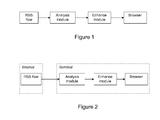
- Figure 1 represents an example of architecture of the device according to the invention.
- the analysis and enhance modules can be embedded in the terminal.
- This architecture doesn't need a gateway or a server but implies more resources in the terminal.
- Figure 2 represents another example of architecture of the device according to the invention.
- the analysis and enhance modules can also be integrated in a gateway or server. This lightens terminals and modules can address different terminals.
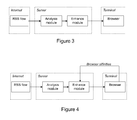
- Figure 3 represents another example of architecture of the device according to the invention.
- the analysis module can be located in the terminal or in a remote server or gateway.
- the analysis relies on two categories, a qualitative and a quantitative analysis, each one composed of thematics.
- the analysis result is a list of notes which gives a profiling of the information provided.
- the qualitative analysis aims at identifying media types. For example:
- the quantitative analysis aims at extracting different information weight, such as:
- This profile is composed of a list of attributes with a note representing its load in document profile.
- the enhance module aims at formatting a RSS document to another document in order to enhance its graphical representation.
- This formatting is made by using profile notes extracted by the analysis module. Rules are applied on these notes in order to perform a variety of graphical enhancement. This brings an initial "list” document to a complex and rich document, oriented towards a better user experience.
- Analysis module attributes are:
- the enhance module rules can be adapted to a browser terminal. This allows to provide enhanced information to different types of terminals (DECT handset, Wi-Fi tablet, Internet radio receiver ... ).
- the browser sends (with a push or pull mechanism) its affinities to the enhance module.
- the affinities can be:
- Figure 4 shows an example of the architecture of the device according to the present invention with the affinity notion.
- Rules are then adapted to terminal characteristics in order to provide the user a friendly document, with deletion of all unusable elements and emphasize of all useful information.
Landscapes
- Engineering & Computer Science (AREA)
- Databases & Information Systems (AREA)
- Theoretical Computer Science (AREA)
- Data Mining & Analysis (AREA)
- Physics & Mathematics (AREA)
- General Engineering & Computer Science (AREA)
- General Physics & Mathematics (AREA)
- Information Retrieval, Db Structures And Fs Structures Therefor (AREA)
- Information Transfer Between Computers (AREA)
Abstract
The present invention relates to a device for automatic analysis and graphical enhancement of multimedia documents comprising:
• An analysis module for performing a qualitative analysis and a quantitative analysis of a multimedia document, said qualitative analysis identifying media types and said quantitative analysis extracting an information weight; and
• An enhance module for formatting said multimedia document to another document in order to enhance its graphical representation, using the results obtained by said analysis module.
• An analysis module for performing a qualitative analysis and a quantitative analysis of a multimedia document, said qualitative analysis identifying media types and said quantitative analysis extracting an information weight; and
• An enhance module for formatting said multimedia document to another document in order to enhance its graphical representation, using the results obtained by said analysis module.
The present invention also relates to a method for automatic analysis and graphical enhancement of multimedia documents.
Description
- The present invention pertains to the field of Information and Communication technologies.
- The present invention more particularly relates to a method and to a device for automatic analysis and graphical enhancement of multimedia documents.
- The present invention relates to content delivery, and more particularly to RSS ("Really Simple Syndication") content delivery. RSS is a family of web feed formats used to publish frequently updated works-such as blog entries, news headlines, audio, and video-in a standardized format. An RSS document (which is called a "feed", "web feed" or "channel") includes full or summarized text, plus metadata such as publishing dates and authorship. Web feeds benefit publishers by letting them syndicate content automatically.
- The present invention aims at providing RSS information to remote terminals (such as DECT handset, Wi-Fi tablet, Internet radio receiver ...) with design and content enhanced and adapted to them.
- RSS technology offers a simple way to provide information to a terminal regardless how it will be rendered. This information is always organized as a list of items, composed of a title and a description. It is textual, can be graphically enhanced by adding an image (RSS image element) and HTML encoded content but it remains a list of items.
- The existing way to graphically enhance and adapt a RSS content to a terminal is to extract information from the flow (temperature and weather condition for example) and to integrate them in a dedicated design. This system is commonly used for widget development (available in personal computer desktop, mobile phone ...) but it implies the perfect knowledge of the RSS flow providing the information. It also becomes dependent of it and any change of this latter can make it become out of service.
- To summarize, the two existing possibilities are to display RSS information:
- in a generic way, as a list of titles and descriptions; or
- in a dedicated way, graphically improved but extremely linked to RSS content source.
- More, remote terminals displaying information provided by RSS flow can be very different and an information meaningful for one terminal can be useless or unusable for another one.
- Below is a Table (Table 1) giving some examples of RSS flow "styles", terminal examples and content interest for them:
Table 1. Pure textual content Content with images Content with only links to external web pages Content with audio podcast DECT handset with text display Useful Poor Unusable Unusable DECT handset with color graphic display Useful Useful Unusable Unusable Wi-Fi tablet Poor Useful Useful Useful Internet radio receiver Unusable Unusable Unusable Useful - The table above (Table 1) shows a notion which is answered by the present invention: RSS browsers have affinities to information type depending on terminal capabilities.
- The present invention aims at solving the above-mentioned drawbacks of the prior art solutions.
- The technical problem the present invention seeks to solve can be defined as: how to analyse and personalize information provided in a multimedia document?
- The present invention is defined, in its broadest sense, as a device for automatic analysis and graphical enhancement of multimedia documents comprising:
- An analysis module for performing a qualitative analysis and a quantitative analysis of a multimedia document, said qualitative analysis identifying media types and said quantitative analysis extracting an information weight; and
- An enhance module for formatting said multimedia document to another document in order to enhance its graphical representation, using the results obtained by said analysis module.
- Preferably, said analysis module provides a list of notes giving a profiling of the information provided in said multimedia document.
- According to an embodiment, the formatting performed by said enhance module is performed by using the list of notes giving a profiling of the information provided in said multimedia document provided by said analysis module.
- Advantageously, said media types are in the group of :
- HTML encoded (for text enhancement, link encoding);
- Existing images (none, some, all titles);
- Links to audio podcast;
- Links to video podcast;
- Keyword existence.
- According to an embodiment, said information weight is in the group of:
- Title number;
- Title length;
- Description length.
- Preferably, said enhance module is adapted to a browser terminal using a notion related to affinity.
- According to an embodiment, said notion related to affinity belongs to the group of:
- display type (black and white, color, size);
- audio or video support;
- alert support; or
- a characteristic used to personalize the format of said multimedia document.
- The present invention also relates to a method for automatic analysis and graphical enhancement of multimedia documents comprising:
- An analysis step for performing a qualitative analysis and a quantitative analysis of a multimedia document, said qualitative analysis identifying media types and said quantitative analysis extracting an information weight; and
- An enhance step for formatting said multimedia document to another document in order to enhance its graphical representation, using the results obtained by said analysis module.
- The advantages provided by the present invention are the following:
- RSS documents are automatically analyzed and graphically enhanced.
- RSS documents are not displayed as a classical title list or with a proprietary widget (with strong link to content provided).
- Their display is adapted to their content (emphasis of images, keywords, title or description number, audio or video podcast automatically play...).
- Their display is adapted to terminal capabilities.
- The graphic enhance module is not linked to RSS document provider. It works with all standard RSS documents.
- Multiple RSS documents have their own way of display and user experience is enhanced with this graphic variety and richness.
- The separation between analysis and enhance modules allows to build a solution architecture where one or both modules can be combined in a server or a gateway to address different terminal types.
- The following detailed description will be better understood with the drawings, in which:
- •
Figure 1, 2 ,3 and 4 show examples of architectures of the device according to the present invention. - The device according to the present invention is composed of two modules. The first one analyses flow content, while the second one enhances its graphic representation.
- In order to gain graphical freedom, the terminal browser can be another standard one such as a WML browser, where graphical design and user interaction can be better optimized.
-
Figure 1 represents an example of architecture of the device according to the invention. - The analysis and enhance modules can be embedded in the terminal. This architecture doesn't need a gateway or a server but implies more resources in the terminal.
-
Figure 2 represents another example of architecture of the device according to the invention. - The analysis and enhance modules can also be integrated in a gateway or server. This lightens terminals and modules can address different terminals.
-
Figure 3 represents another example of architecture of the device according to the invention. - The analysis module can be located in the terminal or in a remote server or gateway.
- According to the present invention, the analysis relies on two categories, a qualitative and a quantitative analysis, each one composed of thematics. The analysis result is a list of notes which gives a profiling of the information provided.
- The qualitative analysis aims at identifying media types. For example:
- HTML encoded (for text enhancement, link encoding, ...)
- existing images (none, some, all titles)
- links to audio podcast
- links to video podcast
- keyword existence (for alerts, ...)
- ...
- The quantitative analysis aims at extracting different information weight, such as:
- title number
- title length
- description length
- ...
- All these data give a document profile. This profile is composed of a list of attributes with a note representing its load in document profile.
- The enhance module aims at formatting a RSS document to another document in order to enhance its graphical representation.
- This formatting is made by using profile notes extracted by the analysis module. Rules are applied on these notes in order to perform a variety of graphical enhancement. This brings an initial "list" document to a complex and rich document, oriented towards a better user experience.
- In the Table (Table 2) below are some examples of analysis and enhance modules results.
- In the present Example:
Analysis module attributes are: - N : number of titles
- I : number of titles with an image
- V : video podcast
- R1 : If only one title, directly display description ("if N=1")
- R2 : If all titles have an image, display all images as a matrix selector for items ("if N=I")
- R3 : Delete items with video podcast ("for any V")
- With the affinity notion, the enhance module rules can be adapted to a browser terminal. This allows to provide enhanced information to different types of terminals (DECT handset, Wi-Fi tablet, Internet radio receiver ... ).
- According to an embodiment, the browser sends (with a push or pull mechanism) its affinities to the enhance module. The affinities can be:
- display type (black and white, color, size, ...)
- audio or video support
- alert support
- or any other kind of characteristic that can be used to personalize the document format.
-
Figure 4 shows an example of the architecture of the device according to the present invention with the affinity notion. - Rules are then adapted to terminal characteristics in order to provide the user a friendly document, with deletion of all unusable elements and emphasize of all useful information.
- The above specification, examples and drawings provide a complete description of the method according to the present invention. Since many embodiments of the invention can be made without departing from the spirit and scope of the invention, the invention resides in the claims herein after appended.
- F1 : A flow with only one textual item (title+description)
- F2 : A flow of 10 items with 2 video podcast links and all titles with an image
| Analysis module | Enhance module | Result | |||||
| N | I | V | R1 | R2 | R3 | ||
| F1 | 1 | 0 | 0 | X | - | - | No title list. Description of unique title is directly displayed |
| F2 | 10 | 10 | Items I2 and I3 | - | X | Remove I2 and I3 | 8 images displayed as a matrix selector for flow items |
Claims (8)
- Device for automatic analysis and graphical enhancement of multimedia documents comprising:• An analysis module for performing a qualitative analysis and a quantitative analysis of a multimedia document, said qualitative analysis identifying media types and said quantitative analysis extracting an information weight; and• An enhance module for formatting said multimedia document to another document in order to enhance its graphical representation, using the results obtained by said analysis module.
- Device according to claim 1, characterized in that said analysis module provides a list of notes giving a profiling of the information provided in said multimedia document.
- Device according to claim 2, characterized in that the formatting performed by said enhance module is performed by using the list of notes giving a profiling of the information provided in said multimedia document provided by said analysis module.
- Device according to any of the previous claims, characterized in that said media types are in the group of :• HTML encoded (for text enhancement, link encoding);• Existing images (none, some, all titles);• Links to audio podcast;• Links to video podcast;• Keyword existence.
- Device according to any of the previous claims, characterized in that said information weight is in the group of:• Title number;• Title length;• Description length.
- Device according to any of the previous claims, characterized in that said enhance module is adapted to a browser terminal using a notion related to affinity.
- Device according to claim 6, characterized in that said notion related to affinity belongs to the group of:• display type (black and white, color, size);• audio or video support;• alert support; or• a characteristic used to personalize the format of said multimedia document.
- Method for automatic analysis and graphical enhancement of multimedia documents comprising:• An analysis step for performing a qualitative analysis and a quantitative analysis of a multimedia document, said qualitative analysis identifying media types and said quantitative analysis extracting an information weight; and• An enhance step for formatting said multimedia document to another document in order to enhance its graphical representation, using the results obtained by said analysis module.
Priority Applications (1)
| Application Number | Priority Date | Filing Date | Title |
|---|---|---|---|
| EP10305339A EP2372579A1 (en) | 2010-04-01 | 2010-04-01 | Method and device for graphical presentation of multimedia documents |
Applications Claiming Priority (1)
| Application Number | Priority Date | Filing Date | Title |
|---|---|---|---|
| EP10305339A EP2372579A1 (en) | 2010-04-01 | 2010-04-01 | Method and device for graphical presentation of multimedia documents |
Publications (1)
| Publication Number | Publication Date |
|---|---|
| EP2372579A1 true EP2372579A1 (en) | 2011-10-05 |
Family
ID=42236533
Family Applications (1)
| Application Number | Title | Priority Date | Filing Date |
|---|---|---|---|
| EP10305339A Withdrawn EP2372579A1 (en) | 2010-04-01 | 2010-04-01 | Method and device for graphical presentation of multimedia documents |
Country Status (1)
| Country | Link |
|---|---|
| EP (1) | EP2372579A1 (en) |
-
2010
- 2010-04-01 EP EP10305339A patent/EP2372579A1/en not_active Withdrawn
Non-Patent Citations (1)
| Title |
|---|
| MOHAN R ET AL: "CONTENT ADAPTATION FRAMEWORK: BRINGING THE INTERNET TO INFORMATION APPLIANCES", 1999 IEEE GLOBAL TELECOMMUNICATIONS CONFERENCE. GLOBECOM'99. SEAMLESS INTERCONNECTION FOR UNIVERSAL SERVICES. RIO DE JANEIRO, BRAZIL, DEC. 5-9, 1999; [IEEE GLOBAL TELECOMMUNICATIONS CONFERENCE], NEW YORK, NY : IEEE, US LNKD- DOI:10.1109/GLOCOM.1999.8, 5 December 1999 (1999-12-05), pages 2015 - 2021, XP000951336, ISBN: 978-0-7803-5797-6 * |
Similar Documents
| Publication | Publication Date | Title |
|---|---|---|
| US8671351B2 (en) | Application modification based on feed content | |
| US10261983B2 (en) | Method and device for webpage browsing, and mobile terminal | |
| US8060830B2 (en) | News feed browser | |
| US7810049B2 (en) | System and method for web navigation using images | |
| US8041781B2 (en) | System and method for providing web system services for storing data and context of client applications on the web | |
| US20060253459A1 (en) | News feed viewer | |
| US20100281042A1 (en) | Method and System for Transforming and Delivering Video File Content for Mobile Devices | |
| US8046438B2 (en) | System and method of restoring data and context of client applications stored on the web | |
| US20080228806A1 (en) | System and method of providing context information for client application data stored on the web | |
| JP2014029701A (en) | Document processing for mobile devices | |
| CN101566995A (en) | Method and system for integral release of internet information | |
| US20160371237A1 (en) | Media content presentation by categorizing and formatting media types | |
| CN101782914A (en) | Method and system for prompting web page information | |
| US20080228903A1 (en) | System and method of serving advertisements for web applications | |
| US8429152B2 (en) | Terminal device, content displaying method, and content displaying program | |
| KR20160098797A (en) | Image processing apparatus, controlling method of image processing apparatus and system | |
| WO2015046035A1 (en) | Page/site server for immediately displaying noteworthy places in page content, program, and method | |
| CN104010279B (en) | A kind of multimedia message browsing method, system and user terminal | |
| US8046437B2 (en) | System and method of storing data and context of client application on the web | |
| KR100722992B1 (en) | Method of transmitting contents in broadcasting system and broadcasting system implementing same | |
| US9990115B1 (en) | User interface for providing additional content | |
| US20090037845A1 (en) | Method and System for Editing Web Data | |
| US20140101284A1 (en) | System and method for customization of web content | |
| KR20030063559A (en) | Method for converting data through extensible markup language | |
| KR101054830B1 (en) | Feed retrieval service method and apparatus for linking with feed use service provider supporting various types of feed use |
Legal Events
| Date | Code | Title | Description |
|---|---|---|---|
| PUAI | Public reference made under article 153(3) epc to a published international application that has entered the european phase |
Free format text: ORIGINAL CODE: 0009012 |
|
| AK | Designated contracting states |
Kind code of ref document: A1 Designated state(s): AT BE BG CH CY CZ DE DK EE ES FI FR GB GR HR HU IE IS IT LI LT LU LV MC MK MT NL NO PL PT RO SE SI SK SM TR |
|
| AX | Request for extension of the european patent |
Extension state: AL BA ME RS |
|
| STAA | Information on the status of an ep patent application or granted ep patent |
Free format text: STATUS: THE APPLICATION IS DEEMED TO BE WITHDRAWN |
|
| 18D | Application deemed to be withdrawn |
Effective date: 20120406 |