EP2372456A2 - Novel polymers and photoresist compositions - Google Patents
Novel polymers and photoresist compositions Download PDFInfo
- Publication number
- EP2372456A2 EP2372456A2 EP11160600A EP11160600A EP2372456A2 EP 2372456 A2 EP2372456 A2 EP 2372456A2 EP 11160600 A EP11160600 A EP 11160600A EP 11160600 A EP11160600 A EP 11160600A EP 2372456 A2 EP2372456 A2 EP 2372456A2
- Authority
- EP
- European Patent Office
- Prior art keywords
- groups
- photoacid
- group
- resin
- photoacid generator
- Prior art date
- Legal status (The legal status is an assumption and is not a legal conclusion. Google has not performed a legal analysis and makes no representation as to the accuracy of the status listed.)
- Withdrawn
Links
- 0 CC(OCC**S(C1C(CCCC(F)(F)F)*1)(=O)=O)OC(*(C)C=C)=O Chemical compound CC(OCC**S(C1C(CCCC(F)(F)F)*1)(=O)=O)OC(*(C)C=C)=O 0.000 description 10
- WLOQLWBIJZDHET-UHFFFAOYSA-N c(cc1)ccc1[S+](c1ccccc1)c1ccccc1 Chemical compound c(cc1)ccc1[S+](c1ccccc1)c1ccccc1 WLOQLWBIJZDHET-UHFFFAOYSA-N 0.000 description 2
- UCTSLPKJCMXTSL-UHFFFAOYSA-N CC(C(OCOc(cc1)ccc1S(c1ccccc1)c1ccccc1)=O)=C Chemical compound CC(C(OCOc(cc1)ccc1S(c1ccccc1)c1ccccc1)=O)=C UCTSLPKJCMXTSL-UHFFFAOYSA-N 0.000 description 1
- GDLOOONDLHYPBF-UHFFFAOYSA-N CC(C)(C(CC(C1)C2)(CC1C1)CC21OC(COc(cc1)ccc1S(c1ccccc1)c1ccccc1)=O)OC(C(C)=C)=O Chemical compound CC(C)(C(CC(C1)C2)(CC1C1)CC21OC(COc(cc1)ccc1S(c1ccccc1)c1ccccc1)=O)OC(C(C)=C)=O GDLOOONDLHYPBF-UHFFFAOYSA-N 0.000 description 1
- PBPPYVWABUESCS-UHFFFAOYSA-N CC(C)(C(CC(C1)C2)(CC1C1)CC21OC(COc1ccc(C(c2ccccc2)O)cc1)=O)OC(C(C)=C)=O Chemical compound CC(C)(C(CC(C1)C2)(CC1C1)CC21OC(COc1ccc(C(c2ccccc2)O)cc1)=O)OC(C(C)=C)=O PBPPYVWABUESCS-UHFFFAOYSA-N 0.000 description 1
- CDOYZTOFTGTGBC-UHFFFAOYSA-N CC(C)(C)c(cc1)ccc1-c1ccccc1 Chemical compound CC(C)(C)c(cc1)ccc1-c1ccccc1 CDOYZTOFTGTGBC-UHFFFAOYSA-N 0.000 description 1
- SMRLSNWNOZMVJN-UHFFFAOYSA-N CC(C)C(OCOc1ccc(C(c2ccccc2)O)cc1)=O Chemical compound CC(C)C(OCOc1ccc(C(c2ccccc2)O)cc1)=O SMRLSNWNOZMVJN-UHFFFAOYSA-N 0.000 description 1
Classifications
-
- G—PHYSICS
- G03—PHOTOGRAPHY; CINEMATOGRAPHY; ANALOGOUS TECHNIQUES USING WAVES OTHER THAN OPTICAL WAVES; ELECTROGRAPHY; HOLOGRAPHY
- G03F—PHOTOMECHANICAL PRODUCTION OF TEXTURED OR PATTERNED SURFACES, e.g. FOR PRINTING, FOR PROCESSING OF SEMICONDUCTOR DEVICES; MATERIALS THEREFOR; ORIGINALS THEREFOR; APPARATUS SPECIALLY ADAPTED THEREFOR
- G03F7/00—Photomechanical, e.g. photolithographic, production of textured or patterned surfaces, e.g. printing surfaces; Materials therefor, e.g. comprising photoresists; Apparatus specially adapted therefor
- G03F7/004—Photosensitive materials
- G03F7/0045—Photosensitive materials with organic non-macromolecular light-sensitive compounds not otherwise provided for, e.g. dissolution inhibitors
-
- C—CHEMISTRY; METALLURGY
- C08—ORGANIC MACROMOLECULAR COMPOUNDS; THEIR PREPARATION OR CHEMICAL WORKING-UP; COMPOSITIONS BASED THEREON
- C08F—MACROMOLECULAR COMPOUNDS OBTAINED BY REACTIONS ONLY INVOLVING CARBON-TO-CARBON UNSATURATED BONDS
- C08F220/00—Copolymers of compounds having one or more unsaturated aliphatic radicals, each having only one carbon-to-carbon double bond, and only one being terminated by only one carboxyl radical or a salt, anhydride ester, amide, imide or nitrile thereof
- C08F220/02—Monocarboxylic acids having less than ten carbon atoms; Derivatives thereof
- C08F220/10—Esters
- C08F220/38—Esters containing sulfur
-
- G—PHYSICS
- G03—PHOTOGRAPHY; CINEMATOGRAPHY; ANALOGOUS TECHNIQUES USING WAVES OTHER THAN OPTICAL WAVES; ELECTROGRAPHY; HOLOGRAPHY
- G03F—PHOTOMECHANICAL PRODUCTION OF TEXTURED OR PATTERNED SURFACES, e.g. FOR PRINTING, FOR PROCESSING OF SEMICONDUCTOR DEVICES; MATERIALS THEREFOR; ORIGINALS THEREFOR; APPARATUS SPECIALLY ADAPTED THEREFOR
- G03F7/00—Photomechanical, e.g. photolithographic, production of textured or patterned surfaces, e.g. printing surfaces; Materials therefor, e.g. comprising photoresists; Apparatus specially adapted therefor
-
- G—PHYSICS
- G03—PHOTOGRAPHY; CINEMATOGRAPHY; ANALOGOUS TECHNIQUES USING WAVES OTHER THAN OPTICAL WAVES; ELECTROGRAPHY; HOLOGRAPHY
- G03F—PHOTOMECHANICAL PRODUCTION OF TEXTURED OR PATTERNED SURFACES, e.g. FOR PRINTING, FOR PROCESSING OF SEMICONDUCTOR DEVICES; MATERIALS THEREFOR; ORIGINALS THEREFOR; APPARATUS SPECIALLY ADAPTED THEREFOR
- G03F7/00—Photomechanical, e.g. photolithographic, production of textured or patterned surfaces, e.g. printing surfaces; Materials therefor, e.g. comprising photoresists; Apparatus specially adapted therefor
- G03F7/004—Photosensitive materials
-
- G—PHYSICS
- G03—PHOTOGRAPHY; CINEMATOGRAPHY; ANALOGOUS TECHNIQUES USING WAVES OTHER THAN OPTICAL WAVES; ELECTROGRAPHY; HOLOGRAPHY
- G03F—PHOTOMECHANICAL PRODUCTION OF TEXTURED OR PATTERNED SURFACES, e.g. FOR PRINTING, FOR PROCESSING OF SEMICONDUCTOR DEVICES; MATERIALS THEREFOR; ORIGINALS THEREFOR; APPARATUS SPECIALLY ADAPTED THEREFOR
- G03F7/00—Photomechanical, e.g. photolithographic, production of textured or patterned surfaces, e.g. printing surfaces; Materials therefor, e.g. comprising photoresists; Apparatus specially adapted therefor
- G03F7/004—Photosensitive materials
- G03F7/0046—Photosensitive materials with perfluoro compounds, e.g. for dry lithography
-
- G—PHYSICS
- G03—PHOTOGRAPHY; CINEMATOGRAPHY; ANALOGOUS TECHNIQUES USING WAVES OTHER THAN OPTICAL WAVES; ELECTROGRAPHY; HOLOGRAPHY
- G03F—PHOTOMECHANICAL PRODUCTION OF TEXTURED OR PATTERNED SURFACES, e.g. FOR PRINTING, FOR PROCESSING OF SEMICONDUCTOR DEVICES; MATERIALS THEREFOR; ORIGINALS THEREFOR; APPARATUS SPECIALLY ADAPTED THEREFOR
- G03F7/00—Photomechanical, e.g. photolithographic, production of textured or patterned surfaces, e.g. printing surfaces; Materials therefor, e.g. comprising photoresists; Apparatus specially adapted therefor
- G03F7/004—Photosensitive materials
- G03F7/0047—Photosensitive materials characterised by additives for obtaining a metallic or ceramic pattern, e.g. by firing
-
- G—PHYSICS
- G03—PHOTOGRAPHY; CINEMATOGRAPHY; ANALOGOUS TECHNIQUES USING WAVES OTHER THAN OPTICAL WAVES; ELECTROGRAPHY; HOLOGRAPHY
- G03F—PHOTOMECHANICAL PRODUCTION OF TEXTURED OR PATTERNED SURFACES, e.g. FOR PRINTING, FOR PROCESSING OF SEMICONDUCTOR DEVICES; MATERIALS THEREFOR; ORIGINALS THEREFOR; APPARATUS SPECIALLY ADAPTED THEREFOR
- G03F7/00—Photomechanical, e.g. photolithographic, production of textured or patterned surfaces, e.g. printing surfaces; Materials therefor, e.g. comprising photoresists; Apparatus specially adapted therefor
- G03F7/004—Photosensitive materials
- G03F7/039—Macromolecular compounds which are photodegradable, e.g. positive electron resists
- G03F7/0392—Macromolecular compounds which are photodegradable, e.g. positive electron resists the macromolecular compound being present in a chemically amplified positive photoresist composition
-
- G—PHYSICS
- G03—PHOTOGRAPHY; CINEMATOGRAPHY; ANALOGOUS TECHNIQUES USING WAVES OTHER THAN OPTICAL WAVES; ELECTROGRAPHY; HOLOGRAPHY
- G03F—PHOTOMECHANICAL PRODUCTION OF TEXTURED OR PATTERNED SURFACES, e.g. FOR PRINTING, FOR PROCESSING OF SEMICONDUCTOR DEVICES; MATERIALS THEREFOR; ORIGINALS THEREFOR; APPARATUS SPECIALLY ADAPTED THEREFOR
- G03F7/00—Photomechanical, e.g. photolithographic, production of textured or patterned surfaces, e.g. printing surfaces; Materials therefor, e.g. comprising photoresists; Apparatus specially adapted therefor
- G03F7/004—Photosensitive materials
- G03F7/039—Macromolecular compounds which are photodegradable, e.g. positive electron resists
- G03F7/0392—Macromolecular compounds which are photodegradable, e.g. positive electron resists the macromolecular compound being present in a chemically amplified positive photoresist composition
- G03F7/0397—Macromolecular compounds which are photodegradable, e.g. positive electron resists the macromolecular compound being present in a chemically amplified positive photoresist composition the macromolecular compound having an alicyclic moiety in a side chain
-
- G—PHYSICS
- G03—PHOTOGRAPHY; CINEMATOGRAPHY; ANALOGOUS TECHNIQUES USING WAVES OTHER THAN OPTICAL WAVES; ELECTROGRAPHY; HOLOGRAPHY
- G03F—PHOTOMECHANICAL PRODUCTION OF TEXTURED OR PATTERNED SURFACES, e.g. FOR PRINTING, FOR PROCESSING OF SEMICONDUCTOR DEVICES; MATERIALS THEREFOR; ORIGINALS THEREFOR; APPARATUS SPECIALLY ADAPTED THEREFOR
- G03F7/00—Photomechanical, e.g. photolithographic, production of textured or patterned surfaces, e.g. printing surfaces; Materials therefor, e.g. comprising photoresists; Apparatus specially adapted therefor
- G03F7/20—Exposure; Apparatus therefor
- G03F7/2041—Exposure; Apparatus therefor in the presence of a fluid, e.g. immersion; using fluid cooling means
-
- C—CHEMISTRY; METALLURGY
- C08—ORGANIC MACROMOLECULAR COMPOUNDS; THEIR PREPARATION OR CHEMICAL WORKING-UP; COMPOSITIONS BASED THEREON
- C08F—MACROMOLECULAR COMPOUNDS OBTAINED BY REACTIONS ONLY INVOLVING CARBON-TO-CARBON UNSATURATED BONDS
- C08F220/00—Copolymers of compounds having one or more unsaturated aliphatic radicals, each having only one carbon-to-carbon double bond, and only one being terminated by only one carboxyl radical or a salt, anhydride ester, amide, imide or nitrile thereof
- C08F220/02—Monocarboxylic acids having less than ten carbon atoms; Derivatives thereof
- C08F220/10—Esters
- C08F220/38—Esters containing sulfur
- C08F220/382—Esters containing sulfur and containing oxygen, e.g. 2-sulfoethyl (meth)acrylate
Definitions
- the present invention relates to new polymers that comprise units that contain one or more photoacid generator groups and photoresists that comprise such polymers.
- Preferred polymers of the invention are suitable for use in photoresists imaged at short wavelengths such as sub-200 nm, particularly 193 nm.
- Photoresists are photosensitive films used for transfer of images to a substrate.
- a coating layer of a photoresist is formed on a substrate and the photoresist layer is then exposed through a photomask to a source of activating radiation.
- the photomask has areas that are opaque to activating radiation and other areas that are transparent to activating radiation. Exposure to activating radiation provides a photoinduced chemical transformation of the photoresist coating to thereby transfer the pattern of the photomask to the photoresist-coated substrate.
- the photoresist is developed to provide a relief image that permits selective processing of a substrate.
- photoactive polymers comprise photoacid-labile groups.
- the resin acid-labile moiety comprises a photoacid generator.
- photo-induced cleavage of polymer moieties results in generator in liberation of an acidic group (e.g. sulfonic acid and the like) from the polymer.
- suitable resin photoacid-labile groups include e.g. esters and acetals.
- photoactive polymers comprise a covalently linked ionic photoacid generator group, including ionic photoacid generator groups that are complexed as onium salts, such as a sulfonium group or iodonium group.
- photoactive polymers comprise a covalently linked non-ionic photoacid generator group, such as imidosulfonates; oxime sulfonates; N-oxyimidosulfonates; disulfones; N-sulfonyloxyimides; nitrobenzyl compounds; and halogenated compounds.
- a covalently linked non-ionic photoacid generator group such as imidosulfonates; oxime sulfonates; N-oxyimidosulfonates; disulfones; N-sulfonyloxyimides; nitrobenzyl compounds; and halogenated compounds.
- photoactive polymers comprise carbon alicyclic, heteroalicyclic, anhydride, lactone, naphthyl, hydroxyl and/or acrylate groups.
- Particularly preferred photoactive polymers of the invention may comprise polymerized units of or that comprise 2-methyladamantylacrylate, hydroxyadamantylacrylate, hydroxyadamantylmethacrylate,maleic anhydride, norbornene, 3,4-dihydropyran, optionally substituted phenyl and/or optionally substituted naphthyl.
- Photoacid generator groups may be incorporated (covalently linked) to a polymer structure by a variety of approaches.
- a polymerizable monomer such as an acrylate monomer may include a photoacid generator moiety and such monomer may be reacted with other reagents to provide a polymer with repeat units that comprise the photoacid generator moiety.
- photoacid generator groups may be grafted on to formed polymers, e.g. a photoacid generator compound may be grafted onto a hydroxyl group of repeat units of a polymer.
- Polymers of the invention may be preferably employed in photoresists imaged at sub-200 nm wavelengths such as 193 nm, and thus preferably will be substantially free of any phenyl groups.
- preferred polymers contain less than about 10 mole percent phenyl groups, more preferably less than about 5, 4, 3, 2 or 1 mole percent phenyl groups.
- particularly preferred polymers for 193 nm imaging are completely free of phenyl groups.
- Polymers of the invention also may be suitably utilized in resists imaged at higher wavelengths, such as 248 nm.
- Such polymers suitably will contain aromatic groups such as provided by polymerization of a vinyl aromatic group, e.g. a vinylphenol, acetoxystyrene (where the acetoxy group can be de-blocked after polymerization to provide phenolic units), styrene, ⁇ -methylstyrene, vinyl naphthalene and the like.
- the invention also includes negative-acting photoresists that comprise a polymer or polymer blend as disclosed herein.
- Negative-acting photoresists will preferably comprise a crosslinker component e.g. an amine-based materials such as a melamine resin or benzaguanamine resin.
- the invention also provides methods for forming relief images, including methods for forming a highly resolved relief image such as a pattern of lines where each line has essentially vertical sidewalls and a line width of 0.25 microns or less.
- the invention further provides articles of manufacture comprising substrates such as a microelectronic wafer substrate, optoelectronic substrate or liquid crystal display or other flat panel display substrate having coated thereon a polymer, photoresist or resist relief image of the invention.
- photoresist compositions that comprise a resin component that comprises one or more covalently linked photoacid generator groups, wherein the one or more photoacid generator moieties are a component of (i.e. covalently bonded to) one or more resin photoacid-labile groups.
- a photo-induced cleavage reaction of a resin photoacid-labile group results in cleavage (covalent bond-breakage) of a photoacid generator moiety from the resin.
- Resins of the invention may comprise a variety of covalently-linked photoacid generator groups including ionic and/or non-ionic photoacid generators.
- Photoacid generator groups that comprise (and generate upon photoactivation) sulfonic acid(s) are particularly preferred, including sulfonic acids that comprise fluorine substitution.
- a fluorinated sulfonic acid PAG component of a resin has a formula of R(CH 2 ) n (CF 2 ) 2 SO 3 - where n is an integer of 0 to 5 (preferably n is 0, 1, 2 or 3 and R is a chemical bond or a non-hydrogen substitutent such as substituted ester.
- a fluorinated sulfonic acid PAG component of a resin has a formula of R(CY 2 ) n (CF 2 ) 2 SO 3 - where n is an integer of 0 to 5 (preferably n is 0, 1, 2 or 3; each Y is the same or different and is a hydrogen, halo such as fluoro, optionally substituted alkyl particularly C1 -20 haloalkyl such as fluoroalkyl especially C 1-6 fluoroalkyl e.g. ⁇ CF 3 ; and R is a chemical bond or a non-hydrogen substitutent such as substituted ester.
- Specifically preferred PAG monomer compounds of the invention include the following. These monomers can be co-polymerized to provide a PAG-resin of the invention. These preferred compounds also may be suitably complexed with anionic groups other than the particularly preferred anionic groups depicted below.
- Suitable monomers to co-polymerize with photoacid-containing monomers can vary widely ad include the following.
- Polymers of the invention may include a variety of repeat units.
- Preferred polymers may comprise distinct repeat units, e.g. copolymers (at least two distinct repeat units in the polymer), terpolymers (three distinct repeat units), tetrapolymers (at least four distinct repeat units) and other higher order polymers.
- preferred resins may comprise multiple, distinct photoacid-labile groups wherein at least of the photoacid-labile groups comprises a photoacid generator group as disclosed herein.
- Preferred polymerization reagents to provide a resin of the invention include an anhydride such as maleic anhydride; a lactone such as a butyrolactone; a fluorinated olefin such as tetrafluoroethylene; a carbon alicyclic group such as an optionally substituted norbornene or other cyclic olefin; a heteroalicyclic such as an optionally substituted dihydropyran; or an acrylate such as 2-methyladamantanyl methacrylate or 2-methyladamantanyl acrylate.
- the term acrylate is inclusive of substituted acrylates such as methacrylates.
- preferred polymers of the invention may contain i) repeat units with electron-withdrawing groups such as provided by polymerization of an anhydride or a fluorinated olefin and ii) repeat units of alicyclic groups (including carbon alicyclics i.e. the group has all carbon ring members and/or heteroalicyclic i.e. having one or more N, O or S atoms as ring members, preferably 1 or 2 oxygen or sulfur atoms as ring members) preferably where the alicyclic group is fused to the polymer backbone, e.g. the alicyclic ring has at least two carbon ring members that comprise the polymer backbone.
- Preferred fused carbon alicyclic groups are provided by polymerization of cyclic olefin (endocyclic double bond) compounds such as optionally substituted norbornene groups.
- an oxygen heteroalicyclic group preferably will be present in a polymer together with polymerized carbon alicyclic compounds such as optionally substituted norbornene.
- carbon alicyclic group means each ring member of the non-aromatic group is carbon.
- the carbon alicyclic group can have one or more endocyclic carbon-carbon double bonds, provided the ring is not aromatic.
- heteroalicyclic group means at least one ring member of the non-aromatic cyclic group is other than carbon, e.g. N, O or S, typically one or two oxygen or sulfur atoms.
- the heteroalicyclic group can have one or more endocyclic carbon-carbon double bonds, provided the ring is not aromatic.
- An oxygen heteroalicyclic group means that the group has at least one, and typically only one, oxygen ring atoms.
- Preferred alicyclic polymer units carbon alicyclic or heteroalicyclic may be substituted, e.g. by heteroalkyl groups such as ethers (alkoxy) preferably having 1 to about 10 carbon atoms, allcylthio preferably having 1 to about 10 carbon atoms, alkylsulfinyl preferably 1 to about 10 carbon atoms, alkylsulfonyl preferably having 1 to about 10 carbon atoms; optionally substituted alkyl groups including C 1-20 alkyl; esters including esters having from 2 to about 20 carbons; and the like.
- heteroalkyl groups such as ethers (alkoxy) preferably having 1 to about 10 carbon atoms, allcylthio preferably having 1 to about 10 carbon atoms, alkylsulfinyl preferably 1 to about 10 carbon atoms, alkylsulfonyl preferably having 1 to about 10 carbon atoms; optionally substituted alkyl groups including C 1-20 alkyl;
- a resin may comprise repeat units that are provided by reacting polymerization reagents (e.g. unsaturated monomers) that comprise 1) an acrylate compound such as may provide a photoacid-labile group to the formed polymer (e.g. t-butyl acrylate; t-butyl methacrylate; adamantylacrylate, etc.); 2) an anhydride such as maleic anhydride; and/or 3) unsaturated carbon alicyclic compound such as optionally substituted norbornene and/or an unsaturated heteroalicyclic compound such as an optionally substituted dihydropyran.
- polymerization reagents e.g. unsaturated monomers
- an acrylate compound such as may provide a photoacid-labile group to the formed polymer
- an anhydride such as maleic anhydride
- unsaturated carbon alicyclic compound such as optionally substituted norbornene and/or an unsaturated heteroalicyclic compound such as an optionally substituted
- Resin photoacid-labile groups may be a substituent of one or more of the above-mentioned units, such as a substituent of a polymerized vinyl alicyclic ether, vinyl alicyclic thioether or carbon alicyclic group.
- the photoacid labile moiety also may be present as an additional polymer unit, e.g. as a polymerized alkyl acrylate or alkylmethacrylate, particularly an acrylate having an alicyclic moiety such as methyladamantyl acrylate or methyladamantyl methacrylate.
- Preferred alicyclic photoacid-labile moieties are tertiary ester alicyclic hydrocarbon groups that have two or more fused or bridged rings.
- Preferred tertiary ester groups include optionally substituted adamantyl, particularly methyl adamantyl as mentioned above; optionally substituted fencyl groups, particularly ethyl fencyl; optionally substituted pinnanyl; and optionally substituted tricyclo decanyl, particularly an alkyl-substituted tricyclo decanyl such as 8-ethyl-8-tricyclodecanyl e.g. as provided by polymerization of 8-ethyl-8-tricyclodecanyl acrylate and 8-ethyl-8-tricyclodecanyl methacrylate. Additional alicyclic ester groups also will be suitable, including additional bicyclic, tricyclic and other polycyclic moieties.
- Preferred photoacid-labile groups are ester groups, particularly esters that contain a tertiary alicyclic hydrocarbon ester moiety.
- Preferred tertiary alicyclic hydrocarbon ester moieties are polycyclic groups such adamantyl, ethylfencyl or a tricyclo decanyl moiety.
- a tertiary ring carbon of the alicyclic moiety will be covalently linked to the ester oxygen, such as exemplified by the below-depicted specifically preferred polymers.
- the tertiary carbon linked to the ester oxygen also can be exocyclic to the alicyclic ring, typically where the alicyclic ring is one of the substituents of the exocyclic tertiary carbon.
- the tertiary carbon linked to the ester oxygen will be substituted by the alicyclic ring itself, and/or one, two or three alkyl groups having 1 to about 12 carbons, more typically 1 to about 8 carbons, even more typically 1, 2, 3 or 4 carbons.
- the alicyclic group also preferably will not contain aromatic substitution.
- the alicyclic groups may be suitably monocyclic, or polycyclic, particularly bicyclic or tricyclic groups.
- preferred alicyclic groups of photoacid labile ester groups will have a molecular volume of at least about 125 or about 130 ⁇ 3 , more preferably a molecular volume of at least about 135, 140, 150, 155, 160, 165, 170, 175, 180, 185, 190, 195, or 200 ⁇ 3 . Alicyclic groups larger than about 220 or 250 ⁇ 3 may be less preferred, in at least some applications.
- References herein to molecular volumes designate volumetric size as determined by standard computer modeling, which provides optimized chemical bond lengths and angles. A preferred computer program for determining molecular volume as referred to herein is Alchemy 2000, available from Tripos. For a further discussion of computer-based determination of molecular size, see T Omote et al, Polymers for Advanced Technologies, volume 4, pp. 277-287 .
- Particularly suitable tertiary alicyclic groups of photoacid-labile units include the following, where the wavy line depicts a bond to the carboxyl oxygen of the ester group, and R is suitably optionally substituted alkyl, particularly C 1-8 alkyl such as methyl, ethyl, etc.
- Polymers of the invention also may contain photoacid-labile groups that do not contain an alicyclic moiety.
- polymers of the invention may contain photoacid-labile ester units, such as a photoacid-labile alkyl ester.
- Branched photoacid-labile esters are generally preferred such as t-butyl and — C(CH 3 ) 2 CH(CH 3 ) 2 .
- Polymers of the invention used in a chemically-amplified positive photoresist composition should contain a sufficient amount of photogenerated acid labile groups (e.g. esters and/or acetals) to enable formation of resist relief images as desired.
- suitable amount of such acid labile groups will be at least 1 mole percent of total units of the polymer, more preferably about 2 to 30 mole percent, still more typically about 3 to 20 or 30 mole percent of total polymer units.
- polymers of the invention may contain a heteroalicyclic or carbon alicyclic ring that that is preferably fused to a polymer backbone.
- a fused heteroalicyclic ring unit preferably contains one or more oxygen and/or sulfur atoms.
- a cyclic group is fused to a polymer backbone, it is meant that two ring members of the cyclic group, typically two adjacent carbon atoms of the cyclic group, are also part of the polymer backbone.
- Such a fused ring can be provided by polymerizing a cyclic monomer that has an endocyclic double bond.
- Preferred oxygen ring polymer units will be free of other hetero atoms such as sulfur (i.e. only oxygen and carbon ring members).
- the oxygen ring unit will contain one or two oxygen ring atoms and may have one or more ring substituents.
- Preferred polymers of the invention may contain at least about 2 to 5 mole percent of fused heteroalicyclic units based on total units of the polymer; more preferably from about 5 to 50 mole percent of fused heteroalicyclic units based on total units of the polymer; still more preferably from about 5 or 10 to about 40 or 50 percent of fused heteroalicyclic units based on total units of the polymer.
- Preferred polymers of the invention may contain at least about 2 to 5 mole percent of carbon alicyclic units based on total units of the polymer; more preferably from about 5 to 50 mole percent of fused carbon alicyclic units based on total units of the polymer; still more preferably from about 5 or 10 to about 25 or 30 percent of fused carbon alicyclic units based on total units of the polymer.
- polymers of the invention also may contain additional units such as cyano units, lactone units or anhydride units.
- cyano units For example, acrylonitrile or methacrylonitrile may be polymerized to provide pendant cyano groups, or maleic anhydride may be polymerized to provide a fused anhydride unit.
- reaction is conducted under an inert atmosphere (e.g., N 2 or argon) and at elevated temperatures such as about 70° C. or greater, although reaction temperatures may vary depending on the reactivity of the particular reagents employed and the boiling point of the reaction solvent (if a solvent is employed) as generally discussed above.
- Suitable reaction solvents include e.g. tetrahydrofuran, dioxane, ethyl lactate, DMF and the like. Suitable reaction temperatures for any particular system can be readily determined empirically by those skilled in the art based on the present disclosure. A variety of free radical initiators may be employed.
- azo compounds may be employed such as azo-bis-2,4-dimethylpentanenitrile.
- Peroxides, peresters, peracids and persulfates also could be employed.
- a chain transfer agent or other agent to control radical flux or concentration also may be used in the reaction.
- Monomers that can be reacted to provide a desired polymer of the invention can be identified by those skilled in the art.
- suitable monomers include e.g. methacrylate or acrylate that contains the appropriate group substitution (e.g. tertiary alicyclic, t-butyl, etc.) on the carboxy oxygen of the ester group.
- Maleic anhydride is a preferred reagent to provide fused anhydride polymer units.
- Itaconic anhydride also is a preferred reagent to provide anhydride polymer units, preferably where the itaconic anhydride has purified such as by extraction with chloroform prior to polymerization.
- Vinyl lactones are also preferred reagents, such as alpha-butyrolactone.
- a photoacid generator group e.g. an acrylate monomer containing a photoacid generator moiety such as the acrylate photoacid generator of Example 1 which follows
- acrylate monomer containing a photoacid generator moiety such as the acrylate photoacid generator of Example 1 which follows
- Other suitable and preferred reactive monomers and other reagents have been identified above.
- Additional specifically preferred repeat units of polymers of the invention include hydroxyadamanyl groups (such as disclosed in U.S. patent publication Ser. No. 10/082,769 ) and cyanoadamantyl groups (such as disclosed in U.S. Patent Publication 2005/0208418 ). These groups may be present on a polymer that comprise a covalently linked photoacid generator group, or a polymer that is free of photoacid generator groups.
- a polymer of the invention will have a weight average molecular weight (Mw) of about 800 or 1,000 to about 100,000, more preferably about 2,000 to about 30,000, still more preferably from about 2,000 to 15,000 or 20,000, with a molecular weight distribution (Mw/Mn) of about 3 or less, more preferably a molecular weight distribution of about 2 or less, even more preferably a molecular weight distribution of 1.5 or less or even 1.2 or 1 or less.
- Mw weight average molecular weight
- Mw/Mn molecular weight distribution
- the synthetic methods of the invention can provide such low (narrow) molecular weight distributions.
- Molecular weights (either Mw or Mn) of the polymers of the invention are suitably determined by gel permeation chromatography.
- a first polymer comprises one or more covalently linked photoacid generator groups and (ii) a second polymer (distinct from the first polymer) that does not comprise photoacid generator groups.
- a second polymer differs from the first polymer
- at least one of the first and second polymers comprises photoacid-labile groups.
- the second resin that does not comprise photoacid generator groups does contain photoacid-labile groups. It is also suitable for both the first and second polymer to comprise photoacid labile groups.
- the first and second polymers may be present in varying amounts.
- the weight ratio of the first polymer: second polymer in a photoresist or resin blend of the invention is suitably from 1:10 to 10:1, or from 1:5 to 5:1.
- the multiple distinct polymers suitably may be same class of polymers (e.g., both acrylates, cyclic olefin polymer (e.g. norbornyl/anhydride polymers), fluoropolymers), or the polymers may be of distinct classes, e.g. the first polymer may contain acrylate groups and the second polymer may comprise polymerized norbornyl and maleic anhydride groups (with no acrylate groups).
- the second polymer of the bend that does not contain photoacid generator groups may suitably comprise any of the repeat units or be of any of the polymer types as disclosed herein.
- photoacid generator groups may be covalently linked to a resin in accordance with the invention.
- ionic photoacid generator groups are covalently linked to a resin.
- References to an ionic photoacid generator group indicate that the acid is present in a salt form, e.g. such as an onium salt where an acid (e.g. sulfonium or iodonium) is complexed with an anionic species such as a carboxylate or sulfonate anion.
- an acid e.g. sulfonium or iodonium
- an anionic species such as a carboxylate or sulfonate anion.
- activating radiation e.g. 193 nm or 248 nm
- the cationic moiety of an ionic photoacid generator group is covalently linked to a resin, but the anionic moiety is not covalently linked to the resin.
- the anionic moiety of an ionic photoacid generator group is covalently linked to a resin, but the cationic moiety is not covalently linked to the resin.
- both the anionic moiety and cationic moiety may be covalently linked to as resin.
- non-ionic photoacid generator groups are covalently linked to a resin.
- References to a non-ionic photoacid generator group indicate that the group does not include an acid group complexed as a salt. Rather, activating radiation (e.g. 193 m or 248 nm) will cause reaction of the group (e.g. bond-breaking reaction) to generate an acid moiety.
- the acid moiety of a non-ionic photoacid generator group (which is "unmasked” by activating radiation) is covalently linked to a resin, while activating radiation liberates an acidic or non-acidic cleavage product (not covalently to the resin).
- the acid moiety of a non-ionic photoacid generator group (which is "unmasked” by activating radiation such as 193 nm or 248 nm) is cleaved from a resin as a result of such photogeneration (i.e. no covalent linkage), while an acidic or non-acidic moiety of the photoacid generator group remains covalently linked to the resin.
- no cleavage product is generated upon exposure of the non-ionic photoacid generator group to activating radiation such as 193 nm or 248 nm.
- suitable ionic photoacid generator group may comprise one or more onium salts.
- suitable onium salts include for example, halonium salts, quaternary ammonium, phosphonium and arsonium salts, sulfonium salts and sulfoxonium salts or selenium salts.
- Onium salts have been described in the literature such as in U.S. Pat. Nos. 4442197 ; 4603101 ; and 4624912 .
- onium salts include iodonium salt photoacid generators, such as those compounds disclosed in published European application 0 708 368 A1 .
- Such salts include those represented by the following formula: where Ar 1 and Ar 2 each independently represents a substituted or unsubstituted aryl group.
- a preferred example of the aryl group includes a C 6-14 monocyclic or a condensed ring aryl group.
- Preferred examples of the substituent on the aryl group include an alkyl group, a haloalkyl group, a cycloalkyl group, an aryl group, an alkoxy group, a nitro group, a carboxyl group, an alkoxycarbonyl group, a hydroxyl group, mercapto group, and a halogen atom.
- Sulfonium salts are particularly suitable ionic photoacid generators for PAG blends and resists of the invention, such as compounds of the following formula: wherein R 3 , R 4 and R 5 each independently represents a substituted or unsubstituted alkyl group or aryl group.
- R 3 , R 4 and R 5 each independently represents a substituted or unsubstituted alkyl group or aryl group.
- preferred examples of the substituted or unsubstituted alkyl group and aryl group include a C 6-14 aryl group, a C 1-5 alkyl group, and substituted derivatives thereof.
- Preferred examples of the substituent on the alkyl group include a C 1-8 alkoxy group, a C 1-8 alkyl group, nitro group, carboxyl group, hydroxyl group, and a halogen atom.
- Preferred examples of the substituent on the aryl group include a C 1-8 alkoxy group, carboxyl group, an alkoxycarbonyl group, a C 1-8 haloalkyl group, a C 5-8 cycloalkyl group and a C 1-8 alkylthio group.
- Two of R 3 , R 4 and R 5 and Ar 1 and Ar 2 may be connected to each other via its single bond or a substituent.
- Ionic photoacid generator groups may comprise a variety of complexing (anionic) groups including e.g. anions of the formula RSO 3 - where R is adamantane, alkyl (e.g. C 1-12 alkyl) and perfluoroalkyl such as perfluoro (C 1-12 alkyl), particularly perfluoro counter anions of perfluorooctanesulfonate, perfluorononanesulfonate and the like.
- anionic anionic
- Suitable non-ionic include imidosulfonates such as compounds of the following formula: wherein each R 1 and R 1' are each independently hydrogen or C 1-12 alkyl, more preferably hydrogen or methyl; and R is as defined above, i.e. alkyl (e.g. C 1-12 alkyl), camphor, adamantane and other cycloalkyl typically having from 5 to about 12 ring members, and perfluoroalkyl such as perfluoro(C 1-12 alkyl), particularly perfluorinated groups such as perfluorooctanesulfonate, perfluorobutanesulfonate and the like.
- a specifically preferred photoacid generator of this class is N-[(perfluorooctane sulfonyl)oxy]-5-norbornene-2,3-dicarboximide.
- N-sulfonyloxyimide photoacid generators also are suitable non-ionic photoacid generator groups, including those N-sulfonyloxyimides disclosed in International application WO94/10608 , such as compounds of the following formula: where the carbon atoms form a two carbon structure having a single, double or aromatic bond, or, alternatively, wherein they form a three carbon structure, that is, where the ring is instead a five member or six member ring;
- Additional preferred imidosulfonates include groups such as those of the following formula: wherein R is camphor, adamantane, alkyl (e.g. C 1-12 alkyl) and perfluoroalkyl such as perfluoro(C 1-12 alkyl), particularly perfluorooctanesulfonate, perfluorononanesulfonate and the like.
- R is camphor, adamantane, alkyl (e.g. C 1-12 alkyl) and perfluoroalkyl such as perfluoro(C 1-12 alkyl), particularly perfluorooctanesulfonate, perfluorononanesulfonate and the like.
- a specifically preferred non-ionic photoacid generator group is N-[(perfluorooctanesulfonyl)oxy]-5-norbornene-2,3-dicarboximide.
- Non-ionic photoacid generator groups includes additional sulfono groups such as disclosed in U.S. Pat. No. 5558976 .
- Representative examples of these photoacid generators include: where XaR suitably is phenyl optionally substituted by halogen, C 1-6 alkyl, C 1-6 alkoxy, or C 1-6 haloalkyl, R 7 is a straight-chain, branched or cyclic alkyl group having from 1 to 10 carbon atoms and Z is a sulfonyl group or a carbonyl group: where R is as defined above; and where R 22 is hydrogen, hydroxyl or a group represented by the formula X a RSO 2 O-where X a R is as defined above, and R 23 is a straight or branched alkyl group having from 1 to 5 carbon atoms or a group represented by the formula: where R 24 and R 30 are independently a hydrogen atom, a halogen atom, a straight chain or branched
- Suitable non-ionic photoacid generator group include nitrobenzyl-based groups, including those disclosed in EPO published application No. EP 0 717 319 A1 .
- Suitable nitrobenzyl-based compounds include those of the following formula: where each R 1 , R 2 and R 3 are individually selected from the group consisting of hydrogen and lower alkyl group having from 1-4 carbon atoms; and R 4 and R 5 are individually selected from the group consisting of CF 3 and NO 2 and RX a is optionally substituted carbocyclic aryl, particularly optionally substituted phenyl such as phenyl where the 2, 3, and 4 position substituents are selected from hydrogen and C 1-4 alkyl and where the 5 and 6 ring positions are selected from CF 3 , NO 2 and S03R' where R' of optionally substituted C 1-2 alkyl or aryl such as phenyl where such optional substituents may be C 1-4 alkyl, C 1-4 alkoxy, NO 2 or CF 3 .
- Disulfone derivatives are also suitable non-ionic photoacid generator groups. Suitable groups are disclosed e.g. in published European application 0 708 368 A1 .
- Such materials may be represented by the following formula: Ar 3 ⁇ SO 2 ⁇ SO 2 ⁇ RX a wherein RX a is preferably as defined immediately above and Ar 3 represents a substituted or unsubstituted aryl group.
- a preferred example of the aryl group includes a C 6-14 monocyclic or condensed-ring aryl group.
- Preferred examples of the substituent on the aryl group include an alkyl group, a haloalkyl group, a cycloalkyl group, an aryl group, an alkoxy group, nitro group, carboxyl group, an alkoxycarbonyl group, hydroxyl group, mercapto group, and halogen.
- Oxime sulfonate and N-oxyimidosulfonate photoacid generator groups such as disclosed in U.S. Pat. No. 6,482,567 also will be suitable for use in polymers of the invention.
- photoacid generator groups that can generate ⁇ , ⁇ -difluoroalkyl sulfonic acid photoacid upon exposure to activating radiation, e.g. the photoacid generator groups of this type as disclosed in U.S. Pat. No. 6,849,374 .
- disulfone photoacid generator groups including disulfone photoacid generator groups that contain a diazo, substituted methylene or hydrazine moiety interposed between substituted sulfone groups, e.g. the disulfone photoacid generator groups as disclosed in U.S. Pat. No. 6,783,912 .
- Halogenated non-ionic, photoacid generating compounds are also suitable for use in blends and resists of the invention and include, for example, 1,1-bis[p-chlorophenyl]-2,2,2-trichloroethane (DDT); 1,1-bis[p-methoxyphenyl]-2,2,2-trichloroethane; 1,2,5,6,9,10-hexabromocyclodecane; 1,10-dibromodecane; 1,1-bis[p-chlorophenyl] -2,2-dichloroethane; 4,4-dichloro-2-(trichloromethyl) benzhydrol (Kelthane); hexachlorodimethyl sulfone; 2-chloro-6-(trichloromethyl) pyridine; o,o-diethyl-o-(3,5,6-trichloro-2-pyridyl)phosphorothionate; 1,2,3,4,5,6-hexachlorocyclo
- Acid generators are also disclosed in European Patent Application Nos. 0164248 and 0232972 .
- Acid generators that are particularly preferred for deep U.V. exposure include 1,1-bis(p-chlorophenyl)-2,2,2-trichloroethane (DDT); 1,1-bis(p-methoxyphenol)-2,2,2-trichloroethane; 1,1-bis(chlorophenyl)-2,2,2 trichloroethanol; tris(1,2,3-methanesulfonyl)benzene; and tris(trichloromethyl)triazine.
- DDT 1,1-bis(p-chlorophenyl)-2,2,2-trichloroethane
- 1,1-bis(p-methoxyphenol)-2,2,2-trichloroethane 1,1-bis(chlorophenyl)-2,2,2 trichloroethanol
- tris(1,2,3-methanesulfonyl)benzene and tris
- photoresist compositions of the invention may suitably non-polymeric photoacid generator compounds in addition to a polymer that comprises one or more covalently linked photoacid generator groups.
- Suitable photoacid generator compounds for such combined use are disclosed e.g. in U.S. Pat. Nos. 6,482,567 ; 6,783,912 ; 6,849,374 ; and 6,458,506 .
- a photoresist of the invention should comprise a sufficient amount of photoacid generator groups to enable generation of a relief image upon lithographic processing (exposure and development).
- Such photoacid generator groups may be provided solely by photoacid generator groups covalently linked to a polymer of a photoresist, or a combination of photoacid generator groups covalently linked to a polymer and non-polymeric photoacid generator compounds present in the photoresist composition together with the polymeric photoacid generator.
- total solids (all components except solvent carrier) of a photoresist may be at least 1, 2 or 3 weight percent photoacid generator groups, more typically total solids (all components except solvent carrier) of a photoresist may be at least 5, 8 or 10 weight percent photoacid generator groups. It is in general not necessary to employ photoacid generator groups in excess of about 25, 30, 35 or 40 weight percent of total solids of a photoresist composition.
- Photoresists of the invention also may contain other materials.
- other optional additives include actinic and contrast dyes, anti-striation agents, plasticizers, speed enhancers, sensitizers, etc.
- Such optional additives typically will be present in minor concentration in a photoresist composition except for fillers and dyes which may be present in relatively large concentrations such as, e.g., in amounts of from 5 to 30 percent by weight of the total weight of a resist's dry components.
- a preferred optional additive of resists of the invention is an added base, particularly tetrabutylammonium hydroxide (TBAH), which can enhance resolution of a developed resist relief image.
- the added base is suitably used in relatively small amounts, e.g. about 1 to 10 percent by weight relative to the PAG, more typically 1 to about 5 weight percent.
- ammonium sulfonate salts such as piperidinium p-toluenesulfonate and dicyclohexylammonium p-toluenesulfonate
- alkyl amines such as tripropylamine and dodecylamine
- aryl amines such as diphenylamine, triphenylamine, aminophenol, 2-(4-aminophenyl)-2-(4-hydroxyphenyl)propane, etc.
- the resin binder component of resists of the invention are typically used in an amount sufficient to render an exposed coating layer of the resist developable such as with an aqueous alkaline solution. More particularly, a resin binder will suitably comprise 50 to about 90 weight percent of total solids of the resist.
- the photoactive component should be present in an amount sufficient to enable generation of a latent image in a coating layer of the resist. More specifically, the photoactive component will suitably be present in an amount of from about 1 to 40 weight percent of total solids of a resist. Typically, lesser amounts of the photoactive component will be suitable for chemically amplified resists.
- a resist of the invention can be prepared as a coating composition by dissolving the components of the photoresist in a suitable solvent such as, e.g., a glycol ether such as 2-methoxyethyl ether (diglyme), ethylene glycol monomethyl ether, propylene glycol monomethyl ether; lactates such as ethyl lactate or methyl lactate, with ethyl lactate being preferred; propionates, particularly methyl propionate and ethyl propionate; a Cellosolve ester such as methyl Cellosolve acetate; an aromatic hydrocarbon such toluene or xylene; or a ketone such as methylethyl ketone, cyclohexanone and 2-heptanone.
- a suitable solvent such as, e.g., a glycol ether such as 2-methoxyethyl ether (diglyme), ethylene glycol monomethyl ether, propylene glycol monomethyl
- the photoresists of the invention can be used in accordance with known procedures. Though the photoresists of the invention may be applied as a dry film, they are preferably applied on a substrate as a liquid coating composition, dried by heating to remove solvent preferably until the coating layer is tack free, exposed through a photomask to activating radiation, optionally post-exposure baked to create or enhance solubility differences between exposed and nonexposed regions of the resist coating layer, and then developed preferably with an aqueous alkaline developer to form a relief image.
- a liquid coating resist composition may be applied by any standard means such as spinning, dipping or roller coating.
- the photoresist layer (with overcoated barrier composition layer, if present) is then exposed to activating radiation preferably in an immersion lithography system, i.e. where the space between the exposure tool (particularly the projection lens) and the photoresist coated substrate is occupied by an immersion fluid, such as water or water mixed with one or more additives such as cesium sulfate which can provide a fluid of enhanced refractive index.
- an immersion fluid such as water or water mixed with one or more additives such as cesium sulfate which can provide a fluid of enhanced refractive index.
- the immersion fluid e.g., water
- the immersion fluid has been treated to avoid bubbles, e.g. water can be degassed to avoid nanobubbles.
- immersion exposing indicates that exposure is conducted with such a fluid layer (e.g. water or water with additives) interposed between an exposure tool and the coated photoresist composition layer.
- a fluid layer e.g. water or water with additives
- the substrate on which a resist of the invention is applied and processed suitably can be any substrate used in processes involving photoresists such as a microelectronic wafer.
- the substrate can be a silicon, silicon dioxide or aluminum-aluminum oxide microelectronic wafer.
- Gallium arsenide, ceramic, quartz or copper substrates may also be employed.
- Substrates used for liquid crystal display and other flat panel display applications are also suitably employed, e.g. glass substrates, indium tin oxide coated substrates and the like.
- the exposure energy should be sufficient to effectively activate the photoactive component of the radiation sensitive system to produce a patterned image in the resist coating layer.
- Suitable exposure energies typically range from about 1 to 300 mJ/cm 2 .
- preferred exposure wavelengths include sub-200 nm such as 193 nm.
- Suitable post-exposure bake temperatures are from about 50°C or greater, more specifically from about 50 to 140°C.
- a post-development bake may be employed if desired at temperatures of from about 100 to 150°C for several minutes or longer to further cure the relief image formed upon development.
- the substrate surface bared by development may then be selectively processed, for example chemically etching or plating substrate areas bared of photoresist in accordance with procedures known in the art.
- Suitable etchants include a hydrofluoric acid etching solution and a plasma gas etch such as an oxygen plasma etch.
- Triphenysulfonium 4-hydroxy-1,1,2,2-tetrafluorobutanesulfonate (489 parts) and pTSA (4.9 parts) are mixed with vinyl methacrylate (336 parts). The resulting mixture is stirred at 50°C for 18hr. Usual aqueous workup gives triphenysulfonium 4-(1'-methacryloxyethoxy)-1,1,2,2-tetrafluorobutanesulfonate
- p20x volume isopropyl alcohol dried, redissolved into tetrahydrofuran ⁇ 30% and then a second organic solvent (e.g. p20x volume isopropyl alcohol) precipitation. The material is then dried over night in a vacuum oven.
- a second organic solvent e.g. p20x volume isopropyl alcohol
- a photoresist of the invention is prepared by mixing the following components with amounts expressed as weight percent based on total weight of the resist compositions: Resist components Amount (wt.%) Resin 15 Base additive 0.017 Surfactant 0.0071 Ethyl lactate 81
- the resin binder is the PAG resin of Example 3 above; the base additive is :
- the formulated resist composition is spin coated onto HMDS vapor primed 4 inch silicon wafers and softbaked via a vacuum hotplate at 90°C for 60 seconds.
- the resist coating layer is exposed through a photomask at 193 nm, and then the exposed coating layers are post-exposure baked at 110°C.
- the coated wafers are then treated with 0.26N aqueous tetrabutylammonium hydroxide solution to develop the imaged resist layer.
Landscapes
- Physics & Mathematics (AREA)
- Spectroscopy & Molecular Physics (AREA)
- General Physics & Mathematics (AREA)
- Chemical & Material Sciences (AREA)
- Health & Medical Sciences (AREA)
- Ceramic Engineering (AREA)
- Engineering & Computer Science (AREA)
- Chemical Kinetics & Catalysis (AREA)
- Medicinal Chemistry (AREA)
- Polymers & Plastics (AREA)
- Organic Chemistry (AREA)
- Materials For Photolithography (AREA)
- Addition Polymer Or Copolymer, Post-Treatments, Or Chemical Modifications (AREA)
- Exposure And Positioning Against Photoresist Photosensitive Materials (AREA)
Abstract
Description
- The present invention relates to new polymers that comprise units that contain one or more photoacid generator groups and photoresists that comprise such polymers. Preferred polymers of the invention are suitable for use in photoresists imaged at short wavelengths such as sub-200 nm, particularly 193 nm.
- Photoresists are photosensitive films used for transfer of images to a substrate. A coating layer of a photoresist is formed on a substrate and the photoresist layer is then exposed through a photomask to a source of activating radiation. The photomask has areas that are opaque to activating radiation and other areas that are transparent to activating radiation. Exposure to activating radiation provides a photoinduced chemical transformation of the photoresist coating to thereby transfer the pattern of the photomask to the photoresist-coated substrate. Following exposure, the photoresist is developed to provide a relief image that permits selective processing of a substrate.
- While currently available photoresists are suitable for many applications, current resists also can exhibit significant shortcomings, particularly in high performance applications such as formation of highly resolved sub-half micron and sub-quarter micron features. Certain efforts have been reported to covalently link a photoacid generator component to a resist resin. See
U.S. Pat. No. 7,049,044 andU.S. 2008/0206671 . - We have now found novel photoactive polymers and photoresist compositions that comprise the polymers as a resin component.
- In one aspect, photoactive polymers are provided that comprise photoacid-labile groups. In preferred embodiments, the resin acid-labile moiety comprises a photoacid generator. In preferred embodiments, photo-induced cleavage of polymer moieties results in generator in liberation of an acidic group (e.g. sulfonic acid and the like) from the polymer.
- In preferred aspects, suitable resin photoacid-labile groups include e.g. esters and acetals.
- In another aspect, photoactive polymers are provided that comprise a covalently linked ionic photoacid generator group, including ionic photoacid generator groups that are complexed as onium salts, such as a sulfonium group or iodonium group.
- In yet another aspect, photoactive polymers are provided that comprise a covalently linked non-ionic photoacid generator group, such as imidosulfonates; oxime sulfonates; N-oxyimidosulfonates; disulfones; N-sulfonyloxyimides; nitrobenzyl compounds; and halogenated compounds.
- In a further aspect, photoactive polymers are provided that comprise carbon alicyclic, heteroalicyclic, anhydride, lactone, naphthyl, hydroxyl and/or acrylate groups.
- Particularly preferred photoactive polymers of the invention may comprise polymerized units of or that comprise 2-methyladamantylacrylate, hydroxyadamantylacrylate, hydroxyadamantylmethacrylate,maleic anhydride, norbornene, 3,4-dihydropyran, optionally substituted phenyl and/or optionally substituted naphthyl.
- Photoacid generator groups may be incorporated (covalently linked) to a polymer structure by a variety of approaches. For instance, a polymerizable monomer such as an acrylate monomer may include a photoacid generator moiety and such monomer may be reacted with other reagents to provide a polymer with repeat units that comprise the photoacid generator moiety. Alternatively, photoacid generator groups may be grafted on to formed polymers, e.g. a photoacid generator compound may be grafted onto a hydroxyl group of repeat units of a polymer.
- Polymers of the invention may be preferably employed in photoresists imaged at sub-200 nm wavelengths such as 193 nm, and thus preferably will be substantially free of any phenyl groups. For example, preferred polymers contain less than about 10 mole percent phenyl groups, more preferably less than about 5, 4, 3, 2 or 1 mole percent phenyl groups. In certain aspects, particularly preferred polymers for 193 nm imaging are completely free of phenyl groups.
- Polymers of the invention also may be suitably utilized in resists imaged at higher wavelengths, such as 248 nm. Such polymers suitably will contain aromatic groups such as provided by polymerization of a vinyl aromatic group, e.g. a vinylphenol, acetoxystyrene (where the acetoxy group can be de-blocked after polymerization to provide phenolic units), styrene, α-methylstyrene, vinyl naphthalene and the like.
- The invention also includes negative-acting photoresists that comprise a polymer or polymer blend as disclosed herein. Negative-acting photoresists will preferably comprise a crosslinker component e.g. an amine-based materials such as a melamine resin or benzaguanamine resin.
- The invention also provides methods for forming relief images, including methods for forming a highly resolved relief image such as a pattern of lines where each line has essentially vertical sidewalls and a line width of 0.25 microns or less. The invention further provides articles of manufacture comprising substrates such as a microelectronic wafer substrate, optoelectronic substrate or liquid crystal display or other flat panel display substrate having coated thereon a polymer, photoresist or resist relief image of the invention.
- Other aspects of the invention are disclosed infra.
- As discussed above, we now provide new photoresist compositions that comprise a resin component that comprises one or more covalently linked photoacid generator groups, wherein the one or more photoacid generator moieties are a component of (i.e. covalently bonded to) one or more resin photoacid-labile groups. Preferably, a photo-induced cleavage reaction of a resin photoacid-labile group results in cleavage (covalent bond-breakage) of a photoacid generator moiety from the resin.
- Thus, in preferred aspects, during lithographic processing, photoinduced-reaction of the photoacid-labile groups results in cleavage of the one or more photoacid generator groups from the resin. Resins of the invention may comprise a variety of covalently-linked photoacid generator groups including ionic and/or non-ionic photoacid generators. Photoacid generator groups that comprise (and generate upon photoactivation) sulfonic acid(s) are particularly preferred, including sulfonic acids that comprise fluorine substitution.
- In especially preferred aspects, a fluorinated sulfonic acid PAG component of a resin has a formula of R(CH2)n(CF2)2SO3- where n is an integer of 0 to 5 (preferably n is 0, 1, 2 or 3 and R is a chemical bond or a non-hydrogen substitutent such as substituted ester. In another preferred aspect, a fluorinated sulfonic acid PAG component of a resin has a formula of R(CY2)n(CF2)2SO3- where n is an integer of 0 to 5 (preferably n is 0, 1, 2 or 3; each Y is the same or different and is a hydrogen, halo such as fluoro, optionally substituted alkyl particularly C1-20haloalkyl such as fluoroalkyl especially C1-6fluoroalkyl e.g. ―CF3; and R is a chemical bond or a non-hydrogen substitutent such as substituted ester.
- Specifically preferred PAG monomer compounds of the invention include the following. These monomers can be co-polymerized to provide a PAG-resin of the invention. These preferred compounds also may be suitably complexed with anionic groups other than the particularly preferred anionic groups depicted below.


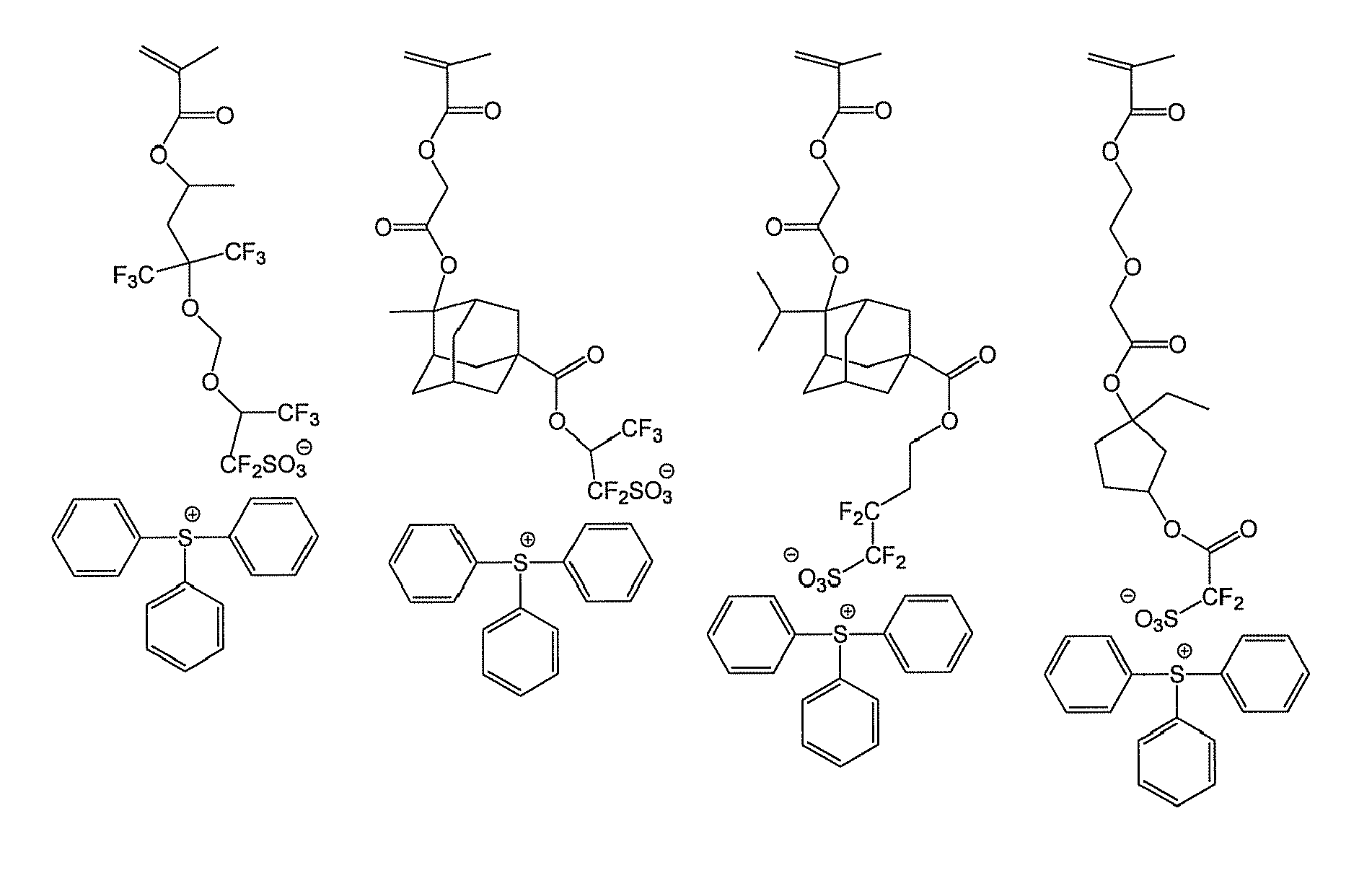
- Suitable monomers to co-polymerize with photoacid-containing monomers can vary widely ad include the following.


- Polymers of the invention may include a variety of repeat units. Preferred polymers may comprise distinct repeat units, e.g. copolymers (at least two distinct repeat units in the polymer), terpolymers (three distinct repeat units), tetrapolymers (at least four distinct repeat units) and other higher order polymers.
- In certain aspects, preferred resins may comprise multiple, distinct photoacid-labile groups wherein at least of the photoacid-labile groups comprises a photoacid generator group as disclosed herein.
- Preferred polymerization reagents to provide a resin of the invention include an anhydride such as maleic anhydride; a lactone such as a butyrolactone; a fluorinated olefin such as tetrafluoroethylene; a carbon alicyclic group such as an optionally substituted norbornene or other cyclic olefin; a heteroalicyclic such as an optionally substituted dihydropyran; or an acrylate such as 2-methyladamantanyl methacrylate or 2-methyladamantanyl acrylate. As used herein, the term acrylate is inclusive of substituted acrylates such as methacrylates.
- Thus, preferred polymers of the invention may contain i) repeat units with electron-withdrawing groups such as provided by polymerization of an anhydride or a fluorinated olefin and ii) repeat units of alicyclic groups (including carbon alicyclics i.e. the group has all carbon ring members and/or heteroalicyclic i.e. having one or more N, O or S atoms as ring members, preferably 1 or 2 oxygen or sulfur atoms as ring members) preferably where the alicyclic group is fused to the polymer backbone, e.g. the alicyclic ring has at least two carbon ring members that comprise the polymer backbone. Preferred fused carbon alicyclic groups are provided by polymerization of cyclic olefin (endocyclic double bond) compounds such as optionally substituted norbornene groups.
- Additionally, an oxygen heteroalicyclic group preferably will be present in a polymer together with polymerized carbon alicyclic compounds such as optionally substituted norbornene.
- As referred to herein, the term "carbon alicyclic group" means each ring member of the non-aromatic group is carbon. The carbon alicyclic group can have one or more endocyclic carbon-carbon double bonds, provided the ring is not aromatic.
- As referred to herein, the term "heteroalicyclic group" means at least one ring member of the non-aromatic cyclic group is other than carbon, e.g. N, O or S, typically one or two oxygen or sulfur atoms. The heteroalicyclic group can have one or more endocyclic carbon-carbon double bonds, provided the ring is not aromatic. An oxygen heteroalicyclic group means that the group has at least one, and typically only one, oxygen ring atoms.
- Preferred alicyclic polymer units carbon alicyclic or heteroalicyclic) may be substituted, e.g. by heteroalkyl groups such as ethers (alkoxy) preferably having 1 to about 10 carbon atoms, allcylthio preferably having 1 to about 10 carbon atoms, alkylsulfinyl preferably 1 to about 10 carbon atoms, alkylsulfonyl preferably having 1 to about 10 carbon atoms; optionally substituted alkyl groups including C1-20 alkyl; esters including esters having from 2 to about 20 carbons; and the like.
- In certain preferred systems, a resin may comprise repeat units that are provided by reacting polymerization reagents (e.g. unsaturated monomers) that comprise 1) an acrylate compound such as may provide a photoacid-labile group to the formed polymer (e.g. t-butyl acrylate; t-butyl methacrylate; adamantylacrylate, etc.); 2) an anhydride such as maleic anhydride; and/or 3) unsaturated carbon alicyclic compound such as optionally substituted norbornene and/or an unsaturated heteroalicyclic compound such as an optionally substituted dihydropyran.
- Also in certain preferred systems and resists of the invention, the following polymers are suitable:
- 1. a phenolic resin that contains acid-labile groups that can provide a chemically amplified positive resist particularly suitable for imaging at 248 nm. Particularly preferred resins of this class include: i) polymers that contain polymerized units of a vinyl phenol and an alkyl acrylate, where the polymerized alkyl acrylate units can undergo a deblocking reaction in the presence of photoacid. Exemplary alkyl acrylates that can undergo a photoacid-induced deblocking reaction include e.g. t-butyl acrylate, t-butyl methacrylate, methyladamantyl acrylate, methyl adamantyl methacrylate, and other non-cyclic alkyl and alicyclic acrylates that can undergo a photoacid-induced reaction, such as polymers in
U.S. Pat. Nos. 6,042,997 and5492793 ; ii) polymers that contain polymerized units of a vinyl phenol, an optionally substituted vinyl phenyl (e.g. styrene) that does not contain a hydroxy or carboxy ring substituent, and an alkyl acrylate such as those deblocking groups described with polymers i) above, such as polymers described inU.S. Pat. No. 6,042,997 ; and iii) polymers that contain repeat units that comprise an acetal or ketal moiety that will react with photoacid, and optionally aromatic repeat units such as phenyl or phenolic groups; such polymers have been described inU.S. Pat. Nos. 5929176 and6,090,526 . - 2. a resin that is substantially or completely free of phenyl or other aromatic groups that can provide a chemically amplified positive resist particularly suitable for imaging at sub-200 nm wavelengths such as 193 nm. Particularly preferred resins of this class include: i) polymers that contain polymerized units of a non-aromatic cyclic olefin (endocyclic double bond) such as an optionally substituted norbornene, such as polymers described in
U.S. Pat. Nos. 5843624 , and6,048,664 ; ii) polymers that contain alkyl acrylate units such as e.g. t-butyl acrylate, t-butyl methacrylate, methyladamantyl acrylate, methyl adamantyl methacrylate, and other non-cyclic alkyl and alicyclic acrylates; such polymers have been described inU.S. Pat. No. 6,057,083 ; European Published ApplicationsEP01008913A1 EP00930542A1 U.S. patent application Ser. No. 09/143,462 , and iii) polymers that contain polymerized anhydride units, particularly polymerized maleic anhydride and/or itaconic anhydride units, such as disclosed inEuropean Published Application EP01008913A1 U.S. Pat. No. 6,048,662 . - 3. a resin that contains repeat units that contain a hetero atom, particularly oxygen and/or sulfur (but other than an anhydride, i.e. the unit does not contain a keto ring atom), and preferable are substantially or completely free of any aromatic units. Preferably, the heteroalicyclic unit is fused to the resin backbone, and further preferred is where the resin comprises a fused carbon alicyclic unit such as provided by polymerization of a norborene group and/or an anhydride unit such as provided by polymerization of a maleic anhydride or itaconic anhydride. Such resins are disclosed in
PCT/US01/14914 andU.S. application Ser. No. 09/567,634 . - 4. a resin that contains fluorine substitution (fluoropolymer), e.g. as may be provided by polymerization of tetrafluoroethylene, a fluorinated aromatic group such as fluoro-styrene compound, and the like. Examples of such resins are disclosed e.g. in
PCT/US99/21912 - Resin photoacid-labile groups may be a substituent of one or more of the above-mentioned units, such as a substituent of a polymerized vinyl alicyclic ether, vinyl alicyclic thioether or carbon alicyclic group. The photoacid labile moiety also may be present as an additional polymer unit, e.g. as a polymerized alkyl acrylate or alkylmethacrylate, particularly an acrylate having an alicyclic moiety such as methyladamantyl acrylate or methyladamantyl methacrylate. Preferred alicyclic photoacid-labile moieties are tertiary ester alicyclic hydrocarbon groups that have two or more fused or bridged rings. Preferred tertiary ester groups include optionally substituted adamantyl, particularly methyl adamantyl as mentioned above; optionally substituted fencyl groups, particularly ethyl fencyl; optionally substituted pinnanyl; and optionally substituted tricyclo decanyl, particularly an alkyl-substituted tricyclo decanyl such as 8-ethyl-8-tricyclodecanyl e.g. as provided by polymerization of 8-ethyl-8-tricyclodecanyl acrylate and 8-ethyl-8-tricyclodecanyl methacrylate. Additional alicyclic ester groups also will be suitable, including additional bicyclic, tricyclic and other polycyclic moieties.
- Preferred photoacid-labile groups are ester groups, particularly esters that contain a tertiary alicyclic hydrocarbon ester moiety. Preferred tertiary alicyclic hydrocarbon ester moieties are polycyclic groups such adamantyl, ethylfencyl or a tricyclo decanyl moiety. References herein to a "tertiary alicyclic ester group" or other similar term indicate that a tertiary alicyclic ring carbon is covalently linked to the ester oxygen, i.e. C(=O)O-TR' where T is a tertiary ring carbon of alicyclic group R'. In at least many cases, preferably a tertiary ring carbon of the alicyclic moiety will be covalently linked to the ester oxygen, such as exemplified by the below-depicted specifically preferred polymers. However, the tertiary carbon linked to the ester oxygen also can be exocyclic to the alicyclic ring, typically where the alicyclic ring is one of the substituents of the exocyclic tertiary carbon. Typically, the tertiary carbon linked to the ester oxygen will be substituted by the alicyclic ring itself, and/or one, two or three alkyl groups having 1 to about 12 carbons, more typically 1 to about 8 carbons, even more typically 1, 2, 3 or 4 carbons. The alicyclic group also preferably will not contain aromatic substitution. The alicyclic groups may be suitably monocyclic, or polycyclic, particularly bicyclic or tricyclic groups.
- Preferred alicyclic moieties (e.g. group TR' of C(=O)O-TR') of photoacid labile ester groups of polymers of the invention have rather large volume. It has been found that such bulky alicyclic groups can provide enhanced resolution when used in copolymers of the invention.
- More particularly, preferred alicyclic groups of photoacid labile ester groups will have a molecular volume of at least about 125 or about 130 Å3, more preferably a molecular volume of at least about 135, 140, 150, 155, 160, 165, 170, 175, 180, 185, 190, 195, or 200 Å3. Alicyclic groups larger than about 220 or 250 Å3 may be less preferred, in at least some applications. References herein to molecular volumes designate volumetric size as determined by standard computer modeling, which provides optimized chemical bond lengths and angles. A preferred computer program for determining molecular volume as referred to herein is Alchemy 2000, available from Tripos. For a further discussion of computer-based determination of molecular size, see T Omote et al, Polymers for Advanced Technologies, volume 4, pp. 277-287.
- Particularly suitable tertiary alicyclic groups of photoacid-labile units include the following, where the wavy line depicts a bond to the carboxyl oxygen of the ester group, and R is suitably optionally substituted alkyl, particularly C1-8 alkyl such as methyl, ethyl, etc.


- Polymers of the invention also may contain photoacid-labile groups that do not contain an alicyclic moiety. For example, polymers of the invention may contain photoacid-labile ester units, such as a photoacid-labile alkyl ester. Generally, the carboxyl oxygen (i.e. the carboxyl oxygen as underlined as follows: —C(=O)O) of the photoacid-labile ester will be covalently linked to the quaternary carbon. Branched photoacid-labile esters are generally preferred such as t-butyl and — C(CH3)2CH(CH3)2.
- Polymers of the invention used in a chemically-amplified positive photoresist composition should contain a sufficient amount of photogenerated acid labile groups (e.g. esters and/or acetals) to enable formation of resist relief images as desired. For instance, suitable amount of such acid labile groups will be at least 1 mole percent of total units of the polymer, more preferably about 2 to 30 mole percent, still more typically about 3 to 20 or 30 mole percent of total polymer units.
- As mentioned, polymers of the invention may contain a heteroalicyclic or carbon alicyclic ring that that is preferably fused to a polymer backbone. A fused heteroalicyclic ring unit preferably contains one or more oxygen and/or sulfur atoms. As indicated above, by stating herein that a cyclic group is fused to a polymer backbone, it is meant that two ring members of the cyclic group, typically two adjacent carbon atoms of the cyclic group, are also part of the polymer backbone. Such a fused ring can be provided by polymerizing a cyclic monomer that has an endocyclic double bond.
- Preferred oxygen ring polymer units will be free of other hetero atoms such as sulfur (i.e. only oxygen and carbon ring members). Typically, the oxygen ring unit will contain one or two oxygen ring atoms and may have one or more ring substituents.
- Preferred polymers of the invention may contain at least about 2 to 5 mole percent of fused heteroalicyclic units based on total units of the polymer; more preferably from about 5 to 50 mole percent of fused heteroalicyclic units based on total units of the polymer; still more preferably from about 5 or 10 to about 40 or 50 percent of fused heteroalicyclic units based on total units of the polymer.
- Preferred polymers of the invention may contain at least about 2 to 5 mole percent of carbon alicyclic units based on total units of the polymer; more preferably from about 5 to 50 mole percent of fused carbon alicyclic units based on total units of the polymer; still more preferably from about 5 or 10 to about 25 or 30 percent of fused carbon alicyclic units based on total units of the polymer.
- As discussed above, polymers of the invention also may contain additional units such as cyano units, lactone units or anhydride units. For example, acrylonitrile or methacrylonitrile may be polymerized to provide pendant cyano groups, or maleic anhydride may be polymerized to provide a fused anhydride unit.
- In the synthesis of the invention, if conducted as a free radial addition, preferably the reaction is conducted under an inert atmosphere (e.g., N2 or argon) and at elevated temperatures such as about 70° C. or greater, although reaction temperatures may vary depending on the reactivity of the particular reagents employed and the boiling point of the reaction solvent (if a solvent is employed) as generally discussed above. Suitable reaction solvents include e.g. tetrahydrofuran, dioxane, ethyl lactate, DMF and the like. Suitable reaction temperatures for any particular system can be readily determined empirically by those skilled in the art based on the present disclosure. A variety of free radical initiators may be employed. For example, azo compounds may be employed such as azo-bis-2,4-dimethylpentanenitrile. Peroxides, peresters, peracids and persulfates also could be employed. A chain transfer agent or other agent to control radical flux or concentration also may be used in the reaction.
- Monomers that can be reacted to provide a desired polymer of the invention can be identified by those skilled in the art. For example, to provide photoacid-labile units, suitable monomers include e.g. methacrylate or acrylate that contains the appropriate group substitution (e.g. tertiary alicyclic, t-butyl, etc.) on the carboxy oxygen of the ester group. Maleic anhydride is a preferred reagent to provide fused anhydride polymer units. Itaconic anhydride also is a preferred reagent to provide anhydride polymer units, preferably where the itaconic anhydride has purified such as by extraction with chloroform prior to polymerization. Vinyl lactones are also preferred reagents, such as alpha-butyrolactone. To incorporate a photoacid generator group into a polymer, a monomer containing photoacid generator groups (e.g. an acrylate monomer containing a photoacid generator moiety such as the acrylate photoacid generator of Example 1 which follows) can be co-polymerized with one or more other monomers. Other suitable and preferred reactive monomers and other reagents have been identified above.
- Additional specifically preferred repeat units of polymers of the invention include hydroxyadamanyl groups (such as disclosed in
U.S. patent publication Ser. No. 10/082,769 U.S. Patent Publication 2005/0208418 ). These groups may be present on a polymer that comprise a covalently linked photoacid generator group, or a polymer that is free of photoacid generator groups. - Preferably a polymer of the invention will have a weight average molecular weight (Mw) of about 800 or 1,000 to about 100,000, more preferably about 2,000 to about 30,000, still more preferably from about 2,000 to 15,000 or 20,000, with a molecular weight distribution (Mw/Mn) of about 3 or less, more preferably a molecular weight distribution of about 2 or less, even more preferably a molecular weight distribution of 1.5 or less or even 1.2 or 1 or less. The synthetic methods of the invention can provide such low (narrow) molecular weight distributions. Molecular weights (either Mw or Mn) of the polymers of the invention are suitably determined by gel permeation chromatography.
- As discussed above, in one aspect of the invention blends of distinct polymers are provided where (i) a first polymer comprises one or more covalently linked photoacid generator groups and (ii) a second polymer (distinct from the first polymer) that does not comprise photoacid generator groups. Preferably, at least one of the first and second polymers comprises photoacid-labile groups. In certain preferred embodiments, the second resin that does not comprise photoacid generator groups does contain photoacid-labile groups. It is also suitable for both the first and second polymer to comprise photoacid labile groups.
- In this aspect, the first and second polymers may be present in varying amounts. For example, the weight ratio of the first polymer: second polymer in a photoresist or resin blend of the invention is suitably from 1:10 to 10:1, or from 1:5 to 5:1.
- Also in this aspect, the multiple distinct polymers suitably may be same class of polymers (e.g., both acrylates, cyclic olefin polymer (e.g. norbornyl/anhydride polymers), fluoropolymers), or the polymers may be of distinct classes, e.g. the first polymer may contain acrylate groups and the second polymer may comprise polymerized norbornyl and maleic anhydride groups (with no acrylate groups). The second polymer of the bend that does not contain photoacid generator groups may suitably comprise any of the repeat units or be of any of the polymer types as disclosed herein.
- As discussed above, a variety of photoacid generator groups may be covalently linked to a resin in accordance with the invention.
- In one aspect, ionic photoacid generator groups are covalently linked to a resin. References to an ionic photoacid generator group indicate that the acid is present in a salt form, e.g. such as an onium salt where an acid (e.g. sulfonium or iodonium) is complexed with an anionic species such as a carboxylate or sulfonate anion. Upon exposure to activating radiation (e.g. 193 nm or 248 nm), the ionic complex is dissociated to provide the active acid species.
- In one embodiment of such ionic photoacid generator groups, the cationic moiety of an ionic photoacid generator group is covalently linked to a resin, but the anionic moiety is not covalently linked to the resin.
- In a further embodiment of such ionic photoacid generator groups, the anionic moiety of an ionic photoacid generator group is covalently linked to a resin, but the cationic moiety is not covalently linked to the resin.
- In a yet further embodiment of such ionic photoacid generator groups, both the anionic moiety and cationic moiety may be covalently linked to as resin.
- In another aspect, non-ionic photoacid generator groups are covalently linked to a resin. References to a non-ionic photoacid generator group indicate that the group does not include an acid group complexed as a salt. Rather, activating radiation (e.g. 193 m or 248 nm) will cause reaction of the group (e.g. bond-breaking reaction) to generate an acid moiety.
- In one embodiment of such non-ionic photoacid generator groups, the acid moiety of a non-ionic photoacid generator group (which is "unmasked" by activating radiation) is covalently linked to a resin, while activating radiation liberates an acidic or non-acidic cleavage product (not covalently to the resin).
- In further embodiment of such non-ionic photoacid generator groups, the acid moiety of a non-ionic photoacid generator group (which is "unmasked" by activating radiation such as 193 nm or 248 nm) is cleaved from a resin as a result of such photogeneration (i.e. no covalent linkage), while an acidic or non-acidic moiety of the photoacid generator group remains covalently linked to the resin.
- In a yet further embodiment of such non-ionic photoacid generator groups, no cleavage product is generated upon exposure of the non-ionic photoacid generator group to activating radiation such as 193 nm or 248 nm.
- As indicated, suitable ionic photoacid generator group may comprise one or more onium salts. Examples of suitable onium salts include for example, halonium salts, quaternary ammonium, phosphonium and arsonium salts, sulfonium salts and sulfoxonium salts or selenium salts. Onium salts have been described in the literature such as in
U.S. Pat. Nos. 4442197 ;4603101 ; and4624912 . - Generally preferred onium salts include iodonium salt photoacid generators, such as those compounds disclosed in published European application
0 708 368 A1 . Such salts include those represented by the following formula: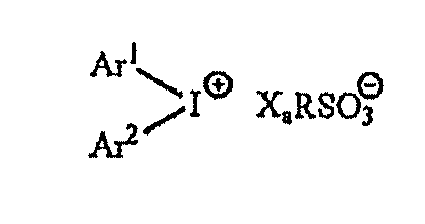
- Sulfonium salts are particularly suitable ionic photoacid generators for PAG blends and resists of the invention, such as compounds of the following formula:

- Ionic photoacid generator groups may comprise a variety of complexing (anionic) groups including e.g. anions of the formula RSO3 - where R is adamantane, alkyl (e.g. C1-12 alkyl) and perfluoroalkyl such as perfluoro (C1-12alkyl), particularly perfluoro counter anions of perfluorooctanesulfonate, perfluorononanesulfonate and the like.
- Suitable non-ionic include imidosulfonates such as compounds of the following formula:

- N-sulfonyloxyimide photoacid generators also are suitable non-ionic photoacid generator groups, including those N-sulfonyloxyimides disclosed in International application
WO94/10608 

- Additional preferred imidosulfonates include groups such as those of the following formula:

- Another class of suitable non-ionic photoacid generator groups includes additional sulfono groups such as disclosed in
U.S. Pat. No. 5558976 . Representative examples of these photoacid generators include:


- Additional suitable non-ionic photoacid generator group include nitrobenzyl-based groups, including those disclosed in EPO published application No.
EP 0 717 319 A1 . Suitable nitrobenzyl-based compounds include those of the following formula:
- Disulfone derivatives are also suitable non-ionic photoacid generator groups. Suitable groups are disclosed e.g. in published European application
0 708 368 A1 . - Such materials may be represented by the following formula:
Ar3―SO2―SO2―RXa
wherein RXa is preferably as defined immediately above and Ar3 represents a substituted or unsubstituted aryl group. A preferred example of the aryl group includes a C6-14 monocyclic or condensed-ring aryl group. Preferred examples of the substituent on the aryl group include an alkyl group, a haloalkyl group, a cycloalkyl group, an aryl group, an alkoxy group, nitro group, carboxyl group, an alkoxycarbonyl group, hydroxyl group, mercapto group, and halogen. - Oxime sulfonate and N-oxyimidosulfonate photoacid generator groups such as disclosed in
U.S. Pat. No. 6,482,567 also will be suitable for use in polymers of the invention. - Also suitable for covalent linkage to polymers of the invention will be photoacid generator groups that can generate α,α-difluoroalkyl sulfonic acid photoacid upon exposure to activating radiation, e.g. the photoacid generator groups of this type as disclosed in
U.S. Pat. No. 6,849,374 . - Further suitable for covalent linkage to polymers of the invention will be disulfone photoacid generator groups, including disulfone photoacid generator groups that contain a diazo, substituted methylene or hydrazine moiety interposed between substituted sulfone groups, e.g. the disulfone photoacid generator groups as disclosed in
U.S. Pat. No. 6,783,912 . - Halogenated non-ionic, photoacid generating compounds are also suitable for use in blends and resists of the invention and include, for example, 1,1-bis[p-chlorophenyl]-2,2,2-trichloroethane (DDT); 1,1-bis[p-methoxyphenyl]-2,2,2-trichloroethane; 1,2,5,6,9,10-hexabromocyclodecane; 1,10-dibromodecane; 1,1-bis[p-chlorophenyl] -2,2-dichloroethane; 4,4-dichloro-2-(trichloromethyl) benzhydrol (Kelthane); hexachlorodimethyl sulfone; 2-chloro-6-(trichloromethyl) pyridine; o,o-diethyl-o-(3,5,6-trichloro-2-pyridyl)phosphorothionate; 1,2,3,4,5,6-hexachlorocyclohexane; N(1,1-bis[p-chlorophenyl]-2,2,2-trichloroethyl)acetamide; tris[2,3-dibromopropyl]isocyanurate; 2,2-bis[p-chlorophenyl]-1,1-dichloroethylene; tris[trichloromethyl]s-triazine; and their isomers, analogs, homologs, and residual compounds. Suitable photoacid generators are also disclosed in European Patent Application Nos.
0164248 and0232972 . Acid generators that are particularly preferred for deep U.V. exposure include 1,1-bis(p-chlorophenyl)-2,2,2-trichloroethane (DDT); 1,1-bis(p-methoxyphenol)-2,2,2-trichloroethane; 1,1-bis(chlorophenyl)-2,2,2 trichloroethanol; tris(1,2,3-methanesulfonyl)benzene; and tris(trichloromethyl)triazine. - As discussed above, photoresist compositions of the invention may suitably non-polymeric photoacid generator compounds in addition to a polymer that comprises one or more covalently linked photoacid generator groups. Suitable photoacid generator compounds for such combined use are disclosed e.g. in
U.S. Pat. Nos. 6,482,567 ;6,783,912 ;6,849,374 ; and6,458,506 . - A photoresist of the invention should comprise a sufficient amount of photoacid generator groups to enable generation of a relief image upon lithographic processing (exposure and development). Such photoacid generator groups may be provided solely by photoacid generator groups covalently linked to a polymer of a photoresist, or a combination of photoacid generator groups covalently linked to a polymer and non-polymeric photoacid generator compounds present in the photoresist composition together with the polymeric photoacid generator. In general, total solids (all components except solvent carrier) of a photoresist may be at least 1, 2 or 3 weight percent photoacid generator groups, more typically total solids (all components except solvent carrier) of a photoresist may be at least 5, 8 or 10 weight percent photoacid generator groups. It is in general not necessary to employ photoacid generator groups in excess of about 25, 30, 35 or 40 weight percent of total solids of a photoresist composition.
- Photoresists of the invention also may contain other materials. For example, other optional additives include actinic and contrast dyes, anti-striation agents, plasticizers, speed enhancers, sensitizers, etc. Such optional additives typically will be present in minor concentration in a photoresist composition except for fillers and dyes which may be present in relatively large concentrations such as, e.g., in amounts of from 5 to 30 percent by weight of the total weight of a resist's dry components.
- A preferred optional additive of resists of the invention is an added base, particularly tetrabutylammonium hydroxide (TBAH), which can enhance resolution of a developed resist relief image. The added base is suitably used in relatively small amounts, e.g. about 1 to 10 percent by weight relative to the PAG, more typically 1 to about 5 weight percent. Other preferred basic additives include ammonium sulfonate salts such as piperidinium p-toluenesulfonate and dicyclohexylammonium p-toluenesulfonate; alkyl amines such as tripropylamine and dodecylamine; aryl amines such as diphenylamine, triphenylamine, aminophenol, 2-(4-aminophenyl)-2-(4-hydroxyphenyl)propane, etc.
- The resin binder component of resists of the invention are typically used in an amount sufficient to render an exposed coating layer of the resist developable such as with an aqueous alkaline solution. More particularly, a resin binder will suitably comprise 50 to about 90 weight percent of total solids of the resist. The photoactive component should be present in an amount sufficient to enable generation of a latent image in a coating layer of the resist. More specifically, the photoactive component will suitably be present in an amount of from about 1 to 40 weight percent of total solids of a resist. Typically, lesser amounts of the photoactive component will be suitable for chemically amplified resists.
- The photoresists of the invention are generally prepared following known procedures with the exception that a PAG resin of the invention is substituted for prior photoactive compounds used in the formulation of such photoresists. For example, a resist of the invention can be prepared as a coating composition by dissolving the components of the photoresist in a suitable solvent such as, e.g., a glycol ether such as 2-methoxyethyl ether (diglyme), ethylene glycol monomethyl ether, propylene glycol monomethyl ether; lactates such as ethyl lactate or methyl lactate, with ethyl lactate being preferred; propionates, particularly methyl propionate and ethyl propionate; a Cellosolve ester such as methyl Cellosolve acetate; an aromatic hydrocarbon such toluene or xylene; or a ketone such as methylethyl ketone, cyclohexanone and 2-heptanone. Typically the solids content of the photoresist varies between 5 and 35 percent by weight of the total weight of the photoresist composition.
- The photoresists of the invention can be used in accordance with known procedures. Though the photoresists of the invention may be applied as a dry film, they are preferably applied on a substrate as a liquid coating composition, dried by heating to remove solvent preferably until the coating layer is tack free, exposed through a photomask to activating radiation, optionally post-exposure baked to create or enhance solubility differences between exposed and nonexposed regions of the resist coating layer, and then developed preferably with an aqueous alkaline developer to form a relief image.
- A liquid coating resist composition may be applied by any standard means such as spinning, dipping or roller coating.
- The photoresist layer (with overcoated barrier composition layer, if present) is then exposed to activating radiation preferably in an immersion lithography system, i.e. where the space between the exposure tool (particularly the projection lens) and the photoresist coated substrate is occupied by an immersion fluid, such as water or water mixed with one or more additives such as cesium sulfate which can provide a fluid of enhanced refractive index. Preferably the immersion fluid (e.g., water) has been treated to avoid bubbles, e.g. water can be degassed to avoid nanobubbles.
- References herein to "immersion exposing" or other similar term indicates that exposure is conducted with such a fluid layer (e.g. water or water with additives) interposed between an exposure tool and the coated photoresist composition layer.
- The substrate on which a resist of the invention is applied and processed suitably can be any substrate used in processes involving photoresists such as a microelectronic wafer. For example, the substrate can be a silicon, silicon dioxide or aluminum-aluminum oxide microelectronic wafer. Gallium arsenide, ceramic, quartz or copper substrates may also be employed. Substrates used for liquid crystal display and other flat panel display applications are also suitably employed, e.g. glass substrates, indium tin oxide coated substrates and the like.
- The exposure energy should be sufficient to effectively activate the photoactive component of the radiation sensitive system to produce a patterned image in the resist coating layer. Suitable exposure energies typically range from about 1 to 300 mJ/cm2. As discussed above, preferred exposure wavelengths include sub-200 nm such as 193 nm. Suitable post-exposure bake temperatures are from about 50°C or greater, more specifically from about 50 to 140°C. For an acid-hardening negative-acting resist, a post-development bake may be employed if desired at temperatures of from about 100 to 150°C for several minutes or longer to further cure the relief image formed upon development. After development and any post-development cure, the substrate surface bared by development may then be selectively processed, for example chemically etching or plating substrate areas bared of photoresist in accordance with procedures known in the art. Suitable etchants include a hydrofluoric acid etching solution and a plasma gas etch such as an oxygen plasma etch.
- The following non-limiting example is illustrative of the invention.
-

- Chloromethyl methacrylate (135 parts), triphenysulfonium 4-hydroxy-1,1,2,2-tetrafluorobutanesulfonate (489 parts) are dissolved in dichloromethane. Diisopropylethylamine (129 parts) is added dropwise. The resulting mixture is stirred at room temperature for 18hr. Usual aqueous workup gives triphenysulfonium 4-methacryloxymethoxy-1,1,2,2-tetrafluorobutanesulfonate.
-
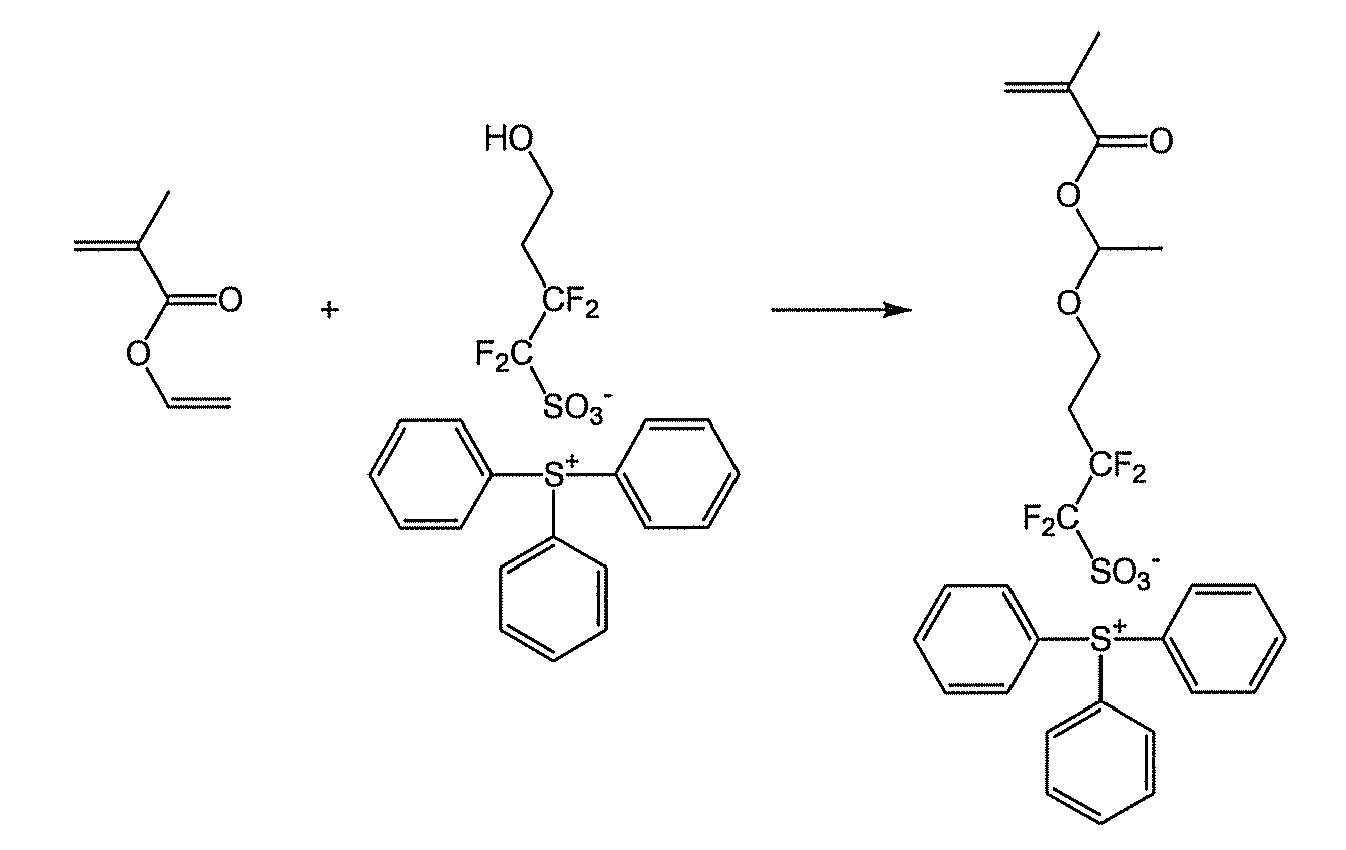
- Triphenysulfonium 4-hydroxy-1,1,2,2-tetrafluorobutanesulfonate (489 parts) and pTSA (4.9 parts) are mixed with vinyl methacrylate (336 parts). The resulting mixture is stirred at 50°C for 18hr. Usual aqueous workup gives triphenysulfonium 4-(1'-methacryloxyethoxy)-1,1,2,2-tetrafluorobutanesulfonate

- Methacryloyl chloride (105 parts) and compound 1 (645 parts) are dissolved in dichloromethane. Triethylamine (101 parts) is added. The resulting mixture is stirred at room temperature for 18hr. Aqueous workup gives compound 2.
-

- 6.57 grams of the PAG monomer of Example 1; 4.2 grams of ECPMA; 5.9 grams of αGBLMA; 5.5 grams of ODOTMA; and 2.7 grams of HAMA are dissolved in dissolved in 15g of tetrahydrofuran and bubbled with nitrogen The structures of ECPMA, αGBLMA, ODOTMA and HAMA are set forth immediately above.
- 5g of tetrahydrofuran and the V601 2.9 gms initiator are weighted out into a separate flask. A round bottom flask is fitted with a condenser, nitrogen line, 5g of tetrahydrofuran added and heated to at least 70°C. The V601/tetrahydrofuran mixture is added and temp is allowed to return to at least 70°C. The monomer solution is then fed into the flask over 3.5 hr and held for at least 30 minutes. To the solution 15 ml of tetrahydrofuran is added and then cooled to room temp via an ice bath. The solution is then precipitated into organic solvent (e.g. p20x volume isopropyl alcohol), dried, redissolved into tetrahydrofuran ~30% and then a second organic solvent (e.g. p20x volume isopropyl alcohol) precipitation. The material is then dried over night in a vacuum oven.
- A photoresist of the invention is prepared by mixing the following components with amounts expressed as weight percent based on total weight of the resist compositions:
Resist components Amount (wt.%) Resin 15 Base additive 0.017 Surfactant 0.0071 Ethyl lactate 81 - The resin binder is the PAG resin of Example 3 above; the base additive is :
- N-allkyl caprolactam, and the surfactant is R08 (fluorine-containing surfactant, available from Dainippon Ink & Chemicals, Inc.). That resin, base additive and surfactant are admixed in the ethyl lactate solvent.
- The formulated resist composition is spin coated onto HMDS vapor primed 4 inch silicon wafers and softbaked via a vacuum hotplate at 90°C for 60 seconds. The resist coating layer is exposed through a photomask at 193 nm, and then the exposed coating layers are post-exposure baked at 110°C. The coated wafers are then treated with 0.26N aqueous tetrabutylammonium hydroxide solution to develop the imaged resist layer.
Claims (10)
- A photoresist composition comprising:a resin comprising (i) one or more photoacid generator moieties covalently linked to the resin; and (ii) one or more photoacid-labile groups,wherein the one or more photoacid generator moieties are a component of one or more of the photoacid-labile groups.
- The photoresist composition of claim 1 wherein photoinduced-reaction of the photoacid-labile groups results in cleavage of the one or more photoacid generator groups from the resin.
- The photoresist composition of claim 1 or 2 wherein the photoacid generator groups are ionic.
- The photoresist composition of claim 1 or 2 wherein the photoacid generator groups are non-ionic.
- The photoresist composition of claim 2 wherein the cleavage results in a sulfonic acid being cleaved from the resin.
- The photoresist composition of any one of claims 1 through 5 wherein the resin comprising photacid generator groups further comprises carbon alicyclic, heteroalicyclic, anhydride, lactone, naphthyl, hydroxyl and/or acrylate groups.
- The photoresist composition of any one of claims 1 through 6 wherein the resin comprising photacid generator groups further comprises polymerized units of 2-methyladamantylacrylate, hydroxyadamantylacrylate, hydroxyadamantylmethacrylate,maleic anhydride, norbornene, 3,4-dihydropyran, optionally substituted phenyl and/or optionally substituted naphthyl.
- A method for producing an electronic device, comprising:applying a coating layer of photoresist of any one of claims 1 through 7 on a substrate;exposing the photoresist coating layer to patterned activating radiation; anddeveloping the exposed photoresist coating layer to provide a photrsesist relief image.
- The method of claim 8 wherein the photoresist composition is immersion exposed with 193 nm patterned activating radiation.
- A resin comprising:(i) one or more photoacid generator moieties covalently linked to the resin; and(ii) one or more photoacid-labile groups,wherein the one or more photoacid generator moieties are a component of one or more of the photoacid-labile groups.
Applications Claiming Priority (1)
| Application Number | Priority Date | Filing Date | Title |
|---|---|---|---|
| US31970610P | 2010-03-31 | 2010-03-31 |
Publications (2)
| Publication Number | Publication Date |
|---|---|
| EP2372456A2 true EP2372456A2 (en) | 2011-10-05 |
| EP2372456A3 EP2372456A3 (en) | 2011-10-26 |
Family
ID=44263216
Family Applications (1)
| Application Number | Title | Priority Date | Filing Date |
|---|---|---|---|
| EP11160600A Withdrawn EP2372456A3 (en) | 2010-03-31 | 2011-03-31 | Novel polymers and photoresist compositions |
Country Status (6)
| Country | Link |
|---|---|
| US (1) | US10670965B2 (en) |
| EP (1) | EP2372456A3 (en) |
| JP (1) | JP5782283B2 (en) |
| KR (1) | KR101949688B1 (en) |
| CN (2) | CN102279520A (en) |
| TW (1) | TWI618982B (en) |
Cited By (1)
| Publication number | Priority date | Publication date | Assignee | Title |
|---|---|---|---|---|
| EP2584409A4 (en) * | 2010-06-15 | 2014-03-12 | Tokyo Ohka Kogyo Co Ltd | RESIST COMPOSITION, METHOD FOR FORMING RESIST PATTERN, POLYMER COMPOUND, AND COMPOUND |
Families Citing this family (22)
| Publication number | Priority date | Publication date | Assignee | Title |
|---|---|---|---|---|
| JP5793489B2 (en) * | 2011-11-30 | 2015-10-14 | 富士フイルム株式会社 | Actinic ray-sensitive or radiation-sensitive composition, resist film using the same, pattern formation method, and electronic device manufacturing method |
| KR20130076598A (en) | 2011-12-28 | 2013-07-08 | 금호석유화학 주식회사 | Hydrophilic photoacid generator and resist composition comprising same |
| US20130171429A1 (en) * | 2011-12-31 | 2013-07-04 | Rohm And Haas Electronic Materials Llc | Cycloaliphatic monomer, polymer comprising the same, and photoresist composition comprising the polymer |
| US8790861B2 (en) | 2011-12-31 | 2014-07-29 | Rohm And Haas Electronic Materials Llc | Cycloaliphatic monomer, polymer comprising the same, and photoresist composition comprising the polymer |
| JP6020347B2 (en) * | 2012-06-04 | 2016-11-02 | 信越化学工業株式会社 | Polymer compound, resist material, and pattern forming method |
| JP5913241B2 (en) * | 2012-09-15 | 2016-04-27 | ローム アンド ハース エレクトロニック マテリアルズ エルエルシーRohm and Haas Electronic Materials LLC | Photoresist containing a plurality of acid generator compounds |
| JP2014153440A (en) * | 2013-02-05 | 2014-08-25 | Tokyo Ohka Kogyo Co Ltd | Resist composition, polymeric compound, compound and method for forming resist pattern |
| JP6361455B2 (en) * | 2013-10-25 | 2018-07-25 | Jsr株式会社 | Colored composition, colored cured film, and display element |
| US9527936B2 (en) | 2014-10-10 | 2016-12-27 | Rohm And Haas Electronic Materials Llc | Polymer comprising repeat units with photoacid-generating functionality and base-solubility-enhancing functionality, and associated photoresist composition and electronic device forming method |
| US9606434B2 (en) | 2014-10-10 | 2017-03-28 | Rohm And Haas Electronic Materials, Llc | Polymer comprising repeat units with photoacid-generating functionality and base-solubility-enhancing functionality, and associated photoresist composition and electronic device forming method |
| US9557642B2 (en) | 2014-10-10 | 2017-01-31 | Rohm And Haas Electronic Materials Llc | Photoresist composition and associated method of forming an electronic device |
| JP6769735B2 (en) | 2015-05-12 | 2020-10-14 | 住友化学株式会社 | Method for producing salt, acid generator, resin, resist composition and resist pattern |
| JP6688147B2 (en) * | 2015-05-12 | 2020-04-28 | 住友化学株式会社 | Salt, acid generator, resin, resist composition, and method for producing resist pattern |
| US9758610B2 (en) * | 2015-12-18 | 2017-09-12 | Dow Global Technologies Llc | Acid-labile hyperbranched copolymer and associated photoresist composition and method of forming an electronic device |
| TWI662364B (en) | 2015-12-31 | 2019-06-11 | Rohm And Haas Electronic Materials Llc | Photoresist composition, coated substrate including the photoresist composition, and method of forming electronic device |
| TWI656111B (en) | 2015-12-31 | 2019-04-11 | Rohm And Haas Electronic Materials Llc | Photoacid generator |
| KR102146095B1 (en) | 2017-09-15 | 2020-08-19 | 주식회사 엘지화학 | Photoacid generator and photoresist composition for thick layer comprising the same |
| JP7188976B2 (en) * | 2017-11-29 | 2022-12-13 | 住友化学株式会社 | Salt, acid generator, resin, resist composition, and method for producing resist pattern |
| TWI683816B (en) * | 2017-11-30 | 2020-02-01 | 美商羅門哈斯電子材料有限公司 | Salts and photoresists comprising same |
| TWI683801B (en) * | 2017-11-30 | 2020-02-01 | 美商羅門哈斯電子材料有限公司 | Zwitterion compounds and photoresists comprising same |
| JP7371574B2 (en) | 2020-06-04 | 2023-10-31 | 信越化学工業株式会社 | Photoacid generator, chemically amplified negative resist composition, and resist pattern forming method |
| CN116675713B (en) * | 2023-05-15 | 2025-07-29 | 上海大学 | Tin-containing polymerizable photoacid generator and preparation method thereof |
Citations (28)
| Publication number | Priority date | Publication date | Assignee | Title |
|---|---|---|---|---|
| US4442197A (en) | 1982-01-11 | 1984-04-10 | General Electric Company | Photocurable compositions |
| EP0164248A2 (en) | 1984-06-01 | 1985-12-11 | Rohm And Haas Company | Photosensitive coating compositions, thermally stable coatings prepared from them, and the use of such coatings in forming thermally stable polymer images |
| US4603101A (en) | 1985-09-27 | 1986-07-29 | General Electric Company | Photoresist compositions containing t-substituted organomethyl vinylaryl ether materials |
| US4624912A (en) | 1984-02-10 | 1986-11-25 | Ciba-Geigy Corporation | Thermally transferable layers of radiation sensitive epoxy resins used to prepare protective coatings and relief images |
| EP0232972A2 (en) | 1986-01-13 | 1987-08-19 | Rohm And Haas Company | Negative photoresist compositions and processes for preparing thermally stable, negative images using them |
| WO1994010608A1 (en) | 1992-10-29 | 1994-05-11 | International Business Machines Corporation | Chemically amplified photoresist |
| US5492793A (en) | 1992-11-03 | 1996-02-20 | International Business Machines Corporation | Photoresist composition |
| EP0708368A1 (en) | 1994-10-18 | 1996-04-24 | Fuji Photo Film Co., Ltd. | Positive-working photosensitive composition |
| EP0717319A1 (en) | 1994-12-06 | 1996-06-19 | Ocg Microelectronic Materials, Inc. | Photoacid generating composition used in radiation-sensitive compositions |
| US5558976A (en) | 1994-09-02 | 1996-09-24 | Wako Pure Chemical Industries, Ltd. | Pattern formation method |
| US5843624A (en) | 1996-03-08 | 1998-12-01 | Lucent Technologies Inc. | Energy-sensitive resist material and a process for device fabrication using an energy-sensitive resist material |
| EP0930542A1 (en) | 1998-01-15 | 1999-07-21 | Shipley Company LLC | Polymers and photoresist compositions for short wavelength imaging |
| US5929176A (en) | 1996-12-20 | 1999-07-27 | Hyundai Electronics Industries Co., Ltd. | Vinyl 4-tetrahydropyranyloxybenzal-vinyl 4-hydroxybenzal-vinyl tetrahydropyranyl ether-vinyl acetate copolymer, vinyl 4-tetrahydropyranyloxybenzal-vinyl tetrahydropyranyl ether-vinyl acetate copolymer and preparation methods thereof |
| US6042997A (en) | 1996-06-11 | 2000-03-28 | Ibm Corporation | Copolymers and photoresist compositions comprising copolymer resin binder component |
| US6048664A (en) | 1999-03-12 | 2000-04-11 | Lucent Technologies, Inc. | Energy-sensitive resist material and a process for device fabrication using an energy-sensitive resist material |
| US6048662A (en) | 1998-12-15 | 2000-04-11 | Bruhnke; John D. | Antireflective coatings comprising poly(oxyalkylene) colorants |
| US6057083A (en) | 1997-11-04 | 2000-05-02 | Shipley Company, L.L.C. | Polymers and photoresist compositions |
| EP1008913A1 (en) | 1998-12-10 | 2000-06-14 | Shipley Company LLC | Photoresist compositions comprising itaconic anhydride polymers |
| US6090526A (en) | 1996-09-13 | 2000-07-18 | Shipley Company, L.L.C. | Polymers and photoresist compositions |
| US6458506B2 (en) | 1998-08-14 | 2002-10-01 | Shipley Company, Llc | Photoacid generators and photoresists comprising same |
| US6482567B1 (en) | 2000-08-25 | 2002-11-19 | Shipley Company, L.L.C. | Oxime sulfonate and N-oxyimidosulfonate photoacid generators and photoresists comprising same |
| US6783912B2 (en) | 2000-02-27 | 2004-08-31 | Shipley Company, L.L.C. | Photoacid generators and photoresists comprising same |
| US6849374B2 (en) | 2000-11-03 | 2005-02-01 | Shipley Company, L.L.C. | Photoacid generators and photoresists comprising same |
| US20050208418A1 (en) | 2004-03-09 | 2005-09-22 | Rohm And Haas Electronic Materials, L.L.C. | Cyanoadamantyl compounds and polymers |
| US7049044B2 (en) | 2002-12-19 | 2006-05-23 | The University Of North Carolina At Charlotte | Nanocomposite negative resists for next generation lithographies |
| US20080206671A1 (en) | 2007-02-28 | 2008-08-28 | Rohm And Haas Electronic Materials Llc | Novel polymers and photoresist compositions |
| US8276902B2 (en) | 2008-04-15 | 2012-10-02 | Wincor Nixdorf International Gmbh | Device for handling single sheets, for introducing rectangular individual sheets into a container |
| US9921912B1 (en) | 2015-09-30 | 2018-03-20 | EMC IP Holding Company LLC | Using spare disk drives to overprovision raid groups |
Family Cites Families (20)
| Publication number | Priority date | Publication date | Assignee | Title |
|---|---|---|---|---|
| WO2002069044A2 (en) * | 2001-02-25 | 2002-09-06 | Shipley Company, L.L.C. | Polymers and photoresist compositions |
| CN1527135A (en) * | 2003-03-05 | 2004-09-08 | 希普利公司 | photoresist composition |
| CN100503756C (en) * | 2004-05-18 | 2009-06-24 | 罗姆及海斯电子材料有限公司 | Coating compositions for use with an overcoated photoresist |
| KR100574495B1 (en) * | 2004-12-15 | 2006-04-27 | 주식회사 하이닉스반도체 | Photoacid generator polymer, preparation method thereof, and upper anti-reflective coating composition containing same |
| JP4597655B2 (en) * | 2004-12-20 | 2010-12-15 | 東京応化工業株式会社 | Resist pattern forming method |
| JP4425776B2 (en) | 2004-12-24 | 2010-03-03 | 信越化学工業株式会社 | Resist material and pattern forming method using the same |
| US7629106B2 (en) * | 2005-11-16 | 2009-12-08 | Shin-Etsu Chemical Co., Ltd. | Resist composition and patterning process using the same |
| JP5034950B2 (en) * | 2005-12-14 | 2012-09-26 | Jsr株式会社 | Compound production method, polymer, and resin composition |
| JP5061612B2 (en) * | 2005-12-27 | 2012-10-31 | 住友化学株式会社 | Acid amplification resin for chemically amplified positive resist composition |
| JP4921160B2 (en) * | 2006-05-30 | 2012-04-25 | 兵庫県 | Photosensitive resin and photosensitive composition |
| WO2007148623A1 (en) | 2006-06-20 | 2007-12-27 | Tokyo Ohka Kogyo Co., Ltd. | Positive resist composition, and method for formation of resist pattern |
| JP4845650B2 (en) * | 2006-09-08 | 2011-12-28 | 富士フイルム株式会社 | Positive resist composition and pattern forming method using the same |
| KR101439951B1 (en) * | 2007-02-15 | 2014-09-17 | 주식회사 동진쎄미켐 | Monomer for photoresist including sulfonyl group, polymer thereof and photoresist composition including the same |
| EP1975705B1 (en) * | 2007-03-28 | 2016-04-27 | FUJIFILM Corporation | Positive resist composition and pattern-forming method |
| JP5449675B2 (en) * | 2007-09-21 | 2014-03-19 | 富士フイルム株式会社 | Photosensitive composition, pattern forming method using the photosensitive composition, and compound used in the photosensitive composition |
| US7858287B2 (en) * | 2007-11-30 | 2010-12-28 | Hyogo Prefecture | Photosensitive resin, and photosensitive composition |
| JP5104343B2 (en) * | 2008-01-28 | 2012-12-19 | 富士通株式会社 | Monomer, resin, resist composition using the resin, and method for manufacturing a semiconductor device using the resist composition |
| US8349990B2 (en) * | 2008-02-20 | 2013-01-08 | The Research Foundation Of State University Of New York | Chain scission polyester polymers for photoresists |
| JP5237173B2 (en) | 2008-06-03 | 2013-07-17 | 信越化学工業株式会社 | Polymerizable compound, polymer compound, positive resist material and pattern forming method using the same |
| JP5364443B2 (en) * | 2009-05-20 | 2013-12-11 | 東京応化工業株式会社 | Positive resist composition, resist pattern forming method, polymer compound |
-
2011
- 2011-03-30 JP JP2011076478A patent/JP5782283B2/en active Active
- 2011-03-31 TW TW100111194A patent/TWI618982B/en active
- 2011-03-31 CN CN2011101375383A patent/CN102279520A/en active Pending
- 2011-03-31 EP EP11160600A patent/EP2372456A3/en not_active Withdrawn
- 2011-03-31 CN CN201610596762.1A patent/CN106125506A/en active Pending
- 2011-03-31 US US13/077,947 patent/US10670965B2/en active Active
- 2011-03-31 KR KR1020110029483A patent/KR101949688B1/en active Active
Patent Citations (28)
| Publication number | Priority date | Publication date | Assignee | Title |
|---|---|---|---|---|
| US4442197A (en) | 1982-01-11 | 1984-04-10 | General Electric Company | Photocurable compositions |
| US4624912A (en) | 1984-02-10 | 1986-11-25 | Ciba-Geigy Corporation | Thermally transferable layers of radiation sensitive epoxy resins used to prepare protective coatings and relief images |
| EP0164248A2 (en) | 1984-06-01 | 1985-12-11 | Rohm And Haas Company | Photosensitive coating compositions, thermally stable coatings prepared from them, and the use of such coatings in forming thermally stable polymer images |
| US4603101A (en) | 1985-09-27 | 1986-07-29 | General Electric Company | Photoresist compositions containing t-substituted organomethyl vinylaryl ether materials |
| EP0232972A2 (en) | 1986-01-13 | 1987-08-19 | Rohm And Haas Company | Negative photoresist compositions and processes for preparing thermally stable, negative images using them |
| WO1994010608A1 (en) | 1992-10-29 | 1994-05-11 | International Business Machines Corporation | Chemically amplified photoresist |
| US5492793A (en) | 1992-11-03 | 1996-02-20 | International Business Machines Corporation | Photoresist composition |
| US5558976A (en) | 1994-09-02 | 1996-09-24 | Wako Pure Chemical Industries, Ltd. | Pattern formation method |
| EP0708368A1 (en) | 1994-10-18 | 1996-04-24 | Fuji Photo Film Co., Ltd. | Positive-working photosensitive composition |
| EP0717319A1 (en) | 1994-12-06 | 1996-06-19 | Ocg Microelectronic Materials, Inc. | Photoacid generating composition used in radiation-sensitive compositions |
| US5843624A (en) | 1996-03-08 | 1998-12-01 | Lucent Technologies Inc. | Energy-sensitive resist material and a process for device fabrication using an energy-sensitive resist material |
| US6042997A (en) | 1996-06-11 | 2000-03-28 | Ibm Corporation | Copolymers and photoresist compositions comprising copolymer resin binder component |
| US6090526A (en) | 1996-09-13 | 2000-07-18 | Shipley Company, L.L.C. | Polymers and photoresist compositions |
| US5929176A (en) | 1996-12-20 | 1999-07-27 | Hyundai Electronics Industries Co., Ltd. | Vinyl 4-tetrahydropyranyloxybenzal-vinyl 4-hydroxybenzal-vinyl tetrahydropyranyl ether-vinyl acetate copolymer, vinyl 4-tetrahydropyranyloxybenzal-vinyl tetrahydropyranyl ether-vinyl acetate copolymer and preparation methods thereof |
| US6057083A (en) | 1997-11-04 | 2000-05-02 | Shipley Company, L.L.C. | Polymers and photoresist compositions |
| EP0930542A1 (en) | 1998-01-15 | 1999-07-21 | Shipley Company LLC | Polymers and photoresist compositions for short wavelength imaging |
| US6458506B2 (en) | 1998-08-14 | 2002-10-01 | Shipley Company, Llc | Photoacid generators and photoresists comprising same |
| EP1008913A1 (en) | 1998-12-10 | 2000-06-14 | Shipley Company LLC | Photoresist compositions comprising itaconic anhydride polymers |
| US6048662A (en) | 1998-12-15 | 2000-04-11 | Bruhnke; John D. | Antireflective coatings comprising poly(oxyalkylene) colorants |
| US6048664A (en) | 1999-03-12 | 2000-04-11 | Lucent Technologies, Inc. | Energy-sensitive resist material and a process for device fabrication using an energy-sensitive resist material |
| US6783912B2 (en) | 2000-02-27 | 2004-08-31 | Shipley Company, L.L.C. | Photoacid generators and photoresists comprising same |
| US6482567B1 (en) | 2000-08-25 | 2002-11-19 | Shipley Company, L.L.C. | Oxime sulfonate and N-oxyimidosulfonate photoacid generators and photoresists comprising same |
| US6849374B2 (en) | 2000-11-03 | 2005-02-01 | Shipley Company, L.L.C. | Photoacid generators and photoresists comprising same |
| US7049044B2 (en) | 2002-12-19 | 2006-05-23 | The University Of North Carolina At Charlotte | Nanocomposite negative resists for next generation lithographies |
| US20050208418A1 (en) | 2004-03-09 | 2005-09-22 | Rohm And Haas Electronic Materials, L.L.C. | Cyanoadamantyl compounds and polymers |
| US20080206671A1 (en) | 2007-02-28 | 2008-08-28 | Rohm And Haas Electronic Materials Llc | Novel polymers and photoresist compositions |
| US8276902B2 (en) | 2008-04-15 | 2012-10-02 | Wincor Nixdorf International Gmbh | Device for handling single sheets, for introducing rectangular individual sheets into a container |
| US9921912B1 (en) | 2015-09-30 | 2018-03-20 | EMC IP Holding Company LLC | Using spare disk drives to overprovision raid groups |
Non-Patent Citations (1)
| Title |
|---|
| T OMOTE ET AL., POLYMERS FOR ADVANCED TECHNOLOGIES, vol. 4, pages 277 - 287 |
Cited By (2)
| Publication number | Priority date | Publication date | Assignee | Title |
|---|---|---|---|---|
| EP2584409A4 (en) * | 2010-06-15 | 2014-03-12 | Tokyo Ohka Kogyo Co Ltd | RESIST COMPOSITION, METHOD FOR FORMING RESIST PATTERN, POLYMER COMPOUND, AND COMPOUND |
| US9023581B2 (en) | 2010-06-15 | 2015-05-05 | Tokyo Ohka Kogyo Co., Ltd | Resist composition, method of forming resist pattern, polymeric compound, and compound |
Also Published As
| Publication number | Publication date |
|---|---|
| JP5782283B2 (en) | 2015-09-24 |
| EP2372456A3 (en) | 2011-10-26 |
| TWI618982B (en) | 2018-03-21 |
| KR20110110047A (en) | 2011-10-06 |
| US10670965B2 (en) | 2020-06-02 |
| US20110269074A1 (en) | 2011-11-03 |
| JP2011215619A (en) | 2011-10-27 |
| TW201142513A (en) | 2011-12-01 |
| KR101949688B1 (en) | 2019-02-19 |
| CN106125506A (en) | 2016-11-16 |
| CN102279520A (en) | 2011-12-14 |
Similar Documents
| Publication | Publication Date | Title |
|---|---|---|
| US10670965B2 (en) | Polymers and photoresist compositions | |
| US7838199B2 (en) | Polymers and photoresist compositions | |
| EP2341089B1 (en) | Photosensitive compositions | |
| US6803169B2 (en) | Photoresist compositions comprising blends of photoacid generators | |
| US7244542B2 (en) | Resins and photoresist compositions comprising same | |
| EP2293143B1 (en) | Novel photoresist compositions | |
| US20120077120A1 (en) | Photoresists comprising multi-amide component | |
| US20090117489A1 (en) | Compositons and processes for immersion lithography | |
| US11106137B2 (en) | Compositions comprising base-reactive component and processes for photolithography | |
| US20030232273A1 (en) | Acetal/alicyclic polymers and photoresist compositions | |
| US7220486B2 (en) | Photoresist compositions | |
| US6767688B2 (en) | Photoresist compositions | |
| US6849376B2 (en) | Polymers and photoresist compositions comprising same | |
| US20030235778A1 (en) | Photoresist compositions for short wavelength imaging |
Legal Events
| Date | Code | Title | Description |
|---|---|---|---|
| PUAI | Public reference made under article 153(3) epc to a published international application that has entered the european phase |
Free format text: ORIGINAL CODE: 0009012 |
|
| PUAL | Search report despatched |
Free format text: ORIGINAL CODE: 0009013 |
|
| 17P | Request for examination filed |
Effective date: 20110331 |
|
| AK | Designated contracting states |
Kind code of ref document: A2 Designated state(s): AL AT BE BG CH CY CZ DE DK EE ES FI FR GB GR HR HU IE IS IT LI LT LU LV MC MK MT NL NO PL PT RO RS SE SI SK SM TR |
|
| AX | Request for extension of the european patent |
Extension state: BA ME |
|
| AK | Designated contracting states |
Kind code of ref document: A3 Designated state(s): AL AT BE BG CH CY CZ DE DK EE ES FI FR GB GR HR HU IE IS IT LI LT LU LV MC MK MT NL NO PL PT RO RS SE SI SK SM TR |
|
| AX | Request for extension of the european patent |
Extension state: BA ME |
|
| RIC1 | Information provided on ipc code assigned before grant |
Ipc: G03F 7/20 20060101ALI20110920BHEP Ipc: G03F 7/039 20060101ALI20110920BHEP Ipc: G03F 7/004 20060101AFI20110920BHEP |
|
| 17Q | First examination report despatched |
Effective date: 20111122 |
|
| STAA | Information on the status of an ep patent application or granted ep patent |
Free format text: STATUS: THE APPLICATION IS DEEMED TO BE WITHDRAWN |
|
| 18D | Application deemed to be withdrawn |
Effective date: 20130618 |