EP2372453B1 - Double-faced photosensitive color photographic paper - Google Patents
Double-faced photosensitive color photographic paper Download PDFInfo
- Publication number
- EP2372453B1 EP2372453B1 EP09829996.9A EP09829996A EP2372453B1 EP 2372453 B1 EP2372453 B1 EP 2372453B1 EP 09829996 A EP09829996 A EP 09829996A EP 2372453 B1 EP2372453 B1 EP 2372453B1
- Authority
- EP
- European Patent Office
- Prior art keywords
- layer
- shading
- solvent
- double
- photographic paper
- Prior art date
- Legal status (The legal status is an assumption and is not a legal conclusion. Google has not performed a legal analysis and makes no representation as to the accuracy of the status listed.)
- Active
Links
Images

Classifications
-
- G—PHYSICS
- G03—PHOTOGRAPHY; CINEMATOGRAPHY; ANALOGOUS TECHNIQUES USING WAVES OTHER THAN OPTICAL WAVES; ELECTROGRAPHY; HOLOGRAPHY
- G03C—PHOTOSENSITIVE MATERIALS FOR PHOTOGRAPHIC PURPOSES; PHOTOGRAPHIC PROCESSES, e.g. CINE, X-RAY, COLOUR, STEREO-PHOTOGRAPHIC PROCESSES; AUXILIARY PROCESSES IN PHOTOGRAPHY
- G03C7/00—Multicolour photographic processes or agents therefor; Regeneration of such processing agents; Photosensitive materials for multicolour processes
- G03C7/30—Colour processes using colour-coupling substances; Materials therefor; Preparing or processing such materials
- G03C7/3029—Materials characterised by a specific arrangement of layers, e.g. unit layers, or layers having a specific function
-
- G—PHYSICS
- G03—PHOTOGRAPHY; CINEMATOGRAPHY; ANALOGOUS TECHNIQUES USING WAVES OTHER THAN OPTICAL WAVES; ELECTROGRAPHY; HOLOGRAPHY
- G03C—PHOTOSENSITIVE MATERIALS FOR PHOTOGRAPHIC PURPOSES; PHOTOGRAPHIC PROCESSES, e.g. CINE, X-RAY, COLOUR, STEREO-PHOTOGRAPHIC PROCESSES; AUXILIARY PROCESSES IN PHOTOGRAPHY
- G03C1/00—Photosensitive materials
- G03C1/74—Applying photosensitive compositions to the base; Drying processes therefor
- G03C2001/7425—Coating on both sides
-
- G—PHYSICS
- G03—PHOTOGRAPHY; CINEMATOGRAPHY; ANALOGOUS TECHNIQUES USING WAVES OTHER THAN OPTICAL WAVES; ELECTROGRAPHY; HOLOGRAPHY
- G03C—PHOTOSENSITIVE MATERIALS FOR PHOTOGRAPHIC PURPOSES; PHOTOGRAPHIC PROCESSES, e.g. CINE, X-RAY, COLOUR, STEREO-PHOTOGRAPHIC PROCESSES; AUXILIARY PROCESSES IN PHOTOGRAPHY
- G03C2200/00—Details
- G03C2200/35—Intermediate layer
-
- G—PHYSICS
- G03—PHOTOGRAPHY; CINEMATOGRAPHY; ANALOGOUS TECHNIQUES USING WAVES OTHER THAN OPTICAL WAVES; ELECTROGRAPHY; HOLOGRAPHY
- G03C—PHOTOSENSITIVE MATERIALS FOR PHOTOGRAPHIC PURPOSES; PHOTOGRAPHIC PROCESSES, e.g. CINE, X-RAY, COLOUR, STEREO-PHOTOGRAPHIC PROCESSES; AUXILIARY PROCESSES IN PHOTOGRAPHY
- G03C7/00—Multicolour photographic processes or agents therefor; Regeneration of such processing agents; Photosensitive materials for multicolour processes
- G03C7/30—Colour processes using colour-coupling substances; Materials therefor; Preparing or processing such materials
- G03C7/3041—Materials with specific sensitometric characteristics, e.g. gamma, density
Definitions
- the present invention relates to a photographic material. More particularly, the present invention relates to a double-sided color photographic paper.
- a conventional single-sided color photographic paper can be subjected to exposure on only one side to form a single-sided image, and no image can be formed on the reverse side.
- the photographic paper after the photographic paper is placed in a frame or an album, it can be viewed only from the side on which the image is formed. Consequently, the applications of the photographic paper in the field of image carrier are restrained. Besides, a supporting substrate presented in the photographic paper does not get its full use, resulting in a high cost.
- short-run digital double-sided printing technology has been developed, and the market capacity thereof has been expanding rapidly.
- the dominant forms of the short-run digital double-sided printings are digital printing or ink-jet printing, and they can, on a limited plane carrier, provide consumers with twice as much as the graphic information provided by a conventional single-sided photosensitive color photographic paper. Therefore, the short-run digital double-sided printing has been widely used in applications such as business cards, personalized calendars, menus, brochures for an auction, specimen cards for a hotel, invitation cards, job cards, business promotional flyers, etc, which has brought huge losses and serious challenges to the traditional silver halide printing industry.
- the short-run digital double-sided printing improves efficiency to a certain extent and meets the needs of individual consumer, it has shortcomings, including limited colors, narrow color gamut, poor image-gradation, poor resolution, long delivery cycle and high cost.
- Chinese utility model patent No. ZL 200520023024.5 discloses a double-sided laser exposing enlarger and a double-sided photosensitive paper used thereby.
- the double-sided exposing enlarger comprises an exposing unit wherein two laser exposures are installed symmetrically on the upper and lower sides of the area where the photosensitive paper is to be exposed.
- a circuit control unit outputs scanning signals, and under the control of these scanning signals, both sides of the photosensitive paper are exposed by the laser exposures to form an image on each side.
- the exposed photosensitive paper is subsequently sent to a developing unit to be developed and enlarged. Through such a process, images are formed on both sides of the photosensitive paper.
- ZL 200520023024.5 comprises a paper base, a first photosensitive layer, a first protective layer, a second photosensitive layer and a second protective layer, wherein the first photosensitive layer and the first protective layer are successively stacked on one side of the paper base, and the second photosensitive layer and the second protective layer are successively stacked on the other side of the paper base.
- the first photosensitive layer and the first protective layer are configured symmetrically with the second photosensitive layer and the second protective layer, respectively.
- the photosensitive layers and the protective layers are stacked by a well-known conventional method for producing color photographic paper. The photographic performance of the photosensitive papers thus produced is liable to be deteriorated due to the double-sided exposure, and such defects as an increased fog density and a decreased sensitivity would occur.
- US-B1-6 352 822 discloses a similar double-sided photographic paper.
- One technical problem to be solved by the present invention is to provide a double-sided color photographic paper which overcomes the above-mentioned defects in the prior art and which can bring about an image rich in color, broad in color gamut, manifold in image-gradation, high in resolution and efficiency, and low in cost.
- the present invention provides the following technical solutions.
- a double-sided color photographic paper comprising in order a first protection layer, a first photosensitive layer, a supporting substrate, a second photosensitive layer and a second protection layer, the supporting substrate having a first surface and a second surface opposite to the first surface, characterized in that a first barrier layer and at least one layer of a first shading layer are sandwiched between the first photosensitive layer and the first surface of the supporting substrate, and the first barrier layer is arranged between the first photosensitive layer and the first shading layer; a second barrier layer and at least one layer of a second shading layer are sandwiched between the second surface of the supporting substrate and the second photosensitive layer, and the second barrier layer is arranged between the second shading layer and the second photosensitive layer; and with respect to and toward the supporting substrate, the first protection layer, the first photosensitive layer, the first barrier layer and the first shading layer are configured symmetrically with the second protection layer, the second photosensitive layer, the second barrier layer and the second shading layer, respectively.
- each of the barrier layers has a thickness of 0.5 to 5 ⁇ m.
- the material for forming each of the barrier layers comprises anti-stain agent and gelatin.
- each of the shading layers has a thickness of 0.5 to 5 ⁇ m.
- each of the shading layers is prepared from a coating composition comprising a shading material, an anti-stain agent, gelatin, and a stabilizer, and the coating amount of each of the components of the composition is as follows: shading material 0.014 to 0.88g/m 2 ; anti-stain agent 0.011 to 0.28g/ m 2 ; gelatin 0.21 to 5.65g/ m 2 ; and stabilizer 0.093 to 1.67g/ m 2 .
- said shading material is selected from the group consisting of: colloidal silver, anti-halation dyes, carbon black, and a combination thereof.
- each of the shading layers has a reflection density of 0.10 to 3.00.
- each of the photosensitive layers comprises three coats which are a red-sensitive layer, a green-sensitive layer and a blue-sensitive layer, said three coats are formed by uniformly coating an emulsion comprising a color-forming agent and a silver halide sensitive to the corresponding color light, respectively.
- the exposing light goes through an emulsion layer and then reaches a white paper base, wherein part of the light will be further transmitted through the white paper base while the rest will be reflected to the emulsion layer, thereby improving the sensitivity of the product.
- both sides of the double-sided color photographic paper are coated with emulsions, when the photographic paper is exposed on one side, the light transmitted through the white paper base will cause the emulsion on the reverse side to be exposed, thus forming an interferential image which adversely affects the photographic performance of the photosensitive paper, and results in such defects as an increased fog density and decreased sensitivity. Therefore, the light transmitted through the white paper base must be eliminated.
- a double-sided color photographic paper provided by the present invention comprises a shading layer, which contains a shading material so as to absorb part of the light transmitted through the white paper base and to prevent the emulsion on the unexposed side to be exposed to form the interferential image.
- the shading material can absorb the light transmitted through the white paper base, the shading material also absorbs part of the light that should be reflected to the emulsion layer, which would lead to an insufficient exposure and deteriorate the photographic performance of the photosensitive paper. Consequently, the thickness of the shading layer and the amount of the shading material to be used should be suitably selected such that the light transmitted through the paper base is absorbed, and the exposure of the emulsion on the reverse side to form the interferential image is prevented.
- the thickness of the shading layers according to the present invention is preferably 0.5 to 5 ⁇ m.
- the shading material in the shading layers according to the present invention may be, but is not limited to, one or more selected from the group consisting of colloidal silver, anti-halation dyes, carbon black, titanium dioxide, silicon dioxide, and aluminum powder. All the shading material is removed during a developing process, thus, the whiteness of the product is not adversely affected.
- Colloidal silver is nano-scaled metal silver in a colloidal form, which takes on a grey appearance and absorbs all the visible light. Colloidal silver can be removed during the bleach or fixing process.
- Colloidal silver can be prepared by the following described processes.
- particles of colloidal simple-substance silver can be formed by reducing silver nitrate by a reductant to yield aggregates of a primary silver particle which functions as a core that grows larger along with the progress of the reduction to form a stable secondary particle, precipitating the secondary particle, washing the precipitate with water, and re-dissolving the washed precipitate.
- particles of colloidal simple-substance silver can be formed by firstly reacting silver nitrate with a halogen salt to yield silver halide particles, and then reacting the silver halide with a reductant and a developing accelerator.
- Anti-halation dye is a dye which prevents light scattering within and between the emulsion layers such that the resolving power of the film is improved.
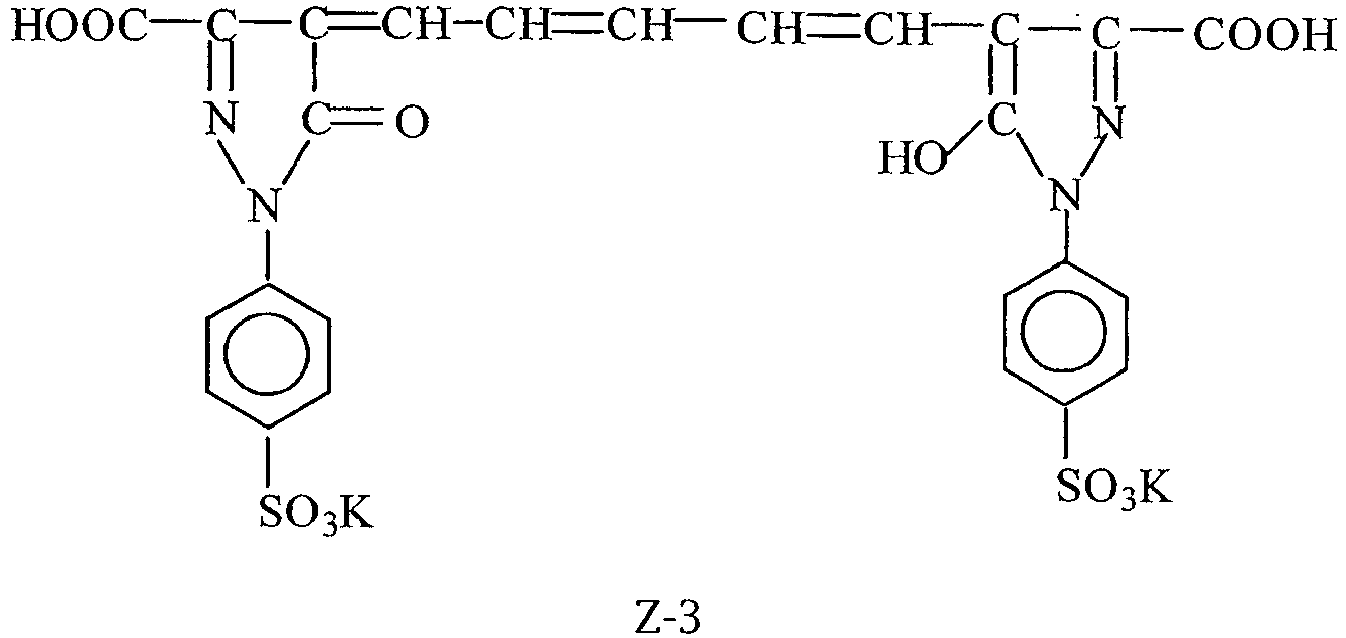
- Anti-halation dye is also known as internal anti-halation dye, and examples thereof include but are not limited to one or more compounds selected from the group consisting of those represented by the following Formulae Z-1 to Z-7, or a combination of the compounds represented by the following Formulae Z-1 to Z-7 (hereinafter, each structure is assigned a symbol, and each symbol assigned for a specific structure is given consistently below to the structure to be represented).
- Carbon black is a fine powder produced by the incomplete combustion of a raw material containing carbon. Carbon black has extremely strong tinctorial strength and hiding power, and both of the tinctorial strength and hiding power, as well as anti-UV effect, increase with the decrease of the particle size of the carbon black particles. Carbon black can be removed for discoloration with water.
- An anti-stain agent is a weakly reductive compound which reacts with quinonediimine that may be contained in the shading material and reduces quinonediimine to a compound having a structure of p-phenylenediamine. Thereby, quinonediimine loses the coupling activity, and cannot migrate into the adjacent emulsion layer. Thus, the stain of the adjacent emulsion layer and the fogging effect can be avoided.
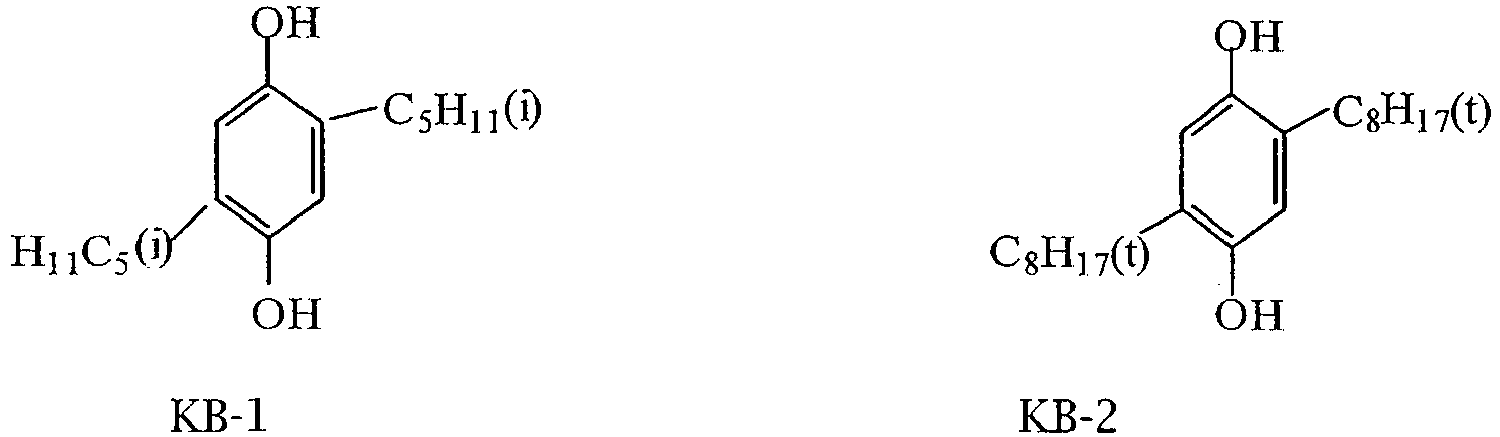
- the anti-stain agent useful for the shading layer can be, but is not limited to, one or more selected from the group consisting of the following substances, or a combination of the following substances.
- Stabilizers applicable in the present invention include:
- the shading effect of the shading layer is mainly achieved by the shading material.
- different shading materials may provide the shading layer with different absorbances, and hence different reflection density. Therefore, the absorbing effect of the shading layer depends on the reflection density provided by the shading material.
- the reflection density of the shading layer is in the range of 0.10 to 3.00.
- the so-called reflection density is the logarithm of the ratio of the amount of the incident light to the amount of the reflected light, which shows the shading ability of the shading layer.
- quinonediimine ion which is an oxidation product in the developing process may remain in the shading material contained in the shading layer, and the remaining quinonediimine ion may migrate into the adjacent emulsion layer and couple with the coupler contained in a photosensitive layer, forming undesired color and causing fog to the product.
- a barrier layer should be provided between the shading layer and the photosensitive layer.
- the barrier layer is a layer formed by hydrophilic gelatin and contains an anti-stain agent, wherein the anti-stain agent can be one or more selected from, but not limited to, the group consisting of KB-1, KB-2, KB-3, KB-4, KB-5, and KB-6, or a combination thereof.
- the thickness of the barrier layer is also a crucial factor to avoid the migration of quinonediimine. If the barrier layer is too thin, it would not function effectively to prevent the oxidation product in the developing process or the anti-halation dye in the shading layer from migrating into the adjacent photosensitive layer. On the other hand, if the barrier layer is too thick, it would adversely affect the penetration of the processing agents, resulting in an insufficient removal of the shading material, and impairing the whiteness of the product.
- the thickness of the barrier layer according to the present invention is preferably, but not limited to, 0.5 to 5 ⁇ m.
- the photosensitive layer comprises three coatings which are a red-sensitive coating, a green-sensitive coating and a blue-sensitive coating, said three coatings are formed by uniformly coating an emulsion comprising a color-forming agent and a silver halide sensitive to the corresponding color light, respectively.
- the silver halide sensitive to the red, green or blue light used in the present invention can be prepared by a double jet emulsification technology known in the art, and can be sensitized with a chemical or sensitized with a spectrum by a sensitizing method known in the art.
- ions of the VIII group transition metal in the periodic table such as Ir 3+ , Rh 3+ , Os 3+ may be doped to improve the photographic properties of the emulsion.
- stabilizer, anti-fogging agent, or other additives may be added to improve the photographic properties of the emulsion.
- All of the couplers for forming the red, green and blue colors, the anti-fading agent, the anti-stain agent, the ultraviolet absorbent, and the organic release agent used in the present invention are compounds known in the art, and they are dispersed in an aqueous solution of gelatin by a dispersing method known in the art.
- a dispersing agent such as sodium triisopropyl naphthyl sulfonate, sodium dodecyl sulfate, sodium dodecyl benzene sulfonate, and sodium di(2-ethylhexyl) sulfosuccinate can be used.
- Useful solvents are esters having a high boiling point such as dibutyl phthalate, tricresyl phosphate, tributyl phosphate, tributyl citrate, and benzoate, and a combination thereof. Besides, a part of solvents having a low boiling point such as ethyl acetate can be added.
- the useful amount of each of the dispersing agent, the solvent having a high boiling point and the solvent having a low boiling point is the same as the content adopted in a conventional dispersing formulation.
- the anti-stain agent used in the photosensitive layer can be one or more selected from, but is not limited to, the group consisting of KB-1, KB-2, KB-3, KB-4, KB-5, and KB-6, or a combination thereof.
- coupler examples of the coupler, the anti-fading agent, the stabilizer, the ultraviolet absorbent, the solvent having a high boiling point, which are useful in the photosensitive layer according to the present invention, are illustrated as follows.
- Couplers include:
- Anti-fading agents include:
- Stabilizers include:
- Solvents having a high boiling point include:
- Ultraviolet absorbents include:
- the protection layer is prepared from a hydrophilic gelatin.
- the protection layer mainly functions to prevent the photosensitive layer from being scratched during cropping, trimming, packaging, and processing. Further, several methods can be employed to improve the mechanical strength and the release property of the protection layer. These methods include the method in which the used gelatin is suitably selected; a polymer is used to replace a part of the gelatin; and a matting agent is added.
- additives such as a surfactant, a thickener, a stabilizer, and a hardener known in the art can be added.
- the supporting substrate is not specifically limited, which can be any paper base for color photographic paper known in the art.
- the double-sided color photographic paper provided by the present invention can be prepared by the following method.
- a coating composition for forming a shading layer (comprising a shading material, a photographic gelatin, and an anti-stain agent), and a coating composition for forming a barrier layer comprising a gelatin and an anti-stain agent are prepared.
- a coating composition for forming a blue-sensitive layer, a coating composition for forming a green-sensitive layer, a coating composition for forming a red-sensitive layer and a coating composition for forming a first protection layer are prepared according to a method for producing a color photographic paper well known in the art.
- a supporting substrate having two surfaces, i.e., a first surface and a second surface opposite to the first surface, is provided.
- a first shading layer is uniformly applied onto the first surface of the supporting substrate by an extrusion coating method, then condensed, and dried.
- a first barrier layer is uniformly applied on the surface of the substrate sample where the first shading layer is applied, then condensed, and dried.
- a first blue-sensitive layer, a first green-sensitive layer, a first red-sensitive layer and a first protection layer are successively and uniformly applied onto the surface of the substrate sample where the first shading layer and the first barrier layer have been applied, then condensed, and dried.
- a second shading layer, a second barrier layer, a second blue-sensitive layer, a second green-sensitive layer, a second red-sensitive layer and a second protection layer are successively and uniformly applied onto the second surface of the supporting substrate, according to the same process for forming the above first shading layer, first barrier layer, first blue-sensitive layer, first green-sensitive layer, first red-sensitive layer and first protection layer, respectively, and then condensed and dried. Thereby, a double-sided color photographic paper sample is obtained.
- the double-sided color photographic paper provided by the present invention is richer in color, broader in color gamut, more manifold in image-gradation, higher in resolution and efficiency, and lower in cost.
- Figure 1 is a schematic graph showing the structure of the double-sided color photographic paper provided by the present invention.
- the present invention is further described referring to Figure 1 .
- the double-sided color photographic paper provided by the present invention comprises a supporting substrate 1, with a first shading layer 2, a first barrier layer 3, a first photosensitive layer 4 and a first protection layer 5 successively stacked on one side of the supporting substrate 1, and a second shading layer 6, a second barrier layer 7, a second photosensitive layer 8 and a second protection layer 9 successively stacked on the other side of the supporting substrate 1.
- the first shading layer 2, the first barrier layer 3, the first photosensitive layer 4 and the first protection layer 5 are configured symmetrically with the second shading layer 6, the second barrier layer 7, the second photosensitive layer 8 and the second protection layer 9, respectively.
- the double-sided color photographic paper provided by the present invention will be further described in form of Examples. Note that the Examples do not intend to limit the scope of the present invention.
- Coating compositions for forming each of the above-listed first to ninth coats are respectively prepared according to the coating amount of each component listed in the above tables.
- a paper base having two surfaces, i.e., a first surface and a second surface opposite to the first surface, is provided to serve as the supporting substrate 1.
- the coating composition for forming the shading layer is uniformly applied onto the first surface of the supporting substrate by an extrusion coating method.
- the applied composition is condensed, and dried.
- the coating amount of the composition is adjusted such that the first shading layer 2 having a thickness of 0.5 ⁇ m and a density of 0.103 is formed.
- the thickness and the density are measured by a subtraction method.
- the coating composition for forming the barrier layer is uniformly applied on the surface of the first shading layer 2 obtained above.
- the applied composition is condensed, and dried.
- the coating amount of the composition is adjusted such that the first barrier layer 3 having a thickness of 0.5 ⁇ m is formed.
- the thickness is also measured by a subtraction method.
- the first RGB sensitive layer 4 consisting of the blue-sensitive layer, the interlayer, the green-sensitive layer, the ultraviolet-absorbing layer, the red-sensitive layer and the ultraviolet absorbent layer
- the first protection layer 5 are successively formed on the surface of the first barrier layer 3 by repeating the steps of applying the coating compositions, and then condensing and drying the applied compositions for forming the above third to ninth coats, respectively.
- the second shading layer 6, the second barrier layer 7, the second RGB photosensitive layer 8 and the second protection layer 9 are successively formed on the second surface of the paper base, i.e., the supporting substrate 1, according to the same process for forming the above first shading layer 2, first barrier layer 3, first RGB photosensitive layer 4 and first protection layer 5, respectively. Thereby, a double-sided color photographic paper sample as illustrated by Figure 1 is obtained.
- the sample thus obtained is cut into several test strips according to a known standard specification, packed under dark environment, and then placed in a testing box having an inner environment of high temperature and high humidity (the temperature is 65 ⁇ , and the humidity is 80 % RH), for 30min.
- the strips are taken out and exposed with conventional exposure equipment.
- the strips upon exposure are developed according to a RA-4 processing technology known in the prior art.
- the photographic properties of strips are measured, and the results are summarized in Table 1.
- Coating compositions for forming each of the above-listed first to ninth coats are respectively prepared according to the coating amount of each component listed in the above tables.
- a paper base having two surfaces, i.e., a first surface and a second surface opposite to the first surface, is provided to serve as the supporting substrate 1.
- the coating composition for forming the shading layer is uniformly applied onto the first surface of the supporting substrate by an extrusion coating method.
- the applied composition is condensed, and dried.
- the coating amount of the composition is adjusted such that the first shading layer 2 having a thickness of 2 ⁇ m and a density of 1.10 is formed.
- the thickness and the density are measured by a subtraction method.
- the coating composition for forming the barrier layer is uniformly applied on the surface of the first shading layer 2 obtained above.
- the applied composition is condensed, and dried.
- the coating amount of the composition is adjusted such that the first barrier layer 3 having a thickness of 2 ⁇ m is formed.
- the thickness is also measured by a subtraction method.
- the first RGB sensitive layer 4 (consisting of the blue-sensitive layer, the interlayer, the green-sensitive layer, the ultraviolet-absorbing layer, the red-sensitive layer and the ultraviolet absorbent layer), and the first protection layer 5 are successively formed on the surface of the first barrier layer 3 by repeating the steps of applying the coating compositions, and then condensing and drying the applied compositions for forming the above third to ninth coats, respectively.
- the second shading layer 6, the second barrier layer 7, the second RGB photosensitive layer 8 and the second protection layer 9 are successively formed on the second surface of the paper base, i.e., the supporting substrate 1, according to the same process for forming the above first shading layer 2, first barrier layer 3, first RGB photosensitive layer 4 and first protection layer 5, respectively. Thereby, a double-sided color photographic paper sample as illustrated by Figure 1 is obtained.
- Coating compositions for forming each of the above-listed first to ninth coats are respectively prepared according to the coating amount of each component listed in the above tables.
- a paper base having two surfaces, i.e., a first surface and a second surface opposite to the first surface, is provided to serve as the supporting substrate 1.
- the coating composition for forming the shading layer is uniformly applied onto the first surface of the supporting substrate by an extrusion coating method.
- the applied composition is condensed, and dried.
- the coating amount of the composition is adjusted such that the first shading layer 2 having a thickness of 3 ⁇ m and a density of 1.60 is formed.
- the thickness and the density are measured by a subtraction method.
- the composition for forming the barrier layer is uniformly applied on the surface of the first shading layer 2 obtained above.
- the applied composition is condensed, and dried.
- the coating amount of the composition is adjusted such that the first barrier layer 3 having a thickness of 3 ⁇ m is formed.
- the thickness is also measured by a subtraction method.
- the first RGB sensitive layer 4 (consisting of the blue-sensitive layer, the interlayer, the green-sensitive layer, the ultraviolet-absorbing layer, the red-sensitive layer and the ultraviolet absorbent layer), and the first protection layer 5 are successively formed on the surface of the first barrier layer 3 by repeating the steps of applying the coating compositions, and then condensing and drying the applied compositions for forming the above third to ninth coats, respectively.
- the second shading layer 6, the second barrier layer 7, the second RGB photosensitive layer 8 and the second protection layer 9 are successively formed on the second surface of the paper base, i.e., the supporting substrate 1, according to the same process for forming the above first shading layer 2, first barrier layer 3, first RGB photosensitive layer 4 and first protection layer 5, respectively. Thereby, a double-sided color photographic paper sample as illustrated by Figure 1 is obtained.
- Coating compositions for forming each of the above-listed first to ninth coats are respectively prepared according to the coating amount of each component listed in the above tables.
- a paper base having two surfaces, i.e., a first surface and a second surface opposite to the first surface, is provided to serve as the supporting substrate 1.
- the coating composition for forming the shading layer is uniformly applied onto the first surface of the supporting substrate by an extrusion coating method.
- the applied composition is condensed, and dried.
- the coating amount of the composition is adjusted such that the first shading layer 2 having a thickness of 4 ⁇ m and a density of 2.11 is formed.
- the thickness and the density are measured by a subtraction method.
- the composition for forming the barrier layer is uniformly applied on the surface of the first shading layer 2 obtained above.
- the applied composition is condensed, and dried.
- the coating amount of the composition is adjusted such that the first barrier layer 3 having a thickness of 4 ⁇ m is formed.
- the thickness is also measured by a subtraction method.
- the first RGB sensitive layer 4 (consisting of the blue-sensitive layer, the interlayer, the green-sensitive layer, the ultraviolet-absorbing layer, the red-sensitive layer and the ultraviolet absorbent layer), and the first protection layer 5 are successively formed on the surface of the first barrier layer 3 by repeating the steps of applying, condensing, and drying the compositions for forming the above third to ninth coats, respectively.
- the second shading layer 6, the second barrier layer 7, the second RGB photosensitive layer 8 and the second protection layer 9 are successively formed on the second surface of the paper base, i.e., the supporting substrate 1, according to the same process for forming the above first shading layer 2, first barrier layer 3, first RGB photosensitive layer 4 and first protection layer 5, respectively. Thereby, a double-sided color photographic paper sample as illustrated by Figure 1 is obtained.
- Coating compositions for forming each of the above-listed first to ninth coats are respectively prepared according to the coating amount of each component listed in the above tables.
- a paper base having two surfaces, i.e., a first surface and a second surface opposite to the first surface, is provided to serve as the supporting substrate 1.
- the coating composition for forming the shading layer is uniformly applied onto the first surface of the supporting substrate by an extrusion coating method.
- the applied composition is condensed, and dried.
- the coating amount of the composition is adjusted such that the first shading layer 2 having a thickness of 5 ⁇ m and a density of 3.01 is formed.
- the thickness and the density are measured by a subtraction method.
- the composition for forming the barrier layer is uniformly applied on the surface of the first shading layer 2 obtained above.
- the applied composition is condensed, and dried.
- the coating amount of the composition is adjusted such that the first barrier layer 3 having a thickness of 5 ⁇ m is formed.
- the thickness is also measured by a subtraction method.
- the first RGB sensitive layer 4 consisting of (the blue-sensitive layer, the interlayer, the green-sensitive layer, the ultraviolet-absorbing layer, the red-sensitive layer and the ultraviolet absorbent layer), and the first protection layer 5 are successively formed on the surface of the first barrier layer 3 by repeating the steps of applying the coating compositions, and then condensing and drying the compositions for forming the above third to ninth coats, respectively.
- the second shading layer 6, the second barrier layer 7, the second RGB photosensitive layer 8 and the second protection layer 9 are successively formed on the second surface of the paper base, i.e., the supporting substrate 1, according to the same process for forming the above first shading layer 2, first barrier layer 3, first RGB photosensitive layer 4 and first protection layer 5, respectively. Thereby, a double-sided color photographic paper sample as illustrated by Figure 1 is obtained.
- Example 1 photographic properties minimum density contrast speed (in ISO value) maximum density single-sided photographic paper as a standard specimen the blue-sensitive layer 0.09 40 100 2.00 the green-sensitive layer 0.10 40 100 2.00 the red-sensitive layer 0.10 40 100 2.00
- Example 1 the blue-sensitive layer 0.10 39 97 1.98 the green-sensitive layer 0.11 38 98 1.99 the red-sensitive layer 0.11 40 99 2.00
- Example 2 the blue-sensitive layer 0.10 38 97 1.97 the green-sensitive layer 0.11 37 97 1.98 the red-sensitive layer 0.10 39 98 1.98
- Example 3 the blue-sensitive layer 0.09 39 97 1.97 the green-sensitive layer 0.10 39 97 1.97 the red-sensitive layer 0.10 38 98 1.98
- Example 4 the blue-sensitive layer 0.10 37 97 1.99 the green-sensitive layer 0.10 39 97 1.97 the red-sensitive layer 0.11 38 98 1.98
- Example 5 the blue-sensitive layer 0.10 37 96 1.96 the green-sensitive layer 0.10 37
- the minimum density is the color density when the exposure value equals 0.
- the speed is the reciprocal value of the exposure value required to achieve a color density 0.6 higher than the minimum density, and is given as a relative value.
- the speed of the single-sided photographic paper as a standard specimen is 100.
- the contrast is the difference between the logarithm of the exposure value required to achieve a color density of 0.7 and that of the exposure value required to achieve a color density of 1.7.
- the contrast of the single-sided photographic paper is 40.
- the maximum density is a color density where the differential coefficient of the color density with respect to the logarithm of the required exposure value is no more than 0.05.
- the maximum density of the single-sided photographic paper is 2.00.
- the double-sided photographic paper produced according to the present invention has photographic properties substantially equivalent to those of the single-sided photographic paper, and is applicable for a double-sided exposing color enlarger.
- double-sided photographic paper double-sided images can be obtained which are as rich in color, broad in color gamut, manifold in image-gradation, and high in resolution, as the image obtained on a conventional single-sided photographic paper.
- the double-sided photographic paper produced according to the present invention the exposing efficiency is improved, the cost is reduced, and the paper pulp resource is saved.
- the double-sided photographic paper produced according to the present invention is favorable for environment protection, easy to put into practical use, and is convenient for viewing, binding and using.
Landscapes
- Physics & Mathematics (AREA)
- General Physics & Mathematics (AREA)
- Silver Salt Photography Or Processing Solution Therefor (AREA)
Description
- The present invention relates to a photographic material. More particularly, the present invention relates to a double-sided color photographic paper.
- A conventional single-sided color photographic paper can be subjected to exposure on only one side to form a single-sided image, and no image can be formed on the reverse side. Thus, after the photographic paper is placed in a frame or an album, it can be viewed only from the side on which the image is formed. Consequently, the applications of the photographic paper in the field of image carrier are restrained. Besides, a supporting substrate presented in the photographic paper does not get its full use, resulting in a high cost. In recent years, short-run digital double-sided printing technology has been developed, and the market capacity thereof has been expanding rapidly. The dominant forms of the short-run digital double-sided printings are digital printing or ink-jet printing, and they can, on a limited plane carrier, provide consumers with twice as much as the graphic information provided by a conventional single-sided photosensitive color photographic paper. Therefore, the short-run digital double-sided printing has been widely used in applications such as business cards, personalized calendars, menus, brochures for an auction, specimen cards for a hotel, invitation cards, job cards, business promotional flyers, etc, which has brought huge losses and serious challenges to the traditional silver halide printing industry. However, despite that the short-run digital double-sided printing improves efficiency to a certain extent and meets the needs of individual consumer, it has shortcomings, including limited colors, narrow color gamut, poor image-gradation, poor resolution, long delivery cycle and high cost.
- Chinese utility model patent No.
ZL 200520023024.5 -
US-B1-6 352 822 discloses a similar double-sided photographic paper. - One technical problem to be solved by the present invention is to provide a double-sided color photographic paper which overcomes the above-mentioned defects in the prior art and which can bring about an image rich in color, broad in color gamut, manifold in image-gradation, high in resolution and efficiency, and low in cost.
- To solve the above technical problem, the present invention provides the following technical solutions.
- A double-sided color photographic paper, comprising in order a first protection layer, a first photosensitive layer, a supporting substrate, a second photosensitive layer and a second protection layer, the supporting substrate having a first surface and a second surface opposite to the first surface, characterized in that a first barrier layer and at least one layer of a first shading layer are sandwiched between the first photosensitive layer and the first surface of the supporting substrate, and the first barrier layer is arranged between the first photosensitive layer and the first shading layer; a second barrier layer and at least one layer of a second shading layer are sandwiched between the second surface of the supporting substrate and the second photosensitive layer, and the second barrier layer is arranged between the second shading layer and the second photosensitive layer; and with respect to and toward the supporting substrate, the first protection layer, the first photosensitive layer, the first barrier layer and the first shading layer are configured symmetrically with the second protection layer, the second photosensitive layer, the second barrier layer and the second shading layer, respectively.
- According to the double-sided color photographic paper as mentioned above, each of the barrier layers has a thickness of 0.5 to 5 µm.
- According to the double-sided color photographic paper as mentioned above, the material for forming each of the barrier layers comprises anti-stain agent and gelatin.
- According to the double-sided color photographic paper as mentioned above, each of the shading layers has a thickness of 0.5 to 5 µm.
- According to the double-sided color photographic paper as mentioned above, each of the shading layers is prepared from a coating composition comprising a shading material, an anti-stain agent, gelatin, and a stabilizer, and the coating amount of each of the components of the composition is as follows:
shading material 0.014 to 0.88g/m2; anti-stain agent 0.011 to 0.28g/ m2; gelatin 0.21 to 5.65g/ m2; and stabilizer 0.093 to 1.67g/ m2. - According to the double-sided photosensitive color photographic paper as mentioned above, said shading material is selected from the group consisting of: colloidal silver, anti-halation dyes, carbon black, and a combination thereof.
- According to the double-sided photosensitive color photographic paper as mentioned above, each of the shading layers has a reflection density of 0.10 to 3.00.
- According to the double-sided photosensitive color photographic paper as mentioned above, each of the photosensitive layers comprises three coats which are a red-sensitive layer, a green-sensitive layer and a blue-sensitive layer, said three coats are formed by uniformly coating an emulsion comprising a color-forming agent and a silver halide sensitive to the corresponding color light, respectively.
- When a conventional single-sided photographic paper is subjected to exposure, the exposing light goes through an emulsion layer and then reaches a white paper base, wherein part of the light will be further transmitted through the white paper base while the rest will be reflected to the emulsion layer, thereby improving the sensitivity of the product. On the other hand, since both sides of the double-sided color photographic paper are coated with emulsions, when the photographic paper is exposed on one side, the light transmitted through the white paper base will cause the emulsion on the reverse side to be exposed, thus forming an interferential image which adversely affects the photographic performance of the photosensitive paper, and results in such defects as an increased fog density and decreased sensitivity. Therefore, the light transmitted through the white paper base must be eliminated. To solve this problem, a double-sided color photographic paper provided by the present invention comprises a shading layer, which contains a shading material so as to absorb part of the light transmitted through the white paper base and to prevent the emulsion on the unexposed side to be exposed to form the interferential image. However, although the shading material can absorb the light transmitted through the white paper base, the shading material also absorbs part of the light that should be reflected to the emulsion layer, which would lead to an insufficient exposure and deteriorate the photographic performance of the photosensitive paper. Consequently, the thickness of the shading layer and the amount of the shading material to be used should be suitably selected such that the light transmitted through the paper base is absorbed, and the exposure of the emulsion on the reverse side to form the interferential image is prevented. Meanwhile, the absorbance of the light that should be reflected to the emulsion layer is reduced as much as possible, and accordingly, the adverse effects on the photographic performance of the photosensitive paper are reduced as much as possible, as well. Although it is not limited, the thickness of the shading layers according to the present invention is preferably 0.5 to 5 µm.
- The shading material in the shading layers according to the present invention may be, but is not limited to, one or more selected from the group consisting of colloidal silver, anti-halation dyes, carbon black, titanium dioxide, silicon dioxide, and aluminum powder. All the shading material is removed during a developing process, thus, the whiteness of the product is not adversely affected.
- Colloidal silver is nano-scaled metal silver in a colloidal form, which takes on a grey appearance and absorbs all the visible light. Colloidal silver can be removed during the bleach or fixing process.
- Colloidal silver can be prepared by the following described processes. For example, particles of colloidal simple-substance silver can be formed by reducing silver nitrate by a reductant to yield aggregates of a primary silver particle which functions as a core that grows larger along with the progress of the reduction to form a stable secondary particle, precipitating the secondary particle, washing the precipitate with water, and re-dissolving the washed precipitate. Alternatively, particles of colloidal simple-substance silver can be formed by firstly reacting silver nitrate with a halogen salt to yield silver halide particles, and then reacting the silver halide with a reductant and a developing accelerator.
- Anti-halation dye is a dye which prevents light scattering within and between the emulsion layers such that the resolving power of the film is improved. Anti-halation dye is also known as internal anti-halation dye, and examples thereof include but are not limited to one or more compounds selected from the group consisting of those represented by the following Formulae Z-1 to Z-7, or a combination of the compounds represented by the following Formulae Z-1 to Z-7 (hereinafter, each structure is assigned a symbol, and each symbol assigned for a specific structure is given consistently below to the structure to be represented).




- Carbon black is a fine powder produced by the incomplete combustion of a raw material containing carbon. Carbon black has extremely strong tinctorial strength and hiding power, and both of the tinctorial strength and hiding power, as well as anti-UV effect, increase with the decrease of the particle size of the carbon black particles. Carbon black can be removed for discoloration with water.
- An anti-stain agent is a weakly reductive compound which reacts with quinonediimine that may be contained in the shading material and reduces quinonediimine to a compound having a structure of p-phenylenediamine. Thereby, quinonediimine loses the coupling activity, and cannot migrate into the adjacent emulsion layer. Thus, the stain of the adjacent emulsion layer and the fogging effect can be avoided. The anti-stain agent useful for the shading layer can be, but is not limited to, one or more selected from the group consisting of the following substances, or a combination of the following substances.


- Stabilizers applicable in the present invention include:


- The shading effect of the shading layer is mainly achieved by the shading material. With respect to the same amount, different shading materials may provide the shading layer with different absorbances, and hence different reflection density. Therefore, the absorbing effect of the shading layer depends on the reflection density provided by the shading material. Preferably, the reflection density of the shading layer is in the range of 0.10 to 3.00. Herein, the so-called reflection density is the logarithm of the ratio of the amount of the incident light to the amount of the reflected light, which shows the shading ability of the shading layer.
- During preparation of the photographic paper, quinonediimine ion which is an oxidation product in the developing process may remain in the shading material contained in the shading layer, and the remaining quinonediimine ion may migrate into the adjacent emulsion layer and couple with the coupler contained in a photosensitive layer, forming undesired color and causing fog to the product. To avoid the migration of quinonediimine, a barrier layer should be provided between the shading layer and the photosensitive layer. The barrier layer is a layer formed by hydrophilic gelatin and contains an anti-stain agent, wherein the anti-stain agent can be one or more selected from, but not limited to, the group consisting of KB-1, KB-2, KB-3, KB-4, KB-5, and KB-6, or a combination thereof.
- According to the present invention, the thickness of the barrier layer is also a crucial factor to avoid the migration of quinonediimine. If the barrier layer is too thin, it would not function effectively to prevent the oxidation product in the developing process or the anti-halation dye in the shading layer from migrating into the adjacent photosensitive layer. On the other hand, if the barrier layer is too thick, it would adversely affect the penetration of the processing agents, resulting in an insufficient removal of the shading material, and impairing the whiteness of the product. The thickness of the barrier layer according to the present invention is preferably, but not limited to, 0.5 to 5 µm.
- In the present invention, the photosensitive layer comprises three coatings which are a red-sensitive coating, a green-sensitive coating and a blue-sensitive coating, said three coatings are formed by uniformly coating an emulsion comprising a color-forming agent and a silver halide sensitive to the corresponding color light, respectively. The silver halide sensitive to the red, green or blue light used in the present invention can be prepared by a double jet emulsification technology known in the art, and can be sensitized with a chemical or sensitized with a spectrum by a sensitizing method known in the art. When preparing the emulsion, ions of the VIII group transition metal in the periodic table such as Ir3+, Rh3+, Os3+ may be doped to improve the photographic properties of the emulsion. Besides, when preparing the emulsion, stabilizer, anti-fogging agent, or other additives may be added to improve the photographic properties of the emulsion.
- All of the couplers for forming the red, green and blue colors, the anti-fading agent, the anti-stain agent, the ultraviolet absorbent, and the organic release agent used in the present invention are compounds known in the art, and they are dispersed in an aqueous solution of gelatin by a dispersing method known in the art. A dispersing agent such as sodium triisopropyl naphthyl sulfonate, sodium dodecyl sulfate, sodium dodecyl benzene sulfonate, and sodium di(2-ethylhexyl) sulfosuccinate can be used. Useful solvents are esters having a high boiling point such as dibutyl phthalate, tricresyl phosphate, tributyl phosphate, tributyl citrate, and benzoate, and a combination thereof. Besides, a part of solvents having a low boiling point such as ethyl acetate can be added. The useful amount of each of the dispersing agent, the solvent having a high boiling point and the solvent having a low boiling point is the same as the content adopted in a conventional dispersing formulation.
- According to the present invention, the anti-stain agent used in the photosensitive layer can be one or more selected from, but is not limited to, the group consisting of KB-1, KB-2, KB-3, KB-4, KB-5, and KB-6, or a combination thereof.
- Examples of the coupler, the anti-fading agent, the stabilizer, the ultraviolet absorbent, the solvent having a high boiling point, which are useful in the photosensitive layer according to the present invention, are illustrated as follows.
- Couplers include:


- Anti-fading agents include:


- Stabilizers include:


- Solvents having a high boiling point include:


- Ultraviolet absorbents include:

- The protection layer is prepared from a hydrophilic gelatin. The protection layer mainly functions to prevent the photosensitive layer from being scratched during cropping, trimming, packaging, and processing. Further, several methods can be employed to improve the mechanical strength and the release property of the protection layer. These methods include the method in which the used gelatin is suitably selected; a polymer is used to replace a part of the gelatin; and a matting agent is added.
- To improve the appearance and properties of the double-sided color photographic paper according to the present invention, additives such as a surfactant, a thickener, a stabilizer, and a hardener known in the art can be added.
- In the present invention, the supporting substrate is not specifically limited, which can be any paper base for color photographic paper known in the art.
- The double-sided color photographic paper provided by the present invention can be prepared by the following method.
- Firstly, a coating composition for forming a shading layer (comprising a shading material, a photographic gelatin, and an anti-stain agent), and a coating composition for forming a barrier layer comprising a gelatin and an anti-stain agent are prepared. Then, a coating composition for forming a blue-sensitive layer, a coating composition for forming a green-sensitive layer, a coating composition for forming a red-sensitive layer and a coating composition for forming a first protection layer are prepared according to a method for producing a color photographic paper well known in the art. A supporting substrate having two surfaces, i.e., a first surface and a second surface opposite to the first surface, is provided. A first shading layer is uniformly applied onto the first surface of the supporting substrate by an extrusion coating method, then condensed, and dried. Secondly, a first barrier layer is uniformly applied on the surface of the substrate sample where the first shading layer is applied, then condensed, and dried. Thirdly, a first blue-sensitive layer, a first green-sensitive layer, a first red-sensitive layer and a first protection layer are successively and uniformly applied onto the surface of the substrate sample where the first shading layer and the first barrier layer have been applied, then condensed, and dried. After that, a second shading layer, a second barrier layer, a second blue-sensitive layer, a second green-sensitive layer, a second red-sensitive layer and a second protection layer are successively and uniformly applied onto the second surface of the supporting substrate, according to the same process for forming the above first shading layer, first barrier layer, first blue-sensitive layer, first green-sensitive layer, first red-sensitive layer and first protection layer, respectively, and then condensed and dried. Thereby, a double-sided color photographic paper sample is obtained.
- Compared with the prior art, the double-sided color photographic paper provided by the present invention is richer in color, broader in color gamut, more manifold in image-gradation, higher in resolution and efficiency, and lower in cost.
-
Figure 1 is a schematic graph showing the structure of the double-sided color photographic paper provided by the present invention. - The numerals presented in
figure 1 represent: - 1 the supporting substrate
- 2 the first shading layer
- 3 the first barrier layer
- 4 the first photosensitive layer
- 5 the first protection layer
- 6 the second shading layer
- 7 the second barrier layer
- 8 the second photosensitive layer
- 9 the second protection layer
- The present invention is further described referring to
Figure 1 . The double-sided color photographic paper provided by the present invention comprises a supporting substrate 1, with afirst shading layer 2, afirst barrier layer 3, a firstphotosensitive layer 4 and afirst protection layer 5 successively stacked on one side of the supporting substrate 1, and a second shading layer 6, asecond barrier layer 7, a second photosensitive layer 8 and a second protection layer 9 successively stacked on the other side of the supporting substrate 1. With respect to and toward the supporting substrate 1, thefirst shading layer 2, thefirst barrier layer 3, the firstphotosensitive layer 4 and thefirst protection layer 5 are configured symmetrically with the second shading layer 6, thesecond barrier layer 7, the second photosensitive layer 8 and the second protection layer 9, respectively. - The double-sided color photographic paper provided by the present invention will be further described in form of Examples. Note that the Examples do not intend to limit the scope of the present invention.
-
coating amount (g/m2) colloidal silver 0.014 gelatin 0.21 anti-stain agent KB-2 0.011 stabilizer W-1 0.093 solvent R-1 0.0067 solvent R-3 0.0033 -
coating amount (g/m2) gelatin 0.0773 anti-stain agent KB-2 0.0054 solvent R-1 0.0034 solvent R-3 0.0017 -
coating amount (g/m2) blue-sensitive silver halide emulsion 0.25 gelatin 1.20 yellow coupler D1 10.43 light stabilizer F1 0.10 solvent R-1 0.30 solvent R-2 0.20 -
coating amount (g/m2) gelatin 0.85 anti-stain agent KB-2 0.09 solvent R-1 0.06 solvent R-3 0.03 -
coating amount (g/m2) green-sensitive silver halide emulsion 0.10 gelatin 1.00 magenta coupler E1 0.25 light stabilizer F1 0.20 solvent R-1 0.10 solvent R-4 0.05 -
coating amount (g/m2) gelatin 0.80 anti-stain agent KB-2 0.10 ultraviolet absorbent UV-1 0.20 ultraviolet absorbent UV-2 0.08 solvent R-1 0.15 solvent R-3 0.03 solvent R-4 0.12 -
coating amount (g/m2) red-sensitive silver halide emulsion 0.17 gelatin 0.90 cyan coupler B1 0.37 ultraviolet absorbent UV-1 0.10 solvent R-1 0.25 solvent R-3 0.10 -
coating amount (g/m2) gelatin 0.55 anti-stain agent KB-2 0.03 ultraviolet absorbent UV-1 0.16 ultraviolet absorbent UV-2 0.04 solvent R-1 0.09 solvent R-3 0.02 solvent R-4 0.05 - ninth coat (the protection layer)
coating amount (g/m2) gelatin 0.80 surfactant J-1 0.22 hardener H-1 0.12 - Coating compositions for forming each of the above-listed first to ninth coats are respectively prepared according to the coating amount of each component listed in the above tables. A paper base having two surfaces, i.e., a first surface and a second surface opposite to the first surface, is provided to serve as the supporting substrate 1. The coating composition for forming the shading layer is uniformly applied onto the first surface of the supporting substrate by an extrusion coating method. The applied composition is condensed, and dried. The coating amount of the composition is adjusted such that the
first shading layer 2 having a thickness of 0.5 µm and a density of 0.103 is formed. The thickness and the density are measured by a subtraction method. The coating composition for forming the barrier layer is uniformly applied on the surface of thefirst shading layer 2 obtained above. The applied composition is condensed, and dried. The coating amount of the composition is adjusted such that thefirst barrier layer 3 having a thickness of 0.5 µm is formed. The thickness is also measured by a subtraction method. Then the first RGB sensitive layer 4 (consisting of the blue-sensitive layer, the interlayer, the green-sensitive layer, the ultraviolet-absorbing layer, the red-sensitive layer and the ultraviolet absorbent layer), and thefirst protection layer 5 are successively formed on the surface of thefirst barrier layer 3 by repeating the steps of applying the coating compositions, and then condensing and drying the applied compositions for forming the above third to ninth coats, respectively. The second shading layer 6, thesecond barrier layer 7, the second RGB photosensitive layer 8 and the second protection layer 9 are successively formed on the second surface of the paper base, i.e., the supporting substrate 1, according to the same process for forming the abovefirst shading layer 2,first barrier layer 3, first RGBphotosensitive layer 4 andfirst protection layer 5, respectively. Thereby, a double-sided color photographic paper sample as illustrated byFigure 1 is obtained. - The sample thus obtained is cut into several test strips according to a known standard specification, packed under dark environment, and then placed in a testing box having an inner environment of high temperature and high humidity (the temperature is 65□, and the humidity is 80 % RH), for 30min. The strips are taken out and exposed with conventional exposure equipment. The strips upon exposure are developed according to a RA-4 processing technology known in the prior art. The photographic properties of strips are measured, and the results are summarized in Table 1. By comparing the results with the photographic properties of a conventional single-sided photosensitive color photographic paper sample, it can be seen, the photographic properties of the double-sided color photographic paper sample prepared according to the present invention are substantially equivalent to those of a standard specimen described below.
-
coating amount (g/m2) colloidal silver 0.11 gelatin 1.45 anti-stain agent KB-4 0.08 stabilizer W-2 0.62 solvent R-1 0.045 solvent R-3 0.022 -
coating amount (g/m2) gelatin 0.515 anti-stain agent KB-4 0.036 solvent R-1 0.023 solvent R-3 0.012 -
coating amount (g/m2) blue-sensitive silver halide emulsion 0.25 gelatin 1.20 yellow coupler D2 10.43 light stabilizer F1 0.10 solvent R-1 0.30 solvent R-2 0.20 -
coating amount (g/m2) gelatin 0.85 anti-stain agent KB-2 0.09 solvent R-1 0.06 solvent R-3 0.03 -
coating amount (g/m2) green-sensitive silver halide emulsion 0.10 gelatin 1.00 magenta coupler E2 0.25 light stabilizer F1 0.20 solvent R-1 0.10 solvent R-4 0.05 -
coating amount (g/m2) gelatin 0.80 anti-stain agent KB-2 0.10 ultraviolet absorbent UV-1 0.20 ultraviolet absorbent UV-2 0.08 solvent R-1 0.15 solvent R-3 0.03 solvent R-4 0.12 -
coating amount (g/m2) red-sensitive silver halide emulsion 0.17 gelatin 0.90 cyan coupler B2 0.37 ultraviolet absorbent UV-1 0.10 solvent R-1 0.25 solvent R-3 0.10 -
coating amount (g/m2) gelatin 0.55 anti-stain agent KB-2 0.03 ultraviolet absorbent UV-1 0.16 ultraviolet absorbent UV-2 0.04 solvent R-1 0.09 solvent R-3 0.02 solvent R-4 0.05 -
coating amount (g/m2) gelatin 0.80 surfactant J-1 0.22 hardener H-1 0.15 - Coating compositions for forming each of the above-listed first to ninth coats are respectively prepared according to the coating amount of each component listed in the above tables. A paper base having two surfaces, i.e., a first surface and a second surface opposite to the first surface, is provided to serve as the supporting substrate 1. The coating composition for forming the shading layer is uniformly applied onto the first surface of the supporting substrate by an extrusion coating method. The applied composition is condensed, and dried. The coating amount of the composition is adjusted such that the
first shading layer 2 having a thickness of 2 µm and a density of 1.10 is formed. The thickness and the density are measured by a subtraction method. The coating composition for forming the barrier layer is uniformly applied on the surface of thefirst shading layer 2 obtained above. The applied composition is condensed, and dried. The coating amount of the composition is adjusted such that thefirst barrier layer 3 having a thickness of 2 µm is formed. The thickness is also measured by a subtraction method. Then the first RGB sensitive layer 4 (consisting of the blue-sensitive layer, the interlayer, the green-sensitive layer, the ultraviolet-absorbing layer, the red-sensitive layer and the ultraviolet absorbent layer), and thefirst protection layer 5 are successively formed on the surface of thefirst barrier layer 3 by repeating the steps of applying the coating compositions, and then condensing and drying the applied compositions for forming the above third to ninth coats, respectively. The second shading layer 6, thesecond barrier layer 7, the second RGB photosensitive layer 8 and the second protection layer 9 are successively formed on the second surface of the paper base, i.e., the supporting substrate 1, according to the same process for forming the abovefirst shading layer 2,first barrier layer 3, first RGBphotosensitive layer 4 andfirst protection layer 5, respectively. Thereby, a double-sided color photographic paper sample as illustrated byFigure 1 is obtained. - The sample thus obtained is tested according to the same method as in Example 1, and the results are summarized in Table 1.
-
coating amount (g/m2) carbon black 0.43 gelatin 2.17 anti-stain agent KB-4 0.11 stabilizer W-2 0.93 solvent R-1 0.067 solvent R-3 0.033 -
coating amount (g/m2) gelatin 0.773 anti-stain agent KB-4 0.054 solvent R-1 0.034 solvent R-3 0.017 -
coating amount (g/m2) blue-sensitive silver halide emulsion 0.25 gelatin 1.20 yellow coupler D2 10.43 light stabilizer F1 0.10 solvent R-1 0.30 solvent R-2 0.20 -
coating amount (g/m2) gelatin 0.85 anti-stain agent KB-2 0.09 solvent R-1 0.06 solvent R-3 0.03 -
coating amount (g/m2) green-sensitive silver halide emulsion 0.10 gelatin 1.00 magenta coupler E2 0.25 light stabilizer F1 0.20 solvent R-1 0.10 solvent R-4 0.05 -
coating amount (g/m2) gelatin 0.80 anti-stain agent KB-2 0.10 ultraviolet absorbent UV-1 0.20 ultraviolet absorbent UV-2 0.08 solvent R-1 0.15 solvent R-3 0.03 solvent R-4 0.12 -
coating amount (g/m2) red-sensitive silver halide emulsion 0.17 gelatin 0.90 cyan coupler B2 0.37 ultraviolet absorbent UV-1 0.10 solvent R-1 0.25 solvent R-3 0.10 -
coating amount (g/m2) gelatin 0.55 anti-stain agent KB-2 0.03 ultraviolet absorbent UV-1 0.16 ultraviolet absorbent UV-2 0.04 solvent R-1 0.09 solvent R-3 0.02 solvent R-4 0.05 -
coating amount (g/m2) gelatin 0.80 surfactant J-1 0.22 hardener H-1 0.17 - Coating compositions for forming each of the above-listed first to ninth coats are respectively prepared according to the coating amount of each component listed in the above tables. A paper base having two surfaces, i.e., a first surface and a second surface opposite to the first surface, is provided to serve as the supporting substrate 1. The coating composition for forming the shading layer is uniformly applied onto the first surface of the supporting substrate by an extrusion coating method. The applied composition is condensed, and dried. The coating amount of the composition is adjusted such that the
first shading layer 2 having a thickness of 3 µm and a density of 1.60 is formed. The thickness and the density are measured by a subtraction method. The composition for forming the barrier layer is uniformly applied on the surface of thefirst shading layer 2 obtained above. The applied composition is condensed, and dried. The coating amount of the composition is adjusted such that thefirst barrier layer 3 having a thickness of 3 µm is formed. The thickness is also measured by a subtraction method. Then the first RGB sensitive layer 4 (consisting of the blue-sensitive layer, the interlayer, the green-sensitive layer, the ultraviolet-absorbing layer, the red-sensitive layer and the ultraviolet absorbent layer), and thefirst protection layer 5 are successively formed on the surface of thefirst barrier layer 3 by repeating the steps of applying the coating compositions, and then condensing and drying the applied compositions for forming the above third to ninth coats, respectively. The second shading layer 6, thesecond barrier layer 7, the second RGB photosensitive layer 8 and the second protection layer 9 are successively formed on the second surface of the paper base, i.e., the supporting substrate 1, according to the same process for forming the abovefirst shading layer 2,first barrier layer 3, first RGBphotosensitive layer 4 andfirst protection layer 5, respectively. Thereby, a double-sided color photographic paper sample as illustrated byFigure 1 is obtained. - The sample thus obtained is tested according to the same method as in Example 1, and the results are summarized in Table 1.
-
coating amount (g/m2) yellow anti-halation dye Z-1 0.30 magenta anti-halation dye Z-2 0.15 cyan anti-halation dye Z-3 0.18 gelatin 4.52 anti-stain agent KB-2 0.20 stabilizer 1.17 solvent R-1 0.128 solvent R-3 0.059 -
coating amount (g/m2) gelatin 0.90 anti-stain agent KB-2 0.065 solvent R-1 0.041 solvent R-3 0.024 -
coating amount (g/m2) blue-sensitive silver halide emulsion 0.25 gelatin 1.20 yellow coupler D 10.43 light stabilizer F1 0.10 solvent R-1 0.30 solvent R-2 0.20 -
coating amount (g/m2) gelatin 0.85 anti-stain agent KB-2 0.09 solvent R-1 0.06 solvent R-3 0.03 -
coating amount (g/m2) green-sensitive silver halide emulsion 0.10 gelatin 1.00 magenta coupler E1 0.25 light stabilizer F1 0.20 solvent R-1 0.10 solvent R-4 0.05 -
coating amount (g/m2) gelatin 0.80 anti-stain agent KB-2 0.10 ultraviolet absorbent UV-1 0.20 ultraviolet absorbent UV-2 0.08 solvent R-1 0.15 solvent R-3 0.03 solvent R-4 0.12 -
coating amount (g/m2) red-sensitive silver halide emulsion 0.17 gelatin 0.90 cyan coupler B1 0.37 ultraviolet absorbent UV-1 0.10 solvent R-1 0.25 solvent R-3 0.10 -
coating amount (g/m2) gelatin 0.55 anti-stain agent KB-2 0.03 ultraviolet absorbent UV-1 0.16 ultraviolet absorbent UV-2 0.04 solvent R-1 0.09 solvent R-3 0.02 solvent R-4 0.05 -
coating amount (g/m2) gelatin 0.80 surfactant J-1 0.22 hardener H-1 0.19 - Coating compositions for forming each of the above-listed first to ninth coats are respectively prepared according to the coating amount of each component listed in the above tables. A paper base having two surfaces, i.e., a first surface and a second surface opposite to the first surface, is provided to serve as the supporting substrate 1. The coating composition for forming the shading layer is uniformly applied onto the first surface of the supporting substrate by an extrusion coating method. The applied composition is condensed, and dried. The coating amount of the composition is adjusted such that the
first shading layer 2 having a thickness of 4 µm and a density of 2.11 is formed. The thickness and the density are measured by a subtraction method. The composition for forming the barrier layer is uniformly applied on the surface of thefirst shading layer 2 obtained above. The applied composition is condensed, and dried. The coating amount of the composition is adjusted such that thefirst barrier layer 3 having a thickness of 4 µm is formed. The thickness is also measured by a subtraction method. Then the first RGB sensitive layer 4 (consisting of the blue-sensitive layer, the interlayer, the green-sensitive layer, the ultraviolet-absorbing layer, the red-sensitive layer and the ultraviolet absorbent layer), and thefirst protection layer 5 are successively formed on the surface of thefirst barrier layer 3 by repeating the steps of applying, condensing, and drying the compositions for forming the above third to ninth coats, respectively. The second shading layer 6, thesecond barrier layer 7, the second RGB photosensitive layer 8 and the second protection layer 9 are successively formed on the second surface of the paper base, i.e., the supporting substrate 1, according to the same process for forming the abovefirst shading layer 2,first barrier layer 3, first RGBphotosensitive layer 4 andfirst protection layer 5, respectively. Thereby, a double-sided color photographic paper sample as illustrated byFigure 1 is obtained. - The sample thus obtained is tested according to the same method as in Example 1, and the results are summarized in Table 1.
-
coating amount (g/m2) yellow anti-halation dye Z-1 0.42 magenta anti-halation dye Z-5 0.21 cyan anti-halation dye Z-4 0.25 gelatin 5.65 anti-stain agent KB-2 0.28 stabilizer 1.67 solvent R-1 0.181 solvent R-3 0.084 -
coating amount (g/m2) gelatin 1.28 anti-stain agent KB-2 0.092 solvent R-1 0.058 solvent R-3 0.034 -
coating amount (g/m2) blue-sensitive silver halide emulsion 0.25 gelatin 1.20 yellow coupler D 10.43 light stabilizer 1 0.10 solvent R-1 0.30 solvent R-2 0.20 -
coating amount (g/m2) gelatin 0.85 anti-stain agent KB-2 0.09 solvent R-1 0.06 solvent R-3 0.03 -
coating amount (g/m2) green-sensitive silver halide emulsion 0.10 gelatin 1.00 magenta coupler E1 0.25 light stabilizer F1 0.20 solvent R-1 0.10 solvent R-4 0.05 -
coating amount (g/m2) gelatin 0.80 anti-stain agent KB-2 0.10 ultraviolet absorbent UV-1 0.20 ultraviolet absorbent UV-2 0.08 solvent R-1 0.15 solvent R-3 0.03 solvent R-4 0.12 -
coating amount (g/m2) red-sensitive silver halide emulsion 0.17 gelatin 0.90 cyan coupler B1 0.37 ultraviolet absorbent UV-1 0.10 solvent R-1 0.25 solvent R-3 0.10 -
coating amount (g/m2) gelatin 0.55 anti-stain agent KB-2 0.03 ultraviolet absorbent UV-1 0.16 ultraviolet absorbent UV-2 0.04 solvent R-1 0.09 solvent R-3 0.02 solvent R-4 0.05 -
coating amount (g/m2) gelatin 0.80 surfactant J-1 0.22 hardener H-1 0.22 - Coating compositions for forming each of the above-listed first to ninth coats are respectively prepared according to the coating amount of each component listed in the above tables. A paper base having two surfaces, i.e., a first surface and a second surface opposite to the first surface, is provided to serve as the supporting substrate 1. The coating composition for forming the shading layer is uniformly applied onto the first surface of the supporting substrate by an extrusion coating method. The applied composition is condensed, and dried. The coating amount of the composition is adjusted such that the
first shading layer 2 having a thickness of 5 µm and a density of 3.01 is formed. The thickness and the density are measured by a subtraction method. The composition for forming the barrier layer is uniformly applied on the surface of thefirst shading layer 2 obtained above. The applied composition is condensed, and dried. The coating amount of the composition is adjusted such that thefirst barrier layer 3 having a thickness of 5 µm is formed. The thickness is also measured by a subtraction method. Then the first RGBsensitive layer 4 consisting of (the blue-sensitive layer, the interlayer, the green-sensitive layer, the ultraviolet-absorbing layer, the red-sensitive layer and the ultraviolet absorbent layer), and thefirst protection layer 5 are successively formed on the surface of thefirst barrier layer 3 by repeating the steps of applying the coating compositions, and then condensing and drying the compositions for forming the above third to ninth coats, respectively. The second shading layer 6, thesecond barrier layer 7, the second RGB photosensitive layer 8 and the second protection layer 9 are successively formed on the second surface of the paper base, i.e., the supporting substrate 1, according to the same process for forming the abovefirst shading layer 2,first barrier layer 3, first RGBphotosensitive layer 4 andfirst protection layer 5, respectively. Thereby, a double-sided color photographic paper sample as illustrated byFigure 1 is obtained. - The sample thus obtained is tested according to the same method as in Example 1, and the results are summarized in Table 1.
Table 1 photographic properties minimum density contrast speed (in ISO value) maximum density single-sided photographic paper as a standard specimen the blue-sensitive layer 0.09 40 100 2.00 the green-sensitive layer 0.10 40 100 2.00 the red-sensitive layer 0.10 40 100 2.00 Example 1 the blue-sensitive layer 0.10 39 97 1.98 the green-sensitive layer 0.11 38 98 1.99 the red-sensitive layer 0.11 40 99 2.00 Example 2 the blue-sensitive layer 0.10 38 97 1.97 the green-sensitive layer 0.11 37 97 1.98 the red-sensitive layer 0.10 39 98 1.98 Example 3 the blue-sensitive layer 0.09 39 97 1.97 the green-sensitive layer 0.10 39 97 1.97 the red-sensitive layer 0.10 38 98 1.98 Example 4 the blue-sensitive layer 0.10 37 97 1.99 the green-sensitive layer 0.10 39 97 1.97 the red-sensitive layer 0.11 38 98 1.98 Example 5 the blue-sensitive layer 0.10 37 96 1.96 the green-sensitive layer 0.10 37 98 1.97 the red-sensitive layer 0.10 37 97 1.98 - In Table 1, the minimum density is the color density when the exposure value equals 0. The speed is the reciprocal value of the exposure value required to achieve a color density 0.6 higher than the minimum density, and is given as a relative value. The speed of the single-sided photographic paper as a standard specimen is 100. The contrast is the difference between the logarithm of the exposure value required to achieve a color density of 0.7 and that of the exposure value required to achieve a color density of 1.7. The contrast of the single-sided photographic paper is 40. The maximum density is a color density where the differential coefficient of the color density with respect to the logarithm of the required exposure value is no more than 0.05. The maximum density of the single-sided photographic paper is 2.00.
- It can be seen from the data in Table 1, the double-sided photographic paper produced according to the present invention has photographic properties substantially equivalent to those of the single-sided photographic paper, and is applicable for a double-sided exposing color enlarger. Using such double-sided photographic paper, double-sided images can be obtained which are as rich in color, broad in color gamut, manifold in image-gradation, and high in resolution, as the image obtained on a conventional single-sided photographic paper. Besides, using the double-sided photographic paper produced according to the present invention, the exposing efficiency is improved, the cost is reduced, and the paper pulp resource is saved. Besides, the double-sided photographic paper produced according to the present invention is favorable for environment protection, easy to put into practical use, and is convenient for viewing, binding and using.
Claims (6)
- A double-sided color photographic paper, comprising in order a first protection layer, a first photosensitive layer, a supporting substrate, a second photosensitive layer and a second protection layer, the supporting substrate having a first surface and a second surface opposite to the first surface, characterized in that
a first barrier layer and at least one layer of a first shading layer are sandwiched between the first photosensitive layer and the first surface of the supporting substrate, and the first barrier layer is arranged between the first photosensitive layer and the first shading layer;
a second barrier layer and at least one layer of a second shading layer are sandwiched between the second surface of the supporting substrate and the second photosensitive layer, and the second barrier layer is arranged between the second shading layer and the second photosensitive layer;
with respect to and toward the supporting substrate, the first protection layer, the first photosensitive layer, the first barrier layer and the first shading layer are configured symmetrically with the second protection layer, the second photosensitive layer, the second barrier layer and the second shading layer, respectively;
wherein each of the barrier layers has a thickness of 0.5 to 5 µm, the material for forming each of the barrier layers comprises anti-stain agent and gelatin, and each of the shading layers is prepared from a coating composition comprising a shading material, an anti-stain agent, gelatin, and a stabilizer. - The double-sided color photographic paper according to claim 1, wherein each of the shading layers has a thickness of 0.5 to 5 µm.
- The double-sided color photographic paper according to any one of claims 1 to 2, wherein the coating amount of each of the components of the composition of each of the shading layers is as follows:shading material 0.014 to 0.88g/m2;anti-stain agent 0.011 to 0.28g/m2;gelatin 0.21 to 5.65g/ m2; andstabilizer 0.093 to 1.67g/m2.
- The double-sided color photographic paper according to claim 1, wherein said shading material is selected from the group consisting of: colloidal silver, anti-halation dyes, carbon black, titanium dioxide, silicon dioxide, aluminum powder, and a combination thereof.
- The double-sided color photographic paper according to claim 4, wherein each of the shading layers has a reflection density of 0.10 to 3.00.
- The double-sided color photographic paper according to claim 5, wherein the photosensitive layer comprises three coats which are a red-sensitive layer, a green-sensitive layer and a blue-sensitive layer, said three coats are formed by uniformly coating an emulsion comprising a coupler and a silver halide sensitive to the corresponding color light, respectively.
Applications Claiming Priority (2)
| Application Number | Priority Date | Filing Date | Title |
|---|---|---|---|
| CN2008100798764A CN101414113B (en) | 2008-12-02 | 2008-12-02 | A double-sided photosensitive color photo paper |
| PCT/CN2009/074987 WO2010063212A1 (en) | 2008-12-02 | 2009-11-17 | Double-faced photosensitive color photographic paper |
Publications (3)
| Publication Number | Publication Date |
|---|---|
| EP2372453A1 EP2372453A1 (en) | 2011-10-05 |
| EP2372453A4 EP2372453A4 (en) | 2012-05-02 |
| EP2372453B1 true EP2372453B1 (en) | 2014-04-23 |
Family
ID=40594705
Family Applications (1)
| Application Number | Title | Priority Date | Filing Date |
|---|---|---|---|
| EP09829996.9A Active EP2372453B1 (en) | 2008-12-02 | 2009-11-17 | Double-faced photosensitive color photographic paper |
Country Status (7)
| Country | Link |
|---|---|
| US (1) | US8409791B2 (en) |
| EP (1) | EP2372453B1 (en) |
| JP (1) | JP5260754B2 (en) |
| CN (1) | CN101414113B (en) |
| DK (1) | DK2372453T3 (en) |
| ES (1) | ES2483769T3 (en) |
| WO (1) | WO2010063212A1 (en) |
Families Citing this family (5)
| Publication number | Priority date | Publication date | Assignee | Title |
|---|---|---|---|---|
| CN101609251B (en) * | 2008-06-16 | 2012-10-10 | 侯锋 | Double-sided light sensitive color photographic paper and preparation method thereof |
| CN101414113B (en) * | 2008-12-02 | 2011-09-21 | 中国乐凯胶片集团公司 | A double-sided photosensitive color photo paper |
| CN102093743B (en) * | 2009-12-15 | 2014-04-16 | 乐凯集团第二胶片厂 | Antihalation dye for printing photographic film and preparation method thereof |
| CN101859062B (en) * | 2010-05-28 | 2012-05-23 | 中国乐凯胶片集团公司 | A photographic paper base for double-sided imaging and a double-sided photosensitive color photographic paper containing the paper base |
| CN102464894B (en) * | 2010-11-12 | 2014-05-14 | 沈阳感光化工研究院 | Method for preparing pyrazolone anti-vignetting dye |
Family Cites Families (11)
| Publication number | Priority date | Publication date | Assignee | Title |
|---|---|---|---|---|
| US4645731A (en) * | 1985-12-27 | 1987-02-24 | E. I. Du Pont De Nemours And Company | Distortion resistant polyester support for use as a phototool |
| JPH04181940A (en) * | 1990-11-16 | 1992-06-29 | Fuji Photo Film Co Ltd | Silver halide color photographic sensitive material and method of forming color picture |
| JPH07219117A (en) | 1994-02-07 | 1995-08-18 | Fuji Photo Film Co Ltd | Photographic material excellent in dimensional stability |
| JPH0862776A (en) * | 1994-08-23 | 1996-03-08 | Konica Corp | Silver halide color photographic sensitive material |
| JPH0895194A (en) * | 1994-09-21 | 1996-04-12 | Konica Corp | Silver halide color photographic sensitive material |
| US6355403B1 (en) * | 2000-01-28 | 2002-03-12 | Eastman Kodak Company | Duplitized reflective members useful for album pages |
| US6352822B1 (en) * | 2000-12-06 | 2002-03-05 | Eastman Kodak Company | Polyolefin base display material with tone enhancing layer |
| JP2004302354A (en) * | 2003-04-01 | 2004-10-28 | Konica Minolta Medical & Graphic Inc | Silver halide photosensitive material, developing method and image forming method |
| CN2807300Y (en) | 2005-06-13 | 2006-08-16 | 高建民 | Double-side exposure laser enlarging and printing machine and double-side photographic paper there used |
| CN101414113B (en) | 2008-12-02 | 2011-09-21 | 中国乐凯胶片集团公司 | A double-sided photosensitive color photo paper |
| CN201229465Y (en) | 2008-12-02 | 2009-04-29 | 中国乐凯胶片集团公司 | Double face sensitizing color photographic paper |
-
2008
- 2008-12-02 CN CN2008100798764A patent/CN101414113B/en active Active
-
2009
- 2009-11-17 WO PCT/CN2009/074987 patent/WO2010063212A1/en not_active Ceased
- 2009-11-17 JP JP2011538822A patent/JP5260754B2/en active Active
- 2009-11-17 ES ES09829996.9T patent/ES2483769T3/en active Active
- 2009-11-17 EP EP09829996.9A patent/EP2372453B1/en active Active
- 2009-11-17 US US13/132,113 patent/US8409791B2/en not_active Expired - Fee Related
- 2009-11-17 DK DK09829996.9T patent/DK2372453T3/en active
Also Published As
| Publication number | Publication date |
|---|---|
| DK2372453T3 (en) | 2014-07-21 |
| CN101414113A (en) | 2009-04-22 |
| JP2012510646A (en) | 2012-05-10 |
| CN101414113B (en) | 2011-09-21 |
| EP2372453A1 (en) | 2011-10-05 |
| ES2483769T3 (en) | 2014-08-07 |
| JP5260754B2 (en) | 2013-08-14 |
| WO2010063212A1 (en) | 2010-06-10 |
| US20110236829A1 (en) | 2011-09-29 |
| US8409791B2 (en) | 2013-04-02 |
| EP2372453A4 (en) | 2012-05-02 |
Similar Documents
| Publication | Publication Date | Title |
|---|---|---|
| DE69602904T2 (en) | Photographic element usable as a movie | |
| US8409791B2 (en) | Double-sided color photographic paper | |
| EP0575006B1 (en) | Color film with closely matched acutance between different color records | |
| GB2138964A (en) | Silver halide photographic paper material | |
| DE19710611C2 (en) | Color photographic silver halide material | |
| JPH0546532B2 (en) | ||
| JP2926662B2 (en) | Silver halide color photographic materials with excellent hue reproducibility | |
| DE69914651T2 (en) | Photographic element with ultra-thin tabular grains | |
| JPH02109041A (en) | Silver halide color photographic sensitive material | |
| EP0762193A1 (en) | Nonaqueous solid particle dye dispersions | |
| DE60119243T2 (en) | Motion picture film element | |
| JPH05505046A (en) | Blue sensitized tabular emulsion for reverse recording film | |
| US6083675A (en) | Color photographic recording material containing a non-diffusing, 2-equivalent coupler which, on coupling, forms a dye removable by rinsing | |
| US4480027A (en) | Photographic recording material for the production of color images to be viewed by reflected light | |
| WO2025058077A1 (en) | Compound, composition, functional material, photographic photosensitive silver halide material, and diffusion transfer type photographic photosensitive silver halide material | |
| JPS63201647A (en) | Silver halide photographic sensitive material | |
| EP0297876A2 (en) | Light-sensitive color photographic material having superior color reproducibility | |
| JPH103146A (en) | Color photographic silver halide sensitive material | |
| JP2887687B2 (en) | Color photographic photosensitive material with excellent hue reproducibility | |
| JPS63187240A (en) | Silver halide photographic sensitive material | |
| JPH1078637A (en) | Color photographic recording material having enhanced sensitivity and improved color reproducibility | |
| JPH07270988A (en) | Silver halide color photographic sensitive material | |
| JP2000181014A (en) | Silver halide color photographic sensitive material and its processing method | |
| JPS6147947A (en) | silver halide photographic materials | |
| CN101859062A (en) | A photographic paper base for double-sided imaging and a double-sided photosensitive color photographic paper containing the paper base |
Legal Events
| Date | Code | Title | Description |
|---|---|---|---|
| PUAI | Public reference made under article 153(3) epc to a published international application that has entered the european phase |
Free format text: ORIGINAL CODE: 0009012 |
|
| 17P | Request for examination filed |
Effective date: 20110701 |
|
| AK | Designated contracting states |
Kind code of ref document: A1 Designated state(s): AT BE BG CH CY CZ DE DK EE ES FI FR GB GR HR HU IE IS IT LI LT LU LV MC MK MT NL NO PL PT RO SE SI SK SM TR |
|
| DAX | Request for extension of the european patent (deleted) | ||
| REG | Reference to a national code |
Ref country code: DE Ref legal event code: R079 Ref document number: 602009023573 Country of ref document: DE Free format text: PREVIOUS MAIN CLASS: G03C0001760000 Ipc: G03C0007300000 |
|
| A4 | Supplementary search report drawn up and despatched |
Effective date: 20120330 |
|
| RIC1 | Information provided on ipc code assigned before grant |
Ipc: G03C 7/30 20060101AFI20120326BHEP |
|
| 17Q | First examination report despatched |
Effective date: 20121112 |
|
| GRAP | Despatch of communication of intention to grant a patent |
Free format text: ORIGINAL CODE: EPIDOSNIGR1 |
|
| INTG | Intention to grant announced |
Effective date: 20131004 |
|
| GRAS | Grant fee paid |
Free format text: ORIGINAL CODE: EPIDOSNIGR3 |
|
| GRAA | (expected) grant |
Free format text: ORIGINAL CODE: 0009210 |
|
| AK | Designated contracting states |
Kind code of ref document: B1 Designated state(s): AT BE BG CH CY CZ DE DK EE ES FI FR GB GR HR HU IE IS IT LI LT LU LV MC MK MT NL NO PL PT RO SE SI SK SM TR |
|
| REG | Reference to a national code |
Ref country code: GB Ref legal event code: FG4D |
|
| REG | Reference to a national code |
Ref country code: CH Ref legal event code: EP |
|
| REG | Reference to a national code |
Ref country code: AT Ref legal event code: REF Ref document number: 664175 Country of ref document: AT Kind code of ref document: T Effective date: 20140515 |
|
| REG | Reference to a national code |
Ref country code: IE Ref legal event code: FG4D |
|
| REG | Reference to a national code |
Ref country code: DE Ref legal event code: R096 Ref document number: 602009023573 Country of ref document: DE Effective date: 20140605 |
|
| REG | Reference to a national code |
Ref country code: DK Ref legal event code: T3 Effective date: 20140718 |
|
| REG | Reference to a national code |
Ref country code: ES Ref legal event code: FG2A Ref document number: 2483769 Country of ref document: ES Kind code of ref document: T3 Effective date: 20140807 |
|
| REG | Reference to a national code |
Ref country code: AT Ref legal event code: MK05 Ref document number: 664175 Country of ref document: AT Kind code of ref document: T Effective date: 20140423 |
|
| REG | Reference to a national code |
Ref country code: NL Ref legal event code: VDEP Effective date: 20140423 |
|
| REG | Reference to a national code |
Ref country code: LT Ref legal event code: MG4D |
|
| PG25 | Lapsed in a contracting state [announced via postgrant information from national office to epo] |
Ref country code: IS Free format text: LAPSE BECAUSE OF FAILURE TO SUBMIT A TRANSLATION OF THE DESCRIPTION OR TO PAY THE FEE WITHIN THE PRESCRIBED TIME-LIMIT Effective date: 20140823 Ref country code: NL Free format text: LAPSE BECAUSE OF FAILURE TO SUBMIT A TRANSLATION OF THE DESCRIPTION OR TO PAY THE FEE WITHIN THE PRESCRIBED TIME-LIMIT Effective date: 20140423 Ref country code: LT Free format text: LAPSE BECAUSE OF FAILURE TO SUBMIT A TRANSLATION OF THE DESCRIPTION OR TO PAY THE FEE WITHIN THE PRESCRIBED TIME-LIMIT Effective date: 20140423 Ref country code: NO Free format text: LAPSE BECAUSE OF FAILURE TO SUBMIT A TRANSLATION OF THE DESCRIPTION OR TO PAY THE FEE WITHIN THE PRESCRIBED TIME-LIMIT Effective date: 20140723 Ref country code: GR Free format text: LAPSE BECAUSE OF FAILURE TO SUBMIT A TRANSLATION OF THE DESCRIPTION OR TO PAY THE FEE WITHIN THE PRESCRIBED TIME-LIMIT Effective date: 20140724 Ref country code: BG Free format text: LAPSE BECAUSE OF FAILURE TO SUBMIT A TRANSLATION OF THE DESCRIPTION OR TO PAY THE FEE WITHIN THE PRESCRIBED TIME-LIMIT Effective date: 20140723 Ref country code: CY Free format text: LAPSE BECAUSE OF FAILURE TO SUBMIT A TRANSLATION OF THE DESCRIPTION OR TO PAY THE FEE WITHIN THE PRESCRIBED TIME-LIMIT Effective date: 20140423 |
|
| PG25 | Lapsed in a contracting state [announced via postgrant information from national office to epo] |
Ref country code: LV Free format text: LAPSE BECAUSE OF FAILURE TO SUBMIT A TRANSLATION OF THE DESCRIPTION OR TO PAY THE FEE WITHIN THE PRESCRIBED TIME-LIMIT Effective date: 20140423 Ref country code: HR Free format text: LAPSE BECAUSE OF FAILURE TO SUBMIT A TRANSLATION OF THE DESCRIPTION OR TO PAY THE FEE WITHIN THE PRESCRIBED TIME-LIMIT Effective date: 20140423 Ref country code: PL Free format text: LAPSE BECAUSE OF FAILURE TO SUBMIT A TRANSLATION OF THE DESCRIPTION OR TO PAY THE FEE WITHIN THE PRESCRIBED TIME-LIMIT Effective date: 20140423 Ref country code: AT Free format text: LAPSE BECAUSE OF FAILURE TO SUBMIT A TRANSLATION OF THE DESCRIPTION OR TO PAY THE FEE WITHIN THE PRESCRIBED TIME-LIMIT Effective date: 20140423 Ref country code: SE Free format text: LAPSE BECAUSE OF FAILURE TO SUBMIT A TRANSLATION OF THE DESCRIPTION OR TO PAY THE FEE WITHIN THE PRESCRIBED TIME-LIMIT Effective date: 20140423 |
|
| PG25 | Lapsed in a contracting state [announced via postgrant information from national office to epo] |
Ref country code: PT Free format text: LAPSE BECAUSE OF FAILURE TO SUBMIT A TRANSLATION OF THE DESCRIPTION OR TO PAY THE FEE WITHIN THE PRESCRIBED TIME-LIMIT Effective date: 20140825 |
|
| REG | Reference to a national code |
Ref country code: DE Ref legal event code: R097 Ref document number: 602009023573 Country of ref document: DE |
|
| PG25 | Lapsed in a contracting state [announced via postgrant information from national office to epo] |
Ref country code: RO Free format text: LAPSE BECAUSE OF FAILURE TO SUBMIT A TRANSLATION OF THE DESCRIPTION OR TO PAY THE FEE WITHIN THE PRESCRIBED TIME-LIMIT Effective date: 20140423 Ref country code: BE Free format text: LAPSE BECAUSE OF FAILURE TO SUBMIT A TRANSLATION OF THE DESCRIPTION OR TO PAY THE FEE WITHIN THE PRESCRIBED TIME-LIMIT Effective date: 20140423 Ref country code: SK Free format text: LAPSE BECAUSE OF FAILURE TO SUBMIT A TRANSLATION OF THE DESCRIPTION OR TO PAY THE FEE WITHIN THE PRESCRIBED TIME-LIMIT Effective date: 20140423 Ref country code: EE Free format text: LAPSE BECAUSE OF FAILURE TO SUBMIT A TRANSLATION OF THE DESCRIPTION OR TO PAY THE FEE WITHIN THE PRESCRIBED TIME-LIMIT Effective date: 20140423 Ref country code: CZ Free format text: LAPSE BECAUSE OF FAILURE TO SUBMIT A TRANSLATION OF THE DESCRIPTION OR TO PAY THE FEE WITHIN THE PRESCRIBED TIME-LIMIT Effective date: 20140423 |
|
| PLBE | No opposition filed within time limit |
Free format text: ORIGINAL CODE: 0009261 |
|
| STAA | Information on the status of an ep patent application or granted ep patent |
Free format text: STATUS: NO OPPOSITION FILED WITHIN TIME LIMIT |
|
| 26N | No opposition filed |
Effective date: 20150126 |
|
| REG | Reference to a national code |
Ref country code: DE Ref legal event code: R097 Ref document number: 602009023573 Country of ref document: DE Effective date: 20150126 |
|
| REG | Reference to a national code |
Ref country code: DE Ref legal event code: R119 Ref document number: 602009023573 Country of ref document: DE |
|
| PG25 | Lapsed in a contracting state [announced via postgrant information from national office to epo] |
Ref country code: LU Free format text: LAPSE BECAUSE OF FAILURE TO SUBMIT A TRANSLATION OF THE DESCRIPTION OR TO PAY THE FEE WITHIN THE PRESCRIBED TIME-LIMIT Effective date: 20141117 Ref country code: MC Free format text: LAPSE BECAUSE OF FAILURE TO SUBMIT A TRANSLATION OF THE DESCRIPTION OR TO PAY THE FEE WITHIN THE PRESCRIBED TIME-LIMIT Effective date: 20140423 |
|
| REG | Reference to a national code |
Ref country code: CH Ref legal event code: PL |
|
| GBPC | Gb: european patent ceased through non-payment of renewal fee |
Effective date: 20141117 |
|
| PG25 | Lapsed in a contracting state [announced via postgrant information from national office to epo] |
Ref country code: SI Free format text: LAPSE BECAUSE OF FAILURE TO SUBMIT A TRANSLATION OF THE DESCRIPTION OR TO PAY THE FEE WITHIN THE PRESCRIBED TIME-LIMIT Effective date: 20140423 Ref country code: CH Free format text: LAPSE BECAUSE OF NON-PAYMENT OF DUE FEES Effective date: 20141130 Ref country code: LI Free format text: LAPSE BECAUSE OF NON-PAYMENT OF DUE FEES Effective date: 20141130 |
|
| REG | Reference to a national code |
Ref country code: IE Ref legal event code: MM4A |
|
| PG25 | Lapsed in a contracting state [announced via postgrant information from national office to epo] |
Ref country code: GB Free format text: LAPSE BECAUSE OF NON-PAYMENT OF DUE FEES Effective date: 20141117 Ref country code: IE Free format text: LAPSE BECAUSE OF NON-PAYMENT OF DUE FEES Effective date: 20141117 Ref country code: DE Free format text: LAPSE BECAUSE OF NON-PAYMENT OF DUE FEES Effective date: 20150602 |
|
| REG | Reference to a national code |
Ref country code: FR Ref legal event code: PLFP Year of fee payment: 7 |
|
| PG25 | Lapsed in a contracting state [announced via postgrant information from national office to epo] |
Ref country code: SM Free format text: LAPSE BECAUSE OF FAILURE TO SUBMIT A TRANSLATION OF THE DESCRIPTION OR TO PAY THE FEE WITHIN THE PRESCRIBED TIME-LIMIT Effective date: 20140423 |
|
| PG25 | Lapsed in a contracting state [announced via postgrant information from national office to epo] |
Ref country code: HU Free format text: LAPSE BECAUSE OF FAILURE TO SUBMIT A TRANSLATION OF THE DESCRIPTION OR TO PAY THE FEE WITHIN THE PRESCRIBED TIME-LIMIT; INVALID AB INITIO Effective date: 20091117 Ref country code: MT Free format text: LAPSE BECAUSE OF FAILURE TO SUBMIT A TRANSLATION OF THE DESCRIPTION OR TO PAY THE FEE WITHIN THE PRESCRIBED TIME-LIMIT Effective date: 20140423 |
|
| REG | Reference to a national code |
Ref country code: FR Ref legal event code: PLFP Year of fee payment: 8 |
|
| REG | Reference to a national code |
Ref country code: FR Ref legal event code: PLFP Year of fee payment: 9 |
|
| PG25 | Lapsed in a contracting state [announced via postgrant information from national office to epo] |
Ref country code: MK Free format text: LAPSE BECAUSE OF FAILURE TO SUBMIT A TRANSLATION OF THE DESCRIPTION OR TO PAY THE FEE WITHIN THE PRESCRIBED TIME-LIMIT Effective date: 20140423 |
|
| PGFP | Annual fee paid to national office [announced via postgrant information from national office to epo] |
Ref country code: IT Payment date: 20251128 Year of fee payment: 17 Ref country code: FI Payment date: 20251118 Year of fee payment: 17 Ref country code: DK Payment date: 20251015 Year of fee payment: 17 |
|
| PGFP | Annual fee paid to national office [announced via postgrant information from national office to epo] |
Ref country code: FR Payment date: 20251010 Year of fee payment: 17 |
|
| PGFP | Annual fee paid to national office [announced via postgrant information from national office to epo] |
Ref country code: TR Payment date: 20251015 Year of fee payment: 17 |
|
| PGFP | Annual fee paid to national office [announced via postgrant information from national office to epo] |
Ref country code: ES Payment date: 20251216 Year of fee payment: 17 |