EP2371581A1 - Pneumatic tire and rubber composition containing twin polymerization structures - Google Patents
Pneumatic tire and rubber composition containing twin polymerization structures Download PDFInfo
- Publication number
- EP2371581A1 EP2371581A1 EP11160910A EP11160910A EP2371581A1 EP 2371581 A1 EP2371581 A1 EP 2371581A1 EP 11160910 A EP11160910 A EP 11160910A EP 11160910 A EP11160910 A EP 11160910A EP 2371581 A1 EP2371581 A1 EP 2371581A1
- Authority
- EP
- European Patent Office
- Prior art keywords
- rubber composition
- phr
- rubber
- silyl ether
- previous
- Prior art date
- Legal status (The legal status is an assumption and is not a legal conclusion. Google has not performed a legal analysis and makes no representation as to the accuracy of the status listed.)
- Granted
Links
- 229920001971 elastomer Polymers 0.000 title claims abstract description 109
- 239000005060 rubber Substances 0.000 title claims abstract description 93
- 239000000203 mixture Substances 0.000 title claims abstract description 58
- 238000006116 polymerization reaction Methods 0.000 title description 28
- KPUWHANPEXNPJT-UHFFFAOYSA-N disiloxane Chemical compound [SiH3]O[SiH3] KPUWHANPEXNPJT-UHFFFAOYSA-N 0.000 claims abstract description 33
- XPFVYQJUAUNWIW-UHFFFAOYSA-N furfuryl alcohol Chemical compound OCC1=CC=CO1 XPFVYQJUAUNWIW-UHFFFAOYSA-N 0.000 claims abstract description 32
- 239000000806 elastomer Substances 0.000 claims abstract description 16
- 150000001993 dienes Chemical class 0.000 claims abstract description 9
- JMXKSZRRTHPKDL-UHFFFAOYSA-N titanium ethoxide Chemical compound [Ti+4].CC[O-].CC[O-].CC[O-].CC[O-] JMXKSZRRTHPKDL-UHFFFAOYSA-N 0.000 claims abstract description 6
- 150000003609 titanium compounds Chemical class 0.000 claims abstract description 3
- 239000002954 polymerization reaction product Substances 0.000 claims abstract 8
- 150000003658 tungsten compounds Chemical class 0.000 claims abstract 2
- VYPSYNLAJGMNEJ-UHFFFAOYSA-N Silicium dioxide Chemical compound O=[Si]=O VYPSYNLAJGMNEJ-UHFFFAOYSA-N 0.000 claims description 93
- 239000000377 silicon dioxide Substances 0.000 claims description 45
- 239000000945 filler Substances 0.000 claims description 39
- NINIDFKCEFEMDL-UHFFFAOYSA-N Sulfur Chemical group [S] NINIDFKCEFEMDL-UHFFFAOYSA-N 0.000 claims description 22
- 229910052717 sulfur Chemical group 0.000 claims description 21
- 239000011593 sulfur Chemical group 0.000 claims description 21
- 229920000642 polymer Polymers 0.000 claims description 15
- 125000000217 alkyl group Chemical group 0.000 claims description 11
- CQRYARSYNCAZFO-UHFFFAOYSA-N salicyl alcohol Chemical compound OCC1=CC=CC=C1O CQRYARSYNCAZFO-UHFFFAOYSA-N 0.000 claims description 10
- 125000004432 carbon atom Chemical group C* 0.000 claims description 9
- 239000002131 composite material Substances 0.000 claims description 8
- 125000003545 alkoxy group Chemical group 0.000 claims description 6
- 239000001257 hydrogen Substances 0.000 claims description 6
- 229910052739 hydrogen Inorganic materials 0.000 claims description 6
- BPQQTUXANYXVAA-UHFFFAOYSA-N Orthosilicate Chemical compound [O-][Si]([O-])([O-])[O-] BPQQTUXANYXVAA-UHFFFAOYSA-N 0.000 claims description 5
- 125000001931 aliphatic group Chemical group 0.000 claims description 4
- QVGXLLKOCUKJST-UHFFFAOYSA-N atomic oxygen Chemical group [O] QVGXLLKOCUKJST-UHFFFAOYSA-N 0.000 claims description 4
- 239000001301 oxygen Substances 0.000 claims description 4
- 229910052760 oxygen Inorganic materials 0.000 claims description 4
- IPJGAEWUPXWFPL-UHFFFAOYSA-N 1-[3-(2,5-dioxopyrrol-1-yl)phenyl]pyrrole-2,5-dione Chemical compound O=C1C=CC(=O)N1C1=CC=CC(N2C(C=CC2=O)=O)=C1 IPJGAEWUPXWFPL-UHFFFAOYSA-N 0.000 claims description 3
- MIIBUHIQXLFJFP-UHFFFAOYSA-N 3-methyl-1-[[3-[(3-methyl-2,5-dioxopyrrol-1-yl)methyl]phenyl]methyl]pyrrole-2,5-dione Chemical compound O=C1C(C)=CC(=O)N1CC1=CC=CC(CN2C(C(C)=CC2=O)=O)=C1 MIIBUHIQXLFJFP-UHFFFAOYSA-N 0.000 claims description 3
- 229920002472 Starch Polymers 0.000 claims description 3
- 239000001913 cellulose Substances 0.000 claims description 3
- 229920002678 cellulose Polymers 0.000 claims description 3
- 239000000835 fiber Substances 0.000 claims description 3
- 229920003192 poly(bis maleimide) Polymers 0.000 claims description 3
- 239000008107 starch Substances 0.000 claims description 3
- 235000019698 starch Nutrition 0.000 claims description 3
- WYLYBQSHRJMURN-UHFFFAOYSA-N (2-methoxyphenyl)methanol Chemical compound COC1=CC=CC=C1CO WYLYBQSHRJMURN-UHFFFAOYSA-N 0.000 claims description 2
- MSHFRERJPWKJFX-UHFFFAOYSA-N 4-Methoxybenzyl alcohol Chemical compound COC1=CC=C(CO)C=C1 MSHFRERJPWKJFX-UHFFFAOYSA-N 0.000 claims description 2
- CKOYRRWBOKMNRG-UHFFFAOYSA-N Furfuryl acetate Chemical compound CC(=O)OCC1=CC=CO1 CKOYRRWBOKMNRG-UHFFFAOYSA-N 0.000 claims description 2
- 241000254043 Melolonthinae Species 0.000 claims description 2
- 229920010741 Ultra High Molecular Weight Polyethylene (UHMWPE) Polymers 0.000 claims description 2
- 150000001338 aliphatic hydrocarbons Chemical class 0.000 claims description 2
- 150000004945 aromatic hydrocarbons Chemical class 0.000 claims description 2
- 150000001642 boronic acid derivatives Chemical class 0.000 claims description 2
- 239000000499 gel Substances 0.000 claims description 2
- 239000004753 textile Substances 0.000 claims description 2
- ZPHGMBGIFODUMF-UHFFFAOYSA-N thiophen-2-ylmethanol Chemical compound OCC1=CC=CS1 ZPHGMBGIFODUMF-UHFFFAOYSA-N 0.000 claims description 2
- KPGXUAIFQMJJFB-UHFFFAOYSA-H tungsten hexachloride Chemical compound Cl[W](Cl)(Cl)(Cl)(Cl)Cl KPGXUAIFQMJJFB-UHFFFAOYSA-H 0.000 claims description 2
- UFHFLCQGNIYNRP-UHFFFAOYSA-N Hydrogen Chemical compound [H][H] UFHFLCQGNIYNRP-UHFFFAOYSA-N 0.000 claims 2
- 150000002431 hydrogen Chemical class 0.000 claims 2
- -1 boronic acid ester Chemical class 0.000 abstract description 9
- 150000001875 compounds Chemical class 0.000 description 24
- 239000000523 sample Substances 0.000 description 21
- 238000002156 mixing Methods 0.000 description 19
- KAKZBPTYRLMSJV-UHFFFAOYSA-N Butadiene Chemical compound C=CC=C KAKZBPTYRLMSJV-UHFFFAOYSA-N 0.000 description 18
- PPBRXRYQALVLMV-UHFFFAOYSA-N Styrene Chemical compound C=CC1=CC=CC=C1 PPBRXRYQALVLMV-UHFFFAOYSA-N 0.000 description 18
- 229920005989 resin Polymers 0.000 description 18
- 239000011347 resin Substances 0.000 description 18
- JOXIMZWYDAKGHI-UHFFFAOYSA-N toluene-4-sulfonic acid Chemical compound CC1=CC=C(S(O)(=O)=O)C=C1 JOXIMZWYDAKGHI-UHFFFAOYSA-N 0.000 description 16
- 239000000178 monomer Substances 0.000 description 14
- 239000002245 particle Substances 0.000 description 13
- 230000003993 interaction Effects 0.000 description 12
- 239000003921 oil Substances 0.000 description 12
- 235000019198 oils Nutrition 0.000 description 12
- 229920003048 styrene butadiene rubber Polymers 0.000 description 12
- 238000000034 method Methods 0.000 description 11
- 239000005062 Polybutadiene Substances 0.000 description 9
- 239000002174 Styrene-butadiene Substances 0.000 description 9
- YXFVVABEGXRONW-UHFFFAOYSA-N Toluene Chemical compound CC1=CC=CC=C1 YXFVVABEGXRONW-UHFFFAOYSA-N 0.000 description 9
- 238000006243 chemical reaction Methods 0.000 description 9
- 239000007795 chemical reaction product Substances 0.000 description 9
- 239000000463 material Substances 0.000 description 9
- 150000003961 organosilicon compounds Chemical class 0.000 description 9
- XLOMVQKBTHCTTD-UHFFFAOYSA-N Zinc monoxide Chemical compound [Zn]=O XLOMVQKBTHCTTD-UHFFFAOYSA-N 0.000 description 8
- 239000006229 carbon black Substances 0.000 description 8
- 235000019241 carbon black Nutrition 0.000 description 8
- 239000011159 matrix material Substances 0.000 description 8
- 229920002857 polybutadiene Polymers 0.000 description 8
- 239000000654 additive Substances 0.000 description 7
- 238000012545 processing Methods 0.000 description 7
- 238000004073 vulcanization Methods 0.000 description 7
- DOIRQSBPFJWKBE-UHFFFAOYSA-N dibutyl phthalate Chemical compound CCCCOC(=O)C1=CC=CC=C1C(=O)OCCCC DOIRQSBPFJWKBE-UHFFFAOYSA-N 0.000 description 6
- 230000000694 effects Effects 0.000 description 6
- 239000002904 solvent Substances 0.000 description 6
- NLHHRLWOUZZQLW-UHFFFAOYSA-N Acrylonitrile Chemical compound C=CC#N NLHHRLWOUZZQLW-UHFFFAOYSA-N 0.000 description 5
- 235000021355 Stearic acid Nutrition 0.000 description 5
- 239000003054 catalyst Substances 0.000 description 5
- 239000003795 chemical substances by application Substances 0.000 description 5
- 229920001577 copolymer Polymers 0.000 description 5
- 238000007720 emulsion polymerization reaction Methods 0.000 description 5
- QIQXTHQIDYTFRH-UHFFFAOYSA-N octadecanoic acid Chemical compound CCCCCCCCCCCCCCCCCC(O)=O QIQXTHQIDYTFRH-UHFFFAOYSA-N 0.000 description 5
- OQCDKBAXFALNLD-UHFFFAOYSA-N octadecanoic acid Natural products CCCCCCCC(C)CCCCCCCCC(O)=O OQCDKBAXFALNLD-UHFFFAOYSA-N 0.000 description 5
- 235000012239 silicon dioxide Nutrition 0.000 description 5
- 239000008117 stearic acid Substances 0.000 description 5
- LFQSCWFLJHTTHZ-UHFFFAOYSA-N Ethanol Chemical compound CCO LFQSCWFLJHTTHZ-UHFFFAOYSA-N 0.000 description 4
- RRHGJUQNOFWUDK-UHFFFAOYSA-N Isoprene Chemical compound CC(=C)C=C RRHGJUQNOFWUDK-UHFFFAOYSA-N 0.000 description 4
- 229920003193 cis-1,4-polybutadiene polymer Polymers 0.000 description 4
- 238000009472 formulation Methods 0.000 description 4
- 238000010528 free radical solution polymerization reaction Methods 0.000 description 4
- VKYKSIONXSXAKP-UHFFFAOYSA-N hexamethylenetetramine Chemical compound C1N(C2)CN3CN1CN2C3 VKYKSIONXSXAKP-UHFFFAOYSA-N 0.000 description 4
- 239000012071 phase Substances 0.000 description 4
- 229920001568 phenolic resin Polymers 0.000 description 4
- 239000000049 pigment Substances 0.000 description 4
- 230000008569 process Effects 0.000 description 4
- 239000010734 process oil Substances 0.000 description 4
- 239000000047 product Substances 0.000 description 4
- 229920001897 terpolymer Polymers 0.000 description 4
- 230000000930 thermomechanical effect Effects 0.000 description 4
- 239000011787 zinc oxide Substances 0.000 description 4
- UHOVQNZJYSORNB-UHFFFAOYSA-N Benzene Chemical compound C1=CC=CC=C1 UHOVQNZJYSORNB-UHFFFAOYSA-N 0.000 description 3
- 239000004215 Carbon black (E152) Substances 0.000 description 3
- BLRPTPMANUNPDV-UHFFFAOYSA-N Silane Chemical compound [SiH4] BLRPTPMANUNPDV-UHFFFAOYSA-N 0.000 description 3
- 230000002378 acidificating effect Effects 0.000 description 3
- 239000003963 antioxidant agent Substances 0.000 description 3
- MTAZNLWOLGHBHU-UHFFFAOYSA-N butadiene-styrene rubber Chemical compound C=CC=C.C=CC1=CC=CC=C1 MTAZNLWOLGHBHU-UHFFFAOYSA-N 0.000 description 3
- 239000007822 coupling agent Substances 0.000 description 3
- 238000004132 cross linking Methods 0.000 description 3
- 238000001723 curing Methods 0.000 description 3
- 229960002380 dibutyl phthalate Drugs 0.000 description 3
- HQQADJVZYDDRJT-UHFFFAOYSA-N ethene;prop-1-ene Chemical group C=C.CC=C HQQADJVZYDDRJT-UHFFFAOYSA-N 0.000 description 3
- 230000009477 glass transition Effects 0.000 description 3
- 238000010438 heat treatment Methods 0.000 description 3
- 229930195733 hydrocarbon Natural products 0.000 description 3
- 150000002430 hydrocarbons Chemical class 0.000 description 3
- 238000011065 in-situ storage Methods 0.000 description 3
- 125000000325 methylidene group Chemical group [H]C([H])=* 0.000 description 3
- DEQZTKGFXNUBJL-UHFFFAOYSA-N n-(1,3-benzothiazol-2-ylsulfanyl)cyclohexanamine Chemical compound C1CCCCC1NSC1=NC2=CC=CC=C2S1 DEQZTKGFXNUBJL-UHFFFAOYSA-N 0.000 description 3
- 238000010058 rubber compounding Methods 0.000 description 3
- 229910000077 silane Inorganic materials 0.000 description 3
- 229920003051 synthetic elastomer Polymers 0.000 description 3
- BJZIXRIEVONTPV-UHFFFAOYSA-N tetrakis(furan-2-ylmethyl) silicate Chemical compound C=1C=COC=1CO[Si](OCC=1OC=CC=1)(OCC=1OC=CC=1)OCC1=CC=CO1 BJZIXRIEVONTPV-UHFFFAOYSA-N 0.000 description 3
- OWRCNXZUPFZXOS-UHFFFAOYSA-N 1,3-diphenylguanidine Chemical compound C=1C=CC=CC=1NC(=N)NC1=CC=CC=C1 OWRCNXZUPFZXOS-UHFFFAOYSA-N 0.000 description 2
- KXGFMDJXCMQABM-UHFFFAOYSA-N 2-methoxy-6-methylphenol Chemical compound [CH]OC1=CC=CC([CH])=C1O KXGFMDJXCMQABM-UHFFFAOYSA-N 0.000 description 2
- ZGHFDIIVVIFNPS-UHFFFAOYSA-N 3-Methyl-3-buten-2-one Chemical compound CC(=C)C(C)=O ZGHFDIIVVIFNPS-UHFFFAOYSA-N 0.000 description 2
- HGINCPLSRVDWNT-UHFFFAOYSA-N Acrolein Chemical compound C=CC=O HGINCPLSRVDWNT-UHFFFAOYSA-N 0.000 description 2
- MFCROAZEPZEVOY-UHFFFAOYSA-N C(c1ccc[o]1)O[Si+](OCc1ccc[o]1)(OCc1ccc[o]1)OCc1ccc[o]1 Chemical compound C(c1ccc[o]1)O[Si+](OCc1ccc[o]1)(OCc1ccc[o]1)OCc1ccc[o]1 MFCROAZEPZEVOY-UHFFFAOYSA-N 0.000 description 2
- 0 CC1C=COC1CO* Chemical compound CC1C=COC1CO* 0.000 description 2
- OKTJSMMVPCPJKN-UHFFFAOYSA-N Carbon Chemical compound [C] OKTJSMMVPCPJKN-UHFFFAOYSA-N 0.000 description 2
- ZRALSGWEFCBTJO-UHFFFAOYSA-N Guanidine Chemical compound NC(N)=N ZRALSGWEFCBTJO-UHFFFAOYSA-N 0.000 description 2
- 239000004677 Nylon Substances 0.000 description 2
- 229920000297 Rayon Polymers 0.000 description 2
- GWEVSGVZZGPLCZ-UHFFFAOYSA-N Titan oxide Chemical compound O=[Ti]=O GWEVSGVZZGPLCZ-UHFFFAOYSA-N 0.000 description 2
- 230000009102 absorption Effects 0.000 description 2
- 238000010521 absorption reaction Methods 0.000 description 2
- 239000002253 acid Substances 0.000 description 2
- 125000003118 aryl group Chemical group 0.000 description 2
- 238000010504 bond cleavage reaction Methods 0.000 description 2
- RTACIUYXLGWTAE-UHFFFAOYSA-N buta-1,3-diene;2-methylbuta-1,3-diene;styrene Chemical compound C=CC=C.CC(=C)C=C.C=CC1=CC=CC=C1 RTACIUYXLGWTAE-UHFFFAOYSA-N 0.000 description 2
- 229920005549 butyl rubber Polymers 0.000 description 2
- 229920003211 cis-1,4-polyisoprene Polymers 0.000 description 2
- 239000013068 control sample Substances 0.000 description 2
- 238000001816 cooling Methods 0.000 description 2
- 230000008878 coupling Effects 0.000 description 2
- 238000010168 coupling process Methods 0.000 description 2
- 238000005859 coupling reaction Methods 0.000 description 2
- 230000003111 delayed effect Effects 0.000 description 2
- JKWMSGQKBLHBQQ-UHFFFAOYSA-N diboron trioxide Chemical compound O=BOB=O JKWMSGQKBLHBQQ-UHFFFAOYSA-N 0.000 description 2
- 235000014113 dietary fatty acids Nutrition 0.000 description 2
- AUZONCFQVSMFAP-UHFFFAOYSA-N disulfiram Chemical compound CCN(CC)C(=S)SSC(=S)N(CC)CC AUZONCFQVSMFAP-UHFFFAOYSA-N 0.000 description 2
- 239000012990 dithiocarbamate Substances 0.000 description 2
- 238000001035 drying Methods 0.000 description 2
- 239000000839 emulsion Substances 0.000 description 2
- FJKIXWOMBXYWOQ-UHFFFAOYSA-N ethenoxyethane Chemical compound CCOC=C FJKIXWOMBXYWOQ-UHFFFAOYSA-N 0.000 description 2
- 239000000194 fatty acid Substances 0.000 description 2
- 229930195729 fatty acid Natural products 0.000 description 2
- 150000004665 fatty acids Chemical class 0.000 description 2
- 238000005189 flocculation Methods 0.000 description 2
- 230000016615 flocculation Effects 0.000 description 2
- SLGWESQGEUXWJQ-UHFFFAOYSA-N formaldehyde;phenol Chemical compound O=C.OC1=CC=CC=C1 SLGWESQGEUXWJQ-UHFFFAOYSA-N 0.000 description 2
- 150000002357 guanidines Chemical class 0.000 description 2
- 125000004435 hydrogen atom Chemical class [H]* 0.000 description 2
- 239000004615 ingredient Substances 0.000 description 2
- 238000005259 measurement Methods 0.000 description 2
- 229920001194 natural rubber Polymers 0.000 description 2
- 229920001778 nylon Polymers 0.000 description 2
- 229920001084 poly(chloroprene) Polymers 0.000 description 2
- 229920000728 polyester Polymers 0.000 description 2
- 229920001195 polyisoprene Polymers 0.000 description 2
- 239000005077 polysulfide Substances 0.000 description 2
- 229920001021 polysulfide Polymers 0.000 description 2
- 150000008117 polysulfides Polymers 0.000 description 2
- 239000002964 rayon Substances 0.000 description 2
- 230000002787 reinforcement Effects 0.000 description 2
- 230000003014 reinforcing effect Effects 0.000 description 2
- GHMLBKRAJCXXBS-UHFFFAOYSA-N resorcinol Chemical compound OC1=CC=CC(O)=C1 GHMLBKRAJCXXBS-UHFFFAOYSA-N 0.000 description 2
- 230000007017 scission Effects 0.000 description 2
- 150000004756 silanes Chemical class 0.000 description 2
- 229960002447 thiram Drugs 0.000 description 2
- ZQFHHQHREABVNX-UHFFFAOYSA-N triethoxy-(propyldisulfanyl)silane Chemical compound CCCSS[Si](OCC)(OCC)OCC ZQFHHQHREABVNX-UHFFFAOYSA-N 0.000 description 2
- ZNOKGRXACCSDPY-UHFFFAOYSA-N tungsten trioxide Chemical compound O=[W](=O)=O ZNOKGRXACCSDPY-UHFFFAOYSA-N 0.000 description 2
- 125000000391 vinyl group Chemical group [H]C([*])=C([H])[H] 0.000 description 2
- 239000001993 wax Substances 0.000 description 2
- PMJHHCWVYXUKFD-SNAWJCMRSA-N (E)-1,3-pentadiene Chemical compound C\C=C\C=C PMJHHCWVYXUKFD-SNAWJCMRSA-N 0.000 description 1
- CBXRMKZFYQISIV-UHFFFAOYSA-N 1-n,1-n,1-n',1-n',2-n,2-n,2-n',2-n'-octamethylethene-1,1,2,2-tetramine Chemical compound CN(C)C(N(C)C)=C(N(C)C)N(C)C CBXRMKZFYQISIV-UHFFFAOYSA-N 0.000 description 1
- HECLRDQVFMWTQS-RGOKHQFPSA-N 1755-01-7 Chemical compound C1[C@H]2[C@@H]3CC=C[C@@H]3[C@@H]1C=C2 HECLRDQVFMWTQS-RGOKHQFPSA-N 0.000 description 1
- LLMLGZUZTFMXSA-UHFFFAOYSA-N 2,3,4,5,6-pentachlorobenzenethiol Chemical compound SC1=C(Cl)C(Cl)=C(Cl)C(Cl)=C1Cl LLMLGZUZTFMXSA-UHFFFAOYSA-N 0.000 description 1
- SDJHPPZKZZWAKF-UHFFFAOYSA-N 2,3-dimethylbuta-1,3-diene Chemical compound CC(=C)C(C)=C SDJHPPZKZZWAKF-UHFFFAOYSA-N 0.000 description 1
- OVSKIKFHRZPJSS-UHFFFAOYSA-N 2,4-D Chemical compound OC(=O)COC1=CC=C(Cl)C=C1Cl OVSKIKFHRZPJSS-UHFFFAOYSA-N 0.000 description 1
- SMZOUWXMTYCWNB-UHFFFAOYSA-N 2-(2-methoxy-5-methylphenyl)ethanamine Chemical compound COC1=CC=C(C)C=C1CCN SMZOUWXMTYCWNB-UHFFFAOYSA-N 0.000 description 1
- NIXOWILDQLNWCW-UHFFFAOYSA-N 2-Propenoic acid Natural products OC(=O)C=C NIXOWILDQLNWCW-UHFFFAOYSA-N 0.000 description 1
- YLZOPXRUQYQQID-UHFFFAOYSA-N 3-(2,4,6,7-tetrahydrotriazolo[4,5-c]pyridin-5-yl)-1-[4-[2-[[3-(trifluoromethoxy)phenyl]methylamino]pyrimidin-5-yl]piperazin-1-yl]propan-1-one Chemical compound N1N=NC=2CN(CCC=21)CCC(=O)N1CCN(CC1)C=1C=NC(=NC=1)NCC1=CC(=CC=C1)OC(F)(F)F YLZOPXRUQYQQID-UHFFFAOYSA-N 0.000 description 1
- ZCYVEMRRCGMTRW-UHFFFAOYSA-N 7553-56-2 Chemical compound [I] ZCYVEMRRCGMTRW-UHFFFAOYSA-N 0.000 description 1
- IJGRMHOSHXDMSA-UHFFFAOYSA-N Atomic nitrogen Chemical compound N#N IJGRMHOSHXDMSA-UHFFFAOYSA-N 0.000 description 1
- 238000004438 BET method Methods 0.000 description 1
- ZOXJGFHDIHLPTG-UHFFFAOYSA-N Boron Chemical compound [B] ZOXJGFHDIHLPTG-UHFFFAOYSA-N 0.000 description 1
- VCCOJDGXJCNKCW-UHFFFAOYSA-N C(c(cccc1)c1O1)O[Si+]1(OC1)Oc2c1cccc2 Chemical compound C(c(cccc1)c1O1)O[Si+]1(OC1)Oc2c1cccc2 VCCOJDGXJCNKCW-UHFFFAOYSA-N 0.000 description 1
- 238000005698 Diels-Alder reaction Methods 0.000 description 1
- BWGNESOTFCXPMA-UHFFFAOYSA-N Dihydrogen disulfide Chemical compound SS BWGNESOTFCXPMA-UHFFFAOYSA-N 0.000 description 1
- 244000043261 Hevea brasiliensis Species 0.000 description 1
- VQTUBCCKSQIDNK-UHFFFAOYSA-N Isobutene Chemical group CC(C)=C VQTUBCCKSQIDNK-UHFFFAOYSA-N 0.000 description 1
- CERQOIWHTDAKMF-UHFFFAOYSA-N Methacrylic acid Chemical compound CC(=C)C(O)=O CERQOIWHTDAKMF-UHFFFAOYSA-N 0.000 description 1
- VVQNEPGJFQJSBK-UHFFFAOYSA-N Methyl methacrylate Chemical compound COC(=O)C(C)=C VVQNEPGJFQJSBK-UHFFFAOYSA-N 0.000 description 1
- UTGQNNCQYDRXCH-UHFFFAOYSA-N N,N'-diphenyl-1,4-phenylenediamine Chemical compound C=1C=C(NC=2C=CC=CC=2)C=CC=1NC1=CC=CC=C1 UTGQNNCQYDRXCH-UHFFFAOYSA-N 0.000 description 1
- CHJJGSNFBQVOTG-UHFFFAOYSA-N N-methyl-guanidine Natural products CNC(N)=N CHJJGSNFBQVOTG-UHFFFAOYSA-N 0.000 description 1
- 239000006057 Non-nutritive feed additive Substances 0.000 description 1
- 229920005683 SIBR Polymers 0.000 description 1
- 229920000026 Si 363 Polymers 0.000 description 1
- XUIMIQQOPSSXEZ-UHFFFAOYSA-N Silicon Chemical compound [Si] XUIMIQQOPSSXEZ-UHFFFAOYSA-N 0.000 description 1
- 239000004115 Sodium Silicate Substances 0.000 description 1
- ATJFFYVFTNAWJD-UHFFFAOYSA-N Tin Chemical compound [Sn] ATJFFYVFTNAWJD-UHFFFAOYSA-N 0.000 description 1
- RTAQQCXQSZGOHL-UHFFFAOYSA-N Titanium Chemical compound [Ti] RTAQQCXQSZGOHL-UHFFFAOYSA-N 0.000 description 1
- 238000010306 acid treatment Methods 0.000 description 1
- 150000007513 acids Chemical class 0.000 description 1
- 230000009471 action Effects 0.000 description 1
- 239000012190 activator Substances 0.000 description 1
- 230000000996 additive effect Effects 0.000 description 1
- 238000005054 agglomeration Methods 0.000 description 1
- 230000002776 aggregation Effects 0.000 description 1
- 150000001299 aldehydes Chemical class 0.000 description 1
- 150000001336 alkenes Chemical class 0.000 description 1
- 125000005370 alkoxysilyl group Chemical group 0.000 description 1
- 150000001412 amines Chemical class 0.000 description 1
- 238000004458 analytical method Methods 0.000 description 1
- 229920003235 aromatic polyamide Polymers 0.000 description 1
- 230000015572 biosynthetic process Effects 0.000 description 1
- 229910052796 boron Inorganic materials 0.000 description 1
- 229920005557 bromobutyl Polymers 0.000 description 1
- WFYPICNXBKQZGB-UHFFFAOYSA-N butenyne Chemical group C=CC#C WFYPICNXBKQZGB-UHFFFAOYSA-N 0.000 description 1
- DKVNPHBNOWQYFE-UHFFFAOYSA-N carbamodithioic acid Chemical compound NC(S)=S DKVNPHBNOWQYFE-UHFFFAOYSA-N 0.000 description 1
- 230000015556 catabolic process Effects 0.000 description 1
- 229920005556 chlorobutyl Polymers 0.000 description 1
- 239000011246 composite particle Substances 0.000 description 1
- 238000013329 compounding Methods 0.000 description 1
- 239000000470 constituent Substances 0.000 description 1
- 125000000000 cycloalkoxy group Chemical group 0.000 description 1
- 125000000113 cyclohexyl group Chemical group [H]C1([H])C([H])([H])C([H])([H])C([H])(*)C([H])([H])C1([H])[H] 0.000 description 1
- 230000003247 decreasing effect Effects 0.000 description 1
- 230000001419 dependent effect Effects 0.000 description 1
- WITDFSFZHZYQHB-UHFFFAOYSA-N dibenzylcarbamothioylsulfanyl n,n-dibenzylcarbamodithioate Chemical compound C=1C=CC=CC=1CN(CC=1C=CC=CC=1)C(=S)SSC(=S)N(CC=1C=CC=CC=1)CC1=CC=CC=C1 WITDFSFZHZYQHB-UHFFFAOYSA-N 0.000 description 1
- CJSBUWDGPXGFGA-UHFFFAOYSA-N dimethyl-butadiene Natural products CC(C)=CC=C CJSBUWDGPXGFGA-UHFFFAOYSA-N 0.000 description 1
- SWSQBOPZIKWTGO-UHFFFAOYSA-N dimethylaminoamidine Natural products CN(C)C(N)=N SWSQBOPZIKWTGO-UHFFFAOYSA-N 0.000 description 1
- 229910001873 dinitrogen Inorganic materials 0.000 description 1
- 150000002019 disulfides Chemical class 0.000 description 1
- 150000004659 dithiocarbamates Chemical class 0.000 description 1
- 238000005516 engineering process Methods 0.000 description 1
- 150000002170 ethers Chemical class 0.000 description 1
- 125000002534 ethynyl group Chemical class [H]C#C* 0.000 description 1
- 238000001125 extrusion Methods 0.000 description 1
- 239000000706 filtrate Substances 0.000 description 1
- 150000002240 furans Chemical class 0.000 description 1
- 229920005555 halobutyl Polymers 0.000 description 1
- 125000004968 halobutyl group Chemical group 0.000 description 1
- 230000007062 hydrolysis Effects 0.000 description 1
- 238000006460 hydrolysis reaction Methods 0.000 description 1
- 230000006872 improvement Effects 0.000 description 1
- 238000010348 incorporation Methods 0.000 description 1
- 229910052740 iodine Inorganic materials 0.000 description 1
- 239000011630 iodine Substances 0.000 description 1
- 150000002576 ketones Chemical class 0.000 description 1
- 239000007791 liquid phase Substances 0.000 description 1
- 229920002521 macromolecule Polymers 0.000 description 1
- 239000004200 microcrystalline wax Substances 0.000 description 1
- 235000019808 microcrystalline wax Nutrition 0.000 description 1
- 230000004048 modification Effects 0.000 description 1
- 238000012986 modification Methods 0.000 description 1
- 229920003052 natural elastomer Polymers 0.000 description 1
- 238000005312 nonlinear dynamic Methods 0.000 description 1
- JRZJOMJEPLMPRA-UHFFFAOYSA-N olefin Natural products CCCCCCCC=C JRZJOMJEPLMPRA-UHFFFAOYSA-N 0.000 description 1
- 150000007524 organic acids Chemical class 0.000 description 1
- 235000005985 organic acids Nutrition 0.000 description 1
- 229920000620 organic polymer Polymers 0.000 description 1
- 125000001979 organolithium group Chemical group 0.000 description 1
- 230000020477 pH reduction Effects 0.000 description 1
- PMJHHCWVYXUKFD-UHFFFAOYSA-N penta-1,3-diene Chemical compound CC=CC=C PMJHHCWVYXUKFD-UHFFFAOYSA-N 0.000 description 1
- 239000013500 performance material Substances 0.000 description 1
- 239000003208 petroleum Substances 0.000 description 1
- 125000001997 phenyl group Chemical group [H]C1=C([H])C([H])=C(*)C([H])=C1[H] 0.000 description 1
- 239000004014 plasticizer Substances 0.000 description 1
- 238000006068 polycondensation reaction Methods 0.000 description 1
- 229920001470 polyketone Polymers 0.000 description 1
- 239000003505 polymerization initiator Substances 0.000 description 1
- 230000000379 polymerizing effect Effects 0.000 description 1
- 238000002360 preparation method Methods 0.000 description 1
- 230000001698 pyrogenic effect Effects 0.000 description 1
- 230000008707 rearrangement Effects 0.000 description 1
- 230000009467 reduction Effects 0.000 description 1
- 238000010992 reflux Methods 0.000 description 1
- 238000010074 rubber mixing Methods 0.000 description 1
- JPPLPDOXWBVPCW-UHFFFAOYSA-N s-(3-triethoxysilylpropyl) octanethioate Chemical compound CCCCCCCC(=O)SCCC[Si](OCC)(OCC)OCC JPPLPDOXWBVPCW-UHFFFAOYSA-N 0.000 description 1
- 238000007086 side reaction Methods 0.000 description 1
- 229910052710 silicon Inorganic materials 0.000 description 1
- 239000010703 silicon Substances 0.000 description 1
- NTHWMYGWWRZVTN-UHFFFAOYSA-N sodium silicate Chemical compound [Na+].[Na+].[O-][Si]([O-])=O NTHWMYGWWRZVTN-UHFFFAOYSA-N 0.000 description 1
- 229910052911 sodium silicate Inorganic materials 0.000 description 1
- 238000001179 sorption measurement Methods 0.000 description 1
- 238000010561 standard procedure Methods 0.000 description 1
- 238000003860 storage Methods 0.000 description 1
- 239000000126 substance Substances 0.000 description 1
- QAZLUNIWYYOJPC-UHFFFAOYSA-M sulfenamide Chemical group [Cl-].COC1=C(C)C=[N+]2C3=NC4=CC=C(OC)C=C4N3SCC2=C1C QAZLUNIWYYOJPC-UHFFFAOYSA-M 0.000 description 1
- 229920001059 synthetic polymer Polymers 0.000 description 1
- 239000005061 synthetic rubber Substances 0.000 description 1
- 238000012360 testing method Methods 0.000 description 1
- 150000003557 thiazoles Chemical class 0.000 description 1
- 150000003585 thioureas Chemical class 0.000 description 1
- KUAZQDVKQLNFPE-UHFFFAOYSA-N thiram Chemical compound CN(C)C(=S)SSC(=S)N(C)C KUAZQDVKQLNFPE-UHFFFAOYSA-N 0.000 description 1
- 239000010936 titanium Substances 0.000 description 1
- 229910052719 titanium Inorganic materials 0.000 description 1
- 239000004408 titanium dioxide Substances 0.000 description 1
- 238000012546 transfer Methods 0.000 description 1
- 230000007704 transition Effects 0.000 description 1
- VTHOKNTVYKTUPI-UHFFFAOYSA-N triethoxy-[3-(3-triethoxysilylpropyltetrasulfanyl)propyl]silane Chemical compound CCO[Si](OCC)(OCC)CCCSSSSCCC[Si](OCC)(OCC)OCC VTHOKNTVYKTUPI-UHFFFAOYSA-N 0.000 description 1
- WFKWXMTUELFFGS-UHFFFAOYSA-N tungsten Chemical compound [W] WFKWXMTUELFFGS-UHFFFAOYSA-N 0.000 description 1
- 229910052721 tungsten Inorganic materials 0.000 description 1
- 239000010937 tungsten Substances 0.000 description 1
- 235000015112 vegetable and seed oil Nutrition 0.000 description 1
- 239000008158 vegetable oil Substances 0.000 description 1
- 229920001567 vinyl ester resin Polymers 0.000 description 1
- 239000012991 xanthate Substances 0.000 description 1
- 150000003752 zinc compounds Chemical class 0.000 description 1
- XOOUIPVCVHRTMJ-UHFFFAOYSA-L zinc stearate Chemical compound [Zn+2].CCCCCCCCCCCCCCCCCC([O-])=O.CCCCCCCCCCCCCCCCCC([O-])=O XOOUIPVCVHRTMJ-UHFFFAOYSA-L 0.000 description 1
Images




Classifications
-
- C—CHEMISTRY; METALLURGY
- C08—ORGANIC MACROMOLECULAR COMPOUNDS; THEIR PREPARATION OR CHEMICAL WORKING-UP; COMPOSITIONS BASED THEREON
- C08K—Use of inorganic or non-macromolecular organic substances as compounding ingredients
- C08K5/00—Use of organic ingredients
- C08K5/54—Silicon-containing compounds
- C08K5/541—Silicon-containing compounds containing oxygen
- C08K5/5435—Silicon-containing compounds containing oxygen containing oxygen in a ring
-
- B—PERFORMING OPERATIONS; TRANSPORTING
- B60—VEHICLES IN GENERAL
- B60C—VEHICLE TYRES; TYRE INFLATION; TYRE CHANGING; CONNECTING VALVES TO INFLATABLE ELASTIC BODIES IN GENERAL; DEVICES OR ARRANGEMENTS RELATED TO TYRES
- B60C1/00—Tyres characterised by the chemical composition or the physical arrangement or mixture of the composition
-
- B—PERFORMING OPERATIONS; TRANSPORTING
- B60—VEHICLES IN GENERAL
- B60C—VEHICLE TYRES; TYRE INFLATION; TYRE CHANGING; CONNECTING VALVES TO INFLATABLE ELASTIC BODIES IN GENERAL; DEVICES OR ARRANGEMENTS RELATED TO TYRES
- B60C1/00—Tyres characterised by the chemical composition or the physical arrangement or mixture of the composition
- B60C1/0016—Compositions of the tread
-
- C—CHEMISTRY; METALLURGY
- C08—ORGANIC MACROMOLECULAR COMPOUNDS; THEIR PREPARATION OR CHEMICAL WORKING-UP; COMPOSITIONS BASED THEREON
- C08K—Use of inorganic or non-macromolecular organic substances as compounding ingredients
- C08K3/00—Use of inorganic substances as compounding ingredients
- C08K3/38—Boron-containing compounds
-
- C—CHEMISTRY; METALLURGY
- C08—ORGANIC MACROMOLECULAR COMPOUNDS; THEIR PREPARATION OR CHEMICAL WORKING-UP; COMPOSITIONS BASED THEREON
- C08K—Use of inorganic or non-macromolecular organic substances as compounding ingredients
- C08K9/00—Use of pretreated ingredients
- C08K9/04—Ingredients treated with organic substances
- C08K9/06—Ingredients treated with organic substances with silicon-containing compounds
-
- C—CHEMISTRY; METALLURGY
- C08—ORGANIC MACROMOLECULAR COMPOUNDS; THEIR PREPARATION OR CHEMICAL WORKING-UP; COMPOSITIONS BASED THEREON
- C08L—COMPOSITIONS OF MACROMOLECULAR COMPOUNDS
- C08L9/00—Compositions of homopolymers or copolymers of conjugated diene hydrocarbons
- C08L9/06—Copolymers with styrene
-
- C—CHEMISTRY; METALLURGY
- C08—ORGANIC MACROMOLECULAR COMPOUNDS; THEIR PREPARATION OR CHEMICAL WORKING-UP; COMPOSITIONS BASED THEREON
- C08K—Use of inorganic or non-macromolecular organic substances as compounding ingredients
- C08K3/00—Use of inorganic substances as compounding ingredients
- C08K3/18—Oxygen-containing compounds, e.g. metal carbonyls
- C08K3/20—Oxides; Hydroxides
- C08K3/22—Oxides; Hydroxides of metals
-
- C—CHEMISTRY; METALLURGY
- C08—ORGANIC MACROMOLECULAR COMPOUNDS; THEIR PREPARATION OR CHEMICAL WORKING-UP; COMPOSITIONS BASED THEREON
- C08K—Use of inorganic or non-macromolecular organic substances as compounding ingredients
- C08K3/00—Use of inorganic substances as compounding ingredients
- C08K3/34—Silicon-containing compounds
- C08K3/36—Silica
-
- C—CHEMISTRY; METALLURGY
- C08—ORGANIC MACROMOLECULAR COMPOUNDS; THEIR PREPARATION OR CHEMICAL WORKING-UP; COMPOSITIONS BASED THEREON
- C08K—Use of inorganic or non-macromolecular organic substances as compounding ingredients
- C08K5/00—Use of organic ingredients
- C08K5/54—Silicon-containing compounds
- C08K5/548—Silicon-containing compounds containing sulfur
-
- C—CHEMISTRY; METALLURGY
- C08—ORGANIC MACROMOLECULAR COMPOUNDS; THEIR PREPARATION OR CHEMICAL WORKING-UP; COMPOSITIONS BASED THEREON
- C08L—COMPOSITIONS OF MACROMOLECULAR COMPOUNDS
- C08L9/00—Compositions of homopolymers or copolymers of conjugated diene hydrocarbons
Definitions
- Twin polymerization is a polymerization process which creates two different polymer structures from one monomer.
- the concept of twin polymerization has been investigated by Spange et al. (see for example, Advanced Materials 2009, 21, 2111-2116 ; Angewandte Chemie International Edition 2007, 46, 628-632 ; Angewandte Chemie International Edition 2009, 48, 8878-8881 ).
- Examples for monomers undergoing twin polymerization are silyl ethers of furfuryl alcohol and 2-hydroxymethyl phenol:
- a furfuryl alcohol resin will be formed from the organic moieties of the component as the polymerization of furfuryl alcohol usually leads to crosslinking by side reactions.
- a phenol-formaldehyde resin can be formed from the organic part of the molecule.
- twin polymerization reaction of tetrafurfuryloxy silane is shown as follows:
- the present invention is directed to a rubber composition in accordance with claim 1 and to a pneumatic tire in accordance with claim 11.
- the present invention is directed to the use of monomers which can undergo twin polymerization in tire compounds to form a reaction product of the monomers.
- the main goal of the use of these materials is the improvement of polymer-filler interactions.
- twin polymerizable monomers may be added as full or partial replacement or in addition to silanes which are currently needed to assure a high level of polymer-filler-interactions when polar fillers like silica, cellulose, starch or short fibers are used.
- materials derived from twin polymerization can also be used as fillers by themselves partially or fully replacing fillers such as carbon black or silica.
- exemplary silyl ethers are silyl ethers of furfuryl alcohol and 2-hydroxymethyl phenol having the following structures III and IV:
- the present invention is further directed to the respective rubber compositions.
- reaction product resulting from twin polymerization of silyl ether may be used in the rubber composition and tire as a partial or complete replacement for conventional fillers.
- the interpenetrating network forms a transition phase on the particle surface.
- This phase provides a high level of adhesion between the silica particles and the polymer matrix.
- the interpenetrating phase exhibits an intermediate modulus between the high modulus filler particles and the low modulus polymer matrix.
- the modulus gradient leads to an improved force transfer between filler particles and polymer matrix which is likely to improve the mechanical properties of the compound.
- the coupling of the interpenetrating network to the elastomer does not proceed before the curing process in order to guarantee good processing during mixing and extrusion.
- the extent of the coupling already taking place during the mixing process might be influenced by the modification of the maximum mixing temperature or other parameters.
- An incomplete scission of the silyl ether groups might be desirable to further enhance the interactions between resin and silicon dioxide by covalent silyl ether bonds.
- An acidic catalyst might be required to induce the twin polymerization or to increase the reaction rate to a reasonable level. As catalysts stearic acid or zinc compounds such as zinc stearate which are often used in rubber formulations might be used.
- twin polymerization process could be performed during a pretreatment of the silica prior to mixing. This could be performed by adsorption of the monomer on the silica in liquid phase with subsequent acid treatment to induce the twin polymerization on the silica surface. The solvent could then be removed and the pretreated silica could be neutralized and used for the compound preparation in an internal mixer.
- the interaction of the organic resin with the polymer matrix may proceed in several ways.
- addition of supplementary resin components such as resorcinol or resorcinol-formaldehyde-precondensates and methylene sources like hexamethylene tetraamine (HMTA) to the compound could lead to a crosslinking of the resin network formed on the surface of the filler particles with the resin network present in the polymer matrix.
- methylene sources may positively influence the stability of a phenol-formaldehyde resin which is formed by the twin polymerization when the silyl ether of 2-hydroxymethyl phenol is used.
- furfuryl alcohol resins When tetrafurfuryloxy silane is used, the resulting furfuryl alcohol resins might be covulcanized with the polymer matrix.
- Furfuryl alcohol resins feature allylic hydrogens which might undergo vulcanization reactions (indicated by the arrow in the following, note that the aromatic behavior of furans is much less pronounced than that of benzene).
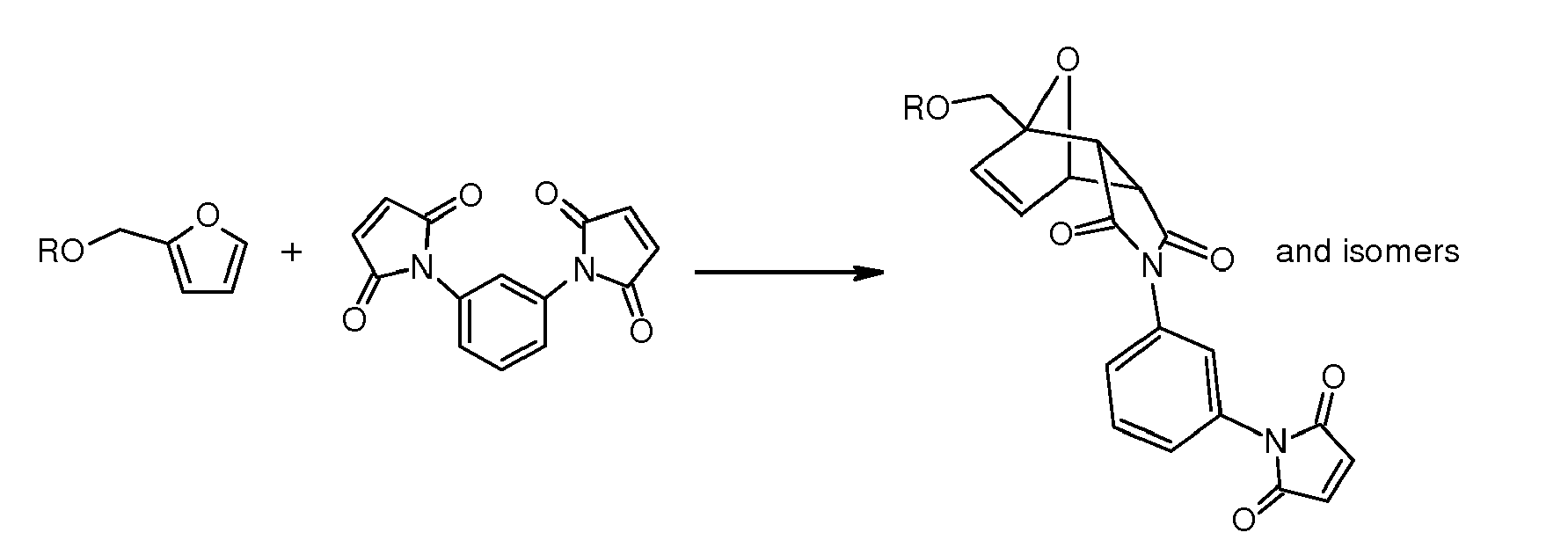
- furfuryl moieties of the partially condensated silane or of furfuryl alcohol resins may react with activated dienophiles in a Diels-Alder reaction as visualized by the following scheme.
- Activated dienophiles which could be used for this type of reaction include bismaleimides such as N, N'-(m-phenylene) bismaleimide and derivatives thereof, and biscitraconimides such as 1 ,3-bis(citraconimidomethyl)benzene and derivatives thereof:
- This reaction could be used to link silanes which have partially condensed on the filler surface with conjugated dienes in elastomer chains. This type of linkage could further enhance polymer-filler interactions as seen in following scheme:
- the rubber composition then includes the reaction product of a silyl ether.
- the silyl ether is tetrafurfuryloxy silane or a silyl ether of 2-hydroxymethyl phenol.
- the silyl ether is a silyl ether of formula I or formula II, as given above.
- the rubber composition includes a sufficient amount of the silyl ether to effect a reinforcing effect on the cured rubber composition.
- the amount of silyl ether in the rubber composition ranges from 1 to 100 phr. In one embodiment, the amount of silyl ether in the rubber composition ranges from 1 to 20 phr.
- the rubber compositon may further include an activated dienophile.
- the activated dienophile includes bismaleimides and biscitraconimides.
- the activated dienophile includes N, N'-(m-phenylene) bismaleimide and 1,3-bis(citraconimidomethyl)benzene.
- the amount of activated dienophile ranges from 1 to 10 phr or from 2 to 6 phr.
- the reaction product obtained by twin polymerization can also be used as filler by themselves partially replacing carbon black or silica.
- the respective monomer of formula I or II can be directly added to the compound formulation during mixing and the twin polymerization can be performed during mixing for example by addition of an acidic catalyst as described above.
- a reaction product obtained by twin-polymerization in a preceding step can be added to an internal mixer during compound mixing.
- the particle size of the composite particles has to be in the low micron or sub-micron range to allow a reinforcement of the compound formulation by the filler.
- the amount of silyl ethers or the respective reaction product added to the compound formulation ranges from 5 to 100 phr such as 15 to 50 phr.
- composites based on the silyl ethers described in formulas I and II the use of composites based on the twin polymerization of boron, titanium and tungsten containing monomers as rubber compound ingredients are also an aspect of this invention. These materials can be used as fillers and added to compound formulations in ranges from 5 to 100 phr such as 15 to 50 phr.
- twin polymerization of these compounds will lead to composites of diboron trioxide and an organic resin.
- Composites based on titanium dioxide and a furfuryl alcohol resin which can be used as fillers can for example be obtained by the twin polymerization of titanium compounds derived from tetraethyl orthotitanate and furfuryl alcohol (see for example, Mehner et al, Adv. Mater, 2008, 20, 4113-4117 ).
- Composites based on tungsten trioxide and organic resins which can be used as fillers can for example be obtained by reaction of tungsten hexachloride with furfuryl acetate, thiophene-2-methanol, p-methoxybenzylalcohol or o-methoxybenzylalcohol (see for example, Böttger-Hiller et al, Angew. Chem. Int. Ed., 2009, 48, 8878-8881 ).
- the rubber composition includes at least one diene based rubber or diene based elastomer.
- Representative synthetic polymers are the homopolymerization products of butadiene and its homologues and derivatives, for example, methylbutadiene, dimethylbutadiene and pentadiene as well as copolymers such as those formed from butadiene or its homologues or derivatives with other unsaturated monomers.
- acetylenes for example, vinyl acetylene
- olefins for example, isobutylene, which copolymerizes with isoprene to form butyl rubber
- vinyl compounds for example, acrylic acid, acrylonitrile (which polymerize with butadiene to form NBR), methacrylic acid and styrene, the latter compound polymerizing with butadiene to form SBR, as well as vinyl esters and various unsaturated aldehydes, ketones and ethers, e.g., acrolein, methyl isopropenyl ketone and vinylethyl ether.
- synthetic rubbers include neoprene (polychloroprene), polybutadiene (including cis-1,4-polybutadiene), polyisoprene (including cis-1,4-polyisoprene), butyl rubber, halobutyl rubber such as chlorobutyl rubber or bromobutyl rubber, styrene/isoprene/butadiene rubber, copolymers of 1,3-butadiene or isoprene with monomers such as styrene, acrylonitrile and methyl methacrylate, as well as ethylene/propylene terpolymers, also known as ethylene/ propylene/diene monomer (EPDM), and in particular, ethylene/propylene/ dicyclopentadiene terpolymers.
- neoprene polychloroprene
- polybutadiene including cis-1,4-polybutadiene
- rubbers which may be used include alkoxysilyl end functionalized solution polymerized polymers (SBR, PBR, IBR and SIBR), silicon-coupled and tin-coupled star-branched polymers.
- SBR alkoxysilyl end functionalized solution polymerized polymers
- PBR polybutadiene
- SIBR silicon-coupled and tin-coupled star-branched polymers.
- the preferred rubber or elastomers are natural rubber, synthetic polyisoprene, polybutadiene and SBR.
- the rubber is preferably of at least two of diene based rubbers.
- a combination of two or more rubbers is preferred such as cis 1,4-polyisoprene rubber (natural or synthetic, although natural is preferred), 3,4-polyisoprene rubber, styrene/isoprene/butadiene rubber, emulsion and solution polymerization derived styrene/butadiene rubbers, cis 1,4-polybutadiene rubbers and emulsion polymerization prepared butadiene/acrylonitrile copolymers.
- an emulsion polymerization derived styrene/butadiene might be used having a relatively conventional styrene content of 20 to 28 percent bound styrene or, for some applications, an E-SBR having a medium to relatively high bound styrene content, namely, a bound styrene content of 30 to 45 percent.
- E-SBR emulsion polymerization prepared E-SBR
- styrene and 1,3-butadiene are copolymerized as an aqueous emulsion.
- the bound styrene content can vary, for example, from 5 to 50 percent.
- the E-SBR may also contain acrylonitrile to form a terpolymer rubber, as E-SBAR, in amounts, for example, of 2 to 30 weight percent bound acrylonitrile in the terpolymer.
- Emulsion polymerization prepared styrene/butadiene/acrylonitrile copolymer rubbers containing 2 to 40 weight percent bound acrylonitrile in the copolymer are also contemplated as diene based rubbers for use in this invention.
- S-SBR solution polymerization prepared SBR
- S-SBR typically has a bound styrene content in a range of 5 to 50, preferably 9 to 36, percent.
- the S-SBR can be conveniently prepared, for example, by organo lithium catalyzation in the presence of an organic hydrocarbon solvent.
- cis 1,4-polybutadiene rubber may be used.
- BR cis 1,4-polybutadiene rubber
- Such BR can be prepared, for example, by organic solution polymerization of 1,3-butadiene.
- the BR may be conveniently characterized, for example, by having at least a 90 percent cis 1,4-content.
- cis 1,4-polybutadiene rubber is used.
- Suitable polybutadiene rubbers may be prepared, for example, by organic solution polymerization of 1,3-butadiene.
- the BR may be conveniently characterized, for example, by having at least a 90 percent cis 1,4-content and a glass transition temperature Tg in a range of from -95 to -105oC.
- Suitable polybutadiene rubbers are available commercially, such as Budene® 1207 from Goodyear.
- a synthetic or natural polyisoprene rubber may be used.
- a reference to glass transition temperature, or Tg, of an elastomer or elastomer composition represents the glass transition temperature(s) of the respective elastomer or elastomer composition in its uncured state or possibly a cured state in a case of an elastomer composition.
- a Tg can be suitably determined as a peak midpoint by a differential scanning calorimeter (DSC) at a temperature rate of increase of 10oC per minute.
- DSC differential scanning calorimeter
- the rubber composition may also include up to 70 phr of processing oil.
- Processing oil may be included in the rubber composition as extending oil typically used to extend elastomers. Processing oil may also be included in the rubber composition by addition of the oil directly during rubber compounding.
- the processing oil used may include both extending oil present in the elastomers, and process oil added during compounding.
- Suitable process oils include various oils as are known in the art, including aromatic, paraffinic, naphthenic, vegetable oils, and low PCA oils, such as MES, TDAE, SRAE and heavy naphthenic oils.
- Suitable low PCA oils include those having a polycyclic aromatic content of less than 3 percent by weight as determined by the IP346 method. Procedures for the IP346 method may be found in Standard Methods for Analysis & Testing of Petroleum and Related Products and British Standard 2000 Parts, 2003, 62nd edition, published by the Institute of Petroleum, United Kingdom .
- the rubber composition may include from 10 to 150 phr of silica. In another embodiment, from 30 to 120 phr of silica or from 40 to 80 phr of silica may be used.
- the commonly employed siliceous pigments which may be used in the rubber compound include conventional pyrogenic and precipitated siliceous pigments (silica).
- precipitated silica is used.
- the conventional siliceous pigments employed in this invention are precipitated silicas such as, for example, those obtained by the acidification of a soluble silicate, e.g., sodium silicate.
- Such conventional silicas might be characterized, for example, by having a BET surface area, as measured using nitrogen gas.
- the BET surface area may be in the range of 40 to 600 square meters per gram. In another embodiment, the BET surface area may be in a range of 80 to 300 square meters per gram. The BET method of measuring surface area is described in the Journal of the American Chemical Society, Volume 60, Page 304 (1930 ).
- the conventional silica may also be characterized by having a dibutylphthalate (DBP) absorption value in a range of 100 to 400, alternatively 150 to 300.
- DBP dibutylphthalate
- silicas such as, only for example herein silicas commercially available from PPG Industries under the Hi-Sil trademark with designations 210 and 243; silicas available from Rhodia, with, for example, designations of Z1165MP and Z165GR and silicas available from Degussa AG with, for example, designations VN2 and VN3.
- Commonly employed carbon blacks can be used as a conventional filler in an amount ranging from 10 to 150 phr. In another embodiment, from 20 to 80 phr of carbon black may be used.
- Representative examples of such carbon blacks include N110, N121, N134, N220, N231, N234, N242, N293, N299, N315, N326, N330, N332, N339, N343, N347, N351, N358, N375, N539, N550, N582, N630, N642, N650, N683, N754, N762, N765, N774, N787, N907, N908, N990 and N991.
- These carbon blacks have iodine absorptions ranging from 9 to 145 g/kg and DBP number ranging from 34 to 150 cm 3 /100 g.
- fillers may be used in the rubber composition including particulate fillers including ultra high molecular weight polyethylene (UHMWPE), crosslinked particulate polymer gels including but not limited to those disclosed in US-A-6,242,534 ; US-A- 6,207,757 ; US-A- 6,133,364 ; US-A- 6,372,857 ; U-S-5,395,891 ; or US-A- 6,127,488 ; plasticized starch composite filler including but not limited to that disclosed in US-A- 5,672,6391 ; cellulose, and short textile fibers such as polyester, polyketone, polyaramid, rayon, or nylon with a length of from 1 to 10 mm. Such other fillers may be used in an amount ranging from 1 to 30 phr.
- UHMWPE ultra high molecular weight polyethylene
- crosslinked particulate polymer gels including but not limited to those disclosed in US-A-6,242,534 ; US-A- 6,207,757 ; US-
- the rubber composition may contain a conventional sulfur containing organosilicon compound.
- suitable sulfur containing organosilicon compounds are of the formula: Z-Alk-S n -Alk-Z VI in which Z is selected from the group consisting of where R 1 is an alkyl group of 1 to 4 carbon atoms, cyclohexyl or phenyl; R 2 is alkoxy of 1 to 8 carbon atoms, or cycloalkoxy of 5 to 8 carbon atoms; Alk is a divalent hydrocarbon of 1 to 18 carbon atoms and n is an integer of 2 to 8.
- the sulfur containing organosilicon compounds are the 3,3'-bis(trimethoxy or triethoxy silylpropyl) polysulfides. In one embodiment, the sulfur containing organosilicon compounds are 3,3'-bis(triethoxysilylpropyl) disulfide and/or 3,3'-bis(triethoxysilylpropyl) tetrasulfide. Therefore, as to formula VI, Z may be where R 2 is an alkoxy of 2 to 4 carbon atoms, alternatively 2 carbon atoms; alk is a divalent hydrocarbon of 2 to 4 carbon atoms, alternatively with 3 carbon atoms; and n is an integer of from 2 to 5, alternatively 2 or 4.
- suitable sulfur containing organosilicon compounds include compounds disclosed in US-A- 6,608,125 .
- suitable sulfur containing organosilicon compounds include those disclosed in US-A- 2003/0130535 .
- the sulfur containing organosilicon compound is Si-363 from Degussa.
- the amount of the sulfur containing organosilicon compound in a rubber composition will vary depending on the level of other additives that are used. Generally speaking, the amount of the compound will range from 0.5 to 20 phr. In one embodiment, the amount will range from 1 to 10 phr.
- the rubber composition would be compounded by methods generally known in the rubber compounding art, such as mixing the various sulfur-vulcanizable constituent rubbers with various commonly used additive materials such as, for example, sulfur donors, curing aids, such as activators and retarders and processing additives, such as oils, resins including tackifying resins and plasticizers, fillers, pigments, fatty acid, zinc oxide, waxes, antioxidants and antiozonants and peptizing agents.
- additives mentioned above are selected and commonly used in conventional amounts.
- sulfur donors include elemental sulfur (free sulfur), an amine disulfide, polymeric polysulfide and sulfur olefin adducts.
- the sulfur-vulcanizing agent is elemental sulfur.
- the sulfur-vulcanizing agent may be used in an amount ranging from 0.5 to 8 phr, alternatively with a range of from 1.5 to 6 phr.
- Typical amounts of tackifier resins, if used, comprise 0.5 to 10 phr, usually 1 to 5 phr.
- processing aids comprise 1 to 50 phr.
- Typical amounts of antioxidants comprise 1 to 5 phr.
- antioxidants may be, for example, diphenyl-p-phenylenediamine and others, such as, for example, those disclosed in The Vanderbilt Rubber Handbook (1978), Pages 344 through 346 .
- Typical amounts of antiozonants comprise 1 to 5 phr.
- Typical amounts of fatty acids, if used, which can include stearic acid comprise 0.5 to 3 phr.
- Typical amounts of waxes comprise 1 to 5 phr. Often microcrystalline waxes are used.
- peptizers comprise 0.1 to 1 phr.
- Typical peptizers may be, for example, pentachlorothiophenol and dibenzamidodiphenyl disulfide.
- Accelerators are used to control the time and/or temperature required for vulcanization and to improve the properties of the vulcanizate.
- a single accelerator system may be used, i.e., primary accelerator.
- the primary accelerator(s) may be used in total amounts ranging from a0.5 to 4, alternatively 0.8 to 1.5, phr.
- combinations of a primary and a secondary accelerator might be used with the secondary accelerator being used in smaller amounts, such as from 0.05 to 3 phr, in order to activate and to improve the properties of the vulcanizate.
- delayed action accelerators may be used which are not affected by normal processing temperatures but produce a satisfactory cure at ordinary vulcanization temperatures.
- Vulcanization retarders might also be used.
- Suitable types of accelerators that may be used in the present invention are amines, disulfides, guanidines, thioureas, thiazoles, thiurams, sulfenamides, dithiocarbamates and xanthates.
- the primary accelerator is a sulfenamide.
- the secondary accelerator may be a guanidine, dithiocarbamate or thiuram compound.
- Suitable guanidines include dipheynylguanidine and the like.
- Suitable thiurams include tetramethylthiuram disulfide, tetraethylthiuram disulfide, and tetrabenzylthiuram disulfide.
- the mixing of the rubber composition can be accomplished by methods known to those having skill in the rubber mixing art.
- the ingredients are typically mixed in at least two stages, namely, at least one non-productive stage followed by a productive mix stage.
- the final curatives including sulfur-vulcanizing agents are typically mixed in the final stage which is conventionally called the "productive" mix stage in which the mixing typically occurs at a temperature, or ultimate temperature, lower than the mix temperature(s) than the preceding non-productive mix stage(s).
- the rubber composition may be subjected to a thermomechanical mixing step.
- the thermomechanical mixing step generally comprises a mechanical working in a mixer or extruder for a period of time suitable in order to produce a rubber temperature between 140°C and 190°C.
- the appropriate duration of the thermomechanical working varies as a function of the operating conditions, and the volume and nature of the components.
- the thermomechanical working may be from 1 to 20 minutes.
- the rubber composition may be incorporated in a variety of rubber components of the tire.
- the rubber component may be a tread (including tread cap and tread base), carcass, sidewall, apex, chafer, sidewall insert, wirecoat or innerliner.
- the component is a tread.
- the rubber composition may be in contact with reinforcing tire cords constructed from conventional materials including polyester, nylon, and rayon. So contacted, the presence of the reaction product of twin polymerization may enhance adhesion of the rubber composition to the tire cords.
- the pneumatic tire of the present invention may be a race tire, passenger tire, aircraft tire, agricultural, earthmover, off-the-road, or truck tire.
- the tire is a passenger or truck tire.
- the tire may also be a radial or bias tire.
- Vulcanization of the pneumatic tire of the present invention is generally carried out at conventional temperatures ranging from 100°C to 200°C. In one embodiment, the vulcanization is conducted at temperatures ranging from 110°C to 180°C. Any of the usual vulcanization processes may be used such as heating in a press or mold, heating with superheated steam or hot air. Such tires can be built, shaped, molded and cured by various methods which are known and will be readily apparent to those having skill in such art.
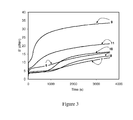
- Figure 1-A shows the graph of temperature versus time for control Sample 1, with the typical gradual increase in temperature due to heating and energy input from the mixer.
- Figure 1-B shows a rapid increase in temperature subsequent to the addition of p-toluenesulfonic acid in Sample 2 at 2 minutes as indicated by the arrow.
- the behavior in Figure 1-B confirms the exothermic polymerization of TFOS in the rubber composition, whereas no such exotherm is seen in control Sample 1 ( Figure 1-A ).
- silica polymerization of a silyl ether in the presence of silica (i.e., pretreatment of silica) is illustrated.
- Silica 200 grams was dispersed in ethanol (800 grams), followed by addition of 0.5 weight percent (based on silica weight) of p-toluenesulfonic acid. After mixing the ethanol was removed by vacuum. The p-toluenesulfonic acid treated silica was then dispersed in toluene, followed by addition of 10 weight percent (based on silica weight) of tetrafurfuryl orthosilicate (TFOS) or 2,2'-spirobi[4H-1,2,3-benzodioxasiline] (SBOS).
- TFOS tetrafurfuryl orthosilicate
- SBOS 2,2'-spirobi[4H-1,2,3-benzodioxasiline]
- the dispersed silica was then stirred at room temperature for 4 days followed by reflux for 1 hour. After cooling the solvent was filtered, the treated silica was washed three times with toluene and the remaining solvent was removed by drying in vacuum.
- SBOS the dispersed silica was stirred at 80oC for 16 hr. After cooling the solvent was filtered, the treated silica was washed three times with toluene and the remaining solvent was removed by drying in vacuum.
- the resulting treated silica particles showed a uniform gray-to-black color caused by the dark color of the resin component of the twin polymerization product. In both cases, no other particles besides the treated silica were visible in the filtrates which shows that the twin polymerization products cover in both cases the silica particle surfaces.
- Pretreated silicas were prepared following the procedures of Example 2.
- a series of nine rubber compounds was prepared following the compositions given in Table 2, with all amounts in phr.
- Other additives were used in identical amounts including process oil, 20 phr; stearic acid, 2 phr; zinc oxide, 3.5 phr; N-cyclohexyl-2-benzothiazole sulfenamide, 1.6 phr; diphenyl guanidine, 1.2; sulfur, 1.8 phr.
- the rubber compounds were evaluated for viscoelastic properties using an MDR 2000 at 150 °C following ASTM D2084 and D5289.
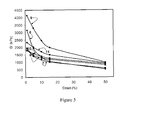
- Figures 4 and 5 indicate an increase in polymer filler interaction for samples with pretreated silica as compared with control, untreated silica.
- a reduced Payne effect is observed for sample 6 as compared with sample 9, and for sample 3 as compared with sample 9. This is seen by comparing the G'50%/G' 1% ratio, which indicates the degree of the strain dependence of the dynamic storage modulus.
- the Payne effect is the nonlinear dynamic mechanical property of elastomers in the presence of filler first studied by Payne, Appl. Polym. Sci., 6, 57 (1962 ). It is generally associated with the breakdown and agglomeration of filler particles. Filler-matrix interactions are also thought to be contributing factors to the Payne effect.
- Such processes are the slippage of entanglements between bound rubber and the mobile rubber phase, molecular surface slippage or rearrangement and release of trapped rubber within the filler network.
- the magnitude of strain dependence of dynamic moduli increases with decreasing molecular weight and strongly reduced by increasing polymer-filler interaction, i.e., by the use of coupling agents. See, e.g., G. Heinrich et al., Advances in Polymer Science, 160, 1436-5030 (2002 ); S. S. Sternstein et al., Macromolecules, 35, 7262-7273 (2002 ); Ai-Jun Zhu et al., Composite Science and Technology, 63, 1113-1126 (2003 ); J. D. Ulmer et al., Rubber Chem.
Landscapes
- Chemical & Material Sciences (AREA)
- Health & Medical Sciences (AREA)
- Chemical Kinetics & Catalysis (AREA)
- Medicinal Chemistry (AREA)
- Polymers & Plastics (AREA)
- Organic Chemistry (AREA)
- Engineering & Computer Science (AREA)
- Mechanical Engineering (AREA)
- Compositions Of Macromolecular Compounds (AREA)
Abstract
A) a twin polymerization reaction product of a silyl ether; or
B) a twin polymerization reaction product of a boronic acid ester; or
C) a twin polymerization reaction product of a titanium compound derived from tetraethyl orthotitanate and furfuryl alcohol; or
D) a twin polymerization reaction product of a tungsten compound.
Description
- Twin polymerization is a polymerization process which creates two different polymer structures from one monomer. The concept of twin polymerization has been investigated by Spange et al. (see for example, Advanced Materials 2009, 21, 2111-2116; Angewandte Chemie International Edition 2007, 46, 628-632; Angewandte Chemie International Edition 2009, 48, 8878-8881). Examples for monomers undergoing twin polymerization are silyl ethers of furfuryl alcohol and 2-hydroxymethyl phenol:

- The scission of the silyl ether bonds of the sketched monomers and further polymerization and/or polycondensation reactions lead to an interpenetrating network of silicon dioxide and an organic polymer. In the first case, a furfuryl alcohol resin will be formed from the organic moieties of the component as the polymerization of furfuryl alcohol usually leads to crosslinking by side reactions. In case of the second monomer, a phenol-formaldehyde resin can be formed from the organic part of the molecule.
- The twin polymerization reaction of tetrafurfuryloxy silane is shown as follows:

- The present invention is directed to a rubber composition in accordance with
claim 1 and to a pneumatic tire in accordance withclaim 11. - Dependent claims refer to preferred embodiments of the invention.
-
-
Figure 1-A and 1-B show graphs of temperature versus time for the mixing of two rubber samples. -
Figure 2 shows a graph of torque versus curetime for several rubber samples. -
Figure 3 shows a graph of torque versus cure time for several rubber samples. -
Figure 4 shows a graph of G' versus percent strain for several rubber samples. -
Figure 5 shows a graph of G' versus percent strain for several rubber samples. -
Figure 6 shows a graph of torque versus cure time for several rubber samples. -
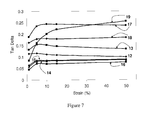
Figure 7 shows a graph of tan delta versus percent strain for several rubber samples. -
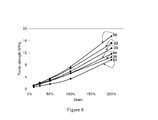
Figure 8 shows a graph of tensile stress versus percent strain for several rubber samples. - The present invention is directed to the use of monomers which can undergo twin polymerization in tire compounds to form a reaction product of the monomers. The main goal of the use of these materials is the improvement of polymer-filler interactions. For example, twin polymerizable monomers may be added as full or partial replacement or in addition to silanes which are currently needed to assure a high level of polymer-filler-interactions when polar fillers like silica, cellulose, starch or short fibers are used. Alternatively, materials derived from twin polymerization can also be used as fillers by themselves partially or fully replacing fillers such as carbon black or silica.
- The present invention is also directed to a pneumatic tire comprising a component, the component comprising a rubber composition comprising a diene based elastomer and 1 to 100 phr, alternatively 5 to 25 phr or 15 to 45 phr, of a reaction product of a silyl ether, wherein the silyl ethers are of the following structures I or II:


- In one embodiment, exemplary silyl ethers are silyl ethers of furfuryl alcohol and 2-hydroxymethyl phenol having the following structures III and IV:


- The present invention is further directed to the respective rubber compositions.
- The reaction product resulting from twin polymerization of silyl ether may be used in the rubber composition and tire as a partial or complete replacement for conventional fillers.
- While not wishing to be bound by any theory, it is believed that due to their relatively high polarity compared to the surrounding polymer matrix it is likely that the monomers migrate to the filler surface during the mixing process. When the twin polymerization starts at the surface of the filler particles, a reaction product such as an interpenetrating network consisting of silicon dioxide and an organic resin is formed. In the case of silica filler particles, strong interactions of the formed silicon dioxide and the filler particles leading to the incorporation of the newly formed silica into the filler particles can be expected. As the organic resin forms an interpenetrating network with the freshly formed silicon dioxide, strong interactions between the resin and the filler particles can also be expected.
- It is believed that the interpenetrating network forms a transition phase on the particle surface. This phase provides a high level of adhesion between the silica particles and the polymer matrix. In addition, the interpenetrating phase exhibits an intermediate modulus between the high modulus filler particles and the low modulus polymer matrix. The modulus gradient leads to an improved force transfer between filler particles and polymer matrix which is likely to improve the mechanical properties of the compound.
- It might be desirable that the coupling of the interpenetrating network to the elastomer does not proceed before the curing process in order to guarantee good processing during mixing and extrusion. The extent of the coupling already taking place during the mixing process might be influenced by the modification of the maximum mixing temperature or other parameters. An incomplete scission of the silyl ether groups might be desirable to further enhance the interactions between resin and silicon dioxide by covalent silyl ether bonds. An acidic catalyst might be required to induce the twin polymerization or to increase the reaction rate to a reasonable level. As catalysts stearic acid or zinc compounds such as zinc stearate which are often used in rubber formulations might be used. In the case that more effective catalysts would be required, stronger organic acids for example p-alkylbenzenesulfonic acids might be added. To avoid issues during the cure reaction, an additional amount of a base can be added at a later mixing stage to neutralize remaining acidic catalyst.
- Alternatively the twin polymerization process could be performed during a pretreatment of the silica prior to mixing. This could be performed by adsorption of the monomer on the silica in liquid phase with subsequent acid treatment to induce the twin polymerization on the silica surface. The solvent could then be removed and the pretreated silica could be neutralized and used for the compound preparation in an internal mixer.
- The interaction of the organic resin with the polymer matrix may proceed in several ways. For example, addition of supplementary resin components such as resorcinol or resorcinol-formaldehyde-precondensates and methylene sources like hexamethylene tetraamine (HMTA) to the compound could lead to a crosslinking of the resin network formed on the surface of the filler particles with the resin network present in the polymer matrix. Moreover, the addition of methylene sources may positively influence the stability of a phenol-formaldehyde resin which is formed by the twin polymerization when the silyl ether of 2-hydroxymethyl phenol is used. As the phenol-formaldehyde ratio in this system is fixed to 1:1, no crosslinking can occur when no other components are added (except via silyl ethers, if the hydrolysis is incomplete). The addition of methylene donors would shift the phenol-formaldehyde ratio thus allowing the formation of crosslinks within the resin.
- When tetrafurfuryloxy silane is used, the resulting furfuryl alcohol resins might be covulcanized with the polymer matrix. Furfuryl alcohol resins feature allylic hydrogens which might undergo vulcanization reactions (indicated by the arrow in the following, note that the aromatic behavior of furans is much less pronounced than that of benzene).

- In addition the furfuryl moieties of the partially condensated silane or of furfuryl alcohol resins may react with activated dienophiles in a Diels-Alder reaction as visualized by the following scheme. Activated dienophiles which could be used for this type of reaction include bismaleimides such as N, N'-(m-phenylene) bismaleimide and derivatives thereof, and biscitraconimides such as 1 ,3-bis(citraconimidomethyl)benzene and derivatives thereof:


- This reaction could be used to link silanes which have partially condensed on the filler surface with conjugated dienes in elastomer chains. This type of linkage could further enhance polymer-filler interactions as seen in following scheme:

- The rubber composition then includes the reaction product of a silyl ether. In one embodiment, the silyl ether is tetrafurfuryloxy silane or a silyl ether of 2-hydroxymethyl phenol. In one embodiment the silyl ether is a silyl ether of formula I or formula II, as given above.
- The rubber composition includes a sufficient amount of the silyl ether to effect a reinforcing effect on the cured rubber composition. In one embodiment, the amount of silyl ether in the rubber composition ranges from 1 to 100 phr. In one embodiment, the amount of silyl ether in the rubber composition ranges from 1 to 20 phr.
- The rubber compositon may further include an activated dienophile. In one embodiment, the activated dienophile includes bismaleimides and biscitraconimides. In one embodiment, the activated dienophile includes N, N'-(m-phenylene) bismaleimide and 1,3-bis(citraconimidomethyl)benzene.
- In one embodiment, the amount of activated dienophile ranges from 1 to 10 phr or from 2 to 6 phr.
- Alternatively to the use as coupling agent at the surface of polar fillers such as silica the reaction product obtained by twin polymerization can also be used as filler by themselves partially replacing carbon black or silica. For this purpose, the respective monomer of formula I or II can be directly added to the compound formulation during mixing and the twin polymerization can be performed during mixing for example by addition of an acidic catalyst as described above.
- Alternatively, a reaction product obtained by twin-polymerization in a preceding step can be added to an internal mixer during compound mixing. In this case, the particle size of the composite particles has to be in the low micron or sub-micron range to allow a reinforcement of the compound formulation by the filler. In the case of the use of materials derived from twin polymerization as alternate fillers, the amount of silyl ethers or the respective reaction product added to the compound formulation ranges from 5 to 100 phr such as 15 to 50 phr.
- Alternatively to the composite materials based on the silyl ethers described in formulas I and II, the use of composites based on the twin polymerization of boron, titanium and tungsten containing monomers as rubber compound ingredients are also an aspect of this invention. These materials can be used as fillers and added to compound formulations in ranges from 5 to 100 phr such as 15 to 50 phr.
- The general structure of boronic acid esters that can be used for this purpose is shown in formula V:

- The twin polymerization of these compounds will lead to composites of diboron trioxide and an organic resin.
- Composites based on titanium dioxide and a furfuryl alcohol resin which can be used as fillers can for example be obtained by the twin polymerization of titanium compounds derived from tetraethyl orthotitanate and furfuryl alcohol (see for example, Mehner et al, Adv. Mater, 2008, 20, 4113-4117).
- Composites based on tungsten trioxide and organic resins which can be used as fillers can for example be obtained by reaction of tungsten hexachloride with furfuryl acetate, thiophene-2-methanol, p-methoxybenzylalcohol or o-methoxybenzylalcohol (see for example, Böttger-Hiller et al, Angew. Chem. Int. Ed., 2009, 48, 8878-8881).
- The rubber composition includes at least one diene based rubber or diene based elastomer. Representative synthetic polymers are the homopolymerization products of butadiene and its homologues and derivatives, for example, methylbutadiene, dimethylbutadiene and pentadiene as well as copolymers such as those formed from butadiene or its homologues or derivatives with other unsaturated monomers. Among the latter are acetylenes, for example, vinyl acetylene; olefins, for example, isobutylene, which copolymerizes with isoprene to form butyl rubber; vinyl compounds, for example, acrylic acid, acrylonitrile (which polymerize with butadiene to form NBR), methacrylic acid and styrene, the latter compound polymerizing with butadiene to form SBR, as well as vinyl esters and various unsaturated aldehydes, ketones and ethers, e.g., acrolein, methyl isopropenyl ketone and vinylethyl ether. Specific examples of synthetic rubbers include neoprene (polychloroprene), polybutadiene (including cis-1,4-polybutadiene), polyisoprene (including cis-1,4-polyisoprene), butyl rubber, halobutyl rubber such as chlorobutyl rubber or bromobutyl rubber, styrene/isoprene/butadiene rubber, copolymers of 1,3-butadiene or isoprene with monomers such as styrene, acrylonitrile and methyl methacrylate, as well as ethylene/propylene terpolymers, also known as ethylene/ propylene/diene monomer (EPDM), and in particular, ethylene/propylene/ dicyclopentadiene terpolymers. Additional examples of rubbers which may be used include alkoxysilyl end functionalized solution polymerized polymers (SBR, PBR, IBR and SIBR), silicon-coupled and tin-coupled star-branched polymers. The preferred rubber or elastomers are natural rubber, synthetic polyisoprene, polybutadiene and SBR.
- In one aspect the rubber is preferably of at least two of diene based rubbers. For example, a combination of two or more rubbers is preferred such as cis 1,4-polyisoprene rubber (natural or synthetic, although natural is preferred), 3,4-polyisoprene rubber, styrene/isoprene/butadiene rubber, emulsion and solution polymerization derived styrene/butadiene rubbers, cis 1,4-polybutadiene rubbers and emulsion polymerization prepared butadiene/acrylonitrile copolymers.
- In one aspect of this invention, an emulsion polymerization derived styrene/butadiene (E-SBR) might be used having a relatively conventional styrene content of 20 to 28 percent bound styrene or, for some applications, an E-SBR having a medium to relatively high bound styrene content, namely, a bound styrene content of 30 to 45 percent.
- By emulsion polymerization prepared E-SBR, it is meant that styrene and 1,3-butadiene are copolymerized as an aqueous emulsion. The bound styrene content can vary, for example, from 5 to 50 percent. In one aspect, the E-SBR may also contain acrylonitrile to form a terpolymer rubber, as E-SBAR, in amounts, for example, of 2 to 30 weight percent bound acrylonitrile in the terpolymer.
- Emulsion polymerization prepared styrene/butadiene/acrylonitrile copolymer rubbers containing 2 to 40 weight percent bound acrylonitrile in the copolymer are also contemplated as diene based rubbers for use in this invention.
- The solution polymerization prepared SBR (S-SBR) typically has a bound styrene content in a range of 5 to 50, preferably 9 to 36, percent. The S-SBR can be conveniently prepared, for example, by organo lithium catalyzation in the presence of an organic hydrocarbon solvent.
- In one embodiment, cis 1,4-polybutadiene rubber (BR) may be used. Such BR can be prepared, for example, by organic solution polymerization of 1,3-butadiene. The BR may be conveniently characterized, for example, by having at least a 90 percent cis 1,4-content.
- In one embodiment, cis 1,4-polybutadiene rubber (BR) is used. Suitable polybutadiene rubbers may be prepared, for example, by organic solution polymerization of 1,3-butadiene. The BR may be conveniently characterized, for example, by having at least a 90 percent cis 1,4-content and a glass transition temperature Tg in a range of from -95 to -105ºC. Suitable polybutadiene rubbers are available commercially, such as Budene® 1207 from Goodyear.
- In one embodiment, a synthetic or natural polyisoprene rubber may be used.
- A reference to glass transition temperature, or Tg, of an elastomer or elastomer composition, where referred to herein, represents the glass transition temperature(s) of the respective elastomer or elastomer composition in its uncured state or possibly a cured state in a case of an elastomer composition. A Tg can be suitably determined as a peak midpoint by a differential scanning calorimeter (DSC) at a temperature rate of increase of 10ºC per minute.
- The term "phr" as used herein, and according to conventional practice, refers to "parts by weight of a respective material per 100 parts by weight of rubber, or elastomer."
- The rubber composition may also include up to 70 phr of processing oil. Processing oil may be included in the rubber composition as extending oil typically used to extend elastomers. Processing oil may also be included in the rubber composition by addition of the oil directly during rubber compounding. The processing oil used may include both extending oil present in the elastomers, and process oil added during compounding. Suitable process oils include various oils as are known in the art, including aromatic, paraffinic, naphthenic, vegetable oils, and low PCA oils, such as MES, TDAE, SRAE and heavy naphthenic oils. Suitable low PCA oils include those having a polycyclic aromatic content of less than 3 percent by weight as determined by the IP346 method. Procedures for the IP346 method may be found in Standard Methods for Analysis & Testing of Petroleum and Related Products and .
- The rubber composition may include from 10 to 150 phr of silica. In another embodiment, from 30 to 120 phr of silica or from 40 to 80 phr of silica may be used.
- The commonly employed siliceous pigments which may be used in the rubber compound include conventional pyrogenic and precipitated siliceous pigments (silica). In one embodiment, precipitated silica is used. The conventional siliceous pigments employed in this invention are precipitated silicas such as, for example, those obtained by the acidification of a soluble silicate, e.g., sodium silicate.
- Such conventional silicas might be characterized, for example, by having a BET surface area, as measured using nitrogen gas. In one embodiment, the BET surface area may be in the range of 40 to 600 square meters per gram. In another embodiment, the BET surface area may be in a range of 80 to 300 square meters per gram. The BET method of measuring surface area is described in the Journal of the American Chemical Society, Volume 60, Page 304 (1930).
- The conventional silica may also be characterized by having a dibutylphthalate (DBP) absorption value in a range of 100 to 400, alternatively 150 to 300.
- Various commercially available silicas may be used, such as, only for example herein silicas commercially available from PPG Industries under the Hi-Sil trademark with designations 210 and 243; silicas available from Rhodia, with, for example, designations of Z1165MP and Z165GR and silicas available from Degussa AG with, for example, designations VN2 and VN3.
- Commonly employed carbon blacks can be used as a conventional filler in an amount ranging from 10 to 150 phr. In another embodiment, from 20 to 80 phr of carbon black may be used. Representative examples of such carbon blacks include N110, N121, N134, N220, N231, N234, N242, N293, N299, N315, N326, N330, N332, N339, N343, N347, N351, N358, N375, N539, N550, N582, N630, N642, N650, N683, N754, N762, N765, N774, N787, N907, N908, N990 and N991. These carbon blacks have iodine absorptions ranging from 9 to 145 g/kg and DBP number ranging from 34 to 150 cm3/100 g.
- Other fillers may be used in the rubber composition including particulate fillers including ultra high molecular weight polyethylene (UHMWPE), crosslinked particulate polymer gels including but not limited to those disclosed in
US-A-6,242,534 ;US-A- 6,207,757 ;US-A- 6,133,364 ;US-A- 6,372,857 ;U-S-5,395,891 ; orUS-A- 6,127,488 ; plasticized starch composite filler including but not limited to that disclosed inUS-A- 5,672,6391 - In one embodiment the rubber composition may contain a conventional sulfur containing organosilicon compound. Examples of suitable sulfur containing organosilicon compounds are of the formula:
Z-Alk-Sn-Alk-Z VI
in which Z is selected from the group consisting of
- In one embodiment, the sulfur containing organosilicon compounds are the 3,3'-bis(trimethoxy or triethoxy silylpropyl) polysulfides. In one embodiment, the sulfur containing organosilicon compounds are 3,3'-bis(triethoxysilylpropyl) disulfide and/or 3,3'-bis(triethoxysilylpropyl) tetrasulfide. Therefore, as to formula VI, Z may be

- In another embodiment, suitable sulfur containing organosilicon compounds include compounds disclosed in
US-A- 6,608,125 . In one embodiment, the sulfur containing organosilicon compounds includes 3-(octanoylthio)-1-propyltriethoxysilane, CH3(CH2)6C(=O) -S-CH2CH2CH2Si(OCH2CH3)3, which is available commercially as NXT™ from Momentive Performance Materials. - In another embodiment, suitable sulfur containing organosilicon compounds include those disclosed in
US-A- 2003/0130535 . In one embodiment, the sulfur containing organosilicon compound is Si-363 from Degussa. - The amount of the sulfur containing organosilicon compound in a rubber composition will vary depending on the level of other additives that are used. Generally speaking, the amount of the compound will range from 0.5 to 20 phr. In one embodiment, the amount will range from 1 to 10 phr.
- It is readily understood by those having skill in the art that the rubber composition would be compounded by methods generally known in the rubber compounding art, such as mixing the various sulfur-vulcanizable constituent rubbers with various commonly used additive materials such as, for example, sulfur donors, curing aids, such as activators and retarders and processing additives, such as oils, resins including tackifying resins and plasticizers, fillers, pigments, fatty acid, zinc oxide, waxes, antioxidants and antiozonants and peptizing agents. As known to those skilled in the art, depending on the intended use of the sulfur vulcanizable and sulfur-vulcanized material (rubbers), the additives mentioned above are selected and commonly used in conventional amounts. Representative examples of sulfur donors include elemental sulfur (free sulfur), an amine disulfide, polymeric polysulfide and sulfur olefin adducts. In one embodiment, the sulfur-vulcanizing agent is elemental sulfur. The sulfur-vulcanizing agent may be used in an amount ranging from 0.5 to 8 phr, alternatively with a range of from 1.5 to 6 phr. Typical amounts of tackifier resins, if used, comprise 0.5 to 10 phr, usually 1 to 5 phr. Typical amounts of processing aids comprise 1 to 50 phr. Typical amounts of antioxidants comprise 1 to 5 phr. Representative antioxidants may be, for example, diphenyl-p-phenylenediamine and others, such as, for example, those disclosed in The Vanderbilt Rubber Handbook (1978), Pages 344 through 346. Typical amounts of antiozonants comprise 1 to 5 phr. Typical amounts of fatty acids, if used, which can include stearic acid comprise 0.5 to 3 phr. Typical amounts of waxes comprise 1 to 5 phr. Often microcrystalline waxes are used. Typical amounts of peptizers comprise 0.1 to 1 phr. Typical peptizers may be, for example, pentachlorothiophenol and dibenzamidodiphenyl disulfide.
- Accelerators are used to control the time and/or temperature required for vulcanization and to improve the properties of the vulcanizate. In one embodiment, a single accelerator system may be used, i.e., primary accelerator. The primary accelerator(s) may be used in total amounts ranging from a0.5 to 4, alternatively 0.8 to 1.5, phr. In another embodiment, combinations of a primary and a secondary accelerator might be used with the secondary accelerator being used in smaller amounts, such as from 0.05 to 3 phr, in order to activate and to improve the properties of the vulcanizate. In addition, delayed action accelerators may be used which are not affected by normal processing temperatures but produce a satisfactory cure at ordinary vulcanization temperatures. Vulcanization retarders might also be used. Suitable types of accelerators that may be used in the present invention are amines, disulfides, guanidines, thioureas, thiazoles, thiurams, sulfenamides, dithiocarbamates and xanthates. In one embodiment, the primary accelerator is a sulfenamide. If a second accelerator is used, the secondary accelerator may be a guanidine, dithiocarbamate or thiuram compound. Suitable guanidines include dipheynylguanidine and the like. Suitable thiurams include tetramethylthiuram disulfide, tetraethylthiuram disulfide, and tetrabenzylthiuram disulfide.
- The mixing of the rubber composition can be accomplished by methods known to those having skill in the rubber mixing art. For example, the ingredients are typically mixed in at least two stages, namely, at least one non-productive stage followed by a productive mix stage. The final curatives including sulfur-vulcanizing agents are typically mixed in the final stage which is conventionally called the "productive" mix stage in which the mixing typically occurs at a temperature, or ultimate temperature, lower than the mix temperature(s) than the preceding non-productive mix stage(s). The rubber composition may be subjected to a thermomechanical mixing step. The thermomechanical mixing step generally comprises a mechanical working in a mixer or extruder for a period of time suitable in order to produce a rubber temperature between 140°C and 190°C. The appropriate duration of the thermomechanical working varies as a function of the operating conditions, and the volume and nature of the components. For example, the thermomechanical working may be from 1 to 20 minutes.
- The rubber composition may be incorporated in a variety of rubber components of the tire. For example, the rubber component may be a tread (including tread cap and tread base), carcass, sidewall, apex, chafer, sidewall insert, wirecoat or innerliner. In one embodiment, the component is a tread.
- In the case of components such as a carcass, the rubber composition may be in contact with reinforcing tire cords constructed from conventional materials including polyester, nylon, and rayon. So contacted, the presence of the reaction product of twin polymerization may enhance adhesion of the rubber composition to the tire cords.
- The pneumatic tire of the present invention may be a race tire, passenger tire, aircraft tire, agricultural, earthmover, off-the-road, or truck tire. In one embodiment, the tire is a passenger or truck tire. The tire may also be a radial or bias tire.
- Vulcanization of the pneumatic tire of the present invention is generally carried out at conventional temperatures ranging from 100°C to 200°C. In one embodiment, the vulcanization is conducted at temperatures ranging from 110°C to 180°C. Any of the usual vulcanization processes may be used such as heating in a press or mold, heating with superheated steam or hot air. Such tires can be built, shaped, molded and cured by various methods which are known and will be readily apparent to those having skill in such art.
- The invention is further illustrated by the following examples.
- In this example, the in situ reaction of a silyl ether in a rubber sample is illustrated. Two rubber samples were mixed according to the composition in Table 1, with all amounts given in phr.
Sample 1 served as control.Sample 2 included a silyl ether (TFOS) and acid polymerization initiator p-toluenesulfonic acid. In the case ofsample 2, the addition of p-toluenesulfonic acid was delayed until 2 minutes after start of mixing. The mixing of the non-productive stage was monitored using the thermocouple embedded in the chamber of the mixer to measure the temperature (°C) with time. The results are shown inFigure 1 .Table 1 Sample No. 1 2 Styrene- butadiene rubber 100 100 tetrafurfuryl orthosilicate (TFOS) 0 10 p- toluenesulfonic acid 0 1 -
Figure 1-A shows the graph of temperature versus time forcontrol Sample 1, with the typical gradual increase in temperature due to heating and energy input from the mixer. In contrast,Figure 1-B shows a rapid increase in temperature subsequent to the addition of p-toluenesulfonic acid inSample 2 at 2 minutes as indicated by the arrow. The behavior inFigure 1-B confirms the exothermic polymerization of TFOS in the rubber composition, whereas no such exotherm is seen in control Sample 1 (Figure 1-A ). - In this example, polymerization of a silyl ether in the presence of silica (i.e., pretreatment of silica) is illustrated. Silica (200 grams) was dispersed in ethanol (800 grams), followed by addition of 0.5 weight percent (based on silica weight) of p-toluenesulfonic acid. After mixing the ethanol was removed by vacuum. The p-toluenesulfonic acid treated silica was then dispersed in toluene, followed by addition of 10 weight percent (based on silica weight) of tetrafurfuryl orthosilicate (TFOS) or 2,2'-spirobi[4H-1,2,3-benzodioxasiline] (SBOS). In the case of TFOS, the dispersed silica was then stirred at room temperature for 4 days followed by reflux for 1 hour. After cooling the solvent was filtered, the treated silica was washed three times with toluene and the remaining solvent was removed by drying in vacuum. In the case of SBOS, the dispersed silica was stirred at 80ºC for 16 hr. After cooling the solvent was filtered, the treated silica was washed three times with toluene and the remaining solvent was removed by drying in vacuum.
- In the case of TFOS, the resulting treated silica particles showed a uniform gray-to-black color caused by the dark color of the resin component of the twin polymerization product. In both cases, no other particles besides the treated silica were visible in the filtrates which shows that the twin polymerization products cover in both cases the silica particle surfaces.
- In this example, the effect of using a pretreated silica in a rubber compound is illustrated. Pretreated silicas were prepared following the procedures of Example 2. A series of nine rubber compounds was prepared following the compositions given in Table 2, with all amounts in phr. Other additives were used in identical amounts including process oil, 20 phr; stearic acid, 2 phr; zinc oxide, 3.5 phr; N-cyclohexyl-2-benzothiazole sulfenamide, 1.6 phr; diphenyl guanidine, 1.2; sulfur, 1.8 phr. The rubber compounds were evaluated for viscoelastic properties using an
MDR 2000 at 150 °C following ASTM D2084 and D5289. Results for torque S' and dynamic modulus G' versus time are given inFigures 2 ,3 ,4 and5 .Table 2 Sample No. 3 4 5 6 7 8 9 10 11 SBR 100 100 100 100 100 100 100 100 100 TFOS-Si1 71.5 71.5 71.5 0 0 0 0 0 0 SBOS- Si 20 0 0 71.5 71.5 71.5 0 0 0 Silica 0 0 0 0 0 0 65 65 65 Silane 30 2.6 5.2 0 2.6 5.2 0 2.6 5.2 1 silica pretreated with tetrafurfuryl orthosilicate according to Example 2
2 silica pretreated with 2,2'-spirobi[4H-1,2,3-benzodioxasiline] according to Example 2
3 triethoxysilylpropyl disulfide -
Figures 4 and5 indicate an increase in polymer filler interaction for samples with pretreated silica as compared with control, untreated silica. In particular, a reduced Payne effect is observed forsample 6 as compared withsample 9, and forsample 3 as compared withsample 9. This is seen by comparing the G'50%/G' 1% ratio, which indicates the degree of the strain dependence of the dynamic storage modulus. The Payne effect is the nonlinear dynamic mechanical property of elastomers in the presence of filler first studied by Payne, Appl. Polym. Sci., 6, 57 (1962). It is generally associated with the breakdown and agglomeration of filler particles. Filler-matrix interactions are also thought to be contributing factors to the Payne effect. Such processes are the slippage of entanglements between bound rubber and the mobile rubber phase, molecular surface slippage or rearrangement and release of trapped rubber within the filler network. The magnitude of strain dependence of dynamic moduli increases with decreasing molecular weight and strongly reduced by increasing polymer-filler interaction, i.e., by the use of coupling agents. See, e.g., G. Heinrich et al., Advances in Polymer Science, 160, 1436-5030 (2002); S. S. Sternstein et al., Macromolecules, 35, 7262-7273 (2002); Ai-Jun Zhu et al., Composite Science and Technology, 63, 1113-1126 (2003); J. D. Ulmer et al., Rubber Chem. & Techn., 71 (4), 637-667 (1998); C. Gauthier et al., Polymer, 45, 2761-2771 (2003). Therefore measurement of Payne effect is highly suitable to quantify polymer-filler interactions. Again referring to the data ofFigures 4 and5 , it is seen that the G'50%/G' 1 % ratio forsample 3 is lower that forsample 9, and also G'50%/G' 1% ratio forsample 6 is lower that forsample 9, indicating a lower strain dependence of the dynamic modulus due to superior polymer-filler interaction forsamples - In this example, the in situ reaction of a silyl ether in a rubber compound in the presence of silica is illustrated. A series of eight rubber compounds was prepared following the compositions given in Table 3, with all amounts in phr. Other additives were used in identical amounts including process oil, 20 phr; stearic acid, 2 phr; zinc oxide, 3.5 phr; N-cyclohexyl-2-benzothiazole sulfenamide, 1.6 phr; diphenyl guanidine, 1.2; sulfur, 1.8 phr. The rubber compounds were evaluated for viscoelastic properties using an
MDR 2000 at 150°C following ASTM D2084 and D5289. Results for torque S' and dynamic modulus G' versus time are given inFigures 6 and7 .Table 3 Sample No. 12 13 14 15 16 17 18 19 Styrene-Butadiene Rubber 70 70 70 70 70 70 70 70 Polybutadiene Rubber 30 30 30 30 30 30 30 30 SBOS 45 5 0 0 0 6.5 6.5 0 p-toluenesulfonic acid 0.23 0.23 0 0.23 0.23 0.3 0.3 0 Silica 65 65 65 65 65 65 65 65 Silane 53 3 5.2 5.2 5.2 0 0 0 Non-Productive Mixing Plateau Temperature [°C] 160 120 160 120 160 120 160 160 4 2,2'-spirobi[4H-1,2,3-benzodioxasiline]
5 triethoxysilylpropyl disulfide - The MDR curves in
Figures 6 and7 show that SBOS leads to a reduction of filler-filler interactions. This can be concluded from the reduced silica flocculation during the first seconds of the MDR measurement. Sample 18 (SBOS mixed at 160°C) shows almost no flocculation behavior. Thus, when compared to silica without coupling agent (sample 19), a clear positive influence of the SBOS is observed. In addition,Figure 7 shows that the RPA tan delta values at high strains are lower for SBOS than for silica without coupler. - In this example, the in situ reaction of a silyl ether in a rubber compound in the presence of carbon black is illustrated. A series of six rubber compounds was prepared following the compositions given in Table 4, with all amounts in phr. Other additives were used in identical amounts including stearic acid, 2 phr; zinc oxide, 3 phr; N-cyclohexyl-2-benzothiazole sulfenamide, 1.6 phr; sulfur, 1.6 phr. The rubber compounds were cured at 150°C for 60 minutes and evaluated for tensile stress. Results are given in
Figure 8 .Table 4 Sample No. 20 21 22 23 24 25 Styrene- Butadiene Rubber 100 100 100 100 100 100 TFOS 0 0 5 10 15 20 p- toluenesulfonic acid 0 0 0.5 1 1.5 2 Carbon black 60 40 55 50 45 40 - The comparison of the tensile curves (
Figure 8 ) of sample 21 (40 phr CB) and sample 25 (40 phr black and 20 phr TFOS) shows that some additional reinforcement is achieved by the structure generated from the reaction producrt of the TFOS.
Claims (14)
- A rubber composition comprising a diene based elastomer and from 1 to 100 phr of:a) a twin polymerization reaction product of a silyl ether, wherein the silyl ethers are of the following structures I or II:

 b) a twin polymerization reaction product of a boronic acid esters as shown in formula V:
 c) a twin polymerization reaction product of a titanium compound derived from tetraethyl orthotitanate and furfuryl alcohol; ord) a twin polymerization reaction product of a tungsten compound derived from tungsten hexachloride and a member of the groups consisting of furfuryl acetate, thiophene-2-methanol, p-methoxybenzylalcohol or o-methoxybenzylalcohol.
 - The rubber composition of claim 1 further comprising from 10 to 150 phr of silica.
- The rubber composition of claim 1 or 2 further comprising from 1 to 30 phr of a filler selected from the group consisting of ultra high molecular weight polyethylene (UHMWPE), crosslinked particulate polymer gels, plasticized starch composite filler, cellulose, and textile fibers.
- The rubber composition of claim 1, 2 or 3, wherein the rubber composition is in contact with a tire cord.
- The rubber composition of at least one of the previous claims, wherein the silyl ether is selected from the group consisting of silyl ether of furfuryl alcohol and silyl ether of 2-hydroxymethyl phenol.
- The rubber composition of at least one of the previous claims, wherein the silyl ether is tetrafurfuryl orthosilicate or 2,2'-spirobi[4H-1,2,3-benzodioxasiline].
- The rubber composition of at least one of the previous claims, wherein the silyl ether is selected from the group consisting of silyl ethers of the following structures III and IV:


- The rubber composition of at least one of the previous claims, wherein the rubber composition further comprises from 1 to 10 phr of at least one activated dienophile.
- The rubber composition of at least one of the previous claims, wherein the rubber composition further comprises from 1 to 10 phr of at least one member of the group consisting of bismaleimides and biscitraconimides.
- The rubber composition of at least one of the previous claims, wherein the rubber composition further comprises from 1 to 10 phr of at least one member of the group consisting of N, N'-(m-phenylene) bismaleimide and 1,3-bis(citraconimidomethyl)benzene.
- A pneumatic tire having a component, the component comprising the rubber composition in accordance with one of the previous claims.
- The pneumatic tire of claims 11, wherein the component is selected from the group consisting of a tread, a tread cap, a tread base, a carcass, a sidewall, an apex, a chafer, a sidewall insert, a wirecoat and an innerliner.
- The pneumatic tire of claim 11, wherein the component is a tread.
- The pneumatic tire of claim 11, wherein the component is a tread cap.
Applications Claiming Priority (2)
| Application Number | Priority Date | Filing Date | Title |
|---|---|---|---|
| US32039310P | 2010-04-02 | 2010-04-02 | |
| US13/048,920 US8536264B2 (en) | 2010-04-02 | 2011-03-16 | Pneumatic tire and rubber composition containing twin polymerization structures |
Publications (2)
| Publication Number | Publication Date |
|---|---|
| EP2371581A1 true EP2371581A1 (en) | 2011-10-05 |
| EP2371581B1 EP2371581B1 (en) | 2013-03-06 |
Family
ID=44281014
Family Applications (1)
| Application Number | Title | Priority Date | Filing Date |
|---|---|---|---|
| EP11160910A Not-in-force EP2371581B1 (en) | 2010-04-02 | 2011-04-01 | Pneumatic tire and rubber composition containing twin polymerization structures |
Country Status (4)
| Country | Link |
|---|---|
| US (1) | US8536264B2 (en) |
| EP (1) | EP2371581B1 (en) |
| CN (1) | CN102234386B (en) |
| BR (1) | BRPI1101868A2 (en) |
Cited By (1)
| Publication number | Priority date | Publication date | Assignee | Title |
|---|---|---|---|---|
| WO2014184342A1 (en) * | 2013-05-17 | 2014-11-20 | Basf Se | Method for producing polyamide composite materials containing silicon |
Families Citing this family (7)
| Publication number | Priority date | Publication date | Assignee | Title |
|---|---|---|---|---|
| CN103476837A (en) * | 2011-01-19 | 2013-12-25 | 巴斯夫欧洲公司 | Method for preparing composite materials |
| US9688837B2 (en) | 2013-11-25 | 2017-06-27 | The Goodyear Tire & Rubber Company | Functionalized polymer, rubber composition and pneumatic tire |
| US9109103B2 (en) | 2013-11-25 | 2015-08-18 | The Goodyear Tire & Rubber Company | Functionalized polymer, rubber composition and pneumatic tire |
| JP2017521523A (en) * | 2014-06-30 | 2017-08-03 | ブリヂストン アメリカズ タイヤ オペレーションズ、 エルエルシー | Rubber composition containing cellulose ester and inorganic oxide |
| JP7125507B2 (en) * | 2018-04-11 | 2022-08-24 | エクソンモービル ケミカル パテンツ インコーポレイテッド | Propylene-Based Polymer Additives for Improving Tire Tread Performance |
| CN110713646B (en) * | 2018-07-13 | 2022-05-27 | 杭州星庐科技有限公司 | Rubber composition and tire using the same |
| US20220098389A1 (en) * | 2020-09-28 | 2022-03-31 | The Goodyear Tire & Rubber Company | Article and rubber composition containing bismaleimide |
Citations (12)
| Publication number | Priority date | Publication date | Assignee | Title |
|---|---|---|---|---|
| US5395891A (en) | 1992-06-24 | 1995-03-07 | Bayer Aktiengesellschaft | Rubber mixtures containing polybutadiene gel |
| US5672639A (en) | 1996-03-12 | 1997-09-30 | The Goodyear Tire & Rubber Company | Starch composite reinforced rubber composition and tire with at least one component thereof |
| US6127488A (en) | 1997-01-17 | 2000-10-03 | Bayer Ag | Rubber mixtures which contain SBR rubber gels |
| US6133364A (en) | 1998-08-01 | 2000-10-17 | Continental Aktiengesellschaft | Rubber composition, method of formulating the composition and vehicle tire made from the composition |
| US6207757B1 (en) | 1998-08-01 | 2001-03-27 | Continental Aktiengesellschaft | Rubber composition, method of adding and blending the composition and vehicle tire made from the composition |
| US6242534B1 (en) | 1998-08-01 | 2001-06-05 | Continental Aktiengesellschaft | Rubber composition, method of formulating and blending the same and article and tires made therefrom |
| US6372857B1 (en) | 1999-09-07 | 2002-04-16 | Bayer Aktiengesellschaft | Microgel-containing rubber mixtures with masked bi-functional mercaptans and vulcanization products produced therefrom |
| US20030130535A1 (en) | 2001-08-06 | 2003-07-10 | Degussa Ag, | Organosilicon compounds |
| US6608125B2 (en) | 1997-08-21 | 2003-08-19 | Crompton Corporation | Blocked mercaptosilane coupling agents for filled rubbers |
| WO2009083083A1 (en) * | 2007-12-27 | 2009-07-09 | Merck Patent Gmbh | Spiro compounds |
| WO2010112581A1 (en) * | 2009-04-03 | 2010-10-07 | Basf Se | Method for the production of composite materials |
| WO2010128144A1 (en) * | 2009-05-08 | 2010-11-11 | Basf Se | Process for producing a particulate nanocomposite material |
Family Cites Families (3)
| Publication number | Priority date | Publication date | Assignee | Title |
|---|---|---|---|---|
| US2276094A (en) | 1939-08-24 | 1942-03-10 | Du Pont | Alpha, beta-unsaturated primary alcohol esters of silicic and boric acids |
| US6524716B2 (en) | 2000-07-27 | 2003-02-25 | The Goodyear Tire & Rubber Company | Method for the preparation of a diene polymer interpenetrated with a polysiloxane |
| US7015272B2 (en) * | 2002-10-28 | 2006-03-21 | The Goodyear Tire & Rubber Company | Rubber with polyethylene and phenylene bismaleimide and tire with component thereof |
-
2011
- 2011-03-16 US US13/048,920 patent/US8536264B2/en not_active Expired - Fee Related
- 2011-04-01 EP EP11160910A patent/EP2371581B1/en not_active Not-in-force
- 2011-04-01 BR BRPI1101868-2A patent/BRPI1101868A2/en not_active IP Right Cessation
- 2011-04-02 CN CN201110083458.4A patent/CN102234386B/en not_active Expired - Fee Related
Patent Citations (12)
| Publication number | Priority date | Publication date | Assignee | Title |
|---|---|---|---|---|
| US5395891A (en) | 1992-06-24 | 1995-03-07 | Bayer Aktiengesellschaft | Rubber mixtures containing polybutadiene gel |
| US5672639A (en) | 1996-03-12 | 1997-09-30 | The Goodyear Tire & Rubber Company | Starch composite reinforced rubber composition and tire with at least one component thereof |
| US6127488A (en) | 1997-01-17 | 2000-10-03 | Bayer Ag | Rubber mixtures which contain SBR rubber gels |
| US6608125B2 (en) | 1997-08-21 | 2003-08-19 | Crompton Corporation | Blocked mercaptosilane coupling agents for filled rubbers |
| US6133364A (en) | 1998-08-01 | 2000-10-17 | Continental Aktiengesellschaft | Rubber composition, method of formulating the composition and vehicle tire made from the composition |
| US6207757B1 (en) | 1998-08-01 | 2001-03-27 | Continental Aktiengesellschaft | Rubber composition, method of adding and blending the composition and vehicle tire made from the composition |
| US6242534B1 (en) | 1998-08-01 | 2001-06-05 | Continental Aktiengesellschaft | Rubber composition, method of formulating and blending the same and article and tires made therefrom |
| US6372857B1 (en) | 1999-09-07 | 2002-04-16 | Bayer Aktiengesellschaft | Microgel-containing rubber mixtures with masked bi-functional mercaptans and vulcanization products produced therefrom |
| US20030130535A1 (en) | 2001-08-06 | 2003-07-10 | Degussa Ag, | Organosilicon compounds |
| WO2009083083A1 (en) * | 2007-12-27 | 2009-07-09 | Merck Patent Gmbh | Spiro compounds |
| WO2010112581A1 (en) * | 2009-04-03 | 2010-10-07 | Basf Se | Method for the production of composite materials |
| WO2010128144A1 (en) * | 2009-05-08 | 2010-11-11 | Basf Se | Process for producing a particulate nanocomposite material |
Non-Patent Citations (14)
| Title |
|---|
| "Standard Methods for Analysis & Testing of Petroleum and Related Products and British Standard 2000 Parts", 2003, INSTITUTE OF PETROLEUM |
| "The Vanderbilt Rubber Handbook", 1978, pages: 344 - 346 |
| ADVANCED MATERIALS, vol. 21, 2009, pages 2111 - 2116 |
| AI-JUN ZHU ET AL., COMPOSITE SCIENCE AND TECHNOLOGY, vol. 63, 2003, pages 1113 - 1126 |
| ANGEWANDTE CHEMIE INTERNATIONAL EDITION, vol. 46, 2007, pages 628 - 632 |
| ANGEWANDTE CHEMIE INTERNATIONAL EDITION, vol. 48, 2009, pages 8878 - 8881 |
| B6TTGER-HILLER ET AL., ANGEW. CHEM. INT. ED., vol. 48, 2009, pages 8878 - 8881 |
| C. GAUTHIER ET AL., POLYMER, vol. 45, 2003, pages 2761 - 2771 |
| G. HEINRICH ET AL., ADVANCES IN POLYMER SCIENCE, vol. 160, 2002, pages 1436 - 5030 |
| J. D. ULMER ET AL., RUBBER CHEM. & TECHN., vol. 71, no. 4, 1998, pages 637 - 667 |
| JOURNAL OF THE AMERICAN CHEMICAL SOCIETY, vol. 60, 1930, pages 304 |
| MEHNER ET AL., ADV. MATER, vol. 20, 2008, pages 4113 - 4117 |
| PAYNE, APPL. POLYM. SCI., vol. 6, 1962, pages 57 |
| S. S. STERNSTEIN ET AL., MACROMOLECULES, vol. 35, 2002, pages 7262 - 7273 |
Cited By (2)
| Publication number | Priority date | Publication date | Assignee | Title |
|---|---|---|---|---|
| WO2014184342A1 (en) * | 2013-05-17 | 2014-11-20 | Basf Se | Method for producing polyamide composite materials containing silicon |
| US9580550B2 (en) | 2013-05-17 | 2017-02-28 | Basf Se | Method for producing polyamide composite materials containing silicon |
Also Published As
| Publication number | Publication date |
|---|---|
| BRPI1101868A2 (en) | 2013-12-31 |
| CN102234386B (en) | 2013-07-24 |
| US20110240197A1 (en) | 2011-10-06 |
| EP2371581B1 (en) | 2013-03-06 |
| US8536264B2 (en) | 2013-09-17 |
| CN102234386A (en) | 2011-11-09 |
Similar Documents
| Publication | Publication Date | Title |
|---|---|---|
| EP2333008B1 (en) | Tire with component containing cellulose | |
| EP2338697B1 (en) | Tire with a component containing carbon nanotubes | |
| EP2028022B1 (en) | Method for making tire with black sidewall and tire made by the method | |
| EP2194090B1 (en) | Rubber composition and pneumatic tire with low zinc content | |
| EP2371581B1 (en) | Pneumatic tire and rubber composition containing twin polymerization structures | |
| EP2889327B1 (en) | Rubber composition for use in a tread of a pneumatic tire | |
| US7897662B2 (en) | Tire with component containing cellulose | |
| EP2028021B1 (en) | Tire with component having combination plasticizer | |
| US20110146873A1 (en) | Pneumatic tire with rubber component containing epoxidized palm oil | |
| EP2039532B1 (en) | Tire with component containing cellulose | |
| EP3888940B1 (en) | A rubber composition and a rubber product | |
| EP2353887A2 (en) | Pneumatic tire | |
| US20120065317A1 (en) | Rubber composition and pneumatic tire | |
| EP2878622B1 (en) | Pneumatic tire with rubber component containing thermoplastic/filler composite | |
| US20090156740A1 (en) | Tire with component containing polymeric nanofiber | |
| EP2325026B1 (en) | Pneumatic tire with rubber component containing carboxymethylcellulose | |
| EP2030809B1 (en) | Tire with component containing asphaltene. | |
| US8048941B2 (en) | Silica/elastomer composite, rubber composition and pneumatic tire | |
| EP4056640A1 (en) | A rubber composition and a tire | |
| EP2371895A1 (en) | Rubber composition and pneumatic tire with a rubber component containing alkylalkoxysilane and silicone resin | |
| US20220089844A1 (en) | Rubber composition and a tire | |
| EP3926009A1 (en) | A rubber composition and a tire | |
| EP3246177A1 (en) | Rubber composition and pneumatic tire with amine compound |
Legal Events
| Date | Code | Title | Description |
|---|---|---|---|
| PUAI | Public reference made under article 153(3) epc to a published international application that has entered the european phase |
Free format text: ORIGINAL CODE: 0009012 |
|
| AK | Designated contracting states |
Kind code of ref document: A1 Designated state(s): AL AT BE BG CH CY CZ DE DK EE ES FI FR GB GR HR HU IE IS IT LI LT LU LV MC MK MT NL NO PL PT RO RS SE SI SK SM TR |
|
| AX | Request for extension of the european patent |
Extension state: BA ME |
|
| 17P | Request for examination filed |
Effective date: 20120405 |
|
| REG | Reference to a national code |
Ref country code: DE Ref legal event code: R079 Ref document number: 602011000956 Country of ref document: DE Free format text: PREVIOUS MAIN CLASS: B60C0001000000 Ipc: C08K0005543500 |
|
| RIC1 | Information provided on ipc code assigned before grant |
Ipc: C08L 9/00 20060101ALI20120718BHEP Ipc: C08K 3/38 20060101ALI20120718BHEP Ipc: C08L 9/06 20060101ALI20120718BHEP Ipc: C08K 5/5435 20060101AFI20120718BHEP Ipc: B60C 1/00 20060101ALI20120718BHEP Ipc: C08K 9/06 20060101ALI20120718BHEP |
|
| GRAP | Despatch of communication of intention to grant a patent |
Free format text: ORIGINAL CODE: EPIDOSNIGR1 |
|
| GRAS | Grant fee paid |
Free format text: ORIGINAL CODE: EPIDOSNIGR3 |
|
| GRAA | (expected) grant |
Free format text: ORIGINAL CODE: 0009210 |
|
| AK | Designated contracting states |
Kind code of ref document: B1 Designated state(s): AL AT BE BG CH CY CZ DE DK EE ES FI FR GB GR HR HU IE IS IT LI LT LU LV MC MK MT NL NO PL PT RO RS SE SI SK SM TR |
|
| REG | Reference to a national code |
Ref country code: GB Ref legal event code: FG4D |
|
| REG | Reference to a national code |
Ref country code: AT Ref legal event code: REF Ref document number: 599606 Country of ref document: AT Kind code of ref document: T Effective date: 20130315 Ref country code: CH Ref legal event code: EP |
|
| REG | Reference to a national code |
Ref country code: IE Ref legal event code: FG4D |
|
| REG | Reference to a national code |
Ref country code: DE Ref legal event code: R096 Ref document number: 602011000956 Country of ref document: DE Effective date: 20130502 |
|
| REG | Reference to a national code |
Ref country code: AT Ref legal event code: MK05 Ref document number: 599606 Country of ref document: AT Kind code of ref document: T Effective date: 20130306 |
|
| PG25 | Lapsed in a contracting state [announced via postgrant information from national office to epo] |
Ref country code: NO Free format text: LAPSE BECAUSE OF FAILURE TO SUBMIT A TRANSLATION OF THE DESCRIPTION OR TO PAY THE FEE WITHIN THE PRESCRIBED TIME-LIMIT Effective date: 20130606 Ref country code: BG Free format text: LAPSE BECAUSE OF FAILURE TO SUBMIT A TRANSLATION OF THE DESCRIPTION OR TO PAY THE FEE WITHIN THE PRESCRIBED TIME-LIMIT Effective date: 20130606 Ref country code: SE Free format text: LAPSE BECAUSE OF FAILURE TO SUBMIT A TRANSLATION OF THE DESCRIPTION OR TO PAY THE FEE WITHIN THE PRESCRIBED TIME-LIMIT Effective date: 20130306 Ref country code: AT Free format text: LAPSE BECAUSE OF FAILURE TO SUBMIT A TRANSLATION OF THE DESCRIPTION OR TO PAY THE FEE WITHIN THE PRESCRIBED TIME-LIMIT Effective date: 20130306 Ref country code: ES Free format text: LAPSE BECAUSE OF FAILURE TO SUBMIT A TRANSLATION OF THE DESCRIPTION OR TO PAY THE FEE WITHIN THE PRESCRIBED TIME-LIMIT Effective date: 20130617 Ref country code: LT Free format text: LAPSE BECAUSE OF FAILURE TO SUBMIT A TRANSLATION OF THE DESCRIPTION OR TO PAY THE FEE WITHIN THE PRESCRIBED TIME-LIMIT Effective date: 20130306 |
|
| REG | Reference to a national code |
Ref country code: NL Ref legal event code: VDEP Effective date: 20130306 |
|
| REG | Reference to a national code |
Ref country code: LT Ref legal event code: MG4D |
|
| PG25 | Lapsed in a contracting state [announced via postgrant information from national office to epo] |
Ref country code: FI Free format text: LAPSE BECAUSE OF FAILURE TO SUBMIT A TRANSLATION OF THE DESCRIPTION OR TO PAY THE FEE WITHIN THE PRESCRIBED TIME-LIMIT Effective date: 20130306 Ref country code: GR Free format text: LAPSE BECAUSE OF FAILURE TO SUBMIT A TRANSLATION OF THE DESCRIPTION OR TO PAY THE FEE WITHIN THE PRESCRIBED TIME-LIMIT Effective date: 20130607 Ref country code: SI Free format text: LAPSE BECAUSE OF FAILURE TO SUBMIT A TRANSLATION OF THE DESCRIPTION OR TO PAY THE FEE WITHIN THE PRESCRIBED TIME-LIMIT Effective date: 20130306 Ref country code: LV Free format text: LAPSE BECAUSE OF FAILURE TO SUBMIT A TRANSLATION OF THE DESCRIPTION OR TO PAY THE FEE WITHIN THE PRESCRIBED TIME-LIMIT Effective date: 20130306 |
|
| PG25 | Lapsed in a contracting state [announced via postgrant information from national office to epo] |
Ref country code: HR Free format text: LAPSE BECAUSE OF FAILURE TO SUBMIT A TRANSLATION OF THE DESCRIPTION OR TO PAY THE FEE WITHIN THE PRESCRIBED TIME-LIMIT Effective date: 20130306 Ref country code: BE Free format text: LAPSE BECAUSE OF FAILURE TO SUBMIT A TRANSLATION OF THE DESCRIPTION OR TO PAY THE FEE WITHIN THE PRESCRIBED TIME-LIMIT Effective date: 20130306 Ref country code: RS Free format text: LAPSE BECAUSE OF FAILURE TO SUBMIT A TRANSLATION OF THE DESCRIPTION OR TO PAY THE FEE WITHIN THE PRESCRIBED TIME-LIMIT Effective date: 20130306 |
|
| PG25 | Lapsed in a contracting state [announced via postgrant information from national office to epo] |
Ref country code: CZ Free format text: LAPSE BECAUSE OF FAILURE TO SUBMIT A TRANSLATION OF THE DESCRIPTION OR TO PAY THE FEE WITHIN THE PRESCRIBED TIME-LIMIT Effective date: 20130306 Ref country code: RO Free format text: LAPSE BECAUSE OF FAILURE TO SUBMIT A TRANSLATION OF THE DESCRIPTION OR TO PAY THE FEE WITHIN THE PRESCRIBED TIME-LIMIT Effective date: 20130306 Ref country code: SK Free format text: LAPSE BECAUSE OF FAILURE TO SUBMIT A TRANSLATION OF THE DESCRIPTION OR TO PAY THE FEE WITHIN THE PRESCRIBED TIME-LIMIT Effective date: 20130306 Ref country code: EE Free format text: LAPSE BECAUSE OF FAILURE TO SUBMIT A TRANSLATION OF THE DESCRIPTION OR TO PAY THE FEE WITHIN THE PRESCRIBED TIME-LIMIT Effective date: 20130306 Ref country code: NL Free format text: LAPSE BECAUSE OF FAILURE TO SUBMIT A TRANSLATION OF THE DESCRIPTION OR TO PAY THE FEE WITHIN THE PRESCRIBED TIME-LIMIT Effective date: 20130306 Ref country code: PT Free format text: LAPSE BECAUSE OF FAILURE TO SUBMIT A TRANSLATION OF THE DESCRIPTION OR TO PAY THE FEE WITHIN THE PRESCRIBED TIME-LIMIT Effective date: 20130708 Ref country code: IS Free format text: LAPSE BECAUSE OF FAILURE TO SUBMIT A TRANSLATION OF THE DESCRIPTION OR TO PAY THE FEE WITHIN THE PRESCRIBED TIME-LIMIT Effective date: 20130706 |
|
| PG25 | Lapsed in a contracting state [announced via postgrant information from national office to epo] |
Ref country code: PL Free format text: LAPSE BECAUSE OF FAILURE TO SUBMIT A TRANSLATION OF THE DESCRIPTION OR TO PAY THE FEE WITHIN THE PRESCRIBED TIME-LIMIT Effective date: 20130306 |
|
| PG25 | Lapsed in a contracting state [announced via postgrant information from national office to epo] |
Ref country code: MC Free format text: LAPSE BECAUSE OF FAILURE TO SUBMIT A TRANSLATION OF THE DESCRIPTION OR TO PAY THE FEE WITHIN THE PRESCRIBED TIME-LIMIT Effective date: 20130306 |
|
| PLBE | No opposition filed within time limit |
Free format text: ORIGINAL CODE: 0009261 |
|
| STAA | Information on the status of an ep patent application or granted ep patent |
Free format text: STATUS: NO OPPOSITION FILED WITHIN TIME LIMIT |
|
| REG | Reference to a national code |
Ref country code: IE Ref legal event code: MM4A |
|
| PG25 | Lapsed in a contracting state [announced via postgrant information from national office to epo] |
Ref country code: DK Free format text: LAPSE BECAUSE OF FAILURE TO SUBMIT A TRANSLATION OF THE DESCRIPTION OR TO PAY THE FEE WITHIN THE PRESCRIBED TIME-LIMIT Effective date: 20130306 |
|
| 26N | No opposition filed |
Effective date: 20131209 |
|
| REG | Reference to a national code |
Ref country code: DE Ref legal event code: R097 Ref document number: 602011000956 Country of ref document: DE Effective date: 20131209 |
|
| PG25 | Lapsed in a contracting state [announced via postgrant information from national office to epo] |
Ref country code: IE Free format text: LAPSE BECAUSE OF NON-PAYMENT OF DUE FEES Effective date: 20130401 |
|
| REG | Reference to a national code |
Ref country code: CH Ref legal event code: PL |
|
| PG25 | Lapsed in a contracting state [announced via postgrant information from national office to epo] |
Ref country code: CH Free format text: LAPSE BECAUSE OF NON-PAYMENT OF DUE FEES Effective date: 20140430 Ref country code: LI Free format text: LAPSE BECAUSE OF NON-PAYMENT OF DUE FEES Effective date: 20140430 |
|
| PG25 | Lapsed in a contracting state [announced via postgrant information from national office to epo] |
Ref country code: MT Free format text: LAPSE BECAUSE OF FAILURE TO SUBMIT A TRANSLATION OF THE DESCRIPTION OR TO PAY THE FEE WITHIN THE PRESCRIBED TIME-LIMIT Effective date: 20130306 |
|
| PG25 | Lapsed in a contracting state [announced via postgrant information from national office to epo] |
Ref country code: SM Free format text: LAPSE BECAUSE OF FAILURE TO SUBMIT A TRANSLATION OF THE DESCRIPTION OR TO PAY THE FEE WITHIN THE PRESCRIBED TIME-LIMIT Effective date: 20130306 |
|
| PG25 | Lapsed in a contracting state [announced via postgrant information from national office to epo] |
Ref country code: CY Free format text: LAPSE BECAUSE OF FAILURE TO SUBMIT A TRANSLATION OF THE DESCRIPTION OR TO PAY THE FEE WITHIN THE PRESCRIBED TIME-LIMIT Effective date: 20130306 Ref country code: TR Free format text: LAPSE BECAUSE OF FAILURE TO SUBMIT A TRANSLATION OF THE DESCRIPTION OR TO PAY THE FEE WITHIN THE PRESCRIBED TIME-LIMIT Effective date: 20130306 |
|
| PG25 | Lapsed in a contracting state [announced via postgrant information from national office to epo] |
Ref country code: MK Free format text: LAPSE BECAUSE OF FAILURE TO SUBMIT A TRANSLATION OF THE DESCRIPTION OR TO PAY THE FEE WITHIN THE PRESCRIBED TIME-LIMIT Effective date: 20130306 Ref country code: HU Free format text: LAPSE BECAUSE OF FAILURE TO SUBMIT A TRANSLATION OF THE DESCRIPTION OR TO PAY THE FEE WITHIN THE PRESCRIBED TIME-LIMIT; INVALID AB INITIO Effective date: 20110401 Ref country code: LU Free format text: LAPSE BECAUSE OF NON-PAYMENT OF DUE FEES Effective date: 20130401 |
|
| GBPC | Gb: european patent ceased through non-payment of renewal fee |
Effective date: 20150401 |
|
| PG25 | Lapsed in a contracting state [announced via postgrant information from national office to epo] |
Ref country code: GB Free format text: LAPSE BECAUSE OF NON-PAYMENT OF DUE FEES Effective date: 20150401 |
|
| REG | Reference to a national code |
Ref country code: FR Ref legal event code: PLFP Year of fee payment: 6 |
|
| REG | Reference to a national code |
Ref country code: FR Ref legal event code: PLFP Year of fee payment: 7 |
|
| PGFP | Annual fee paid to national office [announced via postgrant information from national office to epo] |
Ref country code: FR Payment date: 20170322 Year of fee payment: 7 |
|
| PGFP | Annual fee paid to national office [announced via postgrant information from national office to epo] |
Ref country code: DE Payment date: 20170428 Year of fee payment: 7 |
|
| PGFP | Annual fee paid to national office [announced via postgrant information from national office to epo] |
Ref country code: IT Payment date: 20170414 Year of fee payment: 7 |
|
| PG25 | Lapsed in a contracting state [announced via postgrant information from national office to epo] |
Ref country code: AL Free format text: LAPSE BECAUSE OF FAILURE TO SUBMIT A TRANSLATION OF THE DESCRIPTION OR TO PAY THE FEE WITHIN THE PRESCRIBED TIME-LIMIT Effective date: 20130306 |
|
| REG | Reference to a national code |
Ref country code: DE Ref legal event code: R119 Ref document number: 602011000956 Country of ref document: DE |
|
| PG25 | Lapsed in a contracting state [announced via postgrant information from national office to epo] |
Ref country code: DE Free format text: LAPSE BECAUSE OF NON-PAYMENT OF DUE FEES Effective date: 20181101 |
|
| PG25 | Lapsed in a contracting state [announced via postgrant information from national office to epo] |
Ref country code: FR Free format text: LAPSE BECAUSE OF NON-PAYMENT OF DUE FEES Effective date: 20180430 Ref country code: IT Free format text: LAPSE BECAUSE OF NON-PAYMENT OF DUE FEES Effective date: 20180401 |