EP2368844A2 - Fullerenic structures and such structures tethered to carbon materials - Google Patents
Fullerenic structures and such structures tethered to carbon materials Download PDFInfo
- Publication number
- EP2368844A2 EP2368844A2 EP11171358A EP11171358A EP2368844A2 EP 2368844 A2 EP2368844 A2 EP 2368844A2 EP 11171358 A EP11171358 A EP 11171358A EP 11171358 A EP11171358 A EP 11171358A EP 2368844 A2 EP2368844 A2 EP 2368844A2
- Authority
- EP
- European Patent Office
- Prior art keywords
- fullerene
- carbon
- fullerenic
- structures
- tethered
- Prior art date
- Legal status (The legal status is an assumption and is not a legal conclusion. Google has not performed a legal analysis and makes no representation as to the accuracy of the status listed.)
- Granted
Links
Images



Classifications
-
- B—PERFORMING OPERATIONS; TRANSPORTING
- B82—NANOTECHNOLOGY
- B82Y—SPECIFIC USES OR APPLICATIONS OF NANOSTRUCTURES; MEASUREMENT OR ANALYSIS OF NANOSTRUCTURES; MANUFACTURE OR TREATMENT OF NANOSTRUCTURES
- B82Y30/00—Nanotechnology for materials or surface science, e.g. nanocomposites
-
- B—PERFORMING OPERATIONS; TRANSPORTING
- B82—NANOTECHNOLOGY
- B82Y—SPECIFIC USES OR APPLICATIONS OF NANOSTRUCTURES; MEASUREMENT OR ANALYSIS OF NANOSTRUCTURES; MANUFACTURE OR TREATMENT OF NANOSTRUCTURES
- B82Y40/00—Manufacture or treatment of nanostructures
-
- C—CHEMISTRY; METALLURGY
- C01—INORGANIC CHEMISTRY
- C01B—NON-METALLIC ELEMENTS; COMPOUNDS THEREOF; METALLOIDS OR COMPOUNDS THEREOF NOT COVERED BY SUBCLASS C01C
- C01B32/00—Carbon; Compounds thereof
- C01B32/15—Nano-sized carbon materials
-
- C—CHEMISTRY; METALLURGY
- C01—INORGANIC CHEMISTRY
- C01B—NON-METALLIC ELEMENTS; COMPOUNDS THEREOF; METALLOIDS OR COMPOUNDS THEREOF NOT COVERED BY SUBCLASS C01C
- C01B32/00—Carbon; Compounds thereof
- C01B32/15—Nano-sized carbon materials
- C01B32/152—Fullerenes
- C01B32/156—After-treatment
-
- C—CHEMISTRY; METALLURGY
- C09—DYES; PAINTS; POLISHES; NATURAL RESINS; ADHESIVES; COMPOSITIONS NOT OTHERWISE PROVIDED FOR; APPLICATIONS OF MATERIALS NOT OTHERWISE PROVIDED FOR
- C09C—TREATMENT OF INORGANIC MATERIALS, OTHER THAN FIBROUS FILLERS, TO ENHANCE THEIR PIGMENTING OR FILLING PROPERTIES ; PREPARATION OF CARBON BLACK ; PREPARATION OF INORGANIC MATERIALS WHICH ARE NO SINGLE CHEMICAL COMPOUNDS AND WHICH ARE MAINLY USED AS PIGMENTS OR FILLERS
- C09C1/00—Treatment of specific inorganic materials other than fibrous fillers; Preparation of carbon black
- C09C1/44—Carbon
- C09C1/48—Carbon black
- C09C1/56—Treatment of carbon black ; Purification
-
- C—CHEMISTRY; METALLURGY
- C01—INORGANIC CHEMISTRY
- C01B—NON-METALLIC ELEMENTS; COMPOUNDS THEREOF; METALLOIDS OR COMPOUNDS THEREOF NOT COVERED BY SUBCLASS C01C
- C01B2202/00—Structure or properties of carbon nanotubes
- C01B2202/02—Single-walled nanotubes
-
- C—CHEMISTRY; METALLURGY
- C01—INORGANIC CHEMISTRY
- C01B—NON-METALLIC ELEMENTS; COMPOUNDS THEREOF; METALLOIDS OR COMPOUNDS THEREOF NOT COVERED BY SUBCLASS C01C
- C01B2202/00—Structure or properties of carbon nanotubes
- C01B2202/06—Multi-walled nanotubes
-
- C—CHEMISTRY; METALLURGY
- C01—INORGANIC CHEMISTRY
- C01P—INDEXING SCHEME RELATING TO STRUCTURAL AND PHYSICAL ASPECTS OF SOLID INORGANIC COMPOUNDS
- C01P2004/00—Particle morphology
- C01P2004/01—Particle morphology depicted by an image
- C01P2004/04—Particle morphology depicted by an image obtained by TEM, STEM, STM or AFM
Definitions
- the present invention relates to fullerenic structures and such structures tethered to carbon materials.
- Fullerenic structures are carbon compounds that include closed-caged compounds such as fullerenes and nanotubes.
- One of the first fullerenes discovered was the version containing 60 carbon atoms (C 60 ) made up of adjacent carbon pentagon and hexagon rings.
- Other fullerenes such as C 36 , C 70 , and C 90 have been observed and analyzed. It has been speculated that fullerenic structures both smaller than and larger than C 60 exist in, for example, combustion-generated soot.
- fullerenic structures are small (C 60 has a diameter of approximately 7 A) and typically occur in very low concentrations in soot, their presence is difficult to detect. Furthermore, fullerenes are difficult to detect and characterize because they are often very strongly bound to, or within, the material with which they are condensed in the synthesis process thereby preventing easy removal for chemical analysis. Examples are fullerenes smaller than C 60 all of which necessarily contain adjacent pentagons in their structure and are strongly curved and strained and hence more interactive leading to strong bonding. Similarly, fullerenes larger than may also be strongly bonded to other structures because the size of larger fullerenes facilitates extensive contact thereby increasing the opportunity for bonding interactions.
- fullerenes bound to carbon black pigment would be useful for making an improved ink for use in, for example, an inkjet printer. See, Japanese Laid Open Publication no. 11-140342, published May 25, 1999 . This reference, however, does not establish the chemical bonding of fullerenes to carbon black.
- the invention comprises fullerenes having a molecular weight less than that of C 60 with the exception of C 36 .
- the invention comprises fullerenes C 50 , C 58 , C 130 , and C 176 .
- the invention is the above-mentioned fullerenes in an isolated state.
- the invention is a single-walled carbon nanotube having a diameter less than that of C 60 and not associated with a three-dimensional support matrix.
- the invention is a fullerenic structure including a fullerene chemically bonded to a carbonaceous material.
- the invention is a method for tethering fullerenes to a carbon material including the steps of adding functionalized fullerene to a liquid suspension containing a carbon material.
- the suspension is dried to produce a powder and the powder is heat treated to produce the fullerene chemically bound to the carbon material.
- the functionalized fullerene is dichloromethano [60] fullerene.
- This method may include the additional step of sealing the dried powder in a tube filled with an inert gas followed by heat treatment of the tube in a furnace.
- the first sample was pure carbon black (Regal 330; Cabot Corp.) suspended in a toluene solution.
- the other two samples were prepared from a portion of the carbon black-toluene solution to which was added a specified amount of dichloromethano[60]fullerene.
- this functionalized fullerene the carbon atom of the functional group is bridged to two carbon atoms of the fullerene molecule. After a uniform dispersion was ensured with vigorous mixing, the toluene was allowed to evaporate and the resulting dry powder mixture was sealed inside an argon-filled glass tube.
- a diluted suspension of each of the three samples in toluene was deposited onto a lacey carbon grid and the toluene was allowed to evaporate.
- the samples were analyzed in a JEOL 2010 electron microscope operating at 200 kV.
- the images obtained were analyzed for the presence of fullerene-type structures, i.e., structures that appear to be completely closed cages.
- the number of fullerene-type structures per length of perimeter referred to as linear concentration
- the data then were aggregated across all the images of a particular sample to provide fullerene linear concentration data and fullerene size distribution data.
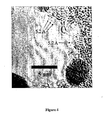
- Figures 1 and 2 show two images that are representative of the images analyzed from the different carbon black samples.
- Figure 1 is an image of a particle taken from pure carbon black while Figure 2 shows a particle from the post-extraction sample.
- the black dashes in Figure 2 are observer-added indications of structures that were deemed to be fullerenic and included in the concentration and size data.
- the absence of black dashes in Figure 1 highlights the lack of fullerene-type structures in the carbon black sample. Only carbon structures along the periphery of the particles were analyzed as only the periphery was thin enough to allow for observation and accurate measurements of the structures. Hebgen P, Goel A, Howard JB, Rainey LC, Vander Sande JB. Proc Combust Inst 2000;28:1397 .
- the hand-drawn black line in the inset to Figure 2 shows the boundary between the area that was analyzed and the particle interior, whose thickness presents too many stacked carbon layers to allow for accurate structural identification.
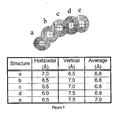
- FIG. 3 shows the method used to perform the quantitative analyses. It can be seen from this cartoon, corresponding to the five condensed structures in the inset to Figure 2 , that both vertical and horizontal height (diameter) were measured and then averaged. This averaged diameter was then used for size distribution purposes. Table 1 gives a summary of the fullerene concentration data. TABLE 1 Sample Number and Description No. of Fullerenic Structures Perimeter Length (nm) Fullerenic Structures per 1000 nm of perimeter 1. Without tethered C 60 21 1775 12 2. With tethered C 60 ; pre-extraction 209 2220 94 3. With tethered C 60 ; post-extraction 172 1970 87
- both the pre- and post-extraction samples exhibit concentrations less than what would correspond to the total amount of functionalized fullerenes added in the experiment.
- the calculated area concentration of fullerene molecules would be 0.25 molecules/nm 2 .
- the corresponding linear concentration of fullerenes would be 0.50 molecules/nm.
- Both tethered samples yield a linear concentration approximately 20% of this theoretical value indicating that many of the fullerenes are not observed. This result is not surprising given the difficulty of finding and observing fullerenes on the carbon black particles.
- Cox et al. deposited C 60 on MgO crystals supported on holey carbon films.
- Circular contrast patterns with about 0.8 nm diameter, consistent with that of C 60 were observed on the MgO crystals and could be seen most clearly on the edges of crystals hanging over holes in the support film. The circular images were not seen on MgO crystals without C 60 deposition.
- Precautions must be taken to analyze images of a particular soot area at all possible focal lengths.
- the position of the soot particles along the optic axis of the instrument will create variations in contrast and image characteristics which can render some structures uninterpretable. This effect can compound errors due to other influences discussed above and, again, can suppress successful observation of fullerenic structures. Thorough focal series can help to alleviate this source of error.
- the method disclosed herein tethers fullerene molecules by chemical bonding to a carbon surface.
- the method disclosed herein can be used to tether fullerenes to the same or other fullerenes or fullerene derivatives including endohedral fullerenes and metallized fullerenes, fullerenic nanostructures including single-walled and multi-walled carbon nanotubes, nested or onion structures or spherical, ellipsoidal, trigonous or other shapes, single- and multi-layered open cage structures of various radii of curvature, fullerenic soot and fullerenic black; and any form of graphitic carbon; any form of diamond; and any form of diamond-like carbon; and any form of amorphous carbon.
- the method disclosed herein is applicable to the situation in which the fullerene being tethered is a fullerene derivative or functionalized fullerene containing a functional group chosen so as to give the functionalized fullerene, and in turn the surface or material to which it is tethered, desired properties such as: acidic, basic, hydrophobic, hydrophilic, oxidizing, reducing, radical, metallic, electrical, magnetic, or other structural, chemical, biological or physical properties. It will also be appreciated that the tethers may differ in length, stiffness, electrical conductivity or other properties.
- tethers of different lengths may be achieved by the use of chemical chains, such as aliphatic hydrocarbon chains of different lengths and tethers of different stiffness may be achieved by the use of chemical structures such as alkane, alkene, alkyne, fused or cross-linked aromatic structures, etc.
- the accuracy of the electron microscope as determined by the above calibration was ⁇ 0.01 nm.
- the accuracy of the measurement of the diameter of a fullerene molecule is limited by the observer's ability to identify the true edge of the hollow circular HRTEM image of the molecule.
- the observer was able to specify the diameter of the image of a fullerene molecule with a precision of ⁇ 0.01 nm or better.
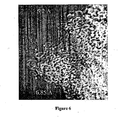
- Figures 4 through 6 show representative images taken from the analysis of samples of flame-generated soot.
- the striped patterns on Figure 4 are the lattice fringe images of the ⁇ 111 ⁇ planes from the deposits of gold that were used to calibrate the microscope.
- Figures 5 and 6 show other areas of the soot and several key structures are indicated by the arrows.
- the numbers associated with the highlighted structures are the observed diameters using the gold calibration as identified in Figure 4 . It can be seen from the indicated structures in Figures 4 through 6 that not only are structures the size of C 60 and larger observed (structures marked 6.85 ⁇ , 8,6 ⁇ ,and 10.3 A), but those smaller than C 60 are prevalent as well (structures marked 5.2 ⁇ ).
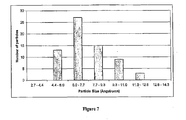
- the size-distribution histogram obtained from the measurement of these structures is seen in Figure 7 .
- the size is an average of the major and minor axes of these, generally non-round structures.
- the numbers along the x-axis represent the bins that were used to separate out the measurements.
- the arbitrary nature of the bin sizes and cut-offs is a consequence of the resolution limit of the measurement technique.
- Figure 7 shows that structures of average dimension both larger and smaller than C 60 are prevalent in the samples. This indicates that we are in fact observing and identifying structures that are not only larger than C 60 but smaller as well.
- the gold island calibration method was developed and used to analyze images of name-generated soot.
- the high precision and accuracy of this method give it a significant advantage over both the measurement method from Hebgen, et al. ( Hebgen, P, Goel A, Howard JB, Rainey LC, VanderSande JB. Proc Combust Inst 2000; 28:1397 ) and the method used in the tethered fullerene Experiment 1 above.
- the observation of structures smaller than C 60 in the experiments using gold calibration proves conclusively that such small structures do exist and that they are not artifacts of the method.
- the measured diameters range from about 0.5 nm to about 1.2 nm (see Fig. 7 ).
- Average diameters of selected structures marked for illustration in Figs. 4-6 include 0.52 nm, 0.685 nm, 0,86 nm, and 1.03 nm, corresponding to C 36 , C 58 , C 90 , and C 130 .
- Fullerene C 20 has only been observed spectroscopically and for only fractions of a millisecond.
- Single-walled carbon nanotubes with diameters less than C 60 have only been observed within porous materials such as zeolites which provide a support structure within which the tubes are grown.
- sub-C 60 fullerenes also indicates the presence of adjacent carbon pentagon rings in these fullerenes, which has important implications for bulk soot properties. Adjacent pentagons result in unique structural and electrical properties in the soot that can be exploited for the development of commercially useful products.
- Example 2 The fullerenes observed in Example 2 are separated and isolated from the material with which they are condensed in the synthesis process.
- fullerenes smaller than C 60 the fractionation and analysis methods of Piskoti et al. is used. Piskoti C, Yarger J, Zettl A. Nature 1998;393:771 .
- Fullerenes larger than C 60 are isolated by solvent extraction and high pressure liquid chromatography analysis. See, Richter H, Labrocca AJ, Grieco WJ, Taghizadeh K, Lafleur AL, Howard JB. J Phys Chem B 1997;101:1556 .
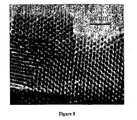
- Figure 8 shows a representative HRTEM image from the analysis of C 60 precipitated from solution directly onto the TEM grid.
- the C 60 molecules have taken a crystalline form with a two-fold symmetry that is visible. Comparing the length scale to the black centers of the individual molecules reveals a diameter of about 0.7 nm as expected for C 60 molecules.
- the measured center-to-center distance between the molecules is 1.01 nm along two of the crystallographic directions and 1.14 nm along the third direction
- composition of matter comprising fullerenes having a molecular weight less than that of C 60 with the exception of C 36 .
- composition of matter comprising fullerene C 50 .
- composition of matter comprising fullerene C 58 .
- composition of matter comprising fullerene C 130 .
- composition of matter comprising fullerene C 176 .
Landscapes
- Chemical & Material Sciences (AREA)
- Engineering & Computer Science (AREA)
- Nanotechnology (AREA)
- Organic Chemistry (AREA)
- Materials Engineering (AREA)
- Physics & Mathematics (AREA)
- Inorganic Chemistry (AREA)
- Condensed Matter Physics & Semiconductors (AREA)
- General Physics & Mathematics (AREA)
- Crystallography & Structural Chemistry (AREA)
- Composite Materials (AREA)
- Manufacturing & Machinery (AREA)
- Carbon And Carbon Compounds (AREA)
- Pigments, Carbon Blacks, Or Wood Stains (AREA)
Abstract
Description
- The government has certain rights in this invention pursuant to Dept. of Energy Grant No. DE-FG02-85ER45179 and Grant No. DE-FG-0284ER13282.
- The present invention relates to fullerenic structures and such structures tethered to carbon materials.
- Fullerenic structures are carbon compounds that include closed-caged compounds such as fullerenes and nanotubes. One of the first fullerenes discovered was the version containing 60 carbon atoms (C60) made up of adjacent carbon pentagon and hexagon rings. Other fullerenes such as C36, C70, and C90 have been observed and analyzed. It has been speculated that fullerenic structures both smaller than and larger than C60 exist in, for example, combustion-generated soot.
- Because fullerenic structures are small (C60 has a diameter of approximately 7 A) and typically occur in very low concentrations in soot, their presence is difficult to detect. Furthermore, fullerenes are difficult to detect and characterize because they are often very strongly bound to, or within, the material with which they are condensed in the synthesis process thereby preventing easy removal for chemical analysis. Examples are fullerenes smaller than C60 all of which necessarily contain adjacent pentagons in their structure and are strongly curved and strained and hence more interactive leading to strong bonding. Similarly, fullerenes larger than may also be strongly bonded to other structures because the size of larger fullerenes facilitates extensive contact thereby increasing the opportunity for bonding interactions.
- It has been suggested that fullerenes bound to carbon black pigment would be useful for making an improved ink for use in, for example, an inkjet printer. See, Japanese Laid Open Publication no.
11-140342, published May 25, 1999 - In one aspect, the invention comprises fullerenes having a molecular weight less than that of C60 with the exception of C36. In another aspect, the invention comprises fullerenes C50, C58, C130, and C176. In another aspect, the invention is the above-mentioned fullerenes in an isolated state. In yet another aspect, the invention is a single-walled carbon nanotube having a diameter less than that of C60 and not associated with a three-dimensional support matrix. In yet another aspect, the invention is a fullerenic structure including a fullerene chemically bonded to a carbonaceous material.
- In still another aspect, the invention is a method for tethering fullerenes to a carbon material including the steps of adding functionalized fullerene to a liquid suspension containing a carbon material. The suspension is dried to produce a powder and the powder is heat treated to produce the fullerene chemically bound to the carbon material. In one embodiment of this aspect of the invention, the functionalized fullerene is dichloromethano [60] fullerene. This method may include the additional step of sealing the dried powder in a tube filled with an inert gas followed by heat treatment of the tube in a furnace.
-
-
Fig. 1 is an HRTEM image of a particle from a pure carbon black sample. -
Fig. 2 is an HRTEM image of a particle from a post-extraction tethered fullerene sample. -
Fig. 3 is a cartoon illustrating the measurement method used for structure diameter size distribution determination. -
Fig. 4 is an HRTEM image of flame soot with gold island deposits and showing structures smaller than C60. -
Fig. 5 is an HRTEM image of flame soot showing structures both larger and smaller than C60. -
Fig. 6 is an HRTEM image of flame soot showing structures larger than, smaller than, and the size of, C60. -
Fig. 7 is a size distribution histogram of structures measured in HRTEM images of flame-generated soot. -
Fig. 8 is an HRTEM image of a pure C60 sample. - As discussed above, detection of fullerenes is difficult because their concentration is low and they are often tightly bound to the material with which they were condensed in the synthesis process making removal for chemical analysis difficult. The composition of matter inventions disclosed herein have been observed using high resolution transmission electron microscopy (HRTEM). This technique provides a means for extending the detection and analysis of fullerenes to lower limits of detection than can be attained by conventional chemical analysis. For example, circular obj ects approximately the size of C60 and C70 fullerenes can be seen in HRTEM images of soot not only from certain low-pressure benzene/oxygen flames well known to contain fullerenes but also from atmospheric-pressure ethylene/air flames in which fullerenes could not be detected by state of the art chemical analysis. Grieco WJ, Howard JB, Rainey LC, Vander Sande JB. Carbon 2000;38:597. The contents of this reference and all of the references cited below are incorporated herein by reference.
- Three different samples were prepared for investigation by HRTEM. The first sample was pure carbon black (Regal 330; Cabot Corp.) suspended in a toluene solution. The other two samples were prepared from a portion of the carbon black-toluene solution to which was added a specified amount of dichloromethano[60]fullerene. In this functionalized fullerene, the carbon atom of the functional group is bridged to two carbon atoms of the fullerene molecule. After a uniform dispersion was ensured with vigorous mixing, the toluene was allowed to evaporate and the resulting dry powder mixture was sealed inside an argon-filled glass tube. The entire unit was then heat treated at approximately 400°C for 4.5 hours in a tubular furnace (Lindberg Model 55036) and then cooled. The material was removed from the tube and divided into two parts. One of these two samples was not treated further and hence consisted of carbon black with tethered fullerenes and any fullerenes that remained untethered, This sample is referred to as pre-extraction. The other of these two samples was extracted by sonication in toluene for 13 minutes followed by vacuum filtration with a 0.45-µm nylon filter to remove any untethered fullerenes. Thus, this sample, referred to as post-extraction, consisted of carbon black with only tethered fullerenes.
- A diluted suspension of each of the three samples in toluene was deposited onto a lacey carbon grid and the toluene was allowed to evaporate. The samples were analyzed in a JEOL 2010 electron microscope operating at 200 kV. The images obtained were analyzed for the presence of fullerene-type structures, i.e., structures that appear to be completely closed cages. In each image, the number of fullerene-type structures per length of perimeter, referred to as linear concentration, was determined and the diameter of each of those structures was measured. The data then were aggregated across all the images of a particular sample to provide fullerene linear concentration data and fullerene size distribution data.
-
Figures 1 and2 show two images that are representative of the images analyzed from the different carbon black samples.Figure 1 is an image of a particle taken from pure carbon black whileFigure 2 shows a particle from the post-extraction sample. - The black dashes in
Figure 2 are observer-added indications of structures that were deemed to be fullerenic and included in the concentration and size data. The absence of black dashes inFigure 1 highlights the lack of fullerene-type structures in the carbon black sample. Only carbon structures along the periphery of the particles were analyzed as only the periphery was thin enough to allow for observation and accurate measurements of the structures. Hebgen P, Goel A, Howard JB, Rainey LC, Vander Sande JB. Proc Combust Inst 2000;28:1397. The hand-drawn black line in the inset toFigure 2 shows the boundary between the area that was analyzed and the particle interior, whose thickness presents too many stacked carbon layers to allow for accurate structural identification. It is unclear whether perceived structures in the particle interior inside the boundary are in fact single structures or the result of superpositioning of two or more different structures. Only the material outside the boundary was sufficiently thin to ensure interpretable observations. Qualitatively, the images show quite clearly that the carbon black doped with tethered fullerenes has many more fullerene-type structures than the pure carbon black particles. - Quantitative analyses of the same images reinforces the qualitative observation.
Figure 3 shows the method used to perform the quantitative analyses. It can be seen from this cartoon, corresponding to the five condensed structures in the inset toFigure 2 , that both vertical and horizontal height (diameter) were measured and then averaged. This averaged diameter was then used for size distribution purposes. Table 1 gives a summary of the fullerene concentration data.TABLE 1 Sample Number and Description No. of Fullerenic Structures Perimeter Length (nm) Fullerenic Structures per 1000 nm of perimeter 1. Without tethered C60 21 1775 12 2. With tethered C60; pre-extraction 209 2220 94 3. With tethered C60; post-extraction 172 1970 87 - From Table 1, it is seen that both samples containing tethered fullerenes have a fullerene concentration almost an order of magnitude greater than the concentration of what appears to be fullerenes in the pure carbon black sample. It should be noted that the post-extraction sample does have a slightly lower concentration than the pre-extraction samples. This is not surprising as it is expected that less than 100% of the functionalized fullerenes would react with the carbon black, leaving some untethered fullerenes to be separated during extraction.
- It should be noted also that both the pre- and post-extraction samples exhibit concentrations less than what would correspond to the total amount of functionalized fullerenes added in the experiment. Considering the relative amounts of carbon black and functionalized fullerenes utilized, and assuming a uniform distribution of fullerenes over the superficial surface of the carbon black, the calculated area concentration of fullerene molecules would be 0.25 molecules/nm2. The corresponding linear concentration of fullerenes would be 0.50 molecules/nm. Both tethered samples yield a linear concentration approximately 20% of this theoretical value indicating that many of the fullerenes are not observed. This result is not surprising given the difficulty of finding and observing fullerenes on the carbon black particles.
- In an experimental situation similar to that disclosed herein, Cox et al. deposited C60 on MgO crystals supported on holey carbon films. Cox DM, Behal S, Disko M, Gorun SM, Greaney M, Hsu CS, Kollin EB, Millar J, Robbins J, Robbins W, Sherwood RD, Tindall P. J Am Chem Soc 1991; 113:2940. Circular contrast patterns with about 0.8 nm diameter, consistent with that of C60, were observed on the MgO crystals and could be seen most clearly on the edges of crystals hanging over holes in the support film. The circular images were not seen on MgO crystals without C60 deposition. The Cox et al. work and the data presented above establish that the contrast observed, for instance in
Figure 2 , is consistent with single C60 molecules. It should be noted that the contrast inFigure 2 is exactly analogous to that inFigure 8 , which is known to show C60 molecules. The order of magnitude increase in observed fullerenic-type structures in doped-with-C60 samples strengthens the conclusion that C60 molecules are being observed. This coupled with the qualitative observations indicates quite strongly that fullerenes have been tethered to the carbon black surface, and furthermore, that these fullerenes are observable with HRTEM. - Nonetheless, precautions must be taken to reduce the influence of radiation damage and/or beam heating on the observations. Such influences include degradation of the sample, incorporation of smaller structures into larger ones, and migration of molecules. All three of these scenarios have been observed during HRTEM imaging and all can contribute to an artificially low frequency of fullerene observations. For example, we have observed C60, and other fullerenic molecules, migrating "behind" the carbon black under some observation conditions, in accord with earlier reports. Fuller T, Banhart F. Chem Phys Lett 1996;254:372.
- Precautions must be taken to analyze images of a particular soot area at all possible focal lengths. The position of the soot particles along the optic axis of the instrument will create variations in contrast and image characteristics which can render some structures uninterpretable. This effect can compound errors due to other influences discussed above and, again, can suppress successful observation of fullerenic structures. Thorough focal series can help to alleviate this source of error.
- While care is taken to minimize the effects of these imaging artifacts, some error will still be incorporated into the imaging results. This reduction in fullerenic structure observations gives a plausible explanation as to why, as mentioned above, the observations account for only 20% of the expected theoretical value. Normally, a 20% agreement would be cause for concern but given the fact that we observe still an order-of-magnitude increase in fullerenic structures with tethered fullerenes, our conclusions are not weakened.
- The method disclosed herein tethers fullerene molecules by chemical bonding to a carbon surface. Those skilled in the art will appreciate that the method disclosed herein can be used to tether fullerenes to the same or other fullerenes or fullerene derivatives including endohedral fullerenes and metallized fullerenes, fullerenic nanostructures including single-walled and multi-walled carbon nanotubes, nested or onion structures or spherical, ellipsoidal, trigonous or other shapes, single- and multi-layered open cage structures of various radii of curvature, fullerenic soot and fullerenic black; and any form of graphitic carbon; any form of diamond; and any form of diamond-like carbon; and any form of amorphous carbon.
- Those skilled in the art will further appreciate that the method disclosed herein is applicable to the situation in which the fullerene being tethered is a fullerene derivative or functionalized fullerene containing a functional group chosen so as to give the functionalized fullerene, and in turn the surface or material to which it is tethered, desired properties such as: acidic, basic, hydrophobic, hydrophilic, oxidizing, reducing, radical, metallic, electrical, magnetic, or other structural, chemical, biological or physical properties. It will also be appreciated that the tethers may differ in length, stiffness, electrical conductivity or other properties. For example, tethers of different lengths may be achieved by the use of chemical chains, such as aliphatic hydrocarbon chains of different lengths and tethers of different stiffness may be achieved by the use of chemical structures such as alkane, alkene, alkyne, fused or cross-linked aromatic structures, etc.
- Additional HRTEM analyses were performed on soot material collected from a premixed benzene/oxygen/argon flame that has been extensively characterized and studied previously. Grieco WJ, Howard JB, Rainey LC, Vander Sande JB. Carbon 2000;38:597; Grieco WJ, Lafleur AL, Swallow KC, Richter H, Taghizadeh, K, Howard JB. Proc. Comb. Inst. 1998; 27:1669-1675. The conditions of this flame are: pressure, 40 Torr; gas velocity at burner, 25 cm/s (25°C); fuel equivalence ratio, 2.4 (atomic C/O ratio, 0.96); and percentage diluent in feed gas, 10% argon. Samples of soot and all other condensables from this flame were collected in the manner described previously (Grieco WJ, Howard JB, Rainey LC, VanderSande JB. Carbon 2000;38;597) and HRTEM analysis was done using the same JEOL 2010 operating at 200 kV as in Example 1. Gold islands were deposited on the surface of several of these samples to provide a magnification calibration for the HRTEM images. Gold has a stable planar structure with a constant interplanar spacing of 2.039 A for the {111} atomic planes. By observing and measuring this known spacing in an image, the image length scale thus is calibrated allowing the dimensions of other structures to be accurately measured. This calibration was used to measure the sizes of several of the closed-cage structures that were observed in the images and the data were compiled across all of the samples into a size distribution histogram.
- The accuracy of the electron microscope as determined by the above calibration was ± 0.01 nm. The accuracy of the measurement of the diameter of a fullerene molecule is limited by the observer's ability to identify the true edge of the hollow circular HRTEM image of the molecule. The observer was able to specify the diameter of the image of a fullerene molecule with a precision of ± 0.01 nm or better.
-
Figures 4 through 6 show representative images taken from the analysis of samples of flame-generated soot. The striped patterns onFigure 4 are the lattice fringe images of the {111} planes from the deposits of gold that were used to calibrate the microscope.Figures 5 and6 show other areas of the soot and several key structures are indicated by the arrows. The numbers associated with the highlighted structures are the observed diameters using the gold calibration as identified inFigure 4 . It can be seen from the indicated structures inFigures 4 through 6 that not only are structures the size of C60 and larger observed (structures marked 6.85 Å, 8,6 Å,and 10.3 A), but those smaller than C60 are prevalent as well (structures marked 5.2 Å). - The size-distribution histogram obtained from the measurement of these structures is seen in
Figure 7 . The size is an average of the major and minor axes of these, generally non-round structures. In the histogram, the numbers along the x-axis represent the bins that were used to separate out the measurements. The arbitrary nature of the bin sizes and cut-offs is a consequence of the resolution limit of the measurement technique. It can be seen fromFigure 7 that there is a significant peak in the bin containing 7 A, which is the diameter of C60. In addition,Figure 7 shows that structures of average dimension both larger and smaller than C60 are prevalent in the samples. This indicates that we are in fact observing and identifying structures that are not only larger than C60 but smaller as well. - The gold island calibration method was developed and used to analyze images of name-generated soot. The high precision and accuracy of this method give it a significant advantage over both the measurement method from Hebgen, et al. (Hebgen, P, Goel A, Howard JB, Rainey LC, VanderSande JB. Proc Combust Inst 2000; 28:1397) and the method used in the tethered fullerene Experiment 1 above. The observation of structures smaller than C60 in the experiments using gold calibration (
Figs. 4 through 7 ) proves conclusively that such small structures do exist and that they are not artifacts of the method. The measured diameters range from about 0.5 nm to about 1.2 nm (seeFig. 7 ). A simple calculation using 0.7 nm as the diameter of C60 and approximating all fullerene molecules as spherical shells whose mass is proportional to the square of the diameter gives 0,5 nm as the diameter of C36 and 1.2 nm as the diameter of C176. The diameter of C36 as represented by the carbon center to carbon center distance has been reported to be 0.5 nm. (Cote M, Grossman JC, Louie SG, Cohen ML. Bull Am Phys Soc 1997; 42:270; Grossman JC, Cote M, Louie SG; Cohen ML. Bull Am Phys Soc 1997; 42:1576; and Grossman JC, Cote M, Louie SG, Cohen ML. Chem Phys Lett 1998;284:344. Average diameters of selected structures marked for illustration inFigs. 4-6 include 0.52 nm, 0.685 nm, 0,86 nm, and 1.03 nm, corresponding to C36, C58, C90, and C130. - Many other closed-cage structures with sizes corresponding to C50 and other fullerenes, and fullerene-like structures larger than the C176 mentioned above, were also observed. A striking feature of the observations was a preponderance of fullerenes that have not been observed in conventional chemical analyses, presumably because they are highly reactive and hence unstable and difficult to synthesize in observable quantities, or strongly attracted to soot or other carbon material with which they are formed and from which they are difficult to remove for chemical analysis. This observation provides grounds for expecting that other unstable species, such as C20 and single-walled carbon nanotubes having diameters less than C60 and not in a three-dimensional support matrix, could be stabilized on a carbon support and observed with the methods of this study. Fullerene C20 has only been observed spectroscopically and for only fractions of a millisecond. Single-walled carbon nanotubes with diameters less than C60 have only been observed within porous materials such as zeolites which provide a support structure within which the tubes are grown.
- The confirmed existence of sub-C60 fullerenes also indicates the presence of adjacent carbon pentagon rings in these fullerenes, which has important implications for bulk soot properties. Adjacent pentagons result in unique structural and electrical properties in the soot that can be exploited for the development of commercially useful products.
- The fullerenes observed in Example 2 are separated and isolated from the material with which they are condensed in the synthesis process. For fullerenes smaller than C60 the fractionation and analysis methods of Piskoti et al. is used. Piskoti C, Yarger J, Zettl A. Nature 1998;393:771. Fullerenes larger than C60 are isolated by solvent extraction and high pressure liquid chromatography analysis. See, Richter H, Labrocca AJ, Grieco WJ, Taghizadeh K, Lafleur AL, Howard JB. J Phys Chem B 1997;101:1556.
- A sample of C60 molecules (99.5% pure; SES Corporation) was examined under HRTEM. The fullerenes were dissolved into toluene and drops of the solution were placed on TEM grids. The toluene was allowed to evaporate before the HRTEM analysis.
-
Figure 8 shows a representative HRTEM image from the analysis of C60 precipitated from solution directly onto the TEM grid. The C60 molecules have taken a crystalline form with a two-fold symmetry that is visible. Comparing the length scale to the black centers of the individual molecules reveals a diameter of about 0.7 nm as expected for C60 molecules. The measured center-to-center distance between the molecules is 1.01 nm along two of the crystallographic directions and 1.14 nm along the third direction - Aspects and features of the present disclosure are further set out in the following numbered paragraphs.
- [001] Composition of matter comprising fullerenes having a molecular weight less than that of C60 with the exception of C36.
- [002] Composition of matter comprising fullerene C50.
- [003] Composition of matter comprising fullerene C58.
- [004] Composition of matter comprising fullerene C130.
- [005] Composition of matter comprising fullerene C176.
- [006] Isolated fullerene C50.
- [007] Isolated fullerene C58.
- [008] Isolated fullerene C130.
- [009] Isolated fullerene C176.
- [010] Fullerenic structure chemically bonded to a carbon surface.
- [011] The fullerenic structure of paragraph [010] wherein the fullerenic structure is C60.
- [012] The fullerenic structure of paragraph [011] wherein fullerene C60 is chemically bonded to carbon black.
- [013] The fullerenic structure of paragraph [012] wherein the fullerene C60 is chemically bonded to carbon black by a carbon atom bridged to two carbon atoms of the fullerene and two carbon atoms of a carbon black.
- [014] Method for tethering a fullerene to a carbon material comprising:
- adding functionalized fullerene to a liquid suspension containing carbon material;
- drying the suspension to produce a powder; and
- heat treating the powder.
- [015] The method of paragraph [014] wherein the functionalized fullerene is dichloromethano [60] fullerene.
- [016] The method of paragraph [014] wherein the functionalized fullerene is dibromomethano [60] fullerene.
- [017] The method of paragraph [014] further including sealing the powder in a tube filled with an inert gas.
- [018] The method of paragraph [017] wherein the tube is heat treated in a furnace.
- [019] The method of paragraph [018] wherein the tube is heat treated at approximately 400°C for 4.5 hours.
- [020] The method of paragraph [014] wherein the carbon material is a fullerene.
- [021] The method of paragraph [014] wherein the carbon material is a fullerene derivative.
- [022] The method of paragraph [021] wherein the fullerene derivative includes an endohedral fullerene.
- [023] The method of paragraph [021] wherein the fullerene derivative includes a metallized fullerene.
- [024] The method of paragraph [014] wherein the carbon material is a fullerenic nanostructure including single-walled and multi-walled carbon nanotubes.
- [025] The method of paragraph [014] wherein the carbon material is a nested or onion structure.
- [026] The method of paragraph [014] wherein the carbon material is spheroidal, ellipsoidal, trigonous-shaped fullerenic structures.
- [027] The method of paragraph [014] wherein the carbon material comprises single and multi-layered open cage structures having a range of radii of curvature.
- [028] The method paragraph [014] wherein the carbon material is fullerenic soot.
- [029] The method of paragraph [014] wherein the carbon material is fullerenic black.
- [030] The method of paragraph [014] wherein the carbon material is graphitic carbon.
- [031] The method of paragraph [014] wherein the carbon material is diamond.
- [032] The method of paragraph [014] wherein the carbon material is diamond-like carbon.
- [033] The method of paragraph [014] wherein the carbon material is amorphous carbon.
- [034] The method of paragraph [014] wherein the functionalized fullerene contains a functional group selected to give the functionalized fullerene and a surface of the material to which it is tethered a desired property.
- [035] The method of paragraph [034] wherein the desired property is selected from the group consisting of acidic, basic, hydrophilic, hydrophobic, oxidizing, reducing, radical, metallic, electrical, magnetic, structural, chemical, biological, or physical properties.
- [036] The method of paragraph [014] further including use of chemical chains selected to achieve a desired tethered length.
- [037] The method of paragraph [014] further including use of chemical structures selected to achieve a desired tether stiffness.
- [038] The method of paragraph [037] wherein the chemical structures comprise alkane, alkene, alkyne, fused or cross-linked aromatic.
- [039] The method of paragraph [014] further including chemical structures selected to achieve a desired electrical conductivity.
- [040] Single-walled carbon nanotube having a diameter less than that of C60 and not associated with a three-dimensional support matrix.
As stated earlier, the contents of all of the references cited in this specification are incorporated herein by reference. - It is recognised that modifications and variations of the invention as disclosed herein will be apparent to those skilled in the art, and it is intended that all such modifications and variations be included within the scope of the appended claims.
Claims (15)
- A fullerenic structure comprising a fullerene tethered by chemical bonding to a carbon surface.
- The fullerenic structure of claim 1, wherein the fullerene is tethered to the carbon surface by a tether comprising an aliphatic hydrocarbon chain.
- The fullerenic structure of claim 2, wherein the tether comprises an alkane, alkene or alkyne chemical structure.
- The fullerenic structure of claim 1, wherein the fullerene is tethered to the chemical surface by a tether comprising a fused or cross-linked aromatic structure.
- The fullerenic structure of claim 1 wherein the fullerene is C60.
- The fullerenic structure of claim 5 wherein fullerene C60 is chemically bonded to carbon black.
- The fullerenic structure of claim 6 wherein the fullerene C60 is chemically bonded to carbon black by a carbon atom bridged to two carbon atoms of the fullerene and two carbon atoms of a carbon black.
- A method for tethering a fullerene by chemical bonding to a carbon material, the method comprising:adding functionalized fullerene to a liquid suspension containing carbon material;drying the suspension to produce a powder; andheat treating the powder to produce the fullerene tethered by chemical bonding to the carbon material.
- The method of claim 8 wherein the functionalized fullerene is dichloromethano [60] fullerene or dibromomethano [60] fullerene.
- The method of claim 8 further including sealing the powder in a tube filled with an inert gas, optionally wherein the tube is heat treated in a furnace (for example at approximately 400°C for 4.5 hours).
- The method of claim 8 wherein the carbon material is a fullerene, a fullerene derivative (including an endohedral fullerene or a metallized fullerene), a fullerenic nanostructure including single-walled and multi-walled carbon nanotubes, a nested or onion structure, a spheroidal, ellipsoidal, or trigonous-shaped fullerenic structure, a carbon material comprising single and multi-layered open cage structures having a range of radii of curvature, fullerenic soot, fullerenic black, graphitic carbon, diamond, diamond-like carbon or amorphous carbon.
- The method of claim 8 wherein the functionalized fullerene contains a functional group selected to give the functionalized fullerene and a surface of the material to which it is tethered a desired property, for example wherein the desired property is selected from the group consisting of acidic, basic, hydrophilic, hydrophobic, oxidizing, reducing, radical, metallic, electrical, magnetic, structural, chemical, biological, or physical properties.
- The method of claim 8, wherein the fullerene is tethered to the carbon material by a tether comprising an aliphatic hydrocarbon chain.
- The method of claim 8 further including use of a) chemical chains selected to achieve a desired tethered length; b) chemical structures selected to achieve a desired tether stiffness; or c) chemical structures selected to achieve a desired electrical conductivity.
- The method of claim 14b) wherein the chemical structures comprise alkane, alkene, alkyne, fused or cross-linked aromatic structures.
Applications Claiming Priority (3)
| Application Number | Priority Date | Filing Date | Title |
|---|---|---|---|
| US10/675,140 US7641882B2 (en) | 2003-09-30 | 2003-09-30 | Fullerenic structures and such structures tethered to carbon materials |
| EP04821499A EP1678080A2 (en) | 2003-09-30 | 2004-09-30 | Fullerenic structures and such structures tethered to carbon materials |
| PCT/US2004/032119 WO2005080268A2 (en) | 2003-09-30 | 2004-09-30 | Fullerenic structures and such structures tethered to carbon materials |
Related Parent Applications (2)
| Application Number | Title | Priority Date | Filing Date |
|---|---|---|---|
| EP04821499.3 Division | 2004-09-30 | ||
| EP04821499A Division EP1678080A2 (en) | 2003-09-30 | 2004-09-30 | Fullerenic structures and such structures tethered to carbon materials |
Publications (3)
| Publication Number | Publication Date |
|---|---|
| EP2368844A2 true EP2368844A2 (en) | 2011-09-28 |
| EP2368844A3 EP2368844A3 (en) | 2016-06-01 |
| EP2368844B1 EP2368844B1 (en) | 2022-05-04 |
Family
ID=34549794
Family Applications (2)
| Application Number | Title | Priority Date | Filing Date |
|---|---|---|---|
| EP04821499A Withdrawn EP1678080A2 (en) | 2003-09-30 | 2004-09-30 | Fullerenic structures and such structures tethered to carbon materials |
| EP11171358.2A Expired - Lifetime EP2368844B1 (en) | 2003-09-30 | 2004-09-30 | Fullerene chemically bonded to a surface of carbon black |
Family Applications Before (1)
| Application Number | Title | Priority Date | Filing Date |
|---|---|---|---|
| EP04821499A Withdrawn EP1678080A2 (en) | 2003-09-30 | 2004-09-30 | Fullerenic structures and such structures tethered to carbon materials |
Country Status (6)
| Country | Link |
|---|---|
| US (2) | US7641882B2 (en) |
| EP (2) | EP1678080A2 (en) |
| JP (1) | JP4923311B2 (en) |
| AU (1) | AU2004315942B2 (en) |
| CA (1) | CA2540735C (en) |
| WO (1) | WO2005080268A2 (en) |
Families Citing this family (8)
| Publication number | Priority date | Publication date | Assignee | Title |
|---|---|---|---|---|
| US6723299B1 (en) | 2001-05-17 | 2004-04-20 | Zyvex Corporation | System and method for manipulating nanotubes |
| US20040034177A1 (en) | 2002-05-02 | 2004-02-19 | Jian Chen | Polymer and method for using the polymer for solubilizing nanotubes |
| US6905667B1 (en) | 2002-05-02 | 2005-06-14 | Zyvex Corporation | Polymer and method for using the polymer for noncovalently functionalizing nanotubes |
| WO2004106420A2 (en) | 2003-05-22 | 2004-12-09 | Zyvex Corporation | Nanocomposites and method for production |
| US7296576B2 (en) | 2004-08-18 | 2007-11-20 | Zyvex Performance Materials, Llc | Polymers for enhanced solubility of nanomaterials, compositions and methods therefor |
| FI20075767A0 (en) * | 2007-10-30 | 2007-10-30 | Canatu Oy | Surface coating and electrical devices comprising this |
| CN102183401B (en) * | 2011-01-16 | 2012-11-21 | 首钢总公司 | Preparation method of carbon extraction replica sample by transmission electron microscope |
| CN110385425A (en) * | 2018-04-19 | 2019-10-29 | 苏州大德碳纳米科技有限公司 | A kind of hydrophily fullerene composite material and preparation method thereof |
Citations (1)
| Publication number | Priority date | Publication date | Assignee | Title |
|---|---|---|---|---|
| JPH11140342A (en) | 1997-11-14 | 1999-05-25 | Minolta Co Ltd | Carbon black pigment and ink |
Family Cites Families (19)
| Publication number | Priority date | Publication date | Assignee | Title |
|---|---|---|---|---|
| US182506A (en) * | 1876-09-19 | Improvement in car-couplings | ||
| US5132105A (en) * | 1990-02-02 | 1992-07-21 | Quantametrics, Inc. | Materials with diamond-like properties and method and means for manufacturing them |
| US5648523A (en) * | 1995-10-26 | 1997-07-15 | Chiang Long Y | Fullerene derivatives as free-radical scavengers |
| JP3563206B2 (en) * | 1996-06-13 | 2004-09-08 | 株式会社石川製作所 | Novel fullerene compound and method for producing and using same |
| JPH1029812A (en) * | 1996-07-15 | 1998-02-03 | Shozo Watabe | Production of fullerene c20 by using extremely heat stable component produced by pressurized heat treatment of petroleum pitch as source material and then treating source material in fused state under high pressure and high temperature condition |
| FR2764280B1 (en) * | 1997-06-06 | 1999-07-16 | Yvan Alfred Schwob | PROCESS FOR THE MANUFACTURE OF CARBON 60 |
| JP3791161B2 (en) * | 1997-11-28 | 2006-06-28 | 日本油脂株式会社 | Fullerene (C60) polymer, polymerization method and thin film production method |
| JP3531520B2 (en) * | 1999-03-19 | 2004-05-31 | 富士通株式会社 | Insulating film, method of manufacturing the same, and electronic device |
| US6884405B2 (en) * | 1999-03-23 | 2005-04-26 | Rosseter Holdings Limited | Method and device for producing higher fullerenes and nanotubes |
| JP3074170B1 (en) * | 1999-05-27 | 2000-08-07 | 大澤 映二 | Manufacturing method of nano-sized spherical graphite |
| JP2002193606A (en) * | 2000-12-22 | 2002-07-10 | Nec Corp | Superconducting material and method of manufacturing it |
| WO2002058176A1 (en) * | 2001-01-19 | 2002-07-25 | Sony Corporation | Electrode module |
| JP3785454B2 (en) * | 2001-04-18 | 2006-06-14 | 独立行政法人物質・材料研究機構 | Carbon wire and method for producing carbon wire |
| US20020182506A1 (en) * | 2001-05-29 | 2002-12-05 | Cagle Dawson W. | Fullerene-based secondary cell electrodes |
| JP2003086022A (en) * | 2001-06-29 | 2003-03-20 | Sony Corp | Proton conductor and electrochemical device using the same |
| JP3984957B2 (en) * | 2001-08-30 | 2007-10-03 | ティーディーエイ リサーチ インコーポレイテッド | Method for removing impurities from combustion fullerenes |
| JP3436932B2 (en) * | 2001-12-12 | 2003-08-18 | 理化学研究所 | Fullerene polymer, fullerene polymer structure, and method for producing the same |
| JP2003192317A (en) * | 2001-12-19 | 2003-07-09 | Inst Of Physical & Chemical Res | Method and apparatus for producing fullerene polymer |
| JP2003321214A (en) * | 2002-05-07 | 2003-11-11 | Japan Science & Technology Corp | Two-dimensional polymer thin film of fullerenes and method for producing the same |
-
2003
- 2003-09-30 US US10/675,140 patent/US7641882B2/en not_active Expired - Lifetime
-
2004
- 2004-09-30 CA CA2540735A patent/CA2540735C/en not_active Expired - Fee Related
- 2004-09-30 EP EP04821499A patent/EP1678080A2/en not_active Withdrawn
- 2004-09-30 WO PCT/US2004/032119 patent/WO2005080268A2/en not_active Ceased
- 2004-09-30 AU AU2004315942A patent/AU2004315942B2/en not_active Ceased
- 2004-09-30 EP EP11171358.2A patent/EP2368844B1/en not_active Expired - Lifetime
- 2004-09-30 JP JP2006534089A patent/JP4923311B2/en not_active Expired - Lifetime
-
2009
- 2009-10-19 US US12/581,337 patent/US8282905B2/en not_active Expired - Fee Related
Patent Citations (1)
| Publication number | Priority date | Publication date | Assignee | Title |
|---|---|---|---|---|
| JPH11140342A (en) | 1997-11-14 | 1999-05-25 | Minolta Co Ltd | Carbon black pigment and ink |
Non-Patent Citations (12)
| Title |
|---|
| COTE M, GROSSMAN JC, LOUIE SG, COHEN ML., BULL AM PHYS SOC, vol. 42, 1997, pages 270 |
| COX DM, BEHAL S, DISKO M, GORUN SM, GREANEY M, HSU CS, KOLLIN EB, MILLAR J, ROBBINS J, ROBBINS W, J AM CHEM SOC, vol. 113, 1991, pages 2940 |
| FULLER T, BANHART F, CHEM PHYS LETT, vol. 254, 1996, pages 372 |
| GRIECO WJ, HOWARD JB, RAINEY LC, VANDER SANDE JB, CARBON, vol. 38, 2000, pages 597 |
| GRIECO WJ, HOWARD JB, RAINEY LC, VANDERSANDE JB, CARBON, vol. 38, 2000, pages 597 |
| GRIECO WJ, LAFLEUR AL, SWALLOW KC, RICHTER H, TAGHIZADEH, K, HOWARD JB, PROC. COMB. INST., vol. 27, 1998, pages 1669 - 1675 |
| GROSSMAN JC, COTE M, LOUIE SG, COHEN ML., BULL AM PHYS SOC, vol. 42, 1997, pages 1576 |
| GROSSMAN JC, COTE M, LOUIE SG, COHEN ML., CHEMPHYS LETT, vol. 284, 1998, pages 344 |
| HEBGEN P, GOEL A, HOWARD JB, RAINEY LC, VANDER SANDE JB, PROC COMBUST HIST, vol. 28, 2000, pages 1397 |
| HEBGEN, P, GOEL A, HOWARD JB, RAINEY LC, VANDERSANDE JB, PROC COMBUSTINST, vol. 28, 2000, pages 1397 |
| PISKOTI C, YARGER J, ZETTL A., NATURE, vol. 393, 1998, pages 771 |
| RICHTER H, LABROCCA AJ, GRIECO WJ, TAGHIZADEH K, LAFLEUR AL, HOWARD JB., J PHYS CHEM B, vol. 101, 1997, pages 1556 |
Also Published As
| Publication number | Publication date |
|---|---|
| AU2004315942A1 (en) | 2005-09-01 |
| AU2004315942B2 (en) | 2010-11-11 |
| WO2005080268A2 (en) | 2005-09-01 |
| EP2368844B1 (en) | 2022-05-04 |
| JP2007508228A (en) | 2007-04-05 |
| WO2005080268A3 (en) | 2006-09-21 |
| EP2368844A3 (en) | 2016-06-01 |
| US20050095191A1 (en) | 2005-05-05 |
| CA2540735A1 (en) | 2005-09-01 |
| CA2540735C (en) | 2014-02-04 |
| JP4923311B2 (en) | 2012-04-25 |
| US8282905B2 (en) | 2012-10-09 |
| EP1678080A2 (en) | 2006-07-12 |
| US20100041928A1 (en) | 2010-02-18 |
| US7641882B2 (en) | 2010-01-05 |
Similar Documents
| Publication | Publication Date | Title |
|---|---|---|
| US8282905B2 (en) | Fullerenic structures and such structures tethered to carbon materials | |
| Petersen et al. | Ecological uptake and depuration of carbon nanotubes by Lumbriculus variegatus | |
| Ritschel et al. | Hydrogen storage in different carbon nanostructures | |
| Saathoff et al. | The AIDA soot aerosol characterisation campaign 1999 | |
| Edgington et al. | Microscopic investigation of single-wall carbon nanotube uptake by Daphnia magna | |
| Bendiab et al. | Orientation of single-walled carbon nanotubes by uniaxial pressure | |
| Weisman | Optical spectroscopy of single-walled carbon nanotubes | |
| Medjo | Characterization of carbon nanotubes | |
| Krätschmer et al. | Adsorption of krypton at 77 K on fullerene C60, graphitized carbon black and diamond | |
| Hornbaker | Electronic structure of carbon nanotube systems measured with scanning tunneling microscopy | |
| Maguer et al. | Purification of single-walled boron nitride nanotubes and boron nitride cages | |
| Shabanova et al. | Fullerites and" growth structures" of nanoobjects | |
| Kröckel et al. | Structural stability in potassium doped single-walled carbon nanotubes, and surface functionalization | |
| Zu et al. | Supramolecular modification of single-walled carbon nanotubes with a water-soluble triptycene derivative | |
| Redlich et al. | High spatial resolution imaging and spectroscopy in nanostructures | |
| Russo et al. | Encapsulated molecules in carbon nanotubes: structure and properties | |
| JP5510845B2 (en) | Standard sample for measurement of detection sensitivity of elemental analyzer attached to transmission electron microscope | |
| Kirkland et al. | Direct and indirect electron microscopy of encapsulated nanocrystals | |
| Crichton | Exploration of self-assembled carbon nanomaterials through various dimensions | |
| Begunova et al. | Growth of the Carbon Nanotubes on the Meteorite Surface: the Influence of the Surface Texture. | |
| John et al. | Production of Multifunctional Carbon Nanotubes for Sensor and Water Treatment Apolications | |
| Williams | Synthesis and characterization of single-walled carbon nanotubes and investigation of their molecular adsorption properties | |
| Wafy | Characterization of Chemical and Mechanical Properties of Polymer Based Nanocomposites | |
| Kröger | C60 as a template for the creation of metal and semiconductor nanoclusters | |
| Vinten | Chemical vapour deposition growth of carbon nanotube forests: kinetics, morphology, composition, and their mechanisms |
Legal Events
| Date | Code | Title | Description |
|---|---|---|---|
| PUAI | Public reference made under article 153(3) epc to a published international application that has entered the european phase |
Free format text: ORIGINAL CODE: 0009012 |
|
| AC | Divisional application: reference to earlier application |
Ref document number: 1678080 Country of ref document: EP Kind code of ref document: P |
|
| AK | Designated contracting states |
Kind code of ref document: A2 Designated state(s): AT BE BG CH CY CZ DE DK EE ES FI FR GB GR HU IE IT LI LU MC NL PL PT RO SE SI SK TR |
|
| RIN1 | Information on inventor provided before grant (corrected) |
Inventor name: GOEL, ANISH Inventor name: VANDER SANDE, JOHN Inventor name: HOWARD, JACK |
|
| PUAL | Search report despatched |
Free format text: ORIGINAL CODE: 0009013 |
|
| AK | Designated contracting states |
Kind code of ref document: A3 Designated state(s): AT BE BG CH CY CZ DE DK EE ES FI FR GB GR HU IE IT LI LU MC NL PL PT RO SE SI SK TR |
|
| RIC1 | Information provided on ipc code assigned before grant |
Ipc: C01B 31/02 20060101AFI20160425BHEP Ipc: C09C 1/56 20060101ALI20160425BHEP |
|
| STAA | Information on the status of an ep patent application or granted ep patent |
Free format text: STATUS: REQUEST FOR EXAMINATION WAS MADE |
|
| 17P | Request for examination filed |
Effective date: 20161201 |
|
| RBV | Designated contracting states (corrected) |
Designated state(s): AT BE BG CH CY CZ DE DK EE ES FI FR GB GR HU IE IT LI LU MC NL PL PT RO SE SI SK TR |
|
| R17P | Request for examination filed (corrected) |
Effective date: 20161201 |
|
| STAA | Information on the status of an ep patent application or granted ep patent |
Free format text: STATUS: EXAMINATION IS IN PROGRESS |
|
| 17Q | First examination report despatched |
Effective date: 20200210 |
|
| REG | Reference to a national code |
Ref country code: DE Ref legal event code: R079 Ref document number: 602004055079 Country of ref document: DE Free format text: PREVIOUS MAIN CLASS: C01B0031020000 Ipc: C01B0032150000 |
|
| GRAP | Despatch of communication of intention to grant a patent |
Free format text: ORIGINAL CODE: EPIDOSNIGR1 |
|
| STAA | Information on the status of an ep patent application or granted ep patent |
Free format text: STATUS: GRANT OF PATENT IS INTENDED |
|
| RIC1 | Information provided on ipc code assigned before grant |
Ipc: B82Y 40/00 20110101ALI20211112BHEP Ipc: B82Y 30/00 20110101ALI20211112BHEP Ipc: C01B 32/156 20170101ALI20211112BHEP Ipc: C09C 1/56 20060101ALI20211112BHEP Ipc: C01B 32/15 20170101AFI20211112BHEP |
|
| INTG | Intention to grant announced |
Effective date: 20211217 |
|
| GRAS | Grant fee paid |
Free format text: ORIGINAL CODE: EPIDOSNIGR3 |
|
| GRAA | (expected) grant |
Free format text: ORIGINAL CODE: 0009210 |
|
| STAA | Information on the status of an ep patent application or granted ep patent |
Free format text: STATUS: THE PATENT HAS BEEN GRANTED |
|
| AC | Divisional application: reference to earlier application |
Ref document number: 1678080 Country of ref document: EP Kind code of ref document: P |
|
| AK | Designated contracting states |
Kind code of ref document: B1 Designated state(s): AT BE BG CH CY CZ DE DK EE ES FI FR GB GR HU IE IT LI LU MC NL PL PT RO SE SI SK TR |
|
| REG | Reference to a national code |
Ref country code: GB Ref legal event code: FG4D |
|
| REG | Reference to a national code |
Ref country code: CH Ref legal event code: EP |
|
| REG | Reference to a national code |
Ref country code: AT Ref legal event code: REF Ref document number: 1488892 Country of ref document: AT Kind code of ref document: T Effective date: 20220515 |
|
| REG | Reference to a national code |
Ref country code: IE Ref legal event code: FG4D Ref country code: DE Ref legal event code: R096 Ref document number: 602004055079 Country of ref document: DE |
|
| REG | Reference to a national code |
Ref country code: NL Ref legal event code: MP Effective date: 20220504 |
|
| REG | Reference to a national code |
Ref country code: AT Ref legal event code: MK05 Ref document number: 1488892 Country of ref document: AT Kind code of ref document: T Effective date: 20220504 |
|
| PG25 | Lapsed in a contracting state [announced via postgrant information from national office to epo] |
Ref country code: SE Free format text: LAPSE BECAUSE OF FAILURE TO SUBMIT A TRANSLATION OF THE DESCRIPTION OR TO PAY THE FEE WITHIN THE PRESCRIBED TIME-LIMIT Effective date: 20220504 Ref country code: PT Free format text: LAPSE BECAUSE OF FAILURE TO SUBMIT A TRANSLATION OF THE DESCRIPTION OR TO PAY THE FEE WITHIN THE PRESCRIBED TIME-LIMIT Effective date: 20220905 Ref country code: NL Free format text: LAPSE BECAUSE OF FAILURE TO SUBMIT A TRANSLATION OF THE DESCRIPTION OR TO PAY THE FEE WITHIN THE PRESCRIBED TIME-LIMIT Effective date: 20220504 Ref country code: GR Free format text: LAPSE BECAUSE OF FAILURE TO SUBMIT A TRANSLATION OF THE DESCRIPTION OR TO PAY THE FEE WITHIN THE PRESCRIBED TIME-LIMIT Effective date: 20220805 Ref country code: FI Free format text: LAPSE BECAUSE OF FAILURE TO SUBMIT A TRANSLATION OF THE DESCRIPTION OR TO PAY THE FEE WITHIN THE PRESCRIBED TIME-LIMIT Effective date: 20220504 Ref country code: ES Free format text: LAPSE BECAUSE OF FAILURE TO SUBMIT A TRANSLATION OF THE DESCRIPTION OR TO PAY THE FEE WITHIN THE PRESCRIBED TIME-LIMIT Effective date: 20220504 Ref country code: BG Free format text: LAPSE BECAUSE OF FAILURE TO SUBMIT A TRANSLATION OF THE DESCRIPTION OR TO PAY THE FEE WITHIN THE PRESCRIBED TIME-LIMIT Effective date: 20220804 Ref country code: AT Free format text: LAPSE BECAUSE OF FAILURE TO SUBMIT A TRANSLATION OF THE DESCRIPTION OR TO PAY THE FEE WITHIN THE PRESCRIBED TIME-LIMIT Effective date: 20220504 |
|
| PGFP | Annual fee paid to national office [announced via postgrant information from national office to epo] |
Ref country code: DE Payment date: 20220928 Year of fee payment: 19 |
|
| PG25 | Lapsed in a contracting state [announced via postgrant information from national office to epo] |
Ref country code: PL Free format text: LAPSE BECAUSE OF FAILURE TO SUBMIT A TRANSLATION OF THE DESCRIPTION OR TO PAY THE FEE WITHIN THE PRESCRIBED TIME-LIMIT Effective date: 20220504 |
|
| PG25 | Lapsed in a contracting state [announced via postgrant information from national office to epo] |
Ref country code: SK Free format text: LAPSE BECAUSE OF FAILURE TO SUBMIT A TRANSLATION OF THE DESCRIPTION OR TO PAY THE FEE WITHIN THE PRESCRIBED TIME-LIMIT Effective date: 20220504 Ref country code: RO Free format text: LAPSE BECAUSE OF FAILURE TO SUBMIT A TRANSLATION OF THE DESCRIPTION OR TO PAY THE FEE WITHIN THE PRESCRIBED TIME-LIMIT Effective date: 20220504 Ref country code: EE Free format text: LAPSE BECAUSE OF FAILURE TO SUBMIT A TRANSLATION OF THE DESCRIPTION OR TO PAY THE FEE WITHIN THE PRESCRIBED TIME-LIMIT Effective date: 20220504 Ref country code: DK Free format text: LAPSE BECAUSE OF FAILURE TO SUBMIT A TRANSLATION OF THE DESCRIPTION OR TO PAY THE FEE WITHIN THE PRESCRIBED TIME-LIMIT Effective date: 20220504 Ref country code: CZ Free format text: LAPSE BECAUSE OF FAILURE TO SUBMIT A TRANSLATION OF THE DESCRIPTION OR TO PAY THE FEE WITHIN THE PRESCRIBED TIME-LIMIT Effective date: 20220504 |
|
| REG | Reference to a national code |
Ref country code: DE Ref legal event code: R097 Ref document number: 602004055079 Country of ref document: DE |
|
| PLBE | No opposition filed within time limit |
Free format text: ORIGINAL CODE: 0009261 |
|
| STAA | Information on the status of an ep patent application or granted ep patent |
Free format text: STATUS: NO OPPOSITION FILED WITHIN TIME LIMIT |
|
| 26N | No opposition filed |
Effective date: 20230207 |
|
| PG25 | Lapsed in a contracting state [announced via postgrant information from national office to epo] |
Ref country code: MC Free format text: LAPSE BECAUSE OF FAILURE TO SUBMIT A TRANSLATION OF THE DESCRIPTION OR TO PAY THE FEE WITHIN THE PRESCRIBED TIME-LIMIT Effective date: 20220504 |
|
| REG | Reference to a national code |
Ref country code: CH Ref legal event code: PL |
|
| REG | Reference to a national code |
Ref country code: BE Ref legal event code: MM Effective date: 20220930 |
|
| PG25 | Lapsed in a contracting state [announced via postgrant information from national office to epo] |
Ref country code: SI Free format text: LAPSE BECAUSE OF FAILURE TO SUBMIT A TRANSLATION OF THE DESCRIPTION OR TO PAY THE FEE WITHIN THE PRESCRIBED TIME-LIMIT Effective date: 20220504 |
|
| PG25 | Lapsed in a contracting state [announced via postgrant information from national office to epo] |
Ref country code: LU Free format text: LAPSE BECAUSE OF NON-PAYMENT OF DUE FEES Effective date: 20220930 |
|
| P01 | Opt-out of the competence of the unified patent court (upc) registered |
Effective date: 20230528 |
|
| PG25 | Lapsed in a contracting state [announced via postgrant information from national office to epo] |
Ref country code: LI Free format text: LAPSE BECAUSE OF NON-PAYMENT OF DUE FEES Effective date: 20220930 Ref country code: IE Free format text: LAPSE BECAUSE OF NON-PAYMENT OF DUE FEES Effective date: 20220930 Ref country code: CH Free format text: LAPSE BECAUSE OF NON-PAYMENT OF DUE FEES Effective date: 20220930 |
|
| PG25 | Lapsed in a contracting state [announced via postgrant information from national office to epo] |
Ref country code: BE Free format text: LAPSE BECAUSE OF NON-PAYMENT OF DUE FEES Effective date: 20220930 |
|
| PGFP | Annual fee paid to national office [announced via postgrant information from national office to epo] |
Ref country code: GB Payment date: 20230927 Year of fee payment: 20 |
|
| PGFP | Annual fee paid to national office [announced via postgrant information from national office to epo] |
Ref country code: FR Payment date: 20230925 Year of fee payment: 20 |
|
| PG25 | Lapsed in a contracting state [announced via postgrant information from national office to epo] |
Ref country code: IT Free format text: LAPSE BECAUSE OF FAILURE TO SUBMIT A TRANSLATION OF THE DESCRIPTION OR TO PAY THE FEE WITHIN THE PRESCRIBED TIME-LIMIT Effective date: 20220504 |
|
| PG25 | Lapsed in a contracting state [announced via postgrant information from national office to epo] |
Ref country code: HU Free format text: LAPSE BECAUSE OF FAILURE TO SUBMIT A TRANSLATION OF THE DESCRIPTION OR TO PAY THE FEE WITHIN THE PRESCRIBED TIME-LIMIT; INVALID AB INITIO Effective date: 20040930 |
|
| REG | Reference to a national code |
Ref country code: DE Ref legal event code: R119 Ref document number: 602004055079 Country of ref document: DE |
|
| PG25 | Lapsed in a contracting state [announced via postgrant information from national office to epo] |
Ref country code: CY Free format text: LAPSE BECAUSE OF FAILURE TO SUBMIT A TRANSLATION OF THE DESCRIPTION OR TO PAY THE FEE WITHIN THE PRESCRIBED TIME-LIMIT Effective date: 20220504 |
|
| PG25 | Lapsed in a contracting state [announced via postgrant information from national office to epo] |
Ref country code: TR Free format text: LAPSE BECAUSE OF FAILURE TO SUBMIT A TRANSLATION OF THE DESCRIPTION OR TO PAY THE FEE WITHIN THE PRESCRIBED TIME-LIMIT Effective date: 20220504 |
|
| PG25 | Lapsed in a contracting state [announced via postgrant information from national office to epo] |
Ref country code: DE Free format text: LAPSE BECAUSE OF NON-PAYMENT OF DUE FEES Effective date: 20240403 |
|
| PG25 | Lapsed in a contracting state [announced via postgrant information from national office to epo] |
Ref country code: GB Free format text: LAPSE BECAUSE OF EXPIRATION OF PROTECTION Effective date: 20240929 |
|
| REG | Reference to a national code |
Ref country code: GB Ref legal event code: PE20 Expiry date: 20240929 |
|
| PG25 | Lapsed in a contracting state [announced via postgrant information from national office to epo] |
Ref country code: GB Free format text: LAPSE BECAUSE OF EXPIRATION OF PROTECTION Effective date: 20240929 |
|
| PG25 | Lapsed in a contracting state [announced via postgrant information from national office to epo] |
Ref country code: BG Free format text: LAPSE BECAUSE OF FAILURE TO SUBMIT A TRANSLATION OF THE DESCRIPTION OR TO PAY THE FEE WITHIN THE PRESCRIBED TIME-LIMIT Effective date: 20220504 |
|
| PG25 | Lapsed in a contracting state [announced via postgrant information from national office to epo] |
Ref country code: BG Free format text: LAPSE BECAUSE OF FAILURE TO SUBMIT A TRANSLATION OF THE DESCRIPTION OR TO PAY THE FEE WITHIN THE PRESCRIBED TIME-LIMIT Effective date: 20220504 |