EP2365250A1 - Partial filling of a pulse detonation combustor in a pulse detonation combustor based hybrid engine - Google Patents
Partial filling of a pulse detonation combustor in a pulse detonation combustor based hybrid engine Download PDFInfo
- Publication number
- EP2365250A1 EP2365250A1 EP10155968A EP10155968A EP2365250A1 EP 2365250 A1 EP2365250 A1 EP 2365250A1 EP 10155968 A EP10155968 A EP 10155968A EP 10155968 A EP10155968 A EP 10155968A EP 2365250 A1 EP2365250 A1 EP 2365250A1
- Authority
- EP
- European Patent Office
- Prior art keywords
- pulse detonation
- fraction
- detonation combustor
- purge
- range
- Prior art date
- Legal status (The legal status is an assumption and is not a legal conclusion. Google has not performed a legal analysis and makes no representation as to the accuracy of the status listed.)
- Withdrawn
Links
- 238000005474 detonation Methods 0.000 title claims abstract description 83
- 239000000446 fuel Substances 0.000 claims abstract description 51
- 238000010926 purge Methods 0.000 claims abstract description 42
- 238000002485 combustion reaction Methods 0.000 claims abstract description 18
- 238000000034 method Methods 0.000 claims description 26
- 239000000203 mixture Substances 0.000 claims description 14
- 230000008569 process Effects 0.000 description 17
- 230000008901 benefit Effects 0.000 description 5
- 230000009467 reduction Effects 0.000 description 5
- 238000004200 deflagration Methods 0.000 description 4
- 230000003247 decreasing effect Effects 0.000 description 3
- 238000013461 design Methods 0.000 description 3
- 230000000977 initiatory effect Effects 0.000 description 3
- 239000000463 material Substances 0.000 description 3
- 238000010248 power generation Methods 0.000 description 3
- 238000010276 construction Methods 0.000 description 2
- 230000008878 coupling Effects 0.000 description 2
- 238000010168 coupling process Methods 0.000 description 2
- 238000005859 coupling reaction Methods 0.000 description 2
- 238000011161 development Methods 0.000 description 2
- 238000009826 distribution Methods 0.000 description 2
- 238000005516 engineering process Methods 0.000 description 2
- 230000035939 shock Effects 0.000 description 2
- 238000011144 upstream manufacturing Methods 0.000 description 2
- 230000035899 viability Effects 0.000 description 2
- 238000013459 approach Methods 0.000 description 1
- 239000012530 fluid Substances 0.000 description 1
- 230000007774 longterm Effects 0.000 description 1
- 230000004048 modification Effects 0.000 description 1
- 238000012986 modification Methods 0.000 description 1
- 238000005457 optimization Methods 0.000 description 1
- 239000007800 oxidant agent Substances 0.000 description 1
- VEMKTZHHVJILDY-UHFFFAOYSA-N resmethrin Chemical compound CC1(C)C(C=C(C)C)C1C(=O)OCC1=COC(CC=2C=CC=CC=2)=C1 VEMKTZHHVJILDY-UHFFFAOYSA-N 0.000 description 1
- 230000007480 spreading Effects 0.000 description 1
- 238000003892 spreading Methods 0.000 description 1
Images


Classifications
-
- F—MECHANICAL ENGINEERING; LIGHTING; HEATING; WEAPONS; BLASTING
- F23—COMBUSTION APPARATUS; COMBUSTION PROCESSES
- F23R—GENERATING COMBUSTION PRODUCTS OF HIGH PRESSURE OR HIGH VELOCITY, e.g. GAS-TURBINE COMBUSTION CHAMBERS
- F23R7/00—Intermittent or explosive combustion chambers
-
- F—MECHANICAL ENGINEERING; LIGHTING; HEATING; WEAPONS; BLASTING
- F02—COMBUSTION ENGINES; HOT-GAS OR COMBUSTION-PRODUCT ENGINE PLANTS
- F02C—GAS-TURBINE PLANTS; AIR INTAKES FOR JET-PROPULSION PLANTS; CONTROLLING FUEL SUPPLY IN AIR-BREATHING JET-PROPULSION PLANTS
- F02C5/00—Gas-turbine plants characterised by the working fluid being generated by intermittent combustion
-
- F—MECHANICAL ENGINEERING; LIGHTING; HEATING; WEAPONS; BLASTING
- F02—COMBUSTION ENGINES; HOT-GAS OR COMBUSTION-PRODUCT ENGINE PLANTS
- F02K—JET-PROPULSION PLANTS
- F02K7/00—Plants in which the working fluid is used in a jet only, i.e. the plants not having a turbine or other engine driving a compressor or a ducted fan; Control thereof
- F02K7/02—Plants in which the working fluid is used in a jet only, i.e. the plants not having a turbine or other engine driving a compressor or a ducted fan; Control thereof the jet being intermittent, i.e. pulse-jet
-
- F—MECHANICAL ENGINEERING; LIGHTING; HEATING; WEAPONS; BLASTING
- F23—COMBUSTION APPARATUS; COMBUSTION PROCESSES
- F23C—METHODS OR APPARATUS FOR COMBUSTION USING FLUID FUEL OR SOLID FUEL SUSPENDED IN A CARRIER GAS OR AIR
- F23C15/00—Apparatus in which combustion takes place in pulses influenced by acoustic resonance in a gas mass
-
- F—MECHANICAL ENGINEERING; LIGHTING; HEATING; WEAPONS; BLASTING
- F23—COMBUSTION APPARATUS; COMBUSTION PROCESSES
- F23R—GENERATING COMBUSTION PRODUCTS OF HIGH PRESSURE OR HIGH VELOCITY, e.g. GAS-TURBINE COMBUSTION CHAMBERS
- F23R2900/00—Special features of, or arrangements for continuous combustion chambers; Combustion processes therefor
- F23R2900/03281—Intermittent fuel injection or supply with plunger pump or other means therefor
Definitions
- This invention relates to pulse detonation systems, and more particularly, to partial filling of a pulse detonation combustor in a pulse detonation combustor based hybrid engine.
- PDCs pulse detonation combustors
- PDEs engines
- PDC/E devices into “hybrid” type engines which use a combination of both conventional gas turbine engine technology and PDC/E technology in an effort to maximize operational efficiency. It is for either of these applications that the following discussion will be directed. It is noted that the following discussion will be directed to "pulse detonation combustors" (i.e. PDCs). However, the use of this term is intended to include pulse detonation engines, and the like.
- an engine comprises at least one pulse detonation combustor having a combustion chamber and an exit nozzle coupled to and downstream of the combustion chamber.
- a detonation occurs within the combustion chamber and at least one of a fuel fill fraction and purge fraction of the at least one pulse detonation combustor are utilized to offset a temperature peak of said detonation from a pressure peak of said detonation.
- the fuel fill fraction is defined as 1 - purge fraction, and the purge fraction is the ratio of the purge time of the at least one pulse detonation combustor to a sum of the purge time of the at least one pulse detonation combustor and a fuel fill time of the at least one pulse detonation combustor.
- a pulse detonation combustor PDC (also including PDEs) is understood to mean any device or system that produces both a pressure rise and velocity increase from a series of repeating detonations or quasi-detonations within the device.
- a "quasi-detonation” is a supersonic turbulent combustion process that produces a pressure rise and velocity increase higher than the pressure rise and velocity increase produced by a deflagration wave.
- Embodiments of PDCs (and PDEs) include a means of igniting a fuel/oxidizer mixture, for example a fuel/air mixture, and a detonation chamber, in which pressure wave fronts initiated by the ignition process coalesce to produce a detonation wave.
- Each detonation or quasi-detonation is initiated either by external ignition, such as spark discharge or laser pulse, or by gas dynamic processes, such as shock focusing, auto ignition or by another detonation (i.e. cross-fire).
- engine means any device used to generate thrust and/or power.
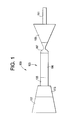
- FIG. 1 depicts an engine 100 having an air flow inlet 101, at least one pulse detonation combustor 103, and a turbine portion 109.
- the pulse detonation combustor 103 has an inlet portion 105, a combustion chamber 106 and an exit nozzle 107.
- a shaft 111 is coupled to the turbine portion 109 to extract work during the operation of the engine 100.
- the engine 100 is an aircraft engine, while in another embodiment of the present invention, the engine 100 is a ground based engine, as used in various power generation applications.
- the present invention is not limited in this regard.
- the engine is a PDC-hybrid type engine.
- the air flow inlet 101 allows for the intake of air flow and directs at least a portion of the air flow to the to the inlet portion 105 of the PDC 103. In an embodiment of the flow into the inlet portion. In a further embodiment of the present invention, the air flow inlet 101 is a compressor, which compresses an air flow entering the engine 100. Because the operation and structure of compressors and other air flow inlets are so well known to those of ordinary skill in the art, a detailed discussion of the air flow inlet 101 will not be included herein.
- the air flow inlet 101 is coupled to the inlet portion 105 of the PDC 103 via a manifold structure 113.
- the manifold structure 113 directs the air flow from the air flow inlet 101 to the inlet portion 105.
- the manifold structure 113 can be of any known structure, and may comprise diffusers, flow direction vanes and the like. The present invention is not limited in this regard.
- the PDC 103 contains an inlet portion 105, a combustion chamber 106 and an exit nozzle 107. Because those of ordinary skill in the art are well familiar with the general structure and operation of a PDC, the general details will not be discussed herein, except for those portions related to the present invention.
- the inlet portion 105 is of any known construction and configuration. Downstream of the of the inlet portion 105 is a combustion chamber 106, in which the detonation or deflagration occurs during the operation of the PDC 103. After the detonation/deflagration the exhaust from the combustion chamber 106 passes through the exit nozzle 107.
- the exit nozzle 107 is integrated into the PDC 103.
- the nozzle 107 is directly coupled to the rotor portion (not shown) of a downstream turbine stage. This aids in controlling the offset between the temperature and pressure peaks during operation of the PDC 103 (which will be discussed more fully below.
- the nozzle 107 is a converging-diverging nozzle, as shown in FIG. 1 and FIG. 5 .
- the fundamental structure of a converging-diverging nozzle is known to those of ordinary skill in the art, and thus will not be discussed in detail herein. A brief further discussion is set forth below.
- the operation of the PDC 103 comprises five basic operational steps. They are: (1) the purge process, (2) the fuel fill process, (3) the detonation initiation process, (4) detonation propagation, and (5) tube blowdown.
- the purge process high temperature exhaust products (generated from a previous detonation) are purged or scavenged out of the combustion chamber 106 with a flow of air, or the like.
- the inlet portion 105 of the PDC 103 contains a valve structure(s) (not shown) which opens during the purge process allowing the inflow of air, or other purge gas.
- valve structure(s) remain open, thus continually allowing air to flow into the chamber 106 while fuel is injected into the air traveling into the chamber 106, thus placing a fuel-air mixture into the chamber 106 of the PDC 103.
- the air flow into the chamber 106 during the fuel fill process is controlled at a specific velocity.
- the fuel is either injected into the air flow upstream of the inlet portion 105, within the inlet portion 105 or after the inlet portion 105, or a combination thereof.
- the detonation After detonation of the fuel air mixture within the chamber 106 the detonation propagates from the detonation origin, and because the inlet portion 105, through the valve structure(s), is closed the detonation propagation is directed downstream within the chamber 106 towards the exit nozzle 107.
- the blowdown stage the detonated materials from the fuel air mixture travel within the chamber 106 toward the exit nozzle 107 and then exit the PDC 103.
- the actual time t (ms) for a pulse detonation cycle is a function of the design and operational parameters of the PDC 103.
- the purge time is t purge and the fuel fill time is t fuelfill .
- the purge fraction of the PDC 103 is the ratio of t purge to t purge + t fuelfill . That is: t purge /(t purge + t fuelfill ).
- the fill fraction of the PDC 103 is 1 - purge fraction.
- the PDC 103 is operated so as to have a partial fuel fill. That is, the fill fraction is between 0.9 and 0.1. In another exemplary embodiment, the fill fraction is between 0.5 and 0.1.
- shock waves from the detonation are employed to compress the fluid within the PDC, and thus a goal is to have the fill fraction within the PDC as small as possible while still sustaining a detonation.
- the minimum purge is at 10%, thus resulting in a fill fraction of 0.1. This is a desirable fill fraction because minimal fuel is being employed, while still maintaining detonation. However, as the fill fraction is decreased the sustainability of the detonation becomes more difficult.
- the fill fraction is within the range of 0.5 to 0.9. In this embodiment, sustaining the detonation is easier, than when the fill fraction approaches 0.1.
- the PDC 103 is operated such that the purge fraction is controlled so that the temperature and pressure peaks are offset. Similar to as discussed above, the purge fraction can be adjusted along with the fuel fill fraction to obtain the desired peak offset.
- the fill fraction of this embodiment is less than 1. Having a fuel fill fraction of less than 1 allows the embodiment of the present invention, to have an overall lower temperature peak and pressure peak, and offset the occurrences of the pressure and temperature peaks. This can also be obtained in conjunction with an adjustment of the purge fraction (i.e., the ratio of the amount of time for the purge stage to the time for the purge plus the fuel fill time).
- the benefits are enhanced by coupling the use of partial fuel filling with an integrated nozzle, such as a converging-diverging exit nozzle 107, as shown in FIG. 1 .
- the fill fraction is within the range of 0.1 to 0.9, and in another exemplary embodiment, the fill fraction is between 0.1 and 0.5. In a further exemplary embodiment, the fill fraction is in the range of 0.5 to 0.9.
- Partial fuel filling together with the flow expansion achieved through the use of an integrated nozzle, such as a converging-diverging nozzle (107) results in the reduction of temperature and pressure peaks experienced during operation, as well as an offset of the operational temperature peak from operational pressure peak and mass flow peak.
- the pressure peak is reduced by broadening the pressure distribution as a function of time, i.e. spreading the pressure peak over a longer operational time. This pressure peak reduction, in turn, causes the temperature peak to be reduced.
- the peaks experienced by the components of the turbine stage (109) are reduced.
- the offset of the temperature and pressure peaks on downstream components can be at least 1 ms.
- the offset between the peaks is at least 2 ms.
- the offset is in the range of 1 to 30 ms. Offsetting these peaks, as well as reducing the levels of the peaks, results in benefits in the operational durability and life of downstream components. The stresses on downstream components is decreased as these peaks are less in magnitude and are not experienced at the same time.
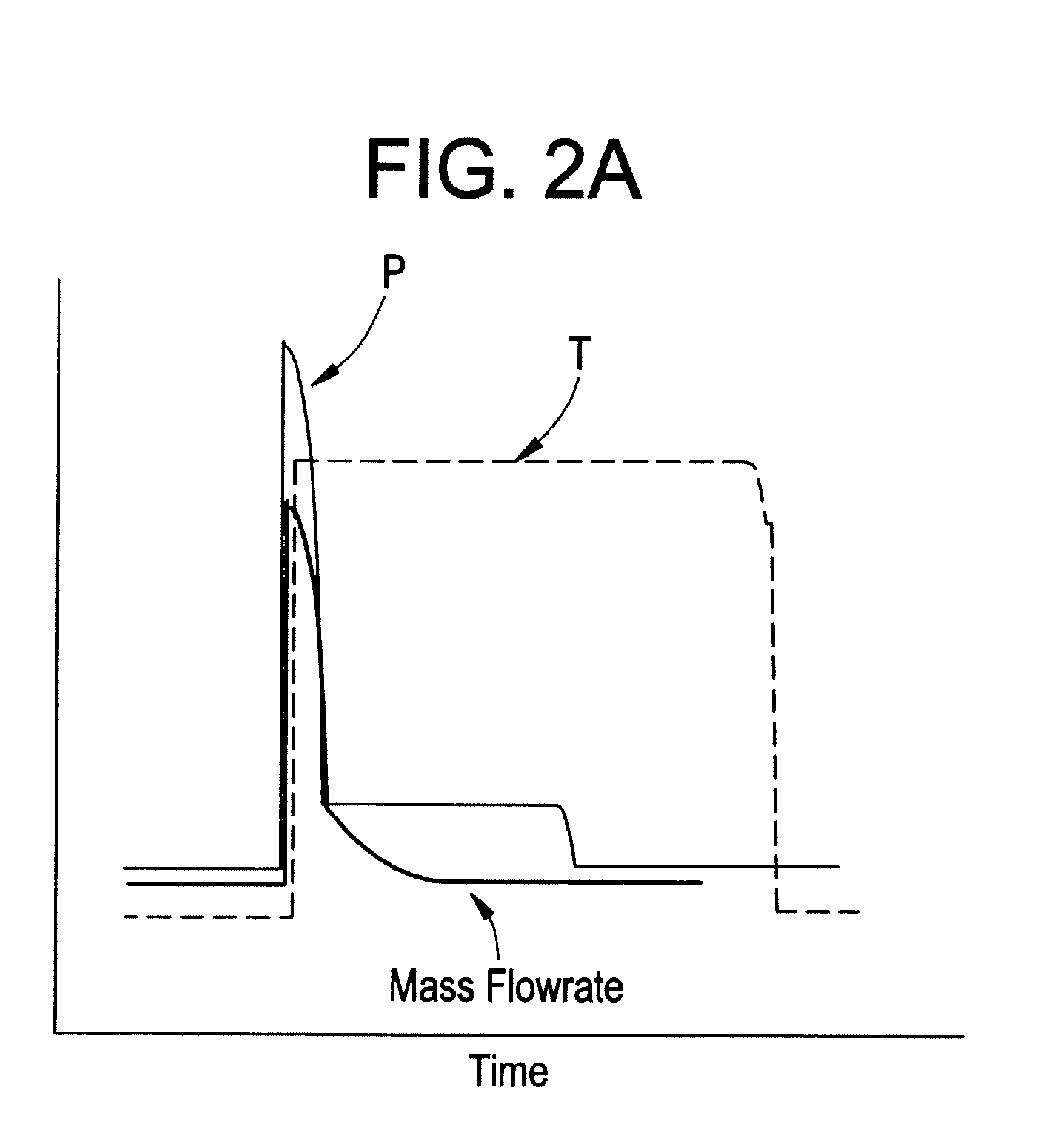
- FIGs. 2A and 2B are exemplary depictions of the pressure, temperature and mass flow of a typical PDC ( FIG. 2A ) and a device in accordance with an embodiment of the invention ( FIG. 2B ).
- the temperature peak, pressure peak and mass flow rate peak occur essentially at the same time.
- the temperature peak is the highest temperature reached during an operational cycle of the PDC and the pressure peak is the highest pressure reached during an operational cycle of the PDC.
- the coupling of a partial fuel fill with an integrated exit nozzle 107 results in having the peak levels of each of the temperature, pressure and mass flow lowered, as well as offsetting the temperature peak from the pressure peak, as well as the mass flow peak.
- the temperature peak is offset such that it lags behind the pressure peak.
- the pressure and mass flow peaks are reduced, at least in part, by the broadening of the pressure and mass flow distributions as a function of time.
- FIG. 5 depicts and exemplary embodiment of a converging-diverging nozzle 107 in accordance with an exemplary embodiment of the present invention.
- a converging-diverging nozzle 107 has a converging section 501, a throat section 503, and a diverging section 505.
- the overall dimensions and configuration of the nozzle 107 to be employed is a function of the operational and design parameters of the PDC and the overall system. However, the physical characteristics of a converging-diverging nozzle are to be maintained such that the nozzle acts in accordance with the performance parameters of a converging diverging nozzle.
- throat-to-tube diameter ratio in the range of 0.1 to 1.0
- angle of convergence is in the range of 10 degrees to less than 90 degrees
- length of the converging section is in the range of 5 to 45 degrees
- (5) the length of the divergence section are to be optimized based on the operational and performance criteria of the PDC 103 and the engine 100.
- FIG. 3 shows a diagrammatical representation of an engine 300 similar in construction to that shown in FIG. 1 , except that a plurality of the PDCs 103 are employed.
- the operation of the PDCs 103 can be synced, such that their operation cycles occur at the same time, or alternatively, their operational cycles are staggered. For example, while one PDC is in its blow down stage, another is in its fuel fill stage.
- the operational timing of the PDCs is a function of the design and performance criteria of the engine 300.
- FIG. 4 a flow is depicted which shows the operational flow of an embodiment of the present invention.
- high temperature exhaust products generated from a previous detonation
- the inlet portion 105 of the PDC 103 contains a valve structure(s) (not shown) which opens during the purge process S 100 allowing the inflow of air, or other purge gas.
- the next step S200 is the partial fuel fill process.
- the valve structure(s) remain open, thus continually allowing air to flow into the chamber 106 while fuel is injected into the air traveling into the chamber 106.
- the air flow into the chamber 106 during the partial fuel fill process S200 is controlled at a specific velocity.
- the fuel is either injected into the air flow upstream of the inlet portion 105, within the inlet portion 105 or after the inlet portion 105, or a combination thereof.
- the partial fuel fill step S200 is conducted such that the fill fraction is less than 1.
- the fill fraction is in the range of 0.1 to 0.5, and in another exemplary embodiment, the fill fraction is in the range of 0.1 to 0.9.
- valve structure(s) (not shown) are closed and the detonation initiation step S300 begins causing detonation of the fuel air mixture within the chamber 106.
- detonation initiation step S300 begins causing detonation of the fuel air mixture within the chamber 106.
- Various sources to create the detonation are known and will not be discussed herein.
- the blowdown step S500 the detonated materials from the fuel air mixture travel within the chamber 106 toward the exit nozzle 107.
- the detonated materials then pass through the exit nozzle 107, which is a converging-diverging nozzle S600. This process results in the decreased temperature, pressure and mass flow peaks discussed above, which is equivalent to lowering the overall equivalence ratio of a PDC.
- the present invention has been discussed above specifically with respect to aircraft applications, the present invention is not limited to this and can be in any similar detonation/deflagration device in which the benefits of the present invention are desirable.
Landscapes
- Engineering & Computer Science (AREA)
- Chemical & Material Sciences (AREA)
- Combustion & Propulsion (AREA)
- Mechanical Engineering (AREA)
- General Engineering & Computer Science (AREA)
- Fluidized-Bed Combustion And Resonant Combustion (AREA)
Abstract
Description
- This invention relates to pulse detonation systems, and more particularly, to partial filling of a pulse detonation combustor in a pulse detonation combustor based hybrid engine.
- With the recent development of pulse detonation combustors (PDCs) and engines (PDEs), various efforts have been underway to use PDC/Es in practical applications, such as combustors for aircraft engines and/or as means to generate additional thrust/propulsion in a post-turbine stage. Further, there are efforts to employ PDC/E devices into "hybrid" type engines which use a combination of both conventional gas turbine engine technology and PDC/E technology in an effort to maximize operational efficiency. It is for either of these applications that the following discussion will be directed. It is noted that the following discussion will be directed to "pulse detonation combustors" (i.e. PDCs). However, the use of this term is intended to include pulse detonation engines, and the like.
- Because of the recent development of PDCs and an increased interest in finding practical applications and uses for these devices, there is an increasing interest in increasing their operational and performance efficiencies.
- Additionally, it is known that the operation of PDCs creates extremely high pressure and temperature peaks both within the PDC and downstream components. Because of these high temperature and pressure peaks, during PDC operation, it is difficult to develop operational systems which can sustain long term exposure to these repeated high temperature and pressure peaks.
- Therefore, there exists a need for an improved PDC and method of operating a PDC which provides improved operational efficiencies and reduces the temperature and pressure peaks associated with traditional PDC operation.
- In an embodiment of the present invention, an engine comprises at least one pulse detonation combustor having a combustion chamber and an exit nozzle coupled to and downstream of the combustion chamber. During operation of the at least one pulse detonation combustor a detonation occurs within the combustion chamber and at least one of a fuel fill fraction and purge fraction of the at least one pulse detonation combustor are utilized to offset a temperature peak of said detonation from a pressure peak of said detonation. The fuel fill fraction is defined as 1 - purge fraction, and the purge fraction is the ratio of the purge time of the at least one pulse detonation combustor to a sum of the purge time of the at least one pulse detonation combustor and a fuel fill time of the at least one pulse detonation combustor.
- As used herein, a "pulse detonation combustor" PDC (also including PDEs) is understood to mean any device or system that produces both a pressure rise and velocity increase from a series of repeating detonations or quasi-detonations within the device. A "quasi-detonation" is a supersonic turbulent combustion process that produces a pressure rise and velocity increase higher than the pressure rise and velocity increase produced by a deflagration wave. Embodiments of PDCs (and PDEs) include a means of igniting a fuel/oxidizer mixture, for example a fuel/air mixture, and a detonation chamber, in which pressure wave fronts initiated by the ignition process coalesce to produce a detonation wave. Each detonation or quasi-detonation is initiated either by external ignition, such as spark discharge or laser pulse, or by gas dynamic processes, such as shock focusing, auto ignition or by another detonation (i.e. cross-fire).
- As used herein, "engine" means any device used to generate thrust and/or power.
- The advantages, nature and various additional features of the invention will appear more fully upon consideration of the illustrative embodiment of the invention which is schematically set forth in the figures, in which:
-
FIG. 1 shows a diagrammatical representation of a power generation device in accordance with an embodiment of the present invention; -
FIGs. 2A and 2B show graphical representations of temperature, pressure and mass flow in a conventional pulse detonation combustor (2A) and a pulse detonation combustor in accordance with an embodiment of the invention (2B); -
FIG. 3 shows a diagrammatical representation of a power generation device in accordance with another embodiment of the present invention; -
FIG. 4 depicts an operational flow chart of an embodiment of the present invention; and -
FIG. 5 depicts a diagrammatical representation of a converging-diverging nozzle used with an embodiment of the present invention. - The present invention will be explained in further detail by making reference to the accompanying drawings, which do not limit the scope of the invention in any way.
-
FIG. 1 depicts anengine 100 having an air flow inlet 101, at least onepulse detonation combustor 103, and aturbine portion 109. Thepulse detonation combustor 103 has aninlet portion 105, acombustion chamber 106 and anexit nozzle 107. In an embodiment of the present invention ashaft 111 is coupled to theturbine portion 109 to extract work during the operation of theengine 100. - In an embodiment of the present invention, the
engine 100 is an aircraft engine, while in another embodiment of the present invention, theengine 100 is a ground based engine, as used in various power generation applications. The present invention is not limited in this regard. In a further embodiment of the present invention, the engine is a PDC-hybrid type engine. - The air flow inlet 101 allows for the intake of air flow and directs at least a portion of the air flow to the to the
inlet portion 105 of thePDC 103. In an embodiment of the flow into the inlet portion. In a further embodiment of the present invention, the air flow inlet 101 is a compressor, which compresses an air flow entering theengine 100. Because the operation and structure of compressors and other air flow inlets are so well known to those of ordinary skill in the art, a detailed discussion of the air flow inlet 101 will not be included herein. - The air flow inlet 101 is coupled to the
inlet portion 105 of thePDC 103 via amanifold structure 113. Themanifold structure 113 directs the air flow from the air flow inlet 101 to theinlet portion 105. Themanifold structure 113 can be of any known structure, and may comprise diffusers, flow direction vanes and the like. The present invention is not limited in this regard. - As described above, the
PDC 103 contains aninlet portion 105, acombustion chamber 106 and anexit nozzle 107. Because those of ordinary skill in the art are well familiar with the general structure and operation of a PDC, the general details will not be discussed herein, except for those portions related to the present invention. Theinlet portion 105 is of any known construction and configuration. Downstream of the of theinlet portion 105 is acombustion chamber 106, in which the detonation or deflagration occurs during the operation of thePDC 103. After the detonation/deflagration the exhaust from thecombustion chamber 106 passes through theexit nozzle 107. - Further, while the figures depict the
PDC 103 andcombustion chamber 106 as having a cylindrical shape with a constant cross-section, this depiction is intended to be merely exemplary and the present invention is not limited to this configuration. That is, it is contemplated that the cross-section shape of thePDC 103 andchamber 106 can be non-circular, such as elliptical, octagonal, etc. Additionally, it is contemplated that thePDC 103 and/or thechamber 106 can have a variable cross-section, for example a conical shape. - In an embodiment of the present invention, the
exit nozzle 107 is integrated into thePDC 103. In a further exemplary embodiment of the present invention, thenozzle 107 is directly coupled to the rotor portion (not shown) of a downstream turbine stage. This aids in controlling the offset between the temperature and pressure peaks during operation of the PDC 103 (which will be discussed more fully below. In an exemplary embodiment of the present invention, thenozzle 107 is a converging-diverging nozzle, as shown inFIG. 1 andFIG. 5 . The fundamental structure of a converging-diverging nozzle is known to those of ordinary skill in the art, and thus will not be discussed in detail herein. A brief further discussion is set forth below. - The operation of the
PDC 103 in accordance with an embodiment of the present invention will now be discussed. - The operation of the
PDC 103 comprises five basic operational steps. They are: (1) the purge process, (2) the fuel fill process, (3) the detonation initiation process, (4) detonation propagation, and (5) tube blowdown. During the purge process, high temperature exhaust products (generated from a previous detonation) are purged or scavenged out of thecombustion chamber 106 with a flow of air, or the like. Typically, theinlet portion 105 of thePDC 103 contains a valve structure(s) (not shown) which opens during the purge process allowing the inflow of air, or other purge gas. During the fuel fill process, the valve structure(s) (not shown) remain open, thus continually allowing air to flow into thechamber 106 while fuel is injected into the air traveling into thechamber 106, thus placing a fuel-air mixture into thechamber 106 of thePDC 103. In an embodiment, the air flow into thechamber 106 during the fuel fill process is controlled at a specific velocity. Further, in an embodiment of the invention, the fuel is either injected into the air flow upstream of theinlet portion 105, within theinlet portion 105 or after theinlet portion 105, or a combination thereof. Once the fuel fill process is complete the valve structure(s) (not shown) are closed and the detonation initiation process begins causing detonation of the fuel air mixture within thechamber 106. Various sources to create the detonation are known and will not be discussed herein. - After detonation of the fuel air mixture within the
chamber 106 the detonation propagates from the detonation origin, and because theinlet portion 105, through the valve structure(s), is closed the detonation propagation is directed downstream within thechamber 106 towards theexit nozzle 107. In the final stage, the blowdown stage, the detonated materials from the fuel air mixture travel within thechamber 106 toward theexit nozzle 107 and then exit thePDC 103. After the blowdown process is complete the valve structure(s) (not shown) open to begin a new operational cycle (time is t = 0 ms). - The actual time t (ms) for a pulse detonation cycle is a function of the design and operational parameters of the
PDC 103. For the purposes of the present application the purge time is tpurge and the fuel fill time is tfuelfill. Thus, as discussed above, the valve structure(s) in theinlet portion 105 are closed at t = tpurge + tfuelfill. Accordingly, the purge fraction of thePDC 103 is the ratio of tpurge to tpurge + tfuelfill. That is: tpurge /(tpurge + tfuelfill). For the purposes of the present invention the fill fraction of thePDC 103 is 1 - purge fraction. - In an exemplary embodiment of the present invention, the
PDC 103 is operated so as to have a partial fuel fill. That is, the fill fraction is between 0.9 and 0.1. In another exemplary embodiment, the fill fraction is between 0.5 and 0.1. In exemplary embodiments of the present invention, shock waves from the detonation are employed to compress the fluid within the PDC, and thus a goal is to have the fill fraction within the PDC as small as possible while still sustaining a detonation. Thus, in an exemplary embodiment of the present invention, the minimum purge is at 10%, thus resulting in a fill fraction of 0.1. This is a desirable fill fraction because minimal fuel is being employed, while still maintaining detonation. However, as the fill fraction is decreased the sustainability of the detonation becomes more difficult. Thus, more tuning and optimization of the system is typically required, although within the abilities of those skilled in the art, to maintain lower fill fractions. In another exemplary embodiment of the present invention, the fill fraction is within the range of 0.5 to 0.9. In this embodiment, sustaining the detonation is easier, than when the fill fraction approaches 0.1. - In a further exemplary embodiment of the present invention, the
PDC 103 is operated such that the purge fraction is controlled so that the temperature and pressure peaks are offset. Similar to as discussed above, the purge fraction can be adjusted along with the fuel fill fraction to obtain the desired peak offset. - In prior devices, during the fuel fill stage (of PDC operation) the fill is completed resulting in the known concurrence of the high pressure and temperature peaks during PDC operation. It is these peaks and their tendency to occur simultaneously during operation which tend to be limiting factors in the application and use of PDCs in various applications and environments.
- In an embodiment of the present invention, only a partial fuel fill and/or an adjustment of the purge fraction is accomplished. When using a partial fuel fill, the fill fraction of this embodiment is less than 1. Having a fuel fill fraction of less than 1 allows the embodiment of the present invention, to have an overall lower temperature peak and pressure peak, and offset the occurrences of the pressure and temperature peaks. This can also be obtained in conjunction with an adjustment of the purge fraction (i.e., the ratio of the amount of time for the purge stage to the time for the purge plus the fuel fill time). In a further embodiment of the presence invention, the benefits are enhanced by coupling the use of partial fuel filling with an integrated nozzle, such as a converging-diverging
exit nozzle 107, as shown inFIG. 1 . In an embodiment of the invention, the fill fraction is within the range of 0.1 to 0.9, and in another exemplary embodiment, the fill fraction is between 0.1 and 0.5. In a further exemplary embodiment, the fill fraction is in the range of 0.5 to 0.9. - Partial fuel filling together with the flow expansion achieved through the use of an integrated nozzle, such as a converging-diverging nozzle (107) results in the reduction of temperature and pressure peaks experienced during operation, as well as an offset of the operational temperature peak from operational pressure peak and mass flow peak. The pressure peak is reduced by broadening the pressure distribution as a function of time, i.e. spreading the pressure peak over a longer operational time. This pressure peak reduction, in turn, causes the temperature peak to be reduced. By reducing both the temperature and pressure peaks in the PDC operation, the peaks experienced by the components of the turbine stage (109) are reduced.
- In an exemplary embodiment, the offset of the temperature and pressure peaks on downstream components, such as the turbine stage, can be at least 1 ms. In a further exemplary embodiment, the offset between the peaks is at least 2 ms. In yet a further exemplary embodiment of the present invention, the offset is in the range of 1 to 30 ms. Offsetting these peaks, as well as reducing the levels of the peaks, results in benefits in the operational durability and life of downstream components. The stresses on downstream components is decreased as these peaks are less in magnitude and are not experienced at the same time.
- The reduction of temperature and pressure loads in the
turbine 109 allow for easier turbine operation, and thus expand the viability of commercial applications of a PDC. -
FIGs. 2A and 2B are exemplary depictions of the pressure, temperature and mass flow of a typical PDC (FIG. 2A ) and a device in accordance with an embodiment of the invention (FIG. 2B ). As shown, in known devices, when the PDC is fully filled in the fuel fill stage and an integrated nozzle is not employed, the temperature peak, pressure peak and mass flow rate peak occur essentially at the same time. For purposes of the present application, the temperature peak is the highest temperature reached during an operational cycle of the PDC and the pressure peak is the highest pressure reached during an operational cycle of the PDC. By having these peaks occur at the same time, high levels of stress and operational difficulties or created on any downstream turbine stage or device. However, in an embodiment of the invention (FIG. 2B ) the coupling of a partial fuel fill with anintegrated exit nozzle 107, such as a converging-diverging nozzle, results in having the peak levels of each of the temperature, pressure and mass flow lowered, as well as offsetting the temperature peak from the pressure peak, as well as the mass flow peak. In an exemplary embodiment of the present invention, the temperature peak is offset such that it lags behind the pressure peak. As also can be seen the pressure and mass flow peaks are reduced, at least in part, by the broadening of the pressure and mass flow distributions as a function of time. These changes result in improved overall performance of the device as well as increasing the commercial viability of the use of PDCs in various operations, by reducing the temperature, pressure and mass flow loading on any downstream equipment, including aturbine stage 109. - As a result of the reductions discussed above (reduction in peak, temp., and mass flow) the overall equivalence ratio of PDC is reduced, thus effectively acting as if the fuel mixture is lean. Accordingly, the benefits of operating at a reduced equivalence ratio is achieved.
-
FIG. 5 depicts and exemplary embodiment of a converging-divergingnozzle 107 in accordance with an exemplary embodiment of the present invention. As shown inFIG. 5 (which is an exemplary embodiment), a converging-divergingnozzle 107 has a convergingsection 501, athroat section 503, and a divergingsection 505. The overall dimensions and configuration of thenozzle 107 to be employed is a function of the operational and design parameters of the PDC and the overall system. However, the physical characteristics of a converging-diverging nozzle are to be maintained such that the nozzle acts in accordance with the performance parameters of a converging diverging nozzle. These characteristics include (1) the throat-to-tube diameter ratio in the range of 0.1 to 1.0, (2) the angle of convergence is in the range of 10 degrees to less than 90 degrees, (3) the length of the converging section, (4) the angle of divergence is in the range of 5 to 45 degrees, and (5) the length of the divergence section. Of course, each of these physical parameters are to be optimized based on the operational and performance criteria of thePDC 103 and theengine 100. -
FIG. 3 shows a diagrammatical representation of anengine 300 similar in construction to that shown inFIG. 1 , except that a plurality of thePDCs 103 are employed. In this embodiment, it is contemplated that the operation of thePDCs 103 can be synced, such that their operation cycles occur at the same time, or alternatively, their operational cycles are staggered. For example, while one PDC is in its blow down stage, another is in its fuel fill stage. The operational timing of the PDCs is a function of the design and performance criteria of theengine 300. - Turning now to
FIG. 4 a flow is depicted which shows the operational flow of an embodiment of the present invention. When t = 0 (at the beginning of a new PDC cycle thePDC chamber 106 is purged S100. During the purge process S100, high temperature exhaust products (generated from a previous detonation) are purged or scavenged out of thecombustion chamber 106 with a flow of air, or the like. Typically, theinlet portion 105 of thePDC 103 contains a valve structure(s) (not shown) which opens during thepurge process S 100 allowing the inflow of air, or other purge gas. The next step S200 is the partial fuel fill process. In this step S200, the valve structure(s) (not shown) remain open, thus continually allowing air to flow into thechamber 106 while fuel is injected into the air traveling into thechamber 106. In an embodiment, the air flow into thechamber 106 during the partial fuel fill process S200 is controlled at a specific velocity. Further, in an embodiment of the invention, the fuel is either injected into the air flow upstream of theinlet portion 105, within theinlet portion 105 or after theinlet portion 105, or a combination thereof. In an embodiment of the invention, the partial fuel fill step S200 is conducted such that the fill fraction is less than 1. In another embodiment of the invention, the fill fraction is in the range of 0.1 to 0.5, and in another exemplary embodiment, the fill fraction is in the range of 0.1 to 0.9. - Once the partial fuel fill step S200 is complete the valve structure(s) (not shown) are closed and the detonation initiation step S300 begins causing detonation of the fuel air mixture within the
chamber 106. Various sources to create the detonation are known and will not be discussed herein. - After detonation of the fuel air mixture within the
chamber 106 the detonation propagates from the detonation origin (the detonation propagation step S400), and because theinlet portion 105, through the valve structure(s), is closed the detonation propagation is directed downstream within thechamber 106 towards theexit nozzle 107. In the final step, the blowdown step S500, the detonated materials from the fuel air mixture travel within thechamber 106 toward theexit nozzle 107. The detonated materials then pass through theexit nozzle 107, which is a converging-diverging nozzle S600. This process results in the decreased temperature, pressure and mass flow peaks discussed above, which is equivalent to lowering the overall equivalence ratio of a PDC. - It is noted that although the present invention has been discussed above specifically with respect to aircraft applications, the present invention is not limited to this and can be in any similar detonation/deflagration device in which the benefits of the present invention are desirable.
- While the invention has been described in terms of various specific embodiments, those skilled in the art will recognize that the invention can be practiced with modification within the spirit and scope of the claims.
Claims (15)
- An engine (100), comprising:at least one pulse detonation combustor (103) having a combustion chamber (106) andan exit nozzle (107) coupled to and downstream of said combustion chamber,wherein during an operation of said at least one pulse detonation combustor a detonation occurs within said combustion chamber and at least one of a fuel fill fraction and purge fraction of said at least one pulse detonation combustor are utilized to offset a temperature peak of said detonation from a pressure peak of said detonation, andwherein said fuel fill fraction is defined as 1 - purge fraction, and wherein purge fraction is the ratio of the purge time of said at least one pulse detonation combustor to a sum of said purge time of said at least one pulse detonation combustor and a fuel fill time of said at least one pulse detonation combustor.
- The engine (100) of claim 1, wherein the fuel fill fraction is in the range of 0.1 to 0.9.
- The engine (100) of claim 1 or claim 2, wherein the fuel fill fraction is in the range of 0.5 to 0.9.
- The engine (100) of any preceding claim, wherein said combustion chamber (106) is only partially filled during a fuel fill stage of its operation.
- The engine (100) of any preceding claim, wherein an offset of time between said temperature peak and said pressure peak is in the range of 1 to 30 ms.
- The engine (100) of any preceding claim, wherein said exit nozzle (107) is a converging-diverging nozzle (107), which has a throat-to-tube diameter ratio in the range of 0.1 to 1.0.
- The engine (100) of any preceding claim, wherein said exit nozzle (107) is a converging-diverging nozzle (107) which has a converging section (501) with a convergence angle in the range of 10 to less than 90 degrees and a diverging section (505) with a divergence angle in the range of 5 to 45 degrees.
- A method of generating power, comprising:partially filling at least one pulse detonation combustor (103) with a fuel-air mixture;detonating said mixture within said at least one pulse detonation combustor; andpassing said detonated mixture through an exit nozzle (107),wherein said detonating step creates a temperature peak and a pressure peak and after said detonated mixtures exits said exit nozzle there is an offset between said temperature peak and said pressure peak of at least 1 ms.
- The method of claim 8, wherein said partial filling of said at least one pulse detonation combustor (103) provides a fuel fill fraction for said at least one pulse detonation combustor in the range of 0.1 to 0.9, where fill fraction is defined as 1 - purge fraction, and
wherein purge fraction is the ratio of the purge time of said at least one pulse detonation combustor to a sum of said purge time of said at least one pulse detonation combustor and a fuel fill time of said at least one pulse detonation combustor. - The method of claim 9, wherein the fuel fill fraction is in the range of 0.1 to 0.5.
- The method of claim 9, wherein the fuel fill fraction is in the range of 0.5 to 0.9.
- The method of any one of claims 9 to 11, wherein said offset between said temperature peak and said pressure peak is at least 2 ms.
- The method of any one of claims 9 to 11, wherein said offset between said temperature peak and said pressure peak is in the range of 1 to 30 ms.
- The method of any one of claims 9 to 13, wherein said exit nozzle is a converging-diverging nozzle which has a throat-to-tube diameter ratio in the range of 0.1 to 1.0.
- The method of any one of claims 9 to 14, wherein said exit nozzle is a converging-diverging nozzle and has a converging section with a convergence angle in the range of 10 to less than 90 degrees and a diverging section with a divergence angle in the range of 5 to 45 degrees.
Priority Applications (1)
| Application Number | Priority Date | Filing Date | Title |
|---|---|---|---|
| EP10155968A EP2365250A1 (en) | 2010-03-09 | 2010-03-09 | Partial filling of a pulse detonation combustor in a pulse detonation combustor based hybrid engine |
Applications Claiming Priority (1)
| Application Number | Priority Date | Filing Date | Title |
|---|---|---|---|
| EP10155968A EP2365250A1 (en) | 2010-03-09 | 2010-03-09 | Partial filling of a pulse detonation combustor in a pulse detonation combustor based hybrid engine |
Publications (1)
| Publication Number | Publication Date |
|---|---|
| EP2365250A1 true EP2365250A1 (en) | 2011-09-14 |
Family
ID=42700397
Family Applications (1)
| Application Number | Title | Priority Date | Filing Date |
|---|---|---|---|
| EP10155968A Withdrawn EP2365250A1 (en) | 2010-03-09 | 2010-03-09 | Partial filling of a pulse detonation combustor in a pulse detonation combustor based hybrid engine |
Country Status (1)
| Country | Link |
|---|---|
| EP (1) | EP2365250A1 (en) |
Citations (5)
| Publication number | Priority date | Publication date | Assignee | Title |
|---|---|---|---|---|
| US6062018A (en) * | 1993-04-14 | 2000-05-16 | Adroit Systems, Inc. | Pulse detonation electrical power generation apparatus with water injection |
| US20040250529A1 (en) * | 2001-09-07 | 2004-12-16 | Bernard Macarez | Gas turbine with intermittent combustion |
| US20050279078A1 (en) * | 2004-06-18 | 2005-12-22 | General Electric Company | Multiple detonation initiator for frequency multiplied pulsed detonation combustion |
| WO2007025047A2 (en) | 2005-08-24 | 2007-03-01 | University Of Cincinnati | Performance improvements for pulse detonation engines using ejectors |
| US20080229756A1 (en) | 2006-12-01 | 2008-09-25 | General Electric Company | System and method for passive valving for pulse detonation combustors |
-
2010
- 2010-03-09 EP EP10155968A patent/EP2365250A1/en not_active Withdrawn
Patent Citations (6)
| Publication number | Priority date | Publication date | Assignee | Title |
|---|---|---|---|---|
| US6062018A (en) * | 1993-04-14 | 2000-05-16 | Adroit Systems, Inc. | Pulse detonation electrical power generation apparatus with water injection |
| US20040250529A1 (en) * | 2001-09-07 | 2004-12-16 | Bernard Macarez | Gas turbine with intermittent combustion |
| EP1483489B1 (en) | 2001-09-07 | 2006-10-18 | Bernard Macarez | Gas turbine with intermittent combustion |
| US20050279078A1 (en) * | 2004-06-18 | 2005-12-22 | General Electric Company | Multiple detonation initiator for frequency multiplied pulsed detonation combustion |
| WO2007025047A2 (en) | 2005-08-24 | 2007-03-01 | University Of Cincinnati | Performance improvements for pulse detonation engines using ejectors |
| US20080229756A1 (en) | 2006-12-01 | 2008-09-25 | General Electric Company | System and method for passive valving for pulse detonation combustors |
Non-Patent Citations (8)
| Title |
|---|
| "PCE*- Pulse Combustion Engine", EUROPEAN FP6 PROPOSAL NUMBER FP6-511812-1, 13 October 2003 (2003-10-13), pages 1 - 6, XP003029354 |
| COOPER, M. AND SHEPHERD, J., E. AND SCHAUER, F.: "Impulse Correlation for Partially-filled detonation Tubes", vol. 20, no. 5, 31 December 2004 (2004-12-31), pages 1 - 10, XP002600839, Retrieved from the Internet <URL:www.galcit.caltech.edu/EDL/publications/reprints/nozzles.pdf> [retrieved on 20100914] * |
| F. JOOS: "Technische Verbrennung", 31 December 2006, SPRINGER-VERLAG BERLIN HEIDELBERG, XP002601300 * |
| FUHUA MA, JEONG-YEOL CHOI, VIGOR YANG: "Propulsive Performance of Airbreathing Pulse Detonation Engines", 31 December 2006 (2006-12-31), pages 1188 - 1203, Retrieved from the Internet <URL:http://yang.ae.gatech.edu/publications/Journal/JPP%20%282006,%20Ma,%20PDE%29.pdf> [retrieved on 20120606] * |
| HOKE, J.; ROYCE, B.; SCHAUER, F.: "Heat Transfer and Thermal Management in a Pulsed Detonation Engine", AIAA AEROSPACE SCIENCES MEETING & EXHIBIT, 6486, 6 January 2003 (2003-01-06), Reno, NV, pages 1 - 5, XP002600836 * |
| KASAHARA, J. ; HIRANO, M.; MATSUO, A.; DAIMON, Y.; ENDO, T.: "Thrust measurement of a multicycle partially filled pulse detonation rocket engine", JOURNAL OF PROPULSION AND POWER, vol. 25, no. 6, 30 December 2009 (2009-12-30), pages 1281 - 1290, XP002600838, Retrieved from the Internet <URL:http://pdf.aiaa.org/jaPreview/JPP/2009/PVJA42224.pdf> [retrieved on 20100915] * |
| MORRIS: "Numerical Modeling of Pulse Detonation Rocket Engine Gasdynamics and Performance", 31 January 2004 (2004-01-31), Retrieved from the Internet <URL:Modeling of Pulse Detonation Rocket Engine Gasdynamics and Performance> [retrieved on 20120606] * |
| VENKAT, E.; NARENDRA, D.: "Systems Level Performance Estimations for a Pulse detonation Combustor Based Hybrid Engine", PROCEEDINGS OF ASME TURBO EXPO 2008, no. GT2008, 51525, 9 June 2008 (2008-06-09), Berlin, pages 1 - 19, XP002600837 * |
Similar Documents
| Publication | Publication Date | Title |
|---|---|---|
| CN101818704B (en) | Ground-based simple cycle pulse detonation combustor based hybrid engine | |
| US20200393128A1 (en) | Variable geometry rotating detonation combustor | |
| US8082728B2 (en) | System and method of continuous detonation in a gas turbine engine | |
| US11149954B2 (en) | Multi-can annular rotating detonation combustor | |
| US8443583B2 (en) | Pilot fuel injection for a wave rotor engine | |
| CN109028142B (en) | Propulsion system and method of operating the same | |
| CN112728585B (en) | System for rotary detonation combustion | |
| GB2473110A (en) | Pulse detonation combustor configuration for deflagration to detonation transition enhancement | |
| EP2559939A2 (en) | Pulse detonation combustor with plenum | |
| EP2336523A2 (en) | Pulse detonation system with fuel lean inlet region | |
| US7055308B2 (en) | Detonation damper for pulse detonation engines | |
| US20090320446A1 (en) | Performance improvements for pulse detonation engines | |
| US7980056B2 (en) | Methods and apparatus for controlling air flow within a pulse detonation engine | |
| CN116717813A (en) | bimodal combustion system | |
| US9217392B2 (en) | Vortex cannon with enhanced ring vortex generation | |
| US8438833B2 (en) | Partial filling of a pulse detonation combustor in a pulse detonation combustor based hybrid engine | |
| CN110529876B (en) | Rotary detonation combustion system | |
| US20100242436A1 (en) | Modulation of inlet mass flow and resonance for a multi-tube pulse detonation engine system using phase shifted operation and detuning | |
| CA2696290A1 (en) | Partial filling of a pulse detonation combustor in a pulse detonation combustor based hybrid engine | |
| US7685806B2 (en) | Method and apparatus for supersonic and shock noise reduction in aircraft engines using pneumatic corrugations | |
| JP2011185133A (en) | Partial filling of pulse detonation combustor in pulse detonation combustor based hybrid type engine | |
| EP2365250A1 (en) | Partial filling of a pulse detonation combustor in a pulse detonation combustor based hybrid engine | |
| EP2312126A1 (en) | Power generation system and corresponding power generating method | |
| US7634904B2 (en) | Methods and apparatus to facilitate generating power from a turbine engine | |
| US20080127630A1 (en) | Turbine for application to pulse detonation combustion system and engine containing the turbine |
Legal Events
| Date | Code | Title | Description |
|---|---|---|---|
| PUAI | Public reference made under article 153(3) epc to a published international application that has entered the european phase |
Free format text: ORIGINAL CODE: 0009012 |
|
| AK | Designated contracting states |
Kind code of ref document: A1 Designated state(s): AT BE BG CH CY CZ DE DK EE ES FI FR GB GR HR HU IE IS IT LI LT LU LV MC MK MT NL NO PL PT RO SE SI SK SM TR |
|
| AX | Request for extension of the european patent |
Extension state: AL BA ME RS |
|
| 17P | Request for examination filed |
Effective date: 20120314 |
|
| 17Q | First examination report despatched |
Effective date: 20120622 |
|
| TPAC | Observations filed by third parties |
Free format text: ORIGINAL CODE: EPIDOSNTIPA |
|
| TPAC | Observations filed by third parties |
Free format text: ORIGINAL CODE: EPIDOSNTIPA |
|
| STAA | Information on the status of an ep patent application or granted ep patent |
Free format text: STATUS: THE APPLICATION IS DEEMED TO BE WITHDRAWN |
|
| 18D | Application deemed to be withdrawn |
Effective date: 20130719 |