EP2365025A1 - Heat-shrinkable polyester film - Google Patents
Heat-shrinkable polyester film Download PDFInfo
- Publication number
- EP2365025A1 EP2365025A1 EP20110001794 EP11001794A EP2365025A1 EP 2365025 A1 EP2365025 A1 EP 2365025A1 EP 20110001794 EP20110001794 EP 20110001794 EP 11001794 A EP11001794 A EP 11001794A EP 2365025 A1 EP2365025 A1 EP 2365025A1
- Authority
- EP
- European Patent Office
- Prior art keywords
- heat
- shrinkage
- film
- shrinkable polyester
- polyester film
- Prior art date
- Legal status (The legal status is an assumption and is not a legal conclusion. Google has not performed a legal analysis and makes no representation as to the accuracy of the status listed.)
- Withdrawn
Links
- 229920006267 polyester film Polymers 0.000 title claims abstract description 36
- MTHSVFCYNBDYFN-UHFFFAOYSA-N diethylene glycol Chemical compound OCCOCCO MTHSVFCYNBDYFN-UHFFFAOYSA-N 0.000 claims description 25
- LYCAIKOWRPUZTN-UHFFFAOYSA-N Ethylene glycol Chemical compound OCCO LYCAIKOWRPUZTN-UHFFFAOYSA-N 0.000 claims description 24
- 229920001634 Copolyester Polymers 0.000 claims description 18
- 239000000203 mixture Substances 0.000 claims description 18
- 238000000034 method Methods 0.000 claims description 15
- KKEYFWRCBNTPAC-UHFFFAOYSA-N terephthalic acid group Chemical group C(C1=CC=C(C(=O)O)C=C1)(=O)O KKEYFWRCBNTPAC-UHFFFAOYSA-N 0.000 claims description 14
- 239000002253 acid Substances 0.000 claims description 11
- 150000002009 diols Chemical class 0.000 claims description 11
- SLCVBVWXLSEKPL-UHFFFAOYSA-N neopentyl glycol Chemical compound OCC(C)(C)CO SLCVBVWXLSEKPL-UHFFFAOYSA-N 0.000 claims description 8
- XLYOFNOQVPJJNP-UHFFFAOYSA-N water Substances O XLYOFNOQVPJJNP-UHFFFAOYSA-N 0.000 claims description 7
- 239000007809 chemical reaction catalyst Substances 0.000 claims description 4
- 229910010272 inorganic material Inorganic materials 0.000 claims description 3
- 239000011147 inorganic material Substances 0.000 claims description 3
- 229920000642 polymer Polymers 0.000 claims description 3
- 239000003381 stabilizer Substances 0.000 claims description 3
- 239000000654 additive Substances 0.000 claims description 2
- 238000006243 chemical reaction Methods 0.000 claims description 2
- 230000000996 additive effect Effects 0.000 claims 1
- 239000000463 material Substances 0.000 abstract description 2
- 230000000052 comparative effect Effects 0.000 description 16
- 229920005989 resin Polymers 0.000 description 15
- 239000011347 resin Substances 0.000 description 15
- 238000010438 heat treatment Methods 0.000 description 11
- 239000004798 oriented polystyrene Substances 0.000 description 7
- 239000004800 polyvinyl chloride Substances 0.000 description 7
- 229920000915 polyvinyl chloride Polymers 0.000 description 6
- 229920006257 Heat-shrinkable film Polymers 0.000 description 4
- WOZVHXUHUFLZGK-UHFFFAOYSA-N dimethyl terephthalate Chemical compound COC(=O)C1=CC=C(C(=O)OC)C=C1 WOZVHXUHUFLZGK-UHFFFAOYSA-N 0.000 description 4
- 238000002372 labelling Methods 0.000 description 4
- 229920006026 co-polymeric resin Polymers 0.000 description 3
- 239000013078 crystal Substances 0.000 description 3
- 229920000728 polyester Polymers 0.000 description 3
- 238000002360 preparation method Methods 0.000 description 3
- VYPSYNLAJGMNEJ-UHFFFAOYSA-N Silicium dioxide Chemical compound O=[Si]=O VYPSYNLAJGMNEJ-UHFFFAOYSA-N 0.000 description 2
- ADCOVFLJGNWWNZ-UHFFFAOYSA-N antimony trioxide Chemical compound O=[Sb]O[Sb]=O ADCOVFLJGNWWNZ-UHFFFAOYSA-N 0.000 description 2
- 229920001577 copolymer Polymers 0.000 description 2
- 238000000113 differential scanning calorimetry Methods 0.000 description 2
- 238000005429 filling process Methods 0.000 description 2
- 239000011521 glass Substances 0.000 description 2
- 230000037303 wrinkles Effects 0.000 description 2
- FYYHWMGAXLPEAU-UHFFFAOYSA-N Magnesium Chemical compound [Mg] FYYHWMGAXLPEAU-UHFFFAOYSA-N 0.000 description 1
- PWHULOQIROXLJO-UHFFFAOYSA-N Manganese Chemical compound [Mn] PWHULOQIROXLJO-UHFFFAOYSA-N 0.000 description 1
- HCHKCACWOHOZIP-UHFFFAOYSA-N Zinc Chemical compound [Zn] HCHKCACWOHOZIP-UHFFFAOYSA-N 0.000 description 1
- YIMQCDZDWXUDCA-UHFFFAOYSA-N [4-(hydroxymethyl)cyclohexyl]methanol Chemical compound OCC1CCC(CO)CC1 YIMQCDZDWXUDCA-UHFFFAOYSA-N 0.000 description 1
- 159000000021 acetate salts Chemical class 0.000 description 1
- 238000004458 analytical method Methods 0.000 description 1
- 238000005452 bending Methods 0.000 description 1
- 238000002485 combustion reaction Methods 0.000 description 1
- 239000013065 commercial product Substances 0.000 description 1
- 238000005336 cracking Methods 0.000 description 1
- 230000007547 defect Effects 0.000 description 1
- 230000006866 deterioration Effects 0.000 description 1
- 238000010586 diagram Methods 0.000 description 1
- 150000002013 dioxins Chemical class 0.000 description 1
- 229920001971 elastomer Polymers 0.000 description 1
- 239000000806 elastomer Substances 0.000 description 1
- 230000009477 glass transition Effects 0.000 description 1
- 230000005484 gravity Effects 0.000 description 1
- 239000012535 impurity Substances 0.000 description 1
- 229910052749 magnesium Inorganic materials 0.000 description 1
- 239000011777 magnesium Substances 0.000 description 1
- 229910052748 manganese Inorganic materials 0.000 description 1
- 239000011572 manganese Substances 0.000 description 1
- 229910052751 metal Inorganic materials 0.000 description 1
- 239000002184 metal Substances 0.000 description 1
- 150000002739 metals Chemical class 0.000 description 1
- 239000013081 microcrystal Substances 0.000 description 1
- 238000012986 modification Methods 0.000 description 1
- 230000004048 modification Effects 0.000 description 1
- 238000004806 packaging method and process Methods 0.000 description 1
- 229920003023 plastic Polymers 0.000 description 1
- 239000004033 plastic Substances 0.000 description 1
- 230000002265 prevention Effects 0.000 description 1
- 238000004064 recycling Methods 0.000 description 1
- 239000000377 silicon dioxide Substances 0.000 description 1
- 230000001954 sterilising effect Effects 0.000 description 1
- 238000004659 sterilization and disinfection Methods 0.000 description 1
- 231100001234 toxic pollutant Toxicity 0.000 description 1
- WVLBCYQITXONBZ-UHFFFAOYSA-N trimethyl phosphate Chemical compound COP(=O)(OC)OC WVLBCYQITXONBZ-UHFFFAOYSA-N 0.000 description 1
- 239000011701 zinc Substances 0.000 description 1
- 229910052725 zinc Inorganic materials 0.000 description 1
Images

Classifications
-
- C—CHEMISTRY; METALLURGY
- C08—ORGANIC MACROMOLECULAR COMPOUNDS; THEIR PREPARATION OR CHEMICAL WORKING-UP; COMPOSITIONS BASED THEREON
- C08J—WORKING-UP; GENERAL PROCESSES OF COMPOUNDING; AFTER-TREATMENT NOT COVERED BY SUBCLASSES C08B, C08C, C08F, C08G or C08H
- C08J5/00—Manufacture of articles or shaped materials containing macromolecular substances
- C08J5/18—Manufacture of films or sheets
-
- B—PERFORMING OPERATIONS; TRANSPORTING
- B29—WORKING OF PLASTICS; WORKING OF SUBSTANCES IN A PLASTIC STATE IN GENERAL
- B29C—SHAPING OR JOINING OF PLASTICS; SHAPING OF MATERIAL IN A PLASTIC STATE, NOT OTHERWISE PROVIDED FOR; AFTER-TREATMENT OF THE SHAPED PRODUCTS, e.g. REPAIRING
- B29C55/00—Shaping by stretching, e.g. drawing through a die; Apparatus therefor
- B29C55/02—Shaping by stretching, e.g. drawing through a die; Apparatus therefor of plates or sheets
- B29C55/04—Shaping by stretching, e.g. drawing through a die; Apparatus therefor of plates or sheets uniaxial, e.g. oblique
-
- B—PERFORMING OPERATIONS; TRANSPORTING
- B29—WORKING OF PLASTICS; WORKING OF SUBSTANCES IN A PLASTIC STATE IN GENERAL
- B29C—SHAPING OR JOINING OF PLASTICS; SHAPING OF MATERIAL IN A PLASTIC STATE, NOT OTHERWISE PROVIDED FOR; AFTER-TREATMENT OF THE SHAPED PRODUCTS, e.g. REPAIRING
- B29C61/00—Shaping by liberation of internal stresses; Making preforms having internal stresses; Apparatus therefor
- B29C61/003—Shaping by liberation of internal stresses; Making preforms having internal stresses; Apparatus therefor characterised by the choice of material
-
- C—CHEMISTRY; METALLURGY
- C08—ORGANIC MACROMOLECULAR COMPOUNDS; THEIR PREPARATION OR CHEMICAL WORKING-UP; COMPOSITIONS BASED THEREON
- C08G—MACROMOLECULAR COMPOUNDS OBTAINED OTHERWISE THAN BY REACTIONS ONLY INVOLVING UNSATURATED CARBON-TO-CARBON BONDS
- C08G63/00—Macromolecular compounds obtained by reactions forming a carboxylic ester link in the main chain of the macromolecule
- C08G63/02—Polyesters derived from hydroxycarboxylic acids or from polycarboxylic acids and polyhydroxy compounds
- C08G63/12—Polyesters derived from hydroxycarboxylic acids or from polycarboxylic acids and polyhydroxy compounds derived from polycarboxylic acids and polyhydroxy compounds
- C08G63/16—Dicarboxylic acids and dihydroxy compounds
- C08G63/18—Dicarboxylic acids and dihydroxy compounds the acids or hydroxy compounds containing carbocyclic rings
- C08G63/181—Acids containing aromatic rings
- C08G63/183—Terephthalic acids
-
- C—CHEMISTRY; METALLURGY
- C09—DYES; PAINTS; POLISHES; NATURAL RESINS; ADHESIVES; COMPOSITIONS NOT OTHERWISE PROVIDED FOR; APPLICATIONS OF MATERIALS NOT OTHERWISE PROVIDED FOR
- C09D—COATING COMPOSITIONS, e.g. PAINTS, VARNISHES OR LACQUERS; FILLING PASTES; CHEMICAL PAINT OR INK REMOVERS; INKS; CORRECTING FLUIDS; WOODSTAINS; PASTES OR SOLIDS FOR COLOURING OR PRINTING; USE OF MATERIALS THEREFOR
- C09D5/00—Coating compositions, e.g. paints, varnishes or lacquers, characterised by their physical nature or the effects produced; Filling pastes
- C09D5/26—Thermosensitive paints
-
- B—PERFORMING OPERATIONS; TRANSPORTING
- B29—WORKING OF PLASTICS; WORKING OF SUBSTANCES IN A PLASTIC STATE IN GENERAL
- B29C—SHAPING OR JOINING OF PLASTICS; SHAPING OF MATERIAL IN A PLASTIC STATE, NOT OTHERWISE PROVIDED FOR; AFTER-TREATMENT OF THE SHAPED PRODUCTS, e.g. REPAIRING
- B29C48/00—Extrusion moulding, i.e. expressing the moulding material through a die or nozzle which imparts the desired form; Apparatus therefor
- B29C48/001—Combinations of extrusion moulding with other shaping operations
- B29C48/0018—Combinations of extrusion moulding with other shaping operations combined with shaping by orienting, stretching or shrinking, e.g. film blowing
-
- B—PERFORMING OPERATIONS; TRANSPORTING
- B29—WORKING OF PLASTICS; WORKING OF SUBSTANCES IN A PLASTIC STATE IN GENERAL
- B29C—SHAPING OR JOINING OF PLASTICS; SHAPING OF MATERIAL IN A PLASTIC STATE, NOT OTHERWISE PROVIDED FOR; AFTER-TREATMENT OF THE SHAPED PRODUCTS, e.g. REPAIRING
- B29C48/00—Extrusion moulding, i.e. expressing the moulding material through a die or nozzle which imparts the desired form; Apparatus therefor
- B29C48/03—Extrusion moulding, i.e. expressing the moulding material through a die or nozzle which imparts the desired form; Apparatus therefor characterised by the shape of the extruded material at extrusion
- B29C48/07—Flat, e.g. panels
- B29C48/08—Flat, e.g. panels flexible, e.g. films
-
- B—PERFORMING OPERATIONS; TRANSPORTING
- B29—WORKING OF PLASTICS; WORKING OF SUBSTANCES IN A PLASTIC STATE IN GENERAL
- B29C—SHAPING OR JOINING OF PLASTICS; SHAPING OF MATERIAL IN A PLASTIC STATE, NOT OTHERWISE PROVIDED FOR; AFTER-TREATMENT OF THE SHAPED PRODUCTS, e.g. REPAIRING
- B29C63/00—Lining or sheathing, i.e. applying preformed layers or sheathings of plastics; Apparatus therefor
- B29C63/38—Lining or sheathing, i.e. applying preformed layers or sheathings of plastics; Apparatus therefor by liberation of internal stresses
-
- B—PERFORMING OPERATIONS; TRANSPORTING
- B29—WORKING OF PLASTICS; WORKING OF SUBSTANCES IN A PLASTIC STATE IN GENERAL
- B29K—INDEXING SCHEME ASSOCIATED WITH SUBCLASSES B29B, B29C OR B29D, RELATING TO MOULDING MATERIALS OR TO MATERIALS FOR MOULDS, REINFORCEMENTS, FILLERS OR PREFORMED PARTS, e.g. INSERTS
- B29K2067/00—Use of polyesters or derivatives thereof, as moulding material
-
- B—PERFORMING OPERATIONS; TRANSPORTING
- B29—WORKING OF PLASTICS; WORKING OF SUBSTANCES IN A PLASTIC STATE IN GENERAL
- B29K—INDEXING SCHEME ASSOCIATED WITH SUBCLASSES B29B, B29C OR B29D, RELATING TO MOULDING MATERIALS OR TO MATERIALS FOR MOULDS, REINFORCEMENTS, FILLERS OR PREFORMED PARTS, e.g. INSERTS
- B29K2105/00—Condition, form or state of moulded material or of the material to be shaped
- B29K2105/02—Condition, form or state of moulded material or of the material to be shaped heat shrinkable
-
- B—PERFORMING OPERATIONS; TRANSPORTING
- B29—WORKING OF PLASTICS; WORKING OF SUBSTANCES IN A PLASTIC STATE IN GENERAL
- B29K—INDEXING SCHEME ASSOCIATED WITH SUBCLASSES B29B, B29C OR B29D, RELATING TO MOULDING MATERIALS OR TO MATERIALS FOR MOULDS, REINFORCEMENTS, FILLERS OR PREFORMED PARTS, e.g. INSERTS
- B29K2995/00—Properties of moulding materials, reinforcements, fillers, preformed parts or moulds
- B29K2995/0037—Other properties
- B29K2995/0049—Heat shrinkable
-
- C—CHEMISTRY; METALLURGY
- C08—ORGANIC MACROMOLECULAR COMPOUNDS; THEIR PREPARATION OR CHEMICAL WORKING-UP; COMPOSITIONS BASED THEREON
- C08J—WORKING-UP; GENERAL PROCESSES OF COMPOUNDING; AFTER-TREATMENT NOT COVERED BY SUBCLASSES C08B, C08C, C08F, C08G or C08H
- C08J2367/00—Characterised by the use of polyesters obtained by reactions forming a carboxylic ester link in the main chain; Derivatives of such polymers
- C08J2367/02—Polyesters derived from dicarboxylic acids and dihydroxy compounds
-
- Y—GENERAL TAGGING OF NEW TECHNOLOGICAL DEVELOPMENTS; GENERAL TAGGING OF CROSS-SECTIONAL TECHNOLOGIES SPANNING OVER SEVERAL SECTIONS OF THE IPC; TECHNICAL SUBJECTS COVERED BY FORMER USPC CROSS-REFERENCE ART COLLECTIONS [XRACs] AND DIGESTS
- Y10—TECHNICAL SUBJECTS COVERED BY FORMER USPC
- Y10T—TECHNICAL SUBJECTS COVERED BY FORMER US CLASSIFICATION
- Y10T428/00—Stock material or miscellaneous articles
- Y10T428/13—Hollow or container type article [e.g., tube, vase, etc.]
- Y10T428/1328—Shrinkable or shrunk [e.g., due to heat, solvent, volatile agent, restraint removal, etc.]
-
- Y—GENERAL TAGGING OF NEW TECHNOLOGICAL DEVELOPMENTS; GENERAL TAGGING OF CROSS-SECTIONAL TECHNOLOGIES SPANNING OVER SEVERAL SECTIONS OF THE IPC; TECHNICAL SUBJECTS COVERED BY FORMER USPC CROSS-REFERENCE ART COLLECTIONS [XRACs] AND DIGESTS
- Y10—TECHNICAL SUBJECTS COVERED BY FORMER USPC
- Y10T—TECHNICAL SUBJECTS COVERED BY FORMER US CLASSIFICATION
- Y10T428/00—Stock material or miscellaneous articles
- Y10T428/13—Hollow or container type article [e.g., tube, vase, etc.]
- Y10T428/1328—Shrinkable or shrunk [e.g., due to heat, solvent, volatile agent, restraint removal, etc.]
- Y10T428/1331—Single layer [continuous layer]
-
- Y—GENERAL TAGGING OF NEW TECHNOLOGICAL DEVELOPMENTS; GENERAL TAGGING OF CROSS-SECTIONAL TECHNOLOGIES SPANNING OVER SEVERAL SECTIONS OF THE IPC; TECHNICAL SUBJECTS COVERED BY FORMER USPC CROSS-REFERENCE ART COLLECTIONS [XRACs] AND DIGESTS
- Y10—TECHNICAL SUBJECTS COVERED BY FORMER USPC
- Y10T—TECHNICAL SUBJECTS COVERED BY FORMER US CLASSIFICATION
- Y10T428/00—Stock material or miscellaneous articles
- Y10T428/31504—Composite [nonstructural laminate]
- Y10T428/31786—Of polyester [e.g., alkyd, etc.]
Definitions
- the present invention relates to a heat-shrinkable polyester film useful for a wrapping material, more particularly suitable for labeling a container due to its good finished appearence after shrinkage.
- Heat-shrinkable films which undergo shrinkage back to the pre-drawn form when heated at a predetermined temperature have been extensively used for labeling a glass or plastic bottle because of its properties that are suitable for printing various articles to attract consumers' attention and for full-wrapping various containers as well as packaging a bundle of goods.
- Heat-shrinkable films made of soft polyvinyl chloride (PVC) have recently become disfavored because they exhibit a limited maximum heat-shrinkage ratio and emit toxic pollutants, e.g., dioxins, on combustion.
- Oriented polystyrene (OPS) films on the other hand, have uniform shrinking properties and low specific gravities, and they can be easily removed from PET bottles for recycling, but they have the problem of poor heat-resistance. Therefore, such oriented polystyrene films are unsuitable for a high rate-shrinkage process or high temperature-filling process.
- Heat-shrinkable polyester films which have improved shrinking properties and heat-resistance as compared with those of PVC and OPS films have been developed for wrapping a glass bottle.
- the shrinkage rates of such polyester films are generally unacceptably high, which results in non-uniform shrinkage when subjected to a thermal shrinkage process using hot air, and therefore, it necessary to use a steam-heating type shrinking machine to prevent non-uniform shrinkage of the film.
- the shrinkage stress of such polyester film is unacceptably high, which often leads to non-uniform shrinkage with consequential distortion, end-bending or rupture, especially when subjected to a secondary thermal shrinkage process, e.g., a sterilization or high temperature-filling process.
- Korean Patent Laid-Open Publication No. 2002-0063158 discloses a copolymer composition comprising terephthalic acid, ethylene glycol, 1,4-cyclohexanedimethanol, and diethylene glycol, and a heat-shrinkable film prepared using the same which has a high softness and a PVC-like shrinking property; and Korean Patent Laid-Open Publication No. 2002-0062838 discloses a heat-shrinkable polyester film comprising a polyester elastomer in an amount of 5 wt% or more.
- heat-shrinkable polyester films shows a skirt phenomenon that a film labeled on a container having fixing point such as a square shape container is riding up at the center between the fixed points in the perpendicular to shrinkage direction, or a riding up phenomenon that a film labeled on a round container is wholly riding up in the perpendicular to shrinkage direction, and thus these conventional films cannot be effectively used for the protection of containers or indication of commercial product.
- polyester films are also known to have shortcomings such as non-uniform heat-shrinkage and crinking during a high temperature shrinking process, which cause the deterioration of the appearance and quality of labeled containers.
- a heat-shrinkable polyester film which has a heat-shrinkage change per degree Celsius (%/°C) along the main shrinkage direction of 1.5 to 3.0 in the range of 60°C to 70°C, 2.5 to 3.5 in the range of 70°C to 80°C, 1.0 to 2.0 in the range of 80°C to 90°C, and 0.1 to 1.0 in the range of 90°C to 100°C
- the heat-shrinkable polyester film may be prepared by using a copolyester composition comprising: (i) a dibasic acid component comprising at least 90 mol% of terephthalic acid residue based on 100mol% of the dibasic acid component; and (ii) a diol component comprising (a) 1 to 20 mol% of diethylene glycol, (b) 5 to 30 mol% of neopentyl glycol, and (c) 50 to 90 mol% of ethylene glycol, based on 100 mol% of the diol component.
- a copolyester composition comprising: (i) a dibasic acid component comprising at least 90 mol% of terephthalic acid residue based on 100mol% of the dibasic acid component; and (ii) a diol component comprising (a) 1 to 20 mol% of diethylene glycol, (b) 5 to 30 mol% of neopentyl glycol, and (c) 50 to 90 mol%
- the heat-shrinkable polyester film can be prepared by a method comprising the steps of: (a) melt-extruding a copolyester composition to obtain a sheet and then drawing the sheet in the main shrinkage direction at a temperature ranging from Tg+5°C to Tg+20°C to obtain an oriented film; and (b) heat-treating the oriented film at a temperature ranges between Tg+5°C and Tg+50°C.
- the heat-shrinkable polyester film according to the present invention has improved performance characteristics in terms of printability, mechanical strength, heat-resistance, and shrinkability sufficient for full-wrapping. Moreover, the inventive film is resistant to a riding up or skirt phenomenon and has a relatively constant heat-shrinkage change over temperature. Accordingly, the inventive film does not show wrinkles and distortion after shrinkage, and thus it can attain a good appearance quality after shrinkage.
- the heat-shrinkable polyester film of the present invention has a heat-shrinkage change per degree Celsius (%/°C) along the main shrinkage direction being 1.5 to 3.0 in the range of 60°C to 70°C, 2.5 to 3.5 in the range of 70°C to 80°C, 1.0 to 2.0 in the range of 80°C to 90°C, and 0.1 to 1.0 in the range of 90°C to 100°C.
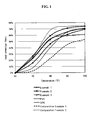
- heat-shrinkage change over temperature along the main shrinkage direction means a gradient of curve at each temperature region shown in FIG. 1 .
- the heat-shrinkable polyester film of the present invention has a relatively constant change rate (i.e., gradient), and thus, the heat-shrinkage ratio does not change drastically in the entire temperature range, which is unlike conventional films.
- the inventive film shows substantially constant change rate, i.e., a straight line-like curve, at a temperature ranging from 60 to 80 °C, which is similar to the heat-shrinkage property of a PVC film.
- the heat-shrinkable polyester film may be prepared by using a copolyester composition comprising (i) a dibasic acid component comprising at least 90mol% of terephthalic acid residue based on 100mol% of the dibasic acid component, and (ii) a diol component comprising (a) 1 to 20 mol% of diethylene glycol, (b) 5 to 30 mol% of neopentyl glycol, and (c) 50 to 90 mol% of ethylene glycol, based on 100mol% of the diol component.
- the copolyester composition may comprise a conventional dibasic acid component such as dimethyl terephthalate (DMT) or terephthalic acid (TPA), preferably a dibasic acid component comprising terephthalic acid (TPA) residue in an amount of 90mol% or more.
- a conventional dibasic acid component such as dimethyl terephthalate (DMT) or terephthalic acid (TPA)
- TPA terephthalic acid
- the film may have a micro-crystal structure generated by orientation of the film during drawing and heat-treatment processes, leading to an improved heat-resistance.
- the copolyester composition may comprise a diol component containing 1 to 20 mol% of diethylene glycol (DEG), 5 to 30 mol% of neopentyl glycol (NPG), and 50 to 90 mol% of ethylene glycol (EG), based on 100mol% of the diol component.
- DEG diethylene glycol
- NPG neopentyl glycol
- EG ethylene glycol
- the heat-shrinkable film may have improved heat-resistance.
- neopentyl glycol When the content of neopentyl glycol is in the range of 10 to 25 mol%, a satisfactory shrinkage ratio may be obtained and the resultant film labeled on a container may be hardly ruptured due to prevention of the excessive generation of oriented crystals during a heat-treatment process after drawing or generation of secondary oriented crystals during thermal shrinkage on a container.
- the copolyester composition may further comprise a reaction catalyst, a polymer stabilizer, reaction additives, and inorganic materials, etc.
- the copolyester composition may comprise 0.3 to 0.5 wt% of the polymer stabilizer (e.g., trimethyl phosphate), 0.2 to 0.4 wt% of the reaction catalyst (e.g., antimony trioxide), and 0.05 to 0.1 wt% of the inorganic material (e.g., silica).
- the polymer stabilizer e.g., trimethyl phosphate
- the reaction catalyst e.g., antimony trioxide
- the inorganic material e.g., silica
- reaction catalyst acetate salts of metals such as magnesium, manganese and zinc may be used.
- the copolyester composition used in the present invention preferably has an intrinsic viscosity of 0.6 to 0.9 dl/g.
- the film can attain satisfactory mechanical properties such as strength and elongation so that the film can be hardly ruptured during post-processes such as printing and labeling.
- the heat-shrinkable polyester film of the present invention preferably has a heat-shrinkage ratio of 50% or more, preferably 55% or more, along the main shrinkage direction when treated in hot water at 90°C for 10 seconds.
- a heat-shrinkage ratio is 55% or more, the film can achieve satisfactory shrinkage in full-wrapping processes for various shape containers even for the neck of a container.
- the film show improved resistance to a skirt phenomenon that a film labeled on a container having fixing points such as a square shape container is riding up at the center between the fixing points in the perpendicular to shrinkage direction, or a riding up phenomenon that a film labeled on a round shape container is entirely riding up in the perpendicular to its shrinkage direction, leading to a good finished appearance and indication of the printed label.
- the inventive heat-shrinkable polyester film has a maximum shrinkage stress of 6N or less, preferably 3.0N to 5.5N, when treated in hot water at 90°C for 10 seconds.
- the maximum shrinkage stress is preferably measured using a film having a thickness of 40 ⁇ m.
- the film may show high resistance to cracking, riding up or skirt phenomenon and avoid the distortion of the container during labeling.
- the polyester film of the present invention may be prepared by a method comprising the steps of (a) melt-extruding the copolyester composition to obtain a sheet and then drawing the sheet in the main shrinkage direction at a temperature of Tg+5°C to Tg+20°C, preferably by adjusting circumferential velocities of rolls or using a tenter, to obtain an oriented film; and (b) heat-treating the oriented film at a temperature ranges between Tg+5°C and Tg+50°C.
- the heat-treatment process of Step (b) is conducted by fixing both ends in the main shrinkage direction of the oriented film and then passing the fixed film through a heat-treatment zone whose temperature ranges between Tg+5°C and Tg+50°C.
- the heat-treatment process is preferable in terms of a constant shrinkage rate, a high heat-shrinkage ratio of the obtained film, a low shrink stress, and a low skirt ratio.
- the temperature of heat-treatment is from Tg+5°C to Tg+50°C, the film can be heat-treated sufficiently and an excessive crystal growth can be prevented to maintain good mechanical properties.
- Copolyester resins were prepared according to the composition and contents shown in Table 1, by using a standard preparation method of copolyester which is conventionally used and well-known in the technical field of the present invention (e.g., Examples 1 to 7 of Korean Patent No. 10-0987065 ) Table 1 No Composition (part by weight) Tg(°C) Type TPA EG NPG DEG Resin 11 100 80 20 0 78 Copolymer Resin 12 100 75 20 5 76 Copolymer Resin 13 100 70 20 10 71 Copolymer Resin 14 100 64 20 16 67 Copolymer
- Polyester films were prepared by using Resins 11 to 14 as shown in Table 2. Each resin was melt-extruded to obtain a sheet, which was drawn at 80°C in the main shrinkage direction at a ratio of 4.0 to obtain an oriented film. Both ends in the main shrinkage direction of the oriented film was fixed, and then the fixed film was heat-setted by passing rapidly through a heat-treatment zone whose temperature ranges between 85°C and 105°C to obtain a heat-shrinkable polyester film having a thickness of 40 ⁇ m.
- a film sample was cut into a piece of 13.0cm (length) x 6.0cm (width) along the main shrinkage direction. Impurities on the sample surface was eliminated, the sample was fixed at both ends in the main shrinkage direction so that the length of the film does not change after shrinkage and then put in hot water at 90°C for 10 seconds. As shown in FIG.
- Tg glass transition temperature
- a film sample was wrapped on a cubic container whose weight is 22g and one side is 6cm and then passed through a steam-heating type shrinking tunnel. Thereafter, the appearance quality after shrinkage of the film was observed.
- Each film was tested 20 times. In case that shrinkage defects such as wrinkles or riding up of the film or a distortion of the container was found twice or less, the film was graded as "O", and 3 times or more, the film was graded as "X".
- a film sample was cut into a piece of 300mm (length) x 15mm (width) in line with the main shrinkage direction and put into a water bath maintained at 60°C, 70°C, 80°C, 90°C or 100°C for 10 seconds, and the change in the film length after the heat-treatment was measured. Using the following equation, the degree of shrinkage was calculated.
- a film sample was cut into a piece of 120mm (length) x 15mm (width) along the main shrinkage direction and indicated at the points of 5mm far from both sides to the length direction.
- the 110mm-long film sample thus obtained was applied to an apparatus having the distance between chucks of 95mm and equipped with a load cell for sensing a shrinkage stress attached to one of grips thereof. Thereafter, the apparatus equipped with the film sample was put in a water bath maintained at 90°C. When the degree of shrinkage of 13.6% was observed, the film sample was heat-treated for 1 min to obtain a maximum shrinkage stress.
- the inventive films of Examples 1 to 3 have more improved performance characteristics in terms of mechanical strength, heat-resistance and heat-shrinkage than the conventional films, and the inventive films showed an uniform heat-shrinkage required for full-wrapping.
Landscapes
- Chemical & Material Sciences (AREA)
- Engineering & Computer Science (AREA)
- Organic Chemistry (AREA)
- Medicinal Chemistry (AREA)
- Polymers & Plastics (AREA)
- Health & Medical Sciences (AREA)
- Chemical Kinetics & Catalysis (AREA)
- Manufacturing & Machinery (AREA)
- Materials Engineering (AREA)
- Mechanical Engineering (AREA)
- Life Sciences & Earth Sciences (AREA)
- Wood Science & Technology (AREA)
- Shaping By String And By Release Of Stress In Plastics And The Like (AREA)
- Manufacture Of Macromolecular Shaped Articles (AREA)
- Polyesters Or Polycarbonates (AREA)
Abstract
A heat-shrinkable polyester film having a heat-shrinkage change per degree Celsius (%/°C) along the main shrinkage direction of 1.5 to 3.0 in the range of 60°C to 70°C, 2.5 to 3.5 in the range of 70°C to 80°C, 1.0 to 2.0 in the range of 80°C to 90°C, and 0.1 to 1.0 in the range of 90°C to 100°C, has a good appearance quality after shrinkage and thus suitable for a wrapping material, particularly a label for a bottle.
Description
- The present invention relates to a heat-shrinkable polyester film useful for a wrapping material, more particularly suitable for labeling a container due to its good finished appearence after shrinkage.
- Heat-shrinkable films which undergo shrinkage back to the pre-drawn form when heated at a predetermined temperature have been extensively used for labeling a glass or plastic bottle because of its properties that are suitable for printing various articles to attract consumers' attention and for full-wrapping various containers as well as packaging a bundle of goods.
- Heat-shrinkable films made of soft polyvinyl chloride (PVC) have recently become disfavored because they exhibit a limited maximum heat-shrinkage ratio and emit toxic pollutants, e.g., dioxins, on combustion. Oriented polystyrene (OPS) films, on the other hand, have uniform shrinking properties and low specific gravities, and they can be easily removed from PET bottles for recycling, but they have the problem of poor heat-resistance. Therefore, such oriented polystyrene films are unsuitable for a high rate-shrinkage process or high temperature-filling process.
- Heat-shrinkable polyester films which have improved shrinking properties and heat-resistance as compared with those of PVC and OPS films have been developed for wrapping a glass bottle. However, the shrinkage rates of such polyester films are generally unacceptably high, which results in non-uniform shrinkage when subjected to a thermal shrinkage process using hot air, and therefore, it necessary to use a steam-heating type shrinking machine to prevent non-uniform shrinkage of the film. In addition, the shrinkage stress of such polyester film is unacceptably high, which often leads to non-uniform shrinkage with consequential distortion, end-bending or rupture, especially when subjected to a secondary thermal shrinkage process, e.g., a sterilization or high temperature-filling process.
- In order to solve the above problems, Korean Patent Laid-Open Publication No.
2002-0063158 2002-0062838 - However, such heat-shrinkable polyester films shows a skirt phenomenon that a film labeled on a container having fixing point such as a square shape container is riding up at the center between the fixed points in the perpendicular to shrinkage direction, or a riding up phenomenon that a film labeled on a round container is wholly riding up in the perpendicular to shrinkage direction, and thus these conventional films cannot be effectively used for the protection of containers or indication of commercial product.
- Moreover, conventional polyester films are also known to have shortcomings such as non-uniform heat-shrinkage and crinking during a high temperature shrinking process, which cause the deterioration of the appearance and quality of labeled containers.
- Accordingly, it is an object of the present invention to provide a heat-shrinkable polyester film having a good appearance after shrinkage due to a uniform heat-shrinkage and a resistance to a riding up or skirt phenomenon, as well as improved characteristics in terms of printability, mechanical strength, heat-resistance, and shrinkage ratio.
- In accordance with one aspect of the present invention, there is provided a heat-shrinkable polyester film which has a heat-shrinkage change per degree Celsius (%/°C) along the main shrinkage direction of 1.5 to 3.0 in the range of 60°C to 70°C, 2.5 to 3.5 in the range of 70°C to 80°C, 1.0 to 2.0 in the range of 80°C to 90°C, and 0.1 to 1.0 in the range of 90°C to 100°C
- The heat-shrinkable polyester film may be prepared by using a copolyester composition comprising: (i) a dibasic acid component comprising at least 90 mol% of terephthalic acid residue based on 100mol% of the dibasic acid component; and (ii) a diol component comprising (a) 1 to 20 mol% of diethylene glycol, (b) 5 to 30 mol% of neopentyl glycol, and (c) 50 to 90 mol% of ethylene glycol, based on 100 mol% of the diol component.
- Further, the heat-shrinkable polyester film can be prepared by a method comprising the steps of: (a) melt-extruding a copolyester composition to obtain a sheet and then drawing the sheet in the main shrinkage direction at a temperature ranging from Tg+5°C to Tg+20°C to obtain an oriented film; and (b) heat-treating the oriented film at a temperature ranges between Tg+5°C and Tg+50°C.
- The heat-shrinkable polyester film according to the present invention has improved performance characteristics in terms of printability, mechanical strength, heat-resistance, and shrinkability sufficient for full-wrapping. Moreover, the inventive film is resistant to a riding up or skirt phenomenon and has a relatively constant heat-shrinkage change over temperature. Accordingly, the inventive film does not show wrinkles and distortion after shrinkage, and thus it can attain a good appearance quality after shrinkage.
- The above and other objects and features of the present invention will become apparent from the following description of the invention, when taken in conjunction with the accompanying drawings, which respectively show:
-
FIG. 1 : heat-shrinkage change of the inventive polyester films according to the temperature; and -
FIG. 2 : an illustrative diagram showing a skirt ratio of a polyester film, wherein W is the width of the film before shrinkage, d is the width of the film after shrinkage, and L is the length of the film. - The heat-shrinkable polyester film of the present invention has a heat-shrinkage change per degree Celsius (%/°C) along the main shrinkage direction being 1.5 to 3.0 in the range of 60°C to 70°C, 2.5 to 3.5 in the range of 70°C to 80°C, 1.0 to 2.0 in the range of 80°C to 90°C, and 0.1 to 1.0 in the range of 90°C to 100°C. For example, heat-shrinkage change over temperature along the main shrinkage direction, means a gradient of curve at each temperature region shown in
FIG. 1 . - As shown in
FIG. 1 , the heat-shrinkable polyester film of the present invention has a relatively constant change rate (i.e., gradient), and thus, the heat-shrinkage ratio does not change drastically in the entire temperature range, which is unlike conventional films. In particular, it is found fromFIG. 1 that the inventive film shows substantially constant change rate, i.e., a straight line-like curve, at a temperature ranging from 60 to 80 °C, which is similar to the heat-shrinkage property of a PVC film. - In accordance with a preferable example of the present invention, the heat-shrinkable polyester film may be prepared by using a copolyester composition comprising (i) a dibasic acid component comprising at least 90mol% of terephthalic acid residue based on 100mol% of the dibasic acid component, and (ii) a diol component comprising (a) 1 to 20 mol% of diethylene glycol, (b) 5 to 30 mol% of neopentyl glycol, and (c) 50 to 90 mol% of ethylene glycol, based on 100mol% of the diol component.
- The copolyester composition may comprise a conventional dibasic acid component such as dimethyl terephthalate (DMT) or terephthalic acid (TPA), preferably a dibasic acid component comprising terephthalic acid (TPA) residue in an amount of 90mol% or more. When the amount falls within the above range, the film may have a micro-crystal structure generated by orientation of the film during drawing and heat-treatment processes, leading to an improved heat-resistance.
- Further, the copolyester composition may comprise a diol component containing 1 to 20 mol% of diethylene glycol (DEG), 5 to 30 mol% of neopentyl glycol (NPG), and 50 to 90 mol% of ethylene glycol (EG), based on 100mol% of the diol component.
- When the content of diethylene glycol is 3mol% or more, characteristics of the inventive film such as a low skirt ratio (S/R) and a constant shrinkage rate can be easily attained. When the content of diethylene glycol is 16 mol% or less, the heat-shrinkable film may have improved heat-resistance.
- When the content of neopentyl glycol is in the range of 10 to 25 mol%, a satisfactory shrinkage ratio may be obtained and the resultant film labeled on a container may be hardly ruptured due to prevention of the excessive generation of oriented crystals during a heat-treatment process after drawing or generation of secondary oriented crystals during thermal shrinkage on a container.
- The copolyester composition may further comprise a reaction catalyst, a polymer stabilizer, reaction additives, and inorganic materials, etc.
- In accordance with a preferable example of the present invention, the copolyester composition may comprise 0.3 to 0.5 wt% of the polymer stabilizer (e.g., trimethyl phosphate), 0.2 to 0.4 wt% of the reaction catalyst (e.g., antimony trioxide), and 0.05 to 0.1 wt% of the inorganic material (e.g., silica).
- As the reaction catalyst, acetate salts of metals such as magnesium, manganese and zinc may be used.
- The copolyester composition used in the present invention preferably has an intrinsic viscosity of 0.6 to 0.9 dl/g. When the intrinsic viscosity is within the above range, the film can attain satisfactory mechanical properties such as strength and elongation so that the film can be hardly ruptured during post-processes such as printing and labeling.
- The heat-shrinkable polyester film of the present invention preferably has a heat-shrinkage ratio of 50% or more, preferably 55% or more, along the main shrinkage direction when treated in hot water at 90°C for 10 seconds. When the heat-shrinkage ratio is 55% or more, the film can achieve satisfactory shrinkage in full-wrapping processes for various shape containers even for the neck of a container.
- Further, the inventive heat-shrinkable polyester film preferably has a skirt ratio (S/R) represented by formula (I) of 14% or less when treated in hot water at 90°C for 10 seconds after fixing both ends in the main shrinkage direction of the film:

wherein, L is the length of the film in line with the main shrinkage direction, W is the width of the film before shrinkage, d is the width of the film after shrinkage. - When the skirt ratio is 14% or less, the film show improved resistance to a skirt phenomenon that a film labeled on a container having fixing points such as a square shape container is riding up at the center between the fixing points in the perpendicular to shrinkage direction, or a riding up phenomenon that a film labeled on a round shape container is entirely riding up in the perpendicular to its shrinkage direction, leading to a good finished appearance and indication of the printed label.
- Further, the inventive heat-shrinkable polyester film has a maximum shrinkage stress of 6N or less, preferably 3.0N to 5.5N, when treated in hot water at 90°C for 10 seconds. The maximum shrinkage stress is preferably measured using a film having a thickness of 40µm. When the maximum shrinkage stress is 6N or less, the film may show high resistance to cracking, riding up or skirt phenomenon and avoid the distortion of the container during labeling.
- The polyester film of the present invention may be prepared by a method comprising the steps of (a) melt-extruding the copolyester composition to obtain a sheet and then drawing the sheet in the main shrinkage direction at a temperature of Tg+5°C to Tg+20°C, preferably by adjusting circumferential velocities of rolls or using a tenter, to obtain an oriented film; and (b) heat-treating the oriented film at a temperature ranges between Tg+5°C and Tg+50°C.
- Preferably, the heat-treatment process of Step (b) is conducted by fixing both ends in the main shrinkage direction of the oriented film and then passing the fixed film through a heat-treatment zone whose temperature ranges between Tg+5°C and Tg+50°C.
- The heat-treatment process is preferable in terms of a constant shrinkage rate, a high heat-shrinkage ratio of the obtained film, a low shrink stress, and a low skirt ratio. When the temperature of heat-treatment is from Tg+5°C to Tg+50°C, the film can be heat-treated sufficiently and an excessive crystal growth can be prevented to maintain good mechanical properties.
- The following Examples are intended to further illustrate the present invention without limiting its scope.
- Copolyester resins were prepared according to the composition and contents shown in Table 1, by using a standard preparation method of copolyester which is conventionally used and well-known in the technical field of the present invention (e.g., Examples 1 to 7 of Korean Patent No.
10-0987065 Table 1 No Composition (part by weight) Tg(°C) Type TPA EG NPG DEG Resin 11100 80 20 0 78 Copolymer Resin 12 100 75 20 5 76 Copolymer Resin 13 100 70 20 10 71 Copolymer Resin 14 100 64 20 16 67 Copolymer - Polyester films were prepared by using Resins 11 to 14 as shown in Table 2. Each resin was melt-extruded to obtain a sheet, which was drawn at 80°C in the main shrinkage direction at a ratio of 4.0 to obtain an oriented film. Both ends in the main shrinkage direction of the oriented film was fixed, and then the fixed film was heat-setted by passing rapidly through a heat-treatment zone whose temperature ranges between 85°C and 105°C to obtain a heat-shrinkable polyester film having a thickness of 40µm.
Table 2 No Resin Heat-treatment Example 1 Resin 12 Treated Example 2 Resin 13 Treated Example 3 Resin 14 Treated Example 4 Resin 11/Resin 14 (30:70,w/w)Treated Comparative Example 1 Resin 11Treated Comparative Example 2 Resin 11Non-treated Comparative Example 3 Resin 12 Non-treated Comparative Example 4 Resin 13 Non-treated Comparative Example 5 Resin 14 Non-treated - The properties of the films prepared by Examples 1 to 4 and Comparative Examples 1 to 5 were evaluated by the following methods, and the results are shown in Table 3.
- A film sample was cut into a piece of 13.0cm (length) x 6.0cm (width) along the main shrinkage direction. Impurities on the sample surface was eliminated, the sample was fixed at both ends in the main shrinkage direction so that the length of the film does not change after shrinkage and then put in hot water at 90°C for 10 seconds. As shown in
FIG. 2 , the width of the sample after shrink was measured, and the skirt ratio of the sample was calculated using the following equation:
- A glass transition temperature (Tg) of a film sample was measured by using DSC (differential scanning calorimetry). A Tg of 65°C or more was graded as "O", and a Tg of less than 65°C was graded as "X".
- A film sample was wrapped on a cubic container whose weight is 22g and one side is 6cm and then passed through a steam-heating type shrinking tunnel. Thereafter, the appearance quality after shrinkage of the film was observed. Each film was tested 20 times. In case that shrinkage defects such as wrinkles or riding up of the film or a distortion of the container was found twice or less, the film was graded as "O", and 3 times or more, the film was graded as "X".
- A film sample was cut into a piece of 300mm (length) x 15mm (width) in line with the main shrinkage direction and put into a water bath maintained at 60°C, 70°C, 80°C, 90°C or 100°C for 10 seconds, and the change in the film length after the heat-treatment was measured. Using the following equation, the degree of shrinkage was calculated.

- A film sample was cut into a piece of 120mm (length) x 15mm (width) along the main shrinkage direction and indicated at the points of 5mm far from both sides to the length direction. The 110mm-long film sample thus obtained was applied to an apparatus having the distance between chucks of 95mm and equipped with a load cell for sensing a shrinkage stress attached to one of grips thereof. Thereafter, the apparatus equipped with the film sample was put in a water bath maintained at 90°C. When the degree of shrinkage of 13.6% was observed, the film sample was heat-treated for 1 min to obtain a maximum shrinkage stress.
Table 3 No Heat-resistance S/R (%) Appearance Quality after Shrinkage Heat-shrinkage ratio (%) 60° C 70° C 80° C 90°C 100°C Example 1 O 10 O 0 27 59 71 74 Example 2 O 11 O 0 16 46 61 69 Example 3 O 11 O 0 24 53 65 71 Example 4 O 13 O 0 17 46 62 72 Comparative Example 1 O 10 Insufficient Shrinkage 0 3 23 45 53 Comparative Example 2 O 17 X 0 25 68 74 75 Comparative Example 3 O 19 X 0 30 60 72 74 Comparative Example 4 O 18 X 0 31 62 74 75 Comparative Example 5 O 18 X 0 32 64 72 75 - Heat-shrinkage patterns of the films obtained in Examples 1 to 3 and Comparative Examples 1 and 2, and PVC and OPS films were measured and the results are shown in Table 4 and
FIG. 1 .Table 4 No Heat-shrinkage (%) S/R (%) Shrinkage Stress (N) Types 60° C 70° C 80° C 90°C 100°C Example 1 0 27 59 71 74 10 5.5 Improved Polyester Film Example 2 0 16 46 61 69 11 4.6 OPS Like Example 3 0 24 53 65 71 11 5.0 PVC Like PVC 0 23 54 59 61 - - - OPS 0 8 40 65 70 - - - Comparative Example 1 0 3 23 45 53 10 4.5 Heat-treated, Polyester Comparative Example 2 0 25 68 74 75 17 6.9 Heat-treated, Polyester - Using the heat-shrinkage ratios in Table 4, the heat-shrinkage change per degree Celsius (%/°C) in the each temperature range along the main shrinkage direction was calculated and shown in Table 5.
Table 5 No Change per degree Celsius (%/°C) 60~70° C 70~80° C 80~90° C 90~100°C Example 1 2.7 3.2 1.2 0.3 Example 2 1.6 3.0 1.5 0.8 Example 3 2.4 2.9 1.2 0.6 PVC 2.3 3.1 0.5 0.2 OPS 0.8 3.2 2.5 0.5 Comparative Example 1 0.3 2.0 2.2 0.8 Comparative Example 2 2.5 4.3 0.6 0.1 - As shown in Tables 3 to 5 and
FIG. 1 , the inventive films of Examples 1 to 3 have more improved performance characteristics in terms of mechanical strength, heat-resistance and heat-shrinkage than the conventional films, and the inventive films showed an uniform heat-shrinkage required for full-wrapping. - While the invention has been described with respect to the above specific embodiments, it should be recognized that various modifications and changes may be made to the invention by those skilled in the art which also fall within the scope of the invention as defined by the appended claims.
Claims (8)
- A heat-shrinkable polyester film having a heat-shrinkage change per degree Celsius (%/°C) along the main shrinkage direction of 1.5 to 3.0 in the range of 60°C to 70°C, 2.5 to 3.5 in the range of 70°C to 80°C, 1.0 to 2.0 in the range of 80°C to 90°C, and 0.1 to 1.0 in the range of 90°C to 100°C.
- The heat-shrinkable polyester film of claim 1, which is prepared by using a copolyester composition comprising (i) a dibasic acid component comprising terephthalic acid residue; and (ii) a diol component comprising diethylene glycol, neopentyl glycol and ethylene glycol.
- The heat-shrinkable polyester film of claim 1, which is prepared by using a copolyester composition comprising:(i) a dibasic acid component comprising at least 90mol% of terephthalic acid residue based on 100mol% of the dibasic acid component; and(ii) a diol component comprising (a) 1 to 20 mol% of diethylene glycol, (b) 5 to 30 mol% of neopentyl glycol, and (c) 50 to 90 mol% of ethylene glycol, based on 100mol% of the diol component.
- The heat-shrinkable polyester film of claims 1, which has a heat-shrinkage ratio of 58% or more along the main shrinkage direction, a skirt ratio (S/R) represented by formula (I) of 14% or less, and a maximum shrinkage stress of 6N or less, when treated in hot water at 90°C for 10 seconds:

the width of the film before shrinkage, and d is the width of the film after shrinkage. - The heat-shrinkable polyester film of claim 2, wherein the copolyester composition further comprises at least one selected from the group consisting of a reaction catalyst, a polymer stabilizer, a reaction additive, and an inorganic material.
- The heat-shrinkable polyester film of claim 2, wherein the copolyester composition has an intrinsic viscosity of 0.6 to 0.9 dl/g.
- A method for preparing the heat-shrinkable polyester film according to claim 1, comprising the steps of:(a) melt-extruding a copolyester composition to obtain a sheet and then drawing the sheet in the main shrinkage direction at a temperature ranging from Tg+5°C to Tg+20°C to obtain an oriented film; and(b) heat-treating the oriented film at a temperature ranges between Tg+5°C and Tg+50°C.
- The method of claim 7, wherein the copolyester composition comprises:(i) a dibasic acid component comprising at least 90mol% of terephthalic acid residue based on 100mol% of the dibasic acid component; and(ii) a diol component comprising (a) 1 to 20 mol% of diethylene glycol, (b) 5 to 30 mol% of neopentyl glycol, and (c) 50 to 90 mol% of ethylene glycol, based on 100mol% of the diol component.
Applications Claiming Priority (1)
| Application Number | Priority Date | Filing Date | Title |
|---|---|---|---|
| KR1020100020967A KR100981129B1 (en) | 2010-03-09 | 2010-03-09 | Heat shrinkable polyester-based film |
Publications (1)
| Publication Number | Publication Date |
|---|---|
| EP2365025A1 true EP2365025A1 (en) | 2011-09-14 |
Family
ID=43009908
Family Applications (1)
| Application Number | Title | Priority Date | Filing Date |
|---|---|---|---|
| EP20110001794 Withdrawn EP2365025A1 (en) | 2010-03-09 | 2011-03-03 | Heat-shrinkable polyester film |
Country Status (6)
| Country | Link |
|---|---|
| US (1) | US8632865B2 (en) |
| EP (1) | EP2365025A1 (en) |
| JP (1) | JP5971897B2 (en) |
| KR (1) | KR100981129B1 (en) |
| CN (1) | CN102190867B (en) |
| TW (1) | TWI429691B (en) |
Cited By (12)
| Publication number | Priority date | Publication date | Assignee | Title |
|---|---|---|---|---|
| WO2019212241A1 (en) | 2018-04-30 | 2019-11-07 | 에스케이씨 주식회사 | Polyester film and method for recycling polyester container using same |
| EP3572451A1 (en) * | 2018-05-21 | 2019-11-27 | SKC Co., Ltd. | Heat shrinkable film and preparation method thereof |
| WO2020076747A1 (en) * | 2018-10-08 | 2020-04-16 | Eastman Chemical Company | Crystallizable shrinkable and thermoformable sheets made from reactor grade resins |
| WO2020076749A1 (en) * | 2018-10-08 | 2020-04-16 | Eastman Chemical Company | Crystallizable shrinkable films and thermoformable sheets made from resin blends |
| EP3617247A4 (en) * | 2017-04-27 | 2020-12-30 | Toyobo Co., Ltd. | Polyester resin for heat shrinkable film, heat shrinkable film, heat shrinkable label, and package |
| WO2021072016A1 (en) * | 2019-10-08 | 2021-04-15 | Eastman Chemical Company | Catalyst systems for crystallizable reactor grade resins |
| EP4116361A1 (en) | 2021-07-05 | 2023-01-11 | SKC Co., Ltd. | Polyester film, heat-shrinkable label and packaging comprising the same |
| US11603432B2 (en) * | 2020-11-18 | 2023-03-14 | Klöckner Pentaplast Of America, Inc. | Thermoformed packaging and methods of forming the same |
| US11858241B2 (en) | 2018-05-29 | 2024-01-02 | Klöckner Pentaplast Gmbh | Transparent polymer film with discolouration compensation |
| EP4368661A1 (en) | 2021-07-05 | 2024-05-15 | SK microworks Co., Ltd. | Polyester film, and heat-shrinkable label and packaging material comprising same |
| US12162250B2 (en) | 2016-08-15 | 2024-12-10 | Klöckner Pentaplast Of America, Inc. | Hot fill laminate |
| US12522695B2 (en) | 2019-10-08 | 2026-01-13 | Eastman Chemical Company | Catalyst systems for crystallizable reactor grade resins with recycled content |
Families Citing this family (29)
| Publication number | Priority date | Publication date | Assignee | Title |
|---|---|---|---|---|
| KR100981129B1 (en) * | 2010-03-09 | 2010-09-10 | 에스케이씨 주식회사 | Heat shrinkable polyester-based film |
| KR101220226B1 (en) | 2010-10-20 | 2013-01-09 | 에스케이씨 주식회사 | Heat-shrinkable polyester film |
| JP6519331B2 (en) * | 2015-06-11 | 2019-05-29 | 東洋紡株式会社 | Heat-shrinkable polyester film and package |
| CN107848194B (en) * | 2015-07-24 | 2020-02-28 | 东洋纺株式会社 | Heat-shrinkable polyester film, method for producing the same, and package |
| CN107922642B (en) * | 2015-08-05 | 2021-01-01 | 东洋纺株式会社 | Heat-shrinkable polyester film and packaging |
| US11299595B2 (en) | 2015-08-19 | 2022-04-12 | Toyobo Co., Ltd. | Heat-shrinkable polyester film and package |
| JP7035535B2 (en) * | 2016-08-01 | 2022-03-15 | 東洋紡株式会社 | Heat shrinkable polyester film and packaging |
| CN110291130B (en) * | 2017-02-13 | 2021-11-19 | 东洋纺株式会社 | Amorphous copolyester raw material for film, heat-shrinkable polyester film, heat-shrinkable label and packaging |
| US10543656B2 (en) | 2018-01-11 | 2020-01-28 | Eastman Chemical Company | Tough shrinkable films |
| US12202944B2 (en) | 2018-04-30 | 2025-01-21 | Sk Microworks America, Inc. | Heat shrinkable film and method for reproducing polyester container using same |
| KR102240877B1 (en) * | 2018-04-30 | 2021-04-19 | 에스케이씨 주식회사 | Method for reproducing polyester container and reproduced polyester chip prepared therefrom |
| CN108610609A (en) * | 2018-05-07 | 2018-10-02 | 郑州网知汇信息科技有限公司 | A kind of highly shrinkable polyester film and preparation method thereof |
| CN112513134B (en) * | 2018-08-03 | 2023-06-20 | 东洋纺株式会社 | Copolyester raw materials for amorphous films, heat-shrinkable polyester films, heat-shrinkable labels and packages |
| TWI771892B (en) * | 2019-07-12 | 2022-07-21 | 南韓商Skc股份有限公司 | Polyester film and method for reproducing polyester container using the same |
| TWI720541B (en) * | 2019-07-12 | 2021-03-01 | 南韓商Skc股份有限公司 | Polyester film and method for reproducingpolyester container using the same |
| CN110684184B (en) * | 2019-08-30 | 2022-06-28 | 江阴市华宏化纤有限公司 | Glycol modified PETG polyester chip and production process thereof |
| KR102226711B1 (en) * | 2019-10-29 | 2021-03-11 | 에스케이씨 주식회사 | Method for reproducing polyester container and polyester film for same |
| KR102258535B1 (en) * | 2019-10-31 | 2021-05-31 | 에스케이씨 주식회사 | Polyester film and method for reproducing polyester container using same |
| WO2021085938A1 (en) * | 2019-10-31 | 2021-05-06 | 에스케이씨 주식회사 | Polyester-based film, and method for recycling polyester-based container using same |
| WO2021086082A1 (en) * | 2019-10-31 | 2021-05-06 | 에스케이씨 주식회사 | Polyester film, method for manufacturing same, and method for recycling polyethylene terephthalate container using same |
| TWI743684B (en) * | 2020-02-15 | 2021-10-21 | 遠東新世紀股份有限公司 | Heat-shrinkable polyester film and its manufacturing method |
| DE112020007130T5 (en) | 2020-04-30 | 2023-03-16 | Bonset America Corporation | Polyester-based shrink film |
| US20230303785A1 (en) * | 2020-09-18 | 2023-09-28 | C.I. Takiron Corporation | Heat-shrinkable polyester film |
| KR102469389B1 (en) * | 2020-10-22 | 2022-11-22 | 에스케이씨 주식회사 | Polyester film, heat-shrinkable label and packaging material comprising same |
| KR102446902B1 (en) * | 2020-10-22 | 2022-09-23 | 에스케이씨 주식회사 | Heat-shrinkable polyester film, and retort food comprising same |
| AU2021202635B2 (en) * | 2021-01-22 | 2022-12-15 | Microworks Co., Ltd. | Polyester film, preparation method thereof and method for reproducing polyethyleneterephthalate container using same |
| CN113510989A (en) * | 2021-04-27 | 2021-10-19 | 天津市浩迪橡塑科技有限公司 | Real leather heat-shrinkable structure for automotive interior and preparation method thereof |
| DE112023003076T5 (en) | 2022-10-31 | 2025-05-22 | Bonset America Corporation | HEAT-SHRINKABLE POLYESTER FILM |
| KR20260033034A (en) * | 2023-07-04 | 2026-03-10 | 도요보 가부시키가이샤 | Heat-shrinkable polyester film |
Citations (10)
| Publication number | Priority date | Publication date | Assignee | Title |
|---|---|---|---|---|
| JPH02289627A (en) * | 1989-04-28 | 1990-11-29 | Kanebo Ltd | Polyester shrink film |
| EP0409288A2 (en) * | 1986-11-12 | 1991-01-23 | Diafoil Hoechst Co., Ltd | Shrinkable polyester film |
| JPH0368634A (en) * | 1989-08-08 | 1991-03-25 | Mitsubishi Rayon Co Ltd | Heat-shrinkable polyester film |
| JPH04193526A (en) * | 1990-11-27 | 1992-07-13 | Sekisui Chem Co Ltd | Heat-shrinkable polyester film |
| JP2001200074A (en) * | 1999-11-12 | 2001-07-24 | Gunze Ltd | Heat-shrinkable polyester film |
| KR20020062838A (en) | 2001-01-25 | 2002-07-31 | 도요 보세키 가부시키가이샤 | Heat-shrinkable polyester films and labels using the same |
| KR20020063158A (en) | 1999-08-17 | 2002-08-01 | 이스트만 케미칼 컴파니 | Reactor grade copolyesters for shrink film applications |
| KR20050117240A (en) * | 2004-06-10 | 2005-12-14 | 주식회사 코오롱 | Polyester shrinkable film |
| WO2009151290A2 (en) * | 2008-06-11 | 2009-12-17 | Skc Co., Ltd. | Heat-shrinkable polyester film |
| KR100981129B1 (en) * | 2010-03-09 | 2010-09-10 | 에스케이씨 주식회사 | Heat shrinkable polyester-based film |
Family Cites Families (10)
| Publication number | Priority date | Publication date | Assignee | Title |
|---|---|---|---|---|
| JP2793713B2 (en) * | 1990-10-27 | 1998-09-03 | 鐘紡株式会社 | Polyester shrink film with improved surface properties |
| BR9408143A (en) * | 1993-11-26 | 1997-08-12 | Eastman Chem Co | Thermo-contractile polymer film for the preparation of film and polyester / plasticizer concentrate that is used to prepare the film |
| US5824398A (en) * | 1996-06-24 | 1998-10-20 | Eastman Chemical Company | Plasticized polyester for shrink film applications |
| JP2000229357A (en) * | 1999-02-09 | 2000-08-22 | Gunze Ltd | Heat-shrinkable film and container with the film fitted by heat-shrinking |
| JP2002046175A (en) * | 2000-07-31 | 2002-02-12 | Mitsubishi Rayon Co Ltd | Heat shrinkable polyester film |
| DE60308428T2 (en) * | 2002-02-14 | 2007-09-13 | Toyo Boseki K.K. | Heat shrinkable polyester films |
| EP1550690A4 (en) * | 2002-10-08 | 2006-12-06 | Denki Kagaku Kogyo Kk | THERMORETRECISSANT FILM |
| EP2036718A1 (en) * | 2006-06-30 | 2009-03-18 | Mitsubishi Plastics, Inc. | Heat-shrinkable laminated film, and moldings, heat shrinkable labels and containers, made by using the film |
| KR101377929B1 (en) * | 2006-07-12 | 2014-03-25 | 군제 가부시키가이샤 | heat shrinkable multilayer film and heat shrinkable label |
| JP5320737B2 (en) * | 2007-12-28 | 2013-10-23 | 東洋紡株式会社 | Heat-shrinkable polyester film and heat-shrinkable label |
-
2010
- 2010-03-09 KR KR1020100020967A patent/KR100981129B1/en active Active
-
2011
- 2011-03-03 EP EP20110001794 patent/EP2365025A1/en not_active Withdrawn
- 2011-03-07 US US13/041,831 patent/US8632865B2/en active Active
- 2011-03-08 TW TW100107714A patent/TWI429691B/en active
- 2011-03-08 CN CN201110057308.6A patent/CN102190867B/en active Active
- 2011-03-09 JP JP2011051400A patent/JP5971897B2/en active Active
Patent Citations (11)
| Publication number | Priority date | Publication date | Assignee | Title |
|---|---|---|---|---|
| EP0409288A2 (en) * | 1986-11-12 | 1991-01-23 | Diafoil Hoechst Co., Ltd | Shrinkable polyester film |
| JPH02289627A (en) * | 1989-04-28 | 1990-11-29 | Kanebo Ltd | Polyester shrink film |
| JPH0368634A (en) * | 1989-08-08 | 1991-03-25 | Mitsubishi Rayon Co Ltd | Heat-shrinkable polyester film |
| JPH04193526A (en) * | 1990-11-27 | 1992-07-13 | Sekisui Chem Co Ltd | Heat-shrinkable polyester film |
| KR20020063158A (en) | 1999-08-17 | 2002-08-01 | 이스트만 케미칼 컴파니 | Reactor grade copolyesters for shrink film applications |
| JP2001200074A (en) * | 1999-11-12 | 2001-07-24 | Gunze Ltd | Heat-shrinkable polyester film |
| KR20020062838A (en) | 2001-01-25 | 2002-07-31 | 도요 보세키 가부시키가이샤 | Heat-shrinkable polyester films and labels using the same |
| KR20050117240A (en) * | 2004-06-10 | 2005-12-14 | 주식회사 코오롱 | Polyester shrinkable film |
| WO2009151290A2 (en) * | 2008-06-11 | 2009-12-17 | Skc Co., Ltd. | Heat-shrinkable polyester film |
| KR100987065B1 (en) | 2008-06-11 | 2010-10-11 | 에스케이씨 주식회사 | Heat-shrinkable polyester film and manufacturing method thereof |
| KR100981129B1 (en) * | 2010-03-09 | 2010-09-10 | 에스케이씨 주식회사 | Heat shrinkable polyester-based film |
Non-Patent Citations (3)
| Title |
|---|
| DATABASE WPI Week 199103, Derwent World Patents Index; AN 1991-018195, XP002653112 * |
| DATABASE WPI Week 200662, Derwent World Patents Index; AN 2006-600056, XP002653114 * |
| DATABASE WPI Week 201074, Derwent World Patents Index; AN 2010-M67053, XP002653113 * |
Cited By (19)
| Publication number | Priority date | Publication date | Assignee | Title |
|---|---|---|---|---|
| US12162250B2 (en) | 2016-08-15 | 2024-12-10 | Klöckner Pentaplast Of America, Inc. | Hot fill laminate |
| US11084901B2 (en) | 2017-04-27 | 2021-08-10 | Toyobo Co., Ltd. | Polyester resin for heat-shrinkable film, heat-shrinkable film, heat-shrinkable label, and packaged product |
| EP3617247A4 (en) * | 2017-04-27 | 2020-12-30 | Toyobo Co., Ltd. | Polyester resin for heat shrinkable film, heat shrinkable film, heat shrinkable label, and package |
| WO2019212241A1 (en) | 2018-04-30 | 2019-11-07 | 에스케이씨 주식회사 | Polyester film and method for recycling polyester container using same |
| EP3572451A1 (en) * | 2018-05-21 | 2019-11-27 | SKC Co., Ltd. | Heat shrinkable film and preparation method thereof |
| US11655062B2 (en) | 2018-05-21 | 2023-05-23 | Sk Microworks Co., Ltd. | Heat shrinkable film and preparation method thereof |
| US10994880B2 (en) | 2018-05-21 | 2021-05-04 | Skc Co., Ltd. | Heat shrinkable film and preparation method thereof |
| US12319037B2 (en) | 2018-05-29 | 2025-06-03 | Klöckner Pentaplast Gmbh | Transparent polymer film with discoloration compensation |
| US11858241B2 (en) | 2018-05-29 | 2024-01-02 | Klöckner Pentaplast Gmbh | Transparent polymer film with discolouration compensation |
| WO2020076749A1 (en) * | 2018-10-08 | 2020-04-16 | Eastman Chemical Company | Crystallizable shrinkable films and thermoformable sheets made from resin blends |
| WO2020076747A1 (en) * | 2018-10-08 | 2020-04-16 | Eastman Chemical Company | Crystallizable shrinkable and thermoformable sheets made from reactor grade resins |
| US12522695B2 (en) | 2019-10-08 | 2026-01-13 | Eastman Chemical Company | Catalyst systems for crystallizable reactor grade resins with recycled content |
| WO2021072016A1 (en) * | 2019-10-08 | 2021-04-15 | Eastman Chemical Company | Catalyst systems for crystallizable reactor grade resins |
| US11891479B2 (en) | 2020-11-18 | 2024-02-06 | Klöckner Pentaplast Of America, Inc. | Thermoformed packaging and methods of forming the same |
| US12312441B2 (en) | 2020-11-18 | 2025-05-27 | Klöckner Pentaplast Of America, Inc. | Thermoformed packaging and methods of forming the same |
| US11603432B2 (en) * | 2020-11-18 | 2023-03-14 | Klöckner Pentaplast Of America, Inc. | Thermoformed packaging and methods of forming the same |
| EP4368661A1 (en) | 2021-07-05 | 2024-05-15 | SK microworks Co., Ltd. | Polyester film, and heat-shrinkable label and packaging material comprising same |
| EP4116361A1 (en) | 2021-07-05 | 2023-01-11 | SKC Co., Ltd. | Polyester film, heat-shrinkable label and packaging comprising the same |
| US12583982B2 (en) | 2021-07-05 | 2026-03-24 | Microworks Co., Ltd. | Polyester film, heat-shrinkable label and packaging comprising same |
Also Published As
| Publication number | Publication date |
|---|---|
| CN102190867B (en) | 2015-10-21 |
| TW201139531A (en) | 2011-11-16 |
| KR100981129B1 (en) | 2010-09-10 |
| US20110224369A1 (en) | 2011-09-15 |
| TWI429691B (en) | 2014-03-11 |
| CN102190867A (en) | 2011-09-21 |
| JP5971897B2 (en) | 2016-08-17 |
| HK1160878A1 (en) | 2012-08-17 |
| JP2011184690A (en) | 2011-09-22 |
| US8632865B2 (en) | 2014-01-21 |
Similar Documents
| Publication | Publication Date | Title |
|---|---|---|
| EP2365025A1 (en) | Heat-shrinkable polyester film | |
| JP7254730B2 (en) | Copolyester raw materials for amorphous films, heat-shrinkable polyester films, heat-shrinkable labels, and packages | |
| EP0267799B1 (en) | Shrinkable polyester film | |
| JP4232777B2 (en) | Heat-shrinkable polyester film roll | |
| EP2217643B1 (en) | Thermo-shrinkable polyester film | |
| KR101458662B1 (en) | Label | |
| EP3103619B1 (en) | Heat-shrinkable polyester film | |
| EP2220148B1 (en) | Thermo-shrinkable polyester film | |
| EP2556945B1 (en) | Heat shrinkable polyester film, method for producing same, and packaged body | |
| EP3831864B1 (en) | Heat-shrinkable polyester-based film, heat-shrinkable label, and package | |
| JP4308662B2 (en) | Biaxially stretched polyester film | |
| JP7768321B2 (en) | Heat-shrinkable polyester film | |
| EP3778729A1 (en) | Heat-shrinkable polyester film | |
| EP4039446B1 (en) | Heat-shrinkable polyester film roll | |
| KR101262435B1 (en) | Thermo-shrinkable polyester film | |
| EP2408850B1 (en) | Heat-shrinkable polyester film and preparation method thereof | |
| JP2001096616A (en) | Heat-shrinkable polyester film | |
| JP2517995B2 (en) | Heat-shrinkable polyester film | |
| KR101305663B1 (en) | Thermo-shrinkable polyester film | |
| HK1160878B (en) | Heat-shrinkable polyester film |
Legal Events
| Date | Code | Title | Description |
|---|---|---|---|
| PUAI | Public reference made under article 153(3) epc to a published international application that has entered the european phase |
Free format text: ORIGINAL CODE: 0009012 |
|
| 17P | Request for examination filed |
Effective date: 20110303 |
|
| AK | Designated contracting states |
Kind code of ref document: A1 Designated state(s): AL AT BE BG CH CY CZ DE DK EE ES FI FR GB GR HR HU IE IS IT LI LT LU LV MC MK MT NL NO PL PT RO RS SE SI SK SM TR |
|
| AX | Request for extension of the european patent |
Extension state: BA ME |
|
| 17Q | First examination report despatched |
Effective date: 20161109 |
|
| STAA | Information on the status of an ep patent application or granted ep patent |
Free format text: STATUS: THE APPLICATION IS DEEMED TO BE WITHDRAWN |
|
| 18D | Application deemed to be withdrawn |
Effective date: 20200603 |