EP2364966A1 - Process for preparation of 3-(2-hydroxy-5-substituted phenyl)-3-phenylpropylamines, intermediates for making hydroxytolterodine - Google Patents
Process for preparation of 3-(2-hydroxy-5-substituted phenyl)-3-phenylpropylamines, intermediates for making hydroxytolterodine Download PDFInfo
- Publication number
- EP2364966A1 EP2364966A1 EP10155864A EP10155864A EP2364966A1 EP 2364966 A1 EP2364966 A1 EP 2364966A1 EP 10155864 A EP10155864 A EP 10155864A EP 10155864 A EP10155864 A EP 10155864A EP 2364966 A1 EP2364966 A1 EP 2364966A1
- Authority
- EP
- European Patent Office
- Prior art keywords
- alkyl
- salt
- acid
- hydroxytolterodine
- fesoterodine
- Prior art date
- Legal status (The legal status is an assumption and is not a legal conclusion. Google has not performed a legal analysis and makes no representation as to the accuracy of the status listed.)
- Ceased
Links
- 238000000034 method Methods 0.000 title claims abstract description 71
- 230000008569 process Effects 0.000 title claims abstract description 61
- -1 3-(2-hydroxy-5-substituted phenyl)-3-phenylpropylamines Chemical class 0.000 title claims description 24
- 238000002360 preparation method Methods 0.000 title abstract description 23
- 239000000543 intermediate Substances 0.000 title abstract description 15
- 206010046543 Urinary incontinence Diseases 0.000 claims abstract description 8
- 150000003839 salts Chemical class 0.000 claims description 60
- 239000002253 acid Substances 0.000 claims description 36
- DCCSDBARQIPTGU-HSZRJFAPSA-N fesoterodine Chemical compound C1([C@@H](CCN(C(C)C)C(C)C)C=2C(=CC=C(CO)C=2)OC(=O)C(C)C)=CC=CC=C1 DCCSDBARQIPTGU-HSZRJFAPSA-N 0.000 claims description 33
- 238000006243 chemical reaction Methods 0.000 claims description 32
- 229960002978 fesoterodine Drugs 0.000 claims description 32
- XLYOFNOQVPJJNP-UHFFFAOYSA-N water Substances O XLYOFNOQVPJJNP-UHFFFAOYSA-N 0.000 claims description 29
- 150000001875 compounds Chemical class 0.000 claims description 25
- RDAFNSMYPSHCBK-QPJJXVBHSA-N (e)-3-phenylprop-2-en-1-amine Chemical compound NC\C=C\C1=CC=CC=C1 RDAFNSMYPSHCBK-QPJJXVBHSA-N 0.000 claims description 24
- 229910052739 hydrogen Inorganic materials 0.000 claims description 24
- 239000001257 hydrogen Substances 0.000 claims description 24
- 125000004178 (C1-C4) alkyl group Chemical group 0.000 claims description 20
- 125000004169 (C1-C6) alkyl group Chemical group 0.000 claims description 20
- 239000003153 chemical reaction reagent Substances 0.000 claims description 20
- 125000000217 alkyl group Chemical group 0.000 claims description 18
- 230000003647 oxidation Effects 0.000 claims description 18
- 238000007254 oxidation reaction Methods 0.000 claims description 18
- DHTHWYZNJZNTIT-UHFFFAOYSA-N 3-[3-[di(propan-2-yl)amino]-1-phenylpropyl]-4-hydroxybenzaldehyde Chemical compound C=1C(C=O)=CC=C(O)C=1C(CCN(C(C)C)C(C)C)C1=CC=CC=C1 DHTHWYZNJZNTIT-UHFFFAOYSA-N 0.000 claims description 17
- QAOWNCQODCNURD-UHFFFAOYSA-N Sulfuric acid Chemical compound OS(O)(=O)=O QAOWNCQODCNURD-UHFFFAOYSA-N 0.000 claims description 16
- 125000004435 hydrogen atom Chemical group [H]* 0.000 claims description 16
- ISWSIDIOOBJBQZ-UHFFFAOYSA-N phenol group Chemical group C1(=CC=CC=C1)O ISWSIDIOOBJBQZ-UHFFFAOYSA-N 0.000 claims description 16
- 230000009467 reduction Effects 0.000 claims description 16
- OOGJQPCLVADCPB-HXUWFJFHSA-N tolterodine Chemical compound C1([C@@H](CCN(C(C)C)C(C)C)C=2C(=CC=C(C)C=2)O)=CC=CC=C1 OOGJQPCLVADCPB-HXUWFJFHSA-N 0.000 claims description 16
- 229960004045 tolterodine Drugs 0.000 claims description 16
- BDIAUFOIMFAIPU-UHFFFAOYSA-N valepotriate Natural products CC(C)CC(=O)OC1C=C(C(=COC2OC(=O)CC(C)C)COC(C)=O)C2C11CO1 BDIAUFOIMFAIPU-UHFFFAOYSA-N 0.000 claims description 16
- AFVFQIVMOAPDHO-UHFFFAOYSA-N methanesulfonic acid Substances CS(O)(=O)=O AFVFQIVMOAPDHO-UHFFFAOYSA-N 0.000 claims description 12
- 125000000229 (C1-C4)alkoxy group Chemical group 0.000 claims description 11
- 150000001299 aldehydes Chemical class 0.000 claims description 11
- 125000001449 isopropyl group Chemical group [H]C([H])([H])C([H])(*)C([H])([H])[H] 0.000 claims description 11
- KKLMJYDGZSAIQX-UHFFFAOYSA-N 2-(n-hydroxyanilino)acetic acid Chemical compound OC(=O)CN(O)C1=CC=CC=C1 KKLMJYDGZSAIQX-UHFFFAOYSA-N 0.000 claims description 10
- VZCYOOQTPOCHFL-OWOJBTEDSA-N Fumaric acid Chemical class OC(=O)\C=C\C(O)=O VZCYOOQTPOCHFL-OWOJBTEDSA-N 0.000 claims description 10
- 150000007513 acids Chemical class 0.000 claims description 10
- 230000001590 oxidative effect Effects 0.000 claims description 10
- 125000006273 (C1-C3) alkyl group Chemical group 0.000 claims description 9
- 125000003118 aryl group Chemical group 0.000 claims description 9
- 125000001181 organosilyl group Chemical group [SiH3]* 0.000 claims description 9
- 239000008186 active pharmaceutical agent Substances 0.000 claims description 8
- 230000010933 acylation Effects 0.000 claims description 8
- 238000005917 acylation reaction Methods 0.000 claims description 8
- 125000004432 carbon atom Chemical group C* 0.000 claims description 8
- 239000007800 oxidant agent Substances 0.000 claims description 8
- 238000005895 oxidative decarboxylation reaction Methods 0.000 claims description 8
- VLTRZXGMWDSKGL-UHFFFAOYSA-N perchloric acid Chemical compound OCl(=O)(=O)=O VLTRZXGMWDSKGL-UHFFFAOYSA-N 0.000 claims description 8
- 150000002148 esters Chemical class 0.000 claims description 7
- 229940098779 methanesulfonic acid Drugs 0.000 claims description 7
- 239000008194 pharmaceutical composition Substances 0.000 claims description 7
- DGMOBVGABMBZSB-UHFFFAOYSA-N 2-methylpropanoyl chloride Chemical compound CC(C)C(Cl)=O DGMOBVGABMBZSB-UHFFFAOYSA-N 0.000 claims description 6
- QOHVOTFSKSSADY-UHFFFAOYSA-N 3-phenyl-n,n-di(propan-2-yl)prop-2-en-1-amine Chemical compound CC(C)N(C(C)C)CC=CC1=CC=CC=C1 QOHVOTFSKSSADY-UHFFFAOYSA-N 0.000 claims description 6
- MHAJPDPJQMAIIY-UHFFFAOYSA-N Hydrogen peroxide Chemical compound OO MHAJPDPJQMAIIY-UHFFFAOYSA-N 0.000 claims description 6
- 206010020853 Hypertonic bladder Diseases 0.000 claims description 6
- 208000009722 Overactive Urinary Bladder Diseases 0.000 claims description 6
- 239000003054 catalyst Substances 0.000 claims description 6
- 208000020629 overactive bladder Diseases 0.000 claims description 6
- 239000002904 solvent Substances 0.000 claims description 6
- 150000001450 anions Chemical class 0.000 claims description 5
- QVGXLLKOCUKJST-UHFFFAOYSA-N atomic oxygen Chemical compound [O] QVGXLLKOCUKJST-UHFFFAOYSA-N 0.000 claims description 5
- 150000001768 cations Chemical class 0.000 claims description 5
- LSACYLWPPQLVSM-UHFFFAOYSA-N isobutyric acid anhydride Chemical compound CC(C)C(=O)OC(=O)C(C)C LSACYLWPPQLVSM-UHFFFAOYSA-N 0.000 claims description 5
- 229910052751 metal Inorganic materials 0.000 claims description 5
- 239000002184 metal Substances 0.000 claims description 5
- 238000005580 one pot reaction Methods 0.000 claims description 5
- 229910052760 oxygen Inorganic materials 0.000 claims description 5
- 239000001301 oxygen Substances 0.000 claims description 5
- 238000005891 transamination reaction Methods 0.000 claims description 5
- 239000003814 drug Substances 0.000 claims description 4
- HHLFWLYXYJOTON-UHFFFAOYSA-N glyoxylic acid Chemical compound OC(=O)C=O HHLFWLYXYJOTON-UHFFFAOYSA-N 0.000 claims description 4
- AZQWKYJCGOJGHM-UHFFFAOYSA-N 1,4-benzoquinone Chemical compound O=C1C=CC(=O)C=C1 AZQWKYJCGOJGHM-UHFFFAOYSA-N 0.000 claims description 3
- COVZYZSDYWQREU-UHFFFAOYSA-N Busulfan Chemical compound CS(=O)(=O)OCCCCOS(C)(=O)=O COVZYZSDYWQREU-UHFFFAOYSA-N 0.000 claims description 3
- 125000001931 aliphatic group Chemical group 0.000 claims description 3
- 230000001078 anti-cholinergic effect Effects 0.000 claims description 3
- 239000003937 drug carrier Substances 0.000 claims description 3
- 238000011065 in-situ storage Methods 0.000 claims description 3
- 229910001869 inorganic persulfate Inorganic materials 0.000 claims description 3
- 150000002576 ketones Chemical class 0.000 claims description 3
- 150000007522 mineralic acids Chemical class 0.000 claims description 3
- 239000003960 organic solvent Substances 0.000 claims description 3
- 125000005385 peroxodisulfate group Chemical group 0.000 claims description 3
- 150000004717 pyruvic acids Chemical class 0.000 claims description 3
- 150000003460 sulfonic acids Chemical class 0.000 claims description 3
- 239000000651 prodrug Substances 0.000 abstract description 5
- 229940002612 prodrug Drugs 0.000 abstract description 5
- DUXZAXCGJSBGDW-UHFFFAOYSA-N 2-[3-[di(propan-2-yl)amino]-1-phenylpropyl]-4-(hydroxymethyl)phenol Chemical compound C=1C(CO)=CC=C(O)C=1C(CCN(C(C)C)C(C)C)C1=CC=CC=C1 DUXZAXCGJSBGDW-UHFFFAOYSA-N 0.000 abstract description 4
- 239000003795 chemical substances by application Substances 0.000 abstract description 3
- 238000002560 therapeutic procedure Methods 0.000 abstract description 2
- UZHMCDNAXDKAJB-UHFFFAOYSA-N 3-(3-amino-1-phenylpropyl)-4-hydroxybenzaldehyde Chemical class C=1C(C=O)=CC=C(O)C=1C(CCN)C1=CC=CC=C1 UZHMCDNAXDKAJB-UHFFFAOYSA-N 0.000 abstract 1
- 239000000243 solution Substances 0.000 description 34
- 239000000203 mixture Substances 0.000 description 30
- FJKROLUGYXJWQN-UHFFFAOYSA-N 4-hydroxybenzoic acid Chemical compound OC(=O)C1=CC=C(O)C=C1 FJKROLUGYXJWQN-UHFFFAOYSA-N 0.000 description 28
- YMWUJEATGCHHMB-UHFFFAOYSA-N Dichloromethane Chemical compound ClCCl YMWUJEATGCHHMB-UHFFFAOYSA-N 0.000 description 27
- OKKJLVBELUTLKV-UHFFFAOYSA-N Methanol Chemical compound OC OKKJLVBELUTLKV-UHFFFAOYSA-N 0.000 description 27
- HEMHJVSKTPXQMS-UHFFFAOYSA-M Sodium hydroxide Chemical compound [OH-].[Na+] HEMHJVSKTPXQMS-UHFFFAOYSA-M 0.000 description 24
- 230000015572 biosynthetic process Effects 0.000 description 18
- 238000003786 synthesis reaction Methods 0.000 description 16
- XSRCDLBHIPVGLB-UHFFFAOYSA-N 2-amino-2-[3-[3-[di(propan-2-yl)amino]-1-phenylpropyl]-4-hydroxyphenyl]acetic acid Chemical compound C=1C(C(N)C(O)=O)=CC=C(O)C=1C(CCN(C(C)C)C(C)C)C1=CC=CC=C1 XSRCDLBHIPVGLB-UHFFFAOYSA-N 0.000 description 15
- YXFVVABEGXRONW-UHFFFAOYSA-N Toluene Chemical compound CC1=CC=CC=C1 YXFVVABEGXRONW-UHFFFAOYSA-N 0.000 description 12
- 239000000047 product Substances 0.000 description 12
- VEXZGXHMUGYJMC-UHFFFAOYSA-N Hydrochloric acid Chemical compound Cl VEXZGXHMUGYJMC-UHFFFAOYSA-N 0.000 description 10
- 239000012071 phase Substances 0.000 description 10
- KFZMGEQAYNKOFK-UHFFFAOYSA-N Isopropanol Chemical compound CC(C)O KFZMGEQAYNKOFK-UHFFFAOYSA-N 0.000 description 9
- UAOMVDZJSHZZME-UHFFFAOYSA-N diisopropylamine Chemical compound CC(C)NC(C)C UAOMVDZJSHZZME-UHFFFAOYSA-N 0.000 description 9
- 239000012074 organic phase Substances 0.000 description 9
- RGHHSNMVTDWUBI-UHFFFAOYSA-N 4-hydroxybenzaldehyde Chemical compound OC1=CC=C(C=O)C=C1 RGHHSNMVTDWUBI-UHFFFAOYSA-N 0.000 description 8
- HEDRZPFGACZZDS-MICDWDOJSA-N Trichloro(2H)methane Chemical compound [2H]C(Cl)(Cl)Cl HEDRZPFGACZZDS-MICDWDOJSA-N 0.000 description 8
- 150000002431 hydrogen Chemical group 0.000 description 8
- RTZKZFJDLAIYFH-UHFFFAOYSA-N Diethyl ether Chemical compound CCOCC RTZKZFJDLAIYFH-UHFFFAOYSA-N 0.000 description 6
- AIJULSRZWUXGPQ-UHFFFAOYSA-N Methylglyoxal Chemical compound CC(=O)C=O AIJULSRZWUXGPQ-UHFFFAOYSA-N 0.000 description 6
- 239000008346 aqueous phase Substances 0.000 description 6
- JXDYKVIHCLTXOP-UHFFFAOYSA-N isatin Chemical compound C1=CC=C2C(=O)C(=O)NC2=C1 JXDYKVIHCLTXOP-UHFFFAOYSA-N 0.000 description 6
- 239000007787 solid Substances 0.000 description 6
- LJCWONGJFPCTTL-SSDOTTSWSA-N D-4-hydroxyphenylglycine Chemical compound [O-]C(=O)[C@H]([NH3+])C1=CC=C(O)C=C1 LJCWONGJFPCTTL-SSDOTTSWSA-N 0.000 description 5
- 238000013459 approach Methods 0.000 description 5
- 238000002955 isolation Methods 0.000 description 5
- 230000009466 transformation Effects 0.000 description 5
- OBCUSTCTKLTMBX-SECBINFHSA-N (2r)-2-acetyloxy-2-phenylacetic acid Chemical compound CC(=O)O[C@@H](C(O)=O)C1=CC=CC=C1 OBCUSTCTKLTMBX-SECBINFHSA-N 0.000 description 4
- LJCWONGJFPCTTL-UHFFFAOYSA-N 4-hydroxyphenylglycine Chemical compound OC(=O)C(N)C1=CC=C(O)C=C1 LJCWONGJFPCTTL-UHFFFAOYSA-N 0.000 description 4
- CIWBSHSKHKDKBQ-JLAZNSOCSA-N Ascorbic acid Chemical compound OC[C@H](O)[C@H]1OC(=O)C(O)=C1O CIWBSHSKHKDKBQ-JLAZNSOCSA-N 0.000 description 4
- UEXCJVNBTNXOEH-UHFFFAOYSA-N Ethynylbenzene Chemical group C#CC1=CC=CC=C1 UEXCJVNBTNXOEH-UHFFFAOYSA-N 0.000 description 4
- 229940121948 Muscarinic receptor antagonist Drugs 0.000 description 4
- IMNFDUFMRHMDMM-UHFFFAOYSA-N N-Heptane Chemical compound CCCCCCC IMNFDUFMRHMDMM-UHFFFAOYSA-N 0.000 description 4
- VYPSYNLAJGMNEJ-UHFFFAOYSA-N Silicium dioxide Chemical compound O=[Si]=O VYPSYNLAJGMNEJ-UHFFFAOYSA-N 0.000 description 4
- 238000004587 chromatography analysis Methods 0.000 description 4
- 239000000546 pharmaceutical excipient Substances 0.000 description 4
- BWHMMNNQKKPAPP-UHFFFAOYSA-L potassium carbonate Chemical compound [K+].[K+].[O-]C([O-])=O BWHMMNNQKKPAPP-UHFFFAOYSA-L 0.000 description 4
- 238000000746 purification Methods 0.000 description 4
- 238000010992 reflux Methods 0.000 description 4
- CHQMHPLRPQMAMX-UHFFFAOYSA-L sodium persulfate Chemical compound [Na+].[Na+].[O-]S(=O)(=O)OOS([O-])(=O)=O CHQMHPLRPQMAMX-UHFFFAOYSA-L 0.000 description 4
- 0 *C(c(cc1)ccc1O)N* Chemical compound *C(c(cc1)ccc1O)N* 0.000 description 3
- 238000001644 13C nuclear magnetic resonance spectroscopy Methods 0.000 description 3
- 238000005160 1H NMR spectroscopy Methods 0.000 description 3
- MSXVEPNJUHWQHW-UHFFFAOYSA-N 2-methylbutan-2-ol Chemical compound CCC(C)(C)O MSXVEPNJUHWQHW-UHFFFAOYSA-N 0.000 description 3
- QTBSBXVTEAMEQO-UHFFFAOYSA-N Acetic acid Chemical compound CC(O)=O QTBSBXVTEAMEQO-UHFFFAOYSA-N 0.000 description 3
- WEVYAHXRMPXWCK-UHFFFAOYSA-N Acetonitrile Chemical compound CC#N WEVYAHXRMPXWCK-UHFFFAOYSA-N 0.000 description 3
- WQZGKKKJIJFFOK-GASJEMHNSA-N Glucose Natural products OC[C@H]1OC(O)[C@H](O)[C@@H](O)[C@@H]1O WQZGKKKJIJFFOK-GASJEMHNSA-N 0.000 description 3
- UFHFLCQGNIYNRP-UHFFFAOYSA-N Hydrogen Chemical compound [H][H] UFHFLCQGNIYNRP-UHFFFAOYSA-N 0.000 description 3
- ZMANZCXQSJIPKH-UHFFFAOYSA-N Triethylamine Chemical compound CCN(CC)CC ZMANZCXQSJIPKH-UHFFFAOYSA-N 0.000 description 3
- 125000001246 bromo group Chemical group Br* 0.000 description 3
- 150000001728 carbonyl compounds Chemical class 0.000 description 3
- 239000003638 chemical reducing agent Substances 0.000 description 3
- 239000000812 cholinergic antagonist Substances 0.000 description 3
- 229940043279 diisopropylamine Drugs 0.000 description 3
- 238000010828 elution Methods 0.000 description 3
- 125000002485 formyl group Chemical group [H]C(*)=O 0.000 description 3
- 239000008103 glucose Substances 0.000 description 3
- 125000005843 halogen group Chemical group 0.000 description 3
- 238000004128 high performance liquid chromatography Methods 0.000 description 3
- 125000004029 hydroxymethyl group Chemical group [H]OC([H])([H])* 0.000 description 3
- 150000002596 lactones Chemical class 0.000 description 3
- 230000003551 muscarinic effect Effects 0.000 description 3
- 150000007524 organic acids Chemical class 0.000 description 3
- NLKNQRATVPKPDG-UHFFFAOYSA-M potassium iodide Chemical compound [K+].[I-] NLKNQRATVPKPDG-UHFFFAOYSA-M 0.000 description 3
- 150000003254 radicals Chemical class 0.000 description 3
- 238000000926 separation method Methods 0.000 description 3
- 239000000741 silica gel Substances 0.000 description 3
- 229910002027 silica gel Inorganic materials 0.000 description 3
- 239000012279 sodium borohydride Substances 0.000 description 3
- 229910000033 sodium borohydride Inorganic materials 0.000 description 3
- 239000007858 starting material Substances 0.000 description 3
- VZCYOOQTPOCHFL-UHFFFAOYSA-N trans-butenedioic acid Natural products OC(=O)C=CC(O)=O VZCYOOQTPOCHFL-UHFFFAOYSA-N 0.000 description 3
- KJPRLNWUNMBNBZ-QPJJXVBHSA-N (E)-cinnamaldehyde Chemical compound O=C\C=C\C1=CC=CC=C1 KJPRLNWUNMBNBZ-QPJJXVBHSA-N 0.000 description 2
- OOCCDEMITAIZTP-QPJJXVBHSA-N (E)-cinnamyl alcohol Chemical compound OC\C=C\C1=CC=CC=C1 OOCCDEMITAIZTP-QPJJXVBHSA-N 0.000 description 2
- QOHVOTFSKSSADY-DHZHZOJOSA-N (e)-3-phenyl-n,n-di(propan-2-yl)prop-2-en-1-amine Chemical compound CC(C)N(C(C)C)C\C=C\C1=CC=CC=C1 QOHVOTFSKSSADY-DHZHZOJOSA-N 0.000 description 2
- ZWEHNKRNPOVVGH-UHFFFAOYSA-N 2-Butanone Chemical compound CCC(C)=O ZWEHNKRNPOVVGH-UHFFFAOYSA-N 0.000 description 2
- VTYYLEPIZMXCLO-UHFFFAOYSA-L Calcium carbonate Chemical compound [Ca+2].[O-]C([O-])=O VTYYLEPIZMXCLO-UHFFFAOYSA-L 0.000 description 2
- JPVYNHNXODAKFH-UHFFFAOYSA-N Cu2+ Chemical class [Cu+2] JPVYNHNXODAKFH-UHFFFAOYSA-N 0.000 description 2
- XDTMQSROBMDMFD-UHFFFAOYSA-N Cyclohexane Chemical compound C1CCCCC1 XDTMQSROBMDMFD-UHFFFAOYSA-N 0.000 description 2
- LFQSCWFLJHTTHZ-UHFFFAOYSA-N Ethanol Chemical compound CCO LFQSCWFLJHTTHZ-UHFFFAOYSA-N 0.000 description 2
- 238000003747 Grignard reaction Methods 0.000 description 2
- KDLHZDBZIXYQEI-UHFFFAOYSA-N Palladium Chemical compound [Pd] KDLHZDBZIXYQEI-UHFFFAOYSA-N 0.000 description 2
- LCTONWCANYUPML-UHFFFAOYSA-N Pyruvic acid Chemical compound CC(=O)C(O)=O LCTONWCANYUPML-UHFFFAOYSA-N 0.000 description 2
- UIIMBOGNXHQVGW-UHFFFAOYSA-M Sodium bicarbonate Chemical compound [Na+].OC([O-])=O UIIMBOGNXHQVGW-UHFFFAOYSA-M 0.000 description 2
- IWTYTFSSTWXZFU-QPJJXVBHSA-N [(e)-3-chloroprop-1-enyl]benzene Chemical compound ClC\C=C\C1=CC=CC=C1 IWTYTFSSTWXZFU-QPJJXVBHSA-N 0.000 description 2
- QWUFTNQKLANUKL-UHSQPCAPSA-N [2-[(1R)-3-[di(propan-2-yl)amino]-1-phenylpropyl]-4-(hydroxymethyl)phenyl] (2S)-2-hydroxy-2-phenylacetate Chemical compound CC(C)N(CC[C@H](c1ccccc1)c1cc(CO)ccc1OC(=O)[C@@H](O)c1ccccc1)C(C)C QWUFTNQKLANUKL-UHSQPCAPSA-N 0.000 description 2
- 229910052783 alkali metal Inorganic materials 0.000 description 2
- AZDRQVAHHNSJOQ-UHFFFAOYSA-N alumane Chemical class [AlH3] AZDRQVAHHNSJOQ-UHFFFAOYSA-N 0.000 description 2
- 150000001413 amino acids Chemical class 0.000 description 2
- 229960005070 ascorbic acid Drugs 0.000 description 2
- 235000010323 ascorbic acid Nutrition 0.000 description 2
- 239000011668 ascorbic acid Substances 0.000 description 2
- 230000009286 beneficial effect Effects 0.000 description 2
- 239000006227 byproduct Substances 0.000 description 2
- 125000003178 carboxy group Chemical group [H]OC(*)=O 0.000 description 2
- 238000010568 chiral column chromatography Methods 0.000 description 2
- 229940117916 cinnamic aldehyde Drugs 0.000 description 2
- KJPRLNWUNMBNBZ-UHFFFAOYSA-N cinnamic aldehyde Natural products O=CC=CC1=CC=CC=C1 KJPRLNWUNMBNBZ-UHFFFAOYSA-N 0.000 description 2
- 238000003776 cleavage reaction Methods 0.000 description 2
- 238000004440 column chromatography Methods 0.000 description 2
- 238000007796 conventional method Methods 0.000 description 2
- 238000005516 engineering process Methods 0.000 description 2
- 150000002170 ethers Chemical group 0.000 description 2
- 235000019439 ethyl acetate Nutrition 0.000 description 2
- 238000001640 fractional crystallisation Methods 0.000 description 2
- 239000001530 fumaric acid Substances 0.000 description 2
- LEQAOMBKQFMDFZ-UHFFFAOYSA-N glyoxal Chemical compound O=CC=O LEQAOMBKQFMDFZ-UHFFFAOYSA-N 0.000 description 2
- 229910001385 heavy metal Inorganic materials 0.000 description 2
- 239000003112 inhibitor Substances 0.000 description 2
- 230000005764 inhibitory process Effects 0.000 description 2
- 239000013067 intermediate product Substances 0.000 description 2
- JMMWKPVZQRWMSS-UHFFFAOYSA-N isopropanol acetate Natural products CC(C)OC(C)=O JMMWKPVZQRWMSS-UHFFFAOYSA-N 0.000 description 2
- 229940011051 isopropyl acetate Drugs 0.000 description 2
- GWYFCOCPABKNJV-UHFFFAOYSA-M isovalerate Chemical compound CC(C)CC([O-])=O GWYFCOCPABKNJV-UHFFFAOYSA-M 0.000 description 2
- HQKMJHAJHXVSDF-UHFFFAOYSA-L magnesium stearate Chemical compound [Mg+2].CCCCCCCCCCCCCCCCCC([O-])=O.CCCCCCCCCCCCCCCCCC([O-])=O HQKMJHAJHXVSDF-UHFFFAOYSA-L 0.000 description 2
- 238000004519 manufacturing process Methods 0.000 description 2
- 150000002826 nitrites Chemical class 0.000 description 2
- 150000002894 organic compounds Chemical class 0.000 description 2
- IWDCLRJOBJJRNH-UHFFFAOYSA-N p-cresol Chemical compound CC1=CC=C(O)C=C1 IWDCLRJOBJJRNH-UHFFFAOYSA-N 0.000 description 2
- BVJSUAQZOZWCKN-UHFFFAOYSA-N p-hydroxybenzyl alcohol Chemical compound OCC1=CC=C(O)C=C1 BVJSUAQZOZWCKN-UHFFFAOYSA-N 0.000 description 2
- JRKICGRDRMAZLK-UHFFFAOYSA-L persulfate group Chemical group S(=O)(=O)([O-])OOS(=O)(=O)[O-] JRKICGRDRMAZLK-UHFFFAOYSA-L 0.000 description 2
- 229910000027 potassium carbonate Inorganic materials 0.000 description 2
- USHAGKDGDHPEEY-UHFFFAOYSA-L potassium persulfate Chemical compound [K+].[K+].[O-]S(=O)(=O)OOS([O-])(=O)=O USHAGKDGDHPEEY-UHFFFAOYSA-L 0.000 description 2
- 150000004053 quinones Chemical class 0.000 description 2
- 230000007017 scission Effects 0.000 description 2
- 239000002002 slurry Substances 0.000 description 2
- DAEPDZWVDSPTHF-UHFFFAOYSA-M sodium pyruvate Chemical compound [Na+].CC(=O)C([O-])=O DAEPDZWVDSPTHF-UHFFFAOYSA-M 0.000 description 2
- 238000003756 stirring Methods 0.000 description 2
- 235000000346 sugar Nutrition 0.000 description 2
- 150000008163 sugars Chemical group 0.000 description 2
- JOXIMZWYDAKGHI-UHFFFAOYSA-N toluene-4-sulfonic acid Chemical compound CC1=CC=C(S(O)(=O)=O)C=C1 JOXIMZWYDAKGHI-UHFFFAOYSA-N 0.000 description 2
- 238000000844 transformation Methods 0.000 description 2
- 229910052723 transition metal Inorganic materials 0.000 description 2
- JJVODHIRRAFJDE-ZETCQYMHSA-N (2S)-2-(hydroxyamino)-2-phenylacetic acid Chemical compound ON[C@@H](C1=CC=CC=C1)C(=O)O JJVODHIRRAFJDE-ZETCQYMHSA-N 0.000 description 1
- IWYDHOAUDWTVEP-ZETCQYMHSA-N (S)-mandelic acid Chemical compound OC(=O)[C@@H](O)C1=CC=CC=C1 IWYDHOAUDWTVEP-ZETCQYMHSA-N 0.000 description 1
- WOAHJDHKFWSLKE-UHFFFAOYSA-N 1,2-benzoquinone Chemical compound O=C1C=CC=CC1=O WOAHJDHKFWSLKE-UHFFFAOYSA-N 0.000 description 1
- JJVODHIRRAFJDE-UHFFFAOYSA-N 2-(hydroxyamino)-2-phenylacetic acid Chemical class ONC(C(O)=O)C1=CC=CC=C1 JJVODHIRRAFJDE-UHFFFAOYSA-N 0.000 description 1
- OOGJQPCLVADCPB-UHFFFAOYSA-N 2-[3-[di(propan-2-yl)amino]-1-phenylpropyl]-4-methylphenol Chemical compound C=1C(C)=CC=C(O)C=1C(CCN(C(C)C)C(C)C)C1=CC=CC=C1 OOGJQPCLVADCPB-UHFFFAOYSA-N 0.000 description 1
- OBCUSTCTKLTMBX-UHFFFAOYSA-N 2-acetyloxy-2-phenylacetic acid Chemical compound CC(=O)OC(C(O)=O)C1=CC=CC=C1 OBCUSTCTKLTMBX-UHFFFAOYSA-N 0.000 description 1
- KISZTEOELCMZPY-UHFFFAOYSA-N 3,3-diphenylpropylamine Chemical class C=1C=CC=CC=1C(CCN)C1=CC=CC=C1 KISZTEOELCMZPY-UHFFFAOYSA-N 0.000 description 1
- MTJGVAJYTOXFJH-UHFFFAOYSA-N 3-aminonaphthalene-1,5-disulfonic acid Chemical compound C1=CC=C(S(O)(=O)=O)C2=CC(N)=CC(S(O)(=O)=O)=C21 MTJGVAJYTOXFJH-UHFFFAOYSA-N 0.000 description 1
- BMYNFMYTOJXKLE-UHFFFAOYSA-N 3-azaniumyl-2-hydroxypropanoate Chemical compound NCC(O)C(O)=O BMYNFMYTOJXKLE-UHFFFAOYSA-N 0.000 description 1
- CVNOWLNNPYYEOH-UHFFFAOYSA-N 4-cyanophenol Chemical compound OC1=CC=C(C#N)C=C1 CVNOWLNNPYYEOH-UHFFFAOYSA-N 0.000 description 1
- 229940090248 4-hydroxybenzoic acid Drugs 0.000 description 1
- HBAQYPYDRFILMT-UHFFFAOYSA-N 8-[3-(1-cyclopropylpyrazol-4-yl)-1H-pyrazolo[4,3-d]pyrimidin-5-yl]-3-methyl-3,8-diazabicyclo[3.2.1]octan-2-one Chemical class C1(CC1)N1N=CC(=C1)C1=NNC2=C1N=C(N=C2)N1C2C(N(CC1CC2)C)=O HBAQYPYDRFILMT-UHFFFAOYSA-N 0.000 description 1
- UGFAIRIUMAVXCW-UHFFFAOYSA-N Carbon monoxide Chemical compound [O+]#[C-] UGFAIRIUMAVXCW-UHFFFAOYSA-N 0.000 description 1
- 229920002785 Croscarmellose sodium Polymers 0.000 description 1
- FBPFZTCFMRRESA-KVTDHHQDSA-N D-Mannitol Chemical compound OC[C@@H](O)[C@@H](O)[C@H](O)[C@H](O)CO FBPFZTCFMRRESA-KVTDHHQDSA-N 0.000 description 1
- DUXZAXCGJSBGDW-HXUWFJFHSA-N Desfesoterodine Chemical compound C1([C@@H](CCN(C(C)C)C(C)C)C=2C(=CC=C(CO)C=2)O)=CC=CC=C1 DUXZAXCGJSBGDW-HXUWFJFHSA-N 0.000 description 1
- 238000007341 Heck reaction Methods 0.000 description 1
- 229920002153 Hydroxypropyl cellulose Polymers 0.000 description 1
- 229910002567 K2S2O8 Inorganic materials 0.000 description 1
- 229930194542 Keto Natural products 0.000 description 1
- LJCWONGJFPCTTL-ZETCQYMHSA-N L-4-hydroxyphenylglycine Chemical compound OC(=O)[C@@H](N)C1=CC=C(O)C=C1 LJCWONGJFPCTTL-ZETCQYMHSA-N 0.000 description 1
- GUBGYTABKSRVRQ-QKKXKWKRSA-N Lactose Natural products OC[C@H]1O[C@@H](O[C@H]2[C@H](O)[C@@H](O)C(O)O[C@@H]2CO)[C@H](O)[C@@H](O)[C@H]1O GUBGYTABKSRVRQ-QKKXKWKRSA-N 0.000 description 1
- 229930195725 Mannitol Natural products 0.000 description 1
- 229920000168 Microcrystalline cellulose Chemical class 0.000 description 1
- 239000007832 Na2SO4 Substances 0.000 description 1
- 239000002202 Polyethylene glycol Substances 0.000 description 1
- PMZURENOXWZQFD-UHFFFAOYSA-L Sodium Sulfate Chemical compound [Na+].[Na+].[O-]S([O-])(=O)=O PMZURENOXWZQFD-UHFFFAOYSA-L 0.000 description 1
- 229920002472 Starch Polymers 0.000 description 1
- 229910021627 Tin(IV) chloride Inorganic materials 0.000 description 1
- IZMUYNVVFGQNFC-GRKNLSHJSA-N [2-[(1r)-3-[di(propan-2-yl)amino]-1-phenylpropyl]-4-(hydroxymethyl)phenyl] (2r)-2-acetyloxy-2-phenylacetate Chemical compound C1([C@@H](CCN(C(C)C)C(C)C)C=2C(=CC=C(CO)C=2)OC(=O)[C@H](OC(C)=O)C=2C=CC=CC=2)=CC=CC=C1 IZMUYNVVFGQNFC-GRKNLSHJSA-N 0.000 description 1
- 238000010521 absorption reaction Methods 0.000 description 1
- DPXJVFZANSGRMM-UHFFFAOYSA-N acetic acid;2,3,4,5,6-pentahydroxyhexanal;sodium Chemical compound [Na].CC(O)=O.OCC(O)C(O)C(O)C(O)C=O DPXJVFZANSGRMM-UHFFFAOYSA-N 0.000 description 1
- 150000008065 acid anhydrides Chemical class 0.000 description 1
- 230000002378 acidificating effect Effects 0.000 description 1
- 150000001323 aldoses Chemical class 0.000 description 1
- 150000001335 aliphatic alkanes Chemical group 0.000 description 1
- 125000004453 alkoxycarbonyl group Chemical group 0.000 description 1
- OOCCDEMITAIZTP-UHFFFAOYSA-N allylic benzylic alcohol Natural products OCC=CC1=CC=CC=C1 OOCCDEMITAIZTP-UHFFFAOYSA-N 0.000 description 1
- 150000004716 alpha keto acids Chemical class 0.000 description 1
- 150000001412 amines Chemical class 0.000 description 1
- 125000003277 amino group Chemical group 0.000 description 1
- 239000003242 anti bacterial agent Substances 0.000 description 1
- 229940088710 antibiotic agent Drugs 0.000 description 1
- 239000012736 aqueous medium Substances 0.000 description 1
- 239000007864 aqueous solution Substances 0.000 description 1
- 238000003556 assay Methods 0.000 description 1
- MUALRAIOVNYAIW-UHFFFAOYSA-N binap Chemical compound C1=CC=CC=C1P(C=1C(=C2C=CC=CC2=CC=1)C=1C2=CC=CC=C2C=CC=1P(C=1C=CC=CC=1)C=1C=CC=CC=1)C1=CC=CC=C1 MUALRAIOVNYAIW-UHFFFAOYSA-N 0.000 description 1
- 239000011230 binding agent Substances 0.000 description 1
- 238000007664 blowing Methods 0.000 description 1
- 239000012267 brine Substances 0.000 description 1
- 229910000019 calcium carbonate Inorganic materials 0.000 description 1
- 239000002775 capsule Substances 0.000 description 1
- 229910002091 carbon monoxide Inorganic materials 0.000 description 1
- 239000000969 carrier Substances 0.000 description 1
- 230000003197 catalytic effect Effects 0.000 description 1
- 239000001913 cellulose Chemical class 0.000 description 1
- 229920002678 cellulose Chemical class 0.000 description 1
- 235000010980 cellulose Nutrition 0.000 description 1
- 150000001805 chlorine compounds Chemical class 0.000 description 1
- 125000000490 cinnamyl group Chemical group C(C=CC1=CC=CC=C1)* 0.000 description 1
- 230000000052 comparative effect Effects 0.000 description 1
- 238000006482 condensation reaction Methods 0.000 description 1
- 238000001816 cooling Methods 0.000 description 1
- 150000001879 copper Chemical class 0.000 description 1
- OPQARKPSCNTWTJ-UHFFFAOYSA-L copper(ii) acetate Chemical compound [Cu+2].CC([O-])=O.CC([O-])=O OPQARKPSCNTWTJ-UHFFFAOYSA-L 0.000 description 1
- 230000008878 coupling Effects 0.000 description 1
- 238000010168 coupling process Methods 0.000 description 1
- 238000005859 coupling reaction Methods 0.000 description 1
- 229960001681 croscarmellose sodium Drugs 0.000 description 1
- 235000010947 crosslinked sodium carboxy methyl cellulose Nutrition 0.000 description 1
- 238000002425 crystallisation Methods 0.000 description 1
- 230000008025 crystallization Effects 0.000 description 1
- 125000004093 cyano group Chemical group *C#N 0.000 description 1
- 230000009615 deamination Effects 0.000 description 1
- 238000006481 deamination reaction Methods 0.000 description 1
- 239000003085 diluting agent Substances 0.000 description 1
- 238000010790 dilution Methods 0.000 description 1
- 239000012895 dilution Substances 0.000 description 1
- 201000010099 disease Diseases 0.000 description 1
- 208000037265 diseases, disorders, signs and symptoms Diseases 0.000 description 1
- 230000000694 effects Effects 0.000 description 1
- 230000032050 esterification Effects 0.000 description 1
- 238000005886 esterification reaction Methods 0.000 description 1
- 238000002474 experimental method Methods 0.000 description 1
- 238000000605 extraction Methods 0.000 description 1
- 239000000796 flavoring agent Substances 0.000 description 1
- 235000013355 food flavoring agent Nutrition 0.000 description 1
- 235000003599 food sweetener Nutrition 0.000 description 1
- 239000003205 fragrance Substances 0.000 description 1
- 239000000499 gel Substances 0.000 description 1
- 230000008570 general process Effects 0.000 description 1
- 229940015043 glyoxal Drugs 0.000 description 1
- 239000008187 granular material Substances 0.000 description 1
- 150000004795 grignard reagents Chemical class 0.000 description 1
- 229910052736 halogen Inorganic materials 0.000 description 1
- 150000002367 halogens Chemical class 0.000 description 1
- 231100001261 hazardous Toxicity 0.000 description 1
- 150000004678 hydrides Chemical class 0.000 description 1
- 230000007062 hydrolysis Effects 0.000 description 1
- 238000006460 hydrolysis reaction Methods 0.000 description 1
- 125000004356 hydroxy functional group Chemical group O* 0.000 description 1
- CBOIHMRHGLHBPB-UHFFFAOYSA-N hydroxymethyl Chemical compound O[CH2] CBOIHMRHGLHBPB-UHFFFAOYSA-N 0.000 description 1
- 239000001863 hydroxypropyl cellulose Substances 0.000 description 1
- 235000010977 hydroxypropyl cellulose Nutrition 0.000 description 1
- 125000001841 imino group Chemical group [H]N=* 0.000 description 1
- 239000012729 immediate-release (IR) formulation Substances 0.000 description 1
- 229910000360 iron(III) sulfate Inorganic materials 0.000 description 1
- 125000000468 ketone group Chemical group 0.000 description 1
- 239000008101 lactose Substances 0.000 description 1
- 239000000314 lubricant Substances 0.000 description 1
- 235000019359 magnesium stearate Nutrition 0.000 description 1
- IWYDHOAUDWTVEP-UHFFFAOYSA-M mandelate Chemical group [O-]C(=O)C(O)C1=CC=CC=C1 IWYDHOAUDWTVEP-UHFFFAOYSA-M 0.000 description 1
- 239000000594 mannitol Substances 0.000 description 1
- 235000010355 mannitol Nutrition 0.000 description 1
- 230000007246 mechanism Effects 0.000 description 1
- 125000002496 methyl group Chemical group [H]C([H])([H])* 0.000 description 1
- 239000008108 microcrystalline cellulose Chemical class 0.000 description 1
- 235000019813 microcrystalline cellulose Nutrition 0.000 description 1
- 229940016286 microcrystalline cellulose Drugs 0.000 description 1
- 230000004048 modification Effects 0.000 description 1
- 238000012986 modification Methods 0.000 description 1
- 239000003149 muscarinic antagonist Substances 0.000 description 1
- 230000007935 neutral effect Effects 0.000 description 1
- 125000001979 organolithium group Chemical group 0.000 description 1
- 238000007833 oxidative deamination reaction Methods 0.000 description 1
- 239000008188 pellet Substances 0.000 description 1
- 150000002989 phenols Chemical class 0.000 description 1
- 229920000058 polyacrylate Polymers 0.000 description 1
- 229920001223 polyethylene glycol Polymers 0.000 description 1
- 239000001267 polyvinylpyrrolidone Substances 0.000 description 1
- 229920000036 polyvinylpyrrolidone Polymers 0.000 description 1
- 235000013855 polyvinylpyrrolidone Nutrition 0.000 description 1
- 239000002244 precipitate Substances 0.000 description 1
- 239000003755 preservative agent Substances 0.000 description 1
- 238000012545 processing Methods 0.000 description 1
- 125000006239 protecting group Chemical group 0.000 description 1
- 229940107700 pyruvic acid Drugs 0.000 description 1
- 239000012429 reaction media Substances 0.000 description 1
- 239000011541 reaction mixture Substances 0.000 description 1
- 230000001105 regulatory effect Effects 0.000 description 1
- 229910000030 sodium bicarbonate Inorganic materials 0.000 description 1
- 235000017557 sodium bicarbonate Nutrition 0.000 description 1
- AJPJDKMHJJGVTQ-UHFFFAOYSA-M sodium dihydrogen phosphate Chemical compound [Na+].OP(O)([O-])=O AJPJDKMHJJGVTQ-UHFFFAOYSA-M 0.000 description 1
- 229910000162 sodium phosphate Inorganic materials 0.000 description 1
- 229940054269 sodium pyruvate Drugs 0.000 description 1
- 239000008109 sodium starch glycolate Substances 0.000 description 1
- 229940079832 sodium starch glycolate Drugs 0.000 description 1
- 229920003109 sodium starch glycolate Polymers 0.000 description 1
- 229910052938 sodium sulfate Inorganic materials 0.000 description 1
- HPALAKNZSZLMCH-UHFFFAOYSA-M sodium;chloride;hydrate Chemical compound O.[Na+].[Cl-] HPALAKNZSZLMCH-UHFFFAOYSA-M 0.000 description 1
- 230000002269 spontaneous effect Effects 0.000 description 1
- 239000003381 stabilizer Substances 0.000 description 1
- 239000008107 starch Substances 0.000 description 1
- 229940032147 starch Drugs 0.000 description 1
- 235000019698 starch Nutrition 0.000 description 1
- 239000000126 substance Substances 0.000 description 1
- 125000001424 substituent group Chemical group 0.000 description 1
- 239000000829 suppository Substances 0.000 description 1
- 239000000725 suspension Substances 0.000 description 1
- 239000003765 sweetening agent Substances 0.000 description 1
- 230000002194 synthesizing effect Effects 0.000 description 1
- 239000003826 tablet Substances 0.000 description 1
- 239000000454 talc Substances 0.000 description 1
- 229910052623 talc Inorganic materials 0.000 description 1
- 235000012222 talc Nutrition 0.000 description 1
- 229940124597 therapeutic agent Drugs 0.000 description 1
- HPGGPRDJHPYFRM-UHFFFAOYSA-J tin(iv) chloride Chemical compound Cl[Sn](Cl)(Cl)Cl HPGGPRDJHPYFRM-UHFFFAOYSA-J 0.000 description 1
- 231100000331 toxic Toxicity 0.000 description 1
- 230000002588 toxic effect Effects 0.000 description 1
- 230000002485 urinary effect Effects 0.000 description 1
Classifications
-
- C—CHEMISTRY; METALLURGY
- C07—ORGANIC CHEMISTRY
- C07C—ACYCLIC OR CARBOCYCLIC COMPOUNDS
- C07C221/00—Preparation of compounds containing amino groups and doubly-bound oxygen atoms bound to the same carbon skeleton
-
- A—HUMAN NECESSITIES
- A61—MEDICAL OR VETERINARY SCIENCE; HYGIENE
- A61P—SPECIFIC THERAPEUTIC ACTIVITY OF CHEMICAL COMPOUNDS OR MEDICINAL PREPARATIONS
- A61P13/00—Drugs for disorders of the urinary system
- A61P13/10—Drugs for disorders of the urinary system of the bladder
-
- C—CHEMISTRY; METALLURGY
- C07—ORGANIC CHEMISTRY
- C07C—ACYCLIC OR CARBOCYCLIC COMPOUNDS
- C07C213/00—Preparation of compounds containing amino and hydroxy, amino and etherified hydroxy or amino and esterified hydroxy groups bound to the same carbon skeleton
-
- C—CHEMISTRY; METALLURGY
- C07—ORGANIC CHEMISTRY
- C07C—ACYCLIC OR CARBOCYCLIC COMPOUNDS
- C07C213/00—Preparation of compounds containing amino and hydroxy, amino and etherified hydroxy or amino and esterified hydroxy groups bound to the same carbon skeleton
- C07C213/08—Preparation of compounds containing amino and hydroxy, amino and etherified hydroxy or amino and esterified hydroxy groups bound to the same carbon skeleton by reactions not involving the formation of amino groups, hydroxy groups or etherified or esterified hydroxy groups
-
- C—CHEMISTRY; METALLURGY
- C07—ORGANIC CHEMISTRY
- C07C—ACYCLIC OR CARBOCYCLIC COMPOUNDS
- C07C227/00—Preparation of compounds containing amino and carboxyl groups bound to the same carbon skeleton
- C07C227/02—Formation of carboxyl groups in compounds containing amino groups, e.g. by oxidation of amino alcohols
-
- C—CHEMISTRY; METALLURGY
- C07—ORGANIC CHEMISTRY
- C07C—ACYCLIC OR CARBOCYCLIC COMPOUNDS
- C07C227/00—Preparation of compounds containing amino and carboxyl groups bound to the same carbon skeleton
- C07C227/14—Preparation of compounds containing amino and carboxyl groups bound to the same carbon skeleton from compounds containing already amino and carboxyl groups or derivatives thereof
- C07C227/16—Preparation of compounds containing amino and carboxyl groups bound to the same carbon skeleton from compounds containing already amino and carboxyl groups or derivatives thereof by reactions not involving the amino or carboxyl groups
-
- C—CHEMISTRY; METALLURGY
- C07—ORGANIC CHEMISTRY
- C07C—ACYCLIC OR CARBOCYCLIC COMPOUNDS
- C07C229/00—Compounds containing amino and carboxyl groups bound to the same carbon skeleton
- C07C229/02—Compounds containing amino and carboxyl groups bound to the same carbon skeleton having amino and carboxyl groups bound to acyclic carbon atoms of the same carbon skeleton
- C07C229/34—Compounds containing amino and carboxyl groups bound to the same carbon skeleton having amino and carboxyl groups bound to acyclic carbon atoms of the same carbon skeleton the carbon skeleton containing six-membered aromatic rings
- C07C229/36—Compounds containing amino and carboxyl groups bound to the same carbon skeleton having amino and carboxyl groups bound to acyclic carbon atoms of the same carbon skeleton the carbon skeleton containing six-membered aromatic rings with at least one amino group and one carboxyl group bound to the same carbon atom of the carbon skeleton
-
- C—CHEMISTRY; METALLURGY
- C07—ORGANIC CHEMISTRY
- C07C—ACYCLIC OR CARBOCYCLIC COMPOUNDS
- C07C51/00—Preparation of carboxylic acids or their salts, halides or anhydrides
- C07C51/41—Preparation of salts of carboxylic acids
- C07C51/412—Preparation of salts of carboxylic acids by conversion of the acids, their salts, esters or anhydrides with the same carboxylic acid part
-
- C—CHEMISTRY; METALLURGY
- C07—ORGANIC CHEMISTRY
- C07B—GENERAL METHODS OF ORGANIC CHEMISTRY; APPARATUS THEREFOR
- C07B2200/00—Indexing scheme relating to specific properties of organic compounds
- C07B2200/07—Optical isomers
Definitions
- the present invention relates to a process for the preparation of common intermediates which can be used for preparation of agents for urinary incontinence therapy, specifically to 2-(3-(diisopropylamino)-1-phenylpropyl)-4-(hydroxymethyl)phenol and its prodrugs.
- Tolterodine (3-(2-hydroxy-5-methylphenyl)- N,N -diisopropyl-3-phenylpropylamine) is a muscarinic receptor antagonist for the treatment of overactive bladder including urinary incontinence. In the body it is converted to a hydroxy metabolite 2-(3-(diisopropylamino)-1-phenylpropyl)-4-(hydroxymethyl)phenol (hydroxytolterodine, HT ), which is also an active molecule.
- HT 2-(3-(diisopropylamino)-1-phenylpropyl)-4-(hydroxymethyl)phenol
- Hydroxytolterodine was firstly prepared in WO 94/011337 in a synthesis, which is extremely long. Similar approach was repeated in WO 99/058478 and optimised in WO 07/138440 , WO 07/144097 and WO 07/144091 . Described synthetic variations involve synthesis via bromo substituted lactone derivative (the bromo process) in 9 to 11 steps, in which some steps include reagents, unwanted in a routine industrial process such as Grignard reagents and aluminium hydrides.
- the bromo process is shown in three partial schemes.
- lactol is formed in one step by cinnamaldehyde.
- the lactol is then transformed further into HT by reaction with diisopropylamine and hydrogen gas in the presence of Pd/C.
- the formation of lactol suffers of low yield and by-products so it must be accomplished by use of amines and isolation of intermediate aminal ethers what makes process longer.
- Major issues with this synthesis are a use of heavy metals and of hydrogen gas. Synthesis is shown in Scheme 5.
- HT is prepared by oxidation of tolterodine.
- An oxidation of toluenic methyl group is not easy and demands protection of phenolic hydroxy group what essentially prolongs the synthesis of HT .
- the object of the present invention is to provide an industrially applicable, economical and acceptable process for obtaining key intermediates useful for synthesizing anticholinergic agents belonging to the class of 3,3-diphenylpropylamines, in particular for preparing hydroxytolterodine ( HT ), tolderodine or fesoterodine, respectively from readily available and optionally cheap and commercial starting compounds.
- HT hydroxytolterodine
- the invention relates to a synthesis of a compound of formula D or a salt thereof: wherein R 1 is selected from H, C 1 -C 6 alkyl, aryl substituted C 1 -C 2 alkyl, C 1 -C 4 -alkyl substituted silyl, Rx is selected from H and C 1 ⁇ C 3 alkyl; and Ry is selected from C 1 -C 3 alkyl, preferably Rx and Ry is isopropyl, comprising reacting a 3-phenylprop-2-en-1-amine of formula B or a salt thereof, wherein Rx and Ry are as defined above with hydroxyphenylglycine or a derivative thereof denoted by formula A in which * denotes chiral C atom, R 1 is selected from H, C 1 -C 6 alkyl, aryl substituted C 1 -C 2 alkyl, C 1 -C 4 -alkyl substituted silyl, R is hydrogen, C 1 -C 6 alkyl or aryl-
- the conversion of the formyl group in the obtained PHB is a very easy and efficient one for industrial purposes.
- the aldehyde PHB can then be converted to hydroxytolterodine ( HT ) in a reduction step, and can preferably further be converted to chiral ( R )- HT , further optionally converting HT or ( R )- HT to salts thereof.
- conversion to chiral ( R )- HT can be carried out with a process involving only one chemical step and one chiral separation step.
- an efficient synthesis of 3-(5-formyl-2-hydroxyphenyl)- N,N -diisopropyl-3-phenylpropylamine is provided to obtain a key intermediate for the synthesis of HT or salts thereof.
- HT can be used as an efficient inhibitor of muscarinic inhibitors, and preferably it can be further modified to obtain further useful therapeutic agents. For example it can be acylated to produce prodrugs for treatment of urinary incontinency.
- the invention relates to an embodiment wherein PHB , suitably via HT , is finally converted to fesoterodine or a salt thereof.
- Conversion can be carried out in only 3 steps using known protocols. These steps preferably include reduction using sodium borohydride, resolution of the product to ( R )-isomer via diastereomeric salt formation with ( R )-2-acetoxy(phenyl)acetic acid and subsequent esterification to fesoterodine.
- Fesoterodine can finally be converted into its salt, preferably into its fumarate salt by reaction with fumaric acid.
- 3-(3-(diisopropylamino)-l-phenylpropyl)-4-hydroxybenzaldehyde is synthesized comprising a reaction of 2-amino-2-(4-hydroxyphenyl)acetic acid (hydroxyphenylglycine) with N,N -diisopropyl-3-phenylprop-2-en-1-amine ( DIPCA ) in the presence of an acid, preferably at 80-150 °C, to give 2-amino-2-(3-(3-(diisopropylamino)-1-phenylpropyl)-4-hydroxyphenyl)acetic acid ( HFG ), and a further reaction with a suitable oxidant, preferably in water at 30-105 °C, to give PHB .
- Intermediate compound HFG can be isolated. But advantageously and preferably, the synthesis from DIPCA to PHB can be carried out in one pot, without intermediate isolation of HFG .
- Starting DIPCA can be prepared from cinnamyl chloride according to known procedure of WO 07/147547 or from other cinnamyl derivatives like cinnamaldehyde or cinnamyl alcohol by methods known to a skilled person. Analogously other N-substituted cinnamamines are prepared.
- Hydroxyphenylglycine is a cheap, commercially available starting material, known and used in production of semisynthetic beta-lactame antibiotics.
- DIPCA is reacted with 0.9 to 2, more preferably with 1 -1.4 molar equivalents of hydroxyphenylglycine compound of formula A as defined above, preferably in which C* has (R) or (S) configuration or a mixture thereof, R 1 is H, C 1 -C 6 alkyl, aryl substituted C 1 -C 2 alkyl, C 1 -C 4 -alkyl substituted silyl, R is hydrogen, C 1 -C 6 alkyl or aryl-C 1 -C 4 -akyl and Y is hydrogen or COR' in which R' is C 1 -C 4 alkyl, C 1 -C 4 alkoxy or benzyloxy, p-substituted benzyloxy, fluorenyloxy in a concentrated strong acid.
- R, R 1 and Y are H.
- the strong acid is selected from inorganic acids such as sulfuric and perchloric acid or organic sulfonic acids, such as C 1 -C 6 alkanesulfonic acids, fluorinated C 1 -C 6 alkanesulfonic acids, arenesulfonic acids, preferably the strong acid are selected from methanesulfonic and sulfuric acid.
- the strong acid is optionally diluted with water in preferably less than 50 % (w/w), most preferably less than 30 % (w/w) and / or with aliphatic acid, such as acetic acid.
- the reaction is carried out at 50-200°C, preferably at 80-150 °C, most preferably at 110-130 °C for 2 - 72 hours, preferably for 8 - 48 hours, most preferably for 20 - 24 hours.
- no organic solvent is contained in or added to the reaction solution for step (a), as this is beneficial for higher conversion rate and higher yield of reaction step (a).
- the intermediate product of Formula C can be isolated by dilution with water, adjusting of pH of water solution to 5-9, preferably to about 7 and optional extraction.
- the isolation can be accomplished by purification with column chromatography in order to characterise the obtained compound.
- the present invention in a further aspect relates to the provision of a compound of the formula C .
- R 1 is H, C 1 -C 6 alkyl, aryl substituted C 1 -C 2 alkyl, C 1 -C 4 -alkyl substituted silyl
- R is hydrogen, C 1 -C 6 alkyl or aryl-C 1 -C 4 -akyl
- Y is hydrogen or COR', in which R' is selected from the group consisting of C 1 -C 4 alkyl, C 1 -C 4 alkoxy, benzyloxy, p -substituted benzyloxy and fluorenyloxy
- Rx is selected from H and C 1 - C 3 alkyl
- Ry is selected from C 1 -C 3 alkyl (preferably R 1 is hydrogen, Rx and Ry is is isopropyl, Formula C ').
- HFG (formula C ', R, Y is H) as a most preferable molecule of the invention may be formed even from more general starting compounds of formula A ' (R and Y different from H) by spontaneous cleavage of labile R and Y groups during the condensation reaction in acidic conditions. If not, the preparation of HFG could be accomplished by an additional reaction of R and Y group cleavage, routine for a skilled person.
- the compound of formula C is thus useful in a process of preparing a medicament, especially for preparing an anticholinergic agent for treatment of urinary incontinence or overactive bladder.
- a preferred use of the compound HFG is for preparing hydroxytolterodine, tolterodine or fesoterodine, optionally as an enantiomeric pure form and further optionally in a salt form.
- isolation of the intermediate product HFG is not necessary and is dispensed with.
- HFG can be provided in a solution, optionally in a reaction solution or any worked-up solution, to be eventually used as useful intermediate for further purposes such as subsequent reaction steps.
- a water immiscible solvent selected from ethers or esters, preferably acetic esters is added and the intermediate is further submitted to reagents which convert it to aldehyde PHB .
- Transformation of amino acid compound HFG to aldehyde PHB is mechanistically three-step reaction.
- the amino group is oxidized to imino compound by treatment by an oxidant.
- the imino intermediate spontaneously hydrolyses in aqueous medium to ⁇ -keto acid which further decarboxylates at elevated temperature to the titled aldehyde.
- HFG is shown in reaction scheme 12 as an exemplified compound of formula C in which R 1 , Y and R respectively are H, and Rx and Ry are isopropyl, other compounds with different R 1 , Rx and Ry substituents as indicated can be analogously used.
- the oxidation/deamination step is carried out by transamination reagents selected from reactive aldehydes and ketones selected from sugars (preferably aldoses, such as glucose), quinones (such as benzoquinone), preferably transamination reagents are selected from ⁇ -keto substituted carbonyl compounds, more preferably from their C 2 -C 3 analogues, such as glyoxalic and pyruvic acids, salts, esters and aldehyde, most preferably from methylglyoxal.
- transamination reagents selected from reactive aldehydes and ketones selected from sugars (preferably aldoses, such as glucose), quinones (such as benzoquinone), preferably transamination reagents are selected from ⁇ -keto substituted carbonyl compounds, more preferably from their C 2 -C 3 analogues, such as glyoxalic and pyruvic acids, salts, esters and aldehyde, most preferably
- the oxidation is performed by air oxygen in the presence of catalytic amounts of radical catalysts, selected from organic compounds such as ascorbic acid or isatin or by transition metal cations, preferably selected from copper (II) salts.
- radical catalysts selected from organic compounds such as ascorbic acid or isatin or by transition metal cations, preferably selected from copper (II) salts.
- the introduction of oxygen is accomplished by vigorous stirring in atmospheric environment, optionally when larger volumes are used the introduction is done by blowing of air or oxygen directly into the reaction medium.
- the amino acid is oxidized by inorganic oxidants selected form salts which include metal cations in higher oxidation states (i.e. typically using a metal cation, (which naturally occurs in different lower and higher oxidation states), in its relatively high oxidation state), such as Fe 3+ or highly oxidized anions (i.e. typically using an anion, (which naturally occurs in different lower and higher oxidation states), in its relatively high oxidation states), such as nitrites and persulfates.
- inorganic persulfates preferably selected from alkali metal peroxodisulfates or, using peroxodisulfate species prepared in situ from corresponding sulfuric salts and hydrogen peroxide.
- potassium peroxodisulfate or sodium peroxodisulfate are used. Contrary to keto oxidants inorganic oxidants are not converted to organic by-products during oxidation process which is beneficial for purification process. Inorganic residues are simply washed by water and losses of product during purification are not higher than 10-15 % of yield in this case.
- Reaction of oxidative deamination/decarboxylation can be carried out at room temperature and above, preferably is carried out at 60°C and above, more preferably at reflux temperature (about 100°C such as up to 105°C), respectively for 0.5 to 24 hours, preferably 2-10 hours.
- the phases are separated and the product is isolated and purified by conventional methods. This can be illustrated by one but not limited example, in which the organic phase is extracted with hydrochloric acid solution, the water phase is alkalised to pH above 7 and the product is reextracted by a water immiscible solvent or mixture of solvents optionally followed by column chromatography purification. Therefore, the formyl intermediate PHB is prepared from cheap hydroxyphenylglycine derivatives and DIPCA in one-pot procedure not using Grignard and hydride reagents. Furthermore, no protection of phenolic group is needed for this conversion.
- PHB can then be further converted to hydroxytolterodine by reduction, preferably by using aluminumhydide or borohydride as reducing agent and more preferably with sodium borohydride in an alcohol such as methanol, and the product can be isolated by conventional methods, as can be depicted from scheme 11 (step from upper right to lower right side).
- HT as prepared by the process of the invention is typically and mostly racemic.
- chiral compound of formula A such as chiral ( R ) or (S) hydroxyphenylglycine, a slight enantiomeric excess could be achieved, typically of at most 20 %.
- separation of ( R ) enantiomer can be accomplished by crystallization with a chiral organic acid, preferably with ( R )-2-acetoxy(phenyl)acetic acid, wherein ( R )- HT is isolated from the precipitated diastereoisometric salt after alkalisation in highly enriched assay, as described in WO 07/138440 .
- enantiomers can be separated by chiral column chromatography or by any other enantiomer separation method known by a skilled person.
- ( R )- HT preferably its enantiomeric form ( R )- HT can be isolated in a solid state as a neutral molecule, or can be converted to a pharmaceutically acceptable salt.
- a preferred salt is mandelate.
- ( R )- HT can be converted to a prodrug molecule by acylation of phenolic hydroxy group by reactive derivatives of alkanoic acids, preferably it can be acylated by isobutyric chloride or anhydride to an isobutyrylated prodrug.
- fesoterodine is converted into a salt thereof, preferably fumarate salt.
- fesoterodine or a salt thereof (illustrated by its fumarate salt) can be depicted from scheme 13 below.
- This synthesis scheme starting from PHB or HT , involves only 3 or 2 steps, respectively to obtain fesoterodine.
- HT or salts of HT or fesoterodine can be used as an anticholinergic for treatment of diseases linked to muscarinic acceptor inhibition, such for the treatment of urinary incontinence or overactive bladder.
- tolterodine, HT or fesoterodine or any salts thereof is obtained as disclosed herein and subsequently formulated as an active pharmaceutical ingredient with a pharmaceutically acceptable carrier, known to those skilled in the art, to prepare a pharmaceutical composition for example in form of tablet, capsules, pellets, granules and suppositories or their combined forms.
- An amount of the anticholinergic agent notably of tolterodine, HT or fesoterodine or any salts thereof as the aforementioned active pharmaceutical ingredient, is suitable chosen to effect muscarinic acceptor inhibition and in particular to be effective for the treatment of urinary incontinence or overactive bladder.
- Pharmaceutical composition in accordance with present invention can be suitable for immediate release or modified release of tolterodine, HT or fesoterodine or any salts thereof obtained as disclosed herein.
- Solid pharmaceutical compositions can be for example coated with aim of increasing peletibility or regulating the disintegration or absorption.
- compositions may be selected from the group consisting of binders, diluents, disintegrating agents, stabilizing agents, preservatives, lubricants, fragrances, flavoring agents, sweeteners and other excipients known in the field of the pharmaceutical technology.
- carriers and excipients may be selected from the group consisting of lactose, microcrystalline cellulose, cellulose derivatives, (e.g. hydroxypropylcellulose, croscarmellose sodium), polyacrylates, calcium carbonate, starch, colloidal silicone dioxide, sodium starch glycolate, talc, magnesium stearate, mannitol, polyvinylpyrrolidone, polyethylene glycol and other excipients known in the field of the pharmaceutical technology.
- the title compound is prepared using the method described in WO 2007/147547 .
- a mixture of cinnamyl chloride (905 ml, 6.5 mol), diisopropylamine (1.37 1, 9.75 mol), potassium carbonate (0.90 kg, 6.5 mol), potassium iodide (54 g, 0.325 mol), toluene (2.1 l) and methanol (0.50 1) is stirred at reflux temperature for 20 hours.
- the mixture is cooled to 25 °C and water (5.2 1) is added. Phases are separated and the organic phase is extracted with brine.
- Organic phase is concentrated under reduced pressure (50 °C) and then water (10.4 1) and toluene (2.6 l) are added and the pH is adjusted to 2 by addition of concentrated hydrochloric acid (-500 ml).
- a mixture of DIPCA (1.09 g, 5 mmol), 4-hydroxybenzaldehyde (2.44 g, 20 mmol) and methanesulfonic acid (1.2 ml, 18 mol) is stirred at 100 °C for 3 hours. During this time the reaction mixture solidifies in a form of rubbery gel. The mixture is cooled to room temperature and left standing for 16 hours. HPLC analysis reveals 95 area % of 4-hydroxybenzaldehyde, 3 area % of DIPCA, and more than 15 minor products.
- the mixture is cooled to 25 °C and the phases are separated.
- Organic phase is extracted with 10 mM aqueous hydrochloric acid (100 ml).
- Aqueous phases are combined and pH is adjusted to 9 by addition 8 M aqueous sodium hydroxide.
- the title compound is prepared using the method described in WO 2007/147547 .
- a solution of PHB (6.33 g, 18.6 mmol) in methanol (40 ml) is cooled to 0 °C.
- sodium borohydride in portions and the solution is stirred for 2 hours.
- the solution is concentrated under reduced pressure and dichloromethane (50 ml) and 1 M aqueous hydrochloric acid are added (30 ml).
- the mixture is stirred for 5 min and the pH is adjusted to 8 using 1 M aqueous sodium hydroxide.
- the phases are separated and the aqueous phase is re-extracted four times with dichloromethane (4 x 30 ml).
Landscapes
- Chemical & Material Sciences (AREA)
- Organic Chemistry (AREA)
- Chemical Kinetics & Catalysis (AREA)
- Health & Medical Sciences (AREA)
- Engineering & Computer Science (AREA)
- Oil, Petroleum & Natural Gas (AREA)
- Nuclear Medicine, Radiotherapy & Molecular Imaging (AREA)
- Medicinal Chemistry (AREA)
- General Chemical & Material Sciences (AREA)
- Urology & Nephrology (AREA)
- Pharmacology & Pharmacy (AREA)
- Life Sciences & Earth Sciences (AREA)
- Animal Behavior & Ethology (AREA)
- General Health & Medical Sciences (AREA)
- Public Health (AREA)
- Veterinary Medicine (AREA)
- Bioinformatics & Cheminformatics (AREA)
- Organic Low-Molecular-Weight Compounds And Preparation Thereof (AREA)
- Acyclic And Carbocyclic Compounds In Medicinal Compositions (AREA)
Abstract
A process is described for the preparation of 3-(5-formyl-2-hydroxyphenyl)-3-phenylpropylamine derivatives, intermediates which can be used for preparation of agents for urinary incontinence therapy, specifically to 2-(3-(diisopropylamino)-1-phenylpropyl)-4-(hydroxymethyl)phenol and its prodrugs.
Description
- The present invention relates to a process for the preparation of common intermediates which can be used for preparation of agents for urinary incontinence therapy, specifically to 2-(3-(diisopropylamino)-1-phenylpropyl)-4-(hydroxymethyl)phenol and its prodrugs.
- Tolterodine (3-(2-hydroxy-5-methylphenyl)-N,N-diisopropyl-3-phenylpropylamine) is a muscarinic receptor antagonist for the treatment of overactive bladder including urinary incontinence. In the body it is converted to a hydroxy metabolite 2-(3-(diisopropylamino)-1-phenylpropyl)-4-(hydroxymethyl)phenol (hydroxytolterodine, HT), which is also an active molecule.

- Hydroxytolterodine was firstly prepared in
WO 94/011337 WO 99/058478 WO 07/138440 WO 07/144097 WO 07/144091 - The bromo process is shown in three partial schemes.


- Several approaches how to simplify the first published process were later developed. An approach via hydrocoumarines (the lactone route), known from preparations of tolterodine was applied to intermediates with different para phenol substituents. The approaches are summarized in Scheme 4 in which transformations shown by arrows can be multistep and the preparations differ each to each by different para phenol substituents R (COOR', COOH, halo, Me, CH2OH), using or omitting protective groups, and in which step the reduction is carried out. The preparations are described at least but not limited in
WO 89/006644 WO 01/096279 WO 07/144097 
- The shortest modification of above described lactone process is described in
WO 07/138440 
- Some other synthetic routes use reagents that are less common for industrial purposes. Such routes are described in
WO 94/011337 WO 02/004399 
- The latter describes a reaction with phenylacetylene (the phenylacetylene route, Scheme 7) in the presence of SnCl4 and a reaction with carbon monoxide and diisopropylamine in the presence of BINAP/Pd catalyst. Both procedures use hydrogen gas, heavy metals, and strong reducing agents, toxic and potentially hazardous reagents.

- Another synthesis is described in
WO 05/012227 
- The shortest synthesis of tolterodine is described in
WO 07/017544 WO 07/147547 
- A skilled person might try to apply this synthetic approach also to the preparation of HT. But surprisingly a reaction of p-hydroxybenzyl alcohol with DIPCA completely fails. Furthermore, the failure was found also applying the reaction with phenols, para substituted with groups, convertible to hydroxymethyl group, such as p-hydroxybenzoic acid, p-hydroxybenzoic esters, p-cyanophenol and p-hydroxybenzaldehyde and also with their corresponding O-protected analogues. The reaction could be applied only on halo derivatives but a transformation of halo to hydroxymethyl group needs Grignard reaction and a protection of phenolic group as shown in Schemes 1 - 3, that considerably prolongs the synthesis.
- Possible transformations of some groups to the hydroxymethyl group of HT are listed below and are summarized in Scheme 10.
a halogen Grignard reaction, protection of phenol, reductions b alkoxycarbonyl protection of phenol, anhydrous reductions c carboxy protection of phenol, anhydrous reductions, optionally transformation to esters d cyano double reduction or hydrolysis + reduction e formyl non-anhydrous one step reduction 
- There is still a need for a short synthesis of 3-(5-formyl-2-hydroxyphenyl)-N,N-diisopropyl-3-phenylpropylamine (PHB) for an efficient synthesis of hydroxytolterodine.
- The object of the present invention is to provide an industrially applicable, economical and acceptable process for obtaining key intermediates useful for synthesizing anticholinergic agents belonging to the class of 3,3-diphenylpropylamines, in particular for preparing hydroxytolterodine (HT), tolderodine or fesoterodine, respectively from readily available and optionally cheap and commercial starting compounds.
- Aspects, advantageous features and preferred embodiments of the present invention summarized in the following items, respectively alone or in combination, contribute to solving this and other objects of the invention:
- (1) A process of preparing a compound of formula D or a salt thereof:

- (a) reacting 3-phenylprop-2-en-1-amine of formula B or a salt thereof, wherein Rx and Ry are defined as above


in the presence of an acid, - (b) optionally removing R and Y, if different from H
- (c) followed by oxidative decarboxylation in the presence of an oxidizing reagent.
- (a) reacting 3-phenylprop-2-en-1-amine of formula B or a salt thereof, wherein Rx and Ry are defined as above
- (2) A process of preparing a 3-(5-formyl-2-hydroxyphenyl)- 3-phenylpropylamine compound of formula D' or a salt thereof:

- (a) reacting 3-phenylprop-2-en-1-amine of formula B or a salt thereof, wherein Rx and Ry are defined as above


in the presence of an acid, - (b) optionally removing R and Y, if different from H
- (c) followed by oxidative decarboxylation in the presence of an oxidizing reagent.
- (a) reacting 3-phenylprop-2-en-1-amine of formula B or a salt thereof, wherein Rx and Ry are defined as above
- (3) The process according to item (1) or (2), wherein hydroxyphenylglycine is subjected to reaction in step (a).
- (4) The process according to items (1) to (3), wherein steps (a) and (b) proceed in a one pot reaction.
In such a preferred embodiment, it is possible to efficiently carry out steps (a) and (b) without a need to isolate any intermediate compound generated during the reactions. - (5) The process according to any one of the preceding items, wherein the acid in step (a) is selected from inorganic acids and organic sulfonic acids, preferably selected from sulfuric acid, perchloric acid, C1-C6 alkanesulfonic acids, fluorinated C1-C6 alkanesulfonic acids, arenesulfonic acids, more preferably selected from methanesulfonic and sulfuric acid.
- (6) The process according to any one of the preceding items, wherein the acid is diluted with water and / or with aliphatic acid, preferably the water content is less than 50 % (w/w), more preferably less than 30 % (w/w).
- (7) The process according to any one of the preceding items, wherein no organic solvent is contained in or added to the reaction solution for step (a).
- (8) The process according to any one of the preceding items, wherein before step (b), the acid reaction solution of step (a) is adjusted to a pH in the range from 5 to 9, preferably in the range from 6.5 to 7.5, then a water immiscible solvent is added, and then step (b) is carried out.
- (9) The process according to item (8), wherein the water immiscible solvent is selected from ethers or esters, more preferably from acetic esters.
- (10) The process according to any one of the preceding items, wherein step (b) is carried out by any one of
- (i) using a transamination reagent selected from reactive aldehydes and ketones;
- (ii) using air oxygen in the presence of a radical catalyst;
- (iii) using inorganic oxidants selected form salts of metal cations in relatively high oxidation states, and anions in relatively high oxidation states.
- (11) The process according to item (10), wherein oxidation is carried out according to (i) and the used transamination reagent is selected from sugars, preferably glucose; quinones, preferably benzoquinone; and α-keto substituted carbonyl compounds, in particular from glyoxalic and pyruvic acids and their salts, esters and aldehydes.
- (12) The process according to item (11), wherein α-keto substituted carbonyl compounds is used, most preferably using methylglyoxal.
- (13) The process according to item (10), wherein oxidation is carried out according to (ii) and the used radical catalyst is selected from organic compounds, preferably ascorbic acid or isatin, and transition metal cations, preferably copper (II) salts.
- (14) The process according to item (10), wherein oxidation is carried out according to (iii) and the used metal cation is Fe3+, or the used highly oxidized anion is selected from nitrites and persulfates.
- (15) The process according to item (14), using an inorganic persulfate, preferably selected from alkali metal peroxodisulfates, or using peroxodisulfate species prepared in situ from corresponding sulfuric salts and hydrogen peroxide.
- (16) A process of preparing hydroxytolterodine or its salts, comprising:
- preparing 3-(5-formyl-2-hydroxyphenyl)-N,N-diisopropyl-3-phenylpropylamine
- according to any one of items (1) to (15),
- carrying out a reduction step to obtain hydroxytolterodine (HT),
- (17) The process according to item (16), wherein the reduction step uses aluminumhydride or borohydride as reducing agent.
- (18) The process according to item (16) or (17), wherein reduction step uses borohydride in an alcohol, preferably in methanol.
- (19) The process according to any one of items (16) to (18), wherein after reduction step to obtain hydroxytolterodine (HT), further comprising separating from the product (R)-HT, or converting HT into (R)-HT.
- (20) The process according to any one of items (16) to (19), wherein after obtaining hydroxytolterodine (HT) or (R)-HT, further comprising a step of forming a salt of (HT) or (R)-HT.
- (21) The process according to item (19) or (20), wherein
(R)-HT is separated from the product by chiral column chromatography, or the obtained hydroxytolterodine (HT) is converted into (R)-HT via fractional crystallization with a chiral organic acid, preferably with chiral 2-acetoxy(phenyl)acetic acid. - (22) A process of preparing acylated hydroxytolterodine or its salts, comprising:
- preparing hydroxytolterodine (HT) or chiral (R)-HT or a salt thereof according to any one of items (16) to (21), and
- carrying out acylation of the phenolic hydroxy group of HT or chiral (R)-HT by an alkanoic acid having straight chain or branched chain alkane residue,
- and optionally converting the acylated hydroxytolterodine into a salt thereof.
- (23) The process according to item (22), wherein the acylation is carried out by a reactive alkanoic acid derivative selected from acid chlorides and acid anhydrides.
- (24) The process according to item (22) or (23) for preparing fesoterodine or its salts, wherein the acylation is carried out by isobutyric chloride or isobutyric anhydride to obtain fesoterodine, and optionally converting fesoterodine into a salt thereof, preferably into fumarate salt.
- (25) A process of preparing fesoterodine or a salt therof, comprising the steps of:
- (a) reacting N,N-diisopropyl-3-phenylprop-2-en-1-amine with hydroxyphenylglycine or a derivative thereof denoted by formula A'

in the presence of an acid; - (b) optionally removing R and Y, if different from H
- (c) followed by oxidative decarboxylation in the presence of an oxidizing reagent to obtain 3-(5-formyl-2-hydroxyphenyl)-N,N-diisopropyl-3-phenylpropylamine;
- (d) reducing the formed 3-(5-formyl-2-hydroxyphenyl)-N,N-diisopropyl-3-phenylpropylamine to obtain hydroxytolterodine (HT);
- (e) converting the obtained HT into (R)-HT; and
- (f) carrying out acylation of the phenolic hydroxy group of (R)-HT obtained in step (d) by isobutyric chloride or isobutyric anhydride to obtain fesoterodine, and optionally converting fesoterodine into a salt thereof, preferably into fumarate salt.
- (a) reacting N,N-diisopropyl-3-phenylprop-2-en-1-amine with hydroxyphenylglycine or a derivative thereof denoted by formula A'
- (26) The process according to item (25), wherein conversion of the obtained HT into (R)-HT in step (d) via fractional crystallization with a chiral organic acid, preferably with (R)-acetoxy(phenyl)acetic acid.
- (27) A compound of formula C

- (28) Use of the compound as set forth in item (27) in a process of preparing a medicament, preferably for preparing an anticholinergic for treatment of urinary incontinence or overactive bladder.
- (29) Use of the compound defined in item (27) for preparing hydroxytolterodine, tolterodine or fesoterodine, optionally in an enantiomeric pure form, and optionally a salt thereof.
- (30) The use according to item (28) or (29), wherein hydroxytolterodine, tolterodine or fesoterodine is prepared in enantiomeric pure form, preferably in its (R)-configuration.
- (31) A process for making a pharmaceutical composition comprising hydroxytolterodine, tolterodine or fesoterodine or a salt thereof as active pharmaceutical ingredient, comprising
providing hydroxytolterodine, tolterodine or fesoterodine or a salt thereof as active pharmaceutical ingredient by involving a process according to any one of items (16) to (26) or a use according to any one of items (28) to (30), and
formulating said active pharmaceutical ingredient with a pharmaceutically acceptable carrier to prepare the pharmaceutical composition. - The invention relates to a synthesis of a compound of formula D or a salt thereof:

reacting a 3-phenylprop-2-en-1-amine of formula B or a salt thereof, wherein Rx and Ry are as defined above

- In a preferred example of formula D, in which R, R1, Y are H, and Rx, Ry are isopropyl the compund 3-(5-formyl-2-hydroxyphenyl)-N,N-diisopropyl-3-phenylpropylamine (PHB) is prepared from commercially available p-hydroxyphenylglycine and N,N-diisopropyl-3-phenylprop-2-en-1-amine (DIPCA). Due to the presence of the chiral C atom, the compound of formula A may be in (R)- or in (S)-configuration, or may be a mixture thereof. The conversion of the formyl group in the obtained PHB, which is provided for by the key synthesis step of the invention, is a very easy and efficient one for industrial purposes. For example and preferably, the aldehyde PHB can then be converted to hydroxytolterodine (HT) in a reduction step, and can preferably further be converted to chiral (R)-HT, further optionally converting HT or (R)-HT to salts thereof. Beneficially, conversion to chiral (R)-HT can be carried out with a process involving only one chemical step and one chiral separation step.
- In one embodiment, an efficient synthesis of 3-(5-formyl-2-hydroxyphenyl)-N,N-diisopropyl-3-phenylpropylamine (PHB) is provided to obtain a key intermediate for the synthesis of HT or salts thereof. HT can be used as an efficient inhibitor of muscarinic inhibitors, and preferably it can be further modified to obtain further useful therapeutic agents. For example it can be acylated to produce prodrugs for treatment of urinary incontinency.
- In particular, the invention relates to an embodiment wherein PHB, suitably via HT, is finally converted to fesoterodine or a salt thereof. Conversion can be carried out in only 3 steps using known protocols. These steps preferably include reduction using sodium borohydride, resolution of the product to (R)-isomer via diastereomeric salt formation with (R)-2-acetoxy(phenyl)acetic acid and subsequent esterification to fesoterodine. Fesoterodine can finally be converted into its salt, preferably into its fumarate salt by reaction with fumaric acid.
- In a preferred embodiment of the invention, 3-(3-(diisopropylamino)-l-phenylpropyl)-4-hydroxybenzaldehyde (PHB) is synthesized comprising a reaction of 2-amino-2-(4-hydroxyphenyl)acetic acid (hydroxyphenylglycine) with N,N-diisopropyl-3-phenylprop-2-en-1-amine (DIPCA) in the presence of an acid, preferably at 80-150 °C, to give 2-amino-2-(3-(3-(diisopropylamino)-1-phenylpropyl)-4-hydroxyphenyl)acetic acid (HFG), and a further reaction with a suitable oxidant, preferably in water at 30-105 °C, to give PHB. Intermediate compound HFG can be isolated. But advantageously and preferably, the synthesis from DIPCA to PHB can be carried out in one pot, without intermediate isolation of HFG.
- The procedure is schematically shown in the upper row of Scheme 11.

- The procedure of Scheme 11 is a special, but not limited example of a more general process for preparation of compounds of formula E

- Starting DIPCA can be prepared from cinnamyl chloride according to known procedure of
WO 07/147547 - Hydroxyphenylglycine is a cheap, commercially available starting material, known and used in production of semisynthetic beta-lactame antibiotics.
- In a preferred embodiment, DIPCA is reacted with 0.9 to 2, more preferably with 1 -1.4 molar equivalents of hydroxyphenylglycine compound of formula A as defined above, preferably

- The intermediate product of Formula C can be isolated by dilution with water, adjusting of pH of water solution to 5-9, preferably to about 7 and optional extraction. The isolation can be accomplished by purification with column chromatography in order to characterise the obtained compound.
- Accordingly, the present invention in a further aspect relates to the provision of a compound of the formula C.


- In a preferred embodiment of the invention, isolation of the intermediate product HFG is not necessary and is dispensed with. In this embodiment, HFG can be provided in a solution, optionally in a reaction solution or any worked-up solution, to be eventually used as useful intermediate for further purposes such as subsequent reaction steps.
- In a further processing without isolation of HFG, after an adjustment of pH to 5-9, preferably to about 7, a water immiscible solvent, selected from ethers or esters, preferably acetic esters is added and the intermediate is further submitted to reagents which convert it to aldehyde PHB.
- Transformation of amino acid compound HFG to aldehyde PHB is mechanistically three-step reaction. In the first step the amino group is oxidized to imino compound by treatment by an oxidant. The imino intermediate spontaneously hydrolyses in aqueous medium to α-keto acid which further decarboxylates at elevated temperature to the titled aldehyde.

- Despite a complicated mechanism the conversation of cinnamyl amine DIPCA via four mechanistic steps in special conditions of invention surprisingly gives more than 50 % total conversion to aldehyde PHB.
- Though only HFG is shown in reaction scheme 12 as an exemplified compound of formula C in which R1, Y and R respectively are H, and Rx and Ry are isopropyl, other compounds with different R1, Rx and Ry substituents as indicated can be analogously used.
- In one embodiment of invention the oxidation/deamination step is carried out by transamination reagents selected from reactive aldehydes and ketones selected from sugars (preferably aldoses, such as glucose), quinones (such as benzoquinone), preferably transamination reagents are selected from α-keto substituted carbonyl compounds, more preferably from their C2-C3 analogues, such as glyoxalic and pyruvic acids, salts, esters and aldehyde, most preferably from methylglyoxal.
- In another embodiment of invention the oxidation is performed by air oxygen in the presence of catalytic amounts of radical catalysts, selected from organic compounds such as ascorbic acid or isatin or by transition metal cations, preferably selected from copper (II) salts. The introduction of oxygen is accomplished by vigorous stirring in atmospheric environment, optionally when larger volumes are used the introduction is done by blowing of air or oxygen directly into the reaction medium.
- In another embodiment the amino acid is oxidized by inorganic oxidants selected form salts which include metal cations in higher oxidation states (i.e. typically using a metal cation, (which naturally occurs in different lower and higher oxidation states), in its relatively high oxidation state), such as Fe3+ or highly oxidized anions (i.e. typically using an anion, (which naturally occurs in different lower and higher oxidation states), in its relatively high oxidation states), such as nitrites and persulfates. The most preferred option is the use of inorganic persulfates, preferably selected from alkali metal peroxodisulfates or, using peroxodisulfate species prepared in situ from corresponding sulfuric salts and hydrogen peroxide. Preferably potassium peroxodisulfate or sodium peroxodisulfate are used. Contrary to keto oxidants inorganic oxidants are not converted to organic by-products during oxidation process which is beneficial for purification process. Inorganic residues are simply washed by water and losses of product during purification are not higher than 10-15 % of yield in this case.
- Reaction of oxidative deamination/decarboxylation can be carried out at room temperature and above, preferably is carried out at 60°C and above, more preferably at reflux temperature (about 100°C such as up to 105°C), respectively for 0.5 to 24 hours, preferably 2-10 hours. After cooling the phases are separated and the product is isolated and purified by conventional methods. This can be illustrated by one but not limited example, in which the organic phase is extracted with hydrochloric acid solution, the water phase is alkalised to pH above 7 and the product is reextracted by a water immiscible solvent or mixture of solvents optionally followed by column chromatography purification. Therefore, the formyl intermediate PHB is prepared from cheap hydroxyphenylglycine derivatives and DIPCA in one-pot procedure not using Grignard and hydride reagents. Furthermore, no protection of phenolic group is needed for this conversion.
- PHB can then be further converted to hydroxytolterodine by reduction, preferably by using aluminumhydide or borohydride as reducing agent and more preferably with sodium borohydride in an alcohol such as methanol, and the product can be isolated by conventional methods, as can be depicted from scheme 11 (step from upper right to lower right side). HT as prepared by the process of the invention is typically and mostly racemic. However using chiral compound of formula A, such as chiral (R) or (S) hydroxyphenylglycine, a slight enantiomeric excess could be achieved, typically of at most 20 %. Using such racemic HT or HT having such enantiomeric excess, separation of (R) enantiomer can be accomplished by crystallization with a chiral organic acid, preferably with (R)-2-acetoxy(phenyl)acetic acid, wherein (R)-HT is isolated from the precipitated diastereoisometric salt after alkalisation in highly enriched assay, as described in
WO 07/138440 - HT, preferably its enantiomeric form (R)-HT can be isolated in a solid state as a neutral molecule, or can be converted to a pharmaceutically acceptable salt. A preferred salt is mandelate. Furthermore, (R)-HT can be converted to a prodrug molecule by acylation of phenolic hydroxy group by reactive derivatives of alkanoic acids, preferably it can be acylated by isobutyric chloride or anhydride to an isobutyrylated prodrug. Preferably, fesoterodine is converted into a salt thereof, preferably fumarate salt.
- A preferred embodiment of making fesoterodine or a salt thereof (illustrated by its fumarate salt) can be depicted from scheme 13 below. This synthesis scheme, starting from PHB or HT, involves only 3 or 2 steps, respectively to obtain fesoterodine.

- HT, or salts of HT or fesoterodine can be used as an anticholinergic for treatment of diseases linked to muscarinic acceptor inhibition, such for the treatment of urinary incontinence or overactive bladder. Accordingly, tolterodine, HT or fesoterodine or any salts thereof is obtained as disclosed herein and subsequently formulated as an active pharmaceutical ingredient with a pharmaceutically acceptable carrier, known to those skilled in the art, to prepare a pharmaceutical composition for example in form of tablet, capsules, pellets, granules and suppositories or their combined forms. An amount of the anticholinergic agent, notably of tolterodine, HT or fesoterodine or any salts thereof as the aforementioned active pharmaceutical ingredient, is suitable chosen to effect muscarinic acceptor inhibition and in particular to be effective for the treatment of urinary incontinence or overactive bladder. Pharmaceutical composition in accordance with present invention can be suitable for immediate release or modified release of tolterodine, HT or fesoterodine or any salts thereof obtained as disclosed herein. Solid pharmaceutical compositions can be for example coated with aim of increasing peletibility or regulating the disintegration or absorption.
- Pharmaceutically acceptable excipients may be selected from the group consisting of binders, diluents, disintegrating agents, stabilizing agents, preservatives, lubricants, fragrances, flavoring agents, sweeteners and other excipients known in the field of the pharmaceutical technology. Preferably, carriers and excipients may be selected from the group consisting of lactose, microcrystalline cellulose, cellulose derivatives, (e.g. hydroxypropylcellulose, croscarmellose sodium), polyacrylates, calcium carbonate, starch, colloidal silicone dioxide, sodium starch glycolate, talc, magnesium stearate, mannitol, polyvinylpyrrolidone, polyethylene glycol and other excipients known in the field of the pharmaceutical technology.
-

WO 2007/147547 . - A mixture of cinnamyl chloride (905 ml, 6.5 mol), diisopropylamine (1.37 1, 9.75 mol), potassium carbonate (0.90 kg, 6.5 mol), potassium iodide (54 g, 0.325 mol), toluene (2.1 l) and methanol (0.50 1) is stirred at reflux temperature for 20 hours. The mixture is cooled to 25 °C and water (5.2 1) is added. Phases are separated and the organic phase is extracted with brine. Organic phase is concentrated under reduced pressure (50 °C) and then water (10.4 1) and toluene (2.6 l) are added and the pH is adjusted to 2 by addition of concentrated hydrochloric acid (-500 ml). The resulting mixture is stirred for 15 minutes and the phases are separated. The aqueous phase is re-extracted twice with toluene (2 x 2.6 l). Then the pH of the aqueous phase is adjusted to 12 by addition of 8 M aqueous sodium hydroxide solution (750 ml). To the resulting white suspension is added heptane (5.2 l) and the mixture is stirred for 15 minutes. Phases are separated and aqueous phase is re-extracted twice with heptane (2 x 2.6 l). Combined organic phases are dried over Na2SO4 and concentrated to give 1.32 kg (93 % yield) of DIPCA.
-

- A mixture of DIPCA (10.9 g, 50 mmol), (R)-2-amino-2-(4-hydroxyphenyl)acetic acid (10.0 g, 60 mmol) and methanesulfonic acid (26 ml, 0.40 mol) is stirred at 120 °C for 20 hours. The solution is cooled down and water (50 ml) is added. Then the pH of the solution is adjusted to 7 by addition of 8 M aqueous sodium hydroxide (- 45 ml) and water is added so that the final volume is 150 ml. A 3 ml aliquot of this solution is taken and subjected to chromatography (Biotage C18HS 25+M column; elution with 10 mM aqueous NaH2PO4: acetonitrile 100 : 0 → 0 : 100) to give 370 mg (96 % yield) of HFG as colourless solid (mixture of diastereoisomers). 1H NMR (D2O): δ 0.99 (m, 12H), 2.28 (m, 2H), 2.66-2.87 (m, 2H), 3.37 (m, 2H), 4.17 (m, 1 H), 4.51 (2 s, 1 H), 6.71 (m, 1H), 6.95-7.09 (m, 2H), 7.11-7.22 (m, 5H). 13C NMR (D2O): δ 18.66, 18.72, 20.4, 20.5, 34.56, 34.63, 43.8, 44.2, 48.9, 49.0, 57.8, 60.67, 60.74, 119.0, 119.1, 128.86, 128.89, 129.5, 129.7, 130.1, 130.5, 130.6, 130.7, 131.3, 131.60, 131.62, 133.3, 133.4, 145.1, 145.3, 156.96, 157.03, 176.0, 176.2.
-

- A mixture of DIPCA (1.09 g, 5 mmol), 4-hydroxybenzaldehyde (2.44 g, 20 mmol) and methanesulfonic acid (1.2 ml, 18 mol) is stirred at 100 °C for 3 hours. During this time the reaction mixture solidifies in a form of rubbery gel. The mixture is cooled to room temperature and left standing for 16 hours. HPLC analysis reveals 95 area % of 4-hydroxybenzaldehyde, 3 area % of DIPCA, and more than 15 minor products.
-

- A mixture of DIPCA (10.9 g, 50 mmol), (R)-2-amino-2-(4-hydroxyphenyl)acetic acid (10.0 g, 60 mmol) and methanesulfonic acid (26 ml, 0.40 mol) is stirred at 120 °C for 20 hours. The solution is cooled down and water (50 ml) is added. Then the pH of the solution is adjusted to 7 by addition of 8 M aqueous sodium hydroxide (- 45 ml) and water is added so that the final volume is 150 ml. A 3 ml aliquot of this solution is taken and diluted with water (see table belowa). To this solution is added selected reagent and catalyst if necessaryb (see table below) and the mixture is stirred at selected temperaturec. After the time indicated in the table belowd a sample is taken and subjected to HPLC analysis. Results are summarised in table below.
Entry Reagent/Cat.b Reagent [mmol] Added water [ml]a Temp. [°C]c Time [h]d HPLC Yield [Area %] 1 Glucose 2 25 100 21 20 2 Benzoquinone 1.2 25 100 18 42 3 Sodium pyruvate 1 5 100 19 46 4 Pyruvic acid. 2.4 25 100 22 32 5 Glyoxal 1.2 25 100 4 39 6 Methylglyoxal 1 25 100 21 52 7 Glyoxylic acid 1.2 25 100 22 29 8 Air/Cu(OAc)2 0.1b 5 100 18 42 9 Air/isatin 0.1b 25 100 4 41 10 Air/ascorbic acid-Cu(OAc)2 2/0.04b 2 80 19 7 11 Fe2(SO4)3 1.5 25 100 22 38 10 K2S2O8 1 25 100 4 54 -

- A mixture of DIPCA (10.9 g, 50 mmol), (R)-2-amino-2-(4-hydroxyphenyl)acetic acid (10.0 g, 60 mmol) and methanesulfonic acid (26 ml, 0.40 mol) is stirred at 130 °C for 23 hours. The solution is cooled down and water (250 ml) is added. The pH of the solution is adjusted to 7 by addition of 8 M aqueous sodium hydroxide (- 45 ml). To the solution are added water (200 ml), isopropyl acetate (200 ml) and potassium peroxodisulfate (18.9 g, 70 mmol) and the mixture is stirred at reflux temperature (78 °C) for 4 hours. The mixture is cooled to 25 °C and the phases are separated. Organic phase is extracted with 10 mM aqueous hydrochloric acid (100 ml). Aqueous phases are combined and pH is adjusted to 9 by addition 8 M aqueous sodium hydroxide. The mixture is extracted four times with dichloromethane : methanol (8 : 2) mixture (4 x 300 ml). After concentration the product is purified by chromatography (silica gel; elution with dichloromethane : methanol = 10 : 1) to give 6.33 g (37 % yield) of PHB. 1H NMR (CDCl3): δ 1.11 (d, 6H, J = 6.5 Hz), 1.18 (d, 6H, J = 6.6 Hz), 2.16 (m, 1 H), 2.42 (m, 2H), 2.78 (m, 1 H), 3.34 (hept, 2H, J = 6.6 Hz), 4.53 (dd, 1 H, J = 4.5 Hz, J = 11.0 Hz), 6.84 (d, 1 H, J = 8.4 Hz), 7.07 (br s, 1 H), 7.14-7.31 (m, 5H), 7.52 (m, 1 H), 9.55 (s, 1 H). 13C NMR (CDCl3): δ 18.8, 19.3, 32.6, 39.5, 42.6, 49.4, 118.8, 126.4, 126.8, 128.3, 128.4, 130.7, 130.8, 132.8, 143.7, 166.8, 190.7.
- A mixture of DIPCA (10.9 g, 50 mmol), (R)-2-amino-2-(4-hydroxyphenyl)acetic acid (10.0 g, 60 mmol) and 70% sulfuric acid (19 g) is stirred at 105 °C for 44 hours. The mixture is cooled down and water (250 ml) is added. The pH of the solution is adjusted to 8 by addition of 8 M aqueous sodium hydroxide (- 50 ml). To the solution water (200 ml), isopropyl acetate (200 ml) and sodium peroxodisulfate (19.0 g, 80 mmol) are added and the mixture is stirred at reflux temperature (76 °C) for 4 hours. The mixture is cooled to 25 °C and the phases are separated. Organic phase is extracted twice with 10 mM aqueous hydrochloric acid (2 x 50 ml). Aqueous phases are combined and pH is adjusted to 9 by addition 8 M aqueous sodium hydroxide. The mixture is extracted four times with dichloromethane/methanol (8 : 2) mixture (4 x 300 ml). After concentration the product is purified by chromatography (silica gel; elution with dichloromethane : methanol = 10 : 1) to give 5.19 g (31 % yield) of PHB.
- The procedure according to Example 6 is followed, but using DIPCA (10.9 g, 50 mmol) and (S)-2-amino-2-(4-hydroxyphenyl)acetic acid (10.0 g, 60 mmol). Yield of PHB: 5.6 g (33 %).
- The procedure according to Example 6 is followed, but using DIPCA (10.9 g, 50 mmol) and racemic 2-amino-2-(4-hydroxyphenyl)acetic acid (10.0 g, 60 mmol). Yield of PHB: 3.9 g (25 %).
-

- The title compound is prepared using the method described in
WO 2007/147547 . A solution of PHB (6.33 g, 18.6 mmol) in methanol (40 ml) is cooled to 0 °C. To the cooled solution is added sodium borohydride in portions and the solution is stirred for 2 hours. The solution is concentrated under reduced pressure and dichloromethane (50 ml) and 1 M aqueous hydrochloric acid are added (30 ml). The mixture is stirred for 5 min and the pH is adjusted to 8 using 1 M aqueous sodium hydroxide. The phases are separated and the aqueous phase is re-extracted four times with dichloromethane (4 x 30 ml). The combined organic phases are concentrated and the product is purified by chromatography (silica gel; dichloromethane : methanol = 1 : 1) to give 5.44 g (86 % yield) of HT. 1H NMR (CDCl3): δ 1.09 (d, 6H, J = 6.7 Hz), 1.15 (d, 6H, J = 6.7 Hz), 2.10 (m, 1 H), 2.37 (m, 2H), 2.74 (m, 1 H), 3.25 (hept, 2H, J = 6.7 Hz), 4.42 (s, 2H), 4.52 (dd, 1 H, J = 3.5 Hz, J = 11.0 Hz), 6.74 (d, 1 H, J = 2.1 Hz), 6.90 (d, 1 H, J = 8.2 Hz), 7.06 (dd, 1 H, J = 2.1 Hz, J = 8.2 Hz), 7.19-7.36 (m, 5H). 13C NMR (CDCl3): δ 19.5, 19.9, 33.1, 39.4, 41.9, 47.9, 65.3, 118.5, 126.2, 126.5, 127.5, 128.3, 128.5, 132.5, 132.8, 144.4, 155.5. -

- A solution of HT (5.12 g, 15 mmol) in t-amyl alcohol (82 ml) is heated to 70 °C and a solution of (R)-acetoxy(phenyl)acetic acid (1.36 g, 7 mmol) in t-amyl alcohol (20 ml) is added over one hour. The resulting mixture is gradually cooled to 25 °C and stirred overnight. The resulting slurry is filtered and the cake is washed twice with t-amyl alcohol (2 x 20 ml). The white solid is dried under reduced pressure at 40 °C to give 3.17 g (85 % yield) of (R)-2-(3-(diisopropylamino)-1-phenylpropyl)-4-(hydroxymethyl)phenol (R)-acetoxy(phenyl)acetate.
- Part of this salt (2.16 g, 4.0 mmol) is suspended in toluene (22 ml), heated to 50 °C and 8 % aqueous solution of potassium carbonate (25 ml) is added. The resulting mixture is stirred vigorously at 50 °C for 1 hour and the phases are separated. The organic phase is washed with water (4 ml) and concentrated under reduced pressure to give 1.3 g (81 % yield) of (R)-HT.
-

- To a solution of (R)-HT (1.11 g, 3.25 mmol) in 2-propanol a solution of (S)-mandelic acid (0.48 g, 3.0 mmol) in 2-propanol is added. Dry diethyl ether (2.5 g) is added and the resulting solution is stirred for 2 hours at 25 °C. The resulting white precipitate is filtered off, washed twice with a of 2-propanol/diethyl ether (1 : 1) mixture (2 x 5 ml) and dried under reduced pressure at 40 °C to give 1.39 g (94 % yield) of (R)-2-(3-(diisopropylamino)-1-phenylpropyl)-4-(hydroxymethyl)phenol (S)-mandelate.
-

- A solution of (R)-HT (0.85 g, 2.5 mmol) and triethylamine (0.37 ml, 2.65 mmol) in dichloromethane (10 ml) is cooled to 0 °C and a solution of isobutyryl chloride (0.28 ml, 2.5 mmol) in dichloromethane is added dropwise. The solution is stirred for 15 minutes at 0 °C and for 30 minutes at 25 °C. Water (4 ml) is added and the phases are separated. The organic phase is washed with 5 % aqueous sodium hydrogen carbonate (4 ml) and concentrated under reduced pressure to give 0.99 g (96 % yield) of isobutyrylated product (R)-BHT.
- A solution of the previously prepared intermediate (0.84 g, 2.04 mmol) in 2-butanone (1.8 ml) is heated to 50 °C and fumaric acid (0.24 g, 2.04 mmol) is added. Stirring is continued for 10 min and cyclohexane (0.4 ml) is added. The mixture is stirred for 18 hours at 25 °C and for 3 hours at 0 °C. The resulting slurry is filtered and the solid is washed with cyclohexane/2-butanone (1 ml; 9:1 v/v) mixture. The solid is dried under reduced pressure at 30 °C to give 0.86 g (80 % yield) of the titled compound.
Claims (19)
- A process of preparing a compound of formula D or a salt thereof:
 (a) reacting 3-phenylprop-2-en-1-amine of formula B or a salt thereof, wherein Rx and Ry are defined as above

in the presence of an acid,(b) optionally removing R and Y, if different from H(c) followed by oxidative decarboxylation in the presence of an oxidizing reagent. - A process of preparing a 3-(5-formyl-2-hydroxyphenyl)- 3-phenylpropylamine compound of formula D' or a salt thereof:
 (a) reacting 3-phenylprop-2-en-1-amine of formula B or a salt thereof, wherein Rx and Ry are defined as above
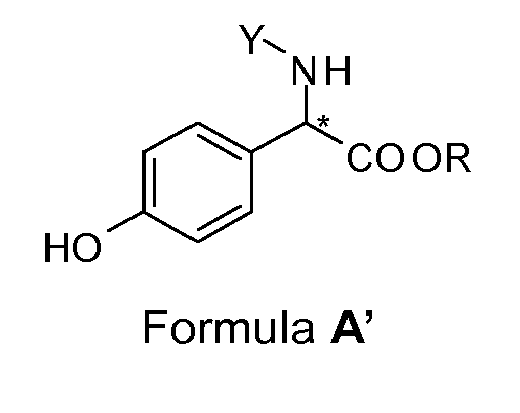
in the presence of an acid,(b) optionally removing R and Y, if different from H(c) followed by oxidative decarboxylation in the presence of an oxidizing reagent. - The process according to claim 1 or 2, wherein Rx and Ry is isopropyl.
- The process according to any one of claims 1 to 3, wherein steps (a) and (b) proceed in a one pot reaction.
- The process according to any one of the preceding claims, wherein the acid in step (a) is selected from inorganic acids and organic sulfonic acids, preferably selected from sulfuric acid, perchloric acid, C1-C6 alkanesulfonic acids, fluorinated C1-C6 alkanesulfonic acids, arenesulfonic acids, more preferably selected from methanesulfonic and sulfuric acid, wherein optionally the acid is diluted with water and / or with aliphatic acid, preferably the water content is less than 50 % (w/w), more preferably less than 30 % (w/w).
- The process according to any one of the preceding claims, wherein no organic solvent is contained in or added to the reaction solution for step (a).
- The process according to any one of the preceding claims, wherein before step (b), the acid reaction solution of step (a) is adjusted to a pH in the range from 5 to 9, then a water immiscible solvent is added, and then step (b) is carried out.
- The process according to any one of the preceding claims, wherein step (b) is carried out by any one of(i) using a transamination reagent selected from reactive aldehydes and ketones;(ii) using air oxygen in the presence of a radical catalyst;(iii) using inorganic oxidants selected from salts of metal cations in relatively high oxidation states, and anions in relatively high oxidation states.
- The process according to any one of the preceding claims, wherein oxidation in step (b) is carried out using any oxidant selected from the group of benzoquinone, glyoxalic acid and pyruvic acids and their salts and esters, inorganic persulfates, or using peroxodisulfate species prepared in situ from corresponding sulfuric salts and hydrogen peroxide.
- A process of preparing hydroxytolterodine or its salts, comprising:preparing 3-(5-formyl-2-hydroxyphenyl)-N,N-diisopropyl-3-phenylpropylamine according to any one of claims 3 to 9,carrying out a reduction step to obtain hydroxytolterodine (HT), andoptionally converting HT to chiral (R)-HT or converting HT or (R)-HT into a salt thereof.
- A process of preparing acylated hydroxytolterodine or its salts, comprising:preparing hydroxytolterodine (HT) or chiral (R)-HT or a salt thereof according to claim 10, andcarrying out acylation of the phenolic hydroxy group of HT or of chiral (R)-HT by an alkanoic acid, and optionally converting the acylated hydroxytolterodine into a salt thereof.
- The process according to claim 11 for preparing fesoterodine or its salts, wherein the acylation is carried out by isobutyric chloride or isobutyric anhydride to obtain fesoterodine, and optionally converting fesoterodine into a salt thereof, preferably into fumarate salt.
- A process of preparing fesoterodine or a salt thereof, comprising the steps of:(a) reacting N,N-diisopropyl-3-phenylprop-2-en-1-amine with hydroxyphenylglycine or a derivative thereof denoted by formula A'

in the presence of an acid;(b) optionally removing R and Y, if other than H(c) followed by oxidative decarboxylation in the presence of an oxidizing reagent to obtain 3-(5-formyl-2-hydroxyphenyl)-N,N-diisopropyl-3-phenylpropylamine;(d) reducing the formed 3-(5-formyl-2-hydroxyphenyl)-N,N-diisopropyl-3-phenylpropylamine to obtain hydroxytolterodine (HT);(e) converting the obtained HT into (R)-HT; and(f) carrying out acylation of the phenolic hydroxy group of (R)-HT obtained in step (d) by isobutyric chloride or isobutyric anhydride to obtain fesoterodine, and optionally converting fesoterodine into a salt thereof, preferably into fumarate salt. - A compound of the formula

- The compound according to claim 14, wherein R, R1, and Y is hydrogen, Rx and Ry is isopropyl.
- Use of the compound as set forth in any one of claims 14 to 15 in a process of preparing a medicament, preferably for preparing an anticholinergic for treatment of urinary incontinence or overactive bladder.
- Use of the compound defined in any one of claims 14 to 15 for preparing hydroxytolterodine, tolterodine or fesoterodine, optionally in an enantiomeric pure form, and optionally a salt thereof.
- The use according to claim 17, wherein hydroxytolterodine, tolterodine or fesoterodine is prepared in enantiomeric pure form, preferably in (R)-configuration.
- A process for making a pharmaceutical composition comprising hydroxytolderodine, tolderodine or fesoterodine or a salt thereof as active pharmaceutical ingredient, comprising
providing hydroxytolterodine, tolterodine or fesoterodine or a salt thereof as active pharmaceutical ingredient by involving a process according to any one of claims 10 to 13 or a use according to claim 17 or 18, and
formulating said active pharmaceutical ingredient with a pharmaceutically acceptable carrier to prepare the pharmaceutical composition.
Priority Applications (7)
| Application Number | Priority Date | Filing Date | Title |
|---|---|---|---|
| EP10155864A EP2364966A1 (en) | 2010-03-09 | 2010-03-09 | Process for preparation of 3-(2-hydroxy-5-substituted phenyl)-3-phenylpropylamines, intermediates for making hydroxytolterodine |
| PCT/EP2011/053465 WO2011110556A1 (en) | 2010-03-09 | 2011-03-08 | Short synthesis of tolterodine, intermediates and metabolites |
| JP2012556486A JP5930975B2 (en) | 2010-03-09 | 2011-03-08 | Short synthesis of tolterodine, intermediates and metabolites |
| EP11709079.5A EP2545024B1 (en) | 2010-03-09 | 2011-03-08 | Process for preparation of 3-(2-hydroxy-5-substituted phenyl)-3-phenylpropylamines, intermediates for making hydroxytolterodine and fesoterodine |
| AU2011226105A AU2011226105B2 (en) | 2010-03-09 | 2011-03-08 | Short synthesis of tolterodine, intermediates and metabolites |
| CA2791844A CA2791844A1 (en) | 2010-03-09 | 2011-03-08 | Short synthesis of tolterodine, intermediates and metabolites |
| US13/582,947 US8703996B2 (en) | 2010-03-09 | 2011-03-08 | Short synthesis of tolterodin, intermediates and metabolites |
Applications Claiming Priority (1)
| Application Number | Priority Date | Filing Date | Title |
|---|---|---|---|
| EP10155864A EP2364966A1 (en) | 2010-03-09 | 2010-03-09 | Process for preparation of 3-(2-hydroxy-5-substituted phenyl)-3-phenylpropylamines, intermediates for making hydroxytolterodine |
Publications (1)
| Publication Number | Publication Date |
|---|---|
| EP2364966A1 true EP2364966A1 (en) | 2011-09-14 |
Family
ID=42307231
Family Applications (2)
| Application Number | Title | Priority Date | Filing Date |
|---|---|---|---|
| EP10155864A Ceased EP2364966A1 (en) | 2010-03-09 | 2010-03-09 | Process for preparation of 3-(2-hydroxy-5-substituted phenyl)-3-phenylpropylamines, intermediates for making hydroxytolterodine |
| EP11709079.5A Not-in-force EP2545024B1 (en) | 2010-03-09 | 2011-03-08 | Process for preparation of 3-(2-hydroxy-5-substituted phenyl)-3-phenylpropylamines, intermediates for making hydroxytolterodine and fesoterodine |
Family Applications After (1)
| Application Number | Title | Priority Date | Filing Date |
|---|---|---|---|
| EP11709079.5A Not-in-force EP2545024B1 (en) | 2010-03-09 | 2011-03-08 | Process for preparation of 3-(2-hydroxy-5-substituted phenyl)-3-phenylpropylamines, intermediates for making hydroxytolterodine and fesoterodine |
Country Status (6)
| Country | Link |
|---|---|
| US (1) | US8703996B2 (en) |
| EP (2) | EP2364966A1 (en) |
| JP (1) | JP5930975B2 (en) |
| AU (1) | AU2011226105B2 (en) |
| CA (1) | CA2791844A1 (en) |
| WO (1) | WO2011110556A1 (en) |
Cited By (2)
| Publication number | Priority date | Publication date | Assignee | Title |
|---|---|---|---|---|
| ITMI20121232A1 (en) * | 2012-07-16 | 2014-01-17 | Cambrex Profarmaco Milano Srl | PROCEDURE FOR THE PREPARATION OF 2- (3-N, N-DIISOPROPYLAMINO-1-PHENYLPROPYL) -4-HYDROXYMETHYL-PHENOL AND ITS DERIVATIVES |
| WO2017137955A1 (en) * | 2016-02-14 | 2017-08-17 | Celestis Pharmaceuticals Pvt. Ltd. | Novel (r) and rac 3-(2-(allyloxy)-5-methylphenyl)-n,n-diisopropyl-3- phenylpropan-1-amine and its use for synthesis of (r) and rac-2-(3- (diisopropylamino)-1-phenylpropyl)-4-(hydroxymethyl)phenol |
Families Citing this family (3)
| Publication number | Priority date | Publication date | Assignee | Title |
|---|---|---|---|---|
| KR101759714B1 (en) * | 2014-06-13 | 2017-07-20 | 한양대학교 에리카산학협력단 | Synthetic Method of Intermediate for Fesoterodine |
| WO2016148444A1 (en) * | 2015-03-17 | 2016-09-22 | 제이더블유중외제약 주식회사 | Novel desfesoterodine derivative, pharmaceutically acceptable salt thereof and pharmaceutical composition comprising same |
| CN114213265A (en) * | 2021-12-22 | 2022-03-22 | 南京美瑞制药有限公司 | A kind of method for preparing tolterodine oxidation impurity |
Citations (13)
| Publication number | Priority date | Publication date | Assignee | Title |
|---|---|---|---|---|
| WO1989006644A1 (en) | 1988-01-22 | 1989-07-27 | Kabivitrum Ab | New amines, their use and preparation |
| WO1994011337A1 (en) | 1992-11-06 | 1994-05-26 | Pharmacia Ab | Novel 3,3-diphenylpropylamines, their use and preparation |
| WO1998043942A1 (en) * | 1997-03-27 | 1998-10-08 | Pharmacia & Upjohn Ab | Novel compounds, their use and preparation |
| WO1999058478A1 (en) | 1998-05-12 | 1999-11-18 | Schwarz Pharma Ag | Novel derivatives of 3,3-diphenylpropylamines |
| WO2001096279A1 (en) | 2000-06-14 | 2001-12-20 | Schwarz Pharma Ag | Shortened synthesis of 3,3-diarylpropylamine derivatives |
| WO2002004399A1 (en) | 2000-07-07 | 2002-01-17 | Schwarz Pharma Ag | Method for producing 3,3-diarylpropylamines |
| WO2005012227A2 (en) | 2003-08-05 | 2005-02-10 | Ranbaxy Laboratories Limited | Process for preparation of 2-(3-diisopropylamino-1-phenylpropyl)-4-hydroxymethyl-phenol, a metabolite of tolterodine |
| WO2007017544A2 (en) | 2005-08-05 | 2007-02-15 | Interquim, S.A. | Method of obtaining 3,3-diphenylpropylamines |
| EP1839649A1 (en) * | 2006-03-31 | 2007-10-03 | LEK Pharmaceuticals D.D. | Coated formulations for tolterodine |
| WO2007138440A1 (en) | 2006-05-24 | 2007-12-06 | Pfizer Limited | Process for the production of benzopyran-2-ol derivatives |
| WO2007144097A1 (en) | 2006-06-12 | 2007-12-21 | Schwarz Pharma Ag | New chiral intermediate, process for producing the same and its use in the manufacture of tolterodine, fesoterodine, or the active metabolite thereof |
| WO2007144091A1 (en) | 2006-06-12 | 2007-12-21 | Schwarz Pharma Ltd. | Shortened synthesis using paraformaldehyde or trioxane |
| WO2007147547A1 (en) | 2006-06-20 | 2007-12-27 | Lek Pharmaceuticals D.D. | Process for preparation of 3-(2-hydroxy-5-substituted phenyl)-n-alkyl-3-phenylpropylamines |
Family Cites Families (1)
| Publication number | Priority date | Publication date | Assignee | Title |
|---|---|---|---|---|
| ES2456866T3 (en) * | 2009-07-27 | 2014-04-23 | Crystal Pharma, S.A.U. | Procedure for obtaining 3,3-diphenylpropylamines |
-
2010
- 2010-03-09 EP EP10155864A patent/EP2364966A1/en not_active Ceased
-
2011
- 2011-03-08 AU AU2011226105A patent/AU2011226105B2/en not_active Ceased
- 2011-03-08 WO PCT/EP2011/053465 patent/WO2011110556A1/en not_active Ceased
- 2011-03-08 US US13/582,947 patent/US8703996B2/en not_active Expired - Fee Related
- 2011-03-08 CA CA2791844A patent/CA2791844A1/en not_active Abandoned
- 2011-03-08 EP EP11709079.5A patent/EP2545024B1/en not_active Not-in-force
- 2011-03-08 JP JP2012556486A patent/JP5930975B2/en not_active Expired - Fee Related
Patent Citations (13)
| Publication number | Priority date | Publication date | Assignee | Title |
|---|---|---|---|---|
| WO1989006644A1 (en) | 1988-01-22 | 1989-07-27 | Kabivitrum Ab | New amines, their use and preparation |
| WO1994011337A1 (en) | 1992-11-06 | 1994-05-26 | Pharmacia Ab | Novel 3,3-diphenylpropylamines, their use and preparation |
| WO1998043942A1 (en) * | 1997-03-27 | 1998-10-08 | Pharmacia & Upjohn Ab | Novel compounds, their use and preparation |
| WO1999058478A1 (en) | 1998-05-12 | 1999-11-18 | Schwarz Pharma Ag | Novel derivatives of 3,3-diphenylpropylamines |
| WO2001096279A1 (en) | 2000-06-14 | 2001-12-20 | Schwarz Pharma Ag | Shortened synthesis of 3,3-diarylpropylamine derivatives |
| WO2002004399A1 (en) | 2000-07-07 | 2002-01-17 | Schwarz Pharma Ag | Method for producing 3,3-diarylpropylamines |
| WO2005012227A2 (en) | 2003-08-05 | 2005-02-10 | Ranbaxy Laboratories Limited | Process for preparation of 2-(3-diisopropylamino-1-phenylpropyl)-4-hydroxymethyl-phenol, a metabolite of tolterodine |
| WO2007017544A2 (en) | 2005-08-05 | 2007-02-15 | Interquim, S.A. | Method of obtaining 3,3-diphenylpropylamines |
| EP1839649A1 (en) * | 2006-03-31 | 2007-10-03 | LEK Pharmaceuticals D.D. | Coated formulations for tolterodine |
| WO2007138440A1 (en) | 2006-05-24 | 2007-12-06 | Pfizer Limited | Process for the production of benzopyran-2-ol derivatives |
| WO2007144097A1 (en) | 2006-06-12 | 2007-12-21 | Schwarz Pharma Ag | New chiral intermediate, process for producing the same and its use in the manufacture of tolterodine, fesoterodine, or the active metabolite thereof |
| WO2007144091A1 (en) | 2006-06-12 | 2007-12-21 | Schwarz Pharma Ltd. | Shortened synthesis using paraformaldehyde or trioxane |
| WO2007147547A1 (en) | 2006-06-20 | 2007-12-27 | Lek Pharmaceuticals D.D. | Process for preparation of 3-(2-hydroxy-5-substituted phenyl)-n-alkyl-3-phenylpropylamines |
Non-Patent Citations (2)
| Title |
|---|
| GANESA GOPALAKRISHNAN ET AL: "Kinetic and mechanistic Studies of the N-Bromosuccinimide-Promoted Oxidative Decarboxylation of Glycine, DL-Alanine and DL-Valine", J.ORG.CHEM., vol. 50, 1985, pages 1206 - 1212, XP002591330 * |
| ORG. LETT., vol. 7, 2005, pages 2285 |
Cited By (3)
| Publication number | Priority date | Publication date | Assignee | Title |
|---|---|---|---|---|
| ITMI20121232A1 (en) * | 2012-07-16 | 2014-01-17 | Cambrex Profarmaco Milano Srl | PROCEDURE FOR THE PREPARATION OF 2- (3-N, N-DIISOPROPYLAMINO-1-PHENYLPROPYL) -4-HYDROXYMETHYL-PHENOL AND ITS DERIVATIVES |
| WO2014012832A1 (en) * | 2012-07-16 | 2014-01-23 | Cambrex Profarmaco Milano S.R.L. | Process for the preparation of 2-(3-n,n-diisopropylamino-1-phenylpropyl)-4-hydroxymethyl-phenol and its derivatives |
| WO2017137955A1 (en) * | 2016-02-14 | 2017-08-17 | Celestis Pharmaceuticals Pvt. Ltd. | Novel (r) and rac 3-(2-(allyloxy)-5-methylphenyl)-n,n-diisopropyl-3- phenylpropan-1-amine and its use for synthesis of (r) and rac-2-(3- (diisopropylamino)-1-phenylpropyl)-4-(hydroxymethyl)phenol |
Also Published As
| Publication number | Publication date |
|---|---|
| AU2011226105B2 (en) | 2014-12-18 |
| CA2791844A1 (en) | 2011-09-15 |
| JP2013521321A (en) | 2013-06-10 |
| AU2011226105A1 (en) | 2012-09-20 |
| US8703996B2 (en) | 2014-04-22 |
| EP2545024A1 (en) | 2013-01-16 |
| EP2545024B1 (en) | 2016-08-03 |
| JP5930975B2 (en) | 2016-06-08 |
| US20130197082A1 (en) | 2013-08-01 |
| WO2011110556A1 (en) | 2011-09-15 |
Similar Documents
| Publication | Publication Date | Title |
|---|---|---|
| US6310248B2 (en) | Process and intermediates | |
| EP1751087B1 (en) | Levodopa derivatives, and compositions and uses thereof | |
| EP2545024B1 (en) | Process for preparation of 3-(2-hydroxy-5-substituted phenyl)-3-phenylpropylamines, intermediates for making hydroxytolterodine and fesoterodine | |
| JP5700578B2 (en) | Method for obtaining 3,3-diphenylpropylamine | |
| CA2658215C (en) | An enantioselective synthesis of pyrrolidines-substituted flavones | |
| KR20120039344A (en) | A novel method of making endoxifen | |
| CA2648554C (en) | Shortened synthesis using paraformaldehyde or trioxane | |
| US6689916B2 (en) | Phenyl propenone compounds | |
| JP2009215198A (en) | METHOD FOR PRODUCING OPTICALLY ACTIVE beta-FLUOROMETHYLCARBONYL DERIVATIVE | |
| CN117142999A (en) | A racemization method for drug intermediates | |
| JP2008255050A (en) | Method for producing cross-coupling compound | |
| CN105377818B (en) | For preparing angstrom new method for replacing drawing Wei | |
| EP1205464B1 (en) | Production method of 2-cyclohexyl-2-hydroxy-2-phenylacetic acid intermediate therefor and production method thereof | |
| JP2000504684A (en) | Racemization of quaternary chiral centers | |
| JP2002193933A (en) | Method for producing optically active piperidine derivative or acid salt thereof | |
| JP2005281311A (en) | Process for the preparation of tolterodine and its intermediates | |
| JP2009019004A (en) | Process for producing optically active aryloxycarboxylic acid derivative | |
| JP2003137835A (en) | Method for producing (r)-3-hydroxy-3-(2-phenyl)hexanoic acid | |
| US20080269494A1 (en) | Process for the Preparation of Alpha-Aryl-Alpha-Piperid-2-Yl-Acetamides and the Acid Hydrolysis Thereof | |
| JP2001226333A (en) | Method for producing optically active aminoindane derivative and intermediate thereof | |
| CN112679337A (en) | Preparation method of (R) - (+) -2- (4-hydroxyphenoxy) propionic acid | |
| IES84805Y1 (en) | Shortened synthesis using paraformaldehyde or trioxane | |
| JP2001233886A (en) | Method of stereoselectively preparing phosphonic acid ester | |
| HK1099927B (en) | Levodopa derivatives, and compositions and uses thereof | |
| JP2000034256A (en) | Salt of optically active α-halo-halophenylacetic acid and optically active aralkylamine and process for producing the same |
Legal Events
| Date | Code | Title | Description |
|---|---|---|---|
| PUAI | Public reference made under article 153(3) epc to a published international application that has entered the european phase |
Free format text: ORIGINAL CODE: 0009012 |
|
| AK | Designated contracting states |
Kind code of ref document: A1 Designated state(s): AT BE BG CH CY CZ DE DK EE ES FI FR GB GR HR HU IE IS IT LI LT LU LV MC MK MT NL NO PL PT RO SE SI SK SM TR |
|
| AX | Request for extension of the european patent |
Extension state: AL BA ME RS |
|
| STAA | Information on the status of an ep patent application or granted ep patent |
Free format text: STATUS: THE APPLICATION HAS BEEN REFUSED |
|
| 18R | Application refused |
Effective date: 20120302 |