EP2364400B1 - Ultra-low sulfur fuel and method for reduced contrail formation - Google Patents
Ultra-low sulfur fuel and method for reduced contrail formation Download PDFInfo
- Publication number
- EP2364400B1 EP2364400B1 EP09752677.6A EP09752677A EP2364400B1 EP 2364400 B1 EP2364400 B1 EP 2364400B1 EP 09752677 A EP09752677 A EP 09752677A EP 2364400 B1 EP2364400 B1 EP 2364400B1
- Authority
- EP
- European Patent Office
- Prior art keywords
- sulfur
- ultra
- fuel
- gas turbine
- contrail
- Prior art date
- Legal status (The legal status is an assumption and is not a legal conclusion. Google has not performed a legal analysis and makes no representation as to the accuracy of the status listed.)
- Revoked
Links
Images
Classifications
-
- F—MECHANICAL ENGINEERING; LIGHTING; HEATING; WEAPONS; BLASTING
- F02—COMBUSTION ENGINES; HOT-GAS OR COMBUSTION-PRODUCT ENGINE PLANTS
- F02C—GAS-TURBINE PLANTS; AIR INTAKES FOR JET-PROPULSION PLANTS; CONTROLLING FUEL SUPPLY IN AIR-BREATHING JET-PROPULSION PLANTS
- F02C3/00—Gas-turbine plants characterised by the use of combustion products as the working fluid
- F02C3/20—Gas-turbine plants characterised by the use of combustion products as the working fluid using a special fuel, oxidant, or dilution fluid to generate the combustion products
-
- F—MECHANICAL ENGINEERING; LIGHTING; HEATING; WEAPONS; BLASTING
- F05—INDEXING SCHEMES RELATING TO ENGINES OR PUMPS IN VARIOUS SUBCLASSES OF CLASSES F01-F04
- F05D—INDEXING SCHEME FOR ASPECTS RELATING TO NON-POSITIVE-DISPLACEMENT MACHINES OR ENGINES, GAS-TURBINES OR JET-PROPULSION PLANTS
- F05D2270/00—Control
- F05D2270/01—Purpose of the control system
- F05D2270/08—Purpose of the control system to produce clean exhaust gases
- F05D2270/082—Purpose of the control system to produce clean exhaust gases with as little NOx as possible
-
- Y—GENERAL TAGGING OF NEW TECHNOLOGICAL DEVELOPMENTS; GENERAL TAGGING OF CROSS-SECTIONAL TECHNOLOGIES SPANNING OVER SEVERAL SECTIONS OF THE IPC; TECHNICAL SUBJECTS COVERED BY FORMER USPC CROSS-REFERENCE ART COLLECTIONS [XRACs] AND DIGESTS
- Y02—TECHNOLOGIES OR APPLICATIONS FOR MITIGATION OR ADAPTATION AGAINST CLIMATE CHANGE
- Y02T—CLIMATE CHANGE MITIGATION TECHNOLOGIES RELATED TO TRANSPORTATION
- Y02T50/00—Aeronautics or air transport
- Y02T50/60—Efficient propulsion technologies, e.g. for aircraft
Definitions
- This disclosure relates to contrails made by the exhaust from aircraft engines.
- Hot exhaust from aircraft engines causes visible trails of condensed water known as contrails under known temperature and humidity conditions. For instance, the hot exhaust mixes with the cooler, moist surrounding air and causes condensation/precipitation of water as minute droplets or ice crystals.
- contrails contribute to changing the Earth's climate by containing outgoing radiation, either directly or as amplified by stimulating the formation of clouds, similar to greenhouse gases. Additionally, contrail formation may be a concern for aircraft operators that wish to minimize visible detection.
- an aircraft may avoid producing contrails by avoiding flying into contrail-forming conditions.
- flight pattern or other circumstances, it is not always possible to avoid contrail-forming conditions.
- contrail avoidance flight patterns may be longer and/or require more total fuel to be burned, which would increase cost and produce more CO 2 with the effect of increasing rather than decreasing global warming.
- Additives to the fuel or to the exhaust may be used to reduce contrail formation.
- the additives influence the size of the condensed water droplets or ice crystals. Droplets or ice crystals of certain sizes may not be visible.
- problems with using additives include the cost of the additives (effectively increasing the cost of the fuel which is already a significant concern in the aviation industry), the weight associated with the additives, and any reduction in engine life or performance caused by the additives.
- Fischer-Tropsch jet fuels having low sulfur levels are disclosed in a technical report entitled “Alternative Jet Fuels” by Chevron, available from www.chevronglobalaviation.com
- US 6,162,956 discloses a Fischer-Tropsch derived distillate fraction that is blended with either a raw gas field condensate distillate fraction or a mildly hydrotreated condensate fraction to obtain a stable, inhibited distillate fuel.
- An example method of managing contrail formation of a gas turbine engine includes delivering an ultra-low sulfur fuel with a desired concentration of sulfur in the ultra-low sulfur fuel to a combustor of a gas turbine engine to limit an amount of sulfur byproduct produced in an exhaust of the gas turbine engine, and predetermining the desired concentration of sulfur in the ultra-low sulfur fuel by establishing a critical threshold of sulfur byproducts in an exhaust of a gas turbine engine such that below a critical threshold, the exhaust substantially reduces contrail formation when the gas turbine engine is flying in contrail-forming conditions.
- An ultra-low sulfur aviation fuel composition includes a concentration of sulfur that is less than one part per million is described.
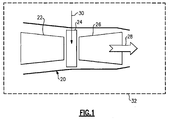
- Figure 1 illustrates an example gas turbine engine utilizing an ultra-low sulfur fuel while flying in contrail-forming conditions.
- Figure 1 illustrates selected portions of an example gas turbine engine 20 that may be employed on an aircraft.
- the gas turbine engine 20 includes a compressor section 22, a combustor 24 for receiving compressed air from the compressor section 22, and a turbine section 26 for receiving an exhaust 28 from the combustor 24. It is to be understood that there are various types of gas turbine engines, many of which can benefit from the disclosed examples, which are not limited to the disclosed design.
- the gas turbine engine 20 utilizes an ultra-low sulfur fuel 30 to manage contrail formation from the gas turbine engine 20 while flying through contrail-forming conditions 32.
- Typical aviation fuels include 30-3000 parts per million of sulfur.
- the ultra-low sulfur fuel 30 of the disclosed example includes a concentration of sulfur that is less than about one part per million to limit an amount of sulfur byproduct produced in the exhaust 28.
- the ultra-low sulfur fuel 30 may have a concentration of sulfur that is less than 300 parts per billion or concentration that is below detectable limits (i.e., nominally zero).
- the sulfur byproducts e.g., including SO 3
- Sulfur byproducts may act as nucleation sites for condensation of water under contrail-forming conditions.
- sulfur byproducts are highly hydroscopic compared to carbon or other particles in an exhaust.
- the sulfur byproducts including any sulfur byproduct associated with emitted soot particles, attract water vapor molecules more readily than other types of particles in the exhaust.
- the sulfur byproduct may rapidly accumulate water and form droplets that lead to contrails.
- the amount of sulfur byproduct in the exhaust 28 is limited by utilizing the ultra-low sulfur fuel 30.
- the ultra-low sulfur fuel 30 thereby limits or eliminates contrail formation because there is limited sulfur byproduct in the exhaust 28 to support nucleation and water droplet formation.
- Reducing or eliminating contrail formation using the ultra-low sulfur fuel 30 provides the benefits of reduced concern of aviation-induced climate change, no increase in effective fuel cost or aircraft weight from additives, no impact on fuel consumption, and reduction of particulate emission.
- Desired concentrations of sulfur in the ultra-low sulfur fuel 30 for reducing or eliminating contrail formation are predetermined.
- Acritical threshold of sulfur byproducts in the exhaust 28 is established such that below the critical threshold, the exhaust 28 substantially reduces contrail formation when the gas turbine engine 20 is flying in the contrail-forming condition 32.
- the reduction in contrail formation may correspond to the degree of visibility of a contrail, average water droplet size or other parameter for judging contrail formation.
- the ultra-low sulfur fuel 30 may be produced using any of a variety of methods.
- the ultra-low sulfur fuel 30 may be a Fischer-Tropsch synthetic paraffin fuel that is made without adding sulfur or sulfur-containing additives.
- the ultra-low sulfur fuel 30 may include a concentration of sulfur that is close to zero or undetectable.
- the ultra-low sulfur fuel 30 may be produced by removing sulfur from an existing type of aviation fuel.
- the existing fuel may be a synthetic fuel or a petroleum-based fuel, for example.
- a sulfur-removing device could be used to remove sulfur from the existing fuel.
- one concern with using the ultra-low sulfur fuel 30 might be sulfur contamination from existing fuel supply chains.
- aviation fuels are typically transported through a supply chain that may handle a variety of different types of fuels. Residual amounts of one type of fuel may remain in the supply chain and intermix with subsequently transported fuels. Normally, the intermixing is insignificant and does not influence engine performance. However, mixing even a small amount of a sulfur-containing fuel with the ultra-low sulfur fuel 30 may increase the sulfur concentration above a desired/threshold concentration for contrail formation.
- the gas turbine engine 20 or the aircraft fuel system may include residual sulfur-containing fuel. Therefore, the supply chain, the aircraft, and gas turbine engine 20 may require cleaning to limit contamination.
Landscapes
- Engineering & Computer Science (AREA)
- Chemical & Material Sciences (AREA)
- Combustion & Propulsion (AREA)
- Mechanical Engineering (AREA)
- General Engineering & Computer Science (AREA)
- Engine Equipment That Uses Special Cycles (AREA)
- Solid Fuels And Fuel-Associated Substances (AREA)
Description
- This disclosure relates to contrails made by the exhaust from aircraft engines. Hot exhaust from aircraft engines causes visible trails of condensed water known as contrails under known temperature and humidity conditions. For instance, the hot exhaust mixes with the cooler, moist surrounding air and causes condensation/precipitation of water as minute droplets or ice crystals. There is speculation that contrails contribute to changing the Earth's climate by containing outgoing radiation, either directly or as amplified by stimulating the formation of clouds, similar to greenhouse gases. Additionally, contrail formation may be a concern for aircraft operators that wish to minimize visible detection.
- In some instances, an aircraft may avoid producing contrails by avoiding flying into contrail-forming conditions. However, depending on the aircraft, flight pattern, or other circumstances, it is not always possible to avoid contrail-forming conditions. In addition, such contrail avoidance flight patterns may be longer and/or require more total fuel to be burned, which would increase cost and produce more CO2 with the effect of increasing rather than decreasing global warming.
- Additives to the fuel or to the exhaust may be used to reduce contrail formation. For instance, the additives influence the size of the condensed water droplets or ice crystals. Droplets or ice crystals of certain sizes may not be visible. However, problems with using additives include the cost of the additives (effectively increasing the cost of the fuel which is already a significant concern in the aviation industry), the weight associated with the additives, and any reduction in engine life or performance caused by the additives.
- Fischer-Tropsch jet fuels having low sulfur levels are disclosed in a technical report entitled "Alternative Jet Fuels" by Chevron, available from www.chevronglobalaviation.com
- Other studies relating to sulfur levels in fuels indicate a study by Mushrush et al. reported in Petroleum Science and Technology, ; and a study by Schumann et al. reported in Journal of Geophysical Research, Vol. 101, No. D3, 20 March 1996, pp 6853-6869.
-
US 6,162,956 discloses a Fischer-Tropsch derived distillate fraction that is blended with either a raw gas field condensate distillate fraction or a mildly hydrotreated condensate fraction to obtain a stable, inhibited distillate fuel. - An example method of managing contrail formation of a gas turbine engine according to claim 1 includes delivering an ultra-low sulfur fuel with a desired concentration of sulfur in the ultra-low sulfur fuel to a combustor of a gas turbine engine to limit an amount of sulfur byproduct produced in an exhaust of the gas turbine engine, and predetermining the desired concentration of sulfur in the ultra-low sulfur fuel by establishing a critical threshold of sulfur byproducts in an exhaust of a gas turbine engine such that below a critical threshold, the exhaust substantially reduces contrail formation when the gas turbine engine is flying in contrail-forming conditions.
- An ultra-low sulfur aviation fuel composition includes a concentration of sulfur that is less than one part per million is described.
- The various features and advantages of the disclosed examples will become apparent to those skilled in the art from the following detailed description. The drawings that accompany the detailed description can be briefly described as follows.
-
Figure 1 illustrates an example gas turbine engine utilizing an ultra-low sulfur fuel while flying in contrail-forming conditions. -
Figure 1 illustrates selected portions of an examplegas turbine engine 20 that may be employed on an aircraft. In this example, thegas turbine engine 20 includes acompressor section 22, acombustor 24 for receiving compressed air from thecompressor section 22, and aturbine section 26 for receiving anexhaust 28 from thecombustor 24. It is to be understood that there are various types of gas turbine engines, many of which can benefit from the disclosed examples, which are not limited to the disclosed design. - The
gas turbine engine 20 utilizes anultra-low sulfur fuel 30 to manage contrail formation from thegas turbine engine 20 while flying through contrail-formingconditions 32. Typical aviation fuels include 30-3000 parts per million of sulfur. However, theultra-low sulfur fuel 30 of the disclosed example includes a concentration of sulfur that is less than about one part per million to limit an amount of sulfur byproduct produced in theexhaust 28.
In further examples, theultra-low sulfur fuel 30 may have a concentration of sulfur that is less than 300 parts per billion or concentration that is below detectable limits (i.e., nominally zero). The sulfur byproducts (e.g., including SO3) may be in the form of particles, compounds, or other exhaust matter emitted in theexhaust 28. - Sulfur byproducts may act as nucleation sites for condensation of water under contrail-forming conditions. For instance, sulfur byproducts are highly hydroscopic compared to carbon or other particles in an exhaust. The sulfur byproducts, including any sulfur byproduct associated with emitted soot particles, attract water vapor molecules more readily than other types of particles in the exhaust. The sulfur byproduct may rapidly accumulate water and form droplets that lead to contrails. The amount of sulfur byproduct in the
exhaust 28 is limited by utilizing theultra-low sulfur fuel 30. Theultra-low sulfur fuel 30 thereby limits or eliminates contrail formation because there is limited sulfur byproduct in theexhaust 28 to support nucleation and water droplet formation. - Reducing or eliminating contrail formation using the
ultra-low sulfur fuel 30 provides the benefits of reduced concern of aviation-induced climate change, no increase in effective fuel cost or aircraft weight from additives, no impact on fuel consumption, and reduction of particulate emission. - Desired concentrations of sulfur in the
ultra-low sulfur fuel 30 for reducing or eliminating contrail formation are predetermined. Acritical threshold of sulfur byproducts in theexhaust 28 is established such that below the critical threshold, theexhaust 28 substantially reduces contrail formation when thegas turbine engine 20 is flying in the contrail-formingcondition 32. In one example, the reduction in contrail formation may correspond to the degree of visibility of a contrail, average water droplet size or other parameter for judging contrail formation. - The
ultra-low sulfur fuel 30 may be produced using any of a variety of methods. In one example, theultra-low sulfur fuel 30 may be a Fischer-Tropsch synthetic paraffin fuel that is made without adding sulfur or sulfur-containing additives. In this regard, theultra-low sulfur fuel 30 may include a concentration of sulfur that is close to zero or undetectable. - In another example, the
ultra-low sulfur fuel 30 may be produced by removing sulfur from an existing type of aviation fuel. The existing fuel may be a synthetic fuel or a petroleum-based fuel, for example. For instance, a sulfur-removing device could be used to remove sulfur from the existing fuel. - Regardless of the source of the
ultra-low sulfur fuel 30, one concern with using theultra-low sulfur fuel 30 might be sulfur contamination from existing fuel supply chains. For instance, aviation fuels are typically transported through a supply chain that may handle a variety of different types of fuels. Residual amounts of one type of fuel may remain in the supply chain and intermix with subsequently transported fuels. Normally, the intermixing is insignificant and does not influence engine performance. However, mixing even a small amount of a sulfur-containing fuel with theultra-low sulfur fuel 30 may increase the sulfur concentration above a desired/threshold concentration for contrail formation. Similarly, thegas turbine engine 20 or the aircraft fuel system may include residual sulfur-containing fuel. Therefore, the supply chain, the aircraft, andgas turbine engine 20 may require cleaning to limit contamination. - Although a combination of features is shown in the illustrated examples, not all of them need to be combined to realize the benefits of various embodiments of this disclosure. In other words, a system designed according to an embodiment of this disclosure will not necessarily include all of the features shown in any one of the Figures or all of the portions schematically shown in the Figures. Moreover, selected features of one example embodiment may be combined with selected features of other example embodiments.
- The preceding description is exemplary rather than limiting in nature. Variations and modifications to the disclosed examples may become apparent to those skilled in the art that do not necessarily depart from the essence of this disclosure.
Claims (4)
- A method of managing contrail formation of a gas turbine engine (20), comprising:delivering an ultra-low sulfur fuel (30) with a desired concentration of sulfur in the ultra-low sulfur fuel to a combustor (24) of a gas turbine engine (20) to limit an amount of sulfur byproduct produced in an exhaust (28) of the gas turbine engine (20), characterised in that:the method further comprises predetermining the desired concentration of sulfur in the ultra-low sulfur fuel by establishing a critical threshold of sulfur byproducts in an exhaust (28) of a gas turbine engine (20) such that below the critical threshold the exhaust (28) substantially reduces contrail formation when the gas turbine engine (20) is flying in contrail-forming conditions (32).
- The method as recited in claim 1, wherein the gas turbine engine (20) is flying in contrail-forming conditions (32).
- The method as recited in claim 1, wherein a concentration of sulfur in the ultra-low sulfur fuel is less than one parts per million.
- The method as recited in claim 1, wherein a concentration of sulfur in the ultra-low sulfur fuel is less than 300 parts per billion.
Applications Claiming Priority (3)
| Application Number | Priority Date | Filing Date | Title |
|---|---|---|---|
| US11448608P | 2008-11-14 | 2008-11-14 | |
| US12/614,640 US20100122519A1 (en) | 2008-11-14 | 2009-11-09 | Ultra-low sulfur fuel and method for reduced contrail formation |
| PCT/US2009/064153 WO2010056819A2 (en) | 2008-11-14 | 2009-11-12 | Ultra-low sulfur fuel and method for reduced contrail formation |
Publications (2)
| Publication Number | Publication Date |
|---|---|
| EP2364400A2 EP2364400A2 (en) | 2011-09-14 |
| EP2364400B1 true EP2364400B1 (en) | 2016-08-17 |
Family
ID=42170686
Family Applications (1)
| Application Number | Title | Priority Date | Filing Date |
|---|---|---|---|
| EP09752677.6A Revoked EP2364400B1 (en) | 2008-11-14 | 2009-11-12 | Ultra-low sulfur fuel and method for reduced contrail formation |
Country Status (8)
| Country | Link |
|---|---|
| US (1) | US20100122519A1 (en) |
| EP (1) | EP2364400B1 (en) |
| JP (1) | JP2012508848A (en) |
| CN (1) | CN102216591A (en) |
| AU (1) | AU2009314114B2 (en) |
| CA (1) | CA2743143A1 (en) |
| RU (1) | RU2505692C2 (en) |
| WO (1) | WO2010056819A2 (en) |
Families Citing this family (9)
| Publication number | Priority date | Publication date | Assignee | Title |
|---|---|---|---|---|
| GB201211058D0 (en) | 2012-06-22 | 2012-08-01 | Rolls Royce Plc | Fuel system |
| GB201211061D0 (en) * | 2012-06-22 | 2012-08-01 | Rolls Royce Plc | Fuel delivery system |
| GB201211064D0 (en) | 2012-06-22 | 2012-08-01 | Rolls Royce Plc | Fuel system |
| GB201317731D0 (en) | 2013-10-08 | 2013-11-20 | Rolls Royce Plc | Fuel delivery system |
| GB201317732D0 (en) * | 2013-10-08 | 2013-11-20 | Rolls Royce Plc | Aircraft engine fuel system |
| GB2524772B (en) * | 2014-04-02 | 2016-07-13 | Rolls Royce Plc | Aircraft vapour trail control system |
| GB201405894D0 (en) | 2014-04-02 | 2014-05-14 | Rolls Royce Plc | Aircraft vapour trail control system |
| GB201506473D0 (en) | 2015-04-16 | 2015-06-03 | Rolls Royce Plc | Aircraft propulsion system |
| GB202219409D0 (en) * | 2022-12-21 | 2023-02-01 | Rolls Royce Plc | Fuel management system |
Citations (2)
| Publication number | Priority date | Publication date | Assignee | Title |
|---|---|---|---|---|
| US6162956A (en) * | 1998-08-18 | 2000-12-19 | Exxon Research And Engineering Co | Stability Fischer-Tropsch diesel fuel and a process for its production |
| US6933323B2 (en) | 2003-01-31 | 2005-08-23 | Chevron U.S.A. Inc. | Production of stable olefinic fischer tropsch fuels with minimum hydrogen consumption |
Family Cites Families (14)
| Publication number | Priority date | Publication date | Assignee | Title |
|---|---|---|---|---|
| US3517505A (en) * | 1962-11-13 | 1970-06-30 | Us Air Force | Method and apparatus for suppressing contrails |
| US3804328A (en) * | 1972-10-13 | 1974-04-16 | Dow Chemical Co | Fog abatement |
| US4766725A (en) * | 1985-12-24 | 1988-08-30 | Scipar, Inc. | Method of suppressing formation of contrails and solution therefor |
| US5005355A (en) * | 1988-08-24 | 1991-04-09 | Scipar, Inc. | Method of suppressing formation of contrails and solution therefor |
| WO1996040844A1 (en) * | 1995-06-07 | 1996-12-19 | Orr William C | Vapor phase combustion method and compositions ii |
| RU2182163C2 (en) * | 1995-06-07 | 2002-05-10 | Уильям К. Орр | Fuel composition |
| US20070187292A1 (en) * | 2001-10-19 | 2007-08-16 | Miller Stephen J | Stable, moderately unsaturated distillate fuel blend stocks prepared by low pressure hydroprocessing of Fischer-Tropsch products |
| US7338541B2 (en) * | 2001-11-20 | 2008-03-04 | The Procter & Gamble Company | Synthetic jet fuel and diesel fuel compositions and processes |
| DE10359868B3 (en) * | 2003-12-18 | 2005-06-16 | Deutsches Zentrum für Luft- und Raumfahrt e.V. | Detecting condensation trails forming behind aircraft involves comparing parts of camera-acquired image that should show condensation trail according to imaging geometry with image parts that cannot contain trail using image processing |
| RU2286588C2 (en) * | 2005-02-18 | 2006-10-27 | Федеральное государственное унитарное предприятие "Лётно-исследовательский институт им. М.М. Громова" | Method of estimation of conditions of forming condensation trails by aircraft with different types of engines |
| FR2891525B1 (en) * | 2005-09-30 | 2007-11-09 | Airbus France Sas | DEVICE FOR CONTROLLING A TOURBILLONARY WAKE GENERATED BY AN OBLONG ELEMENT ON THE EXTRADOS OF A CARRYING SURFACE OF AN AIRCRAFT. |
| RU2304293C1 (en) * | 2005-12-13 | 2007-08-10 | Федеральное государственное унитарное предприятие "Летно-исследовательский институт им. М.М. Громова" | System for aviation ecological monitoring of atmospheric pollution in cruising flight |
| US20110146282A1 (en) * | 2009-12-18 | 2011-06-23 | General Electric Company | System and method for reducing sulfur compounds within fuel stream for turbomachine |
| JP5113230B2 (en) * | 2010-01-04 | 2013-01-09 | 貴之 伊東 | Rocket power generation engine and rocket power generation fan engine |
-
2009
- 2009-11-09 US US12/614,640 patent/US20100122519A1/en not_active Abandoned
- 2009-11-12 JP JP2011536455A patent/JP2012508848A/en active Pending
- 2009-11-12 WO PCT/US2009/064153 patent/WO2010056819A2/en not_active Ceased
- 2009-11-12 CN CN2009801453523A patent/CN102216591A/en active Pending
- 2009-11-12 AU AU2009314114A patent/AU2009314114B2/en not_active Ceased
- 2009-11-12 CA CA2743143A patent/CA2743143A1/en not_active Abandoned
- 2009-11-12 EP EP09752677.6A patent/EP2364400B1/en not_active Revoked
- 2009-11-12 RU RU2011121440/06A patent/RU2505692C2/en not_active IP Right Cessation
Patent Citations (2)
| Publication number | Priority date | Publication date | Assignee | Title |
|---|---|---|---|---|
| US6162956A (en) * | 1998-08-18 | 2000-12-19 | Exxon Research And Engineering Co | Stability Fischer-Tropsch diesel fuel and a process for its production |
| US6933323B2 (en) | 2003-01-31 | 2005-08-23 | Chevron U.S.A. Inc. | Production of stable olefinic fischer tropsch fuels with minimum hydrogen consumption |
Non-Patent Citations (10)
| Title |
|---|
| "Alternative Jet Fuels", ADDENDUM 1 DE L'AVIATION FUELS TECHNICAL REVIEW (FTR-3/A1, 2006, XP055383630 |
| A.M. STARIK ET AL.: "Features of physico-chemical processes in the internal flow and in the plume of jet engines and impact of aviation in the atmosphere", 16TH INTERNATIONAL SYMPOSIUM ON AIR BREATHING ENGINES (XVI ISABE, 31 August 2003 (2003-08-31), Cleveland, OH, XP055383619 |
| D. LAMPRECHT: "Fischer-Tropsch Fuel for Use by the U.S. Military as Battlefield-Use Fuel of the Future", ENERGY & FUELS, vol. 21, no. 3, 4 May 2007 (2007-05-04), pages 1448 - 1853, XP002620002 |
| E. CORPORAN ET AL.: "Influence of fuel chemical composition on particulate matter emissions of a turbine engine", PROCEEDINGS OF ASME TURBO EXPO 2004, POWER FOR LAND, SEA AND AIR, 14 June 2004 (2004-06-14), Vienne, Autriche, pages 1 - 12, XP055383646 |
| G.W. MUSHRUSH ET AL.: "Stability studies of a jet fuel containing no organo-sulfur compounds", PETROLEUM SCIENCE AND TECHNOLOGY, vol. 20, no. 5-6, 2002, pages 561 - 570, XP002967605 |
| R. BUSEN ET AL.: "Visible contrail formation from fuels with different sulfur contents", GEOPHYSICAL RESEARCH LETTERS, vol. 22, no. 11, 1 June 1995 (1995-06-01), pages 1357 - 1360, XP002620003 |
| R.C. BROWN ET AL.: "Aircraft sulfur emissions and the formation of visible contrails", GEOPHYSICAL RESEARCH LETTERS, vol. 24, no. 4, 15 February 1997 (1997-02-15), pages 385 - 388, XP055383642 |
| R.C. MIAKE-LYE ET AL.: "SOx oxidation and volatile aerosol in aircraft exhaust plumes depend on fuel sulfur content", GEOPHYSICAL RESEARCH LETTERS, vol. 25, no. 10, 15 May 1998 (1998-05-15), pages 1677 - 1680, XP055383607 |
| U. SCHUMANN ET AL.: "In situ observations of particles in jet aircraft exhausts and contrails for different sulfur-containing fuels", JOURNAL OF GEOPHYSICAL RESEARCH, vol. 101, no. D3, 20 March 1996 (1996-03-20), pages 6853 - 6869, XP002620001 |
| U. SCHUMANN ET AL.: "Influence of fuel sulfur on the composition of aircraft exhaust plumes : The experiments SULFUR 1-7", JOURNAL OF GEOPHYSICAL RESEARCH, vol. 107, no. D15, 16 August 2002 (2002-08-16), pages AAC 2 - 1 - AAC 2-27, XP055383612 |
Also Published As
| Publication number | Publication date |
|---|---|
| RU2505692C2 (en) | 2014-01-27 |
| AU2009314114B2 (en) | 2013-08-29 |
| WO2010056819A3 (en) | 2011-04-07 |
| CN102216591A (en) | 2011-10-12 |
| EP2364400A2 (en) | 2011-09-14 |
| CA2743143A1 (en) | 2010-05-20 |
| WO2010056819A2 (en) | 2010-05-20 |
| AU2009314114A1 (en) | 2011-07-28 |
| JP2012508848A (en) | 2012-04-12 |
| US20100122519A1 (en) | 2010-05-20 |
| RU2011121440A (en) | 2012-12-20 |
Similar Documents
| Publication | Publication Date | Title |
|---|---|---|
| AU2009314114B2 (en) | Ultra-low sulfur fuel and method for reduced contrail formation | |
| Zhang et al. | Prospects and perspectives foster enhanced research on bio-aviation fuels | |
| US20210277835A1 (en) | Staged combustion | |
| Fridell et al. | Primary particles in ship emissions | |
| US8849541B2 (en) | Fuel delivery system | |
| Huang et al. | Effect of soot structure evolution from commercial jet engine burning petroleum based JP-8 and synthetic HRJ and FT fuels | |
| Blazowski | Future jet fuel combustion problems and requirements | |
| WO2018154651A1 (en) | Fuel composition, ship, and fuel composition automatic switching system | |
| Liu et al. | Insight of effects of air quality and sustainable aviation fuel blend on energy saving and emission reduction in airport | |
| Starik | Gaseous and particulate emissions with jet engine exhaust and atmospheric pollution | |
| Hudson et al. | Cloud condensation nuclei measurements in the high troposphere and in jet aircraft exhaust | |
| Blevins | Particulate matter emitted from aircraft engines | |
| Märkl | Properties of contrails from aircraft with modern engines and alternative fuels | |
| US8453425B2 (en) | Soot reduction by combustor conditioning | |
| Arsenović | PHYSICAL AND CHEMICAL FEATURES OF FUEL A-1 AND LUBRICANTS FOR MLAS MOTORS AND THEIR EFFECT ON ENVIRONMENT | |
| Roiger et al. | In-flight and ground-based measurements of nitrogen oxide emissions from latest generation jet engines and 100% sustainable aviation fuel | |
| Mohsin et al. | Effect of Biodiesel Blend on Exhaust Emission and Engine Performance of Diesel Dual Fuel Engine (Research Note) | |
| Li et al. | Influence of fuel composition, engine power and operation mode on exhaust gas particulate size distribution and gaseous emissions from a gas turbine engine | |
| Khan et al. | Modeling the Role of Organic Compounds and Sulfur Content in Aerosol Nucleation from Aircraft Exhaust | |
| Sauer et al. | Measurements of Emissions and Contrail Ice Particle Properties in Cruise behind a Large Passenger Aircraft Burning 100% Sustainable Aviation Fuel | |
| Boichenko et al. | Ecological properties of conventional and alternative jet fuels. fuels sustainability | |
| Mohd Noh et al. | Green Renewable Energy–Risk Need to Be Tackled in Going Green for Air Transportation | |
| Nuszkowski et al. | Experimental and Error Analysis Investigation into Dilution Factor Equations | |
| Miyagasheva et al. | Aviation pollution | |
| Cai et al. | Estimation of Emission Factors and Particulate Black Carbon and Organic Carbon from Stationary, Mobile, and Non-point Sources in the United States for Incorporation into GREET |
Legal Events
| Date | Code | Title | Description |
|---|---|---|---|
| PUAI | Public reference made under article 153(3) epc to a published international application that has entered the european phase |
Free format text: ORIGINAL CODE: 0009012 |
|
| 17P | Request for examination filed |
Effective date: 20110525 |
|
| AK | Designated contracting states |
Kind code of ref document: A2 Designated state(s): AT BE BG CH CY CZ DE DK EE ES FI FR GB GR HR HU IE IS IT LI LT LU LV MC MK MT NL NO PL PT RO SE SI SK SM TR |
|
| REG | Reference to a national code |
Ref country code: DE Ref legal event code: R079 Ref document number: 602009040451 Country of ref document: DE Free format text: PREVIOUS MAIN CLASS: F02C0009000000 Ipc: F02C0003200000 |
|
| RIC1 | Information provided on ipc code assigned before grant |
Ipc: F02C 3/20 20060101AFI20111118BHEP |
|
| DAX | Request for extension of the european patent (deleted) | ||
| 17Q | First examination report despatched |
Effective date: 20140728 |
|
| GRAP | Despatch of communication of intention to grant a patent |
Free format text: ORIGINAL CODE: EPIDOSNIGR1 |
|
| INTG | Intention to grant announced |
Effective date: 20160301 |
|
| GRAS | Grant fee paid |
Free format text: ORIGINAL CODE: EPIDOSNIGR3 |
|
| GRAA | (expected) grant |
Free format text: ORIGINAL CODE: 0009210 |
|
| AK | Designated contracting states |
Kind code of ref document: B1 Designated state(s): AT BE BG CH CY CZ DE DK EE ES FI FR GB GR HR HU IE IS IT LI LT LU LV MC MK MT NL NO PL PT RO SE SI SK SM TR |
|
| REG | Reference to a national code |
Ref country code: GB Ref legal event code: FG4D |
|
| REG | Reference to a national code |
Ref country code: CH Ref legal event code: EP |
|
| REG | Reference to a national code |
Ref country code: IE Ref legal event code: FG4D |
|
| REG | Reference to a national code |
Ref country code: AT Ref legal event code: REF Ref document number: 821344 Country of ref document: AT Kind code of ref document: T Effective date: 20160915 |
|
| REG | Reference to a national code |
Ref country code: DE Ref legal event code: R096 Ref document number: 602009040451 Country of ref document: DE |
|
| REG | Reference to a national code |
Ref country code: CH Ref legal event code: PCOW Free format text: NEW ADDRESS: 45 MANNING ROAD, BILLERICA, MA 01821-3976 (US) $ UNITED TECHNOLOGIES CORPORATION, 10 FARM SPRINGS RD., FARMINGTON, CT 06032 (US) |
|
| REG | Reference to a national code |
Ref country code: FR Ref legal event code: PLFP Year of fee payment: 8 |
|
| RAP2 | Party data changed (patent owner data changed or rights of a patent transferred) |
Owner name: AERODYNE RESEARCH, INC. Owner name: UNITED TECHNOLOGIES CORPORATION |
|
| REG | Reference to a national code |
Ref country code: NL Ref legal event code: MP Effective date: 20160817 |
|
| REG | Reference to a national code |
Ref country code: LT Ref legal event code: MG4D |
|
| REG | Reference to a national code |
Ref country code: AT Ref legal event code: MK05 Ref document number: 821344 Country of ref document: AT Kind code of ref document: T Effective date: 20160817 |
|
| PG25 | Lapsed in a contracting state [announced via postgrant information from national office to epo] |
Ref country code: IT Free format text: LAPSE BECAUSE OF FAILURE TO SUBMIT A TRANSLATION OF THE DESCRIPTION OR TO PAY THE FEE WITHIN THE PRESCRIBED TIME-LIMIT Effective date: 20160817 Ref country code: LT Free format text: LAPSE BECAUSE OF FAILURE TO SUBMIT A TRANSLATION OF THE DESCRIPTION OR TO PAY THE FEE WITHIN THE PRESCRIBED TIME-LIMIT Effective date: 20160817 Ref country code: NL Free format text: LAPSE BECAUSE OF FAILURE TO SUBMIT A TRANSLATION OF THE DESCRIPTION OR TO PAY THE FEE WITHIN THE PRESCRIBED TIME-LIMIT Effective date: 20160817 Ref country code: FI Free format text: LAPSE BECAUSE OF FAILURE TO SUBMIT A TRANSLATION OF THE DESCRIPTION OR TO PAY THE FEE WITHIN THE PRESCRIBED TIME-LIMIT Effective date: 20160817 Ref country code: HR Free format text: LAPSE BECAUSE OF FAILURE TO SUBMIT A TRANSLATION OF THE DESCRIPTION OR TO PAY THE FEE WITHIN THE PRESCRIBED TIME-LIMIT Effective date: 20160817 Ref country code: NO Free format text: LAPSE BECAUSE OF FAILURE TO SUBMIT A TRANSLATION OF THE DESCRIPTION OR TO PAY THE FEE WITHIN THE PRESCRIBED TIME-LIMIT Effective date: 20161117 |
|
| PG25 | Lapsed in a contracting state [announced via postgrant information from national office to epo] |
Ref country code: ES Free format text: LAPSE BECAUSE OF FAILURE TO SUBMIT A TRANSLATION OF THE DESCRIPTION OR TO PAY THE FEE WITHIN THE PRESCRIBED TIME-LIMIT Effective date: 20160817 Ref country code: LV Free format text: LAPSE BECAUSE OF FAILURE TO SUBMIT A TRANSLATION OF THE DESCRIPTION OR TO PAY THE FEE WITHIN THE PRESCRIBED TIME-LIMIT Effective date: 20160817 Ref country code: GR Free format text: LAPSE BECAUSE OF FAILURE TO SUBMIT A TRANSLATION OF THE DESCRIPTION OR TO PAY THE FEE WITHIN THE PRESCRIBED TIME-LIMIT Effective date: 20161118 Ref country code: AT Free format text: LAPSE BECAUSE OF FAILURE TO SUBMIT A TRANSLATION OF THE DESCRIPTION OR TO PAY THE FEE WITHIN THE PRESCRIBED TIME-LIMIT Effective date: 20160817 Ref country code: BE Free format text: LAPSE BECAUSE OF NON-PAYMENT OF DUE FEES Effective date: 20161130 Ref country code: SE Free format text: LAPSE BECAUSE OF FAILURE TO SUBMIT A TRANSLATION OF THE DESCRIPTION OR TO PAY THE FEE WITHIN THE PRESCRIBED TIME-LIMIT Effective date: 20160817 Ref country code: PT Free format text: LAPSE BECAUSE OF FAILURE TO SUBMIT A TRANSLATION OF THE DESCRIPTION OR TO PAY THE FEE WITHIN THE PRESCRIBED TIME-LIMIT Effective date: 20161219 Ref country code: PL Free format text: LAPSE BECAUSE OF FAILURE TO SUBMIT A TRANSLATION OF THE DESCRIPTION OR TO PAY THE FEE WITHIN THE PRESCRIBED TIME-LIMIT Effective date: 20160817 |
|
| PG25 | Lapsed in a contracting state [announced via postgrant information from national office to epo] |
Ref country code: EE Free format text: LAPSE BECAUSE OF FAILURE TO SUBMIT A TRANSLATION OF THE DESCRIPTION OR TO PAY THE FEE WITHIN THE PRESCRIBED TIME-LIMIT Effective date: 20160817 Ref country code: RO Free format text: LAPSE BECAUSE OF FAILURE TO SUBMIT A TRANSLATION OF THE DESCRIPTION OR TO PAY THE FEE WITHIN THE PRESCRIBED TIME-LIMIT Effective date: 20160817 |
|
| REG | Reference to a national code |
Ref country code: DE Ref legal event code: R026 Ref document number: 602009040451 Country of ref document: DE |
|
| PLBI | Opposition filed |
Free format text: ORIGINAL CODE: 0009260 |
|
| PG25 | Lapsed in a contracting state [announced via postgrant information from national office to epo] |
Ref country code: BG Free format text: LAPSE BECAUSE OF FAILURE TO SUBMIT A TRANSLATION OF THE DESCRIPTION OR TO PAY THE FEE WITHIN THE PRESCRIBED TIME-LIMIT Effective date: 20161117 Ref country code: SK Free format text: LAPSE BECAUSE OF FAILURE TO SUBMIT A TRANSLATION OF THE DESCRIPTION OR TO PAY THE FEE WITHIN THE PRESCRIBED TIME-LIMIT Effective date: 20160817 Ref country code: DK Free format text: LAPSE BECAUSE OF FAILURE TO SUBMIT A TRANSLATION OF THE DESCRIPTION OR TO PAY THE FEE WITHIN THE PRESCRIBED TIME-LIMIT Effective date: 20160817 Ref country code: SM Free format text: LAPSE BECAUSE OF FAILURE TO SUBMIT A TRANSLATION OF THE DESCRIPTION OR TO PAY THE FEE WITHIN THE PRESCRIBED TIME-LIMIT Effective date: 20160817 Ref country code: CZ Free format text: LAPSE BECAUSE OF FAILURE TO SUBMIT A TRANSLATION OF THE DESCRIPTION OR TO PAY THE FEE WITHIN THE PRESCRIBED TIME-LIMIT Effective date: 20160817 Ref country code: BE Free format text: LAPSE BECAUSE OF FAILURE TO SUBMIT A TRANSLATION OF THE DESCRIPTION OR TO PAY THE FEE WITHIN THE PRESCRIBED TIME-LIMIT Effective date: 20160817 |
|
| PLAX | Notice of opposition and request to file observation + time limit sent |
Free format text: ORIGINAL CODE: EPIDOSNOBS2 |
|
| 26 | Opposition filed |
Opponent name: SAFRAN AIRCRAFT ENGINES Effective date: 20170516 |
|
| REG | Reference to a national code |
Ref country code: CH Ref legal event code: PL |
|
| REG | Reference to a national code |
Ref country code: DE Ref legal event code: R082 Ref document number: 602009040451 Country of ref document: DE Representative=s name: SCHMITT-NILSON SCHRAUD WAIBEL WOHLFROM PATENTA, DE |
|
| PG25 | Lapsed in a contracting state [announced via postgrant information from national office to epo] |
Ref country code: LI Free format text: LAPSE BECAUSE OF NON-PAYMENT OF DUE FEES Effective date: 20161130 Ref country code: CH Free format text: LAPSE BECAUSE OF NON-PAYMENT OF DUE FEES Effective date: 20161130 |
|
| REG | Reference to a national code |
Ref country code: IE Ref legal event code: MM4A |
|
| PG25 | Lapsed in a contracting state [announced via postgrant information from national office to epo] |
Ref country code: SI Free format text: LAPSE BECAUSE OF FAILURE TO SUBMIT A TRANSLATION OF THE DESCRIPTION OR TO PAY THE FEE WITHIN THE PRESCRIBED TIME-LIMIT Effective date: 20160817 |
|
| PG25 | Lapsed in a contracting state [announced via postgrant information from national office to epo] |
Ref country code: LU Free format text: LAPSE BECAUSE OF NON-PAYMENT OF DUE FEES Effective date: 20161130 |
|
| REG | Reference to a national code |
Ref country code: FR Ref legal event code: PLFP Year of fee payment: 9 |
|
| PG25 | Lapsed in a contracting state [announced via postgrant information from national office to epo] |
Ref country code: IE Free format text: LAPSE BECAUSE OF NON-PAYMENT OF DUE FEES Effective date: 20161112 |
|
| PG25 | Lapsed in a contracting state [announced via postgrant information from national office to epo] |
Ref country code: HU Free format text: LAPSE BECAUSE OF FAILURE TO SUBMIT A TRANSLATION OF THE DESCRIPTION OR TO PAY THE FEE WITHIN THE PRESCRIBED TIME-LIMIT; INVALID AB INITIO Effective date: 20091112 Ref country code: CY Free format text: LAPSE BECAUSE OF FAILURE TO SUBMIT A TRANSLATION OF THE DESCRIPTION OR TO PAY THE FEE WITHIN THE PRESCRIBED TIME-LIMIT Effective date: 20160817 |
|
| PG25 | Lapsed in a contracting state [announced via postgrant information from national office to epo] |
Ref country code: MK Free format text: LAPSE BECAUSE OF FAILURE TO SUBMIT A TRANSLATION OF THE DESCRIPTION OR TO PAY THE FEE WITHIN THE PRESCRIBED TIME-LIMIT Effective date: 20160817 Ref country code: IS Free format text: LAPSE BECAUSE OF FAILURE TO SUBMIT A TRANSLATION OF THE DESCRIPTION OR TO PAY THE FEE WITHIN THE PRESCRIBED TIME-LIMIT Effective date: 20160817 Ref country code: MC Free format text: LAPSE BECAUSE OF FAILURE TO SUBMIT A TRANSLATION OF THE DESCRIPTION OR TO PAY THE FEE WITHIN THE PRESCRIBED TIME-LIMIT Effective date: 20160817 Ref country code: TR Free format text: LAPSE BECAUSE OF FAILURE TO SUBMIT A TRANSLATION OF THE DESCRIPTION OR TO PAY THE FEE WITHIN THE PRESCRIBED TIME-LIMIT Effective date: 20160817 |
|
| PG25 | Lapsed in a contracting state [announced via postgrant information from national office to epo] |
Ref country code: MT Free format text: LAPSE BECAUSE OF NON-PAYMENT OF DUE FEES Effective date: 20161112 |
|
| REG | Reference to a national code |
Ref country code: FR Ref legal event code: PLFP Year of fee payment: 10 |
|
| REG | Reference to a national code |
Ref country code: DE Ref legal event code: R064 Ref document number: 602009040451 Country of ref document: DE Ref country code: DE Ref legal event code: R103 Ref document number: 602009040451 Country of ref document: DE |
|
| RDAF | Communication despatched that patent is revoked |
Free format text: ORIGINAL CODE: EPIDOSNREV1 |
|
| STAA | Information on the status of an ep patent application or granted ep patent |
Free format text: STATUS: THE PATENT HAS BEEN GRANTED |
|
| PGFP | Annual fee paid to national office [announced via postgrant information from national office to epo] |
Ref country code: DE Payment date: 20181023 Year of fee payment: 10 |
|
| PGFP | Annual fee paid to national office [announced via postgrant information from national office to epo] |
Ref country code: FR Payment date: 20181024 Year of fee payment: 10 Ref country code: GB Payment date: 20181024 Year of fee payment: 10 |
|
| STAA | Information on the status of an ep patent application or granted ep patent |
Free format text: STATUS: PATENT REVOKED |
|
| RDAG | Patent revoked |
Free format text: ORIGINAL CODE: 0009271 |
|
| 27W | Patent revoked |
Effective date: 20181113 |
|
| GBPR | Gb: patent revoked under art. 102 of the ep convention designating the uk as contracting state |
Effective date: 20181113 |