EP2363820A1 - Method and system for determining the solvent accessible surface and its derivates of a molecule - Google Patents
Method and system for determining the solvent accessible surface and its derivates of a molecule Download PDFInfo
- Publication number
- EP2363820A1 EP2363820A1 EP10002203A EP10002203A EP2363820A1 EP 2363820 A1 EP2363820 A1 EP 2363820A1 EP 10002203 A EP10002203 A EP 10002203A EP 10002203 A EP10002203 A EP 10002203A EP 2363820 A1 EP2363820 A1 EP 2363820A1
- Authority
- EP
- European Patent Office
- Prior art keywords
- sphere
- solvent accessible
- intersecting
- accessible surface
- area
- Prior art date
- Legal status (The legal status is an assumption and is not a legal conclusion. Google has not performed a legal analysis and makes no representation as to the accuracy of the status listed.)
- Granted
Links
- 239000002904 solvent Substances 0.000 title claims abstract description 75
- 238000000034 method Methods 0.000 title claims description 48
- 238000000329 molecular dynamics simulation Methods 0.000 claims description 27
- 238000004590 computer program Methods 0.000 claims description 20
- 230000015654 memory Effects 0.000 claims description 17
- 239000013598 vector Substances 0.000 claims description 8
- 238000010586 diagram Methods 0.000 claims description 3
- 230000003287 optical effect Effects 0.000 claims description 2
- 238000004088 simulation Methods 0.000 description 16
- 102000004169 proteins and genes Human genes 0.000 description 14
- 108090000623 proteins and genes Proteins 0.000 description 14
- 239000003814 drug Substances 0.000 description 7
- 229940079593 drug Drugs 0.000 description 7
- 230000006870 function Effects 0.000 description 7
- 238000004891 communication Methods 0.000 description 6
- 230000006854 communication Effects 0.000 description 6
- 230000000737 periodic effect Effects 0.000 description 6
- 230000008569 process Effects 0.000 description 6
- 238000012545 processing Methods 0.000 description 5
- 230000003993 interaction Effects 0.000 description 4
- 239000003446 ligand Substances 0.000 description 4
- 239000000463 material Substances 0.000 description 4
- 239000002245 particle Substances 0.000 description 4
- 230000000694 effects Effects 0.000 description 3
- 238000002474 experimental method Methods 0.000 description 3
- 230000002093 peripheral effect Effects 0.000 description 3
- 201000010099 disease Diseases 0.000 description 2
- 208000037265 diseases, disorders, signs and symptoms Diseases 0.000 description 2
- 230000014509 gene expression Effects 0.000 description 2
- 238000011160 research Methods 0.000 description 2
- 150000003384 small molecules Chemical class 0.000 description 2
- OKTJSMMVPCPJKN-UHFFFAOYSA-N Carbon Chemical compound [C] OKTJSMMVPCPJKN-UHFFFAOYSA-N 0.000 description 1
- HBBGRARXTFLTSG-UHFFFAOYSA-N Lithium ion Chemical compound [Li+] HBBGRARXTFLTSG-UHFFFAOYSA-N 0.000 description 1
- 241001465754 Metazoa Species 0.000 description 1
- 206010028980 Neoplasm Diseases 0.000 description 1
- 239000000654 additive Substances 0.000 description 1
- 230000000996 additive effect Effects 0.000 description 1
- 238000013459 approach Methods 0.000 description 1
- 230000006399 behavior Effects 0.000 description 1
- 230000031018 biological processes and functions Effects 0.000 description 1
- 201000011510 cancer Diseases 0.000 description 1
- 239000002041 carbon nanotube Substances 0.000 description 1
- 229910021393 carbon nanotube Inorganic materials 0.000 description 1
- 230000008859 change Effects 0.000 description 1
- 238000005094 computer simulation Methods 0.000 description 1
- 238000009795 derivation Methods 0.000 description 1
- 238000013461 design Methods 0.000 description 1
- 238000011161 development Methods 0.000 description 1
- 238000006073 displacement reaction Methods 0.000 description 1
- 239000003596 drug target Substances 0.000 description 1
- 230000009881 electrostatic interaction Effects 0.000 description 1
- 238000000126 in silico method Methods 0.000 description 1
- 229910001416 lithium ion Inorganic materials 0.000 description 1
- 229920002521 macromolecule Polymers 0.000 description 1
- 230000007246 mechanism Effects 0.000 description 1
- 239000012528 membrane Substances 0.000 description 1
- 238000012986 modification Methods 0.000 description 1
- 230000004048 modification Effects 0.000 description 1
- 239000002086 nanomaterial Substances 0.000 description 1
- 239000002547 new drug Substances 0.000 description 1
- 230000006916 protein interaction Effects 0.000 description 1
- 230000009467 reduction Effects 0.000 description 1
- 230000001105 regulatory effect Effects 0.000 description 1
- 230000002123 temporal effect Effects 0.000 description 1
- 230000036962 time dependent Effects 0.000 description 1
Images

Classifications
-
- G—PHYSICS
- G16—INFORMATION AND COMMUNICATION TECHNOLOGY [ICT] SPECIALLY ADAPTED FOR SPECIFIC APPLICATION FIELDS
- G16C—COMPUTATIONAL CHEMISTRY; CHEMOINFORMATICS; COMPUTATIONAL MATERIALS SCIENCE
- G16C20/00—Chemoinformatics, i.e. ICT specially adapted for the handling of physicochemical or structural data of chemical particles, elements, compounds or mixtures
- G16C20/30—Prediction of properties of chemical compounds, compositions or mixtures
-
- G—PHYSICS
- G16—INFORMATION AND COMMUNICATION TECHNOLOGY [ICT] SPECIALLY ADAPTED FOR SPECIFIC APPLICATION FIELDS
- G16C—COMPUTATIONAL CHEMISTRY; CHEMOINFORMATICS; COMPUTATIONAL MATERIALS SCIENCE
- G16C10/00—Computational theoretical chemistry, i.e. ICT specially adapted for theoretical aspects of quantum chemistry, molecular mechanics, molecular dynamics or the like
Definitions
- the invention relates to a method for determining the solvent accessible surface area of a molecule with respect to atomic coordinates, wherein the molecule comprises a plurality of atoms, each atom is represented by a sphere having a radius and a center position, and the solvent accessible surface area of the molecule is determined depending on the sum of the solvent accessible surface areas of its atoms.
- the method also relates to a system for determining the derivatives of the solvent accessible surface area of a molecule with respect to atomic coordinates, wherein the molecule comprises a plurality of atoms, each atom is represented by a sphere having a radius and a center position, and the system comprises means for determining the derivatives of the solvent accessible surface area of atoms depending on the radius and center position of the spheres.
- the invention further relates to a processor in a system for performing a molecular dynamics simulation for a system of molecules comprised of atoms and to a computer program for the molecular dynamic simulations based on determining the solvent accessible surface area of atoms and its derivatives, wherein the computer program is executable on a processor in a system for performing a molecular dynamics simulation.
- Molecular dynamics is a technique to perform virtual experiments that increasingly replaces the need to perform costly experiments in the laboratory. Molecular dynamics simulations also permit the study of processes not readily observable with present day experimental techniques (because of the small size of the system, the speed of the process or both).
- proteins which perform the vast majority of all biological processes in all cells of plants, animals or humans.
- the function of these biological macromolecules is regulated in a biological system by binding small molecules (ligands) to the proteins or by the interaction of proteins with other proteins or by the interaction of proteins with DNA.
- ligands small molecules
- a drug has known side effects
- Molecular dynamics can be used to determine how such drug-target complexes bind to the target protein of the drug and how the drugs enter the cell through the membrane.
- Molecular dynamics are also used in order to determine the function of a protein, aspects of its structure, the interaction between proteins, and the interaction of proteins and other molecules, such as DNA or man-made molecules emerging from research in the nano sciences.
- molecular dynamics are used to determine material properties, for example the structure and function of organic light emitting diodes, the efficiency of lithium-ion batteries, or the structure and function of nano materials, e.g. single atom transistor or carbon nanotube sorting.
- molecular dynamics is a method to replace experiments in the laboratory in many fields of science and to permit analysis of the time-dependent behaviour of a molecular system. This knowledge is used to investigate the structure, dynamics, and thermodynamics of biological molecules, their complexes and systems relevant for materials research.
- implicit solvent models which compute forces and properties of the molecular system excluding the solvent by introducing effective energy contributions/forces acting on the atoms of the system.
- the use of implicit solvent models significantly reduces the number of atoms that have to be simulated and thereby the number of instructions a processor must perform to simulate the system.
- Use of implicit solvent models also avoids the use of periodic boundary conditions, which simplifies significantly the computation of particular energy contributions, such as electrostatic interactions, which occur in almost all molecular systems.
- Performing molecular dynamics simulations has limitations in size and time scale due to the available computing resources. Therefore, molecular dynamics simulations of the required complexity cannot be executed on standard processors, because the processing power of such standard processors is too low. This led to the development of special processors and/or architectures in order to substitute or support standard (main-)processors while performing molecular dynamics simulations.
- Such special processors and/or architectures include the Cell processor (IBM/SONY), graphics processing units (GPUs) (ATI/NVIDIA), and FPGA (Field Programmable Gate Array) processors, which can be integrated into standard PC- type computers.
- the object is solved by the method with the features of independent claim 1.
- the object is also solved by the system, the processor, and the computer program as defined by the other independent claims.
- each molecule in a solvent comprises a plurality of atoms.
- Each atom of a molecule possibly contributes to the solvent accessible surface area of the molecule.
- the solvent accessible surface area of the molecule is determined as the sum of the solvent accessible surface areas of its atoms.
- the solvent accessible surface of an atom is defined as the fraction of an area of a sphere centered at the position of the atom which is not covered by spheres centered at the positions of the other atoms of the system.
- To compute the solvent accessible surface each atom is assigned a radius.
- the solvent accessible surface area of an atom is thus influenced by all other atoms, called neighbouring atoms, where the sum of the radii of center and neighbouring atoms is smaller than their distance.
- each atom is considered as being a sphere having a radius and a center position, wherein the center position of the sphere corresponds to the center position of the atom.
- This sphere is assigned to the atom.
- the derivatives of the solvent accessible surface area of each atom i.e. each sphere. are determined. Therefore, for each sphere the intersecting sphere(s) - if any - is(are) determined, wherein each intersecting sphere has an intersection with the surface of the currently considered sphere, defined by the intersection line.
- the intersecting line thus defines an intersection area on the surface of the currently considered sphere that is not accessible to the solvent, since this area is covered by the intersecting sphere.
- each contour is defined by the intersection line of at least one intersecting sphere. If the intersection areas of two or more intersection spheres overlap on the surface of the considered sphere, then the contour is defined a set of sections the intersection lines of these intersecting spheres. Each section of the intersection line that is generated by one neighbouring sphere, but not covered by an intersection with any other neighbouring sphere, is denoted as "arc".
- each sphere that has at least one intersecting sphere at least one contour is determined, wherein the contour is the boundary of the area on the surface of said sphere that is formed
- the solvent accessible surface area of this sphere is then determined as the surface of said sphere substracted by the area contained inside contours defined by neighbouring spheres on its surface.
- the present invention enables to determine exact results for the solvent accessible surface area of a molecule and its derivatives, whereas known methods only achieve approximate results. Moreover, the inventive method requires less intermediate data and can be implemented using only a small number of instructions. From this follows that the inventive method requires less memory space than known methods. Thus, if the inventive method is implemented and executed on a special processor or architecture that usually has only a small memory capacity and a small communication bandwidth for technical reasons, an improved performance of the special processor and/or architecture can be achieved. This is due to the fact that when executing the inventive method on a special processor, many thousand steps computations of the solvent accessible surface and its derivatives can be executed on the special processor without the need of communicating with peripheral devices, e.g. peripheral memories, or a main processor, since the instructions and the required data can be stored in the memory of the special processor and since the memory space needed for storing intermediate results is reduced.
- peripheral devices e.g. peripheral memories, or a main processor
- derivatives dS dr i of the solvent accessible surface area of the atoms with respect to the position of the atoms (or spheres) are determined and the derivatives are required to determine the forces during the process of molecular dynamics simulation.
- the derivative of the solvent accessible surface can be determined exactly.
- using the known method requires fewer and less memory instructions than formerly known methods. Thus, thousands of such computations can be performed on a special processor without the need for communicating with the main processor or with peripheral memories.
- This invention can be realized in the form of a computer program that can be run on one or more processors, in particular on a special processor and/or a special architecture, wherein the computer program is programmed to carry out the inventive method. Parts of the computer program may be run on different processors in order to carry out the inventive method.
- the invention is, thereby, realized by the computer program, wherein this computer program represents the invention in the same sense as the method for the execution of which the computer program is suitable.
- the computer program is preferably stored in a storage element, e.g. any optical or magnetic storage device.
- a storage element may, in particular, be a random-access-memory, a read-only-memory, a hard disk, or any portable memory device.
- a molecule is represented a set of atoms which are modelled as partially overlapping spheres.
- the total solvent accessible surface of the molecule and its derivative are computed as the sum of the solvent accessible surface/derivatives of the individual atoms. Therefore, in the following description the determination of the solvent accessible surface is shown for one atom, which than has to be repeated for the other atoms. The determination of the solvent accessible surface area of several atoms can be performed in parallel.
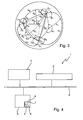
- Figure 1 shows as an example a central atom for which the solvent accessible surface and the derivative are to be determined.
- Figures 2 and 3 show several values required for determining the solvent accessible surface for the central atom according to an embodiment of the present invention. The following description refers to the exemplary arrangement of atoms as shown in figures 1 to 3 .
- Each atom of the exemplary arrangement is represented by its sphere B (for the central atom), B 1 , B 2 , and B 3 (for the relevant neighboring spheres) with radii ⁇ , ⁇ 1 , ⁇ 2 , and ⁇ 3 , respectively.
- the positions of the center of spheres B , B 1 , B 2 , B 3 are denoted by r , r 1 , r 2 , and r 3 , respectively.
- sphere B is intersected by neighboring spheres B 1 , B 2 , and B 3 . Depending on the position of the neighbouring atoms they may intersect intersect with the sphere of the central atom.
- intersection area on the surface of sphere B is bordered by an intersection line I 1 , I 2 , and I 3 , shown as dashed circles in figure 2 .
- To determine the solvent accessible surface of sphere B one must compute the area of each circle I 1 , I 2 , and I 3 on the sphere B and then substract the mutually overlapping areas of these circles.
- arcs a 1 , a 2 , a 3 of the intersecting circles I 1 , I 2 , and I 3 have to be determined, wherein arcs a1-a3 define the outer boundary of the connected region formed by the three circles I 1 , I 2 , and I 3 .
- This determination a complex operation, because the number and arrangement of the overlapping areas depend on the position, radii and number of the neighbouring spheres.
- the solvent accessible surface area of the atom B can be visualized as being the area on its surface that is not covered by the spheres of his neighbours.
- each set of overlapping intersection areas define a contour C m on the surface of a sphere B .
- Each contour C m defines an area on sphere B that can not be accessed by the solvent.
- the areas defined by each contour C m on its sphere B has to be substracted from the surface of sphere B .
- these intersection areas shape a connected area on the surface of sphere B, which is shown in figure 3 as the hatched area denoted as contour C 1 .
- each contour C m on the surface of sphere B is a boundary line that consists of one or more arcs a i resulting from the intersection with the intersecting spheres B i surrounding the neighbouring atoms.
- each arc a 1 , a 2 , a 3 is a section of an intersection line I 1 , I 2 , and I 3 .
- Each contour C m is therefore formed by n arcs, with n being any natural number greater than zero.
- n being any natural number greater than zero.
- the indices of arcs a i increase as one moves round counterclockwise the contour C m .
- each contour C m is determined and subtracted from the total surface area of sphere B.
- the following description shows how to determine the area contained within one contour, a procedure which can be repeated for each contour on the sphere.
- Figure 5 shows another view of sphere B and its intersecting spheres B 1 , B 2 , and B 3 .
- each atom i.e. each sphere B i
- each contour C l , C m may be formed by several intersecting spheres B i .
- the forces acting on atoms have to be determined very often during the simulation process.
- the forces are determined based on the derivatives dS dr i of the solvent accessible surface area S with respect to the position of the neighbouring atoms (i.e. the position r i of the center of intersecting spheres B i ) .
- e i is the unit vector in the direction to the i-th neighbour atom (i.e. in the direction from point r to point r i )
- This formula can be verified based on first considering the component of gradient dS dr i that is parallel to vector e i .
- T i the torque acting on any line on the sphere surface depends only on the end points of the line but not on its particular shape.
- T i can be described as the torque acting on a geodesic that connects the end points v i and v i +1 of arc a i .
- T i should be proportional to the vector v i+1 - v i (if i - n, the index ( i + 1 ) should be substituted by 1 ).
- the boundary consists of a single contour C m as illustrated in the drawings.
- the covered surface can be represented as the union of a central polygon with the vertices v 1 , v 2 , ..., v n and the caps truncated by the sides of this polygon.
- the area of the i -th truncated cap can be found as the area of the sector with the central angle ⁇ i (cf. eq. (1))
- a generalization for considering an arbitrary number of contours C l , C m can be achieved by summing up the contributions from the single contours C l , C m (given by eq. (16)) and then putting the resulting value to the interval (0, 4 ⁇ ) by subtracting 4 ⁇ the necessary number of times.
- Constructing the contour C m of arcs a i and identifying the vertices v i among all the other triple intersections of the atomic spheres, i.e. the intersecting spheres B i can be achieved by means of a modified Voronoi diagram for the set of spheres B i .
- the modification is performed in order to take into account that the spheres B i have different radii ⁇ i .
- the vertices v i are the intersections of the central sphere (i.e. sphere B) with the edges of the corresponding Voronoi cell.
- Figure 4 schematically shows an example of a system 1 that is adapted for executing the inventive method.
- System 1 comprises a main processor 2 that is connected with a memory element 3 via a bus-system 4, as is commonly known in the art.
- Memory element 3 can be any known memory, in particular a main memory
- bus-system 4 can be any known bus-system or any other device that enable communication of different system components.
- System 1 further comprises at least one special processor 5, e.g. a cell processor, a graphics processing unit (GPU), or a FPGA processor.
- Special processor 5 further comprises a memory element 6, having a first memory area 7 for storing data and a second memory area 8 for storing instructions.
- a computer program 9 is stored that comprises an implementation of the inventive method.
- computer program 9 comprises instructions that enable system 1 to execute the inventive method, if the instructions of computer program 9 are run on system 1, in particular on special processor 5.
- inventive method is not limited to be executed on a system similar to system 1. Even if the inventive method is executed on a system that e.g. only comprises a main memory 2, a significant reduction of the computing time will be achieved due to the reduced number of instructions and intermediate results of the inventive method, which in turn lead to a reduced number of inter-processor communications and/or processor-memory communications .
Landscapes
- Chemical & Material Sciences (AREA)
- Crystallography & Structural Chemistry (AREA)
- Life Sciences & Earth Sciences (AREA)
- Engineering & Computer Science (AREA)
- Bioinformatics & Cheminformatics (AREA)
- Bioinformatics & Computational Biology (AREA)
- Computing Systems (AREA)
- Theoretical Computer Science (AREA)
- Management, Administration, Business Operations System, And Electronic Commerce (AREA)
Abstract
Description
- The invention relates to a method for determining the solvent accessible surface area of a molecule with respect to atomic coordinates, wherein the molecule comprises a plurality of atoms, each atom is represented by a sphere having a radius and a center position, and the solvent accessible surface area of the molecule is determined depending on the sum of the solvent accessible surface areas of its atoms.
- The method also relates to a system for determining the derivatives of the solvent accessible surface area of a molecule with respect to atomic coordinates, wherein the molecule comprises a plurality of atoms, each atom is represented by a sphere having a radius and a center position, and the system comprises means for determining the derivatives of the solvent accessible surface area of atoms depending on the radius and center position of the spheres.
- The invention further relates to a processor in a system for performing a molecular dynamics simulation for a system of molecules comprised of atoms and to a computer program for the molecular dynamic simulations based on determining the solvent accessible surface area of atoms and its derivatives, wherein the computer program is executable on a processor in a system for performing a molecular dynamics simulation.
- In order to determine the positions, velocities, and energies of the particles, e.g. the atoms, in the simulations over a period of time, knowledge about the forces between the particles is required. For determining the energy and other thermodynamic properties of the system, the solvent accessible surface of each atom is required. For determining the forces acting on each atom, derivatives of the solvent accessible surface of each atom are required. Techniques known as molecular dynamics determine the positions, velocities and properties of the particles by simulating the physical process in a computer model and thus give insight into all properties of the system and the interaction of the molecules with high temporal and spatial resolution. Molecular dynamics is frequently used in the study of proteins and other biomolecules, as well as in materials science. Molecular dynamics is a technique to perform virtual experiments that increasingly replaces the need to perform costly experiments in the laboratory. Molecular dynamics simulations also permit the study of processes not readily observable with present day experimental techniques (because of the small size of the system, the speed of the process or both).
- One kind of molecules are proteins, which perform the vast majority of all biological processes in all cells of plants, animals or humans. The function of these biological macromolecules is regulated in a biological system by binding small molecules (ligands) to the proteins or by the interaction of proteins with other proteins or by the interaction of proteins with DNA. When the function of a certain protein is involved in a certain disease, it is possible to interfere with its function using artificial ligands, which are the most common mechanism of drugs in use today. Since the structure of many (>40.000) disease-relevant proteins is known, in-silico design of new drugs is possible by performing molecular dynamics simulations that simulate the process of binding of the small molecule to the protein in question. In order to influence the function of a protein, a drug has to bind better to the protein than the natural ligand. Currently, molecular dynamics is the most accurate method to determine the binding-strength of both the natural ligand and the proposed molecules.
- Furthermore, if a drug has known side effects, it is possible to link the drug molecules with the target molecules so that the drug works mostly in the affected cells, for instance, in a cell affected by cancer. Molecular dynamics can be used to determine how such drug-target complexes bind to the target protein of the drug and how the drugs enter the cell through the membrane.
- Molecular dynamics are also used in order to determine the function of a protein, aspects of its structure, the interaction between proteins, and the interaction of proteins and other molecules, such as DNA or man-made molecules emerging from research in the nano sciences.
- In the field of materials sciences, molecular dynamics are used to determine material properties, for example the structure and function of organic light emitting diodes, the efficiency of lithium-ion batteries, or the structure and function of nano materials, e.g. single atom transistor or carbon nanotube sorting.
- Summarized, molecular dynamics is a method to replace experiments in the laboratory in many fields of science and to permit analysis of the time-dependent behaviour of a molecular system. This knowledge is used to investigate the structure, dynamics, and thermodynamics of biological molecules, their complexes and systems relevant for materials research.
- In order to obtain accurate results in molecular dynamics simulations the system must be modelled in its experimentally relevant environment, which is particularly important for systems in solution. One possibility to perform such simulations is to include a large number of solvent molecules explicitly in the simulation, which is performed in a finite simulation volume. In order to avoid edge effects at surface of this volume, periodic boundary conditions are required in such simulations. In a simulation with periodic boundary conditions the system is mathematically replicated periodically in each space direction, such that the particle leaving the simulation volume at the left automatically re-enters it from the right. Periodic boundary conditions permit simulation of an infinite systems, which has no boundaries and therefore no edge effects.
- One widely alternative to this approach are implicit solvent models, which compute forces and properties of the molecular system excluding the solvent by introducing effective energy contributions/forces acting on the atoms of the system. The use of implicit solvent models significantly reduces the number of atoms that have to be simulated and thereby the number of instructions a processor must perform to simulate the system. Use of implicit solvent models also avoids the use of periodic boundary conditions, which simplifies significantly the computation of particular energy contributions, such as electrostatic interactions, which occur in almost all molecular systems.
- Performing molecular dynamics simulations has limitations in size and time scale due to the available computing resources. Therefore, molecular dynamics simulations of the required complexity cannot be executed on standard processors, because the processing power of such standard processors is too low. This led to the development of special processors and/or architectures in order to substitute or support standard (main-)processors while performing molecular dynamics simulations. Such special processors and/or architectures include the Cell processor (IBM/SONY), graphics processing units (GPUs) (ATI/NVIDIA), and FPGA (Field Programmable Gate Array) processors, which can be integrated into standard PC- type computers.
- Currently, state-of-the-art GPUs can perform over 500 billion arithmetic operations per second. According to recent advances in GPU hardware and software architecture, such processing units can now be utilized for general purpose computing and in particular for molecular dynamics simulations. Although these special processors and architectures are - at least theoretically - up to 1000 times faster than standard processors known from personal computers, this hypothetical gain cannot be realized in simulating molecular dynamics using periodic boundary conditions, because of technical reasons, e.g. the high number of inter-processor communications and the high number of processor-memory communications that are needed to evaluate certain mathematical expressions when using periodic boundary conditions.
- Such simulations can be performed much faster using special processors when using implicit solvent models. Most implicit solvent models require the computation of the solvent accessible surface and its derivatives for each atom of the molecule at each time-step of the simulation. Typical simulations performed today comprise 100-100.000.000 atoms for which forces must be computed in 106 - 1012 simulation steps, resulting in the need to compute up to 1020 derivatives of the solvent accessible surface area in one simulation. The determination of the derivatives of the solvent accessible surface area significantly contributes to the total computing complexity of the molecular dynamics simulation, because to date no exact expression for the computation of the derivatives of the solvent accessible surface area of the absence of those available. Using established approximate methods computation of the derivatives of the solvent accessible surface area and thus requires 10.000-100.000 computer operations for each atom and time-step (depending on the accuracy of the approximation). Use of approximate methods to compute the derivatives of the solvent accessible surface thus induces a high cost of the computation and reduces its accuracy, because the use of approximate methods results in errors in the computation of the forces and the computed properties of the system
- It is therefore an object of the present invention to provide an exact method and system for determining the derivatives of the solvent accessible surface area of a molecule that can be used e.g. in molecular dynamics simulations and enable to perform these simulations significantly faster and more accurate than currently known methods.
- The object is solved by the method with the features of
independent claim 1. The object is also solved by the system, the processor, and the computer program as defined by the other independent claims. - The present invention is based on the fact, that each molecule in a solvent comprises a plurality of atoms. Each atom of a molecule possibly contributes to the solvent accessible surface area of the molecule. The solvent accessible surface area of the molecule is determined as the sum of the solvent accessible surface areas of its atoms. The solvent accessible surface of an atom is defined as the fraction of an area of a sphere centered at the position of the atom which is not covered by spheres centered at the positions of the other atoms of the system. To compute the solvent accessible surface each atom is assigned a radius. The solvent accessible surface area of an atom, called center atom, is thus influenced by all other atoms, called neighbouring atoms, where the sum of the radii of center and neighbouring atoms is smaller than their distance. Thus, when determining the solvent accessible surface area of an atom and its derivatives, the part of the surface that is covered by other atoms has to be computed.
- Within the terminology of the present invention, each atom is considered as being a sphere having a radius and a center position, wherein the center position of the sphere corresponds to the center position of the atom. This sphere is assigned to the atom. For determining the derivatives of the solvent accessible surface area of the molecule with respect to the coordinates of the atoms, the derivatives of the solvent accessible surface area of each atom, i.e. each sphere, are determined. Therefore, for each sphere the intersecting sphere(s) - if any - is(are) determined, wherein each intersecting sphere has an intersection with the surface of the currently considered sphere, defined by the intersection line. The intersecting line thus defines an intersection area on the surface of the currently considered sphere that is not accessible to the solvent, since this area is covered by the intersecting sphere.
- If a sphere has more than one intersecting sphere, the intersection areas on the surface of this sphere induced by each intersecting sphere might overlap. This has to be taken into account when determining the solvent accessible surface area of an atom. Therefore, for each sphere the closed areas on its surface that are covered by one or more intersecting spheres are determined. The boundaries of these closed areas are denoted as "contours". Each contour is defined by the intersection line of at least one intersecting sphere. If the intersection areas of two or more intersection spheres overlap on the surface of the considered sphere, then the contour is defined a set of sections the intersection lines of these intersecting spheres. Each section of the intersection line that is generated by one neighbouring sphere, but not covered by an intersection with any other neighbouring sphere, is denoted as "arc".
- According to the present invention, for each sphere that has at least one intersecting sphere, at least one contour is determined, wherein the contour is the boundary of the area on the surface of said sphere that is formed
- (a) by the intersection line of the surface of said sphere with the surface of the intersecting sphere or
- (b) at least by sections of at least two intersecting spheres that have an overlapping area on the surface of said sphere.
- The solvent accessible surface area of this sphere is then determined as the surface of said sphere substracted by the area contained inside contours defined by neighbouring spheres on its surface.
- The present invention enables to determine exact results for the solvent accessible surface area of a molecule and its derivatives, whereas known methods only achieve approximate results. Moreover, the inventive method requires less intermediate data and can be implemented using only a small number of instructions. From this follows that the inventive method requires less memory space than known methods. Thus, if the inventive method is implemented and executed on a special processor or architecture that usually has only a small memory capacity and a small communication bandwidth for technical reasons, an improved performance of the special processor and/or architecture can be achieved. This is due to the fact that when executing the inventive method on a special processor, many thousand steps computations of the solvent accessible surface and its derivatives can be executed on the special processor without the need of communicating with peripheral devices, e.g. peripheral memories, or a main processor, since the instructions and the required data can be stored in the memory of the special processor and since the memory space needed for storing intermediate results is reduced.
- According to embodiment of the present invention, derivatives

- The derivative


wherein - S
- is the solvent accessible surface area of sphere B centered at the point r;
- ri
- is the center of sphere Bi , wherein sphere Bi is the i-th intersecting sphere of sphere B ;
- ρ
- is the radius of sphere B ;
- ρi
- is the radius of the intersecting sphere Bi ;
- bi =|r-ri|
- is the distance between center r of sphere B and center ri of sphere Bi.
- ei = (ri - r)/bi
- is the unit vector from center r of sphere B to the center ri of sphere Bi ; and
- vi
- is the endpoint of an arc ai , wherein arc ai is the part of the intersection line Ii that contributes to the contour Cm .
- If the formula given above is implemented on a processor, the derivative of the solvent accessible surface can be determined exactly. In addition, using the known method requires fewer and less memory instructions than formerly known methods. Thus, thousands of such computations can be performed on a special processor without the need for communicating with the main processor or with peripheral memories.
- This invention can be realized in the form of a computer program that can be run on one or more processors, in particular on a special processor and/or a special architecture, wherein the computer program is programmed to carry out the inventive method. Parts of the computer program may be run on different processors in order to carry out the inventive method. The invention is, thereby, realized by the computer program, wherein this computer program represents the invention in the same sense as the method for the execution of which the computer program is suitable. The computer program is preferably stored in a storage element, e.g. any optical or magnetic storage device. A storage element may, in particular, be a random-access-memory, a read-only-memory, a hard disk, or any portable memory device. When implemented in a computer program, the invention thus enables special processing units to perform molecular dynamics simulations more accurate and much faster than existing methods.
- Further aspects of the invention are shown in the figures and described in the accompanying description.
-
- Fig. 1
- is an exemplary graphic presentation of a first sphere representing a first atom and three neighbouring spheres representing three neighbouring atoms;
- fig. 2
- shows another view of the spheres shown in
figure 1 with labels indicating their radii; - fig. 3
- shows a more detailed view of the spheres shown in
figures 1 and 2 , including a graphic representation of several values that are used for determining the total area of the intersecting circles shown infigure 1 and 2 ; and - fig. 4
- shows an illustration of a system adapted for executing the inventive method.
- In implicit solvent models used in molecular dynamics simulations a molecule is represented a set of atoms which are modelled as partially overlapping spheres. The total solvent accessible surface of the molecule and its derivative are computed as the sum of the solvent accessible surface/derivatives of the individual atoms. Therefore, in the following description the determination of the solvent accessible surface is shown for one atom, which than has to be repeated for the other atoms. The determination of the solvent accessible surface area of several atoms can be performed in parallel.
-
Figure 1 shows as an example a central atom for which the solvent accessible surface and the derivative are to be determined.Figures 2 and3 show several values required for determining the solvent accessible surface for the central atom according to an embodiment of the present invention. The following description refers to the exemplary arrangement of atoms as shown infigures 1 to 3 . - Each atom of the exemplary arrangement is represented by its sphere B (for the central atom), B 1, B 2, and B 3 (for the relevant neighboring spheres) with radii ρ, ρ 1, ρ 2, and ρ 3, respectively. The positions of the center of spheres B, B 1 , B 2 , B 3 are denoted by r, r 1 , r 2 , and r 3 , respectively. In this example sphere B is intersected by neighboring spheres B 1, B 2, and B 3. Depending on the position of the neighbouring atoms they may intersect intersect with the sphere of the central atom. Each intersection area on the surface of sphere B is bordered by an intersection line I 1, I 2, and I 3, shown as dashed circles in
figure 2 . To determine the solvent accessible surface of sphere B one must compute the area of each circle I 1, I 2, and I 3 on the sphere B and then substract the mutually overlapping areas of these circles. In order to determine the solvent accessible area, arcs a 1, a 2 , a 3 of the intersecting circles I 1, I 2, and I 3 have to be determined, wherein arcs a1-a3 define the outer boundary of the connected region formed by the three circles I 1, I 2, and I 3 . - This determination a complex operation, because the number and arrangement of the overlapping areas depend on the position, radii and number of the neighbouring spheres.
- The solvent accessible surface area of the atom B can be visualized as being the area on its surface that is not covered by the spheres of his neighbours.
- Generally speaking, each set of overlapping intersection areas define a contour Cm on the surface of a sphere B. Each contour Cm defines an area on sphere B that can not be accessed by the solvent. Thus, when determining the solvent accessible surface area of an atom, the areas defined by each contour Cm on its sphere B has to be substracted from the surface of sphere B.
- In the example shown in
figures 1 and3 to 5 , the intersection areas on the surface of sphere B with the intersecting spheres B 1, B 2 , B 3 overlap with each other. Thus, these intersection areas shape a connected area on the surface of sphere B, which is shown infigure 3 as the hatched area denoted as contour C 1. The remaining areas on the surface of sphere B that are not comprised by any contour C 1, Cm form the solvent accessible surface area S of sphere B (shown as hatched area infigure 4 .) - Generally, each contour Cm on the surface of sphere B is a boundary line that consists of one or more arcs ai resulting from the intersection with the intersecting spheres Bi surrounding the neighbouring atoms. As can be seen from a combination of
figures 1 and3 , each arc a1 , a2, a3 is a section of an intersection line I 1 , I 2, and I 3 . - Each contour Cm is therefore formed by n arcs, with n being any natural number greater than zero. By convention, the indices of arcs ai increase as one moves round counterclockwise the contour Cm .
- In order to determine the solvent accessible surface of the atom associated with sphere B, the area within each contour Cm is determined and subtracted from the total surface area of sphere B. The following description shows how to determine the area contained within one contour, a procedure which can be repeated for each contour on the sphere.
- Figure 5 shows another view of sphere B and its intersecting spheres B 1, B 2, and B 3. Throughout the following description, only a single contour C l formed by arcs a1 , a2 , a3 is considered. However, each atom (i.e. each sphere Bi ) may contribute to several contours C l, Cm , and each contour C l, Cm may be formed by several intersecting spheres Bi.
- If the solvent accessible surface area is determined for simulating molecular dynamics, the forces acting on atoms have to be determined very often during the simulation process. In order to reduce the computing time, the forces are determined based on the derivatives

- According to the invention, the derivative
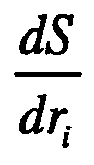

wherein ei is the unit vector in the direction to the i-th neighbour atom (i.e. in the direction from point r to point ri ) - This formula can be verified based on first considering the component of gradient


where θi ; is the angular radius of the cap as shown in figure 5. - θi can be obtained by the term

where bi is the distance between center points r and ri . - By an infinitesimal increment of bi , the fraction of the cap boundary contributing to the change of the covered area is equal to


- An infinitesimal displacement dri of sphere Bi in the direction perpendicular to ei can be treated as a rotation by an angle γi (not shown in the figures) about the central point r, such that

- If the surface tension of the selected atom is σ, then

where Ti is the corresponding torque. From the formulas above follows that
- The inventors have realized that the torque Ti acting on any line on the sphere surface depends only on the end points of the line but not on its particular shape. Thus, Ti can be described as the torque acting on a geodesic that connects the end points vi and v i+1 of arc ai . For symmetry reasons, Ti , should be proportional to the vector vi+1 - vi (if i - n, the index (i + 1) should be substituted by 1).
- When the geodesic is rotated about an axis parallel to this vector by the full angle 2π, the swept area is 4πρ 2|vi+1-vi|/2ρ. When the angle of rotation is dγi, the swept area changes by the factor of dγi /2. From this follows that:

- From the last two formulas above follows, that

- From a combination of formula (8) and formula (3) follows, that

- In the case that two different indices i and j correspond to the same intersecting sphere Bi , then this formula provides the additive contributions from arcs ai and aj . The generalization to the case when the boundary of the covered area consists of several contours C l, Cm is straightforward.
- If an intersecting sphere Bi gives rise to k arcs a1 ,..., ak possibly belonging to different contours C l, Cm , the total derivative is the sum of k terms, each of which is given by eq. (9) .
- Furthermore, the contribution from one contour Cm to the derivative


- In order to provide an elementary derivation for the accessible area S, it is assumed that the boundary consists of a single contour Cm as illustrated in the drawings. The covered surface can be represented as the union of a central polygon with the vertices v1 , v2, ..., vn and the caps truncated by the sides of this polygon. The polygon area S (polygon) is

- The area of the i-th truncated cap can be found as the area of the sector with the central angle ϕ i (cf. eq. (1))

plus (if ϕi > π) or minus (if ϕi < π) the area of the triangle with the vertices vi, vi+1 and the center of the i-th cap. For example, the area of the first triangle with ϕi > π(Fig. 5) is
- The area of the second triangle with ϕi < π is

- In both cases, the area of a truncated cap is given by

- Using eqs. (11) and (15), the formula for the accessible surface area is:

- A generalization for considering an arbitrary number of contours C l, Cm can be achieved by summing up the contributions from the single contours C l, Cm (given by eq. (16)) and then putting the resulting value to the interval (0, 4π) by subtracting 4π the necessary number of times.
- The angle (π-ψi ) can be found as the angle between vectors [e l-1× (vi - r)] ] and [e l × (vi - r)] :

(if i = 1, then i - 1 should be substituted by n). The angle ϕi, can be found as the angle between the vectors [vi -(r+eiρcosθi )] and [v i+1―(r+eiρcosθi )] :

- Constructing the contour Cm of arcs ai and identifying the vertices vi among all the other triple intersections of the atomic spheres, i.e. the intersecting spheres Bi , can be achieved by means of a modified Voronoi diagram for the set of spheres Bi . The modification is performed in order to take into account that the spheres Bi have different radii ρi . The vertices vi are the intersections of the central sphere (i.e. sphere B) with the edges of the corresponding Voronoi cell.
-
Figure 4 schematically shows an example of asystem 1 that is adapted for executing the inventive method. -
System 1 comprises amain processor 2 that is connected with amemory element 3 via a bus-system 4, as is commonly known in the art.Memory element 3 can be any known memory, in particular a main memory, and bus-system 4 can be any known bus-system or any other device that enable communication of different system components. -
System 1 further comprises at least onespecial processor 5, e.g. a cell processor, a graphics processing unit (GPU), or a FPGA processor.Special processor 5 further comprises amemory element 6, having afirst memory area 7 for storing data and asecond memory area 8 for storing instructions. In thesecond memory area 8, acomputer program 9 is stored that comprises an implementation of the inventive method. Thus,computer program 9 comprises instructions that enablesystem 1 to execute the inventive method, if the instructions ofcomputer program 9 are run onsystem 1, in particular onspecial processor 5. - However, the inventive method is not limited to be executed on a system similar to
system 1. Even if the inventive method is executed on a system that e.g. only comprises amain memory 2, a significant reduction of the computing time will be achieved due to the reduced number of instructions and intermediate results of the inventive method, which in turn lead to a reduced number of inter-processor communications and/or processor-memory communications .
Claims (9)
- Method for determining the solvent accessible surface area of a molecule (M) with respect to atomic coordinates, wherein- the molecule (M) comprises a plurality of atoms,- a sphere (Bi ) is assigned to each atom,- each sphere (Bi ) comprises a radius (ρi ) and a center position (ri ), and- the solvent accessible surface area of the molecule (M) is determined depending on the sum of the solvent accessible surface areas (Si) of its atoms,
characterized in that the method comprises
a step of determining for each sphere (B) all neighbouring spheres (Bi ) that intersect with the sphere (B) to define a set of one or more contours (Cm ), such that all intersecting circles of sphere B with spheres Bi intersect on the surface of sphere B and determining for each contour (Cm ) the area enclosed by this contour (Cm ), wherein contour (Cm ) comprises the area on the surface of said sphere (B) that is enclosed by one or more arcs (a1, a2, a3 ) resulting from an intersection of the surface of said sphere (B) with- the surface of one intersecting sphere (Bi ) or- the surfaces of a plurality of intersecting spheres (Bi ) that have an overlapping intersection area on the surface of said sphere (B);
and a step of determining the solvent accessible surface (S) of said sphere (B) as the surface of said sphere (B) substracted by the area comprised by all contours (Cm ) on the surface of said sphere (B). - Method according to claim 1, wherein a force acting on an atom is determined based on the derivative (

- Method according to claim 1 or 2, characterized in that the derivative (


whereinS is the solvent accessible surface area of said sphere (B);ri is the center of an intersecting sphere (Bi );ρ is the radius of said sphere (B);ρi is the radius of the intersecting sphere (Bi );bi =|r-ri | is the distance between the center (r) of said sphere (B) and the center (ri ) of the intersecting sphere (Bi ).ei =(ri -r)lbi is the unit vector from the center (r) of said sphere (B) to the center (ri ) of the intersecting sphere Bi ; andvi is the endpoint of an arc (ai ) , wherein arc (ai ) is the part of the intersection line (Ii ) that contributes to the contour (Cm ). - Method according to anyone of claims 1 to 3, characterized in that the solvent accessible surface area of the atom (S) is determined based on the following formula:

with
whereinψi is the exterior angle of the i-th arc (ai ) ;ϕi , is the central angle of the i-th arc (ai ); andθi , is the angular radius of a cap (capi ) of sphere (Bi ) that overlaps with said sphere ( B ) . - Method according to anyone of claims 1 to 4, characterized in that the determination of the endpoints (vi ) of arc (ai ) of each sphere (Bi ) is based on a modified Voronoi diagram, wherein the Voronoi diagram is modified for taking different radii of different intersecting spheres (Bi ) into account.
- System (1) for determining the derivatives of the solvent accessible surface area of a molecule (M), wherein the molecule (M) comprises a plurality of atoms, a sphere (B, Bi ) is assigned to each atom, the sphere (B, Bi ) comprises a radius ( ρ , ρ i ) and a center position (r, ri ), and wherein the system comprises means for determining the derivatives of the solvent accessible surface area of the molecule (M) depending on the sum of the derivatives of the solvent accessible surface areas (S) of its atoms, characterized in that the system further comprises means adapted for executing a method according to at least one of claims 1 to 5.
- Processor (2, 5) in a system (1) for performing a molecular dynamics simulation, characterized in that the processor (2, 5) comprises means for performing a method according to at least one of claims 1 to 5.
- Computer program (9) for determining the derivatives of the solvent accessible surface area of a molecule (M), wherein the computer program (9) is executable on a processor (2, 5) in a system (1) for performing a molecular dynamics simulation, characterized that the computer program (9) is programmed to execute a method according to at least one of claims 1 to 5, if the computer program (9) is executed on the processor (2, 5) .
- Computer program (9) according to claim 8, characterized in that the computer program (9) is stored on a memory element (3, 6), in particular on a magnetic or an optical medium.
Priority Applications (2)
| Application Number | Priority Date | Filing Date | Title |
|---|---|---|---|
| EP10002203.7A EP2363820B1 (en) | 2010-03-04 | 2010-03-04 | Method and system for determining the solvent accessible surface and its derivates of a molecule |
| US13/039,874 US8589137B2 (en) | 2010-03-04 | 2011-03-03 | Method and system for determining the solvent accessible surface area and its derivatives of a molecule |
Applications Claiming Priority (1)
| Application Number | Priority Date | Filing Date | Title |
|---|---|---|---|
| EP10002203.7A EP2363820B1 (en) | 2010-03-04 | 2010-03-04 | Method and system for determining the solvent accessible surface and its derivates of a molecule |
Publications (2)
| Publication Number | Publication Date |
|---|---|
| EP2363820A1 true EP2363820A1 (en) | 2011-09-07 |
| EP2363820B1 EP2363820B1 (en) | 2019-07-03 |
Family
ID=42486831
Family Applications (1)
| Application Number | Title | Priority Date | Filing Date |
|---|---|---|---|
| EP10002203.7A Active EP2363820B1 (en) | 2010-03-04 | 2010-03-04 | Method and system for determining the solvent accessible surface and its derivates of a molecule |
Country Status (2)
| Country | Link |
|---|---|
| US (1) | US8589137B2 (en) |
| EP (1) | EP2363820B1 (en) |
Families Citing this family (1)
| Publication number | Priority date | Publication date | Assignee | Title |
|---|---|---|---|---|
| US10060910B2 (en) | 2012-07-24 | 2018-08-28 | Enzo Life Sciences, Inc. | Multisignal reagents for labeling analytes |
Citations (1)
| Publication number | Priority date | Publication date | Assignee | Title |
|---|---|---|---|---|
| US20060121455A1 (en) * | 2003-04-14 | 2006-06-08 | California Institute Of Technology | COP protein design tool |
Family Cites Families (10)
| Publication number | Priority date | Publication date | Assignee | Title |
|---|---|---|---|---|
| US4772678A (en) * | 1983-09-15 | 1988-09-20 | Commtech International Management Corporation | Liquid crystalline polymer compositions, process, and products |
| DE4241150C1 (en) * | 1992-12-07 | 1994-06-01 | Fraunhofer Ges Forschung | Electrode membrane composite, process for its production and its use |
| DE10239701A1 (en) * | 2002-08-29 | 2004-03-11 | Celanese Ventures Gmbh | Production of polymer membrane, used in membrane electrode unit for fuel cell, uses phosphorus and/or sulfur oxy-acid in liquid for hydrolyzing membrane made by heating mixture of polyphosphoric acid and polyazole or precursors |
| KR100542203B1 (en) * | 2004-06-30 | 2006-01-10 | 삼성에스디아이 주식회사 | Binder composition for fuel cell, membrane-electrode assembly and method of manufacturing membrane-electrode assembly |
| KR100644856B1 (en) * | 2005-03-17 | 2006-11-24 | 한국과학기술연구원 | Fuel cell membrane and its manufacturing method |
| KR100754374B1 (en) * | 2006-02-07 | 2007-08-31 | 삼성에스디아이 주식회사 | Electrolyte Membrane Using Polybenzoxazine Compound and Its Manufacturing Method |
| KR100893523B1 (en) * | 2006-12-15 | 2009-04-17 | 삼성에스디아이 주식회사 | Fuel cell electrode, manufacturing method thereof and fuel cell employing the same |
| KR101366808B1 (en) * | 2007-10-11 | 2014-02-25 | 삼성전자주식회사 | Polybenzimidazole-base complex, crosslinked material of polybenzoxazines formed thereof, and fuel cell using the same |
| KR101537311B1 (en) * | 2007-11-02 | 2015-07-17 | 삼성전자주식회사 | Electrolyte membrane for fuel cell and fuel cell using the same |
| ATE543857T1 (en) * | 2008-12-16 | 2012-02-15 | Samsung Electronics Co Ltd | HYPERBRANCHED POLYMER, ELECTRODE FOR FUEL CELLS WITH THE HYPERBRANCHED POLYMER, ELECTROLYTE MEMBRANE FOR FUEL CELLS WITH THE HYPERBRANCHED POLYMER AND FUEL CELL WITH AT LEAST ONE ELECTRODE AND THE ELECTROLYTE MEMBRANE |
-
2010
- 2010-03-04 EP EP10002203.7A patent/EP2363820B1/en active Active
-
2011
- 2011-03-03 US US13/039,874 patent/US8589137B2/en not_active Expired - Fee Related
Patent Citations (1)
| Publication number | Priority date | Publication date | Assignee | Title |
|---|---|---|---|---|
| US20060121455A1 (en) * | 2003-04-14 | 2006-06-08 | California Institute Of Technology | COP protein design tool |
Non-Patent Citations (7)
| Title |
|---|
| DYNERMAN D ET AL: "CUSA and CUDE: GPU-accelerated methods for estimating solvent accessible surface area and desolvation.", JOURNAL OF COMPUTATIONAL BIOLOGY : A JOURNAL OF COMPUTATIONAL MOLECULAR CELL BIOLOGY APR 2009 LNKD- PUBMED:19361325, vol. 16, no. 4, April 2009 (2009-04-01), pages 523 - 537, XP002596867, ISSN: 1557-8666 * |
| FRACZKIEWCZ R ET AL: "Exact and efficient analytical calculation of the accessible surface areas and their gradients for macromolecules", JOURNAL OF COMPUTATIONAL CHEMISTRY WILEY USA, vol. 19, no. 3, February 1998 (1998-02-01), pages 319 - 333, XP002596868, ISSN: 0192-8651 * |
| GU Y ET AL: "FPGA-Based Multigrid Computation for Molecular Dynamics Simulations", FIELD-PROGRAMMABLE CUSTOM COMPUTING MACHINES, 2007. FCCM 2007. 15TH ANNUAL IEEE SYMPOSIUM ON, IEEE, PISCATAWAY, NJ, USA LNKD- DOI:10.1109/FCCM.2007.30, 1 April 2007 (2007-04-01), pages 117 - 126, XP031131444, ISBN: 978-0-7695-2940-0 * |
| JUBA D ET AL: "Parallel, stochastic measurement of molecular surface area", JOURNAL OF MOLECULAR GRAPHICS AND MODELLING, ELSEVIER SCIENCE, NEW YORK, NY, US LNKD- DOI:10.1016/J.JMGM.2008.03.001, vol. 27, no. 1, 1 August 2008 (2008-08-01), pages 82 - 87, XP023981487, ISSN: 1093-3263, [retrieved on 20080313] * |
| NARUMI T ET AL: "Overheads in Accelerating Molecular Dynamics Simulations with GPUs", PARALLEL AND DISTRIBUTED COMPUTING, APPLICATIONS AND TECHNOLOGIES, 2008. PDCAT 2008. NINTH INTERNATIONAL CONFERENCE ON, IEEE, PISCATAWAY, NJ, USA, 1 December 2008 (2008-12-01), pages 143 - 150, XP031373697, ISBN: 978-0-7695-3443-5 * |
| PERROT G ET AL: "MSEED: A PROGRAM FOR THE RAPID ANALYTICAL DETERMINATION OF ACCESSIBLE SURFACE AREAS AND THEIR DERIVATIVES", JOURNAL OF COMPUTATIONAL CHEMISTRY, JOHN WILEY AND SONS, CHICHESTER, GB LNKD- DOI:10.1002/JCC.540130102, vol. 13, no. 1, 1 November 1992 (1992-11-01), pages 1 - 11, XP000770074, ISSN: 0192-8651 * |
| SRIDHARAN S ET AL: "A rapid method for calculating derivatives of solvent accessible surface areas of molecules", JOURNAL OF COMPUTATIONAL CHEMISTRY USA, vol. 16, no. 8, August 1995 (1995-08-01), pages 1038 - 1044, XP002596869, ISSN: 0192-8651 * |
Also Published As
| Publication number | Publication date |
|---|---|
| US20110218788A1 (en) | 2011-09-08 |
| EP2363820B1 (en) | 2019-07-03 |
| US8589137B2 (en) | 2013-11-19 |
Similar Documents
| Publication | Publication Date | Title |
|---|---|---|
| Fan et al. | GPU cluster for high performance computing | |
| Jung et al. | New parallel computing algorithm of molecular dynamics for extremely huge scale biological systems | |
| Krone et al. | Visual analysis of biomolecular cavities: State of the art | |
| Manavski et al. | CUDA compatible GPU cards as efficient hardware accelerators for Smith-Waterman sequence alignment | |
| Schalkwijk et al. | High-performance simulations of turbulent clouds on a desktop PC: Exploiting the GPU | |
| D’Hollander | On the role of co-design in high performance computing | |
| Wang et al. | Perifast/corrosion: a 3d pseudospectral peridynamic matlab code for corrosion | |
| Anthopoulos et al. | GPU‐accelerated molecular mechanics computations | |
| Elvira et al. | The future of high energy physics software and computing | |
| Krone et al. | Parallel contour-buildup algorithm for the molecular surface | |
| Gallardo et al. | Two-dimensional compact third-order polynomial reconstructions. Solving nonconservative hyperbolic systems using GPUs | |
| EP2363820B1 (en) | Method and system for determining the solvent accessible surface and its derivates of a molecule | |
| US20030187594A1 (en) | Method for a geometrically accurate model of solute-solvent interactions using implicit solvent | |
| Odyurt et al. | Reduced simulations for high-energy physics, a middle ground for data-driven physics research | |
| Pechan et al. | Hardware accelerated molecular docking: A survey | |
| Alias et al. | High-performance computing and communication models for solving the complex interdisciplinary problems on DPCS | |
| Shkurti et al. | Acceleration of coarse grain molecular dynamics on GPU architectures | |
| Schepke et al. | Online mesh refinement for parallel atmospheric models | |
| Alawneh et al. | Ice simulation using GPGPU | |
| Medvedev et al. | Expanding the cellular automata topologies library for parallel implementation of synchronous cellular automata | |
| Takahashi et al. | World-highest resolution global atmospheric model and its performance on the Earth Simulator | |
| D'Agostino et al. | CUDA accelerated molecular surface generation | |
| Zapata et al. | A GPU parallel finite volume method for a 3D Poisson equation on arbitrary geometries | |
| Ravedutti Lucio Machado et al. | MD-Bench: a generic proxy-app toolbox for state-of-the-art molecular dynamics algorithms | |
| Monitzer | Combining lattice Boltzmann and discrete element methods on a graphics processor |
Legal Events
| Date | Code | Title | Description |
|---|---|---|---|
| PUAI | Public reference made under article 153(3) epc to a published international application that has entered the european phase |
Free format text: ORIGINAL CODE: 0009012 |
|
| AK | Designated contracting states |
Kind code of ref document: A1 Designated state(s): AT BE BG CH CY CZ DE DK EE ES FI FR GB GR HR HU IE IS IT LI LT LU LV MC MK MT NL NO PL PT RO SE SI SK SM TR |
|
| AX | Request for extension of the european patent |
Extension state: AL BA ME RS |
|
| 17P | Request for examination filed |
Effective date: 20111005 |
|
| 17Q | First examination report despatched |
Effective date: 20141021 |
|
| GRAP | Despatch of communication of intention to grant a patent |
Free format text: ORIGINAL CODE: EPIDOSNIGR1 |
|
| REG | Reference to a national code |
Ref country code: DE Ref legal event code: R079 Ref document number: 602010059781 Country of ref document: DE Free format text: PREVIOUS MAIN CLASS: G06F0019000000 Ipc: G16C0020300000 |
|
| STAA | Information on the status of an ep patent application or granted ep patent |
Free format text: STATUS: GRANT OF PATENT IS INTENDED |
|
| RIN1 | Information on inventor provided before grant (corrected) |
Inventor name: KLENIN, KONSTANTIN DR. Inventor name: WENZEL, WOLFGANG DR. Inventor name: PEREZ-SANCHEZ, HORACIO EMILIO DR. |
|
| INTG | Intention to grant announced |
Effective date: 20190115 |
|
| RIC1 | Information provided on ipc code assigned before grant |
Ipc: G16C 20/30 20190101AFI20190114BHEP |
|
| GRAS | Grant fee paid |
Free format text: ORIGINAL CODE: EPIDOSNIGR3 |
|
| GRAA | (expected) grant |
Free format text: ORIGINAL CODE: 0009210 |
|
| STAA | Information on the status of an ep patent application or granted ep patent |
Free format text: STATUS: THE PATENT HAS BEEN GRANTED |
|
| AK | Designated contracting states |
Kind code of ref document: B1 Designated state(s): AT BE BG CH CY CZ DE DK EE ES FI FR GB GR HR HU IE IS IT LI LT LU LV MC MK MT NL NO PL PT RO SE SI SK SM TR |
|
| REG | Reference to a national code |
Ref country code: GB Ref legal event code: FG4D |
|
| REG | Reference to a national code |
Ref country code: CH Ref legal event code: EP Ref country code: AT Ref legal event code: REF Ref document number: 1151954 Country of ref document: AT Kind code of ref document: T Effective date: 20190715 |
|
| REG | Reference to a national code |
Ref country code: IE Ref legal event code: FG4D |
|
| REG | Reference to a national code |
Ref country code: DE Ref legal event code: R096 Ref document number: 602010059781 Country of ref document: DE |
|
| REG | Reference to a national code |
Ref country code: NL Ref legal event code: MP Effective date: 20190703 |
|
| REG | Reference to a national code |
Ref country code: LT Ref legal event code: MG4D |
|
| REG | Reference to a national code |
Ref country code: AT Ref legal event code: MK05 Ref document number: 1151954 Country of ref document: AT Kind code of ref document: T Effective date: 20190703 |
|
| PG25 | Lapsed in a contracting state [announced via postgrant information from national office to epo] |
Ref country code: PT Free format text: LAPSE BECAUSE OF FAILURE TO SUBMIT A TRANSLATION OF THE DESCRIPTION OR TO PAY THE FEE WITHIN THE PRESCRIBED TIME-LIMIT Effective date: 20191104 Ref country code: AT Free format text: LAPSE BECAUSE OF FAILURE TO SUBMIT A TRANSLATION OF THE DESCRIPTION OR TO PAY THE FEE WITHIN THE PRESCRIBED TIME-LIMIT Effective date: 20190703 Ref country code: HR Free format text: LAPSE BECAUSE OF FAILURE TO SUBMIT A TRANSLATION OF THE DESCRIPTION OR TO PAY THE FEE WITHIN THE PRESCRIBED TIME-LIMIT Effective date: 20190703 Ref country code: SE Free format text: LAPSE BECAUSE OF FAILURE TO SUBMIT A TRANSLATION OF THE DESCRIPTION OR TO PAY THE FEE WITHIN THE PRESCRIBED TIME-LIMIT Effective date: 20190703 Ref country code: NO Free format text: LAPSE BECAUSE OF FAILURE TO SUBMIT A TRANSLATION OF THE DESCRIPTION OR TO PAY THE FEE WITHIN THE PRESCRIBED TIME-LIMIT Effective date: 20191003 Ref country code: FI Free format text: LAPSE BECAUSE OF FAILURE TO SUBMIT A TRANSLATION OF THE DESCRIPTION OR TO PAY THE FEE WITHIN THE PRESCRIBED TIME-LIMIT Effective date: 20190703 Ref country code: BG Free format text: LAPSE BECAUSE OF FAILURE TO SUBMIT A TRANSLATION OF THE DESCRIPTION OR TO PAY THE FEE WITHIN THE PRESCRIBED TIME-LIMIT Effective date: 20191003 Ref country code: CZ Free format text: LAPSE BECAUSE OF FAILURE TO SUBMIT A TRANSLATION OF THE DESCRIPTION OR TO PAY THE FEE WITHIN THE PRESCRIBED TIME-LIMIT Effective date: 20190703 Ref country code: NL Free format text: LAPSE BECAUSE OF FAILURE TO SUBMIT A TRANSLATION OF THE DESCRIPTION OR TO PAY THE FEE WITHIN THE PRESCRIBED TIME-LIMIT Effective date: 20190703 Ref country code: LT Free format text: LAPSE BECAUSE OF FAILURE TO SUBMIT A TRANSLATION OF THE DESCRIPTION OR TO PAY THE FEE WITHIN THE PRESCRIBED TIME-LIMIT Effective date: 20190703 |
|
| PG25 | Lapsed in a contracting state [announced via postgrant information from national office to epo] |
Ref country code: IS Free format text: LAPSE BECAUSE OF FAILURE TO SUBMIT A TRANSLATION OF THE DESCRIPTION OR TO PAY THE FEE WITHIN THE PRESCRIBED TIME-LIMIT Effective date: 20191103 Ref country code: GR Free format text: LAPSE BECAUSE OF FAILURE TO SUBMIT A TRANSLATION OF THE DESCRIPTION OR TO PAY THE FEE WITHIN THE PRESCRIBED TIME-LIMIT Effective date: 20191004 Ref country code: LV Free format text: LAPSE BECAUSE OF FAILURE TO SUBMIT A TRANSLATION OF THE DESCRIPTION OR TO PAY THE FEE WITHIN THE PRESCRIBED TIME-LIMIT Effective date: 20190703 Ref country code: ES Free format text: LAPSE BECAUSE OF FAILURE TO SUBMIT A TRANSLATION OF THE DESCRIPTION OR TO PAY THE FEE WITHIN THE PRESCRIBED TIME-LIMIT Effective date: 20190703 |
|
| PG25 | Lapsed in a contracting state [announced via postgrant information from national office to epo] |
Ref country code: TR Free format text: LAPSE BECAUSE OF FAILURE TO SUBMIT A TRANSLATION OF THE DESCRIPTION OR TO PAY THE FEE WITHIN THE PRESCRIBED TIME-LIMIT Effective date: 20190703 |
|
| PG25 | Lapsed in a contracting state [announced via postgrant information from national office to epo] |
Ref country code: DK Free format text: LAPSE BECAUSE OF FAILURE TO SUBMIT A TRANSLATION OF THE DESCRIPTION OR TO PAY THE FEE WITHIN THE PRESCRIBED TIME-LIMIT Effective date: 20190703 Ref country code: PL Free format text: LAPSE BECAUSE OF FAILURE TO SUBMIT A TRANSLATION OF THE DESCRIPTION OR TO PAY THE FEE WITHIN THE PRESCRIBED TIME-LIMIT Effective date: 20190703 Ref country code: RO Free format text: LAPSE BECAUSE OF FAILURE TO SUBMIT A TRANSLATION OF THE DESCRIPTION OR TO PAY THE FEE WITHIN THE PRESCRIBED TIME-LIMIT Effective date: 20190703 Ref country code: IT Free format text: LAPSE BECAUSE OF FAILURE TO SUBMIT A TRANSLATION OF THE DESCRIPTION OR TO PAY THE FEE WITHIN THE PRESCRIBED TIME-LIMIT Effective date: 20190703 Ref country code: EE Free format text: LAPSE BECAUSE OF FAILURE TO SUBMIT A TRANSLATION OF THE DESCRIPTION OR TO PAY THE FEE WITHIN THE PRESCRIBED TIME-LIMIT Effective date: 20190703 |
|
| PG25 | Lapsed in a contracting state [announced via postgrant information from national office to epo] |
Ref country code: SM Free format text: LAPSE BECAUSE OF FAILURE TO SUBMIT A TRANSLATION OF THE DESCRIPTION OR TO PAY THE FEE WITHIN THE PRESCRIBED TIME-LIMIT Effective date: 20190703 Ref country code: IS Free format text: LAPSE BECAUSE OF FAILURE TO SUBMIT A TRANSLATION OF THE DESCRIPTION OR TO PAY THE FEE WITHIN THE PRESCRIBED TIME-LIMIT Effective date: 20200224 Ref country code: SK Free format text: LAPSE BECAUSE OF FAILURE TO SUBMIT A TRANSLATION OF THE DESCRIPTION OR TO PAY THE FEE WITHIN THE PRESCRIBED TIME-LIMIT Effective date: 20190703 |
|
| REG | Reference to a national code |
Ref country code: DE Ref legal event code: R097 Ref document number: 602010059781 Country of ref document: DE |
|
| PLBE | No opposition filed within time limit |
Free format text: ORIGINAL CODE: 0009261 |
|
| STAA | Information on the status of an ep patent application or granted ep patent |
Free format text: STATUS: NO OPPOSITION FILED WITHIN TIME LIMIT |
|
| PG2D | Information on lapse in contracting state deleted |
Ref country code: IS |
|
| 26N | No opposition filed |
Effective date: 20200603 |
|
| PG25 | Lapsed in a contracting state [announced via postgrant information from national office to epo] |
Ref country code: SI Free format text: LAPSE BECAUSE OF FAILURE TO SUBMIT A TRANSLATION OF THE DESCRIPTION OR TO PAY THE FEE WITHIN THE PRESCRIBED TIME-LIMIT Effective date: 20190703 |
|
| PG25 | Lapsed in a contracting state [announced via postgrant information from national office to epo] |
Ref country code: MC Free format text: LAPSE BECAUSE OF FAILURE TO SUBMIT A TRANSLATION OF THE DESCRIPTION OR TO PAY THE FEE WITHIN THE PRESCRIBED TIME-LIMIT Effective date: 20190703 |
|
| REG | Reference to a national code |
Ref country code: CH Ref legal event code: PL |
|
| REG | Reference to a national code |
Ref country code: BE Ref legal event code: MM Effective date: 20200331 |
|
| PG25 | Lapsed in a contracting state [announced via postgrant information from national office to epo] |
Ref country code: LU Free format text: LAPSE BECAUSE OF NON-PAYMENT OF DUE FEES Effective date: 20200304 |
|
| PG25 | Lapsed in a contracting state [announced via postgrant information from national office to epo] |
Ref country code: IE Free format text: LAPSE BECAUSE OF NON-PAYMENT OF DUE FEES Effective date: 20200304 Ref country code: FR Free format text: LAPSE BECAUSE OF NON-PAYMENT OF DUE FEES Effective date: 20200331 Ref country code: LI Free format text: LAPSE BECAUSE OF NON-PAYMENT OF DUE FEES Effective date: 20200331 Ref country code: CH Free format text: LAPSE BECAUSE OF NON-PAYMENT OF DUE FEES Effective date: 20200331 |
|
| PG25 | Lapsed in a contracting state [announced via postgrant information from national office to epo] |
Ref country code: BE Free format text: LAPSE BECAUSE OF NON-PAYMENT OF DUE FEES Effective date: 20200331 |
|
| GBPC | Gb: european patent ceased through non-payment of renewal fee |
Effective date: 20200304 |
|
| PG25 | Lapsed in a contracting state [announced via postgrant information from national office to epo] |
Ref country code: GB Free format text: LAPSE BECAUSE OF NON-PAYMENT OF DUE FEES Effective date: 20200304 |
|
| PGFP | Annual fee paid to national office [announced via postgrant information from national office to epo] |
Ref country code: DE Payment date: 20220322 Year of fee payment: 13 |
|
| PG25 | Lapsed in a contracting state [announced via postgrant information from national office to epo] |
Ref country code: MT Free format text: LAPSE BECAUSE OF FAILURE TO SUBMIT A TRANSLATION OF THE DESCRIPTION OR TO PAY THE FEE WITHIN THE PRESCRIBED TIME-LIMIT Effective date: 20190703 Ref country code: CY Free format text: LAPSE BECAUSE OF FAILURE TO SUBMIT A TRANSLATION OF THE DESCRIPTION OR TO PAY THE FEE WITHIN THE PRESCRIBED TIME-LIMIT Effective date: 20190703 |
|
| PG25 | Lapsed in a contracting state [announced via postgrant information from national office to epo] |
Ref country code: MK Free format text: LAPSE BECAUSE OF FAILURE TO SUBMIT A TRANSLATION OF THE DESCRIPTION OR TO PAY THE FEE WITHIN THE PRESCRIBED TIME-LIMIT Effective date: 20190703 |
|
| REG | Reference to a national code |
Ref country code: DE Ref legal event code: R119 Ref document number: 602010059781 Country of ref document: DE |
|
| PG25 | Lapsed in a contracting state [announced via postgrant information from national office to epo] |
Ref country code: DE Free format text: LAPSE BECAUSE OF NON-PAYMENT OF DUE FEES Effective date: 20231003 |