EP2360882A1 - Process for suppressing intercarrier interference in a OFDM receiver - Google Patents
Process for suppressing intercarrier interference in a OFDM receiver Download PDFInfo
- Publication number
- EP2360882A1 EP2360882A1 EP10368013A EP10368013A EP2360882A1 EP 2360882 A1 EP2360882 A1 EP 2360882A1 EP 10368013 A EP10368013 A EP 10368013A EP 10368013 A EP10368013 A EP 10368013A EP 2360882 A1 EP2360882 A1 EP 2360882A1
- Authority
- EP
- European Patent Office
- Prior art keywords
- matrix
- computing
- ofdm
- channel
- received signal
- Prior art date
- Legal status (The legal status is an assumption and is not a legal conclusion. Google has not performed a legal analysis and makes no representation as to the accuracy of the status listed.)
- Granted
Links
- 238000000034 method Methods 0.000 title claims abstract description 62
- 230000008569 process Effects 0.000 title claims abstract description 35
- 239000011159 matrix material Substances 0.000 claims abstract description 73
- 239000013598 vector Substances 0.000 claims abstract description 16
- 238000004891 communication Methods 0.000 claims description 8
- 230000007774 longterm Effects 0.000 claims description 3
- 230000007246 mechanism Effects 0.000 claims description 3
- 239000000969 carrier Substances 0.000 description 6
- 238000013459 approach Methods 0.000 description 4
- 238000010586 diagram Methods 0.000 description 4
- 238000001914 filtration Methods 0.000 description 4
- 230000000694 effects Effects 0.000 description 3
- 238000012545 processing Methods 0.000 description 3
- 230000004044 response Effects 0.000 description 3
- 230000008901 benefit Effects 0.000 description 2
- 230000001143 conditioned effect Effects 0.000 description 2
- 238000001514 detection method Methods 0.000 description 2
- 238000011161 development Methods 0.000 description 2
- 230000008030 elimination Effects 0.000 description 2
- 238000003379 elimination reaction Methods 0.000 description 2
- 238000005562 fading Methods 0.000 description 2
- 238000004088 simulation Methods 0.000 description 2
- 230000003595 spectral effect Effects 0.000 description 2
- 238000000342 Monte Carlo simulation Methods 0.000 description 1
- 239000000654 additive Substances 0.000 description 1
- 230000000996 additive effect Effects 0.000 description 1
- 230000005540 biological transmission Effects 0.000 description 1
- 230000001413 cellular effect Effects 0.000 description 1
- 238000005094 computer simulation Methods 0.000 description 1
- 238000002939 conjugate gradient method Methods 0.000 description 1
- 125000004122 cyclic group Chemical group 0.000 description 1
- 230000007423 decrease Effects 0.000 description 1
- 230000003247 decreasing effect Effects 0.000 description 1
- 238000013461 design Methods 0.000 description 1
- 238000005315 distribution function Methods 0.000 description 1
- 230000001771 impaired effect Effects 0.000 description 1
- 238000004519 manufacturing process Methods 0.000 description 1
- 238000013507 mapping Methods 0.000 description 1
- 230000000116 mitigating effect Effects 0.000 description 1
- 230000000630 rising effect Effects 0.000 description 1
- 238000001228 spectrum Methods 0.000 description 1
- 238000012546 transfer Methods 0.000 description 1
Images



Classifications
-
- H—ELECTRICITY
- H04—ELECTRIC COMMUNICATION TECHNIQUE
- H04L—TRANSMISSION OF DIGITAL INFORMATION, e.g. TELEGRAPHIC COMMUNICATION
- H04L25/00—Baseband systems
- H04L25/02—Details ; arrangements for supplying electrical power along data transmission lines
- H04L25/03—Shaping networks in transmitter or receiver, e.g. adaptive shaping networks
- H04L25/03006—Arrangements for removing intersymbol interference
- H04L25/03159—Arrangements for removing intersymbol interference operating in the frequency domain
-
- H—ELECTRICITY
- H04—ELECTRIC COMMUNICATION TECHNIQUE
- H04L—TRANSMISSION OF DIGITAL INFORMATION, e.g. TELEGRAPHIC COMMUNICATION
- H04L27/00—Modulated-carrier systems
- H04L27/26—Systems using multi-frequency codes
- H04L27/2601—Multicarrier modulation systems
- H04L27/2647—Arrangements specific to the receiver only
- H04L27/2655—Synchronisation arrangements
- H04L27/2689—Link with other circuits, i.e. special connections between synchronisation arrangements and other circuits for achieving synchronisation
- H04L27/2691—Link with other circuits, i.e. special connections between synchronisation arrangements and other circuits for achieving synchronisation involving interference determination or cancellation
-
- H—ELECTRICITY
- H04—ELECTRIC COMMUNICATION TECHNIQUE
- H04L—TRANSMISSION OF DIGITAL INFORMATION, e.g. TELEGRAPHIC COMMUNICATION
- H04L25/00—Baseband systems
- H04L25/02—Details ; arrangements for supplying electrical power along data transmission lines
- H04L25/03—Shaping networks in transmitter or receiver, e.g. adaptive shaping networks
- H04L25/03006—Arrangements for removing intersymbol interference
- H04L2025/0335—Arrangements for removing intersymbol interference characterised by the type of transmission
- H04L2025/03375—Passband transmission
- H04L2025/03414—Multicarrier
Definitions
- the invention relates to the field of wireless digital communications and more particularly to a process for suppressing intercarrier interference in an OFDM communication system.
- Digital wireless communications are being widely used throughout the world particularly with the latest development of the Orthogonal Frequency Division Multiplex (OFDM systems) and the latest evolution, namely the so-called Long Term Evolution (LTE), DVB-H, WiFi 802.11 and WiMax 802.16 systems.
- OFDM Orthogonal Frequency Division Multiplex
- LTE Long Term Evolution
- DVB-H DVB-H
- WiFi 802.11 WiMax 802.16 systems.
- OFDM is a frequency-division multiplexing (FDM) scheme utilized as a digital multicarrier modulation method.
- FDM frequency-division multiplexing
- OFDM systems demonstrate significant advantages in comparison to single-carrier schemes, particularly in their ability to cope with severe channel conditions (i.e. channel attenuation, narrowband interference, frequency-selective fading).
- OFDM systems performances are significantly impaired by the rising of inter-carrier interference (ICI) effect in the presence of time-varying propagation channels.
- ICI inter-carrier interference
- the movement of a User Equipment (UE) in high velocity results to high Doppler spread and accordingly to fast time-varying propagation channels.
- the resulting fast time-varying propagation channels yield to significant ICI.
- the increased ICI prevents classical OFDM receiver schemes, and particularly the so-called matched filter model - from reliably detecting the desired signal.
- more advanced receiver equalization techniques are required to mitigate the effect of the ICI.
- NxN the OFDM Fast Fourier Transform
- O(N 3 ) the high complexity of achieving such an inversion cannot be supported by a practical mobile receiver.
- a fast converging algorithm saves the battery life of the receiver (in the case of a mobile receiver) and, secondly, a fast convergence algorithm allows to comply more easily to the requirements given by the standards.
- iterative techniques can greatly take advantage from appropriate preconditioning to reduce the CN and to allow faster convergence.
- the Jacobi preconditioning consists in approximately solving the problem of inverting matrix A and transform the original problem into a better conditioned one.
- Jacobi preconditioning significantly reduces the complexity and time required for achieving full matrix A inversion, there is still a need for more advanced preconditioning techniques for achieving the same.
- UE User Equipment
- the conjugate gradient mechanism involves the steps of:
- the preconditioning can be used with other algorithm such as a geometric memorized by Monte Carlo simulation.
- the preconditioning can be used with other algorithm such as a geometric memorized by Monte Carlo simulation.
- the process is used in a receiver for a Long Term Evolution (LTE) system, and more particularly in a mobile telephone.
- LTE Long Term Evolution
- the invention also achieves a receiver for an OFDM communication network comprising means for canceling Intercarrier Interference in a OFDM receiver receiving OFDM blocks in presence of Doppler, further comprising:
- the invention achieves a mobile telephone for a OFDM communication system, having an improve ICI cancellation mechanism.
- H [k] represents the NxN time domain channel convolution matrix
- T comprises the /-th channel tap time-varying values
- v l [ v l ,0 ... v l,P -1 ] T the stochastic coefficients describing the /-th channel tap behavior for the given OFDM block on the P basis functions.
- Figure 1 depicts the model of the OFDM received signal in the channel BEM representation.
- preconditioning can be applied to iterative techniques in order to reduce the CN and to allow faster convergence in order to, firstly, increases the life of the battery of the mobile receiver and, secondly to comply with the time requirement for processing the signal.
- Preconditioning has proven to be useful (see [6] for instance) for improving the ZF iterative ICI cancellation problem.
- ZF Zero Forcing
- f n T E s n ⁇ y ⁇ n H ⁇ R y ⁇ n ⁇ y ⁇ n - 1
- R y ⁇ n ⁇ y ⁇ n E y ⁇ n ⁇ y ⁇ n H
- the computation of the MMSE filtering coefficients can exploit the coherence across sub-carriers and be made by applying a recursive method.
- a sufficiently precise approximation of the inverse of the matrix R y n y n i.e.
- the matrix resulting from the product of GU can therefore be seen as an improved BEM-MMSE pre-conditioner.
- the complexity associated to the filtering operation is proportional to P(N + N log 2 N ).
- This novel approach can be used for achieving a stationary polynomial iterative receiver whose performance are considerably improved, but yet of affordable complexity as the original method.
- a banded preconditioning computed with similar development as for BEM-MMSE can be derived for a Preconditioned CG iterative receiver [1], whose algorithm is presented in figure 3 .
- f n T 1 n ⁇ H H ⁇ H ⁇ S n T ⁇ S n ⁇ H H ⁇ HH H + ⁇ z 2 ⁇ I ⁇ H ⁇ S n T - 1 and for an given choice of the selection matrix Sn and filter length L FIR .
- the appropriate selection Sn is based on the selection of the n subcarrier and two subcarriers, respectively above and below the considered subcarrier.
- four subcarriers may be selected.
- the more subcarriers - and thus selections - the more effective will be the ICI cancellation, but at the cost of higher level of DSP resources.
- a step 11 the process proceeds with the reception of a OFDM block comprising N samples.
- the signal received from the antenna is H F H S with s being the transmitted frequency domain sequence, F H being the inverse Fourier Transform applied in the transmitter and H being the propagation channel.
- a step 12 the process proceeds with the application of a FFT for the purpose of generating N frequency domain representations composing the received signal (R).
- step 13 the process proceeds with the multiplication of said received signal ( R ) by the hermitian value of the channel (H H ), with H being the channel estimate.
- matrix G ⁇ . is a NxN matrix
- the latter is particularly sparce because of the use of the selection matrix S n . This strongly reduces the complexity of the algorithm and thus limits the need of the digital signal processing in the receiver.
- ⁇ k r k H ⁇ z k d k H ⁇ H H ⁇ H + ⁇ z 2 ⁇ I ⁇ d k
- r k H Z k corresponds to a innerproduct of the components of the two vectors r k and Z k
- s k + 1 s k + ⁇ k ⁇ d k
- r k + 1 r k - ⁇ k ⁇ H H ⁇ H + ⁇ z 2 ⁇ I ⁇ d k
- ⁇ k r k + 1 H ⁇ z k + 1 r k T ⁇ z k
- the process then completes the current FOR loop and loops back to step 22 again in order to process a new loop.
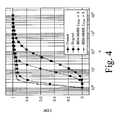
- Figure 4 illustrates the condition number (CN) for diagonal and BEM-MMSE preconditioning
- the performances are measured in terms of bit-error-rate of uncoded QPSK modulated transmitted sequences.
- the SNR is defined as the ratio 1 / ⁇ z 2 .
- N-P-BEM Non Stationary BEM-MMSE Preconditioned iterative ICI cancellation technique
- P-CG Preconditioned CG
- S-P-BEM Stationary BEM-MMSE preconditioning
Landscapes
- Engineering & Computer Science (AREA)
- Computer Networks & Wireless Communication (AREA)
- Signal Processing (AREA)
- Power Engineering (AREA)
- Noise Elimination (AREA)
Abstract
- receiving a OFDM block comprising N samples;
- applying a FFT for the purpose of generating N frequency domain representations composing the received signal (R);
- multiplying said received signal (R) by the hermitian value of the channel (HH), with H being the channel estimate;
- applying on said received signal a preconditioned conjugate gradient algorithm based on a NxN P preconditioner matrix ;
Characterized in that said preconditionner matrix is computed at follows:

and
S n is a L FIR x PN selection matrix obtained by extracting a predetermined number (L FIR) of rows from the identity matrix I PN;
H is equal to HF H, with H being the frequency-domain channel matrix and F being the N x N discrete-Fourier transform unitary matrix F ;
I is the NxN identity matrix ;
σ is the varience of the noise ;
1 n is being the 1 x N vector containing 1 in n-th position and 0 elsewhere
Description
- The invention relates to the field of wireless digital communications and more particularly to a process for suppressing intercarrier interference in an OFDM communication system.
- Digital wireless communications are being widely used throughout the world particularly with the latest development of the Orthogonal Frequency Division Multiplex (OFDM systems) and the latest evolution, namely the so-called Long Term Evolution (LTE), DVB-H, WiFi 802.11 and WiMax 802.16 systems.
- OFDM is a frequency-division multiplexing (FDM) scheme utilized as a digital multicarrier modulation method. As it is well - known to one skilled in the art, OFDM systems demonstrate significant advantages in comparison to single-carrier schemes, particularly in their ability to cope with severe channel conditions (i.e. channel attenuation, narrowband interference, frequency-selective fading).
- However, OFDM systems performances are significantly impaired by the rising of inter-carrier interference (ICI) effect in the presence of time-varying propagation channels. Those circumstances occur in mobile cellular OFDM communication systems as those envisaged in the above mentioned standards.
- More specifically, the movement of a User Equipment (UE) in high velocity results to high Doppler spread and accordingly to fast time-varying propagation channels. In turn, the resulting fast time-varying propagation channels yield to significant ICI. In practice, the increased ICI prevents classical OFDM receiver schemes, and particularly the so-called matched filter model - from reliably detecting the desired signal. Hence more advanced receiver equalization techniques are required to mitigate the effect of the ICI.
- A known solution for reducing the ICI is based on the performance of a full matrix (NxN) inversion where N represents the OFDM Fast Fourier Transform (FFT) order by Gaussian Elimination. However, the high complexity (O(N3)) of achieving such an inversion cannot be supported by a practical mobile receiver.
- To solve the problem of high complexity iterative techniques have been widely used in the art in order to avoid a full matrix inversion. These techniques are based in solving linear systems of equations [1]. Considering a generic linear system of equations of the form
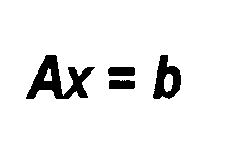
where the vector x is the sequence to be estimated, b is the observation vector, and the matrix A (NxN) is a full-rank input-output transfer matrix, then for any iterative estimation method, the convergence of the sequence estimates x̂ (k)→ x governed by the spectral properties of the matrix A. A commonly used metric for those spectral properties is the condition-number κ(A) , defined as the ratio between the largest and smallest eigen-values of A, κ (A) = |λmax(A)/λmin(A)| (see reference [1]). Specifically, the closer condition number (CN) is to 1, the faster a given iterative algorithm will converge. - Clearly, the convergence of an algorithm has a significant impact on the performance of the receiver since, firstly, a fast converging algorithm saves the battery life of the receiver (in the case of a mobile receiver) and, secondly, a fast convergence algorithm allows to comply more easily to the requirements given by the standards.
- Furthermore, iterative techniques can greatly take advantage from appropriate preconditioning to reduce the CN and to allow faster convergence. Specifically, the iterative methods are applied in an equivalent preconditioned linear system derived from the above mentioned linear system of equations into

with P being the preconditioning matrix and such that κ (A) ≧κ(PA) ≧ 1 with PA = 1 if P -1 = A. - In prior art there are many preconditioning techniques [1]. Among those, a simple and straightforward technique is the Jacobi preconditioning. Specifically, in Jacobi preconditioning, P is chosen to be diagonal and such that diag{ P -1 } = diag{ A } if [A]ii≠0 for i=1, .., N.
- The Jacobi preconditioning consists in approximately solving the problem of inverting matrix A and transform the original problem into a better conditioned one.
- Although Jacobi preconditioning significantly reduces the complexity and time required for achieving full matrix A inversion, there is still a need for more advanced preconditioning techniques for achieving the same.
- It is an object of the present invention to provide an efficient process for reducing the complexity and time required for inverting a full matrix in case of ICI mitigation.
- It is another object of the present invention to provide an efficient process for decreasing the ICI in the presence of Doppler effect in an OFDM channel.
- It is another object of the present invention to provide an efficient process which assists in increasing the lifetime of the battery of a User Equipment (UE) and decreases the manufacturing cost of the latter.
- Those and other objects are achieved by means of the ICI cancellation process which comprises the following steps:
- receiving a OFDM block comprising N samples;
- applying a FFT for the purpose of generating N frequency domain representations composing the received signal (R);
- multiplying said received signal (R) by the hermitian value of the channel (HH), with H being the channel estimate;
- applying on said received signal a preconditioned conjugate gradient algorithm based on a NxN P preconditioner matrix ;
- The process is characterized in that the preconditioning matrix is computed in accordance with the formula below:

- And

- Where
- S n is a L FIR x PN selection matrix obtained by extracting a predetermined number (L FIR) of rows from the identity matrix I PN;
- H is equal to HF H, with H being the frequency-domain channel matrix and F being the N x N discrete-Fourier transform unitary matrix F;
- I is the NxN identity matrix ;
- σ is the varience of the noise ;
- 1 n is being the 1 x N vector containing 1 in n-th position and 0 elsewhere
- In one embodiment, the conjugate gradient mechanism involves the steps of:
- initializing parameters:


- starting a FOR loop ;
- computing:

- computing:

- computing:

- computing:

- computing:

- computing:

- then looping back to perform a new FOR loop.
- Alternatively, the preconditioning can be used with other algorithm such as a geometric serie and even the Mean Square Error algorithm
- Preferably, the process is used in a receiver for a Long Term Evolution (LTE) system, and more particularly in a mobile telephone.
- The invention also achieves a receiver for an OFDM communication network comprising means for canceling Intercarrier Interference in a OFDM receiver receiving OFDM blocks in presence of Doppler, further comprising:
- means for receiving a OFDM block comprising N samples;
- means for applying a FFT for the purpose of generating N frequency domain representations composing the received signal (R);
- means for multiplying said received signal (R) by the hermitian value of the channel (HH), with H being the channel estimate;
- means for applying on said received signal a preconditioned conjugate gradient algorithm based on a NxN P preconditioner matrix.
- The receiver is characterized in that said preconditioning matrix is computed at follows:
- preconditioning matrix is computed in accordance with the formula below:

- And

- At last the invention achieves a mobile telephone for a OFDM communication system, having an improve ICI cancellation mechanism.
- Other features of one or more embodiments of the invention will best understood by reference to the following detailed description when read in conjunction with the accompanying drawings.
-
Figure 1 illustrates a BEM representation of the OFDM received signal -
Figure 2 illustrates one embodiment of the process of the invention. -
Figure 3 illustrates one embodiment of the conjugate gradient process. -
Figure 4 illustrates the condition number (CN) for diagonal and BEM-MMSE preconditioning -
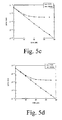
Figure 5a is a diagram illustrating the comparison of the performance of the receiver with 1 iterations and LFIR = 5. -
Figure 5b is a diagram illustrating the comparison of the performance of the receiver with 3 iterations and LFIR = 5. -
Figure 5c is a diagram illustrating the comparison of the performance of the receiver with 1 iterations and LFIR = 3. -
Figure 5d is a diagram illustrating the comparison of the performance of the receiver with 3 iterations and LFIR = 3. - Preliminary to the description of one particular practical embodiment of a preconditioning process, some more theoretical considerations need to be discussed in the following.
- One considers the transmission over a time-varying, frequency-selective fading channel with continuous-time impulse response

assumed to obey the wide sense stationary uncorrelated scattering (WSSUS) model [2], where Ψ(τ) represents the equivalent transmit-receiver front-end low-pass filter, τm represents the p-th path delay, αm (t) is the time-varying complex channel coefficient associated with the m-th path of the propagation channel respectively. One shall refer to h[k,l]as the corresponding low-pass sampled discrete-time impulse response, and assume h[k,l]to be well-approximated by a finite-impulse response model with a maximum delay spread of L samples. Then one assumes a classical OFDM system with cyclic-prefix of duration N cp ≧ L to avoid inter-symbol-interference. By letting N denote the number of sub-carriers the OFDM symbol duration is given by Nblock = N + Ncp. The frequency-domain k-th OFDM transmit symbol s[k] = [s[kN] ... s[kN - N + 1]]T, where (.)T denotes transpose, comprising the encoded symbols s[i] at the output of channel encoding, interleaving and mapping onto a finite-symbol constellation S assumed i.i.d. with unit energy, is modulated by an N x N discrete-Fourier transform unitary matrix F so as to obtain
where (.)H denotes Hermitian transpose. Without accounting for the cyclic-prefix, the n-th received symbol can be written as
where r[k] = [r[kN] ... r[kN - N + 1]]T H [k] represents the NxN time domain channel convolution matrix, and z[k] = [z[kN] ... z[kN - N + 1]]T represents a circularly symmetric complex additive white Gaussian noise such that
- For the sake of the notational simplicity and without loss of generality, one shall drop the time index k in the sequel. Thus equation (2) can be rewritten as follows

- Since in general L « N the channel matrix H will tend to be sparse and banded. When the channel is time invariant within an OFDM symbol, H is circulant and therefore the frequency-domain channel matrix, FHF H , is diagonal.
- This characteristic is widely exploited to perform one-tap frequency-domain equalization.
- In case of time-varying channel though, H is no longer circulant and results in a full frequency-domain channel matrix. Thus the classical OFDM equalization approach is highly suboptimal and more complex equalization is required (see [3], [4] and references therein).
- The channel convolution matrix can be reformulated as

where hl = h[k,l] = [h[kN, l] ... h[kN - N + 1, l]]T comprises the /-th channel tap time-varying values and Ql denotes the corresponding NxN circulant delay matrix with ones in the /-th lower diagonal and zeros elsewhere, i.e. with elements [Ql ] ij = 1 if j = (i- l)mod N and zero otherwise. The vector corresponding to the time-varying evolution of the /-th channel tap can be expressed according to the BEM as follows
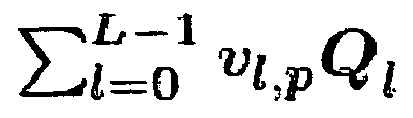
where the NxP matrix B = [b0 b 1 ... b P-1] denotes the deterministic basis spanned by the P complex vectors bp for p=0,..., P-1, and vl =[v l,0 ... v l,P-1]T the stochastic coefficients describing the /-th channel tap behavior for the given OFDM block on the P basis functions. - Then, by plugging (4) in (5)

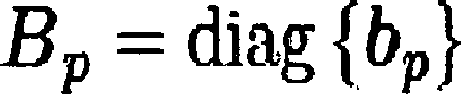
- By defining and summing over the L channel taps, it results

- Then the received signal r of (3) can be expressed according to the channel BEM as


is a diagonal matrix. -
Figure 1 depicts the model of the OFDM received signal in the channel BEM representation. - In the following it will be recalled the (Linear) Minimum-Mean-Square-Error (L-MMSE), Zero Forcing (ZF), and Matched Filter (MF) equalization.
- Letting H = HF H ,we have for the estimated OFDM transmitted sequence

with the MMSE Minimum Mean Square Error equalizer. In the assumption of perfect knowledge of the channel and of its second order statistics, the MMSE estimate (9) entails the inversion of a full matrix in general requiring O(N3) complexity order when classical techniques are used, e.g. the Gauss-Jordan elimination method [5]. An iterative technique can be adopted instead to avoid a full matrix inversion thus reducing the receiver equalization complexity as detailed below. - As mentioned in the prior art section, a wide number of iterative techniques is known from the literature in order to solve linear systems of equation, see e.g. [1]. For a given technique the overall complexity depends on the number of operations per iteration stage times the number of iterations necessary to achieve the estimation accuracy required for the target sequence detection performance. In view of these considerations the speed of convergence is a primary aspect driving the design of an iterative equalization algorithm.
- Considering the generic linear system of equations of the form

described in the Background Art section, we can express the equalization problem (9) as follows:
- In light of the above, the convergence of an iterative approach to the solution of the problem will depend on κ(H H H) = κ(H)2 in the high SNR

- As indicated in the Background Art section, preconditioning can be applied to iterative techniques in order to reduce the CN and to allow faster convergence in order to, firstly, increases the life of the battery of the mobile receiver and, secondly to comply with the time requirement for processing the signal. The iterative methods are applied in an equivalent preconditioned linear system derived from (10) into

- Preconditioning has proven to be useful (see [6] for instance) for improving the ZF iterative ICI cancellation problem.
- As known by the skilled man, preconditioning Zero Forcing (ZF) is a technique used instead of MMSE but which provides inferior performance.
- The prior art solution which was mentioned in the above prior art section, is based on a diagonally pre-conditioned ZF iterative algorithm, uses a pre-conditioner made of a diagonal matrix whose elements are exactly the diagonal matrix of the inverse of the frequency-domain channel matrix diag { P } = diag {( FHF H)-1}.
- There will now be described an improved ICI cancellation process which achieves a new and more effective preconditioning and thus approximates more the global MMSE optimal solution.
- Indeed, the inventors have discovered that the channel BEM can be exploited at the receiver side and interpreted as a multiple windowing of the received signal where the windowing functions correspond to the conjugate of the basis Bp. Let the output of each windowing-branch vector be defined as the projection of the received signal onto the p-th basis function

then the expanded observation vector of the received signal is obtained by stacking each windowing-branch vector in a PN x 1 vector as
- Given the BEM representation of equation (7), we estimate the symbol s[n] at sub-carrier n by adopting local MMSE Finite-Impulse-Response (FIR) filter fn across tones for all the basis output. Exploiting the particular structure of ICI in the channel BEM representation, one can limit the complexity of a full per-tone equalization across all sub-carriers, by selecting a subset of the elements of vector y as
y n = S ny with S n being a L FIR x PN selection matrix obtained by extracting L FIR rows of the identity matrix I PN exploiting the structure of U for a given L FIR and sub-carrier n to have
- Therefore, the per-tone MMSE filter coefficients are computed such that

where
- It is noteworthy mentioning that the above expression stems from the multiplication of a 1 x L FIR vector

y ny n which varies across sub-carriers. - Moreover, the computation of the MMSE filtering coefficients can exploit the coherence across sub-carriers and be made by applying a recursive method. A sufficiently precise approximation of the inverse of the matrix R
y ny n , i.e.

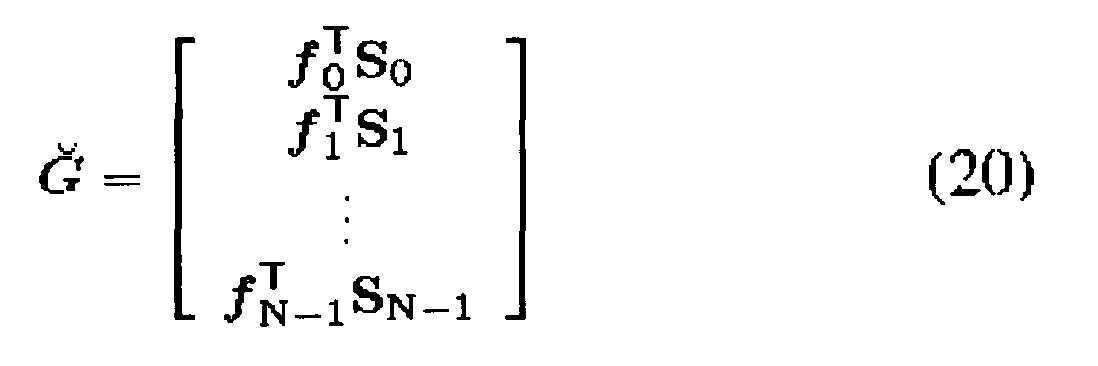
to be used in (34) to compute the filtering coefficients. - All the filters coefficients can be stacked in a sparse filter matrix

- The matrix resulting from the product of GU can therefore be seen as an improved BEM-MMSE pre-conditioner.
- Moreover, the complexity associated to the filtering operation is proportional to P(N + Nlog2 N).
- Indeed, this approach achieves considerably better preconditioning than the one previously presented relying on diagonal preconditioning. Its effectiveness is shown in
Figure 4 where the Cumulative-Distribution-Function (CDF) of the CN for BEM-MMSE preconditioning is compared to both the diagonal preconditioning explained above and to the channel without preconditioning. - This novel approach can be used for achieving a stationary polynomial iterative receiver whose performance are considerably improved, but yet of affordable complexity as the original method.
- It is worth deriving iterative ICI cancellation techniques operating in the squared channel matrix domain and solving the steady state MMSE problem as given in expression (11).
- Noticing that the left hand-side of the linear system of MMSE detection in (11) is Hermitian, the Conjugate Gradient (CG) algorithm can be applied.
- A banded preconditioning computed with similar development as for BEM-MMSE can be derived for a Preconditioned CG iterative receiver [1], whose algorithm is presented in
figure 3 . Letting
and
- In one embodiment, the appropriate selection Sn is based on the selection of the n subcarrier and two subcarriers, respectively above and below the considered subcarrier. Alternatively, four subcarriers may be selected. Clearly, the more subcarriers - and thus selections - the more effective will be the ICI cancellation, but at the cost of higher level of DSP resources.
- With respect to
figure 2 , there will now be described a preferred embodiment of a process for processing a OFDM receive signal to perform OFDM reception in presence of Doppler which achieves an enhanced precondition conjugate gradient MMSE receiver. - In a
step 11, the process proceeds with the reception of a OFDM block comprising N samples. - The signal received from the antenna is H FH S with s being the transmitted frequency domain sequence, FH being the inverse Fourier Transform applied in the transmitter and H being the propagation channel.
- In a
step 12, the process proceeds with the application of a FFT for the purpose of generating N frequency domain representations composing the received signal (R). - Then, in a
step 13, the process proceeds with the multiplication of said received signal ( R ) by the hermitian value of the channel (HH), with H being the channel estimate. - Then, in a
step 14, the process proceeds with the application on said received signal of a preconditioned conjugate gradient algorithm based on a NxN P preconditioner matrix, the preconditionner matrix being computed at follows:
and
- S n is a L FIR x PxN selection matrix obtained by extracting a predetermined number (L FIR) of rows (note L FIR corresponding to the estimated length of the channel) from the identity matrix I PN;
- H is equal to H F H,
- I is the NxN identity matrix ;
- σ z is the varience of the noise z in equation (3) ;
- 1 n is being the 1 x N vector containing 1 in n-th position and 0 elsewhere
- It should be noticed that, while matrix

- It should be noticed that, while the preconditioning which was defined above works particularly well with the so-called conjugate gradient algorithm, it can also be used with other algorithms, such as the geometric serie and even the Mean Square Error algorithm.
- With respect to
figure 3 , there will now be described a more particular embodiment of the process executed for the purpose of achieving the preconditioned conjugate gradient. - In a
step 21, the process proceeds with the initialization of parameters


- Where r0, z0, d0 and S0 are intermediate computing parameters used in the conjugate gradient method corresponding to k=0.
-
Step 22 is the entry point of a FOR loop for a set of K iterations (For k=0 to K-1) of variable k. - In a
step 23, the process proceeds with the computation of :
- It should be noticed rk HZk corresponds to a innerproduct of the components of the two vectors rk and Zk
- In a
step 24, the process proceeds with the computation of:
- Then, in a
step 25, the process computes:
- Then, in a
step 26, the process computes:
- Then, in a
step 27, the process computes:
- Then, in a
step 28, the process computes: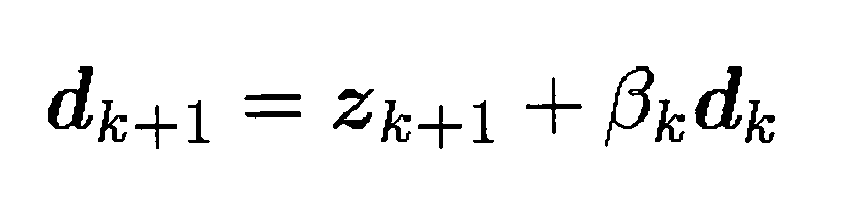
- The process then completes the current FOR loop and loops back to step 22 again in order to process a new loop.
-
Figure 4 illustrates the condition number (CN) for diagonal and BEM-MMSE preconditioning - One may compare the methods proposed in this paper by means of Monte Carlo simulations assuming a cyclic prefixed OFDM setup with N = 128 sub-carriers, a multi-path channel with L = 4 with uniform power delay profile and Jake's Doppler spectrum [2] with normalized Doppler frequency of 0.1 with respect to the sub-carriers spacing. We assume a first order orthogonal-polynomial BEM channel with P = 2.
- The performances are measured in terms of bit-error-rate of uncoded QPSK modulated transmitted sequences. The SNR is defined as the
ratio 
figures 5a-5d , the Non Stationary BEM-MMSE Preconditioned iterative ICI cancellation technique (NS-P-BEM) provides always the overall best performances compared to the reference full-blown matrix inversion MMSE method (labeled MMSE in the plots). The Preconditioned CG method (P-CG), instead, always provides the worst performance for the same number of iteration and MMSE filter lengths. The Preconditioned ZF Iterative (P-ZF) of [6] is drastically improved by the use of Stationary BEM-MMSE preconditioning (S-P-BEM) and the PIC iterative receiver provides a good trade-off in terms of performance and complexity. -
- [1] R. Barrett, Templates for the solution of linear systems: building blocks for iterative methods, Society for Industrial Mathematics, 1994.
- [2] J.G. Proakis and M. Salehi, Digital communications, McGraw-Hill Boston, 1995.
- [3] L. Rugini, P. Banelli, RC Cannizzaro, and G. Leus, "Channel Estimation and Windowed DEF for OFDM with Doppler Spread," in 2006 IEEE International Conference on Acoustics, Speech and Signal Processing, 2006. ICASSP 2006 Proceedings, 2006, vol. 4.
- [4] P. Schniter and H. Liu, "Iterative frequency-domain equalization for single-carrier systems in doubly-dispersive channels," in Signals, Systems and Computers, 2004. Conference Record of the Thirty-Eighth Asilomar Conference on, 2004, vol. 1.
- [5] G.H. Golub and C.F. Van Loan, Matrix computations, Johns Hopkins University Press, 1996.
- [6] C.Y. Hsu and W.R. Wu, "A low-complexity ICI mitigation method for high-speed mobile OFDM systems," in 2006 IEEE International Symposium on Circuits and Systems, 2006. ISCAS 2006. Proceedings, 2006, p. 4.
Claims (10)
- Process for canceling Intercarrier Interference in a OFDM receiver receiving OFDM blocks in presence of Doppler, comprising the steps of :- receiving (11) a OFDM block comprising N samples;- applying (12) a FFT for the purpose of generating N frequency domain representations composing the received signal (R);- multiplying (13) said received signal (R) by the hermitian value of the channel (HH), with H being the channel estimate;- applying (14) on said received signal a preconditioned conjugate gradient algorithm based on a NxN P preconditioner matrix ;Characterized in that said preconditioning matrix is computed at follows:

And S n is a L FIR x PN selection matrix obtained by extracting a predetermined number (L FIR) of rows from the identity matrix I PN;H is equal to HF H, with H being the frequency-domain channel matrix and F being the N x N discrete-Fourier transform unitary matrix F ;I is the NxN identity matrix ;σ is the varience of the noise ;1 n is being the 1 x N vector containing 1 in n-th position and 0 elsewhere
 - Process according to claim 1 characterized in that it said conjugate gradient mechanism involves the steps of:- initializing parameters (21):


 - starting a FOR loop (22);- computing (23):
 - computing (24) :
 - computing (25):
 - computing (26):
 - computing (27):
 - computing (28):
 - then looping back to perform a new FOR loop.
 - Process according to claim 1 characterized in that the preconditioning is used in a combination with a geometric serie and even the Mean Square Error algorithm.
- Process according to claim 1 or 3 characterized in that it is executed in a Long Term Evolution (LTE) system or WIMAX system.
- Process according to claim 1 to 4 characterized in that it is used in a mobile telephone.
- Receiver for an OFDM communication network comprising means for canceling Intercarrier Interference in a OFDM receiver receiving OFDM blocks in presence of Doppler, further comprising:- means for receiving a OFDM block comprising N samples;- means for applying a FFT for the purpose of generating N frequency domain representations composing the received signal (R);- means for multiplying said received signal (R) by the hermitian value of the channel (HH), with H being the channel estimate;- means for applying on said received signal a preconditioned conjugate gradient algorithm based on a NxN P preconditioner matrix ;Characterized in that said preconditioning matrix is computed at follows:

And S n is a L FIR x PN selection matrix obtained by extracting a predetermined number (L FIR) of rows from the identity matrix I PN;H is equal to HF H, with H being the frequency-domain channel matrix and F being the N x N discrete-Fourier transform unitary matrix F;I is the NxN identity matrix ;σ is the varience of the noise ;1 n is being the 1 x N vector containing 1 in n-th position and 0 elsewhere
 - Receiver according to claim 6 characterized in that it further comprises:- means for initializing parameters (21):


 - means for starting a FOR loop (22);- means for computing (23):
 - means for computing (24) :
 - means for computing (25):
 - means for computing (26) :
 - means for computing (27):
 - means for computing (28):
 - then means for looping back to perform a new FOR loop.
 - Receiver according to claim 5 to 6 characterized in that it is for a LTE (LTE) network.
- Receiver according to anyone of claims 5 to 7 characterized in that it is used in a mobile telephone.
- Mobile telephone for a OFDM communication system comprising means for performing the process defined in claims 1-4.
Priority Applications (3)
| Application Number | Priority Date | Filing Date | Title |
|---|---|---|---|
| EP20100368013 EP2360882B1 (en) | 2010-02-15 | 2010-02-15 | Process for suppressing intercarrier interference in a OFDM receiver |
| US13/575,676 US8873681B2 (en) | 2010-02-15 | 2011-02-15 | Process for suppressing intercarrier interference in a OFDM receiver |
| PCT/EP2011/000698 WO2011098299A1 (en) | 2010-02-15 | 2011-02-15 | Process for suppressing intercarrier interference in a ofdm receiver |
Applications Claiming Priority (1)
| Application Number | Priority Date | Filing Date | Title |
|---|---|---|---|
| EP20100368013 EP2360882B1 (en) | 2010-02-15 | 2010-02-15 | Process for suppressing intercarrier interference in a OFDM receiver |
Publications (2)
| Publication Number | Publication Date |
|---|---|
| EP2360882A1 true EP2360882A1 (en) | 2011-08-24 |
| EP2360882B1 EP2360882B1 (en) | 2013-05-29 |
Family
ID=42288773
Family Applications (1)
| Application Number | Title | Priority Date | Filing Date |
|---|---|---|---|
| EP20100368013 Not-in-force EP2360882B1 (en) | 2010-02-15 | 2010-02-15 | Process for suppressing intercarrier interference in a OFDM receiver |
Country Status (3)
| Country | Link |
|---|---|
| US (1) | US8873681B2 (en) |
| EP (1) | EP2360882B1 (en) |
| WO (1) | WO2011098299A1 (en) |
Families Citing this family (6)
| Publication number | Priority date | Publication date | Assignee | Title |
|---|---|---|---|---|
| EP2615784B1 (en) * | 2012-01-10 | 2014-06-25 | Universität Wien | A method of equalizing an OFDM signal |
| US20140219370A1 (en) * | 2013-02-06 | 2014-08-07 | Transpacific Ip Management Group Ltd. | Signal processing in a cooperative ofdm communication system |
| US10182447B2 (en) | 2014-05-08 | 2019-01-15 | Lg Electronics Inc. | Method for processing received signal by forming RE group in MIMO receiver |
| TWI627846B (en) * | 2016-03-30 | 2018-06-21 | 晨星半導體股份有限公司 | Module of enhancing equalization, demodulation system and method of enhancing equalization |
| CN113098815B (en) * | 2021-03-05 | 2022-04-01 | 华中科技大学 | A frequency domain suppression method and system for underwater acoustic OFDM inter-carrier interference |
| CN117716673A (en) * | 2021-05-28 | 2024-03-15 | 大陆汽车科技有限公司 | Transmitter and receiver and method for transmitting and receiving symbols over an orthogonal time-frequency space communication channel affected by doppler spread and multipath |
Citations (1)
| Publication number | Priority date | Publication date | Assignee | Title |
|---|---|---|---|---|
| US20100008433A1 (en) * | 2008-07-10 | 2010-01-14 | Advanced Micro Devices, Inc. | Method and apparatus for advanced inter-carrier interference cancellation in orthogonal frequency division multiplexing (ofdm) channels |
Family Cites Families (8)
| Publication number | Priority date | Publication date | Assignee | Title |
|---|---|---|---|---|
| US7672447B1 (en) * | 2000-06-01 | 2010-03-02 | Telefonaktiebolaget Lm Ericsson (Publ) | Frequency domain echo canceller |
| US20070211813A1 (en) * | 2006-03-10 | 2007-09-13 | Shilpa Talwar | MIMO precoding in the presence of co-channel interference |
| KR101145847B1 (en) * | 2006-07-14 | 2012-05-17 | 삼성전자주식회사 | Signalling method of detecting hidden incumbent system in cognitive radio environment and channel fractioning method used to enable the method |
| FR2916116A1 (en) * | 2007-05-11 | 2008-11-14 | France Telecom | METHODS FOR TRANSMITTING AND RECEIVING A MULTIPLE CARRIER SIGNAL AND SPECTRUM SHIFTING, SIGNAL, COMPUTER PROGRAM PRODUCTS, AND CORRESPONDING TRANSMITTING AND RECEIVING DEVICES. |
| CN101132388B (en) * | 2007-09-18 | 2013-01-09 | 沖电气(新加坡)技术中心 | Receiving method and device for receiving coded signal assisted by signal channel condition information |
| US8254242B2 (en) * | 2008-05-02 | 2012-08-28 | Princeton University | System and method for initial ranging in wireless communication systems |
| EP2311232A4 (en) * | 2008-08-04 | 2015-05-20 | Nxp Bv | A simplified equalizationscheme for distributed resource allocation in multi-carrier systems |
| US8254510B2 (en) * | 2009-12-23 | 2012-08-28 | Industrial Technology Research Institute | Apparatus and method for inter-carrier interference cancellation |
-
2010
- 2010-02-15 EP EP20100368013 patent/EP2360882B1/en not_active Not-in-force
-
2011
- 2011-02-15 US US13/575,676 patent/US8873681B2/en not_active Expired - Fee Related
- 2011-02-15 WO PCT/EP2011/000698 patent/WO2011098299A1/en not_active Ceased
Patent Citations (1)
| Publication number | Priority date | Publication date | Assignee | Title |
|---|---|---|---|---|
| US20100008433A1 (en) * | 2008-07-10 | 2010-01-14 | Advanced Micro Devices, Inc. | Method and apparatus for advanced inter-carrier interference cancellation in orthogonal frequency division multiplexing (ofdm) channels |
Non-Patent Citations (9)
| Title |
|---|
| C.Y. HSU; W.R. WU: "A low-complexity ICI mitigation method for high-speed mobile OFDM systems", IEEE INTERNATIONAL SYMPOSIUM ON CIRCUITS AND SYSTEMS, 2006, pages 4 |
| CHAD C LAU ET AL: "Equalization for OFDM with Multiple Delay-Doppler Paths using Conjugate Gradients with Chebyshev Preconditioning", MILITARY COMMUNICATIONS CONFERENCE, 2007. MILCOM 2007. IEEE, IEEE, PISCATAWAY, NJ, USA, 29 October 2007 (2007-10-29), pages 1 - 6, XP031232864, ISBN: 978-1-4244-1512-0 * |
| G.H. GOLUB; C.F. VAN LOAN: "Matrix computations", 1996, JOHNS HOPKINS UNIVERSITY PRESS |
| J.G. PROAKIS; M. SALEHI: "Digital communications", 1995, MCGRAW-HILL |
| L. RUGINI; P. BANELLI; RC CANNIZZARO; G. LEUS: "Channel Estimation and Windowed DEF for OFDM with Doppler Spread", IEEE INTERNATIONAL CONFERENCE ON ACOUSTICS, SPEECH AND SIGNAL PROCESSING, vol. 4, 2006 |
| P. SCHNITER; H. LIU: "Iterative frequency-domain equalization for single-carrier systems in doubly-dispersive channels", SIGNALS, SYSTEMS AND COMPUTERS, vol. 1, 2004 |
| R. BARRETT: "Templates for the solution of linear systems: building blocks for iterative methods", SOCIETY FOR INDUSTRIAL MATHEMATICS, 1994 |
| RAYMOND GUAN ET AL: "Krylov Subspace Algorithms and Circulant-Embedding Method for Efficient Wideband Single-Carrier Equalization", IEEE TRANSACTIONS ON SIGNAL PROCESSING, IEEE SERVICE CENTER, NEW YORK, NY, US, vol. PP, no. 6, 1 June 2008 (2008-06-01), pages 2483 - 2495, XP011214914, ISSN: 1053-587X * |
| RUGINI L ET AL: "Channel Estimation and Windowed DEF for OFDM with Doppler Spread", ACOUSTICS, SPEECH AND SIGNAL PROCESSING, 2006. ICASSP 2006 PROCEEDINGS . 2006 IEEE INTERNATIONAL CONFERENCE ON TOULOUSE, FRANCE 14-19 MAY 2006, PISCATAWAY, NJ, USA,IEEE, PISCATAWAY, NJ, USA, 1 January 2006 (2006-01-01), pages IV - IV, XP031101166, ISBN: 978-1-4244-0469-8 * |
Also Published As
| Publication number | Publication date |
|---|---|
| US8873681B2 (en) | 2014-10-28 |
| EP2360882B1 (en) | 2013-05-29 |
| WO2011098299A1 (en) | 2011-08-18 |
| US20130163700A1 (en) | 2013-06-27 |
Similar Documents
| Publication | Publication Date | Title |
|---|---|---|
| Gaspar et al. | Low complexity GFDM receiver based on sparse frequency domain processing | |
| CN102365833B (en) | Channel estimation for control channels in OFDM systems | |
| EP2360882B1 (en) | Process for suppressing intercarrier interference in a OFDM receiver | |
| CN101375521B (en) | Channel estimation device, equalization device and radio system | |
| Krishna et al. | On the use of EMD based adaptive filtering for OFDM channel estimation | |
| EP2615784B1 (en) | A method of equalizing an OFDM signal | |
| JP2003218826A (en) | Orthogonal frequency division multiplexed signal receiving system and receiver | |
| EP2140561A1 (en) | A method and an apparatus for estimating a delay spread of a multipath channel | |
| CN1729666B (en) | Correlation method for channel estimation for orthogonal frequency division multiplexing | |
| Dinis et al. | IB‐DFE receivers with space diversity for CP‐assisted DS‐CDMA and MC‐CDMA systems | |
| Berger et al. | Study of pilot designs for cyclic-prefix OFDM on time-varying and sparse underwater acoustic channels | |
| Ali et al. | Blind SOS subspace channel estimation and equalization techniques exploiting spatial diversity in OFDM systems | |
| Schniter et al. | Iterative frequency-domain equalization for single-carrier systems in doubly-dispersive channels | |
| Song et al. | Generalized equalization for underwater acoustic communications | |
| WO2006107910A2 (en) | Channel estimation using linearly-constrained filter coefficients | |
| Fang et al. | Block transmissions over doubly selective channels: Iterative channel estimation and turbo equalization | |
| Krishna et al. | OFDM channel estimation and equalization using multi scale independent component analysis | |
| Hajizadeh et al. | Channel estimation in OFDM system based on the linear interpolation, FFT and decision feedback | |
| Ancora et al. | Preconditioned iterative inter-carrier interference cancellation for OFDM reception in rapidly varying channels | |
| Patra et al. | Efficient signal detection methods for high mobility OFDM system with transmit diversity | |
| Chang et al. | Cancellation of ICI by Doppler effect in OFDM systems | |
| Ogundile et al. | Improved reliability information for OFDM systems on time-varying frequency-selective fading channels | |
| Ahn et al. | A novel subblock-based frequency-domain equalizer over doubly-selective channels | |
| Elnakeeb et al. | On the Cramér-Rao bound of time-varying narrowband leaked MIMO OFDM channels | |
| Zhang et al. | A new algorithm for time domain equalization in OFDM systems |
Legal Events
| Date | Code | Title | Description |
|---|---|---|---|
| PUAI | Public reference made under article 153(3) epc to a published international application that has entered the european phase |
Free format text: ORIGINAL CODE: 0009012 |
|
| PUAI | Public reference made under article 153(3) epc to a published international application that has entered the european phase |
Free format text: ORIGINAL CODE: 0009012 |
|
| AK | Designated contracting states |
Kind code of ref document: A1 Designated state(s): AT BE BG CH CY CZ DE DK EE ES FI FR GB GR HR HU IE IS IT LI LT LU LV MC MK MT NL NO PL PT RO SE SI SK SM TR |
|
| AX | Request for extension of the european patent |
Extension state: AL BA RS |
|
| 17P | Request for examination filed |
Effective date: 20120224 |
|
| 17Q | First examination report despatched |
Effective date: 20120507 |
|
| GRAP | Despatch of communication of intention to grant a patent |
Free format text: ORIGINAL CODE: EPIDOSNIGR1 |
|
| GRAS | Grant fee paid |
Free format text: ORIGINAL CODE: EPIDOSNIGR3 |
|
| GRAA | (expected) grant |
Free format text: ORIGINAL CODE: 0009210 |
|
| AK | Designated contracting states |
Kind code of ref document: B1 Designated state(s): AT BE BG CH CY CZ DE DK EE ES FI FR GB GR HR HU IE IS IT LI LT LU LV MC MK MT NL NO PL PT RO SE SI SK SM TR |
|
| REG | Reference to a national code |
Ref country code: GB Ref legal event code: FG4D |
|
| REG | Reference to a national code |
Ref country code: CH Ref legal event code: EP |
|
| REG | Reference to a national code |
Ref country code: AT Ref legal event code: REF Ref document number: 614999 Country of ref document: AT Kind code of ref document: T Effective date: 20130615 |
|
| REG | Reference to a national code |
Ref country code: IE Ref legal event code: FG4D |
|
| REG | Reference to a national code |
Ref country code: DE Ref legal event code: R096 Ref document number: 602010007303 Country of ref document: DE Effective date: 20130801 |
|
| REG | Reference to a national code |
Ref country code: AT Ref legal event code: MK05 Ref document number: 614999 Country of ref document: AT Kind code of ref document: T Effective date: 20130529 |
|
| REG | Reference to a national code |
Ref country code: LT Ref legal event code: MG4D |
|
| PG25 | Lapsed in a contracting state [announced via postgrant information from national office to epo] |
Ref country code: NO Free format text: LAPSE BECAUSE OF FAILURE TO SUBMIT A TRANSLATION OF THE DESCRIPTION OR TO PAY THE FEE WITHIN THE PRESCRIBED TIME-LIMIT Effective date: 20130829 Ref country code: AT Free format text: LAPSE BECAUSE OF FAILURE TO SUBMIT A TRANSLATION OF THE DESCRIPTION OR TO PAY THE FEE WITHIN THE PRESCRIBED TIME-LIMIT Effective date: 20130529 Ref country code: FI Free format text: LAPSE BECAUSE OF FAILURE TO SUBMIT A TRANSLATION OF THE DESCRIPTION OR TO PAY THE FEE WITHIN THE PRESCRIBED TIME-LIMIT Effective date: 20130529 Ref country code: PT Free format text: LAPSE BECAUSE OF FAILURE TO SUBMIT A TRANSLATION OF THE DESCRIPTION OR TO PAY THE FEE WITHIN THE PRESCRIBED TIME-LIMIT Effective date: 20130930 Ref country code: LT Free format text: LAPSE BECAUSE OF FAILURE TO SUBMIT A TRANSLATION OF THE DESCRIPTION OR TO PAY THE FEE WITHIN THE PRESCRIBED TIME-LIMIT Effective date: 20130529 Ref country code: SE Free format text: LAPSE BECAUSE OF FAILURE TO SUBMIT A TRANSLATION OF THE DESCRIPTION OR TO PAY THE FEE WITHIN THE PRESCRIBED TIME-LIMIT Effective date: 20130529 Ref country code: ES Free format text: LAPSE BECAUSE OF FAILURE TO SUBMIT A TRANSLATION OF THE DESCRIPTION OR TO PAY THE FEE WITHIN THE PRESCRIBED TIME-LIMIT Effective date: 20130909 Ref country code: IS Free format text: LAPSE BECAUSE OF FAILURE TO SUBMIT A TRANSLATION OF THE DESCRIPTION OR TO PAY THE FEE WITHIN THE PRESCRIBED TIME-LIMIT Effective date: 20130929 Ref country code: SI Free format text: LAPSE BECAUSE OF FAILURE TO SUBMIT A TRANSLATION OF THE DESCRIPTION OR TO PAY THE FEE WITHIN THE PRESCRIBED TIME-LIMIT Effective date: 20130529 Ref country code: GR Free format text: LAPSE BECAUSE OF FAILURE TO SUBMIT A TRANSLATION OF THE DESCRIPTION OR TO PAY THE FEE WITHIN THE PRESCRIBED TIME-LIMIT Effective date: 20130830 |
|
| REG | Reference to a national code |
Ref country code: NL Ref legal event code: VDEP Effective date: 20130529 |
|
| PG25 | Lapsed in a contracting state [announced via postgrant information from national office to epo] |
Ref country code: PL Free format text: LAPSE BECAUSE OF FAILURE TO SUBMIT A TRANSLATION OF THE DESCRIPTION OR TO PAY THE FEE WITHIN THE PRESCRIBED TIME-LIMIT Effective date: 20130529 Ref country code: HR Free format text: LAPSE BECAUSE OF FAILURE TO SUBMIT A TRANSLATION OF THE DESCRIPTION OR TO PAY THE FEE WITHIN THE PRESCRIBED TIME-LIMIT Effective date: 20130529 Ref country code: BG Free format text: LAPSE BECAUSE OF FAILURE TO SUBMIT A TRANSLATION OF THE DESCRIPTION OR TO PAY THE FEE WITHIN THE PRESCRIBED TIME-LIMIT Effective date: 20130829 |
|
| PG25 | Lapsed in a contracting state [announced via postgrant information from national office to epo] |
Ref country code: LV Free format text: LAPSE BECAUSE OF FAILURE TO SUBMIT A TRANSLATION OF THE DESCRIPTION OR TO PAY THE FEE WITHIN THE PRESCRIBED TIME-LIMIT Effective date: 20130529 |
|
| PG25 | Lapsed in a contracting state [announced via postgrant information from national office to epo] |
Ref country code: BE Free format text: LAPSE BECAUSE OF FAILURE TO SUBMIT A TRANSLATION OF THE DESCRIPTION OR TO PAY THE FEE WITHIN THE PRESCRIBED TIME-LIMIT Effective date: 20130529 Ref country code: DK Free format text: LAPSE BECAUSE OF FAILURE TO SUBMIT A TRANSLATION OF THE DESCRIPTION OR TO PAY THE FEE WITHIN THE PRESCRIBED TIME-LIMIT Effective date: 20130529 Ref country code: EE Free format text: LAPSE BECAUSE OF FAILURE TO SUBMIT A TRANSLATION OF THE DESCRIPTION OR TO PAY THE FEE WITHIN THE PRESCRIBED TIME-LIMIT Effective date: 20130529 Ref country code: SK Free format text: LAPSE BECAUSE OF FAILURE TO SUBMIT A TRANSLATION OF THE DESCRIPTION OR TO PAY THE FEE WITHIN THE PRESCRIBED TIME-LIMIT Effective date: 20130529 Ref country code: CZ Free format text: LAPSE BECAUSE OF FAILURE TO SUBMIT A TRANSLATION OF THE DESCRIPTION OR TO PAY THE FEE WITHIN THE PRESCRIBED TIME-LIMIT Effective date: 20130529 |
|
| PG25 | Lapsed in a contracting state [announced via postgrant information from national office to epo] |
Ref country code: NL Free format text: LAPSE BECAUSE OF FAILURE TO SUBMIT A TRANSLATION OF THE DESCRIPTION OR TO PAY THE FEE WITHIN THE PRESCRIBED TIME-LIMIT Effective date: 20130529 Ref country code: IT Free format text: LAPSE BECAUSE OF FAILURE TO SUBMIT A TRANSLATION OF THE DESCRIPTION OR TO PAY THE FEE WITHIN THE PRESCRIBED TIME-LIMIT Effective date: 20130529 Ref country code: RO Free format text: LAPSE BECAUSE OF FAILURE TO SUBMIT A TRANSLATION OF THE DESCRIPTION OR TO PAY THE FEE WITHIN THE PRESCRIBED TIME-LIMIT Effective date: 20130529 |
|
| PLBE | No opposition filed within time limit |
Free format text: ORIGINAL CODE: 0009261 |
|
| STAA | Information on the status of an ep patent application or granted ep patent |
Free format text: STATUS: NO OPPOSITION FILED WITHIN TIME LIMIT |
|
| 26N | No opposition filed |
Effective date: 20140303 |
|
| REG | Reference to a national code |
Ref country code: DE Ref legal event code: R097 Ref document number: 602010007303 Country of ref document: DE Effective date: 20140303 |
|
| PG25 | Lapsed in a contracting state [announced via postgrant information from national office to epo] |
Ref country code: LU Free format text: LAPSE BECAUSE OF FAILURE TO SUBMIT A TRANSLATION OF THE DESCRIPTION OR TO PAY THE FEE WITHIN THE PRESCRIBED TIME-LIMIT Effective date: 20140215 Ref country code: MC Free format text: LAPSE BECAUSE OF FAILURE TO SUBMIT A TRANSLATION OF THE DESCRIPTION OR TO PAY THE FEE WITHIN THE PRESCRIBED TIME-LIMIT Effective date: 20130529 |
|
| REG | Reference to a national code |
Ref country code: CH Ref legal event code: PL |
|
| PG25 | Lapsed in a contracting state [announced via postgrant information from national office to epo] |
Ref country code: CH Free format text: LAPSE BECAUSE OF NON-PAYMENT OF DUE FEES Effective date: 20140228 Ref country code: LI Free format text: LAPSE BECAUSE OF NON-PAYMENT OF DUE FEES Effective date: 20140228 |
|
| REG | Reference to a national code |
Ref country code: FR Ref legal event code: ST Effective date: 20141031 |
|
| REG | Reference to a national code |
Ref country code: IE Ref legal event code: MM4A |
|
| PG25 | Lapsed in a contracting state [announced via postgrant information from national office to epo] |
Ref country code: FR Free format text: LAPSE BECAUSE OF NON-PAYMENT OF DUE FEES Effective date: 20140228 Ref country code: IE Free format text: LAPSE BECAUSE OF NON-PAYMENT OF DUE FEES Effective date: 20140215 |
|
| PG25 | Lapsed in a contracting state [announced via postgrant information from national office to epo] |
Ref country code: MT Free format text: LAPSE BECAUSE OF FAILURE TO SUBMIT A TRANSLATION OF THE DESCRIPTION OR TO PAY THE FEE WITHIN THE PRESCRIBED TIME-LIMIT Effective date: 20130529 |
|
| PG25 | Lapsed in a contracting state [announced via postgrant information from national office to epo] |
Ref country code: SM Free format text: LAPSE BECAUSE OF FAILURE TO SUBMIT A TRANSLATION OF THE DESCRIPTION OR TO PAY THE FEE WITHIN THE PRESCRIBED TIME-LIMIT Effective date: 20130529 |
|
| PG25 | Lapsed in a contracting state [announced via postgrant information from national office to epo] |
Ref country code: CY Free format text: LAPSE BECAUSE OF FAILURE TO SUBMIT A TRANSLATION OF THE DESCRIPTION OR TO PAY THE FEE WITHIN THE PRESCRIBED TIME-LIMIT Effective date: 20130529 |
|
| PG25 | Lapsed in a contracting state [announced via postgrant information from national office to epo] |
Ref country code: TR Free format text: LAPSE BECAUSE OF FAILURE TO SUBMIT A TRANSLATION OF THE DESCRIPTION OR TO PAY THE FEE WITHIN THE PRESCRIBED TIME-LIMIT Effective date: 20130529 Ref country code: HU Free format text: LAPSE BECAUSE OF FAILURE TO SUBMIT A TRANSLATION OF THE DESCRIPTION OR TO PAY THE FEE WITHIN THE PRESCRIBED TIME-LIMIT; INVALID AB INITIO Effective date: 20100215 |
|
| REG | Reference to a national code |
Ref country code: DE Ref legal event code: R082 Ref document number: 602010007303 Country of ref document: DE Representative=s name: GRUENECKER PATENT- UND RECHTSANWAELTE PARTG MB, DE Ref country code: DE Ref legal event code: R081 Ref document number: 602010007303 Country of ref document: DE Owner name: OCT CIRCUIT TECHNOLOGIES INTERNATIONAL LTD., IE Free format text: FORMER OWNER: ST-ERICSSON SA, GENEVE PLAN-LES-OUATES, CH |
|
| PGFP | Annual fee paid to national office [announced via postgrant information from national office to epo] |
Ref country code: DE Payment date: 20170119 Year of fee payment: 8 |
|
| PGFP | Annual fee paid to national office [announced via postgrant information from national office to epo] |
Ref country code: GB Payment date: 20170124 Year of fee payment: 8 |
|
| PG25 | Lapsed in a contracting state [announced via postgrant information from national office to epo] |
Ref country code: MK Free format text: LAPSE BECAUSE OF FAILURE TO SUBMIT A TRANSLATION OF THE DESCRIPTION OR TO PAY THE FEE WITHIN THE PRESCRIBED TIME-LIMIT Effective date: 20130529 |
|
| REG | Reference to a national code |
Ref country code: DE Ref legal event code: R119 Ref document number: 602010007303 Country of ref document: DE |
|
| GBPC | Gb: european patent ceased through non-payment of renewal fee |
Effective date: 20180215 |
|
| PG25 | Lapsed in a contracting state [announced via postgrant information from national office to epo] |
Ref country code: DE Free format text: LAPSE BECAUSE OF NON-PAYMENT OF DUE FEES Effective date: 20180901 |
|
| PG25 | Lapsed in a contracting state [announced via postgrant information from national office to epo] |
Ref country code: GB Free format text: LAPSE BECAUSE OF NON-PAYMENT OF DUE FEES Effective date: 20180215 |