EP2360659A1 - Pairing computation device, pairing computation method, and pairing computation program - Google Patents
Pairing computation device, pairing computation method, and pairing computation program Download PDFInfo
- Publication number
- EP2360659A1 EP2360659A1 EP09810049A EP09810049A EP2360659A1 EP 2360659 A1 EP2360659 A1 EP 2360659A1 EP 09810049 A EP09810049 A EP 09810049A EP 09810049 A EP09810049 A EP 09810049A EP 2360659 A1 EP2360659 A1 EP 2360659A1
- Authority
- EP
- European Patent Office
- Prior art keywords
- computation
- rational
- pairing
- computing
- function
- Prior art date
- Legal status (The legal status is an assumption and is not a legal conclusion. Google has not performed a legal analysis and makes no representation as to the accuracy of the status listed.)
- Withdrawn
Links
- 238000000034 method Methods 0.000 title claims abstract description 26
- 238000012892 rational function Methods 0.000 claims abstract description 84
- 239000000654 additive Substances 0.000 claims abstract description 12
- 230000000996 additive effect Effects 0.000 claims abstract description 12
- 230000014509 gene expression Effects 0.000 description 5
- 238000004891 communication Methods 0.000 description 3
- 230000001133 acceleration Effects 0.000 description 1
- 238000009825 accumulation Methods 0.000 description 1
- 238000010586 diagram Methods 0.000 description 1
- 230000000694 effects Effects 0.000 description 1
- 238000011160 research Methods 0.000 description 1
- 238000012827 research and development Methods 0.000 description 1
- 230000009466 transformation Effects 0.000 description 1
Images


Classifications
-
- H—ELECTRICITY
- H04—ELECTRIC COMMUNICATION TECHNIQUE
- H04L—TRANSMISSION OF DIGITAL INFORMATION, e.g. TELEGRAPHIC COMMUNICATION
- H04L9/00—Cryptographic mechanisms or cryptographic arrangements for secret or secure communications; Network security protocols
- H04L9/30—Public key, i.e. encryption algorithm being computationally infeasible to invert or user's encryption keys not requiring secrecy
- H04L9/3066—Public key, i.e. encryption algorithm being computationally infeasible to invert or user's encryption keys not requiring secrecy involving algebraic varieties, e.g. elliptic or hyper-elliptic curves
- H04L9/3073—Public key, i.e. encryption algorithm being computationally infeasible to invert or user's encryption keys not requiring secrecy involving algebraic varieties, e.g. elliptic or hyper-elliptic curves involving pairings, e.g. identity based encryption [IBE], bilinear mappings or bilinear pairings, e.g. Weil or Tate pairing
Definitions
- the present invention relates to a pairing computation device, a pairing computation method, and a pairing computation program all of which enable fast pairing computation.
- an authentication process is carried out to verify that the individual user is a legitimate user.
- authentication generally uses an ID and a password preset for each individual user.
- a network is provided with an authentication server for carrying out an authentication process.
- digital signature data unique to an individual user is attached to individual data.
- This digital signature data ensures that data utilized by an individual user is not tampered by outsiders or is not leaked to outsiders, so that confidential information can be safely handled over a network.
- an individual user is identified in association with an authentication process at an authentication server, and as a result, history of each individual user is accumulated as information one after another in the authentication server every time an authentication process is performed. Therefore, private information such as which site individual users have accessed and which service they have used is accumulated in the authentication server. Thus, in terms of protection of personal information, great caution is given to prevent leakage of such information.
- an individual user transmits, to an authentication server, signature data that certificates that the individual user anonymously belongs to a particular group.
- the authentication server then verifies that the individual user belongs to a particular group without specifying the individual user from the received signature data. Therefore, while preventing fraud by an individual user who does not belong to a group, the authentication server authenticates an individual user without accumulating history information for each individual user.
- pairing computation For anonymous authentication in such a digital group signature, pairing computation is used.
- Pairing computation uses a two-input and one-output function. For example, letting S be a rational point over a prime field F p and Q be a rational point over a k-degree extension field F p k , when the two rational points S and Q are input, an element z in the extension field F* p k is output. Moreover, pairing computation has a bilinear property such that when a times of the rational point S and b times of the rational point Q are input, the ab-th power of z is calculated. This bilinearity is utilized in authentication.
- “k” is an embedding degree
- F* p k " is, strictly speaking, expressed as: F * p k in mathematical representation, but is here represented as "F* p k " due to limitations in expression.
- a point on an elliptic curve is used for each of the rational points S, Q.
- the pairing computation of a rational point on an elliptic curve includes a step of performing computation according to Miller's algorithm and a step of performing exponentiation on the computation result.
- a pairing computation is first performed for excluding an individual user whose access right expires. Then, with the digital group signature, an authentication process is performed through a pairing computation for a predetermined individual user, so that an attribute change such as issue or expiration of access right for each individual user is flexibly handled.
- the present inventors have conducted research and development to increase the pairing computation speed and have conceived the present invention.
- the pairing computation device is characterized in that the computation means for computing the rational function f ⁇ ,Q (S) includes computation means for computing ⁇ Q, storing a result of the computation in a predetermined register, and computing the predetermined rational point by using the result of the computation of ⁇ Q.
- the pairing computation method according to the present invention is characterized by further including a step of causing the CPU of the electronic calculator to function as computation means for computing ⁇ Q and computing the predetermined rational point by using the result of the computation of ⁇ Q, after the step of computing the rational function f ⁇ ,Q (S).
- the pairing computation program according to the present invention is characterized in that the program causes the electronic calculator to function as computation means for computing ⁇ Q and computation means for computing the predetermined rational point by using the result of the computation of ⁇ Q.
- a rational function calculated according to Miller's algorithm in pairing computation is given as a function of an integer variable ⁇ , so that the rational function can be calculated at high speed, thereby achieving faster pairing computation. Therefore, it is possible to provide digital group signature service of practical use.
- a pairing computation device, a pairing computation method, and a pairing computation program according to the present invention perform pairing computation including a first step of computing a rational function according to Miller's algorithm and a second step of performing exponentiation on the computation result.
- the pairing computation device, the pairing computation method, and the pairing computation program compute a rational function using an integer variable ⁇ to speed up the computation.
- the pairing computation device, the pairing computation method, and the pairing computation program according to the present invention use Xate pairing rather than Ate pairing, thereby enabling fast computation.
- the elliptic curves used in pairing computation are known as pairing-friendly curves corresponding to the respective embedding degrees.
- r ⁇ ⁇ 4 - 8 ⁇ ⁇ 2 + 25
- t ⁇ 2 ⁇ ⁇ 3 - 11 ⁇ ⁇ + 15 / 15.
- r ⁇ ⁇ 8 - ⁇ 4 + 1
- t ⁇ ⁇ 5 - ⁇ + 1.
- the order r and the trace t of the Frobenius Endomorphism ⁇ p can be represented as follows using the integer variable ⁇ as described above.
- Equasion 2 can be transformed as follows. Here, the notation ( ⁇ ) will be omitted unless particularly necessary, for the sake of convenience. 6 ⁇ ⁇ 2 ⁇ t - 1 ⁇ p mod r
- Equasion 5 can be transformed as follows. p ⁇ p 2 - 6 ⁇ ⁇ ⁇ p + 1 + 4 ⁇ p + 1 mod r
- Equasion 6 can be transformed as follows. 6 ⁇ ⁇ ⁇ 1 + p ⁇ p 2 + 3 ⁇ p + 1 mod r
- Equasion 8 can be transformed as follows. 1 + p - 1 ⁇ p 2 ⁇ 1 - p mod r
- Equasion 7 can be transformed as follows. 6 ⁇ ⁇ ⁇ 1 + p - 1 1 + p 2 + p ⁇ 1 + p + p 3 + p 10 mod r
- Equasion 3 the rational function f t-1,Q ( ⁇ ) of Ate pairing will be considered.
- V aQ+bQ l aQ,bQ /V aQ+bQ
- l aQ,bQ denotes a value on the line passing through two rational points aQ and bQ
- V aQ+bQ denotes a value on the vertical line of rational point aQ+bQ.
- Formula 15 f p , ⁇ Q 1 + 3 ⁇ p 2 + 10 ⁇ p 9 has bilinearity and can be transformed as follows: Formula 16 f p , Q ⁇ ⁇ 1 + 3 ⁇ p 2 + 10 ⁇ p 9
- Equasion 20 has bilinearity
- the present inventors have noticed that the right side of Equasion 20 has also bilinearity and set the right side of Equasion 20 as a new rational function f' ⁇ ,Q ( ⁇ ).
- the present inventors call this pairing e(Q,S) as Xate pairing.
- Equasion 20 can be transformed as follows: Formula 19 f ⁇ , Q 1 + p + p 3 + p 10 ⁇ g ⁇ Q , p 10 ⁇ ⁇ Q ⁇ g p ⁇ Q , p 3 ⁇ ⁇ Q ⁇ g ⁇ Q + p 10 ⁇ ⁇ Q , p ⁇ Q + p 3 ⁇ ⁇ Q
- Equasion 20 can be transformed as follows, which makes the computation of f' ⁇ ,Q (S) even faster:
- the computation can be performed using the rational function f ⁇ ,Q (S) and a new rational function f' ⁇ ,Q (S) obtained by using the values on the lines passing through predetermined rational points.
- the rational function f' ⁇ ,Q (S) can be computed using ⁇ having a size smaller than t-1, thereby achieving faster pairing computation.
- the pairing computation device may not be configured as an authentication server and may be any device as long as it includes at least computing means such as CPU and can perform pairing computation.
- an electronic calculator 10 which configures an authentication server includes a CPU 11 for performing computation, a storage device 12 such as a hard disk for storing a variety of programs such as a pairing computation program and data for use in the pairing computation program, and a memory device 13 configured with a RAM, for example, for expanding the pairing computation program so as to be executable and for temporarily storing data generated by execution of the pairing computation program.
- Fig. 4 also shows a bus 14.
- the electronic calculator 10 is also connected to an electrical communication line 20 such as the Internet so as to be able to receive signature data of a digital group signature transmitted from a client device 30 connected to the electrical communication line 20.
- Fig. 1 shows that the electronic calculator 10 includes an input/output control unit 15.
- the electronic calculator 10 When signature data of a digital group signature is transmitted from the client device 30 to the electronic calculator 10, the transmitted signature data is temporarily stored in the memory device 13. Then, the electronic calculator 10 performs pairing computation by executing the pairing computation program.
- the electronic calculator 10 upon execution of the pairing computation program, performs pairing computation based on a flowchart shown in Fig. 2 to implement a digital group signature. It is noted that the authentication process in the digital group signature will not be detailed, and only the pairing computation as a subroutine in the authentication process will be detailed.
- the CPU 11 of the electronic calculator 10 functions as input means for inputting required data in step S1 as shown in Fig. 2 . More specifically, in the electronic calculator 10, data of an integer variable ⁇ and data of a rational point Q stored beforehand in the memory device 13 are input in a predetermined register provided inside the CPU 11, and in addition, data of a rational point S temporarily stored as signature data in the memory device 13 is input in a predetermined register provided inside the CPU 11.
- the CPU 11 of the electronic calculator 10 functions as first computation means for performing computation of a rational function f ⁇ ,Q (S) by Miller's algorithm, in step S2.
- step S2 the computation of ⁇ Q is performed along with the computation of the rational function f ⁇ ,Q (S), and the result of the computation of ⁇ Q is stored in a predetermined register provided inside the CPU 11.
- the electronic calculator 10 performs initial settings in step S21. More specifically, the electronic calculator 10 performs an operation to set f ⁇ 1, T ⁇ Q, and i ⁇ [log 2 ( ⁇ )], where i is the number of bits if the integer variable ⁇ is in binary representation.
- the electronic calculator 10 performs a predetermined computation for the rational function f ⁇ ,Q (S) part, in step S22.
- the electronic calculator 10 performs a predetermined computation for the ⁇ Q part, in step S23.
- the electronic calculator 10 determines whether value u i of the i-th bit of the integer variable ⁇ is "1" or "0", in step S24.
- the electronic calculator 10 performs a predetermined computation for the rational function f ⁇ ,Q (S) part, in step S25, and then performs a predetermined computation for the ⁇ Q part, in step S26.
- the electronic calculator 10 performs a termination determination, in step S27.
- step S27 the electronic calculator 10 stores the computation result of the rational function f ⁇ ,Q (S) and the computation result of ⁇ Q in predetermined registers and then ends the subroutine based on the flowchart in Fig. 3 .
- the CPU 11 of the electronic calculator 10 functions as second computation means for computing rational points p 10 ⁇ Q, ⁇ Q+p 10 ⁇ Q, p ⁇ Q+p 3 ⁇ Q, in step S3.
- the electronic calculator 10 performs computation as follows: X ⁇ ⁇ p 10 T , Y ⁇ T + X , and Z ⁇ ⁇ p 3 Y .
- the electronic calculator 10 can perform computation without performing a multiplication process in step S3, the computation can be speeded up.
- the CPU 11 of the electronic calculator 10 functions as third computation means for computing the value l 1 of the rational point S(x s , y s ) on the line passing through the rational points ( ⁇ Q, p 10 ⁇ Q) and the value l 2 of the rational point S(x s , y s ) on the line passing through the rational points ( ⁇ Q+p 10 ⁇ Q, p ⁇ Q+p 3 ⁇ Q), in step S4.
- l 2 l Y,Z (S) is computed as follows: ⁇ Y , Z ⁇ y Z - y Y / x Z - x Y , and l Y , Z S ⁇ x S - x Z ⁇ Y , Z - y S - y Z .
- the electronic calculator 10 performs computation as follows.
- p ⁇ 3 represents p 3 .
- the CPU 11 of the electronic calculator 10 functions as fifth computation means for performing final exponentiation in the pairing e(Q,S) in step S6.
- the electronic calculator 10 performs computation as follows.
- an authentication process is performed using the result of pairing computation obtained as described above.
- the authentication server performs pairing computation based on a flowchart shown in Fig. 4 by executing the pairing computation program.
- step T1 the CPU 11 of the electronic calculator 10 functions as input means for inputting required data. More specifically, in the electronic calculator 10, data of the integer variable ⁇ and data of the rational point Q stored beforehand in the memory device 13 are input in a predetermined register provided inside the CPU 11, and in addition, data of the rational point S temporarily stored as signature data in the memory device 13 is input in a predetermined register provided inside the CPU 11.
- the CPU 11 of the electronic calculator 10 functions as the first computation means for performing computation of a rational function f ⁇ ,Q (S) by Miller's algorithm, in step T2.
- step T2 the first equation in step S22 in the flowchart shown in Fig. 3 is given as follows. ⁇ T , T ⁇ 3 ⁇ x T 2 + a / 2 ⁇ y T
- computation of the rational function f ⁇ ,Q (S) is performed similarly to the flowchart shown in Fig. 3 .
- step T2 the electronic calculator 10 also computes ⁇ Q along with the rational function f ⁇ ,Q (S) and stores the computation result in a predetermined register.
- the CPU 11 of the electronic calculator 10 functions as the second computation means for computing rational points p ⁇ Q, ⁇ Q+p ⁇ Q, p 3 ⁇ Q+p 4 ⁇ Q in step T3.
- the electronic calculator 10 performs computation as follows: X ⁇ ⁇ p T , Y ⁇ T + X , and Z ⁇ ⁇ p 3 Y .
- the CPU 11 of the electronic calculator 10 functions as the third computation means for computing the value l 4 of the rational point S(x s , y s ) on the line passing through the rational points ( ⁇ Q, p ⁇ Q) and the value l 5 of the rational point S(x s , y s ) on the line passing through the rational points ( ⁇ Q+pXQ, p 3 ⁇ Q+p 4 ⁇ Q), in step T4.
- l 5 l Y,Z (S) is computed as follows: ⁇ Y , Z ⁇ y Z - y Y / x Z - x Y , l Y , Z S ⁇ x S - x Z ⁇ ⁇ Y , Z - y S - y Z .
- the electronic calculator 10. performs computation as follows.
- p ⁇ 3 represents p 3 .
- the electronic calculator 10 performs computation as:
- the CPU 11 of the electronic calculator 10 functions as the fifth computation means for performing final exponentiation in the pairing e(Q, S) in step T6.
- an authentication process is performed using the result of pairing computation obtained as described above.
- the electronic calculator 10 performs computation of the rational function f ⁇ ,Q (S) by Miller's algorithm as described above, computes ⁇ Q along with the rational function f ⁇ ,Q (S), and then stores the computation result in a predetermined register.
- the electronic computation device 10 computes ⁇ Q, along with the computation of the rational function f ⁇ 2,Q (S) and the rational function f ⁇ ,Q (S) by Miller's algorithm as described above, and stores the computation result in a predetermined register.
- the electronic calculator 10 performs computation of the rational function f ⁇ ,Q (S) by Miller's algorithm as described above, computes ⁇ Q together with the rational function f ⁇ ,Q (S), and then stores the computation result in a predetermined register.
- pairing computation is performed with Xate pairing to achieve faster pairing computation, thereby making group signatures using pairing computation into practical use.
Landscapes
- Engineering & Computer Science (AREA)
- Theoretical Computer Science (AREA)
- Mathematical Analysis (AREA)
- Computing Systems (AREA)
- Physics & Mathematics (AREA)
- Mathematical Optimization (AREA)
- Mathematical Physics (AREA)
- Pure & Applied Mathematics (AREA)
- Algebra (AREA)
- General Physics & Mathematics (AREA)
- Computer Security & Cryptography (AREA)
- Computer Networks & Wireless Communication (AREA)
- Signal Processing (AREA)
- Complex Calculations (AREA)
- Mobile Radio Communication Systems (AREA)
- Management, Administration, Business Operations System, And Electronic Commerce (AREA)
- Navigation (AREA)
- Control Of Position, Course, Altitude, Or Attitude Of Moving Bodies (AREA)
Abstract
E is an additive group of rational points on a pairable elliptic curve defined over Fp k with an embedding degree of k, and the curve equation is given by y2=x3+ax+b where a∈Fp and b∈Fp,
E[r] is a set of rational points of a prime order r,
ϕp is Frobenius endomorphism, and
the order r and a trace t of the Frobenius endomorphism ϕp are used as functions of an integer variable χ:
computation means for computing a rational function fχ,Q(S);
computation means for computing a value of a rational point S(xs, ys) on a line passing through a predetermined rational point;
computation means for computing a rational function f'χ,Q(S) using computation results of these computation means; and
computation means for performing pairing computation by using the rational function f'χ,Q(S) as Formula (1):

Description
- The present invention relates to a pairing computation device, a pairing computation method, and a pairing computation program all of which enable fast pairing computation.
- Conventionally, when an individual user uses a variety of services offered over a network such as the Internet, an authentication process is carried out to verify that the individual user is a legitimate user. In such an authentication process, authentication generally uses an ID and a password preset for each individual user. For this purpose, a network is provided with an authentication server for carrying out an authentication process.
- Recently, using a digital signature technique, digital signature data unique to an individual user is attached to individual data. This digital signature data ensures that data utilized by an individual user is not tampered by outsiders or is not leaked to outsiders, so that confidential information can be safely handled over a network.
- Meanwhile, with a digital signature, an individual user is identified in association with an authentication process at an authentication server, and as a result, history of each individual user is accumulated as information one after another in the authentication server every time an authentication process is performed. Therefore, private information such as which site individual users have accessed and which service they have used is accumulated in the authentication server. Thus, in terms of protection of personal information, great caution is given to prevent leakage of such information.
- In order to solve accumulation of history information of individual users caused by the use of digital signatures, it is proposed to use a digital group signature, which is the extended digital signature.
- When a digital group signature is used, an individual user transmits, to an authentication server, signature data that certificates that the individual user anonymously belongs to a particular group. The authentication server then verifies that the individual user belongs to a particular group without specifying the individual user from the received signature data. Therefore, while preventing fraud by an individual user who does not belong to a group, the authentication server authenticates an individual user without accumulating history information for each individual user.
- For anonymous authentication in such a digital group signature, pairing computation is used.
- Pairing computation uses a two-input and one-output function. For example, letting S be a rational point over a prime field Fp and Q be a rational point over a k-degree extension field Fp k, when the two rational points S and Q are input, an element z in the extension field F*p k is output. Moreover, pairing computation has a bilinear property such that when a times of the rational point S and b times of the rational point Q are input, the ab-th power of z is calculated. This bilinearity is utilized in authentication. Here, "k" is an embedding degree, and "F*p k" is, strictly speaking, expressed as:

in mathematical representation, but is here represented as "F*p k" due to limitations in expression. - In general, for each of the rational points S, Q, a point on an elliptic curve is used. The pairing computation of a rational point on an elliptic curve includes a step of performing computation according to Miller's algorithm and a step of performing exponentiation on the computation result.
- With a digital group signature, when access right of an individual user belonging to a group is authenticated, a pairing computation is first performed for excluding an individual user whose access right expires. Then, with the digital group signature, an authentication process is performed through a pairing computation for a predetermined individual user, so that an attribute change such as issue or expiration of access right for each individual user is flexibly handled.
- Then, for example, in a case of a digital group signature for a group consisting of 10,000 individual users, if there are 100 individual users whose access rights expire, 100 pairing computations are required. At present, one pairing computation by a general electronic calculator requires about 0.1 second. Accordingly, 100 pairing computations require about 10 seconds. Therefore, in the present situation, a digital group signature scheme is not deemed to be practical and has not been widely used.
- In the present situation, in order to put digital group signatures into practical use, researches are focused on improving the speed of pairing computations. For example, a technique for achieving fast pairing computations proposes using Tate pairing computation defined over an elliptic curve to reduce the computation load (see, for example, Patent Document 1).
- Patent Document 1: Japanese Patent Application Publication No.
2005-316267 - However, the currently proposed techniques for faster pairing computation have not yet been sufficient, and there has been a growing demand for further acceleration of computation.
- In view of the present situation, the present inventors have conducted research and development to increase the pairing computation speed and have conceived the present invention.
- A pairing computation device according to the present invention is for defining pairing e by using:

and
as a nondegenerate bilinear map:
where: - E is an additive group of rational points on a pairable elliptic curve defined over Fp k with an embedding degree of k, and the curve equation is given by y2=x3+ax+b where a∈Fp and b∈Fp,
- E[r] is a set of rational points of a prime order r, and
- ϕp is Frobenius endomorphism,
- computation means for computing a rational function fχ,Q(S);
- computation means for computing a value of a rational point S(xs, ys) on a line passing through a predetermined rational point;
- computation means for computing a rational function f'χ,Q(S) using computation results of these computation means; and
- computation means for performing pairing computation by using the rational function f'χ,Q(S) as:

- The pairing computation device according to the present invention is characterized in that the computation means for computing the rational function fχ,Q(S) includes computation means for computing χQ, storing a result of the computation in a predetermined register, and computing the predetermined rational point by using the result of the computation of χQ.
- Furthermore, the pairing computation device according to the present invention is characterized in that, if the embedding degree k=12, using the integer variable χ, letting the order r and the trace t of the Frobenius endomorphism ϕp be:


letting χQ=R, using a relation of Frobenius endomorphism ϕp of R being ϕp(R)=pR, rational points p10χQ, χQ+p10χQ, pχQ+p3χQ are computed,
a value l1 of the rational point S (xs, ys) on a line passing through rational points (χQ, p10χQ) and a value l2 of the rational point S(xs, ys) on a line passing through rational points (χQ+p10χQ, pχQ+p3χQ) are computed, and
the rational function f'χ,Q(S) is computed by using a value l3 of the rational point S(xs, ys) on a line passing through rational points (pχQ, p3χQ) as:
- Moreover, the pairing computation device according to the present invention is characterized in that using Frobenius endomorphism ϕp of the rational function fχ,Q(S) being ϕp(fχ,Q(S))=fχ,Q(S)p,
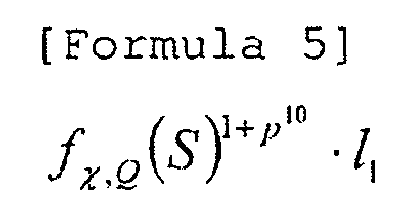
using Frobenius endomorphism ϕp of avalue 1 of the rational point S(xs, ys) on a line passing through rational points (Q1, Q2), Q1,Q2∈G2, being a value of the rational point S(xs, ys) on a line passing through rational points (pQ1, pQ2), the rational function f'χ,Q(S) is computed by computing:

- A pairing computation method according to the present invention is for defining pairing e by using:


as a nondegenerate bilinear map:
where: - E is an additive group of rational points on a pairable elliptic curve defined over Fp k with an embedding degree of k, and the curve equation is given by y2=x3+ax+b where a∈Fp and b∈Fp,
- E[r] is a set of rational points of a prime order r, and
- ϕp is Frobenius endomorphism, and
- causing the CPU of the electronic calculator to function as computation means for computing a rational function fχ,Q(S);
- causing the CPU of the electronic calculator to function as computation means for computing a value of a rational point S(xs, ys) on a line passing through a predetermined rational point;
- causing the CPU of the electronic calculator to function as computation means for computing a rational function f'χ,Q(S) using results of the computations; and
- causing the CPU of the electronic calculator to function as computation means for performing computation by using the rational function f'χ,Q(S) as:

- The pairing computation method according to the present invention is characterized by further including a step of causing the CPU of the electronic calculator to function as computation means for computing χQ and computing the predetermined rational point by using the result of the computation of χQ, after the step of computing the rational function fχ,Q(S).
- A pairing computation program according to the present invention is for defining pairing e by using:

and
as a nondegenerate bilinear map:
where: - E is an additive group of rational points on a pairable elliptic curve defined over Fp k with an embedding degree of k, and the curve equation is given by y2=x3+ax+b where a∈Fp and b∈Fp,
- E[r] is a set of rational points of a prime order r, and
- ϕp is Frobenius endomorphism, and
- computation means for computing a rational function fχ,Q(S);
- computation means for computing a value of a rational point S(xs, ys) on a line passing through a predetermined rational point;
- computation means for computing a rational function f'χ,Q(S) using results of the computations; and
- computation means for performing computation by using the rational function f'χ,Q(S) as:

- The pairing computation program according to the present invention is characterized in that the program causes the electronic calculator to function as computation means for computing χQ and computation means for computing the predetermined rational point by using the result of the computation of χQ.
- In accordance with the present invention, a rational function calculated according to Miller's algorithm in pairing computation is given as a function of an integer variable χ, so that the rational function can be calculated at high speed, thereby achieving faster pairing computation. Therefore, it is possible to provide digital group signature service of practical use.
-
- [
Fig. 1 ] is a schematic diagram of a pairing computation device according to an embodiment of the present invention. - [
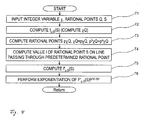
Fig. 2 ] is a flowchart of a pairing computation program according to the embodiment of the present invention. - [
Fig. 3 ] is a flowchart for computing a rational function fχ,Q(S). - [
Fig. 4 ] is a flowchart of a pairing computation program according to another embodiment of the present invention. -
- 10
- electronic calculator
- 11
- CPU
- 12
- storage device
- 13
- memory device
- 14
- bus
- 15
- input/output control unit
- 20
- electrical communication line
- 30
- client device
- A pairing computation device, a pairing computation method, and a pairing computation program according to the present invention perform pairing computation including a first step of computing a rational function according to Miller's algorithm and a second step of performing exponentiation on the computation result. In the first step, the pairing computation device, the pairing computation method, and the pairing computation program compute a rational function using an integer variable χ to speed up the computation.
- Specifically, in the conventional pairing computation, pairing e is defined by using:

and
as a nondegenerate bilinear map:
where: - E is an additive group of rational points on a pairable elliptic curve defined over Fp k with an embedding degree of k, and the curve equation is given by y2=x3+ax+b where a∈Fp and b∈Fp,
- E[r] is a set of rational points of a prime order r, and
- ϕp is Frobenius endomorphism, and
- By contrast, the present inventors have found pairing that allows for faster computation by using an integer variable χ on an elliptic curve. This pairing is referred to as "Xate pairing."
- In other words, the pairing computation device, the pairing computation method, and the pairing computation program according to the present invention use Xate pairing rather than Ate pairing, thereby enabling fast computation.
- In particular, the elliptic curves used in pairing computation are known as pairing-friendly curves corresponding to the respective embedding degrees. For example, with an embedding degree k=12, the order r and the trace t of the Frobenius endomorphism ϕp are known to be represented as follows using the integer variable χ:

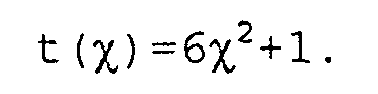
- With an embedding degree k=10, r and t are known to be represented as follows:


Alternatively, they are also known to be represented as follows:

- With an embedding degree k=8, r and t are known to be represented as follows:


Alternatively, they are also known to be represented as follows:

Alternatively, they are also known to be represented as follows:

- With an embedding degree k=18, r and t are known to be represented as follows:


- In the following, Xate pairing will be described with the embedding degree k=12, by way of example.
- With the embedding degree k=12, pairing e is defined by using:

and
as a nondegenerate bilinear map:
where: - E is an additive group of rational points on a pairable elliptic curve defined over Fp 12, and the curve equation is given by y2=x3+b where b∈Fp, E[r] is a set of rational points of a prime order r, and ϕp is Frobenius endomorphism.
- In this case, the order r and the trace t of the Frobenius Endomorphism ϕp can be represented as follows using the integer variable χ as described above.


-
Equasion 2 can be transformed as follows. Here, the notation (χ) will be omitted unless particularly necessary, for the sake of convenience.
Here, a characteristic p has the following relational expression.
- Therefore, the characteristic p is represented as follows using the integer variable χ.

- Using Equasion 3, Equasion 5 can be transformed as follows.

-
Equasion 6 can be transformed as follows.
- Here, based on the already-known relational expression p4-p2+1≡0 (mod r), the following equation is obtained.

- Equasion 8 can be transformed as follows.

- Using Equasion 9 and from the relational expression p6≡-1 (mod r), Equasion 7 can be transformed as follows.

- Next, a rational function ft-1,Q(·) of Ate pairing will be considered. In particular, with Equasion 3, the rational function ft-1,Q(·) can be represented as follows, where t-1=T:

- Here, Q∈G2, and for ∀S∈G1, the following equation is given:

- Using
Equasion 10, the following equation is obtained:
- Here, it is supposed that the rational function satisfies the following relational expressions:


and
- Therefore,
Equasion 13 can be transformed as follows:
- Here, gaQ,bQ=laQ,bQ/VaQ+bQ, where laQ,bQ denotes a value on the line passing through two rational points aQ and bQ, and VaQ+bQ denotes a value on the vertical line of rational point aQ+bQ. When the embedding degree is an even number, the computation of VaQ+bQ can be omitted.
- Furthermore, in Equasion 17,

has bilinearity and can be transformed as follows:
- Therefore, using Equasion 3,
Equasion 13, and Equasion 19, the transformation of Equasion 17 results in the following.
- Here, given that the left side of
Equasion 20 has bilinearity, the present inventors have noticed that the right side ofEquasion 20 has also bilinearity and set the right side ofEquasion 20 as a new rational function f'χ,Q(·). - More specifically, the computation of pairing e(Q,S) is carried out by the following equation:

The present inventors call this pairing e(Q,S) as Xate pairing. - Furthermore, the right side of
Equasion 20 can be transformed as follows:
- In other words, in the case of the embedding degree k=12, if a value l1 of a rational point S (xs, ys) on a line passing through rational points (χQ, p10χQ), a value l2 of a rational point S(xs, ys) on a line passing through rational points (χQ+p10χQ, pχQ+p3χQ), and a value l3 of a rational point S (xs, ys) on a line passing through rational points (pχQ, p3χQ) are calculated and specified, the computation according to Miller's algorithm can be speeded up based on the following equation:
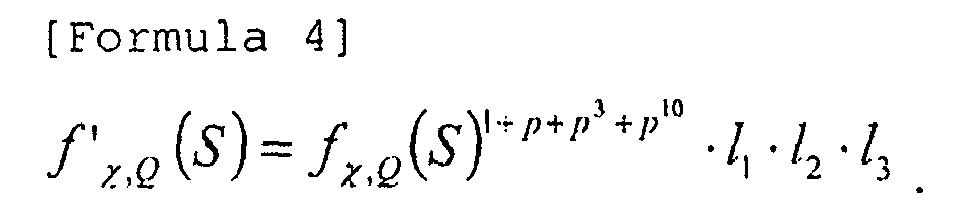
- Moreover, the right side of
Equasion 20 can be transformed as follows, which makes the computation of f'χ,Q(S) even faster:
- As described above, if pairing computation is carried out using Xate pairing, the computation can be performed using the rational function fχ,Q(S) and a new rational function f'χ,Q(S) obtained by using the values on the lines passing through predetermined rational points. In particular, the rational function f'χ,Q(S) can be computed using χ having a size smaller than t-1, thereby achieving faster pairing computation.
- The description has been given so far to the case of the embedding degree k=12. This is basically applicable to the cases of the embedding degrees k=8, 10, 18, and therefore, a detailed description thereof will not be repeated.
- In the following, an embodiment with embedding degree k=12 will be detailed. It is noted that the present embodiment is intended for digital group signatures, and an authentication server configured with a predetermined electronic calculator is assumed as the pairing computation device. However, the pairing computation device may not be configured as an authentication server and may be any device as long as it includes at least computing means such as CPU and can perform pairing computation.
- As shown in
Fig. 1 , anelectronic calculator 10 which configures an authentication server includes aCPU 11 for performing computation, astorage device 12 such as a hard disk for storing a variety of programs such as a pairing computation program and data for use in the pairing computation program, and amemory device 13 configured with a RAM, for example, for expanding the pairing computation program so as to be executable and for temporarily storing data generated by execution of the pairing computation program.Fig. 4 also shows abus 14. - The
electronic calculator 10 is also connected to anelectrical communication line 20 such as the Internet so as to be able to receive signature data of a digital group signature transmitted from aclient device 30 connected to theelectrical communication line 20.Fig. 1 shows that theelectronic calculator 10 includes an input/output control unit 15. - When signature data of a digital group signature is transmitted from the
client device 30 to theelectronic calculator 10, the transmitted signature data is temporarily stored in thememory device 13. Then, theelectronic calculator 10 performs pairing computation by executing the pairing computation program. - More specifically, upon execution of the pairing computation program, the
electronic calculator 10 performs pairing computation based on a flowchart shown inFig. 2 to implement a digital group signature. It is noted that the authentication process in the digital group signature will not be detailed, and only the pairing computation as a subroutine in the authentication process will be detailed. - With the pairing computation program, the
CPU 11 of theelectronic calculator 10 functions as input means for inputting required data in step S1 as shown inFig. 2 . More specifically, in theelectronic calculator 10, data of an integer variable χ and data of a rational point Q stored beforehand in thememory device 13 are input in a predetermined register provided inside theCPU 11, and in addition, data of a rational point S temporarily stored as signature data in thememory device 13 is input in a predetermined register provided inside theCPU 11. - Then, with the pairing computation program, the
CPU 11 of theelectronic calculator 10 functions as first computation means for performing computation of a rational function fχ,Q(S) by Miller's algorithm, in step S2. - Specifically, the computation of the rational function fχ,Q(S) is executed as shown in a flowchart in
Fig. 3 . In particular, in step S2, the computation of χQ is performed along with the computation of the rational function fχ,Q(S), and the result of the computation of χQ is stored in a predetermined register provided inside theCPU 11. - More specifically, based on the flowchart in
Fig. 3 , theelectronic calculator 10 performs initial settings in step S21. More specifically, theelectronic calculator 10 performs an operation to set f←1, T←Q, and i←[log2(χ)], where i is the number of bits if the integer variable χ is in binary representation. - Then, based on the flowchart in
Fig. 3 , theelectronic calculator 10 performs a predetermined computation for the rational function fχ,Q(S) part, in step S22. - Then, based on the flowchart in
Fig. 3 , theelectronic calculator 10 performs a predetermined computation for the χQ part, in step S23. - Then, based on the flowchart in
Fig. 3 , theelectronic calculator 10 determines whether value ui of the i-th bit of the integer variable χ is "1" or "0", in step S24. - If ui=1, based on the flowchart in
Fig. 3 , theelectronic calculator 10 performs a predetermined computation for the rational function fχ,Q(S) part, in step S25, and then performs a predetermined computation for the χQ part, in step S26. - Then, based on the flowchart in
Fig. 3 , theelectronic calculator 10 performs a termination determination, in step S27. - If i≠1 in step S27, based on the flowchart in
Fig. 3 , theelectronic calculator 10 decrements i in step S28, and then, returning to step S22, repeatedly performs the computations of the rational functions fχ,Q(S) and χQ until i=1 in step S27. - If i=1 in step S27, the
electronic calculator 10 stores the computation result of the rational function fχ,Q(S) and the computation result of χQ in predetermined registers and then ends the subroutine based on the flowchart inFig. 3 . - Then, with the pairing computation program, the
CPU 11 of theelectronic calculator 10 functions as second computation means for computing rational points p10χQ, χQ+p10χQ, pχQ+p3χQ, in step S3. - In particular, in the second computation means, letting χQ stored in the predetermined register in step S2 =R, using the relation of Frobenius endomorphism ϕp of R being ϕp(R)=pR, computation is performed by assuming that the rational points are p10χQ=p10R, χQ+p10χQ=R+p10R, pχQ+p3χQ=pR+p3R.
- Specifically, given T=χQ=R where X=p10R, Y=R+p10R, Z=pR+p3R, the
electronic calculator 10 performs computation as follows:

and
- Therefore, since the
electronic calculator 10 can perform computation without performing a multiplication process in step S3, the computation can be speeded up. - Then, with the pairing computation program, the
CPU 11 of theelectronic calculator 10 functions as third computation means for computing the value l1 of the rational point S(xs, ys) on the line passing through the rational points (χQ, p10χQ) and the value l2 of the rational point S(xs, ys) on the line passing through the rational points (χQ+p10χQ, pχQ+p3χQ), in step S4. - Specifically, in the
electronic calculator 10, l1=lT,X(S) is computed as follows:
and
- Furthermore, in the
electronic calculator 10, l2=lY,Z(S) is computed as follows:
and
- Then, with the pairing computation program, the
CPU 11 of theelectronic calculator 10 functions as fourth computation means for computing, using the computation result in the first computation means, the computation result in the third computation means, and the value l3 of the rational point S(xs, ys) on the line passing through the rational points (pχQ, p3χQ), a rational function f'χ,Q(S) as follows, in step S5:
- In particular, in this case, given that Frobenius endomorphism ϕp of the rational function fχ,Q(S) is ϕp(fχ,Q(S)) = fχ,Q(S)p, using ϕp 10(fχ,Q(S)) = fχ,Q(S)p^10 (here, p^10 represents p10), the
electronic calculator 10 computes:
- Furthermore, using Frobenius endomorphism ϕp of a
value 1 of a rational point S(xs, ys) on a line passing through rational points (Q1, Q2), Q1,Q2∈G2, being a value of a rational point S(xs, ys) on a line passing through rational points (pQ1, pQ2), theelectronic calculator 10 computes a rational function f'χ,Q(S) by computing:

- Specifically, the
electronic calculator 10 performs computation as follows. Here, p^3 represents p3. - 1. C←fp^10
- 2. C←C·f
- 3. A←C·lT,X(S)
- 4. B←A p^3
- 5. return A,B
- Therefore,

can be calculated as:
- In this manner, the use of Xate pairing can significantly reduce the computation amount thereby achieving faster pairing computation.
- Then, with the pairing computation program, the
CPU 11 of theelectronic calculator 10 functions as fifth computation means for performing final exponentiation in the pairing e(Q,S) in step S6. - Specifically, the
electronic calculator 10 performs computation as follows. - 1. f'←f'p^6·f'-1
- 2. f'←f'p^2·f'
- 3. a←(f'6)χ·(f'5)p^6
- 4. b←ap
- 5. b←a·b
- 6. compute f'p, f'p^2, and f'p^3
- 7. c←b·(f'p)2.f'p^2
- 8. f'←f'p^3·(C6)χ-2·c·b·(f'p·f')9·a·f'4
- 9. Return f'
- In the
electronic calculator 10 that configures an authentication server, an authentication process is performed using the result of pairing computation obtained as described above. - In the present embodiment, the description has been made to the case of the embedding degree k=12. However, for example, in the case of an embedding degree k=10, similar computation can also be performed.
- With the embedding degree k=10, pairing e is defined by using:

and
as a nondegenerate bilinear map:
where: - E is an additive group of rational points on a pairable elliptic curve defined over Fp 10 with an embedding degree of 10, and the curve equation is given by y2=x3+ax+b where a∈Fp and b∈Fp, E[r] is a set of rational points of a prime order r, and ϕp is Frobenius endomorphism.
- In this case, the order r and the trace t of the Frobenius endomorphism ϕp are represented as follows, using an integer variable χ.


- Furthermore, p-adic expansion by a characteristic p of the integer variable χ is represented as follows.

- Then, a value l4 of a rational point S(xs, ys) on a line passing through rational points (xQ, pχQ) and a value l5 of a rational point S(xs, ys) on a line passing through rational points (χQ+pχQ, p3χQ+p4χQ) are computed, and then using a value l6 of a rational point S (xs, ys) on a line passing through rational points (p3χQ, p4χQ), a rational function f'χ,Q(S) is computed by the following equation:

- Similarly to the case of the embedding degree k=12, also in the case of the embedding degree k=10, the authentication server performs pairing computation based on a flowchart shown in
Fig. 4 by executing the pairing computation program. - With the pairing computation program, as shown in
Fig. 4 , in step T1, theCPU 11 of theelectronic calculator 10 functions as input means for inputting required data. More specifically, in theelectronic calculator 10, data of the integer variable χ and data of the rational point Q stored beforehand in thememory device 13 are input in a predetermined register provided inside theCPU 11, and in addition, data of the rational point S temporarily stored as signature data in thememory device 13 is input in a predetermined register provided inside theCPU 11. - Then, with the pairing computation program, the
CPU 11 of theelectronic calculator 10 functions as the first computation means for performing computation of a rational function fχ,Q(S) by Miller's algorithm, in step T2. - It is noted that in this step T2, the first equation in step S22 in the flowchart shown in
Fig. 3 is given as follows.
- Here, "a" denotes the first-order coefficient in the elliptic curve given by y2=x3+ax+b where a∈Fp and b∈Fp. Except for this first equation, computation of the rational function fχ,Q(S) is performed similarly to the flowchart shown in
Fig. 3 . - Furthermore, in step T2, the
electronic calculator 10 also computes χQ along with the rational function fχ,Q(S) and stores the computation result in a predetermined register. - Then, with the pairing computation program, the
CPU 11 of theelectronic calculator 10 functions as the second computation means for computing rational points pχQ, χQ+pχQ, p3χQ+p4χQ in step T3. - In particular, in the second computation means, letting χQ stored in the predetermined register in step T2 =R, using the relation of Frobenius endomorphism ϕp of R being ϕp(R)=pR, computation is performed by assuming that the rational points are pχQ=pR, χQ+pχQ=R+pR, p3χQ+p4χQ=p3R+p4R.
- Specifically, given T=χQ=R where X=pR, Y=R+pR, Z=p3R+p4R, the
electronic calculator 10 performs computation as follows:

and
- Then, with the pairing computation program, the
CPU 11 of theelectronic calculator 10 functions as the third computation means for computing the value l4 of the rational point S(xs, ys) on the line passing through the rational points (χQ, pχQ) and the value l5 of the rational point S(xs, ys) on the line passing through the rational points (χQ+pXQ, p3χQ+p4χQ), in step T4. - Specifically, in the
electronic calculator 10, l4=lT,X(S) is computed as follows:

- Furthermore, in the
electronic calculator 10, l5=lY,Z(S) is computed as follows:

- Then, with the pairing computation program, the
CPU 11 of theelectronic calculator 10 functions as the fourth computation means for computing, using the computation result in the first computation means, the computation result in the third computation means, and the value l6 of the rational point S(xs, ys) on the line passing through rational points (p3χQ, p4χQ), a rational function f'χ,Q(S) as follows, in step T5:
- In particular, in this case, using Frobenius endomorphism ϕp of the rational function fχ,Q(S) being ϕp(fχ,Q(S)) = fχ,Q(S)p, the
electronic calculator 10 computes:
- Furthermore, using Frobenius endomorphism ϕp of the
value 1 of the rational point S (xs, ys) on the line passing through the rational points (Q1, Q2), Q1,Q2∈G2, being a value of the rational point S(xs, ys) on a line passing through the rational points (pQ1, pQ2), theelectronic calculator 10 computes a rational function f'χ,Q(S) by computing:

- Specifically, the
electronic calculator 10. performs computation as follows. Here, p^3 represents p3. - 1. C←fp
- 2. C←C·f
- 3. A←C·lT,X(S)
- 4. B←Ap^3
- 5. return A,B
- Furthermore, the
electronic calculator 10 performs computation as: - 1. f'←A·B·lY,Z(S)
- 2. f'←f'p^4
- Then, with the pairing computation program, the
CPU 11 of theelectronic calculator 10 functions as the fifth computation means for performing final exponentiation in the pairing e(Q, S) in step T6. - In the
electronic calculator 10 that configures an authentication server, an authentication process is performed using the result of pairing computation obtained as described above. - Furthermore, in the case of the embedding degree k=10, letting the rational function calculated according to Miller's algorithm be given by fχ^2,Q(S) (χ^2 represents χ2), pairing e(Q,S) can also be computed.
- In this case, the order r and the trace t of the Frobenius endomorphism ϕp is represented as follows, using an integer variable χ.


- Furthermore, p-adic expansion by a characteristic p of the integer variable χ is represented as follows.

- Then, the
electronic calculator 10 computes a rational function f'χ,Q(S) by the following equation:
- Therefore, according to the pairing computation program, in the
electronic calculator 10, the pairing e(Q,S) can be computed as: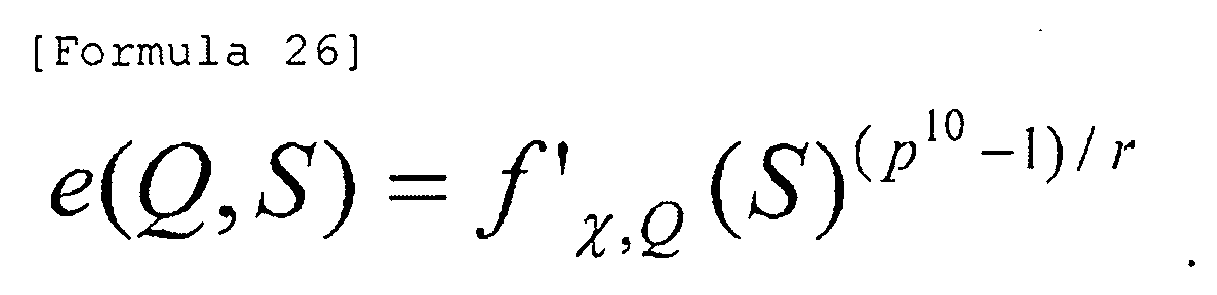
- With the embedding degree k=8, pairing e is defined by using:

and
as a nondegenerate bilinear map:
where: - E is an additive group of rational points on a pairable elliptic curve defined over Fp 8, and the curve equation is given by y2=x3+ax where a∈Fp, E[r] is a set of rational points of a prime order r, and ϕp is the Frobenius endomorphism.
- In this case, the order r and the trace t of Frobenius endomorphism ϕp are represented as follows, using an integer variable χ.


- Furthermore, p-adic expansion by a characteristic p of the integer variable χ is represented as follows.

- Then, using a value l7 of a rational point S(xs, ys) on a line passing through rational points (χQ, χQ), a value l8 of a rational point S(xs, ys) on a line passing through rational points (2χQ, χQ), a value l9 of a rational point S(xs, ys) on a line passing through rational points (p2Q, (3χ+1)Q), and a value l10 of a rational point S(xs, ys) on a line passing through rational points (3χQ, Q), the
electronic calculator 10 computes a rational function f'χ,Q(S) using the following equation:
- In other words, with the pairing computation program, the
electronic calculator 10 performs computation of the rational function fχ,Q(S) by Miller's algorithm as described above, computes χQ along with the rational function fχ,Q(S), and then stores the computation result in a predetermined register. - Then, letting χQ stored in a predetermined register =R, using the relation of Frobenius endomorphism ϕp of R being ϕp(R)=pR, the
electronic calculator 10 computes rational points 2χQ, p2χ, 3χQ, (3χ+1)Q, computes the values l7, l8, l9, l10 using the computation result, and computes the rational function f'χ,Q(S). - Then, in the
electronic calculator 10, the pairing e(Q,S) can be computed as:
- It is noted that, in the case of the embedding degree k=8, the order r and the trace t of the Frobenius endomorphism ϕp may also be represented as follows, using the integer variable χ.


- In this case, p-adic expansion by the characteristic p of the integer variable χ is represented as follows.

- In this case, using a value l11 of a rational point S(xs, ys) on a line passing through rational points (pQ, χQ), the rational function f'χ,Q(S) can also be computed by the following equation:

- Alternatively, in the case of the embedding degree k=8, letting the rational functions calculated according to Miller's algorithm be given by fχ^2,Q(S) (χ^2 represents χ2) and fχ,Q(S), the pairing e (Q, S) can also be computed.
- Here, the order r and the trace t of the Frobenius endomorphism ϕp can also be represented as follows, using the integer variable χ.


- In this case, p-adic expansion by the characteristic p of the integer variable χ is represented as follows.

- In this case, using a value l12 of a rational point S(xs, ys) on a line passing through rational points (χ2Q, pχQ), the rational function f'χ,Q(S) can be computed by the following equation:

- Here, the
electronic computation device 10 computes χQ, along with the computation of the rational function fχ^2,Q(S) and the rational function fχ,Q(S) by Miller's algorithm as described above, and stores the computation result in a predetermined register. - Then, letting χQ stored in a predetermined register =R, using the relation of Frobenius endomorphism ϕp of R being ϕp(R)=pR, the
electronic calculator 10 computes a rational point pχQ, and computes the above-noted value l12 using this computation result, and computes the rational function f'χ,Q(S). Then, the pairing e(Q,S) can be computed as:
- With the embedding degree k=18, pairing e is defined by using:

and
as a nondegenerate bilinear map:
where: - E is an additive group of rational points on a pairable elliptic curve defined over Fp 18, and the curve equation is given by y2=x3+b where b∈Fp, E[r] is a set of rational points of a prime order r, and ϕp is Frobenius endomorphism.
- In this case, the order r and the trace t of the Frobenius endomorphism ϕp are represented as follows, using an integer variable χ.


- In this case, p-adic expansion by a characteristic p of the integer variable χ is represented as follows.

- Then, a value l13 of a rational point S (xs, ys) on a line passing through rational points (3pQ, χQ), the
electronic calculator 10 computes a rational function f'χ,Q(S) by the following equation:
- In other words, with the pairing computation program, the
electronic calculator 10 performs computation of the rational function fχ,Q(S) by Miller's algorithm as described above, computes χQ together with the rational function fχ,Q(S), and then stores the computation result in a predetermined register. - Then, the
electronic calculator 10 computes the above-noted value l13 using the rational function fχ,Q(S) and the computation result of χQ, and computes the rational function f'χ,Q(S), Then, the pairing e(Q,S) can be computed as:
- As described above, pairing computation is performed with Xate pairing to achieve faster pairing computation, thereby making group signatures using pairing computation into practical use.
- In accordance with the present invention, it is possible to provide a high-speed pairing computation device and to provide digital group signature service of practical use.

and
the order r and the trace t of the Frobenius endomorphism ϕp are used as functions of an integer variable χ:

the order r and the trace t of the Frobenius endomorphism ϕp are used as functions of an integer variable χ:

the order r and the trace t of the Frobenius endomorphism ϕp are used as functions of an integer variable χ:


Claims (8)
- A pairing computation device for defining pairing e by using:

and
as a nondegenerate bilinear map:
where:E is an additive group of rational points on a pairable elliptic curve defined over Fp k with an embedding degree of k, and the curve equation is given by y2=x3+ax+b where a∈Fp and b∈Fp,E[r] is a set of rational points of a prime order r, andϕp is Frobenius endomorphism,computing pairing e(Q,S) where S∈G1 and Q∈G2, and outputting a result of the computation,
the pairing computation device comprising, where t is a trace of the Frobenius endomorphism ϕp, instead of computing the pairing e(Q,S) by using a rational function ft-1,Q(S) calculated according to Miller's algorithm as:
and
the order r and the trace t of the Frobenius endomorphism ϕp are used as functions of an integer variable χ:computation means for computing a rational function fχ,Q(S);computation means for computing a value of a rational point S(xs, ys) on a line passing through a predetermined rational point;computation means for computing a rational function f'χ,Q(S) using computation results of these computation means; andcomputation means for performing pairing computation by using the rational function f'χ,Q(S) as:
- The pairing computation device according to claim 1, wherein the computation means for computing the rational function fχ,Q(S) includes computation means for computing χQ, storing a result of the computation in a predetermined register, and computing the predetermined rational point by using the result of the computation of χQ.
- The pairing computation device according to claim 2, wherein, if the embedding degree k=12,
using the integer variable χ, letting the order r and the trace t of the Frobenius endomorphism ϕp be:
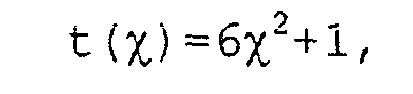
letting χQ=R, using a relation of Frobenius endomorphism ϕp of R being ϕp(R)=pR, rational points p10χQ, χQ+p10χQ, pχQ+p3χQ are computed,
a value l1 of the rational point S(xs, ys) on a line passing through rational points (χQ, p10χQ) and a value l2 of the rational point S(xs, ys) on a line passing through rational points (χQ+p10χQ, pχQ+p3χQ) are computed, and
the rational function f'χ,Q(S) is computed by using a value l3 of the rational point S (xs, ys) on a line passing through rational points (pχQ, p3χQ) as:
- The pairing computation device according to claim 3, wherein
using Frobenius endomorphism φp of the rational function fχ,Q(S) being ϕp(fχ,Q(S)) = fχ,Q(S)p,
is computed, and
using Frobenius endomorphism ϕp of a value 1 of the rational point S(xs, ys) on a line passing through rational points (Q1, Q2), Q1,Q2∈G2, being a value of the rational point S(xs, ys) on a line passing through rational points (pQ1, pQ2), the rational function f'χ,Q(S) is computed by computing:
which satisfies:
- A pairing computation method for defining pairing e by using:

and
as a nondegenerate bilinear map:
where:E is an additive group of rational points on a pairable elliptic curve defined over Fp k with an embedding degree of k, and the curve equation is given by y2=x3+ax+b where a∈Fp and b∈Fp,E[r] is a set of rational points of a prime order r, andϕp is Frobenius endomorphism, andcomputing pairing e(Q,S) where S∈G1 and Q∈G2 by an electronic calculator including a CPU,the pairing computation method comprising steps of, where t is a trace of the Frobenius endomorphism ϕp, instead of computing the pairing e(Q,S) by using a rational function ft-1,Q(S) calculated according to Miller's algorithm as:
and
the order r and the trace t of the Frobenius endomorphism ϕp are used as functions of an integer variable χ:causing the CPU of the electronic calculator to function as computation means for computing a rational function fχ,Q(S);causing the CPU of the electronic calculator to function as computation means for computing a value of a rational point S(xs, ys) on a line passing through a predetermined rational point;causing the CPU of the electronic calculator to function as computation means for computing a rational function f'χ,Q(S) using results of the computations; andcausing the CPU of the electronic calculator to function as computation means for performing computation by using the rational function f'χ,Q(S) as:
- The pairing computation method according to claim 5, further comprising a step of causing the CPU of the electronic calculator to function as computation means for computing χQ and computing the predetermined rational point by using the result of the computation of χQ, after the step of computing the rational function fχ,Q(S).
- A pairing computation program for defining pairing e by using:

and
as a nondegenerate bilinear map:
where:E is an additive group of rational points on a pairable elliptic curve defined over FP k with an embedding degree of k, and the curve equation is given by y2=x3+ax+b where a∈Fp and b∈Fp,E[r] is a set of rational points of a prime order r, andϕp is Frobenius endomorphism, andcausing an electronic calculator including a CPU to compute pairing e(Q,S) where S∈G1 and Q∈G2,the pairing computation program causing the electronic calculator to function as, where t is a trace of the Frobenius endomorphism ϕp, instead of causing computation of the pairing e(Q,S) by using a rational function ft-1,Q(S) calculated according to Miller's algorithm as:
and
the order r and the trace t of the Frobenius endomorphism ϕp are used as functions of an integer variable χ:computation means for computing a rational function fχ,Q(S);computation means for computing a value of a rational point S(xs, ys) on a line passing through a predetermined rational point;computation means for computing a rational function f'χ,Q(S) using results of the computations; andcomputation means for performing computation by using the rational function f'χ,Q(S) as:
- The pairing computation program according to claim 7, wherein the pairing computation program causes the electronic calculator to function as
computation means for computing χQ; and
computation means for computing the predetermined rational point by using the result of the computation of χQ.
Applications Claiming Priority (2)
| Application Number | Priority Date | Filing Date | Title |
|---|---|---|---|
| JP2008222556 | 2008-08-29 | ||
| PCT/JP2009/065099 WO2010024401A1 (en) | 2008-08-29 | 2009-08-28 | Pairing computation device, pairing computation method, and pairing computation program |
Publications (2)
| Publication Number | Publication Date |
|---|---|
| EP2360659A1 true EP2360659A1 (en) | 2011-08-24 |
| EP2360659A4 EP2360659A4 (en) | 2013-03-13 |
Family
ID=41721564
Family Applications (1)
| Application Number | Title | Priority Date | Filing Date |
|---|---|---|---|
| EP09810049A Withdrawn EP2360659A4 (en) | 2008-08-29 | 2009-08-28 | MATCHING CALCULATION DEVICE, MATCHING CALCULATION METHOD, AND MATCHING CALCULATION PROGRAM |
Country Status (5)
| Country | Link |
|---|---|
| US (1) | US8625777B2 (en) |
| EP (1) | EP2360659A4 (en) |
| JP (1) | JP5360836B2 (en) |
| CN (1) | CN102308326B (en) |
| WO (1) | WO2010024401A1 (en) |
Cited By (1)
| Publication number | Priority date | Publication date | Assignee | Title |
|---|---|---|---|---|
| CN108055134A (en) * | 2017-12-12 | 2018-05-18 | 武汉理工大学 | Elliptic curve, which is counted, multiplies and matches the cooperated computing method and system of computing |
Families Citing this family (8)
| Publication number | Priority date | Publication date | Assignee | Title |
|---|---|---|---|---|
| EP2423828B1 (en) * | 2009-04-21 | 2017-08-09 | National University Corporation Okayama University | Pairing arithmetic device, pairing arithmetic method and recording medium having pairing arithmetic program recorded thereon |
| CN102907038B (en) * | 2010-05-19 | 2015-09-16 | 皇家飞利浦电子股份有限公司 | Attribute-Based Digital Signature System |
| JP5769263B2 (en) * | 2010-10-08 | 2015-08-26 | 国立大学法人 岡山大学 | Rational point information compression apparatus, rational point information compression method, and rational point information compression program |
| CN102984129A (en) * | 2012-11-02 | 2013-03-20 | 王攀 | Method for controlling and managing user behavior based on integration of three networks |
| JP6040052B2 (en) * | 2013-02-26 | 2016-12-07 | 日本電信電話株式会社 | Pairing calculation device, pairing calculation method, and program |
| CN104579661B (en) * | 2013-10-21 | 2018-05-01 | 航天信息股份有限公司 | The implementation method and device of the Electronic Signature of identity-based |
| JP6610277B2 (en) * | 2016-01-15 | 2019-11-27 | 富士通株式会社 | Shared key generation program, shared key generation method, and information processing terminal |
| CZ308647B6 (en) * | 2019-06-11 | 2021-01-27 | REGSHARE s.r.o. | Mixing valve and kit for diluting or mixing hazardous substances |
Family Cites Families (11)
| Publication number | Priority date | Publication date | Assignee | Title |
|---|---|---|---|---|
| US20020057796A1 (en) * | 1998-12-24 | 2002-05-16 | Lambert Robert J. | Method for accelerating cryptographic operations on elliptic curves |
| AU2003226413A1 (en) * | 2002-04-15 | 2003-11-03 | Docomo Communications Laboratories Usa, Inc. | Signature schemes using bilinear mappings |
| US7499544B2 (en) * | 2003-11-03 | 2009-03-03 | Microsoft Corporation | Use of isogenies for design of cryptosystems |
| JP2005316267A (en) | 2004-04-30 | 2005-11-10 | Hitachi Ltd | Elliptic curve pairing arithmetic unit |
| CN101031944A (en) * | 2004-09-30 | 2007-09-05 | 索尼株式会社 | Encryption computing method, encryption device, and computer program |
| JP4630117B2 (en) * | 2005-04-25 | 2011-02-09 | 日本電信電話株式会社 | Multi-pairing calculation method, pairing comparison method, apparatus using the same, and program |
| DE102005041102A1 (en) * | 2005-08-30 | 2007-03-15 | Siemens Ag | Method for scalar multiplication of points on an elliptic curve |
| KR101405321B1 (en) * | 2007-03-16 | 2014-06-27 | 재단법인서울대학교산학협력재단 | Key Computation Method and Shared Key Generation Method Using It |
| KR101273465B1 (en) * | 2007-03-16 | 2013-06-14 | 재단법인서울대학교산학협력재단 | Apparatus for batch verification and method using the same |
| US8300808B2 (en) * | 2007-08-09 | 2012-10-30 | National University Corporation Okayama University | Arithmetic operation method and arithmetic operation device |
| US8401179B2 (en) * | 2008-01-18 | 2013-03-19 | Mitsubishi Electric Corporation | Encryption parameter setting apparatus, key generation apparatus, cryptographic system, program, encryption parameter setting method, and key generation method |
-
2009
- 2009-08-28 CN CN200980142428.7A patent/CN102308326B/en not_active Expired - Fee Related
- 2009-08-28 US US13/060,520 patent/US8625777B2/en not_active Expired - Fee Related
- 2009-08-28 WO PCT/JP2009/065099 patent/WO2010024401A1/en not_active Ceased
- 2009-08-28 JP JP2010526795A patent/JP5360836B2/en not_active Expired - Fee Related
- 2009-08-28 EP EP09810049A patent/EP2360659A4/en not_active Withdrawn
Non-Patent Citations (5)
| Title |
|---|
| AUGUSTO JUN DEVEGILI ET AL: "Implementing Cryptographic Pairings over Barreto-Naehrig Curves", 2 July 2007 (2007-07-02), PAIRING-BASED CRYPTOGRAPHY Â PAIRING 2007; [LECTURE NOTES IN COMPUTER SCIENCE], SPRINGER BERLIN HEIDELBERG, BERLIN, HEIDELBERG, PAGE(S) 197 - 207, XP019096360, ISBN: 978-3-540-73488-8 * section 7; page 7 * * |
| CHANG-AN ZHAO ET AL: "All Pairings Are in a Group", INTERNATIONAL ASSOCIATION FOR CRYPTOLOGIC RESEARCH,, vol. 20080229:045008, 29 February 2008 (2008-02-29), pages 1-9, XP061002770, [retrieved on 2008-02-29] * |
| See also references of WO2010024401A1 * |
| VERCAUTEREN F: "Optimal Pairings", INTERNATIONAL ASSOCIATION FOR CRYPTOLOGIC RESEARCH,, vol. 20080307:091031, 7 March 2008 (2008-03-07), pages 1-14, XP061002772, [retrieved on 2008-03-07] * |
| YASUYUKI NOGAMI ET AL: "Integer Variable Ï â Based Ate Pairing", 1 September 2008 (2008-09-01), PAIRING-BASED CRYPTOGRAPHY Â PAIRING 2008; [LECTURE NOTES IN COMPUTER SCIENCE], SPRINGER BERLIN HEIDELBERG, BERLIN, HEIDELBERG, PAGE(S) 178 - 191, XP019103346, ISBN: 978-3-540-85503-3 * |
Cited By (2)
| Publication number | Priority date | Publication date | Assignee | Title |
|---|---|---|---|---|
| CN108055134A (en) * | 2017-12-12 | 2018-05-18 | 武汉理工大学 | Elliptic curve, which is counted, multiplies and matches the cooperated computing method and system of computing |
| CN108055134B (en) * | 2017-12-12 | 2020-08-25 | 武汉理工大学 | Collaborative calculation method and system for elliptic curve point multiplication and pairing operation |
Also Published As
| Publication number | Publication date |
|---|---|
| JP5360836B2 (en) | 2013-12-04 |
| EP2360659A4 (en) | 2013-03-13 |
| CN102308326A (en) | 2012-01-04 |
| US8625777B2 (en) | 2014-01-07 |
| US20110179471A1 (en) | 2011-07-21 |
| JPWO2010024401A1 (en) | 2012-01-26 |
| WO2010024401A1 (en) | 2010-03-04 |
| CN102308326B (en) | 2014-08-13 |
Similar Documents
| Publication | Publication Date | Title |
|---|---|---|
| US8625777B2 (en) | Pairing computation device, pairing computation method, and pairing computation program | |
| US8458471B2 (en) | Digital signature generation apparatus, digital signature verification apparatus, and key generation apparatus | |
| RU2533693C2 (en) | Encoding points on elliptic curve | |
| US20180006803A1 (en) | Multivariate Signature Method for Resisting Key Recovery Attack | |
| KR102364047B1 (en) | Method and apparatus for public-key cryptography based on structured matrices | |
| Zhang et al. | White-box implementation of the identity-based signature scheme in the IEEE P1363 standard for public key cryptography | |
| EP3376705A1 (en) | Elliptic curve point multiplication device and method in a white-box context | |
| EP3276880A1 (en) | Efficient ecdsa signature and verification | |
| US20160149708A1 (en) | Electronic signature system | |
| Azarderakhsh et al. | Hardware deployment of hybrid PQC: SIKE+ ECDH | |
| Sghaier et al. | Fast hardware implementation of ECDSA signature scheme | |
| KR102070061B1 (en) | Batch verification method and apparatus thereof | |
| JP5549018B2 (en) | PAIRING OPERATION DEVICE, PAIRING OPERATION METHOD, AND RECORDING MEDIUM CONTAINING PAIRING OPERATION PROGRAM | |
| US12549362B2 (en) | Encryption device, decryption device, key generation device, encryption method, decryption method, key generation method, computer program product for encryption, computer program product for decryption, and computer program product for key generation | |
| KR20100039048A (en) | Method and apparatus of digital signature using crt-rsa modula exponentiation algorithm against fault attacks, and recording medium using it | |
| KR102510077B1 (en) | Apparatus and method for performing operation being secure against side channel attack | |
| US20070156797A1 (en) | Protection of a calculation performed by an integrated circuit | |
| JPWO2012015047A1 (en) | Scalar multiplication and pairing of rational points on an elliptic curve with embedding degree 1 and composite order | |
| EP3090505B1 (en) | Method for processing a generalized goldwasser-micali ciphertext, corresponding electronic device and computer program product | |
| EP4730104A1 (en) | Verification of an ecdsa signature | |
| JP5168649B2 (en) | Pairing calculation device, pairing calculation method, and pairing calculation program | |
| Geetha et al. | Asymmetric key cipher based on non-linear dynamics | |
| KR101168869B1 (en) | eT pairing Algorithm over GF2^n and recording medium storing the eT pairing Algorithm | |
| US20170359176A1 (en) | Cryptography on an elliptical curve | |
| US20140314230A1 (en) | Cryptography on an elliptical curve |
Legal Events
| Date | Code | Title | Description |
|---|---|---|---|
| PUAI | Public reference made under article 153(3) epc to a published international application that has entered the european phase |
Free format text: ORIGINAL CODE: 0009012 |
|
| 17P | Request for examination filed |
Effective date: 20110303 |
|
| AK | Designated contracting states |
Kind code of ref document: A1 Designated state(s): AT BE BG CH CY CZ DE DK EE ES FI FR GB GR HR HU IE IS IT LI LT LU LV MC MK MT NL NO PL PT RO SE SI SK SM TR |
|
| DAX | Request for extension of the european patent (deleted) | ||
| A4 | Supplementary search report drawn up and despatched |
Effective date: 20130208 |
|
| RIC1 | Information provided on ipc code assigned before grant |
Ipc: H04L 9/30 20060101ALI20130204BHEP Ipc: G09C 1/00 20060101AFI20130204BHEP |
|
| GRAP | Despatch of communication of intention to grant a patent |
Free format text: ORIGINAL CODE: EPIDOSNIGR1 |
|
| RIC1 | Information provided on ipc code assigned before grant |
Ipc: G09C 1/00 20060101AFI20130909BHEP Ipc: H04L 9/30 20060101ALI20130909BHEP |
|
| INTG | Intention to grant announced |
Effective date: 20131010 |
|
| GRAJ | Information related to disapproval of communication of intention to grant by the applicant or resumption of examination proceedings by the epo deleted |
Free format text: ORIGINAL CODE: EPIDOSDIGR1 |
|
| GRAP | Despatch of communication of intention to grant a patent |
Free format text: ORIGINAL CODE: EPIDOSNIGR1 |
|
| GRAP | Despatch of communication of intention to grant a patent |
Free format text: ORIGINAL CODE: EPIDOSNIGR1 |
|
| INTG | Intention to grant announced |
Effective date: 20140402 |
|
| INTC | Intention to grant announced (deleted) | ||
| INTG | Intention to grant announced |
Effective date: 20140424 |
|
| GRAS | Grant fee paid |
Free format text: ORIGINAL CODE: EPIDOSNIGR3 |
|
| STAA | Information on the status of an ep patent application or granted ep patent |
Free format text: STATUS: THE APPLICATION IS DEEMED TO BE WITHDRAWN |
|
| 18D | Application deemed to be withdrawn |
Effective date: 20150303 |