EP2359834B1 - Treatment of paroxysmal nocturnal hemoglobinuria patients by an inhibitor of complement - Google Patents
Treatment of paroxysmal nocturnal hemoglobinuria patients by an inhibitor of complement Download PDFInfo
- Publication number
- EP2359834B1 EP2359834B1 EP11001632.6A EP11001632A EP2359834B1 EP 2359834 B1 EP2359834 B1 EP 2359834B1 EP 11001632 A EP11001632 A EP 11001632A EP 2359834 B1 EP2359834 B1 EP 2359834B1
- Authority
- EP
- European Patent Office
- Prior art keywords
- eculizumab
- patients
- treatment
- complement
- life
- Prior art date
- Legal status (The legal status is an assumption and is not a legal conclusion. Google has not performed a legal analysis and makes no representation as to the accuracy of the status listed.)
- Revoked
Links
Images


Classifications
-
- C—CHEMISTRY; METALLURGY
- C07—ORGANIC CHEMISTRY
- C07K—PEPTIDES
- C07K16/00—Immunoglobulins [IG], e.g. monoclonal or polyclonal antibodies
- C07K16/18—Immunoglobulins [IG], e.g. monoclonal or polyclonal antibodies against material from animals or humans
-
- A—HUMAN NECESSITIES
- A61—MEDICAL OR VETERINARY SCIENCE; HYGIENE
- A61K—PREPARATIONS FOR MEDICAL, DENTAL OR TOILETRY PURPOSES
- A61K31/00—Medicinal preparations containing organic active ingredients
- A61K31/70—Carbohydrates; Sugars; Derivatives thereof
- A61K31/7088—Compounds having three or more nucleosides or nucleotides
- A61K31/7105—Natural ribonucleic acids, i.e. containing only riboses attached to adenine, guanine, cytosine or uracil and having 3'-5' phosphodiester links
-
- A—HUMAN NECESSITIES
- A61—MEDICAL OR VETERINARY SCIENCE; HYGIENE
- A61K—PREPARATIONS FOR MEDICAL, DENTAL OR TOILETRY PURPOSES
- A61K39/00—Medicinal preparations containing antigens or antibodies
- A61K39/395—Antibodies; Immunoglobulins; Immune serum, e.g. antilymphocytic serum
-
- A—HUMAN NECESSITIES
- A61—MEDICAL OR VETERINARY SCIENCE; HYGIENE
- A61K—PREPARATIONS FOR MEDICAL, DENTAL OR TOILETRY PURPOSES
- A61K9/00—Medicinal preparations characterised by special physical form
- A61K9/0012—Galenical forms characterised by the site of application
- A61K9/0019—Injectable compositions; Intramuscular, intravenous, arterial, subcutaneous administration; Compositions to be administered through the skin in an invasive manner
-
- A—HUMAN NECESSITIES
- A61—MEDICAL OR VETERINARY SCIENCE; HYGIENE
- A61P—SPECIFIC THERAPEUTIC ACTIVITY OF CHEMICAL COMPOUNDS OR MEDICINAL PREPARATIONS
- A61P1/00—Drugs for disorders of the alimentary tract or the digestive system
- A61P1/14—Prodigestives, e.g. acids, enzymes, appetite stimulants, antidyspeptics, tonics, antiflatulents
-
- A—HUMAN NECESSITIES
- A61—MEDICAL OR VETERINARY SCIENCE; HYGIENE
- A61P—SPECIFIC THERAPEUTIC ACTIVITY OF CHEMICAL COMPOUNDS OR MEDICINAL PREPARATIONS
- A61P13/00—Drugs for disorders of the urinary system
- A61P13/02—Drugs for disorders of the urinary system of urine or of the urinary tract, e.g. urine acidifiers
-
- A—HUMAN NECESSITIES
- A61—MEDICAL OR VETERINARY SCIENCE; HYGIENE
- A61P—SPECIFIC THERAPEUTIC ACTIVITY OF CHEMICAL COMPOUNDS OR MEDICINAL PREPARATIONS
- A61P15/00—Drugs for genital or sexual disorders; Contraceptives
- A61P15/10—Drugs for genital or sexual disorders; Contraceptives for impotence
-
- A—HUMAN NECESSITIES
- A61—MEDICAL OR VETERINARY SCIENCE; HYGIENE
- A61P—SPECIFIC THERAPEUTIC ACTIVITY OF CHEMICAL COMPOUNDS OR MEDICINAL PREPARATIONS
- A61P17/00—Drugs for dermatological disorders
-
- A—HUMAN NECESSITIES
- A61—MEDICAL OR VETERINARY SCIENCE; HYGIENE
- A61P—SPECIFIC THERAPEUTIC ACTIVITY OF CHEMICAL COMPOUNDS OR MEDICINAL PREPARATIONS
- A61P19/00—Drugs for skeletal disorders
-
- A—HUMAN NECESSITIES
- A61—MEDICAL OR VETERINARY SCIENCE; HYGIENE
- A61P—SPECIFIC THERAPEUTIC ACTIVITY OF CHEMICAL COMPOUNDS OR MEDICINAL PREPARATIONS
- A61P21/00—Drugs for disorders of the muscular or neuromuscular system
-
- A—HUMAN NECESSITIES
- A61—MEDICAL OR VETERINARY SCIENCE; HYGIENE
- A61P—SPECIFIC THERAPEUTIC ACTIVITY OF CHEMICAL COMPOUNDS OR MEDICINAL PREPARATIONS
- A61P25/00—Drugs for disorders of the nervous system
-
- A—HUMAN NECESSITIES
- A61—MEDICAL OR VETERINARY SCIENCE; HYGIENE
- A61P—SPECIFIC THERAPEUTIC ACTIVITY OF CHEMICAL COMPOUNDS OR MEDICINAL PREPARATIONS
- A61P25/00—Drugs for disorders of the nervous system
- A61P25/04—Centrally acting analgesics, e.g. opioids
-
- A—HUMAN NECESSITIES
- A61—MEDICAL OR VETERINARY SCIENCE; HYGIENE
- A61P—SPECIFIC THERAPEUTIC ACTIVITY OF CHEMICAL COMPOUNDS OR MEDICINAL PREPARATIONS
- A61P25/00—Drugs for disorders of the nervous system
- A61P25/18—Antipsychotics, i.e. neuroleptics; Drugs for mania or schizophrenia
-
- A—HUMAN NECESSITIES
- A61—MEDICAL OR VETERINARY SCIENCE; HYGIENE
- A61P—SPECIFIC THERAPEUTIC ACTIVITY OF CHEMICAL COMPOUNDS OR MEDICINAL PREPARATIONS
- A61P25/00—Drugs for disorders of the nervous system
- A61P25/20—Hypnotics; Sedatives
-
- A—HUMAN NECESSITIES
- A61—MEDICAL OR VETERINARY SCIENCE; HYGIENE
- A61P—SPECIFIC THERAPEUTIC ACTIVITY OF CHEMICAL COMPOUNDS OR MEDICINAL PREPARATIONS
- A61P25/00—Drugs for disorders of the nervous system
- A61P25/26—Psychostimulants, e.g. nicotine, cocaine
-
- A—HUMAN NECESSITIES
- A61—MEDICAL OR VETERINARY SCIENCE; HYGIENE
- A61P—SPECIFIC THERAPEUTIC ACTIVITY OF CHEMICAL COMPOUNDS OR MEDICINAL PREPARATIONS
- A61P25/00—Drugs for disorders of the nervous system
- A61P25/28—Drugs for disorders of the nervous system for treating neurodegenerative disorders of the central nervous system, e.g. nootropic agents, cognition enhancers, drugs for treating Alzheimer's disease or other forms of dementia
-
- A—HUMAN NECESSITIES
- A61—MEDICAL OR VETERINARY SCIENCE; HYGIENE
- A61P—SPECIFIC THERAPEUTIC ACTIVITY OF CHEMICAL COMPOUNDS OR MEDICINAL PREPARATIONS
- A61P29/00—Non-central analgesic, antipyretic or antiinflammatory agents, e.g. antirheumatic agents; Non-steroidal antiinflammatory drugs [NSAID]
- A61P29/02—Non-central analgesic, antipyretic or antiinflammatory agents, e.g. antirheumatic agents; Non-steroidal antiinflammatory drugs [NSAID] without antiinflammatory effect
-
- A—HUMAN NECESSITIES
- A61—MEDICAL OR VETERINARY SCIENCE; HYGIENE
- A61P—SPECIFIC THERAPEUTIC ACTIVITY OF CHEMICAL COMPOUNDS OR MEDICINAL PREPARATIONS
- A61P3/00—Drugs for disorders of the metabolism
-
- A—HUMAN NECESSITIES
- A61—MEDICAL OR VETERINARY SCIENCE; HYGIENE
- A61P—SPECIFIC THERAPEUTIC ACTIVITY OF CHEMICAL COMPOUNDS OR MEDICINAL PREPARATIONS
- A61P3/00—Drugs for disorders of the metabolism
- A61P3/02—Nutrients, e.g. vitamins, minerals
-
- A—HUMAN NECESSITIES
- A61—MEDICAL OR VETERINARY SCIENCE; HYGIENE
- A61P—SPECIFIC THERAPEUTIC ACTIVITY OF CHEMICAL COMPOUNDS OR MEDICINAL PREPARATIONS
- A61P31/00—Antiinfectives, i.e. antibiotics, antiseptics, chemotherapeutics
- A61P31/04—Antibacterial agents
-
- A—HUMAN NECESSITIES
- A61—MEDICAL OR VETERINARY SCIENCE; HYGIENE
- A61P—SPECIFIC THERAPEUTIC ACTIVITY OF CHEMICAL COMPOUNDS OR MEDICINAL PREPARATIONS
- A61P37/00—Drugs for immunological or allergic disorders
- A61P37/02—Immunomodulators
- A61P37/04—Immunostimulants
-
- A—HUMAN NECESSITIES
- A61—MEDICAL OR VETERINARY SCIENCE; HYGIENE
- A61P—SPECIFIC THERAPEUTIC ACTIVITY OF CHEMICAL COMPOUNDS OR MEDICINAL PREPARATIONS
- A61P43/00—Drugs for specific purposes, not provided for in groups A61P1/00-A61P41/00
-
- A—HUMAN NECESSITIES
- A61—MEDICAL OR VETERINARY SCIENCE; HYGIENE
- A61P—SPECIFIC THERAPEUTIC ACTIVITY OF CHEMICAL COMPOUNDS OR MEDICINAL PREPARATIONS
- A61P7/00—Drugs for disorders of the blood or the extracellular fluid
-
- A—HUMAN NECESSITIES
- A61—MEDICAL OR VETERINARY SCIENCE; HYGIENE
- A61P—SPECIFIC THERAPEUTIC ACTIVITY OF CHEMICAL COMPOUNDS OR MEDICINAL PREPARATIONS
- A61P7/00—Drugs for disorders of the blood or the extracellular fluid
- A61P7/02—Antithrombotic agents; Anticoagulants; Platelet aggregation inhibitors
-
- A—HUMAN NECESSITIES
- A61—MEDICAL OR VETERINARY SCIENCE; HYGIENE
- A61P—SPECIFIC THERAPEUTIC ACTIVITY OF CHEMICAL COMPOUNDS OR MEDICINAL PREPARATIONS
- A61P7/00—Drugs for disorders of the blood or the extracellular fluid
- A61P7/06—Antianaemics
-
- A—HUMAN NECESSITIES
- A61—MEDICAL OR VETERINARY SCIENCE; HYGIENE
- A61P—SPECIFIC THERAPEUTIC ACTIVITY OF CHEMICAL COMPOUNDS OR MEDICINAL PREPARATIONS
- A61P9/00—Drugs for disorders of the cardiovascular system
- A61P9/12—Antihypertensives
-
- A—HUMAN NECESSITIES
- A61—MEDICAL OR VETERINARY SCIENCE; HYGIENE
- A61K—PREPARATIONS FOR MEDICAL, DENTAL OR TOILETRY PURPOSES
- A61K39/00—Medicinal preparations containing antigens or antibodies
- A61K2039/505—Medicinal preparations containing antigens or antibodies comprising antibodies
-
- A—HUMAN NECESSITIES
- A61—MEDICAL OR VETERINARY SCIENCE; HYGIENE
- A61K—PREPARATIONS FOR MEDICAL, DENTAL OR TOILETRY PURPOSES
- A61K38/00—Medicinal preparations containing peptides
-
- C—CHEMISTRY; METALLURGY
- C07—ORGANIC CHEMISTRY
- C07K—PEPTIDES
- C07K2317/00—Immunoglobulins specific features
- C07K2317/20—Immunoglobulins specific features characterized by taxonomic origin
- C07K2317/24—Immunoglobulins specific features characterized by taxonomic origin containing regions, domains or residues from different species, e.g. chimeric, humanized or veneered
-
- C—CHEMISTRY; METALLURGY
- C07—ORGANIC CHEMISTRY
- C07K—PEPTIDES
- C07K2317/00—Immunoglobulins specific features
- C07K2317/50—Immunoglobulins specific features characterized by immunoglobulin fragments
- C07K2317/51—Complete heavy chain or Fd fragment, i.e. VH + CH1
-
- C—CHEMISTRY; METALLURGY
- C07—ORGANIC CHEMISTRY
- C07K—PEPTIDES
- C07K2317/00—Immunoglobulins specific features
- C07K2317/50—Immunoglobulins specific features characterized by immunoglobulin fragments
- C07K2317/515—Complete light chain, i.e. VL + CL
-
- C—CHEMISTRY; METALLURGY
- C07—ORGANIC CHEMISTRY
- C07K—PEPTIDES
- C07K2317/00—Immunoglobulins specific features
- C07K2317/50—Immunoglobulins specific features characterized by immunoglobulin fragments
- C07K2317/56—Immunoglobulins specific features characterized by immunoglobulin fragments variable (Fv) region, i.e. VH and/or VL
- C07K2317/565—Complementarity determining region [CDR]
Definitions
- Paroxysmal nocturnal hemoglobinuria is an acquired hematologic disease that results from clonal expansion of hematopoietic stem cells with somatic mutations in the X-linked gene called PIG-A. 1,2 Mutations in PIG-A lead to an early block in the synthesis of glycosylphosphatidylinositol (GPI)-anchors, which are required to tether many proteins to the cell surface. Consequently, PNH blood cells have a partial (type II) or complete (type III) deficiency of GPI-anchored proteins.
- GPI glycosylphosphatidylinositol
- Intravascular hemolysis is a prominent feature of PNH and a direct result of the absence of the GPI-anchored complement regulatory protein CD59. 3,4 Under normal circumstances, CD59 blocks the formation of the terminal complement complex (also called the membrane attack complex) on the cell surface, thereby preventing erythrocyte lysis and platelet activation.
- the terminal complement complex also called the membrane attack complex
- Eculizumab is a humanized monoclonal antibody directed against the terminal complement protein C5. 11 In a preliminary, 12-week, open-label clinical study in 11 PNH patients, eculizumab was shown to reduce intravascular hemolysis and transfusion requirements. 12 However, this unblinded study involved a small number of patients with no control arm and without protocol-driven transfusion standards.
- the present invention is characterised by the claim.
- Described is a method to improve at least one aspect of the quality of life of a patient suffering from paroxysmal nocturnal hemoglobinuria, said method comprising administering to said patient in need thereof a compound which inhibits complement or inhibits formation of C5b-9.
- Described is a method to improve at least one aspect of the quality of life of a patient suffering from paroxysmal nocturnal hemoglobinuria, said method comprising administering to said patient in need thereof a compound which inhibits intravascular hemolysis. Said method may result 2 in a greater than 30% reduction in LDH in said patient.
- Described is a method to improve at least one aspect of the quality of life of an anemic patient whose anemia results at least in part from hemolysis, said method comprising administering to said patient in need thereof a compound which inhibits intravascular hemolysis, wherein said patient remains anemic. Said method may result in a greater than 30% reduction in LDH in said patient.
- Described is a method of prolonging the health-adjusted life expectancy of a patient comprising administering to said patient in need thereof a compound which inhibits formation of C5b-9.
- Said patient may be anemic.
- Said patient may remain anemic following treatment.
- Said patient may have a hemoglobin level less than i) 14 g/dL if a man or ii) 12 g/dL if a woman.
- Said patient may have a hemoglobin level less than i) 13 g/dL if a man or ii) 11 g/dL if a woman.
- Said patient may have a hemoglobin level less than i) 12 g/dL if a man or ii) 10 g/dL if a woman. Said patient suffers from paroxysmal nocturnal hemoglobinuria.
- the application provides a pharmaceutical composition comprising an antibody that binds C5 or an active antibody fragment thereof as characterised in the claim.
- the antibody that binds C5 or an active antibody fragment thereof is eculizumab.
- the pharmaceutical formulations of the application may be administered to a subject having PNH.
- kits comprising a pharmaceutical composition of the application.
- the kit may further comprise at least one component of a closed sterile system.
- Components of the closed sterile system include, but are not limited to, needles, syringes, catheter based syringes, needle based injection devices, needle-less injection devices, filters, tubing, valves and cannulas.
- the kit may comprise components for the removal of a preservative from the composition. Such components include filters, syringes, vials, containers, tubing, etc.
- Said quality of life may be measured by a FACIT-Fatigue score.
- the FACIT-Fatigue score may increase by at least 3 points.
- the FACIT-Fatigue score may increase by ⁇ 4 points.
- Said quality of life may be measured by an EORTC QLQ-C30 score.
- Said EORTC QLQ-C30 score may improve by ⁇ 10% of the pretreatment score.
- Said aspect of the quality of life as measured by an EORTC QLQ-C30 score may be selected from the group consisting of a) global health status, b) physical functioning, c) emotional functioning, d) cognitive functioning, e) role functioning, f) social functioning, g) fatigue, h) pain, i) dyspnea, j) appetite loss, and k) insomnia.
- Said aspect of quality of life may be fatigue.
- Said antibody binds C5 and is eculizumab. Said antibody may be administered for at least 6 months. Said patient may have aplastic anemia or myelodysplastic syndrome.
- the single unit dosage form is a 300 mg unit dosage form.
- the single unit dosage form is a sterile solution.
- the single unit dosage form is a preservative free formulation.
- the 300 mg single-use dosage form comprises 30 ml of a 10 mg/ml sterile, preservative free solution.
- the antibody that binds C5 or an active antibody fragment thereof comprises a heavy chain variable region and a light chain variable region, wherein the heavy chain variable region comprises one or more CDR regions having an amino acid sequence selected from the group consisting of SEQ ID NO:5, SEQ ID NO:6, or SEQ ID NO:7, and wherein the light chain variable region comprises one or more CDR regions having an amino acid sequence selected from the group consisting of SEQ ID NO:8, SEQ ID NO:9, or SEQ ID NO:10.
- the antibody that binds C5 or an active antibody fragment thereof comprises a heavy chain variable region and a light chain variable region, wherein the heavy chain variable region consists of SEQ ID NO: 1 and the light chain variable region consists of SEQ ID NO: 3.
- the pharmaceutical composition comprises eculizumab.
- the antibody that binds C5 or an active antibody fragment thereof comprises a heavy chain and a light chain, wherein the heavy chain consists of SEQ ID NO: 2 and the light chain consists of SEQ TD NO: 4.
- Said patient may be anemic. Said patient may remain anemic following treatment. Said patient may have a hemoglobin level less than i) 14 g/dL if a man or ii) 12 g/dL if a woman. Said patient may have a hemoglobin level less than i) 13 g/dL if a man or ii)) 11 g/dL if a woman. Said patient may have a hemoglobin level less than i) 12 g/dL if a man or ii) 10 g/dL if a woman.
- Said health-adjusted life expectancy may be measured according to a unit selected from the group consisting of Years of potential life lost, Disability-free life expectancy, Health-adjusted life year, Quality adjusted life year, Healthy years equivalents, Healthy days gained, Episode-free day, Q-TWiST, Health Utilities Index, or Years of healthy life.
- the health-adjusted life expectancy in a subject may be prolonged by at least one day.
- the health-adjusted life expectancy in a subject may be prolonged by at least one week.
- the health-adjusted life expectancy in a subject may be prolonged by at least one month.
- the health-adjusted life expectancy in a subject may be prolonged by at least one year.
- the pharmaceutical composition is in a single unit dosage form.
- the single unit dosage form is a 300 mg unit dosage form.
- the pharmaceutical composition is a sterile solution.
- Figure 2 shows the effect of eculizumab treatment on transfusion requirements in PNH patients. This is a Kaplan-Meier plot of time to first transfusion for eculizumab- and placebo-treated patients from baseline through week 26. The P value is from the log rank analysis.
- Figure 3 shows the effect of eculizumab on fatigue assessed by the FACIT-Fatigue Instrument. Quality of Life scores were assessed using the Functional Assessment of Chronic Illness Therapy-Fatigue (FACIT-Fatigue) instrument. Values for change from baseline to 26 weeks represent least-square means. A positive change indicates an improvement and a negative change indicates deterioration in the FACIT-Fatigue measures of quality of life.
- FACIT-Fatigue Functional Assessment of Chronic Illness Therapy-Fatigue
- genetically altered antibodies means antibodies wherein the amino acid sequence has been varied from that of a native antibody. Because of the relevance of recombinant DNA techniques to this application, one need not be confined to the sequences of amino acids found in natural antibodies; antibodies can be redesigned to obtain desired characteristics. The possible variations are many and range from the changing of just one or a few amino acids to the complete redesign of, for example, the variable or constant region. Changes in the constant region will, in general, be made in order to improve or alter characteristics, such as complement fixation, interaction with membranes and other effector functions. Changes in the variable region will be made in order to improve the antigen binding characteristics.
- an antigen-binding fragment of an antibody refers to any portion of an antibody that retains the binding utility to the antigen.
- An exemplary antigen-binding fragment of an antibody is the heavy chain and/or light chain CDR, or the heavy and/or light chain variable region.
- homologous in the context of two nucleic acids or polypeptides refers to two or more sequences or subsequences that have at least about 85%, at least 90%, at least 95%, or higher nucleotide or amino acid residue identity, when compared and aligned for maximum correspondence, as measured using the following sequence comparison method and/or by visual inspection.
- the "homolog” exists over a region of the sequences that is about 50 residues in length, at least about 100 residues, at least about 150 residues, or over the full length of the two sequences to be compared.
- Percent (%) sequence identity with respect to a specified subject sequence, or a specified portion thereof, may be defined as the percentage of nucleotides or amino acids in the candidate derivative sequence identical with the nucleotides or amino acids in the subject sequence (or specified portion thereof), after aligning the sequences and introducing gaps, if necessary to achieve the maximum percent sequence identity, as generated by the program WU-BLAST-2.0a19 ( Altschul et al., J. Mol. Biol. 215:403-410 (1997); http://blast.wustl.edu/blast/README.htm-1 ) with search parameters set to default values.
- the HSP S and HSP S2 parameters are dynamic values and are established by the program itself depending upon the composition of the particular sequence and composition of the particular database against which the sequence of interest is being searched.
- a "% identity value” is determined by the number of matching identical nucleotides or amino acids divided by the sequence length for which the percent identity is being reported.
- the present disclosure relates to a pharmaceutical composition as characterised in the claim. It is for treating paroxysmal nocturnal hemoglobinuria ("PNH"), more specifically to improving certain aspects of quality of life which are impaired in PNH patients.
- PNH paroxysmal nocturnal hemoglobinuria
- the pharmaceutical composition for treating PNH which is described herein, involve using eculizumab which binds to or otherwise blocks the generation and/or activity of C5.
- the present invention has been found to provide surprising results. For instance, hemolysis rapidly ceases upon administration of the compound which binds to or otherwise blocks the generation and/or activity of said complement component, with hemoglobinuria being significantly reduced after treatment.
- hemolytic patients can be rendered less dependent on transfusions or transfusion-independent for extended periods (twelve months or more), well beyond the 120 day life cycle of red blood cells.
- type III red blood cell count can be increased dramatically in the midst of other mechanisms of red blood cell lysis (non-complement mediated and/or earlier complement component mediated e.g., Cb3).
- Another example of a surprising result is that symptoms resolved, indicating that NO serum levels were increased enough even in the presence of other mechanisms of red blood cell lysis.
- the complement system acts in conjunction with other immunological systems of the body to defend against intrusion of cellular and viral pathogens.
- complement proteins There are at least 25 complement proteins, which are found as a complex collection of plasma proteins and membrane cofactors.
- the plasma proteins make up about 10% of the globulins in vertebrate serum.
- Complement components achieve their immune defensive functions by interacting in a series of intricate but precise enzymatic cleavage and membrane binding events.
- the resulting complement cascade leads to the production of products with opsonic, immunoregulatory, and lytic functions.
- the complement cascade progresses via the classical pathway or the alternative pathway. These pathways share many components and, while they differ in their initial steps, they converge and share the same "terminal complement” components (C5 through C9) responsible for the activation and destruction of target cells.
- the classical complement pathway is typically initiated by antibody recognition of and binding to an antigenic site on a target cell.
- the alternative pathway is usually antibody independent and can be initiated by certain molecules on pathogen surfaces. Both pathways converge at the point where complement component C3 is cleaved by an active protease (which is different in each pathway) to yield C3a and C3b. Other pathways activating complement attack can act later in the sequence of events leading to various aspects of complement function.
- C3a is an anaphylatoxin.
- C3b binds to bacterial and other cells, as well as to certain viruses and immune complexes, and tags them for removal from the circulation.
- C3b in this role is known as opsonin.
- the opsonic function of C3b is considered to be the most important anti-infective action of the complement system. Patients with genetic lesions that block C3b function are prone to infection by a broad variety of pathogenic organisms, while patients with lesions later in the complement cascade sequence, i.e., patients with lesions that block C5 functions, are found to be more prone only to Neisseria infection, and then only somewhat more prone (Fearon, 1983).
- C3b also forms a complex with other components unique to each pathway to form classical or alternative C5 convertase, which cleaves C5 into C5a and C5b.
- C3 is thus regarded as the central protein in the complement reaction sequence since it is essential to both the alternative and classical pathways (Wurzner et al., 1991).
- This property of C3b is regulated by the serum protease Factor I, which acts on C3b to produce iC3b. While still functional as opsonin, iC3b cannot form an active C5 convertase.
- C5 is a 190 kDa beta globulin found in normal serum at approximately 75 ng/mL (0.4 ⁇ M). C5 is glycosylated, with about 1.5-3 percent of its mass attributed to carbohydrate. Mature C5 is a heterodimer of a 999 amino acid 115 kDa alpha chain that is disulfide linked to a 656 amino acid 75 kDa beta chain. C5 is synthesized as a single chain precursor protein product of a single copy gene (Haviland et al., 1991). The cDNA sequence of the transcript of this gene predicts a secreted pro-C5 precursor of 1659 amino acids along with an 18 amino acid leader sequence.
- the pro-C5 precursor is cleaved after amino acid 655 and 659, to yield the beta chain as an amino terminal fragment (amino acid residues +1 to 655) and the alpha chain as a carboxyl terminal fragment (amino acid residues 660 to 1658), with four amino acids deleted between the two.
- C5a is cleaved from the alpha chain of C5 by either alternative or classical C5 convertase as an amino terminal fragment comprising the first 74 amino acids of the alpha chain (i.e., amino acid residues 660-733). Approximately 20 percent of the 11 kDa mass of C5a is attributed to carbohydrate. The cleavage site for convertase action is at or immediately adjacent to amino acid residue 733. A compound that would bind at or adjacent to this cleavage site would have the potential to block access of the C5 convertase enzymes to the cleavage site and thereby act as a complement inhibitor.
- C5 can also be activated by means other than C5 convertase activity. Limited trypsin digestion (Minta and Man, 1977; Wetsel and Kolb, 1982) and acid treatment (Yamamoto and Gewurz, 1978; Vogt et al., 1989) can also cleave C5 and produce active C5b.
- C5a is another anaphylatoxin.
- C5b combines with C6, C7, and C8 to form the C5b-8 complex at the surface of the target cell.
- the membrane attack complex (MAC, C5b-9, terminal complement complex-TCC) is formed.
- MAC membrane attack complex
- C5b-9 terminal complement complex-TCC
- MAC pores mediate rapid osmotic lysis of the target cells.
- non-lytic concentrations of MACs can produce other effects.
- membrane insertion of small numbers of the C5b-9 complexes into endothelial cells and platelets can cause deleterious cell activation. In some cases activation may precede cell lysis.
- C3a and C5a are anaphylatoxins. These activated complement components can trigger mast cell degranulation, which releases histamine and other mediators of inflammation, resulting in smooth muscle contraction, increased vascular permeability, leukocyte activation, and other inflammatory phenomena including cellular proliferation resulting in hypercellularity.
- C5a also functions as a chemotactic peptide that serves to attract pro-inflammatory granulocytes to the site of complement activation.
- anti-C5 mAb has previously been reported in several experimental models including myocardial reperfusion (Vakeva et al., 1998), systemic lupus erythematosus (Wang et al., 1996) and rheumatoid arthritis (Wang et al., 1995); as well as in human clinical trials (Kirschfink, 2001) of autoimmune disease, cardiopulmonary bypass and acute myocardial infarction.
- MMSE Mini-Mental State Examination
- EORTC European Organization for Research and Treatment of Cancer
- FACIT questionnaires and subscales including fatigue and anemia the Likert Scale
- Borg Scale Tombaugh, et al., J. Am. Geriatr. Soc. 40:922, 1992 ; Cummings, JAMA. 269(18):2420, 1993 ; Crum, et al., JAMA. 269(18):2386, 1993 ; Folstein, et al., J. Psychiat. Res.
- Improvement in quality of life due to administration of a compound which inhibits complement or inhibits formation of C5b-9 may be measured by the Functional Assessment of Chronic Illness Therapy (FACIT) Measurement System. Improvement in quality of life may be measured by: a) full scales; b) stand-alone subscales; and c) symptom indices.
- FACIT Functional Assessment of Chronic Illness Therapy
- EORTC European Organization for Research and Treatment of Cancer
- the EORTC questionnaire is the QLQ-C30.
- Health-adjusted life expectancy is an average of the quality-adjusted life years (QALY) for a given population and can be used to evaluate the therapeutic value of a medical intervention.
- Quality-adjusted life years is a health index that weighs each year of life on a scale from 1 to 0 ( Weinstein MC and Stason WB, N Engl J Med, 296:716-721 (1977 )). Perfect health is rated as 1, death is rated as 0, and disability and pain are rated based on severity.
- QALY is determined by multiplying the number of years at each health status.
- Improvement in quality of life may be measured by the following instruments: Years of potential life lost, Disability-free life expectancy, Health-adjusted life year, Quality adjusted life year, Healthy years equivalents, Healthy days gained, Episode-free day, Q-TWiST, Health Utilities Index, and Years of healthy life. These measurements account for both changes in mortality as well as changes in morbidity and disability. Any of these measurements may be used to assess the change in quality of life due to administration of a compound which inhibits complement or inhibits formation of C5b-9.
- the disclosed methods may improve the quality of life of a patient for at least one day, at least one week, at least two weeks, at least three weeks, at least one month, at least two months, at least three months, at least 6 months, at least one year, at least 18 months, at least two years, at least 30 months, or at least three years, or the duration of treatment.
- the symptoms used to measure quality of life may be scaled for intensity.
- the symptoms may be scaled for frequency.
- the symptoms may be scaled for intensity and frequency.
- Described is a method for prolonging the health-adjusted life expectancy of a subject comprising administering to the subject a compound which inhibits complement or inhibits formation of C5b-9.
- the above measurements account for both changes in mortality as well as changes in morbidity and disability. Any of these measurements may be used to assess the change in quality-adjusted life expectancy due to administration of a compound which inhibits complement or inhibits formation of C5b-9.
- the disclosed methods may prolong the health-adjusted life expectancy in a subject by at least one day, at least one week, at least two weeks, at least three weeks, at least one month, at least two months, at least three months, at least 6 months, at least one year, at least 18 months, at least two years, at least 30 months, or at least three years as measured by the health-adjusted life expectancy (HALE) index as described in Wilkins et al. Am J Public Health, 73:1073-1080 (1983 ).
- HALE health-adjusted life expectancy
- Health-adjusted life expectancy is an average of the quality-adjusted life years (QALY) for a given population and can be used to evaluate the therapeutic value of a medical intervention.
- Quality-adjusted life years is a health index that weighs each year of life on a scale from 1 to 0 ( Weinstein et al., N Engl J Med, 296:716-721 (1977 )). Perfect health is rated as 1, death is rated as 0, and disability and pain are rated based on severity. QALY is determined by multiplying the number of years at each health status.
- the concentration and/or physiologic activity of C5a and C5b in a body fluid can be measured by methods well known in the art.
- C5a such methods include chemotaxis assays, RIAs, or ELISAs (see, for example, Ward and Zvaifler, J Clin Invest. 1971 Mar;50(3):606-16 ; Wurzner, et al., Complement Inflamm. 8:328-340, 1991 ).
- C5b hemolytic assays or assays for soluble C5b-9 as discussed herein can be used. Other assays known in the art can also be used.
- the described method of inhibiting complement activity is to use a monoclonal antibody which binds to complement C5 and inhibits cleavage. This decreases the formation of both C5a and C5b while at the same time allowing the formation of C3a and C3b which are beneficial to the recipient.
- the antibody is disclosed in U.S. Patent 6,355,245 and is named eculizumab.
- a similar antibody against mouse C5 is called BB5.1 ( Frei et al., Mol. Cell. Probes. 1:141-149 (1987 )).
- the Fc portions of antibodies are recognized by specialized receptors expressed by immune effector cells.
- the Fc portions of IgG1 and IgG3 antibodies are recognized by Fc receptors present on the surface of phagocytic cells such as macrophages and neutrophils, which can thereby bind and engulf the molecules or pathogens coated with antibodies of these isotypes ( C. A. Janeway et al., Immunobiology 5th edition, page 147, Garland Publishing (New York, 2001 )).
- Methods described in the application are used to treat paroxysmal nocturnal hemoglobinuria associated symptoms. Treatments of the application may be used in combination with known treatments for paroxysmal nocturnal hemoglobinuria. Treatments of the application may be co-administered with other treatments that treat symptoms of paroxysmal nocturnal hemoglobinuri a.
- the pharmaceutical composition is in a single unit dosage form, namely a 300 mg unit dosage form.
- the pharmaceutical composition is a sterile solution.
- the pharmaceutical composition is a preservative free formulation.
- the pharmaceutical composition comprises a 300 mg single-use formulation of 30 ml of a 10 mg/ml sterile, preservative free solution.
- the antibody may be administered according to the following protocol:
- Administration of the anti-C5 antibodies will generally be performed by an intravascular route, e.g., via intravenous infusion by injection. Other routes of administration may be used if desired but an intravenous route will be the most preferable.
- the formulations may contain pharmaceutically acceptable auxiliary substances as required, such as, tonicity adjusting agents, wetting agents, bactericidal agents, preservatives, stabilizers, and the like. Eculizumab may be administered via
- a typical therapeutic treatment includes a series of doses, which will usually be administered concurrently with the monitoring of clinical endpoints with the dosage levels adjusted as needed to achieve the desired clinical outcome.
- Treatment may be administered in multiple dosages over at least a week.
- Treatment may be administered in multiple dosages over at least a month.
- Treatment may be administered in multiple dosages over at least a year.
- Treatment may be administered in multiple dosages over the remainder of the patient's life.
- the frequency of administration may also be adjusted according to various parameters. These include the clinical response, and the levels of the antibody in a body fluid, such as, blood, plasma, serum, or synovial fluid. To guide adjustment of the frequency of administration, levels of the therapeutic of the disclosure in the body fluid may be monitored during the course of treatment.
- a body fluid such as, blood, plasma, serum, or synovial fluid.
- the frequency of administration may be adjusted according to an assay measuring cell-lysing ability of complement present in one or more of the patient's body fluids.
- the cell-lysing ability can be measured as percent hemolysis in hemolytic assays of the types described herein.
- a 10% or 25% or 50% reduction in the cell-lysing ability of complement present in a body fluid after treatment with the antibody capable of inhibiting complement used in the practice of the application means that the percent hemolysis after treatment is 90, 75, or 50 percent, respectively, of the percent hemolysis before treatment.
- a large initial dose is specific, i.e., a single initial dose sufficient to yield a substantial reduction, and more preferably an at least about 50% reduction, in the hemolytic activity of the patient's serum.
- Such a large initial dose is preferably followed by regularly repeated administration of tapered doses as needed to maintain substantial reductions of serum hemolytic titer.
- the initial dose may be given by both local and systemic routes, followed by repeated systemic administration of tapered doses as described above.
- the liquid formulations of the application may be substantially free of surfactant and/or inorganic salts.
- the liquid formulations may have a pH ranging from about 5.0 to about 7.0.
- the liquid formulations may comprise histidine at a concentration ranging from about 1 mM to about 100 mM.
- the liquid formulations may comprise histidine at a concentration ranging from 1 mM to 100 mM.
- liquid formulations may further comprise one or more excipients such as a saccharide, an amino acid (e.g., arginine, lysine, and methionine) and a polyol.
- excipients such as a saccharide, an amino acid (e.g., arginine, lysine, and methionine) and a polyol. Additional descriptions and methods of preparing and analyzing liquid formulations can be found, for example, in PCT publications WO 03/106644 , WO 04/066957 , and WO 04/091658 .
- wetting agents such as sodium lauryl sulfate and magnesium stearate, as well as coloring agents, release agents, coating agents, sweetening, flavoring and perfuming agents, preservatives and antioxidants can also be present in the pharmaceutical compositions of the application.
- formulations of the subject antibodies are pyrogen-free formulations which are substantially free of endotoxins and/or related pyrogenic substances.
- Endotoxins include toxins that are confined inside microorganisms and are released when the microorganisms are broken down or die.
- Pyrogenic substances also include fever-inducing, thermostable substances (glycoproteins) from the outer membrane of bacteria and other microorganisms. Both of these substances can cause fever, hypotension and shock if administered to humans. Due to the potential harmful effects, it is advantageous to remove even low amounts of endotoxins from intravenously administered pharmaceutical drug solutions.
- FDA Food & Drug Administration
- EU endotoxin units
- Doses of therapeutics of the disclosure will also vary depending on the manner of administration, the particular symptoms of the patient being treated, the overall health, condition, size, and age of the patient, and the judgment of the prescribing physician.
- the formulations of the application can be distributed as articles of manufacture comprising packaging material and a pharmaceutical agent which comprises the antibody capable of inhibiting complement and a pharmaceutically acceptable carrier as appropriate to the mode of administration.
- the packaging material may include a label which indicates that the formulation is for use in the treatment of PNH.
- compositions and uses of the disclosure may be combined with any known complement inhibitors or hemolytic diseases treatments known in the art.
- kits comprising a pharmaceutical composition of the application.
- the kit may further comprise at least one component of a closed sterile system.
- Components of the closed sterile system include, but are not limited to, needles, syringes, catheter based syringes, needle based injection devices, needle-less injection devices, filters, tubing, valves and cannulas.
- the kit may comprise components for the removal of a preservative from the composition. Such components include filters, syringes, vials, containers, tubing, etc.
- the TRIUMPH trial consisted of a 2-week screening period, an observation period of up to 3 months duration, and a 26-week treatment period.
- patients were evaluated with respect to inclusion and exclusion criteria. Men and women, 18 years or older, diagnosed as having PNH with a type III erythrocyte population of ⁇ 10%, and who had received at least 4 transfusions in the previous 12 months were eligible. Concomitant administration of erythropoietin, immunosuppressants, corticosteroids, coumadin, low molecular weight heparin, iron supplements, and folic acid were not reasons for exclusion, provided the doses were steady prior to the first visit and throughout the duration of the study. Because of the increased frequency of neisserial infections in individuals genetically deficient in terminal complement proteins, all patients were vaccinated against Neisseria meningitides. Patients were to avoid conception. The protocol was approved by an Investigational Review Board at each clinical site and written informed consent was obtained from all patients enrolled.
- PRBC packed red blood cell
- a platelet count ⁇ 100,000/mL and a LDH level ⁇ 1.5 times the upper limit of the normal range were also required either at screening or during the observation period for eligibility.
- eculizumab placebo or eculizumab (SolirisTM, Alexion Pharmaceuticals, Inc.) within 10 days of the qualifying transfusion.
- Study medication was dosed in a blinded fashion as follows: 600 mg eculizumab for patients randomly assigned to active drug, or placebo for those patients randomly assigned to placebo, respectively via IV infusion every 7 ⁇ 1 days for 4 doses; followed by 900 mg eculizumab, or placebo, respectively, via IV infusion 7 ⁇ 1 day later; followed by a maintenance dose of 900 mg eculizumab, or placebo, respectively, via IV infusion every 14 ⁇ 2 days for a total of 26 weeks of treatment.
- Pre-specified secondary endpoints included transfusion avoidance, hemolysis as measured by LDH area under the curve from baseline to 26 weeks, and QoL changes as measured from baseline to 26 weeks using the Functional Assessment of Chronic Illness Therapy-Fatigue (FACIT-Fatigue) instrument. 13 Pre-specified exploratory analyses included assessment of the EORTC QLQ-C30 instrument, 14 the change in LDH from baseline through week 26, and thrombosis. Other pre-specified measurements included pharmacokinetics, pharmacodynamics, and immunogenicity of eculizumab. Time to first transfusion during the 26-week treatment phase and the proportion of PNH type III blood cells were also assessed.
- FACIT-Fatigue Functional Assessment of Chronic Illness Therapy-Fatigue
- Treatment-emergent adverse events e.g., serum chemical analyses and complete blood counts
- electrocardiogram data e.g., electrocardiogram data
- vital signs were assessed.
- Adverse events were defined using the MedDRA preferred terms and tabulated as incidence rates per treatment group.
- Stable usage of concomitant medications at baseline in the eculizumab- and placebo-treated groups included the following: erythropoietin, 3 patients and 0 patients; cyclosporine, 1 and 1; anticoagulants (coumarins or heparins) 21 and 11; and steroids (glucocorticoids or androgenic steroids), 12 and 12, respectively.
- the mean LDH level decreased from 2199.7 ⁇ 157.7 IU/L at baseline to 327.3 ⁇ 67.6 IU/L by 26 weeks in eculizumab-treated patients while levels in placebo-treated patients remained consistently elevated with values of 2259.0 ⁇ 158.5 IU/L at baseline and 2418.9 ⁇ 140.3 IU/L at 26 weeks (P ⁇ 0.001, for eculizumab versus placebo).
- Haptoglobin levels were statistically significantly increased in eculizumab- as compared to placebo-treated patients but mean levels of haptoglobin were still below normal levels in eculizumab-treated patients (data not shown).
- Figure 1A shows the degree of intravascular hemolysis in PNH patients, demonstrated by mean lactate dehydrogenase (LDH) levels ( ⁇ standard error) from baseline (study week 0) to week 26 for both eculizumab- and placebo-treated patient populations. Screening occurred up to 3 months prior to study week 0. The upper limit of the normal range (103-223 IU/L) for LDH is indicated by a dashed line. LDH was reduced to a mean level just above the upper limit of normal at week 26 for eculizumab-treated patients; 15 of 41 patients who completed the study demonstrated LDH levels within the normal range. All placebo-treated patients remained at least 5 times above the upper limit of normal at week 26.
- LDH lactate dehydrogenase
- the P value is based on a mixed model analysis from baseline through week 26.
- Figure 1B shows the mean proportion ( ⁇ standard error) of PNH type III erythrocytes assessed for placebo- and eculizumab-treated patients. The screening visit occurred up to 3 months prior to study week 0. The P value is based on a mixed model analysis from baseline through week 26.
- the co-primary efficacy endpoints in the TRIUMPH trial were stabilization of hemoglobin levels and reduction in PRBC units transfused.
- 48.8% of eculizumab-treated patients had maintained levels of hemoglobin above the pre-specified set-point (median set-point value of 7.7 g/dL for both treatment groups) in the absence of transfusions, whereas stabilization of hemoglobin did not occur in any of the patients in the placebo group (P ⁇ 0.001; Table 1).
- the median of PRBC units transfused per patient was 0 in the eculizumab group and 10.0 in the placebo cohort (P ⁇ 0.001), while the mean of PRBC units transfused was 3.0 and 11.0 in the eculizumab and placebo cohorts, respectively.
- the median of PRBC units transfused per patient was 9.0 in the eculizumab cohort and 8.5 in placebo patients while the mean of PRBC units transfused was 9.6 ⁇ 0.6 and 9.7 ⁇ 0.7, respectively.
- SAEs Serious adverse events
- Lactate dehydrogenase a biochemical marker of hemolysis in PNH, 9 was immediately and consistently decreased in all eculizumab-treated patients, while patients in the placebo cohort continued to hemolyze with levels of LDH exceeding 5 times the upper limit of the normal range in all patients at the study end. Levels of LDH were reduced into the normal range in approximately one-third of eculizumab-treated patients, while the remainder stabilized at a level just above the upper limit of normal suggesting residual low level hemolysis in some patients. Levels of haptoglobin, a more sensitive marker of the presence of cell free hemoglobin in the circulation, were undetectable in most patients.
- Patients with PNH generally experience markedly impaired quality of life characterized by fatigue, anemia, thrombosis, and pulmonary hypertension as well as smooth muscle dystonia including abdominal pain, dysphagia, and erectile dysfunction. 9,10,18 These symptoms have been attributed to both excessive intravascular hemolysis and downstream scavenging of nitric oxide by cell free hemoglobin in plasma.
- the reduction of intravascular hemolysis in eculizumab-treated patients in the current study was associated with significant improvements in the fatigue component of quality of life relative to placebo-treated patients as assessed via the FACIT-Fatigue instrument. Further, eculizumab therapy was associated with a median increase of 6.4 points over baseline values established before treatment.
- Eculizumab was safe and well-tolerated. There were no deaths in the study and only a single thrombotic event which occurred in a placebo patient in a site (the hepatic veins) which is typical of the thrombosis in PNH. The relative brief duration of this study was not sufficient to address the relevant issue of a possible protection from thrombosis by terminal complement inhibition with eculizumab.
- Additional safety assessments, as well as efficacy measures, are being examined in an ongoing multi-center, open-label Phase III safety trial of eculizumab (SHEPHERD) in approximately 95 patients with PNH.
- results from the current randomized, double-blind, placebo-controlled, global study show that terminal complement inhibition with eculizumab appears to be a safe and effective therapy for patients with the rare disorder PNH.
- Treatment with eculizumab reduced intravascular hemolysis, and stabilized hemoglobin levels despite a reduction of transfusions, to the point where most PNH patients were rendered transfusion independent. Substantial and clinically meaningful improvements in fatigue and other key quality of life parameters were also demonstrated. All of the 85 patients who completed the study elected to receive eculizumab in an open-label extension study and all currently remain on drug.
- the results of the TRIUMPH study indicate that terminal complement inhibition with eculizumab safely and effectively addresses an important consequence of the underlying genetic defect in PNH hematopoietic stem cells by providing a therapeutic replacement for the terminal complement inhibitor deficiency.
Landscapes
- Health & Medical Sciences (AREA)
- Chemical & Material Sciences (AREA)
- Life Sciences & Earth Sciences (AREA)
- Medicinal Chemistry (AREA)
- General Health & Medical Sciences (AREA)
- Veterinary Medicine (AREA)
- Public Health (AREA)
- Animal Behavior & Ethology (AREA)
- Pharmacology & Pharmacy (AREA)
- Organic Chemistry (AREA)
- Engineering & Computer Science (AREA)
- Bioinformatics & Cheminformatics (AREA)
- General Chemical & Material Sciences (AREA)
- Chemical Kinetics & Catalysis (AREA)
- Nuclear Medicine, Radiotherapy & Molecular Imaging (AREA)
- Neurology (AREA)
- Biomedical Technology (AREA)
- Neurosurgery (AREA)
- Immunology (AREA)
- Diabetes (AREA)
- Hematology (AREA)
- Epidemiology (AREA)
- Molecular Biology (AREA)
- Biochemistry (AREA)
- Psychiatry (AREA)
- Proteomics, Peptides & Aminoacids (AREA)
- Dermatology (AREA)
- Pain & Pain Management (AREA)
- Obesity (AREA)
- Physical Education & Sports Medicine (AREA)
- Nutrition Science (AREA)
- Biophysics (AREA)
- Genetics & Genomics (AREA)
- Rheumatology (AREA)
- Urology & Nephrology (AREA)
- Oncology (AREA)
- Gynecology & Obstetrics (AREA)
- Endocrinology (AREA)
- Reproductive Health (AREA)
- Communicable Diseases (AREA)
Description
- Paroxysmal nocturnal hemoglobinuria (PNH) is an acquired hematologic disease that results from clonal expansion of hematopoietic stem cells with somatic mutations in the X-linked gene called PIG-A.1,2 Mutations in PIG-A lead to an early block in the synthesis of glycosylphosphatidylinositol (GPI)-anchors, which are required to tether many proteins to the cell surface. Consequently, PNH blood cells have a partial (type II) or complete (type III) deficiency of GPI-anchored proteins.
- Intravascular hemolysis is a prominent feature of PNH and a direct result of the absence of the GPI-anchored complement regulatory protein CD59.3,4 Under normal circumstances, CD59 blocks the formation of the terminal complement complex (also called the membrane attack complex) on the cell surface, thereby preventing erythrocyte lysis and platelet activation.5-8 Excessive or persistent intravascular hemolysis in PNH patients not only results in anemia (normal ranges of hemoglobin are 14-18 g/dL for men and 12-16 g/dL for women, and persons with lower levels are considered to be anemic), but also hemoglobinuria and clinical sequelae related to the release of the erythrocyte contents into the circulation: fatigue, thrombosis, abdominal pain, dysphagia, erectile dysfunction, and pulmonary hypertension.9,10,21,22 Indeed, impaired quality of life in PNH is disproportionate to the degree of anemia. Many PNH patients depend on blood transfusions to maintain adequate erythrocyte hemoglobin levels. There have been no therapies that effectively reduce intravascular hemolysis and improve the associated clinical morbidities in PNH.
- Eculizumab is a humanized monoclonal antibody directed against the terminal complement protein C5.11 In a preliminary, 12-week, open-label clinical study in 11 PNH patients, eculizumab was shown to reduce intravascular hemolysis and transfusion requirements.12 However, this unblinded study involved a small number of patients with no control arm and without protocol-driven transfusion standards.
- The present invention is characterised by the claim.
- The present pivotal, phase III study, Transfusion Reduction Efficacy and Safety Clinical Investigation, Randomized, Multi-Center, Double-Blind, Placebo-Controlled, Using Eculizumab in Paroxysmal Nocturnal Hemoglobinuria (TRIUMPH), evaluated the effect of eculizumab on the stabilization of hemoglobin levels and transfusion requirements during 6 months of treatment in a cohort of 87 transfusion-dependent PNH patients. Measures of intravascular hemolysis and quality of life were also assessed. This is the first placebo controlled study of a PNH patient population to control hemolysis and to differentiate between the effects due to hemolysis and the effects due to anemia.
- It has been surprisingly discovered that certain aspects of quality of life were unexpectedly improved by the treatment of PNH patients with eculizumab. Furthermore, these improvements in the quality of life were independent of transfusion. The improved aspects include, e.g., global health status, physical functioning, emotional functioning, cognitive functioning, role functioning, social functioning, fatigue, pain, dyspnea, appetite loss and insomnia. Improvement was also seen in nausea and vomiting, diarrhea, constipation, and financial difficulties but did not reach the level of statistical significance. Because the treated patients remained anemic throughout their treatment, it was unexpected that all of these improvements would have been seen because they were previously thought to be a result of the patient being anemic. Although not wishing to be bound by any theory, it appears that some of the symptoms are likely due, at least in part, to hemolysis and release of hemoglobin into the bloodstream and do not result solely from the patient being anemic. The treatment with eculizumab decreases the amount of lysis thereby limiting hemoglobin release into the bloodstream, thereby apparently resulting in the improvements seen in the treated patients' quality of life. The results presented herein indicate that any treatment that decreases hemolysis in a patient will result in an improvement in the quality of life of said patient.
- Described is a method to improve at least one aspect
of the quality of life of a patient suffering from paroxysmal nocturnal hemoglobinuria, said method comprising administering to said patient in need thereof a compound which inhibits complement or inhibits formation of C5b-9. - Described is a method to improve at least one aspect
of the quality of life of a patient suffering from paroxysmal nocturnal hemoglobinuria, said method comprising administering to said patient in need thereof a compound which inhibits intravascular hemolysis. Said method may result 2 in a greater than 30% reduction in LDH in said patient. - Described is a method to improve at least one aspect
of the quality of life of an anemic patient whose anemia results at least in part from hemolysis, said method comprising administering to said patient in need thereof a compound which inhibits intravascular hemolysis, wherein said patient remains anemic. Said method may result in a greater than 30% reduction in LDH in said patient. - Described is a method of prolonging the health-adjusted life expectancy of a patient comprising administering to said patient in need thereof a compound which inhibits formation of C5b-9. Said patient may be anemic. Said patient may remain anemic following
treatment. Said patient may have a hemoglobin level less than i) 14 g/dL
if a man or ii) 12 g/dL if a woman. Said patient may have a hemoglobin
level less than i) 13 g/dL if a man or ii) 11 g/dL if a woman. Said patient may have a hemoglobin level less than i) 12 g/dL if a man or ii) 10 g/dL if a woman. Said patient suffers from paroxysmal nocturnal hemoglobinuria. - The application provides a pharmaceutical composition comprising an antibody that binds C5 or an active antibody fragment thereof as characterised in the claim. The antibody that binds C5 or an active antibody fragment thereof is eculizumab. The pharmaceutical formulations of the application may be administered to a subject having PNH.
- Described are kits comprising a pharmaceutical composition of the application. The kit may further comprise at least
one component of a closed sterile system. Components of the closed sterile system include, but are not limited to, needles, syringes, catheter based syringes, needle based injection devices, needle-less injection devices, filters, tubing, valves and cannulas. The kit may comprise components for the removal of a preservative from the composition. Such components include filters, syringes, vials, containers, tubing, etc. - Said quality of life may be measured by a FACIT-Fatigue score.
- The FACIT-Fatigue score may increase by at least 3 points. The FACIT-Fatigue score may increase by ≥ 4 points.
- Said quality of life may be measured by an EORTC QLQ-C30 score. Said EORTC QLQ-C30 score may improve by ≥ 10% of the pretreatment score. Said aspect of the quality of life as measured by an EORTC QLQ-C30 score may be selected from the group consisting of a) global health status, b) physical functioning, c) emotional functioning, d) cognitive functioning, e) role functioning, f) social functioning, g) fatigue, h) pain, i) dyspnea, j) appetite loss, and k) insomnia. Said aspect of quality of life may be fatigue.
- Said antibody binds C5 and is eculizumab. Said antibody may be administered for at least 6 months. Said patient may have aplastic anemia or myelodysplastic syndrome.
- Said antibody that binds C5 is administered in a single unit dosage form. The single unit dosage form is a 300 mg unit dosage form. The single unit dosage form is a sterile solution. The single unit dosage form is a preservative free formulation. The 300 mg single-use dosage form comprises 30 ml of a 10 mg/ml sterile, preservative free solution.
- In certain embodiments, the antibody that binds C5 or an active antibody fragment thereof comprises a heavy chain variable region and a light chain variable region, wherein the heavy chain variable region comprises one or more CDR regions having an amino acid sequence selected from the group consisting of SEQ ID NO:5, SEQ ID NO:6, or SEQ ID NO:7, and wherein the light chain variable region comprises one or more CDR regions having an amino acid sequence selected from the group consisting of SEQ ID NO:8, SEQ ID NO:9, or SEQ ID NO:10. In certain embodiments, the antibody that binds C5 or an active antibody fragment thereof comprises a heavy chain variable region and a light chain variable region, wherein the heavy chain variable region consists of SEQ ID NO: 1 and the light chain variable region consists of SEQ ID NO: 3. The pharmaceutical composition comprises eculizumab. In certain embodiments, the antibody that binds C5 or an active antibody fragment thereof comprises a heavy chain and a light chain, wherein the heavy chain consists of SEQ ID NO: 2 and the light chain consists of SEQ TD NO: 4.
- Said patient may be anemic. Said patient may remain anemic following treatment. Said patient may have a hemoglobin level less than i) 14 g/dL if a man or ii) 12 g/dL if a woman. Said patient may have a hemoglobin level less than i) 13 g/dL if a man or ii)) 11 g/dL if a woman. Said patient may have a hemoglobin level less than i) 12 g/dL if a man or ii) 10 g/dL if a woman.
- Said health-adjusted life expectancy may be measured according to a unit selected from the group consisting of Years of potential life lost, Disability-free life expectancy, Health-adjusted life year, Quality adjusted life year, Healthy years equivalents, Healthy days gained, Episode-free day, Q-TWiST, Health Utilities Index, or Years of healthy life.
- The health-adjusted life expectancy in a subject may be prolonged by at least one day. The health-adjusted life expectancy in a subject may be prolonged by at least one week. The health-adjusted life expectancy in a subject may be prolonged by at least one month. The health-adjusted life expectancy in a subject may be prolonged by at least one year.
- The pharmaceutical composition is in a single unit dosage form. The single unit dosage form is a 300 mg unit dosage form. The pharmaceutical composition is a sterile solution.
-
Figure 2 shows the effect of eculizumab treatment on transfusion requirements in PNH patients. This is a Kaplan-Meier plot of time to first transfusion for eculizumab- and placebo-treated patients from baseline throughweek 26. The P value is from the log rank analysis. -
Figure 3 shows the effect of eculizumab on fatigue assessed by the FACIT-Fatigue Instrument. Quality of Life scores were assessed using the Functional Assessment of Chronic Illness Therapy-Fatigue (FACIT-Fatigue) instrument. Values for change from baseline to 26 weeks represent least-square means. A positive change indicates an improvement and a negative change indicates deterioration in the FACIT-Fatigue measures of quality of life. - The term "derived from" means "obtained from" or "produced by" or "descending from".
- The term "genetically altered antibodies" means antibodies wherein the amino acid sequence has been varied from that of a native antibody. Because of the relevance of recombinant DNA techniques to this application, one need not be confined to the sequences of amino acids found in natural antibodies; antibodies can be redesigned to obtain desired characteristics. The possible variations are many and range from the changing of just one or a few amino acids to the complete redesign of, for example, the variable or constant region. Changes in the constant region will, in general, be made in order to improve or alter characteristics, such as complement fixation, interaction with membranes and other effector functions. Changes in the variable region will be made in order to improve the antigen binding characteristics.
- The term "an antigen-binding fragment of an antibody" refers to any portion of an antibody that retains the binding utility to the antigen. An exemplary antigen-binding fragment of an antibody is the heavy chain and/or light chain CDR, or the heavy and/or light chain variable region.
- The term "homologous," in the context of two nucleic acids or polypeptides refers to two or more sequences or subsequences that have at least about 85%, at least 90%, at least 95%, or higher nucleotide or amino acid residue identity, when compared and aligned for maximum correspondence, as measured using the following sequence comparison method and/or by visual inspection. In certain embodiments, the "homolog" exists over a region of the sequences that is about 50 residues in length, at least about 100 residues, at least about 150 residues, or over the full length of the two sequences to be compared.
- Methods of determining percent identity are known in the art. "Percent (%) sequence identity" with respect to a specified subject sequence, or a specified portion thereof, may be defined as the percentage of nucleotides or amino acids in the candidate derivative sequence identical with the nucleotides or amino acids in the subject sequence (or specified portion thereof), after aligning the sequences and introducing gaps, if necessary to achieve the maximum percent sequence identity, as generated by the program WU-BLAST-2.0a19 (Altschul et al., J. Mol. Biol. 215:403-410 (1997); http://blast.wustl.edu/blast/README.htm-1) with search parameters set to default values. The HSP S and HSP S2 parameters are dynamic values and are established by the program itself depending upon the composition of the particular sequence and composition of the particular database against which the sequence of interest is being searched. A "% identity value" is determined by the number of matching identical nucleotides or amino acids divided by the sequence length for which the percent identity is being reported.
- The present disclosure relates to a pharmaceutical composition as characterised in the claim. It is for treating paroxysmal nocturnal hemoglobinuria ("PNH"), more specifically to improving certain aspects of quality of life which are impaired in PNH patients. Specifically, the pharmaceutical composition for treating PNH which is described herein, involve using eculizumab which binds to or otherwise blocks the generation and/or activity of C5. The present invention has been found to provide surprising results. For instance, hemolysis rapidly ceases upon administration of the compound which binds to or otherwise blocks the generation and/or activity of said complement component, with hemoglobinuria being significantly reduced after treatment. Also, hemolytic patients can be rendered less dependent on transfusions or transfusion-independent for extended periods (twelve months or more), well beyond the 120 day life cycle of red blood cells. In addition, type III red blood cell count can be increased dramatically in the midst of other mechanisms of red blood cell lysis (non-complement mediated and/or earlier complement component mediated e.g., Cb3). Another example of a surprising result is that symptoms resolved, indicating that NO serum levels were increased enough even in the presence of other mechanisms of red blood cell lysis. These and other results reported herein are unexpected and could not be predicted from prior treatments of hemolytic diseases.
- The complement system, useful complement inhibitors, and use of these inhibitors to treat PNH and other patients are more fully described in PCT Patent Application
PCT/US2005/003225 filed February 3, 2005 and published as International Publication NumberWO 2005/074607 A2 on August 18, 2005 . - The complement system acts in conjunction with other immunological systems of the body to defend against intrusion of cellular and viral pathogens. There are at least 25 complement proteins, which are found as a complex collection of plasma proteins and membrane cofactors. The plasma proteins make up about 10% of the globulins in vertebrate serum. Complement components achieve their immune defensive functions by interacting in a series of intricate but precise enzymatic cleavage and membrane binding events. The resulting complement cascade leads to the production of products with opsonic, immunoregulatory, and lytic functions.
- The complement cascade progresses via the classical pathway or the alternative pathway. These pathways share many components and, while they differ in their initial steps, they converge and share the same "terminal complement" components (C5 through C9) responsible for the activation and destruction of target cells.
- The classical complement pathway is typically initiated by antibody recognition of and binding to an antigenic site on a target cell. The alternative pathway is usually antibody independent and can be initiated by certain molecules on pathogen surfaces. Both pathways converge at the point where complement component C3 is cleaved by an active protease (which is different in each pathway) to yield C3a and C3b. Other pathways activating complement attack can act later in the sequence of events leading to various aspects of complement function.
- C3a is an anaphylatoxin. C3b binds to bacterial and other cells, as well as to certain viruses and immune complexes, and tags them for removal from the circulation. C3b in this role is known as opsonin. The opsonic function of C3b is considered to be the most important anti-infective action of the complement system. Patients with genetic lesions that block C3b function are prone to infection by a broad variety of pathogenic organisms, while patients with lesions later in the complement cascade sequence, i.e., patients with lesions that block C5 functions, are found to be more prone only to Neisseria infection, and then only somewhat more prone (Fearon, 1983).
- C3b also forms a complex with other components unique to each pathway to form classical or alternative C5 convertase, which cleaves C5 into C5a and C5b. C3 is thus regarded as the central protein in the complement reaction sequence since it is essential to both the alternative and classical pathways (Wurzner et al., 1991). This property of C3b is regulated by the serum protease Factor I, which acts on C3b to produce iC3b. While still functional as opsonin, iC3b cannot form an active C5 convertase.
- C5 is a 190 kDa beta globulin found in normal serum at approximately 75 ng/mL (0.4 µM). C5 is glycosylated, with about 1.5-3 percent of its mass attributed to carbohydrate. Mature C5 is a heterodimer of a 999 amino acid 115 kDa alpha chain that is disulfide linked to a 656 amino acid 75 kDa beta chain. C5 is synthesized as a single chain precursor protein product of a single copy gene (Haviland et al., 1991). The cDNA sequence of the transcript of this gene predicts a secreted pro-C5 precursor of 1659 amino acids along with an 18 amino acid leader sequence.
- The pro-C5 precursor is cleaved after amino acid 655 and 659, to yield the beta chain as an amino terminal fragment (amino acid residues +1 to 655) and the alpha chain as a carboxyl terminal fragment (amino acid residues 660 to 1658), with four amino acids deleted between the two.
- C5a is cleaved from the alpha chain of C5 by either alternative or classical C5 convertase as an amino terminal fragment comprising the first 74 amino acids of the alpha chain (i.e., amino acid residues 660-733). Approximately 20 percent of the 11 kDa mass of C5a is attributed to carbohydrate. The cleavage site for convertase action is at or immediately adjacent to amino acid residue 733. A compound that would bind at or adjacent to this cleavage site would have the potential to block access of the C5 convertase enzymes to the cleavage site and thereby act as a complement inhibitor.
- C5 can also be activated by means other than C5 convertase activity. Limited trypsin digestion (Minta and Man, 1977; Wetsel and Kolb, 1982) and acid treatment (Yamamoto and Gewurz, 1978; Vogt et al., 1989) can also cleave C5 and produce active C5b.
- C5a is another anaphylatoxin. C5b combines with C6, C7, and C8 to form the C5b-8 complex at the surface of the target cell. Upon binding of several C9 molecules, the membrane attack complex (MAC, C5b-9, terminal complement complex-TCC) is formed. When sufficient numbers of MACs insert into target cell membranes the openings they create (MAC pores) mediate rapid osmotic lysis of the target cells. Lower, non-lytic concentrations of MACs can produce other effects. In particular, membrane insertion of small numbers of the C5b-9 complexes into endothelial cells and platelets can cause deleterious cell activation. In some cases activation may precede cell lysis.
- As mentioned above, C3a and C5a are anaphylatoxins. These activated complement components can trigger mast cell degranulation, which releases histamine and other mediators of inflammation, resulting in smooth muscle contraction, increased vascular permeability, leukocyte activation, and other inflammatory phenomena including cellular proliferation resulting in hypercellularity. C5a also functions as a chemotactic peptide that serves to attract pro-inflammatory granulocytes to the site of complement activation.
- The beneficial effect of anti-C5 mAb has previously been reported in several experimental models including myocardial reperfusion (Vakeva et al., 1998), systemic lupus erythematosus (Wang et al., 1996) and rheumatoid arthritis (Wang et al., 1995); as well as in human clinical trials (Kirschfink, 2001) of autoimmune disease, cardiopulmonary bypass and acute myocardial infarction.
- Various measurements exist to assess quality of life and the effect of medical interventions on quality of life for example the Mini-Mental State Examination (MMSE), the Short Test of Mental Status, the European Organization for Research and Treatment of Cancer (EORTC) Quality of Life Questionnaire, the FACIT questionnaires and subscales including fatigue and anemia, the Likert Scale, and Borg Scale (Tombaugh, et al., J. Am. Geriatr. Soc. 40:922, 1992; Cummings, JAMA. 269(18):2420, 1993; Crum, et al., JAMA. 269(18):2386, 1993; Folstein, et al., J. Psychiat. Res. 12:189,1975; Kokmen, et al., Mayo Clin. Proc. 62:281, 1987; Tang-Wai, et al., Arch. Neurol. 60:1777, 2003; Tamburini, Ann. Oncol. 12(Suppl. 3):S7, 2001; Webster et al., Health and Quality of Life Outcomes. 1:79, 2003, www.hqlo.com/content/I/I/79; Grant, et al., Chest. 116:1208, 1999; and www.qolid.org). Any of these measurements may be used to assess the change in quality of life due to administration of a compound which inhibits complement or inhibits formation of C5b-9.
- Improvement in quality of life due to administration of a compound which inhibits complement or inhibits formation of C5b-9 may be measured by the Functional Assessment of Chronic Illness Therapy (FACIT) Measurement System. Improvement in quality of life may be measured by: a) full scales; b) stand-alone subscales; and c) symptom indices.
- Improvement in quality of life due to administration of a compound which inhibits complement or inhibits formation of C5b-9 may be measured by a
European Organization for Research and Treatment of Cancer (EORTC) Quality of Life Questionnaire. In certain embodiments, the EORTC questionnaire is the QLQ-C30. - Improvement in quality of life may be measured by the health-adjusted life expectancy (HALE) index as described in Wilkins, R. and Adams, OB., Am J Public Health, 73:1073-1080 (1983). Health-adjusted life expectancy is an average of the quality-adjusted life years (QALY) for a given population and can be used to evaluate the therapeutic value of a medical intervention. Quality-adjusted life years is a health index that weighs each year of life on a scale from 1 to 0 (Weinstein MC and Stason WB, N Engl J Med, 296:716-721 (1977)). Perfect health is rated as 1, death is rated as 0, and disability and pain are rated based on severity. QALY is determined by multiplying the number of years at each health status.
- Improvement in quality of life may be measured by the following instruments: Years of potential life lost, Disability-free life expectancy, Health-adjusted life year, Quality adjusted life year, Healthy years equivalents, Healthy days gained, Episode-free day, Q-TWiST, Health Utilities Index, and Years of healthy life. These measurements account for both changes in mortality as well as changes in morbidity and disability. Any of these measurements may be used to assess the change in quality of life due to administration of a compound which inhibits complement or inhibits formation of C5b-9.
- The disclosed methods may improve the quality of life of a patient for at least one day, at least one week, at least two weeks, at least three weeks, at least one month, at least two months, at least three months, at least 6 months, at least one year, at least 18 months, at least two years, at least 30 months, or at least three years, or the duration of treatment.
- The symptoms used to measure quality of life may be scaled for intensity. The symptoms may be scaled for frequency. The symptoms may be scaled for intensity and frequency.
- Described is a method for prolonging the health-adjusted life expectancy of a subject comprising administering to the subject a compound which inhibits complement or inhibits formation of C5b-9. The above measurements account for both changes in mortality as well as changes in morbidity and disability. Any of these measurements may be used to assess the change in quality-adjusted life expectancy due to administration of a compound which inhibits complement or inhibits formation of C5b-9.
- The disclosed methods may prolong the health-adjusted life
expectancy in a subject by at least one day, at least one week, at least two weeks, at least three weeks, at least one month, at least two months, at least three months, at least 6 months, at least one year, at least 18 months, at least two years, at least 30 months, or at least three years as measured by the health-adjusted life expectancy (HALE) index as described in Wilkins et al. Am J Public Health, 73:1073-1080 (1983). Health-adjusted life expectancy is an average of the quality-adjusted life years (QALY) for a given population and can be used to evaluate the therapeutic value of a medical intervention. Quality-adjusted life years is a health index that weighs each year of life on a scale from 1 to 0 (Weinstein et al., N Engl J Med, 296:716-721 (1977)). Perfect health is rated as 1, death is rated as 0, and disability and pain are rated based on severity. QALY is determined by multiplying the number of years at each health status. - The concentration and/or physiologic activity of C5a and C5b in a body fluid can be measured by methods well known in the art. For C5a such methods include chemotaxis assays, RIAs, or ELISAs (see, for example, Ward and Zvaifler, J Clin Invest. 1971 Mar;50(3):606-16; Wurzner, et al., Complement Inflamm. 8:328-340, 1991). For C5b, hemolytic assays or assays for soluble C5b-9 as discussed herein can be used. Other assays known in the art can also be used.
- The described method of inhibiting complement activity is to use a monoclonal antibody which binds to complement C5 and inhibits cleavage. This decreases the formation of both C5a and C5b while at the same time allowing the formation of C3a and C3b which are beneficial to the recipient. The antibody is disclosed in
U.S. Patent 6,355,245 and is named eculizumab. A similar antibody against mouse C5 is called BB5.1 (Frei et al., Mol. Cell. Probes. 1:141-149 (1987)). - It is well known that the binding to a molecule (or a pathogen) of antibodies with an Fc region assists in the processing and clearance of the molecule (or pathogen). The Fc portions of antibodies are recognized by specialized receptors expressed by immune effector cells. The Fc portions of IgG1 and IgG3 antibodies are recognized by Fc receptors present on the surface of phagocytic cells such as macrophages and neutrophils, which can thereby bind and engulf the molecules or pathogens coated with antibodies of these isotypes (C. A. Janeway et al., Immunobiology 5th edition, page 147, Garland Publishing (New York, 2001)).
- Methods described in the application are used to treat paroxysmal nocturnal hemoglobinuria associated symptoms. Treatments of the application may be used in combination with known treatments for paroxysmal nocturnal hemoglobinuria. Treatments of the application may be co-administered with other treatments that treat symptoms of paroxysmal nocturnal hemoglobinuri a.
- The pharmaceutical composition is in a single unit dosage form, namely a 300 mg unit dosage form. The pharmaceutical composition is a sterile solution. The pharmaceutical composition is a preservative free formulation. The pharmaceutical composition comprises a 300 mg single-use formulation of 30 ml of a 10 mg/ml sterile, preservative free solution. The antibody may be administered according to the following protocol:
- 600 mg via 25 to 45 minute IV infusion every 7 ± 2 days for the first 4 weeks, followed by 900 mg for the fifth dose 7 ± 2 days later, then 900 mg every 14 ± 2 days thereafter. Antibody is administered via IV infusion over 25 to 45 minutes.
- Administration of the anti-C5 antibodies will generally be performed by an intravascular route, e.g., via intravenous infusion by injection. Other routes of administration may be used if desired but an intravenous route will be the most preferable. The formulations may contain pharmaceutically acceptable auxiliary substances as required, such as, tonicity adjusting agents, wetting agents, bactericidal agents, preservatives, stabilizers, and the like. Eculizumab may be administered via
- A typical therapeutic treatment includes a series of doses, which will usually be administered concurrently with the monitoring of clinical endpoints with the dosage levels adjusted as needed to achieve the desired clinical outcome. Treatment may be administered in multiple dosages over at least a week. Treatment may be administered in multiple dosages over at least a month. Treatment may be administered in multiple dosages over at least a year. Treatment may be administered in multiple dosages over the remainder of the patient's life.
- The frequency of administration may also be adjusted according to various parameters. These include the clinical response, and the levels of the antibody in a body fluid, such as, blood, plasma, serum, or synovial fluid. To guide adjustment of the frequency of administration, levels of the therapeutic of the disclosure in the body fluid may be monitored during the course of treatment.
- The frequency of administration may be adjusted according to an assay measuring cell-lysing ability of complement present in one or more of the patient's body fluids. The cell-lysing ability can be measured as percent hemolysis in hemolytic assays of the types described herein. A 10% or 25% or 50% reduction in the cell-lysing ability of complement present in a body fluid after treatment with the antibody capable of inhibiting complement used in the practice of the application means that the percent hemolysis after treatment is 90, 75, or 50 percent, respectively, of the percent hemolysis before treatment.
- For the treatment of PNH by systemic administration of eculizumab (as opposed to local administration), administration of a large initial dose is specific, i.e., a single initial dose sufficient to yield a substantial reduction, and more preferably an at least about 50% reduction, in the hemolytic activity of the patient's serum. Such a large initial dose is preferably followed by regularly repeated administration of tapered doses as needed to maintain substantial reductions of serum hemolytic titer. The initial dose may be given by both local and systemic routes, followed by repeated systemic administration of tapered doses as described above.
- Formulations particularly useful for antibody-based therapeutic agents are also described in
U.S. Patent App. Publication Nos. 20030202972 ,20040091490 and20050158316 . The liquid formulations of the application may be substantially free of surfactant and/or inorganic salts. The liquid formulations may have a pH ranging from about 5.0 to about 7.0. The liquid formulations may comprise histidine at a concentration ranging from about 1 mM to about 100 mM. The liquid formulations may comprise histidine at a concentration ranging from 1 mM to 100 mM. It is also contemplated that the liquid formulations may further comprise one or more excipients such as a saccharide, an amino acid (e.g., arginine, lysine, and methionine) and a polyol. Additional descriptions and methods of preparing and analyzing liquid formulations can be found, for example, inPCT publications WO 03/106644 WO 04/066957 WO 04/091658 - Wetting agents, emulsifiers and lubricants, such as sodium lauryl sulfate and magnesium stearate, as well as coloring agents, release agents, coating agents, sweetening, flavoring and perfuming agents, preservatives and antioxidants can also be present in the pharmaceutical compositions of the application.
- In certain embodiments, formulations of the subject antibodies are pyrogen-free formulations which are substantially free of endotoxins and/or related pyrogenic substances. Endotoxins include toxins that are confined inside microorganisms and are released when the microorganisms are broken down or die. Pyrogenic substances also include fever-inducing, thermostable substances (glycoproteins) from the outer membrane of bacteria and other microorganisms. Both of these substances can cause fever, hypotension and shock if administered to humans. Due to the potential harmful effects, it is advantageous to remove even low amounts of endotoxins from intravenously administered pharmaceutical drug solutions. The Food & Drug Administration ("FDA") has set an upper limit of 5 endotoxin units (EU) per dose per kilogram body weight in a single one hour period for intravenous drug applications (The United States Pharmacopeial Convention, Pharmacopeial Forum 26 (1):223 (2000)). When therapeutic proteins are administered in amounts of several hundred or thousand milligrams per kilogram body weight, as can be the case with monoclonal antibodies, it is advantageous to remove even trace amounts of endotoxin.
- Doses of therapeutics of the disclosure will also vary depending on the manner of administration, the particular symptoms of the patient being treated, the overall health, condition, size, and age of the patient, and the judgment of the prescribing physician.
- The formulations of the application can be distributed as articles of manufacture comprising packaging material and a pharmaceutical agent which comprises the antibody capable of inhibiting complement and a pharmaceutically acceptable carrier as appropriate to the mode of administration. The packaging material may include a label which indicates that the formulation is for use in the treatment of PNH.
- The pharmaceutical formulations and uses of the disclosure may be combined with any known complement inhibitors or hemolytic diseases treatments known in the art.
- The application describes kits comprising a pharmaceutical
composition of the application. The kit may further comprise at least one component of a closed sterile system. Components of the closed sterile system include, but are not limited to, needles, syringes, catheter based syringes, needle based injection devices, needle-less injection devices, filters, tubing, valves and cannulas. The kit may comprise components for the removal of a preservative from the composition. Such components include filters, syringes, vials, containers, tubing, etc. - The TRIUMPH trial consisted of a 2-week screening period, an observation period of up to 3 months duration, and a 26-week treatment period.
- During the screening period, patients were evaluated with respect to inclusion and exclusion criteria. Men and women, 18 years or older, diagnosed as having PNH with a type III erythrocyte population of ≥10%, and who had received at least 4 transfusions in the previous 12 months were eligible. Concomitant administration of erythropoietin, immunosuppressants, corticosteroids, coumadin, low molecular weight heparin, iron supplements, and folic acid were not reasons for exclusion, provided the doses were steady prior to the first visit and throughout the duration of the study. Because of the increased frequency of neisserial infections in individuals genetically deficient in terminal complement proteins, all patients were vaccinated against Neisseria meningitides. Patients were to avoid conception. The protocol was approved by an Investigational Review Board at each clinical site and written informed consent was obtained from all patients enrolled.
- Patients transfused with a mean pre-transfusion hemoglobin level >10.5 g/dL over the previous 12 months, and those who showed evidence of having a suppressed immune response, complement deficiency, or active bacterial infection, including any history of meningococcal disease, were excluded from the study. Patients were also not eligible if they had previously received a bone marrow transplant or if they had participated in another trial or received another investigational drug within 30 days of the first visit. An individualized transfusion algorithm was calculated for each patient based on their prior 12-month transfusion history; the written algorithm documented the number of packed red blood cell (PRBC) units transfused for given hemoglobin values and served as a prospectively determined guide for transfusion during observation and treatment periods.
- Each patient considered eligible entered an observation period of up to 13 weeks in order to confirm their PBRC transfusion dependence. At least one transfusion --termed the "qualifying" transfusion-- during the 13-week observation period at a hemoglobin value at or below 9 g/dL with symptoms, or at or below 7 g/dL with or without symptoms, in accordance with the transfusion algorithm indicated for each patient, was a requirement to proceed to randomization. The hemoglobin value at which each individual's qualifying transfusion was administered, was defined as the hemoglobin "set point" for that individual for the purpose of the primary efficacy variable. A platelet count ≥100,000/mL and a LDH level ≥1.5 times the upper limit of the normal range were also required either at screening or during the observation period for eligibility.
- Patients were randomly assigned on a one-on-one basis to receive either placebo or eculizumab (Soliris™, Alexion Pharmaceuticals, Inc.) within 10 days of the qualifying transfusion. Study medication was dosed in a blinded fashion as follows: 600 mg eculizumab for patients randomly assigned to active drug, or placebo for those patients randomly assigned to placebo, respectively via IV infusion every 7±1 days for 4 doses; followed by 900 mg eculizumab, or placebo, respectively, via IV infusion 7±1 day later; followed by a maintenance dose of 900 mg eculizumab, or placebo, respectively, via IV infusion every 14±2 days for a total of 26 weeks of treatment.
- There were two co-primary endpoints in the study: (1) stabilization of hemoglobin levels, defined as a hemoglobin value maintained above the individual hemoglobin set point in the absence of transfusions for the entire 26-week treatment period, and (2) reduction in units of PRBCs transfused during the 26-week treatment phase of the study. The trigger for transfusion during the study period remained unchanged for each patient, as compared with their care before entry into the study: patients received blood transfusions when they had symptoms resulting from anemia and reached their individualized, predetermined "set point". Pre-specified secondary endpoints included transfusion avoidance, hemolysis as measured by LDH area under the curve from baseline to 26 weeks, and QoL changes as measured from baseline to 26 weeks using the Functional Assessment of Chronic Illness Therapy-Fatigue (FACIT-Fatigue) instrument. 13 Pre-specified exploratory analyses included assessment of the EORTC QLQ-C30 instrument, 14 the change in LDH from baseline through
week 26, and thrombosis. Other pre-specified measurements included pharmacokinetics, pharmacodynamics, and immunogenicity of eculizumab. Time to first transfusion during the 26-week treatment phase and the proportion of PNH type III blood cells were also assessed. - Treatment-emergent adverse events, clinical laboratory tests (e.g., serum chemical analyses and complete blood counts), electrocardiogram data, and vital signs were assessed. Adverse events were defined using the MedDRA preferred terms and tabulated as incidence rates per treatment group.
- For co-primary endpoints, analyses were performed according to the intention to treat using the data from all patients who were randomized and received study drug; stabilization of hemoglobin levels was analyzed using the Fisher's exact test and total PRBC units transfused were analyzed with the Wilcoxon's rank sum test. For comparison of treatment effect on transfusion avoidance, the Fisher's exact test was used on the incidence and the log rank test was used for time to first transfusion. For LDH area under the curve the Wilcoxon's rank sum test was used.
- Quality of life measure of fatigue was assessed using the scoring guidelines for the FACIT-Fatigue instrument.15 Assessment of quality of life measures based on the EORTC QLQ-C30 instrument was conducted in accordance with the appropriate scoring guidelines The changes of FACIT-Fatigue and EORTC QLQ-C30 scores from baseline through 26 weeks were analyzed using a mixed model, with baseline as covariate, treatment and time as fixed effects, and patient as a random effect. Changes in LDH levels and PNH type III erythrocytes from baseline through 26 weeks were analyzed using the same mixed model. Two-sided tests were used for all analyses. The adverse events and long-term safety checklist were tabulated separately and compared between treatments using the Fisher's exact test. A p-value ≤0.05 was considered to be statistically significant.
- A total of 115 PNH patients were screened. Six patients did not meet the inclusion/exclusion criteria during the screening period. Twenty-one other patients did not receive a qualifying transfusion and were not randomized into the treatment phase. One patient who did not meet the inclusion criteria was inadvertently randomized, but did not receive study medication. Thus 87 hemolytic PNH patients (35 men and 52 women) were enrolled and randomized to receive either eculizumab (N=43) or placebo (N=44), exceeding the original target of 75 randomized patients.
- Patient characteristics were similar in the eculizumab- and placebo-treated cohorts: median age, 41 (range 20-85) and 35 (range 18-78) years; median duration of PNH, 4.2 (range 0.8 to 29.7) and 9.2 (range 0.4 to 38.3) years; patients with history of aplastic anemia, 4 and 11; history of myelodysplastic syndrome, 1 and 0; and history of thrombosis, 9 (16 events) and 8 (11 events). Stable usage of concomitant medications at baseline in the eculizumab- and placebo-treated groups included the following: erythropoietin, 3 patients and 0 patients; cyclosporine, 1 and 1; anticoagulants (coumarins or heparins) 21 and 11; and steroids (glucocorticoids or androgenic steroids), 12 and 12, respectively.
- Of the 87 patients randomized, 85 completed the trial. Two patients who did not complete the trial had been randomized to the eculizumab arm: one patient discontinued due to the inconvenience of travel to the study site and the second patient became pregnant. Ten patients in the placebo-treatment group discontinued infusions, in all cases due to perceived lack of efficacy, but they remained in the study for monitoring purposes.
- In 42 of the 43 eculizumab-treated patients the levels of drug during the maintenance period (900 mg every 2 weeks±2 days) were sufficient to completely block serum hemolytic activity (mean trough value at
week 26 of 101.8 µg/mL). A single patient did not sustain therapeutic trough levels of eculizumab and demonstrated a breakthrough in complement blockade during the last few days of each dosing interval. These breakthroughs were clinically manageable and quickly resolved following the next dose. - The impact of terminal complement inhibition with eculizumab on chronic intravascular hemolysis in PNH patients was demonstrated in this study by an immediate (one week) and sustained decrease in mean levels of LDH (
Figure 1A ). The median LDH area under the curve during the 26-week study period was reduced 85.8% in eculizumab-relative to placebo-treated patients (P<0.001). The mean LDH level decreased from 2199.7±157.7 IU/L at baseline to 327.3±67.6 IU/L by 26 weeks in eculizumab-treated patients while levels in placebo-treated patients remained consistently elevated with values of 2259.0±158.5 IU/L at baseline and 2418.9±140.3 IU/L at 26 weeks (P<0.001, for eculizumab versus placebo). A second biochemical measure of hemolysis, serum aspartate aminotransferase (AST), also showed a statistically significant improvement following eculizumab- versus placebo-treatment (data not shown). Haptoglobin levels were statistically significantly increased in eculizumab- as compared to placebo-treated patients but mean levels of haptoglobin were still below normal levels in eculizumab-treated patients (data not shown). -
Figure 1A shows the degree of intravascular hemolysis in PNH patients, demonstrated by mean lactate dehydrogenase (LDH) levels (±standard error) from baseline (study week 0) toweek 26 for both eculizumab- and placebo-treated patient populations. Screening occurred up to 3 months prior to studyweek 0. The upper limit of the normal range (103-223 IU/L) for LDH is indicated by a dashed line. LDH was reduced to a mean level just above the upper limit of normal atweek 26 for eculizumab-treated patients; 15 of 41 patients who completed the study demonstrated LDH levels within the normal range. All placebo-treated patients remained at least 5 times above the upper limit of normal atweek 26. The P value is based on a mixed model analysis from baseline throughweek 26.Figure 1B shows the mean proportion (±standard error) of PNH type III erythrocytes assessed for placebo- and eculizumab-treated patients. The screening visit occurred up to 3 months prior to studyweek 0. The P value is based on a mixed model analysis from baseline throughweek 26. - A corollary to the reduction in intravascular hemolysis during eculizumab treatment was an observed increase in the PNH type III erythrocyte population (
Figure 1B ). The mean proportions of type III erythrocytes increased from 28.1±2.0% at baseline to 56.9±3.6% byweek 26 for eculizumab-treated patients while proportions in the placebo group remained constant with mean values of 35.7±2.8% before treatment to 35.5±2.8% at 26 weeks (P<0.001, for eculizumab versus placebo). By contrast, the proportions of PNH type III granulocytes and monocytes did not change significantly between the treatment groups during the treatment period and were greater than 90% atweek 26. - The co-primary efficacy endpoints in the TRIUMPH trial were stabilization of hemoglobin levels and reduction in PRBC units transfused. At the end of the treatment period, 48.8% of eculizumab-treated patients had maintained levels of hemoglobin above the pre-specified set-point (median set-point value of 7.7 g/dL for both treatment groups) in the absence of transfusions, whereas stabilization of hemoglobin did not occur in any of the patients in the placebo group (P<0.001; Table 1). By
week 26, the median of PRBC units transfused per patient was 0 in the eculizumab group and 10.0 in the placebo cohort (P<0.001), while the mean of PRBC units transfused was 3.0 and 11.0 in the eculizumab and placebo cohorts, respectively. In the 6-month period prior to the study, the median of PRBC units transfused per patient was 9.0 in the eculizumab cohort and 8.5 in placebo patients while the mean of PRBC units transfused was 9.6±0.6 and 9.7±0.7, respectively. Mean hemoglobin levels were similar between the treatment groups at baseline (10.0±1.8 g/dL in eculizumab-treated patients and 9.7±1.8 g/dL in placebo-treated patients) and did not substantially change by week 26 (10.1±2.5 g/dL and 8.9±2.2 g/dL in eculizumab and placebo cohorts, respectively). - The median time to first transfusion was not reached during the study period in eculizumab-treated patients (it was greater than 26 weeks) while the placebo group reached the median time to first transfusion in only 4 weeks (P<0.001;
Figure 2 ). Transfusion avoidance was achieved in 51.2% and 0% of the eculizumab and placebo cohorts, respectively (P<0.001). By the end of the 26-week treatment period, the total PRBC units transfused were 131 in eculizumab-treated patients versus 482 in the placebo group (Table 1). By contrast, in the 6-month period prior to the study, total PRBC units transfused in the eculizumab- and placebo-cohorts were 413 and 417, respectively.Table 1 Stabilization of Hemoglobin Levels and Reduction in Transfusion Requirements during Eculizumab Treatment PRE-TREATMENT HISTORY* TREATMENT PERIOD Placebo Eculizumab Placebo Eculizumab P Value †Stabilization of Hemoglobin Levels in the absence of transfusions (percent of patients) NA NA 0 48.8 <0.001‡ †Units Transfused per Patient Median 8.5 9.0 10 0 <0.001§ Mean±SE 9.7±0.7 9.6±0.6 11.0±0.83 3.0±0.67 Total Units Transfused per Group 417 413 482 131 *Twelve month historical transfusion data normalized to 6 months
†Co-primary endpoints
‡Base on 2-sided Fisher's exact test
§Based on Wilcoxon's rank sum test
NA, not applicable - Assessments of quality of life in PNH patients during eculizumab treatment were performed using two different instruments; FACIT-Fatigue and the EORTC QLQ-C30. Eculizumab-treated patients showed a mean increase (improvement) in the FACIT-Fatigue score of 6.4±1.2 points from baseline to 26-weeks while the mean score in placebo patients decreased by 4.0±1.7 points, a total difference between the treatment groups of 10.4 points (
Figure 3 ). Mixed model analysis of covariance demonstrated a statistically significant difference between treatment groups (P<0.001). - For the EORTC instrument, improvements were observed with eculizumab-treatment in each subscale. Statistically significant improvements with eculizumab-compared with placebo-treated groups were observed in the following quality of life subscales (Table 2): global health status (P<0.001), physical functioning (P<0.001), emotional functioning (P=0.008), cognitive functioning (P=0.002), role functioning (P<0.001), social functioning (P=0.003), fatigue (P<0.001), pain (P=0.002), dyspnea (P<0.001), appetite loss (P<0.001), and insomnia (P=0.014). The improvements with eculizumab treatment in the other scales, including nausea and vomiting, diarrhea, constipation, and financial difficulties, did not reach statistical significance.
Table 2 Effect of Eculizumab Treatment on Quality of Life Assessed by the EORTC QLQ-C30 Instrument Mean Change from Baseline to Week 26*Placebo Eculizumab Absolute Difference P Value† Global Health Status -8.5 10.9 19.4 <0.001 Functional Role -6.9 17.9 24.8 <0.001 Social 2.0 16.7 14.6 =0.003 Cognitive -6.1 7.9 14.0 =0.002 Physical -3.5 9.4 13.0 <0.001 Emotional -3.7 7.5 11.2 =0.008 Symptoms/Single Items Fatigue 10.0 -16.9 27.0 <0.001 Pain 5.3 -12.3 17.6 =0.002 Dyspnea 8.9 -7.9 16.9 <0.001 Appetite Loss 3.3 -10.3 13.6 <0.001 Insomnia 4.9 -7.9 12.8 =0.014 Financial 0.0 -10.3 10.3 =0.186 Difficulties Constipation 0.0 -6.3 6.3 =0.199 Nausea/vomiting 2.8 -0.4 3.2 =0.056 Diarrhea 5.7 4.8 0.9 =0.147 *A positive change indicates an improvement in global health status and functional scales and a negative change indicates an improvement in symptom and single item scales.
†Based on a mixed analysis-of covariance model with visit as a fixed effect, patient as a random effect and baseline as a covariate. - In order to determine if there was a treatment independent relationship between the FACIT-Fatigue quality of life instrument and intravascular hemolysis, an analysis was performed whereby the mean LDH level (through the 26 week study period) for each TRIUMPH patient was analyzed as a function of the patient's respective mean change in FACIT-Fatigue score from baseline (through the 26 week study period) (see Table 3). For this analysis, mean levels of LDH were divided into 4 groups that included: normal levels, 1-2 times the upper limit of normal (ULN), 2-10 times the upper limit of normal, and greater than 10 times the upper limit of normal. The analysis demonstrated that patients who maintained normal LDH levels throughout the study experienced significant improvements in fatigue when compared to patients who had incrementally higher levels of LDH throughout the study (p=0.0048). These data establish a clear link between increasing intravascular hemolysis as measured by LDH levels and decreased quality of life as measured by the FACIT-Fatigue quality of life instrument.
Table 3 Relationship between FACIT-Fatigue and Intravascular Hemolysis Change of FACIT from Baseline Treatment Group LDH Category <4 >= 4 P Value Combined Normal 4 (30.77%) 9 (69.23%) .0048 1 - 2 X ULN 1 - 2 X ULN 16(61.54%) 10 (38.46%) 2-10XULN 18(72.00%) 7 (28.00%) > 10 X ULN 16(80.00%) 4 (20.00%) - There were no deaths in the study. Serious adverse events (SAEs) were reported for 13 patients, of which 4 occurred in the eculizumab-treated cohort and 9 were in the placebo-treated cohort (see Table 4). All patients recovered without sequelae.
- The most common AEs reported for eculizumab-treated patients were headache, nasopharyngitis, back pain, and upper respiratory tract infection. Headache and back pain occurred more commonly in the eculizumab-treatment group compared with the placebo group. However, the increase in headaches was limited to the first 2 weeks of therapy and was mild to moderate. There were no statistically significant differences in incidents rates between treatment groups for any AEs reported.
- One episode of thrombosis (Budd-Chiari) occurred in a placebo-treated patient. There were no thromboses in eculizumab-treated patients.
- Only one patient showed a detectable level of anti-eculizumab antibodies in the eculizumab-treated cohort; this response was weak (did not titrate), occurred at only one time point and did not result in a disruption of complement blockade.
Table 4 Adverse Event Reporting SERIOUS ADVERSE EVENTS* Placebo Patients n (percent) Eculizumab Patients n (percent) Total 9 (20.5) 4 (9.3) Eculizumab treatment emergent Exacerbation of PNH 3 (6.8) 1 (2.3) Renal colic 0 1 (2.3) Lumbar sacral disc prolapse 0 1 (2.3) Alpha streptococcal bacteremia 0 1 (2.3) Central line infection and UTI 1 (2.3) 0(0) Upper respiratory tract infection 1 (2.3) 0(0) Probable viral infection 1 (2.3) 0(0) Neutropenia 1 (2.3) 0(0) Cellulitis / folliculitis / neutropenia 1 (2.3) 0(0) Anemia and pyrexia 1 (2.3) 0(0) MOST FREQUENT ADVERSE EVENTS*† Headache§ 12 (27.3) 19‡ (44.2) Nasopharyngitis 8 (18.2) 10 (23.3) Upper respiratory tract infection 10 (22.7) 6 (14) Back pain 4 (9.1) 8 (18.6) Nausea 5 (11.4) 7 (16.3) Cough 4 (9.1) 5 (11.6) Diarrhea 5 (11.4) 4 (9.3) Arthralgia 5 (11.4) 3 (7.0) Abdominal pain 5 (11.4) 2 (4.7) Dizziness 5 (11.4) 2 (4.7) Vomiting 5 (11.4) 2 (4.7) Fatigue 1 (2.3) 5 (11.6) Viral infection 5(11.4) 1 (2.3) *By preferred terms
†Occurring in 10% or more of patients
‡Sixteen of 19 patients experienced headache within 48 hours of infusion
§Following the first 2 weeks of dosing, 20.9% of eculizumab- and 22.7% of placebo-treated patients experienced headache - Chronic intravascular hemolysis with periods of acute exacerbation are the classical manifestations of PNH, frequently resulting in anemia, the need for transfusions to sustain hemoglobin levels, and deterioration in quality of life. In the phase III pivotal TRIUMPH study, we examined the effect of terminal complement inhibition with eculizumab on hemoglobin levels and transfusion requirements in patients with PNH. Forty-nine percent of patients treated with eculizumab over the 6-month period demonstrated stabilization of hemoglobin in the absence of transfusions compared to no patients in the placebo arm of the trial. Over 50% of eculizumab-treated patients were transfusion independent during the entire study compared to none in the placebo arm, and the overall mean transfusion rate was reduced by 73%. Moreover, even in patients who did not achieve transfusion independence, eculizumab treatment was associated with a 44% reduction in the rate of transfusion (data now shown).
- Lactate dehydrogenase, a biochemical marker of hemolysis in PNH,9 was immediately and consistently decreased in all eculizumab-treated patients, while patients in the placebo cohort continued to hemolyze with levels of LDH exceeding 5 times the upper limit of the normal range in all patients at the study end. Levels of LDH were reduced into the normal range in approximately one-third of eculizumab-treated patients, while the remainder stabilized at a level just above the upper limit of normal suggesting residual low level hemolysis in some patients. Levels of haptoglobin, a more sensitive marker of the presence of cell free hemoglobin in the circulation, were undetectable in most patients. Low level hemolysis in a subset of eculizumab-treated patients is possibly due to an inherent decrease in survival of these cells or C3b-mediated, extravascular clearance of PNH erythrocytes through the reticuloendothelial system.17
- Before eculizumab treatment, hemoglobin levels in study patients were artificially maintained by frequent transfusion. Therefore, stabilization of hemoglobin levels with a concomitant cessation of or reduction in transfusions represents a net increase in endogenous hemoglobin levels. Our data suggest that resolution of hemolysis with eculizumab results in a new steady state hemoglobin level determined by a balance between the extent of the underlying bone marrow dysfunction, the number of PNH erythrocytes that are preserved by eculizumab therapy and the new level (if any) of transfusion requirement.
- Patients with PNH generally experience markedly impaired quality of life characterized by fatigue, anemia, thrombosis, and pulmonary hypertension as well as smooth muscle dystonia including abdominal pain, dysphagia, and erectile dysfunction.9,10,18 These symptoms have been attributed to both excessive intravascular hemolysis and downstream scavenging of nitric oxide by cell free hemoglobin in plasma. The reduction of intravascular hemolysis in eculizumab-treated patients in the current study was associated with significant improvements in the fatigue component of quality of life relative to placebo-treated patients as assessed via the FACIT-Fatigue instrument. Further, eculizumab therapy was associated with a median increase of 6.4 points over baseline values established before treatment. It has previously been demonstrated that an increase of 3 or more points from baseline represents a clinically important difference in this quality of life instrument.19 Patients who received eculizumab also experienced a significant improvement in most domains of the EORTC QLQ-30 relative to the placebo-treated cohort including global health status, physical functioning, emotional functioning, cognitive functioning, role functioning, social functioning, fatigue, pain, dyspnea, appetite loss, and insomnia. Improvement in the fatigue component of the EORTC QLQ-30 provides support for the improvement demonstrated in the FACIT-Fatigue instrument during eculizumab therapy. Importantly, these improvements in quality of life in the eculizumab-treated patients occurred despite similar levels of erythrocyte hemoglobin in the two treatment groups, further supporting the contribution of hemolysis per se, as opposed to anemia, in mediating the poor quality of life in PNH patients. Clinical assessment of additional life quality-related symptoms of PNH, including abdominal pain, dysphagia, and erectile dysfunction, have also been reported to improve during eculizumab therapy.20
- Eculizumab was safe and well-tolerated. There were no deaths in the study and only a single thrombotic event which occurred in a placebo patient in a site (the hepatic veins) which is typical of the thrombosis in PNH. The relative brief duration of this study was not sufficient to address the relevant issue of a possible protection from thrombosis by terminal complement inhibition with eculizumab.
- Adverse events were generally mild with headache occurring at increased frequency in the eculizumab-treated patients; however, this increased frequency did not persist following the first two doses of therapy. There were 4 SAEs in the eculizumab treatment group and 9 SAEs in the placebo group. There was no evidence of increased infection risk in eculizumab-treated patients during the study period. One eculizumab-treated patient showed a low level of anti-eculizumab antibodies at one time point during the study which did not persist and did not result in a disruption of complement blockade. There were no AEs associated with eculizumab withdrawal in the 2 eculizumab-treated patients who did not complete the trial. Additional safety assessments, as well as efficacy measures, are being examined in an ongoing multi-center, open-label Phase III safety trial of eculizumab (SHEPHERD) in approximately 95 patients with PNH.
- Results from the current randomized, double-blind, placebo-controlled, global study show that terminal complement inhibition with eculizumab appears to be a safe and effective therapy for patients with the rare disorder PNH. Treatment with eculizumab reduced intravascular hemolysis, and stabilized hemoglobin levels despite a reduction of transfusions, to the point where most PNH patients were rendered transfusion independent. Substantial and clinically meaningful improvements in fatigue and other key quality of life parameters were also demonstrated. All of the 85 patients who completed the study elected to receive eculizumab in an open-label extension study and all currently remain on drug. The results of the TRIUMPH study indicate that terminal complement inhibition with eculizumab safely and effectively addresses an important consequence of the underlying genetic defect in PNH hematopoietic stem cells by providing a therapeutic replacement for the terminal complement inhibitor deficiency.
- The present invention provides among other things treatment with an inhibitor of complement. Many variations of the invention will become apparent to those skilled in the art upon review of this specification. The full scope of the invention should be determined by reference to the claims, along with their full scope of equivalents, and the specification, along with such variations.
- 1. Takeda J, Miyata T, Kawagoe K et al. Deficiency of the GPI anchor caused by a somatic mutation of the PIG-A gene in paroxysmal nocturnal hemoglobinuria. Cell 1993;73:703-11.
- 2. Bessler M, Mason PJ, Hillmen P et al. Paroxysmal nocturnal haemoglobinuria (PNH) is caused by somatic mutations in the PIG-A gene. EMBO J 1994;13:110-7.
- 3. Yamashina M, Ueda E, Kinoshita T et al. Inherited complete deficiency of 20-kilodalton homologous restriction factor (CD59) as a cause of paroxysmal nocturnal hemoglobinuria. N Engl J Med 1990;323:1184-9.
- 4. Motoyama N, Okada N, Yamashina M, Okada H. Paroxysmal nocturnal hemoglobinuria due to hereditary nucleotide deletion in the HRF20 (CD59) gene. Eur J Immunol 1992;22:2669-73.
- 5. Holguin MH, Fredrick LR, Bernshaw NJ, Wilcox LA, Parker CJ. Isolation and characterization of a membrane protein from normal human erythrocytes that inhibits reactive lysis of the erythrocytes of paroxysmal nocturnal hemoglobinuria. J Clin Invest 1989;84:7-17.
- 6. Rollins SA, Sims PJ. The complement-inhibitory activity of CD59 resides in its capacity to block incorporation of C9 into membrane C5b-9. J Immunol 1990;144:3478-83.
- 7. Sims PJ, Rollins SA, Wiedmer T. Regulatory control of complement on blood platelets. Modulation of platelet procoagulant responses by a membrane inhibitor of the C5b-9 complex. J Biol Chem 1989;264:19228-35.
- 8. Wiedmer T, Hall SE, Ortel TL, Kane WH, Rosse WF, Sims PJ. Complement-induced vesiculation and exposure of membrane prothrombinase sites in platelets of paroxysmal nocturnal hemoglobinuria. Blood 1993;82:1192-6.
- 9. Rother RP, Bell L, Hillmen P, Gladwin MT. The clinical sequelae of intravascular hemolysis and extravascular plasma hemoglobin: a novel mechanism of human disease. JAMA 2005;293:1653-62.
- 10. Rosse WF. Paroxysmal nocturnal hemoglobinuria. Hoffman. New York: Churchill Livingstone, 2000: 331-342.
- 11. Thomas TC, Rollins SA, Rother RP et al. Inhibition of complement activity by humanized antibody that binds C5 and single-chain Fv. Mol Immunol 1996;33:1389-401.
- 12. Hillmen P, Hall C, Marsh JC et al. Effect of eculizumab on hemolysis and transfusion requirements in patients with paroxysmal nocturnal hemoglobinuria. N Engl J Med 2004;350:552-9.
- 13. Yellen SB, Cella DF, Webster K, Blendowski C, Kaplan E. Measuring fatigue and other anemia-related symptoms with the Functional Assessment of Cancer Therapy (FACT) measurement system. J Pain Symptom Manage 1997;13:63-74.
- 14. Aaronson NK, Ahmedzai S, Bergman B et al. The European Organization for Research and Treatment of Cancer QLQ-C30: a quality-of-life instrument for use in international clinical trials in oncology. J Natl Cancer Inst 1993;85:365-76.
- 15. Cella D. Manual of the Functional Assessment of Chronic Illness Therapy (FACIT) Measurement System. .
- 16. Fayers PM, Aaronson NK, Bjordal K et al. The EORTC QLQ-C30 Scoring Manual (3rd Edition). Brussels: European Organisation for Research and Treatment of Cancer, 2001.
- 17. Jasinski M, Pantazopoulos P, Rother RP et al. A novel mechanism of complement-independent clearance of red cells deficient in glycosyl phosphatidylinositol-linked proteins. Blood 2004;103:2827-34.
- 18. Hill A, Wang X, Sapsford RJ et al. Nitric oxide Consumption and Pulmonary Hypertension in Patients with Paroxysmal Nocturnal Hemoglobinuria. Blood 106[11]. 2005.
Ref Type: Abstract - 19. Cella D, Eton DT, Lai JS, Peterman AH, Merkel DE. Combining anchor and distribution-based methods to derive minimal clinically important differences on the Functional Assessment of Cancer Therapy (FACT) anemia and fatigue scales. J Pain Symptom Manage 2002;24:547-61.
- 20. Hill A, Rother RP, Hillmen P. Improvement in the symptoms of smooth muscle dystonia during eculizumab therapy in paroxysmal nocturnal hemoglobinuria. Haematologica 2005;90:ECR40.
- 21. Parker C, Omine M, Richards S et al. Diagnosis and management of paroxysmal nocturnal hemoglobinuria. Blood 2005;106:3699-709.
- 22. Hill A, Wang X, Sapsford RJ et al. Nitric oxide Consumption and Pulmonary Hypertension in Patients with Paroxysmal Nocturnal Hemoglobinuria. Blood 2005;106:A1046.
-
- SEQ ID NO: 1 - Eculizumab VH

- SEQ ID NO: 2 - Eculizumab Heavy chain
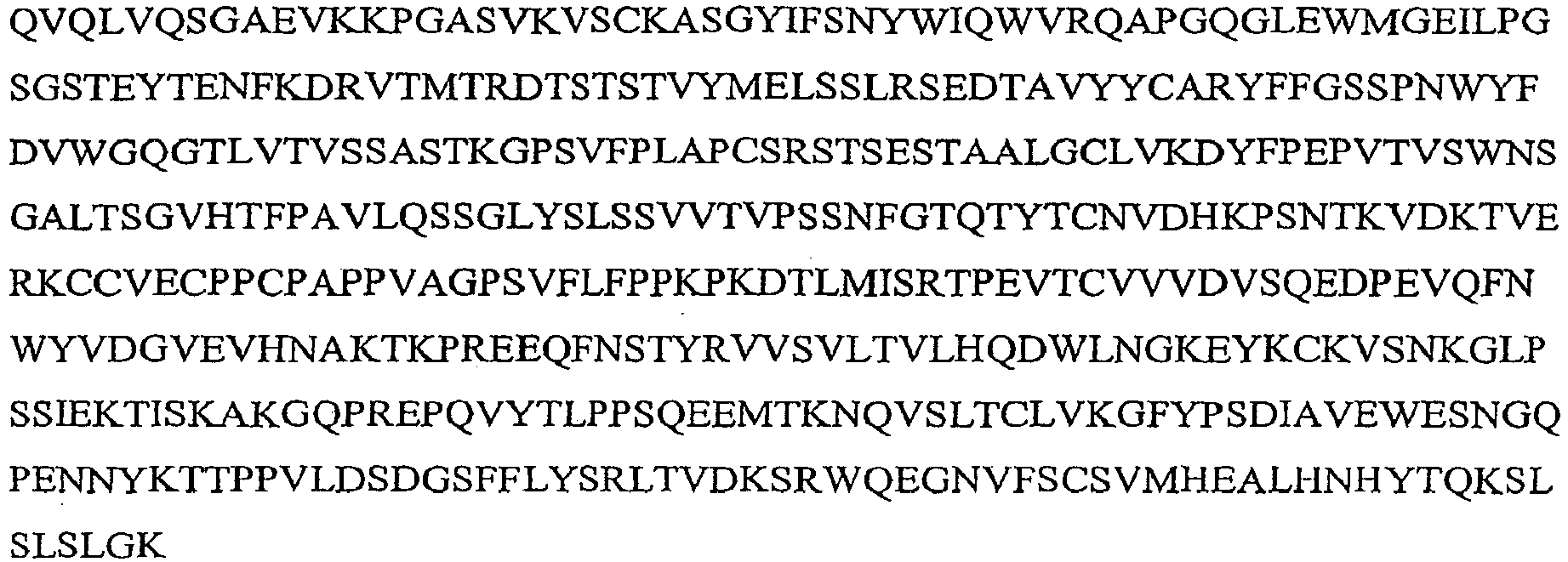
- SEQ ID NO: 3 - Eculizumab VL

- SEQ ID NO: 4 - Eculizumab Light chain

- SEQ ID NO: 5 - Eculizumab CDRH1
NYWIQ - SEQ ID NO: 6 - Eculizumab CDRH2
EILPGSGSTEYTENFKD - SEQ ID NO: 7 - Eculizumab CDRH3
YFFGSSPNWYFDV - SEQ ID NO: 8 - Eculizumab CDRL1
GASENIYGALN - SEQ ID NO: 9 - Eculizumab CDRL2
GATNLAD - SEQ ID NO: 10 - Eculizumab CDRL3
QNVLNTPLT -
- <110> ALEXION PHARMACEUTICALS, INC.
- <120> TREATMENT OF PAROXYSMAL NOCTURNAL HEMOGLOBINURIA PATIENTS BY AN INHIBITOR OF COMPLEMENT
- <130> P2913 EP/1
- <150>
60/783,070
<151> 2006-03-15 - <160> 10
- <170> PatentIn version 3.5
- <210> 1
<211> 123
<212> PRT
<213> Artificial Sequence - <220>
<221> source
<223> /note="Description of Artificial Sequence: Synthetic polypeptide" - <400> 1

- <210> 2
<211> 448
<212> PRT
<213> Artificial sequence - <220>
<221> source
<223> /note="Description of Artificial sequence: Synthetic polypeptide" - <400> 2


- <210> 3
<211> 131
<212> PRT
<213> Artificial Sequence - <220>
<221> source
<223> /note="Description of Artificial Sequence: Synthetic polypeptide" - <400> 3


- <210> 4
<211> 236
<212> PRT
<213> Artificial Sequence - <220>
<221> source
<223> /note="Description of Artificial Sequence: Synthetic polypeptide" " - <400> 4


- <210> 5
<211> 5
<212> PRT
<213> Artificial Sequence - <220>
<221> source
<223> /note="Description of Artificial sequence: Synthetic peptide" - <400> 5

- <210> 6
<211> 17
<212> PRT
<213> Artificial Sequence - <220>
<221> source
<223> /note="Description of Artificial Sequence: Synthetic peptide" - <400> 6

- <210> 7
<211> 13
<212> PRT
<213> Artificial Sequence - <220>
<221> source
<223> /note="Description of Artificial Sequence: Synthetic peptide" - <400> 7

- <210> 8
<211> 11
<212> PRT
<213> Artificial Sequence - <220>
<221> source
<223> /note="Description of Artificial Sequence: Synthetic peptide" - <400> 8

- <210> 9
<211> 7
<212> PRT
<213> Artificial Sequence - <220>
<221> source
<223> /note="Description of Artificial Sequence: Synthetic peptide" - <400> 9

- <210> 10
<211> 9
<212> PRT
<213> Artificial sequence - <220>
<221> source
<223> /note="Description of Artificial Sequence: Synthetic peptide" - <400> 10

Claims (1)
- A pharmaceutical composition for use in treating a patient afflicted with paroxysmal nocturnal hemoglobinuria (PNH), wherein the composition is a 300 mg eculizumab single-use dosage form comprising 30 ml of a 10 mg eculizumab/ml sterile, preservative free solution,
Priority Applications (4)
| Application Number | Priority Date | Filing Date | Title |
|---|---|---|---|
| EP23198329.7A EP4316465A3 (en) | 2006-03-15 | 2007-03-15 | Treatment of paroxysmal nocturnal hemoglobinuria patients by an inhibitor of complement |
| EP16195355.9A EP3167888B1 (en) | 2006-03-15 | 2007-03-15 | Treatment of paroxysmal nocturnal hemoglobinuria patients by an inhibitor of complement |
| SI200731886T SI2359834T1 (en) | 2006-03-15 | 2007-03-15 | Treatment of paroxysmal nocturnal hemoglobinuria patients by an inhibitor of complement |
| EP16172335.8A EP3124029A1 (en) | 2006-03-15 | 2007-03-15 | Treatment of paroxysmal nocturnal hemoglobinuria patients by an inhibitor of complement |
Applications Claiming Priority (2)
| Application Number | Priority Date | Filing Date | Title |
|---|---|---|---|
| US78307006P | 2006-03-15 | 2006-03-15 | |
| EP07753249A EP2001490A1 (en) | 2006-03-15 | 2007-03-15 | Treatment of paroxysmal nocturnal hemoglobinuria patients by an inhibitor of complement |
Related Parent Applications (2)
| Application Number | Title | Priority Date | Filing Date |
|---|---|---|---|
| EP07753249A Division EP2001490A1 (en) | 2006-03-15 | 2007-03-15 | Treatment of paroxysmal nocturnal hemoglobinuria patients by an inhibitor of complement |
| EP07753249.7 Division | 2007-03-15 |
Related Child Applications (4)
| Application Number | Title | Priority Date | Filing Date |
|---|---|---|---|
| EP16195355.9A Division EP3167888B1 (en) | 2006-03-15 | 2007-03-15 | Treatment of paroxysmal nocturnal hemoglobinuria patients by an inhibitor of complement |
| EP23198329.7A Division EP4316465A3 (en) | 2006-03-15 | 2007-03-15 | Treatment of paroxysmal nocturnal hemoglobinuria patients by an inhibitor of complement |
| EP16172335.8A Division EP3124029A1 (en) | 2006-03-15 | 2007-03-15 | Treatment of paroxysmal nocturnal hemoglobinuria patients by an inhibitor of complement |
| EP16172335.8A Division-Into EP3124029A1 (en) | 2006-03-15 | 2007-03-15 | Treatment of paroxysmal nocturnal hemoglobinuria patients by an inhibitor of complement |
Publications (2)
| Publication Number | Publication Date |
|---|---|
| EP2359834A1 EP2359834A1 (en) | 2011-08-24 |
| EP2359834B1 true EP2359834B1 (en) | 2016-11-09 |
Family
ID=38222520
Family Applications (5)
| Application Number | Title | Priority Date | Filing Date |
|---|---|---|---|
| EP16195355.9A Active EP3167888B1 (en) | 2006-03-15 | 2007-03-15 | Treatment of paroxysmal nocturnal hemoglobinuria patients by an inhibitor of complement |
| EP23198329.7A Pending EP4316465A3 (en) | 2006-03-15 | 2007-03-15 | Treatment of paroxysmal nocturnal hemoglobinuria patients by an inhibitor of complement |
| EP07753249A Ceased EP2001490A1 (en) | 2006-03-15 | 2007-03-15 | Treatment of paroxysmal nocturnal hemoglobinuria patients by an inhibitor of complement |
| EP11001632.6A Revoked EP2359834B1 (en) | 2006-03-15 | 2007-03-15 | Treatment of paroxysmal nocturnal hemoglobinuria patients by an inhibitor of complement |
| EP16172335.8A Ceased EP3124029A1 (en) | 2006-03-15 | 2007-03-15 | Treatment of paroxysmal nocturnal hemoglobinuria patients by an inhibitor of complement |
Family Applications Before (3)
| Application Number | Title | Priority Date | Filing Date |
|---|---|---|---|
| EP16195355.9A Active EP3167888B1 (en) | 2006-03-15 | 2007-03-15 | Treatment of paroxysmal nocturnal hemoglobinuria patients by an inhibitor of complement |
| EP23198329.7A Pending EP4316465A3 (en) | 2006-03-15 | 2007-03-15 | Treatment of paroxysmal nocturnal hemoglobinuria patients by an inhibitor of complement |
| EP07753249A Ceased EP2001490A1 (en) | 2006-03-15 | 2007-03-15 | Treatment of paroxysmal nocturnal hemoglobinuria patients by an inhibitor of complement |
Family Applications After (1)
| Application Number | Title | Priority Date | Filing Date |
|---|---|---|---|
| EP16172335.8A Ceased EP3124029A1 (en) | 2006-03-15 | 2007-03-15 | Treatment of paroxysmal nocturnal hemoglobinuria patients by an inhibitor of complement |
Country Status (16)
| Country | Link |
|---|---|
| US (8) | US20090220508A1 (en) |
| EP (5) | EP3167888B1 (en) |
| JP (9) | JP2009530299A (en) |
| KR (2) | KR20140057635A (en) |
| AU (1) | AU2007225044C1 (en) |
| BR (2) | BR122017024057B8 (en) |
| CA (2) | CA2645810C (en) |
| DK (1) | DK2359834T5 (en) |
| ES (2) | ES2612118T3 (en) |
| HU (2) | HUE066795T2 (en) |
| IL (4) | IL302157A (en) |
| MX (2) | MX340784B (en) |
| PL (2) | PL3167888T3 (en) |
| PT (1) | PT2359834T (en) |
| SI (1) | SI2359834T1 (en) |
| WO (1) | WO2007106585A1 (en) |
Cited By (4)
| Publication number | Priority date | Publication date | Assignee | Title |
|---|---|---|---|---|
| US10590189B2 (en) | 2006-03-15 | 2020-03-17 | Alexion Pharmaceuticals, Inc. | Treatment of paroxysmal nocturnal hemoglobinuria patients by an inhibitor of complement |
| US10633434B2 (en) | 2016-06-14 | 2020-04-28 | Regeneron Pharmaceuticals, Inc. | Anti-C5 antibodies |
| WO2021211940A1 (en) | 2020-04-16 | 2021-10-21 | Assistance Publique, Hopitaux De Paris | Methods for treating a complement mediated disorder caused by viruses |
| US11365265B2 (en) | 2017-12-13 | 2022-06-21 | Regeneron Pharmaceuticals, Inc. | Anti-C5 antibody combinations and uses thereof |
Families Citing this family (140)
| Publication number | Priority date | Publication date | Assignee | Title |
|---|---|---|---|---|
| US20050271660A1 (en) | 2002-09-06 | 2005-12-08 | Alexion Pharmaceuticals, Inc. | Nebulization of monoclonal antibodies for treating pulmonary diseases |
| US9200079B2 (en) | 2004-11-12 | 2015-12-01 | Xencor, Inc. | Fc variants with altered binding to FcRn |
| EP4793360A2 (en) | 2006-03-31 | 2026-08-19 | Chugai Seiyaku Kabushiki Kaisha | Methods for controlling blood pharmacokinetics of antibodies |
| EP3127921A1 (en) | 2007-09-26 | 2017-02-08 | Chugai Seiyaku Kabushiki Kaisha | Method of modifying isoelectric point of antibody via amino acid substition in cdr |
| KR101616758B1 (en) * | 2007-12-26 | 2016-04-29 | 젠코어 인코포레이티드 | Fc VARIANTS WITH ALTERED BINDING TO FcRn |
| US12492253B1 (en) | 2008-02-25 | 2025-12-09 | Xencor, Inc. | Anti-human C5 antibodies |
| TW201920257A (en) | 2008-04-11 | 2019-06-01 | 日商中外製藥股份有限公司 | Antigen-binding molecule capable of binding two or more antigen molecules repeatedly |
| PY09026846A (en) | 2008-08-05 | 2015-09-01 | Novartis Ag | COMPOSITIONS AND METHODS FOR ANTIBODIES THAT TARGET THE C5 COMPLEMENT PROTEIN |
| JP6223659B2 (en) * | 2008-11-10 | 2017-11-01 | アレクシオン ファーマシューティカルズ, インコーポレイテッド | Methods and compositions for treating complement related disorders |
| IN2012DN04412A (en) * | 2009-11-09 | 2015-08-07 | Alexion Pharmaceuticals Inc | |
| WO2012009705A1 (en) | 2010-07-15 | 2012-01-19 | Zyngenia, Inc. | Ang-2 binding complexes and uses thereof |
| TW201241008A (en) * | 2010-10-01 | 2012-10-16 | Alexion Pharma Inc | Polypeptides that bind to human complement component C5 |
| TWI654203B (en) | 2010-11-30 | 2019-03-21 | Chugai Seiyaku Kabushiki Kaisha | Antibodies with calcium-dependent antigen binding ability |
| US20140088019A1 (en) | 2011-02-11 | 2014-03-27 | Zyngenia, Inc. | Monovalent and Multivalent Multispecific Complexes and Uses Thereof |
| DK2714738T3 (en) | 2011-05-24 | 2019-01-28 | Zyngenia Inc | MULTIVALENT AND MONOVALENT MULTISPECIFIC COMPLEXES AND THEIR APPLICATIONS |
| SG10201703249PA (en) | 2011-12-21 | 2017-05-30 | Novartis Ag | Compositions and methods for antibodies targeting factor p |
| KR102149028B1 (en) | 2012-02-20 | 2020-08-27 | 스위디쉬 오르펀 바이오비트럼 에이비 (피유비엘) | Polypeptides binding to human complement c5 |
| WO2013137912A2 (en) * | 2012-03-16 | 2013-09-19 | Alexion Pharmaceuticals, Inc. | Methods of distributing complement-inhibiting drugs to patients receiving a complement inhibitor |
| TWI682941B (en) | 2013-02-01 | 2020-01-21 | 美商再生元醫藥公司 | Antibodies comprising chimeric constant domains |
| MX2015013163A (en) | 2013-03-15 | 2016-04-04 | Zyngenia Inc | Multivalent and monovalent multispecific complexes and their uses. |
| JP6505079B2 (en) * | 2013-03-29 | 2019-04-24 | アレクシオン ファーマシューティカルズ, インコーポレイテッド | Compositions and methods for increasing the serum half-life of a therapeutic that targets complement C5 |
| WO2015028558A1 (en) * | 2013-08-28 | 2015-03-05 | Swedish Orphan Biovitrum Ab (Publ) | Stable polypeptides binding to human complement c5 |
| US9982022B2 (en) | 2013-08-28 | 2018-05-29 | Affibody Ab | Binding polypeptides having a mutated scaffold |
| US20150104445A1 (en) | 2013-10-10 | 2015-04-16 | Viropharma Holdings Limited | Methods of inhibiting the alternative pathway of complement immune system activation and compositions used therein |
| NZ711451A (en) * | 2014-03-07 | 2016-05-27 | Alexion Pharma Inc | Anti-c5 antibodies having improved pharmacokinetics |
| TWI754319B (en) | 2014-03-19 | 2022-02-01 | 美商再生元醫藥公司 | Methods and antibody compositions for tumor treatment |
| BR122021025449B1 (en) | 2014-06-12 | 2024-02-15 | Ra Pharmaceuticals, Inc | COMPOUND, POLYPEPTIDE AND COMPOSITION COMPRISING THE SAME |
| EA201790342A1 (en) | 2014-08-08 | 2017-07-31 | ЭЛЕКТОР ЭлЭлСи | ANTIBODIES TO TREM2 AND METHODS OF THEIR APPLICATION |
| JP6898229B6 (en) | 2014-09-29 | 2021-07-28 | ケモセントリックス,インコーポレイティド | Methods and intermediates in the production of C5aR antagonists |
| JP6948942B2 (en) | 2014-10-15 | 2021-10-13 | アレクシオン ファーマシューティカルズ, インコーポレイテッド | Methods and Uses for Shifting the Isoelectric Profile of Protein Products |
| JP6479974B2 (en) | 2014-10-15 | 2019-03-06 | アレクシオン ファーマシューティカルズ, インコーポレイテッド | A method to reproduce large-scale eculizumab-producing cell cultures |
| US20160108357A1 (en) * | 2014-10-15 | 2016-04-21 | Alexion Pharmaceuticals, Inc. | Methods of culturing a cell |
| ES2809455T3 (en) | 2014-11-17 | 2021-03-04 | Regeneron Pharma | Methods for tumor treatment using CD3xCD20 bispecific antibody |
| US20160168237A1 (en) | 2014-12-12 | 2016-06-16 | Alexion Pharmaceuticals, Inc. | Method for treating a complement mediated disorder caused by an infectious agent in a patient |
| EA201791366A1 (en) | 2014-12-19 | 2018-02-28 | Чугаи Сейяку Кабусики Кайся | ANTIBODIES TO C5 AND METHODS OF THEIR APPLICATION |
| MX2017005774A (en) | 2014-12-19 | 2017-07-28 | Chugai Pharmaceutical Co Ltd | Anti-myostatin antibodies, polypeptides containing variant fc regions, and methods of use. |
| US20180016327A1 (en) | 2015-01-22 | 2018-01-18 | Chugai Seiyaku Kabushiki Kaisha | A Combination of Two or More Anti-C5 Antibodies and Methods of Use |
| SMT202100688T1 (en) | 2015-01-28 | 2022-01-10 | Ra Pharmaceuticals Inc | Modulators of complement activity |
| CN114773469B (en) | 2015-02-05 | 2025-12-19 | 中外制药株式会社 | Antibodies comprising ion concentration-dependent antigen binding domains, variants of the FC region, IL-8-binding antibodies and uses thereof |
| ES2936088T3 (en) | 2015-03-23 | 2023-03-14 | Alexion Pharma Inc | virus filtering |
| DK3277725T3 (en) | 2015-03-30 | 2021-01-11 | Regeneron Pharma | Constant heavy chain regions with reduced binding to FC gamma receptors |
| WO2016160756A2 (en) * | 2015-03-31 | 2016-10-06 | Alexion Pharmaceuticlas, Inc. | Identifying and treating subpopulations of paroxysmal nocturnal hemoglobinuria (pnh) patents |
| SG11201708257UA (en) | 2015-04-06 | 2017-11-29 | Subdomain Llc | De novo binding domain containing polypeptides and uses thereof |
| EP3991748A3 (en) | 2015-04-07 | 2022-08-24 | Alector LLC | Anti-sortilin antibodies and methods of use thereof |
| WO2016200627A1 (en) | 2015-06-09 | 2016-12-15 | Children's Hospital Medical Center | Dosing algorithm for complement inhibitor |
| AU2016276981B2 (en) | 2015-06-12 | 2022-10-06 | Alector Llc | Anti-CD33 antibodies and methods of use thereof |
| EP3307779A2 (en) | 2015-06-12 | 2018-04-18 | Alector LLC | Anti-cd33 antibodies and methods of use thereof |
| WO2016209956A1 (en) * | 2015-06-26 | 2016-12-29 | Alexion Pharmaceuticals, Inc. | A method for treating a patient in compliance with vaccination with eculizumab or an eculizumab variant |
| WO2017035409A1 (en) | 2015-08-26 | 2017-03-02 | Achillion Pharmaceuticals, Inc. | Aryl, heteroaryl, and heterocyclic compounds for treatment of immune and inflammatory disorders |
| AR106018A1 (en) | 2015-08-26 | 2017-12-06 | Achillion Pharmaceuticals Inc | ARYL, HETEROARYL AND HETEROCYCLIC COMPOUNDS FOR THE TREATMENT OF MEDICAL DISORDERS |
| WO2017035401A1 (en) | 2015-08-26 | 2017-03-02 | Achillion Pharmaceuticals, Inc. | Amide compounds for treatment of immune and inflammatory disorders |
| WO2017035405A1 (en) | 2015-08-26 | 2017-03-02 | Achillion Pharmaceuticals, Inc. | Amino compounds for treatment of immune and inflammatory disorders |
| CN115960235A (en) | 2015-08-28 | 2023-04-14 | 艾利妥 | Anti-SIGLEC-7 antibodies and methods of use thereof |
| EP3328885A1 (en) | 2015-09-11 | 2018-06-06 | Bruce Andrien | Recombinant glycosylated eculizumab and eculizumab variants |
| MY195059A (en) | 2015-09-23 | 2023-01-05 | Regeneron Pharma | Optimized Anti-CD3 Bispecific Antibodies and Uses Thereof |
| JP7725185B2 (en) | 2015-10-06 | 2025-08-19 | アレクトル エルエルシー | Anti-TREM2 antibodies and methods of use thereof |
| EP3359566A1 (en) | 2015-10-07 | 2018-08-15 | Alexion Pharmaceuticals, Inc. | A method for treating age-related macular degeneration in a patient |
| SG11201803567XA (en) | 2015-10-29 | 2018-05-30 | Alector Llc | Anti-siglec-9 antibodies and methods of use thereof |
| KR20260070290A (en) | 2015-12-16 | 2026-05-18 | 유씨비 홀딩스 인코포레이티드 | Modulators of complement activity |
| CN108401431B (en) | 2015-12-18 | 2022-01-25 | 中外制药株式会社 | anti-C5 antibodies and methods of use |
| SG11201805828YA (en) * | 2016-01-14 | 2018-08-30 | Chemocentryx Inc | Method of treating c3 glomerulopathy |
| JP7023853B2 (en) | 2016-03-04 | 2022-02-22 | アレクトル エルエルシー | Anti-TREM1 antibody and its usage |
| CA3015277A1 (en) | 2016-03-10 | 2017-09-14 | Acceleron Pharma Inc. | Activin type 2 receptor binding proteins and uses thereof |
| JP7103950B2 (en) | 2016-04-22 | 2022-07-20 | アクセレロン ファーマ インコーポレーテッド | ALK7 binding protein and its use |
| CA3024618A1 (en) | 2016-05-27 | 2017-11-30 | Alexion Pharmaceuticals, Inc. | Methods for treatment of refractory generalized myasthenia gravis |
| CN116271014A (en) | 2016-08-05 | 2023-06-23 | 中外制药株式会社 | Composition for preventing or treating IL-8 related diseases |
| US11965884B2 (en) | 2016-10-19 | 2024-04-23 | Alexion Pharmaceuticals, Inc. | Method of quantitating unbound C5 in a sample |
| JP7301741B2 (en) | 2016-12-07 | 2023-07-03 | ラ ファーマシューティカルズ インコーポレイテッド | modulator of complement activity |
| AU2017376884B2 (en) * | 2016-12-16 | 2024-10-03 | Samsung Bioepis Co., Ltd | Stable aqueous anti-C5 antibody composition |
| TWI828672B (en) | 2017-01-31 | 2024-01-11 | 日商中外製藥股份有限公司 | A pharmaceutical composition for use in the treatment or prevention of a c5-related disease and a method for treating or preventing a c5-related disease |
| WO2018160891A1 (en) | 2017-03-01 | 2018-09-07 | Achillion Pharmaceutical, Inc. | Pharmaceutical compounds for treatment of medical disorders |
| CA3053818A1 (en) | 2017-03-01 | 2018-09-07 | Achillion Pharmaceuticals, Inc. | Aryl, heteroaryl, and heterocyclic pharmaceutical compounds for treatment of medical disorders |
| EP3625258A1 (en) | 2017-05-16 | 2020-03-25 | Alector LLC | Anti-siglec-5 antibodies and methods of use thereof |
| JP7194698B2 (en) | 2017-05-22 | 2022-12-22 | アレクシオン ファーマシューティカルズ, インコーポレイテッド | Dosage and administration of anti-C5 antibodies to treat protein-losing enteropathy in patients |
| WO2018226750A1 (en) | 2017-06-06 | 2018-12-13 | Relinia, Inc. | Single-chain tnf receptor 2 agonist fusion proteins |
| ES2965486T3 (en) | 2017-07-27 | 2024-04-15 | Alexion Pharma Inc | High concentration anti-C5 antibody formulations |
| WO2019028284A1 (en) * | 2017-08-02 | 2019-02-07 | Achillion Pharmaceuticals, Inc. | Therapeutic regimens for treatment of paroxysmal nocturnal hemoglobinuria |
| MY205541A (en) | 2017-08-03 | 2024-10-25 | Alector Llc | Anti-cd33 antibodies and methods of use thereof |
| HUE062436T2 (en) | 2017-08-03 | 2023-11-28 | Alector Llc | Anti-trem2 antibodies and methods of use thereof |
| JP7518764B2 (en) | 2017-10-26 | 2024-07-18 | アレクシオン ファーマシューティカルズ, インコーポレイテッド | Dosage and Administration of Anti-C5 Antibodies for the Treatment of Paroxysmal Nocturnal Hemoglobinuria (PNH) and Atypical Hemolytic Uremic Syndrome (aHUS) |
| SI3710067T1 (en) | 2017-11-14 | 2026-01-30 | Arcellx, Inc. | D-domain containing polypeptides and uses thereof |
| WO2019108456A1 (en) | 2017-12-01 | 2019-06-06 | Children's Hospital Medical Center | Compositions for interferon blockade and methods of using same |
| BR112020010916A2 (en) * | 2017-12-04 | 2020-11-17 | Ra Pharmaceuticals, Inc | modulators of complement activity |
| CN111886246B (en) | 2017-12-29 | 2024-12-17 | 艾莱克特有限责任公司 | Anti-TMEM 106B antibodies and methods of use thereof |
| EP3746484A4 (en) | 2018-01-31 | 2021-11-17 | Alector LLC | ANTI-MS4A6A ANTIBODIES AND PROCESSES FOR USE |
| EP3746476A1 (en) | 2018-01-31 | 2020-12-09 | Alector LLC | Anti-ms4a4a antibodies and methods of use thereof |
| US20190247560A1 (en) | 2018-02-13 | 2019-08-15 | Gambro Lundia Ab | Extracorporeal devices and methods of treating complement factor related diseases |
| CR20200566A (en) | 2018-05-25 | 2021-02-19 | Alector Llc | Anti-sirpa antibodies and methods of use thereof |
| EP3802593B1 (en) | 2018-05-31 | 2024-09-11 | Alexion Pharmaceuticals, Inc. | Dosage and administration of anti-c5 antibodies for treatment of paroxysmal nocturnal hemoglobinuria (pnh) in pediatric patients |
| EP3802603A1 (en) | 2018-06-04 | 2021-04-14 | Alexion Pharmaceuticals, Inc. | Dosage and administration of anti-c5 antibodies for treatment of atypical hemolytic uremic syndrome (ahus) in pediatric patients |
| CN119841953A (en) | 2018-06-08 | 2025-04-18 | 艾利妥 | Anti-SIGLEC-7 antibodies and methods of use thereof |
| CA3104295A1 (en) * | 2018-06-19 | 2019-12-26 | Atarga, Llc | Antibody molecules to complement component 5 and uses thereof |
| JP7538723B2 (en) | 2018-06-28 | 2024-08-22 | アレクシオン ファーマシューティカルズ, インコーポレイテッド | Method for producing anti-C5 antibodies |
| AU2019293589A1 (en) | 2018-06-29 | 2021-01-21 | Alector Llc | Anti-SIRP-beta1 antibodies and methods of use thereof |
| SMT202300110T1 (en) | 2018-07-13 | 2023-05-12 | Alector Llc | Anti-sortilin antibodies and methods of use thereof |
| SG11202100555PA (en) | 2018-07-27 | 2021-02-25 | Alector Llc | Anti-siglec-5 antibodies and methods of use thereof |
| MX2021000516A (en) | 2018-08-01 | 2021-04-12 | Chugai Pharmaceutical Co Ltd | A pharmaceutical composition for use in the treatment or prevention of a c5-related disease and a method for treating or preventing a c5-related disease. |
| ES3009025T3 (en) | 2018-08-31 | 2025-03-25 | Regeneron Pharma | Dosing strategy that mitigates cytokine release syndrome for cd3/cd20 bispecific antibodies |
| AR119259A1 (en) | 2018-08-31 | 2021-12-09 | Alector Llc | ANTI-CD33 ANTIBODIES AND METHODS OF USE THEREOF |
| WO2020051538A1 (en) | 2018-09-06 | 2020-03-12 | Achillion Pharmaceuticals, Inc. | Morphic forms of complement factor d inhibitors |
| JP7443375B2 (en) | 2018-09-06 | 2024-03-05 | アキリオン ファーマシューティカルズ, インコーポレーテッド | Macrocyclic compounds for the treatment of medical disorders |
| WO2020069024A1 (en) | 2018-09-25 | 2020-04-02 | Achillion Pharmaceuticals, Inc. | Morphic forms of complement factor d inhibitors |
| TWI897855B (en) | 2018-10-26 | 2025-09-21 | 美商免疫遺傳股份有限公司 | Epcam antibodies, activatable antibodies, and immunoconjugates, and uses thereof |
| US12240893B2 (en) | 2018-10-30 | 2025-03-04 | Alexion Pharmaceuticals, Inc. | Subcutaneous dosage and administration of anti-C5 antibodies for treatment of paroxysmal nocturnal hemoglobinuria (PNH) |
| CN113195472A (en) | 2018-12-17 | 2021-07-30 | 艾其林医药公司 | Targeted drug delivery for the treatment of complement-mediated disorders |
| MX2021011507A (en) | 2019-03-22 | 2021-12-15 | Achillion Pharmaceuticals Inc | PHARMACEUTICAL COMPOUNDS FOR THE TREATMENT OF COMPLEMENT MEDIATED DISORDERS. |
| ES2973767T3 (en) | 2019-06-04 | 2024-06-24 | Ra Pharmaceuticals Inc | Treatment of inflammatory diseases with complement inhibitors |
| TWI877170B (en) | 2019-06-11 | 2025-03-21 | 美商阿列克特有限責任公司 | Methods of use of anti-sortilin antibodies |
| CN114466660A (en) | 2019-07-31 | 2022-05-10 | 豪夫迈·罗氏有限公司 | Dosage and administration regimen for treating or preventing C5-related diseases by using anti-C5 antibody covalenzumab |
| PH12022550239A1 (en) | 2019-07-31 | 2022-12-19 | Alector Llc | Anti-ms4a4a antibodies and methods of use thereof |
| EP4003409A1 (en) | 2019-07-31 | 2022-06-01 | F. Hoffmann-La Roche AG | Dosage and administration regimen for the treatment or prevention of c5-related diseases by the use of the anti-c5 antibody crovalimab |
| US20220259305A1 (en) | 2019-08-05 | 2022-08-18 | Alexion Pharmaceuticals, Inc. | Methods for treatment of refractory generalized myasthenia gravis with eculizumab |
| CN115003699A (en) | 2019-12-05 | 2022-09-02 | 艾利妥 | How to use anti-TREM2 antibodies |
| CA3161271A1 (en) | 2019-12-09 | 2021-06-17 | Alexion Pharmaceuticals, Inc. | Anti-c5 antibody for the treatment of neuromyelitis optica spectrum disorder |
| WO2021119400A1 (en) | 2019-12-12 | 2021-06-17 | Alector Llc | Methods of use of anti-cd33 antibodies |
| PE20221326A1 (en) | 2019-12-13 | 2022-09-09 | Alector Llc | ANTI-MERTK ANTIBODIES AND METHODS OF USE THEREOF |
| CN115768794A (en) | 2020-02-24 | 2023-03-07 | 艾利妥 | How to use the anti-TREM2 antibody |
| WO2021202590A1 (en) | 2020-03-31 | 2021-10-07 | Alector Llc | Anti-mertk antibodies and methods of use thereof |
| CA3172451A1 (en) | 2020-04-03 | 2021-10-07 | Robert Paul | Methods of use of anti-trem2 antibodies |
| KR20230009431A (en) | 2020-05-12 | 2023-01-17 | 알렉시온 파마슈티칼스, 인코포레이티드 | Use of a complement factor D inhibitor alone or in combination with an anti-C5 antibody for the treatment of paroxysmal nocturnal hemoglobinuria |
| CN116194478A (en) | 2020-06-24 | 2023-05-30 | 阿雷克森制药公司 | Subcutaneous (SC) administration of anti-C5 antibody for complement-associated disorders |
| JP2023553399A (en) | 2020-12-02 | 2023-12-21 | アレクトル エルエルシー | How to use anti-Sortilin antibodies |
| US20240174746A1 (en) | 2021-03-18 | 2024-05-30 | Alector Llc | Anti-tmem106b antibodies and methods of use thereof |
| EP4314063A1 (en) | 2021-03-23 | 2024-02-07 | Alector LLC | Anti-tmem106b antibodies for treating and preventing coronavirus infections |
| CA3220629A1 (en) | 2021-05-28 | 2022-12-01 | Tobin J. CAMMETT | Methods for detecting cm-tma biomarkers |
| CN117642426A (en) | 2021-06-16 | 2024-03-01 | 艾莱克特有限责任公司 | Bispecific anti-MerTK and anti-PDL1 antibodies and methods of use |
| WO2022266221A1 (en) | 2021-06-16 | 2022-12-22 | Alector Llc | Monovalent anti-mertk antibodies and methods of use thereof |
| WO2023023220A1 (en) | 2021-08-20 | 2023-02-23 | Alexion Pharmaceuticals, Inc. | Methods for treating sickle cell disease or beta thalassemia using a complement alternative pathway inhibitor |
| EP4419558A1 (en) | 2021-10-19 | 2024-08-28 | Alector LLC | Anti-cd300lb antibodies and methods of use thereof |
| WO2023081898A1 (en) | 2021-11-08 | 2023-05-11 | Alector Llc | Soluble cd33 as a biomarker for anti-cd33 efficacy |
| KR20230105972A (en) * | 2022-01-05 | 2023-07-12 | 주식회사 카나프테라퓨틱스 | ANTI-C3b ANTIBODY OR ANTI-C5 ANTIBODY CONJUGATED WITH ANGIOGENESIS INHIBITOR AND USE THEREOF |
| MX2024010324A (en) | 2022-02-23 | 2024-08-30 | Alector Llc | Methods of use of anti-trem2 antibodies. |
| CN119630428A (en) | 2022-07-12 | 2025-03-14 | 西托姆克斯治疗公司 | EPCAM immunoconjugates and their uses |
| AU2023314795A1 (en) | 2022-07-29 | 2025-03-06 | Alector Llc | Anti-gpnmb antibodies and methods of use thereof |
| US12674662B2 (en) | 2022-09-16 | 2026-07-07 | KLA Coporation | System and method for acquiring alignment measurements of structures of a bonded sample |
| WO2024086796A1 (en) | 2022-10-20 | 2024-04-25 | Alector Llc | Anti-ms4a4a antibodies with amyloid-beta therapies |
| JP2026503002A (en) | 2023-01-06 | 2026-01-27 | アレクトル エルエルシー | Anti-IL18 binding protein antibodies and methods of use thereof |
| CN122295357A (en) | 2023-09-29 | 2026-06-26 | 崔克斯生物公司 | TNF-α variant fusion molecule |
| WO2025094146A1 (en) | 2023-11-02 | 2025-05-08 | Immunogen Switzerland Gmbh | Vasconstrictors for reducing ocular toxicity of antibody-maytansinoid conjugates |
| WO2026161794A1 (en) | 2025-01-27 | 2026-07-30 | Cytomx Therapeutics, Inc. | Epcam immunoconjugates and therapeutic uses thereof |
Citations (18)
| Publication number | Priority date | Publication date | Assignee | Title |
|---|---|---|---|---|
| WO1997011971A1 (en) | 1995-09-28 | 1997-04-03 | Alexion Pharmaceuticals, Inc. | Porcine cell interaction proteins |
| US6171586B1 (en) | 1997-06-13 | 2001-01-09 | Genentech, Inc. | Antibody formulation |
| US6355245B1 (en) | 1994-05-02 | 2002-03-12 | Alexion Pharmaceuticals, Inc. | C5-specific antibodies for the treatment of inflammatory diseases |
| US6407213B1 (en) | 1991-06-14 | 2002-06-18 | Genentech, Inc. | Method for making humanized antibodies |
| US20030202972A1 (en) | 1995-07-27 | 2003-10-30 | Genentech, Inc. | Protein formulation |
| WO2004050017A2 (en) | 2002-12-02 | 2004-06-17 | Alexion Pharmaceuticals, Inc. | Rationally designed antibodies |
| WO2004071439A2 (en) | 2003-02-10 | 2004-08-26 | Elan Pharmaceuticals, Inc. | Immunoglobulin formulation and method of preparation thereof |
| WO2004108158A1 (en) | 2003-06-02 | 2004-12-16 | Alexion Pharmaceuticals, Inc. | De-immunized anti-cd3 antibody |
| WO2005007809A2 (en) | 2003-05-30 | 2005-01-27 | Alexion Pharmaceuticals, Inc. | Antibodies and fusion proteins that include engineered constant regions |
| US20050191298A1 (en) | 2004-02-03 | 2005-09-01 | Leonard Bell | Method of treating hemolytic disease |
| US20050221382A1 (en) | 2002-03-18 | 2005-10-06 | Rother Russell P | Stratification of patient populations having or suspected of having rheumatoid arthritis |
| WO2005092073A2 (en) | 2004-03-24 | 2005-10-06 | Pdl Biopharma, Inc. | Use of anti-alpha5beta1 antibodies to inhibit cancer cell proliferation |
| US20050271660A1 (en) | 2002-09-06 | 2005-12-08 | Alexion Pharmaceuticals, Inc. | Nebulization of monoclonal antibodies for treating pulmonary diseases |
| WO2006003179A2 (en) | 2004-07-01 | 2006-01-12 | Novo Nordisk A/S | Antibodies binding to receptors kir2dl1, -2, 3 but not kir2ds4 and their therapeutic use |
| US20060078307A1 (en) | 2002-12-16 | 2006-04-13 | Koninklijke Philips Electronics N.V. | Personal video recorder method and user interface |
| WO2007002571A2 (en) | 2005-06-23 | 2007-01-04 | Alexion Pharmaceuticals, Inc. | Use of an anti c5 complement antibody to treat patients with sickle cell disease |
| WO2007106585A1 (en) | 2006-03-15 | 2007-09-20 | Alexion Pharmaceuticals, Inc. | Treatment of paroxysmal nocturnal hemoglobinuria patients by an inhibitor of complement |
| US20120230982A1 (en) | 2002-09-06 | 2012-09-13 | Alexion Pharmaceuticals, Inc. | High concentration antibody formulations |
Family Cites Families (53)
| Publication number | Priority date | Publication date | Assignee | Title |
|---|---|---|---|---|
| GB8308235D0 (en) | 1983-03-25 | 1983-05-05 | Celltech Ltd | Polypeptides |
| US4816567A (en) | 1983-04-08 | 1989-03-28 | Genentech, Inc. | Recombinant immunoglobin preparations |
| GB8422238D0 (en) | 1984-09-03 | 1984-10-10 | Neuberger M S | Chimeric proteins |
| US4686100A (en) * | 1985-04-02 | 1987-08-11 | The Board Of Trustees Of The Leland Stanford Junior University | Method for the treatment of adult respiratory distress syndrome |
| US6548640B1 (en) | 1986-03-27 | 2003-04-15 | Btg International Limited | Altered antibodies |
| US5225539A (en) | 1986-03-27 | 1993-07-06 | Medical Research Council | Recombinant altered antibodies and methods of making altered antibodies |
| GB8607679D0 (en) | 1986-03-27 | 1986-04-30 | Winter G P | Recombinant dna product |
| US4946778A (en) | 1987-09-21 | 1990-08-07 | Genex Corporation | Single polypeptide chain binding molecules |
| US5260203A (en) | 1986-09-02 | 1993-11-09 | Enzon, Inc. | Single polypeptide chain binding molecules |
| US5530101A (en) | 1988-12-28 | 1996-06-25 | Protein Design Labs, Inc. | Humanized immunoglobulins |
| US5705732A (en) | 1989-06-12 | 1998-01-06 | Oklahoma Medical Research Foundation | Universal donor cells |
| US5135916A (en) | 1989-06-12 | 1992-08-04 | Oklahoma Medical Research Foundation | Inhibition of complement mediated inflammatory response |
| DE3920358A1 (en) | 1989-06-22 | 1991-01-17 | Behringwerke Ag | BISPECIFIC AND OLIGO-SPECIFIC, MONO- AND OLIGOVALENT ANTI-BODY CONSTRUCTS, THEIR PRODUCTION AND USE |
| DE3924924A1 (en) | 1989-07-27 | 1991-02-07 | Goetze Otto | METHOD FOR DETECTING AND / OR QUANTITATIVELY DETERMINING COMPLEMENT PEPTIDE C5A AND / OR C5ADESARG |
| CA2097825A1 (en) | 1990-12-06 | 1992-06-07 | Henry C. Marsh, Jr. | Synergistic compositions of soluble complement receptors and compounds that inhibit complement and/or suppress immune activity |
| US6329509B1 (en) | 1991-08-14 | 2001-12-11 | Genentech, Inc. | Anti-IgE antibodies |
| ES2136092T3 (en) | 1991-09-23 | 1999-11-16 | Medical Res Council | PROCEDURES FOR THE PRODUCTION OF HUMANIZED ANTIBODIES. |
| US6027725A (en) | 1991-11-25 | 2000-02-22 | Enzon, Inc. | Multivalent antigen-binding proteins |
| DE69233528T2 (en) | 1991-11-25 | 2006-03-16 | Enzon, Inc. | Process for the preparation of multivalent antigen-binding proteins |
| US5456909A (en) | 1992-08-07 | 1995-10-10 | T Cell Sciences, Inc. | Glycoform fractions of recombinant soluble complement receptor 1 (sCR1) having extended half-lives in vivo |
| ES2201097T3 (en) | 1994-01-31 | 2004-03-16 | Trustees Of Boston University | POLYCLONAL ANTIBODIES LIBRARIES. |
| AU3729295A (en) | 1994-09-23 | 1996-04-09 | Alexion Pharmaceuticals, Inc. | Methods for the treatment of inflammatory joint disease |
| US6991790B1 (en) | 1997-06-13 | 2006-01-31 | Genentech, Inc. | Antibody formulation |
| WO2001058526A2 (en) | 2000-02-10 | 2001-08-16 | Alexion Pharmaceuticals, Inc. | Mixtures of caspase inhibitors and complement inhibitors and methods of use thereof |
| ATE449791T1 (en) | 2000-10-10 | 2009-12-15 | Genentech Inc | INHIBITION OF C5 COMPLEMENT ACTIVATION FOR THE TREATMENT AND PREVENTION OF XENO-TRANSPLANT OR ACUTE VASCULAR REJECTION |
| EP1370589B1 (en) * | 2000-12-05 | 2006-03-15 | Alexion Pharmaceuticals, Inc. | Rationally designed antibodies |
| US20040253242A1 (en) | 2000-12-05 | 2004-12-16 | Bowdish Katherine S. | Rationally designed antibodies |
| US20030133939A1 (en) | 2001-01-17 | 2003-07-17 | Genecraft, Inc. | Binding domain-immunoglobulin fusion proteins |
| EP1416962A4 (en) | 2001-07-26 | 2006-05-24 | Alexion Pharma Inc | Method of improving cognitive function |
| MXPA04001301A (en) | 2001-08-17 | 2004-07-08 | Tanox Inc | Complement pathway inhibitors binding to c5 and c5a without preventing the formation of c5b. |
| US7393648B2 (en) | 2001-12-03 | 2008-07-01 | Alexion Pharmaceuticals, Inc. | Hybrid antibodies |
| US7425618B2 (en) | 2002-06-14 | 2008-09-16 | Medimmune, Inc. | Stabilized anti-respiratory syncytial virus (RSV) antibody formulations |
| NZ537277A (en) | 2002-07-18 | 2008-04-30 | Crucell Holland Bv | Recombinant production of mixtures of antibodies |
| US20040091490A1 (en) | 2002-08-28 | 2004-05-13 | Robert Johnson | Stable pH optimized formulation of a modified antibody |
| CA2832136C (en) | 2002-09-27 | 2015-11-17 | Xencor | Optimized fc variants and methods for their generation |
| KR100944575B1 (en) | 2002-10-17 | 2010-02-25 | 젠맵 에이/에스 | Human monoclonal antibodies against CD20 |
| US20040146948A1 (en) | 2002-10-18 | 2004-07-29 | Centenary Institute Of Cancer Medicine And Cell Biology | Compositions and methods for targeting antigen-presenting cells with antibody single-chain variable region fragments |
| US7361339B2 (en) * | 2003-01-09 | 2008-04-22 | Alexion Pharmaceuticals, Inc. | Methods for reducing morality associated with acute myocardial infarction |
| JP2006516636A (en) | 2003-01-30 | 2006-07-06 | メディミューン,インコーポレーテッド | Anti-integrin αvβ3 antibody preparation and use thereof |
| PT1610820E (en) | 2003-04-04 | 2010-12-16 | Novartis Ag | High concentration antibody and protein formulations |
| MXPA05011486A (en) * | 2003-04-25 | 2006-04-18 | Immunex Corp | Inducers of recombinant protein expression. |
| US20050027166A1 (en) | 2003-06-17 | 2005-02-03 | Shinya Matsumoto | Endoscope system for fluorescent observation |
| AT412877B (en) | 2003-07-01 | 2005-08-25 | Miba Gleitlager Gmbh | LAYER MATERIAL |
| US20070116710A1 (en) | 2004-02-03 | 2007-05-24 | Leonard Bell | Methods of treating hemolytic anemia |
| EP2338511A3 (en) | 2004-05-14 | 2012-07-25 | Alexion Pharmaceuticals, Inc. | Prolongation of survival of an allograft by inhibiting complement activity |
| WO2006012415A2 (en) | 2004-07-20 | 2006-02-02 | Critical Therapeutics, Inc. | Rage protein derivatives |
| US7601335B2 (en) | 2005-05-20 | 2009-10-13 | Genentech, Inc. | Pretreatment of a biological sample from an autoimmune disease subject |
| WO2007005612A2 (en) | 2005-07-01 | 2007-01-11 | Medimmune, Inc. | An integrated approach for generating multidomain protein therapeutics |
| JP2009525986A (en) | 2006-02-03 | 2009-07-16 | メディミューン,エルエルシー | Protein preparation |
| BRPI0708424A2 (en) | 2006-03-02 | 2011-05-31 | Alexion Pharma Inc | prolongation of survival of an allograft by inhibition of complement activity |
| CA2650718A1 (en) | 2006-05-01 | 2007-11-15 | Alexion Pharmaceuticals, Inc. | Methods for the treatment of muscular dystrophy associated with dysferlin-deficiency |
| WO2008030505A2 (en) | 2006-09-05 | 2008-03-13 | Alexion Pharmaceuticals, Inc. | Methods and compositions for the treatment of antibody mediated neuropathies |
| CN103079644B (en) | 2010-06-11 | 2017-02-15 | 协和发酵麒麟株式会社 | Anti-TIM-3 antibody |
-
2007
- 2007-03-15 HU HUE16195355A patent/HUE066795T2/en unknown
- 2007-03-15 PT PT110016326T patent/PT2359834T/en unknown
- 2007-03-15 JP JP2009500498A patent/JP2009530299A/en not_active Withdrawn
- 2007-03-15 DK DK11001632.6T patent/DK2359834T5/en active
- 2007-03-15 PL PL16195355.9T patent/PL3167888T3/en unknown
- 2007-03-15 MX MX2008011735A patent/MX340784B/en active IP Right Grant
- 2007-03-15 SI SI200731886T patent/SI2359834T1/en unknown
- 2007-03-15 BR BR122017024057A patent/BR122017024057B8/en active IP Right Grant
- 2007-03-15 CA CA2645810A patent/CA2645810C/en active Active
- 2007-03-15 KR KR1020147008290A patent/KR20140057635A/en not_active Ceased
- 2007-03-15 IL IL302157A patent/IL302157A/en unknown
- 2007-03-15 CA CA3022097A patent/CA3022097C/en active Active
- 2007-03-15 ES ES11001632.6T patent/ES2612118T3/en active Active
- 2007-03-15 EP EP16195355.9A patent/EP3167888B1/en active Active
- 2007-03-15 WO PCT/US2007/006606 patent/WO2007106585A1/en not_active Ceased
- 2007-03-15 PL PL11001632T patent/PL2359834T3/en unknown
- 2007-03-15 BR BRPI0708909A patent/BRPI0708909B8/en active IP Right Grant
- 2007-03-15 EP EP23198329.7A patent/EP4316465A3/en active Pending
- 2007-03-15 AU AU2007225044A patent/AU2007225044C1/en active Active
- 2007-03-15 US US12/225,040 patent/US20090220508A1/en not_active Abandoned
- 2007-03-15 HU HUE11001632A patent/HUE030105T2/en unknown
- 2007-03-15 EP EP07753249A patent/EP2001490A1/en not_active Ceased
- 2007-03-15 KR KR1020087024657A patent/KR20080110800A/en not_active Ceased
- 2007-03-15 ES ES16195355T patent/ES2965283T3/en active Active
- 2007-03-15 EP EP11001632.6A patent/EP2359834B1/en not_active Revoked
- 2007-03-15 EP EP16172335.8A patent/EP3124029A1/en not_active Ceased
-
2008
- 2008-09-11 IL IL194041A patent/IL194041A/en active IP Right Grant
- 2008-09-12 MX MX2022002589A patent/MX2022002589A/en unknown
-
2012
- 2012-03-22 US US13/426,973 patent/US20120237515A1/en not_active Abandoned
-
2013
- 2013-10-23 JP JP2013219882A patent/JP2014015484A/en not_active Withdrawn
-
2015
- 2015-12-03 JP JP2015236260A patent/JP6224059B2/en active Active
-
2016
- 2016-05-06 US US15/148,839 patent/US9718880B2/en active Active
- 2016-09-09 US US15/260,888 patent/US9725504B2/en active Active
- 2016-10-03 US US15/284,015 patent/US9732149B2/en active Active
-
2017
- 2017-02-20 JP JP2017028811A patent/JP2017082017A/en not_active Withdrawn
- 2017-05-14 IL IL252260A patent/IL252260B/en active IP Right Grant
- 2017-07-05 US US15/642,096 patent/US10590189B2/en active Active
-
2018
- 2018-04-08 IL IL258548A patent/IL258548A/en unknown
- 2018-07-25 JP JP2018139327A patent/JP2018165277A/en not_active Withdrawn
-
2019
- 2019-10-08 JP JP2019185225A patent/JP2020002176A/en not_active Withdrawn
-
2020
- 2020-01-23 US US16/750,978 patent/US20200392216A1/en not_active Abandoned
- 2020-02-28 US US16/804,567 patent/US10703809B1/en active Active
-
2021
- 2021-02-17 JP JP2021023314A patent/JP2021073319A/en not_active Withdrawn
-
2022
- 2022-12-28 JP JP2022211659A patent/JP2023026536A/en not_active Withdrawn
-
2025
- 2025-05-30 JP JP2025091052A patent/JP2025120217A/en active Pending
Patent Citations (19)
| Publication number | Priority date | Publication date | Assignee | Title |
|---|---|---|---|---|
| US6407213B1 (en) | 1991-06-14 | 2002-06-18 | Genentech, Inc. | Method for making humanized antibodies |
| US6355245B1 (en) | 1994-05-02 | 2002-03-12 | Alexion Pharmaceuticals, Inc. | C5-specific antibodies for the treatment of inflammatory diseases |
| US20030202972A1 (en) | 1995-07-27 | 2003-10-30 | Genentech, Inc. | Protein formulation |
| WO1997011971A1 (en) | 1995-09-28 | 1997-04-03 | Alexion Pharmaceuticals, Inc. | Porcine cell interaction proteins |
| US6171586B1 (en) | 1997-06-13 | 2001-01-09 | Genentech, Inc. | Antibody formulation |
| US20050221382A1 (en) | 2002-03-18 | 2005-10-06 | Rother Russell P | Stratification of patient populations having or suspected of having rheumatoid arthritis |
| US20050271660A1 (en) | 2002-09-06 | 2005-12-08 | Alexion Pharmaceuticals, Inc. | Nebulization of monoclonal antibodies for treating pulmonary diseases |
| US20120230982A1 (en) | 2002-09-06 | 2012-09-13 | Alexion Pharmaceuticals, Inc. | High concentration antibody formulations |
| WO2004050017A2 (en) | 2002-12-02 | 2004-06-17 | Alexion Pharmaceuticals, Inc. | Rationally designed antibodies |
| US20060078307A1 (en) | 2002-12-16 | 2006-04-13 | Koninklijke Philips Electronics N.V. | Personal video recorder method and user interface |
| WO2004071439A2 (en) | 2003-02-10 | 2004-08-26 | Elan Pharmaceuticals, Inc. | Immunoglobulin formulation and method of preparation thereof |
| WO2005007809A2 (en) | 2003-05-30 | 2005-01-27 | Alexion Pharmaceuticals, Inc. | Antibodies and fusion proteins that include engineered constant regions |
| WO2004108158A1 (en) | 2003-06-02 | 2004-12-16 | Alexion Pharmaceuticals, Inc. | De-immunized anti-cd3 antibody |
| US20050191298A1 (en) | 2004-02-03 | 2005-09-01 | Leonard Bell | Method of treating hemolytic disease |
| WO2005092073A2 (en) | 2004-03-24 | 2005-10-06 | Pdl Biopharma, Inc. | Use of anti-alpha5beta1 antibodies to inhibit cancer cell proliferation |
| WO2006003179A2 (en) | 2004-07-01 | 2006-01-12 | Novo Nordisk A/S | Antibodies binding to receptors kir2dl1, -2, 3 but not kir2ds4 and their therapeutic use |
| WO2007002571A2 (en) | 2005-06-23 | 2007-01-04 | Alexion Pharmaceuticals, Inc. | Use of an anti c5 complement antibody to treat patients with sickle cell disease |
| WO2007106585A1 (en) | 2006-03-15 | 2007-09-20 | Alexion Pharmaceuticals, Inc. | Treatment of paroxysmal nocturnal hemoglobinuria patients by an inhibitor of complement |
| EP2359834A1 (en) | 2006-03-15 | 2011-08-24 | Alexion Pharmaceuticals, Inc. | Treatment of paroxysmal nocturnal hemoglobinuria patients by an inhibitor of complement |
Non-Patent Citations (36)
| Title |
|---|
| "(eculizumab) Highlights of prescribing information", SOLIRIS®, 2007, pages 1 - 8, XP055408770 |
| "Note for guidance on excipients, antioxidants and antimicrobial preservatives in the dossier for application for marketing authorization of a medicinal product.", EMEA , CPMP, 20 February 2003 (2003-02-20), XP055408756 |
| "PACKAGING UNIT OF USE", US PHARMACOPEIA ( USP 29-NF24), 17 May 2017 (2017-05-17), pages 2989, XP055408733, Retrieved from the Internet <URL:http://www.pharmacopeia.cn/v29240/ usp 29nf24s0 _c1136.html> |
| "Quality of Biotechnological Products: Stability Testing of Biotechnological/Biological Products - Q5C", ICH HARMONISED TRIPARTITE GUIDELINE ON STABILITY TESTING OF BIOLOGICAL PRODUCTS, 30 November 1995 (1995-11-30), pages 1 - 8, XP055533063 |
| CORVINI ET AL.: "Complement C7 deficiency presenting as recurrent aseptic meningitis", ANN. ALLERG. ASTH. IMMUNOL., vol. 93, no. 2, 2004, pages 200 - 205, XP026960573 |
| CORVINI MICHAEL ET AL: "Complement C7 deficiency presenting as recurrent aseptic meningitis.", ANNALS OF ALLERGY, ASTHMA & IMMUNOLOGY : OFFICIAL PUBLICATION OF THE AMERICAN COLLEGE OF ALLERGY, ASTHMA, & IMMUNOLOGY AUG 2004, vol. 93, no. 2, August 2004 (2004-08-01), pages 200 - 205, ISSN: 1081-1206 * |
| DATABASE EMBASE [online] ELSEVIER SCIENCE PUBLISHERS, AMSTERDAM, NL; 1991, SIERRA G V G ET AL: "Vaccine against group B Neisseia meningitidis: Protection trial and mass vaccination results in Cuba", Database accession no. EMB-1992094259 * |
| DATABASE MEDLINE [online] US NATIONAL LIBRARY OF MEDICINE (NLM), BETHESDA, MD, US; August 2004 (2004-08-01), CORVINI MICHAEL ET AL: "Complement C7 deficiency presenting as recurrent aseptic meningitis.", Database accession no. NLM15328683 * |
| DATABASE MEDLINE [online] US NATIONAL LIBRARY OF MEDICINE (NLM), BETHESDA, MD, US; October 1992 (1992-10-01), MORRIS J T ET AL: "Recurrence of neisserial meningococcemia due to deficiency of terminal complement component.", Database accession no. NLM1411724 * |
| DAUGHERTY ET AL.: "Formulation and delivery issues for monoclonal antibody therapeutics", ADV. DRUG DEL. REV., vol. 58, no. 5-6, 2006, pages 686 - 706, XP024892149 |
| DRUGS R. D.: "Eculizumab", ADIS DATA INFORMATION, vol. 8, no. 1, 2007, pages 61 - 68, XP055408742 |
| EMERY ET AL.: "The efficacy and safety of rituximab in patients with active rheumatoid arthritis despite methotrexate treatment: Results of a phase IIB randomized, double-blind, placebo-controlled, dose-ranging trial", ARTHRITIS & RHEUMATISM, vol. 54, no. 5, May 2006 (2006-05-01), pages 1390 - 1400, XP055532747 |
| HARDING, DRUGS OF THE FUTURE, vol. 29, no. 7, 2004, pages 673 - 676, XP008113000 |
| HARDING: "Eculizumab", DRUGS FUTURE, vol. 29, no. 7, 2004, pages 673 - 676, XP008113000 |
| HILL ET AL.: "Sustained Control of Hemolysis and Symptoms and ReducedTransfusion Requirements over a Period of 2 Years in ParoxysmalNocturnal Hemoglobinuria (PNH) with Eculizumab Therapy.", BLOOD, vol. 104, no. 11, 2004, pages 2823 - 2824, XP009163501 |
| HILL ET AL.: "Sustained response and long-term safety of eculizumab in paroxysmal nocturnal hemoglobinuria", BLOOD, vol. 106, no. 7, 2005, pages 2559 - 2565, XP002482089 |
| HILL, CLINICAL ADVANCES IN HEMATOLOGY & ONCOLOGY, vol. 3, no. 11, 2005, New York, US, pages 849 - 850, XP001538426 |
| HILL: "Eculizumab for the treatment of paroxysmal nocturnal hemoglobinuria", CLIN. ADV. HEMATOL. ONCOL., vol. 3, no. 11, 2005, pages 849 - 850, XP001538426 |
| HILLMEN ET AL., BRITISH JOURNAL HAEMATOL ., vol. 121, no. suppl. 1, 2003, pages 87, XP009144758 |
| HILLMEN ET AL.: "Eculizumab, a C5 complement blocking antibody, is the first therapy to reduce transfusion requirements in patients with paroxysmal nocturnal haemoglobinuria (PNH)", BR. J. HEMATOL., vol. 121, no. 1, 2003, pages 87 - 95, XP009144758 |
| HILLMEN ET AL.: "EFFECT OF ECULIZUMAB ON HEMOLYSIS AND TRANSFUSION REQUIREMENTS IN PATIENTS WITH PAROXYSMAL NOCTRURNAL HEMAGLOBINURIA", N ENGL. J MED, vol. 350, no. 6, 5 February 2004 (2004-02-05), pages 552 - 559, XP009057948 |
| HILLMEN ET AL.: "EFFECT OF ECULIZUMAB ON HEMOLYSIS AND TRANSFUSION REQUIREMENTS IN PATIENTS WITH PAROXYSMAL NOCTRURNAL HEMAGLOBINURIA", N. ENGL. J. MED., vol. 350, no. 6, 2004, pages 552 - 559, XP009057948 |
| HILLMEN ET AL.: "NATURAL HISTORY OF PAROXYSMAL NOCTURNAL HEMOGLOBINURIA", N. ENG. J. MED., vol. 333, no. 19, 9 November 1995 (1995-11-09), pages 1253 - 1258, XP055532850 |
| HILLMEN ET AL.: "The complement inhibitor eculizumab in paroxysmal nocturnal hemoglobinuria", N. ENGL. J. MED., vol. 355, no. 12, 2006, pages 1233 - 1243, XP002482088 |
| MALONEY ET AL.: "IDEC-C2B8 (RITUXIMAB) ANTI-CD20 MONOCLONAL ANTIBODY THERAPY IN PATIENTS WITH RELAPSED LOW-GRADE NON-HODGKIN'S LYMPHOMA", BLOOD, vol. 90, no. 6, 15 September 1997 (1997-09-15), pages 2188 - 2195, XP001057711 |
| MORRIS ET AL.: "Recurrence of N eisserial Meningococcemia Due to Deficiency of Terminal Complement Component", SOUTH. MED. J., vol. 85, no. 10, 1992, pages 1030 - 1031, XP055408721 |
| MORRIS J T ET AL: "Recurrence of neisserial meningococcemia due to deficiency of terminal complement component.", SOUTHERN MEDICAL JOURNAL OCT 1992, vol. 85, no. 10, October 1992 (1992-10-01), pages 1030 - 1031, ISSN: 0038-4348 * |
| MUELLER ET AL.: "Humanized porcine VCAM-specific monoclonal antibidies with chimeric igG2/G4 constant regions block human leukocyte binding to porcine endothelial cells", MOL. IMMUNOL., vol. 34, no. 6, 1997, pages 441 - 452, XP002988985 |
| MUELLER ET AL.: "Humanized porcine VCAM-specific monoclonal antibodies with chimeric IgG2/G4 constant regions block human leukocyte binding to porcine endothelial cells", MOL IMMUNOL., vol. 34, no. 6, 1997, pages 441 - 452, XP055166865 |
| N/A: "Rituxan TM (Rituximab) Description", IDEC PHARMACEUTICALS CORP,, November 1997 (1997-11-01), pages 1 - 2, XP055461625 |
| SIERRA ET AL.: "VACCINE AGAINST GROUP B NEISSERIA MENINGITIDIS: PROTECTION TRIAL AND MASS VACCINATION RESULTS IN CUBA", NIPH ANNALS, vol. 14, no. 2, 1991, pages 195 - 210, XP001146654 |
| SIERRA G V G ET AL: "Vaccine against group B Neisseia meningitidis: Protection trial and mass vaccination results in Cuba", NIPH ANNALS 1991 NO, vol. 14, no. 2, 1991, pages 195 - 210, ISSN: 0332-5652 * |
| TACKEN PAUL J; ET AL: "Effective induction of naive and recall T-cell responses by targeting antigen to human dendritic cells via a humanized anti-DC-SIGN antibody", BLOOD, vol. 106, no. 4, 15 August 2005 (2005-08-15), pages 1278 - 1285, XP002449006 |
| THOMAS ET AL.: "Inhibition of complement activity by humanized anti-C5 antibody and single-chain Fv", MOL. IMMUNOL., vol. 33, no. 17/18, 1996, pages 1389 - 1401, XP002262113 |
| THOMAS ET AL.: "Inhibition of complement activity by humanized anti-C5 antibody and single-chain Fv", MOLECULAR IMMUNOLOGY, vol. 33, no. 17/18, 1996, pages 1389 - 1401, XP002262113 |
| WANG ET AL.: "ANTIBODY STRUCTURE, INSTABILITY, AND FORMULATION", J. PHARM. SCI., vol. 96, no. 1, January 2007 (2007-01-01), pages 1 - 26, XP009084505 |
Cited By (8)
| Publication number | Priority date | Publication date | Assignee | Title |
|---|---|---|---|---|
| US10590189B2 (en) | 2006-03-15 | 2020-03-17 | Alexion Pharmaceuticals, Inc. | Treatment of paroxysmal nocturnal hemoglobinuria patients by an inhibitor of complement |
| US10703809B1 (en) | 2006-03-15 | 2020-07-07 | Alexion Pharmaceuticals, Inc. | Treatment of paroxysmal nocturnal hemoglobinuria patients by an inhibitor of complement |
| US10633434B2 (en) | 2016-06-14 | 2020-04-28 | Regeneron Pharmaceuticals, Inc. | Anti-C5 antibodies |
| US11479602B2 (en) | 2016-06-14 | 2022-10-25 | Regeneren Pharmaceuticals, Inc. | Methods of treating C5-associated diseases comprising administering anti-C5 antibodies |
| US11492392B2 (en) | 2016-06-14 | 2022-11-08 | Regeneran Pharmaceuticals, Inc. | Polynucleotides encoding anti-C5 antibodies |
| US11365265B2 (en) | 2017-12-13 | 2022-06-21 | Regeneron Pharmaceuticals, Inc. | Anti-C5 antibody combinations and uses thereof |
| US12084516B2 (en) | 2017-12-13 | 2024-09-10 | Regeneron Pharmaceuticals, Inc. | Anti-C5 antibody combinations and uses thereof |
| WO2021211940A1 (en) | 2020-04-16 | 2021-10-21 | Assistance Publique, Hopitaux De Paris | Methods for treating a complement mediated disorder caused by viruses |
Also Published As
Similar Documents
| Publication | Publication Date | Title |
|---|---|---|
| DK2359834T5 (en) | Treatment of paroxysmal nocturnal hemoglobinuria patients with a complement inhibitor | |
| HK1161119B (en) | Treatment of paroxysmal nocturnal hemoglobinuria patients by an inhibitor of complement | |
| HK40105220A (en) | Treatment of paroxysmal nocturnal hemoglobinuria patients by an inhibitor of complement | |
| HK1235319A1 (en) | Treatment of paroxysmal nocturnal hemoglobinuria patients by an inhibitor of complement | |
| HK1235319B (en) | Treatment of paroxysmal nocturnal hemoglobinuria patients by an inhibitor of complement | |
| HK1232786A1 (en) | Treatment of paroxysmal nocturnal hemoglobinuria patients by an inhibitor of complement | |
| AU2013206214A1 (en) | Treatment of paroxysmal nocturnal hemoglobinuria patients by an inhibitor of complement |
Legal Events
| Date | Code | Title | Description |
|---|---|---|---|
| PUAI | Public reference made under article 153(3) epc to a published international application that has entered the european phase |
Free format text: ORIGINAL CODE: 0009012 |
|
| AC | Divisional application: reference to earlier application |
Ref document number: 2001490 Country of ref document: EP Kind code of ref document: P |
|
| AK | Designated contracting states |
Kind code of ref document: A1 Designated state(s): AT BE BG CH CY CZ DE DK EE ES FI FR GB GR HU IE IS IT LI LT LU LV MC MT NL PL PT RO SE SI SK TR |
|
| AX | Request for extension of the european patent |
Extension state: AL BA HR MK RS |
|
| RIN1 | Information on inventor provided before grant (corrected) |
Inventor name: ROTHER, RUSSELL, P. Inventor name: BELL, LEONARD |
|
| 17P | Request for examination filed |
Effective date: 20120224 |
|
| 17Q | First examination report despatched |
Effective date: 20120710 |
|
| REG | Reference to a national code |
Ref country code: HK Ref legal event code: DE Ref document number: 1161119 Country of ref document: HK |
|
| GRAP | Despatch of communication of intention to grant a patent |
Free format text: ORIGINAL CODE: EPIDOSNIGR1 |
|
| INTG | Intention to grant announced |
Effective date: 20160324 |
|
| GRAS | Grant fee paid |
Free format text: ORIGINAL CODE: EPIDOSNIGR3 |
|
| RIN1 | Information on inventor provided before grant (corrected) |
Inventor name: BELL, LEONARD Inventor name: ROTHER, RUSSELL P. |
|
| INTC | Intention to grant announced (deleted) | ||
| GRAR | Information related to intention to grant a patent recorded |
Free format text: ORIGINAL CODE: EPIDOSNIGR71 |
|
| GRAA | (expected) grant |
Free format text: ORIGINAL CODE: 0009210 |
|
| INTG | Intention to grant announced |
Effective date: 20160929 |
|
| AC | Divisional application: reference to earlier application |
Ref document number: 2001490 Country of ref document: EP Kind code of ref document: P |
|
| AK | Designated contracting states |
Kind code of ref document: B1 Designated state(s): AT BE BG CH CY CZ DE DK EE ES FI FR GB GR HU IE IS IT LI LT LU LV MC MT NL PL PT RO SE SI SK TR |
|
| REG | Reference to a national code |
Ref country code: GB Ref legal event code: FG4D |
|
| REG | Reference to a national code |
Ref country code: AT Ref legal event code: REF Ref document number: 843259 Country of ref document: AT Kind code of ref document: T Effective date: 20161115 Ref country code: CH Ref legal event code: EP |
|
| REG | Reference to a national code |
Ref country code: IE Ref legal event code: FG4D |
|
| REG | Reference to a national code |
Ref country code: DE Ref legal event code: R096 Ref document number: 602007048712 Country of ref document: DE |
|
| REG | Reference to a national code |
Ref country code: PT Ref legal event code: SC4A Ref document number: 2359834 Country of ref document: PT Date of ref document: 20161223 Kind code of ref document: T Free format text: AVAILABILITY OF NATIONAL TRANSLATION Effective date: 20161219 |
|
| REG | Reference to a national code |
Ref country code: RO Ref legal event code: EPE |
|
| REG | Reference to a national code |
Ref country code: DK Ref legal event code: T3 Effective date: 20170112 |
|
| REG | Reference to a national code |
Ref country code: DE Ref legal event code: R082 Ref document number: 602007048712 Country of ref document: DE Representative=s name: VOSSIUS & PARTNER PATENTANWAELTE RECHTSANWAELT, DE Ref country code: DE Ref legal event code: R082 Ref document number: 602007048712 Country of ref document: DE Ref country code: DE Ref legal event code: R081 Ref document number: 602007048712 Country of ref document: DE Owner name: ALEXION PHARMACEUTICALS, INC., NEW HAVEN, US Free format text: FORMER OWNER: ALEXION PHARMACEUTICALS, INC., CHESHIRE, CONN., US Ref country code: NL Ref legal event code: FP |
|
| RAP2 | Party data changed (patent owner data changed or rights of a patent transferred) |
Owner name: ALEXION PHARMACEUTICALS, INC. |
|
| REG | Reference to a national code |
Ref country code: DK Ref legal event code: T5 Effective date: 20170202 |
|
| REG | Reference to a national code |
Ref country code: SE Ref legal event code: TRGR |
|
| REG | Reference to a national code |
Ref country code: CH Ref legal event code: PCOW Free format text: NEW ADDRESS: 100 COLLEGE STREET, NEW HAVEN, CT 06510 (US) Ref country code: CH Ref legal event code: NV Representative=s name: VOSSIUS AND PARTNER PATENTANWAELTE RECHTSANWAE, CH |
|
| PG25 | Lapsed in a contracting state [announced via postgrant information from national office to epo] |
Ref country code: LV Free format text: LAPSE BECAUSE OF FAILURE TO SUBMIT A TRANSLATION OF THE DESCRIPTION OR TO PAY THE FEE WITHIN THE PRESCRIBED TIME-LIMIT Effective date: 20161109 |
|
| REG | Reference to a national code |
Ref country code: HU Ref legal event code: HC9C Owner name: ALEXION PHARMACEUTICALS, INC., US Free format text: FORMER OWNER(S): ALEXION PHARMACEUTICALS, INC., US |
|
| REG | Reference to a national code |
Ref country code: LT Ref legal event code: MG4D |
|
| REG | Reference to a national code |
Ref country code: FR Ref legal event code: PLFP Year of fee payment: 11 |
|
| PG25 | Lapsed in a contracting state [announced via postgrant information from national office to epo] |
Ref country code: LT Free format text: LAPSE BECAUSE OF FAILURE TO SUBMIT A TRANSLATION OF THE DESCRIPTION OR TO PAY THE FEE WITHIN THE PRESCRIBED TIME-LIMIT Effective date: 20161109 |
|
| REG | Reference to a national code |
Ref country code: HU Ref legal event code: AG4A Ref document number: E030105 Country of ref document: HU |
|
| REG | Reference to a national code |
Ref country code: ES Ref legal event code: FG2A Ref document number: 2612118 Country of ref document: ES Kind code of ref document: T3 Effective date: 20170512 |
|
| PG25 | Lapsed in a contracting state [announced via postgrant information from national office to epo] |
Ref country code: IS Free format text: LAPSE BECAUSE OF FAILURE TO SUBMIT A TRANSLATION OF THE DESCRIPTION OR TO PAY THE FEE WITHIN THE PRESCRIBED TIME-LIMIT Effective date: 20170309 |
|
| PG25 | Lapsed in a contracting state [announced via postgrant information from national office to epo] |
Ref country code: EE Free format text: LAPSE BECAUSE OF FAILURE TO SUBMIT A TRANSLATION OF THE DESCRIPTION OR TO PAY THE FEE WITHIN THE PRESCRIBED TIME-LIMIT Effective date: 20161109 |
|
| REG | Reference to a national code |
Ref country code: SK Ref legal event code: T3 Ref document number: E 23374 Country of ref document: SK |
|
| REG | Reference to a national code |
Ref country code: DE Ref legal event code: R026 Ref document number: 602007048712 Country of ref document: DE |
|
| PLBI | Opposition filed |
Free format text: ORIGINAL CODE: 0009260 |
|
| PLBI | Opposition filed |
Free format text: ORIGINAL CODE: 0009260 |
|
| PG25 | Lapsed in a contracting state [announced via postgrant information from national office to epo] |
Ref country code: BG Free format text: LAPSE BECAUSE OF FAILURE TO SUBMIT A TRANSLATION OF THE DESCRIPTION OR TO PAY THE FEE WITHIN THE PRESCRIBED TIME-LIMIT Effective date: 20170209 |
|
| PLAX | Notice of opposition and request to file observation + time limit sent |
Free format text: ORIGINAL CODE: EPIDOSNOBS2 |
|
| 26 | Opposition filed |
Opponent name: AMGEN INC. Effective date: 20170804 |
|
| 26 | Opposition filed |
Opponent name: HOFFMANN EITLE Effective date: 20170809 |
|
| PLAF | Information modified related to communication of a notice of opposition and request to file observations + time limit |
Free format text: ORIGINAL CODE: EPIDOSCOBS2 |
|
| PG25 | Lapsed in a contracting state [announced via postgrant information from national office to epo] |
Ref country code: MC Free format text: LAPSE BECAUSE OF FAILURE TO SUBMIT A TRANSLATION OF THE DESCRIPTION OR TO PAY THE FEE WITHIN THE PRESCRIBED TIME-LIMIT Effective date: 20161109 |
|
| REG | Reference to a national code |
Ref country code: HK Ref legal event code: GR Ref document number: 1161119 Country of ref document: HK |
|
| PG25 | Lapsed in a contracting state [announced via postgrant information from national office to epo] |
Ref country code: LU Free format text: LAPSE BECAUSE OF NON-PAYMENT OF DUE FEES Effective date: 20170315 |
|
| PLBB | Reply of patent proprietor to notice(s) of opposition received |
Free format text: ORIGINAL CODE: EPIDOSNOBS3 |
|
| REG | Reference to a national code |
Ref country code: FR Ref legal event code: PLFP Year of fee payment: 12 |
|
| REG | Reference to a national code |
Ref country code: DE Ref legal event code: R082 Ref document number: 602007048712 Country of ref document: DE |
|
| PG25 | Lapsed in a contracting state [announced via postgrant information from national office to epo] |
Ref country code: MT Free format text: LAPSE BECAUSE OF NON-PAYMENT OF DUE FEES Effective date: 20170315 |
|
| RDAF | Communication despatched that patent is revoked |
Free format text: ORIGINAL CODE: EPIDOSNREV1 |
|
| STAA | Information on the status of an ep patent application or granted ep patent |
Free format text: STATUS: THE PATENT HAS BEEN GRANTED |
|
| APBM | Appeal reference recorded |
Free format text: ORIGINAL CODE: EPIDOSNREFNO |
|
| APBP | Date of receipt of notice of appeal recorded |
Free format text: ORIGINAL CODE: EPIDOSNNOA2O |
|
| APAH | Appeal reference modified |
Free format text: ORIGINAL CODE: EPIDOSCREFNO |
|
| APBQ | Date of receipt of statement of grounds of appeal recorded |
Free format text: ORIGINAL CODE: EPIDOSNNOA3O |
|
| PG25 | Lapsed in a contracting state [announced via postgrant information from national office to epo] |
Ref country code: CY Free format text: LAPSE BECAUSE OF NON-PAYMENT OF DUE FEES Effective date: 20161109 |
|
| REG | Reference to a national code |
Ref country code: AT Ref legal event code: UEP Ref document number: 843259 Country of ref document: AT Kind code of ref document: T Effective date: 20161109 |
|
| PLAB | Opposition data, opponent's data or that of the opponent's representative modified |
Free format text: ORIGINAL CODE: 0009299OPPO |
|
| R26 | Opposition filed (corrected) |
Opponent name: HOFFMANN EITLE Effective date: 20170809 |
|
| APAH | Appeal reference modified |
Free format text: ORIGINAL CODE: EPIDOSCREFNO |
|
| PLAB | Opposition data, opponent's data or that of the opponent's representative modified |
Free format text: ORIGINAL CODE: 0009299OPPO |
|
| R26 | Opposition filed (corrected) |
Opponent name: HOFFMANN EITLE Effective date: 20170809 |
|
| REG | Reference to a national code |
Ref country code: CH Ref legal event code: PK Free format text: BERICHTIGUNGEN |
|
| RIN2 | Information on inventor provided after grant (corrected) |
Inventor name: THE OTHER INVENTORS HAVE WAIVED THEIR RIGHT TO BE THUS MENTIONED. Inventor name: ROTHER, RUSSELL P. Inventor name: BELL, LEONARD |
|
| PGFP | Annual fee paid to national office [announced via postgrant information from national office to epo] |
Ref country code: RO Payment date: 20230227 Year of fee payment: 17 Ref country code: IE Payment date: 20230327 Year of fee payment: 17 Ref country code: FR Payment date: 20230327 Year of fee payment: 17 Ref country code: FI Payment date: 20230327 Year of fee payment: 17 Ref country code: DK Payment date: 20230329 Year of fee payment: 17 Ref country code: CZ Payment date: 20230306 Year of fee payment: 17 Ref country code: AT Payment date: 20230221 Year of fee payment: 17 |
|
| PGFP | Annual fee paid to national office [announced via postgrant information from national office to epo] |
Ref country code: TR Payment date: 20230227 Year of fee payment: 17 Ref country code: SK Payment date: 20230221 Year of fee payment: 17 Ref country code: SI Payment date: 20230221 Year of fee payment: 17 Ref country code: PT Payment date: 20230222 Year of fee payment: 17 Ref country code: PL Payment date: 20230228 Year of fee payment: 17 Ref country code: IT Payment date: 20230321 Year of fee payment: 17 Ref country code: HU Payment date: 20230303 Year of fee payment: 17 Ref country code: GR Payment date: 20230331 Year of fee payment: 17 Ref country code: GB Payment date: 20230327 Year of fee payment: 17 Ref country code: DE Payment date: 20230329 Year of fee payment: 17 Ref country code: BE Payment date: 20230327 Year of fee payment: 17 |
|
| P01 | Opt-out of the competence of the unified patent court (upc) registered |
Effective date: 20230413 |
|
| PGFP | Annual fee paid to national office [announced via postgrant information from national office to epo] |
Ref country code: NL Payment date: 20230326 Year of fee payment: 17 |
|
| PGFP | Annual fee paid to national office [announced via postgrant information from national office to epo] |
Ref country code: ES Payment date: 20230403 Year of fee payment: 17 Ref country code: CH Payment date: 20230402 Year of fee payment: 17 |
|
| REG | Reference to a national code |
Ref country code: DE Ref legal event code: R103 Ref document number: 602007048712 Country of ref document: DE Ref country code: DE Ref legal event code: R064 Ref document number: 602007048712 Country of ref document: DE |
|
| APBU | Appeal procedure closed |
Free format text: ORIGINAL CODE: EPIDOSNNOA9O |
|
| RDAG | Patent revoked |
Free format text: ORIGINAL CODE: 0009271 |
|
| STAA | Information on the status of an ep patent application or granted ep patent |
Free format text: STATUS: PATENT REVOKED |
|
| REG | Reference to a national code |
Ref country code: SK Ref legal event code: MC4A Ref document number: E 23374 Country of ref document: SK Effective date: 20230920 |
|
| REG | Reference to a national code |
Ref country code: CH Ref legal event code: PL |
|
| 27W | Patent revoked |
Effective date: 20230920 |
|
| GBPR | Gb: patent revoked under art. 102 of the ep convention designating the uk as contracting state |
Effective date: 20230920 |
|
| PG25 | Lapsed in a contracting state [announced via postgrant information from national office to epo] |
Ref country code: GR Free format text: THE PATENT HAS BEEN ANNULLED BY A DECISION OF A NATIONAL AUTHORITY Effective date: 20240308 |
|
| REG | Reference to a national code |
Ref country code: GR Ref legal event code: NF Ref document number: 20170400101 Country of ref document: GR Effective date: 20240410 |
|
| PG25 | Lapsed in a contracting state [announced via postgrant information from national office to epo] |
Ref country code: GR Free format text: THE PATENT HAS BEEN ANNULLED BY A DECISION OF A NATIONAL AUTHORITY Effective date: 20240308 |
|
| REG | Reference to a national code |
Ref country code: AT Ref legal event code: MA03 Ref document number: 843259 Country of ref document: AT Kind code of ref document: T Effective date: 20230920 |
|
| REG | Reference to a national code |
Ref country code: SI Ref legal event code: NC00 Effective date: 20240610 |
|
| REG | Reference to a national code |
Ref country code: SE Ref legal event code: ECNC |
|
| PGFP | Annual fee paid to national office [announced via postgrant information from national office to epo] |
Ref country code: SE Payment date: 20250218 Year of fee payment: 19 |