EP2358702B1 - Piperidine compounds, pharmaceutical composition comprising the same and its use - Google Patents
Piperidine compounds, pharmaceutical composition comprising the same and its use Download PDFInfo
- Publication number
- EP2358702B1 EP2358702B1 EP09820735.0A EP09820735A EP2358702B1 EP 2358702 B1 EP2358702 B1 EP 2358702B1 EP 09820735 A EP09820735 A EP 09820735A EP 2358702 B1 EP2358702 B1 EP 2358702B1
- Authority
- EP
- European Patent Office
- Prior art keywords
- amino
- methyl
- piperidin
- hydrochloride
- chloro
- Prior art date
- Legal status (The legal status is an assumption and is not a legal conclusion. Google has not performed a legal analysis and makes no representation as to the accuracy of the status listed.)
- Active
Links
- 0 BCC(C)(C)C(*)C(C)(C)CN1CCC(CNC(*)=O)CC1 Chemical compound BCC(C)(C)C(*)C(C)(C)CN1CCC(CNC(*)=O)CC1 0.000 description 2
Classifications
-
- C—CHEMISTRY; METALLURGY
- C07—ORGANIC CHEMISTRY
- C07D—HETEROCYCLIC COMPOUNDS
- C07D211/00—Heterocyclic compounds containing hydrogenated pyridine rings, not condensed with other rings
- C07D211/04—Heterocyclic compounds containing hydrogenated pyridine rings, not condensed with other rings with only hydrogen or carbon atoms directly attached to the ring nitrogen atom
- C07D211/06—Heterocyclic compounds containing hydrogenated pyridine rings, not condensed with other rings with only hydrogen or carbon atoms directly attached to the ring nitrogen atom having no double bonds between ring members or between ring members and non-ring members
- C07D211/08—Heterocyclic compounds containing hydrogenated pyridine rings, not condensed with other rings with only hydrogen or carbon atoms directly attached to the ring nitrogen atom having no double bonds between ring members or between ring members and non-ring members with hydrocarbon or substituted hydrocarbon radicals directly attached to ring carbon atoms
- C07D211/18—Heterocyclic compounds containing hydrogenated pyridine rings, not condensed with other rings with only hydrogen or carbon atoms directly attached to the ring nitrogen atom having no double bonds between ring members or between ring members and non-ring members with hydrocarbon or substituted hydrocarbon radicals directly attached to ring carbon atoms with substituted hydrocarbon radicals attached to ring carbon atoms
- C07D211/26—Heterocyclic compounds containing hydrogenated pyridine rings, not condensed with other rings with only hydrogen or carbon atoms directly attached to the ring nitrogen atom having no double bonds between ring members or between ring members and non-ring members with hydrocarbon or substituted hydrocarbon radicals directly attached to ring carbon atoms with substituted hydrocarbon radicals attached to ring carbon atoms with hydrocarbon radicals, substituted by nitrogen atoms
-
- C—CHEMISTRY; METALLURGY
- C07—ORGANIC CHEMISTRY
- C07D—HETEROCYCLIC COMPOUNDS
- C07D409/00—Heterocyclic compounds containing two or more hetero rings, at least one ring having sulfur atoms as the only ring hetero atoms
- C07D409/02—Heterocyclic compounds containing two or more hetero rings, at least one ring having sulfur atoms as the only ring hetero atoms containing two hetero rings
- C07D409/06—Heterocyclic compounds containing two or more hetero rings, at least one ring having sulfur atoms as the only ring hetero atoms containing two hetero rings linked by a carbon chain containing only aliphatic carbon atoms
-
- A—HUMAN NECESSITIES
- A61—MEDICAL OR VETERINARY SCIENCE; HYGIENE
- A61K—PREPARATIONS FOR MEDICAL, DENTAL OR TOILETRY PURPOSES
- A61K31/00—Medicinal preparations containing organic active ingredients
- A61K31/33—Heterocyclic compounds
- A61K31/395—Heterocyclic compounds having nitrogen as a ring hetero atom, e.g. guanethidine or rifamycins
- A61K31/41—Heterocyclic compounds having nitrogen as a ring hetero atom, e.g. guanethidine or rifamycins having five-membered rings with two or more ring hetero atoms, at least one of which being nitrogen, e.g. tetrazole
- A61K31/415—1,2-Diazoles
-
- A—HUMAN NECESSITIES
- A61—MEDICAL OR VETERINARY SCIENCE; HYGIENE
- A61K—PREPARATIONS FOR MEDICAL, DENTAL OR TOILETRY PURPOSES
- A61K31/00—Medicinal preparations containing organic active ingredients
- A61K31/33—Heterocyclic compounds
- A61K31/395—Heterocyclic compounds having nitrogen as a ring hetero atom, e.g. guanethidine or rifamycins
- A61K31/435—Heterocyclic compounds having nitrogen as a ring hetero atom, e.g. guanethidine or rifamycins having six-membered rings with one nitrogen as the only ring hetero atom
-
- A—HUMAN NECESSITIES
- A61—MEDICAL OR VETERINARY SCIENCE; HYGIENE
- A61K—PREPARATIONS FOR MEDICAL, DENTAL OR TOILETRY PURPOSES
- A61K31/00—Medicinal preparations containing organic active ingredients
- A61K31/33—Heterocyclic compounds
- A61K31/395—Heterocyclic compounds having nitrogen as a ring hetero atom, e.g. guanethidine or rifamycins
- A61K31/435—Heterocyclic compounds having nitrogen as a ring hetero atom, e.g. guanethidine or rifamycins having six-membered rings with one nitrogen as the only ring hetero atom
- A61K31/44—Non condensed pyridines; Hydrogenated derivatives thereof
- A61K31/445—Non condensed piperidines, e.g. piperocaine
-
- A—HUMAN NECESSITIES
- A61—MEDICAL OR VETERINARY SCIENCE; HYGIENE
- A61P—SPECIFIC THERAPEUTIC ACTIVITY OF CHEMICAL COMPOUNDS OR MEDICINAL PREPARATIONS
- A61P1/00—Drugs for disorders of the alimentary tract or the digestive system
-
- A—HUMAN NECESSITIES
- A61—MEDICAL OR VETERINARY SCIENCE; HYGIENE
- A61P—SPECIFIC THERAPEUTIC ACTIVITY OF CHEMICAL COMPOUNDS OR MEDICINAL PREPARATIONS
- A61P1/00—Drugs for disorders of the alimentary tract or the digestive system
- A61P1/04—Drugs for disorders of the alimentary tract or the digestive system for ulcers, gastritis or reflux esophagitis, e.g. antacids, inhibitors of acid secretion, mucosal protectants
-
- A—HUMAN NECESSITIES
- A61—MEDICAL OR VETERINARY SCIENCE; HYGIENE
- A61P—SPECIFIC THERAPEUTIC ACTIVITY OF CHEMICAL COMPOUNDS OR MEDICINAL PREPARATIONS
- A61P1/00—Drugs for disorders of the alimentary tract or the digestive system
- A61P1/06—Anti-spasmodics, e.g. drugs for colics, esophagic dyskinesia
-
- A—HUMAN NECESSITIES
- A61—MEDICAL OR VETERINARY SCIENCE; HYGIENE
- A61P—SPECIFIC THERAPEUTIC ACTIVITY OF CHEMICAL COMPOUNDS OR MEDICINAL PREPARATIONS
- A61P1/00—Drugs for disorders of the alimentary tract or the digestive system
- A61P1/10—Laxatives
-
- A—HUMAN NECESSITIES
- A61—MEDICAL OR VETERINARY SCIENCE; HYGIENE
- A61P—SPECIFIC THERAPEUTIC ACTIVITY OF CHEMICAL COMPOUNDS OR MEDICINAL PREPARATIONS
- A61P1/00—Drugs for disorders of the alimentary tract or the digestive system
- A61P1/14—Prodigestives, e.g. acids, enzymes, appetite stimulants, antidyspeptics, tonics, antiflatulents
-
- A—HUMAN NECESSITIES
- A61—MEDICAL OR VETERINARY SCIENCE; HYGIENE
- A61P—SPECIFIC THERAPEUTIC ACTIVITY OF CHEMICAL COMPOUNDS OR MEDICINAL PREPARATIONS
- A61P29/00—Non-central analgesic, antipyretic or antiinflammatory agents, e.g. antirheumatic agents; Non-steroidal antiinflammatory drugs [NSAID]
-
- A—HUMAN NECESSITIES
- A61—MEDICAL OR VETERINARY SCIENCE; HYGIENE
- A61P—SPECIFIC THERAPEUTIC ACTIVITY OF CHEMICAL COMPOUNDS OR MEDICINAL PREPARATIONS
- A61P35/00—Antineoplastic agents
-
- C—CHEMISTRY; METALLURGY
- C07—ORGANIC CHEMISTRY
- C07D—HETEROCYCLIC COMPOUNDS
- C07D211/00—Heterocyclic compounds containing hydrogenated pyridine rings, not condensed with other rings
- C07D211/04—Heterocyclic compounds containing hydrogenated pyridine rings, not condensed with other rings with only hydrogen or carbon atoms directly attached to the ring nitrogen atom
- C07D211/06—Heterocyclic compounds containing hydrogenated pyridine rings, not condensed with other rings with only hydrogen or carbon atoms directly attached to the ring nitrogen atom having no double bonds between ring members or between ring members and non-ring members
- C07D211/08—Heterocyclic compounds containing hydrogenated pyridine rings, not condensed with other rings with only hydrogen or carbon atoms directly attached to the ring nitrogen atom having no double bonds between ring members or between ring members and non-ring members with hydrocarbon or substituted hydrocarbon radicals directly attached to ring carbon atoms
- C07D211/18—Heterocyclic compounds containing hydrogenated pyridine rings, not condensed with other rings with only hydrogen or carbon atoms directly attached to the ring nitrogen atom having no double bonds between ring members or between ring members and non-ring members with hydrocarbon or substituted hydrocarbon radicals directly attached to ring carbon atoms with substituted hydrocarbon radicals attached to ring carbon atoms
- C07D211/30—Heterocyclic compounds containing hydrogenated pyridine rings, not condensed with other rings with only hydrogen or carbon atoms directly attached to the ring nitrogen atom having no double bonds between ring members or between ring members and non-ring members with hydrocarbon or substituted hydrocarbon radicals directly attached to ring carbon atoms with substituted hydrocarbon radicals attached to ring carbon atoms with hydrocarbon radicals, substituted by doubly bound oxygen or sulfur atoms or by two oxygen or sulfur atoms singly bound to the same carbon atom
- C07D211/32—Heterocyclic compounds containing hydrogenated pyridine rings, not condensed with other rings with only hydrogen or carbon atoms directly attached to the ring nitrogen atom having no double bonds between ring members or between ring members and non-ring members with hydrocarbon or substituted hydrocarbon radicals directly attached to ring carbon atoms with substituted hydrocarbon radicals attached to ring carbon atoms with hydrocarbon radicals, substituted by doubly bound oxygen or sulfur atoms or by two oxygen or sulfur atoms singly bound to the same carbon atom by oxygen atoms
-
- C—CHEMISTRY; METALLURGY
- C07—ORGANIC CHEMISTRY
- C07D—HETEROCYCLIC COMPOUNDS
- C07D235/00—Heterocyclic compounds containing 1,3-diazole or hydrogenated 1,3-diazole rings, condensed with other rings
- C07D235/02—Heterocyclic compounds containing 1,3-diazole or hydrogenated 1,3-diazole rings, condensed with other rings condensed with carbocyclic rings or ring systems
- C07D235/04—Benzimidazoles; Hydrogenated benzimidazoles
-
- C—CHEMISTRY; METALLURGY
- C07—ORGANIC CHEMISTRY
- C07D—HETEROCYCLIC COMPOUNDS
- C07D235/00—Heterocyclic compounds containing 1,3-diazole or hydrogenated 1,3-diazole rings, condensed with other rings
- C07D235/02—Heterocyclic compounds containing 1,3-diazole or hydrogenated 1,3-diazole rings, condensed with other rings condensed with carbocyclic rings or ring systems
- C07D235/04—Benzimidazoles; Hydrogenated benzimidazoles
- C07D235/06—Benzimidazoles; Hydrogenated benzimidazoles with only hydrogen atoms, hydrocarbon or substituted hydrocarbon radicals, directly attached in position 2
-
- C—CHEMISTRY; METALLURGY
- C07—ORGANIC CHEMISTRY
- C07D—HETEROCYCLIC COMPOUNDS
- C07D401/00—Heterocyclic compounds containing two or more hetero rings, having nitrogen atoms as the only ring hetero atoms, at least one ring being a six-membered ring with only one nitrogen atom
- C07D401/02—Heterocyclic compounds containing two or more hetero rings, having nitrogen atoms as the only ring hetero atoms, at least one ring being a six-membered ring with only one nitrogen atom containing two hetero rings
- C07D401/06—Heterocyclic compounds containing two or more hetero rings, having nitrogen atoms as the only ring hetero atoms, at least one ring being a six-membered ring with only one nitrogen atom containing two hetero rings linked by a carbon chain containing only aliphatic carbon atoms
-
- C—CHEMISTRY; METALLURGY
- C07—ORGANIC CHEMISTRY
- C07D—HETEROCYCLIC COMPOUNDS
- C07D401/00—Heterocyclic compounds containing two or more hetero rings, having nitrogen atoms as the only ring hetero atoms, at least one ring being a six-membered ring with only one nitrogen atom
- C07D401/02—Heterocyclic compounds containing two or more hetero rings, having nitrogen atoms as the only ring hetero atoms, at least one ring being a six-membered ring with only one nitrogen atom containing two hetero rings
- C07D401/12—Heterocyclic compounds containing two or more hetero rings, having nitrogen atoms as the only ring hetero atoms, at least one ring being a six-membered ring with only one nitrogen atom containing two hetero rings linked by a chain containing hetero atoms as chain links
Definitions
- the present invention relates, in general, to a piperidine compound and pharmaceutically useful salts thereof, a pharmaceutical composition including an effective amount of racemic or enantiomerically enriched piperidine compounds to treat gastrointestinal diseases, and a method of treating gastrointestinal diseases in a mammal. More particularly, the present invention relates to racemic or enantiomerically enriched O-carbamoyl and hydroxyl piperidine compounds and pharmaceutically useful salts thereof, that are useful to treat irritable bowel syndrome (IBS), gastric motility disorder, and visceral pain.
- IBS irritable bowel syndrome
- piperidine compounds are effectively used for controlling various gastrointestinal diseases, especially for irritable bowel syndrome and gastric motility disorders.
- cis-4-amino-5-chloro-N-[1-[3-(4-fluorophenoxy)-propyl]-3-methoxy-4-piperidinyl]-2-methoxybenzamide has been widely used in the clinical field as a gastrointestinal motility enhancer or as a gastrointestinal prokinetic agent, and other piperidine compounds have been disclosed in many patents ( WO2005/092882 , WO1999/055674 WO2005/021539 , WO04/026868 , WO04/094418 , WO99/02494 WO 2007/149929 , WO 2006/090 279 ) as therapeutic medicines for managing gastrointestinal diseases.
- Certain embodiments provide a piperidine compound and/or a pharmaceutically-acceptable salt thereof, a pharmaceutical composition including an effective amount of a piperidine compound and/or a pharmaceutically-acceptable salt thereof for treating a gastrointestinal disease, and a method of treating diseases in a mammal, such as irritable bowel syndrome (IBS), gastric motility disorder, and/or visceral pain.
- IBS irritable bowel syndrome
- Certain embodiments provide a compound of formula (I) for use in a method of treating disorders in a mammal by administering an effective amount of racemic or enantiomerically enriched piperidine compound represented by the below structural formula (I), in particular, the compounds represented by the below structural formulae (IV) and (V), and a pharmaceutically acceptable carrier to a mammal in need of irritable bowel syndrome (IBS) or gastric motility disorder therapy.
- IBS irritable bowel syndrome
- gastric motility disorder therapy irritable bowel syndrome
- Certain embodiments provide a pi Cyprusdine compound and/or a pharmaceutically-acceptable salt thereof for use in preventing and/or treating a gastrointestinal disease in a mammal, such as irritable bowel syndrome (IBS), gastric motility disorder, constipation, and/or visceral pain.
- IBS irritable bowel syndrome
- Certain embodiments provide a use of a piperidine compound and/or a pharmaceutically-acceptable salt thereof in preparing a pharmaceutical composition for preventing and/or treating a gastrointestinal disease in a mammal, such as irritable bowel syndrome (IBS), gastric motility disorder, constipation, and/or visceral pain.
- IBS irritable bowel syndrome
- a piperidine compound represented by the following structural formula (I), and pharmaceutically acceptable salts thereof are provided, wherein:
- the alkyl group may be selected from the group consisting of a methyl, an ethyl, a linear or branched propyl, a linear or branched butyl, a cyclopropyl, a cyclobutyl, a cyclopentyl, a cyclohexyl, and a benzyl.
- the halogen is selected from fluoro, chloro, bromo, and iodo atoms.
- substituent A in structural formula (I) may be a phenyl group that may be substituted with one or more identical or different groups independently selected from the group consisting of hydrogen, a halogen, an amino group, a C1-C6 linear or branched alkyl group, or a C1-C6 linear and branched alkoxy group.
- Substituent A may be represented by structural formula (II): wherein R3 is a substituted or unsubstituted C1 to C6 linear or branched alkyl.
- the examples of the compound having the chemical formula (IV) may include of 4-amino-5-chloro-N-[[1-(2-hydroxy-2-phenylethyl)piperidin-4-yl]methyl]-2-methoxybenzamide; 4-amino-5-chloro-N-[[1-[2-(4-fluorophenyl)-2-hydroxyethyl]piperidin-4-yl]methyl]-2-methoxybenzamide : hydrochloride; 4-amino-5-chloro-N-[[1-[2-hydroxy-2-(4-methylphenyl)ethyl]piperidin-4-yl]methyl]-2-methoxybenzamide : hydrochloride; 4-amino-5-chloro-N-[[1-[2-hydroxy-2-(4-methoxyphenyl)ethyl]piperidin-4-yl]methyl]-2-methoxybenzamide : hydrochloride; 4-amino-5-chloro-N-[[1
- substituent A may be a benzimidazole group that may be substituted with one or more identical or different groups independently selected from the group consisting of hydrogen, a C1-C6 linear or branched alkyl group, a C1-C6 linear or branched alkoxy group, a C3-C7 cyclic alkyl group, an amino group, a halogen, and an oxo group.
- Substituent A in structural formula (I) is represented by structural formula (III): wherein R4 is C1-C6 linear or branched alkyl group, or a C3-C7 cyclic alkyl that may be substituted or unsubstituted.
- the examples of the compound having the chemical formula (V) may include [1-(2-methylphenoxy)-3-[4-[[(2-oxo-3-propan-2-ylbenzimidazole-1-carbonyl)amino]methyl]piperidin-1-yl]propan-2-yl] carbamate; N-[[1-[2-hydroxy-3-(4-nitrophenoxy)propyl]piperidin-4-yl]methyl]-2-oxo-3-propan-2-ylbenzimidazole-1-carboxamide : hydrochloride; N-[[1-[2-hydroxy-3-(4-methoxyphenoxy)propyl]piperidin-4-yl]methyl]-2-oxo-3-propan-2-ylbenzimidazole-1-carboxamide : hydrochloride; N-[[1-[3-(4-fluorophenoxy)-2-hydroxypropyl]piperidin-4-yl]methyl]-3-methyl-2-oxobenzimidazole-1
- the compound represented by the structural formula (I) and pharmaceutical acceptable salts thereof can be prepared by the following steps, starting from amino alcohol compounds represented by the following general structural formula (VI): wherein A, B, m, and n are as described above.
- the O-carbamoyl compounds represented by the general structural formula (VII) are prepared by reacting an amino alcohol represented by the general structural formula (VI) with 1,1'-carbonyldiimidazole (CDI) and then with an amine base represented by the following general structural formula (VIII): NH R1R2 (VIII) where R1 and R2 are described as above. This procedure is summarized as set forth in Reaction Scheme 1 below.
- the concentration of the starting material (VI) is about 0.005 to 0.1 moles with 1,1'-carbonyldiimidazole (CDI) ranging from about 2.0 to 3.0 equivalents.
- This reaction is preferably carried out at a temperature of 10 to 30 o C.
- the resulting intermediate is treated with 1 to 1000 equivalents of an amine base represented by the general structural formula (VIII) at a temperature of 10 to 30 o C to give the compound of the general structural formula (VII).
- ethereal solvents such as diethyl ether and tetrahydrofuran
- a halogenated hydrocarbon solvent such as dichloromethane and chloroform, or a mixture thereof may be used.
- HX represents an acid that is capable of forming a pharmaceutically useful salt with the basic nitrogen atom.
- Specific examples of the acid used for the preparation of the compound (IX) from the compound (VII) include hydrochloric acid, sulfuric acid, phosphoric acid, acetic acid, benzoic acid, citric acid, malonic acid, salicylic acid, malic acid, fumaric acid, oxalic acid, succinic acid, tartaric acid, lactic acid, gluconic acid, ascorbic acid, maleic acid, aspartic acid, benzene sulfonic acid, methane sulfonic acid, ethane sulfonic acid, hydroxymethane sulfonic acid, hydroxyethane sulfonic acid, and the like.
- the piperidine compounds of structural formula (I) may have all the possible stereo isomeric forms, such as the racemic, enantiomeric, and diastereoisomeric forms, and the pharmaceutically acceptable addition salts with inorganic and/or organic acids or with inorganic and/or organic bases of said compound of structural formula (I), for the preparation of medicines intended for the prevention or treatment of diseases of the gastrointestinal tract such as irritable bowel syndrome (IBS), gastric motility disorder and/or visceral pain.
- IBS irritable bowel syndrome
- visceral pain irritable bowel syndrome
- the amino alcohol benzamide compounds represented by the general structural formula (X) are prepared by reacting piperidine benzamide represented by the general structural formula (XI) with an alkyl halide represented by the following general structural formula (XII), an epoxide represented by the following general structural formula (XIII), or a Weinreb amide represented by the following general structural formula (XIV): wherein m is an integer of 1 or 2, Z is a halogen, and B is the same as defined above; wherein n is an integer of 0 to 2, preferably 0, and B is the same as defined above; and wherein n is an integer of 0 to 2, preferably 0, and B is the same as defined above.
- the desired piperidine compound of structural formula (XV) is prepared by the alkylation of a compound of structural formula (XI) with an alkyl halide (XII) and reduction of the resulting ketone.
- concentration of the starting material (XI) is about 0.005 to 0.1 moles with compound (XII-1) ranging from about 1.1 to 3.0 equivalents and a base such as potassium carbonate, cesium carbonate, and triethylamine ranging from about 1.5 to 5.0 equivalents.
- This reaction is preferably carried out at a temperature of 20 to 80 o C.
- the resulting intermediate ketone is treated with 1.0 to 10.0 equivalents of NaBH 4 at a temperature of 0 to 30 o C to give the compound of the general structural formula (XV).
- the concentration of the starting material (XI) is about 0.005 to 0.1 moles with compound (XII-2) ranging from about 1.1 to 3.0 equivalents and a base such as potassium carbonate, cesium carbonates and triethylamine ranging from about 1.5 to 5.0 equivalents.
- This reaction is preferably carried out at a temperature of 20 to 80 o C.
- an ethereal solvent such as diethyl ether and tetrahydrofuran, a halogenated hydrocarbon solvent such as dichloromethane and chloroform, an alcohol solvent such as methanol, ethanol, and isopropanol, or acetonitrile may be used.
- the piperidine compound (XVI) is prepared by the epoxide ring opening reaction.
- Step 11-2 Details of the reaction conditions described in Step 11-2 are as follows.
- concentration of the starting material (XI) is about 0.005 to 0.1 moles with compound (XIII) ranging from about 1.1 to 3.0 equivalents.
- This reaction is preferably carried out at a temperature of 20 to 80 o C.
- ethereal solvents such as diethyl ether and tetrahydrofuran, a halogenated hydrocarbon solvent such as dichloromethane and chloroform, an alcohol solvent such as methanol, ethanol, and isopropanol, or acetonitrile may be used.
- the piperidine compound (XVIII) is prepared by a coupling reaction of a compound of structural formula (XI) with a Weinreb amide compound of structural formula (XIV), and reduction of a resulting ketone compound of structural formula (XVII). Details of the reaction conditions described in Step II-3 are as follows. For the conversion of the compounds (XI) to the compounds (XVIII), the concentration of the Weinreb amide (XIV) is about 0.005 to 0.1 moles with vinyl magnesium bromide ranging from about 1.1 to 2.0 equivalents. Next, the resulting intermediate is treated with a piperidine compound represented by the general compound (XI) and excess water at a temperature 0 to 30 o C to give the compound of the general structural formula (XVII).
- the resulting intermediate ketone is treated with 1.0 to 10.0 equivalents of NaBH 4 at a temperature of 0 to 30 o C to give the compound of the general structural formula (XVIII).
- an ethereal solvent such as diethyl ether and tetrahydrofuran, a halogenated hydrocarbon solvent such as dichloromethane and chloroform, an alcohol solvent such as methanol, ethanol, and isopropanol, or acetonitrile may be used.
- the amino alcohol benzimidazole compounds represented by the general structural formula (XIX) are prepared by reacting piperidine benzimidazole represented by the general structural formula (XX) with an alkyl halide represented by the following general structural formula (XII) or an epoxide represented by the following general structural formula (XIII): wherein m is an integer of 1 or 2, Z is a halogen, and B is the same as defined above; and wherein n is an integer of 0 to 2, and B is the same as defined above.
- the piperidine compound of structural formula (XXI) is prepared by the alkylation of a compound of structural formula (XX) with an alkyl halide and reduction.
- the reaction may be carried out under the same conditions as described in Step II-1.
- the piperidine compound of structural formula (XXII) is prepared by the epoxide ring opening reaction.
- the reaction may be carried out under the same conditions as described in Step II-2.
- stereochemistry of the product (I, IV, or V) depends solely on that of the starting material (XII or XIII); a starting material (XII or XIII) with an (S)-enantiomer yields only a product with an (S)-enantiomer, and a starting material (XII or XIII) with an (R)-enantiomer yields only a product with an (R)-enantiomer.
- another embodiment provides a pharmaceutical composition including the piperidine compounds represented by structural formula (I), in particular, the compounds represented by structural formula (IV) and (V), as an active ingredient.
- a pharmaceutical composition including an effective amount of the piperidine compounds represented by structural formula (I), in particular, the compounds represented by structural formula (IV) and (V), for treating disorders of gastrointestinal tract such as irritable bowel syndrome, gastrointestinal motility disorder (e.g., gastric motility disorder), constipation, visceral pain, and the like.
- gastrointestinal motility disorder e.g., gastric motility disorder
- constipation e.g., constipation
- visceral pain e.g., visceral pain
- Another embodiment provides a compound of formula (I) for use in a method of treating disorders of gastrointestinal tract, such as irritable bowel syndrome (IBS), gastrointestinal motility disorder (e.g., gastric motility disorder), constipation, and visceral pain, in a mammal including administering the composition of the compound of structural formula (I) to a mammal in need of gastrointestinal tract disorder therapy.
- disorders of gastrointestinal tract such as irritable bowel syndrome (IBS), gastrointestinal motility disorder (e.g., gastric motility disorder), constipation, and visceral pain
- the compounds of structural formula (I) are useful in treating IBS, specifically constipation-predominant IBS, constipation, and other gastrointestinal disorders associated with gastrointestinal motility disorder, because they can increase gastrointestinal motility.
- the compounds of structural formula (I) are useful in alleviating visceral pain caused by IBS and/or other gastrointestinal disorders, because they can reduce visceral pain and discomfort associated with IBS and the like.
- the compounds of structural formula (I) may be administered orally or parenterally, and alone or in combination with conventional pharmaceutical carriers.
- Applicable solid carriers can include one or more substances that may also act as flavoring agents, lubricants, solubilizers, suspending agents, fillers, glidants, compression aids, binders, tablet-disintegrating agents, or encapsulating materials.
- the carrier may be a finely divided solid that is in admixture with the finely divided active ingredient.
- the active ingredient is mixed with a carrier having necessary compression properties in suitable proportions and compacted in the shape and size desired.
- the powders and tablets may contain up to 99% of the active ingredient.
- Suitable solid carriers include, for example, calcium phosphate, magnesium stearate, talc, sugars, lactose, dextrin, starch, gelatin, cellulose, methyl cellulose, sodium carboxymethyl cellulose, polyvinylpyrrolidine, low melting waxes, and ion exchange resins. Liquid carriers may be used in preparing solutions, suspensions, emulsions, syrups, and elixirs.
- the active ingredient can be dissolved or suspended in a pharmaceutically acceptable liquid carrier such as water, an organic solvent, a mixture of both, or pharmaceutically acceptable oils or fats.
- a pharmaceutically acceptable liquid carrier such as water, an organic solvent, a mixture of both, or pharmaceutically acceptable oils or fats.
- the liquid carrier can contain other suitable pharmaceutical additives such as solubilizers, emulsifiers, buffers, preservatives, sweeteners, flavoring agents, suspending agents, thickening agents, colors, viscosity regulators, stabilizers, or osmo-regulators.
- liquid carriers for oral and parenteral administration include water (particularly containing additives as above, e.g., cellulose derivatives, preferably a sodium carboxymethyl cellulose solution), alcohols (including monohydric alcohols and polyhydric alcohols, e.g., glycols) and their derivatives, and oils (e.g., fractionated coconut oil and arachis oil).
- additives e.g., cellulose derivatives, preferably a sodium carboxymethyl cellulose solution
- alcohols including monohydric alcohols and polyhydric alcohols, e.g., glycols
- oils e.g., fractionated coconut oil and arachis oil.
- the carrier can also be an oily ester such as ethyl oleate and isopropyl myristate.
- Sterile liquid carriers are used in sterile liquid form compositions for parenteral administration. Liquid pharmaceutical compositions that are sterile solutions or suspensions can be utilized by, for example, intramuscular, intraperitoneal, or subcutaneous injection. Sterile solutions can also be administered intravenously.
- Oral administration may be either in liquid or solid composition form.
- the pharmaceutical compositions containing the present compounds are in unit dosage form, e.g., as tablets or capsules.
- the composition is subdivided in unit dosages containing appropriate quantities of the active ingredients.
- the unit dosage forms can be packaged compositions, for example, packaged powders, vials, ampoules, prefilled syringes, or sachets containing liquids.
- the unit dosage form can be, for example, a capsule or tablet itself, or it can be an appropriate number of any such compositions in package form.
- the therapeutically effective dosage to be used may be varied or adjusted by the administering physician, and generally ranges from 0.5 mg to 750 mg, according to the specific condition(s) being treated and the size, age, and response pattern of the patient.
- the compounds of structural formula (I) may be administered to patients at a dosage of from 0.7 to 7000mg per day. For a normal human adult with a body weight of approximately 70kg, the administration amount is translated into a daily dose of 0.01 to 100mg per kg of body weight.
- the specific dosage employed may vary depending upon the requirements of the patient, the severity of the patient's condition, and the activity of the compound. The determination of optimum dosages for a particular situation must be clinically done, and is within the skill of the art.
- Another embodiment provides a piperidine compound and/or a pharmaceutically-acceptable salt thereof in preventing and/or treating a gastrointestinal disease in a mammal, such as irritable bowel syndrome (IBS), gastric motility disorder, constipation, and/or visceral pain.
- a piperidine compound and/or a pharmaceutically-acceptable salt thereof in preparing a pharmaceutical composition for preventing and/or treating a gastrointestinal disease in a mammal, such as irritable bowel syndrome (IBS), gastric motility disorder, constipation, and/or visceral pain.
- Example 2 The procedure given in Example 1 was followed using 2-bromo-4'-fluoroacetophenone as a reactant, instead of 2-bromoacetophenone, to give the title compound.
- Example 2 The procedure given in Example 1 was followed using 2-bromo-4'-methylacetophenone as a reactant, instead of 2-bromoacetophenone, to give the title compound.
- Example 2 The procedure given in Example 1 was followed using 2-bromo-4'-methoxyacetophenone as a reactant, instead of 2-bromoacetophenone, to give the title compound.
- Example 2 The procedure given in Example 1 was followed using 2-bromo-4'-cyanoacetophenone as a reactant, instead of 2-bromoacetophenone, to give the title compound.
- Example 2 The procedure given in Example 1 was followed using 2-bromo-4'-chloroacetophenone as a reactant, instead of 2-bromoacetophenone, to give the title compound.
- Example 2 The procedure given in Example 1 was followed using 2-bromo-4'-phenylacetophenone as a reactant, instead of 2-bromoacetophenone, to give the title compound.
- Example 2 The procedure given in Example 1 was followed using 2-bromo-2'-methoxyacetophenone as a reactant, instead of 2-bromoacetophenone, to give the title compound.
- Example 2 The procedure given in Example 1 was followed using 2-bromo-3'-methoxyacetophenone as a reactant, instead of 2-bromoacetophenone, to give the title compound.
- Example 2 The procedure given in Example 1 was followed using 2-bromo-3',4'-dichloroacetophenone as a reactant, instead of 2-bromoacetophenone, to give the title compound.
- Example 2 The procedure given in Example 1 was followed using 2-bromo-2',4'-difluoroacetophenone as a reactant, instead of 2-bromoacetophenone, to give the title compound.
- Example 2 The procedure given in Example 1 was followed using 2-bromo-4'-tert-butylacetophenone as a reactant, instead of 2-bromoacetophenone, to give the title compound.
- Example 2 The procedure given in Example 1 was followed using 2-bromo-2'-chloroacetophenone as a reactant, instead of 2-bromoacetophenone, to give the title compound.
- Example 2 The procedure given in Example 1 was followed using 2-bromo-2',4'-dimethylacetophenone as a reactant, instead of 2-bromoacetophenone, to give the title compound.
- Example 2 The procedure given in Example 1 was followed using 2-bromo-2',5'-dimethoxyacetophenone as a reactant, instead of 2-bromoacetophenone, to give the title compound.
- Example 2 The procedure given in Example 1 was followed using 2-bromo-4'-(difluoromethoxy)acetophenone as a reactant, instead of 2-bromoacetophenone, to give the title compound.
- Example 2 The procedure given in Example 1 was followed using 2-bromo-3',4'-difluoroacetophenone as a reactant, instead of 2-bromoacetophenone, to give the title compound.
- Example 2 The procedure given in Example 1 was followed using 2-bromo-4'-(trifluoromethyl)acetophenone as a reactant, instead of 2-bromoacetophenone, to give the title compound.
- Example 2 The procedure given in Example 1 was followed using 2-bromo-2',4'-dichloroacetophenone as a reactant, instead of 2-bromoacetophenone, to give the title compound.
- Example 20 The procedure given in Example 20 was followed using (R)-styrene oxide as a reactant, instead of (S)-styrene oxide, to give the title compound.
- Example 22 The procedure given in Example 22 was followed using 4-amino-5-chloro-N-[[1-[2-(4-fluorophenyl)-2-hydroxyethyl]piperidin-4-yl]methyl]-2-methoxybenzamide from Example 2 as a reactant, instead of 4-amino-5-chloro-N-[[1-(2-hydroxy-2-phenylethyl)piperidin-4-yl]methyl]-2-methoxybenzamide, to give the title compound.
- Example 22 The procedure given in Example 22 was followed using 4-amino-5-chloro-N-[[1-[2-hydroxy-2-(4-methylphenyl)ethyl]piperidin-4-yl]methyl]-2-methoxybenzamide from Example 3 as a reactant, instead of 4-amino-5-chloro-N-[[1-(2-hydroxy-2-phenylethyl)piperidin-4-yl]methyl]-2-methoxybenzamide, to give the title compound.
- Example 22 The procedure given in Example 22 was followed using 4-amino-5-chloro-N-[[1-[2-(4-cyanophenyl)-2-hydroxyethyl]piperidin-4-yl]methyl]-2-methoxybenzamide from Example 5 as a reactant, instead of 4-amino-5-chloro-N-[[1-(2-hydroxy-2-phenylethyl)piperidin-4-yl]methyl]-2-methoxybenzamide, to give the title compound.
- Example 22 The procedure given in Example 22 was followed using 4-amino-5-chloro-N-[[1-[2-hydroxy-2-(4-phenylphenyl)ethyl]piperidin-4-yl]methyl]-2-methoxybenzamide from Example 7 as a reactant, instead of 4-amino-5-chloro-N-[[1-(2-hydroxy-2-phenylethyl)piperidin-4-yl]methyl]-2-methoxybenzamide, to give the title compound.
- Example 22 The procedure given in Example 22 was followed using 4-amino-5-chloro-N-[[1-[2-hydroxy-2-(3-methoxyphenyl)ethyl]piperidin-4-yl]methyl]-2-methoxybenzamide from Example 9 as a reactant, instead of 4-amino-5-chloro-N-[[1-(2-hydroxy-2-phenylethyl)piperidin-4-yl]methyl]-2-methoxybenzamide, to give the title compound.
- Example 22 The procedure given in Example 22 was followed using 4-amino-5-chloro-N-[[1-[2-(3,4-dichlorophenyl)-2-hydroxyethyl]piperidin-4-yl]methyl]-2-methoxybenzamide from Example 10 as a reactant, instead of 4-amino-5-chloro-N-[[1-(2-hydroxy-2-phenylethyl)piperidin-4-yl]methyl]-2-methoxybenzamide, to give the title compound.
- Example 22 The procedure given in Example 22 was followed using 4-amino-5-chloro-N-[[1-[2-(2-chlorophenyl)-2-hydroxyethyl]piperidin-4-yl]methyl]-2-methoxybenzamide from Example 13 as a reactant, instead of 4-amino-5-chloro-N-[[1-(2-hydroxy-2-phenylethyl)piperidin-4-yl]methyl]-2-methoxybenzamide, to give the title compound.
- Example 22 The procedure given in Example 22 was followed using 4-amino-5-chloro-N-[[1-[2-(2,4-dimethylphenyl)-2-hydroxyethyl]piperidin-4-yl]methyl]-2-methoxybenzamide from Example 14 as a reactant, instead of 4-amino-5-chloro-N-[[1-(2-hydroxy-2-phenylethyl)piperidin-4-yl]methyl]-2-methoxybenzamide, to give the title compound.
- Example 22 The procedure given in Example 22 was followed using 4-amino-5-chloro-N-[[1-[2-(2,5-dimethoxyphenyl)-2-hydroxyethyl]piperidin-4-yl]methyl]-2-methoxybenzamide from Example 15 as a reactant, instead of 4-amino-5-chloro-N-[[1- - (2-hydroxy-2-phenylethyl)piperidin-4-yl]methyl]-2-methoxybenzamide, to give the title compound.
- Example 22 The procedure given in Example 22 was followed using 4-amino-5-chloro-N-[[1-[2-[4-(difluoromethoxy)phenyl]-2-hydroxyethyl]piperidin-4-yl]methyl]-2-methoxybenzamide from Example 16 as a reactant, instead of 4-amino-5-chloro-N-[[1-(2-hydroxy-2-phenylethyl)piperidin-4-yl]methyl]-2-methoxybenzamide, to give the title compound.
- Example 22 The procedure given in Example 22 was followed using 4-amino-5-chloro-N-[[1-[2-(3,4-difluorophenyl)-2-hydroxyethyl]piperidin-4-yl]methyl]-2-methoxybenzamide from Example 17 as a reactant, instead of 4-amino-5-chloro-N-[[1-(2-hydroxy-2-phenylethyl)piperidin-4-yl]methyl]-2-methoxybenzamide, to give the title compound.
- Example 22 The procedure given in Example 22 was followed using 4-amino-5-chloro-N-[[1-[2-hydroxy-2-[4-(trifluoromethyl)phenyl]ethyl]piperidin-4-yl]methyl]-2-methoxybenzamide from Example 18 as a reactant, instead of 4-amino-5-chloro-N-[[1-(2-hydroxy-2-phenylethyl)piperidin-4-yl]methyl]-2-methoxybenzamide, to give the title compound.
- Example 22 The procedure given in Example 22 was followed using 4-amino-5-chloro-N-[[1-[2-(2,4-dichlorophenyl)-2-hydroxyethyl]piperidin-4-yl]methyl]-2-methoxybenzamide from Example 19 as a reactant, instead of 4-amino-5-chloro-N-[[1-(2-hydroxy-2-phenylethyl)piperidin-4-yl]methyl]-2-methoxybenzamide, to give the title compound.
- Example 36 The procedure given in Example 36 was followed using 3-chloro-4'-fluoropropiophenone as a reactant, instead of 3-chloropropiophenone, to give the title compound.
- Example 36 The procedure given in Example 36 was followed using 3-chloro-4'-chloropropiophenone as a reactant, instead of 3-chloropropiophenone, to give the title compound.
- Example 36 The procedure given in Example 36 was followed using 3-chloro-4'-methylpropiophenone as a reactant, instead of 3-chloropropiophenone, to give the title compound.
- Example 36 The procedure given in Example 36 was followed using 3-chloro-4'-methoxypropiophenone as a reactant, instead of 3-chloropropiophenone, to give the title compound.
- Example 41 The procedure given in Example 41 was followed using 3-chlorobenzoic acid as a reactant, instead of 2-chlorobenzoic acid, to give the title compound.
- Example 41 The procedure given in Example 41 was followed using 2-fluorobenzoic acid as a reactant, instead of 2-chlorobenzoic acid, to give the title compound.
- Example 41 The procedure given in Example 41 was followed using 3-fluorobenzoic acid as a reactant, instead of 2-chlorobenzoic acid, to give the title compound.
- Example 41 The procedure given in Example 41 was followed using 2,3-dichlorobenzoic acid as a reactant, instead of 2-chlorobenzoic acid, to give the title compound.
- Example 41 The procedure given in Example 41 was followed using 2,4-dichlorobenzoic acid as a reactant, instead of 2-chlorobenzoic acid, to give the title compound.
- Example 41 The procedure given in Example 41 was followed using 3,4-dichlorobenzoic acid as a reactant, instead of 2-chlorobenzoic acid, to give the title compound.
- Example 41 The procedure given in Example 41 was followed using 4-isopropylbenzoic acid as a reactant, instead of 2-chlorobenzoic acid, to give the title compound.
- Example 41 The procedure given in Example 41 was followed using 3-methoxybenzoic acid as a reactant, instead of 2-chlorobenzoic acid, to give the title compound.
- Example 41 The procedure given in Example 41 was followed using 2-thiophenecarboxylic acid as a reactant, instead of 2-chlorobenzoic acid, to give the title compound.
- Example 41 The procedure given in Example 41 was followed using 4-fluorophenylacetic acid as a reactant, instead of 2-chlorobenzoic acid, to give the title compound.
- Example 41 The procedure given in Example 41 was followed using 3-(4-fluorophenyl)propionic acid as a reactant, instead of 2-chlorobenzoic acid, to give the title compound.
- Example 53 The procedure given in Example 53 was followed using 4-amino-5-chloro-N-[[1-[3-(4-fluorophenyl)-3-hydroxypropyl]piperidin-4-yl]methyl]-2-methoxybenzamide from Example 35 as a reactant, instead of 4-amino-5-chloro-N-[[1-(3-hydroxy-3-phenylpropyl)piperidin-4-yl]methyl]-2-methoxybenzamide, to give the title compound.
- Example 53 The procedure given in Example 53 was followed using 4-amino-5-chloro-N-[[1-[3-(4-chlorophenyl)-3-hydroxypropyl]piperidin-4-yl]methyl]-2-methoxybenzamide from Example 36 as a reactant, instead of 4-amino-5-chloro-N-[[1-(3-hydroxy-3-phenylpropyl)piperidin-4-yl]methyl]-2-methoxybenzamide, to give the title compound.
- Example 53 The procedure given in Example 53 was followed using 4-amino-5-chloro-N-[[1-[3-(2-chlorophenyl)-3-hydroxypropyl]piperidin-4-yl]methyl]-2-methoxybenzamide from Example 39 as a reactant, instead of 4-amino-5-chloro-N-[[1-(3-hydroxy-3-phenylpropyl)piperidin-4-yl]methyl]-2-methoxybenzamide, to give the title compound.
- Example 53 The procedure given in Example 53 was followed using 4-amino-5-chloro-N-[[1-[3-(2-fluorophenyl)-3-hydroxypropyl]piperidin-4-yl]methyl]-2-methoxybenzamide from Example 41 as a reactant, instead of 4-amino-5-chloro-N-[[1-(3-hydroxy-3-phenylpropyl)piperidin-4-yl]methyl]-2-methoxybenzamide, to give the title compound.
- Example 53 The procedure given in Example 53 was followed using 4-amino-5-chloro-N-[[1-[3-(3-fluorophenyl)-3-hydroxypropyl]piperidin-4-yl]methyl]-2-methoxybenzamide from Example 42 as a reactant, instead of 4-amino-5-chloro-N-[[1-(3-hydroxy-3-phenylpropyl)piperidin-4-yl]methyl]-2-methoxybenzamide, to give the title compound.
- Example 53 The procedure given in Example 53 was followed using 4-amino-5-chloro-N-[[1-[3-(2,3-dichlorophenyl-3-hydroxypropyl]piperidin-4-yl]methyl]-2-methoxybenzamide from Example 43 as a reactant, instead of 4-amino-5-chloro-N-[[1-(3-hydroxy-3-phenylpropyl)piperidin-4-yl]methyl]-2-methoxybenzamide, to give the title compound.
- Example 53 The procedure given in Example 53 was followed using 4-amino-5-chloro-N-[[1-[3-(2,4-dichlorophenyl)-3-hydroxypropyl]piperidin-4-yl]methyl]-2-methoxybenzamide from Example 44 as a reactant, instead of 4-amino-5-chloro-N-[[1-(3-hydroxy-3-phenylpropyl)piperidin-4-yl]methyl]-2-methoxybenzamide, to give the title compound.
- Example 53 The procedure given in Example 53 was followed using 4-amino-5-chloro-N-[[1-[3-(3,4-dichlorophenyl)-3-hydroxypropyl]piperidin-4-yl]methyl]-2-methoxybenzamide from Example 45 as a reactant, instead of 4-amino-5-chloro-N-[[1-(3-hydroxy-3-phenylpropyl)piperidin-4-yllmethyl]-2-methoxybenzamide, to give the title compound.
- Example 53 The procedure given in Example 53 was followed using 4-amino-5-chloro-N-[[1-[3-(4-isopropylphenyl)-3-hydroxypropyl]piperidin-4-yl]methyl]-2-methoxybenzamide from Example 46 as a reactant, instead of 4-amino-5-chloro-N-[[1-(3-hydroxy-3-phenylpropyl)piperidin-4-yl]methyl]-2-methoxybenzamide, to give the title compound.
- Example 53 The procedure given in Example 53 was followed using 4-amino-5-chloro-N-[[1-[3-(3-methoxyphenyl)-3-hydroxypropyl]piperidin-4-yl]methyl]-2-methoxybenzamide from Example 47 as a reactant, instead of 4-amino-5-chloro-N-[[1-(3-hydroxy-3-phenylpropyl)piperidin-4-yl]methyl]-2-methoxybenzamide, to give the title compound.
- Example 53 The procedure given in Example 53 was followed using 4-amino-5-chloro-N-[[1-(3-hydroxy-3-thiophen-2-ylpropyl)piperidin-4-yl]methyl]-2-methoxybenzamide from Example 48 as a reactant, instead of 4-amino-5-chloro-N-[[1-(3-hydroxy-3-phenylpropyl)piperidin-4-yl]methyl]-2-methoxybenzamide, to give the title compound.
- Example 53 The procedure given in Example 53 was followed using 4-amino-5-chloro-N-[[1-[4-(4-fluorophenyl)-3-hydroxybutyl]piperidin-4-yl]methyl]-2-methoxybenzamide from Example 51 as a reactant, instead of 4-amino-5-chloro-N-[[1-(3-hydroxy-3-phenylpropyl)piperidin-4-yl]methyl]-2-methoxybenzamide, to give the title compound.
- Example 53 The procedure given in Example 53 was followed using 4-amino-5-chloro-N-[[1-[5-(4-fluorophenyl)-3-hydroxypentyl]piperidin-4-yl]methyl]-2-methoxybenzamide from Example 52 as a reactant, instead of 4-amino-5-chloro-N-[[1-(3-hydroxy-3-phenylpropyl)piperidin-4-yl]methyl]-2-methoxybenzamide, to give the title compound.
- the crude product was dissolved in 20mL of acetonitrile and was added 4-amino-5-chloro-2-methoxy-N-[(piperidin-4-yl)methyl]benzamide (3.6mmol), potassium carbonate (5.4mmol), and potassium iodide (5.4mmol) at 25 oC C.
- the reaction mixture was refluxed for 12h. This solution was then concentrated on a rotary evaporator and diluted with ethylacetate, washed with brine, the resulting organic layer was dried and purified by column chromatography.
- Example 67 The procedure given in Example 67 was followed using (+)-chlorodiisopinocampheylborane as a reactant, instead of (-)-chlorodiisopinocampheylborane, to give the title compound.
- Example 68 The procedure given in Example 68 was followed using (R)-4-amino-5-chloro-N-[[1-[3-(4-fluorophenyl)-3-hydroxypropyl]piperidin-4-yl]methyl]-2-methoxybenzamide as a reactant, instead of (S)-4-amino-5-chloro-N-[[1-[3-(4-fluorophenyl)-3-hydroxypropyl]piperidin-4-yl]methyl]-2-methoxybenzamide, to give the title compound
- Example 71 The procedure given in Example 71 was followed using 4-fluorophenyl glycidyl ether as a reactant, instead of 1,2-epoxy-3-phenoxypropane, to give the title compound.
- Example 71 The procedure given in Example 71 was followed using 4-chlorophenyl glycidyl ether as a reactant, instead of 1,2-epoxy-3-phenoxypropane, to give the title compound.
- Example 71 The procedure given in Example 71 was followed using glycidyl 4-methoxyphenyl ether as a reactant, instead of 1,2-epoxy-3-phenoxypropane, to give the title compound.
- Example 71 The procedure given in Example 71 was followed using 2,3-dichlorophenyl glycidyl ether as a reactant, instead of 1,2-epoxy-3-phenoxypropane, to give the title compound.
- Example 71 The procedure given in Example 71 was followed using 2,4-dichlorophenyl glycidyl ether as a reactant, instead of 1,2-epoxy-3-phenoxypropane, to give the title compound.
- Example 71 The procedure given in Example 71 was followed using 2,5-dichlorophenyl glycidyl ether as a reactant, instead of 1,2-epoxy-3-phenoxypropane, to give the title compound.
- Example 71 The procedure given in Example 71 was followed using 2,6-dichlorophenyl glycidyl ether as a reactant, instead of 1,2-epoxy-3-phenoxypropane, to give the title compound.
- Example 71 The procedure given in Example 71 was followed using 3,4-dichlorophenyl glycidyl ether as a reactant, instead of 1,2-epoxy-3-phenoxypropane, to give the title compound.
- Example 71 The procedure given in Example 71 was followed using 2-chlorophenyl glycidyl ether as a reactant, instead of 1,2-epoxy-3-phenoxypropane, to give the title compound.
- Example 71 The procedure given in Example 71 was followed using glycidyl 4-methylphenyl ether as a reactant, instead of 1,2-epoxy-3-phenoxypropane, to give the title compound.
- Example 71 The procedure given in Example 71 was followed using 3,4-difluorophenyl glycidyl ether as a reactant, instead of 1,2-epoxy-3-phenoxypropane, to give the title compound.
- Example 71 The procedure given in Example 71 was followed using glycidyl 4-trifluoromethylphenyl ether as a reactant, instead of 1,2-epoxy-3-phenoxypropane, to give the title compound.
- Example 71 The procedure given in Example 71 was followed using glycidyl 4-phenylphenyl ether as a reactant, instead of 1,2-epoxy-3-phenoxypropane, to give the title compound.
- Example 71 The procedure given in Example 71 was followed using 2-(Naphthalen-2-yloxymethyl)-oxirane as a reactant, instead of 1,2-epoxy-3-phenoxypropane, to give the title compound.
- Example 71 The procedure given in Example 71 was followed using (2,3-epoxypropyl)benzene as a reactant, instead of 1,2-epoxy-3-phenoxypropane, to give the title compound.
- the title compound was obtained by the method described in Example 89 except that 4-amino-5-chloro-N-[[1-[3-(4-chlorophenoxy)-2-hydroxypropyl]piperidin-4-yl]methyl]-2-methoxybenzamide was used as a starting material instead of 4-amino-5-chloro-N-[[1-[3-(4-fluorophenoxy)-2-hydroxypropyl]piperidin-4-yl]methyl]-2-methoxybenzamide.
- Example 87 The procedure given in Example 87 was followed using 4-amino-5-chloro-N-[[1-[3-(4-methoxyphenoxy)-2-hydroxypropyl]piperidin-4-yl]methyl]-2-methoxybenzamide from Example 74 as a reactant, instead of 4-amino-5-chloro-N-[[1- - (2-hydroxy-3-phenoxypropyl)piperidin-4-yl]methyl]-2-methoxybenzamide, to give the title compound.
- Example 87 The procedure given in Example 87 was followed using 4-amino-5-chloro-N-[[1-[3-(2,3-dichlorophenoxy)-2-hydroxypropyl]piperidin-4-yl]methyl]-2-methoxybenzamide from Example 75 as a reactant, instead of 4-amino-5-chloro-N-[[1-(2-hydroxy-3-phenoxypropyl)piperidin-4-yl]methyl]-2-methoxybenzamide, to give the title compound.
- the title compound was obtained by the method described in Example 93 except using hexamethyleneamine instead of pyrrolidine.
- Example 87 The procedure given in Example 87 was followed using 4-amino-5-chloro-N-[[1-[3-(2,4-dichlorophenoxy)-2-hydroxypropyl]piperidin-4-yl]methyl]-2-methoxybenzamide from Example 76 as a reactant, instead of 4-amino-5-chloro-N-[[1-(2-hydroxy-3-phenoxypropyl)piperidin-4-yl]methyl]-2-methoxybenzamide, to give the title compound.
- Example 87 The procedure given in Example 87 was followed using 4-amino-5-chloro-N-[[1-[3-(2,5-dichlorophenoxy)-2-hydroxypropyl]piperidin-4-yl]methyl]-2-methoxybenzamide from Example 77 as a reactant, instead of 4-amino-5-chloro-N-[[1-(2-hydroxy-3-phenoxypropyl)piperidin-4-yl]methyl]-2-methoxybenzamide, to give the title compound.
- Example 87 The procedure given in Example 87 was followed using 4-amino-5-chloro-N-[[1-[3-(2,6-dichlorophenoxy)-2-hydroxypropyl]piperidin-4-yl]methyl]-2-methoxybenzamide from Example 78 as a reactant, instead of 4-amino-5-chloro-N-[[1-(2-hydroxy-3-phenoxypropyl)piperidin-4-yl]methyl]-2-methoxybenzamide, to give the title compound.
- Example 87 The procedure given in Example 87 was followed using 4-amino-5-chloro-N-[[1-[3-(3,4-dichlorophenoxy)-2-hydroxypropyl]piperidin-4-yl]methyl]-2-methoxybenzamide from Example 79 as a reactant, instead of 4-amino-5-chloro-N-[[1-(2-hydroxy-3-phenoxypropyl)piperidin-4-yl]methyl]-2-methoxybenzamide, to give the title compound.
- Example 87 The procedure given in Example 87 was followed using 4-amino-5-chloro-N-[[1-[2-hydroxy-3-[4-(trifluoromethyl)phenoxy]propyl]piperidin-4-yl]methyl]-2-methoxybenzamide from Example 83 as a reactant, instead of 4-amino-5-chloro-N-[[1-(2-hydroxy-3-phenoxypropyl)piperidin-4-yl]methyl]-2-methoxybenzamide, to give the title compound.
- Example 87 The procedure given in Example 87 was followed using 4-amino-5-chloro-N-[[1-[2-hydroxy-3-(4-phenylphenoxy)propyl]piperidin-4-yl]methyl]-2-methoxybenzamide from Example 84 as a reactant, instead of 4-amino-5-chloro-N-[[1-(2-hydroxy-3-phenoxypropyl)piperidin-4-yl]methyl]-2-methoxybenzamide, to give the title compound.
- Example 87 The procedure given in Example 87 was followed using 4-amino-5-chloro-N-[[1-(2-hydroxy-3-naphthalen-2-yloxypropyl)piperidin-4-yl]methyl]-2-methoxybenzamide from Example 85 as a reactant, instead of 4-amino-5-chloro-N-[[1-(2-hydroxy-3-phenoxypropyl)piperidin-4-yl]methyl]-2-methoxybenzamide, to give the title compound.
- Example 87 The procedure given in Example 87 was followed using 4-amino-5-chloro-N-[[1-(2-hydroxy-3-phenylpropyl)piperidin-1-ium-4-yl]methyl]-2-methoxybenzamide from Example 86 as a reactant, instead of 4-amino-5-chloro-N-[[1-(2-hydroxy-3-phenoxypropyl)piperidin-4-yl]methyl]-2-methoxybenzamide, to give the title compound.
- Example 104 The procedure given in Example 104 was followed using glycidyl 4-nitrophenyl ether as a reactant, instead of 1,2-epoxy-3-phenoxypropane, to give the title compound.
- Example 104 The procedure given in Example 104 was followed using glycidyl 4-methoxyphenyl ether as a reactant, instead of 1,2-epoxy-3-phenoxypropane, to give the title compound.
- Example 104 The procedure given in Example 104 was followed using 4-fluorophenyl glycidyl ether as a reactant, instead of 1,2-epoxy-3-phenoxypropane, to give the title compound.
- Example 104 The procedure given in Example 104 was followed using glycidyl 2-methylphenyl ether as a reactant, instead of 1,2-epoxy-3-phenoxypropane, to give the title compound.
- Example 104 The procedure given in Example 104 was followed using 4-chlorophenyl glycidyl ether as a reactant, instead of 1,2-epoxy-3-phenoxypropane, to give the title compound.
- Example 104 The procedure given in Example 104 was followed using 4-tert-butylphenyl glycidyl ether as a reactant, instead of 1,2-epoxy-3-phenoxypropane, to give the title compound.
- Example 104 The procedure given in Example 104 was followed using 3-methyl-2-oxo-2,3-dihydro-benzimidazole-1-carboxylic acid (piperidin-4-ylmethyl)-amide as a reactant, instead of 3-isopropyl-2-oxo-2,3-dihydro-benzimidazole-1-carboxylic acid (piperidin-4-ylmethyl)-amide, to give the title compound.
- Example 104 The procedure given in Example 104 was followed using 3-methyl-2-oxo-2,3-dihydro-benzimidazole-1-carboxylic acid (piperidin-4-ylmethyl)-amide and 4-chlorophenyl glycidyl ether as a reactant, instead of 3-isopropyl-2-oxo-2,3-dihydrobenzimidazole-1-carboxylic acid (piperidin-4-ylmethyl)-amide and 1,2-epoxy-3-phenoxypropane, to give the title compound.
- Example 104 The procedure given in Example 104 was followed using 3-methyl-2-oxo-2,3-dihydro-benzimidazole-1-carboxylic acid (piperidin-4-ylmethyl)-amide and 4-tert-butylphenyl glycidyl ether as a reactant, instead of 3-isopropyl-2-oxo-2,3-dihydrobenzimidazole-1-carboxylic acid (piperidin-4-ylmethyl)-amide and 1,2-epoxy-3-phenoxypropane, to give the title compound.
- Example 104 The procedure given in Example 104 was followed using 3-methyl-2-oxo-2,3-dihydro-benzimidazole-1-carboxylic acid (piperidin-4-ylmethyl)-amide and glycidyl 4-methoxyphenyl ether as a reactant, instead of 3-isopropyl-2-oxo-2,3-dihydrobenzimidazole-1-carboxylic acid (piperidin-4-ylmethyl)-amide and 1,2-epoxy-3-phenoxypropane, to give the title compound.
- Example 104 The procedure given in Example 104 was followed using 3-methyl-2-oxo-2,3-dihydro-benzimidazole-1-carboxylic acid (piperidin-4-ylmethyl)-amide and 4-fluorophenyl glycidyl ether as a reactant, instead of 3-isopropyl-2-oxo-2,3-dihydrobenzimidazole-1-carboxylic acid (piperidin-4-ylmethyl)-amide and 1,2-epoxy-3-phenoxypropane, to give the title compound.
- Example 104 The procedure given in Example 104 was followed using 3-ethyl-2-oxo-2,3-dihydro-benzimidazole-1-carboxylic acid (piperidin-4-ylmethyl)-amide as a reactant, instead of 3-isopropyl-2-oxo-2,3-dihydro-benzimidazole-1-carboxylic acid (piperidin-4-ylmethyl)-amide, to give the title compound.
- Example 104 The procedure given in Example 104 was followed using 3-ethyl-2-oxo-2,3-dihydro-benzimidazole-1-carboxylic acid (piperidin-4-ylmethyl)-amide and glycidyl 4-methoxyphenyl ether as a reactant, instead of 3-isopropyl-2-oxo-2,3-dihydrobenzimidazole-1-carboxylic acid (piperidin-4-ylmethyl)-amide and 1,2-epoxy-3-phenoxypropane, to give the title compound.
- Example 104 The procedure given in Example 104 was followed using 3-ethyl-2-oxo-2,3-dihydro-benzimidazole-1-carboxylic acid (piperidin-4-ylmethyl)-amide and glycidyl 2-methylphenyl ether as a reactant, instead of 3-isopropyl-2-oxo-2,3-dihydrobenzimidazole-1-carboxylic acid (piperidin-4-ylmethyl)-amide and 1,2-epoxy-3-phenoxypropane, to give the title compound.
- Example 104 The procedure given in Example 104 was followed using 3-ethyl-2-oxo-2,3-dihydro-benzimidazole-1-carboxylic acid (piperidin-4-ylmethyl)-amide and 4-chlorophenyl glycidyl ether as a reactant, instead of 3-isopropyl-2-oxo-2,3-dihydrobenzimidazole-1-carboxylic acid (piperidin-4-ylmethyl)-amide and 1,2-epoxy-3-phenoxypropane, to give the title compound.
- Example 120 The procedure given in Example 120 was followed using N-[[1-[2-hydroxy-3-(4-methoxyphenoxy)propyl]piperidin-4-yl]methyl]-2-oxo-3-propan-2-ylbenzimidazole-1-carboxamide from Example 106 as a reactant, instead of N-[[1-(2-hydroxy-3-phenoxypropyl)piperidin-4-yl]methyl]-2-oxo-3-propan-2-ylbenzimidazole-1-carboxamide, to give the title compound.
- Example 120 The procedure given in Example 120 was followed using N-[[1-[3-(4-fluorophenoxy)-2-hydroxypropyl]piperidin-4-yl]methyl]-2-oxo-3-propan-2-ylbenzimidazole-1-carboxamide from Example 107 as a reactant, instead of N-[[1-(2-hydroxy-3-phenoxypropyl)piperidin-4-yl]methyl]-2-oxo-3-propan-2-ylbenzimidazole-1-carboxamide, to give the title compound.
- Example 120 The procedure given in Example 120 was followed using N-[[1-[2-hydroxy-3-(2-methylphenoxy)propyl]piperidin-4-yl]methyl]-2-oxo-3-propan-2-ylbenzimidazole-1-carboxamide from Example 108 as a reactant, instead of N-[[1-(2-hydroxy-3-phenoxypropyl)piperidin-4-yl]methyl]-2-oxo-3-propan-2-ylbenzimidazole-1-carboxamide, to give the title compound.
- Example 120 The procedure given in Example 120 was followed using N-[[1-[3-(4-chlorophenoxy)-2-hydroxypropyl]piperidin-4-yl]methyl]-2-oxo-3-propan-2-ylbenzimidazole-1-carboxamide from Example 109 as a reactant, instead of N-[[1-(2-hydroxy-3-phenoxypropyl)piperidin-4-yl]methyl]-2-oxo-3-propan-2-ylbenzimidazole-1-carboxamide, to give the title compound.
- Example 120 The procedure given in Example 120 was followed using N-[[1-[3-(4-tert-butylphenoxy)-2-hydroxypropyl]piperidin-4-yl]methyl]-2-oxo-3-propan-2-ylbenzimidazole-1-carboxamide from Example 110 as a reactant, instead of N-[[1-(2-hydroxy-3-phenoxypropyl)piperidin-4-yl]methyl]-2-oxo-3-propan-2-ylbenzimidazole-1-carboxamide, to give the title compound.
- Example 120 The procedure given in Example 120 was followed using N-[[1-(2-hydroxy-3-phenoxypropyl)piperidin-4-yl]methyl]-3-methyl-2-oxobenzimidazole-1-carboxamide from Example 111 as a reactant, instead of N-[[1-(2-hydroxy-3-phenoxypropyl)piperidin-4-yl]methyl]-2-oxo-3-propan-2-ylbenzimidazole-1-carboxamide, to give the title compound.
- Example 120 The procedure given in Example 120 was followed using N-[[1-[3-(4-chlorophenoxy)-2-hydroxypropyl]piperidin-4-yl]methyl]-3-methyl-2-oxobenzimidazole-1-carboxamide from Example 112 as a reactant, instead of N-[[1-(2-hydroxy-3-phenoxypropyl)piperidin-4-yl]methyl]-2-oxo-3-propan-2-ylbenzimidazole-1-carboxamide, to give the title compound.
- Example 120 The procedure given in Example 120 was followed using N-[[1-[3-(4-tert-butylphenoxy)-2-hydroxypropyl]piperidin-4-yl]methyl]-3-methyl-2-oxobenzimidazole-1-carboxamide from Example 113 as a reactant, instead of N-[[1-(2-hydroxy-3-phenoxypropyl)piperidin-4-yl]methyl]-2-oxo-3-propan-2-ylbenzimidazole-1-carboxamide, to give the title compound.
- Example 120 The procedure given in Example 120 was followed using N-[[1-[2-hydroxy-3-(4-methoxyphenoxy)propyl]piperidin-4-yl]methyl]-3-methyl-2-oxobenzimidazole-1-carboxamide from Example 114 as a reactant, instead of N-[[1-(2-hydroxy-3-phenoxypropyl)piperidin-4-yl]methyl]-2-oxo-3-propan-2-ylbenzimidazole-1-carboxamide, to give the title compound.
- Example 120 The procedure given in Example 120 was followed using N-[[1-[3-(4-fluorophenoxy)-2-hydroxypropyl]piperidin-4-yl]methyl]-3-methyl-2-oxobenzimidazole-1-carboxamide from Example 115 as a reactant, instead of N-[[1-(2-hydroxy-3-phenoxypropyl)piperidin-4-yl]methyl]-2-oxo-3-propan-2-ylbenzimidazole-1-carboxamide, to give the title compound.
- Example 120 The procedure given in Example 120 was followed using 3-ethyl-N-[[1-(2-hydroxy-3-phenoxypropyl)piperidin-4-yl]methyl]-2-oxobenzimidazole-1-carboxamide from Example 116 as a reactant, instead of N-[[1-(2-hydroxy-3-phenoxypropyl)piperidin-4-yl]methyl]-2-oxo-3-propan-2-ylbenzimidazole-1-carboxamide, to give the title compound.
- Example 120 The procedure given in Example 120 was followed using 3-ethyl-N-[[1-[2-hydroxy-3-(4-methoxyphenoxy)propyl]piperidin-4-yl]methyl]-2-oxobenzimidazole-1-carboxamide from Example 117 as a reactant, instead of N-[[1-(2-hydroxy-3-phenoxypropyl)piperidin-4-yl]methyl]-2-oxo-3-propan-2-ylbenzimidazole-1-carboxamide, to give the title compound.
- Example 120 The procedure given in Example 120 was followed using 3-ethyl-N-[[1-[2-hydroxy-3-(2-methylphenoxy)propyl]piperidin-4-yl]methyl]-2-oxobenzimidazole-1-carboxamide from Example 118 as a reactant, instead of N-[[1-(2-hydroxy-3-phenoxypropyl)piperidin-4-yl]methyl]-2-oxo-3-propan-2-ylbenzimidazole-1-carboxamide, to give the title compound.
- Example 120 The procedure given in Example 120 was followed using N-[[1-[3-(4-chlorophenoxy)-2-hydroxypropyl]piperidin-4-yl]methyl]-3-ethyl-2-oxobenzimidazole-1-carboxamide from Example 119 as a reactant, instead of N-[[1-(2-hydroxy-3-phenoxypropyl)piperidin-4-yl]methyl]-2-oxo-3-propan-2-ylbenzimidazole-1-carboxamide, to give the title compound.
- Example 135 The procedure given in Example 135 was followed using 3-isopropyl-2-oxo-2,3-dihydro-benzimidazole-1-carboxylic acid (piperidin-4-ylmethyl)-amide as a reactant, instead of 3-cyclopropyl-2-oxo-2,3-dihydro-benzimidazole-1-carboxylic acid (piperidin-4-ylmethyl)-amide, to give the title compound.
- Example 135 The procedure given in Example 135 was followed using 3-isopropyl-2-oxo-2,3-dihydro-benzimidazole-1-carboxylic acid (piperidin-4-ylmethyl)-amide and 3-chloro-4'-fluoropropiophenone as a reactant, instead of 3-cyclopropyl-2-oxo-2,3-dihydro-benzimidazole-1-carboxylic acid (piperidin-4-ylmethyl)-amide and 3-chloropropiophenone, to give the title compound.
- Example 135 The procedure given in Example 135 was followed using 3-chloro-4'-fluoropropiophenone as a reactant, instead of 3-chloropropiophenone, to give the title compound.
- Example 135 The procedure given in Example 135 was followed using 3-isopropyl-2-oxo-2,3-dihydro-benzimidazole-1-carboxylic acid (piperidin-4-ylmethyl)-amide and 3-chloro-4'-chloropropiophenone as a reactant, instead of 3-cyclopropyl-2-oxo-2,3-dihydro-benzimidazole-1-carboxylic acid (piperidin-4-ylmethyl)-amide and 3-chloropropiophenone, to give the title compound.
- Example 135 The procedure given in Example 135 was followed using 3-chloro-4'-chloropropiophenone as a reactant, instead of 3-chloropropiophenone, to give the title compound.
- Example 135 The procedure given in Example 135 was followed using 3-isopropyl-2-oxo-2,3-dihydro-benzimidazole-1-carboxylic acid (piperidin-4-ylmethyl)-amide and 3-chloro-4'-methylpropiophenone as a reactant, instead of 3-cyclopropyl-2-oxo-2,3-dihydro-benzimidazole-1-carboxylic acid (piperidin-4-ylmethyl)-amide and 3-chloropropiophenone, to give the title compound.
- Example 135 The procedure given in Example 135 was followed using 3-chloro-4'-methylpropiophenone as a reactant, instead of 3-chloropropiophenone, to give the title compound.
- Example 135 The procedure given in Example 135 was followed using 3-isopropyl-2-oxo-2,3-dihydro-benzimidazole-1-carboxylic acid (piperidin-4-ylmethyl)-amide and 3-chloro-4'-methoxypropiophenone as a reactant, instead of 3-cyclopropyl-2-oxo-2,3-dihydro-benzimidazole-1-carboxylic acid (piperidin-4-ylmethyl)-amide and 3-chloropropiophenone, to give the title compound.
- Example 135 The procedure given in Example 135 was followed using 3-chloro-4'-methoxypropiophenone as a reactant, instead of 3-chloropropiophenone, to give the title compound.
- Example 145 The procedure given in Example 145 was followed using N-[[1-(3-hydroxy-3-phenylpropyl)piperidin-4-yl]methyl]-2-oxo-3-propan-2-ylbenzimidazole-1-carboxamide from Example 136 as a reactant, instead of 3-cyclopropyl-N-[[1-(3-hydroxy-3-phenylpropyl)piperidin-4-yl]methyl]-2-oxobenzimidazole-1-carboxamide, to give the title compound.
- Example 145 The procedure given in Example 145 was followed using N-[[1-[3-(4-fluorophenyl)-3-hydroxypropyl]piperidin-1-ium-4-yl]methyl]-2-oxo-3-propan-2-ylbenzimidazole-1-carboxamide from Example 137 as a reactant, instead of 3-cyclopropyl-N-[[1-(3-hydroxy-3-phenylpropyl)piperidin-4-yl]methyl]-2-oxobenzimidazole-1-carboxamide, to give the title compound.
- Example 145 The procedure given in Example 145 was followed using 3-cyclopropyl-N-[[1-[3-(4-fluorophenyl)-3-hydroxypropyl]piperidin-1-ium-4-yl]methyl]-2-oxobenzimidazole-1-carboxamide from Example 138 as a reactant, instead of 3-cyclopropyl-N-[[1-(3-hydroxy-3-phenylpropyl)piperidin-4-yl]methyl]-2-oxobenzimidazole-1-carboxamide, to give the title compound.
- Example 145 The procedure given in Example 145 was followed using N-[[1-[3-(4-chlorophenyl)-3-hydroxypropyl]piperidin-1-ium-4-yl]methyl]-2-oxo-3-propan-2-ylbenzimidazole-1-carboxamide from Example 139 as a reactant, instead of 3-cyclopropyl-N-[[1-(3-hydroxy-3-phenylpropyl)piperidin-4-yl]methyl]-2-oxobenzimidazole-1-carboxamide, to give the title compound.
- Example 145 The procedure given in Example 145 was followed using N-[[1-[3-(4-chlorophenyl)-3-hydroxypropyl]piperidin-1-ium-4-yl]methyl]-3-cyclopropyl-2-oxobenzimidazole-1-carboxamide from Example 140 as a reactant, instead of 3-cyclopropyl-N-[[1-(3-hydroxy-3-phenylpropyl)piperidin-4-yl]methyl]-2-oxobenzimidazole-1-carboxamide, to give the title compound.
- Example 145 The procedure given in Example 145 was followed using N-[[1-[3-hydroxy-3-(4-methylphenyl)propyl]piperidin-1-ium-4-yl]methyl]-2-oxo-3-propan-2-ylbenzimidazole-1-carboxamide from Example 141 as a reactant, instead of 3-cyclopropyl-N-[[1-(3-hydroxy-3-phenylpropyl)piperidin-4-yl]methyl]-2-oxobenzimidazole-1-carboxamide, to give the title compound.
- Example 145 The procedure given in Example 145 was followed using 3-cyclopropyl-N-[[1-[3-hydroxy-3-(4-methylphenyl)propyl]piperidin-1-ium-4-yl]methyl]-2-oxobenzimidazole-1-carboxamide from Example 142 as a reactant, instead of 3-cyclopropyl-N-[[1-(3-hydroxy-3-phenylpropyl)piperidin-4-yl]methyl]-2-oxobenzimidazole-1-carboxamide, to give the title compound.
- Example 145 The procedure given in Example 145 was followed using N-[[1-[3-hydroxy-3-(4-methoxyphenyl)propyl]piperidin-1-ium-4-yl]methyl]-2-oxo-3-propan-2-ylbenzimidazole-1-carboxamide from Example 143 as a reactant, instead of 3-cyclopropyl-N-[[1-(3-hydroxy-3-phenylpropyl)piperidin-4-yl]methyl]-2-oxobenzimidazole-1-carboxamide, to give the title compound.
- Example 145 The procedure given in Example 145 was followed using 3-cyclopropyl-N-[[1-[3-hydroxy-3-(4-methoxyphenyl)propyl]piperidin-1-ium-4-yl]methyl]-2-oxobenzimidazole-1-carboxamide from Example 144 as a reactant, instead of 3-cyclopropyl-N-[[1-(3-hydroxy-3-phenylpropyl)piperidin-4-yl]methyl]-2-oxobenzimidazole-1-carboxamide, to give the title compound.
- Example 155 The procedure given in Example 155 was followed using 2-bromo-3'-methoxyacetophenone as a reactant, instead of 2-bromo-4'-fluoroacetophenone, to give the title compound.
- Example 155 The procedure given in Example 155 was followed using 3-cyclopropyl-2-oxo-2,3-dihydro-benzimidazole-1-carboxylic acid (piperidin-4-ylmethyl)-amide and 2-bromo-3'-methoxyacetophenone as a reactant, instead of 3-isopropyl-2-oxo-2,3-dihydro-benzimidazole-1-carboxylic acid (piperidin-4-ylmethyl)-amide and 2-bromo-4'-fluoroacetophenone, to give the title compound.
- Example 145 The procedure given in Example 145 was followed using N-[[1-[2-(4-fluorophenyl)-2-hydroxyethyl]piperidin-4-yl]methyl]-2-oxo-3-propan-2-ylbenzimidazole-1-carboxamide from Example 155 as a reactant, instead of 3-cyclopropyl-N-[[1-(3-hydroxy-3-phenylpropyl)piperidin-4-yl]methyl]-2-oxobenzimidazole-1-carboxamide, to give the title compound.
- Example 145 The procedure given in Example 145 was followed using N-[[1-[2-hydroxy-2-(3-methoxyphenyl)ethyl]piperidin-1-ium-4-yl]methyl]-2-oxo-3-propan-2-ylbenzimidazole-1-carboxamide from Example 156 as a reactant, instead of 3-cyclopropyl-N-[[1-(3-hydroxy-3-phenylpropyl)piperidin-4-yl]methyl]-2-oxobenzimidazole-1-carboxamide, to give the title compound.
- Example 145 The procedure given in Example 145 was followed using 3-cyclopropyl-N-[[1-[2-hydroxy-2-(3-methoxyphenyl)ethyl]piperidin-1-ium-4-yl]methyl]-2-oxobenzimidazole-1-carboxamide from Example 157 as a reactant, instead of 3-cyclopropyl-N-[[1-(3-hydroxy-3-phenylpropyl)piperidin-4-yl]methyl]-2-oxobenzimidazole-1-carboxamide, to give the title compound.
- ICR CD strain male mice (body weight, 25-30g; 8 mice per one group) were fasted for 24h but allowed free access to water until 3 hours before the test.
- mice were sacrificed and the stomach (pylorus ⁇ cardia) was removed and collected to vial.
- the stomach was homogenized with its contents in 0.1N NaOH and the mixture was centrifuged (700*g) for 20min. 2.5mL of the supernatant was added to 0.25mL of trichloroacetic acid solution (20% w/v) to precipitate proteins. After centrifuging (2600*g) for 20min, 0.5mL of the supernatant was added to 0.25mL of 1N NaOH. The mixture was homogenized and its absorbance (Abs) was read at 560nm.
- Abs absorbance
- the compounds of the structural formula (I) and pharmaceutically useful salts have excellent gastrointestinal motility enhancing activity, and hence are useful for treating the diseases of the gastrointestinal tract such as irritable bowel syndrome (IBS), specifically constipation-predominant IBS, and gastric motility disorder.
- IBS irritable bowel syndrome
- IBS specifically constipation-predominant IBS
- gastric motility disorder gastric motility disorder
- the gastrointestinal motility enhancing activity is characteristic of agonism on 5-HT4 receptors.
- 5-HT4 receptor agonists can stimulate upper or lower gut motility while 5-HT4 antagonists inhibit the enhanced gut motility by 5-HT4 agonists.
- the compounds of the structural formula (I) have 5-HT4 receptor binding activity and stimulate gut motility ( see Table 1). Therefore, enhancing gut motility of the compounds of the structural formula (I) is believed to be mediated by agonism on 5-HT4 receptors.
- Table 1 Gastric Emptying Enhancing Activity (3.0mg/kg i.p.) Example Increase % Example Increase % 2 42.6% 56 134.7% 3 71.1% 57 29.0% 4 74.1% 58 48.3% 5 76.1% 59 48.0% 8 51.6% 60 14.2% 9 55.8% 61 44.3% 13 14.0% 62 17.9% 15 78.7% 63 24.4% 16 53.6% 64 7.3% 17 22.1% 65 93.1% 23 55.8% 66 84.1% 24 71.1% 68 52.9 27 48.5% 70 67.5% 29 61.3% 71 63.7% 31 79.3% 72 48.1% 32 40.0% 74 46.7% 33 1152% 83 42.5% 35 105.5% 88 44
- EXAMPLE 162 TNBS-Induced Colorectal Hypersensitivity Test
- Wistar rats (body weight, 200-225g; 8-10 rats per a group) were surgically prepared for electromyographic recording to a previously described technique ( Morteau et al., Dig Dis Sci, 1994, 39(6):1239-1248 ). After laparotomy, three groups of three electrodes were implanted in the striated muscles of the abdomen. Electrodes were exteriorized on the back of the neck and protected by a glass tube attached to the skin.
- CRD Colorectal distension
- mice Five day after the administration of TNBS, rats were treated with test article or their vehicle (carboxymethyl cellulose 0.5 %, 1mL po) one hour before distension. The number of spike bursts that correspond to abdominal contractions was determined per 5 min periods. Values are expressed as means ⁇ SEM. Statistical analysis was performed using the Student's "t" test and criterion for statistical significance was p ⁇ 0.05.
- Table 2 summarizes the result of the activity of the compound obtained in Example 68 as a test compound in the TNBS-induced colorectal hypersensitivity model. Significant decreases in abdominal contraction are observed at 10mg/kg and 30mg/kg of test compound. This result shows that the compound according to one embodiment of the present invention has visceral pain reducing activity in rat preclinical model.
- Table 2 Effect of a test compound on TNBS-induced colorectal hypersensitivity in rats Number of abdominal contraction/5 min 0mmHg a) 15mmHg a) 30mmHg a) 45mmHg a) 60mmHg a) Vehicle 1.1 ⁇ 0.6 5.3 ⁇ 1.6 14.0 ⁇ 2.9 25.7 ⁇ 2.9 30.7 ⁇ 2.7 TNBS + Vehicle 3.2 ⁇ 1.1 13.3 ⁇ 1.6 27.5 ⁇ 4.0 39.0 ⁇ 5.2 45.5 ⁇ 4.7 TNBS + test compound (10mg/kg, po) 4.7 ⁇ 1.2 14.7 ⁇ 2.5 19.9* ⁇ 2.5 31.0 ⁇ 3.9 37.1 ⁇ 6.0 TNBS + 2.1 ⁇ 0.7 7.3* ⁇ 1.8 15.3* ⁇ 3.0 21.4* ⁇ 2.1 28.3* ⁇ 3.1 test compound (30mg/kg, po) a) Pressure of distension * p ⁇ 0.05 significantly different from "TNBS + Vehicle"
- PRS a relatively mild stress, was performed as previously described in Bradesi S, Eutamene H, Garcia-Villar R, Fioramonti J, Bueno L; 'Acute and chronic stress differently affect visceral sensitivity to rectal distension in female rats.' Neurogastroenterol. Mot. (2002) 14, 75-82 .
- Rats were placed in a plastic tunnel, where they are not allowed to move or escape several days before colorectal distension (CRD).
- the balloon connected to a barostat was inflated progressively by steps of 15 mmHg, from 0, 15, 30, 45 and 60 mmHg, each step of inflation lasting 5 min.
- the test compound or vehicle (CMC 0.5%) was given orally (PO), 1hr 15min after the beginning of the PRS. Three hours before and 15 min after the stress session, a CRD was performed.
- the number of spike bursts corresponding to abdominal contractions per 5 min periods was determined for each volume of distension. Colonic pressure and balloon volume were continuously monitored on a potentiometric recorder (L6514, Linseis, Selb, Germany). Values are expressed as means ⁇ SEM.
- Table 3 summarizes the results of the activity of the compound obtained in Example 68 as a test compound in the PRS-induced colorectal hypersensitivity model. Significant decreases in abdominal contraction are observed at 30mg/kg. This result shows that the compound according to one embodiment of the present invention has visceral pain reducing activity.
- Table 3 Effect of a test compound on PRS-induced colorectal hypersensitivity in rats Number of abdominal contraction/5 min 0mmHg a) 15mmHg a) 30mmHg a) 45mmHg a) 60mmHg a) Vehicle 0.7 ⁇ 0.3 3.7 ⁇ 1.4 13.3 ⁇ 2.2 18.8 ⁇ 4.1 23.3 ⁇ 3.9
- Test compound (30mg/kg, po) 4.9 ⁇ 1.1 2.7 ⁇ 0.9 11.9* ⁇ 2.3 35.3* ⁇ 5.3 46.0 ⁇ 3.3 a) Pressure of distension * p ⁇ 0.05 compared to "PRS + vehicle"
Landscapes
- Chemical & Material Sciences (AREA)
- Organic Chemistry (AREA)
- Health & Medical Sciences (AREA)
- General Health & Medical Sciences (AREA)
- Veterinary Medicine (AREA)
- Public Health (AREA)
- Medicinal Chemistry (AREA)
- Pharmacology & Pharmacy (AREA)
- Life Sciences & Earth Sciences (AREA)
- Animal Behavior & Ethology (AREA)
- Nuclear Medicine, Radiotherapy & Molecular Imaging (AREA)
- General Chemical & Material Sciences (AREA)
- Chemical Kinetics & Catalysis (AREA)
- Epidemiology (AREA)
- Engineering & Computer Science (AREA)
- Bioinformatics & Cheminformatics (AREA)
- Pain & Pain Management (AREA)
- Rheumatology (AREA)
- Nutrition Science (AREA)
- Pharmaceuticals Containing Other Organic And Inorganic Compounds (AREA)
- Plural Heterocyclic Compounds (AREA)
- Hydrogenated Pyridines (AREA)
Description
- The present invention relates, in general, to a piperidine compound and pharmaceutically useful salts thereof, a pharmaceutical composition including an effective amount of racemic or enantiomerically enriched piperidine compounds to treat gastrointestinal diseases, and a method of treating gastrointestinal diseases in a mammal. More particularly, the present invention relates to racemic or enantiomerically enriched O-carbamoyl and hydroxyl piperidine compounds and pharmaceutically useful salts thereof, that are useful to treat irritable bowel syndrome (IBS), gastric motility disorder, and visceral pain.
- Many reports have disclosed that piperidine compounds are effectively used for controlling various gastrointestinal diseases, especially for irritable bowel syndrome and gastric motility disorders.
- For example, cis-4-amino-5-chloro-N-[1-[3-(4-fluorophenoxy)-propyl]-3-methoxy-4-piperidinyl]-2-methoxybenzamide (general name: Cisapride) has been widely used in the clinical field as a gastrointestinal motility enhancer or as a gastrointestinal prokinetic agent, and other piperidine compounds have been disclosed in many patents (
WO2005/092882 ,WO1999/055674 WO2005/021539 ,WO04/026868 WO04/094418 WO99/02494 WO 2007/149929 ,WO 2006/090 279 ) as therapeutic medicines for managing gastrointestinal diseases. - Active research and development efforts have continued to be directed to the application of piperidine compounds for the treatment of gastrointestinal diseases.
- Certain embodiments provide a piperidine compound and/or a pharmaceutically-acceptable salt thereof, a pharmaceutical composition including an effective amount of a piperidine compound and/or a pharmaceutically-acceptable salt thereof for treating a gastrointestinal disease, and a method of treating diseases in a mammal, such as irritable bowel syndrome (IBS), gastric motility disorder, and/or visceral pain.
- Certain embodiments provide a compound of formula (I) for use in a method of treating disorders in a mammal by administering an effective amount of racemic or enantiomerically enriched piperidine compound represented by the below structural formula (I), in particular, the compounds represented by the below structural formulae (IV) and (V), and a pharmaceutically acceptable carrier to a mammal in need of irritable bowel syndrome (IBS) or gastric motility disorder therapy.
- Certain embodiments provide a pipéridine compound and/or a pharmaceutically-acceptable salt thereof for use in preventing and/or treating a gastrointestinal disease in a mammal, such as irritable bowel syndrome (IBS), gastric motility disorder, constipation, and/or visceral pain.
- Certain embodiments provide a use of a piperidine compound and/or a pharmaceutically-acceptable salt thereof in preparing a pharmaceutical composition for preventing and/or treating a gastrointestinal disease in a mammal, such as irritable bowel syndrome (IBS), gastric motility disorder, constipation, and/or visceral pain.
- A more complete appreciation of the invention, and many of the attendant advantages thereof, will be readily apparent as the same becomes better understood by reference to the following detailed description.
- In an embodiment, a piperidine compound, represented by the following structural formula (I), and pharmaceutically acceptable salts thereof are provided,
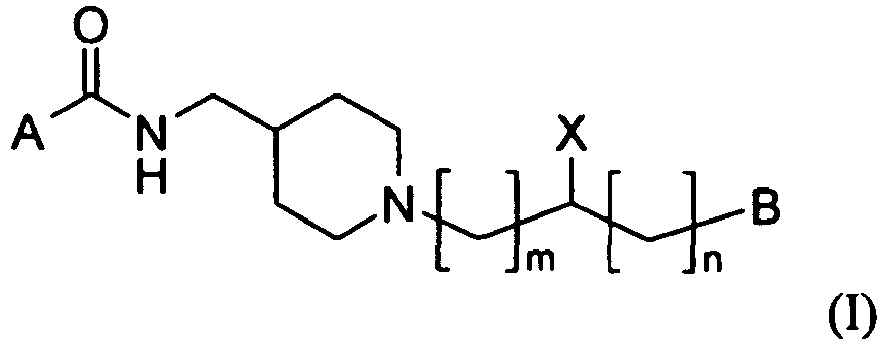
- m is an integer of 1 or 2;
- n is an integer of 0 to 2, preferably 0;
- A is selected from the group consisting of a phenyl group and a benzimidazole group, wherein the phenyl group may be substituted with one or more identical or different groups independently selected from the group consisting of hydrogen, a C1-C6 linear or branched alkyl group, a C1-C6 linear or branched alkoxy group, an amino group, and a halogen, and the benzimidazole group may be substituted with one or more identical or different groups independently selected from the group consisting of hydrogen, a C1-C6 linear or branched alkyl group, a C 1-C6 linear or branched alkoxy group, a C3-C7 cyclic alkyl group, an amino group, a halogen, and an oxo group;
- X is a hydroxy or OCONR1R2 wherein R1 and R2 may be the same or different and independently selected from the group consisting of hydrogen, a C1-C6 linear or branched alkyl group, a benzyl group, and a 5- to 7-membered cyclic or heterocyclic compound that may be substituted with one or more identical or different groups independently selected from the group consisting of a C1 to C6 alkyl, or R1 and R2 may form a 5- to 7-membered heterocyclic ring together with a nitrogen atom to which they are attached; and
- B is selected from the group consisting of a phenyl group, a phenoxy group, a thienyl group, and a naphthyl group, wherein the phenyl group, phenoxy group, thienyl group, or naphthyl group may be substituted with one or more identical or different groups independently selected from the group consisting of hydrogen, halogen, nitro, cyano, methanesulfonyl, trifluoromethyl, trifluoromethoxy, difluoromethoxy, phenyl, a C1-C6 linear or branched alkyl group, and a C1-C6 linear or branched alkoxy group.
- In the definition of the substituents, the alkyl group may be selected from the group consisting of a methyl, an ethyl, a linear or branched propyl, a linear or branched butyl, a cyclopropyl, a cyclobutyl, a cyclopentyl, a cyclohexyl, and a benzyl. The halogen is selected from fluoro, chloro, bromo, and iodo atoms.
- In an embodiment, substituent A in structural formula (I) may be a phenyl group that may be substituted with one or more identical or different groups independently selected from the group consisting of hydrogen, a halogen, an amino group, a C1-C6 linear or branched alkyl group, or a C1-C6 linear and branched alkoxy group.
- Substituent A may be represented by structural formula (II):

- When substituent A in structural formula (I) has structural formula (II), the piperidine compound is represented by the following structural formula (IV):

- The examples of the compound having the chemical formula (IV) may include of 4-amino-5-chloro-N-[[1-(2-hydroxy-2-phenylethyl)piperidin-4-yl]methyl]-2-methoxybenzamide;
4-amino-5-chloro-N-[[1-[2-(4-fluorophenyl)-2-hydroxyethyl]piperidin-4-yl]methyl]-2-methoxybenzamide : hydrochloride;
4-amino-5-chloro-N-[[1-[2-hydroxy-2-(4-methylphenyl)ethyl]piperidin-4-yl]methyl]-2-methoxybenzamide : hydrochloride;
4-amino-5-chloro-N-[[1-[2-hydroxy-2-(4-methoxyphenyl)ethyl]piperidin-4-yl]methyl]-2-methoxybenzamide : hydrochloride;
4-amino-5-chloro-N-[[1-[2-(4-chlorophenyl)-2-hydroxyethyl]piperidin-4-yl]methyl]-2-methoxybenzamide : hydrochloride;
4-amino-5-chloro-N-[[1-[2-(3,4-dichlorophenyl)-2-hydroxyethyl]piperidin-4-yl]methyl]-2-methoxybenzamide : hydrochloride;
4-amino-5-chloro-N-[[1-[2-hydroxy-2-[4-(trifluoromethyl)phenyl] ethyl]piperidin-4-yl]methyl]-2-methoxybenzamide : hydrochloride;
4-amino-5-chloro-N-[[1-[2-(3,4-difluorophenyl)-2-hydroxyethyl]piperidin-4-yl]methyl]-2-methoxybenzamide : hydrochloride;
[2-[4-[[(4-amino-5-chloro-2-methoxybenzoyl)amino]methyl]piperidin-1-yl]-1-phenylethyl] carbamate : hydrochloride;
[2-[4-[[(4-amino-5-chloro-2-methoxybenzoyl)amino]methyl]piperidin-1-yl]-1-(4-fluorophenyl)ethyl] carbamate : hydrochloride;
[2-[4-[[(4-amino-5-chloro-2-methoxybenzoyl)amino]methyl]piperidin-1-yl]-1-(3,4-dichlorophenyl)ethyl] carbamate : hydrochloride;
[2-[4-[[(4-amino-5-chloro-2-methoxybenzoyl)amino]methyl]piperidin-1-yl]-1-(3,4-difluorophenyl)ethyl] carbamate : hydrochloride;
[2-[4-[[(4-amino-5-chloro-2-methoxybenzoyl)amino]methyl]piperidin-1-yl]-1-[4-(trifluoromethyl)phenyl]ethyl] carbamate : hydrochloride;
4-amino-5-chloro-N-[[1-(3-hydroxy-3-phenylpropyl)piperidin-4-yl]methyl]-2-methoxybenzamide : hydrochloride;
4-amino-5-chloro-N-[[1-[3-(4-fluorophenyl)-3-hydroxypropyl]piperidin-4-yl]methyl]-2-methoxybenzamide : hydrochloride;
4-amino-5-chloro-N-[[1-[3-(3,4-dichlorophenyl)-3-hydroxypropyl]piperidin-4-yl]methyl]-2-methoxybenzamide : hydrochloride;
4-amino-5-chloro-N-[[1-(3-hydroxy-3-thiophen-2-ylpropyl)piperidin-4-yl]methyl]-2-methoxybenzamide : hydrochloride;
4-amino-5-chloro-N-[[1-[4-(4-fluorophenyl)-3-hydroxybutyl]piperidin-4-yl]methyl]-2-methoxybenzamide : hydrochloride;
4-amino-5-chloro-N-[[1-[5-(4-fluorophenyl)-3-hydroxypentyl]piperidin-4-yl]methyl]-2-methoxybenzamide : hydrochloride;
[3-[4-[[(4-amino-5-chloro-2-methoxybenzoyl)amino]methyl]piperidin-1-yl]-1-(4-chlorophenyl)propyl] carbamate : hydrochloride;
[4-[4-[[(4-amino-5-chloro-2-methoxybenzoyl)amino]methyl]piperidin-1-yl]-1-(4-fluorophenyl)butan-2-yl] carbamate : hydrochloride;
[1-[4-[[(4-amino-5-chloro-2-methoxybenzoyl)amino]methyl]piperidin-1-yl]-5-(4-fluorophenyl)pentan-3-yl] carbamate : hydrochloride;
4-amino-5-chloro-N-[[1-(2-hydroxy-3-phenoxypropyl)piperidin-4-yl]methyl]-2-methoxybenzamide : hydrochloride;
4-amino-5-chloro-N-[[1-[3-(4-chlorophenoxy)-2-hydroxypropyl]piperidin-4-yl]methyl]-2-methoxybenzamide : hydrochloride;
4-amino-5-chloro-N-[[1-[2-hydroxy-3-[4-(trifluoromethyl)phenoxy]propyl]piperidin-4-yl]methyl]-2-methoxybenzamide : hydrochloride;
[1-[4-[[(4-amino-5-chloro-2-methoxybenzoyl)amino]methyl]piperidin-1-yl]-3-phenoxypropan-2-yl] carbamate : hydrochloride;
[1-[4-[[(4-amino-5-chloro-2-methoxybenzoyl)amino]methyl]piperidin-1-yl]-3-(4-fluorophenoxy)propan-2-yl] 3,5-dimethylpiperidine-1-carboxylate : hydrochloride
[1-[4-[[(4-amino-5-chloro-2-methoxybenzoyl)amino]methyl]piperidin-1-yl]-3-(4-methoxyphenoxy)propan-2-yl] carbamate : hydrochloride;
[1-[4-[[(4-amino-5-chloro-2-methoxybenzoyl)amino]methyl]piperidin-1-yl]-3-(2,3-dichlorophenoxy)propan-2-yl] azepane-1-carboxylate : hydrochloride; 4-amino-5-chloro-N-[[1-[(2S)-2-hydroxy-2-phenylethyl]piperidin-4-yl]methyl]-2-methoxybenzamide;
4-amino-5-chloro-N-[[1-[(2R)-2-hydroxy-2-phenylethyl]piperidin-4-yl]methyl]-2-methoxybenzamide;
4-amino-5-chloro-N-[[1-[3-(4-chlorophenyl)-3-hydroxypropyl]piperidin-4-yl]methyl]-2-methoxybenzamide;
[3-[4-[[(4-amino-5-chloro-2-methoxybenzoyl)amino]methyl]piperidin-1-yl]-1-(4-fluorophenyl)propyl] carbamate;
(R)-[3-[4-[[(4-amino-5-chloro-2-methoxybenzoyl)amino]methyl]piperidin-1-yl]-1-(4-fluorophenyl)propyl] carbamate;
(S)-[3-[4-[[(4-amino-5-chloro-2-methoxybenzoyl)amino]methyl]piperidin-1-yl]-1-(4-fluorophenyl)propyl] carbamate;
4-amino-5-chloro-N-[[1-[2-hydroxy-3-(4-methoxyphenoxy)propyl]piperidin-4-yl]methyl]-2-methoxybenzamide;
[1-[4-[[(4-amino-5-chloro-2-methoxybenzoyl)amino]methyl]piperidin-1-yl]-3-phenoxypropan-2-yl] piperidine-1-carboxylate; and
4-amino-5-chloro-N-[[1-[3-(2,5-dichlorophenoxy)-2-hydroxypropyl]piperidin-4-yl]methyl]-2-methoxybenzamide. - In another embodiment, substituent A may be a benzimidazole group that may be substituted with one or more identical or different groups independently selected from the group consisting of hydrogen, a C1-C6 linear or branched alkyl group, a C1-C6 linear or branched alkoxy group, a C3-C7 cyclic alkyl group, an amino group, a halogen, and an oxo group.
- Substituent A in structural formula (I) is represented by structural formula (III):

- When substituent A in structural formula (I) has structural formula (III), the piperidine compound is represented by the following structural formula (V):

- The examples of the compound having the chemical formula (V) may include [1-(2-methylphenoxy)-3-[4-[[(2-oxo-3-propan-2-ylbenzimidazole-1-carbonyl)amino]methyl]piperidin-1-yl]propan-2-yl] carbamate;
N-[[1-[2-hydroxy-3-(4-nitrophenoxy)propyl]piperidin-4-yl]methyl]-2-oxo-3-propan-2-ylbenzimidazole-1-carboxamide : hydrochloride;
N-[[1-[2-hydroxy-3-(4-methoxyphenoxy)propyl]piperidin-4-yl]methyl]-2-oxo-3-propan-2-ylbenzimidazole-1-carboxamide : hydrochloride;
N-[[1-[3-(4-fluorophenoxy)-2-hydroxypropyl]piperidin-4-yl]methyl]-3-methyl-2-oxobenzimidazole-1-carboxamide : hydrochloride;
3-ethyl-N-[[1-[2-hydroxy-3-(4-methoxyphenoxy)propyl]piperidin4-yl]methyl]-2-oxobenzimidazole-1-carboxamide : hydrochloride;
[1-[4-[[(2-oxo-3-propan-2-ylbenzimidazole-1-carbonyl)amino]methyl]piperidin-1-yl]-3-phenoxypropan-2-yl] carbamate: hydrochlorid;
[1-(4-fluorophenoxy)-3-[4-[[(2-oxo-3-propan-2-ylbenzimidazole-1-carbonyl)amino]methyl]piperidin-1-yl]propan-2-yl] carbamate : hydrochloride;
[1-(4-methoxyphenoxy)-3-[4-[[(3-methyl-2-oxobenzimidazole-1-carbonyl)amino]methyl]piperidin-1-ium-1-yl]propan-2-yl] carbamate : hydrochloride;
[1-[4-[[(3-ethyl-2-oxobenzimidazole-1-carbonyl)amino]methyl]piperidin-1-yl]-3-phenoxypropan-2-yl] carbamate : hydrochloride;
[1-(4-chlorophenoxy)-3-[4-[[(3-ethyl-2-oxobenzimidazole-1-carbonyl)amino]methyl]piperidin-1-yl]propan-2-yl] carbamate: hydrochloride;
3-cyclopropyl-N-[[1-(3-hydroxy-3-phenylpropyl)piperidin-4-yl]methyl]-2-oxobenzimidazole-1-carboxamide : hydrochloride;
3-cyclopropyl-N-[[1-[3-(4-fluorophenyl)-3-hydroxypropyl]piperidin-1-ium-4-yl]methyl]-2-oxobenzimidazole-1-carboxamide : hydrochloride;
[3-[4-[[(3-cyclopropyl-2-oxobenzimidazole-1-carbonyl)amino]methyl]piperidin-1-ium-1-yl]-1-phenylpropyl] carbamate : hydrochloride;
[1-(4-fluorophenyl)-3-[4-[[(2-oxo-3-propan-2-ylbenzimidazole-1-carbonyl)amino]methyl]piperidin-1-ium-1-yl]propyl] carbamate : hydrochloride;
[1-(4-methoxyphenyl)-3-[4-[[(2-oxo-3-propan-2-ylbenzimidazole-1-carbonyl)amino]methyl]piperidin-1-ium-1-yl]propyl] carbamate : hydrochloride;
N-[[1-[2-(4-fluorophenyl)-2-hydroxyethyl]piperidin-4-yl]methyl]-2-oxo-3-propan-2-ylbenzimidazole-1-carboxamide : hydrochloride;
[1-(4-fluorophenyl)-2-[4-[[(2-oxo-3-propan-2-ylbenzimidazole-1-carbonyl)amino]methyl]piperidin-1-ium-1-yl]ethyl] carbamate : hydrochloride;
[[2-[4-[[(3-cyclopropyl-2-oxobenzimidazole-1-carbonyl)amino]methyl]piperidin-1-ium-1-yl]-1-(3-methoxyphenyl)ethyl] carbamate : hydrochloride;
[1-[4-[[(3-methyl-2-oxobenzimidazole-1-carbonyl)amino]methyl]piperidin-1-yl]-3-phenoxypropan-2-yl] carbamate;
N-[[1-(2-hydroxy-3-phenoxypropyl)piperidin-4-yl]methyl]-2-oxo-3-propan-2-ylbenzimidazole-1-carboxamide; and
[3-[4-[[(2-oxo-3-propan-2-ylbenzimidazole-1-carbonyl)amino]methyl]piperidin-1-yl]-1-phenylpropyl] carbamate. - In accordance with an embodiment of the present invention, the compound represented by the structural formula (I) and pharmaceutical acceptable salts thereof can be prepared by the following steps, starting from amino alcohol compounds represented by the following general structural formula (VI):

- The method for preparing the O-carbamoyl compounds represented by the following general structural formula (VII) will be described below in detail:

- The O-carbamoyl compounds represented by the general structural formula (VII) are prepared by reacting an amino alcohol represented by the general structural formula (VI) with 1,1'-carbonyldiimidazole (CDI) and then with an amine base represented by the following general structural formula (VIII):
NH R1R2 (VIII)
where R1 and R2 are described as above.
This procedure is summarized as set forth in Reaction Scheme 1 below.
- The reaction conditions described in Reaction Scheme I are described in detail as follows. For the conversion of the compound (VI) to the compound (VII), the concentration of the starting material (VI) is about 0.005 to 0.1 moles with 1,1'-carbonyldiimidazole (CDI) ranging from about 2.0 to 3.0 equivalents. This reaction is preferably carried out at a temperature of 10 to 30 º C. Without purification, the resulting intermediate is treated with 1 to 1000 equivalents of an amine base represented by the general structural formula (VIII) at a temperature of 10 to 30 º C to give the compound of the general structural formula (VII). For this carbamoylation, ethereal solvents such as diethyl ether and tetrahydrofuran, a halogenated hydrocarbon solvent such as dichloromethane and chloroform, or a mixture thereof may be used.
- In Reaction Scheme I, HX represents an acid that is capable of forming a pharmaceutically useful salt with the basic nitrogen atom. Specific examples of the acid used for the preparation of the compound (IX) from the compound (VII) include hydrochloric acid, sulfuric acid, phosphoric acid, acetic acid, benzoic acid, citric acid, malonic acid, salicylic acid, malic acid, fumaric acid, oxalic acid, succinic acid, tartaric acid, lactic acid, gluconic acid, ascorbic acid, maleic acid, aspartic acid, benzene sulfonic acid, methane sulfonic acid, ethane sulfonic acid, hydroxymethane sulfonic acid, hydroxyethane sulfonic acid, and the like. Additional acids can be found by referring to "Pharmaceutical Salts", J. Pharm. Sci., 1977; 66(1): 1-19. This preparation is executed in a reaction media that can be exemplified by an ethereal solvent such as tetrahydrofuran, an alcoholic solvent such as methanol, an ester solvent such as ethyl acetate, a halogenated hydrocarbon solvent, and mixtures thereof. An ethereal solvent is recommended as an addition solution, including ethyl ether, propyl ether, isopropyl ether, butyl ether, and isobutyl ether. The concentration of the compound (VII) is in the order of about 0.01 to 5 moles.
- The piperidine compounds of structural formula (I) may have all the possible stereo isomeric forms, such as the racemic, enantiomeric, and diastereoisomeric forms, and the pharmaceutically acceptable addition salts with inorganic and/or organic acids or with inorganic and/or organic bases of said compound of structural formula (I), for the preparation of medicines intended for the prevention or treatment of diseases of the gastrointestinal tract such as irritable bowel syndrome (IBS), gastric motility disorder and/or visceral pain.
- The method for preparing the amino alcohol benzamide compounds represented by following structural formula (X) will be described below in detail:

- The amino alcohol benzamide compounds represented by the general structural formula (X) are prepared by reacting piperidine benzamide represented by the general structural formula (XI) with an alkyl halide represented by the following general structural formula (XII), an epoxide represented by the following general structural formula (XIII), or a Weinreb amide represented by the following general structural formula (XIV):
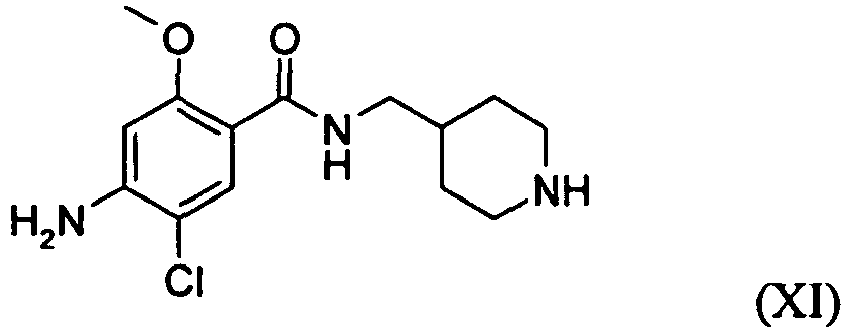


- This procedure is summarized as set forth in Reaction Scheme II below.

- In this step, the desired piperidine compound of structural formula (XV) is prepared by the alkylation of a compound of structural formula (XI) with an alkyl halide (XII) and reduction of the resulting ketone. Details of the reaction conditions described in Step II-1 are as follows. For the conversion of the compounds (XI) to the compounds (XV), the concentration of the starting material (XI) is about 0.005 to 0.1 moles with compound (XII-1) ranging from about 1.1 to 3.0 equivalents and a base such as potassium carbonate, cesium carbonate, and triethylamine ranging from about 1.5 to 5.0 equivalents. This reaction is preferably carried out at a temperature of 20 to 80 º C. Without purification, the resulting intermediate ketone is treated with 1.0 to 10.0 equivalents of NaBH4 at a temperature of 0 to 30 º C to give the compound of the general structural formula (XV).
- For an alternative conversion of compound (XI) to the compound (XV) in which alkyl halide is represented by structural formula (XII-2), the concentration of the starting material (XI) is about 0.005 to 0.1 moles with compound (XII-2) ranging from about 1.1 to 3.0 equivalents and a base such as potassium carbonate, cesium carbonates and triethylamine ranging from about 1.5 to 5.0 equivalents. This reaction is preferably carried out at a temperature of 20 to 80 º C. For this reaction, an ethereal solvent such as diethyl ether and tetrahydrofuran, a halogenated hydrocarbon solvent such as dichloromethane and chloroform, an alcohol solvent such as methanol, ethanol, and isopropanol, or acetonitrile may be used.
- In this step, the piperidine compound (XVI) is prepared by the epoxide ring opening reaction.
- Details of the reaction conditions described in Step 11-2 are as follows. For the conversion of the compound (XI) to the compound (XVI), the concentration of the starting material (XI) is about 0.005 to 0.1 moles with compound (XIII) ranging from about 1.1 to 3.0 equivalents. This reaction is preferably carried out at a temperature of 20 to 80 º C. For this reaction, ethereal solvents such as diethyl ether and tetrahydrofuran, a halogenated hydrocarbon solvent such as dichloromethane and chloroform, an alcohol solvent such as methanol, ethanol, and isopropanol, or acetonitrile may be used.
- In this step, the piperidine compound (XVIII) is prepared by a coupling reaction of a compound of structural formula (XI) with a Weinreb amide compound of structural formula (XIV), and reduction of a resulting ketone compound of structural formula (XVII). Details of the reaction conditions described in Step II-3 are as follows. For the conversion of the compounds (XI) to the compounds (XVIII), the concentration of the Weinreb amide (XIV) is about 0.005 to 0.1 moles with vinyl magnesium bromide ranging from about 1.1 to 2.0 equivalents. Next, the resulting intermediate is treated with a piperidine compound represented by the general compound (XI) and excess water at a temperature 0 to 30 º C to give the compound of the general structural formula (XVII). Without purification, the resulting intermediate ketone is treated with 1.0 to 10.0 equivalents of NaBH4 at a temperature of 0 to 30 º C to give the compound of the general structural formula (XVIII). For this reaction, an ethereal solvent such as diethyl ether and tetrahydrofuran, a halogenated hydrocarbon solvent such as dichloromethane and chloroform, an alcohol solvent such as methanol, ethanol, and isopropanol, or acetonitrile may be used.
- The method for preparing the amino alcohol benzimidazole compounds represented by the following general structural formula (XIX) will be described below in detail.

- The amino alcohol benzimidazole compounds represented by the general structural formula (XIX) are prepared by reacting piperidine benzimidazole represented by the general structural formula (XX) with an alkyl halide represented by the following general structural formula (XII) or an epoxide represented by the following general structural formula (XIII):


- This procedure is summarized as set forth in Reaction Scheme III below.

- In this step, the piperidine compound of structural formula (XXI) is prepared by the alkylation of a compound of structural formula (XX) with an alkyl halide and reduction. The reaction may be carried out under the same conditions as described in Step II-1.
- In this step, the piperidine compound of structural formula (XXII) is prepared by the epoxide ring opening reaction. The reaction may be carried out under the same conditions as described in Step II-2.
- It should be noted that the stereochemistry of the product (I, IV, or V) depends solely on that of the starting material (XII or XIII); a starting material (XII or XIII) with an (S)-enantiomer yields only a product with an (S)-enantiomer, and a starting material (XII or XIII) with an (R)-enantiomer yields only a product with an (R)-enantiomer.
- Based on the therapeutic activities of the novel piperidine compounds as shown in the fallowing examples, another embodiment provides a pharmaceutical composition including the piperidine compounds represented by structural formula (I), in particular, the compounds represented by structural formula (IV) and (V), as an active ingredient.
- In another embodiment, provided is a pharmaceutical composition including an effective amount of the piperidine compounds represented by structural formula (I), in particular, the compounds represented by structural formula (IV) and (V), for treating disorders of gastrointestinal tract such as irritable bowel syndrome, gastrointestinal motility disorder (e.g., gastric motility disorder), constipation, visceral pain, and the like.
- Another embodiment provides a compound of formula (I) for use in a method of treating disorders of gastrointestinal tract, such as irritable bowel syndrome (IBS), gastrointestinal motility disorder (e.g., gastric motility disorder), constipation, and visceral pain, in a mammal including administering the composition of the compound of structural formula (I) to a mammal in need of gastrointestinal tract disorder therapy.
- The compounds of structural formula (I) are useful in treating IBS, specifically constipation-predominant IBS, constipation, and other gastrointestinal disorders associated with gastrointestinal motility disorder, because they can increase gastrointestinal motility.
- Additionally, the compounds of structural formula (I) are useful in alleviating visceral pain caused by IBS and/or other gastrointestinal disorders, because they can reduce visceral pain and discomfort associated with IBS and the like.
- The compounds of structural formula (I) may be administered orally or parenterally, and alone or in combination with conventional pharmaceutical carriers. Applicable solid carriers can include one or more substances that may also act as flavoring agents, lubricants, solubilizers, suspending agents, fillers, glidants, compression aids, binders, tablet-disintegrating agents, or encapsulating materials. In powders, the carrier may be a finely divided solid that is in admixture with the finely divided active ingredient. In tablets, the active ingredient is mixed with a carrier having necessary compression properties in suitable proportions and compacted in the shape and size desired. The powders and tablets may contain up to 99% of the active ingredient.
- Suitable solid carriers include, for example, calcium phosphate, magnesium stearate, talc, sugars, lactose, dextrin, starch, gelatin, cellulose, methyl cellulose, sodium carboxymethyl cellulose, polyvinylpyrrolidine, low melting waxes, and ion exchange resins. Liquid carriers may be used in preparing solutions, suspensions, emulsions, syrups, and elixirs.
- The active ingredient can be dissolved or suspended in a pharmaceutically acceptable liquid carrier such as water, an organic solvent, a mixture of both, or pharmaceutically acceptable oils or fats. The liquid carrier can contain other suitable pharmaceutical additives such as solubilizers, emulsifiers, buffers, preservatives, sweeteners, flavoring agents, suspending agents, thickening agents, colors, viscosity regulators, stabilizers, or osmo-regulators. Suitable examples of liquid carriers for oral and parenteral administration include water (particularly containing additives as above, e.g., cellulose derivatives, preferably a sodium carboxymethyl cellulose solution), alcohols (including monohydric alcohols and polyhydric alcohols, e.g., glycols) and their derivatives, and oils (e.g., fractionated coconut oil and arachis oil).
- For parenteral administration, the carrier can also be an oily ester such as ethyl oleate and isopropyl myristate. Sterile liquid carriers are used in sterile liquid form compositions for parenteral administration. Liquid pharmaceutical compositions that are sterile solutions or suspensions can be utilized by, for example, intramuscular, intraperitoneal, or subcutaneous injection. Sterile solutions can also be administered intravenously.
- Oral administration may be either in liquid or solid composition form. Preferably, the pharmaceutical compositions containing the present compounds are in unit dosage form, e.g., as tablets or capsules. In such form, the composition is subdivided in unit dosages containing appropriate quantities of the active ingredients. The unit dosage forms can be packaged compositions, for example, packaged powders, vials, ampoules, prefilled syringes, or sachets containing liquids. Alternatively, the unit dosage form can be, for example, a capsule or tablet itself, or it can be an appropriate number of any such compositions in package form. The therapeutically effective dosage to be used may be varied or adjusted by the administering physician, and generally ranges from 0.5 mg to 750 mg, according to the specific condition(s) being treated and the size, age, and response pattern of the patient.
- The compounds of structural formula (I) may be administered to patients at a dosage of from 0.7 to 7000mg per day. For a normal human adult with a body weight of approximately 70kg, the administration amount is translated into a daily dose of 0.01 to 100mg per kg of body weight. The specific dosage employed, however, may vary depending upon the requirements of the patient, the severity of the patient's condition, and the activity of the compound. The determination of optimum dosages for a particular situation must be clinically done, and is within the skill of the art.
- Another embodiment provides a piperidine compound and/or a pharmaceutically-acceptable salt thereof in preventing and/or treating a gastrointestinal disease in a mammal, such as irritable bowel syndrome (IBS), gastric motility disorder, constipation, and/or visceral pain. Still another embodiment provides a use of a piperidine compound and/or a pharmaceutically-acceptable salt thereof in preparing a pharmaceutical composition for preventing and/or treating a gastrointestinal disease in a mammal, such as irritable bowel syndrome (IBS), gastric motility disorder, constipation, and/or visceral pain.
- A better understanding of the present invention may be obtained in light of the following examples that are set forth to illustrate, but are not to be construed to limit, the present invention.
- A mixture of 4-amino-5-chloro-2-methoxy-N-((piperidin-4-yl)methyl)benzamide (5.0mmol), 2-bromoacetophenone (6.0mmol), and potassium carbonate (7.6mmol) was stirred in 15mL of acetonitrile for 2h. This solution was then concentrated in a rotary evaporator and diluted with ethyl acetate. This mixture was then washed with brine, and the resulting organic layer was dried and purified by column chromatography. This was dissolved in ethanol (10mL) and was added with sodium borohydride (10.0mmol) at 0°C and stirred at 25°C for 2h. This solution was concentrated on a rotary evaporator and diluted with ethylacetate. This mixture was washed with brine, dried, and concentrated in vacuo. The residue was purified by column chromatography. The resulting 4-amino-5-chloro-N-((1-(2-hydroxy-2-phenylethyl)piperidin-4-yl)methyl)-2-methoxybenzamide was dissolved in methylene chloride (MC) and the solution was treated with a solution of HCl in ether. The resulting precipitate was filtered to give the title compound.
- 1H-NMR (CDC13, 200MHz) δ8.15(s, 1H), 7.8(m, 1H), 7.4-7.2(m, 5H), 6.35(s, 1H), 4.95(m, 1H), 4.4(s, 2H), 3.9(s, 3H), 3.4-3.3(m, 3H), 3.0(m, 1H), 2.6(m, 2H), 2.4(m, 1H), 2.2(m, 1H), 1.9-1.6(m, 3H), 1.6-1.4(m, 2H)
- The procedure given in Example 1 was followed using 2-bromo-4'-fluoroacetophenone as a reactant, instead of 2-bromoacetophenone, to give the title compound.
- 1H-NMR (CDCl3, 200MHz) δ8.1(s, 1H), 7.8(m, 1H), 7.4-7.15(m, 2H), 7.1-6.95(m, 2H), 6.35(s, 1H), 4.9(m, 1H), 4.4(s, 2H), 3.9(m, 3H), 3.4-3.2(m, 3H), 3.1-2.9(m, 1H), 2.6-2.3(m, 3H), 2.3-2.1(m, 1H), 1.9-1.7(m, 3H), 1.6-1.4(m, 2H)
- The procedure given in Example 1 was followed using 2-bromo-4'-methylacetophenone as a reactant, instead of 2-bromoacetophenone, to give the title compound.
- 1 H-NMR (CDCl3, 200MHz) δ8.1(s, 1H), 7.8(m, 1H), 7.3-7.1(m, 4H), 6.35(s, 1H), 4.9(m, 1H), 4.4(s, 2H), 3.9(m, 3H), 3.5-3.3(m, 3H), 3.3-3.1(m, 1H), 2.7(m, 2H), 2.6-2.5(m, 1H), 2.4(m, 4H), 1.9-1.7(m, 3H), 1.6-1.5(m, 2H)
- The procedure given in Example 1 was followed using 2-bromo-4'-methoxyacetophenone as a reactant, instead of 2-bromoacetophenone, to give the title compound.
- 1H NMR (CDCl3, 200MHz) δ8.1(s, 1H), 7.8(m, 1H), 7.4-7.2(m, 2H), 6.95-6.85(m, 2H), 6.35(s, 1H), 4.9(m, 1H), 4.4(s, 2H), 3.9(m, 3H), 3.8(s, 3H), 3.4-3.2(m, 3H), 3.1-3.0(m, 1H), 2.6(m, 2H), 2.5(m, 1H), 2.3-2.1(m, 1H), 1.9-1.7(m, 3H), 1.6-1.4(m, 2H)
- The procedure given in Example 1 was followed using 2-bromo-4'-cyanoacetophenone as a reactant, instead of 2-bromoacetophenone, to give the title compound.
- 1H-NMR (CDCl3, 200MHz) δ8.1(s, 1H), 7.8(m, 1H), 7.65(m, 2H), 7.55(m, 2H), 6.35(s, 1H), 4.9(m, 1H), 4.45(s, 2H), 3.9(m, 3H), 3.4(m, 2H), 3.2(m, 1H), 2.95(m, 1H), 2.7-2.33(m, 3H), 2.2(m, 1H), 1.9-1.7(m, 3H), 1.6-1.4(m, 2H)
- The procedure given in Example 1 was followed using 2-bromo-4'-chloroacetophenone as a reactant, instead of 2-bromoacetophenone, to give the title compound.
- 1H-NMR (CDCl3, 200MHz) δ8.15(m, 1H), 7.8(m, 1H), 7.3(m, 4H), 6.35(s, 1H), 4.8(m, 1H), 4.4(s, 2H), 3.9(s, 3H), 3.4-3.2(m, 3H), 3.05-2.9(m, 1H), 2.6-2.3(m, 3H), 2.2(m, 1H), 1.9-1.6(m, 3H), 1.6-1.4(m, 2H)
- The procedure given in Example 1 was followed using 2-bromo-4'-phenylacetophenone as a reactant, instead of 2-bromoacetophenone, to give the title compound.
- 1H-NMR (CDCl3, 200MHz) δ8.15(m, 1H), 7.85(m, 1H), 7.6-7.3(m, 9H), 6.35(s, 1H), 5.3(m, 1H), 4.4(s, 2H), 3.9(s, 3H), 3.8-3.4(m, 4H), 3.2-3.0(m, 2H), 3.0-2.7(m, 2H), 2.4-1.6(m, 3H), 1.6-1.4(m, 2H)
- The procedure given in Example 1 was followed using 2-bromo-2'-methoxyacetophenone as a reactant, instead of 2-bromoacetophenone, to give the title compound.
- 1H-NMR (CDCl3, 200MHz) δ8.15(m, 1H), 7.85(m, 1H), 7.6(m, 1H),7.3(m, 1H), 7.0(m, 1H), 6.9(m, 1H), 6.35(s, 1H), 5.25(m, 1H), 4.4(s, 2H), 3.9(s, 3H), 3.8(s, 3H), 3.6(m, 2H), 3.1-3.0(m, 2H), 2.9-2.7(m, 4H), 1.9-1.7(m, 3H), 1.7-1.4(m, 2H)
- The procedure given in Example 1 was followed using 2-bromo-3'-methoxyacetophenone as a reactant, instead of 2-bromoacetophenone, to give the title compound.
- 1H-NMR (CDCl3, 200MHz) δ8.15(m, 1H), 7.85(m, 1H), 7.3-7.2(m, 1H),7.0-6.9(m, 2H), 6.85(m, 1H), 6.35(s, 1H), 4.8(m, 1H), 4.4(s, 2H), 3.9(s, 3H), 3.8(s, 3H), 3.4-3.2(m, 3H), 3.0(m, 1H), 2.6(m, 2H), 2.4(m, 1H), 2.2(m, 1H), 1.9-1.6(m, 3H), 1.6-1.4(m, 2H)
- The procedure given in Example 1 was followed using 2-bromo-3',4'-dichloroacetophenone as a reactant, instead of 2-bromoacetophenone, to give the title compound.
- 1H-NMR (CDCl3, 200MHz) δ8.15(s, 1H), 7.8(m, 1H), 7.5(s, 1H), 7.45(m, 1H), 7.2(m, 1H), 6.35(s, 1H), 4.8(m, 1H), 4.4(s, 2H), 3.9(s, 3H), 3.4(m, 2H), 3.3-3.2(m, 1H), 3.0(m, 1H), 2.6-2.3(m, 3H), 2.2(m, 1H), 1.9-1.6(m, 3H), 1.6-1.3(m, 2H)
- The procedure given in Example 1 was followed using 2-bromo-2',4'-difluoroacetophenone as a reactant, instead of 2-bromoacetophenone, to give the title compound.
- 1H-NMR (CDCl3, 200MHz) δ8.15(s, 1H), 7.85(m, 1H), 7.65(m, 1H), 7.0-6.7(m, 2H), 6.35(s, 1H), 5.3(m, 1H), 4.4(s, 2H), 3.9(s, 3H), 3.5(m, 1H), 3.4(m, 2H), 3.2(m, 2H), 2.9-2.2(m, 4H), 2.7-2.4(m, 2H), 2.0-1.8(m, 3H), 1.8-1.6(m, 2H)
- The procedure given in Example 1 was followed using 2-bromo-4'-tert-butylacetophenone as a reactant, instead of 2-bromoacetophenone, to give the title compound.
- 1 H-NMR (CDCl3, 200MHz) δ8.15(s, 1H), 7.8(m, 1H), 7.45-7.3(m, 4H), 6.35(s, 1H), 4.8(m, 1H), 4.4(s, 2H), 3.9(s, 3H), 3.4-3.2(m, 3H), 3.0(m, 1H), 2.6(m, 2H), 2.4(m, 1H), 2.15(m, 1H), 1.9-1.6(m, 3H), 1.55(m, 2H), 1.3(s, 9H)
- The procedure given in Example 1 was followed using 2-bromo-2'-chloroacetophenone as a reactant, instead of 2-bromoacetophenone, to give the title compound.
- 1 H-NMR (CDCl3, 200MHz) δ8.15(s, 1H), 7.85(m, 1H), 7.75(m, 1H), 7.3(m, 3H), 6.35(s, 1H), 5.3(m, 1H), 4.4(s, 2H), 3.9(s, 3H), 3.4(m, 3H), 3.05(m, 1H), 2.85(m, 1H), 2.5(m, 2H), 2.3(m, 1H), 1.9-1.7(m, 3H), 1.6(m, 2H)
- The procedure given in Example 1 was followed using 2-bromo-2',4'-dimethylacetophenone as a reactant, instead of 2-bromoacetophenone, to give the title compound.
- 1H-NMR (CDCl3, 200MHz) δ8.15(s, 1H), 7.8(m, 1H), 7.45(m, 1H), 7.05(m, 1H), 6.95(m, 1H), 6.35(m, 1H), 5.05(m, 1H), 4.4(s, 2H), 3.9(s, 3H), 3.4-3.3(m, 3H), 3.0(m, 1H), 2.6-2.4(m 3H), 2.35(m, 6H), 2.2(m, 1H), 1.9-1.6(m, 3H), 1.55(m, 2H)
- The procedure given in Example 1 was followed using 2-bromo-2',5'-dimethoxyacetophenone as a reactant, instead of 2-bromoacetophenone, to give the title compound.
- 1 H-NMR (CDCl3, 200MHz) δ8.15(s, 1 H), 7.8(m, 1 H), 7.2(m, 1 H), 6.8(s, 2H), 6.35(m, 1H), 5.2(m, 1H), 4.45(s, 2H), 3.9(s, 3H), 3.8(m, 6H), 3.35(m, 2H), 3.0(m, 1H), 2.8(m, 1H), 2.55(m 2H), 2.2(m, 1H), 1.9-1.7(m, 3H), 1.5(m 2H)
- The procedure given in Example 1 was followed using 2-bromo-4'-(difluoromethoxy)acetophenone as a reactant, instead of 2-bromoacetophenone, to give the title compound.
- 1H-NMR (CDCl3, 200MHz) δ8.15(s, 1 H), 7.8(m, 1H), 7.4(m, 2H), 7.1(m, 2H), 6.35(m, 1H), 4.85(m, 1H), 4.45(s, 2H), 3.9(s, 3H), 3.4-3.2(m, 3H), 3.0(m, 1H), 2.7-2.4(m, 3H), 2.2(m 1H), 1.9-1.7(m, 3H), 1.5(m 2H)
- The procedure given in Example 1 was followed using 2-bromo-3',4'-difluoroacetophenone as a reactant, instead of 2-bromoacetophenone, to give the title compound.
- 1 H-NMR (CDCl3, 200MHz) δ8.15(s, 1H), 7.8(m, 1H), 7.3-7.1(m, 3H), 6.35(m, 1H), 4.85(m, 1H), 4.45(s, 2H), 3.9(s, 3H), 3.5-3.2(m, 3H), 3.0(m, 1H), 2.7-2.4(m, 3H), 2.2(m 1H), 1.9-1.7(m, 3H), 1.5(m 2H)
- The procedure given in Example 1 was followed using 2-bromo-4'-(trifluoromethyl)acetophenone as a reactant, instead of 2-bromoacetophenone, to give the title compound.
- 1H-NMR (CDCl3, 200MHz) δ8.15(s, 1H), 7.8(m, 1H), 7.6(m, 2H), 7.5(m, 2H), 6.35(m, 1H), 4.9(m, 1H), 4.45(s, 2H), 3.9(s, 3H), 3.4(m, 2H), 3.3(m, 1H), 3.0(m, 1H), 2.7-2.3(m, 3H), 2.2(m 1H), 1.9-1.7(m, 3H), 1.5(m 2H)
- The procedure given in Example 1 was followed using 2-bromo-2',4'-dichloroacetophenone as a reactant, instead of 2-bromoacetophenone, to give the title compound.
- 1H-NMR (CDCl3, 200MHz) δ8.15(s, 1 H), 7.8(m, 1 H), 7.65(m, 2H), 7.35(m, 2H), 6.35(m, 1H), 5.25(m, 1H), 4.45(s, 2H), 3.9(s, 3H), 3.4(m, 2H), 3.0(m, 1H), 2.8(m, 1H), 2.6-2.2(m, 3H), 1.9-1.7(m, 3H), 1.5(m 2H)
- A mixture of 4-amino-5-chloro-2-methoxy-N-((piperidin-4-yl)methyl)benzamide(5.0mmol), (S)-styrene oxide(6.0mmol) was refluxed in 30ml of isopropanol for 4h. This solution was then concentrated on a rotary evaporator and diluted with ethyl acetate. This mixture was then washed with brine, and the resulting organic layer was dried and purified by column chromatography. The resulting 4-amino-5-chloro-N-[[1-[(2S)-2-hydroxy-2-phenylethyl]piperidin-4-yl]methyl]-2-methoxybenzamide was dissolved in MC and the solution treated with a solution of HCl in ether. The resulting precipitate was filtered to give the title compound.
- 1H-NMR (CDCl3, 200MHz) δ8.15(m, 1H), 8.0-7.9(br, 1H), 7.5-7.3(m, 5H), 6.35(s, 1H), 5.45(br, 1H), 4.4(s, 2H), 3.9(s, 3H), 3.5-2.7(m, 6H), 2.2-2.0(m, 2H), 1.9-1.4(m, 5H)
- The procedure given in Example 20 was followed using (R)-styrene oxide as a reactant, instead of (S)-styrene oxide, to give the title compound.
- 1H-NMR (CDCl3, 200MHz) δ8.15(, 1H), 8.0-7.9(br, 1H), 7.5-7.3(m, 5H), 6.35(s, 1H), 5.2(br, 1H), 4.4(s, 2H), 3.9(s, 3H), 3.5-2.7(m, 6H), 2.2-2.0(m, 2H), 1.9-1.4(m,5H)
- 4-amino-5-chloro-N-[[1-(2-hydroxy-2-phenylethyl)piperidin-4-yl]methyl]-2-methoxybenzamide (1.5mmol) from Example 1 was dissolved in 10mL of THF and added with 1,1'-carbonyl diimidazole (12mmol) at 0°C. The reaction mixture was stirred at room temperature for 2h, followed by the addition of excess ammonium hydroxide (3ml) at room temperature. After 2h stirring at room temperature, water was added to terminate the reaction. The organic layer was extracted 3 times with dichloromethane, dried, and concentrated in vacuo. The resulting carbamate was dissolved in MC and the solution treated with a solution of HCl in ether. The resulting precipitate was filtered to give the title compound.
- 1H-NMR (CDCl3, 200MHz) δ8.1(s, 1H), 7.8(m, 1H), 7.4-7.2(m, 5H), 6.35(s, 1H), 5.9(m, 1H), 4.7(m, 2H), 4.4(s, 2H), 3.9(m, 3H), 3.3(m, 2H), 3.1-2.8(m, 3H), 2.6-2.5(m, 1H), 2.2-2.0(m, 2H), 1.8-1.3(m, 5H)
- The procedure given in Example 22 was followed using 4-amino-5-chloro-N-[[1-[2-(4-fluorophenyl)-2-hydroxyethyl]piperidin-4-yl]methyl]-2-methoxybenzamide from Example 2 as a reactant, instead of 4-amino-5-chloro-N-[[1-(2-hydroxy-2-phenylethyl)piperidin-4-yl]methyl]-2-methoxybenzamide, to give the title compound.
- 1H-NMR (CDCl3, 200MHz) δ8.1(s, 1H), 7.8(m, 1H), 7.4-7.2(m, 2H), 7.15-7.0(m, 2H), 6.35(s, 1H), 5.9-5.8(m, 1H), 5.1-4.8(br, 2H), 4.4(s, 2H), 3.9(m, 3H), 3.4(m, 2H), 3.3-3.0(m, 3H), 2.8-2.6(m, 2H), 2.5-2.3(m, 2H), 1.9-1.5(m, 5H)
- The procedure given in Example 22 was followed using 4-amino-5-chloro-N-[[1-[2-hydroxy-2-(4-methylphenyl)ethyl]piperidin-4-yl]methyl]-2-methoxybenzamide from Example 3 as a reactant, instead of 4-amino-5-chloro-N-[[1-(2-hydroxy-2-phenylethyl)piperidin-4-yl]methyl]-2-methoxybenzamide, to give the title compound.
- 1H-NMR (CDCl3, 200MHz) δ8.1(s, 1H), 7.8(m, 1H), 7.3-7.1(m, 4H), 6.35(s, 1H), 5.9-5.8(m, 1H), 4.9(m, 2H), 4.4(s, 2H), 3.9(m, 3H), 3.4(m, 2H), 3.2-2.9(m, 3H), 2.6(m, 1H), 2.35(s, 3H), 2.3-2.1(m, 2H), 1.9-1.5(m, 5H)
- The procedure given in Example 22 was followed using 4-amino-5-chloro-N-[[1-[2-(4-cyanophenyl)-2-hydroxyethyl]piperidin-4-yl]methyl]-2-methoxybenzamide from Example 5 as a reactant, instead of 4-amino-5-chloro-N-[[1-(2-hydroxy-2-phenylethyl)piperidin-4-yl]methyl]-2-methoxybenzamide, to give the title compound.
- 1 H-NMR (CDCl3, 200MHz) δ8.1(s, 1H), 7.8(m, 1H), 7.7(m, 2H), 7.5(m, 2H), 6.35(s, 1H), 5.9-5.8(m, 1H), 5.0-4.8(br, 2H), 4.4(s, 2H), 3.9(m, 3H), 3.4(m, 2H), 3.1-2.9(m, 3H), 2.7-2.6(m, 1H), 2.4-2.2(m, 2H), 1.9-1.7(m, 3H), 1.5(m, 2H)
- The procedure given in Example 22 was followed using 4-amino-5-chloro-N-[[1-[2-hydroxy-2-(4-phenylphenyl)ethyl]piperidin-4-yl]methyl]-2-methoxybenzamide from Example 7 as a reactant, instead of 4-amino-5-chloro-N-[[1-(2-hydroxy-2-phenylethyl)piperidin-4-yl]methyl]-2-methoxybenzamide, to give the title compound.
- 1 H-NMR (DMSO-d6, 200MHz) δ10.2(br, 1H), 8.05(s, 1H), 7.7(m, 5H), 7.5-7.3(m, 4H), 6.9-6.8(m, 2H), 6.5(s, 1H), 6.05(m, 1H), 3.9(s, 3H), 3.6(m, 2H), 3.4(m, 3H), 3.2(m, 1H), 3.0(m, 2H), 1.9-1.4(m, 5H)
- The procedure given in Example 22 was followed using 4-amino-5-chloro-N-[[1-[2-hydroxy-2-(3-methoxyphenyl)ethyl]piperidin-4-yl]methyl]-2-methoxybenzamide from Example 9 as a reactant, instead of 4-amino-5-chloro-N-[[1-(2-hydroxy-2-phenylethyl)piperidin-4-yl]methyl]-2-methoxybenzamide, to give the title compound.
- 1 H-NMR (DMSO-d6, 200MHz) δ10.1(br, 1H), 8.05(s, 1H), 7.65(m, 1H), 7.4-7.3(m, 1H), 7.0-6.8(m, 5H), 6.5(s, 1H), 6.0(m, 1H), 3.9(s, 3H), 3.85(s, 3H), 3.6(m, 2H), 3.4(m, 3H), 3.2(m, 1H), 3.0(m, 2H), 1.9-1.4(m, 5H)
- The procedure given in Example 22 was followed using 4-amino-5-chloro-N-[[1-[2-(3,4-dichlorophenyl)-2-hydroxyethyl]piperidin-4-yl]methyl]-2-methoxybenzamide from Example 10 as a reactant, instead of 4-amino-5-chloro-N-[[1-(2-hydroxy-2-phenylethyl)piperidin-4-yl]methyl]-2-methoxybenzamide, to give the title compound.
- 1 H-NMR (CDCl3, 200MHz) δ8.15(s, 1H), 7.85(m, 1H), 7.5(m, 2H), 7.3(m, 1H), 6.35(s, 1H), 5.95(m, 1H), 4.4(s, 2H), 3.9(s, 3H), 3.4(m, 2H), 3.3-3.0(m, 3H), 2.7(m, 1H), 2.6-2.3(m, 2H), 1.9-1.6(m, 5H)
- The procedure given in Example 22 was followed using 4-amino-5-chloro-N-[[1-[2-(2-chlorophenyl)-2-hydroxyethyl]piperidin-4-yl]methyl]-2-methoxybenzamide from Example 13 as a reactant, instead of 4-amino-5-chloro-N-[[1-(2-hydroxy-2-phenylethyl)piperidin-4-yl]methyl]-2-methoxybenzamide, to give the title compound.
- 1H-NMR (CDCl3, 200MHz) δ8.15(s, 1H), 7.8(m, 1H), 7.5-7.2(m, 4H), 6.35(m, 1H), 6.3(m, 1H), 5.1(m, 2H), 4.45(s, 2H), 3.9(s, 3H), 3.4-3.2(m, 3H), 3.0(m, 1H), 2.9(m 1H), 2.7(m, 1H), 2.3(m, 2H), 1.9-1.6(m, 3H), 1.55(m, 2H)
- The procedure given in Example 22 was followed using 4-amino-5-chloro-N-[[1-[2-(2,4-dimethylphenyl)-2-hydroxyethyl]piperidin-4-yl]methyl]-2-methoxybenzamide from Example 14 as a reactant, instead of 4-amino-5-chloro-N-[[1-(2-hydroxy-2-phenylethyl)piperidin-4-yl]methyl]-2-methoxybenzamide, to give the title compound.
- 1 H-NMR (CDCl3, 200MHz) δ8.15(s, 1H), 7.8(m, 1H), 7.05(m, 1H), 7.0(m, 2H), 6.35(s, 1H), 6.1(m, 1H), 4.9(br, 2H), 4.45(s, 2H), 3.9(s, 3H), 3.4(m, 2H), 3.2(m, 1H), 3.05-2.9(m, 2H), 2.6(m, 2H), 2.5-2.1(m, 7H), 1.9-1.5(m, 5H)
- The procedure given in Example 22 was followed using 4-amino-5-chloro-N-[[1-[2-(2,5-dimethoxyphenyl)-2-hydroxyethyl]piperidin-4-yl]methyl]-2-methoxybenzamide from Example 15 as a reactant, instead of 4-amino-5-chloro-N-[[1- - (2-hydroxy-2-phenylethyl)piperidin-4-yl]methyl]-2-methoxybenzamide, to give the title compound.
- 1 H-NMR (CDCl3, 200MHz) δ8.15(s, 1H), 7.8(m, 1H), 6.95(s, 1H), 6.8(s, 2H), 6.35(s, 1H), 6.3(m, 1H), 4.95(br, 2H), 4.45(s, 2H), 3.9(s, 3H), 3.8(d, 6H), 3.4-3.2(m, 3H), 3.0(m, 1H), 2.9(m, 1H), 2.7(m, 1H), 2.4-2.2(m, 2H), 1.9-1.7(m, 3H), 1.5(m 2H) .
- The procedure given in Example 22 was followed using 4-amino-5-chloro-N-[[1-[2-[4-(difluoromethoxy)phenyl]-2-hydroxyethyl]piperidin-4-yl]methyl]-2-methoxybenzamide from Example 16 as a reactant, instead of 4-amino-5-chloro-N-[[1-(2-hydroxy-2-phenylethyl)piperidin-4-yl]methyl]-2-methoxybenzamide, to give the title compound.
- 1 H-NMR (CDCl3, 200MHz) δ8.15(s, 1H), 7.8(m, 1H), 7.4(m, 2H), 7.15(m, 2H), 6.65(s, 1H), 6.35(s, 1H), 5.9(m, 1H), 5.1-4.8(br, 2H), 4.45(s, 2H), 3.9(s, 3H), 3.4-3.2(m, 2H), 3.3-3.0(m, 3H), 2.7(m, 1H), 2.5-2.2(m, 2H), 1.9-1.5(m, 5H)
- The procedure given in Example 22 was followed using 4-amino-5-chloro-N-[[1-[2-(3,4-difluorophenyl)-2-hydroxyethyl]piperidin-4-yl]methyl]-2-methoxybenzamide from Example 17 as a reactant, instead of 4-amino-5-chloro-N-[[1-(2-hydroxy-2-phenylethyl)piperidin-4-yl]methyl]-2-methoxybenzamide, to give the title compound.
- 1H-NMR (CDCl3, 200MHz) δ8.15(s, 1H), 7.8(m, 1H), 7.3-7.0(m, 3H), 6.35(s, 1H), 5.8(m, 1H), 5.1-4.8(br, 2H), 4.4(s, 2H), 3.9(s, 3H), 3.35(m, 2H), 3.2-2.9(m, 2H), 2.6(m, H), 2.4-2.1(m, 3H), 1.9-1.4(m, 5H)
- The procedure given in Example 22 was followed using 4-amino-5-chloro-N-[[1-[2-hydroxy-2-[4-(trifluoromethyl)phenyl]ethyl]piperidin-4-yl]methyl]-2-methoxybenzamide from Example 18 as a reactant, instead of 4-amino-5-chloro-N-[[1-(2-hydroxy-2-phenylethyl)piperidin-4-yl]methyl]-2-methoxybenzamide, to give the title compound.
- 1 H-NMR (CDCl3, 200MHz) δ8.15(s, 1H), 7.8(m, 1H), 7.65(m, 2H), 7.5(m, 2H), 6.35(s, 1H), 5.9(m, 1H), 5.1-4.8(br, 2H), 4.4(s, 2H), 3.9(s, 3H), 3.35(m, 2H), 3.2-2.9(m, 3H), 2.6(m, H), 2.4-2.1(m, 2H), 1.9-1.4(m, 5H)
- The procedure given in Example 22 was followed using 4-amino-5-chloro-N-[[1-[2-(2,4-dichlorophenyl)-2-hydroxyethyl]piperidin-4-yl]methyl]-2-methoxybenzamide from Example 19 as a reactant, instead of 4-amino-5-chloro-N-[[1-(2-hydroxy-2-phenylethyl)piperidin-4-yl]methyl]-2-methoxybenzamide, to give the title compound.
- 1H-NMR (CDCl3, 200MHz) δ8.15(s, 1H), 7.8(m, 1H), 7.5-7.2(m, 3H), 6.35(s, 1H), 6.2(m, 1H), 5.1-4.8(br, 2H), 4.4(s, 2H), 3.9(s, 3H), 3.35(m, 2H), 3.2(m, 1H), 3.0(m, 1H), 2.8(m, 1H), 2.65(m, 1H), 2.35(m, 2H), 1.9-1.4(m, 5H)
- A mixture of 4-amino-5-chloro-2-methoxy-N-((piperidin-4-yl)methyl)benzamide (5.0mmol), 3-chloropropiophenone (6.0mmol), potassium carbonate (7.6mmol), and potassium iodide (7.6mmol) was refluxed in 15mL of acetonitrile for 12h. This solution was then concentrated on a rotary evaporator and diluted with ethyl acetate. This mixture was then washed with brine, and the resulting organic layer was dried and purified by column chromatography. This was dissolved in ethanol (10mL) and was added with sodium borohydride (10.0mmol) at 0°C and stirred at 25°C for 2h. This solution was concentrated on a rotary evaporator and diluted with ethylacetate. This mixture was washed with brine, dried, and concentrated in vacuo. The residue was purified by column chromatography. The resulting 4-amino-5-chloro-N-[[1-(3-hydroxy-3-phenylpropyl)piperidin-4-yl]methyl]-2-methoxybenzamide was dissolved in MC and the solution treated with a solution of HCl in ether. The resulting precipitate was filtered to give the title compound.
- 1 H-NMR (CDCl3, 200MHz) δ8.15(s, 1H), 7.8(m, 1H), 7.4-7.2(m, 5H), 6.35(s, 1H), 4.95(m, 1H), 4.4(s, 2H), 3.9(s, 3H), 3.4-3.1(m, 4H), 2.75(m, 2H), 2.3-1.7(m, 7H), 1.5(m, 2H)
- The procedure given in Example 36 was followed using 3-chloro-4'-fluoropropiophenone as a reactant, instead of 3-chloropropiophenone, to give the title compound.
- 1 H-NMR (CDCl3, 200MHz) δ8.1(s, 1H), 7.8(m, 1H), 7.4-7.3(m, 2H), 7.1-7.0(m, 2H), 6.35(s, 1H), 4.9(m, 1H), 4.4(s, 2H), 3.9(s, 3H), 3.4-3.1(m, 4H), 2.9-2.7(m, 2H), 2.4-2.0(m, 2H), 1.9-1.7(m, 5H), 1.7-1.5(m, 2H)
- The procedure given in Example 36 was followed using 3-chloro-4'-chloropropiophenone as a reactant, instead of 3-chloropropiophenone, to give the title compound.
- 1H-NMR (CDC13, 200MHz) δ8.15(s, 1H), 7.8(m, 1H), 7.4-7.35(m, 2H), 7.1-6.9(m, 2H), 6.35(s, 1H), 4.9(m, 1H), 4.4(s, 2H), 3.9(s, 3H), 3.4(m, 2H), 3.3-3.1(m, 2H), 2.8-2.6(m, 2H), 2.3-1.7(m, 7H), 1.5(m, 2H)
- The procedure given in Example 36 was followed using 3-chloro-4'-methylpropiophenone as a reactant, instead of 3-chloropropiophenone, to give the title compound.
- 1H-NMR (CDC13, 200MHz) δ8.15(m, 1H), 7.85(m, 1 H), 7.3(m, 2H), 7.2(m, 2H), 6.35(s, 1H), 4.95(t, 1H), 4.4(s, 2H), 3.9(s, 3H), 3.4(m, 2H), 3.2(m, 2H), 2.8-2.7(m, 2H), 2.4(s, 3H), 2.2(m, 1H), 2.05-1.7(m, 6H), 1.4-1.2(m, 2H)
- The procedure given in Example 36 was followed using 3-chloro-4'-methoxypropiophenone as a reactant, instead of 3-chloropropiophenone, to give the title compound.
- 1 H-NMR (CDC13, 200MHz) δ.15(m, 1H), 7.85(m, 1H), 7.3(m, 2H), 6.9(m, 2H), 6.35(s, 1H), 4.95(t, 1H), 4.4(s, 2H), 3.9(s, 3H), 3.8(s, 3H), 3.4(m, 2H), 3.3-3.1(m, 2H), 2.8-2.6(m, 2H), 2.2(m, 1H), 2.2-1.7(m, 6H), 1.6-1.4(m, 2H)
- A mixture of 2-chlorobenzoic acid (5 mmol) and 1,1'-carbonyl diimidazole was stirred in 30ml of THF for 30min, and N,O-dimethylhydroxylamie hydrochloride (6.5mmol) and triethylamie (5mmol) were added. After 12h stirring at room temperature, water was added to terminate the reaction. The organic layer was extracted 2 times with ethylacetate and the organic layer was washed with 5% HCI solution and brine, dried, and concentrated in vacuo. The crude product was dissolved in THF (30ml) and added with 1M solution of vinylmagnesium bromide (5.5mmol) in THF at 0°C. After 10min stirring, the mixture was warmed to room temperature and stirred for 1h, followed by the addition of 4-amino-5-chloro-2-methoxy-N-((piperidin-4-yl)methyl)benzamide (7.5mmol) and water (7.5ml) at room temperature. After 30min stirring at room temperature, water and ethylacetate added and organic layer was washed with brine, dried, and concentrated in vacuo. The residue was purified by column chromatography. This was dissolved in ethanol (10mL) and was added with sodium borohydride (10.0mmol) at 0°C and stirred at 25°C for 2h. This solution was concentrated on a rotary evaporator and diluted with ethylacetate. This mixture was washed with brine, dried, and concentrated in vacuo. The resulting 4-amino-5-chloro-N-[[1-[3-(2-chlorophenyl)-3-hydroxypropyl]piperidin-4-yl]methyl]-2-methoxybenzamide was dissolved in MC and the solution treated with a solution of HCl in ether. The resulting precipitate was filtered to give the title compound.
- 1 H-NMR (CDC13, 200MHz) δ8.05(s, 1H), 7.8(m, 1H), 7.7(m, 1H), 7.4-7.1(m, 3H), 5.3(s, 1H), 4.5(s, 2H), 3.9(s, 3H), 3.35(m, 2H), 3.1(m, 2H), 2.6(m, 2H), 2.2-1.6(m, 7H), 1.5-1.3(m, 2H)
- The procedure given in Example 41 was followed using 3-chlorobenzoic acid as a reactant, instead of 2-chlorobenzoic acid, to give the title compound.
- 1H-NMR (CDC13, 200MHz) δ 8.05(s, 1H, 7.8(m, 1H), 7.4(s, 1H), 7.3-7.1(m, 3H), 6.3(s, 1H), 4.9(m, 1H), 4.4(s, 2H), 3.9(s, 3H), 3.35(m, 2H), 3.1(m, 2H), 2.6(m, 2H), 2.1-1.9(m, 1H), 1.9-1.5(m, 6H), 1.5-1.3(m, 2H)
- The procedure given in Example 41 was followed using 2-fluorobenzoic acid as a reactant, instead of 2-chlorobenzoic acid, to give the title compound.
- 1H-NMR (CDC13, 200MHz) δ8.05(s, 1H), 7.8(m, 1H), 7.6(m, 1H), 7.2(m, 2H), 6.95(m, 1H), 6.3(s, 1H), 5.2(m, 1H), 4.4(s, 2H), 3.9(s, 3H), 3.3(m, 2H), 3.1(m, 2H), 2.6(m, 2H), 2.2-1.5(m, 7H), 1.5-1.1(m, 2H)
- The procedure given in Example 41 was followed using 3-fluorobenzoic acid as a reactant, instead of 2-chlorobenzoic acid, to give the title compound.
- 1 H-NMR (CDC13, 200MHz) δ8.05(s, 1H), 7.8(m, 1H), 7.3(m, 1H), 7.1(m, 2H), 6.9(m, 1H), 6.3(s, 1H), 4.9(m, 1H), 4.6(s, 2H), 3.9(s, 3H), 3.3(m, 2H), 3.1(m, 2H), 2.6(m, 2H), 2.2-1.5(m, 7H), 1.5-1.2(m, 2H)
- The procedure given in Example 41 was followed using 2,3-dichlorobenzoic acid as a reactant, instead of 2-chlorobenzoic acid, to give the title compound.
- 1 H-NMR (CDC13, 200MHz) δ8.1(s, 1H), 7.8(m, 1H), 7.6(m, 1H), 7.3(m, 4H), 6.35(s, 1H), 5.2(m, 1H), 4.5(m, 2H), 3.9(s, 3H), 3.35(m, 2H), 3.1(m, 2H), 2.8-2.5(m, 2H), 2.2-1.6(m, 7H), 1.4(m, 2H)
- The procedure given in Example 41 was followed using 2,4-dichlorobenzoic acid as a reactant, instead of 2-chlorobenzoic acid, to give the title compound.
- 1 H-NMR (CDC13, 200MHz) δ8.1(s, 1H), 7.8(m, 1H), 7.6(m, 1H), 7.4-7.2(m, 2H), 6.35(s, 1H), 5.3(m, 1H), 4.5(s, 2H), 3.9(s, 3H), 3.35(m, 2H), 3.1(m, 2H), 2.8-2.5(m, 2H), 2.2-1.6(m, 7H), 1.4(m, 2H)
- The procedure given in Example 41 was followed using 3,4-dichlorobenzoic acid as a reactant, instead of 2-chlorobenzoic acid, to give the title compound.
- 1H-NMR (CDC13, 200MHz) δ8.1(s, 1H), 7.8(m, 1H), 7.5-7.3(m, 2H), 7.2(m, 1H), 6.35(s, 1H), 4.95(m, 1H), 4.5(s, 2H), 3.9(s, 3H), 3.35(m, 2H), 3.2(m, 2H), 2.8-2.6(m, 2H), 2.2-1.6(m, 7H), 1.5(m, 2H)
- The procedure given in Example 41 was followed using 4-isopropylbenzoic acid as a reactant, instead of 2-chlorobenzoic acid, to give the title compound.
- 1 H-NMR (CDC13, 200MHz) δ8.1(s, 1H), 7.8(m, 1H), 7.3-7.15(m, 4H), 7.2(m, 2H), 6.3(s, 1H), 4.9(m, 1H), 4.5(s, 2H), 3.9(s, 3H), 3.35(m, 2H), 3.2(m, 2H), 2.9(m, 1H), 2.6(m, 2H), 2.2-1.6(m, 7H), 1.4(m, 2H), 1.3(m, 6H)
- The procedure given in Example 41 was followed using 3-methoxybenzoic acid as a reactant, instead of 2-chlorobenzoic acid, to give the title compound.
- 1 H-NMR (CDC13, 200MHz) δ8.1(s, 1H), 7.8(m, 1H), 7.3-7.2(m, 1H), 6.9(m, 2H), 6.8(m, 1H), 6.3(s, 1H), 5.7(br, 1H), 4.9(m, 1H), 4.55(s, 2H), 3.9(s, 3H), 3.85(s, 3H), 3.3(m, 2H), 3.1(m, 2H), 2.65(m, 2H), 2.1(m, 2H), 2.0(m, 1H), 1.9-1.6(m, 3H), 1.45(m, 2H)
- The procedure given in Example 41 was followed using 2-thiophenecarboxylic acid as a reactant, instead of 2-chlorobenzoic acid, to give the title compound.
- 1 H-NMR (CDC13, 200MHz) δ8.1(s, 1H), 7.8(m, 1H), 7.3-7.2(m, 1H), 6.9(m, 2H), 6.8(m, 1H), 6.3(s, 1H), 5.2(m, 1H), 4.9(br, 1H), 4.55(s, 2H), 3.9(s, 3H), 3.35(m, 2H), 3.2(m, 2H), 2.7(m, 2H), 2.2(m, 1H), 2.1(m, 3H), 1.9-1.6(m, 3H), 1.45(m, 2H)
- The procedure given in Example 41 was followed using 4-fluorophenylacetic acid as a reactant, instead of 2-chlorobenzoic acid, to give the title compound.
- 1 H-NMR (CDC13, 200MHz) δ 8.1(s, 1H), 7.8(m, 1H), 7.2(m, 2H), 7.0(m, 2H), 6.3(s, 1H), 4.4(s, 2H), 4.0(m, 1H), 3.9(s, 3H), 3.3(m, 2H), 3.0(m, 1H), 2.9-2.6(m, 4H), 2.3-1.3(m, 11H)
- The procedure given in Example 41 was followed using 3-(4-fluorophenyl)propionic acid as a reactant, instead of 2-chlorobenzoic acid, to give the title compound.
- 1H-NMR (CDC13, 200MHz) δ8.1(s,1H), 7.75(m, 1H), 7.15(m, 2H), 7.0(m, 2H), 6.3(s, 1H),4.4(s, 2H), 3.85(s, 3H), 3.8(m, 4H), 3.3(m, H), 3.2(m, 1H), 3.0-2.6(m, 6H), 2.1(m, 1H), 2.0-1.6(m, 4H), 1.6-1.3(m, 2H)
- 4-amino-5-chloro-N-[[1-(3-hydroxy-3-phenylpropyl)piperidin-4-yl]methyl]-2-methoxybenzamide (1.5mmol) from Example 34 was dissolved in 10mL of THF and added with 1,1'-carbonyl diimidazole (12mmol) at 0°C. The reaction mixture was stirred at room temperature for 4h, followed by the addition of excess ammonium hydroxide (3ml) at 0°C. After 2h stirring at room temperature, water was added to terminate the reaction. The organic layer was extracted 3 times with dichloromethane, dried, and concentrated in vacuo. The resulting carbamate was dissolved in dichloromethane and the solution treated with a solution of HCl in ether. The resulting precipitate was filtered to give the title compound.
- 1 H-NMR (CDC13, 200MHz) δ8.15(s, 1H), 7.75(m, 1H), 7.4-7.3(m, 5H), 6.3(s, 1H), 5.7(m, 1H), 4.6(m, 2H), 4.4(s, 2H), 3.9(s, 3H), 3.35(m, 2H), 2.9(m, 2H), 2.4-2.3(m, 2H), 2.0-1.8(m, 2H), 1.8-1.5(m, 3H), 1.4-1.2(m, 2H)
- The procedure given in Example 53 was followed using 4-amino-5-chloro-N-[[1-[3-(4-fluorophenyl)-3-hydroxypropyl]piperidin-4-yl]methyl]-2-methoxybenzamide from Example 35 as a reactant, instead of 4-amino-5-chloro-N-[[1-(3-hydroxy-3-phenylpropyl)piperidin-4-yl]methyl]-2-methoxybenzamide, to give the title compound.
- 1H-NMR (CDC13, 200MHz) δ8.1(s, 1H), 7.8(m, 1H), 7.4-7.2(m, 2H), 7.1-7.0(m, 2H), 6.35(s, 1H), 5.7(m, 1H), 4.6(m, 2H), 4.4(s, 2H), 3.9(s, 3H), 3.4-3.2(m,2H), 3.0-2.8(m, 2H), 2.4-2.1(m, 4H), 2.0-1.5(m, 5H), 1.5-1.3(m, 2H)
- The procedure given in Example 53 was followed using 4-amino-5-chloro-N-[[1-[3-(4-chlorophenyl)-3-hydroxypropyl]piperidin-4-yl]methyl]-2-methoxybenzamide from Example 36 as a reactant, instead of 4-amino-5-chloro-N-[[1-(3-hydroxy-3-phenylpropyl)piperidin-4-yl]methyl]-2-methoxybenzamide, to give the title compound.
- 1H-NMR (CDC13, 200MHz) δ8.15(s, 1H), 7.8(m, 1H), 7.4-7.2(m, 2H), 7.1-7.0(m, 2H), 6.35(s, 1H), 5.7(m, 1H), 4.7(m, 2H), 4.4(s, 2H), 3.9(s, 3H), 3.4(m, 2H), 3.1-2.9(m, 2H), 2.4(m, 2H), 2.3-1.6(m, 7H), 1.5-1.3(m, 2H)
- The procedure given in Example 53 was followed using 4-amino-5-chloro-N-[[1-[3-(2-chlorophenyl)-3-hydroxypropyl]piperidin-4-yl]methyl]-2-methoxybenzamide from Example 39 as a reactant, instead of 4-amino-5-chloro-N-[[1-(3-hydroxy-3-phenylpropyl)piperidin-4-yl]methyl]-2-methoxybenzamide, to give the title compound.
- 1 H-NMR (CDC13, 200MHz) δ8.1(s, 1H), 7.8(m, 1H), 7.5-7.1(m, 4H), 6.3(s, 1H), 6.05(m, 1H), 5.0(m, 2H), 4.5(m, 2H), 3.9(s, 3H), 3.3(m, 2H), 3.0(m, 2H), 2.55(m, 2H),2.1(m, 2H), 1.8-1.2(m, 5H), 0.9(m, 2H)
- The procedure given in Example 53 was followed using 4-amino-5-chloro-N-[[1-[3-(2-fluorophenyl)-3-hydroxypropyl]piperidin-4-yl]methyl]-2-methoxybenzamide from Example 41 as a reactant, instead of 4-amino-5-chloro-N-[[1-(3-hydroxy-3-phenylpropyl)piperidin-4-yl]methyl]-2-methoxybenzamide, to give the title compound.
- 1 H-NMR (CDC13, 200MHz) δ8.1(s, 1H), 7.8(m, 1H), 7.4-6.9(m, 4H), 6.3(s, 1H), 5.95(m, 1H), 5.0(s, 2H), 4.5(m, 2H), 3.85(s, 3H), 3.3(m, 2H), 2.95(m, 2H), 2.45(m, 2H), 2.1(m, 2H), 1.8-1.2(m, 5H), 0.9(m, 2H)
- The procedure given in Example 53 was followed using 4-amino-5-chloro-N-[[1-[3-(3-fluorophenyl)-3-hydroxypropyl]piperidin-4-yl]methyl]-2-methoxybenzamide from Example 42 as a reactant, instead of 4-amino-5-chloro-N-[[1-(3-hydroxy-3-phenylpropyl)piperidin-4-yl]methyl]-2-methoxybenzamide, to give the title compound.
- 1 H-NMR (CDC13, 200MHz) δ8.1(s, 1H), 7.8(m, 1H), 7.3(m, 1H), 7.1-6.9(m, 3H), 6.3(s, 1H), 5.65(m, 1H), 4.9(s, 2H), 4.5(s, 2H), 3.85(s, 3H), 3.3(m, 2H), 2.9(m, 2H), 2.35(m, 2H), 2.2-1.8(m, 2H), 1.8-1.2(m, 5H), 0.9(m, 2H)
- The procedure given in Example 53 was followed using 4-amino-5-chloro-N-[[1-[3-(2,3-dichlorophenyl-3-hydroxypropyl]piperidin-4-yl]methyl]-2-methoxybenzamide from Example 43 as a reactant, instead of 4-amino-5-chloro-N-[[1-(3-hydroxy-3-phenylpropyl)piperidin-4-yl]methyl]-2-methoxybenzamide, to give the title compound.
- 1H-NMR (CDC13, 200MHz) δ8.1(s, 1H), 7.8(m, 1H), 7.4-7.15(m, 3H), 6.3(s, 1H), 6.05(m, 1H), 5.05(m, 2H), 4.5(s, 2H), 3.9(s, 3H), 3.3(m, 2H), 2.95(m, 2H), 2.5(m, 2H), 2.1-1.8(m, 4H), 1.8-1.5(m, 3H), 1.3(m, 2H)
- The procedure given in Example 53 was followed using 4-amino-5-chloro-N-[[1-[3-(2,4-dichlorophenyl)-3-hydroxypropyl]piperidin-4-yl]methyl]-2-methoxybenzamide from Example 44 as a reactant, instead of 4-amino-5-chloro-N-[[1-(3-hydroxy-3-phenylpropyl)piperidin-4-yl]methyl]-2-methoxybenzamide, to give the title compound.
- 1 H-NMR (CDC13, 200MHz) δ8.1(s, 1H), 7.8(m, 1H), 7.4-7.15(m, 3H), 6.3(s, 1H), 6.05(m, 1H), 5.05(br, 2H), 4.5(s, 2H), 3.9(s, 3H), 3.35(m, 2H), 3.05(m, 2H), 2.6(m, 2H), 2.1-1.8(m, 4H), 1.8-1.5(m, 3H), 1.3(m, 2H)
- The procedure given in Example 53 was followed using 4-amino-5-chloro-N-[[1-[3-(3,4-dichlorophenyl)-3-hydroxypropyl]piperidin-4-yl]methyl]-2-methoxybenzamide from Example 45 as a reactant, instead of 4-amino-5-chloro-N-[[1-(3-hydroxy-3-phenylpropyl)piperidin-4-yllmethyl]-2-methoxybenzamide, to give the title compound.
- 1H-NMR (CDC13, 200MHz) δ8.1(s, 1H), 7.8(m, 1H), 7.45(m, 2H), 7.2(m, 1H), 6.3(s, 1H), 5.6(m, 1H), 4.95(br, 2H), 4.45(s, 2H), 3.9(s, 3H), 3.53(m, 2H), 2.9(m, 2H), 2.3(m, 4H), 2.2-1.5(m, 5H), 1.3(m, 2H)
- The procedure given in Example 53 was followed using 4-amino-5-chloro-N-[[1-[3-(4-isopropylphenyl)-3-hydroxypropyl]piperidin-4-yl]methyl]-2-methoxybenzamide from Example 46 as a reactant, instead of 4-amino-5-chloro-N-[[1-(3-hydroxy-3-phenylpropyl)piperidin-4-yl]methyl]-2-methoxybenzamide, to give the title compound.
- 1 H-NMR (CDC13, 200MHz) δ8.1(s, 1H), 7.8(m, 1H), 7.3-7.1(m, 4H), 6.3(s, 1H), 5.65(s, 1H), 4.95(s, 2H), 4.5(s, 2H), 3.85(s, 3H), 3.3(m, 2H), 3.1-2.8(m, 3H), 2.4(m, 2H), 2.2-1.8(m, 4H), 1.8-1.5(m, 3H), 1.4-1.2(m, 8H)
- The procedure given in Example 53 was followed using 4-amino-5-chloro-N-[[1-[3-(3-methoxyphenyl)-3-hydroxypropyl]piperidin-4-yl]methyl]-2-methoxybenzamide from Example 47 as a reactant, instead of 4-amino-5-chloro-N-[[1-(3-hydroxy-3-phenylpropyl)piperidin-4-yl]methyl]-2-methoxybenzamide, to give the title compound.
- 1H-NMR (CDC13, 200MHz) δ8.1(s, 1H), 7.8(m, 1H), 7.25(m, 1H), 6.9(m, 3H), 6.3(s, 1H), 5.7(m, 1H), 4.9(s, 2H), 4.55(s, 2H), 3.9(s, 3H), 3.8(s, 3H), 3.35(m, 2H), 2.95(m, 2H), 2.4(m, 2H), 2.2-1.9(m, 4H), 1.8-1.5(m, 3H), 1.45-1.2(m, 2H)
- The procedure given in Example 53 was followed using 4-amino-5-chloro-N-[[1-(3-hydroxy-3-thiophen-2-ylpropyl)piperidin-4-yl]methyl]-2-methoxybenzamide from Example 48 as a reactant, instead of 4-amino-5-chloro-N-[[1-(3-hydroxy-3-phenylpropyl)piperidin-4-yl]methyl]-2-methoxybenzamide, to give the title compound.
- 1H-NMR (CDCl3, 200MHz) δ8.1(s, 1H), 7.8(m, 1H), 7.3(m, 1H), 7.1-6.9(m, 2H), 6.35(s, 1H), 4.75(s, 2H), 4.4(s, 2H), 3.9(s, 3H), 3.35(m, 2H), 3.1(m, 2H), 2.55(m, 1H), 2.5-2.0(m, 5H), 1.9-1.2(m, 5H)
- The procedure given in Example 53 was followed using 4-amino-5-chloro-N-[[1-[4-(4-fluorophenyl)-3-hydroxybutyl]piperidin-4-yl]methyl]-2-methoxybenzamide from Example 51 as a reactant, instead of 4-amino-5-chloro-N-[[1-(3-hydroxy-3-phenylpropyl)piperidin-4-yl]methyl]-2-methoxybenzamide, to give the title compound.
- 1H-NMR (CDC13, 200MHz) δ 8.1(s, 1H), 7.75(m, 1H), 7.15(m, 2H), 7.0(m, 2H), 6.3(s, 1H), 4.9(m, 1H), 4.8(s, 2H), 4.5(s, 2H), 3.85(s, 3H), 3.3(m, 2H), 2.9-2.8(m, 4H), 2.4(m, 2H), 1.9(m, 2H), 1.8-1.5(m, 5H), 1.3(m, 2H)
- The procedure given in Example 53 was followed using 4-amino-5-chloro-N-[[1-[5-(4-fluorophenyl)-3-hydroxypentyl]piperidin-4-yl]methyl]-2-methoxybenzamide from Example 52 as a reactant, instead of 4-amino-5-chloro-N-[[1-(3-hydroxy-3-phenylpropyl)piperidin-4-yl]methyl]-2-methoxybenzamide, to give the title compound.
- 1H-NMR (CDC13, 200MHz) δ 8.1(s, 1H), 7.75(m, 1H), 7.15(m, 2H), 6.95(m, 2H), 6.3(s, 1H), 4.8(m, 1H), 4.75(s, 2H), 4.45(s, 2H), 3.85(s, 3H), 3.35(m, 2H), 2.95(m, 2H), 2.65(m, 2H), 2.4(m, 2H), 2.0-1.5(m, 9H), 1.3(m, 2H)
- A solution of 3-Chloro-4'-fluoropropiophenone (5.4mmol) was slowly added to 1.6M solution of (-)-chlorodiisopinocampheylborane in Hexane (8.1 mmol) at - 25°C. This reaction mixture was stirred at room temperature for 16h. After 16h stirring at -25°C, MeOH was added to terminate the reaction, then it was washed with brine, and the resulting organic layer was dried and concentrated in vacuo. The crude product was dissolved in 20mL of acetonitrile and was added 4-amino-5-chloro-2-methoxy-N-[(piperidin-4-yl)methyl]benzamide (3.6mmol), potassium carbonate (5.4mmol), and potassium iodide (5.4mmol) at 25 ºC C. The reaction mixture was refluxed for 12h. This solution was then concentrated on a rotary evaporator and diluted with ethylacetate, washed with brine, the resulting organic layer was dried and purified by column chromatography. The resulting (S)-4-amino-5-chloro-N-[[1-[3-(4-fluorophenyl)-3-hydroxypropyl]piperidin-4-yl]methyl]-2-methoxybenzamide was dissolved in MC and the solution treated with a solution of HCl in ether. The resulting precipitate was filtered to give the title compound.
- 1 H-NMR (CDC13, 200MHz) δ8.1(s, 1H), 7.8(m, 1H), 7.4-7.3(m, 2H), 7.1-7.0(m, 2H), 6.35(s, 1H), 4.9(m, 1H), 4.4(s, 2H), 3.9(s, 3H), 3.4-3.1(m, 4H), 2.9-2.7(m, 2H), 2.4-2.0(m, 2H), 1.9-1.7(m, 5H), 1.7-1.5(m, 2H)
- (S)-4-amino-5-chloro-N-[[1-[3-(4-fluorophenyl)-3-hydroxypropyl]piperidin-4-yl]methyl]-2-methoxybenzamide(1.5mmol) from Example 62 was dissolved in 10mL of THF and added with 1,1 '-carbonyldiimidazole (12mmol) at 0°C. The reaction mixture was stirred at room temperature for 4h, followed by the addition of excess ammonium hydroxide (3ml) at 0°C. After 2h stirring at room temperature, water was added to terminate the reaction. The organic layer was extracted 3 times with dichloromethane, dried, and concentrated in vacuo. The resulting (S)-[3-[4-[[(4-amino-5-chloro-2-methoxybenzoyl)amino]methyl]piperidin-1-yl]-1-(4-fluorophenyl)propyl] carbamate was dissolved in MC and the solution was treated with a solution of HCl in ether. The resulting precipitate was filtered to give the title compound.
- 1 H-NMR (CDC13, 200MHz) δ8.1(s, 1H), 7.8(m, 1H), 7.4-7.2(m, 2H), 7.1-7.0(m, 2H), 6.3(s, 1H), 5.7(m, 1H), 4.6(m, 2H), 4.4(s, 2H), 3.9(s, 3H), 3.4-3.1(m, 4H), 2.8-2.6(m, 2H), 2.3-2.0(m, 2H), 2.0-1.6(m, 5H), 1.5-1.3(m, 2H)
- The procedure given in Example 67 was followed using (+)-chlorodiisopinocampheylborane as a reactant, instead of (-)-chlorodiisopinocampheylborane, to give the title compound.
- 1H-NMR (CDC13, 200MHz) δ8.1(s, 1H), 7.8(m, 1H), 7.4-7.3(m, 2H), 7.1-7.0(m, 2H), 6.35(s, 1H), 4.9(m, 1H), 4.4(s, 2H), 3.9(s, 3H), 3.4-3.1 (m, 4H), 2.9-2.7(m, 2H), 2.4-2.0(m, 2H), 1.9-1.7(m, 5H), 1.7-1.5(m, 2H)
- The procedure given in Example 68 was followed using (R)-4-amino-5-chloro-N-[[1-[3-(4-fluorophenyl)-3-hydroxypropyl]piperidin-4-yl]methyl]-2-methoxybenzamide as a reactant, instead of (S)-4-amino-5-chloro-N-[[1-[3-(4-fluorophenyl)-3-hydroxypropyl]piperidin-4-yl]methyl]-2-methoxybenzamide, to give the title compound
- 1H-NMR (CDC13, 200MHz) δ8.15(m, 1H), 7.8(m, 1H), 7.4-7.3(m, 4H), 6.35(s, 1H), 4.9(m, 2H), 4.4(s, 2H), 3.9(s, 3H), 3.4(m, 2H), 3.3-3.1(m, 2H), 2.7(m, 2H), 2.2(m, 1H), 2.1-1.6(m, 6H), 1.5-1.3(m, 2H)
- A mixture of 4-amino-5-chloro-2-methoxy-N-[(piperidin-4-yl)methyl]benzamide (3mmol) and 1,2-epoxy-3-phenoxypropane (3mmol) was refluxed in 10mL of isopropanol for 3h. This solution was concentrated on a rotary evaporator and the mixture was purified by column chromatography. The resulting 4-amino-5-chloro-N-((1-(2-hydroxy-3-phenoxypropyl)piperidin-4-yl)methyl)-2-methoxybenzamide was dissolved in MC and the solution treated with a solution of HCl in ether. The resulting precipitate was filtered to give the title compound.
- 1 H NMR(DMSO, 200MHz),ppm(δ): (HCl salt form) 9.75(br, 1H), 8.0(m, 1H), 7.66(s, 1H), 7.30(m, 2H), 6.96(m, 3H), 6.48(s, 1H), 5.96(s, 2H), 4.35(m, 1H), 3.95(m, 2H), 3.83(m, 3H), 3.54(m, 2H), 3.17(m, 4H), 3.0(m, 2H), 1.9-1.5(m, 5H)
- The procedure given in Example 71 was followed using 4-fluorophenyl glycidyl ether as a reactant, instead of 1,2-epoxy-3-phenoxypropane, to give the title compound.
- 1 H NMR(DMSO, 500MHz),ppm(δ): (HCl salt form)
9.3(m, 1H), 8.0(s, 1H), 7.67(s, 1H), 7.13(m, 2H), 6.96(m, 2H), 6.48(s, 1H), 5.93(s, 2H), 4.3(m, 1H), 3.92(s, 2H), 3.83(s, 3H), 3.55(m, 2H), 3.3-3.2(m, 4H), 3.0(m, 2H), 1.77(m, 3H), 1.6(m, 1H), 1.5(m, 1H) - The procedure given in Example 71 was followed using 4-chlorophenyl glycidyl ether as a reactant, instead of 1,2-epoxy-3-phenoxypropane, to give the title compound.
- 1H NMR(DMSO, 200MHz),ppm(δ): (free amine form)
7.9(m, 1H), 7.65(s, 1H), 7.3(m, 2H), 6.95(m, 2H), 6.46(s, 1H), 5.93(s, 2H), 4.85(m, 1H), 4.0-3.8(m, 5H), 3.3-3.1(m, 4H), 2.9(m, 2H), 2.4(m, 1H), 2.0(m, 2H), 1.7-1.4(m, 3H), 1.2(m, 2H) - The procedure given in Example 71 was followed using glycidyl 4-methoxyphenyl ether as a reactant, instead of 1,2-epoxy-3-phenoxypropane, to give the title compound.
- 1 H NMR(DMSO, 500MHz),ppm(δ): (HCl salt form)
9.4(m, 1H), 8.00(m, 1H), 7.67(s, 1H), 6.86(m, 4H), 6.48(m, 1H), 5.91 (m, 2H), 4.29(m, 1H),3.9)m, 2H), 3.83(s, 3H), 3.52(m, 2H), 3.21(m, 4H), 2.90(m, 2H), 1.75(m, 3H), 1.56(m, 1H), 1.47(m, 1H) - The procedure given in Example 71 was followed using 2,3-dichlorophenyl glycidyl ether as a reactant, instead of 1,2-epoxy-3-phenoxypropane, to give the title compound.
- 1H-NMR (CDC13, 200MHz) δ8.1(s, 1H), 7,9-7.85(m, 1H), 7.25(s, 1H), 7.20-7.05(m, 2H), 6.95(m, 1H), 6.35(s, 1H), 4.4(m, 2H), 4.2(m, 1H), 4.05(m, 2H), 3.9(s, 3H), 3.3(m, 2H), 3.1(m, 1H), 3.0(m, 1H), 2.7(m, 2H), 2.4(m, 1H), 2.2(m, 1H), 1.97-1.8(m, 3H), 1.6-1.4(m, 2H)
- The procedure given in Example 71 was followed using 2,4-dichlorophenyl glycidyl ether as a reactant, instead of 1,2-epoxy-3-phenoxypropane, to give the title compound.
- 1H-NMR (CDC13, 200MHz) δ8.1(s, 1H), 7,9-7.85(m, 1H), 7.4(s, 1H), 7.20(m, 1H), 6.9(m, 1H), 6.35(s, 1H), 4.4(m, 2H), 4.2(m, 1H), 4.05(m, 2H), 3.9(s, 3H), 3.4(m, 2H), 3.1(m, 1H), 2.9(m, 1H), 2.65(m, 2H), 2.4(m, 1H), 2.1(m, 1H), 1.9-1.65(m, 3H), 1.6-1.25(m, 2H)
- The procedure given in Example 71 was followed using 2,5-dichlorophenyl glycidyl ether as a reactant, instead of 1,2-epoxy-3-phenoxypropane, to give the title compound.
- 1 H-NMR (CDC13, 200MHz) δ8.1(s, 1H), 7.8(m, 1H), 7.3(M, 1H), 6.95(m, 2H), 6.3(s, 1H), 4.4(s, 2H), 4.2(m, 1H), 4.0(m, 2H), 3.9(s, 3H), 3.4(t, 2H), 3.1(m, 1H), 2.9(m, 1H), 2.6(t, 2H), 2.4(m, 1H), 2.1(m, 1H), 1.9-1.8(m, 3H), 1.5-1.3(m, 2H)
- The procedure given in Example 71 was followed using 2,6-dichlorophenyl glycidyl ether as a reactant, instead of 1,2-epoxy-3-phenoxypropane, to give the title compound.
- 1 H-NMR (CDC13, 200MHz) δ8.8(m, 1H), 8.1(s, 1H), 7.3(2H), 7.0(t, 1H), 6.35(s, 1H), 4.4(s, 2H), 4.2(s, 1H), 4.1(t, 2H), 3.95(s, 3H), 3.4(t, 2H), 3.15(m, 1H), 3.0(m, 1H), 2.75(m, 2H), 2.4(m, 1H), 2.2(m, 1H), 1.8(m, 3H), 1.6-1.3(m, 2H)
- The procedure given in Example 71 was followed using 3,4-dichlorophenyl glycidyl ether as a reactant, instead of 1,2-epoxy-3-phenoxypropane, to give the title compound.
- 1 H-NMR (CDC13, 200MHz) δ 8.15(m, 1H), 7.8(m, 1H), 7.4-7.3(m, 1H), 7.1(m, 1H), 6.9(m, 1H), 6.3(m, 1H), 4.4(s, 2H), 4.1(m, 1H), 4.0-3.9(m, 5H), 3.4(m, 2H), 3.1(m, 1H), 2.9(m, 1H), 2.6(m, 2H), 2.4(m, 1H), 2.2-2.05(m, 1H), 1.9-1.6(m, 3H), 1.5-1.3(m, 2H)
- The procedure given in Example 71 was followed using 2-chlorophenyl glycidyl ether as a reactant, instead of 1,2-epoxy-3-phenoxypropane, to give the title compound.
- 1 H-NMR (CDC13, 200MHz) δ8.1(m, 1H), 7.8(m, 1H), 7.4-7.2(m, 2H), 7.0-6.9(m, 2H), 6.9-6.8(m, 1H), 6.4(s, 1H), 4.5-4.4(m, 2H), 4.3-4.1(m, 3H), 3.9(m, 3H), 3.4(m, 2H), 3.1(m, 1H0), 2.9(m, 1H), 2.6(m, 2H), 2.4(m, 1H), 2.1(m, 1H) 1,9-1.6(m, 3H), 1.5-1.3(m, 2H)
- The procedure given in Example 71 was followed using glycidyl 4-methylphenyl ether as a reactant, instead of 1,2-epoxy-3-phenoxypropane, to give the title compound.
- 1 H-NMR (CDC13, 200MHz) δ 8.15(m, 1H), 7.8(m, 1H), 7.1(m, 2H), 6.8(m, 2H), 6.4(s, 1H), 4.4(m, 2H), 4.1(m, 1H), 4.0-3.9(m, 5H), 3.4(m, 2H), 3.1(m, 1H), 2.9(m, 1H), 2.6(m, 2H), 2.3(m, 4H), 2.1(m, 1H), 1.9-1.6(m, 3H), 1.4(m, 2H)
- The procedure given in Example 71 was followed using 3,4-difluorophenyl glycidyl ether as a reactant, instead of 1,2-epoxy-3-phenoxypropane, to give the title compound.
- 1 H-NMR (CDC13, 200MHz) δ8.15(s, 1H), 7.8(m, 1H), 7.2-7.0(m, 1H), 6.9-6.6(m, 2H), 6.35(s, 1H), 4.4(s, 2H), 4.1(m, 1H), 3.9(m, 5H), 3.4(m, 2H), 3.1-2.9(m, 2H), 2.6(m, 2H), 2.4(m, 1H), 2.1(m, 1H), 1.9-1.6(m, 3H), 1.5-1.3(m, 2H)
- The procedure given in Example 71 was followed using glycidyl 4-trifluoromethylphenyl ether as a reactant, instead of 1,2-epoxy-3-phenoxypropane, to give the title compound.
- 1H-NMR (CDC13, 200MHz) δ8.15(s, 1H), 7.75(m, 1H), 7.6-7.5(m, 2H), 7.0(m, 2H), 6.3(s, 1H), 4.4(s, 2H), 4.2-4.0(m, 3H), 3.9(s, 3H), 3.35(m, 2H), 3.1(m, 1H), 2.9(m, 1H), 2.5(m, 2H), 2.35(m, 1H), 2.1(m, 1H), 1.9-1.6(m, 3H), 1.5-1.3(m, 2H)
- The procedure given in Example 71 was followed using glycidyl 4-phenylphenyl ether as a reactant, instead of 1,2-epoxy-3-phenoxypropane, to give the title compound.
- 1H-NMR (CDCl3, 200MHz) δ8.15(s, 1H), 7.75(m, 1H), 7.5-6.9(m, 9H), 6.3(s, 1H), 5.7(m, 1H), 4.6(m, 2H), 4.4(s, 2H), 3.9(s, 3H), 3.35(m, 2H), 2.9(m, 2H), 2.4-2.3(m, 2H), 2.0-1.8(m, 2H), 1.8-1.5(m, 3H), 1.4-1.2(m, 2H)
- The procedure given in Example 71 was followed using 2-(Naphthalen-2-yloxymethyl)-oxirane as a reactant, instead of 1,2-epoxy-3-phenoxypropane, to give the title compound.
- 1 H-NMR (CDC13, 200MHz) δ 8.15(s, 1H), 7.8(m, 1H), 7.6-7.3(m, 5H), 7.0(m, 2H), 6.3(s, 1H), 4.4(s, 2H), 4.3(m, 1H), 4.1-4.0(m, 2H), 3.9(s, 3H), 3.3(m, 1H), 3.1(m, 1H), 2.7(m, 2H), 2.5(m, 1H), 2.35(m, 1H), 1.9-1.6(m, 3H), 1.6-1.4(m, 2H)
- The procedure given in Example 71 was followed using (2,3-epoxypropyl)benzene as a reactant, instead of 1,2-epoxy-3-phenoxypropane, to give the title compound.
- 1H-NMR (CDC13, 200MHz) δ 8.1(s, 1H), 7.8(m, 1H), 7.3(m, 5H), 6.35(s, 1H), 4.45(s, 2H), 4.0(m, 1H), 3.95(s, 3H), 3.35(m, 2H), 3.05(m, 1H), 2.9(m, 2H), 2.7(m, 1H), 2.5-2.3(m, 3H), 2.0(m, 1H), 1.8-1.6(m, 3H), 1.4(m, 2H)
- 4-amino-5-chloro-N-[[1-(2-hydroxy-3-phenoxypropyl)piperidin-4-yl]methyl]-2-methoxybenzamide (1mmol) was dissolved in 10mL of THF and added with 1,1'-carbonyl diimidazole (1.5mmol) at 0°C. The reaction mixture was stirred at room temperature for 2h, followed by the addition of excess ammonium hydroxide (3mL) at room temperature. After 2h stirring at room temperature, water was added to terminate the reaction. The organic layer was extracted 3 times with dichloromethane, dried, and concentrated in vacuo. The resulting carbamate was dissolved in MC and the solution treated with a solution of HCl in ether. The resulting precipitate was filtered to give the title compound.
- 1 H NMR(DMSO, 200MHz),ppm(δ): (HCl salt form) 8.0(m, 1H), 7.66(s, 1H), 7.29(m, 2H), 6.96(m, 2H), 6.90(m, 1H), 6.48(s, 1H), 5.98(s, 2H), 5.35(m, 1H), 4.15(m, 2H), 3.83(s, 3H), 3.3-2.1(m, 6H), 3.0(m, 2H), 1.78(m, 3H), 1.5(m, 2H)
- The title compound was obtained by the method described in Example 87, except using piperidine (2mmol) instead ammonium hydroxide.
- 1 H NMR(DMSO, 200MHz),ppm(δ): (HCl salt form) 9.95(m, 1H), 8.05(m, 1H), 7.66(s, 1H), 7.31(m, 2H), 6.96(m, 3H), 6.48(s, 1H), 6.0(br, 2H), 5.4(m, 1H), 4.2(m, 2H), 3.83(s, 3H), 3.7-3.4(m, 6H), 3.18(m, 4H), 3.0(m, 2H), 1.77(m, 3H), 1.7-1.3(m, 8H)
- 4-amino-5-chloro-N-[[1-[3-(4-fluorophenoxy)-2-hydroxypropyl]piperidin-4-yl]methyl]-2-methoxybenzamide (1 mmol) was dissolved in 10mL of THF and added with 1,1'-carbonyl diimidazole (1.5mmol) at 0°C. The reaction mixture was stirred at room temperature for 2h, followed by the addition of 3,5-dimethylpiperidine (2mmol) at room temperature. After 2h stirring at room temperature, water was added to terminate the reaction. The organic layer was extracted 3 times with dichloromethane, dried, and concentrated in vacuo. The resulting carbamate was dissolved in MC and the solution treated with a solution of HCl in ether. The resulting precipitate was filtered to give the title compound.
- 1 H NMR(DMSO, 200MHz),ppm(δ): (HCl salt form) 8.0(s, 1H), 7.66(s, 1H), 7.09(m, 2H), 7.01(m, 2H), 6.48(s, 1H), 5.96(s, 2H), 5.35(br, 1H), 4.17(s, 2H), 4.0-3.8(m, 7H), 3.46(m, 2H), 3.18(m, 4H), 3.0(m, 2H), 2.22(m, 2H), 1.9-1.3(m, 7H), 0.81(m, 6H)
- The title compound was obtained by the method described in Example 89 except that 4-amino-5-chloro-N-[[1-[3-(4-chlorophenoxy)-2-hydroxypropyl]piperidin-4-yl]methyl]-2-methoxybenzamide was used as a starting material instead of 4-amino-5-chloro-N-[[1-[3-(4-fluorophenoxy)-2-hydroxypropyl]piperidin-4-yl]methyl]-2-methoxybenzamide.
- 1H NMR(DMSO, 200MHz),ppm(δ): (HCl salt form) 10.1(br, 1H), 8.0(m, 1H), 7.66(s, 1H), 7.34(m, 2H), 7.00(m, 2H), 6.48(s, 1H), 5.96(s, 2H), 5.35(m, 1H), 4.2(m, 2H), 4.0-3.7(m, 7H), 3.6-3.4(m, 2H), 3.18(m, 4H), 3.0(m, 2H), 2.2(m, 2H), 1.9-1.2(m, 7H), 0.9-0.6(m, 6H)
- The procedure given in Example 87 was followed using 4-amino-5-chloro-N-[[1-[3-(4-methoxyphenoxy)-2-hydroxypropyl]piperidin-4-yl]methyl]-2-methoxybenzamide from Example 74 as a reactant, instead of 4-amino-5-chloro-N-[[1- - (2-hydroxy-3-phenoxypropyl)piperidin-4-yl]methyl]-2-methoxybenzamide, to give the title compound.
- 1H NMR(DMSO, 200MHz),ppm(δ): (HCl salt form) 9.95(m, 1H), 8.0(m, 1H), 7.66(s, 1H), 6.88(m, 6H), 6.48(s, 1H), 5.35(m, 1H), 4.07(m, 2H), 3.83(s, 3H),3.69(s, 3H), 3.6(m, 2H), 3.25(m, 5H),3.0(m, 2H), 2.0-1.5(m, 5H)
- The procedure given in Example 87 was followed using 4-amino-5-chloro-N-[[1-[3-(2,3-dichlorophenoxy)-2-hydroxypropyl]piperidin-4-yl]methyl]-2-methoxybenzamide from Example 75 as a reactant, instead of 4-amino-5-chloro-N-[[1-(2-hydroxy-3-phenoxypropyl)piperidin-4-yl]methyl]-2-methoxybenzamide, to give the title compound.
- 1 H-NMR (CDC13, 200MHz) δ8.1(s, 1H), 7.8(m, 1H), 7.3(m, 1H), 7.1(m, 1H), 6.9(m, 1H), 6.35(s, 1H), 5.3(m, 1H), 4.4(m, 2H), 4.3(m, 2H), 3.95(m, 3H), 3.8(m, 2H), 3.4(m, 2H), 3.1(m, 1H), 2.9(m, 1H), 2.3-2.2(m, 2H), 1.9-1.3(m, 5H)
- 4-amino-5-chloro-N-[[1-[3-(2,3-dichlorophenoxy)-2-hydroxypropyl]piperidin-4-yl]methyl]-2-methoxybenzamide (1mmol) was dissolved in 10mL of THF and added with 1,1'-carbonyl diimidazole (1.5mmol) at 0°C. The reaction mixture was stirred at room temperature for 2h, followed by the addition of pyrrolidine (2mmol) at room temperature. After 2h stirring at room temperature, water was added to terminate the reaction. The organic layer was extracted 3 times with dichloromethane, dried, and concentrated in vacuo. The resulting carbamate was dissolved in MC and the solution treated with a solution of HCl in ether. The resulting precipitate was filtered to give the title compound.
- 1 H-NMR (CDC13, 200MHz) δ8.1(s, 1H), 7.9(m, 1H), 7.2-7.1(m, 2H), 7.0-6.9(m, 1H), 6.4(s, 1H), 5.6(m, 1H), 4.5-4.3(m, 2H), 3.9(m, 3H), 3.6(m, 1H), 3.55-3.3(m, 5H), 2.8(m, 2H), 2.55(m, 3H), 2.1(m, 1H), 2.0-1.8(m, 7H), 1.4-1.2(m, 2H)
- The title compound was obtained by the method described in Example 93 except using piperidine instead of pyrrolidine.
- 1 H-NMR (CDCl3, 200MHz) δ8.1 (s, 1H), 7.3(s, 1H), 7.2-7.1 (m, 2H), 7.0(m, 1H), 6.4(s, 1H), 5.6(m, 1H), 4.5(m, 1H), 4.3(m, 1H), 3.9(m, 3H), 33.6(m, 1H), 3.5-3.3(m, 5H), 2.9-2.7(m, 2H), 2.5(m, 4H), 2.2-1.9(m, 4H), 1.8-1.5(m, 7H)
- The title compound was obtained by the method described in Example 93 except using hexamethyleneamine instead of pyrrolidine.
- 1H-NMR (CDCl3, 200MHz) δ8.1(s, 1H), 7.9(m, 1H), 7.3(m, 1H), 7.2-7.1 (m, 2H), 7.0-6.9(m, 1H), 6.4(s, 1H), 5.6(m, 1H), 4.5(m, 1H), 4.35(m, 1H), 4.2-4.0(m, 2H), 3.95(s, 3H), 3.7-3.3(m, 6H), 2.8(m, 2H), 2.7-2.4(m, 4H), 2.2-1.8(m, 4H), 1.8-1.5(m, 9H)
- The procedure given in Example 87 was followed using 4-amino-5-chloro-N-[[1-[3-(2,4-dichlorophenoxy)-2-hydroxypropyl]piperidin-4-yl]methyl]-2-methoxybenzamide from Example 76 as a reactant, instead of 4-amino-5-chloro-N-[[1-(2-hydroxy-3-phenoxypropyl)piperidin-4-yl]methyl]-2-methoxybenzamide, to give the title compound.
- 1H-NMR (CDCl3, 200MHz) δ8.1(m, 1H), 7.9(m, 1H), 7.4(m, 1H), 7.1(m, 1H), 6.9(m, 1H), 6.35(m, 1H), 5.2(m, 1H), 4.8(m, 2H), 4.4(m, 2H), 4.2(m, 2H), 3.9(m, 3H), 3.4(m, 2H), 3.0(m, 2H), 2.75(m, 2H), 2.2(m, 2H), 1.9-1.5(m, 3H), 1.5-1.3(m, 2H)
- The procedure given in Example 87 was followed using 4-amino-5-chloro-N-[[1-[3-(2,5-dichlorophenoxy)-2-hydroxypropyl]piperidin-4-yl]methyl]-2-methoxybenzamide from Example 77 as a reactant, instead of 4-amino-5-chloro-N-[[1-(2-hydroxy-3-phenoxypropyl)piperidin-4-yl]methyl]-2-methoxybenzamide, to give the title compound.
- 1 H-NMR (CDCl3, 200MHz) δ8.1(m, 1H), 7.8(m, 1H), 7.3(m, 1H), 7.0-6.9(m, 2H), 6.3(m, 1H), 5.2(m, 1H), 4.8(m, 2H), 4.4(m, 2H), 4.3-4.1 (m, 2H), 3.9(m, 3H), 3.3(m, 2H), 3.0(m, 2H), 2.7(m, 2H), 2.2(m, 2H), 1.9-1.6(m, 3H), 1.4-1.3(m, 2H)
- The procedure given in Example 87 was followed using 4-amino-5-chloro-N-[[1-[3-(2,6-dichlorophenoxy)-2-hydroxypropyl]piperidin-4-yl]methyl]-2-methoxybenzamide from Example 78 as a reactant, instead of 4-amino-5-chloro-N-[[1-(2-hydroxy-3-phenoxypropyl)piperidin-4-yl]methyl]-2-methoxybenzamide, to give the title compound.
- 1H-NMR (CDCl3, 200MHz) δ 8.1(m, 1H), 7.9(m, 1H), 7.4(m, 1H), 7.05(m, 1H), 6.8(m, 1H), 6.4(m, 1H), 5.2(m, 1H), 4.8(s, 2H), 4.4(s, 2H), 4.2(m, 2H), 3.9(m, 3H), 3.4(m, 2H), 3.0(m, 2H), 2.8(m, 2H), 2.1 (m, 2H), 1.8-1.5(m, 3H), 1.4-1.2(m, 2H)
- The procedure given in Example 87 was followed using 4-amino-5-chloro-N-[[1-[3-(3,4-dichlorophenoxy)-2-hydroxypropyl]piperidin-4-yl]methyl]-2-methoxybenzamide from Example 79 as a reactant, instead of 4-amino-5-chloro-N-[[1-(2-hydroxy-3-phenoxypropyl)piperidin-4-yl]methyl]-2-methoxybenzamide, to give the title compound.
- 1 H-NMR (CDC13, 200MHz) δ8.1 (s, 1H), 7.9(m, 1H), 7.4-7.3(m, 1H), 7.1(m, 1H), 6.9(m, 1H), 6.35(s, 1H), 5.2(m, 1H), 4.8(m 2H), 4.4(m, 2H), 4.2-4.0(m, 2H), 3.95(s, 3H), 3.35(m, 2H), 3.1-2.9(m, 2H), 2.6(m, 2H), 2.2-2.1(m, 2H), 1.8-1.5(m, 3H), 1.4-1.2(m, 3H)
- The procedure given in Example 87 was followed using 4-amino-5-chloro-N-[[1-[2-hydroxy-3-[4-(trifluoromethyl)phenoxy]propyl]piperidin-4-yl]methyl]-2-methoxybenzamide from Example 83 as a reactant, instead of 4-amino-5-chloro-N-[[1-(2-hydroxy-3-phenoxypropyl)piperidin-4-yl]methyl]-2-methoxybenzamide, to give the title compound.
- 1H-NMR (CDCl3, 200MHz) δ8.15(s, 1H), 7.75(m, 1H), 7.7-7.5(m, 2H), 7.0(m, 2H), 6.3(s, 1H), 5.2(m, 1H), 4.7(m, 2H), 4.4(s, 2H), 4.2(m, 2H), 3.9(s, 3H), 3.35(m, 2H), 2.9(m, 2H), 2.7-2.6(m, 2H), 2.2-2.05(m, 2H), 1.85(m, 2H), 1.7(m, 1H), 1.4-1.2(m, 2H)
- The procedure given in Example 87 was followed using 4-amino-5-chloro-N-[[1-[2-hydroxy-3-(4-phenylphenoxy)propyl]piperidin-4-yl]methyl]-2-methoxybenzamide from Example 84 as a reactant, instead of 4-amino-5-chloro-N-[[1-(2-hydroxy-3-phenoxypropyl)piperidin-4-yl]methyl]-2-methoxybenzamide, to give the title compound.
- 1H-NMR (CDC13, 200MHz) δ 8.15(s, 1H), 7.8-7.7(m, 5H), 7.5-7.1 (m, 5H), 6.3(s, 1H), 5.25(m, 1H), 4.7(m, 2H), 4.4-4.2(m, 4H), 3.9(s, 3H), 3.35(m, 2H), 3.1-2.9(m, 2H), 2.7(m, 2H), 2.2-2.1(m, 2H), 1.8-1.5(m, 3H), 1.4-1.2(m, 2H)
- The procedure given in Example 87 was followed using 4-amino-5-chloro-N-[[1-(2-hydroxy-3-naphthalen-2-yloxypropyl)piperidin-4-yl]methyl]-2-methoxybenzamide from Example 85 as a reactant, instead of 4-amino-5-chloro-N-[[1-(2-hydroxy-3-phenoxypropyl)piperidin-4-yl]methyl]-2-methoxybenzamide, to give the title compound.
- 1H-NMR (CDCl3, 200MHz) δ8.15(s, 1H), 7.8(m, 1H), 7.6-7.3(m, 5H), 7.0(m, 2H), 6.3(s, 1H), 5.25(m, 1H), 4.9-4.7(br, 2H), 4.4(s, 2H), 4.2(m, 2H), 3.9(s, 3H), 3.4-3.3(m, 2H), 3.2-3.1 (m, 2H), 2.9-2.8(m, 2H), 2.4-2.15(m, 2H), 1.9-1.6(m, 3H), 1.6-1.4(m, 2H)
- The procedure given in Example 87 was followed using 4-amino-5-chloro-N-[[1-(2-hydroxy-3-phenylpropyl)piperidin-1-ium-4-yl]methyl]-2-methoxybenzamide from Example 86 as a reactant, instead of 4-amino-5-chloro-N-[[1-(2-hydroxy-3-phenoxypropyl)piperidin-4-yl]methyl]-2-methoxybenzamide, to give the title compound.
- 1 H-NMR (CDCl3, 200MHz) δ8.1 (s, 1H), 7.8(m, 1H), 7.3-7. 1 (m, 5H), 6.3(s, 1H), 5.1(m, 1H), 4.95(s, 2H), 4.6(s, 2H), 4.0(m, 1H), 3.85(s, 3H), 3.35(m, 2H), 3.0-2.6(m, 4H), 2.5-2.2(m, 2H), 2.1-1.9(m, 2H), 1.8-1.5(m, 3H), 1.3(m, 2H)
- A mixture of 3-isopropyl-2-oxo-2,3-dihydro-benzimidazole-1-carboxylic acid (piperidin-4-ylmethyl)-amide (3mmol) and 1,2-epoxy-3-phenoxypropane (3mmol) was refluxed in 10mL of isopropanol for 3h. This solution was concentrated on a rotary evaporator and the mixture was purified by column chromatography. The resulting N-[[1-(2-hydroxy-3-phenoxypropyl)piperidin-4-yl]methyl]-2-oxo-3-propan-2-ylbenzimidazole-1-carboxamide was dissolved in MC and the solution treated with a solution of HCl in ether. The resulting precipitate was filtered to give the title compound.
- 1H NMR(DMSO, 200MHz),ppm(δ): (free amine form) 8.83(m, 1H), 8.05(m, 1H), 7.44(m, 1H), 7.4-7.1 (m, 4H),6.93(m, 3H), 4.84(m, 1H), 4.67(m, 1H), 3.88(m, 2H), 3.22(m, 2H),2.92(m, 2H), 2.4(m, 2H), 1.99(m, 2H), 1.64(m, 3H), 1.48(m, 6H), 1.22(m, 2H)
- The procedure given in Example 104 was followed using glycidyl 4-nitrophenyl ether as a reactant, instead of 1,2-epoxy-3-phenoxypropane, to give the title compound.
- 1H-NMR (CDC13, 200MHz) δ9.0(m, 1H), 8.35-8.2(m, 3H), 7.2(m, 3H), 7.0(m, 2H), 4.75(m, 1H), 4.2-4.05(m, 3H), 3.4(t, 2H), 3.1(m, 1H), 2.9(m, 1H), 2.55(m, 2H), 2.4(m, 1H), 2.05(m, 1H), 1.85(m, 2H), 1.7(m, 1H), 1.6(d, 6H), 1.4(m, 2H)
- The procedure given in Example 104 was followed using glycidyl 4-methoxyphenyl ether as a reactant, instead of 1,2-epoxy-3-phenoxypropane, to give the title compound.
- 1 H NMR(DMSO, 200MHz),ppm(δ): (free amine form) 8.83(m, 1H), 8.07(m, 1H), 7.44(m, 1H), 7.15(m, 2H),6.85(m, 4H), 4.78(m, 1H), 4.66(m, 1H), 3.91-3.77(m, 2H), 3.68(s, 3H), 3.22(m, 2H), 2.87(m, 2H),2.36(m, 2H), 1.96(m, 2H), 1.60(m, 2H), 1.48(m, 7H), 1.23(m, 2H)
- The procedure given in Example 104 was followed using 4-fluorophenyl glycidyl ether as a reactant, instead of 1,2-epoxy-3-phenoxypropane, to give the title compound.
- 1H NMR(DMSO, 200MHz),ppm(δ): (HCl salt form) 9.65(m, 1H), 8.88(m, 1H), 8.07(m, 1H), 7.45(m, 1H), 7.16(m, 4H), 6.96(m, 2H), 5.96(m, 1H), 4.67(m, 1H), 4.34(m, 1H), 3.94(m, 2H), 3.56(m, 2H), 3.26(m, 4H), 2.99(m, 2H), 1.86(m, 3H), 1.7-1.4(m, 8H)
- The procedure given in Example 104 was followed using glycidyl 2-methylphenyl ether as a reactant, instead of 1,2-epoxy-3-phenoxypropane, to give the title compound.
- 1H NMR(DMSO, 200MHz),ppm(δ): (HCl salt form) 9.3(m, 1H), 8.87(m, 1H), 8.07(m, 1H), 7.45(m,1H), 7.18(m, 5H), 6.90(m, 2H), 5.94(m, 1H), 4.7(m, 1H), 4.35(m, 1H), 3.95(m, 2H), 3.59(m, 2H), 3.4-2.8(m, 6H), 2.18(s, 3H), 1.87(m, 3H), 1.7-1.4(m, 8H)
- The procedure given in Example 104 was followed using 4-chlorophenyl glycidyl ether as a reactant, instead of 1,2-epoxy-3-phenoxypropane, to give the title compound.
- 1 H NMR(DMSO, 200MHz),ppm(δ): (HCl salt form) 9.5(m, 1H), 8.87(m, 1H), 8.07(m, 1H), 7.5-6.9(m,6H), 5.97(m, 1H), 4.67(m, 1H), 4.35(m, 1 H), 3.96(m, 2H), 3.55(m, 2H), 3.27(m, 4H),2.99(m, 2H), 1.87(m, 3H), 1.7-1.4(m, 8H)
- The procedure given in Example 104 was followed using 4-tert-butylphenyl glycidyl ether as a reactant, instead of 1,2-epoxy-3-phenoxypropane, to give the title compound.
- 1H NMR(DMSO, 200MHz),ppm(δ): (HCl salt form) 9.32(m, 1H), 8.87(m, 1H), 8.07(m, 1H), 7.45(m,1H), 7.29(m, 1H), 7.19(m, 2H), 6.87(m, 2H), 5.95(m, 1H), 4.65(m, 1H), 4.29(m, 1H), 3.93(m, 2H), 3.54(m, 2H), 3.5-3.1(m, 4H), 2.99(m, 2H), 1.87(m, 3H), 1.7-1.47(m, 8H), 1.25(s, 9H)
- The procedure given in Example 104 was followed using 3-methyl-2-oxo-2,3-dihydro-benzimidazole-1-carboxylic acid (piperidin-4-ylmethyl)-amide as a reactant, instead of 3-isopropyl-2-oxo-2,3-dihydro-benzimidazole-1-carboxylic acid (piperidin-4-ylmethyl)-amide, to give the title compound.
- 1H NMR(DMSO, 200MHz),ppm(δ): (HCl salt form) 9.3(m, 1H), 8.83(m, 1H), 8.03(m, 1H), 7.29-7.16(m,5H), 6.97(m, 3H), 5.98(m, 1H), 4.30(m, 1H), 3.96(m, 2H), 3.6 1 (m, 2H), 3.5-3.1 (m, 5H), 2.93(m, 2H), 2.6(m, 2H), 1.87(m, 3H), 1.6(m, 2H)
- The procedure given in Example 104 was followed using 3-methyl-2-oxo-2,3-dihydro-benzimidazole-1-carboxylic acid (piperidin-4-ylmethyl)-amide and 4-chlorophenyl glycidyl ether as a reactant, instead of 3-isopropyl-2-oxo-2,3-dihydrobenzimidazole-1-carboxylic acid (piperidin-4-ylmethyl)-amide and 1,2-epoxy-3-phenoxypropane, to give the title compound.
- 1 H NMR(DMSO, 200MHz),ppm(δ): (HCl salt form) 9.6(m, 1H), 8.82(m, 1H), 8.02(m, 1H), 7.4-6.9(m,7H), 5.98(m, 1H), 4.35(m, 1H), 3.95(m, 2H), 3.54(m, 2H), 3.4-2.9(m, 9H), 1.87(m, 3H), 1.63(m, 2H)
- The procedure given in Example 104 was followed using 3-methyl-2-oxo-2,3-dihydro-benzimidazole-1-carboxylic acid (piperidin-4-ylmethyl)-amide and 4-tert-butylphenyl glycidyl ether as a reactant, instead of 3-isopropyl-2-oxo-2,3-dihydrobenzimidazole-1-carboxylic acid (piperidin-4-ylmethyl)-amide and 1,2-epoxy-3-phenoxypropane, to give the title compound.
- 1H NMR(DMSO, 200MHz),ppm(δ): (HCl salt form) 9.64(m, 1H), 8.82(m, 1H), 8.02(m, 1H), 7.4-7.12(m,5H), 6.87(m, 2H), 5.95(m, 1H), 4.34(m, 1H), 3.93(m, 2H), 3.58(m, 2H), 3.5-3.1(m, 7H), 3.0(m, 2H), 1.87(m, 3H), 1.53(m, 2H), 1.25(s, 9H)
- The procedure given in Example 104 was followed using 3-methyl-2-oxo-2,3-dihydro-benzimidazole-1-carboxylic acid (piperidin-4-ylmethyl)-amide and glycidyl 4-methoxyphenyl ether as a reactant, instead of 3-isopropyl-2-oxo-2,3-dihydrobenzimidazole-1-carboxylic acid (piperidin-4-ylmethyl)-amide and 1,2-epoxy-3-phenoxypropane, to give the title compound.
- 1H NMR(DMSO, 200MHz),ppm(δ): (HCl salt form) 9.45(m, 1H), 8.82(m, 1H), 8.02(m, 1H), 7.35-7.1 (m,3H), 6.88(m, 4H), 5.95(m, 1H), 4.29(m, 1H), 3.89(m, 2H),3.69(s, 3H), 3.6-3.1(m, 7H), 2.99(m, 4H), 1.87(m, 3H), 1.6(m, 2H)
- The procedure given in Example 104 was followed using 3-methyl-2-oxo-2,3-dihydro-benzimidazole-1-carboxylic acid (piperidin-4-ylmethyl)-amide and 4-fluorophenyl glycidyl ether as a reactant, instead of 3-isopropyl-2-oxo-2,3-dihydrobenzimidazole-1-carboxylic acid (piperidin-4-ylmethyl)-amide and 1,2-epoxy-3-phenoxypropane, to give the title compound.
- 1H NMR(DMSO, 200MHz),ppm(δ): (HCl salt form) 9.5(m, 1H), 8.82(m, 1H), 8.02(m, 1H), 7.35-7.05(m,5H), 6.98(m, 2H), 5.94(m, 1H), 4.32(m, 1H), 3.94(m, 2H),3.55(m, 2H), 3.5-3.1 (m, 7H), 2.98(m, 2H), 1.87(m, 3H), 1.6(m, 2H)
- The procedure given in Example 104 was followed using 3-ethyl-2-oxo-2,3-dihydro-benzimidazole-1-carboxylic acid (piperidin-4-ylmethyl)-amide as a reactant, instead of 3-isopropyl-2-oxo-2,3-dihydro-benzimidazole-1-carboxylic acid (piperidin-4-ylmethyl)-amide, to give the title compound.
- 1H-NMR(CDC13, 200MHz) δ 8.95(m, 1H), 8.25(m, 1H), 7.4-7.15(m, 3H), 7.1-6.9(m, 5H), 4.1(m, 2H), 4.0(m, 2H), 3.55(m, 1H), 3.4(t, 2H), 3.1(m, 1H), 3.0(m, 1H), 2.6(m, 2H), 2.4(m, 1H), 2.1(m, 1H), 1.9-1.6(m, 3H), 1.5-1.3(m, 5H)
- The procedure given in Example 104 was followed using 3-ethyl-2-oxo-2,3-dihydro-benzimidazole-1-carboxylic acid (piperidin-4-ylmethyl)-amide and glycidyl 4-methoxyphenyl ether as a reactant, instead of 3-isopropyl-2-oxo-2,3-dihydrobenzimidazole-1-carboxylic acid (piperidin-4-ylmethyl)-amide and 1,2-epoxy-3-phenoxypropane, to give the title compound.
- 1 H-NMR (CDCl3, 200MHz) δ 8.95(m, 1H), 8.2(m, 1H), 7.3-7.0(m, 3H), 6.8(m, 4H), 4.25(m,1H), 4.0(m, 4H), 3.8(s, 3H), 3.5-3.3(m, 4H), 2.9(m, 2H), 2.6(m, 1H), 2.4(m, 1H), 1.9(m, 2H), 1.8-1.6(m, 3H), 1.4(t, 3H)
- The procedure given in Example 104 was followed using 3-ethyl-2-oxo-2,3-dihydro-benzimidazole-1-carboxylic acid (piperidin-4-ylmethyl)-amide and glycidyl 2-methylphenyl ether as a reactant, instead of 3-isopropyl-2-oxo-2,3-dihydrobenzimidazole-1-carboxylic acid (piperidin-4-ylmethyl)-amide and 1,2-epoxy-3-phenoxypropane, to give the title compound.
- 1H-NMR (CDCl3, 200MHz) δ 8.95(m, 1H), 8.25(m, 1H), 7.3-7.0(m, 6H), 6.85(m, 2H), 4.3-3,9(m, 5H), 3.4(m, 2H), 3.2(m, 1H), 3.05(m, 1H), 2.65(m, 2H), 2.4(m, 1H), 2.3(s, 3H), 2.15(m, 1H), 1.85(m, 2H), 1.75(m, 1H), 1.6-1.3(m, 5H)
- The procedure given in Example 104 was followed using 3-ethyl-2-oxo-2,3-dihydro-benzimidazole-1-carboxylic acid (piperidin-4-ylmethyl)-amide and 4-chlorophenyl glycidyl ether as a reactant, instead of 3-isopropyl-2-oxo-2,3-dihydrobenzimidazole-1-carboxylic acid (piperidin-4-ylmethyl)-amide and 1,2-epoxy-3-phenoxypropane, to give the title compound.
- 1H-NMR (CDCl3, 200MHz) δ 8.95(m, 1H), 8.25(m, 1H), 7.2-7.0(m, 4H), 7.05(m, 1H), 6.9(m, 2H), 4.2(m, 1H), 4.0(m, 4H), 3.4(m, 2H), 3.2(m, 1H), 3.05(m, 1H), 2.65(m, 2H), 2.4(m, 1H), 2.0-1.7(m, 3H), 1.6-1.3(m, 5H)
- N-[[1-(2-hydroxy-3-phenoxypropyl)piperidin-4-yl]methyl]-2-oxo-3-propan-2-ylbenzimidazole-1-carboxamide (1mmol) was dissolved in 10mL of THF and added with 1,1'-carbonyl diimidazole (1.5mmol) at 0°C. The reaction mixture was stirred at room temperature for 2h, followed by the addition of excess ammonium hydroxide (3mL) at room temperature. After 2h stirring at room temperature, water was added to terminate the reaction. The organic layer was extracted 3 times with dichloromethane, dried, and concentrated in vacuo. The resulting carbamate was dissolved in MC and the solution treated with a solution of HCl in ether. The resulting precipitate was filtered to give the title compound.
- 1 H NMR(DMSO, 200MHz),ppm(δ): (HCl salt form) 10.2(m, 1H), 8.88(m, 1H), 8.07(m, 1H), 7.6-6.8(m,10H), 5.34(m, 1H), 4.66(m, 1H), 4.15(m, 2H), 3.55(m, 2H), 3.26(m, 4H),3.04(m, 2H), 1.85(m, 3H), 1.59(m, 2H), 1.48(m, 6H)
- The procedure given in Example 120 was followed using N-[[1-[2-hydroxy-3-(4-methoxyphenoxy)propyl]piperidin-4-yl]methyl]-2-oxo-3-propan-2-ylbenzimidazole-1-carboxamide from Example 106 as a reactant, instead of N-[[1-(2-hydroxy-3-phenoxypropyl)piperidin-4-yl]methyl]-2-oxo-3-propan-2-ylbenzimidazole-1-carboxamide, to give the title compound.
- 1 H NMR(DMSO, 200MHz),ppm(δ): (HCl salt form) 9.7(m, 1H), 8.80(m, 1H), 8.07(m, 1H), 7.45(m, 1H),7.18(m, 2H), 6.88(m, 4H), 5.28(m, 1H), 4.65(m, 1H), 4.07(s, 2H), 3.69(s, 3H), 3.58(m, 2H), 3.5-3.2(m, 2H), 3.03(m, 4H), 1.86(m, 3H), 1.49(m, 8H)
- The procedure given in Example 120 was followed using N-[[1-[3-(4-fluorophenoxy)-2-hydroxypropyl]piperidin-4-yl]methyl]-2-oxo-3-propan-2-ylbenzimidazole-1-carboxamide from Example 107 as a reactant, instead of N-[[1-(2-hydroxy-3-phenoxypropyl)piperidin-4-yl]methyl]-2-oxo-3-propan-2-ylbenzimidazole-1-carboxamide, to give the title compound.
- 1H NMR(DMSO, 200MHz),ppm(δ): (HCl salt form) 9.5(m, 1H), 8.88(m, 1H), 8.07(m, 1H), 7.45(m,1H), 7.16(m, 4H), 7.0-6.8(m, 4H), 5.31 (m, 1H), 4.66(m, 1H), 4.11 (m, 2H), 3.60(m, 2H), 3.5-3.2(m, 4H), 3.00(m, 2H), 1.87(m, 3H), 1.7-1.4(m, 8H)
- The procedure given in Example 120 was followed using N-[[1-[2-hydroxy-3-(2-methylphenoxy)propyl]piperidin-4-yl]methyl]-2-oxo-3-propan-2-ylbenzimidazole-1-carboxamide from Example 108 as a reactant, instead of N-[[1-(2-hydroxy-3-phenoxypropyl)piperidin-4-yl]methyl]-2-oxo-3-propan-2-ylbenzimidazole-1-carboxamide, to give the title compound.
- 1 H NMR(DMSO, 200MHz),ppm(δ): (HCl salt form) 9.8(m, 1H), 8.88(m, 1H), 8.04(m, 1H), 7.45(m,1H), 7.18(m, 5H), 6.90(m, 4H), 5.35(m, 1H), 4.7(m, 1H), 4.15(m, 2H), 3.56(m, 2H), 3.4-2.9(m, 6H), 2.18(s, 3H), 1.86(m, 3H), 1.7-1.4(m, 8H)
- The procedure given in Example 120 was followed using N-[[1-[3-(4-chlorophenoxy)-2-hydroxypropyl]piperidin-4-yl]methyl]-2-oxo-3-propan-2-ylbenzimidazole-1-carboxamide from Example 109 as a reactant, instead of N-[[1-(2-hydroxy-3-phenoxypropyl)piperidin-4-yl]methyl]-2-oxo-3-propan-2-ylbenzimidazole-1-carboxamide, to give the title compound.
- 1 H NMR(DMSO, 200MHz),ppm(δ): (HCl salt form) 9.35(m, 1H), 8.88(m, 1H), 8.07(m, 1H), 7.5-6.9(m,9H), 5.3(m, 1H), 4.65(m, 1H), 4.13(m, 2H), 3.60(m, 2H), 3.0(m, 4H),2.84(m, 2H), 1.87(m, 3H), 1.7-1.1(m, 8H)
- The procedure given in Example 120 was followed using N-[[1-[3-(4-tert-butylphenoxy)-2-hydroxypropyl]piperidin-4-yl]methyl]-2-oxo-3-propan-2-ylbenzimidazole-1-carboxamide from Example 110 as a reactant, instead of N-[[1-(2-hydroxy-3-phenoxypropyl)piperidin-4-yl]methyl]-2-oxo-3-propan-2-ylbenzimidazole-1-carboxamide, to give the title compound.
- 1 H NMR(DMSO, 200MHz),ppm(δ): (HCl salt form) 9.64(m, 1H), 8.82(m, 1H), 8.02(m, 1H), 7.3-7.1 (m,5H), 6.87(m, 4H), 5.35(m, 1H), 4.1(m, 2H), 3.58(m, 2H), 3.5-3.1(m, 7H), 3.0(m, 2H), 1.87(m, 3H), 1.53(m, 2H), 1.25(s, 9H)
- The procedure given in Example 120 was followed using N-[[1-(2-hydroxy-3-phenoxypropyl)piperidin-4-yl]methyl]-3-methyl-2-oxobenzimidazole-1-carboxamide from Example 111 as a reactant, instead of N-[[1-(2-hydroxy-3-phenoxypropyl)piperidin-4-yl]methyl]-2-oxo-3-propan-2-ylbenzimidazole-1-carboxamide, to give the title compound.
- 1 H NMR(DMSO, 200MHz),ppm(δ): (HCl salt form) 9.3(m, 1H), 8.83(m, 1H), 8.02(m, 1H), 7.4-6.8(m,8H), 5.31(m, 1H), 4.12(m, 2H), 3.61 (m, 2H), 3.5-2.81 (m, 7H), 2.4-2.1 (m, 2H), 1.81(m, 3H), 1.52(m, 2H)
- The procedure given in Example 120 was followed using N-[[1-[3-(4-chlorophenoxy)-2-hydroxypropyl]piperidin-4-yl]methyl]-3-methyl-2-oxobenzimidazole-1-carboxamide from Example 112 as a reactant, instead of N-[[1-(2-hydroxy-3-phenoxypropyl)piperidin-4-yl]methyl]-2-oxo-3-propan-2-ylbenzimidazole-1-carboxamide, to give the title compound.
- 1 H NMR(DMSO, 200MHz),ppm(δ): (HCl salt form) 9.5(m, 1H), 8.83(m, 1H), 8.02(m, 1H), 7.4-6.9(m,7H), 6.87(m, 2H), 5.3(m, 1H), 4.14(m, 2H),3.6(m, 2H), 3.4-3.1 (m, 5H), 3.0(m, 4H), 1.87(m, 3H), 1.63(m, 2H)
- The procedure given in Example 120 was followed using N-[[1-[3-(4-tert-butylphenoxy)-2-hydroxypropyl]piperidin-4-yl]methyl]-3-methyl-2-oxobenzimidazole-1-carboxamide from Example 113 as a reactant, instead of N-[[1-(2-hydroxy-3-phenoxypropyl)piperidin-4-yl]methyl]-2-oxo-3-propan-2-ylbenzimidazole-1-carboxamide, to give the title compound.
- 1H-NMR (DMSO-d6, 200MHz, HCl form) δ9.64(m, 1H), 8.82(m, 1H), 8.02(m, 1H), 7.3-7.1 (m,5H), 6.87(m, 4H), 5.35(m, 1H), 4.1 (m, 2H), 3.58(m, 2H), 3.5-3.1 (m, 7H), 3.0(m, 2H), 1.87(m, 3H), 1.53(m, 2H), 1.25(s, 9H)
- The procedure given in Example 120 was followed using N-[[1-[2-hydroxy-3-(4-methoxyphenoxy)propyl]piperidin-4-yl]methyl]-3-methyl-2-oxobenzimidazole-1-carboxamide from Example 114 as a reactant, instead of N-[[1-(2-hydroxy-3-phenoxypropyl)piperidin-4-yl]methyl]-2-oxo-3-propan-2-ylbenzimidazole-1-carboxamide, to give the title compound.
- 1 H NMR (DMSO, 200MHz),ppm(δ): (HCl salt form) 9.65(m, 1H), 8.82(m, 1H), 8.02(m, 1H), 7.35-7.1(m,3H), 6.88(m, 6H), 5.35(m, 1H), 4.06(m, 2H),3.69(s, 3H), 3.6-3.1(m, 7H), 3.04(m, 4H), 1.87(m, 3H), 1.6(m, 2H)
- The procedure given in Example 120 was followed using N-[[1-[3-(4-fluorophenoxy)-2-hydroxypropyl]piperidin-4-yl]methyl]-3-methyl-2-oxobenzimidazole-1-carboxamide from Example 115 as a reactant, instead of N-[[1-(2-hydroxy-3-phenoxypropyl)piperidin-4-yl]methyl]-2-oxo-3-propan-2-ylbenzimidazole-1-carboxamide, to give the title compound.
- 1H NMR(DMSO, 200MHz),ppm(δ): (HCl salt form) 9.45(m, 1H), 8.83(m, 1H), 8.02(m, 1H), 7.35-7.05(m,5H), 6.99(m, 2H),6.88(m, 2H), 5.35(m, 1H), 4.11 (m, 2H), 3.60(m, 2H), 3.5-3.1 (m, 7H), 3.04(m, 2H), 1.87(m, 3H), 1.49(m, 2H)
- The procedure given in Example 120 was followed using 3-ethyl-N-[[1-(2-hydroxy-3-phenoxypropyl)piperidin-4-yl]methyl]-2-oxobenzimidazole-1-carboxamide from Example 116 as a reactant, instead of N-[[1-(2-hydroxy-3-phenoxypropyl)piperidin-4-yl]methyl]-2-oxo-3-propan-2-ylbenzimidazole-1-carboxamide, to give the title compound.
- 1H-NMR (CDCl3, 200MHz) δ8.9(m, 1H), 8.25(m, 1H), 7.4-6.9(m, 8H), 5.3(s, 2H), 5.2(m, 1H), 4.15(m, 2H), 4.0(m, 2H), 3.35(t, 2H), 3.0(m, 2H), 2.65(m, 2H), 2.1(m, 2H), 1.75(m, 2H), 1.6(m, 1H), 1.5-1.2(m, 5H)
- The procedure given in Example 120 was followed using 3-ethyl-N-[[1-[2-hydroxy-3-(4-methoxyphenoxy)propyl]piperidin-4-yl]methyl]-2-oxobenzimidazole-1-carboxamide from Example 117 as a reactant, instead of N-[[1-(2-hydroxy-3-phenoxypropyl)piperidin-4-yl]methyl]-2-oxo-3-propan-2-ylbenzimidazole-1-carboxamide, to give the title compound.
- 1H-NMR (CDCl3, 200MHz) δ 8.9(m, 1H), 8.25(m, 1H), 7.2(m, 2H), 7.05(m, 1H), 6.85(m, 4H), 5.15(m, 1H), 5.0(s, 2H), 4.15(m, 2H), 4.0(m, 2H), 3.8(s, 3H), 3.35(t, 2H), 3.0(m, 2H), 2.65(m, 2H), 2.1 (m, 2H), 1.75(m, 2H), 1.6(m, 1H), 1.5-1.2(m, 5H)
- The procedure given in Example 120 was followed using 3-ethyl-N-[[1-[2-hydroxy-3-(2-methylphenoxy)propyl]piperidin-4-yl]methyl]-2-oxobenzimidazole-1-carboxamide from Example 118 as a reactant, instead of N-[[1-(2-hydroxy-3-phenoxypropyl)piperidin-4-yl]methyl]-2-oxo-3-propan-2-ylbenzimidazole-1-carboxamide, to give the title compound.
- 1H-NMR (CDC13, 200MHz) δ 8.9(m, 1H), 8.25(m, 1H), 7.3-7.0(m, 5H), 6.85(m, 2H), 5.25(m, 1H), 5.05(s, 2H), 4.15(m, 2H), 4.0(m, 2H), 3.35(t, 2H), 3.0(m, 2H), 2.7(d, 2H), 2.2(s, 3H), 2.1(m, 2H), 1.8(m, 2H), 1.6(m, 1H), 1.5-1.2(m, 5H)
- The procedure given in Example 120 was followed using N-[[1-[3-(4-chlorophenoxy)-2-hydroxypropyl]piperidin-4-yl]methyl]-3-ethyl-2-oxobenzimidazole-1-carboxamide from Example 119 as a reactant, instead of N-[[1-(2-hydroxy-3-phenoxypropyl)piperidin-4-yl]methyl]-2-oxo-3-propan-2-ylbenzimidazole-1-carboxamide, to give the title compound.
- 1H-NMR (CDCl3, 200MHz) δ8.9(m, 1H), 8.25(m, 1H), 7.3-7.0(m, 5H), 6.9(m, 2H), 5.2(m, 1H), 5.0(s, 2H), 4.15(m, 2H), 4.0(m, 2H), 3.35(t, 2H), 2.95(m, 2H), 2.6(d, 2H), 2.1 (m, 2H), 1.75(m, 2H), 1.6(m, 1H), 1.5-1.2(m, 5H)
- A mixture of 3-cyclopropyl-2-oxo-2,3-dihydro-benzimidazole-1-carboxylic acid (piperidin-4-ylmethyl)-amide (5.0mmol), 3-chloropropiophenone (6.0mmol), potassium carbonate (7.6mmol) and potassium iodide (7.6mmol) was refluxed in 15mL of acetonitrile for 12h. This solution was then concentrated on a rotary evaporator and diluted with ethyl acetate. This mixture was then washed with brine, and the resulting organic layer was dried and purified by column chromatography. This was dissolved in ethanol (10mL) and was added with sodium borohydride (10.0mmol) at 0°C and stirred at 25°C for 2h. This solution was concentrated on a rotary evaporator and diluted with ethylacetate. This mixture was washed with brine, dried, and concentrated in vacuo. The residue was purified by column chromatography. The resulting 3-cyclopropyl-N-[[1-(3-hydroxy-3-phenylpropyl)piperidin-4-yl]methyl]-2-oxobenzimidazole-1-carboxamide was dissolved in MC and the solution treated with a solution of HCl in ether. The resulting precipitate was filtered to give the title compound.
- 1H-NMR (CDCl3, 200MHz) δ 8.95(m, 1H), 8.35(m, 1H), 7.5-7.1 (m, 9H), 4.95(m, 1H), 3.35-3.1(m, 4H), 2.9(m, 1H), 2.7(m, 2H), 2.2(m, 1H), 2.1-1.6(m, 5H), 1.5(m, 2H), 1.3-1.0(m, 5H)
- The procedure given in Example 135 was followed using 3-isopropyl-2-oxo-2,3-dihydro-benzimidazole-1-carboxylic acid (piperidin-4-ylmethyl)-amide as a reactant, instead of 3-cyclopropyl-2-oxo-2,3-dihydro-benzimidazole-1-carboxylic acid (piperidin-4-ylmethyl)-amide, to give the title compound.
- 1H-NMR (CDCl3, 200MHz) δ 9.0(m, 1H), 8.25(m, 1H), 7.5-7.1 (m, 9H), 4.95(m, 1H), 4.75(m, 1H), 3.35(m, 2H), 3.15(m, 2H), 2.8-2.55(m, 2H), 2.1 (m, 1H), 1.9(m, 4H), 1.8-1.4(m, 10H)
- The procedure given in Example 135 was followed using 3-isopropyl-2-oxo-2,3-dihydro-benzimidazole-1-carboxylic acid (piperidin-4-ylmethyl)-amide and 3-chloro-4'-fluoropropiophenone as a reactant, instead of 3-cyclopropyl-2-oxo-2,3-dihydro-benzimidazole-1-carboxylic acid (piperidin-4-ylmethyl)-amide and 3-chloropropiophenone, to give the title compound.
- 1 H-NMR (CDCl3, 500MHz) δ 9.00(m, 1H), 8.28(s, 1H), 7.36(m, 2H), 7.20(m, 3H), 7.03(m, 2H), 4.95(m, 1H), 4.72(m, 1H), 3.37(m, 2H), 3.35(m, 1H), 3.22(m, 1H), 2.81 (m, 1H), 2.71(m, 1H), 2.28(m, 1H), 2.11 (m, 1H), 1.93(m, 4H), 1.79(m, 1H), 1.58(m, 8H)
- The procedure given in Example 135 was followed using 3-chloro-4'-fluoropropiophenone as a reactant, instead of 3-chloropropiophenone, to give the title compound.
- 1 H-NMR (CDCl3, 500MHz) δ 9.00(m, 1H), 8.20(s, 1H), 7.36(m, 2H), 7.20(m, 3H), 7.05(m, 2H), 4.96(m, 1H), 3.37(m, 3H), 3.30(m, 1H), 2.92(m, 2H), 2.80(m, 1H), 2.35(m, 1H), 2.2(m, 1H), 1.96(m, 2H), 1.79(m, 2H), 1.65(m, 3H), 1.20(m, 2H), 1.05(m, 2H)
- The procedure given in Example 135 was followed using 3-isopropyl-2-oxo-2,3-dihydro-benzimidazole-1-carboxylic acid (piperidin-4-ylmethyl)-amide and 3-chloro-4'-chloropropiophenone as a reactant, instead of 3-cyclopropyl-2-oxo-2,3-dihydro-benzimidazole-1-carboxylic acid (piperidin-4-ylmethyl)-amide and 3-chloropropiophenone, to give the title compound.
- 1 H-NMR (CDCl3, 500MHz) δ 9.00(m, 1H), 8.27(m, 1H), 7.33(m, 4H), 7.18(m, 3H), 4.96(m, 1H), 4.72(m, 1H), 3.37(m, 3H), 3.25(m, 1H), 2.87-2.70(m, 2H), 2.40(m, 1H),2.13(m, 1H), 1.95(m, 5H), 1.78(m, 2H),1.58(m, 6H)
- The procedure given in Example 135 was followed using 3-chloro-4'-chloropropiophenone as a reactant, instead of 3-chloropropiophenone, to give the title compound.
- 1H-NMR (CDCl3, 500MHz) δ 8.94(m, 1H), 8.20(m, 1H), 7.33-7.19(m, 7H), 4.96(m, 1H), 3.37(m, 3H), 3.26(m, 1H), 2.91 (m, 2H), 2.81 (m, 1H), 2.32(m, 1H), 2.15(m, 1H), 1.95(m, 4H), 1.77(m, 2H), 1.62(m, 3H), 1.18(m, 2H), 1.05(m, 2H)
- The procedure given in Example 135 was followed using 3-isopropyl-2-oxo-2,3-dihydro-benzimidazole-1-carboxylic acid (piperidin-4-ylmethyl)-amide and 3-chloro-4'-methylpropiophenone as a reactant, instead of 3-cyclopropyl-2-oxo-2,3-dihydro-benzimidazole-1-carboxylic acid (piperidin-4-ylmethyl)-amide and 3-chloropropiophenone, to give the title compound.
- 1H-NMR (CDCl3, 500MHz) δ 9.01 (m, 1H), 8.26(m, 1H), 7.37-7.15(m, 7H), 4.95(m, 1H), 4.75(m, 1H), 3.38(m, 4H), 2.90(m, 2H), 2.36(s, 3H), 2.10-1.65(m, 9H), 1.60(m, 6H)
- The procedure given in Example 135 was followed using 3-chloro-4'-methylpropiophenone as a reactant, instead of 3-chloropropiophenone, to give the title compound.
- 1H-NMR (CDCl3, 500MHz) δ 8.95(m, 1H), 8.20(m, 1H), 7.42-7.13(m, 7H), 4.75(m, 1H), 3.42-3.20(m, 4H), 2.90(m, 1H), 2.81 (m, 2H), 2.32(m, 3H), 2.18(m, 1H), 1.95(m, 3H), 1.80(m, 2H), 1.65(m, 3H), 1.20(m, 2H), 1.06(m, 2H)
- The procedure given in Example 135 was followed using 3-isopropyl-2-oxo-2,3-dihydro-benzimidazole-1-carboxylic acid (piperidin-4-ylmethyl)-amide and 3-chloro-4'-methoxypropiophenone as a reactant, instead of 3-cyclopropyl-2-oxo-2,3-dihydro-benzimidazole-1-carboxylic acid (piperidin-4-ylmethyl)-amide and 3-chloropropiophenone, to give the title compound.
- 1H-NMR (CDCl3, 200MHz) δ 9.05(m, 1H), 8.25(m, 1H), 7.35(m, 3H), 7.2(m, 3H), 6.9(m, 2H), 6.85(m, 1H), 5.0(m, 1H), 4.7(m, 1H), 3.85(s, 3H), 3.7(m, 1H), 3.5(m, 1H), 3.4(m, 2H), 3.25(m, 2H), 3.0(m, 3H), 2.65(m, 2H), 2.3(m, 2H), 2.1(m, 2H), 1.6(m, 6H)
- The procedure given in Example 135 was followed using 3-chloro-4'-methoxypropiophenone as a reactant, instead of 3-chloropropiophenone, to give the title compound.
- 1H-NMR (CDC13,200MHz) δ 8.95(m, 1H), 8.2(m, 1H), 7.4-7.2(m, 5H), 6.9(m, 2H), 4.9(m, 1H), 3.8(s, 3H), 3.35(m, 2H), 3.2(m, 2H), 2.9(m, 1H), 2.75(m, 2H), 2.3-2.0(m, 2H), 1.9(m, 4H), 1.7(m, 1H), 1.55(m, 2H), 1.2-1.0(m, 4H)
- 3-cyclopropyl-N-[[1-(3-hydroxy-3-phenylpropyl)piperidin-4-yl]methyl]-2-oxobenzimidazole-1-carboxamide (1mmol) was dissolved in 10mL of THF and added with 1,1'-carbonyl diimidazole (1.5mmol) at 0°C. The reaction mixture was stirred at room temperature for 2h, followed by the addition of excess ammonium hydroxide (3mL) at room temperature. After 2h stirring at room temperature, water was added to terminate the reaction. The organic layer was extracted 3 times with dichloromethane, dried, and concentrated in vacuo. The resulting carbamate was dissolved in MC and the solution treated with a solution of HCl in ether. The resulting precipitate was filtered to give the title compound.
- 1 H-NMR (CDCl3, 200MHz) δ 9.00(m, 1H), 8.20(m, 1H), 7.31-7.18(m, 8H), 5.71 (m, 1H), 4.73(br, 2H), 3.35(m, 2H), 3.12(br, 2H), 2.90(m, 2H), 2.80(m, 1H), 2.30(m, 2H), 2.07(m, 2H), 1.86(m, 2H), 1.75(m, 1H), 1.60(m, 2H), 1.20(m, 2H), 1.05(m, 2H)
- The procedure given in Example 145 was followed using N-[[1-(3-hydroxy-3-phenylpropyl)piperidin-4-yl]methyl]-2-oxo-3-propan-2-ylbenzimidazole-1-carboxamide from Example 136 as a reactant, instead of 3-cyclopropyl-N-[[1-(3-hydroxy-3-phenylpropyl)piperidin-4-yl]methyl]-2-oxobenzimidazole-1-carboxamide, to give the title compound.
- 1 H-NMR (CDCl3, 200MHz) δ 9.0(m, 1H), 8.3(m, 1H), 7.8(m, 1H), 7.4-7.1(m, 9H), 5.75(m, 1H), 4.8-4.6(m, 3H), 3.35(m, 2H), 3.1(m, 2H), 2.55(m, 3H), 2.4-2.0(m, 5H), 1.9-1.6(m, 4H), 1.5(m, 6H)
- The procedure given in Example 145 was followed using N-[[1-[3-(4-fluorophenyl)-3-hydroxypropyl]piperidin-1-ium-4-yl]methyl]-2-oxo-3-propan-2-ylbenzimidazole-1-carboxamide from Example 137 as a reactant, instead of 3-cyclopropyl-N-[[1-(3-hydroxy-3-phenylpropyl)piperidin-4-yl]methyl]-2-oxobenzimidazole-1-carboxamide, to give the title compound.
- 1 H-NMR (CDCl3, 500MHz) δ 9.00(m, 1H), 8.25(s, 1H), 7.36(m, 2H), 7.20(m, 3H), 7.05(m, 2H), 5.69(m, 1H), 4.72(m, 1H), 3.36(m, 2H), 3.20(m, 2H), 2.65(m, 2H), 2.3(m, 2H), 1.93(m, 3H), 1.79(m, 2H), 1.65(m, 2H), 1.58(m, 6H)
- The procedure given in Example 145 was followed using 3-cyclopropyl-N-[[1-[3-(4-fluorophenyl)-3-hydroxypropyl]piperidin-1-ium-4-yl]methyl]-2-oxobenzimidazole-1-carboxamide from Example 138 as a reactant, instead of 3-cyclopropyl-N-[[1-(3-hydroxy-3-phenylpropyl)piperidin-4-yl]methyl]-2-oxobenzimidazole-1-carboxamide, to give the title compound.
- 1 H-NMR (CDCl3, 200MHz) δ 8.89(m, 1H), 8.20(m, 1H), 7.35-7.19(m, 5H), 7.03(m, 2H), 5.68(m, 1H), 4.78(br, 2H), 3.33(m, 2H), 3.03(m, 2H), 2.90(m, 1H), 2.47(m, 2H), 2.20(m, 1H), 2.06(m, 3H), 1.81(m, 2H), 1.65(m, 1H), 1.45(m, 2H), 1.17(m, 2H), 1.05(m, 2H)
- The procedure given in Example 145 was followed using N-[[1-[3-(4-chlorophenyl)-3-hydroxypropyl]piperidin-1-ium-4-yl]methyl]-2-oxo-3-propan-2-ylbenzimidazole-1-carboxamide from Example 139 as a reactant, instead of 3-cyclopropyl-N-[[1-(3-hydroxy-3-phenylpropyl)piperidin-4-yl]methyl]-2-oxobenzimidazole-1-carboxamide, to give the title compound.
- 1 H-NMR (CDCl3, 200MHz) δ 8.98(m, 1H), 8.26(m, 1H), 7.34-7.17(m, 7H), 5.67(m, 1H), 4.72(m, 3H), 3.35(m, 2H), 3.06(m, 2H), 2.50(m, 2H), 2.25(m, 1H), 2.12(m, 1H), 2.05(m, 2H), 1.85(m, 2H), 1.80(m, 1H), 1.58(m, 6H), 1.28(m, 2H)
- The procedure given in Example 145 was followed using N-[[1-[3-(4-chlorophenyl)-3-hydroxypropyl]piperidin-1-ium-4-yl]methyl]-3-cyclopropyl-2-oxobenzimidazole-1-carboxamide from Example 140 as a reactant, instead of 3-cyclopropyl-N-[[1-(3-hydroxy-3-phenylpropyl)piperidin-4-yl]methyl]-2-oxobenzimidazole-1-carboxamide, to give the title compound.
- 1H-NMR (CDCl3, 500MHz) δ 8.93(m, 1H), 8.19(m, 1H), 7.35-7.20(m, 7H), 5.68(m, 1H), 4.78(m, 2H), 3.36(m, 2H), 3.18(m, 2H), 2.91 (m, 2H), 2.65(m, 2H), 2.31(m, 2H), 2.15(m, 2H), 1.89(m, 2H), 1.75(m, 2H), 1.63(m, 3H), 1.19(m, 2H), 1.06(m, 2H)
- The procedure given in Example 145 was followed using N-[[1-[3-hydroxy-3-(4-methylphenyl)propyl]piperidin-1-ium-4-yl]methyl]-2-oxo-3-propan-2-ylbenzimidazole-1-carboxamide from Example 141 as a reactant, instead of 3-cyclopropyl-N-[[1-(3-hydroxy-3-phenylpropyl)piperidin-4-yl]methyl]-2-oxobenzimidazole-1-carboxamide, to give the title compound.
- 1H-NMR (CDCl3, 200MHz) δ 8.97(m, 1H), 8.25(m, 1H), 7.30-7.13(m, 7H), 5.67(m, 1H), 4.73(m, 3H), 3.50(m, 1H), 3.32(m, 2H), 3.10(m, 2H), 2.58(m, 2H), 2.37(m, 3H), 2.28(m, 1H), 2.11(m, 3H), 1.85(m, 3H), 1.72(m, 1H), 1.58(m, 6H)
- The procedure given in Example 145 was followed using 3-cyclopropyl-N-[[1-[3-hydroxy-3-(4-methylphenyl)propyl]piperidin-1-ium-4-yl]methyl]-2-oxobenzimidazole-1-carboxamide from Example 142 as a reactant, instead of 3-cyclopropyl-N-[[1-(3-hydroxy-3-phenylpropyl)piperidin-4-yl]methyl]-2-oxobenzimidazole-1-carboxamide, to give the title compound.
- 1H-NMR (CDCl3, 200MHz) δ 8.90(m, 1H), 8.20(s, 1H), 7.32-7.13(m, 7H), 5.66(m, 1H), 4.73(br, 2H), 3.35(m, 2H), 3.12(m, 2H), 2.91 (m, 1H), 2.60(m, 2H), 2.40(s, 3H), 2.27(m, 2H), 1.61(m, 2H), 1.87(m, 2H), 1.72(m, 1H), 1.59(m, 2H), 1.20(m, 2H), 1.06(m, 2H)
- The procedure given in Example 145 was followed using N-[[1-[3-hydroxy-3-(4-methoxyphenyl)propyl]piperidin-1-ium-4-yl]methyl]-2-oxo-3-propan-2-ylbenzimidazole-1-carboxamide from Example 143 as a reactant, instead of 3-cyclopropyl-N-[[1-(3-hydroxy-3-phenylpropyl)piperidin-4-yl]methyl]-2-oxobenzimidazole-1-carboxamide, to give the title compound.
- 1H-NMR (CDCl3, 200MHz) δ 9.0(m, 1H), 8.25(m, 1H), 7.35(m, 3H), 7.2(m, 3H), 6.9(m, 2H), 5.65(m, 1H), 4.95(m, 2H), 4.7(m, 1H), 3.8(s, 3H), 3.4(m, 2H), 3.2(m, 2H), 2.7(m, 2H), 2.4-2.1 (m, 4H), 1.9(m, 3H), 1.7(m, 2H), 1.6(m, 6H)
- The procedure given in Example 145 was followed using 3-cyclopropyl-N-[[1-[3-hydroxy-3-(4-methoxyphenyl)propyl]piperidin-1-ium-4-yl]methyl]-2-oxobenzimidazole-1-carboxamide from Example 144 as a reactant, instead of 3-cyclopropyl-N-[[1-(3-hydroxy-3-phenylpropyl)piperidin-4-yl]methyl]-2-oxobenzimidazole-1-carboxamide, to give the title compound.
- 1H-NMR (CDCl3, 200MHz) δ 8.95(m, 1H), 8.2(m, 1H), 7.4-7.2(m, 5H), 6.95(m, 2H), 5.65(m, 1H), 4.8(m, 2H), 3.8(s, 3H), 3.4(m, 2H), 3.2(m, 2H), 2.9(m, 1H), 2.7(m, 2H), 2.5-2.1(m, 4H), 1.9(m, 3H), 1.75(m, 2H), 1.4-1.0(m, 4H)
- A mixture of 3-isopropyl-2-oxo-2,3-dihydro-benzimidazole-1-carboxylic acid (piperidin-4-ylmethyl)-amide (5.0mmol), 2-bromo-4'-fluoroacetophenone (6.0mmol) and potassium carbonate (7.6mmol) was stirred in 15mL of acetonitrile for 2h. This solution was then concentrated on a rotary evaporator and diluted with ethyl acetate. This mixture was then washed with brine, and the resulting organic layer was dried and purified by column chromatography. This was dissolved in ethanol (10mL) and was added with sodium borohydride (10.0mmol) at 0°C and stirred at 25°C for 2h.
This solution was concentrated on a rotary evaporator and diluted with ethylacetate. This mixture was washed with brine, dried, and concentrated in vacuo. The residue was purified by column chromatography. The resulting N-[[1-[2-(4-fluorophenyl)-2-hydroxyethyl]piperidin-1-ium-4-yl]methyl]-2-oxo-3-propan-2-ylbenzimidazole-1-carboxamide was dissolved in MC and the solution treated with a solution of HCl in ether. The resulting precipitate was filtered to give the title compound. - 1H-NMR (CDCl3, 500MHz) δ 9.01 (m, 1H), 8.26(m, 1H), 7.37(m, 2H), 7.20(m, 3H), 7.05(m, 2H), 4.90(br, 2H), 3.38(m, 2H), 3.30(m, 1H), 3.08(m, 1H), 2.63(m, 2H), 2.50(m, 1H), 2.25(m, 1H), 1.91(m, 2H), 1.80(m, 1H), 1.59(m, 8H)
- The procedure given in Example 155 was followed using 2-bromo-3'-methoxyacetophenone as a reactant, instead of 2-bromo-4'-fluoroacetophenone, to give the title compound.
- 1 H-NMR (CDCl3, 200MHz) δ 9.05(m, 1H), 8.3(m, 1H), 7.35-7.1(m, 5H), 7.0(m, 2H), 6.85(m, 1H), 4.9(m, 1H), 4.85(m, 1H), 3.95(s, 3H), 3.4(m, 3H), 3.1 (m, 1H), 2.85(m, 2H), 2.5(m, 1H), 2.3(m, 1H), 1.95-1.8(m, 3H), 1.6-1.5(m, 8H)
- The procedure given in Example 155 was followed using 3-cyclopropyl-2-oxo-2,3-dihydro-benzimidazole-1-carboxylic acid (piperidin-4-ylmethyl)-amide and 2-bromo-3'-methoxyacetophenone as a reactant, instead of 3-isopropyl-2-oxo-2,3-dihydro-benzimidazole-1-carboxylic acid (piperidin-4-ylmethyl)-amide and 2-bromo-4'-fluoroacetophenone, to give the title compound.
- 1H-NMR (CDCl3, 200MHz) δ 8.95(m, 1H), 8.25(m, 1H), 7.35-7.2(m, 4H), 7.0(m, 2H), 6.85(m, 1H), 4.85(m, 1H), 3.95(s, 3H), 3.35(m, 3H), 2.95(m, 2H), 2.6(m, 2H), 2.45(m, 1H), 2.2(m, 1H), 1.9(m, 2H), 1.85(m, 1H), 1.5(m, 2H), 1.3-1.0(m, 4H)
- The procedure given in Example 145 was followed using N-[[1-[2-(4-fluorophenyl)-2-hydroxyethyl]piperidin-4-yl]methyl]-2-oxo-3-propan-2-ylbenzimidazole-1-carboxamide from Example 155 as a reactant, instead of 3-cyclopropyl-N-[[1-(3-hydroxy-3-phenylpropyl)piperidin-4-yl]methyl]-2-oxobenzimidazole-1-carboxamide, to give the title compound.
- 1H-NMR (CDCl3, 500MHz) δ 8.97(m, 1H), 8.26(m, 1H), 7.37(m, 2H), 7.18(m, 3H), 7.05(m, 2H), 5.82(m, 1H), 5.00(m, 1H), 4.72(m, 1H), 3.35(m, 2H), 3.15-2.95(m, 2H), 2.71(m, 1H), 2.62(m, 1H), 2.26(m, 2H), 1.95(m, 1H), 1.85(m, 2H), 1.70(m, 2H), 1.58(m, 6H)
- The procedure given in Example 145 was followed using N-[[1-[2-hydroxy-2-(3-methoxyphenyl)ethyl]piperidin-1-ium-4-yl]methyl]-2-oxo-3-propan-2-ylbenzimidazole-1-carboxamide from Example 156 as a reactant, instead of 3-cyclopropyl-N-[[1-(3-hydroxy-3-phenylpropyl)piperidin-4-yl]methyl]-2-oxobenzimidazole-1-carboxamide, to give the title compound.
- 1H-NMR (CDCl3, 200MHz) δ 9.05(m, 1H), 8.25(m, 1H), 7.35-7.1(m, 4H), 7.0-6.85(m, 3H), 5.9(m, 1H), 4.7(m, 1H), 3.8(s, 3H), 3.5-3.1(m, 4H), 2.8(m, 1H), 2.5(m, 2H), 2.1-1.85(m, 6H), 1.6(m, 6H)
- The procedure given in Example 145 was followed using 3-cyclopropyl-N-[[1-[2-hydroxy-2-(3-methoxyphenyl)ethyl]piperidin-1-ium-4-yl]methyl]-2-oxobenzimidazole-1-carboxamide from Example 157 as a reactant, instead of 3-cyclopropyl-N-[[1-(3-hydroxy-3-phenylpropyl)piperidin-4-yl]methyl]-2-oxobenzimidazole-1-carboxamide, to give the title compound.
- 1 H-NMR (CDC13, 200MHz) δ 9.0(m, 1H), 8.2(m, 1H), 7.4-7.2(m, 4H), 7.05-6.9(m, 3H), 5.95(m, 1H), 3.85(s, 3H), 3.6-3.4(m, 3H), 2.95(m, 2H), 2.7(m, 2H), 2.2-1.8(m, 5H), 1.7(m, 2H), 1.4-1.0(m, 4H)
- ICR CD strain male mice (body weight, 25-30g; 8 mice per one group) were fasted for 24h but allowed free access to water until 3 hours before the test.
- Compounds to be tested for promoting GI motility were injected intraperitoneally or given orally at 30min or 60min prior to phenol red meal administration. Fifteen (15) min after administration of a test meal (0.5% Phenol red in 1.5% methylcellulose solution), mice were sacrificed and the stomach (pylorus~cardia) was removed and collected to vial. The stomach was homogenized with its contents in 0.1N NaOH and the mixture was centrifuged (700*g) for 20min. 2.5mL of the supernatant was added to 0.25mL of trichloroacetic acid solution (20% w/v) to precipitate proteins. After centrifuging (2600*g) for 20min, 0.5mL of the supernatant was added to 0.25mL of 1N NaOH. The mixture was homogenized and its absorbance (Abs) was read at 560nm.
- In each experiment, one group was sacrificed just after the administration of the test meal and was considered as a standard (0% emptying). The gastric emptying (GE) at the 15min period was calculated according to the following formula.


- As shown in Table 1, most compounds of this invention exhibited a potent gastric emptying enhancing effect at a dose of 3 mg/kg.
- As is clear from the above experimental result, the compounds of the structural formula (I) and pharmaceutically useful salts have excellent gastrointestinal motility enhancing activity, and hence are useful for treating the diseases of the gastrointestinal tract such as irritable bowel syndrome (IBS), specifically constipation-predominant IBS, and gastric motility disorder.
- 5-Hydroxytryptamine (5-HT) released from enterochromaffin cells regulate gastrointestinal function in either an excitatory or inhibitory manner. The gastrointestinal motility enhancing activity is characteristic of agonism on 5-HT4 receptors. 5-HT4 receptor agonists can stimulate upper or lower gut motility while 5-HT4 antagonists inhibit the enhanced gut motility by 5-HT4 agonists.
- The compounds of the structural formula (I) have 5-HT4 receptor binding activity and stimulate gut motility (see Table 1). Therefore, enhancing gut motility of the compounds of the structural formula (I) is believed to be mediated by agonism on 5-HT4 receptors.
Table 1: Gastric Emptying Enhancing Activity (3.0mg/kg i.p.) Example Increase % Example Increase % 2 42.6% 56 134.7% 3 71.1% 57 29.0% 4 74.1% 58 48.3% 5 76.1% 59 48.0% 8 51.6% 60 14.2% 9 55.8% 61 44.3% 13 14.0% 62 17.9% 15 78.7% 63 24.4% 16 53.6% 64 7.3% 17 22.1% 65 93.1% 23 55.8% 66 84.1% 24 71.1% 68 52.9 27 48.5% 70 67.5% 29 61.3% 71 63.7% 31 79.3% 72 48.1% 32 40.0% 74 46.7% 33 1152% 83 42.5% 35 105.5% 88 44.1% 36 55.2% 89 45.3% 37 70.7% 96 105.0% 38 49.1% 97 71.4% 39 40.0% 98 63.6% 40 51.6% 99 47.5% 41 24.3% 100 46.1% 42 42.7% 103 88.8% 43 46.1% 104 81.0% 45 51.4% 11 37.2% 46 45.9% 121 46.8% 47 25.9% 122 6.8% 48 3.5% 123 56.8% 49 17.8% 124 45.6% 50 3.9% 126 93.3% 51 122.1% 127 11.3% 52 131.0% 129 5.4% 53 28.4% 135 90.3% 54 89.2% 136 64.1% 55 66.7% 146 83.0% - Hypersensitivity to colorectal distension is common in patients with IBS and may be responsible for the major symptom of visceral pain. Both inflammatory and non-inflammatory animal models of visceral hyperalgesia to distension as will be described in Example 162 and 163, respectively, have been developed to investigate the effect of a compound on visceral pain in IBS.
- Wistar rats (body weight, 200-225g; 8-10 rats per a group) were surgically prepared for electromyographic recording to a previously described technique (Morteau et al., Dig Dis Sci, 1994, 39(6):1239-1248). After laparotomy, three groups of three electrodes were implanted in the striated muscles of the abdomen. Electrodes were exteriorized on the back of the neck and protected by a glass tube attached to the skin.
- Colorectal distension (CRD) was performed with balloon inflated by 5 min steps of 15 mmHg from 0 to 60mmHg by connecting the balloon to computerized barostat. Rats were submitted to CRD 1 day before (basal condition) and 3 days after intra-rectal administration of trinitrobenzene sulfonic acid (TNBS 80 mg/kg intrarectally). Colonic pressure and balloon volume were continuously monitored on a potentiometric recorder (L6514, Linseis, Selb, Germany) with a paper speed of 1 cm.min-1.
- Five day after the administration of TNBS, rats were treated with test article or their vehicle (carboxymethyl cellulose 0.5 %, 1mL po) one hour before distension. The number of spike bursts that correspond to abdominal contractions was determined per 5 min periods. Values are expressed as means ± SEM. Statistical analysis was performed using the Student's "t" test and criterion for statistical significance was p<0.05.
- Table 2 summarizes the result of the activity of the compound obtained in Example 68 as a test compound in the TNBS-induced colorectal hypersensitivity model. Significant decreases in abdominal contraction are observed at 10mg/kg and 30mg/kg of test compound. This result shows that the compound according to one embodiment of the present invention has visceral pain reducing activity in rat preclinical model.
Table 2: Effect of a test compound on TNBS-induced colorectal hypersensitivity in rats Number of abdominal contraction/5 min 0mmHga) 15mmHg a) 30mmHg a) 45mmHg a) 60mmHg a) Vehicle 1.1 ± 0.6 5.3 ± 1.6 14.0 ± 2.9 25.7 ± 2.9 30.7 ± 2.7 TNBS + Vehicle 3.2 ± 1.1 13.3 ± 1.6 27.5 ± 4.0 39.0 ± 5.2 45.5 ± 4.7 TNBS + test compound (10mg/kg, po) 4.7 ± 1.2 14.7 ± 2.5 19.9* ± 2.5 31.0 ± 3.9 37.1 ± 6.0 TNBS + 2.1 ± 0.7 7.3* ± 1.8 15.3* ± 3.0 21.4* ± 2.1 28.3* ± 3.1 test compound (30mg/kg, po) a) Pressure of distension
* p<0.05 significantly different from "TNBS + Vehicle" - Adult female Wistar rats (body weight, 225-250g; 6-7 rats per group) were prepared for electromyography. After anaesthetization, three pairs of nichrome wire electrodes were implanted bilaterally in the striated muscles at 3 cm laterally from the midline. The free ends of electrodes were exteriorized on the back of the neck and protected by a glass tube attached to the skin.
- PRS, a relatively mild stress, was performed as previously described in Bradesi S, Eutamene H, Garcia-Villar R, Fioramonti J, Bueno L; 'Acute and chronic stress differently affect visceral sensitivity to rectal distension in female rats.' Neurogastroenterol. Mot. (2002) 14, 75-82.
- Rats were placed in a plastic tunnel, where they are not allowed to move or escape several days before colorectal distension (CRD). The balloon, connected to a barostat was inflated progressively by steps of 15 mmHg, from 0, 15, 30, 45 and 60 mmHg, each step of inflation lasting 5 min. To determine the antinoiciceptive effect of a test compound on PRS -induced visceral hypersensitivity, the test compound or vehicle (CMC 0.5%) was given orally (PO), 1hr 15min after the beginning of the PRS. Three hours before and 15 min after the stress session, a CRD was performed.
- The number of spike bursts corresponding to abdominal contractions per 5 min periods was determined for each volume of distension. Colonic pressure and balloon volume were continuously monitored on a potentiometric recorder (L6514, Linseis, Selb, Germany). Values are expressed as means ± SEM.
- Statistical analysis was performed by a one way analysis of variance (ANOVA) followed by a Dunnett test. p<0.05 was considered as significant.
- Table 3 summarizes the results of the activity of the compound obtained in Example 68 as a test compound in the PRS-induced colorectal hypersensitivity model. Significant decreases in abdominal contraction are observed at 30mg/kg. This result shows that the compound according to one embodiment of the present invention has visceral pain reducing activity.
Table 3: Effect of a test compound on PRS-induced colorectal hypersensitivity in rats Number of abdominal contraction/5 min 0mmHg a) 15mmHg a) 30mmHg a) 45mmHg a) 60mmHg a) Vehicle 0.7 ± 0.3 3.7 ± 1.4 13.3 ± 2.2 18.8 ± 4.1 23.3 ± 3.9 PRS + vehicle 2.0 ± 0.8 7.0 ± 3.1 33.2 ± 7.9 54.2 ± 6.5 57.8 ± 6.3 PRS + Test compound (30mg/kg, po) 4.9 ± 1.1 2.7 ± 0.9 11.9* ± 2.3 35.3* ± 5.3 46.0 ± 3.3 a) Pressure of distension
* p<0.05 compared to "PRS + vehicle"
Claims (12)
- A piperidine compound selected from compounds of structural formula (I):

m is an integer of 1 or 2;
n is an integer from 0 to 2;
A is selected from a phenyl group and a benzimidazole group, wherein the phenyl group is substituted with one or more groups independently selected from hydrogen, a C1-C6 linear or branched alkyl group, a C 1-C6 linear or branched alkoxy group, an amino group, and a halogen, and the benzimidazole group is substituted with one or more groups independently selected from hydrogen, a C1-C6 linear or branched alkyl group, a C1-C6 linear or branched alkoxy group, a C3-C7 cyclic alkyl group, an amino group, a halogen, and an oxo group;
X is a hydroxy or OCONR1R2 wherein R1 and R2 are independently selected from hydrogen, a C1-C6 linear or branched alkyl group, a benzyl group, and a 5- to 7-membered cyclic or heterocyclic compound that is substituted with one or more groups independently selected from a C1 to C6 alkyl, and R1 and R2 form a 5- to 7-membered heterocyclic ring together with a nitrogen atom to which they are attached; and
B is selected from a phenyl group, a phenoxy group, a thienyl group, and a naphthyl group, wherein the phenyl group, phenoxy group, thienyl group, or naphthyl group is substituted with one or more groups independently selected from hydrogen, halogen, nitro, cyano, methanesulfonyl, trifluoromethyl, trifluoromethoxy, difluoromethoxy, phenyl, a C 1-C6 linear or branched alkyl group, and a C1-C6 linear or branched alkoxy group. - The piperidine compound according to claim 1, wherein substituent A is a phenyl group substituted with one or more groups independently selected from hydrogen, a C1-C6 linear or branched alkyl group, a C1-C6 linear or branched alkoxy group, an amino group, and a halogen.
- The piperidine compound according to claim 2, wherein substituent A is represented by structural formula (II):

- The piperidine compound according to claim 1, wherein substituent A is a benzimidazole group substituted with one or more identical or different groups independently selected from the group consisting of hydrogen, a C 1-C6 linear or branched alkyl group, a C 1-C6 linear or branched alkoxy group, a C3-C7 cyclic alkyl group, an amino group, a halogen, and an oxo group.
- The piperidine compound according to claim 4, wherein substituent A is represented by structural formula (III):
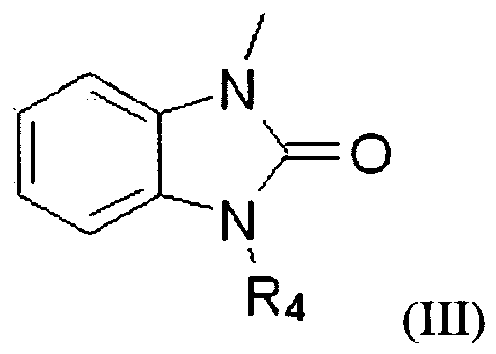
- The piperidine compound according to Claim 3, wherein said compound is selected from the group consisting of 4-amino-5-chloro-N-[[1-(2-hydroxy-2-phenylethyl)piperidin-4-yl]methyl]-2-methoxybenzamide;
4-amino-5-chloro-N-[[1-[2-(4-fluorophenyl)-2-hydroxyethyl]piperidin-4-yl]methyl]-2-methoxybenzamide : hydrochloride;
4-amino-5-chloro-N-[[1-[2-hydroxy-2-(4-methylphenyl)ethyl]piperidin-4-yl]methyl]-2-methoxybenzamide : hydrochloride;
4-amino-5-chloro-N-[[1-[2-hydroxy-2-(4-methoxyphenyl)ethyl]piperidin-4-yl]methyl]-2-methoxybenzamide : hydrochloride;
4-amino-5-chloro-N-[[1-[2-(4-chlorophenyl)-2-hydroxyethyl]piperidin-4-yl]methyl]-2-methoxybenzamide : hydrochloride;
4-amino-5-chloro-N-[[1-[2-(3,4-dichlorophenyl)-2-hydroxyethyl]piperidin-4-yl]methyl]-2-methoxybenzamide : hydrochloride;
4-amino-5-chloro-N-[[1-[2-hydroxy-2-[4-(trifluoromethyl)phenyl]ethyl]piperidin-4-yl]methyl]-2-methoxybenzamide : hydrochloride;
4-amino-5-chloro-N-[[1-[2-(3,4-difluorophenyl)-2-hydroxyethyl]piperidin-4-yl]methyl]-2-methoxybenzamide : hydrochloride;
[2-[4-[[(4-amino-5-chloro-2-methoxybenzoyl)amino]methyl]piperidin-1-yl]-1-phenylethyl] carbamate : hydrochloride;
[2-[4-[[(4-amino-5-chloro-2-methoxybenzoyl)amino]methyl]piperidin-1-yl]-1-(4-fluorophenyl)ethyl] carbamate: hydrochloride;
[2-[4-[[(4-amino-5-chloro-2-methoxybenzoyl)amino]methyl]piperidin-1-yl]-1-(3,4-dichlorophenyl)ethyl] carbamate : hydrochloride;
[2-[4-[[(4-amino-5-chloro-2-methoxybenzoyl)amino]methyl]piperidin-1-yl]-1-(3,4-difluorophenyl)ethyl] carbamate : hydrochloride;
[2-[4-[[(4-amino-5-chloro-2-methoxybenzoyl)amino]methyl]piperidin-1-yl]-1-[4-(trifluoromethyl)phenyl]ethyl] carbamate : hydrochloride;
4-amino-5-chloro-N-[[1-(3-hydroxy-3-phenylpropyl)piperidin-4-yl]methyl]-2-methoxybenzamide : hydrochloride;
4-amino-5-chloro-N-[[1-[3-(4-fluorophenyl)-3-hydroxypropyl]piperidin-4-yl]methyl]-2-methoxybenzamide : hydrochloride;
4-amino-5-chloro-N-[[1-[3-(3,4-dichlorophenyl)-3-hydroxypropyl]piperidin-4-yl]methyl]-2-methoxybenzamide : hydrochloride;
4-amino-5-chloro-N-[[1-(3-hydroxy-3-thiophen-2-ylpropyl)piperidin-4-yl]methyl]-2-methoxybenzamide : hydrochloride;
4-amino-5-chloro-N-[[1-[4-(4-fluorophenyl)-3-hydroxybutyl]piperidin-4-yl]methyl]-2-methoxybenzamide : hydrochloride;
4-amino-5-chloro-N-[[1-[5-(4-fluorophenyl)-3-hydroxypentyl]piperidin-4-yl]methyl]-2-methoxybenzamide : hydrochloride;
[3-[4-[[(4-amino-5-chloro-2-methoxybenzoyl)amino]methyl]piperidin-1-yl]-1-(4-chlorophenyl)propyl] carbamate : hydrochloride;
[4-[4-[[(4-amino-5-chloro-2-methoxybenzoyl)amino]methyl]piperidin-1-yl]-1-(4-fluorophenyl)butan-2-yl] carbamate : hydrochloride;
[1-[4-[[(4-amino-5-chloro-2-methoxybenzoyl)amino]methyl]piperidin-1-yl]-5-(4-fluorophenyl)pentan-3-yl] carbamate : hydrochloride;
4-amino-5-chloro-N-[[1-(2-hydroxy-3-phenoxypropyl)piperidin-4-yl]methyl]-2-methoxybenzamide : hydrochloride;
4-amino-5-chloro-N-[[1-[3-(4-chlorophenoxy)-2-hydroxypropyl]piperidin-4-yl]methyl]-2-methoxybenzamide : hydrochloride;
4-amino-5-chloro-N-[[1-[2-hydroxy-3-[4-(trifluoromethyl)phenoxy]propyl]piperidin-4-yl]methyl]-2-methoxybenzamide : hydrochloride;
[1-[4-[[(4-amino-5-chloro-2-methoxybenzoyl)amino]methyl]piperidin-1-yl]-3-phenoxypropan-2-yl] carbamate : hydrochloride;
[1-[4-[[(4-amino-5-chloro-2-methoxybenzoyl)amino]methyl]piperidin-1-yl]-3-(4-fluorophenoxy)propan-2-yl] 3,5-dimethylpiperidine-1-carboxylate : hydrochloride;
[1-[4-[[(4-amino-5-chloro-2-methoxybenzoyl)amino]methyl]piperidin-1-yl]-3-(4-methoxyphenoxy)propan-2-yl] carbamate: hydrochloride;
[1-[4-[[(4-amino-5-chloro-2-methoxybenzoyl)amino]methyl]piperidin-1-yl]-3-(2,3-dichlorophenoxy)propan-2-yl] azepane-1-carboxylate : hydrochloride;
4-amino-5-chloro-N-[[1-[(2S)-2-hydroxy-2-phenylethyl]piperidin-4-yl]methyl]-2-methoxybenzamide;
4-amino-5-chloro-N-[[1-[(2R)-2-hydroxy-2-phenylethyl]piperidin-4-yl]methyl]-2-methoxybenzamide;
4-amino-5-chloro-N-[[1-[3-(4-chlorophenyl)-3-hydroxypropyl]piperidin-4-yl]methyl]-2-methoxybenzamide;
[3-[4-[[(4-amino-5-chloro-2-methoxybenzoyl)amino]methyl]piperidin-1-yl]-1-(4-fluorophenyl)propyl] carbamate;
(R)-[3-[4-[[(4-amino-5-chloro-2-methoxybenzoyl)amino]methyl]piperidin-1-yl]-1-(4-fluorophenyl)propyl] carbamate;
(S)-[3-[4-[[(4-amino-5-chloro-2-methoxybenzoyl)amino]methyl]piperidin-1-yl]-1-(4-fluorophenyl)propyl] carbamate;
4-amino-5-chloro-N-[[1-[2-hydroxy-3-(4-methoxyphenoxy)propyl]piperidin-4-yl]methyl]-2-methoxybenzamide;
[1-[4-[[(4-amino-5-chloro-2-methoxybenzoyl)amino]methyl]piperidin-1-yl]-3-phenoxypropan-2-yl] piperidine-1-carboxylate; and
4-amino-5-chloro-N-[[1-[3-(2,5-dichlorophenoxy)-2-hydroxypropyl]piperidin-4-yl]methyl]-2-methoxybenzamide. - The piperidine compound according to Claim 5, wherein the compound is selected from the group consisting of [1-(2-methylphenoxy)-3-[4-[[(2-oxo-3-propan-2-ylbenzimidazole-1-carbonyl)amino]methyl]piperidin-1-yl]propan-2-yl] carbamate;N-[[1-[2-hydroxy-3-(4-nitrophenoxy)propyl]piperidin-4-yl]methyl]-2-oxo-3-propan-2-ylbenzimidazole-1-carboxamide : hydrochloride;N-[[1-[2-hydroxy-3-(4-methoxyphenoxy)propyl]piperidin-4-yl]methyl]-2-oxo-3-propan-2-ylbenzimidazole-1-carboxamide : hydrochloride;N-[[1-[3-(4-fluorophenoxy)-2-hydroxypropyl]piperidin-4-yl]methyl]-3-methyl-2-oxobenzimidazole-1-carboxamide : hydrochloride;3-ethyl-N-[[1-[2-hydroxy-3-(4-methoxyphenoxy)propyl]piperidin-4-yl]methyl]-2-oxobenzimidazole-1-carboxamide : hydrochloride;[1-[4-[[(2-oxo-3-propan-2-ylbenzimidazole-1-carbonyl)amino]methyl]piperidin-1-yl]-3-phenoxypropan-2-yl] carbamate: hydrochlorid;[1-(4-fluorophenoxy)-3-[4-[[(2-oxo-3-propan-2-ylbenzimidazole-1-carbonyl)amino]methyl]piperidin-1-yl]propan-2-yl] carbamate : hydrochloride;[1-(4-methoxyphenoxy)-3-[4-[[(3-methyl-2-oxobenzimidazole-1-carbonyl)amino]methyl]piperidin-1-ium-1-yl]propan-2-yl] carbamate : hydrochloride;[1-[4-[[(3-ethyl-2-oxobenzimidazole-1-carbonyl)amino]methyl]piperidin-1-yl]-3-phenoxypropan-2-yl] carbamate : hydrochloride;[1-(4-chlorophenoxy)-3-[4-[[(3-ethyl-2-oxobenzimidazole-1-carbonyl)amino]methyl]piperidin-1-yl]propan-2-yl] carbamate : hydrochloride;3-cyclopropyl-N-[[1-(3-hydroxy-3-phenylpropyl)piperidin-4-yl]methyl]-2-oxobenzimidazole-1-carboxamide : hydrochloride;
3-cyclopropyl-N-[[1-[3-(4-fluorophenyl)-3-hydroxypropyl]piperidin-1-ium-4-yl]methyl]-2-oxobenzimidazole-1-carboxamide : hydrochloride;[3-[4-[[(3-cyclopropyl-2-oxobenzimidazole-1-carbonyl)amino]methyl]piperidin-1-ium-1-yl]-1-phenylpropyl] carbamate : hydrochloride;[1-(4-fluorophenyl)-3-[4-[[(2-oxo-3-propan-2-ylbenzimidazole-1-carbonyl)amino]methyl]piperidin-1-ium-1-yl]propyl] carbamate : hydrochloride;[1-(4-methoxyphenyl)-3-[4-[[(2-oxo-3-propan-2-ylbenzimidazole-1-carbonyl)amino]methyl]piperidin-1-ium-1-yl]propyl] carbamate : hydrochloride;N-[[1-[2-(4-fluorophenyl)-2-hydroxyethyl]piperidin-4-yl]methyl]-2-oxo-3-propan-2-ylbenzimidazole-1-carboxamide : hydrochloride;[1-(4-fluorophenyl)-2-[4-[[(2-oxo-3-propan-2-ylbenzimidazole-1-carbonyl)amino]methyl]piperidin-1-ium-1-yl]ethyl] carbamate : hydrochloride;[[2-[4-[[(3-cyclopropyl-2-oxobenzimidazole-1-carbonyl)amino]methyl]piperidin-1-ium-1-yl]-1-(3-methoxyphenyl)ethyl] carbamate : hydrochloride;[1-[4-[[(3-methyl-2-oxobenzimidazole-1-carbonyl)amino]methyl]piperidin-1-yl]-3-phenoxypropan-2-yl] carbamate;N-[[1-(2-hydroxy-3-phenoxypropyl)piperidin-4-yl]methyl]-2-oxo-3-propan-2-ylbenzimidazole-1-carboxamide; and[3-[4-[[(2-oxo-3-propan-2-ylbenzimidazole-1-carbonyl)amino]methyl]piperidin-1-yl]-1-phenylpropyl] carbamate. - A pharmaceutical composition that comprises a therapeutically effective amount of the piperidine compound of any one of claims 1 to 7 or a pharmaceutically acceptable salt thereof.
- A pharmaceutical composition for treating a gastrointestinal disease in a mammal, which comprises administering an effective amount of the piperidine compound of any one of claims 1 to 7 or pharmaceutically acceptable salt thereof.
- The pharmaceutical composition for use of Claim 9, wherein the gastrointestinal disease comprises at least one disorder selected from irritable bowel syndrome (IBS), gastric motility disorder, constipation, and visceral pain.
- A use of the piperidine compound of any one of claims 1 to 7 or pharmaceutically acceptable salt thereof in preparing a pharmaceutical composition for preventing or treating a gastrointestinal disease.
- The use of Claim 11, wherein the gastrointestinal disease comprises at least one disorder selected from irritable bowel syndrome (IBS), gastric motility disorder, constipation, and visceral pain.
Priority Applications (1)
| Application Number | Priority Date | Filing Date | Title |
|---|---|---|---|
| PL09820735T PL2358702T3 (en) | 2008-10-14 | 2009-10-13 | Piperidine compounds, pharmaceutical composition comprising the same and its use |
Applications Claiming Priority (2)
| Application Number | Priority Date | Filing Date | Title |
|---|---|---|---|
| US10507008P | 2008-10-14 | 2008-10-14 | |
| PCT/KR2009/005863 WO2010044585A2 (en) | 2008-10-14 | 2009-10-13 | Piperidine compounds, pharmaceutical composition comprising the same and its use |
Publications (3)
| Publication Number | Publication Date |
|---|---|
| EP2358702A2 EP2358702A2 (en) | 2011-08-24 |
| EP2358702A4 EP2358702A4 (en) | 2012-04-18 |
| EP2358702B1 true EP2358702B1 (en) | 2013-07-17 |
Family
ID=42099444
Family Applications (1)
| Application Number | Title | Priority Date | Filing Date |
|---|---|---|---|
| EP09820735.0A Active EP2358702B1 (en) | 2008-10-14 | 2009-10-13 | Piperidine compounds, pharmaceutical composition comprising the same and its use |
Country Status (13)
| Country | Link |
|---|---|
| US (5) | US8642772B2 (en) |
| EP (1) | EP2358702B1 (en) |
| JP (1) | JP5555243B2 (en) |
| KR (1) | KR101683222B1 (en) |
| CN (3) | CN103980184B (en) |
| AU (1) | AU2009304054B2 (en) |
| BR (1) | BRPI0920647B1 (en) |
| CA (1) | CA2738609C (en) |
| ES (1) | ES2428101T3 (en) |
| MX (1) | MX2011002091A (en) |
| PL (1) | PL2358702T3 (en) |
| RU (1) | RU2514827C2 (en) |
| WO (1) | WO2010044585A2 (en) |
Families Citing this family (11)
| Publication number | Priority date | Publication date | Assignee | Title |
|---|---|---|---|---|
| WO2009148290A2 (en) * | 2008-06-05 | 2009-12-10 | Sk Holdings Co., Ltd. | 3-substituted propanamine compounds |
| US8101642B2 (en) | 2008-06-05 | 2012-01-24 | Sk Biopharmaceuticals Co., Ltd. | 3-substituted propanamine compounds |
| US8642772B2 (en) | 2008-10-14 | 2014-02-04 | Sk Biopharmaceuticals Co., Ltd. | Piperidine compounds, pharmaceutical composition comprising the same and its use |
| US8232315B2 (en) * | 2009-06-26 | 2012-07-31 | Sk Biopharmaceuticals Co., Ltd. | Methods for treating drug addiction and improving addiction-related behavior |
| WO2011055944A2 (en) | 2009-11-06 | 2011-05-12 | Sk Holdings Co., Ltd. | Methods for treating fibromyalgia syndrome |
| KR101783632B1 (en) | 2009-11-06 | 2017-10-10 | 에스케이바이오팜 주식회사 | Methods for treating Attention-Deficit/Hyperactivity Disorder |
| KR101180174B1 (en) * | 2010-04-23 | 2012-09-05 | 동아제약주식회사 | Novel benzamide derivatives |
| US8623913B2 (en) | 2010-06-30 | 2014-01-07 | Sk Biopharmaceuticals Co., Ltd. | Methods for treating restless legs syndrome |
| US9610274B2 (en) | 2010-06-30 | 2017-04-04 | Sk Biopharmaceuticals Co., Ltd. | Methods for treating bipolar disorder |
| US9771348B2 (en) | 2013-07-25 | 2017-09-26 | Dong-A St Co., Ltd | Method for preparing benzamide derivative, novel intermediate used in preparation of benzamide, and method for preparing novel intermediate |
| WO2025211748A1 (en) * | 2024-04-03 | 2025-10-09 | 에스케이바이오팜 주식회사 | Use of 5-ht4 receptor agonist for preventing, alleviating, or treating gastrointestinal motility disorders caused by glp-1 receptor agonist |
Family Cites Families (27)
| Publication number | Priority date | Publication date | Assignee | Title |
|---|---|---|---|---|
| EP0774460A1 (en) | 1994-03-30 | 1997-05-21 | Yoshitomi Pharmaceutical Industries, Ltd. | Benzoic acid compound and use thereof as medicine |
| KR100197892B1 (en) * | 1994-09-09 | 1999-06-15 | 남창우 | Novel phenylalkylaminoalcohol carbamates and process for preparing the same |
| KR0173862B1 (en) * | 1995-02-11 | 1999-04-01 | 조규향 | O-carbamoyl- (D) -phenylalaninol compounds and their pharmaceutically useful salts and methods for their preparation |
| US5756817C1 (en) * | 1995-02-11 | 2001-04-17 | Sk Corp | O-carbamoyl-phenylananinol compounds their pharmaceutically useful salts and process for preparing the same |
| IT1275903B1 (en) * | 1995-03-14 | 1997-10-24 | Boehringer Ingelheim Italia | ESTERS AND AMIDES OF 1,4-PIPERIDINE DISPLACED |
| KR0173863B1 (en) * | 1995-04-10 | 1999-04-01 | 조규향 | O-carbamoyl-phenylalanineol compounds having substituents on phenyl, pharmaceutically useful salts thereof, and preparation methods thereof |
| AU7001796A (en) * | 1995-09-22 | 1997-04-09 | Yoshitomi Pharmaceutical Industries, Ltd. | Benzoic acid compounds and medicinal use thereof |
| GB9523526D0 (en) * | 1995-11-17 | 1996-01-17 | Zeneca Ltd | Therapeutic compounds |
| TW402591B (en) | 1997-07-11 | 2000-08-21 | Janssen Pharmaceutica Nv | Monocyclic benzamides of 3- or 4-substituted 4-(aminomethyl)-piperidine derivatives |
| US6294555B1 (en) | 1998-04-28 | 2001-09-25 | Dainippon Pharmaceutical Co., Ltd. | 1-[(1-Substituted-4-piperidinyl)methyl]-4-piperidine derivative, process for producing the same, medicinal compositions containing the same and intermediates of these compounds |
| AU3113902A (en) | 2000-12-21 | 2002-07-01 | Bristol Myers Squibb Co | Thiazolyl inhibitors of tec family tyrosine kinases |
| US7259157B2 (en) | 2001-04-03 | 2007-08-21 | Merck & Co., Inc. | N-substituted nonaryl-heterocyclo amidyl NMDA/NR2B Antagonists |
| US20040204341A1 (en) * | 2001-06-12 | 2004-10-14 | Christopher Allen | Nr2b receptor antagonists for the treatment or prevention of migraines |
| MXPA03000145A (en) * | 2002-01-07 | 2003-07-15 | Pfizer | Oxo or oxy-pyridine compounds as 5-ht4 receptor modulators. |
| JP2006502180A (en) | 2002-09-20 | 2006-01-19 | ファイザー株式会社 | N-substituted piperidinyl-imidazopyridine compounds as 5-HT4 receptor modulators |
| WO2004094418A1 (en) | 2003-04-21 | 2004-11-04 | Pfizer Inc. | Imidazopyridine compounds having 5-ht4 receptor agonistic activity and 5-ht3 receptor antagonistic activity |
| CA2537127C (en) * | 2003-09-03 | 2011-04-05 | Pfizer Inc. | Benzimidazolone compounds having 5-ht4 receptor agonistic activity |
| DE602004026095D1 (en) * | 2003-11-24 | 2010-04-29 | Pfizer | CHINOLONCARBOXYLIC ACID COMPOUNDS WITH 5-HT4 RECEPTORAGONISTIC EFFECT |
| DE602004025508D1 (en) * | 2003-12-23 | 2010-03-25 | Serodus As | MODULATORS OF PERIPHERAL 5-HT RECEPTORS |
| CA2555258C (en) | 2004-01-29 | 2009-04-28 | Pfizer Inc. | 1-isopropyl-2-oxo-1,2-dihydropyridine-3-carboxamide derivatives having 5-ht4 receptor agonistic activity |
| WO2005092882A1 (en) | 2004-03-01 | 2005-10-06 | Pfizer Japan, Inc. | 4-amino-5-halogeno-benzamide derivatives as 5-ht4 receptor agonists for the treatment of gastrointestinal, cns, neurological and cardiovascular disorders |
| AU2005254800B2 (en) | 2004-06-15 | 2010-12-09 | Pfizer Inc. | Benzimidazolone carboxylic acid derivatives |
| JP2008509088A (en) * | 2004-09-02 | 2008-03-27 | ファイザー株式会社 | Benzimidazolonecarboxylic acid derivatives |
| NZ556627A (en) * | 2005-02-22 | 2010-09-30 | Pfizer | Oxyindole derivatives as 5HT4 receptor agonists |
| KR100969402B1 (en) * | 2005-04-08 | 2010-07-14 | 화이자 프로덕츠 인크. | Bicyclic [3.1.0] heteroaryl amides as inhibitors of type I glycine transport |
| WO2007149929A1 (en) | 2006-06-23 | 2007-12-27 | Aryx Therapeutics, Inc. | Piperidine derivatives for the treatment of gastrointestinal and cns disorders |
| US8642772B2 (en) | 2008-10-14 | 2014-02-04 | Sk Biopharmaceuticals Co., Ltd. | Piperidine compounds, pharmaceutical composition comprising the same and its use |
-
2009
- 2009-10-09 US US12/576,494 patent/US8642772B2/en active Active
- 2009-10-13 JP JP2011532014A patent/JP5555243B2/en active Active
- 2009-10-13 BR BRPI0920647-7A patent/BRPI0920647B1/en active IP Right Grant
- 2009-10-13 CN CN201410234573.0A patent/CN103980184B/en active Active
- 2009-10-13 CA CA2738609A patent/CA2738609C/en active Active
- 2009-10-13 ES ES09820735T patent/ES2428101T3/en active Active
- 2009-10-13 EP EP09820735.0A patent/EP2358702B1/en active Active
- 2009-10-13 PL PL09820735T patent/PL2358702T3/en unknown
- 2009-10-13 CN CN201610090231.5A patent/CN105646331B/en active Active
- 2009-10-13 MX MX2011002091A patent/MX2011002091A/en active IP Right Grant
- 2009-10-13 WO PCT/KR2009/005863 patent/WO2010044585A2/en not_active Ceased
- 2009-10-13 CN CN200980140895.6A patent/CN102186840B/en active Active
- 2009-10-13 KR KR1020117006210A patent/KR101683222B1/en active Active
- 2009-10-13 AU AU2009304054A patent/AU2009304054B2/en not_active Ceased
- 2009-10-13 RU RU2011109435/04A patent/RU2514827C2/en active
-
2014
- 2014-01-17 US US14/158,517 patent/US9593102B2/en active Active
-
2016
- 2016-08-26 US US15/248,872 patent/US9676718B2/en active Active
-
2017
- 2017-06-09 US US15/618,252 patent/US10144709B2/en active Active
-
2018
- 2018-11-29 US US16/204,364 patent/US20190092727A1/en not_active Abandoned
Also Published As
Similar Documents
| Publication | Publication Date | Title |
|---|---|---|
| US10144709B2 (en) | Piperidine compounds, pharmaceutical composition comprising the same and its use | |
| RU2351588C2 (en) | N-phenyl(piperidine-2-yl)methyl-benzamide derivatives, and their application in therapy | |
| WO2005037781A2 (en) | Derivatives of n-[heteroaryl(piperidine-2-yl)methyl]benzamide, preparation method thereof and application of same in therapeutics | |
| WO2004078715A1 (en) | Nitrogenous heterocyclic derivative having 2,6-disubstituted styryl | |
| JP2004277318A (en) | 1- (1-substituted carbonyl-4-piperidinylmethyl) piperidine derivatives and pharmaceutical compositions containing the same | |
| JP4674686B2 (en) | New benzoylpiperidine compounds | |
| HK1225375B (en) | Piperidine compounds, pharmaceutical composition comprising the same and its use | |
| HK1225375A1 (en) | Piperidine compounds, pharmaceutical composition comprising the same and its use | |
| HK1200446B (en) | Piperidine compounds, pharmaceutical composition comprising the same and its use | |
| HK1162176B (en) | Piperidine compounds, pharmaceutical composition comprising the same and its use | |
| EP0851865A1 (en) | Novel heterocyclic compounds | |
| WO2012100704A1 (en) | Chiral low-toxicity cb1 receptor inhibitor, preparation method therefor, and use thereof | |
| NZ720467B2 (en) | P-substituted asymmetric ureas and medical uses thereof | |
| WO2004087165A1 (en) | Therapeutic agent for prostatic hypertrophy |
Legal Events
| Date | Code | Title | Description |
|---|---|---|---|
| PUAI | Public reference made under article 153(3) epc to a published international application that has entered the european phase |
Free format text: ORIGINAL CODE: 0009012 |
|
| 17P | Request for examination filed |
Effective date: 20110511 |
|
| AK | Designated contracting states |
Kind code of ref document: A2 Designated state(s): AT BE BG CH CY CZ DE DK EE ES FI FR GB GR HR HU IE IS IT LI LT LU LV MC MK MT NL NO PL PT RO SE SI SK SM TR |
|
| DAX | Request for extension of the european patent (deleted) | ||
| RAP1 | Party data changed (applicant data changed or rights of an application transferred) |
Owner name: SK PHARMACEUTICALS CO., LTD. |
|
| A4 | Supplementary search report drawn up and despatched |
Effective date: 20120321 |
|
| RIC1 | Information provided on ipc code assigned before grant |
Ipc: A61P 1/04 20060101ALI20120315BHEP Ipc: A61P 1/00 20060101ALI20120315BHEP Ipc: C07D 211/26 20060101ALI20120315BHEP Ipc: C07D 401/12 20060101AFI20120315BHEP Ipc: A61K 31/445 20060101ALI20120315BHEP Ipc: A61P 35/00 20060101ALI20120315BHEP |
|
| RIC1 | Information provided on ipc code assigned before grant |
Ipc: A61P 35/00 20060101ALI20121220BHEP Ipc: A61P 1/04 20060101ALI20121220BHEP Ipc: A61K 31/445 20060101ALI20121220BHEP Ipc: A61P 1/00 20060101ALI20121220BHEP Ipc: C07D 401/12 20060101AFI20121220BHEP Ipc: C07D 211/26 20060101ALI20121220BHEP |
|
| GRAP | Despatch of communication of intention to grant a patent |
Free format text: ORIGINAL CODE: EPIDOSNIGR1 |
|
| GRAS | Grant fee paid |
Free format text: ORIGINAL CODE: EPIDOSNIGR3 |
|
| GRAA | (expected) grant |
Free format text: ORIGINAL CODE: 0009210 |
|
| AK | Designated contracting states |
Kind code of ref document: B1 Designated state(s): AT BE BG CH CY CZ DE DK EE ES FI FR GB GR HR HU IE IS IT LI LT LU LV MC MK MT NL NO PL PT RO SE SI SK SM TR |
|
| REG | Reference to a national code |
Ref country code: GB Ref legal event code: FG4D |
|
| REG | Reference to a national code |
Ref country code: CH Ref legal event code: EP |
|
| REG | Reference to a national code |
Ref country code: IE Ref legal event code: FG4D |
|
| REG | Reference to a national code |
Ref country code: AT Ref legal event code: REF Ref document number: 622137 Country of ref document: AT Kind code of ref document: T Effective date: 20130815 |
|
| REG | Reference to a national code |
Ref country code: DE Ref legal event code: R096 Ref document number: 602009017308 Country of ref document: DE Effective date: 20130912 |
|
| REG | Reference to a national code |
Ref country code: CH Ref legal event code: NV Representative=s name: ARNOLD AND SIEDSMA AG, CH |
|
| REG | Reference to a national code |
Ref country code: SE Ref legal event code: TRGR |
|
| REG | Reference to a national code |
Ref country code: ES Ref legal event code: FG2A Ref document number: 2428101 Country of ref document: ES Kind code of ref document: T3 Effective date: 20131105 |
|
| REG | Reference to a national code |
Ref country code: NL Ref legal event code: T3 |
|
| REG | Reference to a national code |
Ref country code: LT Ref legal event code: MG4D |
|
| REG | Reference to a national code |
Ref country code: PL Ref legal event code: T3 |
|
| REG | Reference to a national code |
Ref country code: GR Ref legal event code: EP Ref document number: 20130402043 Country of ref document: GR Effective date: 20131118 |
|
| PG25 | Lapsed in a contracting state [announced via postgrant information from national office to epo] |
Ref country code: LT Free format text: LAPSE BECAUSE OF FAILURE TO SUBMIT A TRANSLATION OF THE DESCRIPTION OR TO PAY THE FEE WITHIN THE PRESCRIBED TIME-LIMIT Effective date: 20130717 Ref country code: HR Free format text: LAPSE BECAUSE OF FAILURE TO SUBMIT A TRANSLATION OF THE DESCRIPTION OR TO PAY THE FEE WITHIN THE PRESCRIBED TIME-LIMIT Effective date: 20130717 Ref country code: CY Free format text: LAPSE BECAUSE OF FAILURE TO SUBMIT A TRANSLATION OF THE DESCRIPTION OR TO PAY THE FEE WITHIN THE PRESCRIBED TIME-LIMIT Effective date: 20130626 Ref country code: PT Free format text: LAPSE BECAUSE OF FAILURE TO SUBMIT A TRANSLATION OF THE DESCRIPTION OR TO PAY THE FEE WITHIN THE PRESCRIBED TIME-LIMIT Effective date: 20131118 Ref country code: NO Free format text: LAPSE BECAUSE OF FAILURE TO SUBMIT A TRANSLATION OF THE DESCRIPTION OR TO PAY THE FEE WITHIN THE PRESCRIBED TIME-LIMIT Effective date: 20131017 Ref country code: IS Free format text: LAPSE BECAUSE OF FAILURE TO SUBMIT A TRANSLATION OF THE DESCRIPTION OR TO PAY THE FEE WITHIN THE PRESCRIBED TIME-LIMIT Effective date: 20131117 |
|
| PG25 | Lapsed in a contracting state [announced via postgrant information from national office to epo] |
Ref country code: LV Free format text: LAPSE BECAUSE OF FAILURE TO SUBMIT A TRANSLATION OF THE DESCRIPTION OR TO PAY THE FEE WITHIN THE PRESCRIBED TIME-LIMIT Effective date: 20130717 Ref country code: SI Free format text: LAPSE BECAUSE OF FAILURE TO SUBMIT A TRANSLATION OF THE DESCRIPTION OR TO PAY THE FEE WITHIN THE PRESCRIBED TIME-LIMIT Effective date: 20130717 Ref country code: FI Free format text: LAPSE BECAUSE OF FAILURE TO SUBMIT A TRANSLATION OF THE DESCRIPTION OR TO PAY THE FEE WITHIN THE PRESCRIBED TIME-LIMIT Effective date: 20130717 |
|
| PG25 | Lapsed in a contracting state [announced via postgrant information from national office to epo] |
Ref country code: CY Free format text: LAPSE BECAUSE OF FAILURE TO SUBMIT A TRANSLATION OF THE DESCRIPTION OR TO PAY THE FEE WITHIN THE PRESCRIBED TIME-LIMIT Effective date: 20130717 |
|
| PG25 | Lapsed in a contracting state [announced via postgrant information from national office to epo] |
Ref country code: DK Free format text: LAPSE BECAUSE OF FAILURE TO SUBMIT A TRANSLATION OF THE DESCRIPTION OR TO PAY THE FEE WITHIN THE PRESCRIBED TIME-LIMIT Effective date: 20130717 Ref country code: CZ Free format text: LAPSE BECAUSE OF FAILURE TO SUBMIT A TRANSLATION OF THE DESCRIPTION OR TO PAY THE FEE WITHIN THE PRESCRIBED TIME-LIMIT Effective date: 20130717 Ref country code: EE Free format text: LAPSE BECAUSE OF FAILURE TO SUBMIT A TRANSLATION OF THE DESCRIPTION OR TO PAY THE FEE WITHIN THE PRESCRIBED TIME-LIMIT Effective date: 20130717 Ref country code: RO Free format text: LAPSE BECAUSE OF FAILURE TO SUBMIT A TRANSLATION OF THE DESCRIPTION OR TO PAY THE FEE WITHIN THE PRESCRIBED TIME-LIMIT Effective date: 20130717 Ref country code: SK Free format text: LAPSE BECAUSE OF FAILURE TO SUBMIT A TRANSLATION OF THE DESCRIPTION OR TO PAY THE FEE WITHIN THE PRESCRIBED TIME-LIMIT Effective date: 20130717 |
|
| PLBE | No opposition filed within time limit |
Free format text: ORIGINAL CODE: 0009261 |
|
| STAA | Information on the status of an ep patent application or granted ep patent |
Free format text: STATUS: NO OPPOSITION FILED WITHIN TIME LIMIT |
|
| PG25 | Lapsed in a contracting state [announced via postgrant information from national office to epo] |
Ref country code: MC Free format text: LAPSE BECAUSE OF FAILURE TO SUBMIT A TRANSLATION OF THE DESCRIPTION OR TO PAY THE FEE WITHIN THE PRESCRIBED TIME-LIMIT Effective date: 20130717 |
|
| 26N | No opposition filed |
Effective date: 20140422 |
|
| REG | Reference to a national code |
Ref country code: IE Ref legal event code: MM4A |
|
| REG | Reference to a national code |
Ref country code: DE Ref legal event code: R097 Ref document number: 602009017308 Country of ref document: DE Effective date: 20140422 |
|
| PG25 | Lapsed in a contracting state [announced via postgrant information from national office to epo] |
Ref country code: IE Free format text: LAPSE BECAUSE OF NON-PAYMENT OF DUE FEES Effective date: 20131013 |
|
| PG25 | Lapsed in a contracting state [announced via postgrant information from national office to epo] |
Ref country code: SM Free format text: LAPSE BECAUSE OF FAILURE TO SUBMIT A TRANSLATION OF THE DESCRIPTION OR TO PAY THE FEE WITHIN THE PRESCRIBED TIME-LIMIT Effective date: 20130717 |
|
| PG25 | Lapsed in a contracting state [announced via postgrant information from national office to epo] |
Ref country code: HU Free format text: LAPSE BECAUSE OF FAILURE TO SUBMIT A TRANSLATION OF THE DESCRIPTION OR TO PAY THE FEE WITHIN THE PRESCRIBED TIME-LIMIT; INVALID AB INITIO Effective date: 20091013 Ref country code: LU Free format text: LAPSE BECAUSE OF NON-PAYMENT OF DUE FEES Effective date: 20131013 Ref country code: MK Free format text: LAPSE BECAUSE OF FAILURE TO SUBMIT A TRANSLATION OF THE DESCRIPTION OR TO PAY THE FEE WITHIN THE PRESCRIBED TIME-LIMIT Effective date: 20130717 Ref country code: BG Free format text: LAPSE BECAUSE OF FAILURE TO SUBMIT A TRANSLATION OF THE DESCRIPTION OR TO PAY THE FEE WITHIN THE PRESCRIBED TIME-LIMIT Effective date: 20130717 |
|
| PG25 | Lapsed in a contracting state [announced via postgrant information from national office to epo] |
Ref country code: MT Free format text: LAPSE BECAUSE OF FAILURE TO SUBMIT A TRANSLATION OF THE DESCRIPTION OR TO PAY THE FEE WITHIN THE PRESCRIBED TIME-LIMIT Effective date: 20130717 |
|
| REG | Reference to a national code |
Ref country code: FR Ref legal event code: PLFP Year of fee payment: 8 |
|
| REG | Reference to a national code |
Ref country code: FR Ref legal event code: PLFP Year of fee payment: 9 |
|
| REG | Reference to a national code |
Ref country code: FR Ref legal event code: PLFP Year of fee payment: 10 |
|
| P01 | Opt-out of the competence of the unified patent court (upc) registered |
Effective date: 20230525 |
|
| PGFP | Annual fee paid to national office [announced via postgrant information from national office to epo] |
Ref country code: GR Payment date: 20250911 Year of fee payment: 17 |
|
| PGFP | Annual fee paid to national office [announced via postgrant information from national office to epo] |
Ref country code: PL Payment date: 20250915 Year of fee payment: 17 Ref country code: NL Payment date: 20250912 Year of fee payment: 17 Ref country code: IT Payment date: 20250922 Year of fee payment: 17 |
|
| PGFP | Annual fee paid to national office [announced via postgrant information from national office to epo] |
Ref country code: BE Payment date: 20250917 Year of fee payment: 17 Ref country code: GB Payment date: 20250904 Year of fee payment: 17 |
|
| PGFP | Annual fee paid to national office [announced via postgrant information from national office to epo] |
Ref country code: FR Payment date: 20250908 Year of fee payment: 17 |
|
| PGFP | Annual fee paid to national office [announced via postgrant information from national office to epo] |
Ref country code: SE Payment date: 20250910 Year of fee payment: 17 |
|
| REG | Reference to a national code |
Ref country code: CH Ref legal event code: U11 Free format text: ST27 STATUS EVENT CODE: U-0-0-U10-U11 (AS PROVIDED BY THE NATIONAL OFFICE) Effective date: 20251101 |
|
| PGFP | Annual fee paid to national office [announced via postgrant information from national office to epo] |
Ref country code: DE Payment date: 20250902 Year of fee payment: 17 |
|
| PGFP | Annual fee paid to national office [announced via postgrant information from national office to epo] |
Ref country code: AT Payment date: 20250925 Year of fee payment: 17 |
|
| PGFP | Annual fee paid to national office [announced via postgrant information from national office to epo] |
Ref country code: TR Payment date: 20251008 Year of fee payment: 17 |
|
| PGFP | Annual fee paid to national office [announced via postgrant information from national office to epo] |
Ref country code: CH Payment date: 20251101 Year of fee payment: 17 |
|
| PGFP | Annual fee paid to national office [announced via postgrant information from national office to epo] |
Ref country code: ES Payment date: 20251106 Year of fee payment: 17 |