EP2357249A1 - Macrolide compounds - Google Patents
Macrolide compounds Download PDFInfo
- Publication number
- EP2357249A1 EP2357249A1 EP11164115A EP11164115A EP2357249A1 EP 2357249 A1 EP2357249 A1 EP 2357249A1 EP 11164115 A EP11164115 A EP 11164115A EP 11164115 A EP11164115 A EP 11164115A EP 2357249 A1 EP2357249 A1 EP 2357249A1
- Authority
- EP
- European Patent Office
- Prior art keywords
- compound
- formula
- strain
- dinoflagellate
- amphidinium
- Prior art date
- Legal status (The legal status is an assumption and is not a legal conclusion. Google has not performed a legal analysis and makes no representation as to the accuracy of the status listed.)
- Withdrawn
Links
Classifications
-
- C—CHEMISTRY; METALLURGY
- C12—BIOCHEMISTRY; BEER; SPIRITS; WINE; VINEGAR; MICROBIOLOGY; ENZYMOLOGY; MUTATION OR GENETIC ENGINEERING
- C12P—FERMENTATION OR ENZYME-USING PROCESSES TO SYNTHESISE A DESIRED CHEMICAL COMPOUND OR COMPOSITION OR TO SEPARATE OPTICAL ISOMERS FROM A RACEMIC MIXTURE
- C12P17/00—Preparation of heterocyclic carbon compounds with only O, N, S, Se or Te as ring hetero atoms
- C12P17/02—Oxygen as only ring hetero atoms
- C12P17/08—Oxygen as only ring hetero atoms containing a hetero ring of at least seven ring members, e.g. zearalenone, macrolide aglycons
-
- A—HUMAN NECESSITIES
- A61—MEDICAL OR VETERINARY SCIENCE; HYGIENE
- A61P—SPECIFIC THERAPEUTIC ACTIVITY OF CHEMICAL COMPOUNDS OR MEDICINAL PREPARATIONS
- A61P35/00—Antineoplastic agents
-
- C—CHEMISTRY; METALLURGY
- C07—ORGANIC CHEMISTRY
- C07D—HETEROCYCLIC COMPOUNDS
- C07D313/00—Heterocyclic compounds containing rings of more than six members having one oxygen atom as the only ring hetero atom
-
- C—CHEMISTRY; METALLURGY
- C07—ORGANIC CHEMISTRY
- C07D—HETEROCYCLIC COMPOUNDS
- C07D315/00—Heterocyclic compounds containing rings having one oxygen atom as the only ring hetero atom according to more than one of groups C07D303/00 - C07D313/00
-
- C—CHEMISTRY; METALLURGY
- C07—ORGANIC CHEMISTRY
- C07D—HETEROCYCLIC COMPOUNDS
- C07D493/00—Heterocyclic compounds containing oxygen atoms as the only ring hetero atoms in the condensed system
- C07D493/02—Heterocyclic compounds containing oxygen atoms as the only ring hetero atoms in the condensed system in which the condensed system contains two hetero rings
- C07D493/04—Ortho-condensed systems
-
- C—CHEMISTRY; METALLURGY
- C07—ORGANIC CHEMISTRY
- C07D—HETEROCYCLIC COMPOUNDS
- C07D493/00—Heterocyclic compounds containing oxygen atoms as the only ring hetero atoms in the condensed system
- C07D493/02—Heterocyclic compounds containing oxygen atoms as the only ring hetero atoms in the condensed system in which the condensed system contains two hetero rings
- C07D493/08—Bridged systems
-
- C—CHEMISTRY; METALLURGY
- C07—ORGANIC CHEMISTRY
- C07D—HETEROCYCLIC COMPOUNDS
- C07D493/00—Heterocyclic compounds containing oxygen atoms as the only ring hetero atoms in the condensed system
- C07D493/12—Heterocyclic compounds containing oxygen atoms as the only ring hetero atoms in the condensed system in which the condensed system contains three hetero rings
- C07D493/18—Bridged systems
Definitions
- the present invention relates to a novel macrolide compound, an anticancer agent with the macrolide compound as an active ingredient and a method for producing the macrolide compound.
- This invention pertains to a patent application regarding the results of an entrusted research by the Japan's national government and other organizations (effective promotion of a joint research by industrial, academic and government sectors, "Miriyobisaimo karano yuyokagakusozai no tansaku to kaihatsu (Seeking and development of useful chemical materials from unused microalgae)" financed by 2006 Special Coordination Funds for the Promotion of Science and Technology sponsored by the Ministry of Education, Culture, Sports, Science and Technology in compliance with Article 30 of the Act on Special Measures concerning Industrial Revitalization).
- anticancer agents A variety of compounds constituting anticancer agents are currently developed by examining a derivation and a chemical structure thereof. Amid a growing demand for such new anticancer agents, anticancer agent development is constantly required due to such problems as side effects of an anticancer agent, generation of drug-resistant cancer cells caused by long-term use of anticancer agents and different medicinal effects by the type of cancer.
- seaweed or unicellular algae is known as a natural resource required for providing an anticancer agent or candidate compounds thereof.
- a macrolide compound produced by dinoflagellate alga (Amphidinolide) particularly receives much academic attention due to a strong antitumor activity (Non-patent document 1). Because of the above-mentioned problems, however, seeking and development of anticancer agents, marine organism-derived antitumor substances in particular, is always regarded as a crucially important issue.
- the aim of the present invention is to provide a novel anticancer agent and a novel dinoflagellate alga strain that produces the novel anticancer agent, by searching for an excellent dinoflagellate alga-derived antitumor substance.
- the inventors found out a tumor cell proliferation-inhibiting effect of a novel macrolide compound produced by a novel dinoflagellate alga by isolating a strain of the novel dinoflagellate alga from a natural environment, which is usable as an anticancer agent, and completed each of the following inventions.
- R 1 , R 2 , R 3 and R 4 are respectively one selected from hydrogen group and oxygen protecting group;
- Z-Y is one selected from a carbon single bond and a carbon double bond; and wherein, when Z-Y is a carbon single bond, X is hydroxy group, and when Z-Y is a carbon double bond, X is hydrogen.
- a method for producing any one of compounds according to 1) comprising a process for culturing an Amphidinium sp. Strain HYA002 as a dinoflagellate alga, and a process for collecting at least one of compounds according to 1) from a culture.
- a method for producing any one of compounds according to 1) comprising a process for culturing an Amphidinium sp. Strain HYA024 as a dinoflagellate alga, and a process for collecting at least one of compounds according to 1) from a culture.
- a macrolide compound of this invention has an excellent proliferation-inhibiting effect against a human tumor cell and therefore can be used as a novel anticancer agent.
- a macrolide compound of this invention is a compound having an antitumor activity produced by a novel strain of Amphidinium sp. as dinoflagellate alga and having a chemical structure represented by any one of the following Formulae 1 to 5:
- R 1 , R 2 , R 3 and R 4 are respectively one selected from hydrogen group and oxygen protecting group;
- Z-Y is one selected from a carbon single bond and a carbon double bond; and wherein, when Z-Y is a carbon single bond, X is hydroxy group, and when Z-Y is a carbon double bond, X is hydrogen.
- Particularly preferred embodiments of each of the compounds represented by Formulae 1 to 5 are given by the following Formulae 6 to 11.
- R 1 , R 2 , R 3 are each hydrogen, Z-Y is single bond and X is hydroxy group in Formula 1.
- R 1 , R 2 and R 3 are each hydrogen, Z-Y is double bond and X is hydrogen in Formula 1.
- Solubility soluble in alcohol, chloroform, ethyl acetate and acetone, insoluble in hexane and water, molecular weight measurement: m/z 549 (M+H) + , 1 H-NMR spectrum (600MHz in deuterated chloroform) ⁇ 0.86 (3H, d, 6.5Hz, H 3 -28), 1.01 (3H, d, 6.7Hz, H 3 -32), 1.05 (3H, d, 6.7Hz, H 3 -31), 1.13 (1H, m, H-10), 1.15 (1H, m, H-7), 1.24 (1H, m, H-24), 1.26 (3H, d, 6.7Hz, H 3 -26), 1.42 (1H, m, H-6), 1.42 (1H, m, H-17), 1.43 (1H, m, H-5), 1.50 (1H, m, H-10), 1.56 (1H, m, H-5), 1.60 (1H, m, H-6), 1.61 (1H, m,
- R 1 , R 2 , R 3 and R 4 are each hydrogen in Formula 2.
- R 1 , R 2 , R 3 and R 4 are each hydrogen in Formula 3.
- R 1 , R 2 , and R 3 are each hydrogen in Formula 4.
- R 1 , R 2 , and R 3 are each hydrogen in Formula 5.
- dinoflagellate algae that produce the macrolide compound in this invention are novel dinoflagellate algae identified as Amphidinium sp. Strain HYA002 and HYA024, which were isolated from platyhelminth Amphiscolops sp. in vivo collected at Chatan Town of Okinawa Prefecture and from seawater of Iriomote (an island) of Okinawa Prefecture, respectively. Dinoflagellate alga Strains HYA002 and HYA024 of this invention are preserved at the Department of Natural Products Chemistry, graduate School of Pharmaceutical Sciences, Hokkaido University and Center for Advanced Marine Core Research, Kochi University.
- a macrolide compound in this invention can be obtained by culturing dinoflagellate alga Strain HYA002 or HYA024 under an appropriate condition.
- a seawater-fortified nutrient having compositions as shown in the following Table 1 is added to seawater autoclave-sterilized at 120°C for 20 minutes so as to set the concentration at 1%.
- dinoflagellate alga Strains HYA002 and/or HYA024 are inoculated in a culture solution prepared by filter sterilization using a filter with a pore diameter of 0.22 ⁇ m, and may be allowed to stand for culturing at 25°C for approx. 14 days, irradiated with 3000 lux light during one cycle, composed of 16 hours in light time period and 8 hours in dark time period.
- culture conditions such as culture solution composition or temperature are not limited in this invention and can obviously be adjusted or selected accordingly.
- the macrolide compound which has been produced and accumulated in a culture solution may be collected by separation and refinement means accordingly, which are commonly used in collecting metabolite, for culture algae obtained by centrifugal separation or filtration.
- culture algae are extracted using a solvent like methanol, preferably methanol/toluene (3:1), and a macrolide compound is extracted from an extract (toluene fraction) obtained using an organic solvent like dichloromethane, or column chromatography method may adsorb and elute a macrolide compound.
- the product can be furthermore refined as needed to collect and produce a macrolide compound having a desired purity.
- a carrier used in chromatography is conventionally-used inorganic or organic carrier, e.g. silica gel, polyvinyl resin or polystyrene resin.
- a macrolide compound in this invention is useful as, e.g. an anticancer agent in the field of medicines.
- the compound in this invention may be used alone or blended or formulated in combination with a generally allowable inorganic or organic medicine, or several vehicles, carriers, excipients, disintegrants, binders, brighteners, preservatives, stabilizers, humectants, suspension auxiliary agents, edulcorants, fragrances, coloring agents, etc.
- Drug formulation may be appropriately determined according to route of administration, dosing regimen, etc.
- Dosage forms include oral, enteral, parenteral and topical administration.
- Parenteral administration includes intravenous, intramuscular and subcutaneous administration using parenteral injection.
- a drug can be formulated in granule, fine granule, powder medicine, tablet, hard capsule, soft capsule, syrup, emulsion, suspending agent, liquid medicine, etc.
- a macrolide compound of this invention can be blended in combination with binder like corn starch, gelatin and dextrin, excipient like kaolin, calcium carbonate and microcrystalline cellulose, disintegrant like starch and carboxymethylcellulose sodium, brightener like talc and edulcorant like lactose and sucrose.
- binder like corn starch, gelatin and dextrin
- excipient like kaolin, calcium carbonate and microcrystalline cellulose
- disintegrant like starch and carboxymethylcellulose sodium brightener like talc and edulcorant like lactose and sucrose.
- humectant humectant
- suspension auxiliary agent edulcorant
- coloring agent preservative, stabilizer, etc.
- Solvents or suspending agents used in producing parenterally administered drugs like parenteral injection include water, propylene glycol, polyethylene glycol, benzyl alcohol, ethyl oleate and lecithin.
- a clinical dose of a macrolide compound of this invention is approx. 0.1 to 100mg for an adult in oral administration, preferably 1 to 10mg, but more preferably is appropriately adjusted according to patient's age, condition, symptom and simultaneous administration with other drugs.
- a seawater-fortified nutrient having compositions as shown in the above Table 1 was added to seawater autoclave-sterilized at 120°C for 20 minutes so as to set the concentration at 1%. Then, after 3mM NaHCO 3 was added thereto with a pH ranging from 7.3 to 8.5, dinoflagellate alga Strains HYA002 and/or HYA024 were inoculated in a culture solution prepared by filter sterilization using a filter with a pore diameter of 0.22 ⁇ m. The product was allowed to stand for culturing at 25°C for approx. 14 days, irradiated with 3000 lux light during one cycle, composed of 16 hours in light time period and 8 hours in dark time period.
- High-resolution electrospray ionization mass spectrometry was performed to find out the molecular weights in the 6 types of compounds obtained. Also, spectrum data were measured mainly based on nuclear magnetic resonance (NMR) to define chemical structure formulae for the 6 types of compounds as Formula 6, Formula 7, Formula 8, Formula 9, Formula 10 and Formula 11.
- HRESIMS High-resolution electrospray ionization mass spectrometry
- HRESIMS High-resolution electrospray ionization mass spectrometry
- HRESIMS High-resolution electrospray ionization mass spectrometry
- HRESIMS High-resolution electrospray ionization mass spectrometry
- HRESIMS High-resolution electrospray ionization mass spectrometry
- HRESIMS High-resolution electrospray ionization mass spectrometry
- Human BuRkitt's lymphoma cell line (DG-75, ATCC No. CRL-2675) or human Burkitt's lymphoma cell line (Raji, ATCC No. CRL-86) was suspended in an RPMI-1640 medium (SIGMA) (hereinafter called culture solution) containing 10% calf serum (Moregate) and 10% fetal bovine serum (Hyclone) so as to set the cell number at 1 ⁇ 10 5 /mL. After 50 ⁇ L of the cell suspension was added to a 96-well microplate, 49 ⁇ L of the above culture solution was added thereto to set the whole volume at 99 ⁇ L.
- SIGMA RPMI-1640 medium
- Proliferation-inhibition rate was calculated from absorbance values measured with a microplate reader at 450nm (reference wavelength: 620nm) using the following expression to determine a compound concentration in a culture solution with a proliferation-inhibition rate of 50% as IC 50 value.
- Proliferation - inhibition rate % 1 - sample / blank ⁇ 100
- Table 2 shows IC 50 values for each novel macrolide compound and existing anticancer agent.
- a novel macrolide compound can be an excellent anticancer agent having a high antitumor activity.
- a compound represented by Formula (8) (50 to 500 ⁇ g/kg) that solved in ethanol or 5-FU (10mg/kg) was administered to an 8-week old female Balb/c mouse (Japan SLC) having approx. 1 ⁇ 10 5 of Meth A fibrosarcoma cells (Kitasato Institute) intraperitoneally transplanted therein by 1/3 of the whole volume at 7th, 9th and 11th days intravenously (but 5-FU administered intraperitoneally) to measure tumor weight at 21st day.
Landscapes
- Chemical & Material Sciences (AREA)
- Organic Chemistry (AREA)
- Life Sciences & Earth Sciences (AREA)
- Zoology (AREA)
- Health & Medical Sciences (AREA)
- Wood Science & Technology (AREA)
- Engineering & Computer Science (AREA)
- General Chemical & Material Sciences (AREA)
- Chemical Kinetics & Catalysis (AREA)
- General Health & Medical Sciences (AREA)
- Genetics & Genomics (AREA)
- General Engineering & Computer Science (AREA)
- Bioinformatics & Cheminformatics (AREA)
- Biochemistry (AREA)
- Biotechnology (AREA)
- Microbiology (AREA)
- Nuclear Medicine, Radiotherapy & Molecular Imaging (AREA)
- Veterinary Medicine (AREA)
- Public Health (AREA)
- Animal Behavior & Ethology (AREA)
- Pharmacology & Pharmacy (AREA)
- Medicinal Chemistry (AREA)
- Pharmaceuticals Containing Other Organic And Inorganic Compounds (AREA)
- Preparation Of Compounds By Using Micro-Organisms (AREA)
- Micro-Organisms Or Cultivation Processes Thereof (AREA)
- Pyrane Compounds (AREA)
- Heterocyclic Carbon Compounds Containing A Hetero Ring Having Oxygen Or Sulfur (AREA)
Abstract
Description
- The present invention relates to a novel macrolide compound, an anticancer agent with the macrolide compound as an active ingredient and a method for producing the macrolide compound. This invention pertains to a patent application regarding the results of an entrusted research by the Japan's national government and other organizations (effective promotion of a joint research by industrial, academic and government sectors, "Miriyobisaimo karano yuyokagakusozai no tansaku to kaihatsu (Seeking and development of useful chemical materials from unused microalgae)" financed by 2006 Special Coordination Funds for the Promotion of Science and Technology sponsored by the Ministry of Education, Culture, Sports, Science and Technology in compliance with Article 30 of the Act on Special Measures concerning Industrial Revitalization).
- A variety of compounds constituting anticancer agents are currently developed by examining a derivation and a chemical structure thereof. Amid a growing demand for such new anticancer agents, anticancer agent development is constantly required due to such problems as side effects of an anticancer agent, generation of drug-resistant cancer cells caused by long-term use of anticancer agents and different medicinal effects by the type of cancer.
- In fact, seaweed or unicellular algae is known as a natural resource required for providing an anticancer agent or candidate compounds thereof. A macrolide compound produced by dinoflagellate alga (Amphidinolide) particularly receives much academic attention due to a strong antitumor activity (Non-patent document 1). Because of the above-mentioned problems, however, seeking and development of anticancer agents, marine organism-derived antitumor substances in particular, is always regarded as a crucially important issue.
- [Non-patent document1] J.Kobayashi, et.al., teterahedron Lett., Vol. 27, p 5755, 1986
- The aim of the present invention is to provide a novel anticancer agent and a novel dinoflagellate alga strain that produces the novel anticancer agent, by searching for an excellent dinoflagellate alga-derived antitumor substance.
- The inventors found out a tumor cell proliferation-inhibiting effect of a novel macrolide compound produced by a novel dinoflagellate alga by isolating a strain of the novel dinoflagellate alga from a natural environment, which is usable as an anticancer agent, and completed each of the following inventions.
- 1) A compound consisting of at least one of following general Formula 1, Formula 2, Formula 3, Formula 4 and Formula 5 and salts thereof:
-

-

-

-

-

- wherein R1, R2, R3 and R4 are respectively one selected from hydrogen group and oxygen protecting group; Z-Y is one selected from a carbon single bond and a carbon double bond; and wherein, when Z-Y is a carbon single bond, X is hydroxy group, and when Z-Y is a carbon double bond, X is hydrogen.
2) An anticancer agent containing at least one of compounds according to 1) as an active ingredient. - 3) A method for producing any one of compounds according to 1), comprising a process for culturing an Amphidinium sp. Strain HYA002 as a dinoflagellate alga, and a process for collecting at least one of compounds according to 1) from a culture.
- 4) A method for producing any one of compounds according to 1), comprising a process for culturing an Amphidinium sp. Strain HYA024 as a dinoflagellate alga, and a process for collecting at least one of compounds according to 1) from a culture.
- 5) An Amphidinium sp. Strain HYA002 as a dinoflagellate alga.
- 6) An Amphidinium sp. Strain HYA024 as a dinoflagellate alga.
- A macrolide compound of this invention has an excellent proliferation-inhibiting effect against a human tumor cell and therefore can be used as a novel anticancer agent.
- A macrolide compound of this invention is a compound having an antitumor activity produced by a novel strain of Amphidinium sp. as dinoflagellate alga and having a chemical structure represented by any one of the following Formulae 1 to 5:
-

-

-

-

-

- wherein R1, R2, R3 and R4 are respectively one selected from hydrogen group and oxygen protecting group; Z-Y is one selected from a carbon single bond and a carbon double bond; and wherein, when Z-Y is a carbon single bond, X is hydroxy group, and when Z-Y is a carbon double bond, X is hydrogen.
Particularly preferred embodiments of each of the compounds represented by Formulae 1 to 5 are given by the following Formulae 6 to 11. - a) A compound represented by Formula 6: R1, R2, R3 are each hydrogen, Z-Y is single bond and X is hydroxy group in Formula 1.
-

- Form: colorless oil, solubility: soluble in alcohol, chloroform, ethyl acetate and acetone, insoluble in hexane and water, molecular weight measurement: m/z 567 (M+H)+, 1H-NMR spectrum (600MHz in deuterated chloroform) δ 0.86 (3H, d, 6.5Hz, H3-28), 1.06 (3H, d, 6.8Hz, H3-31), 1.06 (3H , d, 6.8Hz, H3-32), 1.11 (1H, m, H-10), 1.12 (3H, d, 6.7Hz, H3-27), 1.13 (1H, m, H-7), 1.20 (1H, m, H-24), 1.22 (3H, d, 6.7Hz, H3-26), 1.32 (1H, m, H-6), 1.34 (1H, m, H-4), 1.40 (1H, ddd, 4.3, 9.7, 14.0Hz, H-17), 1.48 (1H, m, H-10), 1.50 (1H, m, H-5), 1.51 (1H, m, H-4), 1.54 (1H, m, H-6), 1.61 (1H, m, H-5), 1.63 (1H, m, H-11), 1.74 (3H, brs, H3-30), 1.79 (1H, m, H-12), 1. 79 (1H, m, H-24), 1.83 (1H, m, H-17), 1.88 (1H, m, H-7), 1.90 (1H, m, H-23), 2.13 (1H, dd, 4.2, 13.3Hz, H-12), 2.18 (1H, ddq, 4.3, 11.4, 6.6Hz, H-16), 2.45 (1H, dq, 7.2, 7.0 Hz, H-2), 2.54 (1H, dd, 1.8, 15.7Hz, H-19), 2.71 (1H, dt, 9.1, 2.4 Hz H-8), 2.73 (1H, dd, 9.7, 15.7Hz, H-19), 2.87 (1H, dt, 9.3, 2.4Hz, H-9), 3.69 (1H, brd, 9.4Hz, H-22), 3.76 (1H, dt, 1,5, 7.2Hz, H-3), 4.01 (1H, ddt, 1.8, 4.0, 9.7Hz, H-18), 4.46 (1H, brs, H-21), 4.82 (1H, brs, H-29), 5.00 (1H, brs, H-29), 5.18 (1H, ddq, 1.3, 12.2, 7.4Hz, H-25), 5.48 (1H, s, H-14), 13C-NMR spectrum (150MHz in deuterated chloroform) δ 12.7 (CH3, C-30),14.2 (CH3, C-27), 16.2 (CH3, C-32), 17.9 (CH3, C-28), 20.5 (CH3, C-31), 21.2 CH3, C-26), 24.9 (CH2, C-5), 25.1 (CH2, C-6), 29.3 (CH, C-11), 32.2 (CH2, C-7), 32.4 (CH, C-23), 33.5 (CH2, C-4), 40.2 (CH2, C-24), 40.6 (CH2, C-10), 40.7 (CH2, C-17), 41.2 (CH, C-16), 44.6 (CH2, C-19), 47.0 (CH2, C-12), 48.2 (CH, C-2), 58.6 (CH, C-9), 60.0 (CH, C-8), 67.2 (CH, C18), 67.7 (CH, C-25), 71.2 (CH, C-3), 74.7 (CH, C-22), 77.9 (CH, C-21), 114.9 (CH2, C-29), 126.3 (CH, C-14), 141.5 (C, C-15), 144.1 (C, C-13), 177.4 (C, C-1), 209.9 (C, C-20)
- b) A compound represented by Formula 7: R1, R2 and R3 are each hydrogen, Z-Y is double bond and X is hydrogen in Formula 1.
-

- Solubility: soluble in alcohol, chloroform, ethyl acetate and acetone, insoluble in hexane and water, molecular weight measurement: m/z 549 (M+H)+, 1H-NMR spectrum (600MHz in deuterated chloroform) δ 0.86 (3H, d, 6.5Hz, H3-28), 1.01 (3H, d, 6.7Hz, H3-32), 1.05 (3H, d, 6.7Hz, H3-31), 1.13 (1H, m, H-10), 1.15 (1H, m, H-7), 1.24 (1H, m, H-24), 1.26 (3H, d, 6.7Hz, H3-26), 1.42 (1H, m, H-6), 1.42 (1H, m, H-17), 1.43 (1H, m, H-5), 1.50 (1H, m, H-10), 1.56 (1H, m, H-5), 1.60 (1H, m, H-6), 1.61 (1H, m, H-11), 1.73 (3H, brs, H3-30), 1.78 (1H, m, H-12), 1.80 (3H, brs, H3-27), 1.80 (1H, m, H-17), 1.83 (1H, m, H-7), 1.90 (1H, m, H-24), 1.93 (1H, m, H-23), 2.13 (1H, dd, 4.0, 13,5Hz, H-12), 2.16 (1H, m, H-4), 2.20 (1H, m, H-16), 2.2 (1H, m, H-4), 2.54 (1H, brd, 15 .6Hz, H-19), 2.73 (1H, dd, 9.0, 15.6Hz, H-19), 2.74 (1H, dt, 9.0, 2.4Hz, H-8), 2.91 (1H, dt, 9.5, 2.4Hz, H-9), 3.69 (1H, brd, 9.0Hz, H-22), 3.97 (1H, bRt, 8.5Hz, H-18), 4.43 (1H, brs, H-21), 4.81 (1H, brs, H-29), 5.00 (1H, brs, H-29), 5.06 (1H, m, H-25), 5.50 (1H, s, H-14), 6.88 (1H, bRt, 7.0Hz, H-3), 13C-NMR spectrum (150MHz in deuterated chloroform) δ 12.3 (CH3, C-27), 12.6 (CH3, C-30), 15.7 (CH3, C-32), 17.6 (CH3, C-28), 20.3 (CH3, C-31), 21.2 (CH3, C-26), 25.3 (CH2, C-5), 27.9 (CH2, C-4), 28.0 (CH2, C-6), 29.0 (CH, C-11), 32.1 (CH2, C-7), 32.5 (CH, C-23), 40.0 (CH2, C-24), 40.3 (CH2, C-17), 40.5 (CH2, C-10), 41.1 (CH, C-16), 44.7 (CH2, C-19), 47.1 (CH2, C-12), 58.3 (CH, C-9), 60.0 (CH, C-8), 67.0 (CH, C18), 68.0 (CH, C-25), 75.1 (CH, C-22), 77.4 (CH, C-21), 114.9 (CH2, C-29), 126.2 (CH, C-14), 127.8 (C, C-2), 141.5 (C, C-15), 141.8 (CH, C-3), 144.0 (C, C-13), 167.8 (C, C-1), 210.8 (C, C-20)
- c) A compound represented by Formula 8: R1, R2, R3 and R4 are each hydrogen in Formula 2.
-

- Form: colorless solid, solubility: soluble in chloroform, acetone, ethyl acetate, ethanol and methanol, insoluble in water and hexane, molecular weight measurement: m/z 529.2 (M+Na)+, 1H-NMR spectrum (600MHz in deuterated chloroform) δ 0.91 (3H, d, 6.7Hz, H3-29), 0.99 (3H, d, 6.8Hz, H3-28), 1.11 (3H, d, 6.3Hz, H3-23), 1.24 (3H, d, 7.3Hz, H3-25), 1.25 (1H, ddd, 4.4, 8.8, 13.8Hz, H-20), 1.25 (3H, s, H3-27), 1.40 (1H, m, H-21), 1.80 (1H,dd 4.4, 8.7, 13,8Hz, H-20), 1.82 (1H, m, H-18), 1.90 (1H, bRt, 12.3Hz, H-10), 1.96 (1H, dt, 14,1, 11.6Hz, H-17), 2.15 (1H, m, H-17), 2.12 (3H, s, H3-24), 2.18 (2H, m, H2-8), 2.21 (1H, brd, 12.7Hz, H-10), 2.26 (1H, brd, 13.6Hz, H-12), 2.40 (1H, d, 13.6Hz, H-12), 2.46 (1H, dq, 2.9, 7.3Hz, H-4), 3.52 (1H, brd, 1.9Hz, 13-OH, H-13) 3.58 (1H, quint, 6.3Hz, H-22), 3.81 (1H, bRt, 1l.SHz, H-9), 4.28 (1H, brs, H-5), 4.82 (2H, brs, H2-26), 5.11 (1H, m, H-19), 5.57 (1H, dd, 4.1, 15.7Hz, H-6), 5.68 (1H, m, H-7), 5.72 (1H, brs, H-2), 5.68 (1H, brd, 15,5Hz, H-15), 5.76 (1H, ddd, 3.1, 10.8, 15,5Hz, H-16), 13C-NMR spectrum (150MHz in deuterated chloroform) δ 14.2 (CH3, C-28), 15.5 (CH3, C-29), 15.6 (CH3, C-25), 19.8 (CH3, C-23), 23.1 (CH3, C-27), 23.8 (CH3, C-24), 36.5 (CH2, C-20), 36.5 (CH, C-21), 36.88 (CH2, C-12), 36.94 (CH, C18), 38.2 (CH2, C-17), 39.5 (CH2, C-8), 40.7 (CH2, C-10), 47.9 (CH, C-4), 70.8 (CH, C-19), 71.8 (CH, C-9), 72.2 (CH, C-22), 72.3 (CH, C-5), 77.2 (C,C-14), 99.7 (C, C-13), 110.6 (CH2, C-26), 115.8 (CH, C-2), 126.8 (CH, C-7), 128.8 (CH, C-16), 132.0 (CH, C-6), 134.9 (CH, C-15), 141.7 (C, C-11), 162.0 (C, C-3), 167.4 (C, C-1)
- d) A compound represented by Formula 9: R1, R2, R3 and R4 are each hydrogen in Formula 3.
-

- Form: colorless solid, solubility: soluble in chloroform, acetone, ethyl acetate and ethanol, insoluble in water and hexane, molecular weight measurement: m/z 529.2 (M+Na)+, 1H-NMR spectrum (600MHz in deuterated chloroform) δ 0.87 (3H, d, 6.7Hz, H3-29), 0.90 (3H, d, 6.8Hz, H3-28), 1.13 (1H, m, H-20), 1.13 (3H, d, 6.3Hz, H3-23), 1.18 (3H, d, 7.3Hz, H3-25) 1.44 (3H, s, H3-27), 1.45 (1H, m, H-21), 1.72 (1H, m, H-18), 1.75 (1H, m, H-17), 1.76 (1H, m, H-20), 2.08 (1H, m, H-8), 2.17 (3H, s, H3-26), 2.20 (3H, s, H3-24), 2.23 (1H, bRt, 12.3Hz, H-10), 2.24 (1H, m, H-17), 2.28 (1H, brd, 12.7Hz, H-10), 2.30 (1H, m, H-8), 2.62 (1H, dq, 2.9, 7.3Hz, H-4), 3.61 (1H, m, H-22), 3.72 (1H, m, H-9), 4.3 (1H, brs, 14-OH, H-14) 4.46 (1H, dd, H-5), 4.92 (1H,dt, H-19), 5.56 (1H, m, H-6), 5.56 (1H, m, H-7), 5.58 (1H, d, 15.6Hz, H-15), 5.63 (1H, brs, H-2), 5.74 (1H, dt, 15,5Hz, H-16), 6.18 (1H, s, H-12), 13C-NMR spectrum (150MHz in deuterated chloroform) δ 11.2 (CH3, C-25), 14.6 (CH3, C-28), 14.8 (CH3, C-29), 19.7 (CH3, C-23), 20.0 (CH3, C-26), 20.4 (CH3, C-24), 25.2 (CH3, C-27), 32.4 (CH2, C-20), 34.7 (CH2, C-17), 36.5 (CH, C-21), 37.2 (CH, C18), 40.8 (CH2,C-8), 48.6 (CH2, C-10), 48.7 (CH, C-4), 68.3 (CH, C-9), 72.8 (CH, C-5), 72.2 (CH, C-22), 74.7 (CH, C-19), 77.9 (C, C-14), 116.2 (CH, C-2), 121.8 (CH, C-12), 129.6 (CH, C-6), 130.4 (CH, C-16), 132.4 (CH, C-7), 133.2 (CH, C-15), 157.5 (C, C-11), 160.8 (C, C-3), 166.7 (C, C-1), 200.8 (C, C-13)
- e) A compound represented by Formula 10: R1, R2, and R3 are each hydrogen in Formula 4.
-

- Form: colorless solid, solubility: soluble in chloroform, acetone, ethyl acetate and ethanol, insoluble in water and hexane, molecular weight measurement: m/z 585.4 (M+Na)+, 1H-NMR spectrum (600MHz in deuterated chloroform) δ 0.86 (3H, t, 7.0Hz, H3-28), 0.98 (3H, d, 6.7Hz, H3-30), 1.08 (3H, d, 7.0Hz, H3-32), 1.12 (3H, d, 7.2Hz, H3-29), 1.34 (1H, m, H-20), 1.41 (1H, m, H-3), 1.42 (1H, m, H-27), 1.43 (1H, m, H-20), 1.45 (1H, m, H-21), 1.57 (1H, m, H-8), 1.63 (1H, m, H-27), 1.67 (3H, s, H3-31), 1.70 (1H, m, H-14), 1.71 (1H, m, H-10), 1.76 (1H, m, H-3), 1.82 (1H, m, H-21), 1.83 (1H, m, H-8), 1.90 (1H, m, H-4), 1.95 (2H, m, H2-19), 2.04 (1H, m, H-7), 2.04 (1H, m, H-4), 2.06 (1H, m, H-15), 2.15 (1H, m, H-14), 2.19 (1H, m, H-7), 2.20 (1H, m, H-10), 2.43 (1H, m, H-24), 2.44 (1H, m, H-2), 3.60 (1H, dd, 2.0, 9.4Hz, H-23), 3.71 (1H, m, H-12), 3.94 (1H, m, H-9), 3.98 (1H, t, 7.6Hz, H-26), 4.07 (1H, t, 3.4Hz, H-16), 4.41 (1H, m, H-11), 4.42 (1H, m, H-13), 5.00 (1H, s, H-33), 5.03 (1H, brd, 8.2Hz, H-22), 5.07 (1H, s, H-33), 5.09 (1H, d, 3.4Hz, H-17), 5.34 (1H, m, H-5), 5.46 (1H, dt, 15.0Hz, H6), 13C-NMR spectrum (150MHz in deuterated chloroform) δ 10.2 (CH3, C-28), 16.0 (CH3, C-29), 16.7 (CH3, C-30), 17.2 (CH3, C-31), 17.8 (CH3, C-32), 24.7 (CH2, C-20), 26.5 (CH2, C-21), 28.7 (CH2, C-7), 29.1 (CH2, C-27), 29.5 (CH2, C-4), 33.2 (CH2, C-3), 35.6 (CH, C-24), 36.3 (CH2, C-14), 36.5 (CH2, C-8), 37.6 (CH, C-2), 39.7 (CH2, C-19), 39.8 (CH, C-15), 41.4 (CH2, C-10), 72.8 (CH, C-11), 75.1 (CH, C-22), 78.4 (CH, C-23), 77.2 (CH, C-26), 77.5 (CH-C-13), 77.6 (CH, C-9), 82.8 (CH, C-16), 83.1 (CH, C-12), 112.4 (CH2, C-33), 124.1 (CH, C-17), 129.1 (CH, C-5), 131.2, (CH, C-6), 141.5 (C, C18), 153.9 (C, C-25), 176.6 (C, C-1)
- f) A compound represented by Formula 11: R1, R2, and R3 are each hydrogen in Formula 5.
-

- Form: colorless solid, solubility: soluble in chloroform, acetone, ethyl acetate and ethanol, insoluble in water and hexane, molecular weight measurement: m/z 457.2 (M+Na)+, 1H-NMR spectrum (600MHz in deuterated chloroform) δ 1.01 (3H, d, 7.3Hz, H3-24), 1.01 (3H, d, 7.3Hz, H3-25), 1.27 (1H, m, H-16), 1.39 (1H, ddd, 2.0, 9.3, 15.5Hz, H-16), 1.48 (1H, dt, 14.3, 9.8Hz, H-13), 1.64 (3H, d, 4.2Hz, H3-23), 1.82 (1H, m, H-4), 1.98 (1H, dd, 6.8, 14.0Hz, H-2), 2.10 (1H, m, H-3), 2.26 (1H, brd, 14.3Hz, H-13), 2.32 (1H, m, H-4), 2.35 (1H, m, H-17), 2.38 (1H, dd, 2.4, 14.0Hz, H-2), 2.40 (1H, brd, 8.7Hz, H-12), 2.66 (2H, ddd, 4.4, 8.7, 13.8Hz, H2-20), 3.00 (1H, brd, 9.8Hz, H-11), 3.60 (1H, m, H-15), 3.96 (1H, m, H-7), 3.96 (1H, m, H-8), 5.11 (1H, brd, 9.8Hz, H-14), 5.20 (1H, dd, 8.0, 15.2Hz, H-18), 5.24 (1H, dd, 9.8, 15.4Hz, H-10), 5.38 (1H, m, H-21), 5.40 (1H, m, H-6), 5.40 (1H, m, H-22), 5.45 (1H, m, H-19), 5.77 (1H, m, H-5), 5.79 (1H, m, H-9), 13C-NMR spectrum (150MHz in deuterated chloroform) δ 17.8 (CH3, C-23), 20.7 (CH3, C-24), 21.6 (CH3, C-25), 29.8 (CH, C-3), 33.3 (CH, C-17), 34.3 (CH2, C-13), 35.4 (CH2, C-20), 36.0 (CH2, C-4), 37.7 (CH2-C-2), 40.6 (CH2, C-16), 57.7 (CH, C-12), 59.0 (CH, C-11), 70.8 (CH, C-15), 72.7 (CH, C-14), 76.6 (CH, C-8), 76.7 (CH,.C-7), 125.6 (CH, C-22), 128.6 (CH, C-19), 129.5 (CH, C-21), 131.3 (CH, C-6), 132.5 (CH, C-10), 133.2 (CH, C-5), 135.3 (CH, C18), 135.8 (CH, C-9), 172.6 (C, C-1)
- It was found that 2 types of dinoflagellate algae that produce the macrolide compound in this invention are novel dinoflagellate algae identified as Amphidinium sp. Strain HYA002 and HYA024, which were isolated from platyhelminth Amphiscolops sp. in vivo collected at Chatan Town of Okinawa Prefecture and from seawater of Iriomote (an island) of Okinawa Prefecture, respectively. Dinoflagellate alga Strains HYA002 and HYA024 of this invention are preserved at the Department of Natural Products Chemistry, Graduate School of Pharmaceutical Sciences, Hokkaido University and Center for Advanced Marine Core Research, Kochi University.
- A macrolide compound in this invention can be obtained by culturing dinoflagellate alga Strain HYA002 or HYA024 under an appropriate condition. For example, a seawater-fortified nutrient having compositions as shown in the following Table 1 is added to seawater autoclave-sterilized at 120°C for 20 minutes so as to set the concentration at 1%. Then, after 3mM NaHCO3 is added thereto with a pH ranging from 7.3 to 8.5, dinoflagellate alga Strains HYA002 and/or HYA024 are inoculated in a culture solution prepared by filter sterilization using a filter with a pore diameter of 0.22µm, and may be allowed to stand for culturing at 25°C for approx. 14 days, irradiated with 3000 lux light during one cycle, composed of 16 hours in light time period and 8 hours in dark time period.
-
[Table 1] Compositions in seawater-fortified nutrient: H2O 1393.5ml 1% Na2EDTA Solution 45ml 0.1% FeCl3 Solution 41.25ml 4% MnCl2, 0.5% ZnCl2, 0.1% CoCl2 Solution 0.375ml NaNO3 5.25g Na2 glycerophosphoric acid 0.75g 2% H3BO4 Solution 3.75ml 0.001% vitamin B12 Solution 15ml 1% thiamine HCl Solution 0.75ml 0.01% biotin 0.75ml Tris 7.5g - However, the culture conditions such as culture solution composition or temperature are not limited in this invention and can obviously be adjusted or selected accordingly.
- In view of physicochemical properties of the macrolide compound, the macrolide compound which has been produced and accumulated in a culture solution may be collected by separation and refinement means accordingly, which are commonly used in collecting metabolite, for culture algae obtained by centrifugal separation or filtration. For example, culture algae are extracted using a solvent like methanol, preferably methanol/toluene (3:1), and a macrolide compound is extracted from an extract (toluene fraction) obtained using an organic solvent like dichloromethane, or column chromatography method may adsorb and elute a macrolide compound. The product can be furthermore refined as needed to collect and produce a macrolide compound having a desired purity. A carrier used in chromatography is conventionally-used inorganic or organic carrier, e.g. silica gel, polyvinyl resin or polystyrene resin.
- A macrolide compound in this invention is useful as, e.g. an anticancer agent in the field of medicines. The compound in this invention may be used alone or blended or formulated in combination with a generally allowable inorganic or organic medicine, or several vehicles, carriers, excipients, disintegrants, binders, brighteners, preservatives, stabilizers, humectants, suspension auxiliary agents, edulcorants, fragrances, coloring agents, etc.
- Drug formulation may be appropriately determined according to route of administration, dosing regimen, etc. Dosage forms include oral, enteral, parenteral and topical administration. Parenteral administration includes intravenous, intramuscular and subcutaneous administration using parenteral injection. Based on conventionally known technologies, a drug can be formulated in granule, fine granule, powder medicine, tablet, hard capsule, soft capsule, syrup, emulsion, suspending agent, liquid medicine, etc. When solid preparations such as powder medicine, tablet, granule and capsule are produced, a macrolide compound of this invention can be blended in combination with binder like corn starch, gelatin and dextrin, excipient like kaolin, calcium carbonate and microcrystalline cellulose, disintegrant like starch and carboxymethylcellulose sodium, brightener like talc and edulcorant like lactose and sucrose. When liquid preparations such as emulsion, syrup, suspending agent and liquid medicine are produced, a macrolide compound of this invention can be blended in combination with humectant, suspension auxiliary agent, edulcorant, coloring agent, preservative, stabilizer, etc., in addition to generally used inactive diluent like water and plant oil.
- Solvents or suspending agents used in producing parenterally administered drugs like parenteral injection include water, propylene glycol, polyethylene glycol, benzyl alcohol, ethyl oleate and lecithin.
- A clinical dose of a macrolide compound of this invention is approx. 0.1 to 100mg for an adult in oral administration, preferably 1 to 10mg, but more preferably is appropriately adjusted according to patient's age, condition, symptom and simultaneous administration with other drugs.
-
- 1. A compound consisting of at least one of following general Formula 1, Formula 2, Formula 3, Formula 4 and Formula 5 and salts thereof:


- 2. An anticancer agent containing at least one of compounds set forth in item 1 as an active ingredient.
- 3. A method for producing any one of compounds set forth in item 1, comprising a process for culturing an Amphidinium sp. Strain HYA002 as a dinoflagellate alga, and a process for collecting at least one of compounds set forth in item 1 from a culture.
- 4. A method for producing any one of compounds set forth in item 1, comprising a process for culturing an Amphidinium sp. Strain HYA024 as a dinoflagellate alga, and a process for collecting at least one of compounds set forth in item 1 from a culture.
- 5. An Amphidinium sp. Strain HYA002 as a dinoflagellate alga.
- 6. An Amphidinium sp. Strain HYA024 as a dinoflagellate alga.
- A seawater-fortified nutrient having compositions as shown in the above Table 1 was added to seawater autoclave-sterilized at 120°C for 20 minutes so as to set the concentration at 1%. Then, after 3mM NaHCO3 was added thereto with a pH ranging from 7.3 to 8.5, dinoflagellate alga Strains HYA002 and/or HYA024 were inoculated in a culture solution prepared by filter sterilization using a filter with a pore diameter of 0.22µm. The product was allowed to stand for culturing at 25°C for approx. 14 days, irradiated with 3000 lux light during one cycle, composed of 16 hours in light time period and 8 hours in dark time period.
- Subsequently, 200mL of methanol/toluene (3:1) was added to 60.5g of dinoflagellate alga collected by centrifugal separation and the product was agitated (3 times). Thereafter, 100mL of 1M NaCl was added thereto and culture algae were extracted with 100mL of toluene 3 times. All toluene fractions (730mg) were put in a silica gel column (eluate: CHCl3/MeOH) and refined with Sep-Pak C18 column (MeOH as eluate:water=8:2) and then YMC-Pack PRO C18 column (YMC Co., Ltd., acetonitrile as eluate/water=75:25, flow rate: 3mL/min, detection: UV210nm) to separate and collect 6 types of candidate macrolide compounds.
- High-resolution electrospray ionization mass spectrometry (HRESIMS) was performed to find out the molecular weights in the 6 types of compounds obtained. Also, spectrum data were measured mainly based on nuclear magnetic resonance (NMR) to define chemical structure formulae for the 6 types of compounds as Formula 6, Formula 7, Formula 8, Formula 9, Formula 10 and Formula 11.
-

Molecular weight (C32H54O8Na, calculated value: 589.3716) -

Molecular weight (C32H52O7Na, calculated value: 571.3611) -
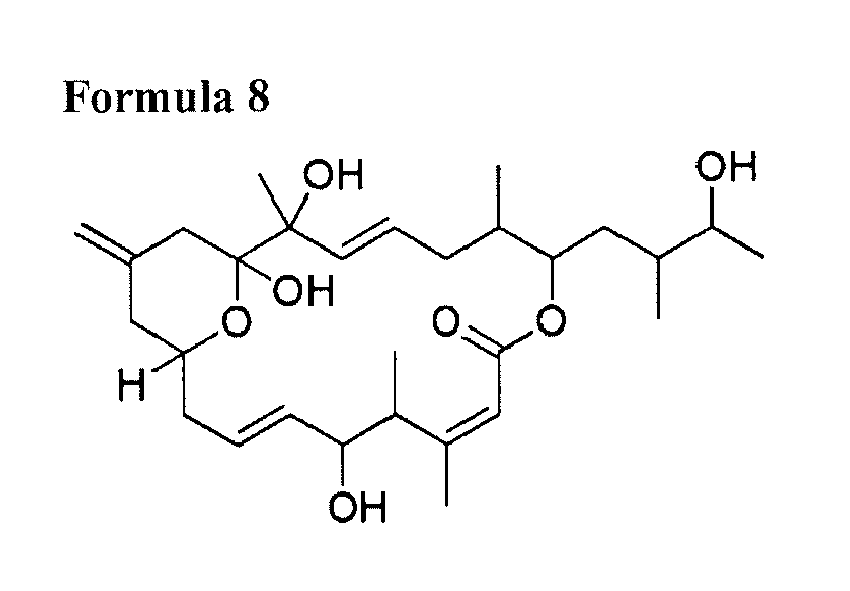
Molecular weight (C29H46O7Na, calculated value: 529.3141) -

Molecular weight (C29H46O7Na, calculated value: 529.3141) -

Molecular weight (C33H54O7Na, calculated value: 585.3767) -

Molecular weight (C25H38O6Na, calculated value: 457.2566)
- Human BuRkitt's lymphoma cell line (DG-75, ATCC No. CRL-2675) or human Burkitt's lymphoma cell line (Raji, ATCC No. CRL-86) was suspended in an RPMI-1640 medium (SIGMA) (hereinafter called culture solution) containing 10% calf serum (Moregate) and 10% fetal bovine serum (Hyclone) so as to set the cell number at 1×10⁵/mL. After 50µL of the cell suspension was added to a 96-well microplate, 49µL of the above culture solution was added thereto to set the whole volume at 99µL. Compounds represented by Formulae (6) to (11) that solved in DMSO, 5-FU (Wako) or doxorubicin (Wako) (all 0.0001 to 10µg/mL) were each added to one well by 1µL, and cultured with a CO2 concentration of 5% at 37°C for 72 hours. After culturing, 10µL of Wako cell Counting Kit-8 (Wako) was added to each well and subjected to color reaction in a CO2 incubator for 3 hours. Proliferation-inhibition rate was calculated from absorbance values measured with a microplate reader at 450nm (reference wavelength: 620nm) using the following expression to determine a compound concentration in a culture solution with a proliferation-inhibition rate of 50% as IC50 value.
-

Table 2 shows IC50 values for each novel macrolide compound and existing anticancer agent. -
[Table 2] ( Unit µg/ mL) DG-75 Raji Compound 6 0.02 -- Compound 7 0.4 -- Compound 8 0.002 0.003 Compound 9 0.9 -- Compound 10 0.006 0.01 Compound 11 0.08 0.05 5-FU 0.9 3.0 Doxorubicin 0.04 0.02 - From these observations, it was confirmed that a novel macrolide compound can be an excellent anticancer agent having a high antitumor activity.
- A compound represented by Formula (8) (50 to 500µg/kg) that solved in ethanol or 5-FU (10mg/kg) was administered to an 8-week old female Balb/c mouse (Japan SLC) having approx. 1×10⁵ of Meth A fibrosarcoma cells (Kitasato Institute) intraperitoneally transplanted therein by 1/3 of the whole volume at 7th, 9th and 11th days intravenously (but 5-FU administered intraperitoneally) to measure tumor weight at 21st day. Using a control mouse to which normal saline solution was administered in lieu of a test compound, anticancer activity on each compound was expressed in number according to a formula of proliferation-inhibition rate (%) = (1- (sample/blank))×100. Table 3 shows the results.
-
[Table 3] Concentration (µg/kg) Proliferation-inhibition rate (%) Formula (8) 50 5.3 200 62.2 500 54.3 5-FU 10000 60.2 - The above test found that the compound represented by Formula (8) shows almost the same proliferation-inhibition rate (anticancer activity) as 5-FU even when it is administered with a lower concentration.
Claims (6)
- A compound consisting of at least one of following general Formula 2 and Formula 3 and salts thereof:


- An anticancer agent containing at least one of compounds set forth in Claim 1 as an active ingredient.
- A method for producing any one of compounds set forth in Claim 1, comprising a process for culturing an Amphidinium sp. Strain HYA002 as a dinoflagellate alga, and a process for collecting at least one of compounds set forth in Claim 1 from a culture.
- A method for producing any one of compounds set forth in Claim 1, comprising a process for culturing an Amphidinium sp. Strain HYA024 as a dinoflagellate alga, and a process for collecting at least one of compounds set forth in Claim 1 from a culture.
- An Amphidinium sp. Strain HYA002 as a dinoflagellate alga.
- An Amphidinium sp. Strain HYA024 as a dinoflagellate alga.
Applications Claiming Priority (2)
| Application Number | Priority Date | Filing Date | Title |
|---|---|---|---|
| JP2006351043 | 2006-12-27 | ||
| EP07849855A EP2119792A4 (en) | 2006-12-27 | 2007-12-19 | INNOVATIVE MACROLIDE COMPOUND |
Related Parent Applications (1)
| Application Number | Title | Priority Date | Filing Date |
|---|---|---|---|
| EP07849855.7 Division | 2007-12-19 |
Publications (1)
| Publication Number | Publication Date |
|---|---|
| EP2357249A1 true EP2357249A1 (en) | 2011-08-17 |
Family
ID=39588258
Family Applications (2)
| Application Number | Title | Priority Date | Filing Date |
|---|---|---|---|
| EP07849855A Withdrawn EP2119792A4 (en) | 2006-12-27 | 2007-12-19 | INNOVATIVE MACROLIDE COMPOUND |
| EP11164115A Withdrawn EP2357249A1 (en) | 2006-12-27 | 2007-12-19 | Macrolide compounds |
Family Applications Before (1)
| Application Number | Title | Priority Date | Filing Date |
|---|---|---|---|
| EP07849855A Withdrawn EP2119792A4 (en) | 2006-12-27 | 2007-12-19 | INNOVATIVE MACROLIDE COMPOUND |
Country Status (4)
| Country | Link |
|---|---|
| US (1) | US8071793B2 (en) |
| EP (2) | EP2119792A4 (en) |
| JP (1) | JPWO2008081568A1 (en) |
| WO (1) | WO2008081568A1 (en) |
Families Citing this family (1)
| Publication number | Priority date | Publication date | Assignee | Title |
|---|---|---|---|---|
| JP7334927B2 (en) * | 2019-03-12 | 2023-08-29 | 学校法人大阪医科薬科大学 | Anti-cancer agent |
-
2007
- 2007-12-19 JP JP2008552019A patent/JPWO2008081568A1/en active Pending
- 2007-12-19 WO PCT/JP2007/001425 patent/WO2008081568A1/en not_active Ceased
- 2007-12-19 EP EP07849855A patent/EP2119792A4/en not_active Withdrawn
- 2007-12-19 US US12/448,633 patent/US8071793B2/en not_active Expired - Fee Related
- 2007-12-19 EP EP11164115A patent/EP2357249A1/en not_active Withdrawn
Non-Patent Citations (4)
| Title |
|---|
| J.KOBAYASHI, TETERAHEDRON LETT., vol. 27, 1986, pages 5755 |
| JUN'ICHI KOBAYASHI ET AL.: "Amphidinolide-A, a novel antineoplastic macrolide from the marine dinoflagellate Amphidinium sp.", TETRAHEDRON LETTERS, vol. 27, no. 47, 1986, pages 5755 - 5758, XP002575702 * |
| KOBAYASHI JUN-ICHI ET AL: "Amphidinolides T2, T3, and T4, new 19-membered macrolides from the dinoflagellate Amphidinium sp. and the biosynthesis of amphidinolide T1", JOURNAL OF ORGANIC CHEMISTRY, AMERICAN CHEMICAL SOCIETY, EASTON.; US, vol. 66, no. 1, 1 January 2001 (2001-01-01), pages 134 - 142, XP002311048, ISSN: 0022-3263 * |
| TSUDA M ET AL: "Amphidinolide U, Novel 20-Membered Macrolide from Marine Dinoflagellate Amphidinium sp", TETRAHEDRON, ELSEVIER SCIENCE PUBLISHERS, AMSTERDAM, NL, vol. 55, no. 51, 17 December 1999 (1999-12-17), pages 14565 - 14570, XP004185326, ISSN: 0040-4020, DOI: 10.1016/S0040-4020(99)00932-1 * |
Also Published As
| Publication number | Publication date |
|---|---|
| EP2119792A4 (en) | 2010-06-30 |
| WO2008081568A1 (en) | 2008-07-10 |
| US20100121079A1 (en) | 2010-05-13 |
| JPWO2008081568A1 (en) | 2010-04-30 |
| EP2119792A1 (en) | 2009-11-18 |
| US8071793B2 (en) | 2011-12-06 |
Similar Documents
| Publication | Publication Date | Title |
|---|---|---|
| Rahier et al. | Anticancer activity of koningic acid and semisynthetic derivatives | |
| CN109134574B (en) | Steroid compound, preparation method and application thereof, and anti-tumor drug | |
| Gao et al. | Cytochalasans from the endophytic fungus Diaporthe ueckerae associated with the fern Pteris vittata | |
| CN103087031A (en) | Application of bistetrahydrobenzopyrone dimer compounds in anti-cancer drugs | |
| CN110218200A (en) | A kind of mangrove endogenetic fungus middle ring depsipeptide compound and the preparation method and application thereof | |
| CN114573537B (en) | Compound with anti-neurodegenerative change activity, preparation method and application thereof | |
| US8071793B2 (en) | Macrolide compound | |
| CN101948472B (en) | Novel staurosporine analogue and preparation method and applications thereof | |
| CN101416962A (en) | Use of cytochalasin D in preparing anti-tumor medicine | |
| JP5351430B2 (en) | New macrolide compounds | |
| Konuklugil et al. | Accumulation of lignans in suspension cultures of Linum mucronatum ssp. armenum (Bordz.) Davis | |
| CN102464664A (en) | Bilobalide derivative and preparation method and application thereof | |
| Lin et al. | A new diketopiperazine alkaloid isolated from an algicolous Aspergillus flavus strain | |
| CN1298722C (en) | Indole carbazole alkaloid and its preparing method and use | |
| CA2701606A1 (en) | Antifungal agents | |
| CN108165496B (en) | Application of Sclerotinia fucker 3A00494 and its fermented compounds in the preparation of antitumor drugs | |
| JP2009051745A (en) | New antitumor macrolide compounds | |
| CN105837650A (en) | Steroid compound and application thereof | |
| CN103275140B (en) | The two key lactone type sophorolipids of 18 one of carbon diacetyl and application thereof | |
| CN102584547A (en) | Bisabolane sesquiterpene dimer compound as well as preparation method and application thereof | |
| CN102618448B (en) | Drimane-type sesquialter terpene cyclohexenone derivative, preparation method thereof and application | |
| He et al. | Biotransformation of artemisinin by human intestinal fungi and cytotoxicity against breast cancer cells of its metabolites | |
| JP2011184437A (en) | Polyketide compound having antitumor activity | |
| CN101475458A (en) | Mitissimol with antineoplastic activity, preparation and use thereof | |
| CN100422167C (en) | Compound of saturated bicyclic ring in cyclohexanone class, preparation method and application |
Legal Events
| Date | Code | Title | Description |
|---|---|---|---|
| PUAI | Public reference made under article 153(3) epc to a published international application that has entered the european phase |
Free format text: ORIGINAL CODE: 0009012 |
|
| AC | Divisional application: reference to earlier application |
Ref document number: 2119792 Country of ref document: EP Kind code of ref document: P |
|
| AK | Designated contracting states |
Kind code of ref document: A1 Designated state(s): AT BE BG CH CY CZ DE DK EE ES FI FR GB GR HU IE IS IT LI LT LU LV MC MT NL PL PT RO SE SI SK TR |
|
| RAP1 | Party data changed (applicant data changed or rights of an application transferred) |
Owner name: NATIONAL UNIVERSITY CORPORATION HOKKAIDO UNIVERSIT |
|
| RAP1 | Party data changed (applicant data changed or rights of an application transferred) |
Owner name: NATIONAL UNIVERSITY CORPORATION KOCHI UNIVERSITY |
|
| RIN1 | Information on inventor provided before grant (corrected) |
Inventor name: OKAMOTO, YUMIKO Inventor name: TSUDA, MASASHI Inventor name: OGUCHI, KEIKO Inventor name: IWAMOTO, RIE |
|
| 17P | Request for examination filed |
Effective date: 20120210 |
|
| 17Q | First examination report despatched |
Effective date: 20120713 |
|
| STAA | Information on the status of an ep patent application or granted ep patent |
Free format text: STATUS: THE APPLICATION IS DEEMED TO BE WITHDRAWN |
|
| 18D | Application deemed to be withdrawn |
Effective date: 20140701 |