EP2357227A1 - Optimized cellulase enzymes - Google Patents
Optimized cellulase enzymes Download PDFInfo
- Publication number
- EP2357227A1 EP2357227A1 EP10153355A EP10153355A EP2357227A1 EP 2357227 A1 EP2357227 A1 EP 2357227A1 EP 10153355 A EP10153355 A EP 10153355A EP 10153355 A EP10153355 A EP 10153355A EP 2357227 A1 EP2357227 A1 EP 2357227A1
- Authority
- EP
- European Patent Office
- Prior art keywords
- seq
- polypeptide
- amino acid
- sequence
- cellobiohydrolase
- Prior art date
- Legal status (The legal status is an assumption and is not a legal conclusion. Google has not performed a legal analysis and makes no representation as to the accuracy of the status listed.)
- Granted
Links
- 108010059892 Cellulase Proteins 0.000 title claims description 12
- 108090000765 processed proteins & peptides Proteins 0.000 claims abstract description 106
- 102000004196 processed proteins & peptides Human genes 0.000 claims abstract description 101
- 229920001184 polypeptide Polymers 0.000 claims abstract description 100
- 108010008885 Cellulose 1,4-beta-Cellobiosidase Proteins 0.000 claims abstract description 94
- 230000000694 effects Effects 0.000 claims abstract description 41
- 238000000034 method Methods 0.000 claims abstract description 38
- 150000007523 nucleic acids Chemical group 0.000 claims abstract description 28
- 239000000203 mixture Substances 0.000 claims abstract description 16
- 239000013598 vector Substances 0.000 claims abstract description 12
- 238000002703 mutagenesis Methods 0.000 claims abstract description 6
- 231100000350 mutagenesis Toxicity 0.000 claims abstract description 6
- 102220125025 rs773325406 Human genes 0.000 claims description 541
- 102200037746 rs5931 Human genes 0.000 claims description 73
- 102200155730 rs121918454 Human genes 0.000 claims description 59
- 108090000623 proteins and genes Proteins 0.000 claims description 56
- 241000499912 Trichoderma reesei Species 0.000 claims description 53
- 240000004808 Saccharomyces cerevisiae Species 0.000 claims description 40
- 235000014680 Saccharomyces cerevisiae Nutrition 0.000 claims description 40
- FWMNVWWHGCHHJJ-SKKKGAJSSA-N 4-amino-1-[(2r)-6-amino-2-[[(2r)-2-[[(2r)-2-[[(2r)-2-amino-3-phenylpropanoyl]amino]-3-phenylpropanoyl]amino]-4-methylpentanoyl]amino]hexanoyl]piperidine-4-carboxylic acid Chemical compound C([C@H](C(=O)N[C@H](CC(C)C)C(=O)N[C@H](CCCCN)C(=O)N1CCC(N)(CC1)C(O)=O)NC(=O)[C@H](N)CC=1C=CC=CC=1)C1=CC=CC=C1 FWMNVWWHGCHHJJ-SKKKGAJSSA-N 0.000 claims description 36
- 150000001413 amino acids Chemical class 0.000 claims description 34
- 102000004169 proteins and genes Human genes 0.000 claims description 31
- 125000003275 alpha amino acid group Chemical group 0.000 claims description 30
- 102220047086 rs200595164 Human genes 0.000 claims description 29
- 210000004027 cell Anatomy 0.000 claims description 25
- 102000039446 nucleic acids Human genes 0.000 claims description 25
- 108020004707 nucleic acids Proteins 0.000 claims description 25
- LFQSCWFLJHTTHZ-UHFFFAOYSA-N Ethanol Chemical compound CCO LFQSCWFLJHTTHZ-UHFFFAOYSA-N 0.000 claims description 23
- 241000235058 Komagataella pastoris Species 0.000 claims description 23
- 229910052739 hydrogen Inorganic materials 0.000 claims description 23
- 229910052700 potassium Inorganic materials 0.000 claims description 23
- 102220574283 5-hydroxytryptamine receptor 2A_S86T_mutation Human genes 0.000 claims description 22
- 125000000539 amino acid group Chemical group 0.000 claims description 22
- 102220539707 Chromosome alignment-maintaining phosphoprotein 1_E65V_mutation Human genes 0.000 claims description 20
- 230000035772 mutation Effects 0.000 claims description 19
- 239000000758 substrate Substances 0.000 claims description 19
- 229910052720 vanadium Inorganic materials 0.000 claims description 19
- 239000000463 material Substances 0.000 claims description 18
- 102000008300 Mutant Proteins Human genes 0.000 claims description 17
- 108010021466 Mutant Proteins Proteins 0.000 claims description 17
- 238000006243 chemical reaction Methods 0.000 claims description 16
- 238000006467 substitution reaction Methods 0.000 claims description 16
- 229910052799 carbon Inorganic materials 0.000 claims description 15
- 102200017779 rs10132601 Human genes 0.000 claims description 14
- 102200161322 rs11739136 Human genes 0.000 claims description 14
- 238000012217 deletion Methods 0.000 claims description 13
- 230000037430 deletion Effects 0.000 claims description 13
- 229910052717 sulfur Inorganic materials 0.000 claims description 13
- 230000003197 catalytic effect Effects 0.000 claims description 12
- 102220242717 rs1553780837 Human genes 0.000 claims description 12
- 239000006228 supernatant Substances 0.000 claims description 11
- 108010084185 Cellulases Proteins 0.000 claims description 10
- 102000005575 Cellulases Human genes 0.000 claims description 10
- 241000223259 Trichoderma Species 0.000 claims description 9
- 102220355118 c.202G>A Human genes 0.000 claims description 9
- 229910052698 phosphorus Inorganic materials 0.000 claims description 9
- 238000012545 processing Methods 0.000 claims description 9
- 102220082618 rs138865666 Human genes 0.000 claims description 8
- 102220045535 rs587782187 Human genes 0.000 claims description 8
- 235000000346 sugar Nutrition 0.000 claims description 8
- 241000235648 Pichia Species 0.000 claims description 7
- 229910052740 iodine Inorganic materials 0.000 claims description 7
- 238000012986 modification Methods 0.000 claims description 7
- 230000004048 modification Effects 0.000 claims description 7
- 229910052757 nitrogen Inorganic materials 0.000 claims description 7
- 102220279008 rs1554568311 Human genes 0.000 claims description 7
- 102220093883 rs876659143 Human genes 0.000 claims description 7
- 102220520654 Testis-expressed protein 10_Y244F_mutation Human genes 0.000 claims description 6
- 239000013604 expression vector Substances 0.000 claims description 6
- 239000004615 ingredient Substances 0.000 claims description 6
- 102220030959 rs139787271 Human genes 0.000 claims description 5
- 102220258161 rs140380494 Human genes 0.000 claims description 5
- 102200078313 rs1554094149 Human genes 0.000 claims description 5
- 102200057871 rs56048668 Human genes 0.000 claims description 5
- 102220279469 rs992385562 Human genes 0.000 claims description 5
- 241000228212 Aspergillus Species 0.000 claims description 4
- 239000004249 Erythorbin acid Substances 0.000 claims description 4
- 241000320412 Ogataea angusta Species 0.000 claims description 4
- 102220411628 c.178T>C Human genes 0.000 claims description 4
- 102220350898 c.215C>G Human genes 0.000 claims description 4
- 230000007515 enzymatic degradation Effects 0.000 claims description 4
- 239000002029 lignocellulosic biomass Substances 0.000 claims description 4
- 102200074783 rs144422014 Human genes 0.000 claims description 4
- 238000012163 sequencing technique Methods 0.000 claims description 4
- 241000222120 Candida <Saccharomycetales> Species 0.000 claims description 3
- 101710121765 Endo-1,4-beta-xylanase Proteins 0.000 claims description 3
- 241000228143 Penicillium Species 0.000 claims description 3
- 241000235070 Saccharomyces Species 0.000 claims description 3
- 102220370375 c.1288A>T Human genes 0.000 claims description 3
- 239000003599 detergent Substances 0.000 claims description 3
- 235000013305 food Nutrition 0.000 claims description 3
- 102200028479 rs267608636 Human genes 0.000 claims description 3
- 102220074175 rs533055438 Human genes 0.000 claims description 3
- 238000002741 site-directed mutagenesis Methods 0.000 claims description 3
- 239000004753 textile Substances 0.000 claims description 3
- 210000005253 yeast cell Anatomy 0.000 claims description 3
- 241000235649 Kluyveromyces Species 0.000 claims description 2
- 241001452677 Ogataea methanolica Species 0.000 claims description 2
- 241000235647 Pachysolen tannophilus Species 0.000 claims description 2
- 241000235060 Scheffersomyces stipitis Species 0.000 claims description 2
- 241000235346 Schizosaccharomyces Species 0.000 claims description 2
- 125000002924 primary amino group Chemical group [H]N([H])* 0.000 claims description 2
- 238000011084 recovery Methods 0.000 claims description 2
- 102220097735 rs876659105 Human genes 0.000 claims description 2
- 230000001131 transforming effect Effects 0.000 claims description 2
- 230000004927 fusion Effects 0.000 description 39
- 241000959173 Rasamsonia emersonii Species 0.000 description 37
- 102000004190 Enzymes Human genes 0.000 description 33
- 108090000790 Enzymes Proteins 0.000 description 33
- 229940088598 enzyme Drugs 0.000 description 33
- 235000001014 amino acid Nutrition 0.000 description 29
- 235000018102 proteins Nutrition 0.000 description 26
- 108010076504 Protein Sorting Signals Proteins 0.000 description 24
- 229920002678 cellulose Polymers 0.000 description 24
- 239000001913 cellulose Substances 0.000 description 24
- 238000000224 chemical solution deposition Methods 0.000 description 24
- 108091026890 Coding region Proteins 0.000 description 18
- 239000012634 fragment Substances 0.000 description 17
- 230000027455 binding Effects 0.000 description 16
- 241000223199 Humicola grisea Species 0.000 description 15
- OKKJLVBELUTLKV-UHFFFAOYSA-N Methanol Chemical compound OC OKKJLVBELUTLKV-UHFFFAOYSA-N 0.000 description 15
- 229910052731 fluorine Inorganic materials 0.000 description 13
- 238000006460 hydrolysis reaction Methods 0.000 description 12
- 238000004519 manufacturing process Methods 0.000 description 12
- 230000007062 hydrolysis Effects 0.000 description 11
- 108020004414 DNA Proteins 0.000 description 9
- 241000588724 Escherichia coli Species 0.000 description 9
- 241000233866 Fungi Species 0.000 description 9
- PEDCQBHIVMGVHV-UHFFFAOYSA-N Glycerine Chemical compound OCC(O)CO PEDCQBHIVMGVHV-UHFFFAOYSA-N 0.000 description 9
- 241000228182 Thermoascus aurantiacus Species 0.000 description 9
- -1 W40 Chemical compound 0.000 description 8
- IXKSXJFAGXLQOQ-XISFHERQSA-N WHWLQLKPGQPMY Chemical group C([C@@H](C(=O)N[C@@H](CC=1C2=CC=CC=C2NC=1)C(=O)N[C@@H](CC(C)C)C(=O)N[C@@H](CCC(N)=O)C(=O)N[C@@H](CC(C)C)C(=O)N1CCC[C@H]1C(=O)NCC(=O)N[C@@H](CCC(N)=O)C(=O)N[C@@H](CC(O)=O)C(=O)N1CCC[C@H]1C(=O)N[C@@H](CCSC)C(=O)N[C@@H](CC=1C=CC(O)=CC=1)C(O)=O)NC(=O)[C@@H](N)CC=1C2=CC=CC=C2NC=1)C1=CNC=N1 IXKSXJFAGXLQOQ-XISFHERQSA-N 0.000 description 8
- 238000010367 cloning Methods 0.000 description 8
- 239000013612 plasmid Substances 0.000 description 8
- 241000223261 Trichoderma viride Species 0.000 description 7
- 101150052795 cbh-1 gene Proteins 0.000 description 7
- 238000012512 characterization method Methods 0.000 description 7
- 102000037865 fusion proteins Human genes 0.000 description 7
- 108020001507 fusion proteins Proteins 0.000 description 7
- 238000002415 sodium dodecyl sulfate polyacrylamide gel electrophoresis Methods 0.000 description 7
- WQZGKKKJIJFFOK-GASJEMHNSA-N Glucose Natural products OC[C@H]1OC(O)[C@H](O)[C@@H](O)[C@@H]1O WQZGKKKJIJFFOK-GASJEMHNSA-N 0.000 description 6
- 230000001461 cytolytic effect Effects 0.000 description 6
- 238000000855 fermentation Methods 0.000 description 6
- 230000004151 fermentation Effects 0.000 description 6
- 230000002538 fungal effect Effects 0.000 description 6
- 239000008103 glucose Substances 0.000 description 6
- 229920000642 polymer Polymers 0.000 description 6
- 102220214489 rs530071578 Human genes 0.000 description 6
- 235000004279 alanine Nutrition 0.000 description 5
- 239000012228 culture supernatant Substances 0.000 description 5
- 239000013613 expression plasmid Substances 0.000 description 5
- 230000003301 hydrolyzing effect Effects 0.000 description 5
- 238000003780 insertion Methods 0.000 description 5
- 230000037431 insertion Effects 0.000 description 5
- 230000008569 process Effects 0.000 description 5
- 239000000243 solution Substances 0.000 description 5
- 239000010902 straw Substances 0.000 description 5
- DHMQDGOQFOQNFH-UHFFFAOYSA-N Glycine Chemical compound NCC(O)=O DHMQDGOQFOQNFH-UHFFFAOYSA-N 0.000 description 4
- CDBYLPFSWZWCQE-UHFFFAOYSA-L Sodium Carbonate Chemical compound [Na+].[Na+].[O-]C([O-])=O CDBYLPFSWZWCQE-UHFFFAOYSA-L 0.000 description 4
- 108010047754 beta-Glucosidase Proteins 0.000 description 4
- 102000006995 beta-Glucosidase Human genes 0.000 description 4
- 239000002773 nucleotide Substances 0.000 description 4
- 125000003729 nucleotide group Chemical group 0.000 description 4
- 238000012216 screening Methods 0.000 description 4
- 239000000126 substance Substances 0.000 description 4
- 229920003043 Cellulose fiber Polymers 0.000 description 3
- GUBGYTABKSRVRQ-CUHNMECISA-N D-Cellobiose Chemical compound O[C@@H]1[C@@H](O)[C@H](O)[C@@H](CO)O[C@H]1O[C@@H]1[C@@H](CO)OC(O)[C@H](O)[C@H]1O GUBGYTABKSRVRQ-CUHNMECISA-N 0.000 description 3
- 101710098247 Exoglucanase 1 Proteins 0.000 description 3
- 108700039691 Genetic Promoter Regions Proteins 0.000 description 3
- 101710089743 Mating factor alpha Proteins 0.000 description 3
- 108091034117 Oligonucleotide Proteins 0.000 description 3
- 101900208676 Saccharomyces cerevisiae Mating factor alpha Proteins 0.000 description 3
- 241000228178 Thermoascus Species 0.000 description 3
- 125000003295 alanine group Chemical group N[C@@H](C)C(=O)* 0.000 description 3
- 238000004458 analytical method Methods 0.000 description 3
- 238000005119 centrifugation Methods 0.000 description 3
- 230000002255 enzymatic effect Effects 0.000 description 3
- ZDXPYRJPNDTMRX-UHFFFAOYSA-N glutamine Natural products OC(=O)C(N)CCC(N)=O ZDXPYRJPNDTMRX-UHFFFAOYSA-N 0.000 description 3
- 108020004445 glyceraldehyde-3-phosphate dehydrogenase Proteins 0.000 description 3
- 230000006872 improvement Effects 0.000 description 3
- 238000005259 measurement Methods 0.000 description 3
- 238000002360 preparation method Methods 0.000 description 3
- 239000000047 product Substances 0.000 description 3
- 230000010076 replication Effects 0.000 description 3
- 230000028327 secretion Effects 0.000 description 3
- 238000012807 shake-flask culturing Methods 0.000 description 3
- 230000009466 transformation Effects 0.000 description 3
- YBJHBAHKTGYVGT-ZKWXMUAHSA-N (+)-Biotin Chemical compound N1C(=O)N[C@@H]2[C@H](CCCCC(=O)O)SC[C@@H]21 YBJHBAHKTGYVGT-ZKWXMUAHSA-N 0.000 description 2
- MTCFGRXMJLQNBG-REOHCLBHSA-N (2S)-2-Amino-3-hydroxypropansäure Chemical compound OC[C@H](N)C(O)=O MTCFGRXMJLQNBG-REOHCLBHSA-N 0.000 description 2
- HSHNITRMYYLLCV-UHFFFAOYSA-N 4-methylumbelliferone Chemical compound C1=C(O)C=CC2=C1OC(=O)C=C2C HSHNITRMYYLLCV-UHFFFAOYSA-N 0.000 description 2
- PRTGXBPFDYMIJH-KSFLKEQHSA-N 7-[(2s,3r,4r,5s,6r)-3,4-dihydroxy-6-(hydroxymethyl)-5-[(2s,3r,4s,5r,6r)-3,4,5-trihydroxy-6-(hydroxymethyl)oxan-2-yl]oxyoxan-2-yl]oxy-4-methylchromen-2-one Chemical compound O([C@@H]1[C@@H](CO)O[C@H]([C@@H]([C@H]1O)O)OC1=CC=2OC(=O)C=C(C=2C=C1)C)[C@@H]1O[C@H](CO)[C@H](O)[C@H](O)[C@H]1O PRTGXBPFDYMIJH-KSFLKEQHSA-N 0.000 description 2
- QGZKDVFQNNGYKY-UHFFFAOYSA-N Ammonia Chemical compound N QGZKDVFQNNGYKY-UHFFFAOYSA-N 0.000 description 2
- 241001248634 Chaetomium thermophilum Species 0.000 description 2
- 108020004705 Codon Proteins 0.000 description 2
- 235000014466 Douglas bleu Nutrition 0.000 description 2
- 108700007698 Genetic Terminator Regions Proteins 0.000 description 2
- WHUUTDBJXJRKMK-UHFFFAOYSA-N Glutamic acid Chemical group OC(=O)C(N)CCC(O)=O WHUUTDBJXJRKMK-UHFFFAOYSA-N 0.000 description 2
- 239000004471 Glycine Substances 0.000 description 2
- 229920002488 Hemicellulose Polymers 0.000 description 2
- 241000421270 Komagataella phaffii CBS 7435 Species 0.000 description 2
- WHUUTDBJXJRKMK-VKHMYHEASA-N L-glutamic acid Chemical group OC(=O)[C@@H](N)CCC(O)=O WHUUTDBJXJRKMK-VKHMYHEASA-N 0.000 description 2
- ROHFNLRQFUQHCH-YFKPBYRVSA-N L-leucine Chemical compound CC(C)C[C@H](N)C(O)=O ROHFNLRQFUQHCH-YFKPBYRVSA-N 0.000 description 2
- CSNNHWWHGAXBCP-UHFFFAOYSA-L Magnesium sulfate Chemical compound [Mg+2].[O-][S+2]([O-])([O-])[O-] CSNNHWWHGAXBCP-UHFFFAOYSA-L 0.000 description 2
- NBIIXXVUZAFLBC-UHFFFAOYSA-N Phosphoric acid Chemical compound OP(O)(O)=O NBIIXXVUZAFLBC-UHFFFAOYSA-N 0.000 description 2
- 101100505672 Podospora anserina grisea gene Proteins 0.000 description 2
- 240000001416 Pseudotsuga menziesii Species 0.000 description 2
- 235000005386 Pseudotsuga menziesii var menziesii Nutrition 0.000 description 2
- 101100010928 Saccharolobus solfataricus (strain ATCC 35092 / DSM 1617 / JCM 11322 / P2) tuf gene Proteins 0.000 description 2
- 101150001810 TEAD1 gene Proteins 0.000 description 2
- 101150074253 TEF1 gene Proteins 0.000 description 2
- 102100029898 Transcriptional enhancer factor TEF-1 Human genes 0.000 description 2
- 241000209140 Triticum Species 0.000 description 2
- 235000021307 Triticum Nutrition 0.000 description 2
- 230000002378 acidificating effect Effects 0.000 description 2
- 230000003321 amplification Effects 0.000 description 2
- 238000003556 assay Methods 0.000 description 2
- 239000002551 biofuel Substances 0.000 description 2
- 239000012152 bradford reagent Substances 0.000 description 2
- 239000000872 buffer Substances 0.000 description 2
- 210000004899 c-terminal region Anatomy 0.000 description 2
- 229940106157 cellulase Drugs 0.000 description 2
- 238000006911 enzymatic reaction Methods 0.000 description 2
- 239000000446 fuel Substances 0.000 description 2
- 239000000499 gel Substances 0.000 description 2
- 235000013922 glutamic acid Nutrition 0.000 description 2
- 239000004220 glutamic acid Chemical group 0.000 description 2
- 102000006602 glyceraldehyde-3-phosphate dehydrogenase Human genes 0.000 description 2
- 238000011534 incubation Methods 0.000 description 2
- 230000006698 induction Effects 0.000 description 2
- 230000010354 integration Effects 0.000 description 2
- 238000002955 isolation Methods 0.000 description 2
- SBUJHOSQTJFQJX-NOAMYHISSA-N kanamycin Chemical compound O[C@@H]1[C@@H](O)[C@H](O)[C@@H](CN)O[C@@H]1O[C@H]1[C@H](O)[C@@H](O[C@@H]2[C@@H]([C@@H](N)[C@H](O)[C@@H](CO)O2)O)[C@H](N)C[C@@H]1N SBUJHOSQTJFQJX-NOAMYHISSA-N 0.000 description 2
- 229920005610 lignin Polymers 0.000 description 2
- 239000002609 medium Substances 0.000 description 2
- 239000007003 mineral medium Substances 0.000 description 2
- 238000007857 nested PCR Methods 0.000 description 2
- 238000010606 normalization Methods 0.000 description 2
- 238000003199 nucleic acid amplification method Methods 0.000 description 2
- 239000005014 poly(hydroxyalkanoate) Substances 0.000 description 2
- 229920000903 polyhydroxyalkanoate Polymers 0.000 description 2
- 210000001938 protoplast Anatomy 0.000 description 2
- 238000002708 random mutagenesis Methods 0.000 description 2
- 239000007974 sodium acetate buffer Substances 0.000 description 2
- 229910000029 sodium carbonate Inorganic materials 0.000 description 2
- 238000003786 synthesis reaction Methods 0.000 description 2
- 238000012546 transfer Methods 0.000 description 2
- 238000011282 treatment Methods 0.000 description 2
- 108091032973 (ribonucleotides)n+m Proteins 0.000 description 1
- PKYCWFICOKSIHZ-UHFFFAOYSA-N 1-(3,7-dihydroxyphenoxazin-10-yl)ethanone Chemical compound OC1=CC=C2N(C(=O)C)C3=CC=C(O)C=C3OC2=C1 PKYCWFICOKSIHZ-UHFFFAOYSA-N 0.000 description 1
- BTJIUGUIPKRLHP-UHFFFAOYSA-N 4-nitrophenol Chemical compound OC1=CC=C([N+]([O-])=O)C=C1 BTJIUGUIPKRLHP-UHFFFAOYSA-N 0.000 description 1
- 229920001817 Agar Polymers 0.000 description 1
- 241000222518 Agaricus Species 0.000 description 1
- 108010025188 Alcohol oxidase Proteins 0.000 description 1
- 101710194180 Alcohol oxidase 1 Proteins 0.000 description 1
- 244000144725 Amygdalus communis Species 0.000 description 1
- 241000235349 Ascomycota Species 0.000 description 1
- 241000894006 Bacteria Species 0.000 description 1
- 241000221198 Basidiomycota Species 0.000 description 1
- 239000002028 Biomass Substances 0.000 description 1
- 238000009010 Bradford assay Methods 0.000 description 1
- VEXZGXHMUGYJMC-UHFFFAOYSA-M Chloride anion Chemical compound [Cl-] VEXZGXHMUGYJMC-UHFFFAOYSA-M 0.000 description 1
- 241000123346 Chrysosporium Species 0.000 description 1
- 241001674013 Chrysosporium lucknowense Species 0.000 description 1
- 229920000742 Cotton Polymers 0.000 description 1
- 125000002353 D-glucosyl group Chemical group C1([C@H](O)[C@@H](O)[C@H](O)[C@H](O1)CO)* 0.000 description 1
- 102000012410 DNA Ligases Human genes 0.000 description 1
- 108010061982 DNA Ligases Proteins 0.000 description 1
- 108010014303 DNA-directed DNA polymerase Proteins 0.000 description 1
- 102000016928 DNA-directed DNA polymerase Human genes 0.000 description 1
- 101000874334 Dalbergia nigrescens Isoflavonoid 7-O-beta-apiosyl-glucoside beta-glycosidase Proteins 0.000 description 1
- 101710088194 Dehydrogenase Proteins 0.000 description 1
- 241000196324 Embryophyta Species 0.000 description 1
- 102000004533 Endonucleases Human genes 0.000 description 1
- 108010042407 Endonucleases Proteins 0.000 description 1
- 101000757733 Enterococcus faecalis (strain ATCC 700802 / V583) Autolysin Proteins 0.000 description 1
- YQYJSBFKSSDGFO-UHFFFAOYSA-N Epihygromycin Natural products OC1C(O)C(C(=O)C)OC1OC(C(=C1)O)=CC=C1C=C(C)C(=O)NC1C(O)C(O)C2OCOC2C1O YQYJSBFKSSDGFO-UHFFFAOYSA-N 0.000 description 1
- 101710112457 Exoglucanase Proteins 0.000 description 1
- 101710098246 Exoglucanase 2 Proteins 0.000 description 1
- 241000223198 Humicola Species 0.000 description 1
- 101001026677 Hypocrea jecorina Exoglucanase 1 Proteins 0.000 description 1
- 101150017040 I gene Proteins 0.000 description 1
- 108091092195 Intron Proteins 0.000 description 1
- 241000222342 Irpex Species 0.000 description 1
- QNAYBMKLOCPYGJ-REOHCLBHSA-N L-alanine Chemical compound C[C@H](N)C(O)=O QNAYBMKLOCPYGJ-REOHCLBHSA-N 0.000 description 1
- ROHFNLRQFUQHCH-UHFFFAOYSA-N Leucine Natural products CC(C)CC(N)C(O)=O ROHFNLRQFUQHCH-UHFFFAOYSA-N 0.000 description 1
- PWHULOQIROXLJO-UHFFFAOYSA-N Manganese Chemical compound [Mn] PWHULOQIROXLJO-UHFFFAOYSA-N 0.000 description 1
- 229920001340 Microbial cellulose Polymers 0.000 description 1
- 101000757734 Mycolicibacterium phlei 38 kDa autolysin Proteins 0.000 description 1
- 108091028043 Nucleic acid sequence Proteins 0.000 description 1
- 238000012408 PCR amplification Methods 0.000 description 1
- 229910019142 PO4 Inorganic materials 0.000 description 1
- 241000235652 Pachysolen Species 0.000 description 1
- 241000228168 Penicillium sp. Species 0.000 description 1
- 241000222385 Phanerochaete Species 0.000 description 1
- 241000222393 Phanerochaete chrysosporium Species 0.000 description 1
- 102000011755 Phosphoglycerate Kinase Human genes 0.000 description 1
- 108091000080 Phosphotransferase Proteins 0.000 description 1
- 235000015696 Portulacaria afra Nutrition 0.000 description 1
- 102000007056 Recombinant Fusion Proteins Human genes 0.000 description 1
- 108010008281 Recombinant Fusion Proteins Proteins 0.000 description 1
- 241000235342 Saccharomycetes Species 0.000 description 1
- MTCFGRXMJLQNBG-UHFFFAOYSA-N Serine Natural products OCC(N)C(O)=O MTCFGRXMJLQNBG-UHFFFAOYSA-N 0.000 description 1
- VMHLLURERBWHNL-UHFFFAOYSA-M Sodium acetate Chemical compound [Na+].CC([O-])=O VMHLLURERBWHNL-UHFFFAOYSA-M 0.000 description 1
- 241000228341 Talaromyces Species 0.000 description 1
- 108010006785 Taq Polymerase Proteins 0.000 description 1
- 101001099217 Thermotoga maritima (strain ATCC 43589 / DSM 3109 / JCM 10099 / NBRC 100826 / MSB8) Triosephosphate isomerase Proteins 0.000 description 1
- 244000177175 Typha elephantina Species 0.000 description 1
- 235000018747 Typha elephantina Nutrition 0.000 description 1
- 241000235017 Zygosaccharomyces Species 0.000 description 1
- JLCPHMBAVCMARE-UHFFFAOYSA-N [3-[[3-[[3-[[3-[[3-[[3-[[3-[[3-[[3-[[3-[[3-[[5-(2-amino-6-oxo-1H-purin-9-yl)-3-[[3-[[3-[[3-[[3-[[3-[[5-(2-amino-6-oxo-1H-purin-9-yl)-3-[[5-(2-amino-6-oxo-1H-purin-9-yl)-3-hydroxyoxolan-2-yl]methoxy-hydroxyphosphoryl]oxyoxolan-2-yl]methoxy-hydroxyphosphoryl]oxy-5-(5-methyl-2,4-dioxopyrimidin-1-yl)oxolan-2-yl]methoxy-hydroxyphosphoryl]oxy-5-(6-aminopurin-9-yl)oxolan-2-yl]methoxy-hydroxyphosphoryl]oxy-5-(6-aminopurin-9-yl)oxolan-2-yl]methoxy-hydroxyphosphoryl]oxy-5-(6-aminopurin-9-yl)oxolan-2-yl]methoxy-hydroxyphosphoryl]oxy-5-(6-aminopurin-9-yl)oxolan-2-yl]methoxy-hydroxyphosphoryl]oxyoxolan-2-yl]methoxy-hydroxyphosphoryl]oxy-5-(5-methyl-2,4-dioxopyrimidin-1-yl)oxolan-2-yl]methoxy-hydroxyphosphoryl]oxy-5-(4-amino-2-oxopyrimidin-1-yl)oxolan-2-yl]methoxy-hydroxyphosphoryl]oxy-5-(5-methyl-2,4-dioxopyrimidin-1-yl)oxolan-2-yl]methoxy-hydroxyphosphoryl]oxy-5-(5-methyl-2,4-dioxopyrimidin-1-yl)oxolan-2-yl]methoxy-hydroxyphosphoryl]oxy-5-(6-aminopurin-9-yl)oxolan-2-yl]methoxy-hydroxyphosphoryl]oxy-5-(6-aminopurin-9-yl)oxolan-2-yl]methoxy-hydroxyphosphoryl]oxy-5-(4-amino-2-oxopyrimidin-1-yl)oxolan-2-yl]methoxy-hydroxyphosphoryl]oxy-5-(4-amino-2-oxopyrimidin-1-yl)oxolan-2-yl]methoxy-hydroxyphosphoryl]oxy-5-(4-amino-2-oxopyrimidin-1-yl)oxolan-2-yl]methoxy-hydroxyphosphoryl]oxy-5-(6-aminopurin-9-yl)oxolan-2-yl]methoxy-hydroxyphosphoryl]oxy-5-(4-amino-2-oxopyrimidin-1-yl)oxolan-2-yl]methyl [5-(6-aminopurin-9-yl)-2-(hydroxymethyl)oxolan-3-yl] hydrogen phosphate Polymers Cc1cn(C2CC(OP(O)(=O)OCC3OC(CC3OP(O)(=O)OCC3OC(CC3O)n3cnc4c3nc(N)[nH]c4=O)n3cnc4c3nc(N)[nH]c4=O)C(COP(O)(=O)OC3CC(OC3COP(O)(=O)OC3CC(OC3COP(O)(=O)OC3CC(OC3COP(O)(=O)OC3CC(OC3COP(O)(=O)OC3CC(OC3COP(O)(=O)OC3CC(OC3COP(O)(=O)OC3CC(OC3COP(O)(=O)OC3CC(OC3COP(O)(=O)OC3CC(OC3COP(O)(=O)OC3CC(OC3COP(O)(=O)OC3CC(OC3COP(O)(=O)OC3CC(OC3COP(O)(=O)OC3CC(OC3COP(O)(=O)OC3CC(OC3COP(O)(=O)OC3CC(OC3COP(O)(=O)OC3CC(OC3COP(O)(=O)OC3CC(OC3CO)n3cnc4c(N)ncnc34)n3ccc(N)nc3=O)n3cnc4c(N)ncnc34)n3ccc(N)nc3=O)n3ccc(N)nc3=O)n3ccc(N)nc3=O)n3cnc4c(N)ncnc34)n3cnc4c(N)ncnc34)n3cc(C)c(=O)[nH]c3=O)n3cc(C)c(=O)[nH]c3=O)n3ccc(N)nc3=O)n3cc(C)c(=O)[nH]c3=O)n3cnc4c3nc(N)[nH]c4=O)n3cnc4c(N)ncnc34)n3cnc4c(N)ncnc34)n3cnc4c(N)ncnc34)n3cnc4c(N)ncnc34)O2)c(=O)[nH]c1=O JLCPHMBAVCMARE-UHFFFAOYSA-N 0.000 description 1
- 238000002835 absorbance Methods 0.000 description 1
- 239000008351 acetate buffer Substances 0.000 description 1
- 239000002253 acid Substances 0.000 description 1
- 230000009471 action Effects 0.000 description 1
- 239000008272 agar Substances 0.000 description 1
- 239000011543 agarose gel Substances 0.000 description 1
- 150000001294 alanine derivatives Chemical group 0.000 description 1
- 150000001298 alcohols Chemical class 0.000 description 1
- 125000001931 aliphatic group Chemical group 0.000 description 1
- 230000004075 alteration Effects 0.000 description 1
- 229910000147 aluminium phosphate Inorganic materials 0.000 description 1
- 229910021529 ammonia Inorganic materials 0.000 description 1
- 125000003118 aryl group Chemical group 0.000 description 1
- 230000001580 bacterial effect Effects 0.000 description 1
- 230000033228 biological regulation Effects 0.000 description 1
- 229920001222 biopolymer Polymers 0.000 description 1
- 230000015572 biosynthetic process Effects 0.000 description 1
- 239000011616 biotin Substances 0.000 description 1
- 229960002685 biotin Drugs 0.000 description 1
- 235000020958 biotin Nutrition 0.000 description 1
- 150000001720 carbohydrates Chemical class 0.000 description 1
- 235000014633 carbohydrates Nutrition 0.000 description 1
- 230000015556 catabolic process Effects 0.000 description 1
- FYGDTMLNYKFZSV-ZWSAEMDYSA-N cellotriose Chemical compound O[C@@H]1[C@@H](O)[C@H](O)[C@@H](CO)O[C@H]1O[C@@H]1[C@@H](CO)O[C@@H](O[C@@H]2[C@H](OC(O)[C@H](O)[C@H]2O)CO)[C@H](O)[C@H]1O FYGDTMLNYKFZSV-ZWSAEMDYSA-N 0.000 description 1
- 235000013339 cereals Nutrition 0.000 description 1
- 230000008859 change Effects 0.000 description 1
- 238000012993 chemical processing Methods 0.000 description 1
- 239000003795 chemical substances by application Substances 0.000 description 1
- 150000001875 compounds Chemical class 0.000 description 1
- 238000010276 construction Methods 0.000 description 1
- 238000010924 continuous production Methods 0.000 description 1
- NKLPQNGYXWVELD-UHFFFAOYSA-M coomassie brilliant blue Chemical compound [Na+].C1=CC(OCC)=CC=C1NC1=CC=C(C(=C2C=CC(C=C2)=[N+](CC)CC=2C=C(C=CC=2)S([O-])(=O)=O)C=2C=CC(=CC=2)N(CC)CC=2C=C(C=CC=2)S([O-])(=O)=O)C=C1 NKLPQNGYXWVELD-UHFFFAOYSA-M 0.000 description 1
- 230000002596 correlated effect Effects 0.000 description 1
- 230000000875 corresponding effect Effects 0.000 description 1
- SUYVUBYJARFZHO-RRKCRQDMSA-N dATP Chemical compound C1=NC=2C(N)=NC=NC=2N1[C@H]1C[C@H](O)[C@@H](COP(O)(=O)OP(O)(=O)OP(O)(O)=O)O1 SUYVUBYJARFZHO-RRKCRQDMSA-N 0.000 description 1
- SUYVUBYJARFZHO-UHFFFAOYSA-N dATP Natural products C1=NC=2C(N)=NC=NC=2N1C1CC(O)C(COP(O)(=O)OP(O)(=O)OP(O)(O)=O)O1 SUYVUBYJARFZHO-UHFFFAOYSA-N 0.000 description 1
- NHVNXKFIZYSCEB-XLPZGREQSA-N dTTP Chemical compound O=C1NC(=O)C(C)=CN1[C@@H]1O[C@H](COP(O)(=O)OP(O)(=O)OP(O)(O)=O)[C@@H](O)C1 NHVNXKFIZYSCEB-XLPZGREQSA-N 0.000 description 1
- 230000003247 decreasing effect Effects 0.000 description 1
- 238000006731 degradation reaction Methods 0.000 description 1
- 230000000593 degrading effect Effects 0.000 description 1
- 230000001419 dependent effect Effects 0.000 description 1
- 238000011161 development Methods 0.000 description 1
- 238000010586 diagram Methods 0.000 description 1
- 150000002009 diols Chemical class 0.000 description 1
- 238000001962 electrophoresis Methods 0.000 description 1
- 230000007071 enzymatic hydrolysis Effects 0.000 description 1
- 238000006047 enzymatic hydrolysis reaction Methods 0.000 description 1
- 238000011156 evaluation Methods 0.000 description 1
- 230000005284 excitation Effects 0.000 description 1
- 238000004880 explosion Methods 0.000 description 1
- 239000012847 fine chemical Substances 0.000 description 1
- 102000054767 gene variant Human genes 0.000 description 1
- 230000002068 genetic effect Effects 0.000 description 1
- 125000002791 glucosyl group Chemical group C1([C@H](O)[C@@H](O)[C@H](O)[C@H](O1)CO)* 0.000 description 1
- 125000000404 glutamine group Chemical group N[C@@H](CCC(N)=O)C(=O)* 0.000 description 1
- 230000012010 growth Effects 0.000 description 1
- 108010002430 hemicellulase Proteins 0.000 description 1
- 238000004128 high performance liquid chromatography Methods 0.000 description 1
- 238000002744 homologous recombination Methods 0.000 description 1
- 230000006801 homologous recombination Effects 0.000 description 1
- 230000002209 hydrophobic effect Effects 0.000 description 1
- 230000028644 hyphal growth Effects 0.000 description 1
- 238000000338 in vitro Methods 0.000 description 1
- 238000001727 in vivo Methods 0.000 description 1
- 230000001939 inductive effect Effects 0.000 description 1
- 238000011081 inoculation Methods 0.000 description 1
- 239000012978 lignocellulosic material Substances 0.000 description 1
- 239000007788 liquid Substances 0.000 description 1
- TWRXJAOTZQYOKJ-UHFFFAOYSA-L magnesium chloride Substances [Mg+2].[Cl-].[Cl-] TWRXJAOTZQYOKJ-UHFFFAOYSA-L 0.000 description 1
- 229910001629 magnesium chloride Inorganic materials 0.000 description 1
- 229910052943 magnesium sulfate Inorganic materials 0.000 description 1
- 235000019341 magnesium sulphate Nutrition 0.000 description 1
- 229910052748 manganese Inorganic materials 0.000 description 1
- 239000011572 manganese Substances 0.000 description 1
- 239000003550 marker Substances 0.000 description 1
- 239000011159 matrix material Substances 0.000 description 1
- 238000012269 metabolic engineering Methods 0.000 description 1
- 230000004060 metabolic process Effects 0.000 description 1
- 239000002207 metabolite Substances 0.000 description 1
- 230000000813 microbial effect Effects 0.000 description 1
- 238000003801 milling Methods 0.000 description 1
- 239000000178 monomer Substances 0.000 description 1
- 150000002772 monosaccharides Chemical class 0.000 description 1
- 231100000219 mutagenic Toxicity 0.000 description 1
- 230000003505 mutagenic effect Effects 0.000 description 1
- 150000002482 oligosaccharides Polymers 0.000 description 1
- 150000007524 organic acids Chemical class 0.000 description 1
- 235000005985 organic acids Nutrition 0.000 description 1
- CWCMIVBLVUHDHK-ZSNHEYEWSA-N phleomycin D1 Chemical compound N([C@H](C(=O)N[C@H](C)[C@@H](O)[C@H](C)C(=O)N[C@@H]([C@H](O)C)C(=O)NCCC=1SC[C@@H](N=1)C=1SC=C(N=1)C(=O)NCCCCNC(N)=N)[C@@H](O[C@H]1[C@H]([C@@H](O)[C@H](O)[C@H](CO)O1)O[C@@H]1[C@H]([C@@H](OC(N)=O)[C@H](O)[C@@H](CO)O1)O)C=1N=CNC=1)C(=O)C1=NC([C@H](CC(N)=O)NC[C@H](N)C(N)=O)=NC(N)=C1C CWCMIVBLVUHDHK-ZSNHEYEWSA-N 0.000 description 1
- NBIIXXVUZAFLBC-UHFFFAOYSA-K phosphate Chemical compound [O-]P([O-])([O-])=O NBIIXXVUZAFLBC-UHFFFAOYSA-K 0.000 description 1
- 239000010452 phosphate Substances 0.000 description 1
- 239000008363 phosphate buffer Substances 0.000 description 1
- 102000020233 phosphotransferase Human genes 0.000 description 1
- 230000001766 physiological effect Effects 0.000 description 1
- 238000013492 plasmid preparation Methods 0.000 description 1
- 239000013600 plasmid vector Substances 0.000 description 1
- 102000040430 polynucleotide Human genes 0.000 description 1
- 108091033319 polynucleotide Proteins 0.000 description 1
- 239000002157 polynucleotide Substances 0.000 description 1
- 229920005862 polyol Polymers 0.000 description 1
- 150000003077 polyols Chemical class 0.000 description 1
- 230000001124 posttranscriptional effect Effects 0.000 description 1
- 230000001323 posttranslational effect Effects 0.000 description 1
- 230000000750 progressive effect Effects 0.000 description 1
- 238000001273 protein sequence alignment Methods 0.000 description 1
- 230000002797 proteolythic effect Effects 0.000 description 1
- 238000000746 purification Methods 0.000 description 1
- 239000002994 raw material Substances 0.000 description 1
- 239000011541 reaction mixture Substances 0.000 description 1
- 102220342577 rs1344845304 Human genes 0.000 description 1
- 102220005433 rs35628685 Human genes 0.000 description 1
- 108010038196 saccharide-binding proteins Proteins 0.000 description 1
- 239000000523 sample Substances 0.000 description 1
- 239000001632 sodium acetate Substances 0.000 description 1
- 235000017281 sodium acetate Nutrition 0.000 description 1
- 239000007787 solid Substances 0.000 description 1
- 238000010186 staining Methods 0.000 description 1
- 150000008163 sugars Chemical class 0.000 description 1
- 239000000725 suspension Substances 0.000 description 1
- 230000002195 synergetic effect Effects 0.000 description 1
- 238000012360 testing method Methods 0.000 description 1
- 239000011573 trace mineral Substances 0.000 description 1
- 235000013619 trace mineral Nutrition 0.000 description 1
- 230000002103 transcriptional effect Effects 0.000 description 1
- 235000017103 tryptophane Nutrition 0.000 description 1
- 150000003654 tryptophanes Chemical class 0.000 description 1
- 239000002699 waste material Substances 0.000 description 1
- 238000009279 wet oxidation reaction Methods 0.000 description 1
- 239000002023 wood Substances 0.000 description 1
- 239000007222 ypd medium Substances 0.000 description 1
Images


Classifications
-
- C—CHEMISTRY; METALLURGY
- C12—BIOCHEMISTRY; BEER; SPIRITS; WINE; VINEGAR; MICROBIOLOGY; ENZYMOLOGY; MUTATION OR GENETIC ENGINEERING
- C12N—MICROORGANISMS OR ENZYMES; COMPOSITIONS THEREOF; PROPAGATING, PRESERVING, OR MAINTAINING MICROORGANISMS; MUTATION OR GENETIC ENGINEERING; CULTURE MEDIA
- C12N9/00—Enzymes; Proenzymes; Compositions thereof; Processes for preparing, activating, inhibiting, separating or purifying enzymes
- C12N9/14—Hydrolases (3)
- C12N9/24—Hydrolases (3) acting on glycosyl compounds (3.2)
- C12N9/2402—Hydrolases (3) acting on glycosyl compounds (3.2) hydrolysing O- and S- glycosyl compounds (3.2.1)
- C12N9/2405—Glucanases
- C12N9/2434—Glucanases acting on beta-1,4-glucosidic bonds
- C12N9/2437—Cellulases (3.2.1.4; 3.2.1.74; 3.2.1.91; 3.2.1.150)
-
- C—CHEMISTRY; METALLURGY
- C12—BIOCHEMISTRY; BEER; SPIRITS; WINE; VINEGAR; MICROBIOLOGY; ENZYMOLOGY; MUTATION OR GENETIC ENGINEERING
- C12N—MICROORGANISMS OR ENZYMES; COMPOSITIONS THEREOF; PROPAGATING, PRESERVING, OR MAINTAINING MICROORGANISMS; MUTATION OR GENETIC ENGINEERING; CULTURE MEDIA
- C12N9/00—Enzymes; Proenzymes; Compositions thereof; Processes for preparing, activating, inhibiting, separating or purifying enzymes
- C12N9/14—Hydrolases (3)
- C12N9/24—Hydrolases (3) acting on glycosyl compounds (3.2)
-
- C—CHEMISTRY; METALLURGY
- C12—BIOCHEMISTRY; BEER; SPIRITS; WINE; VINEGAR; MICROBIOLOGY; ENZYMOLOGY; MUTATION OR GENETIC ENGINEERING
- C12Y—ENZYMES
- C12Y302/00—Hydrolases acting on glycosyl compounds, i.e. glycosylases (3.2)
- C12Y302/01—Glycosidases, i.e. enzymes hydrolysing O- and S-glycosyl compounds (3.2.1)
- C12Y302/01091—Cellulose 1,4-beta-cellobiosidase (3.2.1.91)
-
- Y—GENERAL TAGGING OF NEW TECHNOLOGICAL DEVELOPMENTS; GENERAL TAGGING OF CROSS-SECTIONAL TECHNOLOGIES SPANNING OVER SEVERAL SECTIONS OF THE IPC; TECHNICAL SUBJECTS COVERED BY FORMER USPC CROSS-REFERENCE ART COLLECTIONS [XRACs] AND DIGESTS
- Y02—TECHNOLOGIES OR APPLICATIONS FOR MITIGATION OR ADAPTATION AGAINST CLIMATE CHANGE
- Y02E—REDUCTION OF GREENHOUSE GAS [GHG] EMISSIONS, RELATED TO ENERGY GENERATION, TRANSMISSION OR DISTRIBUTION
- Y02E50/00—Technologies for the production of fuel of non-fossil origin
- Y02E50/10—Biofuels, e.g. bio-diesel
Definitions
- the invention discloses cellulase enzymes with optimized properties for processing of cellulose- and lignocellulose-containing substrates.
- cellobiohydrolase enzymes with preferred characteristics are disclosed.
- the present invention provides fusion, insertion, deletion and/or substitution variants of such enzymes. Enzyme variants have enhanced thermostability, proteolytic stability, specific activity and/or stability at extreme pH.
- Nucleic acid molecules encoding said enzymes, a composition comprising said enzymes, a method for preparation, and the use for cellulose processing and/or for the production of biofuels are disclosed.
- Cellulose material in pure form or in combination with hemicellulose and/or lignin is a valuable and readily available raw material for the production of chemicals and fuels.
- a key step in processing cellulose and lignocellulose is the hydrolysis of the beta-1,4-linked glucose polymer cellulose and the subsequent release of glucose monomers and short glucose oligomers such as cellobiose, cellotriose, etc. Enzymes that catalyze this reaction are found in various organisms, especially filamentous fungi and bacteria, that are capable of degrading and hydrolysing cellulose.
- Treatment to make cellulosic substrates more susceptible to enzymatic degradation comprises milling, chemical processing and/or hydrothermal processing. Examples are wet oxidation and/or steam explosion. Such treatments increase the accessibility of cellulose fibers and separate them from hemicellulose and lignin.
- CBH cellobiohydrolase
- CBHI cellobiohydralase I
- Hydrolyzed cellulosic materials contain several valuable carbohydrate molecules which can be isolated from the mixtures.
- Sugar containing hydrolysates of cellulosic materials can be used for microbial production of a variety of fine chemicals or biopolymers, such as organic acids, ethanol or higher alcohols (also diols or polyols) or polyhydroxyalkanoates (PHAs).
- PHAs polyhydroxyalkanoates
- Kurabi et al. describes preparations of cellulases from Trichoderma reesei and other fungi, such as Penicillium sp. The performance has been analysed on steam-exploded and ethanol organosolv-pretreated Douglas-fir. Better performance of enzyme mixtures appears to be a result of improved properties of single component enzymes as well as the effect of each compound in the mixture, especially the presence of beta-glucosidase.
- glucohydrolase sequences of the glucohydrolase class 7 are known to the art from several fungal sources.
- the Talaromyces emersonii Cel7 cellobiohydrolase is known and expression was reported in Escherichia coli ( Grassick A, Murray PG, Thompson R, Collins CM, Byrnes L, Birrane G, Higgins TM, Tuohy MG. Three-dimensional structure of a thermostable native cellobiohydrolase, CBH IB, and molecular characterization of the cel7 gene from the filamentous fungus, Talaromyces emersonii. Eur J Biochem.
- WO03/000941 discloses a number of CBHs and their corresponding gene sequences. Physiological properties and applications however were not disclosed. The fusion of cellulose binding domains to catalytic subunits of cellobiohydrolases is reported to improve the hydrolytic properties of proteins without a native domain.
- US 2009042266 discloses fusions of Thermoascus aurantiacus Cel7A with cellulose binding domains from cellobiohydrolase i from Chaetomium thermophilum and Hypocrea jecorina.
- Hong et al. (2003) describe the production of Thermoascus aurantiacus CBHI in yeast and its characterization. ( Hong J, Tamaki H, Yamamoto K, Kumagai H Cloning of a gene encoding thermostable cellobiohydrolase from Thermoascus aurantiacus and its expression in yeast. Appl Microbiol Biotechnol. 2003 Nov;63(1):42-50 ).
- Tuohy et al. (2002) report the expression and characterization of Talaromyces emersonii CBH. ( Tuohy MG, Walsh DJ, Murray PG, Claeyssens M, Cuffe MM, Savage AV, Coughlan MP.:Kinetic parameters and mode of action of the cellobiohydrolases produced by Talaromyces emersonii. Biochim Biophys Acta. 2002 Apr 29;1596(2):366-80 ).
- Cellobiohydrolase I (Cel7) was not used in this setup.
- Boer H et al. describes the expression of GH7 classified enzymes in different yeast hosts but expressed protein levels were low.
- Kanokratana et al (2008) Li et al (2009) as well as CN01757710 describe the efficient expression of Cel7 CBH I enzymes, however these proteins are lacking celllulose binding domains required for efficient substrate processing.
- Kanokratana P Chantasingh D, Champreda V, Tanapongpipat S, Pootanakit K, Eurwilaichitr L Identification and expression of cellobiohydrolase (CBHI) gene from an endophytic fungus, Fusicoccum sp. (BCC4124) in Pichia pastoris.
- thermostable cellobiohydrolase from the thermophilic fungus Chaetomium thermophilum and its expression in Pichia pastoris. J Appl Microbiol. 2009 Jun; 106(6):1867-75 ).
- Voutilainen (2008) and Viikari (2007) disclose Cel7 enzymes comprising thermostable cellobiohydrolases, however with only low to moderate expression levels from Trichoderma reesei, ( Voutilainen SP, Puranen T, Siika-Aho M, Lappalainen A, Alapuranen M, Kallio J, Hooman S, Viikari L, Vehmaanperä J, Koivula A. Cloning, expression, and characterization of novel thermostable family 7 cellobiohydrolases. Biotechnol Bioeng. 2008 Oct 15;101(3):515-28 .
- PubMed PMID 18512263; Viikari L, Alapuranen M, Puranen T, Vehmaanperä J, Siika-Aho M. Thermostable enzymes in lignocellulose hydrolysis. Adv Biochem Eng Biotechnol. 2007;108:121-45 ).
- Grassick et al (2004) disclose unfolded expression of Cellobiohydrolase I from Talaromyces emersonii in Escherichia coli but not in yeast.
- Grassick A Murray PG, Thompson R, Collins CM, Byrnes L, Birrane G, Higgins TM, Tuohy MG.
- CBH IB Three-dimensional structure of a thermostable native cellobiohydrolase, CBH IB, and molecular characterization of the cel7 gene from the filamentous fungus, Talaromyces emersonii. Eur J Biochem. 2004 Nov;271(22):4495-506 ).
- the present invention provides a polypeptide having cellobiohydrolase activity.
- This polypeptide comprises an amino acid sequence with at least 85 % sequence identity to SEQ ID NO: 2.
- the present invention discloses a nucleic acid encoding the polypeptide of the present invention, preferably having at least 95 % identity to SEQ ID NO: 1, a vector comprising this nucleic acid and a host transformed with said vector.
- the present invention further provides a method of producing a cellobiohydrolase protein encoded by a vector of the present invention, a method for identifying polypeptides having cellobiohydrolase activity, and a method of preparing such polypeptides having cellobiohydrolase activity.
- the present invention also provides a polypeptide having cellobiohydrolase activity, wherein the polypeptide comprises an amino acid sequence having at least 85 % sequence identity to SEQ ID NO: 2 wherein one or more of the following amino acid residues of the sequence defined by SEQ ID NO: 2 are modified by substitution or deletion: Q1, G4, A6, T15, Q28, W40, D64, E65, A72, S86, K92, V130, V152, Y155, K159, D181, E183, N194, D202, P224, T243, Y244, I277, K304, N310, S311, N318, D320, T335, T344, D346, Q349, A358, Y374, A375, T392, T393, D410, Y422, P442, N445, R446, T456, S460, P462, G463, H468 and/or V482 of amino acids 1 to 500 of SEQ ID NO: 2.
- the present invention provides a polypeptide having cellobiohydrolase activity, which is obtainable by the method of preparing a polypeptide having cellobiohydrolase activity according to the present invention, and a polypeptide having cellobiohydrolase activity, wherein the polypeptide comprises an amino acid sequence having at least 80 % sequence identity to SEQ ID NO: 5, wherein one or more of the following amino acid residues of the sequence defined by SEQ ID NO: 5 are modified by substitution or deletion: Q1, G4, A6, T15, Q28, W40, D64, E65, A72, S86, K92, V130, V152, Y155, K159, D181, E183, N194, D202, P224, T243, Y244, I277, K304, N310, S311, N318, D320, T335, T344, D346, Q349, A358, Y374, A375, T392, T393, D410 and/or Y422 of amino acids 1 to 440 of SEQ ID NO:
- the present invention furthermore provides a polypeptide having cellobiohydrolase activity comprising an amino acid sequence having at least 85 % sequence identity to SEQ ID NO: 12 wherein one or more of the following amino acid residues of the sequence defined by SEQ ID NO: 12 are modified by substitution or deletion: Q1, T15, Q28, W40, C72, V133, V155, Y158, T162, Y247, N307, G308, E317, S341, D345, Y370, T389, Q406, N441, R442, T452, S456, P458, G459, H464 and/or V478.
- the present invention furthermore discloses a composition comprising a polypeptide of the present invention and one or more endoglucanases and/or one or more beta-glucosidases and/or one or more further cellobiohydrolases and/or one or more xylanases.
- the present invention further provides the use of a polypeptide or the composition of the present invention for the enzymatic degradation of lignocellulosic biomass, and/or for textiles processing and/or as ingredient in detergents and/or as ingredient in food or feed compositions.
- the present invention discloses a polypeptide having cellobiohydrolase activity, which comprises an amino acid sequence with at least 85 % sequence identity to SEQ ID NO: 2.
- Cellobiohydrolase or “CBH” refers to enzymes that cleave cellulose from the end of the glucose chain and produce cellobiose as the main product.
- Alternative names are 1,4-beta-D-glucan cellobiohydrolases or cellulose 1,4-beta-cellobiosidases.
- CBHs hydrolyze the 1,4-beta-D-glucosidic linkages from the reducing or non-reducing ends of a polymer containing said linkages.
- “Cellobiohydrolase I” or “CBH I” act from the reducing end of the cellulose fiber.
- “Cellobiohydrolase II” or “CBH II” act from the non-reducing end of the cellulose fiber.
- Cellobiohydrolases typically have a structure consisting of a catalytic domain and one or more "cellulose-binding domains" or “CBD”. Such domains can be located either at the N- or C-terminus of the catalytic domain.
- CBDs have carbohydrate-binding activity and they mediate the binding of the cellulase to crystalline cellulose and presence or absence of binding domains are known to have a major impact on the processivity of an enzyme especially on polymeric substrates.
- the parental sequence is given in SEQ ID NO: 2.
- the sequence derives from the C-terminal fusion of the linker domain and cellulose binding domain of Trichoderma reesei CBHI (SEQ ID NO: 4) to the catalytic domain of Talaromyces emersonii CBHI (SEQ ID NO: 5).
- the invention discloses protein variants that show a high activity at high temperature over an extended period of time.
- the polypeptide of the present invention maintains 50 % of its maximum substrate conversion capacity when the conversion is done for 60 minutes at a temperature of 60 °C or higher.
- the respective temperature is also referred to as the IT50 value.
- the IT50 value is preferably 60 °C or higher.
- Substrate Conversion Capacity of an enzyme is herein defined as the degree of substrate conversion catalyzed by an amount of enzyme within a certain time period under defined conditions (Substrate concentration, pH value and buffer concentration, temperature), as can be determined by end-point assaying of the enzymatic reaction under said conditions.
- Maximum Substrate Conversion Capacity of an enzyme is herein defined as the maximum in Substrate Conversion Capacity found for the enzyme within a number of measurements performed as described before, where only one parameter, e.g. the temperature, was varied within a defined range. According to the present invention, the assay described in Example 8 is used to determine these parameters.
- polypeptides of the present invention have preferably an IT50 value in the range of 62 to 70 °C, more preferably 65 to 70 °C.
- the polypeptide of the present invention preferably comprises an amino acid sequence having at least 90 %, preferably at least 95 %, more preferably at least 99 % sequence identity to SEQ ID NO: 2. Furthermore, it is particularly preferred that the amino acid sequence of the polypeptide has the sequence as defined by SEQ ID NO: 2, or a sequence as defined by SEQ ID NO: 2 wherein 1 to 75, more preferably 1 to 35 amino acid residues are substituted, deleted, or inserted.
- Protein variants are polypeptides whose amino acid sequence differs in one or more positions from this parental protein, whereby differences might be replacements of one amino acid by another, deletions of single or several amino acids, or insertion of additional amino acids or stretches of amino acids into the parental sequence.
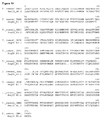
- Per definition variants of the parental polypeptide shall be distinguished from other polypeptides by comparison of sequence identity (alignments) using the ClustalW Algorithm ( Larkin M.A., Blackshields G., Brown N.P., Chenna R., McGettigan P.A., McWilliam H., Valentin F., Wallace I.M., Wilm A., Lopez R., Thompson J.D., Gibson T.J. and Higgins D.G. (2007) ClustalW and ClustalX version 2. Bioinformatics 2007 23(21): 2947-2948 ).
- Methods for the generation of such protein variants include random or site directed mutagenesis, site-saturation mutagenesis, PCR-based fragment assembly, DNA shuffling, homologous recombination in-vitro or in-vivo, and methods of gene-synthesis.
- amino acids amino acids, peptides, nucleotides and nucleic acids are done according to the suggestions of IUPAC. Generally amino acids are named within this document according to the one letter code.
- any amino acid residue may be substituted for the amino acid residue present in the position.
- the alanine may be deleted or substituted for any other amino acid residue (i.e. any one of R, N, D, C, Q, E, G, H, I, L, K, M, F, P, S, T, W, Y and V).
- similar mutation refers to an amino acid mutation that a person skilled in the art would consider similar to a first mutation. Similar in this context means an amino acid that has similar chemical characteristics. If, for example, a mutation at a specific position leads to a substitution of a non-aliphatic amino acid residue (e.g. Ser) with an aliphatic amino acid residue (e.g. Leu), then a substitution at the same position with a different aliphatic amino acid (e.g. Ile or Val) is referred to as a similar mutation.
- Further amino acid characteristics include size of the residue, hydrophobicity, polarity, charge, pK-value, and other amino acid characteristics known in the art.
- a similar mutation may include substitution such as basic for basic, acidic for acidic, polar for polar etc.
- the sets of amino acids thus derived are likely to be conserved for structural reasons. These sets can be described in the form of a Venn diagram ( Livingstone CD, and Barton GJ. (1993) "Protein sequence alignments: a strategy for the hierarchical analysis of residue conservation” Comput.Appl Biosci. 9: 745-756 ; Taylor W. R. (1986) "The classification of amino acid conservation” J.Theor.Biol. 119; 205-218 ).
- the first glutamine (Q) of the amino acid sequence QQAGTA within the parental protein sequence given in SEQ ID NO: 2 is referred to as position number 1 or Q1 or glutamine 1.
- the numbering of all amino acids will be according to their position in the parental sequence given in SEQ ID NO: 2 relative to this position number 1.
- the present invention furthermore discloses variants of the polypeptides of the present invention with changes of their sequence at one or more of the positions: Q1, G4, A6, T15, Q28, W40, D64, E65, A72, S86, K92, V130, V152, Y155, K159, D181, E183, N194, D202, P224, T243, Y244, I277, K304, N310, S311, N318, D320, T335, T344, D346, Q349, A358, Y374, A375, T392, T393, D410, Y422, P442, N445, R446, T456, S460, P462, G463, H468 and/or V482 of amino acids 1 to 500 of SEQ ID NO: 2.
- the variant of the polypeptides of the present invention comprises one or more specific changes of their sequence at the following positions (preferred exchange) or a similar mutation.
- Position Preferred Exchange Similar mutation Q1 L I, L, V, A,G, G4 C C,D,E,R,H,K A6 G, V I, L, V,G T15S S Q, N Q28 R H, K, R W40 R H,K,R D64 N Q, N, S, T, E E65 K, V H,K,R A72 C, V M, I, L, V, G, C S86 T H, K, R, E, D, C, T, N K92 R H, R V130 I F, W, Y, H, K, M, I, L, A, G V152 A, E D, E, A, I, L, G, P Y155 C C,D,E,R,H K159 E D, E D181 N Y, H, K, R, C, S, T, N E183 V
- the variant of the polypeptides of the present invention comprises an amino acid sequence selected from the sequences with mutations with respect to SEQ ID NO: 2, optionally fused with a C-terminal 6x-His Tag, listed in the following Table. Mutations with respect to SEQ ID NO: 2 1 G4C,A72G 2 G4C,Y163C 3 W40R,K159E,N445D 4 E183V 5 N158D,G486S,Y495C 6 W40R 7 S311N 8 T335I 9 W40R,C489R 10 N37S,T243I,R446S 11 T48A 12 W40R,M234K 13 T243I,T325A,V482A 14 E65K 15 T344M 16 Q349R,P441L 17 Q349R,N445D 18 P402S,S460P,Y477Y 19 A72V 20 Q349R,A354T,D373E,N445D 21 I2
- the present invention discloses a nucleic acid encoding the polypeptide of the present invention.
- the nucleic acid is a polynucleotide sequence (DNA or RNA) which is, when set under control of an appropriate promoter and transferred into a suitable biological host or chemical environment, processed to the encoded polypeptide, whereby the process also includes all post-translational and post-transcriptional steps necessary.
- the coding sequence can be easily adapted by variation of degenerated base-triplets, alteration of signal sequences, or by introduction of introns, without affecting the molecular properties of the encoded protein.
- the nucleic acid of the present invention has preferably at least 95 %, more preferably at least 97 %, and most preferably 100% identity to SEQ ID NO: 1.
- the present invention also provides a vector comprising this nucleic acid and a host transformed with said vector.
- the present invention also discloses methods for the production of polypeptides of the present invention and variants thereof in various host cells, including yeast and fungal hosts. It also discloses the use of the resulting strains for the improvement of protein properties by variation of the sequence. Furthermore, the present invention discloses methods for the application of such polypeptides in the hydrolysis of cellulose.
- a further aspect of the invention discloses vectors and methods for the production of protein variants of SEQ ID NO: 2, expressing them in yeast and testing their activity on cellulosic material by measuring the released mono- and/or oligomeric sugar molecules.
- the present invention further relates to a method of producing a cellobiohydrolase protein, comprising the steps:
- the host cell is derived from the group consisting of Saccharomyces, Schizosaccharomyces, Kluyveromyces, Pichia, Hansenula, Aspergillus, Trichoderma, Penicillium, Candida and Yarrowina.
- the host cell is preferably capable of producing ethanol, wherein most preferred yeasts include Saccharomyces cerevisiae, Pichia stipitis, Pachysolen tannophilus, or a methylotrophic yeast, preferably derived from the group of host cells comprising Pichia methanolica, Pichia pastoris, Pichia angusta, Hansenula polymorpha.
- yeast shall herein refer to all lower eukaryotic organisms showing a unicellular vegetative state in their life cycle. This especially includes organisms of the class Saccharomycetes, in particular of the genus Saccharomyces, Pachysolen, Pichia, Candida, Yarrowina, Debaromyces, Klyveromyces, Zygosaccharomyces.
- one aspect of the invention relates to the expression of the claimed polypeptide and variants thereof in yeast.
- the efficient expression of this fusion protein (SEQ ID NO: 2) and derivative protein variants of SEQ ID NO: 2 from yeast can be achieved by insertion of the nucleic acid molecule of SEQ ID NO: 1 starting from nucleotide position 1 into an expression vector under control of at least one appropriate promoter sequence and fusion of the nucleotide molecule to an appropriate signal peptide, for example to the signal peptide of the mating factor alpha of Saccharomyces cerevisiae.
- the polypeptide of the present invention and variants thereof are expressed and secreted at a level of more than 100 mg/l, more preferably of more than 200 mg/l, particularly preferably of more than 500 mg/l, or most preferably of more than 1 g/l into the supernatant after introduction of a nucleic acid encoding a polypeptide having an amino acid sequence with at least 85% sequence identity to the SEQ ID NO: 2 into a yeast.
- the cultivation and isolation of the supernatant can be carried out as described in Example 3.
- a further aspect the invention discloses methods for the production of a polypeptide according to the present invention in a filamentous fungus, preferably in a fungus of the genus Aspergillus or Trichoderma, more preferably in a fungus of the genus Trichoderma, most preferably in Trichoderma reesei.
- filamentous fungus preferably in a fungus of the genus Aspergillus or Trichoderma, more preferably in a fungus of the genus Trichoderma, most preferably in Trichoderma reesei.
- “Filamentous fungi” or “fungi” shall herein refer to all lower eukaryotic organisms showing hyphal growth during at least one state in their life cycle.
- the polypeptide is expressed by fusion of the coding region of a compatible signal sequence to the nucleic acid molecule starting with nucleotide position 52 of SEQ ID NO: 3, as it was done in SEQ ID NO: 3 with the signal sequence of the Trichoderma reesei CBHI, and the positioning of the fusion peptide under control of a sufficiently strong promoter followed by transfer of the genetic construct to the host cell. Examples for such promoters and signal sequences as well as techniques for an efficient transfer have been described in the art.
- the present invention further relates to a method for identifying polypeptides having cellobiohydrolase activity, comprising the steps of:
- nucleic acid of step a one may also use a nucleic acid comprising the catalytic domain of the sequence defined by SEQ ID NO: 6 or of the sequence according to claim 9.
- step d. may be performed by utilizing a well-plate format.
- This format preferably allows the high-throughput performance of the method for identifying polypeptides having cellobiohydrolase activity.
- the steps e. to g. of the method for identifying polypeptides having cellobiohydrolase activity are performed as follows:
- the method for identifying polypeptides having cellobiohydrolase activity comprises the additional steps of:
- the present invention further provides a method of preparing a polypeptide having cellobiohydrolase activity, comprising the steps:
- the polypeptide provided in step a. of the method of preparing a polypeptide having cellobiohydrolase activity is a wild type cellobiohydrolase derived from Trichoderma reesei.
- the present invention further provides polypeptides having cellobiohydrolase activity, which are obtainable by the method of preparing a polypeptide having cellobiohydrolase activity according to the present invention.
- the present invention provides a composition comprising a polypeptide and/or variants thereof of the present invention and one or more cellulases, e.g. one or more endoglucanases and/or one or more beta-glucosidases and/or one or more further cellobiohydrolases and/or one or more xylanases.
- Cellulases or “Cellulolytic enzymes” are defined as enzymes capable of hydrolysing cellulosic substrates or derivatives or mixed feedstocks comprising cellulosic polymers. Such enzymes are referred to as having "cellulolytic activity", thus being able to hydrolyze cellulose molecules from such material into smaller oligo- or monosaccharides.
- Cellulolytic enzymes include cellulases and hemicellulases, in particular they include cellobiohydrolases (CBHs), endoglucanases (EGs) and beta-glucosidases (BGLs).
- the present invention further provides a polypeptide having cellobiohydrolase activity, wherein the polypeptide comprises an amino acid sequence having at least 80 %, preferably at least 95%, more preferably at least 98%, even more preferably at least 99%, and most preferably 100% sequence identity to SEQ ID NO: 5, wherein one or more of the following amino acid residues of the sequence defined by SEQ ID NO: 5 are modified by substitution or deletion of: Q1, G4, A6, T15, Q28, W40, D64, E65, A72, S86, K92, V130, V152, Y155, K159, D181, E183, N194, D202, P224, T243, Y244, 1277, K304, N310, S311, N318, D320, T335, T344, D346, Q349, A358, Y374, A375, T392, T393, D410 and/or Y422 of amino acids 1 to 440 of SEQ ID NO: 5.
- the polypeptide having cellobiohydrolase activity with an amino acid sequence having at least 80 % sequence identity to SEQ ID NO: 5 comprises one or more of the following modified amino acid residues of the sequence defined by SEQ ID NO: 5: Q1L, G4, A6G/V, T15S, Q28Q/R, W40R, D64N, E65K/V, A72V, S86T, K92K/R, V130I/V, V152A/E, Y155C, K159E, D181N, E183V/K, N194C/R/Y/D/K/I/L/G/Q/S/V, D202Y/N/G, P224L, T243I/R/Y/A/F/Q/P/D/V/W/L/M, Y244F/H, I277V, K304R, N310D, S311G/N, N318Y, D320V/E/N, T335l, T3
- the polypeptide having cellobiohydrolase activity comprises one or more modified amino acid residues of the sequence defined by SEQ ID NO: 5 as indicated in the following Table: Mutations with respect to SEQ ID NO: 5 1 G4C,Y163C 2 E183V 3 W40R 4 S311N 5 T335I 6 T48A 7 W40R,M234K 8 E65K 9 T344M 10 A72V 11 I277V 12 D346G 13 S418P 14 G4C,W40R,A72C 15 W40R,T344M 16 W40R,Q349K 17 W40R,T344M,Q349K 18 G4C,A72C,T344M 19 G4C,A72C,Q349K 20 G4C,A72C,T344M,Q349K 21 G4C,W40R,A72C,T344M 22 G4C,W40R,A72C,Q349K 23 G4C,W40R,A72
- the present invention provides a polypeptide having cellobiohydrolase activity comprising an amino acid sequence having at least 85%, preferably at least 95%, more preferably at least 98%, even more preferably at least 99%, and most preferably 100% sequence identity to SEQ ID NO:12 wherein one or more of the following amino acid residues of the sequence defined by SEQ ID NO: 12 are modified by substitution or deletion: Q1, T15, Q28, W40, C72, V133, V155, Y158, T162, Y247, N307, G308, E317, S341, D345, Y370, T389, Q406, N441, R442, T452, S456, P458, G459, H464 and/or V478.
- the polypeptide having cellobiohydrolase activity comprising an amino acid sequence having at least 85 % sequence identity to SEQ ID NO: 12 comprises one or more of the following modified amino acid residues of the sequence defined by SEQ ID NO: 12: Exchange with respect to SEQ ID NO: 12 1 Q1L 2 T15S 3 Q28R 4 W40R 5 C72V 6 V133I 7 V155A,E 8 Y158C 9 T162E 10 Y247F,H 11 N307D 12 G308N 13 E317V,N 14 S341M 15 D345R,K 16 Y370P,R,H,S,A 17 T389A 18 Q406G 19 N441D 20 R442S,G 21 T452A 22 S456L,P 23 P458L,del 24 G459D 25 H464L,Q,R 26 V478A,I
- cellulosic material can be of natural, processed or artificial nature.
- Cellulosic material herein shall be defined as all sorts of pure, non-pure, mixed, blended or otherwise composed material containing at least a fraction of ⁇ -1-4-linked D-glucosyl polymers of at least 7 consecutive subunits.
- Prominent examples of cellulosic materials are all sort of cellulose containing plant materials like wood (soft and hard), straw, grains, elephant grass, hey, leaves, cotton and materials processed there from or waste streams derived from such processes.
- Cellulosic material used in an enzymatic reaction is herein also referred to as cellulosic substrate.
- the hydrolysis of the cellulose material can be a sequential process following cellobiohydrolase production or contemporary to the production in the yeast cell (consolidated bioprocess).
- the expression of cellulolytic enzymes in yeast is of special interest due to the ability of many yeasts to ferment the released sugars (C6 or C5) to ethanol or other metabolites of interest.
- a further embodiment of the invention thus relates to the application of whole cells expressing the polypeptide or variant thereof according to the present invention for the processing of cellulosic materials.
- the present invention discloses the use of a polypeptide and variants thereof or the composition of the present invention for the enzymatic degradation of cellulosic material, preferably lignocellulosic biomass, and/or for textiles processing and/or as ingredient in detergents and/or as ingredient in food or feed compositions.
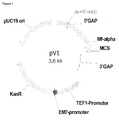
- Expression plasmids for the constitutive expression of protein from transformed Pichia pastoris hosts are prepared by assembly of an expression cassette consisting of a Pichia pastoris gyceraldehyde phosphate dehydrogenase (GAP) promoter, a Saccharomyces cerevisiae SP ⁇ (mating factor alpha signal peptide), a multiple cloning site (MCS) and the 3'-GAP-terminator sequence.
- GAP gyceraldehyde phosphate dehydrogenase
- SP ⁇ Saccharomyces cerevisiae SP ⁇
- MCS multiple cloning site
- 3'-GAP-terminator sequence for selection purposes a kanamycine resistance gene is used under control of the EM7 or TEF promoter for bacterial or yeast selection purposes, respectively.
- pV1 Figure 1
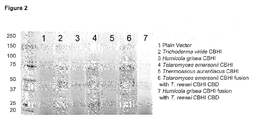
- CBHI genes of Trichoderma viride (CBH-f), Humicola grisea (CBH-d), Thermoascus aurantiacus (CBH-e), Talaromyces emersonii (CBH-b), and fusions of the cellulose binding domain of Trichoderma reesei CBHI with the Talaromyces emersonii CBHI (CBH-a) or the Humicola grisea CBHI (CBH-g) are amplified using the oligo nucleotide pairs and templates (obtained by gene synthesis) as given in the table.
- the fusion gene encoding SEQ ID NO: 2 is generated by overlap extension PCR using the PCR-Fragments generated from SEQ ID NOs:5 and 11. Phusion DNA polymerase (Finnzymes) is used for the amplification PCR.
- Table 1 Primers and templates for the amplification of CBH-a, CBH-b, CBH-d, CBH-e, CBH-f and CBH-g Fragment Primer forward Primer reverse Template CBH-f Trichoderma viride CBHI SEQID NO. 13 CBH-d Humicola grisea CBHI SEQID NO. 7 CBH-e Thermoascus aurantiacus CBHI SEQID NO.
- PCR fragments of expected length are purified from agarose gels after electrophoresis using the Promega® SV PCR and Gel Purification kit. Concentration of DNA fragments are measured on a Spectrophotometer and 0,2pmol of fragments are treated with 9U of T4-DNA polymerase in the presence of 2,5mM dATP for 37,5 min at 22,5°C and treated fragments are annealed with T4-DNA-Polymerase/dTTP treated Sma l-linearized pV1 plasmid DNA and afterwards transformed into chemically competent Escherichia coli Top10 cells.
- Plasmids of Example 2 are transformed to electro-competent Pichia pastoris CBS 7435 cells and transformants are used to inoculate cultures in YPD medium containing 200mg/l, which are incubated for 5 days at 27°C in a rotary shaker at 250 rpm. Culture supernatants were separated by centrifugation at 5000xg for 30 minutes in a Sorvall Avant centrifuge. Supernatants were concentrated on spin columns with cut-off size of 10kDa. Protein pattern of such concentrated supernatants were analyzed by SDS-PAGE (Laemmli et al.) and gels were stained with colloidal Commassie blue stain.
- Enzymatic activity was determined by incubation of the supernatant with 2mM solutions of p-nitraphenyl- ⁇ -D-lactoside or 200 ⁇ M solutions of 4-methyl-umbelliferyl- ⁇ -D-lactoside in 50 mM sodium acetate buffer (pH 5) for 1 hour. The reaction was stopped my addition of equal volumes of 1 M sodium carbonate solution and determination of released p-nitrophenol or 4-methyl umbelliferone by measurement of the absorbance at 405 nm or the fluorescence at 360 nm/ 450 nm excitation/emission.
- Example 4 Genome integration and expression of the Talaromyces emersonii CBHI- T. reesei CBHII-CBD fusion sequences in Pichia pastoris
- the DNA-fragment of the fusion gene are generated by 2 step overlap extension PCR using the oligo nucleotide pairs and synthetic templates as indicated in the table (of Example 2).
- T4-DNA polymerase treated full length fragment was annealed with the linear pV3 vector fragment by slowly reducing the temperature from 75°C to 4°C.
- the pV3 plasmid contains a fusion of the mating factor alpha signal peptide to a multiple cloning site, situated downstream the of a Pichia pastoris AOXI promoter. Transformation of the annealed solution into chemical competent E. coli cells yields transformants, which are selected by their Teocine resistance checked for containing expected construct plasmid by restriction analysis and sequencing.
- pV3-CBH-a plasmid preparations are linearized with SacI and approximately 1 ⁇ g of linear DNA-fragments are transformed to Pichia pastoris electrocompetent cells.
- 94 Transformants from YPD-Zeocin plates are afterwards checked for expression by cultivation in 500 ⁇ l 96-deepwell Plate cultures in BMMY-medium containing 1% methanol and 0.5 % methanol was fed every 24h for 5 days (350 rpm/27°C; humidified orbital shaker with 2,5 cm amplitude. Supernatants are tested for activity on 4-MUL and clones with highest expression levels are selected and again evaluated under same conditions.
- a YPD-Zeocin (100g/l) pre-culture is chosen for inoculation of Mineral medium consisting of phosphate-buffer, magnesium sulphate and chloride, trace elements/biotin and glycerol, with pH calibration using ammonia and phosphoric acid.
- additional glycerol feed is maintained for 1 day before the feed is changed to methanol to shift to inductive conditions for the AOXI promoter. Under these conditions the fermentation is kept for 5 days.
- Cells are separated from the fermentation liquid by centrifugation at 5000xg for 30 minutes. Supernatants are analyzed for total Protein using Bradford Reagent and BSA Standards (Biorad). SDS-PAGE / Coomassie Brilliant blue staining is used to analyze the Protein Pattern on the SDS-PAGE.
- SbfI/SwaI digested pSCMB100 plasmid DNA was transformed into Trichoderma reesei SCF41 essentially as described by Penttilä et al 1997. 10 ⁇ g of linear DNA was used for the transformation of 10 7 protoplasts. Selection of transformants was done by growth of the protoplasts on Mandel's Andreotti media plates with overlay agar, containing hygromycine as selective agent (100mg/l). Transformants were further purified by passage over sporolation media plates and re-selection of spores on hygromycin media. From re-grown mycelia genomic DNA was isolated and the replacement event verified by PCR. Transformants verified in being true replacement strains were further tested for secretion of recombinant protein.
- Random mutagenesis libraries of the Talaromyces emersonii CBHI / Trichoderma reesei - CBD fusion (with 6x His-Tag) gene were generated using error prone PCR applying manganese containing bufferers and inbalanced dNTP concentrations in the Taq -DNA polymerase reaction micture, used for PCR-amplification, essentially as described by Craig and Joyce ( R.Craig Cadwell and G.F. Joyce, 1995. Mutagenic PCR, in PCR Primer: a laboratory manual, ed. C. W. Dieffenbach and G. S. Dveksler, Cold Spring Harbor Press, Cold Spring Harbor, ME, 583-589 ).
- wild type fusion gene SEQ ID NO: 17
- mutants thereof were chosen. Mutated PCR-Fragments were cloned to the pPKGMe Plasmid using Sph I and Hind III endonucleases and T4-DNA-ligase.
- Plasmids of confirmed CBH-ah variants were recovered (Pierce DNAzol Yeast genomic DNA Kit) and sequenced using oligonucleotides alpha-f (5' TACTATTGCCAGCATTGCTGC-3') and oli740 (5'-TCAGCTATTTCACATACAAATCG-3').
- Example 8 Determination of Substrate Conversion Capacity at different temperatures for indication of the thermostability of CBH-ah-Variants using 4-methylumbellifery- ⁇ -D-lactoside 4-MUL
- thermal stability culture supernatants containing the secreted cellobiohydrolase variants were diluted tenfold in sodium acetate buffer (50mM, pH 5) and 10 ⁇ l samples were incubated with 90 ⁇ l of 200 ⁇ M 4-MUL (in buffer) in the temperature gradient of an Eppendorff Gradient Thermocycler. A temperature gradient of 20°C reaching from 55°C to 75°C was applied to 12 reaction mixtures for for each sample for one hour. The temperature profile could be recorded after addition of 100 ⁇ l 1M sodium carbonate solution to each reaction and measurement of the fluorescence intensity at 360nm/454nm in a Tecan Infinite M200 plate reader.
- Trichoderma reesei CBHI (CBH-c) Coding sequence for Trichoderma viride CBHI, including the alpha factor signal peptide.
- Trichoderma viride CBH (CBH-f) Coding Sequence for Humicola grisea CBHI- Trichoderma reesei CBHI cellulose binding domain fusion protein including the alpha factor signal peptide and a 6x His Tag.
- CBH-ah Mature Sequence of Talaromyces emersonii CBHI / Trichoderma reesei - CBD fusion with 6x-His tag
Landscapes
- Chemical & Material Sciences (AREA)
- Life Sciences & Earth Sciences (AREA)
- Health & Medical Sciences (AREA)
- Organic Chemistry (AREA)
- Genetics & Genomics (AREA)
- Engineering & Computer Science (AREA)
- Bioinformatics & Cheminformatics (AREA)
- Zoology (AREA)
- Wood Science & Technology (AREA)
- General Health & Medical Sciences (AREA)
- Biochemistry (AREA)
- General Engineering & Computer Science (AREA)
- Medicinal Chemistry (AREA)
- Biomedical Technology (AREA)
- Biotechnology (AREA)
- Molecular Biology (AREA)
- Microbiology (AREA)
- Micro-Organisms Or Cultivation Processes Thereof (AREA)
- Enzymes And Modification Thereof (AREA)
- Preparation Of Compounds By Using Micro-Organisms (AREA)
- Detergent Compositions (AREA)
- Medicines That Contain Protein Lipid Enzymes And Other Medicines (AREA)
- Immobilizing And Processing Of Enzymes And Microorganisms (AREA)
Abstract
Description
- The invention discloses cellulase enzymes with optimized properties for processing of cellulose- and lignocellulose-containing substrates. In particular, cellobiohydrolase enzymes with preferred characteristics are disclosed. The present invention provides fusion, insertion, deletion and/or substitution variants of such enzymes. Enzyme variants have enhanced thermostability, proteolytic stability, specific activity and/or stability at extreme pH. Nucleic acid molecules encoding said enzymes, a composition comprising said enzymes, a method for preparation, and the use for cellulose processing and/or for the production of biofuels are disclosed.
- The development of production processes based on renewable resources is highly desired, for example for the generation of ethanol from cellulosic and lignocellulosic materials.
- Cellulose material in pure form or in combination with hemicellulose and/or lignin is a valuable and readily available raw material for the production of chemicals and fuels. A key step in processing cellulose and lignocellulose is the hydrolysis of the beta-1,4-linked glucose polymer cellulose and the subsequent release of glucose monomers and short glucose oligomers such as cellobiose, cellotriose, etc. Enzymes that catalyze this reaction are found in various organisms, especially filamentous fungi and bacteria, that are capable of degrading and hydrolysing cellulose.
- Continuous processes for converting solid lignocellulosic biomass into combustible fuel products are known. Treatment to make cellulosic substrates more susceptible to enzymatic degradation comprises milling, chemical processing and/or hydrothermal processing. Examples are wet oxidation and/or steam explosion. Such treatments increase the accessibility of cellulose fibers and separate them from hemicellulose and lignin.
- A number of enzyme mixtures for hydrolysis of treated biomass are known in the literature. Typically a mixture of endoglucanase, exoglucanase and beta-glucosidase enzymes are required for the degradation of cellulose polymers. Among these cellobiohydrolase (CBH) enzymes, and more specifically cellobiohydralase I (CBHI) enzymes, play a key role in the hydrolysis step as they provide the most processive enzymatic activity. CBHI enzymes catalyze the progressive hydrolytic release of cellobiose from the reducing end of the cellulose polymers. (Lynd LR, Weimer PJ, van Zyl WH, Pretorius IS. Microbial cellulose utilization: fundamentals and biotechnology. Microbiol Mol Biol Rev. 2002 Sep;66(3):506-77).
- Hydrolyzed cellulosic materials contain several valuable carbohydrate molecules which can be isolated from the mixtures. Sugar containing hydrolysates of cellulosic materials can be used for microbial production of a variety of fine chemicals or biopolymers, such as organic acids, ethanol or higher alcohols (also diols or polyols) or polyhydroxyalkanoates (PHAs). One of the major uses of the sugar hydrolysates is in the production of biofuels.
- Kurabi et al. (2005) describes preparations of cellulases from Trichoderma reesei and other fungi, such as Penicillium sp. The performance has been analysed on steam-exploded and ethanol organosolv-pretreated Douglas-fir. Better performance of enzyme mixtures appears to be a result of improved properties of single component enzymes as well as the effect of each compound in the mixture, especially the presence of beta-glucosidase. (Kurabi A, Berlin A, Gilkes N, Kilburn D, Bura R, Robinson J, Markov A, Skomarovsky A, Gusakov A, Okunev O, Sinitsyn A, Gregg D, Xie D, Saddler J.(2005) Enzymatic hydrolysis of steam-exploded and ethanol organosolv-pretreated Douglas-Fir by novel and commercial fungal cellulases. Appl Biochem Biotechnol.121-124: 219-30).
- Cellobiohydrolase sequences of the glucohydrolase class 7 (cel7) are known to the art from several fungal sources. The Talaromyces emersonii Cel7 cellobiohydrolase is known and expression was reported in Escherichia coli (Grassick A, Murray PG, Thompson R, Collins CM, Byrnes L, Birrane G, Higgins TM, Tuohy MG. Three-dimensional structure of a thermostable native cellobiohydrolase, CBH IB, and molecular characterization of the cel7 gene from the filamentous fungus, Talaromyces emersonii. Eur J Biochem. 2004 Nov;271 (22):4495-506) and Saccharomyces cerevisiae (Voutilainen SP, Murray PG, Tuohy MG, Koivula A. Expression of Talaromyces emersonii cellobiohydrolase Cel7A in Saccharomyces cerevisiae and rational mutagenesis to improve its thermostability and activity. Protein Eng Des Sel. 2010 Feb;23(2):69-79), however the protein was either produced in inactive form or at rather low yields (less or equal to 5mg/l). Hypocrea jecorina cellobiohydrolase I can be produced from wild type or engineered strains of the genus Hypocrea or Trichoderma at high yields. Improved sequences of Hypocrea jecorina Cel7A are disclosed by
US7459299B2 ,US7452707B2 ,WO2005/030926 ,WO01/04284A1 US2009/0162916 A1 . - Positions leading to improvements were deduced from alignments with sequences from reported thermostable enzymes, suggested from structural information and shuffling of identified positions followed by limited screenings. Screening of larger libraries in transformable organisms such as Saccharomyces cerevisiae was reported by application of very sensitive fluorescent substrates, which resemble native substrates in a very restricted way. (Percival Zhang YH, Himmel ME, Mielenz JR. Outlook for cellulase improvement: screening and selection strategies. Biotechnol Adv. 2006 Sep-Oct;24(5):452-81).
- The production of cellobiohydrolases from other fungal systems such as Thermoascus aurantiacus, Chrysosporium lucknowense or Phanerochaete chrysosporium was reported. Expression of Cel7 cellobiohydrolase from yeasts was reported, but enzymatic yields or enzyme properties remain unsatisfactory. (Penttilä ME, André L, Lehtovaara P, Bailey M, Teeri TT, Knowles JK. Efficient secretion of two fungal cellobiohydrolases by Saccharomyces cerevisiae. Gene. 1988;63(1):103-12).
-
WO03/000941 -
US 2009042266 (A1 ) discloses fusions of Thermoascus aurantiacus Cel7A with cellulose binding domains from cellobiohydrolase i from Chaetomium thermophilum and Hypocrea jecorina. -
US5686593 reports the fusion of specially designed linker regions and binding domains to cellobiohydrolases. - Hong et al. (2003) describe the production of Thermoascus aurantiacus CBHI in yeast and its characterization. (Hong J, Tamaki H, Yamamoto K, Kumagai H Cloning of a gene encoding thermostable cellobiohydrolase from Thermoascus aurantiacus and its expression in yeast. Appl Microbiol Biotechnol. 2003 Nov;63(1):42-50).
- Tuohy et al. (2002) report the expression and characterization of Talaromyces emersonii CBH. (Tuohy MG, Walsh DJ, Murray PG, Claeyssens M, Cuffe MM, Savage AV, Coughlan MP.:Kinetic parameters and mode of action of the cellobiohydrolases produced by Talaromyces emersonii. Biochim Biophys Acta. 2002 Apr 29;1596(2):366-80).
- Nevoigt et al. (2008) reports on the expression of cellulolytic enzymes in yeasts. (Nevoigt E. Progress in metabolic engineering of Saccharomyces cerevisiae. Microbiol Mol Biol Rev. 2008 Sep;72(3):379-412).
- Fujita et al. (2004) reports on a Saccharomyces cervisiae strain expressing a combination of an endoglucanase, a beta glucosidase and a CBHII displayed on the cell surface. Cellobiohydrolase I (Cel7) was not used in this setup. (Fujita Y, Ito J, Ueda M, Fukuda H, Kondo A. Synergistic saccharification, and direct fermentation to ethanol, of amorphous cellulose by use of an engineered yeast strain codisplaying three types of cellulolytic enzyme. Appl Environ Microbiol. 2004 Feb;70(2):1207-12).
- Boer H et al. (2000) describes the expression of GH7 classified enzymes in different yeast hosts but expressed protein levels were low. (Boer H, Teeri TT, Koivula A. Characterization of Trichoderma reesei cellobiohydrolase Cel7A secreted from Pichia pastoris using two different promoters. Biotechnol Bioeng. 2000 ).
- Godbole et al (1999) and Hong et al ( 2003) found that proteins of this enzyme class expressed fom yeast were often misfolded, hyperglycosylated and hydrolytic capabilities decreased compared to the protein expressed from the homologous host. (Godbole S, Decker SR, Nieves RA, Adney WS, Vinzant TB, Baker JO, Thomas SR, Himmel ME. Cloning and expression of Trichoderma reesei cellobiohydrolase I in Pichia pastoris. Biotechnol Prog. 1999 Sep-Oct;15(5):828-33).
- Kanokratana et al (2008), Li et al (2009) as well as
CN01757710 describe the efficient expression of Cel7 CBH I enzymes, however these proteins are lacking celllulose binding domains required for efficient substrate processing. (Kanokratana P, Chantasingh D, Champreda V, Tanapongpipat S, Pootanakit K, Eurwilaichitr L Identification and expression of cellobiohydrolase (CBHI) gene from an endophytic fungus, Fusicoccum sp. (BCC4124) in Pichia pastoris. LProtein Expr Purif. 2008 Mar;58(1):148-53. Epub 2007 Sep 19; Li YL, Li H, Li AN, Li DC. Cloning of a gene encoding thermostable cellobiohydrolase from the thermophilic fungus Chaetomium thermophilum and its expression in Pichia pastoris. J Appl Microbiol. 2009 Jun; 106(6):1867-75). - Voutilainen (2008) and Viikari (2007) disclose Cel7 enzymes comprising thermostable cellobiohydrolases, however with only low to moderate expression levels from Trichoderma reesei, (Voutilainen SP, Puranen T, Siika-Aho M, Lappalainen A, Alapuranen M, Kallio J, Hooman S, Viikari L, Vehmaanperä J, Koivula A. Cloning, expression, and characterization of novel . PubMed PMID: 18512263; Viikari L, Alapuranen M, Puranen T, Vehmaanperä J, Siika-Aho M. Thermostable enzymes in lignocellulose hydrolysis. Adv Biochem Eng Biotechnol. 2007;108:121-45).
- Grassick et al, (2004) disclose unfolded expression of Cellobiohydrolase I from Talaromyces emersonii in Escherichia coli but not in yeast. (Grassick A, Murray PG, Thompson R, Collins CM, Byrnes L, Birrane G, Higgins TM, Tuohy MG. Three-dimensional structure of a thermostable native cellobiohydrolase, CBH IB, and molecular characterization of the cel7 gene from the filamentous fungus, Talaromyces emersonii. Eur J Biochem. 2004 Nov;271(22):4495-506).
- Therefore, there is a need for cellulase enzymes with improved characteristics for the use in technical processes for cellulose hydrolysis. In particular there is a need for CBH enzymes with higher catalytic activity and/or higher stability under process conditions. Moreover there is a need for CBH enzymes with higher productivity in fungal and/or yeast expression and secretion systems.
- The present invention provides a polypeptide having cellobiohydrolase activity. This polypeptide comprises an amino acid sequence with at least 85 % sequence identity to SEQ ID NO: 2.
- Furthermore, the present invention discloses a nucleic acid encoding the polypeptide of the present invention, preferably having at least 95 % identity to SEQ ID NO: 1, a vector comprising this nucleic acid and a host transformed with said vector.
- The present invention further provides a method of producing a cellobiohydrolase protein encoded by a vector of the present invention, a method for identifying polypeptides having cellobiohydrolase activity, and a method of preparing such polypeptides having cellobiohydrolase activity.
- The present invention also provides a polypeptide having cellobiohydrolase activity, wherein the polypeptide comprises an amino acid sequence having at least 85 % sequence identity to SEQ ID NO: 2 wherein one or more of the following amino acid residues of the sequence defined by SEQ ID NO: 2 are modified by substitution or deletion: Q1, G4, A6, T15, Q28, W40, D64, E65, A72, S86, K92, V130, V152, Y155, K159, D181, E183, N194, D202, P224, T243, Y244, I277, K304, N310, S311, N318, D320, T335, T344, D346, Q349, A358, Y374, A375, T392, T393, D410, Y422, P442, N445, R446, T456, S460, P462, G463, H468 and/or V482 of
amino acids 1 to 500 of SEQ ID NO: 2. - Moreover, the present invention provides a polypeptide having cellobiohydrolase activity, which is obtainable by the method of preparing a polypeptide having cellobiohydrolase activity according to the present invention, and a polypeptide having cellobiohydrolase activity, wherein the polypeptide comprises an amino acid sequence having at least 80 % sequence identity to SEQ ID NO: 5, wherein one or more of the following amino acid residues of the sequence defined by SEQ ID NO: 5 are modified by substitution or deletion: Q1, G4, A6, T15, Q28, W40, D64, E65, A72, S86, K92, V130, V152, Y155, K159, D181, E183, N194, D202, P224, T243, Y244, I277, K304, N310, S311, N318, D320, T335, T344, D346, Q349, A358, Y374, A375, T392, T393, D410 and/or Y422 of
amino acids 1 to 440 of SEQ ID NO: 5. - The present invention furthermore provides a polypeptide having cellobiohydrolase activity comprising an amino acid sequence having at least 85 % sequence identity to SEQ ID NO: 12 wherein one or more of the following amino acid residues of the sequence defined by SEQ ID NO: 12 are modified by substitution or deletion: Q1, T15, Q28, W40, C72, V133, V155, Y158, T162, Y247, N307, G308, E317, S341, D345, Y370, T389, Q406, N441, R442, T452, S456, P458, G459, H464 and/or V478.
- The present invention furthermore discloses a composition comprising a polypeptide of the present invention and one or more endoglucanases and/or one or more beta-glucosidases and/or one or more further cellobiohydrolases and/or one or more xylanases.
- The present invention further provides the use of a polypeptide or the composition of the present invention for the enzymatic degradation of lignocellulosic biomass, and/or for textiles processing and/or as ingredient in detergents and/or as ingredient in food or feed compositions.
-
-
Figure 1 : Restriction Maps of pV1 for constitutive expression of Proteins in Pichia pastoris: pUC19 - ori: Origin of replication in E. coli; KanR: Kanamycine/G418 Resistance with TEF1 and EMZ Promoter sequences for selection in Pichia pastoris and E. coli, respectively; 5'GAP: glyceraldehyde-3-phosphate dehydrogenase Promoter region; 3'-GAP: terminator region; SP MFalpha: Saccharomyces cerevisiae mating factor alpha signal sequence; MCS: multiple cloning site. -
Figure 2 : Commassie stained SDS-PAGE of 10-fold concentrated supernatants of shakeflask cultures of Pichia pastoris CBS 7435 containing expression plasmids with coding sequences for the mature CBHI proteins of Trichoderma viride (CBH-f; lane 2), Humicola grisea (CBH-d; lane 3), Talaromyces emersonii (CBH-b; lane 4), Thermoascus aurantiacus (CBH-e; lane 5), as well as the Talaromyces emersonii CBHI-CBD fusion (CBH-a; lane 6) and the Humicola grisea-CBD fusion (CBH-g; lane 7) in N-terminal fusion to the signal peptide of the Saccharomyces cerevisiae mating factor alpha under control of the Pichia pastoris glyceraldehyde-3-phosphate dehydrogenase promoter. -
Figure 3 : Map of the pV3 expression plasmid for protein expression in Pichia pastoris. Replicons: pUC19 - ori: Origin of replication in E. coli; ZeoR: Zeocine resistance gene with TEF1 and EM7 promoter sequences for expression in Pichia pastoris and E. coli, respectively; AOX I promoter: Promoter region of the Pichia pastoris alcohol oxidase I gene;AOX 1 transcriptional terminator: terminator region; SP MFalpha: Saccharomyces cerevisiae mating factor alpha signal sequence; MCS: multiple cloning site. -
Figure 4 : SDS-PAGE analysis of culture supernatant samples taken from the fermentation of a Pichia pastoris strain with a genomic integration of an AOXI-expression cassette, expressing the Talaromyces emersonii CBHI / Trichoderma reesei -CBD fusion peptide (CBH-a) in a 71 bioreactor during methanol induction. Samples P1 - P7 are taken at the beginning of the methanol induction and after 20, 45, 119.5, 142.5, 145.5 and 167 hours, respectively. -
Figure 5 : Map of pV4 expression plasmid for the expression of the Talaromyces emersonii CBHI / Trichoderma reesei-CBD fusion peptide (CBH-ah) in Trichoderma reesei. Replicon: pUC19 for replication in E. coli. cbh1 5': 5' promoter region of the Trichoderma CBHI gene; cbh1 signal peptide: Coding sequence for the Trichoderma reesei CBHI leader peptide; CBH-a: Talaromyces emersonii CBHI / Trichoderma reesei -CBD fusion peptide: coding region for SEQ ID NO: 18; cbh1 Terminator: 3' termination region of the Trichoderma reesei CBHI locus; hygromycine resistance: coding region of the hygromycine phosphotransferase under control of a Trichoderma reesei phosphoglycerate kinase promoter; cbh1 3': homology sequence to the termination region of the Trichoderma reesei CBHI locus for double crossover events. -
Figure 6 : SDS-Page of Trichoderma reesei culture supernatants.Lane 1 shows the expression pattern of a replacement strain carrying a Talaromyces emersonii CBHI / Trichoderma reesei -CBD fusion (CBH-ah) inplace of the native CBHI gene. Incomparison lane 2 shows the pattern for the unmodified strain under same conditions. M: molecular size marker. -
Figure 7 : Determination of IT50 values from Substrate Conversion Capacity vs. temperature graphs after normalization. For the normalization step the maximum and the minimum fluorescence values for the selected temperature are correlated to 1 or 0, respectively. Linear interpolation to F'(T)=0.5 between the nearest two temperature points with normalized values next to 0.5 results in the defined IT50 temperature. -
Figure 8 : Normalized Conversion Capacity vs. temperature graphs of "wt" Talaromyces emersonii CBHI / Trichoderma reesei -CBD fusions (CBH-ah: SEQ ID NO: 18 = SEQ ID NO: 2 + 6x His-Tag) and mutants based on 4-Methylumbelliferyl -β-D-lactoside hydrolysis results evaluated at various temperatures. The fluorescence values were normalized according tofigure 8 over the temperature range from 55°C to 75°C.- A
- wt;
- B
- G4C,A72C;
- C
- G4C,A72C,Q349K:
- D
- G4C,A72C,DT81N,Q349K;
- E
- Q1L,G4C,A72C,D181N,E183K,Q349R;
- F
- Q1L,G4C,A72C,S86T,D181N,E183K,D320V,Q349R;
- G
- G4C,A72C,E183K,D202Y,N310D,Q349R;
- H
- Q1L,G4C,A72C, A145T,H203R,Q349K,T403K;
-
Figure 9 : Glucose yields of hydrolysis of pretreated straw with wt and mutated Talaromyces emersonii CBHI / Trichoderma reesei -CBD (CBH-ah) fusion protein after hydrolysis for 48 hours in the presence of a β-glycosidase. The variants are characterized by the following mutations with respect to SEQ ID NO: 18 and were expressed from Pichia pastoris in shake flask cultures and isolated from the supernatant by affinity chomatography using Ni-NTA.- A: wt
- B: G4C,A72C
- C: G4C,A72C,Q349K
- D: G4C,A72C,D181N,Q349K
- E: Q1L,G4C,A72C,D181N,E183K,Q349R
- F: Q1L,G4C,A72C,S86T,D181N,E183K,D320V,Q349R
- G: G4C, A72C, E183K,D202Y,N310D,Q349R
-
Figure 10 : Alignment of SEQ ID NO: 2 with the Trichoderma reesei CBHI. The alignment matrix blosum62mt2 with gap opening penalty of 10 and gap extension penalty of 0.1 was used to create the alignment. - The present invention discloses a polypeptide having cellobiohydrolase activity, which comprises an amino acid sequence with at least 85 % sequence identity to SEQ ID NO: 2. "Cellobiohydrolase" or "CBH" refers to enzymes that cleave cellulose from the end of the glucose chain and produce cellobiose as the main product. Alternative names are 1,4-beta-D-glucan cellobiohydrolases or
cellulose 1,4-beta-cellobiosidases. CBHs hydrolyze the 1,4-beta-D-glucosidic linkages from the reducing or non-reducing ends of a polymer containing said linkages. "Cellobiohydrolase I" or "CBH I" act from the reducing end of the cellulose fiber. "Cellobiohydrolase II" or "CBH II" act from the non-reducing end of the cellulose fiber. Cellobiohydrolases typically have a structure consisting of a catalytic domain and one or more "cellulose-binding domains" or "CBD". Such domains can be located either at the N- or C-terminus of the catalytic domain. CBDs have carbohydrate-binding activity and they mediate the binding of the cellulase to crystalline cellulose and presence or absence of binding domains are known to have a major impact on the processivity of an enzyme especially on polymeric substrates. - The parental sequence is given in SEQ ID NO: 2. The sequence derives from the C-terminal fusion of the linker domain and cellulose binding domain of Trichoderma reesei CBHI (SEQ ID NO: 4) to the catalytic domain of Talaromyces emersonii CBHI (SEQ ID NO: 5).
- In a preferred aspect, the invention discloses protein variants that show a high activity at high temperature over an extended period of time. Preferably, the polypeptide of the present invention maintains 50 % of its maximum substrate conversion capacity when the conversion is done for 60 minutes at a temperature of 60 °C or higher. The respective temperature is also referred to as the IT50 value. In other words, the IT50 value is preferably 60 °C or higher. "Substrate Conversion Capacity" of an enzyme is herein defined as the degree of substrate conversion catalyzed by an amount of enzyme within a certain time period under defined conditions (Substrate concentration, pH value and buffer concentration, temperature), as can be determined by end-point assaying of the enzymatic reaction under said conditions. "Maximum Substrate Conversion Capacity" of an enzyme is herein defined as the maximum in Substrate Conversion Capacity found for the enzyme within a number of measurements performed as described before, where only one parameter, e.g. the temperature, was varied within a defined range. According to the present invention, the assay described in Example 8 is used to determine these parameters.
- Furthermore, the polypeptides of the present invention have preferably an IT50 value in the range of 62 to 70 °C, more preferably 65 to 70 °C.
- The polypeptide of the present invention preferably comprises an amino acid sequence having at least 90 %, preferably at least 95 %, more preferably at least 99 % sequence identity to SEQ ID NO: 2. Furthermore, it is particularly preferred that the amino acid sequence of the polypeptide has the sequence as defined by SEQ ID NO: 2, or a sequence as defined by SEQ ID NO: 2 wherein 1 to 75, more preferably 1 to 35 amino acid residues are substituted, deleted, or inserted.
- Particularly preferred are variants of the protein of SEQ ID NO: 2. "Protein variants" are polypeptides whose amino acid sequence differs in one or more positions from this parental protein, whereby differences might be replacements of one amino acid by another, deletions of single or several amino acids, or insertion of additional amino acids or stretches of amino acids into the parental sequence. Per definition variants of the parental polypeptide shall be distinguished from other polypeptides by comparison of sequence identity (alignments) using the ClustalW Algorithm (Larkin M.A., Blackshields G., Brown N.P., Chenna R., McGettigan P.A., McWilliam H., Valentin F., Wallace I.M., Wilm A., Lopez R., Thompson J.D., Gibson T.J. and Higgins D.G. (2007) ClustalW and ). Methods for the generation of such protein variants include random or site directed mutagenesis, site-saturation mutagenesis, PCR-based fragment assembly, DNA shuffling, homologous recombination in-vitro or in-vivo, and methods of gene-synthesis.
- The nomenclature of amino acids, peptides, nucleotides and nucleic acids is done according to the suggestions of IUPAC. Generally amino acids are named within this document according to the one letter code.
- Exchanges of single amino acids are described by naming the single letter code of the original amino acid followed by its position number and the single letter code of the replacing amino acid, i.e. the change of glutamine at position one to a leucine at this position is described as "Q1L". For deletions of single positions from the sequence the symbol of the replacing amino acid is substituted by the three letter abbreviation "del" thus the deletion of alanine at
position 3 would be referred to as "A3del". Inserted additional amino acids receive the number of the preceding position extended by a small letter in alphabetical order relative to their distance to their point of insertion. Thus, the insertion of two tryptophanes afterposition 3 is referred to as "3aW, 3bW". Introduction of untranslated codons TAA, TGA and TAG into the nucleic acid sequence is indicated as "*" in the amino acid sequence, thus the introduction of a terminating codon atposition 4 of the amino acid sequence is referred to as "G4*". - Multiple mutations are separated by a plus sign or a slash or a comma. For example, two mutations in
positions 20 and 21 substituting alanine and glutamic acid for glycine and serine, respectively, are indicated as "A20G+E21S" or "A20G/E21S" "A20G,E21S". - When an amino acid residue at a given position is substituted with two or more alternative amino acid residues these residues are separated by a comma or a slash. For example, substitution of alanine at position 30 with either glycine or glutamic acid is indicated as "A20G,E" or "A20G/E", or "A20G, A20E".
- When a position suitable for modification is identified herein without any specific modification being suggested, it is to be understood that any amino acid residue may be substituted for the amino acid residue present in the position. Thus, for instance, when a modification of an alanine in
position 20 is mentioned but not specified, it is to be understood that the alanine may be deleted or substituted for any other amino acid residue (i.e. any one of R, N, D, C, Q, E, G, H, I, L, K, M, F, P, S, T, W, Y and V). - The terms "similar mutation" or "similar substitution" refer to an amino acid mutation that a person skilled in the art would consider similar to a first mutation. Similar in this context means an amino acid that has similar chemical characteristics. If, for example, a mutation at a specific position leads to a substitution of a non-aliphatic amino acid residue (e.g. Ser) with an aliphatic amino acid residue (e.g. Leu), then a substitution at the same position with a different aliphatic amino acid (e.g. Ile or Val) is referred to as a similar mutation. Further amino acid characteristics include size of the residue, hydrophobicity, polarity, charge, pK-value, and other amino acid characteristics known in the art. Accordingly, a similar mutation may include substitution such as basic for basic, acidic for acidic, polar for polar etc. The sets of amino acids thus derived are likely to be conserved for structural reasons. These sets can be described in the form of a Venn diagram (Livingstone CD, and Barton GJ. (1993) "Protein sequence alignments: a strategy for the hierarchical analysis of residue conservation" Comput.Appl Biosci. 9: 745-756; Taylor W. R. (1986) "The classification of amino acid conservation" J.Theor.Biol. 119; 205-218). Similar substitutions may be made, for example, according to the following grouping of amino acids: Hydrophobic: F W Y H K M I L V A G; Aromatic: F W Y H; Aliphatic: I L V; Polar: W Y H K R E D C S T N; Charged H K R E D; Positively charged: H K R; Negatively charged: E D.
- As convention for numbering of amino acids and designation of protein variants for the description of protein variants the first glutamine (Q) of the amino acid sequence QQAGTA within the parental protein sequence given in SEQ ID NO: 2 is referred to as
position number 1 or Q1 orglutamine 1. The numbering of all amino acids will be according to their position in the parental sequence given in SEQ ID NO: 2 relative to thisposition number 1. - The present invention furthermore discloses variants of the polypeptides of the present invention with changes of their sequence at one or more of the positions: Q1, G4, A6, T15, Q28, W40, D64, E65, A72, S86, K92, V130, V152, Y155, K159, D181, E183, N194, D202, P224, T243, Y244, I277, K304, N310, S311, N318, D320, T335, T344, D346, Q349, A358, Y374, A375, T392, T393, D410, Y422, P442, N445, R446, T456, S460, P462, G463, H468 and/or V482 of
amino acids 1 to 500 of SEQ ID NO: 2. - In a preferred embodiment, the variant of the polypeptides of the present invention comprises one or more specific changes of their sequence at the following positions (preferred exchange) or a similar mutation.
Position Preferred Exchange Similar mutation Q1 L I, L, V, A,G, G4 C C,D,E,R,H,K A6 G, V I, L, V,G T15S S Q, N Q28 R H, K, R W40 R H,K,R D64 N Q, N, S, T, E E65 K, V H,K,R A72 C, V M, I, L, V, G, C S86 T H, K, R, E, D, C, T, N K92 R H, R V130 I F, W, Y, H, K, M, I, L, A, G V152 A, E D, E, A, I, L, G, P Y155 C C,D,E,R,H K159 E D, E D181 N Y, H, K, R, C, S, T, N E183 V, K I, L, V, A, G, R, K, H N194 C, R, Y, D, K, I, L, G, Q, S, V F, W, C, R, Y, D, K, I, L, G, Q, S, V, H D202 Y,N,G A, R, N, C, Q, G, H, I, L, K, M, F, P, S, T, W, Y, V P224 L I, L, V, A, G T243 I, C, R, Y, A, F, Q, P, D, V, W, L, M H, K, I, C, R, Y, A, F, Q, P, D, V, W, L, M Y244 F, H F, W, H, I277 V G, A K304 R H, R N310 D C, D, E, R, H S311 G, N I, L, V, A, G, Q, T, D, N318 Y F, W, Y, H D320 V, E, N W, Y, H, K, R, E, C, S, T, N T335 I F, W, Y, H, K, M, I, L, V, A, G T344 M F, W, Y, H, K, M, I, L, V, A, G D346 G, A, E I, L, V, A, G Q349 R, K H, K, R 358 E F, W, Y, H, K, M, I, L, V, G Y374 C, P, R, H, S, A C, P, R, H, S, A, K, E, D, C, F A375 C, D, N, Y, R, Q, L, V, E, G, T, M H, K, C, D, N, Y, R, Q, L, V, E, G, T, M T392 C, D, K H, K, R, E, D, C T393 A I, L, V, A, G, D410 G F, W, Y, H, K, M, I, L, V, A, G Y422 F H, F, W P442 S, del S, del, T N445 D D, E, Q R446 S, G A, S, G, V, I, L, C, P T456 A S, A, G, I, L, V, C, P S460 L, P G, A, I, L, P, V P462 L, del G, A, I, L, V, del G463 D D, E H468 L, Q, R K, R, E, D, C, S, T, N V482 A, I G, L, A, I - Even more preferably, the variant of the polypeptides of the present invention comprises an amino acid sequence selected from the sequences with mutations with respect to SEQ ID NO: 2, optionally fused with a C-terminal 6x-His Tag, listed in the following Table.
Mutations with respect to SEQ ID NO: 2 1 G4C,A72G 2 G4C,Y163C 3 W40R,K159E,N445D 4 E183V 5 N158D,G486S,Y495C 6 W40R 7 S311N 8 T335I 9 W40R,C489R 10 N37S,T243I,R446S 11 T48A 12 W40R,M234K 13 T243I,T325A,V482A 14 E65K 15 T344M 16 Q349R,P441L 17 Q349R,N445D 18 P402S,S460P,Y477Y 19 A72V 20 Q349R,A354T,D373E,N445D 21 I277V 22 T335I,D346A,T393A,D410G 23 D346G 24 S418P 25 G4C,W40R,A72C 26 W40R,T344M 27 W40R,Q349K 28 W40R,T344M,Q349K 29 G4C,A72C,T344M 30 G4C,A72C,Q349K 31 G4C,A72C,T344M,Q349K 32 G4C,W40R,A72C,T344M 33 G4C,W40R,A72C,Q349K 34 G4C,W40R,A72C,T344M,Q349K 35 Y496F 36 S467T 37 N54S,N194Y 38 R446G 39 V130I,H350Y 40 K92R 41 T3251 42 Y60H 43 T229A 44 D346G,R453G 45 D320E 46 E65V,Q349R 47 T392M 48 W40R,N445D 49 W40R,T344M,N445D 50 W40R,Q349K,N445D 51 W40R,T344M,Q349K,N445D 52 G4C,A72C,D346G 53 G4C,A72C,Q349R 54 G4C,A72C,D346G,Q349R 55 G4C,A72C,T344M,D346G,Q349R 56 A72V,Q349R,N445D 57 G4C,A6G,A72C,Q349K 58 G4C,A72C,Q349K,A376T 59 G4C,A72C,Q349K,E65V,Q349R 60 G4C,A72C,Q349K,H468Q 61 G4C,A72C,Q349K,S24N 62 G4C,P12Q,A72C,Q349K,Q362H 63 N194C,Y374C 64 T243C,A375C 65 T243C,A375C,N194C,Y374C 66 G4C,A72C,Q349K,D320V 67 G4C,A72C,Q349K,G434S,G470D 68 G4C,A72C,Q349K,Q28R,S193T,Q490L 69 G4C,A72C,Q349K,S86T 70 G4C,A72C,Q349K,T448A,T449A 71 G4C,A72C,K92R,Q349K,N493D 72 G4C,A72C,D181N,Q349K 73 G4C,A72C,E183V,K304R,Q349K 74 G4C,AT2C,S311N,Q349K,A465T 75 Q1L,G4C,A72C,Q349K 76 G4C,A72C,S86T,M234V,Q349K 77 G4C,A72C,E183K,Q349K 78 G4C,A72C,S311G,Q349K 79 G4C,D64N,A72C,Q349K 80 G4C,A72C,D181N,P224L,Q349K 81 G4C,A72C,E183K,N318Y,Q349K 82 G4C,A72C,E183V,Q349K 83 G4C,A72C,N194C,Y374C 84 G4C,A72C,N194C,Q349R,Y374C 85 N194R,Y374D 86 T243R,A375D 87 N194R,T243R,Y374D,A375D 88 Q1L,G4C,A72C,S86T,Q349R 89 Q1L,G4C,A72C,D181N,Q349R 90 Q1L,G4C,A72C,E183K,Q349R 91 Q1L,G4C,A72C,D181N,E183K,Q349R 92 Q1L,G4C,A72C,D320V,Q349R 93 Q1L,G4C,A72C,S86T,D181N,E183K,D320V,Q349R 94 G4C,A72C,Q349R,V367A 95 G4C,A72C,Q349R,R446S,T456A 96 G4C,A72C,E183K,D202Y,N310D,Q349R 97 G4C,D64N,A72C,Q349R,A358E,P464Q 98 Q1L,G4C,A72C,Q349R 99 G4C,A72C,G251R,Q349R 100 G4C,A72C,P224L,F306Y,Q349R 101 G4C,V32G,N49S,A72C,S193L,Q349R 102 G4C,A72C,D181N,Q349R 103 G4C,A72C,P224L,Q349R,S409L,P429S 104 G4C,A72C,D202N,Q349R 105 A72V,T335I,D346A,T393A,P436S 106 A72V,T335I,D346A,T393A,N445D 107 A72V,T335I,D346A,T393A 108 W40R,D346A,T393A 109 A72V,D346A,T393A,N445D 110 W40R,T335I,D346A,T393A,P436S 111 A72V,D346A,T393A 112 W40R,D320V,Q349K,T393A,N445D 113 G4C,E65V,A72C,Q349R 114 G4C,A72C,Q349R,G459D 115 G4C,A72C,D202N,S311N,Q349R,N493D 116 G4C,A72C,D202G,D320N,Q349R,A358E 117 G4C,A72C,Q349R,Y422F 118 G4C,S24N,E65K,A72C,Q349R,I430L,G439D 119 G4C,T48A,A72C,Q349R,P480S 120 G4C,A72V,Q349R,P462del 121 G4C,A72C,D320V,Q349R 122 G4C,E65V,A72C,Y244H,Q349R 123 G4C,A72C,E183K,Q349R 124 G4C,A72C,E183K,Q349R,P464L 125 G4C,A72C,Q349R,T465I 126 G4C,A72C,E183K,D346E,Q349R 127 G4C,A72C,S311G,Q349R 128 G4C,A72C,P224L,Q349R 129 G4C,A72C,S236Y,Q349R 130 D320V,D346A,Q349R,T393A,N445D 131 A72V,D320V,D346A,T393A,N445D 132 A72V,D320V,D346A 133 A72V,D320V,T3351,D346A,T393A,N446D 134 D320V,D346A,T393A,N445D 135 A72V,D320V,T393A,P436S 136 A72V,T3351,D346A,N445D 137 Q349R,T393A,P436S,N445D 138 A72V,Q349K,T393A,N445D 139 W40R,D320V,T393A,N445D 140 A72V,D346A 141 M234I,G438del 142 E187K,D320V,P442del 143 W40R,T335I,D346A,T393A 144 W40R,D320V,Q349K,P436S,N445D 145 A72V,D320V,T335I,D346A,T393A,P436S 146 G4C,A72C,D320V,Q349K 147 G4C,A72C,S311G,D320V,Q349K 148 Q1L,G4C,A72C,Q349K,T392M 149 D320V,Q349K 150 G4C,A72C,D202V,D320V,Q349K 151 G4C,A72C,D320V,Q349K,G443D,L492Q 152 G4C,A72C,D320V,D346V,Q349K 153 Q1L,G4C,A68T,A72C,Q349K,G439D,R453S 154 Q1L,G4C,A72C,D202N,Q349K 155 Q1L,G4C,A68T,A72C,Q349K 156 Q1L,G4C,A72C,K154R,Q349K,T393I 157 Q1L,G4C,A72C,S193P,Q349K,V482I 158 Q1L,G4C,A72C,H203R,0349K,P442S 159 Q1L,G4C,A72C,Q349K,H468R 160 Q1L,G4C,A72C,D202N,Q349K,G486D 161 Q1L,G4C,E65K,A72C,Q349K 162 Q1L,G4C,A72C,Q349K,Y422F 163 Q1L,G4C,Q28R,A72C,Q349K,H468L 164 Q1L,G4C,A72C,D181N,D247N,Q349K 165 Q1L,G4C,A72C,D181N,Q349K,T451S 166 Q1L,G4C,Q28R,A72C,Q349K 167 Q1L,G4C,A72C,A145T,H203R,Q349K,T403K 168 Q1L,G4C,A72C,I200F,Q349K,L500I 169 Q1L,G4C,D64N,A72C,Q349K 170 Q1L,G4C,A72C,V152A,Q349K 171 Q1L,G4C,T15S,A72C,Y244F,Q349K 172 Q1L,G4C,A6V,A72C,0349K 173 Q1L,G4C,A72G,S311N,Q349K,G463D 174 Q1L,G4C,A72C,Y155C,Q349K 175 Q1L,G4C,A72G,S311N,Q349K 176 Q1L,G4C,A72C,D346V,Q349K 177 Q1L,G4C,A72C,Q349K,T392K 178 Q1L,G4C,A72C,S311G,Q349K 179 Q1L,G4C,A72C,S311G,Q349K,H468R 180 G4C,A72C,N194K,T243Y,Q349R,A375N 181 G4C,A72C,N194D,T243A,Q349R,Y374P,A375Y 182 G4C,A72C,N194I,T243Y,Q349R,Y374P,A375R 183 G4C,A72C,N194K,Q349R,Y374P,A375Q 184 G4C,A72C,N194L,T243Y,Q349R,Y374R,A375L 185 G4C,A72C,N194G,T243F,Q349R,Y374P,A375R 186 G4C,A72C,N194L,T243Q,Q349R,Y374P,A375V 187 G4C,A72C,N194K,T243P,Q349R,Y374H,A375E 188 G4C,A72C,N194I,T243D,Q349R,Y374P,A375Y 189 G4C,A72C,N194Q,T243V,Q349R,Y374P,A375Y 190 G4C,A72C,N194S,T243W,Q349R,Y374S,A375G 191 G4C,A72C,N194Y,T243L,Q349R,Y374S,A375R 192 G4C,A72C,N194V,T243M, Q349R,Y374A,A375T 193 G4C,A72C,T243G,Q349R,Y374P,A375M 194 G4C,A72C,T243Q,Q349R,Y374P,A375M 195 G4C,A72C,N194Y,T243V,Q349R,Y374P - In a further aspect, the present invention discloses a nucleic acid encoding the polypeptide of the present invention. The nucleic acid is a polynucleotide sequence (DNA or RNA) which is, when set under control of an appropriate promoter and transferred into a suitable biological host or chemical environment, processed to the encoded polypeptide, whereby the process also includes all post-translational and post-transcriptional steps necessary. The coding sequence can be easily adapted by variation of degenerated base-triplets, alteration of signal sequences, or by introduction of introns, without affecting the molecular properties of the encoded protein. The nucleic acid of the present invention has preferably at least 95 %, more preferably at least 97 %, and most preferably 100% identity to SEQ ID NO: 1. The present invention also provides a vector comprising this nucleic acid and a host transformed with said vector.
- The present invention also discloses methods for the production of polypeptides of the present invention and variants thereof in various host cells, including yeast and fungal hosts. It also discloses the use of the resulting strains for the improvement of protein properties by variation of the sequence. Furthermore, the present invention discloses methods for the application of such polypeptides in the hydrolysis of cellulose.
- A further aspect of the invention discloses vectors and methods for the production of protein variants of SEQ ID NO: 2, expressing them in yeast and testing their activity on cellulosic material by measuring the released mono- and/or oligomeric sugar molecules.
- The present invention further relates to a method of producing a cellobiohydrolase protein, comprising the steps:
- a. obtaining a host cell, which has been transformed with a vector comprising the nucleic acid of the present invention;
- b. cultivation of the host cell under conditions under which the cellobiohydrolase protein is expressed; and
- c. recovery of the cellobiohydrolase protein.
- In a preferred embodiment, the host cell is derived from the group consisting of Saccharomyces, Schizosaccharomyces, Kluyveromyces, Pichia, Hansenula, Aspergillus, Trichoderma, Penicillium, Candida and Yarrowina. The host cell is preferably capable of producing ethanol, wherein most preferred yeasts include Saccharomyces cerevisiae, Pichia stipitis, Pachysolen tannophilus, or a methylotrophic yeast, preferably derived from the group of host cells comprising Pichia methanolica, Pichia pastoris, Pichia angusta, Hansenula polymorpha.
- It has surprisingly been found that the polypeptide according to the present invention and variants thereof can be expressed from yeast at high levels. "Yeast" shall herein refer to all lower eukaryotic organisms showing a unicellular vegetative state in their life cycle. This especially includes organisms of the class Saccharomycetes, in particular of the genus Saccharomyces, Pachysolen, Pichia, Candida, Yarrowina, Debaromyces, Klyveromyces, Zygosaccharomyces.
- Thus, one aspect of the invention relates to the expression of the claimed polypeptide and variants thereof in yeast. The efficient expression of this fusion protein (SEQ ID NO: 2) and derivative protein variants of SEQ ID NO: 2 from yeast can be achieved by insertion of the nucleic acid molecule of SEQ ID NO: 1 starting from
nucleotide position 1 into an expression vector under control of at least one appropriate promoter sequence and fusion of the nucleotide molecule to an appropriate signal peptide, for example to the signal peptide of the mating factor alpha of Saccharomyces cerevisiae. - In a preferred embodiment, the polypeptide of the present invention and variants thereof are expressed and secreted at a level of more than 100 mg/l, more preferably of more than 200 mg/l, particularly preferably of more than 500 mg/l, or most preferably of more than 1 g/l into the supernatant after introduction of a nucleic acid encoding a polypeptide having an amino acid sequence with at least 85% sequence identity to the SEQ ID NO: 2 into a yeast. To determine the level of expression in yeast, the cultivation and isolation of the supernatant can be carried out as described in Example 3.
- A further aspect the invention discloses methods for the production of a polypeptide according to the present invention in a filamentous fungus, preferably in a fungus of the genus Aspergillus or Trichoderma, more preferably in a fungus of the genus Trichoderma, most preferably in Trichoderma reesei. "Filamentous fungi" or "fungi" shall herein refer to all lower eukaryotic organisms showing hyphal growth during at least one state in their life cycle. This especially includes organisms of the phylum Ascomycota and Basidiomycota, in particular of the genus Trichoderma, Talaromyces, Aspergillus, Penicillium, Chrysosporium, Phanerochaete, Thermoascus, Agaricus, Pleutrus, Irpex. The polypeptide is expressed by fusion of the coding region of a compatible signal sequence to the nucleic acid molecule starting with nucleotide position 52 of SEQ ID NO: 3, as it was done in SEQ ID NO: 3 with the signal sequence of the Trichoderma reesei CBHI, and the positioning of the fusion peptide under control of a sufficiently strong promoter followed by transfer of the genetic construct to the host cell. Examples for such promoters and signal sequences as well as techniques for an efficient transfer have been described in the art.
- In a further aspect the present invention further relates to a method for identifying polypeptides having cellobiohydrolase activity, comprising the steps of:
- a. Generating a library of mutant genes encoding mutant proteins by mutagenesis of a nucleic acid having the sequence defined by SEQ ID NO: 6 (encoding SEQ ID NO: 5) or a nucleic acid according to claim 9, preferably having the sequence defined by SEQ ID NO: 1;
- b. Inserting each mutant gene into an expression vector;
- c. Transforming yeast cells with each expression vector to provide a library of yeast transformants;
- d. Cultivation of each yeast transformant under conditions under which the mutant protein is expressed and secreted;
- e. Incubating the expressed mutant protein with a substrate;
- f. Determining the catalytic activity of the mutant protein;
- g. Selecting a mutant protein according to the determined catalytic activity.
- As the nucleic acid of step a. one may also use a nucleic acid comprising the catalytic domain of the sequence defined by SEQ ID NO: 6 or of the sequence according to claim 9.
- Specifically, step d. may be performed by utilizing a well-plate format. This format preferably allows the high-throughput performance of the method for identifying polypeptides having cellobiohydrolase activity.
- Preferably, the steps e. to g. of the method for identifying polypeptides having cellobiohydrolase activity are performed as follows:
- e. Incubating the expressed mutant protein with cellulosic material;
- f. Determining the amount of released sugar;
- g. Selecting a mutant protein according to the amount of released sugar.
- In another embodiment, the method for identifying polypeptides having cellobiohydrolase activity comprises the additional steps of:
- h. Sequencing the selected mutant gene or protein;
- i. Identifying the amino acid modification(s) by comparing the sequence of the selected mutant protein with the amino acid sequence of SEQ ID NO: 2.
- The present invention further provides a method of preparing a polypeptide having cellobiohydrolase activity, comprising the steps:
- a. Providing a polypeptide having cellobiohydrolase activity comprising an amino sequence having at least 70 % sequence identity to the catalytic domain of SEQ ID NO: 2 (SEQ ID NO: 5);
- b. Identifying the amino acids of this polypeptide which correspond to the amino acids which are modified with respect to the amino acid sequence of SEQ ID NO: 2, as identified in step i. of the method for identifying polypeptides having cellobiohydrolase activity; and
- c. Preparing a mutant polypeptide of the polypeptide provided in step a. by carrying out the amino acid modification(s) identified in step b. through site-directed mutagenesis.
- Preferably, the polypeptide provided in step a. of the method of preparing a polypeptide having cellobiohydrolase activity is a wild type cellobiohydrolase derived from Trichoderma reesei.
- The present invention further provides polypeptides having cellobiohydrolase activity, which are obtainable by the method of preparing a polypeptide having cellobiohydrolase activity according to the present invention.
- Furthermore, the present invention provides a composition comprising a polypeptide and/or variants thereof of the present invention and one or more cellulases, e.g. one or more endoglucanases and/or one or more beta-glucosidases and/or one or more further cellobiohydrolases and/or one or more xylanases. "Cellulases" or "Cellulolytic enzymes" are defined as enzymes capable of hydrolysing cellulosic substrates or derivatives or mixed feedstocks comprising cellulosic polymers. Such enzymes are referred to as having "cellulolytic activity", thus being able to hydrolyze cellulose molecules from such material into smaller oligo- or monosaccharides. Cellulolytic enzymes include cellulases and hemicellulases, in particular they include cellobiohydrolases (CBHs), endoglucanases (EGs) and beta-glucosidases (BGLs).
- The present invention further provides a polypeptide having cellobiohydrolase activity, wherein the polypeptide comprises an amino acid sequence having at least 80 %, preferably at least 95%, more preferably at least 98%, even more preferably at least 99%, and most preferably 100% sequence identity to SEQ ID NO: 5, wherein one or more of the following amino acid residues of the sequence defined by SEQ ID NO: 5 are modified by substitution or deletion of: Q1, G4, A6, T15, Q28, W40, D64, E65, A72, S86, K92, V130, V152, Y155, K159, D181, E183, N194, D202, P224, T243, Y244, 1277, K304, N310, S311, N318, D320, T335, T344, D346, Q349, A358, Y374, A375, T392, T393, D410 and/or Y422 of
amino acids 1 to 440 of SEQ ID NO: 5. - In a preferred embodiment, the polypeptide having cellobiohydrolase activity with an amino acid sequence having at least 80 % sequence identity to SEQ ID NO: 5 comprises one or more of the following modified amino acid residues of the sequence defined by SEQ ID NO: 5: Q1L, G4, A6G/V, T15S, Q28Q/R, W40R, D64N, E65K/V, A72V, S86T, K92K/R, V130I/V, V152A/E, Y155C, K159E, D181N, E183V/K, N194C/R/Y/D/K/I/L/G/Q/S/V, D202Y/N/G, P224L, T243I/R/Y/A/F/Q/P/D/V/W/L/M, Y244F/H, I277V, K304R, N310D, S311G/N, N318Y, D320V/E/N, T335l, T344M, D346G/A/V, Q349R/K, A358E, Y374C/P/R/H/S/A, A375D/N/Y/R/Q/L/V/E/G/T/M, T392C/D/K, T393A, D410G, Y422F.
- More preferably, the polypeptide having cellobiohydrolase activity comprises one or more modified amino acid residues of the sequence defined by SEQ ID NO: 5 as indicated in the following Table:
Mutations with respect to SEQ ID NO: 5 1 G4C,Y163C 2 E183V 3 W40R 4 S311N 5 T335I 6 T48A 7 W40R,M234K 8 E65K 9 T344M 10 A72V 11 I277V 12 D346G 13 S418P 14 G4C,W40R,A72C 15 W40R,T344M 16 W40R,Q349K 17 W40R,T344M,Q349K 18 G4C,A72C,T344M 19 G4C,A72C,Q349K 20 G4C,A72C,T344M,Q349K 21 G4C,W40R,A72C,T344M 22 G4C,W40R,A72C,Q349K 23 G4C,W40R,A72C,T344M,Q349K 24 N54S,N194Y 25 V130I,H350Y 26 K92R 27 T325I 28 Y60H 29 T229A 30 D320E 31 E65V.Q349R 32 T392M 33 G4C,A72C,D346G 34 G4C,A72C,Q349R 35 G4C,A72C,D346G,Q349R 36 G4C,A72C,T344M,D346G,Q349R 37 G4C,A6G,A72C,Q349K 38 G4C,A72C,Q349K,A376T 39 G4C,A72C,Q349K,E65V,Q349R 40 G4C,A72C,Q349K,S24N 41 G4C,P12Q,A72C,Q349K,Q362H 42 N194C,Y374C 43 T243C,A375C,N194C,Y374C 44 G4C,A72C,Q349K,D320V 45 G4C,A72C,Q349K,S86T 46 G4C,A72C,D181N,Q349K 47 G4C,A72C,E183V,K304R,Q349K 48 Q1L,G4C.A72C,Q349K 49 G4C,A72C,S86T,M234V,Q349K 50 G4C,A72C,E183K,Q349K 51 G4C,A72C,S311G,Q349K 52 G4C,D64N,A72C,Q349K 53 G4C,A72C,D181N,P224L,Q349K 54 G4C,A72C,E183K,N318Y,Q349K 55 G4C,A72C,E183V,Q349K 56 G4C,A72C,N194C,Y374C 57 G4C,A72C,N194C,Q349R,Y374C 58 N194R,Y374D 59 T243R,A375D 60 N194R,T243R,Y374D,A375D 61 Q1L,G4C,A72C,S86T,Q349R 62 Q1L,G4C,A72C,D181 N,Q349R 63 Q1L,G4C,A72C,E183K,Q349R 64 Q1L,G4C,A72C,D181N,E183K,Q349R 65 Q1L,G4C,A72C,D320V,Q349R 66 Q1L,G4C,A72C,S86T,D181N,E183K,D320V,Q349R 67 G4C,A72C,Q349R,V367A 68 G4C,A72C,E183K,D202Y,N310D,Q349R 69 Q1L,G4C,A72C,Q349R 70 G4C,A72C,G251R,Q349R 71 G4C,A72C,P224L,F306Y,Q349R 72 G4C,V32G,N49S,A72C,S193L,Q349R 73 G4C,A72C,D181 N,Q349R 74 G4C,A72C,D202N,Q349R 75 A72V,T335I,D346A,T393A,P436S 76 A72V,T335I,D346A,T393A 77 W40R,D346A,T393A 78 A72V,D346A,T393A 79 G4C,E65V,A72C,Q349R 80 G4C,A72C,D202G,D320N,Q349R,A358E 81 G4C,A72C,D320V,Q349R 82 G4C,E65V,A72C,Y244H,Q349R 83 G4C,A72C,E183K,Q349R 84 G4C,A72C,E183K,D346E,Q349R 85 G4C,A72C,S311G,Q349R 86 G4C,A72C,P224L,Q349R 87 G4C,A72C,S236Y,Q349R 88 A72V,D320V,D346A 89 A72V,D346A 90 W40R,T335I,D346A,T393A 91 G4C,A72C,D320V,Q349K 92 G4C,A72C,S311 G,D320V,Q349K 93 Q1L,G4C,A72C,Q349K,T392M 94 D320V,Q349K 95 G4C,A72C,D202V,D320V,Q349K 96 G4C,A72C,D320V,D346V,Q349K 97 Q1L,G4C,A72C,D202N,Q349K 98 Q1L,G4C,A68T,A72C,Q349K 99 Q1L,G4C,A72C,K154R,Q349K,T3931 100 Q1L,G4C,E65K,A72C,Q349K 101 Q1L,G4C,A72C,D181N,D247N,Q349K 102 Q1L,G4C,Q28R,A72C,Q349K 103 Q1L,G4C,A72C,A145T,H203R,Q349K,T403K 104 Q1L,G4C,D64N,A72C,Q349K 105 Q1L,G4C,A72C,V152A,Q349K 106 Q1L,G4C,T15S,A72C,Y244F,Q349K 107 Q1 L,G4C,A6V,A72C,Q349K 108 Q1L,G4C,A72C,Y156C,Q349K 109 Q1L,G4C,A72C,S311N,Q349K 110 Q1L,G4C.A72C,D346V,Q349K 111 Q1L,GAC,A72C,Q349K,T392K 112 Q1L,G4C,A72C,S311G,Q349K 113 G4C,A72C,N194K,T243Y,Q349R,A375N 114 G4C,A72C,N194D,T243A,Q349R,Y374P,A375Y 115 G4C,A72C,N194I,T243Y,Q349R,Y374P,A375R 116 G4C,A72C,N194K,Q349R,Y374P,A375Q 117 G4C,A72C,N194L,T243Y,Q349R,Y374R,A375L 118 G4C,A72C,N194G,T243F,Q349R,Y374P,A375R 119 G4C,A72C,N194L,T243Q,Q349R,Y374P,A375V 120 G4C,A72C,N194K,T243P,Q349R,Y374H,A375E 121 G4C,A72C,N1941,T243D,Q349R, Y374P,A375Y 122 G4C,A72C,N194Q,T243V,Q349R,Y374P,A375Y 123 G4C,A72C,N194S,T243W,Q349R,Y374S,A375G 124 G4C.A72C,N194Y,T243L,Q349R,Y374S,A375R 125 G4C,A72C,N194V,T243M,Q349R,Y374A,A375T 126 G4C,A72C,T243G,Q349R,Y374P,A375M 127 G4C,A72C,T243Q,Q349R,Y374P,A375M 128 G4C,A72C,N194Y,T243V,Q349R,Y374P - Furthermore, the present invention provides a polypeptide having cellobiohydrolase activity comprising an amino acid sequence having at least 85%, preferably at least 95%, more preferably at least 98%, even more preferably at least 99%, and most preferably 100% sequence identity to SEQ ID NO:12 wherein one or more of the following amino acid residues of the sequence defined by SEQ ID NO: 12 are modified by substitution or deletion: Q1, T15, Q28, W40, C72, V133, V155, Y158, T162, Y247, N307, G308, E317, S341, D345, Y370, T389, Q406, N441, R442, T452, S456, P458, G459, H464 and/or V478.
- In a preferred embodiment, the polypeptide having cellobiohydrolase activity comprising an amino acid sequence having at least 85 % sequence identity to SEQ ID NO: 12 comprises one or more of the following modified amino acid residues of the sequence defined by SEQ ID NO: 12:
Exchange with respect to SEQ ID NO: 12 1 Q1L 2 T15S 3 Q28R 4 W40R 5 C72V 6 V133I 7 V155A,E 8 Y158C 9 T162E 10 Y247F,H 11 N307D 12 G308N 13 E317V,N 14 S341M 15 D345R,K 16 Y370P,R,H,S,A 17 T389A 18 Q406G 19 N441D 20 R442S,G 21 T452A 22 S456L,P 23 P458L,del 24 G459D 25 H464L,Q,R 26 V478A,I - Another aspect of the invention relates to the application of the isolated polypeptides and variants thereof of the present invention for the complete or partial hydrolysis of cellulosic material. The cellulosic material can be of natural, processed or artificial nature. "Cellulosic material" herein shall be defined as all sorts of pure, non-pure, mixed, blended or otherwise composed material containing at least a fraction of β-1-4-linked D-glucosyl polymers of at least 7 consecutive subunits. Prominent examples of cellulosic materials are all sort of cellulose containing plant materials like wood (soft and hard), straw, grains, elephant grass, hey, leaves, cotton and materials processed there from or waste streams derived from such processes. Cellulosic material used in an enzymatic reaction is herein also referred to as cellulosic substrate.
- The hydrolysis of the cellulose material can be a sequential process following cellobiohydrolase production or contemporary to the production in the yeast cell (consolidated bioprocess). The expression of cellulolytic enzymes in yeast is of special interest due to the ability of many yeasts to ferment the released sugars (C6 or C5) to ethanol or other metabolites of interest.
- A further embodiment of the invention thus relates to the application of whole cells expressing the polypeptide or variant thereof according to the present invention for the processing of cellulosic materials.
- In a particular embodiment, the present invention discloses the use of a polypeptide and variants thereof or the composition of the present invention for the enzymatic degradation of cellulosic material, preferably lignocellulosic biomass, and/or for textiles processing and/or as ingredient in detergents and/or as ingredient in food or feed compositions.
- Expression plasmids for the constitutive expression of protein from transformed Pichia pastoris hosts are prepared by assembly of an expression cassette consisting of a Pichia pastoris gyceraldehyde phosphate dehydrogenase (GAP) promoter, a Saccharomyces cerevisiae SPα (mating factor alpha signal peptide), a multiple cloning site (MCS) and the 3'-GAP-terminator sequence. For selection purposes a kanamycine resistance gene is used under control of the EM7 or TEF promoter for bacterial or yeast selection purposes, respectively. The resulting plasmid vectors are designated as pV1 (
Figure 1 ) and pV2 (alternative MCS) Transformation and expression cultivation are done essentially as described by Waterham, H. R., Digan, M. E., Koutz, P. J., Lair, S. V., Cregg, J. M. (1997). Isolation of the Pichia pastoris glyceraldehyde-3-phosphate dehydrogenase gene and regulation and use of its promoter. Gene, 186, 37-44 and Cregg, J.M.: Pichia Protocols in Methods in Molecular Biology, Second Edition, Humana Press, Totowa New Jersey 2007. - CBHI genes of Trichoderma viride (CBH-f), Humicola grisea (CBH-d), Thermoascus aurantiacus (CBH-e), Talaromyces emersonii (CBH-b), and fusions of the cellulose binding domain of Trichoderma reesei CBHI with the Talaromyces emersonii CBHI (CBH-a) or the Humicola grisea CBHI (CBH-g) are amplified using the oligo nucleotide pairs and templates (obtained by gene synthesis) as given in the table. The fusion gene encoding SEQ ID NO: 2 is generated by overlap extension PCR using the PCR-Fragments generated from SEQ ID NOs:5 and 11. Phusion DNA polymerase (Finnzymes) is used for the amplification PCR.
Table 1: Primers and templates for the amplification of CBH-a, CBH-b, CBH-d, CBH-e, CBH-f and CBH-g Fragment Primer forward Primer reverse Template CBH-f Trichoderma viride CBHI 

SEQID NO. 13 CBH-d Humicola grisea CBHI 

SEQID NO. 7 CBH-e Thermoascus aurantiacus CBHI 

SEQID NO. 9 CBH-b Talaromyces emersonii CBHI 

SEQID NO.5 CBH-a part1 Talaromyces emersonii CBH fusion fragment part1 
SEQID NO.5 CBH-a part2 Trichoderma reesei CBHI binding domain fusion fragment part2 

SEQID NO. 11 CBH-a Talaromyces emersonii CBHI fusion protein 

5a+5b SEQID NO. 2 CBH-g part1 Humicola grisea CBHI fusion fragment part1 

SEQID NO. 19 CBH-g part2 Trichoderma reesei CBHI binding domain fusion fragment part2 

SEQID NO.11 CBH-g Humicula grisea fusion protein 

6a+6b SEQID NO. 15 - PCR fragments of expected length are purified from agarose gels after electrophoresis using the Promega® SV PCR and Gel Purification kit. Concentration of DNA fragments are measured on a Spectrophotometer and 0,2pmol of fragments are treated with 9U of T4-DNA polymerase in the presence of 2,5mM dATP for 37,5 min at 22,5°C and treated fragments are annealed with T4-DNA-Polymerase/dTTP treated Smal-linearized pV1 plasmid DNA and afterwards transformed into chemically competent Escherichia coli Top10 cells. Deviant from the described procedure the product generated by the primer pair according to the table lane 11 encoding the Humicula grisea fusion protein fragments are cloned via the introduced SphI and SalI site to pV2. Transformants are controlled by sequencing of isolated plasmid DNA.
- Plasmids of Example 2 are transformed to electro-competent Pichia pastoris CBS 7435 cells and transformants are used to inoculate cultures in YPD medium containing 200mg/l, which are incubated for 5 days at 27°C in a rotary shaker at 250 rpm. Culture supernatants were separated by centrifugation at 5000xg for 30 minutes in a Sorvall Avant centrifuge. Supernatants were concentrated on spin columns with cut-off size of 10kDa. Protein pattern of such concentrated supernatants were analyzed by SDS-PAGE (Laemmli et al.) and gels were stained with colloidal Commassie blue stain. Enzymatic activity was determined by incubation of the supernatant with 2mM solutions of p-nitraphenyl-β-D-lactoside or 200µM solutions of 4-methyl-umbelliferyl-β-D-lactoside in 50 mM sodium acetate buffer (pH 5) for 1 hour. The reaction was stopped my addition of equal volumes of 1 M sodium carbonate solution and determination of released p-nitrophenol or 4-methyl umbelliferone by measurement of the absorbance at 405 nm or the fluorescence at 360 nm/ 450 nm excitation/emission.
- The DNA-fragment of the fusion gene are generated by 2 step overlap extension PCR using the oligo nucleotide pairs and synthetic templates as indicated in the table (of Example 2). T4-DNA polymerase treated full length fragment was annealed with the linear pV3 vector fragment by slowly reducing the temperature from 75°C to 4°C. The pV3 plasmid contains a fusion of the mating factor alpha signal peptide to a multiple cloning site, situated downstream the of a Pichia pastoris AOXI promoter. Transformation of the annealed solution into chemical competent E. coli cells yields transformants, which are selected by their Teocine resistance checked for containing expected construct plasmid by restriction analysis and sequencing. pV3-CBH-a plasmid preparations are linearized with SacI and approximately 1 µg of linear DNA-fragments are transformed to Pichia pastoris electrocompetent cells. 94 Transformants from YPD-Zeocin plates are afterwards checked for expression by cultivation in 500µl 96-deepwell Plate cultures in BMMY-medium containing 1% methanol and 0.5 % methanol was fed every 24h for 5 days (350 rpm/27°C; humidified orbital shaker with 2,5 cm amplitude. Supernatants are tested for activity on 4-MUL and clones with highest expression levels are selected and again evaluated under same conditions.
- For fermentation in an Infors Multifors bioreactor the strain producing the highest enzyme concentration is selected. A YPD-Zeocin (100g/l) pre-culture is chosen for inoculation of Mineral medium consisting of phosphate-buffer, magnesium sulphate and chloride, trace elements/biotin and glycerol, with pH calibration using ammonia and phosphoric acid. After metabolism of the batch glycerol (2%) additional glycerol feed is maintained for 1 day before the feed is changed to methanol to shift to inductive conditions for the AOXI promoter. Under these conditions the fermentation is kept for 5 days. Cells are separated from the fermentation liquid by centrifugation at 5000xg for 30 minutes. Supernatants are analyzed for total Protein using Bradford Reagent and BSA Standards (Biorad). SDS-PAGE / Coomassie Brilliant blue staining is used to analyze the Protein Pattern on the SDS-PAGE.
- SbfI/SwaI digested pSCMB100 plasmid DNA was transformed into Trichoderma reesei SCF41 essentially as described by Penttilä et al 1997. 10µg of linear DNA was used for the transformation of 107 protoplasts. Selection of transformants was done by growth of the protoplasts on Mandel's Andreotti media plates with overlay agar, containing hygromycine as selective agent (100mg/l). Transformants were further purified by passage over sporolation media plates and re-selection of spores on hygromycin media. From re-grown mycelia genomic DNA was isolated and the replacement event verified by PCR. Transformants verified in being true replacement strains were further tested for secretion of recombinant protein.
- Expression of recombinant CBHI replacement strains of Talaromyces emersonii CBHI / Trichoderma reesei -CBD fusion with 6x His-Tag in Trichoderma reesei Q6A (ATCC 13631) was done in shakeflask cultures containing 40ml Mineral medium containing 2% Avicel in 300ml flasks and cultivation at 30°C/250rpm for 6 days. Supernatants recovered by centrifugation and further analyzed by SDS-PAGE and Bradford Protein assays.
- Random mutagenesis libraries of the Talaromyces emersonii CBHI / Trichoderma reesei - CBD fusion (with 6x His-Tag) gene were generated using error prone PCR applying manganese containing bufferers and inbalanced dNTP concentrations in the Taq-DNA polymerase reaction micture, used for PCR-amplification, essentially as described by Craig and Joyce (R.Craig Cadwell and G.F. Joyce, 1995. Mutagenic PCR, in PCR Primer: a laboratory manual, ed. C. W. Dieffenbach and G. S. Dveksler, Cold Spring Harbor Press, Cold Spring Harbor, ME, 583-589). As template the wild type fusion gene (SEQ ID NO: 17) or mutants thereof were chosen. Mutated PCR-Fragments were cloned to the pPKGMe Plasmid using SphI and HindIII endonucleases and T4-DNA-ligase.
- Libraries of the Talaromyces emersonii CBHI / Trichoderma reesei -CBD fusion (with 6x His-Tag) gene variants were distributed in 1536 well plates with well occupation number close to 1. Enzyme was expressed over 7 days in a volume of 4µl YPG-G418 medium. For evaluation of the properties of the variants 2µl samples of culture supernatants were transferred to plates containing a suspension of milled straw, acetate buffer and beta-glucosidase. After incubation of the sealed reaction plates for 48 hours at defined temperatures the glucose concentration was determined using Amplex red in the presence of GOX and HRP by analyzing the fluorescence level. Best-performing Hits were re-cultivated and re-evaluated. Plasmids of confirmed CBH-ah variants were recovered (Pierce DNAzol Yeast genomic DNA Kit) and sequenced using oligonucleotides alpha-f (5' TACTATTGCCAGCATTGCTGC-3') and oli740 (5'-TCAGCTATTTCACATACAAATCG-3').
- For precise comparison of the thermal stability culture supernatants containing the secreted cellobiohydrolase variants were diluted tenfold in sodium acetate buffer (50mM, pH 5) and 10µl samples were incubated with 90µl of 200µM 4-MUL (in buffer) in the temperature gradient of an Eppendorff Gradient Thermocycler. A temperature gradient of 20°C reaching from 55°C to 75°C was applied to 12 reaction mixtures for for each sample for one hour. The temperature profile could be recorded after addition of 100µl 1M sodium carbonate solution to each reaction and measurement of the fluorescence intensity at 360nm/454nm in a Tecan Infinite M200 plate reader. For comparison of the thermostability the values were normalized between 1 and 0 for the maximum and minimum fluorescence count (
Figure 7 ).Table 2: Listing of Mutants of SEQ ID NO: 18 with improved IT50 values. Mutations with respect to SEQ ID NO: 18 IT50 [°C] none 59,8 1 N194R,Y374D 59,8 2 S467T 60,1 3 G4C,A72C,Q349K,52A-N 60,1 4 T392M 60,2 5 W40R,D320V,T393A,N445D 60,2 6 W40R 60,3 7 R446G 60,6 8 D346G,R453G 60,9 9 Y496F 60,9 10 T335I,D346A,T393A,D410G 61,0 11 T243I,T325A,V482A 61,0 12 N194R,T243R,Y374D,A375D 61,1 13 E65K 61,1 14 T48A 61,2 15 G4C,A72C,T344M 61,2 16 T243R,A375D 61,3 17 W40R,K159E,N445D,A501 S 61,3 18 T344M 61,3 19 W40R,M234K 61,3 20 Q349R,T393A,P436S,N445D 61,4 21 Q349R,A354T,D373E,N445D 61,4 22 G4C,W40R,A72C,T344M 61,4 23 G4C,A72C,N194L,T243Y,Q349R,Y374R,A375L 61,5 24 G4C,D64N,A72C,Q349K 61,5 25 W40R,T344M 61,5 26 W40R,D346A,T393A 61,6 27 N158D,G486S,Y495C 61,6 28 D320E 61,6 29 A72V 61,6 30 E183V 61,6 31 Q349R,N445D 61,6 32 W40R,C489R 61,7 33 W40R,Q349K 61,9 34 G4C,A72C,Q349K,E65V,Q349R 61,9 35 S311N 62,0 36 D320V,D346A,Q349R,T393A,N445D 62,1 37 T335l 62,2 38 A72V,D346A 62,2 39 D320V,D346A,T393A,N445D 62,2 40 G4C,A72C,N194S,T243W,Q349R,Y374S,A375G 62,3 41 E65V,Q349R 62,3 42 A72V,T335I,D346A,N445D 62,3 43 G4C,A72C,N194L,T243Q,Q349R,Y374P,A375V 62,3 44 G4C,A72C,D346G 62,3 45 W40R,T344M,Q349K 62,3 46 G4C,Y163C 62,4 47 G4C,V32G,N49S,A72C,S193L,Q349R 62,4 48 G4C,A72C,D346G,Q349R 62,6 49 W40R,D320V,Q349K,P436S,N445D 62,7 50 G4C,A72C,D181N,Q349R 62,7 51 G4C,A72C,Q349K 62,7 52 A72V,Q349R,N445D 62,8 53 G4C,A72C,T344M,Q349K 62,8 54 G4C,A72C,D320V,Q349K 62,8 55 G4C,A72C,P224L,F306Y,Q349R 62,9 56 A72V,T3351,D346A,T393A,N445D 62,9 57 G4C,A72C,T344M,D346G,Q349R 63,0 58 A72V,D346A,T393A 63,0 59 G4C,A72C,0349R,R446S,T456A 63,0 60 G4C,W40R,A72C,T344M,Q349K 63,0 61 A72V,D320V,D346A 63,1 62 G4C,A72C,N194Y,T243L,Q349R,Y374S,A375R 63,1 63 G4C,A72C,Q349K,T448A,T449A 63,2 64 G4C,E65V,A72C,Y244H,Q349R 63,3 65 G4C,A72C 63,3 66 G4C,A72C,P224L,Q349R,S409L,P429S 63,4 67 G4C,A72C,D202G,D320N,Q349R,A358E 63,4 68 G4C,A72C,D320V,Q349R,H508R 63,4 69 G4C,A72C,Q349K,S86T 63,4 70 A72V,T335I,D346A,T393A,P436S 63,4 71 G4C,A72C,E183V,K304R,Q349K 63,5 72 G4C,A72C,T243G,Q349R,Y374P,A375M 63,5 73 G4C,A72C,Q349R,T465I 63,6 74 G4C,A72C,N194V,T243M,Q349R,Y374A,A375T 63,6 75 G4C,D64N,A72C,Q349R,A358E,P464Q 63,6 76 G4C,A72C,Q349K,Q28R,S193T,Q490L 63,6 77 G4C,A72C,E183K,Q349K 63,6 78 G4C,A72C,S311N,Q349K,A455T,H509Q 63,6 79 G4C,A72C,N194K,Q349R,Y374P,A375Q 63,6 80 G4C,A72C,D181 N,Q349K 63,6 81 W40R,D320V,Q349K,T393A,N445D 63,7 82 W40R,T335I,D346A,T393A 63,7 83 G4C,A72C,N194K,T243P,Q349R,Y374H,A375E 63,7 84 G4C,A72V,Q349R,P462del 63,8 85 G4C,A72C,S236Y,Q349R 63,8 86 G4C,A72C,S311G,Q349K 63,8 87 A72V,D320V,T335I,D346A,T393A,N445D 63,8 88 G4C,A72C,S86T,M234V,Q349K 63,8 89 G4C,A72C,G251R,Q349R 63,9 90 Q1L,G4C,A68T,A72C,Q349K,H505N 63,9 91 A72V,T3351,D346A,T393A 63,9 92 G4C,A72C,E183K,Q349R 63,9 93 G4C,A72C,Q349R 63,9 94 Q1 L,G4C,A72C,H203R,Q349K,P442S 63,9 95 G4C,A72C,Q349K,G4345,G470D 64,0 96 G4C,W40R,A72C,Q349K 64,0 97 G4C,A72C,Q349R,V367A 64,0 98 G4C,A72C,S311G,D320V,Q349K 64,0 99 W40R,T335I,D346A,T393A,P436S 64,0 100 A72V,D346A,T393A,N445D 64,1 101 Q1L,G4C,A72C,D202N,Q349K 64,1 102 G4C,A72C,D320V,Q349R 64,1 103 Q1L,G4C,A72C,K154R,Q349K,T393I 64,1 104 G4C,A72C,N194G,T243F,Q349R,Y374P,A375R 64,1 105 A72V,D320V,D346A,T393A,N445D 64,1 106 G4C,A72C,E183V,Q349K 64,1 107 G4C,A72C, E183K, 318Y,Q349K 64,1 108 G4C,A72C,K92R,Q349K,N493D 64,1 109 Q1L,G4C,A72C,Q349K 64,2 110 M234I,G438del 64,2 111 G4C,A72C,Q349R,G459D 64,2 112 G4C,A72C,Q349R,Y422F 64,2 113 G4C,T48A,A72C,Q349R,P480S 64,2 114 E187K,D320V,P442del 64,2 115 G4C,S24N,E65K,A72C,Q349R,I430L,G439D 64,2 116 A72V,D320V,T335I,D346A,T393A,P436S 64,3 197 Q1L,G4C,A72C,S193P,Q349K,V482I 64,3 118 G4C,A72C,D320V,Q349K,G443D,L492Q 64,3 119 G4C,A72C,Q349K,D320V 64,4 120 G4C,A72C,N194K,T243Y,Q349R.A375N 64,4 121 Q1 L,G4C,Q28R,A72C,Q349K,H468L 64,5 122 G4C,E65V,A72C,Q349R 64,5 123 D320V,Q349K 64,5 124 G4C,A72C,D181N,P224L,Q349K 64,5 125 G4C,A72C,T243Q,Q349R,Y374P,A375M 64,5 126 Q1 L,G4C,A72C,D320V,Q349R 64,5 127 Q1L,G4C,T15S,A72C,Y244F,Q349K 64,5 128 G4C,A72C,E183K,D346E,Q349R 64,6 129 Q1L,G4C,A72C,Q349K,T392M 64,6 130 G4C,A72C,D202N,S311N,Q349R,N493D 64,6 131 G4C,A72C,N194D,T243A,Q349R,Y374P,A375Y 64,6 132 G4C,A72C,N194Y,T243V,Q349R,Y374P 64,7 133 Q1L,G4C,A72C,Q349R 64,7 134 G4C,A72C,D202N,Q349R,H507Y 64,7 135 G4C,A72C,P224L,Q349R,A503V 64,7 136 N194C,Y374C 64,7 137 Q1L,G4C,A72C,D181N,Q349R 64,8 138 G4C,A72C,D320V,D346V,Q349K 64,8 139 Q1L,G4C,A72C,V152A,Q349K 64,8 140 G4C,A72C,E183K,D202Y,N310D,Q349R 64,8 141 Q1L,G4C,Q28R,A72C,Q349K 64,8 142 Q1L,G4C,A72C,Q349K,Y422F 64,8 143 G4C,A72C,D202V,D320V,Q349K,H504Y 64,8 144 Q1L,G4C,A72C,D181N,D247N,Q349K,S502T 64,8 145 Q1L,G4C,A68T.A72C,Q349K,G439D,R453S 64,9 146 Q1L,G4C,A72C,Q349K,H468R 64,9 147 Q1L,G4C,D64N,A72C,Q349K 64,9 148 G4C,A72C,E183K,Q349R,P464L 64,9 149 G4C,A72C,N194I,T243Y,Q349R,Y374P,A375R 65,0 150 Q1 L,G4C,A72C,Q349K,H508L 65,0 151 Q1L,G4C,A72C,E183K,Q349R 65,0 152 G4C,A72C,S311G,Q349R 65,0 153 Q1L,G4C,A72C,S311N,Q349K,G463D 65,1 154 Q1L,G4C,A72C,S86T,Q349R 65,1 155 Q1L,G4C,E65K,A72C,Q349K 65,2 156 Q1L,G4C,A72C,D181 N,Q349K,T451 S 65,2 157 Q1L,G4C,A6V,A72C,Q349K 65,3 158 G4C,A72C,N194I,T243D,Q349R,Y374P,A375Y 65,3 159 G4C,A72C,N194C,Y374C 65,6 160 Q1L,G4C,A72C,A145T,H203R,Q349K,T403K 65,8 161 Q1L,G4C,A72C,S311G,Q349K 66,0 162 Q1L,G4C,A72C,D202N,Q349K,G486D 66,0 163 Q1L,G4C,A72C,I200F,Q349K,L500I 66,0 164 Q1L,G4C,A68T,A72C,Q349K 66,1 165 Q1L,G4C,A72C,D346V,Q349K 66,2 166 G4C,A72C,N194Q,T243V,Q349R,Y374P,A375Y 66,3 167 Q1L,G4C,A72C,Q349K,T392K 66,3 168 Q1L,G4C,A72C,D181N,E183K,Q349R 66,4 169 Q1L,G4C,A72C,S311N,Q349K 66,5 170 G4C,A72C,N194C,Q349R,Y374C 66,5 171 Q1L,G4C,A72C,Y155C,Q349K,A503T 67,0 172 Q1L,G4C,A72C,S86T,D181N,E183K,D320V,Q349R 67,0 - 80 mL of fermentation broth were concentrated to a final volume of approx. 1mL. After determination of protein concentration (Bradford reagent, Biorad, Germany, Standard is BSA form Sigma-Aldrich, Germany) 1.2mg of protein were purified with the Ni-NTA Spin kit (Qiagen, Germany). The purified CBH1 fraction was subsequently assayed by performing a hydrolysis reaction on pretreated (acid pretreatment) wheat straw. 12,5mg (dry mass) of pretreated wheat straw is mixed with 0,0125mg of purified CBH1 and 40CBU Novo188 (Novozymes, Denmark) per mg of CBH1. 50mM sodium acetate (Sigma-Aldrich, Germany) is added up to 500µL. The assay is kept at temperatures ranging from 50°C to 65°C for 48 hours and analysed by HPLC to determine the temperature dependent glucose content.
-
Table 3: Overview on Sequence Listings SEQ ID Nucleic acid [N]/Protein [P] Description ID SEQ ID NO 01 [N] Coding Sequence for Talaromyces emersonii CBHI / Trichoderma reesei -CBD fusion SEQ ID NO 02 [P] Mature Sequence of Talaromyces emersonii CBHI / Trichoderma reesei -CBD CBH-a SEQ ID NO 03 [N] Coding sequence of the fusion of CBH-a with Trichoderma reesei CBHI Signal peptide SEQ ID NO 04 [P] Trichoderma reesei CBHI cellulose binding domain and linker sequence SEQ ID NO 05 [P] Talaromyces emersonii CBHI CBH-b SEQ ID NO 06 [N] Talaromyces emersonii CBHI SEQ ID NO 07 [P] Humicola grisea CBHI SEQ ID NO 08 [N] Humicola grisea CBHI CBH-d SEQ ID NO 09 [P] Thermoascus aurantiacus CBHI SEQ ID NO 10 [N] Thermoascus aurantiacus CBHI CBH-e SEQ ID NO 11 [N] Trichoderma reesei CBHI SEQ ID NO 12 [P] Trichoderma reesei CBHI CBH-c SEQ ID NO 13 [N] Trichoderma viridae CBHI SEQ ID NO 14 [P] Trichoderma viridae CBHI CBH-f SEQ ID NO 15 [N] fusion Humicola grisea CBHI / Trichoderma reesei -CBD SEQ ID NO 16 [P] fusion Humicola grisea CBHI / Trichoderma reesei -CBD CBH-g SEQ ID NO 17 [N] Coding Sequence for Talaromyces emersonii CBHI / Trichoderma reesei -CBD including the alpha factor signal peptide and a 6x His Tag. SEQ ID NO 18 [P] Mature Sequence of Talaromyces emersonii CBHI / Trichoderma reesei -CBD fusion peptide with 6x His Tag CBH-ah SEQ ID NO 19 [N] Humicola grisea CBHI, alternative coding sequence Coding Sequence for CBH-a (mature) Mature Sequence of CBH-a
 Coding sequence of the fusion of CBH-a with Trichoderma reesei CBHI Signal peptide
 Trichoderma reesei CBHI cellulose binding domain and linker sequence
 Talaromyces emersonii CBHI sequence (CBH-b)
 Coding sequence of Talaromyces emersonii CBHI fused to the alpha factor signal peptide
 Humicola grisea CBHI (CBH-d)
 Coding sequence of Humicola grisea CBHI fused to the alpha factor signal peptide
 Thermoascus auratiacus CBHI (CBH-e)
 Coding sequence of Thermoascus auratiacus CBHI fused to the alpha factor signal peptide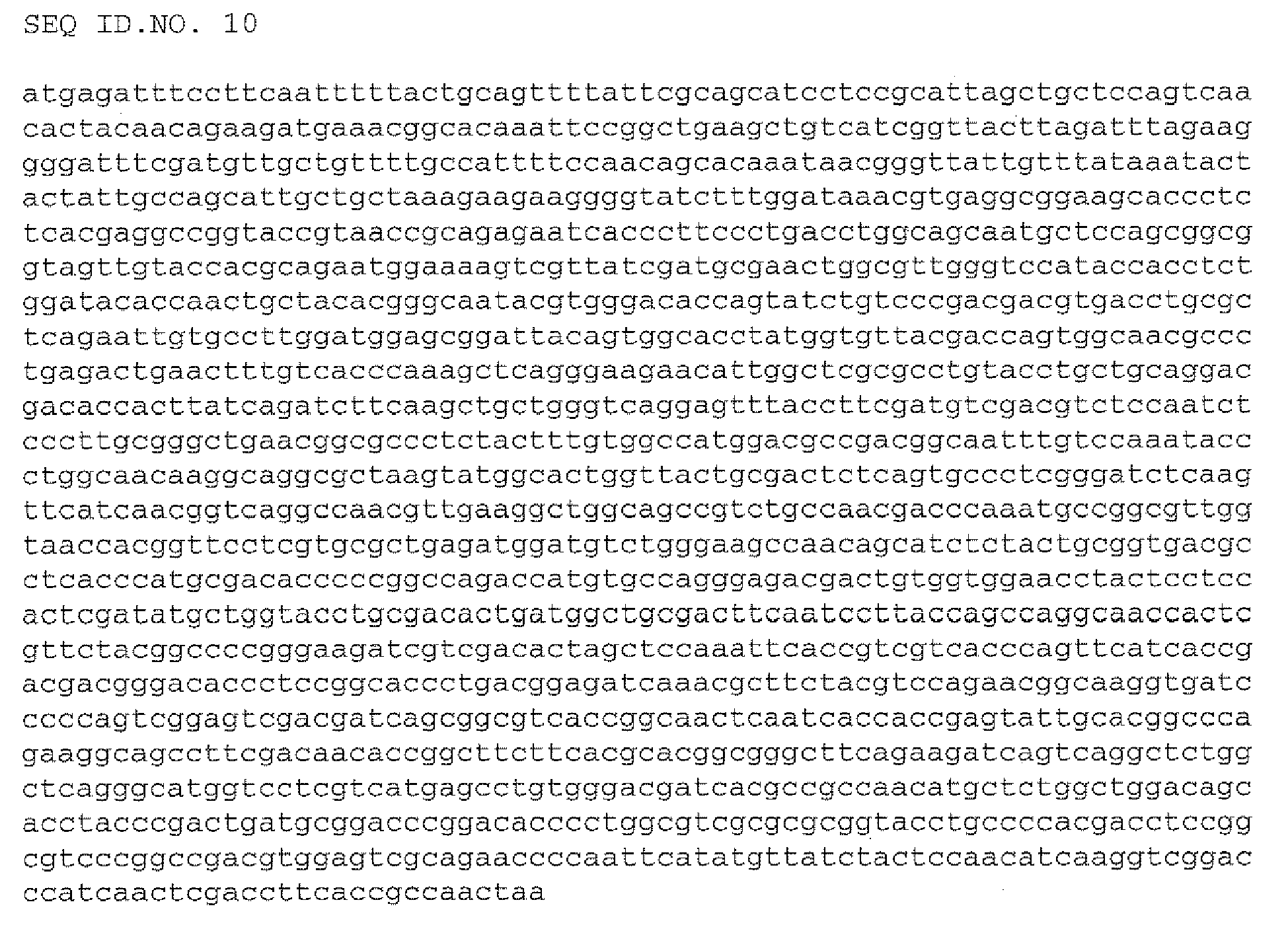
 Coding sequence for Trichoderma reesei CBHI (CBH-c), including the alpha factor signal peptide and a 6x His Tag.
 Trichoderma reesei CBHI (CBH-c)
 Coding sequence for Trichoderma viride CBHI, including the alpha factor signal peptide.
 Trichoderma viride CBH (CBH-f)
 Coding Sequence for Humicola grisea CBHI- Trichoderma reesei CBHI cellulose binding domain fusion protein including the alpha factor signal peptide and a 6x His Tag.
 Humicola grisea CBHI- Trichoderma reesei CBHI cellulose binding domain fusion protein including a 6x His Tag (CBH-g)
 Coding sequence for Talaromyces emersonii CBHT / Trichoderma reesei -CBD fusion including the alpha factor signal peptide and a 6x His Tag.
 Mature Sequence of Talaromyces emersonii CBHI / Trichoderma reesei - CBD fusion with 6x-His tag (CBH-ah)


- Alternative coding sequence of Humicola grisea CBHI with signal sequence


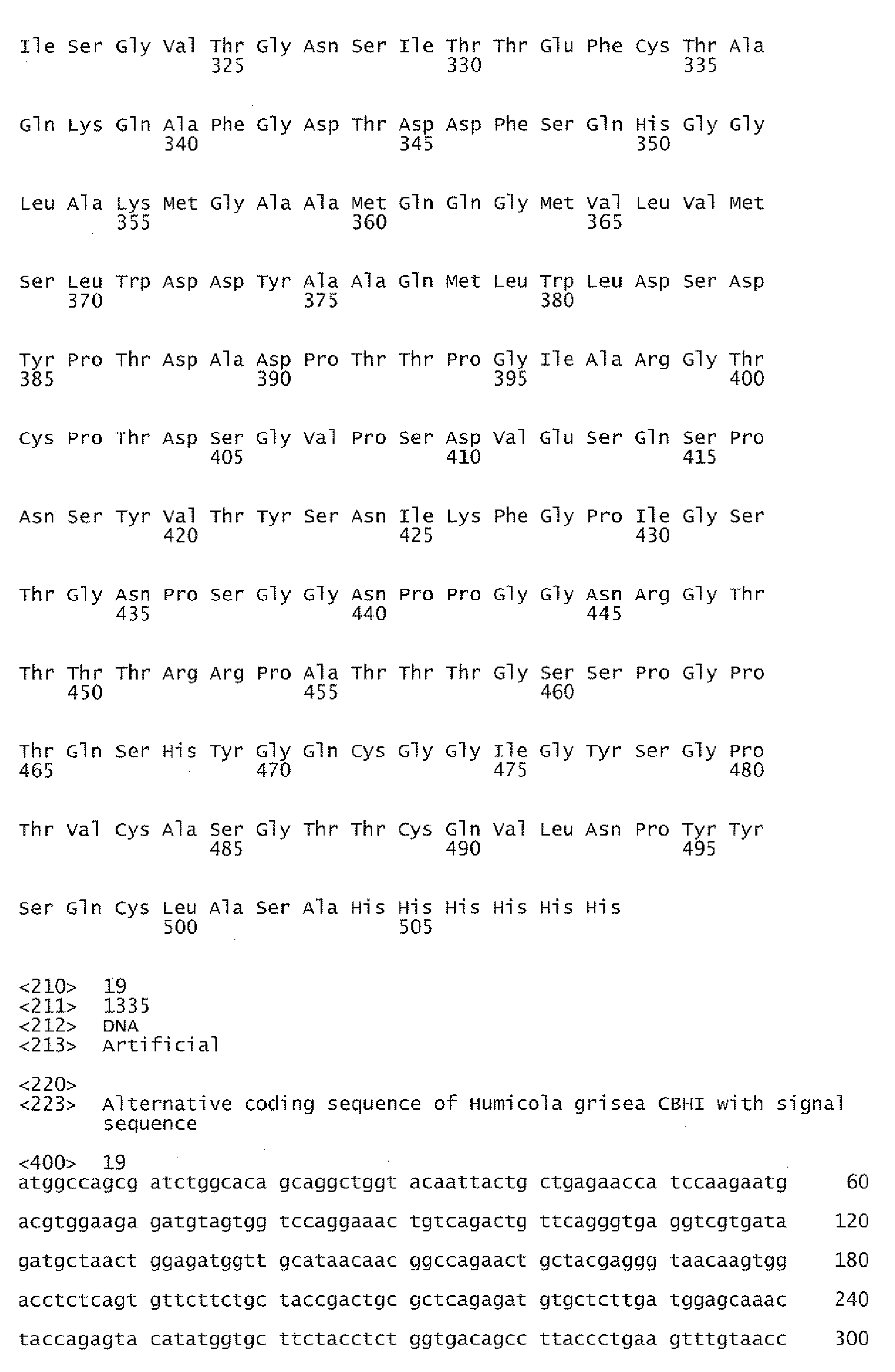
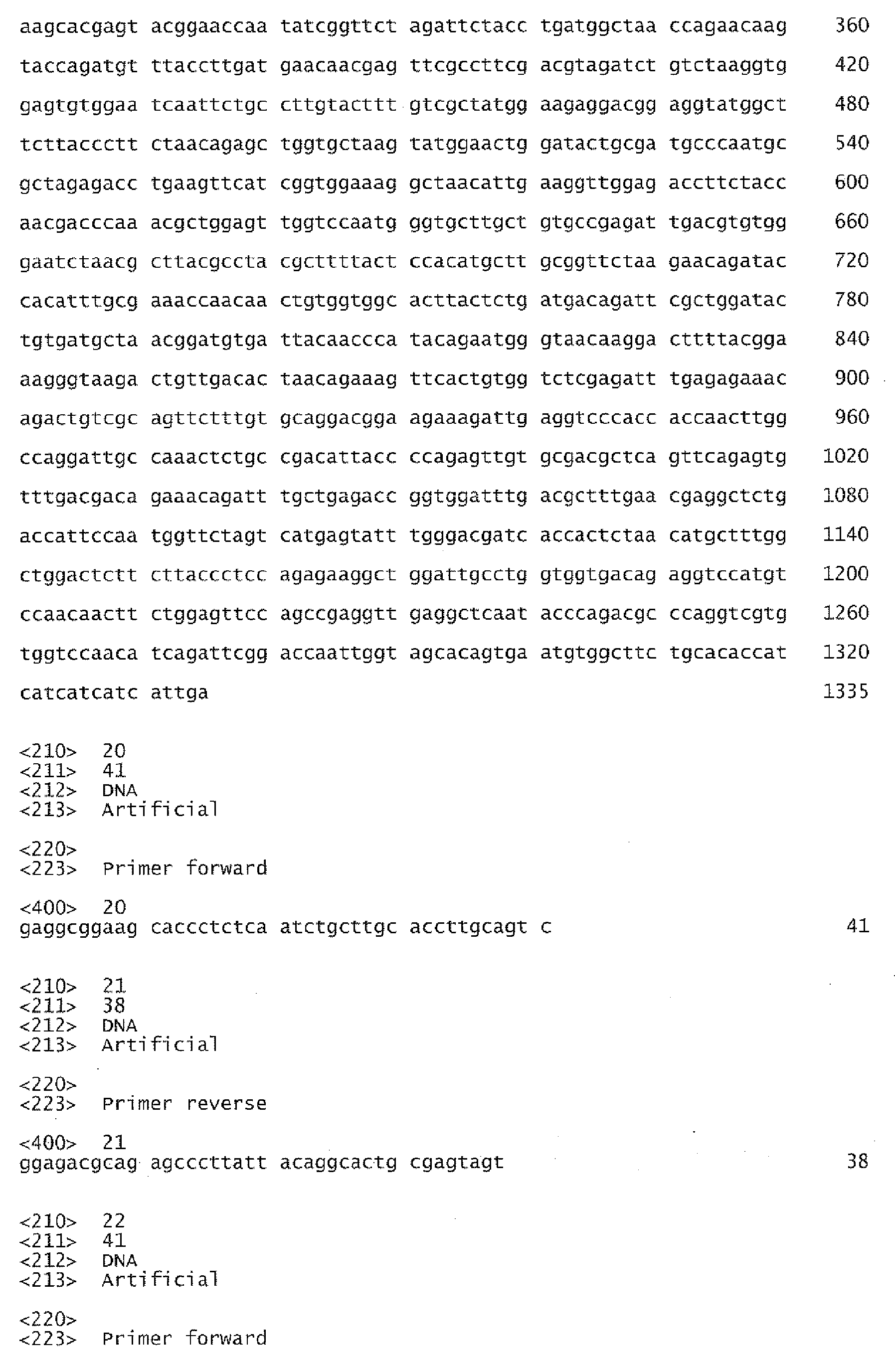


Claims (28)
- A polypeptide having cellobiohydrolase activity, wherein the polypeptide comprises an amino acid sequence having at least 85 % sequence identity to SEQ ID NO: 2.
- The polypeptide according to claim 1, wherein the polypeptide maintains 50 % of its maximum substrate conversion capacity when the conversion is done for 60 minutes at a temperature of 60°C or higher.
- The polypeptide according to claim 1 or 2, wherein the polypeptide comprises an amino acid sequence having at least 90 %, preferably at least 95 %, more preferably at least 99 % sequence identity to SEQ ID NO: 2.
- The polypeptide according to one or more of the preceding claims, wherein the amino acid sequence of the polypeptide has the sequence as defined by SEQ ID NO: 2, or a sequence as defined by SEQ ID NO: 2 wherein 1 to 75 amino acid residues, more preferably 1 to 35 amino acid residues are substituted, deleted, or inserted.
- The polypeptide according to claim 4, wherein one or more of the following amino acid residues of the sequence defined by SEQ ID NO: 2 are modified by substitution or deletion: positions Q1, G4, A6, T15, Q28, W40, D64, E65, A72, S86, K92, V130, V152, Y155, K159, D181, E183, N194, D202, P224, T243, Y244, I277, K304, N310, S311, N318, D320, T335, T344, D346, Q349, A358, Y374, A375, T392, T393, D410, Y422, P442, N445, R446, T456, S460, P462, G463, H468 and/or V482 of amino acids 1 to 500 of SEQ ID NO: 2.
- The polypeptide according to claim 5, wherein one or more of the following amino acid residues of the sequence defined by SEQ ID NO: 2 are modified as follows:
Position Preferred Exchange Q1 L G4 C A6 G,V T15 S Q28 Q,R W40 R D64 N E65 K,V A72 C,V S86 T K92 K,R V130 I,V V152 A,E Y155 C K159 E D181 N E183 V,K N194 C,R,Y,D,K,I,L,G,Q,S,V D202 Y,N,G P224 L T243 I,C,R,Y,A,F,Q,P,D,V,W,L,M Y244 F,H I277 V K304 R N310 D S311 G,N N318 Y D320 V,E,N T335 I T344 M D346 G,A,E,V Q349 R,K A358 E Y374 C,P,R,H,S,A A375 C,D,N,Y,R,Q,L,V,E,G,T,M T392 C,D,K T393 A D410 G Y422 F P442 S,del N445 D R446 S,G T456 T,A S460 L,P P462 L,del G463 D H468 L,Q,R V482 A,I - The polypeptide according to one or more of the preceding claims, wherein the polypeptide has an amino acid sequence selected from the list of the following mutations of SEQ ID NO: 2:
Mutations with respect to Seq ID.NO2 G4C,A72C 2 G4C,Y163C 3 W40R,K159E,N445D 4 E183V 5 N158D,G486S,Y495C 6 W40R 7 S311N 8 T335l 9 W40R,C489R 10 N37S,T243I,R446S 11 T48A 12 W40R,M234K 13 T243l,T325A,V 14 E65K 15 T344M 16 Q349R,P441L 17 Q349R,N445D 18 P402S,S460P,Y477Y 19 A72V 20 Q349R,A354T,D373E,N445D 21 I277V 22 T335I,D346A,T393A,D410G 23 D346G 24 S418P 25 G4C,W40R,A72C 26 W40R,T344M 27 W40R,Q349K 28 W40R,T344M,Q349K 29 G4C,A72G,T344M 30 G4C,A72C,Q349K 31 G4C,A72C,T344M,Q349K 32 G4C,W40R,A72C,T344M 33 G4C,W40R,A72C,Q349K 34 G4C,W40R,A72C,T344M,Q349K 35 Y496F 36 S467T 37 N54S,N194Y 38 R446G 39 V130I,H350Y 40 K92R 41 T325I 42 Y60H 43 T229A 44 D346G,R453G 45 D320E 46 E65V,Q349R 47 T392M 48 W40R,N445D 49 W40R,T344M,N445D 50 W40R,Q349K,N445D 51 W40R,T344M,Q349K,N445D 52 G4C,A72C,D346G 53 G4C,A72C,Q349R 54 G4C,A72C,D346G,Q349R 55 G4C,A72C,T344M,D346G,Q349R 56 A72V,Q349R,N445D 57 G4C,A6G,A72C,Q349K 58 G4C,A72C,Q349K,A376T 59 G4C,A72C,Q349K, E65V,Q349R 60 G4C,A72C,Q349K,H468Q 61 G4C,A72C,Q349K,S24N 62 G4C,P12Q,A72C,Q349K,Q362H 63 N194C,Y374C 64 T243C,A375C 65 T243C,A375C,N194C,Y374C 66 G4C,A72C,Q349K,D320V 67 G4C,A72C,Q349K,G434S,G470D 68 G4C,A72C,Q349K,Q28R,S193T,Q490L 69 G4C,A72C,Q349K,S86T 70 G4C,A72C,Q349K,T448A,T449A 71 G4C,A72C,K92R,Q349K, N493D 72 G4C,A72C,D181N,Q349K 73 G4C,A72C,E183V,K304R,Q349K 74 G4C,A72C,S311 N,Q349K,A455T 75 Q1L,G4C,A72C,Q349K 76 G4C,A72C,S86T,M234V,Q349K 77 G4C,A72C,E183K,Q349K 78 G4C,A72C,S311G,Q349K 79 G4C,D64N,A72C,Q349K 80 G4C,A72C,D181 N,P224L,Q349K 81 G4C,A72C,E183K,N318Y,Q349K 82 G4C,A72C,E183V,Q349K 83 G4C,A72C,N194C,Y374C 84 G4C,A72C,N194C,Q349R,Y374C 85 N194R,Y374D 86 T243R,A375D 87 N194R,T243R,Y374D,A375D 88 Q1L,G4C,A72C,S86T,Q349R 89 Q1L,G4C,A72C,D181N,Q349R 90 Q1L,G4C,A72C,E183K,Q349R 91 Q1L,G4C,A72C,D181N,E183K,Q349R 92 Q1L,G4C,A72C,D320V,Q349R 93 Q1L,G4C,A72C,S86T,D181N,E183K,D320V,Q349R 94 G4C,A72C,Q349R,V367A 95 G4C,A72C,Q349R, R446S,T456A 96 G4C,A72C,E183K,D202Y,N310D,Q349R 97 G4C,D64N,A72C,Q349R,A358E,P464Q 98 Q1L,G4C,A72C,Q349R 99 G4C,A72C,G251R,Q349R 100 G4C,A72C,P224L, F308Y,Q349R 101 G4C,V32G,N49S,A72C,S193L,Q349R 102 G4C,A72C,D181N,Q349R 103 G4C,A72C,P224L,Q349R,S409L,P429S 104 G4C,A72C,D202N,Q349R 105 A72V,T335I,D346A,T393A,P436S 106 A72V,T335I,D346A,T393A,N445D 107 A72V,T335I,D346A,T393A 108 W40R,D346A,T393A 109 A72V,D346A,T393A,N445D 110 W40R,T335I,D346A,T393A,P436S 111 A72V,D346A,T393A 112 W40R, D320V,Q349K,T393A,N445D 113 G4C,E65V,A72C,Q349R 114 G4C,A72C,Q349R,G459D 115 G4C,A72C,D202N,S311 N,Q349R,N493D 116 G4C,A72C,D202G,D320N,Q349R,A358E 117 G4C,A72C,Q349R,Y422F 118 G4C,S24N,E65K,A72C,Q349R,I430L,G439D 119 G4C,T48A,A72C,Q349R,P480S 120 G4C,A72V,Q349R,P462del 121 G4C,A72C,D320V,Q349R 122 G4C,E65V,A72C,Y244H,Q349R 123 G4C,A72C,E183K,Q349R 124 G4C,A72C,E183K,Q349R,P464L 125 G4C,A72C,Q349R,T465I 126 G4C,A72C,E183K,D346E,Q349R 127 G4C,A72C,S311G,Q349R 128 G4C,A72C,P224L,Q349R 129 G4C,A72C,S236Y,Q349R 130 D320V,D346A,Q349R,T393A,N445D 131 A72V,D320V,D346A,T393A,N445D 132 A72V,D320V,D346A 133 A72V,D320V,T335I,D346A,T393A,N445D 134 D320V,D346A,T393A,N445D 135 A72V,D320V,T393A,P436S 136 A72V,T335I,D346A,N445D 137 Q349R,T393A,P436S,N445D 138 A72V,Q349K,T393A,N445D 139 W40R,D320V,T393A,N445D 140 A72V,D346A 141 M234I,G438del 142 E187K,D320V,P442del 143 W40R,T335I, D346A,T393A 144 W40R,D320V,Q349K,P436S,N445D 145 A72V,D320V,T335I,D346A,T393A,P436S 146 G4C,A72C,D320V,Q349K 147 G4C,A72C,S311G,D320V,Q349K 148 Q1L,G4C,A72C,Q349K,T392M 149 D320V,Q349K 150 G4C,A72C,D202V,D320V,Q349K 151 G4C,A72C,D320V,Q349K,G443D,L492Q 152 G4C,A72C,D320V,D346V,Q349K 153 Q1L,G4C,A68T,A72C,Q349K,G439D,R453S 154 Q1L,G4C,A72C,D202N,Q349K 155 Q1 L,G4C,A68T,A72C,Q349K 156 Q1L,G4C,A72C,K154R,Q349K,T393I 157 Q1L,G4C,A72C,S193P,Q349K,V482I 158 Q1L,G4C,A72C,H203R,Q349K,P442S 159 Q1L,G4C,A72C,Q349K,H468R 160 Q1 L,G4C,A72C,D202N,Q349K,G486D 161 Q1L,G4C,E65K,A72C,Q349K 162 Q1LG4C,A72C,Q349K,Y422F 163 Q1 L,G4C,Q28R,A72C,Q349K,H468L 164 Q1L,G4C,A72C,D181N,D247N,Q349K 165 Q1L,G4C,A72C,D181N,Q349K,T451S 166 Q1L,G4C,Q28R,A72C,Q349K 167 Q1L,G4C,A72C,A145T,H203R,Q349K,T403K 168 Q1L,G4C,A72C,I200F,Q349K,L500I 169 Q1L,G4C,D64N,A72C,Q349K 170 Q1L,G4C,A72C,V152A,Q349K 171 Q1L,G4C,T15S,A72C,Y244F,Q349K 172 Q1L,G4C,A6V,A72C,Q349K 173 Q1L,G4C,A72C,S311 N,Q349K,G463D 174 Q1L,G4C,A72C,Y155C,Q349K 175 Q1L,G4C,A72C,S311 N,Q349K 176 Q1L,G4C,A72C,D346V,Q349K 177 Q1L,G4C,A72C,Q349K,T392K 178 Q1L,G4C,A72C,S311 G,Q349K 179 Q1L,G4C,A72C,S311 G,Q349K,H468R 180 G4C,A72C,N194K,T243Y,Q349R,A375N 181 G4C,A72C,N194D,T243A,Q349R,Y374P,A375Y 182 G4C,A72C,N194I,T243Y,Q349R,Y374P,A375R 183 G4C,A72C,N194K,Q349R,Y374P,A375Q 184 G4C,A72C,N194L,T243Y,Q349R,Y374R,A375L 185 G4C,A72C,N194G,T243F,Q349R,Y374P,A375R 186 G4C,A72C,N194L,T243Q,Q349R,Y374P,A375V 187 G4C,A72C,N194K,T243P,Q349R,Y374H,A375E 188 G4C,A72C,N1941,T243D,Q349R,Y374P,A375Y 189 G4C,A72C,N194Q,T243V,Q349R,Y374P,A375Y 190 G4C,A72C,N194S,T243W,Q349R,Y374S,A375G 191 G4C,A72C,N194Y,T243L,Q349R,Y374S,A375R 192 G4C,A72C,N194V,T243M,Q349R,Y374A,A375T 193 G4C,A72C,T243G,Q349R,Y374P,A375M 194 G4C,A72C,T243Q,Q349R,Y374P,A375M 195 G4C,A72C,N194Y,T243V,Q349R,Y374P - The polypeptide according to one or more of the preceding claims, which is expressed and secreted at a level of more than 100 mg/l, more preferably of more than 200 mg/l, particularly preferably of more than 500 mg/l, and most preferably of more than 1 g/l into the supernatant after introduction of a nucleic acid encoding a polypeptide having an amino acid sequence with at least 85% sequence identity to the SEQ ID NO: 2 into a yeast.
- A nucleic acid encoding the polypeptide of one or more of claim 1 to 8, preferably having at least 95% identity to SEQ lD NO: 1.
- A vector comprising the nucleic acid of claim 9.
- A host cell transformed with a vector of claim 10.
- The host cell of claim 11, wherein the host cell is derived from the group consisting of Saccharomyces, Schizosaccharomyces, Kluyveromyces, Pichia, Pichia, Hansenula, Aspergillus, Trichoderma, Penicillium, Candida and Yarrowina.
- The host cell of claim 11 or 12, wherein the host cell is capable of producing ethanol, preferably a yeast derived from the group of host cells comprising Saccharomyces cerevisiae, Pichia stipitis, Pachysolen tannophilus.
- The host cell of any one of claims 11 to 13, wherein the host cell is a methylotrophic yeast, preferably derived from the group of host cells comprising Pichia methanolica, Pichia pastoris, Pichia angusta, Hansenula polymorpha.
- A method of producing a cellobiohydrolase protein, comprising the steps:a. obtaining a host cell, which has been transformed with a vector comprising the nucleic acid as defined in claim 9;b. cultivation of the host cell under conditions under which the cellobiohydrolase protein is expressed; andc. recovery of the cellobiohydrolase protein.
- Method for identifying polypeptides having cellobiohydrolase activity, comprising the steps of:a. Generating a library of mutant genes encoding mutant proteins by mutagenesis of a nucleic acid having the sequence defined by SEQ ID NO: 6 (encoding SEQ ID NO: 5) or a nucleic acid according to claim 9 , preferably having the sequence defined by SEQ ID NO: 1;b. Inserting each mutant gene into an expression vector;c. Transforming yeast cells with each expression vector to provide a library of yeast transformants;d. Cultivation of each yeast transformant under conditions under which the mutant protein is expressed and secreted;e. Incubating the expressed mutant protein with a substrate;f. Determining the catalytic activity of the mutant protein;g. Selecting a mutant protein according to the determined catalytic activity.
- The method of claim 16, wherein a library of mutant genes encoding mutant proteins by mutagenesis of a nucleic acid a nucleic acid according to claim 9 is generated, and wherein steps e. to g. are performed as follows:e. Incubating the expressed mutant protein with cellulosic material;f. Determining the amount of released sugar;g. Selecting a mutant protein according to the amount of released sugar.
- The method of claim 16 or 17, comprising the additional steps of:h. Sequencing the selected mutant gene or protein;j. identifying the amino acid modification(s) by comparing the sequence of the selected mutant protein with the amino acid sequence of SEQ ID NO: 2.
- Method of preparing a polypeptide having cellobiohydrolase activity, comprising the steps:a. Providing a polypeptide having cellobiohydrolase activity comprising an amino sequence having at least 70 % sequence identity to the catalytic domain of SEQ lD NO: 2 (SEQ ID NO: 5);b. Identifying the amino acids of this polypeptide which correspond to the amino acids which are modified with respect to the amino acid sequence of SEQ ID NO: 2, as identified in step i. of claim 18; andc. Preparing a mutant polypeptide of the polypeptide provided in step a. by carrying out the amino acid modification(s) identified in step b. through site-directed mutagenesis.
- The method according to claim 19, wherein the polypeptide provided in step a. is a wild type cellobiohydrolase derived from Trichoderma reesei.
- Polypeptide having cellobiohydrolase activity, obtainable by the method of claim 19 or 20.
- Polypeptide having cellobiohydrolase activity, wherein the polypeptide comprises an amino acid sequence having at least 80 % sequence identity to SEQ ID NO: 5, wherein one or more of the following amino acid residues of the sequence defined by SEQ ID NO: 5 are modified by substitution or deletion: Q1, G4, A6, T15, Q28, W40, D64, E65, A72, S86, K92, V130, V152, Y155, K159, D181, E183, N194, D202, P224, T243, Y244, I277, K304, N310, S311, N318, D320, T335, T344, D346, Q349, A358, Y374, A375, T392, T393, D410 and/or Y422 of amino acids 1 to 440 of SEQ ID NO: 5.
- The polypeptide according to claim 22, wherein one or more of the following amino acid residues of the sequence defined by SEQ ID NO: 5 are modified as indicated in the following table:
Position Preferred Exchange Q1 L A6 G,V T15 S Q28 Q,R W40 R D64 N E65 K,V A72 V S86 T K92 K,R V130 I,V V152 A,E Y155 C K159 E D181 N E183 V,K N194 C,R,Y,D,K,I,L,G,Q,S,V D202 Y,N,G P224 L T243 I,R,Y,A,F,Q,P,D,V,W,L,M Y244 F,H I277 V K304 R N310 D S311 G,N N318 Y D320 V,E,N T335 I T344 M D346 G,A,E,V Q349 R,K A358 E Y374 C,P,R,H,S,A A375 D,N,Y,R.Q,L,V,E,G,T,M T392 C,D,K T393 A D410 G Y422 F P442 S,del N445 D R446 S,G T456 T,A S460 L,P P462 L,del G463 D H468 L,Q,R V482 A,I - The polypeptide according to claim 23, wherein the polypeptide has an amino acid sequence selected from the list of the following mutations of SEQ ID NO: 5:
Mutations with respect to SEQ ID NO: 5 1 G4C,Y163C 2 E183V 3 W40R 4 S311N 5 T335I 6 T48A 7 W40R,M234K 8 E65K 9 T344M 10 A72V 11 I277V 12 D346G 13 S418P 14 G4C,W40R,A72C 15 W40R,T344M 16 W40R,Q349K 17 W40R,T344M,Q349K 18 G4C,A72C,T344M 19 G4C,A72C,Q349K 20 G4C,A72C,T344M,Q349K 21 G4C,W40R,A72C,T344M 22 G4C,W40R,A72C,Q349K 23 G4C,W40R,A72C,T344M,Q349K 24 N54S,N194Y 25 V1301,H350Y 26 K92R 27 T325I 28 Y60H 29 T229A 30 D320E 31 E65V,Q349R 32 T392M 33 G4C,A72C,D346G 34 G4C,A72C,Q349R 35 G4C,A72C,D346G,Q349R 36 G4C,A72C,T344M,D346G,Q349R 37 G4C,A6G,A72C,Q349K 38 G4C,A72C,Q349K,A376T 39 G4C,A72C,Q349K,E65V,Q349R 40 G4C,A72C,Q349K,S24N 41 G4C,P12Q,A72C,Q349K,Q362H 42 N194C,Y374C 43 T243C,A375C,N194C,Y374C 44 G4C,A72C,Q349K,D320V 45 G4C,A72C,Q349K,S86T 46 G4C,A72C,D181N,Q349K 47 G4C,A72C,E183V,K304R,Q349K 48 Q1L,G4C,A72C,Q349K 49 G4C,A72C,S86T,M234V,Q349K 50 G4C,A72C,E183K,Q349K 51 G4C,A72C,S311G,Q349K 52 G4C,D64N,A72C,Q349K 53 G4C,A72C,D181N,P224L,Q349K 54 G4C,A72C, E183K,N318Y,Q349K 55 G4C,A72C,E183V,Q349K 56 G4C,A72C,N194C,Y374C 57 G4C,A72C,N194C,Q349R,Y374C 58 N194R,Y374D 59 T243R,A375D 60 N194R,T243R,Y374D,A375D 61 Q1L,G4C,A72C,S86T,Q349R 62 Q1L,G4C,A72C,D181N,Q349R 63 Q1L,G4C,A72C,E1834C,Q349R 64 Q1L,G4C,A72C,D181N,E183K,Q349R 65 Q1L,G4C,A72C,D320V,Q349R 66 Q1L,G4C,A72C,586T,D181N,E183K,D320V,Q349R 67 G4C,A72C,0349R,V367A 68 G4C,A72C,E183K,D202Y,N310D,Q349R 69 Q1L,G4C,A72C,Q349R 70 G4C,A72C,G251 R,Q349R 71 G4C,A72C,P224L,F306Y,Q349R 72 G4C,V32G,N49S,A72C,S193L,Q349R 73 G4C,A72C,D181N,Q349R 74 G4C,A 72C,D202N,Q349R 75 A72V,T3351,D346A,T393A,P436S 76 A72V,T335I,D346A,T393A 77 W40R,D346A,T393A 78 A72V,D346A,T393A 79 G4C,E65V,A72C,Q349R 80 G4C,A72C,D202G,D320N,Q349R,A358E 81 G4C,A72C,D320V,Q349R 82 G4C,E65V,A72C,Y244H,Q349R 83 G4C,A72C,E183K,Q349R 84 G4C,A72C,E183K,D346E,Q349R 85 G4C,A72C,S311G,Q349R 86 G4C,A72C,P224L,Q349R 87 G4C,A72C,S236Y,Q349R 88 A72V,D320V,D346A 89 A72V,D346A 90 W40R,T335I,D346A,T393A 91 G4C,A72C,D320V,Q349K 92 G4C,A72C,S311G,D320V,Q349K 93 Q1L,G4C,A72C,Q349K,T392M 94 D320V,Q349K 95 G4C,A72C,D202V,D320V,Q349K 96 G4C,A72C, D320V,D346V,Q349K 97 Q1L,G4C,A72C,D202N,Q349K 98 Q1L,G4C,A68T,A72C,Q349K 99 Q1L,G4C,A72C,K154R,Q349KT393I 100 Q1L,G4C,E65K,A72C,Q349K 101 Q1L,G4C,A72C,D181N,D247N,0349K 102 Q1L,G4C,Q28R,A72C,Q349K 103 Q1L,G4C,A72C,A145T,H203R,Q349K,T403K 104 Q1L,G4C,D64N,A72C,Q349K 105 Q1L,G4C,A72C,V152A,Q349K 106 Q1L,G4C,T15S,A72C,Y244F,Q349K 107 Q1L,G4C,A6V,A72C,Q349K 108 Q1L,G4C,A72C,Y155C,0349K 109 Q1L,G4C,A72C,S311 N,Q349K 110 Q1L,G4C,A72C,D346V,Q349K 111 Q1L,G4C,A72C,Q349K,T392K 112 Q1L,G4C,A72C,S311G,Q349K 113 G4C,A72C,N194K,T243Y,Q349R,A375N 114 G4C,A72C,N194D,T243A,Q349R,Y374P,A375Y 115 G4C,A72C,N194I,T243Y,Q349R,Y374P,A375R 116 G4C,A72C,N194K,Q349R,Y374P,A375Q 117 G4C,A72C,N194L,T243Y,Q349R,Y374R,A375L 118 G4C,A72C,N194G,T243F,Q349R,Y374P,A375R 119 G4C,A72C,N194L,T243Q,Q349R,Y374P,A375V 120 G4C,A72C,N194K,T243P,Q349R,Y374H,A375E 121 G4C,A72C,N1941,T243D,Q349R,Y374P,A375Y 122 G4C,A72C,N194Q,T243V,Q349R,Y374P,A375Y 123 G4C,A72C,N194S,T243W,Q349R,Y374S,A375G 124 G4C,A72C,N194Y,T243L,Q349R,Y374S,A375R 125 G4C,A72C,N194V,T243M,Q349R,Y374A,A375T 126 G4C,A72C,T243G,Q349R,Y374P,A375M 127 G4C,A72C,T243Q,Q349R,Y374P,A375M 128 G4C,A72C,N194Y,T243V,Q349R,Y374P - Polypeptide having cellobiohydrolase activity, wherein the polypeptide comprises an amino acid sequence having at least 85 % sequence identity to SEQ ID NO: 12 wherein one or more of the following amino acid residues of the sequence defined by SEQ ID NO: 12 are modified by substitution or deletion: Q1, T15, Q28, W40, C72, V133, V155, Y158, T162, Y247, N307, G308, E317, S341, D345, Y370, T389, Q406, N441, R442, T452, S456, P458, G459, H464 and/or V478.
- Polypeptide according to claim 25, wherein the polypeptide has the amino acid sequence of SEQ ID NO: 12 wherein one or more of the following amino acid residues are modified by substitution or deletion: Q1, T15, Q28, W40, C72, V133, V155, Y158, T162, Y247, N307, G308, E317, S341, D345, Y370, T389, Q406, N441, R442, T452, S456, P458, G459, H464 and/or V478.
- Composition comprising the polypeptide of one or more of claims 1 to 8 or 21 to 26 and one or more endoglucanases and/or one or more beta-glucosidases and/or one or more further cellobiohydrolases and/or one or more xylanases.
- Use of the polypeptide according to one or more of claims 1 to 8 or 21 to 26 or of the composition of claim 26 for the enzymatic degradation of lignocellulosic biomass, and/or for textiles processing and/or as ingredient in detergents and/or as ingredient in food or feed compositions.
Priority Applications (20)
| Application Number | Priority Date | Filing Date | Title |
|---|---|---|---|
| PL10153355T PL2357227T3 (en) | 2010-02-11 | 2010-02-11 | Optimized cellulase enzymes |
| EP10153355.2A EP2357227B1 (en) | 2010-02-11 | 2010-02-11 | Optimized cellulase enzymes |
| ES10153355.2T ES2549328T3 (en) | 2010-02-11 | 2010-02-11 | Optimized cellulose enzymes |
| SI201031027T SI2357227T1 (en) | 2010-02-11 | 2010-02-11 | Optimized cellulase enzymes |
| DK10153355.2T DK2357227T3 (en) | 2010-02-11 | 2010-02-11 | Optimized cellulase enzymes |
| RS20181132A RS57695B1 (en) | 2010-02-11 | 2011-02-11 | Optimized cellulase enzymes |
| DK11706777.7T DK2534245T3 (en) | 2010-02-11 | 2011-02-11 | OPTIMIZED CELLULASE ENZYMES |
| PL11706777T PL2534245T3 (en) | 2010-02-11 | 2011-02-11 | Optimized cellulase enzymes |
| US13/578,291 US9458443B2 (en) | 2010-02-11 | 2011-02-11 | Optimized cellulase enzymes |
| MX2012009357A MX344963B (en) | 2010-02-11 | 2011-02-11 | Optimized cellulase enzymes. |
| BR112012020277A BR112012020277A2 (en) | 2010-02-11 | 2011-02-11 | "optimized cellulase enzymes". |
| HRP20181587TT HRP20181587T1 (en) | 2010-02-11 | 2011-02-11 | OPTIMIZED CELLULASE ENZYMES |
| CA2789423A CA2789423C (en) | 2010-02-11 | 2011-02-11 | Optimized cellulase enzymes |
| PCT/EP2011/052023 WO2011098551A2 (en) | 2010-02-11 | 2011-02-11 | Optimized cellulase enzymes |
| AU2011214298A AU2011214298B2 (en) | 2010-02-11 | 2011-02-11 | Optimized cellulase enzymes |
| CN2011800185464A CN102844430A (en) | 2010-02-11 | 2011-02-11 | Optimized cellulase enzymes |
| SI201131575T SI2534245T1 (en) | 2010-02-11 | 2011-02-11 | Optimized cellulase enzymes |
| EP11706777.7A EP2534245B1 (en) | 2010-02-11 | 2011-02-11 | Optimized cellulase enzymes |
| ES11706777.7T ES2689939T3 (en) | 2010-02-11 | 2011-02-11 | Optimized cellulose enzymes |
| HRP20151043TT HRP20151043T1 (en) | 2010-02-11 | 2015-10-01 | Optimized cellulase enzymes |
Applications Claiming Priority (1)
| Application Number | Priority Date | Filing Date | Title |
|---|---|---|---|
| EP10153355.2A EP2357227B1 (en) | 2010-02-11 | 2010-02-11 | Optimized cellulase enzymes |
Publications (2)
| Publication Number | Publication Date |
|---|---|
| EP2357227A1 true EP2357227A1 (en) | 2011-08-17 |
| EP2357227B1 EP2357227B1 (en) | 2015-07-15 |
Family
ID=42027636
Family Applications (2)
| Application Number | Title | Priority Date | Filing Date |
|---|---|---|---|
| EP10153355.2A Active EP2357227B1 (en) | 2010-02-11 | 2010-02-11 | Optimized cellulase enzymes |
| EP11706777.7A Active EP2534245B1 (en) | 2010-02-11 | 2011-02-11 | Optimized cellulase enzymes |
Family Applications After (1)
| Application Number | Title | Priority Date | Filing Date |
|---|---|---|---|
| EP11706777.7A Active EP2534245B1 (en) | 2010-02-11 | 2011-02-11 | Optimized cellulase enzymes |
Country Status (14)
| Country | Link |
|---|---|
| US (1) | US9458443B2 (en) |
| EP (2) | EP2357227B1 (en) |
| CN (1) | CN102844430A (en) |
| AU (1) | AU2011214298B2 (en) |
| BR (1) | BR112012020277A2 (en) |
| CA (1) | CA2789423C (en) |
| DK (2) | DK2357227T3 (en) |
| ES (2) | ES2549328T3 (en) |
| HR (2) | HRP20181587T1 (en) |
| MX (1) | MX344963B (en) |
| PL (2) | PL2357227T3 (en) |
| RS (1) | RS57695B1 (en) |
| SI (2) | SI2357227T1 (en) |
| WO (1) | WO2011098551A2 (en) |
Cited By (7)
| Publication number | Priority date | Publication date | Assignee | Title |
|---|---|---|---|---|
| WO2012048171A3 (en) * | 2010-10-06 | 2012-07-19 | Bp Corporation North America Inc. | Variant cbh i polypeptides with reduced product inhibition |
| WO2012135719A1 (en) * | 2011-03-31 | 2012-10-04 | Novozymes, Inc. | Cellulose binding domain variants and polynucleotides encoding same |
| EP2576626A4 (en) * | 2010-06-01 | 2013-11-20 | California Inst Of Techn | FUNCTIONAL AND STABLE CLASS I CELLOBIOHYDROLASTIC ENZYMES |
| EP2794664A4 (en) * | 2011-12-22 | 2015-08-19 | Novozymes Inc | HYBRID POLYPEPTIDES HAVING CELLOBIOHYDROLASE ACTIVITY AND POLYNUCLEOTIDES ENCODING SAID POLYPEPTIDES |
| EP2780450A4 (en) * | 2011-11-15 | 2015-09-09 | Novozymes Inc | Polypeptides having cellobiohydrolase activity and polynucleotides encoding same |
| EP3029139A1 (en) * | 2014-12-04 | 2016-06-08 | Honda Motor Co., Ltd. | Method for producing highly active cellobiohydrolase and highly active cellobiohydrolase |
| EP2964760B1 (en) * | 2013-03-08 | 2021-05-12 | Novozymes A/S | Cellobiohydrolase variants and polynucleotides encoding same |
Families Citing this family (12)
| Publication number | Priority date | Publication date | Assignee | Title |
|---|---|---|---|---|
| WO2014093294A1 (en) * | 2012-12-12 | 2014-06-19 | Danisco Us Inc. | Variants of cellobiohydrolases |
| MX2015007234A (en) | 2012-12-12 | 2015-10-29 | Danisco Us Inc | Variants of cellobiohydrolases. |
| EP3594335B1 (en) | 2014-09-05 | 2024-05-01 | Novozymes A/S | Carbohydrate binding module variants and polynucleotides encoding same |
| WO2016040265A1 (en) | 2014-09-08 | 2016-03-17 | Novozymes A/S | Cellobiohydrolase variants and polynucleotides encoding same |
| DK3262165T3 (en) | 2015-02-24 | 2020-08-24 | Novozymes As | CELLOBIOHYDROLASE VARIANTS AND POLYNUCLEOTIDES ENCODING THEM |
| WO2017177289A1 (en) | 2016-04-15 | 2017-10-19 | Vtt International Oy | Process for conversion of biomass into fermentable sugars with integrated enzyme |
| US11299723B2 (en) | 2016-06-15 | 2022-04-12 | Codexis, Inc. | Engineered beta-glucosidases and glucosylation methods |
| CN109337888B (en) * | 2018-11-12 | 2021-08-17 | 南开大学 | Cellobiohydrolase mutant and its production method and application |
| CN110373402B (en) * | 2019-08-13 | 2021-07-20 | 山东农业大学 | A kind of method to improve thermostable cellulase enzyme activity and thermostability |
| CN113186175B (en) * | 2021-06-04 | 2023-08-04 | 翌圣生物科技(上海)股份有限公司 | Mutant Taq DNA polymerase, coding DNA sequence, recombinant vector, recombinant expression cell and application thereof |
| CN114426961B (en) * | 2022-03-10 | 2024-01-26 | 安徽大学 | Beta-glucosidase mutant, encoding gene, expression strain and application thereof |
| CN117802072B (en) * | 2024-02-29 | 2024-05-24 | 北京挑战生物技术有限公司 | Xylanase mutant and application thereof |
Citations (13)
| Publication number | Priority date | Publication date | Assignee | Title |
|---|---|---|---|---|
| US5686593A (en) | 1990-05-09 | 1997-11-11 | Novo Nordisk A/S | Enzyme capable of degrading cellulose or hemicellulose |
| WO2001004284A1 (en) | 1999-07-13 | 2001-01-18 | Midwest Research Institute | Cellobiohydrolase reduced glycosylation variants: cbhin45a; cbhin270a; and cbhin384a |
| WO2003000941A2 (en) | 2001-06-26 | 2003-01-03 | Novozymes A/S | Polypeptides having cellobiohydrolase i activity and polynucleotides encoding same |
| WO2005030926A2 (en) | 2003-08-25 | 2005-04-07 | Novozymes Inc. | Variants of glycoside hydrolases |
| CN1757710A (en) | 2005-07-15 | 2006-04-12 | 山东农业大学 | Saccharomyce engineering strain for expressing cbh1 gene and its construction method |
| WO2006117432A1 (en) * | 2005-04-29 | 2006-11-09 | Ab Enzymes Oy | Improved cellulases |
| US7452707B2 (en) | 2003-03-21 | 2008-11-18 | Danisco A/S, Genencor Division | CBH1 homologs and variant CBH1 cellulases |
| US7459299B2 (en) | 2003-04-01 | 2008-12-02 | Danisco A/S, Genencor Division | Variant Humicola grisea CBH1.1 |
| US20090042266A1 (en) | 2005-12-22 | 2009-02-12 | Roal Oy | Treatment of cellulosic material and enzymes useful thererin |
| US20090162916A1 (en) | 1999-07-13 | 2009-06-25 | Alliance For Sustainable Energy, Llc | Cellobiohydrolase i enzymes |
| WO2009138877A2 (en) * | 2008-05-11 | 2009-11-19 | Universiteit Stellenbosch | Heterologous expression of fungal cellobiohydrolases in yeast |
| WO2009139839A1 (en) * | 2008-05-11 | 2009-11-19 | Mascoma Corporation | Construction of protrophic/celluloytic yeast strains expressing tethered and secreted cellulases |
| WO2010005553A1 (en) * | 2008-07-07 | 2010-01-14 | Mascoma Corporation | Isolation and characterization of schizochytrium aggregatum cellobiohydrolase i (cbh 1) |
Family Cites Families (6)
| Publication number | Priority date | Publication date | Assignee | Title |
|---|---|---|---|---|
| US7375197B2 (en) | 2002-01-14 | 2008-05-20 | Midwest Research Institute | Cellobiohydrolase I gene and improved variants |
| JP4756861B2 (en) * | 2002-08-16 | 2011-08-24 | ジェネンコー・インターナショナル・インク | Novel HyproCrea Jecolina CBH1 Cellulase |
| AU2003219956A1 (en) * | 2003-02-27 | 2004-09-28 | Midwest Research Institute | Superactive cellulase formulation using cellobiohydrolase-1 from penicillium funiculosum |
| US8017373B2 (en) * | 2006-08-31 | 2011-09-13 | Iogen Energy Corporation | Process for enzymatic hydrolysis of pretreated lignocellulosic feedstocks |
| CA2716806A1 (en) * | 2008-02-29 | 2009-09-03 | University Of Central Florida Research Foundation, Inc. | Production and use of plant degrading materials |
| BRPI1015536A2 (en) | 2009-04-24 | 2019-07-02 | Dsm Ip Assets Bv | carbohydrate degradation polypeptide and uses thereof |
-
2010
- 2010-02-11 EP EP10153355.2A patent/EP2357227B1/en active Active
- 2010-02-11 ES ES10153355.2T patent/ES2549328T3/en active Active
- 2010-02-11 DK DK10153355.2T patent/DK2357227T3/en active
- 2010-02-11 SI SI201031027T patent/SI2357227T1/en unknown
- 2010-02-11 PL PL10153355T patent/PL2357227T3/en unknown
-
2011
- 2011-02-11 RS RS20181132A patent/RS57695B1/en unknown
- 2011-02-11 CA CA2789423A patent/CA2789423C/en active Active
- 2011-02-11 AU AU2011214298A patent/AU2011214298B2/en not_active Ceased
- 2011-02-11 MX MX2012009357A patent/MX344963B/en active IP Right Grant
- 2011-02-11 EP EP11706777.7A patent/EP2534245B1/en active Active
- 2011-02-11 CN CN2011800185464A patent/CN102844430A/en active Pending
- 2011-02-11 HR HRP20181587TT patent/HRP20181587T1/en unknown
- 2011-02-11 PL PL11706777T patent/PL2534245T3/en unknown
- 2011-02-11 SI SI201131575T patent/SI2534245T1/en unknown
- 2011-02-11 WO PCT/EP2011/052023 patent/WO2011098551A2/en not_active Ceased
- 2011-02-11 US US13/578,291 patent/US9458443B2/en not_active Expired - Fee Related
- 2011-02-11 BR BR112012020277A patent/BR112012020277A2/en not_active IP Right Cessation
- 2011-02-11 ES ES11706777.7T patent/ES2689939T3/en active Active
- 2011-02-11 DK DK11706777.7T patent/DK2534245T3/en active
-
2015
- 2015-10-01 HR HRP20151043TT patent/HRP20151043T1/en unknown
Patent Citations (13)
| Publication number | Priority date | Publication date | Assignee | Title |
|---|---|---|---|---|
| US5686593A (en) | 1990-05-09 | 1997-11-11 | Novo Nordisk A/S | Enzyme capable of degrading cellulose or hemicellulose |
| WO2001004284A1 (en) | 1999-07-13 | 2001-01-18 | Midwest Research Institute | Cellobiohydrolase reduced glycosylation variants: cbhin45a; cbhin270a; and cbhin384a |
| US20090162916A1 (en) | 1999-07-13 | 2009-06-25 | Alliance For Sustainable Energy, Llc | Cellobiohydrolase i enzymes |
| WO2003000941A2 (en) | 2001-06-26 | 2003-01-03 | Novozymes A/S | Polypeptides having cellobiohydrolase i activity and polynucleotides encoding same |
| US7452707B2 (en) | 2003-03-21 | 2008-11-18 | Danisco A/S, Genencor Division | CBH1 homologs and variant CBH1 cellulases |
| US7459299B2 (en) | 2003-04-01 | 2008-12-02 | Danisco A/S, Genencor Division | Variant Humicola grisea CBH1.1 |
| WO2005030926A2 (en) | 2003-08-25 | 2005-04-07 | Novozymes Inc. | Variants of glycoside hydrolases |
| WO2006117432A1 (en) * | 2005-04-29 | 2006-11-09 | Ab Enzymes Oy | Improved cellulases |
| CN1757710A (en) | 2005-07-15 | 2006-04-12 | 山东农业大学 | Saccharomyce engineering strain for expressing cbh1 gene and its construction method |
| US20090042266A1 (en) | 2005-12-22 | 2009-02-12 | Roal Oy | Treatment of cellulosic material and enzymes useful thererin |
| WO2009138877A2 (en) * | 2008-05-11 | 2009-11-19 | Universiteit Stellenbosch | Heterologous expression of fungal cellobiohydrolases in yeast |
| WO2009139839A1 (en) * | 2008-05-11 | 2009-11-19 | Mascoma Corporation | Construction of protrophic/celluloytic yeast strains expressing tethered and secreted cellulases |
| WO2010005553A1 (en) * | 2008-07-07 | 2010-01-14 | Mascoma Corporation | Isolation and characterization of schizochytrium aggregatum cellobiohydrolase i (cbh 1) |
Non-Patent Citations (23)
| Title |
|---|
| BOER H; TEERI TT; KOIVULA A: "Characterization of Trichoderma reesei cellobiohydrolase Cel7A secreted from Pichia pastoris using two different promoters", BIOTECHNOL BIOENG, vol. 69, no. 5, 5 September 2000 (2000-09-05), pages 486 - 494 |
| CREGG, J.M.: "Pichia Protocols in Methods in Molecular Biology", 2007, HUMANA PRESS |
| DATABASE PDB [online] 24 February 2009 (2009-02-24), GRASSNICK ET AL.: "3-DIMENSIONAL STRUCTURE OF NATIVE CEL7A FROM TALAROMYCES EMERSONII", XP002593512, retrieved from EBI accession no. PDB:1Q9H Database accession no. 1Q9H * |
| DATABASE UniProt [online] 1 February 2005 (2005-02-01), "SubName: Full=Cellobiohydrolase;", XP002593511, retrieved from EBI accession no. UNIPROT:Q5MBA7 Database accession no. Q5MBA7 * |
| FUJITA Y; ITO J; UEDA M; FUKUDA H; KONDO A: "Synergistic saccharification, and direct fermentation to ethanol, of amorphous cellulose by use of an engineered yeast strain codisplaying three types of cellulolytic enzyme", APPL ENVIRON MICROBIOL., vol. 70, no. 2, February 2004 (2004-02-01), pages 1207 - 1212 |
| GODBOLE S; DECKER SR; NIEVES RA; ADNEY WS; VINZANT TB; BAKER JO; THOMAS SR; HIMMEL ME: "Cloning and expression of Trichoderma reesei cellobiohydrolase I in Pichia pastoris", BIOTECHNOL PROG., vol. 15, no. 5, September 1999 (1999-09-01), pages 828 - 833 |
| GRASSICK A; MURRAY PG; THOMPSON R; COLLINS CM; BYRNES L; BIRRANE G; HIGGINS TM; TUOHY MG: "Three-dimensional structure of a thermostable native cellobiohydrolase, CBH IB, and molecular characterization of the cel7 gene from the filamentous fungus, Talaromyces emersonii", EUR J BIOCHEM., vol. 271, no. 22, November 2004 (2004-11-01), pages 4495 - 4506 |
| HONG J; TAMAKI H; YAMAMOTO K; KUMAGAI H: "Cloning of a gene encoding thermostable cellobiohydrolase from Thermoascus aurantiacus and its expression in yeast", APPL MICROBIOL BIOTECHNOL., vol. 63, no. 1, November 2003 (2003-11-01), pages 42 - 50 |
| KURABI ET AL.: "Enzymatic hydrolysis of steam-exploded and ethanol organosolv-pretreated Douglas-Fir by novel and commercial fungal cellulases", APPL BIOCHEM BIOTECHNOL., vol. 121-124, 2005, pages 219 - 230 |
| LARKIN ET AL.: "ClustalW and ClustalX version 2", BIOINFORMATICS, vol. 23, no. 21, 2007, pages 2947 - 2948 |
| LI YL; LI H; LI AN; LI DC: "Cloning of a gene encoding thermostable cellobiohydrolase from the thermophilic fungus Chaetomium thermophilum and its expression in Pichia pastoris", J APPL-MICROBIOL., vol. 106, no. 6, June 2009 (2009-06-01), pages 1867 - 1875 |
| LIVINGSTONE CD.; BARTON GJ.: "Protein sequence alignments: a strategy for the hierarchical analysis of residue conservation", COMPUT.APPI BIOSCI., vol. 9, 1993, pages 745 - 756 |
| LPROTEIN EXPR PURIF., vol. 58, no. 1, March 2008 (2008-03-01), pages 148 - 153 |
| LYND LR; WEIMER PJ; VAN ZYL WH; PRETORIUS IS: "Microbial cellulose utilization: fundamentals and biotechnology", MICROBIOL MOL BIOI REV., vol. 66, no. 3, September 2002 (2002-09-01), pages 506 - 577 |
| NEVOIGT E.: "Progress in metabolic engineering of Saccharomyces cerevisiae", MICROBIOL MOL BIOL REV., vol. 72, no. 3, September 2008 (2008-09-01), pages 379 - 412 |
| PENTTILÄ ME; ANDRE L; LEHTOVAARA P; BAILEY M; TEERI TT; KNOWLES JK: "Efficient secretion of two fungal cellobiohydrolases by Saccharomyces cerevisiae", GENE, vol. 63, no. 1, 1988, pages 103 - 112 |
| PERCIVAL ZHANG YH; HIMMEL ME; MIELENZ JR.: "Outlook for cellulase improvement: screening and selection strategies", BIOTECHNOL ADV., vol. 24, no. 5, September 2006 (2006-09-01), pages 452 - 481 |
| TAYLOR W. R.: "The classification of amino acid conservation", J.THEOR.BIOL., vol. 119, 1986, pages 205 - 218 |
| TUOHY MG; WALSH DJ; MURRAY PG; CLAEYSSENS M; CUFFE MM; SAVAGE AV; COUGHLAN MP: "Kinetic parameters and mode of action of the cellobiohydrolases produced by Talaromyces emersonii", BIOCHIM BIOPHYS ACTA, vol. 1596, no. 2, 29 April 2002 (2002-04-29), pages 366 - 380 |
| VIIKARI L; ALAPURANEN M; PURANEN T; VEHMAANPERA J; SIIKA-AHO M: "Thermostable enzymes in lignocellulose hydrolysis", ADV BIOCHEM ENG BIOTECHNOL., vol. 108, 2007, pages 121 - 145 |
| VOUTILAINEN SP; MURRAY PG; TUOHY MG; KOIVULA A: "Expression of Talaromyces emersonii cellobiohydrolase Cel7A in Saccharomyces cerevisiae and rational mutagenesis to improve its thermostability and activity", PROTEIN ENG DES SEL., vol. 23, no. 2, February 2010 (2010-02-01), pages 69 - 79 |
| VOUTILAINEN SP; PURANEN T; SIIKA-AHO M; LAPPALAINEN A; ALAPURANEN M; KALLIO J; HOOMAN S; VIIKARI L; VEHMAANPERA J; KOIVULA A: "Cloning, expression, and characterization of novel thermostable family 7 cellobiohydrolases", BIOTECHNOL BIOENG, vol. 101, no. 3, 15 October 2008 (2008-10-15), pages 515 - 528 |
| WATERHAM, H. R.; DIGAN, M. E.; KOUTZ, P. J.; LAIR, S. V.; CREGG, J. M.: "Isolation of the Pichia pastoris glyceraldehyde-3-phosphate dehydrogenase gene and regulation and use of its promoter", GENE, vol. 186, 1997, pages 37 - 44 |
Cited By (17)
| Publication number | Priority date | Publication date | Assignee | Title |
|---|---|---|---|---|
| US9284587B2 (en) | 2010-06-01 | 2016-03-15 | California Institute Of Technology | Stable, functional chimeric cellobiohydrolase class I enzymes |
| US9708633B2 (en) | 2010-06-01 | 2017-07-18 | California Institute Of Technology | Stable, functional chimeric cellobiohydrolase class I enzymes |
| EP2576626A4 (en) * | 2010-06-01 | 2013-11-20 | California Inst Of Techn | FUNCTIONAL AND STABLE CLASS I CELLOBIOHYDROLASTIC ENZYMES |
| US8962295B2 (en) | 2010-06-01 | 2015-02-24 | California Institute Of Technology | Stable, functional chimeric cellobiohydrolase class I enzymes |
| US9096871B2 (en) | 2010-10-06 | 2015-08-04 | Bp Corporation North America Inc. | Variant CBH I polypeptides with reduced product inhibition |
| US9234216B2 (en) | 2010-10-06 | 2016-01-12 | Bp Corporation North America Inc. | Variant CBH I polypeptides |
| WO2012048171A3 (en) * | 2010-10-06 | 2012-07-19 | Bp Corporation North America Inc. | Variant cbh i polypeptides with reduced product inhibition |
| WO2012135719A1 (en) * | 2011-03-31 | 2012-10-04 | Novozymes, Inc. | Cellulose binding domain variants and polynucleotides encoding same |
| EP2780450A4 (en) * | 2011-11-15 | 2015-09-09 | Novozymes Inc | Polypeptides having cellobiohydrolase activity and polynucleotides encoding same |
| EP2794664A4 (en) * | 2011-12-22 | 2015-08-19 | Novozymes Inc | HYBRID POLYPEPTIDES HAVING CELLOBIOHYDROLASE ACTIVITY AND POLYNUCLEOTIDES ENCODING SAID POLYPEPTIDES |
| US9481897B2 (en) | 2011-12-22 | 2016-11-01 | Novozymes, Inc. | Hybrid polypeptides having cellobiohydrolase activity and polynucleotides encoding same |
| US9969994B2 (en) | 2011-12-22 | 2018-05-15 | Novozymes, Inc. | Hybrid polypeptides having cellobiohydrolase activity and polynucleotides encoding same |
| EP2964760B1 (en) * | 2013-03-08 | 2021-05-12 | Novozymes A/S | Cellobiohydrolase variants and polynucleotides encoding same |
| EP3029139A1 (en) * | 2014-12-04 | 2016-06-08 | Honda Motor Co., Ltd. | Method for producing highly active cellobiohydrolase and highly active cellobiohydrolase |
| CN105671020A (en) * | 2014-12-04 | 2016-06-15 | 本田技研工业株式会社 | Method for producing highly active cellobiohydrolase and highly active cellobiohydrolase |
| JP2016106561A (en) * | 2014-12-04 | 2016-06-20 | 本田技研工業株式会社 | Highly active cellobiohydrolase |
| US9605249B2 (en) | 2014-12-04 | 2017-03-28 | Honda Motor Co., Ltd. | Method for producing highly active cellobiohydrolase and highly active cellobiohydrolase |
Also Published As
| Publication number | Publication date |
|---|---|
| EP2534245B1 (en) | 2018-07-04 |
| EP2357227B1 (en) | 2015-07-15 |
| CA2789423C (en) | 2017-12-12 |
| MX344963B (en) | 2017-01-11 |
| ES2549328T3 (en) | 2015-10-27 |
| SI2357227T1 (en) | 2015-11-30 |
| PL2534245T3 (en) | 2019-02-28 |
| MX2012009357A (en) | 2012-12-17 |
| WO2011098551A3 (en) | 2012-05-31 |
| BR112012020277A2 (en) | 2015-09-15 |
| AU2011214298A1 (en) | 2012-09-06 |
| US9458443B2 (en) | 2016-10-04 |
| EP2534245A2 (en) | 2012-12-19 |
| AU2011214298B2 (en) | 2014-11-06 |
| HRP20181587T1 (en) | 2018-12-14 |
| CN102844430A (en) | 2012-12-26 |
| DK2534245T3 (en) | 2018-10-01 |
| CA2789423A1 (en) | 2011-08-18 |
| ES2689939T3 (en) | 2018-11-16 |
| WO2011098551A2 (en) | 2011-08-18 |
| DK2357227T3 (en) | 2015-09-14 |
| US20130123115A1 (en) | 2013-05-16 |
| RS57695B1 (en) | 2018-11-30 |
| SI2534245T1 (en) | 2019-01-31 |
| PL2357227T3 (en) | 2015-12-31 |
| HRP20151043T1 (en) | 2015-11-06 |
Similar Documents
| Publication | Publication Date | Title |
|---|---|---|
| EP2357227B1 (en) | Optimized cellulase enzymes | |
| US9885028B2 (en) | Carbohydrate binding modules with reduced binding to lignin | |
| WO2013029176A1 (en) | Novel cellobiohydrolase enzymes | |
| EP2401370A1 (en) | Novel lignin-resistant cellulase enzymes | |
| CA2763836A1 (en) | Novel beta-glucosidase enzymes | |
| JP2011509662A (en) | Cellulase variants with reduced inhibition by glucose | |
| Chen et al. | A highly active beta-glucanase from a new strain of rumen fungus Orpinomyces sp. Y102 exhibits cellobiohydrolase and cellotriohydrolase activities | |
| WO2010012102A1 (en) | Family 6 cellulase with decreased inactivation by lignin | |
| US8354266B2 (en) | Method for producing extracellular multi-enzyme complexes in host cells | |
| US9080162B2 (en) | Cellulase variants | |
| EP2660319A1 (en) | Endoglucanases with improved properties | |
| Tang et al. | Improving endoglucanase activity by adding the carbohydrate-binding module from Corticium rolfsii | |
| HUE025604T2 (en) | Optimized cellulase enzymes | |
| US9322007B2 (en) | Stable fungal Cel6 enzyme variants | |
| JP6361868B2 (en) | β-glucosidase | |
| Galanopoulou | Bacterial hydrolases of thermophilic origin and their application in plant biomass valorisation |
Legal Events
| Date | Code | Title | Description |
|---|---|---|---|
| PUAI | Public reference made under article 153(3) epc to a published international application that has entered the european phase |
Free format text: ORIGINAL CODE: 0009012 |
|
| AK | Designated contracting states |
Kind code of ref document: A1 Designated state(s): AT BE BG CH CY CZ DE DK EE ES FI FR GB GR HR HU IE IS IT LI LT LU LV MC MK MT NL NO PL PT RO SE SI SK SM TR |
|
| AX | Request for extension of the european patent |
Extension state: AL BA RS |
|
| RIN1 | Information on inventor provided before grant (corrected) |
Inventor name: KOLTERMANN, ANDRE, DR. Inventor name: REISINGER, CHRISTOPH, DR. Inventor name: RARBACH, MARKUS, DR. Inventor name: CLAREN, JOERG, DR. Inventor name: UNTERSTRASSER, ISABEL Inventor name: GERLACH, JOCHEN, DR. Inventor name: KOHL, ANDREAS, DR. Inventor name: SCHLOSSER, DOMINIK Inventor name: ROECHER, LUTZ Inventor name: PIECK, JAN, CARSTEN, DR. Inventor name: BRUECK, THOMAS, DR. Inventor name: THE OTHER INVENTORS HAVE AGREED TO WAIVE THEIR ENT |
|
| 17P | Request for examination filed |
Effective date: 20111026 |
|
| RAP1 | Party data changed (applicant data changed or rights of an application transferred) |
Owner name: SUED-CHEMIE IP GMBH & CO. KG |
|
| 17Q | First examination report despatched |
Effective date: 20121019 |
|
| GRAP | Despatch of communication of intention to grant a patent |
Free format text: ORIGINAL CODE: EPIDOSNIGR1 |
|
| INTG | Intention to grant announced |
Effective date: 20150311 |
|
| RIN1 | Information on inventor provided before grant (corrected) |
Inventor name: THE OTHER INVENTORS HAVE AGREED TO WAIVE THEIR ENT Inventor name: RARBACH, MARKUS, DR. Inventor name: ROECHER, LUTZ Inventor name: GERLACH, JOCHEN, DR. Inventor name: CLAREN, JOERG, DR. Inventor name: PIECK, JAN, CARSTEN, DR. Inventor name: UNTERSTRASSER, ISABEL Inventor name: BRUECK, THOMAS, DR. Inventor name: REISINGER, CHRISTOPH, DR. Inventor name: KOHL, ANDREAS, DR. Inventor name: KOLTERMANN, ANDRE, DR. Inventor name: SCHLOSSER, DOMINIK |
|
| GRAS | Grant fee paid |
Free format text: ORIGINAL CODE: EPIDOSNIGR3 |
|
| GRAA | (expected) grant |
Free format text: ORIGINAL CODE: 0009210 |
|
| AK | Designated contracting states |
Kind code of ref document: B1 Designated state(s): AT BE BG CH CY CZ DE DK EE ES FI FR GB GR HR HU IE IS IT LI LT LU LV MC MK MT NL NO PL PT RO SE SI SK SM TR |
|
| REG | Reference to a national code |
Ref country code: CH Ref legal event code: EP Ref country code: GB Ref legal event code: FG4D |
|
| REG | Reference to a national code |
Ref country code: IE Ref legal event code: FG4D |
|
| REG | Reference to a national code |
Ref country code: AT Ref legal event code: REF Ref document number: 736804 Country of ref document: AT Kind code of ref document: T Effective date: 20150815 |
|
| REG | Reference to a national code |
Ref country code: DE Ref legal event code: R096 Ref document number: 602010025858 Country of ref document: DE |
|
| REG | Reference to a national code |
Ref country code: DK Ref legal event code: T3 Effective date: 20150910 |
|
| REG | Reference to a national code |
Ref country code: HR Ref legal event code: TUEP Ref document number: P20151043 Country of ref document: HR |
|
| REG | Reference to a national code |
Ref country code: SE Ref legal event code: TRGR |
|
| REG | Reference to a national code |
Ref country code: ES Ref legal event code: FG2A Ref document number: 2549328 Country of ref document: ES Kind code of ref document: T3 Effective date: 20151027 |
|
| REG | Reference to a national code |
Ref country code: HR Ref legal event code: T1PR Ref document number: P20151043 Country of ref document: HR |
|
| REG | Reference to a national code |
Ref country code: NO Ref legal event code: T2 Effective date: 20150715 |
|
| REG | Reference to a national code |
Ref country code: RO Ref legal event code: EPE |
|
| REG | Reference to a national code |
Ref country code: NL Ref legal event code: FP |
|
| REG | Reference to a national code |
Ref country code: LT Ref legal event code: MG4D |
|
| REG | Reference to a national code |
Ref country code: FR Ref legal event code: PLFP Year of fee payment: 7 |
|
| REG | Reference to a national code |
Ref country code: PL Ref legal event code: T3 |
|
| PG25 | Lapsed in a contracting state [announced via postgrant information from national office to epo] |
Ref country code: LV Free format text: LAPSE BECAUSE OF FAILURE TO SUBMIT A TRANSLATION OF THE DESCRIPTION OR TO PAY THE FEE WITHIN THE PRESCRIBED TIME-LIMIT Effective date: 20150715 Ref country code: LT Free format text: LAPSE BECAUSE OF FAILURE TO SUBMIT A TRANSLATION OF THE DESCRIPTION OR TO PAY THE FEE WITHIN THE PRESCRIBED TIME-LIMIT Effective date: 20150715 |
|
| REG | Reference to a national code |
Ref country code: SK Ref legal event code: T3 Ref document number: E 19504 Country of ref document: SK |
|
| PG25 | Lapsed in a contracting state [announced via postgrant information from national office to epo] |
Ref country code: PT Free format text: LAPSE BECAUSE OF FAILURE TO SUBMIT A TRANSLATION OF THE DESCRIPTION OR TO PAY THE FEE WITHIN THE PRESCRIBED TIME-LIMIT Effective date: 20151116 |
|
| REG | Reference to a national code |
Ref country code: HU Ref legal event code: AG4A Ref document number: E025604 Country of ref document: HU |
|
| REG | Reference to a national code |
Ref country code: DE Ref legal event code: R097 Ref document number: 602010025858 Country of ref document: DE |
|
| PG25 | Lapsed in a contracting state [announced via postgrant information from national office to epo] |
Ref country code: EE Free format text: LAPSE BECAUSE OF FAILURE TO SUBMIT A TRANSLATION OF THE DESCRIPTION OR TO PAY THE FEE WITHIN THE PRESCRIBED TIME-LIMIT Effective date: 20150715 |
|
| PLBE | No opposition filed within time limit |
Free format text: ORIGINAL CODE: 0009261 |
|
| STAA | Information on the status of an ep patent application or granted ep patent |
Free format text: STATUS: NO OPPOSITION FILED WITHIN TIME LIMIT |
|
| 26N | No opposition filed |
Effective date: 20160418 |
|
| PG25 | Lapsed in a contracting state [announced via postgrant information from national office to epo] |
Ref country code: IS Free format text: LAPSE BECAUSE OF FAILURE TO SUBMIT A TRANSLATION OF THE DESCRIPTION OR TO PAY THE FEE WITHIN THE PRESCRIBED TIME-LIMIT Effective date: 20150715 |
|
| PG25 | Lapsed in a contracting state [announced via postgrant information from national office to epo] |
Ref country code: MC Free format text: LAPSE BECAUSE OF FAILURE TO SUBMIT A TRANSLATION OF THE DESCRIPTION OR TO PAY THE FEE WITHIN THE PRESCRIBED TIME-LIMIT Effective date: 20150715 |
|
| REG | Reference to a national code |
Ref country code: IE Ref legal event code: MM4A |
|
| REG | Reference to a national code |
Ref country code: FR Ref legal event code: PLFP Year of fee payment: 8 |
|
| PG25 | Lapsed in a contracting state [announced via postgrant information from national office to epo] |
Ref country code: IE Free format text: LAPSE BECAUSE OF NON-PAYMENT OF DUE FEES Effective date: 20160211 |
|
| PGFP | Annual fee paid to national office [announced via postgrant information from national office to epo] |
Ref country code: LU Payment date: 20161213 Year of fee payment: 8 |
|
| REG | Reference to a national code |
Ref country code: AT Ref legal event code: UEP Ref document number: 736804 Country of ref document: AT Kind code of ref document: T Effective date: 20150715 |
|
| PG25 | Lapsed in a contracting state [announced via postgrant information from national office to epo] |
Ref country code: MT Free format text: LAPSE BECAUSE OF FAILURE TO SUBMIT A TRANSLATION OF THE DESCRIPTION OR TO PAY THE FEE WITHIN THE PRESCRIBED TIME-LIMIT Effective date: 20150715 |
|
| REG | Reference to a national code |
Ref country code: FR Ref legal event code: PLFP Year of fee payment: 9 |
|
| PG25 | Lapsed in a contracting state [announced via postgrant information from national office to epo] |
Ref country code: SM Free format text: LAPSE BECAUSE OF FAILURE TO SUBMIT A TRANSLATION OF THE DESCRIPTION OR TO PAY THE FEE WITHIN THE PRESCRIBED TIME-LIMIT Effective date: 20150715 Ref country code: CY Free format text: LAPSE BECAUSE OF FAILURE TO SUBMIT A TRANSLATION OF THE DESCRIPTION OR TO PAY THE FEE WITHIN THE PRESCRIBED TIME-LIMIT Effective date: 20150715 |
|
| PG25 | Lapsed in a contracting state [announced via postgrant information from national office to epo] |
Ref country code: GR Free format text: LAPSE BECAUSE OF FAILURE TO SUBMIT A TRANSLATION OF THE DESCRIPTION OR TO PAY THE FEE WITHIN THE PRESCRIBED TIME-LIMIT Effective date: 20150715 Ref country code: MT Free format text: LAPSE BECAUSE OF FAILURE TO SUBMIT A TRANSLATION OF THE DESCRIPTION OR TO PAY THE FEE WITHIN THE PRESCRIBED TIME-LIMIT Effective date: 20160229 |
|
| PGFP | Annual fee paid to national office [announced via postgrant information from national office to epo] |
Ref country code: MK Payment date: 20161122 Year of fee payment: 8 |
|
| PG25 | Lapsed in a contracting state [announced via postgrant information from national office to epo] |
Ref country code: LU Free format text: LAPSE BECAUSE OF NON-PAYMENT OF DUE FEES Effective date: 20180211 |
|
| REG | Reference to a national code |
Ref country code: HR Ref legal event code: ODRP Ref document number: P20151043 Country of ref document: HR Payment date: 20190205 Year of fee payment: 10 |
|
| REG | Reference to a national code |
Ref country code: HR Ref legal event code: ODRP Ref document number: P20151043 Country of ref document: HR Payment date: 20200128 Year of fee payment: 11 |
|
| REG | Reference to a national code |
Ref country code: ES Ref legal event code: PC2A Owner name: CLARIANT PRODUKTE (DEUTSCHLAND) GMBH Effective date: 20201105 |
|
| REG | Reference to a national code |
Ref country code: NL Ref legal event code: PD Owner name: CLARIANT PRODUKTE (DEUTSCHLAND) GMBH; DE Free format text: DETAILS ASSIGNMENT: CHANGE OF OWNER(S), ASSIGNMENT; FORMER OWNER NAME: SUED-CHEMIE IP GMBH & CO. KG Effective date: 20201111 |
|
| REG | Reference to a national code |
Ref country code: SK Ref legal event code: PC4A Ref document number: E 19504 Country of ref document: SK Owner name: CLARIANT PRODUKTE (DEUTSCHLAND) GMBH, FRANKFUR, DE Free format text: FORMER OWNER: SUED-CHEMIE IP GMBH & CO. KG, MUENCHEN, DE Effective date: 20210111 |
|
| REG | Reference to a national code |
Ref country code: HR Ref legal event code: PPPP Ref document number: P20151043 Country of ref document: HR Owner name: CLARIANT PRODUKTE (DEUTSCHLAND) GMBH, DE |
|
| REG | Reference to a national code |
Ref country code: HR Ref legal event code: ODRP Ref document number: P20151043 Country of ref document: HR Payment date: 20210129 Year of fee payment: 12 |
|
| REG | Reference to a national code |
Ref country code: NO Ref legal event code: CHAD Owner name: CLARIANT PRODUKTE (DEUTSCHLAND) GMBH, DE Ref country code: NO Ref legal event code: CREP |
|
| REG | Reference to a national code |
Ref country code: AT Ref legal event code: PC Ref document number: 736804 Country of ref document: AT Kind code of ref document: T Owner name: CLARIANT PRODUKTE (DEUTSCHLAND) GMBH, DE Effective date: 20210215 |
|
| REG | Reference to a national code |
Ref country code: BE Ref legal event code: PD Owner name: CLARIANT PRODUKTE (DEUTSCHLAND) GMBH; DE Free format text: DETAILS ASSIGNMENT: CHANGE OF OWNER(S), ASSIGNMENT; FORMER OWNER NAME: SUED-CHEMIE IP GMBH & CO. KG Effective date: 20210209 |
|
| REG | Reference to a national code |
Ref country code: FI Ref legal event code: PCE Owner name: CLARIANT PRODUKTE (DEUTSCHLAND) GMBH Ref country code: DE Ref legal event code: R081 Ref document number: 602010025858 Country of ref document: DE Owner name: CLARIANT PRODUKTE (DEUTSCHLAND) GMBH, DE Free format text: FORMER OWNER: SUED-CHEMIE IP GMBH & CO. KG, 80333 MUENCHEN, DE |
|
| REG | Reference to a national code |
Ref country code: HU Ref legal event code: GB9C Owner name: CLARIANT PRODUKTE (DEUTSCHLAND) GMBH, DE Free format text: FORMER OWNER(S): SUED-CHEMIE IP GMBH & CO. KG, DE; SUED-CHEMIE IP GMBH & CO. KG, DE Ref country code: HU Ref legal event code: HC9C Owner name: CLARIANT PRODUKTE (DEUTSCHLAND) GMBH, DE Free format text: FORMER OWNER(S): SUED-CHEMIE IP GMBH & CO. KG, DE; SUED-CHEMIE IP GMBH & CO. KG, DE |
|
| REG | Reference to a national code |
Ref country code: GB Ref legal event code: 732E Free format text: REGISTERED BETWEEN 20210805 AND 20210811 |
|
| REG | Reference to a national code |
Ref country code: HR Ref legal event code: ODRP Ref document number: P20151043 Country of ref document: HR Payment date: 20220131 Year of fee payment: 13 |
|
| PGFP | Annual fee paid to national office [announced via postgrant information from national office to epo] |
Ref country code: HU Payment date: 20220131 Year of fee payment: 13 Ref country code: GB Payment date: 20220222 Year of fee payment: 13 Ref country code: FI Payment date: 20220216 Year of fee payment: 13 Ref country code: DK Payment date: 20220218 Year of fee payment: 13 Ref country code: CH Payment date: 20220218 Year of fee payment: 13 Ref country code: BG Payment date: 20220217 Year of fee payment: 13 Ref country code: AT Payment date: 20220216 Year of fee payment: 13 |
|
| PGFP | Annual fee paid to national office [announced via postgrant information from national office to epo] |
Ref country code: TR Payment date: 20220131 Year of fee payment: 13 Ref country code: SK Payment date: 20220131 Year of fee payment: 13 Ref country code: SE Payment date: 20220218 Year of fee payment: 13 Ref country code: RO Payment date: 20220207 Year of fee payment: 13 Ref country code: NO Payment date: 20220216 Year of fee payment: 13 Ref country code: NL Payment date: 20220224 Year of fee payment: 13 Ref country code: IT Payment date: 20220221 Year of fee payment: 13 Ref country code: HR Payment date: 20220131 Year of fee payment: 13 Ref country code: FR Payment date: 20220224 Year of fee payment: 13 Ref country code: ES Payment date: 20220311 Year of fee payment: 13 Ref country code: CZ Payment date: 20220211 Year of fee payment: 13 Ref country code: BE Payment date: 20220224 Year of fee payment: 13 |
|
| PGFP | Annual fee paid to national office [announced via postgrant information from national office to epo] |
Ref country code: SI Payment date: 20220131 Year of fee payment: 13 |
|
| PGFP | Annual fee paid to national office [announced via postgrant information from national office to epo] |
Ref country code: DE Payment date: 20220428 Year of fee payment: 13 |
|
| REG | Reference to a national code |
Ref country code: HR Ref legal event code: PBON Ref document number: P20151043 Country of ref document: HR Effective date: 20230211 |
|
| REG | Reference to a national code |
Ref country code: DE Ref legal event code: R119 Ref document number: 602010025858 Country of ref document: DE |
|
| REG | Reference to a national code |
Ref country code: NO Ref legal event code: MMEP Ref country code: DK Ref legal event code: EBP Effective date: 20230228 |
|
| REG | Reference to a national code |
Ref country code: SK Ref legal event code: MM4A Ref document number: E 19504 Country of ref document: SK Effective date: 20230211 |
|
| REG | Reference to a national code |
Ref country code: CH Ref legal event code: PL |
|
| REG | Reference to a national code |
Ref country code: SE Ref legal event code: EUG |
|
| REG | Reference to a national code |
Ref country code: NL Ref legal event code: MM Effective date: 20230301 |
|
| REG | Reference to a national code |
Ref country code: AT Ref legal event code: MM01 Ref document number: 736804 Country of ref document: AT Kind code of ref document: T Effective date: 20230211 |
|
| REG | Reference to a national code |
Ref country code: BE Ref legal event code: MM Effective date: 20230228 |
|
| GBPC | Gb: european patent ceased through non-payment of renewal fee |
Effective date: 20230211 |
|
| PG25 | Lapsed in a contracting state [announced via postgrant information from national office to epo] |
Ref country code: SE Free format text: LAPSE BECAUSE OF NON-PAYMENT OF DUE FEES Effective date: 20230212 Ref country code: RO Free format text: LAPSE BECAUSE OF NON-PAYMENT OF DUE FEES Effective date: 20230211 Ref country code: NO Free format text: LAPSE BECAUSE OF NON-PAYMENT OF DUE FEES Effective date: 20230228 Ref country code: LI Free format text: LAPSE BECAUSE OF NON-PAYMENT OF DUE FEES Effective date: 20230228 Ref country code: FI Free format text: LAPSE BECAUSE OF NON-PAYMENT OF DUE FEES Effective date: 20230211 Ref country code: CZ Free format text: LAPSE BECAUSE OF NON-PAYMENT OF DUE FEES Effective date: 20230211 Ref country code: CH Free format text: LAPSE BECAUSE OF NON-PAYMENT OF DUE FEES Effective date: 20230228 Ref country code: AT Free format text: LAPSE BECAUSE OF NON-PAYMENT OF DUE FEES Effective date: 20230211 |
|
| PG25 | Lapsed in a contracting state [announced via postgrant information from national office to epo] |
Ref country code: SK Free format text: LAPSE BECAUSE OF NON-PAYMENT OF DUE FEES Effective date: 20230211 Ref country code: SI Free format text: LAPSE BECAUSE OF NON-PAYMENT OF DUE FEES Effective date: 20230212 Ref country code: NL Free format text: LAPSE BECAUSE OF NON-PAYMENT OF DUE FEES Effective date: 20230301 Ref country code: HU Free format text: LAPSE BECAUSE OF NON-PAYMENT OF DUE FEES Effective date: 20230212 Ref country code: HR Free format text: LAPSE BECAUSE OF NON-PAYMENT OF DUE FEES Effective date: 20230211 |
|
| PGFP | Annual fee paid to national office [announced via postgrant information from national office to epo] |
Ref country code: PL Payment date: 20220202 Year of fee payment: 13 |
|
| REG | Reference to a national code |
Ref country code: SI Ref legal event code: KO00 Effective date: 20231023 |
|
| PG25 | Lapsed in a contracting state [announced via postgrant information from national office to epo] |
Ref country code: GB Free format text: LAPSE BECAUSE OF NON-PAYMENT OF DUE FEES Effective date: 20230211 |
|
| PG25 | Lapsed in a contracting state [announced via postgrant information from national office to epo] |
Ref country code: IT Free format text: LAPSE BECAUSE OF NON-PAYMENT OF DUE FEES Effective date: 20230211 Ref country code: GB Free format text: LAPSE BECAUSE OF NON-PAYMENT OF DUE FEES Effective date: 20230211 Ref country code: FR Free format text: LAPSE BECAUSE OF NON-PAYMENT OF DUE FEES Effective date: 20230228 Ref country code: DK Free format text: LAPSE BECAUSE OF NON-PAYMENT OF DUE FEES Effective date: 20230228 Ref country code: DE Free format text: LAPSE BECAUSE OF NON-PAYMENT OF DUE FEES Effective date: 20230901 |
|
| PG25 | Lapsed in a contracting state [announced via postgrant information from national office to epo] |
Ref country code: BE Free format text: LAPSE BECAUSE OF NON-PAYMENT OF DUE FEES Effective date: 20230228 |
|
| REG | Reference to a national code |
Ref country code: ES Ref legal event code: FD2A Effective date: 20240404 |
|
| PG25 | Lapsed in a contracting state [announced via postgrant information from national office to epo] |
Ref country code: ES Free format text: LAPSE BECAUSE OF NON-PAYMENT OF DUE FEES Effective date: 20230212 |
|
| PG25 | Lapsed in a contracting state [announced via postgrant information from national office to epo] |
Ref country code: ES Free format text: LAPSE BECAUSE OF NON-PAYMENT OF DUE FEES Effective date: 20230212 |
|
| PG25 | Lapsed in a contracting state [announced via postgrant information from national office to epo] |
Ref country code: PL Free format text: LAPSE BECAUSE OF NON-PAYMENT OF DUE FEES Effective date: 20230211 |
|
| PG25 | Lapsed in a contracting state [announced via postgrant information from national office to epo] |
Ref country code: PL Free format text: LAPSE BECAUSE OF NON-PAYMENT OF DUE FEES Effective date: 20230211 |
|
| PG25 | Lapsed in a contracting state [announced via postgrant information from national office to epo] |
Ref country code: BG Free format text: LAPSE BECAUSE OF NON-PAYMENT OF DUE FEES Effective date: 20230211 |
|
| PG25 | Lapsed in a contracting state [announced via postgrant information from national office to epo] |
Ref country code: BG Free format text: LAPSE BECAUSE OF NON-PAYMENT OF DUE FEES Effective date: 20230211 |