EP2355575A1 - Method of transmitting data - Google Patents
Method of transmitting data Download PDFInfo
- Publication number
- EP2355575A1 EP2355575A1 EP10152325A EP10152325A EP2355575A1 EP 2355575 A1 EP2355575 A1 EP 2355575A1 EP 10152325 A EP10152325 A EP 10152325A EP 10152325 A EP10152325 A EP 10152325A EP 2355575 A1 EP2355575 A1 EP 2355575A1
- Authority
- EP
- European Patent Office
- Prior art keywords
- transmitting data
- burst
- sequence
- data according
- random
- Prior art date
- Legal status (The legal status is an assumption and is not a legal conclusion. Google has not performed a legal analysis and makes no representation as to the accuracy of the status listed.)
- Granted
Links
Images



Classifications
-
- H—ELECTRICITY
- H04—ELECTRIC COMMUNICATION TECHNIQUE
- H04W—WIRELESS COMMUNICATION NETWORKS
- H04W74/00—Wireless channel access
- H04W74/08—Non-scheduled access, e.g. ALOHA
- H04W74/0833—Random access procedures, e.g. with 4-step access
- H04W74/0841—Random access procedures, e.g. with 4-step access with collision treatment
-
- H—ELECTRICITY
- H04—ELECTRIC COMMUNICATION TECHNIQUE
- H04L—TRANSMISSION OF DIGITAL INFORMATION, e.g. TELEGRAPHIC COMMUNICATION
- H04L1/00—Arrangements for detecting or preventing errors in the information received
- H04L1/004—Arrangements for detecting or preventing errors in the information received by using forward error control
- H04L1/0041—Arrangements at the transmitter end
-
- H—ELECTRICITY
- H04—ELECTRIC COMMUNICATION TECHNIQUE
- H04L—TRANSMISSION OF DIGITAL INFORMATION, e.g. TELEGRAPHIC COMMUNICATION
- H04L1/00—Arrangements for detecting or preventing errors in the information received
- H04L1/004—Arrangements for detecting or preventing errors in the information received by using forward error control
- H04L1/0056—Systems characterized by the type of code used
- H04L1/0057—Block codes
-
- H—ELECTRICITY
- H04—ELECTRIC COMMUNICATION TECHNIQUE
- H04L—TRANSMISSION OF DIGITAL INFORMATION, e.g. TELEGRAPHIC COMMUNICATION
- H04L1/00—Arrangements for detecting or preventing errors in the information received
- H04L1/12—Arrangements for detecting or preventing errors in the information received by using return channel
- H04L1/16—Arrangements for detecting or preventing errors in the information received by using return channel in which the return channel carries supervisory signals, e.g. repetition request signals
- H04L1/18—Automatic repetition systems, e.g. Van Duuren systems
- H04L1/1867—Arrangements specially adapted for the transmitter end
- H04L1/189—Transmission or retransmission of more than one copy of a message
Definitions
- the invention is related to a method of transmitting data to an access point over a transmission channel which is shared among a plurality of users.
- a known method for such a transmission of data is the Contention Resolution Diversity Slotted ALOHA (CRDSA) method.
- CDSA Contention Resolution Diversity Slotted ALOHA
- This method could for instance be used in the case of digital packetized uplink from many grounds stations towards a satellite. If we assume that there is no coordination between the users, i.e., the users may transmit their data packets on the same carrier frequency and in the same time instant and if we further assume that there is no Code Division Multiple Access (CDMA) it is obvious that packets sent by various users may collide on the communication medium, meaning that they will create interference among each other.
- CDMA Code Division Multiple Access
- the Slotted ALOHA method is a known protocol aiming to manage such uncoordinated multiple access schemes. In the Slotted ALOHA method the time access is partitioned in frames of duration Tf.
- Each user must align his packet transmission to a slot, i.e., a synchronization with the frame structure must be kept by each user.
- Each user then transmits data independently with respect to the others and awaits for an acknowledgement from the gateway, which is the common access point. If no acknowledgement is received meaning that a collision has taken place on the communication medium, the user retransmits his packet with a random delay. This procedure is repeated until the packet transmission is successful.
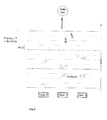
- the concept of the Slotted ALOHA method is shown in figures 1 and 2 .
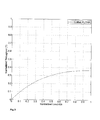
- the throughput which can be achieved with the Slotted ALOHA method as a function of the offered traffic G is shown in figure 3 .
- the Contention Resolution Diversity Slotted ALOHA (CRDSA) method.
- each user transmits two copies of the same packet within a frame in two randomly selected slots.
- a pointer to the position of the twin packet is written. If one packet is received without collision by the gateway or access point the pointer can be extracted from the header and is used by the gateway to identify where the twin packet is located in the frame structure.
- an interference cancellation process takes place with the following steps:
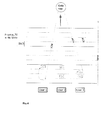
- figure 4 shows that user 1 sends two copies of a packet.
- One copy leads to a collision while the other one is correctly received by the gateway which sends the acknowledgement.
- Both packets which have been sent by user 2 are lost due to collisions.
- the interference caused by the packet sent by user 1 on the packet of user 2 in the forth time slot is cancelled. This permits to recover the packet of user 2.
- the interference caused by user 3 to user 2 may be cancelled by a subtraction as described above.
- the bursts of User 2, 3 and 4 can be received without collisions in slots 1, 4 and 2 respectively.
- the burst of User 1 cannot be decoded since it experiences a collision with the replicas of the bursts of Users 2, 3, 4. Nevertheless, the presence of a pointer in the burst replicas permits to know in which slot the corresponding twins are located.
- Figure 9 provides some insights. More specifically, Figure 9 shows:
- y(t) the pulse shape is denoted. Each contribution is then received within the same slot.
- n(t) is the Gaussian noise contribution (coloured) and ⁇ (i) (t) is the response of the matched filter to u (i) (t).
- the contributions u (1) (t), u (2) (t), ..., u (d-1) (t) represent the interference to be cancelled.
- the d-1 interference contributions deal with bursts that have been correctly detected and decoded in other slots.
- phase rotation terms ⁇ i which may vary from slot to slot. It is therefore needed to estimate ⁇ i , for each burst, directly on the slot where its contribution shall be eliminated.
- the estimation of each ⁇ i can be performed by means of a correlation with a training sequence to be included in each burst as it is described in the above mentioned state of the art documents. If each user selects a different training sequence from a set of orthogonal sequences, it is indeed possible to limit the interference contribution during the estimation of the phase offset.
- the approach used for the estimation of ⁇ I is given by:
- a transmission channel towards an access point is shared among a plurality of users.
- the data is transmitted using the CRDSA method.
- the signals belonging to data packets of different users may arrive within the same CRDSA slot with a random phase offset ⁇ i .
- FFC Full Frame Correlation
- a physical layer Forward Error Correction is applied by using a code generating a sub-matrix for the parity part of the burst structure which is a nearly random sequence.
- a code generating a sub-matrix for the parity part of the burst structure which is a nearly random sequence.
- an LDPC or turbo code can be used for this purpose.
- b (i) w represents the w-th symbol belonging to the burst transmitted by user I
- r* w represents the w-th received signal sample. Note that in the expression above, the summation runs properly from k to n-1, i.e., only on the parity symbols of the burst.
- PFC Partial Frame Correlation
- sequence b (i) is used as a training sequence whereby b (i) is known from previous decoding steps in other slots. It is preferred that the sequence b (i) has a length of more than 128 Bits. Therefore thanks to the sequence length which may be much larger than the length a usual training sequence, the processing gain is huge.
- each source generating a burst uses a source coding technique and/or a randomizer so that the payloads belonging to different bursts are nearly random sequences.
- Training sequences are usually a-priori known to the receiver which uses this knowledge to enhance the parameter estimation. It is preferred to exploit the parity bits of the date frame as training sequences, i.e.it is not necessary to include a pattern of known bits, which lowers the efficiency of the scheme.
- the random delay ⁇ (i) and the random frequency shift f (i) which is uniformly distributed over the interval (-f max , f max ) are directly estimated with a good accuracy on the corresponding burst replicas that have been already recovered.
- Eb/N0 Signal-to-Noise Ratio
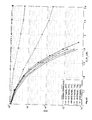
- the FER degradation w.r.t. the number of bursts colliding in the same slot is depicted in Figure 10 .
- the dot-dashed plots are referred to the case where the TS correlation (TSC) is used.
- the solid line refers to the pure Additive White Gaussian Noise (AWGN) performance (no bursts colliding).
- the FER rises up to 4*10 -2 .
- With 4 bursts colliding (3 ICs) the FER goes up to 0.4.
- the process for slots with variable numbers (d) of collisions according to the invention has also been simulated. For the simulations, for each transmission attempt there have been generated the parameters according to the distributions discussed before.
- the resulting samples have been then processed by the IC algorithm.
- the estimation of the phase offsets has been implemented using b (i) as training sequences, where for each user b (i) is a sequence of 2048 QPSK symbols. (Quadrature Phase Shift Keying). For each burst, the information sequence was generated at random, and was then encoded through the (4096,2048) LDPC code of the DVB-RCS+M standard.
- the method proposed here can be applied in all types of commercial wireless and wired transmission systems.
- the inventive method can be applied in particular for interactive satellite services as DVB-RCS, where CRDSA/IRSA may become soon the new multiple access standard.
Landscapes
- Engineering & Computer Science (AREA)
- Computer Networks & Wireless Communication (AREA)
- Signal Processing (AREA)
- Mobile Radio Communication Systems (AREA)
Abstract
Description
- The invention is related to a method of transmitting data to an access point over a transmission channel which is shared among a plurality of users.
- A known method for such a transmission of data is the Contention Resolution Diversity Slotted ALOHA (CRDSA) method. This method could for instance be used in the case of digital packetized uplink from many grounds stations towards a satellite. If we assume that there is no coordination between the users, i.e., the users may transmit their data packets on the same carrier frequency and in the same time instant and if we further assume that there is no Code Division Multiple Access (CDMA) it is obvious that packets sent by various users may collide on the communication medium, meaning that they will create interference among each other. The Slotted ALOHA method is a known protocol aiming to manage such uncoordinated multiple access schemes. In the Slotted ALOHA method the time access is partitioned in frames of duration Tf. Each frame is further partitioned in Ns slots of duration Ts=Tf/Ns. Each user must align his packet transmission to a slot, i.e., a synchronization with the frame structure must be kept by each user. Each user then transmits data independently with respect to the others and awaits for an acknowledgement from the gateway, which is the common access point. If no acknowledgement is received meaning that a collision has taken place on the communication medium, the user retransmits his packet with a random delay. This procedure is repeated until the packet transmission is successful. The concept of the Slotted ALOHA method is shown in
figures 1 and2 . - The throughput achieved by the Slotted ALOHA method is defined as T(G)=Ge - G. The peak throughput for the Slotted ALOHA method is achieved at G=1, for which T≃ 0.3679. This means that if G=1 the fraction of packets which will be transmitted successfully in a transmission attempt will be about 36%. G is defined as G=m/n, whereby m is the number of packet transmission attempts per frame and n is the number of slots per frame. The throughput which can be achieved with the Slotted ALOHA method as a function of the offered traffic G is shown in
figure 3 . - As an improvement of the Slotted ALOHA method the Contention Resolution Diversity Slotted ALOHA (CRDSA) method has been developed. Hereby each user transmits two copies of the same packet within a frame in two randomly selected slots. In the header of each packet a pointer to the position of the twin packet is written. If one packet is received without collision by the gateway or access point the pointer can be extracted from the header and is used by the gateway to identify where the twin packet is located in the frame structure. In case the twin packet collided with another packet, an interference cancellation process takes place with the following steps:
- The waveform representation of the twin packet is reconstructed at the gateway, by decoding the correctly received packet, re-encoding it, and modulating it.
- The so-obtained waveform is subtracted from the received signal within the time slot of the twin copy. This is equivalent to canceling the interference caused by the twin packet to the packet colliding in the same slot.
- The collided packet in this slot can now be decoded.
- This process can be iterated, meaning that the recovery of the collided packet will provide a pointer to the twin packet of the collided one. Thus by using this cascade effect, many packets can be recovered by this interference cancellation procedure.
- This procedure is depicted in
figures 4 and5 wherebyfigure 4 shows thatuser 1 sends two copies of a packet. One copy leads to a collision while the other one is correctly received by the gateway which sends the acknowledgement. The same happens for the packets sent byuser 3. Both packets which have been sent byuser 2 are lost due to collisions. As it is shown infigure 5 the interference caused by the packet sent byuser 1 on the packet ofuser 2 in the forth time slot is cancelled. This permits to recover the packet ofuser 2. As an alternative the interference caused byuser 3 touser 2 may be cancelled by a subtraction as described above. - Simulation results provided in "E. Casini, R.D. Gaudenzi, and O.D.R.Herrero, -Contention resolution diversity slotted aloha (crdsa): An enhanced random access scheme for satellite access packet networks.- IEEE Transactions on Wireless Communications, vol. 6, pp. 1408-1419, April 2007" show that almost in the whole range G∈[0.1] the CRDSA method provides a larger throughput, with a peak of T ≃ 0.55 for G ≃ 0.65. This is shown in
figure 6 . As can be further seen the limit for which the normalized throughput is almost linear is extended from G = 0.1 for Slotted ALOHA to G = 0.4 for CRDSA, meaning that for loads lower than G = 0.4 almost all the transmission attempts are successful. - In order to obtain the above mentioned performance an interference cancelation (IC) is needed. This is depicted in the example shown in
figure 7 . - Herein, a typical collision event is represented.
-
User 1 transmits only one replica of a burst inslot 3. -
User 2 transmits two replicas of the same burst inslots -
User 3 transmits two replicas of the same burst inslots -
User 4 transmits two replicas of the same burst inslots - The bursts of
User slots User 1 cannot be decoded since it experiences a collision with the replicas of the bursts ofUsers - As can be seen in
Figure 8 , it is then possible to cancel the contribution ofUsers Slot 3. - To understand the principle behind this interference cancelation,
Figure 9 provides some insights. More specifically,Figure 9 shows: - The waveforms associated to each burst replica (note that the two replicas of the same burst have the same waveform).
- In
Slot 3, the received signal is given by the sum of 4 contributions (the 4 waveforms ofbursts - Given the knowledge of the bursts that are received without collisions (
bursts Slot 3, and to subtract these contributions from the signal received inSlot 3. - Since the reconstruction of the waveforms of
bursts User 1. The so-called residual interference plays the role of a noisy signal which may jeopardize the correct decoding ofburst 1. - It is therefore crucial to reconstruct the contributions of
bursts - A case is considered where d users attempt a transmission of a burst within the same slot. It is denoted by u(i) (t) the complex baseband PAM (pulse amplitude modulation) signal transmitted by the i-th user, i.e.

where n is the number of symbols composing the frame, b(i) k is the sequence of symbols and T is the symbol period. By y(t) the pulse shape is denoted. Each contribution is then received within the same slot. It is assumed that each contribution arrives with a random delay εi , a random frequency shift fi (uniformly distributed over the interval (-fmax,fmax)) and a random phase offset φi (uniformly distributed in )0,2π)). Assuming frequency shifts that are small w.r.t. the signal bandwidth (i.e., fmax T<<1), after matched filtering, the received signal is given by
- In the expression above, n(t) is the Gaussian noise contribution (coloured) and ũ (i)(t) is the response of the matched filter to u(i)(t).
- It is assumed next that the contribution to be recovered is the one for i=0. Thus, the contributions u(1)(t), u(2)(t), ..., u(d-1)(t) represent the interference to be cancelled. Hence it is considered that the d-1 interference contributions deal with bursts that have been correctly detected and decoded in other slots.
- To proceed with the interference cancelation (i.e., to reconstruct the interference contributions), it is necessary to estimate the set of parameters {εi,fi, φi}, for i=1... d-1. As discussed in E.Casini, R. De Gaudenzi, O. Del Rio, "Contention Resolution Diversity Slotted Aloha (CRDSA): An Enhanced Random Access Scheme for Satellite Access Packet Networks", IEEE Transaction on Wireless Communications, April 2007 and
US2006/0171418 A1 the case where εi and fi can be directly estimated with a good accuracy on the corresponding burst replicas that have been already recovered is considered. - As pointed out in the above mentioned state of the art, this argument does not hold for the phase rotation terms ϕi which may vary from slot to slot. It is therefore needed to estimate ϕi, for each burst, directly on the slot where its contribution shall be eliminated. The estimation of each φi can be performed by means of a correlation with a training sequence to be included in each burst as it is described in the above mentioned state of the art documents. If each user selects a different training sequence from a set of orthogonal sequences, it is indeed possible to limit the interference contribution during the estimation of the phase offset. Thus, the approach used for the estimation of φI is given by:
- ● The introduction, on the transmitter side, of a training sequence (TS) of length nTS symbols into each burst. Each user picks its TS randomly within a set of orthogonal TSs. The burst format for the i-th users thus looks like

where- o [s0 (i) ... SnTS-1(i)] is the TS on nTS symbols.
- o [d0 (i)... dk-nTS-1 (i)] is the burst payload of k-nTS symbols (information part).
- o [p0 (i) ... pn-k-1 (i)] is the redundancy (parity part) added by the physical layer FEC (Forward Error Correction).
- ● n the receiver side, the signal is received and sampled. For the i-th user, the received samples related to [s0 (i) ... SnTS-1 (i)] are given by

Hereby Ik is the interference contribution coming from the other d-1 colliding bursts. The phase rotation is thus estimated as
Herein r*w is the conjugate of rw.
Thanks to this operation, the interference and the noise contributions are reduced w.r.t. the userful signal by a factor nTS (called also "processing gain"), permitting a quite accurate estimation of φI. - ● The i-th interference signal is thus reconstructed at the receiver as

where the reconstruction is not perfect due to the imperfect estimation of φI.
This contribution is removed from r(t) leading to
Herein i(i)(t) is the residual interference contribution caused by the imperfect elimination of the i-th user contribution. - ● The procedure is thus iterated for the d-1 colliding users. The last remaining contribution is the one related to the burst we wish to recover. For this burst, the received sampled signal will result hence in

Herein ik" is the final residual interference contribution due to the imperfect cancelation of the d-1 colliding bursts. The result is that, on top of the noise, there is another term that corrupts the received signal. Thus the FEC decoder has to counteract both the noise and the residual interference. This will lead to the degradation of the Frame Error Rate (FER) after decoding w.r.t. the case where just noise was present. - The more imperfect will be the interference cancelation, the larger will be the residual interference contribution, the higher will be the performance degradation.
- With the method proposed in the above mentioned state of the art documents for the phase estimation, the accuracy of the estimation can be improved by using longer TSs. Nevertheless, a too long TS would waste the system efficiency (stealing space in the busts payload to the useful information symbols). Thus, in these publications it is suggested to use this TS of ~32 , ~64 bits.
- Therefore it is known from the state of the art to use an interference cancelation scheme to remove collisions, whenever a packet arrives at the gateway without collisions. For the interference cancelation the interfering signals are reconstructed estimating the frequency shift and the symbol timing on decoded replicas, while the phase rotation φi is directly estimated on the colliding burst. The phase is estimated by means of a training sequence.
- It is an object of the present invention to provide for a method of transmitting data using the CRDSA method whereby the interference cancelation resulting from data packets of different users arriving on the same slot is improved. According to the invention this object is achieved by the features of
method claim 1. - In the inventive method of transmitting data a transmission channel towards an access point is shared among a plurality of users. The data is transmitted using the CRDSA method. Thereby the burst structure is given by:

- Therefore it is preferred that the there is no more overhead due to the insertion of training sequence (meaning that all the payload is given by data symbols).
- The signals belonging to data packets of different users may arrive within the same CRDSA slot with a random phase offset φi.
- In case the payloads belonging to different bursts are nearly random sequences an estimation of the phase offset φi is performed according to:

- This case is defined as Full Frame Correlation (FFC) whereby it is assumed that the burst payloads are nearly random sequences.
- In case that it cannot be guaranteed that the payloads belonging to different bursts are nearly random sequences a physical layer Forward Error Correction is applied by using a code generating a sub-matrix for the parity part of the burst structure which is a nearly random sequence. For example an LDPC or turbo code can be used for this purpose. The estimation of the phase offset φi is exclusively performed on the sub-sequence constituting the parity part of the burst structure which is a nearly random sequence according to :

- In these equations, b(i) w represents the w-th symbol belonging to the burst transmitted by user I, and r*wrepresents the w-th received signal sample. Note that in the expression above, the summation runs properly from k to n-1, i.e., only on the parity symbols of the burst.
- This case is defined as Partial Frame Correlation (PFC), meaning that the assumption of nearly-random bursts cannot be guaranteed so that the above described procedure (Full Frame Correlation) cannot be applied, since the cross-correlation among users could be high, not allowing any rejection (i.e. cancellation).
- It is preferred that the sequence b(i) is used as a training sequence whereby b(i) is known from previous decoding steps in other slots. It is preferred that the sequence b(i) has a length of more than 128 Bits. Therefore thanks to the sequence length which may be much larger than the length a usual training sequence, the processing gain is huge. As an example a normal training sequence can be made of 64 Bits. A burst can have n=4096 bits. The interference is rejected in the first case by 10log10 64 = 18 dB (processing gain). In the second case, it would be rejected by 10log10 4096 = 36 dB.
- In a preferred embodiment the sub-matrix constituting the payload or the parity part of the burst structure is defined as a nearly random sequence, when the probability that an entry in the matrix is 0 and the probability that an entry in the matrix is 1 are both 0,5 (Pr{pij=0}=Pr{ pij=1}=0.5).
- In the following the Partial Frame Correlation is described in more detail:
- A case is considered where two sources produce two information sequences x (1), x (2) k bits each, and that the Hamming distance between the two sequences is small, e.g., the two sequences differ in a few bits. Denote by c(1), c(2) the n-bits encoded sequences, i.e.

where G is the (k x n) generator matrix of the forward error correction (FEC) code. Assume G to be in systematic form,G=[I|P]. If the FEC code is properly designed, the sub-matrix P would be a (k x (n-k)) binary matrix with nearly independent and identically distributed (i.i.d.) entries, with Pr{pij=0}=Pr{ pij=1}=0.5. Under this assumptions, the parity parts of c(1) and c(2) would be given by two nearly-random sequences. This would not happen if the FEC is for instance a convolutional code. - It is preferred that each source generating a burst uses a source coding technique and/or a randomizer so that the payloads belonging to different bursts are nearly random sequences.
- Training sequences are usually a-priori known to the receiver which uses this knowledge to enhance the parameter estimation. It is preferred to exploit the parity bits of the date frame as training sequences, i.e.it is not necessary to include a pattern of known bits, which lowers the efficiency of the scheme.
- It is preferred that the random delay ε(i) and the random frequency shift f(i) which is uniformly distributed over the interval (-fmax, fmax) are directly estimated with a good accuracy on the corresponding burst replicas that have been already recovered.
- In the following a preferred embodiment of the invention is explained with regard to
figure 10 , whereby the inventive method is compared to the state of the art. -
Figure 10 shows the Frame Error Rate vs. the Signal-to-Noise Ratio (Eb/N0) for the (4096,2048) LDPC code of the DVB-RCS+M standard (QPSK modulation, 50 iterations of the approximate-min* algorithm; IC implemented on the oversampled signal, oversampling factor M=8; Various number of colliding packets (d)). - The FER degradation w.r.t. the number of bursts colliding in the same slot is depicted in
Figure 10 . The dot-dashed plots are referred to the case where the TS correlation (TSC) is used. The solid line refers to the pure Additive White Gaussian Noise (AWGN) performance (no bursts colliding). The degradation is large: at an SNR=1.8 dB, the AWGN FER is close to 10-4. With 2 bursts colliding (1 IC), the FER rises up to 4*10-2. With 4 bursts colliding (3 ICs) the FER goes up to 0.4. With 8 bursts colliding (7 ICs) the FER is almost 1. These results have been obtained using for the simulation the (4096 bits, 2048 bits) LDPC code of the DVB-RCS+M standard, and a TS of 64 bits. - The process for slots with variable numbers (d) of collisions according to the invention has also been simulated. For the simulations, for each transmission attempt there have been generated the parameters according to the distributions discussed before. The received signal r(t) then has been sampled with an oversampling factor Ms=8. The resulting samples have been then processed by the IC algorithm. The estimation of the phase offsets has been implemented using b(i) as training sequences, where for each user b(i) is a sequence of 2048 QPSK symbols. (Quadrature Phase Shift Keying). For each burst, the information sequence was generated at random, and was then encoded through the (4096,2048) LDPC code of the DVB-RCS+M standard. The performance in terms of FER vs Eb/N0 is depicted in
Figure 10 (full frame correlation, FFC) and compared to the case where a TS of 64 bits is used (TSC). The loss w.r.t. the AWGN case is now negligible, and even with d=8 collisions (7 ICs) the loss is minimal, especially when compared with the result of TSC. - The method proposed here can be applied in all types of commercial wireless and wired transmission systems. The inventive method can be applied in particular for interactive satellite services as DVB-RCS, where CRDSA/IRSA may become soon the new multiple access standard.
Claims (8)
- Method of transmitting data, whereby a transmission channel towards an access point is shared among a plurality of users,
the data being transmitted using the Contention Resolution Diversity Slotted Aloha (CRDSA) method,
whereby the burst structure is given by:
whereby the signals belonging to data packets of different users may arrive within the same CRDSA slot with a random phase offset φI,
characterized in thata) in case the payloads belonging to different bursts are nearly random sequences an estimation of the phase offset φi is performed according to: b) in case that it cannot be guaranteed that the payloads belonging to different bursts are nearly random sequences a physical layer Forward Error Correction (FEC) is applied by using a code generating a sub-matrix for the parity part of the burst structure which is a nearly random matrix and the estimation of the phase offset φi is exclusively performed on the sub-sequence constituting the parity part of the burst structure which is a nearly random sequence according to:
- Method of transmitting data according to claim 1, characterized in that a Low Density Parity Check (LDPC) or turbo code is used for performing the physical layer Forward Error Correction.
- Method of transmitting data according to one of claims 1 or 2, characterized in that the sub-matrix constituting the payload or the parity part of the burst structure is defined as a nearly random sequence when the probability that an entry in the matrix is 0 and the probability that an entry in the matrix is 1 are both 0,5.
- Method of transmitting data according to one of claims 1-3, characterized in that each source generating a burst uses a source coding technique and/or a randomizer so that the payloads belonging to different bursts are nearly random sequences.
- Method of transmitting data according to one of claims 1-4, characterized in that the code used for physical layer Forward Error Correction is not a convolutional code when it cannot be guaranteed that the payloads belonging to different bursts are nearly random sequences.
- Method of transmitting data according to one of claims 1-5, characterized in that the sequence b(i) is used as a training sequence, whereby b(i) is known from previous decoding steps in other slots.
- Method of transmitting data according to claim 6, characterized in that the sequence b(i) has a length of more than 128 Bits.
- Method of transmitting data according to one of claims 1-7, characterized in that the signals belonging to data packets of different users may arrive within the same CRDSA slot with a random delay ε(i) and/or a random frequency shift f(i), whereby ε(i) and f(i) can be estimated with a good accuracy on corresponding burst replicas that have already been recovered.
Priority Applications (1)
| Application Number | Priority Date | Filing Date | Title |
|---|---|---|---|
| EP10152325.6A EP2355575B1 (en) | 2010-02-01 | 2010-02-01 | Method of transmitting data |
Applications Claiming Priority (1)
| Application Number | Priority Date | Filing Date | Title |
|---|---|---|---|
| EP10152325.6A EP2355575B1 (en) | 2010-02-01 | 2010-02-01 | Method of transmitting data |
Publications (2)
| Publication Number | Publication Date |
|---|---|
| EP2355575A1 true EP2355575A1 (en) | 2011-08-10 |
| EP2355575B1 EP2355575B1 (en) | 2013-07-10 |
Family
ID=41786150
Family Applications (1)
| Application Number | Title | Priority Date | Filing Date |
|---|---|---|---|
| EP10152325.6A Active EP2355575B1 (en) | 2010-02-01 | 2010-02-01 | Method of transmitting data |
Country Status (1)
| Country | Link |
|---|---|
| EP (1) | EP2355575B1 (en) |
Cited By (1)
| Publication number | Priority date | Publication date | Assignee | Title |
|---|---|---|---|---|
| CN120834846A (en) * | 2025-09-16 | 2025-10-24 | 北京理工大学 | Aircraft arrival direction estimation method, system, device and medium based on CRDSA |
Citations (1)
| Publication number | Priority date | Publication date | Assignee | Title |
|---|---|---|---|---|
| EP1686746A1 (en) * | 2005-01-31 | 2006-08-02 | Agence Spatiale Europeenne | Packet data transmssion over a shared transmission channel |
-
2010
- 2010-02-01 EP EP10152325.6A patent/EP2355575B1/en active Active
Patent Citations (2)
| Publication number | Priority date | Publication date | Assignee | Title |
|---|---|---|---|---|
| EP1686746A1 (en) * | 2005-01-31 | 2006-08-02 | Agence Spatiale Europeenne | Packet data transmssion over a shared transmission channel |
| US20060171418A1 (en) | 2005-01-31 | 2006-08-03 | Agence Spatiale Europeenne | Method of packet mode digital communication over a transmission channel shared by a plurality of users |
Non-Patent Citations (3)
| Title |
|---|
| E. CASINI; R.D. GAUDENZI; O.D.R.HERRERO: "Contention resolution diversity slotted aloha (crdsa): An enhanced random access scheme for satellite access packet networks", IEEE TRANSACTIONS ON WIRELESS COMMUNICATIONS, vol. 6, April 2007 (2007-04-01), pages 1408 - 1419 |
| E.CASINI; R. DE GAUDENZI; O. DEL RIO: "Contention Resolution Diversity Slotted Aloha (CRDSA): An Enhanced Random Access Scheme for Satellite Access Packet Networks", IEEE TRANSACTION ON WIRELESS COMMUNICATIONS, April 2007 (2007-04-01) |
| ENRICO CASINI ET AL: "Contention Resolution Diversity Slotted ALOHA (CRDSA): An Enhanced Random Access Schemefor Satellite Access Packet Networks", IEEE TRANSACTIONS ON WIRELESS COMMUNICATIONS, IEEE SERVICE CENTER, PISCATAWAY, NJ, US, vol. 6, no. 4, 1 April 2007 (2007-04-01), pages 1408 - 1419, XP011177132, ISSN: 1536-1276 * |
Cited By (1)
| Publication number | Priority date | Publication date | Assignee | Title |
|---|---|---|---|---|
| CN120834846A (en) * | 2025-09-16 | 2025-10-24 | 北京理工大学 | Aircraft arrival direction estimation method, system, device and medium based on CRDSA |
Also Published As
| Publication number | Publication date |
|---|---|
| EP2355575B1 (en) | 2013-07-10 |
Similar Documents
| Publication | Publication Date | Title |
|---|---|---|
| US20250119330A1 (en) | Systems and Methods for Communicating by Modulating Data on Zeros in the Presence of Channel Impairments | |
| US8340132B2 (en) | Method for contention resolution in time-hopping or frequency-hopping | |
| JP4982586B2 (en) | Communication method and system in multiple access network | |
| De Gaudenzi et al. | Asynchronous contention resolution diversity ALOHA: Making CRDSA truly asynchronous | |
| Clazzer et al. | Enhancing contention resolution ALOHA using combining techniques | |
| EP3017646B1 (en) | Method and apparatus for transmitting data packets over a transmission channel shared by a plurality of users | |
| EP2262149B1 (en) | Data detection and demodulation for wireless communication systems | |
| EP3378063B1 (en) | Method and apparatus for providing random access communication | |
| CN1802796B (en) | Communication method and apparatus for multi-user detection | |
| Bui et al. | A multi-replica decoding technique for contention resolution diversity slotted ALOHA | |
| US8930800B2 (en) | Method and apparatus of triple-decoding for IEEE 802.11p physical layer mechanism | |
| US9294223B2 (en) | Reception of co-channel signals | |
| Cocco et al. | Network‐coded diversity protocol for collision recovery in slotted ALOHA networks | |
| EP2355575B1 (en) | Method of transmitting data | |
| Cocco et al. | Practical issues in multi-user physical layer network coding | |
| Bui et al. | Multi-slot coded ALOHA with irregular degree distribution | |
| Ferré et al. | A downlink non orthogonal multiple access for chirp spread spectrum communications | |
| Rahman et al. | An iterative ZigZag decoding for combating collisions in wireless networks | |
| Zidane et al. | Estimation of timing offsets and phase shifts between packet replicas in MARSALA random access | |
| Zidane et al. | Phase noise impact on the performance of contention resolution slotted random access schemes | |
| Keene et al. | Collision localization for IEEE 802.11 wireless LANs | |
| Liva | Contention resolution diversity slotted ALOHA with variable rate burst repetitions | |
| Zidane et al. | Enhancement of MARSALA random access with coding schemes, power distributions and maximum ratio combining | |
| CN121770938A (en) | Working method of satellite-borne VDE-Link 20-based receiver | |
| Bergamasco et al. | OTFS-IDMA: An Unsourced Multiple Access Scheme for Doubly-Dispersive Channels |
Legal Events
| Date | Code | Title | Description |
|---|---|---|---|
| PUAI | Public reference made under article 153(3) epc to a published international application that has entered the european phase |
Free format text: ORIGINAL CODE: 0009012 |
|
| AK | Designated contracting states |
Kind code of ref document: A1 Designated state(s): AT BE BG CH CY CZ DE DK EE ES FI FR GB GR HR HU IE IS IT LI LT LU LV MC MK MT NL NO PL PT RO SE SI SK SM TR |
|
| AX | Request for extension of the european patent |
Extension state: AL BA RS |
|
| 17P | Request for examination filed |
Effective date: 20120107 |
|
| GRAP | Despatch of communication of intention to grant a patent |
Free format text: ORIGINAL CODE: EPIDOSNIGR1 |
|
| GRAS | Grant fee paid |
Free format text: ORIGINAL CODE: EPIDOSNIGR3 |
|
| GRAA | (expected) grant |
Free format text: ORIGINAL CODE: 0009210 |
|
| AK | Designated contracting states |
Kind code of ref document: B1 Designated state(s): AT BE BG CH CY CZ DE DK EE ES FI FR GB GR HR HU IE IS IT LI LT LU LV MC MK MT NL NO PL PT RO SE SI SK SM TR |
|
| REG | Reference to a national code |
Ref country code: GB Ref legal event code: FG4D |
|
| REG | Reference to a national code |
Ref country code: CH Ref legal event code: EP Ref country code: AT Ref legal event code: REF Ref document number: 621553 Country of ref document: AT Kind code of ref document: T Effective date: 20130715 |
|
| REG | Reference to a national code |
Ref country code: IE Ref legal event code: FG4D |
|
| REG | Reference to a national code |
Ref country code: DE Ref legal event code: R096 Ref document number: 602010008338 Country of ref document: DE Effective date: 20130905 |
|
| PG25 | Lapsed in a contracting state [announced via postgrant information from national office to epo] |
Ref country code: SI Free format text: LAPSE BECAUSE OF FAILURE TO SUBMIT A TRANSLATION OF THE DESCRIPTION OR TO PAY THE FEE WITHIN THE PRESCRIBED TIME-LIMIT Effective date: 20130710 |
|
| REG | Reference to a national code |
Ref country code: AT Ref legal event code: MK05 Ref document number: 621553 Country of ref document: AT Kind code of ref document: T Effective date: 20130710 |
|
| REG | Reference to a national code |
Ref country code: NL Ref legal event code: VDEP Effective date: 20130710 |
|
| REG | Reference to a national code |
Ref country code: LT Ref legal event code: MG4D |
|
| PG25 | Lapsed in a contracting state [announced via postgrant information from national office to epo] |
Ref country code: AT Free format text: LAPSE BECAUSE OF FAILURE TO SUBMIT A TRANSLATION OF THE DESCRIPTION OR TO PAY THE FEE WITHIN THE PRESCRIBED TIME-LIMIT Effective date: 20130710 Ref country code: HR Free format text: LAPSE BECAUSE OF FAILURE TO SUBMIT A TRANSLATION OF THE DESCRIPTION OR TO PAY THE FEE WITHIN THE PRESCRIBED TIME-LIMIT Effective date: 20130710 Ref country code: SE Free format text: LAPSE BECAUSE OF FAILURE TO SUBMIT A TRANSLATION OF THE DESCRIPTION OR TO PAY THE FEE WITHIN THE PRESCRIBED TIME-LIMIT Effective date: 20130710 Ref country code: LT Free format text: LAPSE BECAUSE OF FAILURE TO SUBMIT A TRANSLATION OF THE DESCRIPTION OR TO PAY THE FEE WITHIN THE PRESCRIBED TIME-LIMIT Effective date: 20130710 Ref country code: NO Free format text: LAPSE BECAUSE OF FAILURE TO SUBMIT A TRANSLATION OF THE DESCRIPTION OR TO PAY THE FEE WITHIN THE PRESCRIBED TIME-LIMIT Effective date: 20131010 Ref country code: PT Free format text: LAPSE BECAUSE OF FAILURE TO SUBMIT A TRANSLATION OF THE DESCRIPTION OR TO PAY THE FEE WITHIN THE PRESCRIBED TIME-LIMIT Effective date: 20131111 Ref country code: IS Free format text: LAPSE BECAUSE OF FAILURE TO SUBMIT A TRANSLATION OF THE DESCRIPTION OR TO PAY THE FEE WITHIN THE PRESCRIBED TIME-LIMIT Effective date: 20131110 Ref country code: CY Free format text: LAPSE BECAUSE OF FAILURE TO SUBMIT A TRANSLATION OF THE DESCRIPTION OR TO PAY THE FEE WITHIN THE PRESCRIBED TIME-LIMIT Effective date: 20130626 Ref country code: BE Free format text: LAPSE BECAUSE OF FAILURE TO SUBMIT A TRANSLATION OF THE DESCRIPTION OR TO PAY THE FEE WITHIN THE PRESCRIBED TIME-LIMIT Effective date: 20130710 |
|
| PG25 | Lapsed in a contracting state [announced via postgrant information from national office to epo] |
Ref country code: PL Free format text: LAPSE BECAUSE OF FAILURE TO SUBMIT A TRANSLATION OF THE DESCRIPTION OR TO PAY THE FEE WITHIN THE PRESCRIBED TIME-LIMIT Effective date: 20130710 Ref country code: LV Free format text: LAPSE BECAUSE OF FAILURE TO SUBMIT A TRANSLATION OF THE DESCRIPTION OR TO PAY THE FEE WITHIN THE PRESCRIBED TIME-LIMIT Effective date: 20130710 Ref country code: GR Free format text: LAPSE BECAUSE OF FAILURE TO SUBMIT A TRANSLATION OF THE DESCRIPTION OR TO PAY THE FEE WITHIN THE PRESCRIBED TIME-LIMIT Effective date: 20131011 Ref country code: NL Free format text: LAPSE BECAUSE OF FAILURE TO SUBMIT A TRANSLATION OF THE DESCRIPTION OR TO PAY THE FEE WITHIN THE PRESCRIBED TIME-LIMIT Effective date: 20130710 Ref country code: FI Free format text: LAPSE BECAUSE OF FAILURE TO SUBMIT A TRANSLATION OF THE DESCRIPTION OR TO PAY THE FEE WITHIN THE PRESCRIBED TIME-LIMIT Effective date: 20130710 Ref country code: ES Free format text: LAPSE BECAUSE OF FAILURE TO SUBMIT A TRANSLATION OF THE DESCRIPTION OR TO PAY THE FEE WITHIN THE PRESCRIBED TIME-LIMIT Effective date: 20131021 |
|
| PG25 | Lapsed in a contracting state [announced via postgrant information from national office to epo] |
Ref country code: CY Free format text: LAPSE BECAUSE OF FAILURE TO SUBMIT A TRANSLATION OF THE DESCRIPTION OR TO PAY THE FEE WITHIN THE PRESCRIBED TIME-LIMIT Effective date: 20130710 |
|
| PG25 | Lapsed in a contracting state [announced via postgrant information from national office to epo] |
Ref country code: EE Free format text: LAPSE BECAUSE OF FAILURE TO SUBMIT A TRANSLATION OF THE DESCRIPTION OR TO PAY THE FEE WITHIN THE PRESCRIBED TIME-LIMIT Effective date: 20130710 Ref country code: DK Free format text: LAPSE BECAUSE OF FAILURE TO SUBMIT A TRANSLATION OF THE DESCRIPTION OR TO PAY THE FEE WITHIN THE PRESCRIBED TIME-LIMIT Effective date: 20130710 Ref country code: CZ Free format text: LAPSE BECAUSE OF FAILURE TO SUBMIT A TRANSLATION OF THE DESCRIPTION OR TO PAY THE FEE WITHIN THE PRESCRIBED TIME-LIMIT Effective date: 20130710 Ref country code: RO Free format text: LAPSE BECAUSE OF FAILURE TO SUBMIT A TRANSLATION OF THE DESCRIPTION OR TO PAY THE FEE WITHIN THE PRESCRIBED TIME-LIMIT Effective date: 20130710 Ref country code: SK Free format text: LAPSE BECAUSE OF FAILURE TO SUBMIT A TRANSLATION OF THE DESCRIPTION OR TO PAY THE FEE WITHIN THE PRESCRIBED TIME-LIMIT Effective date: 20130710 |
|
| PLBE | No opposition filed within time limit |
Free format text: ORIGINAL CODE: 0009261 |
|
| STAA | Information on the status of an ep patent application or granted ep patent |
Free format text: STATUS: NO OPPOSITION FILED WITHIN TIME LIMIT |
|
| PG25 | Lapsed in a contracting state [announced via postgrant information from national office to epo] |
Ref country code: IT Free format text: LAPSE BECAUSE OF FAILURE TO SUBMIT A TRANSLATION OF THE DESCRIPTION OR TO PAY THE FEE WITHIN THE PRESCRIBED TIME-LIMIT Effective date: 20130710 |
|
| 26N | No opposition filed |
Effective date: 20140411 |
|
| REG | Reference to a national code |
Ref country code: DE Ref legal event code: R097 Ref document number: 602010008338 Country of ref document: DE Effective date: 20140411 |
|
| PG25 | Lapsed in a contracting state [announced via postgrant information from national office to epo] |
Ref country code: MC Free format text: LAPSE BECAUSE OF FAILURE TO SUBMIT A TRANSLATION OF THE DESCRIPTION OR TO PAY THE FEE WITHIN THE PRESCRIBED TIME-LIMIT Effective date: 20130710 Ref country code: LU Free format text: LAPSE BECAUSE OF FAILURE TO SUBMIT A TRANSLATION OF THE DESCRIPTION OR TO PAY THE FEE WITHIN THE PRESCRIBED TIME-LIMIT Effective date: 20140201 |
|
| REG | Reference to a national code |
Ref country code: CH Ref legal event code: PL |
|
| PG25 | Lapsed in a contracting state [announced via postgrant information from national office to epo] |
Ref country code: LI Free format text: LAPSE BECAUSE OF NON-PAYMENT OF DUE FEES Effective date: 20140228 Ref country code: CH Free format text: LAPSE BECAUSE OF NON-PAYMENT OF DUE FEES Effective date: 20140228 |
|
| REG | Reference to a national code |
Ref country code: FR Ref legal event code: ST Effective date: 20141031 |
|
| REG | Reference to a national code |
Ref country code: IE Ref legal event code: MM4A |
|
| PG25 | Lapsed in a contracting state [announced via postgrant information from national office to epo] |
Ref country code: IE Free format text: LAPSE BECAUSE OF NON-PAYMENT OF DUE FEES Effective date: 20140201 Ref country code: FR Free format text: LAPSE BECAUSE OF NON-PAYMENT OF DUE FEES Effective date: 20140228 |
|
| PG25 | Lapsed in a contracting state [announced via postgrant information from national office to epo] |
Ref country code: MT Free format text: LAPSE BECAUSE OF FAILURE TO SUBMIT A TRANSLATION OF THE DESCRIPTION OR TO PAY THE FEE WITHIN THE PRESCRIBED TIME-LIMIT Effective date: 20130710 |
|
| PG25 | Lapsed in a contracting state [announced via postgrant information from national office to epo] |
Ref country code: SM Free format text: LAPSE BECAUSE OF FAILURE TO SUBMIT A TRANSLATION OF THE DESCRIPTION OR TO PAY THE FEE WITHIN THE PRESCRIBED TIME-LIMIT Effective date: 20130710 |
|
| PG25 | Lapsed in a contracting state [announced via postgrant information from national office to epo] |
Ref country code: BG Free format text: LAPSE BECAUSE OF FAILURE TO SUBMIT A TRANSLATION OF THE DESCRIPTION OR TO PAY THE FEE WITHIN THE PRESCRIBED TIME-LIMIT Effective date: 20130710 |
|
| PG25 | Lapsed in a contracting state [announced via postgrant information from national office to epo] |
Ref country code: HU Free format text: LAPSE BECAUSE OF FAILURE TO SUBMIT A TRANSLATION OF THE DESCRIPTION OR TO PAY THE FEE WITHIN THE PRESCRIBED TIME-LIMIT; INVALID AB INITIO Effective date: 20100201 Ref country code: TR Free format text: LAPSE BECAUSE OF FAILURE TO SUBMIT A TRANSLATION OF THE DESCRIPTION OR TO PAY THE FEE WITHIN THE PRESCRIBED TIME-LIMIT Effective date: 20130710 |
|
| PG25 | Lapsed in a contracting state [announced via postgrant information from national office to epo] |
Ref country code: MK Free format text: LAPSE BECAUSE OF FAILURE TO SUBMIT A TRANSLATION OF THE DESCRIPTION OR TO PAY THE FEE WITHIN THE PRESCRIBED TIME-LIMIT Effective date: 20130710 |
|
| PGFP | Annual fee paid to national office [announced via postgrant information from national office to epo] |
Ref country code: GB Payment date: 20200130 Year of fee payment: 11 |
|
| REG | Reference to a national code |
Ref country code: DE Ref legal event code: R084 Ref document number: 602010008338 Country of ref document: DE |
|
| GBPC | Gb: european patent ceased through non-payment of renewal fee |
Effective date: 20210201 |
|
| PG25 | Lapsed in a contracting state [announced via postgrant information from national office to epo] |
Ref country code: GB Free format text: LAPSE BECAUSE OF NON-PAYMENT OF DUE FEES Effective date: 20210201 |
|
| PGFP | Annual fee paid to national office [announced via postgrant information from national office to epo] |
Ref country code: DE Payment date: 20260115 Year of fee payment: 17 |