EP2355042A1 - A method for foreground - background discrimination - Google Patents
A method for foreground - background discrimination Download PDFInfo
- Publication number
- EP2355042A1 EP2355042A1 EP10189608A EP10189608A EP2355042A1 EP 2355042 A1 EP2355042 A1 EP 2355042A1 EP 10189608 A EP10189608 A EP 10189608A EP 10189608 A EP10189608 A EP 10189608A EP 2355042 A1 EP2355042 A1 EP 2355042A1
- Authority
- EP
- European Patent Office
- Prior art keywords
- vector
- vectors
- motion vector
- foreground
- block
- Prior art date
- Legal status (The legal status is an assumption and is not a legal conclusion. Google has not performed a legal analysis and makes no representation as to the accuracy of the status listed.)
- Granted
Links
Images


Classifications
-
- G—PHYSICS
- G06—COMPUTING OR CALCULATING; COUNTING
- G06T—IMAGE DATA PROCESSING OR GENERATION, IN GENERAL
- G06T7/00—Image analysis
- G06T7/20—Analysis of motion
- G06T7/215—Motion-based segmentation
-
- G—PHYSICS
- G06—COMPUTING OR CALCULATING; COUNTING
- G06T—IMAGE DATA PROCESSING OR GENERATION, IN GENERAL
- G06T7/00—Image analysis
- G06T7/10—Segmentation; Edge detection
- G06T7/194—Segmentation; Edge detection involving foreground-background segmentation
-
- G—PHYSICS
- G06—COMPUTING OR CALCULATING; COUNTING
- G06T—IMAGE DATA PROCESSING OR GENERATION, IN GENERAL
- G06T2207/00—Indexing scheme for image analysis or image enhancement
- G06T2207/10—Image acquisition modality
- G06T2207/10016—Video; Image sequence
Definitions
- This invention relates to a foreground (FG) - background (BG) discrimination method for video processing applications by determining whether the motion vectors belong to foreground or background according to an evaluated metric.
- FG foreground
- BG background
- the BG motion vector should be utilized in the unidirectional interpolation of occlusion regions (cover/uncover regions).
- FG - BG vector discrimination method should be described.
- an image processing method involves determining a global motion between a reference frame and a current frame in a frame sequence. Said image processing method involves determining a classification parameter for a current group of at least one image element in a said current frame of said frame sequence. A representation of said global motion of image element property values from said reference frame in the sequence to said current frame is determined. A reference group is identified in said reference frame for said current group utilizing the determined global motion representation. Then, said classification parameter is calculated based on a difference in property values of said image elements in said current group and said reference group. This calculated classification parameter is used for FG - BG determination. As mentioned in document W02008/091205A1 , said parameter exceeds a threshold the group regarded as a foreground group in the frame otherwise it belongs to the background.
- foreground - background discrimination is made by proposing FG - BG discrimination metric based on continuity or discontinuity of vectors in their own trajectory with spatial neighbourhood.
- FG - BG discrimination To discriminate FG and BG, a reliable and robust discrimination metric is used. Said discrimination metric is calculated by accumulating vector differences in a motion vector field. In said motion vector field continuation and discontinuation of FG and BG vectors are detected. According to said continuation check, vector differences are accumulated and accumulation buffer is calculated. The appreciation analysis of discrimination metric represents that the accumulated difference is higher; probability of being BG motion vector is higher.
- the object of the present invention is to provide a new approach for FG - BG discrimination by proposing novel FG - BG discrimination metric.
- Another object of the present invention is to propose reliable, robust FG - BG discrimination metric around occlusion regions based on motion continuation in temporal space.
- Another object of the invention is to provide discrimination metric by accumulating the vector differences according to motion continuation in a motion vector field.
- Another object of the invention is to check the continuation of motion vectors in a NxN block - sized grid by a window or kernel.
- Another object of the invention is to reduce or avoid halo artifacts around the object/motion boundaries.
- the present invention offers a method for foreground (FG) (1) - background (BG) (2) discrimination for video applications.
- FG (1) - BG (2) discrimination has importance in many video application processes such as object segmentation, motion segmentation and frame rate up - conversion (FRUC). During said processes, halo effects occur around object - motion boundaries, since FG (1) - BG (2) discrimination is not considered. Lack of FG - BG discrimination causes wrong motion vector utilization in occlusion region. To reduce or avoid halo effects unidirectional interpolation should be made in occlusion region. For convenient unidirectional interpolation, FG (1) - BG (2) discrimination should be done.
- the present invention comprises discrimination metric for FG (1) - BG (2) discrimination.
- discrimination metric for FG (1) - BG (2) discrimination.
- motion vector assignments in occlusion regions are accurate enough to represent true motion.
- motion vector field estimated for a frame is occlusion - insensitive.
- Said discrimination metric is calculated by accumulating the vector differences of each vector in a window or a kernel along both forward and backward trajectory of the central vector of the window.
- said discrimination metric is based on the continuation and discontinuation of the vector fields for FG (1) and BG (2) respectively in temporal space.
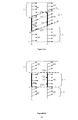
- Figure (1-a ) shows BG (2) vectors (201, 202) and FG (1) vectors (101, 102) for moving FG (1) case and in forward (101, 201) and backward (102, 202) directions in a present frame f n according to previous (f n-1 ) and next (f n+1 ) frames.
- Figure (1-b ) shows BG (2) vectors (203, 204) and FG (1) vectors (103, 104) for stationary FG (1) case and in forward (103, 203) and backward (104, 204) directions in a present frame f n according to previous (f n-1 ) and next (f n+1 ) frames.
- continuation (111, 112, 113, 114) and discontinuation (211, 212, 213, 214) of vectors (101, 103, 201, 203) give evidence for the vectors to be FG (1) or BG (2) vectors (101, 103, 201, 203).
- the FG (1) motion vector trajectories follow similar motion vectors which are shown in the figures as 111, 112, 113 and 114.
- the BG (2) motion vector trajectories do not follow similar motion vectors which are shown in the figures as 211, 212, 213 and 214.
- discrimination metric By checking continuity and discontinuity of vectors in said window or kernel, discrimination metric will be calculated.
- the calculation of discrimination metric takes place in N ⁇ N block-sized grid which comprises estimated motion vector field.
- said window or kernel scans all blocks in said grid.
- Said window or kernel can be 3x3 block - sized, for instance.
- said discrimination metric is calculated by accumulating vector differences of each vector in said window or kernel along the forward and backward trajectory of the central vector of said window or kernel.
- FIG 3-a checking continuity (111, 112) and discontinuity (211, 212) of FG (1) and BG (2) vectors (101, 201) by a 3x3 window or kernel size in N ⁇ N block - sized grid is illustrated. Movement of a FG (1) object in 3 frames which are previous frame f n-1 , present frame f n and next frame f n+1 is shown in figure 3-a . When the present frame f n takes into account, it is seen that vectors (101) belonging to FG (1) object have continuity (111, 112) in their own trajectory such as in forward (111) direction which can be checked by next frame f n+1 and in backward (112) direction which can be checked by previous frame f n-1 .
- BG (2) vectors (201) do not have continuity (211, 212) in their own trajectory which can be checked by previous f n-1 and next f n+1 frames.
- the vector differences accumulation is done by using L2 (Euclidean) or L1 (Manhattan) distance metric.
- L2 Euclidean
- L1 Manhattan
- the resultant accumulation buffer will be the measure of each vector's background metric which represents the discrimination metric.
- discrimination metric represents that the accumulated difference is higher; probability of being BG (2) motion vector (201) is higher, since, BG (2) vectors (201) do not follow their own trajectory in occlusion regions.
- step for acquiring a scalar map which represents the FG (1) - BG (2) discrimination metric measure for the motion vectors in the motion vector field is described below step by step for acquiring a scalar map which represents the FG (1) - BG (2) discrimination metric measure for the motion vectors in the motion vector field.
- a block based motion vector field is already obtained by some motion estimation method.
- Every block is visited by using any scan order (raster scan) by the window or kernel and the steps 2 and 3 are applied.
- scan order raster scan
- Step 2 The forward and backward trajectory, crossing block locations, X f , X b , on the motion vector fields of next and previous frames are computed.
- Step 3 The each block, in the N ⁇ N block - sized grid is centered at the block in the window or kernel positioned at x is visited, and the forward and backward trajectory motion vector difference is accumulated to D buf buffer.
- n is an offset vector to reach the each blocks in said window or kernel.
- the set of vectors, n must be ⁇ (-1,-1), (-1,0), (-1,1), (0,-1), (0,0), (0,1), (1,-1), (1,0), (1,1) ⁇ .
Landscapes
- Engineering & Computer Science (AREA)
- Computer Vision & Pattern Recognition (AREA)
- Physics & Mathematics (AREA)
- General Physics & Mathematics (AREA)
- Theoretical Computer Science (AREA)
- Multimedia (AREA)
- Image Analysis (AREA)
- Image Processing (AREA)
- Television Systems (AREA)
- Studio Circuits (AREA)
Abstract
Description
- This invention relates to a foreground (FG) - background (BG) discrimination method for video processing applications by determining whether the motion vectors belong to foreground or background according to an evaluated metric.
- Lack of foreground - background (FG - BG) discrimination causes so many problems in video application processes like object segmentation, motion segmentation, and frame rate up-conversion (FRUC) applications. Especially halo effect problem in the motion compensated interpolation step in FRUC applications occurs along the object - motion boundaries, since, FG - BG motion vectors are not discriminated in the halo regions. Also, this halo effect is caused by the covered and uncovered regions between two successive frames used for interpolation. Covering and uncovering are caused by the speed difference between the FG and BG objects. Thus, in order to reduce or avoid halo effect around the object - motion boundaries, the BG motion vector should be utilized in the unidirectional interpolation of occlusion regions (cover/uncover regions). For this purpose, FG - BG vector discrimination method should be described.
- In document
W02008/091205A1 , an image processing method involves determining a global motion between a reference frame and a current frame in a frame sequence is described. Said image processing method involves determining a classification parameter for a current group of at least one image element in a said current frame of said frame sequence. A representation of said global motion of image element property values from said reference frame in the sequence to said current frame is determined. A reference group is identified in said reference frame for said current group utilizing the determined global motion representation. Then, said classification parameter is calculated based on a difference in property values of said image elements in said current group and said reference group. This calculated classification parameter is used for FG - BG determination. As mentioned in documentW02008/091205A1 , said parameter exceeds a threshold the group regarded as a foreground group in the frame otherwise it belongs to the background. - In document
US 2002/0085096 A1 ; a method for detecting foreground or background vector near a discontinuity in a vector field is described. To detect said foreground or background vector in said vector field, covering and uncovering situation existence is checked. Then, motion velocities of the foreground and background objects are determined. According to these determined velocities, FG - BG vectors are identified. - In present invention, foreground - background discrimination is made by proposing FG - BG discrimination metric based on continuity or discontinuity of vectors in their own trajectory with spatial neighbourhood.
- Present invention explains a method for FG - BG discrimination. To discriminate FG and BG, a reliable and robust discrimination metric is used. Said discrimination metric is calculated by accumulating vector differences in a motion vector field. In said motion vector field continuation and discontinuation of FG and BG vectors are detected. According to said continuation check, vector differences are accumulated and accumulation buffer is calculated. The appreciation analysis of discrimination metric represents that the accumulated difference is higher; probability of being BG motion vector is higher.
- The object of the present invention is to provide a new approach for FG - BG discrimination by proposing novel FG - BG discrimination metric.
- Another object of the present invention is to propose reliable, robust FG - BG discrimination metric around occlusion regions based on motion continuation in temporal space.
- Another object of the invention is to provide discrimination metric by accumulating the vector differences according to motion continuation in a motion vector field.
- Another object of the invention is to check the continuation of motion vectors in a NxN block - sized grid by a window or kernel.
- Another object of the invention is to reduce or avoid halo artifacts around the object/motion boundaries.
-
- Figure 1-a:
- shows estimated motion vector fields in forward and backward directions for moving foreground
- Figure 1-b:
- shows estimated motion vector fields in forward and backward directions for stationary foreground
- Figure 2-a:
- shows continuation of foreground and discontinuation of background vectors of two consecutive motion vector fields in forward direction and in temporal space for moving foreground
- Figure 2-b:
- shows continuation of foreground and discontinuation background vectors of two consecutive motion vector fields in forward direction and in temporal space for stationary foreground
- Figure 3-a:
- shows one dimensional cross sectional demonstration for a 3x3 window or kernel size for moving foreground
- Figure 3-b:
- shows one dimensional cross sectional demonstration for a 3x3 window or kernel size for stationary foreground
- The reference numbers as used in figures may possess the following meanings.
- Foreground (1)
- Forward foreground vector for moving foreground (101)
- Backward foreground vector for moving foreground (102)
- Forward foreground vector for stationary foreground (103)
- Backward foreground vector for stationary background (104)
- Continuation of forward foreground vector for moving foreground (111)
- Continuation of backward foreground vector for moving foreground (112) Background (2)
- Forward background vector for moving foreground (201)
- Backward background vector for moving foreground (202)
- Forward background vector for stationary foreground (203)
- Backward background vector for stationary foreground (204)
- Discontinuation of forward background vector for moving foreground (211)
- Discontinuation of backward background vector for moving foreground (212)
- The present invention offers a method for foreground (FG) (1) - background (BG) (2) discrimination for video applications. FG (1) - BG (2) discrimination has importance in many video application processes such as object segmentation, motion segmentation and frame rate up - conversion (FRUC). During said processes, halo effects occur around object - motion boundaries, since FG (1) - BG (2) discrimination is not considered. Lack of FG - BG discrimination causes wrong motion vector utilization in occlusion region. To reduce or avoid halo effects unidirectional interpolation should be made in occlusion region. For convenient unidirectional interpolation, FG (1) - BG (2) discrimination should be done.
- The present invention comprises discrimination metric for FG (1) - BG (2) discrimination. In order to take action for calculating discrimination metric it is assumed that motion vector assignments in occlusion regions are accurate enough to represent true motion. In other words motion vector field estimated for a frame is occlusion - insensitive. Said discrimination metric is calculated by accumulating the vector differences of each vector in a window or a kernel along both forward and backward trajectory of the central vector of the window. Moreover, said discrimination metric is based on the continuation and discontinuation of the vector fields for FG (1) and BG (2) respectively in temporal space.
-
Figure (1-a ) shows BG (2) vectors (201, 202) and FG (1) vectors (101, 102) for moving FG (1) case and in forward (101, 201) and backward (102, 202) directions in a present frame fn according to previous (fn-1) and next (fn+1) frames. -
Figure (1-b ) shows BG (2) vectors (203, 204) and FG (1) vectors (103, 104) for stationary FG (1) case and in forward (103, 203) and backward (104, 204) directions in a present frame fn according to previous (fn-1) and next (fn+1) frames. - In
Figure 2-a for moving FG (1) case, continuation (111, 112) of FG (1) vectors (101) and discontinuation (211, 212) of BG (2) vectors (201) in both forward (111, 211) and backward (112, 212) directories in a present frame fn according to next frame fn+1 in occlusion regions is shown. - In
Figure 2-b for stationary FG (1) case, continuation (113, 114) of FG (1) vectors (103) and discontinuation (213, 214) of BG (2) vectors (203) in both forward (113, 213) and backward (114, 214) directories in a present frame fn according to next frame fn+1 in occlusion regions is shown. - According to
figures 2-a and 2-b , continuation (111, 112, 113, 114) and discontinuation (211, 212, 213, 214) of vectors (101, 103, 201, 203) give evidence for the vectors to be FG (1) or BG (2) vectors (101, 103, 201, 203). Assuming that the inertia of the FG (1) objects does not change, the FG (1) motion vector trajectories follow similar motion vectors which are shown in the figures as 111, 112, 113 and 114. However, the BG (2) motion vector trajectories do not follow similar motion vectors which are shown in the figures as 211, 212, 213 and 214. Thus, continuation of motion vectors between present frame fn and next frame fn+1 in occlusion regions, in their own trajectory represent that motion vectors are FG (1) motion vectors (101, 103). Moreover, if motion vectors do not continue their own trajectory in occlusion regions and discontinuity is observed between present frame fn and next frame fn+1, then these vectors should be BG (2) motion vectors (201, 203). - In case of ground truth motion vector field the motion vector difference in forward and backward trajectories can be used as FG (1) - BG (2) discrimination metric. However, there is high possibility for error during motion vector field estimation processes. Thus, such a metric will not be convenient. To manage with convenient problem, explained continuation and discontinuation check of the trajectories should be done in a window or kernel containing the neighbour vectors.
- By checking continuity and discontinuity of vectors in said window or kernel, discrimination metric will be calculated. The calculation of discrimination metric takes place in N×N block-sized grid which comprises estimated motion vector field. In N×N block - sized grid, said window or kernel scans all blocks in said grid. Said window or kernel can be 3x3 block - sized, for instance. As explained above, said discrimination metric is calculated by accumulating vector differences of each vector in said window or kernel along the forward and backward trajectory of the central vector of said window or kernel.
- In
Figure 3-a , checking continuity (111, 112) and discontinuity (211, 212) of FG (1) and BG (2) vectors (101, 201) by a 3x3 window or kernel size in N×N block - sized grid is illustrated. Movement of a FG (1) object in 3 frames which are previous frame fn-1, present frame fn and next frame fn+1 is shown infigure 3-a . When the present frame fn takes into account, it is seen that vectors (101) belonging to FG (1) object have continuity (111, 112) in their own trajectory such as in forward (111) direction which can be checked by next frame fn+1 and in backward (112) direction which can be checked by previous frame fn-1. However, BG (2) vectors (201) do not have continuity (211, 212) in their own trajectory which can be checked by previous fn-1 and next fn+1 frames. According to these continuation (111, 112) and discontinuation (211, 212) of vectors as explained above the vector differences accumulation is done by using L2 (Euclidean) or L1 (Manhattan) distance metric. Accumulating the vector differences for forward and backward trajectories, for each vector (101, 201), for each window or kernel centred with each vector in the motion vector field, the resultant accumulation buffer will be the measure of each vector's background metric which represents the discrimination metric. The appreciation analysis of discrimination metric represents that the accumulated difference is higher; probability of being BG (2) motion vector (201) is higher, since, BG (2) vectors (201) do not follow their own trajectory in occlusion regions. - In
Figure 3-b , there is also an example for 3x3 window or kernel size. However, the difference inFigure 3-b is, FG (1) object is stationary. As explained above, FG (1) vectors (103) continue (113, 114) in their own trajectory and BG (2) vectors (203) do not follow their own trajectory. Thus, according to these continuation (113, 114) and discontinuation (213, 214) of vectors accumulation buffer is calculated to discriminate FG (1) and BG (2). - The calculation of said accumulation buffer is described below step by step for acquiring a scalar map which represents the FG (1) - BG (2) discrimination metric measure for the motion vectors in the motion vector field. Before calculation, it is assumed that a block based motion vector field is already obtained by some motion estimation method.
- Step 1: Set the vector difference buffer (Dbuf) to zero for all motion vector blocks. Dbuf = 0
- Every block is visited by using any scan order (raster scan) by the window or kernel and the
steps 2 and 3 are applied. - Step 2: The forward and backward trajectory, crossing block locations, Xf, Xb, on the motion vector fields of next and previous frames are computed.
xf =(x+vt (x))/ N and
xb = (x-vt (x))/ N where vt(x) is the motion vector of the block spatially at x, temporally at t; and N is the block size in pixel unit. - Step 3: The each block, in the N×N block - sized grid is centered at the block in the window or kernel positioned at x is visited, and the forward and backward trajectory motion vector difference is accumulated to Dbuf buffer.
Db (Xu+n)f= Dbuf(x+n)+∥vt(x+n)-vt+1(xf+n)∥ for forward trajectory difference and
Dbuf(x+n)=Dbuf(x+n)+∥vt(x+ n)-vt-1(xb+n)∥ for backward trajectory difference.
n is an offset vector to reach the each blocks in said window or kernel. As an example, for a 3x3 window or kernel the set of vectors, n , must be {(-1,-1), (-1,0), (-1,1), (0,-1), (0,0), (0,1), (1,-1), (1,0), (1,1)}.
Claims (6)
- A method for foreground (1) - background (2) vector discrimination in a N×N block- sized grid comprises estimated motion vector field in occlusion region for video display applications characterized in that it further comprises the steps of;- detecting continuation (111, 112, 113, 114) and discontinuation (211, 212, 213, 214) of forward (111, 113, 211, 213) and backward (112, 114, 212, 214) trajectories of foreground (1) vectors (101, 103) and background (2) vectors (201, 203) in said motion vector field,- calculating motion vector difference according to continuation (111, 112, 113, 114) and discontinuation (211, 212, 213, 214) of foreground (1) vectors (101, 103) and background (2) vectors (201, 203),- accumulating the said motion vector differences for forward and backward trajectories, for each vector.
- A method according to claim 1 wherein, detection of continuation (111, 112, 113, 114) and discontinuation (211, 212, 213, 214) of the trajectories is done in a window or kernel containing the neighbour vectors.
- A method according to claim 1 wherein, accumulation is done for each vector (101, 102, 103, 104, 201, 202, 203, 204) by scanning with said window or kernel centred with each vector in said motion vector field.
- A method according to claim 1 wherein, said accumulation is done by using L2 distance metric.
- A method according to claim 1 wherein, said accumulation is done by using L1 distance metric.
- A method according to claim 1 wherein, accumulation buffer calculation further contains the steps of,- setting the vector difference buffer (Dbuf) to zero for all motion vector blocks.
Dbuf = 0- computing the forward and backward trajectory, crossing block locations, Xf, Xb, on the motion vector fields of next and previous frames.
xf (x+vt(x))/ N and
xb = (x-vt(x))/ N where vt(x) is the motion vector of the block spatially
at x, temporally at t; and N is the block size in pixel unit.- visiting the each block, in the N×N block - sized grid, centered at the block in the window or kernel positioned at x, and accumulating the forward and backward trajectory motion vector difference to Dbuf buffer.
Db (Xu+n)f=Dbuf(x+n)+∥vt(x+n)-vt+1 (xf+n)∥ for forward
trajectory difference and
Dbuf(x+n)=Dbuf(x+n)+∥vt(x+n)-vt-1(xb+n)∥ for backward
trajectory difference.
n is an offset vector to reach the each blocks in the window/kernel.
Applications Claiming Priority (1)
| Application Number | Priority Date | Filing Date | Title |
|---|---|---|---|
| TR2009/09007A TR200909007A2 (en) | 2009-12-01 | 2009-12-01 | Foreground-background parsing method |
Publications (2)
| Publication Number | Publication Date |
|---|---|
| EP2355042A1 true EP2355042A1 (en) | 2011-08-10 |
| EP2355042B1 EP2355042B1 (en) | 2013-04-17 |
Family
ID=43708713
Family Applications (1)
| Application Number | Title | Priority Date | Filing Date |
|---|---|---|---|
| EP10189608.2A Active EP2355042B1 (en) | 2009-12-01 | 2010-11-02 | A method for foreground - background discrimination |
Country Status (3)
| Country | Link |
|---|---|
| EP (1) | EP2355042B1 (en) |
| ES (1) | ES2421738T3 (en) |
| TR (1) | TR200909007A2 (en) |
Families Citing this family (2)
| Publication number | Priority date | Publication date | Assignee | Title |
|---|---|---|---|---|
| CN104268900B (en) * | 2014-09-26 | 2017-02-15 | 中安消技术有限公司 | Motion object detection method and device |
| CN104966305B (en) * | 2015-06-12 | 2017-12-15 | 上海交通大学 | Foreground detection method based on motion vector division |
Citations (5)
| Publication number | Priority date | Publication date | Assignee | Title |
|---|---|---|---|---|
| US1A (en) | 1836-07-13 | John Ruggles | Locomotive steam-engine for rail and other roads | |
| US6008865A (en) * | 1997-02-14 | 1999-12-28 | Eastman Kodak Company | Segmentation-based method for motion-compensated frame interpolation |
| US20020085096A1 (en) | 2000-05-18 | 2002-07-04 | Mertens Mark Jozef Willem | Foreground/background detector |
| WO2006054257A1 (en) * | 2004-11-22 | 2006-05-26 | Koninklijke Philips Electronics N.V. | Motion vector field projection dealing with covering and uncovering |
| WO2008091205A1 (en) | 2007-01-26 | 2008-07-31 | Telefonaktiebolaget Lm Ericsson (Publ) | Image block classification |
-
2009
- 2009-12-01 TR TR2009/09007A patent/TR200909007A2/en unknown
-
2010
- 2010-11-02 ES ES10189608T patent/ES2421738T3/en active Active
- 2010-11-02 EP EP10189608.2A patent/EP2355042B1/en active Active
Patent Citations (5)
| Publication number | Priority date | Publication date | Assignee | Title |
|---|---|---|---|---|
| US1A (en) | 1836-07-13 | John Ruggles | Locomotive steam-engine for rail and other roads | |
| US6008865A (en) * | 1997-02-14 | 1999-12-28 | Eastman Kodak Company | Segmentation-based method for motion-compensated frame interpolation |
| US20020085096A1 (en) | 2000-05-18 | 2002-07-04 | Mertens Mark Jozef Willem | Foreground/background detector |
| WO2006054257A1 (en) * | 2004-11-22 | 2006-05-26 | Koninklijke Philips Electronics N.V. | Motion vector field projection dealing with covering and uncovering |
| WO2008091205A1 (en) | 2007-01-26 | 2008-07-31 | Telefonaktiebolaget Lm Ericsson (Publ) | Image block classification |
Non-Patent Citations (2)
| Title |
|---|
| CHOI B-T ET AL: "NEW FRAME RATE UP-CONVERSION USING BI-DIRECTIONAL MOTION ESTIMATION", IEEE TRANSACTIONS ON CONSUMER ELECTRONICS, IEEE SERVICE CENTER, NEW YORK, NY, US, vol. 46, no. 3, 1 August 2000 (2000-08-01), pages 603 - 609, XP001142884, ISSN: 0098-3063, DOI: 10.1109/30.883418 * |
| SHIH-SHINH HUANG ET AL: "Region-Level Motion-Based Foreground Segmentation Under a Bayesian Network", IEEE TRANSACTIONS ON CIRCUITS AND SYSTEMS FOR VIDEO TECHNOLOGY, IEEE SERVICE CENTER, PISCATAWAY, NJ, US, vol. 19, no. 4, 1 April 2009 (2009-04-01), pages 522 - 532, XP011251367, ISSN: 1051-8215 * |
Also Published As
| Publication number | Publication date |
|---|---|
| ES2421738T3 (en) | 2013-09-05 |
| EP2355042B1 (en) | 2013-04-17 |
| TR200909007A2 (en) | 2011-06-21 |
Similar Documents
| Publication | Publication Date | Title |
|---|---|---|
| Denman et al. | Improved simultaneous computation of motion detection and optical flow for object tracking | |
| KR101861722B1 (en) | Method of processing video data and image processing circuit | |
| US7010039B2 (en) | Motion estimator for reduced halos in MC up-conversion | |
| EP3113108B1 (en) | Detection of lens contamination using expected edge trajectories | |
| EP1549047B1 (en) | Robust camera pan vector estimation using iterative center of mass | |
| CN110782433B (en) | Dynamic information violent parabolic detection method and device based on time sequence and storage medium | |
| WO2010024479A1 (en) | Apparatus and method for converting 2d image signals into 3d image signals | |
| US20050180506A1 (en) | Unit for and method of estimating a current motion vector | |
| Sun et al. | Fast motion object detection algorithm using complementary depth image on an RGB-D camera | |
| WO2004039074A1 (en) | Image processing unit with fall-back | |
| EP3593322B1 (en) | Method of detecting moving objects from a temporal sequence of images | |
| CN1266948C (en) | Interruption detector and occlusion area detection method for occlusion area detection | |
| US9917988B2 (en) | Method for detecting occlusion areas | |
| US8306123B2 (en) | Method and apparatus to improve the convergence speed of a recursive motion estimator | |
| EP1514241A2 (en) | Unit for and method of estimating a motion vector | |
| EP2355042B1 (en) | A method for foreground - background discrimination | |
| WO2013017184A1 (en) | Method and device for video surveillance | |
| CN1381025A (en) | Image foreground/background velocity detector | |
| Tanaka et al. | Removal of adherent waterdrops from images acquired with a stereo camera system | |
| Vibha et al. | Dynamic object detection, tracking and counting in video streams for multimedia mining | |
| US9106926B1 (en) | Using double confirmation of motion vectors to determine occluded regions in images | |
| US20080144716A1 (en) | Method For Motion Vector Determination | |
| EP2237559A1 (en) | Background motion estimate based halo reduction | |
| EP1606952A1 (en) | Method for motion vector determination | |
| JP2004287806A (en) | Moving target detecting device, tracking system, and moving target identifying method |
Legal Events
| Date | Code | Title | Description |
|---|---|---|---|
| PUAI | Public reference made under article 153(3) epc to a published international application that has entered the european phase |
Free format text: ORIGINAL CODE: 0009012 |
|
| AK | Designated contracting states |
Kind code of ref document: A1 Designated state(s): AL AT BE BG CH CY CZ DE DK EE ES FI FR GB GR HR HU IE IS IT LI LT LU LV MC MK MT NL NO PL PT RO RS SE SI SK SM TR |
|
| AX | Request for extension of the european patent |
Extension state: BA ME |
|
| 17P | Request for examination filed |
Effective date: 20120209 |
|
| 17Q | First examination report despatched |
Effective date: 20120720 |
|
| GRAP | Despatch of communication of intention to grant a patent |
Free format text: ORIGINAL CODE: EPIDOSNIGR1 |
|
| GRAS | Grant fee paid |
Free format text: ORIGINAL CODE: EPIDOSNIGR3 |
|
| GRAA | (expected) grant |
Free format text: ORIGINAL CODE: 0009210 |
|
| AK | Designated contracting states |
Kind code of ref document: B1 Designated state(s): AL AT BE BG CH CY CZ DE DK EE ES FI FR GB GR HR HU IE IS IT LI LT LU LV MC MK MT NL NO PL PT RO RS SE SI SK SM TR |
|
| REG | Reference to a national code |
Ref country code: GB Ref legal event code: FG4D |
|
| REG | Reference to a national code |
Ref country code: CH Ref legal event code: EP |
|
| REG | Reference to a national code |
Ref country code: IE Ref legal event code: FG4D |
|
| REG | Reference to a national code |
Ref country code: AT Ref legal event code: REF Ref document number: 607716 Country of ref document: AT Kind code of ref document: T Effective date: 20130515 |
|
| REG | Reference to a national code |
Ref country code: DE Ref legal event code: R096 Ref document number: 602010006222 Country of ref document: DE Effective date: 20130613 |
|
| REG | Reference to a national code |
Ref country code: ES Ref legal event code: FG2A Ref document number: 2421738 Country of ref document: ES Kind code of ref document: T3 Effective date: 20130905 |
|
| REG | Reference to a national code |
Ref country code: AT Ref legal event code: MK05 Ref document number: 607716 Country of ref document: AT Kind code of ref document: T Effective date: 20130417 |
|
| REG | Reference to a national code |
Ref country code: LT Ref legal event code: MG4D |
|
| REG | Reference to a national code |
Ref country code: NL Ref legal event code: VDEP Effective date: 20130417 |
|
| PG25 | Lapsed in a contracting state [announced via postgrant information from national office to epo] |
Ref country code: LT Free format text: LAPSE BECAUSE OF FAILURE TO SUBMIT A TRANSLATION OF THE DESCRIPTION OR TO PAY THE FEE WITHIN THE PRESCRIBED TIME-LIMIT Effective date: 20130417 Ref country code: AT Free format text: LAPSE BECAUSE OF FAILURE TO SUBMIT A TRANSLATION OF THE DESCRIPTION OR TO PAY THE FEE WITHIN THE PRESCRIBED TIME-LIMIT Effective date: 20130417 Ref country code: NO Free format text: LAPSE BECAUSE OF FAILURE TO SUBMIT A TRANSLATION OF THE DESCRIPTION OR TO PAY THE FEE WITHIN THE PRESCRIBED TIME-LIMIT Effective date: 20130717 Ref country code: PT Free format text: LAPSE BECAUSE OF FAILURE TO SUBMIT A TRANSLATION OF THE DESCRIPTION OR TO PAY THE FEE WITHIN THE PRESCRIBED TIME-LIMIT Effective date: 20130819 Ref country code: FI Free format text: LAPSE BECAUSE OF FAILURE TO SUBMIT A TRANSLATION OF THE DESCRIPTION OR TO PAY THE FEE WITHIN THE PRESCRIBED TIME-LIMIT Effective date: 20130417 Ref country code: SI Free format text: LAPSE BECAUSE OF FAILURE TO SUBMIT A TRANSLATION OF THE DESCRIPTION OR TO PAY THE FEE WITHIN THE PRESCRIBED TIME-LIMIT Effective date: 20130417 Ref country code: BE Free format text: LAPSE BECAUSE OF FAILURE TO SUBMIT A TRANSLATION OF THE DESCRIPTION OR TO PAY THE FEE WITHIN THE PRESCRIBED TIME-LIMIT Effective date: 20130417 Ref country code: IS Free format text: LAPSE BECAUSE OF FAILURE TO SUBMIT A TRANSLATION OF THE DESCRIPTION OR TO PAY THE FEE WITHIN THE PRESCRIBED TIME-LIMIT Effective date: 20130817 Ref country code: GR Free format text: LAPSE BECAUSE OF FAILURE TO SUBMIT A TRANSLATION OF THE DESCRIPTION OR TO PAY THE FEE WITHIN THE PRESCRIBED TIME-LIMIT Effective date: 20130718 Ref country code: SE Free format text: LAPSE BECAUSE OF FAILURE TO SUBMIT A TRANSLATION OF THE DESCRIPTION OR TO PAY THE FEE WITHIN THE PRESCRIBED TIME-LIMIT Effective date: 20130417 |
|
| PG25 | Lapsed in a contracting state [announced via postgrant information from national office to epo] |
Ref country code: RS Free format text: LAPSE BECAUSE OF FAILURE TO SUBMIT A TRANSLATION OF THE DESCRIPTION OR TO PAY THE FEE WITHIN THE PRESCRIBED TIME-LIMIT Effective date: 20130417 Ref country code: CY Free format text: LAPSE BECAUSE OF FAILURE TO SUBMIT A TRANSLATION OF THE DESCRIPTION OR TO PAY THE FEE WITHIN THE PRESCRIBED TIME-LIMIT Effective date: 20130417 Ref country code: BG Free format text: LAPSE BECAUSE OF FAILURE TO SUBMIT A TRANSLATION OF THE DESCRIPTION OR TO PAY THE FEE WITHIN THE PRESCRIBED TIME-LIMIT Effective date: 20130717 Ref country code: HR Free format text: LAPSE BECAUSE OF FAILURE TO SUBMIT A TRANSLATION OF THE DESCRIPTION OR TO PAY THE FEE WITHIN THE PRESCRIBED TIME-LIMIT Effective date: 20130417 Ref country code: LV Free format text: LAPSE BECAUSE OF FAILURE TO SUBMIT A TRANSLATION OF THE DESCRIPTION OR TO PAY THE FEE WITHIN THE PRESCRIBED TIME-LIMIT Effective date: 20130417 Ref country code: PL Free format text: LAPSE BECAUSE OF FAILURE TO SUBMIT A TRANSLATION OF THE DESCRIPTION OR TO PAY THE FEE WITHIN THE PRESCRIBED TIME-LIMIT Effective date: 20130417 |
|
| PG25 | Lapsed in a contracting state [announced via postgrant information from national office to epo] |
Ref country code: CZ Free format text: LAPSE BECAUSE OF FAILURE TO SUBMIT A TRANSLATION OF THE DESCRIPTION OR TO PAY THE FEE WITHIN THE PRESCRIBED TIME-LIMIT Effective date: 20130417 Ref country code: SK Free format text: LAPSE BECAUSE OF FAILURE TO SUBMIT A TRANSLATION OF THE DESCRIPTION OR TO PAY THE FEE WITHIN THE PRESCRIBED TIME-LIMIT Effective date: 20130417 Ref country code: DK Free format text: LAPSE BECAUSE OF FAILURE TO SUBMIT A TRANSLATION OF THE DESCRIPTION OR TO PAY THE FEE WITHIN THE PRESCRIBED TIME-LIMIT Effective date: 20130417 Ref country code: EE Free format text: LAPSE BECAUSE OF FAILURE TO SUBMIT A TRANSLATION OF THE DESCRIPTION OR TO PAY THE FEE WITHIN THE PRESCRIBED TIME-LIMIT Effective date: 20130417 |
|
| PLBE | No opposition filed within time limit |
Free format text: ORIGINAL CODE: 0009261 |
|
| STAA | Information on the status of an ep patent application or granted ep patent |
Free format text: STATUS: NO OPPOSITION FILED WITHIN TIME LIMIT |
|
| PG25 | Lapsed in a contracting state [announced via postgrant information from national office to epo] |
Ref country code: RO Free format text: LAPSE BECAUSE OF FAILURE TO SUBMIT A TRANSLATION OF THE DESCRIPTION OR TO PAY THE FEE WITHIN THE PRESCRIBED TIME-LIMIT Effective date: 20130417 Ref country code: NL Free format text: LAPSE BECAUSE OF FAILURE TO SUBMIT A TRANSLATION OF THE DESCRIPTION OR TO PAY THE FEE WITHIN THE PRESCRIBED TIME-LIMIT Effective date: 20130417 |
|
| 26N | No opposition filed |
Effective date: 20140120 |
|
| REG | Reference to a national code |
Ref country code: DE Ref legal event code: R097 Ref document number: 602010006222 Country of ref document: DE Effective date: 20140120 |
|
| PG25 | Lapsed in a contracting state [announced via postgrant information from national office to epo] |
Ref country code: MC Free format text: LAPSE BECAUSE OF FAILURE TO SUBMIT A TRANSLATION OF THE DESCRIPTION OR TO PAY THE FEE WITHIN THE PRESCRIBED TIME-LIMIT Effective date: 20130417 |
|
| REG | Reference to a national code |
Ref country code: IE Ref legal event code: MM4A |
|
| PG25 | Lapsed in a contracting state [announced via postgrant information from national office to epo] |
Ref country code: IE Free format text: LAPSE BECAUSE OF NON-PAYMENT OF DUE FEES Effective date: 20131102 |
|
| PG25 | Lapsed in a contracting state [announced via postgrant information from national office to epo] |
Ref country code: SM Free format text: LAPSE BECAUSE OF FAILURE TO SUBMIT A TRANSLATION OF THE DESCRIPTION OR TO PAY THE FEE WITHIN THE PRESCRIBED TIME-LIMIT Effective date: 20130417 |
|
| REG | Reference to a national code |
Ref country code: CH Ref legal event code: PL |
|
| PG25 | Lapsed in a contracting state [announced via postgrant information from national office to epo] |
Ref country code: LI Free format text: LAPSE BECAUSE OF NON-PAYMENT OF DUE FEES Effective date: 20141130 Ref country code: LU Free format text: LAPSE BECAUSE OF NON-PAYMENT OF DUE FEES Effective date: 20131102 Ref country code: HU Free format text: LAPSE BECAUSE OF FAILURE TO SUBMIT A TRANSLATION OF THE DESCRIPTION OR TO PAY THE FEE WITHIN THE PRESCRIBED TIME-LIMIT; INVALID AB INITIO Effective date: 20101102 Ref country code: CH Free format text: LAPSE BECAUSE OF NON-PAYMENT OF DUE FEES Effective date: 20141130 Ref country code: MK Free format text: LAPSE BECAUSE OF FAILURE TO SUBMIT A TRANSLATION OF THE DESCRIPTION OR TO PAY THE FEE WITHIN THE PRESCRIBED TIME-LIMIT Effective date: 20130417 |
|
| REG | Reference to a national code |
Ref country code: FR Ref legal event code: PLFP Year of fee payment: 6 |
|
| PG25 | Lapsed in a contracting state [announced via postgrant information from national office to epo] |
Ref country code: MT Free format text: LAPSE BECAUSE OF FAILURE TO SUBMIT A TRANSLATION OF THE DESCRIPTION OR TO PAY THE FEE WITHIN THE PRESCRIBED TIME-LIMIT Effective date: 20130417 |
|
| REG | Reference to a national code |
Ref country code: FR Ref legal event code: PLFP Year of fee payment: 7 |
|
| REG | Reference to a national code |
Ref country code: FR Ref legal event code: PLFP Year of fee payment: 8 |
|
| PG25 | Lapsed in a contracting state [announced via postgrant information from national office to epo] |
Ref country code: AL Free format text: LAPSE BECAUSE OF FAILURE TO SUBMIT A TRANSLATION OF THE DESCRIPTION OR TO PAY THE FEE WITHIN THE PRESCRIBED TIME-LIMIT Effective date: 20130417 |
|
| P01 | Opt-out of the competence of the unified patent court (upc) registered |
Effective date: 20230529 |
|
| PGFP | Annual fee paid to national office [announced via postgrant information from national office to epo] |
Ref country code: DE Payment date: 20241121 Year of fee payment: 15 |
|
| PGFP | Annual fee paid to national office [announced via postgrant information from national office to epo] |
Ref country code: GB Payment date: 20241120 Year of fee payment: 15 |
|
| PGFP | Annual fee paid to national office [announced via postgrant information from national office to epo] |
Ref country code: FR Payment date: 20241128 Year of fee payment: 15 |
|
| PGFP | Annual fee paid to national office [announced via postgrant information from national office to epo] |
Ref country code: IT Payment date: 20241126 Year of fee payment: 15 Ref country code: ES Payment date: 20241230 Year of fee payment: 15 |
|
| PGFP | Annual fee paid to national office [announced via postgrant information from national office to epo] |
Ref country code: TR Payment date: 20251031 Year of fee payment: 16 |
|
| REG | Reference to a national code |
Ref country code: DE Ref legal event code: R119 Ref document number: 602010006222 Country of ref document: DE |