EP2354468A2 - Rotatable vaned nozzle for a radial inflow turbine - Google Patents
Rotatable vaned nozzle for a radial inflow turbine Download PDFInfo
- Publication number
- EP2354468A2 EP2354468A2 EP11152601A EP11152601A EP2354468A2 EP 2354468 A2 EP2354468 A2 EP 2354468A2 EP 11152601 A EP11152601 A EP 11152601A EP 11152601 A EP11152601 A EP 11152601A EP 2354468 A2 EP2354468 A2 EP 2354468A2
- Authority
- EP
- European Patent Office
- Prior art keywords
- ring
- nozzle
- vane
- actuation
- vanes
- Prior art date
- Legal status (The legal status is an assumption and is not a legal conclusion. Google has not performed a legal analysis and makes no representation as to the accuracy of the status listed.)
- Withdrawn
Links
Images


Classifications
-
- F—MECHANICAL ENGINEERING; LIGHTING; HEATING; WEAPONS; BLASTING
- F01—MACHINES OR ENGINES IN GENERAL; ENGINE PLANTS IN GENERAL; STEAM ENGINES
- F01D—NON-POSITIVE DISPLACEMENT MACHINES OR ENGINES, e.g. STEAM TURBINES
- F01D17/00—Regulating or controlling by varying flow
- F01D17/10—Final actuators
- F01D17/12—Final actuators arranged in stator parts
- F01D17/14—Final actuators arranged in stator parts varying effective cross-sectional area of nozzles or guide conduits
- F01D17/16—Final actuators arranged in stator parts varying effective cross-sectional area of nozzles or guide conduits by means of nozzle vanes
- F01D17/165—Final actuators arranged in stator parts varying effective cross-sectional area of nozzles or guide conduits by means of nozzle vanes for radial flow, i.e. the vanes turning around axes which are essentially parallel to the rotor centre line
-
- F—MECHANICAL ENGINEERING; LIGHTING; HEATING; WEAPONS; BLASTING
- F01—MACHINES OR ENGINES IN GENERAL; ENGINE PLANTS IN GENERAL; STEAM ENGINES
- F01D—NON-POSITIVE DISPLACEMENT MACHINES OR ENGINES, e.g. STEAM TURBINES
- F01D9/00—Stators
- F01D9/02—Nozzles; Nozzle boxes; Stator blades; Guide conduits, e.g. individual nozzles
- F01D9/04—Nozzles; Nozzle boxes; Stator blades; Guide conduits, e.g. individual nozzles forming ring or sector
- F01D9/042—Nozzles; Nozzle boxes; Stator blades; Guide conduits, e.g. individual nozzles forming ring or sector fixing blades to stators
-
- F—MECHANICAL ENGINEERING; LIGHTING; HEATING; WEAPONS; BLASTING
- F02—COMBUSTION ENGINES; HOT-GAS OR COMBUSTION-PRODUCT ENGINE PLANTS
- F02C—GAS-TURBINE PLANTS; AIR INTAKES FOR JET-PROPULSION PLANTS; CONTROLLING FUEL SUPPLY IN AIR-BREATHING JET-PROPULSION PLANTS
- F02C6/00—Plural gas-turbine plants; Combinations of gas-turbine plants with other apparatus; Adaptations of gas-turbine plants for special use
- F02C6/04—Gas-turbine plants providing heated or pressurised working fluid for other apparatus, e.g. without mechanical power output
- F02C6/10—Gas-turbine plants providing heated or pressurised working fluid for other apparatus, e.g. without mechanical power output supplying working fluid to a user, e.g. a chemical process, which returns working fluid to a turbine of the plant
- F02C6/12—Turbochargers, i.e. plants for augmenting mechanical power output of internal-combustion piston engines by increase of charge pressure
-
- F—MECHANICAL ENGINEERING; LIGHTING; HEATING; WEAPONS; BLASTING
- F05—INDEXING SCHEMES RELATING TO ENGINES OR PUMPS IN VARIOUS SUBCLASSES OF CLASSES F01-F04
- F05D—INDEXING SCHEME FOR ASPECTS RELATING TO NON-POSITIVE-DISPLACEMENT MACHINES OR ENGINES, GAS-TURBINES OR JET-PROPULSION PLANTS
- F05D2210/00—Working fluids
- F05D2210/40—Flow geometry or direction
- F05D2210/43—Radial inlet and axial outlet
-
- F—MECHANICAL ENGINEERING; LIGHTING; HEATING; WEAPONS; BLASTING
- F05—INDEXING SCHEMES RELATING TO ENGINES OR PUMPS IN VARIOUS SUBCLASSES OF CLASSES F01-F04
- F05D—INDEXING SCHEME FOR ASPECTS RELATING TO NON-POSITIVE-DISPLACEMENT MACHINES OR ENGINES, GAS-TURBINES OR JET-PROPULSION PLANTS
- F05D2260/00—Function
- F05D2260/50—Kinematic linkage, i.e. transmission of position
- F05D2260/53—Kinematic linkage, i.e. transmission of position using gears
Definitions
- This invention relates generally to radial inflow turbines, and more particularly, to a variable vaned nozzle system for such turbines.
- a radial turbine is a practical device for converting influent (e.g. gas) pressure and temperature to shaft power.
- a radial inflow turbine employs an annular inlet surrounding a turbine wheel through which the influent under pressure is directed. To uniformly distribute the influent, vanes are disposed about the annular inlet to create nozzles.
- Many radial inflow turbines incorporate fixed geometry nozzle vanes, or airfoils, in an attempt to optimally guide the influent entering the rotor. In such cases the principal flow parameters, such as pressure, mass flow rate, and temperature remain in fixed proportion, and cannot be individually controlled.
- a variable nozzle provides an additional degree of control freedom, permitting independent control over inlet temperature, pressure, and flow through the turbine stage.
- variable nozzles are often variable through the controlled pivotal motion of the vanes. Changing the stagger angle alters the throat between the vanes and changes the flow angle entering the rotor.
- the pivotal vanes are typically mounted between mounting rings which are positioned in a housing to either side of the annular inlet.
- the vanes are rotated by a series of horizontal and vertical wheels strung together on a cable. One wheel is rotated by a motor shaft connected to a motor. This one wheel, in turn, rotates each other wheel by drawing the cable clockwise or counterclockwise around each wheel.
- the vanes can rotate, for instance, by being connected to the axis of the wheels that rotate in a plane parallel with the plane of the mounting ring.
- each vane is attached to a rod which is positioned perpendicular to the influent flow direction.
- the rods in a circumferential array, protrude through a movable annular back-wall, and are rotated by a linkage.
- the vanes in this assembly are adjusted in discrete movements.
- nozzle systems are bulky, with many duplicate parts required to adjust the vanes.
- the bulkiness or clumsiness of these assemblies can be problematic.
- the additional parts and more complicated assemblies add to the manufacturing and assembly costs.
- sealing the influent flow paths to increase or maintain influent pressure and velocity through the nozzles can be difficult and complicated, or it can add further to the bulkiness.
- Each opening from the influent flow path that accommodates a part necessary for the vane adjustment is an opening that must be sealed.
- Duplicate parts create additional areas that need to be sealed
- these systems are limited or devoid in their adaptability for use with various existing radial inflow turbines because the parts are not easily repositioned or resized to accommodate differently configured or differently sized turbines.
- a nozzle assembly for adjusting a radial inflow turbine.
- the nozzle assembly can comprise a gas inlet ring, a gas outlet ring, an actuation ring, a plurality of guides, and a plurality of nozzle vanes.
- the gas outlet ring can be spaced apart from the gas inlet ring and the gas outlet ring can oppose the gas inlet ring.
- the actuation ring can have a central axis about which the actuation ring is rotatable with respect to the inlet ring and the outlet ring.
- the plurality of guides can be connected to at least one of the gas inlet ring, the gas outlet ring, and the actuation ring.
- the plurality of nozzle vanes can be circumferentially spaced and disposed between the gas inlet ring and the gas outlet ring, with each nozzle vane rotatable about a vane pivot axis with respect to the gas inlet ring and the gas outlet ring, and each nozzle vane in sliding engagement with a respective guide from the plurality of guides.
- variable nozzle system for a radial inflow turbine.
- the variable nozzle system can comprise a first mounting ring, a second mounting ring, a plurality of vanes, a plurality of nozzles, an actuation ring, a gear rack, and a gear shaft.
- the second mounting ring can be spaced apart from the first mounting ring and the second mounting ring can oppose the first mounting ring.
- the plurality of vanes can be circumferentially spaced between the first mounting ring and the second mounting ring, and each vane can have a pivot point around which each vane is rotatable to adjust a plurality of nozzles.
- Each nozzle in the plurality of nozzles can be defined on four sides by the first mounting ring, the second mounting ring, and two vanes from the plurality of vanes.
- the actuation ring can have a central axis about which the actuation ring is rotatable with respect to the first mounting ring and the second mounting ring.
- the actuation ring can also be engaged with each nozzle vane from the plurality of nozzle vanes to drive the rotation of each nozzle vane.
- the gear rack can be attached to the actuation ring.
- the gear shaft can extend through the second mounting ring and can have a pinion engageable with the gear rack.
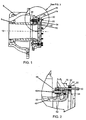
- Fig. 1 depicts a cross-section of a nozzle assembly 12 used with a radial inflow turbine.
- Figure 2 is a detailed view of the embodiment depicted in Fig. 1 highlighting one vane 14 and one adjustable nozzle 26.
- the nozzle assembly 12 can be connected as part of the radial inflow turbine, and the radial inflow turbine can be used with an alternator (not shown) or another type of generator (not shown).
- the alternator or generator is typically used to convert energy from expanding influent to electrical power.
- the influent is typically a gas, though it could be one from a variety of fluids.
- the influent accelerates from the periphery of an inlet ring 20 and an outlet ring 16, into the nozzle assembly 12, directed by adjustable vanes 14, with a tangential vector, toward a turbine rotor (4, see Fig. 4 ).
- the lowered pressure and lowered temperature influent exits the nozzle assembly 12 through the outlet ring 16, a shroud 52, and a diffuser 6.
- the diffuser 6 is internal to a suction housing 8. Electrical power converted by the alternator (not shown) can be connected to a load with conventional wiring.
- Fig. 3 is a partially exploded perspective view of the nozzle assembly 12 according to one embodiment of the invention.
- the vanes 14 surround the turbine rotor 4 (see Fig. 4 ) in a circumferential array.
- the vanes 14 are adjustably angled to direct the flow of influent into the rotor with a high degree of tangency.
- the number of vanes 14 in the nozzle assembly 12 typically varies from 11 to 19, although other numbers of vanes 14 are conceived and can be used.
- 16 vanes 14 are depicted. Turning away from the partially exploded view of Fig. 1 , and turning momentarily to Fig. 2 and Fig. 3 , each vane 14 is positioned between the outlet ring 16 and an inlet ring 20, creating an adjustable nozzle 26 in the space between each vane, the space bounded as well by the inlet ring 20 and the outlet ring 16.
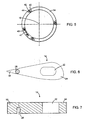
- Fig. 6 illustrates an adjustable vane 14 according to one embodiment of the invention
- Fig. 7 is a sectioned side view of the vane 14 illustrated in Fig. 6
- each vane 14 can have a slot 22, approximately in a head end 24.
- the slot 22 can extend completely through the width of the vane 14, or the slot 22 can extend only partially through the width of the vane 14.
- Each vane also has a bore or hole 28 in a tail end 18.
- the hole 28 can accept a pin, bolt, screw, or another similar fastening or pivoting device.
- the shape of the vanes 14 can vary from the shape illustrated in Fig. 6 and Fig. 7 , as necessary to achieve desirable influent flow parameters.
- each slot 22 extends a guide 30.
- the illustrated guide 30 is a pin or bolt.
- Each guide 30 is secured to either the inlet ring 20 on one side of its respective vane 14, or to the outlet ring 16 on the opposite side of its respective vane 14.
- Each guide 30 can also be secured to both the inlet ring 20 and the outlet ring 20, as shown.
- Each vane 14 can move (e.g. rotate) so that the slot 22 of each vane slides, guided by each respective guide 30.
- each guide 30 illustrated is a pin, other alternative guides 30 are conceived. For instance, one or more rails or posts can extend or project from the inlet ring, the outlet ring, or the actuation ring, into the slot 22 or between vanes 14, and guide the rotation of each respective vane 14.
- One or more of the guides 30 can be a bolt 30 to fasten the inlet ring 20 to the outlet ring 16, with the vanes 14 in between the inlet ring 20 and the outlet ring 16.
- three of the guides 30 are bolts 30.
- the bolts 30 can be double headed or of another variety suitable to fasten securely to one or both of the inlet ring 20, the outlet ring 16, or another stationary structure within the nozzle assembly 12.
- the bolts 30, or other bolts used in the assembly, and the position of these bolts can be adapted for use with various existing turbines.
- the illustrated embodiment can be modified to use bolts that preexist in various, existing turbines as the bolts 30, pins 30, or other fastening or pivoting devices.
- a spacer 32 can be used around each guide pin 30 in each slot 22 in order to provide the appropriate clearance between the inlet ring 20 and the outlet ring 16 so that the vane 14 can move in a plane parallel to the plane of the inlet ring 20 and the outlet ring 16. If the appropriate dimensional clearance between the inlet ring 20 and outlet ring 16 is not maintained when the vanes 14 are to be moved, then the vanes 14 might be squeezed between the inlet ring 20 and the outlet ring 16, creating excessive friction that can obstruct proper movement of the vanes 14. Other mechanisms known in the art can also be used to create a permanent or temporary clearance between the vanes 14 and the inlet ring 20, and/or between the vanes 14 and the outlet ring 16, so that the vanes 14 can move when actuated.
- Fig. 4 is a sectioned view of the nozzle assembly 12 according to one embodiment of the invention.
- the vanes 14 are actuated, in part, by a connection with an actuation ring 34.
- a pivot pin 36 can extend from the hole 28 of each vane to the actuation ring 34.
- Each pivot pin 36 has a center axis about which each respective vane 14 rotates.
- the actuation ring 34 can be located or sized otherwise in other embodiments, for instance, to accommodate use of the nozzle assembly 12 with various, existing turbines.
- Fig. 5 illustrates the actuation ring 34, a gear rack 46, and rollers 42 according to one embodiment of the invention.
- the illustrated actuation ring 34 has three cutout sections 40, with one roller 42 positioned in each cutout section 40 to guide and stabilize the rotational movement of the actuation ring 34.
- Each roller 42 rotates about a roller bolt or roller pin 44 which is secured to the actuation ring 34. This embodiment can be modified depending on the position of the actuation ring 34.
- the actuation ring 34 also has, or is connected to, the gear rack 46.
- the gear rack 46 has gear rack teeth 47 which fit with similar gear shaft teeth (not shown) on an end of a gear shaft 48 (see Fig. 1 and Fig. 2 ). A fine match between the gear rack teeth 47 and the gear shaft teeth (not shown) enables fine adjustment of the vanes 14.
- the gear shaft 48 extends through the outlet ring 16, where the gear shaft 48 can be connected to and operated by (e.g. rotated about an axis of the gear shaft 48) an actuator or motor (not shown).
- a gear spacer 60 can provide support to the gear shaft 48 and help maintain its alignment.
- a gland 58 can provide a liquid-tight and gas-tight seal between the gear shaft 48 and the outlet ring 16.
- Rotation of the gear shaft 48 through interaction of the gear shaft teeth (not shown) with the gear rack teeth 47, rotates the gear rack 47 and the actuation ring 34 about a central axis 10 of the nozzle assembly 12, which is also the center axis of the actuation ring 34. It is conceived that the center axis of the actuation ring 34 be offset radially from the central axis 10, for instance, if necessary to adapt the nozzle assembly 12 to connect and work with an existing turbine.
- the slot 22 can be in the tail end 18, while the hole 28 can be in the head end 24.
- the nozzle assembly 12 can be modified accordingly, particularly including the pivot pins 36 and guides 30.
- the guides 30 can function as, or be modified to function as pivot pins.
- the pivot pins 36 can function as, or be modified to function as guides.
- the need to adjust the nozzles 26 is dictated by external variables, such as a demand for power, changing input from the fuel source, a natural variation in the supply pressure, and so forth.
- external variables such as a demand for power, changing input from the fuel source, a natural variation in the supply pressure, and so forth.
- Methods and means to detect external variables and operate a motor based on the external variable using a digital microprocessor, microcontroller, or other programmable controller are known.
- seals are used.
- the gland 58 provides one such seal.
- An O-ring or other seal can also be used to seal around each of the guide pins 30, for instance, if the guide pins 30 extend all the way through the inlet ring 20 or the outlet ring 16.
- Other seals and sealing mechanisms can be used as are known in the art and/or would be recognized by one skilled in the art.
Landscapes
- Engineering & Computer Science (AREA)
- Mechanical Engineering (AREA)
- General Engineering & Computer Science (AREA)
- Chemical & Material Sciences (AREA)
- Chemical Kinetics & Catalysis (AREA)
- General Chemical & Material Sciences (AREA)
- Combustion & Propulsion (AREA)
- Control Of Turbines (AREA)
- Turbine Rotor Nozzle Sealing (AREA)
Abstract
Description
- This invention relates generally to radial inflow turbines, and more particularly, to a variable vaned nozzle system for such turbines.
- A radial turbine is a practical device for converting influent (e.g. gas) pressure and temperature to shaft power. A radial inflow turbine employs an annular inlet surrounding a turbine wheel through which the influent under pressure is directed. To uniformly distribute the influent, vanes are disposed about the annular inlet to create nozzles. Many radial inflow turbines incorporate fixed geometry nozzle vanes, or airfoils, in an attempt to optimally guide the influent entering the rotor. In such cases the principal flow parameters, such as pressure, mass flow rate, and temperature remain in fixed proportion, and cannot be individually controlled. A variable nozzle provides an additional degree of control freedom, permitting independent control over inlet temperature, pressure, and flow through the turbine stage.
- These variable nozzles are often variable through the controlled pivotal motion of the vanes. Changing the stagger angle alters the throat between the vanes and changes the flow angle entering the rotor. The pivotal vanes are typically mounted between mounting rings which are positioned in a housing to either side of the annular inlet. In one example, the vanes are rotated by a series of horizontal and vertical wheels strung together on a cable. One wheel is rotated by a motor shaft connected to a motor. This one wheel, in turn, rotates each other wheel by drawing the cable clockwise or counterclockwise around each wheel. The vanes can rotate, for instance, by being connected to the axis of the wheels that rotate in a plane parallel with the plane of the mounting ring.
- In another device, each vane is attached to a rod which is positioned perpendicular to the influent flow direction. The rods, in a circumferential array, protrude through a movable annular back-wall, and are rotated by a linkage. The vanes in this assembly are adjusted in discrete movements.
- These types of nozzle systems are bulky, with many duplicate parts required to adjust the vanes. The bulkiness or clumsiness of these assemblies can be problematic. The additional parts and more complicated assemblies add to the manufacturing and assembly costs. Also, with the bulky, duplicate parts, sealing the influent flow paths to increase or maintain influent pressure and velocity through the nozzles can be difficult and complicated, or it can add further to the bulkiness. Each opening from the influent flow path that accommodates a part necessary for the vane adjustment is an opening that must be sealed. Duplicate parts create additional areas that need to be sealed Furthermore, these systems are limited or devoid in their adaptability for use with various existing radial inflow turbines because the parts are not easily repositioned or resized to accommodate differently configured or differently sized turbines.
- It would be advantageous to eliminate or reduce duplicate parts or simplify the nozzle adjustment mechanism.
- It would be advantageous to simplify the sealing arrangements and increase the sealing integrity, efficiency, or durability.
- It would be advantageous to lower costs associated with component manufacturing and system assembly.
- It would be advantageous to provide a nozzle assembly that can be easily adapted for use with a variety of existing radial inflow turbines.
- In one embodiment of the invention, a nozzle assembly for adjusting a radial inflow turbine is provided. The nozzle assembly can comprise a gas inlet ring, a gas outlet ring, an actuation ring, a plurality of guides, and a plurality of nozzle vanes. The gas outlet ring can be spaced apart from the gas inlet ring and the gas outlet ring can oppose the gas inlet ring. The actuation ring can have a central axis about which the actuation ring is rotatable with respect to the inlet ring and the outlet ring. The plurality of guides can be connected to at least one of the gas inlet ring, the gas outlet ring, and the actuation ring. The plurality of nozzle vanes can be circumferentially spaced and disposed between the gas inlet ring and the gas outlet ring, with each nozzle vane rotatable about a vane pivot axis with respect to the gas inlet ring and the gas outlet ring, and each nozzle vane in sliding engagement with a respective guide from the plurality of guides.
- In another embodiment of the invention, a variable nozzle system for a radial inflow turbine is provided. The variable nozzle system can comprise a first mounting ring, a second mounting ring, a plurality of vanes, a plurality of nozzles, an actuation ring, a gear rack, and a gear shaft. The second mounting ring can be spaced apart from the first mounting ring and the second mounting ring can oppose the first mounting ring. The plurality of vanes can be circumferentially spaced between the first mounting ring and the second mounting ring, and each vane can have a pivot point around which each vane is rotatable to adjust a plurality of nozzles. Each nozzle in the plurality of nozzles can be defined on four sides by the first mounting ring, the second mounting ring, and two vanes from the plurality of vanes. The actuation ring can have a central axis about which the actuation ring is rotatable with respect to the first mounting ring and the second mounting ring. The actuation ring can also be engaged with each nozzle vane from the plurality of nozzle vanes to drive the rotation of each nozzle vane. The gear rack can be attached to the actuation ring. The gear shaft can extend through the second mounting ring and can have a pinion engageable with the gear rack.
- For a further understanding of the invention, reference will be made to the following detailed description of the invention which is to be read in connection with the accompanying drawing, where:
-
Fig. 1 is a sectioned view of a nozzle assembly according to one embodiment of the invention; -
Fig. 2 is a detailed view of the sectioned view ofFig. 1 ; -
Fig. 3 is a partially exploded perspective view of the nozzle assembly according to one embodiment of the invention; -
Fig. 4 is sectioned view of a nozzle assembly according to one embodiment of the invention; -
Fig. 5 illustrates an actuation ring, a gear rack, and rollers according to one embodiment of the invention; -
Fig. 6 illustrates an adjustable vane according to one embodiment of the invention; and -
Fig. 7 is a sectioned side view of the vane illustrated inFig. 6 . - Referring now to the various figures of the drawings, there is illustrated one embodiment of the present invention. In referring to the various figures, like numerals shall refer to like parts.
-
Fig. 1 depicts a cross-section of anozzle assembly 12 used with a radial inflow turbine.Figure 2 is a detailed view of the embodiment depicted inFig. 1 highlighting onevane 14 and oneadjustable nozzle 26. Referring toFig. 1 and Fig. 2 , thenozzle assembly 12 can be connected as part of the radial inflow turbine, and the radial inflow turbine can be used with an alternator (not shown) or another type of generator (not shown). The alternator or generator is typically used to convert energy from expanding influent to electrical power. The influent is typically a gas, though it could be one from a variety of fluids. The influent, at a high-temperature and a high-pressure, accelerates from the periphery of aninlet ring 20 and anoutlet ring 16, into thenozzle assembly 12, directed byadjustable vanes 14, with a tangential vector, toward a turbine rotor (4, seeFig. 4 ). A velocity vector of the influent, the mass flow rate of the influent, as well as intensive state properties of the influent such as temperature and pressure, influence the potential energy converted to shaft power, as the rotating turbine is connected to a shaft. The lowered pressure and lowered temperature influent exits thenozzle assembly 12 through theoutlet ring 16, ashroud 52, and adiffuser 6. Thediffuser 6 is internal to asuction housing 8. Electrical power converted by the alternator (not shown) can be connected to a load with conventional wiring. -
Fig. 3 is a partially exploded perspective view of thenozzle assembly 12 according to one embodiment of the invention. Referring to the partially exploded view ofFig. 3 , thevanes 14 surround the turbine rotor 4 (seeFig. 4 ) in a circumferential array. Thevanes 14 are adjustably angled to direct the flow of influent into the rotor with a high degree of tangency. The number ofvanes 14 in thenozzle assembly 12 typically varies from 11 to 19, although other numbers ofvanes 14 are conceived and can be used. In the exemplary embodiment illustrated in the figures, 16vanes 14 are depicted. Turning away from the partially exploded view ofFig. 1 , and turning momentarily toFig. 2 andFig. 3 , eachvane 14 is positioned between theoutlet ring 16 and aninlet ring 20, creating anadjustable nozzle 26 in the space between each vane, the space bounded as well by theinlet ring 20 and theoutlet ring 16. -
Fig. 6 illustrates anadjustable vane 14 according to one embodiment of the invention, andFig. 7 is a sectioned side view of thevane 14 illustrated inFig. 6 . Referring toFig. 6 and Fig. 7 , eachvane 14 can have aslot 22, approximately in ahead end 24. Theslot 22 can extend completely through the width of thevane 14, or theslot 22 can extend only partially through the width of thevane 14. Each vane also has a bore orhole 28 in atail end 18. Thehole 28 can accept a pin, bolt, screw, or another similar fastening or pivoting device. The shape of thevanes 14 can vary from the shape illustrated inFig. 6 and Fig. 7 , as necessary to achieve desirable influent flow parameters. - Referring again to
Fig. 1 and Fig. 2 , through eachslot 22 extends aguide 30. The illustratedguide 30 is a pin or bolt. Eachguide 30 is secured to either theinlet ring 20 on one side of itsrespective vane 14, or to theoutlet ring 16 on the opposite side of itsrespective vane 14. Eachguide 30 can also be secured to both theinlet ring 20 and theoutlet ring 20, as shown. Eachvane 14 can move (e.g. rotate) so that theslot 22 of each vane slides, guided by eachrespective guide 30. While each guide 30 illustrated is a pin, other alternative guides 30 are conceived. For instance, one or more rails or posts can extend or project from the inlet ring, the outlet ring, or the actuation ring, into theslot 22 or betweenvanes 14, and guide the rotation of eachrespective vane 14. - One or more of the
guides 30 can be abolt 30 to fasten theinlet ring 20 to theoutlet ring 16, with thevanes 14 in between theinlet ring 20 and theoutlet ring 16. In the illustrated embodiment, three of theguides 30 arebolts 30. Thebolts 30 can be double headed or of another variety suitable to fasten securely to one or both of theinlet ring 20, theoutlet ring 16, or another stationary structure within thenozzle assembly 12. Thebolts 30, or other bolts used in the assembly, and the position of these bolts can be adapted for use with various existing turbines. For instance, the illustrated embodiment can be modified to use bolts that preexist in various, existing turbines as thebolts 30, pins 30, or other fastening or pivoting devices. - A
spacer 32 can be used around eachguide pin 30 in eachslot 22 in order to provide the appropriate clearance between theinlet ring 20 and theoutlet ring 16 so that thevane 14 can move in a plane parallel to the plane of theinlet ring 20 and theoutlet ring 16. If the appropriate dimensional clearance between theinlet ring 20 andoutlet ring 16 is not maintained when thevanes 14 are to be moved, then thevanes 14 might be squeezed between theinlet ring 20 and theoutlet ring 16, creating excessive friction that can obstruct proper movement of thevanes 14. Other mechanisms known in the art can also be used to create a permanent or temporary clearance between thevanes 14 and theinlet ring 20, and/or between thevanes 14 and theoutlet ring 16, so that thevanes 14 can move when actuated. -
Fig. 4 is a sectioned view of thenozzle assembly 12 according to one embodiment of the invention. Referring toFig. 4 , as well asFig. 3 , thevanes 14 are actuated, in part, by a connection with anactuation ring 34. Apivot pin 36 can extend from thehole 28 of each vane to theactuation ring 34. Eachpivot pin 36 has a center axis about which eachrespective vane 14 rotates. Theactuation ring 34 can be located or sized otherwise in other embodiments, for instance, to accommodate use of thenozzle assembly 12 with various, existing turbines. -
Fig. 5 illustrates theactuation ring 34, agear rack 46, androllers 42 according to one embodiment of the invention. Referring toFig. 5 , the illustratedactuation ring 34 has threecutout sections 40, with oneroller 42 positioned in eachcutout section 40 to guide and stabilize the rotational movement of theactuation ring 34. Eachroller 42 rotates about a roller bolt orroller pin 44 which is secured to theactuation ring 34. This embodiment can be modified depending on the position of theactuation ring 34. - The
actuation ring 34 also has, or is connected to, thegear rack 46. Thegear rack 46 hasgear rack teeth 47 which fit with similar gear shaft teeth (not shown) on an end of a gear shaft 48 (seeFig. 1 and Fig. 2 ). A fine match between thegear rack teeth 47 and the gear shaft teeth (not shown) enables fine adjustment of thevanes 14. - Referring again to
Fig. 1 and Fig. 2 , thegear shaft 48 extends through theoutlet ring 16, where thegear shaft 48 can be connected to and operated by (e.g. rotated about an axis of the gear shaft 48) an actuator or motor (not shown). Agear spacer 60 can provide support to thegear shaft 48 and help maintain its alignment. Agland 58 can provide a liquid-tight and gas-tight seal between thegear shaft 48 and theoutlet ring 16. Rotation of thegear shaft 48, through interaction of the gear shaft teeth (not shown) with thegear rack teeth 47, rotates thegear rack 47 and theactuation ring 34 about acentral axis 10 of thenozzle assembly 12, which is also the center axis of theactuation ring 34. It is conceived that the center axis of theactuation ring 34 be offset radially from thecentral axis 10, for instance, if necessary to adapt thenozzle assembly 12 to connect and work with an existing turbine. - When the
actuation ring 34 rotates, the axes of the pivot pins 36 and therespective holes 28 move rotationally around thecentral axis 10 along with theactuation ring 34. The rotational movement of thevanes 14 along with theactuation ring 34, with respect to thestationary guides 30 and theoutlet ring 16, causes thevanes 14 to rotate and theslots 22 to slide on theguides 30. - In an alternate embodiment, the
slot 22 can be in thetail end 18, while thehole 28 can be in thehead end 24. Thenozzle assembly 12 can be modified accordingly, particularly including the pivot pins 36 and guides 30. In this alternative embodiment, theguides 30 can function as, or be modified to function as pivot pins. Likewise, the pivot pins 36 can function as, or be modified to function as guides. When theactuation ring 34 rotates, the pivot pins 36 functioning (or modified to function) as guides move with theactuation ring 34, causing thevanes 14 to slide on the pivot pins 36 functioning (or modified to function) as guides. Also, thevanes 14 rotate about theholes 28 and theguides 30 functioning (or modified to function) as pivot pins. - In practical application, the need to adjust the
nozzles 26 is dictated by external variables, such as a demand for power, changing input from the fuel source, a natural variation in the supply pressure, and so forth. Methods and means to detect external variables and operate a motor based on the external variable using a digital microprocessor, microcontroller, or other programmable controller are known. - It is important to seal the
nozzle assembly 12 properly in order to maintain pressure integrities and restrict influent flow to the desired path through thenozzle assembly 12. As such, appropriate seals are used. For instance, thegland 58 provides one such seal. An O-ring or other seal can also be used to seal around each of the guide pins 30, for instance, if the guide pins 30 extend all the way through theinlet ring 20 or theoutlet ring 16. Other seals and sealing mechanisms can be used as are known in the art and/or would be recognized by one skilled in the art. - The terminology used herein is for the purpose of description, not limitation. Specific structural and functional details disclosed herein are not to be interpreted as limiting, but merely as a basis for teaching one skilled in the art to employ the present invention. While the present invention has been particularly shown and described with reference to the exemplary embodiments as illustrated in the drawing, it will be recognized by those skilled in the art that various modifications may be made without departing from the spirit and scope of the invention. Those skilled in the art will also recognize the equivalents that may be substituted for elements described with reference to the exemplary embodiments disclosed herein without departing from the scope of the present invention. Therefore, it is intended that the present disclosure not be limited to the particular embodiment(s) disclosed as, but that the disclosure will include all embodiments falling within the scope of the appended claims.
Claims (14)
- A nozzle assembly (12) for adjusting a radial inflow turbine, the nozzle assembly comprising:a gas inlet ring (20);a gas outlet ring (16) spaced apart from the gas inlet ring (20) and opposing the gas inlet ring;an actuation ring (34) having a central axis about which the actuation ring (34) is rotatable with respect to the inlet ring and the outlet ring;a plurality of guides (30) connected to at least one of the gas inlet ring (20), the gas outlet ring (16), and the actuation ring (34); anda plurality of nozzle vanes (14) circumferentially spaced and disposed between the gas inlet ring (20) and the gas outlet ring (16), each nozzle vane (14) rotatable about a vane pivot axis with respect to the gas inlet ring (20) and the gas outlet ring (16), and each nozzle vane (14) in sliding engagement with a respective guide (30) from the plurality of guides.
- The nozzle assembly of claim 1, wherein the nozzle vane (14) has a slot (22) that receives and engages the guide (30).
- The nozzle assembly of claim 2, wherein the actuation ring (34) is connected to the guide (30) and the actuation ring (34) moves the guide (30) in the slot (22) to rotate the nozzle vane (14) about the vane pivot axis.
- The nozzle assembly of any preceding claim, wherein the actuation ring (34) is connected to each nozzle vane (14) at the vane pivot axis.
- The nozzle assembly of any preceding claim, further comprising:a gear rack (46) attached to the actuation ring (34); anda gear shaft (48) extending through the outlet ring (16), the gear shaft (48) comprising a pinion engageable with the gear rack (46).
- A variable nozzle system (12) for a radial inflow turbine, the variable nozzle system comprising:a first mounting ring (20);a second mounting ring (16) spaced apart from the first mounting ring (20) and opposing the first mounting ring (20);a plurality of vanes (14) circumferentially spaced between the first mounting (16) ring and the second mounting ring (16), each vane having a pivot point around which each vane (14) is rotatable to adjust a plurality of nozzles, each nozzle from the plurality of nozzles defined on four sides by the first mounting ring (20), the second mounting ring (16), and two vanes (14) from the plurality of vanes;an actuation ring (34) having a central axis about which the actuation ring (34) is rotatable with respect to the first mounting ring and the second mounting ring, the actuation ring (34) being engaged with each nozzle vane (14) from the plurality of nozzle vanes to drive the rotation of each nozzle vane (14);a gear rack (46) attached to the actuation ring (34); anda gear shaft (48) extending through the second mounting ring (16), the gear shaft (48) comprising a pinion engageable with the gear rack (46).
- The nozzle system of claim 6, further comprising a plurality of guides (30), each guide (30) extending from one of the first mounting ring (20), the second mounting ring (16), and the actuation ring (34), and each guide (30) engaging a respective vane (14) from the plurality of vanes (14) to direct the rotation of each vane (14).
- The nozzle system of claim 6 or 7, wherein the actuation ring (34) is connected to each vane (14) at the pivot point.
- The nozzle assembly or system of any of claim 5 or 8, wherein a gland seals between the gear shaft (48) and the outlet ring (20) or second mounting ring (16).
- The nozzle assembly or system of any of claims 5 to 9, wherein a spacer (60) encircles the gear shaft (46) within the outlet ring (16) or second mounting ring (16).
- The nozzle assembly or system of any preceding claim, wherein each guide (30) from the plurality of guides (30) is one of a bolt, a stud, and a pin.
- The nozzle assembly or system of any preceding claim, wherein the inlet ring (16) or first mounting ring (16) and the outlet ring (20) or second mounting ring (20) are spaced apart by at least one spacer (32).
- The nozzle assembly or system of claim 12, wherein the at least one spacer (32) encircles the guide (30) within a slot (22) of at least one vane (14) of the plurality of nozzle vanes.
- The nozzle assembly or system of any preceding claim, wherein the actuation ring (34) further comprises a plurality of cutouts (40), and wherein the nozzle assembly or system further comprises a plurality of rollers (42), each roller (42) from the plurality of rollers rotatable about a roller axis and positioned in one cutout (40) from the plurality of cutouts (40) in order to provide support and stabilization of the actuation ring (34) during rotation of the actuation ring (34).
Applications Claiming Priority (1)
| Application Number | Priority Date | Filing Date | Title |
|---|---|---|---|
| US12/696,536 US8485778B2 (en) | 2010-01-29 | 2010-01-29 | Rotatable vaned nozzle for a radial inflow turbine |
Publications (2)
| Publication Number | Publication Date |
|---|---|
| EP2354468A2 true EP2354468A2 (en) | 2011-08-10 |
| EP2354468A3 EP2354468A3 (en) | 2014-08-27 |
Family
ID=43629547
Family Applications (1)
| Application Number | Title | Priority Date | Filing Date |
|---|---|---|---|
| EP11152601.8A Withdrawn EP2354468A3 (en) | 2010-01-29 | 2011-01-28 | Rotatable vaned nozzle for a radial inflow turbine |
Country Status (2)
| Country | Link |
|---|---|
| US (1) | US8485778B2 (en) |
| EP (1) | EP2354468A3 (en) |
Cited By (2)
| Publication number | Priority date | Publication date | Assignee | Title |
|---|---|---|---|---|
| WO2013120588A1 (en) * | 2012-02-17 | 2013-08-22 | Ihi Charging Systems International Gmbh | Adjustable diffuser for a turbine of an exhaust-gas turbocharger, and turbine for an exhaust-gas turbocharger |
| WO2018137882A1 (en) * | 2017-01-25 | 2018-08-02 | Ihi Charging Systems International Gmbh | Adjustable guide apparatus for an exhaust gas guide section of an exhaust gas turbocharger and exhaust gas guide section for an exhaust gas turbocharger |
Families Citing this family (9)
| Publication number | Priority date | Publication date | Assignee | Title |
|---|---|---|---|---|
| US9512848B2 (en) | 2011-09-14 | 2016-12-06 | Texas Capital Semiconductor, Inc. | Turbine cap for turbo-molecular pump |
| US9512853B2 (en) | 2013-03-14 | 2016-12-06 | Texas Capital Semiconductor, Inc. | Turbine cap for turbo-molecular pump |
| US11274671B2 (en) | 2011-09-14 | 2022-03-15 | Roger L. Bottomfield | Turbine cap for turbo-molecular pump |
| KR20150102096A (en) * | 2013-01-04 | 2015-09-04 | 보르그워너 인코퍼레이티드 | Variable pivot center vtg vanes and vane pack assembly |
| US9631814B1 (en) | 2014-01-23 | 2017-04-25 | Honeywell International Inc. | Engine assemblies and methods with diffuser vane count and fuel injection assembly count relationships |
| JP6349745B2 (en) * | 2014-01-29 | 2018-07-04 | 株式会社Ihi | Variable nozzle unit and variable capacity turbocharger |
| US9651091B2 (en) * | 2014-04-01 | 2017-05-16 | Hamilton Sundstrand Corporation | Thrust plate assembly |
| CN109505668B (en) * | 2017-09-14 | 2021-06-11 | 中国航发商用航空发动机有限责任公司 | Fixed blade adjusting mechanism of gas compressor |
| CN118934097B (en) * | 2024-08-21 | 2025-03-18 | 醴陵中油燃气有限责任公司 | Pressure difference power generation centripetal turbine expansion device |
Citations (1)
| Publication number | Priority date | Publication date | Assignee | Title |
|---|---|---|---|---|
| US4502836A (en) * | 1982-07-02 | 1985-03-05 | Swearingen Judson S | Method for nozzle clamping force control |
Family Cites Families (14)
| Publication number | Priority date | Publication date | Assignee | Title |
|---|---|---|---|---|
| US121127A (en) * | 1871-11-21 | Improvement in clothes-driers and ironing-boards | ||
| GB731822A (en) * | 1952-03-14 | 1955-06-15 | Power Jets Res & Dev Ltd | Improvements relating to turbines or compressors for operation with gaseous fluids |
| US3495921A (en) * | 1967-12-11 | 1970-02-17 | Judson S Swearingen | Variable nozzle turbine |
| US4264270A (en) * | 1979-08-20 | 1981-04-28 | Carrier Corporation | Actuator for adjustable vane means of a turbomachine |
| US4657476A (en) * | 1984-04-11 | 1987-04-14 | Turbotech, Inc. | Variable area turbine |
| US4629396A (en) * | 1984-10-17 | 1986-12-16 | Borg-Warner Corporation | Adjustable stator mechanism for high pressure radial turbines and the like |
| US5851104A (en) * | 1997-12-15 | 1998-12-22 | Atlas Copco Rotoflow, Inc. | Nozzle adjusting mechanism |
| JP4092826B2 (en) * | 1999-10-21 | 2008-05-28 | 株式会社デンソー | Spark plug and manufacturing method thereof |
| US7281379B2 (en) * | 2002-11-13 | 2007-10-16 | Utc Power Corporation | Dual-use radial turbomachine |
| US7254949B2 (en) * | 2002-11-13 | 2007-08-14 | Utc Power Corporation | Turbine with vaned nozzles |
| AU2003206001A1 (en) * | 2003-02-19 | 2004-09-09 | Honeywell International Inc. | Nozzle device for a turbocharger and associated control method |
| US7393179B1 (en) * | 2004-04-13 | 2008-07-01 | Brayton Energy, Llc | Variable position turbine nozzle |
| JP4930150B2 (en) * | 2007-03-29 | 2012-05-16 | 株式会社Ihi | Expansion turbine with variable nozzle mechanism |
| US20100150701A1 (en) * | 2007-06-26 | 2010-06-17 | Borgwarner Inc. | Variable geometry turbocharger |
-
2010
- 2010-01-29 US US12/696,536 patent/US8485778B2/en active Active
-
2011
- 2011-01-28 EP EP11152601.8A patent/EP2354468A3/en not_active Withdrawn
Patent Citations (1)
| Publication number | Priority date | Publication date | Assignee | Title |
|---|---|---|---|---|
| US4502836A (en) * | 1982-07-02 | 1985-03-05 | Swearingen Judson S | Method for nozzle clamping force control |
Cited By (2)
| Publication number | Priority date | Publication date | Assignee | Title |
|---|---|---|---|---|
| WO2013120588A1 (en) * | 2012-02-17 | 2013-08-22 | Ihi Charging Systems International Gmbh | Adjustable diffuser for a turbine of an exhaust-gas turbocharger, and turbine for an exhaust-gas turbocharger |
| WO2018137882A1 (en) * | 2017-01-25 | 2018-08-02 | Ihi Charging Systems International Gmbh | Adjustable guide apparatus for an exhaust gas guide section of an exhaust gas turbocharger and exhaust gas guide section for an exhaust gas turbocharger |
Also Published As
| Publication number | Publication date |
|---|---|
| US20110189001A1 (en) | 2011-08-04 |
| EP2354468A3 (en) | 2014-08-27 |
| US8485778B2 (en) | 2013-07-16 |
Similar Documents
| Publication | Publication Date | Title |
|---|---|---|
| US8485778B2 (en) | Rotatable vaned nozzle for a radial inflow turbine | |
| US10167872B2 (en) | System and method for operating a compressor | |
| EP1961919A2 (en) | Variable rotor blade for gas turbine engine | |
| CN1188587C (en) | Turbocharger with sliding blades having combined dynamic surfaces and heat screen and uncoupled axial actuating device | |
| US6547520B2 (en) | Rotating vane diffuser for a centrifugal compressor | |
| CN211820076U (en) | Air inlet amount adjusting mechanism for fan, fan and gas water heater | |
| CN101050728A (en) | Synchronous ring type variable vane synchronizing mechanism for inner diameter side vane shroud | |
| EP2484916A1 (en) | Centrifugal compressor having variable geometry diffuser and method thereof | |
| JPWO2014098073A1 (en) | Steam valve and steam turbine | |
| US11092167B2 (en) | Variable vane actuating system | |
| US6964554B2 (en) | Drop-in nozzle block for steam turbine | |
| US20160084156A1 (en) | Variable flow-restricting turbine assembly for a turbocharger, corresponding turbocharger engine and vehicle, and operating method | |
| US6506011B1 (en) | Method for limiting split ring diffuser travel | |
| US20180023412A1 (en) | Radial centrifugal turbomachine | |
| CN1650097A (en) | Improved vane design for variable geometry turbochargers | |
| US20200072074A1 (en) | Variable vane actuating system | |
| KR102410457B1 (en) | Adjustable dilution hole and gas turbine combustor comprising same | |
| EP3480434A1 (en) | Inlet cartridge for adjusting the cross-section of compressor inlet and compressor | |
| CN106481374B (en) | Turbine device | |
| EP3569827B1 (en) | Variable diffuser having a respective penny for each vane | |
| KR101070907B1 (en) | Turbine having variable vane | |
| CN208486918U (en) | A kind of nozzle assembly aperture ring driving structure | |
| US10883379B2 (en) | Variable diffuser having a respective penny for each vane | |
| KR102567540B1 (en) | Turbine | |
| KR102597828B1 (en) | Inlet guide vane |
Legal Events
| Date | Code | Title | Description |
|---|---|---|---|
| PUAI | Public reference made under article 153(3) epc to a published international application that has entered the european phase |
Free format text: ORIGINAL CODE: 0009012 |
|
| AK | Designated contracting states |
Kind code of ref document: A2 Designated state(s): AL AT BE BG CH CY CZ DE DK EE ES FI FR GB GR HR HU IE IS IT LI LT LU LV MC MK MT NL NO PL PT RO RS SE SI SK SM TR |
|
| AX | Request for extension of the european patent |
Extension state: BA ME |
|
| PUAL | Search report despatched |
Free format text: ORIGINAL CODE: 0009013 |
|
| AK | Designated contracting states |
Kind code of ref document: A3 Designated state(s): AL AT BE BG CH CY CZ DE DK EE ES FI FR GB GR HR HU IE IS IT LI LT LU LV MC MK MT NL NO PL PT RO RS SE SI SK SM TR |
|
| AX | Request for extension of the european patent |
Extension state: BA ME |
|
| RIC1 | Information provided on ipc code assigned before grant |
Ipc: F01D 17/16 20060101AFI20140721BHEP |
|
| 17P | Request for examination filed |
Effective date: 20150227 |
|
| RBV | Designated contracting states (corrected) |
Designated state(s): AL AT BE BG CH CY CZ DE DK EE ES FI FR GB GR HR HU IE IS IT LI LT LU LV MC MK MT NL NO PL PT RO RS SE SI SK SM TR |
|
| 17Q | First examination report despatched |
Effective date: 20160412 |
|
| RAP1 | Party data changed (applicant data changed or rights of an application transferred) |
Owner name: UNITED TECHNOLOGIES CORPORATION |
|
| STAA | Information on the status of an ep patent application or granted ep patent |
Free format text: STATUS: EXAMINATION IS IN PROGRESS |
|
| STAA | Information on the status of an ep patent application or granted ep patent |
Free format text: STATUS: THE APPLICATION HAS BEEN WITHDRAWN |
|
| RAP1 | Party data changed (applicant data changed or rights of an application transferred) |
Owner name: RAYTHEON TECHNOLOGIES CORPORATION |
|
| 18W | Application withdrawn |
Effective date: 20210308 |