EP2354068A1 - Sheet folder - Google Patents
Sheet folder Download PDFInfo
- Publication number
- EP2354068A1 EP2354068A1 EP11152258A EP11152258A EP2354068A1 EP 2354068 A1 EP2354068 A1 EP 2354068A1 EP 11152258 A EP11152258 A EP 11152258A EP 11152258 A EP11152258 A EP 11152258A EP 2354068 A1 EP2354068 A1 EP 2354068A1
- Authority
- EP
- European Patent Office
- Prior art keywords
- fold
- sheet
- box
- curved
- folder
- Prior art date
- Legal status (The legal status is an assumption and is not a legal conclusion. Google has not performed a legal analysis and makes no representation as to the accuracy of the status listed.)
- Granted
Links
Images


Classifications
-
- B—PERFORMING OPERATIONS; TRANSPORTING
- B65—CONVEYING; PACKING; STORING; HANDLING THIN OR FILAMENTARY MATERIAL
- B65H—HANDLING THIN OR FILAMENTARY MATERIAL, e.g. SHEETS, WEBS, CABLES
- B65H45/00—Folding thin material
- B65H45/12—Folding articles or webs with application of pressure to define or form crease lines
- B65H45/14—Buckling folders
- B65H45/142—Pocket-type folders
- B65H45/144—Pockets or stops therefor
- B65H45/145—Pockets or stops therefor circular pockets
Definitions
- the present invention relates to apparatus for folding and particularly to a sheet folder for a paper handling apparatus, such as is used for preparing documents for insertion into envelopes, for example in preparing mass mailings.
- a letter of one or more sheets of paper is printed and collated with one or more items of insert material such as information leaflets, advertising flyers and return envelopes and each collation of documents is inserted into an envelope.
- insert material such as information leaflets, advertising flyers and return envelopes
- each collation of documents is inserted into an envelope.
- letters are printed on A4 size sheets of paper and must be folded to fit into C5 or DL envelopes, which are commonly used in the mail.
- Sheets may be folded once, i.e. into two panels, in a so-called V-fold. Alternatively they may be folded twice, into three panels, either in a so-called Z-fold, which sandwiches a middle panel of the sheet between the outer two panels, or a C-fold in which one of the outer panels is sandwiched between the other outer panel and the middle panel.
- One traditional folder is a buckle fold apparatus.
- the document to be folded is fed by rollers into a dead-end fold box defined by parallel fold plates and a back-stop.
- the leading edge of the document encounters the back-stop, but the trailing edge continues to be driven forward by the rollers. Consequently the document buckles about a line between the leading and the trailing edge determined by the depth of the box in relation to the length of the document.
- the buckling portion is caught in the nip of exit rollers, positioned at the top of the fold box, which complete the fold by flattening the fold line and drawing the folded document out of the fold box.
- a typical such buckle folding device is described in US 4,647,029 .
- the process may be repeated, either in the same fold box or in a second fold box, if two folds are required, for example for a Z- or C- fold.
- Apparatus for folding a Z- or C- fold is described for example in US 5,819,666 .
- Fold plates incorporating a curved portion have been used in some machines to maintain a small footprint but known such curved fold plates do not accommodate multiple sheet folding because of the larger roller diameters and clearances required, which result in the forms being less controlled.
- Known curved fold plate systems also do not cope successfully with curled input sheets (which tends to happen when the sheets have passed recently through a printing machine).
- a curved fold box may be more likely to result in damage to a document being folded, compared to a straight fold box, because the document tends naturally to take the same shape as the fold box.
- the resultant curved document sometimes does not feed reliably into the nip of the folding exit rollers, which can then cause damage to the document.
- This is a particular problem with a C-fold because the leading edge of the document becomes the leading edge of the inside panel of the three panels and tends to curve away from the nip of the output folding rollers which sometimes results in this edge being damaged.
- a sheet folder comprising input rollers, exit rollers and a fold box having a fold plate which is curved substantially along its whole length, wherein the curved fold plate is configured to induce a sheet to curve in two different directions during the folding process.
- Such a curved fold box occupies a smaller footprint than a straight fold box and is thus more suitable for compact machines. With a curve extending substantially the whole length of the fold plates the document to be folded is less likely to snag on abrupt corners which could cause damage to the document.
- the curved fold plate preferably comprises a relatively small portion which curves in the opposite direction to the overall curve of the box. This portion is generally in the vicinity of the sheet entrance mark of the box and serves as a smooth transition for the sheets as they enter the fold box.
- the curved fold box facilitates a simpler form of adjustable backstop since it can be mounted to be pivotable about a point generally at the focal point of the curve. This enables the backstop to be adjustable along the whole length of the fold box simply by manually turning the backstop about the pivot point, e.g. by turning and securing a knob or lever at the pivot point. This design also reduces the amount of mechanical hardware needed to mount the adjustable backstop.
- the backstop can also be set automatically such as by using a controlled motor drive connected to the pivot point of the backstop.
- the fold plate is configured to induce the sheet to curve in two different directions during the folding process, such as in the shape of an 'S'.
- a sheet folder comprising: a first curved fold box for making a first fold in a sheet; a second curved fold box for making a second fold in the sheet; wherein the second fold box is adapted to induce an "S" shaped curve in the sheet.
- a pivotably mounted adjustable backstop is provided for the or each fold box. It may be adjusted manually or automatically.
- Figure 1 shows a traditional buckle folder comprising two fold boxes 1 and 2 each box comprising a pair of linear straight fold plates.
- a sheet of paper, shown at 30, first enters the folder at input 3 and passes through the nip between a fixed roller 5 and a sprung roller 7 into the mouth of the first fold box 1. It is guided between the two plates of the first box 1 until the leading edge of the sheet 30 reaches a backstop 9.
- the rollers 5, 7 continue to drive the sheet 30 but the backstop 9 prevents it going further into the fold box 1 and causes it to be caught in the nip of the exit roller comprising the sprung roller 7 and a fixed roller 10.
- the line 40 indicates the lower limit of a compact folder and it will be seen that the traditional straight fold plates extend substantially beyond this limit and hence a special stand is required.
- Figure 2 illustrates a folder according to the invention in which a traditional straight fold box is replaced with a curved fold box 100. This is advantageous from a space point of view and allows a compact sheet folder to be accommodated on a normal table or desk without the need for a special stand.
- the shape of the second fold box 2 is shown in more detail and comprises an additional curved portion 50, curved in the opposite direction to the general curve of the fold box 200 to assist a smooth transition for the sheets as they enter the fold box.
- the outer fold plate 201 has a shape which breaks the back of the document to be folded.
- This shape comprises a generally convex portion in the region 45 between points 46 and 47 adjacent to a generally concave portion between portion 47 and backstop 8.
- Other shapes or indentations would achieve the same effect of breaking the back of the document, through all layers, but this shape is particularly effective.
- This portion 46 generally presents a convex surface to the folded sheet 30 and portion 47 presents a concave surface to the folded sheet 30.
- curve and curved as used in connection with the fold plates are intended to include any shape which is not linear.
- the curved shapes referred to may be arcs of circles or of ellipses or other non-straight shapes and the fold plates may comprise combinations of different curves along their lengths.
- the two fold plates of a fold box may be of different shapes and may taper together toward the backstop and diverge toward the input rollers.
- a further fold plate can be substituted for the deflector which itself can be adjusted to shut off the fold plate 200 which results in a no-fold.
- a sheet 30 has one fold already which has been formed in fold box 100.
- the leading fold edge 51 is shown touching the outer fold plate of fold box 200 in the uppermost convex shaped region 50.
- This fold edge 51 travels down the fold box as shown in Figure 5 until it reaches the backstop 8.
- the leading edge 51 stalls against the backstop and as the sheet 30 is driven further into the fold box, the leading, folded, portion forms a convex shape and is driven into the indentation 47 and starts to buckle.
- the stalled portion of the sheet 30 forms an S shape around the fold plate geometry effectively breaking the back of the sheet in the area marked 54.
Landscapes
- Folding Of Thin Sheet-Like Materials, Special Discharging Devices, And Others (AREA)
Abstract
Description
- The present invention relates to apparatus for folding and particularly to a sheet folder for a paper handling apparatus, such as is used for preparing documents for insertion into envelopes, for example in preparing mass mailings.
- In a typical such paper handling apparatus a letter of one or more sheets of paper is printed and collated with one or more items of insert material such as information leaflets, advertising flyers and return envelopes and each collation of documents is inserted into an envelope. Usually letters are printed on A4 size sheets of paper and must be folded to fit into C5 or DL envelopes, which are commonly used in the mail.
- Sheets may be folded once, i.e. into two panels, in a so-called V-fold. Alternatively they may be folded twice, into three panels, either in a so-called Z-fold, which sandwiches a middle panel of the sheet between the outer two panels, or a C-fold in which one of the outer panels is sandwiched between the other outer panel and the middle panel.
- One traditional folder is a buckle fold apparatus. The document to be folded is fed by rollers into a dead-end fold box defined by parallel fold plates and a back-stop. The leading edge of the document encounters the back-stop, but the trailing edge continues to be driven forward by the rollers. Consequently the document buckles about a line between the leading and the trailing edge determined by the depth of the box in relation to the length of the document. The buckling portion is caught in the nip of exit rollers, positioned at the top of the fold box, which complete the fold by flattening the fold line and drawing the folded document out of the fold box. A typical such buckle folding device is described in
US 4,647,029 . The process may be repeated, either in the same fold box or in a second fold box, if two folds are required, for example for a Z- or C- fold. Apparatus for folding a Z- or C- fold is described for example inUS 5,819,666 . - To accommodate a variety of sizes of documents to be folded, and different fold lengths, such fold boxes are relatively long and the back-stop is adjustable along the length of the fold plates. Long fold boxes are however difficult to incorporate into compact folding machines, and require special stands. Hence they are not suitable for use in desk-top or table-top folders or mailing machines, which are thus restricted to certain sizes of paper and envelope. It would be advantageous to have more versatility in such smaller machines so that they can also be used for a variety of lengths of documents. Even in full size, non-compact machines, there is often a requirement for clearance to other machine features and a smaller footprint to save space.
- Fold plates incorporating a curved portion have been used in some machines to maintain a small footprint but known such curved fold plates do not accommodate multiple sheet folding because of the larger roller diameters and clearances required, which result in the forms being less controlled. Known curved fold plate systems also do not cope successfully with curled input sheets (which tends to happen when the sheets have passed recently through a printing machine).
- Thus it can be seen that in certain conditions a curved fold box may be more likely to result in damage to a document being folded, compared to a straight fold box, because the document tends naturally to take the same shape as the fold box. Hence the resultant curved document sometimes does not feed reliably into the nip of the folding exit rollers, which can then cause damage to the document. This is a particular problem with a C-fold because the leading edge of the document becomes the leading edge of the inside panel of the three panels and tends to curve away from the nip of the output folding rollers which sometimes results in this edge being damaged.
- According to the present invention there is provided a sheet folder comprising input rollers, exit rollers and a fold box having a fold plate which is curved substantially along its whole length, wherein the curved fold plate is configured to induce a sheet to curve in two different directions during the folding process.
- Such a curved fold box occupies a smaller footprint than a straight fold box and is thus more suitable for compact machines. With a curve extending substantially the whole length of the fold plates the document to be folded is less likely to snag on abrupt corners which could cause damage to the document.
- Inducing an S - shape in the document to be folded effectively 'breaks the back' of the document to be folded, and forces the S shape through all of the panels of the folded sheet or sheets. The curved fold plate preferably comprises a relatively small portion which curves in the opposite direction to the overall curve of the box. This portion is generally in the vicinity of the sheet entrance mark of the box and serves as a smooth transition for the sheets as they enter the fold box.
- The curved fold box facilitates a simpler form of adjustable backstop since it can be mounted to be pivotable about a point generally at the focal point of the curve. This enables the backstop to be adjustable along the whole length of the fold box simply by manually turning the backstop about the pivot point, e.g. by turning and securing a knob or lever at the pivot point. This design also reduces the amount of mechanical hardware needed to mount the adjustable backstop.
- The backstop can also be set automatically such as by using a controlled motor drive connected to the pivot point of the backstop.
- According to a preferred embodiment of the present invention therefore the fold plate is configured to induce the sheet to curve in two different directions during the folding process, such as in the shape of an 'S'.
- According to a second aspect of the present invention there is provided a sheet folder comprising: a first curved fold box for making a first fold in a sheet; a second curved fold box for making a second fold in the sheet; wherein the second fold box is adapted to induce an "S" shaped curve in the sheet.
- According to a preferred embodiment of the invention a pivotably mounted adjustable backstop is provided for the or each fold box. It may be adjusted manually or automatically.
- For a better understanding of the present invention and to show how the same may be carried into effect reference will now be made to the accompanying drawings in which:
-
Figure 1 is a schematic cross-section through a known buckling folder; -
Figure 2 is a schematic cross-section through a buckling folder according to the invention; -
Figure 3 is a schematic cross-section through a buckling folder according to a preferred embodiment of the invention. -
Figures 4 to 7 show a sequence of operations of the folder of the invention. -
Figure 1 shows a traditional buckle folder comprising twofold boxes 1 and 2 each box comprising a pair of linear straight fold plates. A sheet of paper, shown at 30, first enters the folder atinput 3 and passes through the nip between a fixed roller 5 and a sprung roller 7 into the mouth of the first fold box 1. It is guided between the two plates of the first box 1 until the leading edge of thesheet 30 reaches abackstop 9. The rollers 5, 7 continue to drive thesheet 30 but thebackstop 9 prevents it going further into the fold box 1 and causes it to be caught in the nip of the exit roller comprising the sprung roller 7 and a fixedroller 10. This nip folds thesheet 30 along a line spaced from the leading edge by the distance between thebackstop 9 and the nip of therollers 7 and 10. In the example shown this is one-third the length of the sheet, which is being folded in a C- fold configuration. - Thus a double thickness of paper sheet is pulled through the nip between the
rollers 7 and 10 and is guided by a deflector 11 around fixedroller 10 and into the mouth of thefold box 2. Thesheet 30 continues to be driven into thefold box 2 until the leading edge, which is now the foldededge 12, reaches abackstop 8 infold box 2 as is shown inFigure 1 . Since thesheet 30 can go no further into thefold box 2, the trailing third section of it is driven aroundroller 13 into the nip ofroller 13 and a third fixedroller 14, thus folding the sheet again along a line spaced from the leadingfold edge 12 by the distance from thebackstop 8 to the nip of therollers edge 35 of thesheet 30 becomes tucked into the fold and the folded sheet exits the folder in the direction ofoutput arrow 38, folded into three panels in a traditional C- fold. - The
line 40 indicates the lower limit of a compact folder and it will be seen that the traditional straight fold plates extend substantially beyond this limit and hence a special stand is required. -
Figure 2 illustrates a folder according to the invention in which a traditional straight fold box is replaced with acurved fold box 100. This is advantageous from a space point of view and allows a compact sheet folder to be accommodated on a normal table or desk without the need for a special stand. - However a problem can arise particularly when the second fold of a C- fold is being executed. The original leading
edge 35 of thesheet 30 tends to get damaged as the sheet is pulled through thenip 16 of theexit rollers sheet 30 adopt a curved 'S' shape and thus the original leadingedge 35 is curved away from thenip 16 and does not engage into the second fold of thesheet 30 as cleanly as it does with straight fold plates. - In
Figure 3 the shape of thesecond fold box 2 is shown in more detail and comprises an additional curved portion 50, curved in the opposite direction to the general curve of thefold box 200 to assist a smooth transition for the sheets as they enter the fold box. - The outer fold plate 201 has a shape which breaks the back of the document to be folded. This shape comprises a generally convex portion in the
region 45 betweenpoints 46 and 47 adjacent to a generally concave portion betweenportion 47 andbackstop 8. Other shapes or indentations would achieve the same effect of breaking the back of the document, through all layers, but this shape is particularly effective. This portion 46 generally presents a convex surface to the foldedsheet 30 andportion 47 presents a concave surface to the foldedsheet 30. - This causes the sheet to adopt a double curve, such as in the form of an S shape in cross section, with the top bar of the S pointing towards the
exit roller nip 16. InFigure 3 such a backward S shape can be seen in the region ofarrow 45 with the bulge of the upper curve being to the right and the bulge of the lower curve being to the left. This configuration tends to encourage the original leadingedge 35 to bend toward the nip 16 of theexit rollers sheet edge 35 to tuck into the second fold as it is flattened by therollers edge 35 is less likely to be damaged during the folding process. - The terms "curve" and "curved" as used in connection with the fold plates are intended to include any shape which is not linear. The curved shapes referred to may be arcs of circles or of ellipses or other non-straight shapes and the fold plates may comprise combinations of different curves along their lengths. The two fold plates of a fold box may be of different shapes and may taper together toward the backstop and diverge toward the input rollers.
- A further fold plate can be substituted for the deflector which itself can be adjusted to shut off the
fold plate 200 which results in a no-fold. - In
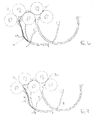
Figure 4 asheet 30 has one fold already which has been formed infold box 100. The leading fold edge 51 is shown touching the outer fold plate offold box 200 in the uppermost convex shaped region 50. This fold edge 51 travels down the fold box as shown inFigure 5 until it reaches thebackstop 8. InFigure 6 the leading edge 51 stalls against the backstop and as thesheet 30 is driven further into the fold box, the leading, folded, portion forms a convex shape and is driven into theindentation 47 and starts to buckle. As the buckle enters the nip point of the output fold rollers, the stalled portion of thesheet 30 forms an S shape around the fold plate geometry effectively breaking the back of the sheet in the area marked 54. - A sequence of the operation of the folder is shown in
Figures 4 to 7 .
Claims (11)
- A sheet folder comprising input rollers, exit rollers and a fold box comprising an inner and an outer fold plate which are each curved substantially along their whole length, wherein the outer curved fold plate comprises adjacent portions which curve in opposite directions to induce a sheet to curve in two opposite directions during the folding process.
- A sheet folder according to claim 1 wherein the fold box is configured to induce an 'S' shape in the sheet.
- A sheet folder as claimed in claim 2 or 3 wherein the outer fold plate comprises a portion shaped generally as an "S" in cross section.
- A sheet folder as claimed in claim 2 or 3 wherein the outer fold plate comprises a portion which presents a concave surface to the sheet and a portion which presents a convex surface to the sheet.
- A sheet folder as claimed in any one of the preceding claims wherein the outer fold plate has a major portion which is curved generally along an arc of a circle.
- A sheet folder as claimed in any one of claims 1 to 5 wherein the outer fold plate has a major portion which is curved along an arc of an ellipse.
- A sheet folder as claimed in any one of the preceding claims wherein the fold box further comprises an adjustable backstop.
- A sheet folder as claimed in claim 7 wherein the backstop is adjusted by pivoting.
- A sheet folder as claimed in claim 7 wherein the backstop is adjustable by rotation about the focal point.
- A sheet folder comprising:a first curved fold box for making a first fold in a sheet;a second curved fold box for making a second fold in the sheet;wherein the second fold box is adapted to induce an "S" shaped curve in the sheet.
- A sheet folder according to any of the preceding claims adapted for multiple-sheet folding.
Applications Claiming Priority (1)
| Application Number | Priority Date | Filing Date | Title |
|---|---|---|---|
| GBGB1001604.6A GB201001604D0 (en) | 2010-02-01 | 2010-02-01 | Sheet folder |
Publications (2)
| Publication Number | Publication Date |
|---|---|
| EP2354068A1 true EP2354068A1 (en) | 2011-08-10 |
| EP2354068B1 EP2354068B1 (en) | 2012-09-26 |
Family
ID=42084278
Family Applications (1)
| Application Number | Title | Priority Date | Filing Date |
|---|---|---|---|
| EP11152258A Active EP2354068B1 (en) | 2010-02-01 | 2011-01-26 | Sheet folder |
Country Status (3)
| Country | Link |
|---|---|
| US (1) | US8641590B2 (en) |
| EP (1) | EP2354068B1 (en) |
| GB (1) | GB201001604D0 (en) |
Families Citing this family (4)
| Publication number | Priority date | Publication date | Assignee | Title |
|---|---|---|---|---|
| JP5760479B2 (en) * | 2011-02-15 | 2015-08-12 | 株式会社リコー | Paper folding mechanism, paper folding device using the same, and image forming apparatus |
| JP2014162577A (en) * | 2013-02-22 | 2014-09-08 | Riso Kagaku Corp | Sheet folding device |
| JP6197441B2 (en) * | 2013-07-25 | 2017-09-20 | 株式会社リコー | Paper processing apparatus, image forming system, and paper folding method |
| EP3348417A1 (en) * | 2017-01-13 | 2018-07-18 | Neopost Technologies | Cold seal paper apparatus and method for manufacturing mailpieces |
Citations (4)
| Publication number | Priority date | Publication date | Assignee | Title |
|---|---|---|---|---|
| US4573672A (en) * | 1984-02-17 | 1986-03-04 | Mathias Bauerle Gmbh | Paper folding machine |
| US4647029A (en) | 1985-07-09 | 1987-03-03 | Duplo Seizo Kabushiki Kaisha | Paper sheet folding device |
| US4834699A (en) * | 1987-03-25 | 1989-05-30 | Martin Samuel W | Buckle chute paper folding apparatus |
| US5819666A (en) | 1996-02-08 | 1998-10-13 | Prinserter Corporation | Mailing system controlled by the computer software |
Family Cites Families (6)
| Publication number | Priority date | Publication date | Assignee | Title |
|---|---|---|---|---|
| JPS61217476A (en) | 1985-03-20 | 1986-09-27 | Canon Inc | Sheet folding device |
| US4717134A (en) | 1985-03-15 | 1988-01-05 | Canon Kabushiki Kaisha | Sheet folding apparatus |
| JP2002255446A (en) | 2001-02-26 | 2002-09-11 | Konica Corp | Paper folding device and image forming device |
| US6719680B2 (en) * | 2001-02-26 | 2004-04-13 | Konica Corporation | Sheet folding apparatus |
| US7066871B1 (en) * | 2003-06-05 | 2006-06-27 | Bescorp, Inc. | Folder with set feeder and telescoping stacker |
| JP5194245B2 (en) | 2007-06-15 | 2013-05-08 | オセ−テクノロジーズ・ベー・ヴエー | Folding device |
-
2010
- 2010-02-01 GB GBGB1001604.6A patent/GB201001604D0/en not_active Ceased
-
2011
- 2011-01-26 EP EP11152258A patent/EP2354068B1/en active Active
- 2011-01-31 US US13/017,890 patent/US8641590B2/en active Active
Patent Citations (4)
| Publication number | Priority date | Publication date | Assignee | Title |
|---|---|---|---|---|
| US4573672A (en) * | 1984-02-17 | 1986-03-04 | Mathias Bauerle Gmbh | Paper folding machine |
| US4647029A (en) | 1985-07-09 | 1987-03-03 | Duplo Seizo Kabushiki Kaisha | Paper sheet folding device |
| US4834699A (en) * | 1987-03-25 | 1989-05-30 | Martin Samuel W | Buckle chute paper folding apparatus |
| US5819666A (en) | 1996-02-08 | 1998-10-13 | Prinserter Corporation | Mailing system controlled by the computer software |
Also Published As
| Publication number | Publication date |
|---|---|
| US8641590B2 (en) | 2014-02-04 |
| EP2354068B1 (en) | 2012-09-26 |
| US20120004085A1 (en) | 2012-01-05 |
| GB201001604D0 (en) | 2010-03-17 |
Similar Documents
| Publication | Publication Date | Title |
|---|---|---|
| JP5544969B2 (en) | Recording material post-processing apparatus and image forming system | |
| US6799759B1 (en) | Booklet maker with contact member | |
| JP4930551B2 (en) | Paper post-processing device | |
| EP2354068B1 (en) | Sheet folder | |
| EP2746205B2 (en) | Loop folding system for providing c, z or half-fold sheets | |
| EP2634125A1 (en) | Method and device for folding a stack of sheets | |
| US5554094A (en) | Folding apparatus | |
| EP2517995A1 (en) | Folding machine with transport device | |
| JP2010001149A (en) | Sheet processing device and image forming system | |
| US6881181B2 (en) | Sheet folding apparatus | |
| EP0754643B1 (en) | A device for collecting folded and unfolded copy sheets | |
| US7427059B2 (en) | Paper handling system materials exit path arrangement | |
| CN105905664B (en) | Folding device and method | |
| JP6065426B2 (en) | Recording material processing apparatus and image forming system | |
| US11667491B2 (en) | Sheet post-processing apparatus | |
| JP5359595B2 (en) | Booklet processing equipment | |
| JP2022170714A (en) | Sheet post-processing device | |
| EP1557388B1 (en) | Automated sheet folder or booklet maker which applies sticker closures | |
| JP6553334B2 (en) | Sheet processing apparatus and image forming apparatus having the same | |
| US7591454B2 (en) | Paper handling system material feed path arrangement | |
| US8752815B2 (en) | System and method for processing multi-page mail pieces | |
| EP0523977A1 (en) | A device for folding a sheet of paper for insertion into an envelope | |
| EP2762433B1 (en) | Sheet folding apparatus | |
| EP2223879A1 (en) | Apparatus and method for folding a sheet | |
| JP5100364B2 (en) | Method for producing booklets and folds |
Legal Events
| Date | Code | Title | Description |
|---|---|---|---|
| PUAI | Public reference made under article 153(3) epc to a published international application that has entered the european phase |
Free format text: ORIGINAL CODE: 0009012 |
|
| AK | Designated contracting states |
Kind code of ref document: A1 Designated state(s): AL AT BE BG CH CY CZ DE DK EE ES FI FR GB GR HR HU IE IS IT LI LT LU LV MC MK MT NL NO PL PT RO RS SE SI SK SM TR |
|
| AX | Request for extension of the european patent |
Extension state: BA ME |
|
| 17P | Request for examination filed |
Effective date: 20120120 |
|
| GRAP | Despatch of communication of intention to grant a patent |
Free format text: ORIGINAL CODE: EPIDOSNIGR1 |
|
| RIC1 | Information provided on ipc code assigned before grant |
Ipc: B65H 45/14 20060101AFI20120330BHEP |
|
| GRAS | Grant fee paid |
Free format text: ORIGINAL CODE: EPIDOSNIGR3 |
|
| GRAA | (expected) grant |
Free format text: ORIGINAL CODE: 0009210 |
|
| AK | Designated contracting states |
Kind code of ref document: B1 Designated state(s): AL AT BE BG CH CY CZ DE DK EE ES FI FR GB GR HR HU IE IS IT LI LT LU LV MC MK MT NL NO PL PT RO RS SE SI SK SM TR |
|
| REG | Reference to a national code |
Ref country code: GB Ref legal event code: FG4D |
|
| REG | Reference to a national code |
Ref country code: CH Ref legal event code: EP |
|
| REG | Reference to a national code |
Ref country code: AT Ref legal event code: REF Ref document number: 576943 Country of ref document: AT Kind code of ref document: T Effective date: 20121015 |
|
| REG | Reference to a national code |
Ref country code: IE Ref legal event code: FG4D |
|
| REG | Reference to a national code |
Ref country code: DE Ref legal event code: R096 Ref document number: 602011000259 Country of ref document: DE Effective date: 20121122 |
|
| PG25 | Lapsed in a contracting state [announced via postgrant information from national office to epo] |
Ref country code: NO Free format text: LAPSE BECAUSE OF FAILURE TO SUBMIT A TRANSLATION OF THE DESCRIPTION OR TO PAY THE FEE WITHIN THE PRESCRIBED TIME-LIMIT Effective date: 20121226 Ref country code: LT Free format text: LAPSE BECAUSE OF FAILURE TO SUBMIT A TRANSLATION OF THE DESCRIPTION OR TO PAY THE FEE WITHIN THE PRESCRIBED TIME-LIMIT Effective date: 20120926 Ref country code: HR Free format text: LAPSE BECAUSE OF FAILURE TO SUBMIT A TRANSLATION OF THE DESCRIPTION OR TO PAY THE FEE WITHIN THE PRESCRIBED TIME-LIMIT Effective date: 20120926 Ref country code: FI Free format text: LAPSE BECAUSE OF FAILURE TO SUBMIT A TRANSLATION OF THE DESCRIPTION OR TO PAY THE FEE WITHIN THE PRESCRIBED TIME-LIMIT Effective date: 20120926 |
|
| REG | Reference to a national code |
Ref country code: AT Ref legal event code: MK05 Ref document number: 576943 Country of ref document: AT Kind code of ref document: T Effective date: 20120926 |
|
| REG | Reference to a national code |
Ref country code: LT Ref legal event code: MG4D Effective date: 20120926 |
|
| REG | Reference to a national code |
Ref country code: NL Ref legal event code: VDEP Effective date: 20120926 |
|
| PG25 | Lapsed in a contracting state [announced via postgrant information from national office to epo] |
Ref country code: LV Free format text: LAPSE BECAUSE OF FAILURE TO SUBMIT A TRANSLATION OF THE DESCRIPTION OR TO PAY THE FEE WITHIN THE PRESCRIBED TIME-LIMIT Effective date: 20120926 Ref country code: GR Free format text: LAPSE BECAUSE OF FAILURE TO SUBMIT A TRANSLATION OF THE DESCRIPTION OR TO PAY THE FEE WITHIN THE PRESCRIBED TIME-LIMIT Effective date: 20121227 Ref country code: SI Free format text: LAPSE BECAUSE OF FAILURE TO SUBMIT A TRANSLATION OF THE DESCRIPTION OR TO PAY THE FEE WITHIN THE PRESCRIBED TIME-LIMIT Effective date: 20120926 Ref country code: SE Free format text: LAPSE BECAUSE OF FAILURE TO SUBMIT A TRANSLATION OF THE DESCRIPTION OR TO PAY THE FEE WITHIN THE PRESCRIBED TIME-LIMIT Effective date: 20120926 |
|
| PG25 | Lapsed in a contracting state [announced via postgrant information from national office to epo] |
Ref country code: CZ Free format text: LAPSE BECAUSE OF FAILURE TO SUBMIT A TRANSLATION OF THE DESCRIPTION OR TO PAY THE FEE WITHIN THE PRESCRIBED TIME-LIMIT Effective date: 20120926 Ref country code: NL Free format text: LAPSE BECAUSE OF FAILURE TO SUBMIT A TRANSLATION OF THE DESCRIPTION OR TO PAY THE FEE WITHIN THE PRESCRIBED TIME-LIMIT Effective date: 20120926 Ref country code: BE Free format text: LAPSE BECAUSE OF FAILURE TO SUBMIT A TRANSLATION OF THE DESCRIPTION OR TO PAY THE FEE WITHIN THE PRESCRIBED TIME-LIMIT Effective date: 20120926 Ref country code: EE Free format text: LAPSE BECAUSE OF FAILURE TO SUBMIT A TRANSLATION OF THE DESCRIPTION OR TO PAY THE FEE WITHIN THE PRESCRIBED TIME-LIMIT Effective date: 20120926 Ref country code: RO Free format text: LAPSE BECAUSE OF FAILURE TO SUBMIT A TRANSLATION OF THE DESCRIPTION OR TO PAY THE FEE WITHIN THE PRESCRIBED TIME-LIMIT Effective date: 20120926 Ref country code: IS Free format text: LAPSE BECAUSE OF FAILURE TO SUBMIT A TRANSLATION OF THE DESCRIPTION OR TO PAY THE FEE WITHIN THE PRESCRIBED TIME-LIMIT Effective date: 20130126 |
|
| PG25 | Lapsed in a contracting state [announced via postgrant information from national office to epo] |
Ref country code: SK Free format text: LAPSE BECAUSE OF FAILURE TO SUBMIT A TRANSLATION OF THE DESCRIPTION OR TO PAY THE FEE WITHIN THE PRESCRIBED TIME-LIMIT Effective date: 20120926 Ref country code: PT Free format text: LAPSE BECAUSE OF FAILURE TO SUBMIT A TRANSLATION OF THE DESCRIPTION OR TO PAY THE FEE WITHIN THE PRESCRIBED TIME-LIMIT Effective date: 20130128 Ref country code: PL Free format text: LAPSE BECAUSE OF FAILURE TO SUBMIT A TRANSLATION OF THE DESCRIPTION OR TO PAY THE FEE WITHIN THE PRESCRIBED TIME-LIMIT Effective date: 20120926 |
|
| PG25 | Lapsed in a contracting state [announced via postgrant information from national office to epo] |
Ref country code: AT Free format text: LAPSE BECAUSE OF FAILURE TO SUBMIT A TRANSLATION OF THE DESCRIPTION OR TO PAY THE FEE WITHIN THE PRESCRIBED TIME-LIMIT Effective date: 20120926 |
|
| PG25 | Lapsed in a contracting state [announced via postgrant information from national office to epo] |
Ref country code: BG Free format text: LAPSE BECAUSE OF FAILURE TO SUBMIT A TRANSLATION OF THE DESCRIPTION OR TO PAY THE FEE WITHIN THE PRESCRIBED TIME-LIMIT Effective date: 20121226 Ref country code: RS Free format text: LAPSE BECAUSE OF FAILURE TO SUBMIT A TRANSLATION OF THE DESCRIPTION OR TO PAY THE FEE WITHIN THE PRESCRIBED TIME-LIMIT Effective date: 20120926 Ref country code: DK Free format text: LAPSE BECAUSE OF FAILURE TO SUBMIT A TRANSLATION OF THE DESCRIPTION OR TO PAY THE FEE WITHIN THE PRESCRIBED TIME-LIMIT Effective date: 20120926 |
|
| PLBE | No opposition filed within time limit |
Free format text: ORIGINAL CODE: 0009261 |
|
| STAA | Information on the status of an ep patent application or granted ep patent |
Free format text: STATUS: NO OPPOSITION FILED WITHIN TIME LIMIT |
|
| PG25 | Lapsed in a contracting state [announced via postgrant information from national office to epo] |
Ref country code: MC Free format text: LAPSE BECAUSE OF NON-PAYMENT OF DUE FEES Effective date: 20130131 Ref country code: IT Free format text: LAPSE BECAUSE OF FAILURE TO SUBMIT A TRANSLATION OF THE DESCRIPTION OR TO PAY THE FEE WITHIN THE PRESCRIBED TIME-LIMIT Effective date: 20120926 |
|
| 26N | No opposition filed |
Effective date: 20130627 |
|
| REG | Reference to a national code |
Ref country code: IE Ref legal event code: MM4A |
|
| REG | Reference to a national code |
Ref country code: DE Ref legal event code: R097 Ref document number: 602011000259 Country of ref document: DE Effective date: 20130627 |
|
| PG25 | Lapsed in a contracting state [announced via postgrant information from national office to epo] |
Ref country code: ES Free format text: LAPSE BECAUSE OF FAILURE TO SUBMIT A TRANSLATION OF THE DESCRIPTION OR TO PAY THE FEE WITHIN THE PRESCRIBED TIME-LIMIT Effective date: 20130106 |
|
| PG25 | Lapsed in a contracting state [announced via postgrant information from national office to epo] |
Ref country code: CY Free format text: LAPSE BECAUSE OF FAILURE TO SUBMIT A TRANSLATION OF THE DESCRIPTION OR TO PAY THE FEE WITHIN THE PRESCRIBED TIME-LIMIT Effective date: 20120926 |
|
| PG25 | Lapsed in a contracting state [announced via postgrant information from national office to epo] |
Ref country code: IE Free format text: LAPSE BECAUSE OF NON-PAYMENT OF DUE FEES Effective date: 20130126 Ref country code: AL Free format text: LAPSE BECAUSE OF FAILURE TO SUBMIT A TRANSLATION OF THE DESCRIPTION OR TO PAY THE FEE WITHIN THE PRESCRIBED TIME-LIMIT Effective date: 20120926 |
|
| PG25 | Lapsed in a contracting state [announced via postgrant information from national office to epo] |
Ref country code: MT Free format text: LAPSE BECAUSE OF FAILURE TO SUBMIT A TRANSLATION OF THE DESCRIPTION OR TO PAY THE FEE WITHIN THE PRESCRIBED TIME-LIMIT Effective date: 20120926 |
|
| REG | Reference to a national code |
Ref country code: CH Ref legal event code: PL |
|
| PG25 | Lapsed in a contracting state [announced via postgrant information from national office to epo] |
Ref country code: LI Free format text: LAPSE BECAUSE OF NON-PAYMENT OF DUE FEES Effective date: 20140131 Ref country code: CH Free format text: LAPSE BECAUSE OF NON-PAYMENT OF DUE FEES Effective date: 20140131 |
|
| PG25 | Lapsed in a contracting state [announced via postgrant information from national office to epo] |
Ref country code: SM Free format text: LAPSE BECAUSE OF FAILURE TO SUBMIT A TRANSLATION OF THE DESCRIPTION OR TO PAY THE FEE WITHIN THE PRESCRIBED TIME-LIMIT Effective date: 20120926 |
|
| PG25 | Lapsed in a contracting state [announced via postgrant information from national office to epo] |
Ref country code: TR Free format text: LAPSE BECAUSE OF FAILURE TO SUBMIT A TRANSLATION OF THE DESCRIPTION OR TO PAY THE FEE WITHIN THE PRESCRIBED TIME-LIMIT Effective date: 20120926 |
|
| PG25 | Lapsed in a contracting state [announced via postgrant information from national office to epo] |
Ref country code: HU Free format text: LAPSE BECAUSE OF FAILURE TO SUBMIT A TRANSLATION OF THE DESCRIPTION OR TO PAY THE FEE WITHIN THE PRESCRIBED TIME-LIMIT; INVALID AB INITIO Effective date: 20110126 Ref country code: MK Free format text: LAPSE BECAUSE OF FAILURE TO SUBMIT A TRANSLATION OF THE DESCRIPTION OR TO PAY THE FEE WITHIN THE PRESCRIBED TIME-LIMIT Effective date: 20120926 Ref country code: LU Free format text: LAPSE BECAUSE OF NON-PAYMENT OF DUE FEES Effective date: 20130126 |
|
| REG | Reference to a national code |
Ref country code: FR Ref legal event code: PLFP Year of fee payment: 6 |
|
| REG | Reference to a national code |
Ref country code: FR Ref legal event code: PLFP Year of fee payment: 7 |
|
| REG | Reference to a national code |
Ref country code: FR Ref legal event code: PLFP Year of fee payment: 8 |
|
| REG | Reference to a national code |
Ref country code: DE Ref legal event code: R082 Ref document number: 602011000259 Country of ref document: DE Representative=s name: CBDL PATENTANWAELTE GBR, DE Ref country code: DE Ref legal event code: R082 Ref document number: 602011000259 Country of ref document: DE Representative=s name: CBDL PATENTANWAELTE EGBR, DE |
|
| PGFP | Annual fee paid to national office [announced via postgrant information from national office to epo] |
Ref country code: GB Payment date: 20260123 Year of fee payment: 16 |
|
| PGFP | Annual fee paid to national office [announced via postgrant information from national office to epo] |
Ref country code: DE Payment date: 20260121 Year of fee payment: 16 |
|
| PGFP | Annual fee paid to national office [announced via postgrant information from national office to epo] |
Ref country code: FR Payment date: 20260123 Year of fee payment: 16 |