EP2352729B1 - Melanocortin receptor antagonist compounds, process for preparing them and use thereof in human medicine and cosmetics - Google Patents
Melanocortin receptor antagonist compounds, process for preparing them and use thereof in human medicine and cosmetics Download PDFInfo
- Publication number
- EP2352729B1 EP2352729B1 EP09744693.4A EP09744693A EP2352729B1 EP 2352729 B1 EP2352729 B1 EP 2352729B1 EP 09744693 A EP09744693 A EP 09744693A EP 2352729 B1 EP2352729 B1 EP 2352729B1
- Authority
- EP
- European Patent Office
- Prior art keywords
- ethyl
- imidazol
- cyclohexyl
- oxoethyl
- propionyl
- Prior art date
- Legal status (The legal status is an assumption and is not a legal conclusion. Google has not performed a legal analysis and makes no representation as to the accuracy of the status listed.)
- Not-in-force
Links
- 150000001875 compounds Chemical class 0.000 title claims description 93
- 239000003814 drug Substances 0.000 title claims description 6
- 238000004519 manufacturing process Methods 0.000 title description 5
- 229940122534 Melanocortin receptor antagonist Drugs 0.000 title description 2
- 239000002537 cosmetic Substances 0.000 title description 2
- XSQUKJJJFZCRTK-UHFFFAOYSA-N Urea Chemical compound NC(N)=O XSQUKJJJFZCRTK-UHFFFAOYSA-N 0.000 claims description 72
- 125000000217 alkyl group Chemical group 0.000 claims description 47
- 125000001495 ethyl group Chemical group [H]C([H])([H])C([H])([H])* 0.000 claims description 44
- 239000000203 mixture Substances 0.000 claims description 34
- 239000004202 carbamide Substances 0.000 claims description 30
- UMGDCJDMYOKAJW-UHFFFAOYSA-N thiourea Chemical compound NC(N)=S UMGDCJDMYOKAJW-UHFFFAOYSA-N 0.000 claims description 26
- 238000002360 preparation method Methods 0.000 claims description 21
- 125000003545 alkoxy group Chemical group 0.000 claims description 17
- 206010006895 Cachexia Diseases 0.000 claims description 15
- 125000001436 propyl group Chemical group [H]C([*])([H])C([H])([H])C([H])([H])[H] 0.000 claims description 14
- 125000004432 carbon atom Chemical group C* 0.000 claims description 13
- 239000005557 antagonist Substances 0.000 claims description 12
- 125000002887 hydroxy group Chemical group [H]O* 0.000 claims description 12
- 208000016261 weight loss Diseases 0.000 claims description 12
- 230000004580 weight loss Effects 0.000 claims description 12
- 102100023724 Melanocortin receptor 4 Human genes 0.000 claims description 11
- 125000001951 carbamoylamino group Chemical group C(N)(=O)N* 0.000 claims description 11
- 208000037265 diseases, disorders, signs and symptoms Diseases 0.000 claims description 11
- 229920006395 saturated elastomer Polymers 0.000 claims description 11
- 230000007170 pathology Effects 0.000 claims description 10
- 229930195735 unsaturated hydrocarbon Natural products 0.000 claims description 10
- 150000001732 carboxylic acid derivatives Chemical class 0.000 claims description 9
- 125000000753 cycloalkyl group Chemical group 0.000 claims description 9
- 206010028980 Neoplasm Diseases 0.000 claims description 8
- 125000002252 acyl group Chemical group 0.000 claims description 8
- 125000003118 aryl group Chemical group 0.000 claims description 8
- 125000001316 cycloalkyl alkyl group Chemical group 0.000 claims description 8
- 125000004475 heteroaralkyl group Chemical group 0.000 claims description 8
- 125000001147 pentyl group Chemical group C(CCCC)* 0.000 claims description 8
- 229930195734 saturated hydrocarbon Natural products 0.000 claims description 8
- 201000011510 cancer Diseases 0.000 claims description 7
- 230000000694 effects Effects 0.000 claims description 7
- 230000037406 food intake Effects 0.000 claims description 7
- 235000012631 food intake Nutrition 0.000 claims description 7
- 125000005843 halogen group Chemical group 0.000 claims description 7
- 125000001072 heteroaryl group Chemical group 0.000 claims description 7
- 125000001997 phenyl group Chemical group [H]C1=C([H])C([H])=C(*)C([H])=C1[H] 0.000 claims description 7
- 230000001105 regulatory effect Effects 0.000 claims description 7
- 208000008589 Obesity Diseases 0.000 claims description 6
- 208000022531 anorexia Diseases 0.000 claims description 6
- 125000003710 aryl alkyl group Chemical group 0.000 claims description 6
- 210000000988 bone and bone Anatomy 0.000 claims description 6
- 206010061428 decreased appetite Diseases 0.000 claims description 6
- 201000010099 disease Diseases 0.000 claims description 6
- 125000004435 hydrogen atom Chemical group [H]* 0.000 claims description 6
- 235000020824 obesity Nutrition 0.000 claims description 6
- 125000004430 oxygen atom Chemical group O* 0.000 claims description 6
- 239000008194 pharmaceutical composition Substances 0.000 claims description 6
- 150000003839 salts Chemical class 0.000 claims description 6
- 208000030507 AIDS Diseases 0.000 claims description 5
- 208000023275 Autoimmune disease Diseases 0.000 claims description 5
- 208000035473 Communicable disease Diseases 0.000 claims description 5
- 206010019280 Heart failures Diseases 0.000 claims description 5
- 208000000857 Hepatic Insufficiency Diseases 0.000 claims description 5
- 206010019663 Hepatic failure Diseases 0.000 claims description 5
- 208000001647 Renal Insufficiency Diseases 0.000 claims description 5
- 125000004423 acyloxy group Chemical group 0.000 claims description 5
- 230000006583 body weight regulation Effects 0.000 claims description 5
- 230000001925 catabolic effect Effects 0.000 claims description 5
- 125000004093 cyano group Chemical group *C#N 0.000 claims description 5
- 208000035475 disorder Diseases 0.000 claims description 5
- OFTNIKXIOHVTLR-GDLZYMKVSA-N ethyl 4-cyclohexyl-1-[(2r)-2-[5-(1h-imidazol-5-yl)pentylcarbamoylamino]-3-(4-methoxyphenyl)propanoyl]piperidine-4-carboxylate Chemical compound C([C@H](C(=O)N1CCC(CC1)(C(=O)OCC)C1CCCCC1)NC(=O)NCCCCCC=1N=CNC=1)C1=CC=C(OC)C=C1 OFTNIKXIOHVTLR-GDLZYMKVSA-N 0.000 claims description 5
- 230000013632 homeostatic process Effects 0.000 claims description 5
- 201000006370 kidney failure Diseases 0.000 claims description 5
- 125000001624 naphthyl group Chemical group 0.000 claims description 5
- 208000001076 sarcopenia Diseases 0.000 claims description 5
- 125000003107 substituted aryl group Chemical group 0.000 claims description 5
- 201000008827 tuberculosis Diseases 0.000 claims description 5
- HBAQYPYDRFILMT-UHFFFAOYSA-N 8-[3-(1-cyclopropylpyrazol-4-yl)-1H-pyrazolo[4,3-d]pyrimidin-5-yl]-3-methyl-3,8-diazabicyclo[3.2.1]octan-2-one Chemical class C1(CC1)N1N=CC(=C1)C1=NNC2=C1N=C(N=C2)N1C2C(N(CC1CC2)C)=O HBAQYPYDRFILMT-UHFFFAOYSA-N 0.000 claims description 4
- 208000030814 Eating disease Diseases 0.000 claims description 4
- 208000019454 Feeding and Eating disease Diseases 0.000 claims description 4
- 208000019693 Lung disease Diseases 0.000 claims description 4
- 125000004453 alkoxycarbonyl group Chemical group 0.000 claims description 4
- 150000003857 carboxamides Chemical class 0.000 claims description 4
- 230000001684 chronic effect Effects 0.000 claims description 4
- 125000005112 cycloalkylalkoxy group Chemical group 0.000 claims description 4
- 235000014632 disordered eating Nutrition 0.000 claims description 4
- RZWMTVWBZNELLG-HHHXNRCGSA-N ethyl 4-cyclohexyl-1-[(2r)-2-[3-(1h-imidazol-5-yl)propylcarbamothioylamino]-3-(4-methoxyphenyl)propanoyl]piperidine-4-carboxylate Chemical compound C([C@H](C(=O)N1CCC(CC1)(C(=O)OCC)C1CCCCC1)NC(=S)NCCCC=1N=CNC=1)C1=CC=C(OC)C=C1 RZWMTVWBZNELLG-HHHXNRCGSA-N 0.000 claims description 4
- 125000002924 primary amino group Chemical class [H]N([H])* 0.000 claims description 4
- 229910052717 sulfur Inorganic materials 0.000 claims description 4
- 230000004584 weight gain Effects 0.000 claims description 4
- 235000019786 weight gain Nutrition 0.000 claims description 4
- 101000978418 Homo sapiens Melanocortin receptor 4 Proteins 0.000 claims description 3
- YMFKSCPECPDOFG-HHHXNRCGSA-N ethyl 4-cyclohexyl-1-[(2r)-3-(4-methoxyphenyl)-2-[2-(1-methylimidazol-4-yl)ethylcarbamothioylamino]propanoyl]piperidine-4-carboxylate Chemical compound C([C@H](C(=O)N1CCC(CC1)(C(=O)OCC)C1CCCCC1)NC(=S)NCCC=1N=CN(C)C=1)C1=CC=C(OC)C=C1 YMFKSCPECPDOFG-HHHXNRCGSA-N 0.000 claims description 3
- 125000002496 methyl group Chemical group [H]C([H])([H])* 0.000 claims description 3
- SRJOCJYGOFTFLH-UHFFFAOYSA-M piperidine-4-carboxylate Chemical compound [O-]C(=O)C1CCNCC1 SRJOCJYGOFTFLH-UHFFFAOYSA-M 0.000 claims description 3
- VDJIPAUFTQWUBJ-UHFFFAOYSA-N 1-[1-(4-cyclohexyl-4-propoxypiperidin-1-yl)-3-(4-methoxyphenyl)-1-oxopropan-2-yl]-3-[3-(1h-imidazol-5-yl)propyl]thiourea Chemical compound C1CC(OCCC)(C2CCCCC2)CCN1C(=O)C(NC(=S)NCCCC=1N=CNC=1)CC1=CC=C(OC)C=C1 VDJIPAUFTQWUBJ-UHFFFAOYSA-N 0.000 claims description 2
- 125000004429 atom Chemical group 0.000 claims description 2
- OOCLRWYPJZXYHR-AREMUKBSSA-N ethyl 4-cyclohexyl-1-[(2r)-3-(2,4-dichlorophenyl)-2-[2-(1-methylimidazol-4-yl)ethylcarbamoylamino]propanoyl]piperidine-4-carboxylate Chemical compound C([C@H](C(=O)N1CCC(CC1)(C(=O)OCC)C1CCCCC1)NC(=O)NCCC=1N=CN(C)C=1)C1=CC=C(Cl)C=C1Cl OOCLRWYPJZXYHR-AREMUKBSSA-N 0.000 claims description 2
- ABDLYHMIXVGQOD-RUZDIDTESA-N ethyl 4-cyclohexyl-1-[(2r)-3-(2,4-dichlorophenyl)-2-[2-(1h-imidazol-5-yl)ethylcarbamoylamino]propanoyl]piperidine-4-carboxylate Chemical compound C([C@H](C(=O)N1CCC(CC1)(C(=O)OCC)C1CCCCC1)NC(=O)NCCC=1N=CNC=1)C1=CC=C(Cl)C=C1Cl ABDLYHMIXVGQOD-RUZDIDTESA-N 0.000 claims description 2
- QHAWTTCYNPKPEJ-AREMUKBSSA-N ethyl 4-cyclohexyl-1-[(2r)-3-(2,4-dichlorophenyl)-2-[2-(3-methylimidazol-4-yl)ethylcarbamoylamino]propanoyl]piperidine-4-carboxylate Chemical compound C([C@H](C(=O)N1CCC(CC1)(C(=O)OCC)C1CCCCC1)NC(=O)NCCC=1N(C=NC=1)C)C1=CC=C(Cl)C=C1Cl QHAWTTCYNPKPEJ-AREMUKBSSA-N 0.000 claims description 2
- XXEPTBIYCKOVKS-MUUNZHRXSA-N ethyl 4-cyclohexyl-1-[(2r)-3-(2,4-dichlorophenyl)-2-[5-(1h-imidazol-5-yl)pentylcarbamoylamino]propanoyl]piperidine-4-carboxylate Chemical compound C([C@H](C(=O)N1CCC(CC1)(C(=O)OCC)C1CCCCC1)NC(=O)NCCCCCC=1N=CNC=1)C1=CC=C(Cl)C=C1Cl XXEPTBIYCKOVKS-MUUNZHRXSA-N 0.000 claims description 2
- KLHPSDSILXMFPW-AREMUKBSSA-N ethyl 4-cyclohexyl-1-[(2r)-3-(3,4-dichlorophenyl)-2-[2-(1-methylimidazol-4-yl)ethylcarbamoylamino]propanoyl]piperidine-4-carboxylate Chemical compound C([C@H](C(=O)N1CCC(CC1)(C(=O)OCC)C1CCCCC1)NC(=O)NCCC=1N=CN(C)C=1)C1=CC=C(Cl)C(Cl)=C1 KLHPSDSILXMFPW-AREMUKBSSA-N 0.000 claims description 2
- OUQPVUKIBFYZMV-MUUNZHRXSA-N ethyl 4-cyclohexyl-1-[(2r)-3-(3,4-dichlorophenyl)-2-[5-(1h-imidazol-5-yl)pentylcarbamoylamino]propanoyl]piperidine-4-carboxylate Chemical compound C([C@H](C(=O)N1CCC(CC1)(C(=O)OCC)C1CCCCC1)NC(=O)NCCCCCC=1N=CNC=1)C1=CC=C(Cl)C(Cl)=C1 OUQPVUKIBFYZMV-MUUNZHRXSA-N 0.000 claims description 2
- 229910052736 halogen Inorganic materials 0.000 claims description 2
- 150000002367 halogens Chemical class 0.000 claims description 2
- 125000000449 nitro group Chemical group [O-][N+](*)=O 0.000 claims description 2
- 125000001501 propionyl group Chemical group O=C([*])C([H])([H])C([H])([H])[H] 0.000 claims description 2
- 125000004434 sulfur atom Chemical group 0.000 claims description 2
- 125000000999 tert-butyl group Chemical group [H]C([H])([H])C(*)(C([H])([H])[H])C([H])([H])[H] 0.000 claims description 2
- 125000002023 trifluoromethyl group Chemical group FC(F)(F)* 0.000 claims description 2
- YMWUJEATGCHHMB-UHFFFAOYSA-N Dichloromethane Chemical compound ClCCl YMWUJEATGCHHMB-UHFFFAOYSA-N 0.000 description 198
- XEKOWRVHYACXOJ-UHFFFAOYSA-N Ethyl acetate Chemical compound CCOC(C)=O XEKOWRVHYACXOJ-UHFFFAOYSA-N 0.000 description 79
- OKKJLVBELUTLKV-UHFFFAOYSA-N Methanol Chemical compound OC OKKJLVBELUTLKV-UHFFFAOYSA-N 0.000 description 69
- HEMHJVSKTPXQMS-UHFFFAOYSA-M Sodium hydroxide Chemical compound [OH-].[Na+] HEMHJVSKTPXQMS-UHFFFAOYSA-M 0.000 description 63
- ZMXDDKWLCZADIW-UHFFFAOYSA-N N,N-Dimethylformamide Chemical compound CN(C)C=O ZMXDDKWLCZADIW-UHFFFAOYSA-N 0.000 description 51
- 239000000243 solution Substances 0.000 description 43
- CSNNHWWHGAXBCP-UHFFFAOYSA-L Magnesium sulfate Chemical compound [Mg+2].[O-][S+2]([O-])([O-])[O-] CSNNHWWHGAXBCP-UHFFFAOYSA-L 0.000 description 36
- ZMANZCXQSJIPKH-UHFFFAOYSA-N Triethylamine Chemical compound CCN(CC)CC ZMANZCXQSJIPKH-UHFFFAOYSA-N 0.000 description 36
- DTQVDTLACAAQTR-UHFFFAOYSA-N Trifluoroacetic acid Chemical compound OC(=O)C(F)(F)F DTQVDTLACAAQTR-UHFFFAOYSA-N 0.000 description 35
- 239000012074 organic phase Substances 0.000 description 32
- IAZDPXIOMUYVGZ-UHFFFAOYSA-N Dimethylsulphoxide Chemical compound CS(C)=O IAZDPXIOMUYVGZ-UHFFFAOYSA-N 0.000 description 29
- 235000019439 ethyl acetate Nutrition 0.000 description 29
- 239000002904 solvent Substances 0.000 description 29
- XLYOFNOQVPJJNP-UHFFFAOYSA-N water Substances O XLYOFNOQVPJJNP-UHFFFAOYSA-N 0.000 description 27
- VEXZGXHMUGYJMC-UHFFFAOYSA-N Hydrochloric acid Chemical compound Cl VEXZGXHMUGYJMC-UHFFFAOYSA-N 0.000 description 26
- VYPSYNLAJGMNEJ-UHFFFAOYSA-N Silicium dioxide Chemical compound O=[Si]=O VYPSYNLAJGMNEJ-UHFFFAOYSA-N 0.000 description 24
- WYURNTSHIVDZCO-UHFFFAOYSA-N Tetrahydrofuran Chemical compound C1CCOC1 WYURNTSHIVDZCO-UHFFFAOYSA-N 0.000 description 24
- 239000012429 reaction media Substances 0.000 description 24
- 150000001412 amines Chemical group 0.000 description 22
- WEVYAHXRMPXWCK-UHFFFAOYSA-N Acetonitrile Chemical compound CC#N WEVYAHXRMPXWCK-UHFFFAOYSA-N 0.000 description 19
- 239000003480 eluent Substances 0.000 description 19
- 239000000843 powder Substances 0.000 description 19
- IMNFDUFMRHMDMM-UHFFFAOYSA-N N-Heptane Chemical compound CCCCCCC IMNFDUFMRHMDMM-UHFFFAOYSA-N 0.000 description 18
- 229910052943 magnesium sulfate Inorganic materials 0.000 description 18
- 238000006243 chemical reaction Methods 0.000 description 17
- JGFZNNIVVJXRND-UHFFFAOYSA-N N,N-Diisopropylethylamine (DIPEA) Chemical compound CCN(C(C)C)C(C)C JGFZNNIVVJXRND-UHFFFAOYSA-N 0.000 description 16
- -1 bicyclic hydrocarbon Chemical class 0.000 description 16
- 239000012043 crude product Substances 0.000 description 16
- 239000000741 silica gel Substances 0.000 description 16
- 229910002027 silica gel Inorganic materials 0.000 description 16
- 238000000034 method Methods 0.000 description 15
- 108090000950 Melanocortin Receptors Proteins 0.000 description 13
- 102000004378 Melanocortin Receptors Human genes 0.000 description 13
- RTZKZFJDLAIYFH-UHFFFAOYSA-N Diethyl ether Chemical compound CCOCC RTZKZFJDLAIYFH-UHFFFAOYSA-N 0.000 description 12
- PMZURENOXWZQFD-UHFFFAOYSA-L Sodium Sulfate Chemical compound [Na+].[Na+].[O-]S([O-])(=O)=O PMZURENOXWZQFD-UHFFFAOYSA-L 0.000 description 12
- KRKNYBCHXYNGOX-UHFFFAOYSA-N citric acid Chemical compound OC(=O)CC(O)(C(O)=O)CC(O)=O KRKNYBCHXYNGOX-UHFFFAOYSA-N 0.000 description 12
- 229910052938 sodium sulfate Inorganic materials 0.000 description 12
- 239000000047 product Substances 0.000 description 11
- 235000011152 sodium sulphate Nutrition 0.000 description 11
- QAOWNCQODCNURD-UHFFFAOYSA-N Sulfuric acid Chemical compound OS(O)(=O)=O QAOWNCQODCNURD-UHFFFAOYSA-N 0.000 description 10
- 239000002585 base Substances 0.000 description 10
- LFQSCWFLJHTTHZ-UHFFFAOYSA-N Ethanol Chemical compound CCO LFQSCWFLJHTTHZ-UHFFFAOYSA-N 0.000 description 9
- YXFVVABEGXRONW-UHFFFAOYSA-N Toluene Chemical compound CC1=CC=CC=C1 YXFVVABEGXRONW-UHFFFAOYSA-N 0.000 description 9
- 238000010511 deprotection reaction Methods 0.000 description 9
- 238000003756 stirring Methods 0.000 description 9
- YLQBMQCUIZJEEH-UHFFFAOYSA-N tetrahydrofuran Natural products C=1C=COC=1 YLQBMQCUIZJEEH-UHFFFAOYSA-N 0.000 description 9
- GQHTUMJGOHRCHB-UHFFFAOYSA-N 2,3,4,6,7,8,9,10-octahydropyrimido[1,2-a]azepine Chemical compound C1CCCCN2CCCN=C21 GQHTUMJGOHRCHB-UHFFFAOYSA-N 0.000 description 8
- 101710085775 Melanocortin receptor 4 Proteins 0.000 description 8
- 238000005984 hydrogenation reaction Methods 0.000 description 8
- 239000002609 medium Substances 0.000 description 8
- 239000011541 reaction mixture Substances 0.000 description 8
- NXLNNXIXOYSCMB-UHFFFAOYSA-N (4-nitrophenyl) carbonochloridate Chemical compound [O-][N+](=O)C1=CC=C(OC(Cl)=O)C=C1 NXLNNXIXOYSCMB-UHFFFAOYSA-N 0.000 description 7
- UIIMBOGNXHQVGW-UHFFFAOYSA-M Sodium bicarbonate Chemical compound [Na+].OC([O-])=O UIIMBOGNXHQVGW-UHFFFAOYSA-M 0.000 description 7
- 239000007787 solid Substances 0.000 description 7
- VHUUQVKOLVNVRT-UHFFFAOYSA-N Ammonium hydroxide Chemical compound [NH4+].[OH-] VHUUQVKOLVNVRT-UHFFFAOYSA-N 0.000 description 6
- WMFOQBRAJBCJND-UHFFFAOYSA-M Lithium hydroxide Chemical compound [Li+].[OH-] WMFOQBRAJBCJND-UHFFFAOYSA-M 0.000 description 6
- MUBZPKHOEPUJKR-UHFFFAOYSA-N Oxalic acid Chemical compound OC(=O)C(O)=O MUBZPKHOEPUJKR-UHFFFAOYSA-N 0.000 description 6
- NQRYJNQNLNOLGT-UHFFFAOYSA-N Piperidine Chemical compound C1CCNCC1 NQRYJNQNLNOLGT-UHFFFAOYSA-N 0.000 description 6
- 102100027467 Pro-opiomelanocortin Human genes 0.000 description 6
- 108010021436 Type 4 Melanocortin Receptor Proteins 0.000 description 6
- NPZTUJOABDZTLV-UHFFFAOYSA-N hydroxybenzotriazole Substances O=C1C=CC=C2NNN=C12 NPZTUJOABDZTLV-UHFFFAOYSA-N 0.000 description 6
- 150000002894 organic compounds Chemical class 0.000 description 6
- 150000002926 oxygen Chemical group 0.000 description 6
- 238000012360 testing method Methods 0.000 description 6
- LMDZBCPBFSXMTL-UHFFFAOYSA-N 1-Ethyl-3-(3-dimethylaminopropyl)carbodiimide Substances CCN=C=NCCCN(C)C LMDZBCPBFSXMTL-UHFFFAOYSA-N 0.000 description 5
- YUEVQPPZHWZGIS-JOCHJYFZSA-N 1-[1-[(2r)-2-amino-3-(4-methoxyphenyl)propanoyl]-4-cyclohexylpiperidin-4-yl]butan-1-one Chemical compound C([C@@H](N)C(=O)N1CCC(CC1)(C(=O)CCC)C1CCCCC1)C1=CC=C(OC)C=C1 YUEVQPPZHWZGIS-JOCHJYFZSA-N 0.000 description 5
- YYROPELSRYBVMQ-UHFFFAOYSA-N 4-toluenesulfonyl chloride Chemical compound CC1=CC=C(S(Cl)(=O)=O)C=C1 YYROPELSRYBVMQ-UHFFFAOYSA-N 0.000 description 5
- NLXLAEXVIDQMFP-UHFFFAOYSA-N Ammonia chloride Chemical compound [NH4+].[Cl-] NLXLAEXVIDQMFP-UHFFFAOYSA-N 0.000 description 5
- 239000012317 TBTU Substances 0.000 description 5
- 239000002253 acid Substances 0.000 description 5
- 229910052751 metal Inorganic materials 0.000 description 5
- 239000002184 metal Substances 0.000 description 5
- MHOVAHRLVXNVSD-UHFFFAOYSA-N rhodium atom Chemical compound [Rh] MHOVAHRLVXNVSD-UHFFFAOYSA-N 0.000 description 5
- 239000000725 suspension Substances 0.000 description 5
- 125000003088 (fluoren-9-ylmethoxy)carbonyl group Chemical group 0.000 description 4
- 0 *C(C(O)=O)N* Chemical compound *C(C(O)=O)N* 0.000 description 4
- 101800000414 Corticotropin Proteins 0.000 description 4
- FAPWRFPIFSIZLT-UHFFFAOYSA-M Sodium chloride Chemical compound [Na+].[Cl-] FAPWRFPIFSIZLT-UHFFFAOYSA-M 0.000 description 4
- HEDRZPFGACZZDS-MICDWDOJSA-N Trichloro(2H)methane Chemical compound [2H]C(Cl)(Cl)Cl HEDRZPFGACZZDS-MICDWDOJSA-N 0.000 description 4
- 102000008316 Type 4 Melanocortin Receptor Human genes 0.000 description 4
- CLZISMQKJZCZDN-UHFFFAOYSA-N [benzotriazol-1-yloxy(dimethylamino)methylidene]-dimethylazanium Chemical compound C1=CC=C2N(OC(N(C)C)=[N+](C)C)N=NC2=C1 CLZISMQKJZCZDN-UHFFFAOYSA-N 0.000 description 4
- 239000000556 agonist Substances 0.000 description 4
- 235000011114 ammonium hydroxide Nutrition 0.000 description 4
- IDLFZVILOHSSID-OVLDLUHVSA-N corticotropin Chemical compound C([C@@H](C(=O)N[C@@H](CO)C(=O)N[C@@H](CCSC)C(=O)N[C@@H](CCC(O)=O)C(=O)N[C@@H](CC=1NC=NC=1)C(=O)N[C@@H](CC=1C=CC=CC=1)C(=O)N[C@@H](CCCNC(N)=N)C(=O)N[C@@H](CC=1C2=CC=CC=C2NC=1)C(=O)NCC(=O)N[C@@H](CCCCN)C(=O)N1[C@@H](CCC1)C(=O)N[C@@H](C(C)C)C(=O)NCC(=O)N[C@@H](CCCCN)C(=O)N[C@@H](CCCCN)C(=O)N[C@@H](CCCNC(N)=N)C(=O)N[C@@H](CCCNC(N)=N)C(=O)N1[C@@H](CCC1)C(=O)N[C@@H](C(C)C)C(=O)N[C@@H](CCCCN)C(=O)N[C@@H](C(C)C)C(=O)N[C@@H](CC=1C=CC(O)=CC=1)C(=O)N1[C@@H](CCC1)C(=O)N[C@@H](CC(N)=O)C(=O)NCC(=O)N[C@@H](C)C(=O)N[C@@H](CCC(O)=O)C(=O)N[C@@H](CC(O)=O)C(=O)N[C@@H](CCC(O)=O)C(=O)N[C@@H](CO)C(=O)N[C@@H](C)C(=O)N[C@@H](CCC(O)=O)C(=O)N[C@@H](C)C(=O)N[C@@H](CC=1C=CC=CC=1)C(=O)N1[C@@H](CCC1)C(=O)N[C@@H](CC(C)C)C(=O)N[C@@H](CCC(O)=O)C(=O)N[C@@H](CC=1C=CC=CC=1)C(O)=O)NC(=O)[C@@H](N)CO)C1=CC=C(O)C=C1 IDLFZVILOHSSID-OVLDLUHVSA-N 0.000 description 4
- 229960000258 corticotropin Drugs 0.000 description 4
- CLLGBEUAFDPDTA-HHHXNRCGSA-N ethyl 4-cyclohexyl-1-[(2r)-2-[3-(1h-imidazol-5-yl)propylcarbamoylamino]-3-(4-methoxyphenyl)propanoyl]piperidine-4-carboxylate Chemical compound C([C@H](C(=O)N1CCC(CC1)(C(=O)OCC)C1CCCCC1)NC(=O)NCCCC=1NC=NC=1)C1=CC=C(OC)C=C1 CLLGBEUAFDPDTA-HHHXNRCGSA-N 0.000 description 4
- 150000002576 ketones Chemical class 0.000 description 4
- 239000011777 magnesium Substances 0.000 description 4
- 229910052749 magnesium Inorganic materials 0.000 description 4
- 235000019341 magnesium sulphate Nutrition 0.000 description 4
- 150000002825 nitriles Chemical group 0.000 description 4
- 150000003138 primary alcohols Chemical class 0.000 description 4
- 102000005962 receptors Human genes 0.000 description 4
- 108020003175 receptors Proteins 0.000 description 4
- RYHBNJHYFVUHQT-UHFFFAOYSA-N 1,4-Dioxane Chemical compound C1COCCO1 RYHBNJHYFVUHQT-UHFFFAOYSA-N 0.000 description 3
- NLZWBHKEHVDHOP-UHFFFAOYSA-N 1-(4-cyclohexylpiperidin-4-yl)butan-1-one Chemical compound C1CCCCC1C1(C(=O)CCC)CCNCC1 NLZWBHKEHVDHOP-UHFFFAOYSA-N 0.000 description 3
- RQTVIKMRXYJTDX-UHFFFAOYSA-N 1-(4-methylphenyl)sulfonyl-4-phenylpiperidine-4-carbonitrile Chemical compound C1=CC(C)=CC=C1S(=O)(=O)N1CCC(C=2C=CC=CC=2)(C#N)CC1 RQTVIKMRXYJTDX-UHFFFAOYSA-N 0.000 description 3
- KBZFKAPOMLZIPI-MUUNZHRXSA-N 1-[(2r)-1-(4-butanoyl-4-cyclohexylpiperidin-1-yl)-3-(4-methoxyphenyl)-1-oxopropan-2-yl]-3-[2-(1-methylimidazol-4-yl)ethyl]urea Chemical compound C([C@H](C(=O)N1CCC(CC1)(C(=O)CCC)C1CCCCC1)NC(=O)NCCC=1N=CN(C)C=1)C1=CC=C(OC)C=C1 KBZFKAPOMLZIPI-MUUNZHRXSA-N 0.000 description 3
- QYPNILSMKJSMCJ-AREMUKBSSA-N 1-[(2r)-1-(4-butanoyl-4-cyclohexylpiperidin-1-yl)-3-(4-methoxyphenyl)-1-oxopropan-2-yl]-3-[2-(2h-triazol-4-yl)ethyl]urea Chemical compound C([C@H](C(=O)N1CCC(CC1)(C(=O)CCC)C1CCCCC1)NC(=O)NCCC=1N=NNC=1)C1=CC=C(OC)C=C1 QYPNILSMKJSMCJ-AREMUKBSSA-N 0.000 description 3
- JANWSNANXQNOSZ-UHFFFAOYSA-N 1-[1-(4-methylphenyl)sulfonyl-4-phenylpiperidin-4-yl]butan-1-one Chemical compound C1CC(C(=O)CCC)(C=2C=CC=CC=2)CCN1S(=O)(=O)C1=CC=C(C)C=C1 JANWSNANXQNOSZ-UHFFFAOYSA-N 0.000 description 3
- SWKMSWJRUGUTEY-UHFFFAOYSA-N 2-(2h-triazol-4-yl)ethanamine;dihydrochloride Chemical compound Cl.Cl.NCCC1=CNN=N1 SWKMSWJRUGUTEY-UHFFFAOYSA-N 0.000 description 3
- JZHGMKQZNYMDGG-UHFFFAOYSA-N 2-[2-(1h-imidazol-5-yl)ethylcarbamoylamino]-3-(4-methoxyphenyl)propanoic acid Chemical compound C1=CC(OC)=CC=C1CC(C(O)=O)NC(=O)NCCC1=CNC=N1 JZHGMKQZNYMDGG-UHFFFAOYSA-N 0.000 description 3
- AGAFBPVWQYSORF-UHFFFAOYSA-N 2-[5-(1-tritylimidazol-4-yl)pent-4-enyl]isoindole-1,3-dione Chemical compound O=C1C2=CC=CC=C2C(=O)N1CCCC=CC(N=C1)=CN1C(C=1C=CC=CC=1)(C=1C=CC=CC=1)C1=CC=CC=C1 AGAFBPVWQYSORF-UHFFFAOYSA-N 0.000 description 3
- KJQTWRNZZPIXMK-UHFFFAOYSA-N 2-[5-(1-tritylimidazol-4-yl)pentyl]isoindole-1,3-dione Chemical compound O=C1C2=CC=CC=C2C(=O)N1CCCCCC(N=C1)=CN1C(C=1C=CC=CC=1)(C=1C=CC=CC=1)C1=CC=CC=C1 KJQTWRNZZPIXMK-UHFFFAOYSA-N 0.000 description 3
- MWGXBNQATXEQSB-UHFFFAOYSA-N 3-(1h-imidazol-5-yl)propan-1-amine;2,2,2-trifluoroacetic acid Chemical compound OC(=O)C(F)(F)F.OC(=O)C(F)(F)F.NCCCC1=CNC=N1 MWGXBNQATXEQSB-UHFFFAOYSA-N 0.000 description 3
- FPQQSJJWHUJYPU-UHFFFAOYSA-N 3-(dimethylamino)propyliminomethylidene-ethylazanium;chloride Chemical compound Cl.CCN=C=NCCCN(C)C FPQQSJJWHUJYPU-UHFFFAOYSA-N 0.000 description 3
- 108700034262 4-Nle-7-Phe-alpha- MSH Proteins 0.000 description 3
- QTBSBXVTEAMEQO-UHFFFAOYSA-N Acetic acid Chemical compound CC(O)=O QTBSBXVTEAMEQO-UHFFFAOYSA-N 0.000 description 3
- 239000000275 Adrenocorticotropic Hormone Substances 0.000 description 3
- 108010008364 Melanocortins Proteins 0.000 description 3
- 239000000654 additive Substances 0.000 description 3
- UAHFGYDRQSXQEB-LEBBXHLNSA-N afamelanotide Chemical compound C([C@@H](C(=O)N[C@@H](CO)C(=O)N[C@@H](CCCC)C(=O)N[C@@H](CCC(O)=O)C(=O)N[C@@H](CC=1NC=NC=1)C(=O)N[C@H](CC=1C=CC=CC=1)C(=O)N[C@@H](CCCNC(N)=N)C(=O)N[C@@H](CC=1C2=CC=CC=C2NC=1)C(=O)NCC(=O)N[C@@H](CCCCN)C(=O)N1[C@@H](CCC1)C(=O)N[C@@H](C(C)C)C(N)=O)NC(=O)[C@H](CO)NC(C)=O)C1=CC=C(O)C=C1 UAHFGYDRQSXQEB-LEBBXHLNSA-N 0.000 description 3
- 235000001014 amino acid Nutrition 0.000 description 3
- 150000001413 amino acids Chemical class 0.000 description 3
- QGZKDVFQNNGYKY-UHFFFAOYSA-N ammonia Natural products N QGZKDVFQNNGYKY-UHFFFAOYSA-N 0.000 description 3
- 239000008346 aqueous phase Substances 0.000 description 3
- 230000015572 biosynthetic process Effects 0.000 description 3
- 125000002915 carbonyl group Chemical group [*:2]C([*:1])=O 0.000 description 3
- 238000001816 cooling Methods 0.000 description 3
- ARUVKPQLZAKDPS-UHFFFAOYSA-L copper(II) sulfate Chemical compound [Cu+2].[O-][S+2]([O-])([O-])[O-] ARUVKPQLZAKDPS-UHFFFAOYSA-L 0.000 description 3
- CMEGOFDJZBASBO-HXUWFJFHSA-N ethyl 1-[(2r)-2-amino-3-(3,4-dichlorophenyl)propanoyl]-4-cyclohexylpiperidine-4-carboxylate Chemical compound C([C@@H](N)C(=O)N1CCC(CC1)(C(=O)OCC)C1CCCCC1)C1=CC=C(Cl)C(Cl)=C1 CMEGOFDJZBASBO-HXUWFJFHSA-N 0.000 description 3
- KRVVRGHFRJDBRP-OAQYLSRUSA-N ethyl 1-[(2r)-2-amino-3-(4-methoxyphenyl)propanoyl]-4-cyclohexylpiperidine-4-carboxylate Chemical compound C([C@@H](N)C(=O)N1CCC(CC1)(C(=O)OCC)C1CCCCC1)C1=CC=C(OC)C=C1 KRVVRGHFRJDBRP-OAQYLSRUSA-N 0.000 description 3
- XRGKCJWSBZZPIW-ZMBIFBSDSA-N ethyl 1-[(2r)-2-amino-3-(4-methoxyphenyl)propanoyl]-4-cyclohexylpiperidine-4-carboxylate;2,2,2-trifluoroacetic acid Chemical compound OC(=O)C(F)(F)F.C([C@@H](N)C(=O)N1CCC(CC1)(C(=O)OCC)C1CCCCC1)C1=CC=C(OC)C=C1 XRGKCJWSBZZPIW-ZMBIFBSDSA-N 0.000 description 3
- PEIUGPMEBYPFQA-HSZRJFAPSA-N ethyl 4-cyclohexyl-1-[(2r)-3-(3,4-dichlorophenyl)-2-[(2-methylpropan-2-yl)oxycarbonylamino]propanoyl]piperidine-4-carboxylate Chemical compound C([C@H](C(=O)N1CCC(CC1)(C(=O)OCC)C1CCCCC1)NC(=O)OC(C)(C)C)C1=CC=C(Cl)C(Cl)=C1 PEIUGPMEBYPFQA-HSZRJFAPSA-N 0.000 description 3
- OKVHZQDVZUTQEY-RUZDIDTESA-N ethyl 4-cyclohexyl-1-[(2r)-3-(3,4-dichlorophenyl)-2-[2-(1h-imidazol-5-yl)ethylcarbamoylamino]propanoyl]piperidine-4-carboxylate Chemical compound C([C@H](C(=O)N1CCC(CC1)(C(=O)OCC)C1CCCCC1)NC(=O)NCCC=1N=CNC=1)C1=CC=C(Cl)C(Cl)=C1 OKVHZQDVZUTQEY-RUZDIDTESA-N 0.000 description 3
- HFMOOSPJHPESDS-XMMPIXPASA-N ethyl 4-cyclohexyl-1-[(2r)-3-(4-methoxyphenyl)-2-[(2-methylpropan-2-yl)oxycarbonylamino]propanoyl]piperidine-4-carboxylate Chemical compound C([C@H](C(=O)N1CCC(CC1)(C(=O)OCC)C1CCCCC1)NC(=O)OC(C)(C)C)C1=CC=C(OC)C=C1 HFMOOSPJHPESDS-XMMPIXPASA-N 0.000 description 3
- 238000004128 high performance liquid chromatography Methods 0.000 description 3
- 239000005556 hormone Substances 0.000 description 3
- 229940088597 hormone Drugs 0.000 description 3
- SABJIJOJSHRGSB-UHFFFAOYSA-N hydron;1-(4-phenylpiperidin-4-yl)butan-1-one;chloride Chemical compound Cl.C=1C=CC=CC=1C1(C(=O)CCC)CCNCC1 SABJIJOJSHRGSB-UHFFFAOYSA-N 0.000 description 3
- 239000002865 melanocortin Substances 0.000 description 3
- DFAWRRKQHFINPZ-HNNXBMFYSA-N methyl (2s)-2-[2-(1h-imidazol-5-yl)ethylcarbamoylamino]-3-(4-methoxyphenyl)propanoate Chemical compound C([C@@H](C(=O)OC)NC(=O)NCCC=1N=CNC=1)C1=CC=C(OC)C=C1 DFAWRRKQHFINPZ-HNNXBMFYSA-N 0.000 description 3
- USYGMXDJUAQNGU-JTQLQIEISA-N methyl (2s)-2-amino-3-(4-methoxyphenyl)propanoate Chemical compound COC(=O)[C@@H](N)CC1=CC=C(OC)C=C1 USYGMXDJUAQNGU-JTQLQIEISA-N 0.000 description 3
- 229910052757 nitrogen Inorganic materials 0.000 description 3
- 229910052760 oxygen Inorganic materials 0.000 description 3
- 238000002953 preparative HPLC Methods 0.000 description 3
- 108090000765 processed proteins & peptides Proteins 0.000 description 3
- 238000000746 purification Methods 0.000 description 3
- 150000003335 secondary amines Chemical class 0.000 description 3
- 239000000377 silicon dioxide Substances 0.000 description 3
- 229910000030 sodium bicarbonate Inorganic materials 0.000 description 3
- 239000000126 substance Substances 0.000 description 3
- 230000000699 topical effect Effects 0.000 description 3
- 125000005490 tosylate group Chemical group 0.000 description 3
- 238000010792 warming Methods 0.000 description 3
- SLWWWZWJISHVOU-GFCCVEGCSA-N (2r)-3-(4-methoxyphenyl)-2-[(2-methylpropan-2-yl)oxycarbonylamino]propanoic acid Chemical compound COC1=CC=C(C[C@@H](NC(=O)OC(C)(C)C)C(O)=O)C=C1 SLWWWZWJISHVOU-GFCCVEGCSA-N 0.000 description 2
- YQYLLBSWWRWWAY-UHFFFAOYSA-N 1-tritylimidazole-4-carbaldehyde Chemical compound C1=NC(C=O)=CN1C(C=1C=CC=CC=1)(C=1C=CC=CC=1)C1=CC=CC=C1 YQYLLBSWWRWWAY-UHFFFAOYSA-N 0.000 description 2
- NGNBDVOYPDDBFK-UHFFFAOYSA-N 2-[2,4-di(pentan-2-yl)phenoxy]acetyl chloride Chemical compound CCCC(C)C1=CC=C(OCC(Cl)=O)C(C(C)CCC)=C1 NGNBDVOYPDDBFK-UHFFFAOYSA-N 0.000 description 2
- JMTMSDXUXJISAY-UHFFFAOYSA-N 2H-benzotriazol-4-ol Chemical compound OC1=CC=CC2=C1N=NN2 JMTMSDXUXJISAY-UHFFFAOYSA-N 0.000 description 2
- WYFRXOUZFLLKCH-UHFFFAOYSA-N 5-(1h-imidazol-5-yl)pentan-1-amine;2,2,2-trifluoroacetic acid Chemical compound OC(=O)C(F)(F)F.OC(=O)C(F)(F)F.NCCCCCC1=CNC=N1 WYFRXOUZFLLKCH-UHFFFAOYSA-N 0.000 description 2
- 102100022455 Adrenocorticotropic hormone receptor Human genes 0.000 description 2
- 239000004215 Carbon black (E152) Substances 0.000 description 2
- IAZDPXIOMUYVGZ-WFGJKAKNSA-N Dimethyl sulfoxide Chemical compound [2H]C([2H])([2H])S(=O)C([2H])([2H])[2H] IAZDPXIOMUYVGZ-WFGJKAKNSA-N 0.000 description 2
- 239000006144 Dulbecco’s modified Eagle's medium Substances 0.000 description 2
- NTYJJOPFIAHURM-UHFFFAOYSA-N Histamine Chemical compound NCCC1=CN=CN1 NTYJJOPFIAHURM-UHFFFAOYSA-N 0.000 description 2
- 101000678419 Homo sapiens Adrenocorticotropic hormone receptor Proteins 0.000 description 2
- UFHFLCQGNIYNRP-UHFFFAOYSA-N Hydrogen Chemical compound [H][H] UFHFLCQGNIYNRP-UHFFFAOYSA-N 0.000 description 2
- KFZMGEQAYNKOFK-UHFFFAOYSA-N Isopropanol Chemical compound CC(C)O KFZMGEQAYNKOFK-UHFFFAOYSA-N 0.000 description 2
- XUMBMVFBXHLACL-UHFFFAOYSA-N Melanin Chemical compound O=C1C(=O)C(C2=CNC3=C(C(C(=O)C4=C32)=O)C)=C2C4=CNC2=C1C XUMBMVFBXHLACL-UHFFFAOYSA-N 0.000 description 2
- 102000001796 Melanocortin 4 receptors Human genes 0.000 description 2
- 239000000637 Melanocyte-Stimulating Hormone Substances 0.000 description 2
- 108010007013 Melanocyte-Stimulating Hormones Proteins 0.000 description 2
- 102100034216 Melanocyte-stimulating hormone receptor Human genes 0.000 description 2
- AFVFQIVMOAPDHO-UHFFFAOYSA-N Methanesulfonic acid Chemical compound CS(O)(=O)=O AFVFQIVMOAPDHO-UHFFFAOYSA-N 0.000 description 2
- 241000699670 Mus sp. Species 0.000 description 2
- 229920012196 Polyoxymethylene Copolymer Polymers 0.000 description 2
- 108010069820 Pro-Opiomelanocortin Proteins 0.000 description 2
- 201000001880 Sexual dysfunction Diseases 0.000 description 2
- KEAYESYHFKHZAL-UHFFFAOYSA-N Sodium Chemical compound [Na] KEAYESYHFKHZAL-UHFFFAOYSA-N 0.000 description 2
- DKGAVHZHDRPRBM-UHFFFAOYSA-N Tert-Butanol Chemical compound CC(C)(C)O DKGAVHZHDRPRBM-UHFFFAOYSA-N 0.000 description 2
- RKVAIRWLZHVMPC-UHFFFAOYSA-N [4-[2-(1,3-dioxoisoindol-2-yl)ethyl]triazol-1-yl]methyl 2,2-dimethylpropanoate Chemical compound N1=NN(COC(=O)C(C)(C)C)C=C1CCN1C(=O)C2=CC=CC=C2C1=O RKVAIRWLZHVMPC-UHFFFAOYSA-N 0.000 description 2
- 230000002378 acidificating effect Effects 0.000 description 2
- 150000007513 acids Chemical class 0.000 description 2
- 150000001336 alkenes Chemical class 0.000 description 2
- 230000029936 alkylation Effects 0.000 description 2
- 238000005804 alkylation reaction Methods 0.000 description 2
- 150000004657 carbamic acid derivatives Chemical class 0.000 description 2
- 239000003054 catalyst Substances 0.000 description 2
- 238000013270 controlled release Methods 0.000 description 2
- 229910000366 copper(II) sulfate Inorganic materials 0.000 description 2
- 239000007822 coupling agent Substances 0.000 description 2
- 125000004122 cyclic group Chemical group 0.000 description 2
- 125000000113 cyclohexyl group Chemical group [H]C1([H])C([H])([H])C([H])([H])C([H])(*)C([H])([H])C1([H])[H] 0.000 description 2
- IKYOVSVBLHGFMA-UHFFFAOYSA-N dipyridin-2-yloxymethanethione Chemical compound C=1C=CC=NC=1OC(=S)OC1=CC=CC=N1 IKYOVSVBLHGFMA-UHFFFAOYSA-N 0.000 description 2
- 150000002148 esters Chemical group 0.000 description 2
- CSJYNQFGNBFQAB-AREMUKBSSA-N ethyl 4-cyclohexyl-1-[(2r)-3-(3,4-dichlorophenyl)-2-[2-(3-methylimidazol-4-yl)ethylcarbamoylamino]propanoyl]piperidine-4-carboxylate Chemical compound C([C@H](C(=O)N1CCC(CC1)(C(=O)OCC)C1CCCCC1)NC(=O)NCCC=1N(C=NC=1)C)C1=CC=C(Cl)C(Cl)=C1 CSJYNQFGNBFQAB-AREMUKBSSA-N 0.000 description 2
- 238000001704 evaporation Methods 0.000 description 2
- 239000000706 filtrate Substances 0.000 description 2
- 238000001914 filtration Methods 0.000 description 2
- 239000000499 gel Substances 0.000 description 2
- 125000005842 heteroatom Chemical group 0.000 description 2
- 125000000623 heterocyclic group Chemical group 0.000 description 2
- 150000004677 hydrates Chemical class 0.000 description 2
- 229930195733 hydrocarbon Natural products 0.000 description 2
- 239000001257 hydrogen Substances 0.000 description 2
- 229910052739 hydrogen Inorganic materials 0.000 description 2
- IXCSERBJSXMMFS-UHFFFAOYSA-N hydrogen chloride Substances Cl.Cl IXCSERBJSXMMFS-UHFFFAOYSA-N 0.000 description 2
- 229910000041 hydrogen chloride Inorganic materials 0.000 description 2
- 229910052500 inorganic mineral Inorganic materials 0.000 description 2
- 239000000543 intermediate Substances 0.000 description 2
- 239000012948 isocyanate Substances 0.000 description 2
- 150000002513 isocyanates Chemical class 0.000 description 2
- 150000002540 isothiocyanates Chemical class 0.000 description 2
- 239000003446 ligand Substances 0.000 description 2
- 150000002632 lipids Chemical class 0.000 description 2
- ZCSHNCUQKCANBX-UHFFFAOYSA-N lithium diisopropylamide Chemical compound [Li+].CC(C)[N-]C(C)C ZCSHNCUQKCANBX-UHFFFAOYSA-N 0.000 description 2
- 239000012139 lysis buffer Substances 0.000 description 2
- 230000014759 maintenance of location Effects 0.000 description 2
- 239000004005 microsphere Substances 0.000 description 2
- 235000010755 mineral Nutrition 0.000 description 2
- 239000011707 mineral Substances 0.000 description 2
- 210000004400 mucous membrane Anatomy 0.000 description 2
- LJRKSMJMHJCQIU-UHFFFAOYSA-N n-tert-butyl-4-cyclohexyl-1-[2-[2-(1h-imidazol-5-yl)ethylcarbamoylamino]-3-(4-methoxyphenyl)propanoyl]piperidine-4-carboxamide Chemical compound C1=CC(OC)=CC=C1CC(C(=O)N1CCC(CC1)(C1CCCCC1)C(=O)NC(C)(C)C)NC(=O)NCCC1=CNC=N1 LJRKSMJMHJCQIU-UHFFFAOYSA-N 0.000 description 2
- XSZBSNPPVWXMKV-UHFFFAOYSA-N n-tert-butyl-4-cyclohexylpiperidine-4-carboxamide Chemical compound C1CCCCC1C1(C(=O)NC(C)(C)C)CCNCC1 XSZBSNPPVWXMKV-UHFFFAOYSA-N 0.000 description 2
- 239000002077 nanosphere Substances 0.000 description 2
- 150000007524 organic acids Chemical class 0.000 description 2
- 235000006408 oxalic acid Nutrition 0.000 description 2
- CTSLXHKWHWQRSH-UHFFFAOYSA-N oxalyl chloride Chemical compound ClC(=O)C(Cl)=O CTSLXHKWHWQRSH-UHFFFAOYSA-N 0.000 description 2
- MUMZUERVLWJKNR-UHFFFAOYSA-N oxoplatinum Chemical compound [Pt]=O MUMZUERVLWJKNR-UHFFFAOYSA-N 0.000 description 2
- 238000005897 peptide coupling reaction Methods 0.000 description 2
- YZTJYBJCZXZGCT-UHFFFAOYSA-N phenylpiperazine Chemical class C1CNCCN1C1=CC=CC=C1 YZTJYBJCZXZGCT-UHFFFAOYSA-N 0.000 description 2
- 229910003446 platinum oxide Inorganic materials 0.000 description 2
- 102000004196 processed proteins & peptides Human genes 0.000 description 2
- 231100000872 sexual dysfunction Toxicity 0.000 description 2
- 239000011780 sodium chloride Substances 0.000 description 2
- 239000012312 sodium hydride Substances 0.000 description 2
- 229910000104 sodium hydride Inorganic materials 0.000 description 2
- 239000012453 solvate Substances 0.000 description 2
- 239000007858 starting material Substances 0.000 description 2
- 125000001424 substituent group Chemical group 0.000 description 2
- 238000003786 synthesis reaction Methods 0.000 description 2
- URGXFCXAAYSLPO-UHFFFAOYSA-N tert-butyl 2-oxoazetidine-1-carboxylate Chemical compound CC(C)(C)OC(=O)N1CCC1=O URGXFCXAAYSLPO-UHFFFAOYSA-N 0.000 description 2
- USSFHLLHRUSIEZ-RUZDIDTESA-N tert-butyl n-[(2r)-1-(4-butanoyl-4-cyclohexylpiperidin-1-yl)-3-(4-methoxyphenyl)-1-oxopropan-2-yl]carbamate Chemical compound C([C@H](C(=O)N1CCC(CC1)(C(=O)CCC)C1CCCCC1)NC(=O)OC(C)(C)C)C1=CC=C(OC)C=C1 USSFHLLHRUSIEZ-RUZDIDTESA-N 0.000 description 2
- 150000003509 tertiary alcohols Chemical class 0.000 description 2
- 230000001225 therapeutic effect Effects 0.000 description 2
- 238000004809 thin layer chromatography Methods 0.000 description 2
- FYSNRJHAOHDILO-UHFFFAOYSA-N thionyl chloride Chemical compound ClS(Cl)=O FYSNRJHAOHDILO-UHFFFAOYSA-N 0.000 description 2
- 239000013598 vector Substances 0.000 description 2
- NWZSZGALRFJKBT-KNIFDHDWSA-N (2s)-2,6-diaminohexanoic acid;(2s)-2-hydroxybutanedioic acid Chemical compound OC(=O)[C@@H](O)CC(O)=O.NCCCC[C@H](N)C(O)=O NWZSZGALRFJKBT-KNIFDHDWSA-N 0.000 description 1
- SLWWWZWJISHVOU-LBPRGKRZSA-N (2s)-3-(4-methoxyphenyl)-2-[(2-methylpropan-2-yl)oxycarbonylamino]propanoic acid Chemical compound COC1=CC=C(C[C@H](NC(=O)OC(C)(C)C)C(O)=O)C=C1 SLWWWZWJISHVOU-LBPRGKRZSA-N 0.000 description 1
- QHFKWIKCUHNXAU-UHFFFAOYSA-N (4-nitrophenyl) carbamate Chemical group NC(=O)OC1=CC=C([N+]([O-])=O)C=C1 QHFKWIKCUHNXAU-UHFFFAOYSA-N 0.000 description 1
- HBZBAMXERPYTFS-SECBINFHSA-N (4S)-2-(6,7-dihydro-5H-pyrrolo[3,2-f][1,3]benzothiazol-2-yl)-4,5-dihydro-1,3-thiazole-4-carboxylic acid Chemical compound OC(=O)[C@H]1CSC(=N1)c1nc2cc3CCNc3cc2s1 HBZBAMXERPYTFS-SECBINFHSA-N 0.000 description 1
- ASOKPJOREAFHNY-UHFFFAOYSA-N 1-Hydroxybenzotriazole Chemical compound C1=CC=C2N(O)N=NC2=C1 ASOKPJOREAFHNY-UHFFFAOYSA-N 0.000 description 1
- ZQEXIXXJFSQPNA-UHFFFAOYSA-N 1h-imidazole-5-carbaldehyde Chemical compound O=CC1=CNC=N1 ZQEXIXXJFSQPNA-UHFFFAOYSA-N 0.000 description 1
- YIMNQWSIQLKYOZ-UHFFFAOYSA-N 2-but-3-ynylisoindole-1,3-dione Chemical compound C1=CC=C2C(=O)N(CCC#C)C(=O)C2=C1 YIMNQWSIQLKYOZ-UHFFFAOYSA-N 0.000 description 1
- YEDUAINPPJYDJZ-UHFFFAOYSA-N 2-hydroxybenzothiazole Chemical compound C1=CC=C2SC(O)=NC2=C1 YEDUAINPPJYDJZ-UHFFFAOYSA-N 0.000 description 1
- KWPQTFXULUUCGD-UHFFFAOYSA-N 3,4,5,7,8,9,10,10a-octahydropyrido[1,2-a][1,4]diazepine Chemical compound C1CCN=CC2CCCCN21 KWPQTFXULUUCGD-UHFFFAOYSA-N 0.000 description 1
- PQVLJKLTNMOGBT-UHFFFAOYSA-N 3-(1-tritylimidazol-4-yl)propan-1-amine Chemical compound C1=NC(CCCN)=CN1C(C=1C=CC=CC=1)(C=1C=CC=CC=1)C1=CC=CC=C1 PQVLJKLTNMOGBT-UHFFFAOYSA-N 0.000 description 1
- BMYNFMYTOJXKLE-UHFFFAOYSA-N 3-azaniumyl-2-hydroxypropanoate Chemical compound NCC(O)C(O)=O BMYNFMYTOJXKLE-UHFFFAOYSA-N 0.000 description 1
- YKNPTFHDEQEFAS-UHFFFAOYSA-M 4-(1,3-dioxoisoindol-2-yl)butyl-triphenylphosphanium;bromide Chemical compound [Br-].O=C1C2=CC=CC=C2C(=O)N1CCCC[P+](C=1C=CC=CC=1)(C=1C=CC=CC=1)C1=CC=CC=C1 YKNPTFHDEQEFAS-UHFFFAOYSA-M 0.000 description 1
- 125000005274 4-hydroxybenzoic acid group Chemical class 0.000 description 1
- DMCVVFIWYIKAEJ-UHFFFAOYSA-N 4-phenylpiperidine-4-carbonitrile Chemical compound C=1C=CC=CC=1C1(C#N)CCNCC1 DMCVVFIWYIKAEJ-UHFFFAOYSA-N 0.000 description 1
- ZCYVEMRRCGMTRW-UHFFFAOYSA-N 7553-56-2 Chemical compound [I] ZCYVEMRRCGMTRW-UHFFFAOYSA-N 0.000 description 1
- 102000006822 Agouti Signaling Protein Human genes 0.000 description 1
- 108010072151 Agouti Signaling Protein Proteins 0.000 description 1
- 208000019901 Anxiety disease Diseases 0.000 description 1
- 241000195940 Bryophyta Species 0.000 description 1
- 101150113144 CARTPT gene Proteins 0.000 description 1
- ZAMOUSCENKQFHK-UHFFFAOYSA-N Chlorine atom Chemical compound [Cl] ZAMOUSCENKQFHK-UHFFFAOYSA-N 0.000 description 1
- 208000017667 Chronic Disease Diseases 0.000 description 1
- 102000008064 Corticotropin Receptors Human genes 0.000 description 1
- 108010074311 Corticotropin Receptors Proteins 0.000 description 1
- IGXWBGJHJZYPQS-SSDOTTSWSA-N D-Luciferin Chemical compound OC(=O)[C@H]1CSC(C=2SC3=CC=C(O)C=C3N=2)=N1 IGXWBGJHJZYPQS-SSDOTTSWSA-N 0.000 description 1
- CYCGRDQQIOGCKX-UHFFFAOYSA-N Dehydro-luciferin Natural products OC(=O)C1=CSC(C=2SC3=CC(O)=CC=C3N=2)=N1 CYCGRDQQIOGCKX-UHFFFAOYSA-N 0.000 description 1
- FEWJPZIEWOKRBE-JCYAYHJZSA-N Dextrotartaric acid Chemical compound OC(=O)[C@H](O)[C@@H](O)C(O)=O FEWJPZIEWOKRBE-JCYAYHJZSA-N 0.000 description 1
- 102000009025 Endorphins Human genes 0.000 description 1
- 108010049140 Endorphins Proteins 0.000 description 1
- BJGNCJDXODQBOB-UHFFFAOYSA-N Fivefly Luciferin Natural products OC(=O)C1CSC(C=2SC3=CC(O)=CC=C3N=2)=N1 BJGNCJDXODQBOB-UHFFFAOYSA-N 0.000 description 1
- PXGOKWXKJXAPGV-UHFFFAOYSA-N Fluorine Chemical compound FF PXGOKWXKJXAPGV-UHFFFAOYSA-N 0.000 description 1
- 102000003688 G-Protein-Coupled Receptors Human genes 0.000 description 1
- 108090000045 G-Protein-Coupled Receptors Proteins 0.000 description 1
- 101000978431 Homo sapiens Melanocortin receptor 3 Proteins 0.000 description 1
- 101001134060 Homo sapiens Melanocyte-stimulating hormone receptor Proteins 0.000 description 1
- 108060001084 Luciferase Proteins 0.000 description 1
- 239000005089 Luciferase Substances 0.000 description 1
- DDWFXDSYGUXRAY-UHFFFAOYSA-N Luciferin Natural products CCc1c(C)c(CC2NC(=O)C(=C2C=C)C)[nH]c1Cc3[nH]c4C(=C5/NC(CC(=O)O)C(C)C5CC(=O)O)CC(=O)c4c3C DDWFXDSYGUXRAY-UHFFFAOYSA-N 0.000 description 1
- 241000124008 Mammalia Species 0.000 description 1
- 102000030612 Melanocortin 5 receptor Human genes 0.000 description 1
- 108010088565 Melanocortin 5 receptor Proteins 0.000 description 1
- 102100023726 Melanocortin receptor 3 Human genes 0.000 description 1
- 101710161100 Melanocyte-stimulating hormone receptor Proteins 0.000 description 1
- FHQDWPCFSJMNCT-UHFFFAOYSA-N N(tele)-methylhistamine Chemical compound CN1C=NC(CCN)=C1 FHQDWPCFSJMNCT-UHFFFAOYSA-N 0.000 description 1
- 239000007832 Na2SO4 Substances 0.000 description 1
- GRYLNZFGIOXLOG-UHFFFAOYSA-N Nitric acid Chemical compound O[N+]([O-])=O GRYLNZFGIOXLOG-UHFFFAOYSA-N 0.000 description 1
- KDLHZDBZIXYQEI-UHFFFAOYSA-N Palladium on carbon Substances [Pd] KDLHZDBZIXYQEI-UHFFFAOYSA-N 0.000 description 1
- 229930040373 Paraformaldehyde Natural products 0.000 description 1
- 229940083963 Peptide antagonist Drugs 0.000 description 1
- YGYAWVDWMABLBF-UHFFFAOYSA-N Phosgene Chemical compound ClC(Cl)=O YGYAWVDWMABLBF-UHFFFAOYSA-N 0.000 description 1
- QAOWNCQODCNURD-UHFFFAOYSA-L Sulfate Chemical compound [O-]S([O-])(=O)=O QAOWNCQODCNURD-UHFFFAOYSA-L 0.000 description 1
- FEWJPZIEWOKRBE-UHFFFAOYSA-N Tartaric acid Natural products [H+].[H+].[O-]C(=O)C(O)C(O)C([O-])=O FEWJPZIEWOKRBE-UHFFFAOYSA-N 0.000 description 1
- 108010021428 Type 1 Melanocortin Receptor Proteins 0.000 description 1
- 102000008314 Type 1 Melanocortin Receptor Human genes 0.000 description 1
- LEHOTFFKMJEONL-UHFFFAOYSA-N Uric Acid Chemical group N1C(=O)NC(=O)C2=C1NC(=O)N2 LEHOTFFKMJEONL-UHFFFAOYSA-N 0.000 description 1
- 238000007239 Wittig reaction Methods 0.000 description 1
- 230000004913 activation Effects 0.000 description 1
- 239000012190 activator Substances 0.000 description 1
- 230000010933 acylation Effects 0.000 description 1
- 238000005917 acylation reaction Methods 0.000 description 1
- 210000004100 adrenal gland Anatomy 0.000 description 1
- 230000002411 adverse Effects 0.000 description 1
- 150000001298 alcohols Chemical class 0.000 description 1
- 150000001299 aldehydes Chemical group 0.000 description 1
- 150000001371 alpha-amino acids Chemical class 0.000 description 1
- 235000008206 alpha-amino acids Nutrition 0.000 description 1
- 150000001408 amides Chemical class 0.000 description 1
- 235000019270 ammonium chloride Nutrition 0.000 description 1
- 239000000908 ammonium hydroxide Substances 0.000 description 1
- 239000003963 antioxidant agent Substances 0.000 description 1
- 235000006708 antioxidants Nutrition 0.000 description 1
- 230000036506 anxiety Effects 0.000 description 1
- QVGXLLKOCUKJST-UHFFFAOYSA-N atomic oxygen Chemical group [O] QVGXLLKOCUKJST-UHFFFAOYSA-N 0.000 description 1
- 150000001539 azetidines Chemical class 0.000 description 1
- MEJGIRNNNFPMOX-UHFFFAOYSA-N azidomethyl 2,2-dimethylpropanoate Chemical compound CC(C)(C)C(=O)OCN=[N+]=[N-] MEJGIRNNNFPMOX-UHFFFAOYSA-N 0.000 description 1
- 230000006399 behavior Effects 0.000 description 1
- 230000004071 biological effect Effects 0.000 description 1
- 230000037396 body weight Effects 0.000 description 1
- 239000012267 brine Substances 0.000 description 1
- 125000001246 bromo group Chemical group Br* 0.000 description 1
- KTUQUZJOVNIKNZ-UHFFFAOYSA-N butan-1-ol;hydrate Chemical compound O.CCCCO KTUQUZJOVNIKNZ-UHFFFAOYSA-N 0.000 description 1
- 125000000484 butyl group Chemical group [H]C([*])([H])C([H])([H])C([H])([H])C([H])([H])[H] 0.000 description 1
- 244000309466 calf Species 0.000 description 1
- 239000002775 capsule Substances 0.000 description 1
- 125000003178 carboxy group Chemical group [H]OC(*)=O 0.000 description 1
- 239000007795 chemical reaction product Substances 0.000 description 1
- 239000003795 chemical substances by application Substances 0.000 description 1
- 239000000460 chlorine Substances 0.000 description 1
- 229910052801 chlorine Inorganic materials 0.000 description 1
- 238000003776 cleavage reaction Methods 0.000 description 1
- 230000001276 controlling effect Effects 0.000 description 1
- 229910000365 copper sulfate Inorganic materials 0.000 description 1
- 239000003246 corticosteroid Substances 0.000 description 1
- 229960001334 corticosteroids Drugs 0.000 description 1
- 230000008878 coupling Effects 0.000 description 1
- 238000010168 coupling process Methods 0.000 description 1
- 238000005859 coupling reaction Methods 0.000 description 1
- 239000006071 cream Substances 0.000 description 1
- 125000000000 cycloalkoxy group Chemical group 0.000 description 1
- 230000007812 deficiency Effects 0.000 description 1
- 230000005595 deprotonation Effects 0.000 description 1
- 238000010537 deprotonation reaction Methods 0.000 description 1
- 206010012601 diabetes mellitus Diseases 0.000 description 1
- 125000004663 dialkyl amino group Chemical group 0.000 description 1
- 238000010790 dilution Methods 0.000 description 1
- 239000012895 dilution Substances 0.000 description 1
- HCUYBXPSSCRKRF-UHFFFAOYSA-N diphosgene Chemical compound ClC(=O)OC(Cl)(Cl)Cl HCUYBXPSSCRKRF-UHFFFAOYSA-N 0.000 description 1
- 229940079593 drug Drugs 0.000 description 1
- 238000007876 drug discovery Methods 0.000 description 1
- 230000004064 dysfunction Effects 0.000 description 1
- 239000003995 emulsifying agent Substances 0.000 description 1
- 239000000839 emulsion Substances 0.000 description 1
- 230000037149 energy metabolism Effects 0.000 description 1
- 230000032050 esterification Effects 0.000 description 1
- 238000005886 esterification reaction Methods 0.000 description 1
- CCIVGXIOQKPBKL-UHFFFAOYSA-M ethanesulfonate Chemical compound CCS([O-])(=O)=O CCIVGXIOQKPBKL-UHFFFAOYSA-M 0.000 description 1
- VVUGIKIXAFFQBO-ZWAGFTRDSA-N ethyl 4-cyclohexyl-1-[(2r)-2-[2-(1h-imidazol-5-yl)propylcarbamothioylamino]-3-(4-methoxyphenyl)propanoyl]piperidine-4-carboxylate Chemical compound C([C@H](C(=O)N1CCC(CC1)(C(=O)OCC)C1CCCCC1)NC(=S)NCC(C)C=1N=CNC=1)C1=CC=C(OC)C=C1 VVUGIKIXAFFQBO-ZWAGFTRDSA-N 0.000 description 1
- JSMBTKFFHHEAHY-UHFFFAOYSA-N ethyl 4-cyclohexylpiperidine-4-carboxylate Chemical compound C1CCCCC1C1(C(=O)OCC)CCNCC1 JSMBTKFFHHEAHY-UHFFFAOYSA-N 0.000 description 1
- 210000003499 exocrine gland Anatomy 0.000 description 1
- 238000000605 extraction Methods 0.000 description 1
- 239000011737 fluorine Substances 0.000 description 1
- 229910052731 fluorine Inorganic materials 0.000 description 1
- 235000019264 food flavour enhancer Nutrition 0.000 description 1
- 125000002485 formyl group Chemical group [H]C(*)=O 0.000 description 1
- 239000008187 granular material Substances 0.000 description 1
- 238000010438 heat treatment Methods 0.000 description 1
- 229960001340 histamine Drugs 0.000 description 1
- 229960004931 histamine dihydrochloride Drugs 0.000 description 1
- PPZMYIBUHIPZOS-UHFFFAOYSA-N histamine dihydrochloride Chemical compound Cl.Cl.NCCC1=CN=CN1 PPZMYIBUHIPZOS-UHFFFAOYSA-N 0.000 description 1
- IKDUDTNKRLTJSI-UHFFFAOYSA-N hydrazine monohydrate Substances O.NN IKDUDTNKRLTJSI-UHFFFAOYSA-N 0.000 description 1
- 238000006698 hydrazinolysis reaction Methods 0.000 description 1
- 230000007062 hydrolysis Effects 0.000 description 1
- 238000006460 hydrolysis reaction Methods 0.000 description 1
- 150000002466 imines Chemical class 0.000 description 1
- 210000000987 immune system Anatomy 0.000 description 1
- 230000004968 inflammatory condition Effects 0.000 description 1
- 230000005764 inhibitory process Effects 0.000 description 1
- 238000002347 injection Methods 0.000 description 1
- 239000007924 injection Substances 0.000 description 1
- 230000003993 interaction Effects 0.000 description 1
- 238000003402 intramolecular cyclocondensation reaction Methods 0.000 description 1
- 239000011630 iodine Substances 0.000 description 1
- 229910052740 iodine Inorganic materials 0.000 description 1
- HVTICUPFWKNHNG-UHFFFAOYSA-N iodoethane Chemical compound CCI HVTICUPFWKNHNG-UHFFFAOYSA-N 0.000 description 1
- 125000001449 isopropyl group Chemical group [H]C([H])([H])C([H])(*)C([H])([H])[H] 0.000 description 1
- 239000007788 liquid Substances 0.000 description 1
- 239000012280 lithium aluminium hydride Substances 0.000 description 1
- YNESATAKKCNGOF-UHFFFAOYSA-N lithium bis(trimethylsilyl)amide Chemical compound [Li+].C[Si](C)(C)[N-][Si](C)(C)C YNESATAKKCNGOF-UHFFFAOYSA-N 0.000 description 1
- 238000004020 luminiscence type Methods 0.000 description 1
- 229940098779 methanesulfonic acid Drugs 0.000 description 1
- ZKUUVVYMPUDTGJ-UHFFFAOYSA-N methyl 5-hydroxy-4-methoxy-2-nitrobenzoate Chemical compound COC(=O)C1=CC(O)=C(OC)C=C1[N+]([O-])=O ZKUUVVYMPUDTGJ-UHFFFAOYSA-N 0.000 description 1
- 235000013336 milk Nutrition 0.000 description 1
- 210000004080 milk Anatomy 0.000 description 1
- 239000003607 modifier Substances 0.000 description 1
- 235000011929 mousse Nutrition 0.000 description 1
- 201000000585 muscular atrophy Diseases 0.000 description 1
- 229910017604 nitric acid Inorganic materials 0.000 description 1
- IJGRMHOSHXDMSA-UHFFFAOYSA-N nitrogen Substances N#N IJGRMHOSHXDMSA-UHFFFAOYSA-N 0.000 description 1
- QJGQUHMNIGDVPM-UHFFFAOYSA-N nitrogen group Chemical group [N] QJGQUHMNIGDVPM-UHFFFAOYSA-N 0.000 description 1
- 239000002674 ointment Substances 0.000 description 1
- 235000005985 organic acids Nutrition 0.000 description 1
- 230000003204 osmotic effect Effects 0.000 description 1
- 230000002018 overexpression Effects 0.000 description 1
- 239000001301 oxygen Substances 0.000 description 1
- 229920002866 paraformaldehyde Polymers 0.000 description 1
- 235000011837 pasties Nutrition 0.000 description 1
- 230000037361 pathway Effects 0.000 description 1
- 230000010412 perfusion Effects 0.000 description 1
- 230000000144 pharmacologic effect Effects 0.000 description 1
- XKJCHHZQLQNZHY-UHFFFAOYSA-N phthalimide Chemical compound C1=CC=C2C(=O)NC(=O)C2=C1 XKJCHHZQLQNZHY-UHFFFAOYSA-N 0.000 description 1
- 230000000704 physical effect Effects 0.000 description 1
- OXNIZHLAWKMVMX-UHFFFAOYSA-N picric acid Chemical compound OC1=C([N+]([O-])=O)C=C([N+]([O-])=O)C=C1[N+]([O-])=O OXNIZHLAWKMVMX-UHFFFAOYSA-N 0.000 description 1
- IUGYQRQAERSCNH-UHFFFAOYSA-N pivalic acid Chemical compound CC(C)(C)C(O)=O IUGYQRQAERSCNH-UHFFFAOYSA-N 0.000 description 1
- 230000023603 positive regulation of transcription initiation, DNA-dependent Effects 0.000 description 1
- 230000004481 post-translational protein modification Effects 0.000 description 1
- 230000003389 potentiating effect Effects 0.000 description 1
- 239000002244 precipitate Substances 0.000 description 1
- 238000012746 preparative thin layer chromatography Methods 0.000 description 1
- 239000003755 preservative agent Substances 0.000 description 1
- 125000006239 protecting group Chemical group 0.000 description 1
- GZRKXKUVVPSREJ-UHFFFAOYSA-N pyridinylpiperazine Chemical class C1CNCCN1C1=CC=CC=N1 GZRKXKUVVPSREJ-UHFFFAOYSA-N 0.000 description 1
- 230000009467 reduction Effects 0.000 description 1
- 238000006722 reduction reaction Methods 0.000 description 1
- 238000006268 reductive amination reaction Methods 0.000 description 1
- 238000010992 reflux Methods 0.000 description 1
- 230000004044 response Effects 0.000 description 1
- 230000007017 scission Effects 0.000 description 1
- 238000012216 screening Methods 0.000 description 1
- 210000002966 serum Anatomy 0.000 description 1
- 230000009329 sexual behaviour Effects 0.000 description 1
- 239000002453 shampoo Substances 0.000 description 1
- PPASLZSBLFJQEF-RKJRWTFHSA-M sodium ascorbate Substances [Na+].OC[C@@H](O)[C@H]1OC(=O)C(O)=C1[O-] PPASLZSBLFJQEF-RKJRWTFHSA-M 0.000 description 1
- 235000010378 sodium ascorbate Nutrition 0.000 description 1
- 229960005055 sodium ascorbate Drugs 0.000 description 1
- 235000017557 sodium bicarbonate Nutrition 0.000 description 1
- 239000012279 sodium borohydride Substances 0.000 description 1
- 229910000033 sodium borohydride Inorganic materials 0.000 description 1
- BEOOHQFXGBMRKU-UHFFFAOYSA-N sodium cyanoborohydride Chemical compound [Na+].[B-]C#N BEOOHQFXGBMRKU-UHFFFAOYSA-N 0.000 description 1
- PPASLZSBLFJQEF-RXSVEWSESA-M sodium-L-ascorbate Chemical compound [Na+].OC[C@H](O)[C@H]1OC(=O)C(O)=C1[O-] PPASLZSBLFJQEF-RXSVEWSESA-M 0.000 description 1
- HPALAKNZSZLMCH-UHFFFAOYSA-M sodium;chloride;hydrate Chemical compound O.[Na+].[Cl-] HPALAKNZSZLMCH-UHFFFAOYSA-M 0.000 description 1
- 239000007921 spray Substances 0.000 description 1
- 239000003381 stabilizer Substances 0.000 description 1
- BDHFUVZGWQCTTF-UHFFFAOYSA-M sulfonate Chemical compound [O-]S(=O)=O BDHFUVZGWQCTTF-UHFFFAOYSA-M 0.000 description 1
- 208000024891 symptom Diseases 0.000 description 1
- 239000006188 syrup Substances 0.000 description 1
- 235000020357 syrup Nutrition 0.000 description 1
- 239000003826 tablet Substances 0.000 description 1
- 235000002906 tartaric acid Nutrition 0.000 description 1
- 239000011975 tartaric acid Substances 0.000 description 1
- YBRBMKDOPFTVDT-UHFFFAOYSA-N tert-butylamine Chemical compound CC(C)(C)N YBRBMKDOPFTVDT-UHFFFAOYSA-N 0.000 description 1
- ZWZVWGITAAIFPS-UHFFFAOYSA-N thiophosgene Chemical compound ClC(Cl)=S ZWZVWGITAAIFPS-UHFFFAOYSA-N 0.000 description 1
- JOXIMZWYDAKGHI-UHFFFAOYSA-N toluene-4-sulfonic acid Chemical compound CC1=CC=C(S(O)(=O)=O)C=C1 JOXIMZWYDAKGHI-UHFFFAOYSA-N 0.000 description 1
- JBWKIWSBJXDJDT-UHFFFAOYSA-N triphenylmethyl chloride Chemical compound C=1C=CC=CC=1C(C=1C=CC=CC=1)(Cl)C1=CC=CC=C1 JBWKIWSBJXDJDT-UHFFFAOYSA-N 0.000 description 1
- UCPYLLCMEDAXFR-UHFFFAOYSA-N triphosgene Chemical compound ClC(Cl)(Cl)OC(=O)OC(Cl)(Cl)Cl UCPYLLCMEDAXFR-UHFFFAOYSA-N 0.000 description 1
- 230000002747 voluntary effect Effects 0.000 description 1
- 238000005406 washing Methods 0.000 description 1
- 230000003313 weakening effect Effects 0.000 description 1
- 239000000080 wetting agent Substances 0.000 description 1
Images





Classifications
-
- C—CHEMISTRY; METALLURGY
- C07—ORGANIC CHEMISTRY
- C07D—HETEROCYCLIC COMPOUNDS
- C07D401/00—Heterocyclic compounds containing two or more hetero rings, having nitrogen atoms as the only ring hetero atoms, at least one ring being a six-membered ring with only one nitrogen atom
- C07D401/02—Heterocyclic compounds containing two or more hetero rings, having nitrogen atoms as the only ring hetero atoms, at least one ring being a six-membered ring with only one nitrogen atom containing two hetero rings
- C07D401/12—Heterocyclic compounds containing two or more hetero rings, having nitrogen atoms as the only ring hetero atoms, at least one ring being a six-membered ring with only one nitrogen atom containing two hetero rings linked by a chain containing hetero atoms as chain links
-
- A—HUMAN NECESSITIES
- A61—MEDICAL OR VETERINARY SCIENCE; HYGIENE
- A61P—SPECIFIC THERAPEUTIC ACTIVITY OF CHEMICAL COMPOUNDS OR MEDICINAL PREPARATIONS
- A61P1/00—Drugs for disorders of the alimentary tract or the digestive system
- A61P1/16—Drugs for disorders of the alimentary tract or the digestive system for liver or gallbladder disorders, e.g. hepatoprotective agents, cholagogues, litholytics
-
- A—HUMAN NECESSITIES
- A61—MEDICAL OR VETERINARY SCIENCE; HYGIENE
- A61P—SPECIFIC THERAPEUTIC ACTIVITY OF CHEMICAL COMPOUNDS OR MEDICINAL PREPARATIONS
- A61P11/00—Drugs for disorders of the respiratory system
-
- A—HUMAN NECESSITIES
- A61—MEDICAL OR VETERINARY SCIENCE; HYGIENE
- A61P—SPECIFIC THERAPEUTIC ACTIVITY OF CHEMICAL COMPOUNDS OR MEDICINAL PREPARATIONS
- A61P13/00—Drugs for disorders of the urinary system
- A61P13/12—Drugs for disorders of the urinary system of the kidneys
-
- A—HUMAN NECESSITIES
- A61—MEDICAL OR VETERINARY SCIENCE; HYGIENE
- A61P—SPECIFIC THERAPEUTIC ACTIVITY OF CHEMICAL COMPOUNDS OR MEDICINAL PREPARATIONS
- A61P19/00—Drugs for skeletal disorders
-
- A—HUMAN NECESSITIES
- A61—MEDICAL OR VETERINARY SCIENCE; HYGIENE
- A61P—SPECIFIC THERAPEUTIC ACTIVITY OF CHEMICAL COMPOUNDS OR MEDICINAL PREPARATIONS
- A61P25/00—Drugs for disorders of the nervous system
-
- A—HUMAN NECESSITIES
- A61—MEDICAL OR VETERINARY SCIENCE; HYGIENE
- A61P—SPECIFIC THERAPEUTIC ACTIVITY OF CHEMICAL COMPOUNDS OR MEDICINAL PREPARATIONS
- A61P3/00—Drugs for disorders of the metabolism
-
- A—HUMAN NECESSITIES
- A61—MEDICAL OR VETERINARY SCIENCE; HYGIENE
- A61P—SPECIFIC THERAPEUTIC ACTIVITY OF CHEMICAL COMPOUNDS OR MEDICINAL PREPARATIONS
- A61P3/00—Drugs for disorders of the metabolism
- A61P3/04—Anorexiants; Antiobesity agents
-
- A—HUMAN NECESSITIES
- A61—MEDICAL OR VETERINARY SCIENCE; HYGIENE
- A61P—SPECIFIC THERAPEUTIC ACTIVITY OF CHEMICAL COMPOUNDS OR MEDICINAL PREPARATIONS
- A61P31/00—Antiinfectives, i.e. antibiotics, antiseptics, chemotherapeutics
-
- A—HUMAN NECESSITIES
- A61—MEDICAL OR VETERINARY SCIENCE; HYGIENE
- A61P—SPECIFIC THERAPEUTIC ACTIVITY OF CHEMICAL COMPOUNDS OR MEDICINAL PREPARATIONS
- A61P31/00—Antiinfectives, i.e. antibiotics, antiseptics, chemotherapeutics
- A61P31/04—Antibacterial agents
- A61P31/06—Antibacterial agents for tuberculosis
-
- A—HUMAN NECESSITIES
- A61—MEDICAL OR VETERINARY SCIENCE; HYGIENE
- A61P—SPECIFIC THERAPEUTIC ACTIVITY OF CHEMICAL COMPOUNDS OR MEDICINAL PREPARATIONS
- A61P31/00—Antiinfectives, i.e. antibiotics, antiseptics, chemotherapeutics
- A61P31/12—Antivirals
- A61P31/14—Antivirals for RNA viruses
- A61P31/18—Antivirals for RNA viruses for HIV
-
- A—HUMAN NECESSITIES
- A61—MEDICAL OR VETERINARY SCIENCE; HYGIENE
- A61P—SPECIFIC THERAPEUTIC ACTIVITY OF CHEMICAL COMPOUNDS OR MEDICINAL PREPARATIONS
- A61P35/00—Antineoplastic agents
-
- A—HUMAN NECESSITIES
- A61—MEDICAL OR VETERINARY SCIENCE; HYGIENE
- A61P—SPECIFIC THERAPEUTIC ACTIVITY OF CHEMICAL COMPOUNDS OR MEDICINAL PREPARATIONS
- A61P37/00—Drugs for immunological or allergic disorders
-
- A—HUMAN NECESSITIES
- A61—MEDICAL OR VETERINARY SCIENCE; HYGIENE
- A61P—SPECIFIC THERAPEUTIC ACTIVITY OF CHEMICAL COMPOUNDS OR MEDICINAL PREPARATIONS
- A61P37/00—Drugs for immunological or allergic disorders
- A61P37/02—Immunomodulators
- A61P37/06—Immunosuppressants, e.g. drugs for graft rejection
-
- A—HUMAN NECESSITIES
- A61—MEDICAL OR VETERINARY SCIENCE; HYGIENE
- A61P—SPECIFIC THERAPEUTIC ACTIVITY OF CHEMICAL COMPOUNDS OR MEDICINAL PREPARATIONS
- A61P43/00—Drugs for specific purposes, not provided for in groups A61P1/00-A61P41/00
-
- A—HUMAN NECESSITIES
- A61—MEDICAL OR VETERINARY SCIENCE; HYGIENE
- A61P—SPECIFIC THERAPEUTIC ACTIVITY OF CHEMICAL COMPOUNDS OR MEDICINAL PREPARATIONS
- A61P9/00—Drugs for disorders of the cardiovascular system
-
- A—HUMAN NECESSITIES
- A61—MEDICAL OR VETERINARY SCIENCE; HYGIENE
- A61P—SPECIFIC THERAPEUTIC ACTIVITY OF CHEMICAL COMPOUNDS OR MEDICINAL PREPARATIONS
- A61P9/00—Drugs for disorders of the cardiovascular system
- A61P9/04—Inotropic agents, i.e. stimulants of cardiac contraction; Drugs for heart failure
-
- C—CHEMISTRY; METALLURGY
- C07—ORGANIC CHEMISTRY
- C07D—HETEROCYCLIC COMPOUNDS
- C07D403/00—Heterocyclic compounds containing two or more hetero rings, having nitrogen atoms as the only ring hetero atoms, not provided for by group C07D401/00
- C07D403/02—Heterocyclic compounds containing two or more hetero rings, having nitrogen atoms as the only ring hetero atoms, not provided for by group C07D401/00 containing two hetero rings
- C07D403/12—Heterocyclic compounds containing two or more hetero rings, having nitrogen atoms as the only ring hetero atoms, not provided for by group C07D401/00 containing two hetero rings linked by a chain containing hetero atoms as chain links
Definitions
- POMC propiomelanocortin
- melanocortins melanocortins
- hormone adrenocorticotropin various endorphins, for instance lignotropin ( Cone, et al., Recent Prong. Horm. Res., 51: 287-317, (1996 ); Cone et al., Ann. N.Y. Acad. Sc., 31: 342-363, (1993 ).
- MCRs Melanocortin receptors
- MC1-5R melanocyte-stimulating hormones
- ACTH adrenocorticotropic hormone
- Agouti proteins and derivatives thereof an exception is the MC2R receptor, which binds only with ACTH ( Major pharmacological distinction of the ACTH receptor from other melanocortin receptors, Schioth et al., Life Sciences (1996), 59(10), 797-801 ).
- MCRs as targets for medicaments for treating major pathologies such as obesity, diabetes, inflammatory conditions and sexual dysfunction raises the need for compounds that show high specificity towards a particular subtype.
- the modelling of selective medicaments, for slightly different receptor subtypes, is a difficult task that would be simplified in the light of detailed knowledge regarding the determinants of the ligand-receptor interaction.
- the pathologies described as being associated with dysfunction of the MC4 receptor concern weight regulation (homeostasis), sexual dysfunctions, depression and anxiety ( Chaki et al, Current Topics in Medicinal Chemistry, 2007, 1145-1151 ), and bones ( Cart overexpression is the only identifiable cause of high bone mass in melanocortin 4 receptor deficiency, Endocrinology, 2006 Jul;147(7):3196-202 ).
- Patents WO 02/070 511 , WO 02/079 146 and WO 02/069 905 claim the use of compounds as modulators of melanocortin receptors, more particularly MC1-R and MC4-R.
- the suitable mineral acids are, for example, hydrohalic acids, for instance hydrochloric acid or hydrobromic acid, sulfuric acid and nitric acid.
- the suitable organic acids are, for example, picric acid, methanesulfonic acid, ethanesulfonic acid, para-toluenesulfonic acid, oxalic acid and tartaric acid.
- the compounds of general formula (I) may also exist in the form of hydrates or solvates with water or with a solvent.
- the suitable solvents for forming solvates or hydrates are, for example, alcohols, for instance ethanol or isopropanol, or water.
- aryl denotes an unsubstituted phenyl or naphthyl.
- substituted aryl denotes a phenyl or a naphthyl substituted with one or more groups of atoms chosen from an alkyl, an alkoxy, a halogen, a hydroxyl, a cyano, a trifluoromethyl and a nitro.
- cycloalkyl denotes a saturated cyclic hydrocarbon-based chain containing from 3 to 7 carbon atoms.
- hydroxyl means the OH group.
- amino means the NH 2 group.
- cyano denotes the CN group.
- carboxylic acid denotes the CO 2 H group.
- acyl denotes a formyl or a carbonyl substituted with an alkyl, a cycloalkyl or a cycloalkylalkyl.
- alkyl denotes a substituted or unsubstituted lower alkyl or higher alkyl.
- lower alkyl denotes a linear or branched, saturated or unsaturated hydrocarbon-based chain containing from 1 to 4 carbon atoms or an unsaturated chain containing from 2 to 4 carbon atoms and especially, for example, methyl, ethyl, propyl, isopropyl and butyl.
- the term "higher alkyl” denotes a linear or branched, saturated or unsaturated hydrocarbon-based chain containing from 5 to 10 carbon atoms.
- cycloalkylalkyl denotes an alkyl substituted with a cycloalkyl.
- lower alkoxy denotes an oxygen atom substituted with a lower alkyl.
- substituted lower alkoxy denotes an oxygen atom substituted with a substituted lower alkyl.
- substituted higher alkoxy denotes an oxygen atom substituted with a substituted higher alkyl.
- cycloalkylalkoxy denotes an oxygen atom substituted with a cycloalkylalkyl.
- carboxylate denotes a carbonyl substituted with a monoalkylamino or a dialkylamino.
- substituted aralkyl denotes an alkyl substituted with a substituted aryl.
- substituted heteroaryl denotes an aromatic heterocycle substituted with one or more alkyl groups.
- substituted heteroaralkyl denotes an alkyl substituted with a substituted heteroaryl.
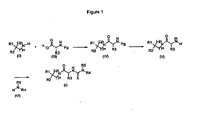
- the compounds of formula (I) may be prepared by adding the amines of formula (VI) to isocyanates or isothiocyanates obtained from the compounds (V) in dichloromethane or dimethylformamide, for example.
- the isocyanates may be prepared from the amines (V) in the presence of phosgene, diphosgene or triphosgene, for example.
- the isothiocyanates may be prepared from the amines (V) in the presence of thiophosgene ( Nowick J.S. et al., JOC (1996) 3929-3934 ), or bis(2-pyridyl) thionocarbonate ( WO 2008/008 954 ), for example.
- the compounds of formula (II) are obtained by deprotection of the amine function of the compounds of formula (VIII), via methods chosen from those known to a person skilled in the art. They include, inter alia, the use of trifluoroacetic acid or hydrochloric acid in dichloromethane, or ethyl acetate, for example in the case of a protection with a Boc group, hydrogenation with the appropriate metal in tetrahydrofuran or methanol, for example in the case of a protection with a CBz group, and piperidine in acetonitrile, for example in the case of a protection with an Fmoc group.
- the introduction of the group R1 may be performed, for example, by alpha deprotonation of the ester function of compound (IX) in the presence of a base such as lithium diisopropylamide or lithium hexamethyldisilazide in solvents such as dichloromethane or tetrahydrofuran.
- a base such as lithium diisopropylamide or lithium hexamethyldisilazide
- solvents such as dichloromethane or tetrahydrofuran.
- the compounds of formula (II) are obtained by deprotection of the amine function of the compounds of formula (X), via methods chosen from those known to a person skilled in the art.
- the compounds of formula (XXIV) are obtained, for example, by addition of a magnesium halide derived from a phenyl to the commercially available ketone (XVII) followed by alkylation of the tertiary alcohol according to methods conventionally described in the literature, to give the compounds (XXV).
- the compounds (XXVI) are obtained, for example, by hydrogenation of compound (XXV) in the presence of a catalyst, which may be rhodium on alumina or platinum oxide in dioxane, for example.
- a subject of the present invention is also compounds of formula (I) as defined above, for the treatment of the following pathologies:
- a subject of the present invention is also the use of the compounds of formula (I) as defined above for the preparation of a composition for treating the following pathologies:
- composition according to the invention may be performed orally, enterally, parenterally, topically or ocularly.
- the pharmaceutical composition is packaged in a form that is suitable for topical application.
- the colourless oil obtained is diluted in 5 ml of dimethylformamide, the mixture is heated to 80°C, and 18 mg (0.12 mmol) of histamine are added and the solution is stirred for 5 minutes at 80°C and overnight at room temperature.
- the reaction is stopped by adding aqueous 1 N sodium hydroxide solution and the organic compounds are extracted with dichloromethane. The organic phase is washed with water and then dried over sodium sulfate, filtered and concentrated.
- the oil obtained is chromatographed on silica gel (eluent: 90/10 DCM/MeOH).
- Example 7 Ethyl 4-cyclohexyl-1-[( R )-2- ⁇ 3-[3-(1H-imidazol-4-yl)propyl]-thioureido ⁇ -3-(4-methoxyphenyl)propionyl]piperidine-4-carboxylate
- the oil obtained is dissolved in 5 ml of DMF at 80°C, and 14 mg of 5-(1 H-imidazol-4-yl)pentylamine bis(trifluoroacetate) are added.
- the reaction mixture is stirred at 80°C for 5 minutes and for 18 hours at room temperature.
- the organic phase is washed with 1 N sodium hydroxide, extracted with dichloromethane and then dried over MgSO 4 , filtered and concentrated.
- the crude product obtained is purified by preparative HPLC.
- the lines HEK293 are transfected with vectors pCRE-Luc and hMC1 R or hMC4R. The cells are cultured at 37°C and 5% CO 2 , in DMEM medium supplemented with 10% foetal calf serum.
- the melanocortin receptor will activate the cAMP pathway, which, via the vector CRE-Luc, will lead to the synthesis of luciferase.
- the luminescence proportional to the degree of activation or inhibition of receptor may be measured.
- the products are dissolved at 10 mM in DMSO. They are tested as a response dose at 0.1% of DMSO final. The range comprising 10 points and a zero starts at 10 ⁇ M with four-fold dilutions.
- To test agonists the products are tested alone.
- To determine the antagonist behaviour the products of interest are tested in the presence of 1 nM NDP-MSH (reference agonist).
- the cells are inoculated at a rate of 5000 cells per well (384-well plate) in serum-free DMEM medium and incubated overnight at 37°C and 5% CO 2 .
Landscapes
- Health & Medical Sciences (AREA)
- Chemical & Material Sciences (AREA)
- Organic Chemistry (AREA)
- Life Sciences & Earth Sciences (AREA)
- Nuclear Medicine, Radiotherapy & Molecular Imaging (AREA)
- General Health & Medical Sciences (AREA)
- General Chemical & Material Sciences (AREA)
- Medicinal Chemistry (AREA)
- Veterinary Medicine (AREA)
- Public Health (AREA)
- Pharmacology & Pharmacy (AREA)
- Chemical Kinetics & Catalysis (AREA)
- Animal Behavior & Ethology (AREA)
- Bioinformatics & Cheminformatics (AREA)
- Engineering & Computer Science (AREA)
- Immunology (AREA)
- Communicable Diseases (AREA)
- Cardiology (AREA)
- Oncology (AREA)
- Heart & Thoracic Surgery (AREA)
- Obesity (AREA)
- Virology (AREA)
- Pulmonology (AREA)
- Diabetes (AREA)
- Hematology (AREA)
- Neurosurgery (AREA)
- Molecular Biology (AREA)
- Neurology (AREA)
- Hospice & Palliative Care (AREA)
- Child & Adolescent Psychology (AREA)
- AIDS & HIV (AREA)
- Tropical Medicine & Parasitology (AREA)
- Biomedical Technology (AREA)
- Transplantation (AREA)
- Urology & Nephrology (AREA)
- Physical Education & Sports Medicine (AREA)
- Gastroenterology & Hepatology (AREA)
- Pharmaceuticals Containing Other Organic And Inorganic Compounds (AREA)
- Plural Heterocyclic Compounds (AREA)
Description
- The invention relates to novel compounds as antagonist products of one or more melanocortin receptors. The invention also relates to a process for preparing them and to their therapeutic use.
- Melanocortins form the family of regulatory peptides that are synthesized via a post-translational process of the hormone propiomelanocortin (POMC - 131 amino acids long). POMC leads to the production of three classes of hormone: melanocortins, the hormone adrenocorticotropin and various endorphins, for instance lignotropin (Cone, et al., Recent Prong. Horm. Res., 51: 287-317, (1996); Cone et al., Ann. N.Y. Acad. Sc., 31: 342-363, (1993).
- Melanocortin receptors (MCRs) form part of the superfamily of GPCRs with seven transmembrane domains. To date, five subtypes of receptor, MC1-5R, have been identified in mammals. An endogenous group of peptides binds to MCRs with agonist or antagonist effects, for instance the melanocyte-stimulating hormones (MSH), adrenocorticotropic hormone (ACTH), and the Agouti proteins and derivatives thereof. However, an exception is the MC2R receptor, which binds only with ACTH (Major pharmacological distinction of the ACTH receptor from other melanocortin receptors, Schioth et al., Life Sciences (1996), 59(10), 797-801).
- MCRs have varied physiological roles. MC1R regulates the formation of melanin in the skin, and has a role in regulating the immune system. MC2R regulates the production of corticosteroids in the adrenal glands. The receptors MC3R and MC4R play a role in controlling food intake and sexual behaviour. MC5R is involved in regulating the exocrine glands (Wikberg, Jarl E.S., Melanocortin receptors: perspectives for novel drugs. European Journal of Pharmacology (1999), 375(1-3), 295-310. Wikberg, Jarl E.S., Melanocortin receptors: new opportunities in drug discovery. Expert Opinion on Therapeutic Patents (2001), 11(1), 61-76).
- The potential use of MCRs as targets for medicaments for treating major pathologies such as obesity, diabetes, inflammatory conditions and sexual dysfunction raises the need for compounds that show high specificity towards a particular subtype. However, the modelling of selective medicaments, for slightly different receptor subtypes, is a difficult task that would be simplified in the light of detailed knowledge regarding the determinants of the ligand-receptor interaction.
- The Applicant has now found, surprisingly and unexpectedly, that certain compounds of general formula (I), which is the subject of the present invention, are selective MC4-R antagonists.
- The pathologies described as being associated with dysfunction of the MC4 receptor concern weight regulation (homeostasis), sexual dysfunctions, depression and anxiety (Chaki et al, Current Topics in Medicinal Chemistry, 2007, 1145-1151), and bones (Cart overexpression is the only identifiable cause of high bone mass in ).
- Mention may be made in particular of disorders associated with weight loss (including involuntary weight loss) such as anorexia. Mention may also be made of cachexia (The role of central melanocortins in cachexia, Contemporary Endocrinology: Energy Metabolism and Obesity: Research and Clinical Applications, pp. 59-68) and related indications such as sarcopenia (Cofemer 2008 by P. Dehail), catabolic diseases, and cancer- or HIV-related cachexia. Specifically, cachexia is defined hereinbelow as a profound weakening of the body (weight loss, muscular atrophy, etc.), associated with very substantial denutrition. Cachexia is not a disease in itself, but the symptom of another. It may arise from an anorexia (even in the case of a person whose weight loss is not voluntary), a cancer (cancer-related cachexia, produced by substances secreted by the tumour, cachexins), chronic diseases (COPD, cardiac insufficiency, hepatic insufficiency, renal insufficiency) or even certain infectious diseases (for example tuberculosis and AIDS, or certain autoimmune diseases).
- Patents
WO 02/070 511 WO 02/079 146 WO 02/069 905 -
Patent US/2004/006067 describes compounds as modulators of melanocortin receptors which do not comprise an uric group. - Chen describes the recent advances in the discovery of non-peptide ligands of the MC4-R receptor (Progress in Medicinal Chemistry, Vol. 45, p. 111-167).
- Chen et al. describe the use of selective MC4-R antagonists as a potential treatment for cachexia (Current Topics in Medicinal Chemistry 2007, 1131-1136)
- Pontillo et al. describe substituted phenylpiperazine compounds as selective antagonists of the MC4 receptors, administration of which makes it possible to increase food intake in mice (A potent and selective non-peptide antagonist of the melanocortin-4 receptor induces food intake in satiated mice - Bioorganic & Medicinal Chemistry Letters 15(2005) 2541-46).
- Vos et al. describe the identification of a novel series of MC4-R antagonists (Bioorganic & Medicinal Chemistry Letters 16(2006) 2302-2305).
- Chen et al. describe the identification of novel selective MC4-R antagonists derived from phenylpiperazines and from pyridinylpiperazines (Journal of Medicinal Chemistry, 2007, 6356-6366).
- Now, the Applicant has demonstrated, unexpectedly, that certain compounds of formula (I) as described hereinbelow, have melanocortin receptor antagonist properties, and in particular for the receptors of the MC4 type.
- Thus, the present invention relates to compounds of general formula (I) below:

- R1 represents a hydrogen atom, an aryl, a substituted aryl, an alkyl, a cycloalkyl or a cycloalkylalkyl,
- R2 represents a hydrogen atom, a hydroxyl, a lower alkyl, a substituted lower alkyl, a higher alkyl, a substituted higher alkyl, a cycloalkyl, a cycloalkylalkyl, a lower alkoxy, a substituted lower alkoxy, a higher alkoxy, a substituted higher alkoxy, a cycloalkylalkoxy, an acyloxy, an acyl, an alkoxycarbonyl, a carboxamide, a carboxylic acid, a cyano, or an amino disubstituted with an acyl and an aryl or alkyl,
- R3 represents an aralkyl or a substituted aralkyl,
- R4 represents a heteroaralkyl or a substituted heteroaralkyl,
- R5 represents a hydrogen atom or an alkyl,
- X represents an oxygen atom or a sulfur atom,
- n, m may be equal to 1 or 2;
- Among the addition salts of the compounds of general formula (I) with a pharmaceutically acceptable acid, mention may be made preferably of the salts with an organic acid or with a mineral acid.
- The suitable mineral acids are, for example, hydrohalic acids, for instance hydrochloric acid or hydrobromic acid, sulfuric acid and nitric acid.
- The suitable organic acids are, for example, picric acid, methanesulfonic acid, ethanesulfonic acid, para-toluenesulfonic acid, oxalic acid and tartaric acid.
- The compounds of general formula (I) may also exist in the form of hydrates or solvates with water or with a solvent.
- The suitable solvents for forming solvates or hydrates are, for example, alcohols, for instance ethanol or isopropanol, or water.
- According to the present invention, the term "aryl" denotes an unsubstituted phenyl or naphthyl.
- According to the present invention, the term "substituted aryl" denotes a phenyl or a naphthyl substituted with one or more groups of atoms chosen from an alkyl, an alkoxy, a halogen, a hydroxyl, a cyano, a trifluoromethyl and a nitro.
- According to the present invention, the term "cycloalkyl" denotes a saturated cyclic hydrocarbon-based chain containing from 3 to 7 carbon atoms.
- According to the present invention, the term "hydroxyl" means the OH group.
- According to the present invention, the term "amino" means the NH2 group.
- According to the present invention, the term "cyano" denotes the CN group.
- According to the present invention, the term "carboxylic acid" denotes the CO2H group.
- According to the present invention, the term "acyl" denotes a formyl or a carbonyl substituted with an alkyl, a cycloalkyl or a cycloalkylalkyl.
- According to the present invention, the term "alkyl" denotes a substituted or unsubstituted lower alkyl or higher alkyl.
- According to the present invention, the term "lower alkyl" denotes a linear or branched, saturated or unsaturated hydrocarbon-based chain containing from 1 to 4 carbon atoms or an unsaturated chain containing from 2 to 4 carbon atoms and especially, for example, methyl, ethyl, propyl, isopropyl and butyl.
- According to the present invention, the term "substituted lower alkyl" means a linear or branched, saturated or unsaturated hydrocarbon-based chain containing from 1 to 4 carbon atoms and substituted with one or more halogen atoms or with a hydroxyl, or an unsaturated hydrocarbon-based chain containing from 2 to 4 carbon atoms and substituted with one or more halogen atoms or with a hydroxyl.
- According to the present invention, the term "higher alkyl" denotes a linear or branched, saturated or unsaturated hydrocarbon-based chain containing from 5 to 10 carbon atoms.
- According to the present invention, the term "substituted higher alkyl" denotes a linear or branched, saturated or unsaturated hydrocarbon-based chain containing from 5 to 10 carbon atoms and substituted with one or more halogen atoms or with a hydroxyl.
- According to the present invention, the term "halogen atom" means chlorine, fluorine, iodine and bromine atoms.
- According to the present invention, the term "cycloalkylalkyl" denotes an alkyl substituted with a cycloalkyl.
- According to the present invention, the term "lower alkoxy" denotes an oxygen atom substituted with a lower alkyl.
- According to the present invention, the term "substituted lower alkoxy" denotes an oxygen atom substituted with a substituted lower alkyl.
- According to the present invention, the term "higher alkoxy" denotes an oxygen atom substituted with a higher alkyl.
- According to the present invention, the term "substituted higher alkoxy" denotes an oxygen atom substituted with a substituted higher alkyl.
- According to the present invention, the term "cycloalkylalkoxy" denotes an oxygen atom substituted with a cycloalkylalkyl.
- According to the present invention, the term "acyloxy" denotes an oxygen atom substituted with an acyl.
- According to the present invention, the term "alkoxycarbonyl" denotes a carbonyl substituted with an alkoxy, cycloalkoxy or a cycloalkylalkoxy.
- According to the present invention, the term "carboxamide" denotes a carbonyl substituted with a monoalkylamino or a dialkylamino.
- According to the present invention, the term "aralkyl" denotes an alkyl substituted with an aryl.
- According to the present invention, the term "substituted aralkyl" denotes an alkyl substituted with a substituted aryl.
- According to the present invention, the term "heterocycle" denotes a saturated or unsaturated, cyclic or bicyclic hydrocarbon-based chain, comprising one or more heteroatoms chosen from O, S and N.
- According to the present invention, the term "substituted heterocycle" denotes a saturated or unsaturated, cyclic or bicyclic hydrocarbon-based chain, comprising one or more heteroatoms chosen from O, S and N substituted with one or more alkyl groups.
- According to the present invention, the term "heteroaryl" denotes an aromatic heterocycle.
- According to the present invention, the term "substituted heteroaryl" denotes an aromatic heterocycle substituted with one or more alkyl groups.
- According to the present invention, the term "heteroaralkyl" denotes an alkyl substituted with a heteroaryl.
- According to the present invention, the term "substituted heteroaralkyl" denotes an alkyl substituted with a substituted heteroaryl.
- Among the compounds of general formula (I) included in the context of the present invention, mention may be made especially of the following:
- tert-Butyl 4-cyclohexyl-1-[2-{3-[2-(1H-imidazol-4-yl)ethyl]ureido}-3-(4-methoxyphenyl)-propionyl]piperidine-4-carboxylamide
- 1-[((R)-2-(4-Butyryl-4-cyclohexylpiperidin-1-yl)-1-(4-methoxybenzyl)-2-oxoethyl]-3-[2-(1-methyl-1 H-imidazol-4-yl)ethyl]urea
- 1-[((R)-2-(4-Butyryl-4-cyclohexylpiperidin-1-yl)-1-(4-methoxybenzyl)-2-oxoethyl]-3-[2-(1 H-[1,2,3]triazol-4-yl)ethyl]urea
- Ethyl 4-cyclohexyl-1-[(R)-2-{3-[3-(3H-imidazol-4-yl)propyl]ureido}-3-(4-methoxy-phenyl)propionyl]piperidine-4-carboxylate
- Ethyl 4-cyclohexyl-1-((R)-3-(3,4-dichlorophenyl)-2-{3-[2-(1H-imidazol-4-yl)ethyl]-ureido}propionyl)piperidine-4-carboxylate
- Ethyl 4-cyclohexyl-1-((R)-3-(3,4-dichlorophenyl)-2-{3-[2-(3-methyl-3H-imidazol-4-yl)-ethyl]ureido}propionyl)piperidine-4-carboxylate
- Ethyl 4-cyclohexyl-1-[(R)-2-{3-[3-(1H-imidazol-4-yl)propyl]thioureido}-3-(4-methoxy-phenyl)propionyl]piperidine-4-carboxylate
- Ethyl 4-cyclohexyl-1-((R)-3-(4-methoxyphenyl)-2-{3-[2-(1-methyl-1H-imidazol-4-yl)-ethyl]thioureido}propionyl)piperidine-4-carboxylate
- Ethyl 4-cyclohexyl-1-((R)-3-(2,4-dichlorophenyl)-2-{3-[2-(1H-imidazol-4-yl)ethyl]-ureido}propionyl)piperidine-4-carboxylate
- Ethyl 4-cyclohexyl-1-[(R)-2-{3-[5-(1H-imidazol-4-yl)pentyl]ureido}-3-(4-methoxy-phenyl)propionyl]piperidine-4-carboxylate
- 4-Cyclohexyl-1-(3-(4-methoxyphenyl)-2-{3-[(R)-2-(1-methyl-1H-imidazol-4-yl)ethyl]-ureido}propionyl)piperidine-4-tert-butylcarbamoyl
- 4-Cyclohexyl-1-(3-(4-methoxyphenyl)-2-{3-[(R)-2-(1H-[1,2,3]triazol-4-yl)ethyl]ureido}-propionyl)piperidine-4-tert-butylcarbamoyl
- 4-Cyclohexyl-1-[(R)-2-{3-[3-(1H-imidazol-4-yl)propyl]ureido}-3-(4-methoxyphenyl)-propionyl]piperidine-4-tert-butylcarbamoyl
- 4-Cyclohexyl-1-[(R)-2-{3-[5-(1H-imidazol-4-yl)pentyl]ureido}-3-(4-methoxyphenyl)-propionyl]piperidine-4-tert-butylcarbamoyl
- 4-Cyclohexyl-1-((R)-3-(4-methoxyphenyl)-2-{3-[2-(1-methyl-1H-imidazol-4-yl)ethyl]-thioureido}propionyl)piperidine-4-tert-butylcarbamoyl
- 4-Cyclohexyl-1-[(R)-2-{3-[3-(1H-imidazol-4-yl)propyl]thioureido}-3-(4-methoxyphenyl)-propionyl]piperidine-4-tert-butylcarbamoyl
- 1-[((R)-2-(4-Butyryl-4-cyclohexylpiperidin-1-yl)-1-(4-methoxybenzyl)-2-oxoethyl]-3-[2-(1-methyl-1 H-imidazol-4-yl)ethyl]thiourea
- 1-[((R)-2-(4-Butyryl-4-cyclohexylpiperidin-1-yl)-1-(4-methoxybenzyl)-2-oxoethyl]-3-[2-(1 H-[1,2,3]triazol-4-yl)ethyl]thiourea
- Ethyl 4-cyclohexyl-1-((R)-3-(3,4-dichlorophenyl)-2-{3-[2-(1-methyl-1H-imidazol-4-yl)-ethyl]ureido}propionyl)piperidine-4-carboxylate
- Ethyl 4-cyclohexyl-1-((R)-3-(3,4-dichlorophenyl)-2-{3-[5-(1H-imidazol-4-yl)pentyl]-ureido}propionyl)piperidine-4-carboxylate
- Ethyl 4-cyclohexyl-1-((R)-3-(2,4-dichlorophenyl)-2-{3-[2-(1-methyl-1H-imidazol-4-yl)-ethyl]ureido}propionyl)piperidine-4-carboxylate
- Ethyl 4-cyclohexyl-1-((R)-3-(2,4-dichlorophenyl)-2-{3-[2-(3-methyl-3H-imidazol-4-yl)-ethyl]ureido}propionyl)piperidine-4-carboxylate
- Ethyl 4-cyclohexyl-1-((R)-3-(2,4-dichlorophenyl)-2-{3-[5-(1H-imidazol-4-yl)pentyl]-ureido}propionyl)piperidine-4-carboxylate
- 1-[((R)-2-(4-Cyclohexyl-4-propoxypiperidin-1-yl)-1-(4-methoxybenzyl)-2-oxoethyl]-3-[2-(1-methyl-1 H-imidazol-4-yl)ethyl]urea
- 1-[((R)-2-(4-Cyclohexyl-4-propoxypiperidin-1-yl)-1-(4-methoxybenzyl)-2-oxoethyl]-3-[2-(1 H-[1,2,3]triazol-4-yl)ethyl]urea
- 1-[((R)-2-(4-Cyclohexyl-4-propoxypiperid in-1-yl)-1-(4-methoxybenzyl)-2-oxoethyl]-3-[3-(1 H-imidazol-4-yl)propyl]urea
- 1-[((R)-2-(4-Cyclohexyl-4-propoxypiperidin-1-yl)-1-(4-methoxybenzyl)-2-oxoethyl]-3-[5-(1H-imidazol-4-yl)pentyl]urea
- 1-[((R)-2-(4-Cyclohexyl-4-propoxypiperidin-1-yl)-1-(4-methoxybenzyl)-2-oxoethyl]-3-[2-(1-methyl-1 H-imidazol-4-yl)ethyl]thiourea
- 1-[2-(4-Cyclohexyl-4-propoxypiperid in-1-yl)-1-(4-methoxybenzyl)-2-oxoethyl]-3-[3-(1 H-imidazol-4-yl)propyl]thiourea
- 1-[((R)-2-(4-Butyryl-4-cyclohexylpiperidin-1-yl)-1-(4-chlorobenzyl)-2-oxoethyl]-3-[2-(1-methyl-1H-imidazol-4-yl)ethyl]urea
- 1-[((R)-2-(4-Butyryl-4-cyclohexylpiperidin-1-yl)-1-(4-chlorobenzyl)-2-oxoethyl]-3-[2-(1H-[1,2,3]triazol-4-yl)ethyl]urea
- 1-[((R)-2-(4-Butyryl-4-cyclohexylpiperidin-1-yl)-1-(4-chlorobenzyl)-2-oxoethyl]-3-[3-(1H-imidazol-4-yl)propyl]urea
- 1-[((R)-2-(4-Butyryl-4-cyclohexylpiperidin-1-yl)-1-(4-chlorobenzyl)-2-oxoethyl]-3-[5-(1 H-imidazol-4-yl)pentyl]urea
- 1-[((R)-2-(4-Butyryl-4-cyclohexylpiperidin-1-yl)-1-(4-chlorobenzyl)-2-oxoethyl]-3-[2-(1-methyl-1 H-imidazol-4-yl)ethyl]thiourea
- 1-[((R)-2-(4-Butyryl-4-cyclohexylpiperidin-1-yl)-1-(4-chlorobenzyl)-2-oxoethyl]-3-[3-(1 H-imidazol-4-yl)propyl]thiourea
- 1-[((R)-2-(4-Butyryl-4-cyclohexylpiperidin-1-yl)-1-(2,4-dichlorobenzyl)-2-oxoethyl]-3-(1H-imidazol-4-yl)methyl)urea
- 1-[((R)-2-(4-Butyryl-4-cyclohexylpiperidin-1-yl)-1-(4-fluorobenzyl)-2-oxoethyl]-3-[2-(1-methyl-1 H-imidazol-4-yl)ethyl]urea
- 1-[((R)-2-(4-Butyryl-4-cyclohexylpiperidin-1-yl)-1-(4-fluorobenzyl)-2-oxoethyl]-3-[2-(1H-[1,2,3]triazol-4-yl)ethyl]urea
- 1-[((R)-2-(4-Butyryl-4-cyclohexylpiperidin-1-yl)-1-(4-fluorobenzyl)-2-oxoethyl]-3-[3-(1H-imidazol-4-yl)propyl]urea
- 1-[((R)-2-(4-Butyryl-4-cyclohexylpiperidin-1-yl)-1-(4-fluorobenzyl)-2-oxoethyl]-3-[5-(1H-imidazol-4-yl)pentyl]urea
- 1-[((R)-2-(4-Butyryl-4-cyclohexylpiperidin-1-yl)-1-(4-fluorobenzyl)-2-oxoethyl]-3-[2-(1-methyl-1 H-imidazol-4-yl)ethyl]thiourea
- 1-[((R)-2-(4-Butyryl-4-cyclohexylpiperidin-1-yl)-1-(4-fluorobenzyl)-2-oxoethyl]-3-[3-(1H-imidazol-4-yl))propyl]thiourea
- The compounds of general formula (I) are prepared according to the general reaction schemes presented in
figure 1 . - Using reaction scheme 1 (
figure 1 ):
- According to
scheme 1, the compounds of formula (IV) may be prepared by coupling between the intermediates of formula (II) and an amino acid of formula (III) whose amine function is protected with a protecting group Pg (for example a Boc, CBz or Fmoc group), under standard peptide coupling conditions (Han, S., Kim, Y. Tetrahedron, 2004, 60, 2447-2467; Albericio, F. Current Opinion in Chemical Biology, 2004, 8, 211-221; Humphrey, J., Chamberlin, R. Chem. Rev., 1997, 97, 2243-2266), using, for example, as coupling agent 1-(3-dimethylaminopropyl)-3-ethylcarbodiimide hydrochloride, hydroxybenzotriazole or TBTU, and as base triethylamine or diisopropylethylamine, in a solvent such as dichloromethane or dimethylformamide. - The amino acids of general formula (IV) are commercially available or may be prepared via methods described in the literature (Williams, R.M., Synthesis of optically active α-amino acids, Pergamon Press, Oxford, 1989).
- The compounds of formula (V) are obtained by deprotection of the amine function of the compounds of formula (IV), via methods chosen from those known to a person skilled in the art. They include, inter alia, the use of trifluoroacetic acid or hydrochloric acid in dichloromethane, or ethyl acetate, for example in the case of a protection with a Boc group, hydrogenation with the appropriate metal in tetrahydrofuran or methanol, for example in the case of a protection with a CBz group, and piperidine in acetonitrile, for example in the case of a protection with an Fmoc group.
- In a final step, the compounds of formula (I) may be prepared by adding the amines of formula (VI) to isocyanates or isothiocyanates obtained from the compounds (V) in dichloromethane or dimethylformamide, for example. The isocyanates may be prepared from the amines (V) in the presence of phosgene, diphosgene or triphosgene, for example. The isothiocyanates may be prepared from the amines (V) in the presence of thiophosgene (Nowick J.S. et al., JOC (1996) 3929-3934), or bis(2-pyridyl) thionocarbonate (
WO 2008/008 954 ), for example. The compounds of formula (I) may also be synthesized by adding the amines of formula (VI) to activated carbamates obtained from the amines (V) in dichloromethane or dimethylformamide, for example. The term "activated carbamate" means, for example, a para-nitrophenyl carbamate group (Igarashi, T., Synlett (2007) 1436), which may be obtained by adding para-nitrophenyl chloroformate to the amine (V) in the presence of a base, which may be, for example, triethylamine in dichloromethane or dimethylformamide. - The compounds of formula (II) are commercially available or may be prepared according to the methods described in the literature or known to those skilled in the art, adapted as a function of the nature of the substituents R1 and R2.
Schemes 1 to 8 below show examples of preparation of the compounds of formula (II). - For example, when R2 contains an acyloxy or carboxamide chain, the preparation of the compound (II, n, m = 2) may be performed according to scheme 1:

- The compounds of formula (VIII) are obtained:
- when X is an oxygen, for example, by esterification of the carboxylic acid function of the compounds (VII) using the methods described in the literature, or
- when X is a nitrogen, for example by addition to an amine or to an acid chloride obtained from the carboxylic acid (VII) using methods chosen from those known to a person skilled in the art. It is especially possible to use oxalyl chloride or thionyl chloride in solvents such as dichloromethane or dimethylformamide.
- The compounds of formula (II) are obtained by deprotection of the amine function of the compounds of formula (VIII), via methods chosen from those known to a person skilled in the art. They include, inter alia, the use of trifluoroacetic acid or hydrochloric acid in dichloromethane, or ethyl acetate, for example in the case of a protection with a Boc group, hydrogenation with the appropriate metal in tetrahydrofuran or methanol, for example in the case of a protection with a CBz group, and piperidine in acetonitrile, for example in the case of a protection with an Fmoc group.
- For example, when R1 contains an alkyl, cycloalkyl or cycloalkylalkyl group and R2 contains an acyloxy chain, the preparation of the compound (II, n, m = 2) may be performed according to scheme 2:

- The introduction of the group R1 may be performed, for example, by alpha deprotonation of the ester function of compound (IX) in the presence of a base such as lithium diisopropylamide or lithium hexamethyldisilazide in solvents such as dichloromethane or tetrahydrofuran. The compounds of formula (II) are obtained by deprotection of the amine function of the compounds of formula (X), via methods chosen from those known to a person skilled in the art. They include, inter alia, the use of trifluoroacetic acid or hydrochloric acid in dichloromethane, or ethyl acetate, for example in the case of a protection with a Boc group, hydrogenation with the appropriate metal in tetrahydrofuran or methanol, for example in the case of a protection with a CBz group.
- For example, when R2 contains an alkoxy or an alkoxycarbonyl chain, the preparation of the compound (II, n, m = 1) may be performed according to scheme 3:

- The compounds of formula (XII) are obtained, for example, by addition of a magnesium halide derived from R1 to the N-Boc-azetidinone (XI) followed by alkylation or acylation of the tertiary alcohol according to methods conventionally described in the literature, to lead to the compounds (XIII). The compounds of formula (II) are obtained by deprotection of the amine function of the compounds of formula (XIII), for example in the presence of trifluoroacetic acid or hydrochloric acid in dichloromethane or ethyl acetate.
- For example, when R2 contains an acyl group, the preparation of the compound (II, n = m = 1) may be performed according to scheme 4:

- The compounds of formula (XV) may be obtained under peptide coupling conditions between compounds with a carboxylic acid (XIV) and the Weinreb amine, using, for example, as coupling agent, 1-(3-dimethylaminopropyl)-3-ethylcarbodiimide hydrochloride, hydroxybenzotriazole or TBTU, and, as base, triethylamine or diisopropylethylamine, in a solvent such as dichloromethane or dimethylformamide. The compounds of formula (XVI) are obtained, for example, by addition of a magnesium halide derived from R1 to the derivative of the Weinreb amide (XV). The compounds of formula (II) are obtained by deprotection of the amine function of the compounds of formula (X), via methods chosen from those known to a person skilled in the art. They include, inter alia, the use of trifluoroacetic acid or hydrochloric acid in dichloromethane, or ethyl acetate, for example in the case of a deprotection with a Boc group, hydrogenation with the appropriate metal in tetrahydrofuran or methanol, for example in the case of a protection with a CBz group.
- For example, when R2 contains a disubstituted amine, the preparation of the compound (II, n = m = 2) may be performed according to scheme 5:

- The compounds of formula (XVIII) may be obtained under reductive amination conditions between the commercially available ketone (XVII) and an amine in the presence of sodium borohydride or sodium cyanoborohydride, for example. The secondary amines (XVIII) may then be acylated in the presence of a base such as triethylamine and of an acid chloride, for example, to give the compounds (XIX). The compounds of formula (II) are obtained by deprotection of the amine function of the compounds of formula (VIII), via methods chosen from those known to a person skilled in the art. They include, inter alia, the use of trifluoroacetic acid or hydrochloric acid in dichloromethane or ethyl acetate, for example in the case of a protection with a Boc group, hydrogenation with the appropriate metal in tetrahydrofuran or methanol, for example in the case of a protection with a CBz group, and of piperidine in acetonitrile, for example in the case of a protection with an Fmoc group.
- For example, when R1 contains a cyclohexyl and R2 contains an acyl group, the preparation of the compound (II, n = m = 2) may be performed according to scheme 6:

- After protection of the commercially available amine (XX) with a tosylate group, for example by reacting tosyl chloride in the presence of a base such as triethylamine in dichloromethane, the compounds (XXI) are obtained. The compounds of formula (XXII) are obtained, for example, by addition of a magnesium halide derived from an alkyl in toluene to the nitrile function of the derivatives (XXI) followed by a hydrolysis in acidic medium of the intermediate imine, which may be hydrochloric acid. The compounds of formula (XXIII) are obtained by deprotection of the amine function in acidic medium, which may be sulfuric acid in the case of a tosylate group. The compounds (II) are obtained, for example, by hydrogenation of compound (X) in the presence of a catalyst, which may be rhodium on alumina or platinum oxide in dioxane, for example.
- For example, when R1 is a cyclohexyl group and R2 is an alkoxy group, the preparation of the compound (II, n = m = 2) may be performed according to scheme 7:

- The compounds of formula (XXIV) are obtained, for example, by addition of a magnesium halide derived from a phenyl to the commercially available ketone (XVII) followed by alkylation of the tertiary alcohol according to methods conventionally described in the literature, to give the compounds (XXV). The compounds (XXVI) are obtained, for example, by hydrogenation of compound (XXV) in the presence of a catalyst, which may be rhodium on alumina or platinum oxide in dioxane, for example. The compounds of formula (II) are obtained by deprotection of the amine function of the compounds of formula (XXVI), for example in the presence of trifluoroacetic acid or hydrochloric acid in dichloromethane or ethyl acetate.
- For example, when R1 is an aryl group and R2 contains an alkyl chain, the preparation of the compound (II, n = m = 1) may be performed according to scheme 8:

- The compounds of formula (XXVIII) may be obtained, for example, by addition of a base, such as sodium hydride, in the presence of a halogenated derivative derived from R2 to the commercially available nitrile derivatives (XXVII). The primary alcohols (XXIX) may be synthesized from the nitrile derivatives (XXVIII) in the presence of a base, for example sodium hydride and paraformaldehyde. The primary alcohol function of the compounds (XXIX) may be converted into sulfonate in the presence of a base, which may be triethylamine, and of tosyl chloride, for example. The azetidine compounds (II) may be synthesized by intramolecular cyclization between an amine function obtained after reduction of the nitrile function, for example, in the presence of lithium aluminium hydride and the tosylate function.
- The compounds of formula (VI) are commercially available or may be prepared according to the methods described in the literature or known to those skilled in the art, adapted as a function of the nature of the substituents R4 and R5.
Schemes 9 to 11 below present examples of preparation of the compounds of formula (VI). - For example, when R5 is an alkyl group and R4 contains a heteroaralkyl group, the preparation of compound (VI) may be performed, for example, by following a protocol described in the literature (Durant G.J., Emmet J.C., Ganellin C.R., Roe A.M., (1973) Br. Pat.
1 341 375 
- For example, when R4 contains a 1,2,3-triazole heterocycle, the preparation of compound (VI) may be performed according to scheme 10:

- The compounds of formula (XXXIV) may be prepared via methods described in the literature (Loren J. C., Synlett, 2005, 2847-2850) followed by cleavage in basic medium in the presence, for example, of sodium hydroxide, to give the compounds (VI).
- For example, when R4 contains a heteroaralkyl, the preparation of compound (VI) may be performed according to scheme 11:

- The compounds of formula (VI) may be prepared via methods described in the literature (Wolin R., BOMCL, 1998, 2157) via a Wittig reaction between aldehydes substituted with heteroaryls and commercially available ylides to form the alkenes (XXXV) followed by a hydrogenation of the double bond and hydrazinolysis of the phthalimide to generate the compounds (VI).
- A subject of the present invention is also compounds of formula (I) as defined above, as medicaments.
- A subject of the present invention is also compounds of formula (I) as defined above, for the treatment of the following pathologies:
- weight regulation (homeostasis) and disorders related to weight loss (including involuntary weight loss) or weight gain, such as anorexia, obesity, cachexia and related indications, for instance sarcopenia, catabolic diseases, cachexia related to cancer, chronic pulmonary diseases (COPD), cardiac insufficiency, hepatic insufficiency, renal insufficiency, and certain infectious diseases (tuberculosis, AIDS) or certain autoimmune diseases,
- regulating food intake and eating disorders,
- bone pathologies.
- A subject of the present invention is also the use of the compounds of formula (I) as defined above for the preparation of a composition for treating the following pathologies:
- weight regulation (homeostasis) and disorders related to weight loss (including involuntary weight loss) or weight gain, such as anorexia, obesity, cachexia and related indications, for instance sarcopenia, catabolic diseases, cachexia related to cancer, chronic pulmonary diseases (COPD), cardiac insufficiency, hepatic insufficiency, renal insufficiency, and certain infectious diseases (tuberculosis, AIDS) or certain autoimmune diseases,
- regulating food intake and eating disorders,
- bone pathologies.
- A subject of the present invention is also a pharmaceutical composition comprising a compound as defined above and a pharmaceutically acceptable support.
- A subject of the present invention is also a pharmaceutical composition intended especially for treating the abovementioned complaints, which is characterized in that it comprises, in a pharmaceutically acceptable support that is compatible with the mode of administration selected therefor, a compound of general formula (I) in one of its enantiomers, or a salt thereof with a pharmaceutically acceptable acid.
- The term "pharmaceutically acceptable support" means a medium that is compatible with the skin, mucous membranes and the integuments.
- The administration of the composition according to the invention may be performed orally, enterally, parenterally, topically or ocularly. Preferably, the pharmaceutical composition is packaged in a form that is suitable for topical application.
- Via the oral route, the composition may be in the form of tablets, gel capsules, coated tablets, syrups, suspensions, solutions, powders, granules, emulsions, suspensions, or microspheres, nanospheres or lipid or polymeric vesicles allowing controlled release. Via the parenteral route, the composition may be in the form of solutions or suspensions for perfusion or for injection.
- The compounds according to the invention are generally administered orally or systemically at a daily dose from about 0.01 mg/kg to 100 mg/kg of body weight, in one or more dosage intakes.
- The compounds are used systemically at a concentration generally of between 0.001 % and 10% by weight and preferably between 0.01 % and 1% by weight relative to the weight of the composition.
- Via the topical route, the pharmaceutical composition according to the invention is more particularly intended for treating the skin and mucous membranes, and may be in liquid, pasty or solid form, and more particularly in the form of ointments, creams, milks, pomades, powders, impregnated pads, syndets, solutions, gels, sprays, mousses, suspensions, sticks, shampoos or washing bases. They may also be in the form of suspensions of microspheres or nanospheres or lipid or polymeric vesicles or of polymeric or gelled patches allowing controlled release.
- The compositions used for topical application have a concentration of compound according to the invention generally of between 0.001% and 10% by weight and preferably between 0.01 % and 5% by weight relative to the total weight of the composition.
- The pharmaceutical and cosmetic compositions as described previously may also contain inert additives or even pharmacodynamically active additives as regards the pharmaceutical compositions, or combinations of these additives, and especially:
- wetting agents;
- flavour enhancers;
- preserving agents such as para-hydroxybenzoic acid esters;
- stabilizers;
- humidity regulators;
- pH regulators;
- osmotic pressure modifiers;
- emulsifiers;
- UV-A and UV-B screening agents;
- antioxidants.
- Needless to say, a person skilled in the art will take care to select the optional compound(s) to be added to these compositions such that the advantageous properties intrinsically associated with the present invention are not, or are not substantially, adversely affected by the envisaged addition.
- Several examples of production of compounds of general formula (I) according to the invention and of the results of biological activity of these compounds will now be given, by way of illustration and without any limiting nature.
- The examples that follow describe the preparation of certain compounds in accordance with the invention. These examples are not limiting, and serve merely to illustrate the present invention. The numbers of the presented compounds refer to those given in the table hereinbelow, which illustrates the chemical structures and the physical properties of a number of compounds according to the invention.
- The following abbreviations are used:
- EDC: 1-Ethyl-(3-Dimethylaminopropyl)Carbodiimide hydrochloride
- HOBt: 1-HydrOxy-1,2,3-Benzotriazole
- TBTU: N,N,N',N'-TetraMethyl-O-(BenzoTriazol-1-yl)Uronium Tetrafluoroborate
- DBU: 1,5-DiazaBicyclo(5,4,0)Undec-5-ene
- Rh/Al2O3: Rhodium on alumina
- NaHCO3: Sodium hydrogen carbonate
- NH4Cl: Ammonium chloride
- NH4OH: Ammonium hydroxide
- NaCl: Sodium chloride
- MgSO4: Magnesium sulfate
- Na2SO4: Sodium sulfate
- CuSO4: Copper sulfate
- NaOH: Sodium hydroxide
- EtOAc: Ethyl acetate
- DCM: Dichloromethane
- DMF: DimethylFormamide
- MeOH: Methanol
- THF: Tetrahydrofuran
- DMSO: dimethyl sulfoxide
- CH3CN: acetonitrile
- TFA: trifluoroacetic acid
- CH2Cl2: dichloromethane
- CDCl3: deuterated chloroform
- TLC: Thin Layer Chromatography
- Stereoisomers that are converted from one to the other by rotation around the bonds (single bond provided by a pair of electrons) are known as conformers.
- 0.53 ml (1.06 mmol) of a 2M solution of oxalic acid in dichloromethane and 0.04 ml of dimethylformamide are added to 300 mg (0.96 mmol) of piperidine-1-tert-butoxycarbonyl-4-cyclohexyl-4'-carboxylic acid in 3.5 ml of dichloromethane at 0°C. After 1 hour, the solvents are evaporated off. 3.5 ml of tert-butylamine are added and the medium is stirred at room temperature for 6 hours. After evaporating off the solvents, the crude product obtained is chromatographed on silica gel (eluent: 1/1 heptane/ethyl acetate). 285 mg of a white solid are obtained in a yield of 81%.
- 5 ml of a 4M solution of hydrogen chloride in ethyl acetate are added to 280 mg (1.86 mmol) of 4-tert-butylcarbamoyl-4-cyclohexylpiperidine-1-tert-butoxycarbonyl. After stirring for 4 hours, the reaction medium is washed with aqueous 1 N hydrochloric acid solution and then with aqueous sodium hydroxide solution, adjusting the pH to 10. The organic products are extracted with ethyl acetate. After evaporating off the solvents, 172 mg of a white powder are obtained in a yield of 72%.
1 H NMR CDCl 3 : δ = 0.80-1.06 (m, 7H); 1.16 (s, 9H); 1.52-1.60 (m, 6H); 1.78-1.85 (m, 2H); 2.62 (bt, 2H, J = 12.8 Hz); 2.98 (bd, 2H, J = 12.8 Hz) - To 10 g (33.8 mmol) of (S)-2-tert-butoxycarbonylamino-3-(4-methoxyphenyl)propionic acid are added 75 ml of methanol and then 10 ml of sulfuric acid dropwise over 30 minutes. After 30 hours, the reaction medium is basified to pH 8-9 by adding aqueous 10N sodium hydroxide solution followed by saturated sodium hydrogen carbonate solution. The organic products are extracted with dichloromethane. The organic phase is dried over magnesium sulfate and then filtered, and the solvents are evaporated off. 6.36 g of methyl (S)-2-amino-3-(4-methoxyphenyl)propionate in the form of a brown oil are obtained in a yield of 90%.
- To 5.08 g (24.3 mmol) of methyl (S)-2-amino-3-(4-methoxyphenyl)propionate are added 15 ml of dichloromethane. The reaction medium is immersed in a bath of cold water. 7.34 g (36.4 mmol) of 4-nitrophenyl chloroformate are added, followed by 6.33 ml of diisopropylethylamine. After warming to room temperature, the reaction medium is stirred for 2 hours. The reaction is stopped by adding water, followed by extraction with dichloromethane. The organic phase is dried over magnesium sulfate, filtered and concentrated on a rotary evaporator. 12 g of a yellow oil are obtained. To these 12 g are added 10 ml of dimethylformamide and the mixture is then heated to 80°C. 8.95 g (48.6 mmol) of histamine dihydrochloride are added, followed by dropwise addition of 14.8 ml (85.1 mmol) of diisopropylethylamine. After cooling to room temperature, the solvents are evaporated off and the crude product is chromatographed on a silica column (eluent: 85/15 dichloromethane/methanol). 5.6 g of methyl (S)-2-{3-[2-(1H-imidazol-4-yl)ethyl]ureido}-3-(4-methoxyphenyl)propanoate in the form of a yellow oil are obtained in a yield of 67%.
1 H NMR/CD 3 OD: δ= 2.72 (t, 2H J= 6.36Hz); 2.90 (dd, 1H, J=13.7, 5.88 Hz); 3.04 (dd, 1 H, J=13.7, 5.60 Hz); 3.22 (q, 2H, J=7.4Hz); 3.67 (s, 3H), 3.75 (s, 3H); 4.48 (q, 1 H, J= 5.76Hz); 6.81 (d, 2H, J=8.6Hz); 6.87 (s, 1 H); 7.05 (d, 2H, J=8.6Hz); 7.75 (s, 1 H) - To 500 mg (1.44 mmol) of methyl (S)-2-{3-[2-(1H-imidazol-4-yl)ethyl]ureido}-3-(4-methoxyphenyl)propanoate are added 500 mg of lithium hydroxide, 7 ml of tetrahydrofuran and 2 ml of water. The reaction medium is placed in a microwave reactor with stirring, at 100°C for 10 minutes. Seven other identical tests are performed. The various tests are combined and concentrated to dryness. The crude product obtained is purified by filtration on a pad of silica (eluent: 1/1 dichloromethane/methanol). 2.73 g of 2-{3-[2-(1H-imidazol-4-yl)ethyl]ureido}-3-(4-methoxyphenyl)propanoic acid in the form of a pale yellow powder are obtained in a yield of 70%.
1 H NMR/CD 3 OD : δ= 2.71 (t, 2H J= 6.94Hz); 2.89 (dd, 1 H, J=13.6, 6.67 Hz); 3.05 (dd, 1 H, J=13.6, 4.97 Hz); 3.22 (q, 2H, J=7.4Hz); 3.72 (s, 3H); 4.31 (tl, 1 H, J= 5.97Hz); 6.76 (d, 2H, J=8.5Hz); 6.84 (s, 1 H); 7.10 (d, 2H, J=8.5Hz); 7.68 (s, 1 H) - To 150 mg (0.45 mmol) of 2-{3-[2-(1H-imidazol-4-yl)ethyl]ureido}-3-(4-methoxyphenyl)propanoic acid dissolved in 3 ml of dichloromethane and 0.5 ml of dimethylformamide are added 0.16 ml (0.90 mmol) of diisopropylethylamine, 161 mg (0.50 mmol) of TBTU and 133 mg (0.50 mmol) of 4-tert-butylcarbamoyl-4-cyclohexylpiperidine. After 3 hours, the solution is washed with 1 N sodium hydroxide solution and the organic products are extracted with dichloromethane. The organic phase is dried over magnesium sulfate, filtered and concentrated. The crude product obtained is purified by preparative TLC (eluent: dichloromethane/methanol 85/15). 29 mg of 4-tert-butylcarbamoyl 4-cyclohexyl-1-[2-{3-[2-(1H-imidazol-4-yl)ethyl]ureido}-3-(4-methoxyphenyl)propionyl]-piperidine in the form of a white powder are obtained in a yield of 11 %.
1 H NMR/DMSO D6 100°C: δ = 0.89-1.17 (m, 7H); 1.29 (s, 9H); 1.34-1.99 (m, 9H); 2.62 (t, J = 7.2 Hz, 2H); 2.73-2.89 (m, 4H); 3.24 (ql, J = 6 - 7.6 Hz, 2H); 3.73 (s, 3H); 4.81 (ql, J = 6 Hz, 1 H); 5.93 (tl, 1 H); 6.00 (d, J = 8.8 Hz, 1 H); 6.23 (s, 1 H); 6.74 (s, 1 H); 6.81 (d, J = 8.4 Hz, 2H); 7.08 (d, J = 8 Hz, 2H); 7.47 (s,1H). - 17.2 g (89.8 mmol) of 4-methylbenzenesulfonyl chloride dissolved in 150 ml of dichloromethane are added to a solution of 20 g (89.8 mmol) of 4-phenylpiperidine-4-carbonitrile and 28 ml of triethylamine in 200 ml of dichloromethane. The reaction mixture is stirred for 1 hour at room temperature. The reaction is stopped by adding 200 ml of water, and is then extracted with dichloromethane. The organic phases are combined and dried over sodium sulfate. The solvents are evaporated off and the residue is then taken up in diethyl ether and filtered off. 30.3 g of 4-phenyl-1-(toluene-4-sulfonyl)piperidin-4-carbonitrile in the form of a white powder are obtained in a yield of 99%.
1 H NMR/CDCl 3 : δ=0.60 (t, 3H, J=7.36Hz); 1.35 (hex, 2H, J=7.36Hz); 2.09 (t, 2H, J=7.36Hz); 2.15 (m, 2H); 2.46 (s, 3H); 2.57-2.66 (4H, m); 3.57-3.62 (2H, m); 7.22 (d, 2H, J=8.2Hz); 7.23-7.46 (m, 5H); 7.71 (d, J=8.2Hz) - 88 ml (176 mmol) of n-propylmagnesium chloride are added to a solution of 30 g (88 mmol) of 4-phenyl-1-(toluene-4-sulfonyl)piperidine-4-carbonitrile in 500 ml of toluene. The reaction mixture is stirred for 6 hours at 65-70°C and then overnight at room temperature. The reaction is stopped by adding 100 ml of tetrahydrofuran, and is then hydrolysed with 1 N hydrochloric acid solution and extracted with ethyl acetate. The organic phases are combined and dried over sodium sulfate. The solvents are evaporated off and the residue is then taken up in diethyl ether and filtered off. 1.38 g of starting material are recovered. The filtrate is concentrated to dryness and then chromatographed on silica gel (eluent: 80/20 heptane/ethyl acetate). 17.8 g of 1-[4-phenyl-1-(toluene-4-sulfonyl)piperidin-4-yl]-butan-1-one in the form of a white powder are obtained in a yield of 50%.
1 H NMR/CDCl 3 : δ=0.60 (t, 3H, J=7.36Hz); 1.35 (hex, 2H, J=7.36Hz); 2.09 (t, 2H, J=7.36Hz); 2.15 (m, 2H); 2.46 (s, 3H); 2.57-2.66 (4H, m); 3.57-3.62 (2H, m); 7.22 (d, 2H, J=8.2Hz); 7.23-7.46 (m, 5H); 7.71 (d, J=8.2Hz) - 10 g (26 mmol) of 1-[4-phenyl-1-(toluene-4-sulfonyl)piperidin-4-yl]-butan-1-one are suspended in 64 ml of sulfuric acid and 32 ml of water. The reaction mixture is stirred at reflux for 48 hours. The reaction is monitored by HPLC. 50 ml of ethanol are added to homogenize the reaction medium, followed by 40 ml of sulfuric acid, and heating is continued for 24 hours. The reaction is stopped by addition to ice and basified with sodium hydroxide solution, and then extracted with ethyl acetate. The organic phases are combined and dried over sodium sulfate. The solvents are evaporated off and the residue is then taken up in diethyl ether and precipitated with a 4N solution of hydrogen chloride in ethyl acetate. 3.8 g of 4-butyryl-4-phenylpiperidine hydrochloride in the form of a white powder are obtained in a yield of 55%.
1 H NMR/DMSO: δ=0.56 (t, 3H, J=7.36Hz); 1.31 (hex, 2H, J=7.36Hz); 2.21 (m, 2H); 2.27 (t, 2H, J=7.36Hz); 2.55 (m, 2H); 2.94-2.99 (m, 2H); 3.09-3.12 (m, 2H); 7.32-7.37 (m, 3H); 7.42-7.46 (m, 2H); 8.99 (sl, 1H). - In a Parr bomb under a hydrogen pressure of 6 bar, 100 mg of rhodium on alumina and 0.2 ml of acetic acid are added to a solution of 100 mg (0.5 mmol) of 4-butyryl-4-phenylpiperidine hydrochloride in 10 ml of dioxane. The reaction medium is heated at 80°C for 12 hours. The reaction is stopped and then filtered through Celite and washed with dichloromethane. The solvents are evaporated off and the residue is taken up in water, basified with 1 N sodium hydroxide solution and extracted with ethyl acetate. The organic phases are dried over sodium sulfate. The solvents are evaporated off and the residue is chromatographed on silica gel (eluent: 9/1 dichloromethane/methanol). 51.2 mg of 1-(4-cyclohexylpiperidin-4-yl)-butan-1-one in the form of a white powder are obtained in a yield of 61 %.
1 H NMR/CDCl 3 : δ=0.92 (t, 2H, J=7.36Hz); 0.98 (m, 2H); 1.07-1.27 (m, 3H), 1.34-1.42 (m, 1 H); 1.49-1.68 (m, 5H), 1.62 (hex, 2H, J=7.36Hz); 1.72-1.82 (m, 2H); 2.02 (ddl, 2H, J=2.28; 13.7Hz); 2.40 (t, 2H, J=7.36Hz); 2.55 (td, 2H, J=2.28; 12.4Hz); 2.95 (dtl, 2H, J=2.96, 12.4Hz). - 0.44 g (1.9 mmol) of 1-(4-cyclohexylpiperidin-4-yl)butan-1-one, 0.56 g of (R)-2-tert-butoxycarbonylamino-3-(4-methoxyphenyl)propionic acid (1.9 mmol), 0.4 g (2.1 mmol) of EDC and 0.282 g (2.1 mmol) of HOBt are dissolved in 4 ml of DMF. The mixture is stirred at room temperature for 2 hours. The solution is washed with aqueous 2.5% citric acid solution and extracted with ethyl acetate, and the organic phase is then washed with aqueous 10N sodium hydroxide solution. It is dried over sodium sulfate, filtered and concentrated. The crude product obtained is chromatographed on silica gel (eluent: 7/3 heptane/ethyl acetate). 0.43 g is obtained in the form of a colourless oil in a yield of 44%.
- 0.43 g (0.84 mmol) of tert-butyl [(R)-2-(4-butyryl-4-cyclohexylpiperidin-1-yl)-1-(4-methoxybenzyl)-2-oxoethyl]carbamate is diluted in 8 ml of DCM and 2 ml of trifluoroacetic acid. The solution is stirred for 1 hour 30 minutes at room temperature and then poured into 1 N sodium hydroxide solution and extracted with dichloromethane. The organic phase is dried, filtered and then concentrated. 300 mg of 1-{1-[(R)-2-amino-3-(4-methoxyphenyl)propionyl]-4-cyclohexylpiperidin-4-yl}butan-1-one in the form of a colourless oil are obtained in a yield of 86%.
1 H NMR CDCl 3 : results given infigure 2b (mixture of conformers) - 75 mg (0.18 mmol) of 1-{1-[(R)-2-amino-3-(4-methoxyphenyl)propionyl]-4-cyclohexyl-piperidin-4-yl}butan-1-one and 40 mg (0.2 mmol) of para-nitrophenyl chloroformate are dissolved in 5 ml of dichloromethane. The mixture is stirred for 1 hour at room temperature and the solution is then stopped by adding 20% aqueous ammonia and extracted with dichloromethane. The organic phase is washed with water and then dried over sodium sulfate, filtered and concentrated to dryness. The oil obtained is diluted in 5 ml of DMF, the mixture is heated to 80°C and 39 mg (0.2 mmol) of 1-methylhistamine and 0.05 ml (0.36 mmol) of triethylamine are then added, and the solution is stirred for 5 minutes at 80°C and for 10 minutes at room temperature. The reaction is stopped by adding aqueous 1 N sodium hydroxide solution and then extracted with DCM. The organic phase is washed with water and then dried over sulfate, filtered and concentrated. The oil obtained is chromatographed on silica gel (eluent: 90/10 DCM/MeOH). 40 mg of 1-[(R)-2-(4-butyryl-4-cyclohexylpiperidin-1-yl)-1-(4-methoxybenzyl)-2-oxoethyl]-3-[2-(1-methyl-1H-imidazol-4-yl)ethyl]urea in the form of a colourless oil are obtained in a yield of 39%.
1 H NMR DMSO D6 100°C: 0.80-0.90 (m, 5H); 1.04-1.22 (m, 4H); 1.32-1.54 (m, 6H); 1.59-1.62 (m, 1 H); 1.72 (bd, 2H, J=13.2Hz); 1.89 (bt, 2H, J=13.2Hz); 2.40 (t, 2H, J=7.2Hz); 2.54 (t, 2H, J=7.2Hz); 2.71 (dd, 1 H, J=8.0, 13.6Hz); 2.79 (dd, 1 H, J=13.6, 5.6Hz); 3.2 (m, 4H); 3.22 (q, 2H, J=7.2Hz); 3.59 (s, 3H); 3.73 (s, 3H); 4.79 (q, 1 H, J=4.3Hz); 5.89 (vs, 1 H); 5.98 (bd, J= 7.2Hz); 6.76 (s, 1 H); 6.81 (d, 2H, J=8.0Hz); 7.07 (d, 2H, J=8.0Hz); 7.39 (s, 1 H). - 702 mg (3.52 mmol) of N-(3-butynyl)phthalimide and 552 mg (3.51 mmol) of 2,2-dimethylpropionic acid azidomethyl ester are suspended in a water/t-butanol mixture (1/1, 10.5 ml). 0.18 ml of a 1M CuSO4 solution is added. 206 mg (1.04 mmol) of sodium ascorbate are then added. After 4 hours, the reaction is stopped by adding aqueous ammonia solution, and the reaction medium is extracted with EtOAc. The organic phase is then washed with brine and dried over MgSO4, filtered and concentrated. 1.11 g of 2,2-dimethylpropionic acid 4-[2-(1,3-dioxo-1,3-dihydro-isoindol-2-yl)ethyl]-[1,2,3]triazol-1-ylmethyl ester in the form of a yellow oil are obtained in a yield of 88%.
- 1.08 g (3.03 mmol) of 2,2-dimethylpropionic acid 4-[2-(1,3-dioxo-1,3-dihydroisoindol2-2-yl)ethyl]-[1,2,3]triazol-1-ylmethyl ester are dissolved in 7 ml of MeOH, to which 7 ml of aqueous 1 N sodium hydroxide solution are added. After stirring for 2 hours, the reaction medium is extracted with DCM. The aqueous phase is concentrated. The solid obtained is taken up in ethanol and, after filtration, the solvents are evaporated off. The crude product is purified in a column of silica (7/3 DCM/MeOH). 558 mg of a white solid are obtained and dissolved in 15 ml of THF and 6 ml of water, to which are added 720 mg of lithium hydroxide. The reaction medium is placed at 160°C in a microwave reactor for 45 minutes. The reaction medium is filtered and then extracted with DCM. The aqueous phase is then acidified with hydrochloric acid (pH = 1) and is then concentrated. The crude product obtained is chromatographed on silica gel (eluent: 7/3 DCM/MeOH). 430 mg of 2-(1H-[1,2,3]triazol-4-yl)ethylamine dihydrochloride are obtained in the form of a white powder in a yield of 14%.
1 H NMR DMSO: 2.93 (m, 2H); 3.02 (m, 2H); 7.76 (s, 1 H) - 30 mg (0.15 mmol) of 4-nitrophenyl chloroformate are added, at 0°C, to 57 mg (0.14 mmol) of 1-{1-[(R)-2-amino-3-(4-methoxyphenyl)propionyl]-4-cyclohexyl-piperidin-4-yl}butan-1-one (cf. preparation 2-3) dissolved in 2 ml of DCM. The reaction mixture is stirred for 4 hours at room temperature. The reaction is stopped by adding aqueous NH4OH solution and the organic compounds are extracted with DCM. The organic phase is then washed with water and dried over MgSO4, filtered and concentrated. The oil obtained is dissolved in DMF at 80°C, and 52 mg (0.28 mmol) of 2-(1H-[1,2,3]triazol-4-yl)ethylamine dihydrochloride and 0.1 ml (0.72 mmol) of triethylamine are then added. The reaction mixture is stirred at 80°C for 10 minutes. After cooling to room temperature, dichloromethane is added and the organic phase is washed with 1 N sodium hydroxide. The organic phase is dried over MgSO4, filtered and concentrated. The crude product obtained is chromatographed on silica gel (eluent: 93/7 DCM/MeOH). 25 mg of 1-[(R)-2-(4-butyryl-4-cyclohexyl-piperidin-1-yl)-1-(4-methoxybenzyl)-2-oxoethyl]-3-[2-(1H-[1,2,3]triazol-4-yl)ethyl]urea are obtained in the form of a white solid in a yield of 32%.
-
Atlantis T3 150 x 4.6 mm, 5 µm column
UV detector: 190-450 nm
Flow rate: 0.3 ml/min
Solvent A: H2O+0.05TFA
Solvent B: CH3CN+0.05TFA
Gradient:Time composition 0.0 min A=95%, B=5% 20.0 min A=5%, B=95% 30.0 min A=5%, B=95% - 1.92 ml (12.8 mmol) of DBU and 1.04 ml (12.8 mmol) of iodoethane are added to 2.00 g (6.42 mmol) of piperidine-1-tert-butoxycarbonyl-4-cyclohexyl-4'-carboxylic acid in 10 ml of toluene. The medium is stirred in a microwave reactor for 10 minutes at 120°C. Dichloromethane is added to the reaction medium and the organic phase is washed with a saturated aqueous NaHCO3 solution. The organic phase is dried over MgSO4, filtered and concentrated. The crude product obtained is chromatographed on silica gel (eluent: 9/1 heptane/ethyl acetate). 1.92 g of ethyl piperidine-1-tert-butoxycarbonyl-4-cyclohexyl-4'-carboxylate in the form of a colourless oil are obtained in a yield of 88%.
- 6 ml of trifluoroacetic acid are introduced at 0°C into 1.90 g (5.60 mmol) dissolved in 8 ml of dichloromethane. After 4 hours, the solvents are evaporated off and the reaction medium is taken off in EtOAc and then washed with 1 N sodium hydroxide. The organic phase is dried over MgSO4, filtered and evaporated. 1.21 g of ethyl piperidine-4-cyclohexyl-4'-carboxylate in the form of a white solid are obtained in a yield of 90%.
1 H NMR COCl 3 : 1.07-1.17 (m, 6H) ; 1.21 (t, 3H, J=7.2Hz); 1.25-1.33 (m, 1H); 1.45 (dt, 2H, J=13.4, 4.16Hz); 1.56-1.71 (m, 5H); 2.09 (bd, 2H, J=13.6Hz); 2.61 (bt, 2H, J=12.8Hz), 3.03 (bd, 2H, J=12.8Hz); 4.12 (q, 2H, J=7.12Hz) - 2 ml of trifluoroacetic acid are added to 195 mg (0.53 mmol) of 3-(1-trityl-1H-imidazol-4-yl) propylamine dissolved in 8 ml of DCM and then immersed in an ice bath. After warming to room temperature, the reaction medium is stirred for 2 hours and the solvents are then evaporated off. The solid obtained is taken up in EtOAc and water. The aqueous phase is then concentrated and 110 mg of a white powder are obtained and used in the next step without further purification.
1 H NMR DMSO: 2.09 (pent, 2H, J=6.9Hz); 2.77-2.82 (m, 2H); 4.28 (t, 2H, J=6.8Hz); 7.71 (s, 1 H); 7.77 (s, 1 H); 9.11 (s, 1 H) - To 3.22 g (10.9 mmol) of (R)-2-tert-butoxycarbonylamino-3-(4-methoxyphenyl)-propionic acid dissolved in 20 ml of DMF are added 2.29 g (12.0 mmol) of EDC, 1.62 g (12.0 mmol) of HOBt, 2.62 g (10.9 mmol) of ethyl 4-cyclohexylpiperidine-4-carboxylate and 4.6 ml (32.7 mmol) of triethylamine. After stirring for 2 hours 30 minutes, the reaction is stopped by adding aqueous 1 N sodium hydroxide solution and the organic products are extracted with dichloromethane. The organic phase is dried over MgSO4, filtered and evaporated. The crude product obtained is chromatographed on silica gel (eluent: 7/3 heptane/EtOAc). 3.70 g of ethyl 1-[(R)-2-tert-butoxycarbonylamino-3-(4-methoxyphenyl)propionyl]-4-cyclohexylpiperidine-4-carboxylate in the form of a white powder are obtained in a yield of 66%.
1 H NMR/CDCl 3 : results presented infigure 3a (mixture of conformers) - To 3.7 g (7.16 mmol) of ethyl 1-[(R)-2-tert-butoxycarbonylamino-3-(4-methoxy-phenyl)propionyl]-4-cyclohexylpiperidine-4-carboxylate dissolved in 30 ml of DCM immersed in a bath at 0°C are added 10 ml of trifluoroacetic acid. After stirring for 1 hour 30 minutes, the solvents are evaporated off. The reaction medium is washed with aqueous 1 N sodium hydroxide solution and extracted with DCM. The organic phase is then washed with water and then dried over MgSO4, filtered and concentrated. 2.74 g of ethyl 1-[(R)-2-amino-3-(4-methoxyphenyl)propionyl]-4-cyclohexylpiperidine-4-carboxylate in the form of a white powder are obtained in a yield of 92%.
1 H NMR/CDCl 3 : results presented infigure 3b (mixture of conformers) - To 100 mg (0.24 mmol) of ethyl 1-[(R)-2-amino-3-(4-methoxyphenyl)propionyl]-4-cyclohexylpiperidine-4-carboxylate dissolved in 2 ml of DCM immersed in a bath of cold water are added 53 mg (0.26 mmol) of 4-nitrophenyl chloroformate. After warming to room temperature, the reaction medium is stirred for 2 hours and 30 minutes. The reaction is stopped by adding aqueous ammonia solution. The organic phase is then washed with water and then dried over MgSO4, filtered and concentrated. The oil obtained is dissolved in 4 ml of DMF at 80°C, and 110 mg (0.31 mmol) of 3-(1 H-imidazol-4-yl)propylamine bis(trifluoroacetate), 0.05 ml of triethylamine are then added. The reaction mixture is left stirring at 80°C for 15 minutes. After returning to room temperature, dichloromethane is added and the organic phase is washed with 1 N sodium hydroxide solution. The organic phase is dried over MgSO4, filtered and concentrated. The crude product obtained is chromatographed on silica gel (eluent: 9/1 DCM/MeOH). 26 mg of ethyl 4-cyclohexyl-1-[(R)-2-{3-[3-(3H-imidazol-4-yl)propyl]ureido}-3-(4-methoxyphenyl)propionyl]-piperidine-4-carboxylate in the form of a colourless oil are obtained in a yield of 11%.
1 H NMR: results presented infigure 3c (mixture of conformers) - 0.5 g (2.1 mmol) of ethyl piperidine-4-cyclohexyl-4'-carboxylate (cf. preparation 4-1-2), 0.7 g (2.1 mmol) of (R)-2-tert-butoxycarbonylamino-3-(3,4-dichlorophenyl)-propionic, 0.31 g (2.3 mmol) of HOBT, 0.44 g (2.3 mmol) of EDC and 0.73 ml (4.2 mmol) of diisopropylethylamine are placed in 5 ml of DMF. The mixture is stirred for 2 hours at room temperature. The reaction is stopped by addition of an aqueous 5% citric acid solution. The organic compounds are extracted with ethyl acetate, then the organic phase is washed with aqueous 1 N sodium hydroxide solution and then with water. The organic phase is dried over sodium sulfate, filtered and concentrated. The oil obtained is chromatographed on silica gel (eluent: 1/1 heptane/ethyl acetate). 300 mg of ethyl 1-[(R)-2-tert-butoxycarbonylamino-3-(3,4-dichlorophenyl)propionyl]-4-cyclohexylpiperidine-4-carboxylate are obtained in a yield of 26%.
1 H NMR CDCL 3 : results given infigure 4 (mixture of conformers) - 300 mg (0.54 mmol) of ethyl 1-[(R)-2-tert-butoxycarbonylamino-3-(3,4-dichloro-phenyl)propionyl]-4-cyclohexylpiperidine-4-carboxylate are diluted in 5 ml of a 4/1 dichloromethane/trifluoroacetic acid solution. After stirring for 2 hours, the mixture is poured into aqueous 1 N sodium hydroxide solution and then extracted with dichloromethane. The organic phase is dried over sodium sulfate, filtered and concentrated. 210 mg of ethyl 1-[(R)-2-amino-3-(3,4-dichlorophenyl)propionyl]-4-cyclohexylpiperidine-4-carboxylate in the form of a white powder are obtained in a yield of 86%.
- 60 mg (11 mmol) of ethyl 1-[(R)-2-amino-3-(3,4-dichlorophenyl)propionyl]-4-cyclohexylpiperidine-4-carboxylate and 29 mg (0.12 mmol) of para-nitrophenyl chloroformate are dissolved in 5 ml of dichloromethane. The mixture is stirred for 1 hour at room temperature and the solution is then poured into water and extracted with dichloromethane. The organic phase is dried over sodium sulfate, filtered and concentrated. The colourless oil obtained is diluted in 5 ml of dimethylformamide, the mixture is heated to 80°C, and 18 mg (0.12 mmol) of histamine are added and the solution is stirred for 5 minutes at 80°C and overnight at room temperature. The reaction is stopped by adding aqueous 1 N sodium hydroxide solution and the organic compounds are extracted with dichloromethane. The organic phase is washed with water and then dried over sodium sulfate, filtered and concentrated. The oil obtained is chromatographed on silica gel (eluent: 90/10 DCM/MeOH). 25 mg of ethyl 4-cyclohexyl-1-((R)-3-(3,4-dichlorophenyl)-2-{3-[2-(1H-imidazo-4-yl)ethyl]ureido}-propionyl)piperidine-4-carboxylate in the form of a colourless oil are obtained in a yield of 38%.
1 H NMR/DMSO 100°C: 0.89(m, 4H); 1.11(m,4H); 1.22(t,3H,6Hz); 1.28(s,2H); 1.61(d,3H,8Hz); 1.73(d,2H,12Hz); 1.97(t,2H,8Hz); 2.62(t,2H,6Hz); 2.87(m,6H); 3.24(qua,2H,6Hz); 4.13(qua,2H,8Hz); 4.85(qua,2H8Hz); 5.94(m,1 H) ; 6.09(d,1H,8Hz); 6.76(d,1H,8Hz); 7.18(d,1H,8Hz); 7.40(s,1H); 7.47(d,1H,8Hz); 7.53(s,1 H) - Synthetic route identical to that of Example 5.
1 H NMR/DMSO 100°C: 0.89 (m, 3H); 1.05-1.45 (m,8H); 1.22 (t,3H,6Hz); 1.61 (m,3H); 1.75 (m,2H); 1.97 (m,2H); 2.64 (m,2H); 2.78 (m, 2H); 2.80-3.10 (m,4H); 3.24 (m,2H); 3.56 (s, 3H); 4.15 (qua,2H,8Hz); 4.87 (qua,2H8Hz); 6.02 (m,1 H); 6.14 (d,1H,8Hz); 6.78 (d,1H,8Hz); 7.18 (d,1H,8Hz); 7.40 (s,1H); 7.48 (d,1H,8Hz); 7.66 (s,1H) - To 10 g (19.4 mmol) of ethyl 1-[(R)-2-tert-butoxycarbonylamino-3-(4-methoxyphenyl)-propionyl]-4-cyclohexylpiperidine-4-carboxytate (cf. preparation 4-3) in 80 ml of dichloromethane are added 20 ml of trifluoroacetic acid. The reaction medium is stirred for 2 hours at room temperature. The solvents are evaporated off and diethyl ether is added in the presence of a few drops of dichloromethane. The precipitate obtained is filtered off and then dried under vacuum at 40°C. 8 g of ethyl 1-[(R)-2-amino-3-(4-methoxyphenyl)propionyl]-4-cyclohexylpiperidine-4-carboxylate trifluoroacetate in the form of a white powder are obtained in a yield of 78%.
1 H NMR/CD 3 OD: results presented infigure 5a (mixture of conformers) - To 1 g (1.88 mmol) of ethyl 1-[(R)-2-amino-3-(4-methoxyphenyl)propionyl]-4-cyclohexylpiperidine-4-carboxylate trifluoroacetate dissolved in 10 ml of CH2Cl2 and 1 ml (5.66 mmol) of diisopropylethylamine are added 438 mg (1.88 mmol) of thiocarbonic acid O,O-bis(2-pyridyl) ester. After stirring the reaction medium for 2 hours at room temperature, the solvents are evaporated off and the crude product obtained is chromatographed on silica gel (eluent: 6/4 heptane/EtOAc). 763 mg of ethyl 4-cyclohexyl-1-[(R)-2-isothiocyanato-3-(4-methoxyphenyl)propionyl]piperidine-4-carboxylate in the form of a colourless oil are obtained in a yield of 88%.
1 H NMR/CDCl 3 : results presented infigure 5b (mixture of conformers) - To 65 mg (0.141 mmol) of ethyl 4-cyclohexyl-1-[(R)-2-isothiocyanato-3-(4-methoxy-phenyl)propionyl]piperidine-4-carboxylate in 5 ml of DMF are added 50 mg (0.141 mmol) of 3-(1H-imidazol-4-yl)propylamine bis(trifluoroacetate) (cf. preparation 4-2) and then 0.063 ml (0.425 mmol) of 1,8-diazabicyclo[5.4.0]undec-7-ene. The reaction medium is stirred for 2 hours and then hydrolysed by adding aqueous 5% citric acid solution. The organic compounds are extracted with dichloromethane. The organic phase is dried over MgSO4, filtered and concentrated. The crude product obtained is chromatographed on silica gel (eluent: 80/20 CH2Cl2/MeOH). 22 mg of ethyl 4-cyclohexyl-1-[(R)-2-{3-[2-(1H-imidazol-4-yl)propyl]thioureido}-3-(4-methoxy-phenyl)propionyl]piperidine-4-carboxylate in the form of a pale yellow powder are obtained in a yield of 26%.
1 H NMR: results presented infigure 5c (mixture of conformers). - Synthetic route identical to that of Example 7.
1 H NMR: results presented infigure 6 (mixture of conformers). - Synthetic route identical to that of Example 5.
1 H NMR/DMSO 100°C: 0.90(m,3H); 1.07-1.27(m,8H); 1.60(m,3H); 1.74(m,2H); 1.96(dd,2H,2.4Hz,11.2Hz); 2.60(t,2H,7.2Hz); 2.76(m,2H); 2.96(m,4H); 3.21(qua, 2H,7.2Hz); 4.12(qua,2H,7.2Hz); 4.99(qua,1H); 5.93(s,1H); 6.11(d,1H,4.8Hz); 6.74(s,1H); 7.28(s,2H) ; 7.49(d,2H,11.2Hz); 7.97(s,1H) - To a solution containing 1 g (10.4 mmol) of 1 H-imidazole-4-carbaldehyde and 3.18 g (11.4 mmol) of trityl chloride suspended in 28 ml of acetonitrile are added dropwise 2.5 ml (17.7 mmol) of triethylamine. After stirring for 2 hours at room temperature, 30 ml of water are added and the crude reaction product is filtered. 3.2 g in the form of a beige-coloured powder are obtained and used in the following step without further purification.
- 0.663 ml (4.43 mmol) of DBU and 1.0 g (2.96 mmol) of 1-trityl-1H-imidazole-4-carbaldehyde are added to 2.41 g (4.43 mmol) of [4-(1,3-dioxo-1,3-dihydroisoindol-2-yl)butyl]triphenylphosphonium bromide. The reaction medium is refluxed for 18 hours. The reaction is stopped by adding aqueous 5% citric acid solution and the organic compounds are extracted with CH2Cl2. The organic phase is dried over MgSO4, filtered and concentrated. The residue obtained is chromatographed on silica gel (eluent: heptane/EtOAc (6/4)). 785 mg of 2-[5-(1-trityl-1H-imidazol-4-yl)pent-4-enyl]isoindole-1,3-dione are obtained in a yield of 51 %.
- 785 mg (1.5 mmol) of 2-[5-(1-trityl-1H-imidazol-4-yl)pent-4-enyl]isoindole-1,3-dione, 10 ml of a MeOH/THF mixture (6/4) and 392 mg of 10% Pd/C are introduced into a Parr bomb. The reaction medium is stirred at room temperature under a hydrogen pressure of 5 bar. After 4 hours, the reaction medium is filtered through Celite and concentrated. The crude product obtained is chromatographed on silica gel (eluent: heptane/EtOAc (5/5) and then CH2Cl2/MeOH (9/1)). 380 mg of 2-[5-(1-trityl-1H-imidazol-4-yl)pentyl]isoindole-1,3-dione in the form of a white powder are obtained in a yield of 48%.
1 H NMR CDCl 3 : 1.30 (pent, 2H, J = 6.6 Hz); 1.55-1.64 (m, 4H); 2.45 (t, 2H, J = 7.5 Hz); 3.58 (t, 2H, J = 7.3 Hz); 6.43 (s, 1 H); 7.09 (m, 6H); 7.27 (m, 7H); 7.62 (m, 2H); 7.77 (m, 2H). - 0.10 ml of hydrazine hydrate is added to 380 mg (0.72 mmol) of 2-[5-(1-trityl-1H-imidazol-4-yl)pentyl]isoindole-1,3-dione dissolved in 10 ml of MeOH. The reaction medium is refluxed for 4 hours. After cooling to room temperature, the mixture is filtered and the filtrate concentrated. The crude product obtained is purified by preparative HPLC. 4 ml of dichloromethane and 0.5 ml of trifluoroacetic acid are added to the residue obtained. The reaction medium is stirred at room temperature for 18 hours. The solvents are evaporated off. 14 mg of a powder are obtained, and are used in the next step without further purification.
- 16 µL of diisopropylethylamine and 10 mg (51 µmol) of 4-nitrophenyl chloroformate are added to 25 mg (47 µmol) of 1-{1-[(R)-2-amino-3-(4-methoxyphenyl)propionyl]-4-cyclohexylpiperidin-4-yl}butan-1-one (cf. preparation 4.4) dissolved in 5 ml of DCM. The reaction mixture is stirred for 2 hours at room temperature. The reaction is stopped by adding water and the organic compounds are extracted with DCM. The organic phase is then dried over MgSO4, filtered and concentrated. The oil obtained is dissolved in 5 ml of DMF at 80°C, and 14 mg of 5-(1 H-imidazol-4-yl)pentylamine bis(trifluoroacetate) are added. The reaction mixture is stirred at 80°C for 5 minutes and for 18 hours at room temperature. The organic phase is washed with 1 N sodium hydroxide, extracted with dichloromethane and then dried over MgSO4, filtered and concentrated. The crude product obtained is purified by preparative HPLC. 3 mg of ethyl 4-cyclohexyl-1-[(R)-2-{3-[5-(1H-imidazol-4-yl)pentyl]ureido}-3-(4-methoxy-phenyl)propionyl]piperidine-4-carboxylate are obtained in a yield of 10%.
-
Modulo-cart strategy C18 100x21.2 mm, 5 µm column
UV detector: 210-400 nm
Flow rate: 17 ml/min
Solvent A: H2O+0.05 TFA
Solvent B: CH3CN+0.05 TFA
Gradient:Time composition 0.0 min A=90%, B=10% 10.0 min A=2%, B=98% 12.0 min A=2%, B=98% 12.1 min A=90%, B=10% 15.0 min A=90%, B=10% -
Gemini C6 Phenyl 150x3 mm, 3 µm column
UV detector: 190-900 nm
Flow rate: 0.5 ml/min
Solvent A: CH3CN+0.02 TFA
Solvent B: H2O+0.02 TFA
Gradient:Time composition 0.0 min A=10%, B=90% 20.0 min A=90%, B=10% 30.0 min A=90%, B=10%
Retention time: 12.62 min, 91%, M+H: 595. - Cells: The lines HEK293 are transfected with vectors pCRE-Luc and hMC1 R or hMC4R. The cells are cultured at 37°C and 5% CO2, in DMEM medium supplemented with 10% foetal calf serum.
- Test principle: In the presence of an activator (agonist), the melanocortin receptor will activate the cAMP pathway, which, via the vector CRE-Luc, will lead to the synthesis of luciferase. After addition of a lysis buffer containing a luminescent luciferase substrate, the luminescence proportional to the degree of activation or inhibition of receptor may be measured.
- Testing the products: The products are dissolved at 10 mM in DMSO. They are tested as a response dose at 0.1% of DMSO final. The range comprising 10 points and a zero starts at 10 µM with four-fold dilutions. To test agonists, the products are tested alone. To determine the antagonist behaviour, the products of interest are tested in the presence of 1 nM NDP-MSH (reference agonist). The cells are inoculated at a rate of 5000 cells per well (384-well plate) in serum-free DMEM medium and incubated overnight at 37°C and 5% CO2.
- The products and the reference ligand (NDP-MSH) are added the following day and the plates are reincubated for 6 hours at 37°C and 5% CO2. After adding the lysis buffer containing luciferin, the plates are read in a Top-Count machine. The results are normalized as percentage of activity using the 100% (cells + NDP-MSH at 10 nM) and 0% (cells alone) controls. An EC50 is calculated for each product using the XLFit software. The results are given in nM and presented in the table below.
EC50 hMC1-R (nM) EC50 hMC4-R (nM) 2000 60 1000 50 2000 50 500 20 2000 15 2000 10 1000 50 1000 50 1000 2 250 5 - These results show a selectivity differential of the compounds according to the invention of a factor of 20 or more between the activity on the human MC4 receptor with respect to the human MC1 receptor. It has thus been demonstrated that the compounds of the invention are highly selective for the MC4 receptor.
Claims (7)
- Compounds of general formula (I) below:
 R1 represents a hydrogen atom, an aryl which is an unsubstituted phenyl or naphthyl, a substituted aryl which is a phenyl or a naphthyl substituted with one or more groups of atoms chosen from an alkyl, an alkoxy, a halogen, a hydroxyl, a cyano, a trifluoromethyl and a nitro, an alkyl, a cycloalkyl or a cycloalkylalkyl,R2 represents a hydrogen atom, a hydroxyl or a lower alkyl which is a linear or branched, saturated or unsaturated hydrocarbon-based chain containing from 1 to 4 carbon atoms or an unsaturated chain containing from 2 to 4 carbon atoms, a substituted lower alkyl which is a linear or branched, saturated or unsaturated hydrocarbon-based chain containing from 1 to 4 carbon atoms and substituted with one or more halogen atoms or with a hydroxyl, or an unsaturated hydrocarbon-based chain containing from 2 to 4 carbon atoms and substituted with one or more halogen atoms or with a hydroxyl, a higher alkyl which is a linear or branched, saturated or unsaturated hydrocarbon-based chain containing from 5 to 10 carbon atoms, a substituted higher alkyl which is a linear or branched, saturated or unsaturated hydrocarbon-based chain containing from 5 to 10 carbon atoms and substituted with one or more halogen atoms or with a hydroxyl, a cycloalkyl, a cycloalkylalkyl, a lower alkoxy which is an oxygen atom substituted with a lower alkyl, a substituted lower alkoxy which is an oxygen atom substituted with, a substituted lower alkyl, a higher alkoxy which is oxygen atom substituted with a higher alkyl, a substituted higher alkoxy which is an oxygen atom substituted with a substituted higher alkyl, a cycloalkylalkoxy, an acyloxy, an acyl, an alkoxycarbonyl, a carboxamide, a carboxylic acid, a cyano or an amino disubstituted with an acyl and an aryl which is an unsubstituted phenyl or naphthyl or alkyl,R3 represents an aralkyl which is an alkyl substituted with an aryl or a substituted aralkyl which is an alkyl substituted with a substituted aryl,R4 represents a heteroaralkyl which is an alkyl substituted with heteroaryl or a substituted heteroaralkyl which is an alkyl substituted with a substituted heteroaryl,R5 represents a hydrogen atom or an alkyl,X represents an oxygen atom or a sulfur atom,n, m may be equal to 1 or 2;and also the corresponding salts and enantiomers, characterized in that they have antagonist activity with respect to the MC4R receptor.
 - Compounds of formula (I) according to Claim 1, having antagonist activity with respect to the MC4R receptor with an EC50 of less than or equal to 60 nM.
- Compounds of formula (I) according to Claim 1, chosen from the following compounds:tert-Butyl 4-cyclohexyl-1-[2-{3-[2-(1H-imidazol-4-yl)ethyl]ureido}-3-(4-methoxyphenyl)-propionyl]piperidine-4-carboxylamide1-[((R)-2-(4-Butyryl-4-cyclohexylpiperidin-1-yl)-1-(4-methoxybenzyl)-2-oxoethyl]-3-[2-(1-methyl-1 H-imidazol-4-yl)ethyl]urea1-[((R)-2-(4-Butyryl-4-cyclohexylpiperidin-1-yl)-1-(4-methoxybenzyl)-2-oxoethyl]-3-[2-(1H-[1,2,3]triazol-4-yl)ethyl]ureaEthyl 4-cyclohexyl-1-[(R)-2-{3-[3-(3H-imidazol-4-yl)propyl]ureido}-3-(4-methoxy-phenyl)propionyl]piperidine-4-carboxylateEthyl 4-cyclohexyl-1-((R)-3-(3,4-dichlorophenyl)-2-{3-[2-(1H-imidazol-4-yl)ethyl]-ureido}propionyl]piperidine-4-carboxylateEthyl 4-cyclohexyl-1-((R)-3-(3,4-dichlorophenyl)-2-{3-[2-(3-methyl-3H-imidazol-4-yl)-ethyl]ureido}propionyl]piperidine-4-carboxylateEthyl 4-cyclohexyl-1-[(R)-2-{3-[3-(1H-imidazol-4-yl)propyl]thioureido}-3-(4-methoxy-phenyl)propionyl]piperidine-4-carboxylateEthyl 4-cyclohexyl-1-((R)-3-(4-methoxyphenyl)-2-{3-[2-(1-methyl-1H-imidazol-4-yl)-ethyl]thioureido}propionyl)piperidine-4-carboxylateEthyl 4-cyclohexyl-1-((R)-3-(2,4-dichlorophenyl)-2-{3-[2-(1H-imidazol-4-yl)ethyl]-ureido}propionyl)piperidine-4-carboxylateEthyl 4-cyclohexyl-1-[(R)-2-{3-[5-(1H-imidazol-4-yl)pentyl]ureido}-3-(4-methoxy-phenyl)propionyl]piperidine-4-carboxylate4-Cyclohexyl-1-(3-(4-methoxyphenyl)-2-{3-[(R)-2-(1-methyl-1H-imidazol-4-yl)ethyl]-ureido}propionyl)piperidine-4-tert-butylcarbamoyl4-Cyclohexyl-1-(3-(4-methoxyphenyl)-2-{3-[(R)-2-(1H-[1,2,3]triazol-4-yl)ethyl]ureido}-propionyl)piperidine-4-tert-butylcarbamoyl4-Cyclohexyl-1-[(R)-2-{3-[3-(1H-imidazol-4-yl)propyl]ureido}-3-(4-methoxyphenyl)-propionyl]piperidine-4-tert-butylcarbamoyl4-Cyclohexyl-1-[(R)-2-{3-[5-(1H-imidazol-4-yl)pentyl]ureido}-3-(4-methoxyphenyl)propionyl]piperidine-4-tert-butylcarbamoyl4-Cyclohexyl-1-((R)-3-(4-methoxyphenyl)-2-{3-[2-(1-methyl-1H-imidazol-4-yl)ethyl]-thioureido}propionyl)piperidine-4-tert-butylcarbamoyl4-Cyclohexyl-1-[(R)-2-{3-[3-(1H-imidazol-4-yl)propyl]thioureido}-3-(4-methoxyphenyl)-propionyl]piperidine-4-tert-butylcarbamoyl1-[((R)-2-(4-Butyryl-4-cyclohexylpiperidin-1-yl)-1-(4-methoxybenzyl)-2-oxoethyl]-3-[2-(1-methyl-1 H-imidazol-4-yl)ethyl]thiourea1-[((R)-2-(4-Butyryl-4-cyclohexylpiperidin-1-yl)-1-(4-methoxybenzyl)-2-oxoethyl]-3-[2-(1 H-[1,2,3]triazol-4-yl)ethyl]thioureaEthyl 4-cyclohexyl-1-((R)-3-(3,4-dichlorophenyl)-2-{3-[2-(1-methyl-1H-imidazol-4-yl)-ethyl]ureido}propionyl)piperidine-4-carboxylateEthyl 4-cyclohexyl-1-((R)-3-(3,4-dichlorophenyl)-2-{3-[5-(1H-imidazol-4-yl)pentyl]-ureido}propionyl)piperidine-4-carboxylateEthyl 4-cyclohexyl-1-((R)-3-(2,4-dichlorophenyl)-2-{3-[2-(1-methyl-1H-imidazol-4-yl)-ethyl]ureido}propionyl)piperidine-4-carboxylateEthyl 4-cyclohexyl-1-((R)-3-(2,4-dichlorophenyl)-2-{3-[2-(3-methyl-3H-imidazol-4-yl)-ethyl]ureido}propionyl)piperidine-4-carboxylateEthyl 4-cyclohexyl-1-((R)-3-(2,4-dichlorophenyl)-2-{3-[5-(1H-imidazol-4-yl)pentyl]-ureido}propionyl)piperidine-4-carboxylate1-[((R)-2-(4-Cyclohexyl-4-propoxypiperidin-1-yl)-1-(4-methoxybenzyl)-2-oxoethyl]-3-[2-(1-methyl-1 H-imidazol-4-yl)ethyl]urea1-[((R)-2-(4-Cyclohexyl-4-propoxypiperidin-1-yl)-1-(4-methoxybenzyl)-2-oxoethyl]-3-[2-(1 H-[1,2,3]triazol-4-yl)ethyl]urea1-[((R)-2-(4-Cyclohexyl-4-propoxypiperidin-1-yl)-1-(4-methoxybenzyl)-2-oxoethyl]-3-[3-(1 H-imidazol-4-yl)propyl]urea1-[((R)-2-(4-Cyclohexyl-4-propoxypiperidin-1-yl)-1-(4-methoxybenzyl)-2-oxoethyl]-3-[5-(1 H-imidazol-4-yl)pentyl]urea1-[((R)-2-(4-Cyclohexyl-4-propoxypiperidin-1-yl)-1-(4-methoxybenzyl)-2-oxoethyl]-3-[2-(1-methyl-1 H-imidazol-4-yl)ethyl]thiourea1-[2-(4-Cyclohexyl-4-propoxypiperidin-1-yl)-1-(4-methoxybenzyl)-2-oxoethyl]-3-[3-(1H-imidazol-4-yl)propyl]thiourea1-[((R)-2-(4-Butyryl-4-cyclohexylpiperidin-1-yl)-1-(4-chlorobenzyl)-2-oxoethyl]-3-[2-(1-methyl-1 H-imidazol-4-yl)ethyl]urea1-[((R)-2-(4-Butyryl-4-cyclohexylpiperidin-1-yl)-1-(4-chlorobenzyl)-2-oxoethyl]-3-[2-(1 H-[1,2,3]triazol-4-yl)ethyl]urea1-[((R)-2-(4-Butyryl-4-cyclohexylpiperidin-1-yl)-1-(4-chlorobenzyl)-2-oxoethyl]-3-[3-(1 H-imidazol-4-yl)propyl]urea1-[((R)-2-(4-Butyryl-4-cyclohexylpiperidin-1-yl)-1-(4-chlorobenzyl)-2-oxoethyl]-3-[5-(1 H-imidazol-4-yl)pentyl]urea1-[((R)-2-(4-Butyryl-4-cyclohexylpiperidin-1-yl)-1-(4-chlorobenzyl)-2-oxoethyl]-3-[2-(1-methyl-1 H-imidazol-4-yl)ethyl]thiourea1-[((R)-2-(4-Butyryl-4-cyclohexylpiperidin-1-yl)-1-(4-chlorobenzyl)-2-oxoethyl]-3-[3-(1 H-imidazol-4-yl)propyl]thiourea1-[((R)-2-(4-Butyryl-4-cyclohexylpiperidin-1-yl)-1-(2,4-dichlorobenzyl)-2-oxoethyl]-3-(1 H-imidazol-4-yl)methyl)urea1-[((R)-2-(4-Butyryl-4-cyclohexylpiperidin-1-yl)-1-(4-fluorobenzyl)-2-oxoethyl]-3-[2-(1-methyl-1 H-imidazol-4-yl)ethyl]urea1-[((R)-2-(4-Butyryl-4-cyclohexylpiperidin-1-yl)-1-(4-fluorobenzyl)-2-oxoethyl]-3-[2-(1H-[1,2,3]triazol-4-yl)ethyl]urea1-[((R)-2-(4-Butyryl-4-cyclohexylpiperidin-1-yl)-1-(4-fluorobenzyl)-2-oxoethyl]-3-[3-(1H-imidazol-4-yl)propyl]urea1-[((R)-2-(4-Butyryl-4-cyclohexylpiperidin-1-yl)-1-(4-fluorobenzyl)-2-oxoethyl]-3-[5-(1H-imidazol-4-yl)pentyl]urea1-[((R)-2-(4-Butyryl-4-cyclohexylpiperidin-1-yl)-1-(4-fluorobenzyl)-2-oxoethyl]-3-[2-(1-methyl-1H-imidazol-4-yl)ethyl]thiourea1-[((R)-2-(4-Butyryl-4-cyclohexylpiperidin-1-yl)-1-(4-fluorobenzyl)-2-oxoethyl]-3-[3-(1H-imidazol-4-yl)propyl]thiourea
- Compounds of formula (I) according to the preceding claims as a medicament.
- Compounds of formula (I) according to the preceding claims, for treating the following pathologies:- weight regulation (homeostasis) and disorders related to weight loss (including involuntary weight loss) or weight gain, such as anorexia, obesity, cachexia and related indications, for instance sarcopenia, catabolic diseases, cachexia related to cancer, chronic pulmonary diseases (COPD), cardiac insufficiency, hepatic insufficiency, renal insufficiency, and certain infectious diseases (tuberculosis, AIDS) or certain autoimmune diseases,- regulating food intake and eating disorders,- bone pathologies.
- Use of the compounds of formula (I) according to the preceding claims, for the preparation of a composition for treating the following pathologies:- weight regulation (homeostasis) and disorders related to weight loss (including involuntary weight loss) or weight gain, such as anorexia, obesity, cachexia and related indications, for instance sarcopenia, catabolic diseases, cachexia related to cancer, chronic pulmonary diseases (COPD), cardiac insufficiency, hepatic insufficiency, renal insufficiency, and certain infectious diseases (tuberculosis, AIDS) or certain autoimmune diseases,- regulating food intake and eating disorders,- bone pathologies.
- Pharmaceutical composition comprising a compound according to Claims 1 to 4 and a pharmaceutically acceptable support.
Applications Claiming Priority (3)
| Application Number | Priority Date | Filing Date | Title |
|---|---|---|---|
| US11118808P | 2008-11-04 | 2008-11-04 | |
| FR0857499A FR2937868B1 (en) | 2008-11-04 | 2008-11-04 | ANTAGONIST COMPOUNDS OF MELANOCORTIN RECEPTORS, PROCESS FOR THEIR PREPARATION AND THEIR USE IN HUMAN MEDICINE AND COSMETICS |
| PCT/EP2009/064651 WO2010052256A1 (en) | 2008-11-04 | 2009-11-04 | Melanocortin receptor antagonist compounds, process for preparing them and use thereof in human medicine and cosmetics |
Publications (2)
| Publication Number | Publication Date |
|---|---|
| EP2352729A1 EP2352729A1 (en) | 2011-08-10 |
| EP2352729B1 true EP2352729B1 (en) | 2014-05-14 |
Family
ID=40568299
Family Applications (1)
| Application Number | Title | Priority Date | Filing Date |
|---|---|---|---|
| EP09744693.4A Not-in-force EP2352729B1 (en) | 2008-11-04 | 2009-11-04 | Melanocortin receptor antagonist compounds, process for preparing them and use thereof in human medicine and cosmetics |
Country Status (7)
| Country | Link |
|---|---|
| US (2) | US8962846B2 (en) |
| EP (1) | EP2352729B1 (en) |
| JP (1) | JP2012507493A (en) |
| CA (1) | CA2738749A1 (en) |
| ES (1) | ES2483738T3 (en) |
| FR (1) | FR2937868B1 (en) |
| WO (1) | WO2010052256A1 (en) |
Families Citing this family (6)
| Publication number | Priority date | Publication date | Assignee | Title |
|---|---|---|---|---|
| CA3301962A1 (en) | 2011-12-29 | 2026-03-02 | Rhythm Pharmaceuticals, Inc. | Method of treating melanocortin-4 receptor-associated disorders in heterozygous carriers |
| PT3356386T (en) | 2015-09-30 | 2024-05-17 | Rhythm Pharmaceuticals Inc | Method of treating melanocortin-4 receptor pathway-associated disorders |
| EP3768245A4 (en) * | 2018-03-23 | 2023-10-18 | Palatin Technologies, Inc. | Melanocortin receptor-specific peptide formulations and methods for gastrointestinal tract-specific delivery |
| AU2019249255A1 (en) | 2018-04-06 | 2020-11-05 | Alastair GARFIELD | Compositions for treating kidney disease |
| PE20231215A1 (en) | 2020-06-09 | 2023-08-17 | Pfizer | SPIRO COMPOUNDS AS ANTAGONISTS OF THE MELANOCORTIN 4 RECEPTOR AND USES THEREOF |
| CA3241470A1 (en) | 2021-12-06 | 2023-06-15 | Pfizer Inc. | Melanocortin 4 receptor antagonists and uses thereof |
Family Cites Families (9)
| Publication number | Priority date | Publication date | Assignee | Title |
|---|---|---|---|---|
| EP1072591A4 (en) * | 1998-03-26 | 2005-01-05 | Santen Pharmaceutical Co Ltd | Novel urea derivatives |
| HUP0600103A2 (en) | 2001-03-02 | 2006-06-28 | Bristol Myers Squibb Co | Co-administration of melanocortin receptor agonist and phosphodiesterase inhibitor for treatment of cyclic-amp associated disorders |
| WO2002079146A2 (en) | 2001-03-02 | 2002-10-10 | Bristol-Myers Squibb Company | Compounds useful as modulators of melanocortin receptors and pharmaceutical compositions comprising same |
| US6977264B2 (en) * | 2001-07-25 | 2005-12-20 | Amgen Inc. | Substituted piperidines and methods of use |
| EP1465867A1 (en) * | 2001-10-09 | 2004-10-13 | Neurocrine Biosciences, Inc. | Ligands of melanocortin receptors and compositions and methods related thereto |
| WO2004024720A1 (en) * | 2002-09-11 | 2004-03-25 | Merck & Co., Inc. | Piperazine urea derivatives as melanocortin-4 receptor agonists |
| CA2545644C (en) * | 2003-11-12 | 2011-11-01 | Lg Life Sciences Ltd. | Melanocortin receptor agonists |
| KR20050045927A (en) * | 2003-11-12 | 2005-05-17 | 주식회사 엘지생명과학 | Melanocortin receptor agonists |
| EP1842846A1 (en) * | 2006-04-07 | 2007-10-10 | Santhera Pharmaceuticals (Schweiz) AG | Phenylpiperidine derivatives as melanocortin-4 receptor modulators |
-
2008
- 2008-11-04 FR FR0857499A patent/FR2937868B1/en not_active Expired - Fee Related
-
2009
- 2009-11-04 EP EP09744693.4A patent/EP2352729B1/en not_active Not-in-force
- 2009-11-04 CA CA2738749A patent/CA2738749A1/en not_active Abandoned
- 2009-11-04 US US13/126,221 patent/US8962846B2/en not_active Expired - Fee Related
- 2009-11-04 WO PCT/EP2009/064651 patent/WO2010052256A1/en not_active Ceased
- 2009-11-04 ES ES09744693.4T patent/ES2483738T3/en active Active
- 2009-11-04 JP JP2011533764A patent/JP2012507493A/en active Pending
-
2015
- 2015-01-30 US US14/610,329 patent/US20150329522A1/en not_active Abandoned
Also Published As
| Publication number | Publication date |
|---|---|
| FR2937868A1 (en) | 2010-05-07 |
| US8962846B2 (en) | 2015-02-24 |
| CA2738749A1 (en) | 2010-05-14 |
| US20110281913A1 (en) | 2011-11-17 |
| WO2010052256A1 (en) | 2010-05-14 |
| US20150329522A1 (en) | 2015-11-19 |
| FR2937868B1 (en) | 2010-11-05 |
| JP2012507493A (en) | 2012-03-29 |
| ES2483738T3 (en) | 2014-08-07 |
| EP2352729A1 (en) | 2011-08-10 |
Similar Documents
| Publication | Publication Date | Title |
|---|---|---|
| US6172067B1 (en) | 2-substituted-1-piperidyl benzimidazole compounds as ORL1-receptor agonists | |
| JP3342478B2 (en) | ORL1-4- (2-keto-1-benzimidazolinyl) piperidine compounds as receptor agonists | |
| US20150329522A1 (en) | Melanocortin receptor antagonist compounds, process for preparing them and use thereof in human medicine and cosmetics | |
| FI103407B (en) | A process for the preparation of therapeutically active N-substituted pyrimidine and imidazoline derivatives and pyrimidine and imidazoline derivatives useful as intermediates | |
| CN102203082B (en) | Melanocortin receptor modulators, processes for their preparation and their use in human medicine and cosmetics | |
| KR100661118B1 (en) | Melanocortin receptor agonists | |
| EP0984779A1 (en) | Somatostatin agonists | |
| HUP0401544A2 (en) | Compounds useful as modulators of melanocortin receptors and pharmaceutical compositions comprising same | |
| JP2005511475A6 (en) | Compounds useful as modulators of melanocortin receptors and pharmaceutical compositions containing the same | |
| JP2005504028A (en) | Substituted piperidines as modulators of melanocortin receptors | |
| KR20050045927A (en) | Melanocortin receptor agonists | |
| CA2574454A1 (en) | Aminopiperidine derivatives, preparation thereof and use thereof as melanocortin receptor agonists | |
| CA2213080C (en) | 1-aryl-2-acylamino-ethane compounds and their use as neurokinin especially neurokinin 1 antagonists | |
| WO2005118573A1 (en) | Novel diazepine compounds as ligands of the melanocortin 1 and/or 4 receptors | |
| JP2001513749A (en) | Quinoline and benzimidazole derivatives as bradykinin agonists | |
| CN102356084A (en) | N-[(6-aza-bicyclo[3.2.1]oct-5-yl)-aryl-methyl]-heterobenzamide derivatives, preparation thereof, and therapeutic use of same | |
| WO1999038849A1 (en) | PHENYLPIPERAZINE DERIVATIVES AS INTEGRIN αvβ3 ANTAGONISTS | |
| GB2351733A (en) | Non-peptide somatostatin agonists | |
| AU2005222398A1 (en) | Ion channel modulators | |
| US20030109549A1 (en) | 2-Substituted-1-piperidyl benzimidazole compounds as ORL1-receptor agonists | |
| US5332738A (en) | Imidazolidine antipsychotic agents | |
| EP1676837A1 (en) | Process for producing aminopyrrolidine derivative and intermediate compound |
Legal Events
| Date | Code | Title | Description |
|---|---|---|---|
| PUAI | Public reference made under article 153(3) epc to a published international application that has entered the european phase |
Free format text: ORIGINAL CODE: 0009012 |
|
| 17P | Request for examination filed |
Effective date: 20110606 |
|
| AK | Designated contracting states |
Kind code of ref document: A1 Designated state(s): AT BE BG CH CY CZ DE DK EE ES FI FR GB GR HR HU IE IS IT LI LT LU LV MC MK MT NL NO PL PT RO SE SI SK SM TR |
|
| DAX | Request for extension of the european patent (deleted) | ||
| 17Q | First examination report despatched |
Effective date: 20120308 |
|
| GRAP | Despatch of communication of intention to grant a patent |
Free format text: ORIGINAL CODE: EPIDOSNIGR1 |
|
| INTG | Intention to grant announced |
Effective date: 20131206 |
|
| GRAS | Grant fee paid |
Free format text: ORIGINAL CODE: EPIDOSNIGR3 |
|
| GRAA | (expected) grant |
Free format text: ORIGINAL CODE: 0009210 |
|
| AK | Designated contracting states |
Kind code of ref document: B1 Designated state(s): AT BE BG CH CY CZ DE DK EE ES FI FR GB GR HR HU IE IS IT LI LT LU LV MC MK MT NL NO PL PT RO SE SI SK SM TR |
|
| REG | Reference to a national code |
Ref country code: GB Ref legal event code: FG4D |
|
| REG | Reference to a national code |
Ref country code: AT Ref legal event code: REF Ref document number: 668216 Country of ref document: AT Kind code of ref document: T Effective date: 20140615 |
|
| REG | Reference to a national code |
Ref country code: IE Ref legal event code: FG4D |
|
| REG | Reference to a national code |
Ref country code: DE Ref legal event code: R096 Ref document number: 602009024109 Country of ref document: DE Effective date: 20140626 |
|
| REG | Reference to a national code |
Ref country code: ES Ref legal event code: FG2A Ref document number: 2483738 Country of ref document: ES Kind code of ref document: T3 Effective date: 20140807 |
|
| REG | Reference to a national code |
Ref country code: AT Ref legal event code: MK05 Ref document number: 668216 Country of ref document: AT Kind code of ref document: T Effective date: 20140514 Ref country code: NL Ref legal event code: VDEP Effective date: 20140514 |
|
| REG | Reference to a national code |
Ref country code: LT Ref legal event code: MG4D |
|
| PG25 | Lapsed in a contracting state [announced via postgrant information from national office to epo] |
Ref country code: FI Free format text: LAPSE BECAUSE OF FAILURE TO SUBMIT A TRANSLATION OF THE DESCRIPTION OR TO PAY THE FEE WITHIN THE PRESCRIBED TIME-LIMIT Effective date: 20140514 Ref country code: CY Free format text: LAPSE BECAUSE OF FAILURE TO SUBMIT A TRANSLATION OF THE DESCRIPTION OR TO PAY THE FEE WITHIN THE PRESCRIBED TIME-LIMIT Effective date: 20140514 Ref country code: NO Free format text: LAPSE BECAUSE OF FAILURE TO SUBMIT A TRANSLATION OF THE DESCRIPTION OR TO PAY THE FEE WITHIN THE PRESCRIBED TIME-LIMIT Effective date: 20140814 Ref country code: IS Free format text: LAPSE BECAUSE OF FAILURE TO SUBMIT A TRANSLATION OF THE DESCRIPTION OR TO PAY THE FEE WITHIN THE PRESCRIBED TIME-LIMIT Effective date: 20140914 Ref country code: LT Free format text: LAPSE BECAUSE OF FAILURE TO SUBMIT A TRANSLATION OF THE DESCRIPTION OR TO PAY THE FEE WITHIN THE PRESCRIBED TIME-LIMIT Effective date: 20140514 |
|
| PGFP | Annual fee paid to national office [announced via postgrant information from national office to epo] |
Ref country code: MC Payment date: 20140926 Year of fee payment: 6 |
|
| PG25 | Lapsed in a contracting state [announced via postgrant information from national office to epo] |
Ref country code: AT Free format text: LAPSE BECAUSE OF FAILURE TO SUBMIT A TRANSLATION OF THE DESCRIPTION OR TO PAY THE FEE WITHIN THE PRESCRIBED TIME-LIMIT Effective date: 20140514 Ref country code: SE Free format text: LAPSE BECAUSE OF FAILURE TO SUBMIT A TRANSLATION OF THE DESCRIPTION OR TO PAY THE FEE WITHIN THE PRESCRIBED TIME-LIMIT Effective date: 20140514 Ref country code: LV Free format text: LAPSE BECAUSE OF FAILURE TO SUBMIT A TRANSLATION OF THE DESCRIPTION OR TO PAY THE FEE WITHIN THE PRESCRIBED TIME-LIMIT Effective date: 20140514 Ref country code: PL Free format text: LAPSE BECAUSE OF FAILURE TO SUBMIT A TRANSLATION OF THE DESCRIPTION OR TO PAY THE FEE WITHIN THE PRESCRIBED TIME-LIMIT Effective date: 20140514 Ref country code: HR Free format text: LAPSE BECAUSE OF FAILURE TO SUBMIT A TRANSLATION OF THE DESCRIPTION OR TO PAY THE FEE WITHIN THE PRESCRIBED TIME-LIMIT Effective date: 20140514 |
|
| PG25 | Lapsed in a contracting state [announced via postgrant information from national office to epo] |
Ref country code: PT Free format text: LAPSE BECAUSE OF FAILURE TO SUBMIT A TRANSLATION OF THE DESCRIPTION OR TO PAY THE FEE WITHIN THE PRESCRIBED TIME-LIMIT Effective date: 20140915 |
|
| PGFP | Annual fee paid to national office [announced via postgrant information from national office to epo] |
Ref country code: LU Payment date: 20141119 Year of fee payment: 6 |
|
| PG25 | Lapsed in a contracting state [announced via postgrant information from national office to epo] |
Ref country code: DK Free format text: LAPSE BECAUSE OF FAILURE TO SUBMIT A TRANSLATION OF THE DESCRIPTION OR TO PAY THE FEE WITHIN THE PRESCRIBED TIME-LIMIT Effective date: 20140514 Ref country code: CZ Free format text: LAPSE BECAUSE OF FAILURE TO SUBMIT A TRANSLATION OF THE DESCRIPTION OR TO PAY THE FEE WITHIN THE PRESCRIBED TIME-LIMIT Effective date: 20140514 Ref country code: RO Free format text: LAPSE BECAUSE OF FAILURE TO SUBMIT A TRANSLATION OF THE DESCRIPTION OR TO PAY THE FEE WITHIN THE PRESCRIBED TIME-LIMIT Effective date: 20140514 Ref country code: BE Free format text: LAPSE BECAUSE OF FAILURE TO SUBMIT A TRANSLATION OF THE DESCRIPTION OR TO PAY THE FEE WITHIN THE PRESCRIBED TIME-LIMIT Effective date: 20140514 Ref country code: EE Free format text: LAPSE BECAUSE OF FAILURE TO SUBMIT A TRANSLATION OF THE DESCRIPTION OR TO PAY THE FEE WITHIN THE PRESCRIBED TIME-LIMIT Effective date: 20140514 Ref country code: SK Free format text: LAPSE BECAUSE OF FAILURE TO SUBMIT A TRANSLATION OF THE DESCRIPTION OR TO PAY THE FEE WITHIN THE PRESCRIBED TIME-LIMIT Effective date: 20140514 |
|
| PGFP | Annual fee paid to national office [announced via postgrant information from national office to epo] |
Ref country code: IE Payment date: 20141110 Year of fee payment: 6 |
|
| REG | Reference to a national code |
Ref country code: DE Ref legal event code: R097 Ref document number: 602009024109 Country of ref document: DE |
|
| PG25 | Lapsed in a contracting state [announced via postgrant information from national office to epo] |
Ref country code: NL Free format text: LAPSE BECAUSE OF FAILURE TO SUBMIT A TRANSLATION OF THE DESCRIPTION OR TO PAY THE FEE WITHIN THE PRESCRIBED TIME-LIMIT Effective date: 20140514 |
|
| PLBE | No opposition filed within time limit |
Free format text: ORIGINAL CODE: 0009261 |
|
| STAA | Information on the status of an ep patent application or granted ep patent |
Free format text: STATUS: NO OPPOSITION FILED WITHIN TIME LIMIT |
|
| 26N | No opposition filed |
Effective date: 20150217 |
|
| REG | Reference to a national code |
Ref country code: DE Ref legal event code: R097 Ref document number: 602009024109 Country of ref document: DE Effective date: 20150217 |
|
| REG | Reference to a national code |
Ref country code: CH Ref legal event code: PL |
|
| PG25 | Lapsed in a contracting state [announced via postgrant information from national office to epo] |
Ref country code: SI Free format text: LAPSE BECAUSE OF FAILURE TO SUBMIT A TRANSLATION OF THE DESCRIPTION OR TO PAY THE FEE WITHIN THE PRESCRIBED TIME-LIMIT Effective date: 20140514 Ref country code: LI Free format text: LAPSE BECAUSE OF NON-PAYMENT OF DUE FEES Effective date: 20141130 Ref country code: CH Free format text: LAPSE BECAUSE OF NON-PAYMENT OF DUE FEES Effective date: 20141130 |
|
| REG | Reference to a national code |
Ref country code: FR Ref legal event code: PLFP Year of fee payment: 7 |
|
| PG25 | Lapsed in a contracting state [announced via postgrant information from national office to epo] |
Ref country code: SM Free format text: LAPSE BECAUSE OF FAILURE TO SUBMIT A TRANSLATION OF THE DESCRIPTION OR TO PAY THE FEE WITHIN THE PRESCRIBED TIME-LIMIT Effective date: 20140514 |
|
| PG25 | Lapsed in a contracting state [announced via postgrant information from national office to epo] |
Ref country code: LU Free format text: LAPSE BECAUSE OF NON-PAYMENT OF DUE FEES Effective date: 20151104 Ref country code: MC Free format text: LAPSE BECAUSE OF NON-PAYMENT OF DUE FEES Effective date: 20151130 Ref country code: BG Free format text: LAPSE BECAUSE OF FAILURE TO SUBMIT A TRANSLATION OF THE DESCRIPTION OR TO PAY THE FEE WITHIN THE PRESCRIBED TIME-LIMIT Effective date: 20140514 Ref country code: GR Free format text: LAPSE BECAUSE OF FAILURE TO SUBMIT A TRANSLATION OF THE DESCRIPTION OR TO PAY THE FEE WITHIN THE PRESCRIBED TIME-LIMIT Effective date: 20140514 |
|
| PG25 | Lapsed in a contracting state [announced via postgrant information from national office to epo] |
Ref country code: HU Free format text: LAPSE BECAUSE OF FAILURE TO SUBMIT A TRANSLATION OF THE DESCRIPTION OR TO PAY THE FEE WITHIN THE PRESCRIBED TIME-LIMIT; INVALID AB INITIO Effective date: 20091104 Ref country code: TR Free format text: LAPSE BECAUSE OF FAILURE TO SUBMIT A TRANSLATION OF THE DESCRIPTION OR TO PAY THE FEE WITHIN THE PRESCRIBED TIME-LIMIT Effective date: 20140514 Ref country code: MT Free format text: LAPSE BECAUSE OF FAILURE TO SUBMIT A TRANSLATION OF THE DESCRIPTION OR TO PAY THE FEE WITHIN THE PRESCRIBED TIME-LIMIT Effective date: 20140514 |
|
| REG | Reference to a national code |
Ref country code: IE Ref legal event code: MM4A |
|
| REG | Reference to a national code |
Ref country code: FR Ref legal event code: PLFP Year of fee payment: 8 |
|
| PG25 | Lapsed in a contracting state [announced via postgrant information from national office to epo] |
Ref country code: IE Free format text: LAPSE BECAUSE OF NON-PAYMENT OF DUE FEES Effective date: 20151104 |
|
| PGFP | Annual fee paid to national office [announced via postgrant information from national office to epo] |
Ref country code: DE Payment date: 20161101 Year of fee payment: 8 Ref country code: FR Payment date: 20161014 Year of fee payment: 8 Ref country code: GB Payment date: 20161102 Year of fee payment: 8 |
|
| PGFP | Annual fee paid to national office [announced via postgrant information from national office to epo] |
Ref country code: ES Payment date: 20161011 Year of fee payment: 8 Ref country code: IT Payment date: 20161122 Year of fee payment: 8 |
|
| REG | Reference to a national code |
Ref country code: DE Ref legal event code: R119 Ref document number: 602009024109 Country of ref document: DE |
|
| PG25 | Lapsed in a contracting state [announced via postgrant information from national office to epo] |
Ref country code: MK Free format text: LAPSE BECAUSE OF FAILURE TO SUBMIT A TRANSLATION OF THE DESCRIPTION OR TO PAY THE FEE WITHIN THE PRESCRIBED TIME-LIMIT Effective date: 20140514 |
|
| GBPC | Gb: european patent ceased through non-payment of renewal fee |
Effective date: 20171104 |
|
| REG | Reference to a national code |
Ref country code: FR Ref legal event code: ST Effective date: 20180731 |
|
| PG25 | Lapsed in a contracting state [announced via postgrant information from national office to epo] |
Ref country code: IT Free format text: LAPSE BECAUSE OF NON-PAYMENT OF DUE FEES Effective date: 20171104 Ref country code: DE Free format text: LAPSE BECAUSE OF NON-PAYMENT OF DUE FEES Effective date: 20180602 Ref country code: FR Free format text: LAPSE BECAUSE OF NON-PAYMENT OF DUE FEES Effective date: 20171130 |
|
| PG25 | Lapsed in a contracting state [announced via postgrant information from national office to epo] |
Ref country code: GB Free format text: LAPSE BECAUSE OF NON-PAYMENT OF DUE FEES Effective date: 20171104 |
|
| REG | Reference to a national code |
Ref country code: ES Ref legal event code: FD2A Effective date: 20181221 |
|
| PG25 | Lapsed in a contracting state [announced via postgrant information from national office to epo] |
Ref country code: ES Free format text: LAPSE BECAUSE OF NON-PAYMENT OF DUE FEES Effective date: 20171105 |