EP2351740A1 - Insecticidal composition comprising N-substituted (6-haloalkylpyridin-3-YL)alkyl sulfoximines - Google Patents
Insecticidal composition comprising N-substituted (6-haloalkylpyridin-3-YL)alkyl sulfoximines Download PDFInfo
- Publication number
- EP2351740A1 EP2351740A1 EP20100192786 EP10192786A EP2351740A1 EP 2351740 A1 EP2351740 A1 EP 2351740A1 EP 20100192786 EP20100192786 EP 20100192786 EP 10192786 A EP10192786 A EP 10192786A EP 2351740 A1 EP2351740 A1 EP 2351740A1
- Authority
- EP
- European Patent Office
- Prior art keywords
- insecticides
- methyl
- organothiophosphate
- ethyl
- mmol
- Prior art date
- Legal status (The legal status is an assumption and is not a legal conclusion. Google has not performed a legal analysis and makes no representation as to the accuracy of the status listed.)
- Granted
Links
- 0 CC*c1ccc(CC#N)cn1 Chemical compound CC*c1ccc(CC#N)cn1 0.000 description 5
- WCUQSTHNIFYTBR-UHFFFAOYSA-N CC(c1ccc(CS(C)(=NC#N)=O)cn1)(F)F Chemical compound CC(c1ccc(CS(C)(=NC#N)=O)cn1)(F)F WCUQSTHNIFYTBR-UHFFFAOYSA-N 0.000 description 1
- JTOZSXKXZGVGCV-UHFFFAOYSA-N FC(F)(F)SCCCCl Chemical compound FC(F)(F)SCCCCl JTOZSXKXZGVGCV-UHFFFAOYSA-N 0.000 description 1
- ASPFVJOMSQGNJH-UHFFFAOYSA-N FC(c1ncc(C2SCCC2)cc1)(F)F Chemical compound FC(c1ncc(C2SCCC2)cc1)(F)F ASPFVJOMSQGNJH-UHFFFAOYSA-N 0.000 description 1
- DOYLLLYCCJNJKP-UHFFFAOYSA-N N#CN=S1(C(CC2C=NC(C(F)(F)F)=CC2)CCC1)=O Chemical compound N#CN=S1(C(CC2C=NC(C(F)(F)F)=CC2)CCC1)=O DOYLLLYCCJNJKP-UHFFFAOYSA-N 0.000 description 1
- APOZOURFXAKMOQ-UHFFFAOYSA-N N#CN=S1(CCCC1)=O Chemical compound N#CN=S1(CCCC1)=O APOZOURFXAKMOQ-UHFFFAOYSA-N 0.000 description 1
Classifications
-
- A—HUMAN NECESSITIES
- A01—AGRICULTURE; FORESTRY; ANIMAL HUSBANDRY; HUNTING; TRAPPING; FISHING
- A01N—PRESERVATION OF BODIES OF HUMANS OR ANIMALS OR PLANTS OR PARTS THEREOF; BIOCIDES, e.g. AS DISINFECTANTS, AS PESTICIDES OR AS HERBICIDES; PEST REPELLANTS OR ATTRACTANTS; PLANT GROWTH REGULATORS
- A01N47/00—Biocides, pest repellants or attractants, or plant growth regulators containing organic compounds containing a carbon atom not being member of a ring and having no bond to a carbon or hydrogen atom, e.g. derivatives of carbonic acid
- A01N47/40—Biocides, pest repellants or attractants, or plant growth regulators containing organic compounds containing a carbon atom not being member of a ring and having no bond to a carbon or hydrogen atom, e.g. derivatives of carbonic acid the carbon atom having a double or triple bond to nitrogen, e.g. cyanates, cyanamides
-
- C—CHEMISTRY; METALLURGY
- C07—ORGANIC CHEMISTRY
- C07D—HETEROCYCLIC COMPOUNDS
- C07D213/00—Heterocyclic compounds containing six-membered rings, not condensed with other rings, with one nitrogen atom as the only ring hetero atom and three or more double bonds between ring members or between ring members and non-ring members
- C07D213/02—Heterocyclic compounds containing six-membered rings, not condensed with other rings, with one nitrogen atom as the only ring hetero atom and three or more double bonds between ring members or between ring members and non-ring members having three double bonds between ring members or between ring members and non-ring members
- C07D213/04—Heterocyclic compounds containing six-membered rings, not condensed with other rings, with one nitrogen atom as the only ring hetero atom and three or more double bonds between ring members or between ring members and non-ring members having three double bonds between ring members or between ring members and non-ring members having no bond between the ring nitrogen atom and a non-ring member or having only hydrogen or carbon atoms directly attached to the ring nitrogen atom
- C07D213/24—Heterocyclic compounds containing six-membered rings, not condensed with other rings, with one nitrogen atom as the only ring hetero atom and three or more double bonds between ring members or between ring members and non-ring members having three double bonds between ring members or between ring members and non-ring members having no bond between the ring nitrogen atom and a non-ring member or having only hydrogen or carbon atoms directly attached to the ring nitrogen atom with substituted hydrocarbon radicals attached to ring carbon atoms
- C07D213/26—Radicals substituted by halogen atoms or nitro radicals
-
- A—HUMAN NECESSITIES
- A01—AGRICULTURE; FORESTRY; ANIMAL HUSBANDRY; HUNTING; TRAPPING; FISHING
- A01N—PRESERVATION OF BODIES OF HUMANS OR ANIMALS OR PLANTS OR PARTS THEREOF; BIOCIDES, e.g. AS DISINFECTANTS, AS PESTICIDES OR AS HERBICIDES; PEST REPELLANTS OR ATTRACTANTS; PLANT GROWTH REGULATORS
- A01N47/00—Biocides, pest repellants or attractants, or plant growth regulators containing organic compounds containing a carbon atom not being member of a ring and having no bond to a carbon or hydrogen atom, e.g. derivatives of carbonic acid
- A01N47/08—Biocides, pest repellants or attractants, or plant growth regulators containing organic compounds containing a carbon atom not being member of a ring and having no bond to a carbon or hydrogen atom, e.g. derivatives of carbonic acid the carbon atom having one or more single bonds to nitrogen atoms
- A01N47/10—Carbamic acid derivatives, i.e. containing the group —O—CO—N<; Thio analogues thereof
- A01N47/24—Carbamic acid derivatives, i.e. containing the group —O—CO—N<; Thio analogues thereof containing the groups, or; Thio analogues thereof
-
- A—HUMAN NECESSITIES
- A01—AGRICULTURE; FORESTRY; ANIMAL HUSBANDRY; HUNTING; TRAPPING; FISHING
- A01N—PRESERVATION OF BODIES OF HUMANS OR ANIMALS OR PLANTS OR PARTS THEREOF; BIOCIDES, e.g. AS DISINFECTANTS, AS PESTICIDES OR AS HERBICIDES; PEST REPELLANTS OR ATTRACTANTS; PLANT GROWTH REGULATORS
- A01N51/00—Biocides, pest repellants or attractants, or plant growth regulators containing organic compounds having the sequences of atoms O—N—S, X—O—S, N—N—S, O—N—N or O-halogen, regardless of the number of bonds each atom has and with no atom of these sequences forming part of a heterocyclic ring
-
- C—CHEMISTRY; METALLURGY
- C07—ORGANIC CHEMISTRY
- C07D—HETEROCYCLIC COMPOUNDS
- C07D213/00—Heterocyclic compounds containing six-membered rings, not condensed with other rings, with one nitrogen atom as the only ring hetero atom and three or more double bonds between ring members or between ring members and non-ring members
- C07D213/02—Heterocyclic compounds containing six-membered rings, not condensed with other rings, with one nitrogen atom as the only ring hetero atom and three or more double bonds between ring members or between ring members and non-ring members having three double bonds between ring members or between ring members and non-ring members
- C07D213/04—Heterocyclic compounds containing six-membered rings, not condensed with other rings, with one nitrogen atom as the only ring hetero atom and three or more double bonds between ring members or between ring members and non-ring members having three double bonds between ring members or between ring members and non-ring members having no bond between the ring nitrogen atom and a non-ring member or having only hydrogen or carbon atoms directly attached to the ring nitrogen atom
- C07D213/24—Heterocyclic compounds containing six-membered rings, not condensed with other rings, with one nitrogen atom as the only ring hetero atom and three or more double bonds between ring members or between ring members and non-ring members having three double bonds between ring members or between ring members and non-ring members having no bond between the ring nitrogen atom and a non-ring member or having only hydrogen or carbon atoms directly attached to the ring nitrogen atom with substituted hydrocarbon radicals attached to ring carbon atoms
- C07D213/28—Radicals substituted by singly-bound oxygen or sulphur atoms
- C07D213/32—Sulfur atoms
- C07D213/34—Sulfur atoms to which a second hetero atom is attached
-
- C—CHEMISTRY; METALLURGY
- C07—ORGANIC CHEMISTRY
- C07D—HETEROCYCLIC COMPOUNDS
- C07D213/00—Heterocyclic compounds containing six-membered rings, not condensed with other rings, with one nitrogen atom as the only ring hetero atom and three or more double bonds between ring members or between ring members and non-ring members
- C07D213/02—Heterocyclic compounds containing six-membered rings, not condensed with other rings, with one nitrogen atom as the only ring hetero atom and three or more double bonds between ring members or between ring members and non-ring members having three double bonds between ring members or between ring members and non-ring members
- C07D213/04—Heterocyclic compounds containing six-membered rings, not condensed with other rings, with one nitrogen atom as the only ring hetero atom and three or more double bonds between ring members or between ring members and non-ring members having three double bonds between ring members or between ring members and non-ring members having no bond between the ring nitrogen atom and a non-ring member or having only hydrogen or carbon atoms directly attached to the ring nitrogen atom
- C07D213/24—Heterocyclic compounds containing six-membered rings, not condensed with other rings, with one nitrogen atom as the only ring hetero atom and three or more double bonds between ring members or between ring members and non-ring members having three double bonds between ring members or between ring members and non-ring members having no bond between the ring nitrogen atom and a non-ring member or having only hydrogen or carbon atoms directly attached to the ring nitrogen atom with substituted hydrocarbon radicals attached to ring carbon atoms
- C07D213/44—Radicals substituted by doubly-bound oxygen, sulfur, or nitrogen atoms, or by two such atoms singly-bound to the same carbon atom
- C07D213/53—Nitrogen atoms
-
- C—CHEMISTRY; METALLURGY
- C07—ORGANIC CHEMISTRY
- C07D—HETEROCYCLIC COMPOUNDS
- C07D213/00—Heterocyclic compounds containing six-membered rings, not condensed with other rings, with one nitrogen atom as the only ring hetero atom and three or more double bonds between ring members or between ring members and non-ring members
- C07D213/02—Heterocyclic compounds containing six-membered rings, not condensed with other rings, with one nitrogen atom as the only ring hetero atom and three or more double bonds between ring members or between ring members and non-ring members having three double bonds between ring members or between ring members and non-ring members
- C07D213/04—Heterocyclic compounds containing six-membered rings, not condensed with other rings, with one nitrogen atom as the only ring hetero atom and three or more double bonds between ring members or between ring members and non-ring members having three double bonds between ring members or between ring members and non-ring members having no bond between the ring nitrogen atom and a non-ring member or having only hydrogen or carbon atoms directly attached to the ring nitrogen atom
- C07D213/24—Heterocyclic compounds containing six-membered rings, not condensed with other rings, with one nitrogen atom as the only ring hetero atom and three or more double bonds between ring members or between ring members and non-ring members having three double bonds between ring members or between ring members and non-ring members having no bond between the ring nitrogen atom and a non-ring member or having only hydrogen or carbon atoms directly attached to the ring nitrogen atom with substituted hydrocarbon radicals attached to ring carbon atoms
- C07D213/54—Radicals substituted by carbon atoms having three bonds to hetero atoms with at the most one bond to halogen, e.g. ester or nitrile radicals
- C07D213/57—Nitriles
-
- C—CHEMISTRY; METALLURGY
- C07—ORGANIC CHEMISTRY
- C07D—HETEROCYCLIC COMPOUNDS
- C07D409/00—Heterocyclic compounds containing two or more hetero rings, at least one ring having sulfur atoms as the only ring hetero atoms
- C07D409/02—Heterocyclic compounds containing two or more hetero rings, at least one ring having sulfur atoms as the only ring hetero atoms containing two hetero rings
- C07D409/04—Heterocyclic compounds containing two or more hetero rings, at least one ring having sulfur atoms as the only ring hetero atoms containing two hetero rings directly linked by a ring-member-to-ring-member bond
-
- G—PHYSICS
- G06—COMPUTING OR CALCULATING; COUNTING
- G06Q—INFORMATION AND COMMUNICATION TECHNOLOGY [ICT] SPECIALLY ADAPTED FOR ADMINISTRATIVE, COMMERCIAL, FINANCIAL, MANAGERIAL OR SUPERVISORY PURPOSES; SYSTEMS OR METHODS SPECIALLY ADAPTED FOR ADMINISTRATIVE, COMMERCIAL, FINANCIAL, MANAGERIAL OR SUPERVISORY PURPOSES, NOT OTHERWISE PROVIDED FOR
- G06Q30/00—Commerce
- G06Q30/018—Certifying business or products
-
- G—PHYSICS
- G06—COMPUTING OR CALCULATING; COUNTING
- G06Q—INFORMATION AND COMMUNICATION TECHNOLOGY [ICT] SPECIALLY ADAPTED FOR ADMINISTRATIVE, COMMERCIAL, FINANCIAL, MANAGERIAL OR SUPERVISORY PURPOSES; SYSTEMS OR METHODS SPECIALLY ADAPTED FOR ADMINISTRATIVE, COMMERCIAL, FINANCIAL, MANAGERIAL OR SUPERVISORY PURPOSES, NOT OTHERWISE PROVIDED FOR
- G06Q50/00—Information and communication technology [ICT] specially adapted for implementation of business processes of specific business sectors, e.g. utilities or tourism
- G06Q50/10—Services
- G06Q50/26—Government or public services
Definitions
- the present invention concerns novel N- substituted (6-haloalkylpyridin-3-yl)alkyl sulfoximines and their use in controlling insects and certain other invertebrates, particularly aphids and other sucking insects.
- This invention also includes new synthesis procedures for preparing the compounds, pesticide compositions containing the compounds, and methods of controlling insects using the compounds.
- U.S. Patent Application Publication 2005/0228027 A1 describes certain sulfoximine compounds including some containing (6-alkylpyridin-3-yl)alkyl groups and their use in controlling insects. It has now been discovered that (6-haloalkylpyridin-3-yl)alkyl sulfoximines have greatly improved activity.
- This invention concerns compounds useful for the control of insects, especially useful for the control of aphids and other sucking insects. More specifically, the invention concerns compounds of the formula (I) wherein
- Preferred compounds of formula (I) include the following classes:
- the invention also provides new processes for preparing compounds of formula (I) as well as new compositions and methods of use, which will be described in detail hereinafter.
- alkyl include straight chain, branched chain, and cyclic groups.
- typical alkyl groups are methyl, ethyl, 1-methylethyl, propyl, 1,1-dimethylethyl, and cyclopropyl.
- haloalkyl includes alkyl groups substituted with from one to the maximum possible number of halogen atoms, all combinations of halogens included.
- halogen includes fluorine, chlorine, bromine and iodine, with fluorine being preferred.
- the compounds of this invention can exist as one or more stereoisomers.
- the various stereoisomers include geometric isomers, diastereomers and enantiomers.
- the compounds of the present invention include racemic mixtures, individual stereoisomers and optically active mixtures. It will be appreciated by those skilled in the art that one stereoisomer may be more active than the others.
- Individual stereoisomers and optically active mixtures may be obtained by selective synthetic procedures, by conventional synthetic procedures using resolved starting materials or by conventional resolution procedures.
- step a of Scheme A sulfide of formula (A) is oxidized with meta- chloroperoxybenzoic acid (m CPBA) in a polar solvent below 0 °C to provide sulfoxide of formula (B).
- m CPBA meta- chloroperoxybenzoic acid
- dichloromethane is the preferred solvent for oxidation.
- step b of Scheme A sulfoxide (B) is imitated with sodium azide in the presence of concentrated sulfuric acid in an aprotic solvent under heating to provide sulfoximine of formula (C). In most cases, chloroform is the preferred solvent for this reaction.
- the nitrogen of sulfoximine (C) can be either cyanated with cyanogen bromide in the presence of a base, or nitrated with nitric acid in the presence of acetic anhydride under mildly elevated temperature, or carboxylated with alkyl (R 4 ) chloroformate in the presence of base such as 4-dimethylaminopyridine (DMAP) to provide N- substituted sulfoximine (Ia).
- base is required for efficient cyanation and carboxylation and the preferred base is DMAP, whereas sulfuric acid is used as catalyst for efficient nitration reaction.
- step a of Scheme B sulfide is oxidized with iodobenzene diacetate in the presence of cyanamide at 0 °C to give sulfilimine (D).
- the reaction can be carried out in a polar aprotic solvent like CH 2 Cl 2 .
- the sulfilimine (D) is oxidized with m CPBA.
- a base such as potassium carbonate is employed to neutralize the acidity of m CPBA.
- Protic polar solvents such as ethanol and water are used to increase the solubility of the sulfilimine starting material and the base employed.
- the sulfilimine ( D ) can also be oxidized with aqueous sodium or potassium periodinate solution in the presence of catalyst ruthenium trichloride hydrate or similar catalyst.
- the organic solvent for this catalysis can be polar aprotic solvent such as CH 2 Cl 2 , chloroform, or acetonitrile.
- KHMDS potassium hexamethyldisilamide
- step a of Scheme D which is similar to step b of Scheme A, sulfoxide is iminated with sodium azide in the presence of concentrated sulfuric acid or with O-mesitylsulfonylhydroxylamine in a polar aprotic solvent to provide sulfoximine.
- Chloroform or dichloromethane are the preferred solvents.
- step b of Scheme D similar to step c of Scheme A, the nitrogen of sulfoximine can be either cyanated with cyanogen bromide, or nitrated with nitric acid followed by treatment with acetic anhydride under refluxing conditions, or carboxylated with methyl chloroformate in the presence of base such as DMAP to provide N- substitued cyclic sulfoximine.
- Base is required for efficient cyanation and carboxylation and the preferred base is DMAP, whereas sulfuric acid is used as catalyst for efficient nitration reaction.
- the ⁇ -carbon of N- substituted sulfoximine can be alkylated with a heteroaromatic methyl halide in the presence of a base such as KHMDS or butyl lithium (BuLi) to give the desired N- substituted sulfoximines.
- a base such as KHMDS or butyl lithium (BuLi)
- the preferred halide can be bromide, chloride or iodide.
- the compounds of formula (Ic) can be prepared by a first ⁇ -alkylation of sulfoxides to give ⁇ -substituted sulfoxides and then an imination of the sulfoxide followed by N- substitution of the resulting sulfoximine by using the steps c , a and b respectively as described above for Scheme D.
- base such as potassium tert -butoxide
- the appropriate enone is coupled with dimethyl-aminoacrylonitrile and cyclized with ammonium acetate in DMF to yield the corresponding 6-substituted nicotinonitrile.
- Treatment with methylmagnesium bromide, reduction with sodium borohydride, chlorination with thionyl chloride, and nucleophilic substitution with the sodium salt of an alkyl thiol provide desired sulfides (A 1 ).
- an amine e.g., pyrrolidine
- Dimethylsulfide is oxidized with iodobenzene diacetate in the presence of cyanamide at 0 °C to give the corresponding sulfilimine.
- the reaction can be carried out in a polar aprotic solvent like CH 2 Cl 2 or THF.
- the sulfilimine is then oxidized with m CPBA.
- a base such as potassium carbonate is employed to neutralize the acidity of m CPBA.
- Protic polar solvents such as ethanol and water are used to increase the solubility of the sulfilimine starting material and the base employed.
- the ⁇ -carbon of the N- substituted sulfoximine can be alkylated with a heteroaromatic methyl halide in the presence of a base such as KHMDS or butyl lithium (BuLi) to give the desired N- substituted sulfoximine.
- the preferred halide can be bromide, chloride or iodide.
- DAST diethylaminosulfur trifluoride
- Example IV Preparation of (1- ⁇ 6-[chloro(difluoro)methyl]pyridin-3-yl ⁇ ethyl)(methyl)-oxido- ⁇ 4 -sulfanylidenecyanamide ( 4 ).
- Example V Preparation of [1-(6-trichloromethylpyridin-3-yl)ethyl](methyl)-oxido- ⁇ 4 -sulfanylidenecyanamide ( 5 ).
- Example XIII Insecticidal test for cotton aphid ( Aphis gossypii ) in foliar spray assay
- a hand-held Devilbiss sprayer was used to apply the test solutions until runoff to both sides of the squash cotyledon leaves.
- Four plants (4 replications) were used for each concentration of each compound.
- Reference plants (solvent check) were sprayed with the diluent only.
- Treated plants were held in a holding room for 3 days at approximately 23 °C and 40 percent RH before the number of live aphids on each plant was recorded.
- the rating scale is as follows: % Control (or Mortality) Rating 90-100 A 80-89 B 70-79 C 60-69 D 50-59 E Less than 50 F Inactive G Not tested H
- Example XIV Insecticidal test for green peach aphid (Myzus persicae) in foliar spray assay
- the seedlings were infested with 20-50 green peach aphids (wingless adult and nymph) 2-3 days prior to chemical application.
- Four seedlings were used for each treatment.
- Compounds (2 mg) were dissolved in 2 ml of acetone : methanol (1:1) solvent, forming stock solutions of 1000 ppm.
- the stock solutions were then diluted with a diluent consisting 80 parts of 0.025 percent Tween 20 in H 2 O and 20 parts of acetone : methanol (1:1).
- a hand-held Devilbiss sprayer was used for spraying the test solutions to both sides of cabbage leaves until runoff.
- Example XV Insecticidal test for brown planthopper ( Nilaparvata lugens ) and green leafhopper ( Nephotettix sp .)
- a foliar spray assay and a root-uptake systemic assay were performed on both brown planthopper and green leafhopper.
- Four-week-old rice seedlings were submerged in 3-cm depth of water in the bottom portion (high 5 cm, diameter 3 cm) of a 2-part glass cylinder (high 18 cm, diameter 3 cm).
- a metal screen was used to hold the seedlings within the bottom portion.
- Scotch tape was used to bind the two portions of the cylinder after setting up the seedlings.
- a metal cap was used to cover the cylinder. There were 4 cylinders for each treatment.
- the test compound was dissolved in acetone to make a 10,000 ppm stock solution.
- this stock solution was diluted with water to make 10, 2.5, 0.31, 0.08 and 0.02 ppm test solutions. A volume of 0.5 ml of a test solution or solvent blank as check was sprayed into the glass cylinder.
- the stock solution was incorporated at final test concentrations of 10, 2.5, 0.31, 0.08 and 0.02 ppm in the water in which rice seedlings were submerged.
- five laboratory-reared 3 rd instar nymphs of brown planthopper or green leafhopper were introduced into each cylinder 3 hr after insecticide application.
- Compound 2 was selected for advanced testing against sweet potato whitefly, green peach aphid, termite, cat flea and brown dog tick using procedures described hereinafter.
- the 12.5 ppm spray solutions were then made by diluting 0.188 mL of the master solution with 14.812 ml of 0.025 percent Tween 20 in water.
- the lower concentrations were made by diluting the 12.5 ppm spray solution with a diluent consisting 98.75 parts of 0.025 percent Tween 20 in water and 1.25 parts of acetone : methanol (1 : 1).
- the diluent was used as solvent control.
- the test solutions were sprayed with a hand-held Devilbiss sprayer until runoff to both sides of the infested cotton leaves. Four plants (4 replications) were used for each treatment. Treated plants were held in a holding room for 12 days at approximately 23 °C and 40 percent RH before evaluation.
- Example XVII Insecticidal test for green peach aphid ( Myzus persicae ) in root uptake assay
- Example XVIII Insecticidal test for cotton aphid ( Aphis gossypii ) in seed coating assay
- Compound 2 was tested in an assay designed to evaluate its systemic activity for control of cotton aphid through seed-coating prior to planting.
- the crop used in this assay was a hybrid squash (var. Pic-N-Pic).
- Test compound was formulated in a 10 percent SC formulation.
- the original 10 percent formulation was used.
- the 10 percent formulation were diluted 10X with DI water before application.
- Ten squash seeds were used for each treatment. Seeds were placed on waxed paper and a pipette was used to apply the original or diluted formulations to each seed. One half (5 ul) of the sample was spread onto one side of a seed.
- Example XIX Insecticidal test for Eastern subterranean termite (Reticulitermes flavipes ) in filter paper assay.
- Activity of Compound 2 was evaluated for its activity on Eastern subterranean termite.
- Technical material of the test compound was formulated in acetone on a wt/wt basis to deliver 1000, 500, 200, 50, 12.5, 3.12 and 0.78 ppm to 42.5 mm Whatman No. 1 filter papers per 200 ul of pipetted solution. Each test concentration was applied to six filter papers (6 reps).
- Six acetone-only control units and six DI water-only control units were also prepared.
- the filter papers were dried overnight in the fume hood before they were placed into 60 X 15 mm Fisher Brand plastic Petri dishes. A volume of 200 ul DI water was pipetted onto each filter paper at the time of test set-up, just prior to infesting with termites. Ten worker termites were added to each Petri dish and covered. The infested Petri dishes were put in the laboratory Conviron at 28 °C and 60 percent RH. Termite mortality was recorded at 1,2,4,7, and 10 days after infestation (DAI).
- Example XX Insecticidal test for cat flea (Ctenocephalides felis) in filter wool assay.
- Compound 2 was evaluated in a dose response series to establish the range of activity of the test compound.
- Technical material was dissolved in acetone and diluted with the same solvent to obtain the test concentrations.
- Bioassays were conducted by treating polyester aquarium filter wool with 1.0 ml of the test solution, thoroughly saturating the substrate and allowing it to dry for at least 1 hour. The dry filter wool was then placed into 10 cm plastic Petri dishes and covered with the lid. Each treatment was replicated 5 times. Approximately 15 unfed cat flea adults were placed into each replicate of each dosage being evaluated. Mortality was assessed at 2, 8, 24 and 48 hours after introduction of the fleas into the test system. The mean percent mortality for each dosage group and time interval was determined and results from the 48-hour observation are presented in Table 9. Table 9. Activity against cat flea. Comp # Conc. % Flea mortality 2 5 ppm 18 50 ppm 25 500 ppm 40 5,000 ppm 57
- Example XXI Insecticidal test for brown dog tick ( Rhipicephalus sanguineus ) in glass plate assay
- Compound 2 was evaluated in a dose response series to establish the range of activity of the test compound.
- Technical material was dissolved in acetone and diluted with the same solvent to obtain the test concentrations.
- Tick bioassays were conducted by applying 1.0 ml of the test substance to clean dry glass plates confined by 10 cm grease pencil circles drawn on the plates and spread evenly with an acid brush. The plates were allowed to dry for at least 1 hour before adult ticks were confined to the treated substrate using 10 cm Petri dish lids. Each treatment was replicated 5 times. Approximately 5 adult ticks were placed into each replicate. Mortality was assessed at 2, 8, 24 and 48 hours after introduction of the ticks into the test system. The mean percent mortality for each dosage group and time interval was determined and results from the 48-hour observation are presented in Table 10. Table 10. Activity against brown dog tick. Comp # Conc., ppm % Tick mortality 2 50 ppm 28 500 ppm 61
- the compounds of the invention are useful for the control of invertebrates including insects. Therefore, the present invention also is directed to a method for inhibiting an insect which comprises applying an insect-inhibiting amount of a compound of formula (I) to a locus of the insect, to the area to be protected, or directly on the insect to be controlled.
- the compounds of the invention may also be used to control other invertebrate pests such as mites and nematodes.
- insects which eat, damage or contact edible, commodity, ornamental, turf or pasture plants can be controlled by applying the active compounds to the seed of the plant before planting, to the seedling, or cutting which is planted, the leaves, stems, fruits, grain, and/or roots, or to the soil or other growth medium before or after the crop is planted. Protection of these plants against virus, fungus or bacterium diseases may also be achieved indirectly through controlling sap-feeding pests such as whitefly, plant hopper, aphid and spider mite. Such plants include those which are bred through conventional approaches and which are genetically modified using modern biotechnology to gain insect-resistant, herbicide-resistant, nutrition-enhancement, and/or any other beneficial traits.
- the compounds might also be useful to protect textiles, paper, stored grain, seeds and other foodstuffs, houses and other buildings which may be occupied by humans and/or companion, farm, ranch, zoo, or other animals, by applying an active compound to or near such objects.
- domesticated animals, buildings or human beings might be protected with the compounds by controlling invertebrate and/or nematode pests that are parasitic or are capable of transmitting infectious diseases.
- pests include, for example, chiggers, ticks, lice, mosquitoes, flies, fleas and heartworms.
- Nonagronomic applications also include invertebrate pest control in forests, in yards, along road sides and railroad right of way.
- insects or other pests which can be inhibited include, but are not limited to:
- compositions which are important embodiments of the invention, and which comprise a compound of this invention and a phytologically-acceptable inert carrier. Control of the pests is achieved by applying compounds of the invention in forms of sprays, topical treatment, gels, seed coatings, microcapsulations, systemic uptake, baits, eartags, boluses, foggers, fumigants aerosols, dusts and many others.
- the compositions are either concentrated solid or liquid formulations which are dispersed in water for application, or are dust or granular formulations which are applied without further treatment.
- the compositions are prepared according to procedures and formulae which are conventional in the agricultural chemical art, but which are novel and important because of the presence therein of the compounds of this invention. Some description of the formulation of the compositions will be given, however, to assure that agricultural chemists can readily prepare any desired composition.
- the dispersions in which the compounds are applied are most often aqueous suspensions or emulsions prepared from concentrated formulations of the compounds.
- Such water-soluble, water-suspendable or emulsifiable formulations are either solids, usually known as wettable powders, or liquids usually known as emulsifiable concentrates or aqueous suspensions.
- Wettable powders which may be compacted to form water dispersible granules, comprise an intimate mixture of the active compound, an inert carrier, and surfactants.
- the concentration of the active compound is usually from 10 percent to 90 percent by weight.
- the inert carrier is usually chosen from among the attapulgite clays, the montmorillonite clays, the diatomaceous earths, or the purified silicates.
- Effective surfactants comprising from 0.5 percent to 10 percent of the wettable powder, are found among the sulfonated lignins, the condensed naphthalenesulfonates, the naphthalenesulfonates, the alkylbenzenesulfonates, the alkyl sulfates, and nonionic surfactants such as ethylene oxide adducts of alkyl phenols.
- Emulsifiable concentrates of the compounds comprise a convenient concentration of a compound, such as from 50 to 500 grams per liter of liquid, equivalent to 10 percent to 50 percent, dissolved in an inert carrier which is either a water miscible solvent or a mixture of water-immiscible organic solvent and emulsifiers.
- Useful organic solvents include aromatics, especially the xylenes, and the petroleum fractions, especially the high-boiling naphthalenic and olefinic portions of petroleum such as heavy aromatic naphtha.
- Other organic solvents may also be used, such as the terpenic solvents including rosin derivatives, aliphatic ketones such as cyclohexanone, and complex alcohols such as 2-ethoxyethanol.
- Suitable emulsifiers for emulsifiable concentrates are chosen from conventional anionic and /or nonionic surfactants, such as those discussed above.
- Aqueous suspensions comprise suspensions of water-insoluble compounds of this invention, dispersed in an aqueous vehicle at a concentration in the range from 5 percent to 50 percent by weight.
- Suspensions are prepared by finely grinding the compound, and vigorously mixing it into a vehicle comprised of water and surfactants chosen from the same types discussed above.
- Inert ingredients such as inorganic salts and synthetic or natural gums, may also be added, to increase the density and viscosity of the aqueous vehicle. It is often most effective to grind and mix the compound at the same time by preparing the aqueous mixture, and homogenizing it in an implement such as a sand mill, ball mill, or piston-type homogenizer.
- the compounds may also be applied as granular compositions, which are particularly useful for applications to the soil.
- Granular compositions usually contain from 0.5 percent to 10 percent by weight of the compound, dispersed in an inert carrier which consists entirely or in large part of clay or a similar inexpensive substance.
- Such compositions are usually prepared by dissolving the compound in a suitable solvent and applying it to a granular carrier which has been preformed to the appropriate particle size, in the range of from 0.5 to 3 mm.
- Such compositions may also be formulated by making a dough or paste of the carrier and compound and crushing and drying to obtain the desired granular particle size.
- Dusts containing the compounds are prepared simply by intimately mixing the compound in powdered form with a suitable dusty agricultural carrier, such as kaolin clay, ground volcanic rock, and the like. Dusts can suitably contain from 1 percent to 10 percent of the compound.
- Insecticides and acaricides are generally applied in the form of a dispersion of the active ingredient in a liquid carrier. It is conventional to refer to application rates in terms of the concentration of active ingredient in the carrier. The most widely used carrier is water.
- the compounds of the invention can also be applied in the form of an aerosol composition.
- the active compound is dissolved or dispersed in an inert carrier, which is a pressure-generating propellant mixture.
- the aerosol composition is packaged in a container from which the mixture is dispensed through an atomizing valve.
- Propellant mixtures comprise either low-boiling halocarbons, which may be mixed with organic solvents, or aqueous suspensions pressurized with inert gases or gaseous hydrocarbons.
- the actual amount of compound to be applied to loci of insects and mites is not critical and can readily be determined by those skilled in the art in view of the examples above. In general, concentrations from 10 ppm to 5000 ppm by weight of compound are expected to provide good control. With many of the compounds, concentrations from 100 to 1500 ppm will suffice.
- the locus to which a compound is applied can be any locus inhabited by an insect or mite, for example, vegetable crops, fruit and nut trees, grape vines, ornamental plants, domesticated animals, the interior or exterior surfaces of buildings, and the soil around buildings.
- Systemic movement of compounds of the invention in plants may be utilized to control pests on one portion of the plant by applying the compounds to a different portion of it.
- control of foliar-feeding insects can be controlled by drip irrigation or furrow application, or by treating the seed before planting.
- Seed treatment can be applied to all types of seeds, including those from which plants genetically transformed to express specialized traits will germinate.
- Representative examples include those expressing proteins toxic to invertebrate pests, such as Bacillus thuringiensis or other insecticidal proteins, those expressing herbicide resistance, such as "Roundup Ready ® " seed, or those with "stacked” foreign genes expressing insecticidal proteins, herbicide resistance, nutrition-enhancement and/or any other beneficial traits.
- An insecticidal bait composition consisting of compounds of the present invention and attractants and/or feeding stimulants may be used to increase efficacy of the insecticides against insect pest in a device such as trap, bait station, and the like.
- the bait composition is usually a solid, semi-solid (including gel) or liquid bait matrix including the stimulants and one or more non-microencapsulated or microencapsulated insecticides in an amount effective to act as kill agents.
- the compounds of the present invention are often applied in conjunction with one or more other insecticides or fungicides or herbicides to obtain control of a wider variety of pests diseases and weeds.
- the presently claimed compounds can be formulated with the other insecticides or fungicides or herbicide, tank mixed with the other insecticides or fungicides or herbicides, or applied sequentially with the other insecticides or fungicides or herbicides.
- antibiotic insecticides such as
- fungicides that can be employed beneficially in combination with the compounds of the present invention include: 2-(thiocyanatomethylthio)-benzothiazole, 2-phenylphenol, 8-hydroxyquinoline sulfate, Ampelomyces, quisqualis, azaconazole, azoxystrobin, Bacillus subtilis, benalaxyl, benomyl; benthiavalicarb-isopropyl, benzylaminobenzene-sulfonate (BABS) salt, bicarbonates, biphenyl, bismerthiazol, bitertanol, blasticidin-S, borax, Bordeaux mixture, boscalid, bromuconazole, bupirimate, calcium polysulfide, captafol, captan, carbendazim, carboxin, carpropamid, carvone, chloroneb, chlorothalonil, chlozolinate, Coniothyrium minitans, copper hydro
- Some of the herbicides that can be employed in conjunction with the compounds of the present invention include: amide herbicides such as allidochlor, beflubutamid, benzadox, benzipram, bromobutide, cafenstrole, CDEA, chlorthiamid, cyprazole, dimethenamid, dimethenamid-P, diphenamid, epronaz, etnipromid, fentrazamide, flupoxam, fomesafen, halosafen, isocarbamid, isoxaben, napropamide, naptalam, pethoxamid, propyzamide, quinonamid and tebutam; anilide herbicides such as chloranocryl, cisanilide, clomeprop, cypromid, diflufenican, etobenzanid, fenasulam, flufenacet, flufenican, mefenacet, mefluid
- the invention in particular includes the following Items
Landscapes
- Chemical & Material Sciences (AREA)
- Organic Chemistry (AREA)
- Life Sciences & Earth Sciences (AREA)
- Business, Economics & Management (AREA)
- Engineering & Computer Science (AREA)
- Health & Medical Sciences (AREA)
- General Health & Medical Sciences (AREA)
- Wood Science & Technology (AREA)
- Agronomy & Crop Science (AREA)
- Pest Control & Pesticides (AREA)
- Plant Pathology (AREA)
- Dentistry (AREA)
- Zoology (AREA)
- Environmental Sciences (AREA)
- Physics & Mathematics (AREA)
- Marketing (AREA)
- Tourism & Hospitality (AREA)
- Theoretical Computer Science (AREA)
- General Physics & Mathematics (AREA)
- Development Economics (AREA)
- Economics (AREA)
- General Business, Economics & Management (AREA)
- Strategic Management (AREA)
- Human Resources & Organizations (AREA)
- Finance (AREA)
- Primary Health Care (AREA)
- Educational Administration (AREA)
- Accounting & Taxation (AREA)
- Entrepreneurship & Innovation (AREA)
- Pyridine Compounds (AREA)
- Agricultural Chemicals And Associated Chemicals (AREA)
- Plural Heterocyclic Compounds (AREA)
- Pharmaceuticals Containing Other Organic And Inorganic Compounds (AREA)
Abstract
Description
- This application claims the benefit of United States Provisional Applications Serial Number
60/772,108 filed on February 10, 2006 60/836,044 filed on August 7,2006 - The present invention concerns novel N-substituted (6-haloalkylpyridin-3-yl)alkyl sulfoximines and their use in controlling insects and certain other invertebrates, particularly aphids and other sucking insects. This invention also includes new synthesis procedures for preparing the compounds, pesticide compositions containing the compounds, and methods of controlling insects using the compounds.
- There is an acute need for new insecticides. Insects are developing resistance to the insecticides in current use. At least 400 species of arthropods are resistant to one or more insecticides. The development of resistance to some of the older insecticides, such as DDT, the carbamates, and the organophosphates, is well known. But resistance has even developed to some of the newer pyrethroid insecticides. Therefore a need exists for new insecticides, and particularly for compounds that have sew or atypical modes of action.
-
U.S. Patent Application Publication 2005/0228027 A1 describes certain sulfoximine compounds including some containing (6-alkylpyridin-3-yl)alkyl groups and their use in controlling insects. It has now been discovered that (6-haloalkylpyridin-3-yl)alkyl sulfoximines have greatly improved activity. - This invention concerns compounds useful for the control of insects, especially useful for the control of aphids and other sucking insects. More specifically, the invention concerns compounds of the formula (I)

- X represents NO2, CN or CCOR4;
- L represents a single bond or R1, S and L taken together represents a 4-, 5-or 6-membered ring;
- R1 represents (C1-C4) alkyl;
- R2 and R3 independently represent hydrogen, methyl, ethyl, fluoro, chloro or bromo;
- n is an integer from 0-3;
- Y represents (C1-C4) haloalkyl; and
- R4 represents (C1-C3) alkyl.
- Preferred compounds of formula (I) include the following classes:
- (1) Compounds of formula (I) wherein X is NO2 or CN, most preferably CN.
- (2) Compounds of formula (I) wherein Y is CF3.
- (3) Compounds of formula (I) wherein R2 and R3 independently represent hydrogen, methyl or ethyl.
- (4) Compounds of formula (I) wherein R1, S and L taken together form a saturated 5-membered ring, and n is 0, i.e., having the structure

- (5) Compounds of formula (I) wherein R1 represents CH3 and L represents a single bond, i.e., having the structure

- It will be appreciated by those skilled in the art that the most preferred compounds are generally those which are comprised of combinations of the above preferred classes.
- The invention also provides new processes for preparing compounds of formula (I) as well as new compositions and methods of use, which will be described in detail hereinafter.
- Throughout this document, all temperatures are given in degrees Celsius, and all percentages are weight percentages unless otherwise stated.
- Unless specifically limited otherwise, the term alkyl (including derivative terms such as alkoxy), as used herein, include straight chain, branched chain, and cyclic groups. Thus, typical alkyl groups are methyl, ethyl, 1-methylethyl, propyl, 1,1-dimethylethyl, and cyclopropyl. The term haloalkyl includes alkyl groups substituted with from one to the maximum possible number of halogen atoms, all combinations of halogens included. The term halogen includes fluorine, chlorine, bromine and iodine, with fluorine being preferred.
- The compounds of this invention can exist as one or more stereoisomers. The various stereoisomers include geometric isomers, diastereomers and enantiomers. Thus the compounds of the present invention include racemic mixtures, individual stereoisomers and optically active mixtures. It will be appreciated by those skilled in the art that one stereoisomer may be more active than the others. Individual stereoisomers and optically active mixtures may be obtained by selective synthetic procedures, by conventional synthetic procedures using resolved starting materials or by conventional resolution procedures.
- The compounds of formula (Ia), wherein R1, R2, R3, R4, X, and Y are as previously defined and L is a single bond, can be prepared by the methods illustrated in Scheme A:
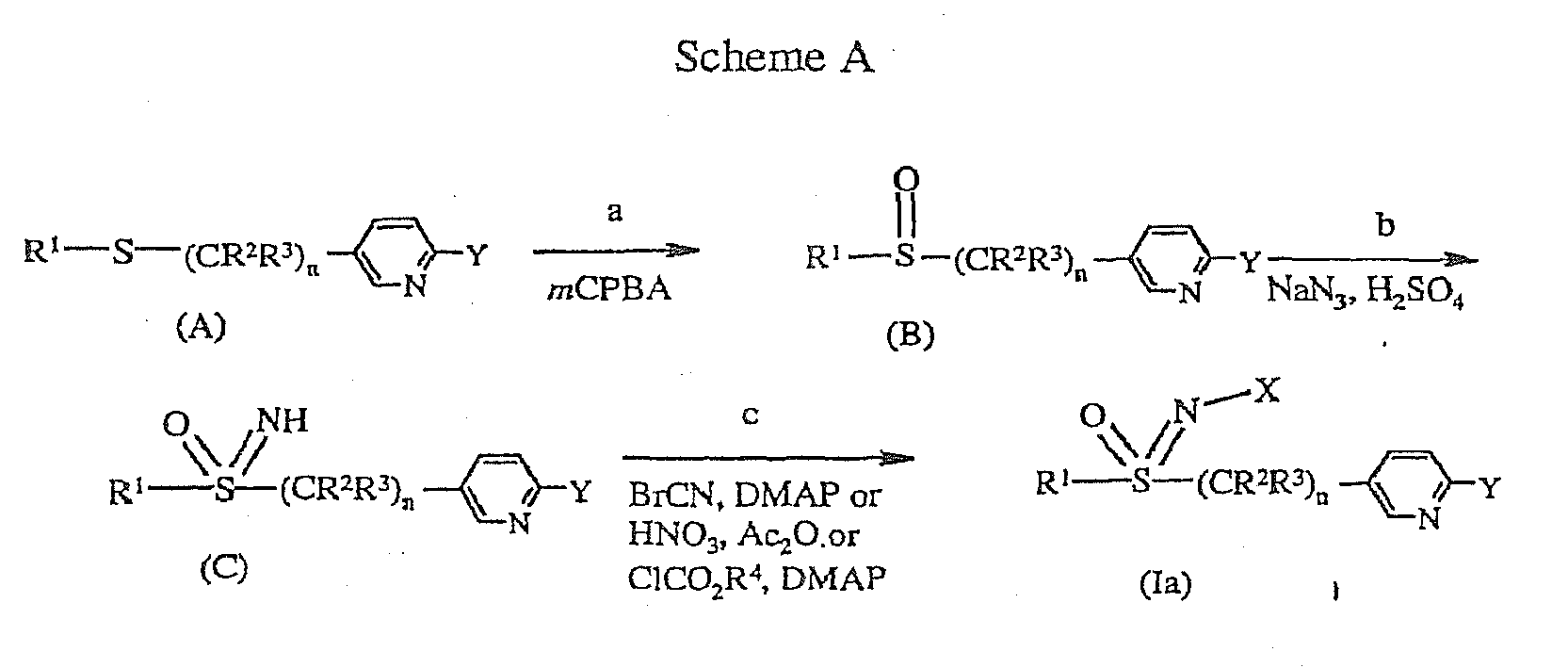
- In step a of Scheme A, sulfide of formula (A) is oxidized with meta-chloroperoxybenzoic acid (mCPBA) in a polar solvent below 0 °C to provide sulfoxide of formula (B). In most cases, dichloromethane is the preferred solvent for oxidation.
- In step b of Scheme A, sulfoxide (B) is imitated with sodium azide in the presence of concentrated sulfuric acid in an aprotic solvent under heating to provide sulfoximine of formula (C). In most cases, chloroform is the preferred solvent for this reaction.
- In step c of Scheme A, the nitrogen of sulfoximine (C) can be either cyanated with cyanogen bromide in the presence of a base, or nitrated with nitric acid in the presence of acetic anhydride under mildly elevated temperature, or carboxylated with alkyl (R4) chloroformate in the presence of base such as 4-dimethylaminopyridine (DMAP) to provide N-substituted sulfoximine (Ia). Base is required for efficient cyanation and carboxylation and the preferred base is DMAP, whereas sulfuric acid is used as catalyst for efficient nitration reaction.
- The compounds of formula (Ia), wherein X represents CN and R1, R2, R3, R4 and Y are as previously defmed, can be prepared by the mild and efficient method illustrated in Scheme B.
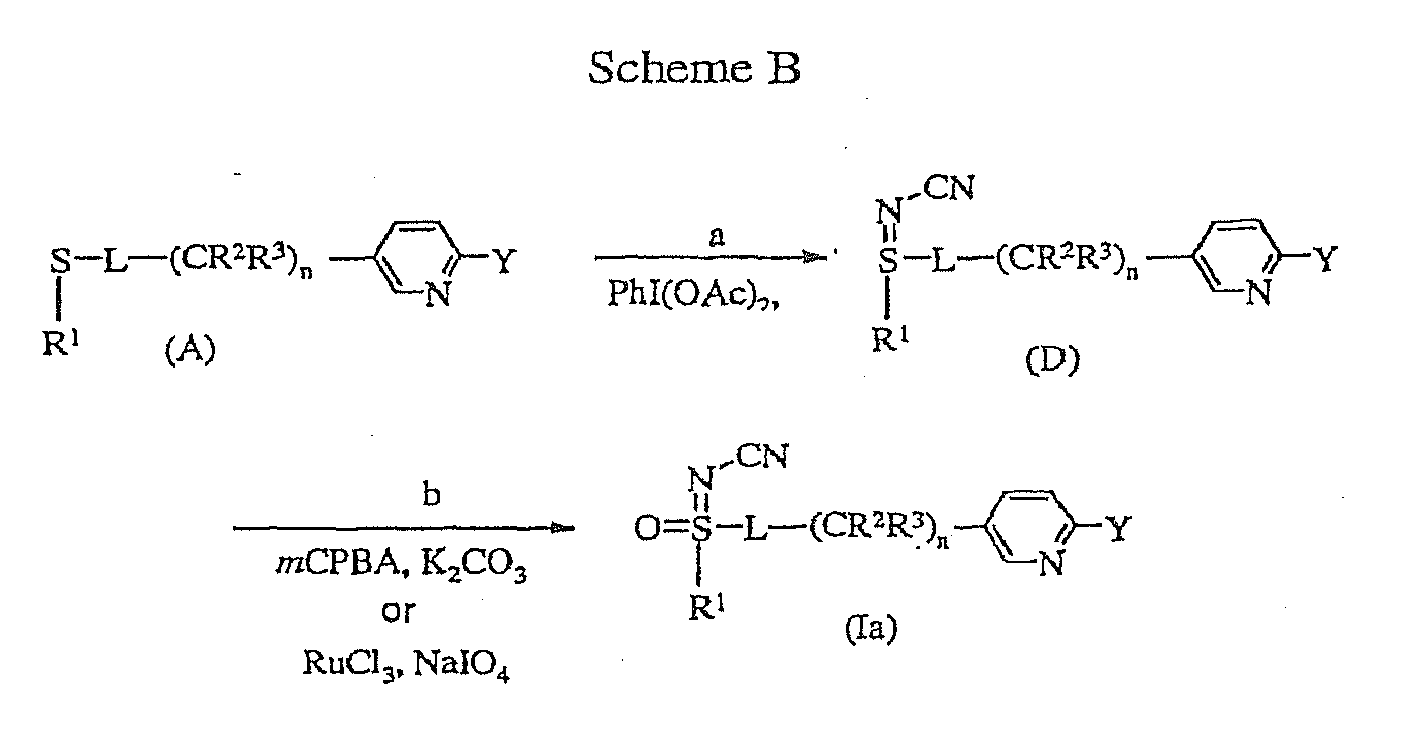
- In step a of Scheme B, sulfide is oxidized with iodobenzene diacetate in the presence of cyanamide at 0 °C to give sulfilimine (D). The reaction can be carried out in a polar aprotic solvent like CH2Cl2.
- In step b of Scheme B, the sulfilimine (D) is oxidized with mCPBA. A base such as potassium carbonate is employed to neutralize the acidity of mCPBA. Protic polar solvents such as ethanol and water are used to increase the solubility of the sulfilimine starting material and the base employed. The sulfilimine (D) can also be oxidized with aqueous sodium or potassium periodinate solution in the presence of catalyst ruthenium trichloride hydrate or similar catalyst. The organic solvent for this catalysis can be polar aprotic solvent such as CH2Cl2, chloroform, or acetonitrile.
- The α-carbon of the N-substituted sulfoximine of formula (Ia), i.e., n=1, R3 = H in the (CR2R3) group adjacent to the N-substituted sulfoximine function can be further alkylated or halogenated (R5) in the presence of a base such as potassium hexamethyldisilamide (KHMDS) to give N-substituted sulfoximines of formula (Ib), wherein R1, R2, R3, R4, X, L and Y are as previously defined and Z is an appropriate leaving group, as illustrated in Scheme C. The preferred leaving groups are iodide (R5 = alkyl), benzenesulfonimide (R5 = F), tetrachloroethene (R5 = Cl), and tetrafluoroethene (R5 = Br).

- Sulfoximine compounds of formula (Ic) wherein R1, S and L taken together form a saturated 4-, 5- or 6-membered ring and n=1 can be prepared by the methods illustrated in Scheme D wherein X and Y are as previously defined and m is 0, 1, or 2.

- In step a of Scheme D, which is similar to step b of Scheme A, sulfoxide is iminated with sodium azide in the presence of concentrated sulfuric acid or with O-mesitylsulfonylhydroxylamine in a polar aprotic solvent to provide sulfoximine. Chloroform or dichloromethane are the preferred solvents.
- In step b of Scheme D, similar to step c of Scheme A, the nitrogen of sulfoximine can be either cyanated with cyanogen bromide, or nitrated with nitric acid followed by treatment with acetic anhydride under refluxing conditions, or carboxylated with methyl chloroformate in the presence of base such as DMAP to provide N-substitued cyclic sulfoximine. Base is required for efficient cyanation and carboxylation and the preferred base is DMAP, whereas sulfuric acid is used as catalyst for efficient nitration reaction.
- In step c of Scheme D, the α-carbon of N-substituted sulfoximine can be alkylated with a heteroaromatic methyl halide in the presence of a base such as KHMDS or butyl lithium (BuLi) to give the desired N-substituted sulfoximines. The preferred halide can be bromide, chloride or iodide.
- Alternatively, the compounds of formula (Ic) can be prepared by a first α-alkylation of sulfoxides to give α-substituted sulfoxides and then an imination of the sulfoxide followed by N-substitution of the resulting sulfoximine by using the steps c, a and b respectively as described above for Scheme D.
- The starting sulfides (A) in Scheme A can be prepared in different ways as illustrated in Schemes E, F G, H, I and J.
- In Scheme E, the sulfide of formula (A1), wherein R1, R2 and Y are as previously defined, n=1, and R3 = H, can be prepared from the chloride of formula (E) by nucleophilic substitution with the sodium salt of an alkyl thiol.

- In Scheme F, the sulfide of formula (A2), wherein R1, R2 and Y are as previously defined, n=3, and R3 = H, can be prepared from the chloride of formula (F) by reacting with a 2-mono substituted methyl malonate in the presence of base such as potassium tert-butoxide to provide 2,2-disubstitued malonate, hydrolysis under basic conditions to form a diacid, decarboxylation of the diacid by heating to give a monoacid, reduction of the monoacid with borane-tetrahyrofuran complex to provide an alcohol, tosylation of the alcohol with toluenesulfonyl chloride (tosyl chloride) in the presence of a base like pyridine to give a tosylate and replacement of the tosylate with the sodium salt of the desired thiol.

- In Scheme G, the sulfide of formula (A3), wherein R1, R2 and Y are as previously defined, n=2, and R3 = H, can be prepared from the nitrile of formula (G) by deprotonation with a strong base and alkylation with an alkyl iodide to give α-alkylated nitrile, hydrolysis of the α-alkylated nitrile in the presence of a strong acid like HCl to give an acid, reduction of the acid with borane-tetrahyrofuran complex to provide an alcohol, tosylation of the alcohol with tosyl chloride in the presence of a base like pyridine to give a tosylate and replacement of the tosylate with the sodium salt of the desired thiol.

- In Scheme H, the sulfide of formula (A4), wherein R1, S and L taken together represents a 4-, 5- or 6-membered ring (m = 0, 1, or 2) and n is 0 can be prepared from the corresponding substituted chloromethyl pyridine by treatment with thiourea, hydrolysis and subsequent alkylation with the appropriate bromo chloroalkane (m = 0, 1, or 2) under aqueous base conditions, and cyclization in the presence of a base like potassium-t-butoxide in a polar aprotic solvent such as THF.

- Sulfides of formula (A1), wherein R1, R2 = CH3, Y as previously defined, and R3 = H, can be prepared alternatively via methods illustrated in Scheme I.
- Accordingly, the appropriate enone is coupled with dimethyl-aminoacrylonitrile and cyclized with ammonium acetate in DMF to yield the corresponding 6-substituted nicotinonitrile. Treatment with methylmagnesium bromide, reduction with sodium borohydride, chlorination with thionyl chloride, and nucleophilic substitution with the sodium salt of an alkyl thiol provide desired sulfides (A1).

- Sulfides of formula (A1), wherein R1 = methyl or ethyl, R2 and R3 independently represent hydrogen, methyl or ethyl, and Y is as previously defined can be prepared via a variation of Scheme I, depicted in Scheme J, wherein enamines, formed from the addition of an amine, e.g., pyrrolidine, with the Michael adduct of certain sulfides with appropriately substituted α,β-unsaturated aldehydes, are coupled with substituted enones and cyclized with ammonium acetate in acetonitrile to yield the desired sulfides (A1).

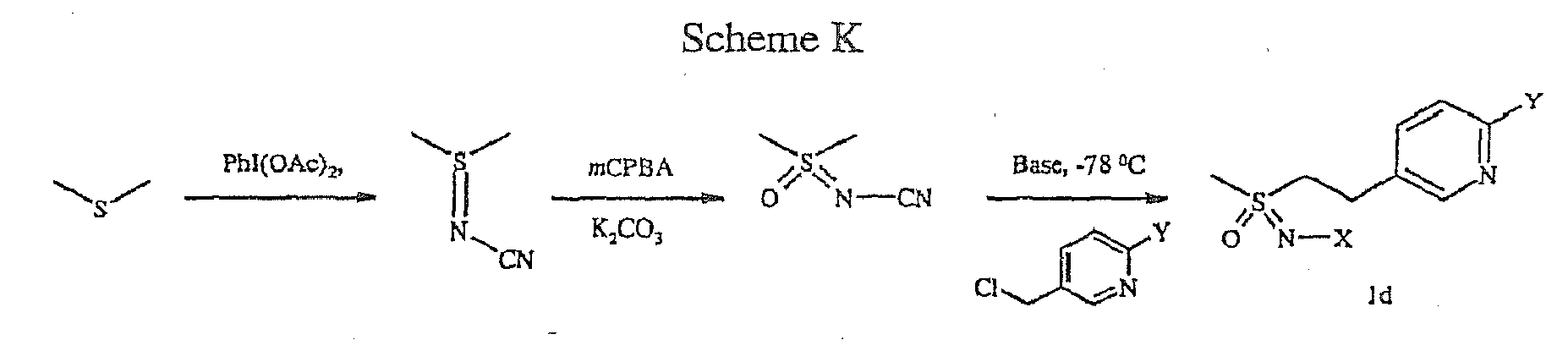
- Sulfoximine compounds of the formula (Id) wherein n = 2, R1 and R2 are hydrogen, L is a single bond, and X and Y are as previously defined can be prepared by the method illustrated in Scheme K. Dimethylsulfide is oxidized with iodobenzene diacetate in the presence of cyanamide at 0 °C to give the corresponding sulfilimine. The reaction can be carried out in a polar aprotic solvent like CH2Cl2 or THF. The sulfilimine is then oxidized with mCPBA. A base such as potassium carbonate is employed to neutralize the acidity of mCPBA. Protic polar solvents such as ethanol and water are used to increase the solubility of the sulfilimine starting material and the base employed. The α-carbon of the N-substituted sulfoximine can be alkylated with a heteroaromatic methyl halide in the presence of a base such as KHMDS or butyl lithium (BuLi) to give the desired N-substituted sulfoximine. The preferred halide can be bromide, chloride or iodide.
- In Scheme L, sulfides of formula (A1), wherein Y is a fluoroalkyl group, R1 is as previously defined, and n=1 can be prepared from the 6- acylpyridine or 6-formyl pyridine by reaction with diethylaminosulfur trifluoride (DAST). Subsequent halogenation of the 3-methyl group with NBS followed by nucleophilic substitution with the sodium salt of an alkyl thiol furnishes the desired sulfide.

-

- To a solution of 3-chloromethyl-6-(trifluoromethyl)pyridine (5.1 g, 26 mmol) in dimethyl sulfoxide (DMSO; 20 mL) was added in one portion sodium thiomethoxide (1.8 g, 26 mmol). A violent exothermic reaction was observed which resulted in the reaction turning dark. The reaction was stirred for 1 hr, then additional sodium thiomethoxide (0.91 g, 13 mmol) was added slowly. The reaction was stirred overnight, after which it was poured into H2O and several drops of conc. HCl were added. The mixture was extracted with Et2O (3 x 50 mL) and the organic layers combined, washed with brine, dried over MgSO4 and concentrated. The crude product was purified by chromatography (Prep 500, 10 percent acetone/hexanes) to furnish the sulfide (A) as a pale yellow oil (3.6 g, 67 percent). 1H NMR (300 MHz, CDCl3) δ 8.6 (s, 1H), 7.9 (d, 1H), 7.7 (d, 1H), 3.7 (s, 2H), 2.0 (s, 3H); GC-MS: mass calcd for C8H8F3NS [M]+ 207. Found 207.

- To a solution of sulfide (A) (3.5 g, 17 mmol) and cyanamide (1.4 mg, 34 mmol) in CH2Cl2 (30 mL) at 0 °C was added iodobenzenediacetate (11.0 g, 34 mmol) all at once. The reaction was stirred for 30 min, then allowed to warm to room temperature overnight. The mixture was diluted with CH2Cl2 (50 mL) and washed with H2O. The aqueous layer was extracted with ethyl acetate (4 x 50 mL), and the combined CH2Cl2 and ethyl acetate layers dried over MgSO4 and concentrated. The crude product was triturated with hexanes and purifed by chromatography (chromatotron, 60 percent acetone/hexanes) to furnish the sulfilimine (B) as a yellow gum (0.60 g, 14 percent). IR (film) 3008, 2924, 2143, 1693 cm-1 ;1H NMR (300 MHz, CDCl3) δ 8.8 (s, 1H), 8.0 (d, 1H), 7.8 (d, 1H), 4.5 (d, 1H), 4.3 (d, 1H), 2.9 (s, 3H); LC-MS (ESI): mass calcd for C9H9F3N3S [M+H]+ 248.04. Found 248.

- To a solution of m-chloroperbenzoic acid (mCPBA; 80 percent, 1.0 g, 4.9 mmol) in EtOH (10 mL) at 0 °C was added a solution of K2CO3 (1.4 g, 10 mmol) in H2O (7 mL). The solution was stirred for 20 min, then a solution of sulfilimine (B) (0.60 g, 2.4 mmol) in EtOH (20 mL) was added all at once. The reaction was stirred at 0 °C for 30 min, then allowed to warm to room temperature over the course of 1 hr. The reaction was then quenched with aq. sodium bisulfite and the mixture was concentrated to remove ethanol. The resulting mixture was extracted with CH2Cl2 and the combined organic layers dried over MgSO4 and concentrated. The crude product was purified by chromatography (chromatotron, 50 percent acetone/hexanes) to furnish the sulfoximine (1) as an off-white solid (0.28 g, 44 percent). Mp = 135-137 °C; 1H NMR (300 MHz, CDCl3) δ 8.8 (s, 1H), 8.1 (d, 1H), 7.8 (d, 1H), 4.7 (m, 2H), 3.2 (s, 3H); LC-MS (ELSD): mass calcd for C9H9F3N3OS [M+H]+ 264.04. Found 263.92.
-
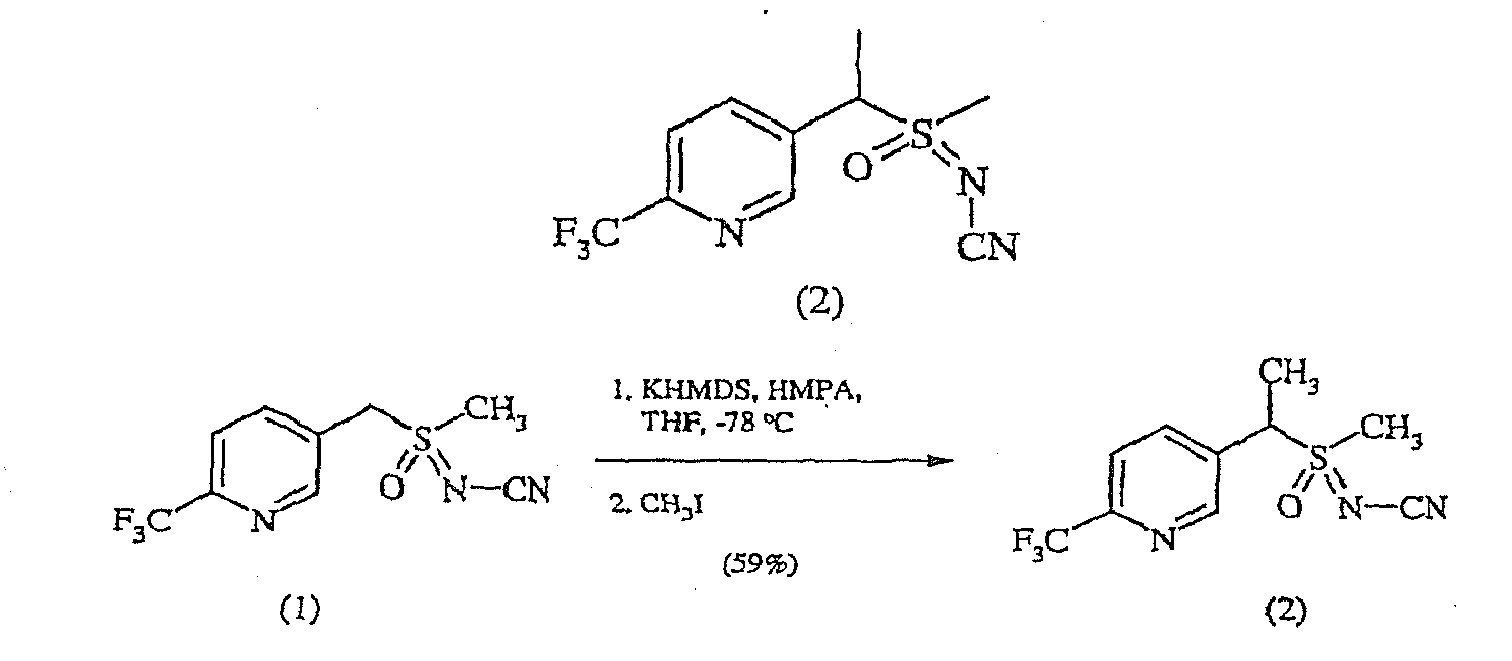
- To a solution of sulfoximine (1) (50 mg, 0.19 mmol) and hexamethylphosphoramide (HMPA; 17 µL, 0.10 mmol) in tetrahydrofuran (THF; 2 mL) at -78 °C was added potassium hexamethyldisilazane (KHMDS; 0.5 M in toluene, 420 µL, 0.21 mmol) dropwise. The solution was stirred at -78 °C for an additional 20 min, after which iodomethane (13 µL, 0.21 1 mmol) was added. The reaction was allowed to warm to room temperature over the course of 1 hr, after which it was quenched with satd. aq. NH4Cl and extracted with CH2Cl2. The organic layer was dried over Na2SO4, concentrated, and the crude product purified by chromatography (chromatotron, 70 percent acetone/CH2Cl2) to furnish the sulfoximine (2) as a 2:1 mixture of diastereomers (colorless oil; 31 mg, 59 percent). 1H NMR (300 MHz, CDCl3) δ (major diastereomer) 8.8 (s, 1H), 8.1 (d, 1H), 7.8 (d, 1H), 4.6 (q, 1H), 3.0 (s, 3H), 2.0 (d, 3H); (minor diastereomer) 8.8 (s, 1H), 8.1 (d, 1H), 7.8 (d, 1H), 4.6 (q, 1H), 3.1 (s, 3H), 2.0 (d, 3H); LC-MS (ELSD): mass calcd for C10H10F3N3OS [M+H]+ 278.06. Found 278.05.
-

- To a suspension of thiourea (1.2 g, 16 mmol) in EtOH (25 mL) was added a solution of 3-chloromethyl-6-(trifluoromethyl)pyridine in EtOH (10 mL). The suspension was stirred at room temperature for 2 days, during which a white precipitated formed. The precipitate was filtered to give the desired amidine hyrdochloride as a white solid (2.4 g, 58 percent). Mp = 186-188 °C. No further attempt was made to purify the product. 1H NMR (300 MHz, CDCl3) δ 8.9 (bs, 4H), 8.4 (s, 1H), 7.6 (d, 1H), 7.3 (d, 1H), 4.2 (s, 2H); LC-MS (ELSD): mass calcd for C8H8F3N3S [M+H]+ 236.05. Found 236.01.

- To a solution of amidine hydrochloride (A) (1.8 g, 6.8 mmol) in H2O (12 mL) at 10 °C was added 10 N NaOH (0.68 mL, 6.8 mmol), which resulted in the formation of a white precipitate. The suspension was heated at 100°C for 30 min, then cooled back down to 10°C. Additional 10 N NaOH (0.68 mL, 6.8 mmol) was then added, followed by 1-bromo-3-chloropropane (0.67 mL, 6.8 mmol) all at once. The reaction was stirred at room temperature overnight, then extracted with CH2Cl2. The combined organic layers were washed with brine, dried over Na2SO4 and concentrated to furnish the sulfide (B) as a colorless oil (1.7 g, 96 percent). No further attempt was made to purify the product. 1H NMR (300 MHz, CDCl3) δ 8.6 (s, 1H), 7.8 (d, 1H), 7.6 (d, 1H), 3.8 (s, 2H), 3.6 (t, 2H), 2.6 (t, 2H), 2.0 (quint, 2H).

- To a suspension of potassium tert-butoxide (1.5 g, 13 mmol) in THF (12 mL) was added HMPA (1.7 mL, 10 mmol) followed by a solution of sulfide (B) (1.8 g, 6.7 mmol) in THF (3 mL) dropwise. The reaction was allowed to stir at room temperature overnight, followed by concentration and purification by chromatography (Biotage, 40 percent EtOAc/hexanes) to furnish cyclized product (C) as an orange oil (230 mg, 15 percent). 1H NMR (300 MHz, CDCl3) δ 8.7 (s, 1H), 8.0 (d, 1H), 7.6 (d, 1H), 4.6 (dd, 1H), 3.2 (m, 1H), 3.1 (m, 1H), 2.5 (m, 1H), 2.3 (m, 1H), 2.1-1.9 (m, 2H).

- To a solution of sulfide (C) (230 mg, 0.99 mmol) and cyanamide (83 mg, 2.0 mmol) in CH2Cl2 (5 mL) at 0°C was added iodobenzenediacetate (350 mg, 1.1 mmol) all at once. The reaction was stirred for 3 hr, then concentrated and the crude product purified by chromatography (chromatotron, 50 percent acetone/hexanes) to furnish the sulfilimine (D) as an orange oil (150 mg, mixture of diastereomers, 56 percent). 1H NMR (300 MHz, CDCl3) δ 8.8 (s, 1H), 7.9 (d, 1H), 7.8 (d, 1H), 4.8 (dd, 1H), 3.5 (m, 2H), 2.9-2.7 (m, 2H), 2.6 (m, 1H), 2.3 (m, 1H).

- To a solution of mCPBA (80 percent, 180 mg, 0.82 mmol) in EtOH (3 mL) at 0 °C was added a solution of K2CO3 (230 mg, 1.7 mmol) in H2O (1.5 mL). The solution was stirred for 20 min, then a solution of sulfilimine (D) (150 mg, 0.55 mmol) in EtOH (2 mL) was added all at once. The reaction was stirred at 0 °C for 45 min, after which the solvent was decanted into a separate flask and concentrated to give a white solid. The solid was slurried in CHCl3, filtered, and concentrated to furnish pure sulfoximine (3) as a colorless oil (72 mg, 44 percent). 1H NMR (300 MHz, CDCl3) δ (1.5: 1 mixture of diastereomers) 8.8 (s, 2H), 8.0 (d, 2H), 7.8 (d, 2H), 4.7 (q, 1H), 4.6 (q, 1H), 4.0-3.4 (m, s, 4H), 3.0-2.4 (m, 8 H); LC-MS (ELSD): mass calcd for C11H11F3N3OS [M+H]+ 290.06. Found 289.99.
-

- (3E)-1-Chloro-4-ethoxy-1,1-difluorobut-3-en-2-one (7.36 g, 40 mmol) was dissolved in dry toluene (40 mL) and treated with 3-dimethylaminoacrylonitrile (4.61 g, 48 mmol) at room temperature. The solution was heated at 100 °C for 3.5 hr. The solvent was then removed under reduced pressure and the remaining mixture was re-dissolved in DMF (20 mL), treated with ammonium acetate (4.62 g, 60 mmol) and stirred at room temperature overnight. Water was added to the reaction mixture and and the resulting mixture was extracted with ether-CH2CH2 (1 : 2, v/v) twice. The combined organic layer was washed with brine, dried, filtered and concentrated. The residue was purified on silica gel to give 3.1 g of 6-[chloro(difluoro)methyl]nicotinonitrile (A) as light colored oil in 41 percent yield. GC-MS: mass calcd for C7H3ClF2N2 [M]+ 188. Found 188.

- 6-[Chloro(difluoro)methyl]nicotinonitrile (A) (3.0 g, 15.8 mmol) was dissolved in anhydrous ether (25 mL) and cooled in an ice-water bath. A solution of 3 M of methylmagnesium bromide in hexane (6.4 mL, 19 mmol) was added through a syringe. After the addition was over, the mixture was stirred at 0 °C for 5 hr and then at room temperature for 10 hr. The reaction was quenched slowly with 1 N citric acid aqueous solution at 0 °C and the resulting mixture was stirred at room temperature for 1 hr. The pH was adjusted back to pH 7 with saturated NaHCO3 aqueous solution. The two phases were separated and the aqueous phase was extracted with ethyl acetate twice. The combined organic layer was washed with brine, dried over anhydrous Na2SO4, filtered, and concentrated. The remaining mixture was purified on silica gel eluted with 15 percent acetone in hexane to give 0.88 g of the desired product 1-{6-[chloro(difluoro)methyl]pyridin-3-yl}-ethanone (B) as brownish oil in 30 percent yield. GC-MS: mass calcd for C8H6ClF2NO [M]+ 205. Found 205.

- To a solution of 1-{6-[chloro(diffuoro)methyl]pyridin-3-yl}ethanone (B) (0.85 g, 4.14 mmol) in MeOH (10 mL) at 0 °C was added NaBH4 (0.16 g, 4.14 mmol). The mixture was stirred for 30 min and 2 M HCl aqueous solution was added until pH reached 7. Solvent was removed under reduced pressure and the remaining mixture was extracted with CH2Cl2 (2 x 50 mL). The combined organic layer was dried over anhydrous Na2SO4, filtered, concentrated, and dried in vacuo to give 0.798 g of analytically pure 1-{6-[chloro(difluoro)methyl]-pyridin-3-yl}ethanol (C) on GC-MS as a light yellow oil in 93 percent yield. GC-MS: mass calcd for C8H6ClF2NO [M]+ 207. Found 207.

- To a solution of 1-{6-[chloro(difluoro)methyl]-pyridin-3-yl}ethanol (0.78 g, 3.77 mmol) in CH2Cl2 (40 mL) was added thionyl chloride (0.54 mL, 7.54 mmol) dropwise at room temperature. After 1hr, the reaction was quenched slowly with saturated NaHCO3 aqueous solution and the two phases were separated. The organic layer was dried over Na2SO4, filtered, concentrated, and dried in vacuum to give 0.83 g of the crude 2-[chloro(difluoro)methyl]-5-(1-chloroethyl)pyridine (D) as brown oil in 98 percent yield, which was directly used for the next step reaction. GC-MS: mass calcd for C8H7Cl2F2N [M]+ 225. Found 225.

- To a solution of 2-[chloro(difluoro)methyl]-5-(1-chloroethyl)pyridine (D) (0.81 g, 3.6 mmol) in ethanol (10 mL) was added sodium thiomethoxide (0.52 g, 7.4 mmol) under stirring in one portion at 0 °C. After 10 min, the mixture was allowed to warm to room temperature and stirred overnight. The solvent ethanol was then removed under reduced pressure and the residue was re-taken into ether/CH2Cl2 and brine. The two phases were separated and the organic layer was extracted with CH2Cl2 one more time. The combined organic layer was dried over anhydrous Na2SO4, filtered, concentrated, purified on silica gel using 5 percent ethyl acetate in hexane to give 0.348 g of the 2-[chloro(difluoro)methyl]-5-[1-(methylthio)ethyl]pyridine (E) in 40 percent yield GC-MS: mass calcd for C9H10ClF2NS [M]+ 237. Found 237.
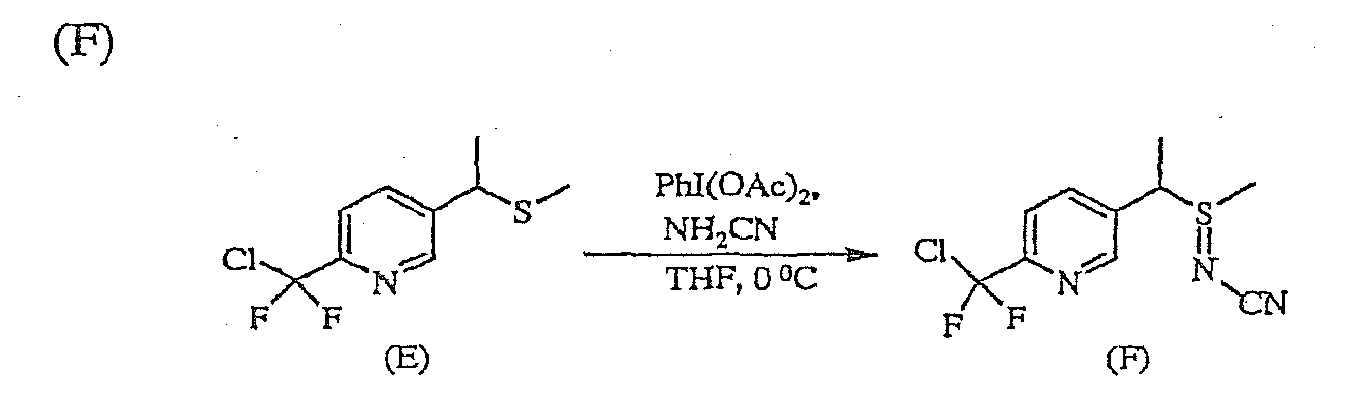
- To a stirred solution of 2-[chloro(difluoro)methyl]-5-[1-(methylthio)-ethyl]pyridine (E) (0.32 g, 1.35 mmol) and cyanamide (0.058 g, 1.35 mmol) in THF (7 mL) was added iodobenzene diacetate (0.44 g, 1.35 mmol) in one portion at 0 °C and the resulting mixture was stirred at this temperature for 1 hr and then at room temperature for 2 hr. The solvent was then removed under reduced pressure and the resulting mixture was dissolved in CH2Cl2, washed with half-saturated brine, dried over anhydrous Na2SO4, filtered, concentrated, and purified on silica gel using 50 percent acetone in hexane to give 0.175 g of (1-{6-[chloro-(difluoro)methyl]pyidin-3-yl }ethyl)(methyl)-λ4-sulfanylidenecyanamide (F) as light-yellow oil in 48 percent yield. 1H NMR (300 MHz, CDCl3) δ 8.71 (d, J = 1.8 Hz, 1H), 7.91 (dd, J = 8.4, 1.8 Hz, 1H) 7.78 (d, J = 8.4 Hz, 1H), 4.42 (q, J = 6.9 Hz, 1H), 2.64 (s, 3H), 1.92 (d, J = 6.9 Hz, 3H); LC-MS: mass calcd for C10H10ClF2N3S [M+1]+ 278. Found 278.

- To a stirred solution of (1-{6-[chloro(difluoro)methyl]pyridin-3-yl}ethyl)-(methyl)-λ4-sulfanylidenecyanamide (F) (0.16 g, 0.6 mmol) in ethanol (10 mL) was added 20 percent potassium carbonate aqueous solution (1.24 g, 1.8 mmol) at 0 °C under stirring. After 10 min stirring, 80 percent mCPBA (0.19 g, ca 0.9 mmol) was added to the mixture, which was stirred at 0 °C for 2 hr after which the reaction was quenched with a spatula of solid sodium thiosulfate. Most of the solvent ethanol was removed under reduced pressure and an aqueous saturated NaHCO3 -brine (1 : 1, v/v) solution was added and the mixture extracted with chloroform three times. The combined organic layer was dried over Na2SO4, filtered and concentrated. The residue was purified on silica gel using 35-50 percent acetone in hexane as eluent to give 0.092 g of the product (1-{6-[chloro(difluoro)-methyl]pyridin-3-yl}ethyl)(methyl)oxido-λ4-sulfanylidenecyanamide (4) as colorless oil in 57 percent yield. 1H NMR (300 MHz, CDCl3) δ 8.79 (s, 1H), 8.09 (d, J = 8.1 Hz, 1H), 7.80 (d, J = 8.1 Hz, 1H), 4.73 (q, J = 7.2 Hz, 1H), 3.16 and 3.11 (2 s, 3H, a mixture of two diastereomeric α-CH3 groups between the sulfoximine and the pyridine tail), 2.00 (d, J = 7.2 Hz, 3H); LC-MS: mass calcd for C10H10ClF2N3OS [M-1]+ 292. Found 292.
-

- A mixture of 5-ethylpyridine-2-carboxylic acid (1.98 g, 13 mmol), phenylphosphonic dichloride (2.8 g, 14.3 mmol), phosphorus pentachloride (7.7 g, 32 mmol) was stirred and slowly heated. Once a clear yellow liquid was formed, the mixture was heated to reflux overnight: After cooling, the volatiles were removed under reduced pressure. The residue was carefully poured into saturated sodium carbonate aqueous solution cooled in an ice-water bath. The aqueous phase was then extracted with CH2Cl2 two times. The combined organic layer was washed with brine, dried over anhydrous Na2SO4, filtered, concentrated, and partially purified on silica gel eluted with 10 percent EtOAc in hexane to give 2.7 g of crude product containing both 5-ethyl-2-(trichloromethyl)pyridine and 5-(1-chloro-ethyl)-2-(trichloromethyl)pyridine in an approximate 3:1 ratio (GC data, masses calcd for C8H8Cl3N and C8H7Cl4N [M]+ 223 and 257 respectively. Found 223 and 257 respectively).
- A mixture of the above-mentioned crude product (2.6 g) in carbon tetrachloride (100 mL) was then treated with 80 percent of N-bromosuccinimide (1.9 g, 11 mmol) and benzoylperoxide (0.66 g, 0.275 mmol) and then refluxed overnight The solid was filtered off, the filtrate concentrated and the resulting residue purified on silica gel using 4 percent EtOAc in hexane to give 1.0 g of the desired product 5-(1-bromoethyl)-2-(trichloromethyl)pyridine (A) as a yellow solid. The combined yield for the two steps was 25 percent. GC-MS: mass calcd for C8H7BrCl3N [M-1-Cl]+ 266. Found 266.


- To a stirred solution of 5-[1-(methylthio)ethyl]-2-(trichloromethyl)-pyridine (B) (0.55 g, 2.3 mmol) and cyanamide (0.097 g, 2.3 mmol) in THF (7 mL) cooled to 0 °C was added iodobenzene diacetate (0.75 g, 2.3 mmol) in one portion. The resulting mixture was stirred at 0 °C for 1 hr and then at room temperature for 2 hr. The solvent was removed in vacuo and the resulting mixture was purified on silica gel using 50 percent acetone in hexane to give 0.254 g of (1E)-methyl{ 1-[6-(trichloromethyl)pyridin-3-yl]ethyl}-λ4-sulfanylidenecyanamide (C) as an off-white solid in 40 percent yield. 1H NMR for the diastereomeric mixture (300 MHz, d6-acetone) δ 8.87 (s, 1H), 8.21-8.25 (m, 2H), 4.65-4.76 (m, 1H), 2.86-2.66 (m, 3H), 1.88-1.92 (m, 3H).

- To a stirred solution of (1E)-methyl{1-[6-(trichloromethyl)pyridin-3-yl]ethyl}-λ4-sulfanylidenecyanamide (C) (0.20 g, 0.65 mmol) in ethanol (15 mL) was added 20 percent aqueous potassium carbonate solution (1.3 mL) at 0 °C, followed by addition of 80 percent mCPBA. The resulting mixture was stirred for 2 hr at 0 °C and then quenched with solid sodium thiosulfate. Most of the solvent was evaporated and 1:1 aqueous saturated NaHCO3-brine (v/v) was added and the mixture was extracted with chloroform three times. The combined organic layer was dried over anhydrous Na2SO4, filtered and concentrated. The residue was purified on silica gel using 40 percent acetone in hexane to give 0.10 g of [1-(6-trichloromethylpyridin-3-yl)ethyl](methyl)-oxido- λ4-sulfanylidene-cyanamide (5) as colorless oil in 50 percent yield. 1H NMR (300 MHz, CDCl3) δ 8.83 (s, 1H), 8.12-8.23 (m, 1H), 5.15(q, 1H), 3.37 and 3.28 (2 s, 3H, a mixture of two diastereomeric α-CH3 groups between the sulfoximine and the pyridine tail), 2.03 (d, 3H); LC-MS: mass calcd for C10H12Cl3N3OS [M+1]+ 328. Found 328.
-

- To a solution of dimethylsulfide (10.0 g, 161 mmol) and cyanamide (6.7 g, 161 mmol) in THF (500 mL) at 0 °C was added iodobenzenediacetate (51.8 g, 161 mmol) all at once. Let stir at 0 °C for 30 min, then allowed reaction to warm to room temperature overnight. The reaction was concentrated and purified by passing through a silica gel plug, first with 100 percent hexanes, then with 100 percent acetone, furnishing sulfilimine (A) as a colorless oil = 13.4 g (82 percent). 1H NMR (300:MHz, CDCl3) δ 2.8 (s, 6H); GC-MS: mass calcd for C3H6N2S [M]+, 102. Found 102.

- To a solution mCPBA (80 percent, 25.3 g, 147 mmol) in EtOH (450 mL) at 0 °C was added solution of K2CO3 (40.6 g, 294 mmol) in H2O (340 mL). After 20 min, sulfilimine (10.0 g, 98 mmol) in EtOH (150 mL) was added all at once. The suspension was stirred at 0 °C for 90 min, after which the crude reaction mixture was concentrated to remove EtOH, then extracted with CH2Cl2 (3x). The combined organic layers were washed with satd aq NaHCO3 soln (3x), dried over Na2SO4 and concentrated to furnish sulfoximine (B) as a yellow solid = 1.310 g (10 percent). 1H NMR (300 MHz, CDCl3) δ 3.4 (s, 6H); GC-MS: mass calcd for C3H6N2OS [M]+, 118. Found 118.

- To a solution of sulfoximine (100 mg, 0.85 mmol) in THF (2 mL) at -78 °C was added nBuLi (2.5 M, 340 µL, 0.85 mmol) dropwise. The solution was let solution stir for 20 min, then 5-(chloromethyl)-2-trifluoromethyl pyridine (170 mg, 0.85 mmol) was added. The solution was let solution stir at -78 °C for additional 2 h, then quenched with satd aq ammonium choride and extracted with CH2Cl2. The combined organic extracts were dried over sodium sulfate, concentrated and purified by flash chromatography (40 percent EtOAc/ 80 percent hexanes) to furnish [2-(6-trifluoromethylpyridin-3-yl)ethyl](methyl)-oxido-λ4-sulfanylidene-cyanamide (6) as a yellow solid = 14.5 mg (6 percent); mp = 83-87 °C. 1H NMR (300 MHz, CDCl3) δ 8.69 (d, 1H), 7.85 (dd, 1H), 7.74 (d, 1H), 3.58-3.79 (m, 2H), 3.38-3.46 (m, 2H), 3.30 (s, 3H); LC-MS (ELSD): mass calcd for C10H11F3N3OS [M+H]+, 278. Found 278.
-

- To a solution of 2-iodo-5-bromopyridine (18.4 g, 65 mmol) in THF (100 mL) at -15 °C was added isopropylmagnesium chloride (2M, 35 mL, 70 mmol) dropwise at a rate such that the temperature of the reaction did not exceed 0 °C. The reaction was stirred at -15 °C for 1 h, then DMF (7.5 mL, 97 mmol) was added dropwise at a rate such that the temperature of the reaction did not exceed 0 °C. The reaction was stirred for 30 min, then warmed to room temperature for an additional 1 h. The reaction was cooled back down to 0 °C and 2 N HCl (80 mL) was added dropwise, maintaining the temperature below 20 °C. After stirring for 30 min, 2 N NaOH was added until pH 7 was reached. The organic layer was then separated and the aqueous layer extracted with CH2Cl2 (3x). The combined organic layers were dried over MgSO4, concentrated and purified by flash chromatography (SiO2, 10 percent EtOAc/hexanes) to furnish 5-bromopyridine-2-carbaldehyde (A) as a white solid (7.3g, 60 percent). 1H NMR (300 MHz, CDCl3) δ 10.0 (s, 1H), 8.9 (s, 1H), 8.0 (d, 1H), 7.8 (d, 1H).

- To a cooled solution of 5-bromopyridine-2-carbaldehyde (A) (7.0 g, 38 mmol) in CH2Cl2 (300 mL) at -78 °C was added diethylaminosulfur trifluoride (DAST, 10.8 mL, 83 mmol). The reaction was allowed to warm to room temperature over the course of 6 h, then it was quenched slowly with H2O, washed with saturated aqueous NaHCO3 and dried over Na2SO4. Concentration and purification by silica gel plug (CH2Cl2 eluent) furnished 5-bromo-2-difluoromethylpyridine (B) as brown crystals (5.3g, 67 percent). 1H NMR (300 MHz, CDCl3) δ 8.8 (s, 1H), 8.0 (d, 1H), 7.6 (d, 1H), 6.6 (t, 1H).
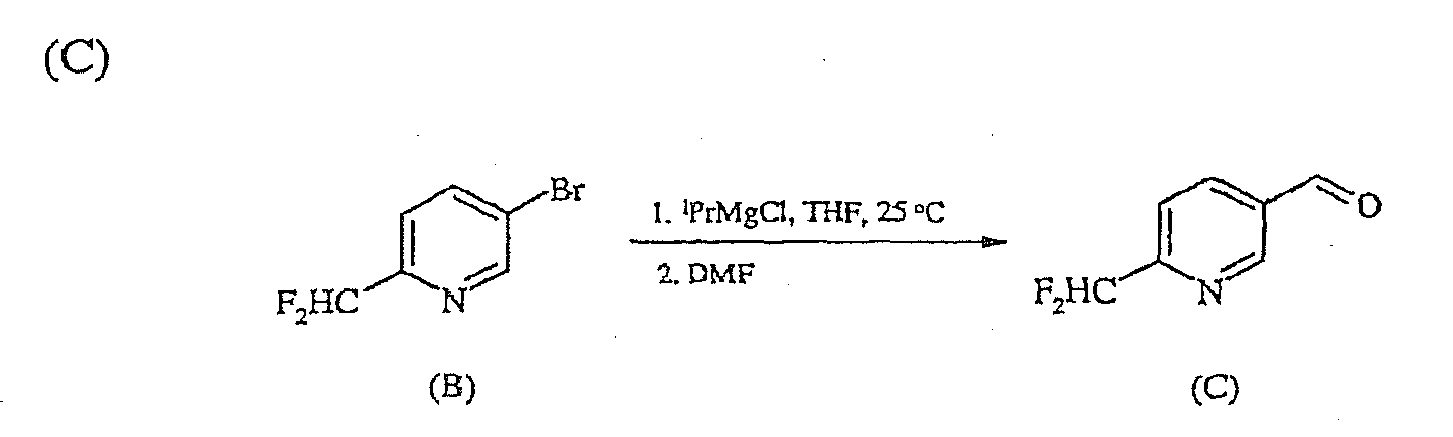
- To a solution of 5-bromo-2-difluoromethylpyridine (B) (1.8 g, 8.6 mmol) in THF (40 mL) at 25 °C was added isopropylmagnesium chloride (2M, 8.6 mL, 17 mmol) dropwise. The reaction was allowed to stir for 2 h, then DMF (660 µL, 8.6 mmol) was added and the reaction was stirred for an additional 22 h. The reaction was quenched with 2M HCl and basified with 1M NaOH until pH 7 reached. The organic layer was separated and the aqueous layer was extracted with CH2Cl2. The combined organic layers were dried over Na2SO4, concentrated and purified by flash chromatography (10 percent EtOAc/hexanes) to furnish 6-difluoromethylpyridine-3-carbaldehyde (C) as an orange oil (320 mg, 24 percent).

- To a solution of 6-difluoromethylpyridine-3-carbaldehyde (C) (500 mg, 3.2 mmol) in MeOH (10 mL) at 0 °C was added NaBH4 (60 mg, 1.6 mmol). The reaction was allowed to stir for 30 min, then 2M HCl was added until pH 2 was reached. The resulting solution was extracted with CH2Cl2 (3x) and the combined organic layers dried over Na2SO4 and concentrated to furnish (6-difluoromethyl-pyridin-3-yl)methanol (D) as an orange oil (420 mg, 82 percent) which was used in the next step without further purification. 1H NMR (300 MHz, CDCl3) δ 8.6 (s, 1H), 7.9 (d, 1B), 7.6 (d, 1H), 6.6 (t, 1H), 4.8 (s, 2H).

- To a solution of (6-difluoromethylpyridin-3-yl)methanol (D) (450 mg, 2.8 mmol) in CH2Cl2 (10 mL) at room temperature was SOCl2 (230 µL, 3.1 mmol). The reaction was allowed to stir for 1 h, then the reaction was quenched slowly with saturated aqueous NaHCO3. The aqueous phase was extracted with CH2Cl2 (3x) and the combined organic layers were dried over Na2SO4 and concentrated to furnish the The resulting solution was extracted with CH2Cl2 (3x) and the combined organic layers dried over Na2SO4 and concentrated to furnish 5-chloromethyl-2-difluoromethylpyridine (E) as a reddish brown oil (490 mg, 98 percent) which was used in the next step without further purification. 1H NMR (300 MHz, CDCl3) δ 8.7 (s, 1H), 7.9 (d, 1H),7.6 (d, 1H), 6.6 (t, 1H), 4.6 (s, 2H).

- To a solution of sodium thiomethoxide (240 mg, 3.3 mmol) in ETCH (10 ml) at room temperature was added a solution of 5-chloromethyl-2-difluoromethylpyridine (E) (490 mg, 2.8 mmol) in EtOH (3 mL). The reaction was allowed to stir for 9 h, then the reaction was concentrated, taken up in Et2O, and washed with H2O. The organic phase was dried over Na2SO4 and concentrated to furnish 2-difluoromethyl-5-methylthiomethyl-pyridine (F) as an orange oil (422 mg, 81 percent) which was used in the next step without further purification. 1H NMR (300 MHz, CDCl3) δ 8.6 (s, 1H), 7.8 (d, 1H), 7.6 (d, 1H), 6.6 (t, 1H), 3.7 (s, 2H), 2.0 (s, 3H).

- [(6-Difluoromethylpyridin-3-yl)methyl] (methyl)-oxido- λ4-sulfanylidenecyanamide (7) was synthesized from 2-difluoromethyl-5-methylthiomethylpyridine (F) in two steps as described in Examples I-B and I-C. Isolated as a white solid (51 percent yield). 1H NMR (300 MHz, CDCl3) δ 8.7 (s, 1H), 8.0 (d, 1H), 7.8 (d, 1H), 6.7 (t, 1H), 4.7 (dd, 2H), 3,2 (s, 3H); LC-MS (ELSD): mass calcd for C9H10F2N3OS [M+H]+, 246. Found 246.
-

- [1-(6-difluoromethylpyridin-3-yl)ethyl](methyl)-oxido- λ4-sulfanylidenecyanamide (8) was synthesized from [(6-difluoromethylpyridin-3-yl)methyl](methyl)-oxido-λ4-sulfanylidenecyanamide (7) in one step as described in Example II. Isolated as a colorless oil (74 percent yield) and a 1:1 mixture of diastereomers. 1H NMR (300 MHz, CDCl3) δ (mixture of two diastereomers) 8.7 (s, 2H), 8.0 (d, 2H), 7.8 (d, 2H), 6.7 (t, 2H), 4.6 (q, 2H), 3.1 (s, 3H), 3.0 (s, 3H), 2.0 (d, 6H); LC-MS (ELSD): mass calcd for C10H12F7N3OS [M+H]+, 260. Found 260.
-

- (E)-1-Ethoxy-4,4,5,5,5-pentafluoropent-1-en-3-one (1.09 g, 5 mmol) in anhydrous ethyl ether (5 mL) was treated with 1-((E)-3-methylthiobut-1-enyl)pyrrolidine (0.85 g, 5 mmol) in 2 mL dry ether at -15 °C over a period of 5 min and the reaction was continued for 20 min. Then the temperature was allowed to rise to room temperature and the reaction continued for 3 h. The solvent was removed under reduced pressure and the residue re-dissolved in anhydrous DMF (5 mL). Ammonium acetate (0.58 g, 7.5 mmol) was added and the mixture stirred at room temperature over a weekend. Water was added and mixture extracted with ether three times. The combined organic layer was washed with brine, dried over anhydrous Na2SO4, filtered, concentrated, and purified on silica gel eluted with 8 percent EtOAc in hexane (v/v) to give 0.16 g of the desired 5-(1-methylthioethyl)-2-pentafluoroethylpyridine (A) as brownish colored oil in 12 percent yield. GC-MS: mass calcd for C10H11F2N3S [M]+ 271. Found 271.

- To a stirred solution of the 5-(1-methylthioethyl)-2-pentafluoro-ethylpyridine (A) (0.16 g, 0.6 mmol) and cyanamide (0.025 g, 0.6 mmol) in THF (3 mL) cooled to 0 °C was added iodobenzene diacetate (0.19 g, 0.6 mmol) in one portion and the resulting mixture was stirred at 0 °C for 2 h and then at room temperature overnight. The solvent was removed in vacuo and the resulting mixture was suspended in brine-saturated NaHCO3 (9:1), which was then extracted with CH2Cl2-EtOAc (1:1, v/v) two times. The combined organic layer was dried over Na2SO4, filtered, concentrated, and dried to give 0.16 g of (1-{6-[pentafluoroethyl]pyridin-3-yl}ethyl)(methyl)-λ4-sulfanylidenecyanamide (B) as a brownish oil in 85 percent yield. LC-MS: mass calcd for C11H10F5N3S [M]+ 311.28. Found [M-1]+ 309.84

- To a stirred solution of the 80 percent 3-chloroperoxybenzoic acid (0.17 g, ca 0.8 mmol) in ethanol (3 mL) cooled to 0 °C was added 20 percent aqueous potassium carbonate (1.0 mL, 1.5 mmol and the resulting mixture was stirred at 0 °C for 20 min. Then (1-{6-[pentafluoroethyl]pyridin-3-yl}ethyl)(methyl)-λ4-sulfanylidenecyanamide (B) was added at once and the mixture was stirred at 0 °C for 1 h. The reaction was quenched with a small spatula of solid sodium thiosulfate. Most of the solvent was evaporated and brine solution was added and the mixture extracted with CH2Cl2 three times. The combined organic layer was dried over Na2SO4, filtered and concentrated and the residue was purified on silica gel using 10 percent acetone in CH2Cl2 (v/v) to give 0.089 g of [1-(6-pentafluoroethylpyridin-3-yl)ethyl] (methyl)-oxido-λ4-sulfanylidenecyanamide (9) as a white solid in 54 percent yield. LC-MS: mass calcd for C10H10F5N3OS [M]+ 327.28. Found [M-1]+ 325.83.
-

- 1-Oxidotetrahydro-1H-1λ4-thien-1-ylidenecyanamide (A) was prepared from tetrahydrothiophene by a two step procedure as described in Examples VI-A and VI-B (69 percent yield). 1H NMR (300 MHz, CDCl3) δ 3.5 (m, 2H), 3.3 (m, 2H), 2.3-2.5 (m, 4H); GC-MS: mass calcd for C5H8N2OS [M+H]+, 144. Found 144.

- To a solution of 1-oxidotetrahydro-1H-1λ4-thien-1-ylidenecyanamide (A) (200 mg, 1.4 mmol) in THF (10 ml) at 78 °C was added LDA solution in THF (1.8M, 850 µL, 1.5 mmol). The reaction was allowed to stir for 45 min, then 5-chloromethyl-2-trifluoromethylpyridine (300 mg, 1.5 mmol) was added dropwise. The solution was allowed to stir at -78 °C for 1h, then it was warmed to 0 °C for an additional 2 h. The reaction was then quenched with saturated aqueous NH4Cl and extracted with CH2Cl2. The combined organic layers were dried over Na2SO4, concentrated, and purified by flash chromatography to furnish 2-[(6-trifluoromethylpyridin-3-yl)methyl]-1-oxidotetrahydro-1H-1λ4-thien-1-ylidenecyanamide (10) as a yellow oil (41 mg, 9 percent). IR (film) 2946, 2194, 1339 cm-1; 1H NMR (300 MHz, CDCl3) δ (mixture of two diastereomers) 8.6 (s, 2H), 7.8 (m, 2H). 7.7 (d, 1H), 7.6 (d, 1H), 3.4 - 3.8 (m, 7H), 3.3 (m, 1H), 3.0 - 3.2 (m, 2H), 1.9-2.6 (m, 8H); LC-MS (ELSD): mass calcd for C12H13F3N3OS [M+H]+, 304. Found 304.
-

- To a solution of 5-(1-methylthioethyl)-2-trifluoromethylpyridine (2.0 g, 9 mmol) in CHCl3 (20 mL) at 0 °C was added solution of mCPBA (2.1 g, 10 mmol) in CHCl3 (25 mL) over the course of 1.5 h. The solution was stirred an additional 2 h, then it was concentrated and purified by flash chromatography (10 percent MeOH/CH2Cl2) to furnish 5-(1-methylsulfinylethyl)-2-trifluoromethylpyridine (A) as a yellow oil (710 mg, 33 percent) and a ∼2:1 mixture of diastereomers. 1H NMR (300 MHz, CDCl3) δ (major diastereomer) 8.7 (s, 1H), 7.8 (d, 1H), 7.7 (d, 1H), 4.0 (q, 1H), 2.4 (s, 3H), 1.75 (d, 3H); (minor diastereomer) 8.6 (s, 1H), 7.9 (d, 1H), 7.7 (d, 1H), 3.8 (q, 1H), 2.3 (s, 3H), 1.8 (d, 3H); LC-MS (ELSD): mass calcd for C9H11F3NOS [M+H]+, 238. Found 238.

- To a solution of 5-(1-methylsulfinylethyl)-2-trifluoromethylpyridine (A) (600 mg, 2.5 mmol) in CHCl3 (5 mL) at 0 °C was added sodium azide (260 mg, 4.0 mmol) and H2SO4 (1 mL). The reaction was warmed to 55 °C until gas evolution was observed, then it was cooled back down to room temperature overnight. The liquid was decanted into a separate flask and the residual syrup was dissolved in H2O, basified with Na2CO3 and extracted with CH2Cl2. The combined organic layers were dried over Na2SO4, concentrated and purified by flash chromatography to furnish 5-[1-(methylsulfonimidoyl)ethyl]-2-trifluoromethylpyridine (B) as a yellow oil (130 mg, 20 percent) and a∼1:1 mixture of diastereomers. 1H NMR (300 MHz, CDCl3) δ (mixture of diastereomer) 8.8 (d, 2H), 8.0 (dd, 2H), 7.8 (d, 2H), 4.4 (m, 2H), 2.9 (s, 3H), 2.85 (s, 3H), 1.8 (m, 6H); LC-MS (ELSD): mass calcd for C9H11F3N2OS [M]+ , 252. Found 252.

- To a solution of 5-[1-(methylsulfonimidoyl)ethyl]-2-trifluoromethylpyridine (B) (100 mg, 0.4 mmol) in CH2Cl2 (2 mL) at 0 °C was added HNO3 (16 µL, 0.4 mmol) dropwise. To the resulting suspension was added acetic anhydride (750 µL) and concentrated H2SO4 (5 µL) and the mixture was heated to 40 °C. The suspension slowly became homogeneous over the course of 15 min. The solvent was then removed and the crude residue was dissolved in H2O. Solid Na2CO3 was added until pH 8 was reached and the aqueous phase was extracted with CH2Cl2. The combined organic layers were dried over Na2SO4, concentrated and purified by flash chromatography to furnish 2-trifluoromethyl-5-(1-{methyl(oxido)-[oxido(oxo)hydrazono]- λ4-sulfanyl}ethyl)pyridine (11) as a yellow oil (22 mg, 19 percent) and a 1:1 mixture of diastereomers. 1H NMR (300 MHz, CDCl3) δ (mixture of diastereomers) 8.8 (d, 2H), 8.1 (m, 2H), 7.8 (m, 2H), 5.1 (q, 1H), 5.0 (q, 1H), 3.3 (s, 3H), 3.25 (s, 3H), 2.0 (m, 6H); LC-MS (ELSD): mass calcd for C9H11F3N3O3S [M+H]+, 298. Found 298.
-

- To a solution 5-methyl-2-acetylpyridine (9.9 g, 73.3 mmol) in molecule sieves-dried CH2Cl2 (150 mL) was added diethylamino sulfolnyltrifluoride (DAST) (25.8 g, 260 mmol) at room temperature and the mixture was stirred at room temperature overnight. More DAST (12 g, 74 mmol) was added and the reaction continued for two more days after which an additional DAST (3.8 g, 23 mmol) was added and the reaction continued for another 3 days. After the reaction was quenched slowly with saturated NaHCO3 at 0 °C, the organic phase was separated, dried over Na2SO4, filtered, and concentrated. The residue was purified on silica gel eluted with 8 percent EtOAc in hexane to give 3.91 g of 2-(1,1-difluoroethyl)-5-methylpyridine (A) as a light brownish oil in 34 percent yield. GC-MS: mass calcd for C8H9F2N [M]+ 157. Found 157.

- A mixture of 2-(1,1-difluoroethyl)-5-methylpyridine (A) (2.0 g, 12.7 mmol), N-bromosuccinimide (2.2 g, 12.7 mmol) and benzoylperoxide (0.15 g, 0.63 mmol) in carbon tetrachloride (100 mL) was refluxed overnight. After the solid was removed by filtration, the filtrate was concentrated. The residue was re-dissolved in ethanol (40 mL) and sodium thiomethoxide (1.33 g, 19 mmol) was added at room temperature and stirred for 3 h. The solvent was removed under reduced pressure and the remaining mixture was dissolved in CH2Cl2 and water. After separation, the organic layer was dried over Na2SO4, filtered and concentrated. The crude product 2-(1,1-difluoroethyl)-5-methylthiomethyl-pyridine (B) was 94 percent pure on GC/MS, which was used directly for the next reaction without further purification. GC-MS: mass calcd for C9H11F2NS [M]+ 203. Found 203.

- To a stirred solution of 2-(1,1-difluoroethyl)-5-methylthiomethylpyridine (B) (1.22 g. 6.0 mmol) and cyanamide (0.25 g, 6.0 mmol) in THF (7 mL) cooled to 0 °C was added iodobenzene diacetate (1.93 g, 6.0 mmol) in one portion and the resulting mixture was stirred at 0 °C for 1 h and then at room temperature for 2 h. The solvent was removed in vacuo and the resulting mixture was purified on silica gel using 60 percent acetone in hexane (v/v) to give 1.22 g of [(6-(1,1-difluoroethylpyridin-3-yl)methyl](methyl)-λ4-sulfanylidenecyanamide (C) (84 percent yield) as brownish oil which turned into a brownish solid after standing in the refrigerator overnight. LC-MS: mass calcd for C10H11F2N3S [M]+ 243.28. Found [M+1]+ 244.11.

- To a 100 ml round bottom flask equipped with magnetic stirrer, addition funnel, and thermometer was charged the sodium periodate (0.95 g, 4.44 mmol) and water (12 mL). After the solid had dissolved, 15 mL of CH2Cl2 was added followed by the ruthenium trichloride hydrate (0.033 g, 0.15 mmol). [(6-(1,1-difluoroethylpyridin-3-yl)methyl](methyl)-λ4-sulfanylidenecyanamide (C) (0.72 g, 2.96 mmol) dissolved in 5 mL of CH2Cl2 was added dropwise over a period of 30 min. The mixture was stirred rapidly at room temperature for 1.5 h and then filtered through a filtering paper to remove some insolubles. The mixture was then separated in separation funnel after ethyl acetate was added to facilitate the separation. The aqueous phase was extracted with CH2Cl2 twice. The combined organics was washed with brine, dried over dry Na2SO4, filtered, concentrated, and briefly purified on silica gel with 70 percent acetone in hexane to give 0.652 g of the desired product [(6-(1,1-difluoroethylpyridin-3-yl)methyl](methyl)-oxido λ4-sulfanylidenecyanamide (D) as a white solid in 87 percent yield. LC-MS: mass calcd for C10H11F2N3OS [M]+ 259.28. Found [M+1]+ 260.02.

- To a solution of [(6-(1,1-difluoroethylpyridin-3-yl)methyl](methyl)-oxido λ4-sulfanylidenecyanamide (D) (0.55 g, 2.0 mmol) and HMPA (0.09 mL, 0.55 mmol) in 20 mL anhydrous THF was added 0.5 M potassium bis(trimethylsilyl)amide in toluene (4.4 mL, 2.2 mmol) at -78°C dropwise. After 45 min, iodomethane (0.14 mL, 2.2 mmol) was added in one portion via a syringe. Ten minutes later, the temperature was allowed to rise to 0 °C and mixture continued to stir for 1.5 h. The reaction was quenched with saturated aqueous NH4Cl, diluted with brine, extracted once each with EtOAc and CH2Cl2. The combined organic layer was dried over Na2SO4, filtered, and concentrated. The residue was purified by preparative HPLC to give 0.15 g of the desired [6-(1,1-difluoroethyl)pyridin-3-yl)ethyl](methyl)-oxido-λ4-sulfanylidenecyanamide (12) in 26 percent yield. LC-MS: mass calcd for C11H13F2N3OS [M]+ 273.31. Found [M+1]+ 274.21.
- The compounds identified in the foregoing examples were tested against cotton aphid, green peach aphid, sweet potato whitefly, brown planthopper, green leafhopper, termite, cat flea and/or brown dog tick using procedures described hereinafter.
- Squash with fully expanded cotyledon leaves were trimmed to one cotyledon per plant and infested with cotton aphid (wingless adult and nymph) 1 day prior to chemical application. Each plant was examined before chemical application to ensure proper infestation (ca. 30-70 aphids per plant). Compounds (2 mg) were dissolved in 2 ml of acetone : methanol (1:1) solvent, forming stock solutions of 1000 ppm. The stock solutions were then diluted with a diluent consisting 80 parts of 0.025 percent Tween 20 in H2O and 20 parts of acetone : methanol (1 : 1). A hand-held Devilbiss sprayer was used to apply the test solutions until runoff to both sides of the squash cotyledon leaves. Four plants (4 replications) were used for each concentration of each compound. Reference plants (solvent check) were sprayed with the diluent only. Treated plants were held in a holding room for 3 days at approximately 23 °C and 40 percent RH before the number of live aphids on each plant was recorded. Insecticidal activity was measured by Corrected Percent Control using Abbott's correction formula and presented in Table 1:

where - X = No. of live aphids on solvent check plants
- Y = No. of live aphids on treated plants
- In each case of Table 1 the rating scale is as follows:
% Control (or Mortality) Rating 90-100 A 80-89 B 70-79 C 60-69 D 50-59 E Less than 50 F Inactive G Not tested H - The compounds that showed high activities against cotton aphid in Table 1 were selected for further testing against green peach aphid using procedures described hereinafter.
- Cabbage seedlings grown in 3-inch pots, with 2-3 small (3-5 cm) true leaves, were used as test substrate. The seedlings were infested with 20-50 green peach aphids (wingless adult and nymph) 2-3 days prior to chemical application. Four seedlings were used for each treatment. Compounds (2 mg) were dissolved in 2 ml of acetone : methanol (1:1) solvent, forming stock solutions of 1000 ppm. The stock solutions were then diluted with a diluent consisting 80 parts of 0.025 percent Tween 20 in H2O and 20 parts of acetone : methanol (1:1). A hand-held Devilbiss sprayer was used for spraying the test solutions to both sides of cabbage leaves until runoff. Reference plants (solvent check) were sprayed with the diluent only. Treated plants were held in a holding room for three days at approximately 23 °C and 40 percent RH prior to grading. Evaluation was conducted by counting the number of live aphids per plant under a microscope. Insecticidal activity was measured by using Abbott's correction formula:

where - X = No. of live aphids on solvent check plants
- Y = No. of live aphids on treated plants
- The Corrected Percent Control values from assays are given in Table 2.
Table 2. Activity against green peach aphid on cabbage Cmpd # % Control at ppm, foliar spray 0.195 ppm 0.781 ppm 3.125 ppm 1 G F A 2 B A A 3 F F D 4 B A A 5 G F B 8 F F F 11 c B A 12 H E B - In each case of Table 2 the rating scale is the same as that used for Table 1.
- The compounds that showed high activities against green peach aphid in Table 2 were selected for further testing against brown planthopper and green leafhopper using procedures described hereinafter.
- A foliar spray assay and a root-uptake systemic assay were performed on both brown planthopper and green leafhopper. Four-week-old rice seedlings were submerged in 3-cm depth of water in the bottom portion (high 5 cm, diameter 3 cm) of a 2-part glass cylinder (high 18 cm, diameter 3 cm). A metal screen was used to hold the seedlings within the bottom portion. Scotch tape was used to bind the two portions of the cylinder after setting up the seedlings. A metal cap was used to cover the cylinder. There were 4 cylinders for each treatment. The test compound was dissolved in acetone to make a 10,000 ppm stock solution. For the foliar spray assay, this stock solution was diluted with water to make 10, 2.5, 0.31, 0.08 and 0.02 ppm test solutions. A volume of 0.5 ml of a test solution or solvent blank as check was sprayed into the glass cylinder. For systemic test, the stock solution was incorporated at final test concentrations of 10, 2.5, 0.31, 0.08 and 0.02 ppm in the water in which rice seedlings were submerged. In both foliar spray and systemic tests, five laboratory-reared 3rd instar nymphs of brown planthopper or green leafhopper were introduced into each cylinder 3 hr after insecticide application. The treated test units were kept in a growth chamber with conditions set as followings: Temperature 28 ± 0.5 °C; Relative humidity 70 ± 0.5 percent; Photoperiod 14 hr light: 8 hr dark. Mortality of hoppers was observed at 2 and 6 days after infestation. The corrected Percent Control values relative to mortality in the solvent reference are given in Tables 3 and 4.
Table 3. Foliar spray activity against brown planthopper and green leafhopper on rice. % Control at ppm against green leafhopper % Control at ppm against brown planthopper Comp # 0.02 0.08 0.31 2.5 10 0.02 0.08 0.31 2.5 10 2 D A A A A F E A A A 4 E B A A A F E B A A Table 4. Systemic activity against brown planthopper and green leafhopper on rice. % Control at ppm against green leafhopper % Control at ppm against brown planthopper Comp # 0.02 0.08 0.31 2.5 10 0.02 0.08 0.31 2.5 10 2 D B A A A F C A A A 4 E C A A A F E A A A - In each case of Tables 3 and 4 the rating scale is the same as that used for Table 1.
- Compound 2 was selected for advanced testing against sweet potato whitefly, green peach aphid, termite, cat flea and brown dog tick using procedures described hereinafter.
- This test was designed to measure the capability of whitefly eggs and/or young nymphs to develop to large nymphs. Cotton seedlings at the growth stage of one or two expanding true leaf were trimmed so that only the first true leaf remained (cotyledon leaves were also removed). The plants were pre-infested with sweet potato whitefly eggs by keeping plants next to the colony-keeping plants for two days. The infested plants were carefully checked for presence of similar egg density before use in the insecticidal tests. Master solutions of test compounds at 1000 ppm were prepared in acetone : methanol(1:1). The 12.5 ppm spray solutions were then made by diluting 0.188 mL of the master solution with 14.812 ml of 0.025 percent Tween 20 in water. The lower concentrations were made by diluting the 12.5 ppm spray solution with a diluent consisting 98.75 parts of 0.025 percent Tween 20 in water and 1.25 parts of acetone : methanol (1 : 1). The diluent was used as solvent control. The test solutions were sprayed with a hand-held Devilbiss sprayer until runoff to both sides of the infested cotton leaves. Four plants (4 replications) were used for each treatment. Treated plants were held in a holding room for 12 days at approximately 23 °C and 40 percent RH before evaluation. To evaluate the efficacy of the compounds, the number of live large nymphs in an area of 1 square inch on the lower surface of the treated cotton leaves was counted under a microscope. Insecticidal activity was determined by Corrected percent Control using Abbott's correction formula and presented in Table 5:

where - X = No. of live large nymphs on solvent check plants
- Y = No. of live large nymphs on treated plants
- Systemic activity of compound 2 against green peach aphid was evaluated in a root uptake assay. Bell peppers (Capsicum annum var. California Wonder) was used as test plant seeded and grown in rock wool plugs. Plants were grown to expanding 1st true leaf stage. The rock wool plugs containing individual plants were placed in 1-ounce cups and surrounded with white clean sand. Five plants were used for each treatment. Stock solution of 1000 ppm was made by dissolving 2 mg of technical test compound in 2 mL acetone. The highest test concentration (10 ppm, 0.05 mg/5 ml) was prepared by diluting 0.32 mL stock solution with 1.6 mL acetone and 30.08 mL DI water, containing 6 percent acetone. Lower test concentrations were prepared by sequentially diluting 6.5 mL higher concentration (start from the 10 ppm test solution) with 26.0 ml acetone:DI water (6:94). A volume of 5 mL was applied to each cup (each plant). Use 6 percent acetone in water as solvent check. After insecticide application, the seedlings were infested with green peach aphids and held in a growth chamber (25 °C, 50 percent R.H, 16 hr light: 8 hr drak). Number of live aphid on each plant was counted at 3 days after infestation. Calculations for percent control were based on a corrected basis compared to the populations on the solvent check plants.

where - X = No. of live aphids on solvent check plants
- Y = No. of live aphids on treated plants
- The Corrected Percent Control values from lower test rates are given in Table 6.
Table 6. Systemic activity against green peach aphid on pepper Comp # % Control, root uptake systemic 0.08 ug/plant 0.4 ug/plant 2 ug/plant 10 ug/plant 2 61 95 100 100 - Compound 2 was tested in an assay designed to evaluate its systemic activity for control of cotton aphid through seed-coating prior to planting. The crop used in this assay was a hybrid squash (var. Pic-N-Pic). Test compound was formulated in a 10 percent SC formulation. For the 1 mg/seed treatment, the original 10 percent formulation was used. For the 0.1 mg/seed treatment, the 10 percent formulation were diluted 10X with DI water before application. Ten squash seeds were used for each treatment. Seeds were placed on waxed paper and a pipette was used to apply the original or diluted formulations to each seed. One half (5 ul) of the sample was spread onto one side of a seed. Once dried (approximately 1 hr), the seed was flipped over and the 2nd half of sample was spread over the other side. The air-dried, treated seeds were individually planted into 3 inch pots containing metro mix. The pots were placed on a California cart and moved into the greenhouse for sub watering only. Thirteen days later, when the seedlings were approximately 9 inch tall with three expanding true leaves, the 1st leaf was infested with approximately 40 wingless aphids. The infested plants were kept in an environmental holding room (23C, 40 percent RH, 16 hr light: 8 hr dark) for three days before the number of live aphids was counted under a microscope. Calculations for percent control were based on a corrected basis compared to the populations on the reference plants germinated from seeds treated with the formulation blank.

where - X = No. of live aphids on reference plants
- Y = No. of live aphids on treated plants
- The Corrected Percent Control values from assays are given in Table 7.
Table 7. Systemic activity against cotton aphid on squash Comp # % Control, root uptake systemic 0.1 mg/seed 1 mg/seed 2 99.7 100 - Activity of Compound 2 was evaluated for its activity on Eastern subterranean termite. Technical material of the test compound was formulated in acetone on a wt/wt basis to deliver 1000, 500, 200, 50, 12.5, 3.12 and 0.78 ppm to 42.5 mm Whatman No. 1 filter papers per 200 ul of pipetted solution. Each test concentration was applied to six filter papers (6 reps). Six acetone-only control units and six DI water-only control units were also prepared. The filter papers were dried overnight in the fume hood before they were placed into 60 X 15 mm Fisher Brand plastic Petri dishes. A volume of 200 ul DI water was pipetted onto each filter paper at the time of test set-up, just prior to infesting with termites. Ten worker termites were added to each Petri dish and covered. The infested Petri dishes were put in the laboratory Conviron at 28 °C and 60 percent RH. Termite mortality was recorded at 1,2,4,7, and 10 days after infestation (DAI).
- Throughout the duration of the test, an average of 150 ul of DI water was added daily to the filter papers to retain moisture. Results are presented in Table 8.
Table 8. Activity against Eastern subterranean_termite. Comp # % Termite mortality Conc. 1 DAI 2 DAI 4 DAI 7 DAI 10 DAI 2 0.78 ppm 7 17 58 73 80 3.13 ppm 25 48 67 83 87 12.5 ppm 48 67 90 100 100 50 ppm 55 72 98 100 100 200 ppm 55 72 80 100 100 500 ppm 63 82 98 100 100 1000 ppm 87 90 100 100 100 Acetone Control - 0 0 0 2 3 DI Water Control - 7 7 7 7 7 - Compound 2 was evaluated in a dose response series to establish the range of activity of the test compound. Technical material was dissolved in acetone and diluted with the same solvent to obtain the test concentrations. Bioassays were conducted by treating polyester aquarium filter wool with 1.0 ml of the test solution, thoroughly saturating the substrate and allowing it to dry for at least 1 hour. The dry filter wool was then placed into 10 cm plastic Petri dishes and covered with the lid. Each treatment was replicated 5 times. Approximately 15 unfed cat flea adults were placed into each replicate of each dosage being evaluated. Mortality was assessed at 2, 8, 24 and 48 hours after introduction of the fleas into the test system. The mean percent mortality for each dosage group and time interval was determined and results from the 48-hour observation are presented in Table 9.
Table 9. Activity against cat flea. Comp # Conc. % Flea mortality 2 5 ppm 18 50 ppm 25 500 ppm 40 5,000 ppm 57 - Compound 2 was evaluated in a dose response series to establish the range of activity of the test compound. Technical material was dissolved in acetone and diluted with the same solvent to obtain the test concentrations. Tick bioassays were conducted by applying 1.0 ml of the test substance to clean dry glass plates confined by 10 cm grease pencil circles drawn on the plates and spread evenly with an acid brush. The plates were allowed to dry for at least 1 hour before adult ticks were confined to the treated substrate using 10 cm Petri dish lids. Each treatment was replicated 5 times. Approximately 5 adult ticks were placed into each replicate. Mortality was assessed at 2, 8, 24 and 48 hours after introduction of the ticks into the test system. The mean percent mortality for each dosage group and time interval was determined and results from the 48-hour observation are presented in Table 10.
Table 10. Activity against brown dog tick. Comp # Conc., ppm % Tick mortality 2 50 ppm 28 500 ppm 61 - The compounds of the invention are useful for the control of invertebrates including insects. Therefore, the present invention also is directed to a method for inhibiting an insect which comprises applying an insect-inhibiting amount of a compound of formula (I) to a locus of the insect, to the area to be protected, or directly on the insect to be controlled. The compounds of the invention may also be used to control other invertebrate pests such as mites and nematodes.
- The "locus" of insects or other pests is a term used herein to refer to the environment in which the insects or other pests live or where their eggs are present, including the air surrounding them, the food they eat, or objects which they contact. For example, insects which eat, damage or contact edible, commodity, ornamental, turf or pasture plants can be controlled by applying the active compounds to the seed of the plant before planting, to the seedling, or cutting which is planted, the leaves, stems, fruits, grain, and/or roots, or to the soil or other growth medium before or after the crop is planted. Protection of these plants against virus, fungus or bacterium diseases may also be achieved indirectly through controlling sap-feeding pests such as whitefly, plant hopper, aphid and spider mite. Such plants include those which are bred through conventional approaches and which are genetically modified using modern biotechnology to gain insect-resistant, herbicide-resistant, nutrition-enhancement, and/or any other beneficial traits.
- It is contemplated that the compounds might also be useful to protect textiles, paper, stored grain, seeds and other foodstuffs, houses and other buildings which may be occupied by humans and/or companion, farm, ranch, zoo, or other animals, by applying an active compound to or near such objects. Domesticated animals, buildings or human beings might be protected with the compounds by controlling invertebrate and/or nematode pests that are parasitic or are capable of transmitting infectious diseases. Such pests include, for example, chiggers, ticks, lice, mosquitoes, flies, fleas and heartworms. Nonagronomic applications also include invertebrate pest control in forests, in yards, along road sides and railroad right of way.
- The term "inhibiting an insect" refers to a decrease in the numbers of living insects, or a decrease in the number of viable insect eggs. The extent of reduction accomplished by a compound depends, of course, upon the application rate of the compound, the particular compound used, and the target insect species. At least an inactivating amount should be used. The term "insect-inactivating amount" is used to describe the amount, which is sufficient to cause a measurable reduction in the treated insect population. Generally an amount in the range from 1 to 1000 ppm by weight active compound is used. For example, insects or other pests which can be inhibited include, but are not limited to:
- Lepidoptera-Heliothis spp., Helicoverpa spp., Spodoptera spp., Mythimna unipuncta, Agrotis ipsilon, Earias spp., Euxoa auxiliaris, Trichoplusia ni, Anticarsia gemmatalis, Rachiplusia nu, Plutella xylostella, Chilo spp., Scirpophaga incertulas, Sesamia inferens, Cnaphalocrocis medinalis, Ostrinia nubilalis, Cydia pomonella, Carposina niponensis, Adoxophyes orana, Archips argyrospilus, Pandemis heparana, Epinotia aporema, Eupoecilia ambiguella, Lobesia botrana, Polychrosis viteana, Pectinophora gossypiella, Pieris rapae, Phyllonorycter spp., Leucoptera malifoliella, Phyllocnisitis citrella
- Coleoptera - Diabrotica spp., Leptinotarsa decemlineata, Oulema oryzae, Anthonomus grandis, Lissorhoptrus oryzophilus, Agriotes spp., Melanotus communis, Popillia japonica, Cyclocephala spp., Tribolium spp.
- Homoptera - Aphis spp., Myzus persicae, Rhopalosiphum spp., Dysaphis plantaginea, Toxoptera spp., Macrosiphum euphorbiae, Aulacorthum solani, Sitobion avenae, Metopolophium dirhodum, Schizaphis graminum, Brachycolus noxius, Nephotettix spp., Nilaparvata lugens, Sogatella furcifera, Laodelphax striatellus, Bemisia tabaci, Trialeurodes vaporariorum, Aleurodes proletella, Aleurathrixus floccosus, Quadraspidiotus perniciosus, Unaspis yanonensis, Ceroplastes rubens, Aonidiella aurantii
- Hemiptera - Lygus spp., Eurygaster maura, Nezara viridula, Piezodorus guildingi, Leptocorisa varicornis, Cimex lectularius, Cimex hemipterus
- Thysanoptera - Frankliniella spp., Thrips spp., Scirtothrips dorsalis
- Isoptera - Reticulitermes flavipes, Coptotermes formosanus, Reticulitermes virginicus, Heterotermes aureus, Reticulitermes hesperus, Coptotermes frenchii, Shedorhinotermes spp., Reticulitermes santonensis, Reticulitermes grassei, Reticulitermes banyulensis, Reticulitermes speratus, Reticulitermes hageni, Reticulitermes tibialis, Zootermopsis spp., Incisitermes spp., Marginitermes spp., Macrotermes spp., Microcerotermes spp., Microtermes spp.
- Diptera- Liriomyza spp., Musca domestica, Aedes spp., Culex spp., Anopheles spp., Fannia spp., Stomoxys spp.,
- Hymenoptera-Iridomyrmex humilis, Solenopsis spp., Monomorium pharaonis, Atta spp., Pogonomyrmex spp., Camponotus spp., Monomorium spp., Tapinoma sessile, Tetramorium spp., Xylocapa spp., Vespula spp., Polistes spp.
- Mallophaga (chewing lice)
- Anoplura (sucking lice) - Pthirus pubis, Pediculus spp.
- Orthoptera (grasshopper, crickets) - Melanoplus spp., Locusta migratoria, Schistocerca gregaria, Gryllotalpidae (mole crickets).
- Blattoidea (cockroaches) - Blatta orientalis, Blattella germanica, Periplaneta americana, Supella longipalpa, Periplaneta australasiae, Periplaneta brunnea, Parcoblatta pennsylvanica, Periplaneta fuliginosa, Pycnoscelus surinamensis,
- Siphanaptera - Ctenophalides spp., Pulex irritans
- Acari - Tetranychus spp., Panonychus spp., Eotetranychus carpini, Phyllocoptruta oleivora, Aculus pelekassi, Brevipalpus phoenicis, Boophilus spp., Dermacentor variabilis, Rhipicephalus sanguineus, Amblyomma americanum, Ixodes spp., Notoedres cati, Sarcoptes scabiei, Dermatophagoides spp.
- Nematoda - Dirofilaria immitis, Meloidogyne spp., Heterodera spp., Hoplolaimus columbus, Belonolaimus spp., Pratylenchus spp., Rotylenchus reniformis, Criconemella ornata, Ditylenchus spp., Aphelenchoides besseyi, Hirschmanniella spp.
- The compounds of this invention are applied in the form of compositions which are important embodiments of the invention, and which comprise a compound of this invention and a phytologically-acceptable inert carrier. Control of the pests is achieved by applying compounds of the invention in forms of sprays, topical treatment, gels, seed coatings, microcapsulations, systemic uptake, baits, eartags, boluses, foggers, fumigants aerosols, dusts and many others. The compositions are either concentrated solid or liquid formulations which are dispersed in water for application, or are dust or granular formulations which are applied without further treatment. The compositions are prepared according to procedures and formulae which are conventional in the agricultural chemical art, but which are novel and important because of the presence therein of the compounds of this invention. Some description of the formulation of the compositions will be given, however, to assure that agricultural chemists can readily prepare any desired composition.
- The dispersions in which the compounds are applied are most often aqueous suspensions or emulsions prepared from concentrated formulations of the compounds. Such water-soluble, water-suspendable or emulsifiable formulations are either solids, usually known as wettable powders, or liquids usually known as emulsifiable concentrates or aqueous suspensions. Wettable powders, which may be compacted to form water dispersible granules, comprise an intimate mixture of the active compound, an inert carrier, and surfactants. The concentration of the active compound is usually from 10 percent to 90 percent by weight. The inert carrier is usually chosen from among the attapulgite clays, the montmorillonite clays, the diatomaceous earths, or the purified silicates. Effective surfactants, comprising from 0.5 percent to 10 percent of the wettable powder, are found among the sulfonated lignins, the condensed naphthalenesulfonates, the naphthalenesulfonates, the alkylbenzenesulfonates, the alkyl sulfates, and nonionic surfactants such as ethylene oxide adducts of alkyl phenols.
- Emulsifiable concentrates of the compounds comprise a convenient concentration of a compound, such as from 50 to 500 grams per liter of liquid, equivalent to 10 percent to 50 percent, dissolved in an inert carrier which is either a water miscible solvent or a mixture of water-immiscible organic solvent and emulsifiers. Useful organic solvents include aromatics, especially the xylenes, and the petroleum fractions, especially the high-boiling naphthalenic and olefinic portions of petroleum such as heavy aromatic naphtha. Other organic solvents may also be used, such as the terpenic solvents including rosin derivatives, aliphatic ketones such as cyclohexanone, and complex alcohols such as 2-ethoxyethanol. Suitable emulsifiers for emulsifiable concentrates are chosen from conventional anionic and /or nonionic surfactants, such as those discussed above.
- Aqueous suspensions comprise suspensions of water-insoluble compounds of this invention, dispersed in an aqueous vehicle at a concentration in the range from 5 percent to 50 percent by weight. Suspensions are prepared by finely grinding the compound, and vigorously mixing it into a vehicle comprised of water and surfactants chosen from the same types discussed above. Inert ingredients, such as inorganic salts and synthetic or natural gums, may also be added, to increase the density and viscosity of the aqueous vehicle. It is often most effective to grind and mix the compound at the same time by preparing the aqueous mixture, and homogenizing it in an implement such as a sand mill, ball mill, or piston-type homogenizer.
- The compounds may also be applied as granular compositions, which are particularly useful for applications to the soil. Granular compositions usually contain from 0.5 percent to 10 percent by weight of the compound, dispersed in an inert carrier which consists entirely or in large part of clay or a similar inexpensive substance. Such compositions are usually prepared by dissolving the compound in a suitable solvent and applying it to a granular carrier which has been preformed to the appropriate particle size, in the range of from 0.5 to 3 mm. Such compositions may also be formulated by making a dough or paste of the carrier and compound and crushing and drying to obtain the desired granular particle size.
- Dusts containing the compounds are prepared simply by intimately mixing the compound in powdered form with a suitable dusty agricultural carrier, such as kaolin clay, ground volcanic rock, and the like. Dusts can suitably contain from 1 percent to 10 percent of the compound.
- It is equally practical, when desirable for any reason, to apply the compound in the form of a solution in an appropriate organic solvent, usually a bland petroleum oil, such as the spray oils, which are widely used in agricultural chemistry.
- Insecticides and acaricides are generally applied in the form of a dispersion of the active ingredient in a liquid carrier. It is conventional to refer to application rates in terms of the concentration of active ingredient in the carrier. The most widely used carrier is water.
- The compounds of the invention can also be applied in the form of an aerosol composition. In such compositions the active compound is dissolved or dispersed in an inert carrier, which is a pressure-generating propellant mixture. The aerosol composition is packaged in a container from which the mixture is dispensed through an atomizing valve. Propellant mixtures comprise either low-boiling halocarbons, which may be mixed with organic solvents, or aqueous suspensions pressurized with inert gases or gaseous hydrocarbons.
- The actual amount of compound to be applied to loci of insects and mites is not critical and can readily be determined by those skilled in the art in view of the examples above. In general, concentrations from 10 ppm to 5000 ppm by weight of compound are expected to provide good control. With many of the compounds, concentrations from 100 to 1500 ppm will suffice.
- The locus to which a compound is applied can be any locus inhabited by an insect or mite, for example, vegetable crops, fruit and nut trees, grape vines, ornamental plants, domesticated animals, the interior or exterior surfaces of buildings, and the soil around buildings.
- Because of the unique ability of insect eggs to resist toxicant action, repeated applications may be desirable to control newly emerged larvae, as is true of other known insecticides and acaricides.
- Systemic movement of compounds of the invention in plants may be utilized to control pests on one portion of the plant by applying the compounds to a different portion of it. For example, control of foliar-feeding insects can be controlled by drip irrigation or furrow application, or by treating the seed before planting. Seed treatment can be applied to all types of seeds, including those from which plants genetically transformed to express specialized traits will germinate. Representative examples include those expressing proteins toxic to invertebrate pests, such as Bacillus thuringiensis or other insecticidal proteins, those expressing herbicide resistance, such as "Roundup Ready®" seed, or those with "stacked" foreign genes expressing insecticidal proteins, herbicide resistance, nutrition-enhancement and/or any other beneficial traits.
- An insecticidal bait composition consisting of compounds of the present invention and attractants and/or feeding stimulants may be used to increase efficacy of the insecticides against insect pest in a device such as trap, bait station, and the like. The bait composition is usually a solid, semi-solid (including gel) or liquid bait matrix including the stimulants and one or more non-microencapsulated or microencapsulated insecticides in an amount effective to act as kill agents.
- The compounds of the present invention (Formula I) are often applied in conjunction with one or more other insecticides or fungicides or herbicides to obtain control of a wider variety of pests diseases and weeds. When used in conjunction with other insecticides or fungicides or herbicides, the presently claimed compounds can be formulated with the other insecticides or fungicides or herbicide, tank mixed with the other insecticides or fungicides or herbicides, or applied sequentially with the other insecticides or fungicides or herbicides.
- Some of the insecticides that can be employed beneficially in combination with the compounds of the present invention include: antibiotic insecticides such as allosamidin and thuringiensin; macrocyclic lactone insecticides such as spinosad, spinetoram, and other spinosyns including the 21-butenyl spinosyns and their derivatives; avermectin insecticides such as abamectin, doramectin, emamectin, eprinomectin, ivermectin and selamectin; milbemycin insecticides such as lepimectin, milbemectin, milbemycin oxime and moxidectin; arsenical insecticides such as calcium arsenate, copper acetoarsenite, copper arsenate, lead arsenate, potassium arsenite and sodium arsenite; biological insecticides such as Bacillus popilliae, B. sphaericus, B. thuringiensis subsp. aizawai, B. thuringiensis subsp. kurstaki, B. thuringiensis subsp. tenebrionis, Beauveria bassiana, Cydia pomonella granulosis virus, Douglas fir tussock moth NPV, gypsy moth NPV, Helicoverpa zea NPV, Indian meal moth granulosis virus, Metarhizium anisopliae, Nosema locustae, Paecilomyces fumosoroseus, P. lalacinus, Photorhabdus luminescens, Spodoptera exigua NPV, trypsin modulating oostatic factor, Xenorhabdus nematophilus, and X. bovienii, plant incorporated protectant insecticides such as Cry1Ab, Cry1Ac, Cry1F, Cry1A.105, Cry2Ab2, Cry3A, mir Cry3A, Cry3Bb1, Cry34, Cry35, and VIP3A; botanical insecticides such as anabasine, azadirachtin, d-limonene, nicotine, pyrethrins, cinerins, cinerin I, cinerin II, jasmolin I,jasmolin II, pyrethrin I, pyrethrin II, quassia, rotenone, ryania and sabadilla; carbamate insecticides such as bendiocarb and carbaryl; benzofuranyl methylcarbamate insecticides such as benfuracarb, carbofuran, carbosulfan, decarbofuran and furathiocarb; dimethylcarbamate insecticides dimitan, dimetilan, hyquincarb and pirimicarb; oxime carbamate insecticides such as alanycarb, aldicarb, aldoxycarb, butocarboxim, butoxycarboxim, methomyl, nitrilacarb, oxamyl, tazimcarb, thiocarboxime, thiodicarb and thiofanox; phenyl methylcarbamate insecticides such as allyxycarb, aminocarb, bufencarb, butacarb, carbanolate, cloethocarb, dicresyl, dioxacarb, EMPC, ethiofencarb, fenethacarb, fenobucarb, isoprocarb, methiocarb, metolcarb, mexacarbate, promacyl, promecarb, propoxur, trimethacarb, XMC and xylylcarb; dinitrophenol insecticides such as dinex, dinoprop, dinosam and DNOC; fluorine insecticides such as barium hexafluorosilicate, cryolite, sodium fluoride, sodium hexafluorosilicate and sulfluramid; formamidine insecticides such as amitraz, chlordimeform, formetanate and formparanate; fumigant insecticides such as acrylonitrile, carbon disulfide, carbon tetrachloride, chloroform, chloropicrin, para-dichlorobenzene, 1,2-dichloropropane, ethyl formate, ethylene dibromide, ethylene dichloride, ethylene oxide, hydrogen cyanide, iodomethane, methyl bromide, methylchloroform, methylene chloride, naphthalene, phosphine, sulfuryl fluoride and tetrachloroethane; inorganic insecticides such as borax, calcium polysulfide, copper oleate, mercurous chloride, potassium thiocyanate and sodium thiocyanate; chitin synthesis inhibitors such as bistrifluron, buprofezin, chlorfluazuron, cyromazine, diflubenzuron, flucycloxuron, flufenoxuron, hexaflumuron, lufenuron, novaluron, noviflumuron, penfluron, teflubenzuron and triflumuron; juvenile hormone mimics such as epofenonane, fenoxycarb, hydroprene, kinoprene, methoprene, pyriproxyfen and triprene; juvenile hormones such as juvenile hormone I, juvenile hormone II and juvenile hormone III; moulting hormone agonists such as chromafenozide, halofenozide, methoxyfenozide and tebufenozide; moulting hormones such as α-ecdysone and ecdysterone; moulting inhibitors such as diofenolan; precocenes such as precocene I, precocene II and precocene III; unclassified insect growth regulators such as dicyclanil; nereistoxin analogue insecticides such as bensultap, cartap, thiocyclam and thiosultap; nicotinoid insecticides such as flonicamid; nitroguanidine insecticides such as clothianidin, dinotefuran, imidacloprid and thiamethoxam; nitromethylene insecticides such as nitenpyram and nithiazine; pyridylmethylamine insecticides such as acetamiprid, imidacloprid, nitenpyram and thiacloprid; organochlorine insecticides such as bromo-DDT, camphechlor, DDT, pp'-DDT, ethyl-DDD, HCH, gamma-HCH, lindane, methoxychlor, pentachlorophenol and TDE; cyclodiene insecticides such as aldrin, bromocyclen, chlorbicyclen, chlordane, chlordecone, dieldrin, dilor, endosulfan, endrin, HEOD, heptachlor, HHDN, isobenzan, isodrin, kelevan and mirex; organophosphate insecticides such as bromfenvinfos, chlorfenvinphos, crotoxyphos, dichlorvos, dicrotophos, dimethylvinphos, fospirate, heptenophos, methocrotophos, mevinphos, monocrotophos, naled, naftalofos, phosphamidon, propaphos, TEPP and tetrachlorvinphos; organothiophosphate insecticides such as dioxabenzofos, fosmethilan and phenthoate; aliphatic organothiophosphate insecticides such as acethion, amiton, cadusafos, chlorethoxyfos, chlormephos, demephion, demephion-O, demephion-S, demeton, demeton-O, demeton-S, demeton-methyl, demeton-O-methyl, demeton-S-methyl, demeton-S-methylsulphon, disulfoton, ethion, ethoprophos, IPSP, isothioate, malathion, methacrifos, oxyderneton-methyl, oxydeprofos, oxydisulfoton, phorate, sulfotep, terbufos and thiometon; aliphatic amide organothiophosphate insecticides such as amidithion, cyanthoate, dimethoate, ethoate-methyl, formothion, mecarbam, omethoate, prothoate, sophamide and vamidothion; oxime organothiophosphate insecticides such as chlorphoxim, phoxim and phoxim-methyl; heterocyclic organothiophosphate insecticides such as azamethiphos, coumaphos, coumithoate, diaxathion, endothion, menazon, morphothion, phosalone, pyraclofos, pyridaphenthion and quinothion; benzothiopyran organothiophosphate insecticides such as dithicrofos and thicrofos; benzotriazine organothiophosphate-insecticides such as azinphos-ethyl and azinphos-methyl; isoindole organothiophosphate insecticides such as dialifos and phosmet; isoxazole organothiophosphate insecticides such as isoxathion and zolaprofos; pyrazolopyrimidine organothiophosphate insecticides such as chlorprazophos and pyrazophos; pyridine organothiophosphate insecticides such as chlorpyrifos and chlorpyrifos-methyl; pyrimidine organothiophosphate insecticides such as butathiofos, diazinon, etrimfos, lirimfos, pirimiphos-ethyl, pirimiphos-methyl, primidophos, pyrimitate and tebupirimfos; quinoxaline organothiophosphate insecticides such as quinalphos and quinalphos-methyl; thiadiazole organothiophosphate insecticides such as athidathion, lythidathion, methidathion and prothidathion; triazole organothiophosphate insecticides such as isazofos and triazophos; phenyl organothiophosphate insecticides such as azothoate, bromophos, bromophos-ethyl, carbophenothion, chlorthiophos, cyanophos, cythioate, dicapthon, dichlofenthion, etaphos, famphur, fenchlorphos, fenitrothion fensulfothion, fenthion, fenthion-ethyl, heterophos, jodfenphos, mesulfenfos, parathion, parathion-methyl, phenkapton, phosnichlor, profenofos, prothiofos, sulprofos, temephos, trichlormetaphos-3 and trifenofos; phosphonate insecticides such as butonate and trichlorfon; phosphonothioate insecticides such as mecarphon; phenyl ethylphosphonothioate insecticides such as fonofos and trichloronat; phenyl phenylphosphonothioate insecticides such as cyanofenphos, EPN and leptophos; phosphoramidate insecticides such as crufomate, fenamiphos, fosthietan, mephosfolan,phosfolan and pirimetaphos; phosphoramidothioate insecticides such as acephate, isocarbophos, isofenphos, methamidophos and propetamphos; phosphorodiamide insecticides such as dimefox, mazidox, mipafox and schradan; oxadiazine insecticides such as indoxacarb; phthalimide insecticides such as dialifos, phosmet and tetramethrin; pyrazole insecticides such as acetoprole, ethiprole, fipronil, pyrafluprole, pyriprole, tebufenpyrad, tolfenpyrad and vaniliprole; pyrethroid ester insecticides such as acrinathrin, allethrin, bioallethrin, barthrin, bifenthrin, bioethanomethrin, cyclethrin, cycloprothrin, cyfluthrin, beta-cyfluthrin, cyhalothrin, gamma-cyhalothrin, lambda-cyhalothrin, cypermethrin, alpha-cypermethrin, beta-cypermethrin, theta-cypermethrin, zeta-cypermethrin, cyphenothrin, deltamethrin, dimefluthrin, dimethrin, empenthrin, fenfluthrin, fenpirithrin, fenpropathrin, fenvalerate, esfenvalerate, flucythrinate, fluvalinate, tau-fluvalinate, furethrin, imiprothrin, metofluthrin, permethrin, biopermethrin, transpermethrin, phenothrin, prallethrin, profluthrin, pyresmethrin, resmethrin, bioresmethrin, cismethrin, tefluthrin, terallethrin, tetramethrin, tralomethrin and transfluthrin; pyrethroid ether insecticides such as etofenprox, flufenprox, halfenprox, protrifenbute and silafluofen; pyrimidinamine insecticides such as flufenerim and pyrimidifen; pyrrole insecticides such as chlorfenapyr; tetronic acid insecticides such as spirodiclofen, spirormesifen and spirotetramat; thiourea insecticides such as diafenthiuron; urea insecticides such as flucofuron and sulcofuron; and unclassified insecticides such as AKD-3088, closantel, crotamiton, cyflumetofen, E2Y45, EXD, fenazaflor, fenazaquin, fenoxacrim, fenpyroximate, FKI-1033, flubendiamide, HGW86, hydramethylnon, IKI-2002, isoprothiolane, malonoben, metaflumizone, metoxadiazone, nifluridide, NNI-9850, NNI-0101, pymetrozine, pyridaben, pyridalyl, Qcide, rafoxanide, rynaxypyr, SYJ-159, triarathene and triazamate and any combinations thereof.
- Some of the fungicides that can be employed beneficially in combination with the compounds of the present invention include: 2-(thiocyanatomethylthio)-benzothiazole, 2-phenylphenol, 8-hydroxyquinoline sulfate, Ampelomyces, quisqualis, azaconazole, azoxystrobin, Bacillus subtilis, benalaxyl, benomyl; benthiavalicarb-isopropyl, benzylaminobenzene-sulfonate (BABS) salt, bicarbonates, biphenyl, bismerthiazol, bitertanol, blasticidin-S, borax, Bordeaux mixture, boscalid, bromuconazole, bupirimate, calcium polysulfide, captafol, captan, carbendazim, carboxin, carpropamid, carvone, chloroneb, chlorothalonil, chlozolinate, Coniothyrium minitans, copper hydroxide, copper octanoate, copper oxychloride, copper sulfate, copper sulfate (tribasic), cuprous oxide, cyazofamid, cyflufenamid, cymoxanil, cyproconazole, cyprodinil, dazomet, debacarb, diammonium ethylenebis-(dithiocarbamate), dichlofluanid, dichlorophen, diclocymet, diclomezine, dichloran, diethofencarb, difenoconazole, difenzoquat ion, diflumetorim, dimethomorph, dimoxystrobin, diniconazole, diniconazole-M,dinobuton, dinocap, diphenylamine, dithianon, dodemorph, dodemorph acetate, dodine, dodine free base, edifenphos, epoxiconazole, ethaboxam, ethoxyquin, etridiazole, famoxadone, fenamidone, fenarimol, fenbuconazole, fenfuram, fenhexamid, fenoxanil, fenpiclonil, fenpropidin, fenpropimorph, fentin, fentin acetate, fentin hydroxide, ferbam, ferimzone, fluazinam, fludioxonil, flumorph, fluopicolide, fluoroimide, fluoxastrobin, fluquinconazole, flusilazole, flusulfamide, flutolanil, flutriafol, folpet, formaldehyde, fosetyl, fosetyl-aluminium, fuberidazole, furalaxyl, furametpyr, guazatine, guazatine acetates, GY-81, hexachlorobenzene, hexaconazole, hymexazol, imazalil, imazalil sulfate, imibenconazole, iminoctadine, iminoctadine triacetate, iminoctadine tris(albesilate), ipconazole, iprobenfos, iprodione, iprovalicarb, isoprothiolane, kasugamycin, kasugamycin hydrochloride hydrate, kresoxim-methyl, mancopper, mancozeb, maneb, mepanipyrim, mepronil, mercuric chloride, mercuric oxide, mercurous chloride, metalaxyl, mefenoxam, metalaxyl-M, metam, metam-ammonium, metam-potassium, metam-sodium, metconazole, methasulfocarb, methyl iodide, methyl isothiocyanate, metiram, metominostrobin, metrafenone, mildiomycin, myclobutanil, nabam, nitrothal-isopropyl, nuarimol, octhilinone, ofurace, oleic acid (fatty acids), orysastrobin, oxadixyl, oxine-copper, oxpoconazole fumarate, oxycarboxin, pefurazoate, penconazole, pencycuron, pentachlorophenol, pentachlorophenyl laurate, penthiopyrad, phenylmercury acetate, phosphonic acid, phthalide, picoxystrobin, polyoxin B, polyoxins, polyoxorim, potassium bicarbonate, potassium hydroxyquinoline sulfate, probenazole, prochloraz, procymidone, propamocarb, proparmocarb hydrochloride, propiconazole, propineb, proquinazid, prothioconazole, pyraclostrobin, pyrazophos, pyributicarb, pyrifenox, pyrimethanil, pyroquilon, quinoclamine, quinoxyfen, quintozene, Reynoutria sachalinensis extract, silthiofam, simeconazole, sodium 2-phenylphenoxide, sodium bicarbonate, sodium pentachlorophenoxide, spiroxamine, sulfur, SYP-Z071, tar oils, tebuconazole, tecnazene, tetraconazole, thiabendazole, thifluzamide, thiophanate-methyl, thiram, tiadinil, tolclofos-methyl, tolylfluanid, triadimefon, triadimenol, triazoxide, tricyclazole, tridemorph, trifloxystrobin, triflumizole, triforine, triticonazole, validamycin, vinclozolin, zineb, ziram, zoxamide, Candida oleophila, Fusarium oxysporum, Gliocladium spp., Phlebiopsis gigantean, Streptomyces griseoviridis, Trichoderma spp., (RS)-N-(3,5-dichlorophenyl)-2-(methoxymethyl)-succinimde, 1,2-dichlorapropane, 1,3-dichloro-1,1,3,3-tetrafluoroacetone hydrate, 1-chloro-2,4-dinitronaphthalene, 1-chloro-2-nitropropane, 2-(2-heptadecyl-2-imidazolin-1-yl)ethanol, 2,3-dihydro-5-phenyl-1,4-dithi-ine 1,1,4,4-tetraoxide, 2-methoxyethylmercury acetate, 2-methoxyethylmercury chloride, 2-methoxyethylmercury silicate, 3-(4-chlorophenyl)-5-methylrhodanine, 4-(2-nitroprop-1-enyl)phenyl thiocyanateme: ampropylfos, anilazine, azithiram, barium polysulfide, Bayer 32394, benodanil, benquinox, bentaluron, benzamacril; benzamacril-isobutyl, benzamorf, binapacryl, bis(methylmercury) sulfate, bis(tributyltin) oxide, buthiobate, cadmium calcium copper zinc chromate sulfate, carbamorph, CECA, chlobenthiazone, chloraniformethan, chlorfenazole, chlorquinox, climbazole, copper bis(3-phenylsalicylate), copper zinc chromate, cufraneb, cupric hydrazinium sulfate, cuprobam, cyclafuramid, cypendazole, cyprofuram, decafentin, dichlone, dichlozoline, diclobutrazol, dimethirimol, dinocton, dinosulfon, dinoterbon, dipyrithione, ditalimfos, dodicin, drazoxolon, EBP, ESBP, etaconazole, etem, ethirim, fenaminosulf, fenapanil, fenitropan, fluotrimazole, furcarbanil, furconazole, furconazole-cis, furmecyclox, furophanate, glyodine, griseofulvin, halacrinate, Hercules 3944, hexylthiofos, ICIA0858, isopamphos, isovaledione, mebenil, mecarbinzid, metazoxolon, methfuroxam, methylmercury dicyandiamide, metsulfovax, milneb, mucochloric anhydride, myclozolin, N-3,5-dichlorophenyl-succinimide, N-3-nitrophenylitaconimide, natamycin, N-ethylmercurio-4-toluenesulfonanilide, nickel bis(dimethyldithiocarbamate), OCH, phenylmercury dimethyldithiocarbamate, phenylmercury nitrate, phosdiphen, prothiocarb; prothiocarb hydrochloride, pyracarbolid, pyridinitril, pyroxychlor, pyroxyfur, quinacetol; quinacetol sulfate, quinazamid, quinconazole, rabenzazole, salicylanilide, SSF-109, sultropen, tecoram, thiadifluor, thicyofen, thiochlorfenphim, thiophanate, thioquinox, tioxymid, triamiphos, triarimol, triazbutil, trichlamide, urbacid, XRD-563, and zarilamid, and any combinations thereof.
- Some of the herbicides that can be employed in conjunction with the compounds of the present invention include: amide herbicides such as allidochlor, beflubutamid, benzadox, benzipram, bromobutide, cafenstrole, CDEA, chlorthiamid, cyprazole, dimethenamid, dimethenamid-P, diphenamid, epronaz, etnipromid, fentrazamide, flupoxam, fomesafen, halosafen, isocarbamid, isoxaben, napropamide, naptalam, pethoxamid, propyzamide, quinonamid and tebutam; anilide herbicides such as chloranocryl, cisanilide, clomeprop, cypromid, diflufenican, etobenzanid, fenasulam, flufenacet, flufenican, mefenacet, mefluidide, metamifop, monalide, naproanilide, pentanochlor, picolinafen and propanil; arylalanine herbicides such as benzoylprop, flamprop and flamprop-M; chloroacetanilide herbicides such as acetochlor, alachlor, butachlor, butenachlor, delachlor, diethatyl, dimethachlor, metazachlor, metolachlor, S-metolachlor, pretilachlor, propachlor, propisochlor, prynachlor, terbuchlor, thenylchlor and xylachlor; sulfonanilide herbicides such as benzofluor, perfluidone, pyrimisulfan and profluazol; sulfonamide herbicides such as asulam, carbasulam, fenasulam and oryzalin; antibiotic herbicides such as bilanafos; benzoic acid herbicides such as chloramben, dicamba, 2,3,6-TBA and tricamba; pyrimidinyloxybenzoic acid herbicides such as bispyribac and pyriminobac; pyrimidinylthiobenzoic acid herbicides such as pyrithiobac; phthalic acid herbicides such as chlorthal; picolinic acid herbicides such as aminopyralid, clopyralid and picloram; quinolinecarboxylic acid herbicides such as quinclorac and quinmerac; arsenical herbicides such as cacodylic acid, CMA, DSMA, hexaflurate, MAA, MAMA, MSMA, potassium arsenite and sodium arsenite; benzoylcyclohexanedione herbicides such as mesotrione, sulcotrione, tefuryltrione and tembotrione; benzofuranyl alkylsulfonate herbicides such as benfuresate and ethofumesate; carbamate herbicides such as asulam, carboxazole chlorprocarb, dichlormate, fenasulam, karbutilate and terbucarb; carbanilate herbicides such as barban, BCPC, carbasulam, carbetamide, CEPC, chlorbufam, chlorpropham, CPPC, desmedipham, phenisopham, phenmedipham, phenmedipham-ethyl, propham and swep; cyclohexene oxime herbicides such as alloxydim, butroxydim, clethodim, cloproxydim, cycloxydim, profoxydim, sethoxydim, tepraloxydim and tralkoxydim; cyclopropylisoxazole herbicides such as isoxachlortole and isoxaflutole; dicarboximide herbicides such as benzfendizone, cinidon-ethyl, flumezin, flumiclorac, flumioxazin and flumipropyn; dinitroaniline herbicides such as benfluralin, butralin, dinitramine, ethalfluralin, fluchloralin, isopropalin, methalpropalin, nitralin, oryzalin, pendimethalin, prodiamine, profluralin and trifluralin; dinitrophenol herbicides such as dinofenate, dinoprop, dinosam, dinoseb, dinoterb, DNOC, etinofen and medinoterb; diphenyl ether herbicides such as ethoxyfen; nitrophenyl ether herbicides such as acifluorfen, aclonifen, bifenox, chlomethoxyfen, chlomitrofen, etnipromid, fluorodifen, fluoroglycofen, fluoronitrofen, fomesafen, furyloxyfen, halosafen, lactofen,nitrofen, nitrofluorfen and oxyfluorfen; dithiocarbamate herbicides such as dazomet and metam; halogenated aliphatic herbicides such as alorac, chloropon, dalapon, flupropanate, hexachloroacetane, iodomethane, methyl bromide, monochloroacetic acid, SMA and TCA; imidazolinone herbicides such as imazamethabenz, imazamox, imazapic, imazapyr, imazaquin and imazethapyr; inorganic herbicides such as ammonium sulfamate, borax, calcium chlorate, copper sulfate, ferrous sulfate, potassium azide, potassium cyanate, sodium azide, sodium chlorate and sulfuric acid; nitrile herbicides such as bromobonil, bromoxynil, chloroxynil, dichlobenil, iodobonil, ioxynil and pyraclonil; organophosphorus herbicides such as amiprofos-methyl, anilofos, bensulide, bilanafos, butamifos, 2,4-DEP, DMPA, EBEP, fosamine, glufosinate, glyphosate and piperophos; phenoxy herbicides such as bromofenoxim, clomeprop, 2,4-DEB, 2,4-DEP, difenopenten, disul, erbon, etnipromid, fenteracol and trifopsime; phenoxyacetic herbicides such as 4-CPA, 2,4-D, 3,4-DA, MCPA, MCPA-thioethyl and 2,4,5-T; phenoxybutyric herbicides such as 4-CPB, 2,4-DB, 3,4-DB, MCPB and 2,4,5-TB; phenoxypropionic herbicides such as cloprop, 4-CPP, dichlorprop, dichlorprop-P, 3,4-DP, fenoprop, mecoprop and mecoprop-P; aryloxyphenoxypropionic herbicides such as chlorazifop, clodinafop, clofop, cyhalofop, diclofop, fenoxaprop, fenoxaprop-P, fenthiaprop, fluazifop, fluazifop-P, haloxyfop, haloxyfop-P, isoxapyrifop, metamifop, propaquizafop, quizalofop, quizalofop-P and trifop; phenylenediamine herbicides such as dinitramine and prodiamine; pyrazolyl herbicides such as benzofenap, pyrazolynate, pyrasulfotole, pyrazoxyfen, pyroxasulfone and topramezone; pyrazolylphenyl herbicides such as fluazolate and pyraflufen; pyridazine herbicides such as credazine, pyridafol and pyridate; pyridazinone herbicides such as brompyrazon, chloridazon, dimidazon, flufenpyr, metflurazon, norflurazon, oxapyrazon and pydanon; pyridine herbicides such as aminopyralid, cliodinate, clopyralid, dithiopyr, fluroxypyr, haloxydine, picloram, picolinafen, pyriclor, thiazopyr and triclopyr; pyrimidinediamine herbicides such as iprymidam and tioclorim; quaternary ammonium herbicides such as cyperquat, diethamquat, difenzoquat, diquat, morfamquat and paraquat; thiocarbamate herbicides such as butylate, cycloate, di-allate, EPTC, esprocarb, ethiolate, isopolinate, methiobencarb, molinate, orbencarb, pebulate, prosulfocarb, pyributicarb, sulfallate, thiobencarb, tiocarbazil, tri-allate and vernolate; thiocarbonate herbicides such as dimexano, EXD and proxan; thiourea herbicides such as methiuron; triazine herbicides such as dipropetryn, triaziflam and trihydroxytriazine; chlorotriazine herbicides such as atrazine, chlorazine, cyanazine, cyprazine, eglinazine; ipazine, mesoprazine, procyazine, proglinazine, propazine, sebuthylazine, simazine, terbuthylazine and trietazine; methoxytriazine herbicides such as atraton, methometon, prometon, secbumeton, simeton and terbumeton; methylthiotriazine herbicides such as ametryn, aziprotryne, cyanatryn, desmetryn, dimethametryn, methoprotryne, prometryn, simetryn and terbutryn; triazinone herbicides such as ametridione, amibuzin, hexazinone, isomethiozin, metamitron and metribuzin; triazole herbicides such as amitrole, cafenstrole, epronaz and flupoxam; triazolone herbicides such as amicarbazone, bencarbazone, carfentrazone, flucarbazone, propoxycarbazone, sulfentrazone and thiencarbazone-methyl; triazolopyrimidine herbicides such as cloransulam, diclosulam, florasulam, flumetsulam, metosulam, penoxsulam and pyroxsulam; urcacil herbicides such as butafenacil, bromacil, flupropacil, isocil, lenacil and terbacil; 3-phenyluracils; urea herbicides such as benzthiazuron, cumyluron, cycluron, dichloralurea, diflufenzopyr, isonoruron, isouron, methabenzthiazuron, monisouron and noruron; phenylurea herbicides such as anisuron, buturon, chlorbromuron, chloreturon, chlorotoluron, chloroxuron, daimuron, difenoxuron, dimefuron, diuron, fenuron, fluometuron, fluothiuron, isoproturon, linuron, methiuron, methyldymron, metobenzuron, metobromuron, metoxuron, monolinuron, monuron, neburon, parafluron, phenobenzuron, siduron, tetrafluron and thidiazuron; pyrimidinylsulfonylurea herbicides such as amidosulfuron, azimsulfuron, bensulfuron, chlorimuron, cyclosulfamuron, ethoxysulfuron, flazasulfuron, flucetosulfuron, flupyrsulfuron, foramsulfuron, halosulfuron, imazosulfuron, mesosulfuron, nicosulfuron, orthosulfamuron, oxasulfuron, primisulfuron, pyrazosulfuron, rimsulfuron, sulfometuron, sulfosulfuron and trifloxysulfuron; triazinylsulfonylurea herbicides such as chlorsulfuron, cinosulfuron, ethametsulfuron, iodosulfuron, metsulfuron, prosulfuron, thifensulfuron, triasulfuron, tribenuron, triflusulfuron and tritosulfuron; thiadiazolylurea herbicides such as buthiuron, ethidimuron, tebuthiuron, thiazafluron and thidiazuron; and unclassified herbicides such as acrolein, allyl alcohol, azafenidin, benazolin, bentazone, benzobicyclon, buthidazole, calcium cyanamide, cambendichlor, chlorfenac, chlorfenprop, chlorflurazole, chlorflurenol, cinmethylin, clomazone, CPMF, cresol, ortho-dichlorobenzene, dimepiperate, endothal, fluoromidine, fluridone, flurochloridone, flurtamone, fluthiacet, indanofan, methazole, methyl isothiocyanate, nipyraclofen, OCH, oxadiargyl, oxadiazon, oxaziclomefone, pentachlorophenol, pentoxazone, phenylmercury acetate, pinoxaden, prosulfalin, pyribenzoxim, pyriftalid, quinoclamine, rhodethanil, sulglycapin, thidiazimin, tridiphane, trimeturon, tripropindan and tritac.
- Before an insecticide can be used or sold commercially, such compound undergoes lengthy evaluation processes by various governmental authorities (local, regional, state, national, international). Voluminous data requirements are specified by regulatory authorities and must be addressed through data generation and submission by the product registrant or by another on the product registrant's behalf. These governmental authorities then review such data and if a determination of safety is concluded, provide the potential user and/or seller with product registration approval. Thereafter, in that locality where the product registration is granted and supported, such user and/or seller may use and/or sell such compound.
-
- 1. A compound of the formula (I)

- X represents NO2, CN or COOR4;
- L represents a single bond or R1, S and L taken together represents a 4-, 5-or 6-membered ring;
- R1 represents (C1-C4) alkyl;
- R2 and R3 independently represent hydrogen, (C1-C4) alkyl, fluoro, chloro or bromo;
- n is an integer from 0-3;
- Y represents (C1-C4) haloalkyl; and
- R4 represents (C1-C3) alkyl.
- 2. A compound of Item 1 in which X represents NO2 or CN.
- 3. A compound of Item 1 in which Y represents -CF3.
- 4. A compound of Item 1 in which R2 and R3 independently represent hydrogen, methyl or ethyl.
- 5. A compound of Item 1 having the formula

- X represents NO2, CN or COOR4;
- Y represents (C1-C4) haloalkyl and
- R4 represents C1-C3 alkyl.
- 6. A compound of Item 1 having the formula
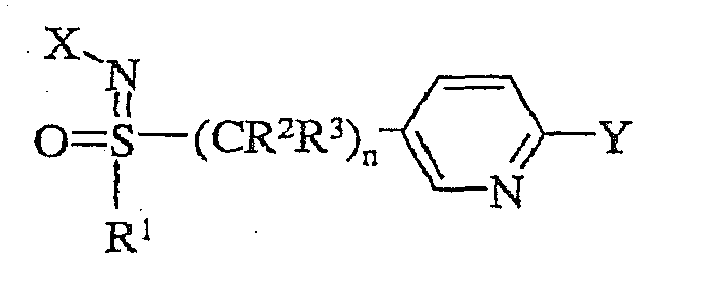
- X represents NO2, CN or COOR4;
- Y represents (C1-C4) haloalkyl
- R1 represents (C1-C4) alkyl;
- R2 and R3 independently represent hydrogen, methyl, ethyl, fluoro, chloro or bromo;
- R4 represents C1-C3 alkyl; and
- n is an integer from 1-3.
- 7. A compound of Item 6 in which X represents NO2 or CN, Y represents CF3, R1 represents methyl or ethyl, R2 and R3 independently represent hydrogen, methyl or ethyl, and n is an integer from 1-3.
- 8. A composition for controlling insects which comprises a compound of any one of Items 1-7 in combination with a phytologically-acceptable carrier.
- 9. A method of controlling insects which comprises applying to a locus where control is desired an insect-inactivating amount of a compound of any one of Items 1-7.
- 10. A process comprising submitting data related to a compound of Item 1 directly to a governmental or regulatory authority or indirectly through another to a governmental or regulatory authority in order to gain approval for the use or sale or both of said compound.'
| Cmpd # | 0.049 ppm | 0.195 ppm | 0.781 ppm | 3.13ppm |
| 1 | A | A | A | A |
| 2 | A | A | A | A |
| 3 | A | A | A | A |
| 4 | A | A | A | A |
| 5 | E | B | A | A |
| 6 | H | H | B | B |
| 7 | F | B | A | A |
| 8 | C | A | A | A |
| 9 | H | H | E | A |
| 10 | H | H | D | C |
| 11 | D | D | A | A |
| 12 | H | H | A | A |
| Comp # | % Control at ppm, foliar spray | ||
| 0.781 ppm | 3.125 ppm | 12.500 ppm | |
| 2 | 80 | 94 | 100 |
Claims (15)
- A composition comprising a compound of the formula (I)
 X represents NO2, CN or COOR4;L represents a single bond or R1, S and L taken together represents a 4-, 5- or 6-membered ring;R1 represents (C1-C4) alkyl;R2 and R3 independently represent hydrogen, (C1-C4) alkyl, fluoro, chloro or bromo;n is an integer from 0-3;Y represents (C1-C4) haloalkyl; andR4 represents (C1-C3) alkyl,and one or more other insecticides or fungicides or herbicides.
 - The composition of claim 1 in which X represents NO2 or CN and/or in which Y represents -CF3 and/or in which R2 and R3 independently represent hydrogen, methyl or ethyl.
- The composition of claim 1 wherein the compound of formula (I) has the formula
 X represents NO2, CN or COOR4;Y represents (C1-C4) haloalkyl andR4 represents C1-C3 alkyl.
 - The composition of claim 1, wherein the compound of formula (I) has the formula
 X represents NO2, CN or COOR4Y represents (C1-C4) haloalkylR1 represents C1-C4 alkyl;R2 and R3 independently represent hydrogen, methyl, ethyl, fluoro, chloro or bromo;R4 represents C1-C3 alkyl; andn is an integer from 1-3.
 - The composition of claim 4 in which X represents NO2 or CN, Y represents CF3, R1 represents methyl or ethyl, R2 and R3 independently represent hydrogen, methyl or ethyl, and n is an integer from 1-3.
- The composition of claim 1, wherein the compound of formula (I) is selected from the group consisting of:


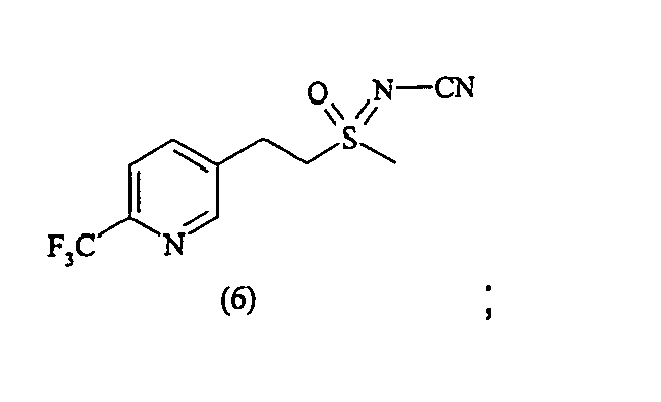


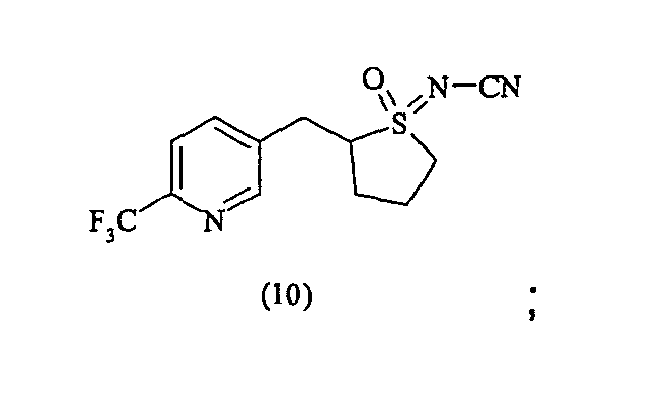


- The composition of claim 1, wherein the compound of formula (I) is

- The composition according to claim 1 comprising:
 (b) one or more compounds selected from antibiotic insecticides, macrocyclic lactone insecticides, avermectin insecticides, milbemycin insecticides, arsenical insecticides, biological insecticides, botanical insecticides, carbamate insecticides, benzofuranyl methylcarbamate insecticides, dimethylcarbamate insecticides, oxime carbamate insecticides, phenyl methylcarbamate insecticides, dinitrophenol insecticides, fluorine insecticides, formamidine insecticides, fumigant insecticides, inorganic insecticides, chitin synthesis inhibitors, juvenile hormone mimics, moulting hormone agonists, moulting hormones, moulting inhibitors, precocenes, nereistoxin analogue insecticides, nicotinoid insecticides, nitroguanidine insecticides nitromethylene insecticides, pyridylmethylamine insecticides, organochlorine insecticides, cyclodiene insecticides, organophosphate insecticides, organothiophosphate insecticides, aliphatic organothiophosphate insecticides, aliphatic amide organothiophosphate insecticides, oxime organothiophosphate insecticides, heterocyclic organothiophosphate insecticides, benzothiopyran organothiophosphate insecticides, benzotriazine organothiophosphate insecticides, isoindole organothiophosphate insecticides, isoxazole organothiophosphate insecticides, pyrazolopyrimidine organothiophosphate insecticides, pyridine organothiophosphate insecticides, pyrimidine organothiophosphate insecticides, quinoxaline organothiophosphate insecticides, thiadiazole organothiophosphate insecticides, triazole organothiophosphate insecticides, phenyl organothiophosphate insecticides, phosphonate insecticides, phosphonothioate insecticides, phenyl ethylphosphonothioate insecticides, phenyl phenylphosphonothioate insecticides, phosphoramidate insecticides, phosphoramidothioate insecticides, phosphorodiamide insecticides, oxadiazine insecticides, phthalimide insecticides, pyrazole insecticides, pyrethroid ester insecticides, pyrethroid ether insecticides, pyrimidinamine insecticides, pyrrole insecticides, tetronic acid insecticides, thiourea insecticides, and urea insecticides.
 - The composition according to claim 1 comprising:
 (b) one or more compounds selected from allosamidin, thuringiensin, spinosad, spinetoram, abamectin, doramectin, emamectin, eprinomectin, ivermectin, selamectin, lepimectin, milbemectin, milbemycin oxime, moxidectin, calcium arsenate, copper acetoarsenite, copper arsenate, lead arsenate, potassium arsenite, sodium arsenite, anabasine, azadirachtin, d-limonene, nicotine, pyrethrins, cinerins, cinerin I, cinerin II, jasmolin I, jasmolin II, pyrethrin I, pyrethrin II, quassia, rotenone, ryania, sabadilla, bendiocarb, carbaryl, benfuracarb, carbofuran, carbosulfan, decarbofuran, furathiocarb, dimitan, dimetilan, hyquincarb, pirimicarb, alanycarb, aldicarb, aldoxycarb, butocarboxim, butoxycarboxim, methomyl, nitrilacarb, oxamyl, tazimcarb, thiocarboxime, thiodicarb, thiofanox, allyxycarb, aminocarb, bufencarb, butacarb, carbanolate, cloethocarb, dicresyl, dioxacarb, EMPC, ethiofencarb, fenethacarb, fenobucarb, isoprocarb, methiocarb, metolcarb, mexacarbate, promacyl, promecarb, propoxur, trimethacarb, XMC, xylylcarb, dinex, dinoprop, dinosam, DNOC, barium hexafluorosilicate, cryolite, sodium fluoride, sodium hexafluorosilicate, sulfluramid, amitraz, chlordimeform, formetanate, formparanate, acrylonitrile, carbon disulfide, carbon tetrachloride, chloroform, chloropicrin, para-dichlorobenzene, 1, 2-dichloropropane, ethyl formate, ethylene dibromide, ethylene dichloride, ethylene oxide, hydrogen cyanide, iodomethane, methyl bromide, methylchloroform, methylene chloride, naphthalene, phosphine, sulfuryl fluoride, tetrachloroethane, borax, calcium polysulfide, copper oleate, mercurous chloride, potassium thiocyanate, sodium thiocyanate, bistrifluron, buprofezin, chlorfluazuron, cyromazine, diflubenzuron, flucycloxuron, flufenoxuron, hexaflumuron, lufenuron, novaluron, noviflumuron, penfluron, teflubenzuron, triflumuron, epofenonane, fenoxycarb, hydroprene, kinoprene, methoprene, pyriproxyfen, triprene, juvenile hormone I, juvenile hormone II, juvenile hormone III, chromafenozide, halofenozide, methoxyfenozide, tebufenozide, α-ecdysone, ecdysterone, diofenolan, precocene I, precocene II, precocene III, dicyclanil, bensultap, cartap, thiocyclam, thiosultap, flonicamid, clothianidin, dinotefuran, imidacloprid, thiamethoxam, nitenpyram, nithiazine, acetamiprid, thiacloprid, bromo-DDT, camphechlor, DDT, pp'-DDT, ethyl-DDD, HCH, gamma-HCH, lindane, methoxychlor, pentachlorophenol, TDE, aldrin, bromocyclen, chlorbicyclen, chlordane, chlordecone, dieldrin, dilor, endosulfan, endrin, HEOD, heptachlor, HHDN, isobenzan, isodrin, kelevan, mirex, bromfenvinfos, chlorfenvinphos, crotoxyphos, dichlorvos, dicrotophos, dimethylvinphos, fospirate, heptenophos, methocrotophos, mevinphos, monocrotophos, naled, naftalofos, phosphamidon, propaphos, TEPP, tetrachlorvinphos, dioxabenzofos, fosmethilan, phenthoate, acethion, amiton, cadusafos, chlorethoxyfos, chlormephos, demephion, demephion-O, demephion-S, demeton, demeton-O, demeton-S, demeton-methyl, demeton-O-methyl, demeton-S-methyl, demeton-S-methylsulphon, disulfoton, ethion, ethoprophos, IPSP, isothioate, malathion, methacrifos, oxydemeton-methyl, oxydeprofos, oxydisulfoton, phorate, sulfotep, terbufos, thiometon, amidithion, cyanthoate, dimethoate, ethoate-methyl, formothion, mecarbam, omethoate, prothoate, sophamide, vamidothion, chlorphoxim, phoxim, phoxim-methyl, azamethiphos, coumaphos, coumithoate, dioxathion, endothion, menazon, morphothion, phosalone, pyraclofos, pyridaphenthion, quinothion, dithicrofos, thicrofos, azinphos-ethyl, azinphos-methyl, dialifos, phosmet, isoxathion, zolaprofos, chlorprazophos, pyrazophos, chlorpyrifos, chlorpyrifos-methyl, butathiofos, diazinon, etrimfos, lirimfos, pirimiphos-ethyl, pirimiphos-methyl, primidophos, pyrimitate, tebupirimfos, quinalphos, quinalphos-methyl, athidathion, lythidathion, methidathion, prothidathion, isazofos, triazophos, azothoate, bromophos, bromophos-ethyl, carbophenothion, chlorthiophos, cyanophos, cythioate, dicapthon, dichlofenthion, etaphos, famphur, fenchlorphos, fenitrothion fensulfothion, fenthion, fenthion-ethyl, heterophos, jodfenphos, mesulfenfos, parathion, parathion-methyl, phenkapton, phosnichlor, profenofos, prothiofos, sulprofos, temephos, trichlormetaphos-3, trifenofos, butonate, trichlorfon, mecarphon, fonofos, trichloronat, cyanofenphos, EPN, leptophos, crufomate, fenamiphos, fosthietan, mephosfolan, phosfolan, pirimetaphos, acephate, isocarbophos, isofenphos, methamidophos, propetamphos, dimefox, mazidox, mipafox, schradan, indoxacarb, tetramethrin, acetoprole, ethiprole, fipronil, pyrafluprole, pyriprole, tebufenpyrad, tolfenpyrad, vaniliprole, acrinathrin, allethrin, bioallethrin, barthrin, bifenthrin, bioethanomethrin, cyclethrin, cycloprothrin, cyfluthrin, beta-cyfluthrin, cyhalothrin, gamma-cyhalothrin, lambda-cyhalothrin, cypermethrin, alpha-cypermethrin, beta-cypermethrin, theta-cypermethrin, zeta-cypermethrin, cyphenothrin, deltamethrin, dimefluthrin, dimethrin, empenthrin, fenfluthrin, fenpirithrin, fenpropathrin, fenvalerate, esfenvalerate, flucythrinate, fluvalinate, tau-fluvalinate, furethrin, imiprothrin, metofluthrin, permethrin, biopermethrin, transpermethrin, phenothrin, prallethrin, profluthrin, pyresmethrin, resmethrin, bioresmethrin, cismethrin, tefluthrin, terallethrin, tetramethrin, tralomethrin, transfluthrin, etofenprox, flufenprox, halfenprox, protrifenbute, silafluofen, flufenerim, pyrimidifen, chlorfenapyr, spirodiclofen, spiromesifen, spirotetramat, diafenthiuron, flucofuron, sulcofuron, AKD-3088, closantel, crotamiton, cyflumetofen, E2Y45, EXD, fenazaflor, fenazaquin, fenoxacrim, fenpyroximate, FKI-1033, flubendiamide, HGW86, hydramethylnon, IKI-2002, isoprothiolane, malonoben, metaflumizone, metoxadiazone, nifluridide, NNI-9850, NNI-0101, pymetrozine, pyridaben, pyridalyl, Qcide, rafoxanide, rynaxypyr, SYJ-159, triarathene, and triazamate.
 - The composition according to claim 1, comprising a compound of formula (I) and methoxyfenozide, spinosad, spinetoram, imidacloprid, acetamiprid, thiamethoxam, thiacloprid, dinotefuran, bifenthrin and/or clothianidin.
- A composition comprising a compound of the formula (I)
 X represents NO2, CN or COOR4;L represents a single bond or R1, S and L taken together represents a 4-, 5- or 6-membered ring;R1 represents (C1-C4) alkyl;R2 and R3 independently represent hydrogen, (C1-C4) alkyl, fluoro, chloro or bromo;n is an integer from 0-3;Y represents (C1-C4) haloalkyl; andR4 represents (C1-C3) alkyl.
 - A composition comprising a compound of the formula (I)
 X represents NO2, CN or COOR4;L represents a single bond or R1, S and L taken together represents a 4-, 5- or 6-membered ring;R2 represents (C1-C4) alkyl;R2 and R3 independently represent hydrogen, (C1-C4) alkyl, fluoro, chloro or bromo;n is an integer from 0-3;Y represents (C1-C4) haloalkyl; andR4 represents (C1-C3) alkyl,and one or more other insecticides or fungicides or herbicides.
 - A composition comprising a compound of the formula (I)
 X represents NO2, CN or COOR4;L represents a single bond or R1, S and L taken together represents a 4-, 5- or 6-membered ring;R1 represents (C1-C4) alkyl;R2 and R3 independently represent hydrogen, (C1-C4) alkyl, fluoro, chloro or bromo;n is an integer from 0-3;Y represents (C1-C4) haloalkyl; andR4 represents (C1-C3) alkyl,and a seed.
 - A composition according to claim 12 comprising:
 (b) one or more compounds selected from antibiotic insecticides, macrocyclic lactone insecticides, avermectin insecticides, milbemycin insecticides, arsenical insecticides, biological insecticides, botanical insecticides, carbamate insecticides, benzofuranyl methylcarbamate insecticides, dimethylcarbamate insecticides, oxime carbamate insecticides, phenyl methylcarbamate insecticides, dinitrophenol insecticides, fluorine insecticides, formamidine insecticides, fumigant insecticides, inorganic insecticides, chitin synthesis inhibitors, juvenile hormone mimics, moulting hormone agonists, moulting hormones moulting inhibitors, precocenes, nereistoxin analogue insecticides, nicotinoid insecticides, nitroguanidine insecticides, nitromethylene insecticides, pyridylmethylamine insecticides, organochlorine insecticides, cyclodiene insecticides, organophosphate insecticides, organothiophosphate insecticides, aliphatic organothiophosphate insecticides, aliphatic amide organothiophosphate insecticides, oxime organothiophosphate insecticides, heterocyclic organothiophosphate insecticides, benzothiopyran organothiophosphate insecticides, benzotriazine organothiophosphate insecticides, isoindole organothiophosphate insecticides, isoxazole organothiophosphate insecticides, pyrazolopyrimidine organothiophosphate insecticides, pyridine organothiophosphate insecticides, pyrimidine organothiophosphate insecticides, quinoxaline organothiophosphate insecticides, thiadiazole organothiophosphate insecticides, triazole organothiophosphate insecticides, phenyl organothiophosphate insecticides, phosphonate insecticides, phosphonothioate insecticides, phenyl ethylphosphonothioate insecticides, phenyl phenylphosphonothioate insecticides, phosphoramidate insecticides, phosphoramidothioate insecticides, phosphorodiamide insecticides, oxadiazine insecticides, phthalimide insecticides, pyrazole insecticides, pyrethroid ester insecticides, pyrethroid ether insecticides, pyrimidinamine insecticides, pyrrole insecticides, tetronic acid insecticides, thiourea insecticides, and urea insecticides.
 - A composition according to claim 12 comprising:
 (b) one or more compounds selected from allosamidin, thuringiensin, spinosad, spinetoram, abamectin, doramectin, emamectin, eprinomectin, ivermectin, selamectin, lepimectin, milbemectin, milbemycin oxime, moxidectin, calcium arsenate, copper acetoarsenite, copper arsenate, lead arsenate, potassium arsenite, sodium arsenite, anabasine, azadirachtin, d-limonene, nicotine, pyrethrins, cinerins, cinerin I, cinerin II, jasmolin I, jasmolin II, pyrethrin I, pyrethrin II, quassia, rotenone, ryania, sabadilla, bendiocarb, carbaryl, benfuracarb, carbofuran, carbosulfan, decarbofuran, furathiocarb, dimitan, dimetilan, hyquincarb, pirimicarb, alanycarb, aldicarb, aldoxycarb, butocarboxim, butoxycarboxim, methomyl, nitrilacarb, oxamyl, tazimcarb, thiocarboxime, thiodicarb, thiofanox, allyxycarb, aminocarb, bufencarb, butacarb, carbanolate, cloethocarb, dicresyl, dioxacarb, EMPC, ethiofencarb, fenethacarb, fenobucarb, isoprocarb, methiocarb, metolcarb, mexacarbate, promacyl, promecarb, propoxur, trimethacarb, XMC, xylylcarb, dinex, dinoprop, dinosam, DNOC, barium hexafluorosilicate, cryolite, sodium fluoride, sodium hexafluorosilicate, sulfluramid, amitraz, chlordimeform, formetanate, formparanate, acrylonitrile, carbon disulfide, carbon tetrachloride, chloroform, chloropicrin, para-dichlorobenzene, 1, 2-dichloropropane, ethyl formate, ethylene dibromide, ethylene dichloride, ethylene oxide, hydrogen cyanide, iodomethane, methyl bromide, methylchloroform, methylene chloride, naphthalene, phosphine, sulfuryl fluoride, tetrachloroethane, borax, calcium polysulfide, copper oleate, mercurous chloride, potassium thiocyanate, sodium thiocyanate, bistrifluron, buprofezin, chlorfluazuron, cyromazine, diflubenzuron, flucycloxuron, flufenoxuron, hexaflumuron, lufenuron, novaluron, noviflumuron, penfluron, teflubenzuron, triflumuron, epofenonane, fenoxycarb, hydroprene, kinoprene, methoprene, pyriproxyfen, triprene, juvenile hormone I, juvenile hormone II, juvenile hormone III, chromafenozide, halofenozide, methoxyfenozide, tebufenozide, α-ecdysone, ecdysterone, diofenolan, precocene I, precocene II, precocene III, dicyclanil, bensultap, cartap, thiocyclam, thiosultap, flonicamid, clothianidin, dinotefuran, imidacloprid, thiamethoxam, nitenpyram, nithiazine, acetamiprid, thiacloprid, bromo-DDT, camphechlor, DDT, pp'-DDT, ethyl-DDD, HCH, gamma-HCH, lindane, methoxychlor, pentachlorophenol, TDE, aldrin, bromocyclen, chlorbicyclen, chlordane, chlordecone, dieldrin, dilor, endosulfan, endrin, HEOD, heptachlor, HHDN, isobenzan, isodrin, kelevan, mirex, bromfenvinfos, chlorfenvinphos, crotoxyphos, dichlorvos, dicrotophos, dimethylvinphos, fospirate, heptenophos, methocrotophos, mevinphos, monocrotophos, naled, naftalofos, phosphamidon, propaphos, TEPP, tetrachlorvinphos, dioxabenzofos, fosmethilan, phenthoate, acethion, amiton, cadusafos, chlorethoxyfos, chlormephos, demephion, demephion-O, demephion-S, demeton, demeton-O, demeton-S, demeton-methyl, demeton-O-methyl, demeton-S-methyl, demeton-S-methylsulphon, disulfoton, ethion, ethoprophos, IPSP, isothioate, malathion, methacrifos, oxydemeton-methyl, oxydeprofos, oxydisulfoton, phorate, sulfotep, terbufos, thiometon, amidithion, cyanthoate, dimethoate, ethoate-methyl, formothion, mecarbam, omethoate, prothoate, sophamide, vamidothion, chlorphoxim, phoxim, phoxim-methyl, azamethiphos, coumaphos, coumithoate, dioxathion, endothion, menazon, morphothion, phosalone, pyraclofos, pyridaphenthion, quinothion, dithicrofos, thicrofos, azinphos-ethyl, azinphos-methyl, dialifos, phosmet, isoxathion, zolaprofos, chlorprazophos, pyrazophos, chlorpyrifos, chlorpyrifos-methyl, butathiofos, diazinon, etrimfos, lirimfos, pirimiphos-ethyl, pirimiphos-methyl, primidophos, pyrimitate, tebupirimfos, quinalphos, quinalphos-methyl, athidathion, lythidathion, methidathion, prothidathion, isazofos, triazophos, azothoate, bromophos, bromophos-ethyl, carbophenothion, chlorthiophos, cyanophos, cythioate, dicapthon, dichlofenthion, etaphos, famphur, fenchlorphos, fenitrothion fensulfothion, fenthion, fenthion-ethyl, heterophos, jodfenphos, mesulfenfos, parathion, parathion-methyl, phenkapton, phosnichlor, profenofos, prothiofos, sulprofos, temephos, trichlormetaphos-3, trifenofos, butonate, trichlorfon, mecarphon, fonofos, trichloronat, cyanofenphos, EPN, leptophos, crufomate, fenamiphos, fosthietan, mephosfolan, phosfolan, pirimetaphos, acephate, isocarbophos, isofenphos, methamidophos, propetamphos, dimefox, mazidox, mipafox, schradan, indoxacarb, tetramethrin, acetoprole, ethiprole, fipronil, pyrafluprole, pyriprole, tebufenpyrad, tolfenpyrad, vaniliprole, acrinathrin, allethrin, bioallethrin, barthrin, bifenthrin, bioethanomethrin, cyclethrin, cycloprothrin, cyfluthrin, beta-cyfluthrin, cyhalothrin, gamma-cyhalothrin, lambda-cyhalothrin, cypermethrin, alpha-cypermethrin, beta-cypermethrin, theta-cypermethrin, zeta-cypermethrin, cyphenothrin, deltamethrin, dimefluthrin, dimethrin, empenthrin, fenfluthrin, fenpirithrin, fenpropathrin, fenvalerate, esfenvalerate, flucythrinate, fluvalinate, tau-fluvalinate, furethrin, imiprothrin, metofluthrin, permethrin, biopermethrin, transpermethrin, phenothrin, prallethrin, profluthrin, pyresmethrin, resmethrin, bioresmethrin, cismethrin, tefluthrin, terallethrin, tetramethrin, tralomethrin, transfluthrin, etofenprox, flufenprox, halfenprox, protrifenbute, silafluofen, flufenerim, pyrimidifen, chlorfenapyr, spirodiclofen, spiromesifen, spirotetramat, diafenthiuron, flucofuron, sulcofuron, AKD-3088, closantel, crotamiton, cyflumetofen, E2Y45, EXD, fenazaflor, fenazaquin, fenoxacrim, fenpyroximate, FKI-1033, flubendiamide, HGW86, hydramethylnon, IKI-2002, isoprothiolane, malonoben, metaflumizone, metoxadiazone, nifluridide, NNI-9850, NNI-0101, pymetrozine, pyridaben, pyridalyl, Qcide, rafoxanide, rynaxypyr, SYJ-159, triarathene, and triazamate.
Priority Applications (1)
| Application Number | Priority Date | Filing Date | Title |
|---|---|---|---|
| EP20100192786 EP2351740B1 (en) | 2006-02-10 | 2007-02-09 | Insecticidal composition comprising N-substituted (6-haloalkylpyridin-3-yl)alkyl sulfoximines |
Applications Claiming Priority (3)
| Application Number | Priority Date | Filing Date | Title |
|---|---|---|---|
| US77210806P | 2006-02-10 | 2006-02-10 | |
| US83604406P | 2006-08-07 | 2006-08-07 | |
| EP20100192786 EP2351740B1 (en) | 2006-02-10 | 2007-02-09 | Insecticidal composition comprising N-substituted (6-haloalkylpyridin-3-yl)alkyl sulfoximines |
Related Parent Applications (1)
| Application Number | Title | Priority Date | Filing Date |
|---|---|---|---|
| EP07750608.7 Division | 2007-02-09 |
Publications (2)
| Publication Number | Publication Date |
|---|---|
| EP2351740A1 true EP2351740A1 (en) | 2011-08-03 |
| EP2351740B1 EP2351740B1 (en) | 2013-04-24 |
Family
ID=38372084
Family Applications (2)
| Application Number | Title | Priority Date | Filing Date |
|---|---|---|---|
| EP20100192786 Active EP2351740B1 (en) | 2006-02-10 | 2007-02-09 | Insecticidal composition comprising N-substituted (6-haloalkylpyridin-3-yl)alkyl sulfoximines |
| EP20070750608 Active EP1989184B1 (en) | 2006-02-10 | 2007-02-09 | Insecticidal n-substituted (6-haloalkylpyridin-3-yl)alkyl sulfoximines |
Family Applications After (1)
| Application Number | Title | Priority Date | Filing Date |
|---|---|---|---|
| EP20070750608 Active EP1989184B1 (en) | 2006-02-10 | 2007-02-09 | Insecticidal n-substituted (6-haloalkylpyridin-3-yl)alkyl sulfoximines |
Country Status (17)
| Country | Link |
|---|---|
| US (10) | US7687634B2 (en) |
| EP (2) | EP2351740B1 (en) |
| JP (2) | JP4975046B2 (en) |
| KR (1) | KR101364430B1 (en) |
| CN (2) | CN102153506B (en) |
| AR (1) | AR059437A1 (en) |
| AT (1) | ATE515497T1 (en) |
| AU (1) | AU2007215167B2 (en) |
| BR (1) | BRPI0707633B8 (en) |
| CA (1) | CA2639911C (en) |
| CL (1) | CL2007000353A1 (en) |
| ES (2) | ES2415511T3 (en) |
| NZ (1) | NZ569786A (en) |
| TW (2) | TW201309635A (en) |
| UY (1) | UY30140A1 (en) |
| WO (1) | WO2007095229A2 (en) |
| ZA (1) | ZA200806317B (en) |
Families Citing this family (175)
| Publication number | Priority date | Publication date | Assignee | Title |
|---|---|---|---|---|
| CN101648906B (en) * | 2004-04-08 | 2012-07-11 | 美国陶氏益农公司 | N-substituted sulfenimides for insecticide |
| TW201309635A (en) | 2006-02-10 | 2013-03-01 | Dow Agrosciences Llc | Insecticidal N-substituted (6-haloalkylpyridin-3-yl)alkyl sulfoximines |
| TWI381811B (en) | 2006-06-23 | 2013-01-11 | Dow Agrosciences Llc | A method to control insects resistant to common insecticides |
| TWI383973B (en) * | 2006-08-07 | 2013-02-01 | Dow Agrosciences Llc | Process for the preparation of 2-substituted-5-(1-alkylthio)alkylpyridines |
| TWI387585B (en) * | 2006-09-01 | 2013-03-01 | Dow Agrosciences Llc | Insecticidal n-substituted (heteroaryl)alkyl sulfilimines |
| US7863303B2 (en) * | 2006-09-01 | 2011-01-04 | Dow Agrosciences Llc | Insecticidal N-substituted (2-substituted-1,3-thiazol)alkyl sulfoximines |
| TWI409256B (en) * | 2006-09-01 | 2013-09-21 | Dow Agrosciences Llc | Insecticidal n-substituted (heteroaryl)cycloalkyl sulfoximines |
| TWI395736B (en) * | 2006-11-08 | 2013-05-11 | Dow Agrosciences Llc | Heteroaryl (substituted) alkyl n-substituted sulfoximines as insecticides |
| TWI383970B (en) * | 2006-11-08 | 2013-02-01 | Dow Agrosciences Llc | Multi-substituted pyridyl sulfoximines and their use as insecticides |
| CN102702082B (en) * | 2006-11-30 | 2014-12-17 | 陶氏益农公司 | Process for the preparation of 2-substituted-5-(1-alkylthio) alkylpyridines |
| US7709648B2 (en) * | 2007-02-09 | 2010-05-04 | Dow Agrosciences Llc | Process for the preparation of 2-substituted-5-(1-alkylthio)alkylpyridines |
| CN101605760B (en) * | 2007-02-09 | 2012-06-20 | 陶氏益农公司 | Process for the oxidation of certain substituted sulfilimines to insecticidal sulfoximines |
| ZA200905012B (en) * | 2007-02-26 | 2010-10-27 | Dow Agrosciences Llc | Process for the preparation of certain substituted sulfimines |
| EP2114163B1 (en) * | 2007-04-12 | 2017-05-10 | Basf Se | Pesticidal mixtures comprising a cyanosulfoximine compound |
| DE102007018452A1 (en) | 2007-04-17 | 2008-10-23 | Bayer Cropscience Ag | Method for improved utilization of the production potential of transgenic plants |
| AR066366A1 (en) * | 2007-05-01 | 2009-08-12 | Dow Agrosciences Llc | PESTICIDED SYNERGIC BLENDS |
| JP5345616B2 (en) | 2007-07-20 | 2013-11-20 | バイエル・イノヴェイション・ゲゼルシャフト・ミット・ベシュレンクテル・ハフツング | Polymer composite material with biocide functionality |
| PT2170602E (en) | 2007-07-20 | 2012-01-16 | Bayer Innovation Gmbh | COMPOSITE POLYMER FILM WITH BARRIER FUNCTIONALITY |
| US8383549B2 (en) | 2007-07-20 | 2013-02-26 | Bayer Cropscience Lp | Methods of increasing crop yield and controlling the growth of weeds using a polymer composite film |
| US20090023782A1 (en) * | 2007-07-20 | 2009-01-22 | Dow Agrosciences Llc | Increasing plant vigor |
| BRPI0814599A2 (en) | 2007-07-27 | 2014-09-30 | Dow Agrosciences Llc | PESTICIDES AND USES THEREOF |
| AU2008282378A1 (en) * | 2007-07-30 | 2009-02-05 | E. I. Du Pont De Nemours And Company | Flea control method |
| CN101909448A (en) * | 2007-11-16 | 2010-12-08 | 巴斯夫欧洲公司 | Pesticidal mixtures comprising cyanosulfoximine compounds |
| KR20100127255A (en) * | 2008-03-03 | 2010-12-03 | 다우 아그로사이언시즈 엘엘씨 | Pesticide |
| AR071832A1 (en) | 2008-04-07 | 2010-07-21 | Bayer Cropscience Ag | COMBINATIONS OF BIOLOGICAL CONTROL AGENTS AND INSECTICIDES OR FUNGICIDES |
| MX2009011860A (en) * | 2008-05-01 | 2009-12-18 | Dow Agrosciences Llc | Synergistic pesticidal mixtures. |
| JP5553824B2 (en) * | 2008-05-07 | 2014-07-16 | バイエル・クロップサイエンス・アーゲー | Synergistic active ingredient combination |
| EP2127522A1 (en) | 2008-05-29 | 2009-12-02 | Bayer CropScience AG | Active-agent combinations with insecticidal and acaricidal properties |
| KR20110025869A (en) * | 2008-07-01 | 2011-03-11 | 다우 아그로사이언시즈 엘엘씨 | Improved process for preparing 2-trifluoromethyl-5- (1-substituted) alkylpyridine |
| MX2011001661A (en) * | 2008-08-12 | 2011-04-11 | Dowagrosciences Llc | Synergistic pesticidal compositions comprising an active compound, an ammonium salt, and a nonionic surfactant. |
| BRPI0917511B8 (en) | 2008-08-19 | 2022-10-11 | Dow Agrosciences Llc | PROCESS FOR PREPARATION OF ALDEHYDES, KETONES, ESTERS AND SULFONES SUBSTITUTED WITH ALKYLTIO |
| EP2328413B1 (en) * | 2008-08-27 | 2017-03-15 | Dow AgroSciences LLC | Pesticidal compositions comprising n-substituted sulfoximines |
| DE102008041695A1 (en) | 2008-08-29 | 2010-03-04 | Bayer Cropscience Ag | Methods for improving plant growth |
| US20110319262A1 (en) * | 2008-10-08 | 2011-12-29 | Syngenta Crop Protection, Llc | Pesticidal combinations containing sulfoxaflor |
| WO2010069495A1 (en) * | 2008-12-18 | 2010-06-24 | Bayer Cropscience Aktiengesellschaft | Atpenins |
| DE102008063561A1 (en) | 2008-12-18 | 2010-08-19 | Bayer Cropscience Ag | Hydrazides, process for their preparation and their use as herbicides and insecticides |
| AR075494A1 (en) | 2008-12-26 | 2011-04-06 | Dow Agrosciences Llc | STABLE INSECTICIDE COMPOSITIONS AND METHODS TO PRODUCE |
| UA106363C2 (en) * | 2008-12-26 | 2014-08-26 | ДАУ АГРОСАЙЕНСИЗ, ЭлЭлСи | Stable insecticidal compositions on the basis of sulfoximine |
| EP2223602A1 (en) * | 2009-02-23 | 2010-09-01 | Bayer CropScience AG | Method for improved utilisation of the production potential of genetically modified plants |
| EP2201841A1 (en) | 2008-12-29 | 2010-06-30 | Bayer CropScience AG | Synergistic insecticidal mixtures |
| CN102333445B (en) * | 2008-12-29 | 2014-09-03 | 拜尔农作物科学股份公司 | Improved method for harnessing the production potential of transgenic plants |
| EP2204094A1 (en) | 2008-12-29 | 2010-07-07 | Bayer CropScience AG | Method for improved utilization of the production potential of transgenic plants Introduction |
| EP2039770A2 (en) | 2009-01-06 | 2009-03-25 | Bayer CropScience AG | Method for improved utilization of the production potential of transgenic plants |
| EP2039772A2 (en) | 2009-01-06 | 2009-03-25 | Bayer CropScience AG | Method for improved utilization of the production potential of transgenic plants introduction |
| EP2039771A2 (en) | 2009-01-06 | 2009-03-25 | Bayer CropScience AG | Method for improved utilization of the production potential of transgenic plants |
| EP2227951A1 (en) | 2009-01-23 | 2010-09-15 | Bayer CropScience AG | Application of enaminocarbonyl compounds for combating viruses transmitted by insects |
| AR075126A1 (en) | 2009-01-29 | 2011-03-09 | Bayer Cropscience Ag | METHOD FOR THE BEST USE OF THE TRANSGENIC PLANTS PRODUCTION POTENTIAL |
| TW201031331A (en) | 2009-02-19 | 2010-09-01 | Bayer Cropscience Ag | Pesticide composition comprising a tetrazolyloxime derivative and a fungicide or an insecticide active substance |
| EP2223598A1 (en) * | 2009-02-23 | 2010-09-01 | Bayer CropScience AG | Insecticidal compounds with improved effect |
| EP2232995A1 (en) | 2009-03-25 | 2010-09-29 | Bayer CropScience AG | Method for improved utilisation of the production potential of transgenic plants |
| PL2564698T3 (en) * | 2009-03-25 | 2017-08-31 | Bayer Cropscience Ag | Nematicidal agent combinations comprising Fluopyram and Bacillus firmus |
| EP2239331A1 (en) | 2009-04-07 | 2010-10-13 | Bayer CropScience AG | Method for improved utilization of the production potential of transgenic plants |
| AR076224A1 (en) | 2009-04-22 | 2011-05-26 | Bayer Cropscience Ag | USE OF PROPINEB AS A BIRD REPELLENT |
| US20100322892A1 (en) * | 2009-04-28 | 2010-12-23 | Basf Corporation | Pesticide compositions and applicators |
| EA022081B1 (en) * | 2009-04-28 | 2015-10-30 | Басф Корпорейшн | FOAM FORMULATING PESTICIDE COMPOSITIONS |
| EP2264008A1 (en) | 2009-06-18 | 2010-12-22 | Bayer CropScience AG | Substituted enaminocarbonyl compounds |
| EP2269455A1 (en) | 2009-06-24 | 2011-01-05 | Bayer CropScience AG | Combinations of biological control agents and insecticides |
| JP2011042643A (en) | 2009-07-24 | 2011-03-03 | Bayer Cropscience Ag | Insecticidal carboxamides |
| ES2559012T3 (en) | 2009-08-20 | 2016-02-10 | Bayer Intellectual Property Gmbh | 3- [1- (3-haloalkyl) -triazolyl] -phenyl sulfide derivatives as acaricides and insecticides |
| CN102471291B (en) | 2009-08-20 | 2015-04-22 | 拜尔农作物科学股份公司 | 3-triazolylphenyl-substituted sulfide derivatives for use as acaricides and insecticides |
| KR20120061931A (en) | 2009-08-28 | 2012-06-13 | 바스프 코포레이션 | Foamable pesticide compositions and methods of application |
| JP5823398B2 (en) | 2009-10-12 | 2015-11-25 | バイエル・インテレクチュアル・プロパティ・ゲゼルシャフト・ミット・ベシュレンクテル・ハフツングBayer Intellectual Property GmbH | Novel amides and thioamides as pesticides |
| CN102573478B (en) | 2009-10-12 | 2015-12-16 | 拜尔农作物科学股份公司 | 1-(Pyridin-3-yl)-pyrazoles and 1-(pyrimidin-5-yl)-pyrazoles as insecticides |
| CN102741244A (en) | 2009-10-26 | 2012-10-17 | 拜耳作物科学公司 | Novel solid form of 4-[[(6-chloropyridin-3-yl)methyl](2,2-difluoroethyl)amino]furan-2(5h)-one |
| UY32940A (en) | 2009-10-27 | 2011-05-31 | Bayer Cropscience Ag | AMIDAS REPLACED WITH HALOGENO RENT AS INSECTICIDES AND ACARICIDES |
| JP2011093855A (en) | 2009-10-30 | 2011-05-12 | Bayer Cropscience Ag | Insecticidal oxazolidinone derivative |
| AR079609A1 (en) | 2009-11-17 | 2012-02-08 | Bayer Cropscience Ag | COMBINATIONS OF ACTIVE COMPOUNDS |
| WO2011080044A2 (en) | 2009-12-16 | 2011-07-07 | Bayer Cropscience Ag | Active compound combinations |
| WO2011076724A2 (en) | 2009-12-23 | 2011-06-30 | Bayer Cropscience Ag | Pesticidal compound mixtures |
| WO2011076726A2 (en) | 2009-12-23 | 2011-06-30 | Bayer Cropscience Ag | Pesticidal compound mixtures |
| WO2011076727A2 (en) | 2009-12-23 | 2011-06-30 | Bayer Cropscience Ag | Pesticidal compound mixtures |
| JP2011136928A (en) | 2009-12-28 | 2011-07-14 | Bayer Cropscience Ag | Insecticidal arylpyrrolidines |
| WO2011092147A1 (en) | 2010-01-29 | 2011-08-04 | Bayer Cropscience Ag | Method to reduce the frequency and/or intensity of blossom-end rot disorder in horticultural crops |
| EP2534133B1 (en) | 2010-02-10 | 2018-09-05 | Bayer CropScience Aktiengesellschaft | Biphenyl substituted cyclical keto-enols |
| WO2011098443A1 (en) | 2010-02-10 | 2011-08-18 | Bayer Cropscience Ag | Spiroheterocyclical substituted tetramic acid derivatives |
| US8598084B2 (en) | 2010-02-19 | 2013-12-03 | Dow Agrosciences, Llc. | Synergistic herbicide/insecticide composition containing certain pyridine carboxylic acids and certain insecticides |
| TW201139625A (en) | 2010-03-02 | 2011-11-16 | Bayer Cropscience Ag | Use of propineb for physiological curative treatment under zinc deficiency |
| US20110306643A1 (en) | 2010-04-23 | 2011-12-15 | Bayer Cropscience Ag | Triglyceride-containing dormancy sprays |
| JP5782678B2 (en) | 2010-04-27 | 2015-09-24 | 住友化学株式会社 | Pest control composition and use thereof |
| PL2563131T3 (en) | 2010-04-27 | 2017-09-29 | Sumitomo Chemical Company, Limited | Pesticidal composition and its use |
| RU2555405C2 (en) | 2010-04-27 | 2015-07-10 | Сумитомо Кемикал Компани, Лимитед | Pesticidal composition and pest control method |
| JP5712504B2 (en) | 2010-04-27 | 2015-05-07 | 住友化学株式会社 | Pest control composition and use thereof |
| PH12012502031A1 (en) | 2010-04-27 | 2017-06-07 | Sumitomo Chemical Co | Pesticidal composition and its use |
| EP2382865A1 (en) | 2010-04-28 | 2011-11-02 | Bayer CropScience AG | Synergistic active agent compounds |
| JP5724212B2 (en) | 2010-04-28 | 2015-05-27 | 住友化学株式会社 | Plant disease control composition and use thereof |
| WO2011135834A1 (en) | 2010-04-28 | 2011-11-03 | Sumitomo Chemical Company, Limited | Pesticidal composition and its use |
| JP5724210B2 (en) | 2010-04-28 | 2015-05-27 | 住友化学株式会社 | Plant disease control composition and use thereof |
| JP5724211B2 (en) | 2010-04-28 | 2015-05-27 | 住友化学株式会社 | Plant disease control composition and use thereof |
| WO2011135831A1 (en) | 2010-04-28 | 2011-11-03 | Sumitomo Chemical Company, Limited | Pesticidal composition and its use |
| JP5789918B2 (en) | 2010-04-28 | 2015-10-07 | 住友化学株式会社 | Plant disease control composition and use thereof |
| RU2569962C2 (en) | 2010-04-28 | 2015-12-10 | Сумитомо Кемикал Компани, Лимитед | Composition for controlling plant diseases and thereof application |
| CN102858163A (en) | 2010-04-28 | 2013-01-02 | 住友化学株式会社 | Plant disease control composition and use thereof |
| CN201712857U (en) | 2010-05-10 | 2011-01-19 | S.C.约翰逊父子公司 | Diffusing device used for volatile material and casing and diffusing piece thereof |
| EP2582693B1 (en) | 2010-06-15 | 2016-03-30 | Bayer Intellectual Property GmbH | New ortho-substituted arylamide derivatives |
| AR081954A1 (en) | 2010-06-30 | 2012-10-31 | Bayer Cropscience Ag | COMBINATIONS OF ACTIVE COMPOUNDS |
| WO2012001068A2 (en) | 2010-07-02 | 2012-01-05 | Bayer Cropscience Ag | Insecticidal or acaricidal formulations with improved availability on plant surfaces |
| WO2012004293A2 (en) | 2010-07-08 | 2012-01-12 | Bayer Cropscience Ag | Insecticide and fungicide active ingredient combinations |
| JP5926253B2 (en) | 2010-07-09 | 2016-05-25 | バイエル・インテレクチュアル・プロパティ・ゲゼルシャフト・ミット・ベシュレンクテル・ハフツングBayer Intellectual Property GmbH | Anthranilamide derivatives as pesticides |
| CA2805483A1 (en) | 2010-07-16 | 2012-01-19 | Bayer Innovation Gmbh | Polymer composite material with biocide functionality |
| BR112013001477A2 (en) | 2010-07-20 | 2016-05-31 | Bayer Ip Gmbh | gel bait for the control of harmful creeping insects |
| EP2422620A1 (en) | 2010-08-26 | 2012-02-29 | Bayer CropScience AG | Insecticidal combinations comprising ethiprole and pymetrozine |
| WO2012028583A1 (en) | 2010-09-03 | 2012-03-08 | Bayer Cropscience Ag | Formulations comprising deltamethrin |
| EP2460406A1 (en) | 2010-12-01 | 2012-06-06 | Bayer CropScience AG | Use of fluopyram for controlling nematodes in nematode resistant crops |
| BR112013006612A2 (en) | 2010-09-22 | 2017-10-24 | Bayer Ip Gmbh | use of biological or chemical control agents for insect and nematode control in resistant crops |
| PL2624699T3 (en) | 2010-10-07 | 2019-05-31 | Bayer Cropscience Ag | Fungicide composition comprising a tetrazolyloxime derivative and a thiazolylpiperidine derivative |
| CN101946796A (en) * | 2010-10-08 | 2011-01-19 | 青岛海利尔药业有限公司 | Insecticidal composition containing flonicamid and profenofos |
| CN101961030A (en) * | 2010-10-08 | 2011-02-02 | 青岛海利尔药业有限公司 | Insecticidal composite containing sulfoxaflor and phoxim |
| JP2012102077A (en) * | 2010-10-14 | 2012-05-31 | Sumitomo Chemical Co Ltd | Noxious organism-preventing/eliminating composition and noxious organism-preventing/eliminating method |
| EP2446742A1 (en) | 2010-10-28 | 2012-05-02 | Bayer CropScience AG | Insecticide or acaricide compositions containing mono- or disaccharides as activity enhancers |
| RU2620380C2 (en) * | 2010-12-03 | 2017-05-25 | ДАУ АГРОСАЙЕНСИЗ ЭлЭлСи | Methods for enamine production |
| KR20130124330A (en) | 2010-12-03 | 2013-11-13 | 다우 아그로사이언시즈 엘엘씨 | Improved process for the preparation of 2-trifluoromethyl-5-(1-substituted)alkylpyridines |
| BR112013013306A8 (en) * | 2010-12-03 | 2017-10-10 | Dow Agrosciences Llc | PROCESSES FOR THE PREPARATION OF ENAMINS |
| UA112066C2 (en) * | 2010-12-03 | 2016-07-25 | ДАУ АГРОСАЙЄНСІЗ ЕлЕлСі | METHODS OF OBTAINING ENAMINES |
| PH12013501253B1 (en) | 2010-12-17 | 2018-02-07 | Discovery Purchaser Corp | Composition containing insecticide-wax particles |
| FR2968893B1 (en) | 2010-12-20 | 2013-11-29 | Centre Nat Rech Scient | PHYTOSANITARY COMPOSITION BASED ON ZEOLITHE |
| EP2468097A1 (en) | 2010-12-21 | 2012-06-27 | Bayer CropScience AG | Use of Isothiazolecarboxamides to create latent host defenses in a plant |
| DE102010063691A1 (en) | 2010-12-21 | 2012-06-21 | Bayer Animal Health Gmbh | Ectoparasiticidal drug combinations |
| CN103929966A (en) | 2011-01-28 | 2014-07-16 | 陶氏益农公司 | Mealybug control |
| JP5679855B2 (en) * | 2011-02-14 | 2015-03-04 | 国立大学法人群馬大学 | Method for producing difluoromethylated heteroaryl compound |
| CN102217644A (en) * | 2011-03-25 | 2011-10-19 | 陕西汤普森生物科技有限公司 | Synergistic pesticide composition containing Sulfoxaflor |
| CN102217601A (en) * | 2011-04-20 | 2011-10-19 | 青岛海利尔药业有限公司 | Highly efficient and environmentally protective pesticidal composition |
| TW201244631A (en) * | 2011-05-06 | 2012-11-16 | Dow Agrosciences Llc | Controlling planthoppers |
| WO2012154537A1 (en) * | 2011-05-06 | 2012-11-15 | Dow Agrosciences Llc | Controlling planthoppers |
| TW201636330A (en) | 2011-05-24 | 2016-10-16 | 拜耳知識產權公司 | 4-aryl-N-phenyl-1,3,5-triazabenzene-2-amine containing a sulfonium imine group |
| WO2012162595A2 (en) | 2011-05-26 | 2012-11-29 | Dow Agrosciences Llc | Pesticidal compositions and related methods |
| AP3594A (en) * | 2011-06-07 | 2016-02-15 | Dow Agrosciences Llc | Oil dispersion of sulfoximines for the control of insects |
| AU2012300903A1 (en) | 2011-09-02 | 2014-03-20 | Basf Se | Insecticidal active mixtures comprising arylquinazolinone compounds |
| CN103930399B (en) | 2011-09-16 | 2016-03-16 | 拜耳知识产权有限责任公司 | Disubstituted 5-fluoropyrimidine derivatives containing iminosulfinyl groups |
| US9167819B2 (en) | 2012-02-21 | 2015-10-27 | Bayer Intellectual Property Gmbh | Herbicidal 3-(sulfin-/sulfonimidoyl)-benzamides |
| WO2013124230A1 (en) | 2012-02-21 | 2013-08-29 | Bayer Intellectual Property Gmbh | Herbicidal sulfinimidoyl- and sulfonimidoyl benzoyl derivatives |
| US8785650B2 (en) | 2012-03-30 | 2014-07-22 | Dow Agrosciences, Llc. | Methods for preparing 3-substituted-6-trifluoromethyl pyridines and methods for using 6-trichloromethyl halogenated pyridines |
| EP2861070B8 (en) * | 2012-04-18 | 2021-12-22 | Corteva Agriscience LLC | N-substituted(6-haloalkylpyridin-3-yl)alkyl sulfoximines as a seed treatment to control coleopteran insects |
| BR112014026596A2 (en) * | 2012-04-30 | 2017-06-27 | Dow Agrosciences Llc | synergistic pesticide composition |
| CA2876181C (en) * | 2012-06-30 | 2021-01-05 | Dow Agrosciences Llc | Pyridine n-oxides and processes for their preparation |
| NZ702523A (en) * | 2012-06-30 | 2016-07-29 | Dow Agrosciences Llc | Production of n-substituted sulfoximine pyridine n-oxides |
| EP2866563B1 (en) * | 2012-06-30 | 2019-07-31 | Dow AgroSciences LLC | Insecticidal n-substituted sulfilimine and sulfoximine pyridine n-oxides |
| US9278151B2 (en) | 2012-11-27 | 2016-03-08 | S.C. Johnson & Son, Inc. | Volatile material dispenser |
| US9205163B2 (en) | 2012-11-27 | 2015-12-08 | S.C. Johnson & Son, Inc. | Volatile material dispenser |
| KR20150092762A (en) | 2012-12-11 | 2015-08-13 | 다우 아그로사이언시즈 엘엘씨 | Improved process for the preparation of n-cyano-s-[1-(pyridin-3-yl)ethyl]-s-methylsulfilimines |
| TWI621616B (en) | 2013-01-31 | 2018-04-21 | 住友化學股份有限公司 | Composition and method for controlling pests |
| DK2958430T3 (en) | 2013-02-19 | 2018-02-12 | Bayer Cropscience Ag | APPLICATION OF PROTHIOCONAZOLE FOR THE INPUT OF HOST DEFENSE REACTIONS |
| US20160029629A1 (en) | 2013-03-13 | 2016-02-04 | Bayer Cropscience Aktiengesellschaft | Lawn growth-promoting agent and method of using same |
| CN103333101B (en) * | 2013-06-08 | 2015-06-17 | 北京格林凯默科技有限公司 | Pyridyl sulfoximine compound and preparation method thereof |
| CN103333102B (en) * | 2013-06-08 | 2015-06-17 | 北京格林凯默科技有限公司 | Pyridyl-N-cyano sulfo oxime compound and preparation method thereof |
| JP2016522231A (en) | 2013-06-21 | 2016-07-28 | バイエル ファーマ アクチエンゲゼルシャフト | Diaminoheteroaryl substituted pyrazoles |
| MX2016003528A (en) * | 2013-09-18 | 2016-07-05 | Redag Crop Prot Ltd | Agricultural chemicals. |
| CN103704257B (en) * | 2013-12-30 | 2016-08-17 | 青岛青知企业管理咨询有限公司 | A kind of Pesticidal combination containing sulfoxaflor |
| WO2015101622A1 (en) | 2014-01-03 | 2015-07-09 | Bayer Cropscience Ag | Novel pyrazolyl-heteroarylamides as pesticides |
| CN104054737A (en) * | 2014-06-30 | 2014-09-24 | 海利尔药业集团股份有限公司 | Insecticidal combination containing sulfoxaflor and spirodiclofen |
| JP2017521441A (en) | 2014-07-15 | 2017-08-03 | バイエル・アニマル・ヘルス・ゲゼルシャフト・ミット・ベシュレンクテル・ハフツングBayer Animal Health Gmbh | Aryl-triazolylpyridines as pest control agents |
| CN104094972B (en) * | 2014-07-29 | 2018-03-27 | 海南正业中农高科股份有限公司 | Composition and application containing sulfoxaflor and sulphur |
| CN104186522A (en) * | 2014-08-04 | 2014-12-10 | 海南正业中农高科股份有限公司 | Composition containing sulfoxaflor and pyridaben and application of composition |
| CN104430469A (en) * | 2014-11-26 | 2015-03-25 | 广东中迅农科股份有限公司 | Pesticide composition containing pyriproxyfen and sulfoxaflor |
| CN105028451B (en) * | 2015-06-19 | 2017-05-03 | 海南正业中农高科股份有限公司 | Composition containing sulfoxaflor and chitosan oligosaccharide and application of composition |
| CN105330661A (en) * | 2015-10-30 | 2016-02-17 | 青岛科技大学 | N-aryl methyl substituted oxadiazine nitro imine derivative and application thereof |
| EP3238540A1 (en) | 2016-04-28 | 2017-11-01 | Bayer CropScience Aktiengesellschaft | Timed-release-type granular agrochemical composition and method for manufacturing same |
| WO2019086009A1 (en) | 2017-11-03 | 2019-05-09 | 华南农业大学 | Nitrogen-containing fused tricyclic compound and use thereof as agroforestry insecticide |
| CN107996599A (en) * | 2017-12-12 | 2018-05-08 | 江西劲农化工有限公司 | A kind of insecticidal smoke composition containing sulfoxaflor and preparation method thereof |
| WO2019224143A1 (en) | 2018-05-24 | 2019-11-28 | Bayer Aktiengesellschaft | Active ingredient combinations with insecticidal, nematicidal and acaricidal properties |
| EP3841086B1 (en) | 2018-08-20 | 2025-04-23 | Achillion Pharmaceuticals, Inc. | Pharmaceutical compounds for the treatment of complement factor d medical disorders |
| CN110292047A (en) * | 2019-08-16 | 2019-10-01 | 青岛瀚生生物科技股份有限公司 | Agricultural double-crossed insecticide containing sulfoxaflor |
| CN110563735B (en) * | 2019-09-27 | 2022-03-29 | 江苏好收成韦恩农化股份有限公司 | Method for preparing florasulam |
| WO2022200364A1 (en) | 2021-03-25 | 2022-09-29 | Syngenta Crop Protection Ag | Insect, acarina and nematode pest control |
| JP2024517342A (en) | 2021-05-14 | 2024-04-19 | シンジェンタ クロップ プロテクション アクチェンゲゼルシャフト | Seed treatment composition |
| JP2024516912A (en) | 2021-05-14 | 2024-04-17 | シンジェンタ クロップ プロテクション アクチェンゲゼルシャフト | Control of insect, acarine and nematode pests |
| WO2022268815A1 (en) | 2021-06-24 | 2022-12-29 | Syngenta Crop Protection Ag | Insect, acarina and nematode pest control |
| WO2022268813A1 (en) | 2021-06-24 | 2022-12-29 | Syngenta Crop Protection Ag | Insect, acarina and nematode pest control |
| CN113966746A (en) * | 2021-10-28 | 2022-01-25 | 溧阳中南化工有限公司 | Insecticide containing spinetoram and sulfoxaflor as well as preparation method and application of insecticide |
| WO2023105065A1 (en) | 2021-12-10 | 2023-06-15 | Syngenta Crop Protection Ag | Insect, acarina and nematode pest control |
| WO2023105064A1 (en) | 2021-12-10 | 2023-06-15 | Syngenta Crop Protection Ag | Insect, acarina and nematode pest control |
| MX2024007123A (en) | 2021-12-16 | 2024-06-24 | United Ind Corporation | Ready-to-use barrier and knockdown pesticides. |
| CN114808175B (en) * | 2022-04-28 | 2024-05-17 | 汕头市鼎泰丰实业有限公司 | Antibacterial deinsectization fabric and preparation method thereof |
| CN121548569A (en) | 2023-07-18 | 2026-02-17 | 安道麦马克西姆有限公司 | Method for preparing N-cyanothioimine compounds |
| KR20260113049A (en) | 2023-11-14 | 2026-07-21 | 바이엘 악티엔게젤샤프트 | Sulfonimidoyl benzamide having herbicidal activity |
| CN121942679A (en) * | 2026-04-03 | 2026-05-01 | 广东立威农业科技有限公司 | Pesticide suspending agent containing sulfoxaflor-bifenthrin and preparation method thereof |
Citations (2)
| Publication number | Priority date | Publication date | Assignee | Title |
|---|---|---|---|---|
| GB1307271A (en) * | 1970-06-25 | 1973-02-14 | Shell Int Research | Sulphoximine derivatives and their use in herbicidal compositions |
| US20050228027A1 (en) | 2004-04-08 | 2005-10-13 | Yuanming Zhu | Insecticidal N-substituted sulfoximines |
Family Cites Families (45)
| Publication number | Priority date | Publication date | Assignee | Title |
|---|---|---|---|---|
| US3711486A (en) | 1969-03-17 | 1973-01-16 | Dow Chemical Co | Substituted(trifluoromethyl)pyridines |
| US3787420A (en) * | 1969-03-17 | 1974-01-22 | Dow Chemical Co | Cyanoalkoxy(trifluoromethyl)pyridines |
| US3609158A (en) * | 1969-03-17 | 1971-09-28 | Dow Chemical Co | Certain substituted (pyridyl)-oxy acetic acid derivatives |
| US3852279A (en) | 1973-03-12 | 1974-12-03 | Squibb & Sons Inc | 7-substituted -3,3a,4,5,6,7-hexahydro-3-substituted-2h- pyrazolo (4,3-c)pyridines |
| US4053622A (en) * | 1977-01-14 | 1977-10-11 | Shell Oil Company | Phenyl esters of 3-methyl-2-(1-nitro-2-oxo-2-phenoxyethylidene)-1-imidazolidinecarboxylic acids |
| US4577028A (en) * | 1981-10-20 | 1986-03-18 | Ciba-Geigy Corporation | 5-Haloalkyl-pyridines |
| US4692184A (en) * | 1984-04-24 | 1987-09-08 | Monsanto Company | 2,6-substituted pyridine compounds |
| US5053516A (en) | 1984-05-23 | 1991-10-01 | Ici Americas Inc. | Synthesis of 2-substituted-5-methylpyridines from methylcyclobutanecarbonitrile, valeronitrile and pentenonitrile intermediates |
| EP0274379B1 (en) | 1987-01-06 | 1993-06-30 | Sugai Chemical Industry Co., Ltd. | Process for preparing pyridine-2,3-dicarboxylic acid compounds |
| US4747871A (en) * | 1987-01-07 | 1988-05-31 | Monsanto Company | 2,6-bis(trifluoromethyl)-3-hydroxycarbonyl pyridine, salts and gametocides |
| GB8700838D0 (en) | 1987-01-15 | 1987-02-18 | Shell Int Research | Termiticides |
| JPH0625116B2 (en) * | 1987-07-08 | 1994-04-06 | ダイソー株式会社 | Process for producing pyridine-2,3-dicarboxylic acid derivative |
| US5099023A (en) * | 1990-03-19 | 1992-03-24 | Monsanto Company | Process for preparation of fluoromethyl-substituted pyridine carbodithioates |
| US5099024A (en) * | 1990-03-19 | 1992-03-24 | Monsanto Company | Process for preparation of fluoromethyl-substituted pyridine carbodithioates |
| US5225560A (en) * | 1990-06-15 | 1993-07-06 | American Cyanamid Company | Process for the preparation of dialkyl pyridine-2,3-dicarboxylate and derivatives thereof from dialkyl dichlorosuccinate |
| US5118809A (en) | 1990-06-15 | 1992-06-02 | American Cyanamid Company | Process for the preparation of substituted and unsubstituted-2,3-pyridinedicarboxylates from chloromaleate or chlorofumarate or mixtures thereof |
| US5124458A (en) | 1990-06-15 | 1992-06-23 | American Cyanamid Company | Process for the preparation of dialkyl pyridine-2,3-dicarboxylate and derivatives thereof from dialkyl dichlorosuccinate |
| US5169432A (en) * | 1991-05-23 | 1992-12-08 | Monsanto Company | Substituted 2,6-Substituted Pyridine Herbicides |
| US5229519A (en) | 1992-03-06 | 1993-07-20 | Reilly Industries, Inc. | Process for preparing 2-halo-5-halomethylpyridines |
| US5227491A (en) * | 1992-03-10 | 1993-07-13 | American Cyanamid Company | Process for the preparation of dialkyl 2,3-pyridinedicarboxylate and derivatives thereof from an α,β-unsaturated oxime and an aminobutenedioate |
| US6060502A (en) * | 1995-06-05 | 2000-05-09 | Rhone-Poulenc Agrochimie | Pesticidal sulfur compounds |
| DE19523658A1 (en) | 1995-06-29 | 1997-01-02 | Bayer Ag | Substituted N-methylene thioureas |
| US5772894A (en) | 1996-07-17 | 1998-06-30 | Nalco Chemical Company | Derivatized rhodamine dye and its copolymers |
| AU5935300A (en) | 1999-07-22 | 2001-02-13 | Nalco Chemical Company | Fluorescent water-soluble polymers |
| EP1110962A1 (en) * | 1999-12-10 | 2001-06-27 | Pfizer Inc. | Process for preparing 1,4-dihydropyridine compounds |
| AU2003291403A1 (en) * | 2002-11-08 | 2004-06-03 | Neurogen Corporation | 3-substituted-6-aryl pyridined as ligands of c5a receptors |
| ES2318275T3 (en) * | 2003-03-07 | 2009-05-01 | Syngenta Participations Ag | PROCEDURE FOR THE PRODUCTION OF ESTERES OF THE SUBSTITUTED NIOCOTINIC ACID. |
| ZA200605471B (en) * | 2003-12-23 | 2007-11-28 | Dow Agrosciences Llc | Process for the preparation of pyridine derivatives |
| TW201309635A (en) * | 2006-02-10 | 2013-03-01 | Dow Agrosciences Llc | Insecticidal N-substituted (6-haloalkylpyridin-3-yl)alkyl sulfoximines |
| TWI381811B (en) * | 2006-06-23 | 2013-01-11 | Dow Agrosciences Llc | A method to control insects resistant to common insecticides |
| TWI383973B (en) * | 2006-08-07 | 2013-02-01 | Dow Agrosciences Llc | Process for the preparation of 2-substituted-5-(1-alkylthio)alkylpyridines |
| TWI409256B (en) * | 2006-09-01 | 2013-09-21 | Dow Agrosciences Llc | Insecticidal n-substituted (heteroaryl)cycloalkyl sulfoximines |
| TWI387585B (en) * | 2006-09-01 | 2013-03-01 | Dow Agrosciences Llc | Insecticidal n-substituted (heteroaryl)alkyl sulfilimines |
| TWI383970B (en) * | 2006-11-08 | 2013-02-01 | Dow Agrosciences Llc | Multi-substituted pyridyl sulfoximines and their use as insecticides |
| TWI395736B (en) * | 2006-11-08 | 2013-05-11 | Dow Agrosciences Llc | Heteroaryl (substituted) alkyl n-substituted sulfoximines as insecticides |
| TW200820902A (en) * | 2006-11-08 | 2008-05-16 | Dow Agrosciences Llc | Use of N-substituted sulfoximines for control of invertebrate pests |
| CN102702082B (en) * | 2006-11-30 | 2014-12-17 | 陶氏益农公司 | Process for the preparation of 2-substituted-5-(1-alkylthio) alkylpyridines |
| EP1938804A1 (en) * | 2006-12-22 | 2008-07-02 | Novartis AG | Pharmaceutical formulation comprising neurokinin antagonist |
| US7709648B2 (en) * | 2007-02-09 | 2010-05-04 | Dow Agrosciences Llc | Process for the preparation of 2-substituted-5-(1-alkylthio)alkylpyridines |
| US7511149B2 (en) | 2007-02-09 | 2009-03-31 | Dow Agrosciences Llc | Process for the oxidation of certain substituted sulfilimines to insecticidal sulfoximines |
| AR066366A1 (en) * | 2007-05-01 | 2009-08-12 | Dow Agrosciences Llc | PESTICIDED SYNERGIC BLENDS |
| US20090023782A1 (en) * | 2007-07-20 | 2009-01-22 | Dow Agrosciences Llc | Increasing plant vigor |
| MX2011001661A (en) * | 2008-08-12 | 2011-04-11 | Dowagrosciences Llc | Synergistic pesticidal compositions comprising an active compound, an ammonium salt, and a nonionic surfactant. |
| UA106363C2 (en) * | 2008-12-26 | 2014-08-26 | ДАУ АГРОСАЙЕНСИЗ, ЭлЭлСи | Stable insecticidal compositions on the basis of sulfoximine |
| AR075494A1 (en) * | 2008-12-26 | 2011-04-06 | Dow Agrosciences Llc | STABLE INSECTICIDE COMPOSITIONS AND METHODS TO PRODUCE |
-
2007
- 2007-02-08 TW TW101139987A patent/TW201309635A/en unknown
- 2007-02-08 TW TW96104610A patent/TWI398433B/en active
- 2007-02-09 AU AU2007215167A patent/AU2007215167B2/en active Active
- 2007-02-09 WO PCT/US2007/003781 patent/WO2007095229A2/en not_active Ceased
- 2007-02-09 KR KR1020087019451A patent/KR101364430B1/en active Active
- 2007-02-09 CN CN2011100395676A patent/CN102153506B/en active Active
- 2007-02-09 EP EP20100192786 patent/EP2351740B1/en active Active
- 2007-02-09 AT AT07750608T patent/ATE515497T1/en active
- 2007-02-09 ZA ZA200806317A patent/ZA200806317B/en unknown
- 2007-02-09 AR ARP070100568 patent/AR059437A1/en active IP Right Grant
- 2007-02-09 BR BRPI0707633A patent/BRPI0707633B8/en active IP Right Grant
- 2007-02-09 NZ NZ569786A patent/NZ569786A/en unknown
- 2007-02-09 UY UY30140A patent/UY30140A1/en active IP Right Grant
- 2007-02-09 ES ES10192786T patent/ES2415511T3/en active Active
- 2007-02-09 CA CA 2639911 patent/CA2639911C/en active Active
- 2007-02-09 EP EP20070750608 patent/EP1989184B1/en active Active
- 2007-02-09 JP JP2008554425A patent/JP4975046B2/en active Active
- 2007-02-09 US US11/704,842 patent/US7687634B2/en active Active
- 2007-02-09 CL CL2007000353A patent/CL2007000353A1/en unknown
- 2007-02-09 ES ES07750608T patent/ES2365427T3/en active Active
- 2007-02-09 CN CN2007800051336A patent/CN101384552B/en active Active
-
2010
- 2010-02-16 US US12/706,497 patent/US8013164B2/en active Active
- 2010-02-16 US US12/706,513 patent/US8269016B2/en active Active
- 2010-02-16 US US12/706,552 patent/US8288422B2/en active Active
- 2010-02-16 US US12/706,461 patent/US8193364B2/en active Active
-
2011
- 2011-11-22 JP JP2011254783A patent/JP5785855B2/en active Active
-
2012
- 2012-04-12 US US13/444,939 patent/US20120231953A1/en not_active Abandoned
- 2012-07-26 US US13/558,378 patent/US8669278B2/en active Active
- 2012-09-07 US US13/606,691 patent/US8598214B2/en active Active
-
2014
- 2014-01-17 US US14/158,103 patent/US9012654B2/en active Active
- 2014-11-25 US US14/553,169 patent/US20150080432A1/en not_active Abandoned
Patent Citations (3)
| Publication number | Priority date | Publication date | Assignee | Title |
|---|---|---|---|---|
| GB1307271A (en) * | 1970-06-25 | 1973-02-14 | Shell Int Research | Sulphoximine derivatives and their use in herbicidal compositions |
| US20050228027A1 (en) | 2004-04-08 | 2005-10-13 | Yuanming Zhu | Insecticidal N-substituted sulfoximines |
| WO2006060029A2 (en) * | 2004-04-08 | 2006-06-08 | Dow Agrosciences Llc | Insecticidal n-substituted sulfoximines |
Also Published As
Similar Documents
| Publication | Publication Date | Title |
|---|---|---|
| EP2351740B1 (en) | Insecticidal composition comprising N-substituted (6-haloalkylpyridin-3-yl)alkyl sulfoximines | |
| EP2369921B1 (en) | Stable sulfoximine-insecticide compositions | |
| EP2369935B1 (en) | Stable insecticide compositions and methods for producing same | |
| EP2079697B1 (en) | Multi-substituted pyridyl sulfoximines and their use as insecticides | |
| EP2338882B1 (en) | 2-((6-(Haloalkyl substituted))pyridin-3-yl)-tetrahydro-1H-1(lamba)4-thien-1-ylidenecyanamide derivatives and related compounds as pesticides and insecticides | |
| EP2057120B1 (en) | Insecticidal n-substituted (heteroaryl)cycloalkyl sulfoximines | |
| US20100173962A1 (en) | Heteroaryl (substituted)alkyl n-substituted sulfoximines as insecticides |
Legal Events
| Date | Code | Title | Description |
|---|---|---|---|
| PUAI | Public reference made under article 153(3) epc to a published international application that has entered the european phase |
Free format text: ORIGINAL CODE: 0009012 |
|
| AC | Divisional application: reference to earlier application |
Ref document number: 1989184 Country of ref document: EP Kind code of ref document: P |
|
| AK | Designated contracting states |
Kind code of ref document: A1 Designated state(s): AT BE BG CH CY CZ DE DK EE ES FI FR GB GR HU IE IS IT LI LT LU LV MC NL PL PT RO SE SI SK TR |
|
| 17P | Request for examination filed |
Effective date: 20111108 |
|
| 17Q | First examination report despatched |
Effective date: 20120323 |
|
| GRAP | Despatch of communication of intention to grant a patent |
Free format text: ORIGINAL CODE: EPIDOSNIGR1 |
|
| GRAS | Grant fee paid |
Free format text: ORIGINAL CODE: EPIDOSNIGR3 |
|
| RIN1 | Information on inventor provided before grant (corrected) |
Inventor name: NUGENT, BENJAMIN, M. Inventor name: ROGERS, RICHARD, B. Inventor name: HEGDE, VIDYADHAR, B. Inventor name: RENGA, JAMES, M. Inventor name: DENMARK, JOSEPH, M. Inventor name: HUANG, JIM, X. Inventor name: LOSO, MICHAEL, R. Inventor name: ZHU, YUANMING |
|
| GRAA | (expected) grant |
Free format text: ORIGINAL CODE: 0009210 |
|
| AC | Divisional application: reference to earlier application |
Ref document number: 1989184 Country of ref document: EP Kind code of ref document: P |
|
| AK | Designated contracting states |
Kind code of ref document: B1 Designated state(s): AT BE BG CH CY CZ DE DK EE ES FI FR GB GR HU IE IS IT LI LT LU LV MC NL PL PT RO SE SI SK TR |
|
| REG | Reference to a national code |
Ref country code: GB Ref legal event code: FG4D |
|
| REG | Reference to a national code |
Ref country code: CH Ref legal event code: EP |
|
| REG | Reference to a national code |
Ref country code: AT Ref legal event code: REF Ref document number: 608558 Country of ref document: AT Kind code of ref document: T Effective date: 20130515 |
|
| REG | Reference to a national code |
Ref country code: IE Ref legal event code: FG4D |
|
| REG | Reference to a national code |
Ref country code: DE Ref legal event code: R096 Ref document number: 602007030100 Country of ref document: DE Effective date: 20130613 |
|
| REG | Reference to a national code |
Ref country code: GR Ref legal event code: EP Ref document number: 20130400890 Country of ref document: GR Effective date: 20130517 |
|
| REG | Reference to a national code |
Ref country code: ES Ref legal event code: FG2A Ref document number: 2415511 Country of ref document: ES Kind code of ref document: T3 Effective date: 20130725 |
|
| REG | Reference to a national code |
Ref country code: LT Ref legal event code: MG4D |
|
| REG | Reference to a national code |
Ref country code: NL Ref legal event code: VDEP Effective date: 20130424 |
|
| PG25 | Lapsed in a contracting state [announced via postgrant information from national office to epo] |
Ref country code: BE Free format text: LAPSE BECAUSE OF FAILURE TO SUBMIT A TRANSLATION OF THE DESCRIPTION OR TO PAY THE FEE WITHIN THE PRESCRIBED TIME-LIMIT Effective date: 20130424 Ref country code: FI Free format text: LAPSE BECAUSE OF FAILURE TO SUBMIT A TRANSLATION OF THE DESCRIPTION OR TO PAY THE FEE WITHIN THE PRESCRIBED TIME-LIMIT Effective date: 20130424 Ref country code: SE Free format text: LAPSE BECAUSE OF FAILURE TO SUBMIT A TRANSLATION OF THE DESCRIPTION OR TO PAY THE FEE WITHIN THE PRESCRIBED TIME-LIMIT Effective date: 20130424 Ref country code: IS Free format text: LAPSE BECAUSE OF FAILURE TO SUBMIT A TRANSLATION OF THE DESCRIPTION OR TO PAY THE FEE WITHIN THE PRESCRIBED TIME-LIMIT Effective date: 20130824 Ref country code: PT Free format text: LAPSE BECAUSE OF FAILURE TO SUBMIT A TRANSLATION OF THE DESCRIPTION OR TO PAY THE FEE WITHIN THE PRESCRIBED TIME-LIMIT Effective date: 20130826 Ref country code: SI Free format text: LAPSE BECAUSE OF FAILURE TO SUBMIT A TRANSLATION OF THE DESCRIPTION OR TO PAY THE FEE WITHIN THE PRESCRIBED TIME-LIMIT Effective date: 20130424 Ref country code: LT Free format text: LAPSE BECAUSE OF FAILURE TO SUBMIT A TRANSLATION OF THE DESCRIPTION OR TO PAY THE FEE WITHIN THE PRESCRIBED TIME-LIMIT Effective date: 20130424 |
|
| PG25 | Lapsed in a contracting state [announced via postgrant information from national office to epo] |
Ref country code: LV Free format text: LAPSE BECAUSE OF FAILURE TO SUBMIT A TRANSLATION OF THE DESCRIPTION OR TO PAY THE FEE WITHIN THE PRESCRIBED TIME-LIMIT Effective date: 20130424 Ref country code: PL Free format text: LAPSE BECAUSE OF FAILURE TO SUBMIT A TRANSLATION OF THE DESCRIPTION OR TO PAY THE FEE WITHIN THE PRESCRIBED TIME-LIMIT Effective date: 20130424 Ref country code: BG Free format text: LAPSE BECAUSE OF FAILURE TO SUBMIT A TRANSLATION OF THE DESCRIPTION OR TO PAY THE FEE WITHIN THE PRESCRIBED TIME-LIMIT Effective date: 20130724 Ref country code: CY Free format text: LAPSE BECAUSE OF FAILURE TO SUBMIT A TRANSLATION OF THE DESCRIPTION OR TO PAY THE FEE WITHIN THE PRESCRIBED TIME-LIMIT Effective date: 20130424 |
|
| PG25 | Lapsed in a contracting state [announced via postgrant information from national office to epo] |
Ref country code: EE Free format text: LAPSE BECAUSE OF FAILURE TO SUBMIT A TRANSLATION OF THE DESCRIPTION OR TO PAY THE FEE WITHIN THE PRESCRIBED TIME-LIMIT Effective date: 20130424 Ref country code: CZ Free format text: LAPSE BECAUSE OF FAILURE TO SUBMIT A TRANSLATION OF THE DESCRIPTION OR TO PAY THE FEE WITHIN THE PRESCRIBED TIME-LIMIT Effective date: 20130424 Ref country code: SK Free format text: LAPSE BECAUSE OF FAILURE TO SUBMIT A TRANSLATION OF THE DESCRIPTION OR TO PAY THE FEE WITHIN THE PRESCRIBED TIME-LIMIT Effective date: 20130424 Ref country code: DK Free format text: LAPSE BECAUSE OF FAILURE TO SUBMIT A TRANSLATION OF THE DESCRIPTION OR TO PAY THE FEE WITHIN THE PRESCRIBED TIME-LIMIT Effective date: 20130424 |
|
| PG25 | Lapsed in a contracting state [announced via postgrant information from national office to epo] |
Ref country code: RO Free format text: LAPSE BECAUSE OF FAILURE TO SUBMIT A TRANSLATION OF THE DESCRIPTION OR TO PAY THE FEE WITHIN THE PRESCRIBED TIME-LIMIT Effective date: 20130424 Ref country code: NL Free format text: LAPSE BECAUSE OF FAILURE TO SUBMIT A TRANSLATION OF THE DESCRIPTION OR TO PAY THE FEE WITHIN THE PRESCRIBED TIME-LIMIT Effective date: 20130424 |
|
| PLBE | No opposition filed within time limit |
Free format text: ORIGINAL CODE: 0009261 |
|
| STAA | Information on the status of an ep patent application or granted ep patent |
Free format text: STATUS: NO OPPOSITION FILED WITHIN TIME LIMIT |
|
| 26N | No opposition filed |
Effective date: 20140127 |
|
| REG | Reference to a national code |
Ref country code: DE Ref legal event code: R097 Ref document number: 602007030100 Country of ref document: DE Effective date: 20140127 |
|
| PG25 | Lapsed in a contracting state [announced via postgrant information from national office to epo] |
Ref country code: LU Free format text: LAPSE BECAUSE OF FAILURE TO SUBMIT A TRANSLATION OF THE DESCRIPTION OR TO PAY THE FEE WITHIN THE PRESCRIBED TIME-LIMIT Effective date: 20140209 Ref country code: MC Free format text: LAPSE BECAUSE OF FAILURE TO SUBMIT A TRANSLATION OF THE DESCRIPTION OR TO PAY THE FEE WITHIN THE PRESCRIBED TIME-LIMIT Effective date: 20130424 |
|
| REG | Reference to a national code |
Ref country code: CH Ref legal event code: PL |
|
| PG25 | Lapsed in a contracting state [announced via postgrant information from national office to epo] |
Ref country code: CH Free format text: LAPSE BECAUSE OF NON-PAYMENT OF DUE FEES Effective date: 20140228 Ref country code: LI Free format text: LAPSE BECAUSE OF NON-PAYMENT OF DUE FEES Effective date: 20140228 |
|
| REG | Reference to a national code |
Ref country code: IE Ref legal event code: MM4A |
|
| PG25 | Lapsed in a contracting state [announced via postgrant information from national office to epo] |
Ref country code: IE Free format text: LAPSE BECAUSE OF NON-PAYMENT OF DUE FEES Effective date: 20140209 |
|
| REG | Reference to a national code |
Ref country code: FR Ref legal event code: PLFP Year of fee payment: 10 |
|
| PG25 | Lapsed in a contracting state [announced via postgrant information from national office to epo] |
Ref country code: HU Free format text: LAPSE BECAUSE OF FAILURE TO SUBMIT A TRANSLATION OF THE DESCRIPTION OR TO PAY THE FEE WITHIN THE PRESCRIBED TIME-LIMIT; INVALID AB INITIO Effective date: 20070209 |
|
| REG | Reference to a national code |
Ref country code: FR Ref legal event code: PLFP Year of fee payment: 11 |
|
| REG | Reference to a national code |
Ref country code: FR Ref legal event code: PLFP Year of fee payment: 12 |
|
| REG | Reference to a national code |
Ref country code: DE Ref legal event code: R081 Ref document number: 602007030100 Country of ref document: DE Owner name: CORTEVA AGRISCIENCE LLC, INDIANAPOLIS, US Free format text: FORMER OWNER: DOW AGROSCIENCES LLC, INDIANAPOLIS, IND., US |
|
| REG | Reference to a national code |
Ref country code: AT Ref legal event code: HC Ref document number: 608558 Country of ref document: AT Kind code of ref document: T Owner name: CORTEVA AGRISCIENCE LLC, US Effective date: 20220426 |
|
| REG | Reference to a national code |
Ref country code: ES Ref legal event code: PC2A Owner name: CORTEVA AGRISCIENCE LLC Effective date: 20221114 |
|
| P01 | Opt-out of the competence of the unified patent court (upc) registered |
Effective date: 20230526 |
|
| PGFP | Annual fee paid to national office [announced via postgrant information from national office to epo] |
Ref country code: GB Payment date: 20260213 Year of fee payment: 20 |
|
| PGFP | Annual fee paid to national office [announced via postgrant information from national office to epo] |
Ref country code: ES Payment date: 20260313 Year of fee payment: 20 |
|
| PGFP | Annual fee paid to national office [announced via postgrant information from national office to epo] |
Ref country code: DE Payment date: 20260123 Year of fee payment: 20 |
|
| PGFP | Annual fee paid to national office [announced via postgrant information from national office to epo] |
Ref country code: AT Payment date: 20260115 Year of fee payment: 20 |
|
| PGFP | Annual fee paid to national office [announced via postgrant information from national office to epo] |
Ref country code: IT Payment date: 20260114 Year of fee payment: 20 |
|
| PGFP | Annual fee paid to national office [announced via postgrant information from national office to epo] |
Ref country code: FR Payment date: 20260213 Year of fee payment: 20 |
|
| PGFP | Annual fee paid to national office [announced via postgrant information from national office to epo] |
Ref country code: TR Payment date: 20260128 Year of fee payment: 20 |
|
| PGFP | Annual fee paid to national office [announced via postgrant information from national office to epo] |
Ref country code: GR Payment date: 20260115 Year of fee payment: 20 |