EP2351286B1 - Cryptographic algorithm fault protections - Google Patents
Cryptographic algorithm fault protections Download PDFInfo
- Publication number
- EP2351286B1 EP2351286B1 EP09783910.4A EP09783910A EP2351286B1 EP 2351286 B1 EP2351286 B1 EP 2351286B1 EP 09783910 A EP09783910 A EP 09783910A EP 2351286 B1 EP2351286 B1 EP 2351286B1
- Authority
- EP
- European Patent Office
- Prior art keywords
- cryptographic
- relationship
- key
- bit
- bits
- Prior art date
- Legal status (The legal status is an assumption and is not a legal conclusion. Google has not performed a legal analysis and makes no representation as to the accuracy of the status listed.)
- Active
Links
Images
Classifications
-
- H—ELECTRICITY
- H04—ELECTRIC COMMUNICATION TECHNIQUE
- H04L—TRANSMISSION OF DIGITAL INFORMATION, e.g. TELEGRAPHIC COMMUNICATION
- H04L9/00—Cryptographic mechanisms or cryptographic arrangements for secret or secure communications; Network security protocols
- H04L9/06—Cryptographic mechanisms or cryptographic arrangements for secret or secure communications; Network security protocols the encryption apparatus using shift registers or memories for block-wise or stream coding, e.g. DES systems or RC4; Hash functions; Pseudorandom sequence generators
-
- H—ELECTRICITY
- H04—ELECTRIC COMMUNICATION TECHNIQUE
- H04L—TRANSMISSION OF DIGITAL INFORMATION, e.g. TELEGRAPHIC COMMUNICATION
- H04L9/00—Cryptographic mechanisms or cryptographic arrangements for secret or secure communications; Network security protocols
- H04L9/002—Countermeasures against attacks on cryptographic mechanisms
- H04L9/004—Countermeasures against attacks on cryptographic mechanisms for fault attacks
-
- G—PHYSICS
- G06—COMPUTING OR CALCULATING; COUNTING
- G06F—ELECTRIC DIGITAL DATA PROCESSING
- G06F21/00—Security arrangements for protecting computers, components thereof, programs or data against unauthorised activity
- G06F21/60—Protecting data
- G06F21/62—Protecting access to data via a platform, e.g. using keys or access control rules
-
- H—ELECTRICITY
- H04—ELECTRIC COMMUNICATION TECHNIQUE
- H04L—TRANSMISSION OF DIGITAL INFORMATION, e.g. TELEGRAPHIC COMMUNICATION
- H04L12/00—Data switching networks
- H04L12/02—Details
- H04L12/22—Arrangements for preventing the taking of data from a data transmission channel without authorisation
-
- H—ELECTRICITY
- H04—ELECTRIC COMMUNICATION TECHNIQUE
- H04L—TRANSMISSION OF DIGITAL INFORMATION, e.g. TELEGRAPHIC COMMUNICATION
- H04L2209/00—Additional information or applications relating to cryptographic mechanisms or cryptographic arrangements for secret or secure communication H04L9/00
- H04L2209/12—Details relating to cryptographic hardware or logic circuitry
- H04L2209/127—Trusted platform modules [TPM]
Definitions
- the invention relates to a method for protecting the execution of a cryptographic algorithm against fault attacks.
- Such cryptographic devices can take the form of a regular computer, secured by controlling the software which is installed on it, and by installing specific security software such as firewall, antivirus, antispyware, etc.
- Such computer can be a laptop computer, a desktop computer, a PDA (personal digital assistant), a cell phone, or any other kind of computer made more secure by controlling it tightly.
- the security can be assessed by passing security certifications such as Common Criteria, FIPS 140-2, etc.
- a dedicated device which is specialized in cryptography, and which is easier to secure.
- dedicated cryptographic devices include smart cards, USB keys, dongles, TPMs (Trusted Platform Module), HSMs (HSM stands for Hardware Security Module, which is a well known security device typically equipped with a powerful CPU allowing it to carry a lot of cryptographic operations in order to support even very demanding servers), SSL/TLS accelerators, etc.
- Such dedicated cryptographic devices are typically used in conjunction with a regular computer (e.g. workstations, servers, PCs, cell phones, PDAs, etc.), to which they add a supplementary level of security, e.g. by making it much more difficult to steal key material.
- J It is therefore an object of the invention to modify the implementation of a cryptographic algorithm (without modifying the final result of course), in such a way that an attempt to modify a cryptographic key during the execution of the cryptographic algorithm be detected or at least reduce the ability of the attacker to draw a conclusion on the value of the bits composing the key.
- the method aims at protecting against state of the art attacks which are not able to change the value of the bits in both directions, but only either to reset the bits to 0 or to set the bits to 1.
- a method according to claim 1 is proposed for securing the execution of a cryptographic algorithm A against fault attacks.
- the cryptographic algorithm A can be for example DES (or DES -1 , i.e. DES decryption), 3DES (or 3DES -1 ), or AES (or AES -1 ), or asymmetric algorithms such as RSA, elliptic curves, Diffie Hellman, etc. (each asymmetric algorithm being used either for a public key operation, such as RSA encryption or RSA signature verification, or for a private key operation, such as RSA signature or RSA decryption).
- the cryptographic algorithm A involves a key K0 and a message M.
- the cryptographic algorithm A is set to compute a value A(K0,M).
- A is the DES algorithm
- M is a piece of data to be encrypted with the DES algorithm
- K0 is a DES key to be used for the encryption
- A(K0,M) is the encrypted message.
- steps a and b are carried out is random.
- the bijections f and g and the relationship R are all linked together and to the cryptographic algorithm A, and cannot be chosen arbitrarily, they have to be defined by those skilled in the art (for certain algorithms A there is no convenient relationship R, in which case the proposed method is not applicable).
- e be the public exponent
- the number a should not be a multiple of p or q, where p and q are the primes composing the modulus N (otherwise g is not bijective, and the verification of the relationship R is less easy, as it is possible to compute A(f(d),g(M)) from A(d,M) but not necessarily the other way).
- the function f modifies as many bits as possible in the key K0, since a same attack carried on both K0 and f(K0), will typically not be able to modify both K0 and f(K0) if it targets one of the bits that are different in K0 and in f(K0) (i.e. it will change the target bit either in K0 or in f(K0), but not in both K0 and f(K0)). Indeed, state of the art attacks are able to set bits to 1 or reset them to 0, but not to define their value as 0 or 1 at will.
- the bijection f consists in inverting all bits of the key K0, i.e. every 0 in K0 is replaced by a 1 in f(K0) and vice versa. This is advantageous since the attacker cannot change a given bit both in K0 and in f(K0), based on above discussed state of the art attacks.
- n random keys K1...Kn it is possible to generate n random keys K1...Kn, and to compute in random order A(Ki,M) and A(f(Ki),g(M)) for every i between 0 and n.
- the order is preferably different each time the method is invoked.
- the order could be A(f(K2),g(M)), A(f(K0),g(M)), A(K1,M), A(f(K3),g(M)), A(K3,M), A(K0,M), A(K2,M), A(f(K1),g(M)), and next time the method is invoked, the order could be different.
- the verification can be simplified, for example if f and g consist in taking the logical bit complement of the input parameter, and if the relationship consists in verifying that the two results are logical bit complements, the verification can consist in XORing all results, and verifying, if n is odd, that the final result is 0, and if n is even, that the result is 1111...111
- the invention also relates to a cryptographic device implementing a method as described above.
- the cryptographic device can be any device implementing a cryptographic algorithm, either in software or in hardware.
- the cryptographic device is a secure cryptographic device, such as a smart card, a TPM, or an HSM, all three of which typically comprise security features (hardware and/or software based) making them a lot more secure than for example a general purpose computer.
Landscapes
- Engineering & Computer Science (AREA)
- Computer Security & Cryptography (AREA)
- Computer Networks & Wireless Communication (AREA)
- Signal Processing (AREA)
- Theoretical Computer Science (AREA)
- General Health & Medical Sciences (AREA)
- Bioethics (AREA)
- Computer Hardware Design (AREA)
- Software Systems (AREA)
- Physics & Mathematics (AREA)
- General Engineering & Computer Science (AREA)
- General Physics & Mathematics (AREA)
- Health & Medical Sciences (AREA)
- Storage Device Security (AREA)
Description
- The invention relates to a method for protecting the execution of a cryptographic algorithm against fault attacks.
- Cryptographic algorithms can typically be executed by any programmable computer. However, it turns out that even a securely designed cryptographic algorithm may become insecure when executed on an insecure computer. For example, spyware could be installed inside the computer and attempt to retrieve key material used by the cryptographic algorithm, thereby rendering cryptographic operations absolutely useless (for example the hacker would be able to obtain clear text information with the retrieved key material).
- It has therefore been proposed, for sensitive applications, to implement cryptographic algorithms in special cryptographic devices (secure cryptographic devices), which are designed to be as secure as possible for the purpose of cryptographic operations.
- Such cryptographic devices can take the form of a regular computer, secured by controlling the software which is installed on it, and by installing specific security software such as firewall, antivirus, antispyware, etc. Such computer can be a laptop computer, a desktop computer, a PDA (personal digital assistant), a cell phone, or any other kind of computer made more secure by controlling it tightly. The security can be assessed by passing security certifications such as Common Criteria, FIPS 140-2, etc.
- It is often preferred to rely on a dedicated device, which is specialized in cryptography, and which is easier to secure. Typical examples of such dedicated cryptographic devices include smart cards, USB keys, dongles, TPMs (Trusted Platform Module), HSMs (HSM stands for Hardware Security Module, which is a well known security device typically equipped with a powerful CPU allowing it to carry a lot of cryptographic operations in order to support even very demanding servers), SSL/TLS accelerators, etc. Such dedicated cryptographic devices are typically used in conjunction with a regular computer (e.g. workstations, servers, PCs, cell phones, PDAs, etc.), to which they add a supplementary level of security, e.g. by making it much more difficult to steal key material.
- However, even dedicated devices can be subject to attacks. For example invasive attacks (sometimes called physical attacks, or fault attacks) on such dedicated cryptographic device typically consist in disturbing the expected behavior of the device and making it work abnormally in order to infer sensitive data. Such attacks were introduced in the late nineties. They are a serious concern, because they could lead an attacker to recover key material even when stored in cryptographic devices such as smart cards, which are normally considered secure. This would allow the attacker to impersonate the legitimate user (e.g. perform financial transactions from his bank account, use his phone line, carry out illegal activities in his name, etc.). In the past such attacks were not perceived as critical for personal computers since there are typically plenty of easier ways to crack a computer with pure software means, without the burden of an invasive attack. However, due to growing fraud, and with the emergence of components such as TPMs (trusted platform modules, which specifications are managed by the Trusted Computing Group), this could change. TPMs are meant to introduce secure cryptographic features in possibly all sorts of products (PDAs, printers, cell phones, etc.), they are more and more common especially in corporate PCs, but also in all sorts of electronic equipments. TPMs can be an integral part of a motherboard on which they are welded (it is possible for a TPM to be removable, by having it inserted in a specific slot, although a TPM has little reasons to be removed regularly). TPMs typically comprise means for managing cryptographic material of a computing system more securely than if it was done solely by conventional means of the computing system, such as the computing system processor and memory. There have also been attempts to improve the security of generic processors (such as main processors embedded in conventional computer systems). So invasive attacks now become a threat to a lot more devices than before, and not only for standalone cryptographic devices or high security computers (e.g. sensitive servers). As the technological response of hardware manufacturers evolves, new hardware countermeasures are being added regularly. However it is widely believed that those can only be effective if combined with efficient software countermeasures. Embedded devices are especially exposed to this category of attacks when the attacker has the hardware fully available in hands. A typical example of invasive attack is the original Bellcore attack which allows an attacker to retrieve the RSA private key given one faulty signature.
- Of particular concerns are special invasive attacks which consist in changing the value stored in a key register. A key register is a register storing a cryptographic key, e.g. a DES key, an AES key or an RSA key. Such attacks are more and more efficient, and it is now possible, under certain conditions, to target a specific bit of a register meant to contain a key (e.g. with laser or other means), and to change the value of this bit. It is also possible to repeat the same attack, which makes it inefficient for example to compare the result of two consecutive computations with the same key, since the value of the key could be altered twice in the same way and lead to the same (wrong) result, despite the redundancy of the operation.
- However, depending on the type of memory composing the register, existing attacks typically always resets the bit to 0 or always sets the bit to 1. A "safe-error attack" is based on the assumption that the attacker has the above mentioned ability to force a precise bit of the key either to 1 or 0 (depending on the chip). Thus he can deduce if the bit was 0 or 1 by looking at the effects produced by his attack. Good result/normal reaction: the bit already had the forced value before being forced. Wrong result/abnormal behavior (e.g. attack detected): the bit had the opposite value of the forced value.
- There is still no known technique able to easily set a chosen bit to any desired value (0 or 1), at will. Such techniques, called multi-spatial fault injections, are considered hardly feasible.
- A countermeasure against fault attacks in the context of RSA implementations is disclosed in: Giraud C, "An RSA Implementation Resistant to Fault Attacks and to Simple Power Analysis," IEEE TRANSACTIONS ON COMPUTERS, vol. 55, no. 9, 01.09.2006, p. 1116-1120, DOI: 10.1109/TC.2006.135.
- A number of countermeasures against fault attacks are known from: Bar-El H. et al., "The Sorcerer's Apprentice Guide to Fault Attacks", Proc. of the IEEE, vol. 94, no. 2, 01.02.2006, p. 370-382, DOI: 10.1109/JPROC.2005.862424.
- J It is therefore an object of the invention to modify the implementation of a cryptographic algorithm (without modifying the final result of course), in such a way that an attempt to modify a cryptographic key during the execution of the cryptographic algorithm be detected or at least reduce the ability of the attacker to draw a conclusion on the value of the bits composing the key. In particular, the method aims at protecting against state of the art attacks which are not able to change the value of the bits in both directions, but only either to reset the bits to 0 or to set the bits to 1.
- The invention and its advantages will be explained more in details in the following specification referring to the appended drawings, in which
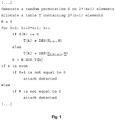
Figure 1 represents a pseudo code implementing a method according to a preferred embodiment of the invention. - According to a preferred embodiment of the invention, a method according to
claim 1 is proposed for securing the execution of a cryptographic algorithm A against fault attacks. The cryptographic algorithm A can be for example DES (or DES-1, i.e. DES decryption), 3DES (or 3DES-1), or AES (or AES-1), or asymmetric algorithms such as RSA, elliptic curves, Diffie Hellman, etc. (each asymmetric algorithm being used either for a public key operation, such as RSA encryption or RSA signature verification, or for a private key operation, such as RSA signature or RSA decryption). The cryptographic algorithm A involves a key K0 and a message M. The cryptographic algorithm A is set to compute a value A(K0,M). For example, in a preferred embodiment, A is the DES algorithm, M is a piece of data to be encrypted with the DES algorithm, K0 is a DES key to be used for the encryption, and A(K0,M) is the encrypted message. Given a relationship R between A(K0,M) and A(f(K0),g(M)), where f and g are two bijections, and where f is different from the identity function, the method comprises: - a. computing the expected result A(K0,M) of the cryptographic algorithm
- b. computing a modified result A(f(K0),g(M)), by applying the cryptographic algorithm A on a modified key f(K0) and on a message g(M),
- c. checking whether the relationship R between the values A(K0,M) and A(f(K0),g(M)) computed in the two preceding steps is verified
- d. detecting an attack if the relationship R is not verified
- The order in which steps a and b are carried out is random. Of course, the bijections f and g and the relationship R are all linked together and to the cryptographic algorithm A, and cannot be chosen arbitrarily, they have to be defined by those skilled in the art (for certain algorithms A there is no convenient relationship R, in which case the proposed method is not applicable).
- For an RSA private key operation, K0 can be denoted d (RSA private key exponent), and A(K0,M)=A(d,M)=Md mod N (standard RSA, well known in the art). Let e be the public exponent, and N be the modulus of the RSA key pair (conventional notations for RSA). It is possible, for example, to define f(d) as f(d) = d + b∗(e∗d - 1), and to define g(M) as g(M) = M∗(ae) mod N, where a and b are two random numbers comprised between 1 and N-1 (0<a,b<N). Preferably, the number a should not be a multiple of p or q, where p and q are the primes composing the modulus N (otherwise g is not bijective, and the verification of the relationship R is less easy, as it is possible to compute A(f(d),g(M)) from A(d,M) but not necessarily the other way).
- With this definition of f and g, we have A(f(d),g(M))=a∗A(d,M) mod N, which is the relationship R to verify.
- Indeed:

- It is preferred for the function f to modify as many bits as possible in the key K0, since a same attack carried on both K0 and f(K0), will typically not be able to modify both K0 and f(K0) if it targets one of the bits that are different in K0 and in f(K0) (i.e. it will change the target bit either in K0 or in f(K0), but not in both K0 and f(K0)). Indeed, state of the art attacks are able to set bits to 1 or reset them to 0, but not to define their value as 0 or 1 at will. Even if the attack was able to change the bits at will, the attacker should change K0 and f(K0) in a manner such that the relationship R between the values A(K0,M) and A(f(K0),g(M)) still be met, which can be a difficult problem depending on how R is defined.
- In a preferred version of the above method, the bijection f consists in inverting all bits of the key K0, i.e. every 0 in K0 is replaced by a 1 in f(K0) and vice versa. This is advantageous since the attacker cannot change a given bit both in K0 and in f(K0), based on above discussed state of the art attacks.
- The bijection g may consist in inverting all bits of the message M. Sometimes it may not be needed to change the message, but sometimes the properties of the cryptographic algorithm A are such that it is advantageous to modify the message too (with g being different from the identity) in order to simplify the relationship R.
- In particular, the relationship R may consist in the fact that the each bit of the expected result A(K0,M) is the inverse of the corresponding bit of the modified result A(f(K0),g(M)).
- For example, with the DES algorithm, a method provided as background for the invention would consist in:
- a. computing the expected result r = DES(K0,M)
- b. computing a modified result mr = DES(KO,M), where KO denotes the logical bit complement of K0, and M denotes the logical bit complement of M.
- c. checking whether the first result r is the logical bit complement of the second result mr. For example, it is possible to check that r XOR mr is equal to 11111 ...11.
- d. detecting an attack if the relationship is not verified, i.e. if the two results are not logical bit complements.
- The same example works equally by replacing DES by DES-1, by 3DES or by 3DES-1.
- According to an improved version of the above methods, it is possible to generate n random keys K1...Kn, and to compute in random order A(Ki,M) and A(f(Ki),g(M)) for every i between 0 and n. The order is preferably different each time the method is invoked. For example, for n=3, the order could be A(f(K2),g(M)), A(f(K0),g(M)), A(K1,M), A(f(K3),g(M)), A(K3,M), A(K0,M), A(K2,M), A(f(K1),g(M)), and next time the method is invoked, the order could be different.
- Then the preferred method checks the relationship R for each couple of values A(Ki,M) and A(f(Ki),g(M)), and detects an attack if the relationship R is not verified for any i between 0 and n. This technique is advantageous because it is very hard for a hacker to know at what point the method computes which cryptographic operation, e.g. the hacker does not know when the method computes the really useful cryptographic operation (the one computing the expected result A(K0,M)), therefore when doing the attack the hacker does not know which key he is disturbing. This makes it even harder for the hacker to draw conclusions. With a naive computation A(K0,M), the hacker could try to set one bit of K0, and if the bit was already set, the method would output the expected result, and if the bit of the key was not set, the method would output an error message (if attack detected) or an erroneous result, therefore informing the hacker whether the bit of the key was 0 or 1. But with this preferred embodiment, whenever the hacker attempts to modify something, he has a very high likelihood to draw wrong conclusions because the bit he possibly guessed was not necessarily the bit of the key K0, but could be the bit of any key Ki, or f(Ki) (one chance out of 2∗(n+1) to target the right key).
- It should be noted that even with n=0 it is possible to compute in random order either A(K0,M) and then A(f(K0),g(M)) or first A(f(K0),g(M)) and then A(KO,M).
- In an improved version of the method that has just been described, the verification can be simplified, for example if f and g consist in taking the logical bit complement of the input parameter, and if the relationship consists in verifying that the two results are logical bit complements, the verification can consist in XORing all results, and verifying, if n is odd, that the final result is 0, and if n is even, that the result is 1111...111
- For example, in the case of DES, the pseudo code according to
figure 1 could be used. - Notes: in this pseudo code, and in the line T [k] = DES (K S(k)-n-1 ,M), the underscore designate the logical bit complement operation. Checking that R is equal to 11111...11 can be checked by verifying that R+1 is equal to 0.
- Of course, the same pseudo code would be applicable to DES-1, to 3DES or to 3DES-1.
- The invention also relates to a cryptographic device implementing a method as described above. The cryptographic device can be any device implementing a cryptographic algorithm, either in software or in hardware. However, in preferred embodiments, the cryptographic device is a secure cryptographic device, such as a smart card, a TPM, or an HSM, all three of which typically comprise security features (hardware and/or software based) making them a lot more secure than for example a general purpose computer.
Claims (9)
- Method for securing the execution of a cryptographic algorithm A on a message M and using a cryptographic key K0 against fault attacks, wherein, given a cryptographic key k and a message m the cryptographic algorithm A is set to compute a value A(k,m), and wherein, a given relationship R between A(k,m) and A(f(k),g(m)) holds where f and g are two bijections, and where f is different from the identity function, the method comprises generating n random keys K1 .. Kn, computing in random order A(Ki,M) and A(f(Ki),g(M)) for every i between 0 and n, after all of said computations in random order of A(Ki,M) and A(f(Ki),g(M)) for every i between 0 and n are finished, checking whether the relationship R for each couple of values A(Ki,M) and A(f(Ki),g(M)) for every i between 0 and n, and detecting an attack if the relationship R is not verified for any i between 0 and n.
- Method according to claim 1, wherein the bijection f consists in inverting all bits of its input.
- Method according to any previous claim, wherein the bijection g consists in inverting all bits of its input.
- Method according to any previous claim, wherein the relationship R consists in the fact that the each bit of the expected result A(Ki,M) is the inverse of the corresponding bit of the modified result A(f(Ki),g(M)).
- Cryptographic device implementing a cryptographic algorithm A for secure computation on a message M and using a cryptographic key K0 wherein, given a cryptographic key k and a message m the cryptographic algorithm A is set to compute a value A(k,m), and wherein, a given relationship R between A(k,m) and A(f(k),g(m)) holds, where f and g are two bijections, and where f is different from the identity function, the cryptographic device being characterized in that it further comprises means for:a. generating n random keys K1 ... Kn,
computing in random order A(Ki,M) and A(f(Ki),g(M)) for every i between 0 and n,
after all of said computations in random order of A(Ki,M) and A(f(Ki),g(M)) for every i between 0 and n are finished,
checking the relationship R for each couple of values A(Ki,M) and A(f(Ki),g(M)) for every i between 0 and n, and for
detecting an attack if the relationship R is not verified for any i between 0 and n. - Cryptographic device according to claim 5, wherein the bijection f consists in inverting all bits of its input.
- Cryptographic device according to claim 5 or 6, wherein the bijection g consists in inverting all bits of its input.
- Cryptographic device according to any of claims 5 to 7, wherein the relationship R consists in the fact that the each bit of the expected result A(Ki,M) is the inverse of the corresponding bit of the modified result A(f(K0),g(M)).
- Cryptographic device according to any of claims 5 to 8, wherein the cryptographic device is a smart card, a TPM, or an HSM.
Priority Applications (1)
| Application Number | Priority Date | Filing Date | Title |
|---|---|---|---|
| EP09783910.4A EP2351286B1 (en) | 2008-10-24 | 2009-10-09 | Cryptographic algorithm fault protections |
Applications Claiming Priority (3)
| Application Number | Priority Date | Filing Date | Title |
|---|---|---|---|
| EP08305727A EP2180631A1 (en) | 2008-10-24 | 2008-10-24 | Cryptographic algorithm fault protections |
| EP09783910.4A EP2351286B1 (en) | 2008-10-24 | 2009-10-09 | Cryptographic algorithm fault protections |
| PCT/EP2009/063205 WO2010046251A1 (en) | 2008-10-24 | 2009-10-09 | Cryptographic algorithm fault protections |
Publications (2)
| Publication Number | Publication Date |
|---|---|
| EP2351286A1 EP2351286A1 (en) | 2011-08-03 |
| EP2351286B1 true EP2351286B1 (en) | 2020-04-22 |
Family
ID=40495723
Family Applications (2)
| Application Number | Title | Priority Date | Filing Date |
|---|---|---|---|
| EP08305727A Withdrawn EP2180631A1 (en) | 2008-10-24 | 2008-10-24 | Cryptographic algorithm fault protections |
| EP09783910.4A Active EP2351286B1 (en) | 2008-10-24 | 2009-10-09 | Cryptographic algorithm fault protections |
Family Applications Before (1)
| Application Number | Title | Priority Date | Filing Date |
|---|---|---|---|
| EP08305727A Withdrawn EP2180631A1 (en) | 2008-10-24 | 2008-10-24 | Cryptographic algorithm fault protections |
Country Status (5)
| Country | Link |
|---|---|
| US (1) | US8477933B2 (en) |
| EP (2) | EP2180631A1 (en) |
| JP (3) | JP2012506658A (en) |
| KR (1) | KR101528836B1 (en) |
| WO (1) | WO2010046251A1 (en) |
Families Citing this family (13)
| Publication number | Priority date | Publication date | Assignee | Title |
|---|---|---|---|---|
| EP2367316B1 (en) * | 2010-03-12 | 2017-07-05 | STMicroelectronics (Rousset) SAS | Method and circuitry for detecting a fault attack |
| DE102010055237A1 (en) * | 2010-12-20 | 2012-06-21 | Giesecke & Devrient Gmbh | Method for protected execution of a cryptographic calculation |
| EP2602952A1 (en) | 2011-12-07 | 2013-06-12 | Gemalto SA | Cryptographic method for protecting a key hardware register against fault attacks |
| EP2620890A1 (en) * | 2012-01-25 | 2013-07-31 | Gemalto SA | Method for detecting a fault injected in hardware registers of an electronic device |
| DE102012011727A1 (en) * | 2012-06-13 | 2013-12-19 | Giesecke & Devrient Gmbh | Method for performing cryptographic computation of keys, involves supplying key or partial key to processor from key register under cancelling operation, and performing cryptographic computation using key or partial key |
| CN103530474A (en) * | 2013-10-25 | 2014-01-22 | 东南大学 | AES (advanced encryption standard) algorithm circuit oriented method for testing differential power attack |
| FR3045184B1 (en) * | 2015-12-15 | 2018-07-20 | Idemia France | METHOD OF WRITING IN A NON-VOLATILE MEMORY OF AN ELECTRONIC ENTITY AND ELECTRONIC ENTITY THEREFOR |
| JP6728799B2 (en) * | 2016-03-11 | 2020-07-22 | 日本電気株式会社 | Cryptographic communication system, cryptographic communication method, security chip, communication device, control method thereof, and control program |
| EP3267354A1 (en) * | 2016-07-04 | 2018-01-10 | Gemalto Sa | Secure loading of secret data to non-protected hardware registers |
| FR3056789B1 (en) * | 2016-09-27 | 2018-09-21 | Safran Identity & Security | METHOD FOR ENCRYPTING OR SYMMETRICALLY DECRYPTING BY BLOCK |
| CN109508157A (en) * | 2017-09-14 | 2019-03-22 | 北京立思辰计算机技术有限公司 | A kind of printer controller and printer control method |
| US12541688B2 (en) * | 2018-11-05 | 2026-02-03 | Edge Case Research, Inc. | Systems and methods for evaluating perception system quality |
| CN113434332B (en) * | 2021-05-27 | 2022-02-18 | 国家信息技术安全研究中心 | Fault propagation-based key recovery method for DES/3DES middle wheel attack |
Citations (1)
| Publication number | Priority date | Publication date | Assignee | Title |
|---|---|---|---|---|
| FR2893796A1 (en) * | 2005-11-21 | 2007-05-25 | Atmel Corp | Cryptographic hardware engine protecting method for smart card, involves executing multiple loops of encrypting algorithm on data of input message, using authentic and dummy masked keys to produce authentic and dummy message data results |
Family Cites Families (10)
| Publication number | Priority date | Publication date | Assignee | Title |
|---|---|---|---|---|
| JPH10154976A (en) * | 1996-11-22 | 1998-06-09 | Toshiba Corp | Tamper-free device |
| JP2000165375A (en) * | 1998-11-30 | 2000-06-16 | Hitachi Ltd | Information processing device, IC card |
| JP4188571B2 (en) * | 2001-03-30 | 2008-11-26 | 株式会社日立製作所 | Arithmetic method of information processing apparatus and tamper resistant arithmetic disturbance implementation method |
| JP3844116B2 (en) * | 2001-04-16 | 2006-11-08 | 株式会社ルネサステクノロジ | Encryption / decryption device and IC card |
| DE10136335B4 (en) | 2001-07-26 | 2007-03-22 | Infineon Technologies Ag | Processor with several arithmetic units |
| FR2829331B1 (en) * | 2001-09-04 | 2004-09-10 | St Microelectronics Sa | METHOD FOR SECURING A SECRET QUANTITY |
| DE102004062825B4 (en) * | 2004-12-27 | 2006-11-23 | Infineon Technologies Ag | Cryptographic unit and method for operating a cryptographic unit |
| JP4529719B2 (en) * | 2005-02-16 | 2010-08-25 | ソニー株式会社 | Signal processing circuit |
| JP4871194B2 (en) * | 2006-04-18 | 2012-02-08 | 株式会社半導体エネルギー研究所 | Parameter extraction method and computer-readable storage medium having program for executing parameter extraction method |
| US7836309B2 (en) * | 2007-07-20 | 2010-11-16 | Microsoft Corporation | Generic extensible pre-operating system cryptographic infrastructure |
-
2008
- 2008-10-24 EP EP08305727A patent/EP2180631A1/en not_active Withdrawn
-
2009
- 2009-10-09 KR KR1020117009006A patent/KR101528836B1/en active Active
- 2009-10-09 WO PCT/EP2009/063205 patent/WO2010046251A1/en not_active Ceased
- 2009-10-09 JP JP2011532582A patent/JP2012506658A/en active Pending
- 2009-10-09 EP EP09783910.4A patent/EP2351286B1/en active Active
- 2009-10-09 US US13/123,655 patent/US8477933B2/en active Active
-
2014
- 2014-06-20 JP JP2014126948A patent/JP2014197222A/en active Pending
-
2016
- 2016-10-18 JP JP2016204123A patent/JP6347819B2/en active Active
Patent Citations (1)
| Publication number | Priority date | Publication date | Assignee | Title |
|---|---|---|---|---|
| FR2893796A1 (en) * | 2005-11-21 | 2007-05-25 | Atmel Corp | Cryptographic hardware engine protecting method for smart card, involves executing multiple loops of encrypting algorithm on data of input message, using authentic and dummy masked keys to produce authentic and dummy message data results |
Non-Patent Citations (4)
| Title |
|---|
| BAR-EL H ET AL: "The Sorcerer's Apprentice Guide to Fault Attacks", PROCEEDINGS OF THE IEEE, IEEE. NEW YORK, US, vol. 94, no. 2, 1 February 2006 (2006-02-01), pages 370 - 382, XP011442695, ISSN: 0018-9219, DOI: 10.1109/JPROC.2005.862424 * |
| BONEH D ET AL: "On the importance of eliminating errors in cryptographic computations", JOURNAL OF CRYPTOL, SPRINGER, NEW YORK, NY, US, vol. 14, 1 March 2001 (2001-03-01), pages 101 - 119, XP007907758, ISSN: 0933-2790, DOI: 10.1007=S001450010016 * |
| DAVIES: "Some Regular Properties of the 'Data Encryption Standard' Algorithm", EUROCRYPT '81, 1 January 1983 (1983-01-01), XP055575084, ISBN: 978-1-4757-0604-8, Retrieved from the Internet <URL:https://link.springer.com/chapter/10.1007/978-1-4757-0602-4_8> [retrieved on 20190327] * |
| GIRAUD C: "An RSA Implementation Resistant to Fault Attacks and to Simple Power Analysis", IEEE TRANSACTIONS ON COMPUTERS, IEEE SERVICE CENTER, LOS ALAMITOS, CA, US, vol. 55, no. 9, 1 September 2006 (2006-09-01), pages 1116 - 1120, XP002460785, ISSN: 0018-9340, DOI: 10.1109/TC.2006.135 * |
Also Published As
| Publication number | Publication date |
|---|---|
| KR101528836B1 (en) | 2015-06-15 |
| JP2017034713A (en) | 2017-02-09 |
| EP2351286A1 (en) | 2011-08-03 |
| JP2012506658A (en) | 2012-03-15 |
| US20110274268A1 (en) | 2011-11-10 |
| US8477933B2 (en) | 2013-07-02 |
| KR20110088509A (en) | 2011-08-03 |
| JP2014197222A (en) | 2014-10-16 |
| EP2180631A1 (en) | 2010-04-28 |
| WO2010046251A1 (en) | 2010-04-29 |
| JP6347819B2 (en) | 2018-06-27 |
Similar Documents
| Publication | Publication Date | Title |
|---|---|---|
| US8477933B2 (en) | Cryptographic algorithm fault protections | |
| US8850221B2 (en) | Protection against side channel attacks with an integrity check | |
| US9571289B2 (en) | Methods and systems for glitch-resistant cryptographic signing | |
| EP2553866B1 (en) | System and method for protecting cryptographic assets from a white-box attack | |
| US8402287B2 (en) | Protection against side channel attacks | |
| US12284278B2 (en) | System and method to generate prime numbers in cryptographic applications | |
| EP3596876B1 (en) | Elliptic curve point multiplication device and method for signing a message in a white-box context | |
| WO2018017421A1 (en) | Modular exponentiation with side channel attack countermeasures | |
| EP3503459B1 (en) | Device and method for protecting execution of a cryptographic operation | |
| CN103404073B (en) | Protection Against Passive Listening | |
| EP2154604A1 (en) | Countermeasure securing exponentiation based cryptography | |
| JP2011072040A (en) | Method for protecting electronic circuit against fault-based attacks | |
| EP3698262B1 (en) | Protecting modular inversion operation from external monitoring attacks | |
| CN1682484B (en) | Protected Cryptographic Computation | |
| EP2401734B1 (en) | System and method for performing exponentiation in a cryptographic system | |
| EP1347596B1 (en) | Digital signature methods and apparatus | |
| Schmidt et al. | Combined implementation attack resistant exponentiation | |
| KR100953715B1 (en) | Digital Signature Method using Crt-Rssa Modular Exponential Algorithm, Apparatus and Its Computer-readable Storage Media Recording the Same | |
| Berzati et al. | A survey of differential fault analysis against classical RSA implementations | |
| US10305678B2 (en) | Imbalanced montgomery ladder | |
| Devi et al. | A Review on Different Types of Attacks on RSA and ECC | |
| WO2018148819A1 (en) | Cryptographic scheme with fault injection attack countermeasure | |
| Chen et al. | A new and extended fault analysis on RSA |
Legal Events
| Date | Code | Title | Description |
|---|---|---|---|
| PUAI | Public reference made under article 153(3) epc to a published international application that has entered the european phase |
Free format text: ORIGINAL CODE: 0009012 |
|
| 17P | Request for examination filed |
Effective date: 20110418 |
|
| AK | Designated contracting states |
Kind code of ref document: A1 Designated state(s): AT BE BG CH CY CZ DE DK EE ES FI FR GB GR HR HU IE IS IT LI LT LU LV MC MK MT NL NO PL PT RO SE SI SK SM TR |
|
| DAX | Request for extension of the european patent (deleted) | ||
| STAA | Information on the status of an ep patent application or granted ep patent |
Free format text: STATUS: EXAMINATION IS IN PROGRESS |
|
| 17Q | First examination report despatched |
Effective date: 20170706 |
|
| RAP1 | Party data changed (applicant data changed or rights of an application transferred) |
Owner name: THALES DIS FRANCE SA |
|
| GRAP | Despatch of communication of intention to grant a patent |
Free format text: ORIGINAL CODE: EPIDOSNIGR1 |
|
| STAA | Information on the status of an ep patent application or granted ep patent |
Free format text: STATUS: GRANT OF PATENT IS INTENDED |
|
| INTG | Intention to grant announced |
Effective date: 20191104 |
|
| GRAS | Grant fee paid |
Free format text: ORIGINAL CODE: EPIDOSNIGR3 |
|
| GRAA | (expected) grant |
Free format text: ORIGINAL CODE: 0009210 |
|
| STAA | Information on the status of an ep patent application or granted ep patent |
Free format text: STATUS: THE PATENT HAS BEEN GRANTED |
|
| AK | Designated contracting states |
Kind code of ref document: B1 Designated state(s): AT BE BG CH CY CZ DE DK EE ES FI FR GB GR HR HU IE IS IT LI LT LU LV MC MK MT NL NO PL PT RO SE SI SK SM TR |
|
| REG | Reference to a national code |
Ref country code: GB Ref legal event code: FG4D |
|
| REG | Reference to a national code |
Ref country code: CH Ref legal event code: EP |
|
| REG | Reference to a national code |
Ref country code: IE Ref legal event code: FG4D |
|
| REG | Reference to a national code |
Ref country code: DE Ref legal event code: R096 Ref document number: 602009061801 Country of ref document: DE |
|
| REG | Reference to a national code |
Ref country code: AT Ref legal event code: REF Ref document number: 1261565 Country of ref document: AT Kind code of ref document: T Effective date: 20200515 |
|
| REG | Reference to a national code |
Ref country code: LT Ref legal event code: MG4D |
|
| REG | Reference to a national code |
Ref country code: NL Ref legal event code: MP Effective date: 20200422 |
|
| PG25 | Lapsed in a contracting state [announced via postgrant information from national office to epo] |
Ref country code: SE Free format text: LAPSE BECAUSE OF FAILURE TO SUBMIT A TRANSLATION OF THE DESCRIPTION OR TO PAY THE FEE WITHIN THE PRESCRIBED TIME-LIMIT Effective date: 20200422 Ref country code: IS Free format text: LAPSE BECAUSE OF FAILURE TO SUBMIT A TRANSLATION OF THE DESCRIPTION OR TO PAY THE FEE WITHIN THE PRESCRIBED TIME-LIMIT Effective date: 20200822 Ref country code: FI Free format text: LAPSE BECAUSE OF FAILURE TO SUBMIT A TRANSLATION OF THE DESCRIPTION OR TO PAY THE FEE WITHIN THE PRESCRIBED TIME-LIMIT Effective date: 20200422 Ref country code: NO Free format text: LAPSE BECAUSE OF FAILURE TO SUBMIT A TRANSLATION OF THE DESCRIPTION OR TO PAY THE FEE WITHIN THE PRESCRIBED TIME-LIMIT Effective date: 20200722 Ref country code: GR Free format text: LAPSE BECAUSE OF FAILURE TO SUBMIT A TRANSLATION OF THE DESCRIPTION OR TO PAY THE FEE WITHIN THE PRESCRIBED TIME-LIMIT Effective date: 20200723 Ref country code: PT Free format text: LAPSE BECAUSE OF FAILURE TO SUBMIT A TRANSLATION OF THE DESCRIPTION OR TO PAY THE FEE WITHIN THE PRESCRIBED TIME-LIMIT Effective date: 20200824 Ref country code: NL Free format text: LAPSE BECAUSE OF FAILURE TO SUBMIT A TRANSLATION OF THE DESCRIPTION OR TO PAY THE FEE WITHIN THE PRESCRIBED TIME-LIMIT Effective date: 20200422 Ref country code: LT Free format text: LAPSE BECAUSE OF FAILURE TO SUBMIT A TRANSLATION OF THE DESCRIPTION OR TO PAY THE FEE WITHIN THE PRESCRIBED TIME-LIMIT Effective date: 20200422 |
|
| REG | Reference to a national code |
Ref country code: AT Ref legal event code: MK05 Ref document number: 1261565 Country of ref document: AT Kind code of ref document: T Effective date: 20200422 |
|
| PG25 | Lapsed in a contracting state [announced via postgrant information from national office to epo] |
Ref country code: LV Free format text: LAPSE BECAUSE OF FAILURE TO SUBMIT A TRANSLATION OF THE DESCRIPTION OR TO PAY THE FEE WITHIN THE PRESCRIBED TIME-LIMIT Effective date: 20200422 Ref country code: BG Free format text: LAPSE BECAUSE OF FAILURE TO SUBMIT A TRANSLATION OF THE DESCRIPTION OR TO PAY THE FEE WITHIN THE PRESCRIBED TIME-LIMIT Effective date: 20200722 Ref country code: HR Free format text: LAPSE BECAUSE OF FAILURE TO SUBMIT A TRANSLATION OF THE DESCRIPTION OR TO PAY THE FEE WITHIN THE PRESCRIBED TIME-LIMIT Effective date: 20200422 |
|
| REG | Reference to a national code |
Ref country code: DE Ref legal event code: R097 Ref document number: 602009061801 Country of ref document: DE |
|
| PG25 | Lapsed in a contracting state [announced via postgrant information from national office to epo] |
Ref country code: RO Free format text: LAPSE BECAUSE OF FAILURE TO SUBMIT A TRANSLATION OF THE DESCRIPTION OR TO PAY THE FEE WITHIN THE PRESCRIBED TIME-LIMIT Effective date: 20200422 Ref country code: SM Free format text: LAPSE BECAUSE OF FAILURE TO SUBMIT A TRANSLATION OF THE DESCRIPTION OR TO PAY THE FEE WITHIN THE PRESCRIBED TIME-LIMIT Effective date: 20200422 Ref country code: AT Free format text: LAPSE BECAUSE OF FAILURE TO SUBMIT A TRANSLATION OF THE DESCRIPTION OR TO PAY THE FEE WITHIN THE PRESCRIBED TIME-LIMIT Effective date: 20200422 Ref country code: EE Free format text: LAPSE BECAUSE OF FAILURE TO SUBMIT A TRANSLATION OF THE DESCRIPTION OR TO PAY THE FEE WITHIN THE PRESCRIBED TIME-LIMIT Effective date: 20200422 Ref country code: IT Free format text: LAPSE BECAUSE OF FAILURE TO SUBMIT A TRANSLATION OF THE DESCRIPTION OR TO PAY THE FEE WITHIN THE PRESCRIBED TIME-LIMIT Effective date: 20200422 Ref country code: DK Free format text: LAPSE BECAUSE OF FAILURE TO SUBMIT A TRANSLATION OF THE DESCRIPTION OR TO PAY THE FEE WITHIN THE PRESCRIBED TIME-LIMIT Effective date: 20200422 Ref country code: ES Free format text: LAPSE BECAUSE OF FAILURE TO SUBMIT A TRANSLATION OF THE DESCRIPTION OR TO PAY THE FEE WITHIN THE PRESCRIBED TIME-LIMIT Effective date: 20200422 Ref country code: CZ Free format text: LAPSE BECAUSE OF FAILURE TO SUBMIT A TRANSLATION OF THE DESCRIPTION OR TO PAY THE FEE WITHIN THE PRESCRIBED TIME-LIMIT Effective date: 20200422 |
|
| PG25 | Lapsed in a contracting state [announced via postgrant information from national office to epo] |
Ref country code: SK Free format text: LAPSE BECAUSE OF FAILURE TO SUBMIT A TRANSLATION OF THE DESCRIPTION OR TO PAY THE FEE WITHIN THE PRESCRIBED TIME-LIMIT Effective date: 20200422 Ref country code: PL Free format text: LAPSE BECAUSE OF FAILURE TO SUBMIT A TRANSLATION OF THE DESCRIPTION OR TO PAY THE FEE WITHIN THE PRESCRIBED TIME-LIMIT Effective date: 20200422 |
|
| PLBE | No opposition filed within time limit |
Free format text: ORIGINAL CODE: 0009261 |
|
| STAA | Information on the status of an ep patent application or granted ep patent |
Free format text: STATUS: NO OPPOSITION FILED WITHIN TIME LIMIT |
|
| 26N | No opposition filed |
Effective date: 20210125 |
|
| PG25 | Lapsed in a contracting state [announced via postgrant information from national office to epo] |
Ref country code: SI Free format text: LAPSE BECAUSE OF FAILURE TO SUBMIT A TRANSLATION OF THE DESCRIPTION OR TO PAY THE FEE WITHIN THE PRESCRIBED TIME-LIMIT Effective date: 20200422 |
|
| REG | Reference to a national code |
Ref country code: CH Ref legal event code: PL |
|
| PG25 | Lapsed in a contracting state [announced via postgrant information from national office to epo] |
Ref country code: LU Free format text: LAPSE BECAUSE OF NON-PAYMENT OF DUE FEES Effective date: 20201009 Ref country code: MC Free format text: LAPSE BECAUSE OF FAILURE TO SUBMIT A TRANSLATION OF THE DESCRIPTION OR TO PAY THE FEE WITHIN THE PRESCRIBED TIME-LIMIT Effective date: 20200422 |
|
| REG | Reference to a national code |
Ref country code: BE Ref legal event code: MM Effective date: 20201031 |
|
| PG25 | Lapsed in a contracting state [announced via postgrant information from national office to epo] |
Ref country code: LI Free format text: LAPSE BECAUSE OF NON-PAYMENT OF DUE FEES Effective date: 20201031 Ref country code: CH Free format text: LAPSE BECAUSE OF NON-PAYMENT OF DUE FEES Effective date: 20201031 Ref country code: BE Free format text: LAPSE BECAUSE OF NON-PAYMENT OF DUE FEES Effective date: 20201031 |
|
| PG25 | Lapsed in a contracting state [announced via postgrant information from national office to epo] |
Ref country code: IE Free format text: LAPSE BECAUSE OF NON-PAYMENT OF DUE FEES Effective date: 20201009 |
|
| PG25 | Lapsed in a contracting state [announced via postgrant information from national office to epo] |
Ref country code: TR Free format text: LAPSE BECAUSE OF FAILURE TO SUBMIT A TRANSLATION OF THE DESCRIPTION OR TO PAY THE FEE WITHIN THE PRESCRIBED TIME-LIMIT Effective date: 20200422 Ref country code: MT Free format text: LAPSE BECAUSE OF FAILURE TO SUBMIT A TRANSLATION OF THE DESCRIPTION OR TO PAY THE FEE WITHIN THE PRESCRIBED TIME-LIMIT Effective date: 20200422 Ref country code: CY Free format text: LAPSE BECAUSE OF FAILURE TO SUBMIT A TRANSLATION OF THE DESCRIPTION OR TO PAY THE FEE WITHIN THE PRESCRIBED TIME-LIMIT Effective date: 20200422 |
|
| PG25 | Lapsed in a contracting state [announced via postgrant information from national office to epo] |
Ref country code: MK Free format text: LAPSE BECAUSE OF FAILURE TO SUBMIT A TRANSLATION OF THE DESCRIPTION OR TO PAY THE FEE WITHIN THE PRESCRIBED TIME-LIMIT Effective date: 20200422 |
|
| P01 | Opt-out of the competence of the unified patent court (upc) registered |
Effective date: 20230517 |
|
| PGFP | Annual fee paid to national office [announced via postgrant information from national office to epo] |
Ref country code: GB Payment date: 20250923 Year of fee payment: 17 |
|
| PGFP | Annual fee paid to national office [announced via postgrant information from national office to epo] |
Ref country code: FR Payment date: 20250924 Year of fee payment: 17 |
|
| PGFP | Annual fee paid to national office [announced via postgrant information from national office to epo] |
Ref country code: DE Payment date: 20250923 Year of fee payment: 17 |