EP2350040B1 - Expeditious synthesis of gibberllin a5 and esters thereof - Google Patents
Expeditious synthesis of gibberllin a5 and esters thereof Download PDFInfo
- Publication number
- EP2350040B1 EP2350040B1 EP09756786.1A EP09756786A EP2350040B1 EP 2350040 B1 EP2350040 B1 EP 2350040B1 EP 09756786 A EP09756786 A EP 09756786A EP 2350040 B1 EP2350040 B1 EP 2350040B1
- Authority
- EP
- European Patent Office
- Prior art keywords
- compound
- formula
- alkyl
- groups
- mixture
- Prior art date
- Legal status (The legal status is an assumption and is not a legal conclusion. Google has not performed a legal analysis and makes no representation as to the accuracy of the status listed.)
- Not-in-force
Links
- 0 C[C@@]1(C([C@@](C(C[C@]2(CC3)O)[C@@]33CC2=C)C(O*)=O)[C@]3(C=C2)O*1)[C@@]2O Chemical compound C[C@@]1(C([C@@](C(C[C@]2(CC3)O)[C@@]33CC2=C)C(O*)=O)[C@]3(C=C2)O*1)[C@@]2O 0.000 description 4
Classifications
-
- C—CHEMISTRY; METALLURGY
- C07—ORGANIC CHEMISTRY
- C07D—HETEROCYCLIC COMPOUNDS
- C07D307/00—Heterocyclic compounds containing five-membered rings having one oxygen atom as the only ring hetero atom
- C07D307/77—Heterocyclic compounds containing five-membered rings having one oxygen atom as the only ring hetero atom ortho- or peri-condensed with carbocyclic rings or ring systems
- C07D307/93—Heterocyclic compounds containing five-membered rings having one oxygen atom as the only ring hetero atom ortho- or peri-condensed with carbocyclic rings or ring systems condensed with a ring other than six-membered
Definitions
- the present invention relates generally to synthetic organic chemistry and plant growth hormones. More particularly, it concerns the efficient preparation of gibberellin A 5 in a cost-effective manner.
- auxins There are six major groups of plant hormones: auxins, gibberellins, ethylene, cytokinins, brassinosteroids and abscisic acid.
- the more commonly used groups in agriculture, floriculture, forestry and horticulture are the auxins, gibberellins, ethylene and cytokinins.
- Gibberellins are a group of tetracyclic diterpenoid compounds, and the skeleton below shows the carbon numbering of the C 19 class of gibberellins:
- gibberellins occur naturally in plants and some of these gibberellins can be produced by fermentation methods. There are over 130 gibberellins discussed in the literature. Individual gibberellins are designated with an integer that reflects the chronological order of discovery. Four examples of gibberellins that occur naturally in higher plants are shown below and three of these (gibberellins A 3 , A 4 and A 7 ) can also be produced in commercial quantities by fungal fermentation.
- Naturally occurring gibberellins are used in all of the above-mentioned fields to, for example, promote flowering.
- Three gibberellins have been used extensively for commercial purposes: GA 3 (also known as gibberellic acid) and a mixture of GA 4 and GA 7 (GA 4/7 ). All three are native to higher plants and can be derived from fungal fermentations. However, when applied exogenously to higher plants they can often have detrimental side effects. For example, GA 3 often produces excessive stem elongation when applied to many plants, which can be undesireable in terms of lodging (falling over) in rain, or aesthetically when used for floriculture purposes.
- GA 4/7 can also promote excessive (undesireable) stem elongation and both GA 3 and GA 7 can be excessively persistent when applied to higher plants due to the C-1,2 double bond in Ring A (shown above). Therefore, while applied gibberellins can promote flowering, there may also be the detrimental effect of increased shoot and stem growth (excessive elongation).
- Preventing excessive shoot growth in a flowering plant is useful in many circumstances. For example, this effect makes the plant more resistant to falling over under adverse weather conditions such as wind, rain, hail and snow. This effect also makes the plant more compact, more stocky and more resistant to lodging as a result of weather conditions or as a result of heavy fruit or seed or grain production: In orchard situations, or in floriculture, for example, a more compact nature of a shrub or tree is valuable for a variety of reasons, including ease of tending the plant, picking the fruit, aesthetics, applying other treatments and reducing the necessity to prune the plant.
- GA 5 offers advantages over the currently used GA 3 .
- GA 5 is an exceptionally florigenic molecule (King and Evans, 2003), but does not suffer the side effects of excessive shoot growth and flower stalk elongation to the degree seen with GA 3 and other gibberellins (King and Evans, 2003; Pharis, 1972; Ben-Tal, 2000).
- the use of an inexpensively produced GA 5 preparation offers cost advantages over, for example, GA 4/7 .
- GA 5 has been prepared by some groups; however the processes are frequently inefficient and the reagents quite expensive. Since it has been very expensive to synthesize, GA 5 is typically not used in agriculture or the other commercial areas mentioned above.
- the synthetic methodology of the present invention provides inexpensive and facile access to GA 5 esters. Simple removal of the ester moiety by well-known techniques may then reveal GA 5 . These methods allow production of GA 5 in a manner that facilitates its use in agriculture, floriculture, forestry and horticulture.
- the present invention contemplates a method of preparing a compound of formula (I) wherein R is alkyl (C ⁇ 8) , alkenyl (C ⁇ 8) , or aralkyl (C ⁇ 8) , or a substituted version of any of these groups, comprising reacting a compound of formula (II) wherein R is as defined above, and R 1 is an alkyl (C ⁇ 8) sulfonate or an aryl (C ⁇ 8) sulfonate, or a substituted version of either of these groups, in the presence of a metal hydride and a dipolar aprotic solvent to produce a mixture comprising the compound of formula (I).
- the compound of formula (I) is the predominant species in the mixture.
- “predominant” it is meant that a specified compound is present in an amount that is higher than any other compound in the mixture.
- R 1 is not a mesylate.
- the metal hydride that is employed in methods of the present invention may be any metal hydride known in the art, and such hydrides are commercially available.
- the metal hydride is NaBH 4 or LiAlH 4 .
- the number of molar equivalents of metal hydride employed in methods of the present invention may range from about 1 to about 10, for example, including integers and non-integers. In certain embodiments, the number of equivalents may be about, at most about, or at least about 1, 1.5, 2, 2.5, 3, 3.5, 4, 4.5, 5, 5.5, 6, 6.5, 7, 7.5, 8, 8.5, 9, 9.5, 10, or higher, or any range derivable therein. In particular embodiments, the number of equivalents may range from about 2-5. In certain embodiments, the metal hydride is NaBH 4 , and the number of equivalents of NaBH 4 ranges from about 2-5.
- dipolar aprotic solvent Dipolar aprotic solvents are well-known in the art and are commercially available.
- the dipolar aprotic solvent is further defined as DMF, DMSO or dimethyl acetamide.
- the dipolar aprotic solvent is DMF.
- ether-type solvents may be employed, which are also well-known and commercially available. Such solvents include THF and 1,2-dimethoxyethane. Combinations of solvents are also contemplated.
- Methods of the present invention may further comprise obtaining a compound of formula (II).
- Compounds of formula (II) may be produced synthetically. For example, one may purchase GA 3 and then esterify it using, for example, an alkyl (C ⁇ 8) halide, an aryl (C ⁇ 8) halide, or an aralkyl (C ⁇ 8) halide, or a substituted version of any of these groups, to produce a compound of formula (III) wherein R is alkyl (C ⁇ 8) , alkenyl (C ⁇ 8) , or aralkyl (C ⁇ 8) , or a substituted version of any of these groups.
- a sulfonylating agent As a next step, one may react the compound of formula (III) in the presence of a sulfonylating agent to produce a compound of formula (II).
- Sulfonylating agents are well-known in the art, and non-limiting examples includes alkyl (C ⁇ 8) sulfonyl chlorides and aryl (C ⁇ 8 )sulfonyl chlorides ( e.g. , tosyl chloride, benzenesulfonyl chloride and methanesulfonyl chloride).
- methods of the present invention may further comprise isolating the compound of formula (I) from the mixture.
- Methods of isolation in this or any other method discussed herein are well-known in the art and include, for example, crystallization, silica gel column chromatography, and HPLC. In certain embodiments, isolation is performed using crystallization.
- Methods of the present invention may also further comprise removing the R group of the compound of formula (I) to produce GA 5 .
- Methods of removing the R group that is, de-esterification
- Methods of removing the R group are well-known in the art and include basic hydrolysis, for example. Protocols for the removal of ester groups are described in Smith and March (2001), for example.
- the removal is performed before isolation of the compound of formula (I) from the mixture. In other embodiments, the removal is performed after isolation of the compound of formula (I) from the mixture.
- the mixture comprising the compound of formula (I) may further comprise a compound of formula (IV): wherein R is alkyl (C ⁇ 8) , alkenyl (C ⁇ 8) , or aralkyl (C ⁇ 8) , or a substituted version of any of these groups.
- the ratio of the compound of formula (I) to the compound of formula (IV) may be greater than 1:1 in this mixture, in certain embodiments. In certain embodiments, the ratio of the compound of formula (I) to the compound of formula (IV) is greater than about 4:1. In certain embodiments, the ratio of the compound of formula (I) to the compound of formula (IV) is greater than about 7:1. In certain embodiments, the ratio of the compound of formula (I) to the compound of formula (IV) is greater than about 10:1.
- the ratio of the compound of formula (I) to the compound of formula (IV) is greater than about 15:1. In certain embodiments, the ratio of the compound of formula (I) to the compound of formula (IV) is about 20:1. In certain embodiments, the ratio of the compound of formula (I) to the compound of formula (IV) is greater than about 20:1.
- Also contemplated by the present invention are methods of preparing GA 5 comprising (a) reacting a compound of formula (II) wherein R is alkyl (C ⁇ 8) , alkenyl (C ⁇ 8) , or aralkyl (C ⁇ 8) , or a substituted version of any of these groups, and R 1 is an alkyl (C ⁇ 8) sulfonate or an aryl (C ⁇ 8) sulfonate, or a substituted version of either of these groups, in the presence of a metal hydride and a dipolar aprotic solvent to produce a mixture comprising a compound of formula (I) wherein R is alkyl (C ⁇ 8) , alkenyl (C ⁇ 8) , or aralkyl (C ⁇ 8) , or a substituted version of any of these groups, and (b) removing the R group of the compound of formula (I) to produce GA 5 .
- R is alkyl (C ⁇ 8) , alkenyl (C ⁇ 8) , or
- the metal hydride may be any metal hydride known in the art, including, for example, NaBH 4 or LiAlH 4 .
- the dipolar aprotic solvent employed may be any such solvent known in the art, including, for example, DMF, DMSO, dimethyl acetamide.
- Such methods may further comprise obtaining the compound of formula (II), as described above.
- such methods may further comprise isolating the compound of formula (I) from the mixture of step (a).
- Such isolation methods are described above.
- step (b) the removal of the R group (de-esterification) may be performed as described herein. The removal of the R group may be performed either before or after isolation of the compound of formula (I).
- the number of molar equivalents of metal hydride may equal any amount discussed herein, such as about 1 to about 10.
- the compound of formula (I) may be the predominant species in the mixture.
- the mixture may further comprise a compound of formula (IV) wherein R is alkyl (C ⁇ 8) , alkenyl (C ⁇ 8) , or aralkyl (C ⁇ 8) , or a substituted version of any of these groups.
- R is alkyl (C ⁇ 8) , alkenyl (C ⁇ 8) , or aralkyl (C ⁇ 8) , or a substituted version of any of these groups.
- the ratio of the compound of formula (I) to the the compound of formula (IV) may be greater than 1:1 in such a mixture, in certain embodiments. Indeed, the ratios may be any ratio discussed herein regarding compounds of formulas (I) and (IV), such as about 1:1 to about 20:1, or higher.
- R may be further defined as alkyl (C ⁇ 8) , such as methyl, ethyl, n-propyl, or isopropyl.
- R may be an alkenyl (C ⁇ 8) group, such as allyl.
- R may be a substituted or unsubstituted aralkyl (C ⁇ 8) group, such as benzyl or 2-furanylmethyl.
- R 1 may be further defined as an aryl (C ⁇ 8) sulfonate, such as a tosylate.
- alkyl (C ⁇ 8) , aryl (C ⁇ 8) and aralkyl (C ⁇ 8) groups e.g., alkyl (C ⁇ 8) , alkyl (C ⁇ 8) sulfonate, alkyl (C ⁇ 8) halide, aryl (C ⁇ 8) sulfonate, aralkyl (C ⁇ 8) , etc .
- the number of carbons may be 1, 2, 3, 4, 5, 6, 7, or 8, or any range derivable therein. It is also specifically contemplated that any particular number of carbon atoms may be excluded from any of these definitions.
- halide means independently -F, -Cl, -Br or -I and "sulfonyl” means -SO 2 -.
- alkyl when used without the “substituted” modifier, refers to a non-aromatic monovalent group, having a saturated carbon atom as the point of attachment, a linear or branched, cyclo, cyclic or acyclic structure, no carbon-carbon double or triple bonds, and no atoms other than carbon and hydrogen.
- the groups, -CH 3 (Me), -CH 2 CH 3 (Et), -CH 2 CH 2 CH 3 ( n -Pr), -CH(CH 3 ) 2 ( iso -Pr), -CH(CH 2 ) 2 (cyclopropyl), -CH 2 CH 2 CH 2 CH 3 (n-Bu), -CH(CH 3 )CH 2 CH 3 ( sec -butyl), -CH 2 CH(CH 3 ) 2 ( iso -butyl), -C(CH 3 ) 3 ( tert -butyl), -CH 2 C(CH 3 ) 3 ( neo -pentyl), cyclobutyl, cyclopentyl, cyclohexyl, and cyclohexylmethyl are non-limiting examples of alkyl groups.
- substituted alkyl refers to a non-aromatic monovalent group, having a saturated carbon atom as the point of attachment, a linear or branched, cyclo, cyclic or acyclic structure, no carbon-carbon double or triple bonds, and at least one atom independently selected from the group consisting of N, O, F, Cl, Br, I, Si, P, and S.
- the following groups are non-limiting examples of substituted alkyl groups: -CH 2 OH, -CH 2 Cl, -CH 2 Br, -CH 2 SH, -CF 3 , -CH 2 CN, -CH 2 C(O)H, -CH 2 C(O)OH, -CH 2 C(O)OCH 3 , -CH 2 C(O)NH 2 , -CH 2 C(O)NHCH 3 , -CH 2 C(O)CH 3 , -CH 2 OCH 3 , -CH 2 OCH 2 CF 3 , -CH 2 OC(O)CH 3 , -CH 2 NH 2 , -CH 2 NHCH 3 , -CH 2 N(CH 3 ) 2 , -CH 2 CH 2 Cl, -CH 2 CH 2 OH, -CH 2 CF 3 , -CH 2 CH 2 OC(O)CH 3 , -CH 2 CH 2 NHCO 2 C(CH 3 ) 3 , and -CH
- alkenyl when used without the "substituted” modifier refers to a monovalent group, having a nonaromatic carbon atom as the point of attachment, a linear or branched, cyclo, cyclic or acyclic structure, at least one nonaromatic carbon-carbon double bond, no carbon-carbon triple bonds, and no atoms other than carbon and hydrogen.
- substituted alkenyl refers to a monovalent group, having a nonaromatic carbon atom as the point of attachment, at least one nonaromatic carbon-carbon double bond, no carbon-carbon triple bonds, a linear or branched, cyclo, cyclic or acyclic structure, and at least one atom independently selected from the group consisting of N, O, F, Cl, Br, I, Si, P, and S.
- aryl when used without the “substituted” modifier, refers to a monovalent group, having an aromatic carbon atom as the point of attachment, said carbon atom forming part of a six-membered aromatic ring structure wherein the ring atoms are all carbon, and wherein the monovalent group consists of no atoms other than carbon and hydrogen.
- substituted aryl refers to a monovalent group, having an aromatic carbon atom as the point of attachment, said carbon atom forming part of a six-membered aromatic ring structure wherein the ring atoms are all carbon, and wherein the monovalent group further has at least one atom independently selected from the group consisting of N, O, F, Cl, Br, I, Si, P, and S.
- Non-limiting examples of substituted aryl groups include the groups: -C 6 H 4 F, -C 6 H 4 Cl, -C 6 H 4 Br, -C 6 H 4 I, -C 6 H 4 OH, -C 6 H 4 OCH 3 , -C 6 H 4 OCH 2 CH 3 , -C 6 H 4 OC(O)CH 3 , -C 6 H 4 NH 2 , -C 6 H 4 NHCH 3 , -C 6 H 4 N(CH 3 ) 2 , -C 6 H 4 CH 2 OH, -C 6 H 4 CH 2 OC(O)CH 3 , -C 6 H 4 CH 2 NH 2 , -C 6 H 4 CF 3 , -C 6 H 4 CN, -C 6 H 4 CHO, -C 6 H 4 C(O)CH 3 , -C 6 H 4 C(O)C 6 H 5 , -C 6 H 4 CO 2 H, -C 6 H 4 CO 2 CH 3
- aralkyl when used without the "substituted” modifier refers to the monovalent group -alkanediyl-aryl, in which the terms alkanediyl and aryl are each used in a manner consistent with the definitions provided herein.
- Non-limiting examples of aralkyls are: phenylmethyl (benzyl, Bn), 1-phenyl-ethyl, 2-phenyl-ethyl, indenyl and 2,3-dihydro-indenyl, provided that indenyl and 2,3-dihydro-indenyl are only examples of aralkyl in so far as the point of attachment in each case is one of the saturated carbon atoms.
- aralkyl When the term “aralkyl” is used with the “substituted” modifier, either one or both the alkanediyl and the aryl is substituted.
- substituted aralkyls are (3-chlorophenyl)-methyl, 2-oxo-2-phenyl-ethyl (phenylcarbonylmethyl), 2-chloro-2-phenyl-ethyl and 2-methylfuranyl.
- alkynediyl when used without the "substituted” modifier refers to a non-aromatic divalent group, wherein the alkynediyl group is attached with two ⁇ -bonds, with two carbon atoms as points of attachment, a linear or branched, cyclo, cyclic or acyclic structure, at least one carbon-carbon triple bond, and no atoms other than carbon and hydrogen.
- the groups, -C ⁇ C-, -C ⁇ CCH 2 -, and -C ⁇ CCH(CH 3 )- are non-limiting examples of alkynediyl groups.
- substituted alkynediyl refers to a non-aromatic divalent group, wherein the alkynediyl group is attached with two ⁇ -bonds, with two carbon atoms as points of attachment, a linear or branched, cyclo, cyclic or acyclic structure, at least one carbon-carbon triple bond, and at least one atom independently selected from the group consisting of N, O, F, Cl, Br, I, Si, P, and S.
- the groups -C ⁇ CCH(F)- and -C ⁇ CCH(Cl)- are non-limiting examples of substituted alkynediyl groups.
- alkyl sulfonate and aryl sulfonate refer to compounds having the structure -OSO 2 R, wherein R is alkyl or aryl, as defined above, including substituted versions thereof.
- alkyl sulfonates and aryl sulfonates include mesylate, triflate, tosylate and besylate. In certain embodiments, mesylates are excluded from compounds of the present invention.
- protecting group refers to a moiety attached to a functional group to prevent an otherwise unwanted reaction of that functional group.
- functional group generally refers to how persons of skill in the art classify chemically reactive groups. Examples of functional groups include hydroxyl, amine, sulfhydryl, amide, carboxylic acid, ester, carbonyl, etc.
- Protecting groups are well-known to those of skill in the art. Non-limiting exemplary protecting groups fall into categories such as hydroxy protecting groups, amino protecting groups, sulfhydryl protecting groups and carbonyl protecting groups. Such protecting groups, including examples of their installation and removal, may be found in Greene and Wuts (1999).
- the starting materials, products and intermediates described herein are also contemplated as protected by one or more protecting groups-that is, the present invention contemplates such compounds in their "protected form," wherein at least one functional group is protected by a protecting group.
- Compounds prepared by the present invention may contain one or more asymmetric centers and thus can occur as racemates and racemic mixtures, single enantiomers, diastereomeric mixtures and individual diastereomers. In certain embodiments, a single diastereomer is present. All possible stereoisomers of the compounds prepared by the present invention are contemplated as being within the scope of the present invention. However, in certain aspects, particular diastereomers are contemplated.
- the chiral centers of the compounds prepared by the present invention can have the S- or the R -configuration, as defined by the IUPAC 1974 Recommendations. Thus, in certain aspects, compounds prepared by the present invention may comprise S - or R -configurations at particular carbon centers.
- “derivative” refers to a chemically-modified compound that still retains the desired effects of the compound prior to the chemical modification.
- a “GA 5 derivative” refers to a chemically modified GA 5 that still retains the desired effects of the parent GA 5 prior to its chemical modification. Such effects may be enhanced ( e.g ., slightly more effective, twice as effective, etc.) or diminished ( e.g ., slightly less effective, 2-fold less effective, etc .) relative to the parent GA 5 , but may still be considered a GA 5 derivative.
- Such derivatives may have the addition, removal, or substitution of one or more chemical moieties on the parent molecule.
- Non-limiting examples of the types of modifications that can be made to the compounds and structures disclosed herein include the addition or removal of lower unsubstituted alkyls such as methyl, ethyl, propyl, or substituted lower alkyls such as hydroxymethyl or aminomethyl groups; carboxyl groups and carbonyl groups; hydroxyls; nitro, amino, amide, imide, and azo groups; sulfate, sulfonate, sulfono, sulfhydryl, sulfenyl, sulfonyl, sulfoxido, sulfonamide, phosphate, phosphono, phosphoryl groups, and halide substituents.
- lower unsubstituted alkyls such as methyl, ethyl, propyl, or substituted lower alkyls such as hydroxymethyl or aminomethyl groups
- carboxyl groups and carbonyl groups hydroxyls; nitro, amino, amide, imide,
- Additional modifications can include an addition or a deletion of one or more atoms of the atomic framework, for example, substitution of an ethyl by a propyl, or substitution of a phenyl by a larger or smaller aromatic group.
- heteroatoms such as N, S, or O can be substituted into the structure instead of a carbon atom.
- Salts of any of the compounds prepared by the present invention are also contemplated.
- the term "salt(s)" as used herein, is understood as being acidic and/or basic salts formed with inorganic and/or organic acids and bases.
- Zwitterions are understood as being included within the term “salt(s)” as used herein, as are quaternary ammonium salts, such as alkylammonium salts.
- Salts include, but are not limited to, sodium, lithium, potassium, amines, tartrates, citrates, hydrohalides and phosphates.
- Hydrates of compounds prepared by the present invention are also contemplated.
- the term "hydrate" when used as a modifier to a compound means that the compound has less than one (e.g ., hemihydrate), one ( e.g ., monohydrate), or more than one ( e.g ., dihydrate) water molecules associated with each compound, such as in solid forms of the compound.
- the naturally occurring plant product GA 5 may be obtained using both non-synthetic and synthetic means.
- GA 5 has been isolated from seeds (MacMillan et al., 1961; MacMillan et al., 1959) and has been reported to be produced by bacteria in a mixture with other gibberellins (Joo et al., 2004), although its presence in the medium used to ferment the bacteria cannot be excluded. Synthetic methods of preparing GA 5 , radioactive GA 5 , and GA 5 methyl ester have been discussed in the literature.
- the preparation of GA 5 and various esters from a GA 3 ester as provided by the present invention offers an inexpensive and efficient means of accessing these compounds.
- GA 3 is readily available at low cost, and the reagents employed to produce GA 5 esters and GA 5 as described herein are typically cheaper than those found in other preparations.
- relatively inexpensive and simple triturations purity the sulfonylated GA 3 ester intermediate and GA 5 ester product.
- Optional removal of the GA 5 ester reveals GA 5 .
- GA 5 as produced herein may be used in agriculture, floriculture, forestry and horticulture.
- GA 5 may be used to stimulate flowering, such as in grasses, grains and canola.
- Cytokinins, auxins, brassinosteroids, or other plant growth regulators may be combined with GA 5 for flowering and/or growth purposes, such as for canola.
- Other uses include stimulation of a more uniform bud break in woody angiosperm fruit trees (e.g., peach and apricot) as well as promotion of flowering in a variety of biennial bearing plants, such as apples, apricots, pecan and coffee plants.
- GA 5 may be employed in outdoor conditions that are less than favorable for flowering and shoot growth, such as lower-than-average temperatures, to achieve the benefits discussed herein.
- the products and intermediates produced using methods of the present invention may also be employed as materials to generate GA 5 derivatives as well as other known gibberellins and derivatives thereof.
- radioactive isotopes and or stable isotopes may be incorporated during the syntheses described herein such that the labelled products may be used to monitor these compounds in plant studies.
- Gibberellin A 5 may be provided to the commercial user as the crystalline parent material (with directions for solubilization using an appropriate solvent, such as ethanol or water), or as a salt, e.g., potassium salt, or as a formulated material (concentrate) that is relatively stable over time and can be easily diluted according to directions for practical use as a spray, either to drip off (1 to 300 ppm) or at recommended doses per acre or per hectare in a given volume of solution, e.g., 0.1, 0.3, 1, 3, 10, 33 etc., grams per 100 litres applied to each hectare.
- an appropriate solvent such as ethanol or water
- a salt e.g., potassium salt
- concentration concentration
- Frequency of application may be once, or more than once, such as twice, thrice, etc., where repeated applications may be necessary, or may be used in lieu of a single high dose application.
- Appropriate surfactants may be included in the formulated concentrate.
- GA 5 or one of its derivatives may also be formulated according to protocols provided by European Patent 1 094 708 .
- Application may take place at or prior to the time at which each individual plant species is known to "make the decision” to induce potential floral buds (meristems) to begin the path toward floral bud differentiation and development. This could be early spring for certain species of annuals, biennials, or perennials, or in the previous late summer autumn/early winter for some biennials, or in the previous summer/autumn for some perennials, including woody plants (Pharis and King, 1985).
- the starting GA 3 methyl ester was prepared by alkylating GA 3 (Zhejiang Shenghua Biok Biology Co., Ltd., China; imported by Bloomfresh, Pty Ltd, Cheltenham VIC., Australia) using methyl iodide and K 2 CO 3 .
- Toluenesulfonyl chloride (11.2 g, 58.9 mmol) was added to purified GA 3 methyl ester (10.6 g, 29.4 mmol) in pyridine (50 mL) at 0 °C under nitrogen.
- the reaction mixture was stirred for 24 h warming to 15 °C, then quenched with water (50 mL) and diluted with dichloromethane (100 mL).
- the starting GA 3 alkyl ester was prepared by alkylating GA 3 using methods well known in the art.
- the GA 3 methyl ester was prepared by alkylating GA 5 using methyl iodide and K 2 CO 3 .
- toluenesulfonyl chloride 2.5 equivalents was added to the purified GA 3 alkyl ester (1.0 mmol) in pyridine at 0 °C under nitrogen.
- methanol (1.50 microliters) was added and the reaction mixture was allowed to stir for an additional 24 hours. The reaction was quenched with water and diluted with chloroform.
- the organic phase was separated and the aqueous phase was extracted with chloroform, collected, dried with magnesium sulfate and concentrated in vacuo.
- the resulting GA 3 alkyl ester tosylate was purified using silica chromatography. Finally, the GA 3 alkyl ester tosylate was converted to the corresponding GA 5 alkyl ester using NaBH 4 .
- Table 2 shows the yields of each step for converting the GA 3 starting material to the corresponding GA 5 alkyl ester.
- GA-CO 2 R (percent yield ) R GA 3 alkyl ester GA 3 alkyl ester tosylate GA 5 alkyl ester Methyl >95 80 65 Ethyl 76 66 49 Benzyl 77 68 60 2-Furyl 84 49 49
- the data reveals that the methyl substituent produces the GA 5 alkyl ester in better yields than when an ethyl, benzyl or 2-furyl substituent is used.
Landscapes
- Chemical & Material Sciences (AREA)
- Organic Chemistry (AREA)
- Organic Low-Molecular-Weight Compounds And Preparation Thereof (AREA)
Description
- The present invention relates generally to synthetic organic chemistry and plant growth hormones. More particularly, it concerns the efficient preparation of gibberellin A5 in a cost-effective manner.
- There are six major groups of plant hormones: auxins, gibberellins, ethylene, cytokinins, brassinosteroids and abscisic acid. The more commonly used groups in agriculture, floriculture, forestry and horticulture are the auxins, gibberellins, ethylene and cytokinins. Gibberellins are a group of tetracyclic diterpenoid compounds, and the skeleton below shows the carbon numbering of the C19 class of gibberellins:

- Many gibberellins occur naturally in plants and some of these gibberellins can be produced by fermentation methods. There are over 130 gibberellins discussed in the literature. Individual gibberellins are designated with an integer that reflects the chronological order of discovery. Four examples of gibberellins that occur naturally in higher plants are shown below and three of these (gibberellins A3, A4 and A7) can also be produced in commercial quantities by fungal fermentation.


- Naturally occurring gibberellins are used in all of the above-mentioned fields to, for example, promote flowering. Three gibberellins have been used extensively for commercial purposes: GA3 (also known as gibberellic acid) and a mixture of GA4 and GA7 (GA4/7). All three are native to higher plants and can be derived from fungal fermentations. However, when applied exogenously to higher plants they can often have detrimental side effects. For example, GA3 often produces excessive stem elongation when applied to many plants, which can be undesireable in terms of lodging (falling over) in rain, or aesthetically when used for floriculture purposes. Like GA3, GA4/7 can also promote excessive (undesireable) stem elongation and both GA3 and GA7 can be excessively persistent when applied to higher plants due to the C-1,2 double bond in Ring A (shown above). Therefore, while applied gibberellins can promote flowering, there may also be the detrimental effect of increased shoot and stem growth (excessive elongation).
- Preventing excessive shoot growth in a flowering plant is useful in many circumstances. For example, this effect makes the plant more resistant to falling over under adverse weather conditions such as wind, rain, hail and snow. This effect also makes the plant more compact, more stocky and more resistant to lodging as a result of weather conditions or as a result of heavy fruit or seed or grain production: In orchard situations, or in floriculture, for example, a more compact nature of a shrub or tree is valuable for a variety of reasons, including ease of tending the plant, picking the fruit, aesthetics, applying other treatments and reducing the necessity to prune the plant.
- For the promotion of flowering and other benefits, the use of GA5 offers advantages over the currently used GA3. For example, GA5 is an exceptionally florigenic molecule (King and Evans, 2003), but does not suffer the side effects of excessive shoot growth and flower stalk elongation to the degree seen with GA3 and other gibberellins (King and Evans, 2003; Pharis, 1972; Ben-Tal, 2000). Moreover, the use of an inexpensively produced GA5 preparation offers cost advantages over, for example, GA4/7. GA5 has been prepared by some groups; however the processes are frequently inefficient and the reagents quite expensive. Since it has been very expensive to synthesize, GA5 is typically not used in agriculture or the other commercial areas mentioned above.
- The synthetic methodology of the present invention provides inexpensive and facile access to GA5 esters. Simple removal of the ester moiety by well-known techniques may then reveal GA5. These methods allow production of GA5 in a manner that facilitates its use in agriculture, floriculture, forestry and horticulture.
- Accordingly, the present invention contemplates a method of preparing a compound of formula (I)


- The metal hydride that is employed in methods of the present invention may be any metal hydride known in the art, and such hydrides are commercially available. In certain embodiments, the metal hydride is NaBH4 or LiAlH4. The number of molar equivalents of metal hydride employed in methods of the present invention may range from about 1 to about 10, for example, including integers and non-integers. In certain embodiments, the number of equivalents may be about, at most about, or at least about 1, 1.5, 2, 2.5, 3, 3.5, 4, 4.5, 5, 5.5, 6, 6.5, 7, 7.5, 8, 8.5, 9, 9.5, 10, or higher, or any range derivable therein. In particular embodiments, the number of equivalents may range from about 2-5. In certain embodiments, the metal hydride is NaBH4, and the number of equivalents of NaBH4 ranges from about 2-5.
- The reaction of the compound of formula (II) as noted above is performed in the presence of a dipolar aprotic solvent. Dipolar aprotic solvents are well-known in the art and are commercially available. In certain embodiments, the dipolar aprotic solvent is further defined as DMF, DMSO or dimethyl acetamide. In particular embodiments, the dipolar aprotic solvent is DMF. In accordance with the present disclosure, ether-type solvents may be employed, which are also well-known and commercially available. Such solvents include THF and 1,2-dimethoxyethane. Combinations of solvents are also contemplated.
- Methods of the present invention may further comprise obtaining a compound of formula (II). Compounds of formula (II) may be produced synthetically. For example, one may purchase GA3 and then esterify it using, for example, an alkyl(C≤8) halide, an aryl(C≤8) halide, or an aralkyl(C≤8) halide, or a substituted version of any of these groups, to produce a compound of formula (III)

- In certain embodiments, methods of the present invention may further comprise isolating the compound of formula (I) from the mixture. Methods of isolation in this or any other method discussed herein are well-known in the art and include, for example, crystallization, silica gel column chromatography, and HPLC. In certain embodiments, isolation is performed using crystallization.
- Methods of the present invention may also further comprise removing the R group of the compound of formula (I) to produce GA5. Methods of removing the R group (that is, de-esterification) are well-known in the art and include basic hydrolysis, for example. Protocols for the removal of ester groups are described in Smith and March (2001), for example. In certain embodiments, the removal is performed before isolation of the compound of formula (I) from the mixture. In other embodiments, the removal is performed after isolation of the compound of formula (I) from the mixture.
- The mixture comprising the compound of formula (I) may further comprise a compound of formula (IV):

- Also contemplated by the present invention are methods of preparing GA5 comprising (a) reacting a compound of formula (II)


- Such methods may further comprise obtaining the compound of formula (II), as described above. In certain embodiments, such methods may further comprise isolating the compound of formula (I) from the mixture of step (a). Such isolation methods are described above. Regarding step (b), the removal of the R group (de-esterification) may be performed as described herein. The removal of the R group may be performed either before or after isolation of the compound of formula (I). Moreover, the number of molar equivalents of metal hydride may equal any amount discussed herein, such as about 1 to about 10. Regarding step (a) above or any other embodiment regarding a mixture that comprises a compound of formula (I), the compound of formula (I) may be the predominant species in the mixture. The mixture may further comprise a compound of formula (IV)
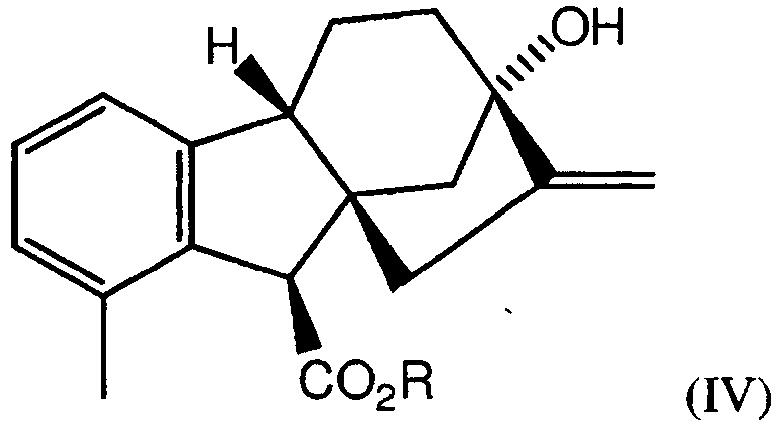
- In any embodiment herein, R may be further defined as alkyl(C≤8), such as methyl, ethyl, n-propyl, or isopropyl. R may be an alkenyl(C≤8) group, such as allyl. R may be a substituted or unsubstituted aralkyl(C≤8) group, such as benzyl or 2-furanylmethyl. In any embodiment herein, R1 may be further defined as an aryl(C≤8) sulfonate, such as a tosylate.
- In any embodiment herein regarding alkyl(C≤8), aryl(C≤8) and aralkyl(C≤8) groups (e.g., alkyl(C≤8), alkyl(C≤8) sulfonate, alkyl(C≤8) halide, aryl(C≤8) sulfonate, aralkyl(C≤8), etc.), it is specifically contemplated that the number of carbons may be 1, 2, 3, 4, 5, 6, 7, or 8, or any range derivable therein. It is also specifically contemplated that any particular number of carbon atoms may be excluded from any of these definitions.
- As used herein, "halide" means independently -F, -Cl, -Br or -I and "sulfonyl" means -SO2-.
- The term "alkyl," when used without the "substituted" modifier, refers to a non-aromatic monovalent group, having a saturated carbon atom as the point of attachment, a linear or branched, cyclo, cyclic or acyclic structure, no carbon-carbon double or triple bonds, and no atoms other than carbon and hydrogen. The groups, -CH3 (Me), -CH2CH3 (Et), -CH2CH2CH3 (n-Pr), -CH(CH3)2 (iso-Pr), -CH(CH2)2 (cyclopropyl), -CH2CH2CH2CH3 (n-Bu), -CH(CH3)CH2CH3 (sec-butyl), -CH2CH(CH3)2 (iso-butyl), -C(CH3)3 (tert-butyl), -CH2C(CH3)3 (neo-pentyl), cyclobutyl, cyclopentyl, cyclohexyl, and cyclohexylmethyl are non-limiting examples of alkyl groups. The term "substituted alkyl" refers to a non-aromatic monovalent group, having a saturated carbon atom as the point of attachment, a linear or branched, cyclo, cyclic or acyclic structure, no carbon-carbon double or triple bonds, and at least one atom independently selected from the group consisting of N, O, F, Cl, Br, I, Si, P, and S. The following groups are non-limiting examples of substituted alkyl groups: -CH2OH, -CH2Cl, -CH2Br, -CH2SH, -CF3, -CH2CN, -CH2C(O)H, -CH2C(O)OH, -CH2C(O)OCH3, -CH2C(O)NH2, -CH2C(O)NHCH3, -CH2C(O)CH3, -CH2OCH3, -CH2OCH2CF3, -CH2OC(O)CH3, -CH2NH2, -CH2NHCH3, -CH2N(CH3)2, -CH2CH2Cl, -CH2CH2OH, -CH2CF3, -CH2CH2OC(O)CH3, -CH2CH2NHCO2C(CH3)3, and -CH2Si(CH3)3. In certain embodiments, "lower alkyl" groups are contemplated, wherein the total number of carbon atoms in the lower alkyl group is 6 or less.
- The term "alkenyl" when used without the "substituted" modifier refers to a monovalent group, having a nonaromatic carbon atom as the point of attachment, a linear or branched, cyclo, cyclic or acyclic structure, at least one nonaromatic carbon-carbon double bond, no carbon-carbon triple bonds, and no atoms other than carbon and hydrogen. Non-limiting examples of alkenyl groups include: -CH=CH2 (vinyl), -CH=CHCH3, -CH=CHCH2CH3, -CH2CH=CH2 (allyl), -CH2CH=CHCH3, and -CH=CH-C6H5. The term "substituted alkenyl" refers to a monovalent group, having a nonaromatic carbon atom as the point of attachment, at least one nonaromatic carbon-carbon double bond, no carbon-carbon triple bonds, a linear or branched, cyclo, cyclic or acyclic structure, and at least one atom independently selected from the group consisting of N, O, F, Cl, Br, I, Si, P, and S. The groups, -CH=CHF, -CH=CHCl and -CH=CHBr, are non-limiting examples of substituted alkenyl groups.
- The term "aryl," when used without the "substituted" modifier, refers to a monovalent group, having an aromatic carbon atom as the point of attachment, said carbon atom forming part of a six-membered aromatic ring structure wherein the ring atoms are all carbon, and wherein the monovalent group consists of no atoms other than carbon and hydrogen. Non-limiting examples of aryl groups include phenyl (Ph), methylphenyl, (dimethyl)phenyl, -C6H4CH2CH3 (ethylphenyl), -C6H4CH2CH2CH3 (propylphenyl), -C6H4CH(CH3)2, -C6H4CH(CH2)2, -C6H3(CH3)CH2CH3 (methylethylphenyl), -C6H4CH=CH2 (vinylphenyl), -C6H4CH=CHCH3, -C6H4C≡CH, -C6H4C≡CCH3, naphthyl, and the monovalent group derived from biphenyl. The term "substituted aryl" refers to a monovalent group, having an aromatic carbon atom as the point of attachment, said carbon atom forming part of a six-membered aromatic ring structure wherein the ring atoms are all carbon, and wherein the monovalent group further has at least one atom independently selected from the group consisting of N, O, F, Cl, Br, I, Si, P, and S. Non-limiting examples of substituted aryl groups include the groups: -C6H4F, -C6H4Cl, -C6H4Br, -C6H4I, -C6H4OH, -C6H4OCH3, -C6H4OCH2CH3, -C6H4OC(O)CH3, -C6H4NH2, -C6H4NHCH3, -C6H4N(CH3)2, -C6H4CH2OH, -C6H4CH2OC(O)CH3, -C6H4CH2NH2, -C6H4CF3, -C6H4CN, -C6H4CHO, -C6H4C(O)CH3, -C6H4C(O)C6H5, -C6H4CO2H, -C6H4CO2CH3, -C6H4CONH2, -C6H4CONHCH3, and -C6H4CON(CH3)2.
- The term "aralkyl" when used without the "substituted" modifier refers to the monovalent group -alkanediyl-aryl, in which the terms alkanediyl and aryl are each used in a manner consistent with the definitions provided herein. Non-limiting examples of aralkyls are: phenylmethyl (benzyl, Bn), 1-phenyl-ethyl, 2-phenyl-ethyl, indenyl and 2,3-dihydro-indenyl, provided that indenyl and 2,3-dihydro-indenyl are only examples of aralkyl in so far as the point of attachment in each case is one of the saturated carbon atoms. When the term "aralkyl" is used with the "substituted" modifier, either one or both the alkanediyl and the aryl is substituted. Non-limiting examples of substituted aralkyls are (3-chlorophenyl)-methyl, 2-oxo-2-phenyl-ethyl (phenylcarbonylmethyl), 2-chloro-2-phenyl-ethyl and 2-methylfuranyl.
- The term "alkynediyl" when used without the "substituted" modifier refers to a non-aromatic divalent group, wherein the alkynediyl group is attached with two σ-bonds, with two carbon atoms as points of attachment, a linear or branched, cyclo, cyclic or acyclic structure, at least one carbon-carbon triple bond, and no atoms other than carbon and hydrogen. The groups, -C≡C-, -C≡CCH2-, and -C≡CCH(CH3)- are non-limiting examples of alkynediyl groups. The term "substituted alkynediyl" refers to a non-aromatic divalent group, wherein the alkynediyl group is attached with two σ-bonds, with two carbon atoms as points of attachment, a linear or branched, cyclo, cyclic or acyclic structure, at least one carbon-carbon triple bond, and at least one atom independently selected from the group consisting of N, O, F, Cl, Br, I, Si, P, and S. The groups -C≡CCH(F)- and -C≡CCH(Cl)- are non-limiting examples of substituted alkynediyl groups.
- The terms "alkyl sulfonate" and "aryl sulfonate" refer to compounds having the structure -OSO2R, wherein R is alkyl or aryl, as defined above, including substituted versions thereof. Non-limiting examples of alkyl sulfonates and aryl sulfonates include mesylate, triflate, tosylate and besylate. In certain embodiments, mesylates are excluded from compounds of the present invention.
- As used herein, "protecting group" refers to a moiety attached to a functional group to prevent an otherwise unwanted reaction of that functional group. The term "functional group" generally refers to how persons of skill in the art classify chemically reactive groups. Examples of functional groups include hydroxyl, amine, sulfhydryl, amide, carboxylic acid, ester, carbonyl, etc. Protecting groups are well-known to those of skill in the art. Non-limiting exemplary protecting groups fall into categories such as hydroxy protecting groups, amino protecting groups, sulfhydryl protecting groups and carbonyl protecting groups. Such protecting groups, including examples of their installation and removal, may be found in Greene and Wuts (1999). The starting materials, products and intermediates described herein are also contemplated as protected by one or more protecting groups-that is, the present invention contemplates such compounds in their "protected form," wherein at least one functional group is protected by a protecting group.
- Compounds prepared by the present invention may contain one or more asymmetric centers and thus can occur as racemates and racemic mixtures, single enantiomers, diastereomeric mixtures and individual diastereomers. In certain embodiments, a single diastereomer is present. All possible stereoisomers of the compounds prepared by the present invention are contemplated as being within the scope of the present invention. However, in certain aspects, particular diastereomers are contemplated. The chiral centers of the compounds prepared by the present invention can have the S- or the R-configuration, as defined by the IUPAC 1974 Recommendations. Thus, in certain aspects, compounds prepared by the present invention may comprise S- or R-configurations at particular carbon centers.
- Persons of ordinary skill in the art will be familiar with methods of purifying compounds prepared by the present invention. One of ordinary skill in the art will understand that compounds prepared by the present invention can generally be purified at any step, including the purification of intermediates as well as purification of the final products. Purification procedures include, for example, silica gel column chromatography, HPLC, or crystallization. In particular embodiments, trituration is employed. In certain embodiments, solvent extraction is employed.
- Modifications or derivatives of the compounds disclosed throughout this specification are contemplated as being useful with the methods and compositions of the present invention. Derivatives may be prepared and the properties of such derivatives may be assayed for their desired properties by any method known to those of skill in the art. A non-limiting example of a method for testing GA5 derivatives as compared to GA5 is described by Ben-Tal (2000).
- In certain aspects, "derivative" refers to a chemically-modified compound that still retains the desired effects of the compound prior to the chemical modification. Using GA5 as an example, a "GA5 derivative" refers to a chemically modified GA5 that still retains the desired effects of the parent GA5 prior to its chemical modification. Such effects may be enhanced (e.g., slightly more effective, twice as effective, etc.) or diminished (e.g., slightly less effective, 2-fold less effective, etc.) relative to the parent GA5, but may still be considered a GA5 derivative. Such derivatives may have the addition, removal, or substitution of one or more chemical moieties on the parent molecule. Non-limiting examples of the types of modifications that can be made to the compounds and structures disclosed herein include the addition or removal of lower unsubstituted alkyls such as methyl, ethyl, propyl, or substituted lower alkyls such as hydroxymethyl or aminomethyl groups; carboxyl groups and carbonyl groups; hydroxyls; nitro, amino, amide, imide, and azo groups; sulfate, sulfonate, sulfono, sulfhydryl, sulfenyl, sulfonyl, sulfoxido, sulfonamide, phosphate, phosphono, phosphoryl groups, and halide substituents. Additional modifications can include an addition or a deletion of one or more atoms of the atomic framework, for example, substitution of an ethyl by a propyl, or substitution of a phenyl by a larger or smaller aromatic group. Alternatively, in a cyclic or bicyclic structure, heteroatoms such as N, S, or O can be substituted into the structure instead of a carbon atom.
- Salts of any of the compounds prepared by the present invention are also contemplated. The term "salt(s)" as used herein, is understood as being acidic and/or basic salts formed with inorganic and/or organic acids and bases. Zwitterions (internal or inner salts) are understood as being included within the term "salt(s)" as used herein, as are quaternary ammonium salts, such as alkylammonium salts. Salts include, but are not limited to, sodium, lithium, potassium, amines, tartrates, citrates, hydrohalides and phosphates.
- Hydrates of compounds prepared by the present invention are also contemplated. The term "hydrate" when used as a modifier to a compound means that the compound has less than one (e.g., hemihydrate), one (e.g., monohydrate), or more than one (e.g., dihydrate) water molecules associated with each compound, such as in solid forms of the compound.
- It is contemplated that any embodiment discussed in this specification can be implemented with respect to any method, compound, or composition of the invention, and vice versa. Furthermore, compounds and compositions prepared by the invention can be used to achieve methods of the invention.
- The use of the term "or" in the claims is used to mean "and/or" unless explicitly indicated to refer to alternatives only or the alternatives are mutually exclusive, although the disclosure supports a definition that refers to only alternatives and "and/or."
- Throughout this application, the term "about" is used to indicate that a value includes the standard deviation of error for the device or method being employed to determine the value. In any embodiment discussed in the context of a numerical value used in conjunction with the term "about," it is specifically contemplated that the term about can be omitted.
- Following long-standing patent law, the words "a" and "an," when used in conjunction with the word "comprising" in the claims or specification, denotes one or more, unless specifically noted.
- Other objects, features and advantages of the present invention will become apparent from the following detailed description. It should be understood, however, that the detailed description and the specific examples, while indicating specific embodiments of the invention, are given by way of illustration only.
- The naturally occurring plant product GA5 may be obtained using both non-synthetic and synthetic means. GA5 has been isolated from seeds (MacMillan et al., 1961; MacMillan et al., 1959) and has been reported to be produced by bacteria in a mixture with other gibberellins (Joo et al., 2004), although its presence in the medium used to ferment the bacteria cannot be excluded. Synthetic methods of preparing GA5, radioactive GA5, and GA5 methyl ester have been discussed in the literature. See, e.g., Nuyttens et al., 1991; Shimano et al., 1990; Grootaert and De Clercq, 1986; Bearder et al., 1981; Hanson, 1980; Murofushi et al., 1977; Duri et al., 1981; Great Britain Patent 892777; and
U.S. Patent 5,767,042 . Many of these reactions require expensive reagents, entail multiple steps, or are impractical for large-scale production. - By contrast, the preparation of GA5 and various esters from a GA3 ester as provided by the present invention offers an inexpensive and efficient means of accessing these compounds. As a starting material, GA3 is readily available at low cost, and the reagents employed to produce GA5 esters and GA5 as described herein are typically cheaper than those found in other preparations. Moreover, relatively inexpensive and simple triturations purity the sulfonylated GA3 ester intermediate and GA5 ester product. Optional removal of the GA5 ester reveals GA5.
- In keeping with the description above, GA5 as produced herein may be used in agriculture, floriculture, forestry and horticulture. For example, GA5 may be used to stimulate flowering, such as in grasses, grains and canola. Cytokinins, auxins, brassinosteroids, or other plant growth regulators (natural or synthetic) may be combined with GA5 for flowering and/or growth purposes, such as for canola. Other uses include stimulation of a more uniform bud break in woody angiosperm fruit trees (e.g., peach and apricot) as well as promotion of flowering in a variety of biennial bearing plants, such as apples, apricots, pecan and coffee plants. GA5 may be employed in outdoor conditions that are less than favorable for flowering and shoot growth, such as lower-than-average temperatures, to achieve the benefits discussed herein.
- In addition, the products and intermediates produced using methods of the present invention may also be employed as materials to generate GA5 derivatives as well as other known gibberellins and derivatives thereof. Furthermore, radioactive isotopes and or stable isotopes may be incorporated during the syntheses described herein such that the labelled products may be used to monitor these compounds in plant studies.
- Gibberellin A5 may be provided to the commercial user as the crystalline parent material (with directions for solubilization using an appropriate solvent, such as ethanol or water), or as a salt, e.g., potassium salt, or as a formulated material (concentrate) that is relatively stable over time and can be easily diluted according to directions for practical use as a spray, either to drip off (1 to 300 ppm) or at recommended doses per acre or per hectare in a given volume of solution, e.g., 0.1, 0.3, 1, 3, 10, 33 etc., grams per 100 litres applied to each hectare.
- Frequency of application may be once, or more than once, such as twice, thrice, etc., where repeated applications may be necessary, or may be used in lieu of a single high dose application. Appropriate surfactants (to lower surface tension of the application solution) may be included in the formulated concentrate. GA5 or one of its derivatives may also be formulated according to protocols provided by European Patent
1 094 708 . - Application may take place at or prior to the time at which each individual plant species is known to "make the decision" to induce potential floral buds (meristems) to begin the path toward floral bud differentiation and development. This could be early spring for certain species of annuals, biennials, or perennials, or in the previous late summer autumn/early winter for some biennials, or in the previous summer/autumn for some perennials, including woody plants (Pharis and King, 1985).
- The following examples are included to demonstrate particular embodiments of the invention. It should be appreciated by those of skill in the art that the techniques disclosed in the examples which follow represent techniques discovered by the inventor to function well in the practice of the invention.
-

- The starting GA3 methyl ester was prepared by alkylating GA3 (Zhejiang Shenghua Biok Biology Co., Ltd., China; imported by Bloomfresh, Pty Ltd, Cheltenham VIC., Australia) using methyl iodide and K2CO3. Toluenesulfonyl chloride (11.2 g, 58.9 mmol) was added to purified GA3 methyl ester (10.6 g, 29.4 mmol) in pyridine (50 mL) at 0 °C under nitrogen. The reaction mixture was stirred for 24 h warming to 15 °C, then quenched with water (50 mL) and diluted with dichloromethane (100 mL). The organic phase was separated and the aqueous phase extracted with dichloromethane (3 x 30 mL). The combined organic extracts were washed with 1 M HCl (20 mL), water (20 mL), brine (20 mL) then dried over magnesium sulfate. Concentration of the organic phase in vacuo gave a yellow solid which was purified by trituration with hexane to give the desired tosylate as a white solid (12.0 g, 80%).
- Characterization of GA3 methyl ester tosylate: m.p: 140-142 °C; IR (thin film) cm-1: 3541s (C-OH), 2939 (C-H), 1778s (C=O), 1729s (C=O), 1454, 1360, 1175; 1H NMR (300 MHz, CDCl3) δ: 0.95 (s, 3H, 18 -CH3), 1.63-2.22 (m, 10H), 2.46 (s, 3H, -Ts), 2.70 (ABd, J = 10.8 Hz, 1H, H-6), 3.25 (ABd, J = 10.8 Hz, 1H, H-5), 3.71 (s, 3H, - CO2Me), 4.80 (d, J = 3.6 Hz, 1H, H-3), 4.96 (s, 1H, H-17), 5.26 (s, 1H, H'-17), 5.80 (dd, J = 9.3 Hz, 2.7 Hz, 1H, H-2), 6.38 (d, J = 9.3 Hz, 1H, H-1), 7.36 (d, J = 8.1 Hz, 2H, -Ts), 7.80 (d, J = 8.1 Hz, 2H, -Ts); 13C NMR (75 MHz, CDCl3) δ: 14.5, 16.8, 21.7, 38.0, 42.9, 44.5, 50.1, 50.4, 50.6, 52.2, 52.6, 53.0, 77.0, 77.9, 90.0, 107.7, 127.9, 128.6, 130.0, 132.9, 135.2, 145.4, 156.5, 171.8, 176.3; LRMS (m/z): 514 (M+, 2%), 454 (5%), 342 (15), 298 (51), 238 (100), 211 (49), 195 (58), 155 (61), 91 (62); HRMS: C27H30O8S (M+) requires 514.1661, found 514.1655.
-

- DMF (80 mL) was added to the tosylate from Example 1 (8.4 g, 16.3 mmol) and sodium borohydride (2.16 g, 57.2 mmol) at 0 °C under nitrogen. The mixture was warmed to room temperature and stirred for 18 h. The reaction was then quenched with water (50 mL) and diluted with ethyl acetate (50 mL). The organic phase was separated and the aqueous phase extracted with ethyl acetate (3 x 50 mL). The aqueous phase was then saturated with sodium chloride and further extracted with ethyl acetate (2 x 50 mL). The combined organic extracts were washed with water (50 mL), brine (50 mL), dried over magnesium sulfate and concentrated in vacuo to give a yellow wax. Purification by trituration with ether gave GA5 methyl ester as a white solid (2.54 g, 45%). To establish the total amount of GA5 methyl ester produced, the mother liquor was further purified by flash column chromatography using ethyl acetate:hexane (3:7) as eluant to give epi-allogibberic methyl ester as a white wax (0.67 g, 14%), and more GA5 methyl ester (1.11 g, 20%). Thus, the total yield of GA5 methyl ester obtained was 3.65 g, 65%.
- This synthesis was carried out on 100 mg, 500 mg, and 10 g scales (all approx.). It is noted that cyanoborohydride did not produce favorable results, and that use of methanesulfonate did not work under these conditions. In each synthesis, the predominant product obtained was GA5 methyl ester. However, this was unexpected, as hydride reductions of allylic sulfonates invariably afford mixtures of double bond isomers that strongly favor products in which the double bond does not migrate. (Longbottom et al.., 2002; Longbottom et al., 2003). Under the reaction conditions described by this Example and elsewhere in this application, (1) the formation of a single alkene isomer is unprecedented, and (2) the favored formation of the SN2' product (i.e., where the double bond has migrated) is again without precedent. The references cited above describe reductions that give ∼ 85:15 alkene mixtures favoring SN2 products (i.e., no migration of the double bond).
- Characterization of GA5 methyl ester: m.p: 179-189 °C; IR (thin film) cm-1: 3479s (C-OH), 2932 (C-H), 1752s (C=O), 1732s (C=O), 1454, 1381, 1199; 1H NMR (300 MHz, CDCl3) δ: 1.23 (s, 3H, 18-CH3), 1.62-2.18 (m, 9H), 2.32 (m, 1H), 2.59 (m, 1H), 2.66 (ABd, J = 9.6 Hz, 1H, H-6), 2.79 (ABd, J = 9.6 Hz, 1H, H-5), 3.72 (s, 3H, - CO2Me), 4.95 (s, 1H, H-17), 5.24 (s, 1H, H'-17), 5.67 (m, 1H, H-2), 5.80 (m, 1H, H-3); 13C NMR (75 MHz, CDCl3) δ: 15.2, 17.4, 35.2, 38.2, 42.9, 45.7, 48.0, 50.6, 50.9, 52.1, 53.2, 55.5, 78.2, 91.6, 107.3, 127.7, 132.3, 156.5, 172.9, 177.6; LRMS (m/z): 344 (M+, 15%), 312 (28), 300 (55), 240 (100), 225 (21), 156 (48), 105 (63); HRMS: C20H24O5 (M+) requires 344.1624, found 344.1620.
- Characterization of epi-allogibberic methyl ester: IR (thin film) cm-1: 3401br (C-OH), 2930 (C-H), 1732s (C=O), 1435, 1335, 1244, 1158; 1H NMR (300 MHz, CDCl3) δ: 1.54 2.20 (m, 7H), 2.24 (s, 3H, -CH3), 2.52 (m, 1H), 2.79 (m, 1H), 3.45 (d, J = 8.1 Hz, 1H), 3.66 (s, 3H, -CO2Me), 5.06 (s, 1H), 5.19 (s, 1H), 6.98-7.01 (m, 2H), 7.17 (t, J = 7.5 Hz, 1H); 13C NMR (75 MHz, CDCl3) δ: 18.7, 21.0, 38.3, 38.4, 47.9, 48.8, 51.7, 53.7, 56.2, 78.5, 106.7, 119.8, 127.7, 127.8, 134.8, 139.4, 146.5, 155.4, 172.5. LRMS (m/z): 298 (M+, 42%), 269 (10), 238 (100), 221 (23), 209 (25), 155 (35); HRMS: C19H22O3 (M+) requires 298.1569, found 298.1567.
- A variety of solvents were tested to optimize this aspect of the reaction described in Example 2. Table 1 describes the outcomes of the solvents tested:
Table 1 Solvent Eq. NaBH4 Yield or Ratio of GA5 Methyl Ester (A):epi-Allogibberic Methyl Ester (B) DMSO 5 A = 68%;B = 12% Ratio: about 7:1 DMSO 3 A = 50%; B = 13% Ratio: about 4:1 DMSO 2 Ratio: about 4:1 with trace of starting material THF 3 Complex mixture DMF 3 A = 62% ; B = 2% with trace of starting material DMF 3.5 (small scale, 70 mg) A = 60%; B = 7.2% Ratio: about 10:1 DMF 3.5 (large scale, 8.4 g) A = 65%; B = 14% Ratio: about 5:1 - In general, yields and ratios from experiments camed out in DMF were more reliable and reproducible than those carried out in DMSO.
- A variety of GA5 alkyl esters were synthesized to investigate the effect of the alkyl ester on the overall yield of the corresponding GA5 alkyl ester.

- The starting GA3 alkyl ester was prepared by alkylating GA3 using methods well known in the art. For example, the GA3 methyl ester was prepared by alkylating GA5 using methyl iodide and K2CO3. In general, toluenesulfonyl chloride (2.5 equivalents) was added to the purified GA3 alkyl ester (1.0 mmol) in pyridine at 0 °C under nitrogen. After allowing the reaction mixture to stir for 23 hours, methanol (1.50 microliters) was added and the reaction mixture was allowed to stir for an additional 24 hours. The reaction was quenched with water and diluted with chloroform. The organic phase was separated and the aqueous phase was extracted with chloroform, collected, dried with magnesium sulfate and concentrated in vacuo. The resulting GA3 alkyl ester tosylate was purified using silica chromatography. Finally, the GA3 alkyl ester tosylate was converted to the corresponding GA5 alkyl ester using NaBH4.
- Table 2 shows the yields of each step for converting the GA3 starting material to the corresponding GA5 alkyl ester.
Table 2 GA-CO2R (percent yield) R= GA3 alkyl ester GA3 alkyl ester tosylate GA5 alkyl ester Methyl >95 80 65 Ethyl 76 66 49 Benzyl 77 68 60 2-Furyl 84 49 49 - In general, the data reveals that the methyl substituent produces the GA5 alkyl ester in better yields than when an ethyl, benzyl or 2-furyl substituent is used.
-
- Great Britain Patent
892777 - European Patent
1 094 708 -
U.S. Patent 5,767,042 -
U.S. Patent 7,199,082 - Bearder et al., J. Chem. Soc., 3:672-8, 1981.
- Ben-Tal, Israel J. of Plant Sciences, 48:205-215, 2000.
- Duri et al., J. Chem. Soc., Perkins Trans. I, 1:161-4, 1981.
- Greene and Wuts, In: Protective Groups in Organic Synthesis, 2nd Ed..; Wiley, NY, 1999.
- Grootaert and De Clercq, Tet. Lett., 27:1731-4, 1986.
- Hanson, Monograph-British Plant Growth Regulator Group, 5:5-16, 1980.
- Joo et al., Biotech. Lett., 26:487-491, 2004.
- King and Evans, Annu. Rev. Plant Biol., 54:307-328, 2003.
- Longbottom et al., Angew. Chemie, Int'l Ed., 41:2786-2790, 2002.
- Longbottom et al., Tetrahedron, 59:6955-6966, 2003.
- MacMillan et al., Proc. Chem. Soc., 325-6, 1959.
- MacMillan et al., Adv. Chem. Ser., 28:18-25, 1961.
- Murofushi et al., 41:1075-9, 1977.
- Nuyttens et al., Synlett., 7:526-8, 1991.
- Pharis, Planta Berl., 105:205-212, 1972.
- Pharis and King, Ann. Review of Plant Physiology, 36:517-68, 1985.
- Shimano et al., Chem. Pharm. Bull., 38:276-8, 1990.
- Smith and March, March's Advanced Organic Chemistry: Reactions, Mechanisms, and Structure, 5th ed., Wiley Interscience, New York, 2001.
Claims (15)
- A method of preparing a compound of formula (I):

the method comprising the step of reacting a compound of formula (II):
in the presence of a metal hydride and a dipolar aprotic solvent to produce a mixture comprising the compound of formula (I). - The method of claim 1, the method further comprising the step of removing the R group of the compound of formula (I) to produce GA5.
- The method of claim 2, wherein the compound of formula (I) is the predominant species in the mixture of step (a).
- The method of claim 1 or 2, wherein the dipolar aprotic solvent is DMF, DMSO, or dimethyl acetamide.
- The method of claim 1 or 2, wherein the metal hydride is NaBH4 or LiAlH4.
- The method of claim 1 or 2, the method further comprising the step of isolating the compound of formula (I) from the mixture.
- The method of claim 6, wherein the step of isolating the compound of formula (I) from the mixture is performed after or before removal of R from the compound of formula (I).
- The method of claim 1 or 2, wherein the number of molar equivalents of the metal hydride ranges from about 1 to about 10, in particular wherein the metal hydride is NaBH4 and the number of molar equivalents of NaBH4 ranges from about 2 to 5.
- The method of claim 1 or 2, wherein the mixture comprising the compound of formula (I) further comprises a compound of formula (IV):

- The method of claim 1 or 2, wherein R is alkyl(C≤8), in particular wherein R is methyl.
- The method of claim 1 or 2, wherein R1 is an aryl(C≤8) sulfonate, in particular wherein R1 is tosylate.
- The method of claim 1 or 2, the method further comprising the step of obtaining a compound of formula (II).
- The method of claim 12, wherein the compound of formula (II) is obtained by reacting a compound of formula (III):

- The method of claim 13, wherein the sulfonylating agent is an alkyl(C≤8)sulfonyl chloride or an aryl(C≤8)sulfonyl chloride.
- The method of claim 14, wherein the alkyl(C≤8)sulfonyl chloride or the aryl(C≤8)sulfonyl chloride is tosyl chloride, benzenesulfonyl chloride, or methanesulfonyl chloride.
Applications Claiming Priority (2)
| Application Number | Priority Date | Filing Date | Title |
|---|---|---|---|
| US9844408P | 2008-09-19 | 2008-09-19 | |
| PCT/IB2009/007067 WO2010032136A1 (en) | 2008-09-19 | 2009-09-18 | Expeditious synthesis of gibberllin a5 and esters thereof |
Publications (3)
| Publication Number | Publication Date |
|---|---|
| EP2350040A1 EP2350040A1 (en) | 2011-08-03 |
| EP2350040B1 true EP2350040B1 (en) | 2014-03-26 |
| EP2350040B8 EP2350040B8 (en) | 2014-06-11 |
Family
ID=41572371
Family Applications (1)
| Application Number | Title | Priority Date | Filing Date |
|---|---|---|---|
| EP09756786.1A Not-in-force EP2350040B8 (en) | 2008-09-19 | 2009-09-18 | Expeditious synthesis of gibberllin a5 and esters thereof |
Country Status (7)
| Country | Link |
|---|---|
| US (1) | US8461357B2 (en) |
| EP (1) | EP2350040B8 (en) |
| AU (1) | AU2009294316B2 (en) |
| CA (1) | CA2737877C (en) |
| ES (1) | ES2469832T3 (en) |
| NZ (1) | NZ591796A (en) |
| WO (1) | WO2010032136A1 (en) |
Families Citing this family (1)
| Publication number | Priority date | Publication date | Assignee | Title |
|---|---|---|---|---|
| WO2017161453A1 (en) * | 2016-03-23 | 2017-09-28 | Uti Limited Partnership | Use of gibberellin a5 to increase the yield and quality of grapes |
Family Cites Families (7)
| Publication number | Priority date | Publication date | Assignee | Title |
|---|---|---|---|---|
| GB892777A (en) | 1959-10-26 | 1962-03-28 | Ici Ltd | Gibberellins |
| US4243594A (en) | 1978-07-18 | 1981-01-06 | Imperial Chemical Industries Limited | Process for the 13-deoxygenation of a 3,13-dehydroxy-gibberellin |
| CA1184187A (en) | 1981-10-30 | 1985-03-19 | John V. Turner | Process for making gibberellins |
| AUPM766694A0 (en) * | 1994-08-25 | 1994-09-15 | Australian National University, The | Ring modified gibberellin compounds, and preparation and use thereof |
| FR2750423B1 (en) | 1996-06-28 | 1998-08-14 | Rhone Poulenc Chimie | PROCESS FOR THE ASYMMETRIC HYDROGENATION OF A KETONIC COMPOUND |
| US7199082B1 (en) | 1999-10-28 | 2007-04-03 | University Of North Texas | Methods for extending the freshness of cut flowers, ornamental trees, and plant cuttings |
| DE102005018025A1 (en) | 2005-04-14 | 2006-11-02 | Schering Ag | New heterocyclic compounds which are cytokine interleukin-8 inhibitors useful for treating e.g., chronic obstructive lung disease, bronchitis, rheumatoid arthritis, psoriasis, gastrointestinal disease and Crohn's disease |
-
2009
- 2009-09-18 US US13/119,889 patent/US8461357B2/en not_active Expired - Fee Related
- 2009-09-18 WO PCT/IB2009/007067 patent/WO2010032136A1/en not_active Ceased
- 2009-09-18 EP EP09756786.1A patent/EP2350040B8/en not_active Not-in-force
- 2009-09-18 AU AU2009294316A patent/AU2009294316B2/en not_active Ceased
- 2009-09-18 NZ NZ591796A patent/NZ591796A/en not_active IP Right Cessation
- 2009-09-18 ES ES09756786.1T patent/ES2469832T3/en active Active
- 2009-09-18 CA CA2737877A patent/CA2737877C/en not_active Expired - Fee Related
Also Published As
| Publication number | Publication date |
|---|---|
| AU2009294316A1 (en) | 2010-03-25 |
| ES2469832T3 (en) | 2014-06-20 |
| EP2350040B8 (en) | 2014-06-11 |
| EP2350040A1 (en) | 2011-08-03 |
| CA2737877C (en) | 2016-10-11 |
| CA2737877A1 (en) | 2010-03-25 |
| WO2010032136A1 (en) | 2010-03-25 |
| AU2009294316B2 (en) | 2014-06-26 |
| US8461357B2 (en) | 2013-06-11 |
| NZ591796A (en) | 2011-12-22 |
| US20110263876A1 (en) | 2011-10-27 |
Similar Documents
| Publication | Publication Date | Title |
|---|---|---|
| EP0441160B1 (en) | Process for preparing levo and dextro fenfluramine | |
| US6197998B1 (en) | Process for producing N-glycyltyrosine and its crystal structure | |
| US8461357B2 (en) | Expeditious synthesis of gibberellin A5 and esters thereof | |
| LU82116A1 (en) | METHOD FOR SELECTIVELY PRODUCING ISOSORBIDE-5-NITRATE | |
| US20150197479A1 (en) | (s)-3'-methyl-abscisic acid and esters thereof | |
| CN119390751A (en) | A long-acting brassinolide compound and its application | |
| DE69226638T2 (en) | METHOD FOR SEPARATING GIBBERELLIN MIXTURES | |
| CA1190238A (en) | Process for preparing optically active [s]-2- acetyl-7-(2-hydroxy-3- isopropylaminopropoxy)benzofuran and salts thereof | |
| US20080221340A1 (en) | Process for the Production of Nebivolol | |
| EP2283025B1 (en) | 5-fluoro-3alpha ,17beta-dihydroxy-5alpha-androstan-6-one, the method for its production and its use for influencing plant growth | |
| KR20180101546A (en) | Synthesis of intermediates of navbolol | |
| US4158096A (en) | Intermediates for insect pheromone | |
| CN110105311B (en) | Synthetic method of sex pheromone intermediate of fall webworm | |
| CN115057881B (en) | A method for organic catalytic synthesis of chiral tetrasubstituted silane aldehyde compounds and derivatization thereof | |
| US20080269495A1 (en) | Process for Preparation of Piperidine Carboxylic Acid | |
| SU922108A1 (en) | Process for producing derivatives of 6-methyl-8-beta-hydrazinomethylergolin or their salts | |
| US20050059732A1 (en) | Synthesis of 8-membered carbocyclic compound having diexomethylene groups | |
| KR100911720B1 (en) | Method for preparing crystalline hydrochloride safoglylate | |
| Beale et al. | An efficient synthesis of 2-hydroxy-gibberellins | |
| EP0579096B1 (en) | A process for the preparation of 5-(3-tert.-butylamino-2-hydroxypropoxy)-3,4-dihydro- carbostyryl. | |
| US20050171145A1 (en) | Process for the preparation of 2-(ethoxymethyl)-tropane derivatives | |
| CN115215803A (en) | Preparation method of 4-halogenated-1- (difluoromethyl) -1H-imidazole | |
| KR100355533B1 (en) | Process for the stereoselective synthesis of nucleoside analogues | |
| Hua et al. | Structure of (+)-(7S, SS)-1, 2, 3, 5, 6, 7-hexahydro-7-methyl-8-(p-tolylsulfinyl)-5-indolizinone | |
| JPH10158256A (en) | 3-Epidiberreic acid ethers and method for producing the same |
Legal Events
| Date | Code | Title | Description |
|---|---|---|---|
| PUAI | Public reference made under article 153(3) epc to a published international application that has entered the european phase |
Free format text: ORIGINAL CODE: 0009012 |
|
| 17P | Request for examination filed |
Effective date: 20110418 |
|
| AK | Designated contracting states |
Kind code of ref document: A1 Designated state(s): AT BE BG CH CY CZ DE DK EE ES FI FR GB GR HR HU IE IS IT LI LT LU LV MC MK MT NL NO PL PT RO SE SI SK SM TR |
|
| DAX | Request for extension of the european patent (deleted) | ||
| GRAP | Despatch of communication of intention to grant a patent |
Free format text: ORIGINAL CODE: EPIDOSNIGR1 |
|
| INTG | Intention to grant announced |
Effective date: 20130625 |
|
| GRAP | Despatch of communication of intention to grant a patent |
Free format text: ORIGINAL CODE: EPIDOSNIGR1 |
|
| INTG | Intention to grant announced |
Effective date: 20131121 |
|
| GRAS | Grant fee paid |
Free format text: ORIGINAL CODE: EPIDOSNIGR3 |
|
| GRAA | (expected) grant |
Free format text: ORIGINAL CODE: 0009210 |
|
| AK | Designated contracting states |
Kind code of ref document: B1 Designated state(s): AT BE BG CH CY CZ DE DK EE ES FI FR GB GR HR HU IE IS IT LI LT LU LV MC MK MT NL NO PL PT RO SE SI SK SM TR |
|
| REG | Reference to a national code |
Ref country code: GB Ref legal event code: FG4D |
|
| REG | Reference to a national code |
Ref country code: CH Ref legal event code: EP |
|
| REG | Reference to a national code |
Ref country code: AT Ref legal event code: REF Ref document number: 658921 Country of ref document: AT Kind code of ref document: T Effective date: 20140415 |
|
| RAP2 | Party data changed (patent owner data changed or rights of a patent transferred) |
Owner name: AUSTRALIAN NATIONAL UNIVERSITY Owner name: UTI LIMITED PARTNERSHIP |
|
| REG | Reference to a national code |
Ref country code: IE Ref legal event code: FG4D |
|
| REG | Reference to a national code |
Ref country code: DE Ref legal event code: R096 Ref document number: 602009022781 Country of ref document: DE Effective date: 20140508 |
|
| REG | Reference to a national code |
Ref country code: DE Ref legal event code: R082 Ref document number: 602009022781 Country of ref document: DE Representative=s name: DEHMEL & BETTENHAUSEN PATENTANWAELTE PARTMBB, DE Ref country code: DE Ref legal event code: R082 Ref document number: 602009022781 Country of ref document: DE Representative=s name: DEHMEL & BETTENHAUSEN PATENT- UND RECHTSANWAEL, DE |
|
| REG | Reference to a national code |
Ref country code: CH Ref legal event code: NV Representative=s name: WAGNER + HELBIG PATENTANWAELTE, CH |
|
| REG | Reference to a national code |
Ref country code: ES Ref legal event code: FG2A Ref document number: 2469832 Country of ref document: ES Kind code of ref document: T3 Effective date: 20140620 |
|
| REG | Reference to a national code |
Ref country code: NL Ref legal event code: T3 Ref country code: GB Ref legal event code: 732E Free format text: REGISTERED BETWEEN 20140605 AND 20140611 |
|
| REG | Reference to a national code |
Ref country code: GB Ref legal event code: 732E Free format text: REGISTERED BETWEEN 20140612 AND 20140618 |
|
| PG25 | Lapsed in a contracting state [announced via postgrant information from national office to epo] |
Ref country code: NO Free format text: LAPSE BECAUSE OF FAILURE TO SUBMIT A TRANSLATION OF THE DESCRIPTION OR TO PAY THE FEE WITHIN THE PRESCRIBED TIME-LIMIT Effective date: 20140626 Ref country code: LT Free format text: LAPSE BECAUSE OF FAILURE TO SUBMIT A TRANSLATION OF THE DESCRIPTION OR TO PAY THE FEE WITHIN THE PRESCRIBED TIME-LIMIT Effective date: 20140326 |
|
| REG | Reference to a national code |
Ref country code: LT Ref legal event code: MG4D |
|
| PG25 | Lapsed in a contracting state [announced via postgrant information from national office to epo] |
Ref country code: SE Free format text: LAPSE BECAUSE OF FAILURE TO SUBMIT A TRANSLATION OF THE DESCRIPTION OR TO PAY THE FEE WITHIN THE PRESCRIBED TIME-LIMIT Effective date: 20140326 Ref country code: FI Free format text: LAPSE BECAUSE OF FAILURE TO SUBMIT A TRANSLATION OF THE DESCRIPTION OR TO PAY THE FEE WITHIN THE PRESCRIBED TIME-LIMIT Effective date: 20140326 |
|
| PG25 | Lapsed in a contracting state [announced via postgrant information from national office to epo] |
Ref country code: HR Free format text: LAPSE BECAUSE OF FAILURE TO SUBMIT A TRANSLATION OF THE DESCRIPTION OR TO PAY THE FEE WITHIN THE PRESCRIBED TIME-LIMIT Effective date: 20140326 Ref country code: LV Free format text: LAPSE BECAUSE OF FAILURE TO SUBMIT A TRANSLATION OF THE DESCRIPTION OR TO PAY THE FEE WITHIN THE PRESCRIBED TIME-LIMIT Effective date: 20140326 |
|
| PG25 | Lapsed in a contracting state [announced via postgrant information from national office to epo] |
Ref country code: BG Free format text: LAPSE BECAUSE OF FAILURE TO SUBMIT A TRANSLATION OF THE DESCRIPTION OR TO PAY THE FEE WITHIN THE PRESCRIBED TIME-LIMIT Effective date: 20140626 Ref country code: IS Free format text: LAPSE BECAUSE OF FAILURE TO SUBMIT A TRANSLATION OF THE DESCRIPTION OR TO PAY THE FEE WITHIN THE PRESCRIBED TIME-LIMIT Effective date: 20140726 Ref country code: CZ Free format text: LAPSE BECAUSE OF FAILURE TO SUBMIT A TRANSLATION OF THE DESCRIPTION OR TO PAY THE FEE WITHIN THE PRESCRIBED TIME-LIMIT Effective date: 20140326 Ref country code: EE Free format text: LAPSE BECAUSE OF FAILURE TO SUBMIT A TRANSLATION OF THE DESCRIPTION OR TO PAY THE FEE WITHIN THE PRESCRIBED TIME-LIMIT Effective date: 20140326 Ref country code: CY Free format text: LAPSE BECAUSE OF FAILURE TO SUBMIT A TRANSLATION OF THE DESCRIPTION OR TO PAY THE FEE WITHIN THE PRESCRIBED TIME-LIMIT Effective date: 20140326 Ref country code: BE Free format text: LAPSE BECAUSE OF FAILURE TO SUBMIT A TRANSLATION OF THE DESCRIPTION OR TO PAY THE FEE WITHIN THE PRESCRIBED TIME-LIMIT Effective date: 20140326 Ref country code: RO Free format text: LAPSE BECAUSE OF FAILURE TO SUBMIT A TRANSLATION OF THE DESCRIPTION OR TO PAY THE FEE WITHIN THE PRESCRIBED TIME-LIMIT Effective date: 20140326 |
|
| PG25 | Lapsed in a contracting state [announced via postgrant information from national office to epo] |
Ref country code: PL Free format text: LAPSE BECAUSE OF FAILURE TO SUBMIT A TRANSLATION OF THE DESCRIPTION OR TO PAY THE FEE WITHIN THE PRESCRIBED TIME-LIMIT Effective date: 20140326 Ref country code: SK Free format text: LAPSE BECAUSE OF FAILURE TO SUBMIT A TRANSLATION OF THE DESCRIPTION OR TO PAY THE FEE WITHIN THE PRESCRIBED TIME-LIMIT Effective date: 20140326 |
|
| PG25 | Lapsed in a contracting state [announced via postgrant information from national office to epo] |
Ref country code: PT Free format text: LAPSE BECAUSE OF FAILURE TO SUBMIT A TRANSLATION OF THE DESCRIPTION OR TO PAY THE FEE WITHIN THE PRESCRIBED TIME-LIMIT Effective date: 20140728 |
|
| REG | Reference to a national code |
Ref country code: DE Ref legal event code: R097 Ref document number: 602009022781 Country of ref document: DE |
|
| PG25 | Lapsed in a contracting state [announced via postgrant information from national office to epo] |
Ref country code: DK Free format text: LAPSE BECAUSE OF FAILURE TO SUBMIT A TRANSLATION OF THE DESCRIPTION OR TO PAY THE FEE WITHIN THE PRESCRIBED TIME-LIMIT Effective date: 20140326 |
|
| PLBE | No opposition filed within time limit |
Free format text: ORIGINAL CODE: 0009261 |
|
| STAA | Information on the status of an ep patent application or granted ep patent |
Free format text: STATUS: NO OPPOSITION FILED WITHIN TIME LIMIT |
|
| 26N | No opposition filed |
Effective date: 20150106 |
|
| REG | Reference to a national code |
Ref country code: CH Ref legal event code: PCAR Free format text: NEW ADDRESS: 48, ROUTE DE DIVONNE CASE POSTALE 2666, 1260 NYON (CH) |
|
| PG25 | Lapsed in a contracting state [announced via postgrant information from national office to epo] |
Ref country code: IT Free format text: LAPSE BECAUSE OF FAILURE TO SUBMIT A TRANSLATION OF THE DESCRIPTION OR TO PAY THE FEE WITHIN THE PRESCRIBED TIME-LIMIT Effective date: 20140326 |
|
| REG | Reference to a national code |
Ref country code: DE Ref legal event code: R097 Ref document number: 602009022781 Country of ref document: DE Effective date: 20150106 |
|
| PG25 | Lapsed in a contracting state [announced via postgrant information from national office to epo] |
Ref country code: LU Free format text: LAPSE BECAUSE OF FAILURE TO SUBMIT A TRANSLATION OF THE DESCRIPTION OR TO PAY THE FEE WITHIN THE PRESCRIBED TIME-LIMIT Effective date: 20140918 Ref country code: MC Free format text: LAPSE BECAUSE OF FAILURE TO SUBMIT A TRANSLATION OF THE DESCRIPTION OR TO PAY THE FEE WITHIN THE PRESCRIBED TIME-LIMIT Effective date: 20140326 |
|
| REG | Reference to a national code |
Ref country code: IE Ref legal event code: MM4A |
|
| PG25 | Lapsed in a contracting state [announced via postgrant information from national office to epo] |
Ref country code: SI Free format text: LAPSE BECAUSE OF FAILURE TO SUBMIT A TRANSLATION OF THE DESCRIPTION OR TO PAY THE FEE WITHIN THE PRESCRIBED TIME-LIMIT Effective date: 20140326 |
|
| PG25 | Lapsed in a contracting state [announced via postgrant information from national office to epo] |
Ref country code: IE Free format text: LAPSE BECAUSE OF NON-PAYMENT OF DUE FEES Effective date: 20140918 |
|
| PG25 | Lapsed in a contracting state [announced via postgrant information from national office to epo] |
Ref country code: SM Free format text: LAPSE BECAUSE OF FAILURE TO SUBMIT A TRANSLATION OF THE DESCRIPTION OR TO PAY THE FEE WITHIN THE PRESCRIBED TIME-LIMIT Effective date: 20140326 |
|
| PG25 | Lapsed in a contracting state [announced via postgrant information from national office to epo] |
Ref country code: GR Free format text: LAPSE BECAUSE OF FAILURE TO SUBMIT A TRANSLATION OF THE DESCRIPTION OR TO PAY THE FEE WITHIN THE PRESCRIBED TIME-LIMIT Effective date: 20140627 Ref country code: MT Free format text: LAPSE BECAUSE OF FAILURE TO SUBMIT A TRANSLATION OF THE DESCRIPTION OR TO PAY THE FEE WITHIN THE PRESCRIBED TIME-LIMIT Effective date: 20140326 |
|
| PG25 | Lapsed in a contracting state [announced via postgrant information from national office to epo] |
Ref country code: TR Free format text: LAPSE BECAUSE OF FAILURE TO SUBMIT A TRANSLATION OF THE DESCRIPTION OR TO PAY THE FEE WITHIN THE PRESCRIBED TIME-LIMIT Effective date: 20140326 Ref country code: HU Free format text: LAPSE BECAUSE OF FAILURE TO SUBMIT A TRANSLATION OF THE DESCRIPTION OR TO PAY THE FEE WITHIN THE PRESCRIBED TIME-LIMIT; INVALID AB INITIO Effective date: 20090918 |
|
| REG | Reference to a national code |
Ref country code: FR Ref legal event code: PLFP Year of fee payment: 8 |
|
| REG | Reference to a national code |
Ref country code: FR Ref legal event code: PLFP Year of fee payment: 9 |
|
| PG25 | Lapsed in a contracting state [announced via postgrant information from national office to epo] |
Ref country code: MK Free format text: LAPSE BECAUSE OF FAILURE TO SUBMIT A TRANSLATION OF THE DESCRIPTION OR TO PAY THE FEE WITHIN THE PRESCRIBED TIME-LIMIT Effective date: 20140326 |
|
| REG | Reference to a national code |
Ref country code: FR Ref legal event code: PLFP Year of fee payment: 10 |
|
| PGFP | Annual fee paid to national office [announced via postgrant information from national office to epo] |
Ref country code: NL Payment date: 20190926 Year of fee payment: 11 Ref country code: FR Payment date: 20190925 Year of fee payment: 11 |
|
| PGFP | Annual fee paid to national office [announced via postgrant information from national office to epo] |
Ref country code: GB Payment date: 20190927 Year of fee payment: 11 |
|
| PGFP | Annual fee paid to national office [announced via postgrant information from national office to epo] |
Ref country code: DE Payment date: 20190927 Year of fee payment: 11 |
|
| PGFP | Annual fee paid to national office [announced via postgrant information from national office to epo] |
Ref country code: ES Payment date: 20191001 Year of fee payment: 11 |
|
| PGFP | Annual fee paid to national office [announced via postgrant information from national office to epo] |
Ref country code: CH Payment date: 20191002 Year of fee payment: 11 |
|
| PGFP | Annual fee paid to national office [announced via postgrant information from national office to epo] |
Ref country code: AT Payment date: 20200902 Year of fee payment: 12 |
|
| REG | Reference to a national code |
Ref country code: DE Ref legal event code: R119 Ref document number: 602009022781 Country of ref document: DE |
|
| REG | Reference to a national code |
Ref country code: CH Ref legal event code: PL |
|
| REG | Reference to a national code |
Ref country code: NL Ref legal event code: MM Effective date: 20201001 |
|
| GBPC | Gb: european patent ceased through non-payment of renewal fee |
Effective date: 20200918 |
|
| PG25 | Lapsed in a contracting state [announced via postgrant information from national office to epo] |
Ref country code: NL Free format text: LAPSE BECAUSE OF NON-PAYMENT OF DUE FEES Effective date: 20201001 |
|
| PG25 | Lapsed in a contracting state [announced via postgrant information from national office to epo] |
Ref country code: DE Free format text: LAPSE BECAUSE OF NON-PAYMENT OF DUE FEES Effective date: 20210401 Ref country code: FR Free format text: LAPSE BECAUSE OF NON-PAYMENT OF DUE FEES Effective date: 20200930 |
|
| PG25 | Lapsed in a contracting state [announced via postgrant information from national office to epo] |
Ref country code: CH Free format text: LAPSE BECAUSE OF NON-PAYMENT OF DUE FEES Effective date: 20200930 Ref country code: GB Free format text: LAPSE BECAUSE OF NON-PAYMENT OF DUE FEES Effective date: 20200918 Ref country code: LI Free format text: LAPSE BECAUSE OF NON-PAYMENT OF DUE FEES Effective date: 20200930 |
|
| REG | Reference to a national code |
Ref country code: ES Ref legal event code: FD2A Effective date: 20220118 |
|
| REG | Reference to a national code |
Ref country code: AT Ref legal event code: MM01 Ref document number: 658921 Country of ref document: AT Kind code of ref document: T Effective date: 20210918 |
|
| PG25 | Lapsed in a contracting state [announced via postgrant information from national office to epo] |
Ref country code: ES Free format text: LAPSE BECAUSE OF NON-PAYMENT OF DUE FEES Effective date: 20200919 |
|
| PG25 | Lapsed in a contracting state [announced via postgrant information from national office to epo] |
Ref country code: AT Free format text: LAPSE BECAUSE OF NON-PAYMENT OF DUE FEES Effective date: 20210918 |