EP2348120B1 - Enzymatic reduction of 1-phenylpropanone and derivatives thereof - Google Patents
Enzymatic reduction of 1-phenylpropanone and derivatives thereof Download PDFInfo
- Publication number
- EP2348120B1 EP2348120B1 EP09181016.8A EP09181016A EP2348120B1 EP 2348120 B1 EP2348120 B1 EP 2348120B1 EP 09181016 A EP09181016 A EP 09181016A EP 2348120 B1 EP2348120 B1 EP 2348120B1
- Authority
- EP
- European Patent Office
- Prior art keywords
- group
- seq
- alkyl
- polypeptide
- substituted
- Prior art date
- Legal status (The legal status is an assumption and is not a legal conclusion. Google has not performed a legal analysis and makes no representation as to the accuracy of the status listed.)
- Not-in-force
Links
- 230000009467 reduction Effects 0.000 title claims description 20
- 230000002255 enzymatic effect Effects 0.000 title claims description 13
- QCCDLTOVEPVEJK-UHFFFAOYSA-N benzyl methyl ketone Natural products CC(=O)CC1=CC=CC=C1 QCCDLTOVEPVEJK-UHFFFAOYSA-N 0.000 title description 9
- KRIOVPPHQSLHCZ-UHFFFAOYSA-N propiophenone Chemical compound CCC(=O)C1=CC=CC=C1 KRIOVPPHQSLHCZ-UHFFFAOYSA-N 0.000 title description 5
- 150000001875 compounds Chemical class 0.000 claims description 43
- 125000004169 (C1-C6) alkyl group Chemical group 0.000 claims description 31
- -1 -CH2OH Chemical group 0.000 claims description 31
- 229920001184 polypeptide Polymers 0.000 claims description 26
- 102000004196 processed proteins & peptides Human genes 0.000 claims description 26
- 108090000765 processed proteins & peptides Proteins 0.000 claims description 26
- 102000016912 Aldehyde Reductase Human genes 0.000 claims description 25
- 108010053754 Aldehyde reductase Proteins 0.000 claims description 25
- 125000003277 amino group Chemical group 0.000 claims description 22
- 238000000034 method Methods 0.000 claims description 22
- 125000004178 (C1-C4) alkyl group Chemical group 0.000 claims description 16
- 238000002360 preparation method Methods 0.000 claims description 14
- 241000192282 [Candida] tenuis Species 0.000 claims description 13
- 150000001413 amino acids Chemical class 0.000 claims description 12
- 230000009466 transformation Effects 0.000 claims description 11
- 230000000694 effects Effects 0.000 claims description 10
- 239000012634 fragment Substances 0.000 claims description 9
- 240000004808 Saccharomyces cerevisiae Species 0.000 claims description 8
- 125000004432 carbon atom Chemical group C* 0.000 claims description 8
- 238000012217 deletion Methods 0.000 claims description 5
- 230000037430 deletion Effects 0.000 claims description 5
- 125000006575 electron-withdrawing group Chemical group 0.000 claims description 5
- 125000004191 (C1-C6) alkoxy group Chemical group 0.000 claims description 3
- 229910006069 SO3H Inorganic materials 0.000 claims description 3
- 210000004899 c-terminal region Anatomy 0.000 claims description 3
- 125000003178 carboxy group Chemical group [H]OC(*)=O 0.000 claims description 3
- 238000003780 insertion Methods 0.000 claims description 3
- 230000037431 insertion Effects 0.000 claims description 3
- 229910052799 carbon Inorganic materials 0.000 claims description 2
- 238000006266 etherification reaction Methods 0.000 claims description 2
- LFQSCWFLJHTTHZ-UHFFFAOYSA-N Ethanol Chemical compound CCO LFQSCWFLJHTTHZ-UHFFFAOYSA-N 0.000 description 33
- XEKOWRVHYACXOJ-UHFFFAOYSA-N Ethyl acetate Chemical compound CCOC(C)=O XEKOWRVHYACXOJ-UHFFFAOYSA-N 0.000 description 27
- 239000000203 mixture Substances 0.000 description 24
- 239000000243 solution Substances 0.000 description 24
- YMWUJEATGCHHMB-UHFFFAOYSA-N Dichloromethane Chemical compound ClCCl YMWUJEATGCHHMB-UHFFFAOYSA-N 0.000 description 22
- IAZDPXIOMUYVGZ-UHFFFAOYSA-N Dimethylsulphoxide Chemical compound CS(C)=O IAZDPXIOMUYVGZ-UHFFFAOYSA-N 0.000 description 21
- CSNNHWWHGAXBCP-UHFFFAOYSA-L Magnesium sulfate Chemical compound [Mg+2].[O-][S+2]([O-])([O-])[O-] CSNNHWWHGAXBCP-UHFFFAOYSA-L 0.000 description 20
- 238000006243 chemical reaction Methods 0.000 description 17
- OKKJLVBELUTLKV-UHFFFAOYSA-N Methanol Chemical compound OC OKKJLVBELUTLKV-UHFFFAOYSA-N 0.000 description 15
- 239000000758 substrate Substances 0.000 description 14
- 125000004093 cyano group Chemical group *C#N 0.000 description 13
- RTZKZFJDLAIYFH-UHFFFAOYSA-N Diethyl ether Chemical compound CCOCC RTZKZFJDLAIYFH-UHFFFAOYSA-N 0.000 description 12
- 239000000284 extract Substances 0.000 description 12
- FAPWRFPIFSIZLT-UHFFFAOYSA-M Sodium chloride Chemical compound [Na+].[Cl-] FAPWRFPIFSIZLT-UHFFFAOYSA-M 0.000 description 10
- 125000001246 bromo group Chemical group Br* 0.000 description 10
- 229910052943 magnesium sulfate Inorganic materials 0.000 description 10
- 102000004190 Enzymes Human genes 0.000 description 9
- 108090000790 Enzymes Proteins 0.000 description 9
- 125000001309 chloro group Chemical group Cl* 0.000 description 9
- 229940093499 ethyl acetate Drugs 0.000 description 9
- 235000019439 ethyl acetate Nutrition 0.000 description 9
- XLYOFNOQVPJJNP-UHFFFAOYSA-N water Substances O XLYOFNOQVPJJNP-UHFFFAOYSA-N 0.000 description 9
- 238000004587 chromatography analysis Methods 0.000 description 8
- 102220545633 Xylulose kinase_W24Y_mutation Human genes 0.000 description 7
- 229940024606 amino acid Drugs 0.000 description 7
- 235000001014 amino acid Nutrition 0.000 description 7
- 230000015572 biosynthetic process Effects 0.000 description 7
- 229910052739 hydrogen Inorganic materials 0.000 description 7
- VLKZOEOYAKHREP-UHFFFAOYSA-N n-Hexane Chemical compound CCCCCC VLKZOEOYAKHREP-UHFFFAOYSA-N 0.000 description 7
- 239000008057 potassium phosphate buffer Substances 0.000 description 7
- 238000000746 purification Methods 0.000 description 7
- 238000003756 stirring Methods 0.000 description 7
- 102220545638 Xylulose kinase_D51A_mutation Human genes 0.000 description 6
- 210000004027 cell Anatomy 0.000 description 6
- 238000001816 cooling Methods 0.000 description 6
- 125000000753 cycloalkyl group Chemical group 0.000 description 6
- 239000001257 hydrogen Substances 0.000 description 6
- 229930027945 nicotinamide-adenine dinucleotide Natural products 0.000 description 6
- BOPGDPNILDQYTO-NNYOXOHSSA-N nicotinamide-adenine dinucleotide Chemical compound C1=CCC(C(=O)N)=CN1[C@H]1[C@H](O)[C@H](O)[C@@H](COP(O)(=O)OP(O)(=O)OC[C@@H]2[C@H]([C@@H](O)[C@@H](O2)N2C3=NC=NC(N)=C3N=C2)O)O1 BOPGDPNILDQYTO-NNYOXOHSSA-N 0.000 description 6
- BWHMMNNQKKPAPP-UHFFFAOYSA-L potassium carbonate Chemical compound [K+].[K+].[O-]C([O-])=O BWHMMNNQKKPAPP-UHFFFAOYSA-L 0.000 description 6
- 239000013615 primer Substances 0.000 description 6
- 239000011541 reaction mixture Substances 0.000 description 6
- 238000003786 synthesis reaction Methods 0.000 description 6
- 108020004414 DNA Proteins 0.000 description 5
- 230000002441 reversible effect Effects 0.000 description 5
- 239000011780 sodium chloride Substances 0.000 description 5
- 238000006467 substitution reaction Methods 0.000 description 5
- HEDRZPFGACZZDS-UHFFFAOYSA-N Chloroform Chemical compound ClC(Cl)Cl HEDRZPFGACZZDS-UHFFFAOYSA-N 0.000 description 4
- ZHNUHDYFZUAESO-UHFFFAOYSA-N Formamide Chemical compound NC=O ZHNUHDYFZUAESO-UHFFFAOYSA-N 0.000 description 4
- HEDRZPFGACZZDS-MICDWDOJSA-N Trichloro(2H)methane Chemical compound [2H]C(Cl)(Cl)Cl HEDRZPFGACZZDS-MICDWDOJSA-N 0.000 description 4
- 125000000217 alkyl group Chemical group 0.000 description 4
- 125000006242 amine protecting group Chemical group 0.000 description 4
- 125000004435 hydrogen atom Chemical group [H]* 0.000 description 4
- 125000001997 phenyl group Chemical group [H]C1=C([H])C([H])=C(*)C([H])=C1[H] 0.000 description 4
- 102000004169 proteins and genes Human genes 0.000 description 4
- 108090000623 proteins and genes Proteins 0.000 description 4
- 238000010898 silica gel chromatography Methods 0.000 description 4
- 239000007787 solid Substances 0.000 description 4
- 239000002904 solvent Substances 0.000 description 4
- 125000001424 substituent group Chemical group 0.000 description 4
- HBAQYPYDRFILMT-UHFFFAOYSA-N 8-[3-(1-cyclopropylpyrazol-4-yl)-1H-pyrazolo[4,3-d]pyrimidin-5-yl]-3-methyl-3,8-diazabicyclo[3.2.1]octan-2-one Chemical class C1(CC1)N1N=CC(=C1)C1=NNC2=C1N=C(N=C2)N1C2C(N(CC1CC2)C)=O HBAQYPYDRFILMT-UHFFFAOYSA-N 0.000 description 3
- CSCPPACGZOOCGX-UHFFFAOYSA-N Acetone Chemical compound CC(C)=O CSCPPACGZOOCGX-UHFFFAOYSA-N 0.000 description 3
- UHOVQNZJYSORNB-UHFFFAOYSA-N Benzene Chemical compound C1=CC=CC=C1 UHOVQNZJYSORNB-UHFFFAOYSA-N 0.000 description 3
- WSFSSNUMVMOOMR-UHFFFAOYSA-N Formaldehyde Chemical compound O=C WSFSSNUMVMOOMR-UHFFFAOYSA-N 0.000 description 3
- UFHFLCQGNIYNRP-UHFFFAOYSA-N Hydrogen Chemical compound [H][H] UFHFLCQGNIYNRP-UHFFFAOYSA-N 0.000 description 3
- 102000004316 Oxidoreductases Human genes 0.000 description 3
- 108090000854 Oxidoreductases Proteins 0.000 description 3
- VYPSYNLAJGMNEJ-UHFFFAOYSA-N Silicium dioxide Chemical compound O=[Si]=O VYPSYNLAJGMNEJ-UHFFFAOYSA-N 0.000 description 3
- 239000002253 acid Substances 0.000 description 3
- 239000005515 coenzyme Substances 0.000 description 3
- 125000001033 ether group Chemical group 0.000 description 3
- 150000002170 ethers Chemical class 0.000 description 3
- 125000001153 fluoro group Chemical group F* 0.000 description 3
- 125000000468 ketone group Chemical group 0.000 description 3
- 230000014759 maintenance of location Effects 0.000 description 3
- 229910000027 potassium carbonate Inorganic materials 0.000 description 3
- 239000002243 precursor Substances 0.000 description 3
- 125000006239 protecting group Chemical group 0.000 description 3
- 235000018102 proteins Nutrition 0.000 description 3
- 238000010992 reflux Methods 0.000 description 3
- 150000003839 salts Chemical class 0.000 description 3
- 239000000725 suspension Substances 0.000 description 3
- 238000000844 transformation Methods 0.000 description 3
- 125000002023 trifluoromethyl group Chemical group FC(F)(F)* 0.000 description 3
- JZFUHAGLMZWKTF-VIFPVBQESA-N (1s)-3-chloro-1-phenylpropan-1-ol Chemical class ClCC[C@H](O)C1=CC=CC=C1 JZFUHAGLMZWKTF-VIFPVBQESA-N 0.000 description 2
- QEXPFYRHIYKWEW-INIZCTEOSA-N (3s)-3-(2-methylphenoxy)-3-phenylpropan-1-amine Chemical compound CC1=CC=CC=C1O[C@@H](CCN)C1=CC=CC=C1 QEXPFYRHIYKWEW-INIZCTEOSA-N 0.000 description 2
- VHGCDTVCOLNTBX-KRWDZBQOSA-N (3s)-n-methyl-3-(2-methylphenoxy)-3-phenylpropan-1-amine Chemical compound O([C@@H](CCNC)C=1C=CC=CC=1)C1=CC=CC=C1C VHGCDTVCOLNTBX-KRWDZBQOSA-N 0.000 description 2
- RTHCYVBBDHJXIQ-MRXNPFEDSA-N (R)-fluoxetine Chemical compound O([C@H](CCNC)C=1C=CC=CC=1)C1=CC=C(C(F)(F)F)C=C1 RTHCYVBBDHJXIQ-MRXNPFEDSA-N 0.000 description 2
- SQDWIPMYVBCJJX-MRXNPFEDSA-N 1-[(1r)-3-chloro-1-phenylpropoxy]-2-methylbenzene Chemical compound CC1=CC=CC=C1O[C@H](CCCl)C1=CC=CC=C1 SQDWIPMYVBCJJX-MRXNPFEDSA-N 0.000 description 2
- PUAQLLVFLMYYJJ-UHFFFAOYSA-N 2-aminopropiophenone Chemical compound CC(N)C(=O)C1=CC=CC=C1 PUAQLLVFLMYYJJ-UHFFFAOYSA-N 0.000 description 2
- 125000004200 2-methoxyethyl group Chemical group [H]C([H])([H])OC([H])([H])C([H])([H])* 0.000 description 2
- KWOLFJPFCHCOCG-UHFFFAOYSA-N Acetophenone Chemical compound CC(=O)C1=CC=CC=C1 KWOLFJPFCHCOCG-UHFFFAOYSA-N 0.000 description 2
- 0 C*(*)C*(C)C[C@](c1ccccc1)O Chemical compound C*(*)C*(C)C[C@](c1ccccc1)O 0.000 description 2
- 241001198387 Escherichia coli BL21(DE3) Species 0.000 description 2
- 241000282326 Felis catus Species 0.000 description 2
- DHMQDGOQFOQNFH-UHFFFAOYSA-N Glycine Chemical compound NCC(O)=O DHMQDGOQFOQNFH-UHFFFAOYSA-N 0.000 description 2
- 229930194542 Keto Natural products 0.000 description 2
- 229910010084 LiAlH4 Inorganic materials 0.000 description 2
- 239000007832 Na2SO4 Substances 0.000 description 2
- DYUQAZSOFZSPHD-UHFFFAOYSA-N Phenylpropanol Chemical compound CCC(O)C1=CC=CC=C1 DYUQAZSOFZSPHD-UHFFFAOYSA-N 0.000 description 2
- PMZURENOXWZQFD-UHFFFAOYSA-L Sodium Sulfate Chemical compound [Na+].[Na+].[O-]S([O-])(=O)=O PMZURENOXWZQFD-UHFFFAOYSA-L 0.000 description 2
- PXIPVTKHYLBLMZ-UHFFFAOYSA-N Sodium azide Chemical compound [Na+].[N-]=[N+]=[N-] PXIPVTKHYLBLMZ-UHFFFAOYSA-N 0.000 description 2
- UIIMBOGNXHQVGW-UHFFFAOYSA-M Sodium bicarbonate Chemical compound [Na+].OC([O-])=O UIIMBOGNXHQVGW-UHFFFAOYSA-M 0.000 description 2
- 238000004458 analytical method Methods 0.000 description 2
- 238000013459 approach Methods 0.000 description 2
- 238000003556 assay Methods 0.000 description 2
- VHGCDTVCOLNTBX-QGZVFWFLSA-N atomoxetine Chemical compound O([C@H](CCNC)C=1C=CC=CC=1)C1=CC=CC=C1C VHGCDTVCOLNTBX-QGZVFWFLSA-N 0.000 description 2
- 125000001584 benzyloxycarbonyl group Chemical group C(=O)(OCC1=CC=CC=C1)* 0.000 description 2
- 239000012267 brine Substances 0.000 description 2
- 125000002915 carbonyl group Chemical group [*:2]C([*:1])=O 0.000 description 2
- 239000003054 catalyst Substances 0.000 description 2
- 230000003197 catalytic effect Effects 0.000 description 2
- 239000012230 colorless oil Substances 0.000 description 2
- 230000001419 dependent effect Effects 0.000 description 2
- 238000010790 dilution Methods 0.000 description 2
- 239000012895 dilution Substances 0.000 description 2
- 239000003814 drug Substances 0.000 description 2
- FAMRKDQNMBBFBR-UHFFFAOYSA-N ethyl n-ethoxycarbonyliminocarbamate Chemical compound CCOC(=O)N=NC(=O)OCC FAMRKDQNMBBFBR-UHFFFAOYSA-N 0.000 description 2
- 229960002464 fluoxetine Drugs 0.000 description 2
- 239000000499 gel Substances 0.000 description 2
- 229910052736 halogen Inorganic materials 0.000 description 2
- 125000005843 halogen group Chemical group 0.000 description 2
- 150000002367 halogens Chemical class 0.000 description 2
- 125000001449 isopropyl group Chemical group [H]C([H])([H])C([H])(*)C([H])([H])[H] 0.000 description 2
- 150000002576 ketones Chemical class 0.000 description 2
- 239000010410 layer Substances 0.000 description 2
- 230000000670 limiting effect Effects 0.000 description 2
- 239000012280 lithium aluminium hydride Substances 0.000 description 2
- ZCSHNCUQKCANBX-UHFFFAOYSA-N lithium diisopropylamide Chemical compound [Li+].CC(C)[N-]C(C)C ZCSHNCUQKCANBX-UHFFFAOYSA-N 0.000 description 2
- 238000004519 manufacturing process Methods 0.000 description 2
- 239000011159 matrix material Substances 0.000 description 2
- 238000005259 measurement Methods 0.000 description 2
- JAVRNIFMYIJXIE-UHFFFAOYSA-N methyl 2-chlorobenzoate Chemical compound COC(=O)C1=CC=CC=C1Cl JAVRNIFMYIJXIE-UHFFFAOYSA-N 0.000 description 2
- XMJHPCRAQCTCFT-UHFFFAOYSA-N methyl chloroformate Chemical compound COC(Cl)=O XMJHPCRAQCTCFT-UHFFFAOYSA-N 0.000 description 2
- 125000000449 nitro group Chemical group [O-][N+](*)=O 0.000 description 2
- QWVGKYWNOKOFNN-UHFFFAOYSA-N o-cresol Chemical compound CC1=CC=CC=C1O QWVGKYWNOKOFNN-UHFFFAOYSA-N 0.000 description 2
- 239000012044 organic layer Substances 0.000 description 2
- 239000013612 plasmid Substances 0.000 description 2
- 239000013600 plasmid vector Substances 0.000 description 2
- 230000003389 potentiating effect Effects 0.000 description 2
- 238000010791 quenching Methods 0.000 description 2
- 230000002829 reductive effect Effects 0.000 description 2
- 229920006395 saturated elastomer Polymers 0.000 description 2
- 230000037432 silent mutation Effects 0.000 description 2
- 238000002741 site-directed mutagenesis Methods 0.000 description 2
- 239000012279 sodium borohydride Substances 0.000 description 2
- 229910000033 sodium borohydride Inorganic materials 0.000 description 2
- 238000002415 sodium dodecyl sulfate polyacrylamide gel electrophoresis Methods 0.000 description 2
- 229910052938 sodium sulfate Inorganic materials 0.000 description 2
- HPALAKNZSZLMCH-UHFFFAOYSA-M sodium;chloride;hydrate Chemical compound O.[Na+].[Cl-] HPALAKNZSZLMCH-UHFFFAOYSA-M 0.000 description 2
- 125000000999 tert-butyl group Chemical group [H]C([H])([H])C(*)(C([H])([H])[H])C([H])([H])[H] 0.000 description 2
- 229910052723 transition metal Inorganic materials 0.000 description 2
- 150000003624 transition metals Chemical class 0.000 description 2
- RIOQSEWOXXDEQQ-UHFFFAOYSA-N triphenylphosphine Chemical compound C1=CC=CC=C1P(C=1C=CC=CC=1)C1=CC=CC=C1 RIOQSEWOXXDEQQ-UHFFFAOYSA-N 0.000 description 2
- IOINVUDAFYPKGX-UHFFFAOYSA-N (2-cyano-1-phenylethyl) acetate Chemical compound CC(=O)OC(CC#N)C1=CC=CC=C1 IOINVUDAFYPKGX-UHFFFAOYSA-N 0.000 description 1
- QBYIENPQHBMVBV-HFEGYEGKSA-N (2R)-2-hydroxy-2-phenylacetic acid Chemical compound O[C@@H](C(O)=O)c1ccccc1.O[C@@H](C(O)=O)c1ccccc1 QBYIENPQHBMVBV-HFEGYEGKSA-N 0.000 description 1
- ITJNARMNRKSWTA-OAHLLOKOSA-N (3r)-3-(2-methoxyphenoxy)-n-methyl-3-phenylpropan-1-amine Chemical compound O([C@H](CCNC)C=1C=CC=CC=1)C1=CC=CC=C1OC ITJNARMNRKSWTA-OAHLLOKOSA-N 0.000 description 1
- WIQRCHMSJFFONW-OAHLLOKOSA-N (3r)-3-phenyl-3-[4-(trifluoromethyl)phenoxy]propan-1-amine Chemical compound O([C@H](CCN)C=1C=CC=CC=1)C1=CC=C(C(F)(F)F)C=C1 WIQRCHMSJFFONW-OAHLLOKOSA-N 0.000 description 1
- ITJNARMNRKSWTA-HNNXBMFYSA-N (3s)-3-(2-methoxyphenoxy)-n-methyl-3-phenylpropan-1-amine Chemical compound O([C@@H](CCNC)C=1C=CC=CC=1)C1=CC=CC=C1OC ITJNARMNRKSWTA-HNNXBMFYSA-N 0.000 description 1
- AWMPSCRQYVLIBP-INIZCTEOSA-N (3s)-3-(2-methylphenoxy)-3-phenylpropanenitrile Chemical compound CC1=CC=CC=C1O[C@@H](CC#N)C1=CC=CC=C1 AWMPSCRQYVLIBP-INIZCTEOSA-N 0.000 description 1
- HILDHWAXSORHRZ-VIFPVBQESA-N (3s)-3-hydroxy-3-phenylpropanenitrile Chemical compound N#CC[C@H](O)C1=CC=CC=C1 HILDHWAXSORHRZ-VIFPVBQESA-N 0.000 description 1
- WIQRCHMSJFFONW-HNNXBMFYSA-N (3s)-3-phenyl-3-[4-(trifluoromethyl)phenoxy]propan-1-amine Chemical compound O([C@@H](CCN)C=1C=CC=CC=1)C1=CC=C(C(F)(F)F)C=C1 WIQRCHMSJFFONW-HNNXBMFYSA-N 0.000 description 1
- LUCXVPAZUDVVBT-LMOVPXPDSA-N (3s)-n-methyl-3-(2-methylphenoxy)-3-phenylpropan-1-amine;hydrochloride Chemical compound Cl.O([C@@H](CCNC)C=1C=CC=CC=1)C1=CC=CC=C1C LUCXVPAZUDVVBT-LMOVPXPDSA-N 0.000 description 1
- ZEUITGRIYCTCEM-KRWDZBQOSA-N (S)-duloxetine Chemical compound C1([C@@H](OC=2C3=CC=CC=C3C=CC=2)CCNC)=CC=CS1 ZEUITGRIYCTCEM-KRWDZBQOSA-N 0.000 description 1
- RTHCYVBBDHJXIQ-INIZCTEOSA-N (S)-fluoxetine Chemical compound O([C@@H](CCNC)C=1C=CC=CC=1)C1=CC=C(C(F)(F)F)C=C1 RTHCYVBBDHJXIQ-INIZCTEOSA-N 0.000 description 1
- 125000003088 (fluoren-9-ylmethoxy)carbonyl group Chemical group 0.000 description 1
- 125000005918 1,2-dimethylbutyl group Chemical group 0.000 description 1
- OYRNHXFIDNZUGQ-UHFFFAOYSA-N 1-(2,4-dichlorophenyl)-3-hydroxypropan-2-one Chemical compound OCC(=O)CC1=CC=C(Cl)C=C1Cl OYRNHXFIDNZUGQ-UHFFFAOYSA-N 0.000 description 1
- XMCRWEBERCXJCH-UHFFFAOYSA-N 1-(2,4-dichlorophenyl)ethanone Chemical compound CC(=O)C1=CC=C(Cl)C=C1Cl XMCRWEBERCXJCH-UHFFFAOYSA-N 0.000 description 1
- CGXJUBDTCAAXAY-UHFFFAOYSA-N 1-(3-aminophenyl)propan-1-one Chemical compound CCC(=O)C1=CC=CC(N)=C1 CGXJUBDTCAAXAY-UHFFFAOYSA-N 0.000 description 1
- UZQHZMXINHTSHF-UHFFFAOYSA-N 1-(4-bromophenyl)-3-(methylamino)propan-1-one;hydrochloride Chemical compound Cl.CNCCC(=O)C1=CC=C(Br)C=C1 UZQHZMXINHTSHF-UHFFFAOYSA-N 0.000 description 1
- WYECURVXVYPVAT-UHFFFAOYSA-N 1-(4-bromophenyl)ethanone Chemical compound CC(=O)C1=CC=C(Br)C=C1 WYECURVXVYPVAT-UHFFFAOYSA-N 0.000 description 1
- SQDWIPMYVBCJJX-INIZCTEOSA-N 1-[(1s)-3-chloro-1-phenylpropoxy]-2-methylbenzene Chemical compound CC1=CC=CC=C1O[C@@H](CCCl)C1=CC=CC=C1 SQDWIPMYVBCJJX-INIZCTEOSA-N 0.000 description 1
- 125000006218 1-ethylbutyl group Chemical group [H]C([H])([H])C([H])([H])C([H])([H])C([H])(*)C([H])([H])C([H])([H])[H] 0.000 description 1
- UTQNKKSJPHTPBS-UHFFFAOYSA-N 2,2,2-trichloroethanone Chemical group ClC(Cl)(Cl)[C]=O UTQNKKSJPHTPBS-UHFFFAOYSA-N 0.000 description 1
- IKCLCGXPQILATA-UHFFFAOYSA-N 2-chlorobenzoic acid Chemical compound OC(=O)C1=CC=CC=C1Cl IKCLCGXPQILATA-UHFFFAOYSA-N 0.000 description 1
- 125000006176 2-ethylbutyl group Chemical group [H]C([H])([H])C([H])([H])C([H])(C([H])([H])*)C([H])([H])C([H])([H])[H] 0.000 description 1
- 125000004493 2-methylbut-1-yl group Chemical group CC(C*)CC 0.000 description 1
- 125000005916 2-methylpentyl group Chemical group 0.000 description 1
- RTXGOKBYAHABBR-UHFFFAOYSA-N 3-bromo-1-phenylpropan-1-one Chemical compound BrCCC(=O)C1=CC=CC=C1 RTXGOKBYAHABBR-UHFFFAOYSA-N 0.000 description 1
- AYFJBHFMQODYBC-UHFFFAOYSA-N 3-chloro-1-(4-chlorophenyl)propan-1-one Chemical compound ClCCC(=O)C1=CC=C(Cl)C=C1 AYFJBHFMQODYBC-UHFFFAOYSA-N 0.000 description 1
- KTJRGPZVSKWRTJ-UHFFFAOYSA-N 3-chloro-1-phenylpropan-1-one Chemical compound ClCCC(=O)C1=CC=CC=C1 KTJRGPZVSKWRTJ-UHFFFAOYSA-N 0.000 description 1
- INUNLMUAPJVRME-UHFFFAOYSA-N 3-chloropropanoyl chloride Chemical compound ClCCC(Cl)=O INUNLMUAPJVRME-UHFFFAOYSA-N 0.000 description 1
- PQCFUZMQHVIOSM-UHFFFAOYSA-N 3-hydroxy-1-phenylpropan-1-one Chemical class OCCC(=O)C1=CC=CC=C1 PQCFUZMQHVIOSM-UHFFFAOYSA-N 0.000 description 1
- KKDBMBCWNSMKTA-UHFFFAOYSA-N 3-iodo-1-phenylpropan-1-one Chemical compound ICCC(=O)C1=CC=CC=C1 KKDBMBCWNSMKTA-UHFFFAOYSA-N 0.000 description 1
- 125000003542 3-methylbutan-2-yl group Chemical group [H]C([H])([H])C([H])(*)C([H])(C([H])([H])[H])C([H])([H])[H] 0.000 description 1
- 125000005917 3-methylpentyl group Chemical group 0.000 description 1
- MGDKAIHGKFPFTO-UHFFFAOYSA-N 3-oxo-2-phenylpropanenitrile Chemical compound O=CC(C#N)C1=CC=CC=C1 MGDKAIHGKFPFTO-UHFFFAOYSA-N 0.000 description 1
- 125000004203 4-hydroxyphenyl group Chemical group [H]OC1=C([H])C([H])=C(*)C([H])=C1[H] 0.000 description 1
- 241000283690 Bos taurus Species 0.000 description 1
- 241000282472 Canis lupus familiaris Species 0.000 description 1
- 241000283707 Capra Species 0.000 description 1
- OKTJSMMVPCPJKN-UHFFFAOYSA-N Carbon Chemical group [C] OKTJSMMVPCPJKN-UHFFFAOYSA-N 0.000 description 1
- 241000700198 Cavia Species 0.000 description 1
- 102000012410 DNA Ligases Human genes 0.000 description 1
- 108010061982 DNA Ligases Proteins 0.000 description 1
- 239000003155 DNA primer Substances 0.000 description 1
- 108010014303 DNA-directed DNA polymerase Proteins 0.000 description 1
- 102000016928 DNA-directed DNA polymerase Human genes 0.000 description 1
- 208000020401 Depressive disease Diseases 0.000 description 1
- 208000030814 Eating disease Diseases 0.000 description 1
- 241000283086 Equidae Species 0.000 description 1
- 208000019454 Feeding and Eating disease Diseases 0.000 description 1
- 108090000698 Formate Dehydrogenases Proteins 0.000 description 1
- 238000005863 Friedel-Crafts acylation reaction Methods 0.000 description 1
- 239000004471 Glycine Substances 0.000 description 1
- QNAYBMKLOCPYGJ-REOHCLBHSA-N L-alanine Chemical compound C[C@H](N)C(O)=O QNAYBMKLOCPYGJ-REOHCLBHSA-N 0.000 description 1
- CKLJMWTZIZZHCS-REOHCLBHSA-N L-aspartic acid Chemical compound OC(=O)[C@@H](N)CC(O)=O CKLJMWTZIZZHCS-REOHCLBHSA-N 0.000 description 1
- AGPKZVBTJJNPAG-WHFBIAKZSA-N L-isoleucine Chemical compound CC[C@H](C)[C@H](N)C(O)=O AGPKZVBTJJNPAG-WHFBIAKZSA-N 0.000 description 1
- ROHFNLRQFUQHCH-YFKPBYRVSA-N L-leucine Chemical compound CC(C)C[C@H](N)C(O)=O ROHFNLRQFUQHCH-YFKPBYRVSA-N 0.000 description 1
- COLNVLDHVKWLRT-QMMMGPOBSA-N L-phenylalanine Chemical compound OC(=O)[C@@H](N)CC1=CC=CC=C1 COLNVLDHVKWLRT-QMMMGPOBSA-N 0.000 description 1
- QIVBCDIJIAJPQS-VIFPVBQESA-N L-tryptophane Chemical compound C1=CC=C2C(C[C@H](N)C(O)=O)=CNC2=C1 QIVBCDIJIAJPQS-VIFPVBQESA-N 0.000 description 1
- OUYCCCASQSFEME-QMMMGPOBSA-N L-tyrosine Chemical compound OC(=O)[C@@H](N)CC1=CC=C(O)C=C1 OUYCCCASQSFEME-QMMMGPOBSA-N 0.000 description 1
- KZSNJWFQEVHDMF-BYPYZUCNSA-N L-valine Chemical compound CC(C)[C@H](N)C(O)=O KZSNJWFQEVHDMF-BYPYZUCNSA-N 0.000 description 1
- ROHFNLRQFUQHCH-UHFFFAOYSA-N Leucine Natural products CC(C)CC(N)C(O)=O ROHFNLRQFUQHCH-UHFFFAOYSA-N 0.000 description 1
- 239000004367 Lipase Substances 0.000 description 1
- 102000004882 Lipase Human genes 0.000 description 1
- 108090001060 Lipase Proteins 0.000 description 1
- 241000124008 Mammalia Species 0.000 description 1
- 241001465754 Metazoa Species 0.000 description 1
- BAVYZALUXZFZLV-UHFFFAOYSA-N Methylamine Chemical compound NC BAVYZALUXZFZLV-UHFFFAOYSA-N 0.000 description 1
- 241000699670 Mus sp. Species 0.000 description 1
- 238000005481 NMR spectroscopy Methods 0.000 description 1
- 229910003844 NSO2 Inorganic materials 0.000 description 1
- 108091034117 Oligonucleotide Proteins 0.000 description 1
- 241000283973 Oryctolagus cuniculus Species 0.000 description 1
- 238000012408 PCR amplification Methods 0.000 description 1
- 229930040373 Paraformaldehyde Natural products 0.000 description 1
- 241001494479 Pecora Species 0.000 description 1
- 108010002747 Pfu DNA polymerase Proteins 0.000 description 1
- 108010021757 Polynucleotide 5'-Hydroxyl-Kinase Proteins 0.000 description 1
- 102000008422 Polynucleotide 5'-hydroxyl-kinase Human genes 0.000 description 1
- 102100037681 Protein FEV Human genes 0.000 description 1
- 101710198166 Protein FEV Proteins 0.000 description 1
- IWYDHOAUDWTVEP-UHFFFAOYSA-N R-2-phenyl-2-hydroxyacetic acid Natural products OC(=O)C(O)C1=CC=CC=C1 IWYDHOAUDWTVEP-UHFFFAOYSA-N 0.000 description 1
- 241000700159 Rattus Species 0.000 description 1
- 229920002684 Sepharose Polymers 0.000 description 1
- MTCFGRXMJLQNBG-UHFFFAOYSA-N Serine Natural products OCC(N)C(O)=O MTCFGRXMJLQNBG-UHFFFAOYSA-N 0.000 description 1
- AWMVMTVKBNGEAK-UHFFFAOYSA-N Styrene oxide Chemical compound C1OC1C1=CC=CC=C1 AWMVMTVKBNGEAK-UHFFFAOYSA-N 0.000 description 1
- 241000282887 Suidae Species 0.000 description 1
- 102220470370 Thymosin beta-10_W24A_mutation Human genes 0.000 description 1
- QIVBCDIJIAJPQS-UHFFFAOYSA-N Tryptophan Natural products C1=CC=C2C(CC(N)C(O)=O)=CNC2=C1 QIVBCDIJIAJPQS-UHFFFAOYSA-N 0.000 description 1
- 239000006035 Tryptophane Substances 0.000 description 1
- KZSNJWFQEVHDMF-UHFFFAOYSA-N Valine Natural products CC(C)C(N)C(O)=O KZSNJWFQEVHDMF-UHFFFAOYSA-N 0.000 description 1
- JLCPHMBAVCMARE-UHFFFAOYSA-N [3-[[3-[[3-[[3-[[3-[[3-[[3-[[3-[[3-[[3-[[3-[[5-(2-amino-6-oxo-1H-purin-9-yl)-3-[[3-[[3-[[3-[[3-[[3-[[5-(2-amino-6-oxo-1H-purin-9-yl)-3-[[5-(2-amino-6-oxo-1H-purin-9-yl)-3-hydroxyoxolan-2-yl]methoxy-hydroxyphosphoryl]oxyoxolan-2-yl]methoxy-hydroxyphosphoryl]oxy-5-(5-methyl-2,4-dioxopyrimidin-1-yl)oxolan-2-yl]methoxy-hydroxyphosphoryl]oxy-5-(6-aminopurin-9-yl)oxolan-2-yl]methoxy-hydroxyphosphoryl]oxy-5-(6-aminopurin-9-yl)oxolan-2-yl]methoxy-hydroxyphosphoryl]oxy-5-(6-aminopurin-9-yl)oxolan-2-yl]methoxy-hydroxyphosphoryl]oxy-5-(6-aminopurin-9-yl)oxolan-2-yl]methoxy-hydroxyphosphoryl]oxyoxolan-2-yl]methoxy-hydroxyphosphoryl]oxy-5-(5-methyl-2,4-dioxopyrimidin-1-yl)oxolan-2-yl]methoxy-hydroxyphosphoryl]oxy-5-(4-amino-2-oxopyrimidin-1-yl)oxolan-2-yl]methoxy-hydroxyphosphoryl]oxy-5-(5-methyl-2,4-dioxopyrimidin-1-yl)oxolan-2-yl]methoxy-hydroxyphosphoryl]oxy-5-(5-methyl-2,4-dioxopyrimidin-1-yl)oxolan-2-yl]methoxy-hydroxyphosphoryl]oxy-5-(6-aminopurin-9-yl)oxolan-2-yl]methoxy-hydroxyphosphoryl]oxy-5-(6-aminopurin-9-yl)oxolan-2-yl]methoxy-hydroxyphosphoryl]oxy-5-(4-amino-2-oxopyrimidin-1-yl)oxolan-2-yl]methoxy-hydroxyphosphoryl]oxy-5-(4-amino-2-oxopyrimidin-1-yl)oxolan-2-yl]methoxy-hydroxyphosphoryl]oxy-5-(4-amino-2-oxopyrimidin-1-yl)oxolan-2-yl]methoxy-hydroxyphosphoryl]oxy-5-(6-aminopurin-9-yl)oxolan-2-yl]methoxy-hydroxyphosphoryl]oxy-5-(4-amino-2-oxopyrimidin-1-yl)oxolan-2-yl]methyl [5-(6-aminopurin-9-yl)-2-(hydroxymethyl)oxolan-3-yl] hydrogen phosphate Polymers Cc1cn(C2CC(OP(O)(=O)OCC3OC(CC3OP(O)(=O)OCC3OC(CC3O)n3cnc4c3nc(N)[nH]c4=O)n3cnc4c3nc(N)[nH]c4=O)C(COP(O)(=O)OC3CC(OC3COP(O)(=O)OC3CC(OC3COP(O)(=O)OC3CC(OC3COP(O)(=O)OC3CC(OC3COP(O)(=O)OC3CC(OC3COP(O)(=O)OC3CC(OC3COP(O)(=O)OC3CC(OC3COP(O)(=O)OC3CC(OC3COP(O)(=O)OC3CC(OC3COP(O)(=O)OC3CC(OC3COP(O)(=O)OC3CC(OC3COP(O)(=O)OC3CC(OC3COP(O)(=O)OC3CC(OC3COP(O)(=O)OC3CC(OC3COP(O)(=O)OC3CC(OC3COP(O)(=O)OC3CC(OC3COP(O)(=O)OC3CC(OC3CO)n3cnc4c(N)ncnc34)n3ccc(N)nc3=O)n3cnc4c(N)ncnc34)n3ccc(N)nc3=O)n3ccc(N)nc3=O)n3ccc(N)nc3=O)n3cnc4c(N)ncnc34)n3cnc4c(N)ncnc34)n3cc(C)c(=O)[nH]c3=O)n3cc(C)c(=O)[nH]c3=O)n3ccc(N)nc3=O)n3cc(C)c(=O)[nH]c3=O)n3cnc4c3nc(N)[nH]c4=O)n3cnc4c(N)ncnc34)n3cnc4c(N)ncnc34)n3cnc4c(N)ncnc34)n3cnc4c(N)ncnc34)O2)c(=O)[nH]c1=O JLCPHMBAVCMARE-UHFFFAOYSA-N 0.000 description 1
- YJZQVAGDBJRCTL-UHFFFAOYSA-N [CH2+]C1CCCCC1 Chemical compound [CH2+]C1CCCCC1 YJZQVAGDBJRCTL-UHFFFAOYSA-N 0.000 description 1
- 125000002339 acetoacetyl group Chemical group O=C([*])C([H])([H])C(=O)C([H])([H])[H] 0.000 description 1
- WGZCUXZFISUUPR-UHFFFAOYSA-N acetonitrile;oxolane Chemical compound CC#N.C1CCOC1 WGZCUXZFISUUPR-UHFFFAOYSA-N 0.000 description 1
- 150000008062 acetophenones Chemical class 0.000 description 1
- 125000002777 acetyl group Chemical group [H]C([H])([H])C(*)=O 0.000 description 1
- 150000007513 acids Chemical class 0.000 description 1
- 125000002252 acyl group Chemical group 0.000 description 1
- 125000004423 acyloxy group Chemical group 0.000 description 1
- 238000001042 affinity chromatography Methods 0.000 description 1
- 235000004279 alanine Nutrition 0.000 description 1
- 150000001298 alcohols Chemical class 0.000 description 1
- 125000003545 alkoxy group Chemical group 0.000 description 1
- 150000001412 amines Chemical class 0.000 description 1
- VZTDIZULWFCMLS-UHFFFAOYSA-N ammonium formate Chemical compound [NH4+].[O-]C=O VZTDIZULWFCMLS-UHFFFAOYSA-N 0.000 description 1
- AVKUERGKIZMTKX-NJBDSQKTSA-N ampicillin Chemical compound C1([C@@H](N)C(=O)N[C@H]2[C@H]3SC([C@@H](N3C2=O)C(O)=O)(C)C)=CC=CC=C1 AVKUERGKIZMTKX-NJBDSQKTSA-N 0.000 description 1
- 229960000723 ampicillin Drugs 0.000 description 1
- 239000000935 antidepressant agent Substances 0.000 description 1
- 229940005513 antidepressants Drugs 0.000 description 1
- 229940009098 aspartate Drugs 0.000 description 1
- 229960002430 atomoxetine Drugs 0.000 description 1
- 230000001580 bacterial effect Effects 0.000 description 1
- 235000010233 benzoic acid Nutrition 0.000 description 1
- 150000001559 benzoic acids Chemical class 0.000 description 1
- 125000003236 benzoyl group Chemical group [H]C1=C([H])C([H])=C(C([H])=C1[H])C(*)=O 0.000 description 1
- ZJRCIQAMTAINCB-UHFFFAOYSA-N benzoylacetonitrile Chemical compound N#CCC(=O)C1=CC=CC=C1 ZJRCIQAMTAINCB-UHFFFAOYSA-N 0.000 description 1
- 239000011942 biocatalyst Substances 0.000 description 1
- 239000000872 buffer Substances 0.000 description 1
- 102220357159 c.-188_-187inv Human genes 0.000 description 1
- 150000001721 carbon Chemical group 0.000 description 1
- 238000001460 carbon-13 nuclear magnetic resonance spectrum Methods 0.000 description 1
- 238000006555 catalytic reaction Methods 0.000 description 1
- 238000005119 centrifugation Methods 0.000 description 1
- 125000002668 chloroacetyl group Chemical group ClCC(=O)* 0.000 description 1
- MVPPADPHJFYWMZ-UHFFFAOYSA-N chlorobenzene Chemical compound ClC1=CC=CC=C1 MVPPADPHJFYWMZ-UHFFFAOYSA-N 0.000 description 1
- 238000005100 correlation spectroscopy Methods 0.000 description 1
- 230000008878 coupling Effects 0.000 description 1
- 238000010168 coupling process Methods 0.000 description 1
- 238000005859 coupling reaction Methods 0.000 description 1
- 235000014632 disordered eating Nutrition 0.000 description 1
- 238000004821 distillation Methods 0.000 description 1
- 229940079593 drug Drugs 0.000 description 1
- 229960002866 duloxetine Drugs 0.000 description 1
- 239000000975 dye Substances 0.000 description 1
- 238000004520 electroporation Methods 0.000 description 1
- 239000012259 ether extract Substances 0.000 description 1
- 238000001704 evaporation Methods 0.000 description 1
- 230000008020 evaporation Effects 0.000 description 1
- 238000002474 experimental method Methods 0.000 description 1
- 238000001914 filtration Methods 0.000 description 1
- 125000002485 formyl group Chemical group [H]C(*)=O 0.000 description 1
- 238000001640 fractional crystallisation Methods 0.000 description 1
- 238000003919 heteronuclear multiple bond coherence Methods 0.000 description 1
- 238000005570 heteronuclear single quantum coherence Methods 0.000 description 1
- 239000002044 hexane fraction Substances 0.000 description 1
- 238000005984 hydrogenation reaction Methods 0.000 description 1
- 230000007062 hydrolysis Effects 0.000 description 1
- 238000006460 hydrolysis reaction Methods 0.000 description 1
- 125000002887 hydroxy group Chemical group [H]O* 0.000 description 1
- 125000004464 hydroxyphenyl group Chemical group 0.000 description 1
- 239000005457 ice water Substances 0.000 description 1
- 230000006698 induction Effects 0.000 description 1
- 238000007852 inverse PCR Methods 0.000 description 1
- 125000002346 iodo group Chemical group I* 0.000 description 1
- INQOMBQAUSQDDS-UHFFFAOYSA-N iodomethane Chemical compound IC INQOMBQAUSQDDS-UHFFFAOYSA-N 0.000 description 1
- 125000004491 isohexyl group Chemical group C(CCC(C)C)* 0.000 description 1
- 229960000310 isoleucine Drugs 0.000 description 1
- AGPKZVBTJJNPAG-UHFFFAOYSA-N isoleucine Natural products CCC(C)C(N)C(O)=O AGPKZVBTJJNPAG-UHFFFAOYSA-N 0.000 description 1
- 125000001972 isopentyl group Chemical group [H]C([H])([H])C([H])(C([H])([H])[H])C([H])([H])C([H])([H])* 0.000 description 1
- BPHPUYQFMNQIOC-NXRLNHOXSA-N isopropyl beta-D-thiogalactopyranoside Chemical compound CC(C)S[C@@H]1O[C@H](CO)[C@H](O)[C@H](O)[C@H]1O BPHPUYQFMNQIOC-NXRLNHOXSA-N 0.000 description 1
- 239000003446 ligand Substances 0.000 description 1
- 235000019421 lipase Nutrition 0.000 description 1
- 239000007788 liquid Substances 0.000 description 1
- 229960002510 mandelic acid Drugs 0.000 description 1
- 230000000873 masking effect Effects 0.000 description 1
- 125000001160 methoxycarbonyl group Chemical group [H]C([H])([H])OC(*)=O 0.000 description 1
- NQMRYBIKMRVZLB-UHFFFAOYSA-N methylamine hydrochloride Chemical compound [Cl-].[NH3+]C NQMRYBIKMRVZLB-UHFFFAOYSA-N 0.000 description 1
- 125000000250 methylamino group Chemical group [H]N(*)C([H])([H])[H] 0.000 description 1
- 238000012986 modification Methods 0.000 description 1
- 230000004048 modification Effects 0.000 description 1
- 230000035772 mutation Effects 0.000 description 1
- ITJNARMNRKSWTA-UHFFFAOYSA-N nisoxetine Chemical compound C=1C=CC=CC=1C(CCNC)OC1=CC=CC=C1OC ITJNARMNRKSWTA-UHFFFAOYSA-N 0.000 description 1
- 229950004211 nisoxetine Drugs 0.000 description 1
- 239000002767 noradrenalin uptake inhibitor Substances 0.000 description 1
- 229940127221 norepinephrine reuptake inhibitor Drugs 0.000 description 1
- WIQRCHMSJFFONW-UHFFFAOYSA-N norfluoxetine Chemical compound C=1C=CC=CC=1C(CCN)OC1=CC=C(C(F)(F)F)C=C1 WIQRCHMSJFFONW-UHFFFAOYSA-N 0.000 description 1
- 108020004707 nucleic acids Proteins 0.000 description 1
- 102000039446 nucleic acids Human genes 0.000 description 1
- 150000007523 nucleic acids Chemical class 0.000 description 1
- 239000002773 nucleotide Substances 0.000 description 1
- 125000003729 nucleotide group Chemical group 0.000 description 1
- 239000003921 oil Substances 0.000 description 1
- QULYNCCPRWKEMF-UHFFFAOYSA-N parachlorobenzotrifluoride Chemical compound FC(F)(F)C1=CC=C(Cl)C=C1 QULYNCCPRWKEMF-UHFFFAOYSA-N 0.000 description 1
- 229920002866 paraformaldehyde Polymers 0.000 description 1
- 150000002989 phenols Chemical class 0.000 description 1
- COLNVLDHVKWLRT-UHFFFAOYSA-N phenylalanine Natural products OC(=O)C(N)CC1=CC=CC=C1 COLNVLDHVKWLRT-UHFFFAOYSA-N 0.000 description 1
- UYWQUFXKFGHYNT-UHFFFAOYSA-N phenylmethyl ester of formic acid Natural products O=COCC1=CC=CC=C1 UYWQUFXKFGHYNT-UHFFFAOYSA-N 0.000 description 1
- 238000002264 polyacrylamide gel electrophoresis Methods 0.000 description 1
- 239000011148 porous material Substances 0.000 description 1
- 230000008569 process Effects 0.000 description 1
- 238000012545 processing Methods 0.000 description 1
- 238000000425 proton nuclear magnetic resonance spectrum Methods 0.000 description 1
- 208000020016 psychiatric disease Diseases 0.000 description 1
- 239000000376 reactant Substances 0.000 description 1
- CBQGYUDMJHNJBX-RTBURBONSA-N reboxetine Chemical compound CCOC1=CC=CC=C1O[C@H](C=1C=CC=CC=1)[C@@H]1OCCNC1 CBQGYUDMJHNJBX-RTBURBONSA-N 0.000 description 1
- 229960003770 reboxetine Drugs 0.000 description 1
- 238000004064 recycling Methods 0.000 description 1
- 102220010866 rs397514631 Human genes 0.000 description 1
- 102220058623 rs869025190 Human genes 0.000 description 1
- 239000012047 saturated solution Substances 0.000 description 1
- 238000009738 saturating Methods 0.000 description 1
- 238000012216 screening Methods 0.000 description 1
- 125000003548 sec-pentyl group Chemical group [H]C([H])([H])C([H])([H])C([H])([H])C([H])(*)C([H])([H])[H] 0.000 description 1
- 229940124834 selective serotonin reuptake inhibitor Drugs 0.000 description 1
- 239000012896 selective serotonin reuptake inhibitor Substances 0.000 description 1
- 238000012163 sequencing technique Methods 0.000 description 1
- 239000000741 silica gel Substances 0.000 description 1
- 229910002027 silica gel Inorganic materials 0.000 description 1
- 239000000377 silicon dioxide Substances 0.000 description 1
- 229910000030 sodium bicarbonate Inorganic materials 0.000 description 1
- 238000004611 spectroscopical analysis Methods 0.000 description 1
- 238000007619 statistical method Methods 0.000 description 1
- 239000000126 substance Substances 0.000 description 1
- 238000010189 synthetic method Methods 0.000 description 1
- 125000001973 tert-pentyl group Chemical group [H]C([H])([H])C([H])([H])C(*)(C([H])([H])[H])C([H])([H])[H] 0.000 description 1
- 238000001551 total correlation spectroscopy Methods 0.000 description 1
- 125000004044 trifluoroacetyl group Chemical group FC(C(=O)*)(F)F 0.000 description 1
- 229960004799 tryptophan Drugs 0.000 description 1
- OUYCCCASQSFEME-UHFFFAOYSA-N tyrosine Natural products OC(=O)C(N)CC1=CC=C(O)C=C1 OUYCCCASQSFEME-UHFFFAOYSA-N 0.000 description 1
- 238000000108 ultra-filtration Methods 0.000 description 1
- 238000005199 ultracentrifugation Methods 0.000 description 1
- 238000000870 ultraviolet spectroscopy Methods 0.000 description 1
- 239000004474 valine Substances 0.000 description 1
Images
Classifications
-
- C—CHEMISTRY; METALLURGY
- C12—BIOCHEMISTRY; BEER; SPIRITS; WINE; VINEGAR; MICROBIOLOGY; ENZYMOLOGY; MUTATION OR GENETIC ENGINEERING
- C12P—FERMENTATION OR ENZYME-USING PROCESSES TO SYNTHESISE A DESIRED CHEMICAL COMPOUND OR COMPOSITION OR TO SEPARATE OPTICAL ISOMERS FROM A RACEMIC MIXTURE
- C12P41/00—Processes using enzymes or microorganisms to separate optical isomers from a racemic mixture
- C12P41/002—Processes using enzymes or microorganisms to separate optical isomers from a racemic mixture by oxidation/reduction reactions
-
- C—CHEMISTRY; METALLURGY
- C12—BIOCHEMISTRY; BEER; SPIRITS; WINE; VINEGAR; MICROBIOLOGY; ENZYMOLOGY; MUTATION OR GENETIC ENGINEERING
- C12N—MICROORGANISMS OR ENZYMES; COMPOSITIONS THEREOF; PROPAGATING, PRESERVING, OR MAINTAINING MICROORGANISMS; MUTATION OR GENETIC ENGINEERING; CULTURE MEDIA
- C12N9/00—Enzymes; Proenzymes; Compositions thereof; Processes for preparing, activating, inhibiting, separating or purifying enzymes
- C12N9/0004—Oxidoreductases (1.)
- C12N9/0006—Oxidoreductases (1.) acting on CH-OH groups as donors (1.1)
-
- C—CHEMISTRY; METALLURGY
- C12—BIOCHEMISTRY; BEER; SPIRITS; WINE; VINEGAR; MICROBIOLOGY; ENZYMOLOGY; MUTATION OR GENETIC ENGINEERING
- C12P—FERMENTATION OR ENZYME-USING PROCESSES TO SYNTHESISE A DESIRED CHEMICAL COMPOUND OR COMPOSITION OR TO SEPARATE OPTICAL ISOMERS FROM A RACEMIC MIXTURE
- C12P7/00—Preparation of oxygen-containing organic compounds
- C12P7/02—Preparation of oxygen-containing organic compounds containing a hydroxy group
- C12P7/22—Preparation of oxygen-containing organic compounds containing a hydroxy group aromatic
-
- C—CHEMISTRY; METALLURGY
- C12—BIOCHEMISTRY; BEER; SPIRITS; WINE; VINEGAR; MICROBIOLOGY; ENZYMOLOGY; MUTATION OR GENETIC ENGINEERING
- C12Y—ENZYMES
- C12Y101/00—Oxidoreductases acting on the CH-OH group of donors (1.1)
- C12Y101/01—Oxidoreductases acting on the CH-OH group of donors (1.1) with NAD+ or NADP+ as acceptor (1.1.1)
- C12Y101/01307—D-Xylose reductase (1.1.1.307)
Definitions
- the present application relates to the preparation of 1-phenylpropan-1-ol and derivatives thereof, i.e. a compound of formula IIa, comprising the reduction of 1-phenylpropanone and derivatives thereof, i.e. a compound of formula I, with a xylose reductase.
- the present application also relates to a method further comprising the transformation of a compound of formula IIa, and to the use of a xylose reductase for the reduction of a compound of formula I.
- Selective serotonin and norepinephrine reuptake inhibitors of the "oxetine"-group are a potent class of antidepressants which cover several representative pharmaceuticals like Fluoxetine, Norfluoxetine, Tomoxetine, Nisoxetine, Reboxetine, and Duloxetine. These compounds belong to the most important drugs used for treatment of depression, trepidation, eating disorders and psychiatric disorders. All of these compounds have been developed as racemic mixtures and most of them are still merchandised in the racemic form, even though it was shown that one of the two enantiomers usually is more potent than the other enantiomer.
- N -methyl-3-aryloxy-3-phenyl-propylamines For preparation of enantiomerically pure N -methyl-3-aryloxy-3-phenyl-propylamines mostly processes using a kinetic resolution are applied. Therefore, a racemate of the N -methyl-3-aryloxy-3-phenyl-propylamines or of synthetic precursors is treated with an enantiomerically pure acid in order to gain a mixture of the two resulting salts, which are diastereomers to each other. These salts are separated by fractional crystallization and the desired ( R )- or ( S )-form of the N-methyl-3aryloxy-3-phenyl-propylamines is subsequently recovered by treatment with a strong base to liberate it from the salt.
- a large variety of different enantiomerically pure acids have been used for that purpose; namely mandelic acid gains good results of the resolution ( WO 2008/026227 ; WO 2006/009884 ; US 7,473,
- lipase catalyzed hydrolysis of 3-acetoxy-3-phenylpropionitrile, ß-hydroxy-ß-arylpropionates, and of derivates thereof is used for kinetic chiral resolutions of precursors, which are useable for further synthesis of enantiomerical pure N -methyl-3-aryloxy-3-phenyl-propylamines.
- Synthetic chiral catalysts for transition metal catalyzed hydrogenation of carbonyl or 1,3-dicarbonyl systems are applied to directly induce chirality into prochiral precursor of N -methyl-3-aryloxy-3-phenyl-propylamines.
- the catalyst systems as well as the reaction conditions play an important role for the stereochemical outcome of the reaction.
- the enantioselectivity and the yield of transition metal catalyzed reactions are hence very sensitive to small structural changes of the reactants. Their use to synthesize a wide variety of different N -methyl-3-aryl-3-aryloxy-propylamines is therefore limited.
- the invention relates to a method for the preparation of a compound according to Formula IIa wherein
- a second aspect of the present invention relates to a method for the preparation of a compound according to Formula III wherein
- the invention relates to the use of a xylose reductase selected from the yeast Candida tenuis for the reduction of a compound according to Formula I.
- the terms “about” and “approximately” denote an interval of accuracy that a person skilled in the art will understand to still ensure the technical effect of the feature in question.
- the term typically indicates a deviation from the indicated numerical value of ⁇ 20 %, preferably ⁇ 15 %, more preferably ⁇ 10 %, and even more preferably ⁇ 5 %.
- -(C 1 -C 6 )alkyl means a straight chain or branched non-cyclic hydrocarbon having from 1 to 6 carbon atoms.
- Representative straight chain -(C 1 -C 6 )alkyls include -methyl, -ethyl, -n-propyl, -n-butyl, -n-pentyl, and -n-hexyl.
- Representative branched -(C1-C6)alkyls include -iso-propyl, -sec-butyl, -iso-butyl, -tert-butyl, -iso-pentyl, -neopentyl, 1-methylbutyl, 2-methylbutyl, 3-methylbutyl, 1,1-dimethylpropyl, 1,2-dimethylpropyl, 1-methylpentyl, 2-methylpentyl, 3-methylpentyl, 4-methylpentyl, 1-ethylbutyl, 2-ethylbutyl, 3-ethylbutyl, 1,1-dimethtylbutyl, 1,2-dimethylbutyl, 1,3-dimethylbutyl, 2,2-dimethylbutyl, 2,3-dimethylbutyl, and 3,3-dimethylbutyl.
- -(C 1 -C 4 )alkyl means a straight chain or branched non-cyclic hydrocarbon having from 1 to 4 carbon atoms.
- Representative straight chain -(C 1 -C 4 )alkyls include -methyl, -ethyl, -n-propyl, and -n-butyl.
- Representative branched -(C 1 -C 4 )alkyls include -iso-propyl, -sec-butyl, -iso-butyl, and -tert-butyl.
- -(C 1 -C 2 )alkyl means a straight chain non-cyclic hydrocarbon having 1 or 2 carbon atoms.
- Representative straight chain -(C 1 -C 2 )alkyls include -methyl and -ethyl.
- -(C 1 -C 6 )alkoxy means a straight chain or branched non-cyclic hydrocarbon having one or more ether groups and from 1 to 6 carbon atoms. Especially, a -(C 1 -C 6 )alkoxy group may be represented by a group of-O-(C 1 -C 6 )alkyl. Representative straight chain and branched -(C 1 -C 6 )alkoxys include methoxy, ethoxy, methoxymethyl, 2-methoxyethyl, 5-methoxypentyl, 3-ethoxybutyl and the like.
- -(C 1 -C 4 )alkoxy means a straight chain or branched non-cyclic hydrocarbon having one or more ether groups and from 1 to 4 carbon atoms. Especially, a -(C 1 -C 4 )alkoxy group may be represented by a group of -O-(C 1 -C 4 )alkyl. Representative straight chain and branched -(C 1 -C 4 )alkoxys include methoxy, ethoxy, methoxymethyl, 2-methoxyethyl, and the like.
- -(C 1 -C 2 )alkoxy means a straight chain or branched non-cyclic hydrocarbon having one or more ether groups and 1 or 2 carbon atoms.
- a -(C 1 -C 2 )alkoxy group may be represented by a group of -O-(C 1 -C 2 )alkyl.
- Representative straight chain and branched -(C 1 -C 2 )alkoxys include methoxy, ethoxy, methoxymethyl.
- Any alkyl or alkoxy may be substituted by one or more second groups.
- a preferred substitution is the substitution with a halogen atom, an amino group, a hydroxy group, or a hydroxy-phenyl group, preferably 4-hydroxy-phenyl.
- An especially preferred substitution is the substitution with at least one fluoro atom, preferably several fluoro atoms.
- Halogen or "halo” means -F (fluoro), -C1 (chloro), -Br (bromo), or -I (iodo).
- a first group is "substituted” the group may be substituted with one or more second groups.
- a first group is "substituted with one or more” second groups, one or more hydrogen atoms of the first group is replaced with a corresponding number of second groups. Where the number of second groups is two or greater, each second group can be the same or different.
- amino substituted by one or two -(C 1 -C 6 )alkyl groups may be expressed as a -NR 1 R 2 group, wherein R 1 and R 2 are, independently of each other, selected from hydrogen and -(C 1 -C 6 )alkyl, with the proviso that at least one of R 1 and R 2 is other than hydrogen. It is preferred that the -(C 1 -C 6 )alkyl group is selected from a -(C 1 -C 4 )alkyl group, and a -(C 1 -C 2 )alkyl group, with the definition of all alkyl groups as above.
- protected amino group shall refer to an amino group which is protected by an amine protecting group. Such a group protects the amine during reactions of the synthesis from undesired transformation and can be easily removed.
- amine protecting group means an easily removable group which is known in the art to protect an amino group against undesirable reaction during synthetic procedures and to be selectively removable.
- the use of amine protecting groups is well known in the art for protecting groups against undesirable reactions during a synthetic procedure and many such protecting groups are known, for example, T. H. Greene and P. G. M. Wuts, Protective Groups in Organic Synthesis, 4th edition, John Wiley & Sons, New York (2007 ), incorporated herein by reference.
- Preferred amine protecting groups are acyl, including formyl, acetyl, chloroacetyl, trichloroacetyl, o-nitrophenylacetyl, o-nitrophenoxyacetyl, trifluoroacetyl, acetoacetyl, 4-chlorobutyryl, isobutyryl, o-nitrocinnamoyl, picolinoyl, acylisothiocyanate, aminocaproyl, benzoyl and the like, and acyloxy including methoxycarbonyl, 9-fluorenylmethoxycarbonyl (Fmoc), 2,2,2-trifluoroethoxy-carbonyl, 2-trimethylsilylethxoycarbonyl, vinyloxycarbonyl, allyloxycarbonyl (Alloc), t-butyloxycarbonyl (Boc), 1,1-dimethylpropynyloxycarbonyl, benzyloxycarbonyl (Cbz
- electron withdrawing refers to any substituent which attracts the electrons from a conjugated electron structure, thereby providing a polarized resonating structure.
- Illustrative of the electron withdrawing groups useful in the present invention include -(C 1 -C 6 )alkoxy, preferably -(C 1 -C 4 )alkoxy, further preferably -(C 1 -C 2 )alkoxy, halogens, -NO 2 , -SO 2 R 3 , -SO 2 CH 2 F, -SO 2 CHF 2 , -SO 2 CF 3 , -S(NSO 2 CF 3 )CF 3 , -CF 3 , -CO 2 R 3 , -C(O)CF 3 , -CN, cyanovinyl and dicyanovinyl, wherein R 3 is a hydrogen or a -(C 1 -C 6 )alkyl group, preferably -H or a -(
- the "enantiomeric excess" (ee) is the absolute difference between the mole fractions of the two enantiomers. This value is usually expressed in %ee.
- An enantioselective reaction is a reaction wherein one of two possible enantiomers is formed in an excess, i.e., an enantiomeric excess can be determined.
- subject refers to a human or an animal, preferably a mammal such as e.g. non-human primates, mice, rats, rabbits, guinea pigs, dogs, cats, cattle, horses, sheep, pigs, goats and the like.
- a "subject” in the context of the present invention is a human.
- a first aspect relates to a method for the preparation of a compound according to Formula IIa wherein
- X is, independently, selected from the group consisting of -F, -Cl, -Br, -I, -CN, -NO 2 , and (C 1 -C 6 )alkoxy, and preferably selected from -F, -Cl, -Br, -I, and -CN.
- each X is independently selected. In other words, when n is 2 or 3, X is present more than once in the compound of Formula I.
- These different representations of X may be identical or different, and each X may be selected from the corresponding group.
- X is preferably at the ortho and/or para position in respect to the substituent containing Y.
- X is preferably in the ortho position.
- X is in the para position.
- the ortho and/or para position is expressed at the phenyl ring containing the substituent X and the group -C(O)CH 2 (CH 2 ) m Y in respect or in relation to the -C(O)CH 2 (CH 2 ) m Y group.
- the ortho position is the position adjacent to the -C(O)CH 2 (CH 2 ) m Y group, and the para position is the opposite or 4-position, if the -C(O)CH 2 (CH 2 ) m Y group is at the 1-position.
- n is selected from 0, 1, 2, or 3. It is preferred that n is 1 or 2, with 1 being further preferred.
- the compounds according to Formula I are derivatives of 1-phenylpropanone, and comprise 1-phenylpropanone itself. This group of compounds is also referred to as 1-phenylpropanones.
- Y is selected from the group consisting of hydrogen, substituted or unsubstituted -(C 1 -C 6 )alkyl, -F, -Cl, -Br, -I, -CN, -NH 2 , amino substituted by one or two (C 1 -C 6 )alkyl groups, and a protected amino group.
- Y is -CN.
- the carbon chain contains three carbon atoms, being substituted with an optionally substituted phenyl ring.
- Y is selected from -H, -Cl, -Br, -NH 2 , or methylamino (-NHCH 3 ).
- a central element of the present invention is the reduction of a compound of Formula I to a compound of Formula IIa using a xylose reductase. This reduction is carried out in well known media, like potassium phosphate buffer.
- the substituents X and Y are not affected or altered in any way by the reduction using an oxidoreductase.
- the reduction of the compound of Formula I is an enantioselective reduction, wherein the enantiomer of the compounds according to Formula IIa is produced at an enantiomeric excess.
- the enantiomeric excess is at least 10 %ee, preferably at least 20 %ee, more preferably at least 50 %ee, more preferably at least 90 %ee, more preferably 95 %ee, even more preferably at least 99 %ee, and most preferably at least 99.5 %ee.
- the present invention relies on a xylose reductase selected from the yeast Candida tenuis.
- a xylose reductase from Candida tenuis (AKR 2B5) is particularly preferred.
- fragment refers to a polypeptide according to a) and b) as mentioned above which differs from e.g. SEQ ID No.:1 by the deletion of internal amino acids, N-terminal and/or C-terminal truncations.
- a polypeptide of SEQ ID No.: 1 may be shortened at its N- and/or C-termini for about 1, 2, 3, 4, 5, 6, 7, 8, 9, 10 or even more amino acids without substantially affecting its enzymatic activity and specificity.
- fragment thus refers a shortened version of the polypeptides according to a) and b) as mentioned above with the fragments still having a xylose reductase enzymatic activity and specificity comparable to the activity and specificity of those polypeptides from which the fragments are derived.
- the person skilled in the art will, of course, know which sequences may be particularly suitable for deletion without affecting its enzymatic activity and selectivity.
- the polypeptide of SEQ ID No.: 1 has been characterized in detail, e.g. in Kratzer et al. (Biochem. J., 393: 51-58, 2006 ), Pival et al.
- mutant refers to a polypeptide which is based e.g. on SEQ ID No. 1 but which comprises an insertion, e.g. 1, 2, 3, 4, 5, 6, 7, 8, 9, 10 or more additional amino acids without substantially affecting enzymatic activity and specificity.
- a polypeptide according to b) is shares at least about 75%, at least about 80%, preferably at least about 85%, at least about 90%, more preferably at least 90%, at least about 91 %, at least about 92%, at least about 93%, at least about 94%, at least about 95% and even more preferably at least about 96%, at least about 97%, at least about 98% and at least about 99% sequence identity with SEQ ID No.: 1.
- the determination of percent identity between two protein sequences is preferably accomplished using the mathematical algorithm of Karlin and Altschul (Proc. Natl. Acad. Sci USA 90: 5873-5877, 1993 ). Such an algorithm is e.g. incorporated into the BLASTp program of Altschul et al. (J. MoI. Biol. 215: 403-410, 1990) available at NCBI (http://www.ncbi.nlm.nih.gov/blast/Blast.cge ).
- the determination of percent identity is preferably performed with the standard parameters of the BLASTp program.
- the "Max Target Sequences” box may be set to 100, the "Short queries” box may be ticked, the "Expect threshold” box may be set to 10 and the “Word Size” box may be set to "3".
- the scoring parameters the "Matrix” box may be set to "BLOSUM62”, the "Gap Costs” Box may be set to “Existence: 11 Extension:1”, the "Compositional adjustments” box may be set to "Conditional compositional score matrix adjustment”.
- the "Low complexity regions” box may not be ticked, the "Mask for lookup table only” box may not be ticked and the "Mask lower case letters” box may not be ticked.
- all parameters are set as outlined above.
- polypeptides which share at least 70% sequence identity with SEQ ID No.:1 must also display xylose reductase activity in order to be a xylose reductase in accordance with the invention.
- polypeptide having e.g. 90% sequence identity with SEQ ID No.: 1 will be a xylose reductase by reacting it with the same substrates as a polypeptide of SEQ ID No.: 1. If the two polypeptides both show enzymatic activity towards these substrates, they will be considered to be xylose reductases.
- polypeptides being derived from SEQ ID No.: 1 include polypeptides which at position 24 of SEQ ID No:1 carry an alanine (W24A), valine (W24V), leucine (W24L), isoleucine (W24I), glycine (W24G), or serine (W24S) instead of tryptophane and/or which at position 51 of SEQ ID No.:1 carry a phenylalanine (D51F) or tyrosine (D51Y) instead of a aspartate.
- Other mutants which may be introduced in addition or alternatively are W24F and W24Y and/or D51A, D51L, D511 or D51G.
- the amino acid numbering refers to SEQ ID No.: 1.
- a second aspect of the present invention refers to a method for the preparation of a compound according to Formula III wherein
- n, m, X, Y, and the substitution of R' also apply to the compounds of Formula III.
- the transformation comprises the etherification of the compound according to Formula IIa while substantially retaining or inverting the conformation at the asymmetric carbon atom.
- substantially retaining or inverting the conformation comprises a retention or inversion, respectively, of at least 50 mol-%, preferably at least 70 mol-%, more preferably at least 90 mol-%, even more preferably at least 95 mol-%, and most preferably at least 99 mol-%.
- chiral ethers of any of the intermediate alcohols can be performed in two different ways leading to retention and inversion of the chiral centre in the resulting ethers, respectively.
- a Mitsunobu-type reaction with a substituted phenol using diethylazodicarboxylat (DEAD) causes inversion of the configuration at excellent enantiomeric excesses.
- an ether coupling with a substituted halophenol via NaH used as base leads to retention of the configuration in very good enantiomeric excesses.
- the compounds according to Formula III comprise derivatives of N -Methyl-3-aryl-3-aryloxy-propylamines, preferably ( S )-Fluoxetione, ( S )-Tomoxetine, ( S )-Nisoxetine, ( R )-Fluoxetione, ( R )-Tomoxetine, and ( R )-Nisoxetine, as well as the phenyl substituted analogues.
- the compounds according to Formula III comprise derivatives of 3-aryl-3-aryloxy-propylamines, preferably ( S )-Norfluoxetine, ( R )-Norfluoxetine, and the phenyl substituted analogues.
- Example 1 Candida tenuis xylose reductase ( Ct XR) production
- Recombinant xylose reductase of Candida tenuis CBS4435 (SEQ ID No.:1) was overexpressed in Escherichia coli BL21 (DE3) using the plasmid vector pBeact.li (pet1 la_XR, restriction sites used Nde I and Bam HI; ampicillin resistance).
- the bacterial strain was grown in baffled flasks at 37°C and 130 rpm to an OD of 1.0 (600 nm). Enzyme production was induced at 25°C by addition of 250 ⁇ M isopropyl- ⁇ -D-thiogalactopyranosid.
- Red31 resemble the reductase cofactors NAD(P)H and often allow enzyme purification to high purities. Red31 was immobilized on Sepharose CL-4B and used for CtXR purification ( J. Chromat. B, 737, 195-202 (2000 )).
- the centrifuged cell extract with a conductivity of 2.5 mS/cm was applied to the Red31 dye-ligand column (6 ⁇ 2.6 cm, approximately 6-8 mg protein/mL of gel) equilibrated with five column volumes of 50 mM potassium phosphate buffer, pH 7.0. Adsorbed protein was eluted at a flow rate of 2 mL/min with a step gradient of 0.2 M and 2 M NaCl. Fractions of 20 mL were collected and the 2 M NaCl peak containing most of the Ct XR, as judged by activity measurements and SDS-PAGE, was pooled.
- the pooled fractions were concentrated in Vivaspin 20 mL concentrator tubes with 10,000 molecular weight cut off to a volume of less than 10 mL.
- the buffer was changed to 50 mM potassium phosphate buffer, pH 7.0 without NaCl and re-concentrated. Purification grade was monitored by sodium dodecyl sulphate-polyacrylamide gel electrophoresis.
- Keto substrates were dissolved in ethanol or DMSO prior to dilution into 50 mM potassium phosphate buffer, pH 7.0 to a final ethanol concentration of 5 % ethanol or 25 % DMSO.
- Kinetic parameters for enzymatic ketone reduction by NADH were not affected by the added ethanol or DMSO. They were obtained under conditions in which the substrate concentration was varied and the coenzyme concentration was constant and saturating (carbonyl reduction, 280 ⁇ M NADH).
- the enzyme concentration in the assays was in the range of 0.03-10.0 ⁇ M, depending on the activity towards the respective substrate.
- the Ct XR, CtXR W24F, and CtXR D51A catalyzed reductions are performed using 9.5 units of the respective biocatalyst in potassium phosphate buffer (300 mL; 50 mM; pH 7.5; 10% ethanol; 25°C).
- potassium phosphate buffer 300 mL; 50 mM; pH 7.5; 10% ethanol; 25°C.
- the prochiral substrates 3-aminopropiophenone, 3-chloropropiophenone, 3-bromopropiophenone, 3-iodopropiophenone, or 3-phenyl-3-oxo-propannitrile are added in 10 mM concentration and additionally NADH is added in 12 mM concentration.
- the transformations are performed in potassium phosphate buffer (300 mL; 50 mM; pH 7.5; 10% ethanol; 25°C) with substrate (10 mM), ammonium formiate (40 mM), NAD(H) (230 ⁇ M), CtXR, Ct XR W24F, or CtXR D51A (10 units), and formate dehydrogenase (45 units) for recycling of the NADH.
- substrate 10 mM
- ammonium formiate 40 mM
- NAD(H) 230 ⁇ M
- CtXR, Ct XR W24F, or CtXR D51A 10 units
- formate dehydrogenase 45 units
- the aqueous layer is extracted three times with CH 2 Cl 2 (150 mL each) and combined organic extracts are washed with brine and dried over MgSO 4 .
- the solutions are evaporated to dryness to get the crude reaction mixture for determination of the conversions.
- Keto function containing substrates were dissolved in ethanol or DMSO prior to dilution into 50 mM potassium phosphate buffer, pH 7.0 to a final ethanol concentration of 5 % ethanol or 25 % DMSO. 1 mM excess [NADH] and about 0.4-2.4 units of enzyme activity, measured with the substrate to be reduced were added and the reaction mixture was incubated at 25°C. After keto reduction of ⁇ 80 % ( ⁇ 5-25 min), determined as the depletion of NADH, the solutions were centrifuged prior to chromatographic analysis.
- a Fokl restriction site in the W24 reverse primer was inserted by introducing silent mutations. Introduction of additional silent mutations avoided dimerisation of oligonucleotides.
- the amplified linear plasmid was gel purified and ligated using a T4 DNA ligase. The ligation product was desalted over a MF-membranefilter (pore size 0.025 ⁇ m, diameter 13 mm, Millipore) for 1 hour prior to electroporation into competent E. coli BL21 (DE3) cells. Plasmid miniprep DNA was subjected to dideoxy sequencing to verify the introduction of the desired mutations and that no misincorporations of nucleotides had occurred because of DNA polymerase errors. Purified D51A, W24F mutants migrated in SDS/PAGE as single protein bands to exactly the same position as the wild-type.
Landscapes
- Chemical & Material Sciences (AREA)
- Organic Chemistry (AREA)
- Life Sciences & Earth Sciences (AREA)
- Engineering & Computer Science (AREA)
- Zoology (AREA)
- Wood Science & Technology (AREA)
- Health & Medical Sciences (AREA)
- Bioinformatics & Cheminformatics (AREA)
- Genetics & Genomics (AREA)
- General Health & Medical Sciences (AREA)
- General Engineering & Computer Science (AREA)
- Biochemistry (AREA)
- Microbiology (AREA)
- Biotechnology (AREA)
- General Chemical & Material Sciences (AREA)
- Chemical Kinetics & Catalysis (AREA)
- Biomedical Technology (AREA)
- Analytical Chemistry (AREA)
- Molecular Biology (AREA)
- Medicinal Chemistry (AREA)
- Preparation Of Compounds By Using Micro-Organisms (AREA)
Description
- The present application relates to the preparation of 1-phenylpropan-1-ol and derivatives thereof, i.e. a compound of formula IIa, comprising the reduction of 1-phenylpropanone and derivatives thereof, i.e. a compound of formula I, with a xylose reductase. The present application also relates to a method further comprising the transformation of a compound of formula IIa, and to the use of a xylose reductase for the reduction of a compound of formula I.
- Selective serotonin and norepinephrine reuptake inhibitors of the "oxetine"-group are a potent class of antidepressants which cover several representative pharmaceuticals like Fluoxetine, Norfluoxetine, Tomoxetine, Nisoxetine, Reboxetine, and Duloxetine. These compounds belong to the most important drugs used for treatment of depression, trepidation, eating disorders and psychiatric disorders. All of these compounds have been developed as racemic mixtures and most of them are still merchandised in the racemic form, even though it was shown that one of the two enantiomers usually is more potent than the other enantiomer.
- There are a multitude of synthetic methods to gain racemic mixtures of N-methyl-3-aryloxy-3-phenyl-propylamines know in the art. For example,
US 4,314,081 discloses a method for the preparation of Fluoxetine. - For preparation of enantiomerically pure N-methyl-3-aryloxy-3-phenyl-propylamines mostly processes using a kinetic resolution are applied. Therefore, a racemate of the N-methyl-3-aryloxy-3-phenyl-propylamines or of synthetic precursors is treated with an enantiomerically pure acid in order to gain a mixture of the two resulting salts, which are diastereomers to each other. These salts are separated by fractional crystallization and the desired (R)- or (S)-form of the N-methyl-3aryloxy-3-phenyl-propylamines is subsequently recovered by treatment with a strong base to liberate it from the salt. A large variety of different enantiomerically pure acids have been used for that purpose; namely mandelic acid gains good results of the resolution (
WO 2008/026227 ;WO 2006/009884 ;US 7,473,804 ). - In other approaches lipase catalyzed hydrolysis of 3-acetoxy-3-phenylpropionitrile, ß-hydroxy-ß-arylpropionates, and of derivates thereof is used for kinetic chiral resolutions of precursors, which are useable for further synthesis of enantiomerical pure N-methyl-3-aryloxy-3-phenyl-propylamines.
- However, in these concepts, always half of the prepared N-methyl-3-aryl-oxy-3-phenyl-propylamine is lost.
- Synthetic chiral catalysts for transition metal catalyzed hydrogenation of carbonyl or 1,3-dicarbonyl systems are applied to directly induce chirality into prochiral precursor of N-methyl-3-aryloxy-3-phenyl-propylamines. In these reactions, the catalyst systems as well as the reaction conditions play an important role for the stereochemical outcome of the reaction. The enantioselectivity and the yield of transition metal catalyzed reactions are hence very sensitive to small structural changes of the reactants. Their use to synthesize a wide variety of different N-methyl-3-aryl-3-aryloxy-propylamines is therefore limited. In a further synthesis, enatiomerically pure and commercially available styrene oxide is utilized to gain (R)-and (S)-Fluoxetine, -Norfluoxetine and related compounds. This approach, however, only shifts the problem of gaining enantiomeric excess into a prior step of the synthesis.
- Thus, there is still a need for a method of preparation of N-methyl-3-aryloxy-3-phenyl-propylamine and its derivatives in an enantiomeric excess.
- It is an objective of the present invention to provide a method for the preparation of 1-phenylpropan-1-ol and its derivatives according to formula IIa, preferably from 1-phenylpropanone, or the corresponding derivatives according to formula I, using a xylose reductase.
- These and other objectives of the present invention; as they will become apparent from the ensuing description, are attained by the subject matter of the independent claims. Some of the preferred embodiments of the present invention are set forth in the dependent claims.
- In a first aspect, the invention relates to a method for the preparation of a compound according to Formula IIa

- n
- is 0, 1, 2, or 3;
- X
- is, independently of each other, an electron withdrawing group; and
- Y
- is selected from the group consisting of -H, substituted or unsubstituted -(C1-C6)alkyl, -F, -Cl, -Br, -I, -CN, -NH2, amino substituted by one or two (C1-C6)alkyl groups, and a protected amino group; and
- Y
- is -CN;
- A second aspect of the present invention relates to a method for the preparation of a compound according to Formula III

- n
- is 0, 1, 2, or 3;
- R
- is selected from the group consisting of substituted or unsubstituted -(C1-C6)alkyl, and substituted or unsubstituted -(C1-C6)alkoxy;
- R'
- is selected from the group consisting of X; and O-SO3H, -OH, -O-C(O)CH3, -NH2, amino substituted by one or two -(C1-C6)alkyl groups, -NH-C(O)CH3, -(C1-C6)alkyl, -CH2OH, -COOH, -COO-(C1-C4)alkyl, -CHO, -C(O)-(C1-C4)alkyl; and
- Y
- is selected from the group consisting of -H, substituted or unsubstituted -(C1-C6)alkyl, -F, -Cl, -Br, -I, -CN, -NH2, amino substituted by one or two -(C1-C6)alkyl groups, and a protected amino group; and
- Y
- is -CN;
- Finally, in a third aspect, the invention relates to the use of a xylose reductase selected from the yeast Candida tenuis for the reduction of a compound according to Formula I.
-
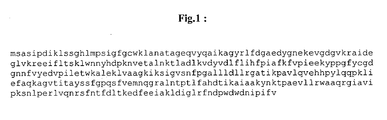
- Figure 1:
- depicts the amino acid sequence of xylose reductase from C. tenuis (SEQ ID No.: 1).
- Before describing in detail exemplary embodiments of the present invention, definitions important for understanding the present invention are given. It is to be understood that unless defined otherwise, all technical and scientific terms used herein have the same meanings as commonly understood by one of ordinary skill in the art.
- As used in this specification and in the appended claims, the singular forms of "a" and "an" also include the respective plurals unless the context clearly dictates otherwise.
- In the context of the present invention, the terms "about" and "approximately" denote an interval of accuracy that a person skilled in the art will understand to still ensure the technical effect of the feature in question. The term typically indicates a deviation from the indicated numerical value of ±20 %, preferably ±15 %, more preferably ±10 %, and even more preferably ±5 %.
- It is to be understood that the term "comprising" is not limiting. For the purposes of the present invention the term "consisting of" is considered to be a preferred embodiment of the term "comprising of". If hereinafter a group is defined to comprise at least a certain number of embodiments, this is meant to also encompass a group which preferably consists of these embodiments only.
- "-(C1-C6)alkyl" means a straight chain or branched non-cyclic hydrocarbon having from 1 to 6 carbon atoms. Representative straight chain -(C1-C6)alkyls include -methyl, -ethyl, -n-propyl, -n-butyl, -n-pentyl, and -n-hexyl. Representative branched -(C1-C6)alkyls include -iso-propyl, -sec-butyl, -iso-butyl, -tert-butyl, -iso-pentyl, -neopentyl, 1-methylbutyl, 2-methylbutyl, 3-methylbutyl, 1,1-dimethylpropyl, 1,2-dimethylpropyl, 1-methylpentyl, 2-methylpentyl, 3-methylpentyl, 4-methylpentyl, 1-ethylbutyl, 2-ethylbutyl, 3-ethylbutyl, 1,1-dimethtylbutyl, 1,2-dimethylbutyl, 1,3-dimethylbutyl, 2,2-dimethylbutyl, 2,3-dimethylbutyl, and 3,3-dimethylbutyl.
- "-(C1-C4)alkyl" means a straight chain or branched non-cyclic hydrocarbon having from 1 to 4 carbon atoms. Representative straight chain -(C1-C4)alkyls include -methyl, -ethyl, -n-propyl, and -n-butyl. Representative branched -(C1-C4)alkyls include -iso-propyl, -sec-butyl, -iso-butyl, and -tert-butyl.
- "-(C1-C2)alkyl" means a straight chain non-cyclic hydrocarbon having 1 or 2 carbon atoms. Representative straight chain -(C1-C2)alkyls include -methyl and -ethyl.
- "-(C1-C6)alkoxy" means a straight chain or branched non-cyclic hydrocarbon having one or more ether groups and from 1 to 6 carbon atoms. Especially, a -(C1-C6)alkoxy group may be represented by a group of-O-(C1-C6)alkyl. Representative straight chain and branched -(C1-C6)alkoxys include methoxy, ethoxy, methoxymethyl, 2-methoxyethyl, 5-methoxypentyl, 3-ethoxybutyl and the like.
- "-(C1-C4)alkoxy" means a straight chain or branched non-cyclic hydrocarbon having one or more ether groups and from 1 to 4 carbon atoms. Especially, a -(C1-C4)alkoxy group may be represented by a group of -O-(C1-C4)alkyl. Representative straight chain and branched -(C1-C4)alkoxys include methoxy, ethoxy, methoxymethyl, 2-methoxyethyl, and the like.
- "-(C1-C2)alkoxy" means a straight chain or branched non-cyclic hydrocarbon having one or more ether groups and 1 or 2 carbon atoms. Especially, a -(C1-C2)alkoxy group may be represented by a group of -O-(C1-C2)alkyl. Representative straight chain and branched -(C1-C2)alkoxys include methoxy, ethoxy, methoxymethyl. Any alkyl or alkoxy may be substituted by one or more second groups. A preferred substitution is the substitution with a halogen atom, an amino group, a hydroxy group, or a hydroxy-phenyl group, preferably 4-hydroxy-phenyl. An especially preferred substitution is the substitution with at least one fluoro atom, preferably several fluoro atoms.
- "Halogen" or "halo" means -F (fluoro), -C1 (chloro), -Br (bromo), or -I (iodo). When a first group is "substituted" the group may be substituted with one or more second groups. When a first group is "substituted with one or more" second groups, one or more hydrogen atoms of the first group is replaced with a corresponding number of second groups. Where the number of second groups is two or greater, each second group can be the same or different.
- An "amino substituted by one or two -(C1-C6)alkyl groups" may be expressed as a -NR1R2 group, wherein R1 and R2 are, independently of each other, selected from hydrogen and -(C1-C6)alkyl, with the proviso that at least one of R1 and R2 is other than hydrogen. It is preferred that the -(C1-C6)alkyl group is selected from a -(C1-C4)alkyl group, and a -(C1-C2)alkyl group, with the definition of all alkyl groups as above.
- The term "protected amino group" shall refer to an amino group which is protected by an amine protecting group. Such a group protects the amine during reactions of the synthesis from undesired transformation and can be easily removed.
- The term "amine protecting group" means an easily removable group which is known in the art to protect an amino group against undesirable reaction during synthetic procedures and to be selectively removable. The use of amine protecting groups is well known in the art for protecting groups against undesirable reactions during a synthetic procedure and many such protecting groups are known, for example, T. H. Greene and P. G. M. Wuts, Protective Groups in Organic Synthesis, 4th edition, John Wiley & Sons, New York (2007), incorporated herein by reference. Preferred amine protecting groups are acyl, including formyl, acetyl, chloroacetyl, trichloroacetyl, o-nitrophenylacetyl, o-nitrophenoxyacetyl, trifluoroacetyl, acetoacetyl, 4-chlorobutyryl, isobutyryl, o-nitrocinnamoyl, picolinoyl, acylisothiocyanate, aminocaproyl, benzoyl and the like, and acyloxy including methoxycarbonyl, 9-fluorenylmethoxycarbonyl (Fmoc), 2,2,2-trifluoroethoxy-carbonyl, 2-trimethylsilylethxoycarbonyl, vinyloxycarbonyl, allyloxycarbonyl (Alloc), t-butyloxycarbonyl (Boc), 1,1-dimethylpropynyloxycarbonyl, benzyloxycarbonyl (Cbz), p-nitrobenzyloxycarbonyl, 2,4-dichlorobenzyloxycarbonyl, and the like.
- The term "electron withdrawing", as employed herein, refers to any substituent which attracts the electrons from a conjugated electron structure, thereby providing a polarized resonating structure. Illustrative of the electron withdrawing groups useful in the present invention include -(C1-C6)alkoxy, preferably -(C1-C4)alkoxy, further preferably -(C1-C2)alkoxy, halogens, -NO2, -SO2R3, -SO2CH2F, -SO2CHF2, -SO2CF3, -S(NSO2CF3)CF3, -CF3, -CO2R3, -C(O)CF3, -CN, cyanovinyl and dicyanovinyl, wherein R3 is a hydrogen or a -(C1-C6)alkyl group, preferably -H or a -(C1-C4)alkyl group, further preferably -H or a -(C1-C2)alkyl group.
- The "enantiomeric excess" (ee) is the absolute difference between the mole fractions of the two enantiomers. This value is usually expressed in %ee. An enantioselective reaction is a reaction wherein one of two possible enantiomers is formed in an excess, i.e., an enantiomeric excess can be determined.
- The term "subject" as used herein refers to a human or an animal, preferably a mammal such as e.g. non-human primates, mice, rats, rabbits, guinea pigs, dogs, cats, cattle, horses, sheep, pigs, goats and the like. Preferably a "subject" in the context of the present invention is a human.
- As mentioned above, a first aspect relates to a method for the preparation of a compound according to Formula IIa

- n
- is 0, 1, 2, or 3;
- X
- is, independently of each other, an electron withdrawing group; and
- Y
- is selected from the group consisting of-H (hydrogen), substituted or unsubstituted -(C1-C6)alkyl, preferably -(C1-C4)alkyl, further preferably -(C1-C2)alkyl, -F, -Cl, -Br, -I, -CN, -NH2, amino substituted by one or two -(C1-C6)alkyl groups, preferably -(C1-C4)alkyl groups, further preferably -(C1-C2)alkyl groups, and a protected amino group; and
- Y
- is -CN;
- In the following, preferred embodiments of a compound of Formula I as defined above are described. It is to be understood that these preferred embodiments of the first aspect of the invention also form preferred embodiments of the compounds of Formula IIa and III, as well as the second aspect of the invention.
- In a preferred embodiment, in the above compound according to Formula I, X is, independently, selected from the group consisting of -F, -Cl, -Br, -I, -CN, -NO2, and (C1-C6)alkoxy, and preferably selected from -F, -Cl, -Br, -I, and -CN.
- In any of the embodiments wherein n is 2 or 3, each X is independently selected. In other words, when n is 2 or 3, X is present more than once in the compound of Formula I. These different representations of X may be identical or different, and each X may be selected from the corresponding group.
- Furthermore, in any of the embodiments wherein n is 1, 2, or 3, X is preferably at the ortho and/or para position in respect to the substituent containing Y. In a further preferred embodiment, X is preferably in the ortho position. In another further preferred embodiment, X is in the para position. The ortho and/or para position is expressed at the phenyl ring containing the substituent X and the group -C(O)CH2(CH2)mY in respect or in relation to the -C(O)CH2(CH2)mY group. The ortho position is the position adjacent to the -C(O)CH2(CH2)m Y group, and the para position is the opposite or 4-position, if the -C(O)CH2(CH2)m Y group is at the 1-position.
- In any of the above described embodiments, n is selected from 0, 1, 2, or 3. It is preferred that n is 1 or 2, with 1 being further preferred.
- It should be understood that the preferred embodiments referring to X also refer to the preferred embodiments of n and the position of X, and vice-versa.
- The compounds according to Formula I are derivatives of 1-phenylpropanone, and comprise 1-phenylpropanone itself. This group of compounds is also referred to as 1-phenylpropanones. To form derivatives of 1-phenylpropanone, when m = 1, Y is selected from the group consisting of hydrogen, substituted or unsubstituted -(C1-C6)alkyl, -F, -Cl, -Br, -I, -CN, -NH2, amino substituted by one or two (C1-C6)alkyl groups, and a protected amino group.
- In another embodiment, when m = 0, Y is -CN. In this embodiment, the carbon chain contains three carbon atoms, being substituted with an optionally substituted phenyl ring.
- In a further preferred embodiment, when m = 1, Y is selected from -H, -Cl, -Br, -NH2, or methylamino (-NHCH3).
- A central element of the present invention is the reduction of a compound of Formula I to a compound of Formula IIa using a xylose reductase. This reduction is carried out in well known media, like potassium phosphate buffer. In a preferred embodiment, the substituents X and Y are not affected or altered in any way by the reduction using an oxidoreductase.
- The reduction of the compound of Formula I is an enantioselective reduction, wherein the enantiomer of the compounds according to Formula IIa is produced at an enantiomeric excess. In a further preferred embodiment, the enantiomeric excess is at least 10 %ee, preferably at least 20 %ee, more preferably at least 50 %ee, more preferably at least 90 %ee, more preferably 95 %ee, even more preferably at least 99 %ee, and most preferably at least 99.5 %ee.
- The enantioselective reduction results in the (S)-enantiomer according to Formula Ila

- For the methods and uses described herein, the present invention relies on a xylose reductase selected from the yeast Candida tenuis.
- A xylose reductase from Candida tenuis (AKR 2B5) is particularly preferred.
- Another particularly preferred embodiment relates to an oxidoreductase selected from the group consisting of:
- a) a polypeptide comprising SEQ ID No.: 1;
- b) a polypeptide having at least about 70% sequence identity to SEQ ID No.:1 and having xylose reductase activity;
- c) fragments or mutants of polypeptides according to a) and b) having xylose reductase activity.
- The term "fragment" refers to a polypeptide according to a) and b) as mentioned above which differs from e.g. SEQ ID No.:1 by the deletion of internal amino acids, N-terminal and/or C-terminal truncations.
- The person skilled in the art is aware that e.g. a polypeptide of SEQ ID No.: 1 may be shortened at its N- and/or C-termini for about 1, 2, 3, 4, 5, 6, 7, 8, 9, 10 or even more amino acids without substantially affecting its enzymatic activity and specificity. Similarly, there may internal deletions of about 1, 2, 3, 4, 5, 6, 7, 8, 9 or 10 amino acids within SEQ ID No.: 1 without affecting substantially its enzymatic activity and specificity. The term "fragment" thus refers a shortened version of the polypeptides according to a) and b) as mentioned above with the fragments still having a xylose reductase enzymatic activity and specificity comparable to the activity and specificity of those polypeptides from which the fragments are derived. The person skilled in the art will, of course, know which sequences may be particularly suitable for deletion without affecting its enzymatic activity and selectivity. The polypeptide of SEQ ID No.: 1 has been characterized in detail, e.g. in Kratzer et al. (Biochem. J., 393: 51-58, 2006), Pival et al. (FEBS Letters, 582:4095-4099, 2008) and Nidetzky et al. (Biochemistry, 40: 10371-10381; 2001). The person skilled in the art thus has information available which amino acids and amino acid stretches are important for catalytic activity and substrate specificity and which therefore should not be deleted.
- The term "mutant" refers to a polypeptide which is based e.g. on SEQ ID No. 1 but which comprises an insertion, e.g. 1, 2, 3, 4, 5, 6, 7, 8, 9, 10 or more additional amino acids without substantially affecting enzymatic activity and specificity. Preferably a polypeptide according to b) is shares at least about 75%, at least about 80%, preferably at least about 85%, at least about 90%, more preferably at least 90%, at least about 91 %, at least about 92%, at least about 93%, at least about 94%, at least about 95% and even more preferably at least about 96%, at least about 97%, at least about 98% and at least about 99% sequence identity with SEQ ID No.: 1.
- The determination of percent identity between two protein sequences is preferably accomplished using the mathematical algorithm of Karlin and Altschul (Proc. Natl. Acad. Sci USA 90: 5873-5877, 1993). Such an algorithm is e.g. incorporated into the BLASTp program of Altschul et al. (J. MoI. Biol. 215: 403-410, 1990) available at NCBI (http://www.ncbi.nlm.nih.gov/blast/Blast.cge).
- The determination of percent identity is preferably performed with the standard parameters of the BLASTp program.
- For the general parameters, the "Max Target Sequences" box may be set to 100, the "Short queries" box may be ticked, the "Expect threshold" box may be set to 10 and the "Word Size" box may be set to "3". For the scoring parameters the "Matrix" box may be set to "BLOSUM62", the "Gap Costs" Box may be set to "Existence: 11 Extension:1", the "Compositional adjustments" box may be set to "Conditional compositional score matrix adjustment". For the Filters and Masking parameters the "Low complexity regions" box may not be ticked, the "Mask for lookup table only" box may not be ticked and the "Mask lower case letters" box may not be ticked. Most prefeably, all parameters are set as outlined above.
- It is to be understood that polypeptides which share at least 70% sequence identity with SEQ ID No.:1 must also display xylose reductase activity in order to be a xylose reductase in accordance with the invention.
- It will be straightforward for a skilled person to determine whether a polypeptide having e.g. 90% sequence identity with SEQ ID No.: 1 will be a xylose reductase by reacting it with the same substrates as a polypeptide of SEQ ID No.: 1. If the two polypeptides both show enzymatic activity towards these substrates, they will be considered to be xylose reductases.
- Examples of polypeptides being derived from SEQ ID No.: 1 include polypeptides which at position 24 of SEQ ID No:1 carry an alanine (W24A), valine (W24V), leucine (W24L), isoleucine (W24I), glycine (W24G), or serine (W24S) instead of tryptophane and/or which at position 51 of SEQ ID No.:1 carry a phenylalanine (D51F) or tyrosine (D51Y) instead of a aspartate. Other mutants which may be introduced in addition or alternatively are W24F and W24Y and/or D51A, D51L, D511 or D51G. The amino acid numbering refers to SEQ ID No.: 1.
- As mentioned above, a second aspect of the present invention refers to a method for the preparation of a compound according to Formula III

- n
- is 0, 1, 2, or 3;
- R
- is selected from the group consisting of substituted or unsubstituted (C1-C6)alkyl, substituted or unsubstituted (C1-C6)alkoxy; and
- R'
- is selected from the group consisting of X; and O-SO3H, -OH, -O-C(O)CH3, -NH2, amino substituted by one or two -(C1-C6)alkyl groups, -NH-C(O)CH3, -(C1-C6)alkyl, preferabyl -(C1-C4)alkyl, further preferably -(C1-C2)alkyl, -CH2OH, -COOH, -COO-(C1-C4)alkyl, -CHO, -C(O)-(C1-C4)alkyl; and
- Y
- is selected from the group consisting of hydrogen, substituted or unsubstituted -(C1-C6)alkyl, preferably -(C1-C4)alkyl, further preferably -(C1-C2)alkyl, -F, -Cl, -Br, -I, -CN, -NH2, amino substituted by one or two (C1-C6)alkyl groups, and a protected amino group; and
- Y
- is -CN;
- The preferred embodiments regarding n, m, X, Y, and the substitution of R' also apply to the compounds of Formula III.
- In another preferred embodiment, the transformation comprises the etherification of the compound according to Formula IIa while substantially retaining or inverting the conformation at the asymmetric carbon atom. Thus, a chiral ether is formed. In this context, substantially retaining or inverting the conformation comprises a retention or inversion, respectively, of at least 50 mol-%, preferably at least 70 mol-%, more preferably at least 90 mol-%, even more preferably at least 95 mol-%, and most preferably at least 99 mol-%.
- The formation of chiral ethers of any of the intermediate alcohols can be performed in two different ways leading to retention and inversion of the chiral centre in the resulting ethers, respectively.
- In a preferred embodiment, a Mitsunobu-type reaction with a substituted phenol using diethylazodicarboxylat (DEAD) causes inversion of the configuration at excellent enantiomeric excesses.
- In another preferred embodiment, an ether coupling with a substituted halophenol via NaH used as base leads to retention of the configuration in very good enantiomeric excesses.
- In another preferred embodiment, the compounds according to Formula III comprise derivatives of N-Methyl-3-aryl-3-aryloxy-propylamines, preferably (S)-Fluoxetione, (S)-Tomoxetine, (S)-Nisoxetine, (R)-Fluoxetione, (R)-Tomoxetine, and (R)-Nisoxetine, as well as the phenyl substituted analogues.
- In another preferred embodiment, the compounds according to Formula III comprise derivatives of 3-aryl-3-aryloxy-propylamines, preferably (S)-Norfluoxetine, (R)-Norfluoxetine, and the phenyl substituted analogues.
- The invention is described hereinafter with respect to specific examples. These examples are; however, not to be construed as limiting the invention in any way.
- Recombinant xylose reductase of Candida tenuis CBS4435 (SEQ ID No.:1) was overexpressed in Escherichia coli BL21 (DE3) using the plasmid vector pBeact.li (pet1 la_XR, restriction sites used NdeI and BamHI; ampicillin resistance). The bacterial strain was grown in baffled flasks at 37°C and 130 rpm to an OD of 1.0 (600 nm). Enzyme production was induced at 25°C by addition of 250 µM isopropyl-β-D-thiogalactopyranosid. About 18 h after induction, cells were harvested by centrifugation (6000 rpm) and disrupted by 3 passages through a french press. Cell debris was separated by ultra-centrifugation (30,000 rpm) and the cell free raw-extract was subjected to affinity chromatography. Dyes like Red31 resemble the reductase cofactors NAD(P)H and often allow enzyme purification to high purities. Red31 was immobilized on Sepharose CL-4B and used for CtXR purification (J. Chromat. B, 737, 195-202 (2000)). The centrifuged cell extract with a conductivity of 2.5 mS/cm was applied to the Red31 dye-ligand column (6×2.6 cm, approximately 6-8 mg protein/mL of gel) equilibrated with five column volumes of 50 mM potassium phosphate buffer, pH 7.0. Adsorbed protein was eluted at a flow rate of 2 mL/min with a step gradient of 0.2 M and 2 M NaCl. Fractions of 20 mL were collected and the 2 M NaCl peak containing most of the CtXR, as judged by activity measurements and SDS-PAGE, was pooled. The pooled fractions were concentrated in Vivaspin 20 mL concentrator tubes with 10,000 molecular weight cut off to a volume of less than 10 mL. The buffer was changed to 50 mM potassium phosphate buffer, pH 7.0 without NaCl and re-concentrated. Purification grade was monitored by sodium dodecyl sulphate-polyacrylamide gel electrophoresis.
- Initial rate measurements were carried out as described recently ( Biochem. J., 385, 75-83 (2005)). Keto substrates were dissolved in ethanol or DMSO prior to dilution into 50 mM potassium phosphate buffer, pH 7.0 to a final ethanol concentration of 5 % ethanol or 25 % DMSO. Kinetic parameters for enzymatic ketone reduction by NADH were not affected by the added ethanol or DMSO. They were obtained under conditions in which the substrate concentration was varied and the coenzyme concentration was constant and saturating (carbonyl reduction, 280 µM NADH). The enzyme concentration in the assays was in the range of 0.03-10.0 µM, depending on the activity towards the respective substrate. Appropriate controls containing enzyme and coenzyme, or the substrate and coenzyme were determined under conditions otherwise exactly identical to the enzymic assay. If required, the initial rates were corrected for blank readings. All experiments were performed at 25°C. Data processing and statistical analysis were carried out as reported elsewhere ( Biochem. J., 385, 75-83 (2005)). The limited solubility of certain compounds often prevented saturation of the enzymes with ketone substrates. In these cases, the catalytic efficiency was obtained from the part of the Michaelis-Menten plot where under conditions of [substrate] « Km, the reaction rate is linearly dependent on [substrate] with a slope that equals (k cat/K m) divided by the molar concentration of enzyme.
- The CtXR, CtXR W24F, and CtXR D51A catalyzed reductions are performed using 9.5 units of the respective biocatalyst in potassium phosphate buffer (300 mL; 50 mM; pH 7.5; 10% ethanol; 25°C). To each transformation the prochiral substrates 3-aminopropiophenone, 3-chloropropiophenone, 3-bromopropiophenone, 3-iodopropiophenone, or 3-phenyl-3-oxo-propannitrile are added in 10 mM concentration and additionally NADH is added in 12 mM concentration. Alternatively the transformations are performed in potassium phosphate buffer (300 mL; 50 mM; pH 7.5; 10% ethanol; 25°C) with substrate (10 mM), ammonium formiate (40 mM), NAD(H) (230 µM), CtXR, CtXR W24F, or CtXR D51A (10 units), and formate dehydrogenase (45 units) for recycling of the NADH. The course of transformations are monitored by UV-spectroscopy (290 nm) and stopped by addition of sodium azide (0.3 mM) when the conversion finished. The enzymes are separated by a 76 mm ultrafiltration stirred cell with a cut-off of 10,000 Da. The aqueous layer is extracted three times with CH2Cl2 (150 mL each) and combined organic extracts are washed with brine and dried over MgSO4. The solutions are evaporated to dryness to get the crude reaction mixture for determination of the conversions. Subsequent silica gel column chromatography (CH2Cl2/ethylacetate 10:1) afforded the extracted (S)-3-aryl-3-hydroxylpropylamines, (S)-1-chloro-3-aryl-3-hydroxylpropane, (S)-1-bromo-3-aryl-3-hydroxylpropane, (S)-1-iodo-3-aryl-3-hydroxylpropane and (S)-3-phenyl-3-hydroxy-propannitrile as yellow oil or amorphous solid, respectively.
- Keto function containing substrates were dissolved in ethanol or DMSO prior to dilution into 50 mM potassium phosphate buffer, pH 7.0 to a final ethanol concentration of 5 % ethanol or 25 % DMSO. 1 mM excess [NADH] and about 0.4-2.4 units of enzyme activity, measured with the substrate to be reduced were added and the reaction mixture was incubated at 25°C. After keto reduction of ~ 80 % (< 5-25 min), determined as the depletion of NADH, the solutions were centrifuged prior to chromatographic analysis.
- The structures of the resulting products were determined by NMR spectroscopy. Therefore saturated aqueous NaHCO3 solution was added and the mixture was extracted three times with ethyl acetate. Combined organic extracts were washed with H2O and saturated aqueous NaCl solution, dried over Na2SO4, and concentrated in vacuo. 1H and 13C NMR spectra were measured at 298.15 K in CDCl3 (>99.98% D) on a Bruker Avance DRX-400 or DRX-600 at 400.13 MHz (100.61 MHz) or 600.13 MHz (150.90 MHz), respectively. Chemical shifts were referenced to residual CHCl3 (δH = 7.26) and CDCl3 (δC = 77.36) and are given in ppm. Assignments of proton resonances were confirmed by two dimensional homonuclear (COSY, TOCSY, NOESY) and heteronuclear (HSQC, HMBC) spectroscopy.
- Site-directed mutagenesis of CtXR was carried out by using inverse PCR that followed a published protocol with slight modifications ( Nucleic Acids Res., 17, 6545-6551 (1989)). The plasmid vector pBEAct.li ( Biol. Chem., 380, 1395-1403 (1999)) was directly amplified with Pfu DNA polymerase and the two oligonucleotide primers listed below with the mismatched bases underlined. The primers were phosphorylated at the 5'end using T4 polynucleotide kinase prior to PCR amplification.
- D51A forward: 5' GAGGCCTACGGTAACGAAAAG 3' (SEQ IDNo.:2)
- D51 reverse: 5' GGCACCGTCGAACAATCTGTA 3' (SEQ ID No.:3)
- W24F forward: 5' GGTTTCGGCTGTTTCAAACTCG 3' (SEQ ID No.:4)
- W24 reverse: 5' GATGGATGGCATTAAGTGGCCG 3' (SEQ ID No.:5)
- To facilitate colony screening by restriction site analysis, a Fokl restriction site in the W24 reverse primer was inserted by introducing silent mutations. Introduction of additional silent mutations avoided dimerisation of oligonucleotides. The amplified linear plasmid was gel purified and ligated using a T4 DNA ligase. The ligation product was desalted over a MF-membranefilter (pore size 0.025 µm, diameter 13 mm, Millipore) for 1 hour prior to electroporation into competent E. coli BL21 (DE3) cells. Plasmid miniprep DNA was subjected to dideoxy sequencing to verify the introduction of the desired mutations and that no misincorporations of nucleotides had occurred because of DNA polymerase errors. Purified D51A, W24F mutants migrated in SDS/PAGE as single protein bands to exactly the same position as the wild-type.
- A mixture of 4-chlorobenzene (3.9 g, 34 mmol) and AlC13 (2 g, 15 mmol) is cooled to 0-5°C and stirred for 30 min. before 3-chloropropionyl chloride (1 g, 13 mmol) is added dropwise. After 30 min the resulting solution is heated to 50°C for 12 h. The reaction mixture is poured into 300 mL of a icewater/HCl-mixture and extracted with CH2Cl2 (3 x 50 mL). The combined organic extracts are washed with 10% HCl-, NaCl-, NaHCO3- and sat. NaCl-solutions and dried over MgSO4. The solvent is removed via distillation (<50°C) and the resulting is purified by chromatography (hexan/ethylacetate 8:2) to gain 3-chloro-1-(4-chlorophenyl)-1-propanone (4.06 g, 20 mmol, 60 %: Organikum, 20. Aufl.: Johann Ambrosius Barth Verlag, Heidelberg, p. 362 (1996)).
- A mixture of 2,4-dichloroacetophenone (1 g, 5 mmol) and 37% formaldehyde (0.3 g, 10 mmol) are placed in sealed vessel in a microwave cavity. Microwave irradiation of 250 W is used, which elevates the temperature from 25°C to 175°C during 5 min. The reaction mixture is held at this temperature for 8 min. After cooling, reaction mixture is extracted with chloroform. The organic extracts are washed with brine, dried, and filtered. Evaporation of the solvent provides a residue that is purified by chromatography on silica gel with CH2Cl2 to furnish 1-(2,4-Dichlorophenyl)-3-hydroxypropanone (0.38 g, 1,8 mmol, 35 %; J. Med. Chem., 51, 3841-3855 (2008)).
- A mixture of 4-bromoacetophenone (0.1 g, 0.5 mmol), methylamine hydrochloride (0.1 g, 1 mmol), paraformaldehyde (0.05 g, 1.7 mmol), and conc. HCl (0.1 g) in 1 mL ethanol was heated in a sealed flask at 110°C for 24 h. After cooling to RT, the solvent was removed and 5 mL of ethyl acetate was added. The resulting suspension was vigorously stirred at RT for 6 h and then filtered and washed with ethyl acetate to afford 1-(4-Bromophenyl)-3-methylaminopropan-1-one hydrochlorid (0.07 g, 0.25 mmol, 50 %; Angew. Chem. Int. Ed., 44, 1687-1689 (2005)).
- 2-Chlorobenzoic acid (0.3 g, 1.9 mmol) and Potassium carbonate (1.3 g, 9.3 mmol) are solved in acetone. Methyliodide (2.3g, 15 mmol) is dropwise added to this solution. This mixture is heated with a reflux condenser for 18 h. After filtration with a silica plug the solvent is distilled under reduced pressure to gain methyl 2-chlorobenzoate (0.3 g, 1.9 mmol, 91 %).
- To a lithium diisopropylamide solution (2.0 g, 3 mmol, 1.5 M) in 6 mL THF acetonitrile (0.075 g, 1.8 mmol) is added dropwise at -78°C. After the solution has been stirred at -78°C for 1 h, methyl 2-chlorobenzoate (0.028 g, 1.7 mmol) in 6 mL THF is added dropwise at -78°C. The reaction mixture is kept at -78°C for 1 h and warmed up to RT. After being stirred for an additional 2 h, the reaction is quenched by addition of H2O. The aqueous layer is acidified to pH 5 with 1 N HCl and extracted three times with ether. The combined organic extracts are dried over Na2SO4 and concentrated to give 3-(2'-chloro)-phenyl-3-oxo-propionitrile (0.025 g, 1.5 mmol, 85 %; Bioorg. Med. Chem. 2006, 14, 7501-7511.).
- A solution of NaBH4 (0.06 g, 1.5 mmol) in dry THF(10 mL) is added dropwise to a solution of ketal protected phenyl-3-oxo-propionitrile (0.3 g, 1.5 mmol) in dry THF (10 mL) at 0°C with stirring under Ar. The mixture is heated at 70°C for 6 h. After cooling to 0°C 20 mL water is added to the reaction which is then extracted with ethylacetate (3 x 15 mL). The combined organic extracts are dried over MgSO4 and concentrated in vacuo. Purification by chromatography (ethylacetate/methanol 1:1) provides ketal protected aminopropiophenone as a colorless solid (0.27 g, 1.3 mmol, 85 %), which is then deprotected under acid conditions.
- To a solution of aminopropiophenone (0.2 g, 1.3 mmol) and methyl chloroformate (1.4 g, 1.5 mmol) in CH2Cl2 (15 mL) is K2CO3 (7.2 g, 5.2 mmol) in H2O (15 mL) added with stirring at 0°C. The mixture is warmed to RT, stirred further for 1 h. 10 mL water are added and the mixture is extracted with CH2Cl2 (2x10 mL). Combined organic extracts are dried over MgSO4 and concentrated in vacuo. The residual is dissolved in 10 mL THF and the resulting solution is directly used in the reduction. Therefore to a suspension of LiAlH4 (0.5 g, 1.3 mmol) in dry THF (20 mL) is a solution of the above formamide intermediate in 10 mL of THF added dropwise at 0°C with stirring under Ar. Then the mixture is heated at reflux for 12 h. After cooling to 0°C, 4 mL of degassed water is added to quench the reaction. The resulting mixture is filtered, and the organic layers are separated, dried over MgSO4 and concentrated in vacuo. Purification by chromatography on silica gel chromatography (CH2Cl2/methanol 1:1) yielded 3-N-methylaminopropiophenone as a colorless oil (0.16 g, 1.0 mmol, 80 %; Org. Biomol. Chem., 3, 2513-2518 (2005)).
-
- a.) Diethylazodicarboxylat (DEAD, 0.03 g, 0.17 mmol) and triphenylphosphine (0.05 g, 0.19 mmol) are added to a solution of (S)-1-chloro-3-hydroxyl-3-phenylpropanes (0.28 g, 0.16 mmol) and ortho-cresol (0.02 g, 0.18 mmol) in 1 mL THF. The mixture is stirred at RT for 16 h. THF is removed under vacuum and the residue extracted with hexane (3 x 50 mL). The combined hexane fractions are concentrated, and the residue is purified on silica gel chromatography (hexane/EtO2 1: 1) provide (R)-1-chloro-3-(2'-methylphenyloxy)-3-phenylpropane as a colourles liquid (0.029 g, 0.11 mmol, 70 %; J. Chem. Soc, Perkin Trans., 1, 1767-1769. (2000)).
- b.) 60% NaH (1.19 g, 30 mmol) is added in four batches into a solution of (S)-1-chloro-3-hydroxyl-3-phenylpropanes (4.1 g, 25 mmol) in DMSO (20 mL) at 0°C with stirring. After the mixture has been heated to 70°C for 30 min, a solution of 4-chlorobenzotrifluoride (4.5 g, 25 mmol) in DMSO (5 mL) is added to the mixture and then heated at 90°C for 2 h. The resulting mixture is cooled to 0°C, water (20 mL) is added and extracted with ether (2 x 20 mL). The ether extracts are combined and dried over MgSO4 and concentrated to about 10 mL. A saturated solution of HCl in ether was added dropwise into the solution to provide (S)-1-chloro-3-(2'-methylphenyloxy)-3-phenylpropane as colorless oil (7.79 g, 22.5 mmol, 90 %; Org. Biomol. Chem., 3, 2513-2518 (2005)).
- A solution of NaBH4 (0.026 g, 0.7 mmol) in dry THF(10 mL) is added dropwise to a solution of (S)-3-(2'-methylphenyloxy)-3-phenylpropannitrile (0.1 g, 0.7 mmol) in dry THF (10 mL) at 0°C with stirring under Ar. The mixture is heated at 70°C for 6 h. After cooling to 0°C 20 mL water is added to the reaction which is then extracted with ethylacetate (3 x 15 mL). The combined organic extracts are dried over MgSO4 and concentrated in vacuo. Purification by chromatography (ethylacetate/methanol 1:1) provide (S)-3-(2'-methylphenyloxy)-3-phenylpropylamine as a white solid (0.09 g, 0.63 mmol, 90 %, Org. Biomol. Chem., 3, 2513-2518 (2005)).
- To a solution of (S)-3-(2'-methylphenyloxy)-3-phenylpropylamine (0.05 g, 0.3 mmol) and methyl chloroformate (0.04 g, 0.4 mmol) in CH2Cl2 (15 mL) is K2CO3 (0.07 g, 1.3 mmol) in H2O (15 mL) added with stirring at 0°C. The mixture is warmed to RT, stirred further for 1 h. 10 mL water are added and the mixture is extracted with CH2Cl2 (2 x 10 mL). Combined organic extracts are dried over MgSO4 and concentrated in vacuo. The residual is dissolved in 10 mL THF and the resulting solution is directly used in the reduction. Therefore to a suspension of LiAlH4 (0.01 g, 0.3 mmol) in dry THF (20 mL) is a solution of the above formamide intermediate in 10 mL of THF added dropwise at 0°C with stirring under Ar. Then the mixture is heated at reflux for 12 h. After cooling to 0°C, 4 mL of degassed water is added to quench the reaction. The resulting mixture is filtered, and the organic layers are separated, dried over MgSO4 and concentrated in vacuo. Purification by chromatography on silica gel chromatography (CH2Cl2/methanol 1:1) yielded (S)-N-methyl-3-(2'-methylphenyloxy)-3-phenylpropylamine as a white solid (0.05 g, 0.29 mmol, 90 %, Org. Biomol. Chem., 3, 2513-2518 (2005)).
- (R)-1-Chloro-3-(2'-methylphenyloxy)-3-phenylpropane (0.028 g, 0.09 mmol) and aqueous MeNH2 (40%, 0.5 mL) are dissolved in 5 mL ethanol. The solution is refluxed in a close vessel at 120°C for 12 h, cooled to RT and poured into water. The mixture is extracted with ether (3 x 20 mL) and the organic extract is washed with water and aq. NaCl, dried over MgSO4 and concentrated in vacuo. The residue is purified by chromatography (CH2Cl2/MeOH 10:1) to yield (S)-N-methyl-3-(2'-methylphenyloxy)-3-phenylpropylamine hydrochlorid (0,015 g, 0,05 mmol, 60 %; J. Chem. Soc, Perkin Trans. 1, 1767-1769 (2000)).
-
- <110> UNIVERSITÄT WIEN, TECHNISCHE UNIVERSITAT GRAZ
- <120> Enzymatic reduction of 1-phenylpropanone and derivatives thereof
- <130> U7174/DJB
- <140>
EP09181016.8
<141> 2009-12-30 - <160> 5
- <170> PatentIn version 3.3
- <210> 1
<211> 322
<212> PRT
<213> Candida tenuis - <400> 1


- <210> 2
<211> 21
<212> DNA
<213> Artificial - <220>
<223> Primer; D51A forward - <400> 2
gaggcctacg gtaacgaaaa g 21 - <210> 3
<211> 21
<212> DNA
<213> Artificial - <220>
<223> Primer; D51 reverse - <400> 3
ggcaccgtcg aacaatctgt a 21 - <210> 4
<211> 22
<212> DNA
<213> Artificial - <220>
<223> Primer; W24F forward - <400> 4
ggtttcggct gtttcaaact cg 22 - <210> 5
<211> 22
<212> DNA
<213> Artificial - <220>
<223> Primer; w24 reverse - <400> 5
gatggatggc attaagtggc cg 22

with a xylose reductase selected from the yeast Candida tenuis (AKR 2B5).

with a xylose reductase selected from the yeast Candida tenuis (AKR 2B5).
Claims (9)
- Method for the preparation of a compound according to Formula IIa
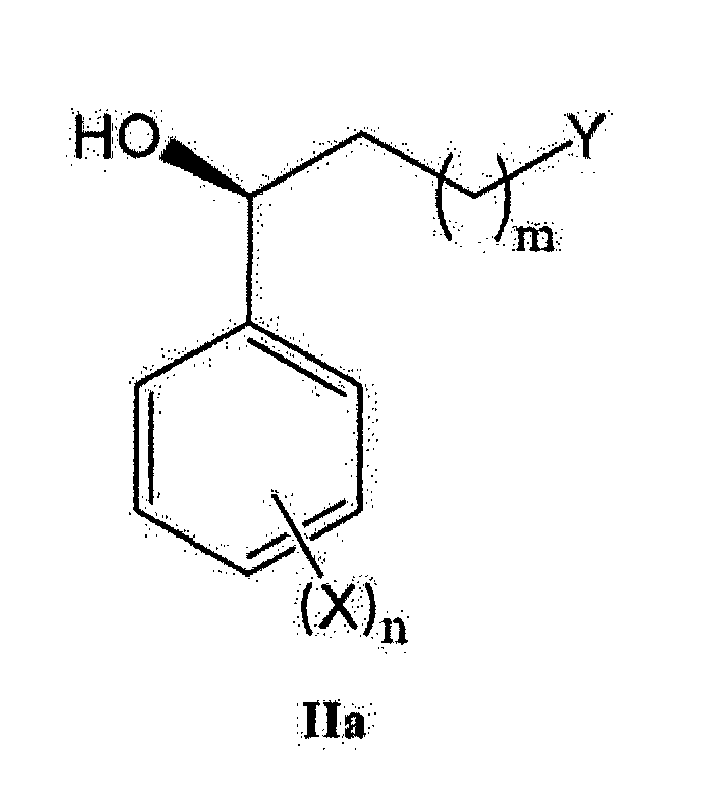 n is 0, 1, 2, or 3;m is 0 or 1;X is, independently of each other, an electron withdrawing group; andwhen m = 1:Y is selected from the group consisting of -H, substitsted or unsubstiuted -(C1-C6)alkyl -F, -Cl, -Br, -I, -CN, -NH2, amino substituted by one or two (C1-C6)alkyl groups, and a protected amino group; andwhen m = 0:Y is -CN;comprising a step of reducing a compound according to Formula I
with a xylose reductase selected from the yeast Candida tenuis (AKR 2B5). - Method according to claim 1, wherein X is, independently, selected from the group consisting of -F, -Cl, -Br, -I, and -CN.
- Method according to any of the previous claims, wherein n is 1 or 2.
- Method according to any of the previous claims, wherein Y is -H, -Cl, -Br, -NH2, or -NHCH3.
- Method for the preparation of a compound according to Formula III
 n is 0, 1, 2, or 3;m is 0 or 1;X is, independently of each other, an electron withdrawing group;R is selected from the group consisting of substituted or unsubstituted (C1-C6)alkyl, substituted or unsubstituted (C1-C6)alkoxy; andR' is selected from the group consisting of X; and O-SO3H, -OH, -O-C(O)CH3, -NH2, amino substituted by one or two -(C1-C6)alkyl groups, -NH-C(O)CH3, -(C1-C6)alkyl, -CH2OH, -COOH, -COO-(C1-C4)alkyl, -CHO, -C(O)-(C1-C4)alkyl; andwhen m = 1:Y is selected from the group consisting of -H, substituted or unsubstituted -(C1-C6)alkyl, -F, -Cl, -Br, -I, -CN; -NH2, amino substituted by one or two (C1-C6)alkyl groups, and a protected amino group; andwhen m = 0:Y is -CN;comprising the method according to any of the previous claims for the preparation of a compound according to Formula IIa, and the subsequent transformation of the compound according to Formula IIa to a compound according to Formula III.
 - Method according to claim 5, wherein the transformation comprises the etherification of the compound according to Formula IIa while substantially retaining or inverting the conformation at the asymmetric carbon atom.
- Method according to any of the previous claims, wherein said xylose reductase selected from the yeast Candida tenuis (AKR 2B5) is selected from the group consisting of:a) a polypeptide comprising SEQ ID No.: 1;b) a polypeptide having at least 70% sequence identity to SEQ ID No.:1 and having xylose reductase activity;c) fragments or mutants of polypeptides according to a) and b), wherein a fragment is a polypeptide which differs from SEQ ID No.: 1 by the deletion of internal amino acids, N-terminal and/or C-terminal truncations without affecting the enzymatic activity and specificity of SEQ ID No.: 1 and wherein a mutant is a polypeptide which differs from SEQ ID No.: 1 by insertion of one or more additional amino acids without affecting the enzymatic activity and specificity of SEQ ID No.: 1.
- Use of a xylose reductase selected from the yeast Candida tenuis for the reduction of a compound according to Formula I
- Use according to any of claims 8, wherein said xylose reductase selected from the yeast Candida tenuis is selected from the group consisting of:a) a polypeptide comprising SEQ ID No.: 1;b) a polypeptide having at least 70% sequence identity to SEQ ID No.:1 and having xylose reductase activity;c) fragments or mutants of polypeptides according to a) and b), wherein a fragment is a polypeptide which differs from SEQ ID No.: 1 by the deletion of internal amino acids, N-terminal and/or C-terminal truncations without affecting the enzymatic activity and specificity of SEQ ID No.: 1 and wherein a mutant is a polypeptide which differs from SEQ ID No.: 1 by insertion of one or more additional amino acids without affecting thee enzymatic activity and specificity of SEQ ID No.: 1.
Priority Applications (1)
| Application Number | Priority Date | Filing Date | Title |
|---|---|---|---|
| EP09181016.8A EP2348120B1 (en) | 2009-12-30 | 2009-12-30 | Enzymatic reduction of 1-phenylpropanone and derivatives thereof |
Applications Claiming Priority (1)
| Application Number | Priority Date | Filing Date | Title |
|---|---|---|---|
| EP09181016.8A EP2348120B1 (en) | 2009-12-30 | 2009-12-30 | Enzymatic reduction of 1-phenylpropanone and derivatives thereof |
Publications (2)
| Publication Number | Publication Date |
|---|---|
| EP2348120A1 EP2348120A1 (en) | 2011-07-27 |
| EP2348120B1 true EP2348120B1 (en) | 2014-06-11 |
Family
ID=42587915
Family Applications (1)
| Application Number | Title | Priority Date | Filing Date |
|---|---|---|---|
| EP09181016.8A Not-in-force EP2348120B1 (en) | 2009-12-30 | 2009-12-30 | Enzymatic reduction of 1-phenylpropanone and derivatives thereof |
Country Status (1)
| Country | Link |
|---|---|
| EP (1) | EP2348120B1 (en) |
Families Citing this family (2)
| Publication number | Priority date | Publication date | Assignee | Title |
|---|---|---|---|---|
| EP2551351A1 (en) * | 2011-07-29 | 2013-01-30 | Interquim, S.A. | Process for production of optically active (R)-(-)-1-(2,4-dichloro-phenyl)-2-imidazole-1-yl-ethanol |
| EP2634180A1 (en) * | 2012-03-01 | 2013-09-04 | Lonza Ltd. | Enzymatic process for the preparation of butyrolactones |
Family Cites Families (7)
| Publication number | Priority date | Publication date | Assignee | Title |
|---|---|---|---|---|
| US4314081A (en) | 1974-01-10 | 1982-02-02 | Eli Lilly And Company | Arloxyphenylpropylamines |
| JP3027614B2 (en) * | 1990-12-27 | 2000-04-04 | ダイセル化学工業株式会社 | Method for producing optically active (R) -3-chloro-1-phenyl-1-propanol |
| JP3061422B2 (en) * | 1990-12-27 | 2000-07-10 | ダイセル化学工業株式会社 | Method for producing optically active (S) -2-chloro-1-phenylpropanol |
| GB2387597B (en) * | 2001-01-22 | 2004-11-10 | Council Scient Ind Res | Stereoselective preparation of 3-hydroxy-3-phenylpropionitrile |
| WO2006009884A1 (en) | 2004-06-17 | 2006-01-26 | Dr. Reddy's Laboratories Ltd. | 3-aryloxy-3-arylpropylamine synthesis |
| CN1976894A (en) | 2004-07-22 | 2007-06-06 | 特瓦药物精化学品股份有限公司 | Polymorphs of atomoxetine hydrochloride |
| WO2008026227A2 (en) | 2006-08-28 | 2008-03-06 | Matrix Laboratories Ltd | A process for the preparation of atomoxetine hydrochloride |
-
2009
- 2009-12-30 EP EP09181016.8A patent/EP2348120B1/en not_active Not-in-force
Non-Patent Citations (3)
| Title |
|---|
| JACK LIANG ET AL: "Development of a Biocatalytic Process as an Alternative to the (-)-DIP-Cl-Mediated Asymmetric Reduction of a Key Intermediate of Montelukast", ORGANIC PROCESS RESEARCH & DEVELOPMENT, vol. 14, no. 1, 15 January 2010 (2010-01-15), pages 193 - 198, XP055018991, ISSN: 1083-6160, DOI: 10.1021/op900272d * |
| REGINA KRATZER ET AL: "Identification of Candida tenuis xylose reductase as highly selective biocatalyst for the synthesis of aromatic ?-hydroxy esters and improvement of its efficiency by protein engineering", CHEMICAL COMMUNICATIONS, no. 10, 1 January 2007 (2007-01-01), pages 1047, XP055019037, ISSN: 1359-7345, DOI: 10.1039/b616475g * |
| REGINA KRATZER ET AL: "Probing the substrate binding site of Candida tenuis xylose reductase (AKR2B5) with site-directed mutagenesis", BIOCHEMICAL JOURNAL, vol. 393, no. 1, 1 January 2006 (2006-01-01), pages 51, XP055018940, ISSN: 0264-6021, DOI: 10.1042/BJ20050831 * |
Also Published As
| Publication number | Publication date |
|---|---|
| EP2348120A1 (en) | 2011-07-27 |
Similar Documents
| Publication | Publication Date | Title |
|---|---|---|
| Brovetto et al. | C− C bond-forming lyases in organic synthesis | |
| Pesnot et al. | The catalytic potential of coptis japonica NCS2 revealed–development and utilisation of a fluorescamine‐based assay | |
| Bühler et al. | Substrate specificity of mutants of the hydroxynitrile lyase from Manihot esculenta | |
| Ni et al. | Biocatalytic properties of a recombinant aldo-keto reductase with broad substrate spectrum and excellent stereoselectivity | |
| Winkler et al. | Nitrile as activating group in the asymmetric bioreduction of β‐cyanoacrylic acids catalyzed by ene‐reductases | |
| Dobiašová et al. | Recent Progress in the Synthesis of α‐Hydroxy Carbonyl Compounds With ThDP‐Dependent Carboligases | |
| Shimoda et al. | Biotransformation of enones with biocatalysts—two enone reductases from Astasia longa | |
| WO2020011883A1 (en) | Method for biocatalytic production of terpene compounds | |
| JP4922929B2 (en) | Novel aminotransferase, gene encoding the same, and use thereof | |
| JP2015535426A (en) | Process for producing .alpha.,. Omega.-diols from alkanes or 1-alkanols using CYP153 alkane hydroxylases | |
| Voss et al. | Multi‐faceted set‐up of a diverse ketoreductase library enables the synthesis of pharmaceutically‐relevant secondary alcohols | |
| Wang et al. | Nitrile biotransformations for the synthesis of enantiomerically enriched Baylis–Hillman adducts | |
| Walsh et al. | Chorismate aminations: partial purification of Escherichia coli PABA synthase and mechanistic comparison with anthranilate synthase | |
| EP2348120A1 (en) | Enzymatic reduction of 1-phenylpropanone and derivatives thereof | |
| Drewke et al. | Growth response to 4‐hydroxy‐l‐threonine of Escherichia coli mutants blocked in vitamin B6 biosynthesis | |
| Fracchiolla et al. | Insight into the stereoselective synthesis of (1S)‐Nor (pseudo) ephedrine analogues by a two‐steps biocatalytic process | |
| CN121065255B (en) | CsNOMT gene and application of sakurin in preventing and controlling anthracnose of tea tree | |
| Engel et al. | Substrate range of acetohydroxy acid synthase I from Escherichia coli in the stereoselective synthesis of α‐hydroxy ketones | |
| Barbieri et al. | Bioreduction of aromatic ketones: preparation of chiral benzyl alcohols in both enantiomeric forms | |
| CN121227609A (en) | Engineered Escherichia coli strains for producing 2,3-pentanediol, their construction methods, and applications | |
| Sanchez‐Gonzalez et al. | Mixed Aromatic Acyloin Condensations with Recombinant Benzaldehyde Lyase: Synthesis of α‐Hydroxydihydrochalcones and Related α‐Hydroxy Ketones | |
| Giovannini et al. | Enzymatic diastereo-and enantioselective synthesis of α-alkyl-α, β-dihydroxyketones | |
| Ren et al. | Synthesis of optically active α-bromohydrins via reduction of α-bromoacetophenone analogues catalyzed by an isolated carbonyl reductase | |
| Keppler et al. | Enzymatic evaluation of different Aspergillus strains by biotransformation of cyclic ketones | |
| Ju et al. | Enantioselective synthesis of vicinal diols by an enzymatic approach |
Legal Events
| Date | Code | Title | Description |
|---|---|---|---|
| PUAI | Public reference made under article 153(3) epc to a published international application that has entered the european phase |
Free format text: ORIGINAL CODE: 0009012 |
|
| AK | Designated contracting states |
Kind code of ref document: A1 Designated state(s): AT BE BG CH CY CZ DE DK EE ES FI FR GB GR HR HU IE IS IT LI LT LU LV MC MK MT NL NO PL PT RO SE SI SK SM TR |
|
| AX | Request for extension of the european patent |
Extension state: AL BA RS |
|
| 17P | Request for examination filed |
Effective date: 20120119 |
|
| 17Q | First examination report despatched |
Effective date: 20120217 |
|
| REG | Reference to a national code |
Ref country code: DE Ref legal event code: R079 Ref document number: 602009024572 Country of ref document: DE Free format text: PREVIOUS MAIN CLASS: C12P0007040000 Ipc: C12P0007220000 |
|
| GRAP | Despatch of communication of intention to grant a patent |
Free format text: ORIGINAL CODE: EPIDOSNIGR1 |
|
| INTG | Intention to grant announced |
Effective date: 20131220 |
|
| RIC1 | Information provided on ipc code assigned before grant |
Ipc: C12P 7/22 20060101AFI20131209BHEP Ipc: C12P 41/00 20060101ALI20131209BHEP Ipc: C12N 9/04 20060101ALI20131209BHEP |
|
| GRAS | Grant fee paid |
Free format text: ORIGINAL CODE: EPIDOSNIGR3 |
|
| GRAA | (expected) grant |
Free format text: ORIGINAL CODE: 0009210 |
|
| RIN1 | Information on inventor provided before grant (corrected) |
Inventor name: BRECKER, LOTHAR Inventor name: VOGL, MICHAEL Inventor name: KRATZER, REGINA Inventor name: NIDETZKY, BERND |
|
| AK | Designated contracting states |
Kind code of ref document: B1 Designated state(s): AT BE BG CH CY CZ DE DK EE ES FI FR GB GR HR HU IE IS IT LI LT LU LV MC MK MT NL NO PL PT RO SE SI SK SM TR |
|
| REG | Reference to a national code |
Ref country code: GB Ref legal event code: FG4D |
|
| REG | Reference to a national code |
Ref country code: CH Ref legal event code: EP |
|
| REG | Reference to a national code |
Ref country code: IE Ref legal event code: FG4D |
|
| REG | Reference to a national code |
Ref country code: AT Ref legal event code: REF Ref document number: 672289 Country of ref document: AT Kind code of ref document: T Effective date: 20140715 |
|
| REG | Reference to a national code |
Ref country code: DE Ref legal event code: R096 Ref document number: 602009024572 Country of ref document: DE Effective date: 20140724 |
|
| PG25 | Lapsed in a contracting state [announced via postgrant information from national office to epo] |
Ref country code: LT Free format text: LAPSE BECAUSE OF FAILURE TO SUBMIT A TRANSLATION OF THE DESCRIPTION OR TO PAY THE FEE WITHIN THE PRESCRIBED TIME-LIMIT Effective date: 20140611 Ref country code: FI Free format text: LAPSE BECAUSE OF FAILURE TO SUBMIT A TRANSLATION OF THE DESCRIPTION OR TO PAY THE FEE WITHIN THE PRESCRIBED TIME-LIMIT Effective date: 20140611 Ref country code: NO Free format text: LAPSE BECAUSE OF FAILURE TO SUBMIT A TRANSLATION OF THE DESCRIPTION OR TO PAY THE FEE WITHIN THE PRESCRIBED TIME-LIMIT Effective date: 20140911 Ref country code: GR Free format text: LAPSE BECAUSE OF FAILURE TO SUBMIT A TRANSLATION OF THE DESCRIPTION OR TO PAY THE FEE WITHIN THE PRESCRIBED TIME-LIMIT Effective date: 20140912 |
|
| REG | Reference to a national code |
Ref country code: NL Ref legal event code: VDEP Effective date: 20140611 |
|
| REG | Reference to a national code |
Ref country code: AT Ref legal event code: MK05 Ref document number: 672289 Country of ref document: AT Kind code of ref document: T Effective date: 20140611 |
|
| REG | Reference to a national code |
Ref country code: LT Ref legal event code: MG4D |
|
| PG25 | Lapsed in a contracting state [announced via postgrant information from national office to epo] |
Ref country code: LV Free format text: LAPSE BECAUSE OF FAILURE TO SUBMIT A TRANSLATION OF THE DESCRIPTION OR TO PAY THE FEE WITHIN THE PRESCRIBED TIME-LIMIT Effective date: 20140611 Ref country code: HR Free format text: LAPSE BECAUSE OF FAILURE TO SUBMIT A TRANSLATION OF THE DESCRIPTION OR TO PAY THE FEE WITHIN THE PRESCRIBED TIME-LIMIT Effective date: 20140611 Ref country code: SE Free format text: LAPSE BECAUSE OF FAILURE TO SUBMIT A TRANSLATION OF THE DESCRIPTION OR TO PAY THE FEE WITHIN THE PRESCRIBED TIME-LIMIT Effective date: 20140611 |
|
| PG25 | Lapsed in a contracting state [announced via postgrant information from national office to epo] |
Ref country code: RO Free format text: LAPSE BECAUSE OF FAILURE TO SUBMIT A TRANSLATION OF THE DESCRIPTION OR TO PAY THE FEE WITHIN THE PRESCRIBED TIME-LIMIT Effective date: 20140611 Ref country code: CZ Free format text: LAPSE BECAUSE OF FAILURE TO SUBMIT A TRANSLATION OF THE DESCRIPTION OR TO PAY THE FEE WITHIN THE PRESCRIBED TIME-LIMIT Effective date: 20140611 Ref country code: ES Free format text: LAPSE BECAUSE OF FAILURE TO SUBMIT A TRANSLATION OF THE DESCRIPTION OR TO PAY THE FEE WITHIN THE PRESCRIBED TIME-LIMIT Effective date: 20140611 Ref country code: EE Free format text: LAPSE BECAUSE OF FAILURE TO SUBMIT A TRANSLATION OF THE DESCRIPTION OR TO PAY THE FEE WITHIN THE PRESCRIBED TIME-LIMIT Effective date: 20140611 Ref country code: PT Free format text: LAPSE BECAUSE OF FAILURE TO SUBMIT A TRANSLATION OF THE DESCRIPTION OR TO PAY THE FEE WITHIN THE PRESCRIBED TIME-LIMIT Effective date: 20141013 Ref country code: SK Free format text: LAPSE BECAUSE OF FAILURE TO SUBMIT A TRANSLATION OF THE DESCRIPTION OR TO PAY THE FEE WITHIN THE PRESCRIBED TIME-LIMIT Effective date: 20140611 |
|
| PG25 | Lapsed in a contracting state [announced via postgrant information from national office to epo] |
Ref country code: NL Free format text: LAPSE BECAUSE OF FAILURE TO SUBMIT A TRANSLATION OF THE DESCRIPTION OR TO PAY THE FEE WITHIN THE PRESCRIBED TIME-LIMIT Effective date: 20140611 Ref country code: AT Free format text: LAPSE BECAUSE OF FAILURE TO SUBMIT A TRANSLATION OF THE DESCRIPTION OR TO PAY THE FEE WITHIN THE PRESCRIBED TIME-LIMIT Effective date: 20140611 Ref country code: IS Free format text: LAPSE BECAUSE OF FAILURE TO SUBMIT A TRANSLATION OF THE DESCRIPTION OR TO PAY THE FEE WITHIN THE PRESCRIBED TIME-LIMIT Effective date: 20141011 Ref country code: PL Free format text: LAPSE BECAUSE OF FAILURE TO SUBMIT A TRANSLATION OF THE DESCRIPTION OR TO PAY THE FEE WITHIN THE PRESCRIBED TIME-LIMIT Effective date: 20140611 |
|
| REG | Reference to a national code |
Ref country code: DE Ref legal event code: R097 Ref document number: 602009024572 Country of ref document: DE |
|
| PLBE | No opposition filed within time limit |
Free format text: ORIGINAL CODE: 0009261 |
|
| STAA | Information on the status of an ep patent application or granted ep patent |
Free format text: STATUS: NO OPPOSITION FILED WITHIN TIME LIMIT |
|
| PG25 | Lapsed in a contracting state [announced via postgrant information from national office to epo] |
Ref country code: DK Free format text: LAPSE BECAUSE OF FAILURE TO SUBMIT A TRANSLATION OF THE DESCRIPTION OR TO PAY THE FEE WITHIN THE PRESCRIBED TIME-LIMIT Effective date: 20140611 Ref country code: IT Free format text: LAPSE BECAUSE OF FAILURE TO SUBMIT A TRANSLATION OF THE DESCRIPTION OR TO PAY THE FEE WITHIN THE PRESCRIBED TIME-LIMIT Effective date: 20140611 |
|
| 26N | No opposition filed |
Effective date: 20150312 |
|
| REG | Reference to a national code |
Ref country code: DE Ref legal event code: R097 Ref document number: 602009024572 Country of ref document: DE Effective date: 20150312 |
|
| PG25 | Lapsed in a contracting state [announced via postgrant information from national office to epo] |
Ref country code: BE Free format text: LAPSE BECAUSE OF FAILURE TO SUBMIT A TRANSLATION OF THE DESCRIPTION OR TO PAY THE FEE WITHIN THE PRESCRIBED TIME-LIMIT Effective date: 20140611 |
|
| REG | Reference to a national code |
Ref country code: DE Ref legal event code: R119 Ref document number: 602009024572 Country of ref document: DE |
|
| PG25 | Lapsed in a contracting state [announced via postgrant information from national office to epo] |
Ref country code: LU Free format text: LAPSE BECAUSE OF FAILURE TO SUBMIT A TRANSLATION OF THE DESCRIPTION OR TO PAY THE FEE WITHIN THE PRESCRIBED TIME-LIMIT Effective date: 20141230 Ref country code: SI Free format text: LAPSE BECAUSE OF FAILURE TO SUBMIT A TRANSLATION OF THE DESCRIPTION OR TO PAY THE FEE WITHIN THE PRESCRIBED TIME-LIMIT Effective date: 20140611 |
|
| REG | Reference to a national code |
Ref country code: CH Ref legal event code: PL |
|
| GBPC | Gb: european patent ceased through non-payment of renewal fee |
Effective date: 20141230 |
|
| REG | Reference to a national code |
Ref country code: IE Ref legal event code: MM4A |
|
| REG | Reference to a national code |
Ref country code: FR Ref legal event code: ST Effective date: 20150831 |
|
| PG25 | Lapsed in a contracting state [announced via postgrant information from national office to epo] |
Ref country code: LI Free format text: LAPSE BECAUSE OF NON-PAYMENT OF DUE FEES Effective date: 20141231 Ref country code: DE Free format text: LAPSE BECAUSE OF NON-PAYMENT OF DUE FEES Effective date: 20150701 Ref country code: GB Free format text: LAPSE BECAUSE OF NON-PAYMENT OF DUE FEES Effective date: 20141230 Ref country code: CH Free format text: LAPSE BECAUSE OF NON-PAYMENT OF DUE FEES Effective date: 20141231 Ref country code: IE Free format text: LAPSE BECAUSE OF NON-PAYMENT OF DUE FEES Effective date: 20141230 |
|
| PG25 | Lapsed in a contracting state [announced via postgrant information from national office to epo] |
Ref country code: FR Free format text: LAPSE BECAUSE OF NON-PAYMENT OF DUE FEES Effective date: 20141231 |
|
| PG25 | Lapsed in a contracting state [announced via postgrant information from national office to epo] |
Ref country code: SM Free format text: LAPSE BECAUSE OF FAILURE TO SUBMIT A TRANSLATION OF THE DESCRIPTION OR TO PAY THE FEE WITHIN THE PRESCRIBED TIME-LIMIT Effective date: 20140611 |
|
| PG25 | Lapsed in a contracting state [announced via postgrant information from national office to epo] |
Ref country code: MC Free format text: LAPSE BECAUSE OF FAILURE TO SUBMIT A TRANSLATION OF THE DESCRIPTION OR TO PAY THE FEE WITHIN THE PRESCRIBED TIME-LIMIT Effective date: 20140611 |
|
| PG25 | Lapsed in a contracting state [announced via postgrant information from national office to epo] |
Ref country code: BG Free format text: LAPSE BECAUSE OF FAILURE TO SUBMIT A TRANSLATION OF THE DESCRIPTION OR TO PAY THE FEE WITHIN THE PRESCRIBED TIME-LIMIT Effective date: 20140611 Ref country code: CY Free format text: LAPSE BECAUSE OF FAILURE TO SUBMIT A TRANSLATION OF THE DESCRIPTION OR TO PAY THE FEE WITHIN THE PRESCRIBED TIME-LIMIT Effective date: 20140611 |
|
| PG25 | Lapsed in a contracting state [announced via postgrant information from national office to epo] |
Ref country code: TR Free format text: LAPSE BECAUSE OF FAILURE TO SUBMIT A TRANSLATION OF THE DESCRIPTION OR TO PAY THE FEE WITHIN THE PRESCRIBED TIME-LIMIT Effective date: 20140611 Ref country code: HU Free format text: LAPSE BECAUSE OF FAILURE TO SUBMIT A TRANSLATION OF THE DESCRIPTION OR TO PAY THE FEE WITHIN THE PRESCRIBED TIME-LIMIT; INVALID AB INITIO Effective date: 20091230 Ref country code: MT Free format text: LAPSE BECAUSE OF FAILURE TO SUBMIT A TRANSLATION OF THE DESCRIPTION OR TO PAY THE FEE WITHIN THE PRESCRIBED TIME-LIMIT Effective date: 20140611 |
|
| PG25 | Lapsed in a contracting state [announced via postgrant information from national office to epo] |
Ref country code: MK Free format text: LAPSE BECAUSE OF FAILURE TO SUBMIT A TRANSLATION OF THE DESCRIPTION OR TO PAY THE FEE WITHIN THE PRESCRIBED TIME-LIMIT Effective date: 20140611 |