EP2348049A2 - Novel application of aimp1 polypeptide - Google Patents
Novel application of aimp1 polypeptide Download PDFInfo
- Publication number
- EP2348049A2 EP2348049A2 EP09819399A EP09819399A EP2348049A2 EP 2348049 A2 EP2348049 A2 EP 2348049A2 EP 09819399 A EP09819399 A EP 09819399A EP 09819399 A EP09819399 A EP 09819399A EP 2348049 A2 EP2348049 A2 EP 2348049A2
- Authority
- EP
- European Patent Office
- Prior art keywords
- arthritis
- diagnosis
- aimp1
- polypeptide
- specimen
- Prior art date
- Legal status (The legal status is an assumption and is not a legal conclusion. Google has not performed a legal analysis and makes no representation as to the accuracy of the status listed.)
- Granted
Links
Images

Classifications
-
- G—PHYSICS
- G01—MEASURING; TESTING
- G01N—INVESTIGATING OR ANALYSING MATERIALS BY DETERMINING THEIR CHEMICAL OR PHYSICAL PROPERTIES
- G01N33/00—Investigating or analysing materials by specific methods not covered by groups G01N1/00 - G01N31/00
- G01N33/48—Biological material, e.g. blood, urine; Haemocytometers
- G01N33/50—Chemical analysis of biological material, e.g. blood, urine; Testing involving biospecific ligand binding methods; Immunological testing
- G01N33/53—Immunoassay; Biospecific binding assay; Materials therefor
- G01N33/564—Immunoassay; Biospecific binding assay; Materials therefor for pre-existing immune complex or autoimmune disease, i.e. systemic lupus erythematosus, rheumatoid arthritis, multiple sclerosis, rheumatoid factors or complement components C1-C9
-
- G—PHYSICS
- G01—MEASURING; TESTING
- G01N—INVESTIGATING OR ANALYSING MATERIALS BY DETERMINING THEIR CHEMICAL OR PHYSICAL PROPERTIES
- G01N2800/00—Detection or diagnosis of diseases
- G01N2800/10—Musculoskeletal or connective tissue disorders
- G01N2800/101—Diffuse connective tissue disease, e.g. Sjögren, Wegener's granulomatosis
- G01N2800/102—Arthritis; Rheumatoid arthritis, i.e. inflammation of peripheral joints
Definitions
- the present invention relates to a novel use of AIMP1 polypeptide, more particularly to a composition for diagnosis of arthritis comprising an antibody against AIMP1, a kit for diagnosis comprising the same, a method for diagnosis of arthritis comprising: acquiring a specimen from a subject; and detecting AIMP1 polypeptide included in the specimen, and an antibody against the AIMP1 polypeptide for diagnosis of arthritis.
- Arthritis collectively refers to the diseases associated with inflammatory changes to the joint for any reason. It involves loss of cartilage which connects bones so that they can move smoothly. Arthritis is classified into various kinds, including degenerative arthritis or osteoarthritis, rheumatoid arthritis, avascular necrosis of the femur head, traumatic arthritis, tuberculosis arthritis, pyrogenic arthritis, and the like.
- rheumatoid arthritis is a chronic disease primarily featured by inflammations in the joint lining or the synovium. Prolonged rheumatoid arthritis may result in damage to the joint, causing chronic pain, loss of functioning and disability.
- Rheumatoid arthritis proceeds in three stages. The first stage is characterized by pain, fever, stiffness, redness, and swelling of the synovial lining resulting in swelling around the joint. The second stage is characterized by fast division and growth of cells, i.e. pannus, leading to thickening of the synovium. In the third stage, the inflammatory cells release enzymes that degrade the bone and cartilage, resulting in loss of the form and alignment of the related joint, stronger pain, and loss of motility.
- the diagnosis of rheumatoid arthritis is process-based and there is no sure method of diagnosing rheumatoid arthritis. Accordingly, a more convenient technique for diagnosis of rheumatoid arthritis is needed.
- osteoarthritis (degenerative arthritis) is an arthritis resulting from degenerative changes in cartilage and nearby bones among the components of the joint. It causes acute pain in weight bearing joints, such as hips and knees, difficulty in moving, and deformation of the joints if left untreated for a long time. There are two major causes of osteoarthritis. One is damage to the joint due to excessive load although the cartilage or bone of the joint is normal. The other is the case where the cartilage or bone of the joint is weaker than normal although the load is normal.
- AIMP1 ARS-interacting multi-functional protein 1
- the AIMP1 is a protein consisting of 312 amino acids. It binds to the multi-tRNA synthetase complex ( Deutscher, M. P., Method Enzymol, 29, 577-583, 1974 ; Dang C. V. et al., Int. J. Biochem. 14, 539-543, 1982 ; Mirande, M. et al., EMBO J. 1, 733-736, 1982 ; Yang D. C.
- AIMP1 is secreted from various types of cells, including prostate cancer cells, immune cells and transgenic cells, and the secretion is induced by various stimulations such as TNF ⁇ and heat shock ( Park S. G. et al., Am. J. Pathol., 166, 387-398, 2005 ; Barnett G. et al., Cancer Res. 60, 2850-2857, 2000 ).
- the secreted AIMP1 is known to work on diverse target cells such as monocytes/macrophages, endothelial cells and fibroblast cells.
- AIMP1 protein While the inventors of the present invention have studied about the physiological functions of AIMP1 protein, they found out that the level of the AIMP1 protein in the serum and synovial fluid is increased in arthritic patients. Based on the finding, they have developed a composition for diagnosis of arthritis comprising AIMP1 polypeptide as an effective ingredient.
- the object of the present invention is to provide novel use of AIMP1 polypeptide.
- the present invention provides a composition for diagnosis of arthritis comprising AIMP1 polypeptide.
- the present invention provides a kit for diagnosis of arthritis comprising the composition.
- the present invention provides a method for detecting AIMP1 polypeptide through antigen-antibody reaction of a sample of a patient to provide information for diagnosis of arthritis.
- the present invention provides a method for diagnosis of arthritis comprising : acquiring a specimen from a subject; and detecting AIMP1 polypeptide included in the specimen.
- the present invention provides an antibody against AIMP1 polypeptide for diagnosis of arthritis.
- a composition of the present invention comprises an antibody against AIMP1 polypeptide and may be used for diagnosis of arthritis.
- AIMP1 polypeptide of the present invention is known as p43 and consist of 312 of amino acid and binds to multi-tRNA synthetase complex and enhances its catalytic activity.
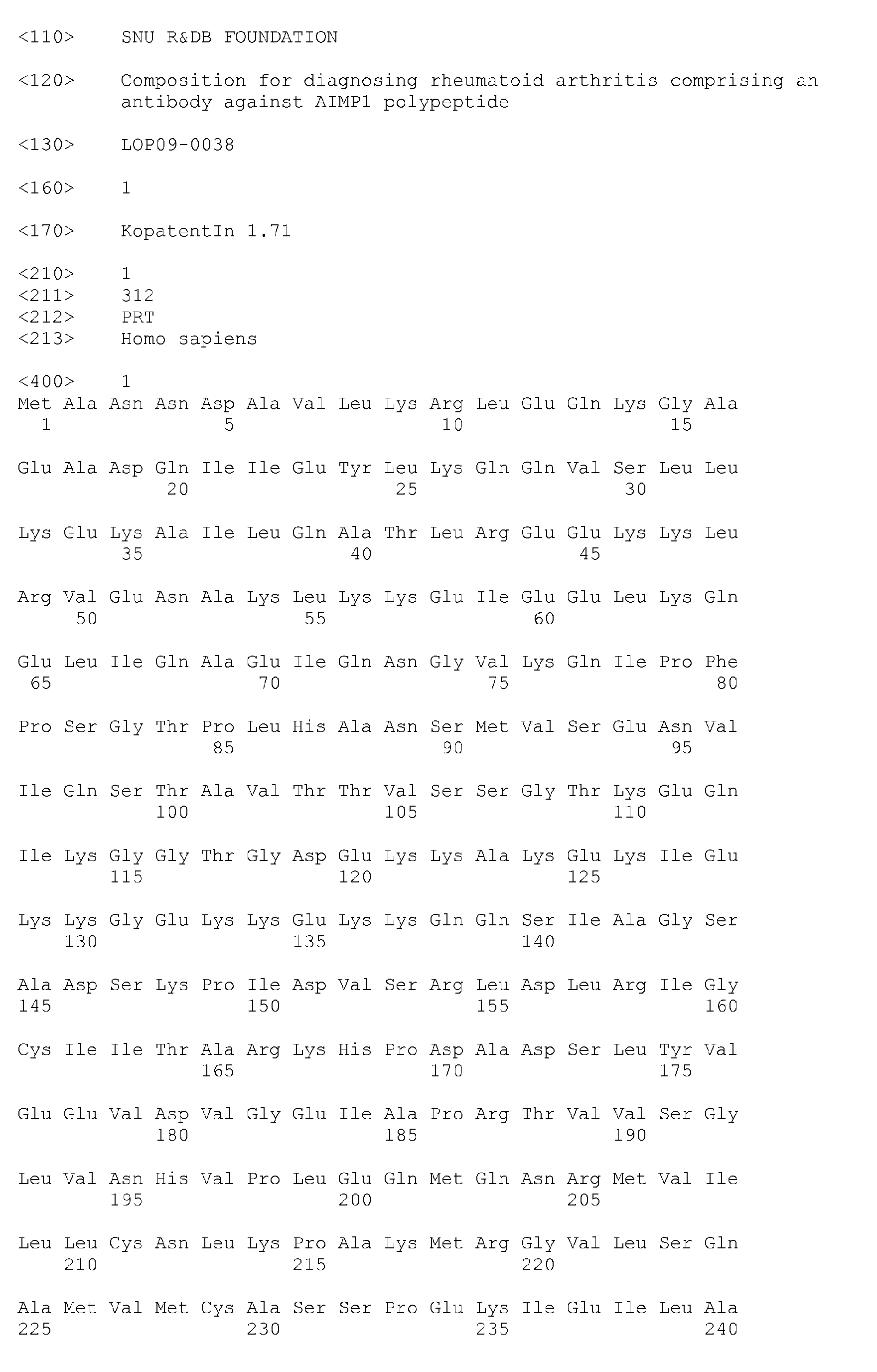
- the AIMP1 polypeptide may be, but not limited thereto, a polypeptide having an amino acid sequence represented by SEQ ID NO: 1.
- the AIMP1 polypeptide may be one disclosed in Genbank Accession No. NM_004755, BC014051, CR542281.
- the AIMP1 polypeptide may be functional equivalents thereof.
- polypeptides which have at least 70%, preferably at least 80%, more preferably at least 90% amino acid sequence homology (i.e., identity) with the amino acid sequence represented by SEQ ID NO: 1.
- it comprises polypeptide having 70%, 71%, 72%, 73%, 74%, 75%, 76%, 77%, 78%, 79%, 80%, 81%, 82%, 83%, 84%, 85%, 86%, 87 %, 88 %, 89%, 90%, 91%, 92%, 93%, 94%, 95%, 96%, 97%, 98%, 99% and 100% of amino acid sequence homology and exhibit substantially identical physiological activity to AIMP1 polypeptide.
- substantially identical physiological activity refers showing original activity of AIMP1 polypeptide as well as enhancing catalytic activity by binding to multi-tRNA synthetase complex.
- the functional equivalents may include, for example peptides produced by as a result of addition, substitution or deletion of some amino acid of SEQ ID NO:1. Substitutions of the amino acids are preferably conservative substitutions.
- amino acids examples include aliphatic amino acids (Gly, Ala, Pro), hydrophobic amino acids (Ile, Leu, Val), aromatic amino acids (Phe, Tyr, Trp), acidic amino acids (Asp, Glu), basic amino acids (His, Lys, Arg, Gln, Asn) and sulfur-containing amino acids (Cys, Met).
- the functional equivalents also include variants with deletion of some of the amino acid sequence of the AIMP1 polypeptide of the present invention. Deletion or substitutions of the amino acids are preferably located at regions that are not directly involved in the physiological activity of the AIMP1 polypeptide of the present invention.
- the functional equivalents also include variants with addition of several amino acids in both terminal ends of the amino acid sequence of the AIMP1 or in the sequence.
- the functional equivalents of the present invention also include polypeptide derivatives which have modification of some of the chemical structure of the inventive polypeptide while maintaining the fundamental backbone and physiological activity of the polypeptide of the present invention. Examples of this modification include structural modifications for changing the stability, storage, volatility or solubility of the AIMP1 polypeptide of the present invention.
- Sequence identity and homology is defined herein as the percentage of amino acid residues in the candidate sequence that are identical with amino acid sequence of AIMP1 polypeptide, after aligning the sequences and introducing gaps, if necessary, to achieve the maximum percent sequence identity, and not considering any conservative substitutions as part of the sequence identity.
- sequence identity can be determined by standard methods that are commonly used to compare the similarity in position of the amino acids of two polypeptides.
- two polypeptides are aligned for optimal matching of their respective amino acids (either along the full length of one or both sequences or along a predetermined portion of one or both sequences).
- the programs provide a default opening penalty and a default gap penalty, and a scoring matrix such as PAM 250 (a standard scoring matrix; see Dayhoff et al., in Atlas of Protein Sequence and Structure, vol. 5, supp. 3, 1978 ) can be used in conjunction with the computer program.
- PAM 250 a standard scoring matrix; see Dayhoff et al., in Atlas of Protein Sequence and Structure, vol. 5, supp. 3, 1978
- the percent identity can be calculated as the follow. The total number of identical matches multiplied by 100 and then divided by the sum of the length of the longer sequence within the matched span and the number of gaps introduced into the longer sequences in order to align the two sequences.
- An antibody against AIMP1 polypeptide refers a specific protein molecule directing to an antigenic region of AIMP1 polypeptide.
- the antibody refers an antibody specifically binding to AIMP1 polypeptide and it comprises polyclonal antibody, monoclonal antibody and recombinant antibody.
- the antibodies against the AIM1 polypeptide may be easily prepared in accordance with conventional technologies known to one skilled in the art.
- Polyclonal antibodies may be prepared by a method widely known in the art, which includes injecting the AIM1 polypeptide antigen into an animal and collecting blood samples from the animal to obtain serum containing antibodies.
- Such polyclonal antibodies may be prepared from a certain animal host, such as goats, rabbits, sheep, monkeys, horses, pigs, cows and dogs.
- Monoclonal antibodies may be prepared by a method widely known in the art, such as a hybridoma method ( Kohler and Milstein, European Journal of Immunology, 6:511-519(1976 )) or a phage antibody library technique ( Clackson et al, Nature, 352:624-628(1991 ); and Marks et al, J. Mol. Biol., 222:58, 1-597 (1991 )).
- the hybridoma method employs cells from an immunologically suitable host animal injected with a diagnostic marker protein of lung cancer as an antigen, such as mice, and a cancer or myeloma cell line as another group.
- a diagnostic marker protein of lung cancer as an antigen
- mice such as mice
- a cancer or myeloma cell line as another group.
- Cells of the two groups are fused with each other by a method widely known in the art, for example, using polyethylene glycol , and antibody-producing cells are proliferated by a standard tissue culture method. After uniform cell colonies are obtained by subcloning using a limited dilution technique, hybridomas capable of producing an antibody specific for the diagnostic marker protein of AIM1 are cultivated in large scale in vitro or in vivo according to a standard technique.
- Monoclonal antibodies produced by the hybridomas may be used in an unpurified form, but are preferably used after being highly purified by a method widely known in the art so as to obtain best results.
- the phage antibody library method includes constructing a phage antibody library in vitro by obtaining genes for antibodies ( single-chain fragment variable (scFv)) to a variety of intracellular lung cancer markers and expressing them in a fusion protein form on the surface of phages, and isolating monoclonal antibodies binding to lung cancer-specific proteins from the library.
- Antibodies prepared by the above methods are isolated using gel electrophoresis, dialysis, salting out, ion exchange chromatography, affinity chromatography, and the like.
- the antibodies of the present invention include complete forms having two full-length light chains and two full-length heavy chains, as well as functional fragments of antibody molecules.
- the functional fragments of antibody molecules refer to fragments retaining at least an antigen-binding function, and include Fab, F(ab'), F(ab')2 and Fv.
- An AIM1 polypeptide according to the present invention can be prepared by separating from nature materials or genetic engineering methods.
- a DNA molecule encoding an AIM1 polypeptide or its functional equivalents is constructed according to any conventional method.
- the DNA molecule may synthesize by performing PCR using suitable primers.
- the DNA molecule may also be synthesized by a standard method known in the art, for example using an automatic DNA synthesizer (commercially available from Biosearch or Applied Biosystems).
- the constructed DNA molecule is inserted into a vector comprising at least one expression control sequence(ex: promoter, enhancer) that is operatively linked to the DNA sequence so as to control the expression of the DNA molecule, and host cells are transformed with the resulting recombinant expression vector.
- the transformed cells are cultured in a medium and condition suitable to express the DNA sequence, and a substantially pure polypeptide encoded by the DNA sequence is collected from the culture medium.
- the collection of the pure polypeptide may be performed using a method known in the art, for example, chromatography.
- substantially pure polypeptide means the inventive polypeptide that does not substantially contain any other proteins derived from host cells.
- the AIM1 polypeptide can be chemically synthesized easily according to any technique known in the art ( Creighton, Proteins: Structures and Molecular Principles, W.H. Freeman and Co., NY, 1983 ). As a typical technique, they are not limited to, but include liquid or solid phase synthesis, fragment condensation, F-MOC or T-BOC chemistry ( Chemical Approaches to the Synthesis of Peptides and Proteins, Williams et al., Eds., CRC Press, Boca Raton Florida, 1997 ; A Practical Approach, Atherton & Sheppard, Eds., IRL Press, Oxford, England, 1989 ).
- Arthritis of the present invention refers to the diseases associated with inflammatory changes to the joint for any reason.
- it may be degenerative arthritis or osteoarthritis, rheumatoid arthritis, avascular necrosis of the femur head, traumatic arthritis, tuberculosis arthritis and pyrogenic arthritis, and preferably it may be rheumatoid arthritis or degenerative arthritis (osteoarthritis).
- the present invention provides a kit for diagnosis of arthritis comprising an antibody against AIM1 polypeptide of the present invention.
- the kit of the present invention may further comprise an instrument and/or a reagent for immunological analysis which are well known in the art as well as an antibody against AIM1 polypeptide.
- the immunological analysis may comprise a method as long as it can measure binding of antigen-antibody.
- These methods are well known in the art and for example, there are immunocytochemistry and immunohistochemistry, radioimmunoassays, ELISA (Enzyme Linked Immunoabsorbent assay), immunoblotting, Farr assay, immunoprecipitation, latex cohesion, erythrocyte cohesion, nephelometry, immunodiffusion, count-current electrophoresis, single radical immunodiffusion, protein chip and immunofluorescence.
- an instrument and/or a reagent for immunological analysis comprises a suitable carrier or a support, a marker which produces a detectable signal, a diluent and a cleansing agent.
- a marker which produces a detectable signal
- a diluent e.g., a diluent
- a cleansing agent e.g., a diluent
- the marker when it is an enzyme, it may comprise a substrate which is enable to measure activity of the enzyme and a reaction blocking agent.
- An antibody against an AIM1 polypeptide which is included in the kit for diagnosis of the present invention preferably may be fixed to a suitable carrier or a support as disclosed in the reference ( Antibodies: A Laboratory Manual, Harlow & Lane; Cold Spring Harbor, 1988 ).
- a suitable carrier or a support there are agarose, cellulose, nitrocellulose, dextran, sephadex, sepharose, liposome, carboxymethylcellulose, polyacrylamide, polysterine, gabbro, filter paper, ion exchange resin, plastic film, plastic tube, glass, polyamine-methylvinyl-ether-maleic acid copolymer, amino acid copolymer, ethylene-maleic acid copolymer, nylon, cup, flat packs.
- the support may have a random form, for example, a form of globular (beads), cylindrical (test tube or inside of well), plane (sheet, test strip).
- a marker which produces a detectable signal enables to measure formation of antigen-antibody complex qualitatively and quantitatively and the examples are a enzyme, a fluorescent material, a ligand, a luminous material, microparticle, a redox molecule and a radioactive isotope.
- a enzyme ⁇ -glucuronidase, ⁇ -D-glucosidase, urase, peroxidase, alkaline phosphatase, acetylcholine esterase, glucose oxidase, hexokinase, malate dehydrogenase, glucose-6-phosphate hydrogenase and invertase may be used.
- fluorescin As a fluorescent material, fluorescin, isothiocyanate, rodamin, phycoerythrin, phycocyanin, allophycocyanin, fluorescinisothiocyanate may be used.
- a ligand there are biotin derivatives and as a luminous material, acridium, ester, luciferin and luciferase.
- a microparticle there are colloid gold and colored latex, and as a redox molecule, there are ferrocene, ruthenium complex compound, biologen, quinone, Ti ion, Cs ion, dimide, 1,4-benzoquinone and hydroquinone.
- radioactive isotope 3H, 14C, 32P, 35S, 36Cl, 51Co, 58Co, 59Fe, 90Y, 125I, 131I and 186Re.
- anything can be used as long as it can be used in immunological analysis.
- kit for diagnosis of arthritis may further comprise composition for detecting a marker for arthritis which is well known in the art.
- a marker for arthritis which is well known in the art may be, but not limited thereto, rheumatoid factor, cyclic citrullinated peptide, citrulline antibody, antinuclear antibody and C-reactive protein( Critical reviews in clinical laboratory sciences, vol.44, pp339-363 (2007 ))
- the present invention provides a method for detecting an AIMP1 polypeptide through antigen-antibody reaction from a sample of a patient. At this time, antigen-antibody reaction is well described above.
- the present invention provides a method for diagnosis of arthritis comprising : acquiring a specimen from a subject; and detecting AIMP1 polypeptide included in the specimen.
- subject means mammals, particularly animals including human beings.
- the subject may be patients in need of diagnosis.
- the term "specimen (or sample)” comprises solid tissue samples such as biologically originated and liquefied samples, biopsy samples, and tissue culture or cells originated thereof. More specifically, for example, but not limited thereto, it may be tissue, extract, cell lysate, hole blood, blood plasma, serum, saliva, ocular humor, cerebrospinal fluid, sweat, urine, milk, ascites, synovial fluid and peritoneum fluid and preferably it may be serum or synovia.
- the sample is acquired from animals, preferably from mammals and most preferably from human beings.
- the sample may be pretreated before use. For example, it may comprise filtration, distillation, extraction, concentration, inactivation of inhibitors, adding of a reagent.
- the protein may be isolated from the sample and used for detection.
- detection means analysis, imaging, identification and deciding of existence or non-existence of a AIMP1 polypeptide and subunits thereof.
- the present invention provides an antibody against a AIMP1 polypeptide for diagnosis of arthritis. Also, the present invention provides use of a AIMP1 polypeptide for preparing a reagent for diagnosis of arthritis.
- the present invention provides a composition for diagnosis of arthritis including an antibody against AIMP1 polypeptide as a novel diagnosis marker of arthritis, a kit for diagnosis including the same, a method for diagnosis of arthritis comprising: acquiring a specimen from a subject; and detecting AIMP1 polypeptide included in the specimen, and an antibody against the AIMP1 polypeptide for diagnosis of arthritis.
- the composition, kit for diagnosis, method for diagnosis and antibody against the AIMP1 polypeptide may be used to diagnose arthritis early since they allow easy diagnosis of arthritis using a specimen from the patient.
- AIMP1 level in synovial fluid (SF) and serum acquired from 35 patients diagnosed with rheumatoid arthritis (RA), 18 patients diagnosed with osteoarthritis (OA) and 20 healthy people was measured as follows.
- the synovial fluid was collected from the cartilage tissue of the patients or healthy people by arthrocentesis or joint aspiration using a syringe.
- the level of AIMP1 in the collected synovial fluid and serum was measured using a commercially available ELISA kit for human AIMP1 (Cat. No. IMG-100, Imagene, Co. Ltd.) according to the manufacturer's instructions as follows.
- the specimen (10 ⁇ L) was mixed with a diluent (90 ⁇ L) and then added to a 96-well ELISA plate. After reaction for 2 hours, the mixture was washed 4 times with washing buffer. Then, peroxidase-conjugated anti-AIMP1 antibody (1 ⁇ L) diluted in a diluent (1 mL) was added to a 96-well plate, 100 ⁇ L per each well.
- substrate solution 100 ⁇ L was added to each well.
- stop solution 100 ⁇ L was added to each well. Then, absorbance was measured at 450 nm to determine the level of AIMP1.
- AIMP1 was detected in high level in the synovial fluid from the patients with rheumatoid arthritis (RA) or osteoarthritis (OA), whereas it was not detected in the synovial fluid from the healthy people (HC). Accordingly, AIMP1 may be utilized as a marker for rheumatoid arthritis or osteoarthritis. Further, more AIMP1 was detected from the serum of the patients with rheumatoid arthritis than that from the healthy people. There was no significant difference between the osteoarthritic patients and the healthy people.
- the present invention provides a composition for diagnosis of arthritis including an antibody against AIMP1 polypeptide as a novel diagnosis marker of arthritis, a kit for diagnosis including the same, a method for diagnosis of arthritis comprising: acquiring a specimen from a subject; and detecting AIMP1 polypeptide included in the specimen, and an antibody against the AIMP1 polypeptide for diagnosis of arthritis.
- the composition, kit for diagnosis, method for diagnosis and antibody against the AIMP1 polypeptide may be used to diagnose arthritis early since they allow easy diagnosis of arthritis using a specimen from the patient.
Landscapes
- Health & Medical Sciences (AREA)
- Immunology (AREA)
- Life Sciences & Earth Sciences (AREA)
- Hematology (AREA)
- Engineering & Computer Science (AREA)
- Chemical & Material Sciences (AREA)
- Urology & Nephrology (AREA)
- Biomedical Technology (AREA)
- Molecular Biology (AREA)
- Microbiology (AREA)
- Physics & Mathematics (AREA)
- Biotechnology (AREA)
- Rheumatology (AREA)
- Rehabilitation Therapy (AREA)
- Food Science & Technology (AREA)
- Medicinal Chemistry (AREA)
- Cell Biology (AREA)
- Analytical Chemistry (AREA)
- Biochemistry (AREA)
- General Health & Medical Sciences (AREA)
- General Physics & Mathematics (AREA)
- Pathology (AREA)
- Peptides Or Proteins (AREA)
Abstract
Description
- The present invention relates to a novel use of AIMP1 polypeptide, more particularly to a composition for diagnosis of arthritis comprising an antibody against AIMP1, a kit for diagnosis comprising the same, a method for diagnosis of arthritis comprising: acquiring a specimen from a subject; and detecting AIMP1 polypeptide included in the specimen, and an antibody against the AIMP1 polypeptide for diagnosis of arthritis.
- Arthritis collectively refers to the diseases associated with inflammatory changes to the joint for any reason. It involves loss of cartilage which connects bones so that they can move smoothly. Arthritis is classified into various kinds, including degenerative arthritis or osteoarthritis, rheumatoid arthritis, avascular necrosis of the femur head, traumatic arthritis, tuberculosis arthritis, pyrogenic arthritis, and the like.
- Among them, rheumatoid arthritis is a chronic disease primarily featured by inflammations in the joint lining or the synovium. Prolonged rheumatoid arthritis may result in damage to the joint, causing chronic pain, loss of functioning and disability. Rheumatoid arthritis proceeds in three stages. The first stage is characterized by pain, fever, stiffness, redness, and swelling of the synovial lining resulting in swelling around the joint. The second stage is characterized by fast division and growth of cells, i.e. pannus, leading to thickening of the synovium. In the third stage, the inflammatory cells release enzymes that degrade the bone and cartilage, resulting in loss of the form and alignment of the related joint, stronger pain, and loss of motility. The diagnosis of rheumatoid arthritis is process-based and there is no sure method of diagnosing rheumatoid arthritis. Accordingly, a more convenient technique for diagnosis of rheumatoid arthritis is needed.
- Also, osteoarthritis (degenerative arthritis) is an arthritis resulting from degenerative changes in cartilage and nearby bones among the components of the joint. It causes acute pain in weight bearing joints, such as hips and knees, difficulty in moving, and deformation of the joints if left untreated for a long time. There are two major causes of osteoarthritis. One is damage to the joint due to excessive load although the cartilage or bone of the joint is normal. The other is the case where the cartilage or bone of the joint is weaker than normal although the load is normal.
- Meanwhile, AIMP1 (ARS-interacting multi-functional protein 1), formerly known as the p43 protein, was renamed so by the inventors of the present invention (Sang Gyu Park, et al., Trends in Biochemical Sciences, 30:569-574, 2005). The AIMP1 is a protein consisting of 312 amino acids. It binds to the multi-tRNA synthetase complex (Deutscher, M. P., Method Enzymol, 29, 577-583, 1974; Dang C. V. et al., Int. J. Biochem. 14, 539-543, 1982; Mirande, M. et al., EMBO J. 1, 733-736, 1982; Yang D. C. et al., Curr. Top. Cell. Regul. 26, 325-335, 1985) and thus enhances catalytic activity of the multi-tRNA synthetase (Park S. G. et al., J. Biol. Chem. 274, 16673-16676, 1999). AIMP1 is secreted from various types of cells, including prostate cancer cells, immune cells and transgenic cells, and the secretion is induced by various stimulations such as TNFα and heat shock (Park S. G. et al., Am. J. Pathol., 166, 387-398, 2005; Barnett G. et al., Cancer Res. 60, 2850-2857, 2000). The secreted AIMP1 is known to work on diverse target cells such as monocytes/macrophages, endothelial cells and fibroblast cells.
- While the inventors of the present invention have studied about the physiological functions of AIMP1 protein, they found out that the level of the AIMP1 protein in the serum and synovial fluid is increased in arthritic patients. Based on the finding, they have developed a composition for diagnosis of arthritis comprising AIMP1 polypeptide as an effective ingredient.
- Accordingly, the object of the present invention is to provide novel use of AIMP1 polypeptide.
- To achieve the above object, the present invention provides a composition for diagnosis of arthritis comprising AIMP1 polypeptide.
- To achieve another object, the present invention provides a kit for diagnosis of arthritis comprising the composition.
- To achieve another object, the present invention provides a method for detecting AIMP1 polypeptide through antigen-antibody reaction of a sample of a patient to provide information for diagnosis of arthritis.
- To achieve another object, the present invention provides a method for diagnosis of arthritis comprising : acquiring a specimen from a subject; and detecting AIMP1 polypeptide included in the specimen.
- To achieve another object, the present invention provides an antibody against AIMP1 polypeptide for diagnosis of arthritis.
- Hereafter, the present invention will be described in more detail.
- A composition of the present invention comprises an antibody against AIMP1 polypeptide and may be used for diagnosis of arthritis.
- AIMP1 polypeptide of the present invention is known as p43 and consist of 312 of amino acid and binds to multi-tRNA synthetase complex and enhances its catalytic activity. The AIMP1 polypeptide may be, but not limited thereto, a polypeptide having an amino acid sequence represented by SEQ ID NO: 1. In addition, the AIMP1 polypeptide may be one disclosed in Genbank Accession No. NM_004755, BC014051, CR542281. In addition, the AIMP1 polypeptide may be functional equivalents thereof.
- The term "functional equivalents" refer to polypeptides which have at least 70%, preferably at least 80%, more preferably at least 90% amino acid sequence homology (i.e., identity) with the amino acid sequence represented by SEQ ID NO: 1. For example, it comprises polypeptide having 70%, 71%, 72%, 73%, 74%, 75%, 76%, 77%, 78%, 79%, 80%, 81%, 82%, 83%, 84%, 85%, 86%, 87 %, 88 %, 89%, 90%, 91%, 92%, 93%, 94%, 95%, 96%, 97%, 98%, 99% and 100% of amino acid sequence homology and exhibit substantially identical physiological activity to AIMP1 polypeptide. As used herein, "substantially identical physiological activity" refers showing original activity of AIMP1 polypeptide as well as enhancing catalytic activity by binding to multi-tRNA synthetase complex. The functional equivalents may include, for example peptides produced by as a result of addition, substitution or deletion of some amino acid of SEQ ID NO:1. Substitutions of the amino acids are preferably conservative substitutions. Examples of conservative substitutions of naturally occurring amino acids are as follows: aliphatic amino acids (Gly, Ala, Pro), hydrophobic amino acids (Ile, Leu, Val), aromatic amino acids (Phe, Tyr, Trp), acidic amino acids (Asp, Glu), basic amino acids (His, Lys, Arg, Gln, Asn) and sulfur-containing amino acids (Cys, Met). In addition, the functional equivalents also include variants with deletion of some of the amino acid sequence of the AIMP1 polypeptide of the present invention. Deletion or substitutions of the amino acids are preferably located at regions that are not directly involved in the physiological activity of the AIMP1 polypeptide of the present invention. And deletion of the amino acids is preferably located at regions that are not directly involved in the physiological activity of the AIMP1 polypeptide of the present invention. In addition, the functional equivalents also include variants with addition of several amino acids in both terminal ends of the amino acid sequence of the AIMP1 or in the sequence. Moreover, the functional equivalents of the present invention also include polypeptide derivatives which have modification of some of the chemical structure of the inventive polypeptide while maintaining the fundamental backbone and physiological activity of the polypeptide of the present invention. Examples of this modification include structural modifications for changing the stability, storage, volatility or solubility of the AIMP1 polypeptide of the present invention.
- Sequence identity and homology is defined herein as the percentage of amino acid residues in the candidate sequence that are identical with amino acid sequence of AIMP1 polypeptide, after aligning the sequences and introducing gaps, if necessary, to achieve the maximum percent sequence identity, and not considering any conservative substitutions as part of the sequence identity. In addition, none of N-terminal, C-terminal, or internal extensions, deletions, or insertions into the amino acid sequence of AIMP1 polypeptide shall be construed as affecting sequence identity or homology. Thus, sequence identity can be determined by standard methods that are commonly used to compare the similarity in position of the amino acids of two polypeptides. Using a computer program such as BLAST or FASTA, two polypeptides are aligned for optimal matching of their respective amino acids (either along the full length of one or both sequences or along a predetermined portion of one or both sequences). The programs provide a default opening penalty and a default gap penalty, and a scoring matrix such as PAM 250 (a standard scoring matrix; see Dayhoff et al., in Atlas of Protein Sequence and Structure, vol. 5, supp. 3, 1978) can be used in conjunction with the computer program. For example, the percent identity can be calculated as the follow. The total number of identical matches multiplied by 100 and then divided by the sum of the length of the longer sequence within the matched span and the number of gaps introduced into the longer sequences in order to align the two sequences.
- An antibody against AIMP1 polypeptide refers a specific protein molecule directing to an antigenic region of AIMP1 polypeptide. For the purpose of the present invention, the antibody refers an antibody specifically binding to AIMP1 polypeptide and it comprises polyclonal antibody, monoclonal antibody and recombinant antibody.
- The antibodies against the AIM1 polypeptide may be easily prepared in accordance with conventional technologies known to one skilled in the art. Polyclonal antibodies may be prepared by a method widely known in the art, which includes injecting the AIM1 polypeptide antigen into an animal and collecting blood samples from the animal to obtain serum containing antibodies. Such polyclonal antibodies may be prepared from a certain animal host, such as goats, rabbits, sheep, monkeys, horses, pigs, cows and dogs.
- Monoclonal antibodies may be prepared by a method widely known in the art, such as a hybridoma method (Kohler and Milstein, European Journal of Immunology, 6:511-519(1976)) or a phage antibody library technique (Clackson et al, Nature, 352:624-628(1991); and Marks et al, J. Mol. Biol., 222:58, 1-597 (1991)).
- The hybridoma method employs cells from an immunologically suitable host animal injected with a diagnostic marker protein of lung cancer as an antigen, such as mice, and a cancer or myeloma cell line as another group. Cells of the two groups are fused with each other by a method widely known in the art, for example, using polyethylene glycol , and antibody-producing cells are proliferated by a standard tissue culture method. After uniform cell colonies are obtained by subcloning using a limited dilution technique, hybridomas capable of producing an antibody specific for the diagnostic marker protein of AIM1 are cultivated in large scale in vitro or in vivo according to a standard technique. Monoclonal antibodies produced by the hybridomas may be used in an unpurified form, but are preferably used after being highly purified by a method widely known in the art so as to obtain best results. The phage antibody library method includes constructing a phage antibody library in vitro by obtaining genes for antibodies ( single-chain fragment variable ( scFv)) to a variety of intracellular lung cancer markers and expressing them in a fusion protein form on the surface of phages, and isolating monoclonal antibodies binding to lung cancer-specific proteins from the library. Antibodies prepared by the above methods are isolated using gel electrophoresis, dialysis, salting out, ion exchange chromatography, affinity chromatography, and the like.
- In addition, the antibodies of the present invention include complete forms having two full-length light chains and two full-length heavy chains, as well as functional fragments of antibody molecules. The functional fragments of antibody molecules refer to fragments retaining at least an antigen-binding function, and include Fab, F(ab'), F(ab')2 and Fv.
- An AIM1 polypeptide according to the present invention can be prepared by separating from nature materials or genetic engineering methods. For example, a DNA molecule encoding an AIM1 polypeptide or its functional equivalents is constructed according to any conventional method. The DNA molecule may synthesize by performing PCR using suitable primers. Alternatively, the DNA molecule may also be synthesized by a standard method known in the art, for example using an automatic DNA synthesizer (commercially available from Biosearch or Applied Biosystems). The constructed DNA molecule is inserted into a vector comprising at least one expression control sequence(ex: promoter, enhancer) that is operatively linked to the DNA sequence so as to control the expression of the DNA molecule, and host cells are transformed with the resulting recombinant expression vector. The transformed cells are cultured in a medium and condition suitable to express the DNA sequence, and a substantially pure polypeptide encoded by the DNA sequence is collected from the culture medium. The collection of the pure polypeptide may be performed using a method known in the art, for example, chromatography. In this regard, the term "substantially pure polypeptide" means the inventive polypeptide that does not substantially contain any other proteins derived from host cells. For the genetic engineering method for synthesizing the inventive polypeptide, the reader may refer to the following literatures: Maniatis et al., Molecular Cloning: A Laboratory Manual, Cold Spring Harbor Laboratory 1982; Sambrook et al., Molecular Cloning; A Laboratory Manual, Cold Spring Harbor Press, N.Y., Second(1998) and Third(2000) Editions; Gene Expression Technology, Method in Enzymology, Genetics and Molecular Biology, Method in Enzymology, Guthrie & Fink (eds.), Academic Press, San Diego, Calif. 1991; and Hitzeman et al., J. Biol. Chem., 255, 12073-12080 1990.
- Also, the AIM1 polypeptide can be chemically synthesized easily according to any technique known in the art (Creighton, Proteins: Structures and Molecular Principles, W.H. Freeman and Co., NY, 1983). As a typical technique, they are not limited to, but include liquid or solid phase synthesis, fragment condensation, F-MOC or T-BOC chemistry (Chemical Approaches to the Synthesis of Peptides and Proteins, Williams et al., Eds., CRC Press, Boca Raton Florida, 1997; A Practical Approach, Atherton & Sheppard, Eds., IRL Press, Oxford, England, 1989).
- Arthritis of the present invention refers to the diseases associated with inflammatory changes to the joint for any reason. For example, it may be degenerative arthritis or osteoarthritis, rheumatoid arthritis, avascular necrosis of the femur head, traumatic arthritis, tuberculosis arthritis and pyrogenic arthritis, and preferably it may be rheumatoid arthritis or degenerative arthritis (osteoarthritis).
- Meanwhile, the present invention provides a kit for diagnosis of arthritis comprising an antibody against AIM1 polypeptide of the present invention.
- The kit of the present invention may further comprise an instrument and/or a reagent for immunological analysis which are well known in the art as well as an antibody against AIM1 polypeptide.
- The immunological analysis may comprise a method as long as it can measure binding of antigen-antibody. These methods are well known in the art and for example, there are immunocytochemistry and immunohistochemistry, radioimmunoassays, ELISA (Enzyme Linked Immunoabsorbent assay), immunoblotting, Farr assay, immunoprecipitation, latex cohesion, erythrocyte cohesion, nephelometry, immunodiffusion, count-current electrophoresis, single radical immunodiffusion, protein chip and immunofluorescence.
- As an instrument and/or a reagent for immunological analysis, it comprises a suitable carrier or a support, a marker which produces a detectable signal, a diluent and a cleansing agent. In addition, when the marker is an enzyme, it may comprise a substrate which is enable to measure activity of the enzyme and a reaction blocking agent.
- An antibody against an AIM1 polypeptide which is included in the kit for diagnosis of the present invention preferably may be fixed to a suitable carrier or a support as disclosed in the reference (Antibodies: A Laboratory Manual, Harlow & Lane; Cold Spring Harbor, 1988). As examples of a suitable carrier or a support, there are agarose, cellulose, nitrocellulose, dextran, sephadex, sepharose, liposome, carboxymethylcellulose, polyacrylamide, polysterine, gabbro, filter paper, ion exchange resin, plastic film, plastic tube, glass, polyamine-methylvinyl-ether-maleic acid copolymer, amino acid copolymer, ethylene-maleic acid copolymer, nylon, cup, flat packs. As other solid substrates, there are a cell culture plate, a ELISA plate, a tube and a polymeric membrane. The support may have a random form, for example, a form of globular (beads), cylindrical (test tube or inside of well), plane (sheet, test strip).
- A marker which produces a detectable signal enables to measure formation of antigen-antibody complex qualitatively and quantitatively and the examples are a enzyme, a fluorescent material, a ligand, a luminous material, microparticle, a redox molecule and a radioactive isotope. As a enzyme, β-glucuronidase, β-D-glucosidase, urase, peroxidase, alkaline phosphatase, acetylcholine esterase, glucose oxidase, hexokinase, malate dehydrogenase, glucose-6-phosphate hydrogenase and invertase may be used. As a fluorescent material, fluorescin, isothiocyanate, rodamin, phycoerythrin, phycocyanin, allophycocyanin, fluorescinisothiocyanate may be used. As a ligand, there are biotin derivatives and as a luminous material, acridium, ester, luciferin and luciferase. As a microparticle, there are colloid gold and colored latex, and as a redox molecule, there are ferrocene, ruthenium complex compound, biologen, quinone, Ti ion, Cs ion, dimide, 1,4-benzoquinone and hydroquinone. As a radioactive isotope, 3H, 14C, 32P, 35S, 36Cl, 51Co, 58Co, 59Fe, 90Y, 125I, 131I and 186Re. However, besides the above mentioned things, anything can be used as long as it can be used in immunological analysis.
- Also, the kit for diagnosis of arthritis may further comprise composition for detecting a marker for arthritis which is well known in the art. For example, a marker for arthritis which is well known in the art may be, but not limited thereto, rheumatoid factor, cyclic citrullinated peptide, citrulline antibody, antinuclear antibody and C-reactive protein(Critical reviews in clinical laboratory sciences, vol.44, pp339-363 (2007))
- Also, to provide necessary information for diagnosis of arthritis, the present invention provides a method for detecting an AIMP1 polypeptide through antigen-antibody reaction from a sample of a patient. At this time, antigen-antibody reaction is well described above.
- Meanwhile, the present invention provides a method for diagnosis of arthritis comprising : acquiring a specimen from a subject; and detecting AIMP1 polypeptide included in the specimen.
- As used herein, the term "subject" means mammals, particularly animals including human beings. The subject may be patients in need of diagnosis.
- As used herein, the term "specimen (or sample)" comprises solid tissue samples such as biologically originated and liquefied samples, biopsy samples, and tissue culture or cells originated thereof. More specifically, for example, but not limited thereto, it may be tissue, extract, cell lysate, hole blood, blood plasma, serum, saliva, ocular humor, cerebrospinal fluid, sweat, urine, milk, ascites, synovial fluid and peritoneum fluid and preferably it may be serum or synovia. The sample is acquired from animals, preferably from mammals and most preferably from human beings. The sample may be pretreated before use. For example, it may comprise filtration, distillation, extraction, concentration, inactivation of inhibitors, adding of a reagent. In addition, the protein may be isolated from the sample and used for detection.
- As used herein, the term "detection" means analysis, imaging, identification and deciding of existence or non-existence of a AIMP1 polypeptide and subunits thereof.
- Meanwhile, the present invention provides an antibody against a AIMP1 polypeptide for diagnosis of arthritis. Also, the present invention provides use of a AIMP1 polypeptide for preparing a reagent for diagnosis of arthritis.
- For the genetic engineering method for nucleotides and proteins of the present invention, it may be referred to the following literatures: Maniatis et al., Molecular Cloning: A Laboratory Manual, Cold Spring Harbor Laboratory 1982; Sambrook et al., Molecular Cloning; A Laboratory Manual, Cold Spring Harbor Press, N.Y., Second(1998) and Third(2000) Editions; Gene Expression Technology, Method in Enzymology, Genetics and Molecular Biology, Method in Enzymology, Guthrie & Fink (eds.), Academic Press, San Diego, Calif. 1991; and Hitzeman et al., J. Biol. Chem., 255, 12073-12080 1990.
- Accordingly, the present invention provides a composition for diagnosis of arthritis including an antibody against AIMP1 polypeptide as a novel diagnosis marker of arthritis, a kit for diagnosis including the same, a method for diagnosis of arthritis comprising: acquiring a specimen from a subject; and detecting AIMP1 polypeptide included in the specimen, and an antibody against the AIMP1 polypeptide for diagnosis of arthritis. The composition, kit for diagnosis, method for diagnosis and antibody against the AIMP1 polypeptide may be used to diagnose arthritis early since they allow easy diagnosis of arthritis using a specimen from the patient.
-
Figure 1 is a graph identifying level of AIMP1 in synovial fluid of the normal group (HC, n=20), rheumatoid arthritis group (RA, n=35) and osteoarthritis patient group (OA, n=18) by ELISA. - The examples and experiments will now be described. The following examples and experiments are for illustrative purposes only and not intended to limit the scope of the present invention.
- AIMP1 level in synovial fluid (SF) and serum acquired from 35 patients diagnosed with rheumatoid arthritis (RA), 18 patients diagnosed with osteoarthritis (OA) and 20 healthy people was measured as follows. The synovial fluid was collected from the cartilage tissue of the patients or healthy people by arthrocentesis or joint aspiration using a syringe.
- The level of AIMP1 in the collected synovial fluid and serum was measured using a commercially available ELISA kit for human AIMP1 (Cat. No. IMG-100, Imagene, Co. Ltd.) according to the manufacturer's instructions as follows. The specimen (10 µL) was mixed with a diluent (90 µL) and then added to a 96-well ELISA plate. After reaction for 2 hours, the mixture was washed 4 times with washing buffer. Then, peroxidase-conjugated anti-AIMP1 antibody (1 µL) diluted in a diluent (1 mL) was added to a 96-well plate, 100 µL per each well. After reaction for 1 hour and washing 4 times with washing buffer, substrate solution (100 µL) was added to each well. After reaction for 30 minutes, stop solution (100 µL) was added to each well. Then, absorbance was measured at 450 nm to determine the level of AIMP1.
- As seen from
Fig. 1 , AIMP1 was detected in high level in the synovial fluid from the patients with rheumatoid arthritis (RA) or osteoarthritis (OA), whereas it was not detected in the synovial fluid from the healthy people (HC). Accordingly, AIMP1 may be utilized as a marker for rheumatoid arthritis or osteoarthritis. Further, more AIMP1 was detected from the serum of the patients with rheumatoid arthritis than that from the healthy people. There was no significant difference between the osteoarthritic patients and the healthy people. - As can be seen foregoing, the present invention provides a composition for diagnosis of arthritis including an antibody against AIMP1 polypeptide as a novel diagnosis marker of arthritis, a kit for diagnosis including the same, a method for diagnosis of arthritis comprising: acquiring a specimen from a subject; and detecting AIMP1 polypeptide included in the specimen, and an antibody against the AIMP1 polypeptide for diagnosis of arthritis. The composition, kit for diagnosis, method for diagnosis and antibody against the AIMP1 polypeptide may be used to diagnose arthritis early since they allow easy diagnosis of arthritis using a specimen from the patient.

Claims (8)
- A composition for diagnosis of arthritis comprising an antibody against AIMP1 polypeptide as an active ingredient.
- The composition of claim 1, wherein the AIMP1 polypeptide is a polypeptide having an amino acid sequence represented by SEQ ID NO: 1.
- The composition of claim 1, wherein the arthritis is rheumatoid arthritis or osteoarthritis.
- A kit for diagnosis of arthritis comprising the composition of claim 1.
- A method for detecting AIMP1 polypeptide through antigen-antibody reaction of a sample of a patient to provide information for diagnosis of arthritis.
- A method for diagnosis of arthritis comprising : acquiring a specimen from a subject; and detecting AIMP1 polypeptide in the specimen.
- An antibody against AIMP1 polypeptide for diagnosis of arthritis.
- Use of AIMP1 polypeptide for preparing an agent for diagnosis of arthritis.
Applications Claiming Priority (2)
| Application Number | Priority Date | Filing Date | Title |
|---|---|---|---|
| KR1020080099782A KR101067817B1 (en) | 2008-10-10 | 2008-10-10 | A composition for diagnosing arthritis, comprising an antibody against an AIMP1 polypeptide |
| PCT/KR2009/005778 WO2010041892A2 (en) | 2008-10-10 | 2009-10-09 | Novel application of aimp1 polypeptide |
Publications (3)
| Publication Number | Publication Date |
|---|---|
| EP2348049A2 true EP2348049A2 (en) | 2011-07-27 |
| EP2348049A4 EP2348049A4 (en) | 2012-03-28 |
| EP2348049B1 EP2348049B1 (en) | 2013-10-02 |
Family
ID=42101102
Family Applications (1)
| Application Number | Title | Priority Date | Filing Date |
|---|---|---|---|
| EP09819399.8A Not-in-force EP2348049B1 (en) | 2008-10-10 | 2009-10-09 | Application of aimp1 polypeptide |
Country Status (4)
| Country | Link |
|---|---|
| US (1) | US20110250701A1 (en) |
| EP (1) | EP2348049B1 (en) |
| KR (1) | KR101067817B1 (en) |
| WO (1) | WO2010041892A2 (en) |
Families Citing this family (45)
| Publication number | Priority date | Publication date | Assignee | Title |
|---|---|---|---|---|
| CN102105164A (en) | 2008-06-11 | 2011-06-22 | Atyr医药公司 | Thrombopoietic activity of tyrosyl-TRNA synthetase polypeptides |
| EP2310498A1 (en) * | 2008-06-26 | 2011-04-20 | Atyr Pharma, Inc. | Compositions and methods comprising glycyl-trna synthetases having non-canonical biological activities |
| ES2552773T3 (en) | 2009-02-27 | 2015-12-02 | Atyr Pharma, Inc. | Structural reasons for polypeptides associated with cell signaling activity |
| JP5730280B2 (en) | 2009-03-16 | 2015-06-03 | パング バイオファーマ リミテッド | Compositions and methods comprising histidyl-tRNA synthetase splice variants having non-canonical biological activity |
| WO2010120509A2 (en) * | 2009-03-31 | 2010-10-21 | Atyr Pharma, Inc. | Compositions and methods comprising aspartyl-trna synthetases having non-canonical biological activities |
| US20110150885A1 (en) * | 2009-12-11 | 2011-06-23 | Atyr Pharma, Inc. | Aminoacyl trna synthetases for modulating hematopoiesis |
| US8828395B2 (en) | 2009-12-11 | 2014-09-09 | Atyr Pharma, Inc. | Antibodies that bind tyrosyl-tRNA synthetases |
| ES2535951T3 (en) | 2009-12-11 | 2015-05-19 | Atyr Pharma, Inc. | Histidyl tRNA synthetases to reduce inflammation |
| KR101150900B1 (en) * | 2010-01-26 | 2012-05-30 | 연세대학교 산학협력단 | Compositions for Treating Osteoarthritis |
| CA2797093C (en) | 2010-04-26 | 2019-10-29 | Atyr Pharma, Inc. | Innovative discovery of therapeutic, diagnostic, and antibody compositions related to protein fragments of cysteinyl-trna synthetase |
| CA2797259C (en) | 2010-04-27 | 2020-09-29 | Atyr Pharma, Inc. | Innovative discovery of therapeutic, diagnostic, and antibody compositions related to protein fragments of threonyl trna synthetases |
| CA2797362C (en) | 2010-04-27 | 2020-12-08 | Atyr Pharma, Inc. | Innovative discovery of therapeutic, diagnostic, and antibody compositions related to protein fragments of isoleucyl trna synthetases |
| WO2011139853A2 (en) | 2010-04-28 | 2011-11-10 | Atyr Pharma, Inc. | Innovative discovery of therapeutic, diagnostic, and antibody compositions related to protein fragments of alanyl trna synthetases |
| EP2563383B1 (en) | 2010-04-29 | 2017-03-01 | Atyr Pharma, Inc. | Innovative discovery of therapeutic, diagnostic, and antibody compositions related to protein fragments of valyl trna synthetases |
| US8986680B2 (en) | 2010-04-29 | 2015-03-24 | Atyr Pharma, Inc. | Innovative discovery of therapeutic, diagnostic, and antibody compositions related to protein fragments of Asparaginyl tRNA synthetases |
| CA2797977C (en) | 2010-05-03 | 2019-08-20 | Atyr Pharma, Inc. | Innovative discovery of therapeutic, diagnostic, and antibody compositions related to protein fragments of phenylalanyl-alpha-trna synthetases |
| CN103140233B (en) | 2010-05-03 | 2017-04-05 | Atyr 医药公司 | Treatment, diagnosis and the discovery of antibody compositions related to the protein fragments of methionyl-tRNA synthetase |
| AU2011248357B2 (en) | 2010-05-03 | 2017-02-23 | Pangu Biopharma Limited | Innovative discovery of therapeutic, diagnostic, and antibody compositions related to protein fragments of seryl-tRNA synthetases |
| WO2011139986A2 (en) | 2010-05-03 | 2011-11-10 | Atyr Pharma, Inc. | Innovative discovery of therapeutic, diagnostic, and antibody compositions related to protein fragments of arginyl-trna synthetases |
| US9062301B2 (en) | 2010-05-04 | 2015-06-23 | Atyr Pharma, Inc. | Innovative discovery of therapeutic, diagnostic, and antibody compositions related to protein fragments of glutamyl-prolyl-tRNA synthetases |
| EP2566499B1 (en) | 2010-05-04 | 2017-01-25 | aTyr Pharma, Inc. | Innovative discovery of therapeutic, diagnostic, and antibody compositions related to protein fragments of p38 multi-trna synthetase complex |
| CA2799197C (en) | 2010-05-14 | 2019-10-29 | Atyr Pharma, Inc. | Innovative discovery of therapeutic, diagnostic, and antibody compositions related to protein fragments of phenylalanyl-beta-trna synthetases |
| US9034598B2 (en) | 2010-05-17 | 2015-05-19 | Atyr Pharma, Inc. | Innovative discovery of therapeutic, diagnostic, and antibody compositions related to protein fragments of leucyl-tRNA synthetases |
| AU2011258106B2 (en) | 2010-05-27 | 2017-02-23 | Pangu Biopharma Limited | Innovative discovery of therapeutic, diagnostic, and antibody compositions related to protein fragments of glutaminyl-tRNA synthetases |
| CN103118694B (en) | 2010-06-01 | 2016-08-03 | Atyr医药公司 | Discovery of therapeutic, diagnostic and antibody compositions related to protein fragments of lysyl-tRNA synthetase |
| US8999321B2 (en) | 2010-07-12 | 2015-04-07 | Atyr Pharma, Inc. | Innovative discovery of therapeutic, diagnostic, and antibody compositions related to protein fragments of glycyl-tRNA synthetases |
| JP6116479B2 (en) | 2010-07-12 | 2017-04-19 | エータイアー ファーマ, インコーポレイテッド | Innovative discovery of therapeutic, diagnostic and antibody compositions related to protein fragments of glycyl-tRNA synthetase |
| CA2804278C (en) | 2010-07-12 | 2021-07-13 | Atyr Pharma, Inc. | Innovative discovery of therapeutic, diagnostic, and antibody compositions related to protein fragments of aspartyl-trna synthetases |
| EP2593126B1 (en) | 2010-07-12 | 2017-09-20 | aTyr Pharma, Inc. | Innovative discovery of therapeutic, diagnostic, and antibody compositions related to protein fragments of histidyl-trna synthetases |
| JP5964304B2 (en) | 2010-08-25 | 2016-08-03 | エータイアー ファーマ, インコーポレイテッド | Innovative discovery of therapeutic, diagnostic and antibody compositions related to protein fragments of tyrosyl-tRNA synthetase |
| CA2812795C (en) | 2010-10-06 | 2021-08-31 | Atyr Pharma, Inc. | Innovative discovery of therapeutic, diagnostic, and antibody compositions related protein fragments of tryptophanyl trna synthetases |
| KR101589135B1 (en) * | 2011-04-20 | 2016-01-29 | 주식회사 셀앤바이오 | Humanized anti-EMAPII antibodies and uses thereof |
| WO2013022982A2 (en) | 2011-08-09 | 2013-02-14 | Atyr Pharma, Inc. | Pegylated tyrosyl-trna synthetase polypeptides |
| US9816084B2 (en) | 2011-12-06 | 2017-11-14 | Atyr Pharma, Inc. | Aspartyl-tRNA synthetases |
| WO2013086228A1 (en) | 2011-12-06 | 2013-06-13 | Atyr Pharma, Inc. | Pegylated aspartyl-trna synthetase polypeptides |
| CN104220461A (en) | 2011-12-29 | 2014-12-17 | Atyr医药公司 | Aspartyl-trna synthetase-fc conjugates |
| WO2013105721A1 (en) * | 2012-01-13 | 2013-07-18 | 가톨릭대학교 산학협력단 | Rheumatoid arthritis diagnosis kit |
| US9347941B2 (en) | 2012-01-13 | 2016-05-24 | Catholic University Industry-Academic Cooperation Foundation | Diagnosis kit for rheumatoid arthritis |
| EP2814514B1 (en) | 2012-02-16 | 2017-09-13 | Atyr Pharma, Inc. | Histidyl-trna synthetases for treating autoimmune and inflammatory diseases |
| CN114717206A (en) | 2013-03-15 | 2022-07-08 | Atyr 医药公司 | Histidyl-TRNA synthetase-FC conjugates |
| JP6792001B2 (en) * | 2016-07-01 | 2020-11-25 | メディシナル バイオコンバージェンス リサーチ センター | Composition for diagnosing thyroid cyst cancer using aminoacyl-tRNA synthetase-related protein expression level and diagnostic marker detection method |
| KR101757346B1 (en) * | 2017-03-27 | 2017-07-26 | 아주대학교산학협력단 | Anti-EMAP II Antibody and Use thereof |
| ES2994451T3 (en) | 2017-04-20 | 2025-01-24 | Atyr Pharma Inc | Compositions for treating lung inflammation |
| KR20180121057A (en) * | 2017-04-28 | 2018-11-07 | 아주대학교산학협력단 | Biomarker composition for diagnosing systemic lupus erythematosus comprising AIMP1 and method for diagnosing systemic lupus erythematosus using the same marker |
| KR102118631B1 (en) | 2019-09-30 | 2020-06-03 | 조선대학교 산학협력단 | Composition for diagnosing arthritis and kit comprising the same |
Family Cites Families (6)
| Publication number | Priority date | Publication date | Assignee | Title |
|---|---|---|---|---|
| US5641867A (en) * | 1993-09-29 | 1997-06-24 | The Trustees Of Columbia University In The City Of New York | Antibody which specifically binds to endothelial-monocyte activating polypeptide II |
| AU5114000A (en) * | 2000-06-14 | 2001-12-24 | Imagene Co., Ltd. | P43 anti-tumor therapeutic agent and three dimensional structure of its cytokinedomain |
| KR100515016B1 (en) * | 2002-07-22 | 2005-09-15 | 재단법인서울대학교산학협력재단 | Pharmaceutical composition for wound treatment containing p43 as an effective component |
| WO2007100058A1 (en) * | 2006-03-02 | 2007-09-07 | National University Corporation Chiba University | Rheumatoid arthritis test method and treating method |
| WO2008007818A1 (en) * | 2006-07-13 | 2008-01-17 | Seoul National University Industry Foundation | Novel use of aimp1 for controlling glucose level |
| JP2010525362A (en) * | 2007-04-27 | 2010-07-22 | アイマジーン カンパニー リミテッド | Screening method for immunomodulators |
-
2008
- 2008-10-10 KR KR1020080099782A patent/KR101067817B1/en not_active Expired - Fee Related
-
2009
- 2009-10-09 EP EP09819399.8A patent/EP2348049B1/en not_active Not-in-force
- 2009-10-09 US US13/123,511 patent/US20110250701A1/en not_active Abandoned
- 2009-10-09 WO PCT/KR2009/005778 patent/WO2010041892A2/en not_active Ceased
Also Published As
| Publication number | Publication date |
|---|---|
| WO2010041892A3 (en) | 2010-08-19 |
| WO2010041892A2 (en) | 2010-04-15 |
| EP2348049B1 (en) | 2013-10-02 |
| KR20100040582A (en) | 2010-04-20 |
| US20110250701A1 (en) | 2011-10-13 |
| WO2010041892A9 (en) | 2010-07-01 |
| EP2348049A4 (en) | 2012-03-28 |
| KR101067817B1 (en) | 2011-09-27 |
Similar Documents
| Publication | Publication Date | Title |
|---|---|---|
| EP2348049B1 (en) | Application of aimp1 polypeptide | |
| EP0756708B1 (en) | Use of human neutrophil lipocalin (hnl) as a diagnostic marker and anti-hnl-antibody preparation | |
| CN102460174B (en) | Clinical diagnosis of liver fibrosis using a novel panel of low-abundance human plasma protein biomarkers | |
| TWI822655B (en) | Methods and compositions for the detection and diagnosis of renal disease and periodontal disease | |
| CA2814023C (en) | Moesin fragments and uses thereof | |
| EP2239576A1 (en) | Composition and method for diagnosis or detection of gastric cancer | |
| WO2012039161A1 (en) | Novel testing method and testing reagent for angiitis | |
| CA2814026C (en) | Moesin fragments associated with aplastic anemia | |
| EP2077325A1 (en) | Monoclonal antibody and use thereof | |
| US5976810A (en) | Method of detecting autoantibody present in the serum of rheumatic | |
| CN102232087A (en) | Antibodies to modified human IGF-1/E peptides | |
| EP1169647B1 (en) | Method for analyzing the amount of intraabdominal adipose tissue | |
| JP4567890B2 (en) | Method for detecting megsin protein and use thereof | |
| US20110124009A1 (en) | Composition, kit and method for assaying neuropathy | |
| JP2000512123A (en) | Nephropathy-related immunoglobulin G and antibodies therefor | |
| JP2011226882A (en) | Urinary system disease marker and antibody the same, and urinary system disease diagnosis kit | |
| JP3870242B2 (en) | Detection method, diagnostic agent and diagnostic kit for kidney disease | |
| EP4726391A1 (en) | Novel citrullinated peptides that bind to anti-citrullinated protein antibodies (acpas) and their use in the diagnosis and prediction of rheumatoid arthritis | |
| JP2023131930A (en) | How to test for inflammatory bowel disease | |
| WO2025012482A1 (en) | Method and means for prediction and evaluation of therapy response in rheumatoid arthritis | |
| WO2023275235A1 (en) | Method and means for diagnosis of spondyloarthritis | |
| WO2007126160A1 (en) | Prostasin partial peptide and anti-prostasin antibody | |
| JP2007121310A (en) | Diagnostic agent for autoimmune diseases | |
| JPH06199896A (en) | Glioma motor factor |
Legal Events
| Date | Code | Title | Description |
|---|---|---|---|
| PUAI | Public reference made under article 153(3) epc to a published international application that has entered the european phase |
Free format text: ORIGINAL CODE: 0009012 |
|
| 17P | Request for examination filed |
Effective date: 20110505 |
|
| AK | Designated contracting states |
Kind code of ref document: A2 Designated state(s): AT BE BG CH CY CZ DE DK EE ES FI FR GB GR HR HU IE IS IT LI LT LU LV MC MK MT NL NO PL PT RO SE SI SK SM TR |
|
| AX | Request for extension of the european patent |
Extension state: AL BA RS |
|
| DAX | Request for extension of the european patent (deleted) | ||
| A4 | Supplementary search report drawn up and despatched |
Effective date: 20120227 |
|
| RIC1 | Information provided on ipc code assigned before grant |
Ipc: G01N 33/564 20060101ALI20120217BHEP Ipc: C07K 16/18 20060101AFI20120217BHEP |
|
| RIC1 | Information provided on ipc code assigned before grant |
Ipc: G01N 33/564 20060101ALI20121003BHEP Ipc: C07K 16/18 20060101AFI20121003BHEP |
|
| 17Q | First examination report despatched |
Effective date: 20121016 |
|
| REG | Reference to a national code |
Ref country code: DE Ref legal event code: R079 Ref document number: 602009019251 Country of ref document: DE Free format text: PREVIOUS MAIN CLASS: C07K0016180000 Ipc: G01N0033564000 |
|
| RIC1 | Information provided on ipc code assigned before grant |
Ipc: G01N 33/564 20060101AFI20130306BHEP |
|
| GRAP | Despatch of communication of intention to grant a patent |
Free format text: ORIGINAL CODE: EPIDOSNIGR1 |
|
| INTG | Intention to grant announced |
Effective date: 20130426 |
|
| GRAS | Grant fee paid |
Free format text: ORIGINAL CODE: EPIDOSNIGR3 |
|
| GRAA | (expected) grant |
Free format text: ORIGINAL CODE: 0009210 |
|
| AK | Designated contracting states |
Kind code of ref document: B1 Designated state(s): AT BE BG CH CY CZ DE DK EE ES FI FR GB GR HR HU IE IS IT LI LT LU LV MC MK MT NL NO PL PT RO SE SI SK SM TR |
|
| REG | Reference to a national code |
Ref country code: GB Ref legal event code: FG4D |
|
| REG | Reference to a national code |
Ref country code: AT Ref legal event code: REF Ref document number: 634843 Country of ref document: AT Kind code of ref document: T Effective date: 20131015 Ref country code: CH Ref legal event code: EP |
|
| REG | Reference to a national code |
Ref country code: IE Ref legal event code: FG4D |
|
| REG | Reference to a national code |
Ref country code: DE Ref legal event code: R096 Ref document number: 602009019251 Country of ref document: DE Effective date: 20131128 |
|
| REG | Reference to a national code |
Ref country code: AT Ref legal event code: MK05 Ref document number: 634843 Country of ref document: AT Kind code of ref document: T Effective date: 20131002 |
|
| REG | Reference to a national code |
Ref country code: NL Ref legal event code: VDEP Effective date: 20131002 |
|
| PG25 | Lapsed in a contracting state [announced via postgrant information from national office to epo] |
Ref country code: SI Free format text: LAPSE BECAUSE OF FAILURE TO SUBMIT A TRANSLATION OF THE DESCRIPTION OR TO PAY THE FEE WITHIN THE PRESCRIBED TIME-LIMIT Effective date: 20131002 |
|
| REG | Reference to a national code |
Ref country code: CH Ref legal event code: NV Representative=s name: ISLER AND PEDRAZZINI AG, CH Ref country code: CH Ref legal event code: PUE Owner name: MEDICINAL BIOCONVERGENCE RESEARCH CENTER, KR Free format text: FORMER OWNER: SNU R&DB FOUNDATION, KR |
|
| REG | Reference to a national code |
Ref country code: DE Ref legal event code: R082 Ref document number: 602009019251 Country of ref document: DE Representative=s name: GULDE HENGELHAUPT ZIEBIG & SCHNEIDER, DE |
|
| REG | Reference to a national code |
Ref country code: LT Ref legal event code: MG4D |
|
| RAP2 | Party data changed (patent owner data changed or rights of a patent transferred) |
Owner name: MEDICINAL BIOCONVERGENCE RESEARCH CENTER |
|
| REG | Reference to a national code |
Ref country code: DE Ref legal event code: R082 Ref document number: 602009019251 Country of ref document: DE Representative=s name: GULDE & PARTNER PATENT- UND RECHTSANWALTSKANZL, DE Effective date: 20140318 Ref country code: DE Ref legal event code: R081 Ref document number: 602009019251 Country of ref document: DE Owner name: MEDICINAL BIOCONVERGENCE RESEARCH CENTER, KR Free format text: FORMER OWNER: SNU R&DB FOUNDATION, SEOUL, KR Effective date: 20140318 Ref country code: DE Ref legal event code: R081 Ref document number: 602009019251 Country of ref document: DE Owner name: MEDICINAL BIOCONVERGENCE RESEARCH CENTER, SUWO, KR Free format text: FORMER OWNER: SNU R&DB FOUNDATION, SEOUL, KR Effective date: 20140318 Ref country code: DE Ref legal event code: R082 Ref document number: 602009019251 Country of ref document: DE Representative=s name: STOLMAR & PARTNER PATENTANWAELTE PARTG MBB, DE Effective date: 20140318 |
|
| PG25 | Lapsed in a contracting state [announced via postgrant information from national office to epo] |
Ref country code: LT Free format text: LAPSE BECAUSE OF FAILURE TO SUBMIT A TRANSLATION OF THE DESCRIPTION OR TO PAY THE FEE WITHIN THE PRESCRIBED TIME-LIMIT Effective date: 20131002 Ref country code: NO Free format text: LAPSE BECAUSE OF FAILURE TO SUBMIT A TRANSLATION OF THE DESCRIPTION OR TO PAY THE FEE WITHIN THE PRESCRIBED TIME-LIMIT Effective date: 20140102 Ref country code: IS Free format text: LAPSE BECAUSE OF FAILURE TO SUBMIT A TRANSLATION OF THE DESCRIPTION OR TO PAY THE FEE WITHIN THE PRESCRIBED TIME-LIMIT Effective date: 20140202 Ref country code: NL Free format text: LAPSE BECAUSE OF FAILURE TO SUBMIT A TRANSLATION OF THE DESCRIPTION OR TO PAY THE FEE WITHIN THE PRESCRIBED TIME-LIMIT Effective date: 20131002 Ref country code: CZ Free format text: LAPSE BECAUSE OF FAILURE TO SUBMIT A TRANSLATION OF THE DESCRIPTION OR TO PAY THE FEE WITHIN THE PRESCRIBED TIME-LIMIT Effective date: 20131002 Ref country code: SE Free format text: LAPSE BECAUSE OF FAILURE TO SUBMIT A TRANSLATION OF THE DESCRIPTION OR TO PAY THE FEE WITHIN THE PRESCRIBED TIME-LIMIT Effective date: 20131002 Ref country code: HR Free format text: LAPSE BECAUSE OF FAILURE TO SUBMIT A TRANSLATION OF THE DESCRIPTION OR TO PAY THE FEE WITHIN THE PRESCRIBED TIME-LIMIT Effective date: 20131002 Ref country code: FI Free format text: LAPSE BECAUSE OF FAILURE TO SUBMIT A TRANSLATION OF THE DESCRIPTION OR TO PAY THE FEE WITHIN THE PRESCRIBED TIME-LIMIT Effective date: 20131002 Ref country code: BE Free format text: LAPSE BECAUSE OF FAILURE TO SUBMIT A TRANSLATION OF THE DESCRIPTION OR TO PAY THE FEE WITHIN THE PRESCRIBED TIME-LIMIT Effective date: 20131002 |
|
| PG25 | Lapsed in a contracting state [announced via postgrant information from national office to epo] |
Ref country code: PL Free format text: LAPSE BECAUSE OF FAILURE TO SUBMIT A TRANSLATION OF THE DESCRIPTION OR TO PAY THE FEE WITHIN THE PRESCRIBED TIME-LIMIT Effective date: 20131002 Ref country code: AT Free format text: LAPSE BECAUSE OF FAILURE TO SUBMIT A TRANSLATION OF THE DESCRIPTION OR TO PAY THE FEE WITHIN THE PRESCRIBED TIME-LIMIT Effective date: 20131002 Ref country code: ES Free format text: LAPSE BECAUSE OF FAILURE TO SUBMIT A TRANSLATION OF THE DESCRIPTION OR TO PAY THE FEE WITHIN THE PRESCRIBED TIME-LIMIT Effective date: 20131002 Ref country code: CY Free format text: LAPSE BECAUSE OF FAILURE TO SUBMIT A TRANSLATION OF THE DESCRIPTION OR TO PAY THE FEE WITHIN THE PRESCRIBED TIME-LIMIT Effective date: 20131002 Ref country code: LV Free format text: LAPSE BECAUSE OF FAILURE TO SUBMIT A TRANSLATION OF THE DESCRIPTION OR TO PAY THE FEE WITHIN THE PRESCRIBED TIME-LIMIT Effective date: 20131002 |
|
| REG | Reference to a national code |
Ref country code: GB Ref legal event code: 732E Free format text: REGISTERED BETWEEN 20140515 AND 20140521 |
|
| PG25 | Lapsed in a contracting state [announced via postgrant information from national office to epo] |
Ref country code: PT Free format text: LAPSE BECAUSE OF FAILURE TO SUBMIT A TRANSLATION OF THE DESCRIPTION OR TO PAY THE FEE WITHIN THE PRESCRIBED TIME-LIMIT Effective date: 20140203 |
|
| REG | Reference to a national code |
Ref country code: DE Ref legal event code: R097 Ref document number: 602009019251 Country of ref document: DE |
|
| REG | Reference to a national code |
Ref country code: IE Ref legal event code: MM4A |
|
| PG25 | Lapsed in a contracting state [announced via postgrant information from national office to epo] |
Ref country code: MC Free format text: LAPSE BECAUSE OF FAILURE TO SUBMIT A TRANSLATION OF THE DESCRIPTION OR TO PAY THE FEE WITHIN THE PRESCRIBED TIME-LIMIT Effective date: 20131002 Ref country code: EE Free format text: LAPSE BECAUSE OF FAILURE TO SUBMIT A TRANSLATION OF THE DESCRIPTION OR TO PAY THE FEE WITHIN THE PRESCRIBED TIME-LIMIT Effective date: 20131002 |
|
| PLBE | No opposition filed within time limit |
Free format text: ORIGINAL CODE: 0009261 |
|
| STAA | Information on the status of an ep patent application or granted ep patent |
Free format text: STATUS: NO OPPOSITION FILED WITHIN TIME LIMIT |
|
| PG25 | Lapsed in a contracting state [announced via postgrant information from national office to epo] |
Ref country code: SK Free format text: LAPSE BECAUSE OF FAILURE TO SUBMIT A TRANSLATION OF THE DESCRIPTION OR TO PAY THE FEE WITHIN THE PRESCRIBED TIME-LIMIT Effective date: 20131002 Ref country code: RO Free format text: LAPSE BECAUSE OF FAILURE TO SUBMIT A TRANSLATION OF THE DESCRIPTION OR TO PAY THE FEE WITHIN THE PRESCRIBED TIME-LIMIT Effective date: 20131002 Ref country code: IT Free format text: LAPSE BECAUSE OF FAILURE TO SUBMIT A TRANSLATION OF THE DESCRIPTION OR TO PAY THE FEE WITHIN THE PRESCRIBED TIME-LIMIT Effective date: 20131002 |
|
| REG | Reference to a national code |
Ref country code: FR Ref legal event code: TP Owner name: MEDICINAL BIOCONVERGENCE RESEARCH CENTER, KR Effective date: 20140805 |
|
| 26N | No opposition filed |
Effective date: 20140703 |
|
| PG25 | Lapsed in a contracting state [announced via postgrant information from national office to epo] |
Ref country code: DK Free format text: LAPSE BECAUSE OF FAILURE TO SUBMIT A TRANSLATION OF THE DESCRIPTION OR TO PAY THE FEE WITHIN THE PRESCRIBED TIME-LIMIT Effective date: 20131002 |
|
| REG | Reference to a national code |
Ref country code: DE Ref legal event code: R097 Ref document number: 602009019251 Country of ref document: DE Effective date: 20140703 |
|
| PG25 | Lapsed in a contracting state [announced via postgrant information from national office to epo] |
Ref country code: IE Free format text: LAPSE BECAUSE OF NON-PAYMENT OF DUE FEES Effective date: 20131009 |
|
| PG25 | Lapsed in a contracting state [announced via postgrant information from national office to epo] |
Ref country code: SM Free format text: LAPSE BECAUSE OF FAILURE TO SUBMIT A TRANSLATION OF THE DESCRIPTION OR TO PAY THE FEE WITHIN THE PRESCRIBED TIME-LIMIT Effective date: 20131002 |
|
| PG25 | Lapsed in a contracting state [announced via postgrant information from national office to epo] |
Ref country code: TR Free format text: LAPSE BECAUSE OF FAILURE TO SUBMIT A TRANSLATION OF THE DESCRIPTION OR TO PAY THE FEE WITHIN THE PRESCRIBED TIME-LIMIT Effective date: 20131002 |
|
| PG25 | Lapsed in a contracting state [announced via postgrant information from national office to epo] |
Ref country code: BG Free format text: LAPSE BECAUSE OF FAILURE TO SUBMIT A TRANSLATION OF THE DESCRIPTION OR TO PAY THE FEE WITHIN THE PRESCRIBED TIME-LIMIT Effective date: 20131002 Ref country code: MK Free format text: LAPSE BECAUSE OF FAILURE TO SUBMIT A TRANSLATION OF THE DESCRIPTION OR TO PAY THE FEE WITHIN THE PRESCRIBED TIME-LIMIT Effective date: 20131002 Ref country code: LU Free format text: LAPSE BECAUSE OF NON-PAYMENT OF DUE FEES Effective date: 20131009 Ref country code: HU Free format text: LAPSE BECAUSE OF FAILURE TO SUBMIT A TRANSLATION OF THE DESCRIPTION OR TO PAY THE FEE WITHIN THE PRESCRIBED TIME-LIMIT; INVALID AB INITIO Effective date: 20091009 |
|
| PG25 | Lapsed in a contracting state [announced via postgrant information from national office to epo] |
Ref country code: MT Free format text: LAPSE BECAUSE OF FAILURE TO SUBMIT A TRANSLATION OF THE DESCRIPTION OR TO PAY THE FEE WITHIN THE PRESCRIBED TIME-LIMIT Effective date: 20131002 Ref country code: GR Free format text: LAPSE BECAUSE OF NON-PAYMENT OF DUE FEES Effective date: 20131002 |
|
| REG | Reference to a national code |
Ref country code: FR Ref legal event code: PLFP Year of fee payment: 7 |
|
| PG25 | Lapsed in a contracting state [announced via postgrant information from national office to epo] |
Ref country code: NO Free format text: LAPSE BECAUSE OF FAILURE TO SUBMIT A TRANSLATION OF THE DESCRIPTION OR TO PAY THE FEE WITHIN THE PRESCRIBED TIME-LIMIT Effective date: 20140101 |
|
| REG | Reference to a national code |
Ref country code: DE Representative=s name: STOLMAR & PARTNER PATENTANWAELTE PARTG MBB, DE Ref legal event code: R082 Ref document number: 602009019251 Country of ref document: DE |
|
| PG25 | Lapsed in a contracting state [announced via postgrant information from national office to epo] |
Ref country code: GR Free format text: LAPSE BECAUSE OF FAILURE TO SUBMIT A TRANSLATION OF THE DESCRIPTION OR TO PAY THE FEE WITHIN THE PRESCRIBED TIME-LIMIT Effective date: 20140103 |
|
| REG | Reference to a national code |
Ref country code: FR Ref legal event code: PLFP Year of fee payment: 8 |
|
| REG | Reference to a national code |
Ref country code: FR Ref legal event code: PLFP Year of fee payment: 9 |
|
| PGFP | Annual fee paid to national office [announced via postgrant information from national office to epo] |
Ref country code: DE Payment date: 20171027 Year of fee payment: 9 Ref country code: FR Payment date: 20171031 Year of fee payment: 9 |
|
| PGFP | Annual fee paid to national office [announced via postgrant information from national office to epo] |
Ref country code: CH Payment date: 20171120 Year of fee payment: 9 Ref country code: GB Payment date: 20171030 Year of fee payment: 9 |
|
| REG | Reference to a national code |
Ref country code: DE Ref legal event code: R119 Ref document number: 602009019251 Country of ref document: DE |
|
| REG | Reference to a national code |
Ref country code: CH Ref legal event code: PL |
|
| GBPC | Gb: european patent ceased through non-payment of renewal fee |
Effective date: 20181009 |
|
| PG25 | Lapsed in a contracting state [announced via postgrant information from national office to epo] |
Ref country code: DE Free format text: LAPSE BECAUSE OF NON-PAYMENT OF DUE FEES Effective date: 20190501 |
|
| PG25 | Lapsed in a contracting state [announced via postgrant information from national office to epo] |
Ref country code: CH Free format text: LAPSE BECAUSE OF NON-PAYMENT OF DUE FEES Effective date: 20181031 Ref country code: FR Free format text: LAPSE BECAUSE OF NON-PAYMENT OF DUE FEES Effective date: 20181031 Ref country code: LI Free format text: LAPSE BECAUSE OF NON-PAYMENT OF DUE FEES Effective date: 20181031 |
|
| PG25 | Lapsed in a contracting state [announced via postgrant information from national office to epo] |
Ref country code: GB Free format text: LAPSE BECAUSE OF NON-PAYMENT OF DUE FEES Effective date: 20181009 |