EP2347801A1 - Golf ball wear indicator - Google Patents
Golf ball wear indicator Download PDFInfo
- Publication number
- EP2347801A1 EP2347801A1 EP11151422A EP11151422A EP2347801A1 EP 2347801 A1 EP2347801 A1 EP 2347801A1 EP 11151422 A EP11151422 A EP 11151422A EP 11151422 A EP11151422 A EP 11151422A EP 2347801 A1 EP2347801 A1 EP 2347801A1
- Authority
- EP
- European Patent Office
- Prior art keywords
- layer
- reacting
- ball
- core
- protecting
- Prior art date
- Legal status (The legal status is an assumption and is not a legal conclusion. Google has not performed a legal analysis and makes no representation as to the accuracy of the status listed.)
- Granted
Links
- 230000007613 environmental effect Effects 0.000 claims abstract description 32
- 239000010410 layer Substances 0.000 claims description 182
- 239000000463 material Substances 0.000 claims description 92
- 239000003999 initiator Substances 0.000 claims description 23
- 239000002131 composite material Substances 0.000 claims description 17
- 239000011241 protective layer Substances 0.000 claims description 11
- QVGXLLKOCUKJST-UHFFFAOYSA-N atomic oxygen Chemical group [O] QVGXLLKOCUKJST-UHFFFAOYSA-N 0.000 claims description 3
- 239000001301 oxygen Substances 0.000 claims description 3
- 229910052760 oxygen Inorganic materials 0.000 claims description 3
- 230000001681 protective effect Effects 0.000 claims description 3
- 230000004044 response Effects 0.000 claims description 2
- 230000006866 deterioration Effects 0.000 abstract description 20
- 230000008859 change Effects 0.000 abstract description 11
- 238000000034 method Methods 0.000 description 14
- 238000002845 discoloration Methods 0.000 description 7
- 244000025254 Cannabis sativa Species 0.000 description 4
- 238000001802 infusion Methods 0.000 description 4
- 230000008569 process Effects 0.000 description 4
- 230000005855 radiation Effects 0.000 description 4
- 230000000694 effects Effects 0.000 description 3
- IJGRMHOSHXDMSA-UHFFFAOYSA-N Atomic nitrogen Chemical compound N#N IJGRMHOSHXDMSA-UHFFFAOYSA-N 0.000 description 2
- XLOMVQKBTHCTTD-UHFFFAOYSA-N Zinc monoxide Chemical compound [Zn]=O XLOMVQKBTHCTTD-UHFFFAOYSA-N 0.000 description 2
- 230000003628 erosive effect Effects 0.000 description 2
- 239000000203 mixture Substances 0.000 description 2
- 239000007787 solid Substances 0.000 description 2
- GWEVSGVZZGPLCZ-UHFFFAOYSA-N Titan oxide Chemical compound O=[Ti]=O GWEVSGVZZGPLCZ-UHFFFAOYSA-N 0.000 description 1
- 239000012190 activator Substances 0.000 description 1
- 239000003086 colorant Substances 0.000 description 1
- 230000006835 compression Effects 0.000 description 1
- 238000007906 compression Methods 0.000 description 1
- 230000001627 detrimental effect Effects 0.000 description 1
- 229940046528 grass pollen Drugs 0.000 description 1
- 238000007373 indentation Methods 0.000 description 1
- 230000000977 initiatory effect Effects 0.000 description 1
- 239000007788 liquid Substances 0.000 description 1
- 238000012986 modification Methods 0.000 description 1
- 230000004048 modification Effects 0.000 description 1
- 229910052757 nitrogen Inorganic materials 0.000 description 1
- 230000000149 penetrating effect Effects 0.000 description 1
- 230000000750 progressive effect Effects 0.000 description 1
- 230000009257 reactivity Effects 0.000 description 1
- 239000011347 resin Substances 0.000 description 1
- 229920005989 resin Polymers 0.000 description 1
- 239000011435 rock Substances 0.000 description 1
- OGIDPMRJRNCKJF-UHFFFAOYSA-N titanium oxide Inorganic materials [Ti]=O OGIDPMRJRNCKJF-UHFFFAOYSA-N 0.000 description 1
- 229940046536 tree pollen allergenic extract Drugs 0.000 description 1
- 238000002211 ultraviolet spectrum Methods 0.000 description 1
- XLYOFNOQVPJJNP-UHFFFAOYSA-N water Substances O XLYOFNOQVPJJNP-UHFFFAOYSA-N 0.000 description 1
- 239000011787 zinc oxide Substances 0.000 description 1
Images



Classifications
-
- A—HUMAN NECESSITIES
- A63—SPORTS; GAMES; AMUSEMENTS
- A63B—APPARATUS FOR PHYSICAL TRAINING, GYMNASTICS, SWIMMING, CLIMBING, OR FENCING; BALL GAMES; TRAINING EQUIPMENT
- A63B43/00—Balls with special arrangements
- A63B43/008—Balls with special arrangements with means for improving visibility, e.g. special markings or colours
-
- A—HUMAN NECESSITIES
- A63—SPORTS; GAMES; AMUSEMENTS
- A63B—APPARATUS FOR PHYSICAL TRAINING, GYMNASTICS, SWIMMING, CLIMBING, OR FENCING; BALL GAMES; TRAINING EQUIPMENT
- A63B37/00—Solid balls; Rigid hollow balls; Marbles
- A63B37/0003—Golf balls
-
- A—HUMAN NECESSITIES
- A63—SPORTS; GAMES; AMUSEMENTS
- A63B—APPARATUS FOR PHYSICAL TRAINING, GYMNASTICS, SWIMMING, CLIMBING, OR FENCING; BALL GAMES; TRAINING EQUIPMENT
- A63B37/00—Solid balls; Rigid hollow balls; Marbles
- A63B37/0003—Golf balls
- A63B37/0022—Coatings, e.g. paint films; Markings
-
- A—HUMAN NECESSITIES
- A63—SPORTS; GAMES; AMUSEMENTS
- A63B—APPARATUS FOR PHYSICAL TRAINING, GYMNASTICS, SWIMMING, CLIMBING, OR FENCING; BALL GAMES; TRAINING EQUIPMENT
- A63B37/00—Solid balls; Rigid hollow balls; Marbles
- A63B37/14—Special surfaces
-
- A—HUMAN NECESSITIES
- A63—SPORTS; GAMES; AMUSEMENTS
- A63B—APPARATUS FOR PHYSICAL TRAINING, GYMNASTICS, SWIMMING, CLIMBING, OR FENCING; BALL GAMES; TRAINING EQUIPMENT
- A63B37/00—Solid balls; Rigid hollow balls; Marbles
- A63B37/0003—Golf balls
- A63B37/0038—Intermediate layers, e.g. inner cover, outer core, mantle
- A63B37/0039—Intermediate layers, e.g. inner cover, outer core, mantle characterised by the material
-
- A—HUMAN NECESSITIES
- A63—SPORTS; GAMES; AMUSEMENTS
- A63B—APPARATUS FOR PHYSICAL TRAINING, GYMNASTICS, SWIMMING, CLIMBING, OR FENCING; BALL GAMES; TRAINING EQUIPMENT
- A63B37/00—Solid balls; Rigid hollow balls; Marbles
- A63B37/0003—Golf balls
- A63B37/007—Characteristics of the ball as a whole
- A63B37/0072—Characteristics of the ball as a whole with a specified number of layers
- A63B37/0076—Multi-piece balls, i.e. having two or more intermediate layers
-
- A—HUMAN NECESSITIES
- A63—SPORTS; GAMES; AMUSEMENTS
- A63B—APPARATUS FOR PHYSICAL TRAINING, GYMNASTICS, SWIMMING, CLIMBING, OR FENCING; BALL GAMES; TRAINING EQUIPMENT
- A63B37/00—Solid balls; Rigid hollow balls; Marbles
- A63B37/0003—Golf balls
- A63B37/007—Characteristics of the ball as a whole
- A63B37/0077—Physical properties
- A63B37/0095—Scuff resistance
-
- A—HUMAN NECESSITIES
- A63—SPORTS; GAMES; AMUSEMENTS
- A63B—APPARATUS FOR PHYSICAL TRAINING, GYMNASTICS, SWIMMING, CLIMBING, OR FENCING; BALL GAMES; TRAINING EQUIPMENT
- A63B71/00—Games or sports accessories not covered in groups A63B1/00 - A63B69/00
- A63B71/06—Indicating or scoring devices for games or players, or for other sports activities
Definitions
- the present invention relates generally to a golf ball including a layer that changes in appearance when exposed to an atmospheric element.
- the change in appearance alerts a golfer that the performance characteristics of the ball have changed and that the ball should be replaced.
- the ball selected by a golfer has a great effect on the golfer's score in a round of golf.
- Golf balls are designed that have varying types of properties, such as a particular size, weight, and density, all of which affect the flight path of the ball.
- the outer surface of the ball also affects the flight path of the ball.
- Balls are designed with a variety of dimple sizes and shapes, in addition to being made with various materials that also affect the flight of a ball.
- Golf balls may be designed with a particular flight path in mind. If a ball becomes scuffed or otherwise damaged, the flight path of the ball may change. While golfers may be aware that such a change occurs, they may be unaware of what level of scuffing or damage causes a change in the flight path.
- a golfer may be useful to have a ball that includes an indicator that alerts a golfer that a ball surface has deteriorated and that the flight path of the ball may be different from that which was originally intended.
- an outer composite layer of a golf ball includes a wear indicator that reacts when exposed to an environmental reaction initiator.
- the outer composite layer includes a top layer, a reacting layer, and a protective layer.
- the reacting layer is capable of reacting to the initiator.
- the protective layer is between the top layer and the reacting layer. The protective layer is capable of protecting the reacting layer from exposure to the initiator.
- a golf ball in another embodiment, includes a wear indicator that includes a wear indicator that reacts when exposed to an environmental source.
- the golf ball includes a core and a cover.
- the cover includes a reacting layer that is radially outward of the core.
- the reacting layer comprises a reacting material that is capable of reacting when exposed to an environmental source.
- the cover also includes a protecting layer that is radially outward of the reacting layer.
- the protecting layer comprises a shielding material that is capable of shielding the reacting layer from the environmental source.
- a method of determining whether to use a golf ball includes the steps of striking the golf ball with a golf club, examining the golf ball to determine whether the golf ball has reacted to an environmental source, and choosing to continue to use the golf ball. The method further comprises choosing to discontinue use of the ball and choosing to replace the ball.
- FIG. 1 is a cross section of an embodiment of a golf ball
- FIG. 2 is an expanded view of a cross section of an embodiment of a golf ball
- FIG. 3 is an expanded view of a cross section of another embodiment of a golf ball
- FIG. 4 is an expanded view of a cross section of another embodiment of a golf ball
- FIG. 5 is an expanded view of a cross section of another embodiment of a golf ball
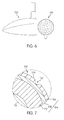
- FIG. 6 is a perspective view of a ball being struck by a club
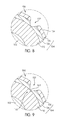
- FIG. 7 is an expanded view of a cross section of an embodiment of a golf ball showing wear
- FIG. 8 is an expanded view of a cross section of an embodiment of a golf ball showing wear
- FIG. 9 is an expanded view of a cross section of an embodiment of a golf ball showing wear and a discoloration of a layer
- FIG. 10 is a front view of an embodiment of a golf ball showing wear and a discoloration of a layer.
- the embodiments disclosed are golf balls having a series of layers forming an outer composite layer or cover.
- the outer cover of the golf ball When a ball is being used by a golfer, the outer cover of the golf ball will deteriorate or become damaged through ordinary play.
- a reacting layer When the ball becomes too deteriorated to provide the designed ball flight, a reacting layer will become exposed and will react to one or more atmospheric elements to alert a golfer that the ball has deteriorated and that a new ball should be selected.
- the series of layers that alerts the golfer to the deterioration can be considered a wear indicator.
- FIG. 1 is a cross-sectional view of an embodiment of a golf ball 100.
- the golf ball 100 has a series of radially or circumferentially arranged layers.
- the innermost layer is a core 102.
- the core 102 can be any of a variety of cores commonly used in golf balls.
- the core 102 could be liquid filled or solid filled.
- the solid may be rubber, resin, or any other suitable material.
- the core may also include various types of weights.
- the core 102 may also include a wound cover.
- the core 102 may also include a variety of layers.
- the term "core" includes the portions of the golf ball that do not include the cover or coat.
- an optional mantle layer may be included adjacent core 102 or between any two of the other layers where desirable.
- Cover or outer composite layer 104 surrounds core 102. Cover 104 is radially outward of core 102.
- FIG. 2 is an enlargement of the area within the dashed lines of FIG. 1.
- FIG. 2 shows the layers of cover 104 in greater detail.
- the layers of cover 104 in FIG. 2 include reacting layer 110, protecting layer 108, and top layer 106.
- Top layer 106 may surround and be radially outward from protecting layer 108.
- Protecting layer 108 may surround and be radially outward from reacting layer 110.
- Reacting layer 110 may surround and be positioned radially outward from core 102.
- top layer 106 is shown in simplified form.
- 106 top layer and in particular, outer surface 154 of top layer 106, is configured to be struck by a golf club.
- top layer 106 may include various dimples, frets or lands, projections, printing, or any other features that a designer thinks would be desirable in affecting the flight path of the ball 100.
- Top layer 106 may be designed to be scuff resistant.
- Reacting layer 110 may be placed adjacent core 102.
- Reacting layer 110 includes a reacting material.
- the reacting material is selected from various materials that react or are capable of reacting when exposed to a corresponding activator. In the present case, it may be desirable for the reacting material to react when it is exposed to an environmental source that is ambient in an environment in which a golfer would likely be golfing. On a standard golf course, there are many items commonly found that can be suitable environmental sources. For example, the reacting material could be sensitive to grass or tree pollen and could react when exposed to such pollens. Alternatively, the material could react when exposed to oxygen, nitrogen or other elements in the air.
- the reacting material may be desirable to select a reacting material that reacts to something to which it is only likely to be exposed when it is actively being used as a playing ball on a golf course. While exposure to air or pollen may occur even when a ball is in a golf bag in a garage, some exposures occur only when the ball is in a golf cart for possible play.
- the reacting material could react when exposed to radiation from the sun.
- the reacting material may react when exposed to a particular wavelength of radiation from the sun, such as when exposed to one or more wavelengths of ultraviolet light.
- the environmental source may also be considered to be a reaction initiator.
- the reacting material may be a material that remains in one configuration, status, or color, for example, until a reaction is initiated by exposure to an initiator.
- the initiator is desirably something atmospheric from the golf course atmosphere, such as air, light, grass, or other material that is likely to come into contact with the reacting material and that is capable of initiating a reaction from the reacting material.
- the reacting material may react in any of a variety of ways to alert a golfer that it has been exposed to the environmental source or initiator.
- the reacting material could change size. In such an instance, for example, the reacting material could become larger when exposed to the environmental source.
- the reacting material could be ionized so as to send an electrical current and alarm to a user indicating that the reacting material has been exposed to the source.
- the reacting material may change color when exposed to the environmental source.
- the reacting material reacts differently over time. For example, if the reacting material reacts by changing color, the reacting material may change from white to light purple upon initial exposure to the environmental source. Over the course of time, additional exposure could deepen the color of the exposed reacting material. If the reacting material reacts to UV light, the reaction could be considered to be similar to a tan that a person might have, the darker the tan tending to indicate how long the person was exposed to the sun.
- Reacting layer 110 may be made partially or entirely from the reacting material.
- the selection of a desirable reacting material and its concentration in the reacting layer may depend on a variety of factors. These factors may include the compressibility of the material, cost, color, ease of achieving a generally uniform mixture of the material within the layer, and any other considerations a designer may consider to be important or desirable.
- the proportion of reacting material to the entire material of the reacting layer may vary depending on the amount or concentration of reacting material necessary to be effective to react to the environmental source.
- Protecting layer 108 may be adjacent and radially outwardly from reacting layer 110.
- Protecting layer 108 may be adjacent and radially inward from top layer 106.
- Protecting layer 108 may include a shielding material that shields or is capable of shielding the reacting material from the environmental source. It may be desirable that the shielding material in protecting layer 108 and the reacting material in reacting layer 110 be selected together so that the shielding material is effective in shielding the reacting material.
- the shielding material could be zinc oxide or titanium oxide, either alone or in combination with another material.
- a reacting material in reacting layer 110 may be a material that is sensitive to light waves in the ultraviolet spectrum.
- the protective material in protecting layer in such an instance may be a material that filters or blocks ultraviolet light waves from penetrating the protecting material. In such an instance, the protecting layer prevents the reacting layer from prematurely being exposed to the initiator or environmental source.
- Protecting layer 108 may be made partially or entirely from the protecting material.
- the selection of a desirable protecting material and its concentration may depend on a variety of factors. These factors may include the compressibility of the material, cost, color, ease of achieving a generally uniform mixture of the material over the layer, and any other considerations a designer may consider to be important or desirable.
- the proportion of protecting material to the entire material of the protecting layer may vary depending on the amount or concentration of protecting material necessary to be effective to protect the reacting material from the environmental source.
- Protecting layer 108 may also be made in whole or in part from materials designed to improve ball flight.
- the configuration of the top layer may be replicated on the surface of protecting layer 108 to allow protecting layer 108 to improve ball flight.
- the protecting layer may be made in whole or in part from a material that has the necessary properties to resist scuffing or other damage caused by a golf club or other item striking the ball.
- FIG. 3 is a close up view of an alternative configuration of a ball 200 taken in the area of the dashed lines in FIG. 1 .
- Cover or outer composite layer 204 may surround core 202.
- Cover 204 may be radially outward of core 202.
- Protecting layer 212 may surround and be radially outward from reacting layer 210.
- Reacting layer 210 may surround and be radially outward from core 202.
- core 202 has the same properties and alternatives as were disclosed in relationship to core 102 discussed earlier.
- Reacting layer 210 has the same properties and alternatives as were disclosed in relationship to reacting layer 110 discussed earlier.
- a distinction between the embodiment of FIG. 2 and the embodiment of FIG. 3 is the use of a protecting layer 212 in FIG. 3 instead of a protecting layer 108 and a top layer 106 in FIG. 2 .
- protecting layer 212 may be designed to have the features of both protecting layer 108 and top layer 106.
- protecting layer 212 may include an effective amount of the protecting material discussed earlier in an amount effective to protect the reacting layer 210 from exposure to the initiator.
- Protecting layer 212 may also have the features of the top layer 106, such as having an outer surface configured with dimples, lands, and other features to allow the outer surface to be struck by a golf club and have a useful flight path.
- Protecting layer 212 may also be scuff resistant.
- FIG. 4 is a close up view of an alternative configuration of a ball 300 taken in the area of the dashed lines in FIG. 1 .
- Cover or outer composite layer 304 may surround core 302.
- Cover 304 may be radially outward of core 302.
- Top layer 306 may surround and be radially outward from secondary layer 314.
- Secondary layer 314 may surround and be radially outward from protecting layer 308.
- Protecting layer 308 may surround and be radially outward from reacting layer 310.
- Reacting layer 310 may surround and be positioned radially outward from core 302.
- core 302 has the same properties and alternatives as were disclosed in relationship to core 102 and core 202 discussed earlier.
- Reacting layer 310 has the same properties and alternatives as were disclosed in relationship to reacting layer 110 and reacting layer 210 discussed earlier.
- Protecting layer 308 has the same properties and alternatives as were disclosed in relationship to protecting layer 108 discussed earlier.
- Top layer 306 has the same properties and alternatives as were disclosed in relationship to top layer 106 discussed earlier.
- Secondary layer 314 may be included for a variety of reasons. The inclusion of the materials for the reacting layer and the protecting layer may change the overall compression of the ball or other performance factors. It may be desirable to include a secondary layer that restores such performance factors to a standard condition. In addition, it may be desirable to use more than one protecting layer in some instances. In such cases, a secondary layer can include the protecting or shielding material to provide an additional layer of protection. Alternatively, the secondary layer may include a colorant that changes the appearance of the ball. There may be other reasons or factors that may render it useful to include a layer that includes various properties. While FIG. 4 shows the secondary layer 314 positioned between the protecting layer 308 and the top layer 306, it could be positioned between other layers instead, depending on the purpose for including the secondary layer.
- FIG. 5 is a close up view of an alternative configuration of a ball 500 taken in the area of the dashed lines in FIG. 1 .
- Cover or outer composite layer 504 may surround core 502.
- Cover 504 may be radially outward of core 502.
- Top layer 506 may surround and be radially outward from active layer 516.
- core 502 has the same properties and alternatives as were disclosed in relationship to core 102, core 202, and core 302 discussed earlier.
- the properties of the reacting and protecting layers as described in the embodiments of FIGS. 1-4 are combined into active layer 516.
- Active layer 516 includes both a reacting material being capable of reacting when exposed to an environmental source and a shielding material that is capable of shielding the reacting material from the environmental source.
- the reacting material and shielding materials used in active layer 516 may be similar or identical to those disclosed in connection with the earlier disclosed embodiments.
- the proportion of reacting and shielding materials may be any desirable proportion.
- the thickness of active layer 516 may be about 10 microns.
- a dye infusion process may be used to apply active layer 516 to core 502 in this embodiment.
- a similar dye infusion process could be used in other embodiments to apply at least the reacting layer or material.
- the method used for such application may be a conventional dye infusion process or may be the dye infusion process disclosed in U.S. Patent Number , currently U.S. Patent Application Serial No. 12/691,171 , entitled “Systems and Methods for Applying Markings to an Article” filed on January 21, 2010, which application is incorporated herein by reference.
- FIGS. 6-10 show the usage of an exemplary ball. While any of the embodiments disclosed may be used, the ball 100 as shown in FIGS. 1 and 2 is chosen as an exemplary embodiment.
- FIG. 6 shows the position of a ball 100 relative to an exemplary golf club 150. When golf club 150 strikes golf ball 100, it causes a slight deterioration of the cover 104 of golf ball 100. The flight of the golf ball 100 and the impinging of the golf ball 100 over the golf course also cause deterioration of the cover 104. If the ball 100 lands on grass, the erosion may be less than if the ball 100 hits a tree, a trap, a cart path, a rock, gravel, or any other harder impediment on the course.
- the outer or top layer 106 will begin to wear deteriorate, as is shown by the slight indentation as shown at 152.
- the top layer 106 may have a thickness of 15 microns or less. Accordingly, the small scuff represented in the area 152 on the ball may be indistinguishable from the rest of the outer surface 154 of the ball, particularly if the ball has dimples or other discontinuities. An average golfer does not typically notice a small scuff of very minimal depth like that shown at 152, and such a small or shallow scuff will not affect the play or the flight path of the ball.
- FIG. 8 shows the effect of accumulated deterioration in a particular area over time. Because a golfer is typically unaware of damage occurring to the ball, the golfer will continue to play with ball 100. Over time, the scuffs on ball 100 become deeper through, among other things, a golf club repeatedly hitting a ball in the same area of the ball. Because of these accumulated impacts, top layer 106 will continue to erode until it has reached protection layer 108. Protection layer 108 will then begin to erode or deteriorate, as is shown in FIG. 8 , and the area of deterioration 152 will likely become wider and deeper.
- FIG. 9 shows the effect when the deterioration has reached the level of reacting layer 110.
- the golfer has continued to use ball 100, and a small area of erosion completely through top layer 106 and protecting layer 108 has resulted. This creates an exposed surface or area 160 in or on the reacting layer 110. This exposes the reacting material in reacting layer 110 to the atmosphere surrounding ball 100.
- the reacting material may react to an atmospheric or environmental condition common to golf courses. For example, it may react to ultraviolet rays from the sun. This reaction may cause the reacting material to change color as is shown as a discoloration 162 shown by stippling in reacting layer 110 in FIG. 9 .
- the discoloration 162 may alert the golfer that the deterioration of ball 100 has reached an extent where the flight path of the ball is affected by the deterioration and that therefore, the golfer should discard the ball and use a new ball instead.
- the reaction between the reacting material and the environmental condition may be progressive over time, rather than immediate.
- FIG. 9 shows the overall appearance of ball 100 after some deterioration has taken place.
- a golfer is likely only to see outer surface 154 of ball 100.
- the golfer is likely to be able to note a plurality of discolored areas 162, particularly if discolored areas 162 are concentrated in a particular area of the outer surface 154.
- the discoloration or other reaction of the reacting material alerts the golfer to the deterioration and the fact that the ball's designed flight path has been affected by the deterioration. If it is important to the golfer to have a particular flight path as the ball was originally designed, the golfer can then decide whether the deterioration is great enough to discard the ball and use a new one.
- the wear or deterioration indication provided does not require the changing of the ball. It merely provides information to the golfer that was previously unavailable. Because the outer layers of most golf balls are white, it is difficult for a golfer to determine whether a scuff or wear or a plurality of scuffs or worn areas on a ball are sufficiently great or detrimental to the surface of the ball to affect the flight path of the ball. The inclusion of a layer in the ball that discolors or otherwise changes in appearance to indicate a particular degree of wear may be helpful to a golfer in making this determination.
- the golfer can then choose to discontinue use of the ball and replace the ball, to use it in an area where the golfer frequently mishits the ball into, for example, a water hazard or an area of trees or high grass that makes it difficult to locate a ball, or to continue playing with it even with the deterioration.
- a golfer with a less consistent stroke profile may not experience an increased score or other negative consequence from the changed flight path of the ball and may wish to continue using it, even with a moderate degree of deterioration, while a golfer with a more consistent swing may choose to discontinue use of the ball and to replace the ball if there is only a slight degree of deterioration, because that golfer has a greater degree of certainty of the designed flight path of the ball.
- Each golfer can examine the ball with whatever frequency the golfer deems useful to determine whether to continue use of the ball or discontinue use of the ball and replace it with another ball.
- Each golfer can individually make the decision of when the flight path is too greatly affected to continue to use the ball.
- the drawings illustrate layers having a variety of thicknesses and other thicknesses have been mentioned in connection with one or more embodiments. These thicknesses should not be considered to be the only possible thicknesses for the layers.
- the desirable thicknesses for the various layers depends on the materials a designer wishes to use and the protection or reactivity the designer wishes to provide by the various layers. A person having ordinary skill in the art can modify the present embodiments to provide for a ball having layers of appropriate thicknesses.
Landscapes
- Health & Medical Sciences (AREA)
- General Health & Medical Sciences (AREA)
- Physical Education & Sports Medicine (AREA)
- Golf Clubs (AREA)
- Laminated Bodies (AREA)
Abstract
Description
- The present invention relates generally to a golf ball including a layer that changes in appearance when exposed to an atmospheric element. The change in appearance alerts a golfer that the performance characteristics of the ball have changed and that the ball should be replaced.
- The ball selected by a golfer has a great effect on the golfer's score in a round of golf. Golf balls are designed that have varying types of properties, such as a particular size, weight, and density, all of which affect the flight path of the ball.
- In addition to these properties, the outer surface of the ball also affects the flight path of the ball. Balls are designed with a variety of dimple sizes and shapes, in addition to being made with various materials that also affect the flight of a ball.
- Golf balls may be designed with a particular flight path in mind. If a ball becomes scuffed or otherwise damaged, the flight path of the ball may change. While golfers may be aware that such a change occurs, they may be unaware of what level of scuffing or damage causes a change in the flight path.
- Therefore, it may be useful to a golfer to have a ball that includes an indicator that alerts a golfer that a ball surface has deteriorated and that the flight path of the ball may be different from that which was originally intended.
- In one embodiment, an outer composite layer of a golf ball includes a wear indicator that reacts when exposed to an environmental reaction initiator. The outer composite layer includes a top layer, a reacting layer, and a protective layer. The reacting layer is capable of reacting to the initiator. The protective layer is between the top layer and the reacting layer. The protective layer is capable of protecting the reacting layer from exposure to the initiator.
- In another embodiment, a golf ball includes a wear indicator that includes a wear indicator that reacts when exposed to an environmental source. The golf ball includes a core and a cover. The cover includes a reacting layer that is radially outward of the core. The reacting layer comprises a reacting material that is capable of reacting when exposed to an environmental source. The cover also includes a protecting layer that is radially outward of the reacting layer. The protecting layer comprises a shielding material that is capable of shielding the reacting layer from the environmental source.
- A method of determining whether to use a golf ball is also disclosed. The method includes the steps of striking the golf ball with a golf club, examining the golf ball to determine whether the golf ball has reacted to an environmental source, and choosing to continue to use the golf ball. The method further comprises choosing to discontinue use of the ball and choosing to replace the ball.
- Other systems, methods, features and advantages of the invention will be, or will become, apparent to one of ordinary skill in the art upon examination of the following figures and detailed description. It is intended that all such additional systems, methods, features and advantages be included within this description and this summary, be within the scope of the invention, and be protected by the following claims.
- The invention can be better understood with reference to the following drawings and description. The components in the figures are not necessarily to scale, emphasis instead being placed upon illustrating the principles of the invention. Moreover, in the figures, like reference numerals designate corresponding parts throughout the different views.
-
FIG. 1 is a cross section of an embodiment of a golf ball; -
FIG. 2 is an expanded view of a cross section of an embodiment of a golf ball; -
FIG. 3 is an expanded view of a cross section of another embodiment of a golf ball; -
FIG. 4 is an expanded view of a cross section of another embodiment of a golf ball; -
FIG. 5 is an expanded view of a cross section of another embodiment of a golf ball; -
FIG. 6 is a perspective view of a ball being struck by a club; -
FIG. 7 is an expanded view of a cross section of an embodiment of a golf ball showing wear; -
FIG. 8 is an expanded view of a cross section of an embodiment of a golf ball showing wear; -
FIG. 9 is an expanded view of a cross section of an embodiment of a golf ball showing wear and a discoloration of a layer; -
FIG. 10 is a front view of an embodiment of a golf ball showing wear and a discoloration of a layer. - The embodiments disclosed are golf balls having a series of layers forming an outer composite layer or cover. When a ball is being used by a golfer, the outer cover of the golf ball will deteriorate or become damaged through ordinary play. When the ball becomes too deteriorated to provide the designed ball flight, a reacting layer will become exposed and will react to one or more atmospheric elements to alert a golfer that the ball has deteriorated and that a new ball should be selected. The series of layers that alerts the golfer to the deterioration can be considered a wear indicator.
-
FIG. 1 is a cross-sectional view of an embodiment of agolf ball 100. Thegolf ball 100 has a series of radially or circumferentially arranged layers. The innermost layer is acore 102. Thecore 102 can be any of a variety of cores commonly used in golf balls. For example, thecore 102 could be liquid filled or solid filled. The solid may be rubber, resin, or any other suitable material. The core may also include various types of weights. Thecore 102 may also include a wound cover. Thecore 102 may also include a variety of layers. In essence, in the context of the present disclosure, the term "core" includes the portions of the golf ball that do not include the cover or coat. A person having ordinary skill in the art can select a core that produces the technical and flight characteristics that are desirable. While not specifically shown in the FIGS., an optional mantle layer may be includedadjacent core 102 or between any two of the other layers where desirable. - Cover or
outer composite layer 104 surroundscore 102.Cover 104 is radially outward ofcore 102.FIG. 2 is an enlargement of the area within the dashed lines ofFIG. 1. FIG. 2 shows the layers ofcover 104 in greater detail. The layers ofcover 104 inFIG. 2 include reactinglayer 110, protectinglayer 108, andtop layer 106.Top layer 106 may surround and be radially outward from protectinglayer 108. Protectinglayer 108 may surround and be radially outward from reactinglayer 110. Reactinglayer 110 may surround and be positioned radially outward fromcore 102. - In the FIGS.,
top layer 106 is shown in simplified form. In a commercial version, 106 top layer, and in particular,outer surface 154 oftop layer 106, is configured to be struck by a golf club. Accordingly,top layer 106 may include various dimples, frets or lands, projections, printing, or any other features that a designer thinks would be desirable in affecting the flight path of theball 100.Top layer 106 may be designed to be scuff resistant. - Reacting
layer 110 may be placedadjacent core 102. Reactinglayer 110 includes a reacting material. The reacting material is selected from various materials that react or are capable of reacting when exposed to a corresponding activator. In the present case, it may be desirable for the reacting material to react when it is exposed to an environmental source that is ambient in an environment in which a golfer would likely be golfing. On a standard golf course, there are many items commonly found that can be suitable environmental sources. For example, the reacting material could be sensitive to grass or tree pollen and could react when exposed to such pollens. Alternatively, the material could react when exposed to oxygen, nitrogen or other elements in the air. However, it may be desirable to select a reacting material that reacts to something to which it is only likely to be exposed when it is actively being used as a playing ball on a golf course. While exposure to air or pollen may occur even when a ball is in a golf bag in a garage, some exposures occur only when the ball is in a golf cart for possible play. For example, the reacting material could react when exposed to radiation from the sun. In particular, the reacting material may react when exposed to a particular wavelength of radiation from the sun, such as when exposed to one or more wavelengths of ultraviolet light. - The environmental source may also be considered to be a reaction initiator. In many cases, the reacting material may be a material that remains in one configuration, status, or color, for example, until a reaction is initiated by exposure to an initiator. The initiator is desirably something atmospheric from the golf course atmosphere, such as air, light, grass, or other material that is likely to come into contact with the reacting material and that is capable of initiating a reaction from the reacting material.
- The reacting material may react in any of a variety of ways to alert a golfer that it has been exposed to the environmental source or initiator. For example, the reacting material could change size. In such an instance, for example, the reacting material could become larger when exposed to the environmental source. Alternatively, the reacting material could be ionized so as to send an electrical current and alarm to a user indicating that the reacting material has been exposed to the source. As another alternative, the reacting material may change color when exposed to the environmental source.
- It may also be useful if the reacting material reacts differently over time. For example, if the reacting material reacts by changing color, the reacting material may change from white to light purple upon initial exposure to the environmental source. Over the course of time, additional exposure could deepen the color of the exposed reacting material. If the reacting material reacts to UV light, the reaction could be considered to be similar to a tan that a person might have, the darker the tan tending to indicate how long the person was exposed to the sun.
- Reacting
layer 110 may be made partially or entirely from the reacting material. The selection of a desirable reacting material and its concentration in the reacting layer may depend on a variety of factors. These factors may include the compressibility of the material, cost, color, ease of achieving a generally uniform mixture of the material within the layer, and any other considerations a designer may consider to be important or desirable. The proportion of reacting material to the entire material of the reacting layer may vary depending on the amount or concentration of reacting material necessary to be effective to react to the environmental source. - Protecting
layer 108 may be adjacent and radially outwardly from reactinglayer 110. Protectinglayer 108 may be adjacent and radially inward fromtop layer 106. Protectinglayer 108 may include a shielding material that shields or is capable of shielding the reacting material from the environmental source. It may be desirable that the shielding material in protectinglayer 108 and the reacting material in reactinglayer 110 be selected together so that the shielding material is effective in shielding the reacting material. In some instances, the shielding material could be zinc oxide or titanium oxide, either alone or in combination with another material. - For example, a reacting material in reacting
layer 110 may be a material that is sensitive to light waves in the ultraviolet spectrum. The protective material in protecting layer in such an instance may be a material that filters or blocks ultraviolet light waves from penetrating the protecting material. In such an instance, the protecting layer prevents the reacting layer from prematurely being exposed to the initiator or environmental source. - Protecting
layer 108 may be made partially or entirely from the protecting material. The selection of a desirable protecting material and its concentration may depend on a variety of factors. These factors may include the compressibility of the material, cost, color, ease of achieving a generally uniform mixture of the material over the layer, and any other considerations a designer may consider to be important or desirable. The proportion of protecting material to the entire material of the protecting layer may vary depending on the amount or concentration of protecting material necessary to be effective to protect the reacting material from the environmental source. - Protecting
layer 108 may also be made in whole or in part from materials designed to improve ball flight. The configuration of the top layer may be replicated on the surface of protectinglayer 108 to allow protectinglayer 108 to improve ball flight. In addition, the protecting layer may be made in whole or in part from a material that has the necessary properties to resist scuffing or other damage caused by a golf club or other item striking the ball. - An alternative embodiment is shown in
FIG. 3. FIG. 3 is a close up view of an alternative configuration of aball 200 taken in the area of the dashed lines inFIG. 1 . Cover or outer composite layer 204 may surroundcore 202. Cover 204 may be radially outward ofcore 202. Protecting layer 212 may surround and be radially outward from reacting layer 210. Reacting layer 210 may surround and be radially outward fromcore 202. - In the embodiment of
FIG. 3 ,core 202 has the same properties and alternatives as were disclosed in relationship tocore 102 discussed earlier. Reacting layer 210 has the same properties and alternatives as were disclosed in relationship to reactinglayer 110 discussed earlier. A distinction between the embodiment ofFIG. 2 and the embodiment ofFIG. 3 is the use of a protecting layer 212 inFIG. 3 instead of aprotecting layer 108 and atop layer 106 inFIG. 2 . - In
FIG. 3 , protecting layer 212 may be designed to have the features of both protectinglayer 108 andtop layer 106. For example, protecting layer 212 may include an effective amount of the protecting material discussed earlier in an amount effective to protect the reacting layer 210 from exposure to the initiator. Protecting layer 212 may also have the features of thetop layer 106, such as having an outer surface configured with dimples, lands, and other features to allow the outer surface to be struck by a golf club and have a useful flight path. Protecting layer 212 may also be scuff resistant. - Turning now to
FIG. 4 , yet another embodiment is disclosed.FIG. 4 is a close up view of an alternative configuration of aball 300 taken in the area of the dashed lines inFIG. 1 . Cover or outercomposite layer 304 may surroundcore 302. Cover 304 may be radially outward ofcore 302.Top layer 306 may surround and be radially outward fromsecondary layer 314.Secondary layer 314 may surround and be radially outward from protectinglayer 308. Protectinglayer 308 may surround and be radially outward from reactinglayer 310. Reactinglayer 310 may surround and be positioned radially outward fromcore 302. - In the embodiment of
FIG. 4 ,core 302 has the same properties and alternatives as were disclosed in relationship tocore 102 andcore 202 discussed earlier. Reactinglayer 310 has the same properties and alternatives as were disclosed in relationship to reactinglayer 110 and reacting layer 210 discussed earlier. Protectinglayer 308 has the same properties and alternatives as were disclosed in relationship to protectinglayer 108 discussed earlier.Top layer 306 has the same properties and alternatives as were disclosed in relationship totop layer 106 discussed earlier. - A distinction between the embodiment of
FIG. 4 and the embodiment ofFIG. 2 is the inclusion of a secondary layer, such assecondary layer 314.Secondary layer 314 may be included for a variety of reasons. The inclusion of the materials for the reacting layer and the protecting layer may change the overall compression of the ball or other performance factors. It may be desirable to include a secondary layer that restores such performance factors to a standard condition. In addition, it may be desirable to use more than one protecting layer in some instances. In such cases, a secondary layer can include the protecting or shielding material to provide an additional layer of protection. Alternatively, the secondary layer may include a colorant that changes the appearance of the ball. There may be other reasons or factors that may render it useful to include a layer that includes various properties. WhileFIG. 4 shows thesecondary layer 314 positioned between the protectinglayer 308 and thetop layer 306, it could be positioned between other layers instead, depending on the purpose for including the secondary layer. - Turning now to
FIG. 5 , yet another embodiment is disclosed.FIG. 5 is a close up view of an alternative configuration of aball 500 taken in the area of the dashed lines inFIG. 1 . Cover or outercomposite layer 504 may surroundcore 502. Cover 504 may be radially outward ofcore 502.Top layer 506 may surround and be radially outward fromactive layer 516. - In the embodiment of
FIG. 5 ,core 502 has the same properties and alternatives as were disclosed in relationship tocore 102,core 202, andcore 302 discussed earlier. In the embodiment ofFIG. 5 , the properties of the reacting and protecting layers as described in the embodiments ofFIGS. 1-4 are combined intoactive layer 516.Active layer 516 includes both a reacting material being capable of reacting when exposed to an environmental source and a shielding material that is capable of shielding the reacting material from the environmental source. The reacting material and shielding materials used inactive layer 516 may be similar or identical to those disclosed in connection with the earlier disclosed embodiments. The proportion of reacting and shielding materials may be any desirable proportion. The thickness ofactive layer 516 may be about 10 microns. It may be useful to use a dye infusion process to applyactive layer 516 tocore 502 in this embodiment. A similar dye infusion process could be used in other embodiments to apply at least the reacting layer or material. The method used for such application may be a conventional dye infusion process or may be the dye infusion process disclosed in U.S. Patent Number , currentlyU.S. Patent Application Serial No. 12/691,171 -
FIGS. 6-10 show the usage of an exemplary ball. While any of the embodiments disclosed may be used, theball 100 as shown inFIGS. 1 and 2 is chosen as an exemplary embodiment.FIG. 6 shows the position of aball 100 relative to anexemplary golf club 150. Whengolf club 150 strikesgolf ball 100, it causes a slight deterioration of thecover 104 ofgolf ball 100. The flight of thegolf ball 100 and the impinging of thegolf ball 100 over the golf course also cause deterioration of thecover 104. If theball 100 lands on grass, the erosion may be less than if theball 100 hits a tree, a trap, a cart path, a rock, gravel, or any other harder impediment on the course. - In a closer view, as shown in
FIG. 7 , the outer ortop layer 106 will begin to wear deteriorate, as is shown by the slight indentation as shown at 152. In many golf balls, thetop layer 106 may have a thickness of 15 microns or less. Accordingly, the small scuff represented in thearea 152 on the ball may be indistinguishable from the rest of theouter surface 154 of the ball, particularly if the ball has dimples or other discontinuities. An average golfer does not typically notice a small scuff of very minimal depth like that shown at 152, and such a small or shallow scuff will not affect the play or the flight path of the ball. In fact, at least a microscopic amount of damage is done to the ball and thetop layer 106 each time theball 100 is struck by agolf club 150 or other item on the golf course, most of which does not negatively affect the flight path of the ball. Accordingly, the golfer will continue to use the ball, possibly unaware of the damage. -
FIG. 8 shows the effect of accumulated deterioration in a particular area over time. Because a golfer is typically unaware of damage occurring to the ball, the golfer will continue to play withball 100. Over time, the scuffs onball 100 become deeper through, among other things, a golf club repeatedly hitting a ball in the same area of the ball. Because of these accumulated impacts,top layer 106 will continue to erode until it has reachedprotection layer 108.Protection layer 108 will then begin to erode or deteriorate, as is shown inFIG. 8 , and the area ofdeterioration 152 will likely become wider and deeper. -
FIG. 9 shows the effect when the deterioration has reached the level of reactinglayer 110. InFIG. 9 , the golfer has continued to useball 100, and a small area of erosion completely throughtop layer 106 and protectinglayer 108 has resulted. This creates an exposed surface orarea 160 in or on the reactinglayer 110. This exposes the reacting material in reactinglayer 110 to theatmosphere surrounding ball 100. As discussed earlier, the reacting material may react to an atmospheric or environmental condition common to golf courses. For example, it may react to ultraviolet rays from the sun. This reaction may cause the reacting material to change color as is shown as adiscoloration 162 shown by stippling in reactinglayer 110 inFIG. 9 . Thediscoloration 162 may alert the golfer that the deterioration ofball 100 has reached an extent where the flight path of the ball is affected by the deterioration and that therefore, the golfer should discard the ball and use a new ball instead. As discussed in greater detail above, the reaction between the reacting material and the environmental condition may be progressive over time, rather than immediate. - Because of the relative thickness of the layers and the small amount of deterioration provided by any one impact between
ball 100 and other items, such asclub 150, a golfer is unlikely to notice any one particular area of deterioration alone. Initially, the area ofdiscoloration 162 might be only a few microns across, but area ofdiscoloration 162 enlarges over time.FIG. 9 shows the overall appearance ofball 100 after some deterioration has taken place. As shown inFIG. 10 , a golfer is likely only to seeouter surface 154 ofball 100. The golfer is likely to be able to note a plurality ofdiscolored areas 162, particularly ifdiscolored areas 162 are concentrated in a particular area of theouter surface 154. The discoloration or other reaction of the reacting material alerts the golfer to the deterioration and the fact that the ball's designed flight path has been affected by the deterioration. If it is important to the golfer to have a particular flight path as the ball was originally designed, the golfer can then decide whether the deterioration is great enough to discard the ball and use a new one. - The wear or deterioration indication provided does not require the changing of the ball. It merely provides information to the golfer that was previously unavailable. Because the outer layers of most golf balls are white, it is difficult for a golfer to determine whether a scuff or wear or a plurality of scuffs or worn areas on a ball are sufficiently great or detrimental to the surface of the ball to affect the flight path of the ball. The inclusion of a layer in the ball that discolors or otherwise changes in appearance to indicate a particular degree of wear may be helpful to a golfer in making this determination. If the flight path of the ball may be affected, the golfer can then choose to discontinue use of the ball and replace the ball, to use it in an area where the golfer frequently mishits the ball into, for example, a water hazard or an area of trees or high grass that makes it difficult to locate a ball, or to continue playing with it even with the deterioration. For example, a golfer with a less consistent stroke profile may not experience an increased score or other negative consequence from the changed flight path of the ball and may wish to continue using it, even with a moderate degree of deterioration, while a golfer with a more consistent swing may choose to discontinue use of the ball and to replace the ball if there is only a slight degree of deterioration, because that golfer has a greater degree of certainty of the designed flight path of the ball. Each golfer can examine the ball with whatever frequency the golfer deems useful to determine whether to continue use of the ball or discontinue use of the ball and replace it with another ball. Each golfer can individually make the decision of when the flight path is too greatly affected to continue to use the ball.
- The drawings illustrate layers having a variety of thicknesses and other thicknesses have been mentioned in connection with one or more embodiments. These thicknesses should not be considered to be the only possible thicknesses for the layers. The desirable thicknesses for the various layers depends on the materials a designer wishes to use and the protection or reactivity the designer wishes to provide by the various layers. A person having ordinary skill in the art can modify the present embodiments to provide for a ball having layers of appropriate thicknesses.
- The invention may further be realised according to the following embodiments:
- 1. An outer composite layer of a golf ball including a wear indicator that reacts when exposed to an environmental reaction initiator, comprising:
- a top layer;
- a reacting layer that is capable of reacting to the initiator; and
- a protective layer positioned between the top layer and the reacting layer that is capable of protecting the reacting layer from exposure to the initiator.
- 2. The outer composite layer according to
embodiment 1, wherein the initiator is oxygen. - 3. The outer composite layer according to
embodiment 1, wherein the initiator is light. - 4. The outer composite layer according to embodiment 3, wherein the initiator is certain wavelengths of light.
- 5. The outer composite layer according to
embodiment 1, wherein a reacting material in the reacting layer changes color in response to exposure to the initiator. - 6. The outer composite layer according to
embodiment 1, wherein the top layer is formed of a top material that minimizes scuffing. - 7. The outer composite layer according to
embodiment 1, wherein the protective layer is formed of a second material that minimizes scuffing. - 8. The outer composite layer according to
embodiment 1, wherein a protective material in the protective layer shields the reacting layer from ultraviolet rays. - 9. A golf ball that includes a wear indicator that reacts when exposed to an environmental source, comprising:
- a core; and
- a cover, the cover comprising:
- a reacting layer radially outward of the core, comprising a reacting material that is capable of reacting when exposed to the environmental source; and
- a protecting layer radially outward of the reacting layer, comprising a shielding material that is capable of shielding the reacting layer from the environmental source.
- 10. The golf ball according to embodiment 9, further comprising a top layer radially outwardly of the protecting layer.
- 11. The golf ball according to embodiment 9, wherein the environmental source is radiation from the sun.
- 12. The golf ball according to embodiment 9, wherein the environmental source is air.
- 13. The golf ball according to embodiment 9, wherein the reacting material changes color.
- 14. A method of determining whether to use a golf ball, comprising:
- striking the golf ball with a golf club;
- examining the golf ball to determine whether the golf ball has reacted to an environmental source; and
- choosing to continue to use the golf ball.
- 15. The method of determining whether to use a golf ball according to embodiment 14, further comprising choosing to discontinue use of the golf ball.
- 16. The method of determining whether to use a golf ball according to embodiment 14, further comprising replacing the golf ball.
- 17. A golf ball, comprising:
- a core; and
- an active layer positioned radially outwardly of the core, comprising a shielding material and a reacting material, the reacting material being capable of reacting when exposed to a environmental source and the shielding material that is capable of shielding the reacting material from the environmental source.
- 18. The golf ball according to embodiment 17, further comprising a top layer radially outwardly of the active layer.
- 19. The golf ball according to embodiment 17, wherein the environmental source is radiation from the sun.
- 20. The golf ball according to embodiment 17, wherein the reacting material changes color.
- While various embodiments of the invention have been described, the description is intended to be exemplary, rather than limiting and it will be apparent to those of ordinary skill in the art that many more embodiments and implementations are possible that are within the scope of the invention. Accordingly, the invention is not to be restricted except in light of the attached claims and their equivalents. Also, various modifications and changes may be made within the scope of the attached claims.
Claims (10)
- A ball, comprising:an outer composite layer including a wear indicator that reacts when exposed to an environmental reaction initiator, comprising:a reacting layer that is capable of reacting to the initiator; anda protective layer positioned radially outwardly of the reacting layer that is capable of protecting the reacting layer from exposure to the initiator.
- The ball according to claim 1, wherein the initiator is oxygen.
- The ball according to claim 1, wherein the initiator is light.
- The ball according to claim 3, wherein the initiator is certain wavelengths of light.
- The ball according to claim 1, wherein a reacting material in the reacting layer changes color in response to exposure to the initiator.
- The ball according to claim 1, further comprising a top layer positioned radially outwardly of the protective layer that is formed of a top material that minimizes scuffing.
- The ball according to claim 1, wherein the protective layer is formed of a second material that minimizes scuffing.
- The ball according to claim 1, wherein a protective material in the protective layer shields the reacting layer from ultraviolet rays.
- The ball according to claim 1, further comprising a core, the outer composite layer being positioned radially outwardly of the core.
- The ball according to claim 9, wherein the reacting layer is positioned radially outwardly of the core, the protective layer is positioned radially outwardly of the reacting layer, and a top layer is positioned radially outwardly of the reacting layer.
Applications Claiming Priority (1)
| Application Number | Priority Date | Filing Date | Title |
|---|---|---|---|
| US12/691,282 US8734272B2 (en) | 2010-01-21 | 2010-01-21 | Golf ball wear indicator |
Publications (2)
| Publication Number | Publication Date |
|---|---|
| EP2347801A1 true EP2347801A1 (en) | 2011-07-27 |
| EP2347801B1 EP2347801B1 (en) | 2013-01-16 |
Family
ID=43858299
Family Applications (1)
| Application Number | Title | Priority Date | Filing Date |
|---|---|---|---|
| EP11151422A Not-in-force EP2347801B1 (en) | 2010-01-21 | 2011-01-19 | Golf ball wear indicator |
Country Status (5)
| Country | Link |
|---|---|
| US (1) | US8734272B2 (en) |
| EP (1) | EP2347801B1 (en) |
| JP (1) | JP5608866B2 (en) |
| CN (2) | CN102151388B (en) |
| TW (1) | TWI441667B (en) |
Cited By (1)
| Publication number | Priority date | Publication date | Assignee | Title |
|---|---|---|---|---|
| US8734272B2 (en) | 2010-01-21 | 2014-05-27 | Nike, Inc. | Golf ball wear indicator |
Families Citing this family (7)
| Publication number | Priority date | Publication date | Assignee | Title |
|---|---|---|---|---|
| CN102499604A (en) * | 2011-11-01 | 2012-06-20 | 常熟新诚鑫织造有限公司 | Towel fabric provided with usage prompting device |
| US9101796B2 (en) | 2012-01-03 | 2015-08-11 | Nike, Inc. | Golf ball having an over-indexed thermoplastic polyurethane elastomer cover and having a soft feeling when hit |
| US8980155B2 (en) | 2012-01-03 | 2015-03-17 | Nike, Inc. | Over-indexed thermoplastic polyurethane elastomer, method of making, and articles comprising the elastomer |
| US8987405B2 (en) | 2012-01-03 | 2015-03-24 | Nike, Inc. | Golf ball having an over-indexed thermoplastic polyurethane elastomer cover and having a soft feeling when hit |
| US8906508B2 (en) | 2012-05-30 | 2014-12-09 | Nike, Inc. | Method of toughening thermoplastic polyurethane and articles comprising toughened thermoplastic polyurethane |
| WO2018085811A1 (en) | 2016-11-07 | 2018-05-11 | Cranin Jonathan | Performance gauge for fabric and cushioning material |
| US20250073540A1 (en) * | 2023-09-01 | 2025-03-06 | Arlene Silva | Ball for racket sports |
Citations (3)
| Publication number | Priority date | Publication date | Assignee | Title |
|---|---|---|---|---|
| WO2001081457A2 (en) * | 2000-04-26 | 2001-11-01 | Battelle Memorial Institute | Solvent-activated color-forming compositions |
| US20040034122A1 (en) * | 2002-08-16 | 2004-02-19 | Lacy William B. | Golf ball compositions comprising metallized lipid-based nanotubules |
| WO2004053004A1 (en) * | 2002-12-06 | 2004-06-24 | Polaroid Corporation | Water-immersion indicator indicia and articles bearing such indicia |
Family Cites Families (40)
| Publication number | Priority date | Publication date | Assignee | Title |
|---|---|---|---|---|
| US4235441A (en) * | 1979-09-14 | 1980-11-25 | Richard Ciccarello | Diffractionated golf ball |
| US4798386A (en) * | 1986-12-22 | 1989-01-17 | Acushnet Company | Golf ball with fluorescent cover |
| US4998734A (en) * | 1989-11-30 | 1991-03-12 | Universal Golf Supply, Inc. | Golf ball |
| JPH0816215B2 (en) * | 1990-06-18 | 1996-02-21 | 株式会社松井色素化学工業所 | Photochromic material |
| JPH04122372A (en) * | 1990-09-14 | 1992-04-22 | Uchida Giken:Kk | Luminous golf ball |
| JPH06509955A (en) * | 1991-08-23 | 1994-11-10 | ザ、ジレット、カンパニー | Sustained release matrix for oral application |
| US5322031A (en) | 1992-12-14 | 1994-06-21 | Safety 1St, Inc. | Color change nipple |
| US5427378A (en) * | 1994-01-10 | 1995-06-27 | Murphy; James A. | Golf ball and method of making same |
| EP0671659B1 (en) * | 1994-03-03 | 1998-05-27 | Mitsubishi Chemical Corporation | Photosensitive composition |
| CN1048185C (en) * | 1994-04-14 | 2000-01-12 | 莎蒂安工业有限公司 | Takraw balls |
| US5584767A (en) | 1995-06-07 | 1996-12-17 | Columbia Industries, Inc. | Bowling ball finger insert having a wear indicator |
| GB2316010B (en) | 1996-08-05 | 2000-05-10 | Neil William Russell | Golf practice device |
| US5713799A (en) * | 1996-09-19 | 1998-02-03 | Balmat; Paul L. | Golf ball |
| US5989135A (en) | 1997-04-28 | 1999-11-23 | Night & Day Golf, Inc. | Luminescent golf ball |
| US6358160B1 (en) * | 1997-10-03 | 2002-03-19 | Performance Dynamics Llc | Golf ball with water immersion indicator |
| US6277037B1 (en) * | 1997-10-03 | 2001-08-21 | Performance Dynamics Llc | Golf ball with water immersion indicator |
| US5823891A (en) * | 1997-10-03 | 1998-10-20 | Performance Dynamics, Llc | Golf ball with water immersion indicator |
| US6513370B1 (en) | 1998-04-17 | 2003-02-04 | Mark Helton | Wear indicator for sports balls |
| JP3015013B1 (en) * | 1998-11-17 | 2000-02-28 | 亀谷産業株式会社 | Marked golf ball and method of manufacturing the same |
| JP4126516B2 (en) * | 1999-03-11 | 2008-07-30 | ブリヂストンスポーツ株式会社 | Golf ball |
| US7169859B2 (en) * | 1999-05-18 | 2007-01-30 | General Electric Company | Weatherable, thermostable polymers having improved flow composition |
| US6780127B2 (en) * | 2001-12-06 | 2004-08-24 | Callaway Golf Company | Golf ball with temperature indicator |
| JP2003052881A (en) * | 2001-08-08 | 2003-02-25 | Takashi Takao | Golf ball that changes color |
| US6986719B2 (en) * | 2001-12-06 | 2006-01-17 | Callaway Golf Company | Golf ball with temperature indicator |
| US7056230B2 (en) * | 2001-12-18 | 2006-06-06 | Emalfarb Bradley S | Golf ball with changeable characteristics |
| US7244193B2 (en) * | 2001-12-18 | 2007-07-17 | Bradley Emalfarb | Method of playing golf |
| US20040176188A1 (en) * | 2003-03-07 | 2004-09-09 | Morgan William E. | Multi-layer golf ball with translucent cover |
| KR100572369B1 (en) * | 2003-06-27 | 2006-04-24 | 주식회사 팬텀 | Photoluminescent golf ball |
| KR100572373B1 (en) * | 2003-06-27 | 2006-04-24 | 주식회사 팬텀 | Thermochromic golf ball |
| KR20050001225A (en) * | 2003-06-27 | 2005-01-06 | 주식회사 팬텀 | The photochromism golfball |
| JP4304443B2 (en) * | 2003-08-07 | 2009-07-29 | ブリヂストンスポーツ株式会社 | Golf ball |
| JP2005224427A (en) | 2004-02-13 | 2005-08-25 | Mizuno Corp | Golf club head and golf club |
| JP3104373U (en) * | 2004-04-01 | 2004-09-16 | 株式会社アンバリッド | Golf ball |
| US7967702B2 (en) * | 2004-04-09 | 2011-06-28 | Performance Indicator, Llc | Golf ball with water immersion indicator |
| US7291076B2 (en) * | 2005-07-14 | 2007-11-06 | Bridgestone Sports Co., Ltd | Golf ball |
| US7367902B2 (en) * | 2005-11-17 | 2008-05-06 | Bridgestone Sports Co., Ltd. | Golf ball |
| US20070119363A1 (en) | 2005-11-30 | 2007-05-31 | Neto Leven V | Hose apparatus wear indicator |
| US7772315B2 (en) * | 2007-07-18 | 2010-08-10 | Taylor Made Golf Company, Inc. | Triboluminescent materials and golf balls made from such materials |
| US8272977B2 (en) * | 2010-01-15 | 2012-09-25 | Nike, Inc. | Golf spin detector |
| US8734272B2 (en) | 2010-01-21 | 2014-05-27 | Nike, Inc. | Golf ball wear indicator |
-
2010
- 2010-01-21 US US12/691,282 patent/US8734272B2/en not_active Expired - Fee Related
-
2011
- 2011-01-10 TW TW100100796A patent/TWI441667B/en not_active IP Right Cessation
- 2011-01-19 JP JP2011008429A patent/JP5608866B2/en not_active Expired - Fee Related
- 2011-01-19 EP EP11151422A patent/EP2347801B1/en not_active Not-in-force
- 2011-01-20 CN CN201110025954.4A patent/CN102151388B/en not_active Expired - Fee Related
- 2011-01-20 CN CN2011200220569U patent/CN202289347U/en not_active Expired - Fee Related
Patent Citations (3)
| Publication number | Priority date | Publication date | Assignee | Title |
|---|---|---|---|---|
| WO2001081457A2 (en) * | 2000-04-26 | 2001-11-01 | Battelle Memorial Institute | Solvent-activated color-forming compositions |
| US20040034122A1 (en) * | 2002-08-16 | 2004-02-19 | Lacy William B. | Golf ball compositions comprising metallized lipid-based nanotubules |
| WO2004053004A1 (en) * | 2002-12-06 | 2004-06-24 | Polaroid Corporation | Water-immersion indicator indicia and articles bearing such indicia |
Cited By (1)
| Publication number | Priority date | Publication date | Assignee | Title |
|---|---|---|---|---|
| US8734272B2 (en) | 2010-01-21 | 2014-05-27 | Nike, Inc. | Golf ball wear indicator |
Also Published As
| Publication number | Publication date |
|---|---|
| JP2011147777A (en) | 2011-08-04 |
| TW201125616A (en) | 2011-08-01 |
| US20110177883A1 (en) | 2011-07-21 |
| US8734272B2 (en) | 2014-05-27 |
| CN102151388A (en) | 2011-08-17 |
| JP5608866B2 (en) | 2014-10-15 |
| CN102151388B (en) | 2015-06-03 |
| TWI441667B (en) | 2014-06-21 |
| CN202289347U (en) | 2012-07-04 |
| EP2347801B1 (en) | 2013-01-16 |
Similar Documents
| Publication | Publication Date | Title |
|---|---|---|
| EP2347801B1 (en) | Golf ball wear indicator | |
| CA2730693C (en) | Multilayer solid golf ball | |
| AU2011101058B4 (en) | Golf ball having layers with specified moduli and hardnesses | |
| US20120202620A1 (en) | Golf Ball Having Dual Core Deflection Differential | |
| EP2347800A1 (en) | Golf ball with reduced flight path length | |
| US11441878B2 (en) | Reactive firearm training target providing visible feedback | |
| US12515108B2 (en) | Pickleball ball | |
| CN202155000U (en) | Golf ball and outer composite layer of the golf ball | |
| JP2018118032A (en) | Golf ball | |
| US12083390B2 (en) | Method and system for utilizing radio-opaque fillers in multiple layers of golf balls | |
| US8480516B2 (en) | Methods for encouraging use of greenhouse gas reducing golf balls | |
| US20040266553A1 (en) | Photochromic golf ball | |
| US20130217516A1 (en) | Golf ball | |
| US8475297B2 (en) | Golf ball with carbon dioxide absorbents | |
| US20230310945A1 (en) | Method And System For Utilizing Radio-Opaque Fillers In Multiple Layers Of Golf Balls | |
| US11717726B1 (en) | Golf ball cover with silane coupling agent | |
| US7244193B2 (en) | Method of playing golf | |
| US20220305346A1 (en) | Method And System For Utilizing Radio-Opaque Fillers In Multiple Layers Of Golf Balls | |
| JP2002529162A (en) | Golf ball | |
| US7056230B2 (en) | Golf ball with changeable characteristics | |
| US20250073540A1 (en) | Ball for racket sports | |
| JP2012030074A (en) | Kit and method for customization and recycling of golf ball | |
| JP2009069084A (en) | Cylinder cover for pedestrian protection impact testing machines | |
| CA2457703C (en) | Golf ball with changeable characteristics | |
| JP3206971U (en) | Soft tennis ball |
Legal Events
| Date | Code | Title | Description |
|---|---|---|---|
| PUAI | Public reference made under article 153(3) epc to a published international application that has entered the european phase |
Free format text: ORIGINAL CODE: 0009012 |
|
| 17P | Request for examination filed |
Effective date: 20110119 |
|
| AK | Designated contracting states |
Kind code of ref document: A1 Designated state(s): AL AT BE BG CH CY CZ DE DK EE ES FI FR GB GR HR HU IE IS IT LI LT LU LV MC MK MT NL NO PL PT RO RS SE SI SK SM TR |
|
| AX | Request for extension of the european patent |
Extension state: BA ME |
|
| GRAP | Despatch of communication of intention to grant a patent |
Free format text: ORIGINAL CODE: EPIDOSNIGR1 |
|
| RIC1 | Information provided on ipc code assigned before grant |
Ipc: A63B 37/00 20060101AFI20120611BHEP Ipc: A63B 43/00 20060101ALI20120611BHEP Ipc: A63B 37/14 20060101ALI20120611BHEP |
|
| GRAS | Grant fee paid |
Free format text: ORIGINAL CODE: EPIDOSNIGR3 |
|
| GRAA | (expected) grant |
Free format text: ORIGINAL CODE: 0009210 |
|
| AK | Designated contracting states |
Kind code of ref document: B1 Designated state(s): AL AT BE BG CH CY CZ DE DK EE ES FI FR GB GR HR HU IE IS IT LI LT LU LV MC MK MT NL NO PL PT RO RS SE SI SK SM TR |
|
| REG | Reference to a national code |
Ref country code: GB Ref legal event code: FG4D |
|
| REG | Reference to a national code |
Ref country code: CH Ref legal event code: EP |
|
| REG | Reference to a national code |
Ref country code: IE Ref legal event code: FG4D |
|
| REG | Reference to a national code |
Ref country code: CH Ref legal event code: EP Ref country code: AT Ref legal event code: REF Ref document number: 593542 Country of ref document: AT Kind code of ref document: T Effective date: 20130215 |
|
| REG | Reference to a national code |
Ref country code: DE Ref legal event code: R096 Ref document number: 602011000740 Country of ref document: DE Effective date: 20130314 |
|
| REG | Reference to a national code |
Ref country code: SE Ref legal event code: TRGR |
|
| REG | Reference to a national code |
Ref country code: AT Ref legal event code: MK05 Ref document number: 593542 Country of ref document: AT Kind code of ref document: T Effective date: 20130116 |
|
| REG | Reference to a national code |
Ref country code: NL Ref legal event code: VDEP Effective date: 20130116 |
|
| REG | Reference to a national code |
Ref country code: LT Ref legal event code: MG4D |
|
| PG25 | Lapsed in a contracting state [announced via postgrant information from national office to epo] |
Ref country code: AT Free format text: LAPSE BECAUSE OF FAILURE TO SUBMIT A TRANSLATION OF THE DESCRIPTION OR TO PAY THE FEE WITHIN THE PRESCRIBED TIME-LIMIT Effective date: 20130116 Ref country code: LT Free format text: LAPSE BECAUSE OF FAILURE TO SUBMIT A TRANSLATION OF THE DESCRIPTION OR TO PAY THE FEE WITHIN THE PRESCRIBED TIME-LIMIT Effective date: 20130116 Ref country code: IS Free format text: LAPSE BECAUSE OF FAILURE TO SUBMIT A TRANSLATION OF THE DESCRIPTION OR TO PAY THE FEE WITHIN THE PRESCRIBED TIME-LIMIT Effective date: 20130516 Ref country code: BG Free format text: LAPSE BECAUSE OF FAILURE TO SUBMIT A TRANSLATION OF THE DESCRIPTION OR TO PAY THE FEE WITHIN THE PRESCRIBED TIME-LIMIT Effective date: 20130416 Ref country code: ES Free format text: LAPSE BECAUSE OF FAILURE TO SUBMIT A TRANSLATION OF THE DESCRIPTION OR TO PAY THE FEE WITHIN THE PRESCRIBED TIME-LIMIT Effective date: 20130427 Ref country code: BE Free format text: LAPSE BECAUSE OF FAILURE TO SUBMIT A TRANSLATION OF THE DESCRIPTION OR TO PAY THE FEE WITHIN THE PRESCRIBED TIME-LIMIT Effective date: 20130116 Ref country code: NO Free format text: LAPSE BECAUSE OF FAILURE TO SUBMIT A TRANSLATION OF THE DESCRIPTION OR TO PAY THE FEE WITHIN THE PRESCRIBED TIME-LIMIT Effective date: 20130416 |
|
| PG25 | Lapsed in a contracting state [announced via postgrant information from national office to epo] |
Ref country code: FI Free format text: LAPSE BECAUSE OF FAILURE TO SUBMIT A TRANSLATION OF THE DESCRIPTION OR TO PAY THE FEE WITHIN THE PRESCRIBED TIME-LIMIT Effective date: 20130116 Ref country code: LV Free format text: LAPSE BECAUSE OF FAILURE TO SUBMIT A TRANSLATION OF THE DESCRIPTION OR TO PAY THE FEE WITHIN THE PRESCRIBED TIME-LIMIT Effective date: 20130116 Ref country code: PT Free format text: LAPSE BECAUSE OF FAILURE TO SUBMIT A TRANSLATION OF THE DESCRIPTION OR TO PAY THE FEE WITHIN THE PRESCRIBED TIME-LIMIT Effective date: 20130516 Ref country code: SI Free format text: LAPSE BECAUSE OF FAILURE TO SUBMIT A TRANSLATION OF THE DESCRIPTION OR TO PAY THE FEE WITHIN THE PRESCRIBED TIME-LIMIT Effective date: 20130116 Ref country code: NL Free format text: LAPSE BECAUSE OF FAILURE TO SUBMIT A TRANSLATION OF THE DESCRIPTION OR TO PAY THE FEE WITHIN THE PRESCRIBED TIME-LIMIT Effective date: 20130116 Ref country code: MC Free format text: LAPSE BECAUSE OF NON-PAYMENT OF DUE FEES Effective date: 20130131 Ref country code: PL Free format text: LAPSE BECAUSE OF FAILURE TO SUBMIT A TRANSLATION OF THE DESCRIPTION OR TO PAY THE FEE WITHIN THE PRESCRIBED TIME-LIMIT Effective date: 20130116 Ref country code: GR Free format text: LAPSE BECAUSE OF FAILURE TO SUBMIT A TRANSLATION OF THE DESCRIPTION OR TO PAY THE FEE WITHIN THE PRESCRIBED TIME-LIMIT Effective date: 20130417 |
|
| PG25 | Lapsed in a contracting state [announced via postgrant information from national office to epo] |
Ref country code: HR Free format text: LAPSE BECAUSE OF FAILURE TO SUBMIT A TRANSLATION OF THE DESCRIPTION OR TO PAY THE FEE WITHIN THE PRESCRIBED TIME-LIMIT Effective date: 20130116 Ref country code: RS Free format text: LAPSE BECAUSE OF FAILURE TO SUBMIT A TRANSLATION OF THE DESCRIPTION OR TO PAY THE FEE WITHIN THE PRESCRIBED TIME-LIMIT Effective date: 20130116 |
|
| REG | Reference to a national code |
Ref country code: IE Ref legal event code: MM4A |
|
| PG25 | Lapsed in a contracting state [announced via postgrant information from national office to epo] |
Ref country code: RO Free format text: LAPSE BECAUSE OF FAILURE TO SUBMIT A TRANSLATION OF THE DESCRIPTION OR TO PAY THE FEE WITHIN THE PRESCRIBED TIME-LIMIT Effective date: 20130116 Ref country code: SK Free format text: LAPSE BECAUSE OF FAILURE TO SUBMIT A TRANSLATION OF THE DESCRIPTION OR TO PAY THE FEE WITHIN THE PRESCRIBED TIME-LIMIT Effective date: 20130116 Ref country code: EE Free format text: LAPSE BECAUSE OF FAILURE TO SUBMIT A TRANSLATION OF THE DESCRIPTION OR TO PAY THE FEE WITHIN THE PRESCRIBED TIME-LIMIT Effective date: 20130116 Ref country code: CZ Free format text: LAPSE BECAUSE OF FAILURE TO SUBMIT A TRANSLATION OF THE DESCRIPTION OR TO PAY THE FEE WITHIN THE PRESCRIBED TIME-LIMIT Effective date: 20130116 Ref country code: DK Free format text: LAPSE BECAUSE OF FAILURE TO SUBMIT A TRANSLATION OF THE DESCRIPTION OR TO PAY THE FEE WITHIN THE PRESCRIBED TIME-LIMIT Effective date: 20130116 |
|
| PLBE | No opposition filed within time limit |
Free format text: ORIGINAL CODE: 0009261 |
|
| STAA | Information on the status of an ep patent application or granted ep patent |
Free format text: STATUS: NO OPPOSITION FILED WITHIN TIME LIMIT |
|
| PG25 | Lapsed in a contracting state [announced via postgrant information from national office to epo] |
Ref country code: CY Free format text: LAPSE BECAUSE OF FAILURE TO SUBMIT A TRANSLATION OF THE DESCRIPTION OR TO PAY THE FEE WITHIN THE PRESCRIBED TIME-LIMIT Effective date: 20130116 |
|
| 26N | No opposition filed |
Effective date: 20131017 |
|
| PG25 | Lapsed in a contracting state [announced via postgrant information from national office to epo] |
Ref country code: IT Free format text: LAPSE BECAUSE OF FAILURE TO SUBMIT A TRANSLATION OF THE DESCRIPTION OR TO PAY THE FEE WITHIN THE PRESCRIBED TIME-LIMIT Effective date: 20130116 |
|
| PG25 | Lapsed in a contracting state [announced via postgrant information from national office to epo] |
Ref country code: AL Free format text: LAPSE BECAUSE OF FAILURE TO SUBMIT A TRANSLATION OF THE DESCRIPTION OR TO PAY THE FEE WITHIN THE PRESCRIBED TIME-LIMIT Effective date: 20130116 Ref country code: IE Free format text: LAPSE BECAUSE OF NON-PAYMENT OF DUE FEES Effective date: 20130119 |
|
| REG | Reference to a national code |
Ref country code: DE Ref legal event code: R097 Ref document number: 602011000740 Country of ref document: DE Effective date: 20131017 |
|
| REG | Reference to a national code |
Ref country code: GB Ref legal event code: 732E Free format text: REGISTERED BETWEEN 20140626 AND 20140702 |
|
| PG25 | Lapsed in a contracting state [announced via postgrant information from national office to epo] |
Ref country code: MT Free format text: LAPSE BECAUSE OF FAILURE TO SUBMIT A TRANSLATION OF THE DESCRIPTION OR TO PAY THE FEE WITHIN THE PRESCRIBED TIME-LIMIT Effective date: 20130116 |
|
| REG | Reference to a national code |
Ref country code: CH Ref legal event code: PL |
|
| PG25 | Lapsed in a contracting state [announced via postgrant information from national office to epo] |
Ref country code: LI Free format text: LAPSE BECAUSE OF NON-PAYMENT OF DUE FEES Effective date: 20140131 Ref country code: CH Free format text: LAPSE BECAUSE OF NON-PAYMENT OF DUE FEES Effective date: 20140131 |
|
| REG | Reference to a national code |
Ref country code: DE Ref legal event code: R082 Ref document number: 602011000740 Country of ref document: DE Representative=s name: GRUENECKER PATENT- UND RECHTSANWAELTE PARTG MB, DE |
|
| REG | Reference to a national code |
Ref country code: DE Ref legal event code: R082 Ref document number: 602011000740 Country of ref document: DE Representative=s name: GRUENECKER PATENT- UND RECHTSANWAELTE PARTG MB, DE Effective date: 20150401 Ref country code: DE Ref legal event code: R081 Ref document number: 602011000740 Country of ref document: DE Owner name: NIKE INNOVATE C.V. (KOMMANDITGESELLSCHAFT NIED, US Free format text: FORMER OWNER: NIKE INTERNATIONAL LTD., BEAVERTON, OREG., US Effective date: 20150401 |
|
| REG | Reference to a national code |
Ref country code: FR Ref legal event code: TP Owner name: NIKE INNOVATE C.V., US Effective date: 20150420 |
|
| PG25 | Lapsed in a contracting state [announced via postgrant information from national office to epo] |
Ref country code: SM Free format text: LAPSE BECAUSE OF FAILURE TO SUBMIT A TRANSLATION OF THE DESCRIPTION OR TO PAY THE FEE WITHIN THE PRESCRIBED TIME-LIMIT Effective date: 20130116 |
|
| PG25 | Lapsed in a contracting state [announced via postgrant information from national office to epo] |
Ref country code: TR Free format text: LAPSE BECAUSE OF FAILURE TO SUBMIT A TRANSLATION OF THE DESCRIPTION OR TO PAY THE FEE WITHIN THE PRESCRIBED TIME-LIMIT Effective date: 20130116 |
|
| PG25 | Lapsed in a contracting state [announced via postgrant information from national office to epo] |
Ref country code: HU Free format text: LAPSE BECAUSE OF FAILURE TO SUBMIT A TRANSLATION OF THE DESCRIPTION OR TO PAY THE FEE WITHIN THE PRESCRIBED TIME-LIMIT; INVALID AB INITIO Effective date: 20110119 Ref country code: MK Free format text: LAPSE BECAUSE OF FAILURE TO SUBMIT A TRANSLATION OF THE DESCRIPTION OR TO PAY THE FEE WITHIN THE PRESCRIBED TIME-LIMIT Effective date: 20130116 Ref country code: LU Free format text: LAPSE BECAUSE OF NON-PAYMENT OF DUE FEES Effective date: 20130119 |
|
| REG | Reference to a national code |
Ref country code: FR Ref legal event code: PLFP Year of fee payment: 6 |
|
| REG | Reference to a national code |
Ref country code: FR Ref legal event code: PLFP Year of fee payment: 7 |
|
| PGFP | Annual fee paid to national office [announced via postgrant information from national office to epo] |
Ref country code: FR Payment date: 20161215 Year of fee payment: 7 |
|
| PGFP | Annual fee paid to national office [announced via postgrant information from national office to epo] |
Ref country code: SE Payment date: 20170111 Year of fee payment: 7 Ref country code: DE Payment date: 20170110 Year of fee payment: 7 |
|
| PGFP | Annual fee paid to national office [announced via postgrant information from national office to epo] |
Ref country code: GB Payment date: 20170118 Year of fee payment: 7 |
|
| REG | Reference to a national code |
Ref country code: DE Ref legal event code: R119 Ref document number: 602011000740 Country of ref document: DE |
|
| REG | Reference to a national code |
Ref country code: SE Ref legal event code: EUG |
|
| GBPC | Gb: european patent ceased through non-payment of renewal fee |
Effective date: 20180119 |
|
| PG25 | Lapsed in a contracting state [announced via postgrant information from national office to epo] |
Ref country code: DE Free format text: LAPSE BECAUSE OF NON-PAYMENT OF DUE FEES Effective date: 20180801 Ref country code: SE Free format text: LAPSE BECAUSE OF NON-PAYMENT OF DUE FEES Effective date: 20180120 Ref country code: FR Free format text: LAPSE BECAUSE OF NON-PAYMENT OF DUE FEES Effective date: 20180131 |
|
| REG | Reference to a national code |
Ref country code: FR Ref legal event code: ST Effective date: 20180928 |
|
| PG25 | Lapsed in a contracting state [announced via postgrant information from national office to epo] |
Ref country code: GB Free format text: LAPSE BECAUSE OF NON-PAYMENT OF DUE FEES Effective date: 20180119 |