EP2347732A1 - Knee prosthesis system - Google Patents
Knee prosthesis system Download PDFInfo
- Publication number
- EP2347732A1 EP2347732A1 EP11150578A EP11150578A EP2347732A1 EP 2347732 A1 EP2347732 A1 EP 2347732A1 EP 11150578 A EP11150578 A EP 11150578A EP 11150578 A EP11150578 A EP 11150578A EP 2347732 A1 EP2347732 A1 EP 2347732A1
- Authority
- EP
- European Patent Office
- Prior art keywords
- mobile
- sized
- fixed
- distinctly
- components
- Prior art date
- Legal status (The legal status is an assumption and is not a legal conclusion. Google has not performed a legal analysis and makes no representation as to the accuracy of the status listed.)
- Withdrawn
Links
- 210000003127 knee Anatomy 0.000 title claims abstract description 81
- 210000000988 bone and bone Anatomy 0.000 claims abstract description 21
- 238000013150 knee replacement Methods 0.000 claims abstract description 8
- 238000002513 implantation Methods 0.000 claims description 18
- 210000002303 tibia Anatomy 0.000 description 23
- 210000000689 upper leg Anatomy 0.000 description 21
- 210000003484 anatomy Anatomy 0.000 description 6
- 239000007943 implant Substances 0.000 description 5
- 210000004417 patella Anatomy 0.000 description 5
- 238000002360 preparation method Methods 0.000 description 4
- 238000001356 surgical procedure Methods 0.000 description 4
- 230000000694 effects Effects 0.000 description 3
- 230000003993 interaction Effects 0.000 description 3
- 238000000034 method Methods 0.000 description 3
- 238000005520 cutting process Methods 0.000 description 2
- 210000001519 tissue Anatomy 0.000 description 2
- 208000037408 Device failure Diseases 0.000 description 1
- 208000005137 Joint instability Diseases 0.000 description 1
- 206010070874 Joint laxity Diseases 0.000 description 1
- 239000004698 Polyethylene Substances 0.000 description 1
- 208000037099 Prosthesis Failure Diseases 0.000 description 1
- 244000273618 Sphenoclea zeylanica Species 0.000 description 1
- 239000004699 Ultra-high molecular weight polyethylene Substances 0.000 description 1
- 238000005266 casting Methods 0.000 description 1
- 230000003247 decreasing effect Effects 0.000 description 1
- 230000002401 inhibitory effect Effects 0.000 description 1
- 210000003041 ligament Anatomy 0.000 description 1
- 230000033001 locomotion Effects 0.000 description 1
- 238000004519 manufacturing process Methods 0.000 description 1
- 239000000463 material Substances 0.000 description 1
- -1 polyethylene Polymers 0.000 description 1
- 229920000573 polyethylene Polymers 0.000 description 1
- 210000002967 posterior cruciate ligament Anatomy 0.000 description 1
- 210000004872 soft tissue Anatomy 0.000 description 1
- 229920000785 ultra high molecular weight polyethylene Polymers 0.000 description 1
Images







Classifications
-
- A—HUMAN NECESSITIES
- A61—MEDICAL OR VETERINARY SCIENCE; HYGIENE
- A61F—FILTERS IMPLANTABLE INTO BLOOD VESSELS; PROSTHESES; DEVICES PROVIDING PATENCY TO, OR PREVENTING COLLAPSING OF, TUBULAR STRUCTURES OF THE BODY, e.g. STENTS; ORTHOPAEDIC, NURSING OR CONTRACEPTIVE DEVICES; FOMENTATION; TREATMENT OR PROTECTION OF EYES OR EARS; BANDAGES, DRESSINGS OR ABSORBENT PADS; FIRST-AID KITS
- A61F2/00—Filters implantable into blood vessels; Prostheses, i.e. artificial substitutes or replacements for parts of the body; Appliances for connecting them with the body; Devices providing patency to, or preventing collapsing of, tubular structures of the body, e.g. stents
- A61F2/02—Prostheses implantable into the body
- A61F2/30—Joints
- A61F2/38—Joints for elbows or knees
- A61F2/389—Tibial components
-
- A—HUMAN NECESSITIES
- A61—MEDICAL OR VETERINARY SCIENCE; HYGIENE
- A61F—FILTERS IMPLANTABLE INTO BLOOD VESSELS; PROSTHESES; DEVICES PROVIDING PATENCY TO, OR PREVENTING COLLAPSING OF, TUBULAR STRUCTURES OF THE BODY, e.g. STENTS; ORTHOPAEDIC, NURSING OR CONTRACEPTIVE DEVICES; FOMENTATION; TREATMENT OR PROTECTION OF EYES OR EARS; BANDAGES, DRESSINGS OR ABSORBENT PADS; FIRST-AID KITS
- A61F2/00—Filters implantable into blood vessels; Prostheses, i.e. artificial substitutes or replacements for parts of the body; Appliances for connecting them with the body; Devices providing patency to, or preventing collapsing of, tubular structures of the body, e.g. stents
- A61F2/02—Prostheses implantable into the body
- A61F2/30—Joints
- A61F2/38—Joints for elbows or knees
- A61F2/3868—Joints for elbows or knees with sliding tibial bearing
-
- A—HUMAN NECESSITIES
- A61—MEDICAL OR VETERINARY SCIENCE; HYGIENE
- A61F—FILTERS IMPLANTABLE INTO BLOOD VESSELS; PROSTHESES; DEVICES PROVIDING PATENCY TO, OR PREVENTING COLLAPSING OF, TUBULAR STRUCTURES OF THE BODY, e.g. STENTS; ORTHOPAEDIC, NURSING OR CONTRACEPTIVE DEVICES; FOMENTATION; TREATMENT OR PROTECTION OF EYES OR EARS; BANDAGES, DRESSINGS OR ABSORBENT PADS; FIRST-AID KITS
- A61F2/00—Filters implantable into blood vessels; Prostheses, i.e. artificial substitutes or replacements for parts of the body; Appliances for connecting them with the body; Devices providing patency to, or preventing collapsing of, tubular structures of the body, e.g. stents
- A61F2/02—Prostheses implantable into the body
- A61F2/30—Joints
- A61F2002/30001—Additional features of subject-matter classified in A61F2/28, A61F2/30 and subgroups thereof
- A61F2002/30108—Shapes
- A61F2002/30199—Three-dimensional shapes
- A61F2002/30205—Three-dimensional shapes conical
- A61F2002/30217—Three-dimensional shapes conical hollow cones, e.g. tubular-like cones
-
- A—HUMAN NECESSITIES
- A61—MEDICAL OR VETERINARY SCIENCE; HYGIENE
- A61F—FILTERS IMPLANTABLE INTO BLOOD VESSELS; PROSTHESES; DEVICES PROVIDING PATENCY TO, OR PREVENTING COLLAPSING OF, TUBULAR STRUCTURES OF THE BODY, e.g. STENTS; ORTHOPAEDIC, NURSING OR CONTRACEPTIVE DEVICES; FOMENTATION; TREATMENT OR PROTECTION OF EYES OR EARS; BANDAGES, DRESSINGS OR ABSORBENT PADS; FIRST-AID KITS
- A61F2/00—Filters implantable into blood vessels; Prostheses, i.e. artificial substitutes or replacements for parts of the body; Appliances for connecting them with the body; Devices providing patency to, or preventing collapsing of, tubular structures of the body, e.g. stents
- A61F2/02—Prostheses implantable into the body
- A61F2/30—Joints
- A61F2002/30001—Additional features of subject-matter classified in A61F2/28, A61F2/30 and subgroups thereof
- A61F2002/30316—The prosthesis having different structural features at different locations within the same prosthesis; Connections between prosthetic parts; Special structural features of bone or joint prostheses not otherwise provided for
- A61F2002/30535—Special structural features of bone or joint prostheses not otherwise provided for
- A61F2002/30604—Special structural features of bone or joint prostheses not otherwise provided for modular
-
- A—HUMAN NECESSITIES
- A61—MEDICAL OR VETERINARY SCIENCE; HYGIENE
- A61F—FILTERS IMPLANTABLE INTO BLOOD VESSELS; PROSTHESES; DEVICES PROVIDING PATENCY TO, OR PREVENTING COLLAPSING OF, TUBULAR STRUCTURES OF THE BODY, e.g. STENTS; ORTHOPAEDIC, NURSING OR CONTRACEPTIVE DEVICES; FOMENTATION; TREATMENT OR PROTECTION OF EYES OR EARS; BANDAGES, DRESSINGS OR ABSORBENT PADS; FIRST-AID KITS
- A61F2/00—Filters implantable into blood vessels; Prostheses, i.e. artificial substitutes or replacements for parts of the body; Appliances for connecting them with the body; Devices providing patency to, or preventing collapsing of, tubular structures of the body, e.g. stents
- A61F2/02—Prostheses implantable into the body
- A61F2/30—Joints
- A61F2/30767—Special external or bone-contacting surface, e.g. coating for improving bone ingrowth
- A61F2/30771—Special external or bone-contacting surface, e.g. coating for improving bone ingrowth applied in original prostheses, e.g. holes or grooves
- A61F2002/30878—Special external or bone-contacting surface, e.g. coating for improving bone ingrowth applied in original prostheses, e.g. holes or grooves with non-sharp protrusions, for instance contacting the bone for anchoring, e.g. keels, pegs, pins, posts, shanks, stems, struts
-
- A—HUMAN NECESSITIES
- A61—MEDICAL OR VETERINARY SCIENCE; HYGIENE
- A61F—FILTERS IMPLANTABLE INTO BLOOD VESSELS; PROSTHESES; DEVICES PROVIDING PATENCY TO, OR PREVENTING COLLAPSING OF, TUBULAR STRUCTURES OF THE BODY, e.g. STENTS; ORTHOPAEDIC, NURSING OR CONTRACEPTIVE DEVICES; FOMENTATION; TREATMENT OR PROTECTION OF EYES OR EARS; BANDAGES, DRESSINGS OR ABSORBENT PADS; FIRST-AID KITS
- A61F2/00—Filters implantable into blood vessels; Prostheses, i.e. artificial substitutes or replacements for parts of the body; Appliances for connecting them with the body; Devices providing patency to, or preventing collapsing of, tubular structures of the body, e.g. stents
- A61F2/02—Prostheses implantable into the body
- A61F2/30—Joints
- A61F2/30767—Special external or bone-contacting surface, e.g. coating for improving bone ingrowth
- A61F2/30771—Special external or bone-contacting surface, e.g. coating for improving bone ingrowth applied in original prostheses, e.g. holes or grooves
- A61F2002/30878—Special external or bone-contacting surface, e.g. coating for improving bone ingrowth applied in original prostheses, e.g. holes or grooves with non-sharp protrusions, for instance contacting the bone for anchoring, e.g. keels, pegs, pins, posts, shanks, stems, struts
- A61F2002/30884—Fins or wings, e.g. longitudinal wings for preventing rotation within the bone cavity
-
- A—HUMAN NECESSITIES
- A61—MEDICAL OR VETERINARY SCIENCE; HYGIENE
- A61F—FILTERS IMPLANTABLE INTO BLOOD VESSELS; PROSTHESES; DEVICES PROVIDING PATENCY TO, OR PREVENTING COLLAPSING OF, TUBULAR STRUCTURES OF THE BODY, e.g. STENTS; ORTHOPAEDIC, NURSING OR CONTRACEPTIVE DEVICES; FOMENTATION; TREATMENT OR PROTECTION OF EYES OR EARS; BANDAGES, DRESSINGS OR ABSORBENT PADS; FIRST-AID KITS
- A61F2230/00—Geometry of prostheses classified in groups A61F2/00 - A61F2/26 or A61F2/82 or A61F9/00 or A61F11/00 or subgroups thereof
- A61F2230/0063—Three-dimensional shapes
- A61F2230/0067—Three-dimensional shapes conical
Definitions
- This invention relates to knee prosthesis systems.
- the most widely-used type of knee prosthesis for implantation into a patient during a total knee replacement (TKR) procedure includes three components: a metallic, femoral component that attaches to the distal femur; a metallic, tibial component (or tray) that attaches to the proximal tibia; and a polymeric (UHMWPE), insert (also called a bearing or an inlay) that fits between the femoral and tibial components.
- a metallic, femoral component that attaches to the distal femur
- a metallic, tibial component or tray
- UHMWPE polymeric
- patella replacements also available for use in combination with some of these knee prostheses.
- Two types of knee prostheses are a posterior-stabilized (PS) prosthesis, for when the posterior cruciate ligament is no longer viable, and a (posterior) cruciate-retaining (CR) knee prosthesis.
- PS posterior-stabilized
- CR cruciate-retaining
- Each of these two types of knee prostheses may be provided as a fixed bearing knee prosthesis, in which the insert does not move relative to the tibial component, or a mobile bearing knee prosthesis, in which the insert rotates upon a smooth platform of the tibial component. Whether to use a mobile insert or a fixed insert depends largely on the condition of the patient's knee ligaments and other soft tissues.
- a knee prosthesis system may include numerous sizes of femoral, tibial and insert components to accommodate the variation of patient anatomies in the worldwide TKR patient population.
- the design of a knee prosthesis system requires trade-offs among many important factors related to kinematic performance, clinical outcomes, implant longevity, cost, and ease of use, to name just a few.
- An important consideration relative to both the kinematic performance and the life of the knee prosthesis is the degree of conformity between the femoral component bearing surfaces and the insert bearing surfaces.
- US-7628818 discloses a fixed bearing, knee prosthesis system in which each of differently sized inserts are compatible with each size of tibial component, so that it is possible for a surgeon to select a tibial component that is properly sized for a patient's tibia, and an insert that is matched with the femoral component.
- US-A-2009/0326666 discloses a knee prosthesis system having a plurality of distinctly-sized PS inserts (fixed or mobile) having a spine extending superiorly from an inferior surface.
- the spine has a posterior side that has a concave cam surface and a convex cam surface.
- Each of the PS femoral components has a pair of spaced-apart condyles defining an intracondylar notch that has a posterior cam.
- the posterior cam includes a concave cam surface and a convex cam surface.
- the concave cam surface of the posterior cam contacts the convex cam surface of the spine during a first range of flexion and the convex cam surface of the posterior cam contacts the concave cam surface of the spine during a second range of flexion.
- a conformity ratio of zero represents a flat insert surface, corresponding to very high contact stress at high loads.
- a conformity ratio of 0.99 represents high conformity, corresponding, in general, to high contact area, relatively low contact stress and, subsequently, reduced wear rate of the polyethylene surface of the insert.
- some patients have a larger distal femur than other patients for a given size of the proximal tibia.
- the surgeon may need to choose to implant a femoral component that is slightly mismatched with the femur and matched with the insert, or a femoral component that is matched with the femur and slightly mismatched with the insert.
- the present invention provides a knee prosthesis system from which a surgeon may select a fixed or a mobile, total knee replacement prosthesis for implantation into a patient, the knee prosthesis system comprising:
- the knee prosthesis system includes a plurality of distinctly-sized femoral components.
- the knee prosthesis system includes a plurality of fixed inserts, each of which is sized and shaped for implantation between one of the plurality of distinctly-sized femoral components and at least one of the plurality of distinctly-sized fixed tibial components.
- the knee prosthesis system includes a plurality of mobile inserts, each of which is sized and shaped for implantation between one of the plurality of distinctly-sized femoral components and at least one of the plurality of distinctly-sized mobile tibial components.
- each of the plurality of distinctly-sized fixed tibial components further includes a fixed stem extending distally from the fixed platform
- each of the plurality of distinctly-sized mobile tibial components further includes a mobile stem extending distally from the mobile platform.
- the size and shape of the fixed stem of each of the plurality of distinctly-sized fixed tibial components is approximately the same as the size and shape of the mobile stem of a correspondingly-sized one of the plurality of distinctly-sized mobile tibial components.
- each of the fixed stems and each of the mobile stems include a distal portion having a distal length and a proximal portion having any one of a plurality of proximal lengths, such that each of the fixed stems and each of the mobile stems may have any one of a plurality of overall stem lengths.
- the distal portion of each of the fixed stems and the distal portion of each of the mobile stems has an approximately conical shape.
- the proximal portion of each of the fixed stems and the proximal portion of each of the mobile stems has an approximately frustoconical shape.
- the invention also provides a knee prosthesis system from which a surgeon may select a fixed or mobile, total knee replacement prosthesis for implantation into a patient, the knee prosthesis system comprising:
- each of the plurality of distinctly-sized fixed tibial components further includes a fixed stem extending distally from the fixed platform
- each of the plurality of distinctly-sized mobile tibial components further includes a mobile stem extending distally from the mobile platform.
- the size and shape of the fixed stem of each of the plurality of distinctly-sized fixed tibial components is approximately the same as the size and shape of the mobile stem of a correspondingly-sized one of the plurality of distinctly-sized mobile tibial components.
- each of the fixed stems and each of the mobile stems include a distal portion having a distal length and a proximal portion having any one of a plurality of proximal lengths, such that each of the fixed stems and each of the mobile stems may have any one of a plurality of overall stem lengths.
- the distal portion of each of the fixed stems and the distal portion of each of the mobile stems has an approximately conical shape.
- the proximal portion of each of the fixed stems and the proximal portion of each of the mobile stems has an approximately frustoconical shape.
- a surgeon would be preferable for a surgeon to be able to select a femoral component that is sized to fit the femur of a particular patient, a tibial component that is sized to fit the tibia, and an insert that optimally matches the femoral component and is compatible with the tibial component.
- a knee prosthesis system should include both fixed and mobile types of prostheses and provide for both CR and PS procedures. Furthermore, the system should accommodate the wide variety of patient anatomies in the worldwide population.
- a knee prosthesis system may include femoral, tibial and insert components in a number of sizes, for each of the right and left knees, to accommodate variations in patient anatomies and conditions.
- each of inserts may be provided in a number of thicknesses so that the surgeon may select the one that results in the appropriate joint tension. Consequently, knee prosthesis manufacturers must provide a very large inventory of components representing a large number of different size combinations to accommodate the worldwide patient population. What is needed, therefore, is an improved, knee prosthesis system that allows component interchangeability to provide the necessary size combinations with a minimal number of components.
- Both the PS and the CR femoral components have a pair of spaced-apart condyles that are somewhat similar to the natural condyles of the distal femur.
- a box or intracondylar notch positioned between the condyles includes features for interaction with a spine on the PS insert.
- Implantation of the PS femoral component requires cutting a recess into the distal femur to receive the box.
- the size of the box is the same for all of the PS femoral component sizes, thereby requiring cutting the same size recess into the distal femur, even for smaller femurs. It is desirable, however, to conserve natural bone, if possible, during preparation of the femur for attachment of the femoral component. There is a further need, therefore, for a knee prosthesis system in which each of the PS femoral components has a box that is sized proportionately to the femur size, while also addressing the previously described needs.
- TKR prosthesis systems include tibial components for a range of anatomical sizes.
- the tibial component for a mobile TKR prosthesis of a particular size has a different configuration than that of a fixed TKR prosthesis of the same size.
- the platform that supports the fixed bearing insert may have a different shape than the platform that supports the mobile bearing insert. This may result in a small, but possibly significant, difference in coverage of the resected, tibial plateau surface.
- surgeons may obtain the desired, tibial bone coverage is to select a larger size tibial component.
- What is more desirable is a TKR system that has mobile and fixed tibial components with a common platform profile shape that is optimized for interaction with surrounding tissues, kinematic performance, etc.
- TKR systems have tibial components with stems of variable lengths to accommodate different tibial bone conditions.
- the stems for mobile tibial components may have a different configuration than the stems for fixed tibial components.
- a preferable TKR system would have mobile and fixed tibial components with stems of different lengths, but not requiring several different reaming instruments for preparing the tibia. This would also provide the surgeon with the intraoperative flexibility to select the appropriate type of tibial component, while reducing the number of instruments that would need to be available during the surgical procedure.
- Fig. 1 shows directional arrows for these terms and the terms “inferior, superior”.
- references to "surgeon” and “user” are applicable to any person who might assist a surgeon during the surgical procedure.
- Figs. 1 to 16 show components of a knee prosthesis system 100 that is shown in Fig. 17 .
- Each of these components may be provided in a plurality of sizes and may be matched together as described next, thereby providing the surgeon with a large plurality of size combinations.
- the surgeon may select, for each patient in a large patient population, a size combination that correctly matches both the femur and the tibia of the patient. That is, the femoral component is distinctly-sized to fit the femur and the tibial component is distinctly-sized to fit the tibia, and the components of the knee prosthesis are optimally match to avoid compromising joint performance.
- One characteristic of the distinctly-sized femoral and tibial components of knee prosthesis system 100 is proportionality of each component to the particular size of bone to which the component is to be attached.
- the dimensional scale of the component varies, but not the shape.
- the femoral component may have a proportionally-sized, intercondylar distance, such that a large femoral component has a proportionally longer intercondylar distance than that of a small femoral component.
- a large tibial component may have a proportionally wider and deeper, posterior notch than that of a small tibial component.
- Fig. 1 is a perspective view of a cruciate-retaining, fixed bearing, knee prosthesis 110, also referred to as a fixed CR prosthesis 110, which includes a CR femoral component 20 ( Fig. 10 ), a fixed CR insert 50 ( Fig. 11 ) and a fixed tibial component 70 ( Fig. 12 ).
- Fixed CR prosthesis 110 may be identical to or similar to the knee prosthesis shown in Fig. 1 of US-7628818 . Any one of a plurality of differently-sized inserts (or bearings) may be secured to any one of a plurality of differently-sized tibial components (or trays).
- CR femoral component 20 includes a medial condyle 24 and a lateral condyle 26, both of which articulate upon a superior surface 56 of fixed CR bearing 50.
- An anterior buttress 75 and a posterior buttress 76 of fixed tibial component 70 fixedly retain CR insert 50 to fixed tibial component 70, such that an inferior surface 54 of CR insert 50 rests on a platform 72 of fixed tibial component 70.
- Fixed tibial component 70 also includes a stem 74 that inserts into the surgically prepared proximal tibia.
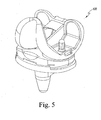
- Fig. 5 is a perspective view of a posterior-stabilized, fixed bearing, knee prosthesis 120, also referred to as a fixed PS prosthesis 120, which includes a PS femoral component 10, a fixed PS insert 30 and fixed tibial component 70.
- PS femoral component 10 may be identical to or similar to the femoral component shown in Fig. 1 of US-A-2009/0326666 .
- PS femoral component 10 includes a medial condyle 14 and a lateral condyle 16, both of which articulate upon a superior surface 36 of fixed PS insert 30.
- PS femoral component 10 also includes a box 32 positioned between medial condyle 14 and lateral condyle 16.
- Box 32 encases a posterior cam and an anterior cam (both hidden) that operationally engage with a spine 32 of fixed PS insert 30 as described in US-A-2009/0326666 .
- Anterior buttress 75 and posterior buttress 776 of fixed tibial component 70 retain PS insert 30, such that an inferior surface 34 of PS insert 30 rests on a platform 72 of fixed tibial component 70.
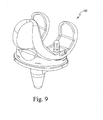
- Fig. 9 is a perspective view of a cruciate-retaining, mobile bearing, knee prosthesis 130, also referred to as a mobile CR prosthesis 130, which includes CR femoral component 20 (previously described for Fig. 2 ), a mobile CR bearing insert 60 and a mobile tibial component 80.
- Medial condyle 24 and lateral condyle 26 of CR femoral component 20 articulate on a superior surface 66 of mobile CR insert 60.
- An inferior surface 64 of mobile CR insert 60 articulates against platform 82 of mobile tibial component 80.
- a post 68 extends inferiorly from inferior surface 64 and rotatably inserts into a hollow stem 84 of mobile tibial component 80.
- Fig. 13 is a perspective view of a posterior-stabilized, mobile bearing, knee prosthesis 140, also referred to as a mobile PS prosthesis 140, which includes PS femoral component 10 (previously described for Fig. 6 ), a mobile PS insert 40 and mobile tibial component 80 (previously described for Fig. 12 ).
- Mobile PS insert 40 includes a superior surface 46 and a spine 42 that may be identical to superior surface 36 and spine 32 of fixed PS insert 30 shown in Fig. 7 .
- Mobile PS insert 40 also includes an inferior surface 34 that may be identical to inferior surface 54 of fixed CR insert 50 shown in Fig. 3 .
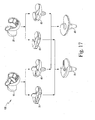
- Fig. 17 is a chart representing an integrated, knee prosthesis system 40 that includes each of the knee prostheses shown in Figs. 1 , 5 , 9 and 13 .
- Each of components 10, 20, 30, 40, 50, 60, 70 and 80 may be provided in a plurality of sizes (for example, ten sizes) to accommodate the wide variation of anatomies of the patient population. These components may be matched together as follows:
- each size of each of inserts 30, 40, 50 and 60 may be provided in a plurality of thicknesses.
- the anatomies of patients vary not only in size, but also in femur/tibia, size proportionality.
- TKR procedures it is possible to determine the size combinations that would be needed for the majority of patients in the worldwide population.
- each of practically all patients may be accommodated with a knee prosthesis distinctly-sized to fit both the femur and the tibia by pairing a femoral component that is sized either up two sizes or down two sizes from a tibial component.
- a “size 3" CR femoral component may be used with any one of a “size 1, 2, 3, 4 or 5" tibial components (fixed or mobile), whereas a “size 1” CR femoral component may be used with any one of a “size 1, 2 or 3” tibial components (fixed or mobile). Similarly, a “size 5" fixed tibial component may be used with any one of a “size 3, 4, 5, 6 or 7" fixed insert (CR or PS).
- each of these pairings allows optimally matching the femoral component to the insert to maintain desirable geometrical relationships.
- Tables 1 lists the components of an exemplary embodiment of knee prosthesis system 100.
- Table 2 lists the femoral component sizes provided for each femoral component listed in Table 1.
- Table 2 also shows for each femoral component size the compatible insert size for each insert listed in Table 1 and the compatible tibial component sizes for each tibial component listed in Table 1.
- Table 1 Knee Prosthesis System Components Component No. of sizes No. of thicknesses No.
- knee prosthesis system 100 shown in Table 1 and Table 2 provides 2176 unique combinations of prosthesis components.
- the femoral component is distinctly-sized to fit the patient's femur while optimally matched to the insert
- the tibial component is distinctly-sized to fit the patient's tibia while compatible with the insert.
- knee prosthesis system 100 may allow surgeons to avoid compromising kinematic performance and life of the implanted joint for each patient of the worldwide patient population.
- patella components may also be provided for implantation in combination with the knee prosthesis.
- the patella components may be provided in a plurality of sizes.
- Examples of patella implants that may be adapted for use in knee prosthesis system 100 are available under the trade mark PFC Sigma from DePuy Orthopaedics Inc.
- Another embodiment of knee prosthesis system 100 may also include two unique types of patella components, each type having five sizes, thereby allowing the surgeon to select from 21,760 unique combinations of components. In each of these combinations, the femoral component is distinctly-sized to match the patient's femur while optimally matched to the insert, and the tibial component is distinctly-sized to fit the patient's tibia while compatible with the insert.
- Knee prosthesis system 100 allows the surgeon to select a combination of knee prosthesis components for implantation into the patient, in which the components are distinctly-sized to fit the femur and tibia of the patient, while also optimally matched to avoid compromising performance of the reconstructed joint. Knee prosthesis system 100 further provides PS femoral components that are proportionally sized to the femur since the PS insert (fixed or mobile) is matched to each PS femoral component. Knee prosthesis system 100 also may lower the cost and complexity of the necessary inventory of implant components to accommodate the worldwide patient population, due primarily to the interchangeability of the components.
- mobile tibial component 80 and fixed tibial component 70 may have an approximately similar or identical external size and configuration for each anatomical size, enabling the surgeon to prepare the proximal tibia in approximately the same way using the same instrumentation. This also allows the surgeon to implant either type of tibial component even after the proximal tibial has been surgically prepared.
- Figs. 18, 19, 20 and 21 show four representative sizes of mobile tibial component 80 of knee prosthesis system 100.
- Knee prosthesis system 100 may have ten sizes of each of fixed tibial component 70 and mobile tibial component 80, as shown in Table 2.
- Fig. 18 is an anterior view of a size one, mobile tibial component 150 having a size one platform 152, a size one stem 154 and a pair of opposing keels 151, 153 extending between stem 154 and platform 152.
- Stem 154 has a distal portion 156 with a length "E" and a proximal portion 158 with a length "A".
- Fig. 19 is an anterior view of a size three, mobile tibial component 160 having a size three platform 162, a size three stem 164 and a pair of opposing keels 161, 163.
- Stem 164 has a distal portion 166, also with length "E", and a proximal portion 168 with a length "B".
- Fig. 20 is an anterior view of a size seven, mobile tibial component 170 having a size seven platform 172, a size three stem 174 and a pair of opposing keels 171, 173.
- Stem 174 has a distal portion 176, also with length "E", and a proximal portion 178 with a length "C”.
- Fig. 21 is an anterior view of a size nine, mobile tibial component 180 having a size nine platform 182, a size nine stem 184 and a pair of opposing keels 181, 182.
- Stem 184 has a distal portion 186, also with length "E”, and a proximal portion 188 with a length "D”.
- length “D” is greater than length "C”, which is greater than length "B”, which is greater than length "A”.
- increasing stem length corresponds to increasing length of the proximal portion of the stem, while the length of the distal portion remains constant.
- Distal portions 156, 166, 176 and 186 may also have the same, generally conical shape.
- Proximal portions 158, 168, 178 and 188 may have approximately the same frustoconical shape and vary primarily in length.
- Keels 151, 153, 161, 163,171, 173, 181, 183 may have approximately similar configurations and orientations. As would be apparent to those skilled in the art, a surgeon may use the same reaming instrument to form a cavity to the desired depth in the proximal tibia to receive any one of the various sizes of stems 154, 164, 174 and 184.
- each of the plurality of distinctly-sized fixed tibial components may be approximately similar or identical to the corresponding one of the plurality of distinctly-sized mobile tibial components
- the surgical preparation of the proximal tibia may be the same for a given size of either the fixed or mobile tibial components, and the required instrumentation may be the same for all sizes of both the fixed and mobile tibial components.
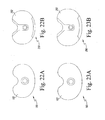
- Figs. 22A, 22B, 23A, 23B , 24A, 24B, 25A and 25B show superior (plan) views of four representative sizes of fixed and mobile tibial components of knee prosthesis system 100.
- knee prosthesis system 100 may have ten sizes of each of fixed tibial component 70 and mobile tibial component 80, as shown in Table 2.
- Fig. 22A shows size one mobile tibial component 150 to have a platform 152 that has a similar "footprint" or profile as a platform 252 of a size one fixed tibial component 250 shown in Fig. 22B .
- Fig. 23A shows size three mobile tibial component 160 to have a platform 162 that has a similar profile as a platform 262 of a size one fixed tibial component 260 shown in Fig. 23B .
- Fig. 24A shows size seven mobile tibial component 170 to have a platform 172 that has a similar profile as a platform 272 of a size one fixed tibial component 270 shown in Fig. 24B .
- Fig. 25A shows size nine mobile tibial component 180 to have a platform 182 that has a similar profile as a platform 282 of a size one fixed tibial component 280 shown in Fig. 25B .
- the platform profile (as viewed from the top, in the direction of the stem axis) is the same for both mobile and fixed tibial components for a particular anatomical size. There is no need to change tibial component size to get the same, tibial plateau coverage when choosing between a mobile and a fixed prosthesis.
- Another benefit of the common platform shape is that the same casting tool or a portion of the tool may be used in the manufacture of both tibial components, enabling reduced component cost.
Landscapes
- Health & Medical Sciences (AREA)
- Orthopedic Medicine & Surgery (AREA)
- Physical Education & Sports Medicine (AREA)
- Cardiology (AREA)
- Oral & Maxillofacial Surgery (AREA)
- Transplantation (AREA)
- Engineering & Computer Science (AREA)
- Biomedical Technology (AREA)
- Heart & Thoracic Surgery (AREA)
- Vascular Medicine (AREA)
- Life Sciences & Earth Sciences (AREA)
- Animal Behavior & Ethology (AREA)
- General Health & Medical Sciences (AREA)
- Public Health (AREA)
- Veterinary Medicine (AREA)
- Prostheses (AREA)
Abstract
A knee prosthesis system (100) for total knee replacement of a patient has a plurality of distinctly-sized fixed tibial components (70), each of which has a fixed platform (72) defining a first, bone covering profile and a plurality of distinctly-sized mobile tibial components (80), each of which has a mobile platform (82) defining a second, bone covering profile. The first and second, bone covering profiles are approximately the same for any one of the plurality of distinctly-sized fixed tibial components and a correspondingly-sized one of the plurality of distinctly-sized mobile tibial components.
Description
- This invention relates to knee prosthesis systems.
- The most widely-used type of knee prosthesis for implantation into a patient during a total knee replacement (TKR) procedure includes three components: a metallic, femoral component that attaches to the distal femur; a metallic, tibial component (or tray) that attaches to the proximal tibia; and a polymeric (UHMWPE), insert (also called a bearing or an inlay) that fits between the femoral and tibial components. Various types of patella replacements are also available for use in combination with some of these knee prostheses. Two types of knee prostheses are a posterior-stabilized (PS) prosthesis, for when the posterior cruciate ligament is no longer viable, and a (posterior) cruciate-retaining (CR) knee prosthesis. Each of these two types of knee prostheses may be provided as a fixed bearing knee prosthesis, in which the insert does not move relative to the tibial component, or a mobile bearing knee prosthesis, in which the insert rotates upon a smooth platform of the tibial component. Whether to use a mobile insert or a fixed insert depends largely on the condition of the patient's knee ligaments and other soft tissues.
- A knee prosthesis system may include numerous sizes of femoral, tibial and insert components to accommodate the variation of patient anatomies in the worldwide TKR patient population. The design of a knee prosthesis system requires trade-offs among many important factors related to kinematic performance, clinical outcomes, implant longevity, cost, and ease of use, to name just a few. An important consideration relative to both the kinematic performance and the life of the knee prosthesis is the degree of conformity between the femoral component bearing surfaces and the insert bearing surfaces.
-
US-7628818 discloses a fixed bearing, knee prosthesis system in which each of differently sized inserts are compatible with each size of tibial component, so that it is possible for a surgeon to select a tibial component that is properly sized for a patient's tibia, and an insert that is matched with the femoral component. -
US-A-2009/0326666 discloses a knee prosthesis system having a plurality of distinctly-sized PS inserts (fixed or mobile) having a spine extending superiorly from an inferior surface. The spine has a posterior side that has a concave cam surface and a convex cam surface. Each of the PS femoral components has a pair of spaced-apart condyles defining an intracondylar notch that has a posterior cam. The posterior cam includes a concave cam surface and a convex cam surface. The concave cam surface of the posterior cam contacts the convex cam surface of the spine during a first range of flexion and the convex cam surface of the posterior cam contacts the concave cam surface of the spine during a second range of flexion. - Investigators typically characterize conformity in either the coronal plane or sagittal plane as the ratio of the convex radius of a femoral condyle of the femoral component to the concave radius of the interfacing insert surface. A conformity ratio of zero represents a flat insert surface, corresponding to very high contact stress at high loads. A conformity ratio of 0.99 represents high conformity, corresponding, in general, to high contact area, relatively low contact stress and, subsequently, reduced wear rate of the polyethylene surface of the insert.
- Investigators have found that conformity in the coronal plane may affect prosthesis life more than conformity in the sagittal plane. For example, in an article by Kuster, et al, "The effects of conformity and load in total knee replacement" (Clinical Orthopaedics and Related Research, Number 375, pp. 302-12, June 2000), the authors found that the compressive surface stress, the shear stress and the von Mises stress were affected by changes to the conformity ratio and to a lesser extent by load changes. In a more recent article by Berend, et al, "Effects of coronal plane conformity on tibial loading in TKA: a comparison of AGC flat versus conforming articulations" (Surgical Technology Int., Number 18, pp. 207-212, 2009), the authors studied the effect of conformity on loading of the proximal tibia of the patient. Improper loading of the proximal tibia may lead to aseptic loosening of the tibial component in the tibia and eventually prosthesis failure requiring revision surgery. The authors found that coronally dished components created a strain increase in the anterior medial tibia while creating a significant strain decrease in the posterior tibia. They also found that proximal tibial strains were decreased and centralized in conforming versus flat articulations.
- It is known in the art, however, that very high conformity may also lead, for example, to undesirable loading conditions on the insert surface or to excessive constraint of the femoral component, thereby inhibiting joint motions important to joint performance and patient comfort. Therefore, designs with intermediate values of contact area may be optimal as long as the stresses are below the yield strength of the insert material, in order to provide the optimal combination of joint laxity and conformity.
- Complicating the challenge faced by knee prosthesis designers is the variability of patient anatomies in the worldwide, TKR patient population. Smaller patients with smaller femurs require, obviously, smaller knee prostheses. Each of the medial and lateral condyles of a femoral component of a small femoral component has a smaller coronal radius than a large femoral component for a large patient. To maintain the appropriate comformity ratio, as well as other geometrical relationships including condylar spacing, the small femoral component must be matched to a properly sized insert. However, in addition to the wide range of patient sizes, the dimensional proportionality between the femur and tibia bones also varies widely. For example, some patients have a larger distal femur than other patients for a given size of the proximal tibia. In such cases when using currently available knee prosthesis systems, the surgeon may need to choose to implant a femoral component that is slightly mismatched with the femur and matched with the insert, or a femoral component that is matched with the femur and slightly mismatched with the insert.
- The present invention provides a knee prosthesis system from which a surgeon may select a fixed or a mobile, total knee replacement prosthesis for implantation into a patient, the knee prosthesis system comprising:
- a plurality of distinctly-sized fixed tibial components, each of which has a fixed platform defining a first, bone covering profile;
- a plurality of distinctly-sized mobile tibial components, each of which has a mobile platform defining a second, bone covering profile;
- in which the first and second, bone covering profiles are approximately the same for any one of the plurality of distinctly-sized fixed tibial components and a correspondingly-sized one of the plurality of distinctly-sized mobile tibial components.
- Optionally, the knee prosthesis system includes a plurality of distinctly-sized femoral components.
- Optionally, the knee prosthesis system includes a plurality of fixed inserts, each of which is sized and shaped for implantation between one of the plurality of distinctly-sized femoral components and at least one of the plurality of distinctly-sized fixed tibial components.
- Optionally, the knee prosthesis system includes a plurality of mobile inserts, each of which is sized and shaped for implantation between one of the plurality of distinctly-sized femoral components and at least one of the plurality of distinctly-sized mobile tibial components.
- Optionally, each of the plurality of distinctly-sized fixed tibial components further includes a fixed stem extending distally from the fixed platform, and each of the plurality of distinctly-sized mobile tibial components further includes a mobile stem extending distally from the mobile platform. Optionally, the size and shape of the fixed stem of each of the plurality of distinctly-sized fixed tibial components is approximately the same as the size and shape of the mobile stem of a correspondingly-sized one of the plurality of distinctly-sized mobile tibial components.
- Optionally, each of the fixed stems and each of the mobile stems include a distal portion having a distal length and a proximal portion having any one of a plurality of proximal lengths, such that each of the fixed stems and each of the mobile stems may have any one of a plurality of overall stem lengths.
- Optionally, the distal portion of each of the fixed stems and the distal portion of each of the mobile stems has an approximately conical shape.
- Optionally, the proximal portion of each of the fixed stems and the proximal portion of each of the mobile stems has an approximately frustoconical shape.
- The invention also provides a knee prosthesis system from which a surgeon may select a fixed or mobile, total knee replacement prosthesis for implantation into a patient, the knee prosthesis system comprising:
- a plurality of distinctly-sized fixed tibial components, each of which has a fixed platform defining a first, bone covering profile;
- a plurality of distinctly-sized mobile tibial components, each of which has a mobile platform defining a second, bone covering profile;
- a plurality of distinctly-sized femoral components;
- a plurality of fixed inserts, each of which is sized and shaped for implantation between one of the plurality of distinctly-sized femoral components and at least one of the plurality of distinctly-sized fixed tibial components; and
- a plurality of mobile inserts, each of which is sized and shaped for implantation between one of the plurality of distinctly-sized femoral components and at least one of the plurality of distinctly-sized mobile tibial components;
- in which the first and second, bone covering profiles are approximately the same for any one of the plurality of distinctly-sized fixed tibial components and a correspondingly-sized one of the plurality of distinctly-sized mobile tibial components.
- Optionally, each of the plurality of distinctly-sized fixed tibial components further includes a fixed stem extending distally from the fixed platform, and each of the plurality of distinctly-sized mobile tibial components further includes a mobile stem extending distally from the mobile platform. Optionally, the size and shape of the fixed stem of each of the plurality of distinctly-sized fixed tibial components is approximately the same as the size and shape of the mobile stem of a correspondingly-sized one of the plurality of distinctly-sized mobile tibial components.
- Optionally, each of the fixed stems and each of the mobile stems include a distal portion having a distal length and a proximal portion having any one of a plurality of proximal lengths, such that each of the fixed stems and each of the mobile stems may have any one of a plurality of overall stem lengths.
- Optionally, the distal portion of each of the fixed stems and the distal portion of each of the mobile stems has an approximately conical shape.
- Optionally, the proximal portion of each of the fixed stems and the proximal portion of each of the mobile stems has an approximately frustoconical shape.
- It would be preferable for a surgeon to be able to select a femoral component that is sized to fit the femur of a particular patient, a tibial component that is sized to fit the tibia, and an insert that optimally matches the femoral component and is compatible with the tibial component. Such a knee prosthesis system should include both fixed and mobile types of prostheses and provide for both CR and PS procedures. Furthermore, the system should accommodate the wide variety of patient anatomies in the worldwide population.
- It is desirable to maintain or lower the costs and complexity of knee prosthesis systems. A knee prosthesis system may include femoral, tibial and insert components in a number of sizes, for each of the right and left knees, to accommodate variations in patient anatomies and conditions. In addition, each of inserts may be provided in a number of thicknesses so that the surgeon may select the one that results in the appropriate joint tension. Consequently, knee prosthesis manufacturers must provide a very large inventory of components representing a large number of different size combinations to accommodate the worldwide patient population. What is needed, therefore, is an improved, knee prosthesis system that allows component interchangeability to provide the necessary size combinations with a minimal number of components.
- Another consideration during the design of knee prosthesis systems is bone preparation for implantation of the PS femoral component. Both the PS and the CR femoral components have a pair of spaced-apart condyles that are somewhat similar to the natural condyles of the distal femur. For the PS femoral component, a box (or intracondylar notch) positioned between the condyles includes features for interaction with a spine on the PS insert. Implantation of the PS femoral component requires cutting a recess into the distal femur to receive the box. In some current, knee prosthesis systems, the size of the box is the same for all of the PS femoral component sizes, thereby requiring cutting the same size recess into the distal femur, even for smaller femurs. It is desirable, however, to conserve natural bone, if possible, during preparation of the femur for attachment of the femoral component. There is a further need, therefore, for a knee prosthesis system in which each of the PS femoral components has a box that is sized proportionately to the femur size, while also addressing the previously described needs.
- Yet another consideration during the design of knee prosthesis systems is bone preparation for implantation of the tibial component. Currently available, mobile and fixed TKR prosthesis systems include tibial components for a range of anatomical sizes. For some of these systems, the tibial component for a mobile TKR prosthesis of a particular size has a different configuration than that of a fixed TKR prosthesis of the same size. Specifically, the platform that supports the fixed bearing insert may have a different shape than the platform that supports the mobile bearing insert. This may result in a small, but possibly significant, difference in coverage of the resected, tibial plateau surface. Although less than ideal, one way surgeons may obtain the desired, tibial bone coverage is to select a larger size tibial component. What is more desirable is a TKR system that has mobile and fixed tibial components with a common platform profile shape that is optimized for interaction with surrounding tissues, kinematic performance, etc.
- Also, currently available TKR systems have tibial components with stems of variable lengths to accommodate different tibial bone conditions. Furthermore, the stems for mobile tibial components may have a different configuration than the stems for fixed tibial components. Subsequently, such systems require that a number of different reaming instruments be available for each surgical procedure. A preferable TKR system would have mobile and fixed tibial components with stems of different lengths, but not requiring several different reaming instruments for preparing the tibia. This would also provide the surgeon with the intraoperative flexibility to select the appropriate type of tibial component, while reducing the number of instruments that would need to be available during the surgical procedure.
- Embodiments of the invention are described below by way of example with reference to the accompanying drawings, in which common reference numerals identify the common elements, and in which:
-
Fig. 1 is a perspective view of a fixedCR prosthesis 110. -
Fig. 2 is a perspective view of aCR femoral component 20, which is part offixed CR prosthesis 110 shown inFig. 1 andmobile CR prosthesis 130 shown inFig. 9 . -
Fig. 3 is a perspective view of a fixedCR insert 50, which is part offixed CR prosthesis 110 shown inFig. 1 . -
Fig. 4 is a perspective view of a fixedtibial component 70, which is part offixed CR prosthesis 110 shown inFig. 1 and a fixedPS prosthesis 120 shown inFig. 5 . -
Fig. 5 is a perspective view offixed PS prosthesis 120. -
Fig. 6 is a perspective view of aPS femoral component 10, which is part offixed PS prosthesis 120 shown inFig. 5 and amobile PS prosthesis 140 shown inFig. 13 . -
Fig. 7 is a perspective view of a fixedPS insert 30, which is part offixed PS prosthesis 120 shown inFig. 5 . -
Fig. 8 is a perspective view of fixedtibial component 70, which is also shown inFig. 4 . -
Fig. 9 is a perspective view of amobile CR prosthesis 130. -
Fig. 10 is a perspective view of CRfemoral component 20, which is also shown inFig. 2 . -
Fig. 11 is a perspective view of amobile CR insert 60, which is part ofmobile CR prosthesis 130 shown inFig. 9 . -
Fig. 12 is a perspective view of amobile tibial component 80, which is part ofmobile CR prosthesis 130 and amobile PS prosthesis 140 shown inFig. 13 . -
Fig. 13 is a perspective view ofmobile PS prosthesis 140. -
Fig. 14 is a perspective view of PSfemoral component 10, which is also shown inFig. 10 . -
Fig. 15 is a perspective view of amobile PS insert 40, which is part ofmobile PS prosthesis 140 shown inFig. 13 . -
Fig. 16 is a perspective view ofmobile tibial component 80, which is also shown inFig. 12 . -
Fig. 17 is a chart representingknee prosthesis system 100 for configuring, in a plurality of size combinations, each of the prostheses shown inFigs. 1 ,5 ,9 and13 . -
Fig. 18 is an anterior view of a size one, mobile tibial component. -
Fig. 19 is an anterior view of a size three, mobile tibial component. -
Fig. 20 is an anterior view of a size seven, mobile tibial component. -
Fig. 21 is an anterior view of a size nine, mobile tibial component. -
Fig. 22A is a superior view of the size one, mobile tibial component ofFig. 18 . -
Fig. 22B is a superior view of a size one, fixed tibial component. -
Fig. 23A is a superior view of the size three, mobile tibial component ofFig. 19 . -
Fig. 23B is a superior view of a size three, fixed tibial component. -
Fig. 24A is a superior view of the size seven, mobile tibial component ofFig. 20 . -
Fig. 24B is a superior view of a size seven, fixed tibial component. -
Fig. 25A is a superior view of the size nine, mobile tibial component ofFig. 21 . -
Fig. 25B is a superior view of a size nine, fixed tibial component. - In this document, the terms "anterior, posterior, lateral, medial" generally refer to the front, back, outside and midline of the surgical patient, respectively, although we also use these terms in reference to the devices.
Fig. 1 shows directional arrows for these terms and the terms "inferior, superior". Also, references to "surgeon" and "user" are applicable to any person who might assist a surgeon during the surgical procedure. - Referring to the drawings,
Figs. 1 to 16 show components of aknee prosthesis system 100 that is shown inFig. 17 . Each of these components may be provided in a plurality of sizes and may be matched together as described next, thereby providing the surgeon with a large plurality of size combinations. Usingknee prosthesis system 100, the surgeon may select, for each patient in a large patient population, a size combination that correctly matches both the femur and the tibia of the patient. That is, the femoral component is distinctly-sized to fit the femur and the tibial component is distinctly-sized to fit the tibia, and the components of the knee prosthesis are optimally match to avoid compromising joint performance. - One characteristic of the distinctly-sized femoral and tibial components of
knee prosthesis system 100 is proportionality of each component to the particular size of bone to which the component is to be attached. In general, the dimensional scale of the component varies, but not the shape. For example, the femoral component may have a proportionally-sized, intercondylar distance, such that a large femoral component has a proportionally longer intercondylar distance than that of a small femoral component. Similarly, a large tibial component may have a proportionally wider and deeper, posterior notch than that of a small tibial component. -
Fig. 1 is a perspective view of a cruciate-retaining, fixed bearing,knee prosthesis 110, also referred to as afixed CR prosthesis 110, which includes a CR femoral component 20 (Fig. 10 ), a fixed CR insert 50 (Fig. 11 ) and a fixed tibial component 70 (Fig. 12 ).Fixed CR prosthesis 110 may be identical to or similar to the knee prosthesis shown inFig. 1 ofUS-7628818 . Any one of a plurality of differently-sized inserts (or bearings) may be secured to any one of a plurality of differently-sized tibial components (or trays). As a result, articulation surface geometries and other features of the insert may be enhanced for each size of femoral component. Such interchangeability also allows for smaller size increments in the design of a range of femoral components. CRfemoral component 20 includes amedial condyle 24 and alateral condyle 26, both of which articulate upon asuperior surface 56 of fixedCR bearing 50. An anterior buttress 75 and a posterior buttress 76 of fixedtibial component 70 fixedly retain CR insert 50 to fixedtibial component 70, such that aninferior surface 54 of CR insert 50 rests on aplatform 72 of fixedtibial component 70.Fixed tibial component 70 also includes astem 74 that inserts into the surgically prepared proximal tibia. -
Fig. 5 is a perspective view of a posterior-stabilized, fixed bearing,knee prosthesis 120, also referred to as afixed PS prosthesis 120, which includes aPS femoral component 10, a fixedPS insert 30 and fixedtibial component 70. PSfemoral component 10 may be identical to or similar to the femoral component shown inFig. 1 ofUS-A-2009/0326666 . PSfemoral component 10 includes amedial condyle 14 and alateral condyle 16, both of which articulate upon asuperior surface 36 of fixedPS insert 30. PSfemoral component 10 also includes abox 32 positioned betweenmedial condyle 14 andlateral condyle 16.Box 32 encases a posterior cam and an anterior cam (both hidden) that operationally engage with aspine 32 of fixedPS insert 30 as described inUS-A-2009/0326666 . Anterior buttress 75 and posterior buttress 776 of fixedtibial component 70retain PS insert 30, such that aninferior surface 34 of PS insert 30 rests on aplatform 72 of fixedtibial component 70. -
Fig. 9 is a perspective view of a cruciate-retaining, mobile bearing,knee prosthesis 130, also referred to as amobile CR prosthesis 130, which includes CR femoral component 20 (previously described forFig. 2 ), a mobileCR bearing insert 60 and amobile tibial component 80.Medial condyle 24 andlateral condyle 26 of CRfemoral component 20 articulate on asuperior surface 66 ofmobile CR insert 60. Aninferior surface 64 of mobile CR insert 60 articulates againstplatform 82 ofmobile tibial component 80. Apost 68 extends inferiorly frominferior surface 64 and rotatably inserts into ahollow stem 84 ofmobile tibial component 80. -
Fig. 13 is a perspective view of a posterior-stabilized, mobile bearing,knee prosthesis 140, also referred to as amobile PS prosthesis 140, which includes PS femoral component 10 (previously described forFig. 6 ), amobile PS insert 40 and mobile tibial component 80 (previously described forFig. 12 ).Mobile PS insert 40 includes asuperior surface 46 and aspine 42 that may be identical tosuperior surface 36 andspine 32 of fixedPS insert 30 shown inFig. 7 .Mobile PS insert 40 also includes aninferior surface 34 that may be identical toinferior surface 54 of fixed CR insert 50 shown inFig. 3 . -
Fig. 17 is a chart representing an integrated,knee prosthesis system 40 that includes each of the knee prostheses shown inFigs. 1 ,5 ,9 and13 . Each ofcomponents - Any one size of PS
femoral component 10 may be matched with any one size of either fixedPS insert 30 ormobile insert 40. - Any one size of CR
femoral component 20 may be matched with any one size of either fixed CR insert 50 ormobile CR insert 60. - Any one size of fixed
tibial component 70 may be matched with any one size of either fixedPS insert 30 or fixedCR insert 50. - Any one size of
mobile tibial component 80 may be matched with any one size of eithermobile PS insert 40 ormobile CR insert 60. - In addition, each size of each of
inserts - As noted earlier, the anatomies of patients vary not only in size, but also in femur/tibia, size proportionality. Using historical data for TKR procedures, it is possible to determine the size combinations that would be needed for the majority of patients in the worldwide population. For example, each of practically all patients may be accommodated with a knee prosthesis distinctly-sized to fit both the femur and the tibia by pairing a femoral component that is sized either up two sizes or down two sizes from a tibial component. A "size 3" CR femoral component may be used with any one of a "size 1, 2, 3, 4 or 5" tibial components (fixed or mobile), whereas a "size 1" CR femoral component may be used with any one of a "size 1, 2 or 3" tibial components (fixed or mobile). Similarly, a "size 5" fixed tibial component may be used with any one of a "size 3, 4, 5, 6 or 7" fixed insert (CR or PS). Using
knee prosthesis system 100, each of these pairings allows optimally matching the femoral component to the insert to maintain desirable geometrical relationships. - Tables 1 lists the components of an exemplary embodiment of
knee prosthesis system 100. Table 2 lists the femoral component sizes provided for each femoral component listed in Table 1. Table 2 also shows for each femoral component size the compatible insert size for each insert listed in Table 1 and the compatible tibial component sizes for each tibial component listed in Table 1.Table 1: Knee Prosthesis System Components Component No. of sizes No. of thicknesses No. of components PS femoral (right) 14 --- 14 PS femoral (left) 14 --- 14 CR femoral (right) 14 --- 14 CR femoral (left) 14 --- 14 PS insert, mobile 10 9 90 PS insert, fixed 10 9 90 CR insert, mobile 10 8 80 CR insert, fixed 10 8 80 Tibial, mobile 10 --- 10 Tibial, fixed 10 --- 10 TOTAL 416 Table 2: Compatible Sizes Femoral component size Insert Size Tibial component size 1 1 1, 2, 3 2 2 1, 2, 3, 4 3 3 1, 2, 3, 4, 5 3N 3 1, 2, 3, 4, 5 4 4 2, 3, 4, 5, 6 4N 4 2, 3, 4, 5, 6 5 5 3, 4, 5, 6, 7 5N 5 3, 4, 5, 6, 7 6 6 4, 5, 6, 7, 8 6N 6 4, 5, 6, 7, 8 7 7 5, 6, 7, 8, 9 8 8 6, 7, 8, 9, 10 9 9 7, 8, 9, 10 10 10 8, 9, 10 - The embodiment of
knee prosthesis system 100 shown in Table 1 and Table 2 provides 2176 unique combinations of prosthesis components. In each of these combinations, the femoral component is distinctly-sized to fit the patient's femur while optimally matched to the insert, and the tibial component is distinctly-sized to fit the patient's tibia while compatible with the insert. As a result,knee prosthesis system 100 may allow surgeons to avoid compromising kinematic performance and life of the implanted joint for each patient of the worldwide patient population. - As previously noted, patella components may also be provided for implantation in combination with the knee prosthesis. The patella components may be provided in a plurality of sizes. Examples of patella implants that may be adapted for use in
knee prosthesis system 100 are available under the trade mark PFC Sigma from DePuy Orthopaedics Inc. Another embodiment ofknee prosthesis system 100 may also include two unique types of patella components, each type having five sizes, thereby allowing the surgeon to select from 21,760 unique combinations of components. In each of these combinations, the femoral component is distinctly-sized to match the patient's femur while optimally matched to the insert, and the tibial component is distinctly-sized to fit the patient's tibia while compatible with the insert. -
Knee prosthesis system 100 allows the surgeon to select a combination of knee prosthesis components for implantation into the patient, in which the components are distinctly-sized to fit the femur and tibia of the patient, while also optimally matched to avoid compromising performance of the reconstructed joint.Knee prosthesis system 100 further provides PS femoral components that are proportionally sized to the femur since the PS insert (fixed or mobile) is matched to each PS femoral component.Knee prosthesis system 100 also may lower the cost and complexity of the necessary inventory of implant components to accommodate the worldwide patient population, due primarily to the interchangeability of the components. - As previously explained, there is a need for a knee prosthesis system that has mobile and fixed tibial components with stems of different lengths, but that does not require several different reaming instruments for preparing the tibia. As shown in
Fig. 17 ,mobile tibial component 80 and fixedtibial component 70 may have an approximately similar or identical external size and configuration for each anatomical size, enabling the surgeon to prepare the proximal tibia in approximately the same way using the same instrumentation. This also allows the surgeon to implant either type of tibial component even after the proximal tibial has been surgically prepared. -
Figs. 18, 19, 20 and 21 show four representative sizes ofmobile tibial component 80 ofknee prosthesis system 100.Knee prosthesis system 100, for example, may have ten sizes of each of fixedtibial component 70 andmobile tibial component 80, as shown in Table 2.Fig. 18 is an anterior view of a size one,mobile tibial component 150 having a size oneplatform 152, a size onestem 154 and a pair of opposingkeels stem 154 andplatform 152.Stem 154 has adistal portion 156 with a length "E" and aproximal portion 158 with a length "A". -
Fig. 19 is an anterior view of a size three,mobile tibial component 160 having a size threeplatform 162, a size threestem 164 and a pair of opposingkeels Stem 164 has adistal portion 166, also with length "E", and aproximal portion 168 with a length "B". -
Fig. 20 is an anterior view of a size seven,mobile tibial component 170 having a size sevenplatform 172, a size threestem 174 and a pair of opposingkeels Stem 174 has adistal portion 176, also with length "E", and aproximal portion 178 with a length "C". -
Fig. 21 is an anterior view of a size nine,mobile tibial component 180 having a size nineplatform 182, a size ninestem 184 and a pair of opposingkeels Stem 184 has adistal portion 186, also with length "E", and aproximal portion 188 with a length "D". - As shown in
Figs. 18, 19, 20 and 21 , length "D" is greater than length "C", which is greater than length "B", which is greater than length "A". In general, increasing stem length corresponds to increasing length of the proximal portion of the stem, while the length of the distal portion remains constant. -
Distal portions Proximal portions Keels stems - As previously explained, it is also desirable that the total knee replacement system have mobile and fixed tibial components with a common, platform profile or "footprint" that is optimized for coverage of the tibial plateau, interaction with surrounding tissues, kinematic performance and other factors.
Figs. 22A, 22B, 23A, 23B ,24A, 24B, 25A and 25B show superior (plan) views of four representative sizes of fixed and mobile tibial components ofknee prosthesis system 100. As noted previously,knee prosthesis system 100 may have ten sizes of each of fixedtibial component 70 andmobile tibial component 80, as shown in Table 2. -
Fig. 22A shows size onemobile tibial component 150 to have aplatform 152 that has a similar "footprint" or profile as aplatform 252 of a size one fixedtibial component 250 shown inFig. 22B . -
Fig. 23A shows size threemobile tibial component 160 to have aplatform 162 that has a similar profile as aplatform 262 of a size one fixedtibial component 260 shown inFig. 23B . -
Fig. 24A shows size sevenmobile tibial component 170 to have aplatform 172 that has a similar profile as aplatform 272 of a size one fixedtibial component 270 shown inFig. 24B . -
Fig. 25A shows size ninemobile tibial component 180 to have aplatform 182 that has a similar profile as aplatform 282 of a size one fixedtibial component 280 shown inFig. 25B . - For each size of tibial component, the platform profile (as viewed from the top, in the direction of the stem axis) is the same for both mobile and fixed tibial components for a particular anatomical size. There is no need to change tibial component size to get the same, tibial plateau coverage when choosing between a mobile and a fixed prosthesis. Another benefit of the common platform shape is that the same casting tool or a portion of the tool may be used in the manufacture of both tibial components, enabling reduced component cost.
Claims (13)
- A knee prosthesis system from which a surgeon may select a fixed or a mobile, total knee replacement prosthesis for implantation into a patient, the knee prosthesis system comprising:a plurality of distinctly-sized fixed tibial components, each of which has a fixed platform defining a first, bone covering profile;a plurality of distinctly-sized mobile tibial components, each of which has a mobile platform defining a second, bone covering profile;in which the first and second, bone covering profiles are approximately the same for any one of the plurality of distinctly-sized fixed tibial components and a correspondingly-sized one of the plurality of distinctly-sized mobile tibial components.
- The knee prosthesis system of claim 1, further comprising a plurality of distinctly-sized femoral components.
- The knee prosthesis system of claim 2, further comprising a plurality of fixed inserts, each of which is sized and shaped for implantation between one of the plurality of distinctly-sized femoral components and at least one of the plurality of distinctly-sized fixed tibial components.
- The knee prosthesis system of claim 2, further comprising a plurality of mobile inserts, each of which is sized and shaped for implantation between one of the plurality of distinctly-sized femoral components and at least one of the plurality of distinctly-sized mobile tibial components.
- The knee prosthesis system of claim 1, in which:each of the plurality of distinctly-sized fixed tibial components further includes a fixed stem extending distally from the fixed platform; andeach of the plurality of distinctly-sized mobile tibial components further includes a mobile stem extending distally from the mobile platform;and in which the size and shape of the fixed stem of each of the plurality of distinctly-sized fixed tibial components is approximately the same as the size and shape of the mobile stem of a correspondingly-sized one of the plurality of distinctly-sized mobile tibial components.
- The knee prosthesis system of claim 5, in which each of the fixed stems and each of the mobile stems include a distal portion having a distal length and a proximal portion having any one of a plurality of proximal lengths, such that each of the fixed stems and each of the mobile stems may have any one of a plurality of overall stem lengths.
- The knee prosthesis system of claim 6, in which the distal portion of each of the fixed stems and the distal portion of each of the mobile stems has an approximately conical shape.
- The knee prosthesis system of claim 6, in which the proximal portion of each of the fixed stems and the proximal portion of each of the mobile stems has an approximately frustoconical shape.
- A knee prosthesis system from which a surgeon may select a fixed or mobile, total knee replacement prosthesis for implantation into a patient, the knee prosthesis system comprising:a plurality of distinctly-sized fixed tibial components, each of which has a fixed platform defining a first, bone covering profile;a plurality of distinctly-sized mobile tibial components, each of which has a mobile platform defining a second, bone covering profile;a plurality of distinctly-sized femoral components;a plurality of fixed inserts, each of which is sized and shaped for implantation between one of the plurality of distinctly-sized femoral components and at least one of the plurality of distinctly-sized fixed tibial components; anda plurality of mobile inserts, each of which is sized and shaped for implantation between one of the plurality of distinctly-sized femoral components and at least one of the plurality of distinctly-sized mobile tibial components;in which the first and second, bone covering profiles are approximately the same for any one of the plurality of distinctly-sized fixed tibial components and a correspondingly-sized one of the plurality of distinctly-sized mobile tibial components.
- The knee prosthesis system of claim 9, in which:each of the plurality of distinctly-sized fixed tibial components further includes a fixed stem extending distally from the fixed platform; andeach of the plurality of distinctly-sized mobile tibial components further includes a mobile stem extending distally from the mobile platform;and in which the size and shape of the fixed stem of each of the plurality of distinctly-sized fixed tibial components is approximately the same as the size and shape of the mobile stem of a correspondingly-sized one of the plurality of distinctly-sized mobile tibial components.
- The knee prosthesis system of claim 10, in which each of the fixed stems and each of the mobile stems include a distal portion having a distal length and a proximal portion having any one of a plurality of proximal lengths, such that each of the fixed stems and each of the mobile stems may have any one of a plurality of overall stem lengths.
- The knee prosthesis system of claim 11, in which the distal portion of each of the fixed stems and the distal portion of each of the mobile stems has an approximately conical shape.
- The knee prosthesis system of claim 11, in which the proximal portion of each of the fixed stems and the proximal portion of each of the mobile stems has an approximately frustoconical shape.
Applications Claiming Priority (1)
| Application Number | Priority Date | Filing Date | Title |
|---|---|---|---|
| US12/691,280 US20110178606A1 (en) | 2010-01-21 | 2010-01-21 | Tibial components for a knee prosthesis system |
Publications (1)
| Publication Number | Publication Date |
|---|---|
| EP2347732A1 true EP2347732A1 (en) | 2011-07-27 |
Family
ID=43827318
Family Applications (1)
| Application Number | Title | Priority Date | Filing Date |
|---|---|---|---|
| EP11150578A Withdrawn EP2347732A1 (en) | 2010-01-21 | 2011-01-11 | Knee prosthesis system |
Country Status (5)
| Country | Link |
|---|---|
| US (1) | US20110178606A1 (en) |
| EP (1) | EP2347732A1 (en) |
| JP (1) | JP2011147780A (en) |
| CN (1) | CN102133137A (en) |
| AU (1) | AU2011200227A1 (en) |
Cited By (2)
| Publication number | Priority date | Publication date | Assignee | Title |
|---|---|---|---|---|
| WO2013041905A1 (en) | 2011-09-19 | 2013-03-28 | Tecres S.P.A. | Temporary modular spacer device for joints of the human body |
| US9265613B2 (en) | 2012-09-24 | 2016-02-23 | Russell Nevins | Cementless tibial implant |
Families Citing this family (13)
| Publication number | Priority date | Publication date | Assignee | Title |
|---|---|---|---|---|
| US8632600B2 (en) | 2007-09-25 | 2014-01-21 | Depuy (Ireland) | Prosthesis with modular extensions |
| US9204967B2 (en) | 2007-09-28 | 2015-12-08 | Depuy (Ireland) | Fixed-bearing knee prosthesis having interchangeable components |
| US9011547B2 (en) | 2010-01-21 | 2015-04-21 | Depuy (Ireland) | Knee prosthesis system |
| US20140142713A1 (en) * | 2012-11-21 | 2014-05-22 | Abraham P. Wright | Knee prosthesis assembly having proportional trochlear groove geometry |
| IN2014DE00549A (en) * | 2013-03-07 | 2015-06-12 | Depuy Ireland | |
| WO2014143538A1 (en) | 2013-03-14 | 2014-09-18 | Wasielewski Ray C | Knee prosthesis including rotatable spine |
| US9744044B2 (en) | 2013-03-15 | 2017-08-29 | Mako Surgical Corp. | Unicondylar tibial knee implant |
| JP6293426B2 (en) | 2013-06-27 | 2018-03-14 | 京セラ株式会社 | Total knee implant |
| CN104758137A (en) * | 2015-03-23 | 2015-07-08 | 北京市春立正达医疗器械股份有限公司 | Mobile-bearing prosthesis of knee joint |
| US9839523B1 (en) * | 2016-06-10 | 2017-12-12 | Jared Ruben Hillel FORAN | Antibiotic dispensing spacer apparatus and method for infected total knee arthroplasty |
| CN110022798A (en) * | 2016-12-06 | 2019-07-16 | 捷迈有限公司 | Tibial insert |
| CN110799151A (en) * | 2017-06-23 | 2020-02-14 | 福卡斯特矫形外科公司 | Methods, systems, and devices for repairing a knee joint |
| CA3209018A1 (en) * | 2022-08-22 | 2024-02-22 | Zimmer, Inc. | Tibial prosthesis with distal features for cemented fixation |
Citations (6)
| Publication number | Priority date | Publication date | Assignee | Title |
|---|---|---|---|---|
| EP0732091A2 (en) * | 1995-03-13 | 1996-09-18 | Michael J. Pappas | Mobile bearing total joint replacement |
| US7338529B1 (en) * | 2004-03-30 | 2008-03-04 | Biomet Manufacturing Corp. | Methods and apparatuses for enhancing prosthetic implant durability |
| US20080114464A1 (en) * | 2006-10-13 | 2008-05-15 | Barnett Gary D | Mobile/fixed prosthetic knee systems |
| US20090149964A1 (en) * | 2007-10-10 | 2009-06-11 | Biomet Manufacturing Corp. | Knee joint prosthesis system and method for implantation |
| US7628818B2 (en) | 2007-09-28 | 2009-12-08 | Depuy Products, Inc. | Fixed-bearing knee prosthesis having interchangeable components |
| US20090326666A1 (en) | 2008-06-30 | 2009-12-31 | Wyss Joseph G | Posterior stabilized orthopaedic prosthesis |
Family Cites Families (3)
| Publication number | Priority date | Publication date | Assignee | Title |
|---|---|---|---|---|
| US5609641A (en) * | 1995-01-31 | 1997-03-11 | Smith & Nephew Richards Inc. | Tibial prosthesis |
| ES2221610T3 (en) * | 1999-09-24 | 2005-01-01 | Centerpulse Orthopedics Ltd. | PIECE OF TIBIA FOR A PROTESIS OF THE ARTICULATION OF THE KNEE, AND KIT WITH A PIECE OF TIBIA OF THIS TYPE. |
| US6589283B1 (en) * | 2001-05-15 | 2003-07-08 | Biomet, Inc. | Elongated femoral component |
-
2010
- 2010-01-21 US US12/691,280 patent/US20110178606A1/en not_active Abandoned
-
2011
- 2011-01-11 EP EP11150578A patent/EP2347732A1/en not_active Withdrawn
- 2011-01-20 AU AU2011200227A patent/AU2011200227A1/en not_active Abandoned
- 2011-01-20 JP JP2011009558A patent/JP2011147780A/en active Pending
- 2011-01-21 CN CN2011100297847A patent/CN102133137A/en active Pending
Patent Citations (6)
| Publication number | Priority date | Publication date | Assignee | Title |
|---|---|---|---|---|
| EP0732091A2 (en) * | 1995-03-13 | 1996-09-18 | Michael J. Pappas | Mobile bearing total joint replacement |
| US7338529B1 (en) * | 2004-03-30 | 2008-03-04 | Biomet Manufacturing Corp. | Methods and apparatuses for enhancing prosthetic implant durability |
| US20080114464A1 (en) * | 2006-10-13 | 2008-05-15 | Barnett Gary D | Mobile/fixed prosthetic knee systems |
| US7628818B2 (en) | 2007-09-28 | 2009-12-08 | Depuy Products, Inc. | Fixed-bearing knee prosthesis having interchangeable components |
| US20090149964A1 (en) * | 2007-10-10 | 2009-06-11 | Biomet Manufacturing Corp. | Knee joint prosthesis system and method for implantation |
| US20090326666A1 (en) | 2008-06-30 | 2009-12-31 | Wyss Joseph G | Posterior stabilized orthopaedic prosthesis |
Non-Patent Citations (2)
| Title |
|---|
| BEREND ET AL.: "Effects of coronal plane conformity on tibial loading in TKA: a comparison of AGC flat versus conforming articulations", SURGICAL TECHNOLOGY INT., no. 18, 2009, pages 207 - 212 |
| KUSTER ET AL.: "The effects of conformity and load in total knee replacement", CLINICAL ORTHOPAEDICS AND RELATED RESEARCH, no. 375, 12 June 2000 (2000-06-12), pages 302 |
Cited By (4)
| Publication number | Priority date | Publication date | Assignee | Title |
|---|---|---|---|---|
| WO2013041905A1 (en) | 2011-09-19 | 2013-03-28 | Tecres S.P.A. | Temporary modular spacer device for joints of the human body |
| CN103841923A (en) * | 2011-09-19 | 2014-06-04 | 泰克里斯公司 | Temporary modular spacer device for joints of the human body |
| CN103841923B (en) * | 2011-09-19 | 2016-09-14 | 泰克里斯公司 | Temporary modular placeholder device for joints in the human body |
| US9265613B2 (en) | 2012-09-24 | 2016-02-23 | Russell Nevins | Cementless tibial implant |
Also Published As
| Publication number | Publication date |
|---|---|
| CN102133137A (en) | 2011-07-27 |
| US20110178606A1 (en) | 2011-07-21 |
| JP2011147780A (en) | 2011-08-04 |
| AU2011200227A1 (en) | 2011-08-04 |
Similar Documents
| Publication | Publication Date | Title |
|---|---|---|
| EP2901970B1 (en) | Knee prosthesis system | |
| US20110178606A1 (en) | Tibial components for a knee prosthesis system | |
| US11648127B2 (en) | Method and system including sleeves and broaches for surgically preparing the patient's bone | |
| EP2073759B1 (en) | Knee prosthesis kit | |
| EP1955677B1 (en) | Femoral trochlea prostheses | |
| US8403994B2 (en) | Knee implant system | |
| US9532879B2 (en) | Femoral knee prosthesis system with augments and multiple lengths of sleeves sharing a common geometry | |
| AU2011226880B2 (en) | Femoral component of a knee prosthesis having an angled cement pocket | |
| JP2013212408A (en) | Fixed-bearing knee prosthesis having interchangeable components | |
| EP2710981B1 (en) | Orthopaedic knee prosthesis system | |
| EP2777624A1 (en) | Orthopaedic prosthesis | |
| AU2018279260B2 (en) | Modular knee prosthesis | |
| AU2014201081A1 (en) | Fixed-bearing knee prosthesis having interchangeable components |
Legal Events
| Date | Code | Title | Description |
|---|---|---|---|
| PUAI | Public reference made under article 153(3) epc to a published international application that has entered the european phase |
Free format text: ORIGINAL CODE: 0009012 |
|
| AK | Designated contracting states |
Kind code of ref document: A1 Designated state(s): AL AT BE BG CH CY CZ DE DK EE ES FI FR GB GR HR HU IE IS IT LI LT LU LV MC MK MT NL NO PL PT RO RS SE SI SK SM TR |
|
| AX | Request for extension of the european patent |
Extension state: BA ME |
|
| STAA | Information on the status of an ep patent application or granted ep patent |
Free format text: STATUS: THE APPLICATION IS DEEMED TO BE WITHDRAWN |
|
| 18D | Application deemed to be withdrawn |
Effective date: 20120128 |