EP2346857B1 - Compounds for the treatment of inflammatory disorders - Google Patents
Compounds for the treatment of inflammatory disorders Download PDFInfo
- Publication number
- EP2346857B1 EP2346857B1 EP09792832.9A EP09792832A EP2346857B1 EP 2346857 B1 EP2346857 B1 EP 2346857B1 EP 09792832 A EP09792832 A EP 09792832A EP 2346857 B1 EP2346857 B1 EP 2346857B1
- Authority
- EP
- European Patent Office
- Prior art keywords
- compound
- alkyl
- group
- aryl
- mmol
- Prior art date
- Legal status (The legal status is an assumption and is not a legal conclusion. Google has not performed a legal analysis and makes no representation as to the accuracy of the status listed.)
- Active
Links
- 0 O=C(NC1)NC11C(C*2)C2CCC1 Chemical compound O=C(NC1)NC11C(C*2)C2CCC1 0.000 description 11
- LHDNVVCKJSWJKM-UHFFFAOYSA-N COc(c(Br)n1)ccc1I Chemical compound COc(c(Br)n1)ccc1I LHDNVVCKJSWJKM-UHFFFAOYSA-N 0.000 description 2
- JXSHURXKGQJDCR-UHFFFAOYSA-N CC(C(CN1)C(CCC2)[Cs](C)C)SN2C1=O Chemical compound CC(C(CN1)C(CCC2)[Cs](C)C)SN2C1=O JXSHURXKGQJDCR-UHFFFAOYSA-N 0.000 description 1
- VMAQYKGITHDWKL-UHFFFAOYSA-N CC(C(N1)=O)NC1=O Chemical compound CC(C(N1)=O)NC1=O VMAQYKGITHDWKL-UHFFFAOYSA-N 0.000 description 1
- SIUWYZVOHHUBKK-UHFFFAOYSA-N CC(CC1)C(C)C1(CN1)NC1=O Chemical compound CC(CC1)C(C)C1(CN1)NC1=O SIUWYZVOHHUBKK-UHFFFAOYSA-N 0.000 description 1
- XOZZJFHFFZKCBT-OAHLLOKOSA-N COc(c(F)c(c(CN1C[C@@](C(N2)=O)(C#C)NC2=O)c2)C1=O)c2F Chemical compound COc(c(F)c(c(CN1C[C@@](C(N2)=O)(C#C)NC2=O)c2)C1=O)c2F XOZZJFHFFZKCBT-OAHLLOKOSA-N 0.000 description 1
- PPOIRPCPAJHFTN-FQEVSTJZSA-N COc(c(F)c(c(CN1C[C@](c2cc3cnccc3[o]2)(C(N2)=O)NC2=O)c2)C1=O)c2F Chemical compound COc(c(F)c(c(CN1C[C@](c2cc3cnccc3[o]2)(C(N2)=O)NC2=O)c2)C1=O)c2F PPOIRPCPAJHFTN-FQEVSTJZSA-N 0.000 description 1
- FVHIPTPSKLOWAQ-UHFFFAOYSA-N COc(c(F)cc(CN1CC(C(N2)=O)(C#Cc3ccc(C(CN)(C(N4)=O)NC4=O)cc3)NC2=O)c2C1=O)c2F Chemical compound COc(c(F)cc(CN1CC(C(N2)=O)(C#Cc3ccc(C(CN)(C(N4)=O)NC4=O)cc3)NC2=O)c2C1=O)c2F FVHIPTPSKLOWAQ-UHFFFAOYSA-N 0.000 description 1
- OTSMSELPCXCIBR-UHFFFAOYSA-N COc(cc1)cc(CCN2CCNC(N)=O)c1C2=O Chemical compound COc(cc1)cc(CCN2CCNC(N)=O)c1C2=O OTSMSELPCXCIBR-UHFFFAOYSA-N 0.000 description 1
- VDEZFORNGSDBIW-UHFFFAOYSA-N COc1ccc(C#N)nc1Br Chemical compound COc1ccc(C#N)nc1Br VDEZFORNGSDBIW-UHFFFAOYSA-N 0.000 description 1
- RZPFLOHNOBYOBD-GEVKEYJPSA-N COc1ccc(CN(C[C@](c2cc(c(CCC3(C=NC(N4)=O)C4=O)c3cc3)c3[o]2)(C(N2)=O)NC2=O)C2=O)c2c1 Chemical compound COc1ccc(CN(C[C@](c2cc(c(CCC3(C=NC(N4)=O)C4=O)c3cc3)c3[o]2)(C(N2)=O)NC2=O)C2=O)c2c1 RZPFLOHNOBYOBD-GEVKEYJPSA-N 0.000 description 1
- GBGPVUAOTCNZPT-UHFFFAOYSA-N Cc1cc2ccccc2[o]1 Chemical compound Cc1cc2ccccc2[o]1 GBGPVUAOTCNZPT-UHFFFAOYSA-N 0.000 description 1
- RQPXOOHSCDFVGU-UHFFFAOYSA-N N#Cc(nc1Br)ccc1O Chemical compound N#Cc(nc1Br)ccc1O RQPXOOHSCDFVGU-UHFFFAOYSA-N 0.000 description 1
- ZRKQOVXGDIZYDS-UHFFFAOYSA-N Oc(cc1)cc(CC2)c1C2=O Chemical compound Oc(cc1)cc(CC2)c1C2=O ZRKQOVXGDIZYDS-UHFFFAOYSA-N 0.000 description 1
Classifications
-
- C—CHEMISTRY; METALLURGY
- C07—ORGANIC CHEMISTRY
- C07D—HETEROCYCLIC COMPOUNDS
- C07D405/00—Heterocyclic compounds containing both one or more hetero rings having oxygen atoms as the only ring hetero atoms, and one or more rings having nitrogen as the only ring hetero atom
- C07D405/14—Heterocyclic compounds containing both one or more hetero rings having oxygen atoms as the only ring hetero atoms, and one or more rings having nitrogen as the only ring hetero atom containing three or more hetero rings
-
- A—HUMAN NECESSITIES
- A61—MEDICAL OR VETERINARY SCIENCE; HYGIENE
- A61P—SPECIFIC THERAPEUTIC ACTIVITY OF CHEMICAL COMPOUNDS OR MEDICINAL PREPARATIONS
- A61P1/00—Drugs for disorders of the alimentary tract or the digestive system
-
- A—HUMAN NECESSITIES
- A61—MEDICAL OR VETERINARY SCIENCE; HYGIENE
- A61P—SPECIFIC THERAPEUTIC ACTIVITY OF CHEMICAL COMPOUNDS OR MEDICINAL PREPARATIONS
- A61P1/00—Drugs for disorders of the alimentary tract or the digestive system
- A61P1/02—Stomatological preparations, e.g. drugs for caries, aphtae, periodontitis
-
- A—HUMAN NECESSITIES
- A61—MEDICAL OR VETERINARY SCIENCE; HYGIENE
- A61P—SPECIFIC THERAPEUTIC ACTIVITY OF CHEMICAL COMPOUNDS OR MEDICINAL PREPARATIONS
- A61P17/00—Drugs for dermatological disorders
- A61P17/06—Antipsoriatics
-
- A—HUMAN NECESSITIES
- A61—MEDICAL OR VETERINARY SCIENCE; HYGIENE
- A61P—SPECIFIC THERAPEUTIC ACTIVITY OF CHEMICAL COMPOUNDS OR MEDICINAL PREPARATIONS
- A61P19/00—Drugs for skeletal disorders
-
- A—HUMAN NECESSITIES
- A61—MEDICAL OR VETERINARY SCIENCE; HYGIENE
- A61P—SPECIFIC THERAPEUTIC ACTIVITY OF CHEMICAL COMPOUNDS OR MEDICINAL PREPARATIONS
- A61P19/00—Drugs for skeletal disorders
- A61P19/02—Drugs for skeletal disorders for joint disorders, e.g. arthritis, arthrosis
-
- A—HUMAN NECESSITIES
- A61—MEDICAL OR VETERINARY SCIENCE; HYGIENE
- A61P—SPECIFIC THERAPEUTIC ACTIVITY OF CHEMICAL COMPOUNDS OR MEDICINAL PREPARATIONS
- A61P27/00—Drugs for disorders of the senses
- A61P27/02—Ophthalmic agents
- A61P27/06—Antiglaucoma agents or miotics
-
- A—HUMAN NECESSITIES
- A61—MEDICAL OR VETERINARY SCIENCE; HYGIENE
- A61P—SPECIFIC THERAPEUTIC ACTIVITY OF CHEMICAL COMPOUNDS OR MEDICINAL PREPARATIONS
- A61P31/00—Antiinfectives, i.e. antibiotics, antiseptics, chemotherapeutics
-
- A—HUMAN NECESSITIES
- A61—MEDICAL OR VETERINARY SCIENCE; HYGIENE
- A61P—SPECIFIC THERAPEUTIC ACTIVITY OF CHEMICAL COMPOUNDS OR MEDICINAL PREPARATIONS
- A61P31/00—Antiinfectives, i.e. antibiotics, antiseptics, chemotherapeutics
- A61P31/12—Antivirals
- A61P31/14—Antivirals for RNA viruses
- A61P31/18—Antivirals for RNA viruses for HIV
-
- A—HUMAN NECESSITIES
- A61—MEDICAL OR VETERINARY SCIENCE; HYGIENE
- A61P—SPECIFIC THERAPEUTIC ACTIVITY OF CHEMICAL COMPOUNDS OR MEDICINAL PREPARATIONS
- A61P35/00—Antineoplastic agents
- A61P35/04—Antineoplastic agents specific for metastasis
-
- A—HUMAN NECESSITIES
- A61—MEDICAL OR VETERINARY SCIENCE; HYGIENE
- A61P—SPECIFIC THERAPEUTIC ACTIVITY OF CHEMICAL COMPOUNDS OR MEDICINAL PREPARATIONS
- A61P9/00—Drugs for disorders of the cardiovascular system
-
- C—CHEMISTRY; METALLURGY
- C07—ORGANIC CHEMISTRY
- C07D—HETEROCYCLIC COMPOUNDS
- C07D403/00—Heterocyclic compounds containing two or more hetero rings, having nitrogen atoms as the only ring hetero atoms, not provided for by group C07D401/00
- C07D403/02—Heterocyclic compounds containing two or more hetero rings, having nitrogen atoms as the only ring hetero atoms, not provided for by group C07D401/00 containing two hetero rings
- C07D403/06—Heterocyclic compounds containing two or more hetero rings, having nitrogen atoms as the only ring hetero atoms, not provided for by group C07D401/00 containing two hetero rings linked by a carbon chain containing only aliphatic carbon atoms
-
- C—CHEMISTRY; METALLURGY
- C07—ORGANIC CHEMISTRY
- C07D—HETEROCYCLIC COMPOUNDS
- C07D403/00—Heterocyclic compounds containing two or more hetero rings, having nitrogen atoms as the only ring hetero atoms, not provided for by group C07D401/00
- C07D403/14—Heterocyclic compounds containing two or more hetero rings, having nitrogen atoms as the only ring hetero atoms, not provided for by group C07D401/00 containing three or more hetero rings
-
- C—CHEMISTRY; METALLURGY
- C07—ORGANIC CHEMISTRY
- C07D—HETEROCYCLIC COMPOUNDS
- C07D491/00—Heterocyclic compounds containing in the condensed ring system both one or more rings having oxygen atoms as the only ring hetero atoms and one or more rings having nitrogen atoms as the only ring hetero atoms, not provided for by groups C07D451/00 - C07D459/00, C07D463/00, C07D477/00 or C07D489/00
- C07D491/02—Heterocyclic compounds containing in the condensed ring system both one or more rings having oxygen atoms as the only ring hetero atoms and one or more rings having nitrogen atoms as the only ring hetero atoms, not provided for by groups C07D451/00 - C07D459/00, C07D463/00, C07D477/00 or C07D489/00 in which the condensed system contains two hetero rings
- C07D491/04—Ortho-condensed systems
- C07D491/044—Ortho-condensed systems with only one oxygen atom as ring hetero atom in the oxygen-containing ring
- C07D491/048—Ortho-condensed systems with only one oxygen atom as ring hetero atom in the oxygen-containing ring the oxygen-containing ring being five-membered
Definitions
- This invention relates generally to novel hydantoin derivatives that can inhibit matrix metalloproteinases (MMPs), a disintegrin and metalloproteases (ADAMs) and/or tumor necrosis factor alpha-converting enzyme (TACE) and in so doing prevent the release of tumor necrosis factor alpha (TNF- ⁇ ), pharmaceutical compositions comprising such compounds, and compounds for use in methods of treatment.
- MMPs matrix metalloproteinases
- ADAMs disintegrin and metalloproteases
- TACE tumor necrosis factor alpha-converting enzyme
- Osteo- and rheumatoid arthritis are destructive diseases of articular cartilage characterized by localized erosion of the cartilage surface. Findings have shown that articular cartilage from the femoral heads of patients with OA, for example, had a reduced incorporation of radiolabeled sulfate over controls, suggesting that there must be an enhanced rate of cartilage degradation in OA ( Mankin et al. J. Bone Joint Surg. 52A (1970) 424-434 ).
- MPs Metalloproteases
- MMPs are a family of over 20 different enzymes that are involved in a variety of biological processes important in the uncontrolled breakdown of connective tissue, including proteoglycan and collagen, leading to resorption of the extracellular matrix. This is a feature of many pathological conditions, such as RA and OA, corneal, epidermal or gastric ulceration; tumor metastasis or invasion; periodontal disease and bone disease. Normally these catabolic enzymes are tightly regulated at the level of their synthesis as well as at their level of extracellular activity through the action of specific inhibitors, such as alpha-2-macroglobulins and TIMPs (tissue inhibitor of MPs), which form inactive complexes with the MMP's.
- specific inhibitors such as alpha-2-macroglobulins and TIMPs (tissue inhibitor of MPs)
- Tumor necrosis factor alpha is a cell-associated cytokine that is processed from a 26 kDa precursor form to a 17 kd active form. See Black R.A. "Tumor necrosis factor-alpha converting enzyme” Int J Biochem Cell Biol. 2002 Jan; 34(1):1-5 and Moss ML, White JM, Lambert MH, Andrews RC.”TACE and other ADAM proteases as targets for drug discovery" Drug Discov Today. 2001 Apr 1;6(8):417-426 .
- TNF- ⁇ has been shown to play a pivotal role in immune and inflammatory responses. Inappropriate or over-expression of TNF- ⁇ is a hallmark of a number of diseases, including RA, Crohn's disease, multiple sclerosis, psoriasis and sepsis. Inhibition of TNF- ⁇ production has been shown to be beneficial in many preclinical models of inflammatory disease, making inhibition of TNF- ⁇ production or signaling an appealing target for the development of novel anti-inflammatory drugs.
- TNF- ⁇ is a primary mediator in humans and animals of inflammation, fever and acute phase responses, similar to those observed during acute infection and shock. Excess TNF- ⁇ has been shown to be lethal. Blocking the effects of TNF- ⁇ with specific antibodies can be beneficial in a variety of conditions, including autoimmune diseases such as RA ( Feldman et al, Lancet, (1994) 344, 1105 ), non-insulin dependent diabetes mellitus ( Lohmander L. S. et al., Arthritis Rheum. 36 (1993) 1214-22 ) and Crohn's disease ( Macdonald T. et al., Clin. Exp. Immunol. 81 (1990) 301 ).
- RA Feldman et al, Lancet, (1994) 344, 1105
- non-insulin dependent diabetes mellitus Lohmander L. S. et al., Arthritis Rheum. 36 (1993) 1214-22
- Crohn's disease Macdonald T.
- TNF- ⁇ Compounds that inhibit the production of TNF- ⁇ are therefore of therapeutic importance for the treatment of inflammatory disorders. Recently it has been shown that metalloproteases, such as TACE, are capable of converting TNF- ⁇ from its inactive to active form ( Gearing et al Nature, 1994, 370, 555 ). Since excessive TNF- ⁇ production has been noted in several disease conditions also characterized by MMP-mediated tissue degradation, compounds which inhibit both MMPs and TNF- ⁇ production may also have a particular advantage in diseases where both mechanisms are involved.
- TACE is a member of the ADAM family of type I membrane proteins and mediates the ectodomain shedding of various membrane-anchored signaling and adhesion proteins. TACE has become increasingly important in the study of several diseases, including inflammatory disease, because of its role in cleaving TNF- ⁇ from its "stalk" sequence and thus releasing the soluble form of the TNF- ⁇ protein ( Black R.A. Int J Biochem Cell Biol. 2002 34,1-5 ).
- PCT Publications WO 2006/019768 , WO 2007/084415 , WO 2007/084451 , and WO 2007/084455 refer to hydantoin derivatives that are TACE inhibitors.
- TNF- ⁇ MMPs, ADAMs, TACE, and TNF- ⁇
- the inhibition of TNF- ⁇ , TACE and or other MMPs can prevent the degradation of cartilage by these enzymes, thereby alleviating the pathological conditions of OA and RA as well as many other auto-immune diseases.
- the present invention provides a novel class of compounds as inhibitors of TACE, the production of TNF- ⁇ , MMPs, ADAMs, aggrecanase, or any combination thereof, pharmaceutical compositions comprising one or more such compounds, compounds or pharmaceutical compositions for use in methods of treatment of the human body by therapy, and use of compounds for the manufacture of a medicament for treating rheumatoid arthritis, psoriasis or inflammatory bowel disease.
- the present application discloses a compound represented by Formula (I): or a pharmaceutically acceptable salt or solvate thereof, wherein:
- the compounds of Formula (I) can be useful as inhibitors of TACE and may be useful in the treatment and prevention of diseases associated with TACE, TNF- ⁇ , MMPs, ADAMs or any combination thereof.
- the present invention provides a novel class of inhibitors of TACE, aggrecanase, the production of TNF- ⁇ , MMPs, ADAMs or any combination thereof, pharmaceutical compositions containing one or more of the compounds, compounds or pharmaceutical compositions for use in methods of treatment of the human body by therapy, and use of compounds for the manufacture of a medicament for treating rheumatoid arthritis, psoriasis or inflammatory bowel disease
- the present invention provides compounds which are represented by structural Formula (I) above or a pharmaceutically acceptable salt, solvate thereof, wherein the various moieties are as described above.
- X is -(CR 8 2 ) p -.
- ring A is aryl or heteroaryl.
- ring A is aryl or heteroaryl substituted by -OR 3 wherein R 3 is H or alkyl.
- ring A is aryl or heteroaryl substituted by -OCH 3 .
- ring A is aryl
- ring A is phenyl
- ring A is phenyl substituted by -OR 3 wherein R 3 is H or alkyl.
- ring A is phenyl substituted by -OCH 3 .
- X is -(CR 8 2 ) p -, wherein R 8 is H.
- X is -(CR 8 2 ) p -, wherein p is 1 or 2.
- R is H
- R 1 is H.
- R 4 is H.
- R 5 and R 6 together with the carbon atoms to which they are attached form a five- or six-membered cycloalkyl, wherein said five- or six-membered cycloalkyl contains two radicals on the same carbon atom, said radicals taken together with the carbon atom to which they are attached form a five-membered heterocyclyl.
- R 5 and R 6 together with the carbon atoms to which they are attached form a five- or six-membered cycloalkyl, wherein said five- or six-membered cycloalkyl contains two radicals on the same carbon atom, said radicals taken together with the carbon atom to which they are attached form a five-membered heterocyclyl, wherein said five- or six-membered cycloalkyl comprising R 5 and R 6 and further comprising said five-membered heterocyclyl is selected from the group consisting of: and each of which is unsubstituted or independently substituted with one to four R 10 moieties.
- formula (I), formula (I) is selected from the group consisting of Formula (IA) and Formula (IB): wherein in each of Formula (IA) and (IB), R 2 is selected from the group consisting of H, alkyl, and halo; and R 3 is selected from the group consisting of H and alkyl.
- R 2 is selected from the group consisting of H and halo.
- R 2 is selected from the group consisting of H and fluoro.
- the compound of formula (I) is selected from the group consisting of: and or a pharmaceutically acceptable salt or solvate thereof.
- “Mammal” means humans and other mammalian animals.
- Alkyl means an aliphatic hydrocarbon group which may be straight or branched and comprising about 1 to about 20 carbon atoms in the chain. Preferred alkyl groups contain about 1 to about 12 carbon atoms in the chain. More preferred alkyl groups contain about 1 to about 6 carbon atoms in the chain. Branched means that one or more lower alkyl groups such as methyl, ethyl or propyl, are attached to a linear alkyl chain. "Lower alkyl” means a group having about 1 to about 6 carbon atoms in the chain which may be straight or branched.
- suitable alkyl groups include methyl, ethyl, n-propyl, isopropyl and t-butyl.
- Alkenyl means an aliphatic hydrocarbon group containing at least one carbon-carbon double bond and which may be straight or branched and comprising about 2 to about 15 carbon atoms in the chain.
- Preferred alkenyl groups have about 2 to about 12 carbon atoms in the chain; and more preferably about 2 to about 6 carbon atoms in the chain.
- Branched means that one or more lower alkyl groups such as methyl, ethyl or propyl, are attached to a linear alkenyl chain.
- “Lower alkenyl” means about 2 to about 6 carbon atoms in the chain which may be straight or branched.
- Alkenyl may be unsubstituted or optionally substituted by one or more substituents which may be the same or different, each substituent being independently selected from the group consisting of halo, alkyl. aryl, heteroaryl, cycloalkyl, cyano, alkoxy and -S(alkyl).
- suitable alkenyl groups include ethenyl, propenyl, n-butenyl, 3-methylbut-2-enyl, n-pentenyl, octenyl and decenyl.
- Alkylene means a difunctional group obtained by removal of a hydrogen atom from an alkyl group that is defined above.
- alkylene include methylene, ethylene and propylene.
- Alkynyl means an aliphatic hydrocarbon group containing at least one carbon-carbon triple bond and which may be straight or branched and comprising about 2 to about 15 carbon atoms in the chain.
- Preferred alkynyl groups have about 2 to about 12 carbon atoms in the chain; and more preferably about 2 to about 4 carbon atoms in the chain.
- Branched means that one or more lower alkyl groups such as methyl, ethyl or propyl, are attached to a linear alkynyl chain.
- “Lower alkynyl” means about 2 to about 6 carbon atoms in the chain which may be straight or branched.
- alkynyl groups include ethynyl, propynyl, 2-butynyl and 3-methylbutynyl.
- Alkynyl may be unsubstituted or optionally substituted by one or more substituents which may be the same or different, each substituent being independently selected from the group consisting of alkyl, aryl and cycloalkyl.
- Aryl means an aromatic monocyclic or multicyclic ring system comprising about 6 to about 14 carbon atoms, preferably about 6 to about 10 carbon atoms.
- the aryl group can be optionally substituted with one or more "ring system substituents" which may be the same or different, and are as defined herein.
- suitable aryl groups include phenyl and naphthyl.
- Heteroaryl means an aromatic monocyclic or multicyclic ring system comprising about 5 to about 14 ring atoms, preferably about 5 to about 10 ring atoms, in which one or more of the ring atoms is an element other than carbon, for example nitrogen, oxygen or sulfur, alone or in combination. Preferred heteroaryls contain about 5 to about 6 ring atoms.
- the "heteroaryl” can be optionally substituted by one or more "ring system substituents" which may be the same or different, and are as defined herein.
- the prefix aza, oxa or thia before the heteroaryl root name means that at least a nitrogen, oxygen or sulfur atom respectively, is present as a ring atom.
- heteroaryl may also include a heteroaryl as defined above fused to an aryl as defined above.
- suitable heteroaryls include pyridyl, pyrazinyl, furanyl, thienyl, pyrimidinyl, pyridone (including N-substituted pyridones), isoxazolyl, isothiazolyl, oxazolyl, thiazolyl, pyrazolyl, furazanyl, pyrrolyl, pyrazolyl, triazolyl, 1,2,4-thiadiazolyl, pyrazinyl, pyridazinyl, quinoxalinyl, phthalazinyl, oxindolyl, imidazo[1,2-a]pyridinyl, imidazo[2,1-b]thiazolyl, benzofurazany
- Aralkyl or “arylalkyl” means an aryl-alkyl- group in which the aryl and alkyl are as previously described. Preferred aralkyls comprise a lower alkyl group. Non-limiting examples of suitable aralkyl groups include benzyl, 2-phenethyl and naphthalenylmethyl. The bond to the parent moiety is through the alkyl.
- Alkylaryl means an alkyl-aryl- group in which the alkyl and aryl are as previously described. Preferred alkylaryls comprise a lower alkyl group. Non-limiting example of a suitable alkylaryl group is tolyl. The bond to the parent moiety is through the aryl.
- Cycloalkyl means a non-aromatic mono- or multicyclic ring system comprising about 3 to about 10 carbon atoms, preferably about 5 to about 10 carbon atoms. Preferred cycloalkyl rings contain about 5 to about 7 ring atoms.
- the cycloalkyl can be optionally substituted with one or more "ring system substituents" which may be the same or different, and are as defined above.
- suitable monocyclic cycloalkyls include cyclopropyl, cyclopentyl, cyclohexyl, cycloheptyl and the like.
- suitable multicyclic cycloalkyls include 1-decalinyl, norbornyl, adamantyl and the like.
- Cycloalkylalkyl means a cycloalkyl moiety as defined above linked via an alkyl moiety (defined above) to a parent core.
- suitable cycloalkylalkyls include cyclohexylmethyl, adamantylmethyl and the like.
- Cycloalkenyl means a non-aromatic mono or multicyclic ring system comprising about 3 to about 10 carbon atoms, preferably about 5 to about 10 carbon atoms which contains at least one carbon-carbon double bond. Preferred cycloalkenyl rings contain about 5 to about 7 ring atoms.
- the cycloalkenyl can be optionally substituted with one or more "ring system substituents" which may be the same or different, and are as defined above.
- suitable monocyclic cycloalkenyls include cyclopentenyl, cyclohexenyl, cyclohepta-1,3-dienyl, and the like.
- Non-limiting example of a suitable multicyclic cycloalkenyl is norbornylenyl.
- Cycloalkenylalkyl means a cycloalkenyl moiety as defined above linked via an alkyl moiety (defined above) to a parent core.
- suitable cycloalkenylalkyls include cyclopentenylmethyl, cyclohexenylmethyl and the like.
- Halo or “Halogen” means fluorine, chlorine, bromine, or iodine. Preferred are fluorine, chlorine and bromine.
- Ring system substituent means a substituent attached to an aromatic or non-aromatic ring system which, for example, replaces an available hydrogen on the ring system.
- Ring system substituents may be the same or different, each being independently selected from the group consisting of alkyl, alkenyl, alkynyl, aryl, heteroaryl, aralkyl, alkylaryl, heteroaralkyl, heteroarylalkenyl, heteroarylalkynyl, alkylheteroaryl, hydroxy, hydroxyalkyl, alkoxy, aryloxy, aralkoxy, acyl, aroyl, halo, nitro, cyano, carboxy, alkoxycarbonyl, aryloxycarbonyl, aralkoxycarbonyl, alkylsulfonyl, arylsulfonyl, heteroarylsulfonyl, alkylthio, arylthio, heteroarylthio, aralkylthio
- Ring system substituent may also mean a single moiety which simultaneously replaces two available hydrogens on two adjacent carbon atoms (one H on each carbon) on a ring system.
- Examples of such moiety are methylene dioxy, ethylenedioxy, -C(CH 3 ) 2 - and the like which form moieties such as, for example:
- Heteroarylalkyl means a heteroaryl moiety as defined above linked via an alkyl moiety (defined above) to a parent core.
- suitable heteroaryls include 2-pyridinylmethyl, quinolinylmethyl and the like.
- Heterocyclyl means a non-aromatic saturated monocyclic or multicyclic ring system comprising about 3 to about 10 ring atoms, preferably about 5 to about 10 ring atoms, in which one or more of the atoms in the ring system is an element other than carbon, for example nitrogen, oxygen or sulfur, alone or in combination. There are no adjacent oxygen and/or sulfur atoms present in the ring system.
- Preferred heterocyclyls contain about 5 to about 6 ring atoms.
- the prefix aza, oxa or thia before the heterocyclyl root name means that at least a nitrogen, oxygen or sulfur atom respectively is present as a ring atom.
- Any -NH in a heterocyclyl ring may exist protected such as, for example, as an -N(Boc), -N(CBz), -N(Tos) group and the like; such protections are also considered part of this invention.
- the heterocyclyl can be optionally substituted by one or more "ring system substituents" which may be the same or different, and are as defined herein.
- heterocyclyl can be optionally oxidized to the corresponding N-oxide, S-oxide or S,S-dioxide.
- suitable monocyclic heterocyclyl rings include piperidyl, pyrrolidinyl, piperazinyl, morpholinyl, thiomorpholinyl, thiazolidinyl, 1,4-dioxanyl, tetrahydrofuranyl, tetrahydrothiophenyl, lactam, lactone, and the like.
- Heterocyclylalkyl means a heterocyclyl moiety as defined above linked via an alkyl moiety (defined above) to a parent core.
- suitable heterocyclylalkyls include piperidinylmethyl, piperazinylmethyl and the like.
- Heterocyclenyl means a non-aromatic monocyclic or multicyclic ring system comprising about 3 to about 10 ring atoms, preferably about 5 to about 10 ring atoms, in which one or more of the atoms in the ring system is an element other than carbon, for example nitrogen, oxygen or sulfur atom, alone or in combination, and which contains at least one carbon-carbon double bond or carbon-nitrogen double bond. There are no adjacent oxygen and/or sulfur atoms present in the ring system.
- Preferred heterocyclenyl rings contain about 5 to about 6 ring atoms.
- the prefix aza, oxa or thia before the heterocyclenyl root name means that at least a nitrogen, oxygen or sulfur atom respectively is present as a ring atom.
- the heterocyclenyl can be optionally substituted by one or more ring system substituents, wherein "ring system substituent" is as defined above.
- the nitrogen or sulfur atom of the heterocyclenyl can be optionally oxidized to the corresponding N-oxide, S-oxide or S,S-dioxide.
- heterocyclenyl groups include 1,2,3,4-tetrahydropyridinyl, 1,2-dihydropyridinyl, 1,4-dihydropyridinyl, 1,2,3,6-tetrahydropyridinyl, 1,4,5,6-tetrahydropyrimidinyl, 2-pyrrolinyl, 3-pyrrolinyl, 2-imidazolinyl, 2-pyrazolinyl, dihydroimidazolyl, dihydrooxazolyl, dihydrooxadiazolyl, dihydrothiazolyl, 3,4-dihydro-2H-pyranyl, dihydrofuranyl, fluorodihydrofuranyl, 7-oxabicyclo[2.2.1]heptenyl, dihydrothiophenyl, dihydrothiopyranyl, and the like.
- Heterocyclenylalkyl means a heterocyclenyl moiety as defined above linked via an alkyl moiety (defined above) to a parent core.
- hetero-atom containing ring systems of this invention there are no hydroxyl groups on carbon atoms adjacent to a N, O or S, as well as there are no N or S groups on carbon adjacent to another heteroatom.
- N, O or S there are no N or S groups on carbon adjacent to another heteroatom.
- Alkynylalkyl means an alkynyl-alkyl- group in which the alkynyl and alkyl are as previously described. Preferred alkynylalkyls contain a lower alkynyl and a lower alkyl group. The bond to the parent moiety is through the alkyl.
- suitable alkynylalkyl groups include propargyl methyl.
- Heteroaralkyl means a heteroaryl-alkyl- group in which the heteroaryl and alkyl are as previously described. Preferred heteroaralkyls contain a lower alkyl group. Non-limiting examples of suitable aralkyl groups include pyridylmethyl, and quinolin-3-ylmethyl. The bond to the parent moiety is through the alkyl.
- Hydroxyalkyl means a HO-alkyl- group in which alkyl is as previously defined. Preferred hydroxyalkyls contain lower alkyl. Non-limiting examples of suitable hydroxyalkyl groups include hydroxymethyl and 2-hydroxyethyl.
- acyl means an H-C(O)-, alkyl-C(O)- or cycloalkyl-C(O)-, group in which the various groups are as previously described.
- the bond to the parent moiety is through the carbonyl.
- Preferred acyls contain a lower alkyl.
- suitable acyl groups include formyl, acetyl and propanoyl.
- Aroyl means an aryl-C(O)- group in which the aryl group is as previously described. The bond to the parent moiety is through the carbonyl.
- suitable groups include benzoyl and 1- naphthoyl.
- Alkoxy means an alkyl-O- group in which the alkyl group is as previously described.
- suitable alkoxy groups include methoxy, ethoxy, n-propoxy, isopropoxy and n-butoxy.
- the bond to the parent moiety is through the ether oxygen.
- Aryloxy means an aryl-O- group in which the aryl group is as previously described.
- suitable aryloxy groups include phenoxy and naphthoxy.
- the bond to the parent moiety is through the ether oxygen.
- Alkyloxy means an aralkyl-O- group in which the aralkyl group is as previously described.
- suitable aralkyloxy groups include benzyloxy and 1- or 2-naphthalenemethoxy.
- the bond to the parent moiety is through the ether oxygen.
- Alkylthio means an alkyl-S- group in which the alkyl group is as previously described.
- suitable alkylthio groups include methylthio and ethylthio.
- the bond to the parent moiety is through the sulfur.
- Arylthio means an aryl-S- group in which the aryl group is as previously described.
- suitable arylthio groups include phenylthio and naphthylthio.
- the bond to the parent moiety is through the sulfur.
- Alkylthio means an aralkyl-S- group in which the aralkyl group is as previously described.
- Non-limiting example of a suitable aralkylthio group is benzylthio.
- the bond to the parent moiety is through the sulfur.
- Alkoxycarbonyl means an alkyl-O-CO- group.
- suitable alkoxycarbonyl groups include methoxycarbonyl and ethoxycarbonyl.
- the bond to the parent moiety is through the carbonyl.
- Aryloxycarbonyl means an aryl-O-C(O)- group.
- suitable aryloxycarbonyl groups include phenoxycarbonyl and naphthoxycarbonyl.
- the bond to the parent moiety is through the carbonyl.
- Alkoxycarbonyl means an aralkyl-O-C(O)- group.
- a suitable aralkoxycarbonyl group is benzyloxycarbonyl.
- the bond to the parent moiety is through the carbonyl.
- Alkylsulfonyl means an alkyl-S(O 2 )- group. Preferred groups are those in which the alkyl group is lower alkyl. The bond to the parent moiety is through the sulfonyl.
- Arylsulfonyl means an aryl-S(O 2 )- group. The bond to the parent moiety is through the sulfonyl.
- substituted means that one or more hydrogens on the designated atom is replaced with a selection from the indicated group, provided that the designated atom's normal valency under the existing circumstances is not exceeded, and that the substitution results in a stable compound. Combinations of substituents and/or variables are permissible only if such combinations result in stable compounds.
- stable compound' or “stable structure” is meant a compound that is sufficiently robust to survive isolation to a useful degree of purity from a reaction mixture, and formulation into an efficacious therapeutic agent.
- purified refers to the physical state of said compound after being isolated from a synthetic process (e.g. from a reaction mixture), or natural source or combination thereof.
- purified refers to the physical state of said compound after being obtained from a purification process or processes described herein or well known to the skilled artisan (e.g., chromatography, recrystallization and the like), in sufficient purity to be characterizable by standard analytical techniques described herein or well known to the skilled artisan.
- protecting groups When a functional group in a compound is termed "protected", this means that the group is in modified form to preclude undesired side reactions at the protected site when the compound is subjected to a reaction. Suitable protecting groups will be recognized by those with ordinary skill in the art as well as by reference to standard textbooks such as, for example, T. W. Greene et al, Protective Groups in organic Synthesis (1991), Wiley, New York .
- variable e.g., aryl, heterocycle, R 2 , etc.
- its definition on each occurrence is independent of its definition at every other occurrence.
- composition is intended to encompass a product comprising the specified ingredients in the specified amounts, as well as any product which results, directly or indirectly, from combination of the specified ingredients in the specified amounts.
- prodrug denotes a compound that is a drug precursor which, upon administration to a subject, undergoes chemical conversion by metabolic or chemical processes to yield a compound of Formula (I) or a salt and/or solvate thereof.
- a discussion of prodrugs is provided in T. Higuchi and V. Stella, Pro-drugs as Novel Delivery Systems (1987) 14 of the A.C.S. Symposium Series , and in Bioreversible Carriers in Drug Design, (1987) Edward B. Roche, ed., American Pharmaceutical Association and Pergamon Press .
- prodrug means a compound (e.g, a drug precursor) that is transformed in vivo to yield a compound of Formula (I) or a pharmaceutically acceptable salt, hydrate or solvate of the compound.
- the transformation may occur by various mechanisms (e.g., by metabolic or chemical processes), such as, for example, through hydrolysis in blood.
- a discussion of the use of prodrugs is provided by T. Higuchi and W. Stella, "Pro-drugs as Novel Delivery Systems," Vol. 14 of the A.C.S. Symposium Series , and in Bioreversible Carriers in Drug Design, ed. Edward B. Roche, American Pharmaceutical Association and Pergamon Press, 1987 .
- a prodrug can comprise an ester formed by the replacement of the hydrogen atom of the acid group with a group such as, for example, (C 1 -C 8 )alkyl, (C 2 -C 12 )alkanoyloxymethyl, 1-(alkanoyloxy)ethyl having from 4 to 9 carbon atoms, 1-methyl-1-(alkanoyloxy)-ethyl having from 5 to 10 carbon atoms, alkoxycarbonyloxymethyl having from 3 to 6 carbon atoms, 1-(alkoxycarbonyloxy)ethyl having from 4 to 7 carbon atoms, 1-methyl-1-(alkoxycarbonyloxy)ethyl having from 5 to 8 carbon atoms, N-(alkoxycarbonyl)aminomethyl having from 3 to 9 carbon atoms, 1-(N-(alkoxycarbon
- a prodrug can be formed by the replacement of the hydrogen atom of the alcohol group with a group such as, for example, (C 1 -C 6 )alkanoyloxymethyl, 1-((C 1 -C 6 )alkanoyloxy)ethyl, 1-methyl-1-((C 1 -C 6 )alkanoyloxy)ethyl, (C 1 -C 6 )alkoxycarbonyloxymethyl, N-(C 1 -C 6 )alkoxycarbonylaminomethyl, succinoyl, (C 1 -C 6 )alkanoyl, ⁇ -amino(C 1 -C 4 )alkanyl, arylacyl and ⁇ -aminoacyl, or ⁇ -aminoacyl- ⁇ -aminoacyl, where each ⁇ -aminoacyl group is independently selected from the naturally occurring L-amino acids, P(O)
- a prodrug can be formed by the replacement of a hydrogen atom in the amine group with a group such as, for example, R-carbonyl, RO-carbonyl, NRR'-carbonyl where R and R' are each independently (C 1 -C 10 )alkyl, (C 3 -C 7 ) cycloalkyl, benzyl, or R-carbonyl is a natural ⁇ -aminoacyl or natural ⁇ -aminoacyl, -C(OH)C(O)OY 1 wherein Y 1 is H, (C 1 -C 6 )alkyl or benzyl, -C(OY 2 )Y 3 wherein Y 2 is (C 1 -C 4 ) alkyl and Y 3 is (C 1 -C 6 )alkyl, carboxy (C 1 -C 6 )alkyl, amino(C 1 -C 4 )alkyl or mono
- R-carbonyl RO-carbonyl
- Solvate means a physical association of a compound of this invention with one or more solvent molecules. This physical association involves varying degrees of ionic and covalent bonding, including hydrogen bonding. In certain instances the solvate will be capable of isolation, for example when one or more solvent molecules are incorporated in the crystal lattice of the crystalline solid.
- Solvate encompasses both solution-phase and isolatable solvates. Non-limiting examples of suitable solvates include ethanolates, methanolates, and the like.
- “Hydrate” is a solvate wherein the solvent molecule is H 2 O.
- Effective amount or “therapeutically effective amount” is meant to describe an amount of compound or a composition of the present invention effective in inhibiting TACE, the production of TNF- ⁇ , MMPs, ADAMS or any combination thereof and thus producing the desired therapeutic, ameliorative, inhibitory or preventative effect.
- the compounds of Formula (I) can form salts which are also within the scope of this invention.
- Reference to a compound of Formula (I) herein is understood to include reference to salts thereof, unless otherwise indicated.
- the term "salt(s)", as employed herein, denotes acidic salts formed with inorganic and/or organic acids, as well as basic salts formed with inorganic and/or organic bases.
- zwitterions inner salts
- Salts of the compounds of the Formula (I) may be formed, for example, by reacting a compound of Formula (I) with an amount of acid or base, such as an equivalent amount, in a medium such as one in which the salt precipitates or in an aqueous medium followed by lyophilization.
- Exemplary acid addition salts include acetates, ascorbates, benzoates, benzenesulfonates, bisulfates, borates, butyrates, citrates, camphorates, camphorsulfonates, fumarates, hydrochlorides, hydrobromides, hydroiodides, lactates, maleates, methanesulfonates, naphthalenesulfonates, nitrates, oxalates, phosphates, propionates, salicylates, succinates, sulfates, tartarates, thiocyanates, toluenesulfonates (also known as tosylates,) and the like.
- Exemplary basic salts include ammonium salts, alkali metal salts such as sodium, lithium, and potassium salts, alkaline earth metal salts such as calcium and magnesium salts, salts with organic bases (for example, organic amines) such as dicyclohexylamines, t-butyl amines, and salts with amino acids such as arginine, lysine and the like.
- Basic nitrogen-containing groups may be quarternized with agents such as lower alkyl halides (e.g. methyl, ethyl, and butyl chlorides, bromides and iodides), dialkyl sulfates (e.g.
- dimethyl, diethyl, and dibutyl sulfates dimethyl, diethyl, and dibutyl sulfates
- long chain halides e.g. decyl, lauryl, and stearyl chlorides, bromides and iodides
- aralkyl halides e.g. benzyl and phenethyl bromides
- All stereoisomers for example, geometric isomers, optical isomers and the like
- the present compounds including those of the salts and solvates of the compounds, such as those which may exist due to asymmetric carbons on various substituents, including enantiomeric forms (which may exist even in the absence of asymmetric carbons), rotameric forms, atropisomers, and diastereomeric forms, are contemplated within the scope of this invention, as are positional isomers (such as, for example, 4-pyridyl and 3-pyridyl).
- Individual stereoisomers of the compounds of the invention may, for example, be substantially free of other isomers, or may be admixed, for example, as racemates or with all other, or other selected, stereoisomers.
- the chiral centers of the present invention can have the S or R configuration as defined by the IUPAC 1974 Recommendations.
- the use of the terms "salt”, “solvate” "prodrug” and the like, is intended to equally apply to the salt, solvate and prodrug of enantiomers, stereoisomers, rotamers, tautomers, positional isomers, racemates or prodrugs of the inventive compounds.
- the present invention also embraces isotopically-labelled compounds of the present invention which are identical to those recited herein, but for the fact that one or more atoms are replaced by an atom having an atomic mass or mass number different from the atomic mass or mass number usually found in nature.
- isotopes that can be incorporated into compounds of the invention include isotopes of hydrogen, carbon, nitrogen, oxygen, phosphorus, fluorine and chlorine and iodine, such as 2 H, 3 H, 11 C, 13 C, 14 C, 15 N, 18 O, 17 O, 31 P, 32 P, 35 S, 18 F, 36 Cl and 123 I, respectively.
- Certain isotopically-labelled compounds of Formula (I) are useful in compound and/or substrate tissue distribution assays. Tritiated (i.e., 3 H) and carbon-14 (i.e., 14 C) isotopes are particularly preferred for their ease of preparation and detectability.
- Certain isotopically-labelled compounds of Formula (I) can be useful for medical imaging purposes such as those labeled with positron-emitting isotopes like 11 C or 18 F can be useful for application in Positron Emission Tomography (PET) and those labeled with gamma ray emitting isotopes like 123 I can be useful for application in Single photon emission computed tomography (SPECT).
- PET Positron Emission Tomography
- SPECT Single photon emission computed tomography
- substitution with heavier isotopes such as deuterium may afford certain therapeutic advantages resulting from greater metabolic stability (e.g., increased in vivo half-life or reduced dosage requirements) and hence may be preferred in some circumstances.
- isotopic substitution at a site where epimerization occurs may slow or reduce the epimerization process and thereby retain the more active or efficacious form of the compound for a longer period of time.
- Isotopically labeled compounds of Formula (I), in particular those containing isotopes with longer half lives (T1/2 >1 day), can generally be prepared by following procedures analogous to those disclosed in the Schemes and/or in the Examples herein below, by substituting an appropriate isotopically labeled reagent for a non-isotopically labeled reagent.
- the compounds according to the invention have pharmacological properties; in particular, the compounds of Formula (I) can be inhibitors of TACE, aggrecanase, TNF- ⁇ and/or MMP activity.
- the invention provides a pharmaceutical composition comprising at least one compound of Formula (I) and additionally comprising at least one pharmaceutically acceptable carrier.
- Described herein is a method of treating disorders associated with TACE, aggrecanase, TNF- ⁇ , MMPs, ADAMs or any combination thereof, said method comprising administering to a patient in need of such treatment an effective amount of at least one compound of Formula (I).
- the invention provides a use of a compound of Formula (I) for the manufacture of a medicament for treating rheumatoid arthritis, psoriasis or inflammatory bowel disease.
- the compounds of Formula (I) can have anti-inflammatory activity and/or immunomodulatory activity and can be useful in the treatment of diseases including but not limited to septic shock, haemodynamic shock, sepsis syndrome, post ischaemic reperfusion injury, malaria, mycobacterial infection, meningitis, psoriasis, congestive heart failure, fibrotic diseases, cachexia, graft rejection, cancers such as cutaneous T-cell lymphoma, diseases involving angiogenesis, autoimmune diseases, skin inflammatory diseases, inflammatory bowel diseases such as Crohn's disease and colitis, OA and RA, ankylosing spondylitis, psoriatic arthritis, adult Still's disease, ureitis, Wegener's granulomatosis, Behcehe disease, Sjogren's syndrome, sarcoidosis, polymyositis, dermatomyositis, multiple sclerosis, sciatica, complex regional pain syndrome, radiation damage, hyperoxic alveolar injury, period
- Described herein is a method of preparing a pharmaceutical composition for treating the disorders associated with TACE, aggrecanase, TNF- ⁇ , MMPs, ADAMs or any combination thereof, said method comprising bringing into intimate contact at least one compound of Formula (I) and at least one pharmaceutically acceptable carrier.
- Described herein is a compound of Formula (I) exhibiting TACE, TNF- ⁇ , MMPs, ADAMs or any combination thereof inhibitory activity, including enantiomers, stereoisomers and tautomers of said compound, and pharmaceutically acceptable salts, solvates, or esters of said compound, said compound being selected from the compounds of structures listed in Table 1 set forth below.
- Described herein is a pharmaceutical composition for treating disorders associated with TACE, aggrecanase, TNF- ⁇ , MMP, ADAM or any combination thereof in a patient comprising, administering to the patient in need of such treatment a therapeutically effective amount of at least one compound of Formula (I) or a pharmaceutically acceptable salt, solvate, ester, or isomer thereof.
- the invention provides a compound of Formula (I) in purified form.
- Disclosed herein is a method of treating a condition or disease mediated by TACE, MMPs, TNF- ⁇ , aggrecanase, or any combination thereof in a patient comprising: administering to the patient in need of such treatment a therapeutically effective amount of at least one compound of Formula (I) or a pharmaceutically acceptable salt, solvate, ester or isomer thereof.
- Disclosed herein is a method of treating a condition or disease selected from the group consisting of rheumatoid arthritis, osteoarthritis, periodontitis, gingivitis, corneal ulceration, solid tumor growth and tumor invasion by secondary metastases, neovascular glaucoma, inflammatory bowel disease, multiple sclerosis and psoriasis in a patient, comprising: administering to the patient in need of such treatment a therapeutically effective amount of at least one compound of Formula (I) or a pharmaceutically acceptable salt, solvate, ester or isomer thereof.
- Disclosed herein is a method of treating a condition or disease selected from the group consisting of fever, cardiovascular conditions, hemorrhage, coagulation, cachexia, anorexia, alcoholism, acute phase response, acute infection, shock, graft versus host reaction, autoimmune disease and HIV infection in a patient comprising administering to the patient in need of such treatment a therapeutically effective amount of at least one compound of Formula (I) or a pharmaceutically acceptable salt, solvate, ester, or isomer thereof.
- a condition or disease selected from the group consisting of septic shock, haemodynamic shock, sepsis syndrome, post ischaemic reperfusion injury, malaria, mycobacterial infection, meningitis, psoriasis, congestive heart failure, fibrotic diseases, cachexia, graft rejection, cancers such as cutaneous T-cell lymphoma, diseases involving angiogenesis, autoimmune diseases, skin inflammatory diseases, inflammatory bowel diseases such as Crohn's disease and colitis, osteo and rheumatoid arthritis, ankylosing spondylitis, psoriatic arthritis, adult Still's disease, ureitis, Wegener's granulomatosis, Behcehe disease, Sjogren's syndrome, sarcoidosis, polymyositis, dermatomyositis, multiple sclerosis, sciatica, complex regional pain syndrome, radiation damage, hyperoxic alveolar injury, periodontal disease, HIV,
- Disclosed herein is a method of treating a condition or disease selected from the group consisting of rheumatoid arthritis, psoriasis, psoriatic arthritis, ankylosing spondylitis, Crohn's disease, and ulcerative colitis, comprising: administering to a patient in need of such treatment a therapeutically effective amount of at least one compound of Formula (I) or a pharmaceutically acceptable salt, solvate, ester or isomer thereof.
- a method of treating rheumatoid arthritis, psoriasis, or inflammatory bowel disease comprising: administering to a patient in need of such treatment a therapeutically effective amount of at least one compound of Formula (I) or a pharmaceutically acceptable salt, solvate, ester or isomer thereof.
- Disclosed herein is a method of treating a condition or disease associated with COPD, comprising: administering to the patient in need of such treatment a therapeutically effective amount of at least one compound of Formula (I) or a pharmaceutically acceptable salt, solvate, ester or isomer thereof.
- Disclosed herein is a method of treating a condition or disease associated with rheumatoid arthritis, comprising: administering to the patient in need of such treatment a therapeutically effective amount of at least one compound of Formula (I) or a pharmaceutically acceptable salt, solvate, ester, or isomer thereof.
- Disclosed herein is a method of treating a condition or disease associated with Crohn's disease, comprising: administering to the patient in need of such treatment a therapeutically effective amount of at least one compound of Formula (I) or a pharmaceutically acceptable salt, solvate, ester or isomer thereof.
- a method of treating a condition or disease associated with psoriasis comprising: administering to the patient in need of such treatment a therapeutically effective amount of at least one compound of Formula (I) or a pharmaceutically acceptable salt, solvate, ester, or isomer thereof.
- the therapeutically effective amount of the at least one compound of Formula (I) or a pharmaceutically acceptable salt, solvate, ester or isomer thereof is topically administered to the patient in need of treatment for psoriasis.
- Disclosed herein is a method of treating a condition or disease associated with ankylosing spondylitis, comprising: administering to the patient in need of such treatment a therapeutically effective amount of at least one compound of Formula (I) or a pharmaceutically acceptable salt, solvate, ester or isomer thereof.
- Disclosed herein is a method of treating a condition or disease associated with sciatica, comprising: administering to the patient in need of such treatment a therapeutically effective amount of at least one compound of Formula (I) or a pharmaceutically acceptable salt, solvate, ester or isomer thereof.
- Disclosed herein is a method of treating a condition or disease associated with complex regional pain syndrome, comprising: administering to the patient in need of such treatment a therapeutically effective amount of at least one compound of Formula (I) or a pharmaceutically acceptable salt, solvate, ester, or isomer thereof.
- Disclosed herein is a method of treating a condition or disease associated with psoriatic arthritis, comprising: administering to the patient in need of such treatment a therapeutically effective amount of at least one compound of Formula (I), or a pharmaceutically acceptable salt, solvate, ester, or isomer thereof.
- Disclosed herein is a method of treating a condition or disease associated with multiple sclerosis, comprising: administering to the patient in need of such treatment a therapeutically effective amount of at least one compound of Formula (I) or a pharmaceutically acceptable salt, solvate, ester or isomer thereof, in combination with a compound selected from the group consisting of Avonex®, Betaseron, Copaxone or other compounds indicated for the treatment of multiple sclerosis.
- a compound of the present invention may be co-administered or used in combination with disease-modifying antirheumatic drugs (DMARDS) such as methotrexate, azathioprine, leflunomide, pencillinamine, gold salts, mycophenolate mofetil, cyclophosphamide and other similar drugs.
- DARDS disease-modifying antirheumatic drugs
- NSAIDs non-steroidal anti-inflammatory drugs
- COX-2 selective (COX-2) inhibitors such as Vioxx® and Celebrex®
- immunosuppressives such as steroids, cyclosporin, Tacrolimus, rapamycin and the like
- biological response modifiers BRMs
- other anti-inflammatory agents such as p38 kinase inhibitors, PDE4 inhibitors, other chemically different TACE inhibitors, chemokine receptor antagonists, Thalidomide and other small molecule inhibitors of pro-inflammatory cytokine production.
- a compound of the present invention may be co-administered or used in combination with an H1 antagonist for the treatment of seasonal allergic rhinitis and/or asthma.
- H1 antagonists may be, for example, Claritin®, Clarinex®, Allegra®, or Zyrtec®.
- Disclsoed herein is a method of treating a condition or disease mediated by TACE, MMPs, TNF- ⁇ , aggrecanase, or any combination thereof in a patient comprising: administering to the patient in need of such treatment a therapeutically effective amount of at least one compound of Formula (I) or a pharmaceutically acceptable salt, solvate or isomer thereof in combination with a therapeutically effective amount of at least one medicament selected from the group consisting of disease modifying anti-rheumatic drugs (DMARDS), NSAIDs, COX-2 inhibitors, COX-1 inhibitors, immunosuppressives, biological response modifiers (BRMs), anti-inflammatory agents and H1 antagonists.
- DARDS disease modifying anti-rheumatic drugs
- NSAIDs NSAIDs
- COX-2 inhibitors COX-1 inhibitors
- immunosuppressives biological response modifiers
- H1 antagonists a therapeutically effective amount of at least one medicament selected from the group consisting of disease modifying anti-rheumatic
- Disclsoed herein is a method of treating a condition or disease selected from the group consisting of rheumatoid arthritis, osteoarthritis, periodontitis, gingivitis, corneal ulceration, solid tumor growth and tumor invasion by secondary metastases, neovascular glaucoma, inflammatory bowel disease, multiple sclerosis and psoriasis in a patient, comprising: administering to the patient in need of such treatment a therapeutically effective amount of at least one compound of Formula (I) or a pharmaceutically acceptable salt, solvate, ester, or isomer thereof in combination with a therapeutically effective amount of at least one medicament selected from the group consisting of DMARDS, NSAIDs, COX-2 inhibitors, COX-1 inhibitors, immunosuppressives, BRMs, anti-inflammatory agents and H1 antagonists.
- a condition or disease selected from the group consisting of rheumatoid arthritis, osteoarthritis, periodontitis, gingivitis, cornea
- Disclosed herein is a method of treating a condition or disease selected from the group consisting of fever, cardiovascular conditions, hemorrhage, coagulation, cachexia, anorexia, alcoholism, acute phase response, acute infection, shock, graft versus host reaction, autoimmune disease, and HIV in a patient, comprising administering to the patient in need of such treatment a therapeutically effective amount of at least one compound of Formula (I) or a pharmaceutically acceptable salt, solvate, ester, or isomer thereof in combination with a therapeutically effective amount of at least one medicament selected from the group consisting of DMARDS, NSAIDs, COX-2 inhibitors, COX-1 inhibitors, immunosuppressives, BRMs, anti-inflammatory agents and H1 antagonists.
- a condition or disease selected from the group consisting of fever, cardiovascular conditions, hemorrhage, coagulation, cachexia, anorexia, alcoholism, acute phase response, acute infection, shock, graft versus host reaction, autoimmune disease, and HIV in
- a condition or disease selected from the group consisting of septic shock, haemodynamic shock, sepsis syndrome, post ischaemic reperfusion injury, malaria, mycobacterial infection, meningitis, psoriasis, congestive heart failure, fibrotic diseases, cachexia, graft rejection, cancers such as cutaneous T-cell lymphoma, diseases involving angiogenesis, autoimmune diseases, skin inflammatory diseases, inflammatory bowel diseases such as Crohn's disease and colitis, osteo and rheumatoid arthritis, ankylosing spondylitis, psoriatic arthritis, adult Still's disease, ureitis, Wegener's granulomatosis, Behcehe disease, Sjogren's syndrome, sarcoidosis, polymyositis, dermatomyositis, multiple sclerosis, sciatica, complex regional pain syndrome, radiation damage, hyperoxic alveolar injury, periodontal disease, HIV,
- a method for treating RA comprising administering a compound of the Formula (I) in combination with compound selected from the class consisting of a COX-2 inhibitor e.g. Celebrex® or Vioxx®; a COX-1 inhibitor, e.g., Feldene®; an immunosuppressive e.g. methotrexate or cyclosporin; a steroid e.g. ⁇ -methasone; and anti-TNF-a compound, e.g. Enbrel® or Remicade®; a PDE IV inhibitor, or other classes of compounds indicated for the treatment of RA.
- a COX-2 inhibitor e.g. Celebrex® or Vioxx®
- COX-1 inhibitor e.g., Feldene®
- an immunosuppressive e.g. methotrexate or cyclosporin
- a steroid e.g. ⁇ -methasone
- anti-TNF-a compound e.g. Enbrel® or Remicade®
- Disclosed herein is a method for treating multiple sclerosis comprising administering a compound of the Formula (I) in combination with a compound selected from the group consisting of Avonex®, Betaseron, Copaxone or other compounds indicated for the treatment of multiple sclerosis.
- TACE activity is determined by a kinetic assay measuring the rate of increase in fluorescent intensity generated by TACE catalyzed cleavage of an internally quenched peptide substrate (SPDL-3).
- SPDL-3 internally quenched peptide substrate
- the purified catalytic domain of recombinant human TACE (rhTACEc, Residue 215 to 477 with two mutations (S266A and N452Q) and a 6xHis tail) is used in the assay. It is purified from the baculovirus/Hi5 cells expression system using affinity chromatography.
- the substrate SPDL-3 is an internally quenched peptide (MCA-Pro-Leu-Ala-Gln-Ala-Val-Arg-Ser-Ser-Ser-Dpa-Arg-NH2), with its sequence derived from the pro-TNF ⁇ cleavage site.
- MCA is (7-Methoxycoumarin-4-yl)acetyl.
- Dpa is N-3-(2,4-Dinitrophenyl)-L-2,3-diaminopropionyl.
- a 50 ⁇ l assay mixture contains 20 mM HEPES, pH 7.3, 5 mM CaCl 2 , 100 ⁇ M ZnCl 2 , 2 % DMSO, 0.04% Methylcellulose, 30 ⁇ M SPDL-3, 70 pM rhTACEc and a test compound.
- RhTACEc is pre-incubated with the test compound for 90 min. at 25 °C. Reaction is started by addition of the substrate.
- the fluorescent intensity (excitation at 320 nm, emission at 405 nm) was measured every 45 seconds for 30 min. using a fluorospectrometer (GEMINI XS, Molecular Devices). Rate of enzymatic reaction is shown as Units per second. Effect of a test compound is shown as % of TACE activity in the absence of the compound.
- the compounds' ability to inhibit TACE activity can also be determined in human whole blood using the assay conditions described in Example 35 below.
- compositions containing the active ingredient may be in a form suitable for oral use, for example, as tablets, lozenges, aqueous or oily suspensions, dispersible powders or granules, emulsions, hard or soft capsules, or syrups or elixirs.
- Compositions intended for oral use may be prepared according to any method known to the art for the manufacture of pharmaceutical compositions and such compositions may contain one or more agents selected from the group consisting of sweetening agents, flavoring agents, coloring agents and preserving agents in order to provide pharmaceutically elegant and palatable preparations. Tablets contain the active ingredient in admixture with non-toxic pharmaceutically acceptable excipients that are suitable for the manufacture of tablets.
- excipients may be for example, inert diluents, such as calcium carbonate, sodium carbonate, lactose, calcium phosphate or sodium phosphate; granulating and disintegrating agents, for example, corn starch, or alginic acid; binding agents, for example starch, gelatin or acacia, and lubricating agents, for example magnesium stearate, stearic acid or talc.
- the tablets may be uncoated or they may be coated by known techniques to delay disintegration and absorption in the gastrointestinal tract and thereby provide a sustained action over a longer period.
- a time delay material such as glyceryl monostearate or glyceryl distearate may be employed. They may also be coated by the technique described in the U.S. Pat. Nos. 4,256,108 ; 4,166,452 ; and 4,265,874 to form osmotic therapeutic tablets for controlled release.
- composition is also intended to encompass both the bulk composition and individual dosage units comprised of more than one (e.g., two) pharmaceutically active agents such as, for example, a compound of the present invention and an additional agent selected from the lists of the additional agents described herein, along with any pharmaceutically inactive excipients.
- the bulk composition and each individual dosage unit can contain fixed amounts of the afore-said "more than one pharmaceutically active agents".
- the bulk composition is material that has not yet been formed into individual dosage units.
- An illustrative dosage unit is an oral dosage unit such as tablets, pills and the like.
- the herein-described method of treating a patient by administering a pharmaceutical composition of the present invention is also intended to encompass the administration of the afore-said bulk composition and individual dosage units.
- Formulations for oral use may also be presented as hard gelatin capsules wherein the active ingredients is mixed with an inert solid diluent, for example, calcium carbonate, calcium phosphate or kaolin, or a soft gelatin capsules where in the active ingredient is mixed with water or an oil medium, for example peanut oil, liquid paraffin or olive oil.
- an inert solid diluent for example, calcium carbonate, calcium phosphate or kaolin
- an oil medium for example peanut oil, liquid paraffin or olive oil.
- Aqueous suspensions contain the active material in admixture with excipients suitable for the manufacture of aqueous suspensions.
- excipients are suspending agents, for example, sodium carboxymethylcellulose, methylcellulose, hydroxypropylmethyl-cellulose, sodium alginate, polyvinyl-pyrrolidone, gum tragacanth and gum acacia; dispersing or wetting agents may be a naturally-occurring phosphatide, for example, lecithin, or condensation products of an alkylene oxide with fatty acids, for example polyoxyethylene stearate, or condensation products of ethylene oxide with long chain aliphatic alcohols, for example, heptadecaethylene-oxycetanol, or condensation products of ethylene oxide with partial esters derived from fatty acids and a hexitol such as polyoxyethylene sorbitol monooleate, or condensation products of ethylene oxide with partial esters derived from fatty acids and hexitol anhydrides, for example, polyethylene
- the aqueous suspensions may also contain one or more preservatives, for example, ethyl or n-propyl, p-hydroxybenzoate, one or more coloring agents, one or more flavoring agents, and one or more sweetening agents, such as sucrose, saccharin or aspartame.
- preservatives for example, ethyl or n-propyl, p-hydroxybenzoate, one or more coloring agents, one or more flavoring agents, and one or more sweetening agents, such as sucrose, saccharin or aspartame.
- Oily suspensions may be formulated by suspending the active ingredient in a vegetable oil, for example, arachis oil, olive oil, sesame oil or coconut oil, or in mineral oil such as liquid paraffin.
- the oily suspensions may contain a thickening agent, for example, beeswax, hard paraffin or cetyl alcohol. Sweetening agents such as those set forth above, and flavoring agents may be added to provide a palatable oral preparation. These compositions may be preserved by the addition of an anti-oxidant such as ascorbic acid.
- Dispersible powders and granules suitable for preparation of an aqueous suspension by the addition of water provide the active ingredient in admixture with a dispersing or wetting agent, suspending agent and one or more preservatives.
- a dispersing or wetting agent e.g., sodium EDTA
- suspending agent e.g., sodium EDTA
- preservatives e.g., sodium EDTA, sodium sulfate, sodium bicarbonate
- the pharmaceutical compositions of the invention may also be in the form of an oil-in-water emulsion.
- the oily phase may be a vegetable oil, e.g., olive oil or arachis oil, or a mineral oil, e.g., liquid paraffin or mixtures of these.
- Suitable emulsifying agents may be naturally-occurring phosphatides, e.g., soy beans, lecithin, and esters or partial esters derived from fatty acids and hexitol anhydrides, for example, sorbitan monooleate, and condensation products of the said partial esters with ethylene oxide, e.g., polyoxyethylene sorbitan monooleate.
- the emulsions may also contain sweetening and flavoring agents.
- Syrups and elixirs may be formulated with sweetening agents, for example, glycerol, propylene glycol, sorbitol or sucrose. Such formulations may also contain a demulcent, a preservative and flavoring and coloring agents.
- sweetening agents for example, glycerol, propylene glycol, sorbitol or sucrose.
- Such formulations may also contain a demulcent, a preservative and flavoring and coloring agents.
- the pharmaceutical compositions may be in the form of a sterile injectable aqueous or oleagenous suspension.
- This suspension may be formulated according to the known art using those suitable dispersing or wetting agents and suspending agents which have been mentioned above.
- the sterile injectable preparation may also be a sterile injectable solution or suspension in a non-toxic parenterally-acceptable diluent or solvent, e.g., as a solution in 1,3-butane diol.
- the acceptable vehicles and solvents that may be employed are water, Ringer's solution and isotonic sodium chloride solution.
- sterile fixed oils are conventionally employed as a solvent or suspending medium.
- any bland fixed oil may be employed including synthetic mono- or diglycerides.
- fatty acids such as oleic acid find use in the preparation of injectables.
- compositions can be prepared by mixing the drug with a suitable non-irritating excipient which is solid at ordinary temperatures but liquid at the rectal temperature and will therefore melt in the rectum to release the drug.
- suitable non-irritating excipient which is solid at ordinary temperatures but liquid at the rectal temperature and will therefore melt in the rectum to release the drug.
- Such materials are cocoa butter and polyethylene glycols.
- creams, ointments, jellies, solutions or suspensions, etc., containing the compounds of the invention are employed.
- topical application shall include mouthwashes and gargles.
- the compounds for the present invention can be administered in the intranasal form via topical use of suitable intranasal vehicles, or via transdermal routes, using those forms of transdermal skin patches well known to those of ordinary skill in the art.
- the dosage administration will, of course, be continuous rather than intermittent throughout the dosage regimen.
- Compounds of the present invention may also be delivered as a suppository employing bases such as cocoa butter, glycerinated gelatin, hydrogenated vegetable oils, mixtures of polyethylene glycols of various molecular weights and fatty acid esters of polyethylene glycol.
- the dosage regimen utilizing the compounds of the present invention is selected in accordance with a variety of factors including type, species, weight, sex and medical condition of the patient; the severity of the condition to be treated; the route of administration; the renal and hepatic function of the patient; and the particular compound thereof employed.
- a physician or veterinarian of ordinary skill can readily determine and prescribe the effective amount of the drug required to prevent, counter, arrest or reverse the progress of the condition.
- Optimal precision in achieving concentration of drug within the range that yields efficacy without toxicity requires a regimen based on the kinetics of the drug's availability to target sites. This involves a consideration of the distribution, equilibrium, and elimination of a drug.
- doses of the compound of Formula(I) useful in the method of the present invention range from 0.01 to 1000 mg per day. More preferably, dosages range from 0.1 to 1000 mg/day. Most preferably, dosages range from 0.1 to 500 mg/day.
- the compositions are preferably provided in the form of tablets containing 0.01 to 1000 milligrams of the active ingredient, particularly 0.01, 0.05, 0.1, 0.5, 1.0, 2.5, 5.0, 10.0, 15.0, 25.0, 50.0, 100 and 500 milligrams of the active ingredient for the symptomatic adjustment of the dosage to the patient to be treated.
- An effective amount of the drug is ordinarily supplied at a dosage level of from about 0.0002 mg/kg to about 50 mg/kg of body weight per day. The range is more particularly from about 0.001 mg/kg to 1 mg/kg of body weight per day.
- the active agent of the present invention may be administered in a single daily dose, or the total daily dosage may be administered in dividend doses of two, three or four time daily.
- the amount of active ingredient that may be combined with the carrier materials to produce single dosage form will vary depending upon the host treated and the particular mode of administration.
- the compounds of the invention may be produced by processes known to those skilled in the art and as shown in the following reaction schemes and in the preparations and examples described below.
- NMR spectra were acquired on the following instruments: 400 MHZ NMR (Bruker), 500 MHZ NMR (Bruker), 400 MHz NMR (Varian), 300 MHZ NMR (Varian) using CD 3 OD, CDCl 3 or DMSO-d 6 as solvents.
- LC-MS data were obtained using a PESciex API 150EX quadropole mass spectrometer using electroscopy ionization.
- Normal phase silica gel chromatography was either accomplished on a Biotage instrument using a 60 ⁇ 12/M, 25/M, or 40/M flash cartridges, or on a Jones Flash Master Personal instrument using Isolute flash SI 5g, 10g, 20g, 50g, or 70 g cartridges.
- Alkylation of acetylene 10 with a suitable A-1 compound yields the quaternary protected amino acid derivative A-2.
- Compound A-2 may be either cyclized into hydantoin A-4 or deprotected to acetylene A-3.
- Introduction of the (hetero)aryl ring is readily accomplished via a Sonogashira reaction with a (hetero)arylhalide to afford intermediates A-5 or A-6.
- Compound A-5 is converted to A-6 by treatment with 7M ammonia in methanol solution at 80 °C in a sealed bottle.
- Compound A-6 may be converted to a pro-drug A-7 by treatment with a suitable alkylating agent.
- Alkylation of acetylene 10 with a suitable A-1 compound yields the quaternary protected amino acid derivative A-2.
- Compound A-2 may be either cyclized into hydantoin A-4 or deprotected to acetylene A-3. Conversion of the acetylene moiety to a fused biaryl ring is readily accomplished via a Sonogashira reaction with a (hetero)arylhalide to afford intermediates B-5 or B-6.
- Compound B-5 is converted to B-6 by treatment with 7M ammonia in methanol solution at 80 °C in a sealed bottle.
- Compound B-6 may be converted to a pro-drug B-7 by treatment with a suitable alkylating agent.
- the two isomers were separated using a chiral OD column. One gram of material was injected into the column and the two peaks were separated by using a solvent mixture of 85% hexanes/ethanol. The second isomer was the desired compound 12 (400 mg, 80%).
- the crude product 18 was dissolved in methanol (1 L) and hydrazine hydrate (29 ml, 597.3 mmol) was added.
- the reaction mixture was stirred with a mechanical stirrer and heated to reflux for 3 hours.
- the reaction mixture was initially a suspension which cleared upon heating. As the reaction progressed a precipitate formed.
- the reaction mixture was cooled and the precipitate was collected by filtration.
- the solids were washed with methanol and the combined filtrate was reduced in volume to approximately 300 mL.
- the additional precipitate was collected by filtration and combined with the above solids.
- the solids were stirred with potassium carbonate solution (1 M, 200 mL) for 15 minutes and filtered. This washing process was repeated with another portion of potassium carbonate solution (1M, 150 ml).
- Compound 1120 was prepared as described in Yu, Wensheng et al Imidazolidinedione derivatives and their preparation, pharmaceutical compositions, and use for the treatment of inflammatory disorders. U.S. Patent Application Publication No. US 2007/0219218 . Compound 1120 was converted to 1120A using the procedure of Hammarstrom, L. G. J.; Fu, Y.; Vail, S.; Hammer, R. P.; McLaughlin, L. Org. Syntheses 2005, 81, 213 . LRMS calcd. 367.11 obsd 368.08.
- Compound 1120A was converted to 1120B using the procedure of Foccella, A.; Bizzarro, F. and Exon, C. Syn Comm 1991, 21, 2165 .
- the crude product was purified via reverse phase chromatography on a C-18 column using a 15%-80% CH 3 CN/H 2 O gradient with 0.1% formic acid added to each component of the mobile phase. The gradient was stopped temporarily at 35% CH 3 CN while the main peak came off of the column to give 22 mg of impure product.
- This material was purified via reverse phase HPLC on a C-18 column using a 5%-50% CH 3 CN/H 2 O gradient with 0.1% formic acid added to each component of the mobile phase.
- Compound 1120B was obtained as a white solid.
- LCMS calcd. 368.1 obsd 369.2.
- 2,4-Difluoro-3-methoxy-benzoic acid was converted to compound 1140F using a sequence of reactions and a set of procedures similar to those described in Example 4.
- Compound 1140F was separated into its enantiomers via chiral HPLC.
- Compound 1140F (0.5 gram) was dissolved in 5 mL of 4:6 CHCl 3 :MeOH and injected onto a preparative ChiralCel OD HPLC column from Chiral Technologies.
- the detector was set at 237 nm.
- the mobile phase was 95:5 hexanes:absolute ethanol at a flow rate of 50 mL/min.
- reaction mixture was filtered and the filtrate was concentrated and purified by reverse phase chromatography using a 0.1% trifluoracetic acid in the aqueous mobile phase (100% water to 50% acetonotrile/water) to provide 2200D (0.09 g, 45%).
- Compound 2210C was prepared as described in Example 29.
- Compound 2225D was prepared using the method described previously in Lavey, B.J. WO 2007/084451 , Example 1087.
- Compounds 2210C and 2225D were combined according to the procedure of Example 6 to afford Compound 2203 .
- HPLC-MS t R 2.60 min (UV 254 nm ); mass calculated for formula C 27 H 23 N 5 O 7 529.2, observed LCMS m / z 530.3 [M+H] + .
- Compound 2217A was prepared as described in Example 14.
- Compound 2225D was described previously in Lavey, B.J. WO 2007/084451 , Example 1087.
- Compounds 2217A and 2225D were combined according to the procedure of Example 6 to afford Compound 2217.
- HPLC-MS t R 2.56 min (UV 254 nm ); mass calculated for formula C 24 H 20 N 4 O 6 460.1, observed LCMS m / z 461.3 [M+H]+.
- Compound 2218A was prepared according to the method described in Chapman, G.M.; Stanforth, S.P; Tarbit, B.; Watson, M.D. J. Chem. Soc., Perkin Trans. 1 2002, 581-582 .
- a microwave tube containing Compound 2218A (1.0 g, 3.2 mmol), pyrazole-3-boronic acid (426 mg, 3.82 mmol) and (Ph 3 P) 4 Pd (294 mg, 0.250 mmol) was sealed, evacuated, and placed under nitrogen atmosphere.
- Acetonitrile (16 mL) and 1 M aq. potassium carbonate solution (16 mL) were added and the reaction mixture was stirred at 100 °C for 2 d.
- Compound 2225D was prepared according to the method previously reported in Lavey, B.J. WO 2007/084451 , Example 1087.
- Aryl bromide 2224D was converted into Compound 2224 following the procedure given in Example 6.
- HPLC-MS t R 2.28 min (UV 254 nm ); mass calculated for formula C 26 H 27 N 5 O 5 489.2, observed LCMS m / z 490.3 [M+H] + .
- Compound 1304B was prepared by the same method described in Part B of Example 29.
- Compound 1304C was prepared by the same method described in Example 6.
- Compounds 2210, 2211, 2214, 2216, and 2223 were prepared by the methods described in Example 29 and Example 6.
- Compound 2213C was prepared by the same method as described in part B of example 29.
- Compounds 2213 and 2215 were prepared by the methods described in Example 30 and Example 6.
- Compound 2237 were prepared by the methods described in Example 31 and Example 6.
- Compound 2238A was prepared by the method described in Example 6.
- Compound 2239 were prepared by the methods described in Example 33 and Example 6.
- Compound 2242 is prepared following the procedure of Example 22.
- Deuterated intermediate 14a is obtained from 6a following the procedures described in Example 2 and Example 3.
- Compound 6a itself can be obtained following the procedure in Example 1, starting from the known compound 1a-1.
- Compound 14a is reacted with intermediate 2200C-1 which is obtained following procedure in Example 22 by first converting commercially available 2200A-1 to 2200 A-4 following published procedures in the following references: Garrett, Mark D.; Scott, Robin; Sheldrake, Gary N.; Dalton, Howard; Goode, Paul. Organic & Biomolecular Chemistry (2006), 4(14), 2710-2715 ; Allen, C. F. H.; Thirtle, John R. USA. Organic Syntheses (1946 John Wiley & Sons, Inc. ; and Koch, Volker; Schnatterer, Stefan. Synthesis (1990), (6), 497-8 .
Landscapes
- Chemical & Material Sciences (AREA)
- Organic Chemistry (AREA)
- Health & Medical Sciences (AREA)
- Life Sciences & Earth Sciences (AREA)
- General Health & Medical Sciences (AREA)
- Public Health (AREA)
- Chemical Kinetics & Catalysis (AREA)
- General Chemical & Material Sciences (AREA)
- Medicinal Chemistry (AREA)
- Nuclear Medicine, Radiotherapy & Molecular Imaging (AREA)
- Veterinary Medicine (AREA)
- Pharmacology & Pharmacy (AREA)
- Animal Behavior & Ethology (AREA)
- Bioinformatics & Cheminformatics (AREA)
- Engineering & Computer Science (AREA)
- Oncology (AREA)
- Virology (AREA)
- Physical Education & Sports Medicine (AREA)
- Communicable Diseases (AREA)
- Ophthalmology & Optometry (AREA)
- Molecular Biology (AREA)
- Tropical Medicine & Parasitology (AREA)
- Cardiology (AREA)
- AIDS & HIV (AREA)
- Dermatology (AREA)
- Immunology (AREA)
- Orthopedic Medicine & Surgery (AREA)
- Rheumatology (AREA)
- Heart & Thoracic Surgery (AREA)
- Pharmaceuticals Containing Other Organic And Inorganic Compounds (AREA)
- Plural Heterocyclic Compounds (AREA)
Description
- This invention relates generally to novel hydantoin derivatives that can inhibit matrix metalloproteinases (MMPs), a disintegrin and metalloproteases (ADAMs) and/or tumor necrosis factor alpha-converting enzyme (TACE) and in so doing prevent the release of tumor necrosis factor alpha (TNF-α), pharmaceutical compositions comprising such compounds, and compounds for use in methods of treatment.
- Osteo- and rheumatoid arthritis (OA and RA, respectively) are destructive diseases of articular cartilage characterized by localized erosion of the cartilage surface. Findings have shown that articular cartilage from the femoral heads of patients with OA, for example, had a reduced incorporation of radiolabeled sulfate over controls, suggesting that there must be an enhanced rate of cartilage degradation in OA (Mankin et al. J. Bone Joint Surg. 52A (1970) 424-434). There are four classes of protein degradative enzymes in mammalian cells: serine, cysteine, aspartic and metalloproteases. The available evidence supports the belief that it is the metalloproteases that are responsible for the degradation of the extracellular matrix of articullar cartilage in OA and RA. Increased activities of collagenases and stromelysin have been found in OA cartilage and the activity correlates with severity of the lesion (Mankin et al. Arthritis Rheum. 21, 1978, 761-766, Woessner et al. Arthritis Rheum. 26, 1983, 63-68 and Ibid. 27, 1984, 305-312). In addition, aggrecanase (a newly identified metalloprotease) has been identified that provides the specific cleavage product of proteoglycan, found in RA and OA patients (Lohmander L. S. et al. Arthritis Rheum. 36, 1993, 1214-22).
- Metalloproteases (MPs) have been implicated as the key enzymes in the destruction of mammalian cartilage and bone. It can be expected that the pathogenesis of such diseases can be modified in a beneficial manner by the administration of MP inhibitors (see Wahl et al. Ann. Rep. Med. Chem. 25, 175-184, AP, San Diego, 1990).
- MMPs are a family of over 20 different enzymes that are involved in a variety of biological processes important in the uncontrolled breakdown of connective tissue, including proteoglycan and collagen, leading to resorption of the extracellular matrix. This is a feature of many pathological conditions, such as RA and OA, corneal, epidermal or gastric ulceration; tumor metastasis or invasion; periodontal disease and bone disease. Normally these catabolic enzymes are tightly regulated at the level of their synthesis as well as at their level of extracellular activity through the action of specific inhibitors, such as alpha-2-macroglobulins and TIMPs (tissue inhibitor of MPs), which form inactive complexes with the MMP's.
- Tumor necrosis factor alpha (TNF-α) is a cell-associated cytokine that is processed from a 26 kDa precursor form to a 17 kd active form. See Black R.A. "Tumor necrosis factor-alpha converting enzyme" Int J Biochem Cell Biol. 2002 Jan; 34(1):1-5 and Moss ML, White JM, Lambert MH, Andrews RC."TACE and other ADAM proteases as targets for drug discovery" Drug Discov Today. 2001 Apr 1;6(8):417-426.
- TNF-α has been shown to play a pivotal role in immune and inflammatory responses. Inappropriate or over-expression of TNF-α is a hallmark of a number of diseases, including RA, Crohn's disease, multiple sclerosis, psoriasis and sepsis. Inhibition of TNF-α production has been shown to be beneficial in many preclinical models of inflammatory disease, making inhibition of TNF-α production or signaling an appealing target for the development of novel anti-inflammatory drugs.
- TNF-α is a primary mediator in humans and animals of inflammation, fever and acute phase responses, similar to those observed during acute infection and shock. Excess TNF-α has been shown to be lethal. Blocking the effects of TNF-α with specific antibodies can be beneficial in a variety of conditions, including autoimmune diseases such as RA (Feldman et al, Lancet, (1994) 344, 1105), non-insulin dependent diabetes mellitus (Lohmander L. S. et al., Arthritis Rheum. 36 (1993) 1214-22) and Crohn's disease (Macdonald T. et al., Clin. Exp. Immunol. 81 (1990) 301).
- Compounds that inhibit the production of TNF-α are therefore of therapeutic importance for the treatment of inflammatory disorders. Recently it has been shown that metalloproteases, such as TACE, are capable of converting TNF-α from its inactive to active form (Gearing et al Nature, 1994, 370, 555). Since excessive TNF-α production has been noted in several disease conditions also characterized by MMP-mediated tissue degradation, compounds which inhibit both MMPs and TNF-α production may also have a particular advantage in diseases where both mechanisms are involved.
- One approach to inhibiting the harmful effects of TNF-α is to inhibit the enzyme, TACE before it can process TNF-α to its soluble form. TACE is a member of the ADAM family of type I membrane proteins and mediates the ectodomain shedding of various membrane-anchored signaling and adhesion proteins. TACE has become increasingly important in the study of several diseases, including inflammatory disease, because of its role in cleaving TNF-α from its "stalk" sequence and thus releasing the soluble form of the TNF-α protein (Black R.A. Int J Biochem Cell Biol. 2002 34,1-5).
- There are numerous patents and publications which disclose hydroxamate, sulphonamide, hydantoin, carboxylate and/or lactam based MMP inhibitors.
-
US 6,677,355 andUS 6,534,491(B2 ), describe compounds that are hydroxamic acid derivatives and MMP inhibitors. -
US 6,495,565 discloses lactam derivatives that are potential inhibitors of MMPs and/or TNF-α. -
PCT Publications WO2002/074750 ,WO2002/096426 WO20040067996 WO2004012663 WO200274750 WO2004024721 -
PCT Publications WO2004024698 andWO2004024715 -
PCT Publications WO2004056766 ,WO2003053940 WO2003053941 -
PCT Publications WO 2006/019768 ,WO 2007/084415 WO 2007/084451 WO 2007/084455 - There is a need in the art for inhibitors of MMPs, ADAMs, TACE, and TNF-α, which can be useful as anti-inflammatory compounds and cartilage protecting therapeutics. The inhibition of TNF-α, TACE and or other MMPs can prevent the degradation of cartilage by these enzymes, thereby alleviating the pathological conditions of OA and RA as well as many other auto-immune diseases.
- In its many embodiments, the present invention provides a novel class of compounds as inhibitors of TACE, the production of TNF-α, MMPs, ADAMs, aggrecanase, or any combination thereof, pharmaceutical compositions comprising one or more such compounds, compounds or pharmaceutical compositions for use in methods of treatment of the human body by therapy, and use of compounds for the manufacture of a medicament for treating rheumatoid arthritis, psoriasis or inflammatory bowel disease.
- In one embodiment, the present application discloses a compound represented by Formula (I):

- ring A is aryl or heteroaryl, wherein said aryl or heteroaryl is unsubstituted or substituted with R2 or -OR3, wherein R2 is H or halo, and R3 is H or alkyl;
- T is aryl or heteroaryl, substituted with an R4, R5, and R6 as shown;
- X is selected from the group consisting of -S-,-O-, -S(O)2-, -S(O)-, -(CR8 2)p- and -N(R')-;
- p is 1 to 3;
- R' is selected from the group consisting of H, alkyl, and aryl;
- R is selected from the group consisting of H, alkyl, cycloalkyl, cycloalkenyl, heterocyclyl, heterocyclenyl, aryl, heteroaryl, -C(=O)alkyl, -C(=O)cycloalkyl, -C(=O)heterocyclyl, -C(=O)aryl, -C(=O)heteroaryl, , -C(=O)O-alkyl, -C(=O)O-cycloalkyl, -C(=O)O-heterocyclyl, -C(=O)O-aryl, and -C(=O)O-heteroaryl;
- R1 is selected from the group consisting of H and -C(R7)2-(Q)nR9;
- R4 is selected from the group consisting of H, alkyl, and halogen;
R5 and R6 are substituents on adjacent carbon atoms, wherein R5 and R6 together with the carbon atoms to which they are attached form a five or six-membered cycloalkyl; wherein said five or six-membered cycloalkyl contains two radicals on the same carbon atom, and said radicals taken together with the carbon atom to which they are attached form a five-membered heterocyclyl; wherein said five or six-membered cycloalkyl comprising R5 and R6 and further comprising said five-membered heterocyclyl is selected from the group consisting of:


- each R7 independently is selected from the group consisting of H, alkyl, and aryl;
- each R8 independently is selected from the group consisting of H, alkyl, and aryl;
- R9 is selected from the group consisting of H, alkyl, heterocyclyl, aryl, heteroaryl, -C(=O)N(R12)2, -C(=O)-alkyl, C(=O)-cycloalkyl, C(=O)-heterocyclyl, -C(=O)-aryl, -C(=O)-heteroaryl, -C(=O)-O-alkyl, -C(=O)-O-cycloalkyl, -C(=O)-O-heterocyclyl, -C(=O)-O-aryl, -C(=O)-O-heteroaryl, -P(=O)(-OH)2, -P(=O)(-O-alkyl)2, wherein when each of said "cycloalkyl", "heterocyclyl", "aryl", or "heteroaryl" in any of the aforementioned R9 groups contains two radicals on adjacent carbon atoms, said radicals may optionally be taken together with the carbon atoms to which they are attached to form a five- or six-membered cycloalkyl, aryl, heterocyclyl or heteroaryl ring;
- each R10 is independently selected from the group consisting of cyano, nitro, -OC(O)R11, -C(R11)=N-OR11, -OR11, -SR11, -N(R11)2, -S(O)R11, -S(O)2R11, -N(R11)S(O)2R11, -N(R11)-C(O)-R11, -N(R11)-C(O)-N(R11)2, -N(R11)-C(O)-OR11, -OC(O)N(R11)2, -C(O)N(R11)-S(O)2R11, -S(O)2N(R11)-C(O)-R11, -C(O)N(R11)C(O)R11, -C(O)N(R11)C(O)NR11, -S(O)2N(R11)2, -N(R11)-C(=NR11)-N(R11)2, -N(R11)-C(=N-CN)-N(R11)2, -haloalkoxy, -C(O)OR11, -C(O)R11, -C(O)N(R11)2, halogen, alkyl, haloalkyl, aryl, heteroaryl, heterocyclyl, heterocyclenyl, cycloalkenyl, and cycloalkyl, with the proviso that there are no adjancent heteroatoms in any of said R10;
- each R11 independently is selected from the group consisting of H, alkyl, cycloalkyl, haloalkyl, hydroxy, heterocyclyl, aryl, and heteroaryl;
- Q is selected from the group consisting of -NR12-, -O-, -S-, -S(O)-, and -S(O)2-;
- each R12 is independently selected from the group consisting of H and alkyl; and
- n is 0 or 1.
- The compounds of Formula (I) can be useful as inhibitors of TACE and may be useful in the treatment and prevention of diseases associated with TACE, TNF-α, MMPs, ADAMs or any combination thereof.
- In its several embodiments, the present invention provides a novel class of inhibitors of TACE, aggrecanase, the production of TNF-α, MMPs, ADAMs or any combination thereof, pharmaceutical compositions containing one or more of the compounds, compounds or pharmaceutical compositions for use in methods of treatment of the human body by therapy, and use of compounds for the manufacture of a medicament for treating rheumatoid arthritis, psoriasis or inflammatory bowel disease
- In one embodiment, the present invention provides compounds which are represented by structural Formula (I) above or a pharmaceutically acceptable salt, solvate thereof, wherein the various moieties are as described above.
- In another embodiment, in formula (I), said T(R4)(R5)(R6) is

- In another embodiment, in formula (I), X is -(CR8 2)p-.
- In another embodiment, in formula (I), ring A is aryl or heteroaryl.
- In another embodiment, in formula (I), ring A is aryl or heteroaryl substituted by -OR3 wherein R3 is H or alkyl.
- In another embodiment, in formula (I), ring A is aryl or heteroaryl substituted by -OCH3.
- In another embodiment, in formula (I), ring A is aryl.
- In another embodiment, in formula (I), ring A is phenyl.
- In another embodiment, in formula (I), ring A is phenyl substituted by -OR3 wherein R3 is H or alkyl.
- In another embodiment, in formula (I), ring A is phenyl substituted by -OCH3.
- In another embodiment, in formula (I), X is -(CR8 2)p-, wherein R8 is H.
- In another embodiment, in formula (I), X is -(CR8 2)p-, wherein p is 1 or 2.
- In another embodiment, in formula (I), R is H.
- In another embodiment, in formula (I), R1 is H.
- In another embodiment, in formula (I), R4 is H.
- In another embodiment, in formula (I), R5 and R6 together with the carbon atoms to which they are attached form a five- or six-membered cycloalkyl, wherein said five- or six-membered cycloalkyl contains two radicals on the same carbon atom, said radicals taken together with the carbon atom to which they are attached form a five-membered heterocyclyl.
- In another embodiment, in formula (I), R5 and R6 together with the carbon atoms to which they are attached form a five- or six-membered cycloalkyl, wherein said five- or six-membered cycloalkyl contains two radicals on the same carbon atom, said radicals taken together with the carbon atom to which they are attached form a five-membered heterocyclyl, wherein said five- or six-membered cycloalkyl comprising R5 and R6 and further comprising said five-membered heterocyclyl is selected from the group consisting of:


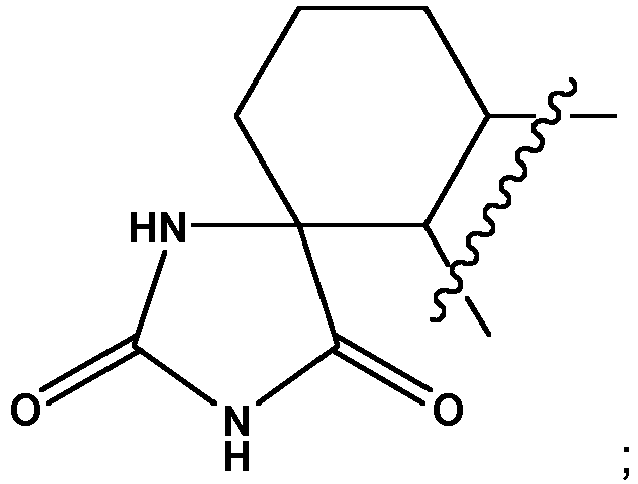
- In another embodiment, formula (I), formula (I) is selected from the group consisting of Formula (IA)


- In another embodiment, in formula (IA) or (IB), R2 is selected from the group consisting of H and halo.
- In another embodiment, in formula (IA) or (IB), R2 is selected from the group consisting of H and fluoro.
- In another embodiment, the compound of formula (I) is selected from the group consisting of:


- As used above, and throughout this disclosure, the following terms, unless otherwise indicated, shall be understood to have the following meanings:
"Patient" includes both human and animals. - "Mammal" means humans and other mammalian animals.
- "Alkyl" means an aliphatic hydrocarbon group which may be straight or branched and comprising about 1 to about 20 carbon atoms in the chain. Preferred alkyl groups contain about 1 to about 12 carbon atoms in the chain. More preferred alkyl groups contain about 1 to about 6 carbon atoms in the chain. Branched means that one or more lower alkyl groups such as methyl, ethyl or propyl, are attached to a linear alkyl chain. "Lower alkyl" means a group having about 1 to about 6 carbon atoms in the chain which may be straight or branched. The alkyl group may be substituted by one or more substituents which may be the same or different, each substituent being independently selected from the group consisting of halo, alkyl, aryl, heteroaryl, cycloalkyl, cyano, hydroxy, alkoxy, alkylthio, amino, oxime (e.g., =N-OH), -NH(alkyl), -NH(cycloalkyl), -N(alkyl)2, -O-C(O)-alkyl, -O-C(O)-aryl, -O-C(O)-cycloalkyl, carboxy and -C(O)O-alkyl. Non-limiting examples of suitable alkyl groups include methyl, ethyl, n-propyl, isopropyl and t-butyl.
- "Alkenyl" means an aliphatic hydrocarbon group containing at least one carbon-carbon double bond and which may be straight or branched and comprising about 2 to about 15 carbon atoms in the chain. Preferred alkenyl groups have about 2 to about 12 carbon atoms in the chain; and more preferably about 2 to about 6 carbon atoms in the chain. Branched means that one or more lower alkyl groups such as methyl, ethyl or propyl, are attached to a linear alkenyl chain. "Lower alkenyl" means about 2 to about 6 carbon atoms in the chain which may be straight or branched. "Alkenyl" may be unsubstituted or optionally substituted by one or more substituents which may be the same or different, each substituent being independently selected from the group consisting of halo, alkyl. aryl, heteroaryl, cycloalkyl, cyano, alkoxy and -S(alkyl). Non-limiting examples of suitable alkenyl groups include ethenyl, propenyl, n-butenyl, 3-methylbut-2-enyl, n-pentenyl, octenyl and decenyl.
- "Alkylene" means a difunctional group obtained by removal of a hydrogen atom from an alkyl group that is defined above. Non-limiting examples of alkylene include methylene, ethylene and propylene.
- "Alkynyl" means an aliphatic hydrocarbon group containing at least one carbon-carbon triple bond and which may be straight or branched and comprising about 2 to about 15 carbon atoms in the chain. Preferred alkynyl groups have about 2 to about 12 carbon atoms in the chain; and more preferably about 2 to about 4 carbon atoms in the chain. Branched means that one or more lower alkyl groups such as methyl, ethyl or propyl, are attached to a linear alkynyl chain. "Lower alkynyl" means about 2 to about 6 carbon atoms in the chain which may be straight or branched. Non-limiting examples of suitable alkynyl groups include ethynyl, propynyl, 2-butynyl and 3-methylbutynyl. "Alkynyl" may be unsubstituted or optionally substituted by one or more substituents which may be the same or different, each substituent being independently selected from the group consisting of alkyl, aryl and cycloalkyl.
- "Aryl" means an aromatic monocyclic or multicyclic ring system comprising about 6 to about 14 carbon atoms, preferably about 6 to about 10 carbon atoms. The aryl group can be optionally substituted with one or more "ring system substituents" which may be the same or different, and are as defined herein. Non-limiting examples of suitable aryl groups include phenyl and naphthyl.
- "Heteroaryl" means an aromatic monocyclic or multicyclic ring system comprising about 5 to about 14 ring atoms, preferably about 5 to about 10 ring atoms, in which one or more of the ring atoms is an element other than carbon, for example nitrogen, oxygen or sulfur, alone or in combination. Preferred heteroaryls contain about 5 to about 6 ring atoms. The "heteroaryl" can be optionally substituted by one or more "ring system substituents" which may be the same or different, and are as defined herein. The prefix aza, oxa or thia before the heteroaryl root name means that at least a nitrogen, oxygen or sulfur atom respectively, is present as a ring atom. A nitrogen atom of a heteroaryl can be optionally oxidized to the corresponding N-oxide. "Heteroaryl" may also include a heteroaryl as defined above fused to an aryl as defined above. Non-limiting examples of suitable heteroaryls include pyridyl, pyrazinyl, furanyl, thienyl, pyrimidinyl, pyridone (including N-substituted pyridones), isoxazolyl, isothiazolyl, oxazolyl, thiazolyl, pyrazolyl, furazanyl, pyrrolyl, pyrazolyl, triazolyl, 1,2,4-thiadiazolyl, pyrazinyl, pyridazinyl, quinoxalinyl, phthalazinyl, oxindolyl, imidazo[1,2-a]pyridinyl, imidazo[2,1-b]thiazolyl, benzofurazanyl, indolyl, azaindolyl, benzimidazolyl, benzothienyl, quinolinyl, imidazolyl, thienopyridyl, quinazolinyl, thienopyrimidyl, pyrrolopyridyl, imidazopyridyl, isoquinolinyl, benzoazaindolyl, 1,2,4-triazinyl, benzothiazolyl and the like. The term "heteroaryl" also refers to partially saturated heteroaryl moieties such as, for example, tetrahydroisoquinolyl, tetrahydroquinolyl and the like.
- "Aralkyl" or "arylalkyl" means an aryl-alkyl- group in which the aryl and alkyl are as previously described. Preferred aralkyls comprise a lower alkyl group. Non-limiting examples of suitable aralkyl groups include benzyl, 2-phenethyl and naphthalenylmethyl. The bond to the parent moiety is through the alkyl.
- "Alkylaryl" means an alkyl-aryl- group in which the alkyl and aryl are as previously described. Preferred alkylaryls comprise a lower alkyl group. Non-limiting example of a suitable alkylaryl group is tolyl. The bond to the parent moiety is through the aryl.
- "Cycloalkyl" means a non-aromatic mono- or multicyclic ring system comprising about 3 to about 10 carbon atoms, preferably about 5 to about 10 carbon atoms. Preferred cycloalkyl rings contain about 5 to about 7 ring atoms. The cycloalkyl can be optionally substituted with one or more "ring system substituents" which may be the same or different, and are as defined above. Non-limiting examples of suitable monocyclic cycloalkyls include cyclopropyl, cyclopentyl, cyclohexyl, cycloheptyl and the like. Non-limiting examples of suitable multicyclic cycloalkyls include 1-decalinyl, norbornyl, adamantyl and the like.
- "Cycloalkylalkyl" means a cycloalkyl moiety as defined above linked via an alkyl moiety (defined above) to a parent core. Non-limiting examples of suitable cycloalkylalkyls include cyclohexylmethyl, adamantylmethyl and the like.
- "Cycloalkenyl" means a non-aromatic mono or multicyclic ring system comprising about 3 to about 10 carbon atoms, preferably about 5 to about 10 carbon atoms which contains at least one carbon-carbon double bond. Preferred cycloalkenyl rings contain about 5 to about 7 ring atoms. The cycloalkenyl can be optionally substituted with one or more "ring system substituents" which may be the same or different, and are as defined above. Non-limiting examples of suitable monocyclic cycloalkenyls include cyclopentenyl, cyclohexenyl, cyclohepta-1,3-dienyl, and the like. Non-limiting example of a suitable multicyclic cycloalkenyl is norbornylenyl.
- "Cycloalkenylalkyl" means a cycloalkenyl moiety as defined above linked via an alkyl moiety (defined above) to a parent core. Non-limiting examples of suitable cycloalkenylalkyls include cyclopentenylmethyl, cyclohexenylmethyl and the like.
- "Halo" or "Halogen" means fluorine, chlorine, bromine, or iodine. Preferred are fluorine, chlorine and bromine.
- "Ring system substituent" means a substituent attached to an aromatic or non-aromatic ring system which, for example, replaces an available hydrogen on the ring system. Ring system substituents may be the same or different, each being independently selected from the group consisting of alkyl, alkenyl, alkynyl, aryl, heteroaryl, aralkyl, alkylaryl, heteroaralkyl, heteroarylalkenyl, heteroarylalkynyl, alkylheteroaryl, hydroxy, hydroxyalkyl, alkoxy, aryloxy, aralkoxy, acyl, aroyl, halo, nitro, cyano, carboxy, alkoxycarbonyl, aryloxycarbonyl, aralkoxycarbonyl, alkylsulfonyl, arylsulfonyl, heteroarylsulfonyl, alkylthio, arylthio, heteroarylthio, aralkylthio, heteroaralkylthio, cycloalkyl, heterocyclyl, -O-C(O)-alkyl, -O-C(O)-aryl, -O-C(O)-cycloalkyl, -C(=N-CN)-NH2, -C(=NH)-NH2, -C(=NH)-NH(alkyl), oxime (e.g., =N-OH), -NY1Y2, -alkyl-NY1Y2, -C(O)NY1Y2, -SO2NY1Y2 and -SO2NY1Y2, wherein Y1 and Y2 can be the same or different and are independently selected from the group consisting of hydrogen, alkyl, aryl, cycloalkyl, and aralkyl. "Ring system substituent" may also mean a single moiety which simultaneously replaces two available hydrogens on two adjacent carbon atoms (one H on each carbon) on a ring system. Examples of such moiety are methylene dioxy, ethylenedioxy, -C(CH3)2- and the like which form moieties such as, for example:

- "Heteroarylalkyl" means a heteroaryl moiety as defined above linked via an alkyl moiety (defined above) to a parent core. Non-limiting examples of suitable heteroaryls include 2-pyridinylmethyl, quinolinylmethyl and the like. "Heterocyclyl" means a non-aromatic saturated monocyclic or multicyclic ring system comprising about 3 to about 10 ring atoms, preferably about 5 to about 10 ring atoms, in which one or more of the atoms in the ring system is an element other than carbon, for example nitrogen, oxygen or sulfur, alone or in combination. There are no adjacent oxygen and/or sulfur atoms present in the ring system. Preferred heterocyclyls contain about 5 to about 6 ring atoms. The prefix aza, oxa or thia before the heterocyclyl root name means that at least a nitrogen, oxygen or sulfur atom respectively is present as a ring atom. Any -NH in a heterocyclyl ring may exist protected such as, for example, as an -N(Boc), -N(CBz), -N(Tos) group and the like; such protections are also considered part of this invention. The heterocyclyl can be optionally substituted by one or more "ring system substituents" which may be the same or different, and are as defined herein. The nitrogen or sulfur atom of the heterocyclyl can be optionally oxidized to the corresponding N-oxide, S-oxide or S,S-dioxide. Non-limiting examples of suitable monocyclic heterocyclyl rings include piperidyl, pyrrolidinyl, piperazinyl, morpholinyl, thiomorpholinyl, thiazolidinyl, 1,4-dioxanyl, tetrahydrofuranyl, tetrahydrothiophenyl, lactam, lactone, and the like. "Heterocyclyl" also includes heterocyclyl rings as described above wherein =O replaces two available hydrogens on the same ring carbon atom. Example of such moiety is pyrrolidone:
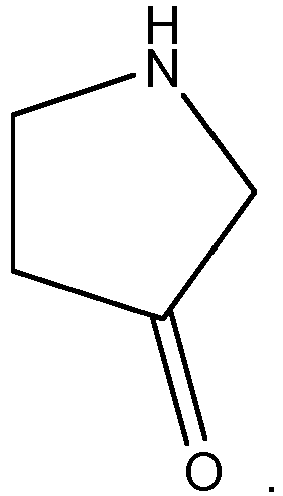
- "Heterocyclylalkyl" means a heterocyclyl moiety as defined above linked via an alkyl moiety (defined above) to a parent core. Non-limiting examples of suitable heterocyclylalkyls include piperidinylmethyl, piperazinylmethyl and the like.
- "Heterocyclenyl" means a non-aromatic monocyclic or multicyclic ring system comprising about 3 to about 10 ring atoms, preferably about 5 to about 10 ring atoms, in which one or more of the atoms in the ring system is an element other than carbon, for example nitrogen, oxygen or sulfur atom, alone or in combination, and which contains at least one carbon-carbon double bond or carbon-nitrogen double bond. There are no adjacent oxygen and/or sulfur atoms present in the ring system. Preferred heterocyclenyl rings contain about 5 to about 6 ring atoms. The prefix aza, oxa or thia before the heterocyclenyl root name means that at least a nitrogen, oxygen or sulfur atom respectively is present as a ring atom. The heterocyclenyl can be optionally substituted by one or more ring system substituents, wherein "ring system substituent" is as defined above. The nitrogen or sulfur atom of the heterocyclenyl can be optionally oxidized to the corresponding N-oxide, S-oxide or S,S-dioxide. Non-limiting examples of suitable heterocyclenyl groups include 1,2,3,4-tetrahydropyridinyl, 1,2-dihydropyridinyl, 1,4-dihydropyridinyl, 1,2,3,6-tetrahydropyridinyl, 1,4,5,6-tetrahydropyrimidinyl, 2-pyrrolinyl, 3-pyrrolinyl, 2-imidazolinyl, 2-pyrazolinyl, dihydroimidazolyl, dihydrooxazolyl, dihydrooxadiazolyl, dihydrothiazolyl, 3,4-dihydro-2H-pyranyl, dihydrofuranyl, fluorodihydrofuranyl, 7-oxabicyclo[2.2.1]heptenyl, dihydrothiophenyl, dihydrothiopyranyl, and the like. "Heterocyclenyl" also includes heterocyclenyl rings as described above wherein =O replaces two available hydrogens on the same ring carbon atom. Example of such moiety is pyrrolidinone:

- "Heterocyclenylalkyl" means a heterocyclenyl moiety as defined above linked via an alkyl moiety (defined above) to a parent core.
- It should be noted that in hetero-atom containing ring systems of this invention, there are no hydroxyl groups on carbon atoms adjacent to a N, O or S, as well as there are no N or S groups on carbon adjacent to another heteroatom. Thus, for example, in the ring:

- It should also be noted that tautomeric forms such as, for example, the moieties:

- "Alkynylalkyl" means an alkynyl-alkyl- group in which the alkynyl and alkyl are as previously described. Preferred alkynylalkyls contain a lower alkynyl and a lower alkyl group. The bond to the parent moiety is through the alkyl. Non-limiting examples of suitable alkynylalkyl groups include propargyl methyl.
- "Heteroaralkyl" means a heteroaryl-alkyl- group in which the heteroaryl and alkyl are as previously described. Preferred heteroaralkyls contain a lower alkyl group. Non-limiting examples of suitable aralkyl groups include pyridylmethyl, and quinolin-3-ylmethyl. The bond to the parent moiety is through the alkyl.
- "Hydroxyalkyl" means a HO-alkyl- group in which alkyl is as previously defined. Preferred hydroxyalkyls contain lower alkyl. Non-limiting examples of suitable hydroxyalkyl groups include hydroxymethyl and 2-hydroxyethyl.
- "Acyl" means an H-C(O)-, alkyl-C(O)- or cycloalkyl-C(O)-, group in which the various groups are as previously described. The bond to the parent moiety is through the carbonyl. Preferred acyls contain a lower alkyl. Non-limiting examples of suitable acyl groups include formyl, acetyl and propanoyl.
- "Aroyl" means an aryl-C(O)- group in which the aryl group is as previously described. The bond to the parent moiety is through the carbonyl. Non-limiting examples of suitable groups include benzoyl and 1- naphthoyl.
- "Alkoxy" means an alkyl-O- group in which the alkyl group is as previously described. Non-limiting examples of suitable alkoxy groups include methoxy, ethoxy, n-propoxy, isopropoxy and n-butoxy. The bond to the parent moiety is through the ether oxygen.
- "Aryloxy" means an aryl-O- group in which the aryl group is as previously described. Non-limiting examples of suitable aryloxy groups include phenoxy and naphthoxy. The bond to the parent moiety is through the ether oxygen.
- "Aralkyloxy" means an aralkyl-O- group in which the aralkyl group is as previously described. Non-limiting examples of suitable aralkyloxy groups include benzyloxy and 1- or 2-naphthalenemethoxy. The bond to the parent moiety is through the ether oxygen.
- "Alkylthio" means an alkyl-S- group in which the alkyl group is as previously described. Non-limiting examples of suitable alkylthio groups include methylthio and ethylthio. The bond to the parent moiety is through the sulfur.
- "Arylthio" means an aryl-S- group in which the aryl group is as previously described. Non-limiting examples of suitable arylthio groups include phenylthio and naphthylthio. The bond to the parent moiety is through the sulfur.
- "Aralkylthio" means an aralkyl-S- group in which the aralkyl group is as previously described. Non-limiting example of a suitable aralkylthio group is benzylthio. The bond to the parent moiety is through the sulfur.
- "Alkoxycarbonyl" means an alkyl-O-CO- group. Non-limiting examples of suitable alkoxycarbonyl groups include methoxycarbonyl and ethoxycarbonyl. The bond to the parent moiety is through the carbonyl.
- "Aryloxycarbonyl" means an aryl-O-C(O)- group. Non-limiting examples of suitable aryloxycarbonyl groups include phenoxycarbonyl and naphthoxycarbonyl. The bond to the parent moiety is through the carbonyl.
- "Aralkoxycarbonyl" means an aralkyl-O-C(O)- group. Non-limiting example of a suitable aralkoxycarbonyl group is benzyloxycarbonyl. The bond to the parent moiety is through the carbonyl.
- "Alkylsulfonyl" means an alkyl-S(O2)- group. Preferred groups are those in which the alkyl group is lower alkyl. The bond to the parent moiety is through the sulfonyl.
- "Arylsulfonyl" means an aryl-S(O2)- group. The bond to the parent moiety is through the sulfonyl.
- The term "substituted" means that one or more hydrogens on the designated atom is replaced with a selection from the indicated group, provided that the designated atom's normal valency under the existing circumstances is not exceeded, and that the substitution results in a stable compound. Combinations of substituents and/or variables are permissible only if such combinations result in stable compounds. By "stable compound' or "stable structure" is meant a compound that is sufficiently robust to survive isolation to a useful degree of purity from a reaction mixture, and formulation into an efficacious therapeutic agent.
- The term "optionally substituted" means optional substitution with the specified groups, radicals or moieties.
- The term "purified", "in purified form" or "in isolated and purified form" for a compound refers to the physical state of said compound after being isolated from a synthetic process (e.g. from a reaction mixture), or natural source or combination thereof. Thus, the term "purified", "in purified form" or "in isolated and purified form" for a compound refers to the physical state of said compound after being obtained from a purification process or processes described herein or well known to the skilled artisan (e.g., chromatography, recrystallization and the like), in sufficient purity to be characterizable by standard analytical techniques described herein or well known to the skilled artisan.
- It should also be noted that any carbon as well as heteroatom with unsatisfied valences in the text, schemes, examples and Tables herein is assumed to have the sufficient number of hydrogen atom(s) to satisfy the valences.
- When a functional group in a compound is termed "protected", this means that the group is in modified form to preclude undesired side reactions at the protected site when the compound is subjected to a reaction. Suitable protecting groups will be recognized by those with ordinary skill in the art as well as by reference to standard textbooks such as, for example, T. W. Greene et al, Protective Groups in organic Synthesis (1991), Wiley, New York.
- When any variable (e.g., aryl, heterocycle, R2, etc.) occurs more than one time in any constituent or in Formula (I), its definition on each occurrence is independent of its definition at every other occurrence.
- As used herein, the term "composition" is intended to encompass a product comprising the specified ingredients in the specified amounts, as well as any product which results, directly or indirectly, from combination of the specified ingredients in the specified amounts.
- Solvates of the compounds of the invention are also contemplated herein. The term "prodrug", as employed herein, denotes a compound that is a drug precursor which, upon administration to a subject, undergoes chemical conversion by metabolic or chemical processes to yield a compound of Formula (I) or a salt and/or solvate thereof. A discussion of prodrugs is provided in T. Higuchi and V. Stella, Pro-drugs as Novel Delivery Systems (1987) 14 of the A.C.S. Symposium Series, and in Bioreversible Carriers in Drug Design, (1987) Edward B. Roche, ed., American Pharmaceutical Association and Pergamon Press. The term "prodrug" means a compound (e.g, a drug precursor) that is transformed in vivo to yield a compound of Formula (I) or a pharmaceutically acceptable salt, hydrate or solvate of the compound. The transformation may occur by various mechanisms (e.g., by metabolic or chemical processes), such as, for example, through hydrolysis in blood. A discussion of the use of prodrugs is provided by T. Higuchi and W. Stella, "Pro-drugs as Novel Delivery Systems," Vol. 14 of the A.C.S. Symposium Series, and in Bioreversible Carriers in Drug Design, ed. Edward B. Roche, American Pharmaceutical Association and Pergamon Press, 1987.
- For example, if a compound of Formula (I) or a pharmaceutically acceptable salt, hydrate or solvate of the compound contains a carboxylic acid functional group, a prodrug can comprise an ester formed by the replacement of the hydrogen atom of the acid group with a group such as, for example, (C1-C8)alkyl, (C2-C12)alkanoyloxymethyl, 1-(alkanoyloxy)ethyl having from 4 to 9 carbon atoms, 1-methyl-1-(alkanoyloxy)-ethyl having from 5 to 10 carbon atoms, alkoxycarbonyloxymethyl having from 3 to 6 carbon atoms, 1-(alkoxycarbonyloxy)ethyl having from 4 to 7 carbon atoms, 1-methyl-1-(alkoxycarbonyloxy)ethyl having from 5 to 8 carbon atoms, N-(alkoxycarbonyl)aminomethyl having from 3 to 9 carbon atoms, 1-(N-(alkoxycarbonyl)amino)ethyl having from 4 to 10 carbon atoms, 3-phthalidyl, 4-crotonolactonyl, gamma-butyrolacton-4-yl, di-N,N-(C1-C2)alkylamino(C2-C3)alkyl (such as β-dimethylaminoethyl), carbamoyl-(C1-C2)alkyl, N,N-di(C1-C2)alkylcarbamoyl-(C1-C2)alkyl and piperidino-, pyrrolidino- or morpholino(C2-C3)alkyl, and the like.
- Similarly, if a compound of Formula (I) contains an alcohol functional group, a prodrug can be formed by the replacement of the hydrogen atom of the alcohol group with a group such as, for example, (C1-C6)alkanoyloxymethyl, 1-((C1-C6)alkanoyloxy)ethyl, 1-methyl-1-((C1-C6)alkanoyloxy)ethyl, (C1-C6)alkoxycarbonyloxymethyl, N-(C1-C6)alkoxycarbonylaminomethyl, succinoyl, (C1-C6)alkanoyl, α-amino(C1-C4)alkanyl, arylacyl and α-aminoacyl, or α-aminoacyl-α-aminoacyl, where each α-aminoacyl group is independently selected from the naturally occurring L-amino acids, P(O)(OH)2, -P(O)(O(C1-C6)alkyl)2 or glycosyl (the radical resulting from the removal of a hydroxyl group of the hemiacetal form of a carbohydrate), and the like.
- If a compound of Formula (I) incorporates an amine functional group, a prodrug can be formed by the replacement of a hydrogen atom in the amine group with a group such as, for example, R-carbonyl, RO-carbonyl, NRR'-carbonyl where R and R' are each independently (C1-C10)alkyl, (C3-C7) cycloalkyl, benzyl, or R-carbonyl is a natural α-aminoacyl or natural α-aminoacyl, -C(OH)C(O)OY1 wherein Y1 is H, (C1-C6)alkyl or benzyl, -C(OY2)Y3 wherein Y2 is (C1-C4) alkyl and Y3 is (C1-C6)alkyl, carboxy (C1-C6)alkyl, amino(C1-C4)alkyl or mono-N-or di-N,N-(C1-C6)alkylaminoalkyl, -C(Y4)Y5 wherein Y4 is H or methyl and Y5 is mono-N- or di-N,N-(C1-C6)alkylamino morpholino, piperidin-1-yl or pyrrolidin-1-yl, and the like.
- "Solvate" means a physical association of a compound of this invention with one or more solvent molecules. This physical association involves varying degrees of ionic and covalent bonding, including hydrogen bonding. In certain instances the solvate will be capable of isolation, for example when one or more solvent molecules are incorporated in the crystal lattice of the crystalline solid. "Solvate" encompasses both solution-phase and isolatable solvates. Non-limiting examples of suitable solvates include ethanolates, methanolates, and the like. "Hydrate" is a solvate wherein the solvent molecule is H2O.
- "Effective amount" or "therapeutically effective amount" is meant to describe an amount of compound or a composition of the present invention effective in inhibiting TACE, the production of TNF-α, MMPs, ADAMS or any combination thereof and thus producing the desired therapeutic, ameliorative, inhibitory or preventative effect.
- The compounds of Formula (I) can form salts which are also within the scope of this invention. Reference to a compound of Formula (I) herein is understood to include reference to salts thereof, unless otherwise indicated. The term "salt(s)", as employed herein, denotes acidic salts formed with inorganic and/or organic acids, as well as basic salts formed with inorganic and/or organic bases. In addition, when a compound of Formula (I) contains both a basic moiety, such as, but not limited to a pyridine or imidazole, and an acidic moiety, such as, but not limited to a carboxylic acid, zwitterions ("inner salts") may be formed and are included within the term "salt(s)" as used herein. Pharmaceutically acceptable (i.e., non-toxic, physiologically acceptable) salts are preferred, although other salts are also useful. Salts of the compounds of the Formula (I) may be formed, for example, by reacting a compound of Formula (I) with an amount of acid or base, such as an equivalent amount, in a medium such as one in which the salt precipitates or in an aqueous medium followed by lyophilization.
- Exemplary acid addition salts include acetates, ascorbates, benzoates, benzenesulfonates, bisulfates, borates, butyrates, citrates, camphorates, camphorsulfonates, fumarates, hydrochlorides, hydrobromides, hydroiodides, lactates, maleates, methanesulfonates, naphthalenesulfonates, nitrates, oxalates, phosphates, propionates, salicylates, succinates, sulfates, tartarates, thiocyanates, toluenesulfonates (also known as tosylates,) and the like. Additionally, acids which are generally considered suitable for the formation of pharmaceutically useful salts from basic pharmaceutical compounds are discussed, for example, by P. Stahl et al, Camille G. (eds.) Handbook of Pharmaceutical Salts. Properties, Selection and Use. (2002) Zurich: Wiley-VCH; S. Berge et al, Journal of Pharmaceutical Sciences (1977) 66(1) 1-19; P. Gould, International J. of Pharmaceutics (1986) 33 201-217; Anderson et al, The Practice of Medicinal Chemistry (1996), Academic Press, New York; and in The Orange Book (Food & Drug Administration, Washington, D.C. on their website). Exemplary basic salts include ammonium salts, alkali metal salts such as sodium, lithium, and potassium salts, alkaline earth metal salts such as calcium and magnesium salts, salts with organic bases (for example, organic amines) such as dicyclohexylamines, t-butyl amines, and salts with amino acids such as arginine, lysine and the like. Basic nitrogen-containing groups may be quarternized with agents such as lower alkyl halides (e.g. methyl, ethyl, and butyl chlorides, bromides and iodides), dialkyl sulfates (e.g. dimethyl, diethyl, and dibutyl sulfates), long chain halides (e.g. decyl, lauryl, and stearyl chlorides, bromides and iodides), aralkyl halides (e.g. benzyl and phenethyl bromides), and others.
- All such acid salts and base salts are intended to be pharmaceutically acceptable salts within the scope of the invention and all acid and base salts are considered equivalent to the free forms of the corresponding compounds for purposes of the invention.
- Compounds of Formula (I) and salts and solvates thereof, may exist in their tautomeric form (for example, as an amide or imino ether). All such tautomeric forms are contemplated herein as part of the present invention.
- All stereoisomers (for example, geometric isomers, optical isomers and the like) of the present compounds (including those of the salts and solvates of the compounds), such as those which may exist due to asymmetric carbons on various substituents, including enantiomeric forms (which may exist even in the absence of asymmetric carbons), rotameric forms, atropisomers, and diastereomeric forms, are contemplated within the scope of this invention, as are positional isomers (such as, for example, 4-pyridyl and 3-pyridyl). Individual stereoisomers of the compounds of the invention may, for example, be substantially free of other isomers, or may be admixed, for example, as racemates or with all other, or other selected, stereoisomers. The chiral centers of the present invention can have the S or R configuration as defined by the IUPAC 1974 Recommendations. The use of the terms "salt", "solvate" "prodrug" and the like, is intended to equally apply to the salt, solvate and prodrug of enantiomers, stereoisomers, rotamers, tautomers, positional isomers, racemates or prodrugs of the inventive compounds.
- The present invention also embraces isotopically-labelled compounds of the present invention which are identical to those recited herein, but for the fact that one or more atoms are replaced by an atom having an atomic mass or mass number different from the atomic mass or mass number usually found in nature. Examples of isotopes that can be incorporated into compounds of the invention include isotopes of hydrogen, carbon, nitrogen, oxygen, phosphorus, fluorine and chlorine and iodine, such as 2H, 3H, 11C, 13C, 14C, 15N, 18O, 17O, 31P, 32P, 35S, 18F, 36Cl and 123I, respectively.
- Certain isotopically-labelled compounds of Formula (I) (e.g., those labeled with 3H and 14C) are useful in compound and/or substrate tissue distribution assays. Tritiated (i.e., 3H) and carbon-14 (i.e., 14C) isotopes are particularly preferred for their ease of preparation and detectability. Certain isotopically-labelled compounds of Formula (I) can be useful for medical imaging purposes such as those labeled with positron-emitting isotopes like 11C or 18F can be useful for application in Positron Emission Tomography (PET) and those labeled with gamma ray emitting isotopes like 123I can be useful for application in Single photon emission computed tomography (SPECT). Further, substitution with heavier isotopes such as deuterium (i.e., 2H) may afford certain therapeutic advantages resulting from greater metabolic stability (e.g., increased in vivo half-life or reduced dosage requirements) and hence may be preferred in some circumstances. Additionally, isotopic substitution at a site where epimerization occurs may slow or reduce the epimerization process and thereby retain the more active or efficacious form of the compound for a longer period of time. Isotopically labeled compounds of Formula (I), in particular those containing isotopes with longer half lives (T1/2 >1 day), can generally be prepared by following procedures analogous to those disclosed in the Schemes and/or in the Examples herein below, by substituting an appropriate isotopically labeled reagent for a non-isotopically labeled reagent.
- Polymorphic forms of the compounds of Formula (I), and of the salts and solvates of the compounds of Formula (I) are intended to be included in the present invention.
- The compounds according to the invention have pharmacological properties; in particular, the compounds of Formula (I) can be inhibitors of TACE, aggrecanase, TNF-α and/or MMP activity.
- In one aspect, the invention provides a pharmaceutical composition comprising at least one compound of Formula (I) and additionally comprising at least one pharmaceutically acceptable carrier.
- Described herein is a method of treating disorders associated with TACE, aggrecanase, TNF-α, MMPs, ADAMs or any combination thereof, said method comprising administering to a patient in need of such treatment an effective amount of at least one compound of Formula (I).
- In another aspect, the invention provides a use of a compound of Formula (I) for the manufacture of a medicament for treating rheumatoid arthritis, psoriasis or inflammatory bowel disease.
- The compounds of Formula (I) can have anti-inflammatory activity and/or immunomodulatory activity and can be useful in the treatment of diseases including but not limited to septic shock, haemodynamic shock, sepsis syndrome, post ischaemic reperfusion injury, malaria, mycobacterial infection, meningitis, psoriasis, congestive heart failure, fibrotic diseases, cachexia, graft rejection, cancers such as cutaneous T-cell lymphoma, diseases involving angiogenesis, autoimmune diseases, skin inflammatory diseases, inflammatory bowel diseases such as Crohn's disease and colitis, OA and RA, ankylosing spondylitis, psoriatic arthritis, adult Still's disease, ureitis, Wegener's granulomatosis, Behcehe disease, Sjogren's syndrome, sarcoidosis, polymyositis, dermatomyositis, multiple sclerosis, sciatica, complex regional pain syndrome, radiation damage, hyperoxic alveolar injury, periodontal disease, HIV, non-insulin dependent diabetes mellitus, systemic lupus erythematosus, glaucoma, sarcoidosis, idiopathic pulmonary fibrosis, bronchopulmonary dysplasia, retinal disease, scleroderma, osteoporosis, renal ischemia, myocardial infarction, cerebral stroke, cerebral ischemia, nephritis, hepatitis, glomerulonephritis, cryptogenic fibrosing aveolitis, psoriasis, transplant rejection, atopic dermatitis, vasculitis, allergy, seasonal allergic rhinitis, reversible airway obstruction, adult respiratory distress syndrome, asthma, chronic obstructive pulmonary disease (COPD) and/or bronchitis. It is contemplated that a compound of this invention may be useful in treating one or more of the diseases listed.
- Described herein is a method of preparing a pharmaceutical composition for treating the disorders associated with TACE, aggrecanase, TNF-α, MMPs, ADAMs or any combination thereof, said method comprising bringing into intimate contact at least one compound of Formula (I) and at least one pharmaceutically acceptable carrier.
- Described herein is a compound of Formula (I) exhibiting TACE, TNF-α, MMPs, ADAMs or any combination thereof inhibitory activity, including enantiomers, stereoisomers and tautomers of said compound, and pharmaceutically acceptable salts, solvates, or esters of said compound, said compound being selected from the compounds of structures listed in Table 1 set forth below.
- Described herein is a pharmaceutical composition for treating disorders associated with TACE, aggrecanase, TNF-α, MMP, ADAM or any combination thereof in a patient comprising, administering to the patient in need of such treatment a therapeutically effective amount of at least one compound of Formula (I) or a pharmaceutically acceptable salt, solvate, ester, or isomer thereof.
- In another aspect, the invention provides a compound of Formula (I) in purified form.
- Disclosed herein is a method of treating a condition or disease mediated by TACE, MMPs, TNF-α, aggrecanase, or any combination thereof in a patient comprising: administering to the patient in need of such treatment a therapeutically effective amount of at least one compound of Formula (I) or a pharmaceutically acceptable salt, solvate, ester or isomer thereof.
- Disclosed herein is a method of treating a condition or disease selected from the group consisting of rheumatoid arthritis, osteoarthritis, periodontitis, gingivitis, corneal ulceration, solid tumor growth and tumor invasion by secondary metastases, neovascular glaucoma, inflammatory bowel disease, multiple sclerosis and psoriasis in a patient, comprising: administering to the patient in need of such treatment a therapeutically effective amount of at least one compound of Formula (I) or a pharmaceutically acceptable salt, solvate, ester or isomer thereof.
- Disclosed herein is a method of treating a condition or disease selected from the group consisting of fever, cardiovascular conditions, hemorrhage, coagulation, cachexia, anorexia, alcoholism, acute phase response, acute infection, shock, graft versus host reaction, autoimmune disease and HIV infection in a patient comprising administering to the patient in need of such treatment a therapeutically effective amount of at least one compound of Formula (I) or a pharmaceutically acceptable salt, solvate, ester, or isomer thereof.
- Disclosed herein is a method of treating a condition or disease selected from the group consisting of septic shock, haemodynamic shock, sepsis syndrome, post ischaemic reperfusion injury, malaria, mycobacterial infection, meningitis, psoriasis, congestive heart failure, fibrotic diseases, cachexia, graft rejection, cancers such as cutaneous T-cell lymphoma, diseases involving angiogenesis, autoimmune diseases, skin inflammatory diseases, inflammatory bowel diseases such as Crohn's disease and colitis, osteo and rheumatoid arthritis, ankylosing spondylitis, psoriatic arthritis, adult Still's disease, ureitis, Wegener's granulomatosis, Behcehe disease, Sjogren's syndrome, sarcoidosis, polymyositis, dermatomyositis, multiple sclerosis, sciatica, complex regional pain syndrome, radiation damage, hyperoxic alveolar injury, periodontal disease, HIV, non-insulin dependent diabetes mellitus, systemic lupus erythematosus, glaucoma, sarcoidosis, idiopathic pulmonary fibrosis, bronchopulmonary dysplasia, retinal disease, scleroderma, osteoporosis, renal ischemia, myocardial infarction, cerebral stroke, cerebral ischemia, nephritis, hepatitis, glomerulonephritis, cryptogenic fibrosing aveolitis, transplant rejection, atopic dermatitis, vasculitis, allergy, seasonal allergic rhinitis, reversible airway obstruction, adult respiratory distress syndrome, asthma, chronic obstructive pulmonary disease (COPD) and bronchitis in a patient comprising administering to the patient in need of such treatment a therapeutically effective amount of at least one compound of Formula (I) or a pharmaceutically acceptable salt, solvate, ester or isomer thereof.
- Disclosed herein is a method of treating a condition or disease selected from the group consisting of rheumatoid arthritis, psoriasis, psoriatic arthritis, ankylosing spondylitis, Crohn's disease, and ulcerative colitis, comprising: administering to a patient in need of such treatment a therapeutically effective amount of at least one compound of Formula (I) or a pharmaceutically acceptable salt, solvate, ester or isomer thereof.
- Disclosed herein is a method of treating rheumatoid arthritis, psoriasis, or inflammatory bowel disease (e.g. Crohn's disease or ulcerative colitis) comprising: administering to a patient in need of such treatment a therapeutically effective amount of at least one compound of Formula (I) or a pharmaceutically acceptable salt, solvate, ester or isomer thereof.
- Disclosed herein is a method of treating a condition or disease associated with COPD, comprising: administering to the patient in need of such treatment a therapeutically effective amount of at least one compound of Formula (I) or a pharmaceutically acceptable salt, solvate, ester or isomer thereof.
- Disclosed herein is a method of treating a condition or disease associated with rheumatoid arthritis, comprising: administering to the patient in need of such treatment a therapeutically effective amount of at least one compound of Formula (I) or a pharmaceutically acceptable salt, solvate, ester, or isomer thereof.
- Disclosed herein is a method of treating a condition or disease associated with Crohn's disease, comprising: administering to the patient in need of such treatment a therapeutically effective amount of at least one compound of Formula (I) or a pharmaceutically acceptable salt, solvate, ester or isomer thereof.
- Disclosed herein is a method of treating a condition or disease associated with psoriasis, comprising: administering to the patient in need of such treatment a therapeutically effective amount of at least one compound of Formula (I) or a pharmaceutically acceptable salt, solvate, ester, or isomer thereof. In specific embodiments, the therapeutically effective amount of the at least one compound of Formula (I) or a pharmaceutically acceptable salt, solvate, ester or isomer thereof is topically administered to the patient in need of treatment for psoriasis.
- Disclosed herein is a method of treating a condition or disease associated with ankylosing spondylitis, comprising: administering to the patient in need of such treatment a therapeutically effective amount of at least one compound of Formula (I) or a pharmaceutically acceptable salt, solvate, ester or isomer thereof.
- Disclosed herein is a method of treating a condition or disease associated with sciatica, comprising: administering to the patient in need of such treatment a therapeutically effective amount of at least one compound of Formula (I) or a pharmaceutically acceptable salt, solvate, ester or isomer thereof.
- Disclosed herein is a method of treating a condition or disease associated with complex regional pain syndrome, comprising: administering to the patient in need of such treatment a therapeutically effective amount of at least one compound of Formula (I) or a pharmaceutically acceptable salt, solvate, ester, or isomer thereof.
- Disclosed herein is a method of treating a condition or disease associated with psoriatic arthritis, comprising: administering to the patient in need of such treatment a therapeutically effective amount of at least one compound of Formula (I), or a pharmaceutically acceptable salt, solvate, ester, or isomer thereof.
- Disclosed herein is a method of treating a condition or disease associated with multiple sclerosis, comprising: administering to the patient in need of such treatment a therapeutically effective amount of at least one compound of Formula (I) or a pharmaceutically acceptable salt, solvate, ester or isomer thereof, in combination with a compound selected from the group consisting of Avonex®, Betaseron, Copaxone or other compounds indicated for the treatment of multiple sclerosis.
- Additionally, a compound of the present invention may be co-administered or used in combination with disease-modifying antirheumatic drugs (DMARDS) such as methotrexate, azathioprine, leflunomide, pencillinamine, gold salts, mycophenolate mofetil, cyclophosphamide and other similar drugs. They may also be co-administered with or used in combination with non-steroidal anti-inflammatory drugs (NSAIDs) such as piroxicam, naproxen, indomethacin, ibuprofen and the like; cycloxygenase-2 selective (COX-2) inhibitors such as Vioxx® and Celebrex®; immunosuppressives such as steroids, cyclosporin, Tacrolimus, rapamycin and the like; biological response modifiers (BRMs) such as Enbrel®, Remicade®, IL-1 antagonists, anti-CD40, anti-CD28, IL-10, anti-adhesion molecules and the like; and other anti-inflammatory agents such as p38 kinase inhibitors, PDE4 inhibitors, other chemically different TACE inhibitors, chemokine receptor antagonists, Thalidomide and other small molecule inhibitors of pro-inflammatory cytokine production.
- Also, a compound of the present invention may be co-administered or used in combination with an H1 antagonist for the treatment of seasonal allergic rhinitis and/or asthma. Suitable H1 antagonists may be, for example, Claritin®, Clarinex®, Allegra®, or Zyrtec®.
- Disclsoed herein is a method of treating a condition or disease mediated by TACE, MMPs, TNF-α, aggrecanase, or any combination thereof in a patient comprising: administering to the patient in need of such treatment a therapeutically effective amount of at least one compound of Formula (I) or a pharmaceutically acceptable salt, solvate or isomer thereof in combination with a therapeutically effective amount of at least one medicament selected from the group consisting of disease modifying anti-rheumatic drugs (DMARDS), NSAIDs, COX-2 inhibitors, COX-1 inhibitors, immunosuppressives, biological response modifiers (BRMs), anti-inflammatory agents and H1 antagonists.
- Disclsoed herein is a method of treating a condition or disease selected from the group consisting of rheumatoid arthritis, osteoarthritis, periodontitis, gingivitis, corneal ulceration, solid tumor growth and tumor invasion by secondary metastases, neovascular glaucoma, inflammatory bowel disease, multiple sclerosis and psoriasis in a patient, comprising: administering to the patient in need of such treatment a therapeutically effective amount of at least one compound of Formula (I) or a pharmaceutically acceptable salt, solvate, ester, or isomer thereof in combination with a therapeutically effective amount of at least one medicament selected from the group consisting of DMARDS, NSAIDs, COX-2 inhibitors, COX-1 inhibitors, immunosuppressives, BRMs, anti-inflammatory agents and H1 antagonists.
- Disclosed herein is a method of treating a condition or disease selected from the group consisting of fever, cardiovascular conditions, hemorrhage, coagulation, cachexia, anorexia, alcoholism, acute phase response, acute infection, shock, graft versus host reaction, autoimmune disease, and HIV in a patient, comprising administering to the patient in need of such treatment a therapeutically effective amount of at least one compound of Formula (I) or a pharmaceutically acceptable salt, solvate, ester, or isomer thereof in combination with a therapeutically effective amount of at least one medicament selected from the group consisting of DMARDS, NSAIDs, COX-2 inhibitors, COX-1 inhibitors, immunosuppressives, BRMs, anti-inflammatory agents and H1 antagonists.
- Disclosed herein is a method of treating a condition or disease selected from the group consisting of septic shock, haemodynamic shock, sepsis syndrome, post ischaemic reperfusion injury, malaria, mycobacterial infection, meningitis, psoriasis, congestive heart failure, fibrotic diseases, cachexia, graft rejection, cancers such as cutaneous T-cell lymphoma, diseases involving angiogenesis, autoimmune diseases, skin inflammatory diseases, inflammatory bowel diseases such as Crohn's disease and colitis, osteo and rheumatoid arthritis, ankylosing spondylitis, psoriatic arthritis, adult Still's disease, ureitis, Wegener's granulomatosis, Behcehe disease, Sjogren's syndrome, sarcoidosis, polymyositis, dermatomyositis, multiple sclerosis, sciatica, complex regional pain syndrome, radiation damage, hyperoxic alveolar injury, periodontal disease, HIV, non-insulin dependent diabetes mellitus, systemic lupus erythematosus, glaucoma, sarcoidosis, idiopathic pulmonary fibrosis, bronchopulmonary dysplasia, retinal disease, scleroderma, osteoporosis, renal ischemia, myocardial infarction, cerebral stroke, cerebral ischemia, nephritis, hepatitis, glomerulonephritis, cryptogenic fibrosing aveolitis, transplant rejection, atopic dermatitis, vasculitis, allergy, seasonal allergic rhinitis, reversible airway obstruction, adult respiratory distress syndrome, asthma, chronic obstructive pulmonary disease (COPD) and bronchitis in a patient comprising administering to the patient in need of such treatment a therapeutically effective amount of at least one compound of Formula (I), or a pharmaceutically acceptable salt, solvate, ester or isomer thereof in combination with a therapeutically effective amount of at least one medicament selected from the group consisting of DMARDS, NSAIDs, COX-2 inhibitors, COX-1 inhibitors, immunosuppressives, BRMs, anti-inflammatory agents and H1 antagonists.
- Disclosed herein is a method for treating RA comprising administering a compound of the Formula (I) in combination with compound selected from the class consisting of a COX-2 inhibitor e.g. Celebrex® or Vioxx®; a COX-1 inhibitor, e.g., Feldene®; an immunosuppressive e.g. methotrexate or cyclosporin; a steroid e.g. β-methasone; and anti-TNF-a compound, e.g. Enbrel® or Remicade®; a PDE IV inhibitor, or other classes of compounds indicated for the treatment of RA.
- Disclosed herein is a method for treating multiple sclerosis comprising administering a compound of the Formula (I) in combination with a compound selected from the group consisting of Avonex®, Betaseron, Copaxone or other compounds indicated for the treatment of multiple sclerosis.
- TACE activity is determined by a kinetic assay measuring the rate of increase in fluorescent intensity generated by TACE catalyzed cleavage of an internally quenched peptide substrate (SPDL-3). The purified catalytic domain of recombinant human TACE (rhTACEc, Residue 215 to 477 with two mutations (S266A and N452Q) and a 6xHis tail) is used in the assay. It is purified from the baculovirus/Hi5 cells expression system using affinity chromatography. The substrate SPDL-3 is an internally quenched peptide (MCA-Pro-Leu-Ala-Gln-Ala-Val-Arg-Ser-Ser-Ser-Dpa-Arg-NH2), with its sequence derived from the pro-TNFα cleavage site. MCA is (7-Methoxycoumarin-4-yl)acetyl. Dpa is N-3-(2,4-Dinitrophenyl)-L-2,3-diaminopropionyl.
- A 50 µl assay mixture contains 20 mM HEPES, pH 7.3, 5 mM CaCl2, 100 µM ZnCl2, 2 % DMSO, 0.04% Methylcellulose, 30 µM SPDL-3, 70 pM rhTACEc and a test compound. RhTACEc is pre-incubated with the test compound for 90 min. at 25 °C. Reaction is started by addition of the substrate. The fluorescent intensity (excitation at 320 nm, emission at 405 nm) was measured every 45 seconds for 30 min. using a fluorospectrometer (GEMINI XS, Molecular Devices). Rate of enzymatic reaction is shown as Units per second. Effect of a test compound is shown as % of TACE activity in the absence of the compound.
- The compounds' ability to inhibit TACE activity can also be determined in human whole blood using the assay conditions described in Example 35 below.
- The pharmaceutical compositions containing the active ingredient may be in a form suitable for oral use, for example, as tablets, lozenges, aqueous or oily suspensions, dispersible powders or granules, emulsions, hard or soft capsules, or syrups or elixirs. Compositions intended for oral use may be prepared according to any method known to the art for the manufacture of pharmaceutical compositions and such compositions may contain one or more agents selected from the group consisting of sweetening agents, flavoring agents, coloring agents and preserving agents in order to provide pharmaceutically elegant and palatable preparations. Tablets contain the active ingredient in admixture with non-toxic pharmaceutically acceptable excipients that are suitable for the manufacture of tablets. These excipients may be for example, inert diluents, such as calcium carbonate, sodium carbonate, lactose, calcium phosphate or sodium phosphate; granulating and disintegrating agents, for example, corn starch, or alginic acid; binding agents, for example starch, gelatin or acacia, and lubricating agents, for example magnesium stearate, stearic acid or talc. The tablets may be uncoated or they may be coated by known techniques to delay disintegration and absorption in the gastrointestinal tract and thereby provide a sustained action over a longer period. For example, a time delay material such as glyceryl monostearate or glyceryl distearate may be employed. They may also be coated by the technique described in the
U.S. Pat. Nos. 4,256,108 ;4,166,452 ; and4,265,874 to form osmotic therapeutic tablets for controlled release. - The term pharmaceutical composition is also intended to encompass both the bulk composition and individual dosage units comprised of more than one (e.g., two) pharmaceutically active agents such as, for example, a compound of the present invention and an additional agent selected from the lists of the additional agents described herein, along with any pharmaceutically inactive excipients. The bulk composition and each individual dosage unit can contain fixed amounts of the afore-said "more than one pharmaceutically active agents". The bulk composition is material that has not yet been formed into individual dosage units. An illustrative dosage unit is an oral dosage unit such as tablets, pills and the like. Similarly, the herein-described method of treating a patient by administering a pharmaceutical composition of the present invention is also intended to encompass the administration of the afore-said bulk composition and individual dosage units.
- Formulations for oral use may also be presented as hard gelatin capsules wherein the active ingredients is mixed with an inert solid diluent, for example, calcium carbonate, calcium phosphate or kaolin, or a soft gelatin capsules where in the active ingredient is mixed with water or an oil medium, for example peanut oil, liquid paraffin or olive oil.
- Aqueous suspensions contain the active material in admixture with excipients suitable for the manufacture of aqueous suspensions. Such excipients are suspending agents, for example, sodium carboxymethylcellulose, methylcellulose, hydroxypropylmethyl-cellulose, sodium alginate, polyvinyl-pyrrolidone, gum tragacanth and gum acacia; dispersing or wetting agents may be a naturally-occurring phosphatide, for example, lecithin, or condensation products of an alkylene oxide with fatty acids, for example polyoxyethylene stearate, or condensation products of ethylene oxide with long chain aliphatic alcohols, for example, heptadecaethylene-oxycetanol, or condensation products of ethylene oxide with partial esters derived from fatty acids and a hexitol such as polyoxyethylene sorbitol monooleate, or condensation products of ethylene oxide with partial esters derived from fatty acids and hexitol anhydrides, for example, polyethylene sorbitan monooleate. The aqueous suspensions may also contain one or more preservatives, for example, ethyl or n-propyl, p-hydroxybenzoate, one or more coloring agents, one or more flavoring agents, and one or more sweetening agents, such as sucrose, saccharin or aspartame.
- Oily suspensions may be formulated by suspending the active ingredient in a vegetable oil, for example, arachis oil, olive oil, sesame oil or coconut oil, or in mineral oil such as liquid paraffin. The oily suspensions may contain a thickening agent, for example, beeswax, hard paraffin or cetyl alcohol. Sweetening agents such as those set forth above, and flavoring agents may be added to provide a palatable oral preparation. These compositions may be preserved by the addition of an anti-oxidant such as ascorbic acid.
- Dispersible powders and granules suitable for preparation of an aqueous suspension by the addition of water provide the active ingredient in admixture with a dispersing or wetting agent, suspending agent and one or more preservatives. Suitable dispersing or wetting agents and suspending agents are exemplified by those already mentioned above. Additional excipients, e.g., sweetening, flavoring and coloring agents, may also be present.
- The pharmaceutical compositions of the invention may also be in the form of an oil-in-water emulsion. The oily phase may be a vegetable oil, e.g., olive oil or arachis oil, or a mineral oil, e.g., liquid paraffin or mixtures of these. Suitable emulsifying agents may be naturally-occurring phosphatides, e.g., soy beans, lecithin, and esters or partial esters derived from fatty acids and hexitol anhydrides, for example, sorbitan monooleate, and condensation products of the said partial esters with ethylene oxide, e.g., polyoxyethylene sorbitan monooleate. The emulsions may also contain sweetening and flavoring agents.
- Syrups and elixirs may be formulated with sweetening agents, for example, glycerol, propylene glycol, sorbitol or sucrose. Such formulations may also contain a demulcent, a preservative and flavoring and coloring agents.
- The pharmaceutical compositions may be in the form of a sterile injectable aqueous or oleagenous suspension. This suspension may be formulated according to the known art using those suitable dispersing or wetting agents and suspending agents which have been mentioned above. The sterile injectable preparation may also be a sterile injectable solution or suspension in a non-toxic parenterally-acceptable diluent or solvent, e.g., as a solution in 1,3-butane diol. Among the acceptable vehicles and solvents that may be employed are water, Ringer's solution and isotonic sodium chloride solution. In addition, sterile fixed oils are conventionally employed as a solvent or suspending medium. For this purpose any bland fixed oil may be employed including synthetic mono- or diglycerides. In addition, fatty acids such as oleic acid find use in the preparation of injectables.
- Compounds of the invention may also be administered in the form of suppositories for rectal administration of the drug. The compositions can be prepared by mixing the drug with a suitable non-irritating excipient which is solid at ordinary temperatures but liquid at the rectal temperature and will therefore melt in the rectum to release the drug. Such materials are cocoa butter and polyethylene glycols.
- For topical use, creams, ointments, jellies, solutions or suspensions, etc., containing the compounds of the invention are employed. (For purposes of this application, topical application shall include mouthwashes and gargles.)
- The compounds for the present invention can be administered in the intranasal form via topical use of suitable intranasal vehicles, or via transdermal routes, using those forms of transdermal skin patches well known to those of ordinary skill in the art. To be administered in the form of a transdermal delivery system, the dosage administration will, of course, be continuous rather than intermittent throughout the dosage regimen. Compounds of the present invention may also be delivered as a suppository employing bases such as cocoa butter, glycerinated gelatin, hydrogenated vegetable oils, mixtures of polyethylene glycols of various molecular weights and fatty acid esters of polyethylene glycol.
- The dosage regimen utilizing the compounds of the present invention is selected in accordance with a variety of factors including type, species, weight, sex and medical condition of the patient; the severity of the condition to be treated; the route of administration; the renal and hepatic function of the patient; and the particular compound thereof employed. A physician or veterinarian of ordinary skill can readily determine and prescribe the effective amount of the drug required to prevent, counter, arrest or reverse the progress of the condition. Optimal precision in achieving concentration of drug within the range that yields efficacy without toxicity requires a regimen based on the kinetics of the drug's availability to target sites. This involves a consideration of the distribution, equilibrium, and elimination of a drug. Preferably, doses of the compound of Formula(I) useful in the method of the present invention range from 0.01 to 1000 mg per day. More preferably, dosages range from 0.1 to 1000 mg/day. Most preferably, dosages range from 0.1 to 500 mg/day. For oral administration, the compositions are preferably provided in the form of tablets containing 0.01 to 1000 milligrams of the active ingredient, particularly 0.01, 0.05, 0.1, 0.5, 1.0, 2.5, 5.0, 10.0, 15.0, 25.0, 50.0, 100 and 500 milligrams of the active ingredient for the symptomatic adjustment of the dosage to the patient to be treated. An effective amount of the drug is ordinarily supplied at a dosage level of from about 0.0002 mg/kg to about 50 mg/kg of body weight per day. The range is more particularly from about 0.001 mg/kg to 1 mg/kg of body weight per day.
- Advantageously, the active agent of the present invention may be administered in a single daily dose, or the total daily dosage may be administered in dividend doses of two, three or four time daily.
- The amount of active ingredient that may be combined with the carrier materials to produce single dosage form will vary depending upon the host treated and the particular mode of administration.
- It will be understood, however, that the specific dose level for any particular patient will depend upon a variety of factors including the age, body weight, general health, sex, diet, time of administration, route or administration, rate of excretion, drug combination and the severity of the particular disease undergoing therapy.
- The compounds of the invention may be produced by processes known to those skilled in the art and as shown in the following reaction schemes and in the preparations and examples described below.
- The following abbreviations are used in the procedures and schemes:
- ACN
- Acetonitrile
- AcOH
- Acetic acid
- Aq
- Aqueous
- BINAP
- 2,2'-bis(diphenylphosphino)-1,1'-binaphthalene
- BOC
- tert-Butoxycarbonyl
- BOC-ON
- [2-(tert-butoxycarbonyloxyimino)-2-phenylacetonitril]
- BOC2O
- BOC Anhydride
- C
- degrees Celsius
- Calcd
- Calculated
- CBZCl
- Benzyl chloroformate
- CDI
- Carbonyldiimidazole
- dba
- Dibenzylidineacetone
- DBU
- 1,8-Diazabicyclo[5.4.0]undec-7-ene
- DCE
- 1,2-Dichloroethane
- DCM
- Dichloromethane
- DEAD
- Diethyl azodicarboxylate
- (DHQ)2PHAL
- Hydroquinine 1,4-phthalazinediyl diether
- DIAD
- Diisopropylazodicarboxylate
- DIPEA
- Diisopropylethylamine
- DMA
- N,N-Dimethylacetamide
- DMAP
- 4-Dimethylaminopyridine
- DME
- Dimethoxyethane
- DMF
- Dimethylformamide
- DMFDMA
- N,N-Dimethylformamide dimethylacetal
- DMPU
- 1,3-Dimethyl-3,4,5,6-tetrahydro-2(1h)-pyrimidinone
- DMSO
- Dimethyl sulfoxide
- dppf
- 1,1'-Bis(diphenylphosphino)ferrocene
- EDCI
- 1-(3-Dimethylaminopropyl)-3-ethylcarbodiimide hydrochloride
- EI
- Electron ionization
- Eq
- Equivalents
- EtOAc
- Ethyl acetate
- EtOH
- Ethanol
- F-TEDA
- 1-chloromethyl-4-fluoro-1,4-diazoniabicyclo[2,2,2]octane bis(tetrafluoroborate)
- g
- grams
- h.
- hours
- 1H
- proton
- HATU
- N,N,N',N'-Tetramethyl-O-(7-Azabenzotriazol-1-yl)Uronium hexafluorophosphate
- Hex
- hexanes
- HOBT
- 1-Hydroxybenzotriazole
- HPLC
- High pressure liquid chromatography
- LAH
- Lithium aluminum hydride
- LCMS
- Liquid Chromatography Mass Spectroscopy
- LDA
- Lithium diisopropylamide
- LHMDS
- Lithium hexamethyldisilazide
- M
- Molar
- mmol
- milimolar
- mCPBA
- meta-Chloroperoxybenzoic acid
- Me
- Methyl
- MeCN
- Acetonitrile
- MeOH
- Methanol
- min
- Minutes
- mg
- Milligrams
- MHZ
- Megahertz
- mL
- Milliliter
- MPLC
- Medium Pressure Liquid Chromatography
- MS
- Mass Spectroscopy
- N
- Normal
- NMR
- Nuclear Magnetic Resonance
- NBS
- N-Bromosuccinimide
- NCS
- N-Chlorosuccinimide
- NIS
- N-Iodosuccinimide
- nm
- nanometers
- NMM
- N-Methylmorpholine
- NMP
- 1-methyl-2-pyrrolidone
- Obsd
- Observed
- ON
- Overnight
- PCC
- Pyridinium Chlorochromate
- Ph
- Phenyl
- PTLC
- Preparative thin layer chromatography
- PyBop
- (Benzotriazol-1-yloxy)tripyrrolidinophosphonium hexafluorophosphate
- PyBrOP
- Bromo-tris-pyrrolidino-phosphonium hexafluorophosphate
- Pyr
- Pyridine
- RT
- Room temperature
- SEM
- 2-(Trimethylsilyl)ethoxymethyl
- sgc
- Silica gel 60 chromatography
- soln
- Solution
- tBOC
- tert-Butoxycarbonyl
- TACE
- TNF-alpha converting enzyme
- TEA
- Triethylamine
- TFA
- Trifluoroacetic acid
- THF
- Tetrahydrofuran
- TLC
- Thin layer chromatography
- TMS
- Trimethylsilyl
- tR
- Retention time
- UV254 nm
- ultraviolet light 254 nm
- NMR spectra were acquired on the following instruments: 400 MHZ NMR (Bruker), 500 MHZ NMR (Bruker), 400 MHz NMR (Varian), 300 MHZ NMR (Varian) using CD3OD, CDCl3 or DMSO-d6 as solvents. LC-MS data were obtained using a PESciex API 150EX quadropole mass spectrometer using electroscopy ionization.
- Purification via reverse phase chromatography (Gilson) was accomplished using a C18 reverse phase column with a gradient of (0.1 % formic acid) 5:95 to 90:10 acetonitrile:water, at a flow rate of 14 mL/min. Samples were collected using UV detection. Alternatively an ISCO Companion with (0.1% formic acid) 5:95 to 95:5 acetonitrile:water, at a flow rate = 10 - 55 mL/min.
- Normal phase silica gel chromatography was either accomplished on a Biotage instrument using a 60 Å 12/M, 25/M, or 40/M flash cartridges, or on a Jones Flash Master Personal instrument using Isolute flash SI 5g, 10g, 20g, 50g, or 70 g cartridges.


-

- Compound 1 (20.0 g, 81.61 mmol), trimethylboroxine (13.36 mL, 97.93 mmol), Pd(dppf)Cl2 (1.0 g, 1.36 mmol), dioxane (350 mL), water (50 mL), and cesium carbonate (22.5 g, 163 mmol) were stirred at 110 °C (oil bath) under nitrogen for 16 hours. After cooling, the solid was removed by filtration. The solution was concentrated and purified by sgc (10:1 EtOAc/hexanes) to give 2 (12.1 g, 80%).
- Compound 2 (4.4 g, 24.2 mmol) was dissolved in carbon tetrachloride (80 mL) and N-bromosuccinimide (4.48 g, 24.2 mmol) and benzoyl peroxide (276 mg, 1.13 mmol) were added. The reaction mixture was stirred at reflux for 3 hours and then solids were filtered and washed with ether. The combined organic layers were washed with water, dried over sodium sulfate, and concentrated to provide the desired product 3 (6.1 g, 98%).
- Compound 3 (32.0 g, 124.0 mmol) was dissolved in 7 M ammonia in MeOH (150 mL) and stirred in a sealed pressure flask at 60 °C overnight. The reaction mixture was cooled and the solvent was removed under reduced pressure. The residue was suspended in ethyl acetate and stirred for 30 minutes. The solids were filtered and dissolved in methylene chloride. The organic layer was washed with water, dried over sodium sulfate, and concentrated to provide the desired product 4 (13.5 g, 67%).
- Compound 4 (2.2 g, 13.4 mmol) was dissolved in THF (250 mL) and DMPU (40 mL). Sodium t-butoxide (1.55 g, 16.13 mmol) was added and stirred for 5 hours. Chloromethylpivalate (3.0 mL, 20.1 mmol) was added dropwise and stirred overnight. The reaction was quenched with saturated ammonium chloride and extracted with ethyl acetate. The combined ethyl acetate layers were washed with water, brine, dried over sodium sulfate and concentrated. Purification by column chromatography (SiO2, 25% ethyl acetate/hexanes) afforded the desired product 5 (2.5 g, 67%).
- Compound 5 (288 mg, 1.04 mmol) was dissolved in methylene chloride (5 mL) and cooled in an ice bath. Bromotrimethylsilane (0.3 mL, 2.08 mmol) was added dropwise and stirred in the ice bath for 30 minutes followed by 2 hours at room temperature. The reaction mixture was concentrated and re-dissolved in methylene chloride (2 mL). Hexanes (8 mL) was added and the solids were filtered to provide the desired product 6 (218 mg, 83%).
-

- Glyoxylic acid monohydrate (20.0 g, 218 mmol) and methyl carbamate (16.3 g, 218 mmol) were dissolved in diethyl ether (200 mL) and stirred overnight. The solids were filtered to provide the desired product 7 (32.0 g, 98%).
- Compound 7 (32.0 g, 214 mmol) was dissolved in MeOH (200 mL) and cooled in an ice bath. Concentrated sulfuric acid (8 mL) was added dropwise and the reaction was stirred overnight. The reaction mixture was diluted with ethyl acetate and water. The organic layer was washed with brine, dried over sodium sulfate, and concentrated to provide compound 8 that was used without purification (27.0 g, 71%).
- Compound 8 (27.0 g, 152 mmol) was dissolved in carbon tetrachloride (700 mL). Phosphorus pentachloride (50 g, 240 mmol) was added and the suspension was stirred for 18 hours (solution became clear over time). The solvent was removed under reduced pressure and the residue was stirred in petroleum ether (500 mL) overnight. The solids were filtered to provide compound 9 with no need for purification (26.5 g, 96%). Trituration step was repeated if mass yield was too high.
- Compound 9 (15.0 g, 82.7 mmol) was dissolved in methylene chloride (140 mL) and cooled in an ice bath. Bis(trimethylsilyl)acetylene (15.0 g, 88.2 mmol) was added in methylene chloride (20 mL). Freshly crushed aluminum chloride (11.0 g, 82.7 mmol) was added in portions over 20 minutes. The reaction mixture was allowed to slowly warm to room temperature and stirred overnight. The reaction was cooled in an ice bath and slowly quenched with water. The organic layer was washed several times with water, dried over sodium sulfate, and concentrated. The residue was triturated/recrystallized from hexanes to provide the desired product 10 (14.8 g, 69%). HPLC-MS tR = 1.84 min (ELSD); mass calculated for formula C10H17NO4Si 243.09, observed LCMS m/z 244.1 (M+H).
- Compound 10 (24.0 g, 98.7 mmol) and compound 6 (25.1 g, 99.0 mmol) were dissolved in THF (300 mL) and cooled to -78 °C. A 1M solution of LiHMDS (198 mL, 198 mmol) was added dropwise over 30 minutes and the reaction mixture was stirred for 2 hours. Saturated ammonium chloride solution was added slowly and the reaction was allowed to warm to room temperature. The aqueous layer was extracted with ethyl acetate. The combined organic layers were washed with water, brine, dried over sodium sulfate, and concentrated. Purification by column chromatography (SiO2, 33% ethyl acetate/hexanes to 50% ethyl acetate/hexanes) afforded the desired product 11 (26.0 g, 63%). HPLC-MS tR = 1.90 min (UV254 nm); mass calculated for formula C20H26N2O6Si 418.15, observed LCMS m/z 419.2 (M+H).
- The two isomers were separated using a chiral OD column. One gram of material was injected into the column and the two peaks were separated by using a solvent mixture of 85% hexanes/ethanol. The second isomer was the desired compound 12 (400 mg, 80%).
- Compound 12 (8.0 g, 19.1 mmol) was dissolved in THF (250 mL) and cooled to 0°C. Tetrabutylammonium fluoride (1 M in THF, 22.9 mL, 22.9 mmol) was added dropwise and the reaction was stirred for 1 hour at room temperature. The reaction mixture was diluted with ethyl acetate and water. The organic layer was washed with water, saturated sodium bicarbonate, brine, dried over sodium sulfate and concentrated to provide compound 13 (5.8 g, 88%). The product was used without purification.
-
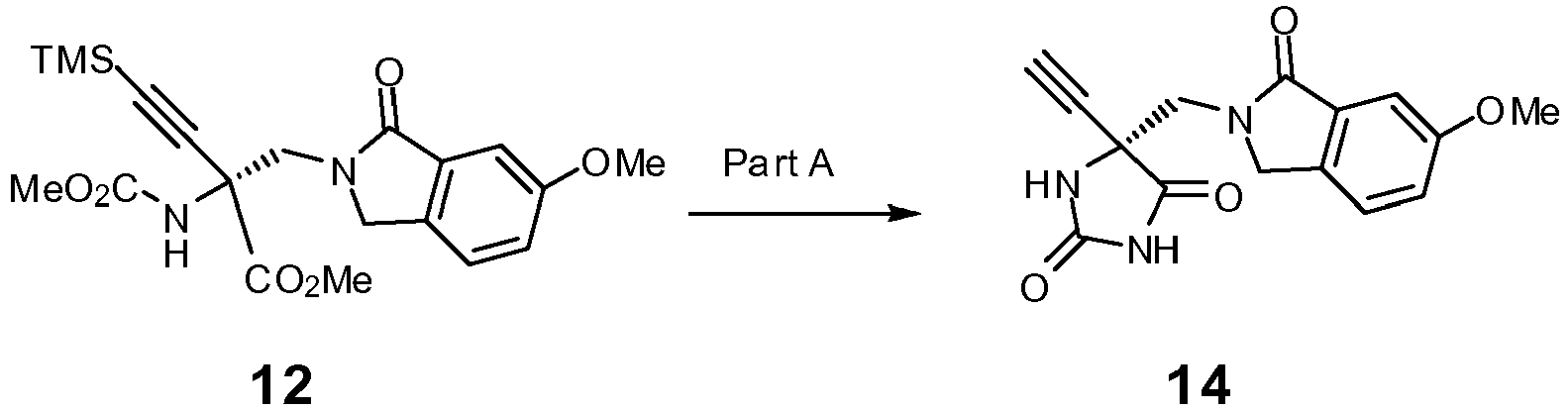
- Compound 12 (1.26 g, 3.0 mmol) in 7 M ammonia in methanol (20 mL) was heated to 85 °C in a pressure bottle overnight. The reaction mixture was concentrated to afford 14 (900 mg, 100%) which was used without further purification. HPLC-MS tR = 1.00 min (UV254 nm); mass calculated for formula C15H13N3O4 299.09, observed LCMS m/z 300.1 (M+H).
-

- Compound 15 (50.8 g, 298.65 mmol) and 16 (55.55 g, 313.58 mmol) were premixed as solids and added to a concentrated sulfuric acid (150 mL) at 10 °C. The reaction mixture was stirred at 10-15 °C for 2-3 hours. The reaction mixture was slowly added to ice water (800 mL) with good stirring. The reaction flask was rinsed with concentrated sulfuric acid and wash was added to the ice water. The solid was collected by filtration, washed with water (2x) and dried at 50 °C under vacuum to afford compound 17 (>100% by weight).
- To a solution of compound 17 (298.65 mmol) in DMF (1 L) was added sequentially cesium carbonate (127 g, 388.24 mmol) and methyl iodide (22.3 mL, 358.38 mmol). The reaction was stirred overnight at room temperature. The reaction mixture was diluted with water (800 ml) and ethyl acetate (800 mL) and the layers were separated. The aqueous layer was extracted with ethyl acetate (500 mL). The combined organic layers were washed with brine, dried over sodium sulfate and concentrated in vacuum. The crude reaction product was used without further purification.
- The crude product 18 was dissolved in methanol (1 L) and hydrazine hydrate (29 ml, 597.3 mmol) was added. The reaction mixture was stirred with a mechanical stirrer and heated to reflux for 3 hours. The reaction mixture was initially a suspension which cleared upon heating. As the reaction progressed a precipitate formed. The reaction mixture was cooled and the precipitate was collected by filtration. The solids were washed with methanol and the combined filtrate was reduced in volume to approximately 300 mL. The additional precipitate was collected by filtration and combined with the above solids. The solids were stirred with potassium carbonate solution (1 M, 200 mL) for 15 minutes and filtered. This washing process was repeated with another portion of potassium carbonate solution (1M, 150 ml). The solids were then washed with hydrochloric acid (2 M, 150 ml) for 15 minutes and filtered. This washing process was repeated with another portion of hydrochloric acid (1M, 150 ml) and the solid was rinsed with water. The potassium carbonate solution was extracted with ethyl acetate twice. The ethyl acetate washes were combined with the methanol filtrate, washed with brine, dried over sodium sulfate, and concentrated. The residue was washed with potassium carbonate solution (1 M, 20 mL) and hydrochloric acid (2 M, 20 mL). The additional solid was rinsed with water and combined with above solid. It was dried under vacuum at 50 °C for overnight to give compound 19 (47.87 g, 88.5% from compound 15).
- To a 3 L three neck flask was added compound 19 (61.07 g, 337.11 mmol), sodium t-butoxide (38.9 g, 404.5 mmol, 1.2 eq), and DMPU (1500 mL). The suspension was stirred with a mechanic stirrer and gently warmed with a heat gun until a clear solution appeared. The solution was cooled to 0 °C and chloromethyl pivalate was added slowly with a syringe. The reaction mixture was stirred at 0 °C for three hours, diluted with H2O (1.5 L) and EtOAc (1.5 L), and the layers were separated. The organic layer was washed with H2O (500 mL x 4), brine (500 mL), dried over sodium sulfate, and concentrated in vacuum. The product was purified by silica gel chromatography (Hexane/EtOAc: 2:1 to 1:1 to 0:1) to afford compound 20 (77.98 g, 78.3%)
- Compound 20 (70.97 g, 240.32 mmol) was dissolved in anhydrous CH2Cl2 (1 L). The solution was cooled to 0 °C and TMSBr (37.3 mL, 288.39 mmol) was added via syringe. The reaction mixture was stirred at 0 °C for two hours and concentrated in vacuum at 25 °C. The residue was stirred with Hexane (500 mL) for 15 min, filtered, and rinsed with hexane (60 mL x 2). The Hexane filtrate was concentrated in volume to approximately 100 mL and the additional solid was filtered, rinsed with hexane (10 mL x 2), and combined with above solid. The solid was dried under vacuum for overnight to give compound 21 (64.81 g, 98.4%).
- To a flamed dried flask was added compound 21 (1.13 g, 4.11 mmol), compound 10 (1.0 g, 4.11 mmol), and anhydrous THF (25 mL). The solution was cooled to -78 °C and LiHMDS (8.63 mL, 8.63 mmol) was added via syringe. The reaction mixture was stirred at -78 °C for two hours, diluted with saturated NH4Cl solution (30 mL) and EtOAc (50 mL). After warming up to room temperature, the aqueous layer was separated and extracted with EtOAc (20 mL) once. The organic layers were combined and TBAF (1 M in THF, 7 mL, 7 mmol) was added. The solution was stirred at 25 °C for 10 min, washed with water (50 mL), brine (50 mL), dried over sodium sulfate, and concentrated in vacuum. The product was purified by silica gel chromatography (Hexane/EtOAc: 2:1 to 1:1 to 0:1) to afford the racemate of compound 22 (891 mg, 59.5%)
- The racemic mixture was separated using SFC conditions (20% MeOH/CO2, 180 mL/min, back pressure of 225 bar, run time 9 minutes, OD-H chiral column). The racemate was dissolved in 1:1 acetonitrile/isopropyl alcohol (250 mg/mL). Compound 22 was isolated as the first peak. HPLC-MS tR = 1.26 min (UV 254 nm); mass calculated for formula C17H17FN2O6 364.11, observed LCMS m/z 365.0 (M+H).
-

- Using the procedures described in Example 3, compound 22 (8.69 g, 23.8 mmol) was converted to 23 in quantitative yield. HPLC-MS tR = 0.93 min (UV 254 nm); mass calculated for formula C15H12FN3O4 317.08, observed LCMS m/z 318.1 (M+H).
-

- Compound 14 (80 mg, 0.266 mmol), compound 2209E (82 mg, 0.26 mmol), Pd(dba)3 (6 mg), dppf (10 mg), Cul (10 mg), and triethylamine (0.1 mL) were dissolved in DMF and stirred at 80 °C overnight. The solvent was removed under reduced pressure and the residue was purified by reverse phase chromatography (18.7 mg). HPLC-MS tR = 1.07 min (UV254 nm); mass calculated for formula C21H19N5O7S 485.1, observed LCMS m/z 486.1 (M+H). 1H NMR (400 MHz, DMSO-d6) δ 11.5 (s, 1H), 9.35 (s, 1H), 8.85 (s, 1H), 7.5 (m, 2H), 7.4 (d, 1H), 7.2 (d, 1H), 7.15 (m, 2H), 7.1 (d, 1H), 7.0 (s, 1H), 4.45 (m, 2H), 4.3 (m, 2H), 3.7 (s, 3H).
-

- Compound 108 (39.1 mg, 0.11 mmol), compound 110 (22.3 mg, 0.11 mmol), Pd(PPh3)3Cl (4 mg), Cul (1 mg), and diisopropylamine (0.3 mL) were dissolved in DMF (3.0 mL) and stirred at 80° C overnight. The solvent was removed under reduced pressure and the residue was purified by reverse phase chromatography affording compound 111 (22 mg). HPLC-MS tR = 1.55 min (ELSD); mass calculated for formula C22H20N4O6 436.2, observed LCMS m/z 437.2 (M+H).
- Compound 111 (22.0 mg, 0.050 mmol) in 7 M ammonia in methanol (3 mL) was heated to 85 °C in a pressure bottle overnight. The solvent was removed under reduced pressure and the residue was purified by reverse phase chromatography affording compound 112 (8.5 mg, 43%) HPLC-MS tR = 1.40 min (ELSD); mass calculated for formula C20H15N5O4 389.1, observed LCMS m/z 390.1 (M+H).
-

- Compound 101 (5.0 g, 30.0 mmol), formamidine acetate (9.37 g, 90.0 mmol), and 2-methoxyethanol (80mL) were refluxed for 16 h. After cooling, the reaction mixture was poured into water (1 L) and stirred for 0.5 h. The solid was isolated by vacuum filtration to provide white solid 102 (5.3 g, 73%). HPLC-MS tR = 0.85 min (ELSD); mass calculated for formula C9H8N2O2 176.1, observed LCMS m/z 177.1 (M+H).
- Compound 102 (2.85 g, 16.2 mmol), 37% aq. formaldehyde (15 mL), and water (100 mL) were heated at reflux for 2 h. The reaction was cooled to 0 °C and white solid was isolated by vacuum filtration to provide the desired product 103 (2.8 g, 85%). 1H NMR (400 MHz, DMSO-d6) δ 8.27 (s, 1H), 7.64 (d, 1H), 7.54 (d, 1H), 7.44 (dd, 1H), 6.74 (t, 1H), 5.35 (d, 2H), 3.88 (s, 3H).
- Compound 103 (750 mg, 3.6 mmol) and triphenylphosphine (1.91 g, 7.3 mmol) were dissolved in DCM (200 mL) and allowed to stir for 5 min at RT. To the solution carbon tetrabromide (2.42g, 7.3 mmol) was added in one portion and stirred for 3 h. The solvent was evaporated and the crude product was purified by column chromatography (SiO2, 5% methanol/dichloromethane) to provide the desired product 104 (237 mg, 24%). HPLC-MS tR = 1.35 min (ELSD); mass calculated for formula C10H9BrN2O2 269.1, observed LCMS m/z 270.1 (M+H).
-

- Compound 105 (212 mg, 0.87 mmol) and compound 104 (235 mg, 0.87 mmol) were dissolved in THF (30 mL) and cooled to -78 °C. A 1M solution of LiHMDS (1.74 mL, 1.74 mmol) was added dropwise over 10 min and the reaction mixture was stirred for 2 h. Saturated ammonium chloride solution (100 mL) was added slowly and the reaction was allowed to warm to RT. The aqueous layer was extracted with ethyl acetate. The combined organic layers were washed with water, and brine, dried over sodium sulfate, and concentrated to dryness. Purification by reverse phase LC/MS afforded the desired product 106 (145 mg, 39%). HPLC-MS tR = 1.83 min (ELSD); mass calculated for formula C20H25N3O6Si 431.1, observed LCMS m/z 432.1 (M+H).
- Compound 106 (140 mg, 0.32 mmol) was dissolved in THF (50 mL) and cooled to 0 °C. Tetrabutylammonium fluoride (1 M in THF, 0.39 mL, 0.39 mmol) was added dropwise and the reaction was stirred for 1 h at room temperature. The reaction mixture was quenched with saturated ammonium chloride (50 mL), extracted with ethyl acetate, washed with water, brine, dried over sodium sulfate and concentrated to provide compound 107 (114 mg, 100%). HPLC-MS tR = 1.50min (ELSD); mass calculated for formula C17H17N3O6 359.1, observed LCMS m/z 360.1 (M+H).
- The two isomers were separated using a chiral normal phase OD column. 107 was injected into the column and the two peaks were separated using a solvent mixture of 85% hexanes/ethanol. Isomer 108 (40.5 mg, 70%) and 109 (39.9 mg, 69%) were isolated.
-

- Compound 2209A (209 mg, 0.84 mmol) and compound 2209B (311 mg, 0.92 mmol) were dissolved in methylene chloride (5 mL) and pyridine (5 mL) was added. The reaction was stirred at room temperature overnight and then quenched with 1N HCl (50 mL). The aqueous layer was extracted with ethyl acetate. The organic layer was dried over sodium sulfate and concentrated to provide the desired product (350 mg). 1H NMR (400 MHz, CDCl3) δ 7.61 (d, 1H), 7.25 (m, 1H), 7.2 (m, 2H), 6.8 (d, 1H), 3.85 (s, 3H), 1.5 (s, 9H).
- Compound 2209C (350 mg, 0.85 mmol) was dissolved in methylene chloride (2 mL) and trifluoroacetic acid (2 mL) and stirred for 2 hours. All solvents were evaporated to provide the desired product (260 mg). 1H NMR (400 MHz, CDCl3) δ 9.15 (s, 1H), 7.55 (d, 1H), 7.15 (m, 1H), 7.0 (s, 2H), 6.9 (d, 1H), 3.8 (s, 3H).
- Compound 2209D (260 mg, 0.79 mmol) was dissolved in methylene chloride (6 mL) and 1 M boron tribromide in methylene chloride (3 mL) was added. The reaction was stirred at room temperature overnight and then quenched with water. The aqueous layer was extracted with ethyl acetate. The combined organic layers were dried over sodium sulfate and concentrated to provide the desired product (200 mg). 1H NMR (400 MHz, DMSO-d6) δ 10.0 (s, 1H), 8.95 (s, 1H), 7.45 (d, 1H), 7.0 (m, 1H), 6.9 (s, 2H), 6.75 (d, 1H).
-

- Compound 2201A (prepared as described in
Yu, W. et al. PCT Appl. WO2007084455A1 -

- To a pressure bottle was added compound 1700I (314 mg, 1.0 mmol), compound 1700J (294 mg, 1.0 mmol), Pd(PPh3)4 (58 mg, 0.05 mmol), acetonitrile (5 mL) and potassium carbonate (5 mL, 1 N aq.). The reaction mixture was subjected to vacuum, and the purged with nitrogen for three times and stirred at 80 °C overnight. The reaction mixture was diluted with water (30 mL) and extracted with EtOAc (3 x 20 mL). The organic layers were combined and washed with brine, dried over sodium sulfate, and concentrated to dryness. The residue was purified by silica gel chromatography (Hexane/EtOAc:1:3) to afford 1700H, (110 mg, 43%).
- A mixture of compound 1700H (56 mg, 0.022 mmol) and AlCl3 (70 mg, 0.055 mmol) were suspended in CH2Cl2 (5 mL). The reaction mixture was refluxed overnight. After cooling, the solvent was evaporated. The residue was mixed with water (10 mL) and extracted with EtOAc (10 mL X 3). The organic layers were combined and washed with brine. The resulting organic layer was dried over sodium sulfate and concentrated to give compound 1700G. The compound was used in the next step without further purification.
-

- Compound 1700A (800 mg, 3.26 mmol), compound 1700K (1.46 mL, 9.79 mmol), Pd(PPh3)2Cl2 (183 mg, 0.26 mmol), Cul (93 mg, 4.9 mmol), and diisopropylamine (1 mL) were dissolved in DMF and stirred at 80 °C overnight. The solvent was removed under reduced pressure and the residue was diluted with CH2Cl2 (50mL), washed by water and brine, and dried over sodium sulfate. The mixture was filtered. The filtrate was concentrated and the residue was purified by column chromatography (5% 7N Ammonia MeOH solution in CH2Cl2) to give 1700B (500 mg, 75%).
- Compound 1700B (500 mg, 2.44 mmol) was added to DMPU (20 mL) and heated with a heat gun until all the material was dissolved. The mixture was then cooled down to room temperature. Sodium t-butoxide (281 mg, 2.92 mmol) was added and the mixture was stirred at room temperature for 5 hours. Chloromethylpivalate (0.42 mL, 2.92 mmol) was added dropwise and the mixture was stirred at room temperature for 3 hours. The reaction mixture was poured into 150 ml water. The resulting solid was then filtered and collected to give 1700C (560 mg, 72%).
- Compound 1700C (560 mg, 1.75 mmol) was dissolved in methylene chloride (10 mL) and cooled in an ice bath. Bromotrimethylsilane (0.3 mL, 2.08 mmol) was added dropwise and the mixture was stirred in the ice bath for 30 minutes followed by 2 hours at room temperature. The reaction mixture was concentrated and re-dissolved in methylene chloride (2 mL). Hexanes (8 mL) was added and the solids were filtered to provide the desired product 1700D (360 mg, 70%).
- Compound 10 (294 mg, 1.21 mmol) and compound 1700D (360 mg, 1.21 mmol) were dissolved in THF (15 mL) and cooled to -78 °C. A 1M solution of LiHMDS (2.6 mL, 2.6 mmol) was added dropwise and the reaction mixture was stirred for 3 hours. Saturated ammonium chloride solution was added slowly and the reaction was allowed to warm to room temperature. The aqueous layer was extracted with ethyl acetate. The combined organic layers were washed with water, brine, dried over sodium sulfate, and concentrated. Purification by column chromatography (SiO2, 33% ethyl acetate/hexanes to 50% ethyl acetate/hexanes) afforded the desired product 1700E (360 mg, 65%).
- Compound 1700E (360 mg, 0.927 mmol) in 7 M ammonia in methanol (10 mL) was heated to 85 °C in a pressure bottle overnight. TLC indicated that the reaction was not complete. Therefore, the solvent was evaporated and the residue was dissolved in 7M ammonia in methanol (10 mL) and heated to 85 °C in a pressure bottle for overnight. The reaction mixture was concentrated. The residue was washed with ether and filtered. The solid was collected to afford 1700F (150 mg, 50%) which was used in the next step without further purification.
- Compound 1700F (36 mg, 0.10 mmol), compound 1700G (33 mg, 0.14 mmol), Pd(PPh3)2Cl2 (5.9 mg, 0.084 mmol), Cul (3.0 mg, 0.016 mmol), and Diisopropylamine (0.1 mL) were dissolved in DMF (1 mL) and stirred at 80 °C overnight. The reaction mixture was purified by Gilson reverse phase chromatography to afford 1700 (10.8 mg, 20%). HPLC-MS tR = 2.65 min (UV254 nm); mass calculated for formula C25H17FN6O5, 500.12, observed LCMS m/z 501.3 (M+H).
-

- Compound 1701A (1.8 g, 4.59 mmol) and AlCl3 (1.8 g, 13.50 mmol) were stirred in methylene chloride in a sealed tube at 75 °C overnight. After cooling, the reaction mixture was taken up in ethyl acetate and extracted with water. The aquous layer was extracted with ethyl acetate 3 times. The combined organic layers were dried with Na2SO4 and then concentrated to dryness. The crude material which was 1701B (1.6 g, 92%) was used without further purification.
- Compound 1701B (300 mg, 0.79 mmol) was dissolved in ammonium hydroxide (9 mL) and stirred in ice bath to make mixture 1. Iodine (180 mg, 0.63 mmol) and KI (421 mg, 2.54 mmol) were dissolved in H2O (3 mL) and this mixture was added dropwise to mixture 1. After addition, the ice bath was removed and the reaction mixture was stirred at room temperature for 2 h. After the reaction was terminated, the solvent was removed. The crude material was purified with ISCO reverse phase column and eluted with actonitrile-water to give 1701C (100 mg, 25%).
- A mixture of 1701C (80 mg, 0.16 mmol), 1701D (53 mg, 0.47 mmol), copper iodide (5 mg, 0.028 mmol), Pd(PPh3)2Cl2 (5 mg, 0.008 mmol) and diisopropylamine (0.120 mL, 0.86 mmol) in DMF (1 mL) was stirred at 85 °C overnight. The reaction mixture was purified by Gilson reverse phase HPLC using a 0.1% formic acid in the acetonitrile-water mobile phase. The isolated fractions were concentrated to afford 1701 (13 mg, 20%) as a light yellow solid. HPLC-MS tR = 2.61 min (UV254 nm); mass calculated for formula C22H16N4O5 416.11, observed LCMS m/z 417.2 (M+H).
-

- A mixture of compound 1705A (6.2 g, 20.67 mmol) which was made according to the literature procedures (Synthesis, 1990, 497-498) and triethylamine (8.7 mL, 62.41 mmol) was stirred in methylene chloride (100 mL) at room temperature. SEMCI (4.4 mL, 24.94 mmol) was added dropwise and the reaction mixture was stirred at room temperature overnight. The reaction mixture was extracted with H2O (100 mL) and layers were separated. The organic layer was dried and concentrated to dryness. The crude material was purified by silica gel chromatography (Hexane/EtOAc: 4:1) to afford compound 1705B (5 g, 56%).
- A mixture of 1705B (500 mg, 1.16 mmol), 1705C (148 mg, 1.16 mmol), Pd(OAc)2 (23 mg, 0.10 mmol), Xantphos (40 mg, 0.069 mmol) and sodium t-butoxide(138 mg, 1.43 mmol) in dioxane (3 mL) was stirred in a sealed tube at 100 °C overnight. After cooling, the reaction mixture was diluted with ethyl acetate (100 mL) and H2O (100mL). The layers were separated. The organic layer was dried with Na2SO4 and then concentrated to dryness. The crude material was purified by silica gel chromatography (Hexane/EtOAc: 1:1) to afford compound 1705D (240 mg, 48%).
- Compound 1705D (240 gm, 0.56 mmol) was dissolved in methanol (10 mL) and HCI (20 mL, 4N in dioxane) was added and the reaction mixture was stirred at room temperature two and half days. The mass spectrum of the reaction mixture still showed the presence of starting material. Solvents were removed and HCI (50 mL, 6N in H2O) and methanol (10 mL) were added and the mixture was stirred at room temperature overnight. Solvents were removed to afford compound 1705E (140 mg, 99%) which was used without further purification.
- A mixture of 1705E (72 mg, 0.28 mmol), compound 14 (93 mg, 0.31 mmol), copper iodide (5 mg, 0.028 mmol), Pd(PPh3)2Cl2 (5 mg, 0.008 mmol) and diisopropylamine (0.40 mL, 2.85 mmol) in DMF (1 mL) was stirred at 85 °C overnight. The reaction mixture was purified by Gilson reverse phase HPLC using a 0.1% formic acid in the acetonitrile-water mobile phase. The fractions which contained 1705 were concentrated to a light yellow solid (24 mg, 17%). HPLC-MS tR = 2.38 min (UV254 nm); mass calculated for formula C23H21N7O6 491.16, observed LCMS m/z 492.3 (M+H).
-

- A mixture of 1705B (813 mg, 1.89 mmol), 1707A (400 mg, 1.89 mmol), copper iodide (36 mg, 0.19 mmol), L-proline (44 mg, 0.38 mmol) and K2CO3 (0.8 g, 5.8 mmol) in DMSO (3 mL) was stirred at 70 °C overnight. After cooling, the reaction mixture was diluted with ethyl acetate (20 mL) and Brine (20mL). The layers were separated. The organic layer was dried with Na2SO4 and then concentrated to dryness. The crude material was purified by silica gel chromatography (Hexane/EtOAc:9:1 to Hexane /EtOAc:3:1) to afford compound 1707B (360 mg, 44%).
-
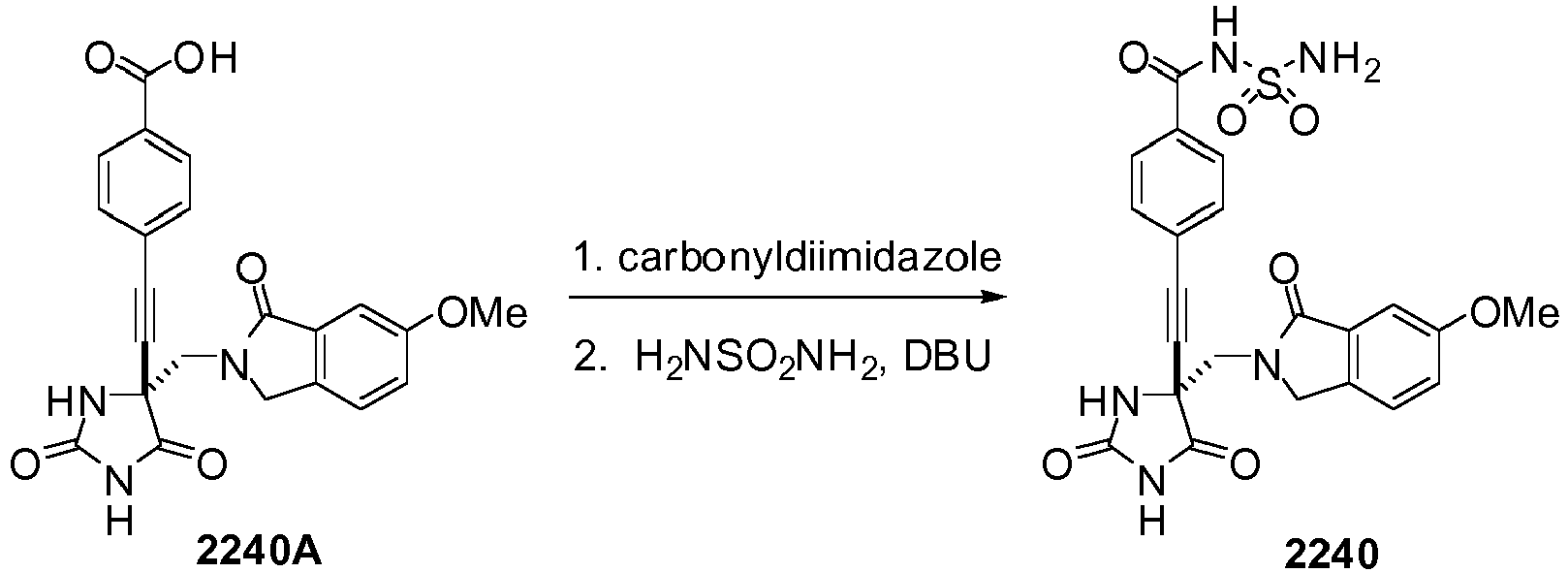
- Compound 2240A and methods for its preparation are described in
Lavey, B.J. et al. PCT Appl. WO2007084451 (A1) -

- Compound 1120 was prepared as described in Yu, Wensheng et al Imidazolidinedione derivatives and their preparation, pharmaceutical compositions, and use for the treatment of inflammatory disorders. U.S. Patent Application Publication No.
US 2007/0219218 . Compound 1120 was converted to 1120A using the procedure of Hammarstrom, L. G. J.; Fu, Y.; Vail, S.; Hammer, R. P.; McLaughlin, L. Org. Syntheses 2005, 81, 213. LRMS calcd. 367.11 obsd 368.08. - Compound 1120A was converted to 1120B using the procedure of Foccella, A.; Bizzarro, F. and Exon, C. Syn Comm 1991, 21, 2165. The crude product was purified via reverse phase chromatography on a C-18 column using a 15%-80% CH3CN/H2O gradient with 0.1% formic acid added to each component of the mobile phase. The gradient was stopped temporarily at 35% CH3CN while the main peak came off of the column to give 22 mg of impure product. This material was purified via reverse phase HPLC on a C-18 column using a 5%-50% CH3CN/H2O gradient with 0.1% formic acid added to each component of the mobile phase. Compound 1120B was obtained as a white solid. LCMS calcd. 368.1 obsd 369.2.
-

- 2,4-Difluoro-3-methoxy-benzoic acid was converted to compound 1140F using a sequence of reactions and a set of procedures similar to those described in Example 4.
- Compound 1140A: 1HNMR (CDCl3) δ 7.94-7.86 (m, 2H), 7.82-7.75 (m, 2H), 6.96-6.87 (m, 1H), 5.11 (s, 2H), 4.02 (s, 3H).
- Compound 1140B: 1HNMR (CDCl3) δ 7.93-7.84 (m, 2H), 7.79-7.71 (m, 2H), 7.02-6.92 (m, 1H), 5.00 (s, 2H), 4.05-3.95 (m, 6H).
- Compound 1140C: 1HNMR (DMSO) δ 8.65 (s, 1H), 7.44-7.34 (m, 1H), 4.33 (s, 2H), 3.93 (s, 3H).
- Compound 1140D: 1HNMR (CDCl3) δ 7.09-6.93 (m, 1H), 5.61(s, 2H), 4.51 (s, 2H), 4.04 (s, 3H), 1.22 (s, 9H).
- Compound 1140E: 1HNMR (CD3OD) δ 7.39-7.15 (m, 1H), 4.56 (s, 2H), 4.02 (s, 3H).
- Compound 1140F: 1HNMR (CDCl3) δ 7.00-6.94 (m, 1H), 6.51 (s, 1H), 4.79-4.68 (m, 1H), 4.46-4.30 (m, 2H), 4.04 (s, 3H), 3.88 (s, 3H), 0.18 (s, 9H).
- Compound 1140F was separated into its enantiomers via chiral HPLC. Compound 1140F (0.5 gram) was dissolved in 5 mL of 4:6 CHCl3:MeOH and injected onto a preparative ChiralCel OD HPLC column from Chiral Technologies. The detector was set at 237 nm. The mobile phase was 95:5 hexanes:absolute ethanol at a flow rate of 50 mL/min.
-

- Compound 1140 (0.6 g, 1.32 mmol), was added to a pressure tube. Methanolic ammonia (20 mL, Aldrich 7 N) was added. The tube was capped and the reaction mixture was heated at 80 °C overnight. The reaction mixture was concentrated to dryness to give compound 1150A (0.36 g, 82% yield). 1HNMR (CD3OD) δ 7.28-7.21 (m, 1H), 4.73-4.51 (m, 2H), 4.08 (s, 3H), 3.62 (s, 1H).
- Compound 1150A (50 mg, 0.15 mg) and compound 1150D were converted to 1150B using a Sonogashira procedure similar to that described in Example 7. 1HNMR (CD3OD) δ 7.66-7.58 (m, 2H), 7.56-7.45 (m, 2H), 7.30-7.20 (m, 1H), 4.80-4.69 (m, 1H), 4.65-4.56 (m, 1H), 4.18 (s, 2H), 4.00 (s, 3H), 3.82-3.75 (m, 1H), 3.61-3.52 (m, 1H), 1.42 (s, 9H).
- Compound 1150B (41 mg, 0.064 mmol) was dissolved in 2 mL of MeOH. A solution of 4N HCl in dioxane was added (3 mL). The reaction mixture was stirred for 4 h at rt then concentrated to dryness. The product was dissolved in a minimum amount of MeOH. EtOAc was added, causing a precipitate to form. The mixture was placed in a centrifuge, to spin down the precipitate. The solution was removed via pipet. The solid was washed with EtOAc then dried under vacuum to give 30 mg of compound 1150. LCMS calcd 538.14 obsd 539.3.
-
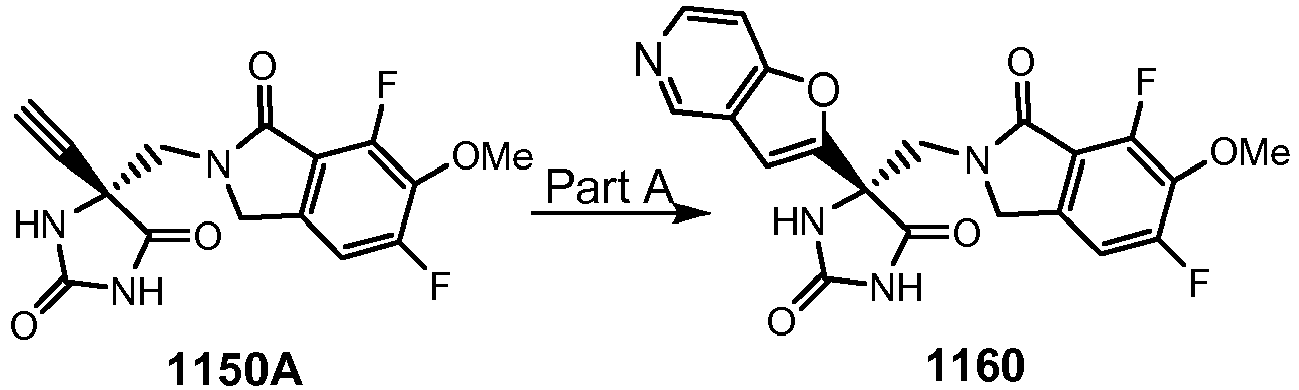
- Compound 1150A was converted to 1160 using a procedure similar to that described in Example 7. LRMS calcd 428.09 obsd 429.2.
-
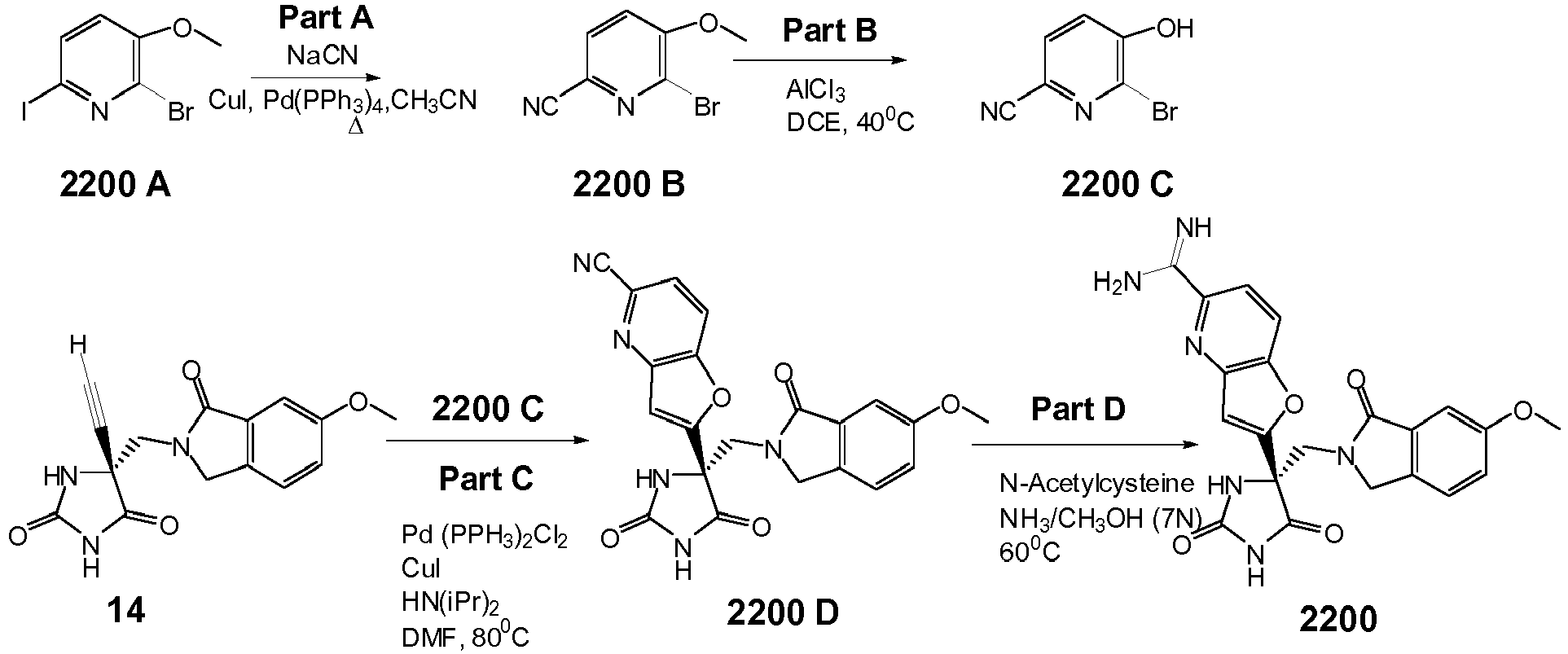
- A mixture of 2-Bromo-5-iodo-3-methoxy pyridine 2200A (0.95g, 3.0mmol), NaCN (0.176 g, 3.6 mmol), Palladium tetrakis triphenylphospine (0.2g, 1.8mmol), CuI (0.07g, 0.4mmol) and acetonitrile (10 mL) was charged into a sealed tube and purged with nitrogen (3x). The reaction was heated at 80 °C for 10 h. After cooling to room temperature the reaction was diluted with EtOAc (100ml), washed with water (2x 50ml) and brine (1 x 50 mL), dried (Na2SO4), filtered, and concentrated to give a crude product which was purified by flash column chromatography (ISCO CombiFlash Rf, SiO2, 12g cartridge (hexanes to 35 % EtOAc / hexanes) to yield compound 2200B (0.25g, 30%).
- Compound 2200B (0.2g, 0.93 mmol) was dissolved in dichloroethane (DCE) (5 mL) and aluminum chloride (0.1g, 0.85 mmol) was added. The reaction mixture was stirred at 40 °C for 10 hours. The reaction was cooled and diluted with EtOAc (50mL) and washed 2 x 25 mL water, and brine (1 x 25 mL) and then dried over sodium sulfate, and concentrated to provide a crude which was purified by flash column chromatography (ISCO CombiFlash Rf, SiO2, 4g cartridge (Hexanes to 25 % EtOAc/hexanes) to yield compound 2200C (0.11g, 60%).
- A mixture of 14 (0.11 g, 0.3 mmol), 2200C (0.12g, 0.3mmol), copper iodide (0.008 g, 0.045 mmol), Pd(PPh3)2Cl2 (0.005 g, 0.008 mmol) and diisopropylethylamine (0.047 mL, 0.33 mmol) in DMF (3 mL) was charged into a sealed tube and purged with nitrogen (3x). The mixture was heated at 80 °C for 12 h. The reaction mixture was filtered and the filtrate was concentrated and purified by reverse phase chromatography using a 0.1% trifluoracetic acid in the aqueous mobile phase (100% water to 50% acetonotrile/water) to provide 2200D (0.09 g, 45%).
- A mixture of 2200D (0.02g, 0.047mmol), N-acetylcysteine1 (0.02g, 0.12 mmol), 7N NH3/CH3OH (5 mL) was charged into a sealed tube and heated at 60 °C for 24 h. The reaction was cooled and the solvent was removed and the product was isolated by reverse phase chromatography using a 0.1% trifluoracetic acid in the aqueous mobile phase (100 % water to 50% acetonitrile/water) to provide 2200 (0.017g, 85%). LC-MS* tR = 1.87 min; observed LCMS m/z 435.2 (M+H).
-
- 1.Udo E.W. Lange, Bernd Schäfer, Dorit Baucke, Ernst Buschmann, Helmut Mack. Tetrahedron letters 40, 7067, 1999.
- The following compounds were made from 2200D using the procedure described in part D, using corresponding amines (hydroxyl amine, N-ethylpiperazine, N-methyl homopiperazine.)
ID STRUCTURE (M+1)+ LC MS* tR 1500 
451.2 1.79 1501 
533.3 1.89 1502 
533.3 2.01 -

- Compound 2210C was prepared as described in Example 29. Compound 2225D was prepared using the method described previously in
Lavey, B.J. WO 2007/084451 , Example 1087. Compounds 2210C and 2225D were combined according to the procedure of Example 6 to afford Compound 2203. HPLC-MS tR = 2.60 min (UV254 nm); mass calculated for formula C27H23N5O7 529.2, observed LCMS m/z 530.3 [M+H]+. -

- Compound 2217A was prepared as described in Example 14. Compound 2225D was described previously in
Lavey, B.J. WO 2007/084451 , Example 1087. Compounds 2217A and 2225D were combined according to the procedure of Example 6 to afford Compound 2217. HPLC-MS tR = 2.56 min (UV254 nm); mass calculated for formula C24H20N4O6 460.1, observed LCMS m/z 461.3 [M+H]+. -

- Compound 2218A was prepared according to the method described in Chapman, G.M.; Stanforth, S.P; Tarbit, B.; Watson, M.D. J. Chem. Soc., Perkin Trans. 1 2002, 581-582. A microwave tube containing Compound 2218A (1.0 g, 3.2 mmol), pyrazole-3-boronic acid (426 mg, 3.82 mmol) and (Ph3P)4Pd (294 mg, 0.250 mmol) was sealed, evacuated, and placed under nitrogen atmosphere. Acetonitrile (16 mL) and 1 M aq. potassium carbonate solution (16 mL) were added and the reaction mixture was stirred at 100 °C for 2 d. The aqueous layer was separated and extracted with EtOAc (3 x 25 mL). The combined organic layers were washed with brine (-50 mL), dried over anhydrous MgSO4, filtered, and concentrated under reduced pressure. From the complex reaction mixture, repeated sgc (10-70% EtOAc-hexanes gradient) afforded 80 mg (10% isolated yield) of the desired Compound 2218B.
- A solution of Compound 2218B (96 mg, 0.38 mmol) in DCE (5 mL) was treated with anhydrous aluminum chloride (126 mg, 0.94 mmol) in a pressure vessel. The vessel was capped and the reaction mixture was heated at reflux for 18 h. The reaction mixture was allowed to cool to rt and was concentrated under reduced pressure. The resulting residue was partitioned in EtOAc (∼100 mL) and water (∼100 mL). The aqueous layer was separated and extracted further with EtOAc (3 x ∼25 mL). The combined organic phases were washed with brine (50 mL), dried over anhydrous MgSO4, filtered, and concentrated under reduced pressure to afford 104 mg of crude product as a yellow solid. Mass calculated for formula C8H6 81BrN3O 241.0, observed m/z 241.9 [M+H]+.
- Compound 2225D was prepared according to the method previously reported in
Lavey, B.J. WO 2007/084451 , Example 1087. A flame-dried microwave tube containing Compound 2225D (60 mg, 0.19 mmol), Compound 2218C (58.4 mg, 0.21 mmol), (Ph3P)2PdCl2 (13 mg, 0.019 mmol), copper(I) iodide (3.6 mg, 0.019 mmol) and a magnetic stir bar was sealed, evacuated and placed under nitrogen atmosphere. Dry, degassed DMF (0.9 mL) and diisopropylamine (0.070 mL, 49 mg, 0.38 mmol) were added. The reaction mixture was stirred at 80 °C, then allowed to cool to rt, and was filtered. The filtrate was subjected to reverse-phase C18 chromatography (10-90% MeCN-water gradient) to afford 41 mg (46% yield) of Compound 2218B. HPLC-MS tR = 2.22 min (UV254 nm); mass calculated for formula C24H26N6O5 472.2, observed LCMS m/z 473.3 [M+H]+. -

- A mixture of p-bromobenzaldehyde (Compound 2224A; 5.00 g, 27.0 mmol), hydroxylamine hydrochloride (3.73 g, 54.1 mmol) and anhydrous sodium acetate (4.43 g, 54.1 mmol) in absolute ethanol (100 mL) was stirred at reflux (80 °C external oil bath temperature) in a pressure vessel for 24 h. The solvent was removed under reduced pressure. The remaining solid was dissolved in Et2O (∼250 mL) and the resulting solution was washed sequentially with water (2 x ∼100 mL) and brine (∼100 mL). The organic layer was dried over anhydrous MgSO4, filtered and concentrated under reduced pressure to afford Compound 2224B as a white solid (5.23 g, 97% yield).
- Solid N-chlorosuccinimide (0.722 g, 5.39 mmol) was added to a stirred solution of oxime (Compound 2224B; 1.072 g, 5.39 mmol) in dry DMF (15 mL). The reaction mixture was stirred at rt for 18 h. The reaction mixture was diluted with Et2O (150 mL) and was washed sequentially with water (3 x 50 mL) and brine (∼50 mL). The organic layer was dried over anhydrous MgSO4, filtered and concentrated under reduced pressure to give a pale yellow solid. Purification of the solid by sgc (40 g silica gel cartridge; 5-25% EtOAc-hexanes gradient) gave 973 mg (77% yield) of the desired product, Compound 2224C, as a white solid.
- Methyl-n-propylamine (151 mg, 2.56 mmol) was added to a solution of oximyl chloride (Compound 2224C, 300 mg, 1.28 mmol) in CH2Cl2 (8 mL) and the resulting mixture was stirred overnight at rt. Evaporation of the solvent gave a residue that was purified by sgc (1-10% MeOH/NH3 in CH2Cl2 gradient) to afford 215 mg (62% yield) of the desired product, Compound 2224D.
- Aryl bromide 2224D was converted into Compound 2224 following the procedure given in Example 6.. HPLC-MS tR = 2.28 min (UV254 nm); mass calculated for formula C26H27N5O5 489.2, observed LCMS m/z 490.3 [M+H]+.
- Using the same procedure as described in this Example, the following compounds could be synthesized: Compounds 2227, 2228, 2229, 2231, and 2234.
- Compound 2227: HPLC-MS tR = 2.83 min (UV254 nm); mass calculated for formula C22H21N5O5S 467.1, observed LCMS m/z 468.3 [M+H]+.
- Compound 2228: HPLC-MS tR = 1.84 min (UV254 nm); mass calculated for formula C27H30N6O5 518.6, observed LCMS m/z 519.3 [M+H]+.
- Compound 2229: HPLC-MS tR = 1.96 min (UV254 nm); mass calculated for formula C29H34N6O5 546.3, observed LCMS m/z 547.3 [M+H]+.
- Compound 2231: HPLC-MS tR = 1.96 min (UV254 nm); mass calculated for formula C24H23N5O5 461.2, observed LCMS m/z 462.3 [M+H]+.
- Compound 2234: HPLC-MS tR = 2.28 min (UV254 nm); mass calculated for formula C26H27N5O5 489.2, observed LCMS m/z 490.3 [M+H]+.
-

- Compound 2230A and methods for its preparation are described in
Lavey, B.J. et al. PCT Appl. WO2007084451 (A1) -

- Compound 1304B was prepared by the same method described in Part B of Example 29.
- Compound 1304C was prepared by the same method described in Example 6.
- Compound 1304C (380 mg, 0.82 mmol) was dissolved in DMF (5 mL). DIPEA (0.28 mL, 1.64 mmol) and SEMCI (0.173 mL, 0.985 mmol) were added. The solution was stirred at RT for overnight. DMF was removed by rotary evaporator. The product was purified by sgc (EtOAc/Hexane: 20% to 100%) to give compound 1304D (441 mg, 90.7%).
- To a 5 mL flask was added compound 1304D (65 mg, 0.11 mmol), 2-amino-5-(4,4,5,5-tetramethyl-1,3,2-dioxaborolan-2-yl)pyridine (35 mg, 0.16 mmol), Pd(dppf)2Cl2 (5 mg). The flask was subjected to vacuum and flushed with N2 three times. K2CO3 (1M, 0.5 mL, 0.5 mmol) and CH3CN were added. The solution was stirred at 80 °C overnight. After the flask had cooled, water and EtOAc were added. The organic layer was separated, washed with brine, dried over Na2SO4, and concentrated. The product was purified by SiO2 chromatography (MeOH/DCM: 1% to 5%) to give compound 1304E.
- Compound 1304E obtained in Part D was dissolved in MeOH (2 mL) in a 15 mL pressure tube. HCl (4M in dioxane, 2 mL) was added. The tube was capped and stirred at 90 °C for overnight. After cooling down, the solvent was removed and residue was dissolved in MeOH (3 ml) and DIPEA (0.5 mL) was added. The solution was stirred at RT for three hours. The solvent was removed and the product was purified by C18 chromatography (CH3CN/H2O, 5% to 90%, with 0.1% HCO2H) to give compound 1304 (23.5mg, 43.2%).
-

- Compound 2210A (4.81g, 32.5 mmol) was suspended in H2O (30 mL) in a 350 mL pressure bottle. KCN (2.11 g, 32.5 mmol), (NH4)2CO3 (12.5g, 129.9 mmol), and NH3/MeOH (7N, 30 mL) were added. The pressure bottle was capped and stirred at 80 °C for 2 days. After cooling down, water (30 mL) was added. The solid was collected by filtration, washed with water, and dried under vacuum to give compound 2210B (2.83g, 40.0%)
- Compound 2210B (600mg, 2.75 mmol) was dissolved in NH3- H2O (37%, 40 mL). Heating may be needed to make a clear solution. A solution of I2 (628 mg, 2.47 mmol) and KI (1.64g, 9.88 mmol) in water (5 mL) was added dropwise. The solution was stirred at 25 °C for 1 hour. The solution was concentrated to half of its original volume, adjusting the pH to 2∼4 with HCl (2N). The solid was collected by filtration, washed with water, dried under vacuum for overnight to give compound 2210C (805mg, 85.1%)
- Compounds 2210, 2211, 2214, 2216, and 2223 were prepared by the methods described in Example 29 and Example 6.
-

- Compound 2213A (800mg, 3.67 mmol) was suspended in anhydrous THF (40 mL) and cooled to 0 °C. Red-Al (3.2 M, 9.2 mL, 29.4 mmol) was added dropwise. After the addition was completed, the solution was heated to 85 °C for 2 hours. It was then cooled to 0 °C and quenched with water. Organic solvent was removed by rotary evaporator. NaOH (1N) was added to adjust the pH to about 7. EtOAc were added and the organic layer was separated. The aqueous layer was extracted with EtOAc twice. The EtOAc layers were combined and concentrated. The product was purified by SiO2 chromatography to give compound 2213C (539.5 mg, 72.1%).
- Compound 2213C was prepared by the same method as described in part B of example 29.
- Compounds 2213 and 2215 were prepared by the methods described in Example 30 and Example 6.
-

- Compound 2237A (300 mg, 0.73 mmol) was dissolved in DMF (5 ml). Cs2CO3 (476 mg, 1.45 mmol) and Mel (0.5 mL) were added. The solution was stirred at RT for overnight. Water and EtOAc were added. The organic layer was separated, washed with brine, dried over Na2SO4, and concentrated. The product was purified by SiO2 chromatography (Hexane/EtOAc 1:0 to 1:1) to give compound 2237B (295 mg, 95.1%).
- Compound 2237B (140 mg, 0.33 mmol) was stirred with NH3/MeOH (7N, 3 mL) in a pressure tube at 110°C for three days. After cooling down, the solvent was removed by rotary evaporator and the product was purified by sgc (DCM/MeOH/ NH3- H2O: 20;1:0.1 to 10:1:0.1) to give compound 2237C (67 mg, 49%).
- Compound 2237 were prepared by the methods described in Example 31 and Example 6.
-

- Compound 2238A was prepared by the method described in Example 6.
- Compound 2238A (76 mg, 0.118 mmol) was dissolved in THF/water (2:1, 1.5 mL) solution. LiOH (11.3 mg, 0.471 mmol) was added. The solution was stirred at 70 °C for overnight. The product was purified by C18 chromatography (CH3CN/H2O, 5% to 90%, with 0.1% HCO2H) to give compound 2238 (56mg, 75.1%).
-

- Compound 2239A (1.65g, 7.54 mmol), 2239B (1.30 g, 7.54 mmol), and DIPEA (1.30 mL, 7.54 mmol) were stirred at DCM (25 mL) for overnight. The solvent was removed and the product was purified by sgc (DCM/MeOH: 0% to 5%) to give compound 2239C (1.88 g, 63.7%).
- Compound 2239 were prepared by the methods described in Example 33 and Example 6.
-

- Compound 2242 is prepared following the procedure of Example 22. Deuterated intermediate 14a is obtained from 6a following the procedures described in Example 2 and Example 3. Compound 6a itself can be obtained following the procedure in Example 1, starting from the known compound 1a-1. Compound 14a is reacted with intermediate 2200C-1 which is obtained following procedure in Example 22 by first converting commercially available 2200A-1 to 2200 A-4 following published procedures in the following references: Garrett, Mark D.; Scott, Robin; Sheldrake, Gary N.; Dalton, Howard; Goode, Paul. Organic & Biomolecular Chemistry (2006), 4(14), 2710-2715; Allen, C. F. H.; Thirtle, John R. USA. Organic Syntheses (1946 John Wiley & Sons, Inc.; and Koch, Volker; Schnatterer, Stefan. Synthesis (1990), (6), 497-8.

- Human whole blood was diluted 1:1 with serum free medium (RPMI, L-glutamine, Pen-Strep, HEPES) and incubated with a test compound in a final volume of 360 µL for 1 h at 37 °C. Forty microliters of LPS (10 µg/mL) was then added. Supernatant was collected after 3.5 h incubation and the concentration of TNF-α was determined by ELISA (R&D Systems). The concentration of the test compound which inhibits 50% of the amount of TNF-α from the control untreated control was determined. The IC50 values for representative compounds of Formula (I) are shown below in Tables A and B.
- To gain insight into the pharmacokinetic properties of the compounds of formula (I), plasma levels of the compounds in rats were determined according to the protocol described in Korfmacher, W. A.; Cox, K. A.; Ng, K. J.; Veals, J.; Hsieh, Y.; Wainhaus, S.; Broske, L.; Prelusky, D.; Nomeir, A.; White, R. E. Rapid Commun. Mass Spectrom. 2001, 15, 335. Briefly, rats, after an overnight fast, were dosed orally with the test compound at a dose of 10 mg/kg in a 5 mL/kg dose volume. Blood was collected at 0.5, 1, 2, 3, 4, and 6 h post-dosing. Mass spectrometry using high performance liquid chromatography was used to identify and measure the concentrations of the test compounds in the plasma at the various time points. The parent ion of each test compound was used to identify and quantitate the compounds in plasma. The area under the curve (AUC) data for representative compounds of Formula (I) are shown below in in Tables A and B.
- The following compounds were prepared using previously described procedures:
Table A: ID Structure Exact Mass Mass Obsvd hWBA2 IC50 (nM) RR1 AUC (nM.h) 1700 
500.1 501.3 500.7 1701 
416.1 417.2 >10000 1702 
446.1 447.2 >10000 1703 
492.1 493.3 >10000 1704 
442.1 443.2 >10000 1705 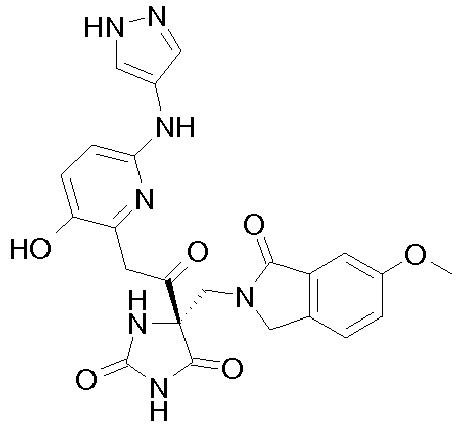
491.2 492.3 292 1707 
554.2 555.3 1570 112 
389.1 390.1 10000001 113 
389.1 390.1 10000001 114 
389.1 390.1 10000001 1150 
538.14 539.3 >10,000 1160 
428.09 429.2 7142 1165 
428.09 429.2 >10,000 1170 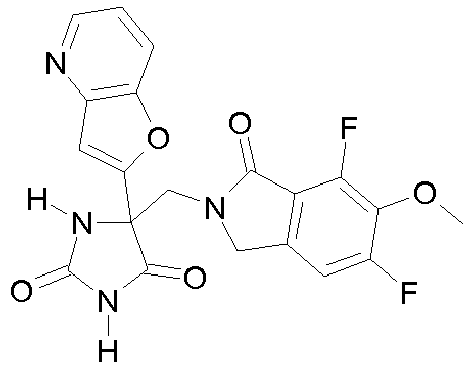
428.09 429.2 >10,000 1175 
428.09 429.2 7120 1180 
454.11 455.3 1431 1190 
554.21 555.3 >10,000 1120A 
367.11 368.08 >10,000 1120B 
368.1 369.2 >10,000 1500 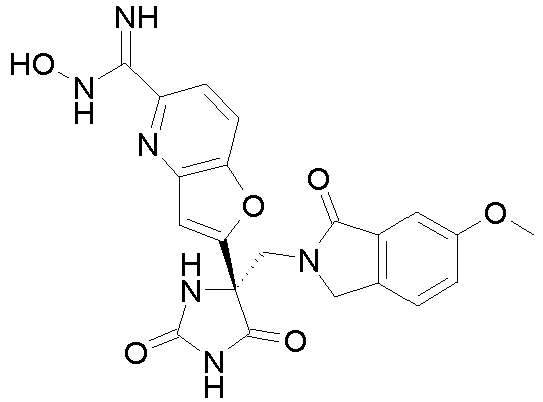
450.4 451.2 640.2 1501 
531.6 533.3 1891.5 1502 
531.6 533.3 1821.1 1304 
494.08 495.3 3098 113 1RR AUC = rapid rat AUC
2hWBA = human whole blood assayTable B: ID Structures Exact Mass Mass Obsvd hWBA2 IC50 nM RR AUC1 (nM.h) 2200 
434.4 435.2 307 2201 
460.03 461.0 10000 2203 
529.2 530.3 3559 2206 
534.2 535.3 384 2207 
562.3 563.3 308 0 2208 
576.3 577.3 281 2209 
485.10 486.1 315 2210 
515.14 516.3 187 321 2211 
529.16 530.3 570 55 2213 
501.16 502.3 335 0 2214 
515.14 516.3 1011 128 2215 
501.16 502.3 628 0 2216 
533.13 534.3 145 1604 2217 
460.1 461.3 1940 2218 
472.1 473.3 284 0 2219 
406.1 407.2 1374 2223 
515.14 1001 2224 
489.2 490.3 239 2227 
467.1 468.3 813 2228 
518.2 519.3 91 2229 
546.2 547.3 96 2230 
497.1 498.3 434 2231 
461.1 462.3 152 2234 
489.2 490.3 205 2237 
630.28 631.3 1184 2238 
631.26 632.3 1025 2239 
562.20 563.3 267 0 2241 
522.22 523.3 1274 1RR AUC = rapid rat AUC
2hWBA = human whole blood assay
Claims (17)
- A compound represented by Formula (I):
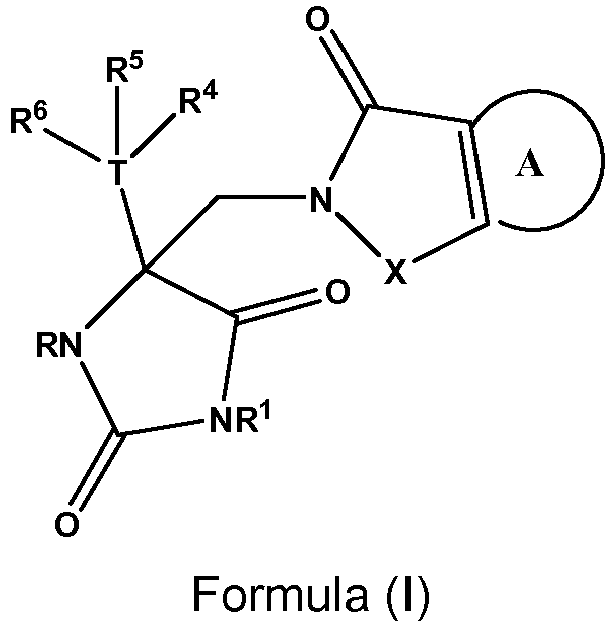 ring A is aryl or heteroaryl, wherein said aryl or heteroaryl is unsubstituted or substituted with R2 or -OR3, wherein R2 is H or halo, and R3 is H or alkyl;T is aryl or heteroaryl, substituted with an R4, R5, and R6 as shown;X is selected from the group consisting of -S-,-O-, -S(O)2-, -S(O)-, -(CR8 2)p- and -N(R')-;p is 1 to 3;R' is selected from the group consisting of H, alkyl, and aryl;R is selected from the group consisting of H, alkyl, cycloalkyl, cycloalkenyl, heterocyclyl, heterocyclenyl, aryl, heteroaryl, -C(=O)alkyl, -C(=O)cycloalkyl, - C(=O)heterocyclyl, -C(=O)aryl, -C(=O)heteroaryl, , -C(=O)O-alkyl, -C(=O)O-cycloalkyl, -C(=O)O-heterocyclyl, -C(=O)O-aryl, and -C(=O)O-heteroaryl;R1 is selected from the group consisting of H and -C(R7)2-(Q)nR9;R4 is selected from the group consisting of H, alkyl, and halogen;
R5 and R6 are substituents on adjacent carbon atoms, wherein R5 and R6 together with the carbon atoms to which they are attached form a five or six-membered cycloalkyl; wherein said five or six-membered cycloalkyl contains two radicals on the same carbon atom, and said radicals taken together with the carbon atom to which they are attached form a five-membered heterocyclyl; wherein said five or six-membered cycloalkyl comprising R5 and R6 and further comprising said five-membered heterocyclyl is selected from the group consisting of:


 each R7 independently is selected from the group consisting of H, alkyl, and aryl;each R8 independently is selected from the group consisting of H, alkyl, and aryl;R9 is selected from the group consisting of H, alkyl, heterocyclyl, aryl, heteroaryl, -C(=O)N(R12)2, -C(=O)-alkyl, C(=O)-cycloalkyl, C(=O)-heterocyclyl, - C(=O)-aryl, -C(=O)-heteroaryl, -C(=O)-O-alkyl, -C(=O)-O-cycloalkyl, -C(=O)-O-heterocyclyl, -C(=O)-O-aryl, -C(=O)-O-heteroaryl, -P(=O)(-OH)2, -P(=O)(-O-alkyl)2, wherein when each of said "cycloalkyl", "heterocyclyl", "aryl", or "heteroaryl" in any of the aforementioned R9 groups contains two radicals on adjacent carbon atoms, said radicals may optionally be taken together with the carbon atoms to which they are attached to form a five- or six-membered cycloalkyl, aryl, heterocyclyl or heteroaryl ring;each R10 is independently selected from the group consisting of cyano, nitro, -OC(O)R11, -C(R11)=N-OR11, -OR11, -SR11, -N(R11)2, -S(O)R11, -S(O)2R11, - N(R11)S(O)2R11, -N(R11)-C(O)-R11, -N(R11)-C(O)-N(R11)2, -N(R11)-C(O)-OR11, - OC(O)N(R11)2, -C(O)N(R11)-S(O)2R11 -S(O)2N(R11)-C(O)-R11, - C(O)N(R11)C(O)R11, -C(O)N(R11)C(O)NR11, -S(O)2N(R11)2, -N(R11)-C(=NR11)-N(R11)2, -N(R11)-C(=N-CN)-N(R11)2, -haloalkoxy, -C(O)OR11, -C(O)R11, - C(O)N(R11)2, halogen, alkyl, haloalkyl, aryl, heteroaryl, heterocyclyl, heterocyclenyl, cycloalkenyl, and cycloalkyl, with the proviso that there are no adjancent heteroatoms in any of said R10;each R11 independently is selected from the group consisting of H, alkyl, cycloalkyl, haloalkyl, hydroxy, heterocyclyl, aryl, and heteroaryl;Q is selected from the group consisting of -NR12-, -O-, -S-, -S(O)-, and - S(O)2-;each R12 is independently selected from the group consisting of H and alkyl; andn is 0 or 1.
 - The compound of claim 1, wherein in formula (I), said T(R4)(R5)(R6) is

- The compound of claim 1 or 2, wherein X is -(CR8 2)p-.
- The compound of claim 1, 2 or 3 wherein ring A is phenyl.
- The compound of claim 4, wherein ring A is phenyl substituted by - OCH3.
- The compound of any preceding claim, wherein R is H.
- The compound of any preceding claim, wherein R1 is H.
- The compound of any preceding claim, wherein R4 is H.
- The compound of claim 1, wherein formula (I) is selected from the group consisting of Formula (IA)


- The compound of claim 9, wherein in formula (IA) or (IB), R2 is selected from the group consisting of H and fluoro.
- The compound of claim 1, selected from:


- The compound of claim 1 selected from:


- A pharmaceutical composition comprising a compound of any preceding claim, or a pharmaceutically acceptable salt or solvate thereof, and at least one pharmaceutically acceptable carrier.
- Use of a compound of any one of claims 1-12, or a pharmaceutically acceptable salt or solvate thereof for the manufacture of a medicament for treating rheumatoid arthritis, psoriasis or inflammatory bowel disease.
- A compound of any one of claims 1 to 12 or a pharmaceutically acceptable salt or solvate thereof for use in a method of treatment of the human body by therapy.
- A compound for use according to claim 15 wherein the therapy is the treatment of rheumatoid arthritis, psoriasis or inflammatory bowel disease.
- A combination of a compound of any one of claims 1-12 or a pharmaceutically acceptable salt or solvate thereof and at least one medicament selected from DMARDS, NSAIDS, COX-2 inhibitors, COX-1 inhibitors, immunosuppresives, BRMs, anti-inflammatory agents and H1 antagonists.
Applications Claiming Priority (2)
| Application Number | Priority Date | Filing Date | Title |
|---|---|---|---|
| US9973208P | 2008-09-24 | 2008-09-24 | |
| PCT/US2009/057805 WO2010036640A2 (en) | 2008-09-24 | 2009-09-22 | Compounds for the treatment of inflammatory disorders |
Publications (2)
| Publication Number | Publication Date |
|---|---|
| EP2346857A2 EP2346857A2 (en) | 2011-07-27 |
| EP2346857B1 true EP2346857B1 (en) | 2019-11-27 |
Family
ID=42045208
Family Applications (1)
| Application Number | Title | Priority Date | Filing Date |
|---|---|---|---|
| EP09792832.9A Active EP2346857B1 (en) | 2008-09-24 | 2009-09-22 | Compounds for the treatment of inflammatory disorders |
Country Status (5)
| Country | Link |
|---|---|
| US (1) | US8450355B2 (en) |
| EP (1) | EP2346857B1 (en) |
| AR (1) | AR073741A1 (en) |
| TW (1) | TW201024303A (en) |
| WO (1) | WO2010036640A2 (en) |
Families Citing this family (6)
| Publication number | Priority date | Publication date | Assignee | Title |
|---|---|---|---|---|
| US8569336B2 (en) | 2008-11-10 | 2013-10-29 | Ling Tong | Compounds for the treatment of inflammatory disorders |
| US8541572B2 (en) * | 2008-11-10 | 2013-09-24 | Merck Sharp & Dohme Corp. | Compounds for the treatment of inflammatory disorders |
| NO2789607T3 (en) | 2011-12-09 | 2018-07-07 | ||
| AU2014275835B2 (en) | 2013-06-07 | 2018-08-16 | Kaken Pharmaceutical Co., Ltd. | (+)-5-(3,4-difluorophenyl)-5-[(3-methyl-2-oxopyridin-1(2H)-yl)methyl]imidazolidine-2,4-dione and drug containing same |
| WO2021217508A1 (en) * | 2020-04-29 | 2021-11-04 | Novartis Ag | COMPOUNDS AND COMPOSITIONS FOR INHIBITING THE ACTIVITY OF HIF2α AND THEIR METHODS OF USE |
| CN113173911A (en) * | 2021-04-20 | 2021-07-27 | 梯尔希(南京)药物研发有限公司 | Synthesis method of imidacloprid metabolite 5-hydroxy imidacloprid |
Family Cites Families (19)
| Publication number | Priority date | Publication date | Assignee | Title |
|---|---|---|---|---|
| US6228869B1 (en) | 1996-10-16 | 2001-05-08 | American Cyanamid Company | Ortho-sulfonamido bicyclic hydroxamic acids as matrix metalloproteinase and TACE inhibitors |
| TR200202164T2 (en) | 1999-08-18 | 2002-11-21 | Warner-Lambert Company | Hydroxamic acid compounds useful as matrix metalloproteinase inhibitors. |
| AU2001250850A1 (en) | 2000-03-17 | 2001-10-03 | Dupont Pharmaceuticals Company | Beta-amino acid derivatives as inhibitors of matrix metalloproteases and tnf-alpha |
| JP2004527511A (en) | 2001-03-15 | 2004-09-09 | アストラゼネカ・アクチエボラーグ | Metalloproteinase inhibitors |
| JP2004535411A (en) | 2001-05-25 | 2004-11-25 | ブリストルーマイヤーズ スクイブ カンパニー | Hydantoins and related heterocyclic compounds as inhibitors of matrix metalloproteinases and / or TNF-α convertases (TACE) |
| WO2003053941A2 (en) | 2001-12-20 | 2003-07-03 | Bristol-Myers Squibb Company | Barbituric acid derivatives as inhibitors of tnf-alpha converting enzyme (tace) and/or matrix metalloproteinases |
| WO2003053940A1 (en) | 2001-12-20 | 2003-07-03 | Bristol-Myers Squibb Company | Barbituric acid derivatives as inhibitors of tnf-$g(a) converting enzyme (tace) and/or matrix metalloproteinases |
| WO2004012663A2 (en) | 2002-08-01 | 2004-02-12 | Bristol-Myers Squibb Company | Hydantoin derivatives as inhibitors of matrix metalloproteinases and/or tnf-alpha converting enzyme |
| GB0221246D0 (en) | 2002-09-13 | 2002-10-23 | Astrazeneca Ab | Compounds |
| GB0221250D0 (en) | 2002-09-13 | 2002-10-23 | Astrazeneca Ab | Compounds |
| AU2003282920A1 (en) | 2002-10-04 | 2004-05-04 | Bristol-Myers Squibb Company | Hydantoin derivatives as inhibitors of matrix metalloproteinases and/or tnf-alpha converting enzyme (tace) |
| CA2510807C (en) | 2002-12-19 | 2011-11-22 | Vertex Pharmaceuticals Incorporated | Inhibitors of tace |
| WO2006019768A1 (en) | 2004-07-16 | 2006-02-23 | Schering Corporation | Hydantoin derivatives for the treatment of inflammatory disorders |
| US7488745B2 (en) * | 2004-07-16 | 2009-02-10 | Schering Corporation | Compounds for the treatment of inflammatory disorders |
| US7504424B2 (en) * | 2004-07-16 | 2009-03-17 | Schering Corporation | Compounds for the treatment of inflammatory disorders |
| PE20071240A1 (en) | 2006-01-17 | 2008-01-14 | Schering Corp | HYDANTOIN-DERIVED COMPOUNDS FOR THE TREATMENT OF INFLAMMATORY DISORDERS |
| JP2010502617A (en) | 2006-08-31 | 2010-01-28 | シェーリング コーポレイション | Hydantoin derivatives useful as antibacterial substances |
| US8569336B2 (en) | 2008-11-10 | 2013-10-29 | Ling Tong | Compounds for the treatment of inflammatory disorders |
| US8541572B2 (en) | 2008-11-10 | 2013-09-24 | Merck Sharp & Dohme Corp. | Compounds for the treatment of inflammatory disorders |
-
2009
- 2009-09-22 US US13/120,730 patent/US8450355B2/en active Active
- 2009-09-22 TW TW098131965A patent/TW201024303A/en unknown
- 2009-09-22 WO PCT/US2009/057805 patent/WO2010036640A2/en not_active Ceased
- 2009-09-22 EP EP09792832.9A patent/EP2346857B1/en active Active
- 2009-09-22 AR ARP090103634A patent/AR073741A1/en not_active Application Discontinuation
Non-Patent Citations (1)
| Title |
|---|
| None * |
Also Published As
| Publication number | Publication date |
|---|---|
| WO2010036640A3 (en) | 2010-08-12 |
| US20110288077A1 (en) | 2011-11-24 |
| US8450355B2 (en) | 2013-05-28 |
| AR073741A1 (en) | 2010-12-01 |
| TW201024303A (en) | 2010-07-01 |
| EP2346857A2 (en) | 2011-07-27 |
| WO2010036640A2 (en) | 2010-04-01 |
Similar Documents
| Publication | Publication Date | Title |
|---|---|---|
| US8178553B2 (en) | Compounds for the treatment of inflammatory disorders | |
| EP1778676B1 (en) | Hydantoin derivatives for the treatment of inflammatory disorders | |
| US7687527B2 (en) | Compounds for the treatment of inflammatory disorders | |
| US8541572B2 (en) | Compounds for the treatment of inflammatory disorders | |
| US7488745B2 (en) | Compounds for the treatment of inflammatory disorders | |
| US8569336B2 (en) | Compounds for the treatment of inflammatory disorders | |
| US8450355B2 (en) | Compounds for the treatment of inflammatory diseases | |
| EP2331528B1 (en) | Compounds for the treatment of inflammatory disorders | |
| US7879997B2 (en) | Compounds for the treatment of inflammatory disorders | |
| US20090239890A1 (en) | Spiro substituted cyclopropane compounds for the treatment of inflammatory disorders | |
| MX2008009297A (en) | Hydantoin compounds for the treatment of inflammatory disorders |
Legal Events
| Date | Code | Title | Description |
|---|---|---|---|
| PUAI | Public reference made under article 153(3) epc to a published international application that has entered the european phase |
Free format text: ORIGINAL CODE: 0009012 |
|
| 17P | Request for examination filed |
Effective date: 20110426 |
|
| AK | Designated contracting states |
Kind code of ref document: A2 Designated state(s): AT BE BG CH CY CZ DE DK EE ES FI FR GB GR HR HU IE IS IT LI LT LU LV MC MK MT NL NO PL PT RO SE SI SK SM TR |
|
| AX | Request for extension of the european patent |
Extension state: AL BA RS |
|
| DAX | Request for extension of the european patent (deleted) | ||
| RAP1 | Party data changed (applicant data changed or rights of an application transferred) |
Owner name: MERCK SHARP & DOHME CORP. |
|
| 17Q | First examination report despatched |
Effective date: 20160201 |
|
| STAA | Information on the status of an ep patent application or granted ep patent |
Free format text: STATUS: EXAMINATION IS IN PROGRESS |
|
| GRAP | Despatch of communication of intention to grant a patent |
Free format text: ORIGINAL CODE: EPIDOSNIGR1 |
|
| STAA | Information on the status of an ep patent application or granted ep patent |
Free format text: STATUS: GRANT OF PATENT IS INTENDED |
|
| INTG | Intention to grant announced |
Effective date: 20190614 |
|
| GRAS | Grant fee paid |
Free format text: ORIGINAL CODE: EPIDOSNIGR3 |
|
| GRAA | (expected) grant |
Free format text: ORIGINAL CODE: 0009210 |
|
| STAA | Information on the status of an ep patent application or granted ep patent |
Free format text: STATUS: THE PATENT HAS BEEN GRANTED |
|
| AK | Designated contracting states |
Kind code of ref document: B1 Designated state(s): AT BE BG CH CY CZ DE DK EE ES FI FR GB GR HR HU IE IS IT LI LT LU LV MC MK MT NL NO PL PT RO SE SI SK SM TR |
|
| REG | Reference to a national code |
Ref country code: GB Ref legal event code: FG4D |
|
| REG | Reference to a national code |
Ref country code: CH Ref legal event code: EP |
|
| REG | Reference to a national code |
Ref country code: DE Ref legal event code: R096 Ref document number: 602009060569 Country of ref document: DE |
|
| REG | Reference to a national code |
Ref country code: AT Ref legal event code: REF Ref document number: 1206544 Country of ref document: AT Kind code of ref document: T Effective date: 20191215 |
|
| REG | Reference to a national code |
Ref country code: IE Ref legal event code: FG4D |
|
| REG | Reference to a national code |
Ref country code: NL Ref legal event code: MP Effective date: 20191127 |
|
| REG | Reference to a national code |
Ref country code: LT Ref legal event code: MG4D |
|
| PG25 | Lapsed in a contracting state [announced via postgrant information from national office to epo] |
Ref country code: BG Free format text: LAPSE BECAUSE OF FAILURE TO SUBMIT A TRANSLATION OF THE DESCRIPTION OR TO PAY THE FEE WITHIN THE PRESCRIBED TIME-LIMIT Effective date: 20200227 Ref country code: NO Free format text: LAPSE BECAUSE OF FAILURE TO SUBMIT A TRANSLATION OF THE DESCRIPTION OR TO PAY THE FEE WITHIN THE PRESCRIBED TIME-LIMIT Effective date: 20200227 Ref country code: GR Free format text: LAPSE BECAUSE OF FAILURE TO SUBMIT A TRANSLATION OF THE DESCRIPTION OR TO PAY THE FEE WITHIN THE PRESCRIBED TIME-LIMIT Effective date: 20200228 Ref country code: FI Free format text: LAPSE BECAUSE OF FAILURE TO SUBMIT A TRANSLATION OF THE DESCRIPTION OR TO PAY THE FEE WITHIN THE PRESCRIBED TIME-LIMIT Effective date: 20191127 Ref country code: LT Free format text: LAPSE BECAUSE OF FAILURE TO SUBMIT A TRANSLATION OF THE DESCRIPTION OR TO PAY THE FEE WITHIN THE PRESCRIBED TIME-LIMIT Effective date: 20191127 Ref country code: ES Free format text: LAPSE BECAUSE OF FAILURE TO SUBMIT A TRANSLATION OF THE DESCRIPTION OR TO PAY THE FEE WITHIN THE PRESCRIBED TIME-LIMIT Effective date: 20191127 Ref country code: NL Free format text: LAPSE BECAUSE OF FAILURE TO SUBMIT A TRANSLATION OF THE DESCRIPTION OR TO PAY THE FEE WITHIN THE PRESCRIBED TIME-LIMIT Effective date: 20191127 Ref country code: LV Free format text: LAPSE BECAUSE OF FAILURE TO SUBMIT A TRANSLATION OF THE DESCRIPTION OR TO PAY THE FEE WITHIN THE PRESCRIBED TIME-LIMIT Effective date: 20191127 Ref country code: SE Free format text: LAPSE BECAUSE OF FAILURE TO SUBMIT A TRANSLATION OF THE DESCRIPTION OR TO PAY THE FEE WITHIN THE PRESCRIBED TIME-LIMIT Effective date: 20191127 |
|
| PG25 | Lapsed in a contracting state [announced via postgrant information from national office to epo] |
Ref country code: HR Free format text: LAPSE BECAUSE OF FAILURE TO SUBMIT A TRANSLATION OF THE DESCRIPTION OR TO PAY THE FEE WITHIN THE PRESCRIBED TIME-LIMIT Effective date: 20191127 Ref country code: IS Free format text: LAPSE BECAUSE OF FAILURE TO SUBMIT A TRANSLATION OF THE DESCRIPTION OR TO PAY THE FEE WITHIN THE PRESCRIBED TIME-LIMIT Effective date: 20200327 |
|
| PG25 | Lapsed in a contracting state [announced via postgrant information from national office to epo] |
Ref country code: RO Free format text: LAPSE BECAUSE OF FAILURE TO SUBMIT A TRANSLATION OF THE DESCRIPTION OR TO PAY THE FEE WITHIN THE PRESCRIBED TIME-LIMIT Effective date: 20191127 Ref country code: CZ Free format text: LAPSE BECAUSE OF FAILURE TO SUBMIT A TRANSLATION OF THE DESCRIPTION OR TO PAY THE FEE WITHIN THE PRESCRIBED TIME-LIMIT Effective date: 20191127 Ref country code: PT Free format text: LAPSE BECAUSE OF FAILURE TO SUBMIT A TRANSLATION OF THE DESCRIPTION OR TO PAY THE FEE WITHIN THE PRESCRIBED TIME-LIMIT Effective date: 20200419 Ref country code: EE Free format text: LAPSE BECAUSE OF FAILURE TO SUBMIT A TRANSLATION OF THE DESCRIPTION OR TO PAY THE FEE WITHIN THE PRESCRIBED TIME-LIMIT Effective date: 20191127 Ref country code: DK Free format text: LAPSE BECAUSE OF FAILURE TO SUBMIT A TRANSLATION OF THE DESCRIPTION OR TO PAY THE FEE WITHIN THE PRESCRIBED TIME-LIMIT Effective date: 20191127 |
|
| REG | Reference to a national code |
Ref country code: DE Ref legal event code: R097 Ref document number: 602009060569 Country of ref document: DE |
|
| PG25 | Lapsed in a contracting state [announced via postgrant information from national office to epo] |
Ref country code: SK Free format text: LAPSE BECAUSE OF FAILURE TO SUBMIT A TRANSLATION OF THE DESCRIPTION OR TO PAY THE FEE WITHIN THE PRESCRIBED TIME-LIMIT Effective date: 20191127 Ref country code: SM Free format text: LAPSE BECAUSE OF FAILURE TO SUBMIT A TRANSLATION OF THE DESCRIPTION OR TO PAY THE FEE WITHIN THE PRESCRIBED TIME-LIMIT Effective date: 20191127 |
|
| REG | Reference to a national code |
Ref country code: AT Ref legal event code: MK05 Ref document number: 1206544 Country of ref document: AT Kind code of ref document: T Effective date: 20191127 |
|
| PLBE | No opposition filed within time limit |
Free format text: ORIGINAL CODE: 0009261 |
|
| STAA | Information on the status of an ep patent application or granted ep patent |
Free format text: STATUS: NO OPPOSITION FILED WITHIN TIME LIMIT |
|
| 26N | No opposition filed |
Effective date: 20200828 |
|
| PG25 | Lapsed in a contracting state [announced via postgrant information from national office to epo] |
Ref country code: AT Free format text: LAPSE BECAUSE OF FAILURE TO SUBMIT A TRANSLATION OF THE DESCRIPTION OR TO PAY THE FEE WITHIN THE PRESCRIBED TIME-LIMIT Effective date: 20191127 Ref country code: PL Free format text: LAPSE BECAUSE OF FAILURE TO SUBMIT A TRANSLATION OF THE DESCRIPTION OR TO PAY THE FEE WITHIN THE PRESCRIBED TIME-LIMIT Effective date: 20191127 Ref country code: SI Free format text: LAPSE BECAUSE OF FAILURE TO SUBMIT A TRANSLATION OF THE DESCRIPTION OR TO PAY THE FEE WITHIN THE PRESCRIBED TIME-LIMIT Effective date: 20191127 |
|
| PG25 | Lapsed in a contracting state [announced via postgrant information from national office to epo] |
Ref country code: IT Free format text: LAPSE BECAUSE OF FAILURE TO SUBMIT A TRANSLATION OF THE DESCRIPTION OR TO PAY THE FEE WITHIN THE PRESCRIBED TIME-LIMIT Effective date: 20191127 |
|
| PG25 | Lapsed in a contracting state [announced via postgrant information from national office to epo] |
Ref country code: MC Free format text: LAPSE BECAUSE OF FAILURE TO SUBMIT A TRANSLATION OF THE DESCRIPTION OR TO PAY THE FEE WITHIN THE PRESCRIBED TIME-LIMIT Effective date: 20191127 |
|
| REG | Reference to a national code |
Ref country code: CH Ref legal event code: PL |
|
| REG | Reference to a national code |
Ref country code: BE Ref legal event code: MM Effective date: 20200930 |
|
| PG25 | Lapsed in a contracting state [announced via postgrant information from national office to epo] |
Ref country code: LU Free format text: LAPSE BECAUSE OF NON-PAYMENT OF DUE FEES Effective date: 20200922 |
|
| PG25 | Lapsed in a contracting state [announced via postgrant information from national office to epo] |
Ref country code: IE Free format text: LAPSE BECAUSE OF NON-PAYMENT OF DUE FEES Effective date: 20200922 Ref country code: LI Free format text: LAPSE BECAUSE OF NON-PAYMENT OF DUE FEES Effective date: 20200930 Ref country code: CH Free format text: LAPSE BECAUSE OF NON-PAYMENT OF DUE FEES Effective date: 20200930 Ref country code: BE Free format text: LAPSE BECAUSE OF NON-PAYMENT OF DUE FEES Effective date: 20200930 |
|
| PG25 | Lapsed in a contracting state [announced via postgrant information from national office to epo] |
Ref country code: TR Free format text: LAPSE BECAUSE OF FAILURE TO SUBMIT A TRANSLATION OF THE DESCRIPTION OR TO PAY THE FEE WITHIN THE PRESCRIBED TIME-LIMIT Effective date: 20191127 Ref country code: MT Free format text: LAPSE BECAUSE OF FAILURE TO SUBMIT A TRANSLATION OF THE DESCRIPTION OR TO PAY THE FEE WITHIN THE PRESCRIBED TIME-LIMIT Effective date: 20191127 Ref country code: CY Free format text: LAPSE BECAUSE OF FAILURE TO SUBMIT A TRANSLATION OF THE DESCRIPTION OR TO PAY THE FEE WITHIN THE PRESCRIBED TIME-LIMIT Effective date: 20191127 |
|
| PG25 | Lapsed in a contracting state [announced via postgrant information from national office to epo] |
Ref country code: MK Free format text: LAPSE BECAUSE OF FAILURE TO SUBMIT A TRANSLATION OF THE DESCRIPTION OR TO PAY THE FEE WITHIN THE PRESCRIBED TIME-LIMIT Effective date: 20191127 |
|
| REG | Reference to a national code |
Ref country code: DE Ref legal event code: R081 Ref document number: 602009060569 Country of ref document: DE Owner name: MERCK SHARP & DOHME LLC, RAHWAY, US Free format text: FORMER OWNER: MERCK SHARP & DOHME CORP., RAHWAY, N.J., US |
|
| REG | Reference to a national code |
Ref country code: GB Ref legal event code: 732E Free format text: REGISTERED BETWEEN 20220908 AND 20220914 |
|
| PGFP | Annual fee paid to national office [announced via postgrant information from national office to epo] |
Ref country code: DE Payment date: 20250808 Year of fee payment: 17 |
|
| PGFP | Annual fee paid to national office [announced via postgrant information from national office to epo] |
Ref country code: GB Payment date: 20250814 Year of fee payment: 17 |
|
| PGFP | Annual fee paid to national office [announced via postgrant information from national office to epo] |
Ref country code: FR Payment date: 20250808 Year of fee payment: 17 |