EP2344970B1 - Data center and data center design - Google Patents
Data center and data center design Download PDFInfo
- Publication number
- EP2344970B1 EP2344970B1 EP09826517.6A EP09826517A EP2344970B1 EP 2344970 B1 EP2344970 B1 EP 2344970B1 EP 09826517 A EP09826517 A EP 09826517A EP 2344970 B1 EP2344970 B1 EP 2344970B1
- Authority
- EP
- European Patent Office
- Prior art keywords
- data center
- applications
- section
- priority
- populated
- Prior art date
- Legal status (The legal status is an assumption and is not a legal conclusion. Google has not performed a legal analysis and makes no representation as to the accuracy of the status listed.)
- Not-in-force
Links
Images


Classifications
-
- G—PHYSICS
- G06—COMPUTING OR CALCULATING; COUNTING
- G06F—ELECTRIC DIGITAL DATA PROCESSING
- G06F9/00—Arrangements for program control, e.g. control units
- G06F9/06—Arrangements for program control, e.g. control units using stored programs, i.e. using an internal store of processing equipment to receive or retain programs
- G06F9/46—Multiprogramming arrangements
- G06F9/50—Allocation of resources, e.g. of the central processing unit [CPU]
- G06F9/5005—Allocation of resources, e.g. of the central processing unit [CPU] to service a request
- G06F9/5027—Allocation of resources, e.g. of the central processing unit [CPU] to service a request the resource being a machine, e.g. CPUs, Servers, Terminals
- G06F9/5044—Allocation of resources, e.g. of the central processing unit [CPU] to service a request the resource being a machine, e.g. CPUs, Servers, Terminals considering hardware capabilities
-
- G—PHYSICS
- G06—COMPUTING OR CALCULATING; COUNTING
- G06F—ELECTRIC DIGITAL DATA PROCESSING
- G06F11/00—Error detection; Error correction; Monitoring
- G06F11/008—Reliability or availability analysis
-
- H—ELECTRICITY
- H04—ELECTRIC COMMUNICATION TECHNIQUE
- H04L—TRANSMISSION OF DIGITAL INFORMATION, e.g. TELEGRAPHIC COMMUNICATION
- H04L67/00—Network arrangements or protocols for supporting network services or applications
- H04L67/01—Protocols
- H04L67/10—Protocols in which an application is distributed across nodes in the network
-
- H—ELECTRICITY
- H04—ELECTRIC COMMUNICATION TECHNIQUE
- H04L—TRANSMISSION OF DIGITAL INFORMATION, e.g. TELEGRAPHIC COMMUNICATION
- H04L67/00—Network arrangements or protocols for supporting network services or applications
- H04L67/50—Network services
- H04L67/60—Scheduling or organising the servicing of application requests, e.g. requests for application data transmissions using the analysis and optimisation of the required network resources
- H04L67/61—Scheduling or organising the servicing of application requests, e.g. requests for application data transmissions using the analysis and optimisation of the required network resources taking into account QoS or priority requirements
-
- H—ELECTRICITY
- H04—ELECTRIC COMMUNICATION TECHNIQUE
- H04L—TRANSMISSION OF DIGITAL INFORMATION, e.g. TELEGRAPHIC COMMUNICATION
- H04L67/00—Network arrangements or protocols for supporting network services or applications
- H04L67/01—Protocols
- H04L67/10—Protocols in which an application is distributed across nodes in the network
- H04L67/1001—Protocols in which an application is distributed across nodes in the network for accessing one among a plurality of replicated servers
-
- H—ELECTRICITY
- H04—ELECTRIC COMMUNICATION TECHNIQUE
- H04L—TRANSMISSION OF DIGITAL INFORMATION, e.g. TELEGRAPHIC COMMUNICATION
- H04L67/00—Network arrangements or protocols for supporting network services or applications
- H04L67/01—Protocols
- H04L67/10—Protocols in which an application is distributed across nodes in the network
- H04L67/1001—Protocols in which an application is distributed across nodes in the network for accessing one among a plurality of replicated servers
- H04L67/1004—Server selection for load balancing
- H04L67/1008—Server selection for load balancing based on parameters of servers, e.g. available memory or workload
-
- H—ELECTRICITY
- H04—ELECTRIC COMMUNICATION TECHNIQUE
- H04L—TRANSMISSION OF DIGITAL INFORMATION, e.g. TELEGRAPHIC COMMUNICATION
- H04L67/00—Network arrangements or protocols for supporting network services or applications
- H04L67/01—Protocols
- H04L67/10—Protocols in which an application is distributed across nodes in the network
- H04L67/1001—Protocols in which an application is distributed across nodes in the network for accessing one among a plurality of replicated servers
- H04L67/1004—Server selection for load balancing
- H04L67/1012—Server selection for load balancing based on compliance of requirements or conditions with available server resources
-
- Y—GENERAL TAGGING OF NEW TECHNOLOGICAL DEVELOPMENTS; GENERAL TAGGING OF CROSS-SECTIONAL TECHNOLOGIES SPANNING OVER SEVERAL SECTIONS OF THE IPC; TECHNICAL SUBJECTS COVERED BY FORMER USPC CROSS-REFERENCE ART COLLECTIONS [XRACs] AND DIGESTS
- Y02—TECHNOLOGIES OR APPLICATIONS FOR MITIGATION OR ADAPTATION AGAINST CLIMATE CHANGE
- Y02D—CLIMATE CHANGE MITIGATION TECHNOLOGIES IN INFORMATION AND COMMUNICATION TECHNOLOGIES [ICT], I.E. INFORMATION AND COMMUNICATION TECHNOLOGIES AIMING AT THE REDUCTION OF THEIR OWN ENERGY USE
- Y02D10/00—Energy efficient computing, e.g. low power processors, power management or thermal management
Definitions
- a data center is a facility that provides computing services to an enterprise.
- a data center typically houses a variety of computer equipment and software applications used to provision the computing services.
- the computer equipment may include computers and servers, network equipment, storage equipment and telecommunication equipment. Additionally, further auxiliary equipment is provided to enable the computer equipment to operate. Such auxiliary equipment may include uninterruptible power supplies (UPS) and cooling equipment.
- UPS uninterruptible power supplies
- TIA-942 Data Center Standards Overview and the Uptime Institute define a set of 4 data center tiers based largely on levels of redundancy. For example, tier 1 data centers offer the most basic set-up, whereas tier 4 data centers offer full redundancy with 99.995% availability. Unsurprisingly, increased redundancy equates to significantly increased capital costs and operating costs. By way of example, up to 50% of a tier 3 or 4 data center may be taken up with redundant power and cooling equipment, which can translate into as much as 50% of the overall capital cost of the data center.
- US 2003/167270 A1 relates to A resource manager for a distributed environment including hosts instantiating copies of a scalable application, generates signals which start up, shutdown or move a selected one of the copies responsive to first information regarding performance of all copies of the scalable application and second information regarding performance of the hosts.
- WO 03/102772 A2 A relates to a method, computer program product and system that establishes and maintains a business continuity policy in a server consolidation environment.
- Business continuity is ensured by enabling high availability of applications.
- a system is selected best fulfilling the requirements for running the application.
- These requirements can include application requirements, such as an amount of available capacity to handle the load that will be placed on the system by the application.
- These requirements can further include system requirements, such as honoring a system limit of a number of applications that can be run on a particular system. Respective priorities of applications can be used to determine whether a lower-priority application can be moved to free resources for running a higher-priority application.
- a data center comprising a plurality of data center sections. Each data center section has a different predefined level of reliability. Also provided is a plurality of sets of applications, each set of applications being populated on one of the plurality of data center sections.
- a method of designing a data center comprises obtaining details of a set of applications to be populated in the data center. For each application a priority characteristic is determined. Based on the determined priority characteristics the applications are populated of different data center sections, with each data center section having a different predefined level of reliability.
- FIG. 1 shows a simplified block diagram of a monolithic tiered data center 100 according to the prior art.
- the data center 100 includes computing equipment 102, which may include computers, servers, networking, and telecommunication equipment, on which run numerous software applications 104a to 104n.
- the equipment 102 is powered by power equipment 106 and is cooled by cooling equipment 108.
- the exact nature of the power equipment 106 and cooling equipment 108 depends on the tier classification of the data center 100. For example, a tier 4 data center may have multiple power and cooling distribution paths including 2N+1 redundancy (i.e. 2 UPS each with N+1 redundancy), whereas a tier 1 data center may have only a single path for power and cooling distribution, with no redundant components.
- 2N+1 redundancy i.e. 2 UPS each with N+1 redundancy
- a tier 1 data center may have only a single path for power and cooling distribution, with no redundant components.
- the present invention is based largely on the realization that significant efficiency and cost savings can be achieved if the nature of the applications intended to be run in the data center are considered during the planning, design, and configuration phases, as will be explained below in more detail.
- Figure 2 shows a block diagram of a number of software applications 104a to 104i that are to run or are planned to be run in a data center. Additional reference is made to the flow diagrams shown in Figures 3A and 3B . Those skilled in the art will appreciate, however, that only a small number of software applications are discussed herein for reasons of clarity, and will further appreciate that the number of software applications in a typical data center may run into the many thousands and beyond.
- a list of software applications to be run or planned to be run in the data center is obtained.
- software applications 104a to 104i are identified. These applications may be individual applications or may be a suite of one or more applications.
- business impact refers to the impact on the enterprise business should that software application not be available, due, for example, to a hardware failure.
- Urgency refers to the time delay in which such an application should be made available following the application becoming unavailable. For example, in a banking environment, an application providing authorization to withdraw funds from an ATM machine may be classed as having high impact and high urgency, whereas an application providing the overnight transfer of funds from one account to another may be classed as having high impact and medium urgency.
- a priority level based on the defined business impact and urgency is defined.
- Table 1 below, for example, shows an example mapping of business impact and urgency to priority.
- an application having high urgency and high business impact is defined as having a critical priority.
- an application having high impact and medium urgency is defined as having a high priority.
- software applications 104a, 104d, and 104e are determined to be low priority, applications 104c, 104f, and 104k as medium priority, and applications 104b, 104g, and 104i as critical priority.
- the number and type of data center sections or tiers may be determined (step 308).
- tier 1 data centers offering the most basic reliability levels
- tier 4 data centers offering full or near full redundancy with 99.995% availability.
- tier 1 data centers offering the most basic reliability levels
- tier 4 data centers offering full or near full redundancy with 99.995% availability.
- the defined priorities of the applications 104a to 104i include low, medium, and critical priorities, it may be initially determined that a data center comprising tiers 1, 2 and 4 is suitable.
- applications having a critical priority may be populated on computer equipment in a Tier 4 data centre
- applications having a medium priority on computer equipment may be populated in a Tier 2 data centre
- applications having a low priority may be populated on computer equipment in a Tier 1 data center.
- each application is mapped to data center tier offering a level of reliability and redundancy corresponding to the determined priority of that application.
- step 310 the capacity of each data center tier determined in step 308 may be estimated. This estimation may be based, for example, on the performance requirements (such as required processing power, required memory, required network bandwidth, etc) of the applications intended to be populated in each data center tier, an estimated physical size of the data center tier, and/or an estimated power density of the data center tier.
- the performance requirements such as required processing power, required memory, required network bandwidth, etc
- a further set of steps, shown in Figure 3B may be additionally performed.
- the additional steps aim to optimize, or at least improve upon, the data center design based on financial considerations.
- step 312 an estimated capital cost of the data center is determined based, for example, on the number of determined data center tiers and their capacity.
- step 314 the data center tiers determined at step 308 are analyzed, from a financial perspective, to determine whether any consolidation of the tiers may be achieved. For example, in situations where there are large number of low and critical priority applications, and a low number of medium priority applications, it may be more cost effective to design a data center having a tier 1 section for the low priority applications and a tier 4 section for the critical and medium priority application, rather than having an additional tier 3 section just for the low number of medium priority applications. This is based on the fact that the construction of each data center tier section has a minimum fixed cost associated therewith. If appropriate, the data center design is rationalized, and a new cost estimated (step 316).
- step 318 the capacity of each proposed data center tier may be modified and its effect on the estimated cost of the proposed data center evaluated (step 320).
- a proposed data center may be arrived at that is initially substantially optimized from a business perspective and, alternatively, additionally substantially optimized from a financial perspective.
- a proposed data center may include various different data center tiers of varying capacities depending on individual requirements.
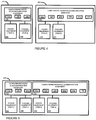
- the data center tiers described above may be implemented either in individual physically separate data centers, as shown in Figure 4 , or by a single hybrid tiered data center as shown in Figure 5 , or in any suitable combination or arrangement.
- FIG. 4 shows a block diagram of a first data center arrangement according to an embodiment of the present invention.
- Data center 402 is a tier 1 data center, and houses low priority applications 104a, 104d, and 104f.
- Data center 402 has tier 1 power equipment 408 and tier 1 cooling equipment 410.
- Data center 404 is a tier 4 data center and houses medium priority applications 104c, 104f and 104k and critical priority applications 104b, 104g and 104i
- Data center 404 has tier 4 power equipment 414 and tier 4 cooling equipment 416. With appropriate network access and interconnection, the data centers 402 and 404 provide seamless enterprise computing services.
- FIG. 5 shows an example hybrid tiered data center 500 designed by following the above-described methods.
- the hybrid tiered data center 500 provides different data center sections each providing different reliability and redundancy characteristics of different data center tiers within a single physical data center.
- computer, network and/or telecommunication equipment 402, power equipment 404, and cooling equipment 406 are arranged to provide the reliability and redundancy characteristics of a tier 1 data center for applications 104a, 104d, and 104e.
- Computer, network and/or telecommunication equipment 408, power equipment 410, and cooling equipment 412 are arranged to provide the reliability and redundancy characteristics of a tier 4 data center for applications 104c, 104f, 104k, 104b 104g, and 104i.
- Suitable computer-readable media may include volatile (e.g., RAM) and/or nonvolatile (e.g., ROM, disk) memory, carrier waves and transmission media (e.g., copper wire, coaxial cable, fiber optic media).
- carrier waves may take the form of electrical, electromagnetic, or optical signals conveying digital data streams along a local network, a publicly accessible network such as the Internet or some other communication link.
Landscapes
- Engineering & Computer Science (AREA)
- Theoretical Computer Science (AREA)
- Software Systems (AREA)
- General Engineering & Computer Science (AREA)
- General Physics & Mathematics (AREA)
- Physics & Mathematics (AREA)
- Computer Networks & Wireless Communication (AREA)
- Signal Processing (AREA)
- Quality & Reliability (AREA)
- Hardware Redundancy (AREA)
- Supply And Distribution Of Alternating Current (AREA)
- Management, Administration, Business Operations System, And Electronic Commerce (AREA)
- Detection And Prevention Of Errors In Transmission (AREA)
- Radio Transmission System (AREA)
- Emergency Protection Circuit Devices (AREA)
- Data Exchanges In Wide-Area Networks (AREA)
Description
- A data center is a facility that provides computing services to an enterprise. A data center typically houses a variety of computer equipment and software applications used to provision the computing services. The computer equipment may include computers and servers, network equipment, storage equipment and telecommunication equipment. Additionally, further auxiliary equipment is provided to enable the computer equipment to operate. Such auxiliary equipment may include uninterruptible power supplies (UPS) and cooling equipment.
- The Telecommunications Industry Association (TIA) TIA-942: Data Center Standards Overview and the Uptime Institute define a set of 4 data center tiers based largely on levels of redundancy. For example,
tier 1 data centers offer the most basic set-up, whereas tier 4 data centers offer full redundancy with 99.995% availability. Unsurprisingly, increased redundancy equates to significantly increased capital costs and operating costs. By way of example, up to 50% of a tier 3 or 4 data center may be taken up with redundant power and cooling equipment, which can translate into as much as 50% of the overall capital cost of the data center. - Typically, when an enterprise builds a data center they typically build the highest tier data center for their budget. The enterprise then populates the data center with their IT equipment and populates the IT equipment with the enterprise's software applications.
-
US 2003/167270 A1 relates to A resource manager for a distributed environment including hosts instantiating copies of a scalable application, generates signals which start up, shutdown or move a selected one of the copies responsive to first information regarding performance of all copies of the scalable application and second information regarding performance of the hosts. -
WO 03/102772 A2 - According to one aspect of the present invention, there is provided a data center comprising a plurality of data center sections. Each data center section has a different predefined level of reliability. Also provided is a plurality of sets of applications, each set of applications being populated on one of the plurality of data center sections.
- According to a second aspect of the present invention, there is provided a method of designing a data center. The method comprises obtaining details of a set of applications to be populated in the data center. For each application a priority characteristic is determined. Based on the determined priority characteristics the applications are populated of different data center sections, with each data center section having a different predefined level of reliability.
- Embodiments of invention will now be described, by way of nonlimiting example only, with reference to the accompanying drawings, in which:
-
Figure 1 is a block diagram showing a monolithic tiered data center according to the prior art; -
Figure 2 is a block diagram showing of a number of software applications; -
Figure 3A is a flow diagram outlining example processing steps taken during a data center design process according to an embodiment of the present invention; -
Figure 3B is a flow diagram outlining example processing steps taken during a data center design process according to a further embodiment of the present invention; -
Figure 4 is a block diagram showing a hybrid tiered data center according to one embodiment of the present invention; and -
Figure 5 is a block diagram showing a hybrid tiered data center according to further embodiment of the present invention. -
Figure 1 shows a simplified block diagram of a monolithictiered data center 100 according to the prior art. Thedata center 100 includescomputing equipment 102, which may include computers, servers, networking, and telecommunication equipment, on which runnumerous software applications 104a to 104n. Theequipment 102 is powered bypower equipment 106 and is cooled bycooling equipment 108. The exact nature of thepower equipment 106 andcooling equipment 108 depends on the tier classification of thedata center 100. For example, a tier 4 data center may have multiple power and cooling distribution paths including 2N+1 redundancy (i.e. 2 UPS each with N+1 redundancy), whereas atier 1 data center may have only a single path for power and cooling distribution, with no redundant components. - Given the increasing operating costs of running a data center, especially with respect to power and cooling, data center operators are looking to reduce the cost of and improve the efficiency of their data centers. Currently, this is being done by applying localized solutions to power, space, and cooling. Such localized solutions include, for example, use of more energy efficient cooling systems, server consolidation, and outsourcing of workload.
- The present invention, however, is based largely on the realization that significant efficiency and cost savings can be achieved if the nature of the applications intended to be run in the data center are considered during the planning, design, and configuration phases, as will be explained below in more detail.
- Reference will now be made to
Figure 2 , which shows a block diagram of a number ofsoftware applications 104a to 104i that are to run or are planned to be run in a data center. Additional reference is made to the flow diagrams shown inFigures 3A and 3B . Those skilled in the art will appreciate, however, that only a small number of software applications are discussed herein for reasons of clarity, and will further appreciate that the number of software applications in a typical data center may run into the many thousands and beyond. - At step 302 a list of software applications to be run or planned to be run in the data center is obtained. In the present example,
software applications 104a to 104i are identified. These applications may be individual applications or may be a suite of one or more applications. - For each
software application 104a to 104i a business impact and urgency level is assigned (step 304). In this sense, in line with standard Information Technology Infrastructure Library (ITIL) terminology, business impact refers to the impact on the enterprise business should that software application not be available, due, for example, to a hardware failure. Urgency refers to the time delay in which such an application should be made available following the application becoming unavailable. For example, in a banking environment, an application providing authorization to withdraw funds from an ATM machine may be classed as having high impact and high urgency, whereas an application providing the overnight transfer of funds from one account to another may be classed as having high impact and medium urgency. - At step 306 a priority level, based on the defined business impact and urgency is defined. Table 1 below, for example, shows an example mapping of business impact and urgency to priority.
Table 1 - Mapping of business impact and urgency to priority Impact High Medium Low Urgency High Critical High Medium Medium High Medium Low Low Medium Low Planning - Thus, in the present example, an application having high urgency and high business impact is defined as having a critical priority. Similarly, an application having high impact and medium urgency is defined as having a high priority.
- In the present
embodiment software applications applications applications - Once the priority of each software application has been defined, the number and type of data center sections or tiers may be determined (step 308). Currently there are 4 widely accepted industry standard data center tiers, with
tier 1 data centers offering the most basic reliability levels, and tier 4 data centers offering full or near full redundancy with 99.995% availability. Those skilled in the art will appreciate that different numbers of data center sections or tiers could be used, each having a different level of reliability, redundancy, or other appropriate characteristics. - For example, if the defined priorities of the
applications 104a to 104i include low, medium, and critical priorities, it may be initially determined that a datacenter comprising tiers - In this case, for example, applications having a critical priority may be populated on computer equipment in a Tier 4 data centre, applications having a medium priority on computer equipment may be populated in a
Tier 2 data centre, and applications having a low priority may be populated on computer equipment in aTier 1 data center. In this way, each application is mapped to data center tier offering a level of reliability and redundancy corresponding to the determined priority of that application. - In
step 310 the capacity of each data center tier determined instep 308 may be estimated. This estimation may be based, for example, on the performance requirements (such as required processing power, required memory, required network bandwidth, etc) of the applications intended to be populated in each data center tier, an estimated physical size of the data center tier, and/or an estimated power density of the data center tier. - According to a further embodiment, a further set of steps, shown in
Figure 3B may be additionally performed. The additional steps aim to optimize, or at least improve upon, the data center design based on financial considerations. - In
step 312 an estimated capital cost of the data center is determined based, for example, on the number of determined data center tiers and their capacity. - In
step 314 the data center tiers determined atstep 308 are analyzed, from a financial perspective, to determine whether any consolidation of the tiers may be achieved. For example, in situations where there are large number of low and critical priority applications, and a low number of medium priority applications, it may be more cost effective to design a data center having atier 1 section for the low priority applications and a tier 4 section for the critical and medium priority application, rather than having an additional tier 3 section just for the low number of medium priority applications. This is based on the fact that the construction of each data center tier section has a minimum fixed cost associated therewith. If appropriate, the data center design is rationalized, and a new cost estimated (step 316). - In
step 318 the capacity of each proposed data center tier may be modified and its effect on the estimated cost of the proposed data center evaluated (step 320). - This process may be repeated numerous times, each time modifying different characteristics of the proposed data center. In this way, a proposed data center may be arrived at that is initially substantially optimized from a business perspective and, alternatively, additionally substantially optimized from a financial perspective. A proposed data center may include various different data center tiers of varying capacities depending on individual requirements.
- The data center tiers described above may be implemented either in individual physically separate data centers, as shown in
Figure 4 , or by a single hybrid tiered data center as shown inFigure 5 , or in any suitable combination or arrangement. -
Figure 4 shows a block diagram of a first data center arrangement according to an embodiment of the present invention. InFigure 4 , there are shown a number ofdifferent data centers Data center 402 is atier 1 data center, and houseslow priority applications Data center 402 hastier 1power equipment 408 andtier 1cooling equipment 410.Data center 404 is a tier 4 data center and housesmedium priority applications critical priority applications 104i Data center 404 has tier 4power equipment 414 and tier 4cooling equipment 416. With appropriate network access and interconnection, thedata centers -
Figure 5 shows an example hybridtiered data center 500 designed by following the above-described methods. The hybridtiered data center 500 provides different data center sections each providing different reliability and redundancy characteristics of different data center tiers within a single physical data center. For example, computer, network and/ortelecommunication equipment 402,power equipment 404, andcooling equipment 406 are arranged to provide the reliability and redundancy characteristics of atier 1 data center forapplications telecommunication equipment 408,power equipment 410, andcooling equipment 412 are arranged to provide the reliability and redundancy characteristics of a tier 4 data center forapplications 104b - By providing a single hybrid data center, further cost savings may be achieved by allowing sharing of common facilities and infrastructure, such as sharing of a physical enclosure or facility, sharing of security systems, access controls, and the like.
- By basing the initial data center design and configuration on the business considerations, such as the priority of the applications that are to run in the data center, significant cost savings and energy efficiency can be achieved. For example, if the
applications 104a to 104i were to all have been housed in a single monolithic tier 4 data center, significant capital costs and operating costs would have been wasted on providing the low and medium priority applications with a level of redundancy and reliability over and above that determined, by the business, as necessary for those applications. In existing monolithic data centers it is estimated that as many as 50% of the applications running in such data centers can be classified as non-business critical. - Although the present embodiments have been described with reference to ITIL principles, those skilled in the art will appreciate that other business service prioritization frameworks, such as ISO 20000, could also be used.
- In further embodiments, not all of the method steps outline above are performed, or are performed in a sequence different from that described above.
- It should also be understood that the techniques of the present invention might be implemented using a variety of technologies. For example, the methods described herein may be implemented in software executing on a computer system, or implemented in hardware utilizing either a combination of microprocessors or other specially designed application specific integrated circuits, programmable logic devices, or various combinations thereof. In particular, methods described herein may be implemented by a series of computer-executable instructions residing on a suitable computer-readable medium. Suitable computer-readable media may include volatile (e.g., RAM) and/or nonvolatile (e.g., ROM, disk) memory, carrier waves and transmission media (e.g., copper wire, coaxial cable, fiber optic media). Exemplary carrier waves may take the form of electrical, electromagnetic, or optical signals conveying digital data streams along a local network, a publicly accessible network such as the Internet or some other communication link.
Claims (11)
- A data center (100) comprising:a plurality of data center sections, each section having a different predefined level of reliability and redundancy; anda plurality of sets of applications (104a - 104n), each set of applications (104a - 104n) being populated on one of the plurality of data center sections,wherein each set of applications (104a - 104n), has a determined priority, and further wherein each set of applications (104a - 104n) is populated on a data center section having a level of reliability and redundancy suitable to the determined priority.
- The data center of claim 1, wherein the plurality of sets of applications further include applications planned to be populated on one of the plurality of data center sections.
- The data center of claim 1, wherein each data center section is one of either an independent physical data center or a section of a data center within a single physical data center.
- The data center of claim 3, wherein each data center section is network interconnected.
- The data center of claim 1, wherein each data center section further comprises power and cooling equipment suitable for providing the level of reliability and redundancy required by each data center section.
- The data center of claim 5, wherein each data center section is a section within a single physical data center, each section sharing common infrastructure elements on the same physical data center.
- A method of designing a data center (100) comprising:obtaining details of a set of applications (104a - 104n) to be populated in the data center;determining a priority characteristic for each applications (104a - 104n); anddetermining, based on the obtained priority characteristics, a plurality of data center sections on which the applications (104a - 104n) are to be populated, each data center section having a different predefined level of reliability and redundancy associated with the determined priority characteristic for each applications (104a - 104n).
- The method according to claim 7, further comprising populating at least some of the plurality of applications on a data center section having a level of reliability corresponding to the determined level of priority of each application.
- The method according to claim 7, further comprising determining the number of data center sections based in part on the determined priority of each set of applications and in part on a financial analysis.
- The method according to claim 7, further comprising performing the method steps iteratively to substantially optimize the data center design.
- The method according to claim 7, wherein a capacity of each of the plurality of data center sections is based on the performance requirements of the applications to be populated therein.
Applications Claiming Priority (2)
| Application Number | Priority Date | Filing Date | Title |
|---|---|---|---|
| US12/261,250 US20100111105A1 (en) | 2008-10-30 | 2008-10-30 | Data center and data center design |
| PCT/US2009/061534 WO2010056473A2 (en) | 2008-10-30 | 2009-10-21 | Data center and data center design |
Publications (3)
| Publication Number | Publication Date |
|---|---|
| EP2344970A2 EP2344970A2 (en) | 2011-07-20 |
| EP2344970A4 EP2344970A4 (en) | 2017-06-14 |
| EP2344970B1 true EP2344970B1 (en) | 2019-09-18 |
Family
ID=42131340
Family Applications (1)
| Application Number | Title | Priority Date | Filing Date |
|---|---|---|---|
| EP09826517.6A Not-in-force EP2344970B1 (en) | 2008-10-30 | 2009-10-21 | Data center and data center design |
Country Status (5)
| Country | Link |
|---|---|
| US (1) | US20100111105A1 (en) |
| EP (1) | EP2344970B1 (en) |
| CN (1) | CN102204213B (en) |
| BR (1) | BRPI0914386A2 (en) |
| WO (1) | WO2010056473A2 (en) |
Families Citing this family (14)
| Publication number | Priority date | Publication date | Assignee | Title |
|---|---|---|---|---|
| US20100161145A1 (en) * | 2008-12-18 | 2010-06-24 | Yahoo! Inc | Search engine design and computational cost analysis |
| GB2467808B (en) | 2009-06-03 | 2011-01-12 | Moduleco Ltd | Data centre |
| US9483258B1 (en) * | 2011-04-27 | 2016-11-01 | Intuit Inc | Multi-site provisioning of resources to software offerings using infrastructure slices |
| GB201113556D0 (en) | 2011-08-05 | 2011-09-21 | Bripco Bvba | Data centre |
| US9485887B1 (en) | 2012-06-15 | 2016-11-01 | Amazon Technologies, Inc. | Data center with streamlined power and cooling |
| US10531597B1 (en) | 2012-06-15 | 2020-01-07 | Amazon Technologies, Inc. | Negative pressure air handling system |
| US9395974B1 (en) * | 2012-06-15 | 2016-07-19 | Amazon Technologies, Inc. | Mixed operating environment |
| US10158579B2 (en) | 2013-06-21 | 2018-12-18 | Amazon Technologies, Inc. | Resource silos at network-accessible services |
| US9851726B2 (en) | 2013-09-04 | 2017-12-26 | Panduit Corp. | Thermal capacity management |
| US10498664B2 (en) * | 2015-06-29 | 2019-12-03 | Vmware, Inc. | Hybrid cloud resource scheduling |
| CN113726918B (en) * | 2017-10-11 | 2024-01-05 | 华为云计算技术有限公司 | Domain name resolution method and related systems and devices based on cloud computing network |
| US11288147B2 (en) * | 2019-11-22 | 2022-03-29 | Visa International Service Association | Method, system, and computer program product for maintaining data centers |
| CN112131010B (en) * | 2020-10-09 | 2025-07-08 | 腾讯科技(深圳)有限公司 | Server layout method, device, computer equipment and storage medium |
| CN113915698B (en) * | 2021-09-28 | 2023-05-30 | 中国联合网络通信集团有限公司 | A method and device for determining the electromechanical system of a data center |
Family Cites Families (23)
| Publication number | Priority date | Publication date | Assignee | Title |
|---|---|---|---|---|
| US5396635A (en) * | 1990-06-01 | 1995-03-07 | Vadem Corporation | Power conservation apparatus having multiple power reduction levels dependent upon the activity of the computer system |
| US6839803B1 (en) * | 1999-10-27 | 2005-01-04 | Shutterfly, Inc. | Multi-tier data storage system |
| AU7344800A (en) * | 1999-08-31 | 2001-03-26 | Shutterfly, Inc. | Multi-tier data storage system |
| US7051098B2 (en) * | 2000-05-25 | 2006-05-23 | United States Of America As Represented By The Secretary Of The Navy | System for monitoring and reporting performance of hosts and applications and selectively configuring applications in a resource managed system |
| US20020082821A1 (en) * | 2000-10-31 | 2002-06-27 | Glenn Ferguson | Data model for automated server configuration |
| JP4230673B2 (en) * | 2001-02-22 | 2009-02-25 | 富士通株式会社 | Service management device |
| US6925529B2 (en) * | 2001-07-12 | 2005-08-02 | International Business Machines Corporation | Data storage on a multi-tiered disk system |
| US7529822B2 (en) * | 2002-05-31 | 2009-05-05 | Symantec Operating Corporation | Business continuation policy for server consolidation environment |
| AU2003278779A1 (en) * | 2002-09-10 | 2004-04-30 | Exagrid Systems, Inc. | Primary and remote data backup with nodal failover |
| US7072807B2 (en) * | 2003-03-06 | 2006-07-04 | Microsoft Corporation | Architecture for distributed computing system and automated design, deployment, and management of distributed applications |
| US20040193476A1 (en) * | 2003-03-31 | 2004-09-30 | Aerdts Reinier J. | Data center analysis |
| IL167628A (en) * | 2004-06-04 | 2010-11-30 | Optier Ltd | System and method for performance management in a multi-tier computing environment |
| US7386537B2 (en) * | 2004-07-23 | 2008-06-10 | Hewlett-Packard Development Company, L.P. | Method and system for determining size of a data center |
| US7409586B1 (en) * | 2004-12-09 | 2008-08-05 | Symantec Operating Corporation | System and method for handling a storage resource error condition based on priority information |
| US7460558B2 (en) * | 2004-12-16 | 2008-12-02 | International Business Machines Corporation | System and method for connection capacity reassignment in a multi-tier data processing system network |
| US7353378B2 (en) * | 2005-02-18 | 2008-04-01 | Hewlett-Packard Development Company, L.P. | Optimizing computer system |
| US7873732B2 (en) * | 2005-04-28 | 2011-01-18 | International Business Machines Corporation | Maintaining service reliability in a data center using a service level objective provisioning mechanism |
| US7962247B2 (en) * | 2005-04-29 | 2011-06-14 | Power-One Renewable Energy Solutions, Llc | Computer implemented systems and methods for start-up, calibration and troubleshooting of an installed renewable energy system |
| US7613747B1 (en) * | 2005-06-08 | 2009-11-03 | Sprint Communications Company L.P. | Tiered database storage and replication |
| JP4884198B2 (en) * | 2006-12-19 | 2012-02-29 | 株式会社日立製作所 | Storage network performance management method, and computer system and management computer using the method |
| US8670971B2 (en) * | 2007-07-31 | 2014-03-11 | Hewlett-Packard Development Company, L.P. | Datacenter workload evaluation |
| US7856499B2 (en) * | 2008-03-20 | 2010-12-21 | Sap Ag | Autonomic provisioning of hosted applications with level of isolation terms |
| US10481962B2 (en) * | 2008-05-30 | 2019-11-19 | EMC IP Holding Company LLC | Method for data disaster recovery assessment and planning |
-
2008
- 2008-10-30 US US12/261,250 patent/US20100111105A1/en not_active Abandoned
-
2009
- 2009-10-21 BR BRPI0914386-6A patent/BRPI0914386A2/en not_active Application Discontinuation
- 2009-10-21 WO PCT/US2009/061534 patent/WO2010056473A2/en not_active Ceased
- 2009-10-21 CN CN200980143345.XA patent/CN102204213B/en not_active Expired - Fee Related
- 2009-10-21 EP EP09826517.6A patent/EP2344970B1/en not_active Not-in-force
Non-Patent Citations (1)
| Title |
|---|
| None * |
Also Published As
| Publication number | Publication date |
|---|---|
| EP2344970A4 (en) | 2017-06-14 |
| CN102204213A (en) | 2011-09-28 |
| BRPI0914386A2 (en) | 2021-03-02 |
| EP2344970A2 (en) | 2011-07-20 |
| WO2010056473A2 (en) | 2010-05-20 |
| WO2010056473A3 (en) | 2010-07-22 |
| US20100111105A1 (en) | 2010-05-06 |
| CN102204213B (en) | 2015-06-10 |
Similar Documents
| Publication | Publication Date | Title |
|---|---|---|
| US20100111105A1 (en) | Data center and data center design | |
| US10942828B2 (en) | Method for storing data shards, apparatus, and system | |
| US10048996B1 (en) | Predicting infrastructure failures in a data center for hosted service mitigation actions | |
| US10257266B2 (en) | Location of actor resources | |
| US8046600B2 (en) | Collaborative power sharing between computing devices | |
| US20140075108A1 (en) | Efficient tcam resource sharing | |
| US20120311295A1 (en) | System and method of optimization of in-memory data grid placement | |
| CN102508786B (en) | Chip design method for optimizing space utilization rate and chip thereof | |
| US11494239B2 (en) | Method for allocating computing resources, electronic device, and computer program product | |
| US20160378631A1 (en) | Validating power paths to it equipment | |
| WO2023158484A1 (en) | Edge gateways in disaggregated networks | |
| Liu et al. | On universal scaling of distributed queues under load balancing | |
| Pham et al. | Modeling and analysis of robust service composition for network functions virtualization | |
| US20250240253A1 (en) | Dynamic independent sds resource adjustment system | |
| JP6565429B2 (en) | Risk mitigation in data center networks using virtual machine sharing | |
| US12395430B2 (en) | Disaggregation of TIER1 devices in an SDN using SmartSwitches | |
| Avelar | Cost benefit analysis of edge micro data center deployments | |
| US12143314B2 (en) | Pooling smart NICs for network disaggregation | |
| US9798847B2 (en) | Cross-hierarchy interconnect adjustment for power recovery | |
| Taka et al. | Joint service placement and user assignment model in multi‐access edge computing networks against base‐station failure | |
| Ali et al. | Energy efficient resource provisioning in disaggregated data centres | |
| EP3438826A1 (en) | Virtual network functions allocation in a datacenter | |
| US20250231602A1 (en) | Portable enterprise computing cluster | |
| Horimoto et al. | Backup resource allocation model with probabilistic protection considering service delay | |
| KR20260056125A (en) | Optimization systems for disk usage of software-defined storage |
Legal Events
| Date | Code | Title | Description |
|---|---|---|---|
| PUAI | Public reference made under article 153(3) epc to a published international application that has entered the european phase |
Free format text: ORIGINAL CODE: 0009012 |
|
| 17P | Request for examination filed |
Effective date: 20110407 |
|
| AK | Designated contracting states |
Kind code of ref document: A2 Designated state(s): AT BE BG CH CY CZ DE DK EE ES FI FR GB GR HR HU IE IS IT LI LT LU LV MC MK MT NL NO PL PT RO SE SI SK SM TR |
|
| AX | Request for extension of the european patent |
Extension state: AL BA RS |
|
| DAX | Request for extension of the european patent (deleted) | ||
| RAP1 | Party data changed (applicant data changed or rights of an application transferred) |
Owner name: HEWLETT PACKARD ENTERPRISE DEVELOPMENT L.P. |
|
| A4 | Supplementary search report drawn up and despatched |
Effective date: 20170511 |
|
| RIC1 | Information provided on ipc code assigned before grant |
Ipc: G06F 9/44 20060101ALI20170505BHEP Ipc: G06F 19/00 20110101AFI20170505BHEP Ipc: H04L 29/08 20060101ALI20170505BHEP |
|
| REG | Reference to a national code |
Ref country code: DE Ref legal event code: R079 Ref document number: 602009059915 Country of ref document: DE Free format text: PREVIOUS MAIN CLASS: G06F0019000000 Ipc: G06F0009440000 |
|
| GRAP | Despatch of communication of intention to grant a patent |
Free format text: ORIGINAL CODE: EPIDOSNIGR1 |
|
| STAA | Information on the status of an ep patent application or granted ep patent |
Free format text: STATUS: GRANT OF PATENT IS INTENDED |
|
| RIC1 | Information provided on ipc code assigned before grant |
Ipc: G06F 9/44 20180101AFI20190327BHEP Ipc: H04L 29/08 20060101ALI20190327BHEP |
|
| INTG | Intention to grant announced |
Effective date: 20190412 |
|
| GRAS | Grant fee paid |
Free format text: ORIGINAL CODE: EPIDOSNIGR3 |
|
| GRAA | (expected) grant |
Free format text: ORIGINAL CODE: 0009210 |
|
| STAA | Information on the status of an ep patent application or granted ep patent |
Free format text: STATUS: THE PATENT HAS BEEN GRANTED |
|
| AK | Designated contracting states |
Kind code of ref document: B1 Designated state(s): AT BE BG CH CY CZ DE DK EE ES FI FR GB GR HR HU IE IS IT LI LT LU LV MC MK MT NL NO PL PT RO SE SI SK SM TR |
|
| REG | Reference to a national code |
Ref country code: GB Ref legal event code: FG4D |
|
| REG | Reference to a national code |
Ref country code: CH Ref legal event code: EP |
|
| REG | Reference to a national code |
Ref country code: DE Ref legal event code: R096 Ref document number: 602009059915 Country of ref document: DE |
|
| REG | Reference to a national code |
Ref country code: AT Ref legal event code: REF Ref document number: 1182120 Country of ref document: AT Kind code of ref document: T Effective date: 20191015 |
|
| REG | Reference to a national code |
Ref country code: IE Ref legal event code: FG4D |
|
| REG | Reference to a national code |
Ref country code: NL Ref legal event code: MP Effective date: 20190918 |
|
| PG25 | Lapsed in a contracting state [announced via postgrant information from national office to epo] |
Ref country code: BG Free format text: LAPSE BECAUSE OF FAILURE TO SUBMIT A TRANSLATION OF THE DESCRIPTION OR TO PAY THE FEE WITHIN THE PRESCRIBED TIME-LIMIT Effective date: 20191218 Ref country code: SE Free format text: LAPSE BECAUSE OF FAILURE TO SUBMIT A TRANSLATION OF THE DESCRIPTION OR TO PAY THE FEE WITHIN THE PRESCRIBED TIME-LIMIT Effective date: 20190918 Ref country code: HR Free format text: LAPSE BECAUSE OF FAILURE TO SUBMIT A TRANSLATION OF THE DESCRIPTION OR TO PAY THE FEE WITHIN THE PRESCRIBED TIME-LIMIT Effective date: 20190918 Ref country code: LT Free format text: LAPSE BECAUSE OF FAILURE TO SUBMIT A TRANSLATION OF THE DESCRIPTION OR TO PAY THE FEE WITHIN THE PRESCRIBED TIME-LIMIT Effective date: 20190918 Ref country code: NO Free format text: LAPSE BECAUSE OF FAILURE TO SUBMIT A TRANSLATION OF THE DESCRIPTION OR TO PAY THE FEE WITHIN THE PRESCRIBED TIME-LIMIT Effective date: 20191218 Ref country code: FI Free format text: LAPSE BECAUSE OF FAILURE TO SUBMIT A TRANSLATION OF THE DESCRIPTION OR TO PAY THE FEE WITHIN THE PRESCRIBED TIME-LIMIT Effective date: 20190918 |
|
| REG | Reference to a national code |
Ref country code: LT Ref legal event code: MG4D |
|
| PG25 | Lapsed in a contracting state [announced via postgrant information from national office to epo] |
Ref country code: LV Free format text: LAPSE BECAUSE OF FAILURE TO SUBMIT A TRANSLATION OF THE DESCRIPTION OR TO PAY THE FEE WITHIN THE PRESCRIBED TIME-LIMIT Effective date: 20190918 Ref country code: GR Free format text: LAPSE BECAUSE OF FAILURE TO SUBMIT A TRANSLATION OF THE DESCRIPTION OR TO PAY THE FEE WITHIN THE PRESCRIBED TIME-LIMIT Effective date: 20191219 |
|
| REG | Reference to a national code |
Ref country code: AT Ref legal event code: MK05 Ref document number: 1182120 Country of ref document: AT Kind code of ref document: T Effective date: 20190918 |
|
| PG25 | Lapsed in a contracting state [announced via postgrant information from national office to epo] |
Ref country code: ES Free format text: LAPSE BECAUSE OF FAILURE TO SUBMIT A TRANSLATION OF THE DESCRIPTION OR TO PAY THE FEE WITHIN THE PRESCRIBED TIME-LIMIT Effective date: 20190918 Ref country code: PT Free format text: LAPSE BECAUSE OF FAILURE TO SUBMIT A TRANSLATION OF THE DESCRIPTION OR TO PAY THE FEE WITHIN THE PRESCRIBED TIME-LIMIT Effective date: 20200120 Ref country code: NL Free format text: LAPSE BECAUSE OF FAILURE TO SUBMIT A TRANSLATION OF THE DESCRIPTION OR TO PAY THE FEE WITHIN THE PRESCRIBED TIME-LIMIT Effective date: 20190918 Ref country code: IT Free format text: LAPSE BECAUSE OF FAILURE TO SUBMIT A TRANSLATION OF THE DESCRIPTION OR TO PAY THE FEE WITHIN THE PRESCRIBED TIME-LIMIT Effective date: 20190918 Ref country code: EE Free format text: LAPSE BECAUSE OF FAILURE TO SUBMIT A TRANSLATION OF THE DESCRIPTION OR TO PAY THE FEE WITHIN THE PRESCRIBED TIME-LIMIT Effective date: 20190918 Ref country code: AT Free format text: LAPSE BECAUSE OF FAILURE TO SUBMIT A TRANSLATION OF THE DESCRIPTION OR TO PAY THE FEE WITHIN THE PRESCRIBED TIME-LIMIT Effective date: 20190918 Ref country code: RO Free format text: LAPSE BECAUSE OF FAILURE TO SUBMIT A TRANSLATION OF THE DESCRIPTION OR TO PAY THE FEE WITHIN THE PRESCRIBED TIME-LIMIT Effective date: 20190918 Ref country code: PL Free format text: LAPSE BECAUSE OF FAILURE TO SUBMIT A TRANSLATION OF THE DESCRIPTION OR TO PAY THE FEE WITHIN THE PRESCRIBED TIME-LIMIT Effective date: 20190918 |
|
| PG25 | Lapsed in a contracting state [announced via postgrant information from national office to epo] |
Ref country code: IS Free format text: LAPSE BECAUSE OF FAILURE TO SUBMIT A TRANSLATION OF THE DESCRIPTION OR TO PAY THE FEE WITHIN THE PRESCRIBED TIME-LIMIT Effective date: 20200224 Ref country code: SK Free format text: LAPSE BECAUSE OF FAILURE TO SUBMIT A TRANSLATION OF THE DESCRIPTION OR TO PAY THE FEE WITHIN THE PRESCRIBED TIME-LIMIT Effective date: 20190918 Ref country code: SM Free format text: LAPSE BECAUSE OF FAILURE TO SUBMIT A TRANSLATION OF THE DESCRIPTION OR TO PAY THE FEE WITHIN THE PRESCRIBED TIME-LIMIT Effective date: 20190918 Ref country code: CZ Free format text: LAPSE BECAUSE OF FAILURE TO SUBMIT A TRANSLATION OF THE DESCRIPTION OR TO PAY THE FEE WITHIN THE PRESCRIBED TIME-LIMIT Effective date: 20190918 |
|
| REG | Reference to a national code |
Ref country code: CH Ref legal event code: PL |
|
| REG | Reference to a national code |
Ref country code: DE Ref legal event code: R097 Ref document number: 602009059915 Country of ref document: DE |
|
| PLBE | No opposition filed within time limit |
Free format text: ORIGINAL CODE: 0009261 |
|
| STAA | Information on the status of an ep patent application or granted ep patent |
Free format text: STATUS: NO OPPOSITION FILED WITHIN TIME LIMIT |
|
| PG2D | Information on lapse in contracting state deleted |
Ref country code: IS |
|
| PG25 | Lapsed in a contracting state [announced via postgrant information from national office to epo] |
Ref country code: LU Free format text: LAPSE BECAUSE OF NON-PAYMENT OF DUE FEES Effective date: 20191021 Ref country code: LI Free format text: LAPSE BECAUSE OF NON-PAYMENT OF DUE FEES Effective date: 20191031 Ref country code: CH Free format text: LAPSE BECAUSE OF NON-PAYMENT OF DUE FEES Effective date: 20191031 Ref country code: DK Free format text: LAPSE BECAUSE OF FAILURE TO SUBMIT A TRANSLATION OF THE DESCRIPTION OR TO PAY THE FEE WITHIN THE PRESCRIBED TIME-LIMIT Effective date: 20190918 Ref country code: IS Free format text: LAPSE BECAUSE OF FAILURE TO SUBMIT A TRANSLATION OF THE DESCRIPTION OR TO PAY THE FEE WITHIN THE PRESCRIBED TIME-LIMIT Effective date: 20200119 |
|
| REG | Reference to a national code |
Ref country code: BE Ref legal event code: MM Effective date: 20191031 |
|
| 26N | No opposition filed |
Effective date: 20200619 |
|
| PG25 | Lapsed in a contracting state [announced via postgrant information from national office to epo] |
Ref country code: SI Free format text: LAPSE BECAUSE OF FAILURE TO SUBMIT A TRANSLATION OF THE DESCRIPTION OR TO PAY THE FEE WITHIN THE PRESCRIBED TIME-LIMIT Effective date: 20190918 Ref country code: MC Free format text: LAPSE BECAUSE OF FAILURE TO SUBMIT A TRANSLATION OF THE DESCRIPTION OR TO PAY THE FEE WITHIN THE PRESCRIBED TIME-LIMIT Effective date: 20190918 Ref country code: BE Free format text: LAPSE BECAUSE OF NON-PAYMENT OF DUE FEES Effective date: 20191031 |
|
| PG25 | Lapsed in a contracting state [announced via postgrant information from national office to epo] |
Ref country code: FR Free format text: LAPSE BECAUSE OF NON-PAYMENT OF DUE FEES Effective date: 20191118 Ref country code: IE Free format text: LAPSE BECAUSE OF NON-PAYMENT OF DUE FEES Effective date: 20191021 |
|
| PGFP | Annual fee paid to national office [announced via postgrant information from national office to epo] |
Ref country code: GB Payment date: 20200921 Year of fee payment: 12 |
|
| PG25 | Lapsed in a contracting state [announced via postgrant information from national office to epo] |
Ref country code: CY Free format text: LAPSE BECAUSE OF FAILURE TO SUBMIT A TRANSLATION OF THE DESCRIPTION OR TO PAY THE FEE WITHIN THE PRESCRIBED TIME-LIMIT Effective date: 20190918 |
|
| PG25 | Lapsed in a contracting state [announced via postgrant information from national office to epo] |
Ref country code: MT Free format text: LAPSE BECAUSE OF FAILURE TO SUBMIT A TRANSLATION OF THE DESCRIPTION OR TO PAY THE FEE WITHIN THE PRESCRIBED TIME-LIMIT Effective date: 20190918 Ref country code: HU Free format text: LAPSE BECAUSE OF FAILURE TO SUBMIT A TRANSLATION OF THE DESCRIPTION OR TO PAY THE FEE WITHIN THE PRESCRIBED TIME-LIMIT; INVALID AB INITIO Effective date: 20091021 |
|
| PG25 | Lapsed in a contracting state [announced via postgrant information from national office to epo] |
Ref country code: TR Free format text: LAPSE BECAUSE OF FAILURE TO SUBMIT A TRANSLATION OF THE DESCRIPTION OR TO PAY THE FEE WITHIN THE PRESCRIBED TIME-LIMIT Effective date: 20190918 |
|
| GBPC | Gb: european patent ceased through non-payment of renewal fee |
Effective date: 20211021 |
|
| PG25 | Lapsed in a contracting state [announced via postgrant information from national office to epo] |
Ref country code: MK Free format text: LAPSE BECAUSE OF FAILURE TO SUBMIT A TRANSLATION OF THE DESCRIPTION OR TO PAY THE FEE WITHIN THE PRESCRIBED TIME-LIMIT Effective date: 20190918 |
|
| PG25 | Lapsed in a contracting state [announced via postgrant information from national office to epo] |
Ref country code: GB Free format text: LAPSE BECAUSE OF NON-PAYMENT OF DUE FEES Effective date: 20211021 |
|
| PGFP | Annual fee paid to national office [announced via postgrant information from national office to epo] |
Ref country code: DE Payment date: 20220920 Year of fee payment: 14 |
|
| REG | Reference to a national code |
Ref country code: DE Ref legal event code: R081 Ref document number: 602009059915 Country of ref document: DE Owner name: HEWLETT PACKARD ENTERPRISE DEVELOPMENT LP, SPR, US Free format text: FORMER OWNER: HEWLETT PACKARD ENTERPRISE DEVELOPMENT LP, HOUSTON, TEX., US |
|
| REG | Reference to a national code |
Ref country code: DE Ref legal event code: R119 Ref document number: 602009059915 Country of ref document: DE |
|
| PG25 | Lapsed in a contracting state [announced via postgrant information from national office to epo] |
Ref country code: DE Free format text: LAPSE BECAUSE OF NON-PAYMENT OF DUE FEES Effective date: 20240501 |