EP2344552B1 - Method for preparing elastomeric copolymers of ethylene and alpha-olefins - Google Patents
Method for preparing elastomeric copolymers of ethylene and alpha-olefins Download PDFInfo
- Publication number
- EP2344552B1 EP2344552B1 EP09824947.7A EP09824947A EP2344552B1 EP 2344552 B1 EP2344552 B1 EP 2344552B1 EP 09824947 A EP09824947 A EP 09824947A EP 2344552 B1 EP2344552 B1 EP 2344552B1
- Authority
- EP
- European Patent Office
- Prior art keywords
- ethylene
- olefin
- alkyl
- catalyst
- copolymer
- Prior art date
- Legal status (The legal status is an assumption and is not a legal conclusion. Google has not performed a legal analysis and makes no representation as to the accuracy of the status listed.)
- Active
Links
- 0 *[Tl](*)(Oc(cccc1)c1-c1ccccc1)Oc1c(cccc2)c2ccc1 Chemical compound *[Tl](*)(Oc(cccc1)c1-c1ccccc1)Oc1c(cccc2)c2ccc1 0.000 description 5
- QNUZDEMXHIAZQK-LCKDVBJRSA-N CC1C2(C([C@@H]3C)C3(C3)C3C3C4)[C@H]5[C@@]34C5C12 Chemical compound CC1C2(C([C@@H]3C)C3(C3)C3C3C4)[C@H]5[C@@]34C5C12 QNUZDEMXHIAZQK-LCKDVBJRSA-N 0.000 description 1
Images


Classifications
-
- C—CHEMISTRY; METALLURGY
- C08—ORGANIC MACROMOLECULAR COMPOUNDS; THEIR PREPARATION OR CHEMICAL WORKING-UP; COMPOSITIONS BASED THEREON
- C08F—MACROMOLECULAR COMPOUNDS OBTAINED BY REACTIONS ONLY INVOLVING CARBON-TO-CARBON UNSATURATED BONDS
- C08F10/00—Homopolymers and copolymers of unsaturated aliphatic hydrocarbons having only one carbon-to-carbon double bond
-
- C—CHEMISTRY; METALLURGY
- C08—ORGANIC MACROMOLECULAR COMPOUNDS; THEIR PREPARATION OR CHEMICAL WORKING-UP; COMPOSITIONS BASED THEREON
- C08F—MACROMOLECULAR COMPOUNDS OBTAINED BY REACTIONS ONLY INVOLVING CARBON-TO-CARBON UNSATURATED BONDS
- C08F210/00—Copolymers of unsaturated aliphatic hydrocarbons having only one carbon-to-carbon double bond
- C08F210/16—Copolymers of ethene with alpha-alkenes, e.g. EP rubbers
-
- C—CHEMISTRY; METALLURGY
- C08—ORGANIC MACROMOLECULAR COMPOUNDS; THEIR PREPARATION OR CHEMICAL WORKING-UP; COMPOSITIONS BASED THEREON
- C08F—MACROMOLECULAR COMPOUNDS OBTAINED BY REACTIONS ONLY INVOLVING CARBON-TO-CARBON UNSATURATED BONDS
- C08F2/00—Processes of polymerisation
- C08F2/01—Processes of polymerisation characterised by special features of the polymerisation apparatus used
-
- C—CHEMISTRY; METALLURGY
- C08—ORGANIC MACROMOLECULAR COMPOUNDS; THEIR PREPARATION OR CHEMICAL WORKING-UP; COMPOSITIONS BASED THEREON
- C08F—MACROMOLECULAR COMPOUNDS OBTAINED BY REACTIONS ONLY INVOLVING CARBON-TO-CARBON UNSATURATED BONDS
- C08F210/00—Copolymers of unsaturated aliphatic hydrocarbons having only one carbon-to-carbon double bond
- C08F210/02—Ethene
-
- C—CHEMISTRY; METALLURGY
- C08—ORGANIC MACROMOLECULAR COMPOUNDS; THEIR PREPARATION OR CHEMICAL WORKING-UP; COMPOSITIONS BASED THEREON
- C08F—MACROMOLECULAR COMPOUNDS OBTAINED BY REACTIONS ONLY INVOLVING CARBON-TO-CARBON UNSATURATED BONDS
- C08F4/00—Polymerisation catalysts
- C08F4/42—Metals; Metal hydrides; Metallo-organic compounds; Use thereof as catalyst precursors
- C08F4/44—Metals; Metal hydrides; Metallo-organic compounds; Use thereof as catalyst precursors selected from light metals, zinc, cadmium, mercury, copper, silver, gold, boron, gallium, indium, thallium, rare earths or actinides
- C08F4/60—Metals; Metal hydrides; Metallo-organic compounds; Use thereof as catalyst precursors selected from light metals, zinc, cadmium, mercury, copper, silver, gold, boron, gallium, indium, thallium, rare earths or actinides together with refractory metals, iron group metals, platinum group metals, manganese, rhenium technetium or compounds thereof
- C08F4/62—Refractory metals or compounds thereof
- C08F4/64—Titanium, zirconium, hafnium or compounds thereof
-
- C—CHEMISTRY; METALLURGY
- C08—ORGANIC MACROMOLECULAR COMPOUNDS; THEIR PREPARATION OR CHEMICAL WORKING-UP; COMPOSITIONS BASED THEREON
- C08F—MACROMOLECULAR COMPOUNDS OBTAINED BY REACTIONS ONLY INVOLVING CARBON-TO-CARBON UNSATURATED BONDS
- C08F2420/00—Metallocene catalysts
- C08F2420/04—Cp or analog not bridged to a non-Cp X ancillary anionic donor
-
- C—CHEMISTRY; METALLURGY
- C08—ORGANIC MACROMOLECULAR COMPOUNDS; THEIR PREPARATION OR CHEMICAL WORKING-UP; COMPOSITIONS BASED THEREON
- C08F—MACROMOLECULAR COMPOUNDS OBTAINED BY REACTIONS ONLY INVOLVING CARBON-TO-CARBON UNSATURATED BONDS
- C08F4/00—Polymerisation catalysts
- C08F4/42—Metals; Metal hydrides; Metallo-organic compounds; Use thereof as catalyst precursors
- C08F4/44—Metals; Metal hydrides; Metallo-organic compounds; Use thereof as catalyst precursors selected from light metals, zinc, cadmium, mercury, copper, silver, gold, boron, gallium, indium, thallium, rare earths or actinides
- C08F4/60—Metals; Metal hydrides; Metallo-organic compounds; Use thereof as catalyst precursors selected from light metals, zinc, cadmium, mercury, copper, silver, gold, boron, gallium, indium, thallium, rare earths or actinides together with refractory metals, iron group metals, platinum group metals, manganese, rhenium technetium or compounds thereof
- C08F4/62—Refractory metals or compounds thereof
- C08F4/64—Titanium, zirconium, hafnium or compounds thereof
- C08F4/659—Component covered by group C08F4/64 containing a transition metal-carbon bond
- C08F4/65908—Component covered by group C08F4/64 containing a transition metal-carbon bond in combination with an ionising compound other than alumoxane, e.g. (C6F5)4B-X+
-
- C—CHEMISTRY; METALLURGY
- C08—ORGANIC MACROMOLECULAR COMPOUNDS; THEIR PREPARATION OR CHEMICAL WORKING-UP; COMPOSITIONS BASED THEREON
- C08F—MACROMOLECULAR COMPOUNDS OBTAINED BY REACTIONS ONLY INVOLVING CARBON-TO-CARBON UNSATURATED BONDS
- C08F4/00—Polymerisation catalysts
- C08F4/42—Metals; Metal hydrides; Metallo-organic compounds; Use thereof as catalyst precursors
- C08F4/44—Metals; Metal hydrides; Metallo-organic compounds; Use thereof as catalyst precursors selected from light metals, zinc, cadmium, mercury, copper, silver, gold, boron, gallium, indium, thallium, rare earths or actinides
- C08F4/60—Metals; Metal hydrides; Metallo-organic compounds; Use thereof as catalyst precursors selected from light metals, zinc, cadmium, mercury, copper, silver, gold, boron, gallium, indium, thallium, rare earths or actinides together with refractory metals, iron group metals, platinum group metals, manganese, rhenium technetium or compounds thereof
- C08F4/62—Refractory metals or compounds thereof
- C08F4/64—Titanium, zirconium, hafnium or compounds thereof
- C08F4/659—Component covered by group C08F4/64 containing a transition metal-carbon bond
- C08F4/65912—Component covered by group C08F4/64 containing a transition metal-carbon bond in combination with an organoaluminium compound
-
- Y—GENERAL TAGGING OF NEW TECHNOLOGICAL DEVELOPMENTS; GENERAL TAGGING OF CROSS-SECTIONAL TECHNOLOGIES SPANNING OVER SEVERAL SECTIONS OF THE IPC; TECHNICAL SUBJECTS COVERED BY FORMER USPC CROSS-REFERENCE ART COLLECTIONS [XRACs] AND DIGESTS
- Y10—TECHNICAL SUBJECTS COVERED BY FORMER USPC
- Y10S—TECHNICAL SUBJECTS COVERED BY FORMER USPC CROSS-REFERENCE ART COLLECTIONS [XRACs] AND DIGESTS
- Y10S526/00—Synthetic resins or natural rubbers -- part of the class 520 series
- Y10S526/943—Polymerization with metallocene catalysts
Definitions
- the present invention relates to a process for preparing elastomeric copolymers of ethylene with ⁇ -olefin. More specifically, it relates to a catalytic system comprising Group 4 transition metal catalyst and aluminoxane cocatalyst or boron compound cocatalyst, or a process for preparing elastomeric copolymers of ethylene with ⁇ -olefin using the system.
- Ziegler-Natta catalysts which generally consist of a titanium or vanadium compound as a primary catalyst component and an alkylaluminium compound as a cocatalyst component have been usually employed for preparing copolymers of ethylene with ⁇ -olefins.
- the catalytic system is disadvantageous (due to its irregular catalyst activation point) in that a large amount of ⁇ -olefin comonomer should be used for preparing elastomeric copolymer of ethylene with ⁇ -olefin, having the density of 0.910 g/cc or less, because of its poor reactivity of copolymerization with higher ⁇ -olefin. In this situation, activity of the catalyst becomes lower. Further, the copolymers prepared by using such catalyst show very irregular distribution of composition and broad molecular weight distribution, thereby being unsuitable as elastomer.
- metallocene catalytic systems consisting of a metallocene compound of Group 4 transition metal in the Periodic Table of Elements, such as titanium, zirconium and hafnium, and methyl aluminoxane as a cocatalyst have been developed. Since the metallocene catalytic system is a homogeneous catalyst having a mono-modal catalyst activation point, it can provide copolymers of ethylene and ⁇ -olefin, having narrow molecular weight distribution and homogenous composition distribution as compared to conventional Ziegler-Natta catalyst.
- European Patent Publication Nos. 320,762 and 3,726,325 Japanese Patent Laid-Open Nos. Sho 63-092621 , Hei 02-84405 and Hei 03-2347 reported that ethylene and ⁇ -olefin can be copolymerized with high activity by activating the metallocene compounds such as Cp 2 TiCl 2 , Cp 2 ZrCl 2 , Cp 2 ZrMeCl, Cp 2 ZrMe 2 , ethylene (IndH 4 ) 2 ZrCl 2 by using methyl aluminoxane as cocatalyst, to provide copolymer of ethylene with ⁇ -olefin having the molecular weight distribution (Mw/Mn) in the range from 1.5 to 2.0.
- Mw/Mn molecular weight distribution
- the catalytic system is disadvantageous, when it is applied to solution polymerization carried out at a high temperature of 80°C or higher, in that a large amount of higher ⁇ -olefin has to be employed (just as in the case of using Ziegler-Natta catalyst) in order to prepare elastomers having the density of 0.910 g/cc or less, due to steric hindrance of the catalyst itself.
- the process is not suitable for preparing high molecular weight polymer with weight average molecular weight (Mw) of not less than 30,000 because ⁇ -dehydrogenation preferentially occurs in this situation.
- the geo-restrictive catalyst could provide noticeable enhancement in reactivity with higher ⁇ -olefins, due to reduced steric hindrance of the catalyst itself.
- non-metallocene catalysts that are not geo-restrictive can be found in US Patent No. 6,329,478 and Korean Patent Laid-Open No. 2001-0074722 . It is found that the catalyst of single activation point, which employs at least one phosphinimine compound(s) as a ligand(s), showed high ethylene conversion in the copolymerization of ethylene with ⁇ -olefin under the condition of solution polymerization at a high temperature of 140°C or more. However those catalysts showed low reactivity with higher ⁇ -olefin, being similar to the metallocene catalyst, so that it is not suitable for preparing elastomers of ethylene with higher ⁇ -olefin.
- WO 2008/047957 A1 describes an arylphenoxy catalyst system for producing an ethylene homopolymer or copolymers of ethylene and ⁇ -olefins, and a method of producing an ethylene homopolymer or copolymers of ethylene and ⁇ -olefins having a high molecular weight under a high temperature solution polymerization condition using the same.
- the catalyst system includes a group 4 arylphenoxy-based transition metal catalyst and an aluminoxane cocatalyst or a boron compound cocatalyst.
- a cyclopentadiene derivative and arylphenoxide as fixed ligands are located around the group 4 transition metal, arylphenoxide is substituted with at least one aryl derivative and at least one halogen compound, and is located at the ortho position thereof, and the ligands are not crosslinked to each other.
- the catalyst includes environmentally friendly raw materials, synthesis of the catalyst is economical, and thermal stability of the catalyst is excellent. It is useful for producing an ethylene homopolymer or copolymers of ethylene and ⁇ -olefins having various physical properties in commercial polymerization processes.
- KR 2009 0095403 A describes a method for manufacturing an ethylene copolymer film, and an ethylene copolymer film prepared by the method, which are provided to improve physical properties and processability by extruding an ethylene copolymer having a multi-modal molecular weight distribution.
- a method for manufacturing an ethylene copolymer film comprises the steps of copolymerizing ethylene and at least one C 3 -C 18 alpha-olefin comonomer in the presence of a catalyst composition containing a transition metal compound; polymerizing ethylene and at least one C 3 -C 18 alpha-olefin comonomer together with the prepared polymer at the temperature higher than the reaction temperature of the first step in the presence of the same catalyst composition of the first step; polymerizing ethylene and at least one C 3 -C 18 alpha-olefin comonomer together with the prepared polymer at the temperature higher than the reaction temperature of the previous step in the presence of a Ziegler-Natta catalyst, to prepare an ethylene copolymer; and extruding the ethylene copolymer at 150-300 °C to make a film.
- KR 2008 0070989 A describes a method for preparing an ultralow density polyolefin copolymer, and an ultralow density polyolefin copolymer prepared by the method, which are provided to obtain a polyolefin copolymer having a low density at a high polymerization temperature.
- a method for preparing an ultralow density polyolefin copolymer comprises the step of polymerizing an olefin by using a catalyst composition containing a transition metal compound at a polymerization temperature of 160-210 °C.
- KR 2007 0104845 A describes a bis-aryloxy-containing transition metal catalyst system for producing an ethylene homopolymer or copolymer, which is provided to obtain a desired catalyst system having a high catalytic activity and excellent thermal stability from easily handled and eco-friendly starting materials.
- a bis-aryloxy-containing transition metal catalyst system for producing an ethylene homopolymer or copolymer comprises a cyclopentadiene derivative and two aryl oxide ligands substituted with an aryl derivative at the ortho position, and has no crosslinking of the ligands.
- KR 100 639696 B1 describes an arylphenoxy-based transition metal catalyst which can be treated easily, is high in yield and is excellent in thermal stability, arylphenoxy catalyst system for preparing an ethylene homopolymer or a copolymer of ethylene and alpha-olefin, and a method for preparing an ethylene homopolymer or a copolymer of ethylene and alpha-olefin by using the catalyst.
- catalyst which comprises a cyclopentadiene derivative, and at least one anionic ligand(s) containing aryloxy group with aryl substituent at ortho-position, or catalytic system of the catalyst with aluminoxane or boron or aluminum compound as an activator is suitable for preparing elastic copolymer of ethylene with ⁇ -olefin, having narrow molecular weight distribution and the density of not more than 0.910 g/cc along with uniform density distribution. Based on the discovery, the inventors completed the present invention.
- an object of the invention is to provide transition metal compounds which are useful as catalysts for preparing copolymers of ethylene with ⁇ -olefin, which have the density of not more than 0.910 g/cc and is usable for various applications such as film, soft package materials, molding products, electric wires, impact resistant reinforcing agents and hot-melt adhesives; catalyst composition comprising the catalyst; and a process for preparing copolymers of ethylene with ⁇ -olefin, having the density of not more than 0.910 g/cc, by using the same.
- the invention is to provide single activation point catalyst showing excellent reactivity with higher ⁇ -olefin with high activity in the copolymerization of ethylene and ⁇ -olefin (the copolymer having the density of not more than 0.910 g/cc), and an economic industrial process for preparing copolymers of ethylene with ⁇ -olefin, having narrow molecular weight distribution and composition distribution with weight average molecular weight of not less than 30,000, by using the catalyst component.
- the invention provides the process of claim 1 and the copolymer of ethylene with ⁇ -olefin prepared according to that process.
- the present invention also provides a process for preparing copolymers of ethylene with ⁇ -olefin, having the density of 0.850 ⁇ 0.910 g/cc, by copolymerizing, in a single reactor or dual continuous reactors connected in series or in parallel, ethylene and one or more (C3-C18) ⁇ -olefin comonomer(s) in the presence of the catalyst composition defined in claim 1, which comprises around the Group 4 transition metal a cyclopentadiene derivative and at least one anionic ligand(s) containing aryloxy group with aryl substituent at ortho-position, and aluminoxane or boron or aluminum compound as an activator.
- the catalysts used according to the invention are specific embodiments of the compounds of the following Chemical Formula (1), which is disclosed herein; however, only the use of the catalyst composition defined in claim 1 is according to the invention
- M represents transition metal from Group 4 in the Periodic Table of Elements
- a catalyst composition which comprises the transition metal catalyst defined in claim 1 and optionally a cocatalyst.
- the cocatalyst may be selected from boron compounds and aluminum compounds, and mixtures thereof.
- the compound of Chemical Formula (1) is Group 4 transition metal catalyst which comprises around the transition metal a cyclopentadiene derivative and at least one aryloxide ligand(s) containing an aryl derivative at the ortho-position, and no crosslinkage between the ligands. (As noted above, only the use of the catalyst composition defined in claim 1 is according to the invention.)
- the core metal M represents transition metal from Group 4 in the Periodic Table of Elements, preferably titanium, zirconium or hafnium.
- Group Cp represents cyclopentadienyl ring which is ⁇ 5 -linkable to the core metal M, or a fused ring containing a cyclopentadienyl ring, and the cyclopentadienyl ring or the fused ring containing a cyclopentadienyl ring may be further substituted by one or more substituent(s) selected from (C1-C20)alkyl, (C6-C30)aryl, (C2-C20)alkenyl and (C6-C30)ar(C1-C20)alkyl.
- Cp examples include cyclopentadienyl, methylcyclopentadienyl, dimethylcyclopentadienyl, tetramethylcyclopentadienyl, pentamethylcyclopentadienyl, butylcyclopentadienyl, sec-butylcyclopentadienyl, tert-butylmethylcyclopentadienyl, trimethylsilylcyclopentadienyl, indenyl, methylindenyl, dimethylindenyl, ethylindenyl, isopropylindenyl, fluorenyl, methylfluorenyl, dimethylfluorenyl, ethylfluorenyl, isopropylfluorenyl, and so on.
- Group R 1 through R 4 on the arylphenoxide ligand of Chemical Formula (1) independently represent hydrogen atom, halogen atom, (C1-C20)alkyl, (C3-C20)cycloalkyl, (C6-C30)aryl, (C6-C30)ar(C1-C10)alkyl, (C1-C20)alkoxy, (C3-C20)alkylsiloxy, (C6-C30)arylsiloxy, (C1-C20)alkylamino, (C6-C30)arylamino, (C1-C20)alkylthio or nitro, or each of R 1 through R 4 may be linked to an adjacent substituent via (C3-C12)alkylene or (C3-C12)alkenylene with or without containing a fused ring to form an alicyclic ring, or a monocyclic or polycyclic aromatic ring; Ar 1 represents (C6-C30)aryl or (C3
- halogen atoms include fluorine, chlorine, bromine and iodine atoms.
- Examples of (C1-C20)alkyl or (C3-C20)cycloalkyl include methyl, ethyl, n-propyl, isopropyl, n-butyl, sec-butyl, tert-butyl, n-pentyl, neopentyl, n-hexyl, n-octyl, n-decyl, n-dodecyl, n-pentadecyl and n-eicosyl; among them, preferable are methyl, ethyl, isopropyl and tert-butyl.
- Examples of (C6-C30)aryl include phenyl, naphthyl, anthracenyl and fluorenyl.
- Examples of (C6-C30)ar(C1-C20)alkyl group include benzyl, (2-methylphenyl)methyl, (3-methylphenyl)methyl, (4-methylphenyl)methyl, (2,3-dimethylphenyl)methyl, (2,4-dimethylphenyl)methyl, (2,5-dimethylphenyl)methyl, (2,6-dimethylphenyl)methyl, (3,4-dimethylphenyl)methyl, (4,6-dimethylphenyl)methyl, (2,3,4-trimethylphenyl)methyl, (2,3,5-trimethylphenyl)methyl, (2,3,6-trimethylphenyl)methyl, (3,4,5-trimethylphenyl)methyl, (2,4,6-trimethylphenyl)methyl, (2,3,4,5-tetramethylphenyl)methyl, (2,3,4,6)-tetramethylphenyl)methyl, (2,3,5,6-tetramethylphenyl)methyl, (pentamethylphenyl)methyl,
- Examples of (C1-C20)alkoxy include methoxy, ethoxy, n-propoxy, isopropoxy, n-butoxy, sec-butoxy, tert-butoxy, n-pentoxy, neopentoxy, n-hexoxy, n-octoxy, n-dodecoxy, n-pentadecoxy and n-eicosoxy; among them, preferable are methoxy, ethoxy, isopropoxy and tert-butoxy.
- Examples of (C3-C20)alkylsiloxy or (C6-C30)arylsiloxy include trimethylsiloxy, triethylsiloxy, tri-n-propylsiloxy, triisopropylsiloxy, tri-n-butylsiloxy, tri-sec-butylsiloxy, tri-tert-butylsiloxy, tri-isobutylsiloxy, tert-butyldimethylsiloxy, tri-n-pentylsiloxy, tri-n-hexylsiloxy and tricyclohexylsiloxy, phenylsiloxy, diphenylsiloxy and naphthylsiloxy; among them, preferable are trimethylsiloxy, tert-butyldimethylsiloxy and phenylsiloxy.
- Examples of (C1-C20)alkylamino or (C6-C30)arylamino include dimethylamino, diethylamino, di-n-propylamino, diisopropylamino, di-n-butylamino, di-sec-butylamino, di-tert-butylamino, diisobutylamino, tert-butylisopropylamino, di-n-hexylamino, di-n-octylamino, di-n-decylamino, diphenylamino, dibenzylamino, methylethylamino, methylphenylamino and benzylhexylamino; among them, preferable are dimethylamino, diethylamino and diphenylamino.
- Examples of (C1-C20)alkylthio or (C6-C30)arylthio include methylthio, ethylthio, isopropylthio, phenylthio and naphthylthio.
- the compound represented by Chemical Formula (1) can be selected from those represented by one of the following Chemical Formulas, only Formulas 1-2, 1-5, 1-7, 1-8, 1-10 and 1-11 being according to the invention: wherein,
- transition metal catalyst selected from the compounds represented by one of the following Chemical Formulas, only Formulas 1-2-1, 1-5-1, 1-7-1, 1-8-1, 1-10-1 and 1-11-1 being according to the invention:
- the transition metal catalyst may be employed preferably with aluminoxane compound or boron compound, or a mixture thereof as cocatalyst, which can extract X ligand from the transition metal compound to cationize the core metal and act as a counterion (that is, an anion) having weak bond strength.
- aluminoxane compound or boron compound, or a mixture thereof as cocatalyst, which can extract X ligand from the transition metal compound to cationize the core metal and act as a counterion (that is, an anion) having weak bond strength.
- the organic aluminum compound employed herein aims at removing a trace amount of polar substances (which act as catalyst poison in the reaction solvent), it may also serve as an alkylating agent when X ligand is halogen.
- boron compounds being usable as cocatalyst according to the present invention are disclosed in US Patent No. 5,198,401 , and can be selected from the compounds represented by one of Chemical Formulas (2) to (4): [Chemical Formula 2] B(R 31 ) 3 [Chemical Formula 3] [R 32 ] + [B(R 31 ) 4 ] - [Chemical Formula 4] [(R 33 ) q ZH] + [B(R 31 ) 4 ] - wherein, B represents boron atom; R 31 represents phenyl, which may be further substituted by three to five substituent(s) selected from fluorine, (C1-C20)alkyl with or without fluorine substituent(s) and (C1-C20)alkoxy with or without fluorine substituent(s); R 32 represents (C5-C7)cycloalkyl radical or (C1-C20)alkyl(C6-C20)aryl radical, (C6-C30)ar(C1-C
- boron-containing cocatalyst include tris(pentafluorophenyl)borane, tris(2,3,5,6-tetrafluorophenyl)borane, tris(2,3,4,5-tetrafluorophenyl)borane, tris(3,4,5-trifluorophenyl)borane, tris(2,3,4-trifluorophenyl)borane, phenylbis(pentafluorophenyl)borane, tetrakis(pentafluorophenyl)borate, tetrakis(2,3,5,6-tetrafluorophenyl)borate, tetrakis(2,3,4,5-tetrafluorophenyl)borate, tetrakis(3,4,5-trifluorophenyl)borate, tetrakis(2,2,4-trifluorophenyl)borate, phenylbis(pentafluorophen
- Specific blends thereof include ferrocenium tetrakis(pentafluorophenyl)borate, 1,1'-dimethylferrocenium tetrakis(pentafluorophenyl)borate, silver tetrakis(pentafluorophenyl)borate, triphenylmethyl tetrakis(pentafluorophenyl)borate, triphenylmethyl tetrakis(3,5-bistrifluoromethylphenyl)borate, triethylammonium tetrakis(pentafluorophenyl)borate, tripropylammonium tetrakis(pentafluorophenyl)borate, tri(n-butyl)ammonium tetrakis(pentafluorophenyl)borate, tri(n-butyl)ammonium tetrakis(3,5-bistrifluoromethylphenyl)borate
- the molar ratio of the core metal M: boron atom is preferably 1:0.1 ⁇ 50, more preferably 1:0.5 ⁇ 15.
- the aluminum compounds being usable for the present invention include aluminoxane compounds represented by Chemical Formula (5) or (6), organoaluminum compounds represented by Chemical Formula (7), or organic aluminum hydrocarbyloxide compounds represented by Chemical Formula (8) or (9) : [Chemical Formula 5] (-Al(R 41 )-O-) m [Chemical Formula 6] (R 41 ) 2 Al-(-O(R 41 )-) p -(R 41 ) 2 [Chemical Formula 7] (R 42 ) r Al(E) 3-r [Chemical Formula 8] (R 43 ) 2 AlOR 44 [Chemical Formula 9] R 43 Al(OR 44 ) 2 wherein, R 41 represents linear or non-linear (C1-C20)alkyl, preferably methyl or isobutyl; m and p independently are integers from 5 to 20; R 42 and R 43 independently represent (C1-C20)alkyl; E represents hydrogen or halogen atom; r is an integer
- the aluminum compounds include aluminoxane compounds such as methylaluminoxane, modified methylaluminoxane and tetraisobutylaluminoxane; organic aluminum compounds including trialkylaluminium such as trimethylaluminum, triethylaluminum, tripropylaluminum, triisobutylaluminum and trihexylaluminum; dialkylaluminum chloride such as dimethylaluminum chloride, diethylaluminum chloride, dipropylaluminum chloride, diisobutylaluminum chloride and dihexylaluminum chloride; alkylaluminum dichloride such as methylaluminum dichloride, ethylaluminum dichloride, propylaluminum dichloride, isobutylaluminum dichloride and hexylaluminum dichloride; and dialkylaluminum hydride such as dimethylaluminum hydride
- the molar ratio of the core metal M: aluminum atom is preferably from 1:1 to 1:2,000, more preferably from 1:5 to 1:1,000.
- the core metal M boron atom: aluminum atom is preferably 1:0.1 ⁇ 50:1 ⁇ 1,000, more preferably 1:0.5 ⁇ 15:5 ⁇ 500.
- the process for preparing copolymers of ethylene with ⁇ -olefin, having the density of not more than 0.910 g/cc, by employing the transition metal catalyst composition according to the present invention is carried out in solution by contacting the transition metal catalyst, cocatalyst, ethylene and ⁇ -olefin comonomer, in the presence of appropriate organic solvent.
- the reactor may be one or more continuous reactor(s) of stirred-tank or pipe type. When two or more reactors are used in series or in parallel, different copolymers (having different molecular weight and/or density) can be prepared for each reaction fraction under different conditions in each reactor, so that copolymers can be prepared in physicochemical mixtures.
- Preferable organic solvents to be employed for the process for preparation include (C3-C20)hydrocarbon, specifically, butane, isobutane, pentane, hexane, heptane, octane, isooctane, nonane, decane, dodecane, cyclohexane, methylcyclohexane, benzene, toluene and xylene. Mixture of those solvents may be used, if desired.
- comonomer used can be (C3-C18) ⁇ -olefin, which is preferably selected from a group consisting of propylene, 1-butene, 1-pentene, 4-methyl-1-pentene, 1-hexene, 1-octene, 1-decene, 1-dodecene, 1-hexadecene and 1-octadecene, more preferably from 1-butene, 1-hexene, 1-octene and 1-decene.
- the polymerization is carried out under a condition (temperature and pressure) wherein the reactants in the reactor can be present in solution.
- a condition temperature and pressure
- Preferable pressure in the polymerization reactor is from 10 to 200 atm, preferably from 20 to 150 atm
- the polymerization temperature is from 60 to 250°C, preferably from 80 to 170°C.
- the copolymers prepared according to the process of the present invention comprise 40 ⁇ 90% by weight of ethylene, preferably 50 ⁇ 85%, more preferably 55 ⁇ 80% by weight of ethylene.
- the density ranges from 0.850 to 0.910 g/cc, preferably from 0.855 to 0.905 g/cc, more preferably from 0.860 to 0.900 g/cc.
- hydrogen may be employed as molecular weight modifier in order to adjust the molecular weight.
- the weight average molecular weight (Mw) of the polymers produced is usually from 30,000 to 500,000, with the molecular weight distribution from 1.5 to 3.0.
- the copolymers of ethylene with ⁇ -olefin according to the invention uniformly comprise ⁇ -olefin branches even in the high molecular weight section, but hardly comprise low molecular weight components with significant amount of ⁇ -olefin branches being extractable in hexane or the like.
- the copolymers would provide important physical properties as elastomer, and much improved hygiene of the final products.
- transition metal catalyst composition of catalytic activity and copolymerization reactivity with higher ⁇ -olefins according to the invention and the process for preparing copolymers of ethylene and ⁇ -olefin by using the same, obtained can be elastic copolymers having higher molecular weight with density of 0.850 ⁇ 0.910 g/cc in higher yield, as compared to the process employing known metallocene and non-metallocene single activation catalysts.
- the synthetic process for preparing the catalyst is simple with high synthetic yield.
- the invention provides economic process since the catalyst can be manufactured with low cost, and the process for preparing the copolymer is carried out by using less amount of ⁇ -olefin comonomer.
- transition metal catalyst composition and the process in accordance with the present invention can be useful for preparation of copolymers of ethylene with ⁇ -olefin comonomers, having different physical properties and elasticity.
- cyclohexane was used after passing through a tube filled with Q-5 catalyst (from BASF), silica gel and activated alumina, and being bubbled by nitrogen with high purity to sufficiently remove moisture, oxygen and other catalyst poison.
- the polymers thus obtained were analyzed by the methods described below.
- reaction mixture was filtered through a celite filter, and solvent was removed therefrom. Recrystallization was carried out from purified toluene and hexane at -35°C. The solid was filtered and dried under reduced pressure to obtain (dichloro)(pentamethylcyclopentadienyl)(2-(9',9"-dimethylfluoren-2-yl)phenoxy)titanium(IV) (5.6 g, yield: 63.9%) as red solid.
- the polymer had melt index of 11.3 and density of 0.8821 g/cc.
- the polymer had weight average molecular weight (Mw) of 42,000 g/mol, molecular weight distribution (Mw/Mn) of 2.10, and 1-octene content of 26.5% by weight.
- Copolymerization of ethylene with 1-octene was carried out according to the same procedure described in Example 1, but using 230 mL of 1-octene.
- the polymer had melt index of 15.3 and density of 0.8678 g/cc.
- the polymer had weight average molecular weight (Mw) of 31,000 g/mol, molecular weight distribution (Mw/Mn) of 2.05, and 1-octene content of 34.4% by weight.
- Copolymerization of ethylene with 1-decene was carried out according to the same procedure described in Example 1, but using 150 mL of 1-decene instead of 1-octene.
- the polymer had melt index of 12.0 and density of 0.8887 g/cc.
- Mw weight average molecular weight
- Mw/Mn molecular weight distribution
- Copolymerization of ethylene with 1-decene was carried out according to the same procedure described in Example 1, but using 230 mL of 1-decene instead of 1-octene.
- the polymer had melt index of 16.1 and density of 0.8786 g/cc.
- Mw weight average molecular weight
- Mw/Mn molecular weight distribution
- Copolymerization of ethylene with 1-decene was carried out according to the same procedure described in Example 1, but raising the reaction temperature to 80°C before feeding the catalyst and using 150 mL of 1-decene.
- the polymer had melt index of 8.0 and density of 0.8815 g/cc.
- Mw weight average molecular weight
- Mw/Mn molecular weight distribution
- Copolymerization of ethylene with 1-octene was carried out according to the same procedure described in Example 1, but using (dichloro)(pentamethylcyclopentadienyl)(2-(9',9"-dimethylfluoren-2'-yl)phenoxy)titanium(IV) prepared from Preparation Example 2 as catalyst.
- the polymer had melt index of 5.5 and density of 0.8840 g/cc.
- the polymer had weight average molecular weight (Mw) of 82,000 g/mol, molecular weight distribution (Mw/Mn) of 2.25, and 1-octene content of 25.5% by weight.
- Copolymerization of ethylene with 1-octene was carried out according to the same procedure described in Example 6, but using 60 mL of 1-octene.
- the polymer had melting point of 91.5°C, melt index of 4.0 and density of 0.8979 g/cc.
- the polymer had weight average molecular weight (Mw) of 86,000 g/mol, molecular weight distribution (Mw/Mn) of 2.17, and 1-octene content of 17.9% by weight.
- Copolymerization of ethylene with 1-octene was carried out according to the same procedure described in Example 6, but using 230 mL of 1-octene.
- the polymer had melt index of 13.0 and density of 0.8680 g/cc.
- the polymer had weight average molecular weight (Mw) of 37,000 g/mol, molecular weight distribution (Mw/Mn) of 2.21, and 1-octene content of 32.0% by weight.
- Copolymerization of ethylene with 1-octene was carried out according to the same procedure described in Example 8, but raising the reaction temperature to 80°C before feeding the catalyst.
- the polymer had melt index of 4.1 and density of 0.8710 g/cc.
- the polymer had weight average molecular weight (Mw) of 83,000 g/mol, molecular weight distribution (Mw/Mn) of 2.09, and 1-octene content of 30.5% by weight.
- Ti represents single activation point catalyst
- Al represents triisobutylaluminum as cocatalyst
- B represents triphenylmethylanilinium tetrakispentafluorophenylborate.
- the catalyst was injected after being dissolved in toluene in a concentration of 0.2 g/L.
- the synthesis was carried out by using 1-octene as the comonomer. Conversion in the reactor was determined by gas chromatography analysis of the process stream at the end of the reactor, under the individual reaction conditions.
- Table 2 shows the analytical results of copolymers of ethylene with 1-octene, prepared from Examples 10 and 11. [Table 1] Ex. 10 Ex. 11 Ex.
- copolymers of ethylene with ⁇ -olefin having the density of not more than 0.910 g/cc and high molecular weight of not less than 30,000 with narrow molecular weight distribution of not more than 3 could be successfully produced under batch or continuous reaction conditions by employing the catalyst composition and the process for preparation according to the invention.
- Fig. 1 is 13 C-NMR spectrum of the copolymer of ethylene with ⁇ -olefin prepared from Example 11, which shows spectrum of typical random copolymer.
- the content of ⁇ -olefin in the polymer can be determined in accordance with a method disclosed by Randal, J. C. (JMS-Rev. Macromol. Chem. Phys. 1980, C29, 201 ), which is incorporated herein as a reference.
- Fig. 2 is the molecular weight distribution curve obtained from gel chromatography of the copolymer ethylene with ⁇ -olefin prepared from Example 11.
- Fig. 2 one can confirm the molecular weight distribution of the copolymer prepared from Example 11 in view of the range of the molecular weight distribution curve as shown in Table 2.
- copolymers of ethylene with ⁇ -olefin prepared according to the present invention are applicable to impact resistant reinforcing agent for crystalline polymers, film, soft package materials, molded products, wire coatings, hot-melt adhesives, and the like.
- the catalyst composition suggested by the present invention exists homogeneously in the polymerization reactor, it is preferably applied to solution polymerization process carried out at a temperature higher than the melting point of the corresponding polymer.
- the transition metal catalyst or cocatalyst may be supported on porous metal oxide carrier and employed for slurry polymerization or gas-phase polymerization process as heterogeneous catalyst composition.
Landscapes
- Chemical & Material Sciences (AREA)
- Health & Medical Sciences (AREA)
- Chemical Kinetics & Catalysis (AREA)
- Medicinal Chemistry (AREA)
- Polymers & Plastics (AREA)
- Organic Chemistry (AREA)
- Engineering & Computer Science (AREA)
- Materials Engineering (AREA)
- Transition And Organic Metals Composition Catalysts For Addition Polymerization (AREA)
- Addition Polymer Or Copolymer, Post-Treatments, Or Chemical Modifications (AREA)
Description
- The present invention relates to a process for preparing elastomeric copolymers of ethylene with α-olefin. More specifically, it relates to a catalytic system comprising Group 4 transition metal catalyst and aluminoxane cocatalyst or boron compound cocatalyst, or a process for preparing elastomeric copolymers of ethylene with α-olefin using the system.
- Conventionally, so-called Ziegler-Natta catalysts which generally consist of a titanium or vanadium compound as a primary catalyst component and an alkylaluminium compound as a cocatalyst component have been usually employed for preparing copolymers of ethylene with α-olefins. Though a Ziegler-Natta catalytic system exhibits high activity on ethylene homopolymerization, the catalytic system is disadvantageous (due to its irregular catalyst activation point) in that a large amount of α-olefin comonomer should be used for preparing elastomeric copolymer of ethylene with α-olefin, having the density of 0.910 g/cc or less, because of its poor reactivity of copolymerization with higher α-olefin. In this situation, activity of the catalyst becomes lower. Further, the copolymers prepared by using such catalyst show very irregular distribution of composition and broad molecular weight distribution, thereby being unsuitable as elastomer.
- Recently, metallocene catalytic systems consisting of a metallocene compound of Group 4 transition metal in the Periodic Table of Elements, such as titanium, zirconium and hafnium, and methyl aluminoxane as a cocatalyst have been developed. Since the metallocene catalytic system is a homogeneous catalyst having a mono-modal catalyst activation point, it can provide copolymers of ethylene and α-olefin, having narrow molecular weight distribution and homogenous composition distribution as compared to conventional Ziegler-Natta catalyst.
- For example, European Patent Publication Nos.
320,762 3,726,325 ; Japanese Patent Laid-Open Nos.Sho 63-092621 Hei 02-84405 Hei 03-2347 - In the meanwhile, disclosed were so-called geo-restrictive non-metallocene type catalysts, wherein the transition metals are linked in the form of a ring, as catalysts for preparing high molecular weight polymers with high catalytic activity in copolymerization of ethylene with α-olefin under the condition of solution polymerization. European Patent Nos.
0416815 and0420436 suggested the examples wherein amide groups are linked in the form of a ring to one cyclopentadiene ligand, while European Patent No.0842939 showed exemplary catalysts wherein phenolic ligands (as electron donors) are linked to cyclopentadiene ligand in the form of a ring. The geo-restrictive catalyst could provide noticeable enhancement in reactivity with higher α-olefins, due to reduced steric hindrance of the catalyst itself. However, there are many difficulties to realize an economic and effective process for preparing copolymers of ethylene with α-olefin, having the density of not more than 0.910 g/cc, since the synthetic process for the catalyst is complicated, and the yield of the procedure of ring formation between the ligands and the transition metal compounds is very low. - On the other hand, examples of non-metallocene catalysts that are not geo-restrictive can be found in
US Patent No. 6,329,478 and Korean Patent Laid-Open No.2001-0074722 -
WO 2008/047957 A1 describes an arylphenoxy catalyst system for producing an ethylene homopolymer or copolymers of ethylene and α-olefins, and a method of producing an ethylene homopolymer or copolymers of ethylene and α-olefins having a high molecular weight under a high temperature solution polymerization condition using the same. The catalyst system includes a group 4 arylphenoxy-based transition metal catalyst and an aluminoxane cocatalyst or a boron compound cocatalyst. In the transition metal catalyst, a cyclopentadiene derivative and arylphenoxide as fixed ligands are located around the group 4 transition metal, arylphenoxide is substituted with at least one aryl derivative and at least one halogen compound, and is located at the ortho position thereof, and the ligands are not crosslinked to each other. The catalyst includes environmentally friendly raw materials, synthesis of the catalyst is economical, and thermal stability of the catalyst is excellent. It is useful for producing an ethylene homopolymer or copolymers of ethylene and α-olefins having various physical properties in commercial polymerization processes. -
KR 2009 0095403 A -
KR 2008 0070989 A -
KR 2007 0104845 A -
KR 100 639696 B1 - Kotohiro Nomura et al. (MACROMOLE CULES, (2002), vol. 35, pages 5388 - 5395) describe the ethylene/styrene copolymerization by various (cyclo pentadienyl)(aryloxy)titanium(IV) complexes-MAO catalyst systems.
- In order to overcome the problems of conventional techniques, the present inventors carried out extensive studies, and found that catalyst, which comprises a cyclopentadiene derivative, and at least one anionic ligand(s) containing aryloxy group with aryl substituent at ortho-position, or catalytic system of the catalyst with aluminoxane or boron or aluminum compound as an activator is suitable for preparing elastic copolymer of ethylene with α-olefin, having narrow molecular weight distribution and the density of not more than 0.910 g/cc along with uniform density distribution. Based on the discovery, the inventors completed the present invention.
- Thus, an object of the invention is to provide transition metal compounds which are useful as catalysts for preparing copolymers of ethylene with α-olefin, which have the density of not more than 0.910 g/cc and is usable for various applications such as film, soft package materials, molding products, electric wires, impact resistant reinforcing agents and hot-melt adhesives; catalyst composition comprising the catalyst; and a process for preparing copolymers of ethylene with α-olefin, having the density of not more than 0.910 g/cc, by using the same. Further, the invention is to provide single activation point catalyst showing excellent reactivity with higher α-olefin with high activity in the copolymerization of ethylene and α-olefin (the copolymer having the density of not more than 0.910 g/cc), and an economic industrial process for preparing copolymers of ethylene with α-olefin, having narrow molecular weight distribution and composition distribution with weight average molecular weight of not less than 30,000, by using the catalyst component.
- The invention provides the process of claim 1 and the copolymer of ethylene with α-olefin prepared according to that process. The present invention also provides a process for preparing copolymers of ethylene with α-olefin, having the density of 0.850∼0.910 g/cc, by copolymerizing, in a single reactor or dual continuous reactors connected in series or in parallel, ethylene and one or more (C3-C18) α-olefin comonomer(s) in the presence of the catalyst composition defined in claim 1, which comprises around the Group 4 transition metal a cyclopentadiene derivative and at least one anionic ligand(s) containing aryloxy group with aryl substituent at ortho-position, and aluminoxane or boron or aluminum compound as an activator. The catalysts used according to the invention are specific embodiments of the compounds of the following Chemical Formula (1), which is disclosed herein; however, only the use of the catalyst composition defined in claim 1 is according to the invention.

- In the formula, M represents transition metal from Group 4 in the Periodic Table of Elements;
- Cp represents cyclopentadienyl ring which is η5-linkable to the core metal M, or a fused ring containing a cyclopentadienyl ring, and the cyclopentadienyl ring or the fused ring containing a cyclopentadienyl ring may be further substituted by one or more substituent(s) selected from (C1-C20)alkyl, (C6-C30)aryl, (C2-C20)alkenyl and (C6-C30)ar(C1-C20)alkyl;
- R1 through R4 independently represent hydrogen atom, halogen atom, (C1-C20)alkyl, (C3-C20)cycloalkyl, (C6-C30)aryl, (C6-C30)ar(C1-C10)alkyl, (C1-C20)alkoxy, (C3-C20)alkylsiloxy, (C6-C30)arylsiloxy, (C1-C20)alkylamino, (C6-C30)arylamino, (C1-C20)alkylthio, (C6-C30)arylthio or nitro, or each of R1 through R4 may be linked to an adjacent substituent via (C3-C12)alkylene or (C3-C12) alkenylene with or without containing a fused ring to form an alicyclic ring, or a monocyclic or polycyclic aromatic ring;
- Ar1 represents (C6-C30)aryl or (C3-C30)heteroaryl containing one or more heteroatom(s) selected from N, O and S;
- X1 and X2 independently represent halogen atom, (C1-C20)alkyl, (C3-C20)cycloalkyl, (C6-C30)ar(C1-C20)alkyl, (C1-C20)alkoxy, (C3-C20)alkylsiloxy, (C6-C30)arylsiloxy, (C1-C20)alkylamino, (C6-C30)arylamino, (C1-C20)alkylthio, (C6-C30)arylthio, or

- R11 through R15 independently represent hydrogen atom, halogen atom, (C1-C20)alkyl, (C3-C20)cycloalkyl, (C6-C30)aryl, (C6-C30)ar(C1-C10)alkyl, (C1-C20)alkoxy, (C3-C20)alkylsiloxy, (C6-C30)arylsiloxy, (C1-C20)alkylamino, (C6-C30)arylamino, (C1-C20)alkylthio, (C6-C30)arylthio or nitro, or each of R11 through R15 may be linked to an adjacent substituent via (C3-C12)alkylene or (C3-C12) alkenylene with or without containing a fused ring to form an alicyclic ring, or a monocyclic or polycyclic aromatic ring; and
- the alkyl, aryl, cycloalkyl, aralkyl, alkoxy, alkylsiloxy, arylsiloxy, alkylamino, arylamino, alkylthio or arylthio of R1 through R4, R11 through R15, X1 and X2; the ring formed by linkage of each of R1 through R4 or R11 through R15 to an adjacent substituent via alkylene or alkenylene; or the aryl or heteroaryl of Ar1 and Ar11 may be further substituted by one or more substituent(s) selected from halogen atom, (C1-C20)alkyl, (C3-C20)cycloalkyl, (C6-C30)aryl, (C6-C30)ar(C1-C10)alkyl, (C1-C20)alkoxy, (C3-C20)alkylsiloxy, (C6-C30)arylsiloxy, (C1-C20)alkylamino, (C6-C30)arylamino, (C1-C20)alkylthio, (C6-C30)arylthio, nitro and hydroxyl.
- Now, the present invention is described in more detail.
- According to the present invention, used is a catalyst composition which comprises the transition metal catalyst defined in claim 1 and optionally a cocatalyst. The cocatalyst may be selected from boron compounds and aluminum compounds, and mixtures thereof.
- First, the compound of Chemical Formula (1) is Group 4 transition metal catalyst which comprises around the transition metal a cyclopentadiene derivative and at least one aryloxide ligand(s) containing an aryl derivative at the ortho-position, and no crosslinkage between the ligands. (As noted above, only the use of the catalyst composition defined in claim 1 is according to the invention.)

- In Chemical Formula (1), the core metal M represents transition metal from Group 4 in the Periodic Table of Elements, preferably titanium, zirconium or hafnium.
- Group Cp represents cyclopentadienyl ring which is η5-linkable to the core metal M, or a fused ring containing a cyclopentadienyl ring, and the cyclopentadienyl ring or the fused ring containing a cyclopentadienyl ring may be further substituted by one or more substituent(s) selected from (C1-C20)alkyl, (C6-C30)aryl, (C2-C20)alkenyl and (C6-C30)ar(C1-C20)alkyl. Specific examples of Cp include cyclopentadienyl, methylcyclopentadienyl, dimethylcyclopentadienyl, tetramethylcyclopentadienyl, pentamethylcyclopentadienyl, butylcyclopentadienyl, sec-butylcyclopentadienyl, tert-butylmethylcyclopentadienyl, trimethylsilylcyclopentadienyl, indenyl, methylindenyl, dimethylindenyl, ethylindenyl, isopropylindenyl, fluorenyl, methylfluorenyl, dimethylfluorenyl, ethylfluorenyl, isopropylfluorenyl, and so on.
- Group R1 through R4 on the arylphenoxide ligand of Chemical Formula (1) independently represent hydrogen atom, halogen atom, (C1-C20)alkyl, (C3-C20)cycloalkyl, (C6-C30)aryl, (C6-C30)ar(C1-C10)alkyl, (C1-C20)alkoxy, (C3-C20)alkylsiloxy, (C6-C30)arylsiloxy, (C1-C20)alkylamino, (C6-C30)arylamino, (C1-C20)alkylthio or nitro, or each of R1 through R4 may be linked to an adjacent substituent via (C3-C12)alkylene or (C3-C12)alkenylene with or without containing a fused ring to form an alicyclic ring, or a monocyclic or polycyclic aromatic ring;
Ar1 represents (C6-C30)aryl or (C3-C30)heteroaryl containing one or more heteroatom(s) selected from N, O and S;
X1 and X2 independently represent halogen atom, (C1-C20)alkyl, (C3-C20)cycloalkyl, (C6-C30)ar(C1-C20)alkyl, (C1-C20)alkoxy, (C3-C20)alkylsiloxy, (C6-C30)arylsiloxy, (C1-C20)alkylamino, (C6-C30)arylamino, (C1-C20)alkylthio, (C6-C30)arylthio, or
the alkyl, aryl, cycloalkyl, aralkyl, alkoxy, alkylsiloxy, arylsiloxy, alkylamino, arylamino, alkylthio or arylthio of R1 through R4, R11 through R15, X1 and X2; the ring formed by linkage of each of R1 through R4 or R11 through R15 to an adjacent substituent via alkylene or alkenylene; or the aryl or heteroaryl of Ar1 and Ar11 may be further substituted by one or more substituent(s) selected from halogen atom, (C1-C20)alkyl, (C3-C20)cycloalkyl, (C6-C30)aryl, (C6-C30)ar(C1-C10)alkyl, (C1-C20)alkoxy, (C3-C20)alkylsiloxy, (C6-C30)arylsiloxy, (C1-C20)alkylamino, (C6-C30)arylamino, (C1-C20)alkylthio, (C6-C30)arylthio, nitro and hydroxyl. - Examples of halogen atoms include fluorine, chlorine, bromine and iodine atoms.
- Examples of (C1-C20)alkyl or (C3-C20)cycloalkyl include methyl, ethyl, n-propyl, isopropyl, n-butyl, sec-butyl, tert-butyl, n-pentyl, neopentyl, n-hexyl, n-octyl, n-decyl, n-dodecyl, n-pentadecyl and n-eicosyl; among them, preferable are methyl, ethyl, isopropyl and tert-butyl.
- Examples of (C6-C30)aryl include phenyl, naphthyl, anthracenyl and fluorenyl.
- Examples of (C6-C30)ar(C1-C20)alkyl group include benzyl, (2-methylphenyl)methyl, (3-methylphenyl)methyl, (4-methylphenyl)methyl, (2,3-dimethylphenyl)methyl, (2,4-dimethylphenyl)methyl, (2,5-dimethylphenyl)methyl, (2,6-dimethylphenyl)methyl, (3,4-dimethylphenyl)methyl, (4,6-dimethylphenyl)methyl, (2,3,4-trimethylphenyl)methyl, (2,3,5-trimethylphenyl)methyl, (2,3,6-trimethylphenyl)methyl, (3,4,5-trimethylphenyl)methyl, (2,4,6-trimethylphenyl)methyl, (2,3,4,5-tetramethylphenyl)methyl, (2,3,4,6)-tetramethylphenyl)methyl, (2,3,5,6-tetramethylphenyl)methyl, (pentamethylphenyl)methyl, (ethylphenyl)methyl, (n-propylphenyl)methyl, (isopropylphenyl)methyl, (n-butylphenyl)methyl, (sec-butylphenyl)methyl, (n-tetradecylphenyl)methyl, triphenylmethyl, naphthylmethyl and anthracenylmethyl; among them, preferable are benzyl and triphenylmethyl.
- Examples of (C1-C20)alkoxy include methoxy, ethoxy, n-propoxy, isopropoxy, n-butoxy, sec-butoxy, tert-butoxy, n-pentoxy, neopentoxy, n-hexoxy, n-octoxy, n-dodecoxy, n-pentadecoxy and n-eicosoxy; among them, preferable are methoxy, ethoxy, isopropoxy and tert-butoxy.
- Examples of (C3-C20)alkylsiloxy or (C6-C30)arylsiloxy include trimethylsiloxy, triethylsiloxy, tri-n-propylsiloxy, triisopropylsiloxy, tri-n-butylsiloxy, tri-sec-butylsiloxy, tri-tert-butylsiloxy, tri-isobutylsiloxy, tert-butyldimethylsiloxy, tri-n-pentylsiloxy, tri-n-hexylsiloxy and tricyclohexylsiloxy, phenylsiloxy, diphenylsiloxy and naphthylsiloxy; among them, preferable are trimethylsiloxy, tert-butyldimethylsiloxy and phenylsiloxy.
- Examples of (C1-C20)alkylamino or (C6-C30)arylamino include dimethylamino, diethylamino, di-n-propylamino, diisopropylamino, di-n-butylamino, di-sec-butylamino, di-tert-butylamino, diisobutylamino, tert-butylisopropylamino, di-n-hexylamino, di-n-octylamino, di-n-decylamino, diphenylamino, dibenzylamino, methylethylamino, methylphenylamino and benzylhexylamino; among them, preferable are dimethylamino, diethylamino and diphenylamino.
- Examples of (C1-C20)alkylthio or (C6-C30)arylthio include methylthio, ethylthio, isopropylthio, phenylthio and naphthylthio.
- Specifically, the compound represented by Chemical Formula (1) can be selected from those represented by one of the following Chemical Formulas, only Formulas 1-2, 1-5, 1-7, 1-8, 1-10 and 1-11 being according to the invention:





- R21 through R26 independently represent hydrogen atom, halogen atom, (C1-C20)alkyl, (C3-C20)cycloalkyl, (C6-C30)aryl, (C6-C30)ar(C1-C10)alkyl, (C1-C20)alkoxy, (C3-C20)alkylsiloxy, (C6-C30)arylsiloxy, (C1-C20)alkylamino, (C6-C30)arylamino, (C1-C20)alkylthio, (C6-C30)arylthio or nitro, or each of R21 through R26 may be linked to an adjacent substituent via (C3-C12)alkylene or (C3-C12) alkenylene with or without containing a fused ring to form an alicyclic ring, or a monocyclic or polycyclic aromatic ring; the alkyl, aryl, cycloalkyl, aralkyl, alkoxy, alkylsiloxy, arylsiloxy, alkylamino, arylamino, alkylthio or arylthio of R21 through R26 may be further substituted by one or more substituent(s) selected from halogen atom, (C1-C20)alkyl, (C3-C20)cycloalkyl, (C6-C30)aryl, (C6-C30)ar(C1-C10)alkyl, (C1-C20)alkoxy, (C3-C20)alkylsiloxy, (C6-C30)arylsiloxy, (C1-C20)alkylamino, (C6-C30)arylamino, (C1-C20)alkylthio, (C6-C30)arylthio, nitro and hydroxyl;
- Cp represents a cyclopentadienyl ring which is η5-linkable to the core metal M, or a fused ring containing a cyclopentadienyl ring, and the cyclopentadienyl ring or the fused ring containing a cyclopentadienyl ring may be further substituted by one or more substituent(s) selected from (C1-C20)alkyl, (C6-C30)aryl, (C2-C20)alkenyl and (C6-C30)ar(C1-C20)alkyl; and
- X1 and X2 independently represent methyl or Cl.
- More specifically, the process for preparing ethylene copolymer employs transition metal catalyst selected from the compounds represented by one of the following Chemical Formulas, only Formulas 1-2-1, 1-5-1, 1-7-1, 1-8-1, 1-10-1 and 1-11-1 being according to the invention:


- wherein, Cp independently represents cyclopentadienyl ring which is η5-linkable to the core metal M, or a fused ring containing a cyclopentadienyl ring, and the fused ring containing a cyclopentadienyl ring may be further substituted by one or more substituent(s) selected from (C1-C20)alkyl, (C6-C30)aryl, (C2-C20)alkenyl and (C6-C30)ar(C1-C20)alkyl; and
- X1 and X2 independently represent methyl or Cl.
- In the meanwhile, in order to provide active catalyst component to be used for olefin polymerization, the transition metal catalyst may be employed preferably with aluminoxane compound or boron compound, or a mixture thereof as cocatalyst, which can extract X ligand from the transition metal compound to cationize the core metal and act as a counterion (that is, an anion) having weak bond strength. Though the organic aluminum compound employed herein aims at removing a trace amount of polar substances (which act as catalyst poison in the reaction solvent), it may also serve as an alkylating agent when X ligand is halogen.
- The boron compounds being usable as cocatalyst according to the present invention are disclosed in
US Patent No. 5,198,401 , and can be selected from the compounds represented by one of Chemical Formulas (2) to (4):
[Chemical Formula 2] B(R31)3
[Chemical Formula 3] [R32]+[B(R31)4]-
[Chemical Formula 4] [(R33)qZH]+[B(R31)4]-
wherein, B represents boron atom; R31 represents phenyl, which may be further substituted by three to five substituent(s) selected from fluorine, (C1-C20)alkyl with or without fluorine substituent(s) and (C1-C20)alkoxy with or without fluorine substituent(s); R32 represents (C5-C7)cycloalkyl radical or (C1-C20)alkyl(C6-C20)aryl radical, (C6-C30)ar(C1-C20)alkyl radical such as triphenylmethyl radical; Z represents nitrogen or phosphorus atom; R33 represents (C1-C20)alkyl radical, or anilinium radical having two (C1-C4)alkyl substituent(s) with nitrogen atom; and q is an integer of 2 or 3. - Preferable examples of boron-containing cocatalyst include tris(pentafluorophenyl)borane, tris(2,3,5,6-tetrafluorophenyl)borane, tris(2,3,4,5-tetrafluorophenyl)borane, tris(3,4,5-trifluorophenyl)borane, tris(2,3,4-trifluorophenyl)borane, phenylbis(pentafluorophenyl)borane, tetrakis(pentafluorophenyl)borate, tetrakis(2,3,5,6-tetrafluorophenyl)borate, tetrakis(2,3,4,5-tetrafluorophenyl)borate, tetrakis(3,4,5-trifluorophenyl)borate, tetrakis(2,2,4-trifluorophenyl)borate, phenylbis(pentafluorophenyl)borate and tetrakis(3,5-bistrifluoromethylphenyl)borate. Specific blends thereof include ferrocenium tetrakis(pentafluorophenyl)borate, 1,1'-dimethylferrocenium tetrakis(pentafluorophenyl)borate, silver tetrakis(pentafluorophenyl)borate, triphenylmethyl tetrakis(pentafluorophenyl)borate, triphenylmethyl tetrakis(3,5-bistrifluoromethylphenyl)borate, triethylammonium tetrakis(pentafluorophenyl)borate, tripropylammonium tetrakis(pentafluorophenyl)borate, tri(n-butyl)ammonium tetrakis(pentafluorophenyl)borate, tri(n-butyl)ammonium tetrakis(3,5-bistrifluoromethylphenyl)borate, N,N-dimethylanilinium tetrakis(pentafluorophenyl)borate, N,N-diethylanilinium tetrakis(pentafluorophenyl)borate, N,N-2,4,6-pentamethylanilinium tetrakis(pentafluorophenyl)borate, N,N-dimethylanilinium tetrakis(3,5-bistrifluoromethylphenyl)borate, diisopropylammonium tetrakis(pentafluorophenyl)borate, dicyclohexylammonium tetrakis(pentafluorophenyl)borate, triphenylphosphonium tetrakis(pentafluorophenyl)borate, tri(methylphenyl)phosphonium tetrakis(pentafluorophenyl)borate and tri(dimethylphenyl)phosphonium tetrakis(pentafluorophenyl)borate. Amont them, more preferable are N,N-dimethylanilinium tetrakis(pentafluorophenyl)borate, triphenylmethylanilinium tetrakis(pentafluorophenyl)borate and tris(pentafluorophenyl)borane. The molar ratio of the core metal M: boron atom is preferably 1:0.1∼50, more preferably 1:0.5∼15.
- The aluminum compounds being usable for the present invention include aluminoxane compounds represented by Chemical Formula (5) or (6), organoaluminum compounds represented by Chemical Formula (7), or organic aluminum hydrocarbyloxide compounds represented by Chemical Formula (8) or (9) :
[Chemical Formula 5] (-Al(R41)-O-)m
[Chemical Formula 6] (R41)2Al-(-O(R41)-)p-(R41)2
[Chemical Formula 7] (R42)rAl(E)3-r
[Chemical Formula 8] (R43)2AlOR44
[Chemical Formula 9] R43Al(OR44)2
wherein, R41 represents linear or non-linear (C1-C20)alkyl, preferably methyl or isobutyl; m and p independently are integers from 5 to 20; R42 and R43 independently represent (C1-C20)alkyl; E represents hydrogen or halogen atom; r is an integer from 1 to 3; and R44 represents (C1-C20) alkyl or (C6-C30)aryl. - Specific examples of the aluminum compounds include aluminoxane compounds such as methylaluminoxane, modified methylaluminoxane and tetraisobutylaluminoxane; organic aluminum compounds including trialkylaluminium such as trimethylaluminum, triethylaluminum, tripropylaluminum, triisobutylaluminum and trihexylaluminum; dialkylaluminum chloride such as dimethylaluminum chloride, diethylaluminum chloride, dipropylaluminum chloride, diisobutylaluminum chloride and dihexylaluminum chloride; alkylaluminum dichloride such as methylaluminum dichloride, ethylaluminum dichloride, propylaluminum dichloride, isobutylaluminum dichloride and hexylaluminum dichloride; and dialkylaluminum hydride such as dimethylaluminum hydride, diethylaluminum hydride, dipropylaluminum hydride, diisobutylaluminum hydride and dihexylaluminum hydride. Among them, preferable is trialkylaluminum, more preferable is triethylaluminum and triisobutylaluminum. The molar ratio of the core metal M: aluminum atom is preferably from 1:1 to 1:2,000, more preferably from 1:5 to 1:1,000.
- Further, the core metal M: boron atom: aluminum atom is preferably 1:0.1∼50:1∼1,000, more preferably 1:0.5∼15:5∼500.
- The process for preparing copolymers of ethylene with α-olefin, having the density of not more than 0.910 g/cc, by employing the transition metal catalyst composition according to the present invention is carried out in solution by contacting the transition metal catalyst, cocatalyst, ethylene and α-olefin comonomer, in the presence of appropriate organic solvent. The reactor may be one or more continuous reactor(s) of stirred-tank or pipe type. When two or more reactors are used in series or in parallel, different copolymers (having different molecular weight and/or density) can be prepared for each reaction fraction under different conditions in each reactor, so that copolymers can be prepared in physicochemical mixtures.
- Preferable organic solvents to be employed for the process for preparation include (C3-C20)hydrocarbon, specifically, butane, isobutane, pentane, hexane, heptane, octane, isooctane, nonane, decane, dodecane, cyclohexane, methylcyclohexane, benzene, toluene and xylene. Mixture of those solvents may be used, if desired.
- As the comonomer, used can be (C3-C18) α-olefin, which is preferably selected from a group consisting of propylene, 1-butene, 1-pentene, 4-methyl-1-pentene, 1-hexene, 1-octene, 1-decene, 1-dodecene, 1-hexadecene and 1-octadecene, more preferably from 1-butene, 1-hexene, 1-octene and 1-decene.
- The polymerization is carried out under a condition (temperature and pressure) wherein the reactants in the reactor can be present in solution. Preferable pressure in the polymerization reactor is from 10 to 200 atm, preferably from 20 to 150 atm, and the polymerization temperature is from 60 to 250°C, preferably from 80 to 170°C.
- The copolymers prepared according to the process of the present invention comprise 40∼90% by weight of ethylene, preferably 50∼85%, more preferably 55∼80% by weight of ethylene. The density ranges from 0.850 to 0.910 g/cc, preferably from 0.855 to 0.905 g/cc, more preferably from 0.860 to 0.900 g/cc.
- Upon preparing the copolymers according to the invention, hydrogen may be employed as molecular weight modifier in order to adjust the molecular weight. The weight average molecular weight (Mw) of the polymers produced is usually from 30,000 to 500,000, with the molecular weight distribution from 1.5 to 3.0.
- Being different from the copolymers prepared by using conventional Ziegler-Natta catalyst (wherein less branches from α-olefin occur in the high molecular weight section, but most of the branches exist in the low molecular weight section), the copolymers of ethylene with α-olefin according to the invention uniformly comprise α-olefin branches even in the high molecular weight section, but hardly comprise low molecular weight components with significant amount of α-olefin branches being extractable in hexane or the like. Thus, the copolymers would provide important physical properties as elastomer, and much improved hygiene of the final products.
- By virtue of the transition metal catalyst composition of catalytic activity and copolymerization reactivity with higher α-olefins according to the invention, and the process for preparing copolymers of ethylene and α-olefin by using the same, obtained can be elastic copolymers having higher molecular weight with density of 0.850∼0.910 g/cc in higher yield, as compared to the process employing known metallocene and non-metallocene single activation catalysts.
- Being a non-crosslinked single activation point catalyst, the synthetic process for preparing the catalyst is simple with high synthetic yield. Thus, the invention provides economic process since the catalyst can be manufactured with low cost, and the process for preparing the copolymer is carried out by using less amount of α-olefin comonomer.
- Thus, the transition metal catalyst composition and the process in accordance with the present invention can be useful for preparation of copolymers of ethylene with α-olefin comonomers, having different physical properties and elasticity.
- The above and other objects, features and advantages of the present invention will become apparent from the following description of preferred embodiments given in conjunction with the accompanying drawings:
-
Fig. 1 is 13C-NMR spectrum of the copolymer of ethylene with α-olefin in accordance with Example 11 of the present invention. -
Fig. 2 is the molecular weight distribution curve obtained from gel chromatography of the copolymer of ethylene with α-olefin in accordance with Example 11 of the present invention. - Hereinafter, the embodiments of the present invention will be described in detail with reference to accompanying Examples, which are not intended to restrict the scope of the invention. The following Examples 1-5, 10 and 11 are not according to the invention and described for reference and/or comparison only.
- Unless being stated otherwise, all experiments for synthesizing the ligands and catalysts were carried out under nitrogen atmosphere with standard Schlenk or glove-box technique, and the organic solvents were used after they had been dried via reflux over sodium metal and benzophenone, and then distilled immediately before use. 1H-NMR analyses of the ligands and catalysts synthesized were performed by using Varian Oxford 300 MHz at ambient temperature.
- As the solvent for polymerization, cyclohexane was used after passing through a tube filled with Q-5 catalyst (from BASF), silica gel and activated alumina, and being bubbled by nitrogen with high purity to sufficiently remove moisture, oxygen and other catalyst poison.
- The polymers thus obtained were analyzed by the methods described below.
- 1. Melt flow index (MI)
MI was measured according to ASTM D 2839. - 2. Density
Density was measured by using density gradient tube, according to ASTM D 1505. - 3. Analysis of melting temperature (Tm)
Tm was measured under 2nd heating condition at a rate of 10°C/min in the presence of nitrogen atmosphere, by means of Dupont DSC 2910. - 4. Molecular weight and molecular weight distribution
Molecular weight was measured at 135°C at a rate of 1.0 mL/min in the presence of 1,2,3-trichlorobenzene solvent by using PL210 GPC provided with PL Mixed-BX2+preCol. Molecular weight was calibrated by using PL polystyrene standards. - 5. α-Olefin content (wt%) in copolymer
α-Olefin content was measured by means of Bruker DRX500 NMR spectroscope at 125 MHz by using 1,2,4-trichlorobenzene/C6D6 (7/3 by weight) mixed solvent at 120°C in the 13C-NMR mode (reference: Randal, J. C. JMS-Rev. Macromol. Chem. Phys. 1980, C29, 201). - In a dry flask, 2-phenylphenol (1.72 g, 10.1 mmol, Aldrich 99%) was dissolved in toluene (40 mL). With carefully stirring, the solution was cooled to 0°C. After slowly adding n-butyllithium (4.8 mL, 2.5 M in hexane, Aldrich) dropwise to the solution, the temperature was maintained for 1 hour. Solution of pentamethylcyclopentadienyltitanium trichloride (1.64 g, 5.5 mmol) in toluene (10 mL) was then slowly added dropwise thereto. After maintaining the temperature for 1 hour, the mixture was warmed to ambient temperature, and stirred for additional 1 hour. The reactor temperature was raised to 90°C, and reaction was carried out for 12 hours. The reaction mixture was then filtered and evaporated to remove volatiles. Recrystallization from toluene/hexane mixture at -35°C gave orange solid (2.3 g).
Yield 75%
1H NMR (C6D6) δ = 1.54 (s, 15H), 6.74∼7.16 (m, 9H) ppm - A 1000 mL three-necked round bottomed flask was charged with 2-bromofluorene (25 g, 102.0 mmol), iodomethane (43.4 g, 306.0 mmol) and DMSO (300 mL), and the mixture was stirred under nitrogen atmosphere in order to obtain complete dissolution. Solution of potassium tert-butoxide (32.1 g, 285.6 mmol) dissolved in DMSO (400 mL) was slowly added dropwise thereto. The mixture was stirred at ambient temperature for 12 hours, and at 80°C for 1 hour, and then cooled again to ambient temperature. The reaction mixture was mixed with water (1000 mL), and the resultant mixture was extracted with n-hexane. The organic layer was washed three times with distilled water, dried over magnesium sulfate (MgSO4), and evaporated by using a rotary evaporator to remove solvent. Purification via silica gel column chromatography (eluent: n-hexane), and recrystallization again from n-hexane gave 2-bromo-9,9'-dimethylfluorene (27.0 g, yield: 96.9%) as white solid.
1H-NMR (CDCl3) δ= 1.65 (s, 6H), 7.35-7.39(m, 2H), 7.44-7.50(m, 2H), 7.58-7.62(m, 2H), 7.72-7.73(m, 1H) ppm - To a flask charged with 2-bromo-9,9'-dimethylfluorene (27.0 g, 98.8 mmol), 2-methoxyphenylboronic acid (18.0 g, 118.6 mmol), palladium acetate (0.13 g, 0.6 mmol), triphenylphosphine (0.94 g, 3.6 mmol) and potassium phosphate (40.9 g, 177.9 mmol), added was mixture of water (70 mL) and dimethoxyethane (150 mL), and the resultant mixture was heated under reflux for 6 hours. After cooling the mixture to ambient temperature, aqueous ammonium chloride solution (150 mL) and diethyl ether (200 mL) were injected thereto. The organic layer was isolated, and the residue was extracted with diethyl ether. The combined organic layer was dried over magnesium sulfate and evaporated to remove the volatile substances. Purification via silica gel column chromatography (eluent: hexane) gave 2-(2"-methoxyphenyl)-9,9'-dimethylfluorene (28.0 g, yield: 94.0%) as solid.
1H-NMR (CDCl3) δ= 1.56(s, 6H), 3.88(s, 3H), 7.04-7.06(d, 1H), 7.08-7.11(t, 1H), 7.33-7.39(m, 3H), 7.43-7.45(d, 1H), 7.47-7.48(d, 1H), 7.56-7.58(d, 1H), 7.63(s, 1H), 7.76-7.840(t, 2H) ppm - To solution of 2-(2"-methoxyphenyl)-9,9'-dimethylfluorene (25.0 g, 83.2 mmol) in methylene chloride (400 mL), added dropwise was solution of boron tribromide (100 mL) (1M in methylene chloride) at -78°C, and the mixture reacted for three hours while slowly raising the temperature to ambient temperature. Then, mixture of ice (150 g) and diethyl ether (300 mL) was added thereto. The organic layer was isolated, and the aqueous layer was extracted with diethyl ether. The combined organic layer was dried over magnesium sulfate and evaporated to remove the volatile substances. Purification via silica gel column chromatography (eluent: mixture of hexane and methylene chloride) gave 2-(9',9"-dimethylfluoren-2'-yl)phenol (18.0 g, yield: 75.5%) as white solid.
1H-NMR (CDCl3) δ= 1.55 (s, 6H), 7.04-7.07 (m, 2H), 7.30-7.40(m, 4H), 7.47-7.50(m, 2H), 7.55(s, 1H), 7.78-7.80 (d, 1H), 7.85-7.87(d, 1H) ppm - To solution of 2-(9',9"-dimethylfluoren-2'-yl)phenol (5.0 g, 17.1 mmol) in toluene (200 mL), slowly injected was n-butyllithium (2.5 M in hexane, 6.9 mL) at -78°C, and the mixture was stirred at ambient temperature for 12 hours. After chilling the reaction mixture to -78°C, slowly added was solution of (pentamethylcyclopentadienyl)titanium(IV) trichloride (4.7 g, 16.3 mmol) in toluene (100 mL), and the reaction was carried out at ambient temperature for 12 hours. When the reaction was completed, the reaction mixture was filtered through a celite filter, and solvent was removed therefrom. Recrystallization was carried out from purified toluene and hexane at -35°C. The solid was filtered and dried under reduced pressure to obtain (dichloro)(pentamethylcyclopentadienyl)(2-(9',9"-dimethylfluoren-2-yl)phenoxy)titanium(IV) (5.6 g, yield: 63.9%) as red solid.
1H-NMR (C6D6) δ= 1.61(s, 6H), 1.77(s, 15H), 7.03-7.05(t, 1H), 7.16-7.19(t, 1H), 7.32-7.34(m, 2H), 7.37-7.39(d, 1H), 7.42-7.44(d, 1H), 7.46-7.47(d, 1H), 7.71-7.77(m, 3H), 7.82-7.84(d, 1H) ppm
Mass (APCI mode, m/z): 539.4 - In a batch-type polymerization reactor, copolymerization of ethylene with 1-octene was carried out as described below.
In a 2000 mL stainless steel reactor, which had been sufficiently dried and purged with nitrogen, charged was cyclohexane (1140 mL) and 1-octene (150 mL). Then, 54.2 mM solution (11.1 mL) of modified methylaluminoxane-7 (modified MAO-7, 7 wt% Al Isopar solution, from Akzo Nobel) in toluene was added thereto. Then, the temperature of the reactor was raised to 140°C, and bis(2-phenylphenoxy) (pentamethylcyclopentadienyl)titanium(IV) chloride (5 mM solution in toluene) (0.4 mL) which had been synthesized from Preparation Example 1 and 10 mM solution of triphenylmethylanilinium tetrakispentafluorophenylborate (99%, Boulder Scientific) in toluene (0.6 mL) were sequentially added thereto. By means of ethylene, the pressure in the reactor was then made up to 30 kg/cm2, with continual supply thereof to carry out polymerization. In one minute of the reaction, maximum temperature 165.0°C was achieved. After 1 minute, 100 mL of ethanol containing 10 vol% of aqueous hydrochloric acid was added to quench the polymerization. Then, the mixture was stirred with 1.5 L of ethanol for 1 hour, and the reaction product was filtered and isolated. The reaction product thus collected was dried in an vacuum oven at 60°C for 8 hours to obtain 40 g of polymer. The polymer had melt index of 11.3 and density of 0.8821 g/cc. As the result of analysis via gel chromatography, the polymer had weight average molecular weight (Mw) of 42,000 g/mol, molecular weight distribution (Mw/Mn) of 2.10, and 1-octene content of 26.5% by weight. - Copolymerization of ethylene with 1-octene was carried out according to the same procedure described in Example 1, but using 230 mL of 1-octene.
- Maximum temperature reached was 167.5°C, and 44.0 g of the polymer was finally obtained. The polymer had melt index of 15.3 and density of 0.8678 g/cc. As the result of analysis via gel chromatography, the polymer had weight average molecular weight (Mw) of 31,000 g/mol, molecular weight distribution (Mw/Mn) of 2.05, and 1-octene content of 34.4% by weight.
- Copolymerization of ethylene with 1-decene was carried out according to the same procedure described in Example 1, but using 150 mL of 1-decene instead of 1-octene.
- Maximum temperature reached was 175°C, and 53.0 g of the polymer was finally obtained. The polymer had melt index of 12.0 and density of 0.8887 g/cc. As the result of analysis via gel chromatography, the polymer had weight average molecular weight (Mw) of 37,000 g/mol, and molecular weight distribution (Mw/Mn) of 2.41.
- Copolymerization of ethylene with 1-decene was carried out according to the same procedure described in Example 1, but using 230 mL of 1-decene instead of 1-octene.
- Maximum temperature reached was 169°C, and 50.0 g of the polymer was finally obtained. The polymer had melt index of 16.1 and density of 0.8786 g/cc. As the result of analysis via gel chromatography, the polymer had weight average molecular weight (Mw) of 34,000 g/mol, and molecular weight distribution (Mw/Mn) of 2.25.
- Copolymerization of ethylene with 1-decene was carried out according to the same procedure described in Example 1, but raising the reaction temperature to 80°C before feeding the catalyst and using 150 mL of 1-decene.
- Maximum temperature reached was 156.0°C, and 100.0 g of the polymer was finally obtained. The polymer had melt index of 8.0 and density of 0.8815 g/cc. As the result of analysis via gel chromatography, the polymer had weight average molecular weight (Mw) of 65,000 g/mol and molecular weight distribution (Mw/Mn) of 2.30.
- Copolymerization of ethylene with 1-octene was carried out according to the same procedure described in Example 1, but using (dichloro)(pentamethylcyclopentadienyl)(2-(9',9"-dimethylfluoren-2'-yl)phenoxy)titanium(IV) prepared from Preparation Example 2 as catalyst.
- Maximum temperature reached was 175°C, and 48 g of the polymer was finally obtained. The polymer had melt index of 5.5 and density of 0.8840 g/cc. As the result of analysis via gel chromatography, the polymer had weight average molecular weight (Mw) of 82,000 g/mol, molecular weight distribution (Mw/Mn) of 2.25, and 1-octene content of 25.5% by weight.
- Copolymerization of ethylene with 1-octene was carried out according to the same procedure described in Example 6, but using 60 mL of 1-octene.
- Maximum temperature reached was 176.0°C, and 46 g of the polymer was finally obtained. The polymer had melting point of 91.5°C, melt index of 4.0 and density of 0.8979 g/cc. As the result of analysis via gel chromatography, the polymer had weight average molecular weight (Mw) of 86,000 g/mol, molecular weight distribution (Mw/Mn) of 2.17, and 1-octene content of 17.9% by weight.
- Copolymerization of ethylene with 1-octene was carried out according to the same procedure described in Example 6, but using 230 mL of 1-octene.
- Maximum temperature reached was 170°C, and 42 g of the polymer was finally obtained. The polymer had melt index of 13.0 and density of 0.8680 g/cc. As the result of analysis via gel chromatography, the polymer had weight average molecular weight (Mw) of 37,000 g/mol, molecular weight distribution (Mw/Mn) of 2.21, and 1-octene content of 32.0% by weight.
- Copolymerization of ethylene with 1-octene was carried out according to the same procedure described in Example 8, but raising the reaction temperature to 80°C before feeding the catalyst.
- Maximum temperature reached was 149°C, and 95 g of the polymer was finally obtained. The polymer had melt index of 4.1 and density of 0.8710 g/cc. As the result of analysis via gel chromatography, the polymer had weight average molecular weight (Mw) of 83,000 g/mol, molecular weight distribution (Mw/Mn) of 2.09, and 1-octene content of 30.5% by weight.
- In a continuous polymerization reactor, copolymerization of ethylene with 1-octene was carried out as described below.
- All substances for the reaction including catalyst, reaction solvent and monomers were continually injected into a 420 mL reactor by using a quantitative pump, and removal of unreacted monomers and solvent and recovery of the polymer from the polymerized reaction mixture were carried out continually. Cyclohexane was used as polymerization solvent, and the flow rate of individual substances and primary reaction conditions are shown in Table 1.
- To the reaction mixture exited from the reactor, added was pelargonic acid at a flow rate of 5.2 mmol/hr to inactivate the catalyst. The unreacted monomers and solvent were removed therefrom to obtain polymer. For Examples 10 and 11, used was bis(2-phenylphenoxy)(pentamethylcyclopentadienyl)titanium(IV) chloride prepared from Preparation Example 1 as catalyst, while for Example 12, (dichloro)(pentamethylcyclopentadienyl)(2-(9',9"-dimethylfluoren-2'-yl)phenoxy)titanium (IV) prepared from Preparation Example 2. The amount of catalyst is shown in Table 1.
- Ti represents single activation point catalyst, Al represents triisobutylaluminum as cocatalyst, and B represents triphenylmethylanilinium tetrakispentafluorophenylborate. The catalyst was injected after being dissolved in toluene in a concentration of 0.2 g/L. The synthesis was carried out by using 1-octene as the comonomer. Conversion in the reactor was determined by gas chromatography analysis of the process stream at the end of the reactor, under the individual reaction conditions. Table 2 shows the analytical results of copolymers of ethylene with 1-octene, prepared from Examples 10 and 11.
[Table 1] Ex. 10 Ex. 11 Ex. 12 Flow rate of overall solution (kg/h) 4.5 4.5 5 Flow rate of ethylene (kg/h) 0.41 0.36 0.50 Proportion of 1-octene (1-octene/ethylene) 0.5 0.9 0.3 Amount of Ti (µmol/h) 6.7 5.4 20.0 Al/ Ti molar ratio 30 35 44 B/Ti molar ratio 3 3 3 Reaction temperature (°C) 93.0 90.0 152.0 Conversion (%) 82.0 70.0 92.4 MI (g/10 min) 1.3 6.1 10.12 Density (g/cc) 0.8876 0.8701 0.8872 - Ti: Ti in the catalyst
- Al: Triisobutylaluminum as cocatalyst
- B: Triphenylmethylanilinium tetrakispentafluorophenylborate as cocatalyst[Table 2] Example 10 Example 11 MI 1.3 6.1 Density 0.8872 0.8701 Content of 1-octene (wt%) 23.5 32.7 Tm (°C) 78.7 60.1 Mw 94,700 71,500 Mw/Mn 2.07 2.1 Flexural strength (kg/cm2) 435 185 Hardness (shore A) 78.3 62.6 Displacement to Peak (mm) 46.2 37.5 - As can be seen from the Examples, copolymers of ethylene with α-olefin, having the density of not more than 0.910 g/cc and high molecular weight of not less than 30,000 with narrow molecular weight distribution of not more than 3 could be successfully produced under batch or continuous reaction conditions by employing the catalyst composition and the process for preparation according to the invention.
-
Fig. 1 is 13C-NMR spectrum of the copolymer of ethylene with α-olefin prepared from Example 11, which shows spectrum of typical random copolymer. The content of α-olefin in the polymer can be determined in accordance with a method disclosed by Randal, J. C. (JMS-Rev. Macromol. Chem. Phys. 1980, C29, 201), which is incorporated herein as a reference. -
Fig. 2 is the molecular weight distribution curve obtained from gel chromatography of the copolymer ethylene with α-olefin prepared from Example 11. By referring toFig. 2 , one can confirm the molecular weight distribution of the copolymer prepared from Example 11 in view of the range of the molecular weight distribution curve as shown in Table 2. - The copolymers of ethylene with α-olefin prepared according to the present invention are applicable to impact resistant reinforcing agent for crystalline polymers, film, soft package materials, molded products, wire coatings, hot-melt adhesives, and the like.
- Since the catalyst composition suggested by the present invention exists homogeneously in the polymerization reactor, it is preferably applied to solution polymerization process carried out at a temperature higher than the melting point of the corresponding polymer. However, the transition metal catalyst or cocatalyst may be supported on porous metal oxide carrier and employed for slurry polymerization or gas-phase polymerization process as heterogeneous catalyst composition.
Claims (13)
- Aprocess for preparing copolymers of ethylene with α-olefin, having the density of 0.850∼0.910 g/cc by copolymerizing ethylene with (C3-C18) α-olefin in the presence of catalyst composition comprising transition metal compound catalyst represented by one of the following Chemical Formulas in a single reactor or continuous reactors connected in series or in parallel for 2-stage reaction.


Cp represents a cyclopentadienyl ring which is η5-linkable to the core metal M, or a fused ring containing a cyclopentadienyl ring, and the cyclopentadienyl ring or the fused ring containing a cyclopentadienyl ring may be further substituted by one or more substituent(s) selected from (C1-C20)alkyl, (C6-C30)aryl, (C2-C20)alkenyl and (C6-C30)ar(C1-C20)alkyl; and
X1 and X2 independently represent methyl or Cl. - The process for preparing copolymers of ethylene with α-olefin according to claim 1, wherein the transition metal catalyst is selected from those represented by one of following Chemical Formulas:

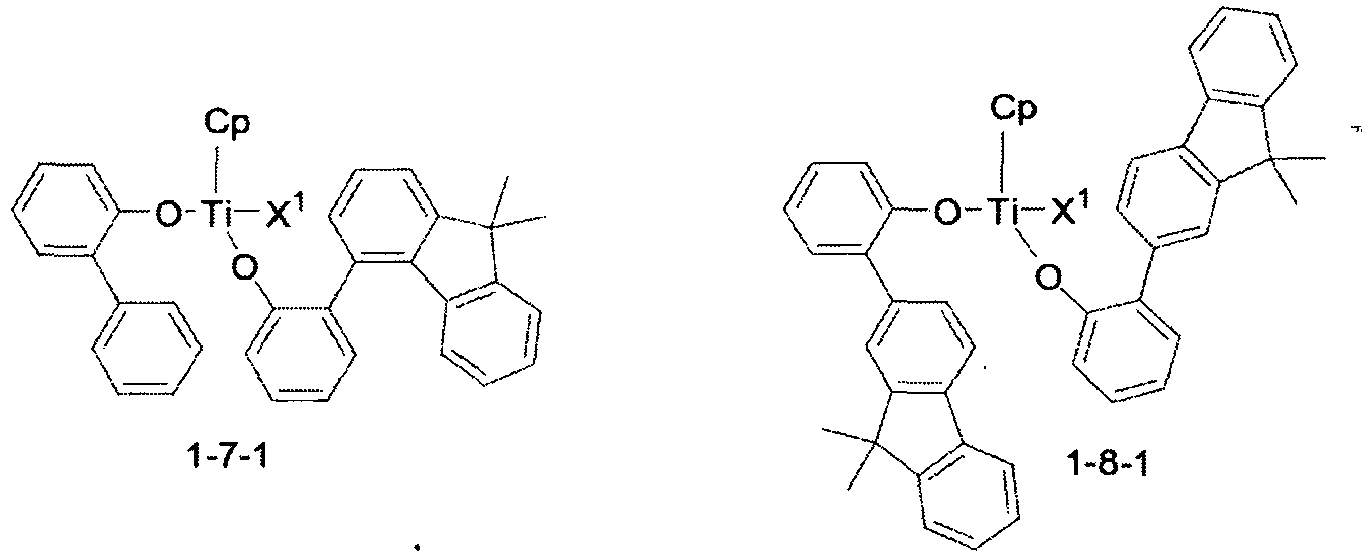

X1 and X2 independently represent methyl or Cl. - The process for preparing copolymers of ethylene with α-olefin according to claim 1, wherein the catalyst composition comprises the transition metal catalyst of Chemical Formula (1), and cocatalyst selected from aluminoxane compounds, alkylaluminum compounds, boron compounds and mixtures thereof.
- The process for preparing copolymers of ethylene with α-olefin according to claim 3, wherein the ratio of the transition metal catalyst to the cocatalyst is 1:0.5∼50:1∼1,000 on the basis of molar ratio of transition metal M: boron atom: aluminum atom.
- The process for preparing copolymers of ethylene with α-olefin according to claim 3, wherein the boron compound cocatalyst is selected from N,N-dimethylanilinium tetrakispentafluorophenylborate and triphenylmethylanilinium tetrakispentafluorophenylborate, and mixtures thereof.
- The process for preparing copolymers of ethylene with α-olefin according to claim 1, wherein the (C3-C18) α-olefin is selected from propylene, 1-butene, 1-pentene, 4-methyl-1-pentene, 1-hexene, 1-octene, 1-decene, 1-dodecene, and mixtures thereof.
- The process for preparing copolymers of ethylene with α-olefin according to claim 1, wherein the content of (C3-C18) α-olefin is from 10% by weight to 60% by weight of the copolymer.
- The process for preparing copolymers of ethylene with α-olefin according to claim 7, wherein the content of α-olefin comonomer is from 20% by weight to 45% by weight of the copolymer.
- The process for preparing copolymers of ethylene with α-olefin according to claim 1, wherein the density of the copolymer is from 0.855 to 0.905 g/cc.
- The process for preparing copolymers of ethylene with α-olefin according to claim 9, wherein the density of the copolymer is from 0.860 to 0.900 g/cc.
- The process for preparing copolymers of ethylene with α-olefin according to claim 1, wherein the weight average molecular weight of the copolymer is from 30,000 to 500,000, and the molecular weight distribution (Mw/Mn) of the copolymer is from 1.5 to 3.0.
- The process for preparing copolymers of ethylene with α-olefin according to claim 1, wherein the pressure in the reactor for the process is from 10 to 150 atm, and the temperature for copolymerization is from 80 to 250°C.
- The copolymer of ethylene with α-olefin, prepared according to the process according to any one of claims 1 to 12.
Applications Claiming Priority (3)
| Application Number | Priority Date | Filing Date | Title |
|---|---|---|---|
| KR20080109174 | 2008-11-05 | ||
| KR1020090082288A KR101167082B1 (en) | 2008-11-05 | 2009-09-02 | Method for preparing elastomeric copolymers of ethylene and a-olefins |
| PCT/KR2009/006024 WO2010053264A2 (en) | 2008-11-05 | 2009-10-19 | METHOD FOR PREPARING ELASTOMERIC COPOLYMERS OF ETHYLENE AND α-OLEFINS |
Publications (3)
| Publication Number | Publication Date |
|---|---|
| EP2344552A2 EP2344552A2 (en) | 2011-07-20 |
| EP2344552A4 EP2344552A4 (en) | 2013-11-06 |
| EP2344552B1 true EP2344552B1 (en) | 2018-08-01 |
Family
ID=42276532
Family Applications (1)
| Application Number | Title | Priority Date | Filing Date |
|---|---|---|---|
| EP09824947.7A Active EP2344552B1 (en) | 2008-11-05 | 2009-10-19 | Method for preparing elastomeric copolymers of ethylene and alpha-olefins |
Country Status (10)
| Country | Link |
|---|---|
| US (2) | US8013086B2 (en) |
| EP (1) | EP2344552B1 (en) |
| JP (1) | JP2012507589A (en) |
| KR (2) | KR101167082B1 (en) |
| CN (2) | CN107365398A (en) |
| CA (1) | CA2728110C (en) |
| ES (1) | ES2684566T3 (en) |
| RU (1) | RU2512536C2 (en) |
| TW (1) | TWI476214B (en) |
| WO (1) | WO2010053264A2 (en) |
Families Citing this family (10)
| Publication number | Priority date | Publication date | Assignee | Title |
|---|---|---|---|---|
| KR101454693B1 (en) * | 2009-12-23 | 2014-11-06 | 에스케이이노베이션 주식회사 | Process for producing an elastic copolymer of ethylene and an? -Olefin |
| KR101248421B1 (en) * | 2010-07-15 | 2013-03-28 | 에스케이이노베이션 주식회사 | Ethylene copolymer with improved elasticity and processibility |
| CN117430740A (en) * | 2017-12-22 | 2024-01-23 | Lg化学株式会社 | Olefin-based polymers |
| JP7130301B2 (en) * | 2018-05-04 | 2022-09-05 | エルジー・ケム・リミテッド | Olefin-based copolymer and method for producing the same |
| CN111116783A (en) * | 2018-10-31 | 2020-05-08 | 中国石油化工股份有限公司 | Olefin polymer and preparation method thereof |
| CN115335448B (en) * | 2020-03-30 | 2025-02-28 | Sabic环球技术有限责任公司 | Thermoplastics for Slurry Transport Pipes |
| CN115873046B (en) * | 2021-09-29 | 2024-11-15 | 中化学科学技术研究有限公司 | Metal complex, preparation method and application thereof |
| CN114989339A (en) * | 2022-07-05 | 2022-09-02 | 宁夏清研高分子新材料有限公司 | Method for improving regularity of TPX polymer |
| CN117986422A (en) * | 2022-10-27 | 2024-05-07 | 中国石油化工股份有限公司 | Ethylene/alpha olefin copolymer and preparation method thereof |
| CN119463001B (en) * | 2024-11-12 | 2026-06-05 | 万华化学集团股份有限公司 | A propylene-based copolymer, its preparation method and application |
Family Cites Families (18)
| Publication number | Priority date | Publication date | Assignee | Title |
|---|---|---|---|---|
| US4752597A (en) * | 1985-12-12 | 1988-06-21 | Exxon Chemical Patents Inc. | New polymerization catalyst |
| JPS6392621A (en) | 1986-10-08 | 1988-04-23 | Mitsubishi Petrochem Co Ltd | Production of ethylene copolymer |
| US5198401A (en) | 1987-01-30 | 1993-03-30 | Exxon Chemical Patents Inc. | Ionic metallocene catalyst compositions |
| US5055438A (en) | 1989-09-13 | 1991-10-08 | Exxon Chemical Patents, Inc. | Olefin polymerization catalysts |
| DE3742934A1 (en) | 1987-12-18 | 1989-06-29 | Hoechst Ag | METHOD FOR PRODUCING A CHIRAL, STEREORIGIDAL METALLOCEN COMPOUND |
| JPH0284405A (en) | 1988-09-20 | 1990-03-26 | Mitsubishi Petrochem Co Ltd | Production of ethylene polymer |
| GB8828206D0 (en) | 1988-12-02 | 1989-01-05 | Shell Int Research | Process for conversion of hydrocarbonaceous feedstock |
| JP2926836B2 (en) | 1989-02-22 | 1999-07-28 | 住友電気工業株式会社 | Nitrogen-containing cermet alloy |
| NZ235032A (en) | 1989-08-31 | 1993-04-28 | Dow Chemical Co | Constrained geometry complexes of titanium, zirconium or hafnium comprising a substituted cyclopentadiene ligand; use as olefin polymerisation catalyst component |
| EP0842939B1 (en) | 1995-07-14 | 2004-10-06 | Sumitomo Chemical Company, Limited | Olefin polymerization catalyst containing a transition metal complex and process for producing olefin polymers |
| US5814714A (en) * | 1995-11-30 | 1998-09-29 | The Dow Chemical Company | Mono-olefin/polyene interpolymers, method of preparation, compositions containing the same, and articles made thereof |
| CA2243783C (en) | 1998-07-21 | 2007-06-05 | Nova Chemicals Ltd. | Bis-phosphinimine catalyst |
| EP1674490A1 (en) * | 2004-12-23 | 2006-06-28 | Borealis Technology Oy | Copolymer |
| KR100639696B1 (en) * | 2005-07-01 | 2006-10-30 | 에스케이 주식회사 | Arylphenoxy Catalyst System for Making Ethylene Homopolymer or Copolymer with α-olefin |
| KR101060838B1 (en) * | 2006-04-24 | 2011-08-30 | 에스케이이노베이션 주식회사 | Bis-arylaryloxy catalyst system for preparing ethylene homopolymer or copolymer with α-olefin |
| CN101522727B (en) * | 2006-10-18 | 2011-07-20 | Sk能源株式会社 | Arylphenoxy catalyst system for producing ethylene homopolymer or copolymers of ethylene and a-olefins |
| KR101011497B1 (en) * | 2007-01-29 | 2011-01-31 | 주식회사 엘지화학 | Method for producing ultra low density polyolefin copolymer |
| KR101181314B1 (en) * | 2008-03-05 | 2012-09-11 | 에스케이이노베이션 주식회사 | Ethylene copolymer film and a method of preparing the same |
-
2009
- 2009-09-02 KR KR1020090082288A patent/KR101167082B1/en active Active
- 2009-10-19 CA CA2728110A patent/CA2728110C/en active Active
- 2009-10-19 EP EP09824947.7A patent/EP2344552B1/en active Active
- 2009-10-19 RU RU2010154457/04A patent/RU2512536C2/en active
- 2009-10-19 ES ES09824947.7T patent/ES2684566T3/en active Active
- 2009-10-19 CN CN201710387567.2A patent/CN107365398A/en active Pending
- 2009-10-19 WO PCT/KR2009/006024 patent/WO2010053264A2/en not_active Ceased
- 2009-10-19 JP JP2011534377A patent/JP2012507589A/en active Pending
- 2009-10-19 CN CN2009801253480A patent/CN102083871A/en active Pending
- 2009-11-04 TW TW098137375A patent/TWI476214B/en active
- 2009-11-04 US US12/612,157 patent/US8013086B2/en active Active
-
2011
- 2011-07-28 US US13/192,812 patent/US20110282011A1/en not_active Abandoned
-
2012
- 2012-01-05 KR KR1020120001475A patent/KR101470564B1/en active Active
Non-Patent Citations (1)
| Title |
|---|
| None * |
Also Published As
| Publication number | Publication date |
|---|---|
| KR20100050385A (en) | 2010-05-13 |
| KR101470564B1 (en) | 2014-12-10 |
| WO2010053264A2 (en) | 2010-05-14 |
| ES2684566T3 (en) | 2018-10-03 |
| CN102083871A (en) | 2011-06-01 |
| WO2010053264A3 (en) | 2010-07-29 |
| EP2344552A2 (en) | 2011-07-20 |
| US20110282011A1 (en) | 2011-11-17 |
| CN107365398A (en) | 2017-11-21 |
| JP2012507589A (en) | 2012-03-29 |
| TW201026722A (en) | 2010-07-16 |
| TWI476214B (en) | 2015-03-11 |
| US20100113720A1 (en) | 2010-05-06 |
| KR20120007087A (en) | 2012-01-19 |
| US8013086B2 (en) | 2011-09-06 |
| RU2512536C2 (en) | 2014-04-10 |
| CA2728110A1 (en) | 2010-05-14 |
| CA2728110C (en) | 2013-10-15 |
| RU2010154457A (en) | 2012-07-10 |
| KR101167082B1 (en) | 2012-07-20 |
| EP2344552A4 (en) | 2013-11-06 |
Similar Documents
| Publication | Publication Date | Title |
|---|---|---|
| JP5550192B2 (en) | Ethylene copolymer and process for producing the same | |
| US8013086B2 (en) | Method for preparing elastomeric copolymers of ethylene and α-olefins | |
| KR101060838B1 (en) | Bis-arylaryloxy catalyst system for preparing ethylene homopolymer or copolymer with α-olefin | |
| US8232359B2 (en) | Process for preparing ethylene homopolymers or copolymers of ethylene with α-olefin by using the transition metal compound | |
| EP2225251B1 (en) | Transition metal complexes, catalysts composition containing the same, and process for preparing ethylene homopolymers or copolymers of ethylene and alpha-olefins using the same | |
| EP2076551B1 (en) | Arylphenoxy catalyst system for producing ethylene homopolymer or copolymers of ethylene and alpha-olefins | |
| JP2009161535A (en) | Transition metal compound, transition metal catalyst composition containing the same, and process for producing ethylene homopolymer or ethylene / α-olefin copolymer using the same | |
| EP2340255B1 (en) | NEW TRANSITION METAL CATALYTIC SYSTEMS AND METHODS FOR PREPARING ETHYLENE HOMOPOLYMERS OR COPOLYMERS OF ETHYLENE AND alpha-OLEFINS USING THE SAME | |
| US10053481B2 (en) | Transition metal compound, transition metal catalyst composition for polymerizing olefin, containing same, and method for preparing ethylene homopolymer or copolymer of ethylene and alpha-olefin by using same | |
| US7985817B2 (en) | Homogeneous catalyst system for producing ethylene homopolymer or ethylene copolymers with alpha-olefins | |
| US7847039B2 (en) | Transition metal complexes, and catalysts compositions for preparing ethylene homopolymers or copolymers | |
| CN102101899B (en) | Ethylene alpha olefin polymer producing method | |
| CA2621307A1 (en) | Homogeneous catalyst system for producing ethylene homopolymer or ethylene copolymers with alpha-olefins |
Legal Events
| Date | Code | Title | Description |
|---|---|---|---|
| PUAI | Public reference made under article 153(3) epc to a published international application that has entered the european phase |
Free format text: ORIGINAL CODE: 0009012 |
|
| 17P | Request for examination filed |
Effective date: 20110517 |
|
| AK | Designated contracting states |
Kind code of ref document: A2 Designated state(s): AT BE BG CH CY CZ DE DK EE ES FI FR GB GR HR HU IE IS IT LI LT LU LV MC MK MT NL NO PL PT RO SE SI SK SM TR |
|
| AX | Request for extension of the european patent |
Extension state: AL BA RS |
|
| RAP1 | Party data changed (applicant data changed or rights of an application transferred) |
Owner name: SK INNOVATION CO., LTD. |
|
| DAX | Request for extension of the european patent (deleted) | ||
| A4 | Supplementary search report drawn up and despatched |
Effective date: 20131008 |
|
| RIC1 | Information provided on ipc code assigned before grant |
Ipc: C08F 4/6592 20060101ALI20131001BHEP Ipc: C08F 4/65 20060101ALI20131001BHEP Ipc: C08F 210/16 20060101AFI20131001BHEP |
|
| 17Q | First examination report despatched |
Effective date: 20140410 |
|
| RAP1 | Party data changed (applicant data changed or rights of an application transferred) |
Owner name: SABIC SK NEXLENE COMPANY PTE. LTD. |
|
| GRAP | Despatch of communication of intention to grant a patent |
Free format text: ORIGINAL CODE: EPIDOSNIGR1 |
|
| INTG | Intention to grant announced |
Effective date: 20180302 |
|
| GRAS | Grant fee paid |
Free format text: ORIGINAL CODE: EPIDOSNIGR3 |
|
| GRAA | (expected) grant |
Free format text: ORIGINAL CODE: 0009210 |
|
| AK | Designated contracting states |
Kind code of ref document: B1 Designated state(s): AT BE BG CH CY CZ DE DK EE ES FI FR GB GR HR HU IE IS IT LI LT LU LV MC MK MT NL NO PL PT RO SE SI SK SM TR |
|
| REG | Reference to a national code |
Ref country code: GB Ref legal event code: FG4D |
|
| REG | Reference to a national code |
Ref country code: CH Ref legal event code: EP Ref country code: AT Ref legal event code: REF Ref document number: 1024200 Country of ref document: AT Kind code of ref document: T Effective date: 20180815 |
|
| REG | Reference to a national code |
Ref country code: IE Ref legal event code: FG4D |
|
| REG | Reference to a national code |
Ref country code: DE Ref legal event code: R096 Ref document number: 602009053628 Country of ref document: DE |
|
| REG | Reference to a national code |
Ref country code: NL Ref legal event code: FP |
|
| REG | Reference to a national code |
Ref country code: ES Ref legal event code: FG2A Ref document number: 2684566 Country of ref document: ES Kind code of ref document: T3 Effective date: 20181003 |
|
| REG | Reference to a national code |
Ref country code: FR Ref legal event code: PLFP Year of fee payment: 10 |
|
| REG | Reference to a national code |
Ref country code: LT Ref legal event code: MG4D |
|
| PG25 | Lapsed in a contracting state [announced via postgrant information from national office to epo] |
Ref country code: GR Free format text: LAPSE BECAUSE OF FAILURE TO SUBMIT A TRANSLATION OF THE DESCRIPTION OR TO PAY THE FEE WITHIN THE PRESCRIBED TIME-LIMIT Effective date: 20181102 Ref country code: SE Free format text: LAPSE BECAUSE OF FAILURE TO SUBMIT A TRANSLATION OF THE DESCRIPTION OR TO PAY THE FEE WITHIN THE PRESCRIBED TIME-LIMIT Effective date: 20180801 Ref country code: NO Free format text: LAPSE BECAUSE OF FAILURE TO SUBMIT A TRANSLATION OF THE DESCRIPTION OR TO PAY THE FEE WITHIN THE PRESCRIBED TIME-LIMIT Effective date: 20181101 Ref country code: BG Free format text: LAPSE BECAUSE OF FAILURE TO SUBMIT A TRANSLATION OF THE DESCRIPTION OR TO PAY THE FEE WITHIN THE PRESCRIBED TIME-LIMIT Effective date: 20181101 Ref country code: IS Free format text: LAPSE BECAUSE OF FAILURE TO SUBMIT A TRANSLATION OF THE DESCRIPTION OR TO PAY THE FEE WITHIN THE PRESCRIBED TIME-LIMIT Effective date: 20181201 Ref country code: FI Free format text: LAPSE BECAUSE OF FAILURE TO SUBMIT A TRANSLATION OF THE DESCRIPTION OR TO PAY THE FEE WITHIN THE PRESCRIBED TIME-LIMIT Effective date: 20180801 Ref country code: LT Free format text: LAPSE BECAUSE OF FAILURE TO SUBMIT A TRANSLATION OF THE DESCRIPTION OR TO PAY THE FEE WITHIN THE PRESCRIBED TIME-LIMIT Effective date: 20180801 Ref country code: PL Free format text: LAPSE BECAUSE OF FAILURE TO SUBMIT A TRANSLATION OF THE DESCRIPTION OR TO PAY THE FEE WITHIN THE PRESCRIBED TIME-LIMIT Effective date: 20180801 |
|
| PG25 | Lapsed in a contracting state [announced via postgrant information from national office to epo] |
Ref country code: LV Free format text: LAPSE BECAUSE OF FAILURE TO SUBMIT A TRANSLATION OF THE DESCRIPTION OR TO PAY THE FEE WITHIN THE PRESCRIBED TIME-LIMIT Effective date: 20180801 Ref country code: HR Free format text: LAPSE BECAUSE OF FAILURE TO SUBMIT A TRANSLATION OF THE DESCRIPTION OR TO PAY THE FEE WITHIN THE PRESCRIBED TIME-LIMIT Effective date: 20180801 |
|
| PG25 | Lapsed in a contracting state [announced via postgrant information from national office to epo] |
Ref country code: EE Free format text: LAPSE BECAUSE OF FAILURE TO SUBMIT A TRANSLATION OF THE DESCRIPTION OR TO PAY THE FEE WITHIN THE PRESCRIBED TIME-LIMIT Effective date: 20180801 Ref country code: RO Free format text: LAPSE BECAUSE OF FAILURE TO SUBMIT A TRANSLATION OF THE DESCRIPTION OR TO PAY THE FEE WITHIN THE PRESCRIBED TIME-LIMIT Effective date: 20180801 Ref country code: CZ Free format text: LAPSE BECAUSE OF FAILURE TO SUBMIT A TRANSLATION OF THE DESCRIPTION OR TO PAY THE FEE WITHIN THE PRESCRIBED TIME-LIMIT Effective date: 20180801 |
|
| REG | Reference to a national code |
Ref country code: DE Ref legal event code: R097 Ref document number: 602009053628 Country of ref document: DE |
|
| PG25 | Lapsed in a contracting state [announced via postgrant information from national office to epo] |
Ref country code: SM Free format text: LAPSE BECAUSE OF FAILURE TO SUBMIT A TRANSLATION OF THE DESCRIPTION OR TO PAY THE FEE WITHIN THE PRESCRIBED TIME-LIMIT Effective date: 20180801 Ref country code: DK Free format text: LAPSE BECAUSE OF FAILURE TO SUBMIT A TRANSLATION OF THE DESCRIPTION OR TO PAY THE FEE WITHIN THE PRESCRIBED TIME-LIMIT Effective date: 20180801 Ref country code: SK Free format text: LAPSE BECAUSE OF FAILURE TO SUBMIT A TRANSLATION OF THE DESCRIPTION OR TO PAY THE FEE WITHIN THE PRESCRIBED TIME-LIMIT Effective date: 20180801 |
|
| REG | Reference to a national code |
Ref country code: CH Ref legal event code: PL |
|
| PLBE | No opposition filed within time limit |
Free format text: ORIGINAL CODE: 0009261 |
|
| STAA | Information on the status of an ep patent application or granted ep patent |
Free format text: STATUS: NO OPPOSITION FILED WITHIN TIME LIMIT |
|
| REG | Reference to a national code |
Ref country code: BE Ref legal event code: MM Effective date: 20181031 |
|
| PG25 | Lapsed in a contracting state [announced via postgrant information from national office to epo] |
Ref country code: MC Free format text: LAPSE BECAUSE OF FAILURE TO SUBMIT A TRANSLATION OF THE DESCRIPTION OR TO PAY THE FEE WITHIN THE PRESCRIBED TIME-LIMIT Effective date: 20180801 Ref country code: LU Free format text: LAPSE BECAUSE OF NON-PAYMENT OF DUE FEES Effective date: 20181019 |
|
| 26N | No opposition filed |
Effective date: 20190503 |
|
| REG | Reference to a national code |
Ref country code: IE Ref legal event code: MM4A |
|
| PG25 | Lapsed in a contracting state [announced via postgrant information from national office to epo] |
Ref country code: BE Free format text: LAPSE BECAUSE OF NON-PAYMENT OF DUE FEES Effective date: 20181031 Ref country code: SI Free format text: LAPSE BECAUSE OF FAILURE TO SUBMIT A TRANSLATION OF THE DESCRIPTION OR TO PAY THE FEE WITHIN THE PRESCRIBED TIME-LIMIT Effective date: 20180801 Ref country code: LI Free format text: LAPSE BECAUSE OF NON-PAYMENT OF DUE FEES Effective date: 20181031 Ref country code: CH Free format text: LAPSE BECAUSE OF NON-PAYMENT OF DUE FEES Effective date: 20181031 |
|
| PG25 | Lapsed in a contracting state [announced via postgrant information from national office to epo] |
Ref country code: IE Free format text: LAPSE BECAUSE OF NON-PAYMENT OF DUE FEES Effective date: 20181019 |
|
| PG25 | Lapsed in a contracting state [announced via postgrant information from national office to epo] |
Ref country code: MT Free format text: LAPSE BECAUSE OF NON-PAYMENT OF DUE FEES Effective date: 20181019 |
|
| PG25 | Lapsed in a contracting state [announced via postgrant information from national office to epo] |
Ref country code: TR Free format text: LAPSE BECAUSE OF FAILURE TO SUBMIT A TRANSLATION OF THE DESCRIPTION OR TO PAY THE FEE WITHIN THE PRESCRIBED TIME-LIMIT Effective date: 20180801 |
|
| PG25 | Lapsed in a contracting state [announced via postgrant information from national office to epo] |
Ref country code: PT Free format text: LAPSE BECAUSE OF FAILURE TO SUBMIT A TRANSLATION OF THE DESCRIPTION OR TO PAY THE FEE WITHIN THE PRESCRIBED TIME-LIMIT Effective date: 20180801 |
|
| PG25 | Lapsed in a contracting state [announced via postgrant information from national office to epo] |
Ref country code: CY Free format text: LAPSE BECAUSE OF FAILURE TO SUBMIT A TRANSLATION OF THE DESCRIPTION OR TO PAY THE FEE WITHIN THE PRESCRIBED TIME-LIMIT Effective date: 20180801 Ref country code: MK Free format text: LAPSE BECAUSE OF NON-PAYMENT OF DUE FEES Effective date: 20180801 Ref country code: HU Free format text: LAPSE BECAUSE OF FAILURE TO SUBMIT A TRANSLATION OF THE DESCRIPTION OR TO PAY THE FEE WITHIN THE PRESCRIBED TIME-LIMIT; INVALID AB INITIO Effective date: 20091019 |
|
| REG | Reference to a national code |
Ref country code: AT Ref legal event code: UEP Ref document number: 1024200 Country of ref document: AT Kind code of ref document: T Effective date: 20180801 |
|
| PGFP | Annual fee paid to national office [announced via postgrant information from national office to epo] |
Ref country code: GB Payment date: 20240920 Year of fee payment: 16 |
|
| PGFP | Annual fee paid to national office [announced via postgrant information from national office to epo] |
Ref country code: FR Payment date: 20240925 Year of fee payment: 16 |
|
| PGFP | Annual fee paid to national office [announced via postgrant information from national office to epo] |
Ref country code: NL Payment date: 20240920 Year of fee payment: 16 |
|
| PGFP | Annual fee paid to national office [announced via postgrant information from national office to epo] |
Ref country code: IT Payment date: 20240923 Year of fee payment: 16 |
|
| PGFP | Annual fee paid to national office [announced via postgrant information from national office to epo] |
Ref country code: DE Payment date: 20240920 Year of fee payment: 16 |
|
| PGFP | Annual fee paid to national office [announced via postgrant information from national office to epo] |
Ref country code: AT Payment date: 20240920 Year of fee payment: 16 |
|
| PGFP | Annual fee paid to national office [announced via postgrant information from national office to epo] |
Ref country code: ES Payment date: 20241114 Year of fee payment: 16 |
|
| REG | Reference to a national code |
Ref country code: DE Ref legal event code: R119 Ref document number: 602009053628 Country of ref document: DE |
|
| REG | Reference to a national code |
Ref country code: NL Ref legal event code: MM Effective date: 20251101 |
|
| REG | Reference to a national code |
Ref country code: AT Ref legal event code: MM01 Ref document number: 1024200 Country of ref document: AT Kind code of ref document: T Effective date: 20251019 |
|
| GBPC | Gb: european patent ceased through non-payment of renewal fee |
Effective date: 20251019 |
|
| PG25 | Lapsed in a contracting state [announced via postgrant information from national office to epo] |
Ref country code: GB Free format text: LAPSE BECAUSE OF NON-PAYMENT OF DUE FEES Effective date: 20251019 |
|
| PG25 | Lapsed in a contracting state [announced via postgrant information from national office to epo] |
Ref country code: DE Free format text: LAPSE BECAUSE OF NON-PAYMENT OF DUE FEES Effective date: 20260501 |
|
| PG25 | Lapsed in a contracting state [announced via postgrant information from national office to epo] |
Ref country code: AT Free format text: LAPSE BECAUSE OF NON-PAYMENT OF DUE FEES Effective date: 20251019 |
|
| PG25 | Lapsed in a contracting state [announced via postgrant information from national office to epo] |
Ref country code: NL Free format text: LAPSE BECAUSE OF NON-PAYMENT OF DUE FEES Effective date: 20251101 |
|
| PG25 | Lapsed in a contracting state [announced via postgrant information from national office to epo] |
Ref country code: FR Free format text: LAPSE BECAUSE OF NON-PAYMENT OF DUE FEES Effective date: 20251031 |