EP2343336A1 - Curing liquids - Google Patents
Curing liquids Download PDFInfo
- Publication number
- EP2343336A1 EP2343336A1 EP20100150166 EP10150166A EP2343336A1 EP 2343336 A1 EP2343336 A1 EP 2343336A1 EP 20100150166 EP20100150166 EP 20100150166 EP 10150166 A EP10150166 A EP 10150166A EP 2343336 A1 EP2343336 A1 EP 2343336A1
- Authority
- EP
- European Patent Office
- Prior art keywords
- methyl
- ylmethyl
- pyridin
- tris
- alkyl
- Prior art date
- Legal status (The legal status is an assumption and is not a legal conclusion. Google has not performed a legal analysis and makes no representation as to the accuracy of the status listed.)
- Ceased
Links
- 239000007788 liquid Substances 0.000 title claims description 42
- 229920005989 resin Polymers 0.000 claims abstract description 128
- 239000011347 resin Substances 0.000 claims abstract description 128
- 229910017052 cobalt Inorganic materials 0.000 claims abstract description 70
- 239000010941 cobalt Substances 0.000 claims abstract description 70
- GUTLYIVDDKVIGB-UHFFFAOYSA-N cobalt atom Chemical compound [Co] GUTLYIVDDKVIGB-UHFFFAOYSA-N 0.000 claims abstract description 70
- 229910052757 nitrogen Inorganic materials 0.000 claims abstract description 52
- 229920001567 vinyl ester resin Polymers 0.000 claims abstract description 38
- 150000002978 peroxides Chemical class 0.000 claims abstract description 34
- 239000004925 Acrylic resin Substances 0.000 claims abstract description 32
- 229920000178 Acrylic resin Polymers 0.000 claims abstract description 32
- 239000003446 ligand Substances 0.000 claims abstract description 28
- 229920006337 unsaturated polyester resin Polymers 0.000 claims abstract description 27
- IJGRMHOSHXDMSA-UHFFFAOYSA-N Atomic nitrogen Chemical compound N#N IJGRMHOSHXDMSA-UHFFFAOYSA-N 0.000 claims abstract description 20
- XEEYBQQBJWHFJM-UHFFFAOYSA-N Iron Chemical group [Fe] XEEYBQQBJWHFJM-UHFFFAOYSA-N 0.000 claims description 207
- 239000000460 chlorine Substances 0.000 claims description 159
- -1 n is from 0 to 4 Substances 0.000 claims description 72
- 239000007983 Tris buffer Substances 0.000 claims description 47
- WFUGQJXVXHBTEM-UHFFFAOYSA-N 2-hydroperoxy-2-(2-hydroperoxybutan-2-ylperoxy)butane Chemical compound CCC(C)(OO)OOC(C)(CC)OO WFUGQJXVXHBTEM-UHFFFAOYSA-N 0.000 claims description 38
- 229910052742 iron Inorganic materials 0.000 claims description 36
- MLCJWRIUYXIWNU-OWOJBTEDSA-N (e)-ethene-1,2-diamine Chemical compound N\C=C\N MLCJWRIUYXIWNU-OWOJBTEDSA-N 0.000 claims description 35
- PPBRXRYQALVLMV-UHFFFAOYSA-N Styrene Chemical compound C=CC1=CC=CC=C1 PPBRXRYQALVLMV-UHFFFAOYSA-N 0.000 claims description 33
- 239000001257 hydrogen Substances 0.000 claims description 26
- 229910052739 hydrogen Inorganic materials 0.000 claims description 26
- 125000004435 hydrogen atom Chemical class [H]* 0.000 claims description 26
- RTZKZFJDLAIYFH-UHFFFAOYSA-N ether Substances CCOCC RTZKZFJDLAIYFH-UHFFFAOYSA-N 0.000 claims description 25
- 229910052751 metal Inorganic materials 0.000 claims description 22
- 239000002184 metal Substances 0.000 claims description 22
- 239000000203 mixture Substances 0.000 claims description 21
- HECLRDQVFMWTQS-RGOKHQFPSA-N 1755-01-7 Chemical compound C1[C@H]2[C@@H]3CC=C[C@@H]3[C@@H]1C=C2 HECLRDQVFMWTQS-RGOKHQFPSA-N 0.000 claims description 18
- 229910052723 transition metal Inorganic materials 0.000 claims description 16
- 125000001072 heteroaryl group Chemical group 0.000 claims description 15
- CWYNVVGOOAEACU-UHFFFAOYSA-N Fe2+ Chemical compound [Fe+2] CWYNVVGOOAEACU-UHFFFAOYSA-N 0.000 claims description 13
- 125000003118 aryl group Chemical group 0.000 claims description 13
- 125000004178 (C1-C4) alkyl group Chemical group 0.000 claims description 12
- 150000001252 acrylic acid derivatives Chemical class 0.000 claims description 12
- 125000000217 alkyl group Chemical group 0.000 claims description 12
- 125000002496 methyl group Chemical group [H]C([H])([H])* 0.000 claims description 12
- 239000004342 Benzoyl peroxide Substances 0.000 claims description 11
- OMPJBNCRMGITSC-UHFFFAOYSA-N Benzoylperoxide Chemical compound C=1C=CC=CC=1C(=O)OOC(=O)C1=CC=CC=C1 OMPJBNCRMGITSC-UHFFFAOYSA-N 0.000 claims description 11
- 235000019400 benzoyl peroxide Nutrition 0.000 claims description 11
- 125000004076 pyridyl group Chemical group 0.000 claims description 11
- 239000002904 solvent Substances 0.000 claims description 11
- 150000003624 transition metals Chemical class 0.000 claims description 11
- 150000001875 compounds Chemical class 0.000 claims description 10
- 239000011572 manganese Substances 0.000 claims description 10
- 125000003342 alkenyl group Chemical group 0.000 claims description 9
- 125000003710 aryl alkyl group Chemical group 0.000 claims description 9
- 125000003785 benzimidazolyl group Chemical group N1=C(NC2=C1C=CC=C2)* 0.000 claims description 9
- 150000001733 carboxylic acid esters Chemical class 0.000 claims description 9
- 125000005842 heteroatom Chemical group 0.000 claims description 9
- 125000002887 hydroxy group Chemical group [H]O* 0.000 claims description 9
- 125000002883 imidazolyl group Chemical group 0.000 claims description 9
- 125000003373 pyrazinyl group Chemical group 0.000 claims description 9
- 125000003226 pyrazolyl group Chemical group 0.000 claims description 9
- 125000006514 pyridin-2-ylmethyl group Chemical group [H]C1=C([H])C([H])=C([H])C(=N1)C([H])([H])* 0.000 claims description 9
- 125000000714 pyrimidinyl group Chemical group 0.000 claims description 9
- 125000000168 pyrrolyl group Chemical group 0.000 claims description 9
- 125000000335 thiazolyl group Chemical group 0.000 claims description 9
- 125000001425 triazolyl group Chemical group 0.000 claims description 9
- PWHULOQIROXLJO-UHFFFAOYSA-N Manganese Chemical compound [Mn] PWHULOQIROXLJO-UHFFFAOYSA-N 0.000 claims description 8
- KCNKJCHARANTIP-SNAWJCMRSA-N allyl-{4-[3-(4-bromo-phenyl)-benzofuran-6-yloxy]-but-2-enyl}-methyl-amine Chemical group C=1OC2=CC(OC/C=C/CN(CC=C)C)=CC=C2C=1C1=CC=C(Br)C=C1 KCNKJCHARANTIP-SNAWJCMRSA-N 0.000 claims description 8
- MDAXKAUIABOHTD-UHFFFAOYSA-N 1,4,8,11-tetraazacyclotetradecane Chemical compound C1CNCCNCCCNCCNC1 MDAXKAUIABOHTD-UHFFFAOYSA-N 0.000 claims description 7
- 150000001412 amines Chemical class 0.000 claims description 7
- MYRTYDVEIRVNKP-UHFFFAOYSA-N 1,2-Divinylbenzene Chemical compound C=CC1=CC=CC=C1C=C MYRTYDVEIRVNKP-UHFFFAOYSA-N 0.000 claims description 6
- 125000000041 C6-C10 aryl group Chemical group 0.000 claims description 6
- 125000003545 alkoxy group Chemical group 0.000 claims description 6
- 150000003973 alkyl amines Chemical class 0.000 claims description 6
- 125000005021 aminoalkenyl group Chemical group 0.000 claims description 6
- 125000005018 aryl alkenyl group Chemical group 0.000 claims description 6
- JXLHNMVSKXFWAO-UHFFFAOYSA-N azane;7-fluoro-2,1,3-benzoxadiazole-4-sulfonic acid Chemical compound N.OS(=O)(=O)C1=CC=C(F)C2=NON=C12 JXLHNMVSKXFWAO-UHFFFAOYSA-N 0.000 claims description 6
- 150000003857 carboxamides Chemical class 0.000 claims description 6
- 229910052801 chlorine Inorganic materials 0.000 claims description 6
- 125000000753 cycloalkyl group Chemical group 0.000 claims description 6
- 125000001495 ethyl group Chemical group [H]C([H])([H])C([H])([H])* 0.000 claims description 6
- 125000000592 heterocycloalkyl group Chemical group 0.000 claims description 6
- 229910052748 manganese Inorganic materials 0.000 claims description 6
- QIIPQYDSKRYMFG-UHFFFAOYSA-N phenyl hydrogen carbonate Chemical compound OC(=O)OC1=CC=CC=C1 QIIPQYDSKRYMFG-UHFFFAOYSA-N 0.000 claims description 6
- 125000001424 substituent group Chemical group 0.000 claims description 6
- 125000004105 2-pyridyl group Chemical group N1=C([*])C([H])=C([H])C([H])=C1[H] 0.000 claims description 5
- VTLYFUHAOXGGBS-UHFFFAOYSA-N Fe3+ Chemical compound [Fe+3] VTLYFUHAOXGGBS-UHFFFAOYSA-N 0.000 claims description 5
- WAEMQWOKJMHJLA-UHFFFAOYSA-N Manganese(2+) Chemical compound [Mn+2] WAEMQWOKJMHJLA-UHFFFAOYSA-N 0.000 claims description 5
- 125000001797 benzyl group Chemical group [H]C1=C([H])C([H])=C(C([H])=C1[H])C([H])([H])* 0.000 claims description 5
- SDNGAOSFCJYACN-UHFFFAOYSA-N 1,1,2-tripyridin-2-ylpropan-1-amine Chemical compound N1=C(C=CC=C1)C(C(N)(C1=NC=CC=C1)C1=NC=CC=C1)C SDNGAOSFCJYACN-UHFFFAOYSA-N 0.000 claims description 4
- QBPPRVHXOZRESW-UHFFFAOYSA-N 1,4,7,10-tetraazacyclododecane Chemical compound C1CNCCNCCNCCN1 QBPPRVHXOZRESW-UHFFFAOYSA-N 0.000 claims description 4
- FRIBMENBGGCKPD-UHFFFAOYSA-N 3-(2,3-dimethoxyphenyl)prop-2-enal Chemical compound COC1=CC=CC(C=CC=O)=C1OC FRIBMENBGGCKPD-UHFFFAOYSA-N 0.000 claims description 4
- NJMWXCOSLAUOGE-UHFFFAOYSA-N 4,11-dimethyl-1,4,8,11-tetrazabicyclo[6.6.2]hexadecane Chemical compound C1CN(C)CCCN2CCN(C)CCCN1CC2 NJMWXCOSLAUOGE-UHFFFAOYSA-N 0.000 claims description 4
- PXHVJJICTQNCMI-UHFFFAOYSA-N Nickel Chemical compound [Ni] PXHVJJICTQNCMI-UHFFFAOYSA-N 0.000 claims description 4
- 150000001408 amides Chemical class 0.000 claims description 4
- 229910052794 bromium Inorganic materials 0.000 claims description 4
- 125000004433 nitrogen atom Chemical group N* 0.000 claims description 4
- 125000000547 substituted alkyl group Chemical group 0.000 claims description 4
- 125000006686 (C1-C24) alkyl group Chemical group 0.000 claims description 3
- 125000000229 (C1-C4)alkoxy group Chemical group 0.000 claims description 3
- 125000004169 (C1-C6) alkyl group Chemical group 0.000 claims description 3
- 125000004209 (C1-C8) alkyl group Chemical group 0.000 claims description 3
- PRICLFAUAJHZLI-UHFFFAOYSA-N 1,1-dipyridin-2-yl-n,n-bis(pyridin-2-ylmethyl)methanamine Chemical compound C=1C=CC=NC=1CN(C(C=1N=CC=CC=1)C=1N=CC=CC=1)CC1=CC=CC=N1 PRICLFAUAJHZLI-UHFFFAOYSA-N 0.000 claims description 3
- NVFSHTYUVXEYKP-UHFFFAOYSA-N 1,4,7,10-tetrakis(pyridin-2-ylmethyl)-1,4,7,10-tetrazacyclododecane Chemical compound C=1C=CC=NC=1CN(CCN(CC=1N=CC=CC=1)CCN(CC=1N=CC=CC=1)CC1)CCN1CC1=CC=CC=N1 NVFSHTYUVXEYKP-UHFFFAOYSA-N 0.000 claims description 3
- STYFDKOQURBOGQ-UHFFFAOYSA-N 1,4,7,10-tetramethyl-1,4,7,10-tetrazacyclododecane Chemical compound CN1CCN(C)CCN(C)CCN(C)CC1 STYFDKOQURBOGQ-UHFFFAOYSA-N 0.000 claims description 3
- HRFJEOWVAGSJNW-UHFFFAOYSA-N 1,4,8,11-tetramethyl-1,4,8,11-tetrazacyclotetradecane Chemical compound CN1CCCN(C)CCN(C)CCCN(C)CC1 HRFJEOWVAGSJNW-UHFFFAOYSA-N 0.000 claims description 3
- PVFFTFNMPCLSOF-UHFFFAOYSA-N 2-[[4-ethyl-7-(quinolin-2-ylmethyl)-1,4,7-triazonan-1-yl]methyl]quinoline Chemical compound C1CN(CC=2N=C3C=CC=CC3=CC=2)CCN(CC)CCN1CC1=CC=C(C=CC=C2)C2=N1 PVFFTFNMPCLSOF-UHFFFAOYSA-N 0.000 claims description 3
- 125000000954 2-hydroxyethyl group Chemical group [H]C([*])([H])C([H])([H])O[H] 0.000 claims description 3
- CVRXLMUYFMERMJ-UHFFFAOYSA-N N,N,N',N'-tetrakis(2-pyridylmethyl)ethylenediamine Chemical compound C=1C=CC=NC=1CN(CC=1N=CC=CC=1)CCN(CC=1N=CC=CC=1)CC1=CC=CC=N1 CVRXLMUYFMERMJ-UHFFFAOYSA-N 0.000 claims description 3
- 125000004450 alkenylene group Chemical group 0.000 claims description 3
- 125000002877 alkyl aryl group Chemical group 0.000 claims description 3
- 125000002947 alkylene group Chemical group 0.000 claims description 3
- 125000000304 alkynyl group Chemical group 0.000 claims description 3
- 125000006294 amino alkylene group Chemical group 0.000 claims description 3
- 125000004103 aminoalkyl group Chemical class 0.000 claims description 3
- 229910052799 carbon Inorganic materials 0.000 claims description 3
- LVQMWOWPMUXJJQ-UHFFFAOYSA-N dimethyl 3-methyl-9-oxo-2,4-dipyridin-2-yl-7-(pyridin-2-ylmethyl)-3,7-diazabicyclo[3.3.1]nonane-1,5-dicarboxylate Chemical compound C1C(C2=O)(C(=O)OC)C(C=3N=CC=CC=3)N(C)C(C=3N=CC=CC=3)C2(C(=O)OC)CN1CC1=CC=CC=N1 LVQMWOWPMUXJJQ-UHFFFAOYSA-N 0.000 claims description 3
- 229910052731 fluorine Inorganic materials 0.000 claims description 3
- 150000002736 metal compounds Chemical class 0.000 claims description 3
- CSJKSEYRYGOSHO-UHFFFAOYSA-N n'-[2-[bis[(5-methyl-1h-imidazol-4-yl)methyl]amino]ethyl]-n,n-diethyl-n'-[(5-methyl-1h-imidazol-4-yl)methyl]ethane-1,2-diamine Chemical compound N1=CNC(C)=C1CN(CCN(CC)CC)CCN(CC1=C(NC=N1)C)CC=1N=CNC=1C CSJKSEYRYGOSHO-UHFFFAOYSA-N 0.000 claims description 3
- NFUIKQGGOZQIFJ-UHFFFAOYSA-N n,n',n'-tris(1h-benzimidazol-2-ylmethyl)-n-methylethane-1,2-diamine Chemical compound C1=CC=C2NC(CN(CCN(CC=3NC4=CC=CC=C4N=3)CC=3NC4=CC=CC=C4N=3)C)=NC2=C1 NFUIKQGGOZQIFJ-UHFFFAOYSA-N 0.000 claims description 3
- CLAWTVFJBDKCHZ-UHFFFAOYSA-N n,n',n'-tris(1h-imidazol-2-ylmethyl)-n-methylethane-1,2-diamine Chemical compound N=1C=CNC=1CN(C)CCN(CC=1NC=CN=1)CC1=NC=CN1 CLAWTVFJBDKCHZ-UHFFFAOYSA-N 0.000 claims description 3
- IWLGIQSOLLGCTK-UHFFFAOYSA-N n,n'-bis(1h-imidazol-2-ylmethyl)-n,n'-dimethylethane-1,2-diamine Chemical compound N=1C=CNC=1CN(C)CCN(C)CC1=NC=CN1 IWLGIQSOLLGCTK-UHFFFAOYSA-N 0.000 claims description 3
- HSYNBGMTLRKRNO-UHFFFAOYSA-N n-ethyl-n,n',n'-tris(1h-imidazol-2-ylmethyl)ethane-1,2-diamine Chemical compound N=1C=CNC=1CN(CC)CCN(CC=1NC=CN=1)CC1=NC=CN1 HSYNBGMTLRKRNO-UHFFFAOYSA-N 0.000 claims description 3
- BLPXLFREPYJZJC-UHFFFAOYSA-N n-hexyl-n,n',n'-tris(1h-imidazol-2-ylmethyl)ethane-1,2-diamine Chemical compound N=1C=CNC=1CN(CCCCCC)CCN(CC=1NC=CN=1)CC1=NC=CN1 BLPXLFREPYJZJC-UHFFFAOYSA-N 0.000 claims description 3
- 125000005702 oxyalkylene group Chemical group 0.000 claims description 3
- 229910052760 oxygen Inorganic materials 0.000 claims description 3
- HJWLCRVIBGQPNF-UHFFFAOYSA-N prop-2-enylbenzene Chemical compound C=CCC1=CC=CC=C1 HJWLCRVIBGQPNF-UHFFFAOYSA-N 0.000 claims description 3
- UFVPUNOEVVUROD-UHFFFAOYSA-N 1,4,7-tris(pyridin-2-ylmethyl)-1,4,7-triazonane Chemical compound C=1C=CC=NC=1CN(CCN(CC=1N=CC=CC=1)CC1)CCN1CC1=CC=CC=N1 UFVPUNOEVVUROD-UHFFFAOYSA-N 0.000 claims description 2
- IWZDGUUAKXKLNH-UHFFFAOYSA-N 1,4-bis[(1-methylimidazol-2-yl)methyl]-7-octyl-1,4,7-triazonane Chemical compound C1CN(CC=2N(C=CN=2)C)CCN(CCCCCCCC)CCN1CC1=NC=CN1C IWZDGUUAKXKLNH-UHFFFAOYSA-N 0.000 claims description 2
- JWYVGKFDLWWQJX-UHFFFAOYSA-N 1-ethenylazepan-2-one Chemical compound C=CN1CCCCCC1=O JWYVGKFDLWWQJX-UHFFFAOYSA-N 0.000 claims description 2
- YRKLIVGVAFDGFG-UHFFFAOYSA-N 1-ethyl-4,7-bis(pyrazol-1-ylmethyl)-1,4,7-triazonane Chemical compound C1CN(CN2N=CC=C2)CCN(CC)CCN1CN1C=CC=N1 YRKLIVGVAFDGFG-UHFFFAOYSA-N 0.000 claims description 2
- RAUOIKSKBZLTMR-UHFFFAOYSA-N 1-ethyl-4,7-bis[(1-methylimidazol-2-yl)methyl]-1,4,7-triazonane Chemical compound C1CN(CC=2N(C=CN=2)C)CCN(CC)CCN1CC1=NC=CN1C RAUOIKSKBZLTMR-UHFFFAOYSA-N 0.000 claims description 2
- SGZVRZQBGMSJRT-UHFFFAOYSA-N 1-methyl-4,7-bis(pyrazol-1-ylmethyl)-1,4,7-triazonane Chemical compound C1CN(CN2N=CC=C2)CCN(C)CCN1CN1C=CC=N1 SGZVRZQBGMSJRT-UHFFFAOYSA-N 0.000 claims description 2
- GLZIMBKYDUFPFE-UHFFFAOYSA-N 1-methyl-4,7-bis[(1-methylimidazol-2-yl)methyl]-1,4,7-triazonane Chemical compound C1CN(CC=2N(C=CN=2)C)CCN(C)CCN1CC1=NC=CN1C GLZIMBKYDUFPFE-UHFFFAOYSA-N 0.000 claims description 2
- WRZCXULVLQCLMC-UHFFFAOYSA-N 1-octyl-4,7-bis(pyrazol-1-ylmethyl)-1,4,7-triazonane Chemical compound C1CN(CN2N=CC=C2)CCN(CCCCCCCC)CCN1CN1C=CC=N1 WRZCXULVLQCLMC-UHFFFAOYSA-N 0.000 claims description 2
- BJELTSYBAHKXRW-UHFFFAOYSA-N 2,4,6-triallyloxy-1,3,5-triazine Chemical compound C=CCOC1=NC(OCC=C)=NC(OCC=C)=N1 BJELTSYBAHKXRW-UHFFFAOYSA-N 0.000 claims description 2
- GVDZHNUOQCLFNS-UHFFFAOYSA-N 2-[[4,7-bis(quinolin-2-ylmethyl)-1,4,7-triazonan-1-yl]methyl]quinoline Chemical compound C=1C=C2C=CC=CC2=NC=1CN(CCN(CC=1N=C2C=CC=CC2=CC=1)CC1)CCN1CC1=CC=C(C=CC=C2)C2=N1 GVDZHNUOQCLFNS-UHFFFAOYSA-N 0.000 claims description 2
- KAAZVPJEUXHKPR-UHFFFAOYSA-N 2-[[4-methyl-7-(quinolin-2-ylmethyl)-1,4,7-triazonan-1-yl]methyl]quinoline Chemical compound C1CN(CC=2N=C3C=CC=CC3=CC=2)CCN(C)CCN1CC1=CC=C(C=CC=C2)C2=N1 KAAZVPJEUXHKPR-UHFFFAOYSA-N 0.000 claims description 2
- RVWBITJYKDNEPL-UHFFFAOYSA-N 2-[[4-octyl-7-(quinolin-2-ylmethyl)-1,4,7-triazonan-1-yl]methyl]quinoline Chemical compound C1CN(CC=2N=C3C=CC=CC3=CC=2)CCN(CCCCCCCC)CCN1CC1=CC=C(C=CC=C2)C2=N1 RVWBITJYKDNEPL-UHFFFAOYSA-N 0.000 claims description 2
- FGVBSRHTSFUPNH-UHFFFAOYSA-N 4,11-dibenzyl-1,4,8,11-tetrazabicyclo[6.6.2]hexadecane Chemical compound C=1C=CC=CC=1CN(CCN(CCC1)CC2)CCCN2CCN1CC1=CC=CC=C1 FGVBSRHTSFUPNH-UHFFFAOYSA-N 0.000 claims description 2
- RYGMFSIKBFXOCR-UHFFFAOYSA-N Copper Chemical compound [Cu] RYGMFSIKBFXOCR-UHFFFAOYSA-N 0.000 claims description 2
- 239000004641 Diallyl-phthalate Substances 0.000 claims description 2
- WHXSMMKQMYFTQS-UHFFFAOYSA-N Lithium Chemical compound [Li] WHXSMMKQMYFTQS-UHFFFAOYSA-N 0.000 claims description 2
- FYYHWMGAXLPEAU-UHFFFAOYSA-N Magnesium Chemical compound [Mg] FYYHWMGAXLPEAU-UHFFFAOYSA-N 0.000 claims description 2
- VVQNEPGJFQJSBK-UHFFFAOYSA-N Methyl methacrylate Chemical compound COC(=O)C(C)=C VVQNEPGJFQJSBK-UHFFFAOYSA-N 0.000 claims description 2
- WHNWPMSKXPGLAX-UHFFFAOYSA-N N-Vinyl-2-pyrrolidone Chemical compound C=CN1CCCC1=O WHNWPMSKXPGLAX-UHFFFAOYSA-N 0.000 claims description 2
- ATJFFYVFTNAWJD-UHFFFAOYSA-N Tin Chemical compound [Sn] ATJFFYVFTNAWJD-UHFFFAOYSA-N 0.000 claims description 2
- HCHKCACWOHOZIP-UHFFFAOYSA-N Zinc Chemical compound [Zn] HCHKCACWOHOZIP-UHFFFAOYSA-N 0.000 claims description 2
- 125000005595 acetylacetonate group Chemical group 0.000 claims description 2
- XYLMUPLGERFSHI-UHFFFAOYSA-N alpha-Methylstyrene Chemical compound CC(=C)C1=CC=CC=C1 XYLMUPLGERFSHI-UHFFFAOYSA-N 0.000 claims description 2
- QUDWYFHPNIMBFC-UHFFFAOYSA-N bis(prop-2-enyl) benzene-1,2-dicarboxylate Chemical compound C=CCOC(=O)C1=CC=CC=C1C(=O)OCC=C QUDWYFHPNIMBFC-UHFFFAOYSA-N 0.000 claims description 2
- 125000000484 butyl group Chemical group [H]C([*])([H])C([H])([H])C([H])([H])C([H])([H])[H] 0.000 claims description 2
- 150000001868 cobalt Chemical class 0.000 claims description 2
- 229910052802 copper Inorganic materials 0.000 claims description 2
- 239000010949 copper Substances 0.000 claims description 2
- IMMCLGBPPSXGIZ-UHFFFAOYSA-N dimethyl 7-[2-(dimethylamino)ethyl]-3-methyl-9-oxo-2,4-dipyridin-2-yl-3,7-diazabicyclo[3.3.1]nonane-1,5-dicarboxylate Chemical compound O=C1C2(C(=O)OC)CN(CCN(C)C)CC1(C(=O)OC)C(C=1N=CC=CC=1)N(C)C2C1=CC=CC=N1 IMMCLGBPPSXGIZ-UHFFFAOYSA-N 0.000 claims description 2
- 125000004051 hexyl group Chemical group [H]C([H])([H])C([H])([H])C([H])([H])C([H])([H])C([H])([H])C([H])([H])* 0.000 claims description 2
- CBOIHMRHGLHBPB-UHFFFAOYSA-N hydroxymethyl Chemical compound O[CH2] CBOIHMRHGLHBPB-UHFFFAOYSA-N 0.000 claims description 2
- 229910052744 lithium Inorganic materials 0.000 claims description 2
- 239000011777 magnesium Substances 0.000 claims description 2
- 229910052749 magnesium Inorganic materials 0.000 claims description 2
- 229910001437 manganese ion Inorganic materials 0.000 claims description 2
- MMIPFLVOWGHZQD-UHFFFAOYSA-N manganese(3+) Chemical compound [Mn+3] MMIPFLVOWGHZQD-UHFFFAOYSA-N 0.000 claims description 2
- 229910052759 nickel Inorganic materials 0.000 claims description 2
- 125000002347 octyl group Chemical group [H]C([*])([H])C([H])([H])C([H])([H])C([H])([H])C([H])([H])C([H])([H])C([H])([H])C([H])([H])[H] 0.000 claims description 2
- 125000001436 propyl group Chemical group [H]C([*])([H])C([H])([H])C([H])([H])[H] 0.000 claims description 2
- 229910052718 tin Inorganic materials 0.000 claims description 2
- 229910052720 vanadium Inorganic materials 0.000 claims description 2
- GPPXJZIENCGNKB-UHFFFAOYSA-N vanadium Chemical compound [V]#[V] GPPXJZIENCGNKB-UHFFFAOYSA-N 0.000 claims description 2
- 229910052725 zinc Inorganic materials 0.000 claims description 2
- 239000011701 zinc Substances 0.000 claims description 2
- 239000013028 medium composition Substances 0.000 claims 10
- OBETXYAYXDNJHR-UHFFFAOYSA-N 2-Ethylhexanoic acid Chemical compound CCCCC(CC)C(O)=O OBETXYAYXDNJHR-UHFFFAOYSA-N 0.000 claims 1
- KYNKUCOQLYEJPH-UHFFFAOYSA-N [K][Ti] Chemical compound [K][Ti] KYNKUCOQLYEJPH-UHFFFAOYSA-N 0.000 claims 1
- SHZIWNPUGXLXDT-UHFFFAOYSA-N caproic acid ethyl ester Natural products CCCCCC(=O)OCC SHZIWNPUGXLXDT-UHFFFAOYSA-N 0.000 claims 1
- 239000012933 diacyl peroxide Substances 0.000 claims 1
- 125000003438 dodecyl group Chemical group [H]C([H])([H])C([H])([H])C([H])([H])C([H])([H])C([H])([H])C([H])([H])C([H])([H])C([H])([H])C([H])([H])C([H])([H])C([H])([H])C([H])([H])* 0.000 claims 1
- 125000004079 stearyl group Chemical group [H]C([*])([H])C([H])([H])C([H])([H])C([H])([H])C([H])([H])C([H])([H])C([H])([H])C([H])([H])C([H])([H])C([H])([H])C([H])([H])C([H])([H])C([H])([H])C([H])([H])C([H])([H])C([H])([H])C([H])([H])C([H])([H])[H] 0.000 claims 1
- 239000011342 resin composition Substances 0.000 abstract description 23
- 239000003999 initiator Substances 0.000 abstract description 18
- 238000000034 method Methods 0.000 abstract description 9
- 229920006305 unsaturated polyester Polymers 0.000 abstract description 9
- 239000002131 composite material Substances 0.000 abstract description 8
- 150000002505 iron Chemical class 0.000 abstract description 3
- 230000008569 process Effects 0.000 abstract description 3
- NIXOWILDQLNWCW-UHFFFAOYSA-N acrylic acid group Chemical group C(C=C)(=O)O NIXOWILDQLNWCW-UHFFFAOYSA-N 0.000 description 30
- 238000001723 curing Methods 0.000 description 25
- 239000000178 monomer Substances 0.000 description 22
- JLTDJTHDQAWBAV-UHFFFAOYSA-N N,N-dimethylaniline Chemical compound CN(C)C1=CC=CC=C1 JLTDJTHDQAWBAV-UHFFFAOYSA-N 0.000 description 21
- YRKCREAYFQTBPV-UHFFFAOYSA-N acetylacetone Natural products CC(=O)CC(C)=O YRKCREAYFQTBPV-UHFFFAOYSA-N 0.000 description 19
- 238000002474 experimental method Methods 0.000 description 19
- DNIAPMSPPWPWGF-UHFFFAOYSA-N Propylene glycol Chemical compound CC(O)CO DNIAPMSPPWPWGF-UHFFFAOYSA-N 0.000 description 16
- 239000003085 diluting agent Substances 0.000 description 15
- 239000000463 material Substances 0.000 description 11
- 239000002253 acid Substances 0.000 description 9
- 150000003254 radicals Chemical class 0.000 description 9
- NIXOWILDQLNWCW-UHFFFAOYSA-M Acrylate Chemical compound [O-]C(=O)C=C NIXOWILDQLNWCW-UHFFFAOYSA-M 0.000 description 8
- LYCAIKOWRPUZTN-UHFFFAOYSA-N Ethylene glycol Chemical compound OCCO LYCAIKOWRPUZTN-UHFFFAOYSA-N 0.000 description 8
- 239000003112 inhibitor Substances 0.000 description 8
- SLCVBVWXLSEKPL-UHFFFAOYSA-N neopentyl glycol Chemical compound OCC(C)(C)CO SLCVBVWXLSEKPL-UHFFFAOYSA-N 0.000 description 8
- 238000012360 testing method Methods 0.000 description 8
- VZCYOOQTPOCHFL-OWOJBTEDSA-N Fumaric acid Chemical compound OC(=O)\C=C\C(O)=O VZCYOOQTPOCHFL-OWOJBTEDSA-N 0.000 description 7
- IISBACLAFKSPIT-UHFFFAOYSA-N bisphenol A Chemical class C=1C=C(O)C=CC=1C(C)(C)C1=CC=C(O)C=C1 IISBACLAFKSPIT-UHFFFAOYSA-N 0.000 description 7
- 239000003054 catalyst Substances 0.000 description 7
- 230000000052 comparative effect Effects 0.000 description 7
- MTHSVFCYNBDYFN-UHFFFAOYSA-N diethylene glycol Chemical compound OCCOCCO MTHSVFCYNBDYFN-UHFFFAOYSA-N 0.000 description 7
- POILWHVDKZOXJZ-ARJAWSKDSA-M (z)-4-oxopent-2-en-2-olate Chemical compound C\C([O-])=C\C(C)=O POILWHVDKZOXJZ-ARJAWSKDSA-M 0.000 description 6
- 125000004356 hydroxy functional group Chemical group O* 0.000 description 6
- 229920000647 polyepoxide Polymers 0.000 description 6
- MHAJPDPJQMAIIY-UHFFFAOYSA-N Hydrogen peroxide Chemical compound OO MHAJPDPJQMAIIY-UHFFFAOYSA-N 0.000 description 5
- 150000008064 anhydrides Chemical class 0.000 description 5
- 125000000524 functional group Chemical group 0.000 description 5
- 150000002696 manganese Chemical class 0.000 description 5
- 238000002156 mixing Methods 0.000 description 5
- 229920000728 polyester Polymers 0.000 description 5
- 238000006116 polymerization reaction Methods 0.000 description 5
- 230000009257 reactivity Effects 0.000 description 5
- KZBUYRJDOAKODT-UHFFFAOYSA-N Chlorine Chemical compound ClCl KZBUYRJDOAKODT-UHFFFAOYSA-N 0.000 description 4
- LFQSCWFLJHTTHZ-UHFFFAOYSA-N Ethanol Chemical compound CCO LFQSCWFLJHTTHZ-UHFFFAOYSA-N 0.000 description 4
- CERQOIWHTDAKMF-UHFFFAOYSA-N Methacrylic acid Chemical compound CC(=C)C(O)=O CERQOIWHTDAKMF-UHFFFAOYSA-N 0.000 description 4
- 238000005266 casting Methods 0.000 description 4
- 238000006243 chemical reaction Methods 0.000 description 4
- 239000003822 epoxy resin Substances 0.000 description 4
- 150000002432 hydroperoxides Chemical class 0.000 description 4
- 150000004698 iron complex Chemical class 0.000 description 4
- 239000002798 polar solvent Substances 0.000 description 4
- 229920005862 polyol Polymers 0.000 description 4
- 150000003077 polyols Chemical class 0.000 description 4
- 150000003839 salts Chemical class 0.000 description 4
- PUZPDOWCWNUUKD-UHFFFAOYSA-M sodium fluoride Chemical compound [F-].[Na+] PUZPDOWCWNUUKD-UHFFFAOYSA-M 0.000 description 4
- VZCYOOQTPOCHFL-UHFFFAOYSA-N trans-butenedioic acid Natural products OC(=O)C=CC(O)=O VZCYOOQTPOCHFL-UHFFFAOYSA-N 0.000 description 4
- 125000000391 vinyl group Chemical group [H]C([*])=C([H])[H] 0.000 description 4
- ITWBWJFEJCHKSN-UHFFFAOYSA-N 1,4,7-triazonane Chemical compound C1CNCCNCCN1 ITWBWJFEJCHKSN-UHFFFAOYSA-N 0.000 description 3
- 125000000022 2-aminoethyl group Chemical group [H]C([*])([H])C([H])([H])N([H])[H] 0.000 description 3
- QTBSBXVTEAMEQO-UHFFFAOYSA-M Acetate Chemical compound CC([O-])=O QTBSBXVTEAMEQO-UHFFFAOYSA-M 0.000 description 3
- WEVYAHXRMPXWCK-UHFFFAOYSA-N Acetonitrile Chemical compound CC#N WEVYAHXRMPXWCK-UHFFFAOYSA-N 0.000 description 3
- CIWBSHSKHKDKBQ-JLAZNSOCSA-N Ascorbic acid Chemical compound OC[C@H](O)[C@H]1OC(=O)C(O)=C1O CIWBSHSKHKDKBQ-JLAZNSOCSA-N 0.000 description 3
- KFZMGEQAYNKOFK-UHFFFAOYSA-N Isopropanol Chemical compound CC(C)O KFZMGEQAYNKOFK-UHFFFAOYSA-N 0.000 description 3
- 229910019142 PO4 Inorganic materials 0.000 description 3
- 150000001298 alcohols Chemical class 0.000 description 3
- 125000001931 aliphatic group Chemical group 0.000 description 3
- 125000000746 allylic group Chemical group 0.000 description 3
- 125000003178 carboxy group Chemical group [H]OC(*)=O 0.000 description 3
- 230000007613 environmental effect Effects 0.000 description 3
- 150000002148 esters Chemical class 0.000 description 3
- 239000001530 fumaric acid Substances 0.000 description 3
- LNEPOXFFQSENCJ-UHFFFAOYSA-N haloperidol Chemical compound C1CC(O)(C=2C=CC(Cl)=CC=2)CCN1CCCC(=O)C1=CC=C(F)C=C1 LNEPOXFFQSENCJ-UHFFFAOYSA-N 0.000 description 3
- 230000000977 initiatory effect Effects 0.000 description 3
- 150000002697 manganese compounds Chemical class 0.000 description 3
- QJGQUHMNIGDVPM-UHFFFAOYSA-N nitrogen group Chemical group [N] QJGQUHMNIGDVPM-UHFFFAOYSA-N 0.000 description 3
- 125000000864 peroxy group Chemical group O(O*)* 0.000 description 3
- 235000021317 phosphate Nutrition 0.000 description 3
- 150000003013 phosphoric acid derivatives Chemical class 0.000 description 3
- 229920000570 polyether Polymers 0.000 description 3
- 239000000047 product Substances 0.000 description 3
- 230000009467 reduction Effects 0.000 description 3
- 239000007787 solid Substances 0.000 description 3
- 239000000243 solution Substances 0.000 description 3
- 150000003512 tertiary amines Chemical class 0.000 description 3
- BPRYUXCVCCNUFE-UHFFFAOYSA-N 2,4,6-trimethylphenol Chemical compound CC1=CC(C)=C(O)C(C)=C1 BPRYUXCVCCNUFE-UHFFFAOYSA-N 0.000 description 2
- SGWZVZZVXOJRAQ-UHFFFAOYSA-N 2,6-Dimethyl-1,4-benzenediol Chemical compound CC1=CC(O)=CC(C)=C1O SGWZVZZVXOJRAQ-UHFFFAOYSA-N 0.000 description 2
- SMZOUWXMTYCWNB-UHFFFAOYSA-N 2-(2-methoxy-5-methylphenyl)ethanamine Chemical compound COC1=CC=C(C)C=C1CCN SMZOUWXMTYCWNB-UHFFFAOYSA-N 0.000 description 2
- XFCMNSHQOZQILR-UHFFFAOYSA-N 2-[2-(2-methylprop-2-enoyloxy)ethoxy]ethyl 2-methylprop-2-enoate Chemical compound CC(=C)C(=O)OCCOCCOC(=O)C(C)=C XFCMNSHQOZQILR-UHFFFAOYSA-N 0.000 description 2
- ICSNLGPSRYBMBD-UHFFFAOYSA-N 2-aminopyridine Chemical compound NC1=CC=CC=N1 ICSNLGPSRYBMBD-UHFFFAOYSA-N 0.000 description 2
- 239000004593 Epoxy Substances 0.000 description 2
- QIGBRXMKCJKVMJ-UHFFFAOYSA-N Hydroquinone Chemical compound OC1=CC=C(O)C=C1 QIGBRXMKCJKVMJ-UHFFFAOYSA-N 0.000 description 2
- NBIIXXVUZAFLBC-UHFFFAOYSA-N Phosphoric acid Chemical compound OP(O)(O)=O NBIIXXVUZAFLBC-UHFFFAOYSA-N 0.000 description 2
- 239000004721 Polyphenylene oxide Substances 0.000 description 2
- KKEYFWRCBNTPAC-UHFFFAOYSA-N Terephthalic acid Chemical compound OC(=O)C1=CC=C(C(O)=O)C=C1 KKEYFWRCBNTPAC-UHFFFAOYSA-N 0.000 description 2
- 150000007513 acids Chemical class 0.000 description 2
- 150000001299 aldehydes Chemical class 0.000 description 2
- 238000004873 anchoring Methods 0.000 description 2
- 230000008901 benefit Effects 0.000 description 2
- QUZSUMLPWDHKCJ-UHFFFAOYSA-N bisphenol A dimethacrylate Chemical compound C1=CC(OC(=O)C(=C)C)=CC=C1C(C)(C)C1=CC=C(OC(=O)C(C)=C)C=C1 QUZSUMLPWDHKCJ-UHFFFAOYSA-N 0.000 description 2
- 229940106691 bisphenol a Drugs 0.000 description 2
- GDTBXPJZTBHREO-UHFFFAOYSA-N bromine Chemical compound BrBr GDTBXPJZTBHREO-UHFFFAOYSA-N 0.000 description 2
- 150000001735 carboxylic acids Chemical class 0.000 description 2
- 230000003197 catalytic effect Effects 0.000 description 2
- YCIMNLLNPGFGHC-UHFFFAOYSA-N catechol Chemical compound OC1=CC=CC=C1O YCIMNLLNPGFGHC-UHFFFAOYSA-N 0.000 description 2
- 229910001914 chlorine tetroxide Inorganic materials 0.000 description 2
- 238000000576 coating method Methods 0.000 description 2
- 238000010276 construction Methods 0.000 description 2
- 238000007334 copolymerization reaction Methods 0.000 description 2
- 238000005260 corrosion Methods 0.000 description 2
- 230000007797 corrosion Effects 0.000 description 2
- 238000004132 cross linking Methods 0.000 description 2
- 230000000694 effects Effects 0.000 description 2
- 125000003700 epoxy group Chemical group 0.000 description 2
- 150000002170 ethers Chemical class 0.000 description 2
- 229940052303 ethers for general anesthesia Drugs 0.000 description 2
- 229940093476 ethylene glycol Drugs 0.000 description 2
- STVZJERGLQHEKB-UHFFFAOYSA-N ethylene glycol dimethacrylate Substances CC(=C)C(=O)OCCOC(=O)C(C)=C STVZJERGLQHEKB-UHFFFAOYSA-N 0.000 description 2
- 238000009408 flooring Methods 0.000 description 2
- 150000002334 glycols Chemical class 0.000 description 2
- LEQAOMBKQFMDFZ-UHFFFAOYSA-N glyoxal Chemical compound O=CC=O LEQAOMBKQFMDFZ-UHFFFAOYSA-N 0.000 description 2
- LHGVFZTZFXWLCP-UHFFFAOYSA-N guaiacol Chemical compound COC1=CC=CC=C1O LHGVFZTZFXWLCP-UHFFFAOYSA-N 0.000 description 2
- 239000000383 hazardous chemical Substances 0.000 description 2
- 230000003301 hydrolyzing effect Effects 0.000 description 2
- 125000002140 imidazol-4-yl group Chemical group [H]N1C([H])=NC([*])=C1[H] 0.000 description 2
- QQVIHTHCMHWDBS-UHFFFAOYSA-N isophthalic acid Chemical compound OC(=O)C1=CC=CC(C(O)=O)=C1 QQVIHTHCMHWDBS-UHFFFAOYSA-N 0.000 description 2
- 150000002576 ketones Chemical class 0.000 description 2
- FPYJFEHAWHCUMM-UHFFFAOYSA-N maleic anhydride Chemical compound O=C1OC(=O)C=C1 FPYJFEHAWHCUMM-UHFFFAOYSA-N 0.000 description 2
- 238000004519 manufacturing process Methods 0.000 description 2
- CERQOIWHTDAKMF-UHFFFAOYSA-M methacrylate group Chemical group C(C(=C)C)(=O)[O-] CERQOIWHTDAKMF-UHFFFAOYSA-M 0.000 description 2
- 125000005395 methacrylic acid group Chemical group 0.000 description 2
- 230000004048 modification Effects 0.000 description 2
- 238000012986 modification Methods 0.000 description 2
- 238000000465 moulding Methods 0.000 description 2
- GEMHFKXPOCTAIP-UHFFFAOYSA-N n,n-dimethyl-n'-phenylcarbamimidoyl chloride Chemical compound CN(C)C(Cl)=NC1=CC=CC=C1 GEMHFKXPOCTAIP-UHFFFAOYSA-N 0.000 description 2
- 229940117969 neopentyl glycol Drugs 0.000 description 2
- 150000001451 organic peroxides Chemical class 0.000 description 2
- NWVVVBRKAWDGAB-UHFFFAOYSA-N p-methoxyphenol Chemical compound COC1=CC=C(O)C=C1 NWVVVBRKAWDGAB-UHFFFAOYSA-N 0.000 description 2
- VLTRZXGMWDSKGL-UHFFFAOYSA-N perchloric acid Chemical compound OCl(=O)(=O)=O VLTRZXGMWDSKGL-UHFFFAOYSA-N 0.000 description 2
- 150000002976 peresters Chemical class 0.000 description 2
- 150000002989 phenols Chemical class 0.000 description 2
- 238000002360 preparation method Methods 0.000 description 2
- YPFDHNVEDLHUCE-UHFFFAOYSA-N propane-1,3-diol Chemical compound OCCCO YPFDHNVEDLHUCE-UHFFFAOYSA-N 0.000 description 2
- 125000004159 quinolin-2-yl group Chemical group [H]C1=C([H])C([H])=C2C([H])=C([H])C(*)=NC2=C1[H] 0.000 description 2
- 239000000126 substance Substances 0.000 description 2
- 150000005846 sugar alcohols Polymers 0.000 description 2
- WGTYBPLFGIVFAS-UHFFFAOYSA-M tetramethylammonium hydroxide Chemical compound [OH-].C[N+](C)(C)C WGTYBPLFGIVFAS-UHFFFAOYSA-M 0.000 description 2
- CNHDIAIOKMXOLK-UHFFFAOYSA-N toluquinol Chemical compound CC1=CC(O)=CC=C1O CNHDIAIOKMXOLK-UHFFFAOYSA-N 0.000 description 2
- DGVVWUTYPXICAM-UHFFFAOYSA-N β‐Mercaptoethanol Chemical compound OCCS DGVVWUTYPXICAM-UHFFFAOYSA-N 0.000 description 2
- JHPBZFOKBAGZBL-UHFFFAOYSA-N (3-hydroxy-2,2,4-trimethylpentyl) 2-methylprop-2-enoate Chemical compound CC(C)C(O)C(C)(C)COC(=O)C(C)=C JHPBZFOKBAGZBL-UHFFFAOYSA-N 0.000 description 1
- 0 *N1CCN(*)CCN(*)CC1 Chemical compound *N1CCN(*)CCN(*)CC1 0.000 description 1
- AZQWKYJCGOJGHM-UHFFFAOYSA-N 1,4-benzoquinone Chemical compound O=C1C=CC(=O)C=C1 AZQWKYJCGOJGHM-UHFFFAOYSA-N 0.000 description 1
- LGJCFVYMIJLQJO-UHFFFAOYSA-N 1-dodecylperoxydodecane Chemical compound CCCCCCCCCCCCOOCCCCCCCCCCCC LGJCFVYMIJLQJO-UHFFFAOYSA-N 0.000 description 1
- FDFVVBKRHGRRFY-UHFFFAOYSA-N 1-hydroxy-2,2,5,5-tetramethylpyrrolidine Chemical compound CC1(C)CCC(C)(C)N1O FDFVVBKRHGRRFY-UHFFFAOYSA-N 0.000 description 1
- CLKPVQZFNYXFCY-UHFFFAOYSA-N 1-hydroxy-2,2,5,5-tetramethylpyrrolidine-3-carboxylic acid Chemical compound CC1(C)CC(C(O)=O)C(C)(C)N1O CLKPVQZFNYXFCY-UHFFFAOYSA-N 0.000 description 1
- GVQKWFQBWZOJHV-UHFFFAOYSA-N 1-hydroxy-2,2,6,6-tetramethylpiperidin-1-ium-4-carboxylate Chemical compound CC1(C)CC(C(O)=O)CC(C)(C)N1O GVQKWFQBWZOJHV-UHFFFAOYSA-N 0.000 description 1
- CSGAUKGQUCHWDP-UHFFFAOYSA-N 1-hydroxy-2,2,6,6-tetramethylpiperidin-4-ol Chemical compound CC1(C)CC(O)CC(C)(C)N1O CSGAUKGQUCHWDP-UHFFFAOYSA-N 0.000 description 1
- KMEUSKGEUADGET-UHFFFAOYSA-N 1-hydroxy-2,2,6,6-tetramethylpiperidin-4-one Chemical compound CC1(C)CC(=O)CC(C)(C)N1O KMEUSKGEUADGET-UHFFFAOYSA-N 0.000 description 1
- WJFKNYWRSNBZNX-UHFFFAOYSA-N 10H-phenothiazine Chemical compound C1=CC=C2NC3=CC=CC=C3SC2=C1 WJFKNYWRSNBZNX-UHFFFAOYSA-N 0.000 description 1
- KGRVJHAUYBGFFP-UHFFFAOYSA-N 2,2'-Methylenebis(4-methyl-6-tert-butylphenol) Chemical compound CC(C)(C)C1=CC(C)=CC(CC=2C(=C(C=C(C)C=2)C(C)(C)C)O)=C1O KGRVJHAUYBGFFP-UHFFFAOYSA-N 0.000 description 1
- OMVSWZDEEGIJJI-UHFFFAOYSA-N 2,2,4-Trimethyl-1,3-pentadienol diisobutyrate Chemical compound CC(C)C(=O)OC(C(C)C)C(C)(C)COC(=O)C(C)C OMVSWZDEEGIJJI-UHFFFAOYSA-N 0.000 description 1
- VUZNLSBZRVZGIK-UHFFFAOYSA-N 2,2,6,6-Tetramethyl-1-piperidinol Chemical compound CC1(C)CCCC(C)(C)N1O VUZNLSBZRVZGIK-UHFFFAOYSA-N 0.000 description 1
- HGOUNPXIJSDIKV-UHFFFAOYSA-N 2,2-bis(hydroxymethyl)butyl 2-methylprop-2-enoate Chemical compound CCC(CO)(CO)COC(=O)C(C)=C HGOUNPXIJSDIKV-UHFFFAOYSA-N 0.000 description 1
- LTMRRSWNXVJMBA-UHFFFAOYSA-L 2,2-diethylpropanedioate Chemical compound CCC(CC)(C([O-])=O)C([O-])=O LTMRRSWNXVJMBA-UHFFFAOYSA-L 0.000 description 1
- YAJYJWXEWKRTPO-UHFFFAOYSA-N 2,3,3,4,4,5-hexamethylhexane-2-thiol Chemical compound CC(C)C(C)(C)C(C)(C)C(C)(C)S YAJYJWXEWKRTPO-UHFFFAOYSA-N 0.000 description 1
- AUFZRCJENRSRLY-UHFFFAOYSA-N 2,3,5-trimethylhydroquinone Chemical compound CC1=CC(O)=C(C)C(C)=C1O AUFZRCJENRSRLY-UHFFFAOYSA-N 0.000 description 1
- AHDSRXYHVZECER-UHFFFAOYSA-N 2,4,6-tris[(dimethylamino)methyl]phenol Chemical compound CN(C)CC1=CC(CN(C)C)=C(O)C(CN(C)C)=C1 AHDSRXYHVZECER-UHFFFAOYSA-N 0.000 description 1
- ICKWICRCANNIBI-UHFFFAOYSA-N 2,4-di-tert-butylphenol Chemical compound CC(C)(C)C1=CC=C(O)C(C(C)(C)C)=C1 ICKWICRCANNIBI-UHFFFAOYSA-N 0.000 description 1
- JZODKRWQWUWGCD-UHFFFAOYSA-N 2,5-di-tert-butylbenzene-1,4-diol Chemical compound CC(C)(C)C1=CC(O)=C(C(C)(C)C)C=C1O JZODKRWQWUWGCD-UHFFFAOYSA-N 0.000 description 1
- JFGVTUJBHHZRAB-UHFFFAOYSA-N 2,6-Di-tert-butyl-1,4-benzenediol Chemical compound CC(C)(C)C1=CC(O)=CC(C(C)(C)C)=C1O JFGVTUJBHHZRAB-UHFFFAOYSA-N 0.000 description 1
- LZFZQYNTEZSWCP-UHFFFAOYSA-N 2,6-dibutyl-4-methylphenol Chemical compound CCCCC1=CC(C)=CC(CCCC)=C1O LZFZQYNTEZSWCP-UHFFFAOYSA-N 0.000 description 1
- PZPVXSMCRLNVRD-UHFFFAOYSA-N 2,6-dibutylphenol Chemical compound CCCCC1=CC=CC(CCCC)=C1O PZPVXSMCRLNVRD-UHFFFAOYSA-N 0.000 description 1
- SENUUPBBLQWHMF-UHFFFAOYSA-N 2,6-dimethylcyclohexa-2,5-diene-1,4-dione Chemical compound CC1=CC(=O)C=C(C)C1=O SENUUPBBLQWHMF-UHFFFAOYSA-N 0.000 description 1
- STMDPCBYJCIZOD-UHFFFAOYSA-N 2-(2,4-dinitroanilino)-4-methylpentanoic acid Chemical compound CC(C)CC(C(O)=O)NC1=CC=C([N+]([O-])=O)C=C1[N+]([O-])=O STMDPCBYJCIZOD-UHFFFAOYSA-N 0.000 description 1
- JAHNSTQSQJOJLO-UHFFFAOYSA-N 2-(3-fluorophenyl)-1h-imidazole Chemical compound FC1=CC=CC(C=2NC=CN=2)=C1 JAHNSTQSQJOJLO-UHFFFAOYSA-N 0.000 description 1
- JKNCOURZONDCGV-UHFFFAOYSA-N 2-(dimethylamino)ethyl 2-methylprop-2-enoate Chemical compound CN(C)CCOC(=O)C(C)=C JKNCOURZONDCGV-UHFFFAOYSA-N 0.000 description 1
- RFIMISVNSAUMBU-UHFFFAOYSA-N 2-(hydroxymethyl)-2-(prop-2-enoxymethyl)propane-1,3-diol Chemical compound OCC(CO)(CO)COCC=C RFIMISVNSAUMBU-UHFFFAOYSA-N 0.000 description 1
- HXCWOOAEAHVMBJ-UHFFFAOYSA-N 2-(n,4-dimethylanilino)ethanol Chemical compound OCCN(C)C1=CC=C(C)C=C1 HXCWOOAEAHVMBJ-UHFFFAOYSA-N 0.000 description 1
- BEWCNXNIQCLWHP-UHFFFAOYSA-N 2-(tert-butylamino)ethyl 2-methylprop-2-enoate Chemical compound CC(=C)C(=O)OCCNC(C)(C)C BEWCNXNIQCLWHP-UHFFFAOYSA-N 0.000 description 1
- MMEDJBFVJUFIDD-UHFFFAOYSA-N 2-[2-(carboxymethyl)phenyl]acetic acid Chemical compound OC(=O)CC1=CC=CC=C1CC(O)=O MMEDJBFVJUFIDD-UHFFFAOYSA-N 0.000 description 1
- OJPDDQSCZGTACX-UHFFFAOYSA-N 2-[n-(2-hydroxyethyl)anilino]ethanol Chemical compound OCCN(CCO)C1=CC=CC=C1 OJPDDQSCZGTACX-UHFFFAOYSA-N 0.000 description 1
- 125000004174 2-benzimidazolyl group Chemical group [H]N1C(*)=NC2=C([H])C([H])=C([H])C([H])=C12 0.000 description 1
- JMWGZSWSTCGVLX-UHFFFAOYSA-N 2-ethyl-2-(hydroxymethyl)propane-1,3-diol;2-methylprop-2-enoic acid Chemical class CC(=C)C(O)=O.CC(=C)C(O)=O.CC(=C)C(O)=O.CCC(CO)(CO)CO JMWGZSWSTCGVLX-UHFFFAOYSA-N 0.000 description 1
- OMIGHNLMNHATMP-UHFFFAOYSA-N 2-hydroxyethyl prop-2-enoate Chemical compound OCCOC(=O)C=C OMIGHNLMNHATMP-UHFFFAOYSA-N 0.000 description 1
- SUNXFMPZAFGPFW-UHFFFAOYSA-N 2-methyl-5-(1-sulfanylpropan-2-yl)cyclohexane-1-thiol Chemical compound SCC(C)C1CCC(C)C(S)C1 SUNXFMPZAFGPFW-UHFFFAOYSA-N 0.000 description 1
- VTWDKFNVVLAELH-UHFFFAOYSA-N 2-methylcyclohexa-2,5-diene-1,4-dione Chemical compound CC1=CC(=O)C=CC1=O VTWDKFNVVLAELH-UHFFFAOYSA-N 0.000 description 1
- KPGXRSRHYNQIFN-UHFFFAOYSA-N 2-oxoglutaric acid Chemical compound OC(=O)CCC(=O)C(O)=O KPGXRSRHYNQIFN-UHFFFAOYSA-N 0.000 description 1
- ZLRANBHTTCVNCE-UHFFFAOYSA-N 2-phenyl-3-(trifluoromethyl)pyridine Chemical compound FC(F)(F)C1=CC=CN=C1C1=CC=CC=C1 ZLRANBHTTCVNCE-UHFFFAOYSA-N 0.000 description 1
- CUZKCNWZBXLAJX-UHFFFAOYSA-N 2-phenylmethoxyethanol Chemical compound OCCOCC1=CC=CC=C1 CUZKCNWZBXLAJX-UHFFFAOYSA-N 0.000 description 1
- HXIQYSLFEXIOAV-UHFFFAOYSA-N 2-tert-butyl-4-(5-tert-butyl-4-hydroxy-2-methylphenyl)sulfanyl-5-methylphenol Chemical compound CC1=CC(O)=C(C(C)(C)C)C=C1SC1=CC(C(C)(C)C)=C(O)C=C1C HXIQYSLFEXIOAV-UHFFFAOYSA-N 0.000 description 1
- VEORPZCZECFIRK-UHFFFAOYSA-N 3,3',5,5'-tetrabromobisphenol A Chemical compound C=1C(Br)=C(O)C(Br)=CC=1C(C)(C)C1=CC(Br)=C(O)C(Br)=C1 VEORPZCZECFIRK-UHFFFAOYSA-N 0.000 description 1
- PJZLSMMERMMQBJ-UHFFFAOYSA-N 3,5-ditert-butylbenzene-1,2-diol Chemical compound CC(C)(C)C1=CC(O)=C(O)C(C(C)(C)C)=C1 PJZLSMMERMMQBJ-UHFFFAOYSA-N 0.000 description 1
- XOJWAAUYNWGQAU-UHFFFAOYSA-N 4-(2-methylprop-2-enoyloxy)butyl 2-methylprop-2-enoate Chemical compound CC(=C)C(=O)OCCCCOC(=O)C(C)=C XOJWAAUYNWGQAU-UHFFFAOYSA-N 0.000 description 1
- DBCAQXHNJOFNGC-UHFFFAOYSA-N 4-bromo-1,1,1-trifluorobutane Chemical compound FC(F)(F)CCCBr DBCAQXHNJOFNGC-UHFFFAOYSA-N 0.000 description 1
- CYQGCJQJIOARKD-UHFFFAOYSA-N 4-carboxy-TEMPO Chemical compound CC1(C)CC(C(O)=O)CC(C)(C)N1[O] CYQGCJQJIOARKD-UHFFFAOYSA-N 0.000 description 1
- XESZUVZBAMCAEJ-UHFFFAOYSA-N 4-tert-butylcatechol Chemical compound CC(C)(C)C1=CC=C(O)C(O)=C1 XESZUVZBAMCAEJ-UHFFFAOYSA-N 0.000 description 1
- SAPGBCWOQLHKKZ-UHFFFAOYSA-N 6-(2-methylprop-2-enoyloxy)hexyl 2-methylprop-2-enoate Chemical compound CC(=C)C(=O)OCCCCCCOC(=O)C(C)=C SAPGBCWOQLHKKZ-UHFFFAOYSA-N 0.000 description 1
- RZVAJINKPMORJF-UHFFFAOYSA-N Acetaminophen Chemical compound CC(=O)NC1=CC=C(O)C=C1 RZVAJINKPMORJF-UHFFFAOYSA-N 0.000 description 1
- HRPVXLWXLXDGHG-UHFFFAOYSA-N Acrylamide Chemical compound NC(=O)C=C HRPVXLWXLXDGHG-UHFFFAOYSA-N 0.000 description 1
- NLHHRLWOUZZQLW-UHFFFAOYSA-N Acrylonitrile Chemical compound C=CC#N NLHHRLWOUZZQLW-UHFFFAOYSA-N 0.000 description 1
- USFZMSVCRYTOJT-UHFFFAOYSA-N Ammonium acetate Chemical compound N.CC(O)=O USFZMSVCRYTOJT-UHFFFAOYSA-N 0.000 description 1
- 239000005695 Ammonium acetate Substances 0.000 description 1
- 229910015900 BF3 Inorganic materials 0.000 description 1
- ROFVEXUMMXZLPA-UHFFFAOYSA-N Bipyridyl Chemical group N1=CC=CC=C1C1=CC=CC=N1 ROFVEXUMMXZLPA-UHFFFAOYSA-N 0.000 description 1
- OKTJSMMVPCPJKN-UHFFFAOYSA-N Carbon Chemical group [C] OKTJSMMVPCPJKN-UHFFFAOYSA-N 0.000 description 1
- ZAMOUSCENKQFHK-UHFFFAOYSA-N Chlorine atom Chemical compound [Cl] ZAMOUSCENKQFHK-UHFFFAOYSA-N 0.000 description 1
- CIWBSHSKHKDKBQ-DUZGATOHSA-N D-isoascorbic acid Chemical compound OC[C@@H](O)[C@H]1OC(=O)C(O)=C1O CIWBSHSKHKDKBQ-DUZGATOHSA-N 0.000 description 1
- QSJXEFYPDANLFS-UHFFFAOYSA-N Diacetyl Chemical group CC(=O)C(C)=O QSJXEFYPDANLFS-UHFFFAOYSA-N 0.000 description 1
- JYFHYPJRHGVZDY-UHFFFAOYSA-N Dibutyl phosphate Chemical compound CCCCOP(O)(=O)OCCCC JYFHYPJRHGVZDY-UHFFFAOYSA-N 0.000 description 1
- 229920001174 Diethylhydroxylamine Polymers 0.000 description 1
- RWSOTUBLDIXVET-UHFFFAOYSA-N Dihydrogen sulfide Chemical class S RWSOTUBLDIXVET-UHFFFAOYSA-N 0.000 description 1
- JOYRKODLDBILNP-UHFFFAOYSA-N Ethyl urethane Chemical compound CCOC(N)=O JOYRKODLDBILNP-UHFFFAOYSA-N 0.000 description 1
- 239000005977 Ethylene Substances 0.000 description 1
- RFSUNEUAIZKAJO-ARQDHWQXSA-N Fructose Chemical compound OC[C@H]1O[C@](O)(CO)[C@@H](O)[C@@H]1O RFSUNEUAIZKAJO-ARQDHWQXSA-N 0.000 description 1
- 229930091371 Fructose Natural products 0.000 description 1
- 239000005715 Fructose Substances 0.000 description 1
- WQZGKKKJIJFFOK-GASJEMHNSA-N Glucose Natural products OC[C@H]1OC(O)[C@H](O)[C@@H](O)[C@@H]1O WQZGKKKJIJFFOK-GASJEMHNSA-N 0.000 description 1
- WOBHKFSMXKNTIM-UHFFFAOYSA-N Hydroxyethyl methacrylate Chemical compound CC(=C)C(=O)OCCO WOBHKFSMXKNTIM-UHFFFAOYSA-N 0.000 description 1
- QAQJMLQRFWZOBN-LAUBAEHRSA-N L-ascorbyl-6-palmitate Chemical compound CCCCCCCCCCCCCCCC(=O)OC[C@H](O)[C@H]1OC(=O)C(O)=C1O QAQJMLQRFWZOBN-LAUBAEHRSA-N 0.000 description 1
- 235000000072 L-ascorbyl-6-palmitate Nutrition 0.000 description 1
- 239000011786 L-ascorbyl-6-palmitate Substances 0.000 description 1
- 239000002841 Lewis acid Substances 0.000 description 1
- LGRFSURHDFAFJT-UHFFFAOYSA-N Phthalic anhydride Natural products C1=CC=C2C(=O)OC(=O)C2=C1 LGRFSURHDFAFJT-UHFFFAOYSA-N 0.000 description 1
- 239000002202 Polyethylene glycol Substances 0.000 description 1
- ZLMJMSJWJFRBEC-UHFFFAOYSA-N Potassium Chemical compound [K] ZLMJMSJWJFRBEC-UHFFFAOYSA-N 0.000 description 1
- YSMRWXYRXBRSND-UHFFFAOYSA-N TOTP Chemical compound CC1=CC=CC=C1OP(=O)(OC=1C(=CC=CC=1)C)OC1=CC=CC=C1C YSMRWXYRXBRSND-UHFFFAOYSA-N 0.000 description 1
- RTAQQCXQSZGOHL-UHFFFAOYSA-N Titanium Chemical compound [Ti] RTAQQCXQSZGOHL-UHFFFAOYSA-N 0.000 description 1
- ZJCCRDAZUWHFQH-UHFFFAOYSA-N Trimethylolpropane Chemical compound CCC(CO)(CO)CO ZJCCRDAZUWHFQH-UHFFFAOYSA-N 0.000 description 1
- XTXRWKRVRITETP-UHFFFAOYSA-N Vinyl acetate Chemical compound CC(=O)OC=C XTXRWKRVRITETP-UHFFFAOYSA-N 0.000 description 1
- DYRDKSSFIWVSNM-UHFFFAOYSA-N acetoacetanilide Chemical compound CC(=O)CC(=O)NC1=CC=CC=C1 DYRDKSSFIWVSNM-UHFFFAOYSA-N 0.000 description 1
- 229920006397 acrylic thermoplastic Polymers 0.000 description 1
- 125000003158 alcohol group Chemical group 0.000 description 1
- 229910000147 aluminium phosphate Inorganic materials 0.000 description 1
- 235000019257 ammonium acetate Nutrition 0.000 description 1
- 229940043376 ammonium acetate Drugs 0.000 description 1
- 150000001448 anilines Chemical class 0.000 description 1
- 235000010323 ascorbic acid Nutrition 0.000 description 1
- 229960005070 ascorbic acid Drugs 0.000 description 1
- 239000011668 ascorbic acid Substances 0.000 description 1
- QVGXLLKOCUKJST-UHFFFAOYSA-N atomic oxygen Chemical compound [O] QVGXLLKOCUKJST-UHFFFAOYSA-N 0.000 description 1
- KXHPPCXNWTUNSB-UHFFFAOYSA-M benzyl(trimethyl)azanium;chloride Chemical compound [Cl-].C[N+](C)(C)CC1=CC=CC=C1 KXHPPCXNWTUNSB-UHFFFAOYSA-M 0.000 description 1
- UAGZTPXKFNNMAL-UHFFFAOYSA-M benzyl-tris(4-chlorophenyl)phosphanium;chloride Chemical compound [Cl-].C1=CC(Cl)=CC=C1[P+](C=1C=CC(Cl)=CC=1)(C=1C=CC(Cl)=CC=1)CC1=CC=CC=C1 UAGZTPXKFNNMAL-UHFFFAOYSA-M 0.000 description 1
- WQZGKKKJIJFFOK-VFUOTHLCSA-N beta-D-glucose Chemical compound OC[C@H]1O[C@@H](O)[C@H](O)[C@@H](O)[C@@H]1O WQZGKKKJIJFFOK-VFUOTHLCSA-N 0.000 description 1
- JQRRFDWXQOQICD-UHFFFAOYSA-N biphenylen-1-ylboronic acid Chemical compound C12=CC=CC=C2C2=C1C=CC=C2B(O)O JQRRFDWXQOQICD-UHFFFAOYSA-N 0.000 description 1
- WTEOIRVLGSZEPR-UHFFFAOYSA-N boron trifluoride Chemical compound FB(F)F WTEOIRVLGSZEPR-UHFFFAOYSA-N 0.000 description 1
- JHIWVOJDXOSYLW-UHFFFAOYSA-N butyl 2,2-difluorocyclopropane-1-carboxylate Chemical compound CCCCOC(=O)C1CC1(F)F JHIWVOJDXOSYLW-UHFFFAOYSA-N 0.000 description 1
- 150000007942 carboxylates Chemical class 0.000 description 1
- 239000012986 chain transfer agent Substances 0.000 description 1
- 239000003795 chemical substances by application Substances 0.000 description 1
- USJRLGNYCQWLPF-UHFFFAOYSA-N chlorophosphane Chemical compound ClP USJRLGNYCQWLPF-UHFFFAOYSA-N 0.000 description 1
- HNEGQIOMVPPMNR-IHWYPQMZSA-N citraconic acid Chemical compound OC(=O)C(/C)=C\C(O)=O HNEGQIOMVPPMNR-IHWYPQMZSA-N 0.000 description 1
- 229940018557 citraconic acid Drugs 0.000 description 1
- QAEKNCDIHIGLFI-UHFFFAOYSA-L cobalt(2+);2-ethylhexanoate Chemical compound [Co+2].CCCCC(CC)C([O-])=O.CCCCC(CC)C([O-])=O QAEKNCDIHIGLFI-UHFFFAOYSA-L 0.000 description 1
- HWVKIRQMNIWOLT-UHFFFAOYSA-L cobalt(2+);octanoate Chemical compound [Co+2].CCCCCCCC([O-])=O.CCCCCCCC([O-])=O HWVKIRQMNIWOLT-UHFFFAOYSA-L 0.000 description 1
- 239000013065 commercial product Substances 0.000 description 1
- 238000012790 confirmation Methods 0.000 description 1
- YQHLDYVWEZKEOX-UHFFFAOYSA-N cumene hydroperoxide Chemical compound OOC(C)(C)C1=CC=CC=C1 YQHLDYVWEZKEOX-UHFFFAOYSA-N 0.000 description 1
- 125000004122 cyclic group Chemical group 0.000 description 1
- 150000001924 cycloalkanes Chemical class 0.000 description 1
- 238000000354 decomposition reaction Methods 0.000 description 1
- 230000001419 dependent effect Effects 0.000 description 1
- NZZIMKJIVMHWJC-UHFFFAOYSA-N dibenzoylmethane Chemical compound C=1C=CC=CC=1C(=O)CC(=O)C1=CC=CC=C1 NZZIMKJIVMHWJC-UHFFFAOYSA-N 0.000 description 1
- 150000005690 diesters Chemical class 0.000 description 1
- 229960004132 diethyl ether Drugs 0.000 description 1
- GGSUCNLOZRCGPQ-UHFFFAOYSA-N diethylaniline Chemical compound CCN(CC)C1=CC=CC=C1 GGSUCNLOZRCGPQ-UHFFFAOYSA-N 0.000 description 1
- FVCOIAYSJZGECG-UHFFFAOYSA-N diethylhydroxylamine Chemical compound CCN(O)CC FVCOIAYSJZGECG-UHFFFAOYSA-N 0.000 description 1
- XFUSKHPBJXJFRA-UHFFFAOYSA-N dihexyl hydrogen phosphite Chemical compound CCCCCCOP(O)OCCCCCC XFUSKHPBJXJFRA-UHFFFAOYSA-N 0.000 description 1
- 125000005442 diisocyanate group Chemical group 0.000 description 1
- XGAAVRYQOUMOKD-UHFFFAOYSA-N dimethyl 3-dodecyl-9-oxo-2,4-dipyridin-2-yl-7-(pyridin-2-ylmethyl)-3,7-diazabicyclo[3.3.1]nonane-1,5-dicarboxylate Chemical compound CCCCCCCCCCCCN1C(c2ccccn2)C2(CN(Cc3ccccn3)CC(C1c1ccccn1)(C(=O)OC)C2=O)C(=O)OC XGAAVRYQOUMOKD-UHFFFAOYSA-N 0.000 description 1
- LMMKHJOVPQIVRC-UHFFFAOYSA-N dimethyl 3-octadecyl-9-oxo-2,4-dipyridin-2-yl-7-(pyridin-2-ylmethyl)-3,7-diazabicyclo[3.3.1]nonane-1,5-dicarboxylate Chemical compound O=C1C2(C(=O)OC)CN(CC=3N=CC=CC=3)CC1(C(=O)OC)C(C=1N=CC=CC=1)N(CCCCCCCCCCCCCCCCCC)C2C1=CC=CC=N1 LMMKHJOVPQIVRC-UHFFFAOYSA-N 0.000 description 1
- YXURFXYTBSKIBR-UHFFFAOYSA-N dimethyl 3-octyl-9-oxo-2,4-dipyridin-2-yl-7-(pyridin-2-ylmethyl)-3,7-diazabicyclo[3.3.1]nonane-1,5-dicarboxylate Chemical compound O=C1C2(C(=O)OC)CN(CC=3N=CC=CC=3)CC1(C(=O)OC)C(C=1N=CC=CC=1)N(CCCCCCCC)C2C1=CC=CC=N1 YXURFXYTBSKIBR-UHFFFAOYSA-N 0.000 description 1
- SZXQTJUDPRGNJN-UHFFFAOYSA-N dipropylene glycol Chemical compound OCCCOCCCO SZXQTJUDPRGNJN-UHFFFAOYSA-N 0.000 description 1
- 238000002845 discoloration Methods 0.000 description 1
- 238000004090 dissolution Methods 0.000 description 1
- WNAHIZMDSQCWRP-UHFFFAOYSA-N dodecane-1-thiol Chemical compound CCCCCCCCCCCCS WNAHIZMDSQCWRP-UHFFFAOYSA-N 0.000 description 1
- 235000010350 erythorbic acid Nutrition 0.000 description 1
- 230000032050 esterification Effects 0.000 description 1
- 238000005886 esterification reaction Methods 0.000 description 1
- XYIBRDXRRQCHLP-UHFFFAOYSA-N ethyl acetoacetate Chemical compound CCOC(=O)CC(C)=O XYIBRDXRRQCHLP-UHFFFAOYSA-N 0.000 description 1
- 230000002349 favourable effect Effects 0.000 description 1
- 239000000835 fiber Substances 0.000 description 1
- 238000009472 formulation Methods 0.000 description 1
- 238000005227 gel permeation chromatography Methods 0.000 description 1
- 239000011521 glass Substances 0.000 description 1
- 239000008103 glucose Substances 0.000 description 1
- 125000003055 glycidyl group Chemical group C(C1CO1)* 0.000 description 1
- VOZRXNHHFUQHIL-UHFFFAOYSA-N glycidyl methacrylate Chemical compound CC(=C)C(=O)OCC1CO1 VOZRXNHHFUQHIL-UHFFFAOYSA-N 0.000 description 1
- 229940015043 glyoxal Drugs 0.000 description 1
- 229960001867 guaiacol Drugs 0.000 description 1
- 230000036541 health Effects 0.000 description 1
- DDHPSZQYTIKAND-UHFFFAOYSA-N hexane-1,2,6-trithiol Chemical compound SCCCCC(S)CS DDHPSZQYTIKAND-UHFFFAOYSA-N 0.000 description 1
- KNQVWTDLQQGKSV-UHFFFAOYSA-O hydroxy-oxo-phenylphosphanium Chemical compound O[P+](=O)C1=CC=CC=C1 KNQVWTDLQQGKSV-UHFFFAOYSA-O 0.000 description 1
- WGCNASOHLSPBMP-UHFFFAOYSA-N hydroxyacetaldehyde Natural products OCC=O WGCNASOHLSPBMP-UHFFFAOYSA-N 0.000 description 1
- 125000003037 imidazol-2-yl group Chemical group [H]N1C([*])=NC([H])=C1[H] 0.000 description 1
- 238000010348 incorporation Methods 0.000 description 1
- 238000002347 injection Methods 0.000 description 1
- 239000007924 injection Substances 0.000 description 1
- 238000003780 insertion Methods 0.000 description 1
- 230000037431 insertion Effects 0.000 description 1
- 229940026239 isoascorbic acid Drugs 0.000 description 1
- 125000000959 isobutyl group Chemical group [H]C([H])([H])C([H])(C([H])([H])[H])C([H])([H])* 0.000 description 1
- 239000012948 isocyanate Substances 0.000 description 1
- 150000002513 isocyanates Chemical class 0.000 description 1
- 150000007517 lewis acids Chemical class 0.000 description 1
- VZCYOOQTPOCHFL-UPHRSURJSA-N maleic acid Chemical compound OC(=O)\C=C/C(O)=O VZCYOOQTPOCHFL-UPHRSURJSA-N 0.000 description 1
- WPBNNNQJVZRUHP-UHFFFAOYSA-L manganese(2+);methyl n-[[2-(methoxycarbonylcarbamothioylamino)phenyl]carbamothioyl]carbamate;n-[2-(sulfidocarbothioylamino)ethyl]carbamodithioate Chemical compound [Mn+2].[S-]C(=S)NCCNC([S-])=S.COC(=O)NC(=S)NC1=CC=CC=C1NC(=S)NC(=O)OC WPBNNNQJVZRUHP-UHFFFAOYSA-L 0.000 description 1
- 230000007246 mechanism Effects 0.000 description 1
- 150000002734 metacrylic acid derivatives Chemical class 0.000 description 1
- GDOPTJXRTPNYNR-UHFFFAOYSA-N methyl-cyclopentane Natural products CC1CCCC1 GDOPTJXRTPNYNR-UHFFFAOYSA-N 0.000 description 1
- LVHBHZANLOWSRM-UHFFFAOYSA-N methylenebutanedioic acid Natural products OC(=O)CC(=C)C(O)=O LVHBHZANLOWSRM-UHFFFAOYSA-N 0.000 description 1
- GYVGXEWAOAAJEU-UHFFFAOYSA-N n,n,4-trimethylaniline Chemical compound CN(C)C1=CC=C(C)C=C1 GYVGXEWAOAAJEU-UHFFFAOYSA-N 0.000 description 1
- DNTMQTKDNSEIFO-UHFFFAOYSA-N n-(hydroxymethyl)-2-methylprop-2-enamide Chemical compound CC(=C)C(=O)NCO DNTMQTKDNSEIFO-UHFFFAOYSA-N 0.000 description 1
- 125000001280 n-hexyl group Chemical group C(CCCCC)* 0.000 description 1
- 150000002894 organic compounds Chemical class 0.000 description 1
- 150000002924 oxiranes Chemical class 0.000 description 1
- 239000001301 oxygen Substances 0.000 description 1
- VLTRZXGMWDSKGL-UHFFFAOYSA-M perchlorate Chemical compound [O-]Cl(=O)(=O)=O VLTRZXGMWDSKGL-UHFFFAOYSA-M 0.000 description 1
- 150000004965 peroxy acids Chemical class 0.000 description 1
- ISWSIDIOOBJBQZ-UHFFFAOYSA-N phenol group Chemical group C1(=CC=CC=C1)O ISWSIDIOOBJBQZ-UHFFFAOYSA-N 0.000 description 1
- 229950000688 phenothiazine Drugs 0.000 description 1
- 150000002990 phenothiazines Chemical class 0.000 description 1
- 125000001997 phenyl group Chemical group [H]C1=C([H])C([H])=C(*)C([H])=C1[H] 0.000 description 1
- ACVYVLVWPXVTIT-UHFFFAOYSA-N phosphinic acid Chemical compound O[PH2]=O ACVYVLVWPXVTIT-UHFFFAOYSA-N 0.000 description 1
- AQSJGOWTSHOLKH-UHFFFAOYSA-N phosphite(3-) Chemical class [O-]P([O-])[O-] AQSJGOWTSHOLKH-UHFFFAOYSA-N 0.000 description 1
- 229920003229 poly(methyl methacrylate) Polymers 0.000 description 1
- 229920001223 polyethylene glycol Polymers 0.000 description 1
- 229920000642 polymer Polymers 0.000 description 1
- 239000003505 polymerization initiator Substances 0.000 description 1
- 230000000379 polymerizing effect Effects 0.000 description 1
- 229910052700 potassium Inorganic materials 0.000 description 1
- 239000011591 potassium Substances 0.000 description 1
- 239000000843 powder Substances 0.000 description 1
- 238000004886 process control Methods 0.000 description 1
- 230000001737 promoting effect Effects 0.000 description 1
- KCTAWXVAICEBSD-UHFFFAOYSA-N prop-2-enoyloxy prop-2-eneperoxoate Chemical compound C=CC(=O)OOOC(=O)C=C KCTAWXVAICEBSD-UHFFFAOYSA-N 0.000 description 1
- 125000004353 pyrazol-1-yl group Chemical group [H]C1=NN(*)C([H])=C1[H] 0.000 description 1
- 238000010791 quenching Methods 0.000 description 1
- 238000009877 rendering Methods 0.000 description 1
- XWGJFPHUCFXLBL-UHFFFAOYSA-M rongalite Chemical compound [Na+].OCS([O-])=O XWGJFPHUCFXLBL-UHFFFAOYSA-M 0.000 description 1
- 238000005507 spraying Methods 0.000 description 1
- 229910001220 stainless steel Inorganic materials 0.000 description 1
- 239000010935 stainless steel Substances 0.000 description 1
- 125000003011 styrenyl group Chemical group [H]\C(*)=C(/[H])C1=C([H])C([H])=C([H])C([H])=C1[H] 0.000 description 1
- 238000006467 substitution reaction Methods 0.000 description 1
- 230000002195 synergetic effect Effects 0.000 description 1
- 235000020357 syrup Nutrition 0.000 description 1
- 239000006188 syrup Substances 0.000 description 1
- ISIJQEHRDSCQIU-UHFFFAOYSA-N tert-butyl 2,7-diazaspiro[4.5]decane-7-carboxylate Chemical compound C1N(C(=O)OC(C)(C)C)CCCC11CNCC1 ISIJQEHRDSCQIU-UHFFFAOYSA-N 0.000 description 1
- ISXSCDLOGDJUNJ-UHFFFAOYSA-N tert-butyl prop-2-enoate Chemical compound CC(C)(C)OC(=O)C=C ISXSCDLOGDJUNJ-UHFFFAOYSA-N 0.000 description 1
- CIHOLLKRGTVIJN-UHFFFAOYSA-N tert‐butyl hydroperoxide Chemical compound CC(C)(C)OO CIHOLLKRGTVIJN-UHFFFAOYSA-N 0.000 description 1
- UGNWTBMOAKPKBL-UHFFFAOYSA-N tetrachloro-1,4-benzoquinone Chemical compound ClC1=C(Cl)C(=O)C(Cl)=C(Cl)C1=O UGNWTBMOAKPKBL-UHFFFAOYSA-N 0.000 description 1
- 229920002803 thermoplastic polyurethane Polymers 0.000 description 1
- 239000004634 thermosetting polymer Substances 0.000 description 1
- 150000007970 thio esters Chemical class 0.000 description 1
- 125000003396 thiol group Chemical group [H]S* 0.000 description 1
- 150000003573 thiols Chemical class 0.000 description 1
- 239000011135 tin Substances 0.000 description 1
- 239000010936 titanium Substances 0.000 description 1
- 229910052719 titanium Inorganic materials 0.000 description 1
- 231100000331 toxic Toxicity 0.000 description 1
- 230000002588 toxic effect Effects 0.000 description 1
- ZIBGPFATKBEMQZ-UHFFFAOYSA-N triethylene glycol Chemical compound OCCOCCOCCO ZIBGPFATKBEMQZ-UHFFFAOYSA-N 0.000 description 1
- JBWKIWSBJXDJDT-UHFFFAOYSA-N triphenylmethyl chloride Chemical compound C=1C=CC=CC=1C(C=1C=CC=CC=1)(Cl)C1=CC=CC=C1 JBWKIWSBJXDJDT-UHFFFAOYSA-N 0.000 description 1
- ILLOBGFGKYTZRO-UHFFFAOYSA-N tris(2-ethylhexyl) phosphite Chemical compound CCCCC(CC)COP(OCC(CC)CCCC)OCC(CC)CCCC ILLOBGFGKYTZRO-UHFFFAOYSA-N 0.000 description 1
- 150000003673 urethanes Chemical class 0.000 description 1
- XLYOFNOQVPJJNP-UHFFFAOYSA-N water Substances O XLYOFNOQVPJJNP-UHFFFAOYSA-N 0.000 description 1
Classifications
-
- C—CHEMISTRY; METALLURGY
- C08—ORGANIC MACROMOLECULAR COMPOUNDS; THEIR PREPARATION OR CHEMICAL WORKING-UP; COMPOSITIONS BASED THEREON
- C08L—COMPOSITIONS OF MACROMOLECULAR COMPOUNDS
- C08L67/00—Compositions of polyesters obtained by reactions forming a carboxylic ester link in the main chain; Compositions of derivatives of such polymers
- C08L67/06—Unsaturated polyesters
-
- C—CHEMISTRY; METALLURGY
- C08—ORGANIC MACROMOLECULAR COMPOUNDS; THEIR PREPARATION OR CHEMICAL WORKING-UP; COMPOSITIONS BASED THEREON
- C08K—Use of inorganic or non-macromolecular organic substances as compounding ingredients
- C08K5/00—Use of organic ingredients
- C08K5/0091—Complexes with metal-heteroatom-bonds
-
- C—CHEMISTRY; METALLURGY
- C08—ORGANIC MACROMOLECULAR COMPOUNDS; THEIR PREPARATION OR CHEMICAL WORKING-UP; COMPOSITIONS BASED THEREON
- C08G—MACROMOLECULAR COMPOUNDS OBTAINED OTHERWISE THAN BY REACTIONS ONLY INVOLVING UNSATURATED CARBON-TO-CARBON BONDS
- C08G63/00—Macromolecular compounds obtained by reactions forming a carboxylic ester link in the main chain of the macromolecule
- C08G63/78—Preparation processes
- C08G63/82—Preparation processes characterised by the catalyst used
- C08G63/83—Alkali metals, alkaline earth metals, beryllium, magnesium, copper, silver, gold, zinc, cadmium, mercury, manganese, or compounds thereof
-
- C—CHEMISTRY; METALLURGY
- C08—ORGANIC MACROMOLECULAR COMPOUNDS; THEIR PREPARATION OR CHEMICAL WORKING-UP; COMPOSITIONS BASED THEREON
- C08K—Use of inorganic or non-macromolecular organic substances as compounding ingredients
- C08K5/00—Use of organic ingredients
- C08K5/0008—Organic ingredients according to more than one of the "one dot" groups of C08K5/01 - C08K5/59
- C08K5/0025—Crosslinking or vulcanising agents; including accelerators
-
- C—CHEMISTRY; METALLURGY
- C08—ORGANIC MACROMOLECULAR COMPOUNDS; THEIR PREPARATION OR CHEMICAL WORKING-UP; COMPOSITIONS BASED THEREON
- C08K—Use of inorganic or non-macromolecular organic substances as compounding ingredients
- C08K5/00—Use of organic ingredients
- C08K5/04—Oxygen-containing compounds
- C08K5/14—Peroxides
-
- C—CHEMISTRY; METALLURGY
- C08—ORGANIC MACROMOLECULAR COMPOUNDS; THEIR PREPARATION OR CHEMICAL WORKING-UP; COMPOSITIONS BASED THEREON
- C08K—Use of inorganic or non-macromolecular organic substances as compounding ingredients
- C08K5/00—Use of organic ingredients
- C08K5/16—Nitrogen-containing compounds
- C08K5/34—Heterocyclic compounds having nitrogen in the ring
-
- C—CHEMISTRY; METALLURGY
- C08—ORGANIC MACROMOLECULAR COMPOUNDS; THEIR PREPARATION OR CHEMICAL WORKING-UP; COMPOSITIONS BASED THEREON
- C08K—Use of inorganic or non-macromolecular organic substances as compounding ingredients
- C08K5/00—Use of organic ingredients
- C08K5/16—Nitrogen-containing compounds
- C08K5/34—Heterocyclic compounds having nitrogen in the ring
- C08K5/3467—Heterocyclic compounds having nitrogen in the ring having more than two nitrogen atoms in the ring
-
- C—CHEMISTRY; METALLURGY
- C08—ORGANIC MACROMOLECULAR COMPOUNDS; THEIR PREPARATION OR CHEMICAL WORKING-UP; COMPOSITIONS BASED THEREON
- C08K—Use of inorganic or non-macromolecular organic substances as compounding ingredients
- C08K5/00—Use of organic ingredients
- C08K5/56—Organo-metallic compounds, i.e. organic compounds containing a metal-to-carbon bond
-
- C—CHEMISTRY; METALLURGY
- C08—ORGANIC MACROMOLECULAR COMPOUNDS; THEIR PREPARATION OR CHEMICAL WORKING-UP; COMPOSITIONS BASED THEREON
- C08K—Use of inorganic or non-macromolecular organic substances as compounding ingredients
- C08K9/00—Use of pretreated ingredients
Definitions
- the present invention concerns the curing and hardening of liquids.
- Thermoset resins including unsaturated polyesters and vinyl esters, are commonly employed in a variety of fabrications, such as casting materials, fiber reinforced materials, and coatings. These resins are typically dissolved in an unsaturated vinyl monomer, like styrene, to facilitate crosslinking (curing) and reduce viscosity.
- the resin is cured with a peroxide type initiator by means of a free radical co-polymerization mechanism to form a solid article. Accelerators are used to promote the decomposition of peroxides.
- WO2008003496 discloses a resin composition comprising an unsaturated polyester resin or vinyl ester resin, a manganese compound and a thiol-containing compound and a peroxide compound having formula ROOH, in which R is hydrogen or an optionally substituted alkyl group.
- WO2008003495 discloses an unsaturated polyester resin composition
- an unsaturated polyester resin composition comprising an unsaturated polyester resin, a manganese compound, a 1,3-dioxo compound and a base; the resin composition being curable with a peroxide.
- iron and manganese compounds are active as primary accelerators at relatively low concentrations for curing unsaturated resins (resin) in the presence of a peroxide. This permits reduction or negation of toxic cobalt accelerators.
- the curing composition also exhibit less colour perturbation and are less dependent upon temperature to facilitate curing.
- the inventions is particularly applicable to curing mediums that require reduced amounts of cobalt accelerants whist functioning effectively and indeed the present invention permits the negation of a cobalt accelerant.
- the present invention provides a liquid curable medium comprising:
- the present invention provides a method of providing the liquid curable medium by the admixture of the primary accelerator, the resin, and the peroxide.
- the primary accelerator is most preferably added as a solution in a polar solvent.
- the present invention provides the cured liquid medium.
- the liquid curable medium comprises less than 0.01 wt % of cobalt wt % based on metal, more preferably less than 0.005, most preferably less than 0.0001 wt %.
- the liquid curable medium does not contain cobalt, i.e., the liquid curable medium is cobalt free.
- the unsaturated polyester resin or vinyl ester resin as is comprised in the resin may be suitable selected from the unsaturated polyester resin or vinyl ester resin as are well known in the art.
- the resin comprises a reactive diluent that serves to cross link. Examples of unsaturated polyester resin or vinyl ester resins to be used in resin compositions of the present invention are subdivided in different categories as listed below.
- a vinyl ester resin is a (meth)acrylate functional resin.
- the class of vinyl ester urethane resins also referred to urethane methacyclate resins
- the vinyl ester resin used in the present invention is a resin that is obtained by the esterification of an epoxy resin with a (meth)acrylic acid or a (meth)acrylamide.
- All of these resins may be modified according to methods known in the art, e.g. for achieving lower acid number, hydroxyl number or anhydride number, or for becoming more flexible due to insertion of flexible units in the backbone, etc.
- the unsaturated polyester resins or vinyl ester resins used in the present invention may contain solvents.
- the solvents may be inert to the resin system or they may be reactive therewith during the curing step. Reactive solvents are particularly preferred.
- Suitable reactive solvents are styrene, vinyl toluene, divinyl benzene, methyl methacrylate, diallyl phthalate, ⁇ -methyl styrene, triallyl cyanurate, (meth)acrylates, N-vinylpyrrolidone, and N-vinylcaprolactam. Mixtures of the reactive solvents, especially with styrene, are also employed.
- the amount of styrene and/or other reactive diluent may be as large as 60% of the resin composition, but is typically between 25% and 35%.
- the unsaturated polyester resins and vinyl ester resins as are being used in the context of the present invention may be any type of such resins, but preferably are chosen from the group of DCPD resins, iso-phthalic resins and orthophthalic resins and vinyl ester resins or blends thereof.
- the resin composition according to the invention preferably has an acid value in the range of from 0.001-300 mg KOH/g of resin composition.
- the acid value of the resin composition is determined titrimetrically according to ISO 2114-2000.
- the molecular weight of the unsaturated polyester resin is in the range of from 500 to 200.000 g/mol.
- the molecular weight of the resin is determined using gel permeation chromatography according to ISO 13885-1.
- the resin compositions according to the present invention generally contain less than 5 wt % of water.
- Acrylic resin as is comprised in the resin compositions according to the present invention may be suitable selected from theromset acrylic resin or acrylic modified resin as are well known in the art. Examples of acrylic resin or modified acrylic resins to be used in resin compositions of the present invention are listed below.
- Acrylic resins based on acrylic monomers that typically contain either acrylate functionality or methacrylate functionality of the general structures: where R can be aromatic or aliphatic, and also contain linear, branched, or cyclic alkanes, ethers, or esters.
- Acrylic monomers a.k.a. acrylic ester and methacrylic ester monomers, are typically synthesized from acrylic acid or methacrylic acid and alcohols. In addition to the standard side-chains, special functionality can be added to (meth)acrylic ester monomers by the use of the appropriate functional alcohol.
- Examples include glycidyl methacrylate, t-butylaminoethyl methacrylate, dimethylaminoethyl methacrylate, 2-hydroxyethyl acrylate, 2-hydroxyethyl methacrylate, N-hydroxymethy acryliamide, N-hydroxymethyl methacrylamide, etc., as well as, hydroxy (meth)acrylates made from glycidyl esters of carboxylic acids.
- carboxyl types like methacrylic acid, acrylic acid, and itiaconic acid
- multifunctional types like 1,4-butylene dimethacrylate, ethyleneglycol dimethacrylate, 1,6 hexandiol dimethacrylate, diethyleneglycol dimethacrylate, bisphenol-A dimethacrylate, ethoxylated bisphenol-A dimethacrylate, trimethylol propane tricarylate, trimethylol propane methacrylate, ethoxylated trimethylolpropane trimethacrylate etc.
- Acrylic resins can also use oligomeric acrylates, which are acrylated urethanes, epoxies, polyesters, polyethers, and acrylics.
- the oligomeric acrylates are formed by reacting acrylate functional monomers with primary or secondary functional groups on the oligomomer.
- the acrylate functional monomers can be added directly to the oligomer or attached to the oligomer using a secondary difunctional monomer.
- ureathane acrylate oligomers are formed by reacting polyester or polyether polyol oligomers with diisocyanates (aliphatic or aromatic) and hydroxy (meth)acrylates.
- Epoxy acrylate oligomers are formed by reacting epoxy resins with carboxyl functional (meth)acrylates.
- Polyether oligomers can also be reacted with carboxy functional (meth)acrylates to form polyethylene glycol dimethacrylate, as an example.
- acrylic resins can use pre-reacted polymer-in-monomer syrups made by polymerizing an acrylic monomer or co-polymerizing a mixture of different acrylic monomers to a specific degree of polymerization, typically 10-60 %.
- the polymerization is typically carried out at 50-110°C using a small amount of polymerization initiator and an optional chain transfer agent.
- the reaction proceeds to a predetermined viscosity, approximation of polymerization degree, and is then cooled to room temperature. Optionally, the reaction is quench cooled by the addition of cold monomer containing a polymerization inhibitor.
- Acrylic modified resins are broad category of resins that are similar to oligomeric acrylates, with the exception that acrylic modified resins use a base resin of sufficient molecular weight as not to be considered an oligomer.
- base resins include polyols, unsaturated polyols, polyesters, unsaturated polyesters, unsaturated dicyclopentadiene-based polyesters, polyisocyantes (chain extended and/or multifunctional), epoxies (Bisphenol-A, novalac, and chain extended) and polyacids, which are typically the products of polyols and polycarboxylic acids or anhydrides.
- Acrylic modified resins are formed by reacting a base resin's primary and secondary functional groups directly with functional acrylic monomers to create primary and/or secondary (meth)acrylic double bonds on the base resin.
- Base resin modification with (meth)acrylic double bonds may also be achieved indirectly by initially reacting the resin's primary and/or secondary functional groups with other difunctional or polyfunctional compounds such as isocyanates, acids, or anhydrides.
- Acrylic resins may be further modified by reacting secondary functional groups formed during the initial modification. Methods for the preparation of acrylic modified resins are well known to those skilled in the art.
- acrylic modified resins used in the present invention may contain solvents.
- the solvents may be inert to the resin system or they may be reactive therewith during the curing step. Reactive solvents are particularly preferred.
- Acrylic monomers and/or oligomeric acrylates discussed above, are examples of suitable reactive solvent typically used with acrylic modified resins. Alternately, acrylic monomers can be copolymerized with styrene, vinyl toluene, divinyl benzene, acrylonitrile, vinyl acetate, and vinyl esters of carboxylic acids, etc. in both acrylic and acrylic modified resin.
- modified acrylic resins further extends the definition of modified acrylic resins to include resins modified by allylic functional groups, where the allylic functionality is introduced to the base resin by allyl glycidyl ether, trimethylol propanediallyl ether, allyl pentaerythritol, and related derivatives.
- the unsaturated polyester, vinyl ester, and acrylic resin systems described above are cured using peroxide type and azo-type initiators.
- Initiators are typically dissociated using heat, UV light, or at room temperature with accelerators to form the free radicals required to begin polymerization.
- Accelerators are usually employed with peroxides, but their use is not limited to ambient curing applications. Not all peroxide initiators can be activated by every accelerator and not all peroxide/accelerator systems are active enough for every resin system.
- the current state of the art for ambient curing of unsaturated polyester and vinyl ester resins uses peroxides accelerated by the presence of metal compounds, especially cobalt salts as accelerators.
- Cobalt naphthenate and cobalt octanoate are the most widely used accelerators.
- the peroxides most commonly used in conjunction with cobalt accelerators are ketone peroxides, hydroperoxides and peresters, specifically with methylethylketone peroxide (MEKP) as the most common type.
- MEKP methylethylketone peroxide
- Modified acrylic resins that contain a significant amount of styrene mixed with acrylate monomers can also be cured with MEKP/cobalt system. The ability to activate many different initiators and be compatible with many resin systems accounts for wide use of cobalt accelerators.
- cobalt accelerators have become undesirable because of their health and environmental hazards. Cobalt accelerators also suffer other technical detriments that include poor reactivity at low temperature ( ⁇ 15°C), color imparted to the resin, and poor reactivity with acrylic and methacrylic monomers, especially in acrylic resins. Many molding applications take place at ambient temperature. However in winter months, ambient temperature may be significantly lower than 15-40°C, which is the typical operating temperature for ambient curing with cobalt accelerators. At temperatures below 15°C, the reduction in activity of cobalt accelerators is disproportionate to the reduction in temperature rendering them ineffective. Also, cobalt octoate and naphthenate salts are very dark in color.
- the color form the cobalt accelerator affects the color of the cure gel coat or molded composite.
- Lower cobalt accelerator levels can be used, but with longer gel and peak exotherm times and lower peak exotherm temperatures.
- unsaturated polyester and vinyl ester resins have been incorporating low volatile acrylic and methacrylic monomers as one way to meet recent government regulations to restrict styrene emissions in open molding facilities.
- the amount of styrene substitution is limited by the poor co-polymerization of most acrylates and methacrylates with maleate and fumarate moieties in the polyester backbone, as well as, the ability of cobalt accelerated MEKP systems to effectively form radicals with acrylic monomers. The latter is especially apparent in acrylic resin systems where cobalt accelerated MEKP systems exhibit little or no reactivity in the absence of styrene.
- the most common initiator/accelerator system currently practiced with acrylic resin systems is benzoyl peroxide (BPO) with at tertiary amine accelerator; i.e. dimethyl aniline (DMA).
- BPO benzoyl peroxide
- DMA dimethyl aniline
- the BPO is less than ideal because it is a solid powder and the DMA can produce a highly colored gel coat of molded composite.
- the cured BPO/DMA system also suffers strong discoloration by heat and light.
- unsaturated polyester resin, vinyl ester resin, and acrylic resin systems with efficient curing performance when cured with a peroxide could be obtained by using a resin composition comprising an unsaturated polyester resin, vinyl ester resin, or acrylic resin and an accelerator comprising a manganese or iron complex of a tetradentate, pentadentate or hexadentate nitrogen donor ligand as defined below.
- an accelerator comprising a manganese or iron complex of a tetradentate, pentadentate or hexadentate nitrogen donor ligand as defined below.
- These iron and manganese complexes function as cobalt-free primary accelerators at low concentrations with surprising technical benefits of reduced color, activity at ambient and sub-ambient temperature, and good curing reactivity in acrylic resins compared to state of the art cobalt accelerators.
- the accelerator is present in the resin composition from 0.00001 and 0.02% w/w based on metal, more preferably from 0.00005 and 0.005% w/w based on metal.
- the level of the primary accelerator may be made up from a mixture of the primary accelerators.
- the tetradentate, pentadentate or hexadentate nitrogen donor ligand may be built up within any organic structure which will support coordinating nitrogen atoms.
- a basic tridentate ligand such as 1,4,7-triazacyclononane and have further nitrogen co-ordination groups, e.g., -CH2-CH2-NH2, -CH2-Py, covalently bound to one or more of the cyclic nitrogens or aliphatic groups.
- the iron ion is selected from Fe(II) and Fe(III) and the manganese ion is selected from Mn(II), Mn(III), and Mn(IV).
- the ligand is present in one or more of the forms [MnLCl 2 ]; [FeLCl 2 ]; [FeLCl]Cl; [FeL(H 2 O)] (PF 6 ) 2 ; [FeL]Cl 2 , [FeLCl]PF 6 and [FeL(H 2 O)] (BF 4 ) 2 .
- the length of any alkyl chain is preferably C1 to C8-alkyl chain and preferably linear. If unspecified the aryl group is a phenyl group.
- the bispidon class are preferably in the form of an iron transition metal catalyst.
- the bispidon ligand is preferably of the form: wherein each R is independently selected from: hydrogen, F, Cl, Br, hydroxyl, C1-C4-alkylo-, -NH-CO-H, -NH-CO-C1-C4-alkyl, -NH2, -NH-C1-C4-alkyl, and C1-C4-alkyl; R1 and R2 are independently selected from:
- R3 R4 and selected from -C(O)-O-CH3, -C(O)-O-CH2CH3, -C(O)-O-CH2C6H5 and CH2OH.
- heteroatom capable of coordinating to a transition metal is pyridin-2-ylmethyl optionally substituted by -CO-C4-alkyl.
- Another preferred heteroatom capable of coordinating to a transition metal is a tertiary amine of the form -C2-C4-alkyl-NR7R8, the -C2-C4-alkyl- of the -C2-C4-alkyl-NR7R8 may be substituted by 1 to 4 C1-C2-alkyl, or may form part of a C3 to C6 saturated alkyl ring, R7 and R8 are independently selected from the group consisting of straight chain-C1-C12-alkyl, branched-C1-C12-alkyl or cyclo-C1-C12-alkyl, - CH2C6H5, and in which R7 and R8 may together form a cyclic ring selected from the group:
- tertiary amines -CH2CH2-NR7R8, -CH2CMe2-NR7R8, -CMe2CH2-NR7R8, -CMeHCH2-NR7R8, -CMeHCMeH-NR7R8, -CH2CMeH-NR7R8, -CH2CH2CH2-NR7R8, -CH2CH2CMe2-NR7R8, -CH2CMe2CH2-NR7R8, and,
- R1 and R2 are CH3, -C2H5, -C3H7, benzyl, -C4H9, -C6H13, -C8H17, -C12H25, and -C18H37 and pyridin-2-yl.
- a preferred class of bispidon is one in which at least one of R1 or R2 is pyridin-2-ylmethyl or benzyl, preferably pyridin-2-ylmethyl.
- a preferred bispidon is dimethyl 2,4-di-(2-pyridyl) -3-methyl-7-(pyridin-2-ylmethyl)-3,7-diaza-bicyclo[3.3.1]nonan-9-one-1,5-dicarboxylate (N2py3o-C1) and the iron complex thereof FeN2py3o-C1 which was prepared as described in W002/48301 .
- methyl group (C1) at the 3 position have longer alkyl chains, namely isobutyl, (n-hexyl) C6, (n-octyl) C8, (n-dodecyl) C12, (n-tetradecyl) C14, (n-octadecyl) C18, which were prepared in an analogous manner.
- Preferred tetradentate bispidons are also illustrated in WO00/60045 and preferred pentadentate bispidons are illustrated in W002/48301 and WO03/104379 .
- the N4py are preferably in the form of an iron transition metal catalyst.
- N4py type ligands are preferably of the form: wherein
- R 1 represents pyridin-2-yl or R 2 represents pyridin-2-yl-methyl.
- R 2 or R 1 represents 2-aminoethyl, 2-(N-(m)ethyl)amino-ethyl or 2-(N,N-di(m)ethyl)aminoethyl.
- R 5 preferably represents 3-methyl pyridin-2-yl.
- R 3 preferably represents hydrogen, benzyl or methyl.
- the preferred ligands are N4Py (i.e. N, N-bis(pyridin-2-yl-methyl)-bis(pyridin-2-yl)methylamine) which is disclosed in WO95/34628 and MeN4py (i.e. N,N-bis(pyridin-2-yl-methyl-1,1-bis(pyridin-2-yl)- 1- aminoethane, as disclosed in EP0909809 .
- the TACN-Nx are preferably in the form of an iron transition metal catalyst.
- the ligands possess the basic 1,4,7-triazacyclononane structure but have one or more pendent nitrogen groups that complex with the transition metal to provide a tetradentate, pentadentate or hexadentate ligand.
- the basic 1,4,7-triazacyclononane structure has two pendent nitrogen groups that complex with the transition metal (TACN-N2).
- the TACN-Nx is preferably of the form: wherein each R20 is selected from: an alkyl, cycloalkyl, heterocycloalkyl, heteroaryl, aryl and arylalkyl groups optionally substituted with a substituent selected from hydroxy, alkoxy, phenoxy, carboxylate, carboxamide, carboxylic ester, sulphonate, amine, alkylamine and N + (R21) 3 , wherein R21 is selected from hydrogen, alkanyl, alkenyl, arylalkanyl, arylalkenyl, oxyalkanyl, oxyalkenyl, aminoalkanyl, aminoalkenyl, alkanyl ether, alkenyl ether, and -CY 2 -R22, in which Y is independently selected from H, CH3, C2H5, C3H7 and R22 is independently selected from an optionally substituted heteroaryl group selected from pyridinyl, pyrazinyl,
- R22 is selected from optionally substituted pyridin-2-yl, imidazol-4-yl, pyrazol-1-yl, quinolin-2-yl groups. Most preferably R22 is either a pyridin-2-yl or a quinolin-2-yl.
- the cyclam and cross bridged ligands are preferably in the form of a manganese transition metal catalyst.
- the cyclam ligand is preferably of the form: wherein: Q is independently selected from: and p is 4; R is independently selected from: hydrogen, C1-C6-alkyl, CH2CH2OH, pyridin-2-ylmethyl, and CH2COOH, or one of R is linked to the N of another Q via an ethylene bridge; R1, R2, R3, R4, R5 and R6 are independently selected from: H, C1-C4-alkyl, and C1-C4-alkylhydroxy.
- Preferred non-cross-bridged ligands are 1,4,8,11-tetraazacyclotetradecane (cyclam), 1,4,8,11-tetramethyl-1,4,8,11-tetraazacyclotetradecane (Me4cyclam), 1,4,7,10-tetraazacyclododecane (cyclen), 1,4,7,10-tetramethyl-1,4,7,10-tetraazacyclododecane (Me4cyclen), and 1,4,7,10-tetrakis(pyridine-2ylmethyl)-1,4,7,10-tetraazacyclododecane (Py4cyclen). With Py4cyclen the iron complex is preferred.
- a preferred cross-bridged ligand is of the form: wherein "R 1 " is independently selected from H, and linear or branched, substituted or unsubstituted C1 to C20 alkyl, alkylaryl, alkenyl or alkynyl; and all nitrogen atoms in the macropolycyclic rings are coordinated with the transition metal.
- R1 Me, which is the ligand 5,12-dimethyl-1,5,8,12-tetraaza-bicyclo[6.6.2]hexadecane of which the complex [Mn(Bcyclam)Cl 2 ] may be synthesised according to WO98/39098 .
- the trispicens are preferably in the form of an iron transition metal catalyst.
- the trispicen type ligands are preferably of the form: R17R17N-X-NR17R17 (VI), wherein:
- the heteroatom donor group is preferably pyridinyl optionally substituted by -CO-C4-alkyl.
- heteroatom donor groups are imidazol-2-yl, 1-methyl-imidazol-2-yl, 4-methyl-imidazol-2-yl, imidazol-4-yl, 2-methyl-imidazol-4-yl, 1-methyl-imidazol-4-yl, benzimidazol-2-yl and 1-methyl-benzimidazol-2-yl.
- R17 are CY 2 -R18.
- the ligand Tpen (i.e . N, N, N', N'-tetra(pyridin-2-yl-methyl)ethylenediamine) is disclosed in WO97/48787 .
- non-bispidon type primary accelerators the following are most preferred: 5,12-dimethyl-1,5,8,12-tetraaza-bicyclo[6.6.2]hexadecane, 5,12-dibenzyl-1,5,8,12-tetraaza-bicyclo[6.6.2]hexadecane, 1,4,8,11-tetraazacyclotetradecane, 1,4,8,11-tetramethyl-1,4,8,11-tetraazacyclotetradecane, 1,4,7,10-tetraazacyclododecane, 1,4,7,10-tetramethyl-1,4,7,10-tetraazacyclododecane, and 1,4,7,10-tetrakis(pyridine-2ylmethyl)-1,4,7,10-tetraazacyclododecane, N,N-bis(pyridin-2-yl-methyl)-bis(pyridin-2-yl)methylamine, N,N-bis(pyridin-2-yl
- the primary accelerator is most preferably present in the form of a solution; the solvent is preferably a polar solvent.
- the polar solvent are: propylene glycol, ethylene glycol, propylene glycol, ethanol, isopropyl alcohol and acetonitrile.
- the primary accelerator is present in the polar solvent in the range 1 to 0.01 wt% based upon metal, more preferably 1 to 0.1 wt%.
- the liquid curable medium may contain a co-accelerator (a secondary accelerator).
- the resin compositions according to the present invention are being curable with a peroxide compound.
- the compounds used for the initiation can be any peroxide known to the skilled person for being used in curing of unsaturated polyester, vinyl ester or acrylic resins.
- Such peroxides include organic and inorganic peroxides, either solids or liquids, and also hydrogen peroxide may be applied.
- suitable peroxides are for example, -OCOO-(peroxy carbonates), -C (O) OO- (peroxyesters), - C (O) OOC (O) - (dialkylperoxides), -OO- (dialkylperoxides) and the like.
- These peroxides can also be oligomeric or polymeric of nature.
- An extensive list of suitable peroxide compounds can be found, a. o., in US/2002/00912412A , paragraph [0018].
- the peroxide is chosen from the group of organic peroxides.
- suitable peroxides are tertiary alkylhydroperoxides (such as t-butyl-hydroperoxide), other hydroperoxides (such as cumylhydroperoxide), ketone peroxides (such as formed by mixing ketones with hydrogen peroxide, like acetylacetone peroxide or methylethylketone peroxide), peroxyesters, or peracids (such as t-butyl peresters, benzoyl peroxide, peracetates, perbenzoates, laurylperoxide, peroxy diethylether.
- tertiary alkylhydroperoxides such as t-butyl-hydroperoxide
- other hydroperoxides such as cumylhydroperoxide
- ketone peroxides such as formed by mixing ketones with hydrogen peroxide, like acetylacetone peroxide or
- the organic peroxides used as curing agent are tertiary peresters or tertiary hydroperoxides, i.e. peroxy moieties having the tertiary carbon directly bound to the OO-acyl or OOH group. Also mixtures of various peroxy compounds may be applied.
- liquid peroxyester a liquid hydroperoxide or a liquid mixture of hydroperoxides. Handling of liquid peroxides is generally easier; mixing is easier and the rate of dissolution into the resin to be cured is higher. Most preferred is to use a liquid ketone peroxide, specifically methyl ethyl ketone peroxide (MEKP).
- MEKP methyl ethyl ketone peroxide
- the resin composition according to the invention also contains one or more reactive diluents, preferably in an amount of at least 5 weight %.
- reactive diluents are especially relevant for reducing the viscosity of the resin in order to improve handling properties, particularly for being used in techniques like vacuum injection, spraying, etc.
- the amount of such reactive diluent in the resin composition according to the invention is not critical.
- the reactive diluent is a methacrylate and/or styrene.
- the resin composition also contains one or more radical inhibitors selected from preferably chosen from the group of phenolic compounds, stable radicals, like galvinoxyl, N-oxyl based compounds, chatechols and/or phenothiazines.
- the amount of radical inhibitor used may vary depending on the gel time that needs to be achieved.
- the phenolic inhibitor is dosed in the range from 0.0001 to 10% by weight, calculated on the total weight of the primary resin system of the resin composition. More preferably, the amount of radical inhibitor is in the resin composition is in the range of from 0.001 to 1% by weight.
- radical inhibitors that can be used are 2-methoxyphenol, 4-methoxyphenol, 2,6-dibutyl-4-methylphenol, 2,6-dibutylphenol, 2,4,6-trimethyl-phenol, 2,4,6-trimethyl-phenol, 2,4,6-tris-dimethylaminomethyl-phenol, 4,4'-thio-bis(3-methyl-6-t-butylphenol), 4,4'-isopropylidine diphenol, 2,4-dit-butylphenol, 6,6'-di-t-butyl-2,2'-methylene-di-p-cresol, hydroquinone, 2-methylhydroquinone, 2,5-di-t-butyl- hydroquinone, 2,6-di-t-butylhydroquinone, 2,6-dimethylhydroquinone, 2,3,5-trimethylhydroquinone, catechol, 4-t-butylcatechol, 4,6-dit-butylcatechol, benzoquinone
- the unsaturated polyester resin, vinyl ester resin, and acrylic resin compositions according to the present invention can be applied in all applications as are usual for such types of resins. In particular they can be suitably used in closed mould applications, but they can also be used in open mold applications. For closed mold applications it is especially important that the manufacturer of the closed mold products reliably can use favorable properties of the resins according to the invention.
- End segments where the unsaturated polyester resin, vinyl ester resin, or acrylic resin compositions according to the present invention can be applied include marine applications, chemical anchoring, construction, relining, roofing, flooring, windmill blades, containers, tanks, pipes, automotive parts, corrosion, electrical, transportation, etc. That is to say, the resins according to the invention can be used in all known uses of unsaturated polyester resins, vinyl ester resins, and acrylic resins.
- the present invention further also relates to a process for radically curing a resin composition according to the invention by adding peroxide to the resin composition and affecting the cobalt-free curing.
- iron or manganese complexes of a tetradentate, pentadentate or hexadentate nitrogen donor ligands accelerates the radically curing of unsaturated polyester resins, vinyl ester resins, and acrylic resins.
- the curing takes place at a temperature between -20 and +200 °C, preferably in the range between -20 and +100 °C, and most preferably in the range from -10 to +60 °C (so-called cold curing) .
- the present invention also relates to a two-component composition
- a two-component composition comprising a first component and second component wherein the first component being the unsaturated polyester resin, vinyl ester resin, or acrylic resin composition according to the present invention and the second component comprises a peroxide compound.
- the term "two-component system” refers to systems where two components (A and B) are being physically separated from each other, for instance in separate cartridges or the like and is intended to include any system wherein each of such two separate components (A and B) may contain further separate components. The components are combined at the time the system is used.
- the present invention also relates to a three-component composition
- a three-component composition comprising a first component, a second component, and a third component wherein the first component comprises the unsaturated polyester resin, vinyl ester resin, or acrylic resin as previously described, the second component being one or combination of the iron or manganese complexes of a tetradentate, pentadentate or hexadentate nitrogen donor ligands accelerators according to the present invention and the third component comprises a peroxide compound.
- the term "three-component system” refers to systems where three components (A. B and C) are being physically separated from each other, for instance in separate cartridges or the like and is intended to include any system wherein each of such three separate components (A, B and C) may contain further separate components. The components are combined at the time the system is used.
- the present invention further also relates to all cured gel coats and molded composites as are being obtained when curing the unsaturated polyester resin, vinyl ester resin, or acrylic resin according to the invention.
- gel coat includes pigmented or non-pigmented gel coats, as well as, in-mold coatings, preferably for marine, sanitary, or automotive applications the have a film thickness of up to 0.75 mm and appropriate weather resistance, hydrolytic stability, and mechanical properties.
- molded composites are considered to have a thickness of at least 0.5 mm and appropriate mechanical properties, preferably as reinforced composite products, and used in the field of chemical anchoring, construction, roofing, flooring, marine applications, windmill blades, containers, tanks, pipes, boats, corrosion, electrical, transportation, aerospace, etc.
- base resins of commercially available promoted resins that may be considered to be representative for unsaturated polyester resins and vinyl ester resins.
- the base resins contain only polymer, reactive diluent, and about 100 ppm inhibitor(s) for shelf life stability.
- An acrylic base resin comprising of an acrylic monomer and modified acrylic resin is also included.
- the table below lists the base resin designation, general resin type, reactive diluent, concentration of reactive diluent, manufacturer and typical end use application.
- N2Py2EtNMe2 Dimethyl 2,4-di-(2-pyridyl)-3-methyl-7-(N,N-dimethyl-aminoethyl)-3,7-diaza-bicyclo[3.3.1]nonan-9-one-1,5-dicarboxylate (N2Py2EtNMe2) and its corresponding iron complex (FeCl(N2Py2C2H4NMe2)]Cl) were prepared as described as disclosed in WO 03/104379 .
- MeN4Py N,N-bis(pyridin-2-yl-methyl-1,1-bis(pyridin-2-yl)- 1-aminoethane , hereafter referred to as MeN4Py, and the corresponding iron(II) complex, [Fe(MeN4py)Cl]Cl, were prepared as described in EP0909809 .
- Bcyclam 4,11-dimethyl-1,4,8,11-tetraazabicyclo[6.6.2]hexadecane , hereafter referred to as Bcyclam
- manganese(II) complex [Mn(Bcyclam)Cl 2 ]
- All iron/manganese complex accelerators were initially diluted to 0.5 to 4 percent with diethylene glycol (DEG) or propylene glycol (PG) for incorporation into the resins.
- DEG diethylene glycol
- PG propylene glycol
- the cobalt 2-ethylhexanoate used for the comparative reference cobalt accelerator is a commercial product and was obtained from OMG; 12% Cobalt Hex-Cem (code 115086).
- the peroxide initiators DMA and AA used in the experiments were obtained from Sigma-Aldrich: 2-Butanone peroxide 35 wt % in TXIB (a.k.a. Methyl ethyl ketone peroxide (MEKP)); Cumene Hydroperoxide, 88%; Benzoyl Peroxide (BPO) ⁇ 50 wt % blended in tricresyl phosphate; Acetylacetone (a.k.a. 2,4-Pentanedione) ⁇ 99%; and, N,N-Dimethylaniline (DMA).
- 2-Butanone peroxide 35 wt % in TXIB a.k.a. Methyl ethyl ketone peroxide (MEKP)
- Cumene Hydroperoxide 88%
- BPO Benzoyl Peroxide
- Acetylacetone a.k.a. 2,4-Pentanedione
- concentrations of accelerators are given in parts per million (ppm) wt/wt, where the weight of the accelerators is "based on metal” with the exception of DMA and acetylacetone (AA).
- Concentrations of initiators are given as percent based on overall solution or paste weight.
- Gel time was determined using a Techne Gel Time Recorder with a 10 mm diameter stainless steel plunger and a 15 gram sample mass in a 24 mL glass vial for all experiments.
- the peak exotherm time and peak exotherm temperature was determined using a thermocouple and data logger inserted into the same sample.
- An offset time was added to the gel and peak exotherm times to account for the mixing of the initiator and initial experimental set-up. All equipment and samples were placed in a steady state chamber set to 25°C and 50% humidity unless otherwise specified.
- Samples of X4545-50 DCPD base resin was promoted with 20 ppm accelerator (based on metal) and then initiated with 1.5% methyl ethyl ketone peroxide (MEKP). Accelerators tested represent all six classes of claimed compounds. A total mass of 15.0 grams was used to determine the gel time of the resin. An unpromoted resin control without accelerators was also included as a control.
- Table 1 show that all six classes of the described iron or manganese complexes of a tetradentate, pentadentate or hexadentate nitrogen donor ligands act as primary accelerators with MEKP. All the accelerators showed good cure properties for gel time in a standard unsaturated polyester resin, especially with 15 gram mass.
- the Bispidon-type catalysts are the most active accelerators of the group based on the resin/initiator system used in this example. The resin control without accelerator did not gel or cure. All the samples cured to a solidified material with the exception of the unpromoted control.
- the T707-70 Iso/NPG and 440325-00 Ortho base resins were promoted with 0.5 ppm Fe ([Fe(N2py3o-C1)Cl]Cl) accelerator and then initiated with 1.5% MEKP.
- the gel time of the promoted resins was determined as in Example 1 using a 15 gram mass. The results are shown in Table 2, below: Table 2 Resin Accelerator Gel Time (minutes) T707-70 Iso/NPG 0.5 ppm Fe ([Fe(N2py3o-C1)Cl]Cl) 6.2 44325-00 Ortho 0.5 ppm Fe ([Fe(N2py3o-C1)Cl]Cl) 7.3
- Example 3 Control of gel/cure times, comparative reactivity to cobalt, low concentrations compared to cobalt
- Samples of 6000-T25 vinyl ester base resin was promoted with a range of iron accelerator concentrations using [Fe(N2py3o-C1)C1]C1.
- the 6000-T25 vinyl ester resin was promoted with a range of cobalt concentrations using 12% Cobalt Hex-Cem for a comparative reference. All the promoted resin samples were initiated with 1.5% MEKP and the gel time, peak exotherm time, and peak exotherm temperature determined.
- the [Fe(N2py3o-C1)Cl]Cl results in Table 3 show that the gel/cure reaction can be controlled by varying accelerator concentration.
- the gel/peak exotherm data represents the entire accelerator concentration range from under promoted to over promoted with vinyl ester resin and using 1.5% MEKP.
- a concentration of about 2 ppm Fe [Fe(N2py3o-C1)Cl]Cl optimizes the system based on gel time and peak exotherm temperature.
- the 12% Cobalt Hex-Cem results in Table 3 serve as a comparative benchmark for comparison of the [Fe(N2py3o-C1)Cl]Cl accelerator.
- the [Fe(N2py3o-C1)Cl]Cl accelerator was significantly more reactive than 12% Cobalt Hex-Cem on a metal concentration basis.
- 1.7 ppm Fe [Fe(N2py3o-C1)Cl]Cl and 256 ppm Co (12% Cobalt Hex-Cem) produced similar peak exotherm temperatures of 127°C and 123°C, respectively.
- Samples of 91690-00 acrylic base resin were promoted with 0.5 ppm Fe and 20 ppm Fe [Fe(N2py2-C2H4NMe2)Cl]Cl, 0.5 ppm Fe and 20 ppm Fe of [Fe(N2py2-C2H4NMe2)Cl]Cl, 250 ppm Co (12% Cobat Hex-Cem) and 5000 ppm N,N-dimethylaniline (DMA). All the samples were initiated with 1.5% MEKP with the exception of DMA promoted sample, which was initiated with 2.0% BPO. The cobalt and DMA promoted samples were included for comparative references. Gel time and peak exotherm temperature was determined for all the initiated samples.
- the environmental chamber was set to 25°C, 10°C, and 0°C testing temperatures for the experiments in this example.
- Triplicate samples of X4545-50 DCPD base resin was promoted with 20 ppm Fe [Fe(N2py3o-C1)Cl]Cl.
- the 10°C test temperature sample was let stand at -10°C before initiation with 1.5% MEKP and placement into the environmental chamber.
- the 0°C test temperature sample was let stand at -30°C before initiation with 1.5% MEKP and placement into the environmental.
- the lower standing temperatures allowed the resin temperature to closely match the testing temperature after addition and mixing of the initiator.
- triplicate X4545-50 DCPD base resin samples were promoted with 100 ppm Co (12% Cobalt Hex-Cem).
- the testing protocol was the same as the previous sample set with 1.5% MEKP initiator. A 15 gram mass was used to determine the gel time, peak exotherm time, and peak exotherm temperature. The results are shown in Table 5 (below): Table 5 Accelerator Test Temp Gel Time Peak Exotherm Time Peak Exotherm Temp Temp Difference (°C) (min) (min) (°C) ( ⁇ °C) 20 ppm Fe ([Fe(N2py3o-C1)Cl]Cl) 25 7.9 17.3 71 46 20 ppm Fe ([Fe(N2py3o-C1)Cl]Cl) 10 20.8 49.5 20 10 20 ppm Fe ([Fe(N2py3o-C1)Cl]Cl) 0 36.3 52.5 6 6 100 ppm Co (12% Cobalt Hex-Cem) 25 28.5 47.2 77 52 100 ppm Co (12% Cobalt Hex-Cem) 10 96.5 155.8 14 4 100 ppm
- Samples of all the unsaturated polyester base resins and the vinyl ester base resins were promoted with 20 ppm Fe ([Fe(N2py3o-C1)Cl]Cl) and then initiated with 1.5% MEKP.
- the gel time, peak exotherm time, and peak exotherm temperature of the promoted resins was determined using a 15 gram mass at 25°C.
- a separate puck was cast for each promoted resin to determine the relative darkness of the cured resin based on the L* axis (black to white) of the CIE L*a*b* color scale.
- the same base resins were promoted with 250 ppm Co (12% Cobalt Hex-Cem), initiated with 1.5% MEKP, and tested using the same protocols as the initial sample set.
- Samples of X4545-50 DCPD base resin were promoted with accelerator(s) as shown in Table 8 (below) and then initiated with 1.5% methyl ethyl ketone peroxide (MEKP).
- MEKP methyl ethyl ketone peroxide
- Many of the experiments in this example contain mixtures of [Fe(N2py3o-C1)Cl]Cl and co-accelerators, specifically low concentrations of cobalt.
- One experiment utilizes a mixture of [Fe(N2py3o-C1)Cl]Cl, 12% Cobalt Hex-Cem, dimethylaniline (DMA) and acetylacetone (AA).
- the DCPD base resin is promoted with low concentrations of 5 ppm cobalt and 2 ppm iron ([Fe(N2py3o-C1)Cl]Cl) combined with 50 ppm DMA and 50 ppm AA to produce a 28.4 minute gel time and 45.4 peak exotherm time, which is very similar to the 28.5 minute gel time and 47.2 minute peak exotherm time of the 100 ppm cobalt promoted benchmark experiment.
Landscapes
- Chemical & Material Sciences (AREA)
- Health & Medical Sciences (AREA)
- Chemical Kinetics & Catalysis (AREA)
- Medicinal Chemistry (AREA)
- Polymers & Plastics (AREA)
- Organic Chemistry (AREA)
- Macromonomer-Based Addition Polymer (AREA)
- Compositions Of Macromolecular Compounds (AREA)
- Nitrogen Condensed Heterocyclic Rings (AREA)
- Paints Or Removers (AREA)
Abstract
The present invention relates to accelerators for curing unsaturated polyester resins, vinyl ester resins, and acrylic resins in conjunction with peroxide type initiators. The accelerators are based on iron/manganese complexes of a tetradentate, pentadentate, or hexadentate nitrogen donor ligands. Also disclosed are curable resin compositions including the forgoing accelerators and a curing process for employing these accelerators. These resin compositions show good curing properties and do not contain cobalt accelerators. The present invention further relates to gel coats and molded composites prepared from such unsaturated polyester, vinyl ester, and acrylic resins.
Description
- The present invention concerns the curing and hardening of liquids.
- Thermoset resins, including unsaturated polyesters and vinyl esters, are commonly employed in a variety of fabrications, such as casting materials, fiber reinforced materials, and coatings. These resins are typically dissolved in an unsaturated vinyl monomer, like styrene, to facilitate crosslinking (curing) and reduce viscosity. The resin is cured with a peroxide type initiator by means of a free radical co-polymerization mechanism to form a solid article. Accelerators are used to promote the decomposition of peroxides.
-
WO2008003496 discloses a resin composition comprising an unsaturated polyester resin or vinyl ester resin, a manganese compound and a thiol-containing compound and a peroxide compound having formula ROOH, in which R is hydrogen or an optionally substituted alkyl group. -
WO2008003495 discloses an unsaturated polyester resin composition comprising an unsaturated polyester resin, a manganese compound, a 1,3-dioxo compound and a base; the resin composition being curable with a peroxide. - We have found active iron and manganese compounds are active as primary accelerators at relatively low concentrations for curing unsaturated resins (resin) in the presence of a peroxide. This permits reduction or negation of toxic cobalt accelerators. The curing composition also exhibit less colour perturbation and are less dependent upon temperature to facilitate curing.
- The inventions is particularly applicable to curing mediums that require reduced amounts of cobalt accelerants whist functioning effectively and indeed the present invention permits the negation of a cobalt accelerant.
- In one aspect the present invention provides a liquid curable medium comprising:
- (i) from 5 to 95 wt % of an unsaturated resin, preferably ;
- (ii) from 0.001 to 10 wt% of a peroxide;
- (iii) from 0.00001 and 0.02% wt % based on metal of a primary accelerator, wherein the primary accelerator is an iron or manganese complex of a tetradentate, pentadentate or hexadentate nitrogen donor ligand, wherein the ligand is selected from the group consisting of:

- hydrogen, F, Cl, Br, hydroxyl, C1-C4-alkylo-, -NH-CO-H, -NH-CO-C1-C4-alkyl, -NH2, -NH-C1-C4-alkyl, and C1-C4-alkyl;
- C1-C24-alkyl, C6-C10-aryl, and,
- a group containing a heteroatom capable of coordinating to a transition metal;
- R3 and R4 are independently selected from hydrogen, C1-C8 alkyl, C1-C8-alkyl-O-C1-C8-alkyl, C1-C8-alkyl-O-C6-C10-aryl, C6-C10-aryl, C1-C8-hydroxyalkyl, and - (CH2)nC(O)OR5
- wherein R5 is independently selected from: hydrogen, C1-C4-alkyl, n is from 0 to 4, and mixtures thereof; and,
- X is selected from C=O, -[C(R6)2]y- wherein Y is from 0 to 3 each R6 is independently selected from hydrogen, hydroxyl, C1-C4-alkoxy and C1-C4-alkyl;
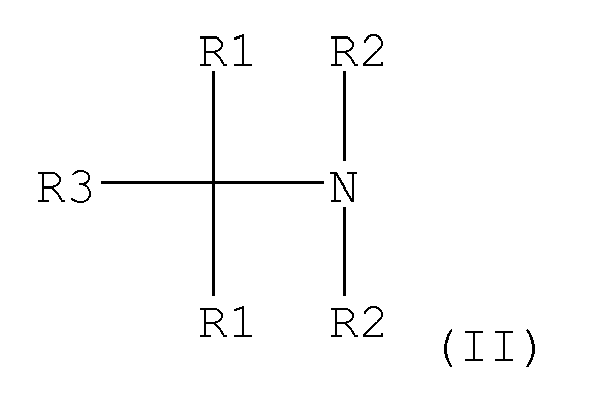
- wherein each R1, R2 independently represents -R4-R5, R3 represents hydrogen, optionally substituted alkyl, aryl or arylalkyl, or -R4-R5,
- each R4 independently represents a single bond or optionally substituted alkylene, alkenylene, oxyalkylene, aminoalkylene, alkylene ether, carboxylic ester or carboxylic amide, and
- each R5 independently represents an optionally N-substituted aminoalkyl group or an optionally substituted heteroaryl group selected from pyridinyl, pyrazinyl, pyrazolyl, pyrrolyl, imidazolyl, benzimidazolyl, pyrimidinyl, triazolyl and thiazolyl;

- wherein each R20 is selected from: an alkyl, cycloalkyl, heterocycloalkyl, heteroaryl, aryl and arylalkyl groups optionally substituted with a substituent selected from hydroxy, alkoxy, phenoxy, carboxylate, carboxamide, carboxylic ester, sulphonate, amine, alkylamine and N+(R21)3, wherein R21 is selected from hydrogen, alkanyl, alkenyl, arylalkanyl, arylalkenyl, oxyalkanyl, oxyalkenyl, aminoalkanyl, aminoalkenyl, alkanyl ether, alkenyl ether, and -CY2-R22, in which Y is independently selected from H, CH3, C2H5, C3H7 and R22 is independently selected from an optionally substituted heteroaryl group selected from pyridinyl, pyrazinyl, pyrazolyl, pyrrolyl, imidazolyl, benzimidazolyl, pyrimidinyl, triazolyl and thiazolyl; and wherein at least one of R20 is a -CY2-R22;

- wherein: Q is independently selected from:


- p is 4;
- R is independently selected from: hydrogen, C1-C6-alkyl, CH2CH2OH, pyridin-2-ylmethyl, and CH2COOH; R1, R2, R3, R4, R5 and R6 are independently selected from: H, C1-C4-alkyl, and C1-C4-alkylhydroxy;

- wherein "R1" is independently selected from H, and linear or branched, substituted or unsubstituted C1 to C20 alkyl, alkylaryl, alkenyl or alkynyl; and all nitrogen atoms in the macropolycyclic rings are coordinated with the transition metal;
R17R17N-X-NR17R17 (VI),
- X is selected from -CH2CH2-, -CH2CH2CH2-, -CH2C(OH)HCH2-; and,
- R17 independently represents a group selected from: R17 and alkyl, cycloalkyl, heterocycloalkyl, heteroaryl, aryl and arylalkyl groups optionally substituted with a substituent selected from hydroxy, alkoxy, phenoxy, carboxylate, carboxamide, carboxylic ester, sulphonate, amine, alkylamine and N+(R19)3, wherein R19 is selected from hydrogen, alkanyl, alkenyl, arylalkanyl, arylalkenyl, oxyalkanyl, oxyalkenyl, aminoalkanyl, aminoalkenyl, alkanyl ether, alkenyl ether, and -CY2-R18, in which Y is independently selected from H, CH3, C2H5, C3H7 and R18 is independently selected from an optionally substituted heteroaryl group selected from pyridinyl, pyrazinyl, pyrazolyl, pyrrolyl, imidazolyl, benzimidazolyl, pyrimidinyl, triazolyl and thiazolyl; and wherein at least two of R17 are -CY2-R18.
- In another aspect the present invention provides a method of providing the liquid curable medium by the admixture of the primary accelerator, the resin, and the peroxide. The primary accelerator is most preferably added as a solution in a polar solvent.
- In a further aspect the present invention provides the cured liquid medium.
- Preferably the liquid curable medium comprises less than 0.01 wt % of cobalt wt % based on metal, more preferably less than 0.005, most preferably less than 0.0001 wt %. Ideally the liquid curable medium does not contain cobalt, i.e., the liquid curable medium is cobalt free.
- The unsaturated polyester resin or vinyl ester resin as is comprised in the resin may be suitable selected from the unsaturated polyester resin or vinyl ester resin as are well known in the art. The resin comprises a reactive diluent that serves to cross link. Examples of unsaturated polyester resin or vinyl ester resins to be used in resin compositions of the present invention are subdivided in different categories as listed below.
- (1) Ortho resins: these are based on phthalic anhydride, maleic anhydride, or fumaric acid and glycols, such as ethylene glycol, diethylene glycol, triethylene glycol, 1,2-propylene glycol, 1,3-propylene glycol, dipropylene glycol, tripopylene glycol, neopentyl glycol, or hydrogenated bis-phenol A. Commonly the ones derived from 1,2-propylene glycol are used in combination with a reactive diluent such as styrene.
- (2) Iso-resins: these are usually prepared from isophthalic acid, maleic anhydride or fumaric acid, and the glycols. These resins may typically contain a higher level of reactive diluent than the ortho-resins.
- (3) Bisphenol-A-fumarates: these are based on ethoxylated bisphenol-A and fumaric acid.
- (4) Chlorendics: are resins prepared from chlorine/bromine containing anhydrides or phenols in the preparation of UP resins.
- (5) Vinyl ester resins: these are resins which are mostly used because of their hydrolytic resistance and excellent mechanical properties, are having unsaturated sites only in the terminal position, introduced by reactions of epoxy resins with (meth)acrylic acid. Typical types of epoxy resins include bisphenol-A, novalac, tetraphenyloethane, cycloaliphatic, tetrabromobisphenol-A, etc.
- Similar to iso resins and ortho resins are unsaturated polyester resins containing terephthalic acid. Besides these classes of resins also so-called dicyclopentadiene (DCPD) resins can be distinguished as unsaturated polyester resin. As used herein, a vinyl ester resin is a (meth)acrylate functional resin. Also the class of vinyl ester urethane resins (also referred to urethane methacyclate resins) can be distinguished a vinyl ester resins. Preferably, the vinyl ester resin used in the present invention is a resin that is obtained by the esterification of an epoxy resin with a (meth)acrylic acid or a (meth)acrylamide.
- All of these resins, as can suitably used in the context of the present invention, may be modified according to methods known in the art, e.g. for achieving lower acid number, hydroxyl number or anhydride number, or for becoming more flexible due to insertion of flexible units in the backbone, etc.
- Also other reactive groups curable by reaction with peroxides may be present in the resins, for instance reactive groups derived from itaconic acid, citraconic acid and allylic groups, etc. Accordingly the unsaturated polyester resins or vinyl ester resins used in the present invention may contain solvents. The solvents may be inert to the resin system or they may be reactive therewith during the curing step. Reactive solvents are particularly preferred. Examples of suitable reactive solvents are styrene, vinyl toluene, divinyl benzene, methyl methacrylate, diallyl phthalate, α-methyl styrene, triallyl cyanurate, (meth)acrylates, N-vinylpyrrolidone, and N-vinylcaprolactam. Mixtures of the reactive solvents, especially with styrene, are also employed. The amount of styrene and/or other reactive diluent may be as large as 60% of the resin composition, but is typically between 25% and 35%.
- The unsaturated polyester resins and vinyl ester resins as are being used in the context of the present invention may be any type of such resins, but preferably are chosen from the group of DCPD resins, iso-phthalic resins and orthophthalic resins and vinyl ester resins or blends thereof.
- The resin composition according to the invention preferably has an acid value in the range of from 0.001-300 mg KOH/g of resin composition. As used herein, the acid value of the resin composition is determined titrimetrically according to ISO 2114-2000. Preferably the molecular weight of the unsaturated polyester resin is in the range of from 500 to 200.000 g/mol. As used herein the molecular weight of the resin is determined using gel permeation chromatography according to ISO 13885-1. The resin compositions according to the present invention generally contain less than 5 wt % of water.
- Acrylic resin as is comprised in the resin compositions according to the present invention, may be suitable selected from theromset acrylic resin or acrylic modified resin as are well known in the art. Examples of acrylic resin or modified acrylic resins to be used in resin compositions of the present invention are listed below.
- Acrylic resins: based on acrylic monomers that typically contain either acrylate functionality or methacrylate functionality of the general structures:

- Also included with functional monomers are carboxyl types like methacrylic acid, acrylic acid, and itiaconic acid, as well as, multifunctional types like 1,4-butylene dimethacrylate, ethyleneglycol dimethacrylate, 1,6 hexandiol dimethacrylate, diethyleneglycol dimethacrylate, bisphenol-A dimethacrylate, ethoxylated bisphenol-A dimethacrylate, trimethylol propane tricarylate, trimethylol propane methacrylate, ethoxylated trimethylolpropane trimethacrylate etc.
- Acrylic resins can also use oligomeric acrylates, which are acrylated urethanes, epoxies, polyesters, polyethers, and acrylics. The oligomeric acrylates are formed by reacting acrylate functional monomers with primary or secondary functional groups on the oligomomer. The acrylate functional monomers can be added directly to the oligomer or attached to the oligomer using a secondary difunctional monomer. For instance, ureathane acrylate oligomers are formed by reacting polyester or polyether polyol oligomers with diisocyanates (aliphatic or aromatic) and hydroxy (meth)acrylates. Epoxy acrylate oligomers are formed by reacting epoxy resins with carboxyl functional (meth)acrylates. Polyether oligomers can also be reacted with carboxy functional (meth)acrylates to form polyethylene glycol dimethacrylate, as an example.
- Additionally, acrylic resins can use pre-reacted polymer-in-monomer syrups made by polymerizing an acrylic monomer or co-polymerizing a mixture of different acrylic monomers to a specific degree of polymerization, typically 10-60 %. The polymerization is typically carried out at 50-110°C using a small amount of polymerization initiator and an optional chain transfer agent. The reaction proceeds to a predetermined viscosity, approximation of polymerization degree, and is then cooled to room temperature. Optionally, the reaction is quench cooled by the addition of cold monomer containing a polymerization inhibitor.
- Acrylic modified resins are broad category of resins that are similar to oligomeric acrylates, with the exception that acrylic modified resins use a base resin of sufficient molecular weight as not to be considered an oligomer. Examples of base resins include polyols, unsaturated polyols, polyesters, unsaturated polyesters, unsaturated dicyclopentadiene-based polyesters, polyisocyantes (chain extended and/or multifunctional), epoxies (Bisphenol-A, novalac, and chain extended) and polyacids, which are typically the products of polyols and polycarboxylic acids or anhydrides. Acrylic modified resins are formed by reacting a base resin's primary and secondary functional groups directly with functional acrylic monomers to create primary and/or secondary (meth)acrylic double bonds on the base resin. Base resin modification with (meth)acrylic double bonds may also be achieved indirectly by initially reacting the resin's primary and/or secondary functional groups with other difunctional or polyfunctional compounds such as isocyanates, acids, or anhydrides. Additionally, Acrylic resins may be further modified by reacting secondary functional groups formed during the initial modification. Methods for the preparation of acrylic modified resins are well known to those skilled in the art.
- Accordingly acrylic modified resins used in the present invention may contain solvents. The solvents may be inert to the resin system or they may be reactive therewith during the curing step. Reactive solvents are particularly preferred. Acrylic monomers and/or oligomeric acrylates, discussed above, are examples of suitable reactive solvent typically used with acrylic modified resins. Alternately, acrylic monomers can be copolymerized with styrene, vinyl toluene, divinyl benzene, acrylonitrile, vinyl acetate, and vinyl esters of carboxylic acids, etc. in both acrylic and acrylic modified resin.
- The use of acrylic monomers and/or oligomeric acrylates as reactive diluents for curing or crosslinking further extends the definition of modified acrylic resins to include resins modified by allylic functional groups, where the allylic functionality is introduced to the base resin by allyl glycidyl ether, trimethylol propanediallyl ether, allyl pentaerythritol, and related derivatives.
- The unsaturated polyester, vinyl ester, and acrylic resin systems described above are cured using peroxide type and azo-type initiators. Initiators are typically dissociated using heat, UV light, or at room temperature with accelerators to form the free radicals required to begin polymerization. Accelerators are usually employed with peroxides, but their use is not limited to ambient curing applications. Not all peroxide initiators can be activated by every accelerator and not all peroxide/accelerator systems are active enough for every resin system. The current state of the art for ambient curing of unsaturated polyester and vinyl ester resins uses peroxides accelerated by the presence of metal compounds, especially cobalt salts as accelerators. Cobalt naphthenate and cobalt octanoate are the most widely used accelerators. The peroxides most commonly used in conjunction with cobalt accelerators are ketone peroxides, hydroperoxides and peresters, specifically with methylethylketone peroxide (MEKP) as the most common type. Modified acrylic resins that contain a significant amount of styrene mixed with acrylate monomers can also be cured with MEKP/cobalt system. The ability to activate many different initiators and be compatible with many resin systems accounts for wide use of cobalt accelerators.
- However, cobalt accelerators have become undesirable because of their health and environmental hazards. Cobalt accelerators also suffer other technical detriments that include poor reactivity at low temperature (<15°C), color imparted to the resin, and poor reactivity with acrylic and methacrylic monomers, especially in acrylic resins. Many molding applications take place at ambient temperature. However in winter months, ambient temperature may be significantly lower than 15-40°C, which is the typical operating temperature for ambient curing with cobalt accelerators. At temperatures below 15°C, the reduction in activity of cobalt accelerators is disproportionate to the reduction in temperature rendering them ineffective. Also, cobalt octoate and naphthenate salts are very dark in color. When used as a primary accelerator at a typical concentration of about 0.02 % (based on metal), the color form the cobalt accelerator affects the color of the cure gel coat or molded composite. Lower cobalt accelerator levels can be used, but with longer gel and peak exotherm times and lower peak exotherm temperatures. Lastly, unsaturated polyester and vinyl ester resins have been incorporating low volatile acrylic and methacrylic monomers as one way to meet recent government regulations to restrict styrene emissions in open molding facilities. However, the amount of styrene substitution is limited by the poor co-polymerization of most acrylates and methacrylates with maleate and fumarate moieties in the polyester backbone, as well as, the ability of cobalt accelerated MEKP systems to effectively form radicals with acrylic monomers. The latter is especially apparent in acrylic resin systems where cobalt accelerated MEKP systems exhibit little or no reactivity in the absence of styrene. The most common initiator/accelerator system currently practiced with acrylic resin systems is benzoyl peroxide (BPO) with at tertiary amine accelerator; i.e. dimethyl aniline (DMA). However, the BPO is less than ideal because it is a solid powder and the DMA can produce a highly colored gel coat of molded composite. The cured BPO/DMA system also suffers strong discoloration by heat and light.
- Accordingly, there is substantial need in the unsaturated polyester resin business, and in particular in the field of production of cure gel coats and molded composites as previously defined, for the finding of accelerated or promoted unsaturated polyester resin, vinyl ester resin, and acrylic resin compositions showing good curing properties and having no cobalt content. In particular, there is a need for providing accelerated resin compositions that are curable with liquid peroxides. In particular such curing should take place at ambient temperature and preferably, also at sub-ambient temperatures. Preferably, the accelerator resin compound will produce cured gel coats and molded composites low in color.
- It was now found, surprisingly, that unsaturated polyester resin, vinyl ester resin, and acrylic resin systems with efficient curing performance when cured with a peroxide could be obtained by using a resin composition comprising an unsaturated polyester resin, vinyl ester resin, or acrylic resin and an accelerator comprising a manganese or iron complex of a tetradentate, pentadentate or hexadentate nitrogen donor ligand as defined below. These iron and manganese complexes function as cobalt-free primary accelerators at low concentrations with surprising technical benefits of reduced color, activity at ambient and sub-ambient temperature, and good curing reactivity in acrylic resins compared to state of the art cobalt accelerators.
- Preferably, the accelerator is present in the resin composition from 0.00001 and 0.02% w/w based on metal, more preferably from 0.00005 and 0.005% w/w based on metal.
- The level of the primary accelerator may be made up from a mixture of the primary accelerators.
- The tetradentate, pentadentate or hexadentate nitrogen donor ligand may be built up within any organic structure which will support coordinating nitrogen atoms. For example one can take a basic tridentate ligand such as 1,4,7-triazacyclononane and have further nitrogen co-ordination groups, e.g., -CH2-CH2-NH2, -CH2-Py, covalently bound to one or more of the cyclic nitrogens or aliphatic groups.
- Preferably the iron ion is selected from Fe(II) and Fe(III) and the manganese ion is selected from Mn(II), Mn(III), and Mn(IV).
- Preferably the ligand is present in one or more of the forms [MnLCl2]; [FeLCl2]; [FeLCl]Cl; [FeL(H2O)] (PF6)2; [FeL]Cl2, [FeLCl]PF6 and [FeL(H2O)] (BF4)2.
- The following are preferred classes of primary accelerator that are iron or manganese complexes of tetradentate, pentadentate or hexadentate nitrogen donor ligands.
- If unspecified the length of any alkyl chain is preferably C1 to C8-alkyl chain and preferably linear. If unspecified the aryl group is a phenyl group.
- The bispidon class are preferably in the form of an iron transition metal catalyst.
- The bispidon ligand is preferably of the form:

- C1-C24-alkyl,
- C6-C10-aryl, and,
- a group containing a heteroatom capable of coordinating to a transition metal;
- R3 and R4 are independently selected from hydrogen, C1-C8 alkyl, C1-C8-alkyl-O-C1-C8-alkyl, C1-C8-alkyl-O-C6-C10-aryl, C6-C10-aryl, C1-C8-hydroxyalkyl, and -(CH2)nC(O)OR5
- wherein R5 is independently selected from: hydrogen, C1-C4-alkyl, n is from 0 to 4, and mixtures thereof; and,
- X is selected from C=O, -[C(R6)2]y- wherein Y is from 0 to 3 each R6 is independently selected from hydrogen, hydroxyl, C1-C4-alkoxy and C1-C4-alkyl.
- Preferably R3 = R4 and selected from -C(O)-O-CH3, -C(O)-O-CH2CH3, -C(O)-O-CH2C6H5 and CH2OH.
- Preferably the heteroatom capable of coordinating to a transition metal is pyridin-2-ylmethyl optionally substituted by -CO-C4-alkyl.
- Another preferred heteroatom capable of coordinating to a transition metal is a tertiary amine of the form -C2-C4-alkyl-NR7R8, the -C2-C4-alkyl- of the -C2-C4-alkyl-NR7R8 may be substituted by 1 to 4 C1-C2-alkyl, or may form part of a C3 to C6 saturated alkyl ring, R7 and R8 are independently selected from the group consisting of straight chain-C1-C12-alkyl, branched-C1-C12-alkyl or cyclo-C1-C12-alkyl, - CH2C6H5, and in which R7 and R8 may together form a cyclic ring selected from the group:

- The following are preferred tertiary amines: -CH2CH2-NR7R8, -CH2CMe2-NR7R8, -CMe2CH2-NR7R8, -CMeHCH2-NR7R8, -CMeHCMeH-NR7R8, -CH2CMeH-NR7R8, -CH2CH2CH2-NR7R8, -CH2CH2CMe2-NR7R8, -CH2CMe2CH2-NR7R8,


- Preferably X is C=O or C(OH)2.
- Preferred groups for R1 and R2 are CH3, -C2H5, -C3H7, benzyl, -C4H9, -C6H13, -C8H17, -C12H25, and -C18H37 and pyridin-2-yl. A preferred class of bispidon is one in which at least one of R1 or R2 is pyridin-2-ylmethyl or benzyl, preferably pyridin-2-ylmethyl.
- A preferred bispidon is dimethyl 2,4-di-(2-pyridyl) -3-methyl-7-(pyridin-2-ylmethyl)-3,7-diaza-bicyclo[3.3.1]nonan-9-one-1,5-dicarboxylate (N2py3o-C1) and the iron complex thereof FeN2py3o-C1 which was prepared as described in
W002/48301 - Preferred tetradentate bispidons are also illustrated in
WO00/60045 W002/48301 WO03/104379 - The N4py are preferably in the form of an iron transition metal catalyst.
- The N4py type ligands are preferably of the form:

- each R1, R2 independently represents -R4-R5,
- R3 represents hydrogen, optionally substituted alkyl, aryl or arylalkyl, or -R4-R5,
- each R4 independently represents a single bond or optionally substituted alkylene, alkenylene, oxyalkylene, aminoalkylene, alkylene ether, carboxylic ester or carboxylic amide, and
- each R5 independently represents an optionally N-substituted aminoalkyl group or an optionally substituted heteroaryl group selected from pyridinyl, pyrazinyl, pyrazolyl, pyrrolyl, imidazolyl, benzimidazolyl, pyrimidinyl, triazolyl and thiazolyl.
- Preferably R1 represents pyridin-2-yl or R2 represents pyridin-2-yl-methyl. Preferably R2 or R1 represents 2-aminoethyl, 2-(N-(m)ethyl)amino-ethyl or 2-(N,N-di(m)ethyl)aminoethyl. If substituted, R5 preferably represents 3-methyl pyridin-2-yl. R3 preferably represents hydrogen, benzyl or methyl.
- The preferred ligands are N4Py (i.e. N, N-bis(pyridin-2-yl-methyl)-bis(pyridin-2-yl)methylamine) which is disclosed in
WO95/34628 EP0909809 . - The TACN-Nx are preferably in the form of an iron transition metal catalyst.
- The ligands possess the basic 1,4,7-triazacyclononane structure but have one or more pendent nitrogen groups that complex with the transition metal to provide a tetradentate, pentadentate or hexadentate ligand. Preferably, the basic 1,4,7-triazacyclononane structure has two pendent nitrogen groups that complex with the transition metal (TACN-N2). The TACN-Nx is preferably of the form:

- Preferably R22 is selected from optionally substituted pyridin-2-yl, imidazol-4-yl, pyrazol-1-yl, quinolin-2-yl groups. Most preferably R22 is either a pyridin-2-yl or a quinolin-2-yl.
- The cyclam and cross bridged ligands are preferably in the form of a manganese transition metal catalyst.
- The cyclam ligand is preferably of the form:


R is independently selected from: hydrogen, C1-C6-alkyl, CH2CH2OH, pyridin-2-ylmethyl, and CH2COOH, or one of R is linked to the N of another Q via an ethylene bridge;
R1, R2, R3, R4, R5 and R6 are independently selected from: H, C1-C4-alkyl, and C1-C4-alkylhydroxy. - Preferred non-cross-bridged ligands are 1,4,8,11-tetraazacyclotetradecane (cyclam), 1,4,8,11-tetramethyl-1,4,8,11-tetraazacyclotetradecane (Me4cyclam), 1,4,7,10-tetraazacyclododecane (cyclen), 1,4,7,10-tetramethyl-1,4,7,10-tetraazacyclododecane (Me4cyclen), and 1,4,7,10-tetrakis(pyridine-2ylmethyl)-1,4,7,10-tetraazacyclododecane (Py4cyclen). With Py4cyclen the iron complex is preferred.
- A preferred cross-bridged ligand is of the form:

- Preferably R1 = Me, which is the ligand 5,12-dimethyl-1,5,8,12-tetraaza-bicyclo[6.6.2]hexadecane of which the complex [Mn(Bcyclam)Cl2] may be synthesised according to
WO98/39098 - Other suitable crossed bridged ligands are also found in
WO98/39098 - The trispicens are preferably in the form of an iron transition metal catalyst.
- The trispicen type ligands are preferably of the form:
R17R17N-X-NR17R17 (VI),
wherein: - X is selected from -CH2CH2-, -CH2CH2CH2-, -CH2C(OH)HCH2-; and,
- R17 independently represents a group selected from: R17 and alkyl, cycloalkyl, heterocycloalkyl, heteroaryl, aryl and arylalkyl groups optionally substituted with a substituent selected from hydroxy, alkoxy, phenoxy, carboxylate, carboxamide, carboxylic ester, sulphonate, amine, alkylamine and N+(R19)3, wherein R19 is selected from hydrogen, alkanyl, alkenyl, arylalkanyl, arylalkenyl, oxyalkanyl, oxyalkenyl, aminoalkanyl, aminoalkenyl, alkanyl ether, alkenyl ether, and -CY2-R18, in which Y is independently selected from H, CH3, C2H5, C3H7 and R18 is independently selected from an optionally substituted heteroaryl group selected from pyridinyl, pyrazinyl, pyrazolyl, pyrrolyl, imidazolyl, benzimidazolyl, pyrimidinyl, triazolyl and thiazolyl;
- The heteroatom donor group is preferably pyridinyl optionally substituted by -CO-C4-alkyl.
- Other preferred heteroatom donor groups are imidazol-2-yl, 1-methyl-imidazol-2-yl, 4-methyl-imidazol-2-yl, imidazol-4-yl, 2-methyl-imidazol-4-yl, 1-methyl-imidazol-4-yl, benzimidazol-2-yl and 1-methyl-benzimidazol-2-yl.
- Preferably three of R17 are CY2-R18.
- The ligand Tpen (i.e. N, N, N', N'-tetra(pyridin-2-yl-methyl)ethylenediamine) is disclosed in
WO97/48787 - The following are preferred trispicens: N-methyl-tris( pyridin-2-ylmethyl)ethylene-1,2-diamine; N-octyl-tris(pyridin-2-ylmethyl)ethylene-1,2-diamine; N-octadecyl-tris(pyridin-2-ylmethyl)ethylene-1,2-diamine; N-methyl-N,N',N'-tris(3-methyl-pyridin-2-ylmethyl)ethylene-1,2-diamine; N-ethyl-N,N',N'-tris(3-methyl-pyridin-2-ylmethyl)ethylene-1,2-diamine; N-methyl-N,N',N'-tris(5-methyl-pyridin-2-ylmethyl)ethyl ene-1,2-diamine;N-ethyl-N,N',N'-tris(5-methyl-pyridin-2-ylmethyl)ethylene-1,2-diamine; N-benzyl- N,N',N'-tris(3-methyl-pyridin-2-ylmethyl)ethylene-1,2-diamine; N-benzyl-N,N',N'-tris(5-methyl-pyridin-2-ylmethyl)ethyl ene-1,2-diamine; N-butyl-N,N',N'-tris(pyridin-2-ylmethyl)ethyl ene-1,2-diamine; N-octyl-N,N',N'-tris(pyridin-2-ylmethyl)ethyl ene-1,2-diamine; N-dodecyl-N,N',N'-tris(pyridin-2-ylmethyl)ethyl ene-1,2-diamine; N-octadecyl-N,N',N'-tris(pyridin-2-ylmethyl)ethyl ene-1,2-diamine; N-Methyl-N,N',N'-Tris(imidazol-2ylmethyl)- ethylenediamine; N-ethyl-N,N',N'-Tris(imidazol-2ylmethyl)-ethylenediamine; N,N'-dimethyl-N,N'-bis(imidazol-2-ylmethyl)-ethylenediamine; N-(1-propan-2-ol)-N,N',N'-Tris(imidazol-2ylmethyl)-ethylenediamine; N-(1-propan-2-ol)-N,N',N'-Tris(1-methyl-imidazol-2ylmethyl)-ethylenediamine; N,N-diethyl-N',N",N"-Tris(5-methyl-imidazol-4ylmethyl)-diethylenetriamine; N-(3-propan-1-ol)-N,N',N'-Tris(1-methyl-imidazol-2-ylmethyl)-ethylenediamine; N-hexyl-N,N',N'-Tris(imidazol-2ylmethyl)-ethylenediamine; N-methyl-N,N',N'-tris(benzimidazol-2ylmethyl)-ethylenediamine; and, N-(3-propan-1-ol)methyl-N,N',N'-tris(benzimidazol-2ylmethyl)-ethylenediamine.
- Other suitable trispicens are found in
WO02/077145 - Of the non-bispidon type primary accelerators the following are most preferred: 5,12-dimethyl-1,5,8,12-tetraaza-bicyclo[6.6.2]hexadecane, 5,12-dibenzyl-1,5,8,12-tetraaza-bicyclo[6.6.2]hexadecane, 1,4,8,11-tetraazacyclotetradecane, 1,4,8,11-tetramethyl-1,4,8,11-tetraazacyclotetradecane, 1,4,7,10-tetraazacyclododecane, 1,4,7,10-tetramethyl-1,4,7,10-tetraazacyclododecane, and 1,4,7,10-tetrakis(pyridine-2ylmethyl)-1,4,7,10-tetraazacyclododecane, N,N-bis(pyridin-2-yl-methyl)-bis(pyridin-2-yl)methylamine, N,N-bis(pyridin-2-yl-methyl-1,1-bis(pyridin-2-yl)- 1-aminoethane, N,N,N',N'-tetra(pyridin-2-yl-methyl)ethylenediamine, N-methyl-tris( pyridin-2-ylmethyl)ethylene-1,2-diamine; N-butyl-N,N',N'-tris(pyridin-2-ylmethyl)ethylene-1,2-diamine; N-octyl-N,N',N'-tris(pyridin-2-ylmethyl)ethylene-1,2-diamine; N-dodecyl-N,N',N'-tris(pyridin-2-ylmethyl)ethylene-1,2-diamine; N-octadecyl-N,N',N'-tris(pyridin-2-ylmethyl)ethylene-1,2-diamine; N-methyl-N,N',N'-tris(3-methyl-pyridin-2-ylmethyl)ethylene-1,2-diamine; N-ethyl-N,N',N'-tris(3-methyl-pyridin-2-ylmethyl)ethylene-1,2-diamine; N-methyl-N,N',N'-tris(5-methyl-pyridin-2-ylmethyl)ethylene-1,2-diamine;N-ethyl-N,N',N'-tris(5-methyl-pyridin-2-ylmethyl)ethylene-1,2-diamine; N-benzyl- N,N',N'-tris(3-methyl-pyridin-2-ylmethyl)ethylene-1,2-diamine; N-benzyl-N,N',N'-tris(5-methyl-pyridin-2-ylmethyl)ethylene-1,2-diamine; N-methyl-N,N',N'-tris(imidazol-2ylmethyl)-ethylenediamine; N-ethyl-N,N',N'-tris(imidazol-2ylmethyl)-ethylenediamine; N,N'-dimethyl-N,N'-bis(imidazol-2-ylmethyl)-ethylenediamine; N-(1-propan-2-ol)-N,N',N'-tris(imidazol-2ylmethyl)-ethylenediamine; N-(1-propan-2-ol)-N,N',N'-tris(1-methyl-imidazol-2ylmethyl)-ethylenediamine; N,N-diethyl-N',N",N"-tris(5-methyl-imidazol-4ylmethyl)-diethylenetriamine; N-(3-propan-1-ol)-N,N',N'-tris(1-methyl-imidazol-2-ylmethyl)-ethylenediamine; N-hexyl-N,N',N'-tris(imidazol-2ylmethyl)-ethylenediamine; N-methyl-N,N',N'-tris(benzimidazol-2ylmethyl)-ethylenediamine; and, N-(3-propan-1-ol)methyl-N,N',N'-tris(benzimidazol-2ylmethyl)-ethylenediamine; 1,4-bis(quinolin-2-ylmethyl)-7-octyl-1,4,7-triazacyclononane; 1,4-bis(quinolin-2-ylmethyl)-7-ethyl-1,4,7-triazacyclononane; 1,4-bis(quinolin-2-ylmethyl)-7-methyl-1,4,7-triazacyclononane, ; 1,4-bis(pyridyl-2-methyl)-7-octyl-1,4,7-triazacyclononane ; 1,4-bis(pyridyl-2-methyl)-7-ethyl-1,4,7-triazacyclononane; 1,4-bis(pyridyl-2-methyl)-7-methyl-1,4,7-triazacyclononane; 1,4-bis(pyrazol-1-ylmethyl)-7-octyl-1,4,7-triazacyclononane; 1,4-bis(pyrazol-1-ylmethyl)-7-ethyl-1,4,7-triazacyclononane; 1,4-bis(pyrazol-1-ylmethyl)-7-methyl-1,4,7-triazacyclononane, 3,5-dimethylpyrazol-1-ylmethyl)-7-octyl-1,4,7-triazacyclononane; 3,5-dimethylpyrazol-1-ylmethyl)-7-ethyl-1,4,7-triazacyclononane; 3,5-dimethylpyrazol-1-ylmethyl)-7-methyl-1,4,7-triazacyclononane; 1,4-bis(1-methylimidazol-2-ylmethyl)-7-octyl-1,4,7-triazacyclononane; 1,4-bis(1-methylimidazol-2-ylmethyl)-7-ethyl-1,4,7-triazacyclononane; 1,4-bis(1-methylimidazol-2-ylmethyl)-7-methyl-1,4,7-triazacyclononane; and, 1,4,7-tris(quinolin-2-ylmethyl)-1,4,7-triazacyclononane; 1,4,7-tris(pyridin-2-ylmethyl)-1,4,7-triazacyclononane.
- The primary accelerator is most preferably present in the form of a solution; the solvent is preferably a polar solvent. Preferred examples of the polar solvent are: propylene glycol, ethylene glycol, propylene glycol, ethanol, isopropyl alcohol and acetonitrile. Preferably the primary accelerator is present in the polar solvent in the range 1 to 0.01 wt% based upon metal, more preferably 1 to 0.1 wt%.
- The liquid curable medium may contain a co-accelerator (a secondary accelerator).
- Examples of a co-accelerator are:
- (1) Metal systems: typically include metal carboxylates, acetylacetonates, dicyclopentadienes, complexes, and derivatives thereof containing cobalt (preferably at low levels if Co used), manganese, copper, iron, zinc, vanadium, nickel, tin, magnesium, titanium, potassium, lithium, and others.
- (2) Amines: typically include nitrogen containing compounds such as derivatives of aniline, various amides, aromatic and aliphatic amines; e.g., dimethylaniline, diethylaniline, 2-aminopyridine, phenyldiethanolamine, dimethyl-p-toluidine, dimethylacetyacetoamide, acetoacetanilide, bipyridyl, N-(2-hydroxyethyl)-N-methyl-paratoluidine etc.
- (3) Oxygen Containing Compounds: typically include oxygenated organic compounds carrying an aldehyde, ketone, ether, ester or alcohol groups capable forming a complex with a metal salt. In particular, keto- and aldo-esters and ethers or alcohols, 1,3-diketones and aldehydes, 1,2-diketones, and certain polyalcohols and other alcohols; e.g., ethyl acetylacetonate, mono- and diesters of ketoglutaric acid, esters of pyrvic acid, glucose, fructose, actylacetone, benzoylaceetone, dibenzoylmethane, diethylmalonate, diacetyl, glyoxal, diethyleneglycol, benzylglycol, ascorbic palmitate etc.
- (4) Thiol Compounds: Thiol compounds include mercaptans and more preferably materials containing at least two thiol groups, and their adducts with anhydride or epoxides all of which are capable of forming complexes with metal salts; e.g., n-dodecylmercaptan, tertdodecylmercaptan, 2-mercaptoethanol, dipentene dimercaptan, ethylcyclohhexyl dimercaptan, ethylene-1,2-bis-3-mercaptate, 1,2,6-hexanetrithiol, tetramercaptoacetate, thioesters of polyalcohols, etc.
- (5) Quaternary salts: Capable of forming complexes with metal salts; e.g., trimethyl benzyl ammonium chloride, tris-(p-chlorophenyl)-benzyl phosphonium chloride, tetrakismathylol phosphonium chloride, ammonium acetate, ammonium octoate, etc.
- (6) Phosphourous Containing Compounds: Capable of forming complexes with metal compounds including alkyl acid phosphites, alkyl acid phosphates, phosphoric acid, hypophosphorous acid, phosphorous acid, trialkyl phosphates, and triaryl phosphates; e.g., tri(2-ethylhexyl) phosphite, dibutyl phosphate, benzene phosphinic acid, dihexyl phosphite, etc.
- (7) Lewis Acids: e.g., boron fluoride dehydrate, ferric choloride, perchloric acid, etc.
- (8) Bases: e.g., tetraethanol ammonium hydroxide, tetramethylammonium hydroxide, etc.
- (9) Others: do not fall into above categories, but have been found to have some promotive effect on certain peroxy catalysts; e.g., sodium sulfoxylate formaldehyde, chlorotriphenyl methane, ascorbic acid, isoascorbic acid, etc.
- The resin compositions according to the present invention are being curable with a peroxide compound. The compounds used for the initiation can be any peroxide known to the skilled person for being used in curing of unsaturated polyester, vinyl ester or acrylic resins. Such peroxides include organic and inorganic peroxides, either solids or liquids, and also hydrogen peroxide may be applied. Examples of suitable peroxides are for example, -OCOO-(peroxy carbonates), -C (O) OO- (peroxyesters), - C (O) OOC (O) - (dialkylperoxides), -OO- (dialkylperoxides) and the like. These peroxides can also be oligomeric or polymeric of nature. An extensive list of suitable peroxide compounds can be found, a. o., in
US/2002/00912412A - Preferably the peroxide is chosen from the group of organic peroxides. Examples of suitable peroxides are tertiary alkylhydroperoxides (such as t-butyl-hydroperoxide), other hydroperoxides (such as cumylhydroperoxide), ketone peroxides (such as formed by mixing ketones with hydrogen peroxide, like acetylacetone peroxide or methylethylketone peroxide), peroxyesters, or peracids (such as t-butyl peresters, benzoyl peroxide, peracetates, perbenzoates, laurylperoxide, peroxy diethylether. Often the organic peroxides used as curing agent are tertiary peresters or tertiary hydroperoxides, i.e. peroxy moieties having the tertiary carbon directly bound to the OO-acyl or OOH group. Also mixtures of various peroxy compounds may be applied.
- Preferred is to use a liquid peroxyester, a liquid hydroperoxide or a liquid mixture of hydroperoxides. Handling of liquid peroxides is generally easier; mixing is easier and the rate of dissolution into the resin to be cured is higher. Most preferred is to use a liquid ketone peroxide, specifically methyl ethyl ketone peroxide (MEKP).
- In a preferred embodiment of the invention, the resin composition according to the invention also contains one or more reactive diluents, preferably in an amount of at least 5 weight %. Such reactive diluents are especially relevant for reducing the viscosity of the resin in order to improve handling properties, particularly for being used in techniques like vacuum injection, spraying, etc. However, the amount of such reactive diluent in the resin composition according to the invention is not critical. Preferably, the reactive diluent is a methacrylate and/or styrene.
- In a yet preferred embodiment the resin composition also contains one or more radical inhibitors selected from preferably chosen from the group of phenolic compounds, stable radicals, like galvinoxyl, N-oxyl based compounds, chatechols and/or phenothiazines. The amount of radical inhibitor used may vary depending on the gel time that needs to be achieved. Preferably the phenolic inhibitor is dosed in the range from 0.0001 to 10% by weight, calculated on the total weight of the primary resin system of the resin composition. More preferably, the amount of radical inhibitor is in the resin composition is in the range of from 0.001 to 1% by weight.
- Suitable examples of radical inhibitors that can be used are 2-methoxyphenol, 4-methoxyphenol, 2,6-dibutyl-4-methylphenol, 2,6-dibutylphenol, 2,4,6-trimethyl-phenol, 2,4,6-trimethyl-phenol, 2,4,6-tris-dimethylaminomethyl-phenol, 4,4'-thio-bis(3-methyl-6-t-butylphenol), 4,4'-isopropylidine diphenol, 2,4-dit-butylphenol, 6,6'-di-t-butyl-2,2'-methylene-di-p-cresol, hydroquinone, 2-methylhydroquinone, 2,5-di-t-butyl- hydroquinone, 2,6-di-t-butylhydroquinone, 2,6-dimethylhydroquinone, 2,3,5-trimethylhydroquinone, catechol, 4-t-butylcatechol, 4,6-dit-butylcatechol, benzoquinone, 2,3,5,6-tetrachloro-1,4-benzoquinone, methylbenzoquinone, 2,6-dimethylbenzoquinone, naphtaquinone, 1-oxyl-2,2,6,6-tetramethylpiperidine (TEMPO), 1-oxyl-2,2,6,6-tetramethylpiperidine-4-ol (TEMPOL), 1-oxyl-2,2,6,6-tetramethylpiperidine-4-one (TEMPON), 1-oxyl-2,2,6,6-tetramethyl-4carboxyl-piperidine (4-carboxy-TEMPO), 1-oxyl-2,2,5,5-tetramethylpyrrolidine, 1-oxyl-2,2,5,5-tetramethyl-3-carboxypyrrolidine, aluminium-N-nitrosophenyl hydroxylamine, diethylhydroxylamine, phenothiazine and/or derivatives or combinations of any of these radical inhibitors.
- The unsaturated polyester resin, vinyl ester resin, and acrylic resin compositions according to the present invention can be applied in all applications as are usual for such types of resins. In particular they can be suitably used in closed mould applications, but they can also be used in open mold applications. For closed mold applications it is especially important that the manufacturer of the closed mold products reliably can use favorable properties of the resins according to the invention. End segments where the unsaturated polyester resin, vinyl ester resin, or acrylic resin compositions according to the present invention can be applied include marine applications, chemical anchoring, construction, relining, roofing, flooring, windmill blades, containers, tanks, pipes, automotive parts, corrosion, electrical, transportation, etc. That is to say, the resins according to the invention can be used in all known uses of unsaturated polyester resins, vinyl ester resins, and acrylic resins.
- The present invention further also relates to a process for radically curing a resin composition according to the invention by adding peroxide to the resin composition and affecting the cobalt-free curing. It has been found that iron or manganese complexes of a tetradentate, pentadentate or hexadentate nitrogen donor ligands accelerates the radically curing of unsaturated polyester resins, vinyl ester resins, and acrylic resins. Preferably the curing takes place at a temperature between -20 and +200 °C, preferably in the range between -20 and +100 °C, and most preferably in the range from -10 to +60 °C (so-called cold curing) .
- The present invention also relates to a two-component composition comprising a first component and second component wherein the first component being the unsaturated polyester resin, vinyl ester resin, or acrylic resin composition according to the present invention and the second component comprises a peroxide compound. As used herein, the term "two-component system" refers to systems where two components (A and B) are being physically separated from each other, for instance in separate cartridges or the like and is intended to include any system wherein each of such two separate components (A and B) may contain further separate components. The components are combined at the time the system is used.
- The present invention also relates to a three-component composition comprising a first component, a second component, and a third component wherein the first component comprises the unsaturated polyester resin, vinyl ester resin, or acrylic resin as previously described, the second component being one or combination of the iron or manganese complexes of a tetradentate, pentadentate or hexadentate nitrogen donor ligands accelerators according to the present invention and the third component comprises a peroxide compound. As used herein, the term "three-component system" refers to systems where three components (A. B and C) are being physically separated from each other, for instance in separate cartridges or the like and is intended to include any system wherein each of such three separate components (A, B and C) may contain further separate components. The components are combined at the time the system is used.
- The present invention further also relates to all cured gel coats and molded composites as are being obtained when curing the unsaturated polyester resin, vinyl ester resin, or acrylic resin according to the invention. Where gel coat includes pigmented or non-pigmented gel coats, as well as, in-mold coatings, preferably for marine, sanitary, or automotive applications the have a film thickness of up to 0.75 mm and appropriate weather resistance, hydrolytic stability, and mechanical properties. Where molded composites are considered to have a thickness of at least 0.5 mm and appropriate mechanical properties, preferably as reinforced composite products, and used in the field of chemical anchoring, construction, roofing, flooring, marine applications, windmill blades, containers, tanks, pipes, boats, corrosion, electrical, transportation, aerospace, etc.
- All experiments described below were performed using base resins of commercially available promoted resins that may be considered to be representative for unsaturated polyester resins and vinyl ester resins. The base resins contain only polymer, reactive diluent, and about 100 ppm inhibitor(s) for shelf life stability. An acrylic base resin comprising of an acrylic monomer and modified acrylic resin is also included. The table below lists the base resin designation, general resin type, reactive diluent, concentration of reactive diluent, manufacturer and typical end use application.
Base Resin Designation General Resin Type Reactive Diluent Conc. (%) Manufacturer End Use Application X4545-50 DCPD Styrene 38.5 Reichhlold Filled Tub & Shower 6000-T25 V.E. Styrene 33.1 Ashland Marine X4545-51 Iso / DCPD Styrene 27.5 Reichhold Marine laminate T707-70 Iso / NPG Styrene 30.1 AOC Gel coat 44325-00 Ortho Styrene 27.5 Reichhold Casting 91690-00 Acrylic EOTMPTA 50 Reichhold ---------- DCPD = Dicyclopentadiene; Iso = Isophthalic; V.E. = Vinyl Ester; Ortho = Orthophthalic; NPG =Neopentylglycol; EOTMPTA = ethoxylated tirmethylolpropane tiracrylate - The iron and manganese complexes used in the experiments were obtained as given below.
- Dimethyl 2,4-di-(2-pyridyl)-3-methyl-7-(pyridin-2-ylmethyl)-3,7-diaza-bicyclo[3.3.1]nonan-9-one-1,5-dicarboxylate (N2py30-C1) and the iron(II) complex thereof [Fe(N2py3o-C1)C1]C1 was prepared as described in
WO0248301 - Dimethyl 2,4-di-(2-pyridyl)-3-octyl-7-(pyridin-2-ylmethyl)-3,7-diaza-bicyclo[3.3.1]nonan-9-one-1,5-dicarboxylate (N2py3o-C8), Dimethyl 2,4-di-(2-pyridyl)-3-dodecyl-7-(pyridin-2-ylmethyl)-3,7-diaza-bicyclo[3.3.1]nonan-9-one-1,5-dicarboxylate (N2py3o-C12), and Dimethyl 2,4-di-(2-pyridyl)-3-octadecyl-7-(pyridin-2-ylmethyl)-3,7-diaza-bicyclo[3.3.1]nonan-9-one-1,5-dicarboxylate (N2py3o-C18) and the corresponding iron complexes, [Fe(N2py3o-C8)Cl]Cl, [Fe(N2py3o-C12)Cl]Cl and [Fe(N2py3o-C18) Cl]Cl, were prepared as described in
WO 2005042532 . - Dimethyl 2,4-di-(2-pyridyl)-3-methyl-7-(N,N-dimethyl-aminoethyl)-3,7-diaza-bicyclo[3.3.1]nonan-9-one-1,5-dicarboxylate (N2Py2EtNMe2) and its corresponding iron complex (FeCl(N2Py2C2H4NMe2)]Cl) were prepared as described as disclosed in
WO 03/104379 - N,N-bis(pyridin-2-yl-methyl-1,1-bis(pyridin-2-yl)- 1-aminoethane , hereafter referred to as MeN4Py, and the corresponding iron(II) complex, [Fe(MeN4py)Cl]Cl, were prepared as described in
EP0909809 . - 4,11-dimethyl-1,4,8,11-tetraazabicyclo[6.6.2]hexadecane , hereafter referred to as Bcyclam, and the corresponding manganese(II) complex, [Mn(Bcyclam)Cl2], were prepared as described in
WO98/39098 - N-methyl-trispicen (Metrispicen was synthesised according to literature procedures (Bernal, J.; et al. J. Chem. Soc., Dalton Trans. 1995, 3667) and
GB2386615 EP0909809 for the MeN4py analog. - 1,4-bis(quinolin-2-ylmethyl)-7-ethyl-1,4,7-triazacyclononane (Quin2TACN) and the corresponding [Fe(Quin2TACN)Cl]ClO4 compound were prepared as disclosed in
EP1259522 . - All iron/manganese complex accelerators were initially diluted to 0.5 to 4 percent with diethylene glycol (DEG) or propylene glycol (PG) for incorporation into the resins.
- The cobalt 2-ethylhexanoate used for the comparative reference cobalt accelerator is a commercial product and was obtained from OMG; 12% Cobalt Hex-Cem (code 115086).
- The peroxide initiators DMA and AA used in the experiments were obtained from Sigma-Aldrich: 2-Butanone peroxide 35 wt % in TXIB (a.k.a. Methyl ethyl ketone peroxide (MEKP)); Cumene Hydroperoxide, 88%; Benzoyl Peroxide (BPO) ~ 50 wt % blended in tricresyl phosphate; Acetylacetone (a.k.a. 2,4-Pentanedione) ≥ 99%; and, N,N-Dimethylaniline (DMA).
- For all examples, concentrations of accelerators are given in parts per million (ppm) wt/wt, where the weight of the accelerators is "based on metal" with the exception of DMA and acetylacetone (AA). Concentrations of initiators are given as percent based on overall solution or paste weight. Gel time was determined using a Techne Gel Time Recorder with a 10 mm diameter stainless steel plunger and a 15 gram sample mass in a 24 mL glass vial for all experiments. The peak exotherm time and peak exotherm temperature was determined using a thermocouple and data logger inserted into the same sample. An offset time was added to the gel and peak exotherm times to account for the mixing of the initiator and initial experimental set-up. All equipment and samples were placed in a steady state chamber set to 25°C and 50% humidity unless otherwise specified.
- Samples of X4545-50 DCPD base resin was promoted with 20 ppm accelerator (based on metal) and then initiated with 1.5% methyl ethyl ketone peroxide (MEKP). Accelerators tested represent all six classes of claimed compounds. A total mass of 15.0 grams was used to determine the gel time of the resin. An unpromoted resin control without accelerators was also included as a control. The gel time results are shown in Table 1, below:
Table 1 Accelerator Gel Time (minutes) None > 1000 [Fe(N2py3o-C1)Cl]Cl 7.9 [Fe(N2py3o-C8)Cl]Cl 5.1 [Fe(N2py3o-C12)Cl]Cl 4.9 [Fe(N2py3o-C18)Cl]Cl 4.5 [Fe (N2py2-C2H4NMe2)Cl]Cl 45.5 [Fe(MeN4py)Cl]Cl 14.0 [Fe(quinTACN)Cl]ClO4 35.9 30.2 [Fe(Metrispicen)Cl]PF6 [Mn(Bcyclam)]Cl2 37.3 - The results in Table 1 show that all six classes of the described iron or manganese complexes of a tetradentate, pentadentate or hexadentate nitrogen donor ligands act as primary accelerators with MEKP. All the accelerators showed good cure properties for gel time in a standard unsaturated polyester resin, especially with 15 gram mass. In general, the Bispidon-type catalysts are the most active accelerators of the group based on the resin/initiator system used in this example. The resin control without accelerator did not gel or cure. All the samples cured to a solidified material with the exception of the unpromoted control.
- The T707-70 Iso/NPG and 440325-00 Ortho base resins were promoted with 0.5 ppm Fe ([Fe(N2py3o-C1)Cl]Cl) accelerator and then initiated with 1.5% MEKP. The gel time of the promoted resins was determined as in Example 1 using a 15 gram mass. The results are shown in Table 2, below:
Table 2 Resin Accelerator Gel Time (minutes) T707-70 Iso/NPG 0.5 ppm Fe ([Fe(N2py3o-C1)Cl]Cl) 6.2 44325-00 Ortho 0.5 ppm Fe ([Fe(N2py3o-C1)Cl]Cl) 7.3 - The results in Table 2 show that the [Fe(N2py3o-C1)C1]C1 accelerator produces good cure properties at low concentrations, 0.5 ppm Fe, in typical unsaturated polyester resin systems initiated with MEKP. Both samples cured to a solidified material
- Samples of 6000-T25 vinyl ester base resin was promoted with a range of iron accelerator concentrations using [Fe(N2py3o-C1)C1]C1. In another set of experiments, the 6000-T25 vinyl ester resin was promoted with a range of cobalt concentrations using 12% Cobalt Hex-Cem for a comparative reference. All the promoted resin samples were initiated with 1.5% MEKP and the gel time, peak exotherm time, and peak exotherm temperature determined. The results are shown in Table 3 (below):
Table 3 Accelerator Gel Time (minutes) Peak Exotherm Time (minutes) Peak Exotherm Temp (°C) 0.4 ppm Fe ([Fe(N2py3o-C1)Cl]Cl) 370.9 463.1 27 0.6 ppm Fe ([Fe(N2py3o-C1)Cl]Cl) 66.0 114.9 31 0.8 ppm Fe ([Fe(N2py3o-C1)Cl]Cl) 32.4 65.8 46 1.1 ppm Fe ([Fe(N2py3o-C1)Cl]Cl) 19.8 43.5 77 1.7 ppm Fe ([Fe(N2py3o-C1)Cl]Cl) 11.9 25.6 127 2.1 ppm Fe ([Fe(N2py3o-C1)Cl]Cl) 10.4 25.3 122 4.3 ppm Fe ([Fe(N2py3o-C1)Cl]Cl) 10.0 28.0 118 10.6 ppm Fe ([Fe(N2py3o-C1)Cl]Cl) 17.7 35.0 145 19.3 ppm Fe ([Fe(N2py3o-C1)Cl]Cl) 24.8 115.0 64 42.2 ppm Fe ([Fe(N2py3o-C1)Cl]Cl) 136.6 517.1 27 10.4 ppm Co (12% Co Hex-Cem) > 1000 N.A. N.A. 52.0 ppm Co (12% Co Hex-Cem) 165.2 197.2 95 106 ppm Co (12% Co Hex-Cem) 121.1 140.8 103 256 ppm Co (12% Co Hex-Cem) 59.0 87.9 123 526 ppm Co (12% Co Hex-Cem) 31.4 55.9 133 1017 ppm Co (12% Co Hex-Cem) 24.4 50.0 135 - The [Fe(N2py3o-C1)Cl]Cl results in Table 3 show that the gel/cure reaction can be controlled by varying accelerator concentration. The gel/peak exotherm data represents the entire accelerator concentration range from under promoted to over promoted with vinyl ester resin and using 1.5% MEKP. A concentration of about 2 ppm Fe [Fe(N2py3o-C1)Cl]Cl optimizes the system based on gel time and peak exotherm temperature.
- The 12% Cobalt Hex-Cem results in Table 3 serve as a comparative benchmark for comparison of the [Fe(N2py3o-C1)Cl]Cl accelerator. In general, the [Fe(N2py3o-C1)Cl]Cl accelerator was significantly more reactive than 12% Cobalt Hex-Cem on a metal concentration basis. 1.7 ppm Fe [Fe(N2py3o-C1)Cl]Cl and 256 ppm Co (12% Cobalt Hex-Cem) produced similar peak exotherm temperatures of 127°C and 123°C, respectively. Significantly lower concentrations of [Fe(N2py3o-C1)Cl]Cl produced consistently faster gel and peak exotherm times compared to 12% Cobalt Hex-Cem (based on metal). All the samples in both data sets cured to a solidified material with the exception of the sample promoted with 10 ppm cobalt.
- Samples of 91690-00 acrylic base resin were promoted with 0.5 ppm Fe and 20 ppm Fe [Fe(N2py2-C2H4NMe2)Cl]Cl, 0.5 ppm Fe and 20 ppm Fe of [Fe(N2py2-C2H4NMe2)Cl]Cl, 250 ppm Co (12% Cobat Hex-Cem) and 5000 ppm N,N-dimethylaniline (DMA). All the samples were initiated with 1.5% MEKP with the exception of DMA promoted sample, which was initiated with 2.0% BPO. The cobalt and DMA promoted samples were included for comparative references. Gel time and peak exotherm temperature was determined for all the initiated samples. The results are summarized in Table 4 (below):
Table 4 Initiator Accelerator Gel Time Peak Exotherm Temp (minutes) (°C) 1.5% MEKP 0.5 ppm Fe ([Fe(N2py2-C2H4NMe2)Cl]Cl) 10.2 77 1.5% MEKP 20 ppm Fe ([Fe(N2py2-C2H4NMe2)Cl]Cl) < 0.3 Too fast 1.5% MEKP 0.5 ppm Fe ([Fe(N2py3o-C1)Cl]Cl) 53.9 27 1.5% MEKP 20 ppm Fe ([Fe(N2py3o-C1)Cl]Cl) < 0.5 Too fast 1.5% MEKP 250 ppm Co (12% Cobalt Hex-Cem) > 1000 N.A. 2.0% BPO 5000 ppm DMA 2.4 95 - The results in Table 4 show [Fe(N2py2-C2H4NMe2)Cl]Cl and [Fe(N2py3o-C1)Cl]Cl accelerators are reactive in acrylic resins with acrylate reactive diluents when used with a MEKP initiator. [Fe(N2py2-C2H4NMe2)Cl]Cl was more reactive than the [Fe(N2py3o-C1)Cl]Cl based on peak exotherm temperature. Both formulations with 20 ppm Fe gelled before mixing of initiator was completed. Comparatively, the sample promoted with 250 pppm Co and initiated with 1.5% MEKP did not gel or cure. Both the [Fe(N2py2-C2H4NMe2)Cl]Cl/MEKP and [Fe(N2py3o-C1)Cl]Cl /MEKP system showed the potential to be more reactive than a typical DMA/BPO system in acrylic resins. All the samples cured to a solidified material with the exception of the sample promoted with 250 ppm Co.
- The environmental chamber was set to 25°C, 10°C, and 0°C testing temperatures for the experiments in this example. Triplicate samples of X4545-50 DCPD base resin was promoted with 20 ppm Fe [Fe(N2py3o-C1)Cl]Cl. The 10°C test temperature sample was let stand at -10°C before initiation with 1.5% MEKP and placement into the environmental chamber. The 0°C test temperature sample was let stand at -30°C before initiation with 1.5% MEKP and placement into the environmental. The lower standing temperatures allowed the resin temperature to closely match the testing temperature after addition and mixing of the initiator. As a comparative reference, triplicate X4545-50 DCPD base resin samples were promoted with 100 ppm Co (12% Cobalt Hex-Cem). The testing protocol was the same as the previous sample set with 1.5% MEKP initiator. A 15 gram mass was used to determine the gel time, peak exotherm time, and peak exotherm temperature. The results are shown in Table 5 (below):
Table 5 Accelerator Test Temp Gel Time Peak Exotherm Time Peak Exotherm Temp Temp Difference (°C) (min) (min) (°C) (Δ°C) 20 ppm Fe ([Fe(N2py3o-C1)Cl]Cl) 25 7.9 17.3 71 46 20 ppm Fe ([Fe(N2py3o-C1)Cl]Cl) 10 20.8 49.5 20 10 20 ppm Fe ([Fe(N2py3o-C1)Cl]Cl) 0 36.3 52.5 6 6 100 ppm Co (12% Cobalt Hex-Cem) 25 28.5 47.2 77 52 100 ppm Co (12% Cobalt Hex-Cem) 10 96.5 155.8 14 4 100 ppm Co (12% Cobalt Hex-Cem) 0 293.7 299.4 2 2 - In general, the results in Table 5 show a strong correlation with test temperature; gel time and peak exotherm time inversely proportional to temperature and peak exotherm temperature and temperature difference directly proportional to temperature. At 25°C, both samples exhibited good gel/cure properties with the [Fe(N2py3o-C1)Cl]Cl promoted sample showing faster gel and peak exotherm times, but the cobalt promoted sample showing a slightly higher exotherm temperature. At sub-ambient temperatures, the samples promoted with 20 ppm Fe ([Fe(N2py3o-C1)Cl]Cl) exhibited significantly better gel/cure properties compared to the samples promoted with 100 ppm Co (12% Cobalt Hex-Cem). At 0°C, gel time of the 20 ppm Fe ([Fe(N2py3o-C1)Cl]Cl) promoted sample was 36.3 minutes compared to 293.7 minutes for the 100 ppm Co (12% Cobalt Hex-Cem) sample. All the samples cured to a solidified material.
- Samples of all the unsaturated polyester base resins and the vinyl ester base resins were promoted with 20 ppm Fe ([Fe(N2py3o-C1)Cl]Cl) and then initiated with 1.5% MEKP. The gel time, peak exotherm time, and peak exotherm temperature of the promoted resins was determined using a 15 gram mass at 25°C. A separate puck was cast for each promoted resin to determine the relative darkness of the cured resin based on the L* axis (black to white) of the CIE L*a*b* color scale. For a comparative reference, the same base resins were promoted with 250 ppm Co (12% Cobalt Hex-Cem), initiated with 1.5% MEKP, and tested using the same protocols as the initial sample set. The results are shown in Table 6:
Table 6 Resin Accelerator Gel Time Peak Exo Time Peak Exo Temp CIE L*a*b* Color (min) (min) (°C) (L*) 6000 T-35 V.E. 19.4 ppm Fe ([Fe(N2py3o-C1)Cl]Cl) 23.7 46.0 104 77.83 X4545-50 DCPD 19.7 ppm Fe ([Fe(N2py30-C1)Cl]Cl) 8.9 16.9 98 72.87 X4545-51 Iso/DCPD 19.6 ppm Fe ([Fe(N2py3o-C1)Cl]Cl) 9.5 16.3 99 74.89 T707-70 Iso/NPG 19.6 ppm Fe ([Fe(N2py3o-C1)Cl]Cl) 7.8 20.7 57 77.04 44325-00 Ortho 19.8 ppm Fe ([Fe(N2py3o-C1)Cl]Cl) 4.9 12.9 71 76.75 6000 T-35 V.E. 256 ppm Co (12% Cobalt Hex-Cem) 59.0 87.9 123 63.99 X4545-50 DCPD 263 ppm Co (12% Cobalt Hex-Cem) 14.2 21.9 108 52.92 X4545-51 Iso/DCPD 279 ppm Co (12% Cobalt Hex-Cem) 26.1 48.1 56 NA T707-70 Iso/NPG 250 ppm Co (12% Cobalt Hex-Cem) 5.6 21.0 66 68.73 44325-00 Ortho 248 ppm Co (12% Cobalt Hex-Cem) 4.0 16.8 73 68.97 - A comparison of the gel time, peak exotherm time, and peak exotherm temperature results in Table 6 shows that very similar performance can be achieved with the [Fe(N2py30-C1)C1]C1 accelerator compared to a typical cobalt accelerator over a broad range of unsaturated polyester and vinyl ester resins. These results also confirm that significantly lower concentrations of [Fe(N2py3o-C1)Cl]Cl are needed to achieve similar performance compared to cobalt accelerators on a metal basis. The lower [Fe(N2py30-C1)C1]C1 accelerator concentration produces an added technical benefit of reduced color in the cured part. A comparison of the L* color values in Table 6 shows castings of resins promoted with 20 ppm Fe ([Fe(N2py3o-C1)Cl]Cl) are significantly lighter in color than the same resins promoted with 250 ppm Co (12% Cobalt Hex-Cem). All the samples and castings cured to a solidified material.
- Gel time tests using X4545-50 DCPD base resin promoted with 20 ppm iron accelerators (based on metal) were initiated with 1.5% MEKP. The same promoted resin samples were used for a second set of experiments initiated with CHP (cumene hydroperoxide) purchased form Sigma Aldrich. The types and manufacturers of the iron accelerators are listed in the table 7a, below.
Table 7a Accelerator Manufacturer 20 ppm Fe ([Fe(N2py3o-C1)Cl]Cl) Rahu Catalytics 20 ppm Fe ([Fe(N2py2-C2H4NMe2)Cl]Cl) Rahu Catalytics 20 ppm Fe (6% Iron Hex-Cem) OMG 20 ppm Fe (12% Iron Neo-Nap OMG 20 ppm Fe (Fe(II) Acetylacetonate) Sigma Aldrich 20 ppm Fe (Fe(III) Acetylacetonate) Sigma Aldrich 20 ppm Fe (Fe(II)Acetate) OMG - The gel time, peak exotherm time, and peak exotherm temperature results are shown in Tables 7b & 7c below:
Table 7b Initiator Accelerator Gel Time Peak Exotherm Time Peak Exotherm Temp (minutes) (minutes) (°C) 1.5% MEKP20 ppm Fe ([Fe(N2py3o-C1)Cl]Cl) 7.9 17.3 71 1.5% MEKP20 ppm Fe ([Fe(N2py2-C2H4NMe2)Cl]Cl 210.1 No Exotherm 1.5% MEKP20 ppm Fe (6% Fe Hex-Cem) Did NOT gel or cure 1.5% MEKP20 ppm Fe (12% Fe Neo-Nap) Did NOT gel or cure 1.5% MEKP20 ppm Fe (Fe(II) Acetylacetonate) Did NOT gel or cure 1.5% MEKP20 ppm Fe (Fe(III) Acetylacetonate) Did NOT gel or cure 1.5% MEKP20 ppm Fe (Fe(II)Acetate) Did NOT gel or cure Table 7c Initiator Accelerator Gel Time Peak Exotherm Time Peak Exotherm Temp (minutes) (minutes) (°C) 1.5% CHP20 ppm Fe ([Fe(N2py30-C1)Cl]Cl) 20.6 41.1 54 1.5% CHP20 ppm Fe ([Fe(N2py2-C2H4NMe2)Cl]Cl 19.1 36.2 33 1.5% CHP20 ppm Fe (6% Fe Hex-Cem) Did NOT gel or cure 1.5% CHP20 ppm Fe (12% Fe Neo-Nap) Did NOT gel or cure 1.5% CHP20 ppm Fe (Fe(II) Acetylacetonate) Did NOT gel or cure 1.5% CHP20 ppm Fe (Fe(III) Acetylacetonate) Did NOT gel or cure 1.5% CHP20 ppm Fe (Fe(II)Acetate) Did NOT gel or cure - The results in Tables 7b & 7c show only the [Fe(N2py30-C1)C1]C1 and [Fe(N2py2-C2H4NMe2)Cl]Cl iron complexes act as primary accelerators and were the only samples to gel and cure to a solidified material.
- Samples of X4545-50 DCPD base resin were promoted with accelerator(s) as shown in Table 8 (below) and then initiated with 1.5% methyl ethyl ketone peroxide (MEKP). Many of the experiments in this example contain mixtures of [Fe(N2py3o-C1)Cl]Cl and co-accelerators, specifically low concentrations of cobalt. One experiment utilizes a mixture of [Fe(N2py3o-C1)Cl]Cl, 12% Cobalt Hex-Cem, dimethylaniline (DMA) and acetylacetone (AA). Also included were reference experiments promoted with only 12% Cobalt Hex-Cem (100 ppm and 10 ppm Co), as well as, a second set of references promoted with only [Fe(N2py3o-C1)Cl]Cl (20 ppm and 0.6 ppm Fe). The gel time and peak exotherm time results are shown in Table 8, below:
Table 8 Accelerator Gel Time Peak Exotherm Time 12% Cobalt Hex-Cem [Fe(N2py3o-C1)Cl]Cl DMA AA (ppm Co) (ppm Fe) (ppm) (ppm) (minutes) (minutes) 100 ---- ---- ---- 28.5 47.2 10 ---- ---- ---- 313.6 356.4 ---- 20 ---- ---- 7.9 17.3 ---- 0.6 ---- ---- 626.6 No Exotherm 100 20 ---- ---- 7.8 16.2 50 0.5 ---- ---- 32.3 50.0 5 10 ---- ---- 14.0 27.8 5 2 ---- ---- 56.6 75.7 5 2 50 50 28.4 45.4 - The results in Table 8 show that very similar process conditions of gel time and peak exotherm time can be obtained by using mixtures of [Fe(N2py3o-C1)Cl]Cl and co-accelerators. The experiment promoted with 50 ppm cobalt (12% Cobalt Hex-Cem) and 0.5 ppm iron (Fe(N2py3o-C1)Cl]Cl) showed a 32 minute gel time and 50 minute peak exotherm time compared to a 29 minute gel time and 47 minute peak exotherm time for the reference experiment promoted with 100 ppm cobalt. Another experiment promoted with 100 ppm cobalt and 20 ppm iron (Fe(N2py3o-C1)Cl]Cl)produced a gel time of 7.8 minutes, which was very similar to the gel time of the experiment promoted with 20 ppm iron (Fe(N2py3o-C1)Cl]Cl) alone. However, both of these reference experiments produced gel times much faster than the 29 minutes of the 100 ppm cobalt promoted reference benchmark. An accelerator combination of 5 ppm cobalt with 10 ppm iron (Fe(N2py3o-C1)Cl]Cl) slowed the gel time and peak exotherm time to 14 minutes and 28 minutes, respectively. Further reducing the promotion package to 5 ppm cobalt and 2 ppm iron (Fe(N2py3o-C1)Cl]Cl) produced gel and peak exotherm times of 57 minutes and 76 minutes, respectively, which were to slow compared to the 100 ppm cobalt promoted benchmark. The last example in Table 8 shows the use of a combination of co-accelerators to achieve gel and peak exotherm times comparable to the 100 ppm cobalt promoted experiment. In the last example, the DCPD base resin is promoted with low concentrations of 5 ppm cobalt and 2 ppm iron ([Fe(N2py3o-C1)Cl]Cl) combined with 50 ppm DMA and 50 ppm AA to produce a 28.4 minute gel time and 45.4 peak exotherm time, which is very similar to the 28.5 minute gel time and 47.2 minute peak exotherm time of the 100 ppm cobalt promoted benchmark experiment. Also included are reference experiments promoted with 10 ppm cobalt alone and 0.6 ppm iron (Fe(N2py3o-C1)Cl]Cl) alone that showed gel times of 314 minutes and 627 minutes, respectively. These reference experiments also demonstrate the synergistic effects of the co-accelerator combinations formally presented. All the samples cured to a solidified material.
Claims (22)
- A liquid curable medium comprising:(i) from 5 to 95 wt % of an unsaturated resin;(ii) from 0.001 to 10 wt% of a peroxide;(iii) from 0.00001 and 0.02% wt % based on metal of a primary accelerator, wherein the primary accelerator is an iron or manganese complex of a tetradentate, pentadentate or hexadentate nitrogen donor ligand, wherein the ligand is selected from the group consisting of:
 hydrogen, F, Cl, Br, hydroxyl, C1-C4-alkylO-, -NH-CO-H, -NH-CO-C1-C4-alkyl, -NH2, -NH-C1-C4-alkyl, and C1-C4-alkyl;R1 and R2 are independently selected from:C1-C24-alkyl, C6-C10-aryl, and,a group containing a heteroatom capable of coordinating to a transition metal;R3 and R4 are independently selected from hydrogen, C1-C8 alkyl, C1-C8-alkyl-O-C1-C8-alkyl, C1-C8-alkyl-O-C6-C10-aryl, C6-C10-aryl, C1-C8-hydroxyalkyl, and - (CH2)nC(O)OR5wherein R5 is independently selected from: hydrogen, C1-C4-alkyl, n is from 0 to 4, and mixtures thereof; and,X is selected from C=O, -[C(R6)2]y- wherein Y is from 0 to 3 each R6 is independently selected from hydrogen, hydroxyl, C1-C4-alkoxy and C1-C4-alkyl;
 wherein each R1, R2 independently represents -R4-R5, R3 represents hydrogen, optionally substituted alkyl, aryl or arylalkyl, or -R4-R5,each R4 independently represents a single bond oroptionally substituted alkylene, alkenylene, oxyalkylene, aminoalkylene, alkylene ether, carboxylic ester or carboxylic amide, andeach R5 independently represents an optionally N-substituted aminoalkyl group or an optionally substituted heteroaryl group selected from pyridinyl, pyrazinyl, pyrazolyl, pyrrolyl, imidazolyl, benzimidazolyl, pyrimidinyl, triazolyl and thiazolyl;
 wherein each R20 is selected from: an alkyl, cycloalkyl, heterocycloalkyl, heteroaryl, aryl and arylalkyl groups optionally substituted with a substituent selected from hydroxy, alkoxy, phenoxy, carboxylate, carboxamide, carboxylic ester, sulphonate, amine, alkylamine and N+(R21)3, wherein R21 is selected from hydrogen, alkanyl, alkenyl, arylalkanyl, arylalkenyl, oxyalkanyl, oxyalkenyl, aminoalkanyl, aminoalkenyl, alkanyl ether, alkenyl ether, and -CY2-R22, in which Y is independently selected from H, CH3, C2H5, C3H7 and R22 is independently selected from an optionally substituted heteroaryl group selected from pyridinyl, pyrazinyl, pyrazolyl, pyrrolyl, imidazolyl, benzimidazolyl, pyrimidinyl, triazolyl and thiazolyl;and wherein at least one of R20 is a -CY2-R22;
 wherein: Q is independently selected from:
 p is 4;R is independently selected from: hydrogen, C1-C6-alkyl, CH2CH2OH, pyridin-2-ylmethyl, and CH2COOH;R1, R2, R3, R4, R5 and R6 are independently selected from: H, C1-C4-alkyl, and C1-C4-alkylhydroxy;
 wherein "R1" is independently selected from H, and linear or branched, substituted or unsubstituted C1 to C20 alkyl, alkylaryl, alkenyl or alkynyl; and all nitrogen atoms in the macropolycyclic rings are coordinated with the transition metal;wherein:
R17R17N-X-NR17R17 (VI),
X is selected from -CH2CH2-, -CH2CH2CH2-, -CH2C(OH)HCH2-; and,R17 independently represents a group selected from: R17 and alkyl, cycloalkyl, heterocycloalkyl, heteroaryl, aryl and arylalkyl groups optionally substituted with a substituent selected from hydroxy, alkoxy, phenoxy, carboxylate, carboxamide, carboxylic ester, sulphonate, amine, alkylamine and N+(R19)3, wherein R19 is selected from hydrogen, alkanyl, alkenyl, arylalkanyl, arylalkenyl, oxyalkanyl, oxyalkenyl, aminoalkanyl, aminoalkenyl, alkanyl ether, alkenyl ether, and -CY2-R18, in which Y is independently selected from H, CH3, C2H5, C3H7 and R18 is independently selected from an optionally substituted heteroaryl group selected from pyridinyl, pyrazinyl, pyrazolyl, pyrrolyl, imidazolyl, benzimidazolyl, pyrimidinyl, triazolyl and thiazolyl; and wherein at least two of R17 are -CY2-R18. - A liquid curable medium composition as defined in claim 1, wherein in formula (I) the heteroatom capable of coordinating to a transition metal is pyridin-2-yl optionally substituted by -C0-C4-alkyl.
- A liquid curable medium composition as defined in claim 2, wherein the heteroatom donor group is unsubstituted pyridinyl.
- A liquid curable medium composition as defined in any one of claims 1 to 4, wherein in formula (I) X is C=O or C(OH)2.
- A liquid curable medium composition as defined in any one of claims 1 to 5, wherein in formula (I): R3 = R4 and selected from -C(O)-O-CH3, -C(O)-O-CH2CH3, -C(O)-O-CH2C6H5 and CH2OH.
- A liquid curable medium as defined in to one of the preceding claims, wherein in formula (I) at least one of R1 or R2 is pyridin-2-ylmethyl and the other is selected from -CH3, -C2H5, -C3H7, -C4H9, C6H13, C8H17, C12H25, and C18H37.
- A liquid curable medium composition according to claim 1, wherein the ligand is selected from 5,12-dimethyl-1,5,8,12-tetraaza-bicyclo[6.6.2]hexadecane, 5,12-dibenzyl-1,5,8,12-tetraaza-bicyclo[6.6.2]hexadecane, 1,4,8,11-tetraazacyclotetradecane, 1,4,8,11-tetramethyl-1,4,8,11-tetraazacyclotetradecane, 1,4,7,10-tetraazacyclododecane, 1,4,7,10-tetramethyl-1,4,7,10-tetraazacyclododecane, and 1,4,7,10-tetrakis(pyridine-2ylmethyl)-1,4,7,10-tetraazacyclododecane, N,N-bis(pyridin-2-yl-methyl)-bis(pyridin-2-yl)methylamine, N,N-bis(pyridin-2-yl-methyl-1,1-bis(pyridin-2-yl)- 1- aminoethane, N,N,N',N'-tetra(pyridin-2-yl-methyl)ethylenediamine, N-methyl-tris(pyridin-2-ylmethyl)ethylene-1,2-diamine; N-butyl-N,N',N'-tris(pyridin-2-ylmethyl)ethylene-1,2-diamine; N-octyl-N,N',N'-tris(pyridin-2-ylmethyl)ethylene-1,2-diamine; N-dodecyl-N,N',N'-tris(pyridin-2-ylmethyl)ethylene-1,2-diamine; N-octadecyl-N,N',N'-tris(pyridin-2-ylmethyl)ethylene-1,2-diamine; N-methyl-N,N',N'-tris(3-methyl-pyridin-2-ylmethyl)ethylene-1,2-diamine; N-ethyl-N,N',N'-tris(3-methyl-pyridin-2-ylmethyl)ethylene-1,2-diamine; N-methyl-N,N',N'-tris(5-methyl-pyridin-2-ylmethyl)ethylene-1,2-diamine;N-ethyl-N,N',N'-tris(5-methyl-pyridin-2-ylmethyl)ethylene-1,2-diamine; N-benzyl- N,N',N'-tris(3-methyl-pyridin-2-ylmethyl)ethylene-1,2-diamine; N-benzyl-N,N',N'-tris(5-methyl-pyridin-2-ylmethyl)ethylene-1,2-diamine; N-methyl-N,N',N'-tris(imidazol-2ylmethyl)-ethylenediamine; N-ethyl-N,N',N'-tris(imidazol-2ylmethyl)-ethylenediamine; N,N'-dimethyl-N,N'-bis(imidazol-2-ylmethyl)-ethylenediamine; N-(1-propan-2-ol)-N,N',N'-tris(imidazol-2ylmethyl)-ethylenediamine; N-(1-propan-2-ol)-N,N',N'-tris(1-methyl-imidazol-2ylmethyl)-ethylenediamine; N,N-diethyl-N',N",N"-tris(5-methyl-imidazol-4ylmethyl)-diethylenetriamine; N-(3-propan-1-ol)-N,N',N'-tris(1-methyl-imidazol-2-ylmethyl)-ethylenediamine; N-hexyl-N,N',N'-tris(imidazol-2ylmethyl)-ethylenediamine; N-methyl-N,N',N'-tris(benzimidazol-2ylmethyl)-ethylenediamine; and, N-(3-propan-1-ol)methyl-N,N',N'-tris(benzimidazol-2ylmethyl)-ethylenediamine; 1,4-bis(quinolin-2-ylmethyl)-7-octyl-1,4,7-triazacyclononane; 1,4-bis(quinolin-2-ylmethyl)-7-ethyl-1,4,7-triazacyclononane; 1,4-bis(quinolin-2-ylmethyl)-7-methyl-1,4,7-triazacyclononane, ; 1,4-bis(pyridyl-2-methyl)-7-octyl-1,4,7-triazacyclononane ; 1,4-bis(pyridyl-2-methyl)-7-ethyl-1,4,7-triazacyclononane; 1,4-bis(pyridyl-2-methyl)-7-methyl-1,4,7-triazacyclononane; 1,4-bis(pyrazol-1-ylmethyl)-7-octyl-1,4,7-triazacyclononane; 1,4-bis(pyrazol-1-ylmethyl)-7-ethyl-1,4,7-triazacyclononane; 1,4-bis(pyrazol-1-ylmethyl)-7-methyl-1,4,7-triazacyclononane, 3,5-dimethylpyrazol-1-ylmethyl)-7-octyl-1,4,7-triazacyclononane; 3,5-dimethylpyrazol-1-ylmethyl)-7-ethyl-1,4,7-triazacyclononane; 3,5-dimethylpyrazol-1-ylmethyl)-7-methyl-1,4,7-triazacyclononane; 1,4-bis(1-methylimidazol-2-ylmethyl)-7-octyl-1,4,7-triazacyclononane; 1,4-bis(1-methylimidazol-2-ylmethyl)-7-ethyl-1,4,7-triazacyclononane; 1,4-bis(1-methylimidazol-2-ylmethyl)-7-methyl-1,4,7-triazacyclononane, 1,4,7-tris(quinolin-2-ylmethyl)-1,4,7-triazacyclononane; 1,4,7-tris(pyridin-2-ylmethyl)-1,4,7-triazacyclononane.
- A liquid curable medium composition as defined in any one of the preceding claims, wherein the iron ion is selected from Fe(II) and Fe(III) and the manganese ion selected from Mn(II), Mn(III), and Mn(IV).
- A liquid curable medium composition according to claim1, wherein the primary accelerator is selected from: an iron(II) complex of dimethyl 2,4-di-(2-pyridyl)-3-methyl-7-(pyridin-2-ylmethyl)-3,7-diaza-bicyclo[3.3.1]nonan-9-one-1,5-dicarboxylate (N2py3o-C1); and, an iron(II) complex of dimethyl 2,4-di-(2-pyridyl)-3-methyl-7-(N,N-dimethyl-amino-ethyl)-3,7-diaza-bicyclo[3.3.1]nonan-9-one-1,5-dicarboxylate (N2Py2EtNMe2).
- A liquid curable medium composition according to any of the preceding claims, wherein the primary accelerator is present at a level from 0.00001 to 0.01 % w/w base on metal.
- A liquid curable medium composition according to any of the preceding claims, wherein the level of peroxide is from 0.01 to 5wt%.
- A liquid curable medium composition according to any of the preceding claims, wherein the level of peroxide is from 0.05 to 3wt%.
- A liquid curable medium according to any one of the preceding claims, wherein the peroxide is selected from: alkylhydroperoxides, ketone peroxides, peroxyesters, diacylperoxides, peroxyketals, dialkyl peroxides, alkylperesters, and percarbonates.
- A liquid curable medium according to claim 13, wherein the peroxide is selected from: methyl ethyl ketone peroxide (MEKP); cumene hydroperoxide; and benzoyl peroxide.
- A liquid curable medium according to any one of the preceding claims, wherein the resin is selected from: unsaturated polyester resin, vinyl ester resin, or acrylic resin.
- A liquid curable medium according to claim 15, wherein the resin comprises a reactive solvent selected from: styrene; vinyl toluene; divinyl benzene; methyl methacrylate; diallyl phthalate; α-methyl styrene; triallyl cyanurate; (meth)acrylates; N-vinylpyrrolidone; and, N-vinylcaprolactam.
- The liquid curable medium according to any one of the preceding claims, wherein the liquid curable medium is formed by the admixture of component (iii) a primary accelerator, component (i) an unsaturated moiety, and component (ii) a peroxide.
- A liquid curable medium according to any one of the preceding claims, wherein the medium contains as co-accelerator a metal compound, the metal selected from: cobalt; manganese; copper; iron; zinc; vanadium; nickel; tin; magnesium; titanium potassium; and, lithium, wherein the compound is selected from: alkyl carboxlates: acetylacetonates; and, dicyclopentadiene.
- A liquid curable medium according to claim 18, wherein the co-accelerator contains cobalt and is present in liquid curable medium at a level of 0.00001 and 0.02 wt % based on metal.
- A liquid curable medium according to claim 19, wherein the co-accelerator contains cobalt and is present in liquid curable medium at a level of 0.0001 and 0.01 wt % based on metal.
- A liquid curable medium according to claim 19 or 20, wherein the cobalt salt is cobalt(2-ethylhexanoate)2.
- A liquid curable medium according to any one of the preceding claims, wherein the liquid curable medium is cured.
Priority Applications (17)
| Application Number | Priority Date | Filing Date | Title |
|---|---|---|---|
| EP20100150166 EP2343336A1 (en) | 2010-01-06 | 2010-01-06 | Curing liquids |
| HK13108904.3A HK1181800B (en) | 2010-01-06 | 2011-01-06 | Curing liquids |
| KR1020127018972A KR101798674B1 (en) | 2010-01-06 | 2011-01-06 | Curing liquids |
| PCT/GB2011/000007 WO2011083309A1 (en) | 2010-01-06 | 2011-01-06 | Curing liquids |
| BR112012016800A BR112012016800B1 (en) | 2010-01-06 | 2011-01-06 | medium curable liquid and cured resin |
| EP11700697.3A EP2521750B1 (en) | 2010-01-06 | 2011-01-06 | Curing liquids |
| CN201180012757.7A CN102906176B (en) | 2010-01-06 | 2011-01-06 | Curing liquids |
| DK11700697.3T DK2521750T3 (en) | 2010-01-06 | 2011-01-06 | CURATION OF LIQUIDS |
| AU2011204530A AU2011204530B2 (en) | 2010-01-06 | 2011-01-06 | Curing liquids |
| ARP110100031A AR079844A1 (en) | 2010-01-06 | 2011-01-06 | CURE OF LIQUIDS |
| CA2786553A CA2786553C (en) | 2010-01-06 | 2011-01-06 | Curing liquids |
| ES11700697.3T ES2506991T3 (en) | 2010-01-06 | 2011-01-06 | Curable liquids |
| US13/520,408 US9150705B2 (en) | 2010-01-06 | 2011-01-06 | Curing liquids |
| JP2012547545A JP5921444B2 (en) | 2010-01-06 | 2011-01-06 | Curable liquid |
| RU2012133457/05A RU2559487C2 (en) | 2010-01-06 | 2011-01-06 | Liquid curing |
| PH1/2012/501376A PH12012501376A1 (en) | 2010-01-06 | 2011-01-06 | Curing liquids |
| ZA2012/04868A ZA201204868B (en) | 2010-01-06 | 2012-06-29 | Curing liquids |
Applications Claiming Priority (1)
| Application Number | Priority Date | Filing Date | Title |
|---|---|---|---|
| EP20100150166 EP2343336A1 (en) | 2010-01-06 | 2010-01-06 | Curing liquids |
Publications (1)
| Publication Number | Publication Date |
|---|---|
| EP2343336A1 true EP2343336A1 (en) | 2011-07-13 |
Family
ID=42270391
Family Applications (2)
| Application Number | Title | Priority Date | Filing Date |
|---|---|---|---|
| EP20100150166 Ceased EP2343336A1 (en) | 2010-01-06 | 2010-01-06 | Curing liquids |
| EP11700697.3A Active EP2521750B1 (en) | 2010-01-06 | 2011-01-06 | Curing liquids |
Family Applications After (1)
| Application Number | Title | Priority Date | Filing Date |
|---|---|---|---|
| EP11700697.3A Active EP2521750B1 (en) | 2010-01-06 | 2011-01-06 | Curing liquids |
Country Status (15)
| Country | Link |
|---|---|
| US (1) | US9150705B2 (en) |
| EP (2) | EP2343336A1 (en) |
| JP (1) | JP5921444B2 (en) |
| KR (1) | KR101798674B1 (en) |
| CN (1) | CN102906176B (en) |
| AR (1) | AR079844A1 (en) |
| AU (1) | AU2011204530B2 (en) |
| BR (1) | BR112012016800B1 (en) |
| CA (1) | CA2786553C (en) |
| DK (1) | DK2521750T3 (en) |
| ES (1) | ES2506991T3 (en) |
| PH (1) | PH12012501376A1 (en) |
| RU (1) | RU2559487C2 (en) |
| WO (1) | WO2011083309A1 (en) |
| ZA (1) | ZA201204868B (en) |
Cited By (4)
| Publication number | Priority date | Publication date | Assignee | Title |
|---|---|---|---|---|
| WO2013083630A1 (en) * | 2011-12-06 | 2013-06-13 | Dsm Ip Assets B.V. | Resin composition |
| EP2725062A4 (en) * | 2011-12-27 | 2015-05-20 | Toray Industries | Thermoplastic resin composition and molded article thereof |
| US9187616B2 (en) | 2012-10-29 | 2015-11-17 | Ashland Licensing And Intellectual Property Llc | Resin compositions |
| CN112399965A (en) * | 2018-06-12 | 2021-02-23 | 诺力昂化学品国际有限公司 | Methods of making composite articles |
Families Citing this family (29)
| Publication number | Priority date | Publication date | Assignee | Title |
|---|---|---|---|---|
| CA2801821C (en) | 2010-06-16 | 2018-05-15 | Akzo Nobel Chemicals International B.V. | Accelerator solution and process for curing curable resins |
| EP2688949B1 (en) | 2011-03-24 | 2015-05-06 | Akzo Nobel Chemicals International B.V. | Accelerator for curing resins |
| MY163181A (en) | 2011-03-24 | 2017-08-15 | Akzo Nobel Chemicals Int Bv | Accelerator for curing resins |
| TWI439451B (en) | 2011-03-24 | 2014-06-01 | Hoffmann La Roche | Heterocyclic amine derivative |
| AR088945A1 (en) * | 2011-12-02 | 2014-07-16 | Akzo Nobel Chemicals Int Bv | MULTI-COMPONENT CURABLE COMPOSITION AND CORRESPONDING CURING PROCESS |
| CA2881505C (en) | 2012-08-29 | 2020-04-14 | Akzo Nobel Chemicals International B.V. | Iron-based accelerator for curing resins |
| CN104837937B (en) | 2012-12-07 | 2018-01-12 | 锡克拜控股有限公司 | Oxidation drying type ink composite |
| GB201222908D0 (en) | 2012-12-19 | 2013-01-30 | Pq Silicas Uk Ltd | Curable liquid compositions |
| WO2014118101A1 (en) | 2013-01-29 | 2014-08-07 | Akzo Nobel Chemicals International B.V. | Process for preparing a fiber-reinforced composite material |
| MA38343B1 (en) * | 2013-02-11 | 2018-03-30 | Chemsenti Ltd | Oxidation curable coating composition |
| EP2954016B1 (en) | 2013-02-11 | 2018-08-01 | Chemsenti Limited | Drier for alkyd-based coating |
| US9068045B2 (en) | 2013-04-05 | 2015-06-30 | Reichhold, Inc. | Curing of liquid thermosetting resins |
| AR099141A1 (en) * | 2014-02-11 | 2016-06-29 | Akzo Nobel Chemicals Int Bv | PROCESS FOR THE CURING OF AN INSURED POLYESTER RESIN OR VINYL ESTER RESIN CONTAINING (MET) ACRYLATE AND COMPOSITION OF RADICALLY RESULTING CURABLE RESIN |
| US10208157B2 (en) * | 2014-09-11 | 2019-02-19 | Blue Cube Ip Llc | Ester resins |
| US10000602B2 (en) | 2014-10-02 | 2018-06-19 | Reichhold Llc 2 | Curable compositions |
| TW201708435A (en) | 2015-07-01 | 2017-03-01 | 西克帕控股有限公司 | Environmentally friendly inks and fountain solutions for wet lithography processes and wet lithography processes |
| EP3555018A4 (en) | 2016-12-14 | 2020-05-27 | Arkema France | COMPOSITION FOR AIR PORE CONTROL FOR THE POLYMERIZATION OF CARBONYL-CONTAINING MONOMERS |
| KR20200016208A (en) * | 2017-06-08 | 2020-02-14 | 디아이씨 가부시끼가이샤 | Curing accelerator, printing ink and paint for oxidative polymerization type unsaturated resin |
| EP3567073A1 (en) | 2018-05-08 | 2019-11-13 | Nouryon Chemicals International B.V. | Process for curing (meth)acrylate-containing resins |
| CA3208500A1 (en) * | 2018-07-05 | 2020-01-09 | Milliken Industrials Limited | Curing of liquids comprising unsaturated resins, a peroxide and a chelant |
| US11518834B2 (en) | 2019-01-02 | 2022-12-06 | Polynt Composites USA, Inc. | Radically polymerizable compositions |
| IL288544B2 (en) * | 2019-05-30 | 2026-03-01 | Polynt Composites Usa Inc | Additive manufacturing compositions and methods |
| JP7688660B2 (en) * | 2020-05-08 | 2025-06-04 | アビテックス ピーティーワイ リミテッド | Gelcoat composition for disinfecting water pools |
| NL2027367B1 (en) | 2021-01-22 | 2022-08-05 | Green Composites B V | Fibre-reinforced composite material |
| EP4396298A1 (en) | 2021-08-30 | 2024-07-10 | Borchers GmbH | Process for improving resin performance |
| US20240417590A1 (en) | 2021-09-30 | 2024-12-19 | Borchers Gmbh | Process for improving resin performance using lewis acids |
| WO2026037942A1 (en) | 2024-08-15 | 2026-02-19 | Borchers Gmbh | Polydentate ligands and thiols in curing liquids |
| WO2026068624A1 (en) | 2024-09-27 | 2026-04-02 | Borchers Gmbh | Antiskinning additives for autoxidizing coatings |
| WO2026068622A1 (en) | 2024-09-27 | 2026-04-02 | Borchers Gmbh | Antiskinning additive blends for autoxidizing coatings |
Citations (3)
| Publication number | Priority date | Publication date | Assignee | Title |
|---|---|---|---|---|
| WO2006034981A1 (en) * | 2004-09-28 | 2006-04-06 | Akzo Nobel N.V. | Curing of water-containing unsaturated polyester resins involving a cobalt accelerator and a complexing compound |
| WO2008003492A1 (en) * | 2006-07-06 | 2008-01-10 | Dsm Ip Assets B.V. | Unsaturated polyester resin or vinyl ester resin compositions |
| WO2008003652A1 (en) * | 2006-07-07 | 2008-01-10 | Unilever Plc | Liquid hardening |
Family Cites Families (24)
| Publication number | Priority date | Publication date | Assignee | Title |
|---|---|---|---|---|
| US4985340A (en) | 1988-06-01 | 1991-01-15 | Minnesota Mining And Manufacturing Company | Energy curable compositions: two component curing agents |
| SU1694601A1 (en) * | 1989-07-13 | 1991-11-30 | Московский Технологический Институт Легкой Промышленности | Polymeric composition |
| DE69125309T2 (en) | 1990-05-21 | 1997-07-03 | Unilever Nv | Bleach activation |
| EP0765381B1 (en) | 1994-06-13 | 1999-08-11 | Unilever N.V. | Bleach activation |
| CA2257891A1 (en) | 1996-06-19 | 1997-12-24 | Roelant Mathijs Hermant | Bleach activation by an iron catalyst comprising a polydentate ligand containing at least six heteroatoms |
| ZA981883B (en) | 1997-03-07 | 1998-09-01 | Univ Kansas | Catalysts and methods for catalytic oxidation |
| CA2248476A1 (en) | 1997-10-01 | 1999-04-01 | Unilever Plc | Bleach activation |
| AU4061900A (en) * | 1999-04-01 | 2000-10-23 | Procter & Gamble Company, The | Transition metal bleaching agents |
| GB0004852D0 (en) | 2000-02-29 | 2000-04-19 | Unilever Plc | Ligand and complex for catalytically bleaching a substrate |
| MXPA01011393A (en) | 2000-11-30 | 2004-05-21 | Rohm & Haas | Redox system and process. |
| GB0030673D0 (en) | 2000-12-15 | 2001-01-31 | Unilever Plc | Ligand and complex for catalytically bleaching a substrate |
| EP1216991A1 (en) | 2000-12-22 | 2002-06-26 | Akzo Nobel N.V. | Transportable and safely packaged organic peroxide formulations comprising reactive phlegmatizers |
| GB0102826D0 (en) | 2001-02-05 | 2001-03-21 | Unilever Plc | Composition and method for bleaching a substrate |
| GB0112023D0 (en) | 2001-05-17 | 2001-07-11 | Bp Chem Int Ltd | Polymerisation catalyst |
| GB2386615A (en) | 2002-03-21 | 2003-09-24 | Unilever Plc | Bleaching composition |
| GB0212991D0 (en) | 2002-06-06 | 2002-07-17 | Unilever Plc | Ligand and complex for catalytically bleaching a substrate |
| JP4507535B2 (en) * | 2003-09-02 | 2010-07-21 | 東亞合成株式会社 | Paint composition |
| EP1678246B1 (en) | 2003-10-31 | 2007-05-02 | DSM IP Assets B.V. | Unsaturated polyester resin or vinyl ester resin compositions having reduced gel-time drift tendency |
| GB0325432D0 (en) | 2003-10-31 | 2003-12-03 | Unilever Plc | Ligand and complex for catalytically bleaching a substrate |
| ES2392347T3 (en) | 2005-05-27 | 2012-12-07 | Catexel Limited | Bleaching process |
| ATE453673T1 (en) | 2006-07-06 | 2010-01-15 | Dsm Ip Assets Bv | COMPOSITIONS CONTAINING UNSATURATED POLYESTER RESIN OR VINYLESTER RESIN |
| US8513343B2 (en) | 2006-07-06 | 2013-08-20 | Dsm Ip Assets B.V. | Unsaturated polyester resin compositions |
| CN103172800B (en) | 2006-07-06 | 2016-04-20 | 帝斯曼知识产权资产管理有限公司 | unsaturated polyester resin or vinyl ester resin compositions |
| CA2801821C (en) * | 2010-06-16 | 2018-05-15 | Akzo Nobel Chemicals International B.V. | Accelerator solution and process for curing curable resins |
-
2010
- 2010-01-06 EP EP20100150166 patent/EP2343336A1/en not_active Ceased
-
2011
- 2011-01-06 JP JP2012547545A patent/JP5921444B2/en active Active
- 2011-01-06 AR ARP110100031A patent/AR079844A1/en active IP Right Grant
- 2011-01-06 ES ES11700697.3T patent/ES2506991T3/en active Active
- 2011-01-06 AU AU2011204530A patent/AU2011204530B2/en active Active
- 2011-01-06 PH PH1/2012/501376A patent/PH12012501376A1/en unknown
- 2011-01-06 DK DK11700697.3T patent/DK2521750T3/en active
- 2011-01-06 BR BR112012016800A patent/BR112012016800B1/en active IP Right Grant
- 2011-01-06 RU RU2012133457/05A patent/RU2559487C2/en not_active IP Right Cessation
- 2011-01-06 CA CA2786553A patent/CA2786553C/en active Active
- 2011-01-06 CN CN201180012757.7A patent/CN102906176B/en active Active
- 2011-01-06 EP EP11700697.3A patent/EP2521750B1/en active Active
- 2011-01-06 KR KR1020127018972A patent/KR101798674B1/en active Active
- 2011-01-06 US US13/520,408 patent/US9150705B2/en active Active
- 2011-01-06 WO PCT/GB2011/000007 patent/WO2011083309A1/en not_active Ceased
-
2012
- 2012-06-29 ZA ZA2012/04868A patent/ZA201204868B/en unknown
Patent Citations (3)
| Publication number | Priority date | Publication date | Assignee | Title |
|---|---|---|---|---|
| WO2006034981A1 (en) * | 2004-09-28 | 2006-04-06 | Akzo Nobel N.V. | Curing of water-containing unsaturated polyester resins involving a cobalt accelerator and a complexing compound |
| WO2008003492A1 (en) * | 2006-07-06 | 2008-01-10 | Dsm Ip Assets B.V. | Unsaturated polyester resin or vinyl ester resin compositions |
| WO2008003652A1 (en) * | 2006-07-07 | 2008-01-10 | Unilever Plc | Liquid hardening |
Cited By (5)
| Publication number | Priority date | Publication date | Assignee | Title |
|---|---|---|---|---|
| WO2013083630A1 (en) * | 2011-12-06 | 2013-06-13 | Dsm Ip Assets B.V. | Resin composition |
| EP2725062A4 (en) * | 2011-12-27 | 2015-05-20 | Toray Industries | Thermoplastic resin composition and molded article thereof |
| US9574065B2 (en) | 2011-12-27 | 2017-02-21 | Toray Industries, Inc. | Thermoplastic resin composition and its molded product |
| US9187616B2 (en) | 2012-10-29 | 2015-11-17 | Ashland Licensing And Intellectual Property Llc | Resin compositions |
| CN112399965A (en) * | 2018-06-12 | 2021-02-23 | 诺力昂化学品国际有限公司 | Methods of making composite articles |
Also Published As
| Publication number | Publication date |
|---|---|
| AR079844A1 (en) | 2012-02-22 |
| AU2011204530A1 (en) | 2012-07-26 |
| JP2013516532A (en) | 2013-05-13 |
| KR20120112605A (en) | 2012-10-11 |
| RU2012133457A (en) | 2014-02-20 |
| BR112012016800A2 (en) | 2018-05-15 |
| JP5921444B2 (en) | 2016-05-24 |
| DK2521750T3 (en) | 2014-10-06 |
| EP2521750A1 (en) | 2012-11-14 |
| KR101798674B1 (en) | 2017-11-16 |
| CN102906176B (en) | 2014-01-01 |
| AU2011204530B2 (en) | 2015-12-03 |
| BR112012016800B1 (en) | 2019-11-05 |
| HK1181800A1 (en) | 2013-11-15 |
| WO2011083309A1 (en) | 2011-07-14 |
| CA2786553C (en) | 2017-11-07 |
| RU2559487C2 (en) | 2015-08-10 |
| ES2506991T3 (en) | 2014-10-13 |
| PH12012501376A1 (en) | 2015-07-31 |
| CA2786553A1 (en) | 2011-07-14 |
| ZA201204868B (en) | 2013-09-25 |
| US9150705B2 (en) | 2015-10-06 |
| WO2011083309A8 (en) | 2012-08-02 |
| EP2521750B1 (en) | 2014-07-02 |
| CN102906176A (en) | 2013-01-30 |
| US20130123452A1 (en) | 2013-05-16 |
Similar Documents
| Publication | Publication Date | Title |
|---|---|---|
| EP2521750B1 (en) | Curing liquids | |
| CA2801821C (en) | Accelerator solution and process for curing curable resins | |
| US12071498B2 (en) | Radically polymerizable compositions | |
| US12570851B2 (en) | Liquids | |
| HK1181800B (en) | Curing liquids | |
| WO2026037942A1 (en) | Polydentate ligands and thiols in curing liquids |
Legal Events
| Date | Code | Title | Description |
|---|---|---|---|
| PUAI | Public reference made under article 153(3) epc to a published international application that has entered the european phase |
Free format text: ORIGINAL CODE: 0009012 |
|
| AK | Designated contracting states |
Kind code of ref document: A1 Designated state(s): AT BE BG CH CY CZ DE DK EE ES FI FR GB GR HR HU IE IS IT LI LT LU LV MC MK MT NL NO PL PT RO SE SI SK SM TR |
|
| STAA | Information on the status of an ep patent application or granted ep patent |
Free format text: STATUS: THE APPLICATION HAS BEEN REFUSED |
|
| 18R | Application refused |
Effective date: 20110507 |