EP2341098A1 - Polycarbonate resin composition - Google Patents
Polycarbonate resin composition Download PDFInfo
- Publication number
- EP2341098A1 EP2341098A1 EP10196530A EP10196530A EP2341098A1 EP 2341098 A1 EP2341098 A1 EP 2341098A1 EP 10196530 A EP10196530 A EP 10196530A EP 10196530 A EP10196530 A EP 10196530A EP 2341098 A1 EP2341098 A1 EP 2341098A1
- Authority
- EP
- European Patent Office
- Prior art keywords
- weight
- aromatic vinyl
- resin composition
- polycarbonate resin
- monomer
- Prior art date
- Legal status (The legal status is an assumption and is not a legal conclusion. Google has not performed a legal analysis and makes no representation as to the accuracy of the status listed.)
- Granted
Links
- 239000004431 polycarbonate resin Substances 0.000 title claims abstract description 49
- 229920005668 polycarbonate resin Polymers 0.000 title claims abstract description 49
- 239000000203 mixture Substances 0.000 title claims abstract description 35
- 229920005989 resin Polymers 0.000 claims abstract description 54
- 239000011347 resin Substances 0.000 claims abstract description 54
- 229920002554 vinyl polymer Polymers 0.000 claims abstract description 46
- -1 phosphate compound Chemical class 0.000 claims abstract description 36
- 229910019142 PO4 Inorganic materials 0.000 claims abstract description 25
- 239000010452 phosphate Substances 0.000 claims abstract description 25
- 150000003018 phosphorus compounds Chemical class 0.000 claims abstract description 24
- 239000000178 monomer Substances 0.000 claims description 34
- 229920006026 co-polymeric resin Polymers 0.000 claims description 26
- 229920001971 elastomer Polymers 0.000 claims description 22
- 229920000578 graft copolymer Polymers 0.000 claims description 18
- 150000001875 compounds Chemical class 0.000 claims description 17
- PPBRXRYQALVLMV-UHFFFAOYSA-N Styrene Chemical compound C=CC1=CC=CC=C1 PPBRXRYQALVLMV-UHFFFAOYSA-N 0.000 claims description 13
- RNFJDJUURJAICM-UHFFFAOYSA-N 2,2,4,4,6,6-hexaphenoxy-1,3,5-triaza-2$l^{5},4$l^{5},6$l^{5}-triphosphacyclohexa-1,3,5-triene Chemical compound N=1P(OC=2C=CC=CC=2)(OC=2C=CC=CC=2)=NP(OC=2C=CC=CC=2)(OC=2C=CC=CC=2)=NP=1(OC=1C=CC=CC=1)OC1=CC=CC=C1 RNFJDJUURJAICM-UHFFFAOYSA-N 0.000 claims description 12
- 239000003063 flame retardant Substances 0.000 claims description 12
- 239000011342 resin composition Substances 0.000 claims description 10
- 125000003118 aryl group Chemical group 0.000 claims description 9
- 239000003795 chemical substances by application Substances 0.000 claims description 6
- 229920003023 plastic Polymers 0.000 claims description 6
- 239000004033 plastic Substances 0.000 claims description 6
- SMZOUWXMTYCWNB-UHFFFAOYSA-N 2-(2-methoxy-5-methylphenyl)ethanamine Chemical compound COC1=CC=C(C)C=C1CCN SMZOUWXMTYCWNB-UHFFFAOYSA-N 0.000 claims description 4
- NIXOWILDQLNWCW-UHFFFAOYSA-N 2-Propenoic acid Natural products OC(=O)C=C NIXOWILDQLNWCW-UHFFFAOYSA-N 0.000 claims description 4
- 239000011256 inorganic filler Substances 0.000 claims description 4
- 229910003475 inorganic filler Inorganic materials 0.000 claims description 4
- CYLVUSZHVURAOY-UHFFFAOYSA-N 2,2-dibromoethenylbenzene Chemical compound BrC(Br)=CC1=CC=CC=C1 CYLVUSZHVURAOY-UHFFFAOYSA-N 0.000 claims description 3
- CISIJYCKDJSTMX-UHFFFAOYSA-N 2,2-dichloroethenylbenzene Chemical compound ClC(Cl)=CC1=CC=CC=C1 CISIJYCKDJSTMX-UHFFFAOYSA-N 0.000 claims description 3
- SBYMUDUGTIKLCR-UHFFFAOYSA-N 2-chloroethenylbenzene Chemical compound ClC=CC1=CC=CC=C1 SBYMUDUGTIKLCR-UHFFFAOYSA-N 0.000 claims description 3
- JLBJTVDPSNHSKJ-UHFFFAOYSA-N 4-Methylstyrene Chemical compound CC1=CC=C(C=C)C=C1 JLBJTVDPSNHSKJ-UHFFFAOYSA-N 0.000 claims description 3
- CERQOIWHTDAKMF-UHFFFAOYSA-N Methacrylic acid Chemical compound CC(=C)C(O)=O CERQOIWHTDAKMF-UHFFFAOYSA-N 0.000 claims description 3
- XYLMUPLGERFSHI-UHFFFAOYSA-N alpha-Methylstyrene Chemical compound CC(=C)C1=CC=CC=C1 XYLMUPLGERFSHI-UHFFFAOYSA-N 0.000 claims description 3
- 239000003963 antioxidant agent Substances 0.000 claims description 3
- MPMBRWOOISTHJV-UHFFFAOYSA-N but-1-enylbenzene Chemical compound CCC=CC1=CC=CC=C1 MPMBRWOOISTHJV-UHFFFAOYSA-N 0.000 claims description 3
- 239000000975 dye Substances 0.000 claims description 3
- 239000012760 heat stabilizer Substances 0.000 claims description 3
- 239000004611 light stabiliser Substances 0.000 claims description 3
- FPYJFEHAWHCUMM-UHFFFAOYSA-N maleic anhydride Chemical compound O=C1OC(=O)C=C1 FPYJFEHAWHCUMM-UHFFFAOYSA-N 0.000 claims description 3
- 150000002825 nitriles Chemical class 0.000 claims description 3
- 239000000049 pigment Substances 0.000 claims description 3
- 239000004014 plasticizer Substances 0.000 claims description 3
- 125000000027 (C1-C10) alkoxy group Chemical group 0.000 claims description 2
- QROGIFZRVHSFLM-QHHAFSJGSA-N [(e)-prop-1-enyl]benzene Chemical compound C\C=C\C1=CC=CC=C1 QROGIFZRVHSFLM-QHHAFSJGSA-N 0.000 claims description 2
- 230000003078 antioxidant effect Effects 0.000 claims description 2
- 230000000979 retarding effect Effects 0.000 claims description 2
- 125000000217 alkyl group Chemical group 0.000 claims 2
- 125000003710 aryl alkyl group Chemical group 0.000 claims 2
- 125000003545 alkoxy group Chemical group 0.000 claims 1
- BHEPBYXIRTUNPN-UHFFFAOYSA-N hydridophosphorus(.) (triplet) Chemical class [PH] BHEPBYXIRTUNPN-UHFFFAOYSA-N 0.000 abstract description 16
- UEZVMMHDMIWARA-UHFFFAOYSA-M phosphonate Chemical compound [O-]P(=O)=O UEZVMMHDMIWARA-UHFFFAOYSA-M 0.000 description 20
- 239000005060 rubber Substances 0.000 description 16
- NBIIXXVUZAFLBC-UHFFFAOYSA-K phosphate Chemical compound [O-]P([O-])([O-])=O NBIIXXVUZAFLBC-UHFFFAOYSA-K 0.000 description 15
- 239000012757 flame retardant agent Substances 0.000 description 14
- IISBACLAFKSPIT-UHFFFAOYSA-N bisphenol A Chemical compound C=1C=C(O)C=CC=1C(C)(C)C1=CC=C(O)C=C1 IISBACLAFKSPIT-UHFFFAOYSA-N 0.000 description 11
- 238000000034 method Methods 0.000 description 11
- 229910052736 halogen Inorganic materials 0.000 description 10
- 150000002367 halogens Chemical class 0.000 description 7
- 239000000654 additive Substances 0.000 description 6
- XECAHXYUAAWDEL-UHFFFAOYSA-N acrylonitrile butadiene styrene Chemical compound C=CC=C.C=CC#N.C=CC1=CC=CC=C1 XECAHXYUAAWDEL-UHFFFAOYSA-N 0.000 description 4
- 229920000122 acrylonitrile butadiene styrene Polymers 0.000 description 4
- 239000004676 acrylonitrile butadiene styrene Substances 0.000 description 4
- 229920001577 copolymer Polymers 0.000 description 4
- 239000008188 pellet Substances 0.000 description 4
- 229920000515 polycarbonate Polymers 0.000 description 4
- 239000004417 polycarbonate Substances 0.000 description 4
- 229920000642 polymer Polymers 0.000 description 4
- 229920003002 synthetic resin Polymers 0.000 description 4
- 229920005992 thermoplastic resin Polymers 0.000 description 4
- 230000000996 additive effect Effects 0.000 description 3
- GDTBXPJZTBHREO-UHFFFAOYSA-N bromine Substances BrBr GDTBXPJZTBHREO-UHFFFAOYSA-N 0.000 description 3
- 229910052794 bromium Inorganic materials 0.000 description 3
- 230000000052 comparative effect Effects 0.000 description 3
- 230000000694 effects Effects 0.000 description 3
- 239000002245 particle Substances 0.000 description 3
- 239000002952 polymeric resin Substances 0.000 description 3
- 239000003381 stabilizer Substances 0.000 description 3
- QEDJMOONZLUIMC-UHFFFAOYSA-N 1-tert-butyl-4-ethenylbenzene Chemical compound CC(C)(C)C1=CC=C(C=C)C=C1 QEDJMOONZLUIMC-UHFFFAOYSA-N 0.000 description 2
- NLHHRLWOUZZQLW-UHFFFAOYSA-N Acrylonitrile Chemical compound C=CC#N NLHHRLWOUZZQLW-UHFFFAOYSA-N 0.000 description 2
- WKBOTKDWSSQWDR-UHFFFAOYSA-N Bromine atom Chemical compound [Br] WKBOTKDWSSQWDR-UHFFFAOYSA-N 0.000 description 2
- RTZKZFJDLAIYFH-UHFFFAOYSA-N Diethyl ether Chemical class CCOCC RTZKZFJDLAIYFH-UHFFFAOYSA-N 0.000 description 2
- GYCMBHHDWRMZGG-UHFFFAOYSA-N Methylacrylonitrile Chemical compound CC(=C)C#N GYCMBHHDWRMZGG-UHFFFAOYSA-N 0.000 description 2
- 239000005062 Polybutadiene Substances 0.000 description 2
- VYPSYNLAJGMNEJ-UHFFFAOYSA-N Silicium dioxide Chemical compound O=[Si]=O VYPSYNLAJGMNEJ-UHFFFAOYSA-N 0.000 description 2
- KYPYTERUKNKOLP-UHFFFAOYSA-N Tetrachlorobisphenol A Chemical compound C=1C(Cl)=C(O)C(Cl)=CC=1C(C)(C)C1=CC(Cl)=C(O)C(Cl)=C1 KYPYTERUKNKOLP-UHFFFAOYSA-N 0.000 description 2
- ADCOVFLJGNWWNZ-UHFFFAOYSA-N antimony trioxide Chemical compound O=[Sb]O[Sb]=O ADCOVFLJGNWWNZ-UHFFFAOYSA-N 0.000 description 2
- 229920006164 aromatic vinyl copolymer Polymers 0.000 description 2
- QVGXLLKOCUKJST-UHFFFAOYSA-N atomic oxygen Chemical compound [O] QVGXLLKOCUKJST-UHFFFAOYSA-N 0.000 description 2
- 125000001797 benzyl group Chemical group [H]C1=C([H])C([H])=C(C([H])=C1[H])C([H])([H])* 0.000 description 2
- 229940106691 bisphenol a Drugs 0.000 description 2
- 238000012662 bulk polymerization Methods 0.000 description 2
- 238000006243 chemical reaction Methods 0.000 description 2
- 229920003244 diene elastomer Polymers 0.000 description 2
- 229920005669 high impact polystyrene Polymers 0.000 description 2
- 239000004797 high-impact polystyrene Substances 0.000 description 2
- 238000002156 mixing Methods 0.000 description 2
- 238000012986 modification Methods 0.000 description 2
- 230000004048 modification Effects 0.000 description 2
- 238000000465 moulding Methods 0.000 description 2
- 239000001301 oxygen Substances 0.000 description 2
- 229910052760 oxygen Inorganic materials 0.000 description 2
- 125000001997 phenyl group Chemical group [H]C1=C([H])C([H])=C(*)C([H])=C1[H] 0.000 description 2
- 230000000704 physical effect Effects 0.000 description 2
- 229920002857 polybutadiene Polymers 0.000 description 2
- 230000000379 polymerizing effect Effects 0.000 description 2
- 238000002360 preparation method Methods 0.000 description 2
- 238000003746 solid phase reaction Methods 0.000 description 2
- 239000000126 substance Substances 0.000 description 2
- 125000000391 vinyl group Chemical group [H]C([*])=C([H])[H] 0.000 description 2
- XKZQKPRCPNGNFR-UHFFFAOYSA-N 2-(3-hydroxyphenyl)phenol Chemical compound OC1=CC=CC(C=2C(=CC=CC=2)O)=C1 XKZQKPRCPNGNFR-UHFFFAOYSA-N 0.000 description 1
- VEORPZCZECFIRK-UHFFFAOYSA-N 3,3',5,5'-tetrabromobisphenol A Chemical class C=1C(Br)=C(O)C(Br)=CC=1C(C)(C)C1=CC(Br)=C(O)C(Br)=C1 VEORPZCZECFIRK-UHFFFAOYSA-N 0.000 description 1
- SDDLEVPIDBLVHC-UHFFFAOYSA-N Bisphenol Z Chemical compound C1=CC(O)=CC=C1C1(C=2C=CC(O)=CC=2)CCCCC1 SDDLEVPIDBLVHC-UHFFFAOYSA-N 0.000 description 1
- 239000004593 Epoxy Chemical class 0.000 description 1
- 229920000181 Ethylene propylene rubber Polymers 0.000 description 1
- UFHFLCQGNIYNRP-UHFFFAOYSA-N Hydrogen Chemical compound [H][H] UFHFLCQGNIYNRP-UHFFFAOYSA-N 0.000 description 1
- QIGBRXMKCJKVMJ-UHFFFAOYSA-N Hydroquinone Chemical compound OC1=CC=C(O)C=C1 QIGBRXMKCJKVMJ-UHFFFAOYSA-N 0.000 description 1
- 239000004419 Panlite Substances 0.000 description 1
- YGYAWVDWMABLBF-UHFFFAOYSA-N Phosgene Chemical compound ClC(Cl)=O YGYAWVDWMABLBF-UHFFFAOYSA-N 0.000 description 1
- OAICVXFJPJFONN-UHFFFAOYSA-N Phosphorus Chemical compound [P] OAICVXFJPJFONN-UHFFFAOYSA-N 0.000 description 1
- XUIMIQQOPSSXEZ-UHFFFAOYSA-N Silicon Chemical compound [Si] XUIMIQQOPSSXEZ-UHFFFAOYSA-N 0.000 description 1
- QAOWNCQODCNURD-UHFFFAOYSA-L Sulfate Chemical compound [O-]S([O-])(=O)=O QAOWNCQODCNURD-UHFFFAOYSA-L 0.000 description 1
- 125000002947 alkylene group Chemical group 0.000 description 1
- 125000001118 alkylidene group Chemical group 0.000 description 1
- 229910052787 antimony Inorganic materials 0.000 description 1
- WATWJIUSRGPENY-UHFFFAOYSA-N antimony atom Chemical compound [Sb] WATWJIUSRGPENY-UHFFFAOYSA-N 0.000 description 1
- LJCFOYOSGPHIOO-UHFFFAOYSA-N antimony pentoxide Chemical compound O=[Sb](=O)O[Sb](=O)=O LJCFOYOSGPHIOO-UHFFFAOYSA-N 0.000 description 1
- AMARPPFNHQPNGB-UHFFFAOYSA-N benzene-1,3-diol;phenol;phosphoric acid Chemical compound OP(O)(O)=O.OC1=CC=CC=C1.OC1=CC=CC=C1.OC1=CC=CC(O)=C1 AMARPPFNHQPNGB-UHFFFAOYSA-N 0.000 description 1
- VCCBEIPGXKNHFW-UHFFFAOYSA-N biphenyl-4,4'-diol Chemical group C1=CC(O)=CC=C1C1=CC=C(O)C=C1 VCCBEIPGXKNHFW-UHFFFAOYSA-N 0.000 description 1
- 125000001246 bromo group Chemical group Br* 0.000 description 1
- 239000004566 building material Substances 0.000 description 1
- 150000001732 carboxylic acid derivatives Chemical class 0.000 description 1
- 238000005266 casting Methods 0.000 description 1
- 230000001413 cellular effect Effects 0.000 description 1
- 238000006757 chemical reactions by type Methods 0.000 description 1
- 239000011248 coating agent Substances 0.000 description 1
- 238000000576 coating method Methods 0.000 description 1
- 238000002485 combustion reaction Methods 0.000 description 1
- 238000007796 conventional method Methods 0.000 description 1
- 239000007822 coupling agent Substances 0.000 description 1
- WHHGLZMJPXIBIX-UHFFFAOYSA-N decabromodiphenyl ether Chemical compound BrC1=C(Br)C(Br)=C(Br)C(Br)=C1OC1=C(Br)C(Br)=C(Br)C(Br)=C1Br WHHGLZMJPXIBIX-UHFFFAOYSA-N 0.000 description 1
- 230000003247 decreasing effect Effects 0.000 description 1
- 238000011161 development Methods 0.000 description 1
- 150000005690 diesters Chemical class 0.000 description 1
- 239000002270 dispersing agent Substances 0.000 description 1
- 239000012795 eco-friendly flame retardant Substances 0.000 description 1
- 230000005684 electric field Effects 0.000 description 1
- 239000002305 electric material Substances 0.000 description 1
- 238000007720 emulsion polymerization reaction Methods 0.000 description 1
- 230000007613 environmental effect Effects 0.000 description 1
- 150000002148 esters Chemical class 0.000 description 1
- GOAJGXULHASQGJ-UHFFFAOYSA-N ethene;prop-2-enenitrile Chemical group C=C.C=CC#N GOAJGXULHASQGJ-UHFFFAOYSA-N 0.000 description 1
- 238000001125 extrusion Methods 0.000 description 1
- 238000010528 free radical solution polymerization reaction Methods 0.000 description 1
- 239000013538 functional additive Substances 0.000 description 1
- 239000007789 gas Substances 0.000 description 1
- 239000003365 glass fiber Substances 0.000 description 1
- 239000002241 glass-ceramic Substances 0.000 description 1
- 150000002366 halogen compounds Chemical class 0.000 description 1
- 239000000383 hazardous chemical Substances 0.000 description 1
- 239000001257 hydrogen Substances 0.000 description 1
- 229910052739 hydrogen Inorganic materials 0.000 description 1
- 238000001746 injection moulding Methods 0.000 description 1
- 239000012784 inorganic fiber Substances 0.000 description 1
- 229920003049 isoprene rubber Polymers 0.000 description 1
- 239000000314 lubricant Substances 0.000 description 1
- 239000011159 matrix material Substances 0.000 description 1
- 238000005259 measurement Methods 0.000 description 1
- 239000010445 mica Substances 0.000 description 1
- 229910052618 mica group Inorganic materials 0.000 description 1
- 238000010137 moulding (plastic) Methods 0.000 description 1
- QJGQUHMNIGDVPM-UHFFFAOYSA-N nitrogen group Chemical group [N] QJGQUHMNIGDVPM-UHFFFAOYSA-N 0.000 description 1
- 238000010422 painting Methods 0.000 description 1
- ISWSIDIOOBJBQZ-UHFFFAOYSA-N phenol group Chemical group C1(=CC=CC=C1)O ISWSIDIOOBJBQZ-UHFFFAOYSA-N 0.000 description 1
- 229910052698 phosphorus Inorganic materials 0.000 description 1
- 239000011574 phosphorus Substances 0.000 description 1
- 239000000088 plastic resin Substances 0.000 description 1
- 229920001084 poly(chloroprene) Polymers 0.000 description 1
- 229920002285 poly(styrene-co-acrylonitrile) Polymers 0.000 description 1
- 229920001955 polyphenylene ether Polymers 0.000 description 1
- 239000002243 precursor Substances 0.000 description 1
- 239000001294 propane Substances 0.000 description 1
- QQONPFPTGQHPMA-UHFFFAOYSA-N propylene Natural products CC=C QQONPFPTGQHPMA-UHFFFAOYSA-N 0.000 description 1
- 229920006395 saturated elastomer Polymers 0.000 description 1
- 229910052710 silicon Inorganic materials 0.000 description 1
- 239000010703 silicon Substances 0.000 description 1
- 239000000377 silicon dioxide Substances 0.000 description 1
- 229920006249 styrenic copolymer Polymers 0.000 description 1
- 238000010557 suspension polymerization reaction Methods 0.000 description 1
- 230000002194 synthesizing effect Effects 0.000 description 1
- 239000000057 synthetic resin Substances 0.000 description 1
- 239000000454 talc Substances 0.000 description 1
- 229910052623 talc Inorganic materials 0.000 description 1
- 229920001897 terpolymer Polymers 0.000 description 1
- MDDUHVRJJAFRAU-YZNNVMRBSA-N tert-butyl-[(1r,3s,5z)-3-[tert-butyl(dimethyl)silyl]oxy-5-(2-diphenylphosphorylethylidene)-4-methylidenecyclohexyl]oxy-dimethylsilane Chemical compound C1[C@@H](O[Si](C)(C)C(C)(C)C)C[C@H](O[Si](C)(C)C(C)(C)C)C(=C)\C1=C/CP(=O)(C=1C=CC=CC=1)C1=CC=CC=C1 MDDUHVRJJAFRAU-YZNNVMRBSA-N 0.000 description 1
- XZZNDPSIHUTMOC-UHFFFAOYSA-N triphenyl phosphate Chemical compound C=1C=CC=CC=1OP(OC=1C=CC=CC=1)(=O)OC1=CC=CC=C1 XZZNDPSIHUTMOC-UHFFFAOYSA-N 0.000 description 1
- 238000005406 washing Methods 0.000 description 1
Classifications
-
- C—CHEMISTRY; METALLURGY
- C08—ORGANIC MACROMOLECULAR COMPOUNDS; THEIR PREPARATION OR CHEMICAL WORKING-UP; COMPOSITIONS BASED THEREON
- C08L—COMPOSITIONS OF MACROMOLECULAR COMPOUNDS
- C08L69/00—Compositions of polycarbonates; Compositions of derivatives of polycarbonates
-
- C—CHEMISTRY; METALLURGY
- C08—ORGANIC MACROMOLECULAR COMPOUNDS; THEIR PREPARATION OR CHEMICAL WORKING-UP; COMPOSITIONS BASED THEREON
- C08J—WORKING-UP; GENERAL PROCESSES OF COMPOUNDING; AFTER-TREATMENT NOT COVERED BY SUBCLASSES C08B, C08C, C08F, C08G or C08H
- C08J5/00—Manufacture of articles or shaped materials containing macromolecular substances
-
- C—CHEMISTRY; METALLURGY
- C08—ORGANIC MACROMOLECULAR COMPOUNDS; THEIR PREPARATION OR CHEMICAL WORKING-UP; COMPOSITIONS BASED THEREON
- C08K—Use of inorganic or non-macromolecular organic substances as compounding ingredients
- C08K5/00—Use of organic ingredients
- C08K5/49—Phosphorus-containing compounds
- C08K5/51—Phosphorus bound to oxygen
- C08K5/52—Phosphorus bound to oxygen only
- C08K5/527—Cyclic esters
-
- C—CHEMISTRY; METALLURGY
- C08—ORGANIC MACROMOLECULAR COMPOUNDS; THEIR PREPARATION OR CHEMICAL WORKING-UP; COMPOSITIONS BASED THEREON
- C08L—COMPOSITIONS OF MACROMOLECULAR COMPOUNDS
- C08L53/00—Compositions of block copolymers containing at least one sequence of a polymer obtained by reactions only involving carbon-to-carbon unsaturated bonds; Compositions of derivatives of such polymers
- C08L53/02—Compositions of block copolymers containing at least one sequence of a polymer obtained by reactions only involving carbon-to-carbon unsaturated bonds; Compositions of derivatives of such polymers of vinyl-aromatic monomers and conjugated dienes
-
- C—CHEMISTRY; METALLURGY
- C08—ORGANIC MACROMOLECULAR COMPOUNDS; THEIR PREPARATION OR CHEMICAL WORKING-UP; COMPOSITIONS BASED THEREON
- C08K—Use of inorganic or non-macromolecular organic substances as compounding ingredients
- C08K5/00—Use of organic ingredients
- C08K5/49—Phosphorus-containing compounds
- C08K5/51—Phosphorus bound to oxygen
-
- C—CHEMISTRY; METALLURGY
- C08—ORGANIC MACROMOLECULAR COMPOUNDS; THEIR PREPARATION OR CHEMICAL WORKING-UP; COMPOSITIONS BASED THEREON
- C08K—Use of inorganic or non-macromolecular organic substances as compounding ingredients
- C08K5/00—Use of organic ingredients
- C08K5/49—Phosphorus-containing compounds
- C08K5/51—Phosphorus bound to oxygen
- C08K5/52—Phosphorus bound to oxygen only
- C08K5/521—Esters of phosphoric acids, e.g. of H3PO4
-
- C—CHEMISTRY; METALLURGY
- C08—ORGANIC MACROMOLECULAR COMPOUNDS; THEIR PREPARATION OR CHEMICAL WORKING-UP; COMPOSITIONS BASED THEREON
- C08K—Use of inorganic or non-macromolecular organic substances as compounding ingredients
- C08K5/00—Use of organic ingredients
- C08K5/49—Phosphorus-containing compounds
- C08K5/51—Phosphorus bound to oxygen
- C08K5/53—Phosphorus bound to oxygen bound to oxygen and to carbon only
- C08K5/5317—Phosphonic compounds, e.g. R—P(:O)(OR')2
- C08K5/5333—Esters of phosphonic acids
- C08K5/5357—Esters of phosphonic acids cyclic
-
- C—CHEMISTRY; METALLURGY
- C08—ORGANIC MACROMOLECULAR COMPOUNDS; THEIR PREPARATION OR CHEMICAL WORKING-UP; COMPOSITIONS BASED THEREON
- C08L—COMPOSITIONS OF MACROMOLECULAR COMPOUNDS
- C08L51/00—Compositions of graft polymers in which the grafted component is obtained by reactions only involving carbon-to-carbon unsaturated bonds; Compositions of derivatives of such polymers
- C08L51/04—Compositions of graft polymers in which the grafted component is obtained by reactions only involving carbon-to-carbon unsaturated bonds; Compositions of derivatives of such polymers grafted on to rubbers
-
- C—CHEMISTRY; METALLURGY
- C08—ORGANIC MACROMOLECULAR COMPOUNDS; THEIR PREPARATION OR CHEMICAL WORKING-UP; COMPOSITIONS BASED THEREON
- C08L—COMPOSITIONS OF MACROMOLECULAR COMPOUNDS
- C08L55/00—Compositions of homopolymers or copolymers, obtained by polymerisation reactions only involving carbon-to-carbon unsaturated bonds, not provided for in groups C08L23/00 - C08L53/00
- C08L55/02—ABS [Acrylonitrile-Butadiene-Styrene] polymers
Definitions
- the present invention relates to a polycarbonate resin composition having good flame retardancy. More especially, the present invention relates to a thermal plastic resin composition having excellentheat resistance as well as good flame retardancy as applying a flame retardant which is prepared by blendinga base resin including a polycarbonate resin and rubber-modified aromatic vinyl resin with two kinds of phosphorous compound.
- plastic polymers and synthetic resins are used in various fields such as vehicles, building materials, aircrafts, railroads, home appliances, etc. Further, the applications thereof are explosively increasing as the development of various functional additives are being rapidly conducted.However, plastic itself can bum easily and does not have fire resistance.Therefore, plastic may be easily combusted by an exterior igniting source and may cause the fire to spread. Accordingly countries such as the United States, Japan and many European countries have passed laws requiring polymer resins to satisfy flame resistance standards to guarantee stability about a fire.
- flame retardant methods for polymers there are a method of synthesizing a thermally stable resin through designing the molecule structure, a method of chemically improving a conventional polymer (reaction type), a method of physically adding by blending a flame retardant agent or compoundingthereof (additive type) and a method of coating or painting a flame retardant agent.
- the most widely used and well known flame retardant method is adding a flame retardant agent to a polymer resin.
- the additive type flame retardant agent is classified by its components as halogen-containing, phosphorus-containing, nitrogen-containing, silicon-containing, inorganic-containing flame retardant agents.
- Halogen-containing flame retardant agents restrain chain reactions through a reaction with radicals that are generated in the gas during the combustion of polymers within a resin.
- halogen-containing compounds used to impart flame retardancy include polybromodiphenyl ether, tetrabromobisphenol-A, epoxy compounds substituted with bromine, chlorinated polyethyleneand the like.
- Antimony trioxide or antimony pentaoxide is commonly used as an antimony-containing compound.
- bromine flame retardant agent which is widely used as a halogen-containing flame retardant because of having matchless physical property, reasonable price and excellent flame retardancy in electric field, may be harmful to human and the environment.
- RoHS(Restriction of Hazardous Substances Directive) was ratified in July 2006. Accordingly, a universal bromine-containing flame retardant agent as known as DECA is partially being suspended from use, and the amount of the agent used is strikingly decreasing.
- the phosphorous flame retardant agent which is free of any halogen compound, is preferred to the flame retardant agent.
- a phosphorous flame retardant agent has excellent flame retardancy on solid phase reaction, particularly on plastic containing a lot of oxygen.
- the phosphorous flame retardant agent classifies phosphate, phosphineoxide, phosphate, phosphonate and the like.
- the phosphorous flame retardant agent attains flame retardancy using char former such as polycarbonate resin or polyphenylene ether resin.
- char former such as polycarbonate resin or polyphenylene ether resin.
- the phosphorous compound usually uses aromatic phosphorous ester such as triphenylphosphate, resorcinol bisphenol phosphate.
- U.S. Pat. No.4,692,488 discloses a thermoplastic resin composition comprising non-halogen aromatic polycarbonate resin, non-halogen styrene-acrylonitrile copolymer, non-halogen phosphorous compound, tetrafluoroethylene copolymer and small amount of ABS copolymer.
- U.S. Pat. No. 5,061,745 discloses a flame retardant resin composition comprising aromatic polycarbonate resin, ABS graft copolymer, styrenic copolymer, phosphorous ester and tetrafluoroethylene copolymer.
- the disadvantages could be observed that more than certain amount of phosphorous ester must be added in order to have an effect of flame retardancy.
- the present inventors have developed anenvironment-friendly flame retardant polycarbonate resin composition that comprises a phosphorous compound using a combination of phosphate and phosphonate as a flame retardant and base resin including a polycarbonate resin and a rubber-modified aromatic vinyl resin, which has a excellent flame retardancy and heat resistance.
- the object of the invention is to provide a polycarbonate resin composition having good flame retardancy.
- Another object of the invention is to provide a polycarbonate resin composition having excellent heat resistance as well as good flame retardancy.
- Another object of the invention is to provide eco-friendly flame retardant polycarbonateresin composition.
- Another object of the invention is to provide flame retardant polycarbonate resin composition making a molded product of electric material because of having excellent flame retardancy.
- a polycarbonate resin composition according to the present invention provides a polycarbonate resin composition having excellent flame retardancy which includes (A) about 30 to about 99 % by weight of a polycarbonate resin; (B) about 1 to about 70 % by weight of a rubber-modified aromatic vinyl resin; and (C) about 0.1 to about 40 parts by weight of a phosphorous compound including (C1) a phosphate compound represented by the formula 2 and (C2) a phosphonate compound represented by formula 3, per 100 parts by weight of a base resin including (A) and (B).
- the said resin composition which may further include one or more selected from the group consisting of a flame retardant, a flame retarding aid, a plasticizer, heat stabilizer, an anti-dripping agent, antioxidant, light stabilizer, dye, pigment, inorganic filler, or a combination thereof
- the present invention provides processed goods prepared by using the above resin composition.
- a polycarbonate resin composition according to the present invention includes(A) about 30 to about 99 % by weight of a polycarbonate resin; (B) about 1 to about 70 % by weight of a rubber-modified aromatic vinyl resin; and (C) about 0.1 to about 40 parts by weight of a phosphorous compound including (C1) a phosphate compound and (C2) a phosphonate compound, per 100 parts by weight of a base resin including (A) and (B).
- a polycarbonate resin of the present invention may be prepared by reacting a diphenol represented by Chemical Formula 1 with a phosgene, halogen formate or a carbonic diester. (wherein A is a single bond, a C 1-5 alkylene group, a C 1-5 alkylidene group, a C 5-6 cycloalkylidene group, -S- or -SO 2 -.)
- diphenols of Chemical Formula 1 may include without limitation hydroquinol, resocinol, 4,4'-dihydroxy diphenyl, 2,2-bis-(4-hydroxyphenyl)-propane, 2,4-bis-(4-hydroxyphenyl)-2-methyl buthane, 1,1-bis-(4-hydroxyphenyl)-cyclohexane, 2,2-bis-(3-chloro-4-hyroxyphenyl)-propane, 2,2-bis-(3,5-dichloro-4-hydroxyphenyl)-propane, and the like, and mixtures thereof.
- the polycarbonate resin according to the present invention may have a weight average molecular weight (Mw) of about 10,000 to about 200,000, for example about 15,000 to about 80,000.
- suitable polycarbonates incorporated into the composition of the present invention may be branched in a known manner.
- such branched polycarbonates can be prepared by incorporating about 0.05 to about 2 mol %, based on the total quantity of diphenols used, of tri- or higher functional compounds, for example, those with three or more phenolic groups.
- the composition of the invention can include the polycarbonate resin in an amount of about 1 to about 99% by weight, for example about 20 to about 80% by weight, based on the total weight of the base resin.
- Such compositions can exhibit a good balance of flame retardancy, mechanical strength and scratch-resistance.
- a polycarbonate used in preparation of a polycarbonate resin composition of the present invention may include without limitation homopolycarbonate, copolycarbonate or the mixture thereof.
- a polycarbonate used in preparation of a polycarbonate resin composition of the present invention may substitute totally or partially ester precursor, for example aromatic polyester-carbonate resin prepared by polymerizingin presence of difunctional carboxylic acid.
- the polycarbonate resin composition can include the polycarbonate resin (A) in an amount of about 30 to about 99 % by weight, for example about 40 to about 90 % by weight,for example about 50 to about 80 % by weight, for example about 60 to about 77 % by weight, based on the total weight of a base resin comprising (A) and (B), wherein (A) is polycarbonate resin and (B) is a rubber-modified aromatic vinyl resin. If the polycarbonate resin is used in above amount, excellent flame retardany and mechanical properties may be obtained.
- the rubber modified aromatic vinyl based copolymer resin according to the present invention is a polymer resin wherein a rubbery polymer is dispersed in the form of particles in a matrix of an aromatic vinyl polymer.
- the rubber modified aromatic vinyl based copolymer resin can be prepared by polymerizing rubbery polymer, aromatic vinyl monomer, and optionally monomer polymerizable with the aromatic vinyl monomer.
- the rubber modified aromatic vinyl based copolymer resins can be prepared by known methods such as emulsion polymerization, solution polymerization, suspension polymerization, and bulk polymerization.
- the rubber-modified aromatic vinyl based copolymer resin can be produced by preparing separately a graft copolymer resin typically having high rubber content and an aromatic vinyl copolymer resin which does not contain rubber and mixing them together. In bulk polymerization, the rubber modified aromatic vinyl based copolymer resin can be prepared in one process without separately preparing the graft copolymer resin and the aromatic vinyl copolymer resin. In either case, the rubber content in a final rubber modified aromatic vinyl based copolymer resin can range from about 1 to about 30% by weight, for example about 3 to about 20 % by weight, for example about 5 to about 15 % by weight, based on the total weight of a base resin.
- the Z-average particle size of the rubber in the rubber modified aromatic vinyl based copolymer resin can range from about 0.1 to 6.0 ⁇ m, for example about 0.25 to about 4 ⁇ m.
- the above resin may include without limitation acrylonitrile-butadiene-styrene copolymer resin (ABS), acrylonitrile-acryl rubber-styrene copolymer (AAS), acrylonitrile-ethylene/propylene rubber-styrene copolymer (AES), High Impact Polystyrene (HIPS)and the like. These can be used singly or as a combination of at least two or more thereof.
- ABS acrylonitrile-butadiene-styrene copolymer resin
- AS acrylonitrile-acryl rubber-styrene copolymer
- AES acrylonitrile-ethylene/propylene rubber-styrene copolymer
- HIPS High Impact Polystyrene
- the graft copolymer resin can be used alone or in combination with a copolymer resin which does not contain rubber, depending on the compatibility thereof.
- the rubber-modified aromatic vinyl based copolymer resin comprises about 10 to about 100% by weight of a graft copolymer resin and about 0 to about 90% by weight of a copolymer resin.
- the rubber-modified aromatic vinyl based copolymer resin comprises about 55 to about 90% by weight of a graft copolymer resin and about 10 to about 45% by weight of a copolymer resin.
- the rubber-modified aromatic vinyl based copolymer resin comprises about 15 to about 50% by weight of a graft copolymer resin and about 50 to about 85% by weight of a copolymer resin.
- the flame retardant polycarbonate resin composition can include the rubber-modified aromatic vinyl resin (B) in amount of about 1 to about 70 % by weight, for example about 1 to about 50 % by weight, for example about 5 to about 40 by weight, based on the total weight of a base resin comprising (A) and (B).
- a graft copolymer resin (B 1 ) and a copolymer resin (B 2 ), which a rubber-modified aromatic vinyl resin (B) is comprised of, are explained concretely as follows.
- the graft copolymer resin (B 1 ) of the present invention may be prepared by polymerizing a rubbery polymer with a graft-copolymerizablearomatic vinyl monomer and a monomer copolymerizable with said aromatic vinyl monomer.
- Examples of the rubbery polymers may include without limitation diene rubbers such as polybutadiene, poly(styrene-butadiene), poly(acrylonitrile-butadiene), and the like; saturated rubbers in which hydrogen is added to thediene rubber; isoprene rubbers; chloroprene rubbers; acryl rubbers such as polybutyl acrylic acid; ethylene-propylene rubbers; and terpolymers of ethylene-propylene-diene (EPDM), and the like, and combinations thereof.
- diene rubber is preferred, butadiene rubber is more preferred.
- the content of rubbery polymer in the graft copolymer resin may be about 5 to about 65% by weight, for example about 10 to about 65% by weight, based on the total weight of the graft copolymer resin (B 1 ).
- the average size of the rubber particles can range from about 0.1 to about 4 ⁇ m taking into account the desired impact strength and appearance of the resin composition.
- aromatic vinyl monomer may include, but are not limited to, a styrene monomer such as styrene, ⁇ -methyl styrene, ⁇ -methyl styrene, p-methyl styrene, p-t-butylstyrene, ethylstyrene, monochlorostyrene, dichlorostyrene, dibromostyrene and the like, and combinations thereof.
- the styrene is most preferred.
- the aromatic vinyl monomer may be used in an amount of about 34 to about 94% by weight based on the total weight of the graft copolymer resin (B 1 ).
- One or more kind of monomers copolymerizable with the said aromatic vinyl monomer may be included.
- the said monomer may include, but are not limited, the unsaturated nitrile monomer such as acrylonitrile, methacrylonitrile, and the like, and may be used alone or in combination of two or more.
- the amount of the unsaturated nitrile monomer can be about 1 to about 30% by weight, based on the total weight of the graft copolymer resin (B 1 ).
- the said graft copolymer may be prepared by adding a monomer to impart processability and heat resistance, wherein examples of the monomer may include without limitation acrylic acid, methacrylic acid, maleic anhydride, N-substituted maleimide, and the like, and combinations thereof.
- the monomer imparting processability and heat resistance may be used in an amount of about 0 to about 15% by weight, based on the total weight of the graft copolymer resin (B 1 ).
- a copolymer resin of the present invention is polymerized at the equivalent rate of the monomer composition in the graft copolymer except for rubbery taking compatibility into account.
- aromatic vinyl monomer used in the said styrene copolymer resin may include, but are not limited to, styrene, a-methyl styrene, p-methyl styrene, p-t-butyl styrene, ethylstyrene, monochlorostyrene, dichlorostyrene, dibromostyrene, vinyl naphthaleneand the like, and the combinations thereof. Styrene is preferred the most.
- the aromatic vinyl monomer can be used in an amount of about 60 to about 90% by weight, based on the total weight of the copolymer resin (B 2 ).
- amonomer copolymerizable with the said aromatic vinyl monomer preferably may include, but are not limited to, unsaturated nitrile compound such as acrylonitrile, methacrylonitrile, and the like, and may be used alone or in combination of two or more.
- the amount of the copolymerizable monomer with the aromatic vinyl monomer can be about 10 to about 40% by weight, based on the total weight of the copolymer resin (B 2 ).
- the monomers may include without limitation acrylic acid, methacrylic acid, maleic anhydride, N-substituted maleimide and the like, and combinations thereof.
- the amount of the monomers imparting processability and heat resistance can be about 0 to about 30% by weight, based on the total weight of the copolymer resin (B 2 ).
- Phosphorous compound have excellent retardancy effect in solid phase reaction, particularly in plastic containing a lot of oxygen.
- phosphorous compounds are used in combination of two to impart more improving retardancy than in single.
- the phosphorous compounds (C1), (C2) have a structure represented by following fomulas 2, 3 in order to imparting retardancy of the present invention.
- the phosphorous compound (C1) is a phosphate based compound and (C2) is a phosphonate based compound.
- Each of the phosphorous compounds is used in combination to have a synergy effect so that it may provide excellent retardancy and high heat resistance.
- the above phosphorous compound (C) can be prepared easily by the person skilled in the art.
- the (C) phosphorous compound comprises (C1) about 20 to about 80% by weight of phosphate based compound represented by Formula 2 and (C2) about 20 to about 80% by weight of phosphonate based compound represented by Fornula 3, component of each is explained as follows.
- each of R 1 independently is C 1 -C 10 alkyl, aryl or alkyl-substituted aryl andaralkyl group.
- the above phosphate based compound (C1) may be used in single or in combination as two more mixture, wherein (C1) is about 20 to about 80% by weight, for example about 30 to about 70% by weight, based on total weight of the phosphorous compound (C). If the amount of the phosphate based compound is less than about 20 % by weight, flame retardancy and heat resistance of the thermoplastic resin composition may be reduced. If the amount of the phosphate based compound is more than about 80 % by weight, physical strengthof the thermoplastic resin composition may be reduced.
- each of R 1 independently is C 1 -C 10 alkyl, aryl or alkyl-substituted aryl, C 1 -C 10 alkoxy,C 1 -C 10 alkoxy-substituted aryl andaralkyl.
- the phosphate based compound (C2) of the present invention may be used in single or in combination of two more mixtures, wherein the (C2) is about 20 to 80 % by weight, for example about 30 to about 70% by weight, based on total weight of phosphorous compound (C).
- the phosphorous compound (C) of the present invention comprises a combination of the (C1) and (C2), the amount of a combination of (C1) and (C2)is about 0.1 to about 40 parts by weight, for example about 1 to about 30 parts by weight, for example about 2 to about 20 parts by weight, based on 100 parts by weight of base resin. If the amount of the phosphorous compound (C) is less than about 0.1 parts by weight, sufficient flame retardancy cannot be obtained. If the amount of the phosphorous compound (C) is more than about 40 parts by weight, machinery properties such as impact strength may be reduced.
- the polycarbonate resin composition may include additives as use of each.
- additives further include without limitation a plasticizer, flame retardant aid, anti-dripping agent, heat stabilizer, parting agent, weather stabilizer, halogen stabilizer, lubricant, inorganic filler, coupling agent, light stabilizer, antioxidants, dye, pigment, antistatic, releasing agent, dispersant, weather stabilizer, inorganic fiber or a combination thereof.
- the inorganic filler is such as talc, silica, mica, glass fiber, ceramics or sulfate.
- the additive may be less than about 30 parts by weight, for example about 0.1 to about 30 parts by weight, based on 100 parts by weight of a base resin.
- the polycarbonate resin composition according to the present invention can be prepared by a conventional method. For example, all the components and additives are mixed together and extruded through an extruder and are prepared in the form of pellets or chips.
- the polycarbonate resin composition of the present invention can be applied to housing of electric or electronic goods such as TV, audio, cellular phone, digital camera, navigation, washing, computer, monitor, MP3, video player, CD player and cleanser and large-sized molding product because of having excellent flame retardancy and heat resistance.
- electric or electronic goods such as TV, audio, cellular phone, digital camera, navigation, washing, computer, monitor, MP3, video player, CD player and cleanser and large-sized molding product because of having excellent flame retardancy and heat resistance.
- Method for preparing the plastic molding article using a polycarbonate resin compound in accordance with the present invention is not limited, and methods such as extrusion, injection molding or casting may be employed. The methods in the above may be easily conducted by those skilled in the art.
- Flame retardancy The flame retardancyis measured according to UL 94 VB with a thickness of 1/8".
- Total burning time When the flame retardancy is measured, total burning time is sum of first and second burning time about 5 specimens.
- Heat resistance VST(Vicat Softening Temperature) is measuredby 5 kg pendulum according to ISO R 306.
- IZOD impact strength Impact strength is measured according to ASTM D-256 with a thickness of 1/8".(kgf cm/cm).
- Examples 1 to 12 using a combination of phosphate based resin (C1) and phosphonate based resin (C2) of phosphorous compound havemore excellent flame retardancy(1/8"), impact strength and heat resistance than Comparative Examples 1 to 10 using a single of phosphate based resin (C1) or phosphonate based resin (C2).
Landscapes
- Chemical & Material Sciences (AREA)
- Health & Medical Sciences (AREA)
- Chemical Kinetics & Catalysis (AREA)
- Medicinal Chemistry (AREA)
- Polymers & Plastics (AREA)
- Organic Chemistry (AREA)
- Engineering & Computer Science (AREA)
- Manufacturing & Machinery (AREA)
- Materials Engineering (AREA)
- Compositions Of Macromolecular Compounds (AREA)
Abstract
Description
- The present invention relates to a polycarbonate resin composition having good flame retardancy. More especially, the present invention relates to a thermal plastic resin composition having excellentheat resistance as well as good flame retardancy as applying a flame retardant which is prepared by blendinga base resin including a polycarbonate resin and rubber-modified aromatic vinyl resin with two kinds of phosphorous compound.
- Recently, plastic polymers and synthetic resins are used in various fields such as vehicles, building materials, aircrafts, railroads, home appliances, etc. Further, the applications thereof are explosively increasing as the development of various functional additives are being rapidly conducted.However, plastic itself can bum easily and does not have fire resistance.Therefore, plastic may be easily combusted by an exterior igniting source and may cause the fire to spread. Accordingly countries such as the United States, Japan and many European countries have passed laws requiring polymer resins to satisfy flame resistance standards to guarantee stability about a fire.
- As for flame retardant methods for polymers, there are a method of synthesizing a thermally stable resin through designing the molecule structure, a method of chemically improving a conventional polymer (reaction type), a method of physically adding by blending a flame retardant agent or compoundingthereof (additive type) and a method of coating or painting a flame retardant agent. The most widely used and well known flame retardant method is adding a flame retardant agent to a polymer resin. The additive type flame retardant agent is classified by its components as halogen-containing, phosphorus-containing, nitrogen-containing, silicon-containing, inorganic-containing flame retardant agents.
- Halogen-containing flame retardant agents restrain chain reactions through a reaction with radicals that are generated in the gas during the combustion of polymers within a resin.Examples of halogen-containing compounds used to impart flame retardancy include polybromodiphenyl ether, tetrabromobisphenol-A, epoxy compounds substituted with bromine, chlorinated polyethyleneand the like. Antimony trioxide or antimony pentaoxide is commonly used as an antimony-containing compound. Particularly, bromine flame retardant agent, which is widely used as a halogen-containing flame retardant because of having matchless physical property, reasonable price and excellent flame retardancy in electric field, may be harmful to human and the environment.Due to the above, RoHS(Restriction of Hazardous Substances Directive) was ratified in July 2006. Accordingly, a universal bromine-containing flame retardant agent as known as DECA is partially being suspended from use, and the amount of the agent used is strikingly decreasing.
- However, as concerns about the environmental issue increase, there is a trend to restrain the use of the halogen based flame retardant agent. Therefore, the phosphorous flame retardant agent, which is free of any halogen compound, is preferred to the flame retardant agent. Such a phosphorous flame retardant agent has excellent flame retardancy on solid phase reaction, particularly on plastic containing a lot of oxygen.The phosphorous flame retardant agent classifies phosphate, phosphineoxide, phosphate, phosphonate and the like. Further, the phosphorous flame retardant agent attains flame retardancy using char former such as polycarbonate resin or polyphenylene ether resin.The phosphorous compound usually uses aromatic phosphorous ester such as triphenylphosphate, resorcinol bisphenol phosphate.
-
U.S. Pat. No.4,692,488 discloses a thermoplastic resin composition comprising non-halogen aromatic polycarbonate resin, non-halogen styrene-acrylonitrile copolymer, non-halogen phosphorous compound, tetrafluoroethylene copolymer and small amount of ABS copolymer.U.S. Pat. No. 5,061,745 discloses a flame retardant resin composition comprising aromatic polycarbonate resin, ABS graft copolymer, styrenic copolymer, phosphorous ester and tetrafluoroethylene copolymer. However, the disadvantages could be observed that more than certain amount of phosphorous ester must be added in order to have an effect of flame retardancy. - The present inventors have developed anenvironment-friendly flame retardant polycarbonate resin composition that comprises a phosphorous compound using a combination of phosphate and phosphonate as a flame retardant and base resin including a polycarbonate resin and a rubber-modified aromatic vinyl resin, which has a excellent flame retardancy and heat resistance.
- The object of the invention is to provide a polycarbonate resin composition having good flame retardancy.
- Another object of the invention is to providea polycarbonate resin composition having excellent heat resistance as well as good flame retardancy.
- Another object of the invention is to provide eco-friendly flame retardant polycarbonateresin composition.
- Another object of the invention is to provide flame retardant polycarbonate resin composition making a molded product of electric material because of having excellent flame retardancy.
- In order to resolve the above technical problem, a polycarbonate resin composition according to the present invention provides a polycarbonate resin composition having excellent flame retardancy which includes (A) about 30 to about 99 % by weight of a polycarbonate resin; (B) about 1 to about 70 % by weight of a rubber-modified aromatic vinyl resin; and (C) about 0.1 to about 40 parts by weight of a phosphorous compound including (C1) a phosphate compound represented by the formula 2 and (C2) a phosphonate compound represented by formula 3, per 100 parts by weight of a base resin including (A) and (B).
- It is a feature of an embodiment of the invention to provide the said phosphorous compound (C) including (C1) about 20 to about 80 % by weight of a phosphate compound and (C2) about 20 to about 80 % by weight of a phosphonate compound.
- It is another feature of an embodiment of the present invention to provide the said resin composition which may further include one or more selected from the group consisting of a flame retardant, a flame retarding aid, a plasticizer, heat stabilizer, an anti-dripping agent, antioxidant, light stabilizer, dye, pigment, inorganic filler, or a combination thereof
- In order to resolve another technical problem, the present invention provides processed goods prepared by using the above resin composition.
- The present invention will be described more fully hereinafter in the following detailed description of the invention, in which some, but not all embodiments of the invention are described. Indeed, this invention may be embodied in many different forms and should not be construed as limited to the embodiments set forth herein; rather, these embodiments are provided so that this disclosure will satisfy applicable legal requirements.
- A polycarbonate resin composition according to the present invention includes(A) about 30 to about 99 % by weight of a polycarbonate resin; (B) about 1 to about 70 % by weight of a rubber-modified aromatic vinyl resin; and (C) about 0.1 to about 40 parts by weight of a phosphorous compound including (C1) a phosphate compound and (C2) a phosphonate compound, per 100 parts by weight of a base resin including (A) and (B).
- A polycarbonate resin of the present invention may be prepared by reacting a diphenol represented by Chemical Formula 1 with a phosgene, halogen formate or a carbonic diester.

- Examples of diphenols of Chemical Formula 1 may include without limitation hydroquinol, resocinol, 4,4'-dihydroxy diphenyl, 2,2-bis-(4-hydroxyphenyl)-propane, 2,4-bis-(4-hydroxyphenyl)-2-methyl buthane, 1,1-bis-(4-hydroxyphenyl)-cyclohexane, 2,2-bis-(3-chloro-4-hyroxyphenyl)-propane, 2,2-bis-(3,5-dichloro-4-hydroxyphenyl)-propane, and the like, and mixtures thereof. From among these, 2,2-bis-(4-hydroxyphenyl)-propane, 2,2-bis-(3,5-dichloro-4-hydroxyphenyl)-propane, 1, 1 -bis-(4-hydroxyphenyl)-cyclohexaneand the like is preferable. Further, the 2,2-bis-(4-hydroxyphenyl)-propane (also referred to as bisphenol-A, BPA) is the most preferable. The polycarbonate resin according to the present invention may have a weight average molecular weight (Mw) of about 10,000 to about 200,000, for example about 15,000 to about 80,000.
- In accordance with various embodiments of the invention, suitable polycarbonates incorporated into the composition of the present invention may be branched in a known manner. For example, such branched polycarbonates can be prepared by incorporating about 0.05 to about 2 mol %, based on the total quantity of diphenols used, of tri- or higher functional compounds, for example, those with three or more phenolic groups.
- In exemplary embodiments, the composition of the invention can include the polycarbonate resin in an amount of about 1 to about 99% by weight, for example about 20 to about 80% by weight, based on the total weight of the base resin. Such compositions can exhibit a good balance of flame retardancy, mechanical strength and scratch-resistance.
- A polycarbonate used in preparation of a polycarbonate resin composition of the present invention may include without limitation homopolycarbonate, copolycarbonate or the mixture thereof.
- Further, a polycarbonate used in preparation of a polycarbonate resin composition of the present invention may substitute totally or partially ester precursor, for example aromatic polyester-carbonate resin prepared by polymerizingin presence of difunctional carboxylic acid.
- In the present invention, the polycarbonate resin composition can include the polycarbonate resin (A) in an amount of about 30 to about 99 % by weight, for example about 40 to about 90 % by weight,for example about 50 to about 80 % by weight, for example about 60 to about 77 % by weight, based on the total weight of a base resin comprising (A) and (B), wherein (A) is polycarbonate resin and (B) is a rubber-modified aromatic vinyl resin. If the polycarbonate resin is used in above amount, excellent flame retardany and mechanical properties may be obtained.
- The rubber modified aromatic vinyl based copolymer resin according to the present invention is a polymer resin wherein a rubbery polymer is dispersed in the form of particles in a matrix of an aromatic vinyl polymer. The rubber modified aromatic vinyl based copolymer resin can be prepared by polymerizing rubbery polymer, aromatic vinyl monomer, and optionally monomer polymerizable with the aromatic vinyl monomer. The rubber modified aromatic vinyl based copolymer resins can be prepared by known methods such as emulsion polymerization, solution polymerization, suspension polymerization, and bulk polymerization.
- The rubber-modified aromatic vinyl based copolymer resin can be produced by preparing separately a graft copolymer resin typically having high rubber content and an aromatic vinyl copolymer resin which does not contain rubber and mixing them together. In bulk polymerization, the rubber modified aromatic vinyl based copolymer resin can be prepared in one process without separately preparing the graft copolymer resin and the aromatic vinyl copolymer resin. In either case, the rubber content in a final rubber modified aromatic vinyl based copolymer resin can range from about 1 to about 30% by weight, for example about 3 to about 20 % by weight, for example about 5 to about 15 % by weight, based on the total weight of a base resin. The Z-average particle size of the rubber in the rubber modified aromatic vinyl based copolymer resin can range from about 0.1 to 6.0 µm, for example about 0.25 to about 4µm.
- The above resin may include without limitation acrylonitrile-butadiene-styrene copolymer resin (ABS), acrylonitrile-acryl rubber-styrene copolymer (AAS), acrylonitrile-ethylene/propylene rubber-styrene copolymer (AES), High Impact Polystyrene (HIPS)and the like. These can be used singly or as a combination of at least two or more thereof.
- In the rubber modified aromatic vinyl based copolymer resin, the graft copolymer resin can be used alone or in combination with a copolymer resin which does not contain rubber, depending on the compatibility thereof.
- In an embodiment of the present invention, the rubber-modified aromatic vinyl based copolymer resin comprises about 10 to about 100% by weight of a graft copolymer resin and about 0 to about 90% by weight of a copolymer resin.In another embodiment of the present invention, the rubber-modified aromatic vinyl based copolymer resin comprises about 55 to about 90% by weight of a graft copolymer resin and about 10 to about 45% by weight of a copolymer resin. In another embodiment of the present invention, the rubber-modified aromatic vinyl based copolymer resin comprises about 15 to about 50% by weight of a graft copolymer resin and about 50 to about 85% by weight of a copolymer resin.
- In the present, the flame retardant polycarbonate resin composition can include the rubber-modified aromatic vinyl resin (B) in amount of about 1 to about 70 % by weight, for example about 1 to about 50 % by weight, for example about 5 to about 40 by weight, based on the total weight of a base resin comprising (A) and (B).
- A graft copolymer resin (B1) and a copolymer resin (B2), which a rubber-modified aromatic vinyl resin (B) is comprised of, are explained concretely as follows.
- The graft copolymer resin (B1) of the present invention may be prepared by polymerizing a rubbery polymer with a graft-copolymerizablearomatic vinyl monomer and a monomer copolymerizable with said aromatic vinyl monomer.
- Examples of the rubbery polymers may include without limitation diene rubbers such as polybutadiene, poly(styrene-butadiene), poly(acrylonitrile-butadiene), and the like; saturated rubbers in which hydrogen is added to thediene rubber; isoprene rubbers; chloroprene rubbers; acryl rubbers such as polybutyl acrylic acid; ethylene-propylene rubbers; and terpolymers of ethylene-propylene-diene (EPDM), and the like, and combinations thereof. The diene rubber is preferred, butadiene rubber is more preferred. The content of rubbery polymer in the graft copolymer resin may be about 5 to about 65% by weight, for example about 10 to about 65% by weight, based on the total weight of the graft copolymer resin (B1). The average size of the rubber particles can range from about 0.1 to about 4 µm taking into account the desired impact strength and appearance of the resin composition.
- Examples of the aromatic vinyl monomer may include, but are not limited to, a styrene monomer such as styrene, α-methyl styrene, β-methyl styrene, p-methyl styrene, p-t-butylstyrene, ethylstyrene, monochlorostyrene, dichlorostyrene, dibromostyrene and the like, and combinations thereof. The styrene is most preferred. The aromatic vinyl monomer may be used in an amount of about 34 to about 94% by weight based on the total weight of the graft copolymer resin (B1).
- One or more kind of monomers copolymerizable with the said aromatic vinyl monomer may be included. Examples of the said monomer may include, but are not limited, the unsaturated nitrile monomer such as acrylonitrile, methacrylonitrile, and the like, and may be used alone or in combination of two or more. The amount of the unsaturated nitrile monomer can be about 1 to about 30% by weight, based on the total weight of the graft copolymer resin (B1).
- The said graft copolymer may be prepared by adding a monomer to impart processability and heat resistance, wherein examples of the monomer may include without limitation acrylic acid, methacrylic acid, maleic anhydride, N-substituted maleimide, and the like, and combinations thereof. The monomer imparting processability and heat resistance may be used in an amount of about 0 to about 15% by weight, based on the total weight of the graft copolymer resin (B1).
- A copolymer resin of the present invention is polymerized at the equivalent rate of the monomer composition in the graft copolymer except for rubbery taking compatibility into account.
- Examples of the aromatic vinyl monomer used in the said styrene copolymer resin may include, but are not limited to, styrene, a-methyl styrene, p-methyl styrene, p-t-butyl styrene, ethylstyrene, monochlorostyrene, dichlorostyrene, dibromostyrene, vinyl naphthaleneand the like, and the combinations thereof. Styrene is preferred the most. The aromatic vinyl monomer can be used in an amount of about 60 to about 90% by weight, based on the total weight of the copolymer resin (B2).
- Examples of amonomer copolymerizable with the said aromatic vinyl monomer preferably may include, but are not limited to, unsaturated nitrile compound such as acrylonitrile, methacrylonitrile, and the like, and may be used alone or in combination of two or more. The amount of the copolymerizable monomer with the aromatic vinyl monomer can be about 10 to about 40% by weight, based on the total weight of the copolymer resin (B2).
- Further, for the purpose of imparting processability and heat resistance to the said copolymer resin, the monomers may include without limitation acrylic acid, methacrylic acid, maleic anhydride, N-substituted maleimide and the like, and combinations thereof. The amount of the monomers imparting processability and heat resistance can be about 0 to about 30% by weight, based on the total weight of the copolymer resin (B2).
- Phosphorous compound have excellent retardancy effect in solid phase reaction, particularly in plastic containing a lot of oxygen.With respect to a thermoplastic resin composition of the present invention, phosphorous compounds are used in combination of two to impart more improving retardancy than in single.The phosphorous compounds (C1), (C2) have a structure represented by following fomulas 2, 3 in order to imparting retardancy of the present invention. The phosphorous compound (C1) is a phosphate based compound and (C2) is a phosphonate based compound. Each of the phosphorous compounds is used in combination to have a synergy effect so that it may provide excellent retardancy and high heat resistance.The above phosphorous compound (C) can be prepared easily by the person skilled in the art.
- In an embodiment of the present invention, the (C) phosphorous compound comprises (C1) about 20 to about 80% by weight of phosphate based compound represented by Formula 2 and (C2) about 20 to about 80% by weight of phosphonate based compound represented by Fornula 3, component of each is explained as follows.
-


andaralkyl group.) - The above phosphate based compound (C1) may be used in single or in combination as two more mixture, wherein (C1) is about 20 to about 80% by weight, for example about 30 to about 70% by weight, based on total weight of the phosphorous compound (C). If the amount of the phosphate based compound is less than about 20 % by weight, flame retardancy and heat resistance of the thermoplastic resin composition may be reduced. If the amount of the phosphate based compound is more than about 80 % by weight, physical strengthof the thermoplastic resin composition may be reduced.
-
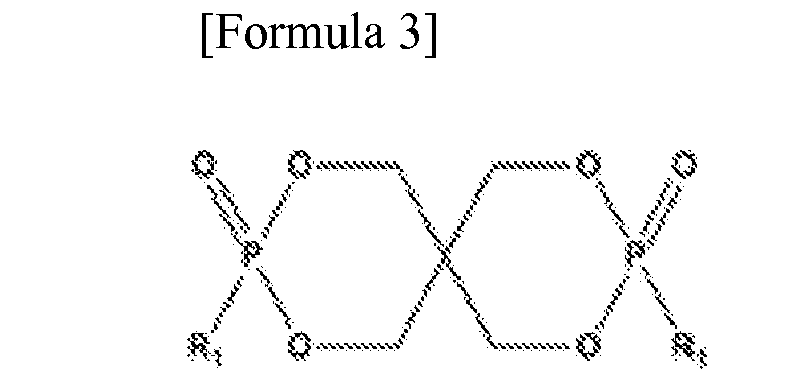
- The phosphate based compound (C2) of the present invention may be used in single or in combination of two more mixtures, wherein the (C2) is about 20 to 80 % by weight, for example about 30 to about 70% by weight, based on total weight of phosphorous compound (C).
- The phosphorous compound (C) of the present invention comprises a combination of the (C1) and (C2), the amount of a combination of (C1) and (C2)is about 0.1 to about 40 parts by weight, for example about 1 to about 30 parts by weight, for example about 2 to about 20 parts by weight, based on 100 parts by weight of base resin. If the amount of the phosphorous compound (C) is less than about 0.1 parts by weight, sufficient flame retardancy cannot be obtained. If the amount of the phosphorous compound (C) is more than about 40 parts by weight, machinery properties such as impact strength may be reduced.
- In an embodiment of the present invention, the polycarbonate resin composition may include additives as use of each. Examples of such additives further include without limitation a plasticizer, flame retardant aid, anti-dripping agent, heat stabilizer, parting agent, weather stabilizer, halogen stabilizer, lubricant, inorganic filler, coupling agent, light stabilizer, antioxidants, dye, pigment, antistatic, releasing agent, dispersant, weather stabilizer, inorganic fiber or a combination thereof. The inorganic filler is such as talc, silica, mica, glass fiber, ceramics or sulfate. The additive may be less than about 30 parts by weight, for example about 0.1 to about 30 parts by weight, based on 100 parts by weight of a base resin.
- The polycarbonate resin composition according to the present invention can be prepared by a conventional method. For example, all the components and additives are mixed together and extruded through an extruder and are prepared in the form of pellets or chips.
- The polycarbonate resin composition of the present invention can be applied to housing of electric or electronic goods such as TV, audio, cellular phone, digital camera, navigation, washing, computer, monitor, MP3, video player, CD player and cleanser and large-sized molding product because of having excellent flame retardancy and heat resistance.
- Method for preparing the plastic molding article using a polycarbonate resin compound in accordance with the present invention is not limited, and methods such as extrusion, injection molding or casting may be employed. The methods in the above may be easily conducted by those skilled in the art.
- The invention may be better understood by reference to the following examples which are intended for the purpose of illustration and are not to be construed as in any way limiting the scope of the present invention, which is defined in the claims appended hereto.
- The following components were used:
- (A) Polycarbonate resin
Bisphenol-A type Polycarbonate resin made by Teijin company of Japan (product name:PANLITE L-1250W) with a weight average molecular weight (Mw) of about 25,000 g/molis used. - (B) Rubber-modified aromatic vinyl resin
Rubber-reinforcedstyrenic resin made by Cheil Industries, Inc. of South Korea (product name: CHT)is used. - (C) Phosphorous compound
- (C1) Phosphate based compound
- (C1-a) Phosphate was used, whereinR1is phenyl.
- (C1-b) Phosphate was used, wherein R1 is benzyl
- (C2) Phosphonate
- (C2-a) Phosphonate was used, wherein R1 is phenyl.
- (C2-b) Phosphonate was used, wherein R1 is benzyl.
- (C2-c) Phosphonate was used,R1 ispara-methoxyphenyl.
- The components in amounts shown in the following Table 1, 2 are extruded through a conventional extruder at 200∼280C° to prepare pellets.After the prepared pellets are dried at 80C° for 2 hours, the pellets are injected by 10 oz extruder under conditions of a molding temperature of 180∼280 C° and a tool temperature of 40∼80 C°. Then, samples are prepared.
- (1) Flame retardancy: The flame retardancyis measured according to UL 94 VB with a thickness of 1/8".
(2) Total burning time:When the flame retardancy is measured, total burning time is sum of first and second burning time about 5 specimens.
(3) Heat resistance: VST(Vicat Softening Temperature) is measuredby 5 kg pendulum according to ISO R 306.
(4) IZOD impact strength: Impact strength is measured according to ASTM D-256 with a thickness of 1/8".(kgf cm/cm).Table 1 Examples 1 2 3 4 5 6 (A) Polycarbonate resin 70 70 70 70 70 70 (B) Rubber-modified aromatic vinyl resin 30 30 30 30 30 30 (C) Phosphorous (C1) Phosphate compound (C1-a) 4 - 4 - 4 - (C1-b) - 4 - 4 - 4 (C2-a) 4 4 - - - - compound (C2) Phosphonate (C2-b) - - 4 4 - - (C2-c) - - - - 4 4 Total burning time 13 27 14 21 16 23 UL-94 V-0 V-0 V-0 V-0 V-0 V-0 Heat resistance (C°) 120 129 119 121 124 123 IZOD impact strength 18 16 17 16 18 17 7 8 9 10 11 12 (A) Polycarbonate resin 70 70 70 70 70 70 (B) Rubber-modified aromatic vinyl resin 30 30 30 30 30 30 (C) Phosphorous compound (C1) Phosphate compound (C1-a) 2 6 - - 2 6 (C1-b) - - 2 6 - - (C2) Phosphonate (C2-a) 6 2 - - - - (C2-b) - - 6 2 - - (C2-c) - - - - 6 2 Total burning time 34 40 31 34 38 37 UL-94 V-0 V-0 V-0 V-0 V-0 V-0 Heat resistance (C°) 118 117 117 119 120 121 IZOD impact strength 15 14 14 11 15 16 Table 2 Comparative examples 1 2 3 4 5 (A) Polycarbonate resin 70 70 70 70 70 (B) Rubber-modified aromatic vinyl resin 30 30 30 30 30 (C) Phosphorous compound (C1) Phosphate compound (C1-a) 8 - - - - (C1-b) - 8 - - - (C2) Phosphonate (C2-a) - - 8 - - (C2-b) - - - 8 - (C2-c) - - - - 8 Total burning time - - - - - UL-94 Fail Fail Fail Fail Fail Heat resistance (C°) 104 108 107 114 117 IZOD impact strength 12 11 13 14 12 Comparative examples 6 7 8 9 10 (A) Polycarbonate resin 70 70 70 70 70 (B) Rubber-modified aromatic vinyl resin 30 30 30 30 30 (C) Phosphorous compound (C1) Phosphate compound (C1-a) 10 - - - - (C1-b) - 10 - - - (C2) Phosphonate (C2-a) - - 10 - - (C2-b) - - - 10 - (C2-c) - - - - 10 Total burning time - - - - - UL-94 Fail Fail Fail Fail Fail Heat resistance (C°) 99 100 102 103 106 IZOD impact strength 10 9 10 11 11 - As shown in Table 1 and 2, Examples 1 to 12 using a combination of phosphate based resin (C1) and phosphonate based resin (C2) of phosphorous compound havemore excellent flame retardancy(1/8"), impact strength and heat resistance than Comparative Examples 1 to 10 using a single of phosphate based resin (C1) or phosphonate based resin (C2).
- Many modifications and other embodiments of the invention will come to mind to one skilled in the art to which this invention pertains having the benefit of the teachings presented in the foregoing descriptions. Therefore, it is to be understood that the invention is not to be limited to the specific embodiments disclosed and that modifications and other embodiments are intended to be included within the scope of the appended claims. Although specific terms are employed herein, they are used in a generic and descriptive sense only and not for purposes of limitation, the scope of the invention being defined in the claims.
- This application claims priority from Korea Patent Application No.
2009-0135291, filed on December 31, 2009
Claims (8)
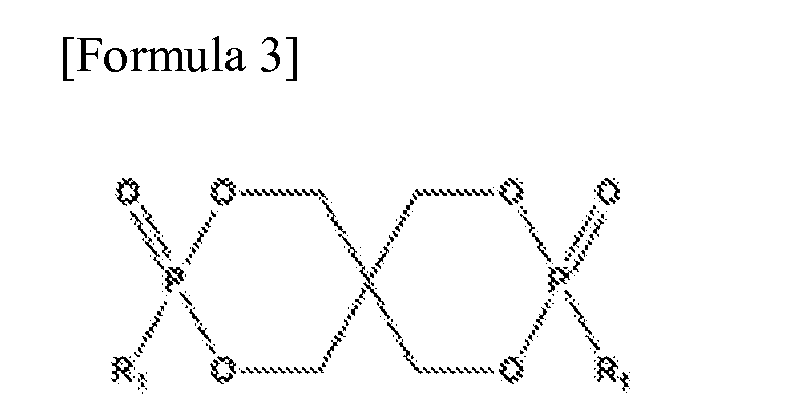
- A polycarbonate resin composition having excellent flame retardancy comprising:(A) about 30 to about 99 % by weight of a polycarbonate resin; and(B) about 1 to about 70 % by weight of a rubber-modified aromatic vinyl resin;(C) about 0.1 to about 40 parts by weight of a phosphorous compound including (C1) a phosphate compound represented by the formula 2 and (C2) a phosphonate compound represented by formula 3, per 100 parts by weight of a base resin including (A) and (B):

- The polycarbonate resin composition having excellent flame retardancyof claim 1, wherein the rubber-modified aromatic vinyl resin (B) comprises (B1)about 10 to 100 % by weight of a graft copolymer resin which is prepared by graft-copolymerazingabout 5 to about 65 % by weight of a rubbery polymer, about 34 to about 94% by weight of an aromatic vinyl monomer, about 1 to about 30 % by weight of a monomer copolymerizable with said aromatic vinyl monomer, and about 0 to about 15 % by weight of a monomer being capable of applying machinability and heat resistance; and(B2) about 0 to about 90 % by weight of a copolymer resin which is prepared by copolymerizing about 60 to about 90 % by weight of a aromatic vinyl monomer, about 10 to about 40 % by weight of a monomercopolymerizable with said aromatic vinyl monomer, andabout 0 to about 30 % by weight of a monomer being capable of applying machinability and heat resistance.
- The polycarbonate resin composition having excellent flame retardancyof claim 2, wherein said aromatic vinyl monomeris one or more selected from the group consisting of styrene, a-methylstyrene, β-methylstyrene, p-methylstyrene, para t-buthylstyrene, ethylstyrene, monochlorostyrene, dichlorostyrene, dibromostyrene and a combination thereof.
- The polycarbonate resin composition having excellent flame retardancyof claim 2, wherein said monomer copolymerizable with said aromatic vinyl monomer is unsaturated nitrile-containing compound.
- The polycarbonate resin composition having excellent flame retardancyof claim 2, wherein said monomer being capable of applying machinability and heat resistanceisone or more selected from the group consisting of acrylic acid, methacrylic acid, maleic anhydride, N-substitutedmaleimide and a combination thereof.
- The polycarbonate resin composition having excellent flame retardancy of any of claims 1 to 5, wherein said phosphorous compound (C) comprises (C1) about 20 to about 80 % by weight of a phosphate compound represented by the formula 2 and (C2) about 20 to about 80 % by weight of a phosphonate compound represented by formula 3.
- The polycarbonate resin composition having excellent flame retardancy of any of claims 1 to 6, wherein said resin composition further comprises one or more selected from the group consisting of a flame retardant, a flame retarding aid,a plasticizer, heat stabilizer, an anti-dripping agent, antioxidant, light stabilizer, dye, pigment, inorganic filler, or a combination thereof
- A plastic article obtainable by the resin composition of any one of claims 1 to 7.
Applications Claiming Priority (1)
| Application Number | Priority Date | Filing Date | Title |
|---|---|---|---|
| KR1020090135291A KR101251330B1 (en) | 2009-12-31 | 2009-12-31 | Polycarbonate Resin Composition Having Good Flame Retardancy |
Publications (2)
| Publication Number | Publication Date |
|---|---|
| EP2341098A1 true EP2341098A1 (en) | 2011-07-06 |
| EP2341098B1 EP2341098B1 (en) | 2013-09-04 |
Family
ID=43432373
Family Applications (1)
| Application Number | Title | Priority Date | Filing Date |
|---|---|---|---|
| EP10196530.9A Not-in-force EP2341098B1 (en) | 2009-12-31 | 2010-12-22 | Polycarbonate resin composition |
Country Status (4)
| Country | Link |
|---|---|
| US (1) | US8222330B2 (en) |
| EP (1) | EP2341098B1 (en) |
| KR (1) | KR101251330B1 (en) |
| CN (1) | CN102115584B (en) |
Families Citing this family (5)
| Publication number | Priority date | Publication date | Assignee | Title |
|---|---|---|---|---|
| KR101240321B1 (en) * | 2009-12-21 | 2013-03-08 | 제일모직주식회사 | Non-halogen Flameproof Polycarbonate Resin Composition |
| KR101447270B1 (en) * | 2011-12-01 | 2014-10-06 | 제일모직주식회사 | Polycarbonate resin composition |
| US11879042B2 (en) | 2021-08-02 | 2024-01-23 | B/E Aerospace, Inc. | Fire resistant thermoplastic-based resin for fiber-reinforced composites |
| CN118724960B (en) * | 2024-09-03 | 2024-12-17 | 江苏恒力化纤股份有限公司 | Reactive cyclic phosphate flame retardant, and preparation method and application thereof |
| CN118724962B (en) * | 2024-09-03 | 2025-01-28 | 江苏恒力化纤股份有限公司 | An active phosphate flame retardant and its preparation method and application |
Citations (3)
| Publication number | Priority date | Publication date | Assignee | Title |
|---|---|---|---|---|
| US4178281A (en) * | 1978-05-30 | 1979-12-11 | Borg-Warner Corporation | Flame-retardant polycarbonate compositions |
| US4692488A (en) | 1985-06-29 | 1987-09-08 | Bayer Aktiengesellschaft | Thermoplastic polycarbonate moulding compositions |
| US5061745A (en) | 1988-06-04 | 1991-10-29 | Bayer Aktiengesellschaft | Flame-retardant, high-impact polycarbonate molding compounds |
Family Cites Families (6)
| Publication number | Priority date | Publication date | Assignee | Title |
|---|---|---|---|---|
| EP0728811B1 (en) | 1995-02-27 | 2003-09-17 | Mitsubishi Chemical Corporation | Flame retardant thermoplastic resin composition |
| JP4585659B2 (en) * | 2000-07-21 | 2010-11-24 | 帝人化成株式会社 | Flame retardant resin composition and molded product therefrom |
| KR100508870B1 (en) * | 2002-12-31 | 2005-08-17 | 제일모직주식회사 | Flameproof Thermoplastic Resin Composition |
| KR100560151B1 (en) * | 2004-12-30 | 2006-03-10 | 제일모직주식회사 | Flame Retardant Polycarbonate Resin Composition |
| KR101004668B1 (en) * | 2007-12-28 | 2011-01-04 | 제일모직주식회사 | Flame retardant thermoplastic resin composition and preparation method thereof |
| KR101240321B1 (en) * | 2009-12-21 | 2013-03-08 | 제일모직주식회사 | Non-halogen Flameproof Polycarbonate Resin Composition |
-
2009
- 2009-12-31 KR KR1020090135291A patent/KR101251330B1/en not_active Expired - Fee Related
-
2010
- 2010-11-19 CN CN2010105561786A patent/CN102115584B/en not_active Expired - Fee Related
- 2010-12-15 US US12/968,894 patent/US8222330B2/en not_active Expired - Fee Related
- 2010-12-22 EP EP10196530.9A patent/EP2341098B1/en not_active Not-in-force
Patent Citations (3)
| Publication number | Priority date | Publication date | Assignee | Title |
|---|---|---|---|---|
| US4178281A (en) * | 1978-05-30 | 1979-12-11 | Borg-Warner Corporation | Flame-retardant polycarbonate compositions |
| US4692488A (en) | 1985-06-29 | 1987-09-08 | Bayer Aktiengesellschaft | Thermoplastic polycarbonate moulding compositions |
| US5061745A (en) | 1988-06-04 | 1991-10-29 | Bayer Aktiengesellschaft | Flame-retardant, high-impact polycarbonate molding compounds |
Also Published As
| Publication number | Publication date |
|---|---|
| EP2341098B1 (en) | 2013-09-04 |
| KR20110078470A (en) | 2011-07-07 |
| US20110160367A1 (en) | 2011-06-30 |
| CN102115584A (en) | 2011-07-06 |
| KR101251330B1 (en) | 2013-04-05 |
| CN102115584B (en) | 2013-01-09 |
| US8222330B2 (en) | 2012-07-17 |
Similar Documents
| Publication | Publication Date | Title |
|---|---|---|
| US20070249768A1 (en) | Flame Retardant Polycarbonate Resin Composition | |
| WO2001029135A1 (en) | Polycarbonate resin composition | |
| CN101768348B (en) | Flameproof thermoplastic resin composition | |
| EP2341098B1 (en) | Polycarbonate resin composition | |
| US8933154B2 (en) | Flame retardant thermoplastic resin composition and molded article including the same | |
| EP2215163B1 (en) | Non-halogen flameproof polycarbonate resin composition | |
| US7919548B2 (en) | Sterically hindered phenolic phosphonates and polycarbonate resin composition using the same | |
| KR101620663B1 (en) | Flame retardant thermoplastic resin composition and article comprising the same | |
| US8133946B2 (en) | Non-halogen flameproof polycarbonate resin composition | |
| JPH0959502A (en) | Flame-retardant resin composition | |
| US20110160365A1 (en) | Flame Retardant Polycarbonate Resin Composition | |
| KR102106695B1 (en) | Thermoplastic resin composition and article produced therefrom | |
| US20130168619A1 (en) | Thermoplastic Resin Composition Having Excellent Flame Retardancy, Colorability and Thermal Stability | |
| KR101012078B1 (en) | Non-halogen flame retardant polycarbonate resin composition | |
| JP3007336B1 (en) | Flame retardant resin composition | |
| KR20110078521A (en) | Polycarbonate resin composition with excellent flame retardancy | |
| KR20140080354A (en) | Flame retardant thermoplastic resin composition and article produced therefrom | |
| KR20100075172A (en) | Thermoplastic resin composition having good flame retardancy |
Legal Events
| Date | Code | Title | Description |
|---|---|---|---|
| PUAI | Public reference made under article 153(3) epc to a published international application that has entered the european phase |
Free format text: ORIGINAL CODE: 0009012 |
|
| AK | Designated contracting states |
Kind code of ref document: A1 Designated state(s): AL AT BE BG CH CY CZ DE DK EE ES FI FR GB GR HR HU IE IS IT LI LT LU LV MC MK MT NL NO PL PT RO RS SE SI SK SM TR |
|
| AX | Request for extension of the european patent |
Extension state: BA ME |
|
| 17P | Request for examination filed |
Effective date: 20111130 |
|
| GRAP | Despatch of communication of intention to grant a patent |
Free format text: ORIGINAL CODE: EPIDOSNIGR1 |
|
| GRAP | Despatch of communication of intention to grant a patent |
Free format text: ORIGINAL CODE: EPIDOSNIGR1 |
|
| GRAS | Grant fee paid |
Free format text: ORIGINAL CODE: EPIDOSNIGR3 |
|
| GRAA | (expected) grant |
Free format text: ORIGINAL CODE: 0009210 |
|
| INTG | Intention to grant announced |
Effective date: 20130711 |
|
| AK | Designated contracting states |
Kind code of ref document: B1 Designated state(s): AL AT BE BG CH CY CZ DE DK EE ES FI FR GB GR HR HU IE IS IT LI LT LU LV MC MK MT NL NO PL PT RO RS SE SI SK SM TR |
|
| REG | Reference to a national code |
Ref country code: GB Ref legal event code: FG4D |
|
| REG | Reference to a national code |
Ref country code: CH Ref legal event code: EP |
|
| REG | Reference to a national code |
Ref country code: AT Ref legal event code: REF Ref document number: 630521 Country of ref document: AT Kind code of ref document: T Effective date: 20130915 |
|
| REG | Reference to a national code |
Ref country code: IE Ref legal event code: FG4D |
|
| REG | Reference to a national code |
Ref country code: NL Ref legal event code: T3 |
|
| REG | Reference to a national code |
Ref country code: DE Ref legal event code: R096 Ref document number: 602010009981 Country of ref document: DE Effective date: 20131031 |
|
| REG | Reference to a national code |
Ref country code: AT Ref legal event code: MK05 Ref document number: 630521 Country of ref document: AT Kind code of ref document: T Effective date: 20130904 |
|
| PG25 | Lapsed in a contracting state [announced via postgrant information from national office to epo] |
Ref country code: HR Free format text: LAPSE BECAUSE OF FAILURE TO SUBMIT A TRANSLATION OF THE DESCRIPTION OR TO PAY THE FEE WITHIN THE PRESCRIBED TIME-LIMIT Effective date: 20130904 Ref country code: NO Free format text: LAPSE BECAUSE OF FAILURE TO SUBMIT A TRANSLATION OF THE DESCRIPTION OR TO PAY THE FEE WITHIN THE PRESCRIBED TIME-LIMIT Effective date: 20131204 Ref country code: AT Free format text: LAPSE BECAUSE OF FAILURE TO SUBMIT A TRANSLATION OF THE DESCRIPTION OR TO PAY THE FEE WITHIN THE PRESCRIBED TIME-LIMIT Effective date: 20130904 Ref country code: SE Free format text: LAPSE BECAUSE OF FAILURE TO SUBMIT A TRANSLATION OF THE DESCRIPTION OR TO PAY THE FEE WITHIN THE PRESCRIBED TIME-LIMIT Effective date: 20130904 Ref country code: LT Free format text: LAPSE BECAUSE OF FAILURE TO SUBMIT A TRANSLATION OF THE DESCRIPTION OR TO PAY THE FEE WITHIN THE PRESCRIBED TIME-LIMIT Effective date: 20130904 Ref country code: CY Free format text: LAPSE BECAUSE OF FAILURE TO SUBMIT A TRANSLATION OF THE DESCRIPTION OR TO PAY THE FEE WITHIN THE PRESCRIBED TIME-LIMIT Effective date: 20130724 |
|
| REG | Reference to a national code |
Ref country code: LT Ref legal event code: MG4D |
|
| PG25 | Lapsed in a contracting state [announced via postgrant information from national office to epo] |
Ref country code: FI Free format text: LAPSE BECAUSE OF FAILURE TO SUBMIT A TRANSLATION OF THE DESCRIPTION OR TO PAY THE FEE WITHIN THE PRESCRIBED TIME-LIMIT Effective date: 20130904 Ref country code: LV Free format text: LAPSE BECAUSE OF FAILURE TO SUBMIT A TRANSLATION OF THE DESCRIPTION OR TO PAY THE FEE WITHIN THE PRESCRIBED TIME-LIMIT Effective date: 20130904 Ref country code: GR Free format text: LAPSE BECAUSE OF FAILURE TO SUBMIT A TRANSLATION OF THE DESCRIPTION OR TO PAY THE FEE WITHIN THE PRESCRIBED TIME-LIMIT Effective date: 20131205 Ref country code: PL Free format text: LAPSE BECAUSE OF FAILURE TO SUBMIT A TRANSLATION OF THE DESCRIPTION OR TO PAY THE FEE WITHIN THE PRESCRIBED TIME-LIMIT Effective date: 20130904 Ref country code: SI Free format text: LAPSE BECAUSE OF FAILURE TO SUBMIT A TRANSLATION OF THE DESCRIPTION OR TO PAY THE FEE WITHIN THE PRESCRIBED TIME-LIMIT Effective date: 20130904 |
|
| PG25 | Lapsed in a contracting state [announced via postgrant information from national office to epo] |
Ref country code: CY Free format text: LAPSE BECAUSE OF FAILURE TO SUBMIT A TRANSLATION OF THE DESCRIPTION OR TO PAY THE FEE WITHIN THE PRESCRIBED TIME-LIMIT Effective date: 20130904 Ref country code: BE Free format text: LAPSE BECAUSE OF FAILURE TO SUBMIT A TRANSLATION OF THE DESCRIPTION OR TO PAY THE FEE WITHIN THE PRESCRIBED TIME-LIMIT Effective date: 20130904 |
|
| PG25 | Lapsed in a contracting state [announced via postgrant information from national office to epo] |
Ref country code: EE Free format text: LAPSE BECAUSE OF FAILURE TO SUBMIT A TRANSLATION OF THE DESCRIPTION OR TO PAY THE FEE WITHIN THE PRESCRIBED TIME-LIMIT Effective date: 20130904 Ref country code: CZ Free format text: LAPSE BECAUSE OF FAILURE TO SUBMIT A TRANSLATION OF THE DESCRIPTION OR TO PAY THE FEE WITHIN THE PRESCRIBED TIME-LIMIT Effective date: 20130904 Ref country code: SK Free format text: LAPSE BECAUSE OF FAILURE TO SUBMIT A TRANSLATION OF THE DESCRIPTION OR TO PAY THE FEE WITHIN THE PRESCRIBED TIME-LIMIT Effective date: 20130904 Ref country code: IS Free format text: LAPSE BECAUSE OF FAILURE TO SUBMIT A TRANSLATION OF THE DESCRIPTION OR TO PAY THE FEE WITHIN THE PRESCRIBED TIME-LIMIT Effective date: 20140104 Ref country code: RO Free format text: LAPSE BECAUSE OF FAILURE TO SUBMIT A TRANSLATION OF THE DESCRIPTION OR TO PAY THE FEE WITHIN THE PRESCRIBED TIME-LIMIT Effective date: 20130904 |
|
| PG25 | Lapsed in a contracting state [announced via postgrant information from national office to epo] |
Ref country code: ES Free format text: LAPSE BECAUSE OF FAILURE TO SUBMIT A TRANSLATION OF THE DESCRIPTION OR TO PAY THE FEE WITHIN THE PRESCRIBED TIME-LIMIT Effective date: 20130904 |
|
| REG | Reference to a national code |
Ref country code: DE Ref legal event code: R097 Ref document number: 602010009981 Country of ref document: DE |
|
| PG25 | Lapsed in a contracting state [announced via postgrant information from national office to epo] |
Ref country code: PT Free format text: LAPSE BECAUSE OF FAILURE TO SUBMIT A TRANSLATION OF THE DESCRIPTION OR TO PAY THE FEE WITHIN THE PRESCRIBED TIME-LIMIT Effective date: 20140106 |
|
| PLBE | No opposition filed within time limit |
Free format text: ORIGINAL CODE: 0009261 |
|
| STAA | Information on the status of an ep patent application or granted ep patent |
Free format text: STATUS: NO OPPOSITION FILED WITHIN TIME LIMIT |
|
| 26N | No opposition filed |
Effective date: 20140605 |
|
| PG25 | Lapsed in a contracting state [announced via postgrant information from national office to epo] |
Ref country code: IT Free format text: LAPSE BECAUSE OF FAILURE TO SUBMIT A TRANSLATION OF THE DESCRIPTION OR TO PAY THE FEE WITHIN THE PRESCRIBED TIME-LIMIT Effective date: 20130904 Ref country code: LU Free format text: LAPSE BECAUSE OF FAILURE TO SUBMIT A TRANSLATION OF THE DESCRIPTION OR TO PAY THE FEE WITHIN THE PRESCRIBED TIME-LIMIT Effective date: 20131222 Ref country code: MC Free format text: LAPSE BECAUSE OF FAILURE TO SUBMIT A TRANSLATION OF THE DESCRIPTION OR TO PAY THE FEE WITHIN THE PRESCRIBED TIME-LIMIT Effective date: 20130904 |
|
| REG | Reference to a national code |
Ref country code: DE Ref legal event code: R097 Ref document number: 602010009981 Country of ref document: DE Effective date: 20140605 |
|
| REG | Reference to a national code |
Ref country code: IE Ref legal event code: MM4A |
|
| PG25 | Lapsed in a contracting state [announced via postgrant information from national office to epo] |
Ref country code: DK Free format text: LAPSE BECAUSE OF FAILURE TO SUBMIT A TRANSLATION OF THE DESCRIPTION OR TO PAY THE FEE WITHIN THE PRESCRIBED TIME-LIMIT Effective date: 20130904 |
|
| PG25 | Lapsed in a contracting state [announced via postgrant information from national office to epo] |
Ref country code: IE Free format text: LAPSE BECAUSE OF NON-PAYMENT OF DUE FEES Effective date: 20131222 |
|
| PG25 | Lapsed in a contracting state [announced via postgrant information from national office to epo] |
Ref country code: SM Free format text: LAPSE BECAUSE OF FAILURE TO SUBMIT A TRANSLATION OF THE DESCRIPTION OR TO PAY THE FEE WITHIN THE PRESCRIBED TIME-LIMIT Effective date: 20130904 |
|
| PG25 | Lapsed in a contracting state [announced via postgrant information from national office to epo] |
Ref country code: TR Free format text: LAPSE BECAUSE OF FAILURE TO SUBMIT A TRANSLATION OF THE DESCRIPTION OR TO PAY THE FEE WITHIN THE PRESCRIBED TIME-LIMIT Effective date: 20130904 |
|
| PG25 | Lapsed in a contracting state [announced via postgrant information from national office to epo] |
Ref country code: BG Free format text: LAPSE BECAUSE OF FAILURE TO SUBMIT A TRANSLATION OF THE DESCRIPTION OR TO PAY THE FEE WITHIN THE PRESCRIBED TIME-LIMIT Effective date: 20130904 Ref country code: RS Free format text: LAPSE BECAUSE OF FAILURE TO SUBMIT A TRANSLATION OF THE DESCRIPTION OR TO PAY THE FEE WITHIN THE PRESCRIBED TIME-LIMIT Effective date: 20131204 Ref country code: HU Free format text: LAPSE BECAUSE OF FAILURE TO SUBMIT A TRANSLATION OF THE DESCRIPTION OR TO PAY THE FEE WITHIN THE PRESCRIBED TIME-LIMIT; INVALID AB INITIO Effective date: 20101222 Ref country code: MK Free format text: LAPSE BECAUSE OF FAILURE TO SUBMIT A TRANSLATION OF THE DESCRIPTION OR TO PAY THE FEE WITHIN THE PRESCRIBED TIME-LIMIT Effective date: 20130904 |
|
| REG | Reference to a national code |
Ref country code: CH Ref legal event code: PL |
|
| GBPC | Gb: european patent ceased through non-payment of renewal fee |
Effective date: 20141222 |
|
| PG25 | Lapsed in a contracting state [announced via postgrant information from national office to epo] |
Ref country code: MT Free format text: LAPSE BECAUSE OF FAILURE TO SUBMIT A TRANSLATION OF THE DESCRIPTION OR TO PAY THE FEE WITHIN THE PRESCRIBED TIME-LIMIT Effective date: 20130904 |
|
| PG25 | Lapsed in a contracting state [announced via postgrant information from national office to epo] |
Ref country code: LI Free format text: LAPSE BECAUSE OF NON-PAYMENT OF DUE FEES Effective date: 20141231 Ref country code: CH Free format text: LAPSE BECAUSE OF NON-PAYMENT OF DUE FEES Effective date: 20141231 Ref country code: GB Free format text: LAPSE BECAUSE OF NON-PAYMENT OF DUE FEES Effective date: 20141222 |
|
| REG | Reference to a national code |
Ref country code: FR Ref legal event code: PLFP Year of fee payment: 6 |
|
| REG | Reference to a national code |
Ref country code: FR Ref legal event code: PLFP Year of fee payment: 7 |
|
| REG | Reference to a national code |
Ref country code: NL Ref legal event code: PD Owner name: LOTTE ADVANCED MATERIALS CO., LTD.; KR Free format text: DETAILS ASSIGNMENT: CHANGE OF OWNER(S), MERGE; FORMER OWNER NAME: SAMSUNG SDI CO., LTD. Effective date: 20170221 |
|
| REG | Reference to a national code |
Ref country code: DE Ref legal event code: R081 Ref document number: 602010009981 Country of ref document: DE Owner name: LOTTE ADVANCED MATERIALS CO., LTD., YEOSU-SI, KR Free format text: FORMER OWNER: CHEIL INDUSTRIES INC., UIWANG-SI, KYONGGI-DO, KR Ref country code: DE Ref legal event code: R082 Ref document number: 602010009981 Country of ref document: DE Representative=s name: BARDEHLE PAGENBERG PARTNERSCHAFT MBB PATENTANW, DE |
|
| REG | Reference to a national code |
Ref country code: DE Ref legal event code: R081 Ref document number: 602010009981 Country of ref document: DE Owner name: LOTTE ADVANCED MATERIALS CO., LTD., YEOSU-SI, KR Free format text: FORMER OWNER: SAMSUNG SDI CO., LTD., YONGIN-SI, KYONGGI-DO, KR Ref country code: DE Ref legal event code: R082 Ref document number: 602010009981 Country of ref document: DE Representative=s name: BARDEHLE PAGENBERG PARTNERSCHAFT MBB PATENTANW, DE |
|
| REG | Reference to a national code |
Ref country code: FR Ref legal event code: TP Owner name: LOTTE ADVANCED MATERIALS CO., LTD., KR Effective date: 20170831 |
|
| REG | Reference to a national code |
Ref country code: FR Ref legal event code: PLFP Year of fee payment: 8 |
|
| PG25 | Lapsed in a contracting state [announced via postgrant information from national office to epo] |
Ref country code: AL Free format text: LAPSE BECAUSE OF FAILURE TO SUBMIT A TRANSLATION OF THE DESCRIPTION OR TO PAY THE FEE WITHIN THE PRESCRIBED TIME-LIMIT Effective date: 20130904 |
|
| PGFP | Annual fee paid to national office [announced via postgrant information from national office to epo] |
Ref country code: FR Payment date: 20201112 Year of fee payment: 11 Ref country code: DE Payment date: 20201208 Year of fee payment: 11 |
|
| PGFP | Annual fee paid to national office [announced via postgrant information from national office to epo] |
Ref country code: NL Payment date: 20201214 Year of fee payment: 11 |
|
| REG | Reference to a national code |
Ref country code: DE Ref legal event code: R119 Ref document number: 602010009981 Country of ref document: DE |
|
| REG | Reference to a national code |
Ref country code: NL Ref legal event code: MM Effective date: 20220101 |
|
| PG25 | Lapsed in a contracting state [announced via postgrant information from national office to epo] |
Ref country code: NL Free format text: LAPSE BECAUSE OF NON-PAYMENT OF DUE FEES Effective date: 20220101 |
|
| PG25 | Lapsed in a contracting state [announced via postgrant information from national office to epo] |
Ref country code: DE Free format text: LAPSE BECAUSE OF NON-PAYMENT OF DUE FEES Effective date: 20220701 |
|
| PG25 | Lapsed in a contracting state [announced via postgrant information from national office to epo] |
Ref country code: FR Free format text: LAPSE BECAUSE OF NON-PAYMENT OF DUE FEES Effective date: 20211231 |