EP2338487A1 - Combination therapy with PARP inhibitors - Google Patents
Combination therapy with PARP inhibitors Download PDFInfo
- Publication number
- EP2338487A1 EP2338487A1 EP11157696A EP11157696A EP2338487A1 EP 2338487 A1 EP2338487 A1 EP 2338487A1 EP 11157696 A EP11157696 A EP 11157696A EP 11157696 A EP11157696 A EP 11157696A EP 2338487 A1 EP2338487 A1 EP 2338487A1
- Authority
- EP
- European Patent Office
- Prior art keywords
- carboxamide
- benzimidazole
- group
- formula
- alkyl
- Prior art date
- Legal status (The legal status is an assumption and is not a legal conclusion. Google has not performed a legal analysis and makes no representation as to the accuracy of the status listed.)
- Granted
Links
Images


Classifications
-
- C—CHEMISTRY; METALLURGY
- C07—ORGANIC CHEMISTRY
- C07D—HETEROCYCLIC COMPOUNDS
- C07D403/00—Heterocyclic compounds containing two or more hetero rings, having nitrogen atoms as the only ring hetero atoms, not provided for by group C07D401/00
- C07D403/02—Heterocyclic compounds containing two or more hetero rings, having nitrogen atoms as the only ring hetero atoms, not provided for by group C07D401/00 containing two hetero rings
- C07D403/04—Heterocyclic compounds containing two or more hetero rings, having nitrogen atoms as the only ring hetero atoms, not provided for by group C07D401/00 containing two hetero rings directly linked by a ring-member-to-ring-member bond
-
- A—HUMAN NECESSITIES
- A61—MEDICAL OR VETERINARY SCIENCE; HYGIENE
- A61K—PREPARATIONS FOR MEDICAL, DENTAL OR TOILETRY PURPOSES
- A61K31/00—Medicinal preparations containing organic active ingredients
- A61K31/33—Heterocyclic compounds
- A61K31/395—Heterocyclic compounds having nitrogen as a ring hetero atom, e.g. guanethidine or rifamycins
- A61K31/41—Heterocyclic compounds having nitrogen as a ring hetero atom, e.g. guanethidine or rifamycins having five-membered rings with two or more ring hetero atoms, at least one of which being nitrogen, e.g. tetrazole
-
- A—HUMAN NECESSITIES
- A61—MEDICAL OR VETERINARY SCIENCE; HYGIENE
- A61K—PREPARATIONS FOR MEDICAL, DENTAL OR TOILETRY PURPOSES
- A61K31/00—Medicinal preparations containing organic active ingredients
- A61K31/33—Heterocyclic compounds
- A61K31/395—Heterocyclic compounds having nitrogen as a ring hetero atom, e.g. guanethidine or rifamycins
- A61K31/41—Heterocyclic compounds having nitrogen as a ring hetero atom, e.g. guanethidine or rifamycins having five-membered rings with two or more ring hetero atoms, at least one of which being nitrogen, e.g. tetrazole
- A61K31/4164—1,3-Diazoles
-
- A—HUMAN NECESSITIES
- A61—MEDICAL OR VETERINARY SCIENCE; HYGIENE
- A61K—PREPARATIONS FOR MEDICAL, DENTAL OR TOILETRY PURPOSES
- A61K41/00—Medicinal preparations obtained by treating materials with wave energy or particle radiation ; Therapies using these preparations
- A61K41/0038—Radiosensitizing, i.e. administration of pharmaceutical agents that enhance the effect of radiotherapy
-
- A—HUMAN NECESSITIES
- A61—MEDICAL OR VETERINARY SCIENCE; HYGIENE
- A61K—PREPARATIONS FOR MEDICAL, DENTAL OR TOILETRY PURPOSES
- A61K45/00—Medicinal preparations containing active ingredients not provided for in groups A61K31/00 - A61K41/00
- A61K45/06—Mixtures of active ingredients without chemical characterisation, e.g. antiphlogistics and cardiaca
-
- A—HUMAN NECESSITIES
- A61—MEDICAL OR VETERINARY SCIENCE; HYGIENE
- A61P—SPECIFIC THERAPEUTIC ACTIVITY OF CHEMICAL COMPOUNDS OR MEDICINAL PREPARATIONS
- A61P35/00—Antineoplastic agents
-
- A—HUMAN NECESSITIES
- A61—MEDICAL OR VETERINARY SCIENCE; HYGIENE
- A61P—SPECIFIC THERAPEUTIC ACTIVITY OF CHEMICAL COMPOUNDS OR MEDICINAL PREPARATIONS
- A61P35/00—Antineoplastic agents
- A61P35/02—Antineoplastic agents specific for leukemia
-
- A—HUMAN NECESSITIES
- A61—MEDICAL OR VETERINARY SCIENCE; HYGIENE
- A61P—SPECIFIC THERAPEUTIC ACTIVITY OF CHEMICAL COMPOUNDS OR MEDICINAL PREPARATIONS
- A61P43/00—Drugs for specific purposes, not provided for in groups A61P1/00-A61P41/00
-
- A—HUMAN NECESSITIES
- A61—MEDICAL OR VETERINARY SCIENCE; HYGIENE
- A61N—ELECTROTHERAPY; MAGNETOTHERAPY; RADIATION THERAPY; ULTRASOUND THERAPY
- A61N5/00—Radiation therapy
- A61N5/10—X-ray therapy; Gamma-ray therapy; Particle-irradiation therapy
- A61N2005/1092—Details
- A61N2005/1098—Enhancing the effect of the particle by an injected agent or implanted device
Definitions
- the invention relates to compositions comprising drugs having additive anti-cancer activity and methods of treatment using the combinations.
- PARP inhibitors have an essential role in facilitating DNA repair, controlling RNA transcription, mediating cell death, and regulating immune response. These actions make PARP inhibitors targets for a broad spectrum of disorders. PARP inhibitors have demonstrated efficacy in numerous models of disease, particularly in models of ischemia reperfusion injury, inflammatory disease, degenerative diseases, protection from adverse effects of cytoxic compounds, and the potentiation of cytotoxic cancer therapy.
- PARP has also been indicated in retroviral infection and thus inhibitors may have use in antiretroviral therapy
- PARP inhibitors have been efficacious in preventing ischemia reperfusion injury in models of myocardial infarction, stroke, other neural trauma, organ transplantation, as well as reperfusion of the eye, kidney, gut and skeletal muscle.
- Inhibitors have been efficacious in inflammatory diseases such as arthritis, gout, inflammatory bowel disease, CNS inflammation such as MS and allergic encephalitis, sepsis, septic shock, hemmorhagic shock, pulmonary fibrosis, and uveitis.
- PARP inhibitors have also shown benefit in several models of degenerative disease including diabetes (as well as complications) and Parkinsons disease.
- PARP inhibitors can ameliorate the liver toxicity following acetominophen overdose, cardiac and kidney toxicities from doxorubicin and platinum based antineoplastic agents, as well as skin damage secondary to sulfur mustards.
- PART inhibitors have been shown to potentiate radiation and chemotherapy by increasing apoptosis of cancer cells, limiting tumor growth, decreasing metastasis, and prolonging the survival of tumor-bearing animals.
- the present invention describes benzimidazole derivatives of Formula (I) which constitute potent PARP inhibitors in combination with radiotherapy or in combination with other chemotherapeutic agents.
- the present invention provides a PARP inhibitor of formula (1) or a therapeutically acceptable salt thereof, wherein
- the present invention provides a pharmaceutical composition
- a pharmaceutical composition comprising a compound of Formula (I), or a therapeutically acceptable salt thereof, and a cytotoxic agent selected from the group consisting of temozolomide (TMZ), irinotecan, cisplatin, carboplatin, and topotecan.
- TMZ temozolomide
- irinotecan irinotecan
- carboplatin carboplatin
- topotecan topotecan
- the present invention provides a pharmaceutical composition
- a pharmaceutical composition comprising 2-[(2R)-2-methylpyrrolidin-2-yl]-1H-benzimidazole-4-carboxamide, or a therapeutically acceptable salt thereof and a cytotoxic agent selected from the group consisting of temozolomide, irinotecan, cisplatin, carboplatin, and topotecan.
- the present invention provides a pharmaceutical composition
- a pharmaceutical composition comprising 2-(N-propylpiperidin-4-yl) benzimidazole-4-carboxamide, or a therapeutically acceptable salt thereof, and a cytotoxic agent selected from the group consisting of temozolomide, irinotecan, cisplatin, carboplatin, and topotecan.
- the present invention provides the administration of a compound of Formula (1) in combination with a cytotoxic agent selected from the group consisting of temozolomide, irinotecan, cisplatin, carboplatin, and topotecan.
- a cytotoxic agent selected from the group consisting of temozolomide, irinotecan, cisplatin, carboplatin, and topotecan.
- the present invention provides the administration of a compound of Formula (1) selected from the group consisting of 2-(N-propylpiperidin-4-yl) benzimidazole-4-carboxamide and 2-[(2R)-2-methylpyrrolidin-2-yl]-1H-benzimidazole-4-carboxamide, or a therapeutically acceptable salt thereof, and a cytotoxic agent selected from the group consisting of temozolomide, irinotecan, cisplatin, carboplatin, and topotecan.
- a compound of Formula (1) selected from the group consisting of 2-(N-propylpiperidin-4-yl) benzimidazole-4-carboxamide and 2-[(2R)-2-methylpyrrolidin-2-yl]-1H-benzimidazole-4-carboxamide, or a therapeutically acceptable salt thereof
- a cytotoxic agent selected from the group consisting of temozolomide, irinotecan, cisplatin, carboplatin, and
- the present invention provides a pharmaceutical composition
- a pharmaceutical composition comprising a compound of Formula (I), or a therapeutically acceptable salt thereof, used in combination with radiotherapy.
- the present invention provides a pharmaceutical composition
- a pharmaceutical composition comprising 2-[(2R)-2-methylpyrrolidin-2-y1]-1H-benzimidazole-4-carboxamide, or a therapeutically acceptable salt thereof, used in combination with radiotherapy.
- the present invention provides a pharmaceutical composition
- a pharmaceutical composition comprising 2-(N-propylpiperidin-4-yl) benzimidazole-4-carboxamide, or a therapeutically acceptable salt thereof, used in combination with radiotherapy.
- the present invention provides the administration of a compound of Formula (I) in combination with radiotherapy.
- the present invention provides the administration of a compound of Formula (I) selected from the group consisting of 2-(N-propylpiperidin-4-yl) benzimidazole-4-carboxamide and 2-[(2R)-2-methylpyrrolidin-2-yl]-1H-benzimidazole-4-carboxamide, or a therapeutically acceptable salt thereof, and radiotherapy.
- a compound of Formula (I) selected from the group consisting of 2-(N-propylpiperidin-4-yl) benzimidazole-4-carboxamide and 2-[(2R)-2-methylpyrrolidin-2-yl]-1H-benzimidazole-4-carboxamide, or a therapeutically acceptable salt thereof, and radiotherapy.
- the present invention provides a method of treating cancer in a mammal in recognized need of such treatment comprising administering to the mammal a therapeutically acceptable amount of a compound of Formula (I) or a therapeutically acceptable salt thereof and a cytotoxic agent selected from the group consisting of temozolomide, irinotecan, cisplatin, carboplatin, and topotecan.
- a cytotoxic agent selected from the group consisting of temozolomide, irinotecan, cisplatin, carboplatin, and topotecan.
- the present invention provides a method of treating cancer in a mammal in recognized need of such treatment comprising administering to the mammal a therapeutically acceptable amount of a compound of Formula (I) or a therapeutically acceptable salt thereof and radiotherapy.
- the present invention provides a method of treating cancer in a mammal in recognized need of such treatment comprising administering to the mammal a therapeutically acceptable amount of a compound of Formula (I) selected from the group consisting of 2-(N-propylpiperidin-4-yl) benzimidazole-4-carboxamide and 2-[(2R)-2-methylpyrrolidin-2-yl]-1H-benzimidazole-4-carboxamide, or a therapeutically acceptable salt thereof, and a cytotoxic agent selected from the group consisting of temozolomide, irinotecan, cisplatin, carboplatin, and topotecan.
- a compound of Formula (I) selected from the group consisting of 2-(N-propylpiperidin-4-yl) benzimidazole-4-carboxamide and 2-[(2R)-2-methylpyrrolidin-2-yl]-1H-benzimidazole-4-carboxamide, or a therapeutically acceptable salt thereof
- the present invention provides a method of treating cancer in a mammal in recognized need of such treatment comprising administering to the mammal a therapeutically acceptable amount of a compound of Formula (I) selected from the group consisting of 2-(N-propylpiperidin-4-yl) benzimidazole-4-carboxamide and 2-[(2R)-2-methylpyrrolidin-2-yl]-1H-benzimidazole-4-carboxamide, or a therapeutically acceptable salt thereof, and radiotherapy.
- a compound of Formula (I) selected from the group consisting of 2-(N-propylpiperidin-4-yl) benzimidazole-4-carboxamide and 2-[(2R)-2-methylpyrrolidin-2-yl]-1H-benzimidazole-4-carboxamide, or a therapeutically acceptable salt thereof, and radiotherapy.
- the present invention provides a method of inhibiting tumor growth in a mammal in recognized need of such treatment comprising administering to the mammal a therapeutically acceptable amount of a compound of Formula (I) or a therapeutically acceptable salt thereof, and a cytotoxic agent selected from the group consisting of temozolomide, irinotecan, cisplatin, carboplatin, and topotecan.
- a cytotoxic agent selected from the group consisting of temozolomide, irinotecan, cisplatin, carboplatin, and topotecan.
- the present invention provides a method of inhibiting tumor growth in a mammal in recognized need of such treatment comprising administering to the mammal a therapeutically acceptable amount of a compound of Formula (I) or a therapeutically acceptable salt thereof, and radiotherapy.
- the present invention provides a method of inhibiting tumor growth in a mammal in recognized need of such treatment comprising administering to the mammal a therapeutically acceptable amount of a compound of Formula (I) selected from the group consisting of 2-(N-propylpiperidin-4-yl) benzimidazole-4-carboxamide and 2-[(2R)-2-methylpyrrolidin-2-yl]-1H-benzimidazole-4-carboxamide, or a therapeutically acceptable salt thereof, and radiotherapy.
- a compound of Formula (I) selected from the group consisting of 2-(N-propylpiperidin-4-yl) benzimidazole-4-carboxamide and 2-[(2R)-2-methylpyrrolidin-2-yl]-1H-benzimidazole-4-carboxamide, or a therapeutically acceptable salt thereof, and radiotherapy.
- the present invention provides a method of inhibiting tumor growth in a mammal in recognized need of such treatment comprising administering to the mammal a therapeutically acceptable amount of a compound of Formula (I) selected from the group consisting of 2-(N-propylpiperidin-4-yl) benzimidazole-4-carboxamide and 2-[(2R)-2-methylpyrrolidin-2-yl]-1H-benzimidazole-4-carboxamide, or a therapeutically acceptable salt thereof, and a cytotoxic agent selected from the group consisting of temozolomide, irinotecan, cisplatin, carboplatin, and topotecan.
- a compound of Formula (I) selected from the group consisting of 2-(N-propylpiperidin-4-yl) benzimidazole-4-carboxamide and 2-[(2R)-2-methylpyrrolidin-2-yl]-1H-benzimidazole-4-carboxamide, or a therapeutically acceptable salt thereof
- this invention provides a composition for treating leukemia comprising a PARP inhibitor of formula (I) or a therapeutically acceptable salt thereof, wherein
- this invention provides a composition for treating CNS tumors comprising a PART inhibitor of formula (I) or a therapeutically acceptable salt thereof, wherein
- the present invention provides a method of treating leukemia in a mammal comprising administering thereto a compound of formula (I), or a therapeutically acceptable salt thereof, and a cytotoxic agent selected from the group consisting of temozolomide (TMZ), irinotecan, cisplatin, carboplatin, and topotecan.
- a cytotoxic agent selected from the group consisting of temozolomide (TMZ), irinotecan, cisplatin, carboplatin, and topotecan.
- the present invention provides a pharmaceutical composition
- a pharmaceutical composition comprising a compound of formula (I), or a therapeutically acceptable salt thereof, and a cytotoxic agent selected from the group consisting of temozolomide, irinotecan, cisplatin, carboplatin, and topotecan.
- the present invention provides a pharmaceutical composition for treating leukemia comprising 2-[(2R)-2-methylpyrrolidin-2-yl]-1H-benzimidazole-4-carboxamide, or a therapeutically acceptable salt thereof, and a cytotoxic agent selected from the group consisting of temozolomide, irinotecan, cisplatin, carboplatin, and topotecan.
- the present invention provides a pharmaceutical composition for treating CNS tumors comprising 2-[(2R)-2-methylpyrrolidin-2-yl]-1H-benzimidazole-4-carboxamide, or a therapeutically acceptable salt thereof, and a cytotoxic agent selected from the group consisting of temozolomide, irinotecan, cisplatin, carboplatin, and topotecan.
- the present invention provides a method of treating leukemia in a mammal comprising administering thereto 2-(N-propylpiperidin-4-yl) benzimidazole-4-carboxamide, or a therapeutically acceptable salt thereof, and a cytotoxic agent selected from the group consisting of temozolomide, irinotecan, cisplatin, carboplatin, and topotecan.
- the present invention provides a method of treating CNS tumors in a mammal comprising administering thereto 2-(N-propylpiperidin-4-yl) benzimidazote-4-carboxamide, or a therapeutically acceptable salt thereof, and a cytotoxic agent selected from the group consisting of temozolomide, irinotecan, cisplatin, carboplatin, and topotecan.
- the present invention provides a method of treating leukemia in a mammal comprising administering thereto a compound of formula (I) selected from the group consisting of 2-(N-propylpiperidin-4-yl) benzimidazole-4-carboxamide and 2-[(2R)-2-methylpyrrolidin-2-yl]-1H-benzimidazole-4-carboxamide, or a therapeutically acceptable salt thereof, and a cytotoxic agent selected from the group consisting of temozolomide, irinotecan, cisplatin, carboplatin, and topotecan.
- a compound of formula (I) selected from the group consisting of 2-(N-propylpiperidin-4-yl) benzimidazole-4-carboxamide and 2-[(2R)-2-methylpyrrolidin-2-yl]-1H-benzimidazole-4-carboxamide, or a therapeutically acceptable salt thereof
- a cytotoxic agent selected from the group consisting of temozolomi
- the present invention provides a pharmaceutical composition for treating leukemia in a mammal comprising a compound of Formula (I), or a therapeutically acceptable salt thereof, used in combination with radiotherapy.
- the present invention provides a pharmaceutical composition for treating leukemia in a mammal comprising 2-[(2R)-2-methylpyrrolidin-2-yl]-1H-benzimidazole-4-carboxamide, or a therapeutically acceptable salt thereof, used in combination with radiotherapy.
- the present invention provides a pharmaceutical composition for treating leukemia in a mammal comprising 2-(N-propylpiperidin-4-yl) benzimidazole-4-carboxamide, or a therapeutically acceptable salt thereof, used in combination with radiotherapy.
- the present invention provides a method for treating leukemia in a mammal comprising administering thereto a compound of Formula (I) in combination with radiotherapy.
- the present invention provides a method for treating leukemia in a mammal comprising administering thereto a compound of Formula (I) selected from the group consisting of 2-(N-propylpiperidin-4-yl) benzimidazole-4-carboxamide and 2-[(2R)-2-methylpyrrolidin-2-yl]-1H-benzimidazole-4-carboxamide, or a therapeutically acceptable salt thereof, and radiotherapy.
- a compound of Formula (I) selected from the group consisting of 2-(N-propylpiperidin-4-yl) benzimidazole-4-carboxamide and 2-[(2R)-2-methylpyrrolidin-2-yl]-1H-benzimidazole-4-carboxamide, or a therapeutically acceptable salt thereof, and radiotherapy.
- the present invention provides a method of treating leukemia in a mammal comprising administering thereto a therapeutically acceptable amount of a compound of Formula (I) or a therapeutically acceptable salt thereof and a cytotoxic agent selected from the group consisting of temozolomide, irinotecan, cisplatin, carboplatin, and topotecan.
- a cytotoxic agent selected from the group consisting of temozolomide, irinotecan, cisplatin, carboplatin, and topotecan.
- the present invention provides a method of treating leukemia in a mammal comprising administering thereto a therapeutically acceptable amount of a compound of Formula (I) or a therapeutically acceptable salt thereof and radiotherapy.
- the present invention provides a method of treating leukemia in a mammal comprising administering thereto a therapeutically acceptable amount of a compound of Formula (I) selected from the group consisting of 2-(N-propylpiperidin-4-yl) benzimidazole-4-carboxamide and 2-[(2R)-2-methylpyrrolidin-2-yl]-1H-benzimidazole-4-carboxamide, or a therapeutically acceptable salt thereof, and a cytotoxic agent selected from the group consisting oftemozolomide, irinotecan, cisplatin, carboplatin, and topotecan.
- a compound of Formula (I) selected from the group consisting of 2-(N-propylpiperidin-4-yl) benzimidazole-4-carboxamide and 2-[(2R)-2-methylpyrrolidin-2-yl]-1H-benzimidazole-4-carboxamide, or a therapeutically acceptable salt thereof
- a cytotoxic agent selected from the group consist
- the present invention provides a method of treating leukemia in a mammal comprising administering thereto a therapeutically acceptable amount of a compound of Formula (I) selected from the group consisting of 2-(N-propylpiperidin-4-yl) benzimidazole-4-carboxamide and 2-[(2R)-2-methylpyrrolidin-2-yl]-1H-benzimidazole-4-carboxamide, or a therapeutically acceptable salt thereof, and radiotherapy.
- a compound of Formula (I) selected from the group consisting of 2-(N-propylpiperidin-4-yl) benzimidazole-4-carboxamide and 2-[(2R)-2-methylpyrrolidin-2-yl]-1H-benzimidazole-4-carboxamide, or a therapeutically acceptable salt thereof, and radiotherapy.
- leukemia as used herein means acute myleogenous leukemia, lymphocytic leukemia or chronic myleoid leukemia.
- A-861695 and the term “ABT-888” as used herein is the compound 2-[(2R)-2-methylpyrrolidin-2-yl]-1H-benzimidazole-4-carboxamide.
- ABT-472 as used herein means the compound 2-(N-propylpiperidin-4-yl) benzimidazole-4-carboxamide.
- alkenyl as used herein, means a straight or branched chain hydrocarbon containing from 2 to 10 carbons and containing at least one carbon-carbon double bond formed by the removal of two hydrogens.
- Representative examples of alkenyl include, but are not limited to, ethenyl, 2-propenyl, 2-methyl-2-propenyl, 3-butenyl, 4-pentenyl, 5-hexenyl, 2-heptenyl, 2-methyl-1-heptenyl, and 3-decenyl.
- alkoxy as used herein, means an alkyl group, as defined herein, appended to the parent molecular moiety through an oxygen atom, Representative examples of alkoxy include, but are not limited to, methoxy, ethoxy, propoxy, 2-propoxy, butoxy, tert-butoxy, pentyloxy, and hexyloxy.
- alkoxyalkyl as used herein, means at least one alkoxy group, as defined herein, appended to the parent molecular moiety through an alkyl group, as defined herein.
- Representative examples of alkoxyalkyl include, but are not limited to, tert-butoxynnethyl, 2-ethoxyethyl, 2-methoxyethyl, and methoxymethyl.
- alkoxycarbonyl as used herein, means an alkoxy group, as defined herein, appended to the parent molecular moiety through a carbonyl group, as defined herein.
- Representative examples of alkoxycarbonyl include, but are not limited to, methoxycarbonyl, ethoxycarbonyl, and tert-butoxycarbonyl.
- alkoxycarbonylalkyl as used herein, means an alkoxycarbonyl group, as defined herein, appended to the parent molecular moiety through an alkyl group, as defined herein.
- alkyl as used herein, means a straight or branched chain hydrocarbon containing from 1 to 10 carbon atoms.
- Representative examples of alkyl include, but are not limited to, methyl, ethyl, n-propyl, iso-propyl, n-butyl, sec-butyl, iso-butyl, tert-butyl, n-pentyl, isopentyl, neopentyl, n-hexyl, 3-methylhexyl, 2,2-dimethylpentyl, 2,3-dimethylpentyl, n-heptyl, n-octyl, n-nonyl, and n-decyl.
- alkylcarbonyl as used herein, means an alkyl group, as defined herein, appended to the parent molecular moiety through a carbonyl group, as defined herein.
- Representative examples of alkylcarbonyl include, but are not limited to, acetyl, 1-oxopropyl, 2,2-dimethyl-1-oxopropyl, 1-oxobutyl, and 1-oxopentyl.
- alkylcarbonyloxy means an alkylcarbonyl group, as defined herein, appended to the parent molecular moiety through an oxygen atom.
- Representative examples of alkylcarbonyloxy include, but are not limited to, acetyloxy, ethylcarbonyloxy, and tert-butylcarbonyloxy.
- alkylthio as used herein, means an alkyl group, as defined herein, appended to the parent molecular moiety through a sulfur atom.
- Representative examples of alkylthio include, but are not limited, methylthio, ethylthio, tert-butylthio, and hexylthio.
- alkylthioalkyl as used herein, means an alkylthio group, as defined herein, appended to the parent molecular moiety through an alkyl group, as defined herein.
- Representative examples of alkylthioalkyl include, but are not limited, methylthiomethyl and 2-(ethylthio)ethyl.
- alkynyl as used herein, means a straight or branched chain hydrocarbon group containing from 2 to 10 carbon atoms and containing at least one carbon-carbon triple bond.
- Representative examples of alkynyl include, but are not limited, to acetylenyl, 1-propynyl, 2-propynyl, 3-butynyl, 2-pentynyl, and 1-butynyl.
- aryl as used herein, means a phenyl group or a naphthyl group.
- the aryl groups of the present invention can be optionally substituted with one, two, three, four, or five substituents independently selected from the group consisting of alkenyl, alkoxy, alkoxyalkyl, alkoxycarbonyl, alkyl, alkylcarbonyl, alkylcarbonyloxy, alkylthio, alkylthioalkyl, alkynyl, carboxy, cyano, formyl, haloalkoxy, haloalkyl, halogen, hydroxy, hydroxyalkyl, mercapto, nitro, -NR E R F , and (NR E R F )carbonyl
- arylalkyl as used herein, means an aryl group, as defined herein, appended to the parent molecular moiety through an alkyl group, as defined herein.
- Representative examples of arylalkyl include, but are not limited to, benzyl, 2-phenylethyl, 3-phenylpropyl, 1-methyl-3-phenylpropyl, and 2-naphth-2-ylethyl.
- cancer means growth of tumor cells which interfere with the growth of healthy cells.
- carbonyl as used herein, means a -C(O)- group.
- CNS tumor means a tumor of the central nervous system (CNS), including brain stem glioma, craniopharyngioma, medulloblastoma, and meningioma.
- CNS central nervous system
- cyano as used herein, means a -CN group.
- cycloalkyl as used herein, means a saturated cyclic hydrocarbon group containing from 3 to 8 carbons, examples of cycloalkyl include cyclopropyl, cyclobutyl, cyclopentyl, cyclohexyl, cycloheptyl, and cyclooctyl.
- the cycloalkyl groups of the present invention are optionally substituted with 1, 2, 3, or 4 substituents selected from alkenyl, alkoxy, alkoxyalkyl, alkoxycarbonyl, alkyl, alkylcarbonyl, alkylcarbonyloxy, alkylthio, alkylthioalkyl, alkynyl, carboxy, cyano, formyl, haloalkoxy, haloalkyl, halogen, hydroxy, hydroxyalkyl, mercapto, oxo, -NR E R F , and (NR E R F :)carbonyl.
- substituents selected from alkenyl, alkoxy, alkoxyalkyl, alkoxycarbonyl, alkyl, alkylcarbonyl, alkylcarbonyloxy, alkylthio, alkylthioalkyl, alkynyl, carboxy, cyano, formyl, haloalkoxy, haloalkyl
- cycloalkylalkyl as used herein, means a cycloalkyl group, as defined herein, appended to the parent molecular moiety through an alkyl group, as defined herein.
- Representative examples of cycloalkylalkyl include, but are not limited to, cyclopropylmethyl, 2-cyclobutylethyl, cyclopentylmethyl, cyclohexylmethyl, and 4-cycloheptylbutyl.
- cytotoxic agent means a substance that is potentially genotoxic, oncogenic, mutagenic, teratogenic or in any way hazardous to cells; used commonly in referring to antineoplastic drugs that selectively damage or destroy dividing cells.
- halo or halogen as used herein, means -Cl, -Br, -I or -F.
- haloalkoxy means at least one halogen, as defined herein, appended to the parent molecular moiety through an alkoxy group, as defined herein.
- Representative examples of haloalkoxy include, but are not limited to, chloromethoxy, 2-fluoroethoxy, trifluoromethoxy, and pentafluoroethoxy.
- haloalkyl as used herein, means at least one halogen, as defined herein, appended to the parent molecular moiety through an alkyl group, as defined herein.
- Representative examples of haloalkyl include, but are not limited to, chloromethyl, 2-fluoroethyl, trifluoromethyl, pentafluoroethyl, and 2-chloro-3-fluoropentyl.
- hoteroaryl means a monocyclic heteroaryl ring or a bicyclic heteroaryl ring.
- the monocyclic heteroaryl ring is a 5 or 6 membered ring.
- the 5 membered ring has two double bonds and contains one, two, three or four heteroatoms independently selected from the group consisting ofN, O, and S.
- the 6 membered ring has three double bonds and contains one, two, three or four heteroatoms independently selected from the group consisting ofN, O, and S.
- the bicyclic heteroaryl ring consists of the 5 or 6 membered heteroaryl ring fused to a phenyl group or the 5 or 6 membered heteroaryl ring is fused to another 5 or 6 membered heteroaryl ring.
- Nitrogen heteroatoms contained within the heteroaryl may be optionally oxidized to the N-oxide.
- the heteroaryl is connected to the parent molecular moiety through any carbon atom contained within the heteroaryl while maintaining proper valence.
- heteroaryl include, but are not limited to, benzothienyl, benzoxadiazolyl, cinnolinyl, furopyridinyl, furyl, imidazolyl, indazolyl, indolyl, isoxazolyl, isoquinolinyl, isothiazolyl, naphthyridinyl; oxadiazolyl, oxazolyl, pyridinyl, pyridazinyl, pyrimidinyl, pyrazinyl, pyrazolyl, pyrrolyl, pyridinium N-oxide, quinolinyl, tetrazolyl, thiadiazolyl, thiazolyl, thienopyridinyl, thienyl, triazolyl, and triazinyl.
- heteroaryl groups of the present invention are substituted with 0, 1, 2, 3, or 4 substituents independently selected from alkenyl, alkoxy, alkoxyalkyl, alkoxycarbonyl, alkyl, alkylcarbonyl, alkylcarbonyloxy, alkylthio, alkylthioalkyl, alkynyl, carboxy, cyano, formyl, haloalkoxy, haloalkyl, halogen, hydroxy, hydroxyalkyl, mercapto, nitro, -NR E R F , and (NR E R F )carbonyl.
- substituents independently selected from alkenyl, alkoxy, alkoxyalkyl, alkoxycarbonyl, alkyl, alkylcarbonyl, alkylcarbonyloxy, alkylthio, alkylthioalkyl, alkynyl, carboxy, cyano, formyl, haloalkoxy, haloalkyl, halogen,
- heteroarylalkyl as used herein, means a heteroaryl, as defined herein, appended to the parent molecular moiety through an alkyl group, as defined herein.
- Representative examples of heteroarylalkyl include, but are not limted to, pyridinymethyl.
- heterocycle or “heterocyclic” as used herein, means a monocyclic or bicyclic heterocyclic ring.
- the monocyclic heterocyclic ring consists of a 3, 4, 5, 6, 7, or 8 membered ring containing at least one heteroatom independently selected from O, N, and S.
- the 3 or 4 membered ring contains 1 heteroatom selected from the group consisting of O, N and S.
- the 5 membered ring contains zero or one double bond and one, two or three heteroatoms selected from the group consisting of O, N and S.
- the 6 or 7 membered ring contains zero, one or two double bonds and one, two or three heteroatoms selected from the group consisting of O, N and S.
- the bicyclic heterocyclic ring consists of a monocyclic heterocyclic ring fused to a cycloalkyl group or the monocyclic heterocyclic ring fused to a phenyl group or the monocyclic heterocyclic ring fused to another monocyclic heterocyclic ring.
- the heterocycle is connected to the parent molecular moiety through any carbon or nitrogen atom contained within the heterocycle while maintaining proper valence.
- heterocycle include, but are not limited to, azetidinyl, azepanyl, aziridinyl, diazepanyl, 1,3-dioxanyl, 1,3-dioxolanyl, 1,3-dithiolanyl, 1,3-dithianyl, imidazolinyl, imidazolidinyl, isothiazolinyl, isothiazolidinyl, isoxazolinyl, isoxazolidinyl, morpholinyl, oxadiazolinyl, oxadiazolidinyl, oxazolinyl, oxazolidinyl, piperazinyl, piperidinyl, pyrazolinyl, pyrazolidinyl, pyrrolinyl, pyrrolidinyl, tetrahydrofuranyl, tetrahydropyranyl, tetrahydrothienyl, thi
- heterocycles of this invention are substituted with 0, 1, 2, or 3 substituents independently selected from alkenyl, alkoxy, alkoxyalkyl, alkoxycarbonyl, alkyl, alkylcarbonyl, alkylcarbonyloxy, alkylthio, alkylthioalkyl, alkynyl, carboxy, cyano, formyl, haloalkoxy, haloalkyl, halogen, hydroxy, hydroxyalkyl, mercapto, nitro, -NR E R F , and (NR E RF)carbonyl.
- substituents independently selected from alkenyl, alkoxy, alkoxyalkyl, alkoxycarbonyl, alkyl, alkylcarbonyl, alkylcarbonyloxy, alkylthio, alkylthioalkyl, alkynyl, carboxy, cyano, formyl, haloalkoxy, haloalkyl, halogen, hydroxy, hydroxy
- heterocycloalkyl as used herein, means a heterocycle, as defined herein, appended to the parent molecular moiety through an alkyl group, as defined herein.
- hydroxy as used herein, means an -OH group.
- hydroxyalkyl as used herein, means at least one hydroxy group, as defined herein, is appended to the parent molecular moiety through an alkyl group, as defined herein.
- Representative examples of hydroxyalkyl include, but are not limited to, hydroxymethyl, 2-hydroxyethyl, 3-hydroxypropyl, 2,3-dihydroxypentyl, and 2-ethyl-4-hydroxyheptyl.
- mammal means a particular class of vertebrate.
- mercapto as used herein, means a -SH group.
- nitro as used herein, means a -NO 2 group.
- nonaromatic means that a 4 membered nonaromatic ring contains zero double bonds, a 5 membered nonaromatic ring contains zero or one double bond, a 6, 7, or 8 membered nonaromatic ring contains zero, one, or two double bonds.
- NR A R B means two groups, R A and R B , which are appended to the parent molecular moiety through a nitrogen atom.
- R A and R B are each independently hydrogen, alkyl, and alkylcarbonyl.
- Representative examples of NR A R B include, but are not limited to, amino, methylamino, acetylamino, and acetylmethylamino.
- (NR A R B )carbonyl as used herein, means a NR A R B group, as defined herein, appended to the parent molecular moiety through a carbonyl group, as defined herein.
- Representative examples of (NR A R B )carbonyl include, but are not limited to, aminocarbonyl, (methylamino)carbonyl, (dimethylamino)carbonyl, and (ethylrnethylarnino)carbonyl.
- NR C R D means two groups, R C and R D , which are appended to the parent molecular moiety through a nitrogen atom.
- R C and R D are each independently, hydrogen, alkyl, and alkylcarbonyl.
- Representative examples of NR C R D include, but are not limited to, amino, methylamino, acetylamino, and acetylmethylamino.
- (NR C R D )carbonyl as used herein, means a NR C R D group, as defined herein, appended to the parent molecular moiety through a carbonyl group, as defined herein.
- Representative examples of (NR C R D )carbonyl include, but are not limited to, aminocarbonyl, (methylamino)carbonyl, (dimethylamino)carbonyl, and (ethylmethylamino)carbonyl.
- (NR C R D )carbonylalkyl as used herein, means a (NR C R D )carbonyl group, as defined herein, appended to the parent molecular moiety through an alkyl group, as defined herein.
- (NR C R D )sulfonyl as used herein, means a NR C R D group, as defined herein, appended to the parent molecular moiety through a sulfonyl group, as defined herein.
- Representative examples of (NR C R D )sulfonyl include, but are not limited to, aminosulfonyl, (methylamino)sulfonyl, (dimethylamino)sulfonyl, and (ethylmethylamino)sulfonyl.
- NR E R F means two groups, R E and R F , which are appended to the parent molecular moiety through a nitrogen atom.
- R E and R F are each independently hydrogen, alkyl, and alkylcarbonyl.
- Representative examples of NR E R F include, but are not limited to, amino, methylamino, acetylamino, and acetylmethylamino.
- (NR E R F )carbonyl means a NR E R F group, as defined herein, appended to the parent molecular moiety through a carbonyl group, as defined herein.
- Representative examples of (NR E R F )carbonyl include, but are not limited to, aminocarbonyl, (methylamino)carbonyl, (dimethylamino)carbonyl, and (ethylmethylamino)carbonyl.
- radiotherapy means exposure to radiation from a radioactive substance used in the treatment of disease (especially cancer).
- TMZ temozolomide
- treating,' means at least sustaining and preferably reversing the course of a disease or adverse physiological event.
- Stereoisomers can exist as stereoisomers, wherein asymmetric or chiral centers are present.
- Stereoisomers are designated (R) or (S) depending on the configuration of substituents around the chiral carbon atom.
- the terms (R) and (S) used herein are configurations as defined in IUPAC 1974 Recommendations for Section E, Fundamental Stereochemistry, Pure Appl. Chem., (1976), 45:13-30 , hereby incorporated by reference.
- the present invention contemplates various stereoisomers and mixtures thereof and are specifically included within the scope of this invention.
- Stereoisomers include enantiomers, diastereomers, and mixtures of enantiomers or diastereomers.
- Individual stereoisomers of compounds of the present invention may be prepared synthetically from commercially available starting materials which contain asymmetric or chiral centers or by preparation of racemic mixtures followed by resolution well-known to those of ordinary skill in the art. These methods of resolution are exemplified by (1) attachment of a mixture of enantiomers to a chiral auxiliary, separation of the resulting mixture of diastereomers by recrystallization or chromatography and liberation of the optically pure product from the auxiliary or (2) direct separation of the mixture of optical enantiomers on chiral chromatographic columns.
- a therapeutically effective amount of one of the compounds of the present invention can be employed as a zwitterion or as a pharmaceutically acceptable salt.
- a “therapeutically effective amount” of the compound of the invention is meant a sufficient amount of the compound to treat or prevent a disease or disorder ameliorated by a PARP inhibitor at a reasonable benefit/risk ratio applicable to any medical treatment. It will be understood, however, that the total daily usage of the compounds and compositions of the present invention will be decided by the attending physician within the scope of sound medical judgment.
- the specific therapeutically effective dose level for any particular patient will depend upon a variety of factors including the disorder being treated and the severity of the disorder; activity of the specific compound employed; the specific composition employed, the age, body weight, general health, sex and diet of the patient; the time of administration, route of administration, and rate of excretion of the specific compound employed; the duration of the treatment; drugs used in combination or coincidential with the specific compound employed; and like factors well known in the medical arts. For example, it is well within the skill of the art to start doses of the compound at levels lower than those required to achieve the desired therapeutic effect and to gradually increase the dosage until the desired effect is achieved.
- salts are, within the scope of sound medical judgement, suitable for use in contact with the tissues of humans and lower animals without undue toxicity, irritation, allergic response and the like and are commensurate with a reasonable benefit/risk ratio.
- Pharmaceutically acceptable salts are well-known in the art. The salts can be prepared in situ during the final isolation and purification of the compounds of the present invention or separately by reacting the free base of a compound of the present invention with a suitable acid.
- Representative acids include, but are not limited to acetatic, citric, aspartic, benzoic, benzenesulfonic, butyric, fumaric, hydrochloric, hydrobromic, hydroiodic, lactic, maleic, methanesulfonic; pamoic, pectinic, pivalic, propionic, succinic, tartaric, phosphic, glutamic, and p-toluenesulfonic.
- the basic nitrogen-containing groups can be quatemized with such agents as lower alkyl halides such as methyl, ethyl, propyl, and butyl chlorides, bromides and iodides; dialkyl sulfates like dimethyl, diethyl, dibutyl and diamyl sulfates; long chain halides such as decyl, lauryl, myristyl and stearyl chlorides, bromides and iodides; arylalkyl halides like benzyl and phenethyl bromides and others. Water or oil-soluble or dispersible products are thereby obtained.
- lower alkyl halides such as methyl, ethyl, propyl, and butyl chlorides, bromides and iodides
- dialkyl sulfates like dimethyl, diethyl, dibutyl and diamyl sulfates
- long chain halides such as decyl
- a compound of the present invention may be administered as a pharmaceutical composition containing a compound of the present invention in combination with one or more pharmaceutically acceptable excipients.
- a pharmaceutically acceptable carrier or excipient refers to a non-toxic solid, semi-solid or liquid filler, diluent, encapsulating material or formulation auxiliary of any type.
- the compositions can be administered parenterally, intracisternally, intravaginally, intraperitoneally, topically (as by powders, ointments, drops or transdermal patch), rectally, or bucally.
- parenteral refers to modes of administration which include intravenous, intramuscular, intraperitoneal, intrasternal, subcutaneous and intraarticular injection and infusion.
- compositions for parenteral injection comprise pharmaceutically-acceptable sterile aqueous or nonaqueous solutions, dispersions, suspensions or emulsions, as well as sterile powders for reconstitution into sterile injectable solutions or dispersions just prior to use.
- suitable aqueous and nonaqueous carriers, diluents, solvents or vehicles include water, ethanol, polyols (such as glycerol, propylene glycol, polyethylene glycol, and the like), carboxymethylcellulose and suitable mixtures thereof, vegetable oils (such as olive oil), and injectable organic esters such as ethyl oleate.
- Proper fluidity may be maintained, for example, by the use of coating materials such as lecithin, by the maintenance of the required particle size in the case of dispersions, and by the use of surfactants.
- compositions can also contain adjuvants such as preservative, wetting agents, emulsifying agents, and dispersing agents. Prevention of the action of microorganisms may be ensured by the inclusion of various antibacterial and antifungal agents, for example, paraben, chlorobutanol, phenol sorbic acid, and the like. It may also be desirable to include isotonic agents such as sugars, sodium chloride, and the like. Prolonged absorption of the injectable pharmaceutical form may be brought about by the inclusion of agents which delay absorption, such as aluminum monostearate and gelatin.
- Liposomes are generally derived from phospholipids or other lipid substances. Liposomes are formed by mono- or multi-lamellar hydrated liquid crystals that are dispersed in an aqueous medium. Any non-toxic, physiologically-acceptable and metabolizable lipid capable of forming liposomes can be used.
- the present compositions in liposome form can contain, in addition to a compound of the present invention, stabilizers, preservatives, excipients, and the like.
- the preferred lipids are the phospholipids and the phosphatidyl cholines (lecithins), both natural and synthetic. Methods to form liposomes are known in the art. See, for example, Prescott, Ed., Methods in Cell Biology, Volume XIV, Academic Press, New York, N.Y. (1976), p. 33 et seq.
- Total daily dose of the compositions of the invention to be administered to a human or other mammal host in single or divided doses may be in amounts, for example, from 0.0001 to 300 mg/kg body weight daily and more usually 1 to 300 mg/kg body weight.
- the dose, from 0.0001 to 300 mg/kg body, may be given twice a day.
- Nicotinamide[2,5',8-3H]adenine dinucleotide and strepavidin SPA beads were purchased from Amersham Biosiences (UK) Recombinant Human Poly(ADP-Ribose) Polymerase (PARP) purified from E.coli and 6-Biotin-17-NAD + , were purchase from Trevigen, Gaithersburg, MD. NAD + , Histone, aminobenzamide, 3-amino benzamide and Calf Thymus DNA (dcDNA) were purchased from Sigma, St. Louis, MO. Stem loop oligonucleotide containing MCAT sequence was obtained from Qiagen.
- the oligos were dissoloved to 1mM in annealing buffer containing 10mM Tris HCl pH 7.5, 1mM EDTA, and 50mM NaCl, incubated for 5min at 95°C, and followed by annealing at 45°C for 45 minutes.
- Histone Hl (95% electrophoretically pure) was purchased from Roche, Indianapolis, IN.
- Biotinylated histone Hl was prepared by treating the protein with Sulfo-NHS-LC-Biotin from Pierce Rockford, IL.
- the biotinylation reaction was conducted by slowly and intermittently adding 3 equivalents of 10mM Sulfo-NHS-LC-Biotin to 100 ⁇ M Histone H1 in phosphate-buffered saline, pH 7.5, at 4°C with gentle vortexing over 1min followed by subsequent 4°C incubation for 1hr.
- Streptavidin coated (FlashPlate Plus) microplates were purchased from Perkin Elmer, Boston, MA.
- PARP 1 assay was conducted in PARP assay buffer containing 50 mM Tris pH 8.0, 1mM DTT, 4 mM MgCl 2 .
- PARP reactions contained 1.5 ⁇ M [ 3 H]-NAD + (1.6uCi/mmol), 200 nM biotinylated histone H1, 200 nM slDNA, and 1nM PARP enzyme.
- Auto reactions utilizing SPA bead-based detection were carried out in 100 ⁇ l volumes in white 96 well plates. Reactions were initiated by adding 50 ⁇ l of 2X NAD + substrate mixture to 50 ⁇ l of 2X enzyme mixture containing PARP and DNA.
- mice were implanted i.p with OMPs delivering A-620223 at 0,6.25,12.5, or 25 mg/kg/day for 14 days.
- Starting day 0 mice received radiation treatment (2 Gy/day) for 10 doses alone or in combination with the 3 different doses of 2-(N-propylpiperidin-4-yl) benzimidazole-4-carboxamide.
- mice with B16F10 murine melanoma mice were divided into six treatment groups with 8-10 mice per group. See figure two for treatment groups.
- B16F10 cells were injected s.c. into C57BL/6 mice on day 0. Dosing was initiated on day one.
- A-861695 was administered p.o., b.i.d. on days 1-14.
- temozolomide (TMZ) was administered p.o., q.d. (for the groups receiving both TMZ and A-861695, TMZ was given two hours after the A-861695 was administered).
- A-861695 administered orally, significantly potentates the TMZ efficacy in a dose dependent manner.
- 9L is a transplantable rat glioma cell line that produces orthotopic gliosarcoma in Fisher 344 rats. Since 9L is implanted orthotopically, this model can be used to assess the ability of a compound to be effective in an environment where drug must cross the blood-brain barrier. Agents such as TMZ, which cross the blood-brain barrier, are more efficacious in this model than agents that do not.
- Rats were randomized into treatment groups (11-12 rats per group) of vehicle, TMZ (17.5 mg/kg/day, p.o. q.d.), and A-861695 (5, 18, and 50 mg/kg/day, p.o. b.i.d.) + TMZ (17.5 mg/kg, p.o. q.d.).
- Treatment of A-861695 began on day 3 following tumor cell inoculation and continued for 13 days.
- TMZ was administered from day 4 to 8. Tumor growth was monitored longitudinally using contrast-enhanced magnetic resonance imaging (MRI). Animal survival was evaluated based on humane euthanasia of rats presenting signs of irreversible illness. Results are shown in Figure 3 .
- MRI contrast-enhanced magnetic resonance imaging
- A-861695 When combined with TMZ, A-861695 significantly potentiated its antitumor activity. A-861695 at 50 mg/kg/day in combination with TMZ reduced tumor volume (on day 14) by 63%, which was 44% better than TMZ alone (p ⁇ 0.005). The combination of 18 mg/kg/day or 50 mg/kg/day doses of A-861695 with TMZ also significantly prolonged animal survival (p ⁇ 0.005, Log-rank test).
- the pharmacokinetic profile of A-861695 was evaluated in tumor-bearing rats with drug concentration measured in plasma as well as in brain and tumor tissues. After multiple doses of A-861695 (50mg/kg/day), the concentration of the compound 2 hours post dosing (near C max ) was 1.36 ⁇ 0:16 ⁇ g/mL, 0.72 ⁇ 0.12 ⁇ g/g, and 3.00 ⁇ 0.16 ⁇ g/g, in plasma, brain, and tumor tissues, respectively. A-861695 displayed improved bioavailability in brain tissue compare to other PARP inhibitors. Co-administration of TMZ did not alter the plasma PK profile of A-861695.
- the MX-1 breast carcinoma xenograft model in scid mice was used to test the ability of A-861695 to potentiate the efficacy of platinum-based agents.
- This cell line was derived from a 29-year old female with a poorly differentiated mammary carcinoma.
- Mix-1 is sensitive to cytotoxic agents.
- Carboplatin a second-generation platinum containing anticancer drug, is currently the standard of care for treating lung, ovarian, and head and neck cancers. MX-1 tumors are sensitive to carboplatin. Therefore, carboplatin was administered at lower doses of 5,10, and 15 mg/kg/day to obtain an appropriate experimental window to allow examination of potentiation with PARP inhibitors.
- mice were randomized into treatment groups of 8-10 mice per group. Tumors were size-matched to ⁇ 200 mm 3 on day 16. A-861695 was administered at 25 mg/kg/day s.c., via 14-day osmotic minipumps (OMPs) starting on day 17. Carboplatin was given i.p., on day 20, 24 and 27. Data presented in Figure 4 are mean ⁇ S.E.M. of 8-10 mice per treatment group.
- carboplatin produced a dose-dependent tumor inhibition.
- A-861695 administered at 25 mg/kg/day via OMPs for 14 days caused a pronounced potentiation of carboplatin at 10 and 15 mg/kg/day as reflected by tumor volumes.
- the 10 mg/kg/day carboplatin/PARP combination regressed tumor volumes from day 26, whereas carboplatin monotherapy only delayed tumor growth.
- A-861695 induced a pronounced potentiation of cisplatin activity.
- A-861695 at 5, 25, and 50 mg/kg/day in combination with cisplatin showed an increase in cures (8/9, 8/9 and 6/9 animals, respectively, cures defined as no measurable tumors at end of the trial), whereas the cisplatin monotherapy had only 3/9 cures.
- This dose-response study demonstrated that maximal potentiation was reached at 5 mg/kg/day of A-861695.
- HDAC inhibitors such as valproic acid can be used to reduce tumor size
- Valproic acid crosses the blood brain barrier and is well studies and is safely tolerated in children
- Valproic acid as a single therapeutic agent has been used as an anti-tumor agent for adult and pediatric tumors, including neuroblastomas and gliomas.
- valproic acid can enhance the effects of radiotherapy (see figure 6 ).
- the parp inhibitor A-861695 also crosses the blood brain barrier and may work well in combination with valproic acid.
- Table 3 The following dose escalation schema, shown in Table 3, was used by Applicants to dose temozolomide. All patients were started with dose level 1. Patients with leukemia were dosed one level below the dose level under the study for patients with solid/CNS tumors. Table 4 shows the dose adjustment of temozolomide for patients with solid/CNS tumors. Table 5 shows the dose adjustment of temozolomide for patients with leukemias.
- Table 3 Temozolomide dose escalation schema Dose level Dose 0 125 mg/m 2 /day 1 150 mg/m 2 /day 2 175 mg/m 2 /day 3 200 mg/m 2 /day Table 4 Day 29 ANC and/or Platelet Count Recovery Dose Adjustment 500 ⁇ ANC ⁇ 1000/ ⁇ l 50.000 ⁇ Plt ⁇ 100,000/ ⁇ l Before day 42 from start of prior cycle Resume TMZ without dose adjustment 500 ⁇ ANC ⁇ 1000/ ⁇ l 50,000 ⁇ Plt ⁇ 1 100,000/ ⁇ l After day 42 from start of prior cycle Reduce TMZ dose by 25 mg/m 2 /day ANC ⁇ 500 Plt ⁇ 50,000/ml N.A.
- Percentage survival rate of mice with intra-cerebellar medulloblastoma xenographs after having been treated with TMZ and ABT-888 are shown in Figure 7 and 8 .
- Time is in days.
- the present disclosure also relates to:
- a method of treating leukemia in a mammal comprising administering thereto a PARP inhibitor of formula (I), or a therapeutically acceptable salt thereof, and a cytotoxic agent selected from the group consisting of temozolomide. (TMZ), irinotecan, cisplatin, carboplatin, and topotecan.
- a PARP inhibitor of formula (I) or a therapeutically acceptable salt thereof
- a cytotoxic agent selected from the group consisting of temozolomide. (TMZ), irinotecan, cisplatin, carboplatin, and topotecan.
- a method of treating CNS tumors in a mammal comprising administering thereto a PARP inhibitor of formula (-I), or a therapeutically acceptable salt thereof, and a cytotoxic agent selected from the group consisting of temozolomide (TMZ), irinotecan, cisplatin, carboplatin, and topotecan.
- a PARP inhibitor of formula (-I) or a therapeutically acceptable salt thereof
- a cytotoxic agent selected from the group consisting of temozolomide (TMZ), irinotecan, cisplatin, carboplatin, and topotecan.
Landscapes
- Health & Medical Sciences (AREA)
- Chemical & Material Sciences (AREA)
- Animal Behavior & Ethology (AREA)
- Veterinary Medicine (AREA)
- Public Health (AREA)
- Medicinal Chemistry (AREA)
- General Health & Medical Sciences (AREA)
- Pharmacology & Pharmacy (AREA)
- Life Sciences & Earth Sciences (AREA)
- Organic Chemistry (AREA)
- Epidemiology (AREA)
- General Chemical & Material Sciences (AREA)
- Nuclear Medicine, Radiotherapy & Molecular Imaging (AREA)
- Chemical Kinetics & Catalysis (AREA)
- Oncology (AREA)
- Engineering & Computer Science (AREA)
- Bioinformatics & Cheminformatics (AREA)
- Hematology (AREA)
- Pharmaceuticals Containing Other Organic And Inorganic Compounds (AREA)
- Acyclic And Carbocyclic Compounds In Medicinal Compositions (AREA)
- Medicines That Contain Protein Lipid Enzymes And Other Medicines (AREA)
Abstract
Description
- This application claims priority from
U.S. Provisional Patent Application Serial No. 60/867, 518 filed November 28, 2006 U.S. Provisional Patent Application Serial No. 60/829,261 filed October 12, 2006 U.S. Provisional Patent Application Serial No. 60/850,042 filed October 6, 2006 U.S. Provisional Patent Application Serial No. 60/804,112 filed June 7, 2006 U.S. Provisional Patent Application Serial No. 60/759,445, filed January 17, 2006 - The invention relates to compositions comprising drugs having additive anti-cancer activity and methods of treatment using the combinations.
- Poly(ADP-ribose)polymerase (PARP) or poly(ADP-ribose)synthase (PARS) has an essential role in facilitating DNA repair, controlling RNA transcription, mediating cell death, and regulating immune response. These actions make PARP inhibitors targets for a broad spectrum of disorders. PARP inhibitors have demonstrated efficacy in numerous models of disease, particularly in models of ischemia reperfusion injury, inflammatory disease, degenerative diseases, protection from adverse effects of cytoxic compounds, and the potentiation of cytotoxic cancer therapy. PARP has also been indicated in retroviral infection and thus inhibitors may have use in antiretroviral therapy, PARP inhibitors have been efficacious in preventing ischemia reperfusion injury in models of myocardial infarction, stroke, other neural trauma, organ transplantation, as well as reperfusion of the eye, kidney, gut and skeletal muscle. Inhibitors have been efficacious in inflammatory diseases such as arthritis, gout, inflammatory bowel disease, CNS inflammation such as MS and allergic encephalitis, sepsis, septic shock, hemmorhagic shock, pulmonary fibrosis, and uveitis. PARP inhibitors have also shown benefit in several models of degenerative disease including diabetes (as well as complications) and Parkinsons disease. PARP inhibitors can ameliorate the liver toxicity following acetominophen overdose, cardiac and kidney toxicities from doxorubicin and platinum based antineoplastic agents, as well as skin damage secondary to sulfur mustards. In various cancer models, PART inhibitors have been shown to potentiate radiation and chemotherapy by increasing apoptosis of cancer cells, limiting tumor growth, decreasing metastasis, and prolonging the survival of tumor-bearing animals.
- The present invention describes benzimidazole derivatives of Formula (I) which constitute potent PARP inhibitors in combination with radiotherapy or in combination with other chemotherapeutic agents.
- In its principle embodiment, the present invention provides a PARP inhibitor of formula (1)

- R1, R2, and R3 are independently selected from the group consisting of hydrogen, alkenyl, alkoxy, alkoxycarbonyl, alkyl, alkynyl, cyano, haloalkoxy, haloalkyl, halogen, hydroxy, hydroxyalkyl, nitro, NRARB, and (NRARB)carbonyl;
- A is a nonaromatic 4, 5, 6, 7, or 8-membered ring that contains 1 or 2 nitrogen atoms and, optionally, one sulfur or oxygen atom, wherein the nonaromatic ring is optionally substituted with 1, 2, or 3 substituents selected from the group consisting of alkenyl, alkoxy, alkoxyalkyl, alkoxycarbonyl, alkoxycarbonylalkyl, alkyl, alkynyl, aryl, arylalkyl, cycloalkyl, cycloalkylalkyl, cyano, haloalkoxy, haloalkyl, halogen, heterocycle, heterocyclealkyl, heteroaryl, heteroarylalkyl, hydroxy, hydroxyalkyl, nitro, NRCRD, (NRCRD)alkyl, (NRCRD)carbonyl, (NRCRD)carbanylalkyl, and (NRCRD)sulfonyl; and
- RA, RB, RC, and RD are independently selected from the group consisting of hydrogen, alkyl, and alkycarbonyl; in combination with radiotherapy or a cytotoxic agent selected from the group consisting of temozolomide, irinotecan, cisplatin, carboplatin, and topotecan.
-
-
Figure 1 shows data generated from the single and combined administration of the compound, 2-(N-propylpiperidin-4-yl) benzirnidazale-4-carbaxamide and radiotherapy. -
Figure 2 shows data generated from the single and combined administration of A-861695 and TMZ in rats with murine melanoma. -
Figure 3 shows data generated from the single and combined administration of A-861695 and TMZ in rats with orthotopic gliosarcoma. -
Figure 4 shows data generated from the single and combined administration of A-861695 and carboplatin in the MX-1 breast carcinoma xenograft model in scid mice. -
Figure 5 shows data generated from the single and combined administration A-861695 and cisplatin in the MX-1 breast carcinoma xenograft model in nude mice. -
Figure 6 shows data generated from the single and combined administration valproic acid and radiotherapy. -
Figure 7 shows the survival rate of mice with intra-cerebellar medulloblastoma xenographs after having been treated with TMZ and ABT-888 in combination and as single agents. -
Figure 8 shows the survival rate of mice with intra-cerebellar medulloblastoma xenographs after having been treated with TMZ and ABT-888 in combination and as single agents. -
Figure 9 shows results of administration of differing amounts of TMZ and ABT-888 combinations for HSB T-cell ALL -
Figure 10 shows results of administration of differing amounts of TMZ and ABT-888 combinations for JM1 pre-B ALL. -
Figure 11 shows results of administration of differing amounts of TMZ and ABT-888 combinations for P 115 primary AML cells. - In another embodiment, the present invention provides a pharmaceutical composition comprising a compound of Formula (I), or a therapeutically acceptable salt thereof, and a cytotoxic agent selected from the group consisting of temozolomide (TMZ), irinotecan, cisplatin, carboplatin, and topotecan.
- In another embodiment, the present invention provides a pharmaceutical composition comprising 2-[(2R)-2-methylpyrrolidin-2-yl]-1H-benzimidazole-4-carboxamide, or a therapeutically acceptable salt thereof and a cytotoxic agent selected from the group consisting of temozolomide, irinotecan, cisplatin, carboplatin, and topotecan.
- In another embodiment, the present invention provides a pharmaceutical composition comprising 2-(N-propylpiperidin-4-yl) benzimidazole-4-carboxamide, or a therapeutically acceptable salt thereof, and a cytotoxic agent selected from the group consisting of temozolomide, irinotecan, cisplatin, carboplatin, and topotecan.
- In another embodiment, the present invention provides the administration of a compound of Formula (1) in combination with a cytotoxic agent selected from the group consisting of temozolomide, irinotecan, cisplatin, carboplatin, and topotecan.
- In another embodiment, the present invention provides the administration of a compound of Formula (1) selected from the group consisting of 2-(N-propylpiperidin-4-yl) benzimidazole-4-carboxamide and 2-[(2R)-2-methylpyrrolidin-2-yl]-1H-benzimidazole-4-carboxamide, or a therapeutically acceptable salt thereof, and a cytotoxic agent selected from the group consisting of temozolomide, irinotecan, cisplatin, carboplatin, and topotecan.
- In another embodiment, the present invention provides a pharmaceutical composition comprising a compound of Formula (I), or a therapeutically acceptable salt thereof, used in combination with radiotherapy.
- In another embodiment, the present invention provides a pharmaceutical composition comprising 2-[(2R)-2-methylpyrrolidin-2-y1]-1H-benzimidazole-4-carboxamide, or a therapeutically acceptable salt thereof, used in combination with radiotherapy.
- In another embodiment, the present invention provides a pharmaceutical composition comprising 2-(N-propylpiperidin-4-yl) benzimidazole-4-carboxamide, or a therapeutically acceptable salt thereof, used in combination with radiotherapy.
- In another embodiment, the present invention provides the administration of a compound of Formula (I) in combination with radiotherapy.
- In another embodiment, the present invention provides the administration of a compound of Formula (I) selected from the group consisting of 2-(N-propylpiperidin-4-yl) benzimidazole-4-carboxamide and 2-[(2R)-2-methylpyrrolidin-2-yl]-1H-benzimidazole-4-carboxamide, or a therapeutically acceptable salt thereof, and radiotherapy.
- In another embodiment, the present invention provides a method of treating cancer in a mammal in recognized need of such treatment comprising administering to the mammal a therapeutically acceptable amount of a compound of Formula (I) or a therapeutically acceptable salt thereof and a cytotoxic agent selected from the group consisting of temozolomide, irinotecan, cisplatin, carboplatin, and topotecan.
- In another embodiment, the present invention provides a method of treating cancer in a mammal in recognized need of such treatment comprising administering to the mammal a therapeutically acceptable amount of a compound of Formula (I) or a therapeutically acceptable salt thereof and radiotherapy.
- In another embodiment, the present invention provides a method of treating cancer in a mammal in recognized need of such treatment comprising administering to the mammal a therapeutically acceptable amount of a compound of Formula (I) selected from the group consisting of 2-(N-propylpiperidin-4-yl) benzimidazole-4-carboxamide and 2-[(2R)-2-methylpyrrolidin-2-yl]-1H-benzimidazole-4-carboxamide, or a therapeutically acceptable salt thereof, and a cytotoxic agent selected from the group consisting of temozolomide, irinotecan, cisplatin, carboplatin, and topotecan.
- In another embodiment, the present invention provides a method of treating cancer in a mammal in recognized need of such treatment comprising administering to the mammal a therapeutically acceptable amount of a compound of Formula (I) selected from the group consisting of 2-(N-propylpiperidin-4-yl) benzimidazole-4-carboxamide and 2-[(2R)-2-methylpyrrolidin-2-yl]-1H-benzimidazole-4-carboxamide, or a therapeutically acceptable salt thereof, and radiotherapy.
- In another embodiment, the present invention provides a method of inhibiting tumor growth in a mammal in recognized need of such treatment comprising administering to the mammal a therapeutically acceptable amount of a compound of Formula (I) or a therapeutically acceptable salt thereof, and a cytotoxic agent selected from the group consisting of temozolomide, irinotecan, cisplatin, carboplatin, and topotecan.
- In another embodiment, the present invention provides a method of inhibiting tumor growth in a mammal in recognized need of such treatment comprising administering to the mammal a therapeutically acceptable amount of a compound of Formula (I) or a therapeutically acceptable salt thereof, and radiotherapy.
- In another embodiment, the present invention provides a method of inhibiting tumor growth in a mammal in recognized need of such treatment comprising administering to the mammal a therapeutically acceptable amount of a compound of Formula (I) selected from the group consisting of 2-(N-propylpiperidin-4-yl) benzimidazole-4-carboxamide and 2-[(2R)-2-methylpyrrolidin-2-yl]-1H-benzimidazole-4-carboxamide, or a therapeutically acceptable salt thereof, and radiotherapy.
- In another embodiment, the present invention provides a method of inhibiting tumor growth in a mammal in recognized need of such treatment comprising administering to the mammal a therapeutically acceptable amount of a compound of Formula (I) selected from the group consisting of 2-(N-propylpiperidin-4-yl) benzimidazole-4-carboxamide and 2-[(2R)-2-methylpyrrolidin-2-yl]-1H-benzimidazole-4-carboxamide, or a therapeutically acceptable salt thereof, and a cytotoxic agent selected from the group consisting of temozolomide, irinotecan, cisplatin, carboplatin, and topotecan.
- In its principle embodiment, this invention provides a composition for treating leukemia comprising a PARP inhibitor of formula (I)

- R1, R2, and R3 are independently selected from the group consisting of hydrogen, alkenyl, alkoxy, alkoxycarbonyl, alkyl, alkynyl, cyano, haloalkoxy, haloalkyl, halogen, hydroxy, hydroxyalkyl, nitro, NRARB, and (NRARB)carbonyl;
- A is a nonaromatic 4,5, 6,7, or 8-membered ring that contains 1 or 2 nitrogen atoms and, optionally, one sulfur or oxygen atom, wherein the nonaromatic ring is optionally substituted with 1,2, or 3 substituents selected from the group consisting of alkenyl, alkoxy, alkoxyalkyl, alkoxycarbonyl, alkoxycarbonylalkyl, alkyl, alkynyl, aryl, arylalkyl, cycloalkyl, cycloalkylalkyl, cyano, haloalkoxy, haloalkyl, halogen, heterocycle, heterocyclealkyl, heteroaryl, heteroarylalkyl, hydroxy, hydroxyalkyl, nitro, NRCRD, (NRCRD)alkyl, (NRCRD)carbotiyl, (NRCRD)carbonylalkyl, and (NRCRD)sulfonyl; and
- RA, RB, RC, and RD are independently selected from the group consisting of hydrogen, alkyl, and alkycarbonyl;
- in combination with radiotherapy or a cytotoxic agent selected from the group consisting of temozolomide, irinotecan, cisplatin, carboplatin, and topotecan.
- In another embodiment, this invention provides a composition for treating CNS tumors comprising a PART inhibitor of formula (I)

- R1, R2, and R3 are independently selected from the group consisting of hydrogen, alkenyl, alkoxy, alkoxycarbonyl, alkyl, alkynyl, cyano, haloalkoxy, haloalkyl, halogen hydroxy, hydroxyalkyl, nitro, NRARB, and (NRARB)carbonyl;
- A is a nonaromatic 4, 5, 6, 7, or 8-membered ring that contains 1 or 2 nitrogen atoms and, optionally, one sulfur or oxygen atom, wherein the nonaromatic ring is optionally substituted with 1, 2, or 3 substituents selected from the group consisting of alkenyl, alkoxy, alkoxyalkyl, alkoxycarbonyl, alkoxycarbonylalkyl, alkyl, alkynyl, aryl, arylalkyl, cycloalkyl, cycloalkylalkyl, cyano, haloalkoxy, haloalkyl, halogen, heterocycle, heterocyclealkyl, heteroaryl, heteroarylalkyl, hydroxy, hydroxyalkyl, nitro, NRCRD, (NRCRD)alkyl, (NRCRD)carbonyl, (NRCRD)carbonylalkyl, and (NRCRD)sulfonyl,- and
- RA, RB, RC, and RD are independently selected from the group consisting of hydrogen, alkyl, and alkycarbonyl;
- in combination with radiotherapy or a cytotoxic agent selected from the group consisting of temozolomide, irinotecan, cisplatin, carboplatin, and topotecan.
- In another embodiment, the present invention provides a method of treating leukemia in a mammal comprising administering thereto a compound of formula (I), or a therapeutically acceptable salt thereof, and a cytotoxic agent selected from the group consisting of temozolomide (TMZ), irinotecan, cisplatin, carboplatin, and topotecan.
- In another embodiment, the present invention provides a pharmaceutical composition comprising a compound of formula (I), or a therapeutically acceptable salt thereof, and a cytotoxic agent selected from the group consisting of temozolomide, irinotecan, cisplatin, carboplatin, and topotecan.
- In another embodiment, the present invention provides a pharmaceutical composition for treating leukemia comprising 2-[(2R)-2-methylpyrrolidin-2-yl]-1H-benzimidazole-4-carboxamide, or a therapeutically acceptable salt thereof, and a cytotoxic agent selected from the group consisting of temozolomide, irinotecan, cisplatin, carboplatin, and topotecan.
- In another embodiment, the present invention provides a pharmaceutical composition for treating CNS tumors comprising 2-[(2R)-2-methylpyrrolidin-2-yl]-1H-benzimidazole-4-carboxamide, or a therapeutically acceptable salt thereof, and a cytotoxic agent selected from the group consisting of temozolomide, irinotecan, cisplatin, carboplatin, and topotecan.
- In another embodiment, the present invention provides a method of treating leukemia in a mammal comprising administering thereto 2-(N-propylpiperidin-4-yl) benzimidazole-4-carboxamide, or a therapeutically acceptable salt thereof, and a cytotoxic agent selected from the group consisting of temozolomide, irinotecan, cisplatin, carboplatin, and topotecan.
- In another embodiment, the present invention provides a method of treating CNS tumors in a mammal comprising administering thereto 2-(N-propylpiperidin-4-yl) benzimidazote-4-carboxamide, or a therapeutically acceptable salt thereof, and a cytotoxic agent selected from the group consisting of temozolomide, irinotecan, cisplatin, carboplatin, and topotecan.
- In another embodiment, the present invention provides a method of treating leukemia in a mammal comprising administering thereto a compound of formula (I) selected from the group consisting of 2-(N-propylpiperidin-4-yl) benzimidazole-4-carboxamide and 2-[(2R)-2-methylpyrrolidin-2-yl]-1H-benzimidazole-4-carboxamide, or a therapeutically acceptable salt thereof, and a cytotoxic agent selected from the group consisting of temozolomide, irinotecan, cisplatin, carboplatin, and topotecan.
- In another embodiment, the present invention provides a pharmaceutical composition for treating leukemia in a mammal comprising a compound of Formula (I), or a therapeutically acceptable salt thereof, used in combination with radiotherapy.
- In another embodiment, the present invention provides a pharmaceutical composition for treating leukemia in a mammal comprising 2-[(2R)-2-methylpyrrolidin-2-yl]-1H-benzimidazole-4-carboxamide, or a therapeutically acceptable salt thereof, used in combination with radiotherapy.
- In another embodiment, the present invention provides a pharmaceutical composition for treating leukemia in a mammal comprising 2-(N-propylpiperidin-4-yl) benzimidazole-4-carboxamide, or a therapeutically acceptable salt thereof, used in combination with radiotherapy.
- In another embodiment, the present invention provides a method for treating leukemia in a mammal comprising administering thereto a compound of Formula (I) in combination with radiotherapy.
- In another embodiment, the present invention provides a method for treating leukemia in a mammal comprising administering thereto a compound of Formula (I) selected from the group consisting of 2-(N-propylpiperidin-4-yl) benzimidazole-4-carboxamide and 2-[(2R)-2-methylpyrrolidin-2-yl]-1H-benzimidazole-4-carboxamide, or a therapeutically acceptable salt thereof, and radiotherapy.
- In another embodiment, the present invention provides a method of treating leukemia in a mammal comprising administering thereto a therapeutically acceptable amount of a compound of Formula (I) or a therapeutically acceptable salt thereof and a cytotoxic agent selected from the group consisting of temozolomide, irinotecan, cisplatin, carboplatin, and topotecan.
- In another embodiment, the present invention provides a method of treating leukemia in a mammal comprising administering thereto a therapeutically acceptable amount of a compound of Formula (I) or a therapeutically acceptable salt thereof and radiotherapy.
- In another embodiment, the present invention provides a method of treating leukemia in a mammal comprising administering thereto a therapeutically acceptable amount of a compound of Formula (I) selected from the group consisting of 2-(N-propylpiperidin-4-yl) benzimidazole-4-carboxamide and 2-[(2R)-2-methylpyrrolidin-2-yl]-1H-benzimidazole-4-carboxamide, or a therapeutically acceptable salt thereof, and a cytotoxic agent selected from the group consisting oftemozolomide, irinotecan, cisplatin, carboplatin, and topotecan.
- In another embodiment, the present invention provides a method of treating leukemia in a mammal comprising administering thereto a therapeutically acceptable amount of a compound of Formula (I) selected from the group consisting of 2-(N-propylpiperidin-4-yl) benzimidazole-4-carboxamide and 2-[(2R)-2-methylpyrrolidin-2-yl]-1H-benzimidazole-4-carboxamide, or a therapeutically acceptable salt thereof, and radiotherapy.
- Proper valences are maintained for all moieties and combinations thereof of the compounds of this invention.
- As used throughout this specification and the appended claims, the following terms have the following meanings:
- The term "leukemia," as used herein means acute myleogenous leukemia, lymphocytic leukemia or chronic myleoid leukemia.
- The term "A-861695," and the term "ABT-888" as used herein is the compound 2-[(2R)-2-methylpyrrolidin-2-yl]-1H-benzimidazole-4-carboxamide.
- The term "ABT-472," as used herein means the compound 2-(N-propylpiperidin-4-yl) benzimidazole-4-carboxamide.
- The term "alkenyl" as used herein, means a straight or branched chain hydrocarbon containing from 2 to 10 carbons and containing at least one carbon-carbon double bond formed by the removal of two hydrogens. Representative examples of alkenyl include, but are not limited to, ethenyl, 2-propenyl, 2-methyl-2-propenyl, 3-butenyl, 4-pentenyl, 5-hexenyl, 2-heptenyl, 2-methyl-1-heptenyl, and 3-decenyl.
- The term "alkoxy" as used herein, means an alkyl group, as defined herein, appended to the parent molecular moiety through an oxygen atom, Representative examples of alkoxy include, but are not limited to, methoxy, ethoxy, propoxy, 2-propoxy, butoxy, tert-butoxy, pentyloxy, and hexyloxy.
- The term "alkoxyalkyl" as used herein, means at least one alkoxy group, as defined herein, appended to the parent molecular moiety through an alkyl group, as defined herein. Representative examples of alkoxyalkyl include, but are not limited to, tert-butoxynnethyl, 2-ethoxyethyl, 2-methoxyethyl, and methoxymethyl.
- The term "alkoxycarbonyl" as used herein, means an alkoxy group, as defined herein, appended to the parent molecular moiety through a carbonyl group, as defined herein. Representative examples of alkoxycarbonyl include, but are not limited to, methoxycarbonyl, ethoxycarbonyl, and tert-butoxycarbonyl.
- The term "alkoxycarbonylalkyl" as used herein, means an alkoxycarbonyl group, as defined herein, appended to the parent molecular moiety through an alkyl group, as defined herein.
- The term "alkyl" as used herein, means a straight or branched chain hydrocarbon containing from 1 to 10 carbon atoms. Representative examples of alkyl include, but are not limited to, methyl, ethyl, n-propyl, iso-propyl, n-butyl, sec-butyl, iso-butyl, tert-butyl, n-pentyl, isopentyl, neopentyl, n-hexyl, 3-methylhexyl, 2,2-dimethylpentyl, 2,3-dimethylpentyl, n-heptyl, n-octyl, n-nonyl, and n-decyl.
- The term "alkylcarbonyl" as used herein, means an alkyl group, as defined herein, appended to the parent molecular moiety through a carbonyl group, as defined herein. Representative examples of alkylcarbonyl include, but are not limited to, acetyl, 1-oxopropyl, 2,2-dimethyl-1-oxopropyl, 1-oxobutyl, and 1-oxopentyl.
- The term "alkylcarbonyloxy" as used herein, means an alkylcarbonyl group, as defined herein, appended to the parent molecular moiety through an oxygen atom. Representative examples of alkylcarbonyloxy include, but are not limited to, acetyloxy, ethylcarbonyloxy, and tert-butylcarbonyloxy.
- The term "alkylthio" as used herein, means an alkyl group, as defined herein, appended to the parent molecular moiety through a sulfur atom. Representative examples of alkylthio include, but are not limited, methylthio, ethylthio, tert-butylthio, and hexylthio.
- The term "alkylthioalkyl" as used herein, means an alkylthio group, as defined herein, appended to the parent molecular moiety through an alkyl group, as defined herein. Representative examples of alkylthioalkyl include, but are not limited, methylthiomethyl and 2-(ethylthio)ethyl.
- The term "alkynyl" as used herein, means a straight or branched chain hydrocarbon group containing from 2 to 10 carbon atoms and containing at least one carbon-carbon triple bond. Representative examples of alkynyl include, but are not limited, to acetylenyl, 1-propynyl, 2-propynyl, 3-butynyl, 2-pentynyl, and 1-butynyl.
- The term "aryl," as used herein, means a phenyl group or a naphthyl group.
- The aryl groups of the present invention can be optionally substituted with one, two, three, four, or five substituents independently selected from the group consisting of alkenyl, alkoxy, alkoxyalkyl, alkoxycarbonyl, alkyl, alkylcarbonyl, alkylcarbonyloxy, alkylthio, alkylthioalkyl, alkynyl, carboxy, cyano, formyl, haloalkoxy, haloalkyl, halogen, hydroxy, hydroxyalkyl, mercapto, nitro, -NRERF, and (NRERF)carbonyl
- The term "arylalkyl" as used herein, means an aryl group, as defined herein, appended to the parent molecular moiety through an alkyl group, as defined herein. Representative examples of arylalkyl include, but are not limited to, benzyl, 2-phenylethyl, 3-phenylpropyl, 1-methyl-3-phenylpropyl, and 2-naphth-2-ylethyl.
- The term "cancer," as used herein, means growth of tumor cells which interfere with the growth of healthy cells.
- The term "carbonyl" as used herein, means a -C(O)- group.
- The term "carboxy" as used herein, means a -CO2H group.
- The term CNS tumor, as used herein, means a tumor of the central nervous system (CNS), including brain stem glioma, craniopharyngioma, medulloblastoma, and meningioma.
- The term "cyano" as used herein, means a -CN group.
- The term "cycloalkyl" as used herein, means a saturated cyclic hydrocarbon group containing from 3 to 8 carbons, examples of cycloalkyl include cyclopropyl, cyclobutyl, cyclopentyl, cyclohexyl, cycloheptyl, and cyclooctyl.
- The cycloalkyl groups of the present invention are optionally substituted with 1, 2, 3, or 4 substituents selected from alkenyl, alkoxy, alkoxyalkyl, alkoxycarbonyl, alkyl, alkylcarbonyl, alkylcarbonyloxy, alkylthio, alkylthioalkyl, alkynyl, carboxy, cyano, formyl, haloalkoxy, haloalkyl, halogen, hydroxy, hydroxyalkyl, mercapto, oxo, -NRERF, and (NRERF:)carbonyl.
- The term "cycloalkylalkyl" as used herein, means a cycloalkyl group, as defined herein, appended to the parent molecular moiety through an alkyl group, as defined herein. Representative examples of cycloalkylalkyl include, but are not limited to, cyclopropylmethyl, 2-cyclobutylethyl, cyclopentylmethyl, cyclohexylmethyl, and 4-cycloheptylbutyl.
- The term cytotoxic agent as used herein means a substance that is potentially genotoxic, oncogenic, mutagenic, teratogenic or in any way hazardous to cells; used commonly in referring to antineoplastic drugs that selectively damage or destroy dividing cells.
- The term "formyl" as used herein, means a -C(O)H group.
- The term "halo" or "halogen" as used herein, means -Cl, -Br, -I or -F.
- The term "haloalkoxy" as used herein, means at least one halogen, as defined herein, appended to the parent molecular moiety through an alkoxy group, as defined herein. Representative examples of haloalkoxy include, but are not limited to, chloromethoxy, 2-fluoroethoxy, trifluoromethoxy, and pentafluoroethoxy.
- The term "haloalkyl" as used herein, means at least one halogen, as defined herein, appended to the parent molecular moiety through an alkyl group, as defined herein. Representative examples of haloalkyl include, but are not limited to, chloromethyl, 2-fluoroethyl, trifluoromethyl, pentafluoroethyl, and 2-chloro-3-fluoropentyl.
- The term "hoteroaryl," as used herein, means a monocyclic heteroaryl ring or a bicyclic heteroaryl ring. The monocyclic heteroaryl ring is a 5 or 6 membered ring. The 5 membered ring has two double bonds and contains one, two, three or four heteroatoms independently selected from the group consisting ofN, O, and S. The 6 membered ring has three double bonds and contains one, two, three or four heteroatoms independently selected from the group consisting ofN, O, and S. The bicyclic heteroaryl ring consists of the 5 or 6 membered heteroaryl ring fused to a phenyl group or the 5 or 6 membered heteroaryl ring is fused to another 5 or 6 membered heteroaryl ring. Nitrogen heteroatoms contained within the heteroaryl may be optionally oxidized to the N-oxide. The heteroaryl is connected to the parent molecular moiety through any carbon atom contained within the heteroaryl while maintaining proper valence. Representative examples of heteroaryl include, but are not limited to, benzothienyl, benzoxadiazolyl, cinnolinyl, furopyridinyl, furyl, imidazolyl, indazolyl, indolyl, isoxazolyl, isoquinolinyl, isothiazolyl, naphthyridinyl; oxadiazolyl, oxazolyl, pyridinyl, pyridazinyl, pyrimidinyl, pyrazinyl, pyrazolyl, pyrrolyl, pyridinium N-oxide, quinolinyl, tetrazolyl, thiadiazolyl, thiazolyl, thienopyridinyl, thienyl, triazolyl, and triazinyl.
- The heteroaryl groups of the present invention are substituted with 0, 1, 2, 3, or 4 substituents independently selected from alkenyl, alkoxy, alkoxyalkyl, alkoxycarbonyl, alkyl, alkylcarbonyl, alkylcarbonyloxy, alkylthio, alkylthioalkyl, alkynyl, carboxy, cyano, formyl, haloalkoxy, haloalkyl, halogen, hydroxy, hydroxyalkyl, mercapto, nitro, -NRERF, and (NRERF)carbonyl.
- The term "heteroarylalkyl" as used herein, means a heteroaryl, as defined herein, appended to the parent molecular moiety through an alkyl group, as defined herein. Representative examples of heteroarylalkyl include, but are not limted to, pyridinymethyl.
- The term "heterocycle" or "heterocyclic" as used herein, means a monocyclic or bicyclic heterocyclic ring. The monocyclic heterocyclic ring consists of a 3, 4, 5, 6, 7, or 8 membered ring containing at least one heteroatom independently selected from O, N, and S. The 3 or 4 membered ring contains 1 heteroatom selected from the group consisting of O, N and S. The 5 membered ring contains zero or one double bond and one, two or three heteroatoms selected from the group consisting of O, N and S. The 6 or 7 membered ring contains zero, one or two double bonds and one, two or three heteroatoms selected from the group consisting of O, N and S. The bicyclic heterocyclic ring consists of a monocyclic heterocyclic ring fused to a cycloalkyl group or the monocyclic heterocyclic ring fused to a phenyl group or the monocyclic heterocyclic ring fused to another monocyclic heterocyclic ring. The heterocycle is connected to the parent molecular moiety through any carbon or nitrogen atom contained within the heterocycle while maintaining proper valence. Representative examples of heterocycle include, but are not limited to, azetidinyl, azepanyl, aziridinyl, diazepanyl, 1,3-dioxanyl, 1,3-dioxolanyl, 1,3-dithiolanyl, 1,3-dithianyl, imidazolinyl, imidazolidinyl, isothiazolinyl, isothiazolidinyl, isoxazolinyl, isoxazolidinyl, morpholinyl, oxadiazolinyl, oxadiazolidinyl, oxazolinyl, oxazolidinyl, piperazinyl, piperidinyl, pyrazolinyl, pyrazolidinyl, pyrrolinyl, pyrrolidinyl, tetrahydrofuranyl, tetrahydropyranyl, tetrahydrothienyl, thiadiazolinyl, thiadiazolidinyl, thiazolinyl, thiazolidinyl, thiomorpholinyl, 1,1-dioxidothiomorpholinyl (thiomorpholine sulfone), thiopyranyl, and trithianyl.
- The heterocycles of this invention are substituted with 0, 1, 2, or 3 substituents independently selected from alkenyl, alkoxy, alkoxyalkyl, alkoxycarbonyl, alkyl, alkylcarbonyl, alkylcarbonyloxy, alkylthio, alkylthioalkyl, alkynyl, carboxy, cyano, formyl, haloalkoxy, haloalkyl, halogen, hydroxy, hydroxyalkyl, mercapto, nitro, -NRERF, and (NRERF)carbonyl.
- The term "heterocycloalkyl" as used herein, means a heterocycle, as defined herein, appended to the parent molecular moiety through an alkyl group, as defined herein.
- The term "hydroxy" as used herein, means an -OH group.
- The term "hydroxyalkyl" as used herein, means at least one hydroxy group, as defined herein, is appended to the parent molecular moiety through an alkyl group, as defined herein. Representative examples of hydroxyalkyl include, but are not limited to, hydroxymethyl, 2-hydroxyethyl, 3-hydroxypropyl, 2,3-dihydroxypentyl, and 2-ethyl-4-hydroxyheptyl.
- The term "mammal," as used herein, means a particular class of vertebrate.
- The term "mercapto" as used herein, means a -SH group.
- The term "nitro" as used herein, means a -NO2 group.
- The term "nonaromatic" as used herein, means that a 4 membered nonaromatic ring contains zero double bonds, a 5 membered nonaromatic ring contains zero or one double bond, a 6, 7, or 8 membered nonaromatic ring contains zero, one, or two double bonds.
- The term "NRARB" as used herein, means two groups, RA and RB, which are appended to the parent molecular moiety through a nitrogen atom. RA and RB are each independently hydrogen, alkyl, and alkylcarbonyl. Representative examples of NRARB include, but are not limited to, amino, methylamino, acetylamino, and acetylmethylamino.
- The term "(NRARB)carbonyl" as used herein, means a NRARB group, as defined herein, appended to the parent molecular moiety through a carbonyl group, as defined herein. Representative examples of (NRARB)carbonyl include, but are not limited to, aminocarbonyl, (methylamino)carbonyl, (dimethylamino)carbonyl, and (ethylrnethylarnino)carbonyl.
- The term "NRCRD" as used herein, means two groups, RC and RD, which are appended to the parent molecular moiety through a nitrogen atom. RC and RD are each independently, hydrogen, alkyl, and alkylcarbonyl. Representative examples of NRCRD include, but are not limited to, amino, methylamino, acetylamino, and acetylmethylamino.
- The term "(NRCRD)carbonyl" as used herein, means a NRCRD group, as defined herein, appended to the parent molecular moiety through a carbonyl group, as defined herein. Representative examples of (NRCRD)carbonyl include, but are not limited to, aminocarbonyl, (methylamino)carbonyl, (dimethylamino)carbonyl, and (ethylmethylamino)carbonyl.
- The term "(NRCRD)carbonylalkyl" as used herein, means a (NRCRD)carbonyl group, as defined herein, appended to the parent molecular moiety through an alkyl group, as defined herein.
- The term "(NRCRD)sulfonyl" as used herein, means a NRCRD group, as defined herein, appended to the parent molecular moiety through a sulfonyl group, as defined herein. Representative examples of (NRCRD)sulfonyl include, but are not limited to, aminosulfonyl, (methylamino)sulfonyl, (dimethylamino)sulfonyl, and (ethylmethylamino)sulfonyl.
- The term "NRERF" as used herein, means two groups, RE and RF, which are appended to the parent molecular moiety through a nitrogen atom. RE and RF are each independently hydrogen, alkyl, and alkylcarbonyl. Representative examples of NRERF include, but are not limited to, amino, methylamino, acetylamino, and acetylmethylamino.
- The term "(NRERF)carbonyl" as used herein, means a NRERF group, as defined herein, appended to the parent molecular moiety through a carbonyl group, as defined herein. Representative examples of (NRERF)carbonyl include, but are not limited to, aminocarbonyl, (methylamino)carbonyl, (dimethylamino)carbonyl, and (ethylmethylamino)carbonyl.
- The term "oxo" as used herein, means a =O moiety.
- The term radiotherapy as used herein, means exposure to radiation from a radioactive substance used in the treatment of disease (especially cancer).
- The term or abbreviation, TMZ, as used herein means temozolomide.
- The term "treating,'" as used herein, means at least sustaining and preferably reversing the course of a disease or adverse physiological event.
- Compounds of the present invention can exist as stereoisomers, wherein asymmetric or chiral centers are present. Stereoisomers are designated (R) or (S) depending on the configuration of substituents around the chiral carbon atom. The terms (R) and (S) used herein are configurations as defined in IUPAC 1974 Recommendations for Section E, Fundamental Stereochemistry, Pure Appl. Chem., (1976), 45:13-30, hereby incorporated by reference. The present invention contemplates various stereoisomers and mixtures thereof and are specifically included within the scope of this invention. Stereoisomers include enantiomers, diastereomers, and mixtures of enantiomers or diastereomers. Individual stereoisomers of compounds of the present invention may be prepared synthetically from commercially available starting materials which contain asymmetric or chiral centers or by preparation of racemic mixtures followed by resolution well-known to those of ordinary skill in the art. These methods of resolution are exemplified by (1) attachment of a mixture of enantiomers to a chiral auxiliary, separation of the resulting mixture of diastereomers by recrystallization or chromatography and liberation of the optically pure product from the auxiliary or (2) direct separation of the mixture of optical enantiomers on chiral chromatographic columns.
- When used in the above or other treatments, a therapeutically effective amount of one of the compounds of the present invention can be employed as a zwitterion or as a pharmaceutically acceptable salt. By a "therapeutically effective amount" of the compound of the invention is meant a sufficient amount of the compound to treat or prevent a disease or disorder ameliorated by a PARP inhibitor at a reasonable benefit/risk ratio applicable to any medical treatment. It will be understood, however, that the total daily usage of the compounds and compositions of the present invention will be decided by the attending physician within the scope of sound medical judgment. The specific therapeutically effective dose level for any particular patient will depend upon a variety of factors including the disorder being treated and the severity of the disorder; activity of the specific compound employed; the specific composition employed, the age, body weight, general health, sex and diet of the patient; the time of administration, route of administration, and rate of excretion of the specific compound employed; the duration of the treatment; drugs used in combination or coincidential with the specific compound employed; and like factors well known in the medical arts. For example, it is well within the skill of the art to start doses of the compound at levels lower than those required to achieve the desired therapeutic effect and to gradually increase the dosage until the desired effect is achieved.
- By "pharmaceutically acceptable salt" is meant those salts which are, within the scope of sound medical judgement, suitable for use in contact with the tissues of humans and lower animals without undue toxicity, irritation, allergic response and the like and are commensurate with a reasonable benefit/risk ratio. Pharmaceutically acceptable salts are well-known in the art. The salts can be prepared in situ during the final isolation and purification of the compounds of the present invention or separately by reacting the free base of a compound of the present invention with a suitable acid. Representative acids include, but are not limited to acetatic, citric, aspartic, benzoic, benzenesulfonic, butyric, fumaric, hydrochloric, hydrobromic, hydroiodic, lactic, maleic, methanesulfonic; pamoic, pectinic, pivalic, propionic, succinic, tartaric, phosphic, glutamic, and p-toluenesulfonic. Also, the basic nitrogen-containing groups can be quatemized with such agents as lower alkyl halides such as methyl, ethyl, propyl, and butyl chlorides, bromides and iodides; dialkyl sulfates like dimethyl, diethyl, dibutyl and diamyl sulfates; long chain halides such as decyl, lauryl, myristyl and stearyl chlorides, bromides and iodides; arylalkyl halides like benzyl and phenethyl bromides and others. Water or oil-soluble or dispersible products are thereby obtained.
- A compound of the present invention may be administered as a pharmaceutical composition containing a compound of the present invention in combination with one or more pharmaceutically acceptable excipients. A pharmaceutically acceptable carrier or excipient refers to a non-toxic solid, semi-solid or liquid filler, diluent, encapsulating material or formulation auxiliary of any type. The compositions can be administered parenterally, intracisternally, intravaginally, intraperitoneally, topically (as by powders, ointments, drops or transdermal patch), rectally, or bucally. The term "parenteral" as used herein refers to modes of administration which include intravenous, intramuscular, intraperitoneal, intrasternal, subcutaneous and intraarticular injection and infusion.
- Pharmaceutical compositions for parenteral injection comprise pharmaceutically-acceptable sterile aqueous or nonaqueous solutions, dispersions, suspensions or emulsions, as well as sterile powders for reconstitution into sterile injectable solutions or dispersions just prior to use. Examples of suitable aqueous and nonaqueous carriers, diluents, solvents or vehicles include water, ethanol, polyols (such as glycerol, propylene glycol, polyethylene glycol, and the like), carboxymethylcellulose and suitable mixtures thereof, vegetable oils (such as olive oil), and injectable organic esters such as ethyl oleate. Proper fluidity may be maintained, for example, by the use of coating materials such as lecithin, by the maintenance of the required particle size in the case of dispersions, and by the use of surfactants.
- These compositions can also contain adjuvants such as preservative, wetting agents, emulsifying agents, and dispersing agents. Prevention of the action of microorganisms may be ensured by the inclusion of various antibacterial and antifungal agents, for example, paraben, chlorobutanol, phenol sorbic acid, and the like. It may also be desirable to include isotonic agents such as sugars, sodium chloride, and the like. Prolonged absorption of the injectable pharmaceutical form may be brought about by the inclusion of agents which delay absorption, such as aluminum monostearate and gelatin.
- Compounds of the present invention may also be administered in the form of liposomes. As is known in the art, liposomes are generally derived from phospholipids or other lipid substances. Liposomes are formed by mono- or multi-lamellar hydrated liquid crystals that are dispersed in an aqueous medium. Any non-toxic, physiologically-acceptable and metabolizable lipid capable of forming liposomes can be used. The present compositions in liposome form can contain, in addition to a compound of the present invention, stabilizers, preservatives, excipients, and the like. The preferred lipids are the phospholipids and the phosphatidyl cholines (lecithins), both natural and synthetic. Methods to form liposomes are known in the art. See, for example, Prescott, Ed., Methods in Cell Biology, Volume XIV, Academic Press, New York, N.Y. (1976), p. 33 et seq.
- Total daily dose of the compositions of the invention to be administered to a human or other mammal host in single or divided doses may be in amounts, for example, from 0.0001 to 300 mg/kg body weight daily and more usually 1 to 300 mg/kg body weight. The dose, from 0.0001 to 300 mg/kg body, may be given twice a day.
- Compounds of the present invention were named by ACD/ChemSketch version 5.06 (developed by Advanced Chemistry Development, Inc., Toronto, ON, Canada) or were given names which appeared to be consistent with ACD nomenclature.
- Nicotinamide[2,5',8-3H]adenine dinucleotide and strepavidin SPA beads were purchased from Amersham Biosiences (UK) Recombinant Human Poly(ADP-Ribose) Polymerase (PARP) purified from E.coli and 6-Biotin-17-NAD+ , were purchase from Trevigen, Gaithersburg, MD. NAD+, Histone, aminobenzamide, 3-amino benzamide and Calf Thymus DNA (dcDNA) were purchased from Sigma, St. Louis, MO. Stem loop oligonucleotide containing MCAT sequence was obtained from Qiagen. The oligos were dissoloved to 1mM in annealing buffer containing 10mM Tris HCl pH 7.5, 1mM EDTA, and 50mM NaCl, incubated for 5min at 95°C, and followed by annealing at 45°C for 45 minutes. Histone Hl (95% electrophoretically pure) was purchased from Roche, Indianapolis, IN. Biotinylated histone Hl was prepared by treating the protein with Sulfo-NHS-LC-Biotin from Pierce Rockford, IL. The biotinylation reaction was conducted by slowly and intermittently adding 3 equivalents of 10mM Sulfo-NHS-LC-Biotin to 100µM Histone H1 in phosphate-buffered saline, pH 7.5, at 4°C with gentle vortexing over 1min followed by subsequent 4°C incubation for 1hr. Streptavidin coated (FlashPlate Plus) microplates were purchased from Perkin Elmer, Boston, MA.
-
PARP 1 assay was conducted in PARP assay buffer containing 50 mM Tris pH 8.0, 1mM DTT, 4 mM MgCl2. PARP reactions contained 1.5 µM [3H]-NAD+(1.6uCi/mmol), 200 nM biotinylated histone H1, 200 nM slDNA, and 1nM PARP enzyme. Auto reactions utilizing SPA bead-based detection were carried out in 100µl volumes in white 96 well plates. Reactions were initiated by adding 50 µl of 2X NAD+ substrate mixture to 50µl of 2X enzyme mixture containing PARP and DNA. These reactions were terminated by the addition of 1.50 µl of 1.5 mM benzamide (~1000-fold over its IC50). 170 µl of the stopped reaction mixtures were transferred to streptavidin Flash Plates, incubated for 1hr, and counted using a TopCount microplate scintillation counter. The Ki data was determined from inhibition curves at various substrate concentrations and are shown in Table 1 for representative compounds of the present invention.Table 1 Inhibition of PARP PARP Inhibition Compound Ki (nM) 2-(2-methylpyrrolidin-2-yl)-1H-benzimidazole-4-carboxamide 4.3 2-[(2R)-pyrrolidin-2-yl]-1H-benzimidazole-4-carboxamide 8 2-[(2R)-2-mothylpyrrolidin-2-yl]-1H-benzimidazole-4-carboxamide 5.4 2-[(2S),pyrrolidin-2-yl]-1H-benzimidazole-4-caxboxamide-4- 28.4 2-[(2S)-2-methylpyrrolidin-2-yl]-1H-benzimidazole-4-carboxamide 5.1 2-[(2S)-1-methylpyrrolidin-2-yl]-1H-benzimidazole-4-carboxamide 30.8 2-[(2R)-1-methylpyrrolidin-2-yl]-1H-benzimidazole-4-carboxamide 7.3 2-(1,2-dimethylpyrrolidin-2-yl)-1H-benzimidazole-4-carboxamide 6.2 2-[(2S)-1-ethylpyrrolidin-2-yl]-1H-benzimidazal-4-carboxamide 49 2-(1-ethyl-2-methylpyrrolidin-2-yl)-1H-bonzimidazole-4-carboxamide, 6 2-[(2S)-1-propylpyrrolidin-2-yl]-1H-benzimidazolez-4-carboxamide 129 2-[(2R)-1-propylpyrrolidin-2-yl]-1H-benztmidazole-4-carboxamide 146 2-(2-methyl-1-propylpyrrolidin-2-yl)-1H-benzimidazole-4-carboxamide 18.7 2-[(2R)-1-isopropylpyrrolidin-2-yl]-1H-benzimidazole-4-carboxamide, 12.8 2-[(2S)-1-isopropylpyrrolidin-2-yl]-1H-benzimidazole-4-carboxamide 19.3 2-(1-isopropyl-2-mothylpyrrolidin-2-yl)-1H-benzimidazole-4-carboxamide 17.5 2-[(2S).-1-cyelobutylpyrrolidin-2-yl]-1H-benzimidazole-4-carboxamide 338 2-[(2R)-1-cyclobutypyrrolidin-2-yl]-1H-benzimidazole-4-carboxamide, 142 2-(1-cyclobutyl-2-methylpyrrolidin-2-yl)-1H-benzimidazole-4-carboxamide 31.3 2-pyrrolidin-3-yl-1H-benzimidazole-4-carboxamide, 3.9 2-(3-methylpyrrolidin-3-yl)-1H-benzimidazole-4-carboxamide 3.9 2-(1-propylpyrrolidin-3-yl)-1H-benzimidazole-4-carboxamide 8.1 2-(3-methyl-l-propylpyrrolidin-3-yl)-1H-benzimidazole-4-carbaxamide 4.2 2-[1-(cyclopropylmethyl)pyrrolidin-3-yl]-1H-benzimidazole-4-carboxamide 5.2 2-[1-(cyclopropylmethyl)-3-methylpyrrolidin-3-yl]-1H-benzimidazole-4-carboxamide 5 2-(1-isobutylpyrrolidin-3-yl)-1H-benzimidazole-4-carboxamide 7.4 2-(1-isobutyl-3-methylpyrrolidin-3-yl)-1H-benzimidazole.-4-carboxamide 3.8 2-(1-isopropylpyrrolidin-3-yl)-1H-benzimidazole-4-carboxamide 9.2 2-(1-isopropyl-3-methylpyrrolidul-3-yl)-1H-benzimidazole-4-carboxamide 4.4 2-(1-cyclobutylpyrrolidin-3-yl)-1H-benzimidazole-4-carboxamide 6.8 2-(1-cydobutyl-3-methylpyuolidin-3-yl)-1H benzimidazole-4-carboxamide 4 2-(1-cyclopentylpyrrolidin-3-yl)-1H-benzimidazole-4-carboxamide 5.5 2-(1-cylopentyl-3-methylpyrrolidin-3-yl)-1H-benzimidazole-4-carboxamide 3.4 2-(1-cyclohexylpyrrolidin-3-yl)-1H-benzimidazole-4-carboxamide 7 2-(1-coyclohexyl-3-methylpyrrolidin-3-yl)-1H-benzimidazole-4-carboxamide 5,8 2-(1-tetrahydro-2H-pyran-4-ylpyrrolidin-3-yl)-1H-benzimidazole-4-carboxamide 8,2 2-(3-methyl-1-tetrahydro-2H-pyran-4-ylpyrrolidin-3-yl)-1H-benzimidazole-4-carboxamide 7.2 2-[1-(pyridin-4-ylmethyl)pyrrolidin-3-yl]-1H-benzimtdazole-4-carboxamide 14.2 2-[3-methyl-1-(pyridin-4-ylmethyl)pyrrolidin-3-yl]-1H-benzimidazole-4-carboxamide 8.9 2-[1-(2-phenylethyl)pyrrolidin-3-yl]-1H-benzimidazole-4-carboxamide 9.1 2-[3-methyl-1-(2-phenylethyl)pyrrolidin-3-yl]-1H-benzimidazole-4-carboxamide 10,5 2-[1-(1-methyl-3-phenylpropyl)pyrrolidin-3-yl]-1H-benzimidazole-4-Carboxamide 13:2 2-[3-methyl-1-(1-methyl-3-phenylpropyl)pyrrolidin-3-yl]-1H-benzimidazole-4-carboxamide 12 2-azetidin-2-yl-1H-benzimidazole-4-carboxamide. 34 2-(2-methylazetidin-2-yl)-1H-benzimidazole-4-carboxamide 14.1 2-(1-isopropylazetidin-2-yl)-1H-benzimidazole-4-caxboxamide 118 2-(1-isopropyl-2-methylazetidin-2-yl)-1H-benzimidazole-4-carboxamide 41.6 2-(1-cyclobutylazetidin-2-yl)-1H-benzimidazole-4-carboxamide 80 2-(1-cyclobutyl-2-methylazetidin-2-yl)-1H-benzimidazole-4-carboxamide 33.3 2-(1-cyclopentylazetidin-2-yl)-1H-benzimidazole-4-carboxamide 176 2-(1-cyclopentyl-2-methylazetidin-2-yl)-1H-benzimidazole-4-carboxamide 31.1 2-(1-cyclohexylazetidin-2-yl)-1H-benzimidazole-4-carboxamide 245 2-(1-eyelohoxyl-2-methylazetidin-2-yl)-1H-benzimidazole-4-carboxamide 27.7 2-azetidin-3-yl-1H-benzimidazole-4-carboxamide 6 2-(3-methylazettdin-3-yl)-1H-benzimidazole-4-carboxamide 4.4 2-(1-propylazetidin-3-yl)-1H-benzimidazole-4-carboxamide 14.1 2-(3-methyl-l-propylazetidin-3-yl)1H-benzimidazole-4-carboxamide 6.9 2-[1-(cylopropylmethyl)azetidin-3-yl]-1H-benzimidazole-4-carboxamide 19 2-[1-(cyclopropylmethyl)-3-methylazetidin-3-yl]-1H-benzimidazole-4-carboxamide 8 2-(1-isobutylazetidin-3-yl)-1H-benzimidazole-4-carboxamide 14.4 2-(1-isobutyl-3-methylazetidin-3-yl)-1H-benzimidazole-4-carboxamide 5.6 2-(1-cyclobutylazetidin-3-yl)-1H-benzimidazole-4-carboxamide 16.4 2-(1-cyclobutyl-3-methylazetidin-3-yl)-1H-benzimidazole-4-carboxamide 6.1 2-(1-cyclopentylazetidin-3-yl)-1H-benzimidazole-4-carboxamide 14 2-(1-cyclopentyl-3-methylazetidin-3-yl)-1H-benzimidazole-4-carboxamide 4 2-(1-cyclohexylazetidin-3-yl)-1H-benzimidazole-4-carboxamide 16 2-(1-cyclohexyl-3-methylazetidin-3-yl)-1H-benzimidazole-4-carboxamide 5.6 2-(1-tetrahydro-2H-pyran-4-ylazetidin-3-yl)-1H-benzimidazole-4-carboxamide 45.6 2-(3-methyl-1-tetrahydro-2H-pyran-4-ylazetidin-3-yl)-1H-benzimidazole-4-carboxamide 12.7 2-{1-[(dimethylamino)sulfonyl]azetidin-3-yl}-1H-benzimidazole-4-calboxamide 16 2-{1-[(dtmethylamino)sulfonyl]-3-methylazetidin-3-yl}-1H-benzimidazole-4-carboxamide 7 2-[(2S)-piperidin-2-yl]-1H-benzimidazole-4-carboxamide 46.1 2-[(2R) -piperidin-2-yl]-1H-benziraidazole-4-carboxamide 47.4 2-[piperidin-2-y1]-1H-benzimidazole-4-carboxamide 32.2 2-(2-methylpiperidin-2-yl)-1H-benzimidazole-4-carboxamide 4.6 2-(1-propylpiperidin-2-yl)-1H-benzimidazole-4-carboxamide 120 2-(2-methyl-l-propylpiperidin-2-yl)-1H-benzimidazole-4-carboxamide 18.7 2- {1-[(dimethylamino)sulfonyl]piperidin-4-yl) -1H-benzimidazole-4-carboxamide 31.1 2- {1-[(dimethylamino)sulfonyl]-4-methylpiperidin-4-yl}-1H-benzimidazole-4-carboxamide 8.8 2-(1-cyclobutylpiperidin-4-yl)-1H-benzimidazole-4-carboxamide 6.3 2-(1-cyclobutyl-4-methylpipendin-4-yl)-1H-benzimidazole-4-carboxamide 9.2 2-(1-isopropylpiperidin-4-y1)-1H-benzimidazole-4-carboxamide 6 2-(1-isopropyl-4-methylpiperidin-4-yl)-1H-benzimidazole-4-carboxamide 8 2-(N-propylpiperidin-4-yl) benzimidazole-4-carboxamide 8.6 2-(4-methyl-1-propylpiperidin-4-yl)-1H-benzimidazole-4-carboxamide, 13.5 2-azepan-4-yl-1H-benzimidazole-4-carboxamido 5.7 2-(4-methylazepan-4-yl)-1H-benzimidazole-4-carboxamide 3.3 2-(1-cyclopentylazepan-4-yl)-1H-benzimidazole-4-carboxamide 3.9 2-(1-cyclopentyl-4-methylazepan-4-yl)-1H-benzimidazole-4-carboxamide 7.3 2-(1-cyclohexylazepan-4-yl)-1H-benzimidazole-4-carboxamide 4.8 2-(1-cyclohexyl-4-methylazepan-4-yl)-1H-benzimidazole-4-carboxamide 11.9 - The following examples are presented to provide what is believed to be the most useful and readily understood description of procedures and conceptual aspects of this invention.
- This study was done in nude mice bearing HCT-116 tumors in the leg. Three days (-3) prior to the beginning of radiotherapy, mice were implanted i.p with OMPs delivering A-620223 at 0,6.25,12.5, or 25 mg/kg/day for 14 days. Starting
day 0 mice received radiation treatment (2 Gy/day) for 10 doses alone or in combination with the 3 different doses of 2-(N-propylpiperidin-4-yl) benzimidazole-4-carboxamide. - As can be seen from the data presented in
Figure 1 , the combination of the compound, 2-(N-propylpiperidin-4-yl) benzimidazole-4-carboxamide, with radiotherapy resulted in a significant improvement in the reduction of tumor size when compared to the administration of radiotherapy or compound alone as a monotherapy. - This study was done on mice with B16F10 murine melanoma. Mice were divided into six treatment groups with 8-10 mice per group. See figure two for treatment groups. B16F10 cells were injected s.c. into C57BL/6 mice on
day 0. Dosing was initiated on day one. A-861695 was administered p.o., b.i.d. on days 1-14. On days 3-7 temozolomide (TMZ) was administered p.o., q.d. (for the groups receiving both TMZ and A-861695, TMZ was given two hours after the A-861695 was administered). - As can be seen from the data presented in
Figure 2 , A-861695, administered orally, significantly potentates the TMZ efficacy in a dose dependent manner. The combination of A-861695 at 25, 12.5 or 3.1 mg/kg/day p.o., divided b.i.d., in combination with TMZ at 62.5 mg/kg/day (p.o., q.d. X5) proved significantly more efficacious than TMZ monotherapy. - This study was conducted with Fisher 344 rats. 9L is a transplantable rat glioma cell line that produces orthotopic gliosarcoma in Fisher 344 rats. Since 9L is implanted orthotopically, this model can be used to assess the ability of a compound to be effective in an environment where drug must cross the blood-brain barrier. Agents such as TMZ, which cross the blood-brain barrier, are more efficacious in this model than agents that do not.
- Rats were randomized into treatment groups (11-12 rats per group) of vehicle, TMZ (17.5 mg/kg/day, p.o. q.d.), and A-861695 (5, 18, and 50 mg/kg/day, p.o. b.i.d.) + TMZ (17.5 mg/kg, p.o. q.d.). Treatment of A-861695 began on day 3 following tumor cell inoculation and continued for 13 days. TMZ was administered from
day 4 to 8. Tumor growth was monitored longitudinally using contrast-enhanced magnetic resonance imaging (MRI). Animal survival was evaluated based on humane euthanasia of rats presenting signs of irreversible illness. Results are shown inFigure 3 . - When combined with TMZ, A-861695 significantly potentiated its antitumor activity. A-861695 at 50 mg/kg/day in combination with TMZ reduced tumor volume (on day 14) by 63%, which was 44% better than TMZ alone (p < 0.005). The combination of 18 mg/kg/day or 50 mg/kg/day doses of A-861695 with TMZ also significantly prolonged animal survival (p < 0.005, Log-rank test).
- The pharmacokinetic profile of A-861695 was evaluated in tumor-bearing rats with drug concentration measured in plasma as well as in brain and tumor tissues. After multiple doses of A-861695 (50mg/kg/day), the concentration of the
compound 2 hours post dosing (near Cmax) was 1.36 ± 0:16 µg/mL, 0.72 ± 0.12 µg/g, and 3.00 ± 0.16 µg/g, in plasma, brain, and tumor tissues, respectively. A-861695 displayed improved bioavailability in brain tissue compare to other PARP inhibitors. Co-administration of TMZ did not alter the plasma PK profile of A-861695. - The MX-1 breast carcinoma xenograft model in scid mice was used to test the ability of A-861695 to potentiate the efficacy of platinum-based agents. This cell line was derived from a 29-year old female with a poorly differentiated mammary carcinoma. Mix-1 is sensitive to cytotoxic agents.
- Carboplatin, a second-generation platinum containing anticancer drug, is currently the standard of care for treating lung, ovarian, and head and neck cancers. MX-1 tumors are sensitive to carboplatin. Therefore, carboplatin was administered at lower doses of 5,10, and 15 mg/kg/day to obtain an appropriate experimental window to allow examination of potentiation with PARP inhibitors.
- Mice were randomized into treatment groups of 8-10 mice per group. Tumors were size-matched to ~200 mm3 on
day 16. A-861695 was administered at 25 mg/kg/day s.c., via 14-day osmotic minipumps (OMPs) starting on day 17. Carboplatin was given i.p., onday 20, 24 and 27. Data presented inFigure 4 are mean ± S.E.M. of 8-10 mice per treatment group. - As a single agent, carboplatin produced a dose-dependent tumor inhibition. A-861695 administered at 25 mg/kg/day via OMPs for 14 days caused a pronounced potentiation of carboplatin at 10 and 15 mg/kg/day as reflected by tumor volumes. The 10 mg/kg/day carboplatin/PARP combination regressed tumor volumes from day 26, whereas carboplatin monotherapy only delayed tumor growth.
- In this study the efficacy of A-861695 in combination with cisplatin was evaluated in the MX-1 breast carcinoma xenograft model in nude mice. Tumors were size-matched to 100 mm3 on
day 16 and PARP inhibitor therapy (p.o., b.i.d. x8) was initiated the same day. A single dose of cisplatin at 6.0 mg/kg/day was administered i.p.day 18. Data, shown inFigure 5 , are mean ± S.E.M. of 9 mice per treatment group. - A-861695 induced a pronounced potentiation of cisplatin activity. A-861695 at 5, 25, and 50 mg/kg/day in combination with cisplatin showed an increase in cures (8/9, 8/9 and 6/9 animals, respectively, cures defined as no measurable tumors at end of the trial), whereas the cisplatin monotherapy had only 3/9 cures. This dose-response study demonstrated that maximal potentiation was reached at 5 mg/kg/day of A-861695.
- Applicants have also found HDAC inhibitors such as valproic acid can be used to reduce tumor size, Valproic acid crosses the blood brain barrier and is well studies and is safely tolerated in children, Valproic acid as a single therapeutic agent has been used as an anti-tumor agent for adult and pediatric tumors, including neuroblastomas and gliomas. Applicants have found that valproic acid can enhance the effects of radiotherapy (see
figure 6 ). The parp inhibitor A-861695 also crosses the blood brain barrier and may work well in combination with valproic acid. - The dosing of compounds of form (I) such as 2-[(2R)-2-methylpyrrolidin-2-yl]-1H-benzimidazole-4-carboxamide in humans has been studied by Applicants. The following schedule, shown in table 2, has been used by Applicants when administering ABT-888 and temozolomide. This protocol for dosing can be followed for up to 12 cycles.
Table 2 DAY DRUG 1 2 3 4 5 6 7 8 9-28 temozolomide X X X X X Rest and Evaluation ABT-888 X X X X X X X X - The following dose escalation schema, shown in Table 3, was used by Applicants to dose temozolomide. All patients were started with
dose level 1. Patients with leukemia were dosed one level below the dose level under the study for patients with solid/CNS tumors. Table 4 shows the dose adjustment of temozolomide for patients with solid/CNS tumors. Table 5 shows the dose adjustment of temozolomide for patients with leukemias.Table 3 Temozolomide dose escalation schema Dose level Dose 0 125 mg/m2/ day 1 150 mg/m2/ day 2 175 mg/m2/day 3 200 mg/m2/day Table 4 Day 29 ANC and/or Platelet Count Recovery Dose Adjustment 500≤ ANC < 1000/µl 50.000 ≤ Plt < 100,000/µl Before day 42 from start of prior cycle Resume TMZ without dose adjustment 500 ≤ ANC < 1000/µl 50,000 ≤Plt < 1 100,000/µl After day 42 from start of prior cycle Reduce TMZ dose by 25 mg/m2/day ANC < 500 Plt < 50,000/ml N.A. Reduce TMZ dose by 25 mg/m2/day Table 5 Protocol therapy to continue if ANC ≥ 500/µl and platelet count ≥ 20,000/µl by day 28 If ANC ≥ 500/µl and platelet count ≥ 20.000/µl) by day 42 -> reduce TMZ by 25 mg/m2/day If ANC ≤ 500/µl and/or platelet count ≤ 20,000/µl by day 42 -> bone marrow < 25% blasts Postpone therapy until ANC ≥ 500/µl and platelet count ≥ 20,000/µl Reduce TMZ by 25 mg/m2/day - Percentage survival rate of mice with intra-cerebellar medulloblastoma xenographs after having been treated with TMZ and ABT-888 are shown in
Figure 7 and8 . Time is in days. - Results of administration and enhancement of in vivo activity of differing amounts of TMZ and ABT-888 combinations for HSB T-cell ALL; JM1 pre-B ALL; and P115 primary AML cells; are shown in
Figures 9-11 . - These data show the enhancement of toxicity of TMZ by ABT-888.
- The present disclosure also relates to:
- A PARP inhibitor of formula (I)

- R1, R2, and R3 are independently selected from the group consisting of hydrogen, alkenyl, alkoxy, alkoxycarbonyl, alkyl, alkynyl, cyano, haloalkoxy, haloalkyl, halogen, hydroxy, hydroxyalkyl, nitro, NRARB, and (NRARB)carbonyl;
- A is a nonaromatic 4; 5, 6, 7, or 8-membered ring that contains 1 or 2 nitrogen atoms and, optionally, one sulfur or oxygen atom, wherein the nonaromatic ring is optionally substituted with 1, 2, or 3 substituents selected from the group consisting of alkenyl, alkoxy, alkoxyalkyl, alkoxycarbonyl, alkoxycarbonylalkyl, alkyl, alkynyl, aryl, arylalkyl, cycloalkyl, cycloalkylalkyl, cyano, haloalkoxy, haloalkyl, halogen, heterocycle, heterocycloalkyl, heteroaryl, heteroarylalkyl, hydroxy, hydroxyalkyl, nitro, NRCRD, (NRCRD)alkyl, (NRCRD)carbonyl, (MRCRD)carbonylalkyl, and (NRCRD)sulfonyl; and
- RA, RB, RC, and RD are independently selected from the group consisting of hydrogen, alkyl, and alkycarbonyl;
- in combination with radiotherapy or a cytotoxic agent selected from the group consisting of temozolomide, irinotecan, cisplatin and carboplatin.
- The combination of embodiment A wherein the PARP inhibitor of formula (I) is 2-[(2R)-2-methylpyrrolidin-2-yl]-1H-benzimidazole-4-carboxamide.
- The combination of embodiment A wherein the cytotoxic agent is temozolomide.
- A method of treating leukemia in a mammal comprising administering thereto a PARP inhibitor of formula (I), or a therapeutically acceptable salt thereof, and a cytotoxic agent selected from the group consisting of temozolomide. (TMZ), irinotecan, cisplatin, carboplatin, and topotecan.
- The method of embodiment B wherein the PARP inhibitor of formula (I) is 2-[(2R)-2-methylpyrrolidin-2-yl]-1H-benzimidazole-4-carboxamide.
- The method of embodiment B wherein the PARP inhibitor of formula (I) is 2-[(2R)-2-methylpyrrolidin-2-yl]-1H-benzimidazole-4-carboxamide and the cytotoxic agent is temozolomide.
- A method of treating CNS tumors in a mammal comprising administering thereto a PARP inhibitor of formula (-I), or a therapeutically acceptable salt thereof, and a cytotoxic agent selected from the group consisting of temozolomide (TMZ), irinotecan, cisplatin, carboplatin, and topotecan.
- The method of embodiment C wherein the PARP inhibitor of formula (I) is 2-[(2R)-2-methylpyrrolidin-2-yl]-1H-benzimidazole-4-carboxamide.
- The method of embodiment C wherein the PARP inhibitor of formula (I) is 2-[(2R)-2-methylpyrrolidin-2-yl]-1H-benzimidazole-4-carboxamide and the cytotoxic agent is temozolomide.
- The method of embodiment C wherein the PARP inhibitor of formula (I) is 2-(N-propylpiperidin-4-yl) benzimidazole-4-carboxamide.
Claims (6)
- A combination comprising (a) a PARP inhibitor of formula (I)
 R1, R2, and R3 are independently selected from the group consisting of hydrogen, alkenyl, alkoxy, alkoxycarbonyl, alkyl, alkynyl, cyano, haloalkoxy, haloalkyl, halogen, hydroxy, hydroxyalkyl, nitro, NRARB, and (NRARB)carbonyl;A is a nonaromatic 4, 5, 6, 7, or 8-membered ring that contains 1 or 2 nitrogen atoms and, optionally, one sulfur or oxygen atom, wherein the nonaromatic ring is optionally substituted with 1, 2, or 3 substituents selected from the group consisting of alkenyl, alkoxy, alkoxyalkyl, alkoxycarbonyl, alkoxycarbonylalkyl, alkyl, alkynyl, aryl, arylalkyl, cycloalkyl, cycloalkylalkyl, cyano, haloalkoxy, haloalkyl, halogen, heterocycle, heterocyclealkyl, heteroaryl, heteroarylalkyl, hydroxy, hydroxyalkyl, nitro, NRCRD, (NRCRD)alkyl, (NRCRD)carbonyl, (NRCRD)carbonylalkyl, and (NRCRD)sulfonyl; andRA, RB, RC, and RD are independently selected from the group consisting of hydrogen, alkyl, and alkycarbonyl; and (b) radiotherapy.
 - The combination of claim 1 wherein the PARP inhibitor of formula (I) is 2-[(2R)- 2- methylpyrrolidin-2-yl]-1H-benzimidazole-4-carboxamide,
- A PARP inhibitor of formula (I)
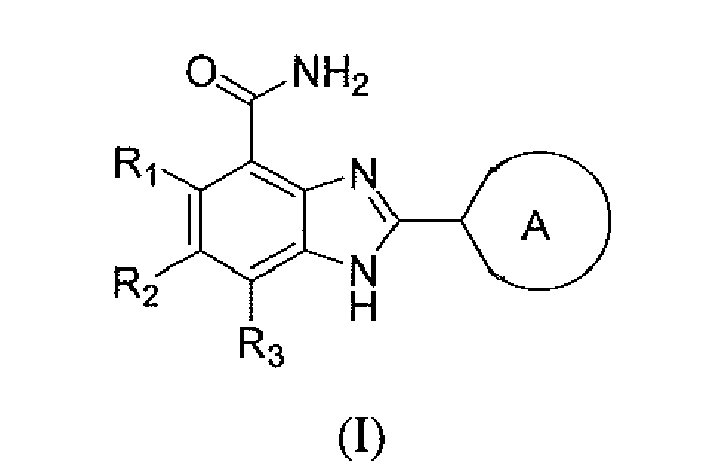 R1, R2, and R3 are independently selected from the group consisting of hydrogen, alkenyl, alkoxy, alkoxycarbonyl, alkyl, alkynyl, cyano, haloalkoxy, haloalkyl, halogen, hydroxy, hydroxyalkyl, nitro, NRARB, and (NRARB)carborzyl;A is a nonaromatic 4, 5, 6, 7, or 8-membered ring that contains 1 or 2 nitrogen atoms and, optionally, one sulfur or oxygen atom, wherein the nonaromatic ring is optionally substituted with 1, 2, or 3 substituents selected from the group consisting of alkenyl, alkoxy, alkoxyalkyl, alkoxycarbonyl, alkoxycarbonylalkyl, alkyl, alkynyl, aryl, arylalkyl, cycloalkyl, cycloalkylalkyl, cyano, haloalkoxy, haloalkyl, halogen, heterocycle, heterocyclealkyl, heteroaryl, heteroarylalkyl, hydroxy, hydroxyalkyl, nitro, NRERD, (NRGRD)alkyl, (NRCRD)carbonyl, (NRCRD)carbonylalkyl, and (NRCRD)sulfonyl; andRA, RB, RC, and RD are independently selected from the group consisting of hydrogen, alkyl, and alkycarbonyl for use in treating cancer or inhibiting tumor growth in a mammal wherein said PARP inhibitor of formula (I) is to be administered in combination with radiotherapy.
 - The PARP inhibitor of formula (1) for the use in accordance with claim 3 wherein the PARP inhibitor of formula (I) is 2-[(2R)-2-methylpyrrolidin-2-yl]-1H-benzimidazole-4-carboxamide,
- The PARP inhibitor of formula (I) for use in treating cancer in accordance with claim 3 wherein the cancer is leukemia.
- The PARP inhibitor of formula (I) for use in treating cancer in accordance with claim 3 wherein the cancer is a CNS tumor.
Priority Applications (4)
| Application Number | Priority Date | Filing Date | Title |
|---|---|---|---|
| PL11157696T PL2338487T3 (en) | 2006-01-17 | 2007-01-17 | Combination therapy with PARP inhibitors |
| SI200731329T SI2338487T1 (en) | 2006-01-17 | 2007-01-17 | Combination therapy with PARP inhibitors |
| MEP-2013-546A ME02121B (en) | 2006-01-17 | 2007-01-17 | Combination therapy with PARP inhibitors |
| CY20131101087T CY1114882T1 (en) | 2006-01-17 | 2013-12-03 | Combination Therapy With Parp Suspensions |
Applications Claiming Priority (6)
| Application Number | Priority Date | Filing Date | Title |
|---|---|---|---|
| US75944506P | 2006-01-17 | 2006-01-17 | |
| US80411206P | 2006-06-07 | 2006-06-07 | |
| US85004206P | 2006-10-06 | 2006-10-06 | |
| US82926106P | 2006-10-12 | 2006-10-12 | |
| US86751806P | 2006-11-28 | 2006-11-28 | |
| EP07716699A EP1976515A2 (en) | 2006-01-17 | 2007-01-17 | Combination therapy with parp inhibitors |
Related Parent Applications (1)
| Application Number | Title | Priority Date | Filing Date |
|---|---|---|---|
| EP07716699.9 Division | 2007-01-17 |
Publications (2)
| Publication Number | Publication Date |
|---|---|
| EP2338487A1 true EP2338487A1 (en) | 2011-06-29 |
| EP2338487B1 EP2338487B1 (en) | 2013-09-11 |
Family
ID=38141258
Family Applications (3)
| Application Number | Title | Priority Date | Filing Date |
|---|---|---|---|
| EP07716699A Withdrawn EP1976515A2 (en) | 2006-01-17 | 2007-01-17 | Combination therapy with parp inhibitors |
| EP11157682A Withdrawn EP2329818A1 (en) | 2006-01-17 | 2007-01-17 | Combination therapy with PARP inhibitors |
| EP11157696.3A Active EP2338487B1 (en) | 2006-01-17 | 2007-01-17 | Combination therapy with PARP inhibitors |
Family Applications Before (2)
| Application Number | Title | Priority Date | Filing Date |
|---|---|---|---|
| EP07716699A Withdrawn EP1976515A2 (en) | 2006-01-17 | 2007-01-17 | Combination therapy with parp inhibitors |
| EP11157682A Withdrawn EP2329818A1 (en) | 2006-01-17 | 2007-01-17 | Combination therapy with PARP inhibitors |
Country Status (14)
| Country | Link |
|---|---|
| US (4) | US20070265324A1 (en) |
| EP (3) | EP1976515A2 (en) |
| JP (4) | JP5289060B2 (en) |
| CN (1) | CN101370497B (en) |
| CA (1) | CA2635691C (en) |
| DK (1) | DK2338487T3 (en) |
| ES (1) | ES2437132T3 (en) |
| HR (1) | HRP20131180T1 (en) |
| ME (1) | ME02121B (en) |
| PL (1) | PL2338487T3 (en) |
| PT (1) | PT2338487E (en) |
| RS (1) | RS53082B (en) |
| SI (1) | SI2338487T1 (en) |
| WO (1) | WO2007084532A2 (en) |
Families Citing this family (40)
| Publication number | Priority date | Publication date | Assignee | Title |
|---|---|---|---|---|
| IL142917A0 (en) | 1998-11-03 | 2002-04-21 | Basf Ag | Substituted 2-phenylbenzimidazoles, the production thereof and their use |
| US7728026B2 (en) * | 2005-04-11 | 2010-06-01 | Abbott Laboratories, Inc. | 2-substituted-1 h-benzimidazile-4-carboxamides are PARP inhibitors |
| CN101233121A (en) * | 2005-06-10 | 2008-07-30 | 彼帕科学公司 | PARP Modulators and Cancer Therapy |
| ZA200800907B (en) | 2005-07-18 | 2010-04-28 | Bipar Sciences Inc | Treatment of cancer |
| JP5227796B2 (en) * | 2005-09-29 | 2013-07-03 | アボット・ラボラトリーズ | 1H-benzimidazole-4-carboxamide substituted by phenyl at the 2-position is a potent PARP inhibitor |
| JP5162465B2 (en) * | 2005-11-15 | 2013-03-13 | アボット・ラボラトリーズ | Substituted 1H-benzimidazole-4-carboxamides are potent PARP inhibitors |
| MX2008014004A (en) * | 2006-05-02 | 2008-11-12 | Abbott Lab | Substituted 1h-benzimidazole-4-carboxamides are potent parp inhibitors. |
| CN101534836B (en) | 2006-09-05 | 2011-09-28 | 彼帕科学公司 | Use of PARP inhibitors in the preparation of medicines for treating obesity |
| WO2008030883A2 (en) | 2006-09-05 | 2008-03-13 | Bipar Sciences, Inc. | Treatment of cancer |
| US8067613B2 (en) * | 2007-07-16 | 2011-11-29 | Abbott Laboratories | Benzimidazole poly(ADP ribose)polymerase inhibitors |
| US7732491B2 (en) * | 2007-11-12 | 2010-06-08 | Bipar Sciences, Inc. | Treatment of breast cancer with a PARP inhibitor alone or in combination with anti-tumor agents |
| MX2010008572A (en) * | 2008-02-04 | 2010-11-30 | Bipar Sciences Inc | Methods of diagnosing and treating parp-mediated diseases. |
| WO2012016876A1 (en) * | 2010-08-03 | 2012-02-09 | Nerviano Medical Sciences S.R.L. | Therapeutic combination comprising a parp-1 inhibitor and an anti-neoplastic agent |
| TWI386203B (en) * | 2011-01-07 | 2013-02-21 | Univ China Medical | Pharmaceutical composition for treating brain cancer or reducing temozolomide-resistance of brain cancer cells and uses of the same |
| SG2014014294A (en) | 2011-04-11 | 2014-06-27 | Abbvie Inc | Parp inhibitors for the treatment of cipn |
| US20130310625A1 (en) | 2012-05-15 | 2013-11-21 | Abbvie Inc. | Veliparib in combination with whole brain radiation therapy for the treatment of brain metastases |
| US9717724B2 (en) | 2012-06-13 | 2017-08-01 | Ipsen Biopharm Ltd. | Methods for treating pancreatic cancer using combination therapies |
| AU2013202947B2 (en) | 2012-06-13 | 2016-06-02 | Ipsen Biopharm Ltd. | Methods for treating pancreatic cancer using combination therapies comprising liposomal irinotecan |
| CN104230896A (en) * | 2013-06-17 | 2014-12-24 | 上海汇伦生命科技有限公司 | Benzimidazole-2-piperazine heterocyclic compound, its pharmaceutical composition and its preparation method and application |
| TW201600086A (en) | 2013-12-10 | 2016-01-01 | 艾伯維有限公司 | VELIPARIB in combination with carboplatin for the treatment of triple negative breast cancer |
| MX386070B (en) * | 2014-01-14 | 2025-03-18 | Nektar Therapeutics | COMBINATION-BASED TREATMENT METHOD. |
| US11318131B2 (en) | 2015-05-18 | 2022-05-03 | Ipsen Biopharm Ltd. | Nanoliposomal irinotecan for use in treating small cell lung cancer |
| JP7042739B2 (en) | 2015-08-20 | 2022-03-28 | イプセン バイオファーム リミティド | Combination therapy with liposomal irinotecan and PARP inhibitors for cancer treatment |
| TW202400181A (en) | 2015-08-21 | 2024-01-01 | 英商益普生生物製藥有限公司 | Methods for treating metastatic pancreatic cancer using combination therapies comprising liposomal irinotecan and oxaliplatin |
| CN105712937B (en) * | 2016-02-28 | 2019-02-22 | 河北宁格生物医药科技有限公司 | A compound for treating metastatic tumor and use thereof |
| CN110402163A (en) | 2016-11-02 | 2019-11-01 | 易普森生物制药有限公司 | Use the combination therapy to treat gastric cancer for including liposome Irinotecan, oxaliplatin, 5 FU 5 fluorouracil (and formyl tetrahydrofolic acid) |
| GB201709076D0 (en) * | 2017-06-07 | 2017-07-19 | Inst Of Cancer Research: Royal Cancer Hospital | Parp inhibitors for use in methods of treating cancer |
| KR20200121800A (en) * | 2018-01-05 | 2020-10-26 | 싸이브렉사 1, 인크. | Compounds, compositions and methods for the treatment of diseases related to tissues suffering from acidic or hypoxic diseases |
| WO2019194738A1 (en) | 2018-04-05 | 2019-10-10 | Noviga Research Ab | Novel combinations of a tubulin polymerization inhibitor and a poly (adp-ribose) polymerase (parp) inhibitor for use in the treatment of cancer |
| CN109232540A (en) * | 2018-06-15 | 2019-01-18 | 深圳市坤健创新药物研究院 | A kind of substituted benzimidazole derivative and application |
| CN108997320A (en) * | 2018-08-30 | 2018-12-14 | 深圳市坤健创新药物研究院 | A kind of fluorine-containing substituted benzimidazole derivative and application |
| CA3139180A1 (en) * | 2019-03-27 | 2020-10-01 | Daiichi Sankyo Company, Limited | Combination of antibody-pyrrolobenzodiazepine derivative conjugate and parp inhibitor |
| MX2022000449A (en) | 2019-07-10 | 2022-04-25 | Cybrexa 2 Inc | PEPTIDE CONJUGATES OF CYTOTOXINS AS THERAPEUTIC. |
| US11555019B2 (en) | 2019-07-10 | 2023-01-17 | Cybrexa 3, Inc. | Peptide conjugates of microtubule-targeting agents as therapeutics |
| CN114053415B (en) * | 2020-07-30 | 2024-06-18 | 江苏天士力帝益药业有限公司 | TSL-1502 compound drug combination |
| US12293220B2 (en) | 2022-04-21 | 2025-05-06 | Dell Products L.P. | Context-driven framework to migrate the applications and its dependencies by analyzing the relationships |
| CA3172480A1 (en) | 2022-04-27 | 2023-10-27 | Susanne KOSSATZ | Combination treatment of small-cell lung cancer |
| CN118615452A (en) * | 2023-03-07 | 2024-09-10 | 中国科学院分子细胞科学卓越创新中心 | DNA-damaging drugs combined with chemotherapy |
| US12566633B2 (en) | 2023-04-20 | 2026-03-03 | Dell Products L.P. | Method and system for managing resource utilization of applications |
| US12292781B2 (en) | 2023-04-21 | 2025-05-06 | Dell Products L.P. | Method and system for managing power consumption for devices |
Citations (4)
| Publication number | Priority date | Publication date | Assignee | Title |
|---|---|---|---|---|
| WO1997004771A1 (en) * | 1995-08-02 | 1997-02-13 | Newcastle University Ventures Limited | Benzimidazole compounds |
| WO2000032579A1 (en) * | 1998-11-27 | 2000-06-08 | Basf Aktiengesellschaft | Substituted benzimidazoles and their use as parp inhibitors |
| WO2006052976A2 (en) * | 2004-11-09 | 2006-05-18 | Schering Corporation | Improved dosing regimen of temozolomide for treating cancer based on the patient’s mgmt level |
| WO2006110816A2 (en) * | 2005-04-11 | 2006-10-19 | Abbott Laboratories | 1h-benzimidazole-4-carboxamides substituted with a quaternary carbon at the 2-position are potent parp inhibitors |
Family Cites Families (13)
| Publication number | Priority date | Publication date | Assignee | Title |
|---|---|---|---|---|
| ES2162092T3 (en) * | 1995-08-28 | 2001-12-16 | Schering Corp | COMBINATION THERAPY FOR ADVANCED CANCERS THAT INCLUDES TEMOZOLOMIDE AND CISPLATIN. |
| BR9806106A (en) * | 1997-07-02 | 1999-08-31 | Atochem North America Elf | Ink base for dispersion coating, paint, coating, and, article of manufacture |
| US6495541B1 (en) * | 1999-01-11 | 2002-12-17 | Agouron Pharmaceuticals, Inc. | Tricyclic inhibitors of poly(ADP-ribose) polymerases |
| CN1345240A (en) * | 1999-03-30 | 2002-04-17 | 先灵公司 | Improved cancer treatment with temozolomide |
| DE19920936A1 (en) * | 1999-05-07 | 2000-11-09 | Basf Ag | Heterocyclically substituted benzimidazoles, their preparation and use |
| US6465448B1 (en) * | 1999-08-13 | 2002-10-15 | Case Western Reserve University | Methoxyamine potentiation of temozolomide anti-cancer activity |
| US6635677B2 (en) * | 1999-08-13 | 2003-10-21 | Case Western Reserve University | Methoxyamine combinations in the treatment of cancer |
| AU7314200A (en) * | 1999-09-17 | 2001-04-24 | Yamanouchi Pharmaceutical Co., Ltd. | Benzimidazole derivatives |
| DE60335359D1 (en) * | 2002-04-30 | 2011-01-27 | Kudos Pharm Ltd | phthalazinone |
| CA2520997A1 (en) * | 2003-03-31 | 2004-10-14 | Stacie Sara Canan-Koch | Salts of tricyclic inhibitors of poly(adp-ribose) polymerases |
| ES2396334T3 (en) * | 2003-05-28 | 2013-02-20 | Eisai Inc. | Compounds, methods and pharmaceutical compositions for PARP inhibition |
| CN101233121A (en) * | 2005-06-10 | 2008-07-30 | 彼帕科学公司 | PARP Modulators and Cancer Therapy |
| WO2006137510A1 (en) * | 2005-06-24 | 2006-12-28 | Ono Pharmaceutical Co., Ltd. | Agent for reduction of bleeding in cerebrovascular disorder |
-
2007
- 2007-01-17 EP EP07716699A patent/EP1976515A2/en not_active Withdrawn
- 2007-01-17 JP JP2008551343A patent/JP5289060B2/en not_active Expired - Fee Related
- 2007-01-17 DK DK11157696.3T patent/DK2338487T3/en active
- 2007-01-17 ES ES11157696.3T patent/ES2437132T3/en active Active
- 2007-01-17 PT PT111576963T patent/PT2338487E/en unknown
- 2007-01-17 RS RS20130546A patent/RS53082B/en unknown
- 2007-01-17 PL PL11157696T patent/PL2338487T3/en unknown
- 2007-01-17 SI SI200731329T patent/SI2338487T1/en unknown
- 2007-01-17 ME MEP-2013-546A patent/ME02121B/en unknown
- 2007-01-17 CA CA2635691A patent/CA2635691C/en not_active Expired - Fee Related
- 2007-01-17 EP EP11157682A patent/EP2329818A1/en not_active Withdrawn
- 2007-01-17 WO PCT/US2007/001189 patent/WO2007084532A2/en not_active Ceased
- 2007-01-17 US US11/623,996 patent/US20070265324A1/en not_active Abandoned
- 2007-01-17 CN CN2007800024112A patent/CN101370497B/en not_active Expired - Fee Related
- 2007-01-17 EP EP11157696.3A patent/EP2338487B1/en active Active
-
2011
- 2011-03-01 US US13/037,712 patent/US20110152336A1/en not_active Abandoned
- 2011-03-01 US US13/037,691 patent/US20110151023A1/en not_active Abandoned
- 2011-11-03 US US13/288,165 patent/US20120045524A1/en not_active Abandoned
-
2013
- 2013-02-12 JP JP2013024289A patent/JP2013136605A/en not_active Withdrawn
- 2013-12-11 HR HRP20131180TT patent/HRP20131180T1/en unknown
-
2015
- 2015-05-07 JP JP2015095009A patent/JP6147799B2/en not_active Expired - Fee Related
-
2017
- 2017-04-07 JP JP2017076489A patent/JP2017160216A/en active Pending
Patent Citations (4)
| Publication number | Priority date | Publication date | Assignee | Title |
|---|---|---|---|---|
| WO1997004771A1 (en) * | 1995-08-02 | 1997-02-13 | Newcastle University Ventures Limited | Benzimidazole compounds |
| WO2000032579A1 (en) * | 1998-11-27 | 2000-06-08 | Basf Aktiengesellschaft | Substituted benzimidazoles and their use as parp inhibitors |
| WO2006052976A2 (en) * | 2004-11-09 | 2006-05-18 | Schering Corporation | Improved dosing regimen of temozolomide for treating cancer based on the patient’s mgmt level |
| WO2006110816A2 (en) * | 2005-04-11 | 2006-10-19 | Abbott Laboratories | 1h-benzimidazole-4-carboxamides substituted with a quaternary carbon at the 2-position are potent parp inhibitors |
Non-Patent Citations (2)
| Title |
|---|
| "Methods in Cell Biology", vol. XIV, 1976, ACADEMIC PRESS, pages: 33 |
| "Recommendations for Section E, Fundamental Stereochemistry", PURE APPL. CHEM., vol. 45, 1976, pages 13 - 30 |
Also Published As
| Publication number | Publication date |
|---|---|
| US20120045524A1 (en) | 2012-02-23 |
| HRP20131180T1 (en) | 2014-01-31 |
| CN101370497B (en) | 2010-11-17 |
| PT2338487E (en) | 2013-12-16 |
| WO2007084532A3 (en) | 2007-09-07 |
| JP6147799B2 (en) | 2017-06-14 |
| JP2015187114A (en) | 2015-10-29 |
| DK2338487T3 (en) | 2013-12-09 |
| EP2329818A1 (en) | 2011-06-08 |
| CA2635691C (en) | 2013-10-29 |
| SI2338487T1 (en) | 2014-01-31 |
| CN101370497A (en) | 2009-02-18 |
| EP1976515A2 (en) | 2008-10-08 |
| JP2017160216A (en) | 2017-09-14 |
| ES2437132T3 (en) | 2014-01-09 |
| JP2013136605A (en) | 2013-07-11 |
| ME02121B (en) | 2014-06-30 |
| RS53082B (en) | 2014-06-30 |
| US20070265324A1 (en) | 2007-11-15 |
| JP5289060B2 (en) | 2013-09-11 |
| PL2338487T3 (en) | 2014-03-31 |
| US20110152336A1 (en) | 2011-06-23 |
| WO2007084532A2 (en) | 2007-07-26 |
| CA2635691A1 (en) | 2007-07-26 |
| US20110151023A1 (en) | 2011-06-23 |
| EP2338487B1 (en) | 2013-09-11 |
| JP2009523801A (en) | 2009-06-25 |
Similar Documents
| Publication | Publication Date | Title |
|---|---|---|
| EP2338487B1 (en) | Combination therapy with PARP inhibitors | |
| US20160324829A1 (en) | Combination therapy with parp inhibitors | |
| US20150005354A1 (en) | Combination Therapy With Parp Inhibitors | |
| US20130225647A1 (en) | Combination therapy with parp inhibitors | |
| US20140093585A1 (en) | Parp inhibitors for the treatment of cipn | |
| CA2843417A1 (en) | Treatment of breast cancer | |
| CA3138197A1 (en) | Anti-cancer nuclear hormone receptor-targeting compounds | |
| AU2016242118B2 (en) | Novel therapies for cancer | |
| US20080280867A1 (en) | Combination therapy with parp inhibitors | |
| MX2008009180A (en) | Combination therapy with parp inhibitors | |
| HK1245120B (en) | Novel therapies for cancer |
Legal Events
| Date | Code | Title | Description |
|---|---|---|---|
| PUAI | Public reference made under article 153(3) epc to a published international application that has entered the european phase |
Free format text: ORIGINAL CODE: 0009012 |
|
| AC | Divisional application: reference to earlier application |
Ref document number: 1976515 Country of ref document: EP Kind code of ref document: P |
|
| AK | Designated contracting states |
Kind code of ref document: A1 Designated state(s): AT BE BG CH CY CZ DE DK EE ES FI FR GB GR HU IE IS IT LI LT LU LV MC NL PL PT RO SE SI SK TR |
|
| AX | Request for extension of the european patent |
Extension state: AL BA HR MK RS |
|
| 17P | Request for examination filed |
Effective date: 20111228 |
|
| 17Q | First examination report despatched |
Effective date: 20120223 |
|
| RIC1 | Information provided on ipc code assigned before grant |
Ipc: A61K 49/00 20060101ALI20120831BHEP Ipc: A61P 35/00 20060101ALI20120831BHEP Ipc: C07D 401/02 20060101ALI20120831BHEP Ipc: A61K 31/41 20060101AFI20120831BHEP Ipc: A61K 41/00 20060101ALI20120831BHEP Ipc: A61K 9/00 20060101ALI20120831BHEP Ipc: C07D 471/00 20060101ALI20120831BHEP Ipc: A61K 31/4164 20060101ALI20120831BHEP Ipc: A61N 5/00 20060101ALI20120831BHEP |
|
| REG | Reference to a national code |
Ref country code: DE Ref legal event code: R079 Ref document number: 602007032871 Country of ref document: DE Free format text: PREVIOUS MAIN CLASS: A61K0031410000 Ipc: C07D0403040000 |
|
| GRAP | Despatch of communication of intention to grant a patent |
Free format text: ORIGINAL CODE: EPIDOSNIGR1 |
|
| RIC1 | Information provided on ipc code assigned before grant |
Ipc: A61K 9/00 20060101ALI20130307BHEP Ipc: C07D 403/04 20060101AFI20130307BHEP Ipc: A61P 35/00 20060101ALI20130307BHEP Ipc: A61K 41/00 20060101ALI20130307BHEP Ipc: A61K 49/00 20060101ALI20130307BHEP Ipc: A61K 45/06 20060101ALI20130307BHEP Ipc: A61K 31/4164 20060101ALI20130307BHEP Ipc: C07D 471/00 20060101ALI20130307BHEP Ipc: C07D 401/02 20060101ALI20130307BHEP Ipc: A61N 5/00 20060101ALI20130307BHEP Ipc: A61K 31/41 20060101ALI20130307BHEP |
|
| GRAS | Grant fee paid |
Free format text: ORIGINAL CODE: EPIDOSNIGR3 |
|
| GRAA | (expected) grant |
Free format text: ORIGINAL CODE: 0009210 |
|
| AC | Divisional application: reference to earlier application |
Ref document number: 1976515 Country of ref document: EP Kind code of ref document: P |
|
| AK | Designated contracting states |
Kind code of ref document: B1 Designated state(s): AT BE BG CH CY CZ DE DK EE ES FI FR GB GR HU IE IS IT LI LT LU LV MC NL PL PT RO SE SI SK TR |
|
| AX | Request for extension of the european patent |
Extension state: AL BA HR MK RS |
|
| REG | Reference to a national code |
Ref country code: GB Ref legal event code: FG4D |
|
| REG | Reference to a national code |
Ref country code: CH Ref legal event code: EP |
|
| REG | Reference to a national code |
Ref country code: AT Ref legal event code: REF Ref document number: 631554 Country of ref document: AT Kind code of ref document: T Effective date: 20130915 |
|
| BECA | Be: change of holder's address |
Owner name: ABBVIE BAHAMAS LTD.SASSOON HOUSE, SHIRLEY STREET & Effective date: 20130911 |
|
| BECH | Be: change of holder |
Owner name: ABBVIE BAHAMAS LTD. Effective date: 20130911 |
|
| REG | Reference to a national code |
Ref country code: IE Ref legal event code: FG4D |
|
| REG | Reference to a national code |
Ref country code: DE Ref legal event code: R096 Ref document number: 602007032871 Country of ref document: DE Effective date: 20131107 |
|
| REG | Reference to a national code |
Ref country code: DK Ref legal event code: T3 Effective date: 20131205 Ref country code: RO Ref legal event code: EPE |
|
| RAP2 | Party data changed (patent owner data changed or rights of a patent transferred) |
Owner name: ABBVIE BAHAMAS LTD. |
|
| REG | Reference to a national code |
Ref country code: HR Ref legal event code: TUEP Ref document number: P20131180 Country of ref document: HR |
|
| REG | Reference to a national code |
Ref country code: PT Ref legal event code: SC4A Free format text: AVAILABILITY OF NATIONAL TRANSLATION Effective date: 20131209 |
|
| REG | Reference to a national code |
Ref country code: NL Ref legal event code: T3 |
|
| REG | Reference to a national code |
Ref country code: PT Ref legal event code: PC4A Owner name: ABBVIE BAHAMAS LTD., BS Effective date: 20131219 Ref country code: SE Ref legal event code: TRGR |
|
| REG | Reference to a national code |
Ref country code: ES Ref legal event code: FG2A Ref document number: 2437132 Country of ref document: ES Kind code of ref document: T3 Effective date: 20140109 |
|
| REG | Reference to a national code |
Ref country code: NL Ref legal event code: SD Effective date: 20140113 |
|
| REG | Reference to a national code |
Ref country code: HR Ref legal event code: T1PR Ref document number: P20131180 Country of ref document: HR Ref country code: CH Ref legal event code: NV Representative=s name: BOHEST AG, CH |
|
| REG | Reference to a national code |
Ref country code: GB Ref legal event code: 732E Free format text: REGISTERED BETWEEN 20140116 AND 20140122 |
|
| REG | Reference to a national code |
Ref country code: EE Ref legal event code: FG4A Ref document number: E008727 Country of ref document: EE Effective date: 20131211 |
|
| REG | Reference to a national code |
Ref country code: GR Ref legal event code: EP Ref document number: 20130402629 Country of ref document: GR Effective date: 20140124 |
|
| REG | Reference to a national code |
Ref country code: DE Ref legal event code: R081 Ref document number: 602007032871 Country of ref document: DE Owner name: ABBVIE BAHAMAS LTD., BS Free format text: FORMER OWNER: ABBOTT LABORATORIES, ABBOTT PARK, US Effective date: 20140227 Ref country code: DE Ref legal event code: R081 Ref document number: 602007032871 Country of ref document: DE Owner name: ABBVIE BAHAMAS LTD., BS Free format text: FORMER OWNER: ABBOTT LABORATORIES, ABBOTT PARK, ILL., US Effective date: 20140227 Ref country code: DE Ref legal event code: R081 Ref document number: 602007032871 Country of ref document: DE Owner name: ABBVIE BAHAMAS LTD., NASSAU, BS Free format text: FORMER OWNER: ABBOTT LABORATORIES, ABBOTT PARK, ILL., US Effective date: 20140227 Ref country code: DE Ref legal event code: R081 Ref document number: 602007032871 Country of ref document: DE Owner name: ABBVIE IRELAND UNLIMITED COMPANY, IE Free format text: FORMER OWNER: ABBOTT LABORATORIES, ABBOTT PARK, ILL., US Effective date: 20140227 |
|
| REG | Reference to a national code |
Ref country code: SK Ref legal event code: T3 Ref document number: E 15660 Country of ref document: SK |
|
| REG | Reference to a national code |
Ref country code: DE Ref legal event code: R097 Ref document number: 602007032871 Country of ref document: DE |
|
| PLBE | No opposition filed within time limit |
Free format text: ORIGINAL CODE: 0009261 |
|
| STAA | Information on the status of an ep patent application or granted ep patent |
Free format text: STATUS: NO OPPOSITION FILED WITHIN TIME LIMIT |
|
| REG | Reference to a national code |
Ref country code: CH Ref legal event code: PCAR Free format text: NEW ADDRESS: HOLBEINSTRASSE 36-38, 4051 BASEL (CH) |
|
| 26N | No opposition filed |
Effective date: 20140612 |
|
| REG | Reference to a national code |
Ref country code: DE Ref legal event code: R097 Ref document number: 602007032871 Country of ref document: DE Effective date: 20140612 |
|
| REG | Reference to a national code |
Ref country code: HU Ref legal event code: AG4A Ref document number: E020346 Country of ref document: HU |
|
| REG | Reference to a national code |
Ref country code: FR Ref legal event code: PLFP Year of fee payment: 10 |
|
| REG | Reference to a national code |
Ref country code: EE Ref legal event code: GB1A Ref document number: E008727 Country of ref document: EE |
|
| REG | Reference to a national code |
Ref country code: DE Ref legal event code: R082 Ref document number: 602007032871 Country of ref document: DE Representative=s name: SCHIEBER - FARAGO, DE Ref country code: DE Ref legal event code: R081 Ref document number: 602007032871 Country of ref document: DE Owner name: ABBVIE IRELAND UNLIMITED COMPANY, IE Free format text: FORMER OWNER: ABBVIE BAHAMAS LTD., NASSAU, NEW PROVIDENCE, BS Ref country code: DE Ref legal event code: R082 Ref document number: 602007032871 Country of ref document: DE Representative=s name: FARAGO PATENTANWAELTE, DE Ref country code: DE Ref legal event code: R082 Ref document number: 602007032871 Country of ref document: DE Representative=s name: FARAGO PATENTANWALTS- UND RECHTSANWALTSGESELLS, DE |
|
| REG | Reference to a national code |
Ref country code: NL Ref legal event code: PD Owner name: ABBVIE IRELAND UNLIMITED COMPANY; BM Free format text: DETAILS ASSIGNMENT: VERANDERING VAN EIGENAAR(S), OVERDRACHT; FORMER OWNER NAME: ABBVIE BAHAMAS LIMITED Effective date: 20161004 |
|
| REG | Reference to a national code |
Ref country code: CH Ref legal event code: PUE Owner name: ABBVIE IRELAND UNLIMITED COMPANY, IE Free format text: FORMER OWNER: ABBVIE BAHAMAS LTD., BS Ref country code: CH Ref legal event code: PCOW Free format text: NEW ADDRESS: C/O CODAN SERVICES LIMITED CLARENDON HOUSE 2 CHURCH STREET, HAMILTON, HM11 (BM) |
|
| REG | Reference to a national code |
Ref country code: GB Ref legal event code: 732E Free format text: REGISTERED BETWEEN 20161117 AND 20161123 |
|
| REG | Reference to a national code |
Ref country code: FR Ref legal event code: PLFP Year of fee payment: 11 |
|
| REG | Reference to a national code |
Ref country code: HR Ref legal event code: PPPP Ref document number: P20131180 Country of ref document: HR Owner name: ABBVIE IRELAND UNLIMITED COMPANY, BM |
|
| REG | Reference to a national code |
Ref country code: SI Ref legal event code: SP73 Owner name: ABBVIE IRELAND UNLIMITED COMPANY; BM Effective date: 20161230 |
|
| REG | Reference to a national code |
Ref country code: SK Ref legal event code: PC4A Ref document number: E 15660 Country of ref document: SK Owner name: ABBVIE IRELAND UNLIMITED COMPANY, HAMILTON, BM Free format text: FORMER OWNER: ABBVIE BAHAMAS LTD., NEW PROVIDENCE, NASSAU, BS Effective date: 20170110 |
|
| REG | Reference to a national code |
Ref country code: ES Ref legal event code: PC2A Owner name: ABBVIE IRELAND UNLIMITED COMPANY Effective date: 20170130 |
|
| REG | Reference to a national code |
Ref country code: FR Ref legal event code: TP Owner name: ABBVIE IRELAND UNLIMITED COMPANY, BM Effective date: 20170110 |
|
| REG | Reference to a national code |
Ref country code: HU Ref legal event code: FH1C Free format text: FORMER REPRESENTATIVE(S): DR. TOEROEK FERENC, DANUBIA SZABADALMI ES JOGI IRODA KFT., HU Representative=s name: DANUBIA SZABADALMI ES JOGI IRODA KFT., HU Ref country code: HU Ref legal event code: GB9C Owner name: ABBVIE IRELAND UNLIMITED COMPANY, BM Free format text: FORMER OWNER(S): ABBVIE BAHAMAS LTD., BS |
|
| REG | Reference to a national code |
Ref country code: FR Ref legal event code: PLFP Year of fee payment: 12 |
|
| REG | Reference to a national code |
Ref country code: HR Ref legal event code: ODRP Ref document number: P20131180 Country of ref document: HR Payment date: 20180116 Year of fee payment: 12 |
|
| PGFP | Annual fee paid to national office [announced via postgrant information from national office to epo] |
Ref country code: FR Payment date: 20171220 Year of fee payment: 12 Ref country code: SK Payment date: 20171222 Year of fee payment: 12 Ref country code: RO Payment date: 20171221 Year of fee payment: 12 Ref country code: CZ Payment date: 20171228 Year of fee payment: 12 Ref country code: DK Payment date: 20171228 Year of fee payment: 12 Ref country code: FI Payment date: 20171228 Year of fee payment: 12 Ref country code: MC Payment date: 20171229 Year of fee payment: 12 |
|
| PGFP | Annual fee paid to national office [announced via postgrant information from national office to epo] |
Ref country code: IS Payment date: 20171212 Year of fee payment: 12 Ref country code: GR Payment date: 20171228 Year of fee payment: 12 Ref country code: LU Payment date: 20180108 Year of fee payment: 12 Ref country code: PL Payment date: 20171215 Year of fee payment: 12 Ref country code: BG Payment date: 20171218 Year of fee payment: 12 Ref country code: GB Payment date: 20171228 Year of fee payment: 12 Ref country code: PT Payment date: 20171228 Year of fee payment: 12 |
|
| PGFP | Annual fee paid to national office [announced via postgrant information from national office to epo] |
Ref country code: NL Payment date: 20180111 Year of fee payment: 12 |
|
| PGFP | Annual fee paid to national office [announced via postgrant information from national office to epo] |
Ref country code: ES Payment date: 20180202 Year of fee payment: 12 Ref country code: CY Payment date: 20171220 Year of fee payment: 12 Ref country code: DE Payment date: 20180109 Year of fee payment: 12 Ref country code: LT Payment date: 20180115 Year of fee payment: 12 Ref country code: CH Payment date: 20180125 Year of fee payment: 12 |
|
| PGFP | Annual fee paid to national office [announced via postgrant information from national office to epo] |
Ref country code: EE Payment date: 20180102 Year of fee payment: 12 Ref country code: LV Payment date: 20180103 Year of fee payment: 12 Ref country code: SI Payment date: 20171222 Year of fee payment: 12 Ref country code: IT Payment date: 20180111 Year of fee payment: 12 Ref country code: TR Payment date: 20180105 Year of fee payment: 12 Ref country code: HU Payment date: 20171222 Year of fee payment: 12 Ref country code: IE Payment date: 20180128 Year of fee payment: 12 Ref country code: SE Payment date: 20180109 Year of fee payment: 12 Ref country code: BE Payment date: 20180118 Year of fee payment: 12 Ref country code: AT Payment date: 20171228 Year of fee payment: 12 |
|
| REG | Reference to a national code |
Ref country code: DE Ref legal event code: R119 Ref document number: 602007032871 Country of ref document: DE Ref country code: HR Ref legal event code: PBON Ref document number: P20131180 Country of ref document: HR Effective date: 20190117 |
|
| REG | Reference to a national code |
Ref country code: LT Ref legal event code: MM4D Effective date: 20190117 |
|
| REG | Reference to a national code |
Ref country code: EE Ref legal event code: MM4A Ref document number: E008727 Country of ref document: EE Effective date: 20190131 |
|
| REG | Reference to a national code |
Ref country code: DK Ref legal event code: EBP Effective date: 20190131 |
|
| PG25 | Lapsed in a contracting state [announced via postgrant information from national office to epo] |
Ref country code: MC Free format text: LAPSE BECAUSE OF NON-PAYMENT OF DUE FEES Effective date: 20190131 |
|
| REG | Reference to a national code |
Ref country code: CH Ref legal event code: PL |
|
| REG | Reference to a national code |
Ref country code: NL Ref legal event code: MM Effective date: 20190201 |
|
| REG | Reference to a national code |
Ref country code: AT Ref legal event code: MM01 Ref document number: 631554 Country of ref document: AT Kind code of ref document: T Effective date: 20190117 |
|
| GBPC | Gb: european patent ceased through non-payment of renewal fee |
Effective date: 20190117 |
|
| PG25 | Lapsed in a contracting state [announced via postgrant information from national office to epo] |
Ref country code: LU Free format text: LAPSE BECAUSE OF NON-PAYMENT OF DUE FEES Effective date: 20190117 |
|
| REG | Reference to a national code |
Ref country code: SK Ref legal event code: MM4A Ref document number: E 15660 Country of ref document: SK Effective date: 20190117 |
|
| REG | Reference to a national code |
Ref country code: BE Ref legal event code: MM Effective date: 20190131 |
|
| REG | Reference to a national code |
Ref country code: IE Ref legal event code: MM4A |
|
| PG25 | Lapsed in a contracting state [announced via postgrant information from national office to epo] |
Ref country code: FR Free format text: LAPSE BECAUSE OF NON-PAYMENT OF DUE FEES Effective date: 20190131 Ref country code: SK Free format text: LAPSE BECAUSE OF NON-PAYMENT OF DUE FEES Effective date: 20190117 Ref country code: LT Free format text: LAPSE BECAUSE OF NON-PAYMENT OF DUE FEES Effective date: 20190117 Ref country code: EE Free format text: LAPSE BECAUSE OF NON-PAYMENT OF DUE FEES Effective date: 20190131 Ref country code: FI Free format text: LAPSE BECAUSE OF NON-PAYMENT OF DUE FEES Effective date: 20190117 Ref country code: NL Free format text: LAPSE BECAUSE OF NON-PAYMENT OF DUE FEES Effective date: 20190201 Ref country code: PT Free format text: LAPSE BECAUSE OF NON-PAYMENT OF DUE FEES Effective date: 20190717 Ref country code: DE Free format text: LAPSE BECAUSE OF NON-PAYMENT OF DUE FEES Effective date: 20190801 Ref country code: CZ Free format text: LAPSE BECAUSE OF NON-PAYMENT OF DUE FEES Effective date: 20190117 Ref country code: SE Free format text: LAPSE BECAUSE OF NON-PAYMENT OF DUE FEES Effective date: 20190118 Ref country code: CY Free format text: LAPSE BECAUSE OF NON-PAYMENT OF DUE FEES Effective date: 20190117 Ref country code: RO Free format text: LAPSE BECAUSE OF NON-PAYMENT OF DUE FEES Effective date: 20190117 Ref country code: SI Free format text: LAPSE BECAUSE OF NON-PAYMENT OF DUE FEES Effective date: 20190118 |
|
| PG25 | Lapsed in a contracting state [announced via postgrant information from national office to epo] |
Ref country code: BG Free format text: LAPSE BECAUSE OF NON-PAYMENT OF DUE FEES Effective date: 20190731 Ref country code: HU Free format text: LAPSE BECAUSE OF NON-PAYMENT OF DUE FEES Effective date: 20190118 Ref country code: GR Free format text: LAPSE BECAUSE OF NON-PAYMENT OF DUE FEES Effective date: 20190802 Ref country code: LV Free format text: LAPSE BECAUSE OF NON-PAYMENT OF DUE FEES Effective date: 20190117 Ref country code: BE Free format text: LAPSE BECAUSE OF NON-PAYMENT OF DUE FEES Effective date: 20190131 |
|
| PG25 | Lapsed in a contracting state [announced via postgrant information from national office to epo] |
Ref country code: GB Free format text: LAPSE BECAUSE OF NON-PAYMENT OF DUE FEES Effective date: 20190117 Ref country code: IS Free format text: LAPSE BECAUSE OF FAILURE TO SUBMIT A TRANSLATION OF THE DESCRIPTION OR TO PAY THE FEE WITHIN THE PRESCRIBED TIME-LIMIT Effective date: 20190801 Ref country code: LI Free format text: LAPSE BECAUSE OF NON-PAYMENT OF DUE FEES Effective date: 20190131 Ref country code: CH Free format text: LAPSE BECAUSE OF NON-PAYMENT OF DUE FEES Effective date: 20190131 Ref country code: AT Free format text: LAPSE BECAUSE OF NON-PAYMENT OF DUE FEES Effective date: 20190117 |
|
| REG | Reference to a national code |
Ref country code: SI Ref legal event code: KO00 Effective date: 20190926 |
|
| PG25 | Lapsed in a contracting state [announced via postgrant information from national office to epo] |
Ref country code: DK Free format text: LAPSE BECAUSE OF NON-PAYMENT OF DUE FEES Effective date: 20190131 Ref country code: IE Free format text: LAPSE BECAUSE OF NON-PAYMENT OF DUE FEES Effective date: 20190117 |
|
| PG25 | Lapsed in a contracting state [announced via postgrant information from national office to epo] |
Ref country code: IT Free format text: LAPSE BECAUSE OF NON-PAYMENT OF DUE FEES Effective date: 20190117 |
|
| REG | Reference to a national code |
Ref country code: ES Ref legal event code: FD2A Effective date: 20200310 |
|
| PG25 | Lapsed in a contracting state [announced via postgrant information from national office to epo] |
Ref country code: ES Free format text: LAPSE BECAUSE OF NON-PAYMENT OF DUE FEES Effective date: 20190118 |
|
| PG25 | Lapsed in a contracting state [announced via postgrant information from national office to epo] |
Ref country code: PL Free format text: LAPSE BECAUSE OF NON-PAYMENT OF DUE FEES Effective date: 20190117 |
|
| PG25 | Lapsed in a contracting state [announced via postgrant information from national office to epo] |
Ref country code: TR Free format text: LAPSE BECAUSE OF NON-PAYMENT OF DUE FEES Effective date: 20190117 |