EP2337386A1 - Method and system for routing data to a mobile node in a foreign network - Google Patents
Method and system for routing data to a mobile node in a foreign network Download PDFInfo
- Publication number
- EP2337386A1 EP2337386A1 EP09306235A EP09306235A EP2337386A1 EP 2337386 A1 EP2337386 A1 EP 2337386A1 EP 09306235 A EP09306235 A EP 09306235A EP 09306235 A EP09306235 A EP 09306235A EP 2337386 A1 EP2337386 A1 EP 2337386A1
- Authority
- EP
- European Patent Office
- Prior art keywords
- address
- network
- access router
- mobile node
- care
- Prior art date
- Legal status (The legal status is an assumption and is not a legal conclusion. Google has not performed a legal analysis and makes no representation as to the accuracy of the status listed.)
- Withdrawn
Links
- 238000000034 method Methods 0.000 title claims abstract description 26
- 230000007774 longterm Effects 0.000 claims abstract description 24
- 238000013500 data storage Methods 0.000 claims abstract description 12
- 230000005641 tunneling Effects 0.000 claims description 5
- 230000007246 mechanism Effects 0.000 description 14
- 230000008859 change Effects 0.000 description 5
- 238000004891 communication Methods 0.000 description 3
- 230000001419 dependent effect Effects 0.000 description 3
- 230000008901 benefit Effects 0.000 description 2
- 238000012423 maintenance Methods 0.000 description 2
- 230000004048 modification Effects 0.000 description 2
- 238000012986 modification Methods 0.000 description 2
- 230000006855 networking Effects 0.000 description 2
- 230000008569 process Effects 0.000 description 2
- 238000013459 approach Methods 0.000 description 1
Images


Classifications
-
- H—ELECTRICITY
- H04—ELECTRIC COMMUNICATION TECHNIQUE
- H04W—WIRELESS COMMUNICATION NETWORKS
- H04W8/00—Network data management
- H04W8/02—Processing of mobility data, e.g. registration information at HLR [Home Location Register] or VLR [Visitor Location Register]; Transfer of mobility data, e.g. between HLR, VLR or external networks
- H04W8/08—Mobility data transfer
- H04W8/082—Mobility data transfer for traffic bypassing of mobility servers, e.g. location registers, home PLMNs or home agents
-
- H—ELECTRICITY
- H04—ELECTRIC COMMUNICATION TECHNIQUE
- H04W—WIRELESS COMMUNICATION NETWORKS
- H04W8/00—Network data management
- H04W8/26—Network addressing or numbering for mobility support
- H04W8/28—Number portability ; Network address portability
-
- H—ELECTRICITY
- H04—ELECTRIC COMMUNICATION TECHNIQUE
- H04W—WIRELESS COMMUNICATION NETWORKS
- H04W8/00—Network data management
- H04W8/02—Processing of mobility data, e.g. registration information at HLR [Home Location Register] or VLR [Visitor Location Register]; Transfer of mobility data, e.g. between HLR, VLR or external networks
-
- H—ELECTRICITY
- H04—ELECTRIC COMMUNICATION TECHNIQUE
- H04W—WIRELESS COMMUNICATION NETWORKS
- H04W40/00—Communication routing or communication path finding
- H04W40/24—Connectivity information management, e.g. connectivity discovery or connectivity update
Definitions
- the present invention relates to network routing, and more particularly to a system and method for managing connectivity for a mobile node entering a foreign network different from the mobile node's home network.
- IP mobile Internet Protocol
- IP protocol describes those actions that enable a mobile node to maintain connectivity during a handover from one access router to another access router.
- Mobile IP is described in specifications that may be found from the Internet Engineering Task Force (IETF), and the like, as for instance in RFC (Request For Comments) 3344 and RFC 3776.
- IETF Internet Engineering Task Force
- Mobile IP enables the mobile node to be identified by its home address, regardless of its current point of attachment to the Internet.
- the mobile node is also associated with a care-of-address, which provides information about the mobile node's current location.
- care-of-address typically, during a handover between access routers the care-of-address changes but the home address remains the same.
- Mobile IP When away from home, Mobile IP uses protocol tunneling to hide a mobile node's home address from intervening routers between its home network and its current location. The tunnel terminates at the mobile node's care-of address.
- the care-of address must be an address to which datagrams can be delivered via conventional IP routing. At the care-of address, the original datagram is removed from the tunnel and delivered to the mobile node.
- router refers to a dedicated network element that receives packets and forwards them towards a destination.
- a router is used to extend or segment networks by forwarding packets from one subnet to another.
- a router typically operates at layer 3 TCP/IP of the Open Systems Interconnection (OSI) reference model for networking.
- OSI Open Systems Interconnection
- some routers can provide additional functionality that operates above layer 3 of TCP/IP or OSI reference model.
- the term "access router” refers to a router that is associated with a mobile node for providing IP connectivity between the mobile node and other nodes on an IP network, such as a correspondent node.
- the access router is a dedicated network element coupled to an IP network, it may also be in communication with one or more points of attachment for a wireless network.
- Mobile Node refers to a (e.g. wireless) device that changes its point of attachment from one network or sub-network to another.
- a mobile node may change its location without losing connectivity and without changing its IP address; it may continue to communicate with other Internet nodes at any location using its (constant or long-term) IP address, assuming link-layer connectivity to a point of attachment is available.
- a mobile node is given a long-term home IP address on a home network. This home address is administered in substantially the same way as a "permanent" IP address is provided to a stationary host.
- a mobile node can change its point of attachment from one link to another, while still being reachable via its home address.
- link-layer also referred to as data-link layer, or network interface layer, refers to a device driver within an operating system, and a corresponding network interface card, that are configured to enable physical interfacing to a network media, such as a cable, wireless media, or the like.
- the link-layer typically operates at layer 2 of the Open Systems Interconnection (OSI) reference model for networking.
- OSI Open Systems Interconnection
- IP connectivity refers to the ability to send and receive normal IP packets.
- flow refers to a flow of packets.
- Care-of Address refers to the termination point of a tunnel towards a mobile node, for datagrams forwarded to the mobile node while it is away from home.
- Correspondent Node refers to a peer with which a mobile node is communicating.
- a correspondent node may be either mobile or stationary.
- Formal Network refers to any network other than the mobile node's Home Network.
- Home Address refers to an IP address that is assigned for an extended period of time to a mobile node. It remains unchanged regardless of where the node is attached to the Internet.
- Home Network refers to a network, possibly virtual, having a network prefix matching that of a mobile node's home address. Note that standard IP routing mechanisms will deliver datagrams destined to a mobile node's Home Address to the mobile node's Home Network.
- Link refers to a facility or medium over which nodes can communicate at the link layer.
- a link underlies the network layer.
- Link-Layer Address refers to the address used to identify an endpoint of some communication over a physical link.
- Link-Layer address is an interface's Media Access Control (MAC) address.
- MAC Media Access Control
- Mobility Agent refers to Either a home agent or a foreign agent.
- Node refers to a host or a router.
- Tunnel refers to the path followed by a datagram while it is encapsulated.
- the model is that, while it is encapsulated, a datagram is routed to a knowledgeable decapsulating agent, which decapsulates the datagram and then correctly delivers it to its ultimate destination.
- Vehicle Network refers to a network other than a mobile node's Home Network, to which the mobile node is currently connected.
- Agent Discovery refers to Home agents and foreign agents advertising their availability on each link for which they provide service. A newly arrived mobile node can send a solicitation on the link to learn if any prospective agents are present.
- Registration refers to when the mobile node is away from home, it registers its care-of address with its home agent. Depending on its method of attachment, the mobile node will register either directly with its home agent, or through a foreign agent which forwards the registration to the home agent.
- a method for delivering at least one data packet originating from a corresponding node in a corresponding network to a mobile node having a home network and being connected to a foreign network different from the home network, the mobile node having a long term IP address belonging to the home network and a care-of-address being the address of an foreign network access router of the foreign network, the home network, the corresponding network and the foreign network being coupled to each other by means of an IP network comprising at least one data storage, the networks being connected to the IP network by respectively a home network access router, a corresponding network access router, and the foreign network access router, the method comprising performing by the corresponding network access router:
- the method is performed on a per data packet basis.
- the method further comprises receiving notifications of changes in the care-of-address of the mobile node, such that consulting the data storage is not necessary on a per packet basis.
- the data storage comprises a DNS server.
- forwarding the at least one data packet by the corresponding network access router directly to the care-of-address is based on Layer 3 connectivity of the ISO reference model.
- the method comprises tunneling the at least one data packet between the corresponding network access router and the foreign network access router.
- the long term IP address is a public address.
- a method for updating internet location information for a mobile node on a storage by an access router of a network, the storage being accessible through the internet, comprising sending a care-of-address of the mobile node and a long term IP address of the mobile node to the storage over the IP network.
- the access router is a home network access router of the mobile node.
- the access router is a foreign network access router of the mobile node.
- an access router for an IP network is disclosed, arranged for forwarding long term IP address and care-of-address of a mobile node belonging to its domain to a DNS server in the IP network to which it provides access.
- an access router for an IP network is disclosed, which is arranged for intercepting data packets originating from nodes within its domain and directed towards nodes outside its domain, extracting destination addresses of the packets, and retrieving care-of-addresses corresponding to the destination addresses of the packets from a storage in the IP network.
- Fig. 1 a scheme of a typical network architecture in which the mobile IP mechanism is applied, is depicted.
- Multiple access networks namely a corresponding network (CN), a home network (HN), and a foreign network (FN), are interconnected by means of the internet network.
- Terminals are connected by means of access networks.
- the terminal typically has a layer 2 connectivity up to the layer 3 node, being for instance an edge router in the access network to which the terminal is attached (called domain).
- Each of the networks is connected by means of a respective access router to the internet; a corresponding network access router (CNAR), a home network access router (HNAR), and a foreign network access router (FNAR).
- CNAR network access router
- HNAR home network access router
- FNAR foreign network access router
- a corresponding node (C) for instance belonging to the corresponding network domain, forwards a packet to a mobile node (M).
- This mobile node (M) belongs to the home network (HN) from which it acquired a long-term IP address.
- HN home network
- delivering of data packets sent from the corresponding node to the mobile node is based on the long-term IP address and a care-of-address of the mobile node.
- a care-of-address can typically be the IP address access router of the foreign network.
- Fig. 2 illustrates the mechanism of "triangular routing", which is a result of the state of the art mobile IP mechanisms.
- the home network access router intercepts the packet which is destined for the mobile node, and has been made aware by the mobile node or by the access router of the foreign network (FNAR) of the mobile node's care-of-address, typically being the IP address of the FNAR.
- the HNAR then forwards the packets to the FNAR, by tunneling it to the care-of-address of the mobile node.
- the tunnel is ended, and an association exists between the long-term IP address of the mobile node and the link layer (or layer 2) address of the mobile node, such that the FNAR can forward the information to the mobile node M.
- This form of packet routing is not data transport efficient, as all traffic to the mobile network in a foreign network is routed via the home agent in the home network of the mobile node.
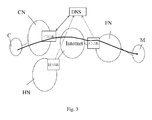
- Fig. 3 an improved mobile IP routing mechanism is illustrated according to embodiments of the present invention.
- the required basic architecture is very similar to the state of the art architecture, but comprises further a data storage, for instance a domain name server (DNS).
- DNS domain name server
- the proposed use of the DNS server avoids the need for triangular routing of packets between a corresponding node and a mobile node, as follows: when the corresponding node sends this packets over the corresponding network and the corresponding network access router (CNAR), towards the mobile node, the CNAR intercepts the package and consults the storage means (for instance DNS server) in order to retrieve location data based on the long-term IP address of the mobile node.
- DNS server network access router
- the long-term IP address of the mobile node is linked with (or bound with) the care-of-address of the mobile node.
- the care-of-address of the mobile node can be returned to the CNAR, such that the CNAR can forward the packet to the access router of the foreign network, corresponding to the care-of-address of the mobile node by tunneling the packet over the internet.
- the tunnel is ended, and the destination address of the original IP packet is associated with a link layer address of the mobile node in the foreign network. Then the packet can be forwarded to the mobile node based on link layer connectivity.
- This procedure allows avoiding the triangular routing and is thus more transport efficient than the state of the art mechanism. It does require the maintenance of a data storage, for instance a DNS, in which the long-term IP address (which is preferably a public IP address) is stored and linked with the current care-of-address of the mobile node.
- the registration of the node with each of those foreign networks comprises the acquisition of a care-of-address in each of those network.
- the care-of-address is typically forwarded to the home network access router, directly by the mobile node, or indirectly via the foreign network access router.
- the foreign network access router and the home network access router are aware of the care-of-address of the mobile node at any time.
- the updating of the DNS can thus preferably be performed by the home network access router (or home agent) as this party is typically a trusted party. If the foreign network access router (or foreign agent) is a trusted party, the maintenance of the binding information between the long-term IP address and the care-of-address of the mobile node in the DNS can be performed by the FNAR (or foreign agent).
- FA foreign agent
- HA home agent
- the registration process for a mobile node in foreign networks can correspond to the state of the art registration process.
- the foreign agent and home agent are located on the edge of the layer 2 domain.
- Advantages of embodiments of the present invention are that the mechanism fits or is technically compatible with the current IP V4 architecture and that no modifications to the terminals is necessary.
- An important advantage is that triangular routing can be avoided and that a more efficient data transport can be achieved.
- a consultation of the DNS may be necessary for each of the packets forwarded from the corresponding node to the mobile node, as the mobile node may change access network and may therefore change care-of-address.
- the DNS server comprising the binding information between the long-term IP address of the mobile node and the care-of-address of the mobile node may forward (and may be adapted therefor) the new care-of-address automatically to the corresponding network access router whenever a change in care-of-address occurs for the mobile node.
- Applying such a mechanism in the DNS server allows the removal of the active consultation step of the DNS server by the access router of the corresponding network for every packet. After the consultation for the first packet of a data stream, such a mechanism may further not be necessary anymore.
Landscapes
- Engineering & Computer Science (AREA)
- Databases & Information Systems (AREA)
- Computer Networks & Wireless Communication (AREA)
- Signal Processing (AREA)
- Mobile Radio Communication Systems (AREA)
- Data Exchanges In Wide-Area Networks (AREA)
Abstract
a. intercepting said at least one data packet and detecting the destination IP address thereof;
b. consulting said at least one data storage, whereby said care-of-address of said mobile node is retrieved by using the destination IP address of said at least one packet;
c. forwarding said at least one data packet directly to said care-of-address, and indicating said long term IP address to said foreign network access router.
Description
- The present invention relates to network routing, and more particularly to a system and method for managing connectivity for a mobile node entering a foreign network different from the mobile node's home network.
- The mobile Internet Protocol (IP) enables a mobile node to move freely from one point of connection to another in different networks which are visited along its route. More specifically, the mobile IP protocol describes those actions that enable a mobile node to maintain connectivity during a handover from one access router to another access router.
- Mobile IP is described in specifications that may be found from the Internet Engineering Task Force (IETF), and the like, as for instance in RFC (Request For Comments) 3344 and RFC 3776. Mobile IP enables the mobile node to be identified by its home address, regardless of its current point of attachment to the Internet. When the mobile node is away from the home network, it is also associated with a care-of-address, which provides information about the mobile node's current location. Typically, during a handover between access routers the care-of-address changes but the home address remains the same.
- The following provides a rough outline of operation of the state of the art mobile IP protocol:
- Mobility agents (i.e., foreign agents and home agents) advertise their presence via Agent Advertisement messages. A mobile node may optionally solicit an Agent Advertisement message from any locally attached mobility agents through an Agent Solicitation message.
- A mobile node receives these Agent Advertisements and determines whether it is on its home network or a foreign network.
- When the mobile node detects that it is located on its home network, it operates without mobility services. If returning to its home network from being registered elsewhere, the mobile node deregisters with its home agent, through exchange of a Registration Request and Registration Reply message with it.
- When a mobile node detects that it has moved to a foreign network, it obtains a care-of address on the foreign network.
- The mobile node operating away from home then registers its new care-of address with its home agent through exchange of a Registration Request and Registration Reply message with it, possibly via a foreign agent.
- Datagrams sent to the mobile node's home address are intercepted by its home agent, tunneled by the home agent to the mobile node's care-of address, received at the tunnel endpoint, and finally delivered to the mobile node.
- In the reverse direction, datagrams sent by the mobile node are generally delivered to their destination using standard IP routing mechanisms, not necessarily passing through the home agent.
- When away from home, Mobile IP uses protocol tunneling to hide a mobile node's home address from intervening routers between its home network and its current location. The tunnel terminates at the mobile node's care-of address. The care-of address must be an address to which datagrams can be delivered via conventional IP routing. At the care-of address, the original datagram is removed from the tunnel and delivered to the mobile node.
- The problem with this state of the art approach, is that the so called triangular routing is not data transport efficient, as all traffic to a mobile node in a foreign network is routed via the home agent in the home network of the mobile node. The use of the long term IP address belonging to the home network of the mobile node has made such a scheme necessary.
- Throughout the specification and claims, the following terms take the meanings explicitly associated herein, unless the context clearly dictates otherwise.
- The term "router" refers to a dedicated network element that receives packets and forwards them towards a destination. In particular, a router is used to extend or segment networks by forwarding packets from one subnet to another. A router typically operates at layer 3 TCP/IP of the Open Systems Interconnection (OSI) reference model for networking. However, some routers can provide additional functionality that operates above layer 3 of TCP/IP or OSI reference model.
- The term "access router" refers to a router that is associated with a mobile node for providing IP connectivity between the mobile node and other nodes on an IP network, such as a correspondent node. Although the access router is a dedicated network element coupled to an IP network, it may also be in communication with one or more points of attachment for a wireless network.
- The term "Mobile Node" refers to a (e.g. wireless) device that changes its point of attachment from one network or sub-network to another. A mobile node may change its location without losing connectivity and without changing its IP address; it may continue to communicate with other Internet nodes at any location using its (constant or long-term) IP address, assuming link-layer connectivity to a point of attachment is available. A mobile node is given a long-term home IP address on a home network. This home address is administered in substantially the same way as a "permanent" IP address is provided to a stationary host. A mobile node can change its point of attachment from one link to another, while still being reachable via its home address.
- The term "link-layer," also referred to as data-link layer, or network interface layer, refers to a device driver within an operating system, and a corresponding network interface card, that are configured to enable physical interfacing to a network media, such as a cable, wireless media, or the like. The link-layer typically operates at layer 2 of the Open Systems Interconnection (OSI) reference model for networking.
- The term "IP connectivity" refers to the ability to send and receive normal IP packets.
- The term "flow" refers to a flow of packets.
- The term "Care-of Address" refers to the termination point of a tunnel towards a mobile node, for datagrams forwarded to the mobile node while it is away from home.
- The term "Correspondent Node" refers to a peer with which a mobile node is communicating. A correspondent node may be either mobile or stationary.
- The term "Foreign Network" refers to any network other than the mobile node's Home Network.
- The term "Home Address" refers to an IP address that is assigned for an extended period of time to a mobile node. It remains unchanged regardless of where the node is attached to the Internet.
- The term "Home Network" refers to a network, possibly virtual, having a network prefix matching that of a mobile node's home address. Note that standard IP routing mechanisms will deliver datagrams destined to a mobile node's Home Address to the mobile node's Home Network.
- The term "Link" refers to a facility or medium over which nodes can communicate at the link layer. A link underlies the network layer.
- The term "Link-Layer Address" refers to the address used to identify an endpoint of some communication over a physical link. Typically, the Link-Layer address is an interface's Media Access Control (MAC) address.
- The term "Mobility Agent" refers to Either a home agent or a foreign agent.
- The term "Node" refers to a host or a router.
- The term "Tunnel" refers to the path followed by a datagram while it is encapsulated. The model is that, while it is encapsulated, a datagram is routed to a knowledgeable decapsulating agent, which decapsulates the datagram and then correctly delivers it to its ultimate destination.
- The term "Visited Network" refers to a network other than a mobile node's Home Network, to which the mobile node is currently connected.
- The term "Agent Discovery" refers to Home agents and foreign agents advertising their availability on each link for which they provide service. A newly arrived mobile node can send a solicitation on the link to learn if any prospective agents are present.
- The term "Registration" refers to when the mobile node is away from home, it registers its care-of address with its home agent. Depending on its method of attachment, the mobile node will register either directly with its home agent, or through a foreign agent which forwards the registration to the home agent.
- It is an object of the present invention to provide a method and systems which remove the need for triangular routing in mobile IP.
- According to a first aspect of the present invention a method is disclosed for delivering at least one data packet originating from a corresponding node in a corresponding network to a mobile node having a home network and being connected to a foreign network different from the home network, the mobile node having a long term IP address belonging to the home network and a care-of-address being the address of an foreign network access router of the foreign network, the home network, the corresponding network and the foreign network being coupled to each other by means of an IP network comprising at least one data storage, the networks being connected to the IP network by respectively a home network access router, a corresponding network access router, and the foreign network access router, the method comprising performing by the corresponding network access router:
- a. intercepting the at least one data packet and detecting the destination IP address thereof;
- b. consulting the at least one data storage, whereby the care-of-address of the mobile node is retrieved by using the destination IP address of the at least one packet;
- c. forwarding the at least one data packet directly to the care-of-address, and further indicating the long term IP address of the mobile node to the foreign network access router, such that the foreign network access router can forward the at least one data packet to the mobile node.
- According to embodiments of the present invention the method is performed on a per data packet basis.
- According to embodiments of the present invention the method further comprises receiving notifications of changes in the care-of-address of the mobile node, such that consulting the data storage is not necessary on a per packet basis.
- According to embodiments of the present invention the data storage comprises a DNS server.
- According to embodiments of the present invention forwarding the at least one data packet by the corresponding network access router directly to the care-of-address is based on Layer 3 connectivity of the ISO reference model.
- According to embodiments of the present invention the method comprises tunneling the at least one data packet between the corresponding network access router and the foreign network access router.
- According to embodiments of the present invention the long term IP address is a public address.
- According to a second aspect of the present invention a method is disclosed for updating internet location information for a mobile node on a storage by an access router of a network, the storage being accessible through the internet, comprising sending a care-of-address of the mobile node and a long term IP address of the mobile node to the storage over the IP network.
- According to embodiments of the present invention the access router is a home network access router of the mobile node.
- According to embodiments of the present invention the access router is a foreign network access router of the mobile node.
- According to a third aspect of the present invention an access router for an IP network is disclosed, arranged for forwarding long term IP address and care-of-address of a mobile node belonging to its domain to a DNS server in the IP network to which it provides access.
- According to a fourth aspect of the present invention an access router for an IP network is disclosed, which is arranged for intercepting data packets originating from nodes within its domain and directed towards nodes outside its domain, extracting destination addresses of the packets, and retrieving care-of-addresses corresponding to the destination addresses of the packets from a storage in the IP network.
- Further aspects of the present invention are described by the dependent claims. The features from the dependent claims, features of any of the independent claims and any features of other dependent claims may be combined as considered appropriate to the person of ordinary skill, and not only in the particular combinations as defined by the claims.
- The accompanying drawings are used to illustrate embodiments of the present invention.
-
Fig. 1 depicts a scheme of a typical network architecture in which the mobile IP mechanism is applied. -
Fig. 2 illustrates the state of the art mobile IP routing mechanisms. -
Fig. 3 illustrates an improved mobile IP routing mechanism according to aspects of the present invention. - Reference signs are chosen such that they are the same for similar or equal elements or features in different figures or drawings.
- The above and other advantageous features and objects of the invention will become more apparent and the invention will be better understood from the following detailed description when read in conjunction with the respective drawings.
- The description of aspects of the present invention is performed by means of particular embodiments and with reference to certain drawings but the invention is not limited thereto. Depicted figures are only schematic and should not be considered as limiting. E.g. certain elements or features may be shown out of proportion or out of scale with respect to other elements.
- In the description of certain embodiments according to the present invention, various features are sometimes grouped together in a single embodiment, figure, or description thereof for the purpose of aiding in the understanding of one or more of the various inventive aspects. This is not to be interpreted as if all features of the group are necessarily present to solve a particular problem. Inventive aspects may lie in less than all features of such a group of features present in the description of a particular embodiment.
- In
Fig. 1 a scheme of a typical network architecture in which the mobile IP mechanism is applied, is depicted. Multiple access networks, namely a corresponding network (CN), a home network (HN), and a foreign network (FN), are interconnected by means of the internet network. Terminals are connected by means of access networks. The terminal typically has a layer 2 connectivity up to the layer 3 node, being for instance an edge router in the access network to which the terminal is attached (called domain). Each of the networks is connected by means of a respective access router to the internet; a corresponding network access router (CNAR), a home network access router (HNAR), and a foreign network access router (FNAR). - In a typical situation a corresponding node (C), for instance belonging to the corresponding network domain, forwards a packet to a mobile node (M). This mobile node (M) belongs to the home network (HN) from which it acquired a long-term IP address. When the mobile node is travelling and attaches to foreign networks, delivering of data packets sent from the corresponding node to the mobile node is based on the long-term IP address and a care-of-address of the mobile node. A care-of-address can typically be the IP address access router of the foreign network.
-
Fig. 2 illustrates the mechanism of "triangular routing", which is a result of the state of the art mobile IP mechanisms. When sending a packet from the corresponding node towards the mobile node, the packet is directed towards the long-term IP address of the mobile node. The home network access router (HNAR) intercepts the packet which is destined for the mobile node, and has been made aware by the mobile node or by the access router of the foreign network (FNAR) of the mobile node's care-of-address, typically being the IP address of the FNAR. The HNAR then forwards the packets to the FNAR, by tunneling it to the care-of-address of the mobile node. In the FNAR, the tunnel is ended, and an association exists between the long-term IP address of the mobile node and the link layer (or layer 2) address of the mobile node, such that the FNAR can forward the information to the mobile node M. This form of packet routing is not data transport efficient, as all traffic to the mobile network in a foreign network is routed via the home agent in the home network of the mobile node. - In
Fig. 3 an improved mobile IP routing mechanism is illustrated according to embodiments of the present invention. The required basic architecture is very similar to the state of the art architecture, but comprises further a data storage, for instance a domain name server (DNS). The proposed use of the DNS server avoids the need for triangular routing of packets between a corresponding node and a mobile node, as follows: when the corresponding node sends this packets over the corresponding network and the corresponding network access router (CNAR), towards the mobile node, the CNAR intercepts the package and consults the storage means (for instance DNS server) in order to retrieve location data based on the long-term IP address of the mobile node. In the DNS the long-term IP address of the mobile node is linked with (or bound with) the care-of-address of the mobile node. The care-of-address of the mobile node can be returned to the CNAR, such that the CNAR can forward the packet to the access router of the foreign network, corresponding to the care-of-address of the mobile node by tunneling the packet over the internet. At the FNAR the tunnel is ended, and the destination address of the original IP packet is associated with a link layer address of the mobile node in the foreign network. Then the packet can be forwarded to the mobile node based on link layer connectivity. This procedure allows avoiding the triangular routing and is thus more transport efficient than the state of the art mechanism. It does require the maintenance of a data storage, for instance a DNS, in which the long-term IP address (which is preferably a public IP address) is stored and linked with the current care-of-address of the mobile node. - When a mobile node is travelling along different foreign networks, the registration of the node with each of those foreign networks comprises the acquisition of a care-of-address in each of those network. Once a care-of-address is acquired by state of the art mechanisms, the care-of-address is typically forwarded to the home network access router, directly by the mobile node, or indirectly via the foreign network access router. According to the standardized mobile IP protocol the foreign network access router and the home network access router (or foreign agent and home agent) are aware of the care-of-address of the mobile node at any time. The updating of the DNS can thus preferably be performed by the home network access router (or home agent) as this party is typically a trusted party. If the foreign network access router (or foreign agent) is a trusted party, the maintenance of the binding information between the long-term IP address and the care-of-address of the mobile node in the DNS can be performed by the FNAR (or foreign agent).
- It can be noted that the standard notion as described in the mobile IP standards of a foreign agent (FA) and a home agent (HA) remain the same, but their functions are different:
- the foreign agent (FA) is aware of the position of the mobile node visiting his domain;
- the home agent (HA) is aware of the location of all mobile nodes belonging to his domain; meaning that the home agent is the preferred trusted entity to manage the terminal and update information in the DNS for a terminal in its domain.
- The registration process for a mobile node in foreign networks can correspond to the state of the art registration process. The foreign agent and home agent are located on the edge of the layer 2 domain.
- For the communication from the corresponding node to the mobile node;
- if the mobile node is in his home network, all routing occurs via the home agent of the "mobile" node, and the packet is forwarded without modification. This corresponds to normal mobile IP behavior.
- if the mobile node is in the visited (or foreign) network direct routing is possible wherein the packet is tunneled from the access router of the corresponding network to the access router of the foreign network (or foreign agent). This means that the foreign agent can behave according to the mobile IP V4 specification.
- Advantages of embodiments of the present invention are that the mechanism fits or is technically compatible with the current IP V4 architecture and that no modifications to the terminals is necessary. An important advantage is that triangular routing can be avoided and that a more efficient data transport can be achieved.
- According to embodiments of the present invention a consultation of the DNS may be necessary for each of the packets forwarded from the corresponding node to the mobile node, as the mobile node may change access network and may therefore change care-of-address.
- According to preferred embodiments of the present invention the DNS server comprising the binding information between the long-term IP address of the mobile node and the care-of-address of the mobile node may forward (and may be adapted therefor) the new care-of-address automatically to the corresponding network access router whenever a change in care-of-address occurs for the mobile node. Applying such a mechanism in the DNS server allows the removal of the active consultation step of the DNS server by the access router of the corresponding network for every packet. After the consultation for the first packet of a data stream, such a mechanism may further not be necessary anymore.
- While some embodiments described herein include some but not other features included in other embodiments, combinations of features of different embodiments are meant to be within the scope of the invention, and form different embodiments, as would be understood by the skilled person.
- While the principles of the invention have been set out above in connection with specific embodiments, it is to be clearly understood that this description is merely made by way of example and not as a limitation of the scope of protection which is determined by the appended claims.
Claims (12)
- A method for delivering at least one data packet originating from a corresponding node in a corresponding network to a mobile node having a home network and being connected to a foreign network different from said home network, the mobile node having a long term IP address belonging to said home network and a care-of-address being the address of an foreign network access router of said foreign network, said home network, said corresponding network and said foreign network being coupled to each other by means of an IP network comprising at least one data storage, said networks being connected to said IP network by respectively a home network access router, a corresponding network access router, and said foreign network access router, the method comprising performing by said corresponding network access router:a. intercepting said at least one data packet and detecting the destination IP address thereof;b. consulting said at least one data storage, whereby said care-of-address of said mobile node is retrieved by using the destination IP address of said at least one packet;c. forwarding said at least one data packet directly to said care-of-address, and further indicating said long term IP address of said mobile node to said foreign network access router, such that said foreign network access router can forward said at least one data packet to said mobile node.
- A method according to claim 1, performed on a per data packet basis.
- A method according to claim 1, further comprising receiving notifications of changes in said care-of-address of said mobile node, such that consulting said data storage is not necessary on a per packet basis.
- A method according to any of the previous claims, wherein said data storage comprises a DNS server.
- A method according to any of the previous claims, wherein said forwarding said at least one data packet by said corresponding network access router directly to said care-of-address is based on Layer 3 connectivity of the ISO reference model.
- A method according to claim 5, comprising tunneling said at least one data packet between said corresponding network access router and said foreign network access router.
- A method according to any of the previous claims, wherein said long term IP address is a public address.
- A method for updating internet location information for a mobile node on a storage by an access router of a network, said storage being accessible through the internet, comprising sending a care-of-address of said mobile node and a long term IP address of said mobile node to said storage over said IP network.
- A method according to claim 8, wherein said access router is a home network access router of said mobile node.
- A method according to claim 8, wherein said access router is a foreign network access router of said mobile node.
- An access router for an IP network, arranged for forwarding long term IP address and care-of-address of a mobile node belonging to a domain of said access router to a DNS server in the IP network to which it provides access.
- An access router for an IP network, which is arranged for intercepting data packets originating from nodes within a domain of said access router and directed towards nodes outside a domain of said access router, extracting destination address of said packets, and retrieving care-of-addresses corresponding to said destination addresses of said packets from a storage in said IP network.
Priority Applications (6)
| Application Number | Priority Date | Filing Date | Title |
|---|---|---|---|
| EP09306235A EP2337386A1 (en) | 2009-12-15 | 2009-12-15 | Method and system for routing data to a mobile node in a foreign network |
| PCT/EP2010/069499 WO2011073135A1 (en) | 2009-12-15 | 2010-12-13 | Method and system for routing data to a mobile node in a foreign network |
| CN201080056995.3A CN102656908B (en) | 2009-12-15 | 2010-12-13 | For by the method and system of data routing to the mobile node in field network |
| US13/516,038 US9432835B2 (en) | 2009-12-15 | 2010-12-13 | Method and system for routing data to a mobile node in a foreign network |
| KR1020127018119A KR20120104331A (en) | 2009-12-15 | 2010-12-13 | Method and system for routing data to a mobile node in a foreign network |
| JP2012543652A JP5975881B2 (en) | 2009-12-15 | 2010-12-13 | Method and system for routing data to mobile nodes in a foreign network |
Applications Claiming Priority (1)
| Application Number | Priority Date | Filing Date | Title |
|---|---|---|---|
| EP09306235A EP2337386A1 (en) | 2009-12-15 | 2009-12-15 | Method and system for routing data to a mobile node in a foreign network |
Publications (1)
| Publication Number | Publication Date |
|---|---|
| EP2337386A1 true EP2337386A1 (en) | 2011-06-22 |
Family
ID=42111445
Family Applications (1)
| Application Number | Title | Priority Date | Filing Date |
|---|---|---|---|
| EP09306235A Withdrawn EP2337386A1 (en) | 2009-12-15 | 2009-12-15 | Method and system for routing data to a mobile node in a foreign network |
Country Status (6)
| Country | Link |
|---|---|
| US (1) | US9432835B2 (en) |
| EP (1) | EP2337386A1 (en) |
| JP (1) | JP5975881B2 (en) |
| KR (1) | KR20120104331A (en) |
| CN (1) | CN102656908B (en) |
| WO (1) | WO2011073135A1 (en) |
Cited By (3)
| Publication number | Priority date | Publication date | Assignee | Title |
|---|---|---|---|---|
| WO2013102445A1 (en) * | 2012-01-06 | 2013-07-11 | Huawei Technologies Co., Ltd. | System and method for distributed mobility management |
| EP2779716A3 (en) * | 2013-03-15 | 2014-11-19 | Genband US LLC | Direct routing of communication sessions for mobile IP communication end points |
| US10270643B2 (en) | 2013-03-15 | 2019-04-23 | Genband Us Llc | Peer-to-peer interconnection between service providers |
Citations (9)
| Publication number | Priority date | Publication date | Assignee | Title |
|---|---|---|---|---|
| US20030035387A1 (en) * | 2001-08-16 | 2003-02-20 | Kil-Lyeon Kim | Mobile internet protocol system and route optimization method therefor |
| US6614774B1 (en) * | 1998-12-04 | 2003-09-02 | Lucent Technologies Inc. | Method and system for providing wireless mobile server and peer-to-peer services with dynamic DNS update |
| US6629149B1 (en) * | 1999-08-17 | 2003-09-30 | At&T Corp. | Network system and method |
| EP1379034A1 (en) * | 2001-03-13 | 2004-01-07 | NEC Corporation | System for managing mobile node in mobile network |
| US20040024901A1 (en) | 2000-04-17 | 2004-02-05 | Prathima Agrawal | Telecommunication enhanced mobile IP architecture for intra-domain mobility |
| US20060018291A1 (en) * | 2004-07-23 | 2006-01-26 | Cisco Technology, Inc. | Methods and apparatus for achieving route optimization and location privacy in an IPV6 network |
| US7313631B1 (en) | 1999-09-06 | 2007-12-25 | University Of Bristol | DNS updating in communication network |
| US20080198805A1 (en) * | 2005-06-30 | 2008-08-21 | Kilian Weniger | Optimized Reverse Tunnelling for Packet Switched Mobile Communication Systems |
| EP2099189A1 (en) | 2008-03-03 | 2009-09-09 | Panasonic Corporation | Information exchange between gateways for route optimization with network-based mobility management |
Family Cites Families (7)
| Publication number | Priority date | Publication date | Assignee | Title |
|---|---|---|---|---|
| US6992994B2 (en) * | 2000-04-17 | 2006-01-31 | Telcordia Technologies, Inc. | Methods and systems for a generalized mobility solution using a dynamic tunneling agent |
| JP3617952B2 (en) | 2000-09-14 | 2005-02-09 | Kddi株式会社 | Data transfer method and system in mobile IP |
| JP2002223236A (en) * | 2001-01-24 | 2002-08-09 | Matsushita Electric Ind Co Ltd | Gateway device in communication system and route optimization method in communication system |
| JP2002223237A (en) | 2001-01-26 | 2002-08-09 | Seiko Epson Corp | Network system |
| JP3601464B2 (en) * | 2001-03-13 | 2004-12-15 | 日本電気株式会社 | Mobile terminal management system, mobile terminal management method and terminal in mobile network |
| FI20031258A0 (en) * | 2003-09-04 | 2003-09-04 | Nokia Corp | Location privacy in the communication system |
| US8724528B2 (en) * | 2008-03-03 | 2014-05-13 | Optis Wireless Technology, Llc | Information exchange between gateways for route optimization with network-based mobility management |
-
2009
- 2009-12-15 EP EP09306235A patent/EP2337386A1/en not_active Withdrawn
-
2010
- 2010-12-13 WO PCT/EP2010/069499 patent/WO2011073135A1/en not_active Ceased
- 2010-12-13 KR KR1020127018119A patent/KR20120104331A/en not_active Ceased
- 2010-12-13 US US13/516,038 patent/US9432835B2/en not_active Expired - Fee Related
- 2010-12-13 JP JP2012543652A patent/JP5975881B2/en not_active Expired - Fee Related
- 2010-12-13 CN CN201080056995.3A patent/CN102656908B/en not_active Expired - Fee Related
Patent Citations (9)
| Publication number | Priority date | Publication date | Assignee | Title |
|---|---|---|---|---|
| US6614774B1 (en) * | 1998-12-04 | 2003-09-02 | Lucent Technologies Inc. | Method and system for providing wireless mobile server and peer-to-peer services with dynamic DNS update |
| US6629149B1 (en) * | 1999-08-17 | 2003-09-30 | At&T Corp. | Network system and method |
| US7313631B1 (en) | 1999-09-06 | 2007-12-25 | University Of Bristol | DNS updating in communication network |
| US20040024901A1 (en) | 2000-04-17 | 2004-02-05 | Prathima Agrawal | Telecommunication enhanced mobile IP architecture for intra-domain mobility |
| EP1379034A1 (en) * | 2001-03-13 | 2004-01-07 | NEC Corporation | System for managing mobile node in mobile network |
| US20030035387A1 (en) * | 2001-08-16 | 2003-02-20 | Kil-Lyeon Kim | Mobile internet protocol system and route optimization method therefor |
| US20060018291A1 (en) * | 2004-07-23 | 2006-01-26 | Cisco Technology, Inc. | Methods and apparatus for achieving route optimization and location privacy in an IPV6 network |
| US20080198805A1 (en) * | 2005-06-30 | 2008-08-21 | Kilian Weniger | Optimized Reverse Tunnelling for Packet Switched Mobile Communication Systems |
| EP2099189A1 (en) | 2008-03-03 | 2009-09-09 | Panasonic Corporation | Information exchange between gateways for route optimization with network-based mobility management |
Cited By (7)
| Publication number | Priority date | Publication date | Assignee | Title |
|---|---|---|---|---|
| WO2013102445A1 (en) * | 2012-01-06 | 2013-07-11 | Huawei Technologies Co., Ltd. | System and method for distributed mobility management |
| CN104041093A (en) * | 2012-01-06 | 2014-09-10 | 华为技术有限公司 | System and method for distributed mobility management |
| EP2779716A3 (en) * | 2013-03-15 | 2014-11-19 | Genband US LLC | Direct routing of communication sessions for mobile IP communication end points |
| US9485707B2 (en) | 2013-03-15 | 2016-11-01 | Genband Us Llc | Direct routing of communication sessions for mobile IP communication end points |
| US9894700B2 (en) | 2013-03-15 | 2018-02-13 | Genband Us Llc | Direct routing of communication sessions for mobile IP communication end points |
| US10270643B2 (en) | 2013-03-15 | 2019-04-23 | Genband Us Llc | Peer-to-peer interconnection between service providers |
| EP2779750B1 (en) * | 2013-03-15 | 2020-09-30 | Genband US LLC | Peer-to-peer interconnection between service providers |
Also Published As
| Publication number | Publication date |
|---|---|
| JP2013514023A (en) | 2013-04-22 |
| JP5975881B2 (en) | 2016-08-23 |
| US9432835B2 (en) | 2016-08-30 |
| KR20120104331A (en) | 2012-09-20 |
| CN102656908A (en) | 2012-09-05 |
| US20120300721A1 (en) | 2012-11-29 |
| CN102656908B (en) | 2015-09-16 |
| WO2011073135A1 (en) | 2011-06-23 |
Similar Documents
| Publication | Publication Date | Title |
|---|---|---|
| US8170010B2 (en) | Multiple interface mobile node with simultaneous home- and foreign network connection | |
| EP1134991B1 (en) | Load balancing in telecommunications system supporting mobile IP | |
| US6915325B1 (en) | Method and program code for communicating with a mobile node through tunnels | |
| US20030193952A1 (en) | Mobile node handoff methods and apparatus | |
| US20030021275A1 (en) | Mobile data routing | |
| EP2160067A1 (en) | Detection of the mobility management function used by the network | |
| US9787526B2 (en) | Method and apparatus for providing mobile IP service through a network address translation gateway | |
| US8649352B2 (en) | Packet forwarding methods for use in handoffs | |
| Gao et al. | A virtual home agent based route optimization for mobile IP | |
| US9432835B2 (en) | Method and system for routing data to a mobile node in a foreign network | |
| EP2071807A1 (en) | Advanced Mobile IP system employing distributed home agents | |
| KR100359431B1 (en) | Mobile IP system and the routing method thereof | |
| JP5192032B2 (en) | Negotiation of different mobile IP delivery styles | |
| US8027310B2 (en) | Flexible mobile IP foreign agent architecture for enabling converged services | |
| Kuntz et al. | Versatile IPv6 mobility deployment with dual stack mobile IPv6 | |
| Nada | On using Mobile IP Protocols | |
| EP2001187A1 (en) | Method of and system for delivering data packets in a data network | |
| WO2003096634A1 (en) | Packet forwarding methods for use in handoffs | |
| KR20040036229A (en) | Apparatus of supporting mobile service in MPLS VPN, and method therein | |
| Heijenk et al. | Mobile IP | |
| Al-Kasasbeh et al. | Indirect routing of mobile ip: A non-encapsulation approach |
Legal Events
| Date | Code | Title | Description |
|---|---|---|---|
| PUAI | Public reference made under article 153(3) epc to a published international application that has entered the european phase |
Free format text: ORIGINAL CODE: 0009012 |
|
| AK | Designated contracting states |
Kind code of ref document: A1 Designated state(s): AT BE BG CH CY CZ DE DK EE ES FI FR GB GR HR HU IE IS IT LI LT LU LV MC MK MT NL NO PL PT RO SE SI SK SM TR |
|
| AX | Request for extension of the european patent |
Extension state: AL BA RS |
|
| 17P | Request for examination filed |
Effective date: 20111222 |
|
| RAP1 | Party data changed (applicant data changed or rights of an application transferred) |
Owner name: ALCATEL LUCENT |
|
| 17Q | First examination report despatched |
Effective date: 20120828 |
|
| 111Z | Information provided on other rights and legal means of execution |
Free format text: AT BE BG CH CY CZ DE DK EE ES FI FR GB GR HR HU IE IS IT LI LT LU LV MC MK MT NL NO PL PT RO SE SI SK SM TR Effective date: 20130410 |
|
| RAP1 | Party data changed (applicant data changed or rights of an application transferred) |
Owner name: ALCATEL LUCENT |
|
| D11X | Information provided on other rights and legal means of execution (deleted) | ||
| GRAP | Despatch of communication of intention to grant a patent |
Free format text: ORIGINAL CODE: EPIDOSNIGR1 |
|
| RIC1 | Information provided on ipc code assigned before grant |
Ipc: H04W 40/24 20090101ALN20170411BHEP Ipc: H04W 8/08 20090101AFI20170411BHEP |
|
| INTG | Intention to grant announced |
Effective date: 20170511 |
|
| STAA | Information on the status of an ep patent application or granted ep patent |
Free format text: STATUS: THE APPLICATION IS DEEMED TO BE WITHDRAWN |
|
| 18D | Application deemed to be withdrawn |
Effective date: 20170922 |