EP2336973A2 - Motion estimation improvement method avoiding fake block matches - Google Patents
Motion estimation improvement method avoiding fake block matches Download PDFInfo
- Publication number
- EP2336973A2 EP2336973A2 EP10189552A EP10189552A EP2336973A2 EP 2336973 A2 EP2336973 A2 EP 2336973A2 EP 10189552 A EP10189552 A EP 10189552A EP 10189552 A EP10189552 A EP 10189552A EP 2336973 A2 EP2336973 A2 EP 2336973A2
- Authority
- EP
- European Patent Office
- Prior art keywords
- motion vector
- gmv
- components
- motion
- search
- Prior art date
- Legal status (The legal status is an assumption and is not a legal conclusion. Google has not performed a legal analysis and makes no representation as to the accuracy of the status listed.)
- Granted
Links
Images

Classifications
-
- H—ELECTRICITY
- H04—ELECTRIC COMMUNICATION TECHNIQUE
- H04N—PICTORIAL COMMUNICATION, e.g. TELEVISION
- H04N5/00—Details of television systems
- H04N5/14—Picture signal circuitry for video frequency region
- H04N5/144—Movement detection
- H04N5/145—Movement estimation
-
- G—PHYSICS
- G06—COMPUTING OR CALCULATING; COUNTING
- G06T—IMAGE DATA PROCESSING OR GENERATION, IN GENERAL
- G06T7/00—Image analysis
- G06T7/20—Analysis of motion
- G06T7/223—Analysis of motion using block-matching
- G06T7/238—Analysis of motion using block-matching using non-full search, e.g. three-step search
Definitions
- This invention relates to method for limiting the motion vector of the central search path in the reverse direction to the global motion of the scene.
- Motion estimation techniques are widely used in video systems such as compression, motion tracing and video noise filtering. Motion estimation is usually the most intensive part of such a video system in terms of computational complexity. Hence, various fast block matching techniques are developed, which enable fast estimation of motion by decreasing the total number of operations under the condition of tolerant error. Most of the fast block matching techniques utilize a search pattern traversed in a search range to limit the number of operations. Some examples of block motion estimation methods utilizing search pattern are three-step search, diamond search, cross diamond search, hexagonal search and multi-path techniques.
- the one example of the block motion estimation method is the three-step search strategy.
- T. Koga T. Koga, K. Linuma, A. Hirano, Y. Lijima, and T. Ishiguro, "Motion Compensated Interframe Coding for Video Conferencing", Proc. Nat. Telecommun. Conf., New Orleans, LA, Nov. 29-Dec. 3 1981, pp.G5.3.1-5.3.5
- PDM pixel difference metric
- the point with the minimum PDM is chosen to be the center for the next step in which the PDM values are computed for the additional eight neighbor points which are two units away from the center point.
- the point having the minimum PDM in the previous step is taken to be the center for the search.
- the PDM is computed for the center and the additional eight neighbor points which are one unit away. Then, the point having the minimum PDM is chosen to be the match.
- the second example of the search method is the diamond search strategy.
- the diamond search strategy utilizes two diamond shaped search patterns namely, large diamond and small diamond, having nine and five checking points, respectively.
- the large diamond search pattern LDSP
- PDM values are computed for these points. At each step, it is controlled whether the candidate having the minimum PDM is the center point.
- the large diamond pattern is located around the point having the minimum PDM value and the next step is processed. If the point with the minimum pixel difference value is the center point, the small diamond search pattern (SDSP) is located around the center point. At this step, the PDM is computed for the five candidate points and the point giving the minimum pixel difference value is assigned to be the match.
- SDSP small diamond search pattern
- the other search method for block motion estimation is the cross diamond search method.
- this method utilizes a cross shaped search pattern (CSSP) computing PDM for nine candidates including the center candidate. If the center candidate has the minimum PDM value, then the search stops. If not, two additional search points, which are the closest points of the central LDSP to the point giving the minimum PDM in the previous step, are checked. If the point giving the minimum PDM value is the same point of the previous step, that point is assigned as the match. If not, regular diamond search procedure is applied by locating the LDSP at the point giving the minimum PDM value at the previous step.
- the next method is the hexagonal search strategy for block motion estimation, According to method for hexagonal-based search pattern for fast block motion estimation by C. Zhu ( C. Zhu, X. Lin and L. P. Chau, "Hexagonal-Based Search Pattern for Fast Block Motion Estimation", IEEE Trans., Circuits and Syst. Video Technol., vol. 12, no. 5, pp. 349-355, May 2002 ), in this method, two search patterns, which are the hexagonal search pattern checking seven control points and the rectangular search pattern checking nine control points, are utilized. The hexagonal search pattern is applied to the seven candidates around the start point of the search procedure and the PDM values are computed. If the point with the minimum PDM value is the center candidate, the rectangular search pattern is applied and the nine candidates are checked.
- the point giving the minimum PDM is assigned to be the match. If the candidate giving the minimum PDM value with the hexagonal pattern is not the central one, the hexagonal search pattern is located around the minimum PDM candidate and it is applied continuously until the minimum PDM point is found at the central location.
- the fast block matching techniques provide the estimation of motion with less number of operations, they usually suffer from being unable to estimate the true motion.
- One of the major reasons for such a wrong estimation of motion is the incorrect estimation of starting path at the beginning of the search procedure. Searching for the minimum point in a wrong direction may result in totally diverse motion vectors than the true motion vector. One other reason can be stated as being trapped into local minima points. A local minimum point may prevent the search procedure to reach the global minimum and hence the true motion vector, even when the initial search direction is estimated in a correct way.
- Multi-path techniques are used for solving the problems of wrong estimation of the initial search direction and being trapped into local minima points.
- search procedure is applied in parallel starting from different points and multiple motion vectors are obtained for each block of pixels. After the parallel search tracks are complete, one of the motion vectors is chosen according to some metric. Nevertheless, the determination of the winner path according to some metric may lead to wrong decisions although the winner path candidate gives better metric performance than the other path(s). Such a situation may be observed when there is a strong global motion in the scene.
- One or more of the search paths may estimate motion vectors which are inconsistent with the global motion of the scene by being trapped into local minima points; for example, fake matches which have very little probability of existence in real life situations.
- the core idea of the present method is limiting the motion vector of the central search path in the reverse direction to the global motion of the scene.
- Central search path is the search trajectory which starts seeking the match of a particular block in the reference frame from the frame coordinates of the block center in the search frame.
- the aim of the present invention is to find the correct motion estimation by limiting the motion vectors.
- Another aim of the present invention is to improve the motion estimation method avoiding unexpected block matches.
- Present invention comprises a solution to the problem of wrong motion estimation by limiting the motion vectors that are inconsistent with the global motion of the scene.
- the main principle of this invention is to limit the estimated motion vectors according to a threshold determined in conjunction with the global motion of the scene.
- the general motion estimation scheme is shown in Figure - 1.
- the global motion estimation for the whole frame is also considered for the estimation of the motion vector for any block.
- This matching may be acceptable in terms of minimizing the pixel difference metric (PDM) or maximizing the peak signal - to - noise ratio (PSNR) value between the actual and the motion compensated frames.
- PDM pixel difference metric
- PSNR peak signal - to - noise ratio
- Present invention comprises for limiting the motion vector found in the reverse direction of the global motion vector according to thresholds for the x and y components.
- the internal block diagram of the motion estimation procedure with the present invention added is shown in Figure 3 .
- the x and y components of the motion vector limits and the global motion vector are denoted by L x , L y and GMVx, GMVy, respectively.
- K x , K y any ⁇ denote the components base limits which are predetermined threshold and a scaling constant, respectively.
- the parameters ⁇ , K x , K y are design parameters to be determined as constants. However, there are constraints on these design parameters. ⁇ ⁇ 1 K x ⁇ 1 K y ⁇ 1
- the global motion vector is strong in the positive direction
- the y component of the global motion vector limit is obtained by the similar procedure which has only one difference from the above mentioned procedure by using the y component of the global motion vector and the y component of base limit instead of the x component. Also, similar arguments can be made about the case where the x component of the global motion vector is negative and also for the y component of the global motion vector.
- the central search path is the search trajectory which starts seeking the match of a particular block in the reference frame from the frame coordinates of the block center in the search frame.
Landscapes
- Engineering & Computer Science (AREA)
- Multimedia (AREA)
- Computer Vision & Pattern Recognition (AREA)
- Physics & Mathematics (AREA)
- General Physics & Mathematics (AREA)
- Theoretical Computer Science (AREA)
- Signal Processing (AREA)
- Compression Or Coding Systems Of Tv Signals (AREA)
- Image Analysis (AREA)
- Collating Specific Patterns (AREA)
- Measurement Of The Respiration, Hearing Ability, Form, And Blood Characteristics Of Living Organisms (AREA)
Abstract
Description
- This invention relates to method for limiting the motion vector of the central search path in the reverse direction to the global motion of the scene.
- Motion estimation techniques are widely used in video systems such as compression, motion tracing and video noise filtering. Motion estimation is usually the most intensive part of such a video system in terms of computational complexity. Hence, various fast block matching techniques are developed, which enable fast estimation of motion by decreasing the total number of operations under the condition of tolerant error. Most of the fast block matching techniques utilize a search pattern traversed in a search range to limit the number of operations. Some examples of block motion estimation methods utilizing search pattern are three-step search, diamond search, cross diamond search, hexagonal search and multi-path techniques.
- The one example of the block motion estimation method is the three-step search strategy. According to method by T. Koga (T. Koga, K. Linuma, A. Hirano, Y. Lijima, and T. Ishiguro, "Motion Compensated Interframe Coding for Video Conferencing", Proc. Nat. Telecommun. Conf., New Orleans, LA, Nov. 29-Dec. 3 1981, pp.G5.3.1-5.3.5), in the three-step strategy, pixel difference metric (PDM) is computed at the center point and the additional eight points which are four units away from the center point. The point with the minimum PDM is chosen to be the center for the next step in which the PDM values are computed for the additional eight neighbor points which are two units away from the center point. In the final step, the point having the minimum PDM in the previous step is taken to be the center for the search. The PDM is computed for the center and the additional eight neighbor points which are one unit away. Then, the point having the minimum PDM is chosen to be the match.
- The second example of the search method is the diamond search strategy. According to method by S. Zhu (S. Zhu and K. Ma, "A New Diamond Search Algorithm for Fast Block-Matching Motion Estimation", IEEE Trans., Image Processing, vol. 9, no. 2, pp. 287-290, February 2000), the diamond search strategy utilizes two diamond shaped search patterns namely, large diamond and small diamond, having nine and five checking points, respectively. According to this document, firstly, the large diamond search pattern (LDSP) is applied to the check points and PDM values are computed for these points. At each step, it is controlled whether the candidate having the minimum PDM is the center point. Then, if the point with the minimum PDM value is not the center point, the large diamond pattern is located around the point having the minimum PDM value and the next step is processed. If the point with the minimum pixel difference value is the center point, the small diamond search pattern (SDSP) is located around the center point. At this step, the PDM is computed for the five candidate points and the point giving the minimum pixel difference value is assigned to be the match.
- The other search method for block motion estimation is the cross diamond search method. According to the cross diamond search method by C. H. Cheung (C. H. Cheung and L. M. Po, "A Novel Cross Diamond Search Algorithm for Fast Block Motion Estimation", IEEE Trans., Circuits and Syst. Video Technol., vol. 12, no. 12, pp.1168-1177, December 2002), this method utilizes a cross shaped search pattern (CSSP) computing PDM for nine candidates including the center candidate. If the center candidate has the minimum PDM value, then the search stops. If not, two additional search points, which are the closest points of the central LDSP to the point giving the minimum PDM in the previous step, are checked. If the point giving the minimum PDM value is the same point of the previous step, that point is assigned as the match. If not, regular diamond search procedure is applied by locating the LDSP at the point giving the minimum PDM value at the previous step.
- The next method is the hexagonal search strategy for block motion estimation, According to method for hexagonal-based search pattern for fast block motion estimation by C. Zhu (C. Zhu, X. Lin and L. P. Chau, "Hexagonal-Based Search Pattern for Fast Block Motion Estimation", IEEE Trans., Circuits and Syst. Video Technol., vol. 12, no. 5, pp. 349-355, May 2002), in this method, two search patterns, which are the hexagonal search pattern checking seven control points and the rectangular search pattern checking nine control points, are utilized. The hexagonal search pattern is applied to the seven candidates around the start point of the search procedure and the PDM values are computed. If the point with the minimum PDM value is the center candidate, the rectangular search pattern is applied and the nine candidates are checked. The point giving the minimum PDM is assigned to be the match. If the candidate giving the minimum PDM value with the hexagonal pattern is not the central one, the hexagonal search pattern is located around the minimum PDM candidate and it is applied continuously until the minimum PDM point is found at the central location.
- Although the fast block matching techniques provide the estimation of motion with less number of operations, they usually suffer from being unable to estimate the true motion. One of the major reasons for such a wrong estimation of motion is the incorrect estimation of starting path at the beginning of the search procedure. Searching for the minimum point in a wrong direction may result in totally diverse motion vectors than the true motion vector. One other reason can be stated as being trapped into local minima points. A local minimum point may prevent the search procedure to reach the global minimum and hence the true motion vector, even when the initial search direction is estimated in a correct way.
- In the patent document with publication number
US 2007/0196018 A1 , method of multi-path block matching computing for image processing is disclosed. Multi-path techniques are used for solving the problems of wrong estimation of the initial search direction and being trapped into local minima points. In multi-path techniques, search procedure is applied in parallel starting from different points and multiple motion vectors are obtained for each block of pixels. After the parallel search tracks are complete, one of the motion vectors is chosen according to some metric. Nevertheless, the determination of the winner path according to some metric may lead to wrong decisions although the winner path candidate gives better metric performance than the other path(s). Such a situation may be observed when there is a strong global motion in the scene. One or more of the search paths may estimate motion vectors which are inconsistent with the global motion of the scene by being trapped into local minima points; for example, fake matches which have very little probability of existence in real life situations. - Moreover, the core idea of the present method is limiting the motion vector of the central search path in the reverse direction to the global motion of the scene. Central search path is the search trajectory which starts seeking the match of a particular block in the reference frame from the frame coordinates of the block center in the search frame. When the motion vector of the central search path is found to be pointing towards the opposite direction of the global motion of the scene by amplitude larger than an allowed threshold decided by taking into account the amplitude of the global motion and so it is limited. Therefore, the present method avoids unexpected block matches.
- The aim of the present invention is to find the correct motion estimation by limiting the motion vectors.
- Another aim of the present invention is to improve the motion estimation method avoiding unexpected block matches.
- The invention is illustrated in the appended figures, in which;
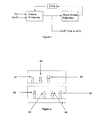
- Figure - 1 shows general motion estimation scheme with feedback of global motion.
- Figure - 2 shows a problematic situation without the present invention.
- Figure - 3 shows internal diagram of the motion estimation block.
- The parts in the figures are given reference numbers and these numbers are described below.
Objects in the first frame (a1), (a2), (a3) Objects in the second frame (b1), (b2), (b3), (b4) - Present invention comprises a solution to the problem of wrong motion estimation by limiting the motion vectors that are inconsistent with the global motion of the scene. The main principle of this invention is to limit the estimated motion vectors according to a threshold determined in conjunction with the global motion of the scene. The general motion estimation scheme is shown in Figure - 1. The global motion estimation for the whole frame is also considered for the estimation of the motion vector for any block.
- In the Figure - 2, a problematic situation for motion estimation is shown. Suppose that the actual matches of the objects in the first frame (a1, a2, a3) be the objects (b1, b2, b3) respectively in the second frame. Considering the actual matches, there is a global motion in positive x direction, since this global motion estimate must be supplied to the motion estimation module. Additionally, suppose the object (b4) in the second frame be an aperture object, that is, an object which newly enters the scene. When the motion estimation algorithm is searching for the match of the object (a3) in the second frame, it may somehow (if the search range is sufficiently large) label the object (b4) as the match of the object (a3) although the real matching is the object (a3) to the object (b3). This matching may be acceptable in terms of minimizing the pixel difference metric (PDM) or maximizing the peak signal - to - noise ratio (PSNR) value between the actual and the motion compensated frames. However, for applications where estimating the true motion is more important than such metrics, such a matching may lead to erroneous results. Since the consistency of the neighboring blocks is an important aspect for true motion applications, such a wrong motion vector may result in wrong modifications of the motion vectors of the neighboring blocks during the post processing steps for the motion vector field even when they are truly estimated.
- Present invention comprises for limiting the motion vector found in the reverse direction of the global motion vector according to thresholds for the x and y components. The internal block diagram of the motion estimation procedure with the present invention added is shown in
Figure 3 . - The first step of this method is the motion vector limit calculator (MVLC) unit which calculates the thresholds for the x and y components of the motion vectors according to the global motion vector supplied to the module. Then, motion vector limits are found as follows:


- The x and y components of the motion vector limits and the global motion vector are denoted by Lx, Ly and GMVx, GMVy, respectively. In addition, Kx, Ky any λ denote the components base limits which are predetermined threshold and a scaling constant, respectively.
- The parameters λ, Kx, Ky are design parameters to be determined as constants. However, there are constraints on these design parameters.

- Considering the equations determining the motion vector limit for the x component (1) in an intuitive manner, these equations can be written in the following form.

- There are two basic cases. In the first case, the global motion vector is strong in the positive direction, and
- if the x component of the global motion vector is positive and larger than the predetermined threshold, the motion vector limit is set in a tighter manner the negative direction since proportion of negative valued vectors with small absolute magnitude are allowed;
- if the x component of the global motion vector is smaller than the predetermined threshold, then this means it is not very strong in the positive direction. In this case, the motion vector limit in the negative direction is set to a looser value since more negative motion vectors are allowed.
- And the y component of the global motion vector limit is obtained by the similar procedure which has only one difference from the above mentioned procedure by using the y component of the global motion vector and the y component of base limit instead of the x component. Also, similar arguments can be made about the case where the x component of the global motion vector is negative and also for the y component of the global motion vector.
- These said thresholds are used to limit the motion vectors which are found in each path in a multipath motion estimation module. For each path, if any component of the estimated motion vector has the same sign with the corresponding limit (Lx or Ly) and has a greater absolute value, then the corresponding component of the motion vector is directly set to the corresponding limit (Lx and Ly).
- The core idea of the method in the present invention is that; the central search path is the search trajectory which starts seeking the match of a particular block in the reference frame from the frame coordinates of the block center in the search frame. When the motion vector of the central search path is found to be pointing towards the opposite direction of the global motion of the scene by amplitude larger than an allowed threshold decided by taking into account the amplitude of the global motion, it is limited. By this way, unexpected block matches are avoided.
Claims (6)
- A motion estimation improvement method avoiding fake block matches, characterized in that it further contains the steps of;• calculating thresholds for the x and y components of the motion vectors,• obtaining the x and y components of the motion vector limits (Lx and Ly) according to the said thresholds, and• setting the corresponding x and y components of the motion vector directly to the corresponding limits (Lx and Ly) if any component of the estimated motion vector has the same sign with the corresponding limit (Lx or Ly) and has a greater absolute value.
- A method according to claim 1 characterized in that, the x and y components of the motion vector limits are found according to the following conditional equation:

, respectively, wherein Lx, Ly represent the x and y components of the motion vector limits; GMVx, GMVy represent the x and y components of the global motion vector; Kx, Ky represent the x and y components base limits which are predetermined threshold and λ denote a scaling constant. - A method according to claim 2, wherein the parameters λ, Kx, Ky may take values such that;

- A method according to claim 1,2 and 3, the global motion vector (GMVx) is positive and larger than the predetermined threshold, the motion vector limit (Lx) is set in the negative direction since proportion of negative valued vectors with small absolute magnitude are allowed.
- A method according to Claim 1,2 or 3, if the x component of the global motion vector (GMVx) is smaller than the predetermined threshold, then this means it is not very strong in the positive direction.
- A method according to Claim 1 and 2, wherein the y component of the global motion vector limit is obtained by the similar procedure.
Applications Claiming Priority (1)
| Application Number | Priority Date | Filing Date | Title |
|---|---|---|---|
| TR2009/08439A TR200908439A2 (en) | 2009-11-06 | 2009-11-06 | A method of improving motion prediction that avoids counterfeit mapping. |
Publications (3)
| Publication Number | Publication Date |
|---|---|
| EP2336973A2 true EP2336973A2 (en) | 2011-06-22 |
| EP2336973A3 EP2336973A3 (en) | 2012-07-11 |
| EP2336973B1 EP2336973B1 (en) | 2013-04-24 |
Family
ID=43558349
Family Applications (1)
| Application Number | Title | Priority Date | Filing Date |
|---|---|---|---|
| EP10189552.2A Active EP2336973B1 (en) | 2009-11-06 | 2010-11-01 | Motion estimation improvement method avoiding fake block matches |
Country Status (3)
| Country | Link |
|---|---|
| EP (1) | EP2336973B1 (en) |
| ES (1) | ES2422716T3 (en) |
| TR (1) | TR200908439A2 (en) |
Citations (1)
| Publication number | Priority date | Publication date | Assignee | Title |
|---|---|---|---|---|
| US20070196018A1 (en) | 2006-02-22 | 2007-08-23 | Chao-Ho Chen | Method of multi-path block matching computing |
Family Cites Families (2)
| Publication number | Priority date | Publication date | Assignee | Title |
|---|---|---|---|---|
| CN101238714B (en) * | 2005-08-12 | 2012-03-28 | Nxp股份有限公司 | Digital image stabilization method and system |
| US8666661B2 (en) * | 2006-03-31 | 2014-03-04 | The Boeing Company | Video navigation |
-
2009
- 2009-11-06 TR TR2009/08439A patent/TR200908439A2/en unknown
-
2010
- 2010-11-01 EP EP10189552.2A patent/EP2336973B1/en active Active
- 2010-11-01 ES ES10189552T patent/ES2422716T3/en active Active
Patent Citations (1)
| Publication number | Priority date | Publication date | Assignee | Title |
|---|---|---|---|---|
| US20070196018A1 (en) | 2006-02-22 | 2007-08-23 | Chao-Ho Chen | Method of multi-path block matching computing |
Non-Patent Citations (4)
| Title |
|---|
| C. H. CHEUNG; L. M. PO: "A Novel Cross Diamond Search Algorithm for Fast Block Motion Estimation", IEEE TRANS., CIRCUITS AND SYST. VIDEO TECHNOL., vol. 12, no. 12, December 2002 (2002-12-01), pages 1168 - 1177 |
| C. ZHU; X. LIN; L. P. CHAU: "Hexagonal-Based Search Pattern for Fast Block Motion Estimation", IEEE TRANS., CIRCUITS AND SYST. VIDEO TECHNOL., vol. 12, no. 5, May 2002 (2002-05-01), pages 349 - 355 |
| S. ZHU; K. MA: "A New Diamond Search Algorithm for Fast Block-Matching Motion Estimation", IEEE TRANS., IMAGE PROCESSING, vol. 9, no. 2, February 2000 (2000-02-01), pages 287 - 290 |
| T. KOGA; K. LINUMA; A. HIRANO; Y. LIJIMA; T. ISHIGURO: "Motion Compensated Interframe Coding for Video Conferencing", PROC. NAT. TELECOMMUN. CONT., NEW ORLEANS, LA, NOV. 29-DEC. 3 1981, 29 November 1981 (1981-11-29), pages G5.3.1 - 5.3.5 |
Also Published As
| Publication number | Publication date |
|---|---|
| ES2422716T3 (en) | 2013-09-13 |
| TR200908439A2 (en) | 2011-05-23 |
| EP2336973B1 (en) | 2013-04-24 |
| EP2336973A3 (en) | 2012-07-11 |
Similar Documents
| Publication | Publication Date | Title |
|---|---|---|
| US6865227B2 (en) | Error concealment of video data using motion vector data recovery | |
| Huang et al. | A multistage motion vector processing method for motion-compensated frame interpolation | |
| US8116383B2 (en) | Efficient adaptive mode selection technique for H.264/AVC-coded video delivery in burst-packet-loss networks | |
| US8018998B2 (en) | Low complexity motion compensated frame interpolation method | |
| US6895361B2 (en) | Adaptive motion estimation apparatus and method | |
| Kang et al. | Dual motion estimation for frame rate up-conversion | |
| US20040227851A1 (en) | Frame interpolating method and apparatus thereof at frame rate conversion | |
| US6317460B1 (en) | Motion vector generation by temporal interpolation | |
| US6914938B2 (en) | Interlaced video motion estimation | |
| US20140010307A1 (en) | Method of and apparatus for complexity scalable frame rate up-conversion | |
| JP2007181674A (en) | Image formation method using block matching and motion compensated interpolation | |
| CN103079037A (en) | Self-adaptive electronic image stabilization method based on long-range view and close-range view switching | |
| WO2010093430A1 (en) | System and method for frame interpolation for a compressed video bitstream | |
| KR100234264B1 (en) | Block matching method using moving target window | |
| US20080107179A1 (en) | Global Motion Estimation | |
| US7982775B2 (en) | Method and apparatus for motion stabilization | |
| US8804830B2 (en) | Method for performing motion estimation | |
| KR100846780B1 (en) | Motion vector estimation method and device | |
| Thaipanich et al. | Video error concealment with outer and inner boundary matching algorithms | |
| EP2336973B1 (en) | Motion estimation improvement method avoiding fake block matches | |
| US8184706B2 (en) | Moving picture coding apparatus and method with decimation of pictures | |
| CN101600105A (en) | Frame frequency lifting method | |
| US8208552B2 (en) | Method, video encoder, and integrated circuit for detecting non-rigid body motion | |
| US20100195736A1 (en) | Moving image decoder, moving image decoding method, and computer-readable medium storing moving image decoding program | |
| WO2016131270A1 (en) | Error concealment method and apparatus |
Legal Events
| Date | Code | Title | Description |
|---|---|---|---|
| PUAI | Public reference made under article 153(3) epc to a published international application that has entered the european phase |
Free format text: ORIGINAL CODE: 0009012 |
|
| AK | Designated contracting states |
Kind code of ref document: A2 Designated state(s): AL AT BE BG CH CY CZ DE DK EE ES FI FR GB GR HR HU IE IS IT LI LT LU LV MC MK MT NL NO PL PT RO RS SE SI SK SM TR |
|
| AX | Request for extension of the european patent |
Extension state: BA ME |
|
| PUAL | Search report despatched |
Free format text: ORIGINAL CODE: 0009013 |
|
| AK | Designated contracting states |
Kind code of ref document: A3 Designated state(s): AL AT BE BG CH CY CZ DE DK EE ES FI FR GB GR HR HU IE IS IT LI LT LU LV MC MK MT NL NO PL PT RO RS SE SI SK SM TR |
|
| AX | Request for extension of the european patent |
Extension state: BA ME |
|
| RIC1 | Information provided on ipc code assigned before grant |
Ipc: G06T 7/20 20060101AFI20120605BHEP |
|
| 17P | Request for examination filed |
Effective date: 20121109 |
|
| GRAP | Despatch of communication of intention to grant a patent |
Free format text: ORIGINAL CODE: EPIDOSNIGR1 |
|
| GRAS | Grant fee paid |
Free format text: ORIGINAL CODE: EPIDOSNIGR3 |
|
| GRAA | (expected) grant |
Free format text: ORIGINAL CODE: 0009210 |
|
| AK | Designated contracting states |
Kind code of ref document: B1 Designated state(s): AL AT BE BG CH CY CZ DE DK EE ES FI FR GB GR HR HU IE IS IT LI LT LU LV MC MK MT NL NO PL PT RO RS SE SI SK SM TR |
|
| REG | Reference to a national code |
Ref country code: GB Ref legal event code: FG4D |
|
| REG | Reference to a national code |
Ref country code: CH Ref legal event code: EP |
|
| REG | Reference to a national code |
Ref country code: AT Ref legal event code: REF Ref document number: 609009 Country of ref document: AT Kind code of ref document: T Effective date: 20130515 |
|
| REG | Reference to a national code |
Ref country code: IE Ref legal event code: FG4D |
|
| REG | Reference to a national code |
Ref country code: DE Ref legal event code: R096 Ref document number: 602010006530 Country of ref document: DE Effective date: 20130627 |
|
| REG | Reference to a national code |
Ref country code: ES Ref legal event code: FG2A Ref document number: 2422716 Country of ref document: ES Kind code of ref document: T3 Effective date: 20130913 |
|
| REG | Reference to a national code |
Ref country code: AT Ref legal event code: MK05 Ref document number: 609009 Country of ref document: AT Kind code of ref document: T Effective date: 20130424 |
|
| REG | Reference to a national code |
Ref country code: LT Ref legal event code: MG4D |
|
| REG | Reference to a national code |
Ref country code: NL Ref legal event code: VDEP Effective date: 20130424 |
|
| PG25 | Lapsed in a contracting state [announced via postgrant information from national office to epo] |
Ref country code: AT Free format text: LAPSE BECAUSE OF FAILURE TO SUBMIT A TRANSLATION OF THE DESCRIPTION OR TO PAY THE FEE WITHIN THE PRESCRIBED TIME-LIMIT Effective date: 20130424 Ref country code: GR Free format text: LAPSE BECAUSE OF FAILURE TO SUBMIT A TRANSLATION OF THE DESCRIPTION OR TO PAY THE FEE WITHIN THE PRESCRIBED TIME-LIMIT Effective date: 20130725 Ref country code: PT Free format text: LAPSE BECAUSE OF FAILURE TO SUBMIT A TRANSLATION OF THE DESCRIPTION OR TO PAY THE FEE WITHIN THE PRESCRIBED TIME-LIMIT Effective date: 20130826 Ref country code: SE Free format text: LAPSE BECAUSE OF FAILURE TO SUBMIT A TRANSLATION OF THE DESCRIPTION OR TO PAY THE FEE WITHIN THE PRESCRIBED TIME-LIMIT Effective date: 20130424 Ref country code: BE Free format text: LAPSE BECAUSE OF FAILURE TO SUBMIT A TRANSLATION OF THE DESCRIPTION OR TO PAY THE FEE WITHIN THE PRESCRIBED TIME-LIMIT Effective date: 20130424 Ref country code: SI Free format text: LAPSE BECAUSE OF FAILURE TO SUBMIT A TRANSLATION OF THE DESCRIPTION OR TO PAY THE FEE WITHIN THE PRESCRIBED TIME-LIMIT Effective date: 20130424 Ref country code: LT Free format text: LAPSE BECAUSE OF FAILURE TO SUBMIT A TRANSLATION OF THE DESCRIPTION OR TO PAY THE FEE WITHIN THE PRESCRIBED TIME-LIMIT Effective date: 20130424 Ref country code: NO Free format text: LAPSE BECAUSE OF FAILURE TO SUBMIT A TRANSLATION OF THE DESCRIPTION OR TO PAY THE FEE WITHIN THE PRESCRIBED TIME-LIMIT Effective date: 20130724 Ref country code: IS Free format text: LAPSE BECAUSE OF FAILURE TO SUBMIT A TRANSLATION OF THE DESCRIPTION OR TO PAY THE FEE WITHIN THE PRESCRIBED TIME-LIMIT Effective date: 20130824 Ref country code: FI Free format text: LAPSE BECAUSE OF FAILURE TO SUBMIT A TRANSLATION OF THE DESCRIPTION OR TO PAY THE FEE WITHIN THE PRESCRIBED TIME-LIMIT Effective date: 20130424 |
|
| PG25 | Lapsed in a contracting state [announced via postgrant information from national office to epo] |
Ref country code: PL Free format text: LAPSE BECAUSE OF FAILURE TO SUBMIT A TRANSLATION OF THE DESCRIPTION OR TO PAY THE FEE WITHIN THE PRESCRIBED TIME-LIMIT Effective date: 20130424 Ref country code: HR Free format text: LAPSE BECAUSE OF FAILURE TO SUBMIT A TRANSLATION OF THE DESCRIPTION OR TO PAY THE FEE WITHIN THE PRESCRIBED TIME-LIMIT Effective date: 20130424 Ref country code: RS Free format text: LAPSE BECAUSE OF FAILURE TO SUBMIT A TRANSLATION OF THE DESCRIPTION OR TO PAY THE FEE WITHIN THE PRESCRIBED TIME-LIMIT Effective date: 20130424 Ref country code: CY Free format text: LAPSE BECAUSE OF FAILURE TO SUBMIT A TRANSLATION OF THE DESCRIPTION OR TO PAY THE FEE WITHIN THE PRESCRIBED TIME-LIMIT Effective date: 20130424 Ref country code: LV Free format text: LAPSE BECAUSE OF FAILURE TO SUBMIT A TRANSLATION OF THE DESCRIPTION OR TO PAY THE FEE WITHIN THE PRESCRIBED TIME-LIMIT Effective date: 20130424 Ref country code: BG Free format text: LAPSE BECAUSE OF FAILURE TO SUBMIT A TRANSLATION OF THE DESCRIPTION OR TO PAY THE FEE WITHIN THE PRESCRIBED TIME-LIMIT Effective date: 20130724 |
|
| PG25 | Lapsed in a contracting state [announced via postgrant information from national office to epo] |
Ref country code: SK Free format text: LAPSE BECAUSE OF FAILURE TO SUBMIT A TRANSLATION OF THE DESCRIPTION OR TO PAY THE FEE WITHIN THE PRESCRIBED TIME-LIMIT Effective date: 20130424 Ref country code: DK Free format text: LAPSE BECAUSE OF FAILURE TO SUBMIT A TRANSLATION OF THE DESCRIPTION OR TO PAY THE FEE WITHIN THE PRESCRIBED TIME-LIMIT Effective date: 20130424 Ref country code: EE Free format text: LAPSE BECAUSE OF FAILURE TO SUBMIT A TRANSLATION OF THE DESCRIPTION OR TO PAY THE FEE WITHIN THE PRESCRIBED TIME-LIMIT Effective date: 20130424 Ref country code: CZ Free format text: LAPSE BECAUSE OF FAILURE TO SUBMIT A TRANSLATION OF THE DESCRIPTION OR TO PAY THE FEE WITHIN THE PRESCRIBED TIME-LIMIT Effective date: 20130424 |
|
| PG25 | Lapsed in a contracting state [announced via postgrant information from national office to epo] |
Ref country code: RO Free format text: LAPSE BECAUSE OF FAILURE TO SUBMIT A TRANSLATION OF THE DESCRIPTION OR TO PAY THE FEE WITHIN THE PRESCRIBED TIME-LIMIT Effective date: 20130424 Ref country code: NL Free format text: LAPSE BECAUSE OF FAILURE TO SUBMIT A TRANSLATION OF THE DESCRIPTION OR TO PAY THE FEE WITHIN THE PRESCRIBED TIME-LIMIT Effective date: 20130424 |
|
| PLBE | No opposition filed within time limit |
Free format text: ORIGINAL CODE: 0009261 |
|
| STAA | Information on the status of an ep patent application or granted ep patent |
Free format text: STATUS: NO OPPOSITION FILED WITHIN TIME LIMIT |
|
| 26N | No opposition filed |
Effective date: 20140127 |
|
| REG | Reference to a national code |
Ref country code: DE Ref legal event code: R097 Ref document number: 602010006530 Country of ref document: DE Effective date: 20140127 |
|
| PG25 | Lapsed in a contracting state [announced via postgrant information from national office to epo] |
Ref country code: MC Free format text: LAPSE BECAUSE OF FAILURE TO SUBMIT A TRANSLATION OF THE DESCRIPTION OR TO PAY THE FEE WITHIN THE PRESCRIBED TIME-LIMIT Effective date: 20130424 |
|
| REG | Reference to a national code |
Ref country code: IE Ref legal event code: MM4A |
|
| PG25 | Lapsed in a contracting state [announced via postgrant information from national office to epo] |
Ref country code: IE Free format text: LAPSE BECAUSE OF NON-PAYMENT OF DUE FEES Effective date: 20131101 |
|
| PG25 | Lapsed in a contracting state [announced via postgrant information from national office to epo] |
Ref country code: SM Free format text: LAPSE BECAUSE OF FAILURE TO SUBMIT A TRANSLATION OF THE DESCRIPTION OR TO PAY THE FEE WITHIN THE PRESCRIBED TIME-LIMIT Effective date: 20130424 |
|
| REG | Reference to a national code |
Ref country code: CH Ref legal event code: PL |
|
| PG25 | Lapsed in a contracting state [announced via postgrant information from national office to epo] |
Ref country code: LI Free format text: LAPSE BECAUSE OF NON-PAYMENT OF DUE FEES Effective date: 20141130 Ref country code: LU Free format text: LAPSE BECAUSE OF NON-PAYMENT OF DUE FEES Effective date: 20131101 Ref country code: HU Free format text: LAPSE BECAUSE OF FAILURE TO SUBMIT A TRANSLATION OF THE DESCRIPTION OR TO PAY THE FEE WITHIN THE PRESCRIBED TIME-LIMIT; INVALID AB INITIO Effective date: 20101101 Ref country code: MK Free format text: LAPSE BECAUSE OF FAILURE TO SUBMIT A TRANSLATION OF THE DESCRIPTION OR TO PAY THE FEE WITHIN THE PRESCRIBED TIME-LIMIT Effective date: 20130424 Ref country code: CH Free format text: LAPSE BECAUSE OF NON-PAYMENT OF DUE FEES Effective date: 20141130 |
|
| REG | Reference to a national code |
Ref country code: FR Ref legal event code: PLFP Year of fee payment: 6 |
|
| PG25 | Lapsed in a contracting state [announced via postgrant information from national office to epo] |
Ref country code: MT Free format text: LAPSE BECAUSE OF FAILURE TO SUBMIT A TRANSLATION OF THE DESCRIPTION OR TO PAY THE FEE WITHIN THE PRESCRIBED TIME-LIMIT Effective date: 20130424 |
|
| REG | Reference to a national code |
Ref country code: FR Ref legal event code: PLFP Year of fee payment: 7 |
|
| REG | Reference to a national code |
Ref country code: FR Ref legal event code: PLFP Year of fee payment: 8 |
|
| PG25 | Lapsed in a contracting state [announced via postgrant information from national office to epo] |
Ref country code: AL Free format text: LAPSE BECAUSE OF FAILURE TO SUBMIT A TRANSLATION OF THE DESCRIPTION OR TO PAY THE FEE WITHIN THE PRESCRIBED TIME-LIMIT Effective date: 20130424 |
|
| PGFP | Annual fee paid to national office [announced via postgrant information from national office to epo] |
Ref country code: DE Payment date: 20241121 Year of fee payment: 15 |
|
| PGFP | Annual fee paid to national office [announced via postgrant information from national office to epo] |
Ref country code: GB Payment date: 20241120 Year of fee payment: 15 |
|
| PGFP | Annual fee paid to national office [announced via postgrant information from national office to epo] |
Ref country code: FR Payment date: 20241128 Year of fee payment: 15 |
|
| PGFP | Annual fee paid to national office [announced via postgrant information from national office to epo] |
Ref country code: IT Payment date: 20241126 Year of fee payment: 15 Ref country code: ES Payment date: 20241230 Year of fee payment: 15 |
|
| PGFP | Annual fee paid to national office [announced via postgrant information from national office to epo] |
Ref country code: TR Payment date: 20251031 Year of fee payment: 16 |
|
| REG | Reference to a national code |
Ref country code: DE Ref legal event code: R119 Ref document number: 602010006530 Country of ref document: DE |