EP2336722A1 - Speed profile dictionary - Google Patents
Speed profile dictionary Download PDFInfo
- Publication number
- EP2336722A1 EP2336722A1 EP10193998A EP10193998A EP2336722A1 EP 2336722 A1 EP2336722 A1 EP 2336722A1 EP 10193998 A EP10193998 A EP 10193998A EP 10193998 A EP10193998 A EP 10193998A EP 2336722 A1 EP2336722 A1 EP 2336722A1
- Authority
- EP
- European Patent Office
- Prior art keywords
- speed
- traffic data
- data
- historic traffic
- historic
- Prior art date
- Legal status (The legal status is an assumption and is not a legal conclusion. Google has not performed a legal analysis and makes no representation as to the accuracy of the status listed.)
- Granted
Links
Images



Classifications
-
- G—PHYSICS
- G01—MEASURING; TESTING
- G01C—MEASURING DISTANCES, LEVELS OR BEARINGS; SURVEYING; NAVIGATION; GYROSCOPIC INSTRUMENTS; PHOTOGRAMMETRY OR VIDEOGRAMMETRY
- G01C21/00—Navigation; Navigational instruments not provided for in groups G01C1/00 - G01C19/00
- G01C21/26—Navigation; Navigational instruments not provided for in groups G01C1/00 - G01C19/00 specially adapted for navigation in a road network
- G01C21/34—Route searching; Route guidance
- G01C21/3453—Special cost functions, i.e. other than distance or default speed limit of road segments
- G01C21/3492—Special cost functions, i.e. other than distance or default speed limit of road segments employing speed data or traffic data, e.g. real-time or historical
-
- G—PHYSICS
- G08—SIGNALLING
- G08G—TRAFFIC CONTROL SYSTEMS
- G08G1/00—Traffic control systems for road vehicles
- G08G1/01—Detecting movement of traffic to be counted or controlled
- G08G1/0104—Measuring and analyzing of parameters relative to traffic conditions
- G08G1/0108—Measuring and analyzing of parameters relative to traffic conditions based on the source of data
- G08G1/0112—Measuring and analyzing of parameters relative to traffic conditions based on the source of data from the vehicle, e.g. floating car data [FCD]
-
- G—PHYSICS
- G08—SIGNALLING
- G08G—TRAFFIC CONTROL SYSTEMS
- G08G1/00—Traffic control systems for road vehicles
- G08G1/01—Detecting movement of traffic to be counted or controlled
- G08G1/0104—Measuring and analyzing of parameters relative to traffic conditions
- G08G1/0108—Measuring and analyzing of parameters relative to traffic conditions based on the source of data
- G08G1/0116—Measuring and analyzing of parameters relative to traffic conditions based on the source of data from roadside infrastructure, e.g. beacons
-
- G—PHYSICS
- G08—SIGNALLING
- G08G—TRAFFIC CONTROL SYSTEMS
- G08G1/00—Traffic control systems for road vehicles
- G08G1/01—Detecting movement of traffic to be counted or controlled
- G08G1/0104—Measuring and analyzing of parameters relative to traffic conditions
- G08G1/0108—Measuring and analyzing of parameters relative to traffic conditions based on the source of data
- G08G1/012—Measuring and analyzing of parameters relative to traffic conditions based on the source of data from other sources than vehicle or roadside beacons, e.g. mobile networks
-
- G—PHYSICS
- G08—SIGNALLING
- G08G—TRAFFIC CONTROL SYSTEMS
- G08G1/00—Traffic control systems for road vehicles
- G08G1/01—Detecting movement of traffic to be counted or controlled
- G08G1/0104—Measuring and analyzing of parameters relative to traffic conditions
- G08G1/0125—Traffic data processing
- G08G1/0129—Traffic data processing for creating historical data or processing based on historical data
-
- G—PHYSICS
- G08—SIGNALLING
- G08G—TRAFFIC CONTROL SYSTEMS
- G08G1/00—Traffic control systems for road vehicles
- G08G1/01—Detecting movement of traffic to be counted or controlled
- G08G1/0104—Measuring and analyzing of parameters relative to traffic conditions
- G08G1/0137—Measuring and analyzing of parameters relative to traffic conditions for specific applications
- G08G1/0141—Measuring and analyzing of parameters relative to traffic conditions for specific applications for traffic information dissemination
Definitions
- the present invention relates generally to historic traffic data, and more particularly, relates to a speed profile dictionary for representing historic speed data.
- Historic traffic data for a roadway may include travel time, delay time, speed, and/or congestion data for various times of the day, days of the week, days of the year, and so on.
- the historic traffic data may be obtained from roadway sensors, probes, and/or incident reporting systems.
- the sensors may use radar, acoustics, video, and embedded loops in the roadway to collect data that can be used to characterize traffic conditions.
- sensor data may include speed, volume (number of vehicles passing the sensor per period of time), and density (percentage of the roadway that is occupied by vehicles).
- the sensor data may include other data types as well, such as vehicle classification (e.g., car, truck, motorcycle).
- Probe data is point data collected from a moving vehicle having a device that can identify vehicle position as a vehicle travels along a road network.
- the device may use cellular technology (e.g., cell handover) or Global Positioning Satellite (GPS) technology to monitor the vehicle's position on the road network.
- GPS Global Positioning Satellite
- the probe data can be used to determine travel time, which can then be used to calculate speed of the vehicle.
- Incident data is traffic data regarding a traffic event that obstructs the flow of traffic on the road system or is otherwise noteworthy in reference to traffic.
- Example incidents include accidents, congestion, construction, disabled vehicles, and vehicle fires.
- a traffic operator may enter the incident data into a Traffic Incident Management System (TIMS), such as the TIMS described in U.S. Patent Publication No. 2004/0143385 , which is assigned to the same assignee as the current application.
- the traffic operator is a person who gathers traffic information from a variety of sources, such as by monitoring emergency scanner frequencies; by viewing images from cameras located adjacent to a roadway; by calling government departments of transportation, police, and emergency services; and by obtaining information from aircraft flying over the road network.
- the historic traffic data may be stored in a historic traffic database, such as NAVTEQ Traffic PatternsTM database, which includes typical traffic speeds for many primary and secondary roads. Data in the historic traffic database may be used in routing applications allowing drivers to plan routes that avoid typically congested areas and receive more accurate trip time estimates based on likely traffic conditions.
- the historic traffic data may also be used to predict clearance time for a traffic event; to predict traffic conditions when sensor data, probe data, and/or incident data is unavailable for a particular roadway; to predict the probability of accidents; or for any other suitable purpose.
- historic traffic database has many beneficial uses, there are still opportunities for improvement.
- One area for improvement is in reducing the storage requirements for the historic traffic database. Because the volume of historic traffic data is so large, it would be beneficial to represent historic traffic data in a manner that minimizes storage requirements.
- a speed profile dictionary and associated lookup tables are disclosed.
- a set of distinct speed profiles is defined using a statistical analysis routine.
- the statistical analysis routine uses clustering.
- Clustering is a statistical analysis technique that analyzes the distribution of data over multiple dimensions and attempts to organize the data into "like" groupings.
- the speed profiles are then matched to location codes identifying physical locations on a road network.
- the use of a speed profile dictionary may reduce storage requirements of a historic traffic database up to 98%.
- the speed profile dictionary may also be used to identify erroneous input data, which improves the consistency and quality of a historic traffic database.
- FIG. 1 is a block diagram of a computing platform 100 that includes hardware and software.
- the computing platform 100 may be a server, a personal computer (PC), a plurality of computers coupled together for parallel computing applications, or any other computer or computer system.
- the computing platform 100 includes a processor 102 that is operable to execute a speed profile dictionary (SPD) application 104 stored in computer-readable storage memory 106.
- SPD speed profile dictionary
- the computer-readable storage memory 106 may be located within the computing platform 100 as shown in Figure 1 .
- the computer-readable storage memory 106 may be located external to the computing platform 100, such as on a flash drive or a CD-ROM disc, which is accessed by the computing platform 100 when the memory 106 is connected to computing platform 100.
- the SPD application 104 generates speed profiles based on historic traffic data stored in a first data store 108.
- the SPD application 104 then associates the generated speed profiles with a cluster identifier to create a speed profile dictionary.
- the SPD application 104 also generates one or more lookup tables that associates location data and time periods with the cluster identifiers.
- the processor 102 then stores the speed profile dictionary and the lookup tables in a second data store 110.
- the data stores 108, 110 include data organized in a data structure and stored in memory, such as ROM, RAM, and flash memory. While Figure 1 depicts the data stores 108, 110 as being on the computing platform 100, it is understood that one or both of the data stores 108, 110 may be stored elsewhere and be accessible to the computing platform 100. Additionally, the data stores 108, 110 may be divided into more than two data stores.
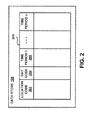
- Figure 2 is an example input to the SPD application 104 depicted in Figure 1 .
- the example depicted in Figure 2 is a table 200 that may be stored in the first data store 108.
- Other data structures may be used for organizing and storing the input data. Additionally, other types of data may be included in the input data.
- the table 200 includes a location code attribute 202.
- the location code attribute 202 includes data associated with location information.
- the location information may include geographical coordinates (e.g., latitude, longitude, and altitude), traffic codes (e.g., Radio Data System Traffic Message Channel (RDS-TMC) codes and Vehicle Information and Communication System (VICS) codes), road segment identifications, grid or tile identifications, and/or any other method of identifying a physical location on or adjacent to a road network in the real world.
- geographical coordinates e.g., latitude, longitude, and altitude
- traffic codes e.g., Radio Data System Traffic Message Channel (RDS-TMC) codes and Vehicle Information and Communication System (VICS) codes
- road segment identifications e.g., grid or tile identifications, and/or any other method of identifying a physical location on or adjacent to a road network in the real world.
- the table 200 also includes a day code attribute 204.
- the day code attribute 204 includes data associated with days of the week and other days of interest.
- Other coding schemes may also be used to identify days of the week and other days of interest.
- the day code attribute 204 may identify other conditions that may impact travel times.
- the day code attribute 204 may include data associated with weather conditions, such as rain, snow, and wind.
- the day code attribute 204 may include data associated with road conditions, such as lane closures.
- the table 200 also includes one or more time period attributes 206.
- the time period attributes 206 includes data associated with a speed value for a period of time. For example, the period of time may be fifteen minutes. In this example, there are ninety-six time periods, each associated with a speed value. Other time period durations may also be used.
- the speed value may be a number representing an average speed (e.g., miles per hour (MPH), kilometers per hour (KPH)) for the time period measured at the associated location. The speed value may also represent other values, such as the median speed for the time period measured at the associated location.
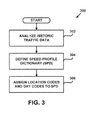
- Figure 3 is a flow chart of a method 300 for generating a speed profile dictionary and associated lookup tables using the data stored in the first data store 108.
- the method 300 may include organizing the historic traffic data as depicted in Figure 2 if not already in this format.
- the method 300 may include additional steps not depicted in Figure 3 as well.
- the SPD application 104 analyzes the historic traffic data stored in the first data store 108.
- a cluster analysis is performed on the historic traffic data.
- Clustering is a statistical analysis technique that analyzes the distribution of data over multiple dimensions and attempts to organize the data into "like" groupings.
- other (supervised or unsupervised) analytical techniques may be used. For example, Fuzzy c-means, hierarchical, Self Organizing Tree Algorithm (SOTA), and other neural network approaches may be used.
- SOTA Self Organizing Tree Algorithm
- An example analysis is described with respect to Figure 4 .
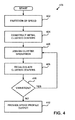
- Figure 4 is a flow chart of a method 400 of analyzing historic traffic data stored in the first data store 108.
- the method 400 uses k-means clustering. K-means clustering works well with large datasets, such as the historic traffic data.
- the SPD application 104 may use analytic software sold by SPSS Inc. to analyze the historic traffic data.
- SPSS Inc. analytic software sold by SPSS Inc.
- other algorithms and/or software programs may be used in the method 400.
- the SPD application 104 partitions the historic traffic data stored in the data store 108 into speed groups referred to herein as speed buckets.
- the historic speed data may be grouped into 5 KPI-I speed buckets.
- the partitions are based on multiples of five and include speeds that are +/- 2.5 KPH. The partitioning may ensure that a given location code's overnight speed is consistent among different days of the week.
- the speed buckets are clustered separately based on the number of location codes present in each partition.
- the SPD application 104 constructs initial cluster centers.
- the initial cluster centers may be predetermined or be randomly selected. For example, initially the cluster centers may be randomly selected. Over time, the initial cluster centers may be predetermined based on the previous results of the method 400.
- the SPD application 104 assigns cluster groupings based on a distance to the cluster centers. Location codes are assigned to the closest cluster center. At block 408, the SPD application 104 recalculates cluster centers based on the location codes assigned to the cluster. This process of assigning location codes to cluster centers and then recalculating new cluster center locations continues based on the determination at block 410.
- the SPD application 104 determines whether there is a variation in the cluster centers. For example, if the cluster centers did not move after the last cluster center recalculation, there is no variation. Additionally or alternatively, if the cluster centers moved slightly (e.g., below a threshold amount) or are oscillating between two locations, the SPD application 104 may determine that there is no variation in the cluster centers. If there is a variation, the SPD application 104 returns to block 406. Otherwise, at block 412, the SPD application 104 outputs speed profiles, which are used at block 304 of the method 300.
- the SPD application 104 may determine whether a predetermined number of iterations have occurred. For example, the predetermined number of iterations may be 100. If the predetermined number of iterations has not been reached, the SPD application 104 returns to block 406. Otherwise, at block 412, the SPD application 104 outputs speed profiles, which are used at block 304 of the method 300.
- the SPD application 104 defines a speed profile dictionary using the speed profiles generated by analyzing the historic traffic data at block 302.
- the SPD application 104 collects location codes 202 for each cluster and generates statistics for each time period 206 (epoch).
- Figure 5 is a graph 500 that depicts example statistics for a speed profile.
- the graph 500 depicts the range of values 502, the ninetieth (90 th ) percentile 504, and the defined speed profile 506.
- the speed profile 506 is defined as the mean speed value.
- Figure 6 is a graph 600 that depicts an example speed profile 602.
- the speed profile 602 is defined as the speed values in time period 206 order, which comprises an entire day speed pattern for a given location code 202.
- the speed profiles are combined if similar to ensure that the profiles have a unique shape. Similar profiles may be identified by performing a least squares error analysis using the following equation, where d represents the deviation between speeds for a given epoch.
- Each unique speed profile is assigned a cluster identifier for referencing purposes.
- the SPD application 104 assigns location codes and day codes to the speed profiles defined at block 304.
- Figure 7 depicts a portion of an example speed profile dictionary 700 and a portion of an example speed profile dictionary lookup table 702.
- Figure 7 is an example output of the SPD application 104 depicted in Figure 1 , which may be stored in the data store 110.
- the speed profile dictionary 700 organizes speed profiles by the assigned cluster identifier.
- the speed profile dictionary 700 may include any number of speed profiles.
- the speed profile dictionary may have 500-1000 different clusters to provide a good range of profiles with minimal loss of accuracy.
- the speed profile dictionary lookup table 702 identifies a corresponding speed profile by location and day using the cluster identifier from the speed profile dictionary 700. ln the example depicted in Figure 7 , the cluster identifier #5 is assigned to location code 5918, Monday through Friday. While the lookup table 702 uses TMC codes, it is understood that any location referencing scheme may be used. Additionally, more than one lookup table may be created. For example, there may be separate tables for holidays, special days, and/or bad traffic days due to weather, lane closures, and so on.
- An application using historic traffic data may use the speed profile dictionary 700 along with one or more lookup tables 702 instead of using the entire historic traffic database.
- the routing application may be stored in the memory of a navigation system, a mobile telephone, a personal computer, a server connected to the Internet, or any other suitable computing platform.
- a user may request route guidance by providing information, such as origin, destination, departure day, departure time, arrival day, and arrival time, to the computing platform.
- the routing application then calculates a route from the origin to the destination using known routing algorithms.
- the routing application identifies location codes associated with a physical location along the route and uses the location codes and the departure day to obtain a cluster identifier from the lookup table 702.
- the departure day may default to the day of the request; however, the user may specify a future date for planning a trip to occur later.
- the routing application obtains a speed profile from the speed profile dictionary 700 using the cluster identifier.
- the routing application calculates an estimated time of travel for the route using the speed profile and provides the route and the estimated time of travel to the user. Additionally or alternatively, the routing application may calculate an estimated time of departure to arrive at a destination at the time specified by the user. Additionally or alternatively, the routing application may calculate alternative routes allowing the user to select a route that meets his requirements (e.g., shortest distance, fastest time, no highways, least amount of traffic).
- the routing application uses the lookup table 702 to obtain the speed profile identified by cluster identifier #10.
- the speed profile identifies the expected speed of travel on that portion of the road network. While this example describes using the speed profile dictionary for routing, the speed profile dictionary may be used with other applications as well.
- the method 300 may be used to identify unlikely speed profiles resulting from erroneous input data and/or processing of the input data.
- the speed profile dictionary may provide more quality and/or consistency than a historic traffic database.
- the speed profile dictionary may be used for portions of the road network not identified in the historic traffic database.
- speed profiles may be assigned to location codes for which there is little or no source data based on similarities with other location codes.
- the two location codes (one associated with historic traffic data, one without) may represent the same type of road (e.g., highway), in a similar area (e.g., city center), having a similar population.
Landscapes
- Physics & Mathematics (AREA)
- General Physics & Mathematics (AREA)
- Chemical & Material Sciences (AREA)
- Analytical Chemistry (AREA)
- Engineering & Computer Science (AREA)
- Radar, Positioning & Navigation (AREA)
- Remote Sensing (AREA)
- Automation & Control Theory (AREA)
- Traffic Control Systems (AREA)
- Navigation (AREA)
Abstract
Description
- The present invention relates generally to historic traffic data, and more particularly, relates to a speed profile dictionary for representing historic speed data.
- Historic traffic data for a roadway may include travel time, delay time, speed, and/or congestion data for various times of the day, days of the week, days of the year, and so on. The historic traffic data may be obtained from roadway sensors, probes, and/or incident reporting systems. The sensors may use radar, acoustics, video, and embedded loops in the roadway to collect data that can be used to characterize traffic conditions. For example, sensor data may include speed, volume (number of vehicles passing the sensor per period of time), and density (percentage of the roadway that is occupied by vehicles). The sensor data may include other data types as well, such as vehicle classification (e.g., car, truck, motorcycle).
- Probe data is point data collected from a moving vehicle having a device that can identify vehicle position as a vehicle travels along a road network. For example, the device may use cellular technology (e.g., cell handover) or Global Positioning Satellite (GPS) technology to monitor the vehicle's position on the road network. By monitoring the vehicle's movement, the probe data can be used to determine travel time, which can then be used to calculate speed of the vehicle.
- Incident data is traffic data regarding a traffic event that obstructs the flow of traffic on the road system or is otherwise noteworthy in reference to traffic. Example incidents include accidents, congestion, construction, disabled vehicles, and vehicle fires. A traffic operator may enter the incident data into a Traffic Incident Management System (TIMS), such as the TIMS described in
U.S. Patent Publication No. 2004/0143385 , which is assigned to the same assignee as the current application. The traffic operator is a person who gathers traffic information from a variety of sources, such as by monitoring emergency scanner frequencies; by viewing images from cameras located adjacent to a roadway; by calling government departments of transportation, police, and emergency services; and by obtaining information from aircraft flying over the road network. - The historic traffic data may be stored in a historic traffic database, such as NAVTEQ Traffic Patterns™ database, which includes typical traffic speeds for many primary and secondary roads. Data in the historic traffic database may be used in routing applications allowing drivers to plan routes that avoid typically congested areas and receive more accurate trip time estimates based on likely traffic conditions. The historic traffic data may also be used to predict clearance time for a traffic event; to predict traffic conditions when sensor data, probe data, and/or incident data is unavailable for a particular roadway; to predict the probability of accidents; or for any other suitable purpose.
- While the historic traffic database has many beneficial uses, there are still opportunities for improvement. One area for improvement is in reducing the storage requirements for the historic traffic database. Because the volume of historic traffic data is so large, it would be beneficial to represent historic traffic data in a manner that minimizes storage requirements.
- A speed profile dictionary and associated lookup tables are disclosed. A set of distinct speed profiles is defined using a statistical analysis routine. Preferably, the statistical analysis routine uses clustering. Clustering is a statistical analysis technique that analyzes the distribution of data over multiple dimensions and attempts to organize the data into "like" groupings. The speed profiles are then matched to location codes identifying physical locations on a road network. The use of a speed profile dictionary may reduce storage requirements of a historic traffic database up to 98%. The speed profile dictionary may also be used to identify erroneous input data, which improves the consistency and quality of a historic traffic database.
- These as well as other aspects and advantages will become apparent to those of ordinary skill in the art by reading the following detailed description, with reference where appropriate to the accompanying drawings. Further, it is understood that this summary is merely an example and is not intended to limit the scope of the invention as claimed.
- Presently preferred embodiments are described below in conjunction with the appended drawing figures, wherein like reference numerals refer to like elements in the various figures, and wherein:
-
Figure 1 is a block diagram of a computing platform for generating a speed profile dictionary, according to an example; -
Figure 2 is an example input of the speed profile dictionary application depicted inFigure 1 ; -
Figure 3 is a flow chart of a method for generating a speed profile dictionary and associated lookup tables, according to an example; -
Figure 4 is a flow chart of a method of analyzing historic traffic data, according to an example; -
Figure 5 is a graph that depicts example statistics for a speed profile; -
Figure 6 is a graph that depicts an example speed profile; and -
Figure 7 depicts a speed profile dictionary and a speed profile dictionary lookup table, according to an example. -
Figure 1 is a block diagram of acomputing platform 100 that includes hardware and software. Thecomputing platform 100 may be a server, a personal computer (PC), a plurality of computers coupled together for parallel computing applications, or any other computer or computer system. Thecomputing platform 100 includes aprocessor 102 that is operable to execute a speed profile dictionary (SPD) application 104 stored in computer-readable storage memory 106. The computer-readable storage memory 106 may be located within thecomputing platform 100 as shown inFigure 1 . Alternatively, the computer-readable storage memory 106 may be located external to thecomputing platform 100, such as on a flash drive or a CD-ROM disc, which is accessed by thecomputing platform 100 when thememory 106 is connected tocomputing platform 100. - The SPD application 104 generates speed profiles based on historic traffic data stored in a
first data store 108. The SPD application 104 then associates the generated speed profiles with a cluster identifier to create a speed profile dictionary. The SPD application 104 also generates one or more lookup tables that associates location data and time periods with the cluster identifiers. Theprocessor 102 then stores the speed profile dictionary and the lookup tables in asecond data store 110. - The
data stores Figure 1 depicts thedata stores computing platform 100, it is understood that one or both of thedata stores computing platform 100. Additionally, thedata stores -
Figure 2 is an example input to the SPD application 104 depicted inFigure 1 . The example depicted inFigure 2 is a table 200 that may be stored in thefirst data store 108. Other data structures may be used for organizing and storing the input data. Additionally, other types of data may be included in the input data. - The table 200 includes a
location code attribute 202. Thelocation code attribute 202 includes data associated with location information. The location information may include geographical coordinates (e.g., latitude, longitude, and altitude), traffic codes (e.g., Radio Data System Traffic Message Channel (RDS-TMC) codes and Vehicle Information and Communication System (VICS) codes), road segment identifications, grid or tile identifications, and/or any other method of identifying a physical location on or adjacent to a road network in the real world. - The table 200 also includes a
day code attribute 204. Theday code attribute 204 includes data associated with days of the week and other days of interest. For example, the days of the week may be represented numerically (e.g., Sunday = I, ... Saturday = 7). As another example, the other days of interest may be assigned numerical codes, such as 100 = Thanksgiving, 200 = Easter Sunday, and so on. Other coding schemes may also be used to identify days of the week and other days of interest. - Additionally, the
day code attribute 204 may identify other conditions that may impact travel times. For example, theday code attribute 204 may include data associated with weather conditions, such as rain, snow, and wind. As another example, theday code attribute 204 may include data associated with road conditions, such as lane closures. - The table 200 also includes one or more time period attributes 206. The time period attributes 206 includes data associated with a speed value for a period of time. For example, the period of time may be fifteen minutes. In this example, there are ninety-six time periods, each associated with a speed value. Other time period durations may also be used. The speed value may be a number representing an average speed (e.g., miles per hour (MPH), kilometers per hour (KPH)) for the time period measured at the associated location. The speed value may also represent other values, such as the median speed for the time period measured at the associated location.
-
Figure 3 is a flow chart of amethod 300 for generating a speed profile dictionary and associated lookup tables using the data stored in thefirst data store 108. Themethod 300 may include organizing the historic traffic data as depicted inFigure 2 if not already in this format. Themethod 300 may include additional steps not depicted inFigure 3 as well. - At
block 302, the SPD application 104 analyzes the historic traffic data stored in thefirst data store 108. Preferably, a cluster analysis is performed on the historic traffic data. Clustering is a statistical analysis technique that analyzes the distribution of data over multiple dimensions and attempts to organize the data into "like" groupings. However, other (supervised or unsupervised) analytical techniques may be used. For example, Fuzzy c-means, hierarchical, Self Organizing Tree Algorithm (SOTA), and other neural network approaches may be used. An example analysis is described with respect toFigure 4 . -
Figure 4 is a flow chart of amethod 400 of analyzing historic traffic data stored in thefirst data store 108. Themethod 400 uses k-means clustering. K-means clustering works well with large datasets, such as the historic traffic data. In one example, the SPD application 104 may use analytic software sold by SPSS Inc. to analyze the historic traffic data. However, other algorithms and/or software programs may be used in themethod 400. - At
block 402, the SPD application 104 partitions the historic traffic data stored in thedata store 108 into speed groups referred to herein as speed buckets. For example, the historic speed data may be grouped into 5 KPI-I speed buckets. In this example, the partitions are based on multiples of five and include speeds that are +/- 2.5 KPH. The partitioning may ensure that a given location code's overnight speed is consistent among different days of the week. - The speed buckets are clustered separately based on the number of location codes present in each partition. The number of clusters targeted for each partition may be obtained using the following formula, where LC = location code and Target is the target output of clusters.

- At
block 404, the SPD application 104 constructs initial cluster centers. The initial cluster centers may be predetermined or be randomly selected. For example, initially the cluster centers may be randomly selected. Over time, the initial cluster centers may be predetermined based on the previous results of themethod 400. - At
block 406, the SPD application 104 assigns cluster groupings based on a distance to the cluster centers. Location codes are assigned to the closest cluster center. Atblock 408, the SPD application 104 recalculates cluster centers based on the location codes assigned to the cluster. This process of assigning location codes to cluster centers and then recalculating new cluster center locations continues based on the determination atblock 410. - At
block 410, the SPD application 104 determines whether there is a variation in the cluster centers. For example, if the cluster centers did not move after the last cluster center recalculation, there is no variation. Additionally or alternatively, if the cluster centers moved slightly (e.g., below a threshold amount) or are oscillating between two locations, the SPD application 104 may determine that there is no variation in the cluster centers. If there is a variation, the SPD application 104 returns to block 406. Otherwise, atblock 412, the SPD application 104 outputs speed profiles, which are used atblock 304 of themethod 300. - Additionally or alternatively, at
block 410, the SPD application 104 may determine whether a predetermined number of iterations have occurred. For example, the predetermined number of iterations may be 100. If the predetermined number of iterations has not been reached, the SPD application 104 returns to block 406. Otherwise, atblock 412, the SPD application 104 outputs speed profiles, which are used atblock 304 of themethod 300. - Returning to
Figure 3 , atblock 304 the SPD application 104 defines a speed profile dictionary using the speed profiles generated by analyzing the historic traffic data atblock 302. The SPD application 104 collectslocation codes 202 for each cluster and generates statistics for each time period 206 (epoch).Figure 5 is agraph 500 that depicts example statistics for a speed profile. Thegraph 500 depicts the range ofvalues 502, the ninetieth (90th)percentile 504, and the definedspeed profile 506. In this example, thespeed profile 506 is defined as the mean speed value.Figure 6 is agraph 600 that depicts anexample speed profile 602. Thespeed profile 602 is defined as the speed values intime period 206 order, which comprises an entire day speed pattern for a givenlocation code 202. - The speed profiles are combined if similar to ensure that the profiles have a unique shape. Similar profiles may be identified by performing a least squares error analysis using the following equation, where d represents the deviation between speeds for a given epoch.

- Each unique speed profile is assigned a cluster identifier for referencing purposes.
- At
block 306, the SPD application 104 assigns location codes and day codes to the speed profiles defined atblock 304.Figure 7 depicts a portion of an examplespeed profile dictionary 700 and a portion of an example speed profile dictionary lookup table 702.Figure 7 is an example output of the SPD application 104 depicted inFigure 1 , which may be stored in thedata store 110. - The
speed profile dictionary 700 organizes speed profiles by the assigned cluster identifier. Thespeed profile dictionary 700 may include any number of speed profiles. For example, the speed profile dictionary may have 500-1000 different clusters to provide a good range of profiles with minimal loss of accuracy. - The speed profile dictionary lookup table 702 identifies a corresponding speed profile by location and day using the cluster identifier from the
speed profile dictionary 700. ln the example depicted inFigure 7 , thecluster identifier # 5 is assigned tolocation code 5918, Monday through Friday. While the lookup table 702 uses TMC codes, it is understood that any location referencing scheme may be used. Additionally, more than one lookup table may be created. For example, there may be separate tables for holidays, special days, and/or bad traffic days due to weather, lane closures, and so on. - An application using historic traffic data, such as a routing application, may use the
speed profile dictionary 700 along with one or more lookup tables 702 instead of using the entire historic traffic database. The routing application may be stored in the memory of a navigation system, a mobile telephone, a personal computer, a server connected to the Internet, or any other suitable computing platform. A user may request route guidance by providing information, such as origin, destination, departure day, departure time, arrival day, and arrival time, to the computing platform. - The routing application then calculates a route from the origin to the destination using known routing algorithms. The routing application identifies location codes associated with a physical location along the route and uses the location codes and the departure day to obtain a cluster identifier from the lookup table 702. The departure day may default to the day of the request; however, the user may specify a future date for planning a trip to occur later. The routing application obtains a speed profile from the
speed profile dictionary 700 using the cluster identifier. - The routing application calculates an estimated time of travel for the route using the speed profile and provides the route and the estimated time of travel to the user. Additionally or alternatively, the routing application may calculate an estimated time of departure to arrive at a destination at the time specified by the user. Additionally or alternatively, the routing application may calculate alternative routes allowing the user to select a route that meets his requirements (e.g., shortest distance, fastest time, no highways, least amount of traffic).
- Referring back to
Figure 7 , if a routing application is asked to provide route guidance along the portion of the road network assignedTMC code 5920 on a Monday, the routing application uses the lookup table 702 to obtain the speed profile identified bycluster identifier # 10. Depending on the time requested for route guidance, the speed profile identifies the expected speed of travel on that portion of the road network. While this example describes using the speed profile dictionary for routing, the speed profile dictionary may be used with other applications as well. - Other benefits may be realized from using the
method 300 to generate a speed profile dictionary. For example, themethod 300 may be used to identify unlikely speed profiles resulting from erroneous input data and/or processing of the input data. As a result, the speed profile dictionary may provide more quality and/or consistency than a historic traffic database. - Additionally, the speed profile dictionary may be used for portions of the road network not identified in the historic traffic database. For example, speed profiles may be assigned to location codes for which there is little or no source data based on similarities with other location codes. For example, the two location codes (one associated with historic traffic data, one without) may represent the same type of road (e.g., highway), in a similar area (e.g., city center), having a similar population.
- It is intended that the foregoing detailed description be regarded as illustrative rather than limiting and that it is understood that the following claims including all equivalents are intended to define the scope of the invention. For example, while the systems and methods described herein used speed data, it is understood that other traffic data may be used in similar systems and methods. The claims should not be read as limited to the described order or elements unless stated to that effect. Therefore, all embodiments that come within the scope and spirit of the following claims and equivalents thereto are claimed as the invention.
Claims (11)
- A computer-implemented method for generating a speed profile dictionary embedded in a computer readable memory, comprising:receiving historic traffic data associated with a road network in a geographic area;partitioning the historic traffic data into speed data ranges;analyzing the historic traffic data by partition to generate a plurality of speed profiles;assigning each speed profile a unique identifier;associating the plurality of speed profiles to location codes that reference physical locations on the road network and day codes that reference days of a week; andproviding a lookup table that references the speed profile identifier by the location code and the day code.
- The method of claim 1, wherein the historic traffic data includes historic speed data associated with the road network.
- The method of claim 1, wherein analyzing the historic traffic data includes organizing the historic traffic data by the location code, the day code, and a plurality of time periods.
- The method of claim 1, wherein analyzing the historic traffic data includes performing a cluster analysis.
- The method of claim 4, wherein the cluster analysis is performed for each partition and the number of clusters per partition is equal to (partition location code count/total location code count) * target output of clusters +2.
- The method of claim 1, wherein analyzing the historic traffic data includes identifying similar speed profiles using a least squares error analysis.
- The method of claim 6, further comprising combining speed profiles that are similar.
- A system for generating a speed profile dictionary, comprising in combination:a processor;data storage; and
machine language instructions stored in the data storage executable by the processor to:analyze historic traffic data within speed data ranges to generate a plurality of speed profiles, wherein the historic traffic data is associated with a road network in a geographic area;assign each speed profile a unique identifier;associate the plurality of speed profiles to location codes that reference physical locations on the road network and day codes; andprovide a lookup table that references the speed profile identifier by the location code and the day code. - The system of claim 8, wherein the historic traffic data includes historic speed data associated with the road network.
- The system of claim 8, wherein the historic traffic data is stored in a data store and organized by the location code, the day code, and a plurality of time periods.
- The system of claim 8, wherein clustering is used to analyze the historic traffic data within speed data ranges.
Applications Claiming Priority (1)
| Application Number | Priority Date | Filing Date | Title |
|---|---|---|---|
| US12/637,980 US8396663B2 (en) | 2009-12-15 | 2009-12-15 | Speed profile dictionary |
Publications (2)
| Publication Number | Publication Date |
|---|---|
| EP2336722A1 true EP2336722A1 (en) | 2011-06-22 |
| EP2336722B1 EP2336722B1 (en) | 2015-01-21 |
Family
ID=43646469
Family Applications (1)
| Application Number | Title | Priority Date | Filing Date |
|---|---|---|---|
| EP10193998.1A Active EP2336722B1 (en) | 2009-12-15 | 2010-12-07 | Speed profile dictionary |
Country Status (4)
| Country | Link |
|---|---|
| US (2) | US8396663B2 (en) |
| EP (1) | EP2336722B1 (en) |
| AU (1) | AU2010246386A1 (en) |
| BR (1) | BRPI1005651B1 (en) |
Cited By (2)
| Publication number | Priority date | Publication date | Assignee | Title |
|---|---|---|---|---|
| CN108346299A (en) * | 2018-01-09 | 2018-07-31 | 北京荣之联科技股份有限公司 | Car speed appraisal procedure and device |
| EP3358542A1 (en) * | 2017-02-01 | 2018-08-08 | Kapsch TrafficCom AG | A method of predicting a traffic behaviour in a road system |
Families Citing this family (12)
| Publication number | Priority date | Publication date | Assignee | Title |
|---|---|---|---|---|
| JP5315353B2 (en) * | 2007-10-26 | 2013-10-16 | トムトム インターナショナル ベスローテン フエンノートシャップ | Method for processing position determination data, machine configured to process position determination data, and storage medium |
| US9552726B2 (en) | 2009-08-24 | 2017-01-24 | Here Global B.V. | Providing driving condition alerts using road attribute data |
| US8396663B2 (en) * | 2009-12-15 | 2013-03-12 | Navteq B.V. | Speed profile dictionary |
| CN103246706A (en) * | 2013-04-09 | 2013-08-14 | 哈尔滨工程大学 | Method of clustering motion trajectories of vehicle objects in road network space |
| US9613529B2 (en) * | 2014-02-03 | 2017-04-04 | Here Global B.V. | Predictive incident aggregation |
| WO2015134311A1 (en) * | 2014-03-03 | 2015-09-11 | Inrix Inc | Traffic obstruction detection |
| US9663111B2 (en) | 2014-05-30 | 2017-05-30 | Ford Global Technologies, Llc | Vehicle speed profile prediction using neural networks |
| US9761133B2 (en) | 2015-06-26 | 2017-09-12 | Here Global B.V. | Determination of a free-flow speed for a link segment |
| US9869561B2 (en) * | 2015-11-23 | 2018-01-16 | Here Global B.V. | Method and apparatus for providing traffic event notifications |
| US10909470B2 (en) | 2017-02-22 | 2021-02-02 | Here Global B.V. | Method and apparatus for providing semantic-free traffic prediction |
| FR3096822B1 (en) * | 2019-05-28 | 2022-04-22 | Ifp Energies Now | Method for predicting at least one profile of the speed of a vehicle on a road network |
| CN110598747B (en) * | 2019-08-13 | 2023-05-02 | 广东工业大学 | Road classification method based on self-adaptive K-means clustering algorithm |
Citations (3)
| Publication number | Priority date | Publication date | Assignee | Title |
|---|---|---|---|---|
| EP1172631A1 (en) * | 2000-06-24 | 2002-01-16 | Robert Bosch Gmbh | Method for route calculation in a navigation apparatus |
| US20040030670A1 (en) * | 2002-08-07 | 2004-02-12 | Mark Barton | Method and system for obtaining recurring delay data using navigation systems |
| WO2009053407A1 (en) * | 2007-10-26 | 2009-04-30 | Tomtom International B.V. | A method of processing positioning data |
Family Cites Families (18)
| Publication number | Priority date | Publication date | Assignee | Title |
|---|---|---|---|---|
| US6680694B1 (en) * | 1997-08-19 | 2004-01-20 | Siemens Vdo Automotive Corporation | Vehicle information system |
| US6545637B1 (en) * | 2001-12-20 | 2003-04-08 | Garmin, Ltd. | Systems and methods for a navigational device with improved route calculation capabilities |
| US20040021437A1 (en) * | 2002-07-31 | 2004-02-05 | Maslov Boris A. | Adaptive electric motors and generators providing improved performance and efficiency |
| WO2005013063A2 (en) * | 2003-07-25 | 2005-02-10 | Landsonar, Inc. | System and method for determining recommended departure time |
| US20050096842A1 (en) * | 2003-11-05 | 2005-05-05 | Eric Tashiro | Traffic routing method and apparatus for navigation system to predict travel time and departure time |
| JP4317000B2 (en) * | 2003-12-10 | 2009-08-19 | パイオニア株式会社 | GUIDANCE GUIDE DEVICE, ITS SYSTEM, ITS METHOD, ITS PROGRAM, AND RECORDING MEDIUM CONTAINING THE PROGRAM |
| JP4255028B2 (en) * | 2005-01-31 | 2009-04-15 | 株式会社ザナヴィ・インフォマティクス | Traffic information transmission method for navigation device and server device |
| JP4878160B2 (en) * | 2006-01-04 | 2012-02-15 | クラリオン株式会社 | Traffic information display method and navigation system |
| US7899611B2 (en) * | 2006-03-03 | 2011-03-01 | Inrix, Inc. | Detecting anomalous road traffic conditions |
| US8355864B2 (en) * | 2007-03-27 | 2013-01-15 | Nec Corporation | Map matching system, map matching method and program |
| US8626230B2 (en) * | 2008-03-04 | 2014-01-07 | Dish Network Corporation | Method and system for using routine driving information in mobile interactive satellite services |
| JP5024134B2 (en) * | 2008-03-14 | 2012-09-12 | アイシン・エィ・ダブリュ株式会社 | Travel information creation device, travel information creation method and program |
| EP2104081A1 (en) * | 2008-03-19 | 2009-09-23 | Harman Becker Automotive Systems GmbH | Method for providing a traffic pattern for navigation map data and navigation map data |
| US8548736B2 (en) * | 2009-02-27 | 2013-10-01 | Telecommunication Systems, Inc. | Historical data based navigational routing |
| CN102460534B (en) * | 2009-04-22 | 2014-10-29 | 因瑞克斯有限公司 | Computer implementation method of predicting expected road traffic conditions based on historical and current data and computing system |
| WO2011004026A2 (en) * | 2009-07-09 | 2011-01-13 | Tomtom International Bv | Navigation devices and methods carried out thereon |
| US8396663B2 (en) * | 2009-12-15 | 2013-03-12 | Navteq B.V. | Speed profile dictionary |
| US20110153189A1 (en) * | 2009-12-17 | 2011-06-23 | Garmin Ltd. | Historical traffic data compression |
-
2009
- 2009-12-15 US US12/637,980 patent/US8396663B2/en active Active
-
2010
- 2010-11-23 AU AU2010246386A patent/AU2010246386A1/en not_active Abandoned
- 2010-12-07 EP EP10193998.1A patent/EP2336722B1/en active Active
- 2010-12-14 BR BRPI1005651A patent/BRPI1005651B1/en not_active IP Right Cessation
-
2013
- 2013-02-06 US US13/760,889 patent/US8954278B2/en active Active
Patent Citations (4)
| Publication number | Priority date | Publication date | Assignee | Title |
|---|---|---|---|---|
| EP1172631A1 (en) * | 2000-06-24 | 2002-01-16 | Robert Bosch Gmbh | Method for route calculation in a navigation apparatus |
| US20040030670A1 (en) * | 2002-08-07 | 2004-02-12 | Mark Barton | Method and system for obtaining recurring delay data using navigation systems |
| WO2009053407A1 (en) * | 2007-10-26 | 2009-04-30 | Tomtom International B.V. | A method of processing positioning data |
| WO2009053405A1 (en) | 2007-10-26 | 2009-04-30 | Tomtom International B.V. | A method and machine for generating map data and a method and navigation device for determining a route using map data |
Cited By (6)
| Publication number | Priority date | Publication date | Assignee | Title |
|---|---|---|---|---|
| EP3358542A1 (en) * | 2017-02-01 | 2018-08-08 | Kapsch TrafficCom AG | A method of predicting a traffic behaviour in a road system |
| WO2018141582A1 (en) * | 2017-02-01 | 2018-08-09 | Kapsch Trafficcom Ag | A method of predicting a traffic behaviour in a road system |
| RU2747317C2 (en) * | 2017-02-01 | 2021-05-04 | Капш Траффикком Аг | Method for predicting the nature of traffic in the road system |
| US11670163B2 (en) | 2017-02-01 | 2023-06-06 | Kapsch Trafficcom Ag | Method of predicting a traffic behaviour in a road system |
| CN108346299A (en) * | 2018-01-09 | 2018-07-31 | 北京荣之联科技股份有限公司 | Car speed appraisal procedure and device |
| CN108346299B (en) * | 2018-01-09 | 2020-07-10 | 北京荣之联科技股份有限公司 | Vehicle speed evaluation method and device |
Also Published As
| Publication number | Publication date |
|---|---|
| EP2336722B1 (en) | 2015-01-21 |
| US8396663B2 (en) | 2013-03-12 |
| US20110144900A1 (en) | 2011-06-16 |
| US8954278B2 (en) | 2015-02-10 |
| US20130151152A1 (en) | 2013-06-13 |
| BRPI1005651B1 (en) | 2019-09-10 |
| BRPI1005651A2 (en) | 2012-06-19 |
| AU2010246386A1 (en) | 2011-06-30 |
Similar Documents
| Publication | Publication Date | Title |
|---|---|---|
| EP2336722B1 (en) | Speed profile dictionary | |
| US10657804B2 (en) | Updating maps and road status | |
| US11237007B2 (en) | Dangerous lane strands | |
| US11100794B2 (en) | Autonomous driving and slowdown patterns | |
| US10055981B2 (en) | Traffic speed modeling | |
| US9672735B2 (en) | Traffic classification based on spatial neighbor model | |
| US10325490B2 (en) | Providing driving condition alerts using road attribute data | |
| US8554473B2 (en) | Energy efficient routing using an impedance factor | |
| EP2653834B1 (en) | Method of Performing a Road Network Search and System for Estimating a Cruising Range of a Vehicle | |
| US9754226B2 (en) | Urban computing of route-oriented vehicles | |
| US20200090503A1 (en) | Method, apparatus, and system for real-time detection of road closures | |
| US11915583B2 (en) | Traffic predictions at lane level | |
| US20220207995A1 (en) | Origination destination route analytics of road lanes | |
| EP3742420B1 (en) | Estimation of mobile device count | |
| Erdelić et al. | A model of speed profiles for urban road networks using G-means clustering | |
| Krumm et al. | Risk-Aware Planning: Methods and Case Study on Safe Driving Route | |
| CN120970649A (en) | Aircraft path planning methods, aircraft and storage media | |
| US20220207992A1 (en) | Surprise pedestrian density and flow | |
| AU2015271869B2 (en) | Speed profile dictionary | |
| Kuchu et al. | Towards sustainable transport: an analysis of urban mobility in Hyderabad, Telangana using Uber movement data | |
| US20220178711A1 (en) | Methods and systems for detecting an environmental zone in a region | |
| Das et al. | Defining level of service criteria of urban streets using neural gas clustering | |
| US20260036432A1 (en) | System and method for determining optimal route | |
| US20260038366A1 (en) | Characterizing congestion queue status on road links | |
| US20250353513A1 (en) | System and method for determining coverage of a vehicle technological field |
Legal Events
| Date | Code | Title | Description |
|---|---|---|---|
| PUAI | Public reference made under article 153(3) epc to a published international application that has entered the european phase |
Free format text: ORIGINAL CODE: 0009012 |
|
| AK | Designated contracting states |
Kind code of ref document: A1 Designated state(s): AL AT BE BG CH CY CZ DE DK EE ES FI FR GB GR HR HU IE IS IT LI LT LU LV MC MK MT NL NO PL PT RO RS SE SI SK SM TR |
|
| AX | Request for extension of the european patent |
Extension state: BA ME |
|
| 17P | Request for examination filed |
Effective date: 20111222 |
|
| 17Q | First examination report despatched |
Effective date: 20121010 |
|
| RAP1 | Party data changed (applicant data changed or rights of an application transferred) |
Owner name: NAVTEQ B.V. |
|
| RAP1 | Party data changed (applicant data changed or rights of an application transferred) |
Owner name: HERE GLOBAL B.V. |
|
| GRAP | Despatch of communication of intention to grant a patent |
Free format text: ORIGINAL CODE: EPIDOSNIGR1 |
|
| INTG | Intention to grant announced |
Effective date: 20140619 |
|
| GRAS | Grant fee paid |
Free format text: ORIGINAL CODE: EPIDOSNIGR3 |
|
| GRAA | (expected) grant |
Free format text: ORIGINAL CODE: 0009210 |
|
| AK | Designated contracting states |
Kind code of ref document: B1 Designated state(s): AL AT BE BG CH CY CZ DE DK EE ES FI FR GB GR HR HU IE IS IT LI LT LU LV MC MK MT NL NO PL PT RO RS SE SI SK SM TR |
|
| REG | Reference to a national code |
Ref country code: GB Ref legal event code: FG4D |
|
| REG | Reference to a national code |
Ref country code: CH Ref legal event code: EP |
|
| REG | Reference to a national code |
Ref country code: IE Ref legal event code: FG4D |
|
| REG | Reference to a national code |
Ref country code: DE Ref legal event code: R096 Ref document number: 602010021919 Country of ref document: DE Effective date: 20150305 |
|
| REG | Reference to a national code |
Ref country code: AT Ref legal event code: REF Ref document number: 709385 Country of ref document: AT Kind code of ref document: T Effective date: 20150315 |
|
| REG | Reference to a national code |
Ref country code: NL Ref legal event code: VDEP Effective date: 20150121 |
|
| REG | Reference to a national code |
Ref country code: AT Ref legal event code: MK05 Ref document number: 709385 Country of ref document: AT Kind code of ref document: T Effective date: 20150121 |
|
| REG | Reference to a national code |
Ref country code: LT Ref legal event code: MG4D |
|
| PG25 | Lapsed in a contracting state [announced via postgrant information from national office to epo] |
Ref country code: SE Free format text: LAPSE BECAUSE OF FAILURE TO SUBMIT A TRANSLATION OF THE DESCRIPTION OR TO PAY THE FEE WITHIN THE PRESCRIBED TIME-LIMIT Effective date: 20150121 Ref country code: BG Free format text: LAPSE BECAUSE OF FAILURE TO SUBMIT A TRANSLATION OF THE DESCRIPTION OR TO PAY THE FEE WITHIN THE PRESCRIBED TIME-LIMIT Effective date: 20150421 Ref country code: LT Free format text: LAPSE BECAUSE OF FAILURE TO SUBMIT A TRANSLATION OF THE DESCRIPTION OR TO PAY THE FEE WITHIN THE PRESCRIBED TIME-LIMIT Effective date: 20150121 Ref country code: NO Free format text: LAPSE BECAUSE OF FAILURE TO SUBMIT A TRANSLATION OF THE DESCRIPTION OR TO PAY THE FEE WITHIN THE PRESCRIBED TIME-LIMIT Effective date: 20150421 Ref country code: HR Free format text: LAPSE BECAUSE OF FAILURE TO SUBMIT A TRANSLATION OF THE DESCRIPTION OR TO PAY THE FEE WITHIN THE PRESCRIBED TIME-LIMIT Effective date: 20150121 Ref country code: ES Free format text: LAPSE BECAUSE OF FAILURE TO SUBMIT A TRANSLATION OF THE DESCRIPTION OR TO PAY THE FEE WITHIN THE PRESCRIBED TIME-LIMIT Effective date: 20150121 Ref country code: FI Free format text: LAPSE BECAUSE OF FAILURE TO SUBMIT A TRANSLATION OF THE DESCRIPTION OR TO PAY THE FEE WITHIN THE PRESCRIBED TIME-LIMIT Effective date: 20150121 |
|
| PG25 | Lapsed in a contracting state [announced via postgrant information from national office to epo] |
Ref country code: GR Free format text: LAPSE BECAUSE OF FAILURE TO SUBMIT A TRANSLATION OF THE DESCRIPTION OR TO PAY THE FEE WITHIN THE PRESCRIBED TIME-LIMIT Effective date: 20150422 Ref country code: NL Free format text: LAPSE BECAUSE OF FAILURE TO SUBMIT A TRANSLATION OF THE DESCRIPTION OR TO PAY THE FEE WITHIN THE PRESCRIBED TIME-LIMIT Effective date: 20150121 Ref country code: AT Free format text: LAPSE BECAUSE OF FAILURE TO SUBMIT A TRANSLATION OF THE DESCRIPTION OR TO PAY THE FEE WITHIN THE PRESCRIBED TIME-LIMIT Effective date: 20150121 Ref country code: RS Free format text: LAPSE BECAUSE OF FAILURE TO SUBMIT A TRANSLATION OF THE DESCRIPTION OR TO PAY THE FEE WITHIN THE PRESCRIBED TIME-LIMIT Effective date: 20150121 Ref country code: PL Free format text: LAPSE BECAUSE OF FAILURE TO SUBMIT A TRANSLATION OF THE DESCRIPTION OR TO PAY THE FEE WITHIN THE PRESCRIBED TIME-LIMIT Effective date: 20150121 Ref country code: IS Free format text: LAPSE BECAUSE OF FAILURE TO SUBMIT A TRANSLATION OF THE DESCRIPTION OR TO PAY THE FEE WITHIN THE PRESCRIBED TIME-LIMIT Effective date: 20150521 Ref country code: LV Free format text: LAPSE BECAUSE OF FAILURE TO SUBMIT A TRANSLATION OF THE DESCRIPTION OR TO PAY THE FEE WITHIN THE PRESCRIBED TIME-LIMIT Effective date: 20150121 |
|
| REG | Reference to a national code |
Ref country code: DE Ref legal event code: R097 Ref document number: 602010021919 Country of ref document: DE |
|
| PG25 | Lapsed in a contracting state [announced via postgrant information from national office to epo] |
Ref country code: DK Free format text: LAPSE BECAUSE OF FAILURE TO SUBMIT A TRANSLATION OF THE DESCRIPTION OR TO PAY THE FEE WITHIN THE PRESCRIBED TIME-LIMIT Effective date: 20150121 Ref country code: EE Free format text: LAPSE BECAUSE OF FAILURE TO SUBMIT A TRANSLATION OF THE DESCRIPTION OR TO PAY THE FEE WITHIN THE PRESCRIBED TIME-LIMIT Effective date: 20150121 Ref country code: SK Free format text: LAPSE BECAUSE OF FAILURE TO SUBMIT A TRANSLATION OF THE DESCRIPTION OR TO PAY THE FEE WITHIN THE PRESCRIBED TIME-LIMIT Effective date: 20150121 Ref country code: CZ Free format text: LAPSE BECAUSE OF FAILURE TO SUBMIT A TRANSLATION OF THE DESCRIPTION OR TO PAY THE FEE WITHIN THE PRESCRIBED TIME-LIMIT Effective date: 20150121 Ref country code: RO Free format text: LAPSE BECAUSE OF FAILURE TO SUBMIT A TRANSLATION OF THE DESCRIPTION OR TO PAY THE FEE WITHIN THE PRESCRIBED TIME-LIMIT Effective date: 20150121 |
|
| REG | Reference to a national code |
Ref country code: FR Ref legal event code: PLFP Year of fee payment: 6 |
|
| PLBE | No opposition filed within time limit |
Free format text: ORIGINAL CODE: 0009261 |
|
| STAA | Information on the status of an ep patent application or granted ep patent |
Free format text: STATUS: NO OPPOSITION FILED WITHIN TIME LIMIT |
|
| 26N | No opposition filed |
Effective date: 20151022 |
|
| PG25 | Lapsed in a contracting state [announced via postgrant information from national office to epo] |
Ref country code: IT Free format text: LAPSE BECAUSE OF FAILURE TO SUBMIT A TRANSLATION OF THE DESCRIPTION OR TO PAY THE FEE WITHIN THE PRESCRIBED TIME-LIMIT Effective date: 20150121 |
|
| PG25 | Lapsed in a contracting state [announced via postgrant information from national office to epo] |
Ref country code: SI Free format text: LAPSE BECAUSE OF FAILURE TO SUBMIT A TRANSLATION OF THE DESCRIPTION OR TO PAY THE FEE WITHIN THE PRESCRIBED TIME-LIMIT Effective date: 20150121 |
|
| PG25 | Lapsed in a contracting state [announced via postgrant information from national office to epo] |
Ref country code: BE Free format text: LAPSE BECAUSE OF FAILURE TO SUBMIT A TRANSLATION OF THE DESCRIPTION OR TO PAY THE FEE WITHIN THE PRESCRIBED TIME-LIMIT Effective date: 20150121 |
|
| PG25 | Lapsed in a contracting state [announced via postgrant information from national office to epo] |
Ref country code: MC Free format text: LAPSE BECAUSE OF FAILURE TO SUBMIT A TRANSLATION OF THE DESCRIPTION OR TO PAY THE FEE WITHIN THE PRESCRIBED TIME-LIMIT Effective date: 20150121 Ref country code: LU Free format text: LAPSE BECAUSE OF FAILURE TO SUBMIT A TRANSLATION OF THE DESCRIPTION OR TO PAY THE FEE WITHIN THE PRESCRIBED TIME-LIMIT Effective date: 20151207 |
|
| REG | Reference to a national code |
Ref country code: CH Ref legal event code: PL |
|
| REG | Reference to a national code |
Ref country code: IE Ref legal event code: MM4A |
|
| PG25 | Lapsed in a contracting state [announced via postgrant information from national office to epo] |
Ref country code: IE Free format text: LAPSE BECAUSE OF NON-PAYMENT OF DUE FEES Effective date: 20151207 Ref country code: CH Free format text: LAPSE BECAUSE OF NON-PAYMENT OF DUE FEES Effective date: 20151231 Ref country code: LI Free format text: LAPSE BECAUSE OF NON-PAYMENT OF DUE FEES Effective date: 20151231 |
|
| REG | Reference to a national code |
Ref country code: FR Ref legal event code: PLFP Year of fee payment: 7 |
|
| PG25 | Lapsed in a contracting state [announced via postgrant information from national office to epo] |
Ref country code: HU Free format text: LAPSE BECAUSE OF FAILURE TO SUBMIT A TRANSLATION OF THE DESCRIPTION OR TO PAY THE FEE WITHIN THE PRESCRIBED TIME-LIMIT; INVALID AB INITIO Effective date: 20101207 Ref country code: SM Free format text: LAPSE BECAUSE OF FAILURE TO SUBMIT A TRANSLATION OF THE DESCRIPTION OR TO PAY THE FEE WITHIN THE PRESCRIBED TIME-LIMIT Effective date: 20150121 |
|
| PG25 | Lapsed in a contracting state [announced via postgrant information from national office to epo] |
Ref country code: CY Free format text: LAPSE BECAUSE OF FAILURE TO SUBMIT A TRANSLATION OF THE DESCRIPTION OR TO PAY THE FEE WITHIN THE PRESCRIBED TIME-LIMIT Effective date: 20150121 |
|
| PG25 | Lapsed in a contracting state [announced via postgrant information from national office to epo] |
Ref country code: MT Free format text: LAPSE BECAUSE OF FAILURE TO SUBMIT A TRANSLATION OF THE DESCRIPTION OR TO PAY THE FEE WITHIN THE PRESCRIBED TIME-LIMIT Effective date: 20150121 Ref country code: TR Free format text: LAPSE BECAUSE OF FAILURE TO SUBMIT A TRANSLATION OF THE DESCRIPTION OR TO PAY THE FEE WITHIN THE PRESCRIBED TIME-LIMIT Effective date: 20150121 |
|
| REG | Reference to a national code |
Ref country code: FR Ref legal event code: PLFP Year of fee payment: 8 |
|
| PG25 | Lapsed in a contracting state [announced via postgrant information from national office to epo] |
Ref country code: PT Free format text: LAPSE BECAUSE OF FAILURE TO SUBMIT A TRANSLATION OF THE DESCRIPTION OR TO PAY THE FEE WITHIN THE PRESCRIBED TIME-LIMIT Effective date: 20150121 Ref country code: MK Free format text: LAPSE BECAUSE OF FAILURE TO SUBMIT A TRANSLATION OF THE DESCRIPTION OR TO PAY THE FEE WITHIN THE PRESCRIBED TIME-LIMIT Effective date: 20150121 |
|
| PG25 | Lapsed in a contracting state [announced via postgrant information from national office to epo] |
Ref country code: AL Free format text: LAPSE BECAUSE OF FAILURE TO SUBMIT A TRANSLATION OF THE DESCRIPTION OR TO PAY THE FEE WITHIN THE PRESCRIBED TIME-LIMIT Effective date: 20150121 |
|
| PGFP | Annual fee paid to national office [announced via postgrant information from national office to epo] |
Ref country code: FR Payment date: 20221010 Year of fee payment: 13 |
|
| PGFP | Annual fee paid to national office [announced via postgrant information from national office to epo] |
Ref country code: GB Payment date: 20221013 Year of fee payment: 13 |
|
| P01 | Opt-out of the competence of the unified patent court (upc) registered |
Effective date: 20230517 |
|
| GBPC | Gb: european patent ceased through non-payment of renewal fee |
Effective date: 20231207 |
|
| PG25 | Lapsed in a contracting state [announced via postgrant information from national office to epo] |
Ref country code: GB Free format text: LAPSE BECAUSE OF NON-PAYMENT OF DUE FEES Effective date: 20231207 |
|
| PG25 | Lapsed in a contracting state [announced via postgrant information from national office to epo] |
Ref country code: FR Free format text: LAPSE BECAUSE OF NON-PAYMENT OF DUE FEES Effective date: 20231231 |
|
| PG25 | Lapsed in a contracting state [announced via postgrant information from national office to epo] |
Ref country code: GB Free format text: LAPSE BECAUSE OF NON-PAYMENT OF DUE FEES Effective date: 20231207 Ref country code: FR Free format text: LAPSE BECAUSE OF NON-PAYMENT OF DUE FEES Effective date: 20231231 |
|
| PGFP | Annual fee paid to national office [announced via postgrant information from national office to epo] |
Ref country code: DE Payment date: 20250930 Year of fee payment: 16 |