EP2336221A1 - Curable compositions - Google Patents
Curable compositions Download PDFInfo
- Publication number
- EP2336221A1 EP2336221A1 EP10194529A EP10194529A EP2336221A1 EP 2336221 A1 EP2336221 A1 EP 2336221A1 EP 10194529 A EP10194529 A EP 10194529A EP 10194529 A EP10194529 A EP 10194529A EP 2336221 A1 EP2336221 A1 EP 2336221A1
- Authority
- EP
- European Patent Office
- Prior art keywords
- anion
- curable composition
- benzoxazine
- composition according
- percent
- Prior art date
- Legal status (The legal status is an assumption and is not a legal conclusion. Google has not performed a legal analysis and makes no representation as to the accuracy of the status listed.)
- Withdrawn
Links
- 239000000203 mixture Substances 0.000 title claims abstract description 60
- -1 benzoxazine compound Chemical class 0.000 claims abstract description 32
- 150000003839 salts Chemical class 0.000 claims abstract description 10
- HBBGRARXTFLTSG-UHFFFAOYSA-N Lithium ion Chemical compound [Li+] HBBGRARXTFLTSG-UHFFFAOYSA-N 0.000 claims abstract description 8
- 229940006487 lithium cation Drugs 0.000 claims abstract description 8
- 239000002685 polymerization catalyst Substances 0.000 claims abstract description 3
- CMLFRMDBDNHMRA-UHFFFAOYSA-N 2h-1,2-benzoxazine Chemical compound C1=CC=C2C=CNOC2=C1 CMLFRMDBDNHMRA-UHFFFAOYSA-N 0.000 claims description 33
- 238000000034 method Methods 0.000 claims description 29
- 229920005989 resin Polymers 0.000 claims description 24
- 239000011347 resin Substances 0.000 claims description 24
- 150000001450 anions Chemical class 0.000 claims description 22
- 239000003054 catalyst Substances 0.000 claims description 18
- 239000007795 chemical reaction product Substances 0.000 claims description 15
- 125000003118 aryl group Chemical group 0.000 claims description 14
- 229920000647 polyepoxide Polymers 0.000 claims description 13
- 239000003822 epoxy resin Substances 0.000 claims description 12
- 239000004744 fabric Substances 0.000 claims description 10
- 150000001449 anionic compounds Chemical class 0.000 claims description 7
- 150000002891 organic anions Chemical class 0.000 claims description 7
- 238000001721 transfer moulding Methods 0.000 claims description 7
- WKBOTKDWSSQWDR-UHFFFAOYSA-N Bromine atom Chemical group [Br] WKBOTKDWSSQWDR-UHFFFAOYSA-N 0.000 claims description 5
- 239000000654 additive Substances 0.000 claims description 5
- 229910052801 chlorine Inorganic materials 0.000 claims description 5
- 125000005843 halogen group Chemical group 0.000 claims description 5
- 229910052744 lithium Inorganic materials 0.000 claims description 5
- ZCYVEMRRCGMTRW-UHFFFAOYSA-N 7553-56-2 Chemical group [I] ZCYVEMRRCGMTRW-UHFFFAOYSA-N 0.000 claims description 4
- CPELXLSAUQHCOX-UHFFFAOYSA-M Bromide Chemical compound [Br-] CPELXLSAUQHCOX-UHFFFAOYSA-M 0.000 claims description 4
- VEXZGXHMUGYJMC-UHFFFAOYSA-M Chloride anion Chemical compound [Cl-] VEXZGXHMUGYJMC-UHFFFAOYSA-M 0.000 claims description 4
- 238000001802 infusion Methods 0.000 claims description 4
- XMBWDFGMSWQBCA-UHFFFAOYSA-M iodide Chemical compound [I-] XMBWDFGMSWQBCA-UHFFFAOYSA-M 0.000 claims description 4
- 229910052740 iodine Inorganic materials 0.000 claims description 4
- ZMZDMBWJUHKJPS-UHFFFAOYSA-M Thiocyanate anion Chemical compound [S-]C#N ZMZDMBWJUHKJPS-UHFFFAOYSA-M 0.000 claims description 2
- 230000000996 additive effect Effects 0.000 claims description 2
- 125000001309 chloro group Chemical group Cl* 0.000 claims description 2
- VLTRZXGMWDSKGL-UHFFFAOYSA-M perchlorate Inorganic materials [O-]Cl(=O)(=O)=O VLTRZXGMWDSKGL-UHFFFAOYSA-M 0.000 claims description 2
- QTBSBXVTEAMEQO-UHFFFAOYSA-M Acetate Chemical compound CC([O-])=O QTBSBXVTEAMEQO-UHFFFAOYSA-M 0.000 claims 1
- NHNBFGGVMKEFGY-UHFFFAOYSA-N Nitrate Chemical compound [O-][N+]([O-])=O NHNBFGGVMKEFGY-UHFFFAOYSA-N 0.000 claims 1
- 238000012545 processing Methods 0.000 abstract description 4
- 150000001767 cationic compounds Chemical class 0.000 abstract 1
- 150000002892 organic cations Chemical class 0.000 abstract 1
- 150000005130 benzoxazines Chemical class 0.000 description 21
- 125000000217 alkyl group Chemical group 0.000 description 14
- 238000006243 chemical reaction Methods 0.000 description 14
- 239000011521 glass Substances 0.000 description 14
- 229910003002 lithium salt Inorganic materials 0.000 description 13
- 159000000002 lithium salts Chemical class 0.000 description 13
- 125000003342 alkenyl group Chemical group 0.000 description 11
- IISBACLAFKSPIT-UHFFFAOYSA-N bisphenol A Chemical compound C=1C=C(O)C=CC=1C(C)(C)C1=CC=C(O)C=C1 IISBACLAFKSPIT-UHFFFAOYSA-N 0.000 description 9
- 150000001875 compounds Chemical class 0.000 description 8
- 239000000178 monomer Substances 0.000 description 8
- 238000006116 polymerization reaction Methods 0.000 description 8
- KUBDPQJOLOUJRM-UHFFFAOYSA-N 2-(chloromethyl)oxirane;4-[2-(4-hydroxyphenyl)propan-2-yl]phenol Chemical compound ClCC1CO1.C=1C=C(O)C=CC=1C(C)(C)C1=CC=C(O)C=C1 KUBDPQJOLOUJRM-UHFFFAOYSA-N 0.000 description 7
- 150000002170 ethers Chemical class 0.000 description 7
- 229940052303 ethers for general anesthesia Drugs 0.000 description 7
- CSCPPACGZOOCGX-UHFFFAOYSA-N Acetone Chemical compound CC(C)=O CSCPPACGZOOCGX-UHFFFAOYSA-N 0.000 description 6
- OKKJLVBELUTLKV-UHFFFAOYSA-N Methanol Chemical compound OC OKKJLVBELUTLKV-UHFFFAOYSA-N 0.000 description 6
- VYPSYNLAJGMNEJ-UHFFFAOYSA-N Silicium dioxide Chemical compound O=[Si]=O VYPSYNLAJGMNEJ-UHFFFAOYSA-N 0.000 description 6
- PXKLMJQFEQBVLD-UHFFFAOYSA-N bisphenol F Chemical compound C1=CC(O)=CC=C1CC1=CC=C(O)C=C1 PXKLMJQFEQBVLD-UHFFFAOYSA-N 0.000 description 6
- LNEPOXFFQSENCJ-UHFFFAOYSA-N haloperidol Chemical compound C1CC(O)(C=2C=CC(Cl)=CC=2)CCN1CCCC(=O)C1=CC=C(F)C=C1 LNEPOXFFQSENCJ-UHFFFAOYSA-N 0.000 description 6
- 239000001257 hydrogen Substances 0.000 description 6
- 229910052739 hydrogen Inorganic materials 0.000 description 6
- 125000004435 hydrogen atom Chemical group [H]* 0.000 description 6
- AMXOYNBUYSYVKV-UHFFFAOYSA-M lithium bromide Chemical compound [Li+].[Br-] AMXOYNBUYSYVKV-UHFFFAOYSA-M 0.000 description 6
- KWGKDLIKAYFUFQ-UHFFFAOYSA-M lithium chloride Chemical compound [Li+].[Cl-] KWGKDLIKAYFUFQ-UHFFFAOYSA-M 0.000 description 6
- 229910052760 oxygen Inorganic materials 0.000 description 6
- 125000004432 carbon atom Chemical group C* 0.000 description 5
- 125000001495 ethyl group Chemical group [H]C([H])([H])C([H])([H])* 0.000 description 5
- HSZCZNFXUDYRKD-UHFFFAOYSA-M lithium iodide Inorganic materials [Li+].[I-] HSZCZNFXUDYRKD-UHFFFAOYSA-M 0.000 description 5
- 239000000463 material Substances 0.000 description 5
- 125000002496 methyl group Chemical group [H]C([H])([H])* 0.000 description 5
- 229920003986 novolac Polymers 0.000 description 5
- 229910052717 sulfur Inorganic materials 0.000 description 5
- 229930185605 Bisphenol Natural products 0.000 description 4
- 241001598984 Bromius obscurus Species 0.000 description 4
- 239000004593 Epoxy Substances 0.000 description 4
- WYURNTSHIVDZCO-UHFFFAOYSA-N Tetrahydrofuran Chemical compound C1CCOC1 WYURNTSHIVDZCO-UHFFFAOYSA-N 0.000 description 4
- 125000000484 butyl group Chemical group [H]C([*])([H])C([H])([H])C([H])([H])C([H])([H])[H] 0.000 description 4
- 229910052799 carbon Inorganic materials 0.000 description 4
- 229910052736 halogen Inorganic materials 0.000 description 4
- 150000002367 halogens Chemical group 0.000 description 4
- 125000001449 isopropyl group Chemical group [H]C([H])([H])C([H])(*)C([H])([H])[H] 0.000 description 4
- IIPYXGDZVMZOAP-UHFFFAOYSA-N lithium nitrate Chemical compound [Li+].[O-][N+]([O-])=O IIPYXGDZVMZOAP-UHFFFAOYSA-N 0.000 description 4
- 150000002989 phenols Chemical class 0.000 description 4
- 125000001436 propyl group Chemical group [H]C([*])([H])C([H])([H])C([H])([H])[H] 0.000 description 4
- 239000002904 solvent Substances 0.000 description 4
- 125000000999 tert-butyl group Chemical group [H]C([H])([H])C(*)(C([H])([H])[H])C([H])([H])[H] 0.000 description 4
- 125000003903 2-propenyl group Chemical group [H]C([*])([H])C([H])=C([H])[H] 0.000 description 3
- UHOVQNZJYSORNB-UHFFFAOYSA-N Benzene Chemical compound C1=CC=CC=C1 UHOVQNZJYSORNB-UHFFFAOYSA-N 0.000 description 3
- ZAMOUSCENKQFHK-UHFFFAOYSA-N Chlorine atom Chemical compound [Cl] ZAMOUSCENKQFHK-UHFFFAOYSA-N 0.000 description 3
- YMWUJEATGCHHMB-UHFFFAOYSA-N Dichloromethane Chemical compound ClCCl YMWUJEATGCHHMB-UHFFFAOYSA-N 0.000 description 3
- RTZKZFJDLAIYFH-UHFFFAOYSA-N Diethyl ether Chemical compound CCOCC RTZKZFJDLAIYFH-UHFFFAOYSA-N 0.000 description 3
- XEKOWRVHYACXOJ-UHFFFAOYSA-N Ethyl acetate Chemical compound CCOC(C)=O XEKOWRVHYACXOJ-UHFFFAOYSA-N 0.000 description 3
- ZMXDDKWLCZADIW-UHFFFAOYSA-N N,N-Dimethylformamide Chemical compound CN(C)C=O ZMXDDKWLCZADIW-UHFFFAOYSA-N 0.000 description 3
- 125000001931 aliphatic group Chemical group 0.000 description 3
- GDTBXPJZTBHREO-UHFFFAOYSA-N bromine Substances BrBr GDTBXPJZTBHREO-UHFFFAOYSA-N 0.000 description 3
- 229910052794 bromium Inorganic materials 0.000 description 3
- 125000004369 butenyl group Chemical group C(=CCC)* 0.000 description 3
- 230000003197 catalytic effect Effects 0.000 description 3
- 239000000460 chlorine Substances 0.000 description 3
- ZUOUZKKEUPVFJK-UHFFFAOYSA-N diphenyl Chemical group C1=CC=CC=C1C1=CC=CC=C1 ZUOUZKKEUPVFJK-UHFFFAOYSA-N 0.000 description 3
- 239000006185 dispersion Substances 0.000 description 3
- 238000009472 formulation Methods 0.000 description 3
- XIXADJRWDQXREU-UHFFFAOYSA-M lithium acetate Chemical compound [Li+].CC([O-])=O XIXADJRWDQXREU-UHFFFAOYSA-M 0.000 description 3
- MHCFAGZWMAWTNR-UHFFFAOYSA-M lithium perchlorate Chemical compound [Li+].[O-]Cl(=O)(=O)=O MHCFAGZWMAWTNR-UHFFFAOYSA-M 0.000 description 3
- 229910001486 lithium perchlorate Inorganic materials 0.000 description 3
- 125000004368 propenyl group Chemical group C(=CC)* 0.000 description 3
- 238000007142 ring opening reaction Methods 0.000 description 3
- 238000012360 testing method Methods 0.000 description 3
- 238000005160 1H NMR spectroscopy Methods 0.000 description 2
- OZUCXGWYZVDFOU-UHFFFAOYSA-N 2-(diethylamino)ethyl 6-hydroxy-4,7-dimethoxy-1-benzofuran-5-carboxylate;hydrochloride Chemical compound [Cl-].CC[NH+](CC)CCOC(=O)C1=C(O)C(OC)=C2OC=CC2=C1OC OZUCXGWYZVDFOU-UHFFFAOYSA-N 0.000 description 2
- ZWEHNKRNPOVVGH-UHFFFAOYSA-N 2-Butanone Chemical compound CCC(C)=O ZWEHNKRNPOVVGH-UHFFFAOYSA-N 0.000 description 2
- QEQVCPKISCKMOQ-UHFFFAOYSA-N 3h-benzo[f][1,2]benzoxazine Chemical group C1=CC=CC2=C(C=CNO3)C3=CC=C21 QEQVCPKISCKMOQ-UHFFFAOYSA-N 0.000 description 2
- VPWNQTHUCYMVMZ-UHFFFAOYSA-N 4,4'-sulfonyldiphenol Chemical compound C1=CC(O)=CC=C1S(=O)(=O)C1=CC=C(O)C=C1 VPWNQTHUCYMVMZ-UHFFFAOYSA-N 0.000 description 2
- UMPGNGRIGSEMTC-UHFFFAOYSA-N 4-[1-(4-hydroxyphenyl)-3,3,5-trimethylcyclohexyl]phenol Chemical compound C1C(C)CC(C)(C)CC1(C=1C=CC(O)=CC=1)C1=CC=C(O)C=C1 UMPGNGRIGSEMTC-UHFFFAOYSA-N 0.000 description 2
- 229920003319 Araldite® Polymers 0.000 description 2
- ZOXJGFHDIHLPTG-UHFFFAOYSA-N Boron Chemical compound [B] ZOXJGFHDIHLPTG-UHFFFAOYSA-N 0.000 description 2
- OKTJSMMVPCPJKN-UHFFFAOYSA-N Carbon Chemical compound [C] OKTJSMMVPCPJKN-UHFFFAOYSA-N 0.000 description 2
- HEDRZPFGACZZDS-UHFFFAOYSA-N Chloroform Chemical compound ClC(Cl)Cl HEDRZPFGACZZDS-UHFFFAOYSA-N 0.000 description 2
- IAZDPXIOMUYVGZ-WFGJKAKNSA-N Dimethyl sulfoxide Chemical compound [2H]C([2H])([2H])S(=O)C([2H])([2H])[2H] IAZDPXIOMUYVGZ-WFGJKAKNSA-N 0.000 description 2
- QIGBRXMKCJKVMJ-UHFFFAOYSA-N Hydroquinone Chemical compound OC1=CC=C(O)C=C1 QIGBRXMKCJKVMJ-UHFFFAOYSA-N 0.000 description 2
- KFZMGEQAYNKOFK-UHFFFAOYSA-N Isopropanol Chemical compound CC(C)O KFZMGEQAYNKOFK-UHFFFAOYSA-N 0.000 description 2
- WHXSMMKQMYFTQS-UHFFFAOYSA-N Lithium Chemical compound [Li] WHXSMMKQMYFTQS-UHFFFAOYSA-N 0.000 description 2
- PPBRXRYQALVLMV-UHFFFAOYSA-N Styrene Chemical compound C=CC1=CC=CC=C1 PPBRXRYQALVLMV-UHFFFAOYSA-N 0.000 description 2
- GWEVSGVZZGPLCZ-UHFFFAOYSA-N Titan oxide Chemical compound O=[Ti]=O GWEVSGVZZGPLCZ-UHFFFAOYSA-N 0.000 description 2
- 239000002253 acid Substances 0.000 description 2
- 229910052782 aluminium Inorganic materials 0.000 description 2
- XAGFODPZIPBFFR-UHFFFAOYSA-N aluminium Chemical compound [Al] XAGFODPZIPBFFR-UHFFFAOYSA-N 0.000 description 2
- 238000004458 analytical method Methods 0.000 description 2
- 239000004305 biphenyl Substances 0.000 description 2
- 235000010290 biphenyl Nutrition 0.000 description 2
- IMHDGJOMLMDPJN-UHFFFAOYSA-N biphenyl-2,2'-diol Chemical compound OC1=CC=CC=C1C1=CC=CC=C1O IMHDGJOMLMDPJN-UHFFFAOYSA-N 0.000 description 2
- VCCBEIPGXKNHFW-UHFFFAOYSA-N biphenyl-4,4'-diol Chemical compound C1=CC(O)=CC=C1C1=CC=C(O)C=C1 VCCBEIPGXKNHFW-UHFFFAOYSA-N 0.000 description 2
- 229910052796 boron Inorganic materials 0.000 description 2
- YCIMNLLNPGFGHC-UHFFFAOYSA-N catechol Chemical compound OC1=CC=CC=C1O YCIMNLLNPGFGHC-UHFFFAOYSA-N 0.000 description 2
- MVPPADPHJFYWMZ-UHFFFAOYSA-N chlorobenzene Chemical compound ClC1=CC=CC=C1 MVPPADPHJFYWMZ-UHFFFAOYSA-N 0.000 description 2
- KZTYYGOKRVBIMI-UHFFFAOYSA-N diphenyl sulfone Chemical compound C=1C=CC=CC=1S(=O)(=O)C1=CC=CC=C1 KZTYYGOKRVBIMI-UHFFFAOYSA-N 0.000 description 2
- 238000001125 extrusion Methods 0.000 description 2
- 239000000835 fiber Substances 0.000 description 2
- SLGWESQGEUXWJQ-UHFFFAOYSA-N formaldehyde;phenol Chemical class O=C.OC1=CC=CC=C1 SLGWESQGEUXWJQ-UHFFFAOYSA-N 0.000 description 2
- 125000006038 hexenyl group Chemical group 0.000 description 2
- 125000004051 hexyl group Chemical group [H]C([H])([H])C([H])([H])C([H])([H])C([H])([H])C([H])([H])C([H])([H])* 0.000 description 2
- 239000004615 ingredient Substances 0.000 description 2
- 238000001746 injection moulding Methods 0.000 description 2
- 239000011630 iodine Substances 0.000 description 2
- 125000000959 isobutyl group Chemical group [H]C([H])([H])C([H])(C([H])([H])[H])C([H])([H])* 0.000 description 2
- HPFQTCRYSOTMDJ-UHFFFAOYSA-M lithium;benzenethiolate Chemical compound [Li+].[S-]C1=CC=CC=C1 HPFQTCRYSOTMDJ-UHFFFAOYSA-M 0.000 description 2
- XAVQZBGEXVFCJI-UHFFFAOYSA-M lithium;phenoxide Chemical compound [Li+].[O-]C1=CC=CC=C1 XAVQZBGEXVFCJI-UHFFFAOYSA-M 0.000 description 2
- ZJZXSOKJEJFHCP-UHFFFAOYSA-M lithium;thiocyanate Chemical compound [Li+].[S-]C#N ZJZXSOKJEJFHCP-UHFFFAOYSA-M 0.000 description 2
- MCVFFRWZNYZUIJ-UHFFFAOYSA-M lithium;trifluoromethanesulfonate Chemical compound [Li+].[O-]S(=O)(=O)C(F)(F)F MCVFFRWZNYZUIJ-UHFFFAOYSA-M 0.000 description 2
- 229910052751 metal Inorganic materials 0.000 description 2
- 239000002184 metal Substances 0.000 description 2
- 125000004123 n-propyl group Chemical group [H]C([H])([H])C([H])([H])C([H])([H])* 0.000 description 2
- 229910052757 nitrogen Inorganic materials 0.000 description 2
- 125000004433 nitrogen atom Chemical group N* 0.000 description 2
- 230000003647 oxidation Effects 0.000 description 2
- 238000007254 oxidation reaction Methods 0.000 description 2
- 125000002255 pentenyl group Chemical group C(=CCCC)* 0.000 description 2
- 125000001997 phenyl group Chemical group [H]C1=C([H])C([H])=C(*)C([H])=C1[H] 0.000 description 2
- 150000008442 polyphenolic compounds Polymers 0.000 description 2
- 235000013824 polyphenols Nutrition 0.000 description 2
- 239000000843 powder Substances 0.000 description 2
- 238000002360 preparation method Methods 0.000 description 2
- 239000010453 quartz Substances 0.000 description 2
- GHMLBKRAJCXXBS-UHFFFAOYSA-N resorcinol Chemical compound OC1=CC=CC(O)=C1 GHMLBKRAJCXXBS-UHFFFAOYSA-N 0.000 description 2
- 125000002914 sec-butyl group Chemical group [H]C([H])([H])C([H])([H])C([H])(*)C([H])([H])[H] 0.000 description 2
- 239000000377 silicon dioxide Substances 0.000 description 2
- 239000000126 substance Substances 0.000 description 2
- HCNHNBLSNVSJTJ-UHFFFAOYSA-N 1,1-Bis(4-hydroxyphenyl)ethane Chemical compound C=1C=C(O)C=CC=1C(C)C1=CC=C(O)C=C1 HCNHNBLSNVSJTJ-UHFFFAOYSA-N 0.000 description 1
- 125000004973 1-butenyl group Chemical group C(=CCC)* 0.000 description 1
- 125000006019 1-methyl-1-propenyl group Chemical group 0.000 description 1
- 125000006021 1-methyl-2-propenyl group Chemical group 0.000 description 1
- 125000006017 1-propenyl group Chemical group 0.000 description 1
- RIAIKPXVFURCBS-UHFFFAOYSA-N 2-(2,2,4-trimethylpentoxymethyl)oxirane Chemical compound CC(C)CC(C)(C)COCC1CO1 RIAIKPXVFURCBS-UHFFFAOYSA-N 0.000 description 1
- YSUQLAYJZDEMOT-UHFFFAOYSA-N 2-(butoxymethyl)oxirane Chemical compound CCCCOCC1CO1 YSUQLAYJZDEMOT-UHFFFAOYSA-N 0.000 description 1
- CUFXMPWHOWYNSO-UHFFFAOYSA-N 2-[(4-methylphenoxy)methyl]oxirane Chemical compound C1=CC(C)=CC=C1OCC1OC1 CUFXMPWHOWYNSO-UHFFFAOYSA-N 0.000 description 1
- 125000004974 2-butenyl group Chemical group C(C=CC)* 0.000 description 1
- QTWJRLJHJPIABL-UHFFFAOYSA-N 2-methylphenol;3-methylphenol;4-methylphenol Chemical compound CC1=CC=C(O)C=C1.CC1=CC=CC(O)=C1.CC1=CC=CC=C1O QTWJRLJHJPIABL-UHFFFAOYSA-N 0.000 description 1
- 125000003504 2-oxazolinyl group Chemical group O1C(=NCC1)* 0.000 description 1
- 125000004975 3-butenyl group Chemical group C(CC=C)* 0.000 description 1
- RXNYJUSEXLAVNQ-UHFFFAOYSA-N 4,4'-Dihydroxybenzophenone Chemical compound C1=CC(O)=CC=C1C(=O)C1=CC=C(O)C=C1 RXNYJUSEXLAVNQ-UHFFFAOYSA-N 0.000 description 1
- VWGKEVWFBOUAND-UHFFFAOYSA-N 4,4'-thiodiphenol Chemical compound C1=CC(O)=CC=C1SC1=CC=C(O)C=C1 VWGKEVWFBOUAND-UHFFFAOYSA-N 0.000 description 1
- NZGQHKSLKRFZFL-UHFFFAOYSA-N 4-(4-hydroxyphenoxy)phenol Chemical compound C1=CC(O)=CC=C1OC1=CC=C(O)C=C1 NZGQHKSLKRFZFL-UHFFFAOYSA-N 0.000 description 1
- MIFGCULLADMRTF-UHFFFAOYSA-N 4-[(4-hydroxy-3-methylphenyl)methyl]-2-methylphenol Chemical compound C1=C(O)C(C)=CC(CC=2C=C(C)C(O)=CC=2)=C1 MIFGCULLADMRTF-UHFFFAOYSA-N 0.000 description 1
- PVFQHGDIOXNKIC-UHFFFAOYSA-N 4-[2-[3-[2-(4-hydroxyphenyl)propan-2-yl]phenyl]propan-2-yl]phenol Chemical compound C=1C=CC(C(C)(C)C=2C=CC(O)=CC=2)=CC=1C(C)(C)C1=CC=C(O)C=C1 PVFQHGDIOXNKIC-UHFFFAOYSA-N 0.000 description 1
- WFCQTAXSWSWIHS-UHFFFAOYSA-N 4-[bis(4-hydroxyphenyl)methyl]phenol Chemical compound C1=CC(O)=CC=C1C(C=1C=CC(O)=CC=1)C1=CC=C(O)C=C1 WFCQTAXSWSWIHS-UHFFFAOYSA-N 0.000 description 1
- 239000005995 Aluminium silicate Substances 0.000 description 1
- 229920003329 Araldite® ECN 1400 Polymers 0.000 description 1
- VOWWYDCFAISREI-UHFFFAOYSA-N Bisphenol AP Chemical compound C=1C=C(O)C=CC=1C(C=1C=CC(O)=CC=1)(C)C1=CC=CC=C1 VOWWYDCFAISREI-UHFFFAOYSA-N 0.000 description 1
- GIXXQTYGFOHYPT-UHFFFAOYSA-N Bisphenol P Chemical compound C=1C=C(C(C)(C)C=2C=CC(O)=CC=2)C=CC=1C(C)(C)C1=CC=C(O)C=C1 GIXXQTYGFOHYPT-UHFFFAOYSA-N 0.000 description 1
- SDDLEVPIDBLVHC-UHFFFAOYSA-N Bisphenol Z Chemical compound C1=CC(O)=CC=C1C1(C=2C=CC(O)=CC=2)CCCCC1 SDDLEVPIDBLVHC-UHFFFAOYSA-N 0.000 description 1
- DKPFZGUDAPQIHT-UHFFFAOYSA-N Butyl acetate Natural products CCCCOC(C)=O DKPFZGUDAPQIHT-UHFFFAOYSA-N 0.000 description 1
- IYFPUJIYSVFHKT-UHFFFAOYSA-N C(c1ccc2OCNCc2c1)c(cc1)cc2c1OCNC2 Chemical compound C(c1ccc2OCNCc2c1)c(cc1)cc2c1OCNC2 IYFPUJIYSVFHKT-UHFFFAOYSA-N 0.000 description 1
- 229920000049 Carbon (fiber) Polymers 0.000 description 1
- JJHHIJFTHRNPIK-UHFFFAOYSA-N Diphenyl sulfoxide Chemical compound C=1C=CC=CC=1S(=O)C1=CC=CC=C1 JJHHIJFTHRNPIK-UHFFFAOYSA-N 0.000 description 1
- IAYPIBMASNFSPL-UHFFFAOYSA-N Ethylene oxide Chemical compound C1CO1 IAYPIBMASNFSPL-UHFFFAOYSA-N 0.000 description 1
- 239000004606 Fillers/Extenders Substances 0.000 description 1
- KRHYYFGTRYWZRS-UHFFFAOYSA-M Fluoride anion Chemical compound [F-] KRHYYFGTRYWZRS-UHFFFAOYSA-M 0.000 description 1
- PXGOKWXKJXAPGV-UHFFFAOYSA-N Fluorine Chemical compound FF PXGOKWXKJXAPGV-UHFFFAOYSA-N 0.000 description 1
- XEEYBQQBJWHFJM-UHFFFAOYSA-N Iron Chemical compound [Fe] XEEYBQQBJWHFJM-UHFFFAOYSA-N 0.000 description 1
- 229910013594 LiOAc Inorganic materials 0.000 description 1
- 238000005481 NMR spectroscopy Methods 0.000 description 1
- MXRIRQGCELJRSN-UHFFFAOYSA-N O.O.O.[Al] Chemical compound O.O.O.[Al] MXRIRQGCELJRSN-UHFFFAOYSA-N 0.000 description 1
- ISWSIDIOOBJBQZ-UHFFFAOYSA-N Phenol Chemical compound OC1=CC=CC=C1 ISWSIDIOOBJBQZ-UHFFFAOYSA-N 0.000 description 1
- FQYUMYWMJTYZTK-UHFFFAOYSA-N Phenyl glycidyl ether Chemical compound C1OC1COC1=CC=CC=C1 FQYUMYWMJTYZTK-UHFFFAOYSA-N 0.000 description 1
- 239000004696 Poly ether ether ketone Substances 0.000 description 1
- 239000004693 Polybenzimidazole Substances 0.000 description 1
- 239000004734 Polyphenylene sulfide Substances 0.000 description 1
- AWMVMTVKBNGEAK-UHFFFAOYSA-N Styrene oxide Chemical compound C1OC1C1=CC=CC=C1 AWMVMTVKBNGEAK-UHFFFAOYSA-N 0.000 description 1
- NINIDFKCEFEMDL-UHFFFAOYSA-N Sulfur Chemical compound [S] NINIDFKCEFEMDL-UHFFFAOYSA-N 0.000 description 1
- TWHMPTLIEICTTL-UHFFFAOYSA-N [Li].COS(=O)(=O)C1=CC=CC=C1 Chemical compound [Li].COS(=O)(=O)C1=CC=CC=C1 TWHMPTLIEICTTL-UHFFFAOYSA-N 0.000 description 1
- NIXOWILDQLNWCW-UHFFFAOYSA-N acrylic acid group Chemical group C(C=C)(=O)O NIXOWILDQLNWCW-UHFFFAOYSA-N 0.000 description 1
- 239000002318 adhesion promoter Substances 0.000 description 1
- 239000011157 advanced composite material Substances 0.000 description 1
- 239000004964 aerogel Substances 0.000 description 1
- 150000001298 alcohols Chemical class 0.000 description 1
- 150000001299 aldehydes Chemical class 0.000 description 1
- 125000003545 alkoxy group Chemical group 0.000 description 1
- 125000002947 alkylene group Chemical group 0.000 description 1
- 239000004411 aluminium Substances 0.000 description 1
- 235000012211 aluminium silicate Nutrition 0.000 description 1
- 150000001408 amides Chemical class 0.000 description 1
- 150000001412 amines Chemical class 0.000 description 1
- 125000002178 anthracenyl group Chemical group C1(=CC=CC2=CC3=CC=CC=C3C=C12)* 0.000 description 1
- 239000003963 antioxidant agent Substances 0.000 description 1
- 239000004760 aramid Substances 0.000 description 1
- 150000004982 aromatic amines Chemical class 0.000 description 1
- 229920003235 aromatic polyamide Polymers 0.000 description 1
- 239000010426 asphalt Substances 0.000 description 1
- QVGXLLKOCUKJST-UHFFFAOYSA-N atomic oxygen Chemical compound [O] QVGXLLKOCUKJST-UHFFFAOYSA-N 0.000 description 1
- JPNZKPRONVOMLL-UHFFFAOYSA-N azane;octadecanoic acid Chemical class [NH4+].CCCCCCCCCCCCCCCCCC([O-])=O JPNZKPRONVOMLL-UHFFFAOYSA-N 0.000 description 1
- LFYJSSARVMHQJB-QIXNEVBVSA-N bakuchiol Chemical compound CC(C)=CCC[C@@](C)(C=C)\C=C\C1=CC=C(O)C=C1 LFYJSSARVMHQJB-QIXNEVBVSA-N 0.000 description 1
- 239000000440 bentonite Substances 0.000 description 1
- 229910000278 bentonite Inorganic materials 0.000 description 1
- SVPXDRXYRYOSEX-UHFFFAOYSA-N bentoquatam Chemical compound O.O=[Si]=O.O=[Al]O[Al]=O SVPXDRXYRYOSEX-UHFFFAOYSA-N 0.000 description 1
- 150000001555 benzenes Chemical group 0.000 description 1
- RWCCWEUUXYIKHB-UHFFFAOYSA-N benzophenone Chemical compound C=1C=CC=CC=1C(=O)C1=CC=CC=C1 RWCCWEUUXYIKHB-UHFFFAOYSA-N 0.000 description 1
- 125000006267 biphenyl group Chemical group 0.000 description 1
- 230000031709 bromination Effects 0.000 description 1
- 238000005893 bromination reaction Methods 0.000 description 1
- 239000006229 carbon black Substances 0.000 description 1
- 239000004917 carbon fiber Substances 0.000 description 1
- 125000002915 carbonyl group Chemical group [*:2]C([*:1])=O 0.000 description 1
- 239000003795 chemical substances by application Substances 0.000 description 1
- 150000008280 chlorinated hydrocarbons Chemical class 0.000 description 1
- 238000005660 chlorination reaction Methods 0.000 description 1
- 239000011280 coal tar Substances 0.000 description 1
- 239000003086 colorant Substances 0.000 description 1
- 229930003836 cresol Natural products 0.000 description 1
- 150000001896 cresols Chemical class 0.000 description 1
- 230000006866 deterioration Effects 0.000 description 1
- 150000001983 dialkylethers Chemical class 0.000 description 1
- 229960004132 diethyl ether Drugs 0.000 description 1
- 238000000113 differential scanning calorimetry Methods 0.000 description 1
- GYZLOYUZLJXAJU-UHFFFAOYSA-N diglycidyl ether Chemical class C1OC1COCC1CO1 GYZLOYUZLJXAJU-UHFFFAOYSA-N 0.000 description 1
- 239000003085 diluting agent Substances 0.000 description 1
- ATUOYWHBWRKTHZ-UHFFFAOYSA-N dimethylmethane Natural products CCC ATUOYWHBWRKTHZ-UHFFFAOYSA-N 0.000 description 1
- IPZJQDSFZGZEOY-UHFFFAOYSA-N dimethylmethylene Chemical compound C[C]C IPZJQDSFZGZEOY-UHFFFAOYSA-N 0.000 description 1
- LTYMSROWYAPPGB-UHFFFAOYSA-N diphenyl sulfide Chemical compound C=1C=CC=CC=1SC1=CC=CC=C1 LTYMSROWYAPPGB-UHFFFAOYSA-N 0.000 description 1
- CZZYITDELCSZES-UHFFFAOYSA-N diphenylmethane Chemical group C=1C=CC=CC=1CC1=CC=CC=C1 CZZYITDELCSZES-UHFFFAOYSA-N 0.000 description 1
- 238000009826 distribution Methods 0.000 description 1
- 239000000975 dye Substances 0.000 description 1
- 230000000694 effects Effects 0.000 description 1
- 238000005516 engineering process Methods 0.000 description 1
- 150000002118 epoxides Chemical class 0.000 description 1
- 150000002148 esters Chemical class 0.000 description 1
- SHTHWCQBJTUESB-UHFFFAOYSA-N ethyl hypofluorite Chemical compound CCOF SHTHWCQBJTUESB-UHFFFAOYSA-N 0.000 description 1
- 230000002349 favourable effect Effects 0.000 description 1
- 239000000945 filler Substances 0.000 description 1
- 229910052731 fluorine Inorganic materials 0.000 description 1
- 239000011737 fluorine Substances 0.000 description 1
- 125000000524 functional group Chemical group 0.000 description 1
- 239000003365 glass fiber Substances 0.000 description 1
- 125000003055 glycidyl group Chemical group C(C1CO1)* 0.000 description 1
- 238000010438 heat treatment Methods 0.000 description 1
- 125000000623 heterocyclic group Chemical group 0.000 description 1
- FUZZWVXGSFPDMH-UHFFFAOYSA-M hexanoate Chemical compound CCCCCC([O-])=O FUZZWVXGSFPDMH-UHFFFAOYSA-M 0.000 description 1
- 125000004356 hydroxy functional group Chemical group O* 0.000 description 1
- AQYSYJUIMQTRMV-UHFFFAOYSA-N hypofluorous acid Chemical compound FO AQYSYJUIMQTRMV-UHFFFAOYSA-N 0.000 description 1
- 150000002460 imidazoles Chemical class 0.000 description 1
- 239000003999 initiator Substances 0.000 description 1
- 230000000977 initiatory effect Effects 0.000 description 1
- 229910052500 inorganic mineral Inorganic materials 0.000 description 1
- IQPQWNKOIGAROB-UHFFFAOYSA-N isocyanate Chemical compound [N-]=C=O IQPQWNKOIGAROB-UHFFFAOYSA-N 0.000 description 1
- 239000012948 isocyanate Substances 0.000 description 1
- 125000001972 isopentyl group Chemical group [H]C([H])([H])C([H])(C([H])([H])[H])C([H])([H])C([H])([H])* 0.000 description 1
- NLYAJNPCOHFWQQ-UHFFFAOYSA-N kaolin Chemical compound O.O.O=[Al]O[Si](=O)O[Si](=O)O[Al]=O NLYAJNPCOHFWQQ-UHFFFAOYSA-N 0.000 description 1
- 150000002576 ketones Chemical class 0.000 description 1
- 239000004611 light stabiliser Substances 0.000 description 1
- 239000007788 liquid Substances 0.000 description 1
- 150000002641 lithium Chemical group 0.000 description 1
- 229910001496 lithium tetrafluoroborate Inorganic materials 0.000 description 1
- 238000004519 manufacturing process Methods 0.000 description 1
- 239000011159 matrix material Substances 0.000 description 1
- 238000005259 measurement Methods 0.000 description 1
- 125000000956 methoxy group Chemical group [H]C([H])([H])O* 0.000 description 1
- 239000010445 mica Substances 0.000 description 1
- 229910052618 mica group Inorganic materials 0.000 description 1
- 239000004005 microsphere Substances 0.000 description 1
- 239000011707 mineral Substances 0.000 description 1
- 239000006082 mold release agent Substances 0.000 description 1
- 125000000896 monocarboxylic acid group Chemical group 0.000 description 1
- 125000004108 n-butyl group Chemical group [H]C([H])([H])C([H])([H])C([H])([H])C([H])([H])* 0.000 description 1
- 125000000740 n-pentyl group Chemical group [H]C([H])([H])C([H])([H])C([H])([H])C([H])([H])C([H])([H])* 0.000 description 1
- 239000002105 nanoparticle Substances 0.000 description 1
- 125000001624 naphthyl group Chemical group 0.000 description 1
- 125000001971 neopentyl group Chemical group [H]C([*])([H])C(C([H])([H])[H])(C([H])([H])[H])C([H])([H])[H] 0.000 description 1
- 125000000449 nitro group Chemical group [O-][N+](*)=O 0.000 description 1
- 239000012299 nitrogen atmosphere Substances 0.000 description 1
- 150000002894 organic compounds Chemical class 0.000 description 1
- 125000001741 organic sulfur group Chemical group 0.000 description 1
- 239000000075 oxide glass Substances 0.000 description 1
- 239000001301 oxygen Substances 0.000 description 1
- RVTZCBVAJQQJTK-UHFFFAOYSA-N oxygen(2-);zirconium(4+) Chemical compound [O-2].[O-2].[Zr+4] RVTZCBVAJQQJTK-UHFFFAOYSA-N 0.000 description 1
- 239000002245 particle Substances 0.000 description 1
- 125000001147 pentyl group Chemical group C(CCCC)* 0.000 description 1
- 229940031826 phenolate Drugs 0.000 description 1
- 229920001568 phenolic resin Polymers 0.000 description 1
- 150000003003 phosphines Chemical class 0.000 description 1
- XNGIFLGASWRNHJ-UHFFFAOYSA-L phthalate(2-) Chemical compound [O-]C(=O)C1=CC=CC=C1C([O-])=O XNGIFLGASWRNHJ-UHFFFAOYSA-L 0.000 description 1
- 230000000704 physical effect Effects 0.000 description 1
- 230000036314 physical performance Effects 0.000 description 1
- 239000000049 pigment Substances 0.000 description 1
- 239000004014 plasticizer Substances 0.000 description 1
- 238000013001 point bending Methods 0.000 description 1
- 229920002239 polyacrylonitrile Polymers 0.000 description 1
- 229920001281 polyalkylene Polymers 0.000 description 1
- 229920002480 polybenzimidazole Polymers 0.000 description 1
- 229920002530 polyetherether ketone Polymers 0.000 description 1
- 229920000642 polymer Polymers 0.000 description 1
- 229920005862 polyol Polymers 0.000 description 1
- 150000003077 polyols Chemical class 0.000 description 1
- 229920000069 polyphenylene sulfide Polymers 0.000 description 1
- 229920001296 polysiloxane Polymers 0.000 description 1
- 239000000047 product Substances 0.000 description 1
- 239000001294 propane Substances 0.000 description 1
- 239000000376 reactant Substances 0.000 description 1
- 230000035484 reaction time Effects 0.000 description 1
- 230000009257 reactivity Effects 0.000 description 1
- 239000012744 reinforcing agent Substances 0.000 description 1
- 239000003340 retarding agent Substances 0.000 description 1
- 150000004760 silicates Chemical class 0.000 description 1
- HBMJWWWQQXIZIP-UHFFFAOYSA-N silicon carbide Chemical compound [Si+]#[C-] HBMJWWWQQXIZIP-UHFFFAOYSA-N 0.000 description 1
- 229910010271 silicon carbide Inorganic materials 0.000 description 1
- 239000000243 solution Substances 0.000 description 1
- 238000006467 substitution reaction Methods 0.000 description 1
- 150000003457 sulfones Chemical class 0.000 description 1
- 150000003462 sulfoxides Chemical class 0.000 description 1
- 239000011593 sulfur Substances 0.000 description 1
- YLQBMQCUIZJEEH-UHFFFAOYSA-N tetrahydrofuran Natural products C=1C=COC=1 YLQBMQCUIZJEEH-UHFFFAOYSA-N 0.000 description 1
- 239000004753 textile Substances 0.000 description 1
- 229920001187 thermosetting polymer Polymers 0.000 description 1
- 150000003573 thiols Chemical class 0.000 description 1
- 239000013008 thixotropic agent Substances 0.000 description 1
- 239000004408 titanium dioxide Substances 0.000 description 1
- 229910052723 transition metal Inorganic materials 0.000 description 1
- 150000003624 transition metals Chemical class 0.000 description 1
- ITMCEJHCFYSIIV-UHFFFAOYSA-N triflic acid Chemical compound OS(=O)(=O)C(F)(F)F ITMCEJHCFYSIIV-UHFFFAOYSA-N 0.000 description 1
- 239000001993 wax Substances 0.000 description 1
- 239000010456 wollastonite Substances 0.000 description 1
- 229910052882 wollastonite Inorganic materials 0.000 description 1
- 229910001928 zirconium oxide Inorganic materials 0.000 description 1
Classifications
-
- C—CHEMISTRY; METALLURGY
- C08—ORGANIC MACROMOLECULAR COMPOUNDS; THEIR PREPARATION OR CHEMICAL WORKING-UP; COMPOSITIONS BASED THEREON
- C08G—MACROMOLECULAR COMPOUNDS OBTAINED OTHERWISE THAN BY REACTIONS ONLY INVOLVING UNSATURATED CARBON-TO-CARBON BONDS
- C08G73/00—Macromolecular compounds obtained by reactions forming a linkage containing nitrogen with or without oxygen or carbon in the main chain of the macromolecule, not provided for in groups C08G12/00 - C08G71/00
- C08G73/02—Polyamines
- C08G73/0233—Polyamines derived from (poly)oxazolines, (poly)oxazines or having pendant acyl groups
-
- C—CHEMISTRY; METALLURGY
- C08—ORGANIC MACROMOLECULAR COMPOUNDS; THEIR PREPARATION OR CHEMICAL WORKING-UP; COMPOSITIONS BASED THEREON
- C08G—MACROMOLECULAR COMPOUNDS OBTAINED OTHERWISE THAN BY REACTIONS ONLY INVOLVING UNSATURATED CARBON-TO-CARBON BONDS
- C08G73/00—Macromolecular compounds obtained by reactions forming a linkage containing nitrogen with or without oxygen or carbon in the main chain of the macromolecule, not provided for in groups C08G12/00 - C08G71/00
- C08G73/02—Polyamines
- C08G73/024—Polyamines containing oxygen in the form of ether bonds in the main chain
-
- C—CHEMISTRY; METALLURGY
- C08—ORGANIC MACROMOLECULAR COMPOUNDS; THEIR PREPARATION OR CHEMICAL WORKING-UP; COMPOSITIONS BASED THEREON
- C08J—WORKING-UP; GENERAL PROCESSES OF COMPOUNDING; AFTER-TREATMENT NOT COVERED BY SUBCLASSES C08B, C08C, C08F, C08G or C08H
- C08J5/00—Manufacture of articles or shaped materials containing macromolecular substances
- C08J5/04—Reinforcing macromolecular compounds with loose or coherent fibrous material
-
- C—CHEMISTRY; METALLURGY
- C08—ORGANIC MACROMOLECULAR COMPOUNDS; THEIR PREPARATION OR CHEMICAL WORKING-UP; COMPOSITIONS BASED THEREON
- C08L—COMPOSITIONS OF MACROMOLECULAR COMPOUNDS
- C08L79/00—Compositions of macromolecular compounds obtained by reactions forming in the main chain of the macromolecule a linkage containing nitrogen with or without oxygen or carbon only, not provided for in groups C08L61/00 - C08L77/00
- C08L79/02—Polyamines
-
- C—CHEMISTRY; METALLURGY
- C09—DYES; PAINTS; POLISHES; NATURAL RESINS; ADHESIVES; COMPOSITIONS NOT OTHERWISE PROVIDED FOR; APPLICATIONS OF MATERIALS NOT OTHERWISE PROVIDED FOR
- C09D—COATING COMPOSITIONS, e.g. PAINTS, VARNISHES OR LACQUERS; FILLING PASTES; CHEMICAL PAINT OR INK REMOVERS; INKS; CORRECTING FLUIDS; WOODSTAINS; PASTES OR SOLIDS FOR COLOURING OR PRINTING; USE OF MATERIALS THEREFOR
- C09D179/00—Coating compositions based on macromolecular compounds obtained by reactions forming in the main chain of the macromolecule a linkage containing nitrogen, with or without oxygen, or carbon only, not provided for in groups C09D161/00 - C09D177/00
- C09D179/02—Polyamines
-
- C—CHEMISTRY; METALLURGY
- C08—ORGANIC MACROMOLECULAR COMPOUNDS; THEIR PREPARATION OR CHEMICAL WORKING-UP; COMPOSITIONS BASED THEREON
- C08J—WORKING-UP; GENERAL PROCESSES OF COMPOUNDING; AFTER-TREATMENT NOT COVERED BY SUBCLASSES C08B, C08C, C08F, C08G or C08H
- C08J2379/00—Characterised by the use of macromolecular compounds obtained by reactions forming in the main chain of the macromolecule a linkage containing nitrogen with or without oxygen, or carbon only, not provided for in groups C08J2361/00 - C08J2377/00
- C08J2379/02—Polyamines
-
- C—CHEMISTRY; METALLURGY
- C08—ORGANIC MACROMOLECULAR COMPOUNDS; THEIR PREPARATION OR CHEMICAL WORKING-UP; COMPOSITIONS BASED THEREON
- C08K—Use of inorganic or non-macromolecular organic substances as compounding ingredients
- C08K3/00—Use of inorganic substances as compounding ingredients
- C08K3/16—Halogen-containing compounds
Definitions
- the present invention relates to a curable composition, comprising a catalyst selected from salts, comprising a least one lithium cation and at least one inorganic and/or organic anion, and at least one benzoxazine resin as well as to the respective cured compositions. Furthermore, the invention relates to a process for producing cured reaction products which are infused with a plurality of fabric plies or unidirectional plies, in which the special catalysts are used.
- Polymerization and curing reactions with latent/activatable catalysts or initiators which start the polymerization and curing reaction by an appropriate external stimulus, can offer a method for controlled polymerizations, especially for the control of the initiation step.
- the non-cured system is exposed to temperatures in the range of 180°C for 45 minutes or even longer to initiate the curing process while ensuring that the conversion of the monomers reaches 100%.
- curable compositions comprising at least one benzoxazine resin and at least one salt, comprising a least one lithium cation and at least one inorganic and/or organic anion, can advantageously be used as matrix resins in advanced composite part fabrication processes, such as resin transfer molding processes (RTM), vacuum assisted resin transfer molding processes (VARTM), and resin infusion processes and the like.
- RTM resin transfer molding processes
- VARTM vacuum assisted resin transfer molding processes
- resin infusion processes and the like can advantageously be used as matrix resins in advanced composite part fabrication processes, such as resin transfer molding processes (RTM), vacuum assisted resin transfer molding processes (VARTM), and resin infusion processes and the like.
- the present invention provides a curable composition, comprising
- the curable composition of the present invention exhibits a long pot-life and a low processing viscosity at temperatures of 125°C or less and can be cured at relatively low temperatures, preferably at temperatures in the range of about 130°C to about 160°C in short time periods, preferably within a time period of about 5 min to about 5 hours.
- the curable compositions are in particular suitable as matrices for the preparation of reinforced material such as prepregs and towpregs and/or can be used in injection molding or extrusion processes.
- a cured reaction product of the curable composition of the present invention in particular a cured reaction product comprising a plurality of fabric plies or unidirectional plies. It is further provided a process of preparing such material.
- the at least one lithium salt of the present invention is used as a heat-activatable catalyst for the curing reaction of benzoxazine resins.
- the curable composition of the present invention comprises at least one benzoxazine resin.
- the benzoxazine compound can be any curable monomer, oligomer or polymer comprising at least one benzoxazine moiety.
- benzoxazine compound may be embraced by the following structure (B-I): where o is 1 to 4, X is selected from a direct bond (when o is 2), alkyl (when o is 1), alkylene (when o is 2-4), carbonyl (when o is 2), oxygen (when o is 2), thiol (when o is 1), sulfur (when o is 2), sulfoxide (when o is 2), and sulfone (when o is 2), R 1 is selected from hydrogen, alkyl, alkenyl and aryl, and R 4 is selected from hydrogen, halogen, such as fluorine, chlorine, bromine or iodine, alkyl and alkenyl, or R 4 is a divalent residue creating a naphthoxazine residue out of the benzoxazine structure.
- X is selected from a direct bond (when o is 2), alkyl (when o is 1), alkylene (when o is
- alkyl denotes branched and unbranched alkyl groups, preferably with 1 to 40 carbon atoms. Preferred are alkyl groups with 1 to 4 carbon atoms. Examples include: methyl, ethyl, n-propyl, iso-propyl, n-butyl, iso-butyl, sec-butyl, tert-butyl, n-pentyl, iso-pentyl, neo-pentyl or hexyl.
- the definitions propyl, butyl, pentyl and hexyl include all possible isomeric forms of the groups in question.
- propyl includes n-propyl and iso-propyl
- butyl includes iso-butyl, sec-butyl and tert-butyl etc.
- the alkyl groups may be substituted by one or more groups preferably selected from methyl, ethyl, iso-propyl, tert-butyl, hydroxy, fluorine, chlorine, bromine and iodine.
- alkenyl denotes branched and unbranched alkenyl groups, preferably with 3 to 40 carbon atoms. Preferred are alkenyl groups with 3 to 5 carbon atoms. Examples include: propenyl, butenyl, pentenyl, or hexenyl. Unless otherwise stated, the definitions propenyl, butenyl, pentenyl and hexenyl include all possible isomeric forms of the groups in question. Thus, for example, propenyl includes 1-propenyl and 2-propenyl (allyl), butenyl includes 1-, 2- and 3-butenyl, 1-methyl-1-propenyl, 1-methyl-2-propenyl etc.
- aryl denotes aromatic ring systems, preferably with 6 to 40 carbon atoms. Examples include: phenyl, naphthyl and anthracenyl, the preferred aryl group being phenyl and napthyl. Unless otherwise stated, the aromatic groups may be substituted by one or more groups preferably selected from among methyl, ethyl, iso-propyl, tert-butyl, hydroxy, alkoxy, such as methoxy or ethoxy, fluorine, chlorine, bromine, iodine and nitro.
- Representative benzoxazine compound within structure (B-II) include: wherein R 1 , R 2 and R 4 are as defined above.
- benzoxazine compound may be embraced by the following structure (B-VII): wherein p is 2, Y is selected from biphenyl, diphenyl methane, diphenyl isopropane, diphenyl sulfide, diphenyl sulfoxide, diphenyl sulfone, and diphenyl ketone, and R 4 is selected from hydrogen, halogen, alkyl and alkenyl.
- additional benzoxazine compounds are within the following structures: wherein R 1 , R 2 and R 4 are as defined above, and R 3 is defined as R 1 , R 2 or R 4 .
- benzoxazine compounds may be used to practice the invention, such as combinations of multifunctional benzoxazines and monofunctional benzoxazines, or combinations of one or more multifunctional benzoxazines or one or more monofunctional benzoxazines.
- Examples of monofunctional benzoxazine compounds may be embraced by the following structure (B-XIX): wherein R is alkyl, such as methyl, ethyl, propyl and butyl, alkenyl or aryl with or without substitution on one, some or all of the available substitutable sites, and R 4 is selected from hydrogen, halogen, alkyl and alkenyl, or R 4 is a divalent residue creating a naphthoxazine residue out of the benzoxazine structure.
- R is alkyl, such as methyl, ethyl, propyl and butyl, alkenyl or aryl with or without substitution on one, some or all of the available substitutable sites
- R 4 is selected from hydrogen, halogen, alkyl and alkenyl, or R 4 is a divalent residue creating a naphthoxazine residue out of the benzoxazine structure.
- Benzoxazine compounds are presently available commercially from several sources, including Huntsman Advanced Materials; Georgia-Pacific Resins, Inc.; and Shikoku Chemicals Corporation, Chiba, Japan, the last of which offers among others Bisphenol A-aniline, Bisphenol A-methylamin, Bisphenol F-aniline benzoxazine resins.
- the benzoxazine compound is an "aliphatic benzoxazine", i.e. a benzoxazine having aliphatic residues bound to the nitrogen atoms of the benzoxazine residue, such as the compound of formula (B-XI) above.
- aliphatic benzoxazine i.e. a benzoxazine having aliphatic residues bound to the nitrogen atoms of the benzoxazine residue, such as the compound of formula (B-XI) above.
- aromatic benzoxazines i.e. benzoxazines having aromatic residues bound to the nitrogen atoms of the benzoxazine residues such as the compounds of formulas (B-XV) or (B-XX).
- mixtures of the before-mentioned benzoxazines are advantageously employed.
- the benzoxazine compound may typically be prepared by reacting a phenolic compound, preferably selected from monophenols and/or diphenols such as biphenyl-4,4'-diol (also known as "4,4'-Biphenol"), Bisphenol A, Bisphenol P, Bisphenol M, Bisphenol F, Bisphenol S, Bisphenol AP, Bisphenol E, 4,4'-oxydiphenol, 4,4'-thiodiphenol, bis(4-hydroxyphenyl)methanone, biphenyl-2,2'-diol, 4,4'-(cyclohexane-1,1-diyl)diphenol or 4,4'-(3,3,5-trimethylcyclohexane-1,1-diyl)diphenol (Bisphenol TMC), with an aldehyde and an alkyl or aryl amine.
- a phenolic compound preferably selected from monophenols and/or diphenols such as biphenyl-4,4'-diol
- benzoxazine compounds may contain partially ring-opened benzoxazine structures.
- those structures can in one embodiment still considered to be benzoxazine moieties, in particular ring-opened benzoxazine moieties.
- the benzoxazine compound is preferably the only curable ingredient in the curable compositions of the present invention. However other curable ingredients or resins can be included, if desired.
- the at least one benzoxazine compound or mixtures of different benzoxazine compounds can be included in an amount in the range of 20 to 99.9 percent by weight, such as 40 to 98 percent by weight, desirably in an amount of 50 to 95 percent by weight, and more desirably in an amount of 60 to 90 percent by weight, based on the total amount of the curable composition of the present invention.
- the curable composition of the present invention additionally comprises at least one inorganic and/or organic lithium salt as a heat-latent or heat-activatable catalyst for the curing reaction of the at least one benzoxazine compound.
- lithium salt refers to compounds which consist of at least one negatively charged anion and at least one positively charged lithium cation. Explicitly not encompassed by this term are compounds in which the lithium atom is involved in one or more covalent bondings.
- the valency of the counterions is in principle not restricted, better mechanical properties can be obtained if the counterion is a monovalent anion.
- the counterion is selected from halogenide anions, pseudo-halogenide anions or anions which comprise at least one halogen atom.
- Preferred halogenide anions according to the present invention include but are not limited to the chloride anion, the bromine anion, the iodide anion and the fluorine anion.
- Preferred pseudo-halogenide anions according to the present invention include but are not limited to the cyanate anion, the thiocyanate anion and the isocyanate anion.
- Preferred anions which comprise at least one halogen atom according to the present invention include anions which comprise the at least one halogen atom in either the oxidation state +VII or in the oxidation state -I.
- Preferred examples are the perchlorate anion, the tetrafluoroborat anion and the trifluoromethanesulfonic acid anion.
- the counterion is selected from the chloride anion, the bromide anion or the iodide anion or from the anions comprising a chlorine atom, a bromine atom or an iodine atom.
- the counterion is selected from anions which comprise at least one aromatic ring system, preferably an optionally substituted benzene ring.
- Preferred examples of this embodiment of the present invention include the phenolate anion as well as the thiophenolate anion.
- Examples of preferred inorganic and/or organic lithium salts according to the present invention include - but are not limited to - lithium iodide, lithium chloride, lithium bromide, lithium perchlorate, lithium thiocyanate, lithium tetrafluoridoborate, lithium acetate, lithium phenolate, lithium thiophenolate, lithium trifluoromethanesulfonate, lithium methylbenzenesulfonate and lithium nitrate.
- Lithium iodide, lithium chloride, lithium bromide, lithium perchlorate, lithium thiocyanate, lithium tetrafluoridoborate, lithium acetate, lithium phenolate, lithium thiophenolate and lithium nitrate are particularly preferred lithium salts.
- the at least one lithium salt of the present invention can be included in an amount in the range of 0.1 to 20 percent by weight, such as 0.2 to 5 percent by weight, desirably in an amount of 0.3 to 3 percent by weight, and more desirably in an amount of 0.5 to 1.5 percent by weight, based on the whole salt and on the total amount of the curable composition of the present invention.
- the curable composition of the present invention may comprise the benzoxazine compound and the lithium salts in an amount that the molar ratio of benzoxazine moieties to lithium cations is in the range of 90:10 to 99.9:0.1, preferably in the range of 95:5 to 99.5:0.5.
- a higher amount of the lithium salts of the present invention could cause the deterioration of mechanical and thermal properties of the resulting cured reaction product, whereas a smaller amount of the lithium salts of the present invention could lead to inefficient curing reactions.
- the curable compositions of the present invention may further comprise other resins apart from the benzoxazine compound, such as epoxy resins.
- epoxy resin refers to any organic compound having at least two functional groups of the oxirane type which can be polymerized by ring opening.
- epoxy resin preferably denotes any conventional epoxy resin which is liquid at room temperature (23°C) or at a higher temperature. These epoxy resins can be monomeric or polymeric, on the one hand, aliphatic, cycloaliphatic, heterocyclic or aromatic, on the other hand.
- the epoxy resins used in the present invention may include multifunctional epoxy- containing compounds, such as C 1 -C 28 alkyl-, poly-phenol glycidyl ethers; polyglycidyl ethers of pyrocatechol, resorcinol, hydroquinone, 4,4'-dihydroxydiphenyl methane (or bisphenol F, such as RE-303-S or RE-404-S available commercially from Nippon Kayuku, Japan), 4,4'-dihydroxy-3,3'-dimethyldiphenyl methane, 4,4'-dihydroxydiphenyl dimethyl methane (or bisphenol A), 4,4'-dihydroxydiphenyl methyl methane, 4,4'-dihydroxydiphenyl cyclohexane, 4,4'-dihydroxy-3,3'-dimethyldiphenyl propane, 4,4'-dihydroxydiphenyl sulfone, and tris(4-hydroxyphenyl) methane; poly
- epoxy resins suitable for use in the present invention are polyglycidyl derivatives of phenolic compounds, such as those available under the tradenames EPON 825, EPON 826, EPON 828, EPON 1001, EPON 1007 and EPON 1009, cycloaliphatic epoxy-containing compounds such as Araldite CY179 from Huntsman or waterborne dispersions under the tradenames EPI-REZ 3510, EPI-REZ 3515, EPI-REZ 3520, EPI-REZ 3522, EPI-REZ 3540 or EPI-REZ 3546 from Hexion; DER 331, DER 332, DER 383, DER 354, and DER 542 from Dow Chemical Co.; GY285 from Huntsman, Inc.; and BREN-S from Nippon Kayaku, Japan.
- EPON 825, EPON 826, EPON 828, EPON 1001, EPON 1007 and EPON 1009 cycloaliphatic epoxy-containing compounds such as Araldite CY179 from Huntsman
- Suitable epoxy resins include polyepoxides prepared from polyols and the like and polyglycidyl derivatives of phenol-formaldehyde novolacs, the latter of which are available commercially under the tradenames DEN 431, DEN 438, and DEN 439 from Dow Chemical Company and a waterborne dispersion ARALDITE PZ 323 from Huntsman. Cresol analogs are also available commercially such as ECN 1273, ECN 1280, ECN 1285, and ECN 1299 or waterborne dispersions ARALDITE ECN 1400 from Huntsman, Inc. SU-8 and EPI-REZ 5003 are bisphenol A-type epoxy novolacs available from Hexion.
- the epoxy resin can be used in the curable composition of the present invention in an amount in the range of 0.1 to 60 percent by weight, more preferably in an amount of 5 to 50 and most preferably in an amount of 10 to 30 percent by weight, based on the total amount of the curable composition.
- Additives suitable for use in the present invention include reactive diluents, for example styrene oxide (epoxide of styrene), butyl glycidyl ether, 2,2,4-trimethylpentyl glycidyl ether, phenyl glycidyl ether, cresyl glycidyl ether or glycidyl esters of synthetic, highly branched, mainly tertiary, aliphatic monocarboxylic acids, and oxazoline group containing compounds; tougheners; plasticizers; extenders; microspheres; fillers, such as silica nanoparticles and reinforcing agents, for example coal tar, bitumen, textile fibers, glass fibers, boron fibers, carbon fibers, mineral silicates, mica, powdered quartz, hydrated aluminum oxide, bentonite, wollastonite, kaolin, silica, aerogel or metal powders, for example aluminium powder
- At least one additive or mixtures of different additives can be used in the curable composition of the present invention in an amount in the range of 0.1 to 30 percent by weight, more preferably in an amount of 2 to 20 percent by weight and most preferably in an amount of 5 to 15 percent by weight, based on the total amount of the curable composition.
- solvents can be used to lower the viscosity of the curable composition.
- Preferable solvents are ethers such as diethylether and tetrahydrofuran, ketones such as acetone and ethyl methyl ketone, esters such as ethyl acetate and butyl acetate, chlorinated hydrocarbons such as chloroform and dichloromethane, aromatics such as benzene and chlorobenzene, amides such as dimethylformamide and methylpyroridone, alcohols such as methanol and isopropanol. More preferably, ester-type solvents and ketone-type solvents are used.
- the curable composition comprises, based on the total amount of the composition:
- a benzoxazine-based curable composition can be obtained which exhibits a long pot-life.
- pot-life refers to the length of time a curable composition retains a viscosity low enough for it to be suitable for processing.
- the curable composition is cured at temperatures of at least 120°C, preferably at temperatures in the range of about 130°C to about 160°C and/or at pressures between 1 to 100 atm, preferably between 1 to 5 atm, and more preferably under atmospheric pressure and/or preferably at curing times above 10 minutes, more preferably above 30 minutes and/or preferably at curing times below 180 minutes, more preferably below 120 minutes.
- curable compositions of the present invention are in particular suitable as matrices for the preparation of reinforced material such as prepregs and towpregs and/or can be used in injection molding or extrusion processes.
- the invention also provides a cured reaction product of the curable composition, in particular cured reaction products comprising a plurality of fabric plies or unidirectional plies infused with the inventive curable composition before curing.
- the aforementioned cured reaction products comprising a plurality of fabric plies or unidirectional plies can in principle be produced by any method.
- One preferred process for producing said cured reaction comprises the steps of:
- the aforementioned process is a resin transfer molding process (RTM), a vacuum assisted resin transfer molding process (VaRTM) or a resin film infusion process (RFI).
- RTM resin transfer molding process
- VaRTM vacuum assisted resin transfer molding process
- RFI resin film infusion process
- VaRTM vacuum assisted resin transfer molding process
- the present invention provides a process whose steps comprise:
- the second temperature used in the processes described above is preferably in the range of 130°C to 160°C.
- the fabric plies or unidirectional plies are preferably made of carbon, glass, aramid, boron, polyalkylene, quartz, polybenzimidazole, polyetheretherketone, polyphenylene sulfide, poly p-phenylene benzobisoaxazole, silicon carbide, phenolformaldehyde, phthalate and/or napthenoate.
- the carbon can be selected from polyacrylonitrile, pitch and acrylic
- the glass can be selected from S glass, S2 glass, E glass, R glass, A glass, AR glass, C glass, D glass, ECR glass, glass filament, staple glass, T glass and zirconium oxide glass.
- another aspect of the present invention is the use of at least one inorganic and/or organic lithium salt of the present invention as a heat-activatable catalyst for the curing reaction of benzoxazine compounds, wherein said benzoxazine compounds are preferably selected from benzoxazines of formula (B-I) to (B-XXII).
- the vacuum dried samples were then heated to 150°C for 30 minutes to estimate the rate of ring-opening (conversion of monomer).
- the resulting cured mixtures were subjected to 1 H-NMR analysis in order to monitor the conversion of the benzoxazine monomer.
- the DSC measurements were performed at a heating rate of 10 °C/min under nitrogen atmosphere. From the resulting DSC profile, the temperature of the peak top (T max ) and the onset temperature (T onset ) were determined.
- Table 1 Entry Catalyst Rate of ring opening (conversion of monomer a after 0.5 h at 150°C) T onset [°C] b T max [°C] 1 -- ⁇ 5% 262 269 2 Lil 100% 180 197 3 LiClO 4 92% 207 219 4 LiSCN 77% 226 237 5 LiBr 33% 208 220 6 LiOPh d 27% 207 222 7 LiSPh d 25% 207 222 8 LiOTf ⁇ 5% 212 223 9 LiBF 4 ⁇ 5% 225 236 10 LiOAc e ⁇ 5% 243 251 11 LiCl e ⁇ 5% 238 247 a Determined by 1 H NMR in DMSO-d 6 .
- All lithium salts of example 1 show catalytic activity in the polymerization of the benzoxazine momoners. Especially lithiumiodide shows an excellent catalytic activity.
- Lil as a catalyst for benzoxazine-momoners leads even after short curing times at 160°C to a material showing satisfying mechanical properties.
Landscapes
- Chemical & Material Sciences (AREA)
- Chemical Kinetics & Catalysis (AREA)
- Organic Chemistry (AREA)
- Health & Medical Sciences (AREA)
- Medicinal Chemistry (AREA)
- Polymers & Plastics (AREA)
- Engineering & Computer Science (AREA)
- Materials Engineering (AREA)
- Manufacturing & Machinery (AREA)
- Life Sciences & Earth Sciences (AREA)
- Wood Science & Technology (AREA)
- Phenolic Resins Or Amino Resins (AREA)
Abstract
The subject matter of the present application is a curable composition comprising at least one polymerization catalyst selected from salts comprising at least one lithium cation and at least one inorganic and/or organic cation in combination with at least one polymerizable benzoxazine compound. The curable compositions of the present invention exhibit a long pot-live and a low processing viscosity at temperatures of 125°C or less and can be cured at relatively low temperatures, preferably at temperatures in the range of about 130°C to about 160°C in short time periods, preferably within a time period of about 5 min to 5 hours.
Description
- The present invention relates to a curable composition, comprising a catalyst selected from salts, comprising a least one lithium cation and at least one inorganic and/or organic anion, and at least one benzoxazine resin as well as to the respective cured compositions. Furthermore, the invention relates to a process for producing cured reaction products which are infused with a plurality of fabric plies or unidirectional plies, in which the special catalysts are used.
- Various catalysts for the polymerization and curing reaction of benzoxazines have been reported. Examples include phenols (
JP2000-178332A JP2000-86863A JP 2000-178332A JP 2003-82099A WO-A1-2009/115488 discloses the use of metal complexes of an organic sulfur containing acid as catalysts for benzoxazine systems. - Polymerization and curing reactions with latent/activatable catalysts or initiators, which start the polymerization and curing reaction by an appropriate external stimulus, can offer a method for controlled polymerizations, especially for the control of the initiation step. In most of the cases the non-cured system is exposed to temperatures in the range of 180°C for 45 minutes or even longer to initiate the curing process while ensuring that the conversion of the monomers reaches 100%. However depending on the additional components of the non-cured system or the environment in which the curing takes place, it is favorable if the curing temperature can be lowered and/or the curing time can be shortened.
- Notwithstanding this state of technology there was still a demand for catalysts which allow a controlled and complete polymerization of benzoxazine monomers at lower temperatures and/or within shorter curing times.
- Therefore it was one object of the present invention to provide new catalysts for benzoxazine-based formulations, which allow that the non-cured formulations exhibit a long pot-life and a low processing viscosity at temperatures of 125°C or less. Furthermore it was an object of the present invention to provide new catalysts for benzoxazine-based formulations, which can be cured at relatively low temperatures, preferably at temperatures in the range of about 130°C to about 160°C in short time periods.
- The inventors of the present invention surprisingly found, that curable compositions, comprising at least one benzoxazine resin and at least one salt, comprising a least one lithium cation and at least one inorganic and/or organic anion, can advantageously be used as matrix resins in advanced composite part fabrication processes, such as resin transfer molding processes (RTM), vacuum assisted resin transfer molding processes (VARTM), and resin infusion processes and the like.
- Therefore, the present invention provides a curable composition, comprising
- a. at least one polymerization catalyst selected from salts comprising a least one lithium cation and at least one inorganic and/or organic anion and
- b. at least one polymerizable benzoxazine compound.
- The curable composition of the present invention exhibits a long pot-life and a low processing viscosity at temperatures of 125°C or less and can be cured at relatively low temperatures, preferably at temperatures in the range of about 130°C to about 160°C in short time periods, preferably within a time period of about 5 min to about 5 hours.
- The curable compositions are in particular suitable as matrices for the preparation of reinforced material such as prepregs and towpregs and/or can be used in injection molding or extrusion processes.
- Therefore it is another aspect of the invention to provide a cured reaction product of the curable composition of the present invention, in particular a cured reaction product comprising a plurality of fabric plies or unidirectional plies. It is further provided a process of preparing such material.
- In a further aspect of the present invention the at least one lithium salt of the present invention is used as a heat-activatable catalyst for the curing reaction of benzoxazine resins.
- The curable composition of the present invention comprises at least one benzoxazine resin.
- The benzoxazine compound can be any curable monomer, oligomer or polymer comprising at least one benzoxazine moiety. Preferably monomers containing up to four benzoxazine moieties are employed as the benzoxazine compound in form of single compounds or mixtures of two or more different benzoxazines.
- In the following a broad spectrum of different suitable benzoxazine compound, containing one to four benzoxazine moieties are presented.
- One possible benzoxazine compound may be embraced by the following structure (B-I):

- The term "alkyl" as used in the present invention denotes branched and unbranched alkyl groups, preferably with 1 to 40 carbon atoms. Preferred are alkyl groups with 1 to 4 carbon atoms. Examples include: methyl, ethyl, n-propyl, iso-propyl, n-butyl, iso-butyl, sec-butyl, tert-butyl, n-pentyl, iso-pentyl, neo-pentyl or hexyl. The definitions propyl, butyl, pentyl and hexyl include all possible isomeric forms of the groups in question. Thus, for example, propyl includes n-propyl and iso-propyl, butyl includes iso-butyl, sec-butyl and tert-butyl etc. Unless otherwise stated, the alkyl groups may be substituted by one or more groups preferably selected from methyl, ethyl, iso-propyl, tert-butyl, hydroxy, fluorine, chlorine, bromine and iodine.
- The term "alkenyl" as used in the present invention denotes branched and unbranched alkenyl groups, preferably with 3 to 40 carbon atoms. Preferred are alkenyl groups with 3 to 5 carbon atoms. Examples include: propenyl, butenyl, pentenyl, or hexenyl. Unless otherwise stated, the definitions propenyl, butenyl, pentenyl and hexenyl include all possible isomeric forms of the groups in question. Thus, for example, propenyl includes 1-propenyl and 2-propenyl (allyl), butenyl includes 1-, 2- and 3-butenyl, 1-methyl-1-propenyl, 1-methyl-2-propenyl etc.
- The term "aryl" as used in the present invention denotes aromatic ring systems, preferably with 6 to 40 carbon atoms. Examples include: phenyl, naphthyl and anthracenyl, the preferred aryl group being phenyl and napthyl. Unless otherwise stated, the aromatic groups may be substituted by one or more groups preferably selected from among methyl, ethyl, iso-propyl, tert-butyl, hydroxy, alkoxy, such as methoxy or ethoxy, fluorine, chlorine, bromine, iodine and nitro.
- More specifically, within structure (B-I) the benzoxazine compound may be embraced by the following structure (B-II):

- Representative benzoxazine compound within structure (B-II) include:

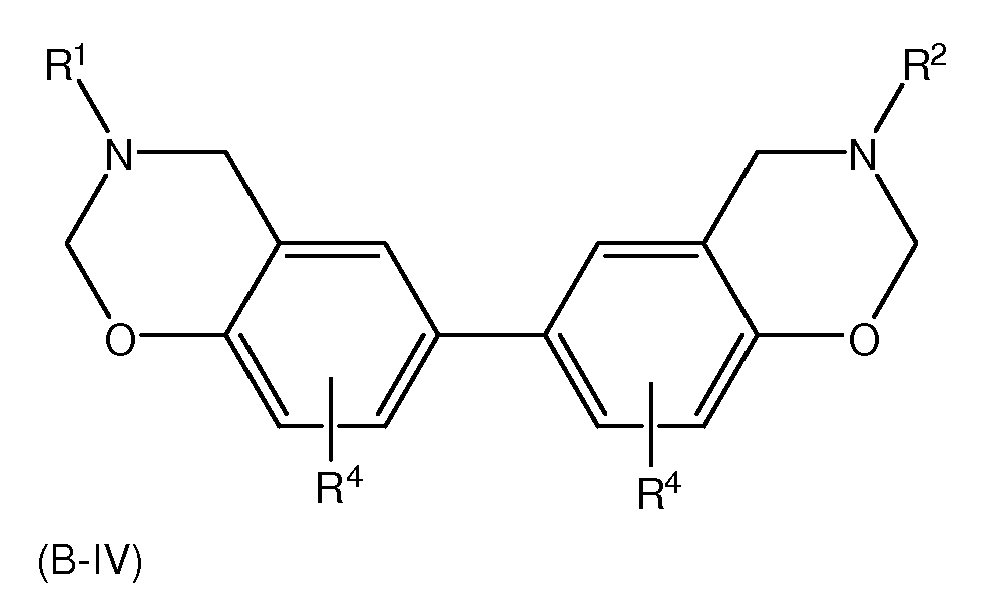


- Alternatively, the benzoxazine compound may be embraced by the following structure (B-VII):

- Though not embraced by structures (B-I) or (B-VII) additional benzoxazine compounds are within the following structures:


- Specific examples of the above generically described benzoxazine compounds include:


- Different benzoxazine compounds may be used to practice the invention, such as combinations of multifunctional benzoxazines and monofunctional benzoxazines, or combinations of one or more multifunctional benzoxazines or one or more monofunctional benzoxazines.
- Examples of monofunctional benzoxazine compounds may be embraced by the following structure (B-XIX):

- For instance, monofunctional benzoxazine compounds may be embraced by general structure (B-XX):

- Specific examples of such a monofunctional benzoxazine compounds are:


- Benzoxazine compounds are presently available commercially from several sources, including Huntsman Advanced Materials; Georgia-Pacific Resins, Inc.; and Shikoku Chemicals Corporation, Chiba, Japan, the last of which offers among others Bisphenol A-aniline, Bisphenol A-methylamin, Bisphenol F-aniline benzoxazine resins.
- In a particularly preferred embodiment of the present invention the benzoxazine compound is an "aliphatic benzoxazine", i.e. a benzoxazine having aliphatic residues bound to the nitrogen atoms of the benzoxazine residue, such as the compound of formula (B-XI) above. However in another preferred embodiment it can be desirable to use "aromatic benzoxazines", i.e. benzoxazines having aromatic residues bound to the nitrogen atoms of the benzoxazine residues such as the compounds of formulas (B-XV) or (B-XX). In some other preferred embodiments mixtures of the before-mentioned benzoxazines are advantageously employed.
- If desired, however, instead of using commercially available sources, the benzoxazine compound may typically be prepared by reacting a phenolic compound, preferably selected from monophenols and/or diphenols such as biphenyl-4,4'-diol (also known as "4,4'-Biphenol"), Bisphenol A, Bisphenol P, Bisphenol M, Bisphenol F, Bisphenol S, Bisphenol AP, Bisphenol E, 4,4'-oxydiphenol, 4,4'-thiodiphenol, bis(4-hydroxyphenyl)methanone, biphenyl-2,2'-diol, 4,4'-(cyclohexane-1,1-diyl)diphenol or 4,4'-(3,3,5-trimethylcyclohexane-1,1-diyl)diphenol (Bisphenol TMC), with an aldehyde and an alkyl or aryl amine.
U.S. Patent No. 5,543,516 , hereby expressly incorporated herein by reference, describes a method of forming benzoxazines, where the reaction time can vary from a few minutes to a few hours, depending on reactant concentration, reactivity and temperature. See generallyU.S. Patent Nos. 4,607,091 (Schreiber ),5,021,484 (Schreiber ),5,200,452 (Schreiber ) and5,443,911 (Schreiber ). - Any of the before-mentioned benzoxazine compounds may contain partially ring-opened benzoxazine structures.
- For the purpose of this invention those structures can in one embodiment still considered to be benzoxazine moieties, in particular ring-opened benzoxazine moieties.
- However in another embodiment of the present invention it is preferred that in the equilibrium state between the ring-opened and the non ring-opend benzoxazine moieties more than 60%, preferably more than 75%, most preferably more than 95% of the benzoxazine moieties are in the non ring-opened state.
- The benzoxazine compound is preferably the only curable ingredient in the curable compositions of the present invention. However other curable ingredients or resins can be included, if desired.
- The at least one benzoxazine compound or mixtures of different benzoxazine compounds can be included in an amount in the range of 20 to 99.9 percent by weight, such as 40 to 98 percent by weight, desirably in an amount of 50 to 95 percent by weight, and more desirably in an amount of 60 to 90 percent by weight, based on the total amount of the curable composition of the present invention.
- As noted above, the curable composition of the present invention additionally comprises at least one inorganic and/or organic lithium salt as a heat-latent or heat-activatable catalyst for the curing reaction of the at least one benzoxazine compound.
- The term "lithium salt" as used in the present invention refers to compounds which consist of at least one negatively charged anion and at least one positively charged lithium cation. Explicitly not encompassed by this term are compounds in which the lithium atom is involved in one or more covalent bondings.
- Although the valency of the counterions is in principle not restricted, better mechanical properties can be obtained if the counterion is a monovalent anion.
- Furthermore it can be preferred that the counterion is selected from halogenide anions, pseudo-halogenide anions or anions which comprise at least one halogen atom.
- Preferred halogenide anions according to the present invention include but are not limited to the chloride anion, the bromine anion, the iodide anion and the fluorine anion.
- Preferred pseudo-halogenide anions according to the present invention include but are not limited to the cyanate anion, the thiocyanate anion and the isocyanate anion.
- Preferred anions which comprise at least one halogen atom according to the present invention include anions which comprise the at least one halogen atom in either the oxidation state +VII or in the oxidation state -I. Preferred examples are the perchlorate anion, the tetrafluoroborat anion and the trifluoromethanesulfonic acid anion.
- Further it has been found that the effects according to the present inventions are maximized if the counterion is selected from the chloride anion, the bromide anion or the iodide anion or from the anions comprising a chlorine atom, a bromine atom or an iodine atom.
- In another preferred embodiment of the present invention the counterion is selected from anions which comprise at least one aromatic ring system, preferably an optionally substituted benzene ring. Preferred examples of this embodiment of the present invention include the phenolate anion as well as the thiophenolate anion.
- Examples of preferred inorganic and/or organic lithium salts according to the present invention include - but are not limited to - lithium iodide, lithium chloride, lithium bromide, lithium perchlorate, lithium thiocyanate, lithium tetrafluoridoborate, lithium acetate, lithium phenolate, lithium thiophenolate, lithium trifluoromethanesulfonate, lithium methylbenzenesulfonate and lithium nitrate. Lithium iodide, lithium chloride, lithium bromide, lithium perchlorate, lithium thiocyanate, lithium tetrafluoridoborate, lithium acetate, lithium phenolate, lithium thiophenolate and lithium nitrate are particularly preferred lithium salts.
- The at least one lithium salt of the present invention can be included in an amount in the range of 0.1 to 20 percent by weight, such as 0.2 to 5 percent by weight, desirably in an amount of 0.3 to 3 percent by weight, and more desirably in an amount of 0.5 to 1.5 percent by weight, based on the whole salt and on the total amount of the curable composition of the present invention.
- The curable composition of the present invention may comprise the benzoxazine compound and the lithium salts in an amount that the molar ratio of benzoxazine moieties to lithium cations is in the range of 90:10 to 99.9:0.1, preferably in the range of 95:5 to 99.5:0.5. A higher amount of the lithium salts of the present invention could cause the deterioration of mechanical and thermal properties of the resulting cured reaction product, whereas a smaller amount of the lithium salts of the present invention could lead to inefficient curing reactions.
- The curable compositions of the present invention may further comprise other resins apart from the benzoxazine compound, such as epoxy resins.
- The term "epoxy resin", as used in the present invention, refers to any organic compound having at least two functional groups of the oxirane type which can be polymerized by ring opening. The term "epoxy resin" preferably denotes any conventional epoxy resin which is liquid at room temperature (23°C) or at a higher temperature. These epoxy resins can be monomeric or polymeric, on the one hand, aliphatic, cycloaliphatic, heterocyclic or aromatic, on the other hand.
- The epoxy resins used in the present invention may include multifunctional epoxy- containing compounds, such as C1-C28 alkyl-, poly-phenol glycidyl ethers; polyglycidyl ethers of pyrocatechol, resorcinol, hydroquinone, 4,4'-dihydroxydiphenyl methane (or bisphenol F, such as RE-303-S or RE-404-S available commercially from Nippon Kayuku, Japan), 4,4'-dihydroxy-3,3'-dimethyldiphenyl methane, 4,4'-dihydroxydiphenyl dimethyl methane (or bisphenol A), 4,4'-dihydroxydiphenyl methyl methane, 4,4'-dihydroxydiphenyl cyclohexane, 4,4'-dihydroxy-3,3'-dimethyldiphenyl propane, 4,4'-dihydroxydiphenyl sulfone, and tris(4-hydroxyphenyl) methane; polyglycidyl ethers of transition metal complexes; chlorination and bromination products of the above-mentioned diphenols; polyglycidyl ethers of novolacs; polyglycidyl ethers of diphenols obtained by esterifying ethers of diphenols obtained by esterifying salts of an aromatic hydrocarboxylic acid with a dihaloalkane or dihalogen dialkyl ether; polyglycidyl ethers of polyphenols obtained by condensing phenols and long-chain halogen paraffins containing at least two halogen atoms; phenol novolac epoxy; cresol novolac epoxy; and combinations thereof. Among the commercially available epoxy resins suitable for use in the present invention are polyglycidyl derivatives of phenolic compounds, such as those available under the tradenames EPON 825, EPON 826, EPON 828, EPON 1001, EPON 1007 and EPON 1009, cycloaliphatic epoxy-containing compounds such as Araldite CY179 from Huntsman or waterborne dispersions under the tradenames EPI-REZ 3510, EPI-REZ 3515, EPI-REZ 3520, EPI-REZ 3522, EPI-REZ 3540 or EPI-REZ 3546 from Hexion; DER 331, DER 332, DER 383, DER 354, and DER 542 from Dow Chemical Co.; GY285 from Huntsman, Inc.; and BREN-S from Nippon Kayaku, Japan. Other suitable epoxy resins include polyepoxides prepared from polyols and the like and polyglycidyl derivatives of phenol-formaldehyde novolacs, the latter of which are available commercially under the tradenames DEN 431, DEN 438, and DEN 439 from Dow Chemical Company and a waterborne dispersion ARALDITE PZ 323 from Huntsman. Cresol analogs are also available commercially such as ECN 1273, ECN 1280, ECN 1285, and ECN 1299 or waterborne dispersions ARALDITE ECN 1400 from Huntsman, Inc. SU-8 and EPI-REZ 5003 are bisphenol A-type epoxy novolacs available from Hexion.
- Of course, combinations of the different epoxy resins are also desirable for use herein.
- If present, the epoxy resin can be used in the curable composition of the present invention in an amount in the range of 0.1 to 60 percent by weight, more preferably in an amount of 5 to 50 and most preferably in an amount of 10 to 30 percent by weight, based on the total amount of the curable composition.
- Additives suitable for use in the present invention include reactive diluents, for example styrene oxide (epoxide of styrene), butyl glycidyl ether, 2,2,4-trimethylpentyl glycidyl ether, phenyl glycidyl ether, cresyl glycidyl ether or glycidyl esters of synthetic, highly branched, mainly tertiary, aliphatic monocarboxylic acids, and oxazoline group containing compounds; tougheners; plasticizers; extenders; microspheres; fillers, such as silica nanoparticles and reinforcing agents, for example coal tar, bitumen, textile fibers, glass fibers, boron fibers, carbon fibers, mineral silicates, mica, powdered quartz, hydrated aluminum oxide, bentonite, wollastonite, kaolin, silica, aerogel or metal powders, for example aluminium powder or iron powder, and also pigments and dyes, such as carbon black, oxide colors and titanium dioxide; fire-retarding agents; thixotropic agents; flow control agents, such as silicones, waxes and stearates, which can, in part, also be used as mold release agents; adhesion promoters; antioxidants and light stabilizers, the particle size and distribution of many of which may be controlled to vary the physical properties and performance of the inventive curable composition.
- If present, at least one additive or mixtures of different additives can be used in the curable composition of the present invention in an amount in the range of 0.1 to 30 percent by weight, more preferably in an amount of 2 to 20 percent by weight and most preferably in an amount of 5 to 15 percent by weight, based on the total amount of the curable composition.
- In one embodiment of the present invention solvents can be used to lower the viscosity of the curable composition. Preferable solvents are ethers such as diethylether and tetrahydrofuran, ketones such as acetone and ethyl methyl ketone, esters such as ethyl acetate and butyl acetate, chlorinated hydrocarbons such as chloroform and dichloromethane, aromatics such as benzene and chlorobenzene, amides such as dimethylformamide and methylpyroridone, alcohols such as methanol and isopropanol. More preferably, ester-type solvents and ketone-type solvents are used.
- In a typical embodiment of the present invention the curable composition comprises, based on the total amount of the composition:
- a) from 20 to 99.9 percent by weight, more typically from 40 to 98 percent by weight, suitably from 50 to 95 percent by weight, for example from 60 to 90 percent by weight of at least one benzoxazine compound;
- b) from 0.1 to 20 percent by weight, more typically from 0.2 to 5 percent by weight, suitably from 0.3 to 3 percent by weight, for example from 0.5 to 1.5 percent by weight of at least one inorganic and/or organic lithium salt of the present invention;
- c) from 0 to 60 percent by weight, more typically from 5 to 50 percent by weight, suitably from 10 to 30 percent by weight, for example from 15 to 25 percent by weight of at least one epoxy resin; and
- d) from 0 to 30 percent by weight, more typically from 2 to 20 percent by weight, suitably from 5 to 15 percent by weight, for example from 6 to 12 percent by weight of one or more additives.
- By using the aforementioned inorganic and/or organic lithium salts of the present invention, a benzoxazine-based curable composition can be obtained which exhibits a long pot-life.
- The term "pot-life" as used in the present invention refers to the length of time a curable composition retains a viscosity low enough for it to be suitable for processing.
- In one embodiment of the present invention the curable composition is cured at temperatures of at least 120°C, preferably at temperatures in the range of about 130°C to about 160°C and/or at pressures between 1 to 100 atm, preferably between 1 to 5 atm, and more preferably under atmospheric pressure and/or preferably at curing times above 10 minutes, more preferably above 30 minutes and/or preferably at curing times below 180 minutes, more preferably below 120 minutes.
- As noted, the curable compositions of the present invention are in particular suitable as matrices for the preparation of reinforced material such as prepregs and towpregs and/or can be used in injection molding or extrusion processes.
- In this regard, the invention also provides a cured reaction product of the curable composition, in particular cured reaction products comprising a plurality of fabric plies or unidirectional plies infused with the inventive curable composition before curing.
- The aforementioned cured reaction products comprising a plurality of fabric plies or unidirectional plies can in principle be produced by any method.
- One preferred process for producing said cured reaction comprises the steps of:
- (a) providing a curable composition of the present invention into a closed mold containing a preform, comprising a plurality of fabric plies or unidirectional plies;
- (b) exposing the interior of the mold to a first temperature of 30°C to 125°C for a time sufficient to allow the curable composition to wet the preform;
- (c) curing the curable composition-impregnated preform within the mold at a second temperature of more (or equal) than 130°C, to form the cured reaction product.
- Preferably the aforementioned process is a resin transfer molding process (RTM), a vacuum assisted resin transfer molding process (VaRTM) or a resin film infusion process (RFI).
- In connection with a vacuum assisted resin transfer molding process (VaRTM), the present invention provides a process whose steps comprise:
- (a) providing a curable composition of the present invention in film form into a closed mold containing a preform, comprising a plurality of fabric plies or unidirectional plies;
- (b) exposing the interior of the mold to a first temperature of 30°C to 125°C under vacuum for a time sufficient to allow the curable composition to wet the perform;
- (c) curing the curable composition-impregnated preform within the mold at a second temperature of more (or equal) than 130°C under vacuum to form the cured reaction product.
- In connection with a resin film infusion process (RFI), the present invention provides a process whose steps comprise:
- (a) providing a preform into a closed mold containing an inventive curable composition in film form, where the preform comprises a plurality of fabric plies or unidirectional plies;
- (b) exposing the interior of the mold to a first temperature of 30°C to 125°C optionally under vacuum for a time sufficient to allow the curable composition to wet the perform;
- (c) curing the curable composition-impregnated preform within the mold at a second temperature of more (or equal) than 130°C under vacuum to form the cured reaction product.
- The second temperature used in the processes described above is preferably in the range of 130°C to 160°C.
- The fabric plies or unidirectional plies are preferably made of carbon, glass, aramid, boron, polyalkylene, quartz, polybenzimidazole, polyetheretherketone, polyphenylene sulfide, poly p-phenylene benzobisoaxazole, silicon carbide, phenolformaldehyde, phthalate and/or napthenoate.
- The carbon can be selected from polyacrylonitrile, pitch and acrylic, and the glass can be selected from S glass, S2 glass, E glass, R glass, A glass, AR glass, C glass, D glass, ECR glass, glass filament, staple glass, T glass and zirconium oxide glass.
- As noted, another aspect of the present invention is the use of at least one inorganic and/or organic lithium salt of the present invention as a heat-activatable catalyst for the curing reaction of benzoxazine compounds, wherein said benzoxazine compounds are preferably selected from benzoxazines of formula (B-I) to (B-XXII).
- The invention is further illustrated by the following examples.
- In a test tube 113 mg (0.5mmol) benzoxazine according to scheme 1 and the catalytic salt (1,0mol %) according to table 1 were dissolved in acetone (approx. 0.2ml) unless otherwise noted. The mixture was dried at room temperature under high vacuum for approx. 1 hour.

- The vacuum dried samples were then heated to 150°C for 30 minutes to estimate the rate of ring-opening (conversion of monomer). The resulting cured mixtures were subjected to 1H-NMR analysis in order to monitor the conversion of the benzoxazine monomer.
- Furthermore 14 mg of the resulting vacuum dried non-cured mixture were placed in an aluminum pan and subjected to a dynamic differential scanning calorimeter (DSC) analysis.
- The DSC measurements were performed at a heating rate of 10 °C/min under nitrogen atmosphere. From the resulting DSC profile, the temperature of the peak top (Tmax) and the onset temperature (Tonset) were determined.
- Basically the DSC results have a good relation to the conversion of monomer: The higher the onset temperature, the lower the conversion.
- The different catalysts were tested according to these procedures and the corresponding values of Tonset and Tmax were listed in Table 1.
Table 1 : Entry Catalyst Rate of ring opening (conversion of monomera after 0.5 h at 150°C) Tonset [°C]b Tmax [°C] 1 -- <5% 262 269 2 Lil 100% 180 197 3 LiClO4 92% 207 219 4 LiSCN 77% 226 237 5 LiBr 33% 208 220 6 LiOPhd 27% 207 222 7 LiSPhd 25% 207 222 8 LiOTf ∼5% 212 223 9 LiBF4 ∼5% 225 236 10 LiOAce <5% 243 251 11 LiCle <5% 238 247 a Determined by 1H NMR in DMSO-d6.
b Onset temperature of the polymerization exotherm determined by DSC (10 °C/min).
c Maximum temperature of the polymerization exotherm determined by DSC (10 °C/min).
d Catalyst was pre-dissolved in THF.
e Catalyst was pre-dissolved in MeOH. - All lithium salts of example 1 show catalytic activity in the polymerization of the benzoxazine momoners. Especially lithiumiodide shows an excellent catalytic activity.
- The mechanical properties of plates obtained by curing of Epsilon® 201 (thermosetting resin based on benzoxazine momomers) with 0,5weigth% of Lil solution (50weigth-% in acetone) under various conditions have been studied in a three-point-bending test according to ASTM-D790-97 (test speed: 0,05 inch/min; support span: 2 inch; diameter loading nose: 10mm). The resulting flexural moduli as well as the flexural strengths are given in table 2.
Table 2: Flexural Modulus Flexural Strength [MPa] [MPa] Cured for 90min at 180 °C 3858 127 Cured for 45min at 180 °C 4121 169 Cured for 90min at 160 °C 3592 120 Cured for 45min at 160 °C 4312 116 - From these data can be derived that Lil as a catalyst for benzoxazine-momoners leads even after short curing times at 160°C to a material showing satisfying mechanical properties.
Claims (14)
- A curable composition comprisinga. at least one polymerization catalyst selected from salts comprising a least one lithium cation and at least one inorganic and/or organic anion andb. at least one polymerizable benzoxazine resin.
- The curable composition according to claim 1, wherein the anion is a monovalent anion.
- The curable composition according to any of claims 1 or 2, wherein the anion is selected from halogenide anions, pseudo-halogenide anions or anions which comprise at least one halogen atom.
- The curable composition according to claim 3, wherein the counterion is selected from the chloride anion, the bromide anion or the iodide anion or from the anions comprising at least one chlorine atom, at least one bromine atom or at least one iodine atom.
- The curable composition according to any of claims 1 or 2, wherein the inorganic and/or organic anion is selected from anions comprising at least one aromatic ring system.
- The curable composition according to any of claims 1 to 5, wherein the counterion is selected from the iodide anion, the chloride anion, the bromide anion, the perchlorate anion, the thiocyanate anion, the tetrafluoridoborate anion, the acetate anion, the trifluoromethanesulfonate anion, the methylbenzenesulfonate anion and the nitrate anion.
- The curable composition of any one of claims 1 to 6, wherein the molar ratio of the benzoxazine moieties to the lithium cations is in the range of 90:10 to 99.9:0.1.
- The curable composition according to any one of claims 1 to 7, comprisinga) from 20 to 99.9 percent by weight of at least one benzoxazine resin,b) from 0.1 to 20 percent by weight of at least one salt comprising a least one lithium cation and at least one inorganic and/or organic anion,c) from 0 to 60 percent by weight of at least one epoxy resin andd) from 0 to 30 percent of at least one additive.
- A cured reaction product of the curable composition according to any of claims 1 to 8.
- The cured reaction product according to claim 9, comprising a plurality of fabric plies or unidirectional plies infused with the curable composition according to any of claims 1 to 8 before curing.
- Use of at least one salt, comprising a least one lithium cation and at least one inorganic and/or organic anion, as catalyst, preferably as heat activatable catalyst, in curable compositions comprising at least one benzoxazine resin.
- A process for producing the cured reaction product of claim 10, which comprises the following steps:(a) providing a curable composition according to any one of Claims 1 to 8 into a closed mold containing a preform comprising a plurality of fabric plies or unidirectional plies;(b) exposing the interior of the mold to a first temperature of 30°C to 125°C for a time sufficient to allow the curable composition to wet the preform;(c) curing the curable composition-impregnated preform within the mold at a second temperature of at least 130°C to form the cured reaction product.
- The process of Claim 12, wherein the process is a resin transfer molding process (RTM), a vacuum assisted resin transfer molding process (VaRTM) or a resin film infusion process (RFI).
- Device coated with a cured reaction product according to any of claim 9 or 10.
Priority Applications (1)
| Application Number | Priority Date | Filing Date | Title |
|---|---|---|---|
| EP10194529A EP2336221A1 (en) | 2010-12-10 | 2010-12-10 | Curable compositions |
Applications Claiming Priority (1)
| Application Number | Priority Date | Filing Date | Title |
|---|---|---|---|
| EP10194529A EP2336221A1 (en) | 2010-12-10 | 2010-12-10 | Curable compositions |
Publications (1)
| Publication Number | Publication Date |
|---|---|
| EP2336221A1 true EP2336221A1 (en) | 2011-06-22 |
Family
ID=43618848
Family Applications (1)
| Application Number | Title | Priority Date | Filing Date |
|---|---|---|---|
| EP10194529A Withdrawn EP2336221A1 (en) | 2010-12-10 | 2010-12-10 | Curable compositions |
Country Status (1)
| Country | Link |
|---|---|
| EP (1) | EP2336221A1 (en) |
Cited By (6)
| Publication number | Priority date | Publication date | Assignee | Title |
|---|---|---|---|---|
| WO2016040541A1 (en) * | 2014-09-12 | 2016-03-17 | Henkel IP & Holding GmbH | Cationically curable benzoxazine compositions |
| WO2017062324A3 (en) * | 2015-10-05 | 2017-08-10 | Raytheon Company | Mixture of benzoxazine resin and cyanate ester resin for pyrolisis densification of carbon-carbon composites |
| WO2017196805A1 (en) | 2016-05-10 | 2017-11-16 | Huntsman Advanced Materials Americas Llc | Benzothiazoles as latent catalysts for benzoxazine resins |
| WO2020169785A1 (en) | 2019-02-22 | 2020-08-27 | Universitat Autonoma De Barcelona | Process for polymerizing 1,3-benzoxazines |
| CN112673043A (en) * | 2018-09-19 | 2021-04-16 | 喜利得股份公司 | Curing agent composition for epoxy resin compounds, epoxy resin compounds and multi-component epoxy resin systems |
| WO2025006086A1 (en) * | 2023-06-30 | 2025-01-02 | Kaneka Corporation | Flame retardant resins and composite preforms |
Citations (15)
| Publication number | Priority date | Publication date | Assignee | Title |
|---|---|---|---|---|
| US4607091A (en) | 1984-09-14 | 1986-08-19 | Gurit-Essex Ag | Polymeric resins derived from 1-oxa-3-aza tetraline group-containing compounds and cycloaliphatic epoxides |
| US4644052A (en) * | 1985-08-15 | 1987-02-17 | Ashland Oil, Inc. | Reaction of bis-oxazoline with polycarboxylic acid catalyzed by alkali or alkaline earth metal cationic complex |
| US5021484A (en) | 1988-07-18 | 1991-06-04 | Gurit-Essex Ag | Fire retardant curable 1-oxa-3-aza tetraline (also termed "3,4-dihydro-1,3-benzoxazine") derived resin composition |
| US5200452A (en) | 1990-12-21 | 1993-04-06 | Gurit-Essex Ag | Fire retardant curable 1-oxa-3-aza tetraline (also termed "3,4-dihydro-1,3-benzoxazine") derived resin composition |
| DE4209925A1 (en) * | 1992-03-27 | 1993-09-30 | Henkel Kgaa | Process for the polymerization of cyclic imino ethers |
| US5443911A (en) | 1990-05-21 | 1995-08-22 | Gurit-Essex Ag | Curable resins comprising halogenated epoxy resins and 1-oxa-3-aza tetraline compounds, method for preparing and use of resins |
| US5543516A (en) | 1994-05-18 | 1996-08-06 | Edison Polymer Innovation Corporation | Process for preparation of benzoxazine compounds in solventless systems |
| JP2000086863A (en) | 1998-09-17 | 2000-03-28 | Sumitomo Bakelite Co Ltd | Thermoplastic resin composition |
| JP2000178332A (en) | 1998-12-18 | 2000-06-27 | Shikoku Chem Corp | Thermosetting resin composition |
| JP2003082099A (en) | 2001-09-14 | 2003-03-19 | Shikoku Chem Corp | Thermosetting resin composition |
| US20050042961A1 (en) * | 2003-08-18 | 2005-02-24 | Henkel Loctite Corporation | Curable compositions for advanced processes, and products made therefrom |
| WO2005063839A1 (en) * | 2003-12-23 | 2005-07-14 | Sekisui Chemical Co., Ltd. | Article and its production |
| WO2008034814A2 (en) * | 2006-09-21 | 2008-03-27 | Henkel Ag & Co. Kgaa | Benzoxazine-containing formulations polymerizable/curable at low temperature |
| FR2923829A1 (en) * | 2007-11-15 | 2009-05-22 | Arkema France | Preparing powder of superabsorbent polymer particles useful to produce hygiene articles, comprises post-cross linking step by crosslinking system comprising non-substituted bisoxazoline and alkaline and alkaline-earth metal catalyst |
| WO2009115488A1 (en) | 2008-03-19 | 2009-09-24 | Henkel Ag & Co. Kgaa | Copolymerization method |
-
2010
- 2010-12-10 EP EP10194529A patent/EP2336221A1/en not_active Withdrawn
Patent Citations (15)
| Publication number | Priority date | Publication date | Assignee | Title |
|---|---|---|---|---|
| US4607091A (en) | 1984-09-14 | 1986-08-19 | Gurit-Essex Ag | Polymeric resins derived from 1-oxa-3-aza tetraline group-containing compounds and cycloaliphatic epoxides |
| US4644052A (en) * | 1985-08-15 | 1987-02-17 | Ashland Oil, Inc. | Reaction of bis-oxazoline with polycarboxylic acid catalyzed by alkali or alkaline earth metal cationic complex |
| US5021484A (en) | 1988-07-18 | 1991-06-04 | Gurit-Essex Ag | Fire retardant curable 1-oxa-3-aza tetraline (also termed "3,4-dihydro-1,3-benzoxazine") derived resin composition |
| US5443911A (en) | 1990-05-21 | 1995-08-22 | Gurit-Essex Ag | Curable resins comprising halogenated epoxy resins and 1-oxa-3-aza tetraline compounds, method for preparing and use of resins |
| US5200452A (en) | 1990-12-21 | 1993-04-06 | Gurit-Essex Ag | Fire retardant curable 1-oxa-3-aza tetraline (also termed "3,4-dihydro-1,3-benzoxazine") derived resin composition |
| DE4209925A1 (en) * | 1992-03-27 | 1993-09-30 | Henkel Kgaa | Process for the polymerization of cyclic imino ethers |
| US5543516A (en) | 1994-05-18 | 1996-08-06 | Edison Polymer Innovation Corporation | Process for preparation of benzoxazine compounds in solventless systems |
| JP2000086863A (en) | 1998-09-17 | 2000-03-28 | Sumitomo Bakelite Co Ltd | Thermoplastic resin composition |
| JP2000178332A (en) | 1998-12-18 | 2000-06-27 | Shikoku Chem Corp | Thermosetting resin composition |
| JP2003082099A (en) | 2001-09-14 | 2003-03-19 | Shikoku Chem Corp | Thermosetting resin composition |
| US20050042961A1 (en) * | 2003-08-18 | 2005-02-24 | Henkel Loctite Corporation | Curable compositions for advanced processes, and products made therefrom |
| WO2005063839A1 (en) * | 2003-12-23 | 2005-07-14 | Sekisui Chemical Co., Ltd. | Article and its production |
| WO2008034814A2 (en) * | 2006-09-21 | 2008-03-27 | Henkel Ag & Co. Kgaa | Benzoxazine-containing formulations polymerizable/curable at low temperature |
| FR2923829A1 (en) * | 2007-11-15 | 2009-05-22 | Arkema France | Preparing powder of superabsorbent polymer particles useful to produce hygiene articles, comprises post-cross linking step by crosslinking system comprising non-substituted bisoxazoline and alkaline and alkaline-earth metal catalyst |
| WO2009115488A1 (en) | 2008-03-19 | 2009-09-24 | Henkel Ag & Co. Kgaa | Copolymerization method |
Cited By (13)
| Publication number | Priority date | Publication date | Assignee | Title |
|---|---|---|---|---|
| CN107108883A (en) * | 2014-09-12 | 2017-08-29 | 汉高知识产权控股有限责任公司 | The benzoxazine compositions of cationically curable |
| WO2016040541A1 (en) * | 2014-09-12 | 2016-03-17 | Henkel IP & Holding GmbH | Cationically curable benzoxazine compositions |
| US10125231B2 (en) | 2015-10-05 | 2018-11-13 | Raytheon Company | Benzoxazine cyanate ester resin for pyrolisis densification of carbon-carbon composites |
| WO2017062324A3 (en) * | 2015-10-05 | 2017-08-10 | Raytheon Company | Mixture of benzoxazine resin and cyanate ester resin for pyrolisis densification of carbon-carbon composites |
| CN109563287A (en) * | 2016-05-10 | 2019-04-02 | 亨斯迈先进材料美国有限责任公司 | Benzothiazole for benzoxazine resin as potential catalyst |
| KR20190018414A (en) * | 2016-05-10 | 2019-02-22 | 헌츠만 어드밴스드 머티리얼스 아메리카스 엘엘씨 | As a potential catalyst for benzoxazine resin, benzothiazole |
| WO2017196805A1 (en) | 2016-05-10 | 2017-11-16 | Huntsman Advanced Materials Americas Llc | Benzothiazoles as latent catalysts for benzoxazine resins |
| US10889686B2 (en) | 2016-05-10 | 2021-01-12 | Huntsman Advanced Materials Americas Llc | Benzothiazoles as latent catalysts for benzoxazine resins |
| CN109563287B (en) * | 2016-05-10 | 2022-09-09 | 亨斯迈先进材料美国有限责任公司 | Benzothiazoles for benzoxazine resins as potential catalysts |
| CN112673043A (en) * | 2018-09-19 | 2021-04-16 | 喜利得股份公司 | Curing agent composition for epoxy resin compounds, epoxy resin compounds and multi-component epoxy resin systems |
| CN112673043B (en) * | 2018-09-19 | 2024-03-29 | 喜利得股份公司 | Curing agent composition for epoxy resin mixtures, epoxy resin mixtures and multicomponent epoxy resin systems |
| WO2020169785A1 (en) | 2019-02-22 | 2020-08-27 | Universitat Autonoma De Barcelona | Process for polymerizing 1,3-benzoxazines |
| WO2025006086A1 (en) * | 2023-06-30 | 2025-01-02 | Kaneka Corporation | Flame retardant resins and composite preforms |
Similar Documents
| Publication | Publication Date | Title |
|---|---|---|
| EP2323995B1 (en) | Polymerizable benzoxazine compositions | |
| US8242217B2 (en) | Epoxy resin curing agent, process for preparing the same, and epoxy resin composition | |
| US20120329945A1 (en) | Benzoxazine-containing compositions | |
| US8748563B2 (en) | Curable compositions | |
| TW201348218A (en) | Benzoxazines and compositions containing the same | |
| EP2336221A1 (en) | Curable compositions | |
| JP5676474B2 (en) | Divinylarene dioxide compound for vacuum resin infusion molding | |
| KR102686755B1 (en) | Epoxy resin, epoxy resin composition, epoxy resin cured product and composite material | |
| KR101607646B1 (en) | Amines and polymeric phenols and usage thereof as curing agents in one component epoxy resin compositions | |
| EP2217651B1 (en) | Curable compositions containing isocyanate-based tougheners | |
| US8247517B2 (en) | Catalyst for curing epoxides | |
| EP3299404A1 (en) | Phthalonitrile resin | |
| US20100179299A1 (en) | Catalyst for curing epoxides | |
| KR101722797B1 (en) | Impact resistant modified compositions | |
| EP2358813B1 (en) | Curing agents for epoxy resins | |
| EP2314579A1 (en) | Fast-curing benzoxazine compounds | |
| JP6723238B2 (en) | Accelerator composition | |
| TWI383005B (en) | Thermosetting resin composition | |
| WO2009115488A1 (en) | Copolymerization method | |
| JP7465926B2 (en) | Epoxy resin, its manufacturing method, epoxy composition containing same, and uses thereof | |
| KR102408630B1 (en) | Epoxy resins, epoxy resin compositions, cured epoxy resins, and composite materials |
Legal Events
| Date | Code | Title | Description |
|---|---|---|---|
| PUAI | Public reference made under article 153(3) epc to a published international application that has entered the european phase |
Free format text: ORIGINAL CODE: 0009012 |
|
| AK | Designated contracting states |
Kind code of ref document: A1 Designated state(s): AL AT BE BG CH CY CZ DE DK EE ES FI FR GB GR HR HU IE IS IT LI LT LU LV MC MK MT NL NO PL PT RO RS SE SI SK SM TR |
|
| AX | Request for extension of the european patent |
Extension state: BA ME |
|
| STAA | Information on the status of an ep patent application or granted ep patent |
Free format text: STATUS: THE APPLICATION IS DEEMED TO BE WITHDRAWN |
|
| 18D | Application deemed to be withdrawn |
Effective date: 20111223 |