EP2335917B1 - Polymer brush composite and method for producing same - Google Patents
Polymer brush composite and method for producing same Download PDFInfo
- Publication number
- EP2335917B1 EP2335917B1 EP09816213.4A EP09816213A EP2335917B1 EP 2335917 B1 EP2335917 B1 EP 2335917B1 EP 09816213 A EP09816213 A EP 09816213A EP 2335917 B1 EP2335917 B1 EP 2335917B1
- Authority
- EP
- European Patent Office
- Prior art keywords
- polymer
- substrate
- polymer chains
- solid layer
- chains
- Prior art date
- Legal status (The legal status is an assumption and is not a legal conclusion. Google has not performed a legal analysis and makes no representation as to the accuracy of the status listed.)
- Not-in-force
Links
- 229920000642 polymer Polymers 0.000 title claims description 180
- 239000002131 composite material Substances 0.000 title claims description 52
- 238000004519 manufacturing process Methods 0.000 title claims description 9
- 239000000758 substrate Substances 0.000 claims description 93
- 239000007787 solid Substances 0.000 claims description 63
- 229910052751 metal Inorganic materials 0.000 claims description 30
- 239000002184 metal Substances 0.000 claims description 30
- 229910044991 metal oxide Inorganic materials 0.000 claims description 23
- 150000004706 metal oxides Chemical class 0.000 claims description 23
- 238000000034 method Methods 0.000 claims description 18
- 230000003647 oxidation Effects 0.000 claims description 17
- 238000007254 oxidation reaction Methods 0.000 claims description 17
- 238000006116 polymerization reaction Methods 0.000 claims description 16
- 230000000977 initiatory effect Effects 0.000 claims description 12
- 239000000178 monomer Substances 0.000 claims description 8
- 230000000149 penetrating effect Effects 0.000 claims description 4
- 230000000379 polymerizing effect Effects 0.000 claims description 4
- 239000010410 layer Substances 0.000 description 68
- 150000001875 compounds Chemical class 0.000 description 32
- 229920000620 organic polymer Polymers 0.000 description 29
- 229910010272 inorganic material Inorganic materials 0.000 description 25
- 239000011147 inorganic material Substances 0.000 description 25
- RTAQQCXQSZGOHL-UHFFFAOYSA-N Titanium Chemical compound [Ti] RTAQQCXQSZGOHL-UHFFFAOYSA-N 0.000 description 13
- 229910052719 titanium Inorganic materials 0.000 description 13
- 239000010936 titanium Substances 0.000 description 13
- 125000000524 functional group Chemical group 0.000 description 12
- OKKJLVBELUTLKV-UHFFFAOYSA-N Methanol Chemical compound OC OKKJLVBELUTLKV-UHFFFAOYSA-N 0.000 description 9
- 230000003100 immobilizing effect Effects 0.000 description 8
- -1 diol compound Chemical class 0.000 description 7
- 239000007822 coupling agent Substances 0.000 description 6
- GWEVSGVZZGPLCZ-UHFFFAOYSA-N Titan oxide Chemical compound O=[Ti]=O GWEVSGVZZGPLCZ-UHFFFAOYSA-N 0.000 description 5
- 239000012736 aqueous medium Substances 0.000 description 5
- 239000002609 medium Substances 0.000 description 5
- BASFCYQUMIYNBI-UHFFFAOYSA-N platinum Chemical compound [Pt] BASFCYQUMIYNBI-UHFFFAOYSA-N 0.000 description 5
- OGIDPMRJRNCKJF-UHFFFAOYSA-N titanium oxide Inorganic materials [Ti]=O OGIDPMRJRNCKJF-UHFFFAOYSA-N 0.000 description 5
- XLYOFNOQVPJJNP-UHFFFAOYSA-N water Substances O XLYOFNOQVPJJNP-UHFFFAOYSA-N 0.000 description 5
- 238000004833 X-ray photoelectron spectroscopy Methods 0.000 description 4
- QCWXUUIWCKQGHC-UHFFFAOYSA-N Zirconium Chemical compound [Zr] QCWXUUIWCKQGHC-UHFFFAOYSA-N 0.000 description 4
- 230000000052 comparative effect Effects 0.000 description 4
- 239000011368 organic material Substances 0.000 description 4
- 238000012643 polycondensation polymerization Methods 0.000 description 4
- 238000000682 scanning probe acoustic microscopy Methods 0.000 description 4
- 239000004065 semiconductor Substances 0.000 description 4
- 229920002554 vinyl polymer Polymers 0.000 description 4
- 229910052726 zirconium Inorganic materials 0.000 description 4
- WOBHKFSMXKNTIM-UHFFFAOYSA-N Hydroxyethyl methacrylate Chemical compound CC(=C)C(=O)OCCO WOBHKFSMXKNTIM-UHFFFAOYSA-N 0.000 description 3
- 239000004952 Polyamide Substances 0.000 description 3
- 230000002349 favourable effect Effects 0.000 description 3
- 230000003993 interaction Effects 0.000 description 3
- 150000002894 organic compounds Chemical group 0.000 description 3
- 229920002647 polyamide Polymers 0.000 description 3
- 229920000728 polyester Polymers 0.000 description 3
- 229910001020 Au alloy Inorganic materials 0.000 description 2
- VMQMZMRVKUZKQL-UHFFFAOYSA-N Cu+ Chemical compound [Cu+] VMQMZMRVKUZKQL-UHFFFAOYSA-N 0.000 description 2
- PXHVJJICTQNCMI-UHFFFAOYSA-N Nickel Chemical compound [Ni] PXHVJJICTQNCMI-UHFFFAOYSA-N 0.000 description 2
- 239000006087 Silane Coupling Agent Substances 0.000 description 2
- WAIPAZQMEIHHTJ-UHFFFAOYSA-N [Cr].[Co] Chemical class [Cr].[Co] WAIPAZQMEIHHTJ-UHFFFAOYSA-N 0.000 description 2
- 238000012644 addition polymerization Methods 0.000 description 2
- 229910045601 alloy Inorganic materials 0.000 description 2
- 239000000956 alloy Substances 0.000 description 2
- 239000000560 biocompatible material Substances 0.000 description 2
- 230000015572 biosynthetic process Effects 0.000 description 2
- 230000021164 cell adhesion Effects 0.000 description 2
- 238000006243 chemical reaction Methods 0.000 description 2
- IOLQWGVDEFWYNP-UHFFFAOYSA-N ethyl 2-bromo-2-methylpropanoate Chemical compound CCOC(=O)C(C)(C)Br IOLQWGVDEFWYNP-UHFFFAOYSA-N 0.000 description 2
- 239000011521 glass Substances 0.000 description 2
- PCHJSUWPFVWCPO-UHFFFAOYSA-N gold Chemical compound [Au] PCHJSUWPFVWCPO-UHFFFAOYSA-N 0.000 description 2
- 229910052737 gold Inorganic materials 0.000 description 2
- 239000010931 gold Substances 0.000 description 2
- 239000003353 gold alloy Substances 0.000 description 2
- 229910021645 metal ion Inorganic materials 0.000 description 2
- 150000002739 metals Chemical class 0.000 description 2
- 229910052697 platinum Inorganic materials 0.000 description 2
- 229920000570 polyether Polymers 0.000 description 2
- 229920002635 polyurethane Polymers 0.000 description 2
- 239000004814 polyurethane Substances 0.000 description 2
- 230000008569 process Effects 0.000 description 2
- 238000010526 radical polymerization reaction Methods 0.000 description 2
- 238000007151 ring opening polymerisation reaction Methods 0.000 description 2
- 238000001228 spectrum Methods 0.000 description 2
- 239000010935 stainless steel Substances 0.000 description 2
- 229910001256 stainless steel alloy Inorganic materials 0.000 description 2
- 238000004381 surface treatment Methods 0.000 description 2
- 125000003396 thiol group Chemical group [H]S* 0.000 description 2
- WUMSTCDLAYQDNO-UHFFFAOYSA-N triethoxy(hexyl)silane Chemical compound CCCCCC[Si](OCC)(OCC)OCC WUMSTCDLAYQDNO-UHFFFAOYSA-N 0.000 description 2
- HRPVXLWXLXDGHG-UHFFFAOYSA-N Acrylamide Chemical compound NC(=O)C=C HRPVXLWXLXDGHG-UHFFFAOYSA-N 0.000 description 1
- VHUUQVKOLVNVRT-UHFFFAOYSA-N Ammonium hydroxide Chemical compound [NH4+].[OH-] VHUUQVKOLVNVRT-UHFFFAOYSA-N 0.000 description 1
- ROFVEXUMMXZLPA-UHFFFAOYSA-N Bipyridyl Chemical compound N1=CC=CC=C1C1=CC=CC=N1 ROFVEXUMMXZLPA-UHFFFAOYSA-N 0.000 description 1
- YQTKLYYISKLJMX-UHFFFAOYSA-N CCCCCC[SiH](OCC)OCC Chemical compound CCCCCC[SiH](OCC)OCC YQTKLYYISKLJMX-UHFFFAOYSA-N 0.000 description 1
- 244000025254 Cannabis sativa Species 0.000 description 1
- RYGMFSIKBFXOCR-UHFFFAOYSA-N Copper Chemical compound [Cu] RYGMFSIKBFXOCR-UHFFFAOYSA-N 0.000 description 1
- 239000006144 Dulbecco’s modified Eagle's medium Substances 0.000 description 1
- 239000004593 Epoxy Substances 0.000 description 1
- 239000002202 Polyethylene glycol Substances 0.000 description 1
- 239000004642 Polyimide Substances 0.000 description 1
- 229920002396 Polyurea Polymers 0.000 description 1
- JUJWROOIHBZHMG-UHFFFAOYSA-N Pyridine Chemical group C1=CC=NC=C1 JUJWROOIHBZHMG-UHFFFAOYSA-N 0.000 description 1
- BQCADISMDOOEFD-UHFFFAOYSA-N Silver Chemical compound [Ag] BQCADISMDOOEFD-UHFFFAOYSA-N 0.000 description 1
- PMZURENOXWZQFD-UHFFFAOYSA-L Sodium Sulfate Chemical compound [Na+].[Na+].[O-]S([O-])(=O)=O PMZURENOXWZQFD-UHFFFAOYSA-L 0.000 description 1
- 229910001069 Ti alloy Inorganic materials 0.000 description 1
- ATJFFYVFTNAWJD-UHFFFAOYSA-N Tin Chemical compound [Sn] ATJFFYVFTNAWJD-UHFFFAOYSA-N 0.000 description 1
- WGLPBDUCMAPZCE-UHFFFAOYSA-N Trioxochromium Chemical compound O=[Cr](=O)=O WGLPBDUCMAPZCE-UHFFFAOYSA-N 0.000 description 1
- QYKIQEUNHZKYBP-UHFFFAOYSA-N Vinyl ether Chemical compound C=COC=C QYKIQEUNHZKYBP-UHFFFAOYSA-N 0.000 description 1
- 229940117913 acrylamide Drugs 0.000 description 1
- 150000001252 acrylic acid derivatives Chemical class 0.000 description 1
- 230000002776 aggregation Effects 0.000 description 1
- 238000004220 aggregation Methods 0.000 description 1
- 150000001336 alkenes Chemical class 0.000 description 1
- 229910052782 aluminium Inorganic materials 0.000 description 1
- XAGFODPZIPBFFR-UHFFFAOYSA-N aluminium Chemical compound [Al] XAGFODPZIPBFFR-UHFFFAOYSA-N 0.000 description 1
- 125000003277 amino group Chemical group 0.000 description 1
- QGZKDVFQNNGYKY-UHFFFAOYSA-N ammonia Natural products N QGZKDVFQNNGYKY-UHFFFAOYSA-N 0.000 description 1
- 125000000852 azido group Chemical group *N=[N+]=[N-] 0.000 description 1
- 239000011230 binding agent Substances 0.000 description 1
- 229960002685 biotin Drugs 0.000 description 1
- 239000011616 biotin Substances 0.000 description 1
- 125000003178 carboxy group Chemical group [H]OC(*)=O 0.000 description 1
- 229910000423 chromium oxide Inorganic materials 0.000 description 1
- 229910052802 copper Inorganic materials 0.000 description 1
- 239000010949 copper Substances 0.000 description 1
- 230000008878 coupling Effects 0.000 description 1
- 238000010168 coupling process Methods 0.000 description 1
- 238000005859 coupling reaction Methods 0.000 description 1
- 230000003247 decreasing effect Effects 0.000 description 1
- 238000011161 development Methods 0.000 description 1
- ZOMNIUBKTOKEHS-UHFFFAOYSA-L dimercury dichloride Chemical class Cl[Hg][Hg]Cl ZOMNIUBKTOKEHS-UHFFFAOYSA-L 0.000 description 1
- 230000000694 effects Effects 0.000 description 1
- 239000002659 electrodeposit Substances 0.000 description 1
- 238000004070 electrodeposition Methods 0.000 description 1
- 238000005516 engineering process Methods 0.000 description 1
- OIKTYAIWDCKBDE-UHFFFAOYSA-N ethoxy(hexyl)silane Chemical compound CCCCCC[SiH2]OCC OIKTYAIWDCKBDE-UHFFFAOYSA-N 0.000 description 1
- 238000011156 evaluation Methods 0.000 description 1
- 239000001963 growth medium Substances 0.000 description 1
- 125000001188 haloalkyl group Chemical group 0.000 description 1
- 230000002209 hydrophobic effect Effects 0.000 description 1
- 230000005661 hydrophobic surface Effects 0.000 description 1
- 125000002887 hydroxy group Chemical group [H]O* 0.000 description 1
- 238000001727 in vivo Methods 0.000 description 1
- 230000002401 inhibitory effect Effects 0.000 description 1
- 229910017053 inorganic salt Inorganic materials 0.000 description 1
- 150000003951 lactams Chemical class 0.000 description 1
- 150000002596 lactones Chemical class 0.000 description 1
- 238000004811 liquid chromatography Methods 0.000 description 1
- 238000010551 living anionic polymerization reaction Methods 0.000 description 1
- 238000010552 living cationic polymerization reaction Methods 0.000 description 1
- 238000005259 measurement Methods 0.000 description 1
- 150000002734 metacrylic acid derivatives Chemical class 0.000 description 1
- 239000007769 metal material Substances 0.000 description 1
- FQPSGWSUVKBHSU-UHFFFAOYSA-N methacrylamide Chemical compound CC(=C)C(N)=O FQPSGWSUVKBHSU-UHFFFAOYSA-N 0.000 description 1
- 230000004048 modification Effects 0.000 description 1
- 238000012986 modification Methods 0.000 description 1
- 229910052759 nickel Inorganic materials 0.000 description 1
- 230000003287 optical effect Effects 0.000 description 1
- 239000003960 organic solvent Substances 0.000 description 1
- TWNQGVIAIRXVLR-UHFFFAOYSA-N oxo(oxoalumanyloxy)alumane Chemical compound O=[Al]O[Al]=O TWNQGVIAIRXVLR-UHFFFAOYSA-N 0.000 description 1
- RVTZCBVAJQQJTK-UHFFFAOYSA-N oxygen(2-);zirconium(4+) Chemical compound [O-2].[O-2].[Zr+4] RVTZCBVAJQQJTK-UHFFFAOYSA-N 0.000 description 1
- 229920000515 polycarbonate Polymers 0.000 description 1
- 239000004417 polycarbonate Substances 0.000 description 1
- 229920001223 polyethylene glycol Polymers 0.000 description 1
- 229920001721 polyimide Polymers 0.000 description 1
- 108090000623 proteins and genes Proteins 0.000 description 1
- 102000004169 proteins and genes Human genes 0.000 description 1
- 230000009257 reactivity Effects 0.000 description 1
- 230000002940 repellent Effects 0.000 description 1
- 239000005871 repellent Substances 0.000 description 1
- 239000002094 self assembled monolayer Substances 0.000 description 1
- 239000013545 self-assembled monolayer Substances 0.000 description 1
- 229910052710 silicon Inorganic materials 0.000 description 1
- 239000010703 silicon Substances 0.000 description 1
- 229910052709 silver Inorganic materials 0.000 description 1
- 239000004332 silver Substances 0.000 description 1
- 229910052938 sodium sulfate Inorganic materials 0.000 description 1
- 235000011152 sodium sulphate Nutrition 0.000 description 1
- 238000001179 sorption measurement Methods 0.000 description 1
- 238000004544 sputter deposition Methods 0.000 description 1
- 238000003786 synthesis reaction Methods 0.000 description 1
- 230000002194 synthesizing effect Effects 0.000 description 1
- 125000005369 trialkoxysilyl group Chemical group 0.000 description 1
- 229920001567 vinyl ester resin Polymers 0.000 description 1
- 125000000391 vinyl group Chemical group [H]C([*])=C([H])[H] 0.000 description 1
- 229910001928 zirconium oxide Inorganic materials 0.000 description 1
Images

Classifications
-
- A—HUMAN NECESSITIES
- A61—MEDICAL OR VETERINARY SCIENCE; HYGIENE
- A61L—METHODS OR APPARATUS FOR STERILISING MATERIALS OR OBJECTS IN GENERAL; DISINFECTION, STERILISATION OR DEODORISATION OF AIR; CHEMICAL ASPECTS OF BANDAGES, DRESSINGS, ABSORBENT PADS OR SURGICAL ARTICLES; MATERIALS FOR BANDAGES, DRESSINGS, ABSORBENT PADS OR SURGICAL ARTICLES
- A61L27/00—Materials for grafts or prostheses or for coating grafts or prostheses
- A61L27/28—Materials for coating prostheses
- A61L27/34—Macromolecular materials
-
- A—HUMAN NECESSITIES
- A61—MEDICAL OR VETERINARY SCIENCE; HYGIENE
- A61L—METHODS OR APPARATUS FOR STERILISING MATERIALS OR OBJECTS IN GENERAL; DISINFECTION, STERILISATION OR DEODORISATION OF AIR; CHEMICAL ASPECTS OF BANDAGES, DRESSINGS, ABSORBENT PADS OR SURGICAL ARTICLES; MATERIALS FOR BANDAGES, DRESSINGS, ABSORBENT PADS OR SURGICAL ARTICLES
- A61L27/00—Materials for grafts or prostheses or for coating grafts or prostheses
- A61L27/02—Inorganic materials
- A61L27/04—Metals or alloys
-
- B—PERFORMING OPERATIONS; TRANSPORTING
- B05—SPRAYING OR ATOMISING IN GENERAL; APPLYING FLUENT MATERIALS TO SURFACES, IN GENERAL
- B05D—PROCESSES FOR APPLYING FLUENT MATERIALS TO SURFACES, IN GENERAL
- B05D1/00—Processes for applying liquids or other fluent materials
- B05D1/18—Processes for applying liquids or other fluent materials performed by dipping
- B05D1/185—Processes for applying liquids or other fluent materials performed by dipping applying monomolecular layers
-
- B—PERFORMING OPERATIONS; TRANSPORTING
- B05—SPRAYING OR ATOMISING IN GENERAL; APPLYING FLUENT MATERIALS TO SURFACES, IN GENERAL
- B05D—PROCESSES FOR APPLYING FLUENT MATERIALS TO SURFACES, IN GENERAL
- B05D1/00—Processes for applying liquids or other fluent materials
- B05D1/28—Processes for applying liquids or other fluent materials performed by transfer from the surfaces of elements carrying the liquid or other fluent material, e.g. brushes, pads, rollers
- B05D1/283—Transferring monomolecular layers or solutions of molecules adapted for forming monomolecular layers from carrying elements
-
- B—PERFORMING OPERATIONS; TRANSPORTING
- B82—NANOTECHNOLOGY
- B82Y—SPECIFIC USES OR APPLICATIONS OF NANOSTRUCTURES; MEASUREMENT OR ANALYSIS OF NANOSTRUCTURES; MANUFACTURE OR TREATMENT OF NANOSTRUCTURES
- B82Y30/00—Nanotechnology for materials or surface science, e.g. nanocomposites
-
- B—PERFORMING OPERATIONS; TRANSPORTING
- B82—NANOTECHNOLOGY
- B82Y—SPECIFIC USES OR APPLICATIONS OF NANOSTRUCTURES; MEASUREMENT OR ANALYSIS OF NANOSTRUCTURES; MANUFACTURE OR TREATMENT OF NANOSTRUCTURES
- B82Y40/00—Manufacture or treatment of nanostructures
-
- C—CHEMISTRY; METALLURGY
- C08—ORGANIC MACROMOLECULAR COMPOUNDS; THEIR PREPARATION OR CHEMICAL WORKING-UP; COMPOSITIONS BASED THEREON
- C08F—MACROMOLECULAR COMPOUNDS OBTAINED BY REACTIONS ONLY INVOLVING CARBON-TO-CARBON UNSATURATED BONDS
- C08F220/00—Copolymers of compounds having one or more unsaturated aliphatic radicals, each having only one carbon-to-carbon double bond, and only one being terminated by only one carboxyl radical or a salt, anhydride ester, amide, imide or nitrile thereof
- C08F220/02—Monocarboxylic acids having less than ten carbon atoms; Derivatives thereof
- C08F220/10—Esters
- C08F220/20—Esters of polyhydric alcohols or phenols, e.g. 2-hydroxyethyl (meth)acrylate or glycerol mono-(meth)acrylate
-
- C—CHEMISTRY; METALLURGY
- C08—ORGANIC MACROMOLECULAR COMPOUNDS; THEIR PREPARATION OR CHEMICAL WORKING-UP; COMPOSITIONS BASED THEREON
- C08F—MACROMOLECULAR COMPOUNDS OBTAINED BY REACTIONS ONLY INVOLVING CARBON-TO-CARBON UNSATURATED BONDS
- C08F292/00—Macromolecular compounds obtained by polymerising monomers on to inorganic materials
-
- C—CHEMISTRY; METALLURGY
- C09—DYES; PAINTS; POLISHES; NATURAL RESINS; ADHESIVES; COMPOSITIONS NOT OTHERWISE PROVIDED FOR; APPLICATIONS OF MATERIALS NOT OTHERWISE PROVIDED FOR
- C09D—COATING COMPOSITIONS, e.g. PAINTS, VARNISHES OR LACQUERS; FILLING PASTES; CHEMICAL PAINT OR INK REMOVERS; INKS; CORRECTING FLUIDS; WOODSTAINS; PASTES OR SOLIDS FOR COLOURING OR PRINTING; USE OF MATERIALS THEREFOR
- C09D5/00—Coating compositions, e.g. paints, varnishes or lacquers, characterised by their physical nature or the effects produced; Filling pastes
- C09D5/44—Coating compositions, e.g. paints, varnishes or lacquers, characterised by their physical nature or the effects produced; Filling pastes for electrophoretic applications
- C09D5/4476—Coating compositions, e.g. paints, varnishes or lacquers, characterised by their physical nature or the effects produced; Filling pastes for electrophoretic applications comprising polymerisation in situ
-
- C—CHEMISTRY; METALLURGY
- C25—ELECTROLYTIC OR ELECTROPHORETIC PROCESSES; APPARATUS THEREFOR
- C25D—PROCESSES FOR THE ELECTROLYTIC OR ELECTROPHORETIC PRODUCTION OF COATINGS; ELECTROFORMING; APPARATUS THEREFOR
- C25D11/00—Electrolytic coating by surface reaction, i.e. forming conversion layers
- C25D11/02—Anodisation
- C25D11/04—Anodisation of aluminium or alloys based thereon
- C25D11/16—Pretreatment, e.g. desmutting
-
- C—CHEMISTRY; METALLURGY
- C25—ELECTROLYTIC OR ELECTROPHORETIC PROCESSES; APPARATUS THEREFOR
- C25D—PROCESSES FOR THE ELECTROLYTIC OR ELECTROPHORETIC PRODUCTION OF COATINGS; ELECTROFORMING; APPARATUS THEREFOR
- C25D11/00—Electrolytic coating by surface reaction, i.e. forming conversion layers
- C25D11/02—Anodisation
- C25D11/26—Anodisation of refractory metals or alloys based thereon
-
- B—PERFORMING OPERATIONS; TRANSPORTING
- B05—SPRAYING OR ATOMISING IN GENERAL; APPLYING FLUENT MATERIALS TO SURFACES, IN GENERAL
- B05D—PROCESSES FOR APPLYING FLUENT MATERIALS TO SURFACES, IN GENERAL
- B05D2202/00—Metallic substrate
- B05D2202/30—Metallic substrate based on refractory metals (Ti, V, Cr, Zr, Nb, Mo, Hf, Ta, W)
- B05D2202/35—Metallic substrate based on refractory metals (Ti, V, Cr, Zr, Nb, Mo, Hf, Ta, W) based on Ti
-
- Y—GENERAL TAGGING OF NEW TECHNOLOGICAL DEVELOPMENTS; GENERAL TAGGING OF CROSS-SECTIONAL TECHNOLOGIES SPANNING OVER SEVERAL SECTIONS OF THE IPC; TECHNICAL SUBJECTS COVERED BY FORMER USPC CROSS-REFERENCE ART COLLECTIONS [XRACs] AND DIGESTS
- Y10—TECHNICAL SUBJECTS COVERED BY FORMER USPC
- Y10T—TECHNICAL SUBJECTS COVERED BY FORMER US CLASSIFICATION
- Y10T428/00—Stock material or miscellaneous articles
- Y10T428/24—Structurally defined web or sheet [e.g., overall dimension, etc.]
- Y10T428/24752—Laterally noncoextensive components
Definitions
- the present invention relates to a polymer brush composite and a method for producing the same.
- a composite material that includes an organic polymer compound and an inorganic material such as a metal have been proposed.
- a composite material has been disclosed that includes a substrate such as a metal and a polymer compound having one end immobilized on the surface of the substrate (for example, see Japanese Patent Application Laid-Open (JP-A) No. 2006-177914 ).
- a composite material has been disclosed that includes a substrate such as a metal and a biocompatible material layer, which are adhered to each other via a binder layer (for example, see JP-A No. 2007-260247 ).
- WO 2004/114371 discloses a compound use to form a self-assembled monolayer, a layer structure and a semiconductor component having a layer structure and a method for producing a layer structure.
- WO 02/056021 discloses polymer brushes for immobilizing molecules to a surface or substrate having improved stability.
- WO 2006/132694 discloses a process for the modification of a substrate so as to form an ultra hydrophobic surface on the substrate.
- WO 94/11118 discloses a method for modifying a surface to develop a microscopically smooth, biocompatible surface.
- a first aspect of the present invention is a polymer brush composite including a substrate, a solid layer disposed on the substrate and containing at least one of a metal or a metal oxide, and a plurality of polymer chains penetrating the solid layer in such a manner that one end of each of the polymer chains is disposed on an upper side of the substrate and the other end of each of the polymer chains is exposed at a surface of the solid layer on an opposite side of the solid layer to the substrate.
- the polymer chains preferably have a ratio (Mw/Mn) of weight average molecular weight (Mw) to number average molecular weight (Mn) of 1.0 or more and 1.5 or less.
- a second aspect of the present invention is a method for producing the polymer brush composite of the invention, the method including a polymer brush forming step of forming a plurality of polymer chains on a substrate, one end of each of the polymer chains being disposed on the substrate, and a solid layer forming step of forming a solid layer containing at least one of a metal or a metal oxide in a region in which the polymer chains are not immobilized on the surface of the substrate that has the polymer chains formed thereon, by applying a voltage to the substrate in a medium, wherein in the solid layer forming step, a metal oxide layer is formed by anodic oxidation.
- the polymer brush forming step preferably includes a step of forming a plurality of polymerization initiation points on the substrate and a step of polymerizing a polymerizable monomer using the plurality of polymerization initiation points as starting points.
- the present invention it is possible to provide a composite material that exhibits favorable binding between an organic polymer compound and an inorganic material and that has a surface at which all or a part of the organic polymer compound is uniformly present in the inorganic material in such a manner that the organic polymer compound has an orientation, and a method for producing the composite material.
- a polymer brush composite according to the present invention includes a substrate, a solid layer disposed on the substrate and containing at least one of a metal or a metal oxide, and a plurality of polymer chains penetrating the solid layer in a state in which the polymer chains are extended in such a manner that one end of each of the polymer chains is disposed on the upper side of the substrate and the other end of each of the polymer chains is exposed at the surface of the solid layer at the opposite side of the solid layer to the substrate.
- one end of each of the polymer chains is buried in the solid layer, thereby enabling the formation of a composite material that exhibits favorable binding between the organic polymer chains and the inorganic material (the solid layer) and has a surface at which the organic polymer compound is uniformly present in the inorganic material in such a manner that the organic polymer compound has an orientation.
- the substrate is not specifically limited as long as the solid layer containing at least one of a metal or a metal oxide can be disposed and one end of the polymer chain can be disposed.
- the substrate has electric conductivity.
- at least the surface of the substrate on which the polymer chains are disposed is smooth. Examples of the substrate may include a metal, a metal oxide, an alloy, and a semiconductor.
- Examples of the metal may include gold, silver, copper, platinum, titanium, aluminum, nickel, and zirconium.
- Examples of the metal oxide may include titanium oxide, zirconium oxide, chromium oxide, and aluminum oxide.
- Examples of the alloy may include titanium alloy, cobalt-chromium alloy, stainless steel, and gold alloy.
- Examples of the semiconductor include silicon.
- the substrate used in the present invention can be appropriately selected according to the purpose of the polymer brush composite.
- the substrate is preferably selected from titanium, zirconium, cobalt-chromium alloy, stainless steel, and gold alloy, and more preferably selected from titanium, zirconium, and gold.
- the solid layer contains at least one of a metal or a metal oxide.
- a metal or a metal oxide examples of the metal and the metal oxide for the solid layer may include metals such as titanium and zirconium, and oxides thereof.
- the metal and the metal oxide for the solid layer can be appropriately selected according to the purpose of the polymer brush composite. From the viewpoint of formationability of the solid layer, a metal that is the same as at least one of metals contained in the substrate or an oxide thereof is preferable.
- the polymer forming the polymer chains is not specifically limited as long as one end of the polymer chain can be disposed on the substrate.
- the polymer may be an addition polymerization polymer or a condensation polymerization polymer.
- Specific examples of the polymer may include vinyl polymers, epoxy polymers, polyester polymers, polyurethane polymers, polyamide polymers, polycarbonate polymers, polyurea polymers, polyether polymers, and polyimide polymers.
- the polymer is preferably a vinyl polymer, a polyester polymer, a polyamide polymer, or a polyether polymer.
- the polymer chains can be appropriately selected according to the purpose of the polymer brush composite.
- the polymer forming the polymer chains in the present invention can be synthesized using commonly used monomer(s).
- the monomers used to form an addition polymerization polymer may include acrylate esters, acryl amide, methacrylate esters, methacryl amide, vinyl esters, vinyl ether, and olefins.
- Polyurethane polymers can be obtained by polymerization of a diol compound and a diisocyanate compound.
- Polyester polymers can be obtained either by condensation polymerization of a diol compound and a dicarboxylic acid compound or by ring-opening polymerization of a lactone.
- Polyamide polymers can be obtained by condensation polymerization of a diamine compound and a dicarboxylic acid compound, by condensation polymerization of an aminocarboxylic acid compound, or by ring-opening polymerization of a lactam.
- Polymer synthesis conditions in the present invention can be appropriately selected according to the monomer to be used.
- the polymer forming the polymer chains in the present invention is preferably a vinyl polymer from the viewpoint of general versatility.
- Examples of the method for synthesizing a vinyl polymer include living radical polymerization, living anionic polymerization, and living cationic polymerization.
- living radical polymerization is preferable from the viewpoint of industrial application and facilitation.
- the weight average molecular weight of the polymer chains in the present invention is not specifically limited.
- the weight average molecular weight thereof may be in a range of from 400 to 10,000,000, and preferably in a range of 10,000 to 200,000.
- the polymer chains in the present invention have a ratio (Mw/Mn) of weight average molecular weight (Mw) to number average molecular weight (Mn) of preferably from 1.0 to 1.5, and more preferably from 1.0 to 1.3.
- Mw/Mn weight average molecular weight
- Mn number average molecular weight
- the polymer chains penetrate the solid layer. Since the plurality of polymer chains penetrating the solid layer, the end of each polymer chain that is not the end disposed on the upper side of the substrate is exposed at the surface of the solid layer (the surface of the solid layer on an opposite side of the solid layer to the substrate), whereby the inorganic material and the organic polymer compound uniformly coexist on the surface of the solid layer containing the inorganic material.
- the polymer chains penetrate the solid layer in a state in which the polymer chains are extended.
- the state in which the polymer chains are extended defined herein means that the state in which the polymer chains are not in an aggregation state, and the definition thereof includes not only a state in which the polymer chains are completely extended, but also a state in which the polymer chains are extended with thermodynamic fluctuations.
- the state in which the polymer chains penetrate the solid layer in such a manner that one end of each of the polymer chains is exposed at the surface of the solid layer means the state in which the one end of a polymer chains is buried in the solid layer and at least a part of the other end thereof is protruded from the surface of the solid layer at the opposite side of the solid layer to the substrate.
- one end of the each polymer chain is immobilized on the substrate.
- the manner of the immobilization may include immobilization by covalent bonding, immobilization by ionic bonding, immobilization by hydrophobic interaction, and immobilization by electrodeposition. Preferred is covalent bonding from the viewpoint of adhesion of the polymer compound.
- the immobilizing density of the polymer chains on the substrate is preferably no less than a immobilizing density at which another polymer chain exists in the radius of inertia of one polymer chain and a mutually repellent force begins to act between the polymer chains, and no more than a immobilizing density at which the polymer chains are closely packed in a state in which the polymer chains are completely extended.
- the immobilizing density thereof is preferably from 0.001 to 1.0 chain/nm 2 , and more preferably from 0.05 to 0.8 chains/nm 2 .
- the interaction between the polymer chains allows the polymer chains to be easily form a state in which the polymer chains are extended, thereby making more uniform the coexisting state of the inorganic material and the organic polymer compound on the surface of the solid layer.
- the polymer brush composite according to the present invention has a conventionally unknown, novel structure, and the organic polymer compound is uniformly present on the surface of the inorganic material (the solid layer) in such a manner that the organic polymer compound has an orientation.
- the polymer brush composite of the present invention can exhibit new properties that cannot be achieved by the inorganic material alone or the organic polymer compound alone, and possesses properties similar to those of a semiconductor.
- the polymer brush composite of the present invention can be applied to a variety of purposes by appropriately combining a metal or a metal oxide forming the solid layer with a polymer forming the polymer chains.
- the polymer brush composite can be applied to high-speed electron exchange between a polymer functional group and a metal, as well as to the development of high-sensitivity sensors.
- the polymer brush composite of the present invention can be particularly preferably used as a biocompatible material.
- the polymer brush composite producing method includes a polymer brush forming step of forming a plurality of polymer chains on a substrate, one end of each of the polymer chains being disposed on the substrate, and a solid layer forming step of forming a solid layer containing at least one of a metal or a metal oxide on the surface of the substrate that has the polymer chains formed thereon, by applying a voltage to the substrate in a medium, wherein tin the solid layer forming step, a metal oxide layer is formed by anodic oxidation.
- the polymer brush composite can be efficiently produced.
- the substrate and the polymer chains described above have the same definitions as the substrate and the polymer chains of the polymer brush composite previously described respectively, and preferable embodiments thereof are the same as those of the substrate and the polymer chains of the polymer brush composite previously described respectively.
- the method for disposing one end of each polymer chain on the substrate there is no specific limitation to the method for disposing one end of each polymer chain on the substrate.
- Examples thereof include a method in which a plurality of functional groups that can be bonded to an organic compound are disposed on a substrate surface and the functional groups are bonded to polymer molecules, and a method in which a plurality of polymerization initiation points are formed on a substrate, and a polymer is obtained by polymerization starting from the polymerization initiation points.
- the method for disposing, on the substrate surface, the functional groups that can bond to an organic compound or the polymerization initiation points may be, for example, a method in which the substrate surface is treated with a compound (a coupling agent) having a functional group capable of reacting with and binding to an organic material and a functional group capable of reacting with and binding to an inorganic material in its molecule.
- a compound a coupling agent
- the coupling agent to be used is not specifically limited as long as it is the compound that has, in its molecule, a functional group capable of reacting with and binding to an organic material and a functional group capable of reacting with and biding to an inorganic material.
- the functional group capable of reacting with and binding to an inorganic material may include a trialkoxysilyl group, a trihalogenosilyl group, an azido group, and a pyridinium group.
- Examples of the functional group capable of reacting with and binding to an organic material may include a haloalkyl group, an amino group, a hydroxy group, a mercapto group, a carboxyl group, a thiol group, and a specific reaction including avidin-biotin reaction.
- the coupling agent may have a coupling group that connects the functional group capable of reacting with and binding to an inorganic material to the functional group capable of reacting with and binding to an organic material.
- the coupling agent is preferably a silane coupling agent from the viewpoint of reactivity with the substrate.
- silane coupling agent examples include 6-(2-bromo-2-isobutyryloxy) hexyl triethoxy silane (BHTE), 6-(2-bromo-2-isobutyryloxy) hexyl diethoxy silane (BHDE), and 6-(2-bromo-2-isobutyryloxy) hexyl monoethoxy silane (BHME).
- BHTE 6-(2-bromo-2-isobutyryloxy) hexyl triethoxy silane
- BHDE 6-(2-bromo-2-isobutyryloxy) hexyl diethoxy silane
- BHME 6-(2-bromo-2-isobutyryloxy) hexyl monoethoxy silane
- the polymer brush forming step preferably includes a step of forming a plurality of polymerization initiation points on the substrate and a step of polymerizing a polymerizable monomer using the plurality of polymerization initiation points as starting points. In this way, the polymer brush can be formed more efficiently.
- the method in which the substrate surface is treated with the above-mentioned coupling agent can be suitably applied.
- the step of polymerizing the polymerizable monomer using the polymerization initiation points as starting points can be carried out under conditions that are appropriately selected according to the kind of the polymerization initiation points and the polymerizable monomer to be used.
- the immobilizing density of the polymer chains on the substrate is preferably from 0.001 to 1.0 chains/nm 2 , and more preferably from 0.05 to 0.8 chains/nm 2 .
- the interaction between adjacent polymer chains allows the polymer chains to easily form a state in which the polymer chains are extended, so that the polymer brush composite can be produced more efficiently.
- the immobilizing density of the polymer chains on the substrate can be controlled, for example, by appropriately selecting conditions for the surface treatment of the substrate using the coupling agent.
- the solid layer containing at least one of a metal or a metal oxide is formed on the surface of the substrate that has the polymer chains formed thereon (particularly, in a region in which the polymer chains are not immobilized), by applying a voltage to the substrate in a medium. In this way, the solid layer can be formed in the state in which the polymer chains having one end disposed on the substrate penetrate the solid layer.
- the medium is preferably an aqueous medium containing water.
- the aqueous medium is not specifically limited as long as it is a water-containing medium.
- the aqueous medium can be formed by further including an organic solvent, an inorganic salt, and the like, according to needs.
- the solid layer containing at least one of a metal or a metal oxide is formed on the surface of the substrate that has the polymer chains formed thereon.
- the voltage to be applied and the method for applying the voltage can be appropriately selected according to the metal and the metal oxide forming the solid layer. For example, a voltage of from 1 to 20 V can be applied in such a manner that the voltage is maintained to be constant.
- a metal oxide derived from a metal forming the substrate is disposed on the substrate by anodic oxidation using the substrate as an anode.
- the metal oxide is mainly disposed on the region in which the polymer chains are not immobilized, whereby the solid layer is formed in such a manner that the polymer chains penetrate the metal oxide layer.
- a metal derived from metal ions present in the aqueous medium can be disposed on the substrate by adding metal ions in the aqueous medium and using the substrate as a cathode.
- the metal is mainly disposed on the region in which the polymer chains are not immobilized, whereby the solid layer is formed in such the manner that the polymer chains penetrate the metal layer.
- the solid layer forming step is preferably performed in such a manner that the non-immobilized end of each polymer chain immobilized on the substrate in the polymer brush forming step is exposed at the surface of the solid layer on an opposite side of the solid layer to the substrate. This can provide the state in which the inorganic material and the organic polymer compound uniformly coexist on the solid layer surface.
- the voltage to be applied to the substrate and the voltage applying method according to the polymer chains immobilized on the substrate are appropriately selected, thereby providing the state in which the non-immobilized end of each polymer chain is exposed at the surface of the solid layer on an opposite side of the solid layer to the substrate.
- a metal titanium plate as a substrate was soaked at room temperature for 12 hours. Thereafter, the substrate was washed with THF and methanol, and the substrate that had been subjected to surface treatment with BHE was obtained.
- the obtained solution was placed in a glass tube containing the titanium plate surface-treated with BHE and the grass tube was sealed. The sealed glass tube was shaked for 90 minutes in a water bath at 40°C to carry out polymerization reaction, thereby obtaining a substrate having polymer chains (PolyHEMA) derived from HEMA formed on the surface thereof (a polymer brush).
- PolyHEMA polymer chains
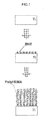
- Fig. 1 schematically shows that the HEMA-derived polymer chains (PolyHEMA), each having one end immobilized on the titanium plate, is formed on the titanium plate.
- PolyHEMA HEMA-derived polymer chains
- the polymer solution obtained by the above polymerization reaction was diluted with DMF and the weight average molecular weight was measured using GPC. The result is that Mw was 20,300.
- polydispersity index (PDI: Mw/Mn) was calculated and the value of Mw/Mn obtained was 1.28.
- the GPC was performed using the CCP & 8020 series high-speed liquid chromatography (manufactured by Toso Co., Ltd.) and as a standard sample, polyethylene glycol.
- the above-obtained substrate having the polymer chains formed thereon was subjected to anodic oxidation using a potentiostat (HA-501 G manufactured by Hokuto Denko Corp.) to electrodeposit titanium oxide on the substrate. In this way, a polymer brush composite was obtained.
- a potentiostat HA-501 G manufactured by Hokuto Denko Corp.
- the anodic oxidation treatment was carried out for 30 seconds in a 0.1 M sodium sulfate solution by applying voltages of 1 V SCE , 5 V SCE , and 10 V SCE , respectively.
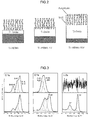
- Fig. 2 one example of an estimated structure of the substrate having the polymer chains formed thereon (Ti-HEMA) before the anodic oxidation treatment is shown at the left side.
- a schematic cross-sectional view illustrating one example of an estimated structure of a polymer brush composite (Ti-HEMA-1V) to which the voltage of 1 V SCE has been applied is shown at the center
- a schematic cross-sectional view illustrating one example of an estimated structure of a polymer brush composite (Ti-HEMA-10V) to which the voltage of 10 V SCE has been applied is shown at the right side.
- Table 2 indicates that the polymer brush composite of the present invention exhibited properties intermediate between the organic compound and the inorganic material. It is also found that even with application of any voltage of 1, 5, and 10 V, the surface states were similar.
- Fig. 3 shows the results of X-ray photoelectron spectroscopy (XPS) of the polymer brush composite
- Fig. 4 shows the results of Auger electron spectroscopy (AES) of the polymer brush composite.
- the XPS was carried out using the SSX 100 (manufactured by SSI technologies, Inc.) by a usual method and the AES was carried out using the JAMP-7100 (manufactured by JEOL Ltd.) by a usual method.
- the spectra in the upper sections of Fig. 3 indicate that, before the anodic oxidation treatment, the substrate surface had no titanium thereon and was covered with organic polymer chains.
- the spectra in the lower sections of Fig. 3 indicate that, as a result of the anodic oxidation treatment, the organic polymer compound and titanium coexisted on the surface of the polymer brush composite.
- the left-side chart of Fig. 4 indicates that, before the anodic oxidation treatment, the substrate surface was covered with the organic polymer chains.
- the right-sided chart of Fig. 4 indicates that, as a result of the anodic oxidation treatment, the organic polymer compound and titanium oxide coexisted on the surface of the polymer brush composite. Furthermore, as the sputtering proceeded, the amount of the organic polymer compound decreased, whereby it is found that the polymer chains were buried in the titanium oxide layer.
- the polymer chains are in the state in which they penetrate the titanium oxide layer (the solid layer) and one end of each polymer chain is exposed at the surface of the solid layer.
- a common culture dish and a comparative sample of an anodically oxidized titanium substrate HeLa cells were cultured for 6 hours under the same conditions and then observed respectively by the fluorescent microscope.
- the left-sided column of Fig. 5 shows the result of the culture dish
- the center column of Fig. 5 shows the result of the comparative sample, respectively.
- adhesion of the HeLa cells were found on both of the culture dish and the comparative sample.
- the polymer brush composite according to the present invention is a composite material that exhibits good adhesion between an organic polymer compound and an inorganic material and has the surface where the organic polymer compound and the inorganic material uniformly coexist. It is also found that the surface of the polymer brush composite of the present invention is non-cell-adherent.
Landscapes
- Chemical & Material Sciences (AREA)
- Engineering & Computer Science (AREA)
- Health & Medical Sciences (AREA)
- Materials Engineering (AREA)
- Organic Chemistry (AREA)
- Nanotechnology (AREA)
- Life Sciences & Earth Sciences (AREA)
- Medicinal Chemistry (AREA)
- Chemical Kinetics & Catalysis (AREA)
- Electrochemistry (AREA)
- Condensed Matter Physics & Semiconductors (AREA)
- Public Health (AREA)
- Veterinary Medicine (AREA)
- Animal Behavior & Ethology (AREA)
- Epidemiology (AREA)
- Transplantation (AREA)
- Metallurgy (AREA)
- Oral & Maxillofacial Surgery (AREA)
- Physics & Mathematics (AREA)
- Inorganic Chemistry (AREA)
- General Health & Medical Sciences (AREA)
- General Physics & Mathematics (AREA)
- Crystallography & Structural Chemistry (AREA)
- Dermatology (AREA)
- Polymers & Plastics (AREA)
- Composite Materials (AREA)
- Manufacturing & Machinery (AREA)
- Molecular Biology (AREA)
- Wood Science & Technology (AREA)
- Laminated Bodies (AREA)
- Materials For Medical Uses (AREA)
- Apparatus Associated With Microorganisms And Enzymes (AREA)
Description
- The present invention relates to a polymer brush composite and a method for producing the same.
- A variety of composite materials that include an organic polymer compound and an inorganic material such as a metal have been proposed. For example, a composite material has been disclosed that includes a substrate such as a metal and a polymer compound having one end immobilized on the surface of the substrate (for example, see Japanese Patent Application Laid-Open (JP-A) No.
2006-177914 JP-A No. 2007-260247 -
WO 2004/114371 discloses a compound use to form a self-assembled monolayer, a layer structure and a semiconductor component having a layer structure and a method for producing a layer structure. -
WO 02/056021 -
WO 2006/132694 discloses a process for the modification of a substrate so as to form an ultra hydrophobic surface on the substrate. -
WO 94/11118 - However, in the composite material described in
JP-A No. 2006-177914 JP-A No. 2007-260247 - It is an object of the present invention to provide a composite material that exhibits favorable binding between an organic polymer compound and an inorganic material and has a surface at which all or a part of the organic polymer compound is uniformly present in the inorganic material in such a manner that the organic polymer compound has an orientation, and a method for producing the composite material.
- A first aspect of the present invention is a polymer brush composite including a substrate, a solid layer disposed on the substrate and containing at least one of a metal or a metal oxide, and a plurality of polymer chains penetrating the solid layer in such a manner that one end of each of the polymer chains is disposed on an upper side of the substrate and the other end of each of the polymer chains is exposed at a surface of the solid layer on an opposite side of the solid layer to the substrate.
- The polymer chains preferably have a ratio (Mw/Mn) of weight average molecular weight (Mw) to number average molecular weight (Mn) of 1.0 or more and 1.5 or less.
- A second aspect of the present invention is a method for producing the polymer brush composite of the invention, the method including a polymer brush forming step of forming a plurality of polymer chains on a substrate, one end of each of the polymer chains being disposed on the substrate, and a solid layer forming step of forming a solid layer containing at least one of a metal or a metal oxide in a region in which the polymer chains are not immobilized on the surface of the substrate that has the polymer chains formed thereon, by applying a voltage to the substrate in a medium, wherein in the solid layer forming step, a metal oxide layer is formed by anodic oxidation.
- The polymer brush forming step preferably includes a step of forming a plurality of polymerization initiation points on the substrate and a step of polymerizing a polymerizable monomer using the plurality of polymerization initiation points as starting points.
- According to the present invention, it is possible to provide a composite material that exhibits favorable binding between an organic polymer compound and an inorganic material and that has a surface at which all or a part of the organic polymer compound is uniformly present in the inorganic material in such a manner that the organic polymer compound has an orientation, and a method for producing the composite material.
-
-
Fig. 1 shows schematic views showing one example of a method for forming polymer chains on a substrate according to the Example of the present invention. -
Fig. 2 shows schematic cross-sectional views illustrating one example of the structure of a polymer brush and a polymer brush composite according to the Example of the present invention. -
Fig. 3 shows charts indicating the results of XPS according to the Example of the present invention, in which the upper sections show the results before anodic oxidation treatment and the lower sections show the results after anodic oxidation treatment. -
Fig. 4 shows charts indicating the results of AES according to the embodiment of the present invention, in which the left chart indicates the results before anodic oxidation treatment and the right chart indicates the results after anodic oxidation treatment. -
Fig. 5 shows fluorescent microscopic photographs showing the evaluation results of cell adhesion according to the Example of the present invention. - A polymer brush composite according to the present invention includes a substrate, a solid layer disposed on the substrate and containing at least one of a metal or a metal oxide, and a plurality of polymer chains penetrating the solid layer in a state in which the polymer chains are extended in such a manner that one end of each of the polymer chains is disposed on the upper side of the substrate and the other end of each of the polymer chains is exposed at the surface of the solid layer at the opposite side of the solid layer to the substrate.
- In such a configuration, one end of each of the polymer chains is buried in the solid layer, thereby enabling the formation of a composite material that exhibits favorable binding between the organic polymer chains and the inorganic material (the solid layer) and has a surface at which the organic polymer compound is uniformly present in the inorganic material in such a manner that the organic polymer compound has an orientation.
- The substrate is not specifically limited as long as the solid layer containing at least one of a metal or a metal oxide can be disposed and one end of the polymer chain can be disposed. Preferably, the substrate has electric conductivity. Preferably, at least the surface of the substrate on which the polymer chains are disposed is smooth. Examples of the substrate may include a metal, a metal oxide, an alloy, and a semiconductor.
- Examples of the metal may include gold, silver, copper, platinum, titanium, aluminum, nickel, and zirconium. Examples of the metal oxide may include titanium oxide, zirconium oxide, chromium oxide, and aluminum oxide. Examples of the alloy may include titanium alloy, cobalt-chromium alloy, stainless steel, and gold alloy. Examples of the semiconductor include silicon.
- The substrate used in the present invention can be appropriately selected according to the purpose of the polymer brush composite. For example, from the viewpoint of biocompatibility, the substrate is preferably selected from titanium, zirconium, cobalt-chromium alloy, stainless steel, and gold alloy, and more preferably selected from titanium, zirconium, and gold.
- The solid layer contains at least one of a metal or a metal oxide. Examples of the metal and the metal oxide for the solid layer may include metals such as titanium and zirconium, and oxides thereof.
- In the present invention, the metal and the metal oxide for the solid layer can be appropriately selected according to the purpose of the polymer brush composite. From the viewpoint of formationability of the solid layer, a metal that is the same as at least one of metals contained in the substrate or an oxide thereof is preferable.
- The polymer forming the polymer chains is not specifically limited as long as one end of the polymer chain can be disposed on the substrate. The polymer may be an addition polymerization polymer or a condensation polymerization polymer. Specific examples of the polymer may include vinyl polymers, epoxy polymers, polyester polymers, polyurethane polymers, polyamide polymers, polycarbonate polymers, polyurea polymers, polyether polymers, and polyimide polymers. The polymer is preferably a vinyl polymer, a polyester polymer, a polyamide polymer, or a polyether polymer.
- In the present invention, the polymer chains can be appropriately selected according to the purpose of the polymer brush composite.
- The polymer forming the polymer chains in the present invention can be synthesized using commonly used monomer(s). Examples of the monomers used to form an addition polymerization polymer may include acrylate esters, acryl amide, methacrylate esters, methacryl amide, vinyl esters, vinyl ether, and olefins. Polyurethane polymers can be obtained by polymerization of a diol compound and a diisocyanate compound. Polyester polymers can be obtained either by condensation polymerization of a diol compound and a dicarboxylic acid compound or by ring-opening polymerization of a lactone. Polyamide polymers can be obtained by condensation polymerization of a diamine compound and a dicarboxylic acid compound, by condensation polymerization of an aminocarboxylic acid compound, or by ring-opening polymerization of a lactam.
- Polymer synthesis conditions in the present invention can be appropriately selected according to the monomer to be used.
- The polymer forming the polymer chains in the present invention is preferably a vinyl polymer from the viewpoint of general versatility.
- Examples of the method for synthesizing a vinyl polymer include living radical polymerization, living anionic polymerization, and living cationic polymerization. In the present invention, living radical polymerization is preferable from the viewpoint of industrial application and facilitation.
- The weight average molecular weight of the polymer chains in the present invention is not specifically limited. For example, the weight average molecular weight thereof may be in a range of from 400 to 10,000,000, and preferably in a range of 10,000 to 200,000.
- The polymer chains in the present invention have a ratio (Mw/Mn) of weight average molecular weight (Mw) to number average molecular weight (Mn) of preferably from 1.0 to 1.5, and more preferably from 1.0 to 1.3. When the ratio Mw/Mn is within the above ranges, the length difference between the individual polymer chains is smaller, so that the surface of the polymer brush composite is in such a state that the polymer compound and the inorganic material more uniformly coexist on the surface thereof.
- The polymer chains penetrate the solid layer. Since the plurality of polymer chains penetrating the solid layer, the end of each polymer chain that is not the end disposed on the upper side of the substrate is exposed at the surface of the solid layer (the surface of the solid layer on an opposite side of the solid layer to the substrate), whereby the inorganic material and the organic polymer compound uniformly coexist on the surface of the solid layer containing the inorganic material.
- There is no specific limitation to the manner in which the polymer chains penetrate the solid layer. From the viewpoint of the uniform coexistence of the inorganic material and the organic polymer compound, preferably, the polymer chains penetrate the solid layer in a state in which the polymer chains are extended. The state in which the polymer chains are extended defined herein means that the state in which the polymer chains are not in an aggregation state, and the definition thereof includes not only a state in which the polymer chains are completely extended, but also a state in which the polymer chains are extended with thermodynamic fluctuations.
- Furthermore, the state in which the polymer chains penetrate the solid layer in such a manner that one end of each of the polymer chains is exposed at the surface of the solid layer means the state in which the one end of a polymer chains is buried in the solid layer and at least a part of the other end thereof is protruded from the surface of the solid layer at the opposite side of the solid layer to the substrate.
- In the present invention, in the polymer brush forming step of forming the polymer chains on the substrate, one end of the each polymer chain is immobilized on the substrate. Examples of the manner of the immobilization may include immobilization by covalent bonding, immobilization by ionic bonding, immobilization by hydrophobic interaction, and immobilization by electrodeposition. Preferred is covalent bonding from the viewpoint of adhesion of the polymer compound.
- The immobilizing density of the polymer chains on the substrate is preferably no less than a immobilizing density at which another polymer chain exists in the radius of inertia of one polymer chain and a mutually repellent force begins to act between the polymer chains, and no more than a immobilizing density at which the polymer chains are closely packed in a state in which the polymer chains are completely extended.
- Specifically, the immobilizing density thereof is preferably from 0.001 to 1.0 chain/nm2, and more preferably from 0.05 to 0.8 chains/nm2. When the polymer chains are immobilized on the substrate at such a high density as in the above ranges, the interaction between the polymer chains allows the polymer chains to be easily form a state in which the polymer chains are extended, thereby making more uniform the coexisting state of the inorganic material and the organic polymer compound on the surface of the solid layer.
- The polymer brush composite according to the present invention has a conventionally unknown, novel structure, and the organic polymer compound is uniformly present on the surface of the inorganic material (the solid layer) in such a manner that the organic polymer compound has an orientation. Thereby, the polymer brush composite of the present invention can exhibit new properties that cannot be achieved by the inorganic material alone or the organic polymer compound alone, and possesses properties similar to those of a semiconductor.
- The polymer brush composite of the present invention can be applied to a variety of purposes by appropriately combining a metal or a metal oxide forming the solid layer with a polymer forming the polymer chains. For example, the polymer brush composite can be applied to high-speed electron exchange between a polymer functional group and a metal, as well as to the development of high-sensitivity sensors.
- Furthermore, when protein adsorption inhibitory effects and non-cell-adherent properties of the polymer brush composite surface are considered and a metal material widely used in vivo is combined, the polymer brush composite of the present invention can be particularly preferably used as a biocompatible material.
- Hereinafter, a detailed explanation will be given of a method for producing a polymer brush composite according to the present invention.
- The polymer brush composite producing method according to the present invention includes a polymer brush forming step of forming a plurality of polymer chains on a substrate, one end of each of the polymer chains being disposed on the substrate, and a solid layer forming step of forming a solid layer containing at least one of a metal or a metal oxide on the surface of the substrate that has the polymer chains formed thereon, by applying a voltage to the substrate in a medium, wherein tin the solid layer forming step, a metal oxide layer is formed by anodic oxidation.
- With the structure thus described, the polymer brush composite can be efficiently produced.
- The substrate and the polymer chains described above have the same definitions as the substrate and the polymer chains of the polymer brush composite previously described respectively, and preferable embodiments thereof are the same as those of the substrate and the polymer chains of the polymer brush composite previously described respectively.
- In the present invention, there is no specific limitation to the method for disposing one end of each polymer chain on the substrate. Examples thereof include a method in which a plurality of functional groups that can be bonded to an organic compound are disposed on a substrate surface and the functional groups are bonded to polymer molecules, and a method in which a plurality of polymerization initiation points are formed on a substrate, and a polymer is obtained by polymerization starting from the polymerization initiation points.
- The method for disposing, on the substrate surface, the functional groups that can bond to an organic compound or the polymerization initiation points, may be, for example, a method in which the substrate surface is treated with a compound (a coupling agent) having a functional group capable of reacting with and binding to an organic material and a functional group capable of reacting with and binding to an inorganic material in its molecule.
- The coupling agent to be used is not specifically limited as long as it is the compound that has, in its molecule, a functional group capable of reacting with and binding to an organic material and a functional group capable of reacting with and biding to an inorganic material. Examples of the functional group capable of reacting with and binding to an inorganic material may include a trialkoxysilyl group, a trihalogenosilyl group, an azido group, and a pyridinium group. Examples of the functional group capable of reacting with and binding to an organic material may include a haloalkyl group, an amino group, a hydroxy group, a mercapto group, a carboxyl group, a thiol group, and a specific reaction including avidin-biotin reaction. The coupling agent may have a coupling group that connects the functional group capable of reacting with and binding to an inorganic material to the functional group capable of reacting with and binding to an organic material.
- In the present invention, the coupling agent is preferably a silane coupling agent from the viewpoint of reactivity with the substrate.
- Specific examples of the silane coupling agent include 6-(2-bromo-2-isobutyryloxy) hexyl triethoxy silane (BHTE), 6-(2-bromo-2-isobutyryloxy) hexyl diethoxy silane (BHDE), and 6-(2-bromo-2-isobutyryloxy) hexyl monoethoxy silane (BHME).
- In the present invention, the polymer brush forming step preferably includes a step of forming a plurality of polymerization initiation points on the substrate and a step of polymerizing a polymerizable monomer using the plurality of polymerization initiation points as starting points. In this way, the polymer brush can be formed more efficiently.
- Herein, as the step of forming the polymerization initiation points on the substrate, the method in which the substrate surface is treated with the above-mentioned coupling agent can be suitably applied.
- The step of polymerizing the polymerizable monomer using the polymerization initiation points as starting points can be carried out under conditions that are appropriately selected according to the kind of the polymerization initiation points and the polymerizable monomer to be used.
- In the present invention, at the polymer brush forming step, one end of each polymer chain is immobilized on the substrate. The immobilizing density of the polymer chains on the substrate is preferably from 0.001 to 1.0 chains/nm2, and more preferably from 0.05 to 0.8 chains/nm2. When the immobilizing density of the polymer chains is in the above ranges, the interaction between adjacent polymer chains allows the polymer chains to easily form a state in which the polymer chains are extended, so that the polymer brush composite can be produced more efficiently.
- The immobilizing density of the polymer chains on the substrate can be controlled, for example, by appropriately selecting conditions for the surface treatment of the substrate using the coupling agent.
- In the solid layer forming step in the present invention, the solid layer containing at least one of a metal or a metal oxide is formed on the surface of the substrate that has the polymer chains formed thereon (particularly, in a region in which the polymer chains are not immobilized), by applying a voltage to the substrate in a medium. In this way, the solid layer can be formed in the state in which the polymer chains having one end disposed on the substrate penetrate the solid layer.
- The medium is preferably an aqueous medium containing water. The aqueous medium is not specifically limited as long as it is a water-containing medium. The aqueous medium can be formed by further including an organic solvent, an inorganic salt, and the like, according to needs.
- In the present invention, by applying a voltage to the substrate, the solid layer containing at least one of a metal or a metal oxide is formed on the surface of the substrate that has the polymer chains formed thereon.
- The voltage to be applied and the method for applying the voltage can be appropriately selected according to the metal and the metal oxide forming the solid layer. For example, a voltage of from 1 to 20 V can be applied in such a manner that the voltage is maintained to be constant.
- In the present invention, when forming the solid layer containing a metal oxide on the substrate, a metal oxide derived from a metal forming the substrate is disposed on the substrate by anodic oxidation using the substrate as an anode. In this case, the metal oxide is mainly disposed on the region in which the polymer chains are not immobilized, whereby the solid layer is formed in such a manner that the polymer chains penetrate the metal oxide layer.
- In the present invention, when forming the solid layer containing a metal on the substrate, a metal derived from metal ions present in the aqueous medium can be disposed on the substrate by adding metal ions in the aqueous medium and using the substrate as a cathode. In this case, the metal is mainly disposed on the region in which the polymer chains are not immobilized, whereby the solid layer is formed in such the manner that the polymer chains penetrate the metal layer.
- In the present invention, the solid layer forming step is preferably performed in such a manner that the non-immobilized end of each polymer chain immobilized on the substrate in the polymer brush forming step is exposed at the surface of the solid layer on an opposite side of the solid layer to the substrate. This can provide the state in which the inorganic material and the organic polymer compound uniformly coexist on the solid layer surface.
- In the solid layer forming step, the voltage to be applied to the substrate and the voltage applying method according to the polymer chains immobilized on the substrate are appropriately selected, thereby providing the state in which the non-immobilized end of each polymer chain is exposed at the surface of the solid layer on an opposite side of the solid layer to the substrate.
- Hereinafter, the present invention is described in further detail below by reference to Examples. It should be however noted that the present invention is not limited to those Examples. In addition, "%" is based on mass unless otherwise specifically stated.
- In a THF solution containing 1% of aqueous ammonia and 1% of 6-(2-bromo-2-isobutyryloxy) hexyl triethoxy silane (BHE), a metal titanium plate as a substrate was soaked at room temperature for 12 hours. Thereafter, the substrate was washed with THF and methanol, and the substrate that had been subjected to surface treatment with BHE was obtained.
- A methanol solution containing 25 mM of Cu(I)Br and 63 mM of bipyridine was stirred for 30 minutes to completely dissolve the Cu(I)Br. In this methanol solution, 4.5 M of 2-hydroxyethyl methacrylate (HEMA) and 22.5 mM of ethyl 2-bromoisobutyrate (EBIB) were added and mixed. The obtained solution was placed in a glass tube containing the titanium plate surface-treated with BHE and the grass tube was sealed. The sealed glass tube was shaked for 90 minutes in a water bath at 40°C to carry out polymerization reaction, thereby obtaining a substrate having polymer chains (PolyHEMA) derived from HEMA formed on the surface thereof (a polymer brush).
-
Fig. 1 schematically shows that the HEMA-derived polymer chains (PolyHEMA), each having one end immobilized on the titanium plate, is formed on the titanium plate. - The polymer solution obtained by the above polymerization reaction was diluted with DMF and the weight average molecular weight was measured using GPC. The result is that Mw was 20,300. In addition, polydispersity index (PDI: Mw/Mn) was calculated and the value of Mw/Mn obtained was 1.28.
- The GPC was performed using the CCP & 8020 series high-speed liquid chromatography (manufactured by Toso Co., Ltd.) and as a standard sample, polyethylene glycol.
- With respect to the above-obtained substrate having the polymer chains formed thereon, the surface state was observed using an automatic ellipsometer (DVA-36L3 manufactured by Mizojiri Optical Co. Ltd.), and the results are shown in Table 1. Table 1 indicates that the polymer chains are uniformly formed on the titanium surface.
Table 1 Layer Thickness of Polymer Chains (nm) Density (chain/nm2) Average Distance between Polymer Chains (nm) 16.4 0.56 1.4 - Next, the above-obtained substrate having the polymer chains formed thereon was subjected to anodic oxidation using a potentiostat (HA-501 G manufactured by Hokuto Denko Corp.) to electrodeposit titanium oxide on the substrate. In this way, a polymer brush composite was obtained.
- Using a saturated calomel electrode (SCE) as a reference electrode and a platinum electrode with platinum-black as a counter electrode, the anodic oxidation treatment was carried out for 30 seconds in a 0.1 M sodium sulfate solution by applying voltages of 1 VSCE, 5 VSCE, and 10 VSCE, respectively.
- In
Fig. 2 , one example of an estimated structure of the substrate having the polymer chains formed thereon (Ti-HEMA) before the anodic oxidation treatment is shown at the left side. - Further, in
Fig. 2 , a schematic cross-sectional view illustrating one example of an estimated structure of a polymer brush composite (Ti-HEMA-1V) to which the voltage of 1 VSCE has been applied is shown at the center, and a schematic cross-sectional view illustrating one example of an estimated structure of a polymer brush composite (Ti-HEMA-10V) to which the voltage of 10 VSCE has been applied is shown at the right side. - With respect to each of the polymer brush composites (Ti-HEMA-1V, Ti-HEMA-5V, and Ti-HEMA-10V) to which the voltages of 1, 5, and 10 VSCE were applied, a contact angle with water was measured using a contact angle meter. Additionally, with respect to comparative samples (Ti-1V, Ti-5V, and Ti-10V) obtained by subjecting a metal titanium plates having no polymer chains formed thereon to anodic oxidation in the same manner as in the above-described process, and the substrate (Ti-HEMA) having the polymer chains formed thereon but not having been subjected to the anodic oxidation, were each subjected to the measurement of a contact angle with water. Table 2 shows the results.
Table 2 Sample Contact Angle (°C) Ti-1V 83 Ti-5V 86 Ti-10V 87 Ti-HEMA 47 Ti-HEMA-1V 67 Ti-HEMA-5V 62 Ti-HEMA-10V 63 - Table 2 indicates that the polymer brush composite of the present invention exhibited properties intermediate between the organic compound and the inorganic material. It is also found that even with application of any voltage of 1, 5, and 10 V, the surface states were similar.
-
Fig. 3 shows the results of X-ray photoelectron spectroscopy (XPS) of the polymer brush composite andFig. 4 shows the results of Auger electron spectroscopy (AES) of the polymer brush composite. The XPS was carried out using the SSX 100 (manufactured by SSI technologies, Inc.) by a usual method and the AES was carried out using the JAMP-7100 (manufactured by JEOL Ltd.) by a usual method. - The spectra in the upper sections of
Fig. 3 indicate that, before the anodic oxidation treatment, the substrate surface had no titanium thereon and was covered with organic polymer chains. The spectra in the lower sections ofFig. 3 indicate that, as a result of the anodic oxidation treatment, the organic polymer compound and titanium coexisted on the surface of the polymer brush composite. - The left-side chart of
Fig. 4 indicates that, before the anodic oxidation treatment, the substrate surface was covered with the organic polymer chains. The right-sided chart ofFig. 4 indicates that, as a result of the anodic oxidation treatment, the organic polymer compound and titanium oxide coexisted on the surface of the polymer brush composite. Furthermore, as the sputtering proceeded, the amount of the organic polymer compound decreased, whereby it is found that the polymer chains were buried in the titanium oxide layer. - In other words, it is found that, in the polymer brush composite of the present invention, the polymer chains are in the state in which they penetrate the titanium oxide layer (the solid layer) and one end of each polymer chain is exposed at the surface of the solid layer.
- Next, cell adhesion of the polymer brush composite of the present invention was evaluated. On the surface of the above-obtained polymer brush composite that has the polymer chains exposed thereon, HeLa cells were cultured for 6 hours under normal culture conditions (culture medium: 10% FCS-added DMEM, 37°C, and 5% CO2). In observation using a fluorescent microscope, most of the HeLa cells did not adhere to the surface of the polymer brush composite, as shown on the right side of
Fig. 5 . The upper sections ofFig. 5 show observation results in a 40-fold magnification, and the lower sections thereof show observation results in a 200-fold magnification. - Meanwhile, using a common culture dish and a comparative sample of an anodically oxidized titanium substrate, HeLa cells were cultured for 6 hours under the same conditions and then observed respectively by the fluorescent microscope. The left-sided column of
Fig. 5 shows the result of the culture dish, and the center column ofFig. 5 shows the result of the comparative sample, respectively. As seen in the photographs on the left-sided column and the center column ofFig. 5 , adhesion of the HeLa cells were found on both of the culture dish and the comparative sample. - As described hereinabove, it is found that the polymer brush composite according to the present invention is a composite material that exhibits good adhesion between an organic polymer compound and an inorganic material and has the surface where the organic polymer compound and the inorganic material uniformly coexist. It is also found that the surface of the polymer brush composite of the present invention is non-cell-adherent.
Claims (4)
- A polymer brush composite, comprising: a substrate, a solid layer disposed on the substrate and containing at least one of a metal or a metal oxide, and a plurality of polymer chains penetrating the solid layer in such a manner that one end of each of the polymer chains is disposed on an upper side of the substrate and the other end of each of the polymer chains is exposed at a surface of the solid layer on an opposite side of the solid layer to the substrate.
- The polymer brush composite according to claim 1, wherein the polymer chains have a ratio (Mw/Mn) of weight average molecular weight (Mw) to number average molecular weight (Mn) of from 1.0 to 1.5.
- A method for producing a polymer brush composite according to claims 1 or 2, the method comprising:a polymer brush forming step of forming a plurality of polymer chains on a substrate, one end of each of the polymer chains being disposed on the substrate; anda solid layer forming step of forming a solid layer containing at least one of a metal or a metal oxide on a surface of the substrate that has the polymer chains formed thereon, by applying a voltage to the substrate in a medium, wherein, in the solid layer forming step, a metal oxide layer is formed by anodic oxidation.
- The method for producing a polymer brush composite according to claim 3, wherein the polymer brush forming step includes a step of forming a plurality of polymerization initiation points on the substrate and a step of polymerizing a polymerizable monomer using the plurality of polymerization initiation points as starting points.
Applications Claiming Priority (2)
| Application Number | Priority Date | Filing Date | Title |
|---|---|---|---|
| JP2008247361 | 2008-09-26 | ||
| PCT/JP2009/066680 WO2010035799A1 (en) | 2008-09-26 | 2009-09-25 | Polymer brush composite and method for producing same |
Publications (3)
| Publication Number | Publication Date |
|---|---|
| EP2335917A1 EP2335917A1 (en) | 2011-06-22 |
| EP2335917A4 EP2335917A4 (en) | 2012-08-01 |
| EP2335917B1 true EP2335917B1 (en) | 2014-04-30 |
Family
ID=42059794
Family Applications (1)
| Application Number | Title | Priority Date | Filing Date |
|---|---|---|---|
| EP09816213.4A Not-in-force EP2335917B1 (en) | 2008-09-26 | 2009-09-25 | Polymer brush composite and method for producing same |
Country Status (4)
| Country | Link |
|---|---|
| US (1) | US20110223390A1 (en) |
| EP (1) | EP2335917B1 (en) |
| JP (1) | JP5437256B2 (en) |
| WO (1) | WO2010035799A1 (en) |
Cited By (1)
| Publication number | Priority date | Publication date | Assignee | Title |
|---|---|---|---|---|
| US10345702B2 (en) | 2017-08-24 | 2019-07-09 | International Business Machines Corporation | Polymer brushes for extreme ultraviolet photolithography |
Families Citing this family (4)
| Publication number | Priority date | Publication date | Assignee | Title |
|---|---|---|---|---|
| EP2621938A1 (en) * | 2010-09-29 | 2013-08-07 | Solvay Specialty Polymers Italy S.p.A. | A composite polymerization initiator and polymer brush composite obtained therefrom |
| CH707176A1 (en) * | 2012-11-13 | 2014-05-15 | Frédéric Gonzales | Surface treatment of rigid metallic material for cleaning textiles, by ceramicizing or anodizing surface of material to create residual porosity of surface, and impregnating porous surface obtained by bio-based polymers |
| US11154061B2 (en) * | 2016-10-17 | 2021-10-26 | Orthobond Corporation | Functional surfaces |
| US11226561B2 (en) | 2018-08-11 | 2022-01-18 | International Business Machines Corporation | Self-priming resist for generic inorganic hardmasks |
Family Cites Families (20)
| Publication number | Priority date | Publication date | Assignee | Title |
|---|---|---|---|---|
| US5326584A (en) * | 1989-04-24 | 1994-07-05 | Drexel University | Biocompatible, surface modified materials and method of making the same |
| JPH08244155A (en) * | 1995-03-14 | 1996-09-24 | Canon Inc | Solid phase bonding method |
| US20060013850A1 (en) * | 1999-12-03 | 2006-01-19 | Domb Abraham J | Electropolymerizable monomers and polymeric coatings on implantable devices prepared therefrom |
| AU2002246978A1 (en) * | 2001-01-10 | 2002-07-24 | Symyx Technologies, Inc. | Polymer brushes for immobilizing molecules to a surface |
| JP2003168682A (en) * | 2001-11-30 | 2003-06-13 | Kansai Tlo Kk | Method of forming fine pattern on silicon workpiece |
| DE10210626A1 (en) * | 2002-03-11 | 2003-09-25 | Transmit Technologietransfer | Process for the production of hollow fibers |
| GB0309355D0 (en) * | 2003-04-24 | 2003-06-04 | Univ Cambridge Tech | Organic electronic devices incorporating semiconducting polymer |
| DE10328811B4 (en) * | 2003-06-20 | 2005-12-29 | Infineon Technologies Ag | A compound for forming a self-assembling monolayer, a layered structure, a semiconductor device having a layered structure and a method for producing a layered structure |
| CA2479670C (en) * | 2003-08-26 | 2009-09-08 | Japan As Represented By The President Of National Cardiovascular Center | Titanium oxide complex and production method thereof, and medical material using the same |
| JP2005319679A (en) * | 2004-05-07 | 2005-11-17 | Japan Science & Technology Agency | Composite substrate and method for manufacturing composite substrate |
| JP2006177914A (en) | 2004-12-20 | 2006-07-06 | Yukio Nagasaki | Surface having thick polymer layer, and preparation method therefor |
| JP2006255811A (en) * | 2005-03-15 | 2006-09-28 | National Institute For Materials Science | Method for forming monomolecular film |
| US7514764B2 (en) * | 2005-03-23 | 2009-04-07 | Wisconsin Alumni Research Foundation | Materials and methods for creating imaging layers |
| US7985451B2 (en) * | 2005-04-01 | 2011-07-26 | Clemson University | Method of manufacturing ultrahydrophobic substrates |
| JP5100023B2 (en) | 2006-03-29 | 2012-12-19 | 京セラメディカル株式会社 | Biomaterial, artificial joint using the same, and manufacturing method thereof |
| JP4909745B2 (en) * | 2007-01-17 | 2012-04-04 | シャープ株式会社 | Organic thin film forming method and organic thin film forming apparatus |
| WO2008097616A1 (en) * | 2007-02-06 | 2008-08-14 | The Board Of Trustees Of The Leland Stanford Junior University | Hydrogel-metal assembly |
| JP2008247361A (en) | 2007-03-30 | 2008-10-16 | Bridgestone Corp | Pneumatic tire |
| US9079999B2 (en) * | 2008-02-26 | 2015-07-14 | Rigoberto Advincula | Methods for preparing polymer coatings by electrochemical grafting of polymer brushes, compositions prepared thereby and compositions for preparing the coatings |
| JP5185720B2 (en) * | 2008-02-27 | 2013-04-17 | 株式会社神戸製鋼所 | Surface treatment method of titanium material for electrodes |
-
2009
- 2009-09-25 WO PCT/JP2009/066680 patent/WO2010035799A1/en not_active Ceased
- 2009-09-25 JP JP2010530875A patent/JP5437256B2/en not_active Expired - Fee Related
- 2009-09-25 EP EP09816213.4A patent/EP2335917B1/en not_active Not-in-force
- 2009-09-25 US US13/120,631 patent/US20110223390A1/en not_active Abandoned
Cited By (2)
| Publication number | Priority date | Publication date | Assignee | Title |
|---|---|---|---|---|
| US10345702B2 (en) | 2017-08-24 | 2019-07-09 | International Business Machines Corporation | Polymer brushes for extreme ultraviolet photolithography |
| US10656523B2 (en) | 2017-08-24 | 2020-05-19 | International Business Machines Corporation | Polymer brushes for extreme ultraviolet photolithography |
Also Published As
| Publication number | Publication date |
|---|---|
| JPWO2010035799A1 (en) | 2012-06-07 |
| EP2335917A4 (en) | 2012-08-01 |
| EP2335917A1 (en) | 2011-06-22 |
| JP5437256B2 (en) | 2014-03-12 |
| US20110223390A1 (en) | 2011-09-15 |
| WO2010035799A1 (en) | 2010-04-01 |
Similar Documents
| Publication | Publication Date | Title |
|---|---|---|
| Gasteier et al. | Surface grafting of PEO‐based star‐shaped molecules for bioanalytical and biomedical applications | |
| Xiao et al. | Highly sensitive and selective method to detect dopamine in the presence of ascorbic acid by a new polymeric composite film | |
| Cosnier | Biosensors based on electropolymerized films: new trends | |
| Akbulut et al. | Electrochemical deposition of polypeptides: bio-based covering materials for surface design | |
| Ma et al. | Antifouling and conducting PEDOT derivative grafted with polyglycerol for highly sensitive electrochemical protein detection in complex biological media | |
| US20110223390A1 (en) | Polymer brush composite and method for producing same | |
| Fabregat et al. | Incorporation of a clot-binding peptide into polythiophene: properties of composites for biomedical applications | |
| Kumru et al. | Electrografting of thiophene, carbazole, pyrrole and their copolymers onto carbon fibers: electrokinetic measurements, surface composition and morphology | |
| Baek et al. | Thin film hydrophilic electroactive polymer coatings for bioelectrodes | |
| Zhang et al. | Functionalization of metal surface via thiol–ene click chemistry: synthesis, adsorption behavior, and postfunctionalization of a catechol-and allyl-containing copolymer | |
| Perez-Madrigal et al. | Polypyrrole-supported membrane proteins for bio-inspired ion channels | |
| Celikbas et al. | Surface modification with a catechol-bearing polypeptide and sensing applications | |
| Chiono et al. | Layer-by-layer coating of photoactive polymers for biomedical applications | |
| Kotanen et al. | Fabrication and in vitro performance of a dual responsive lactate and glucose biosensor | |
| Xue et al. | Developing porous microneedles patch for the detection of wound infections | |
| Liu et al. | Polypyrrole actuator with a bioadhesive surface for accumulating bacteria from physiological media | |
| Kim et al. | Ferrocene-based acrylate copolymer multilayers with efficient antifouling and electrochemical redox properties | |
| Chakraborty et al. | Development and relative comparison of polypyrrole-calcium phosphate composite coatings with differential concentration of chlorophyll functionalized polymer particle achieved through pulsed electro deposition | |
| Yang et al. | Quantitatively Elucidating the Trade-Off between Zwitterionic Antifouling Surfaces and Bioconjugation Performance | |
| Wang et al. | Nanostructured conducting polymers and their biomedical applications | |
| US10696753B2 (en) | Method of electrochemically modifying surface of electrode using dopamine-hyaluronic acid conjugates | |
| US9018344B2 (en) | Polymers for thin film coatings | |
| Liu et al. | Sol–gel coatings by electrochemical deposition | |
| Fukuhara et al. | The effect of different component ratios in block polymers and processing conditions on electrodeposition efficiency onto titanium | |
| Politakos et al. | Smart, biocompatible, responsive surfaces on pH, temperature and ionic strength of titanium oxide and niobium oxide with polymer brushes of poly (acrylic acid), poly (N-isopropylacrylamide) and poly ([2-(methacryloyloxy) ethyl] trimethylammonium chloride) |
Legal Events
| Date | Code | Title | Description |
|---|---|---|---|
| PUAI | Public reference made under article 153(3) epc to a published international application that has entered the european phase |
Free format text: ORIGINAL CODE: 0009012 |
|
| 17P | Request for examination filed |
Effective date: 20110420 |
|
| AK | Designated contracting states |
Kind code of ref document: A1 Designated state(s): AT BE BG CH CY CZ DE DK EE ES FI FR GB GR HR HU IE IS IT LI LT LU LV MC MK MT NL NO PL PT RO SE SI SK SM TR |
|
| AX | Request for extension of the european patent |
Extension state: AL BA RS |
|
| DAX | Request for extension of the european patent (deleted) | ||
| A4 | Supplementary search report drawn up and despatched |
Effective date: 20120702 |
|
| RIC1 | Information provided on ipc code assigned before grant |
Ipc: H01L 21/312 20060101ALI20120626BHEP Ipc: B32B 9/00 20060101ALI20120626BHEP Ipc: H01L 21/316 20060101ALI20120626BHEP Ipc: A61L 27/00 20060101ALI20120626BHEP Ipc: B32B 15/04 20060101AFI20120626BHEP |
|
| REG | Reference to a national code |
Ref country code: DE Ref legal event code: R079 Ref document number: 602009023740 Country of ref document: DE Free format text: PREVIOUS MAIN CLASS: B32B0015040000 Ipc: A61L0027000000 |
|
| RIC1 | Information provided on ipc code assigned before grant |
Ipc: A61L 27/04 20060101ALI20130606BHEP Ipc: A61L 27/00 20060101AFI20130606BHEP Ipc: B82Y 40/00 20110101ALI20130606BHEP Ipc: B82Y 30/00 20110101ALI20130606BHEP Ipc: C08F 292/00 20060101ALI20130606BHEP Ipc: C25D 11/26 20060101ALI20130606BHEP Ipc: C25D 11/16 20060101ALI20130606BHEP Ipc: C09D 5/44 20060101ALI20130606BHEP Ipc: B05D 1/28 20060101ALI20130606BHEP Ipc: A61L 27/34 20060101ALI20130606BHEP Ipc: B05D 1/18 20060101ALI20130606BHEP |
|
| GRAP | Despatch of communication of intention to grant a patent |
Free format text: ORIGINAL CODE: EPIDOSNIGR1 |
|
| INTG | Intention to grant announced |
Effective date: 20131206 |
|
| GRAS | Grant fee paid |
Free format text: ORIGINAL CODE: EPIDOSNIGR3 |
|
| GRAA | (expected) grant |
Free format text: ORIGINAL CODE: 0009210 |
|
| AK | Designated contracting states |
Kind code of ref document: B1 Designated state(s): AT BE BG CH CY CZ DE DK EE ES FI FR GB GR HR HU IE IS IT LI LT LU LV MC MK MT NL NO PL PT RO SE SI SK SM TR |
|
| REG | Reference to a national code |
Ref country code: GB Ref legal event code: FG4D Ref country code: CH Ref legal event code: EP |
|
| REG | Reference to a national code |
Ref country code: AT Ref legal event code: REF Ref document number: 664659 Country of ref document: AT Kind code of ref document: T Effective date: 20140515 |
|
| REG | Reference to a national code |
Ref country code: IE Ref legal event code: FG4D |
|
| REG | Reference to a national code |
Ref country code: DE Ref legal event code: R096 Ref document number: 602009023740 Country of ref document: DE Effective date: 20140612 |
|
| REG | Reference to a national code |
Ref country code: AT Ref legal event code: MK05 Ref document number: 664659 Country of ref document: AT Kind code of ref document: T Effective date: 20140430 |
|
| REG | Reference to a national code |
Ref country code: LT Ref legal event code: MG4D |
|
| REG | Reference to a national code |
Ref country code: NL Ref legal event code: VDEP Effective date: 20140430 |
|
| PG25 | Lapsed in a contracting state [announced via postgrant information from national office to epo] |
Ref country code: FI Free format text: LAPSE BECAUSE OF FAILURE TO SUBMIT A TRANSLATION OF THE DESCRIPTION OR TO PAY THE FEE WITHIN THE PRESCRIBED TIME-LIMIT Effective date: 20140430 Ref country code: GR Free format text: LAPSE BECAUSE OF FAILURE TO SUBMIT A TRANSLATION OF THE DESCRIPTION OR TO PAY THE FEE WITHIN THE PRESCRIBED TIME-LIMIT Effective date: 20140731 Ref country code: LT Free format text: LAPSE BECAUSE OF FAILURE TO SUBMIT A TRANSLATION OF THE DESCRIPTION OR TO PAY THE FEE WITHIN THE PRESCRIBED TIME-LIMIT Effective date: 20140430 Ref country code: CY Free format text: LAPSE BECAUSE OF FAILURE TO SUBMIT A TRANSLATION OF THE DESCRIPTION OR TO PAY THE FEE WITHIN THE PRESCRIBED TIME-LIMIT Effective date: 20140430 Ref country code: NL Free format text: LAPSE BECAUSE OF FAILURE TO SUBMIT A TRANSLATION OF THE DESCRIPTION OR TO PAY THE FEE WITHIN THE PRESCRIBED TIME-LIMIT Effective date: 20140430 Ref country code: IS Free format text: LAPSE BECAUSE OF FAILURE TO SUBMIT A TRANSLATION OF THE DESCRIPTION OR TO PAY THE FEE WITHIN THE PRESCRIBED TIME-LIMIT Effective date: 20140830 Ref country code: BG Free format text: LAPSE BECAUSE OF FAILURE TO SUBMIT A TRANSLATION OF THE DESCRIPTION OR TO PAY THE FEE WITHIN THE PRESCRIBED TIME-LIMIT Effective date: 20140730 Ref country code: NO Free format text: LAPSE BECAUSE OF FAILURE TO SUBMIT A TRANSLATION OF THE DESCRIPTION OR TO PAY THE FEE WITHIN THE PRESCRIBED TIME-LIMIT Effective date: 20140730 |
|
| PGFP | Annual fee paid to national office [announced via postgrant information from national office to epo] |
Ref country code: DE Payment date: 20140922 Year of fee payment: 6 |
|
| PG25 | Lapsed in a contracting state [announced via postgrant information from national office to epo] |
Ref country code: PL Free format text: LAPSE BECAUSE OF FAILURE TO SUBMIT A TRANSLATION OF THE DESCRIPTION OR TO PAY THE FEE WITHIN THE PRESCRIBED TIME-LIMIT Effective date: 20140430 Ref country code: LV Free format text: LAPSE BECAUSE OF FAILURE TO SUBMIT A TRANSLATION OF THE DESCRIPTION OR TO PAY THE FEE WITHIN THE PRESCRIBED TIME-LIMIT Effective date: 20140430 Ref country code: HR Free format text: LAPSE BECAUSE OF FAILURE TO SUBMIT A TRANSLATION OF THE DESCRIPTION OR TO PAY THE FEE WITHIN THE PRESCRIBED TIME-LIMIT Effective date: 20140430 Ref country code: ES Free format text: LAPSE BECAUSE OF FAILURE TO SUBMIT A TRANSLATION OF THE DESCRIPTION OR TO PAY THE FEE WITHIN THE PRESCRIBED TIME-LIMIT Effective date: 20140430 Ref country code: AT Free format text: LAPSE BECAUSE OF FAILURE TO SUBMIT A TRANSLATION OF THE DESCRIPTION OR TO PAY THE FEE WITHIN THE PRESCRIBED TIME-LIMIT Effective date: 20140430 Ref country code: SE Free format text: LAPSE BECAUSE OF FAILURE TO SUBMIT A TRANSLATION OF THE DESCRIPTION OR TO PAY THE FEE WITHIN THE PRESCRIBED TIME-LIMIT Effective date: 20140430 |
|
| PG25 | Lapsed in a contracting state [announced via postgrant information from national office to epo] |
Ref country code: PT Free format text: LAPSE BECAUSE OF FAILURE TO SUBMIT A TRANSLATION OF THE DESCRIPTION OR TO PAY THE FEE WITHIN THE PRESCRIBED TIME-LIMIT Effective date: 20140901 |
|
| PG25 | Lapsed in a contracting state [announced via postgrant information from national office to epo] |
Ref country code: RO Free format text: LAPSE BECAUSE OF FAILURE TO SUBMIT A TRANSLATION OF THE DESCRIPTION OR TO PAY THE FEE WITHIN THE PRESCRIBED TIME-LIMIT Effective date: 20140430 Ref country code: BE Free format text: LAPSE BECAUSE OF FAILURE TO SUBMIT A TRANSLATION OF THE DESCRIPTION OR TO PAY THE FEE WITHIN THE PRESCRIBED TIME-LIMIT Effective date: 20140430 Ref country code: SK Free format text: LAPSE BECAUSE OF FAILURE TO SUBMIT A TRANSLATION OF THE DESCRIPTION OR TO PAY THE FEE WITHIN THE PRESCRIBED TIME-LIMIT Effective date: 20140430 Ref country code: EE Free format text: LAPSE BECAUSE OF FAILURE TO SUBMIT A TRANSLATION OF THE DESCRIPTION OR TO PAY THE FEE WITHIN THE PRESCRIBED TIME-LIMIT Effective date: 20140430 Ref country code: DK Free format text: LAPSE BECAUSE OF FAILURE TO SUBMIT A TRANSLATION OF THE DESCRIPTION OR TO PAY THE FEE WITHIN THE PRESCRIBED TIME-LIMIT Effective date: 20140430 Ref country code: CZ Free format text: LAPSE BECAUSE OF FAILURE TO SUBMIT A TRANSLATION OF THE DESCRIPTION OR TO PAY THE FEE WITHIN THE PRESCRIBED TIME-LIMIT Effective date: 20140430 |
|
| REG | Reference to a national code |
Ref country code: DE Ref legal event code: R097 Ref document number: 602009023740 Country of ref document: DE |
|
| PLBE | No opposition filed within time limit |
Free format text: ORIGINAL CODE: 0009261 |
|
| STAA | Information on the status of an ep patent application or granted ep patent |
Free format text: STATUS: NO OPPOSITION FILED WITHIN TIME LIMIT |
|
| PG25 | Lapsed in a contracting state [announced via postgrant information from national office to epo] |
Ref country code: IT Free format text: LAPSE BECAUSE OF FAILURE TO SUBMIT A TRANSLATION OF THE DESCRIPTION OR TO PAY THE FEE WITHIN THE PRESCRIBED TIME-LIMIT Effective date: 20140430 |
|
| 26N | No opposition filed |
Effective date: 20150202 |
|
| PG25 | Lapsed in a contracting state [announced via postgrant information from national office to epo] |
Ref country code: LU Free format text: LAPSE BECAUSE OF FAILURE TO SUBMIT A TRANSLATION OF THE DESCRIPTION OR TO PAY THE FEE WITHIN THE PRESCRIBED TIME-LIMIT Effective date: 20140925 Ref country code: MC Free format text: LAPSE BECAUSE OF FAILURE TO SUBMIT A TRANSLATION OF THE DESCRIPTION OR TO PAY THE FEE WITHIN THE PRESCRIBED TIME-LIMIT Effective date: 20140430 |
|
| REG | Reference to a national code |
Ref country code: CH Ref legal event code: PL |
|
| REG | Reference to a national code |
Ref country code: DE Ref legal event code: R097 Ref document number: 602009023740 Country of ref document: DE Effective date: 20150202 |
|
| GBPC | Gb: european patent ceased through non-payment of renewal fee |
Effective date: 20140925 |
|
| REG | Reference to a national code |
Ref country code: IE Ref legal event code: MM4A |
|
| REG | Reference to a national code |
Ref country code: FR Ref legal event code: ST Effective date: 20150529 |
|
| PG25 | Lapsed in a contracting state [announced via postgrant information from national office to epo] |
Ref country code: SI Free format text: LAPSE BECAUSE OF FAILURE TO SUBMIT A TRANSLATION OF THE DESCRIPTION OR TO PAY THE FEE WITHIN THE PRESCRIBED TIME-LIMIT Effective date: 20140430 Ref country code: LI Free format text: LAPSE BECAUSE OF NON-PAYMENT OF DUE FEES Effective date: 20140930 Ref country code: GB Free format text: LAPSE BECAUSE OF NON-PAYMENT OF DUE FEES Effective date: 20140925 Ref country code: CH Free format text: LAPSE BECAUSE OF NON-PAYMENT OF DUE FEES Effective date: 20140930 |
|
| PG25 | Lapsed in a contracting state [announced via postgrant information from national office to epo] |
Ref country code: FR Free format text: LAPSE BECAUSE OF NON-PAYMENT OF DUE FEES Effective date: 20140930 Ref country code: IE Free format text: LAPSE BECAUSE OF NON-PAYMENT OF DUE FEES Effective date: 20140925 |
|
| REG | Reference to a national code |
Ref country code: DE Ref legal event code: R119 Ref document number: 602009023740 Country of ref document: DE |
|
| PG25 | Lapsed in a contracting state [announced via postgrant information from national office to epo] |
Ref country code: SM Free format text: LAPSE BECAUSE OF FAILURE TO SUBMIT A TRANSLATION OF THE DESCRIPTION OR TO PAY THE FEE WITHIN THE PRESCRIBED TIME-LIMIT Effective date: 20140430 |
|
| PG25 | Lapsed in a contracting state [announced via postgrant information from national office to epo] |
Ref country code: MT Free format text: LAPSE BECAUSE OF FAILURE TO SUBMIT A TRANSLATION OF THE DESCRIPTION OR TO PAY THE FEE WITHIN THE PRESCRIBED TIME-LIMIT Effective date: 20140430 |
|
| PG25 | Lapsed in a contracting state [announced via postgrant information from national office to epo] |
Ref country code: DE Free format text: LAPSE BECAUSE OF NON-PAYMENT OF DUE FEES Effective date: 20160401 Ref country code: TR Free format text: LAPSE BECAUSE OF FAILURE TO SUBMIT A TRANSLATION OF THE DESCRIPTION OR TO PAY THE FEE WITHIN THE PRESCRIBED TIME-LIMIT Effective date: 20140430 Ref country code: HU Free format text: LAPSE BECAUSE OF FAILURE TO SUBMIT A TRANSLATION OF THE DESCRIPTION OR TO PAY THE FEE WITHIN THE PRESCRIBED TIME-LIMIT; INVALID AB INITIO Effective date: 20090925 |
|
| PG25 | Lapsed in a contracting state [announced via postgrant information from national office to epo] |
Ref country code: MK Free format text: LAPSE BECAUSE OF FAILURE TO SUBMIT A TRANSLATION OF THE DESCRIPTION OR TO PAY THE FEE WITHIN THE PRESCRIBED TIME-LIMIT Effective date: 20140430 |