EP2335664A1 - Method for producing absorptive article - Google Patents
Method for producing absorptive article Download PDFInfo
- Publication number
- EP2335664A1 EP2335664A1 EP09817809A EP09817809A EP2335664A1 EP 2335664 A1 EP2335664 A1 EP 2335664A1 EP 09817809 A EP09817809 A EP 09817809A EP 09817809 A EP09817809 A EP 09817809A EP 2335664 A1 EP2335664 A1 EP 2335664A1
- Authority
- EP
- European Patent Office
- Prior art keywords
- elastic member
- line
- elastic members
- manufacturing
- absorbent article
- Prior art date
- Legal status (The legal status is an assumption and is not a legal conclusion. Google has not performed a legal analysis and makes no representation as to the accuracy of the status listed.)
- Withdrawn
Links
Images


Classifications
-
- A—HUMAN NECESSITIES
- A61—MEDICAL OR VETERINARY SCIENCE; HYGIENE
- A61F—FILTERS IMPLANTABLE INTO BLOOD VESSELS; PROSTHESES; DEVICES PROVIDING PATENCY TO, OR PREVENTING COLLAPSING OF, TUBULAR STRUCTURES OF THE BODY, e.g. STENTS; ORTHOPAEDIC, NURSING OR CONTRACEPTIVE DEVICES; FOMENTATION; TREATMENT OR PROTECTION OF EYES OR EARS; BANDAGES, DRESSINGS OR ABSORBENT PADS; FIRST-AID KITS
- A61F13/00—Bandages or dressings; Absorbent pads
- A61F13/15—Absorbent pads, e.g. sanitary towels, swabs or tampons for external or internal application to the body; Supporting or fastening means therefor; Tampon applicators
- A61F13/15577—Apparatus or processes for manufacturing
- A61F13/15585—Apparatus or processes for manufacturing of babies' napkins, e.g. diapers
- A61F13/15593—Apparatus or processes for manufacturing of babies' napkins, e.g. diapers having elastic ribbons fixed thereto; Devices for applying the ribbons
- A61F13/15609—Apparatus or processes for manufacturing of babies' napkins, e.g. diapers having elastic ribbons fixed thereto; Devices for applying the ribbons the ribbons being applied in an irregular path
-
- A—HUMAN NECESSITIES
- A61—MEDICAL OR VETERINARY SCIENCE; HYGIENE
- A61F—FILTERS IMPLANTABLE INTO BLOOD VESSELS; PROSTHESES; DEVICES PROVIDING PATENCY TO, OR PREVENTING COLLAPSING OF, TUBULAR STRUCTURES OF THE BODY, e.g. STENTS; ORTHOPAEDIC, NURSING OR CONTRACEPTIVE DEVICES; FOMENTATION; TREATMENT OR PROTECTION OF EYES OR EARS; BANDAGES, DRESSINGS OR ABSORBENT PADS; FIRST-AID KITS
- A61F13/00—Bandages or dressings; Absorbent pads
- A61F13/15—Absorbent pads, e.g. sanitary towels, swabs or tampons for external or internal application to the body; Supporting or fastening means therefor; Tampon applicators
- A61F13/45—Absorbent pads, e.g. sanitary towels, swabs or tampons for external or internal application to the body; Supporting or fastening means therefor; Tampon applicators characterised by the shape
- A61F13/49—Absorbent pads, e.g. sanitary towels, swabs or tampons for external or internal application to the body; Supporting or fastening means therefor; Tampon applicators characterised by the shape specially adapted to be worn around the waist, e.g. diapers or nappies
- A61F13/49007—Form-fitting, self-adjusting disposable diapers
- A61F13/49009—Form-fitting, self-adjusting disposable diapers with elastic means
- A61F13/49019—Form-fitting, self-adjusting disposable diapers with elastic means the elastic means being placed longitudinally, transversely or diagonally over the article
-
- Y—GENERAL TAGGING OF NEW TECHNOLOGICAL DEVELOPMENTS; GENERAL TAGGING OF CROSS-SECTIONAL TECHNOLOGIES SPANNING OVER SEVERAL SECTIONS OF THE IPC; TECHNICAL SUBJECTS COVERED BY FORMER USPC CROSS-REFERENCE ART COLLECTIONS [XRACs] AND DIGESTS
- Y10—TECHNICAL SUBJECTS COVERED BY FORMER USPC
- Y10T—TECHNICAL SUBJECTS COVERED BY FORMER US CLASSIFICATION
- Y10T156/00—Adhesive bonding and miscellaneous chemical manufacture
- Y10T156/10—Methods of surface bonding and/or assembly therefor
- Y10T156/1052—Methods of surface bonding and/or assembly therefor with cutting, punching, tearing or severing
- Y10T156/1062—Prior to assembly
- Y10T156/1075—Prior to assembly of plural laminae from single stock and assembling to each other or to additional lamina
-
- Y—GENERAL TAGGING OF NEW TECHNOLOGICAL DEVELOPMENTS; GENERAL TAGGING OF CROSS-SECTIONAL TECHNOLOGIES SPANNING OVER SEVERAL SECTIONS OF THE IPC; TECHNICAL SUBJECTS COVERED BY FORMER USPC CROSS-REFERENCE ART COLLECTIONS [XRACs] AND DIGESTS
- Y10—TECHNICAL SUBJECTS COVERED BY FORMER USPC
- Y10T—TECHNICAL SUBJECTS COVERED BY FORMER US CLASSIFICATION
- Y10T156/00—Adhesive bonding and miscellaneous chemical manufacture
- Y10T156/10—Methods of surface bonding and/or assembly therefor
- Y10T156/1089—Methods of surface bonding and/or assembly therefor of discrete laminae to single face of additional lamina
- Y10T156/1092—All laminae planar and face to face
-
- Y—GENERAL TAGGING OF NEW TECHNOLOGICAL DEVELOPMENTS; GENERAL TAGGING OF CROSS-SECTIONAL TECHNOLOGIES SPANNING OVER SEVERAL SECTIONS OF THE IPC; TECHNICAL SUBJECTS COVERED BY FORMER USPC CROSS-REFERENCE ART COLLECTIONS [XRACs] AND DIGESTS
- Y10—TECHNICAL SUBJECTS COVERED BY FORMER USPC
- Y10T—TECHNICAL SUBJECTS COVERED BY FORMER US CLASSIFICATION
- Y10T156/00—Adhesive bonding and miscellaneous chemical manufacture
- Y10T156/10—Methods of surface bonding and/or assembly therefor
- Y10T156/1089—Methods of surface bonding and/or assembly therefor of discrete laminae to single face of additional lamina
- Y10T156/1092—All laminae planar and face to face
- Y10T156/1093—All laminae planar and face to face with covering of discrete laminae with additional lamina
- Y10T156/1095—Opposed laminae are running length webs
Definitions
- the present invention relates to a manufacturing method of an absorbent article in which multiple elastic members are arranged on a predetermined curved line.
- an elastic member bundle is fed in a conveyance direction (Machine Direction(MD)) via a line splitter, and is thereby split into multiple elastic members.
- MD Machine Direction
- an adhesive is applied at least on a predetermined curved line on a web continuously conveyed.
- the multiple elastic members thus split are placed on the web while being swung in a direction (Crossing Direction(CD)) which crosses the conveyance direction.
- the multiple elastic members can be arranged on the predetermined curved line in a crotch region of the absorbent article.
- the elastic member bundle formed by splitting a single original elastic member into multiple elastic members , and bundling and pressurizing the multiple elastic members is used as the above-described elastic member bundle.
- the conventional manufacturing method of an absorbent article has not specifically defined any specification for the elastic member bundle used in the above-described steps, with the exception of quality of material and dimensions of each elastic member.
- an autohesive raw material such as crude rubber
- a material elastic member
- the material is fed from inside a box in which the material is housed by dropping it down the box.
- the threads can easily tangle with each other in the box since each thread is too thin (about 1 to 2 mm). This tangle can lead to a problem that the thread might be broken during feeding.
- the present invention has been made in view of the above-described problems, and an object thereof is to provide a manufacturing method of an absorbent article capable of solving the problem that an elastic member bundle can be broken easily at a line splitter, by using an elastic member bundle having line-splitting strength measured by a predetermined measuring method within a predetermined range.
- a first aspect of the present invention provides a manufacturing method of an absorbent article in which multiple elastic members are arranged on a predetermined curved line.
- the manufacturing method includes the steps of: splitting an elastic member bundle having line-splitting strength within a predetermined range into the multiple elastic members by feeding the elastic member bundle in a conveyance direction via a line splitter, the line-splitting strength measured by a predetermined measuring method; applying an adhesive at least on the predetermined curved line on a web continuously conveyed; and placing the multiple elastic members thus split on the web while swinging the elastic members in a direction which crosses the conveyance direction.
- the elastic member bundle is formed by splitting a single original elastic member into the multiple elastic members, and bundling pressurizing the multiple elastic members, and the line-splitting strength of the elastic member bundle indicates a force required to split the multiple elastic members which constitute the elastic member bundle.
- the manufacturing method of an absorbent article capable of solving the problem that an elastic member bundle can be broken easily at a line splitter, by using an elastic member bundle having line-splitting strength measured by a predetermined measuring method within a predetermined range.
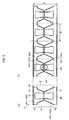
- Fig. 1(a) is a developed plan view of an absorbent article 1 manufactured by using the manufacturing method according to this embodiment
- Fig. 1(b) is a developed plan view of the absorbent article 1 during manufacturing by using the manufacturing method according to this embodiment.
- the absorbent article 1 manufactured by the manufacturing method according to this embodiment may be a pants-type disposable diaper, and may be an open-type disposable diaper.
- the absorbent article 1 is provided with a liquid-permeable top sheet 6A, a liquid-impermeable back sheet 6B, an absorbent 12 arranged between the top sheet 6A and the back sheet 6B.
- the absorbent article 1 includes a front waistband region 15, a rear waistband region 16, and a crotch region 2 located between the front waistband region 15 and the rear waistband region 16.
- multiple first elastic members 4A1 to 4A3 and multiple second elastic members 5A1 to 5A3 are arranged on predetermined curved lines in the crotch region 2.
- this embodiment is configured to arrange three pieces of the first elastic members 4A1 to 4A3 and three pieces of the second elastic members 5A1 to 5A3.
- the numbers of the first elastic member and the second elastic member are not limited to three, but any number can be used.
- the first elastic members 4A1 to 4A3 and the second elastic members 5A1 to 5A3 form a leg gather.
- the leg gather is provided along opening parts for legs.
- the absorbent article 1 may be configured to arrange any one of the first elastic members 4A1 to 4A3 and the second elastic members 5A1 to 5A3 in the crotch region 2.
- one or multiple third elastic members 13 are arranged in the front waistband region 15, and one or multiple fourth elastic members 14 are arranged in the rear waistband region 16.
- the third elastic members 13 and the fourth elastic members 14 form a waist gather.
- a width direction (CD) of a first web 7A continuously conveyed corresponds to a longitudinal direction of the absorbent article 1
- a longitudinal direction (MD) of the first web 7A corresponds to a width direction of the absorbent article 1.
- elastic member bundles 40, 50 having a line splitting strength, which is measured by a predetermined measuring method (to be described later), within a predetermined range are fed in the MD via a line splitter 100 formed of a metal stick or the like, thereby splitting the elastic member bundles 40, 50 into the multiple first elastic members 4A1 to 4A3 and the second elastic members 5A1 to 5A3.
- the elastic member bundle 40 (or 50) is formed in such a manner that a single original elastic member is split into the multiple elastic members 4A1 to 4A3 (or 5A1 to 5A3), and the multiple elastic members 4A1 to 4A3 (or 5A1 to 5A3) are bundled and pressurized.
- each of the elastic members 4A1 to 4A3 (or 5A1 to 5A3) has a substantially circular or a rectangular shape.
- the first web 7A is paid out from a first web whole material, and a traveling direction of the first web 7A is turned by a guide roll 50A.
- an adhesive applying device 51 applies an adhesive 18A on a predetermined position, on an opposite surface to a second web 7B, of the first web 7A (at least on a predetermined curved line).
- first elastic members 4A1 to 4A3 and the second elastic members 5A1 to 5A3 are placed on the predetermined curved line on at least one surface of the first web 7A on which the adhesive 18A is applied, while being swung by a first swing guide 18 and a second swing guide 17, respectively, in a CD (a direction crossing the conveyance direction) of the first web 7A.
- the predetermined curved line on which the first elastic members 4A1 to 4A3 are placed may differ from the predetermined curved line on which the second elastic members 5A1 to 5A3 are placed.
- the first web 7A on which the first elastic members 4A1 to 4A3 and the second elastic members 5A1 to 5A3 are placed is fed between a first roll 8 and a second roll 9 which rotate in the MD so that the first elastic members 4A1 to 4A3, the second elastic members 5A1 to 5A3, and the first web 7A can be pinched and pressed.
- an adhesive applying device 52 applies an adhesive 18B on a predetermined position, on an opposite surface to the first web 7A, of the second web 7B which is paid out from a second web whole material (at least on a predetermined curved line).
- a roll 53 bonds a surface of the first web 7A on which the first elastic members 4A1 to 4A3 and the second elastic members 5A1 to 5A3 are bonded, and a surface of the second web 7B on which the adhesive 18B is applied.
- first elastic members 4A1 to 4A3 and the second elastic members 5A1 to 5A3 which constitute the leg gather can be arranged between the first web 4A and the second web 5A.
- the line-splitting strength of the elastic member bundle 40 (or 50) indicates a force required to split the multiple elastic members 4A1 to 4A3 (or 5A1 to 5A3) which constitute the elastic member bundle 40 (or 50).
- g/piece or N/piece can be used, for example.
- the line-splitting strength of the elastic member bundles 40, 50 can be measured with a measuring method including the following steps (see Fig. 4 ).
- a holding part 43 holds and fixes an elastic member 40A to be measured, and a holding part 42 pulls an elastic member bundle 40B not including the elastic member 40A at a predetermined speed X1 while holding the elastic member bundle 40B.
- the holding part 43 holds and fixes the elastic member bundle 40B not including the elastic member 40A, and the holding part 42 pulls the elastic member 40A to be measured at the predetermined speed X1 while holding the elastic member 40A.
- a maximum load applied when the elastic member 40A to be measured is split is determined as the above-described line-splitting strength.
- this measuring method when a length of each elastic member bundle is set to 300 mm; when the predetermined speed X1 is set to 200 mm/second; when held lengths of the elastic member 40A and the elastic member bundles 40B by the holding parts 42, 43 in the measurement device 400 are set to 25 mm; and when a distance between the holding parts 42, 43 of the measurement device 400 is set to 50 mm, it is preferable to use the elastic member bundles 40, 50 having the line-splitting strength measured by this measuring method within a range of 25mN/piece or less in the above-described manufacturing method.
- the elastic member bundles 40, 50 having the line-splitting strength within a range of 10mN/piece or more in the above-described manufacturing method. Note that, the elastic member bundles 40, 50 need to be bundled with a strength not to be automatically split during the conveyance.
- the elastic member bundles 40, 50 are used in the above-described manufacturing method in which a conveyance speed of each of the elastic member bundles 40, 50 is set to 100m/minute; a draw ratio thereof is set to 1.3 to 3 times; and a maximum angle between a tangent line of the arranged elastic members 4A1 to 4A3 (or, 5A1 to 5A3) and the center line in the MD thereof is set to 68 degrees.
- the line-splitting strength of the elastic member bundles 40, 50 can be measured with a measuring method including the following steps (see Fig. 5 ).
- the holding part 42 pulls one end of the elastic member 40A to be measured and one end of the remaining elastic member bundle 40B at the predetermined speed X1 while holding one ends thereof.
- the maximum load applied when the elastic member 40A to be measured is split is determined as the above-described line-splitting strength.
- each elastic member bundle when the length of each elastic member bundle is set to 300 mm; when the predetermined speed X1 is set to 100 mm/second; when the held lengths of the elastic member 40A and the elastic member bundle 40B by the holding part 42 in the measurement device 400 are set to 25 mm; and when the distance between the holding part 42 and the hook 41 of the measurement device 400 is set to 50 mm, it is preferable to use the elastic member bundles 40, 50 each having the line-splitting strength measured by this measuring method within the range of 25mN/piece or less, in the above-described manufacturing method.
- the elastic member bundles 40, 50 having the line-splitting strength within a range of 10mN/piece or more in the above-described manufacturing method. Note that, the elastic member bundles 40, 50 need to be bundled with a strength not to be automatically split during the conveyance.
- the elastic member bundles 40, 50 are used in the above-described manufacturing method in which the conveyance speed of the elastic member bundles 40, 50 is set to 100m/minute, the draw ratio thereof is set to 1.3 to 3 times, and the maximum angle between the tangent line of the arranged elastic members 4A1 to 4A3 (or, 5A1 to 5A3) and the center line in the MD thereof is set to 68 degrees.
- a pressure to be applied when the multiple elastic members 4A1 to 4A3 (or 5A1 to 5A3) are bundled at the time of forming the elastic member bundles 40, 50 is determined in consideration of quality of material of the original elastic member, a thickness (a diameter, a width, and the like) of the elastic member, and the like.
- the elastic member bundle 40 having the line-splitting strength within the predetermined range is only used as the elastic member bundle 40 used for forming the leg gather.
- the elastic member bundle 40 is broken when being fed in the MD via the line splitter 100. This contributes to a stable production and an improvement in yield.
- the manufacturing method of an absorbent article according to this invention is capable of solving the problem that an elastic member bundle can be broken easily at a line splitter, and is useful for the absorbent article, such as pants-type disposable diaper and an open-type disposable diaper.
Landscapes
- Health & Medical Sciences (AREA)
- Engineering & Computer Science (AREA)
- Vascular Medicine (AREA)
- Epidemiology (AREA)
- Biomedical Technology (AREA)
- Heart & Thoracic Surgery (AREA)
- Life Sciences & Earth Sciences (AREA)
- Animal Behavior & Ethology (AREA)
- General Health & Medical Sciences (AREA)
- Public Health (AREA)
- Veterinary Medicine (AREA)
- Manufacturing & Machinery (AREA)
- Absorbent Articles And Supports Therefor (AREA)
Abstract
Description
- The present invention relates to a manufacturing method of an absorbent article in which multiple elastic members are arranged on a predetermined curved line.
- Conventionally, a manufacturing method of an absorbent article including the following steps has been known.
- Firstly, an elastic member bundle is fed in a conveyance direction (Machine Direction(MD)) via a line splitter, and is thereby split into multiple elastic members.
- Secondly, an adhesive is applied at least on a predetermined curved line on a web continuously conveyed.
- Thirdly, the multiple elastic members thus split are placed on the web while being swung in a direction (Crossing Direction(CD)) which crosses the conveyance direction.
- With the steps, the multiple elastic members can be arranged on the predetermined curved line in a crotch region of the absorbent article.
- Here, the elastic member bundle formed by splitting a single original elastic member into multiple elastic members , and bundling and pressurizing the multiple elastic members is used as the above-described elastic member bundle.
-
- PTL 1:
JP Patent Application Publication H06-70958 - PTL 2:
JP Patent 3679966 - However, the conventional manufacturing method of an absorbent article has not specifically defined any specification for the elastic member bundle used in the above-described steps, with the exception of quality of material and dimensions of each elastic member.
- In the above-described steps, since it is required to swing the split multiple elastic members in the CD, a torsion stress acts on an elastic member bundle before being split at a line splitter. This has caused a problem that the elastic member bundle cannot be split into the multiple elastic members properly and the elastic member bundle can be broken easily.
- Further, suppose that an autohesive raw material, such as crude rubber, is used as a material (elastic member) to be arranged in the crotch region of the absorbent article. In this case, since it is difficult to make rolls from the material, the material is fed from inside a box in which the material is housed by dropping it down the box. Here, when the material is dropped down into the box thread by thread, the threads can easily tangle with each other in the box since each thread is too thin (about 1 to 2 mm). This tangle can lead to a problem that the thread might be broken during feeding.
- As a result, a manufacturing line has to be stopped for installing a new elastic member bundle again, thus resulting in a problem of causing a decrease in production reliability and yield.
- Therefore, the present invention has been made in view of the above-described problems, and an object thereof is to provide a manufacturing method of an absorbent article capable of solving the problem that an elastic member bundle can be broken easily at a line splitter, by using an elastic member bundle having line-splitting strength measured by a predetermined measuring method within a predetermined range.
- A first aspect of the present invention provides a manufacturing method of an absorbent article in which multiple elastic members are arranged on a predetermined curved line. The manufacturing method includes the steps of: splitting an elastic member bundle having line-splitting strength within a predetermined range into the multiple elastic members by feeding the elastic member bundle in a conveyance direction via a line splitter, the line-splitting strength measured by a predetermined measuring method; applying an adhesive at least on the predetermined curved line on a web continuously conveyed; and placing the multiple elastic members thus split on the web while swinging the elastic members in a direction which crosses the conveyance direction. In the manufacturing method, the elastic member bundle is formed by splitting a single original elastic member into the multiple elastic members, and bundling pressurizing the multiple elastic members, and the line-splitting strength of the elastic member bundle indicates a force required to split the multiple elastic members which constitute the elastic member bundle.
- As described above, according to the present invention, it is possible to provide the manufacturing method of an absorbent article capable of solving the problem that an elastic member bundle can be broken easily at a line splitter, by using an elastic member bundle having line-splitting strength measured by a predetermined measuring method within a predetermined range.
-
-
Fig. 1 is a developed plan view of an absorbent article manufactured by a manufacturing method according to a first embodiment of the present invention, and a developed plan view of the absorbent article during manufacturing by the manufacturing method according to the first embodiment of the present invention. -
Fig. 2 is a view for explaining the manufacturing method according to the first embodiment of the present invention. -
Fig. 3 is a view for explaining a manner of splitting an elastic member bundle into multiple elastic members in the manufacturing method according to the first embodiment of the present invention (enlarged view of a portion A ofFig. 2 ). -
Fig. 4 is a view for explaining an example of a method of measuring line-splitting strength of the elastic member bundle used in the manufacturing method according to the first embodiment of the present invention. -
Fig. 5 is a view for explaining another example of a method of measuring the line-splitting strength of the elastic member bundle used in the manufacturing method according to the first embodiment of the present invention. - A manufacturing method of an absorbent article according to a first embodiment of the present invention will be described with reference to
Figs. 1 to 5 . -
Fig. 1(a) is a developed plan view of anabsorbent article 1 manufactured by using the manufacturing method according to this embodiment, andFig. 1(b) is a developed plan view of theabsorbent article 1 during manufacturing by using the manufacturing method according to this embodiment. - Note that, the
absorbent article 1 manufactured by the manufacturing method according to this embodiment may be a pants-type disposable diaper, and may be an open-type disposable diaper. - As shown in
Fig. 1(a) , theabsorbent article 1 is provided with a liquid-permeable top sheet 6A, a liquid-impermeable back sheet 6B, an absorbent 12 arranged between thetop sheet 6A and theback sheet 6B. - Further, the
absorbent article 1 includes afront waistband region 15, arear waistband region 16, and acrotch region 2 located between thefront waistband region 15 and therear waistband region 16. - Here, in the
absorbent article 1, multiple first elastic members 4A1 to 4A3 and multiple second elastic members 5A1 to 5A3 are arranged on predetermined curved lines in thecrotch region 2. - Note that, this embodiment is configured to arrange three pieces of the first elastic members 4A1 to 4A3 and three pieces of the second elastic members 5A1 to 5A3. However, the numbers of the first elastic member and the second elastic member are not limited to three, but any number can be used.
- The first elastic members 4A1 to 4A3 and the second elastic members 5A1 to 5A3 form a leg gather. The leg gather is provided along opening parts for legs.
- Note that, the
absorbent article 1 may be configured to arrange any one of the first elastic members 4A1 to 4A3 and the second elastic members 5A1 to 5A3 in thecrotch region 2. - In the
absorbent article 1, one or multiple thirdelastic members 13 are arranged in thefront waistband region 15, and one or multiple fourthelastic members 14 are arranged in therear waistband region 16. The thirdelastic members 13 and the fourthelastic members 14 form a waist gather. - Hereinafter, a step of forming the leg gather in the manufacturing method according to this embodiment will be described with reference to
Figs. 2 and3 . Note that, in the manufacturing method, a width direction (CD) of afirst web 7A continuously conveyed corresponds to a longitudinal direction of theabsorbent article 1, and a longitudinal direction (MD) of thefirst web 7A corresponds to a width direction of theabsorbent article 1. - Firstly,
elastic member bundles 40, 50 having a line splitting strength, which is measured by a predetermined measuring method (to be described later), within a predetermined range are fed in the MD via aline splitter 100 formed of a metal stick or the like, thereby splitting theelastic member bundles 40, 50 into the multiple first elastic members 4A1 to 4A3 and the second elastic members 5A1 to 5A3. - The elastic member bundle 40 (or 50) is formed in such a manner that a single original elastic member is split into the multiple elastic members 4A1 to 4A3 (or 5A1 to 5A3), and the multiple elastic members 4A1 to 4A3 (or 5A1 to 5A3) are bundled and pressurized.
- For example, as such an original elastic member, a material which is composed of crude rubber, synthetic rubber, or the like and whose cross section has a substantially circular or a rectangular shape is used. Further, the cross section of each of the elastic members 4A1 to 4A3 (or 5A1 to 5A3) has a substantially circular or a rectangular shape.
- Particularly, in a case where the cross section of each of the elastic members 4A1 to 4A3 (or 5A1 to 5A3) has a rectangular shape, a change of stress between before and after the elastic members pass through the
line splitter 100 is larger than a case where the cross section of each of the elastic members 4A1 to 4A3 (or 5A1 to 5A3) has a substantially circular shape, so that a tearing force in theline splitter 100 is not stabilized. Therefore, in the case where the cross section of each of the elastic members 4A1 to 4A3 (or 5A1 to 5A3) has a rectangular shape, the effect of the manufacturing method of an absorbent article of the present invention exhibits remarkably. - Secondly, the
first web 7A is paid out from a first web whole material, and a traveling direction of thefirst web 7A is turned by aguide roll 50A. - Thirdly, an
adhesive applying device 51 applies an adhesive 18A on a predetermined position, on an opposite surface to asecond web 7B, of thefirst web 7A (at least on a predetermined curved line). - Fourthly, the first elastic members 4A1 to 4A3 and the second elastic members 5A1 to 5A3 are placed on the predetermined curved line on at least one surface of the
first web 7A on which the adhesive 18A is applied, while being swung by afirst swing guide 18 and asecond swing guide 17, respectively, in a CD (a direction crossing the conveyance direction) of thefirst web 7A. - Here, the predetermined curved line on which the first elastic members 4A1 to 4A3 are placed may differ from the predetermined curved line on which the second elastic members 5A1 to 5A3 are placed.
- Fifthly, the
first web 7A on which the first elastic members 4A1 to 4A3 and the second elastic members 5A1 to 5A3 are placed is fed between afirst roll 8 and asecond roll 9 which rotate in the MD so that the first elastic members 4A1 to 4A3, the second elastic members 5A1 to 5A3, and thefirst web 7A can be pinched and pressed. - Sixthly, an
adhesive applying device 52 applies an adhesive 18B on a predetermined position, on an opposite surface to thefirst web 7A, of thesecond web 7B which is paid out from a second web whole material (at least on a predetermined curved line). - Seventhly, a
roll 53 bonds a surface of thefirst web 7A on which the first elastic members 4A1 to 4A3 and the second elastic members 5A1 to 5A3 are bonded, and a surface of thesecond web 7B on which the adhesive 18B is applied. - In this manner, the first elastic members 4A1 to 4A3 and the second elastic members 5A1 to 5A3 which constitute the leg gather can be arranged between the first web 4A and the second web 5A.
- Hereinafter, a method of measuring the line-splitting strength of the
elastic member bundles 40, 50 used in the manufacturing method according to this embodiment will be described. Here, the line-splitting strength of the elastic member bundle 40 (or 50) indicates a force required to split the multiple elastic members 4A1 to 4A3 (or 5A1 to 5A3) which constitute the elastic member bundle 40 (or 50). As a unit of the line-splitting strength, g/piece or N/piece can be used, for example. - For example, the line-splitting strength of the elastic member bundles 40, 50 can be measured with a measuring method including the following steps (see
Fig. 4 ). - Firstly, in a
measurement device 400, a holdingpart 43 holds and fixes anelastic member 40A to be measured, and a holdingpart 42 pulls anelastic member bundle 40B not including theelastic member 40A at a predetermined speed X1 while holding theelastic member bundle 40B. Alternatively, the holdingpart 43 holds and fixes theelastic member bundle 40B not including theelastic member 40A, and the holdingpart 42 pulls theelastic member 40A to be measured at the predetermined speed X1 while holding theelastic member 40A. - Secondly, a maximum load applied when the
elastic member 40A to be measured is split is determined as the above-described line-splitting strength. - In this measuring method, when a length of each elastic member bundle is set to 300 mm; when the predetermined speed X1 is set to 200 mm/second; when held lengths of the
elastic member 40A and the elastic member bundles 40B by the holdingparts measurement device 400 are set to 25 mm; and when a distance between the holdingparts measurement device 400 is set to 50 mm, it is preferable to use the elastic member bundles 40, 50 having the line-splitting strength measured by this measuring method within a range of 25mN/piece or less in the above-described manufacturing method. In this case, it is preferable to use the elastic member bundles 40, 50 having the line-splitting strength within a range of 10mN/piece or more in the above-described manufacturing method. Note that, the elastic member bundles 40, 50 need to be bundled with a strength not to be automatically split during the conveyance. - Here, it is assumed that the elastic member bundles 40, 50 are used in the above-described manufacturing method in which a conveyance speed of each of the elastic member bundles 40, 50 is set to 100m/minute; a draw ratio thereof is set to 1.3 to 3 times; and a maximum angle between a tangent line of the arranged elastic members 4A1 to 4A3 (or, 5A1 to 5A3) and the center line in the MD thereof is set to 68 degrees.
- Further, the line-splitting strength of the elastic member bundles 40, 50 can be measured with a measuring method including the following steps (see
Fig. 5 ). - Firstly, in a state where a
hook 41 is set between theelastic member 40A to be measured and the remainingelastic member bundle 40B in themeasurement device 400, the holdingpart 42 pulls one end of theelastic member 40A to be measured and one end of the remainingelastic member bundle 40B at the predetermined speed X1 while holding one ends thereof. - Secondly, the maximum load applied when the
elastic member 40A to be measured is split is determined as the above-described line-splitting strength. - In this measuring method, when the length of each elastic member bundle is set to 300 mm; when the predetermined speed X1 is set to 100 mm/second; when the held lengths of the
elastic member 40A and theelastic member bundle 40B by the holdingpart 42 in themeasurement device 400 are set to 25 mm; and when the distance between the holdingpart 42 and thehook 41 of themeasurement device 400 is set to 50 mm, it is preferable to use the elastic member bundles 40, 50 each having the line-splitting strength measured by this measuring method within the range of 25mN/piece or less, in the above-described manufacturing method. In this case, it is preferable to use the elastic member bundles 40, 50 having the line-splitting strength within a range of 10mN/piece or more in the above-described manufacturing method. Note that, the elastic member bundles 40, 50 need to be bundled with a strength not to be automatically split during the conveyance. - Here, it is assumed that the elastic member bundles 40, 50 are used in the above-described manufacturing method in which the conveyance speed of the elastic member bundles 40, 50 is set to 100m/minute, the draw ratio thereof is set to 1.3 to 3 times, and the maximum angle between the tangent line of the arranged elastic members 4A1 to 4A3 (or, 5A1 to 5A3) and the center line in the MD thereof is set to 68 degrees.
- Note that, a pressure to be applied when the multiple elastic members 4A1 to 4A3 (or 5A1 to 5A3) are bundled at the time of forming the elastic member bundles 40, 50, is determined in consideration of quality of material of the original elastic member, a thickness (a diameter, a width, and the like) of the elastic member, and the like.
- According to the manufacturing method according to the first embodiment of the present invention, the
elastic member bundle 40 having the line-splitting strength within the predetermined range is only used as theelastic member bundle 40 used for forming the leg gather. Thus, it is possible to reduce a defect that theelastic member bundle 40 is broken when being fed in the MD via theline splitter 100. This contributes to a stable production and an improvement in yield. - As described above, the present invention has been described in detail by using the above-described embodiment. However, it is apparent to those skilled in the art that the present invention is not limited to the embodiment described in this description. The present invention can be modified and changed without departing from the gist and the scope of the present invention defined by the appended claims. Therefore, the description is aimed at illustration and explanation of the present invention, and does not have any meaning which limits the present invention.
- This application incorporates by reference Japanese Patent Application No.
2008-255190 (filed on September 30, 2008 - As mentioned above, the manufacturing method of an absorbent article according to this invention is capable of solving the problem that an elastic member bundle can be broken easily at a line splitter, and is useful for the absorbent article, such as pants-type disposable diaper and an open-type disposable diaper.
Claims (5)
- A manufacturing method of an absorbent article in which a plurality of elastic members are arranged on a predetermined curved line, the method comprising the steps of:splitting an elastic member bundle having line-splitting strength within a predetermined range into the plurality of elastic members by feeding the elastic member bundle in a conveyance direction via a line splitter, the line-splitting strength measured by a predetermined measuring method;applying an adhesive at least on the predetermined curved line on a web continuously conveyed; andplacing the plurality of elastic members thus split on the web while swinging the elastic members in a direction which crosses the conveyance direction, whereinthe elastic member bundle is formed by splitting a single original elastic member into the plurality of elastic members, and bundling and pressurizing the plurality of elastic members, andthe line-splitting strength of the elastic member bundle indicates a force required to split the plurality of elastic members which constitute the elastic member bundle.
- The manufacturing method of an absorbent article according to claim 1, wherein
the absorbent article is a disposable diaper including a front waistband region, a rear waistband region, and a crotch region located between the front waistband region and the rear waistband region, and
the plurality of elastic members are arranged in the crotch region. - The manufacturing method of an absorbent article according to claim 1, wherein
the measuring method includes the steps of:pulling any one of an elastic member to be measured and the remaining elastic member bundle at a predetermined speed while fixing the other; anddetermining a maximum load applied when the elastic member to be measured is split as the line-splitting strength. - The manufacturing method of an absorbent article according to claim 2, wherein the predetermined range of dissolution strength is not more than 25 mN/piece.
- The manufacturing method of an absorbent article according to claim 1, wherein
the measuring method includes the steps of:pulling one end of an elastic member to be measured and one end of the remaining elastic member bundle at a predetermined speed while setting a hook between the elastic member to be measured and the remaining elastic member bundle; anddetermining a maximum load applied when the elastic member to be measured is split as the line-splitting strength.
Applications Claiming Priority (2)
| Application Number | Priority Date | Filing Date | Title |
|---|---|---|---|
| JP2008255190 | 2008-09-30 | ||
| PCT/JP2009/067028 WO2010038777A1 (en) | 2008-09-30 | 2009-09-30 | Method for producing absorptive article |
Publications (2)
| Publication Number | Publication Date |
|---|---|
| EP2335664A1 true EP2335664A1 (en) | 2011-06-22 |
| EP2335664A4 EP2335664A4 (en) | 2012-03-28 |
Family
ID=42056116
Family Applications (1)
| Application Number | Title | Priority Date | Filing Date |
|---|---|---|---|
| EP09817809A Withdrawn EP2335664A4 (en) | 2008-09-30 | 2009-09-30 | Method for producing absorptive article |
Country Status (9)
| Country | Link |
|---|---|
| US (1) | US8168034B2 (en) |
| EP (1) | EP2335664A4 (en) |
| JP (1) | JP5432913B2 (en) |
| CN (1) | CN102170847A (en) |
| AR (1) | AR073326A1 (en) |
| AU (1) | AU2009300749A1 (en) |
| CA (1) | CA2738927A1 (en) |
| RU (1) | RU2011115705A (en) |
| WO (1) | WO2010038777A1 (en) |
Families Citing this family (37)
| Publication number | Priority date | Publication date | Assignee | Title |
|---|---|---|---|---|
| US8417374B2 (en) | 2004-04-19 | 2013-04-09 | Curt G. Joa, Inc. | Method and apparatus for changing speed or direction of an article |
| US7638014B2 (en) | 2004-05-21 | 2009-12-29 | Curt G. Joa, Inc. | Method of producing a pants-type diaper |
| US9622918B2 (en) * | 2006-05-18 | 2017-04-18 | Curt G. Joe, Inc. | Methods and apparatus for application of nested zero waste ear to traveling web |
| US9433538B2 (en) | 2006-05-18 | 2016-09-06 | Curt G. Joa, Inc. | Methods and apparatus for application of nested zero waste ear to traveling web and formation of articles using a dual cut slip unit |
| US7780052B2 (en) * | 2006-05-18 | 2010-08-24 | Curt G. Joa, Inc. | Trim removal system |
| US10456302B2 (en) | 2006-05-18 | 2019-10-29 | Curt G. Joa, Inc. | Methods and apparatus for application of nested zero waste ear to traveling web |
| CA2622049C (en) | 2007-02-21 | 2015-04-21 | Curt G. Joa, Inc. | Single transfer insert placement method and apparatus |
| US9550306B2 (en) | 2007-02-21 | 2017-01-24 | Curt G. Joa, Inc. | Single transfer insert placement and apparatus with cross-direction insert placement control |
| US9944487B2 (en) | 2007-02-21 | 2018-04-17 | Curt G. Joa, Inc. | Single transfer insert placement method and apparatus |
| US8398793B2 (en) | 2007-07-20 | 2013-03-19 | Curt G. Joa, Inc. | Apparatus and method for minimizing waste and improving quality and production in web processing operations |
| US9387131B2 (en) | 2007-07-20 | 2016-07-12 | Curt G. Joa, Inc. | Apparatus and method for minimizing waste and improving quality and production in web processing operations by automated threading and re-threading of web materials |
| US8182624B2 (en) * | 2008-03-12 | 2012-05-22 | Curt G. Joa, Inc. | Registered stretch laminate and methods for forming a registered stretch laminate |
| JP5277052B2 (en) * | 2009-04-03 | 2013-08-28 | ユニ・チャーム株式会社 | Method and apparatus for producing composite sheet for absorbent article |
| US8673098B2 (en) | 2009-10-28 | 2014-03-18 | Curt G. Joa, Inc. | Method and apparatus for stretching segmented stretchable film and application of the segmented film to a moving web |
| US9089453B2 (en) | 2009-12-30 | 2015-07-28 | Curt G. Joa, Inc. | Method for producing absorbent article with stretch film side panel and application of intermittent discrete components of an absorbent article |
| US8460495B2 (en) * | 2009-12-30 | 2013-06-11 | Curt G. Joa, Inc. | Method for producing absorbent article with stretch film side panel and application of intermittent discrete components of an absorbent article |
| US8663411B2 (en) | 2010-06-07 | 2014-03-04 | Curt G. Joa, Inc. | Apparatus and method for forming a pant-type diaper with refastenable side seams |
| US9603752B2 (en) | 2010-08-05 | 2017-03-28 | Curt G. Joa, Inc. | Apparatus and method for minimizing waste and improving quality and production in web processing operations by automatic cuff defect correction |
| US9566193B2 (en) | 2011-02-25 | 2017-02-14 | Curt G. Joa, Inc. | Methods and apparatus for forming disposable products at high speeds with small machine footprint |
| US8656817B2 (en) | 2011-03-09 | 2014-02-25 | Curt G. Joa | Multi-profile die cutting assembly |
| USD684613S1 (en) | 2011-04-14 | 2013-06-18 | Curt G. Joa, Inc. | Sliding guard structure |
| US8820380B2 (en) | 2011-07-21 | 2014-09-02 | Curt G. Joa, Inc. | Differential speed shafted machines and uses therefor, including discontinuous and continuous side by side bonding |
| DE202012013209U1 (en) * | 2012-01-16 | 2015-06-17 | Bikoma Gmbh Spezialmaschinen | Device for producing a laminate and hygiene product |
| ES2561754T3 (en) | 2012-02-20 | 2016-02-29 | Curt G. Joa, Inc. | Method for forming joints between discrete components of disposable items |
| CN103315855B (en) * | 2012-03-22 | 2016-05-11 | 全日美实业股份有限公司 | Paper diaper with stretchable member and manufacturing method thereof |
| US9809414B2 (en) | 2012-04-24 | 2017-11-07 | Curt G. Joa, Inc. | Elastic break brake apparatus and method for minimizing broken elastic rethreading |
| US9283683B2 (en) | 2013-07-24 | 2016-03-15 | Curt G. Joa, Inc. | Ventilated vacuum commutation structures |
| USD703248S1 (en) | 2013-08-23 | 2014-04-22 | Curt G. Joa, Inc. | Ventilated vacuum commutation structure |
| USD703712S1 (en) | 2013-08-23 | 2014-04-29 | Curt G. Joa, Inc. | Ventilated vacuum commutation structure |
| USD704237S1 (en) | 2013-08-23 | 2014-05-06 | Curt G. Joa, Inc. | Ventilated vacuum commutation structure |
| USD703247S1 (en) | 2013-08-23 | 2014-04-22 | Curt G. Joa, Inc. | Ventilated vacuum commutation structure |
| USD703711S1 (en) | 2013-08-23 | 2014-04-29 | Curt G. Joa, Inc. | Ventilated vacuum communication structure |
| JP6423798B2 (en) * | 2013-10-10 | 2018-11-14 | 株式会社瑞光 | Elastic laminate manufacturing apparatus and elastic laminate manufacturing method |
| US9289329B1 (en) | 2013-12-05 | 2016-03-22 | Curt G. Joa, Inc. | Method for producing pant type diapers |
| US9533483B2 (en) * | 2014-09-26 | 2017-01-03 | Kimberly-Clark Worldwide, Inc. | Apparatus for and method of shaping and applying a segment to a moving web |
| CA2991328C (en) | 2015-07-24 | 2021-10-26 | Curt G. Joa, Inc. | Vacuum commutation apparatus and methods |
| CN106137547A (en) * | 2016-07-29 | 2016-11-23 | 泉州市汉威机械制造有限公司 | A kind of curve elastic bringing device |
Family Cites Families (22)
| Publication number | Priority date | Publication date | Assignee | Title |
|---|---|---|---|---|
| US2323132A (en) * | 1940-10-17 | 1943-06-29 | Us Rubber Co | Method of manufacturing rubber thread |
| US2678676A (en) * | 1951-07-06 | 1954-05-18 | Us Rubber Co | Apparatus for forming ribbons composed of extruded rubber threads |
| JPS58124449A (en) * | 1982-01-20 | 1983-07-25 | ユニ・チヤ−ム株式会社 | Mounting of extensible elastic member in sanitary article |
| JPS58180601A (en) * | 1982-04-14 | 1983-10-22 | ユニ・チヤ−ム株式会社 | Disposable diaper and attachment of elastic member thereof |
| US4657802A (en) * | 1985-07-30 | 1987-04-14 | Kimberly-Clark Corporation | Composite nonwoven elastic web |
| US4916005A (en) * | 1987-10-13 | 1990-04-10 | Kimberly-Clark Corporation | Diaper article with elasticized waist panel |
| JPH02189148A (en) * | 1989-08-04 | 1990-07-25 | Uni Charm Corp | Mounting method for resilient member for disposal diaper |
| JPH0751416B2 (en) * | 1989-11-20 | 1995-06-05 | 株式会社スター・コーポレーション | How to divide ribbon-shaped rubber |
| JPH03103278U (en) * | 1990-02-05 | 1991-10-28 | ||
| JP2999886B2 (en) | 1992-08-28 | 2000-01-17 | 花王株式会社 | Manufacturing method of absorbent article |
| JP3086141B2 (en) * | 1994-11-10 | 2000-09-11 | 花王株式会社 | Oscillation bonding method for elastic members |
| SE513818C2 (en) * | 1994-12-21 | 2000-11-06 | Sca Hygiene Prod Ab | Flexible absorbent article comprising strips of elastic film and method of manufacturing the same |
| US6376095B1 (en) * | 1998-06-11 | 2002-04-23 | The Dow Chemical Company | Elastic films made from alpha-olefin/vinyl aromatic and/or aliphatic or cycloaliphatic vinyl or vinylidene interpolymers |
| JP4045711B2 (en) * | 1999-06-21 | 2008-02-13 | 東洋紡績株式会社 | Elastic yarn for hygiene products |
| JP3679966B2 (en) | 2000-03-16 | 2005-08-03 | 大王製紙株式会社 | Method and apparatus for dividing elastic elastic member |
| US20020019616A1 (en) * | 2000-05-15 | 2002-02-14 | Thomas Oomman Painumoottil | Elastomeric laminate with film and strands suitable for a nonwoven garment |
| US6946413B2 (en) * | 2000-12-29 | 2005-09-20 | Kimberly-Clark Worldwide, Inc. | Composite material with cloth-like feel |
| JP3862510B2 (en) * | 2001-03-15 | 2006-12-27 | ユニ・チャーム株式会社 | Continuous production method for pants-type diapers |
| JP4155042B2 (en) * | 2002-02-20 | 2008-09-24 | チッソ株式会社 | Elastic long fiber nonwoven fabric and fiber product using the same |
| JP4678721B2 (en) * | 2005-06-14 | 2011-04-27 | ユニ・チャーム株式会社 | Disposable pants-type wearing articles |
| US20070259163A1 (en) * | 2006-03-31 | 2007-11-08 | Andover Healthcare, Inc. | Pressure-sensitive adhesive articles with non-woven backing having an elastometric binder |
| JP5350600B2 (en) | 2007-04-03 | 2013-11-27 | 住友化学株式会社 | Polypropylene resin composition and molded article comprising the same |
-
2009
- 2009-02-20 US US12/389,940 patent/US8168034B2/en not_active Expired - Fee Related
- 2009-09-30 RU RU2011115705/12A patent/RU2011115705A/en not_active Application Discontinuation
- 2009-09-30 WO PCT/JP2009/067028 patent/WO2010038777A1/en not_active Ceased
- 2009-09-30 AU AU2009300749A patent/AU2009300749A1/en not_active Abandoned
- 2009-09-30 EP EP09817809A patent/EP2335664A4/en not_active Withdrawn
- 2009-09-30 AR ARP090103764A patent/AR073326A1/en not_active Application Discontinuation
- 2009-09-30 CA CA2738927A patent/CA2738927A1/en not_active Abandoned
- 2009-09-30 CN CN2009801383412A patent/CN102170847A/en active Pending
- 2009-09-30 JP JP2010531881A patent/JP5432913B2/en not_active Expired - Fee Related
Non-Patent Citations (2)
| Title |
|---|
| No further relevant documents disclosed * |
| See also references of WO2010038777A1 * |
Also Published As
| Publication number | Publication date |
|---|---|
| JPWO2010038777A1 (en) | 2012-03-01 |
| US20100078120A1 (en) | 2010-04-01 |
| EP2335664A4 (en) | 2012-03-28 |
| CA2738927A1 (en) | 2010-04-08 |
| JP5432913B2 (en) | 2014-03-05 |
| US8168034B2 (en) | 2012-05-01 |
| AR073326A1 (en) | 2010-10-28 |
| CN102170847A (en) | 2011-08-31 |
| RU2011115705A (en) | 2012-11-10 |
| AU2009300749A1 (en) | 2010-04-08 |
| WO2010038777A1 (en) | 2010-04-08 |
Similar Documents
| Publication | Publication Date | Title |
|---|---|---|
| US8168034B2 (en) | Manufacturing method of absorbent article | |
| EP2520529B1 (en) | Elastic yarn supply apparatus | |
| JP5268854B2 (en) | Method for producing flexible sheet | |
| JP5452903B2 (en) | Composite sheet manufacturing method, absorbent article manufacturing method using composite sheet, and composite sheet manufacturing apparatus | |
| EP2356960A1 (en) | Device for manufacturing absorptive article and method of manufacturing absorptive article | |
| JP2001504899A (en) | Shirring slide and manufacturing method thereof | |
| CN103180131B (en) | Stretchable sheet manufacturing method | |
| US20240000624A1 (en) | Absorbent articles with frangible pathways with opening facilitation features | |
| CN103201097A (en) | Method for producing stretchable sheet | |
| JP4698208B2 (en) | Disposable diaper manufacturing method | |
| EP4433010A1 (en) | Absorbent article with front and/or back waist regions having a high-stretch zone and a low-stretch zone and methods for making | |
| US20140102618A1 (en) | Method for manufacturing stretch sheet | |
| US11135099B2 (en) | System and method for tearing off and rolling up a strip of absorbent fiber sheet | |
| CN113165824B (en) | Method and device for feeding elastic strands in an apparatus and process for producing layered composite articles | |
| JP2018100457A (en) | Method for producing extensible sheet | |
| EP2799049B1 (en) | Absorbent article manufacturing device | |
| JP6627011B1 (en) | Stretchable sheet for absorbent article and method for producing the same | |
| EP3400918A1 (en) | Improved tampon withdrawal system and method for the fabrication thereof | |
| JP6109263B2 (en) | Disposable diaper manufacturing apparatus and disposable diaper manufacturing method |
Legal Events
| Date | Code | Title | Description |
|---|---|---|---|
| PUAI | Public reference made under article 153(3) epc to a published international application that has entered the european phase |
Free format text: ORIGINAL CODE: 0009012 |
|
| 17P | Request for examination filed |
Effective date: 20110413 |
|
| AK | Designated contracting states |
Kind code of ref document: A1 Designated state(s): AT BE BG CH CY CZ DE DK EE ES FI FR GB GR HR HU IE IS IT LI LT LU LV MC MK MT NL NO PL PT RO SE SI SK SM TR |
|
| AX | Request for extension of the european patent |
Extension state: AL BA RS |
|
| DAX | Request for extension of the european patent (deleted) | ||
| A4 | Supplementary search report drawn up and despatched |
Effective date: 20120223 |
|
| RIC1 | Information provided on ipc code assigned before grant |
Ipc: A61F 13/49 20060101ALI20120217BHEP Ipc: A61F 13/15 20060101AFI20120217BHEP |
|
| 17Q | First examination report despatched |
Effective date: 20130705 |
|
| STAA | Information on the status of an ep patent application or granted ep patent |
Free format text: STATUS: THE APPLICATION HAS BEEN WITHDRAWN |
|
| 18W | Application withdrawn |
Effective date: 20130816 |