EP2334428B1 - Process for recovering base metals from used hydroprocessing catalyst - Google Patents
Process for recovering base metals from used hydroprocessing catalyst Download PDFInfo
- Publication number
- EP2334428B1 EP2334428B1 EP08853416.9A EP08853416A EP2334428B1 EP 2334428 B1 EP2334428 B1 EP 2334428B1 EP 08853416 A EP08853416 A EP 08853416A EP 2334428 B1 EP2334428 B1 EP 2334428B1
- Authority
- EP
- European Patent Office
- Prior art keywords
- metal
- group
- catalyst
- group viii
- molybdenum
- Prior art date
- Legal status (The legal status is an assumption and is not a legal conclusion. Google has not performed a legal analysis and makes no representation as to the accuracy of the status listed.)
- Not-in-force
Links
- 239000003054 catalyst Substances 0.000 title claims description 170
- 238000000034 method Methods 0.000 title claims description 90
- 239000010953 base metal Substances 0.000 title description 7
- 229910052751 metal Inorganic materials 0.000 claims description 276
- 239000002184 metal Substances 0.000 claims description 276
- PXHVJJICTQNCMI-UHFFFAOYSA-N Nickel Chemical group [Ni] PXHVJJICTQNCMI-UHFFFAOYSA-N 0.000 claims description 245
- 229910052750 molybdenum Inorganic materials 0.000 claims description 121
- 239000007787 solid Chemical group 0.000 claims description 120
- 229910052759 nickel Inorganic materials 0.000 claims description 114
- 229910052720 vanadium Inorganic materials 0.000 claims description 85
- ZOKXTWBITQBERF-UHFFFAOYSA-N Molybdenum Chemical group [Mo] ZOKXTWBITQBERF-UHFFFAOYSA-N 0.000 claims description 84
- 239000011733 molybdenum Substances 0.000 claims description 84
- BFNBIHQBYMNNAN-UHFFFAOYSA-N ammonium sulfate Chemical compound N.N.OS(O)(=O)=O BFNBIHQBYMNNAN-UHFFFAOYSA-N 0.000 claims description 75
- 229910052921 ammonium sulfate Inorganic materials 0.000 claims description 75
- 150000002739 metals Chemical class 0.000 claims description 72
- 235000011130 ammonium sulphate Nutrition 0.000 claims description 68
- QGZKDVFQNNGYKY-UHFFFAOYSA-N Ammonia Chemical compound N QGZKDVFQNNGYKY-UHFFFAOYSA-N 0.000 claims description 62
- LEONUFNNVUYDNQ-UHFFFAOYSA-N vanadium atom Chemical group [V] LEONUFNNVUYDNQ-UHFFFAOYSA-N 0.000 claims description 56
- 239000002244 precipitate Substances 0.000 claims description 50
- 239000002002 slurry Substances 0.000 claims description 50
- 238000001556 precipitation Methods 0.000 claims description 46
- 238000011084 recovery Methods 0.000 claims description 43
- 239000000571 coke Substances 0.000 claims description 38
- 238000002386 leaching Methods 0.000 claims description 36
- 239000006228 supernatant Substances 0.000 claims description 33
- 238000000926 separation method Methods 0.000 claims description 32
- XLYOFNOQVPJJNP-UHFFFAOYSA-N water Substances O XLYOFNOQVPJJNP-UHFFFAOYSA-N 0.000 claims description 28
- 239000000203 mixture Substances 0.000 claims description 25
- QAOWNCQODCNURD-UHFFFAOYSA-N Sulfuric acid Chemical compound OS(O)(=O)=O QAOWNCQODCNURD-UHFFFAOYSA-N 0.000 claims description 24
- 229910021529 ammonia Inorganic materials 0.000 claims description 24
- 150000004696 coordination complex Chemical class 0.000 claims description 24
- 229910052976 metal sulfide Inorganic materials 0.000 claims description 24
- 230000001376 precipitating effect Effects 0.000 claims description 17
- UNTBPXHCXVWYOI-UHFFFAOYSA-O azanium;oxido(dioxo)vanadium Chemical compound [NH4+].[O-][V](=O)=O UNTBPXHCXVWYOI-UHFFFAOYSA-O 0.000 claims description 16
- 238000001914 filtration Methods 0.000 claims description 16
- 239000004215 Carbon black (E152) Substances 0.000 claims description 15
- 229930195733 hydrocarbon Natural products 0.000 claims description 15
- 150000002430 hydrocarbons Chemical class 0.000 claims description 15
- UCKMPCXJQFINFW-UHFFFAOYSA-N Sulphide Chemical compound [S-2] UCKMPCXJQFINFW-UHFFFAOYSA-N 0.000 claims description 13
- 239000002253 acid Substances 0.000 claims description 13
- 125000003396 thiol group Chemical group [H]S* 0.000 claims description 13
- 229910052717 sulfur Inorganic materials 0.000 claims description 11
- 238000002156 mixing Methods 0.000 claims description 10
- 238000005119 centrifugation Methods 0.000 claims description 9
- 238000010908 decantation Methods 0.000 claims description 8
- MEFBJEMVZONFCJ-UHFFFAOYSA-N molybdate Chemical compound [O-][Mo]([O-])(=O)=O MEFBJEMVZONFCJ-UHFFFAOYSA-N 0.000 claims description 8
- 150000003464 sulfur compounds Chemical class 0.000 claims description 8
- IJGRMHOSHXDMSA-UHFFFAOYSA-N Atomic nitrogen Chemical compound N#N IJGRMHOSHXDMSA-UHFFFAOYSA-N 0.000 claims description 6
- 229910052739 hydrogen Inorganic materials 0.000 claims description 6
- 229910052760 oxygen Inorganic materials 0.000 claims description 6
- 229910052799 carbon Inorganic materials 0.000 claims description 5
- 229910052500 inorganic mineral Inorganic materials 0.000 claims description 5
- 229910052757 nitrogen Inorganic materials 0.000 claims description 5
- VEXZGXHMUGYJMC-UHFFFAOYSA-N Hydrochloric acid Chemical compound Cl VEXZGXHMUGYJMC-UHFFFAOYSA-N 0.000 claims description 4
- NBIIXXVUZAFLBC-UHFFFAOYSA-N Phosphoric acid Chemical compound OP(O)(O)=O NBIIXXVUZAFLBC-UHFFFAOYSA-N 0.000 claims description 4
- 239000011707 mineral Substances 0.000 claims description 4
- 239000005077 polysulfide Substances 0.000 claims description 4
- 229920001021 polysulfide Polymers 0.000 claims description 4
- 150000008117 polysulfides Polymers 0.000 claims description 4
- 239000000654 additive Substances 0.000 claims description 3
- 230000000996 additive effect Effects 0.000 claims description 3
- 238000001179 sorption measurement Methods 0.000 claims description 3
- GRYLNZFGIOXLOG-UHFFFAOYSA-N Nitric acid Chemical compound O[N+]([O-])=O GRYLNZFGIOXLOG-UHFFFAOYSA-N 0.000 claims description 2
- 229910000147 aluminium phosphate Inorganic materials 0.000 claims description 2
- 125000001495 ethyl group Chemical group [H]C([H])([H])C([H])([H])* 0.000 claims description 2
- 229910017604 nitric acid Inorganic materials 0.000 claims description 2
- 239000011148 porous material Substances 0.000 claims description 2
- 150000003568 thioethers Chemical class 0.000 claims 3
- 239000000243 solution Substances 0.000 description 106
- 239000000706 filtrate Substances 0.000 description 59
- 239000000295 fuel oil Substances 0.000 description 37
- 239000003921 oil Substances 0.000 description 30
- 238000006243 chemical reaction Methods 0.000 description 29
- 239000000047 product Substances 0.000 description 29
- 238000005486 sulfidation Methods 0.000 description 25
- -1 for example Substances 0.000 description 24
- 239000007788 liquid Substances 0.000 description 24
- RWSOTUBLDIXVET-UHFFFAOYSA-N Dihydrogen sulfide Chemical compound S RWSOTUBLDIXVET-UHFFFAOYSA-N 0.000 description 22
- 239000002904 solvent Substances 0.000 description 20
- 229910000037 hydrogen sulfide Inorganic materials 0.000 description 19
- LGQLOGILCSXPEA-UHFFFAOYSA-L nickel sulfate Chemical compound [Ni+2].[O-]S([O-])(=O)=O LGQLOGILCSXPEA-UHFFFAOYSA-L 0.000 description 19
- 238000004939 coking Methods 0.000 description 18
- 238000012360 testing method Methods 0.000 description 16
- 229910000363 nickel(II) sulfate Inorganic materials 0.000 description 15
- 238000004458 analytical method Methods 0.000 description 14
- 239000007789 gas Substances 0.000 description 13
- 239000000463 material Substances 0.000 description 13
- 150000001875 compounds Chemical class 0.000 description 12
- 239000002245 particle Substances 0.000 description 11
- QGZKDVFQNNGYKY-UHFFFAOYSA-O Ammonium Chemical compound [NH4+] QGZKDVFQNNGYKY-UHFFFAOYSA-O 0.000 description 10
- 229910000069 nitrogen hydride Inorganic materials 0.000 description 10
- 229910017052 cobalt Inorganic materials 0.000 description 9
- 239000010941 cobalt Substances 0.000 description 9
- GUTLYIVDDKVIGB-UHFFFAOYSA-N cobalt atom Chemical compound [Co] GUTLYIVDDKVIGB-UHFFFAOYSA-N 0.000 description 9
- 239000001166 ammonium sulphate Chemical group 0.000 description 8
- MNNHAPBLZZVQHP-UHFFFAOYSA-N diammonium hydrogen phosphate Chemical compound [NH4+].[NH4+].OP([O-])([O-])=O MNNHAPBLZZVQHP-UHFFFAOYSA-N 0.000 description 8
- 238000000605 extraction Methods 0.000 description 8
- 150000003839 salts Chemical class 0.000 description 8
- APUPEJJSWDHEBO-UHFFFAOYSA-P ammonium molybdate Chemical compound [NH4+].[NH4+].[O-][Mo]([O-])(=O)=O APUPEJJSWDHEBO-UHFFFAOYSA-P 0.000 description 7
- 230000002378 acidificating effect Effects 0.000 description 6
- 230000003197 catalytic effect Effects 0.000 description 6
- 238000005516 engineering process Methods 0.000 description 6
- 239000003337 fertilizer Substances 0.000 description 6
- 230000005484 gravity Effects 0.000 description 6
- 238000012545 processing Methods 0.000 description 6
- WWNBZGLDODTKEM-UHFFFAOYSA-N sulfanylidenenickel Chemical compound [Ni]=S WWNBZGLDODTKEM-UHFFFAOYSA-N 0.000 description 6
- 150000004763 sulfides Chemical class 0.000 description 6
- 229910017318 Mo—Ni Inorganic materials 0.000 description 5
- NINIDFKCEFEMDL-UHFFFAOYSA-N Sulfur Chemical compound [S] NINIDFKCEFEMDL-UHFFFAOYSA-N 0.000 description 5
- 238000004517 catalytic hydrocracking Methods 0.000 description 5
- 238000006073 displacement reaction Methods 0.000 description 5
- 238000000227 grinding Methods 0.000 description 5
- CWQXQMHSOZUFJS-UHFFFAOYSA-N molybdenum disulfide Chemical compound S=[Mo]=S CWQXQMHSOZUFJS-UHFFFAOYSA-N 0.000 description 5
- 239000011343 solid material Substances 0.000 description 5
- 229910019142 PO4 Inorganic materials 0.000 description 4
- 150000001412 amines Chemical class 0.000 description 4
- DAPUDVOJPZKTSI-UHFFFAOYSA-L ammonium nickel sulfate Chemical compound [NH4+].[NH4+].[Ni+2].[O-]S([O-])(=O)=O.[O-]S([O-])(=O)=O DAPUDVOJPZKTSI-UHFFFAOYSA-L 0.000 description 4
- QVGXLLKOCUKJST-UHFFFAOYSA-N atomic oxygen Chemical compound [O] QVGXLLKOCUKJST-UHFFFAOYSA-N 0.000 description 4
- 239000002585 base Substances 0.000 description 4
- 238000009835 boiling Methods 0.000 description 4
- 238000001035 drying Methods 0.000 description 4
- 239000013505 freshwater Substances 0.000 description 4
- 239000001257 hydrogen Substances 0.000 description 4
- 230000007062 hydrolysis Effects 0.000 description 4
- 238000006460 hydrolysis reaction Methods 0.000 description 4
- 229910052982 molybdenum disulfide Inorganic materials 0.000 description 4
- 230000003647 oxidation Effects 0.000 description 4
- 238000007254 oxidation reaction Methods 0.000 description 4
- 239000001301 oxygen Substances 0.000 description 4
- NBIIXXVUZAFLBC-UHFFFAOYSA-K phosphate Chemical compound [O-]P([O-])([O-])=O NBIIXXVUZAFLBC-UHFFFAOYSA-K 0.000 description 4
- 239000010452 phosphate Substances 0.000 description 4
- 241000894007 species Species 0.000 description 4
- IIACRCGMVDHOTQ-UHFFFAOYSA-M sulfamate Chemical compound NS([O-])(=O)=O IIACRCGMVDHOTQ-UHFFFAOYSA-M 0.000 description 4
- 239000011593 sulfur Substances 0.000 description 4
- 238000005406 washing Methods 0.000 description 4
- 229910019934 (NH4)2MoO4 Inorganic materials 0.000 description 3
- UHOVQNZJYSORNB-UHFFFAOYSA-N Benzene Chemical compound C1=CC=CC=C1 UHOVQNZJYSORNB-UHFFFAOYSA-N 0.000 description 3
- UFHFLCQGNIYNRP-UHFFFAOYSA-N Hydrogen Chemical compound [H][H] UFHFLCQGNIYNRP-UHFFFAOYSA-N 0.000 description 3
- 229910003206 NH4VO3 Inorganic materials 0.000 description 3
- HEMHJVSKTPXQMS-UHFFFAOYSA-M Sodium hydroxide Chemical compound [OH-].[Na+] HEMHJVSKTPXQMS-UHFFFAOYSA-M 0.000 description 3
- QAOWNCQODCNURD-UHFFFAOYSA-L Sulfate Chemical compound [O-]S([O-])(=O)=O QAOWNCQODCNURD-UHFFFAOYSA-L 0.000 description 3
- YXFVVABEGXRONW-UHFFFAOYSA-N Toluene Chemical compound CC1=CC=CC=C1 YXFVVABEGXRONW-UHFFFAOYSA-N 0.000 description 3
- 239000008186 active pharmaceutical agent Substances 0.000 description 3
- 239000011609 ammonium molybdate Substances 0.000 description 3
- 235000018660 ammonium molybdate Nutrition 0.000 description 3
- 229940010552 ammonium molybdate Drugs 0.000 description 3
- 239000010426 asphalt Substances 0.000 description 3
- 239000000356 contaminant Substances 0.000 description 3
- 238000004090 dissolution Methods 0.000 description 3
- 230000000694 effects Effects 0.000 description 3
- 239000012527 feed solution Substances 0.000 description 3
- 239000012263 liquid product Substances 0.000 description 3
- 238000004519 manufacturing process Methods 0.000 description 3
- 235000010755 mineral Nutrition 0.000 description 3
- 239000005078 molybdenum compound Substances 0.000 description 3
- 150000002752 molybdenum compounds Chemical class 0.000 description 3
- 230000001590 oxidative effect Effects 0.000 description 3
- 238000002360 preparation method Methods 0.000 description 3
- 238000007670 refining Methods 0.000 description 3
- 229910052979 sodium sulfide Inorganic materials 0.000 description 3
- GRVFOGOEDUUMBP-UHFFFAOYSA-N sodium sulfide (anhydrous) Chemical compound [Na+].[Na+].[S-2] GRVFOGOEDUUMBP-UHFFFAOYSA-N 0.000 description 3
- 238000005063 solubilization Methods 0.000 description 3
- 229910019964 (NH4)2MoS4 Inorganic materials 0.000 description 2
- OKTJSMMVPCPJKN-UHFFFAOYSA-N Carbon Chemical compound [C] OKTJSMMVPCPJKN-UHFFFAOYSA-N 0.000 description 2
- MYMOFIZGZYHOMD-UHFFFAOYSA-N Dioxygen Chemical compound O=O MYMOFIZGZYHOMD-UHFFFAOYSA-N 0.000 description 2
- 229910003562 H2MoO4 Inorganic materials 0.000 description 2
- 229910016003 MoS3 Inorganic materials 0.000 description 2
- 238000013019 agitation Methods 0.000 description 2
- 229910052783 alkali metal Inorganic materials 0.000 description 2
- UYJXRRSPUVSSMN-UHFFFAOYSA-P ammonium sulfide Chemical compound [NH4+].[NH4+].[S-2] UYJXRRSPUVSSMN-UHFFFAOYSA-P 0.000 description 2
- 239000012298 atmosphere Substances 0.000 description 2
- 230000015572 biosynthetic process Effects 0.000 description 2
- 239000000919 ceramic Substances 0.000 description 2
- 239000010779 crude oil Substances 0.000 description 2
- 230000006378 damage Effects 0.000 description 2
- 238000000151 deposition Methods 0.000 description 2
- 238000010790 dilution Methods 0.000 description 2
- 239000012895 dilution Substances 0.000 description 2
- 229910001882 dioxygen Inorganic materials 0.000 description 2
- GNTDGMZSJNCJKK-UHFFFAOYSA-N divanadium pentaoxide Chemical compound O=[V](=O)O[V](=O)=O GNTDGMZSJNCJKK-UHFFFAOYSA-N 0.000 description 2
- 230000009977 dual effect Effects 0.000 description 2
- 239000012065 filter cake Substances 0.000 description 2
- XLYOFNOQVPJJNP-ZSJDYOACSA-N heavy water Substances [2H]O[2H] XLYOFNOQVPJJNP-ZSJDYOACSA-N 0.000 description 2
- 238000005984 hydrogenation reaction Methods 0.000 description 2
- 239000003350 kerosene Substances 0.000 description 2
- 239000012633 leachable Substances 0.000 description 2
- TVWWSIKTCILRBF-UHFFFAOYSA-N molybdenum trisulfide Chemical compound S=[Mo](=S)=S TVWWSIKTCILRBF-UHFFFAOYSA-N 0.000 description 2
- VLAPMBHFAWRUQP-UHFFFAOYSA-L molybdic acid Chemical compound O[Mo](O)(=O)=O VLAPMBHFAWRUQP-UHFFFAOYSA-L 0.000 description 2
- 238000001728 nano-filtration Methods 0.000 description 2
- 239000007800 oxidant agent Substances 0.000 description 2
- 230000000737 periodic effect Effects 0.000 description 2
- 238000011160 research Methods 0.000 description 2
- APSBXTVYXVQYAB-UHFFFAOYSA-M sodium docusate Chemical compound [Na+].CCCCC(CC)COC(=O)CC(S([O-])(=O)=O)C(=O)OCC(CC)CCCC APSBXTVYXVQYAB-UHFFFAOYSA-M 0.000 description 2
- HYHCSLBZRBJJCH-UHFFFAOYSA-M sodium hydrosulfide Chemical compound [Na+].[SH-] HYHCSLBZRBJJCH-UHFFFAOYSA-M 0.000 description 2
- 239000010935 stainless steel Substances 0.000 description 2
- 229910001220 stainless steel Inorganic materials 0.000 description 2
- 239000000126 substance Substances 0.000 description 2
- 238000003786 synthesis reaction Methods 0.000 description 2
- 239000012991 xanthate Substances 0.000 description 2
- VIJSPAIQWVPKQZ-BLECARSGSA-N (2s)-2-[[(2s)-2-[[(2s)-2-[[(2s)-2-[[(2s)-2-[[(2s)-2-acetamido-5-(diaminomethylideneamino)pentanoyl]amino]-4-methylpentanoyl]amino]-4,4-dimethylpentanoyl]amino]-4-methylpentanoyl]amino]propanoyl]amino]-5-(diaminomethylideneamino)pentanoic acid Chemical compound NC(=N)NCCC[C@@H](C(O)=O)NC(=O)[C@H](C)NC(=O)[C@H](CC(C)C)NC(=O)[C@H](CC(C)(C)C)NC(=O)[C@H](CC(C)C)NC(=O)[C@H](CCCNC(N)=N)NC(C)=O VIJSPAIQWVPKQZ-BLECARSGSA-N 0.000 description 1
- 229910019920 (NH3)2SO4 Inorganic materials 0.000 description 1
- WQZGKKKJIJFFOK-GASJEMHNSA-N Glucose Natural products OC[C@H]1OC(O)[C@H](O)[C@@H](O)[C@@H]1O WQZGKKKJIJFFOK-GASJEMHNSA-N 0.000 description 1
- DGAQECJNVWCQMB-PUAWFVPOSA-M Ilexoside XXIX Chemical compound C[C@@H]1CC[C@@]2(CC[C@@]3(C(=CC[C@H]4[C@]3(CC[C@@H]5[C@@]4(CC[C@@H](C5(C)C)OS(=O)(=O)[O-])C)C)[C@@H]2[C@]1(C)O)C)C(=O)O[C@H]6[C@@H]([C@H]([C@@H]([C@H](O6)CO)O)O)O.[Na+] DGAQECJNVWCQMB-PUAWFVPOSA-M 0.000 description 1
- CTQNGGLPUBDAKN-UHFFFAOYSA-N O-Xylene Chemical compound CC1=CC=CC=C1C CTQNGGLPUBDAKN-UHFFFAOYSA-N 0.000 description 1
- OAICVXFJPJFONN-UHFFFAOYSA-N Phosphorus Chemical compound [P] OAICVXFJPJFONN-UHFFFAOYSA-N 0.000 description 1
- ZLMJMSJWJFRBEC-UHFFFAOYSA-N Potassium Chemical compound [K] ZLMJMSJWJFRBEC-UHFFFAOYSA-N 0.000 description 1
- 229910000831 Steel Inorganic materials 0.000 description 1
- 239000005864 Sulphur Substances 0.000 description 1
- 229910009447 Y1-Yn Inorganic materials 0.000 description 1
- 241001164238 Zulia Species 0.000 description 1
- XHCLAFWTIXFWPH-UHFFFAOYSA-N [O-2].[O-2].[O-2].[O-2].[O-2].[V+5].[V+5] Chemical compound [O-2].[O-2].[O-2].[O-2].[O-2].[V+5].[V+5] XHCLAFWTIXFWPH-UHFFFAOYSA-N 0.000 description 1
- KSECJOPEZIAKMU-UHFFFAOYSA-N [S--].[S--].[S--].[S--].[S--].[V+5].[V+5] Chemical compound [S--].[S--].[S--].[S--].[S--].[V+5].[V+5] KSECJOPEZIAKMU-UHFFFAOYSA-N 0.000 description 1
- 239000003929 acidic solution Substances 0.000 description 1
- 238000005054 agglomeration Methods 0.000 description 1
- 230000002776 aggregation Effects 0.000 description 1
- 150000001340 alkali metals Chemical class 0.000 description 1
- 229910052784 alkaline earth metal Inorganic materials 0.000 description 1
- 239000012670 alkaline solution Substances 0.000 description 1
- 150000001336 alkenes Chemical class 0.000 description 1
- 239000000956 alloy Substances 0.000 description 1
- 229910045601 alloy Inorganic materials 0.000 description 1
- YVBOZGOAVJZITM-UHFFFAOYSA-P ammonium phosphomolybdate Chemical compound [NH4+].[NH4+].[NH4+].[NH4+].[O-]P([O-])=O.[O-][Mo]([O-])(=O)=O YVBOZGOAVJZITM-UHFFFAOYSA-P 0.000 description 1
- 239000007864 aqueous solution Substances 0.000 description 1
- 239000006227 byproduct Substances 0.000 description 1
- 238000001354 calcination Methods 0.000 description 1
- 159000000007 calcium salts Chemical class 0.000 description 1
- JGIATAMCQXIDNZ-UHFFFAOYSA-N calcium sulfide Chemical compound [Ca]=S JGIATAMCQXIDNZ-UHFFFAOYSA-N 0.000 description 1
- WSVMJZUXHCHLLA-UHFFFAOYSA-L calcium;carbonotrithioate Chemical compound [Ca+2].[S-]C([S-])=S WSVMJZUXHCHLLA-UHFFFAOYSA-L 0.000 description 1
- 239000012018 catalyst precursor Substances 0.000 description 1
- 239000003518 caustics Substances 0.000 description 1
- 238000012993 chemical processing Methods 0.000 description 1
- 239000003245 coal Substances 0.000 description 1
- 238000009833 condensation Methods 0.000 description 1
- 230000005494 condensation Effects 0.000 description 1
- 238000001816 cooling Methods 0.000 description 1
- 238000009295 crossflow filtration Methods 0.000 description 1
- 238000005202 decontamination Methods 0.000 description 1
- 230000003588 decontaminative effect Effects 0.000 description 1
- 230000003247 decreasing effect Effects 0.000 description 1
- 230000003111 delayed effect Effects 0.000 description 1
- 230000008021 deposition Effects 0.000 description 1
- 238000010586 diagram Methods 0.000 description 1
- LMBWSYZSUOEYSN-UHFFFAOYSA-M diethyldithiocarbamate Chemical compound CCN(CC)C([S-])=S LMBWSYZSUOEYSN-UHFFFAOYSA-M 0.000 description 1
- 238000009792 diffusion process Methods 0.000 description 1
- 230000003292 diminished effect Effects 0.000 description 1
- RQPRTOROWUUIIX-UHFFFAOYSA-L dipotassium;carbonotrithioate Chemical compound [K+].[K+].[S-]C([S-])=S RQPRTOROWUUIIX-UHFFFAOYSA-L 0.000 description 1
- USAIOOFEIMNEDN-UHFFFAOYSA-L disodium;carbonotrithioate Chemical compound [Na+].[Na+].[S-]C([S-])=S USAIOOFEIMNEDN-UHFFFAOYSA-L 0.000 description 1
- 238000009826 distribution Methods 0.000 description 1
- 150000002019 disulfides Chemical class 0.000 description 1
- 239000012990 dithiocarbamate Substances 0.000 description 1
- 150000004659 dithiocarbamates Chemical class 0.000 description 1
- 238000011143 downstream manufacturing Methods 0.000 description 1
- 230000007613 environmental effect Effects 0.000 description 1
- 230000007717 exclusion Effects 0.000 description 1
- 239000010419 fine particle Substances 0.000 description 1
- 239000012530 fluid Substances 0.000 description 1
- 238000009472 formulation Methods 0.000 description 1
- 239000000446 fuel Substances 0.000 description 1
- 230000006870 function Effects 0.000 description 1
- 239000003502 gasoline Substances 0.000 description 1
- 239000008103 glucose Substances 0.000 description 1
- 125000005842 heteroatom Chemical group 0.000 description 1
- 150000002431 hydrogen Chemical class 0.000 description 1
- RWSOTUBLDIXVET-UHFFFAOYSA-M hydrosulfide Chemical compound [SH-] RWSOTUBLDIXVET-UHFFFAOYSA-M 0.000 description 1
- 150000002484 inorganic compounds Chemical class 0.000 description 1
- 229910010272 inorganic material Inorganic materials 0.000 description 1
- 238000005342 ion exchange Methods 0.000 description 1
- 150000002500 ions Chemical class 0.000 description 1
- 230000014759 maintenance of location Effects 0.000 description 1
- 239000012528 membrane Substances 0.000 description 1
- 238000001471 micro-filtration Methods 0.000 description 1
- 238000012986 modification Methods 0.000 description 1
- 230000004048 modification Effects 0.000 description 1
- 150000002751 molybdenum Chemical class 0.000 description 1
- 230000007935 neutral effect Effects 0.000 description 1
- 229910052758 niobium Inorganic materials 0.000 description 1
- 239000012299 nitrogen atmosphere Substances 0.000 description 1
- 150000007524 organic acids Chemical class 0.000 description 1
- 235000005985 organic acids Nutrition 0.000 description 1
- 150000002894 organic compounds Chemical class 0.000 description 1
- 239000003960 organic solvent Substances 0.000 description 1
- 150000002898 organic sulfur compounds Chemical class 0.000 description 1
- 238000010979 pH adjustment Methods 0.000 description 1
- 239000013618 particulate matter Substances 0.000 description 1
- 239000008188 pellet Substances 0.000 description 1
- 239000003208 petroleum Substances 0.000 description 1
- 239000002006 petroleum coke Substances 0.000 description 1
- 229910052698 phosphorus Inorganic materials 0.000 description 1
- 239000011574 phosphorus Substances 0.000 description 1
- 238000000053 physical method Methods 0.000 description 1
- 229920000642 polymer Polymers 0.000 description 1
- 239000011591 potassium Substances 0.000 description 1
- 229910052700 potassium Inorganic materials 0.000 description 1
- DPLVEEXVKBWGHE-UHFFFAOYSA-N potassium sulfide Chemical compound [S-2].[K+].[K+] DPLVEEXVKBWGHE-UHFFFAOYSA-N 0.000 description 1
- 239000012716 precipitator Substances 0.000 description 1
- 239000002243 precursor Substances 0.000 description 1
- 238000000197 pyrolysis Methods 0.000 description 1
- 238000010791 quenching Methods 0.000 description 1
- 230000000171 quenching effect Effects 0.000 description 1
- 230000003134 recirculating effect Effects 0.000 description 1
- 230000001105 regulatory effect Effects 0.000 description 1
- 238000012958 reprocessing Methods 0.000 description 1
- 230000035939 shock Effects 0.000 description 1
- 239000011734 sodium Substances 0.000 description 1
- 229910052708 sodium Inorganic materials 0.000 description 1
- 235000011121 sodium hydroxide Nutrition 0.000 description 1
- 230000007928 solubilization Effects 0.000 description 1
- 238000000638 solvent extraction Methods 0.000 description 1
- 238000005507 spraying Methods 0.000 description 1
- 239000010959 steel Substances 0.000 description 1
- 239000000725 suspension Substances 0.000 description 1
- YUKQRDCYNOVPGJ-UHFFFAOYSA-N thioacetamide Chemical compound CC(N)=S YUKQRDCYNOVPGJ-UHFFFAOYSA-N 0.000 description 1
- DLFVBJFMPXGRIB-UHFFFAOYSA-N thioacetamide Natural products CC(N)=O DLFVBJFMPXGRIB-UHFFFAOYSA-N 0.000 description 1
- 239000012989 trithiocarbonate Substances 0.000 description 1
- 150000003657 tungsten Chemical class 0.000 description 1
- 238000000108 ultra-filtration Methods 0.000 description 1
- 238000011144 upstream manufacturing Methods 0.000 description 1
- 150000003681 vanadium Chemical class 0.000 description 1
- 150000003682 vanadium compounds Chemical class 0.000 description 1
- 229910001935 vanadium oxide Inorganic materials 0.000 description 1
- 230000008016 vaporization Effects 0.000 description 1
- 239000008096 xylene Substances 0.000 description 1
Images


Classifications
-
- B—PERFORMING OPERATIONS; TRANSPORTING
- B01—PHYSICAL OR CHEMICAL PROCESSES OR APPARATUS IN GENERAL
- B01J—CHEMICAL OR PHYSICAL PROCESSES, e.g. CATALYSIS OR COLLOID CHEMISTRY; THEIR RELEVANT APPARATUS
- B01J38/00—Regeneration or reactivation of catalysts, in general
- B01J38/48—Liquid treating or treating in liquid phase, e.g. dissolved or suspended
- B01J38/68—Liquid treating or treating in liquid phase, e.g. dissolved or suspended including substantial dissolution or chemical precipitation of a catalyst component in the ultimate reconstitution of the catalyst
-
- C—CHEMISTRY; METALLURGY
- C10—PETROLEUM, GAS OR COKE INDUSTRIES; TECHNICAL GASES CONTAINING CARBON MONOXIDE; FUELS; LUBRICANTS; PEAT
- C10G—CRACKING HYDROCARBON OILS; PRODUCTION OF LIQUID HYDROCARBON MIXTURES, e.g. BY DESTRUCTIVE HYDROGENATION, OLIGOMERISATION, POLYMERISATION; RECOVERY OF HYDROCARBON OILS FROM OIL-SHALE, OIL-SAND, OR GASES; REFINING MIXTURES MAINLY CONSISTING OF HYDROCARBONS; REFORMING OF NAPHTHA; MINERAL WAXES
- C10G29/00—Refining of hydrocarbon oils, in the absence of hydrogen, with other chemicals
- C10G29/20—Organic compounds not containing metal atoms
-
- C—CHEMISTRY; METALLURGY
- C22—METALLURGY; FERROUS OR NON-FERROUS ALLOYS; TREATMENT OF ALLOYS OR NON-FERROUS METALS
- C22B—PRODUCTION AND REFINING OF METALS; PRETREATMENT OF RAW MATERIALS
- C22B23/00—Obtaining nickel or cobalt
-
- C—CHEMISTRY; METALLURGY
- C22—METALLURGY; FERROUS OR NON-FERROUS ALLOYS; TREATMENT OF ALLOYS OR NON-FERROUS METALS
- C22B—PRODUCTION AND REFINING OF METALS; PRETREATMENT OF RAW MATERIALS
- C22B34/00—Obtaining refractory metals
- C22B34/20—Obtaining niobium, tantalum or vanadium
- C22B34/22—Obtaining vanadium
- C22B34/225—Obtaining vanadium from spent catalysts
-
- C—CHEMISTRY; METALLURGY
- C22—METALLURGY; FERROUS OR NON-FERROUS ALLOYS; TREATMENT OF ALLOYS OR NON-FERROUS METALS
- C22B—PRODUCTION AND REFINING OF METALS; PRETREATMENT OF RAW MATERIALS
- C22B34/00—Obtaining refractory metals
- C22B34/30—Obtaining chromium, molybdenum or tungsten
- C22B34/34—Obtaining molybdenum
- C22B34/345—Obtaining molybdenum from spent catalysts
-
- C—CHEMISTRY; METALLURGY
- C22—METALLURGY; FERROUS OR NON-FERROUS ALLOYS; TREATMENT OF ALLOYS OR NON-FERROUS METALS
- C22B—PRODUCTION AND REFINING OF METALS; PRETREATMENT OF RAW MATERIALS
- C22B7/00—Working up raw materials other than ores, e.g. scrap, to produce non-ferrous metals and compounds thereof; Methods of a general interest or applied to the winning of more than two metals
- C22B7/009—General processes for recovering metals or metallic compounds from spent catalysts
-
- B—PERFORMING OPERATIONS; TRANSPORTING
- B01—PHYSICAL OR CHEMICAL PROCESSES OR APPARATUS IN GENERAL
- B01J—CHEMICAL OR PHYSICAL PROCESSES, e.g. CATALYSIS OR COLLOID CHEMISTRY; THEIR RELEVANT APPARATUS
- B01J23/00—Catalysts comprising metals or metal oxides or hydroxides, not provided for in group B01J21/00
- B01J23/70—Catalysts comprising metals or metal oxides or hydroxides, not provided for in group B01J21/00 of the iron group metals or copper
- B01J23/76—Catalysts comprising metals or metal oxides or hydroxides, not provided for in group B01J21/00 of the iron group metals or copper combined with metals, oxides or hydroxides provided for in groups B01J23/02 - B01J23/36
- B01J23/84—Catalysts comprising metals or metal oxides or hydroxides, not provided for in group B01J21/00 of the iron group metals or copper combined with metals, oxides or hydroxides provided for in groups B01J23/02 - B01J23/36 with arsenic, antimony, bismuth, vanadium, niobium, tantalum, polonium, chromium, molybdenum, tungsten, manganese, technetium or rhenium
- B01J23/85—Chromium, molybdenum or tungsten
- B01J23/88—Molybdenum
- B01J23/887—Molybdenum containing in addition other metals, oxides or hydroxides provided for in groups B01J23/02 - B01J23/36
- B01J23/8877—Vanadium, tantalum, niobium or polonium
-
- B—PERFORMING OPERATIONS; TRANSPORTING
- B01—PHYSICAL OR CHEMICAL PROCESSES OR APPARATUS IN GENERAL
- B01J—CHEMICAL OR PHYSICAL PROCESSES, e.g. CATALYSIS OR COLLOID CHEMISTRY; THEIR RELEVANT APPARATUS
- B01J23/00—Catalysts comprising metals or metal oxides or hydroxides, not provided for in group B01J21/00
- B01J23/90—Regeneration or reactivation
- B01J23/94—Regeneration or reactivation of catalysts comprising metals, oxides or hydroxides of the iron group metals or copper
-
- Y—GENERAL TAGGING OF NEW TECHNOLOGICAL DEVELOPMENTS; GENERAL TAGGING OF CROSS-SECTIONAL TECHNOLOGIES SPANNING OVER SEVERAL SECTIONS OF THE IPC; TECHNICAL SUBJECTS COVERED BY FORMER USPC CROSS-REFERENCE ART COLLECTIONS [XRACs] AND DIGESTS
- Y02—TECHNOLOGIES OR APPLICATIONS FOR MITIGATION OR ADAPTATION AGAINST CLIMATE CHANGE
- Y02P—CLIMATE CHANGE MITIGATION TECHNOLOGIES IN THE PRODUCTION OR PROCESSING OF GOODS
- Y02P10/00—Technologies related to metal processing
- Y02P10/20—Recycling
Definitions
- the invention relates to a process for recovering metals from used hydroprocessing catalyst.
- Heavy crude contains 40-70% high boiling range material that boils over 1000°F (i.e., vacuum resid) and very low amounts of fuels in high demand such as, for example, gasoline and diesel. Therefore, in order to convert vacuum resid to valuable light products, new and more cost effective technologies are needed. Heavy crude can be converted into lighter products via conventional processes such as coking (e.g., delayed coking and/or fluid coking) and hydroconversion (e.g., LC Fining and H-OIL). However, such conventional processes produce large amounts of undesirable byproducts such as, for example, coke or fuel oil and also are very sensitive to the contaminants such as, for example, V, Ni, and S.
- coking e.g., delayed coking and/or fluid coking
- hydroconversion e.g., LC Fining and H-OIL
- Catalysts have been used widely in the refining and chemical processing industries for many years. Hydroprocessing catalysts, including hydrotreating and hydrocracking catalysts, are now widely employed in facilities worldwide. Hydroprocessing technologies utilize catalysts comprising metals of Group VA, VIA, VIB, VIIA, and / or VIII metal sulfides, e.g., compounds of molybdenum disulfide (MoS 2 ) and nickel sulfide (NiS). Such metals are highly active in hydroconversion of heavy crudes but also are very expensive. In order to minimize the amount of catalyst required, and minimize the diffusion effects, catalyst is often unsupported.
- metals e.g., compounds of molybdenum disulfide (MoS 2 ) and nickel sulfide (NiS).
- MoS 2 molybdenum disulfide
- NiS nickel sulfide
- Expensive used catalyst contained in the USBO is coated with USBO and is not leachable by conventional technologies of metals extraction that basically are effective for water-based slurries. Therefore, without additional processing, the valuable metals cannot be recovered.
- US Patent Publication No. 2007/0025899 discloses a process to recover metals such as molybdenum, nickel, and vanadium from a used catalyst with a plurality of steps and equipment to recover the molybdenum and nickel metal complexes.
- US Patent No. 6,180,072 discloses another complex process requiringsolvent extraction as well as oxidation steps to recover metals from used catalysts containing at least a metal sulphide.
- the present invention provides a method for recovering metals from a used dispersed catalyst originating from a Group VIB metal sulfide catalyst and at least a Group VB metal promoted with a Group VIII metal for hydrocarbon oil hydroprocessing, the method comprising:
- Described herein is a method for recovering catalytic metals from used dispersed catalyst slurried in heavy oil.
- the method comprises pyrolizing used catalyst slurried in heavy oil to provide one or more lighter oil products and a coke-like material. Catalytic metals are recovered from the coke-like material.
- Also described herein is a method comprising mixing used dispersed catalyst slurried in heavy oil with solvent, which causes asphaltenes in the heavy oil to precipitate from the heavy oil. Fine catalyst and precipitated asphaltenes are separated from the heavy oil and solvent. Precipitated asphaltenes are converted to a coke-like material by pyrolizing fine catalyst and precipitated asphaltenes separated from the heavy oil.
- Also described herein is a method for recovering base metals including vanadium from a used dispersed catalyst originating from a Group VIB metal sulfide catalyst promoted with a Group VIII metal for hydrocarbon oil hydroprocessing, the method comprising the steps of: contacting the used dispersed catalyst with a leaching solution containing ammonia and air to dissolve the group VIB metal and the Group VIII metal into the leaching solution, forming a pressure leach slurry containing at least a group VIB soluble metal complex, at least a group VIII soluble metal complex, ammonium sulphate and solid residue containing ammonium metavanadate and coke; separating and removing the solid residue containing ammonium metavanadate and coke from the pressure leach slurry; precipitating from the pressure leach solution at least a portion of the Group VIB metal and at least a portion of the Group VIII metal, wherein the precipitation being carried out at a first pre-selected pH to precipitate as metal complexes at least a portion of the Group VI
- Also described herein is a method for recovering vanadium, molybdenum and nickel from a used dispersed catalyst, the method comprising the steps of: contacting the used dispersed catalyst with a leaching solution containing ammonia and air to dissolve the molybdenum and nickel into the leaching solution, forming a pressure leach slurry containing molybdenum and nickel metal complexes, ammonium sulphate and solid residue containing ammonium metavanadate and coke; separating and removing the solid residue containing ammonium metavanadate and coke from the pressure leach slurry; adjusting the pH of the pressure leach solution by the addition of sulfuric acid to precipitate at least a portion of the molybdenum and nickel as metal complexes; separating and recovering molybdenum and nickel metal complexes from the supernatant containing 0.1 to 5% of the incoming molybdenum, 1 to 20 % of the incoming vanadium, and 1 to 35 % of the incoming nickel.
- the method further comprises the step of adding H 2 S to the supernatant to precipitate out the remaining molybdenum and nickel metal complexes, and subsequent recovery of the molybdenum and nickel metal sulfides from the ammonium sulphate supernatant.
- Also described herein is a method for recovering base metals including vanadium from a used dispersed catalyst originating from a Group VIB metal sulfide catalyst promoted with a Group VIII metal for hydrocarbon oil hydroprocessing, the method comprising the steps of: contacting the used catalyst with a leaching solution containing ammonia and air to dissolve the group VIB metal and the Group VIII metal into the leaching solution, forming a pressure leach slurry containing at least a group VIB soluble metal complex, at least a group VIII soluble metal complex, ammonium sulphate and a first solid residue containing ammonium metavanadate and coke; separating and removing the first solid residue containing ammonium metavanadate and coke from the pressure leach slurry to form a first pressure leach solution; precipitating from the first pressure leach solution at least a portion of the Group VIB metal and at least a portion of the Group VIII metal, wherein the precipitation is carried out at a first pre-selected pH to precipitate a second
- Also described herein is a method for recovering vanadium, molybdenum and nickel from the used catalyst to recover substantial amounts of a Group VIII metal, the method comprising: recovering a secondary filtrate comprising substantially the Group VIII soluble metal complex and a trace amount of Group VB and Group VIB metals; combining the secondary filtrate with the primary filtrate to form a combined filtrate comprising substantially the Group VIII soluble metal complex and a trace quantity of Group VB and Group VIB metals; precipitating from the combined filtrate the Group VB, Group VIB and Group VIII metals in a sulfidation process to form a third solid residue and a tertiary filtrate; separating the third of solid residue from the tertiary filtrate and dissolving the third solid residue to form a group VIII metal product solution.
- Also described herein is a method for recovering vanadium, molybdenum, and nickel from a used catalyst and producing ammonium sulfate useful for other processes, such as fertilizer, the method comprising: all of the above processes and further comprising subjecting the tertiary filtrate to sulfamate destruction by hydrolysis to recover a purified ammonium sulfate solution.
- Also described herein is a method for recovering vanadium, molybdenum and nickel from a used catalyst, the method comprising the steps of: contacting the used catalyst with a leaching solution containing ammonia and air to dissolve the molybdenum and nickel into the leaching solution, forming a pressure leach slurry containing molybdenum and nickel metal complexes, ammonium sulphate and solid residue containing ammonium metavanadate and coke; separating and removing the solid residue containing ammonium metavanadate and coke from the pressure leach slurry; adjusting the pH of the pressure leach solution by the addition of sulfuric acid to precipitate at least a portion of the molybdenum and nickel as metal complexes; separating and recovering molybdenum and nickel metal complexes from the pressure leach solution containing 0.1 to 5% of the incoming molybdenum, 1 to 20 % of the incoming vanadium, and 1 to 35 % of the incoming nickel.
- the method further comprises the step of adding H 2 S to a combination of the primary filtrate and the secondary filtrate to precipitate the remaining molybdenum and nickel metal complexes, and subsequent recovery of, by a means a separation, the molybdenum and nickel metal sulfides from the filtered third solid residue comprising nickel sulfate.
- Also described herein is a method for recovering base metals including vanadium from a used dispersed catalyst originating from a Group VIB metal sulfide catalyst promoted with a Group VIII metal for hydrocarbon oil hydroprocessing, the method comprising the steps of: contacting the used catalyst with a leaching solution containing ammonia and air to dissolve the group VIB metal and the Group VIII metal into the leaching solution, forming a pressure leach slurry containing at least a group VIB soluble metal complex, at least a group VIII soluble metal complex, ammonium sulphate and a first solid residue containing ammonium metavanadate and coke; separating and removing the first solid residue containing ammonium metavanadate and coke from the pressure leach slurry to form a first pressure leach solution; precipitating from the first pressure leach solution at least a portion of the Group VIB metal and at least a portion of the Group VIII metal, wherein the precipitation is carried out at a first pre-selected pH to precipitate a second
- Also described herein is a method for recovering vanadium, molybdenum and nickel from the used catalyst to recover substantial amounts of a Group VIII metal, the method comprising: recovering a secondary filtrate comprising substantially the Group VIII soluble metal complex and a trace amount of Group VB and Group VIB metals; processing the primary filtrate in a primary precipitation method to form a primary solid residue and a primary liquid fraction and separately processing the secondary filtrate in a secondary precipitation method to form a secondary solid residue and a secondary liquid fraction; separating the primary solid residue from the primary liquid fraction and combining the primary solid residue with the used catalyst prior to or simultaneously with contacting the used catalyst with the leaching solution; separating the secondary solid residue from the secondary liquid fraction and dissolving the secondary solid residue to form a Group VIII product solution.
- the primary liquid fraction and the secondary liquid fraction may be combined to form a combined supernatant substantially free of Group VB, Group VIB and Group VIII metals.
- Also described herein is a method for recovering vanadium, molybdenum, and nickel from the used catalyst and producing ammonium sulfate useful for other processes, such as fertilizer, the method comprising: all of the above processes and further comprising subjecting that combined supernatant to sulfamate hydrolysis and sulfide oxidation to recover a purified ammonium sulfate solution.
- Also described herein is a method for recovering vanadium, molybdenum and nickel from a used catalyst, the method comprising the steps of: contacting the used catalyst with a leaching solution containing ammonia and air to dissolve the molybdenum and nickel into the leaching solution, forming a pressure leach slurry containing molybdenum and nickel metal complexes, ammonium sulphate and solid residue containing ammonium metavanadate and coke; separating and removing the solid residue containing ammonium metavanadate and coke from the pressure leach slurry; adjusting the pH of the pressure leach solution by the addition of sulfuric acid to precipitate at least a portion of the molybdenum and nickel as metal complexes; separating and recovering molybdenum and nickel metal complexes from the pressure leach solution containing 0.1 to 5% of the incoming molybdenum, 1 to 20 % of the incoming vanadium, and 1 to 35 % of the incoming nickel.
- the primary precipitation method comprises sulfidation wherein H 2 S and phosphate are added to the primary filtrate and the reaction is carried out at a sufficient temperature and pressure for a sufficient length of time at multiple pH values to substantially remove molybdenum and vanadium species from the ammonium sulfate to form a primary liquid fraction and a primary solid residue.
- the secondary filtrate is passed through the secondary precipitation method comprising sulfidation wherein H 2 S is added to the secondary filtrate and the reaction is carried out at a sufficient temperature and pressure for a sufficient time and at a pH value sufficient to substantially remove nickel, molybdenum and vanadium species to form a secondary liquid fraction and a secondary solid residue, to precipitate the remaining molybdenum and nickel metal complexes, and subsequent recovery of, by a means a separation, the molybdenum and nickel metal sulfides from the filtered third solid residue comprising nickel Sulfate.
- the secondary precipitation method comprising sulfidation wherein H 2 S is added to the secondary filtrate and the reaction is carried out at a sufficient temperature and pressure for a sufficient time and at a pH value sufficient to substantially remove nickel, molybdenum and vanadium species to form a secondary liquid fraction and a secondary solid residue, to precipitate the remaining molybdenum and nickel metal complexes, and subsequent recovery of, by a means
- heavy oil feed or feedstock refers to heavy and ultra-heavy crudes, including but not limited to resids, coals, bitumen, tar sands, etc.
- Heavy oil feedstock may be liquid, semi-solid, and / or solid.
- Examples of heavy oil feedstock that might be upgraded as described herein include but are not limited to Canada Tar sands, vacuum resid from Brazilian Santos and Campos basins, Egyptian Gulf of Suez, Chad, Venezuelan Zulia, Malaysia, and Indonesia Sumatra.
- heavy oil feedstock examples include bottom of the barrel and residuum left over from refinery processes, including "bottom of the barrel” and “residuum” (or “resid”) -- atmospheric tower bottoms, which have a boiling point of at least 343°C. (650°F.), or vacuum tower bottoms, which have a boiling point of at least 524°C. (975°F.), or "resid pitch” and “vacuum residue” - which have a boiling point of 524°C. (975°F.) or greater.
- Properties of heavy oil feedstock may include, but are not limited to: TAN of at least 0.1, at least 0.3, or at least 1; viscosity of at least 10 cSt; API gravity at most 15 in one embodiment, and at most 10 in another embodiment; microcarbon residue (MCR) in the range of about 15 to 30 weight% and (C 7 ) asphaltenes in the range of about 5 to 20 weight%.
- MCR microcarbon residue
- a gram of heavy oil feedstock contains at least 0.0001 grams of Ni/V/Fe; at least 0.005 grams of heteroatoms; at least 0.01 grams of residue; at least 0.04 grams C5 asphaltenes; at least 0.002 grams of MCR; per gram of crude; at least 0.00001 grams of alkali metal salts of one or more organic acids; and at least 0.005 grams of sulfur.
- the heavy oil feedstock has a sulfur content of at least 5 wt. % and an API gravity of from -5 to +5.
- the heavy oil feedstock comprises Athabasca bitumen (Canada) having at least 50% by volume vacuum reside.
- the feedstock is a Boscan (Venezuela) feed with at least 64 % by volume vacuum residue.
- the heavy oil feedstock contains at least 1000 ppm V.
- the V level ranges between 5000 and 10000 ppm. In a third embodiment, at least 5000 ppm.
- hydroprocessing is meant any process that is carried out in the presence of hydrogen, including, but not limited to, methanation, water gas shift reactions, hydrogenation, hydrotreating, hydrodesulfurization, hydrodenitrogenation, hydrodemetallation, hydrodearomatization, hydroisomerization, hydrodewaxing and hydrocracking including selective hydrocracking.
- the phrase "one or more of or "at least one of when used to preface several elements or classes of elements such as X, Y and Z or X 1 -X n , Y 1 -Y n and Z 1 -Z n , is intended to refer to a single element selected from X or Y or Z, a combination of elements selected from the same common class (such as X 1 and X 2 ), as well as a combination of elements selected from different classes (such as X 1 , Y 2 and Z n ).
- the Periodic Table referred to herein is the Table approved by IUPAC and the U.S. National Bureau of Standards, an example is the Periodic Table of the Elements by Los Alamos National Laboratory's Chemistry Division of October 2001 .
- the used catalyst described herein may originates from a dispersed (bulk or unsupported) Group VIB metal sulfide catalyst containing at least one of: a Group VB metal such as V, Nb; a Group VIII metal such as Ni, Co; a Group VIIIB metal such as Fe; a Group IVB metal such as Ti; a Group HB metal such as Zn, and combinations thereof.
- the used catalyst originates from a dispersed (bulk or unsupported) Group VIB metal sulfide catalyst promoted with a Group VIII metal for hydrocarbon oil hydroprocessing. Promoters are typically added to a catalyst formulation to improve selected properties of the catalyst or to modify the catalyst activity and/or selectivity.
- the used catalyst originates from a bulk catalyst precursor of the formula (X) a (M) b [(CH 3 CH 2 ) c N(CH 3 ) 3 ] d O z as disclosed in US Patent Publication No. 20060060502 , wherein X is Nickel, M is Mo , c is an integer from 10 to 40, the molar ratio of a:b is from 0.5/1 to 3/1.
- the used catalyst originates from a hydroprocessing catalyst represented by the formula (M t ) a (X u ) b (S v ) d (C w ) e (H x ) f (O y ) g (N z ) h as disclosed in US Patent Application Serial No. 1 1/931972 with filing date of October 31, 2007, wherein M represents at least Mo; and X functions as a promoter metal, representing at least Ni (X is hereinafter referred to as "Promoter Metal").
- S represents sulfur with the value of the subscript d ranging from (a + 0.5b) to (5a + 2b).
- C represents carbon with subscript e having a value of 0 to 11 (a + b).
- H is hydrogen with the value of f ranging from 0 to 7(a + b).
- O represents oxygen with the value of g ranging from 0 to 5(a + b); and N represents nitrogen with h having a value of 0 to 0.5(a + b).
- a and b each are greater than 0,
- the ratio of a:b is in the range of 1:5 to 10:1.
- the term "used catalyst” refers to a catalyst that has been used in a hydroprocessing operation and, as a result of such use, exhibits relatively lower or diminished catalytic activity.
- the reaction rate constant for a used catalyst temperature is 80% or less in one embodiment, and 50% or less in another embodiment.
- the most commonly encountered metal to be recovered is molybdenum.
- the metals to be recovered from the used catalyst are sulfides of Mo, Ni, and V.
- the used catalyst is generally in the form of a dispersed suspension having an effective median particle size of 0.01 to 200 microns. In another embodiment, the used catalyst has an average particle size of 0.01 to 100 microns. In a third embodiment, the used catalyst is a dispersed slurry having an average particle size of 0.01 to 50 microns. In one embodiment, the used catalyst has a pore volume of 0.05-5 ml/g as determined by nitrogen adsorption. In yet another embodiment, the used catalyst particles can have a size distribution in the range of about 0.2-20 microns, and a mean particle size of about 4-5 micron, with the mode being about 6-7 micron.
- vanadium is by way of exemplification only for any Group VB metal component that may be added to the hydroprocessing catalyst or is present in the hydroprocessing feedstock, and is not intended to exclude other Group VB metals / compounds and mixtures of that may be present in the used hydroprocessing catalyst for metal recovery.
- incoming molybdenum or “incoming nickel,” or “incoming vanadium,” etc. refers to the amount of metal that is initially present in the used catalyst prior to the metal recovery process.
- a catalyst In a hydroprocessing operation, a catalyst is typically enriched / deactivated with nickel and vanadium as "contaminants" in an amount ranging up to about 100 wt% of the fresh catalyst weight. In some operations, due to the rapid coke deposition rate, the catalyst is deactivated prior to achieving its full metals adsorption capacity. Such catalysts are taken out of service when the used catalyst contains as little as 10 wt% nickel plus vanadium compounds.
- Suitable feeds to a process for upgrading heavy oils using a slurry catalyst composition include, for example, atmospheric residuum, vacuum residuum, tar from a solvent deasphlating unit, atmospheric gas oils, vacuum gas oils, deasphalted oils, olefins, oils derived from tar sands or bitumen, oils derived from coal, heavy crude oils, synthetic oils from Fischer-Tropsch processes, and oils derived from recycled oil wastes and polymers.
- the feed is supplied to a reactor, wherein the feed is reacted with a catalyst slurry described in further detail below and preferably hydrogen.
- the reactor is a liquid recirculating reactor, although other types of upflow reactors may be employed.
- the catalyst slurry can be useful for, but not limited to, hydrogenation upgrading processes such as thermal hydrocracking, hydrotreating, hydrodesulphurization, hydrodenitrification, and hydrodemetalization.
- the feedstock to the heavy oil upgrading process comprises finely divided unsupported slurry catalyst, carbon fines, and metal fines in unconverted resid hydrocarbon oil.
- the solids content of the feedstock can be in the range of about 5-40 weight %, for example about 15-30 weight % or about 20-25 weight %.
- a heavy crude oil feedstock containing greater than 50 weight% of vacuum resid with an asphaltene level of greater than 3 weight % when subjected to a high severity conversion process can result in a vacuum reside or asphaltene conversion level in the range of about 80 to 99 weight%.
- the process conditions include temperatures in the range of about 420 to 450°C and pressures in the range of about 500 to 3000 psi hydrogen partial pressure.
- An effect of high severity conversion processes is that a large fraction of the heavier components, such as, for example, asphaltenes, are converted to lighter fractions leaving a small amount of dishydrogenated asphaltenes with a high degree of condensation that are incompatible within the hydroconverted product and, therefore, have a tendency to precipitate, especially when mixed with solvent.
- Effluent streams from the reactor can include one or more valuable light products as well as a stream containing used dispersed catalyst.
- Processing of an effluent stream containing used dispersed catalyst e.g., an unconverted slurry bleed oil (USBO) stream, is described herein.
- the effluent stream comprises between 2 to 50 wt. % used slurry (dispersed or fine) catalyst.
- the used slurry catalyst amount ranges from 3 to 30 wt. %. In a third embodiment, from 5 to 20 wt. %.
- the cost of the catalyst, and more specifically the expensive metal(s) that comprise the catalyst, may necessitate the recovery of metals from the used catalyst for an economical heavy oil upgrading process. Additionally, the recovery of used catalyst from unconverted feed may allow for 90-100% conversion of heavy oil, as described in further detail, below. However, the high molecular weight of the unconverted heavy oil feed makes it difficult to separate unsupported catalyst therefrom. Further, conventional filtration processes may not be suitable to separate catalyst from unconverted feed, as the unsupported fine catalyst may cause plugging or fouling of filters.
- used catalyst recovered from an upstream hydroprocessing unit Prior to metal recovery, used catalyst recovered from an upstream hydroprocessing unit in one embodiment is first washed / deoiled to remove greater than 98 wt% of the hydrocarbon feed and product oils from the used catalyst.
- the stream comprising used catalyst slurried in heavy oil (“USBO" stream) is first deoiled.
- the used catalyst is deoiled in contact with a subcritical dense phase gas in a process as described in WO06117101A1 .
- deoiling is carried out using separation techniques including membrane / ion exchange, nano-filtration, cross flow filtration and the like, reducing the hydrocarbon content to less than 2 wt%.
- the USBO stream is deoiled through a process in which the used catalyst is converted into a coke-like material in a pyrolysis process.
- the stream comprising fine catalyst slurried in heavy oil (“USBO” stream) is thermally cracked or coked, ground, then sent to a metal recovery unit wherein catalytic metals can be recovered from the the coke-like material.
- the USBO stream before coking, is mixed with solvent ("dilution"), which causes asphaltenes in the heavy oil to precipitate from the heavy oil; separating fine catalyst and precipitated asphaltenes from the heavy oil and solvent (“separation”); and converting precipitated asphaltenes to a coke-like material by pyrolizing fine catalyst and precipitated asphaltenes separated from the heavy oil (“coking").
- solvent solvent
- separation fine catalyst and precipitated asphaltenes from the heavy oil and solvent
- coking converting precipitated asphaltenes to a coke-like material by pyrolizing fine catalyst and precipitated asphaltenes separated from the heavy oil
- a solvent 101 is mixed with stream 102 comprising used fine catalyst slurried in heavy oil in a volume ratio of about 0.5/1 to 5/1.
- the solvent to used catalyst mass ratio ranges from 3:1 to 1:3.
- the solvent is an organic solvent selected from the group of xylene, benzene, toluene, kerosene, light naphtha, heavy naphtha, and/or kerosene.
- the solvent is a commercially available solvent such as ShelSolTM 100 series solvent.
- the mixing is for a sufficient amount of time and at a temperature sufficient to promote substantial asphaltenes precipitation. In one embodiment, this temperature ranges from about 55 to 75°C. In one embodiment, the mixing is in the range from 15 minutes to an hour. In another embodiment, for at least 20 minutes.
- the stream 102 containing precipitated asphaltenes, used catalyst, heavy oil, and solvent is sent to the next step 200 for separation.
- the precipitated asphaltenes and used catalyst are next separated from the heavy oil and solvent.
- Conventional separation techniques such as, for example, gravity decanting and/or centrifugal decanting may be used. Used catalyst recovery can be in the range of 90 to 99.9 weight%.
- the separation is via centrifugal decanting, wherein the overflow stream 201 containing solvent and hydrocarbon liquid is sent to a conventional solvent recovery unit, and stream 202 containing precipitated asphaltenes and used catalyst is sent away for drying / coking.
- stream 102 comprising used fine catalyst slurried in heavy oil is sent directly to the coking unit.
- the stream is first optionally treated with a solvent, after separation, the stream containing precipitated asphaltenes and used catalyst is sent to the coking unit.
- the drying / coking device 300 can be any device known to those skilled in the art to be suitable for vaporizing any hydrocarbon liquids contained in a hydrocarbon liquid/solid slurry and coking any heavy hydrocarbon fraction contained in the hydrocarbon liquids.
- the device is selected from an indirect fired kiln, an indirect fired rotary kiln, an indirect fired dryer, an indirect fired rotary dryer, a vacuum dryer, a flexicoker or any such drying device with substantially the same capability as the foregoing.
- the drying / coking device is an indirect fired rotary kiln.
- the feed stream containing used catalyst and MCR / asphaltenes is heated to a suitable calcining temperature between about 350°C. to about 550°C., which temperature is maintained for a sufficient residence time to produce a coked solid material and a hydrocarbon gas stream.
- the atmosphere in the device is inert.
- the coking is done in an oxygen free nitrogen atmosphere or any other inert non-oxidizing atmosphere or under vacuum.
- gas from the device is recovered and fed to an oil recovery condenser (not shown).
- the coked solid material from the device contains used dispersed catalyst.
- a large amount of coke deposited onto the catalyst can block access to the nickel and molybdenum that are desired to be leached / recovered from the used catalyst.
- the amount of coke generated in the coking step can be many times (e.g., about 3 to about 6 times) greater than the amount of coke present on the used catalyst as it exits heavy oil upgrading.
- the coke deposited on the solid material resulted from the coking step does not encapsulate the metals to be recovered.
- the coked solid material in stream 301 is fed to a grinding device 400.
- the grinding device is a vertical grinding or an attrition mill, therein reducing the coked material in size to between about 2 to 100 microns. In a second embodiment, from 5 to 60 microns. In a third embodiment, from 10 to 40 microns, in preparation for further metals recovery processes
- the coked solid material in stream 301 is first fed via suitable means, such as an auger, screw conveyor, lock hopper or gravity flow, to a water quenching tank or spraying tank to thermally shock and break-up agglomerations of coked particulate matter and cool the material to a temperature sufficient to form an aqueous coked solids slurry before going to the grinding device.
- suitable means such as an auger, screw conveyor, lock hopper or gravity flow
- a water quenching tank or spraying tank to thermally shock and break-up agglomerations of coked particulate matter and cool the material to a temperature sufficient to form an aqueous coked solids slurry before going to the grinding device.
- the ground coked particles retain enough porosity to be leachable in the metal recovery process.
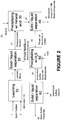
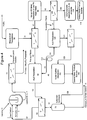
- Figures 2 - 4 are flow diagrams for different embodiments of the metal recovery process, wherein the metal recovery process comprises a number of different steps.
- the deoiled and dried used catalyst particles in stream 1 are first leached with an aqueous solution 2 containing ammonia and air in an autoclave 10, i.e., a multi-chambered, agitated vessel at a sufficient temperature and pressure, in which ammonia and air are supplied to induce leaching reactions, wherein the group VIB and group VIII metals are leached into solution forming group VIB and group VIII soluble metal complexes.
- an autoclave 10 i.e., a multi-chambered, agitated vessel at a sufficient temperature and pressure, in which ammonia and air are supplied to induce leaching reactions, wherein the group VIB and group VIII metals are leached into solution forming group VIB and group VIII soluble metal complexes.
- up to 90% of the (incoming) group VB metal in the feed stays in the coke phase (following discharge from the autoclave) and up to 10% of the incoming group VB metal is leached into solution.
- up to 0.050 wt% ends
- vanadium is converted into ammonium metavanadate
- molybdenum is converted into molybdate compounds including ammonium orthomolybdate
- portions of nickel and cobalt (if any) are converted into amine complexes, e.g., cobalt amine sulfate, nickel amine sulfate, or the like, thereby being leached.
- at least 70 wt% of the group VIB and group VIII metals are leached into solution.
- at least 90 wt% of the nickel and molybdenum are leached into solution.
- the deoiled used catalyst in stream 1 is pressure leached according to US Patent Publication No. US2007/0025899 , with the addition of ammonia and air in stream 2 to induce solubilization or leaching of metal sulfides from the used catalyst.
- the leaching is carried out at a pressure proportional to the temperature.
- the sufficient leach temperature is between 120 to 250°C.
- the sufficient leach temperature is between 135 to 225°C.
- the sufficient autoclave pressure is in the range of 0 - 1200 psig. In a second embodiment, from 100 - 1000 psig. In a third embodiment from 300 psig through about 800 psig.
- the used catalyst particles are pressure leached from 60 minutes to 360 minutes. In another embodiment, the used catalyst particles are pressure leached from 120 minutes to 300 minutes. In a third embodiment, the pressure leach is for a period of less than 240 minutes.
- the concentration of the leaching species and the pH of the leach solution are optimized with sufficient amounts of ammonia to complex the nickel, molybdenum, vanadium and cobalt (if any), and with sufficient free ammonia to control the pH within a range of 9 to 13.
- the molar ratio of ammonia to nickel (plus any cobalt, if present) plus molybdenum plus vanadium is in the range of 20:1 to 30:1.
- the ammonia concentration is maintained at a level of at least 1 wt%, and in a range of 2-7 wt% in yet another embodiment.
- the pressure leaching is carried out in an ammoniacal media at a pressure ranging from 0 to 1200 psig, at a temperature ranging from 100-300°C, and at a pH level of 8.0 or higher in order to efficiently allow the leaching reaction to progress.
- the pH level is maintained between a range of 9 to 12.
- the used catalyst is first caustic leached under atmospheric pressure, according to US Patent No. 6,180,072 , for an extended period of time before the pressure leaching step.
- the leached slurry 11 following cooling is transferred to a depositing / holding tank equipped with appropriate equipment to further reduce the leached slurry temperature to 90°C or less, prior to the next separation step.
- the partially cooled leached slurry 11 is subject to liquid-solid separation via physical methods known in the art, e.g., settling, centrifugation, decantation, or filtration using a vertical type centrifugal filter or a vacuum filter or a plate and frame filter, and the like, into a liquid stream 21 (Pressure Leach Solution stream) containing the group VIB and VIII metal complexes together with ammonium sulfate and a small amount of group VB metal complexes (up to 10 wt% of the incoming group VB metal); the solid residue 22 comprises of coke and any group VB metal complex (up to 90 wt% of the incoming group VB metal).
- the solid residue 22 comprises ammonium-containing vanadium salts such as ammonium metavanadate (NH 4 VO 3 ) and coke. Vanadium, as ammonium metavanadate (NH 4 VO 3 ) is subsequently recovered from the coke residue 22.
- the filtrate or PLS (Pressure Leach Solution) stream 21 is then subjected to a precipitation step.
- liquid-solid separation of the leached slurry 11 is carried out in a filtration device, wherein the solid residue 22 containing NH 4 VO 3 precipitate and coke is separated out in the form of a filter cake from the Pressure Leach Solution containing ammonium molybdate, nickel amine sulfate and ammonium sulfate.
- Group VB metals such as vanadium can be subsequently extracted / recovered from the filter cake, according to US Patent Publication No. US2007/0025899 , by temperature and pH modification; purified NH 4 VO 3 is crystallized as a wet solid and subsequently dried and calcined into vanadium pentoxide pellets.
- the recovered vanadium has diverse industrial applications, including use as a chemical catalyst, preparation of stainless / alloy steels, superconductive magnets and manufacturing of batteries.
- the PLS stream 21 contains 10 to 100 gpL (grams per liter) molybdenum, 1 to 20 gpL nickel, 0.05 to 2.0 gpL vanadium, and 50 to 1000 gpL ammonium sulfate.
- the PLS stream contains 20 to 100 gpL (grams per liter) molybdenum, 5 to 20 gpL nickel, 0.10 to 1.0 gpL vanadium, and 100 to 500 gpL ammonium sulfate.
- Precipitating Metal Complexes from the Pressure Leach Solution PLS:
- the pH of the PLS 21 is controlled to a level at which selective precipitation of the metal complexes occurs ("pre-selected pH"), precipitating as metal complexes at least 90% of the Group VIB metal, at least 90% of the Group VIII metal, and at least 40% of the Group VB metal initially present prior to the precipitation.
- pre-selected pH a level at which selective precipitation of the metal complexes occurs
- about 50-80% of the vanadium leached into the PLS is recovered with the Mo-Ni precipitate with the rest remaining in solution. Up to 90% of the vanadium in solution can be subsequently recovered in an optional subsequent sulfidation step to further precipitate any molybdenum and nickel remaining in solution.
- the pH is adjusted to precipitate as metal complexes at least at least 95% of the Group VIB metal.
- the pre-selected pH is less than about 3.5 to start precipitating at least 90% of soluble molybdenum complexes.
- the pre-selected pH is from pH 1.0 to about 2.0 to initiate precipitation of at least 95% of soluble tungsten complexes.
- several metals can form a precipitate at a given pH. For example, at a pH level of less than 3, both Mo and Ni (and Co, if any) precipitate although more molybdenum precipitates relative to nickel. Additionally, the precipitating concept described herein can be repeated at another pH or pH range to precipitate other metals.
- the pH of the PLS is reduced from greater than 9.0 to less than 3.5 to precipitate greater than 90% of the Mo.
- the pH of the PLS is adjusted to a level of 3.0 to 3.3 to precipitate greater than 92% of the Mo.
- the pH of the PLS is adjusted to a level of 2.65 to 3.0 to precipitate greater than 95% of the Mo.
- a strong mineral acid 23 is added to the precipitating / mixing vessel 30 to adjust the pH.
- the acid is added to the pressure leach solution 21 (PLS) feedstream.
- the acid used to precipitate the metal complexes may include any inorganic mineral acid with a relatively high ionization constant.
- the acid is used in a strength ranging from 1.0 to 12.0 normal.
- the acid is selected from the group of sulfuric acid, hydrochloric acid, phosphoric acid, nitric acid, and the like.
- a sulfur compound having a sulfhydryle group or an ionized sulfhydryl group or a sulfur compound, which is capable of producing a sulfhydryl group or an ionized sulfhydryl group is used to adjust the pH of the PLS and induce precipitation.
- Compounds containing a sulfhydryl or an ionized sulfhydryle group include hydrogen sulfide and inorganic compounds containing sulfide ion, hydrosulfide ion or trithiocarbonate ion as well as organic compounds such as dithiocarbamates, xanthates, mercaptans and the soluble metal salts of these compounds, i.e., the alkali metal and alkaline earth metal salts.
- sulfur compounds which are capable of producing a sulfhydryl or an ionized sulfhydryl group e.g., thioacetamide and reducible disulfides, can also be used.
- organic sulfur compounds which can be used include sodium, potassium or calcium salts of the following ions: ethyl xanthate ion, glucose xanthate ion, isopropyl xanthate ion, dimethyldithiocarbamate ion or diethyldithiocarbamate ion.
- inorganic sulfur compounds include sodium trithiocarbonate, potassium trithiocarbonate, calcium trithiocarbonate, sodium sulfide, potassium sulfide or calcium sulfide
- the sulfur compound is a sulfide-containing compound, e.g., a water soluble sulfide, a water soluble polysulfide, or mixtures thereof, is employed to adjust the pH of the Pressure Leach Solution 21 to a level at which precipitation of the metal complexes occurs.
- hydrogen sulfide, a combination of hydrogen sulfide and caustic soda, ammonium sulfide, NaHS, or Na 2 S, or mixtures thereof is used in an amount of about 0.05 to 0.2 molar to precipitate out nickel, molybdenum, cobalt, and the like from the Pressure Leach Solution 21.
- the precipitation is carried out under mixing conditions at a temperature in the range of 50 to 95°C, a pH level of 1 to 4, and for a sufficient amount of time, e.g., for at least 1 hour, for at least 90% of the molybdenum and nickel in the PLS to precipitate out as a metal complexes.
- the precipitation is carried out at a temperature of 70°C and a pH level of between 2.5 to 3.3.
- at least 95% of the molybdenum precipitates out after 2 hours as a molybdenum compound such as ammonium octamolybdate.
- at least 90% of the nickel precipitates out with the molybdenum as nickel ammonium sulfate.
- the pH of the PLS is continuously regulated for at least part of the precipitation step with the continuous addition of the additive, e.g., mineral acid or sulfide-containing compound, to control the rate of the precipitation as well as the type of metal complexes precipitating from the PLS.
- the additive e.g., mineral acid or sulfide-containing compound
- a sufficient amount of sulfuric acid (20-100% by weight) is used to adjust the pH of the PLS to less than 3.5.
- a sufficient amount of sulfuric acid is added to the PLS to target a pH of 3.0, with the mixture being maintained at a temperature of 60-90°C for 1 to 3 hours, until 99% of the molybdenum precipitates out as molybdate compounds.
- pH controllers known in the art can be used to automatically measure and control pH of the PLS for maximizing the amount of metals precipitated from the PLS.
- a device using a voltametric sensor is used to control and regulate the pH of the PLS.
- the solid precipitate is separated from solution by known means 40 including settling, filtration, decantation, centrifugation etc., or combinations thereof.
- the separation step generates a (primary) filtrate 42 comprising low concentrations of Group VB, Group VIB and Group VIII metals, and a (secondary) solid residue 41 comprising Group VIB in Group VIII metal complexes.
- the unwashed precipitate 41 contains 25-50 wt% Mo, 2 to 10 wt% Ni, less than 0.5 wt% V, less than 30 wt% AmSul, 1 to 10 wt% S, with a Mo to Ni ratio ranging from 5:1 to 25:1.
- the unwashed precipitate 41 contains up to 35 wt% Mo, 6 wt% Ni, less than 0.05 wt% V and about 28 wt% in Amsul, has a light greenish blue color and is soluble in warm ammoniacal solution.
- the cooled precipitate 41 is optionally doubled washed with acidic water (not shown in the Figures) at ambient temperature having a pH in the range of 2 - 3.5 to remove adhering Amsul (ammonium sulfate) that may be entrained in the Mo-Ni precipitate.
- acidic water not shown in the Figures
- a portion of the wash water may be recycled to the leaching step as feed to the autoclave.
- the remaining wash water may be added to the primary filtrate 42 for additional precipitation and recovery of the residual Mo and Ni in the filtrate.
- the solid precipitate 41 containing recovered metals, in one embodiment can be routed to a catalyst synthesis operation for the preparation of fresh catalysts.
- the solid precipitate 41 undergoes further processing, for separating nickel from other metals by acid dissolution, filtration & solvent extraction.
- the solid precipitate (secondary solid residue) 41 is transferred to the vessel 90 for further separation.
- the filtered solid precipitate 41 comprises ammonium octomolybdate and a double solid of nickel ammonium sulfate is first washed in hot, acidified water for a sufficient time to enable dissolution of the double salt of nickel from the ammonium octomolybdate.
- a mixture of the dissolved double salt of nickel and the precipitated ammonium octomolybdate is separated by suitable means 100 to recover as a secondary filtrate 101, which is a solution of nickel and ammonium sulphate, and ammonium octomolybdate precipitate 110.
- the nickel, vanadium and ammonium sulfate levels range from 0.10 to 1 wt. %, 0.05 to 3 wt. %, and 20 - 60 wt. %, respectively.
- the nickel, vanadium and ammonium sulfate levels range from 0.01 to 0.2 wt. %, 0.05 to 1 wt. %, and 0.05 to 3 wt. %, respectively.
- the octomolybdate solids are redissolved in dilute ammonia in vessel 110 at a temperature ranging from 40°C to 60°C to yield an ammonium molybdate and product solution 115.
- the primary filtrate (supernatant) 42 recovered from the separation step 40 is substantially free of Group VIB and Group VIII base metals.
- substantially free means that the primary filtrate 42 recovered from the separation step contains 0.1 to 3% of the Group VIB metal in the used dispersed catalyst, 1 to 20 % of the Group VB metal in the used dispersed catalyst, and 1 to 35 % of the Group VIII metal in the used dispersed catalyst for metal recovery.
- the primary filtrate 42 is primarily Amsul, with small amounts of molybdenum, vanadium, and nickel. In one embodiment, the primary filtrate 42 contains 0.1 to 2% of the incoming molybdenum, 1 to 15 % of the incoming vanadium, and 1 to 30 % of the incoming nickel. In another embodiment, the primary filtrate 42 contains from 0.1 to 1 % of the incoming molybdenum, 1 to 10 % of the incoming vanadium, and 1 to 15 % of the incoming nickel.
- the secondary filtrate 101 in Figures 3 - 4 ) in one embodiment is a nickel and ammonium sulfate solution.
- the secondary filtrate 101 contains insoluble molybdenum, vanadium and high nickel and ammonium sulfate.
- the secondary filtrate 101 comprises primarily nickel and trace amounts of residual molybdenum sulfide and vanadium oxide.
- trace amount means less than 1 wt.%.
- a trace amount means less than 0.5 wt. %.
- trace amount means less than 0.1 wt.%.
- the primary filtrate 42 and the secondary filtrate 101 are mixed to form a combined filtrate 43 and transferred sulfidation tank 50.
- the pH of the primary filtrate or Amsul supernatant 42 (plus optional wash water from washing the precipitate) is adjusted to further precipitate the small amount of metals left in the Amsul filtrate as metal sulfides.
- the primary filtrate 42 is subjected to a primary precipitation method 50 through sulfidation to adjust the pH.
- the pH is adjusted to precipitate at least 95% of the Group VIB metal and at least 95% of the Group VIII metal initially present in the supernatant 42 prior to the precipitation.
- the combined filtrate pH is similarly adjusted to further precipitate the small amount of metals left.
- the filtrate 42 comprises low soluble nickel at less than 400 ppm and a combined concentration of molybdenum and vanadium at less than 1000 ppm and high ammonium sulfate content, in one embodiment from about 420 gpL to 470 gpL and in another embodiment about 450 gpL.
- the pH of the primary filtrate 42 is adjusted to range between 7.5 and 8.5 by the addition of ammonia and in another embodiment a salt of di-ammonium hydrogen phosphate (DAHP) is added prior to sulfidation.
- DAHP di-ammonium hydrogen phosphate
- the primary precipitation method is carried out at a pressure from atmospheric to 100 psig and at a temperature ranging from 60°C to 110°C °.
- the secondary filtrate 101 is subjected to a secondary precipitation method 120.
- the pH is adjusted multiple times, from base to acid / acid to base, in the presence of a sulphur containing compound, e.g. H 2 S gas and phosphate, at 100 kPa for at least 90 minutes to obtain a precipitate of Mo, Ni, and V sulfides.
- a mixture 51 is formed comprising a primary liquid fraction and a primary solid residue, respectively, comprising very low concentrations of molybdenum and vanadium and primarily ammonium sulfate solution. In one embodiment, the concentration of molybdenum and vanadium in the primary solid residue is less than 10 ppm.
- the secondary filtrate 101 comprising a double salt of nickel and trace amounts of molybdenum and vanadium sulfide is passed to a sulfidation vessel 120 (secondary precipitation).
- the composition is subject to a sulfidation precipitation reaction in the presence of H 2 S gas, at a pressure ranging from 90 psig to 110 psig, a temperature ranging from 90°C to 110°C at a pH ranging from 7.5 to 9.5 for about 30 minutes to 90 minutes to form a mixture 121 comprising the secondary liquid fraction 126 and a precipitate comprising the secondary solid residue 129.
- the sulfidation reaction is carried in vessel 120 at a pressure of 100 psig a temperature of 100°C and a pH ranging between 8 and 9 for 60 minutes.
- the mixture 121 is passed to separator 125 to obtain the secondary solid residue 129 in a secondary liquid fraction 125.
- the secondary solid residue containing residual metal sulfides is separated from the ammonium sulfate (Amsul) solution by known means including settling, filtration, decantation, centrifugation, etc., or combinations thereof.
- the secondary solid residue 129 comprising nickel sulfate is transferred to a pressure leaching reactor 130.
- the pH of the residue is adjusted to a range between 4.5 and 5.5.
- the residue is pressure leached in the presence of oxygen at a temperature between 160°C and 170°C at a total pressure ranging from 1000 to 1200 kPa for about one hour.
- nickel sulfide solids are converted to a highly concentrated nickel sulfate solution 140 having a pH of less than 1, which is a desired "product solution.”
- the conversion of nickel sulfide to nickel sulfate is in excess of 90%, in another embodiment conversion is in excess of 95% and in another embodiment conversion is about 99%.
- the primary solid residue and primary liquid fraction 52 are separated into their respective fractions in separator 60.
- the primary solid residue 62 can be thereafter transferred to the used catalyst feed 1 for additional leaching in autoclave 10 or transferred to other processes for metals reclamation.
- the primary liquid fraction 61 is transferred to vessel 70, mixed with the secondary liquid fraction 126 to form a combined supernatant that in one embodiment is subject to sulfamate hydrolysis and sulfide oxidation to form, in one embodiment, a purified ammonium sulfate solution 75.
- the pH is maintained at a level between 7.5 and 9 in the presence of H 2 S gas at 100 kPa for at least one hour to obtain a precipitate of Mo, Ni, and V sulfides.
- the pH is adjusted up to 12 to precipitate more than 95% of the cobalt left in the combined filtrate 43 ( Figure 3 ) or the Amsul supernatant 42 ( Figure 2 ).
- a water soluble sulfide-containing compound 51 e.g., a water soluble sulfide, a water soluble polysulfide, or mixtures thereof, is added to the combined filtrate 43 in Figure 3 or the Amsul supernatant 42 in Figure 2 (and recycled wash water, if any)) with pH adjustment, thus precipitating the small amount of metals dissolved therein.
- the precipitation is carried out at a pressure from atmospheric to 100 psig and at a temperature ranging from 50 - 95°C.
- ammonia is optionally added to the combined filtrate 43 in Figure 3 (or the Amsul supernatant 42 in Figure 2 ) to bring the solution pH to 8 prior to the addition of the water soluble sulfide containing compound.
- the water soluble sulfide-containing compound is selected from the group of hydrogen sulfide, ammonium sulfide, NaHS, or Na 2 S, or mixtures thereof.
- hydrogen sulfide is used in an amount of about 0.05 to 0.2 molar to precipitate out nickel, molybdenum, cobalt, and the like from the filtrate.
- the metal sulfide slurry stream from precipitator 50 is sent to a separator 60.
- the solid precipitate containing residual metal sulfides is separated from the ammonium sulfate (Amsul) solution by known means including settling, filtration, decantation, centrifugation, etc., or combinations thereof.
- a filter press (not shown in Figure 2 ) is used to separate the metal sulfide precipitates 62 from the ammonium sulfate solution 61.
- the solids 62, containing precipitated metal sulfides are sent to a holding tank for subsequent metals recovery through the autoclave.
- the solids 62, containing precipitated metal sulfides are sent to a holding tank for off-site disposal to metals reclaimers.
- the recovered supernatant 61 (in Figure 2 ) or the primary liquid fraction 61 recovered from one embodiment of the primary precipitation method ( Figures 3-4 ) is substantially free of Group VB, Group VIB and Group VIII metals, e.g., V, Mo and Ni.
- substantially free means a removal rate of at least 90% for Group VB metals such as vanadium, and at least 95% for the Group VIB and Group VIII metals in the catalyst, e.g., molybdenum and nickel.
- analysis of the ammonium sulfate solution 61 shows a concentration of 300 to 800 gpL Amsul, less than 100 ppm of the group VIB metals, less than 20 ppm of the Group VIII metals, and less than 100 ppm of the Group VB metals.
- the supernatant (ammonium sulfate solution) 61 has a concentration of 200 to 600 gpL Amsul, less than 50 ppm Mo, less than 10 ppm Ni, and less than 50 ppm V.
- the solution 61 contains 100 to 1000 gpL ammonium sulfate, less than 100 ppm molybdenum, less than 20 ppm nickel, and less than 100 ppm vanadium.
- Ammonium sulfate can be recovered from stream 61 using methods known in the art. In one embodiment, the recovered ammonium sulfate is recycled for use as fertilizers.
- the resulting solid residue 61 comprising nickel sulfide is transferred to a pressure leaching reactor 70, wherein the pH of the residue is adjusted to a range between 4.5 and 5.5, and pressure leached in the presence of oxygen at a temperature between 160°C and 170°C at a total pressure ranging from 1000 to 1200 kPa for about one hour.
- the solid residue 61 is separated from the ammonium sulfate (Amsul) solution by known means including settling, filtration, decantation, centrifugation, etc., or combinations thereof.
- nickel sulfide solids are converted to a highly concentrated nickel sulfate solution having a pH of less than 1, a desired product solution 80.
- the conversion of nickel sulfide to nickel sulfate is in excess of 90%, in another embodiment conversion is in excess of 95% and in yet another embodiment, conversion is about 99%.
- the tertiary filtrate 72 recovered from this step is substantially free of Group VB, Group VIB and Group VIII metals, e.g., V, Mo and Ni.
- substantially free means a removal rate of at least 90% for Group VB metals such as vanadium, and at least 95% for the Group VIB and Group VIII metals in the catalyst, e.g., molybdenum and nickel.
- analysis of the tertiary filtrate, the ammonium sulfate solution 72 shows a concentration of 300 to 800 gpL Amsul, less than 100 ppm of the group VIB metals, less than 20 ppm of the Group VIII metals, and less than 100 ppm of the Group VB metals.
- the tertiary filtrate (ammonium sulfate solution) 61 has a concentration of 200 to 600 gpL Amsul, less than 50 ppm Mo, less than 10 ppm Ni, and less than 50 ppm V.
- the tertiary filtrate sent 72 contains 100 to 1000 gpL ammonium sulfate, less than 100 ppm molybdenum, less than 20 ppm nickel, and less than 100 ppm vanadium.
- a clarified ammonium sulfate effluent 72 is transferred to a reactor 73 and further subjected to sulfamate destruction by hydrolysis in the presence of steam at a temperature ranging between 210 and 250°C to produce a purified ammonium sulfate product 75 suitable for further processing, such as for fertilizer.
- Example 1 Vacuum residue containing used catalyst was processed in a microcoker unit and exposed to coking conditions fro 850 to 950°F. Products from the microcoker unit included a cracked gas stream, a coker liquid product stream, and a solid coke product. The coker liquid product stream was analyzed for metals, specifically molybdenum, nickel, and vanadium. None were found. The solid coke product was similarly analyzed, and it was determined that the solid coke product contained appreciable quantities of molybdenum, nickel, and vanadium. The solid coke product was milled to 100% passing 325 mesh (44 ⁇ m) in a ceramic ball mill, and the milled sample was then was subjected to pressure leach testing under conditions taught in U.S.
- Example 2 Vacuum residue containing used catalyst was diluted with heavy naphtha in a volume ratio of solvent/residue of 3/1. Separation via centrifugal force in a centrifuge at 1600 g-force and 2 minutes residence time yielded 99.8 weight% of the used catalyst having particle size lower than 10 microns.
- the separated solids and asphaltenes (i.e., 50 weight% of the asphaltenes of the feed) were heated up to a temperature of 950°F at atmospheric pressure, with a residence time of 1 hour.
- the recovered solids (coke and catalyst) were ground, or milled, to a particle size range of about greater than 1 to less than 50 microns, yielding a milled material amenable to metals recovery in a 99.8 weight% of Mo and Ni.
- the material was amenable to pressure leaching in an ammoniacal solution to recover valuable metals such as, for example, Mo, Ni, V, and other Group VA, VIA, VIIA, and VIII metals.
- Example 3 A vacuum residue containing about 5 weight% MoS 2 and NiS catalyst.
- the residue stream was contacted with a heavy naphtha in a volume ratio of solvent/residue of 2/1 with a 2000 g-force and 1 minute residence time, yielding a paste containing 99.9 weight% of the catalyst and 50 weight% of the original asphaltenes (less than 1 weight% based on fresh feed to the hydrocracking unit).
- the paste was processed in a microcoker unit and exposed to coking conditions from around 950°F. Products from the microcoker operation included a cracked gas stream (13 weight%), a coker liquid product stream (26 weight%), and a solid coke product (61 weight%).
- the solid coke product was analyzed and it was determined that the coke contained appreciable quantities of Mo, Ni, and V.
- the coke product was milled to 100% passing 325 mesh (44 microns) in a ceramic ball mill, and then was subjected to a pressure leach. Several runs were conducted and in each, extraction of Mo was greater than 99 weight%, Ni greater than 87 weight%, and V greater than 70 weight%, as outlined below. The results are as presented in Table 1.
- Example 4 Example 3 is duplicated with the following conditions for Pressure Leach Test on Coked Sample. The results are presented in Table 2.
- Example 5 In this example, a PLS (deep blue color) stream with a pH of 9.2 was adjusted to ⁇ 3.0 by single stage concentrated sulfuric acid (96%) addition.
- the PLS composition included 33 gpL free NH 3 , 80.9 gpL Mo, 7.9 gpL Ni, 0.17 gpL V and 277 gpL ammonium sulfate (Amsul).
- Amsul ammonium sulfate
- the slurry is cooled to ambient and filtered to remove the precipitate.
- the precipitate is optionally double-washed with pH 3.0 water at ambient temperature to remove entrained ammonium sulfate. During the washing step, an additional 23% of Ni re-solubilizes to achieve a final Ni recovery of about 75%. Minimal re-solubilization of Mo occurs.
- the final solution (including wash) analyzes 0.53 gpL Mo, 1.49 gpL Ni, and 0.08 gpL V, for a metal precipitation efficiency of 99.2% Mo, 76.4% Ni, and 27.9% V.
- the precipitate appearing as light greenish with blue tinges, is soluble in warm ammoniacal solution.
- An analysis of the washed precipitated solids reveals a moisture of 34.2 wt%, 42.6 wt% Mo (dry basis), 3.17 wt% Ni (dry basis), minimal V (less than 0.02 wt%), 6.8 wt% Amsul, 3.4 wt% S and a Mo/Ni ratio of 13.4.
- wash water is recycled to the autoclave feed.
- the remaining wash water and filtrate which is primarily ammonium sulfate (Amsul) contain low levels of Mo & V together with moderate amounts of Ni.
- the solution pH is increased to about 7 with ammonia addition followed by sulfidation with H 2 S gas under pressure at 200-kPa (30-psi) for 2-hours.
- the pH is maintained between 6 & 7 at a temperature of 80°C following which a precipitate of Mo, Ni and V sulfides is obtained.
- the slurry undergoes liquid-solid separation and the Amsul stream is further processed for recovering ammonium sulfate for use as fertilizer.
- Analysis of the final Amsul stream depicts 440 gpL Amsul, with 45 ppm Mo, less than 5 ppm Ni, and 26 ppm V.
- the cake containing recovered metal sulfides is stored in a tank as autoclave feed inventory. It can also be sent for off-site disposal to metals reclaimers.
- Example 6 Example 5 is repeated with a PLS stream having a pH of 10.6, containing 53 gpL free NH 3 , 85 gpL Mo, 8.24 gpL Ni, 0.40 gpL V and 271 gpL ammonium sulfate (Amsul).
- the PLS stream pH is adjusted to 2.71.
- the final solution (including wash) shows 0.48 gpL Mo, 1.44 gpL Ni, and 0.08 gpL V, for a metal precipitation efficiency of 99.2% Mo, 77.3% Ni, and 75% V.
- the washed precipitated solids show a moisture of 25.9 wt%, 41.8 wt% Mo (dry basis), 3.37 wt% Ni (dry basis), 0.16 wt% V, 3.8 wt% AmSul, 2.76 wt% S and a Mo/Ni ratio of 12.4.
- the final Amsul stream concentration reveals 500 gpL Amsul, with 41 ppm Mo, less than 5 ppm Ni, and 26 ppm V.
- Example 7 In this example, a PLS (deep blue color) stream with a pH of 9.2 was adjusted to ⁇ 3.0 by single stage concentrated sulfuric acid (96%) addition.
- the PLS composition included 33 gpL free NH 3 , 80.9 gpL Mo, 7.9 gpL Ni, 0.17 gpL V and 277 gpL ammonium sulfate (Amsul). After mixing for about 2-hours at a temperature of 80°C, about 99% of the molybdenum precipitates out as a molybdenum compound.
- the molybdate/and nickel precipitate which appears as light greenish with blue tinges, is soluble in warm ammoniacal solution.
- An analysis of the washed precipitated solids reveals a moisture of 34.2 wt%, 42.6 wt% Mo (dry basis), 3.17 wt% Ni (dry basis), minimal V (less than 0.02 wt%), 6.8 wt% Amsul, 3.4 wt% S and a Mo/Ni ratio of 13.4.
- the resulting mixture was filtered to separate the undissolved octamolybdate solids from the nickel and ammonium sulfate solution comprising secondary filtrate.
- Table 1 shows Ni, V and ammonium sulfate levels of 0.36-wt%, 0.16-wt% and 4-wt% respectively in the repulped and filtered octamolybdate cake.
- a displacement wash of the solids with fresh water lowers Ni, V and ammonium sulfate levels to 0.05-wt%, 0.17-wt% and 0.2-wt% respectively.
- an additional 23% of Ni re-solubilizes to achieve a final Ni recovery of about 75%. Minimal re-solubilization of Mo occurs.
- the final solution (including wash) analyzes 0.53 gpL Mo, 1.49 gpL Ni, and 0.08 gpL V, for a metal precipitation efficiency of 99.2% Mo, 76.4% Ni, and 27.9% V
- Table 3 Repulp-Displacement Wash Data for Separating Ni & Amsul from Octamolybdate Solids Unwashed solids from Mo-Ni Precipitation from PLS (wt.
- the primary filtrate from the initial step which contains low soluble Mo, Ni & V values and high ammonium sulfate content and the secondary filtrate of nickel and ammonium sulfate solution, which contains low soluble Mo & V and high Ni and ammonium sulfate content are combined to form a mixture comprising metal levels of ⁇ 6-gpl Ni, 330-gpL ammonium sulfate and less than 500-ppm total of Mo and V as shown in Table 4.
- the acidic solution pH is increased to ⁇ 8 with ammonia addition followed by sulfidation with H 2 S gas under pressure at 100-kPa for 1-hour.
- the pH is maintained between 8 and 8.5 at a temperature of 100°C following which a precipitate of Mo, Ni and V compounds are obtained as per the following reactions: Ni(NH 3 ) 2 SO 4 (aq) + H 2 S (g) ⁇ NiS (s) + (NH 4 ) 2 SO 4 (aq) ----------------- (3) 2NH 4 VO 3 (aq) + H 2 S (aq) ⁇ V 2 O 4 (s) + 2 NH 3 (aq) + S 0 + 2 H 2 O (aq) ---- (4a) and/or NH 4 VO 3 (aq) + 4H 2 S (aq) + 2NH 3 (aq) ⁇ (NH 4 ) 3 VS 4 (aq) + 3H 2 O (aq) ---- (4b) (NH 4 ) 2 MoO 4 (
- the sulfided ammonium sulfate slurry undergoes liquid-solid separation and the ammonium stream, containing less than 10-ppm total metals content, is further processed for recovering a purified ammonium sulfate product for use as fertilizer.
- Analysis of the final ammonium sulfate stream indicates 440 gpL ammonium sulfate, with 45 ppm Mo, less than 5 ppm Ni, and 26 ppm V.
- the filtered solids are washed with fresh water to remove adhering ammonium sulfate and soluble sulfides and repulped to a density of ⁇ 20-wt% solids.
- the slurry is acidified to a pH ⁇ 5 and introduced into a reactor for pressure leaching with oxygen gas at 165°C and a total pressure of 1,100 kPag (160-psig).
- Table 5 illustrates complete conversion of the NiS solids into nickel sulfate within 1-hour with the product solution at an acidic pH of less than 1. The following reactions are believed to occur: NiS (s) + 2O 2 (g) ⁇ NiSO 4 ....................................................................
- Example 8 In this example and with tests having conditions shown in Table 6, the following steps can be carried out to lower the Mo and V levels in the Amsul stream: a) adjust the initial feed solution pH to ⁇ 8 with dilute ammonia, add ⁇ 200-ppm P as di-ammonium hydrogen phosphate, followed by sulfidation for 20-minutes; b) adjust the slurry pH to ⁇ 2 with sulfuric acid followed by sulfidation for 20-minutes; c) adjust the final final slurry pH to ⁇ 8 with dilute ammonia followed by sulfidation for 20-minutes.
- Table 6 depicts batch results from several tests on semi-synthetic solutions or pilot plant sulfided effluent depleted of metals content; the pilot run solutions were replenished with synthetic Mo, Ni, V and Amsul salts and the tests were conducted at varying pH and DAHP content. Based on the data represented in Table 1, Ni did not indicate major solubility issues at both acidic and basic ranges. Test No. 1 clearly depicts that continuous sulfidation at neutral to ammoniacal pH does not lower Mo & V values to acceptable concentrations in the amsul effluent. Test No. 2 shows that high Mo levels in the sulfided effluent were a result of the acidic feed solution pH not being initially adjusted to the basic domain.
- V levels were untouched in this pH sequence zone.
- Test No. 3 portrays that Mo levels may be reduced in the sulfided effluent by adjusting the incoming solution pH during sulfidation from acidic to ammoniacal to acidic and finally to the basic domain over 90-minutes; V levels were still unacceptably high.
- Test No. 4 revealed that introduction of a phosphorus based compound, di-ammonium hydrogen phosphate or DAHP, lowered V to acceptable levels in the sulfided effluent.
- Mo levels were high as a result of not adjusting the initial feed solution pH within the ammoniacal region, metal values were significantly lower than Test 2 indicating positive synergies with phosphate addition.
- the newly formed ammonium phosphomolybdate (reaction 4) functioned as a co-precipitant for solubilized vanadium species thus minimizing soluble vanadium levels in the sulfided amsul effluent slurry.
- the sulfided amsul slurry undergoes liquid-solid separation (step 6) and the amsul stream, containing less than 10-ppm total metals content.
- the sulfided amsul slurry undergoes liquid-solid separation (step 6") and the amsul stream, containing less than 5-ppm total metals content, is processed as per the original invention (step 7).
- the filtered solids from step 6" ( Figure 2 ) are washed with fresh water to remove adhering amsul and soluble sulfides and repulped to a density of ⁇ 20-wt% solids.
- the slurry is acidified to a pH ⁇ 5 and introduced into a reactor for pressure leaching with oxygen gas at 165°C and a total pressure of 1,100 kPag (160-psig).
- Table 7 depicts all three metals precipitated to ⁇ 5-ppm levels in the sulfided amsul stream; although higher V and Mo levels were potentially expected to be present in the amsul stream (as a result of reactions 13 & 15), it is believed that high volumes of generated NiS (>40,000-ppm) from reaction 11 acted as a coprecipitant to partially and/or fully remove both Mo & V from the solution phase.
Landscapes
- Chemical & Material Sciences (AREA)
- Engineering & Computer Science (AREA)
- Organic Chemistry (AREA)
- Materials Engineering (AREA)
- Chemical Kinetics & Catalysis (AREA)
- Manufacturing & Machinery (AREA)
- Mechanical Engineering (AREA)
- Metallurgy (AREA)
- Oil, Petroleum & Natural Gas (AREA)
- Life Sciences & Earth Sciences (AREA)
- General Life Sciences & Earth Sciences (AREA)
- Geology (AREA)
- General Chemical & Material Sciences (AREA)
- Environmental & Geological Engineering (AREA)
- Catalysts (AREA)
- Manufacture And Refinement Of Metals (AREA)
- Production Of Liquid Hydrocarbon Mixture For Refining Petroleum (AREA)
Description
- The invention relates to a process for recovering metals from used hydroprocessing catalyst.
- Traditional light oil reserves are being depleted due to high oil production. Oil fields are requiring substantial new investment in secondary and tertiary oil recovery technology. On the other hand, the cost of producing and refining heavy crude has decreased due to new production and refining technologies. Most of the heavy crude reserves all over the world have not yet been exploited. Considering the continuously increasing demand in oil and the large difference in price between light oil and heavy crude, heavy crude reserves are emerging as a very attractive source of energy.
- Heavy crude contains 40-70% high boiling range material that boils over 1000°F (i.e., vacuum resid) and very low amounts of fuels in high demand such as, for example, gasoline and diesel. Therefore, in order to convert vacuum resid to valuable light products, new and more cost effective technologies are needed. Heavy crude can be converted into lighter products via conventional processes such as coking (e.g., delayed coking and/or fluid coking) and hydroconversion (e.g., LC Fining and H-OIL). However, such conventional processes produce large amounts of undesirable byproducts such as, for example, coke or fuel oil and also are very sensitive to the contaminants such as, for example, V, Ni, and S.
- Catalysts have been used widely in the refining and chemical processing industries for many years. Hydroprocessing catalysts, including hydrotreating and hydrocracking catalysts, are now widely employed in facilities worldwide. Hydroprocessing technologies utilize catalysts comprising metals of Group VA, VIA, VIB, VIIA, and / or VIII metal sulfides, e.g., compounds of molybdenum disulfide (MoS2) and nickel sulfide (NiS). Such metals are highly active in hydroconversion of heavy crudes but also are very expensive. In order to minimize the amount of catalyst required, and minimize the diffusion effects, catalyst is often unsupported.
- In hydroconversion of vacuum resid and related feedstocks (upgrading of heavy oil feedstock), the remaining portion of unconverted material, which may range from 0 to 10% of fresh feed, shows low API gravity (-10 to 29), high remaining microcarbon residue (MCR) (0 to 60%), very high viscosity and asphaltenes content, and likely also contains catalyst. Therefore, the separation scheme utilized to recover valuable active metals such as, for example, MoS2 and NiS is a critical step in making the process economically attractive. Catalyst remaining in the unconverted slurry bleed oil (USBO) is to be removed and sent for reprocessing to recover the metals and also to recover the unconverted portion of the residue in order to be recycled or further processed.
- With the advent of the need to refine heavier crude feedstock, refiners are forced to use more catalysts than before for hydroprocessing to remove metals, sulfur and other contaminants from the feedstock. These catalytic processes generate huge quantities of spent catalyst. With the increasing demand and market price for metal values and environmental awareness thereof, catalysts can serve as an economic source for recovery of metals useful for catalyst synthesis and other uses.
- Expensive used catalyst contained in the USBO is coated with USBO and is not leachable by conventional technologies of metals extraction that basically are effective for water-based slurries. Therefore, without additional processing, the valuable metals cannot be recovered. Technologies employing microfiltration, ultrafiltration, or nanofiltration; gravity based separation, such as centrifugation or hydrocycloning; and chemical recovery, which may be effective for water-based slurries, similarly do not provide acceptable results for catalyst coated with USBO.
- In order to recycle catalytic metals and provide a renewable source for the metals, efforts have been made to extract metals from used catalysts, whether in supported or bulk catalyst form.
US Patent Publication No. 2007/0025899 discloses a process to recover metals such as molybdenum, nickel, and vanadium from a used catalyst with a plurality of steps and equipment to recover the molybdenum and nickel metal complexes.US Patent No. 6,180,072 discloses another complex process requiringsolvent extraction as well as oxidation steps to recover metals from used catalysts containing at least a metal sulphide. - There is still a need for an improved and simplified process to recover metals including but not limited to molybdenum, nickel, and vanadium from used hydroprocessing catalysts
- The present invention provides a method for recovering metals from a used dispersed catalyst originating from a Group VIB metal sulfide catalyst and at least a Group VB metal promoted with a Group VIII metal for hydrocarbon oil hydroprocessing, the method comprising:
- contacting the used dispersed catalyst with a leaching solution containing ammonia and air to dissolve the Group VIB metal and the Group VIII metal into the leaching solution at a sufficient temperature and pressure to form a pressure leach slurry containing at least a Group VIB soluble metal complex and at least a Group VIII soluble metal complex and solid residue containing at least a Group VB metal complex and coke;
- separating and removing the solid residue containing the Group VB metal complex and coke from the pressure leach slurry, forming a pressure leach solution;
- precipitating from the pressure leach solution (PLS) at least a portion of the Group VIB metal and at least a portion of the Group VIII metal, wherein the precipitation being carried out at a first pre-selected pH to precipitate as metal complexes at least a portion of the Group VIB metal and at least a portion of the Group VIII metal, wherein the method further comprises:
- recovering the precipitated metal complexes by at least a separation means selected from settling, filtration, decantation, centrifugation and combinations thereof, forming a first supernatant substantially free of at least a portion of the Group VIB metal and at least a portion of the Group VIII metal;
- Described herein is a method for recovering catalytic metals from used dispersed catalyst slurried in heavy oil. The method comprises pyrolizing used catalyst slurried in heavy oil to provide one or more lighter oil products and a coke-like material. Catalytic metals are recovered from the coke-like material.
- Also described herein is a method comprising mixing used dispersed catalyst slurried in heavy oil with solvent, which causes asphaltenes in the heavy oil to precipitate from the heavy oil. Fine catalyst and precipitated asphaltenes are separated from the heavy oil and solvent. Precipitated asphaltenes are converted to a coke-like material by pyrolizing fine catalyst and precipitated asphaltenes separated from the heavy oil.
- Also described herein is a method for recovering base metals including vanadium from a used dispersed catalyst originating from a Group VIB metal sulfide catalyst promoted with a Group VIII metal for hydrocarbon oil hydroprocessing, the method comprising the steps of: contacting the used dispersed catalyst with a leaching solution containing ammonia and air to dissolve the group VIB metal and the Group VIII metal into the leaching solution, forming a pressure leach slurry containing at least a group VIB soluble metal complex, at least a group VIII soluble metal complex, ammonium sulphate and solid residue containing ammonium metavanadate and coke; separating and removing the solid residue containing ammonium metavanadate and coke from the pressure leach slurry; precipitating from the pressure leach solution at least a portion of the Group VIB metal and at least a portion of the Group VIII metal, wherein the precipitation being carried out at a first pre-selected pH to precipitate as metal complexes at least a portion of the Group VIB metal and at least a portion of the Group VIII metal.
- Also described herein is a method for recovering vanadium, molybdenum and nickel from a used dispersed catalyst, the method comprising the steps of: contacting the used dispersed catalyst with a leaching solution containing ammonia and air to dissolve the molybdenum and nickel into the leaching solution, forming a pressure leach slurry containing molybdenum and nickel metal complexes, ammonium sulphate and solid residue containing ammonium metavanadate and coke; separating and removing the solid residue containing ammonium metavanadate and coke from the pressure leach slurry; adjusting the pH of the pressure leach solution by the addition of sulfuric acid to precipitate at least a portion of the molybdenum and nickel as metal complexes; separating and recovering molybdenum and nickel metal complexes from the supernatant containing 0.1 to 5% of the incoming molybdenum, 1 to 20 % of the incoming vanadium, and 1 to 35 % of the incoming nickel.
- In one embodiment, the method further comprises the step of adding H2S to the supernatant to precipitate out the remaining molybdenum and nickel metal complexes, and subsequent recovery of the molybdenum and nickel metal sulfides from the ammonium sulphate supernatant.
- Also described herein is a method for recovering base metals including vanadium from a used dispersed catalyst originating from a Group VIB metal sulfide catalyst promoted with a Group VIII metal for hydrocarbon oil hydroprocessing, the method comprising the steps of: contacting the used catalyst with a leaching solution containing ammonia and air to dissolve the group VIB metal and the Group VIII metal into the leaching solution, forming a pressure leach slurry containing at least a group VIB soluble metal complex, at least a group VIII soluble metal complex, ammonium sulphate and a first solid residue containing ammonium metavanadate and coke; separating and removing the first solid residue containing ammonium metavanadate and coke from the pressure leach slurry to form a first pressure leach solution; precipitating from the first pressure leach solution at least a portion of the Group VIB metal and at least a portion of the Group VIII metal, wherein the precipitation is carried out at a first pre-selected pH to precipitate a second solid residue comprising as metal complexes at least a portion of the Group VIB metal and at least a portion of the Group VIII metal and form a second pressure leach solution comprising at least a portion of the Group VIII soluble metal complex; separating from the second pressure leach solution the second solid residue and a primary filtrate substantially free of Group VB, Group VIB and the Group VIII metals; dissolving the second solid residue, at a second pre-selected pH, to form a group VIB metal precipitate and a group VIII metal containing solution; separating the group VIB metal precipitate from the Group VIII metal containing solution and dissolving said Group VIB metal precipitate in a dilute base at a sufficient temperature to form a Group VIB metal product.
- Also described herein is a method for recovering vanadium, molybdenum and nickel from the used catalyst to recover substantial amounts of a Group VIII metal, the method comprising: recovering a secondary filtrate comprising substantially the Group VIII soluble metal complex and a trace amount of Group VB and Group VIB metals; combining the secondary filtrate with the primary filtrate to form a combined filtrate comprising substantially the Group VIII soluble metal complex and a trace quantity of Group VB and Group VIB metals; precipitating from the combined filtrate the Group VB, Group VIB and Group VIII metals in a sulfidation process to form a third solid residue and a tertiary filtrate; separating the third of solid residue from the tertiary filtrate and dissolving the third solid residue to form a group VIII metal product solution.
- Also described herein is a method for recovering vanadium, molybdenum, and nickel from a used catalyst and producing ammonium sulfate useful for other processes, such as fertilizer, the method comprising: all of the above processes and further comprising subjecting the tertiary filtrate to sulfamate destruction by hydrolysis to recover a purified ammonium sulfate solution.
- Also described herein is a method for recovering vanadium, molybdenum and nickel from a used catalyst, the method comprising the steps of: contacting the used catalyst with a leaching solution containing ammonia and air to dissolve the molybdenum and nickel into the leaching solution, forming a pressure leach slurry containing molybdenum and nickel metal complexes, ammonium sulphate and solid residue containing ammonium metavanadate and coke; separating and removing the solid residue containing ammonium metavanadate and coke from the pressure leach slurry; adjusting the pH of the pressure leach solution by the addition of sulfuric acid to precipitate at least a portion of the molybdenum and nickel as metal complexes; separating and recovering molybdenum and nickel metal complexes from the pressure leach solution containing 0.1 to 5% of the incoming molybdenum, 1 to 20 % of the incoming vanadium, and 1 to 35 % of the incoming nickel.
- In another embodiment, the method further comprises the step of adding H2S to a combination of the primary filtrate and the secondary filtrate to precipitate the remaining molybdenum and nickel metal complexes, and subsequent recovery of, by a means a separation, the molybdenum and nickel metal sulfides from the filtered third solid residue comprising nickel sulfate.
- Also described herein is a method for recovering base metals including vanadium from a used dispersed catalyst originating from a Group VIB metal sulfide catalyst promoted with a Group VIII metal for hydrocarbon oil hydroprocessing, the method comprising the steps of: contacting the used catalyst with a leaching solution containing ammonia and air to dissolve the group VIB metal and the Group VIII metal into the leaching solution, forming a pressure leach slurry containing at least a group VIB soluble metal complex, at least a group VIII soluble metal complex, ammonium sulphate and a first solid residue containing ammonium metavanadate and coke; separating and removing the first solid residue containing ammonium metavanadate and coke from the pressure leach slurry to form a first pressure leach solution; precipitating from the first pressure leach solution at least a portion of the Group VIB metal and at least a portion of the Group VIII metal, wherein the precipitation is carried out at a first pre-selected pH to precipitate a second solid residue comprising as metal complexes at least a portion of the Group VIB metal and at least a portion of the Group VIII metal and form a second pressure leach solution comprising at least a portion of the Group VIII soluble metal complex; separating from the second pressure leach solution the second solid residue and a primary filtrate substantially free of Group VB, Group VIB and the Group VIII metals; dissolving the second solid residue, at a second pre-selected pH, to form a group VIB metal precipitate and a group VIII metal containing solution; separating the group VIB metal precipitate from the Group VIII metal containing solution and dissolving said Group VIB metal precipitate in a dilute base at a sufficient temperature to form a Group VIB metal product.
- Also described herein is a method for recovering vanadium, molybdenum and nickel from the used catalyst to recover substantial amounts of a Group VIII metal, the method comprising: recovering a secondary filtrate comprising substantially the Group VIII soluble metal complex and a trace amount of Group VB and Group VIB metals; processing the primary filtrate in a primary precipitation method to form a primary solid residue and a primary liquid fraction and separately processing the secondary filtrate in a secondary precipitation method to form a secondary solid residue and a secondary liquid fraction; separating the primary solid residue from the primary liquid fraction and combining the primary solid residue with the used catalyst prior to or simultaneously with contacting the used catalyst with the leaching solution; separating the secondary solid residue from the secondary liquid fraction and dissolving the secondary solid residue to form a Group VIII product solution.
- The primary liquid fraction and the secondary liquid fraction may be combined to form a combined supernatant substantially free of Group VB, Group VIB and Group VIII metals.
- Also described herein is a method for recovering vanadium, molybdenum, and nickel from the used catalyst and producing ammonium sulfate useful for other processes, such as fertilizer, the method comprising: all of the above processes and further comprising subjecting that combined supernatant to sulfamate hydrolysis and sulfide oxidation to recover a purified ammonium sulfate solution.
- Also described herein is a method for recovering vanadium, molybdenum and nickel from a used catalyst, the method comprising the steps of: contacting the used catalyst with a leaching solution containing ammonia and air to dissolve the molybdenum and nickel into the leaching solution, forming a pressure leach slurry containing molybdenum and nickel metal complexes, ammonium sulphate and solid residue containing ammonium metavanadate and coke; separating and removing the solid residue containing ammonium metavanadate and coke from the pressure leach slurry; adjusting the pH of the pressure leach solution by the addition of sulfuric acid to precipitate at least a portion of the molybdenum and nickel as metal complexes; separating and recovering molybdenum and nickel metal complexes from the pressure leach solution containing 0.1 to 5% of the incoming molybdenum, 1 to 20 % of the incoming vanadium, and 1 to 35 % of the incoming nickel.
- In another embodiment, the primary precipitation method comprises sulfidation wherein H2S and phosphate are added to the primary filtrate and the reaction is carried out at a sufficient temperature and pressure for a sufficient length of time at multiple pH values to substantially remove molybdenum and vanadium species from the ammonium sulfate to form a primary liquid fraction and a primary solid residue. In this embodiment the secondary filtrate is passed through the secondary precipitation method comprising sulfidation wherein H2S is added to the secondary filtrate and the reaction is carried out at a sufficient temperature and pressure for a sufficient time and at a pH value sufficient to substantially remove nickel, molybdenum and vanadium species to form a secondary liquid fraction and a secondary solid residue, to precipitate the remaining molybdenum and nickel metal complexes, and subsequent recovery of, by a means a separation, the molybdenum and nickel metal sulfides from the filtered third solid residue comprising nickel Sulfate.
-
-
Figure 1 provides an overview of various embodiments for removing oil from an unconverted slurry bleed oil (USBO) stream, comprising used dispersed catalyst. -
Figure 2 is an overview of one embodiment of the metal recovery process. -
Figure 3 is an overview of a second embodiment of the metal recovery process with the generation of discrete base metal streams. -
Figure 4 is an overview of a third embodiment of the metal recovery process with the generation of discrete base metal streams and decontamination of ammonium sulfate co-product. - The following terms will be used throughout the specification and will have the following meanings unless otherwise indicated.
- As used herein, "heavy oil" feed or feedstock refers to heavy and ultra-heavy crudes, including but not limited to resids, coals, bitumen, tar sands, etc. Heavy oil feedstock may be liquid, semi-solid, and / or solid. Examples of heavy oil feedstock that might be upgraded as described herein include but are not limited to Canada Tar sands, vacuum resid from Brazilian Santos and Campos basins, Egyptian Gulf of Suez, Chad, Venezuelan Zulia, Malaysia, and Indonesia Sumatra. Other examples of heavy oil feedstock include bottom of the barrel and residuum left over from refinery processes, including "bottom of the barrel" and "residuum" (or "resid") -- atmospheric tower bottoms, which have a boiling point of at least 343°C. (650°F.), or vacuum tower bottoms, which have a boiling point of at least 524°C. (975°F.), or "resid pitch" and "vacuum residue" - which have a boiling point of 524°C. (975°F.) or greater.
- Properties of heavy oil feedstock may include, but are not limited to: TAN of at least 0.1, at least 0.3, or at least 1; viscosity of at least 10 cSt; API gravity at most 15 in one embodiment, and at most 10 in another embodiment; microcarbon residue (MCR) in the range of about 15 to 30 weight% and (C7) asphaltenes in the range of about 5 to 20 weight%. In one embodiment, a gram of heavy oil feedstock contains at least 0.0001 grams of Ni/V/Fe; at least 0.005 grams of heteroatoms; at least 0.01 grams of residue; at least 0.04 grams C5 asphaltenes; at least 0.002 grams of MCR; per gram of crude; at least 0.00001 grams of alkali metal salts of one or more organic acids; and at least 0.005 grams of sulfur. In one embodiment, the heavy oil feedstock has a sulfur content of at least 5 wt. % and an API gravity of from -5 to +5.
- In one embodiment, the heavy oil feedstock comprises Athabasca bitumen (Canada) having at least 50% by volume vacuum reside. In another embodiment, the feedstock is a Boscan (Venezuela) feed with at least 64 % by volume vacuum residue. In one embodiment, the heavy oil feedstock contains at least 1000 ppm V. In another embodiment, the V level ranges between 5000 and 10000 ppm. In a third embodiment, at least 5000 ppm.
- As used herein, "hydroprocessing" is meant any process that is carried out in the presence of hydrogen, including, but not limited to, methanation, water gas shift reactions, hydrogenation, hydrotreating, hydrodesulfurization, hydrodenitrogenation, hydrodemetallation, hydrodearomatization, hydroisomerization, hydrodewaxing and hydrocracking including selective hydrocracking.
- As used herein, the phrase "one or more of or "at least one of when used to preface several elements or classes of elements such as X, Y and Z or X1-Xn, Y1-Yn and Z1-Zn, is intended to refer to a single element selected from X or Y or Z, a combination of elements selected from the same common class (such as X1 and X2), as well as a combination of elements selected from different classes (such as X1, Y2 and Zn).
- The Periodic Table referred to herein is the Table approved by IUPAC and the U.S. National Bureau of Standards, an example is the Periodic Table of the Elements by Los Alamos National Laboratory's Chemistry Division of October 2001.
- The used catalyst described herein may originates from a dispersed (bulk or unsupported) Group VIB metal sulfide catalyst containing at least one of: a Group VB metal such as V, Nb; a Group VIII metal such as Ni, Co; a Group VIIIB metal such as Fe; a Group IVB metal such as Ti; a Group HB metal such as Zn, and combinations thereof. In another embodiment, the used catalyst originates from a dispersed (bulk or unsupported) Group VIB metal sulfide catalyst promoted with a Group VIII metal for hydrocarbon oil hydroprocessing. Promoters are typically added to a catalyst formulation to improve selected properties of the catalyst or to modify the catalyst activity and/or selectivity.
- In another embodiment, the used catalyst originates from a bulk catalyst precursor of the formula (X)a(M)b[(CH3CH2)cN(CH3)3]dOz as disclosed in
US Patent Publication No. 20060060502 , wherein X is Nickel, M is Mo , c is an integer from 10 to 40, the molar ratio of a:b is from 0.5/1 to 3/1. In another embodiment, the used catalyst originates from a hydroprocessing catalyst represented by the formula (Mt)a(Xu)b(Sv)d(Cw)e(Hx)f(Oy)g(Nz)h as disclosed inUS Patent Application Serial No. 1 1/931972 - As used herein, the term "used catalyst" refers to a catalyst that has been used in a hydroprocessing operation and, as a result of such use, exhibits relatively lower or diminished catalytic activity. For example, if a reaction rate constant of a fresh catalyst at a specific temperature is assumed to be 100%, the reaction rate constant for a used catalyst temperature is 80% or less in one embodiment, and 50% or less in another embodiment. The most commonly encountered metal to be recovered is molybdenum. In one embodiment, the metals to be recovered from the used catalyst are sulfides of Mo, Ni, and V.
- In one embodiment, the used catalyst is generally in the form of a dispersed suspension having an effective median particle size of 0.01 to 200 microns. In another embodiment, the used catalyst has an average particle size of 0.01 to 100 microns. In a third embodiment, the used catalyst is a dispersed slurry having an average particle size of 0.01 to 50 microns. In one embodiment, the used catalyst has a pore volume of 0.05-5 ml/g as determined by nitrogen adsorption. In yet another embodiment, the used catalyst particles can have a size distribution in the range of about 0.2-20 microns, and a mean particle size of about 4-5 micron, with the mode being about 6-7 micron.
- As used herein, the reference to "vanadium" is by way of exemplification only for any Group VB metal component that may be added to the hydroprocessing catalyst or is present in the hydroprocessing feedstock, and is not intended to exclude other Group VB metals / compounds and mixtures of that may be present in the used hydroprocessing catalyst for metal recovery.
- In the sections that follow, the reference to "incoming molybdenum" (or "incoming nickel," or "incoming vanadium," etc.) refers to the amount of metal that is initially present in the used catalyst prior to the metal recovery process.
- In a hydroprocessing operation, a catalyst is typically enriched / deactivated with nickel and vanadium as "contaminants" in an amount ranging up to about 100 wt% of the fresh catalyst weight. In some operations, due to the rapid coke deposition rate, the catalyst is deactivated prior to achieving its full metals adsorption capacity. Such catalysts are taken out of service when the used catalyst contains as little as 10 wt% nickel plus vanadium compounds.
- Heavy Oil Upgrading. Suitable feeds to a process for upgrading heavy oils using a slurry catalyst composition, include, for example, atmospheric residuum, vacuum residuum, tar from a solvent deasphlating unit, atmospheric gas oils, vacuum gas oils, deasphalted oils, olefins, oils derived from tar sands or bitumen, oils derived from coal, heavy crude oils, synthetic oils from Fischer-Tropsch processes, and oils derived from recycled oil wastes and polymers. The feed is supplied to a reactor, wherein the feed is reacted with a catalyst slurry described in further detail below and preferably hydrogen. In an embodiment, the reactor is a liquid recirculating reactor, although other types of upflow reactors may be employed. The catalyst slurry can be useful for, but not limited to, hydrogenation upgrading processes such as thermal hydrocracking, hydrotreating, hydrodesulphurization, hydrodenitrification, and hydrodemetalization.
- In one embodiment, the feedstock to the heavy oil upgrading process comprises finely divided unsupported slurry catalyst, carbon fines, and metal fines in unconverted resid hydrocarbon oil. In one embodiment, the solids content of the feedstock can be in the range of about 5-40 weight %, for example about 15-30 weight % or about 20-25 weight %.
- In one embodiment of a heavy oil conversion (upgrade) process, a heavy crude oil feedstock containing greater than 50 weight% of vacuum resid with an asphaltene level of greater than 3 weight %, when subjected to a high severity conversion process can result in a vacuum reside or asphaltene conversion level in the range of about 80 to 99 weight%. In one embodiment, the process conditions include temperatures in the range of about 420 to 450°C and pressures in the range of about 500 to 3000 psi hydrogen partial pressure. An effect of high severity conversion processes is that a large fraction of the heavier components, such as, for example, asphaltenes, are converted to lighter fractions leaving a small amount of dishydrogenated asphaltenes with a high degree of condensation that are incompatible within the hydroconverted product and, therefore, have a tendency to precipitate, especially when mixed with solvent.
- Effluent streams from the reactor, perhaps following downstream processing, such as, for example, separation(s), can include one or more valuable light products as well as a stream containing used dispersed catalyst. Processing of an effluent stream containing used dispersed catalyst, e.g., an unconverted slurry bleed oil (USBO) stream, is described herein. In one embodiment, the effluent stream comprises between 2 to 50 wt. % used slurry (dispersed or fine) catalyst. In another embodiment, the used slurry catalyst amount ranges from 3 to 30 wt. %. In a third embodiment, from 5 to 20 wt. %.
- The cost of the catalyst, and more specifically the expensive metal(s) that comprise the catalyst, may necessitate the recovery of metals from the used catalyst for an economical heavy oil upgrading process. Additionally, the recovery of used catalyst from unconverted feed may allow for 90-100% conversion of heavy oil, as described in further detail, below. However, the high molecular weight of the unconverted heavy oil feed makes it difficult to separate unsupported catalyst therefrom. Further, conventional filtration processes may not be suitable to separate catalyst from unconverted feed, as the unsupported fine catalyst may cause plugging or fouling of filters.
- Prior to metal recovery, used catalyst recovered from an upstream hydroprocessing unit in one embodiment is first washed / deoiled to remove greater than 98 wt% of the hydrocarbon feed and product oils from the used catalyst.
- Deoiling / Removal of Oil: Before metals can be recovered from the used catalyst, the stream comprising used catalyst slurried in heavy oil ("USBO" stream) is first deoiled. In one embodiment, the used catalyst is deoiled in contact with a subcritical dense phase gas in a process as described in
WO06117101A1 Figure 1 , the USBO stream is deoiled through a process in which the used catalyst is converted into a coke-like material in a pyrolysis process. - In one embodiment of the invention as shown in
Figure 1 (dotted line), the stream comprising fine catalyst slurried in heavy oil ("USBO" stream) is thermally cracked or coked, ground, then sent to a metal recovery unit wherein catalytic metals can be recovered from the the coke-like material. - In a second embodiment, before coking, the USBO stream is mixed with solvent ("dilution"), which causes asphaltenes in the heavy oil to precipitate from the heavy oil; separating fine catalyst and precipitated asphaltenes from the heavy oil and solvent ("separation"); and converting precipitated asphaltenes to a coke-like material by pyrolizing fine catalyst and precipitated asphaltenes separated from the heavy oil ("coking"). A description of the steps involved in the deoiling process is as follows.
- Dilution. In one embodiment as shown in
Figure 1 , a solvent 101 is mixed withstream 102 comprising used fine catalyst slurried in heavy oil in a volume ratio of about 0.5/1 to 5/1. In a second embodiment, the solvent to used catalyst mass ratio ranges from 3:1 to 1:3. In one embodiment, the solvent is an organic solvent selected from the group of xylene, benzene, toluene, kerosene, light naphtha, heavy naphtha, and/or kerosene. In another embodiment, the solvent is a commercially available solvent such asShelSol™ 100 series solvent. In one embodiment, the mixing is for a sufficient amount of time and at a temperature sufficient to promote substantial asphaltenes precipitation. In one embodiment, this temperature ranges from about 55 to 75°C. In one embodiment, the mixing is in the range from 15 minutes to an hour. In another embodiment, for at least 20 minutes. - Mixing the fine catalyst slurried in heavy oil with solvent reduces viscosity and promotes partial asphaltenes precipitation to flocculate part of the asphaltenes and the very fine particles of the used catalyst. The
stream 102 containing precipitated asphaltenes, used catalyst, heavy oil, and solvent is sent to thenext step 200 for separation. - Separation. The precipitated asphaltenes and used catalyst are next separated from the heavy oil and solvent. Conventional separation techniques such as, for example, gravity decanting and/or centrifugal decanting may be used. Used catalyst recovery can be in the range of 90 to 99.9 weight%. In one embodiment, the separation is via centrifugal decanting, wherein the
overflow stream 201 containing solvent and hydrocarbon liquid is sent to a conventional solvent recovery unit, and stream 202 containing precipitated asphaltenes and used catalyst is sent away for drying / coking. - Coking. When MCR or asphaltenes are exposed to extreme temperatures, ranging from 700 to 1000+°F, the petroleum molecules are "thermally cracked" in such a way as to produce some portion of lighter oil product and some portion of condensed asphaltenes and heavy molecules as petroleum coke. In one embodiment as shown in
Figure 1 (dotted line),stream 102 comprising used fine catalyst slurried in heavy oil is sent directly to the coking unit. In another embodiment also as shown inFigure 1 , the stream is first optionally treated with a solvent, after separation, the stream containing precipitated asphaltenes and used catalyst is sent to the coking unit. - The drying / coking device 300 can be any device known to those skilled in the art to be suitable for vaporizing any hydrocarbon liquids contained in a hydrocarbon liquid/solid slurry and coking any heavy hydrocarbon fraction contained in the hydrocarbon liquids. In one embodiment, the device is selected from an indirect fired kiln, an indirect fired rotary kiln, an indirect fired dryer, an indirect fired rotary dryer, a vacuum dryer, a flexicoker or any such drying device with substantially the same capability as the foregoing. In one embodiment, the drying / coking device is an indirect fired rotary kiln.
- In one embodiment of the coking step, the feed stream containing used catalyst and MCR / asphaltenes is heated to a suitable calcining temperature between about 350°C. to about 550°C., which temperature is maintained for a sufficient residence time to produce a coked solid material and a hydrocarbon gas stream. The atmosphere in the device is inert. In one embodiment, the coking is done in an oxygen free nitrogen atmosphere or any other inert non-oxidizing atmosphere or under vacuum. In one embodiment, gas from the device is recovered and fed to an oil recovery condenser (not shown). The coked solid material from the device contains used dispersed catalyst. A large amount of coke deposited onto the catalyst can block access to the nickel and molybdenum that are desired to be leached / recovered from the used catalyst. In one embodiment, the amount of coke generated in the coking step can be many times (e.g., about 3 to about 6 times) greater than the amount of coke present on the used catalyst as it exits heavy oil upgrading. In one embodiment, the coke deposited on the solid material resulted from the coking step does not encapsulate the metals to be recovered.
- Grinding. In one embodiment, the coked solid material in
stream 301 is fed to a grindingdevice 400. In one embodiment, the grinding device is a vertical grinding or an attrition mill, therein reducing the coked material in size to between about 2 to 100 microns. In a second embodiment, from 5 to 60 microns. In a third embodiment, from 10 to 40 microns, in preparation for further metals recovery processes - In one embodiment (not shown), the coked solid material in
stream 301 is first fed via suitable means, such as an auger, screw conveyor, lock hopper or gravity flow, to a water quenching tank or spraying tank to thermally shock and break-up agglomerations of coked particulate matter and cool the material to a temperature sufficient to form an aqueous coked solids slurry before going to the grinding device. The ground coked particles retain enough porosity to be leachable in the metal recovery process.Figures 2 - 4 are flow diagrams for different embodiments of the metal recovery process, wherein the metal recovery process comprises a number of different steps. - Leaching: In one embodiment, the deoiled and dried used catalyst particles in
stream 1 are first leached with anaqueous solution 2 containing ammonia and air in anautoclave 10, i.e., a multi-chambered, agitated vessel at a sufficient temperature and pressure, in which ammonia and air are supplied to induce leaching reactions, wherein the group VIB and group VIII metals are leached into solution forming group VIB and group VIII soluble metal complexes. In one embodiment, up to 90% of the (incoming) group VB metal in the feed stays in the coke phase (following discharge from the autoclave) and up to 10% of the incoming group VB metal is leached into solution. For example, for a used catalyst feed stream containing 0.5 wt. % vanadium, up to 0.050 wt% ends up in the leach solution (based on the total weight of the feed stream). - In one embodiment, vanadium is converted into ammonium metavanadate, molybdenum is converted into molybdate compounds including ammonium orthomolybdate, and portions of nickel and cobalt (if any) are converted into amine complexes, e.g., cobalt amine sulfate, nickel amine sulfate, or the like, thereby being leached. In one embodiment, at least 70 wt% of the group VIB and group VIII metals are leached into solution. In another embodiment, at least 90 wt% of the nickel and molybdenum are leached into solution.
- In one embodiment, the deoiled used catalyst in
stream 1 is pressure leached according to US Patent Publication No.US2007/0025899 , with the addition of ammonia and air instream 2 to induce solubilization or leaching of metal sulfides from the used catalyst. In one embodiment of the ammonical pressure leach, the leaching is carried out at a pressure proportional to the temperature. In a second embodiment, the sufficient leach temperature is between 120 to 250°C. In a third embodiment, the sufficient leach temperature is between 135 to 225°C. In one embodiment, the sufficient autoclave pressure is in the range of 0 - 1200 psig. In a second embodiment, from 100 - 1000 psig. In a third embodiment from 300 psig through about 800 psig. - In one embodiment, the used catalyst particles are pressure leached from 60 minutes to 360 minutes. In another embodiment, the used catalyst particles are pressure leached from 120 minutes to 300 minutes. In a third embodiment, the pressure leach is for a period of less than 240 minutes.
- In one embodiment, the concentration of the leaching species and the pH of the leach solution are optimized with sufficient amounts of ammonia to complex the nickel, molybdenum, vanadium and cobalt (if any), and with sufficient free ammonia to control the pH within a range of 9 to 13. In one embodiment, the molar ratio of ammonia to nickel (plus any cobalt, if present) plus molybdenum plus vanadium is in the range of 20:1 to 30:1. In another embodiment, the ammonia concentration is maintained at a level of at least 1 wt%, and in a range of 2-7 wt% in yet another embodiment.
- In one embodiment, the pressure leaching is carried out in an ammoniacal media at a pressure ranging from 0 to 1200 psig, at a temperature ranging from 100-300°C, and at a pH level of 8.0 or higher in order to efficiently allow the leaching reaction to progress. In another embodiment, the pH level is maintained between a range of 9 to 12.
- In another embodiment (not illustrated in
Figures 2 - 4 ), the used catalyst is first caustic leached under atmospheric pressure, according toUS Patent No. 6,180,072 , for an extended period of time before the pressure leaching step. - In yet another embodiment (not illustrated in
Figures 2 - 4 ), the leachedslurry 11 following cooling is transferred to a depositing / holding tank equipped with appropriate equipment to further reduce the leached slurry temperature to 90°C or less, prior to the next separation step. - Separating / Recovering Vanadium: The partially cooled leached
slurry 11 is subject to liquid-solid separation via physical methods known in the art, e.g., settling, centrifugation, decantation, or filtration using a vertical type centrifugal filter or a vacuum filter or a plate and frame filter, and the like, into a liquid stream 21 (Pressure Leach Solution stream) containing the group VIB and VIII metal complexes together with ammonium sulfate and a small amount of group VB metal complexes (up to 10 wt% of the incoming group VB metal); thesolid residue 22 comprises of coke and any group VB metal complex (up to 90 wt% of the incoming group VB metal). In one embodiment, thesolid residue 22 comprises ammonium-containing vanadium salts such as ammonium metavanadate (NH4VO3) and coke. Vanadium, as ammonium metavanadate (NH4VO3) is subsequently recovered from thecoke residue 22. The filtrate or PLS (Pressure Leach Solution)stream 21 is then subjected to a precipitation step. - In one embodiment, liquid-solid separation of the leached
slurry 11 is carried out in a filtration device, wherein thesolid residue 22 containing NH4VO3 precipitate and coke is separated out in the form of a filter cake from the Pressure Leach Solution containing ammonium molybdate, nickel amine sulfate and ammonium sulfate. Group VB metals such as vanadium can be subsequently extracted / recovered from the filter cake, according to US Patent Publication No.US2007/0025899 , by temperature and pH modification; purified NH4VO3 is crystallized as a wet solid and subsequently dried and calcined into vanadium pentoxide pellets. The recovered vanadium has diverse industrial applications, including use as a chemical catalyst, preparation of stainless / alloy steels, superconductive magnets and manufacturing of batteries. - In one embodiment following liquid-solid separation, the
PLS stream 21 contains 10 to 100 gpL (grams per liter) molybdenum, 1 to 20 gpL nickel, 0.05 to 2.0 gpL vanadium, and 50 to 1000 gpL ammonium sulfate. In a second embodiment, the PLS stream contains 20 to 100 gpL (grams per liter) molybdenum, 5 to 20 gpL nickel, 0.10 to 1.0 gpL vanadium, and 100 to 500 gpL ammonium sulfate. - Precipitating Metal Complexes from the Pressure Leach Solution (PLS): In one embodiment of this step, the pH of the
PLS 21 is controlled to a level at which selective precipitation of the metal complexes occurs ("pre-selected pH"), precipitating as metal complexes at least 90% of the Group VIB metal, at least 90% of the Group VIII metal, and at least 40% of the Group VB metal initially present prior to the precipitation. In one embodiment, about 50-80% of the vanadium leached into the PLS is recovered with the Mo-Ni precipitate with the rest remaining in solution. Up to 90% of the vanadium in solution can be subsequently recovered in an optional subsequent sulfidation step to further precipitate any molybdenum and nickel remaining in solution. - In one embodiment, the pH is adjusted to precipitate as metal complexes at least at least 95% of the Group VIB metal. In another embodiment, the pre-selected pH is less than about 3.5 to start precipitating at least 90% of soluble molybdenum complexes. In another embodiment, the pre-selected pH is from pH 1.0 to about 2.0 to initiate precipitation of at least 95% of soluble tungsten complexes. Generally, several metals can form a precipitate at a given pH. For example, at a pH level of less than 3, both Mo and Ni (and Co, if any) precipitate although more molybdenum precipitates relative to nickel. Additionally, the precipitating concept described herein can be repeated at another pH or pH range to precipitate other metals.
- In one embodiment wherein the group VIB metal is molybdenum and there is an interest in precipitating most or a major portion of the molybdenum, the pH of the PLS is reduced from greater than 9.0 to less than 3.5 to precipitate greater than 90% of the Mo. In a second embodiment, the pH of the PLS is adjusted to a level of 3.0 to 3.3 to precipitate greater than 92% of the Mo. In a third embodiment, the pH of the PLS is adjusted to a level of 2.65 to 3.0 to precipitate greater than 95% of the Mo.
- In one embodiment, a
strong mineral acid 23 is added to the precipitating / mixingvessel 30 to adjust the pH. In another embodiment (not shown), the acid is added to the pressure leach solution 21 (PLS) feedstream. The acid used to precipitate the metal complexes may include any inorganic mineral acid with a relatively high ionization constant. In one embodiment, the acid is used in a strength ranging from 1.0 to 12.0 normal. In another embodiment, the acid is selected from the group of sulfuric acid, hydrochloric acid, phosphoric acid, nitric acid, and the like. - In another embodiment (not shown), a sulfur compound having a sulfhydryle group or an ionized sulfhydryl group or a sulfur compound, which is capable of producing a sulfhydryl group or an ionized sulfhydryl group, is used to adjust the pH of the PLS and induce precipitation. Examples include but are not limited to any sulfur compound which has a sulfhydryl (--SH) group or an ionized sulfhydryl group (--S(-1)). Compounds containing a sulfhydryl or an ionized sulfhydryle group include hydrogen sulfide and inorganic compounds containing sulfide ion, hydrosulfide ion or trithiocarbonate ion as well as organic compounds such as dithiocarbamates, xanthates, mercaptans and the soluble metal salts of these compounds, i.e., the alkali metal and alkaline earth metal salts. Furthermore, sulfur compounds which are capable of producing a sulfhydryl or an ionized sulfhydryl group, e.g., thioacetamide and reducible disulfides, can also be used. Examples of organic sulfur compounds which can be used include sodium, potassium or calcium salts of the following ions: ethyl xanthate ion, glucose xanthate ion, isopropyl xanthate ion, dimethyldithiocarbamate ion or diethyldithiocarbamate ion. Examples of inorganic sulfur compounds include sodium trithiocarbonate, potassium trithiocarbonate, calcium trithiocarbonate, sodium sulfide, potassium sulfide or calcium sulfide
- In one embodiment (not shown), the sulfur compound is a sulfide-containing compound, e.g., a water soluble sulfide, a water soluble polysulfide, or mixtures thereof, is employed to adjust the pH of the
Pressure Leach Solution 21 to a level at which precipitation of the metal complexes occurs. In one embodiment, hydrogen sulfide, a combination of hydrogen sulfide and caustic soda, ammonium sulfide, NaHS, or Na2S, or mixtures thereof is used in an amount of about 0.05 to 0.2 molar to precipitate out nickel, molybdenum, cobalt, and the like from thePressure Leach Solution 21. - In one embodiment, the precipitation is carried out under mixing conditions at a temperature in the range of 50 to 95°C, a pH level of 1 to 4, and for a sufficient amount of time, e.g., for at least 1 hour, for at least 90% of the molybdenum and nickel in the PLS to precipitate out as a metal complexes. In another embodiment, the precipitation is carried out at a temperature of 70°C and a pH level of between 2.5 to 3.3. In one embodiment, at least 95% of the molybdenum precipitates out after 2 hours as a molybdenum compound such as ammonium octamolybdate. In another embodiment, at least 90% of the nickel precipitates out with the molybdenum as nickel ammonium sulfate.
- In one embodiment, the pH of the PLS is continuously regulated for at least part of the precipitation step with the continuous addition of the additive, e.g., mineral acid or sulfide-containing compound, to control the rate of the precipitation as well as the type of metal complexes precipitating from the PLS.
- In one embodiment, a sufficient amount of sulfuric acid (20-100% by weight) is used to adjust the pH of the PLS to less than 3.5. In another embodiment, a sufficient amount of sulfuric acid is added to the PLS to target a pH of 3.0, with the mixture being maintained at a temperature of 60-90°C for 1 to 3 hours, until 99% of the molybdenum precipitates out as molybdate compounds.
- pH controllers known in the art can be used to automatically measure and control pH of the PLS for maximizing the amount of metals precipitated from the PLS. In one embodiment, a device using a voltametric sensor is used to control and regulate the pH of the PLS.
- Separating / Recovering Precipitate of Mo and Ni Metal Complexes: After precipitation in
vessel 30, the solid precipitate is separated from solution by known means 40 including settling, filtration, decantation, centrifugation etc., or combinations thereof. In one embodiment, the separation step generates a (primary)filtrate 42 comprising low concentrations of Group VB, Group VIB and Group VIII metals, and a (secondary)solid residue 41 comprising Group VIB in Group VIII metal complexes. - In one embodiment, following solid-liquid separation, over 99% of the incoming molybdenum and over 98% of the incoming nickel are recovered in the unwashed precipitate 41. In another embodiment, over 98% of the incoming molybdenum and over 90% of the nickel is recovered in the unwashed precipitate 41.
- In one embodiment, the unwashed precipitate 41 contains 25-50 wt% Mo, 2 to 10 wt% Ni, less than 0.5 wt% V, less than 30 wt% AmSul, 1 to 10 wt% S, with a Mo to Ni ratio ranging from 5:1 to 25:1. In yet another embodiment, the unwashed precipitate 41 contains up to 35 wt% Mo, 6 wt% Ni, less than 0.05 wt% V and about 28 wt% in Amsul, has a light greenish blue color and is soluble in warm ammoniacal solution.
- In one embodiment, after liquid-solid separation, the cooled precipitate 41 is optionally doubled washed with acidic water (not shown in the Figures) at ambient temperature having a pH in the range of 2 - 3.5 to remove adhering Amsul (ammonium sulfate) that may be entrained in the Mo-Ni precipitate. A portion of the wash water may be recycled to the leaching step as feed to the autoclave. The remaining wash water may be added to the
primary filtrate 42 for additional precipitation and recovery of the residual Mo and Ni in the filtrate. - The solid precipitate 41, containing recovered metals, in one embodiment can be routed to a catalyst synthesis operation for the preparation of fresh catalysts. In another embodiment, the solid precipitate 41 undergoes further processing, for separating nickel from other metals by acid dissolution, filtration & solvent extraction. In yet another embodiment as illustrated in
Figures 3 - 4 , the solid precipitate (secondary solid residue) 41 is transferred to thevessel 90 for further separation. - In one embodiment, the filtered solid precipitate 41 comprises ammonium octomolybdate and a double solid of nickel ammonium sulfate is first washed in hot, acidified water for a sufficient time to enable dissolution of the double salt of nickel from the ammonium octomolybdate. In a further embodiment as illustrated in
Figures 3-4 , a mixture of the dissolved double salt of nickel and the precipitated ammonium octomolybdate is separated bysuitable means 100 to recover as asecondary filtrate 101, which is a solution of nickel and ammonium sulphate, and ammonium octomolybdate precipitate 110. In one embodiment, the nickel, vanadium and ammonium sulfate levels range from 0.10 to 1 wt. %, 0.05 to 3 wt. %, and 20 - 60 wt. %, respectively. In yet another embodiment, after a displacement wash of the solids with fresh water, the nickel, vanadium and ammonium sulfate levels range from 0.01 to 0.2 wt. %, 0.05 to 1 wt. %, and 0.05 to 3 wt. %, respectively. In one embodiment, the octomolybdate solids are redissolved in dilute ammonia invessel 110 at a temperature ranging from 40°C to 60°C to yield an ammonium molybdate andproduct solution 115. - The primary filtrate (supernatant) 42 recovered from the
separation step 40 is substantially free of Group VIB and Group VIII base metals. In one embodiment, substantially free means that theprimary filtrate 42 recovered from the separation step contains 0.1 to 3% of the Group VIB metal in the used dispersed catalyst, 1 to 20 % of the Group VB metal in the used dispersed catalyst, and 1 to 35 % of the Group VIII metal in the used dispersed catalyst for metal recovery. - In another embodiment, the
primary filtrate 42 is primarily Amsul, with small amounts of molybdenum, vanadium, and nickel. In one embodiment, theprimary filtrate 42 contains 0.1 to 2% of the incoming molybdenum, 1 to 15 % of the incoming vanadium, and 1 to 30 % of the incoming nickel. In another embodiment, theprimary filtrate 42 contains from 0.1 to 1 % of the incoming molybdenum, 1 to 10 % of the incoming vanadium, and 1 to 15 % of the incoming nickel. - The secondary filtrate 101 (in
Figures 3 - 4 ) in one embodiment is a nickel and ammonium sulfate solution. In another embodiment, thesecondary filtrate 101 contains insoluble molybdenum, vanadium and high nickel and ammonium sulfate. In yet another embodiment, thesecondary filtrate 101 comprises primarily nickel and trace amounts of residual molybdenum sulfide and vanadium oxide. In one embodiment, trace amount means less than 1 wt.%. In a second embodiment, a trace amount means less than 0.5 wt. %. In a third embodiment, trace amount means less than 0.1 wt.%. In a fifth embodiment, less than 0.05 wt. %. In one embodiment as shown inFigure 3 , theprimary filtrate 42 and thesecondary filtrate 101 are mixed to form a combinedfiltrate 43 and transferredsulfidation tank 50. - Optional Sulfide Precipitation of Residual Mo and Ni: In one embodiment, the pH of the primary filtrate or Amsul supernatant 42 (plus optional wash water from washing the precipitate) is adjusted to further precipitate the small amount of metals left in the Amsul filtrate as metal sulfides. In one embodiment, the
primary filtrate 42 is subjected to aprimary precipitation method 50 through sulfidation to adjust the pH. In one embodiment, the pH is adjusted to precipitate at least 95% of the Group VIB metal and at least 95% of the Group VIII metal initially present in the supernatant 42 prior to the precipitation. - In the embodiment of
Figure 3 with the combinedfiltrate stream 43, the combined filtrate pH is similarly adjusted to further precipitate the small amount of metals left. - In one embodiment, the
filtrate 42 comprises low soluble nickel at less than 400 ppm and a combined concentration of molybdenum and vanadium at less than 1000 ppm and high ammonium sulfate content, in one embodiment from about 420 gpL to 470 gpL and in another embodiment about 450 gpL. In one embodiment, the pH of theprimary filtrate 42 is adjusted to range between 7.5 and 8.5 by the addition of ammonia and in another embodiment a salt of di-ammonium hydrogen phosphate (DAHP) is added prior to sulfidation. In one embodiment the primary precipitation method is carried out at a pressure from atmospheric to 100 psig and at a temperature ranging from 60°C to 110°C °. - In one embodiment as illustrated in
Figure 4 , thesecondary filtrate 101 is subjected to asecondary precipitation method 120. In one embodiment of the (primary) precipitation method, which is carried out invessel 50, the pH is adjusted multiple times, from base to acid / acid to base, in the presence of a sulphur containing compound, e.g. H2S gas and phosphate, at 100 kPa for at least 90 minutes to obtain a precipitate of Mo, Ni, and V sulfides. In one embodiment of the primary precipitation method, amixture 51 is formed comprising a primary liquid fraction and a primary solid residue, respectively, comprising very low concentrations of molybdenum and vanadium and primarily ammonium sulfate solution. In one embodiment, the concentration of molybdenum and vanadium in the primary solid residue is less than 10 ppm. - In one embodiment as illustrated in
Figure 4 , thesecondary filtrate 101 comprising a double salt of nickel and trace amounts of molybdenum and vanadium sulfide is passed to a sulfidation vessel 120 (secondary precipitation). In this step, the composition is subject to a sulfidation precipitation reaction in the presence of H2S gas, at a pressure ranging from 90 psig to 110 psig, a temperature ranging from 90°C to 110°C at a pH ranging from 7.5 to 9.5 for about 30 minutes to 90 minutes to form amixture 121 comprising the secondaryliquid fraction 126 and a precipitate comprising the secondarysolid residue 129. In one embodiment, the sulfidation reaction is carried invessel 120 at a pressure of 100 psig a temperature of 100°C and a pH ranging between 8 and 9 for 60 minutes. In one embodiment, themixture 121 is passed toseparator 125 to obtain the secondarysolid residue 129 in a secondaryliquid fraction 125. - In one embodiment as illustrated in
Figure 4 , inseparator 125, the secondary solid residue containing residual metal sulfides is separated from the ammonium sulfate (Amsul) solution by known means including settling, filtration, decantation, centrifugation, etc., or combinations thereof. In still another embodiment, the secondarysolid residue 129 comprising nickel sulfate is transferred to apressure leaching reactor 130. In thepressure leaching reactor 130, the pH of the residue is adjusted to a range between 4.5 and 5.5. The residue is pressure leached in the presence of oxygen at a temperature between 160°C and 170°C at a total pressure ranging from 1000 to 1200 kPa for about one hour. In another manifestation, nickel sulfide solids are converted to a highly concentratednickel sulfate solution 140 having a pH of less than 1, which is a desired "product solution." In one embodiment, the conversion of nickel sulfide to nickel sulfate is in excess of 90%, in another embodiment conversion is in excess of 95% and in another embodiment conversion is about 99%. - In one embodiment as illustrated in
Figure 4 , the primary solid residue and primaryliquid fraction 52 are separated into their respective fractions inseparator 60. In one embodiment, the primarysolid residue 62 can be thereafter transferred to the used catalyst feed 1 for additional leaching inautoclave 10 or transferred to other processes for metals reclamation. In one embodiment, theprimary liquid fraction 61 is transferred tovessel 70, mixed with the secondaryliquid fraction 126 to form a combined supernatant that in one embodiment is subject to sulfamate hydrolysis and sulfide oxidation to form, in one embodiment, a purifiedammonium sulfate solution 75. - In one embodiment of the precipitation method, the pH is maintained at a level between 7.5 and 9 in the presence of H2S gas at 100 kPa for at least one hour to obtain a precipitate of Mo, Ni, and V sulfides. In one embodiment with cobalt being used as a promoter group VIII metal, as cobalt precipitation increases with increasingly alkaline solution pH, the pH is adjusted up to 12 to precipitate more than 95% of the cobalt left in the combined filtrate 43 (
Figure 3 ) or the Amsul supernatant 42 (Figure 2 ). - In one embodiment, a water soluble sulfide-containing
compound 51, e.g., a water soluble sulfide, a water soluble polysulfide, or mixtures thereof, is added to the combinedfiltrate 43 inFigure 3 or theAmsul supernatant 42 inFigure 2 (and recycled wash water, if any)) with pH adjustment, thus precipitating the small amount of metals dissolved therein. In one embodiment, the precipitation is carried out at a pressure from atmospheric to 100 psig and at a temperature ranging from 50 - 95°C. In yet another embodiment, ammonia is optionally added to the combinedfiltrate 43 inFigure 3 (or theAmsul supernatant 42 inFigure 2 ) to bring the solution pH to 8 prior to the addition of the water soluble sulfide containing compound. - In one embodiment, the water soluble sulfide-containing compound is selected from the group of hydrogen sulfide, ammonium sulfide, NaHS, or Na2S, or mixtures thereof. In another embodiment, hydrogen sulfide is used in an amount of about 0.05 to 0.2 molar to precipitate out nickel, molybdenum, cobalt, and the like from the filtrate.
- Separation / Recovering Residual Mo and Ni Metal Sulfides: In the event that a (second optional) precipitation step (via sulfidation) is employed to further recover Ni and Mo from the supernatant (filtrate) 42 from
separator 40, the metal sulfide slurry stream fromprecipitator 50 is sent to aseparator 60. In this step, the solid precipitate containing residual metal sulfides is separated from the ammonium sulfate (Amsul) solution by known means including settling, filtration, decantation, centrifugation, etc., or combinations thereof. - In one embodiment, a filter press (not shown in
Figure 2 ) is used to separate the metal sulfide precipitates 62 from theammonium sulfate solution 61. Thesolids 62, containing precipitated metal sulfides, are sent to a holding tank for subsequent metals recovery through the autoclave. In another embodiment, thesolids 62, containing precipitated metal sulfides, are sent to a holding tank for off-site disposal to metals reclaimers. - The recovered supernatant 61 (in
Figure 2 ) or theprimary liquid fraction 61 recovered from one embodiment of the primary precipitation method (Figures 3-4 ) is substantially free of Group VB, Group VIB and Group VIII metals, e.g., V, Mo and Ni. In one embodiment, substantially free means a removal rate of at least 90% for Group VB metals such as vanadium, and at least 95% for the Group VIB and Group VIII metals in the catalyst, e.g., molybdenum and nickel. In one embodiment, analysis of theammonium sulfate solution 61 shows a concentration of 300 to 800 gpL Amsul, less than 100 ppm of the group VIB metals, less than 20 ppm of the Group VIII metals, and less than 100 ppm of the Group VB metals. In a second embodiment, the supernatant (ammonium sulfate solution) 61 has a concentration of 200 to 600 gpL Amsul, less than 50 ppm Mo, less than 10 ppm Ni, and less than 50 ppm V. In a third embodiment, thesolution 61 contains 100 to 1000 gpL ammonium sulfate, less than 100 ppm molybdenum, less than 20 ppm nickel, and less than 100 ppm vanadium. - Ammonium sulfate can be recovered from
stream 61 using methods known in the art. In one embodiment, the recovered ammonium sulfate is recycled for use as fertilizers. - In one embodiment as illustrated in
Figure 3 , after the slurry containing Mo, Ni, and V metal species is subjected to the solidliquid separation step 60, the resultingsolid residue 61 comprising nickel sulfide is transferred to apressure leaching reactor 70, wherein the pH of the residue is adjusted to a range between 4.5 and 5.5, and pressure leached in the presence of oxygen at a temperature between 160°C and 170°C at a total pressure ranging from 1000 to 1200 kPa for about one hour. In this step, thesolid residue 61 is separated from the ammonium sulfate (Amsul) solution by known means including settling, filtration, decantation, centrifugation, etc., or combinations thereof. In another manifestation of this process, nickel sulfide solids are converted to a highly concentrated nickel sulfate solution having a pH of less than 1, a desiredproduct solution 80. In one embodiment, the conversion of nickel sulfide to nickel sulfate is in excess of 90%, in another embodiment conversion is in excess of 95% and in yet another embodiment, conversion is about 99%. - The
tertiary filtrate 72 recovered from this step is substantially free of Group VB, Group VIB and Group VIII metals, e.g., V, Mo and Ni. In one embodiment, substantially free means a removal rate of at least 90% for Group VB metals such as vanadium, and at least 95% for the Group VIB and Group VIII metals in the catalyst, e.g., molybdenum and nickel. In one embodiment, analysis of the tertiary filtrate, theammonium sulfate solution 72, shows a concentration of 300 to 800 gpL Amsul, less than 100 ppm of the group VIB metals, less than 20 ppm of the Group VIII metals, and less than 100 ppm of the Group VB metals. In a second embodiment, the tertiary filtrate (ammonium sulfate solution) 61 has a concentration of 200 to 600 gpL Amsul, less than 50 ppm Mo, less than 10 ppm Ni, and less than 50 ppm V. In a third embodiment, the tertiary filtrate sent 72 contains 100 to 1000 gpL ammonium sulfate, less than 100 ppm molybdenum, less than 20 ppm nickel, and less than 100 ppm vanadium. - In one embodiment as shown in
Figure 3 , a clarifiedammonium sulfate effluent 72 is transferred to areactor 73 and further subjected to sulfamate destruction by hydrolysis in the presence of steam at a temperature ranging between 210 and 250°C to produce a purifiedammonium sulfate product 75 suitable for further processing, such as for fertilizer. - EXAMPLES: The following illustrative examples are intended to be non-limiting.
- Example 1. Vacuum residue containing used catalyst was processed in a microcoker unit and exposed to coking conditions fro 850 to 950°F. Products from the microcoker unit included a cracked gas stream, a coker liquid product stream, and a solid coke product. The coker liquid product stream was analyzed for metals, specifically molybdenum, nickel, and vanadium. None were found. The solid coke product was similarly analyzed, and it was determined that the solid coke product contained appreciable quantities of molybdenum, nickel, and vanadium. The solid coke product was milled to 100% passing 325 mesh (44 µm) in a ceramic ball mill, and the milled sample was then was subjected to pressure leach testing under conditions taught in
U.S. Patent Application Publication No. 2007/0025899 A1 , the contents of which are hereby incorporated by reference in its entirety. Extraction of molybdenum was reported at 99.4%, extraction of nickel was reported at 86.3%, and extraction of vanadium was reported at 68.9%. - Example 2: Vacuum residue containing used catalyst was diluted with heavy naphtha in a volume ratio of solvent/residue of 3/1. Separation via centrifugal force in a centrifuge at 1600 g-force and 2 minutes residence time yielded 99.8 weight% of the used catalyst having particle size lower than 10 microns.
- The separated solids and asphaltenes (i.e., 50 weight% of the asphaltenes of the feed) were heated up to a temperature of 950°F at atmospheric pressure, with a residence time of 1 hour. The recovered solids (coke and catalyst) were ground, or milled, to a particle size range of about greater than 1 to less than 50 microns, yielding a milled material amenable to metals recovery in a 99.8 weight% of Mo and Ni. Specifically, the material was amenable to pressure leaching in an ammoniacal solution to recover valuable metals such as, for example, Mo, Ni, V, and other Group VA, VIA, VIIA, and VIII metals.
- Example 3: A vacuum residue containing about 5 weight% MoS2 and NiS catalyst. The residue stream was contacted with a heavy naphtha in a volume ratio of solvent/residue of 2/1 with a 2000 g-force and 1 minute residence time, yielding a paste containing 99.9 weight% of the catalyst and 50 weight% of the original asphaltenes (less than 1 weight% based on fresh feed to the hydrocracking unit). The paste was processed in a microcoker unit and exposed to coking conditions from around 950°F. Products from the microcoker operation included a cracked gas stream (13 weight%), a coker liquid product stream (26 weight%), and a solid coke product (61 weight%). The solid coke product was analyzed and it was determined that the coke contained appreciable quantities of Mo, Ni, and V. The coke product was milled to 100% passing 325 mesh (44 microns) in a ceramic ball mill, and then was subjected to a pressure leach. Several runs were conducted and in each, extraction of Mo was greater than 99 weight%, Ni greater than 87 weight%, and V greater than 70 weight%, as outlined below. The results are as presented in Table 1.
-
- Charge: 115.0 g dry ground coked catalyst sample, 100% -44 µm
- 2.0 L solution (6 M NH3 and 30 g/L (NH4)2SO4), 2 drops Aerosol OT-75
- Temperature: 150°C
- Total Pressure: 2800 kPa (gauge)
- Oxidant: Compressed air, through sparger on demand to maintain pressure
- Vent Rate: 1.0 L/min
- Equipment: 4 L stainless steel batch autoclave, baffled, agitation supplied by dual axial flow impellers (7.6 cm diameter) rotating at 1120 revolutions/minute, vented through condenser and rotameter.
- Example 4: Example 3 is duplicated with the following conditions for Pressure Leach Test on Coked Sample. The results are presented in Table 2.
- Charge: 50.6 g dry ground coked catalyst sample, 100% -44 µm
- 2.0 L solution (80 g/L NH3 and 30 g/L (NH4)2SO4), 2 drops Aerosol OT-75.
- Temperature: 150°C
- Total Pressure: 2800 kPa (gauge)
- Oxidant: Compressed air, through sparger on demand to maintain pressure
- Vent Rate: 0.5 L/min
- Equipment: 4 L stainless steel batch autoclave, baffled, agitation supplied by dual axial flow impellers (7.6 cm diameter) rotating at 1120 revolutions/minute, vented through condenser and rotameter
- Example 5: In this example, a PLS (deep blue color) stream with a pH of 9.2 was adjusted to ∼3.0 by single stage concentrated sulfuric acid (96%) addition. The PLS composition included 33 gpL free NH3, 80.9 gpL Mo, 7.9 gpL Ni, 0.17 gpL V and 277 gpL ammonium sulfate (Amsul). After mixing for about 2-hours at a temperature of 70°C, about 99% of the molybdenum precipitates out as a molybdenum compound. Approximately 98% of the residual Ni also precipitates out with the molybdenum. It is believed that the compound is a mixture of ammonium octamolybdate and nickel ammonium sulfate.
- The slurry is cooled to ambient and filtered to remove the precipitate. The precipitate is optionally double-washed with pH 3.0 water at ambient temperature to remove entrained ammonium sulfate. During the washing step, an additional 23% of Ni re-solubilizes to achieve a final Ni recovery of about 75%. Minimal re-solubilization of Mo occurs. The final solution (including wash) analyzes 0.53 gpL Mo, 1.49 gpL Ni, and 0.08 gpL V, for a metal precipitation efficiency of 99.2% Mo, 76.4% Ni, and 27.9% V.
- The precipitate, appearing as light greenish with blue tinges, is soluble in warm ammoniacal solution. An analysis of the washed precipitated solids reveals a moisture of 34.2 wt%, 42.6 wt% Mo (dry basis), 3.17 wt% Ni (dry basis), minimal V (less than 0.02 wt%), 6.8 wt% Amsul, 3.4 wt% S and a Mo/Ni ratio of 13.4.
- In the next step, a portion of the wash water is recycled to the autoclave feed. The remaining wash water and filtrate, which is primarily ammonium sulfate (Amsul), contain low levels of Mo & V together with moderate amounts of Ni. The solution pH is increased to about 7 with ammonia addition followed by sulfidation with H2S gas under pressure at 200-kPa (30-psi) for 2-hours. The pH is maintained between 6 & 7 at a temperature of 80°C following which a precipitate of Mo, Ni and V sulfides is obtained. The slurry undergoes liquid-solid separation and the Amsul stream is further processed for recovering ammonium sulfate for use as fertilizer. Analysis of the final Amsul stream depicts 440 gpL Amsul, with 45 ppm Mo, less than 5 ppm Ni, and 26 ppm V.
- Following precipitation, filtering and washing of the sulfided solids, the cake containing recovered metal sulfides is stored in a tank as autoclave feed inventory. It can also be sent for off-site disposal to metals reclaimers.
- Example 6: Example 5 is repeated with a PLS stream having a pH of 10.6, containing 53 gpL free NH3, 85 gpL Mo, 8.24 gpL Ni, 0.40 gpL V and 271 gpL ammonium sulfate (Amsul). The PLS stream pH is adjusted to 2.71. The final solution (including wash) shows 0.48 gpL Mo, 1.44 gpL Ni, and 0.08 gpL V, for a metal precipitation efficiency of 99.2% Mo, 77.3% Ni, and 75% V. The washed precipitated solids show a moisture of 25.9 wt%, 41.8 wt% Mo (dry basis), 3.37 wt% Ni (dry basis), 0.16 wt% V, 3.8 wt% AmSul, 2.76 wt% S and a Mo/Ni ratio of 12.4.
- After sulfidation, the final Amsul stream concentration reveals 500 gpL Amsul, with 41 ppm Mo, less than 5 ppm Ni, and 26 ppm V.
- Example 7: In this example, a PLS (deep blue color) stream with a pH of 9.2 was adjusted to ∼3.0 by single stage concentrated sulfuric acid (96%) addition. The PLS composition included 33 gpL free NH3, 80.9 gpL Mo, 7.9 gpL Ni, 0.17 gpL V and 277 gpL ammonium sulfate (Amsul). After mixing for about 2-hours at a temperature of 80°C, about 99% of the molybdenum precipitates out as a molybdenum compound. Approximately 98% of the residual Ni also precipitates out with the molybdenum resulting in a precipitated mixture comprising ammonium octamolybdate and double salt of nickel ammonium sulfate and a primary filtrate material containing very low levels of molybdenum, nickel and vanadium.
- The molybdate/and nickel precipitate, which appears as light greenish with blue tinges, is soluble in warm ammoniacal solution. An analysis of the washed precipitated solids reveals a moisture of 34.2 wt%, 42.6 wt% Mo (dry basis), 3.17 wt% Ni (dry basis), minimal V (less than 0.02 wt%), 6.8 wt% Amsul, 3.4 wt% S and a Mo/Ni ratio of 13.4. To obtain a purified molybdate product solution, the mixture was cooled to ambient temperature and filtered to separate the filtrate and precipitate, which was then repulped at 25-wt% solids in hot (80°C)
pH 2 acidified water for 30-minutes, enabling dissolution of the double salt of nickel from the ammonium octamolybdate solids as per the following reaction:
NiSO4·(NH4)2SO4.6H2O (s) →6H2O (aq) +NiSO4 (aq) + (NH4)2SO4 (aq) (1)
- The resulting mixture was filtered to separate the undissolved octamolybdate solids from the nickel and ammonium sulfate solution comprising secondary filtrate. Table 1 shows Ni, V and ammonium sulfate levels of 0.36-wt%, 0.16-wt% and 4-wt% respectively in the repulped and filtered octamolybdate cake. A displacement wash of the solids with fresh water lowers Ni, V and ammonium sulfate levels to 0.05-wt%, 0.17-wt% and 0.2-wt% respectively. During the washing step, an additional 23% of Ni re-solubilizes to achieve a final Ni recovery of about 75%. Minimal re-solubilization of Mo occurs. The final solution (including wash) analyzes 0.53 gpL Mo, 1.49 gpL Ni, and 0.08 gpL V, for a metal precipitation efficiency of 99.2% Mo, 76.4% Ni, and 27.9% V
Table 3 Repulp-Displacement Wash Data for Separating Ni & Amsul from Octamolybdate Solids Unwashed solids from Mo-Ni Precipitation from PLS (wt. %) Mo Ni V Ammonium Sulfate 35 3.5 0.1 24 Mo-Ni Solids Repulping @25wt.5 solids & pH2 water @80C - Filtrate Analyses Mo Ni V Ammonium Sulfate 0.25 3.5 0.014 88 Mo-Ni Solids Repulping @25wt.5 solids & pH2 water @80C -Solid Analyses Mo Ni V Ammonium Sulfate 55.6 0.36 0.16 4 Repulped Cake Displacement Wash, pH2, water @60C, L:S ratio 1.6:1 - Wash Water Analyses Mo Ni V Ammonium Sulfate 2.1 4.7 0.01 45 Repulped Cake Displacement Wash, pH2, water @60C, L:S ratio 1.6:1 - Solid Analyses Mo Ni V Ammonium Sulfate 59.8 0.05 0.17 0.2 * Greater than 99% Amsul removal and less than 1% Mo & V leaching from unwashed solids. - The solids are re-is dissolved in hot, dilute ammonia to yield ammonium molybdate product as per the following reaction:
(NH4)4Mo8O26·5H2O (s) + 12NH3 (aq) + H2O (aq) → 8(NH4)2MoO4 (aq)-- (2)
- The primary filtrate from the initial step, which contains low soluble Mo, Ni & V values and high ammonium sulfate content and the secondary filtrate of nickel and ammonium sulfate solution, which contains low soluble Mo & V and high Ni and ammonium sulfate content are combined to form a mixture comprising metal levels of ∼6-gpl Ni, 330-gpL ammonium sulfate and less than 500-ppm total of Mo and V as shown in Table 4.
Table 4 Test # Feed Type H2S Overpressure Kpa Temp. °C Time (min.) pH Mo mg/L Ni mg/L V mg/L Total mg/ L 1 Batch 100 (∼14.5 psi) 0 8.1 370 5,860 38 6,268 Pilot Sulfidation 100 40 8.4 <1 <1 <1 <1 2 Batch 100 (∼14.5 psi) 0 8.1 410 6,400 36.4 6,846 Pilot Sulfidation 100 40 8.3 <1 <1 <1 <1 - The acidic solution pH is increased to ∼8 with ammonia addition followed by sulfidation with H2S gas under pressure at 100-kPa for 1-hour. The pH is maintained between 8 and 8.5 at a temperature of 100°C following which a precipitate of Mo, Ni and V compounds are obtained as per the following reactions:
Ni(NH3)2SO4 (aq) + H2S (g) → NiS (s) + (NH4)2SO4 (aq) ----------------- (3)
2NH4VO3 (aq) + H2S (aq) → V2O4 (s) + 2 NH3 (aq) + S0 + 2 H2O (aq) ---- (4a)
and/or
NH4VO3 (aq) + 4H2S (aq) + 2NH3 (aq) → (NH4)3VS4 (aq) + 3H2O (aq) ---- (4b)
(NH4)2MoO4 (aq) + 3H2S (g) → MoS3 (s) + 4H2O (aq) + 2NH3 (aq) -------- (5a)
and/or
(NH4)2MoO4 (aq) + 3H2S (g) → (NH4)2MoS4 (aq) + 4H2O ------------------ (5b)
- As shown in Table 4, all three metals precipitated to <5-ppm levels in the sulfided ammonium sulfate stream; although higher V and Mo levels are potentially present in the ammonium sulfate stream (as a result of reactions 4b & 5b), it is believed that high volumes of generated NiS (>9,000-ppm) from reaction 3 acted as a co-precipitant to partially remove both Mo & V from the solution phase.
- The sulfided ammonium sulfate slurry undergoes liquid-solid separation and the ammonium stream, containing less than 10-ppm total metals content, is further processed for recovering a purified ammonium sulfate product for use as fertilizer. Analysis of the final ammonium sulfate stream indicates 440 gpL ammonium sulfate, with 45 ppm Mo, less than 5 ppm Ni, and 26 ppm V.
- The filtered solids are washed with fresh water to remove adhering ammonium sulfate and soluble sulfides and repulped to a density of∼20-wt% solids. The slurry is acidified to a pH ∼5 and introduced into a reactor for pressure leaching with oxygen gas at 165°C and a total pressure of 1,100 kPag (160-psig). Table 5 illustrates complete conversion of the NiS solids into nickel sulfate within 1-hour with the product solution at an acidic pH of less than 1. The following reactions are believed to occur:
NiS (s) + 2O2 (g) → NiSO4 .................................................... (6)
V2O4 (s) + 2H2SO4 (aq) - 2VOSO4 (aq) + 2H2O ................. (7)
S0 + 3O2 (g) 2H2O (aq) → 2H2SO4.................................... (8)
(NH4)2S (aq) + 2O2 (g) → (NH4)2SO4................................ (9)
MoS3 (s) + 6O2 (g) + 4H2O (aq) → H2MoO4 (aq) + 3H2SO4 .... (10a)
and/or
(NH4)2MoS4 (aq) + 8O2 + 4H2O → H2MoO4 (aq) + (NH4)2SO4 (aq) + 3H2SO4(aq)......................................... is (10b)
Table 5 Oxidation of NiS Cake from Sulfidation Step Test # Temp ° C 02 Pressure Psi Total Pressure Psig Wt. % Solids Initial pH Final pH Retention Time Hrs Final Ni gpL Ni Extm % 1 165 72 159 21.9 4.5 0.9 2 75.1 > 99% 2 165 72 159 17 5.6 0.87 1 56.0 > 99% - Example 8. In this example and with tests having conditions shown in Table 6, the following steps can be carried out to lower the Mo and V levels in the Amsul stream: a) adjust the initial feed solution pH to ∼8 with dilute ammonia, add ∼200-ppm P as di-ammonium hydrogen phosphate, followed by sulfidation for 20-minutes; b) adjust the slurry pH to ∼2 with sulfuric acid followed by sulfidation for 20-minutes; c) adjust the final final slurry pH to ∼8 with dilute ammonia followed by sulfidation for 20-minutes.
- Table 6 depicts batch results from several tests on semi-synthetic solutions or pilot plant sulfided effluent depleted of metals content; the pilot run solutions were replenished with synthetic Mo, Ni, V and Amsul salts and the tests were conducted at varying pH and DAHP content. Based on the data represented in Table 1, Ni did not indicate major solubility issues at both acidic and basic ranges. Test No. 1 clearly depicts that continuous sulfidation at neutral to ammoniacal pH does not lower Mo & V values to acceptable concentrations in the amsul effluent. Test No. 2 shows that high Mo levels in the sulfided effluent were a result of the acidic feed solution pH not being initially adjusted to the basic domain. V levels were untouched in this pH sequence zone. Test No. 3 portrays that Mo levels may be reduced in the sulfided effluent by adjusting the incoming solution pH during sulfidation from acidic to ammoniacal to acidic and finally to the basic domain over 90-minutes; V levels were still unacceptably high. Test No. 4 revealed that introduction of a phosphorus based compound, di-ammonium hydrogen phosphate or DAHP, lowered V to acceptable levels in the sulfided effluent. Although Mo levels were high as a result of not adjusting the initial feed solution pH within the ammoniacal region, metal values were significantly lower than
Test 2 indicating positive synergies with phosphate addition. - As shown in the tests, it is believed that by adding the phosphate compound (DAHP), the newly formed ammonium phosphomolybdate (reaction 4) functioned as a co-precipitant for solubilized vanadium species thus minimizing soluble vanadium levels in the sulfided amsul effluent slurry. The sulfided amsul slurry undergoes liquid-solid separation (step 6) and the amsul stream, containing less than 10-ppm total metals content.
- The sulfided amsul slurry undergoes liquid-solid separation (step 6") and the amsul stream, containing less than 5-ppm total metals content, is processed as per the original invention (step 7). the filtered solids from step 6" (
Figure 2 ) are washed with fresh water to remove adhering amsul and soluble sulfides and repulped to a density of ∼20-wt% solids. The slurry is acidified to a pH ∼5 and introduced into a reactor for pressure leaching with oxygen gas at 165°C and a total pressure of 1,100 kPag (160-psig). - Table 7 depicts all three metals precipitated to <5-ppm levels in the sulfided amsul stream; although higher V and Mo levels were potentially expected to be present in the amsul stream (as a result of reactions 13 & 15), it is believed that high volumes of generated NiS (>40,000-ppm) from
reaction 11 acted as a coprecipitant to partially and/or fully remove both Mo & V from the solution phase.Table 7 Sulfidation of Ammonium Sulfate Solutions (100gpL) with Ni(26gpL) & Low Mo / V (<100ppm) Test Feed Type H2S overpressure Kpa Temp °C Time Min pH Mo mg/L Ni mg/L V mg/L Total mg/ L 1 Batch pilot 100 100 0 8.1 50 26,500 15 26,565 sulfidation ∼14.5 psi 40 8.0 <1 <1 <1 <1 2 Batch pilot 100 100 0 8.4 42 25, 700 12 25,754 sulfidation ∼14.5 psi 40 8.0 <1 <1 <1 <1 - For the purposes of this specification and appended claims, unless otherwise indicated, all numbers expressing quantities, percentages or proportions, and other numerical values used in the specification and claims, are to be understood as being modified in all instances by the term "about." Accordingly, unless indicated to the contrary, the numerical parameters set forth in the following specification and attached claims are approximations that may vary depending upon the desired properties sought to be obtained by the present invention. It is noted that, as used in this specification and the appended claims, the singular forms "a," "an," and "the," include plural references unless expressly and unequivocally limited to one referent. As used herein, the term "include" and its grammatical variants are intended to be non-limiting, such that recitation of items in a list is not to the exclusion of other like items that can be substituted or added to the listed items.
- This written description uses examples to disclose the invention, including the best mode, and also to enable any person skilled in the art to make and use the invention. The patentable scope is defined by the claims, and may include other examples that occur to those skilled in the art. Such other examples are intended to be within the scope of the claims if they have structural elements that do not differ from the literal language of the claims, or if they include equivalent structural elements with insubstantial differences from the literal languages of the claims.
Table 6 Test No. Feed Type H2S O.P. Kpa T. °C DAHP as P ppm Time min pH Ni ppm V ppm Mo ppm Total Metals ppm Residual P ppm 1 Semi 100 (14.5 Psi) 10 0 0 6.7 340.0 150.0 578.0 204.1 0 Synthetic 0 40 6.6 0.3 131.2 76.2 0 Solution 60 8.0 0.4 130.0 72.6 0 80 8.1 0.7 130.4 73.0 0 2 Semi 100 (14.5 Psi) 10 0 0 2.5 300.0 150.0 600.0 231.8 0 Synthetic 0 40 2.4 264.0 149.0 50.0 0 Solution 60 8.0 2.3 117.0 130.0 0 80 8.3 1.8 111.0 119.0 0 3 Semi 100 (14.5 Psi) 10 0 0 8.5 320.0 150.0 560.0 75.5 0 Synthetic 0 40 2.1 2.3 129.6 0.8 0 Solution 60 8.4 4.2 105.0 19.9 0 80 8.4 4.4 57.7 13.4 0 4 Semi 100 (14.5 Psi) 10 7000 0 3.1 292.0 150.0 495.0 53.7 7000 Synthetic 0 40 2.8 1.4 13.4 4.6 6572 Solution 60 8.3 0.9 4.9 45.3 5310 80 8.2 1.0 5.4 47.3 5270 5 Semi 100 (14.5 Psi) 10 1500 0 6.5 300.0 150.0 536.0 16.9 1322 Synthetic 0 40 2.2 1.0 152.0 0.8 1368 Solution 60 8.6 0.5 5.5 5.7 940 80 8.5 0.9 6.4 9.6 940 6 Semi 100 (14.5 Psi) 10 1500 0 7.8 300.0 150.0 514.0 13.5 1473 Synthetic 0 40 2.0 1.1 131.4 1.4 1356 Solution 60 7.8 0.3 10/8 4.5 1040 80 8.2 0.3 7.5 5.7 980 7 Semi 100 (14.5 Psi) 10 340 0 7.6 254.0 150.0 444.0 8.5 340 Synthetic 0 40 2.0 1.2 143.0 1.4 394 Solution 60 7.0 0.1 2.3 2.1 250 80 8.1 0.1 6.5 1.9 250 8 Semi 100 (14.5 Psi) 10 495 0 8.6 345.0 150.0 520.0 5.8 495 Synthetic 0 40 2.2 0.7 134.0 <0.1 456 Solution 60 7.7 <0.1 5.8 <0.1 300 9 Semi 100 (14.5 Psi) 10 261 0 8.5 345.0 150.0 520.0 4.9 261 Synthetic 0 40 2.2 0.2 92.4 <0.1 261 Solution 60 7.5 <1 4.9 <0.1 170
wherein the PLS is mixed with an additive selected from the group consisting of a mineral acid, a sulfur compound having a sulfhydryl group or an ionized sulfhydryl group and mixtures thereof under mixing conditions at a temperature of 50 to 95°C, a pH level of 1 to 4 and for a sufficient time for at least 90% of the molybdenum and nickel in the PLS to precipitate out as metal complexes.
| Time, min | Head | 0 | 30 | 60 | 120 | 180 | Final (240) |
| Slurry Sample | |||||||
| Weight, g | 112.6 | 98.3 | 84.2 | 77.6 | 79.5 | 1247 | |
| Volume, mL | 114 | 98 | 84 | 78 | 79 | 1180 | |
| Pulp Density, g/L | 998 | 1003 | 1002 | 995 | 1006 | 1056 | |
| Solids, g | 115 | 6.2 | 4.2 | 3.6 | 3.3 | 3.5 | 66.6 |
| Solids, g/L | 58 | 54 | 43 | 43 | 42 | 44 | 56 |
| Solids, % | 5.4 | 5.5 | 4.3 | 4.3 | 4.3 | 4.4 | 5.3 |
| Solution Analysis | |||||||
| pH | 11.5 | 11.2 | 11.1 | 11.2 | 11.3 | 11.1 | |
| NH3 (free)*, g/L | 102 | 82 | 75 | 72 | 66 | 65 | 63 |
| Mo | 0.96 | 4.20 | 4.45 | 4.46 | 4.51 | 4.79 | |
| Ni | 0.19 | 0.47 | 0.48 | 0.48 | 0.48 | 0.50 | |
| V | 0.09 | 0.14 | 0.15 | 0.14 | 0.15 | 0.15 | |
| NH3 (total) | 87.2 | 81.6 | 78.8 | 75.4 | 72.6 | 71.5 | |
| S | 7.3 | 8.3 | 10.1 | 10.0 | 10.1 | 10.1 | 10.6 |
| NH4NH2SO3 | 0.78 | 0.54 | 0.31 | <0.1 | <0.1 | <0.1 | |
| (NH4)2SO4 | 30 | 32.9 | 39.9 | 39.7 | 40.4 | 40.4 | 42.4 |
| Inorganic C | 0.027 | 0.048 | 0.069 | 0.090 | 0.115 | 0.167 | |
| Total Organic C | 0.033 | 0.039 | 0.063 | 0.104 | 0.118 | 0.123 |
| Solids Analysis, % | |||||||
| Mo | 8.29 | 6.61 | 0.60 | 0.082 | <0.05 | <0.05 | 0.059 |
| Ni | 0.99 | 0.66 | 0.16 | 0.11 | 0.12 | 0.14 | 0.12 |
| V | 0.41 | 0.22 | 0.11 | 0.096 | 0.096 | 0.090 | 0.088 |
| Fe | 0.13 | 0.14 | 0.13 | 0.12 | 0.11 | 0.09 | 0.10 |
| C | 68 | 72 | 80 | 80 | 80 | 79 | 79 |
| S | 8.84 | 7.37 | 3.35 | 3.05 | 2.94 | 2.78 | 3.03 |
| Extraction, % (basis) | (C tie) | (C tie) | (C tie) | (C tie) | (C tie) | (C tie) | |
| Mo | 24.7 | 93.9 | 99.2 | 99.5 | 99.5 | 99.4 | |
| Ni | 36.6 | 85.9 | 90.6 | 89.3 | 88.2 | 89.5 | |
| V | 48.5 | 76.1 | 79.9 | 79.9 | 80.9 | 81.3 | |
| S | 21.3 | 67.8 | 70.7 | 71.7 | 72.9 | 70.5 |
| • titrated with 2.94 N H2SO4 in Research lab |
| Time, min | Head | 0 | 30 | 60 | 120 | 180 | Final (240) |
| Slurry Sample | |||||||
| Weight, g | 34.3 | 73.3 | 71.3 | 75.1 | 75.7 | 1373 | |
| Volume, mL | 40 | 74 | 71 | 76 | 77 | 1340 | |
| Pulp Density, g/L | 858 | 991 | 1004 | 988 | 983 | 1024 | |
| Solids, g | 50.6 | 0.7 | 1.3 | 1.3 | 1.4 | 1.4 | 32.6 |
| Solids, g/L | 25.3 | 18 | 18 | 18 | 18 | 18 | 24 |
| Solids, % | 2.5 | 2.0 | 1.8 | 1.8 | 1.9 | 1.8 | 2.4 |
| Solution Analysis | |||||||
| pH | 11.3 | 11.1 | 11.0 | 11.0 | 10.9 | 10.9 | |
| NH3 (free)*, g/L | 80 | 68 | 67 | 63 | 59 | 59 | 58 |
| Mo | 0.15 | 1.64 | 1.61 | 1.61 | 1.62 | 1.69 | |
| Ni | 0.03 | 0.19 | 0.18 | 0.18 | 0.18 | 0.19 | |
| V | <0.01 | 0.048 | 0.052 | 0.050 | 0.052 | 0.053 | |
| NH3 (total) | 78.8 | 75.1 | 71.8 | 69.5 | 67.4 | 68.6 | |
| S | 7.3 | 7.4 | 8.2 | 8.0 | 8.0 | 8.0 | 8.4 |
| NH4NH2SO3 | <0.0.1 | ||||||
| (NH 4 ) 2 SO4 | 30 | 34.2 | |||||
| Inorganic C | 0.023 | 0.036 | 0.038 | 0.049 | 0.056 | 0.086 | |
| Total Organic C | 0.092 | 0.084 | 0.086 | 0.103 | 0.142 | 0.167 | |
| Solids Analysis, % | |||||||
| Mo | 6.06 | 5.88 | 0.16 | 0.045 | 0.043 | 0.038 | 0.039 |
| Ni | 0.75 | 0.62 | 0.13 | 0.11 | 0.12 | 0.12 | 0.11 |
| V | 0.21 | 0.21 | 0.077 | 0.071 | 0.069 | 0.067 | 0.067 |
| Fe | <0.09 | 0.22 | 0.18 | 0.15 | 0.15 | 0.16 | 0.18 |
| C | 75 | 72 | 78 | 78 | 78 | 77 | 77 |
| S | 7.2 | 7.0 | 3.1 | 3.0 | 2.8 | 2.8 | 2.7 |
| Extraction, % (basis) | (C tie) | (C tie) | (C tie) | (C tie) | (C tie) | ||
| Mo | 97.4 | 99.3 | 99.3 | 99.4 | 99.4 | ||
| Ni | 83.0 | 85.4 | 84.8 | 83.9 | 86.3 | ||
| V | 64.7 | 67.5 | 68.4 | 68.9 | 68.9 | ||
| S | 58.6 | 59.9 | 62.6 | 62.1 | 63.5 |
| • titrated with 2.94 N H2SO4 in Research lab |
Claims (15)
- A method of recovering metals from a used dispersed catalyst originating from a Group VIB metal sulfide catalyst and at least a Group VB metal promoted with a Group VIII metal for hydrocarbon oil hydroprocessing, the method comprising:contacting the used dispersed catalyst with a leaching solution containing ammonia and air to dissolve the Group VIB metal and the Group VIII metal into the leaching solution at a sufficient temperature and pressure to form a pressure leach slurry containing at least a Group VIB soluble metal complex and at least a Group VIII soluble metal complex and solid residue containing at least a Group VB metal complex and coke;separating and removing the solid residue containing the Group VB metal complex and coke from the pressure leach slurry, forming a pressure leach solution;precipitating from the pressure leach solution (PLS) at least a portion of the Group VIB metal and at least a portion of the Group VIII metal, wherein the precipitation being carried out at a first pre-selected pH to precipitate as metal complexes at least a portion of the Group VIB metal and at least a portion of the Group VIII metal, wherein the method further comprises:recovering the precipitated metal complexes by at least a separation means selected from settling, filtration, decantation, centrifugation and combinations thereof, forming a first supernatant substantially free of at least a portion of the Group VIB metal and at least a portion of the Group VIII metal;wherein the Group VIB metal in the used dispersed catalyst for metal recovery is molybdenum, the Group VIII metal in the used dispersed catalyst for metal recovery is nickel; andwherein the PLS is mixed with an additive selected from the group consisting of a mineral acid, a sulfur compound having a sulfhydryl group or an ionized sulfhydryl group and mixtures thereof under mixing conditions at a temperature of 50 to 95°C, a pH level of 1 to 4 and for a sufficient time for at least 90% of the molybdenum and nickel in the PLS to precipitate out as metal complexes.
- The method of claim 1, wherein the first supernatant contains 0.1 to 3% of the Group VIB metal in the used dispersed catalyst for metal recovery, 1 to 20 % of the Group VB metal in the used dispersed catalyst for metal recovery, and 1 to 35 % of the Group VIII metal in the used dispersed catalyst for metal recovery.
- The method of claim 1, wherein the first supernatant contains 0.1 to 3% of the Group VIB metal in the used dispersed catalyst for metal recovery, 1 to 20 % of the Group VB metal in the used dispersed catalyst for metal recovery, and 1 to 35 % of the Group VIII metal in the used dispersed catalyst for metal recovery further comprising the step of:precipitating from the first supernatant at least a portion of the Group VIB metal and at least a portion of the Group VIII metal, wherein the precipitation being carried out at a second pre-selected pH to precipitate as metal complexes at least 95% of the Group VIB metal and at least 95% of the Group VIII metal initially present in the first supernatant prior to the precipitation at the second pre-selected pH.
- The method of claim 3, wherein the method further comprises
recovering the Group VIB and group VIII metal sulfides by at least a separation means selected from settling, filtration, decantation, centrifugation and combinations thereof, forming a second supernatant containing less than 100 ppm of the group VIB metal, less than 20 ppm of the Group VIII metal, and less than 100 ppm of the Group VB metal. - The method of claim 3, wherein the Group VB metal in the used dispersed catalyst for metal recovery is vanadium, the pressure leach solution is adjusted to a pH of 3 or less with the addition of a sulfuric acid for at least 95% of the molybdenum to precipitate out as a molybdate complex, the molybdate complex is separated from the first supernatant by filtration, H2S is added to the first supernatant at a pressure from atmospheric to 100 psig and at a temperature ranging from 50 - 95°C to obtain a precipitate of Mo, Ni, and V sulfides, the Mo, Ni, and V sulfides are separated from the second supernatant by filtration, and wherein the second supernatant contains 100 to 1000 gpL ammonium sulfate, less than 100 ppm molybdenum, less than 20 ppm nickel, and less than 100 ppm vanadium.
- The method of any of claims 1-5, wherein at least 90% of the Group VIB metal precipitates from the pressure leach solution as a metal complex.
- The method of any of claims 1-6, wherein the first pre-selected pH is in the range of 2.5 to 3.3 to precipitate greater than 90% of the molybdenum as a molybdate complex.
- The method of any of claims 1-7, wherein the pH of the pressure leach solution is adjusted to a pH of 3 or less with at least one of a water soluble sulfide, a water soluble polysulfide, or mixtures thereof.
- The method of any of claims 1-7, wherein the pH of the PLS is adjusted to a pH of 3.5 or less with an acid selected from the group of sulfuric acid, hydrochloric acid, phosphoric acid and nitric acid.
- The method of claim 9, wherein the PLS is adjusted to a pH of 3 or less with the addition of a sulfuric acid for at least 95% of the molybdenum to precipitate out as a molybdate complex.
- The method of any of claims 1-10, wherein the Group VB metal in the used dispersed catalyst for metal recovery is vanadium, and wherein the first supernatant contains 0.1 to 3% of the molybdenum present in the used dispersed catalyst, 1 to 20 % of the vanadium present in the used dispersed catalyst, and 1 to 35 % of the nickel present in the used dispersed catalyst.
- The method of claim 11, wherein at least one of a water soluble sulfide, a water soluble polysulfide, or mixtures thereof is added to the first supernatant for a pH level of between 5 and 7 to obtain a precipitate of Mo, Ni, and V sulfides, wherein optionally H2S is added to the first supernatant at a pressure from atmospheric to 100 psig and at a temperature ranging from 50 to 95°C.
- The method of recovering metals of claim 1, wherein the hydroprocessing catalyst has the general formula (X)a(M)b[(CH3CH2)cN(CH3)3]dOz and contains at least a group VB metal, wherein X is Ni, M Mo , c is an integer from 10 to 40, the molar ratio of a:b is from 0.5/1 to 3/1.
- The method of any of claims 1 - 13, wherein the used dispersed catalyst originating from a hydroprocessing catalyst has a median size of 0.01 to 200 microns, and the used dispersed catalyst has a pore volume of 0.05-5 ml/g as determined by nitrogen adsorption.
- The method of recovering metals of claim 1, wherein the recovering of metals is recovering of metals including vanadium from a used dispersed catalyst having a general formula (Mt) a (Xu) b (Sv) d (Cw) e (Hx) f (Oy) g (Nz) h containing at least a Group VB metal, wherein M is at least one group VIB metal, X is at least one of a non-noble Group VIII metal, a Group VIIIB metal, a Group VIB metal, a Group IVB metal, and a Group IIB metal, 0 =< b / a =< 5, (a + 0.5b) <= d <= (5a + 2b), 0 <= e <= 11(a+b), 0 <= f <= 7(a+b), 0 <= g <= 5(a + b), 0 <= h <= 0.5(a + b); t, u, v, w, x, y, z, each representing total charge for each of: M, X, S, C, H, O and N, respectively; ta+ub+vd+we+xf+yg+zh=0;
wherein the contacting is contacting the used dispersed catalyst with a leaching solution containing ammonia and air to dissolve the Group VIB metal and the Group VIII metal into the leaching solution at a sufficient temperature and pressure to form a pressure leach slurry containing at least a group VIB soluble metal complex and at least a group VIII soluble metal complex, ammonium sulfate and solid residue containing at least a Group VB metal complex and coke;
the separating is separating and removing the solid residue containing ammonium metavanadate and coke from the pressure leach slurry;
and, following the precipitating of at least a portion of the Group VIB metal and at least a portion of the Group VIII metal from the pressure leach solution, the method further comprises
recovering the metal complexes by filtration, forming a first supernatant containing 0.1 to 3% of the Group VIB metal in the used dispersed catalyst for metal recovery, 1 to 20 % of the Group VB metal in the used dispersed catalyst for metal recovery, and 1 to 35 % of the Group VIII metal in the used dispersed catalyst for metal recovery;
precipitating from the first supernatant at least a portion of the Group VIB metal and at least a portion of the Group VIII metal, wherein the precipitation being carried out at a second pre-selected pH to precipitate as metal complexes at least 95% of the Group VIB metal and at least 95% of the Group VIII metal initially present in the first supernatant prior to the precipitation at the second pre-selected pH; and
recovering the Group VIB and group VIII metal sulfides by filtration, forming a second supernatant containing less than 100 ppm of the group VIB metal, less than 20 ppm of the Group VIII metal, and less than 100 ppm of the group VB metal,
wherein the Group VIB metal is molybdenum and wherein the Group VIII metal is nickel.
Applications Claiming Priority (4)
| Application Number | Priority Date | Filing Date | Title |
|---|---|---|---|
| US11/946,736 US7658895B2 (en) | 2007-11-28 | 2007-11-28 | Process for recovering base metals from spent hydroprocessing catalyst |
| US12/003,218 US7737068B2 (en) | 2007-12-20 | 2007-12-20 | Conversion of fine catalyst into coke-like material |
| US12/004,032 US7790646B2 (en) | 2007-12-20 | 2007-12-20 | Conversion of fine catalyst into coke-like material |
| PCT/US2008/085055 WO2009070778A2 (en) | 2007-11-28 | 2008-11-27 | Process for recovering base metals from used hydroprocessing catalyst |
Publications (3)
| Publication Number | Publication Date |
|---|---|
| EP2334428A2 EP2334428A2 (en) | 2011-06-22 |
| EP2334428A4 EP2334428A4 (en) | 2014-03-19 |
| EP2334428B1 true EP2334428B1 (en) | 2018-04-04 |
Family
ID=40679229
Family Applications (1)
| Application Number | Title | Priority Date | Filing Date |
|---|---|---|---|
| EP08853416.9A Not-in-force EP2334428B1 (en) | 2007-11-28 | 2008-11-27 | Process for recovering base metals from used hydroprocessing catalyst |
Country Status (10)
| Country | Link |
|---|---|
| EP (1) | EP2334428B1 (en) |
| JP (1) | JP2011509165A (en) |
| KR (1) | KR101548029B1 (en) |
| CN (1) | CN101918132A (en) |
| AU (1) | AU2008329625B2 (en) |
| BR (1) | BRPI0819638A2 (en) |
| CA (1) | CA2706957C (en) |
| EA (1) | EA017665B1 (en) |
| MX (1) | MX2010005883A (en) |
| WO (1) | WO2009070778A2 (en) |
Cited By (1)
| Publication number | Priority date | Publication date | Assignee | Title |
|---|---|---|---|---|
| CN110735041A (en) * | 2019-08-28 | 2020-01-31 | 广西银亿高新技术研发有限公司 | process method for leaching insoluble metal waste by cyclic catalytic oxidation acid leaching |
Families Citing this family (31)
| Publication number | Priority date | Publication date | Assignee | Title |
|---|---|---|---|---|
| JP5547922B2 (en) * | 2009-07-31 | 2014-07-16 | 住友化学株式会社 | Method for producing composite oxide containing molybdenum and cobalt |
| FR2958656B1 (en) * | 2010-04-13 | 2012-05-11 | Inst Francais Du Petrole | METHOD FOR HYDROCONVERSION OF PETROLEUM LOADS VIA SLURRY TECHNOLOGY FOR RECOVERING METALS FROM THE CATALYST AND THE LOAD USING AN EXTRACTION STEP |
| FR2958657B1 (en) * | 2010-04-13 | 2012-05-11 | Inst Francais Du Petrole | METHOD OF HYDROCONVERSIONING PETROLEUM LOADS THROUGH SLURRY TECHNOLOGY FOR RECOVERING METALS FROM THE CATALYST AND THE LOAD USING A COKEFACTION STEP. |
| FR2958658B1 (en) * | 2010-04-13 | 2012-03-30 | Inst Francais Du Petrole | METHOD FOR HYDROCONVERSION OF PETROLEUM LOADS VIA SLURRY TECHNOLOGY FOR RECOVERING METALS FROM THE CATALYST AND THE LOAD USING A LEACHING STEP. |
| CA2772170C (en) | 2009-10-08 | 2018-03-06 | IFP Energies Nouvelles | Method for hydroconverting heavy carbonaceous loads, including a bubbling bed technology and slurry technology |
| US8636967B2 (en) * | 2010-01-21 | 2014-01-28 | Intevep, S.A. | Metal recovery from hydroconverted heavy effluent |
| GB2478332A (en) | 2010-03-04 | 2011-09-07 | Grimley Smith Associates | Method of metals recovery from refinery residues |
| JP5824137B2 (en) * | 2011-04-15 | 2015-11-25 | アディティア ビルラ サイエンス アンド テクノロジー カンパニー リミテッド | Method for separation and purification of sodium sulfide |
| CN102795653B (en) * | 2011-05-25 | 2014-09-24 | 中国科学院过程工程研究所 | A method for reclaiming copper oxide and zinc oxide from organosilicon waste contacts |
| CN102794179B (en) * | 2011-05-27 | 2015-04-01 | 中国科学院过程工程研究所 | Catalyst and preparation method for producing formate by CO2 |
| CN103608109A (en) * | 2011-06-14 | 2014-02-26 | 国际壳牌研究有限公司 | Aqueous catalyst sulfidation method |
| DE102011109454A1 (en) * | 2011-08-04 | 2013-02-07 | Hte Aktiengesellschaft | Process for treating product fluid streams |
| US8912111B2 (en) * | 2012-08-07 | 2014-12-16 | Uop Llc | Process for catalyst recovery and optional recycle in a slurry hydrocracking process |
| CN103740387A (en) * | 2014-01-10 | 2014-04-23 | 风卓机械科技(上海)有限公司 | Full-automatic biomass particle carbonization production line |
| ITUB20159304A1 (en) | 2015-12-22 | 2017-06-22 | Eni Spa | PROCEDURE FOR THE TREATMENT OF CURRENTS OF PURGE FROM REFINERY. |
| PL3856877T3 (en) | 2018-09-25 | 2022-11-14 | Eni S.P.A. | Process for the hydroconversion of heavy oil products with recycling |
| WO2020096606A1 (en) * | 2018-11-08 | 2020-05-14 | Hewlett-Packard Development Company, L.P. | Semiconductor formations |
| WO2020121220A1 (en) * | 2018-12-11 | 2020-06-18 | Eni S.P.A. | Process for the selective recovery of transition metals from organic residues |
| IT201800020818A1 (en) | 2018-12-21 | 2020-06-21 | Eni Spa | PROCESS OF HYDROCONVERSION OF MIXTURES OF POLYMERS |
| TW202117027A (en) * | 2019-07-08 | 2021-05-01 | 美商雪維隆美國有限公司 | Metals recovery from spent catalyst |
| CN110614104A (en) * | 2019-07-29 | 2019-12-27 | 西安工程大学 | Preparation method of photocatalyst for efficiently treating sewage |
| CA3165752A1 (en) * | 2020-01-20 | 2021-07-29 | Chevron U.S.A. Inc. | Metals recovery from spent catalyst |
| US11578278B2 (en) | 2020-08-01 | 2023-02-14 | Honeywell International Inc. | Renewable transportation fuel process with thermal oxidation system |
| US11780795B2 (en) | 2020-08-04 | 2023-10-10 | Honeywell International Inc. | Cumene-phenol complex with thermal oxidation system |
| US11578020B2 (en) | 2020-08-04 | 2023-02-14 | Honeywell International Inc. | Naphtha complex with thermal oxidation system |
| US12017984B2 (en) | 2020-08-04 | 2024-06-25 | Honeywell International Inc. | Propane/butane dehydrogenation complex with thermal oxidation system |
| US11492306B2 (en) | 2020-09-30 | 2022-11-08 | Honeywell International Inc. | Alkylation process with thermal oxidation system |
| CN113430383B (en) * | 2021-06-29 | 2022-09-16 | 中国科学院过程工程研究所 | A kind of method for leaching waste catalyst with ammonium sulfate solution to extract vanadium, nickel and molybdenum |
| CN113430382B (en) * | 2021-06-29 | 2022-09-06 | 中国科学院过程工程研究所 | A kind of method for catalytically extracting vanadium molybdenum nickel in waste catalyst |
| CN114277253A (en) * | 2022-01-10 | 2022-04-05 | 广东赛瑞新能源有限公司 | A method and system for recovering metals from heavy oil |
| WO2023154077A1 (en) | 2022-02-14 | 2023-08-17 | Chevron U.S.A. Inc. | Metals recovery from spent supported catalyst |
Family Cites Families (5)
| Publication number | Priority date | Publication date | Assignee | Title |
|---|---|---|---|---|
| US4500495A (en) * | 1982-09-24 | 1985-02-19 | Chevron Research Company | Recovering metals from spent hydroprocessing catalysts |
| US5232577A (en) * | 1990-08-14 | 1993-08-03 | Chevron Research And Technology Company | Hydrocracking process with polycyclic aromatic dimer removal |
| CA2539239C (en) * | 2003-09-17 | 2012-09-11 | Russell Craig Ackerman | Process and catalyst for the hydroconversion of a heavy hydrocarbon feedstock |
| US20050109674A1 (en) * | 2003-11-20 | 2005-05-26 | Advanced Refining Technologies Llc | Hydroconversion catalysts and methods of making and using same |
| US7485267B2 (en) * | 2005-07-29 | 2009-02-03 | Chevron U.S.A. Inc. | Process for metals recovery from spent catalyst |
-
2008
- 2008-11-27 WO PCT/US2008/085055 patent/WO2009070778A2/en not_active Ceased
- 2008-11-27 CA CA2706957A patent/CA2706957C/en not_active Expired - Fee Related
- 2008-11-27 JP JP2010536203A patent/JP2011509165A/en active Pending
- 2008-11-27 MX MX2010005883A patent/MX2010005883A/en active IP Right Grant
- 2008-11-27 KR KR1020107014346A patent/KR101548029B1/en not_active Expired - Fee Related
- 2008-11-27 EP EP08853416.9A patent/EP2334428B1/en not_active Not-in-force
- 2008-11-27 BR BRPI0819638 patent/BRPI0819638A2/en not_active IP Right Cessation
- 2008-11-27 EA EA201070659A patent/EA017665B1/en not_active IP Right Cessation
- 2008-11-27 CN CN2008801251527A patent/CN101918132A/en active Pending
- 2008-11-27 AU AU2008329625A patent/AU2008329625B2/en not_active Ceased
Non-Patent Citations (1)
| Title |
|---|
| None * |
Cited By (1)
| Publication number | Priority date | Publication date | Assignee | Title |
|---|---|---|---|---|
| CN110735041A (en) * | 2019-08-28 | 2020-01-31 | 广西银亿高新技术研发有限公司 | process method for leaching insoluble metal waste by cyclic catalytic oxidation acid leaching |
Also Published As
| Publication number | Publication date |
|---|---|
| EA201070659A1 (en) | 2010-12-30 |
| CA2706957C (en) | 2016-07-19 |
| WO2009070778A3 (en) | 2009-09-17 |
| CA2706957A1 (en) | 2009-06-04 |
| EP2334428A4 (en) | 2014-03-19 |
| EA017665B1 (en) | 2013-02-28 |
| AU2008329625B2 (en) | 2013-05-09 |
| MX2010005883A (en) | 2010-06-09 |
| CN101918132A (en) | 2010-12-15 |
| AU2008329625A1 (en) | 2009-06-04 |
| EP2334428A2 (en) | 2011-06-22 |
| WO2009070778A2 (en) | 2009-06-04 |
| KR20100101615A (en) | 2010-09-17 |
| KR101548029B1 (en) | 2015-08-27 |
| BRPI0819638A2 (en) | 2015-05-05 |
| JP2011509165A (en) | 2011-03-24 |
Similar Documents
| Publication | Publication Date | Title |
|---|---|---|
| CA2706957C (en) | Process for recovering base metals from used hydroprocessing catalyst | |
| US7846404B2 (en) | Process for separating and recovering base metals from used hydroprocessing catalyst | |
| US7837960B2 (en) | Process for separating and recovering base metals from used hydroprocessing catalyst | |
| US7790646B2 (en) | Conversion of fine catalyst into coke-like material | |
| EP2348136B1 (en) | Metal recovery from hydroconverted heavy effluent | |
| US7658895B2 (en) | Process for recovering base metals from spent hydroprocessing catalyst | |
| EP2606157B1 (en) | Process for separating and recovering metals | |
| US7737068B2 (en) | Conversion of fine catalyst into coke-like material | |
| EP2102314A2 (en) | Integrated unsupported slurry catalyst preconditioning process | |
| KR20220029745A (en) | Metal recovery from spent catalyst | |
| US8815185B1 (en) | Recovery of vanadium from petroleum coke slurry containing solubilized base metals | |
| KR20220128377A (en) | Metal recovery from spent catalyst | |
| US12577125B2 (en) | Metals recovery from spent supported catalyst | |
| JP2025505101A (en) | Recovery of metals from spent supported catalysts | |
| CN118510920A (en) | Recovery of metals from spent supported catalysts |
Legal Events
| Date | Code | Title | Description |
|---|---|---|---|
| PUAI | Public reference made under article 153(3) epc to a published international application that has entered the european phase |
Free format text: ORIGINAL CODE: 0009012 |
|
| 17P | Request for examination filed |
Effective date: 20100624 |
|
| AK | Designated contracting states |
Kind code of ref document: A2 Designated state(s): AT BE BG CH CY CZ DE DK EE ES FI FR GB GR HR HU IE IS IT LI LT LU LV MC MT NL NO PL PT RO SE SI SK TR |
|
| A4 | Supplementary search report drawn up and despatched |
Effective date: 20140217 |
|
| RIC1 | Information provided on ipc code assigned before grant |
Ipc: C22B 34/22 20060101ALI20140211BHEP Ipc: C22B 7/00 20060101ALI20140211BHEP Ipc: B01J 23/68 20060101AFI20140211BHEP Ipc: C22B 34/34 20060101ALI20140211BHEP Ipc: C22B 23/00 20060101ALI20140211BHEP Ipc: B01J 23/94 20060101ALI20140211BHEP |
|
| 17Q | First examination report despatched |
Effective date: 20160930 |
|
| STAA | Information on the status of an ep patent application or granted ep patent |
Free format text: STATUS: EXAMINATION IS IN PROGRESS |
|
| GRAP | Despatch of communication of intention to grant a patent |
Free format text: ORIGINAL CODE: EPIDOSNIGR1 |
|
| STAA | Information on the status of an ep patent application or granted ep patent |
Free format text: STATUS: GRANT OF PATENT IS INTENDED |
|
| INTG | Intention to grant announced |
Effective date: 20171013 |
|
| GRAS | Grant fee paid |
Free format text: ORIGINAL CODE: EPIDOSNIGR3 |
|
| GRAA | (expected) grant |
Free format text: ORIGINAL CODE: 0009210 |
|
| STAA | Information on the status of an ep patent application or granted ep patent |
Free format text: STATUS: THE PATENT HAS BEEN GRANTED |
|
| AK | Designated contracting states |
Kind code of ref document: B1 Designated state(s): AT BE BG CH CY CZ DE DK EE ES FI FR GB GR HR HU IE IS IT LI LT LU LV MC MT NL NO PL PT RO SE SI SK TR |
|
| REG | Reference to a national code |
Ref country code: GB Ref legal event code: FG4D |
|
| REG | Reference to a national code |
Ref country code: CH Ref legal event code: EP |
|
| REG | Reference to a national code |
Ref country code: AT Ref legal event code: REF Ref document number: 985007 Country of ref document: AT Kind code of ref document: T Effective date: 20180415 |
|
| REG | Reference to a national code |
Ref country code: DE Ref legal event code: R096 Ref document number: 602008054717 Country of ref document: DE |
|
| REG | Reference to a national code |
Ref country code: IE Ref legal event code: FG4D |
|
| REG | Reference to a national code |
Ref country code: NL Ref legal event code: MP Effective date: 20180404 |
|
| REG | Reference to a national code |
Ref country code: LT Ref legal event code: MG4D |
|
| PG25 | Lapsed in a contracting state [announced via postgrant information from national office to epo] |
Ref country code: NL Free format text: LAPSE BECAUSE OF FAILURE TO SUBMIT A TRANSLATION OF THE DESCRIPTION OR TO PAY THE FEE WITHIN THE PRESCRIBED TIME-LIMIT Effective date: 20180404 |
|
| PG25 | Lapsed in a contracting state [announced via postgrant information from national office to epo] |
Ref country code: NO Free format text: LAPSE BECAUSE OF FAILURE TO SUBMIT A TRANSLATION OF THE DESCRIPTION OR TO PAY THE FEE WITHIN THE PRESCRIBED TIME-LIMIT Effective date: 20180704 Ref country code: FI Free format text: LAPSE BECAUSE OF FAILURE TO SUBMIT A TRANSLATION OF THE DESCRIPTION OR TO PAY THE FEE WITHIN THE PRESCRIBED TIME-LIMIT Effective date: 20180404 Ref country code: BG Free format text: LAPSE BECAUSE OF FAILURE TO SUBMIT A TRANSLATION OF THE DESCRIPTION OR TO PAY THE FEE WITHIN THE PRESCRIBED TIME-LIMIT Effective date: 20180704 Ref country code: LT Free format text: LAPSE BECAUSE OF FAILURE TO SUBMIT A TRANSLATION OF THE DESCRIPTION OR TO PAY THE FEE WITHIN THE PRESCRIBED TIME-LIMIT Effective date: 20180404 Ref country code: ES Free format text: LAPSE BECAUSE OF FAILURE TO SUBMIT A TRANSLATION OF THE DESCRIPTION OR TO PAY THE FEE WITHIN THE PRESCRIBED TIME-LIMIT Effective date: 20180404 Ref country code: PL Free format text: LAPSE BECAUSE OF FAILURE TO SUBMIT A TRANSLATION OF THE DESCRIPTION OR TO PAY THE FEE WITHIN THE PRESCRIBED TIME-LIMIT Effective date: 20180404 Ref country code: SE Free format text: LAPSE BECAUSE OF FAILURE TO SUBMIT A TRANSLATION OF THE DESCRIPTION OR TO PAY THE FEE WITHIN THE PRESCRIBED TIME-LIMIT Effective date: 20180404 |
|
| PG25 | Lapsed in a contracting state [announced via postgrant information from national office to epo] |
Ref country code: HR Free format text: LAPSE BECAUSE OF FAILURE TO SUBMIT A TRANSLATION OF THE DESCRIPTION OR TO PAY THE FEE WITHIN THE PRESCRIBED TIME-LIMIT Effective date: 20180404 Ref country code: LV Free format text: LAPSE BECAUSE OF FAILURE TO SUBMIT A TRANSLATION OF THE DESCRIPTION OR TO PAY THE FEE WITHIN THE PRESCRIBED TIME-LIMIT Effective date: 20180404 Ref country code: GR Free format text: LAPSE BECAUSE OF FAILURE TO SUBMIT A TRANSLATION OF THE DESCRIPTION OR TO PAY THE FEE WITHIN THE PRESCRIBED TIME-LIMIT Effective date: 20180705 |
|
| REG | Reference to a national code |
Ref country code: AT Ref legal event code: MK05 Ref document number: 985007 Country of ref document: AT Kind code of ref document: T Effective date: 20180404 |
|
| PG25 | Lapsed in a contracting state [announced via postgrant information from national office to epo] |
Ref country code: PT Free format text: LAPSE BECAUSE OF FAILURE TO SUBMIT A TRANSLATION OF THE DESCRIPTION OR TO PAY THE FEE WITHIN THE PRESCRIBED TIME-LIMIT Effective date: 20180806 |
|
| REG | Reference to a national code |
Ref country code: DE Ref legal event code: R097 Ref document number: 602008054717 Country of ref document: DE |
|
| PG25 | Lapsed in a contracting state [announced via postgrant information from national office to epo] |
Ref country code: EE Free format text: LAPSE BECAUSE OF FAILURE TO SUBMIT A TRANSLATION OF THE DESCRIPTION OR TO PAY THE FEE WITHIN THE PRESCRIBED TIME-LIMIT Effective date: 20180404 Ref country code: CZ Free format text: LAPSE BECAUSE OF FAILURE TO SUBMIT A TRANSLATION OF THE DESCRIPTION OR TO PAY THE FEE WITHIN THE PRESCRIBED TIME-LIMIT Effective date: 20180404 Ref country code: SK Free format text: LAPSE BECAUSE OF FAILURE TO SUBMIT A TRANSLATION OF THE DESCRIPTION OR TO PAY THE FEE WITHIN THE PRESCRIBED TIME-LIMIT Effective date: 20180404 Ref country code: RO Free format text: LAPSE BECAUSE OF FAILURE TO SUBMIT A TRANSLATION OF THE DESCRIPTION OR TO PAY THE FEE WITHIN THE PRESCRIBED TIME-LIMIT Effective date: 20180404 Ref country code: AT Free format text: LAPSE BECAUSE OF FAILURE TO SUBMIT A TRANSLATION OF THE DESCRIPTION OR TO PAY THE FEE WITHIN THE PRESCRIBED TIME-LIMIT Effective date: 20180404 Ref country code: DK Free format text: LAPSE BECAUSE OF FAILURE TO SUBMIT A TRANSLATION OF THE DESCRIPTION OR TO PAY THE FEE WITHIN THE PRESCRIBED TIME-LIMIT Effective date: 20180404 |
|
| PLBE | No opposition filed within time limit |
Free format text: ORIGINAL CODE: 0009261 |
|
| STAA | Information on the status of an ep patent application or granted ep patent |
Free format text: STATUS: NO OPPOSITION FILED WITHIN TIME LIMIT |
|
| PG25 | Lapsed in a contracting state [announced via postgrant information from national office to epo] |
Ref country code: IT Free format text: LAPSE BECAUSE OF FAILURE TO SUBMIT A TRANSLATION OF THE DESCRIPTION OR TO PAY THE FEE WITHIN THE PRESCRIBED TIME-LIMIT Effective date: 20180404 |
|
| 26N | No opposition filed |
Effective date: 20190107 |
|
| PG25 | Lapsed in a contracting state [announced via postgrant information from national office to epo] |
Ref country code: SI Free format text: LAPSE BECAUSE OF FAILURE TO SUBMIT A TRANSLATION OF THE DESCRIPTION OR TO PAY THE FEE WITHIN THE PRESCRIBED TIME-LIMIT Effective date: 20180404 |
|
| REG | Reference to a national code |
Ref country code: DE Ref legal event code: R119 Ref document number: 602008054717 Country of ref document: DE |
|
| REG | Reference to a national code |
Ref country code: CH Ref legal event code: PL |
|
| GBPC | Gb: european patent ceased through non-payment of renewal fee |
Effective date: 20181127 |
|
| PG25 | Lapsed in a contracting state [announced via postgrant information from national office to epo] |
Ref country code: MC Free format text: LAPSE BECAUSE OF FAILURE TO SUBMIT A TRANSLATION OF THE DESCRIPTION OR TO PAY THE FEE WITHIN THE PRESCRIBED TIME-LIMIT Effective date: 20180404 Ref country code: LU Free format text: LAPSE BECAUSE OF NON-PAYMENT OF DUE FEES Effective date: 20181127 |
|
| REG | Reference to a national code |
Ref country code: BE Ref legal event code: MM Effective date: 20181130 |
|
| REG | Reference to a national code |
Ref country code: IE Ref legal event code: MM4A |
|
| PG25 | Lapsed in a contracting state [announced via postgrant information from national office to epo] |
Ref country code: CH Free format text: LAPSE BECAUSE OF NON-PAYMENT OF DUE FEES Effective date: 20181130 Ref country code: LI Free format text: LAPSE BECAUSE OF NON-PAYMENT OF DUE FEES Effective date: 20181130 |
|
| PG25 | Lapsed in a contracting state [announced via postgrant information from national office to epo] |
Ref country code: DE Free format text: LAPSE BECAUSE OF NON-PAYMENT OF DUE FEES Effective date: 20190601 Ref country code: FR Free format text: LAPSE BECAUSE OF NON-PAYMENT OF DUE FEES Effective date: 20181130 Ref country code: IE Free format text: LAPSE BECAUSE OF NON-PAYMENT OF DUE FEES Effective date: 20181127 |
|
| PG25 | Lapsed in a contracting state [announced via postgrant information from national office to epo] |
Ref country code: BE Free format text: LAPSE BECAUSE OF NON-PAYMENT OF DUE FEES Effective date: 20181130 |
|
| PG25 | Lapsed in a contracting state [announced via postgrant information from national office to epo] |
Ref country code: GB Free format text: LAPSE BECAUSE OF NON-PAYMENT OF DUE FEES Effective date: 20181127 |
|
| PG25 | Lapsed in a contracting state [announced via postgrant information from national office to epo] |
Ref country code: MT Free format text: LAPSE BECAUSE OF NON-PAYMENT OF DUE FEES Effective date: 20181127 |
|
| PG25 | Lapsed in a contracting state [announced via postgrant information from national office to epo] |
Ref country code: TR Free format text: LAPSE BECAUSE OF FAILURE TO SUBMIT A TRANSLATION OF THE DESCRIPTION OR TO PAY THE FEE WITHIN THE PRESCRIBED TIME-LIMIT Effective date: 20180404 |
|
| PG25 | Lapsed in a contracting state [announced via postgrant information from national office to epo] |
Ref country code: HU Free format text: LAPSE BECAUSE OF FAILURE TO SUBMIT A TRANSLATION OF THE DESCRIPTION OR TO PAY THE FEE WITHIN THE PRESCRIBED TIME-LIMIT; INVALID AB INITIO Effective date: 20081127 Ref country code: CY Free format text: LAPSE BECAUSE OF FAILURE TO SUBMIT A TRANSLATION OF THE DESCRIPTION OR TO PAY THE FEE WITHIN THE PRESCRIBED TIME-LIMIT Effective date: 20180404 |
|
| PG25 | Lapsed in a contracting state [announced via postgrant information from national office to epo] |
Ref country code: IS Free format text: LAPSE BECAUSE OF FAILURE TO SUBMIT A TRANSLATION OF THE DESCRIPTION OR TO PAY THE FEE WITHIN THE PRESCRIBED TIME-LIMIT Effective date: 20180804 |
|
| P01 | Opt-out of the competence of the unified patent court (upc) registered |
Effective date: 20230524 |