EP2330143A1 - Ionic organic compound, production method thereof, hydrogelling agent composed of the ionic organic compound, hydrogel containing same, methanol gelling agent, methanol gel containing same, and carbon nanotube dispersant - Google Patents
Ionic organic compound, production method thereof, hydrogelling agent composed of the ionic organic compound, hydrogel containing same, methanol gelling agent, methanol gel containing same, and carbon nanotube dispersant Download PDFInfo
- Publication number
- EP2330143A1 EP2330143A1 EP09811591A EP09811591A EP2330143A1 EP 2330143 A1 EP2330143 A1 EP 2330143A1 EP 09811591 A EP09811591 A EP 09811591A EP 09811591 A EP09811591 A EP 09811591A EP 2330143 A1 EP2330143 A1 EP 2330143A1
- Authority
- EP
- European Patent Office
- Prior art keywords
- compound
- molecular weight
- organic compound
- ionic organic
- ionic
- Prior art date
- Legal status (The legal status is an assumption and is not a legal conclusion. Google has not performed a legal analysis and makes no representation as to the accuracy of the status listed.)
- Withdrawn
Links
- OKKJLVBELUTLKV-UHFFFAOYSA-N Methanol Chemical compound OC OKKJLVBELUTLKV-UHFFFAOYSA-N 0.000 title claims abstract description 99
- 150000002894 organic compounds Chemical class 0.000 title claims abstract description 74
- 238000004519 manufacturing process Methods 0.000 title claims abstract description 69
- OKTJSMMVPCPJKN-UHFFFAOYSA-N Carbon Chemical compound [C] OKTJSMMVPCPJKN-UHFFFAOYSA-N 0.000 title claims abstract description 27
- 229910021393 carbon nanotube Inorganic materials 0.000 title claims abstract description 27
- 239000002041 carbon nanotube Substances 0.000 title claims abstract description 26
- 239000003349 gelling agent Substances 0.000 title claims abstract description 20
- 239000003795 chemical substances by application Substances 0.000 title claims abstract description 16
- 239000002270 dispersing agent Substances 0.000 title claims abstract description 12
- 239000000499 gel Substances 0.000 title claims description 14
- 239000000017 hydrogel Substances 0.000 title claims description 13
- 150000001875 compounds Chemical class 0.000 claims abstract description 142
- 150000008040 ionic compounds Chemical class 0.000 claims abstract description 36
- -1 aromatic diamide compound Chemical class 0.000 claims abstract description 28
- 150000001450 anions Chemical class 0.000 claims abstract description 17
- KWYHDKDOAIKMQN-UHFFFAOYSA-N N,N,N',N'-tetramethylethylenediamine Chemical compound CN(C)CCN(C)C KWYHDKDOAIKMQN-UHFFFAOYSA-N 0.000 claims abstract description 14
- 125000004433 nitrogen atom Chemical group N* 0.000 claims abstract description 14
- 229910052757 nitrogen Inorganic materials 0.000 claims abstract description 13
- 125000004432 carbon atom Chemical group C* 0.000 claims abstract description 11
- 125000001424 substituent group Chemical group 0.000 claims abstract description 10
- 238000006482 condensation reaction Methods 0.000 claims abstract description 8
- OVILZFVTUVWJTO-UHFFFAOYSA-N 4-(chloromethyl)benzamide Chemical group NC(=O)C1=CC=C(CCl)C=C1 OVILZFVTUVWJTO-UHFFFAOYSA-N 0.000 claims abstract description 6
- 125000003118 aryl group Chemical group 0.000 claims abstract description 5
- 125000000524 functional group Chemical group 0.000 claims abstract description 5
- 125000002091 cationic group Chemical group 0.000 claims abstract description 4
- 125000000113 cyclohexyl group Chemical group [H]C1([H])C([H])([H])C([H])([H])C([H])(*)C([H])([H])C1([H])[H] 0.000 claims abstract description 3
- ZMXDDKWLCZADIW-UHFFFAOYSA-N N,N-Dimethylformamide Chemical compound CN(C)C=O ZMXDDKWLCZADIW-UHFFFAOYSA-N 0.000 claims description 18
- 238000006243 chemical reaction Methods 0.000 claims description 9
- 239000002904 solvent Substances 0.000 abstract description 19
- 239000007864 aqueous solution Substances 0.000 abstract description 16
- XLYOFNOQVPJJNP-UHFFFAOYSA-N water Substances O XLYOFNOQVPJJNP-UHFFFAOYSA-N 0.000 abstract description 15
- 238000000034 method Methods 0.000 abstract description 10
- 230000008569 process Effects 0.000 abstract description 5
- 230000007935 neutral effect Effects 0.000 abstract description 3
- LFQSCWFLJHTTHZ-UHFFFAOYSA-N Ethanol Chemical compound CCO LFQSCWFLJHTTHZ-UHFFFAOYSA-N 0.000 abstract 2
- 125000005647 linker group Chemical group 0.000 abstract 2
- 238000005349 anion exchange Methods 0.000 abstract 1
- 238000009826 distribution Methods 0.000 description 80
- 125000000043 benzamido group Chemical group [H]N([*])C(=O)C1=C([H])C([H])=C([H])C([H])=C1[H] 0.000 description 79
- VWVZFHRDLPHBEG-UHFFFAOYSA-N 1-(chloromethyl)-4-methylsulfanylbenzene Chemical group CSC1=CC=C(CCl)C=C1 VWVZFHRDLPHBEG-UHFFFAOYSA-N 0.000 description 73
- 239000006185 dispersion Substances 0.000 description 48
- 150000001768 cations Chemical group 0.000 description 42
- 238000005259 measurement Methods 0.000 description 42
- 238000005160 1H NMR spectroscopy Methods 0.000 description 41
- JRBJSXQPQWSCCF-UHFFFAOYSA-N 3,3'-Dimethoxybenzidine Chemical group C1=C(N)C(OC)=CC(C=2C=C(OC)C(N)=CC=2)=C1 JRBJSXQPQWSCCF-UHFFFAOYSA-N 0.000 description 40
- 238000000425 proton nuclear magnetic resonance spectrum Methods 0.000 description 40
- 238000001542 size-exclusion chromatography Methods 0.000 description 40
- IAZDPXIOMUYVGZ-WFGJKAKNSA-N Dimethyl sulfoxide Chemical compound [2H]C([2H])([2H])S(=O)C([2H])([2H])[2H] IAZDPXIOMUYVGZ-WFGJKAKNSA-N 0.000 description 36
- 239000000243 solution Substances 0.000 description 25
- 238000003786 synthesis reaction Methods 0.000 description 25
- 230000015572 biosynthetic process Effects 0.000 description 24
- 239000002244 precipitate Substances 0.000 description 14
- 238000005956 quaternization reaction Methods 0.000 description 14
- 239000000047 product Substances 0.000 description 12
- QSZMZKBZAYQGRS-UHFFFAOYSA-N lithium;bis(trifluoromethylsulfonyl)azanide Chemical compound [Li+].FC(F)(F)S(=O)(=O)[N-]S(=O)(=O)C(F)(F)F QSZMZKBZAYQGRS-UHFFFAOYSA-N 0.000 description 11
- 238000010438 heat treatment Methods 0.000 description 9
- RTZKZFJDLAIYFH-UHFFFAOYSA-N Diethyl ether Chemical compound CCOCC RTZKZFJDLAIYFH-UHFFFAOYSA-N 0.000 description 6
- UFWIBTONFRDIAS-UHFFFAOYSA-N Naphthalene Chemical compound C1=CC=CC2=CC=CC=C21 UFWIBTONFRDIAS-UHFFFAOYSA-N 0.000 description 6
- ZUOUZKKEUPVFJK-UHFFFAOYSA-N diphenyl Chemical compound C1=CC=CC=C1C1=CC=CC=C1 ZUOUZKKEUPVFJK-UHFFFAOYSA-N 0.000 description 6
- NIHNNTQXNPWCJQ-UHFFFAOYSA-N fluorene Chemical compound C1=CC=C2CC3=CC=CC=C3C2=C1 NIHNNTQXNPWCJQ-UHFFFAOYSA-N 0.000 description 6
- VNWKTOKETHGBQD-UHFFFAOYSA-N methane Chemical compound C VNWKTOKETHGBQD-UHFFFAOYSA-N 0.000 description 6
- TXXWBTOATXBWDR-UHFFFAOYSA-N n,n,n',n'-tetramethylhexane-1,6-diamine Chemical compound CN(C)CCCCCCN(C)C TXXWBTOATXBWDR-UHFFFAOYSA-N 0.000 description 6
- VEAZEPMQWHPHAG-UHFFFAOYSA-N n,n,n',n'-tetramethylbutane-1,4-diamine Chemical compound CN(C)CCCCN(C)C VEAZEPMQWHPHAG-UHFFFAOYSA-N 0.000 description 5
- DMQSHEKGGUOYJS-UHFFFAOYSA-N n,n,n',n'-tetramethylpropane-1,3-diamine Chemical compound CN(C)CCCN(C)C DMQSHEKGGUOYJS-UHFFFAOYSA-N 0.000 description 5
- DBENZRUFCCLWPP-UHFFFAOYSA-N 4-[(4-aminophenyl)diazenyl]-2-methoxy-5-methylaniline Chemical compound C1=C(N)C(OC)=CC(N=NC=2C=CC(N)=CC=2)=C1C DBENZRUFCCLWPP-UHFFFAOYSA-N 0.000 description 4
- XDTMQSROBMDMFD-UHFFFAOYSA-N Cyclohexane Chemical compound C1CCCCC1 XDTMQSROBMDMFD-UHFFFAOYSA-N 0.000 description 4
- MHCFAGZWMAWTNR-UHFFFAOYSA-M lithium perchlorate Chemical compound [Li+].[O-]Cl(=O)(=O)=O MHCFAGZWMAWTNR-UHFFFAOYSA-M 0.000 description 4
- RNVCVTLRINQCPJ-UHFFFAOYSA-N o-toluidine Chemical compound CC1=CC=CC=C1N RNVCVTLRINQCPJ-UHFFFAOYSA-N 0.000 description 4
- YJTKZCDBKVTVBY-UHFFFAOYSA-N 1,3-Diphenylbenzene Chemical group C1=CC=CC=C1C1=CC=CC(C=2C=CC=CC=2)=C1 YJTKZCDBKVTVBY-UHFFFAOYSA-N 0.000 description 3
- YMWUJEATGCHHMB-UHFFFAOYSA-N Dichloromethane Chemical class ClCCl YMWUJEATGCHHMB-UHFFFAOYSA-N 0.000 description 3
- 229910017971 NH4BF4 Inorganic materials 0.000 description 3
- 229910017673 NH4PF6 Inorganic materials 0.000 description 3
- PJANXHGTPQOBST-VAWYXSNFSA-N Stilbene Natural products C=1C=CC=CC=1/C=C/C1=CC=CC=C1 PJANXHGTPQOBST-VAWYXSNFSA-N 0.000 description 3
- ZMANZCXQSJIPKH-UHFFFAOYSA-N Triethylamine Chemical compound CCN(CC)CC ZMANZCXQSJIPKH-UHFFFAOYSA-N 0.000 description 3
- 239000002253 acid Substances 0.000 description 3
- 230000002378 acidificating effect Effects 0.000 description 3
- DMLAVOWQYNRWNQ-UHFFFAOYSA-N azobenzene Chemical compound C1=CC=CC=C1N=NC1=CC=CC=C1 DMLAVOWQYNRWNQ-UHFFFAOYSA-N 0.000 description 3
- ZVSKZLHKADLHSD-UHFFFAOYSA-N benzanilide Chemical compound C=1C=CC=CC=1C(=O)NC1=CC=CC=C1 ZVSKZLHKADLHSD-UHFFFAOYSA-N 0.000 description 3
- 235000010290 biphenyl Nutrition 0.000 description 3
- 239000004305 biphenyl Substances 0.000 description 3
- 229910052794 bromium Inorganic materials 0.000 description 3
- 229910052801 chlorine Inorganic materials 0.000 description 3
- 238000011161 development Methods 0.000 description 3
- 229940117389 dichlorobenzene Drugs 0.000 description 3
- 238000001879 gelation Methods 0.000 description 3
- 229910052740 iodine Inorganic materials 0.000 description 3
- VGTPCRGMBIAPIM-UHFFFAOYSA-M sodium thiocyanate Chemical compound [Na+].[S-]C#N VGTPCRGMBIAPIM-UHFFFAOYSA-M 0.000 description 3
- PJANXHGTPQOBST-UHFFFAOYSA-N stilbene Chemical compound C=1C=CC=CC=1C=CC1=CC=CC=C1 PJANXHGTPQOBST-UHFFFAOYSA-N 0.000 description 3
- 235000021286 stilbenes Nutrition 0.000 description 3
- 239000000126 substance Substances 0.000 description 3
- UOCTUJDMLFVXCS-UHFFFAOYSA-N 1-n,1-n,6-n,6-n-tetramethylnaphthalene-1,6-diamine Chemical compound CN(C)C1=CC=CC2=CC(N(C)C)=CC=C21 UOCTUJDMLFVXCS-UHFFFAOYSA-N 0.000 description 2
- WCZNKVPCIFMXEQ-UHFFFAOYSA-N 2,3,5,6-tetramethylbenzene-1,4-diamine Chemical compound CC1=C(C)C(N)=C(C)C(C)=C1N WCZNKVPCIFMXEQ-UHFFFAOYSA-N 0.000 description 2
- QAYVHDDEMLNVMO-UHFFFAOYSA-N 2,5-dichlorobenzene-1,4-diamine Chemical compound NC1=CC(Cl)=C(N)C=C1Cl QAYVHDDEMLNVMO-UHFFFAOYSA-N 0.000 description 2
- BWAPJIHJXDYDPW-UHFFFAOYSA-N 2,5-dimethyl-p-phenylenediamine Chemical compound CC1=CC(N)=C(C)C=C1N BWAPJIHJXDYDPW-UHFFFAOYSA-N 0.000 description 2
- CPCPKQUNFFHAIZ-UHFFFAOYSA-N 2-chloro-5-methylbenzene-1,4-diamine Chemical compound CC1=CC(N)=C(Cl)C=C1N CPCPKQUNFFHAIZ-UHFFFAOYSA-N 0.000 description 2
- UAIUNKRWKOVEES-UHFFFAOYSA-N 3,3',5,5'-tetramethylbenzidine Chemical compound CC1=C(N)C(C)=CC(C=2C=C(C)C(N)=C(C)C=2)=C1 UAIUNKRWKOVEES-UHFFFAOYSA-N 0.000 description 2
- QHDAFTKIEDDTPV-SEPHDYHBSA-N 4,4'-Diaminostilbene dihydrochloride Chemical compound [Cl-].[Cl-].C1=CC([NH3+])=CC=C1\C=C\C1=CC=C([NH3+])C=C1 QHDAFTKIEDDTPV-SEPHDYHBSA-N 0.000 description 2
- KQIKKETXZQDHGE-FOCLMDBBSA-N 4,4'-diaminoazobenzene Chemical compound C1=CC(N)=CC=C1\N=N\C1=CC=C(N)C=C1 KQIKKETXZQDHGE-FOCLMDBBSA-N 0.000 description 2
- YBRVSVVVWCFQMG-UHFFFAOYSA-N 4,4'-diaminodiphenylmethane Chemical compound C1=CC(N)=CC=C1CC1=CC=C(N)C=C1 YBRVSVVVWCFQMG-UHFFFAOYSA-N 0.000 description 2
- RCOVTJVRTZGSBP-UHFFFAOYSA-N 4-(chloromethyl)benzoyl chloride Chemical compound ClCC1=CC=C(C(Cl)=O)C=C1 RCOVTJVRTZGSBP-UHFFFAOYSA-N 0.000 description 2
- HLBLWEWZXPIGSM-UHFFFAOYSA-N 4-Aminophenyl ether Chemical compound C1=CC(N)=CC=C1OC1=CC=C(N)C=C1 HLBLWEWZXPIGSM-UHFFFAOYSA-N 0.000 description 2
- IOSOEOCUMAIZRA-UHFFFAOYSA-N 4-[2-(4-aminophenyl)phenyl]aniline Chemical group C1=CC(N)=CC=C1C1=CC=CC=C1C1=CC=C(N)C=C1 IOSOEOCUMAIZRA-UHFFFAOYSA-N 0.000 description 2
- XPAQFJJCWGSXGJ-UHFFFAOYSA-N 4-amino-n-(4-aminophenyl)benzamide Chemical compound C1=CC(N)=CC=C1NC(=O)C1=CC=C(N)C=C1 XPAQFJJCWGSXGJ-UHFFFAOYSA-N 0.000 description 2
- SNCJAJRILVFXAE-UHFFFAOYSA-N 9h-fluorene-2,7-diamine Chemical compound NC1=CC=C2C3=CC=C(N)C=C3CC2=C1 SNCJAJRILVFXAE-UHFFFAOYSA-N 0.000 description 2
- WHXSMMKQMYFTQS-UHFFFAOYSA-N Lithium Chemical compound [Li] WHXSMMKQMYFTQS-UHFFFAOYSA-N 0.000 description 2
- 125000005587 carbonate group Chemical group 0.000 description 2
- 239000007810 chemical reaction solvent Substances 0.000 description 2
- 238000007334 copolymerization reaction Methods 0.000 description 2
- 238000001914 filtration Methods 0.000 description 2
- 229910052731 fluorine Inorganic materials 0.000 description 2
- ZMZDMBWJUHKJPS-UHFFFAOYSA-N hydrogen thiocyanate Natural products SC#N ZMZDMBWJUHKJPS-UHFFFAOYSA-N 0.000 description 2
- VQUHVWVGRKTIBH-UHFFFAOYSA-N hydron;2-methylbenzene-1,4-diamine;dichloride Chemical compound Cl.Cl.CC1=CC(N)=CC=C1N VQUHVWVGRKTIBH-UHFFFAOYSA-N 0.000 description 2
- 230000002209 hydrophobic effect Effects 0.000 description 2
- 239000007788 liquid Substances 0.000 description 2
- 229910052744 lithium Inorganic materials 0.000 description 2
- 229910003473 lithium bis(trifluoromethanesulfonyl)imide Inorganic materials 0.000 description 2
- 239000000463 material Substances 0.000 description 2
- 125000001570 methylene group Chemical group [H]C([H])([*:1])[*:2] 0.000 description 2
- 239000000203 mixture Substances 0.000 description 2
- KQSABULTKYLFEV-UHFFFAOYSA-N naphthalene-1,5-diamine Chemical compound C1=CC=C2C(N)=CC=CC2=C1N KQSABULTKYLFEV-UHFFFAOYSA-N 0.000 description 2
- NHNBFGGVMKEFGY-UHFFFAOYSA-N nitrate group Chemical group [N+](=O)([O-])[O-] NHNBFGGVMKEFGY-UHFFFAOYSA-N 0.000 description 2
- 230000000704 physical effect Effects 0.000 description 2
- 238000006068 polycondensation reaction Methods 0.000 description 2
- 238000002360 preparation method Methods 0.000 description 2
- 239000002994 raw material Substances 0.000 description 2
- 230000035484 reaction time Effects 0.000 description 2
- 238000011160 research Methods 0.000 description 2
- 238000003860 storage Methods 0.000 description 2
- QAOWNCQODCNURD-UHFFFAOYSA-L sulfate group Chemical group S(=O)(=O)([O-])[O-] QAOWNCQODCNURD-UHFFFAOYSA-L 0.000 description 2
- DHCDFWKWKRSZHF-UHFFFAOYSA-L thiosulfate(2-) Chemical group [O-]S([S-])(=O)=O DHCDFWKWKRSZHF-UHFFFAOYSA-L 0.000 description 2
- GETQZCLCWQTVFV-UHFFFAOYSA-N trimethylamine Chemical compound CN(C)C GETQZCLCWQTVFV-UHFFFAOYSA-N 0.000 description 2
- VYQCQNCBTMHEFI-NXEZZACHSA-N (2r,3r)-2,3-dimethoxy-n,n,n',n'-tetramethylbutane-1,4-diamine Chemical compound CN(C)C[C@@H](OC)[C@@H](CN(C)C)OC VYQCQNCBTMHEFI-NXEZZACHSA-N 0.000 description 1
- NAWXUBYGYWOOIX-SFHVURJKSA-N (2s)-2-[[4-[2-(2,4-diaminoquinazolin-6-yl)ethyl]benzoyl]amino]-4-methylidenepentanedioic acid Chemical compound C1=CC2=NC(N)=NC(N)=C2C=C1CCC1=CC=C(C(=O)N[C@@H](CC(=C)C(O)=O)C(O)=O)C=C1 NAWXUBYGYWOOIX-SFHVURJKSA-N 0.000 description 1
- VYQCQNCBTMHEFI-UWVGGRQHSA-N (2s,3s)-2,3-dimethoxy-n,n,n',n'-tetramethylbutane-1,4-diamine Chemical compound CN(C)C[C@H](OC)[C@H](CN(C)C)OC VYQCQNCBTMHEFI-UWVGGRQHSA-N 0.000 description 1
- KUEDAAUECWBMLW-AATRIKPKSA-N (e)-n,n,n',n'-tetramethylbut-2-ene-1,4-diamine Chemical compound CN(C)C\C=C\CN(C)C KUEDAAUECWBMLW-AATRIKPKSA-N 0.000 description 1
- ZXMGHDIOOHOAAE-UHFFFAOYSA-N 1,1,1-trifluoro-n-(trifluoromethylsulfonyl)methanesulfonamide Chemical group FC(F)(F)S(=O)(=O)NS(=O)(=O)C(F)(F)F ZXMGHDIOOHOAAE-UHFFFAOYSA-N 0.000 description 1
- CBCKQZAAMUWICA-UHFFFAOYSA-N 1,4-phenylenediamine Chemical compound NC1=CC=C(N)C=C1 CBCKQZAAMUWICA-UHFFFAOYSA-N 0.000 description 1
- HYDATEKARGDBKU-UHFFFAOYSA-N 4-[4-[4-(4-aminophenoxy)phenyl]phenoxy]aniline Chemical group C1=CC(N)=CC=C1OC1=CC=C(C=2C=CC(OC=3C=CC(N)=CC=3)=CC=2)C=C1 HYDATEKARGDBKU-UHFFFAOYSA-N 0.000 description 1
- JZIAOTUERDUSJC-UHFFFAOYSA-N 4-[4-[4-(4-aminophenyl)phenyl]phenyl]aniline Chemical group C1=CC(N)=CC=C1C1=CC=C(C=2C=CC(=CC=2)C=2C=CC(N)=CC=2)C=C1 JZIAOTUERDUSJC-UHFFFAOYSA-N 0.000 description 1
- JGTBRWXVVUZAIL-UHFFFAOYSA-N 6-methoxy-4-(3-methoxyphenyl)cyclohexa-2,4-diene-1,1-diamine Chemical group C1=CC(N)(N)C(OC)C=C1C1=CC=CC(OC)=C1 JGTBRWXVVUZAIL-UHFFFAOYSA-N 0.000 description 1
- QTBSBXVTEAMEQO-UHFFFAOYSA-N Acetic acid Chemical group CC(O)=O QTBSBXVTEAMEQO-UHFFFAOYSA-N 0.000 description 1
- BVKZGUZCCUSVTD-UHFFFAOYSA-M Bicarbonate Chemical compound OC([O-])=O BVKZGUZCCUSVTD-UHFFFAOYSA-M 0.000 description 1
- 239000004215 Carbon black (E152) Substances 0.000 description 1
- GGMPISPXDJJENY-UHFFFAOYSA-N FC(F)(F)S(=O)(=O)[C](S(=O)(=O)C(F)(F)F)S(=O)(=O)C(F)(F)F Chemical compound FC(F)(F)S(=O)(=O)[C](S(=O)(=O)C(F)(F)F)S(=O)(=O)C(F)(F)F GGMPISPXDJJENY-UHFFFAOYSA-N 0.000 description 1
- 229910002651 NO3 Inorganic materials 0.000 description 1
- ZMZDMBWJUHKJPS-UHFFFAOYSA-M Thiocyanate anion Chemical compound [S-]C#N ZMZDMBWJUHKJPS-UHFFFAOYSA-M 0.000 description 1
- 125000003545 alkoxy group Chemical group 0.000 description 1
- 125000000217 alkyl group Chemical group 0.000 description 1
- 125000003368 amide group Chemical group 0.000 description 1
- 150000001408 amides Chemical class 0.000 description 1
- 150000003927 aminopyridines Chemical class 0.000 description 1
- 238000001241 arc-discharge method Methods 0.000 description 1
- 239000003738 black carbon Substances 0.000 description 1
- BVKZGUZCCUSVTD-UHFFFAOYSA-N carbonic acid Chemical group OC(O)=O BVKZGUZCCUSVTD-UHFFFAOYSA-N 0.000 description 1
- 239000003153 chemical reaction reagent Substances 0.000 description 1
- 238000004587 chromatography analysis Methods 0.000 description 1
- 238000004140 cleaning Methods 0.000 description 1
- 239000011365 complex material Substances 0.000 description 1
- 239000002537 cosmetic Substances 0.000 description 1
- VKIRRGRTJUUZHS-UHFFFAOYSA-N cyclohexane-1,4-diamine Chemical compound NC1CCC(N)CC1 VKIRRGRTJUUZHS-UHFFFAOYSA-N 0.000 description 1
- 238000002242 deionisation method Methods 0.000 description 1
- 230000000694 effects Effects 0.000 description 1
- 239000003792 electrolyte Substances 0.000 description 1
- 230000009881 electrostatic interaction Effects 0.000 description 1
- 125000001495 ethyl group Chemical group [H]C([H])([H])C([H])([H])* 0.000 description 1
- 230000007717 exclusion Effects 0.000 description 1
- 235000013305 food Nutrition 0.000 description 1
- 239000000446 fuel Substances 0.000 description 1
- 150000004820 halides Chemical class 0.000 description 1
- 229910052736 halogen Inorganic materials 0.000 description 1
- 229910052811 halogen oxide Inorganic materials 0.000 description 1
- 229930195733 hydrocarbon Natural products 0.000 description 1
- 150000002430 hydrocarbons Chemical class 0.000 description 1
- 229910052739 hydrogen Inorganic materials 0.000 description 1
- 239000001257 hydrogen Substances 0.000 description 1
- 230000003993 interaction Effects 0.000 description 1
- 230000009878 intermolecular interaction Effects 0.000 description 1
- 238000011835 investigation Methods 0.000 description 1
- 229910001486 lithium perchlorate Inorganic materials 0.000 description 1
- 125000002496 methyl group Chemical group [H]C([H])([H])* 0.000 description 1
- VGIVLIHKENZQHQ-UHFFFAOYSA-N n,n,n',n'-tetramethylmethanediamine Chemical compound CN(C)CN(C)C VGIVLIHKENZQHQ-UHFFFAOYSA-N 0.000 description 1
- 230000008520 organization Effects 0.000 description 1
- 125000001997 phenyl group Chemical group [H]C1=C([H])C([H])=C(*)C([H])=C1[H] 0.000 description 1
- 125000002467 phosphate group Chemical group [H]OP(=O)(O[H])O[*] 0.000 description 1
- ACVYVLVWPXVTIT-UHFFFAOYSA-N phosphinic acid Chemical group O[PH2]=O ACVYVLVWPXVTIT-UHFFFAOYSA-N 0.000 description 1
- OJMIONKXNSYLSR-UHFFFAOYSA-N phosphorous acid Chemical group OP(O)O OJMIONKXNSYLSR-UHFFFAOYSA-N 0.000 description 1
- 239000003495 polar organic solvent Substances 0.000 description 1
- 229920003229 poly(methyl methacrylate) Polymers 0.000 description 1
- 238000006116 polymerization reaction Methods 0.000 description 1
- 239000004926 polymethyl methacrylate Substances 0.000 description 1
- 239000000843 powder Substances 0.000 description 1
- 125000002572 propoxy group Chemical group [*]OC([H])([H])C(C([H])([H])[H])([H])[H] 0.000 description 1
- 125000001436 propyl group Chemical group [H]C([*])([H])C([H])([H])C([H])([H])[H] 0.000 description 1
- 125000004076 pyridyl group Chemical group 0.000 description 1
- 238000012552 review Methods 0.000 description 1
- 238000003756 stirring Methods 0.000 description 1
- 239000004094 surface-active agent Substances 0.000 description 1
- 238000001308 synthesis method Methods 0.000 description 1
- 238000009210 therapy by ultrasound Methods 0.000 description 1
- 238000011282 treatment Methods 0.000 description 1
- IMNIMPAHZVJRPE-UHFFFAOYSA-N triethylenediamine Chemical compound C1CN2CCN1CC2 IMNIMPAHZVJRPE-UHFFFAOYSA-N 0.000 description 1
- ITMCEJHCFYSIIV-UHFFFAOYSA-N triflic acid Chemical group OS(=O)(=O)C(F)(F)F ITMCEJHCFYSIIV-UHFFFAOYSA-N 0.000 description 1
- 125000001889 triflyl group Chemical group FC(F)(F)S(*)(=O)=O 0.000 description 1
Images


Classifications
-
- C—CHEMISTRY; METALLURGY
- C08—ORGANIC MACROMOLECULAR COMPOUNDS; THEIR PREPARATION OR CHEMICAL WORKING-UP; COMPOSITIONS BASED THEREON
- C08G—MACROMOLECULAR COMPOUNDS OBTAINED OTHERWISE THAN BY REACTIONS ONLY INVOLVING UNSATURATED CARBON-TO-CARBON BONDS
- C08G73/00—Macromolecular compounds obtained by reactions forming a linkage containing nitrogen with or without oxygen or carbon in the main chain of the macromolecule, not provided for in groups C08G12/00 - C08G71/00
- C08G73/02—Polyamines
- C08G73/028—Polyamidoamines
- C08G73/0293—Quaternisation of polyamidoamines
-
- C—CHEMISTRY; METALLURGY
- C08—ORGANIC MACROMOLECULAR COMPOUNDS; THEIR PREPARATION OR CHEMICAL WORKING-UP; COMPOSITIONS BASED THEREON
- C08J—WORKING-UP; GENERAL PROCESSES OF COMPOUNDING; AFTER-TREATMENT NOT COVERED BY SUBCLASSES C08B, C08C, C08F, C08G or C08H
- C08J3/00—Processes of treating or compounding macromolecular substances
- C08J3/02—Making solutions, dispersions, lattices or gels by other methods than by solution, emulsion or suspension polymerisation techniques
- C08J3/03—Making solutions, dispersions, lattices or gels by other methods than by solution, emulsion or suspension polymerisation techniques in aqueous media
- C08J3/075—Macromolecular gels
-
- C—CHEMISTRY; METALLURGY
- C08—ORGANIC MACROMOLECULAR COMPOUNDS; THEIR PREPARATION OR CHEMICAL WORKING-UP; COMPOSITIONS BASED THEREON
- C08J—WORKING-UP; GENERAL PROCESSES OF COMPOUNDING; AFTER-TREATMENT NOT COVERED BY SUBCLASSES C08B, C08C, C08F, C08G or C08H
- C08J3/00—Processes of treating or compounding macromolecular substances
- C08J3/02—Making solutions, dispersions, lattices or gels by other methods than by solution, emulsion or suspension polymerisation techniques
- C08J3/09—Making solutions, dispersions, lattices or gels by other methods than by solution, emulsion or suspension polymerisation techniques in organic liquids
- C08J3/091—Making solutions, dispersions, lattices or gels by other methods than by solution, emulsion or suspension polymerisation techniques in organic liquids characterised by the chemical constitution of the organic liquid
- C08J3/095—Oxygen containing compounds
-
- C—CHEMISTRY; METALLURGY
- C08—ORGANIC MACROMOLECULAR COMPOUNDS; THEIR PREPARATION OR CHEMICAL WORKING-UP; COMPOSITIONS BASED THEREON
- C08J—WORKING-UP; GENERAL PROCESSES OF COMPOUNDING; AFTER-TREATMENT NOT COVERED BY SUBCLASSES C08B, C08C, C08F, C08G or C08H
- C08J2377/00—Characterised by the use of polyamides obtained by reactions forming a carboxylic amide link in the main chain; Derivatives of such polymers
- C08J2377/10—Polyamides derived from aromatically bound amino and carboxyl groups of amino carboxylic acids or of polyamines and polycarboxylic acids
-
- C—CHEMISTRY; METALLURGY
- C08—ORGANIC MACROMOLECULAR COMPOUNDS; THEIR PREPARATION OR CHEMICAL WORKING-UP; COMPOSITIONS BASED THEREON
- C08K—Use of inorganic or non-macromolecular organic substances as compounding ingredients
- C08K7/00—Use of ingredients characterised by shape
- C08K7/22—Expanded, porous or hollow particles
- C08K7/24—Expanded, porous or hollow particles inorganic
Definitions
- the present invention relates to an ionic organic compound and a production method thereof, a hydrogelling agent composed of the subject ionic organic compound, a hydrogel containing the same, a methanol gelling agent and a methanol gel containing the same, and a carbon nanotube dispersant.
- a novel ionic organic oligomer having an electrolyte structure which is obtained by one step synthetic process by means of a polycondensation reaction between an aminopyridine and an acid halide having an active methylene group functions as a gelling agent against water and an acidic aqueous solution and further functions as a carbon nanotube dispersant and previously made a proposal (see Patent Document 4 below).
- a pyridyl site and an active methylene site each serving as a reaction site must exist in one molecule, so that syntheses of diverse ionic organic compounds are remarkably restricted.
- Non-Patent Document 1 Science, vol. 297, p.593 (2002 )
- the present invention is aimed to provide a novel ionic organic compound and a production method thereof by a simple process. Also, the present invention is aimed to provide a hydrogelling agent composed of the obtained ionic organic compound, a hydrogel using the subject hydrogelling agent and using water as a medium, a methanol gelling agent similarly composed of the obtained ionic organic compound and a methanol gel using the subject methanol gelling agent and using methanol as a medium. Furthermore, the present invention is aimed to provide a carbon nanotube dispersant composed of the subject compound.
- the present invention is concerned with the synthesis of an ionic organic compound represented by the general formula (1) by allowing (A) an optionally substituted aromatic diamide compound or cyclohexane diamide compound having a 4-(chloromethyl)benzamide group at both ends thereof and (B) a compound selected from N,N,N',N'-tetramethylalkylenediamines which may have a substituent having from 1 to 6 carbon atoms between nitrogen atoms to perform a condensation reaction, and it adopts the following constitutions 1 to 8.
- the ionic organic compound of the present invention is suitably used as a gelling agent of water and a gelling agent of methanol.
- the present invention makes it possible to efficiently produce a novel ionic compound having excellent properties as a gelling agent and the like by a simple process and opens a new road for the control of gel physical properties by a combination of reaction reagents or the synthesis and development of a functional gelling agent by means of introduction of a functional group.
- the ionic organic compound of the present invention is suitably used as a carbon nanotube dispersant, it is useful for the development of a novel complex material using a carbon nanotube as an element raw material.
- the ionic organic compound of the present invention which is represented by the foregoing general formula (1) is obtained by a polycondensation reaction between (A) an optionally substituted aromatic diamide compound or cyclohexane diamide compound having a 4-(chloromethyl)benzamide group at both ends thereof and (B) a compound selected from N,N,N',N'-tetramethylalkylenediamines which may have a substituent having from 1 to 6 carbon atoms between nitrogen atoms and a subsequent anion interchange reaction.
- a polar organic solvent such as dimethylformamide and the like as a condensation reaction solvent, it should not be construed that the condensation reaction solvent is limited thereto.
- a reaction time is preferably from 12 to 48 hours. It is preferable that a reaction temperature is from about 50 to 80°C, especially about 80°C.
- a polymerization degree (n) of the ionic compound is from 1 to 800, and preferably from 10 to 300. Though it is desirable to use water as a solvent of the anion interchange reaction, it should not be construed that the solvent of the anion interchange reaction is limited thereto.
- a reaction time is preferably from about 5 minutes to one hour.
- a reaction temperature is preferably from about 80 to 100°C.
- (A) the aromatic diamide compound or cyclohexane diamide compound having a 4-(chloromethyl)benzamide group at both ends thereof include 4,4'-bis[(4-chloromethyl)benzamido]-3,3'-dimethoxybiphenyl, 1,4-bis[(4-chloromethyl)benzamido]-2,3,5,6-tetramethylbenzene, 1,4-bis[(4-chloromethyl)benzamido]-2,5-dichlorobenzene, 1,4-bis[(4-chloromethyl)benzamido]-2,5-dimethylbenzene, 1,4-bis[(4-chloromethyl)benzamido]-2-chloro-5-methylbenzene, 1,4-bis[(4-chloromethyl)benzamido]-2-methylbenzene, 4,4'-bis[ ⁇ (4-chloromethyl)benzamido ⁇ phenyl]methane, 4,4'-bis[ ⁇ (4
- examples of the substituent of (B) the compound selected from N,N,N',N'-tetramethylalkylenediamines which may have a substituent having from 1 to 6 carbon atoms between nitrogen atoms include alkyl groups having from about 1 to 6 carbon atoms such as methyl, ethyl and propyl groups and the like; and alkoxy groups having from about 1 to 6 carbon atoms such as methoxy, ethoxy and propoxy groups and the like.
- Such a compound include N,N,N',N'-tetramethyldiaminomethane, N,N,N',N'-tetramethylethylenediamine, N,N,N',N'-tetramethyl-1,3-propylenediamine, N,N,N',N'-tetramethyl-1,4-butylenediamine, N,N,N',N'-tetramethyl-1,6-hexalenediamine, N,N,N',N'-tetramethyl-1,4-diamino-2-butene, (R,R)-(-)-2,3-dimethoxy-1,4-bis(dimethylamino)butane, (S,S)-(+)-2,3-dimethoxy-1,4-bis(dimethylamino)butane, 1,4-diazabicyclo[2,2,2]octane and the like.
- B represents a cationic functional group having a quaternized nitrogen atom of N,N,N',N'-tetramethylethylenediamine, N,N,N',N'-tetramethyl-1,3-propylenediamine, N,N,N',N'-tetramethyl-1,4-butylenediamine or N,N,N',N'-tetramethyl-1,6-hexalenediamine;
- X represents at least one members selected from a halogen ion (F, Cl, Br or I), a bis(trifluoromethanesulfonyl)amide group (TFSA), a tetrafluoroborate group (BF 4 ), a hexafluorophosphate group (PF 6 ), thiocyanate (SCN), a nitrate group
- F, Cl, Br or I a bis(trifluoromethanesulfonyl)amide group
- BF 4 a tetraflu
- the ionic organic compound obtained by the foregoing method which is represented by the general formula (1), has excellent properties as a hydrogelling agent, and a hydrogel is obtained by dissolving the subject compound in neutral water under heating and then allowing it to stand at room temperature. Similarly, a methanol gel is obtained by dissolving the subject compound in methanol under heating and then allowing it to stand at room temperature.
- the ionic quaternized nitrogen atom is responsible for solubility in water, and the amide group (hydrogen bond), the aromatic ring or hydrocarbon site (hydrophobic interaction), the mutual charge between the cation moiety and the anion moiety (electrostatic interaction) or the like is responsible for an intermolecular interaction, whereby an organization is formed to cause a gelling phenomenon.
- a cation principal chain moiety was estimated to have a number average molecular weight (M n ) of 1.91 ⁇ 10 4 , a weight average molecular weight (M w ) of 7.96 ⁇ 10 4 and a degree of dispersion of molecular weight distribution (M w /M n ) of 4.2.
- a compound represented by the following formula (4) was obtained in a percent yield of 51 % in the same manner as in Example 1, except that in the foregoing Example 1, N,N,N',N'-tetramethyl-1,3-diaminopropane was used in place of the N,N,N',N'-tetramethyl-1,6-diaminohexane.
- the progress of the quaternization reaction and structure were confirmed by a 1 H-NMR spectrum of a TFSA derivative as described later.
- a cation principal chain moiety was estimated to have a number average molecular weight (M n ) of 1.41 ⁇ 10 5 , a weight average molecular weight (M w ) of 2.05 ⁇ 10 5 and a degree of dispersion of molecular weight distribution (M w /M n ) of 1.5.
- a compound represented by the following formula (5) was obtained in the same manner as in Example 1, except that in the foregoing Example 1, N,N,N',N'-tetramethylethylenediamine was used in place of the N,N,N',N'-tetramethyl-1,6-diaminohexane. Percent yield: 25%.
- the product was a compound which is sparingly soluble in a solvent.
- a titled compound represented by the following formula (6) was obtained in the same manner as in Production Example 1, except that 1,4-diamino-2,3,5,6-tetramethylbenzene was used in place of the 4,4'-diamino-3,3'-dimethoxybiphenyl (o-dianisidine) in the foregoing Production Example 1.
- An ionic organic compound represented by the following formula (7) was obtained in a percent yield of 96 % in the same manner as in Example 1, except that in the foregoing Example 1, 1,4-bis[(4-chloromethyl)benzamido]-2,3,5,6-tetramethylbenzene was used in place of the 4,4'-bis[(4-chloromethyl)benzamido]-3,3'-dimethoxybiphenyl. A structure of the obtained compound was confirmed by a 1 H NMR spectrum of the compound.
- a cation principal chain moiety was estimated to have a number average molecular weight (M n ) of 1.24 ⁇ 10 4 , a weight average molecular weight (M w ) of 5.85 ⁇ 10 4 and a degree of dispersion of molecular weight distribution (M w /M n ) of 4.7.
- a titled compound represented by the following formula (8) was obtained in the same manner as in production Example 1, except that 1,4-diamino-2,5-dichlorobenzene was used in place of the 4,4'-diamino-3,3'-dimethoxybiphenyl (o-dianisidine) in the foregoing Production Example 1. Percent yield: 99 %. This compound was a compound which is sparingly soluble in a solvent.
- An ionic organic compound represented by the following formula (9) was obtained in a percent yield of 79 % in the same manner as in Example 1, except that in the foregoing Example 1, 1,4-bis[(4-chloromethyl)benzamido]-2,5-dichlorobenzene was used in place of the 4,4'-bis[(4-chloromethyl)benzamido]-3,3'-dimethoxybiphenyl.
- the progress of the quaternization reaction and structure were confirmed by a 1 H-NMR spectrum of a TFSA derivative as described later.
- a cation principal chain moiety was estimated to have a number average molecular weight (M n ) of 1.27 ⁇ 10 4 , a weight average molecular weight (M w ) of 4.20 ⁇ 10 4 and a degree of dispersion of molecular weight distribution (M w /M n ) of 3.3.
- a titled compound represented by the following formula (10) was obtained in the same manner as in Production Example 1, except that 1,4-diamino-2,5-dimethylbenzene was used in place of the 4,4'-diamino-3,3'-dimethoxybiphenyl (o-dianisidine) in the foregoing Production Example 1.
- Percent yield 96 %.
- An ionic organic compound represented by the following formula (11) was obtained in a percent yield of 77 % in the same manner as in Example 1, except that in the foregoing Example 1, 1,4-bis[(4-chloromethyl)benzamido]-2,5-dimethylbenzene was used in place of the 4,4'-bis[(4-chloromethyl)benzamido]-3,3'-dimethoxybiphenyl.
- a structure of the obtained compound was confirmed by a proton NMR spectrum of the compound.
- a cation principal chain moiety was estimated to have a number average molecular weight (M n ) of 1.82 ⁇ 10 4 , a weight average molecular weight (M w ) of 1.05 ⁇ 10 5 and a degree of dispersion of molecular weight distribution (M w /M n ) of 5.8.
- a titled compound represented by the following formula (12) was obtained in the same manner as in (Production Example 1, except that 1,4-diamino-2-chloro-5-methylbenzene was used in place of the 4,4'-diamino-3,3'-dimethoxybiphenyl (o-dianisidine) in the foregoing Production Example 1. Percent yield: 99 %.
- An ionic organic compound represented by the following formula (13) was obtained in a percent yield of 92 % in the same manner as in Example 1, except that in the foregoing (Example 1, 1,4-bis[(4-chloromethyl)benzamido]-2-chloro-5-methylbenzene was used in place of the 4,4'-bis[(4-chloromethyl)benzamido]-3,3'-dimethoxybiphenyl.
- the progress of the quaternization reaction and structure were confirmed by a 1 H-NMR spectrum of a TFSA derivative as described later.
- a cation principal chain moiety was estimated to have a number average molecular weight (M n ) of 2.45 ⁇ 10 4 , a weight average molecular weight (M w ) of 5.06 ⁇ 10 4 and a degree of dispersion of molecular weight distribution (M w /M n ) of 2.1.
- a titled compound represented by the following formula (14) was obtained in the same manner as in Production Example 1, except that 2,5-diaminotoluene dihydrochloride was used in place of the 4,4'-diamino-3,3'-dimethoxybiphenyl (o-dianisidine) in the foregoing Production Example 1.
- An ionic organic compound represented by the following formula (15) was obtained in a percent yield of 100 % in the same manner as in Example 1, except that in the foregoing Example 1, 1,4-bis[(4-chloromethyl)benzamido]-2-methylbenzene was used in place of the 4,4'-bis[(4-chloromethyl)benzamido]-3,3'-dimethoxybiphenyl.
- the progress of the quaternization reaction and structure were confirmed by a 1 H-NMR spectrum of a TFSA derivative as described later.
- a cation principal chain moiety was estimated to have a number average molecular weight (M n ) of 5.92 ⁇ 10 4 , a weight average molecular weight (M w ) of 1.66 ⁇ 10 5 and a degree of dispersion of molecular weight distribution (M w /M n ) of 2.8.
- An ionic organic compound represented by the following formula (17) was obtained in a percent yield of 85 % in the same manner as in Example 1, except that in the foregoing Example 1, 4,4'-bis [ ⁇ (4-chloromethyl)benzamido ⁇ phenyl]methane was used in place of the 4,4'-bis[(4-chloromethyl)benzamido]-3,3'-dimethoxybiphenyl.
- the obtained compound was one which is sparingly soluble in a solvent.
- An ionic organic compound represented by the following formula (19) was obtained in a percent yield of 75 % in the same manner as in Example 1, except that in the foregoing Example 1, 4,4-bis[ ⁇ (4-chloromethyl)benzamido ⁇ phenyl] ether was used in place of the 4,4'-bis[(4-chloromethyl)benzamido]-3,3'-dimethoxybiphenyl.
- the product was a compound which is sparingly soluble in a solvent.
- a titled compound represented by the following formula (20) was obtained in the same manner as in Production Example 1, except that 1,5-diaminonaphthalene was used in place of the 4,4'-diamino-3,3'-dimethoxybiphenyl (o-dianisidine) in the foregoing Production Example 1.
- An ionic organic compound represented by the following formula (21) was obtained in the same manner as in Example 1, except that in the foregoing Example 1, 1,5-[bis(4-chloromethyl)benzamido]naphthalene was used in place of the 4,4'-bis[(4-chloromethyl)benzamido]-3,3'-dimethoxybiphenyl.
- the progress of the quaternization reaction and structure were confirmed by a 1 H-NMR spectrum of a TFSA derivative as described later.
- a cation principal chain moiety was estimated to have a number average molecular weight (M n ) of 1.75 ⁇ 10 4 , a weight average molecular weight (M w ) of 8.01 ⁇ 10 4 and a degree of dispersion of molecular weight distribution (M w /M n ) of 4. 6.
- a titled compound represented by the following formula (22) was obtained in the same manner as in Production Example 1, except that 4,4'-diaminobenzanilide was used in place of the 4,4'-diamino-3,3'-dimethoxybiphenyl (o-dianisidine) in the foregoing Production Example 1.
- Percent yield 96 %.
- the product was a compound which is sparingly soluble in a solvent.
- An ionic organic compound represented by the following formula (23) was obtained in the same manner as in Example 1, except that in the foregoing Example 1, 4,4'-[bis(4-chloromethyl)benzamido]benzanilide was used in place of the 4,4-bis[(4-chloromethyl)benzamido]-3,3-dimethoxybiphenyl. Percent yield: 92 %. The progress of the quaternization reaction and structure were confirmed by a 1 H-NMR spectrum of a TFSA derivative as described later.
- a cation principal chain moiety was estimated to have a number average molecular weight (M n ) of 1.04 ⁇ 10 4 a weight average molecular weight (M w ) of 3.13 ⁇ 10 4 and a degree of dispersion of molecular weight distribution (M w /M n ) of 3.0.
- An ionic organic compound represented by the following formula (24) was obtained in a percent yield of 100 % in the same manner as in Example 1, except that in the foregoing Example 12, N,N,N' ,N'-tetramethyl-1,4-diaminobutane was used in place of the N,N,N',N'-tetramethyl-1,6-diaminohexane.
- the product was a compound which is sparingly soluble in a solvent.
- An ionic organic compound represented by the following formula (25) was obtained in a percent yield of 100 % in the same manner as in Example 1, except that in the foregoing Example 12, N,N,N',N'-tetramethyl-1,3-diaminopropane was used in place of the N,N,N,N'-tetramethyl-1,6-diaminohexane.
- the progress of the quaternization reaction and structure were confirmed by a 1 H-NMR spectrum of a TFSA derivative as described later.
- a cation principal chain moiety was estimated to have a number average molecular weight (M n ) of 2.20 ⁇ 10 4 a weight average molecular weight (M w ) of 5.11 ⁇ 10 4 and a degree of dispersion of molecular weight distribution (M w /M n ) of 2.3.
- An ionic organic compound represented by the following formula (26) was obtained in a percent yield of 71 % in the same manner as in Example 1, except that in the foregoing Example 12, N,N,N,N'-tetramethylethylenediamine was used in place of the N,N,N',N'-tetramethyl-1,6-diaminohexane.
- the product was a compound which is sparingly soluble in a solvent.
- a titled compound represented by the following formula (27) was obtained in the same manner as in Production Example 1, except that ⁇ , ⁇ '-bis(diaminophenyl)-1,4-diisopropylbenzene was used in place of the 4,4'-diamino-3,3'-dimethoxybiphenyl (o-dianisidine) in the foregoing Production Example 1. Percent yield: 90 %.
- 1 H-NMR 300 MHz, DMSO -d 6 ) ⁇ 1.62 (s, 12H), 4.
- a titled compound represented by the following formula (29) was obtained in the same manner as in Production Example 1, except that 4,4'-bis(4-aminophenoxy)biphenyl was used in place of the 4,4'-diamino-3,3'-dimethoxybiphenyl (o-dianisidine) in the foregoing Production Example 1.
- Percent yield 98 %.
- the product was a compound which is sparingly soluble in a solvent.
- An ionic organic compound represented by the following formula (30) was obtained in the same manner as in Example 1, except that in the foregoing Example 1, 4,4'-bis[ ⁇ (4-chloromethyl)benzamido ⁇ phenoxy]biphenyl was used in place of the 4,4'-bis[(4-chloromethyl)benzamido]-3,3 ⁇ -dimethoxybiphenyl. Percent yield: 85 %.
- the product was a compound which is sparingly soluble in a solvent.
- a titled compound represented by the following formula (31) was obtained in the same manner as in Production Example 1, except that 4,4"-diaminoterphenyl was used in place of the 4,4'-diamino-3,3'-dimethoxybiphenyl (o-dianisidine) in the foregoing Production Example 1.
- the product was a compound which is sparingly soluble in a solvent.
- An ionic organic compound represented by the following formula (32) was obtained in the same manner as in Example 1, except that in the foregoing Example 1, 4,4"-bis[(4-chloromethyl)benzamido]terphenyl was used in place of the 4,4'-bis[(4-chloromethyl)benzamido]-3,3'-dimethoxybiphenyl. Percent yield: 66 %.
- the product was a compound which is sparingly soluble in a solvent.
- a titled compound represented by the following formula (33) was obtained in the same manner as in Production Example 1, except that 2,7-diaminofluorene was used in place of the 4,4'-diamino-3,3'-dimethoxybiphenyl (o-dianisidine) in the foregoing Production Example 1.
- Percent yield 99 %.
- An ionic organic compound represented by the following formula (34) was obtained in the same manner as in Example 1, except that in the foregoing Example 1, 2,7-bis[(4-chloromethyl)benzamido]fluorene was used in place of the 4,4'-bis[(4-chloromethyl)benzamido]-3,3'-dimethoxybiphenyl. Percent yield: 99 %. The progress of the quaternization reaction and structure were confirmed by a 1 H-NMR spectrum of a TFSA derivative as described later.
- a cation principal chain moiety was estimated to have a number average molecular weight (M n ) of 2.14 ⁇ 10 4 , a weight average molecular weight (M w ), of 5.08 ⁇ 10 4 and a degree of dispersion of molecular weight distribution (M w /M n ) of 2.4.
- a titled compound represented by the following formula (35) was obtained in the same manner as in Production Example 1, except that 4,4'-diaminostilbene dihydrochloride was used in place of the 4,4'-diamino-3 3 ⁇ -dimethoxybiphenyl (o-dianisidine) in the foregoing Production Example 1. Percent yield: 99 %.
- An ionic organic compound represented by the following formula (36) was obtained in the same manner as in Example 1, except that in the foregoing Example 1, 4,4'-bis[(4-chloromethyl)benzamido]stilbene was used in place of the 4,4'-bis[(4-chloromethyl)benzamido]-3,3'-dimethoxybiphenyl. Percent yield: 99 %.
- the product was a compound which is sparingly soluble in a solvent.
- a titled compound represented by the following formula (37) was obtained in the same manner as in Production Example 1, except that 4,4'-azodianiline was used in place of the 4,4'-diamino-3,3'-dimethoxybiphenyl (o-dianisidine) in the foregoing Production Example 1. Percent yield: 90 %.
- An ionic organic compound represented by the following formula (38) was obtained in the same manner as in Example 1, except that in the foregoing Example 1, 4,4'-bis[(4-chloromethyl)benzamido]azobenzene was used in place of the 4,4'-bis[(4-chloromethyl)benzamido]-3,3'-dimethoxybiphenyl. Percent yield: 91 %. The progress of the quaternization reaction and structure were confirmed by a 1 H-NMR spectrum of a TFSA derivative as described later.
- a cation principal chain moiety was estimated to have a number average molecular weight (M n ) of 2.15 ⁇ 10 4 a weight average molecular weight (M w ) of 4.58 ⁇ 10 4 and a degree of dispersion of molecular weight distribution (M w /M n ) of 2.1.
- a titled compound represented by the following formula (39) was obtained in the same manner as in Production Example 1, except that o-toluidine was used in place of the 4,4'-diamino-3,3'-dimethoxybiphenyl (o-dianisidine) in the foregoing Production Example 1.
- An ionic organic compound represented by the following formula (40) was obtained in the same manner as in Example 1, except that in the foregoing Example 1, 4,4'-bis[(4-chloromethyl)benzamido]-3,3'-dimethylbiphenyl was used in place of the 4,4'-bis[(4-chloromethyl)benzamido]-3,3'-dimethoxybiphenyl. Percent yield: 91 %. The progress of the quaternization reaction and structure were confirmed by a 1 H-NMR spectrum of a TFSA derivative as described later.
- a cation principal chain moiety was estimated to have a number average molecular weight (M n ) of 3.74 ⁇ 10 4 a weight average molecular weight (M w ) of 8.93 ⁇ 10 4 and a degree of dispersion of molecular weight distribution (M w /M n ) of 2.4.
- a titled compound represented by the following formula (41) was obtained in the same manner as in Production Example 1, except that 3,3',5,5'-tetramethylbenzidine was used in place of the 4,4'-diamino-3,3'-dimethoxybiphenyl (o-dianisidine) in the foregoing Production Example 1.
- Percent yield 97 %.
- An ionic organic compound represented by the following formula (42) was obtained in the same manner as in Example 1, except that in the foregoing Example 1, 4,4'-bis[(4-chloromethyl)benzamido]-3,3',5,5'-tetramethylbiphenyl was used in place of the 4,4'-bis[(4-chloromethyl)benzamido]-3,3'-dimethoxybiphenyl. Percent yield: 94 %. The progress of the quaternization reaction and structure were confirmed by a 1 H-NMR spectrum of a TFSA derivative as described later.
- a cation principal chain moiety was estimated to have a number average molecular weight (M n ) of 6.89 ⁇ 10 4 , a weight average molecular weight (M w ) of 1.60 ⁇ 10 5 and a degree of dispersion of molecular weight distribution (M w /M n ) of 2.3.
- a titled compound represented by the hollowing formula (43) was obtained in the same manner as in Production Example 1, except that 4,4'-diamino-3-methoxy-6-methylazobenzene (Disperse Diazo Black-3BF) was used in place of the 4,4'-diamino-3,3'-dimethoxybiphenyl (o-dianisidine) in the foregoing Production Example 1.
- Percent yield 58 %.
- An ionic organic compound represented by the following formula (44) was obtained in the same manner as in Example 1, except that in the foregoing Example 1, 4,4"-bis[(4-chloromethyl)benzamido]-3-methoxy-6-methylazobenzene was used in place of the 4,4'-bis[(4-chloromethyl)benzamido]-3,3'-dimethoxybiphenyl. Percent yield: 78 %.
- the product was a compounds which is sparingly soluble in a solvent.
- TFSA lithium bis(trifluoromethanesulfonyl)amide
- a cation principal chain moiety was estimated to have a number average molecular weight (M n ) of 1.91 ⁇ 10 4 , a weight average molecular weight (M w ) of 7.96 ⁇ 10 4 and a degree of dispersion of molecular weight distribution (M w /M n ) of 4.2.
- a compound represented by the following formula (46) was obtained in the same manner as in Example 25, except that in the foregoing Example 25, the ionic compound obtained in Example 2, which is represented by the formula (4), was used in place of the ionic compound represented by the formula (3).
- a structure of the obtained compound was confirmed by a proton NMR spectrum of the compound.
- a cation principal chain moiety was estimated to have a number average molecular weight (M n ) of 1.41 ⁇ 10 5 , a weight average molecular weight (M w ) of 2.05 ⁇ 10 5 ) and a degree of dispersion of molecular weight distribution (M n /Mn) of 1.5.
- Example 26 A compound represented by the following formula (47) was obtained in the same manner as in Example 26, except that in the foregoing Example 26, the ionic compound obtained in Example 4, which is represented by the formula (7), was used in place of the ionic compound represented by the formula (4).
- a structure of the obtained compound was confirmed by a proton NMR spectrum of the compound.
- TFSA 1 H-NMR (300 MHz, DMSO-d 6 ) ⁇ 1.39 (br, 4H), 1.87 (br, 4H), 2.13 (br, 12H), 3.00 (br, 12H), 4.61 (br, 4H), 7.73 (br, 4H), 8.16 (br, 4H), 10.02 (br, 2H).
- a cation principal chain moiety was estimated to have a number average molecular weight (M n ) of 1.24 ⁇ 10 4 , a weight average molecular weight (M w ) of 5.85 ⁇ 10 4 and a degree of dispersion of molecular weight distribution (M w /M n ) of 4.7.
- a compound represented by the following formula (48) was obtained in the same manner as in Example 26, except that in the foregoing Example 26, the ionic compound obtained in Example 5, which is represented by the formula (9), was used in place of the ionic compound represented by the formula (4).
- a structure of the obtained compound was confirmed by a proton NMR spectrum of the compound. 1 H-NMR (300 MHz, DMSO-d 6 ) ⁇ 1.39 (br, 4H), 1.86 (br, 4H), 2.99 (bar, 14H), 4.61 (br, 4H), 7.74 (br, 4H), 7.86 (br, 2H), 8.14 (br, 4H), 10.36 (br, 2H).
- a cation principal chain moiety was estimated to have a number average molecular weight (M n ) of 1.27 ⁇ 10 4 , a weight average molecular weight (M w ) of 4.20 ⁇ 10 4 and a degree of dispersion of molecular weight distribution (M w /M n ) of 3.3.
- a compound represented by the following formula (49) was obtained in the same manner as in Example 26, except that in the foregoing Example 26, the ionic compound obtained in Example 6, which is represented by the formula (11), was used in place of the ionic compound represented by the formula (4).
- a structure of the obtained compound was confirmed by a proton NMR spectrum of the compound. 1 H-NMR (300 MHz, DMSO-d 6 ) 6 1.40 (br, 4H), 1.87 (br, 4H), 2.22 (br, 8H), 2.99 (br, 12H), 4.60(br, 4H), 7.25 (br, 2H), 7.73 (br, 4H), 8.13 (br, 4H), 10.02 (br, 2H).
- a cation principal chain moiety was estimated to have a number average molecular weight (M n ) of 1.82 ⁇ 10 4 , a weight average molecular weight (M w ) of 1.05 ⁇ 10 5 and a degree of dispersion of molecular weight distribution (M w /M n ) of 5.8.
- a compound represented by the following formula (50) was obtained in the same manner as in Example 26, except that in the foregoing Example 26, the ionic compound obtained in Example 7, which is represented by the formula (13), was used in place of the ionic compounds represented by the formula (4).
- a structure of the obtained compound was confirmed by a proton NMR spectrum of the compound. 1 H-NMR (300 MHz, DMSO-d 6 ) ⁇ 1.40 (br, 4H), 1.87 (br, 4H), 2.22 (br, 8H), 2.99 (br, 12H), 4.60(br, 4H), 7.25 (br, 2H), 7.73 (br, 4H), 8.13 (br, 4H), 10.02 (br, 2H).
- a cation principal chain moiety was estimated to have a number average molecular weight (M n ) of 2.45 ⁇ 10 4 , a weight average molecular weight (M w ) of 5.06 ⁇ 10 4 and a degree of dispersion of molecular weight distribution (M w /M n ) of 2.1.
- a compound represented by the following formula (51) was obtained in the same manner as in (Example 26, except that in the foregoing Example 26, the ionic compound, obtained in Example 8, which is represented by the formula (15), was used in place of the ionic compound represented by the formula (4).
- a structure of the obtained compound was confirmed by a proton NMR spectrum of the compound. 1 H-NMR (300 MHz, DMSO-d 6 ⁇ 1.40 (br, 5H), 1.88 (br, 4H), 2.25 (br, 4H), 2.99 (br, 16H), 4.60 (br, 4H) , 7.30 (br, 1H), 7.
- a cation principal chain moiety was estimated to have a number average molecular weight (M n ) of 5.92 ⁇ 10 4 , a weight average molecular weight (M w ) of 1.66 ⁇ 10 5 and a degree of dispersion of molecular weight distribution (M w /M n ) of 2.8.
- Example 26 A compounds represented by the following formula (52) was obtained in the same manner as in Example 26, except that in the foregoing (Example 26, the ionic compound obtained in Example 11, which is represented by the formula (21), was used in place of the Ionic compound represented by the formula (4). A structure of the obtained compound was confirmed by a proton NMR spectrum of the compound.
- a cation principal chain moiety was estimated to have a number average molecular weight (M n ) of 1.75 ⁇ 10 4 , a weight average molecular weight (M w ) of 8.01 ⁇ 10 4 and a degree of dispersion of molecular weight distribution (M w /M n ) of 4.6.
- Example 26 A compound represented by the following formula (53) was obtained in the same manner as in Example 26, except that in the foregoing Example 26, the ionic compound obtained in Example 12, which is represented by the formula (23), was used in place of the ionic compound represented by the formula (4). A structure of the obtained compounds was confirmed by a proton NMR spectrum of the compounds.
- a cation principal chain moiety was estimated to have a number average molecular weight (M n ) of 1.04 ⁇ 10 4 , a weight average molecular weight (M w ) of 3.13 ⁇ 10 4 and a degree of dispersion of molecular weight distribution (M w /M n ) of 3.0.
- a compound represented by the following formula (54) was obtained in the same manner as in Example 26, except that in the foregoing Example 26, the ionic compound obtained in Example 15, which is represented by the formula (25), was used in place of the ionic compound represented by the formula, (4).
- a structure of the obtained compound was confirmed by a proton NMR spectrum of the compound. 1 H-NMR (300 MHz, DMSO- d 6 ) ⁇ 3.11 (br, 16H), 4. 66 (br, 4H), 7.77 (br, 10H), 8.00 (br, 4H), 8.14 (br, 4H), 10.19 (br, 1H), 10.37 (br, 1H), 10.63 (br, 1H).
- a cation principal chain moiety was estimated to have a number average molecular weight (M n ) of 2.20 ⁇ 10 4 a weight average molecular weight (M w ) of 5.11 ⁇ 10 4 and a degree of dispersion of molecular weight distribution (M w /M n ) of 2.3.
- a compound represented by the following formula (55) was obtained in the same manner as in Example 26, except that in the foregoing Example 26, the ionic compound obtained in Example 19, which is represented by the formula (34), was used in place of the ionic compound represented by the formula (4).
- a structure of the obtained compound was confirmed by a proton NMR spectrum of the compound. 1 H-NMR (300 MHz, DMSO- d 6 ) ⁇ 1.40 (br, 4H), 1.86 (br 4H), 3.00 (br, 14H), 3.97 (br, 2H), 4.61 (br, 4H), 4.86 (s, 1H), 7.78 (br, 9H), 8.12 (br, 6H), 10.43 (be, 2H).
- a cation principal chain moiety was estimated to have a number average molecular weight (M n ) of 2.14 ⁇ 10 4 , a weight average molecular weight (M w ) of 5.08 ⁇ 10 4 and a degree of dispersion of molecular weight distribution (M w/ M n ) of 2.4.
- a compound represented by the following formula (56) was obtained in the same manner as in Example 26, except that in the foregoing Example 26, the ionic compound obtained in Example 21, which is represented by the formula (38), was used in place of the ionic compound represented by the formula (4).
- a structure of the obtained compound was confirmed by a proton NMR spectrum of the compound. 1 H-NMR (300 MHz, DMSO- d 6 ) ⁇ 1.39 (br, 5H), 4.53 (br, 4H), 3.00 (br, 18H), 4.61 (br, 4H), 7.75 (br, 5H), 7.94 (br, 5H), 8.06 (br, 12H), 10.68 (br, 2H).
- a cation principal chain moiety was estimated to have a number average molecular weight (M n ) of 2.15 ⁇ 10% a weight average molecular weight (M w ) of 4.58 ⁇ 10 4 and a degree of dispersion of molecular weight distribution (M w /M n ) of 2.1.
- a compound represented by the following formula (57) was obtained in the same manner as in Example 26, except that in the foregoing Example 26, the ionic compound obtained in Example 22, which is represented by the formula (40), was used in place of the ionic compound represented by the formula (4).
- a structure of the obtained compound was confirmed by a proton NMR spectrum of the compound. 1 H-NMR (300 MHz, DMSO- d 6 ) ⁇ 1.39 (br, 4H), 1.88 (br, 4H), 2.29 (br, 8H), 3.03 (br, 14H), 4.61 (br, 4H), 7.45 (br, 2H), 7.64 (br, 9H), 8.15 (br, 4H), 10.07 (br, 2H).
- a cation principal chain moiety was estimated to have a number average molecular weight (M n ) of 3.74 ⁇ 10 4 , a weight average molecular weight (M w ) of 8.93 ⁇ 10 4 and a degree of dispersion of molecular weight distribution (M w /M n ) of 2.4.
- Example 26 A compound represented by the following formula (58) was obtained in the same manner as in Example 26, except that in the foregoing Example 26, the ionic compound obtained in Example 23, which is represented by the formula (42), was used in place of the ionic compound represented by the formula (4). A structure of the obtained compound was confirmed by a proton NMR spectrum of the compound.
- a cation principal chain moiety was estimated to have a number average molecular weight (M n ) of 6.89 ⁇ 10 4 , a weight average molecular weight (M w ) of 1.60 ⁇ 10 5 and a degree of dispersion of molecular weight distribution (M w /M n ) of 2.3.
- a precipitate of a compounds represented by the following formula (59) was formed in the same manner as in Example 25, except that in the foregoing Example 25, an ammonium hexafluorophosphate (NH 4 PF 6 solution was used in the place of the lithium bis(trifluoromechanesulfonyl)amide (TFSA) aqueous solution.
- NH 4 PF 6 solution was used in the place of the lithium bis(trifluoromechanesulfonyl)amide (TFSA) aqueous solution.
- TFSA lithium bis(trifluoromechanesulfonyl)amide
- a cation principal chain moiety was estimated to have a number average molecular weight (M n ) of 1.91 ⁇ 10 4 , a weight average molecular weight (M w ) of 7.96 ⁇ 10 4 and a degree of dispersion of molecular weight distribution (M w /M n ) of 4.2.
- a precipitate of a compounds represented by the following formula (60) was formed in the same manner as in Example 25, except that in the foregoing Example 25, an ammonium tetrafluoroborate (NH 4 BF 4 ) solution was used in the place of the lithium bis(trifluoromethanesulfonyl)amide (TFSA) aqueous solution.
- TFSA lithium bis(trifluoromethanesulfonyl)amide
- a cation principal chain moiety was estimated to have a number average molecular weight (M n ) of 1.91 ⁇ 10 4 , a weight average molecular weight (M w ) of 7.96 ⁇ 10 4 and a degree of dispersion of molecular weight distribution (M w /M n ) of 4.2.
- a precipitate of a compound represented by the following formula (61) was formed in the same manner as in Example 25, except that in the foregoing Example 25, a lithium perchlorate (LiclO 4 ) solution was used in the place of the lithium bis(trifluoromethanesulfonyl)amide (TFSA) aqueous solution.
- TFSA lithium bis(trifluoromethanesulfonyl)amide
- a cation principal chain moiety was estimated to have a number average molecular weight (M n ) of 1.91 ⁇ 10 4 , a weight average molecular weight (M w ) of 7.96 ⁇ 10 4 and a degree of dispersion of molecular weight distribution (M w /M n ) of 4.2.
- a precipitate of a compound represented by the following formula (62) was formed in the same manner as in Example 32, except that in the foregoing Example 32, an ammonium hexafluorophosphate (NH 4 PF 6 ) solution was used in the place of the lithium bis(trifluoromethanesulfonyl)amide (TFSA) aqueous solution.
- TFSA lithium bis(trifluoromethanesulfonyl)amide
- a cation principal chain moiety was estimated to have a number average molecular weight (M n ) of 1.04 ⁇ 10 4 , a weight average molecular weight (M w ) of 3.13 ⁇ 10 4 and a degree of dispersion of molecular weight distribution (M w /M n ) of 3.0.
- a precipitate of a compound represented by the following formula (63) was formed in the same manner as in Example 32, except that in the foregoing Example 32, an ammonium tetrafluoroborate (NH 4 BF 4 ) solution was used in the place of the lithium bis(trifluoromethanesulfonyl) acide (TFSA) aqueous solution.
- TFSA lithium bis(trifluoromethanesulfonyl) acide
- a cation principal chain moiety was estimated to have a number average molecular weight (M n ) of 1.04 ⁇ 10 4 , a weight average molecular weight (M w ) of 3.13 ⁇ 10 4 and a degree of dispersion of molecular weight distribution (M w /M n ) of 3.0.
- a precipitate of a compound represented by the following formula (64) was formed in the same manner as in Example 32, except that in the foregoing Example 32, a lithium perchlorate (LiClO 4 ) solution was used in the place of the lithium bis(trifluoromethanesulfonyl)amide (TFSA) aqueous solution.
- TFSA lithium bis(trifluoromethanesulfonyl)amide
- a cation principal chain moiety was estimated to have a number average molecular weight (M n ) of 1.04 ⁇ 10 4 , a weight average molecular weight (M w ) of 3.13 ⁇ 10 4 and a degree of dispersion of molecular weight distribution (M w /M n ) of 3.0.
- a precipitate of a compound represented by the following formula (65) was formed in the same manner as in Example 32, except that in the foregoing Example 32, a sodium thiocyanate (NaSCN) solution was used in the place of the lithium bis(trifluoromethanesulfonyl)amide (TFSA) aqueous solution.
- NaSCN sodium thiocyanate
- TFSA lithium bis(trifluoromethanesulfonyl)amide
- a cation principal chain moiety was estimated to have a number average molecular weight (M n ) of 1.04 ⁇ 10 4 , a weight average molecular weight (M w ) of 3.13 ⁇ 10 4 and a degree of dispersion of molecular weight distribution (M w /M n ) of 3.0.
- a precipitate of a compound represented by the following formula (66) was formed in the same manner as in Example 34, except that in the foregoing Example 34, an ammonium hexafluorophosphate (NH 4 PF 6 ) solution was used in the place of the lithium bis(trifluoromethanesulfonyl)amide (TFSA) aqueous solution.
- TFSA lithium bis(trifluoromethanesulfonyl)amide
- a cation principal chain moiety was estimated to have a number average molecular weight (M n ) of 2.14 ⁇ 10 4 , a weight average molecular weight (M w ) of 5.08 ⁇ 10 4 and a degree of dispersion of molecular weight distribution (M w /M n ) of 2.4.
- a precipitate of a compound represented by the following formula (67) was formed in the same manner as in Example 34, except that in the foregoing Example 34, an ammonium tetrafluoroborate (NH 4 BF 4 ) solution was used in the place of the lithium bis(trifluoromethanesulfonyl)amide (TFSA) aqueous solution.
- TFSA lithium bis(trifluoromethanesulfonyl)amide
- a cation principal chain moiety was estimated to have a number average molecular weight (M n ) of 2.14 ⁇ 10 4 , a weight average molecular weight (M w ) of 5.08 ⁇ 10 4 and a degree of dispersion of molecular weight distribution (M w /M n ) of 2.4.
- a precipitate of a compound represented by the following formula (68) was formed in the same manner as in Example 34, except that in the foregoing Example 34, a lithium perchlorate (LiClO 4 ) solution was used in the place of the lithium bis(trifluoromethanesulfonyl)amide (TFSA) aqueous solution.
- TFSA lithium bis(trifluoromethanesulfonyl)amide
- a cation principal chain moiety was estimated to have a number average molecular weight (M n ) of 2.14 ⁇ 10 4 , a weight average molecular weight (M w ) of 5.08 ⁇ 10 4 and a degree of dispersion of molecular weight distribution (M w /M n ) of 2.4.
- a titled compound represented by the following formula (69) was obtained in the same manner as in Production Example 1, except that trans-1,4-diaminocyclohexane was used in place of the 4,4'-diamino-3,3'-dimethoxybiphenyl (o-dianisidine) in the foregoing Production Example 1. Percent yield: 90 %.
- An ionic organic compound represented by the following formula (70) was obtained in the same manner as in Example 1, except that in the foregoing Example 1, trans-1,4-bis[(4-chloromethyl)benzamido]cyclohexane was used in place of the 4,4'-bis[(4-chloromethyl)benzamido]-3,3'-dimethoxybiphenyl. Percent yield: 93 %. The progress of the quaternization reaction and structure were confirmed by a 1 H-NMR spectrum of a TFSA derivative as described later.
- a cation principal chain moiety was estimated to have a number average molecular weight (M n ) of 1.20 ⁇ 10 4 , a weight average molecular weight (M w ) of 4.36 ⁇ 10 4 and a degree of dispersion of molecular weight distribution (M w /M n ) of 3.6.
- Example 48 which is represented by the formula (70) was used in place of the ionic compound represented by the formula (3).
- a structure of the obtained compound was confirmed by a proton NMR spectrum of the compound.
- a cation principal chain moiety was estimated to have a number average molecular weight (M n ) of 1.20 ⁇ 10 4 , a weight average molecular weight (M w ) of 4.36 ⁇ 10 4 and a degree of dispersion of molecular weight distribution (M w /M n ) of 3.6.
- TFSA counter anion-containing ionic organic compounds of the formulae (45) to (58) and (71), which were obtained in Examples 25 to 37, respectively, was subjected to the molecular weight measurement by a size exclusion chromatography system (Shimadzu Corporation). Shodex Asahipak GF-510 HQ was used as a column. A flow rate was set to 0.4 mL/min. A temperature of the column was kept at 40°C by a column oven (Shimadzu Corporation). N,N-Dimethylformamide containing 30 mM of lithium bis(trifluoromethanesulfonyl) imide was used as an fluent.
- a molecular weight on the basis of poly(methyl methacrylate) was calculated based on a chromatogram obtained by a differential refractometer. Calculated molecular weights (molecular weights of only the cation principal chain moiety not containing an anion moiety due to restrictions on the measurement) are shown in the following Table 4.
- Fig. 3 is a graph in the case of taking a storage elastic modulus (G') and a loss elastic modulus (G") at a strain of 1 % on the ordinate and a frequency on the abscissa.
- G' storage elastic modulus
- G loss elastic modulus
- Each of the ionic organic compound (3) obtained in (Example 1 and the compound (7) obtained in Example 4 (90 mg each) was mixed with pure water (3 mL) after a deionization treatment in a sample tube and then heated to obtain a uniform solution.
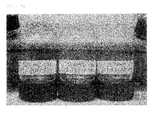
- Each of the solutions was mixed with a multilayered carbon nanotube (1 mg) which had been prepared by an arc discharge method, and the mixture was irradiated with ultrasonic waves for 30 minutes using an ultrasonic irradiation apparatus for cleaning (130 W, 35 kHz), whereby a black carbon nanotube uniform aqueous solution was obtained, and a precipitate was not formed.
- the results are shown in Fig.
- carbon nanotube uniform dispersion solutions could be prepared using the compounds (4), (11), (13), (15), (25), (34), (38), (40), (42) and (70), respectively.
- a concentration range of the ionic organic compound is from about 1 g to 20/, and suitably about 10 g/L.
- a content of the carbon nanotube capable of being still dispersed was from 1 to 3 g/L.
- carbon nanotube uniform dispersion methanol solutions could be prepared using the compounds (3), (11), (13), (28), (42) and (70), respectively.
- a concentration range of the ionic organic compound is from about 1 g to 20 g per liter, and suitably about 10 g/L.
- a content of the carbon nanotube capable of being still dispersed was from 1 to 20 g/L.
- the ionic organic compound of the present invention has excellent properties as a hydrogelling agent, and a hydrogel is obtained by dissolving the subject compound in neutral water under heating and then allowing it to stand at room temperature.
- a hydrogel is obtained by dissolving the subject compound in neutral water under heating and then allowing it to stand at room temperature.
- the hydrogelling agent it is preferable to use the hydrogelling agent in an amount of from about 20 to 100 g/L, especially from about 20 to 50 g/L relative to water or an acidic aqueous solution that is objective to the gelation.
- the ionic organic compound of the present invention has excellent properties as a methanol gelling agent, and a methanol gel is obtained by dissolving the subject compound in methanol under heating and then allowing it to stand at room temperature.
- the hydrogelling agent in an amount of from about 10 to 100 g/L, especially from about 20 to 50 g/L relative to methanol that is objective to the gelation.
- the ionic organic compound of the present invention has excellent properties as a carbon nanotube dispersant, and a carbon nanotube dispersion aqueous solution or a methanol solution is obtained by dissolving the subject compound in water or methanol under heating and adding the carbon nanotube, followed by an ultrasonic treatments
- a carbon nanotube dispersion aqueous solution or a methanol solution is obtained by dissolving the subject compound in water or methanol under heating and adding the carbon nanotube, followed by an ultrasonic treatments
- the dispersant in an amount of from about 1 to 100 g/L, especially about 10 g/L relative to water or methanol.
Landscapes
- Chemical & Material Sciences (AREA)
- Dispersion Chemistry (AREA)
- Health & Medical Sciences (AREA)
- Chemical Kinetics & Catalysis (AREA)
- Medicinal Chemistry (AREA)
- Polymers & Plastics (AREA)
- Organic Chemistry (AREA)
- General Chemical & Material Sciences (AREA)
- Macromolecular Compounds Obtained By Forming Nitrogen-Containing Linkages In General (AREA)
- Organic Low-Molecular-Weight Compounds And Preparation Thereof (AREA)
- Emulsifying, Dispersing, Foam-Producing Or Wetting Agents (AREA)
- Pigments, Carbon Blacks, Or Wood Stains (AREA)
Abstract
Description
- The present invention relates to an ionic organic compound and a production method thereof, a hydrogelling agent composed of the subject ionic organic compound, a hydrogel containing the same, a methanol gelling agent and a methanol gel containing the same, and a carbon nanotube dispersant.
- Gels are spread in wide fields including basic researches of their structures and physical properties and the like, application researches to food products, medical supplies, cosmetics and the like, and so on and attract attention, and the synthesis and development of novel gelling agents have been actively conducted (for examples, see
Patent Document 1 to 3 below). However, there are involved problems such as difficulty in gelation under an acidic condition, requirement for multi-step synthetic process is and the like, and overcoming thereof is being desired.
On the other hand, carbon nanotubes are attracting attention as useful materials for nanotechnology. In particular, the carbon nanotubes are expected to be applies in wide range of fields such as transistors, electron emission electrodes, fuel cell electrodes, and chips for scanning microscope. When they are purified or prepared for applications as materials for the applications, it is necessary to prepare an easily handleable carbon nanotube solution or dispersed liquid. Thus, there is proposed a method for making hydrophobic carbon nanotubes soluble in a solvent, which includes adding a dispersing agent (generally an amphiphilic surfactant) to form a dispersion liquid (for example, see Non-PatentDocument 1 below). Under the present circumstances, however, investigations for further improvements are still being carried out. - Under such a background, the present inventors found that a novel ionic organic oligomer having an electrolyte structure which is obtained by one step synthetic process by means of a polycondensation reaction between an aminopyridine and an acid halide having an active methylene group functions as a gelling agent against water and an acidic aqueous solution and further functions as a carbon nanotube dispersant and previously made a proposal (see Patent Document 4 below). However, in a synthesis method of the subject compound, a pyridyl site and an active methylene site each serving as a reaction site must exist in one molecule, so that syntheses of diverse ionic organic compounds are remarkably restricted.
- As a result of synthetic expansion from the foregoing compound, we previously found that it is possible to synthesize ionic organic compounds by means of a copolymerization method and to utilize those ionic organic compounds as a hydrogelling agent and made an application (see Patent Document 5 below).
The present invention is concerned with synthesis of a new ionic organic compound in which the foregoing copolymerization method has been further developed and utilization of such an ionic organic compound as a hydrogelling agent and a methanol gelling agent and also as a carbon nanotube dispersant. -
- Patent Document 1:
JP-A-2003-327949 - Patent Document 2:
JP-A-2003-49154 - Patent Document 3:
JP-A-2003-55642 - Patent Document 4:
WO 2006/082768 A1 - Patent Document 5: Japanese Patent Application no.
2007-324701 - Non-Patent Document 1: Science, vol. 297, p.593 (2002)
- The present invention is aimed to provide a novel ionic organic compound and a production method thereof by a simple process. Also, the present invention is aimed to provide a hydrogelling agent composed of the obtained ionic organic compound, a hydrogel using the subject hydrogelling agent and using water as a medium, a methanol gelling agent similarly composed of the obtained ionic organic compound and a methanol gel using the subject methanol gelling agent and using methanol as a medium. Furthermore, the present invention is aimed to provide a carbon nanotube dispersant composed of the subject compound.
- The present invention is concerned with the synthesis of an ionic organic compound represented by the general formula (1) by allowing (A) an optionally substituted aromatic diamide compound or cyclohexane diamide compound having a 4-(chloromethyl)benzamide group at both ends thereof and (B) a compound selected from N,N,N',N'-tetramethylalkylenediamines which may have a substituent having from 1 to 6 carbon atoms between nitrogen atoms to perform a condensation reaction, and it adopts the following
constitutions 1 to 8. - 1. An ionic organic compound represented by the following general formula (1).

- 2. A production method of the ionic organic compound as set forth in 1, which is characterized by allowing (A) an optionally substituted aromatic diamide compound or cyclohexane diamide compound having a 4-(chloromethyl)benzamide group at both ends thereof and (B) a compound selected from N, N, N', N'-tetramethylalkylenediamines which may have a substituent having from 1 to 6 carbon atoms between nitrogen atoms to perform a condensation reaction.
- 3. The production method as set forth in 2, which is characterized by performing the condensation reaction in dimethylformamide at from 50 to 80°C.
- 4. The production method of the ionic compound as set forth in 2 or 3, which is characterized by further substituting an anion of the obtained ionic compound with other anion by an anion interchange reaction.
- 5. A hydrogelling agent composed of the ionic organic compound as set forth in 1.
- 6. A hydrogel containing the hydrogelling agent as set forth in 5.
- 7. A methanol gelling agent composed of the ionic organic compound as set forth in 1.
- 8. A methanol gel containing the methanol gelling agent as set forth in 7.
- 9. A carbon nanotube dispersant composed of the ionic organic compound as set forth in 1.
- The ionic organic compound of the present invention is suitably used as a gelling agent of water and a gelling agent of methanol. The present invention makes it possible to efficiently produce a novel ionic compound having excellent properties as a gelling agent and the like by a simple process and opens a new road for the control of gel physical properties by a combination of reaction reagents or the synthesis and development of a functional gelling agent by means of introduction of a functional group. Also, since the ionic organic compound of the present invention is suitably used as a carbon nanotube dispersant, it is useful for the development of a novel complex material using a carbon nanotube as an element raw material.
-
-
Fig. 1 is a photograph of a hydrogel obtained in Example 49, in which the concentration is 2, 3 and 5 % by weight, respectively from the left. -
Fig. 2 is a photograph of a methanol gel obtained in Example 50. -
Fig. 3 is a graph showing the results obtained by measuring dynamic viscoelasticity of a hydrogel in Example 51. -
Fig. 4 is a view regarding the preparation of a carbon nanotube dispersion solution in Example 54, in which (a) shows the state before ultrasonic irradiation, and (b) shows the state after ultrasonic irradiation (in both of a and b, the left shows the case of using (7), and the right shows the case of using (3)). - The ionic organic compound of the present invention which is represented by the foregoing general formula (1) is obtained by a polycondensation reaction between (A) an optionally substituted aromatic diamide compound or cyclohexane diamide compound having a 4-(chloromethyl)benzamide group at both ends thereof and (B) a compound selected from N,N,N',N'-tetramethylalkylenediamines which may have a substituent having from 1 to 6 carbon atoms between nitrogen atoms and a subsequent anion interchange reaction. Though it is desirable to use a polar organic solvent such as dimethylformamide and the like as a condensation reaction solvent, it should not be construed that the condensation reaction solvent is limited thereto. Also, a reaction time is preferably from 12 to 48 hours. It is preferable that a reaction temperature is from about 50 to 80°C, especially about 80°C. A polymerization degree (n) of the ionic compound is from 1 to 800, and preferably from 10 to 300. Though it is desirable to use water as a solvent of the anion interchange reaction, it should not be construed that the solvent of the anion interchange reaction is limited thereto. Also, a reaction time is preferably from about 5 minutes to one hour. A reaction temperature is preferably from about 80 to 100°C.
- Specific examples of (A) the aromatic diamide compound or cyclohexane diamide compound having a 4-(chloromethyl)benzamide group at both ends thereof include 4,4'-bis[(4-chloromethyl)benzamido]-3,3'-dimethoxybiphenyl, 1,4-bis[(4-chloromethyl)benzamido]-2,3,5,6-tetramethylbenzene, 1,4-bis[(4-chloromethyl)benzamido]-2,5-dichlorobenzene, 1,4-bis[(4-chloromethyl)benzamido]-2,5-dimethylbenzene, 1,4-bis[(4-chloromethyl)benzamido]-2-chloro-5-methylbenzene, 1,4-bis[(4-chloromethyl)benzamido]-2-methylbenzene, 4,4'-bis[{(4-chloromethyl)benzamido}phenyl]methane, 4,4'-bis[{(4-chloromethyl)benzamido}phenyl] ether, 1,5-[bis(4-chloromethyl)benzamido]naphthalene, 4,4'-bis[(4-chloromethyl)benzamido]benzanilide, α,α'-bis[(4-chloromethyl)benzamido]-1,4-diisopropylbenzene, 4,4-bis[{(4-chloromethyl)benzamido}phenoxy]biphenyl, 4,4"-bis[(4-chloromethyl)benzamido]terphenyl, 2,7-bis[(4-chloromethyl)benzamido]fluorene, 4,4'-bis[(4-chloromethyl)benzamido]stilbene, 4,4-bis[(4-chloromethyl)benzamido]azobenzene, 4,4'-bis[(4-chloromethyl)benzamido]-3,3'-dimethylbiphenyl, 4,4'-bis[(4-chloromethyl)benzamido]-3,3',5,5'-tetramethylbiphenyl, 4,4'-bis[(4-chloromethyl)benzamido]-3-methoxy-6-methylazobenzene and trans-1,4-bis[(4-chloromethyl)benzamido]cyclohexane.
- Also, examples of the substituent of (B) the compound selected from N,N,N',N'-tetramethylalkylenediamines which may have a substituent having from 1 to 6 carbon atoms between nitrogen atoms include alkyl groups having from about 1 to 6 carbon atoms such as methyl, ethyl and propyl groups and the like; and alkoxy groups having from about 1 to 6 carbon atoms such as methoxy, ethoxy and propoxy groups and the like.
Specific examples of such a compound include N,N,N',N'-tetramethyldiaminomethane, N,N,N',N'-tetramethylethylenediamine, N,N,N',N'-tetramethyl-1,3-propylenediamine, N,N,N',N'-tetramethyl-1,4-butylenediamine, N,N,N',N'-tetramethyl-1,6-hexalenediamine, N,N,N',N'-tetramethyl-1,4-diamino-2-butene, (R,R)-(-)-2,3-dimethoxy-1,4-bis(dimethylamino)butane, (S,S)-(+)-2,3-dimethoxy-1,4-bis(dimethylamino)butane, 1,4-diazabicyclo[2,2,2]octane and the like. - As the preferred ionic organic compound represented by the foregoing general formula (1), compounds represented by the following general formula (A1) are enumerated as examples.

- Other representative examples of compounds (A2 to A20) are also shown below.


- The ionic organic compound obtained by the foregoing method, which is represented by the general formula (1), has excellent properties as a hydrogelling agent, and a hydrogel is obtained by dissolving the subject compound in neutral water under heating and then allowing it to stand at room temperature. Similarly, a methanol gel is obtained by dissolving the subject compound in methanol under heating and then allowing it to stand at room temperature.
In such compounds, it may be considered that the ionic quaternized nitrogen atom is responsible for solubility in water, and the amide group (hydrogen bond), the aromatic ring or hydrocarbon site (hydrophobic interaction), the mutual charge between the cation moiety and the anion moiety (electrostatic interaction) or the like is responsible for an intermolecular interaction, whereby an organization is formed to cause a gelling phenomenon. - The present invention is hereunder specifically described by reference to the following Examples, but it should not be construed that the present invention is limited to the following specific examples.
In the following Examples that is a raw material to produce the ionic organic compound, was for 4-(chloromethyl)benzoyl chloride, N,N,N',N'-tetramethylethylenediamine, N,N,N',N'-tetramethyl-1,3-diaminopropane, N,N,N',N'-tetramethyl-1,4-diaminobutane, N,N,N',N'-tetramethyl-1,6-diaminohexane, 4,4'-diamino-3,3'-dimethoxybiphenyl (o-dianisidine), 1,4-diamino-2,3,5,6-tetramethylbenzene, 1,4-diamino-2,5-dichlorobenzene, 1,4-diamino-2,5-dimethylbenzene, 1,4-diamino-2-chloro-5-methylbenzene, 2,5-diaminotoluene dihydrochloride, bis(4-aminophenyl)methane, bis(4-aminophenyl) ether, 1,5-diaminonaphthalene, 4,4'-diaminobenzanilide, α,α'-bis(diaminophenyl)-1,4-diisopropylbenzene, 4,4'-bis(4-aminophenyl)biphenyl, 4,4"-diaminoterphenyl, 2,7-diaminofluorene, 4,4'-diaminostilbene dihydrochloride, o-toluidine, 3,3',5,5'-tetramethylbenzidine, 4,4'-diamino-3-methoxy-6-methylazobenzene (Disperse Diazo Black-3BF), ammonium hexafluorophosphate, ammonium tetrafluoroborate, lithium perchlorate and sodium thiocyanate, those purchased from Tokyo Chemical Industry Co., Ltd. were used as they were. As for dehydrated methylene chloride and N,N-dimethylformamide, those purchased from Kanto Chemical Co., Inc. were used as they were. As for triethylamine, p-phenylenediamine and N,N,N',N'-tetramethylethylenediamine, those purchased from Wako Pure Chemical Industries, Ltd. were used as they were. As for 4,4'-azodianiline, one purchased from Akcros Chemicals was used as it was. As for lithium bis(trifluoromethanesulfonyl)imide, one purchased from Kishida Chemical Co., Ltd. was used as it was. - 4,4'-Diamino-3,3'-dimethoxybiphenyl (o-dianisidine) (2.44 g, 10.0 moles) and trimethylamine (2.23 g, 22.0 mmoles) were dissolved in dehydrated methylene chloride (90 mL). A solution of 4-chloromethylbenzoyl chloride (3.78 g, 20.0 mmoles) in dehydrated methylene chloride (60 mL) was added thereto with stirring over one hour. Thereafter, the mixture was refluxed under heating for 4 hours and then stirred at room temperature for 13 hours. A precipitate was separated by filtration to obtain a titled compound represented by the following formula (2) as a yellow powder. Yield: 4.69 g, percent yield: 85 %. 1H-NMR (300 MHz, DMSO-d 6) δ 3.97 (s, 6H), 4.86 (s, 4H), 7.33 (dd, J=2 Hz, 8 Hz, 2H), 7.39 (d, J=2 Hz, 2H), 7.60 (d, J=8 Hz, 4H), 7.90 (d, J=8 Hz, 2H), 7.99 (d, J=8 Hz, 4H), 9.53 (s, 2H).
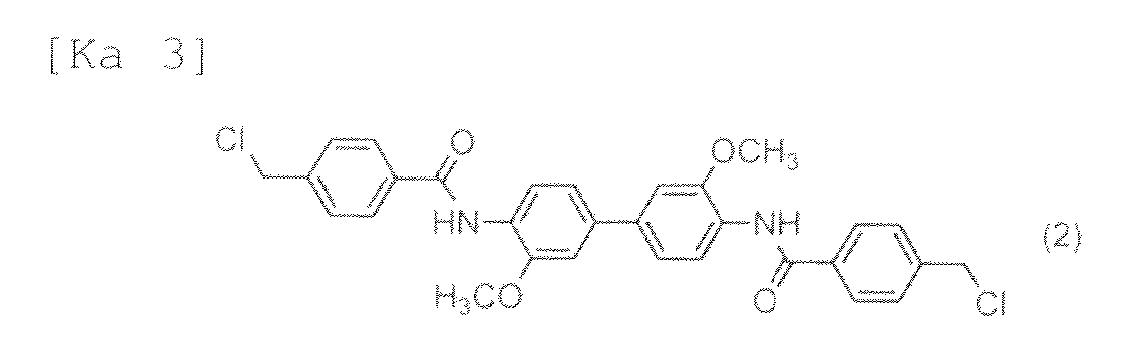
- 4,4'-Bis[(4-chloromethyl)benzamido]-3,3'-dimethoxybiphenyl (1.10 g, 2.0 mmoles) obtained in the foregoing Production Example 1 and N,N,N',N'-tetramethyl-1,6-diaminohexane (0.345 g, 2.0 mmoles) were stirred in dimethylformamide (80 mL) under heating at 80°C for 48 hours. A precipitate which had been formed by the progress of a quaternization reaction was separated by filtration to obtain an ionic organic compound represented by the following formula (3) in a percent yield of 66 %. The progress of the quaternization reaction and structure were confirmed by a 1H-NMR spectrum of a TFSA derivative as described later. Furthermore, in the molecular weight distribution determined from the measurement of size exclusion chromatography of the TFSA derivative, a cation principal chain moiety was estimated to have a number average molecular weight (Mn) of 1.91 × 10⁴, a weight average molecular weight (Mw) of 7.96 × 10⁴ and a degree of dispersion of molecular weight distribution (Mw/Mn) of 4.2.


- A compound represented by the following formula (4) was obtained in a percent yield of 51 % in the same manner as in Example 1, except that in the foregoing Example 1, N,N,N',N'-tetramethyl-1,3-diaminopropane was used in place of the N,N,N',N'-tetramethyl-1,6-diaminohexane. The progress of the quaternization reaction and structure were confirmed by a 1H-NMR spectrum of a TFSA derivative as described later. Furthermore, in the molecular weight distribution determined from the measurement of size exclusion chromatography of the TFSA derivative, a cation principal chain moiety was estimated to have a number average molecular weight (Mn) of 1.41 × 10⁵, a weight average molecular weight (Mw) of 2.05 × 10⁵ and a degree of dispersion of molecular weight distribution (Mw/Mn) of 1.5.

- A compound represented by the following formula (5) was obtained in the same manner as in Example 1, except that in the foregoing Example 1, N,N,N',N'-tetramethylethylenediamine was used in place of the N,N,N',N'-tetramethyl-1,6-diaminohexane. Percent yield: 25%. The product was a compound which is sparingly soluble in a solvent.

- A titled compound represented by the following formula (6) was obtained in the same manner as in Production Example 1, except that 1,4-diamino-2,3,5,6-tetramethylbenzene was used in place of the 4,4'-diamino-3,3'-dimethoxybiphenyl (o-dianisidine) in the foregoing Production Example 1. Percent yield: 87 %. 1H-NMR (300 MHz, DMSO-d 6) δ 2.11 (s, 12H), 4.86 (s, 4H), 7.60 (d, J=8 Hz, 4H), 8.03 (d, J=8 Hz, 4H), 9.89 (s, 2H).

- An ionic organic compound represented by the following formula (7) was obtained in a percent yield of 96 % in the same manner as in Example 1, except that in the foregoing Example 1, 1,4-bis[(4-chloromethyl)benzamido]-2,3,5,6-tetramethylbenzene was used in place of the 4,4'-bis[(4-chloromethyl)benzamido]-3,3'-dimethoxybiphenyl. A structure of the obtained compound was confirmed by a 1H NMR spectrum of the compound. 1H-NMR (300 MHz, D2O) δ 1.54 (br, 4H), 2.01 (br, 4H), 2.27 (br, 12H), 3.16 (br, 12H), 3.43 (br, 4H), 4.66 (be, 4H), 4.82 (br, 8H), 7.80 (br, 4H), 8.14 (br, 4H). In the molecular weight distribution determined from the measurement of size exclusion chromatography of a TFSA derivative as described later, a cation principal chain moiety was estimated to have a number average molecular weight (Mn) of 1.24 × 10⁴, a weight average molecular weight (Mw) of 5.85 × 10⁴ and a degree of dispersion of molecular weight distribution (Mw/Mn) of 4.7.

- A titled compound represented by the following formula (8) was obtained in the same manner as in production Example 1, except that 1,4-diamino-2,5-dichlorobenzene was used in place of the 4,4'-diamino-3,3'-dimethoxybiphenyl (o-dianisidine) in the foregoing Production Example 1. Percent yield: 99 %. This compound was a compound which is sparingly soluble in a solvent.

- An ionic organic compound represented by the following formula (9) was obtained in a percent yield of 79 % in the same manner as in Example 1, except that in the foregoing Example 1, 1,4-bis[(4-chloromethyl)benzamido]-2,5-dichlorobenzene was used in place of the 4,4'-bis[(4-chloromethyl)benzamido]-3,3'-dimethoxybiphenyl. The progress of the quaternization reaction and structure were confirmed by a 1H-NMR spectrum of a TFSA derivative as described later. Furthermore, in the molecular weight distribution determined from the measurement of size exclusion chromatography of the TFSA derivative, a cation principal chain moiety was estimated to have a number average molecular weight (Mn) of 1.27 × 10⁴, a weight average molecular weight (Mw) of 4.20 × 10⁴ and a degree of dispersion of molecular weight distribution (Mw/Mn) of 3.3.

- A titled compound represented by the following formula (10) was obtained in the same manner as in Production Example 1, except that 1,4-diamino-2,5-dimethylbenzene was used in place of the 4,4'-diamino-3,3'-dimethoxybiphenyl (o-dianisidine) in the foregoing Production Example 1. Percent yield: 96 %. 1H-NMR (300 MHz, DMSO-d 6) δ 2.20 (s, 6H), 4.84 (s, 4H), 7.24 (s, 2H), 7.59 (d, J=8 Hz, 4H), 7.99 (d, J=8 Hz, 4H), 9.89 (s, 2H).


- An ionic organic compound represented by the following formula (11) was obtained in a percent yield of 77 % in the same manner as in Example 1, except that in the foregoing Example 1, 1,4-bis[(4-chloromethyl)benzamido]-2,5-dimethylbenzene was used in place of the 4,4'-bis[(4-chloromethyl)benzamido]-3,3'-dimethoxybiphenyl. A structure of the obtained compound was confirmed by a proton NMR spectrum of the compound. 1H-NMR (300 MHz, D2O) δ 1.53 (br, 4H), 1.98 (br, 4H), 2.17 (br, 6H), 3.13 (br, 14H), 3.40 (br, 4H), 4.65 (br, 4H), 7.36 (br, 2H), 7.77 (br, 4H), 8.08 (br, 4H). In the molecular weight distribution determined from the measurement of size exclusion chromatography of a TFSA derivative as described later, a cation principal chain moiety was estimated to have a number average molecular weight (Mn) of 1.82 × 10⁴, a weight average molecular weight (Mw) of 1.05 × 10⁵ and a degree of dispersion of molecular weight distribution (Mw/Mn) of 5.8.


- A titled compound represented by the following formula (12) was obtained in the same manner as in (Production Example 1, except that 1,4-diamino-2-chloro-5-methylbenzene was used in place of the 4,4'-diamino-3,3'-dimethoxybiphenyl (o-dianisidine) in the foregoing Production Example 1. Percent yield: 99 %. 1H-NMR (300 MHz, DMSO-d 6) δ 2.26 (s, 3H), 4.85 (s, 4H), 7.49 (s, 1H), 7.55-7.62 (m, 5H), 7.99 (d, J=8Hz, 2H) 8.002 (d, J=8 Hz, 2H), 10.00 (s, 1H), 10.10 (s, 1H).

- An ionic organic compound represented by the following formula (13) was obtained in a percent yield of 92 % in the same manner as in Example 1, except that in the foregoing (Example 1, 1,4-bis[(4-chloromethyl)benzamido]-2-chloro-5-methylbenzene was used in place of the 4,4'-bis[(4-chloromethyl)benzamido]-3,3'-dimethoxybiphenyl. The progress of the quaternization reaction and structure were confirmed by a 1H-NMR spectrum of a TFSA derivative as described later. Furthermore, in the molecular weight distribution determined from the measurement of size exclusion chromatography of the TFSA derivative, a cation principal chain moiety was estimated to have a number average molecular weight (Mn) of 2.45 × 10⁴, a weight average molecular weight (Mw) of 5.06 × 10⁴ and a degree of dispersion of molecular weight distribution (Mw/Mn) of 2.1.

- A titled compound represented by the following formula (14) was obtained in the same manner as in Production Example 1, except that 2,5-diaminotoluene dihydrochloride was used in place of the 4,4'-diamino-3,3'-dimethoxybiphenyl (o-dianisidine) in the foregoing Production Example 1. Percent yield: 93 %. 1H-NMR (300 MHz, DMSO-d 6) δ 2.24 (s, 3H), 4.85 (s, 4H), 7.30 (d, J=8 Hz, 1H), 7.58-7.69 (m, 6H), 7.97 (m, 4H), 9.88 (s, 1H), 10.25 (s, 1H).

- An ionic organic compound represented by the following formula (15) was obtained in a percent yield of 100 % in the same manner as in Example 1, except that in the foregoing Example 1, 1,4-bis[(4-chloromethyl)benzamido]-2-methylbenzene was used in place of the 4,4'-bis[(4-chloromethyl)benzamido]-3,3'-dimethoxybiphenyl. The progress of the quaternization reaction and structure were confirmed by a 1H-NMR spectrum of a TFSA derivative as described later. Furthermore, in the molecular weight distribution determined from the measurement of size exclusion chromatography of the TFSA derivative, a cation principal chain moiety was estimated to have a number average molecular weight (Mn) of 5.92 × 10⁴ , a weight average molecular weight (Mw) of 1.66 × 10⁵ and a degree of dispersion of molecular weight distribution (Mw/Mn) of 2.8.

- A titled compound represented by the following formula (16) was obtained in the same manner as in Production Example 1, except that bis (4-aminophenyl)methane was used in place of the 4,4-diamino-3,3'-dimethoxybiphenyl (o-dianisidine) in the foregoing Production Example 1. Percent yield: 98 %. 1H-NMR (300 MHz, DMSO-d 6) δ 3.90 (s, 2H), 4.84 (s, 4H), 7.20 (d, J=8 Hz, 4H), 7.58 (d, J=8 Hz, 4H), 7.68 (d, J=8 Hz, 4H), 7.94 (d, J=8 Hz, 4H), 10.21 (s, 2H).

- An ionic organic compound represented by the following formula (17) was obtained in a percent yield of 85 % in the same manner as in Example 1, except that in the foregoing Example 1, 4,4'-bis [{(4-chloromethyl)benzamido}phenyl]methane was used in place of the 4,4'-bis[(4-chloromethyl)benzamido]-3,3'-dimethoxybiphenyl. The obtained compound was one which is sparingly soluble in a solvent.

- A titled compound represented by the following formula (18) was obtained in the same manner as in Production Example 1, except that bis(4-aminophenyl) ether was used in place of the 4,4'-diamino-3,3'-dimethoxybiphenyl (o-dianisidine) in the foregoing Production Example 1. Percent yield: 96 %. 1H-NMR (300 MHz, DMSO-d 6) δ 4.85 (s, 4H), 7.02 (d, J=9 Hz 4H), 7.59 (d, J=8 Hz, 4H), 7.78 (d, J=9 Hz, 4H), 7.96 (d, J=8 Hz, 4H), 10.29 (s, 2H).

- An ionic organic compound represented by the following formula (19) was obtained in a percent yield of 75 % in the same manner as in Example 1, except that in the foregoing Example 1, 4,4-bis[{(4-chloromethyl)benzamido}phenyl] ether was used in place of the 4,4'-bis[(4-chloromethyl)benzamido]-3,3'-dimethoxybiphenyl. The product was a compound which is sparingly soluble in a solvent.

- A titled compound represented by the following formula (20) was obtained in the same manner as in Production Example 1, except that 1,5-diaminonaphthalene was used in place of the 4,4'-diamino-3,3'-dimethoxybiphenyl (o-dianisidine) in the foregoing Production Example 1. Percent yield: 94 %. 1H-NMR (300 MHz, DMSO-d 6) δ 4 .88 (s, 4H), 7.55-7.65 (m, 8H), 7.95 (d, J=8 Hz, 2H), 8.11 (d, J=8 Hz, 4H), 10.52 (s, 2H).

- An ionic organic compound represented by the following formula (21) was obtained in the same manner as in Example 1, except that in the foregoing Example 1, 1,5-[bis(4-chloromethyl)benzamido]naphthalene was used in place of the 4,4'-bis[(4-chloromethyl)benzamido]-3,3'-dimethoxybiphenyl. The progress of the quaternization reaction and structure were confirmed by a 1H-NMR spectrum of a TFSA derivative as described later. Furthermore, in the molecular weight distribution determined from the measurement of size exclusion chromatography of the TFSA derivative, a cation principal chain moiety was estimated to have a number average molecular weight (Mn) of 1.75 × 10⁴ , a weight average molecular weight (Mw) of 8.01 × 10⁴ and a degree of dispersion of molecular weight distribution (Mw/Mn) of 4. 6.

- A titled compound represented by the following formula (22) was obtained in the same manner as in Production Example 1, except that 4,4'-diaminobenzanilide was used in place of the 4,4'-diamino-3,3'-dimethoxybiphenyl (o-dianisidine) in the foregoing Production Example 1. Percent yield: 96 %. The product was a compound which is sparingly soluble in a solvent.

- An ionic organic compound represented by the following formula (23) was obtained in the same manner as in Example 1, except that in the foregoing Example 1, 4,4'-[bis(4-chloromethyl)benzamido]benzanilide was used in place of the 4,4-bis[(4-chloromethyl)benzamido]-3,3-dimethoxybiphenyl. Percent yield: 92 %. The progress of the quaternization reaction and structure were confirmed by a 1H-NMR spectrum of a TFSA derivative as described later. Furthermore, in the molecular weight distribution determined from the measurement of size exclusion chromatography of the TFSA derivative, a cation principal chain moiety was estimated to have a number average molecular weight (Mn) of 1.04 × 10⁴ a weight average molecular weight (Mw) of 3.13 × 10⁴ and a degree of dispersion of molecular weight distribution (Mw/Mn) of 3.0.

- An ionic organic compound represented by the following formula (24) was obtained in a percent yield of 100 % in the same manner as in Example 1, except that in the foregoing Example 12, N,N,N' ,N'-tetramethyl-1,4-diaminobutane was used in place of the N,N,N',N'-tetramethyl-1,6-diaminohexane. The product was a compound which is sparingly soluble in a solvent.

- An ionic organic compound represented by the following formula (25) was obtained in a percent yield of 100 % in the same manner as in Example 1, except that in the foregoing Example 12, N,N,N',N'-tetramethyl-1,3-diaminopropane was used in place of the N,N,N,N'-tetramethyl-1,6-diaminohexane. The progress of the quaternization reaction and structure were confirmed by a 1H-NMR spectrum of a TFSA derivative as described later. Furthermore, in the molecular weight distribution determined from the measurement of size exclusion chromatography of the TFSA derivative, a cation principal chain moiety was estimated to have a number average molecular weight (Mn) of 2.20 × 10⁴ a weight average molecular weight (Mw) of 5.11 × 10⁴ and a degree of dispersion of molecular weight distribution (Mw/Mn) of 2.3.


- An ionic organic compound represented by the following formula (26) was obtained in a percent yield of 71 % in the same manner as in Example 1, except that in the foregoing Example 12, N,N,N,N'-tetramethylethylenediamine was used in place of the N,N,N',N'-tetramethyl-1,6-diaminohexane. The product was a compound which is sparingly soluble in a solvent.

- A titled compound represented by the following formula (27) was obtained in the same manner as in Production Example 1, except that α,α'-bis(diaminophenyl)-1,4-diisopropylbenzene was used in place of the 4,4'-diamino-3,3'-dimethoxybiphenyl (o-dianisidine) in the foregoing Production Example 1. Percent yield: 90 %. 1H-NMR (300 MHz, DMSO-d 6) δ 1.62 (s, 12H), 4. 84 (s, 4H), 7.13 (s, 4H), 7.20 (d, J=9 Hz, 4H), 7.58 (d, J=9 Hz, 4H), 7.65 (d, J=8 Hz, 4H), 7.94 (d, J=8 Hz, 4H), 10.20 (s, 2H).

- An ionic organic compounds represented by the following formula (28) was obtained in the same manner as in Example 1, except that in the foregoing Example 1, α,α'-bis[(4-chloromethyl)benzamido]-1,4-diisopropylbenzene was used in place of the 4,4'-bis[(4-chloromethyl)benzamido]-3,3'-dimethoxybiphenyl. Percent yield: 81 %. The product was a compound which is sparingly soluble in a solvent.
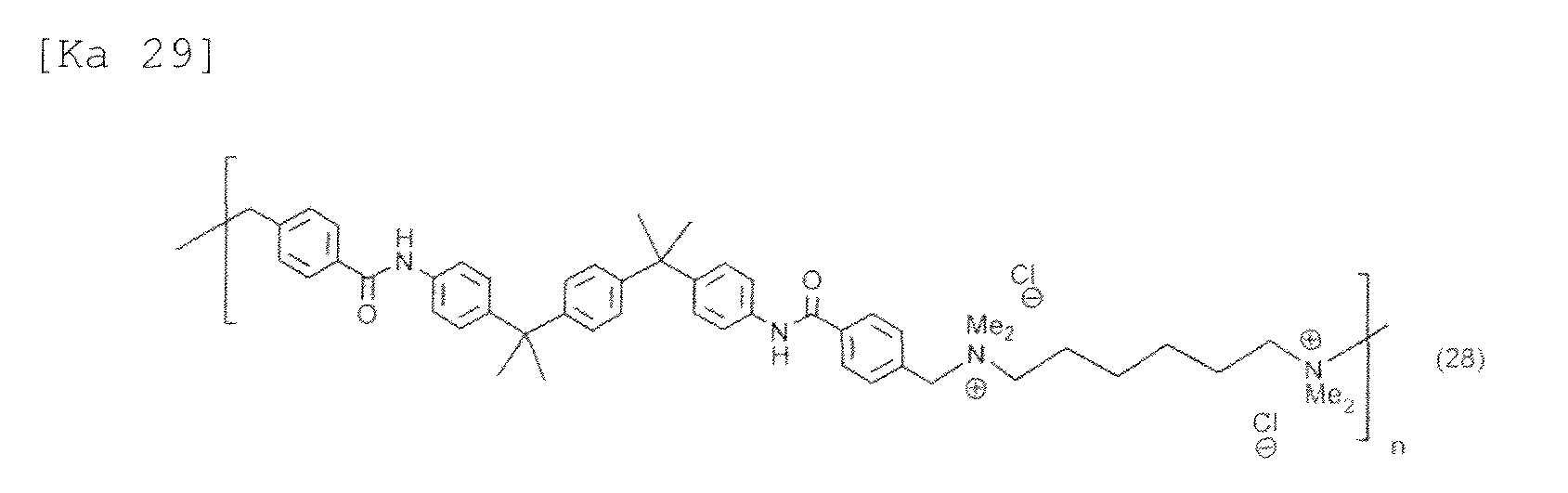
- A titled compound represented by the following formula (29) was obtained in the same manner as in Production Example 1, except that 4,4'-bis(4-aminophenoxy)biphenyl was used in place of the 4,4'-diamino-3,3'-dimethoxybiphenyl (o-dianisidine) in the foregoing Production Example 1. Percent yield: 98 %. The product was a compound which is sparingly soluble in a solvent.

- An ionic organic compound represented by the following formula (30) was obtained in the same manner as in Example 1, except that in the foregoing Example 1, 4,4'-bis[{(4-chloromethyl)benzamido}phenoxy]biphenyl was used in place of the 4,4'-bis[(4-chloromethyl)benzamido]-3,3`-dimethoxybiphenyl. Percent yield: 85 %. The product was a compound which is sparingly soluble in a solvent.


- A titled compound represented by the following formula (31) was obtained in the same manner as in Production Example 1, except that 4,4"-diaminoterphenyl was used in place of the 4,4'-diamino-3,3'-dimethoxybiphenyl (o-dianisidine) in the foregoing Production Example 1. Percent yield: 98 %. The product was a compound which is sparingly soluble in a solvent.

- An ionic organic compound represented by the following formula (32) was obtained in the same manner as in Example 1, except that in the foregoing Example 1, 4,4"-bis[(4-chloromethyl)benzamido]terphenyl was used in place of the 4,4'-bis[(4-chloromethyl)benzamido]-3,3'-dimethoxybiphenyl. Percent yield: 66 %. The product was a compound which is sparingly soluble in a solvent.

- A titled compound represented by the following formula (33) was obtained in the same manner as in Production Example 1, except that 2,7-diaminofluorene was used in place of the 4,4'-diamino-3,3'-dimethoxybiphenyl (o-dianisidine) in the foregoing Production Example 1. Percent yield: 99 %. 1H-NMR (300 MHz, DMSO-d 6) δ 3.96 (s, 2H), 4.86 (s, 4H), 7.61 (d, J=8 Hz, 4H), 7.73-7.82 (m, 4H), 7.97 (d, J=8 Hz, 4H), 8.07 (s, 2H), 10.34 (s, 2H).

- An ionic organic compound represented by the following formula (34) was obtained in the same manner as in Example 1, except that in the foregoing Example 1, 2,7-bis[(4-chloromethyl)benzamido]fluorene was used in place of the 4,4'-bis[(4-chloromethyl)benzamido]-3,3'-dimethoxybiphenyl. Percent yield: 99 %. The progress of the quaternization reaction and structure were confirmed by a 1H-NMR spectrum of a TFSA derivative as described later. Furthermore, in the molecular weight distribution determined from the measurement of size exclusion chromatography of the TFSA derivative, a cation principal chain moiety was estimated to have a number average molecular weight (Mn) of 2.14 × 10⁴, a weight average molecular weight (Mw), of 5.08 × 10⁴ and a degree of dispersion of molecular weight distribution (Mw/Mn) of 2.4.

- A titled compound represented by the following formula (35) was obtained in the same manner as in Production Example 1, except that 4,4'-diaminostilbene dihydrochloride was used in place of the 4,4'-diamino-3 3`-dimethoxybiphenyl (o-dianisidine) in the foregoing Production Example 1. Percent yield: 99 %.

- An ionic organic compound represented by the following formula (36) was obtained in the same manner as in Example 1, except that in the foregoing Example 1, 4,4'-bis[(4-chloromethyl)benzamido]stilbene was used in place of the 4,4'-bis[(4-chloromethyl)benzamido]-3,3'-dimethoxybiphenyl. Percent yield: 99 %. The product was a compound which is sparingly soluble in a solvent.

- A titled compound represented by the following formula (37) was obtained in the same manner as in Production Example 1, except that 4,4'-azodianiline was used in place of the 4,4'-diamino-3,3'-dimethoxybiphenyl (o-dianisidine) in the foregoing Production Example 1. Percent yield: 90 %. 1H-NMR (300 MHz, DMSO-d 6) δ 4.86 (s, 4H), 7.62 (d, J=8 Hz, 4H), 7.92 (d, J=9 Hz, 4H), 7.99 (d, J=9 Hz, 4H), 8.03 (d, J=8 Hz, 4H), 10.60 (s, 2H).
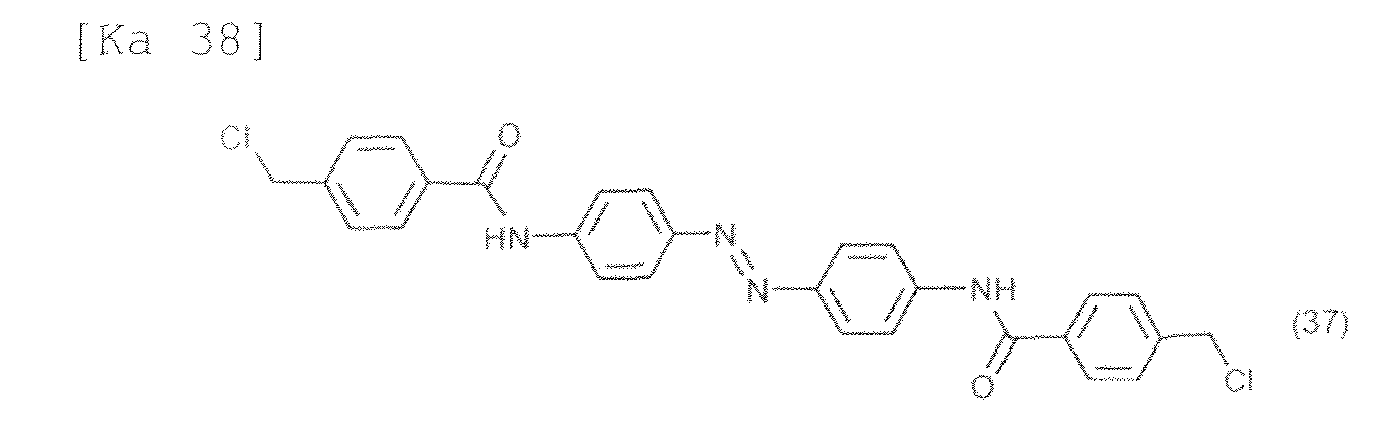
- An ionic organic compound represented by the following formula (38) was obtained in the same manner as in Example 1, except that in the foregoing Example 1, 4,4'-bis[(4-chloromethyl)benzamido]azobenzene was used in place of the 4,4'-bis[(4-chloromethyl)benzamido]-3,3'-dimethoxybiphenyl. Percent yield: 91 %. The progress of the quaternization reaction and structure were confirmed by a 1H-NMR spectrum of a TFSA derivative as described later. Furthermore, in the molecular weight distribution determined from the measurement of size exclusion chromatography of the TFSA derivative, a cation principal chain moiety was estimated to have a number average molecular weight (Mn) of 2.15 × 10⁴ a weight average molecular weight (Mw) of 4.58 × 10⁴ and a degree of dispersion of molecular weight distribution (Mw/Mn) of 2.1.

- A titled compound represented by the following formula (39) was obtained in the same manner as in Production Example 1, except that o-toluidine was used in place of the 4,4'-diamino-3,3'-dimethoxybiphenyl (o-dianisidine) in the foregoing Production Example 1. Percent yield: 98 %. 1H-NMR (300 MHz, DMSO-d 6) δ 4.86 (s, 4H), 7.62 (d, J=8 Hz, 4H), 7.92 (d, J=9 Hz, 4H), 7.99 (d, J=9 Hz, 4H), 8.03 (d, J=8 Hz, 4H), 10.60 (s, 2H).

- An ionic organic compound represented by the following formula (40) was obtained in the same manner as in Example 1, except that in the foregoing Example 1, 4,4'-bis[(4-chloromethyl)benzamido]-3,3'-dimethylbiphenyl was used in place of the 4,4'-bis[(4-chloromethyl)benzamido]-3,3'-dimethoxybiphenyl. Percent yield: 91 %. The progress of the quaternization reaction and structure were confirmed by a 1H-NMR spectrum of a TFSA derivative as described later. Furthermore, in the molecular weight distribution determined from the measurement of size exclusion chromatography of the TFSA derivative, a cation principal chain moiety was estimated to have a number average molecular weight (Mn) of 3.74 × 10⁴ a weight average molecular weight (Mw) of 8.93 × 10⁴ and a degree of dispersion of molecular weight distribution (Mw/Mn) of 2.4.

- A titled compound represented by the following formula (41) was obtained in the same manner as in Production Example 1, except that 3,3',5,5'-tetramethylbenzidine was used in place of the 4,4'-diamino-3,3'-dimethoxybiphenyl (o-dianisidine) in the foregoing Production Example 1. Percent yield: 97 %. 1H-NMR (300 MHz, DMSO-d 6) δ 2.26 (s, 12H), 4.86 (s, 4H), 7.46 (s, 4H), 7.61 (d, J=8 Hz, 4H), 8.02 (d, J=8 Hz, 4H) 9.84 (s, 2H).

- An ionic organic compound represented by the following formula (42) was obtained in the same manner as in Example 1, except that in the foregoing Example 1, 4,4'-bis[(4-chloromethyl)benzamido]-3,3',5,5'-tetramethylbiphenyl was used in place of the 4,4'-bis[(4-chloromethyl)benzamido]-3,3'-dimethoxybiphenyl. Percent yield: 94 %. The progress of the quaternization reaction and structure were confirmed by a 1H-NMR spectrum of a TFSA derivative as described later. Furthermore, in the molecular weight distribution determined from the measurement of size exclusion chromatography of the TFSA derivative, a cation principal chain moiety was estimated to have a number average molecular weight (Mn) of 6.89 × 10⁴ , a weight average molecular weight (Mw) of 1.60 × 10⁵ and a degree of dispersion of molecular weight distribution (Mw/Mn) of 2.3.

- A titled compound represented by the hollowing formula (43) was obtained in the same manner as in Production Example 1, except that 4,4'-diamino-3-methoxy-6-methylazobenzene (Disperse Diazo Black-3BF) was used in place of the 4,4'-diamino-3,3'-dimethoxybiphenyl (o-dianisidine) in the foregoing Production Example 1. Percent yield: 58 %. 1H-NMR (300 MHz, DMSO-d 6) δ 2.68 (s, 3H), 3.91 (s, 3H), 4.86 (s, 4H), 7.36 (s, 1H), 7.60-7.64 (m, 4H), 7.93-8.07 (m, 9H), 9.55 (s, 1H), 10.60 (s, 1H).

- An ionic organic compound represented by the following formula (44) was obtained in the same manner as in Example 1, except that in the foregoing Example 1, 4,4"-bis[(4-chloromethyl)benzamido]-3-methoxy-6-methylazobenzene was used in place of the 4,4'-bis[(4-chloromethyl)benzamido]-3,3'-dimethoxybiphenyl. Percent yield: 78 %. The product was a compounds which is sparingly soluble in a solvent.

- The ionic compound (150 mg) obtained in the foregoing Example 1, which is represented by the formula (3), was dissolved in water (20 mL) at 80°C, to the solution of which was then added a lithium bis(trifluoromethanesulfonyl)amide (TFSA) aqueous solution (5 mL) having a concentration of 0.4 M, whereby a precipitate of a compound represented by the following formula (45) was formed. A structure of the obtained compound was confirmed by a proton NMR spectrum of the compound. 1H-NMR (300 MHz, DMSO-d6) δ 1.40 (br, 4H), 1.87 (br, 4H), 3.00 (brs, 12H), 3.98 (brs, 6H), 4.61 (br, 3H), 7.38 (br, 4H), 7.71 (br, 4H), 7.87 (br, 2H), 8.14 (br, 4H), 9.64 (br, 2H). In the molecular weight distribution determined from the measurement of size exclusion chromatography, a cation principal chain moiety was estimated to have a number average molecular weight (Mn) of 1.91 × 10⁴, a weight average molecular weight (Mw) of 7.96 × 10⁴ and a degree of dispersion of molecular weight distribution (Mw/Mn) of 4.2.

- A compound represented by the following formula (46) was obtained in the same manner as in Example 25, except that in the foregoing Example 25, the ionic compound obtained in Example 2, which is represented by the formula (4), was used in place of the ionic compound represented by the formula (3). A structure of the obtained compound was confirmed by a proton NMR spectrum of the compound. 1H-NMR (300 MHz, DMSO-d6 ) δ 2.27 (br, 12H) , 2.66 (br, 4H), 2.85 (br, 8H), 3.64 (br, 2H), 3.75 (br, 6H), 4.49 (br, 2H), 4.1,6 (br, 4H), 7.60 (br, 8H), 7.91 (br, 4H), 9.41 (br, 2H). In the molecular weight distribution determined from the measurement of size exclusion chromatography, a cation principal chain moiety was estimated to have a number average molecular weight (Mn) of 1.41 × 10⁵, a weight average molecular weight (Mw) of 2.05 × 10⁵) and a degree of dispersion of molecular weight distribution (Mn/Mn) of 1.5.

- A compound represented by the following formula (47) was obtained in the same manner as in Example 26, except that in the foregoing Example 26, the ionic compound obtained in Example 4, which is represented by the formula (7), was used in place of the ionic compound represented by the formula (4). A structure of the obtained compound was confirmed by a proton NMR spectrum of the compound. (TFSA) 1H-NMR (300 MHz, DMSO-d6) δ1.39 (br, 4H), 1.87 (br, 4H), 2.13 (br, 12H), 3.00 (br, 12H), 4.61 (br, 4H), 7.73 (br, 4H), 8.16 (br, 4H), 10.02 (br, 2H). In the molecular weight distribution determined from the measurement of size exclusion chromatography, a cation principal chain moiety was estimated to have a number average molecular weight (Mn) of 1.24 × 10⁴, a weight average molecular weight (Mw) of 5.85 × 10⁴ and a degree of dispersion of molecular weight distribution (Mw/Mn) of 4.7.

- A compound represented by the following formula (48) was obtained in the same manner as in Example 26, except that in the foregoing Example 26, the ionic compound obtained in Example 5, which is represented by the formula (9), was used in place of the ionic compound represented by the formula (4). A structure of the obtained compound was confirmed by a proton NMR spectrum of the compound. 1H-NMR (300 MHz, DMSO-d6) δ 1.39 (br, 4H), 1.86 (br, 4H), 2.99 (bar, 14H), 4.61 (br, 4H), 7.74 (br, 4H), 7.86 (br, 2H), 8.14 (br, 4H), 10.36 (br, 2H). In the molecular weight distribution determined from the measurement of size exclusion chromatography, a cation principal chain moiety was estimated to have a number average molecular weight (Mn) of 1.27 × 10⁴, a weight average molecular weight (Mw) of 4.20 × 10⁴ and a degree of dispersion of molecular weight distribution (Mw/Mn) of 3.3.

- A compound represented by the following formula (49) was obtained in the same manner as in Example 26, except that in the foregoing Example 26, the ionic compound obtained in Example 6, which is represented by the formula (11), was used in place of the ionic compound represented by the formula (4). A structure of the obtained compound was confirmed by a proton NMR spectrum of the compound. 1H-NMR (300 MHz, DMSO-d6) 6 1.40 (br, 4H), 1.87 (br, 4H), 2.22 (br, 8H), 2.99 (br, 12H), 4.60(br, 4H), 7.25 (br, 2H), 7.73 (br, 4H), 8.13 (br, 4H), 10.02 (br, 2H). In the molecular weight distribution determined from the measurement of size exclusion chromatography, a cation principal chain moiety was estimated to have a number average molecular weight (Mn) of 1.82 × 10⁴, a weight average molecular weight (Mw) of 1.05 × 10⁵ and a degree of dispersion of molecular weight distribution (Mw/Mn) of 5.8.


- A compound represented by the following formula (50) was obtained in the same manner as in Example 26, except that in the foregoing Example 26, the ionic compound obtained in Example 7, which is represented by the formula (13), was used in place of the ionic compounds represented by the formula (4). A structure of the obtained compound was confirmed by a proton NMR spectrum of the compound. 1H-NMR (300 MHz, DMSO-d6) δ 1.40 (br, 4H), 1.87 (br, 4H), 2.22 (br, 8H), 2.99 (br, 12H), 4.60(br, 4H), 7.25 (br, 2H), 7.73 (br, 4H), 8.13 (br, 4H), 10.02 (br, 2H). In the molecular weight distribution determined from the measurement of size exclusion chromatography, a cation principal chain moiety was estimated to have a number average molecular weight (Mn) of 2.45 × 10⁴, a weight average molecular weight (Mw) of 5.06 × 10⁴ and a degree of dispersion of molecular weight distribution (Mw/Mn) of 2.1.

- A compound represented by the following formula (51) was obtained in the same manner as in (Example 26, except that in the foregoing Example 26, the ionic compound, obtained in Example 8, which is represented by the formula (15), was used in place of the ionic compound represented by the formula (4). A structure of the obtained compound was confirmed by a proton NMR spectrum of the compound. 1H-NMR (300 MHz, DMSO-d6 δ 1.40 (br, 5H), 1.88 (br, 4H), 2.25 (br, 4H), 2.99 (br, 16H), 4.60 (br, 4H) , 7.30 (br, 1H), 7. 70 (br, 8H), 8.11 (br, 4H), 10.01 (br, 1H), 10.36 (br, 1H). In the molecular weight distribution determined from the measurement of size exclusion chromatography, a cation principal chain moiety was estimated to have a number average molecular weight (Mn) of 5.92 × 10⁴, a weight average molecular weight (Mw) of 1.66 × 10⁵ and a degree of dispersion of molecular weight distribution (Mw/Mn) of 2.8.

- A compounds represented by the following formula (52) was obtained in the same manner as in Example 26, except that in the foregoing (Example 26, the ionic compound obtained in Example 11, which is represented by the formula (21), was used in place of the Ionic compound represented by the formula (4). A structure of the obtained compound was confirmed by a proton NMR spectrum of the compound. 1H-NMR (300 MHz, DMSO-d6 ) δ 1.40 (br, 5H), 1.88 (br, 4H), 2.25 (br, 4H), 2.99 (br, 16H), 4.60 (br, 4H), 7.30 (br, 1H), 7.70 (br, 8H), 8.11 (br, 4H), 10.01 (br, 1H), 10.36 (br, 1H). In the molecular weight distribution determined from the measurement of size exclusion chromatography, a cation principal chain moiety was estimated to have a number average molecular weight (Mn) of 1.75 × 10⁴, a weight average molecular weight (Mw) of 8.01 × 10⁴ and a degree of dispersion of molecular weight distribution (Mw/Mn) of 4.6.

- A compound represented by the following formula (53) was obtained in the same manner as in Example 26, except that in the foregoing Example 26, the ionic compound obtained in Example 12, which is represented by the formula (23), was used in place of the ionic compound represented by the formula (4). A structure of the obtained compounds was confirmed by a proton NMR spectrum of the compounds. 1H-NMR (300 MHz, DMSO-d6 ) δ 1.39 (br, 4H) 1.86 (br, 4H), 2.99 (br, 14H), 4.60 (br, 3H), 7.73 (br, 10H), 7.99 (br, 5H), 8.12 (br, 5H), 10.19 (br, 1H), 10.36 (br, 1H), 10.62 (br, 1H). In the molecular weight distribution determined from the measurement of size exclusion chromatography, a cation principal chain moiety was estimated to have a number average molecular weight (Mn) of 1.04 × 10⁴, a weight average molecular weight (Mw) of 3.13 × 10⁴ and a degree of dispersion of molecular weight distribution (Mw/Mn) of 3.0.

- A compound represented by the following formula (54) was obtained in the same manner as in Example 26, except that in the foregoing Example 26, the ionic compound obtained in Example 15, which is represented by the formula (25), was used in place of the ionic compound represented by the formula, (4). A structure of the obtained compound was confirmed by a proton NMR spectrum of the compound. 1H-NMR (300 MHz, DMSO-d6 ) δ 3.11 (br, 16H), 4. 66 (br, 4H), 7.77 (br, 10H), 8.00 (br, 4H), 8.14 (br, 4H), 10.19 (br, 1H), 10.37 (br, 1H), 10.63 (br, 1H). In the molecular weight distribution determined from the measurement of size exclusion chromatography, a cation principal chain moiety was estimated to have a number average molecular weight (Mn) of 2.20 × 10⁴ a weight average molecular weight (Mw) of 5.11 × 10⁴ and a degree of dispersion of molecular weight distribution (Mw/Mn) of 2.3.

- A compound represented by the following formula (55) was obtained in the same manner as in Example 26, except that in the foregoing Example 26, the ionic compound obtained in Example 19, which is represented by the formula (34), was used in place of the ionic compound represented by the formula (4). A structure of the obtained compound was confirmed by a proton NMR spectrum of the compound. 1H-NMR (300 MHz, DMSO-d6 ) δ 1.40 (br, 4H), 1.86 (br 4H), 3.00 (br, 14H), 3.97 (br, 2H), 4.61 (br, 4H), 4.86 (s, 1H), 7.78 (br, 9H), 8.12 (br, 6H), 10.43 (be, 2H). In the molecular weight distribution determined from the measurement of size exclusion chromatography, a cation principal chain moiety was estimated to have a number average molecular weight (Mn) of 2.14 × 10⁴, a weight average molecular weight (Mw) of 5.08 × 10⁴ and a degree of dispersion of molecular weight distribution (Mw/Mn) of 2.4.

- A compound represented by the following formula (56) was obtained in the same manner as in Example 26, except that in the foregoing Example 26, the ionic compound obtained in Example 21, which is represented by the formula (38), was used in place of the ionic compound represented by the formula (4). A structure of the obtained compound was confirmed by a proton NMR spectrum of the compound. 1H-NMR (300 MHz, DMSO-d6 ) δ 1.39 (br, 5H), 4.53 (br, 4H), 3.00 (br, 18H), 4.61 (br, 4H), 7.75 (br, 5H), 7.94 (br, 5H), 8.06 (br, 12H), 10.68 (br, 2H). In the molecular weight distribution determined from the measurement of size exclusion chromatography, a cation principal chain moiety was estimated to have a number average molecular weight (Mn) of 2.15 × 10% a weight average molecular weight (Mw) of 4.58 × 10⁴ and a degree of dispersion of molecular weight distribution (Mw/Mn) of 2.1.

- A compound represented by the following formula (57) was obtained in the same manner as in Example 26, except that in the foregoing Example 26, the ionic compound obtained in Example 22, which is represented by the formula (40), was used in place of the ionic compound represented by the formula (4). A structure of the obtained compound was confirmed by a proton NMR spectrum of the compound. 1H-NMR (300 MHz, DMSO-d6 ) δ 1.39 (br, 4H), 1.88 (br, 4H), 2.29 (br, 8H), 3.03 (br, 14H), 4.61 (br, 4H), 7.45 (br, 2H), 7.64 (br, 9H), 8.15 (br, 4H), 10.07 (br, 2H). In the molecular weight distribution determined from the measurement of size exclusion chromatography, a cation principal chain moiety was estimated to have a number average molecular weight (Mn) of 3.74 × 10⁴, a weight average molecular weight (Mw) of 8.93 × 10⁴ and a degree of dispersion of molecular weight distribution (Mw/Mn) of 2.4.

- A compound represented by the following formula (58) was obtained in the same manner as in Example 26, except that in the foregoing Example 26, the ionic compound obtained in Example 23, which is represented by the formula (42), was used in place of the ionic compound represented by the formula (4). A structure of the obtained compound was confirmed by a proton NMR spectrum of the compound. 1H-NMR (300 MHz, DMSO-d6 ) δ 1.40 (br, 4H), 1.88 (br, 4H), 2.20 (br, 16H), 2.73 (br, 8H), 2.89 (br, 8H), 3.01 (br, 14H), 4.61 (br, 2H), 7.48 (br, 4H), 7.74 (br, 4H), 7.95 (br, 2H), 8.16 (br, 4H), 9.96 (br, 2H). In the molecular weight distribution determined from the measurement of size exclusion chromatography, a cation principal chain moiety was estimated to have a number average molecular weight (Mn) of 6.89 × 10⁴, a weight average molecular weight (Mw) of 1.60 × 10⁵ and a degree of dispersion of molecular weight distribution (Mw/Mn) of 2.3.

- A precipitate of a compounds represented by the following formula (59) was formed in the same manner as in Example 25, except that in the foregoing Example 25, an ammonium hexafluorophosphate (NH4PF6 solution was used in the place of the lithium bis(trifluoromechanesulfonyl)amide (TFSA) aqueous solution. A structure of the obtained compound was confirmed by a proton NMR spectrum of the compound. 1H NMR (400 MHz, DMSO-d6 ) δ 1.39 (br s, 4H), 1.86 (br s, 4H), 3.00 (s, 12H), 3.32 (br s, 4H), 3.97 (s, 6H), 4.60 (br s, 4H), 7.36 (br d, J = 8.0 Hz, 2H), 7.40 (s, 2H), 7.72 (br d, J = 7.8 Hz, 4H), 7.86 (br d, J = 8.0 Hz, 2H), 8.13 (br d, J = 7.8 Hz, 4H), 9.63 (s, 2H).
In the molecular weight distribution determined from the measurement of size exclusion chromatography of a TFSA derivative as described later, a cation principal chain moiety was estimated to have a number average molecular weight (Mn) of 1.91 × 10⁴, a weight average molecular weight (Mw) of 7.96 × 10⁴ and a degree of dispersion of molecular weight distribution (Mw/Mn) of 4.2.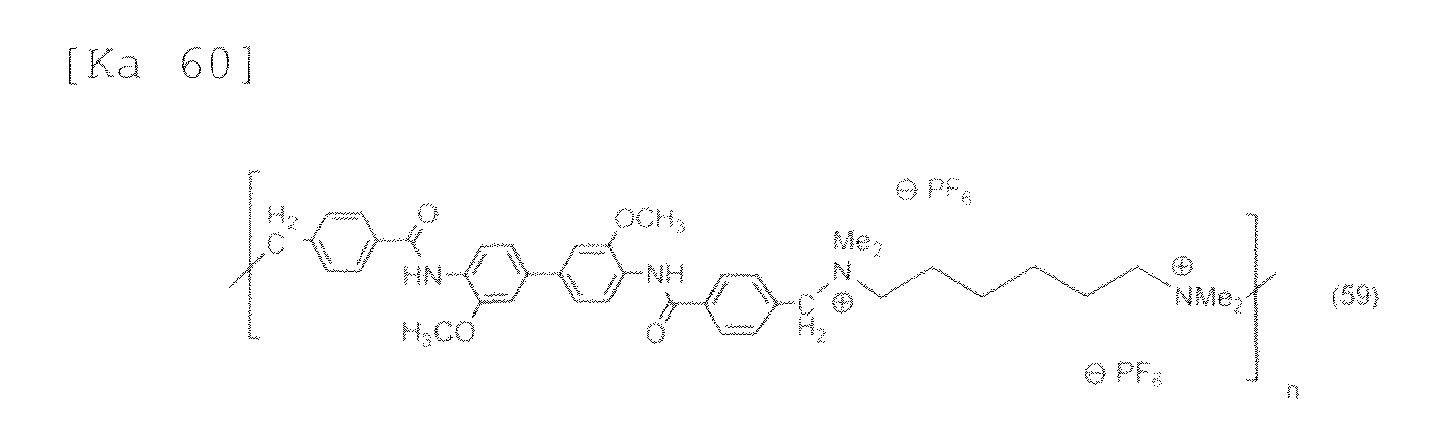
- A precipitate of a compounds represented by the following formula (60) was formed in the same manner as in Example 25, except that in the foregoing Example 25, an ammonium tetrafluoroborate (NH4BF4) solution was used in the place of the lithium bis(trifluoromethanesulfonyl)amide (TFSA) aqueous solution. A structure of the obtained compound was confirmed by a proton NMR spectrum of the compound. 1H NMR (400 MHz, DMSO-d6 ) δ 1.39 (br s, 4H), 1.86 (br s, 4H), 3.00 (s, 12H), 3. 32 (br s, 4H), 3.97 (s, 6H), 4. 60 (br s, 4H), 7.36 (br d, J = 8.0 Hz, 2H), 7.41 (s, 2H), 7.72 (br d, J = 7.8 Hz, 4H), 7.86 (br d, J = 8.0 Hz, 2H), 8.13 (br d, J = 7.8 Hz, 4H), 9.63 (s, 2H).
In the molecular weight distribution determined from the measurement of size exclusion chromatography of a TFSA derivative as described later, a cation principal chain moiety was estimated to have a number average molecular weight (Mn) of 1.91 × 10⁴, a weight average molecular weight (Mw) of 7.96 × 10⁴ and a degree of dispersion of molecular weight distribution (Mw/Mn) of 4.2.
- A precipitate of a compound represented by the following formula (61) was formed in the same manner as in Example 25, except that in the foregoing Example 25, a lithium perchlorate (LiclO4) solution was used in the place of the lithium bis(trifluoromethanesulfonyl)amide (TFSA) aqueous solution. A structure of the obtained compound was confirmed by a proton NMR spectrum of the compound. 1H NMR (400 MHz, DMSO-d6 ) δ 1.39 (br s, 4H), 1.86 (br s, 4H), 3.00 (s, 12H), 3.31 (br s, 4H), 3.97 (s, 6H), 4.61 (br s, 4H), 7.36 (br d, J = 8.0 Hz, 2H), 7.40 (s, 2H), 7.72 (br d, J = 7.8 Hz, 4H), 7.86 (br d, J = 8.0 Hz, 2H), 8.13 (br d, J = 7.8 Hz, 4H), 9.63 (s, 2H).
In the molecular weight distribution determined from the measurement of size exclusion chromatography of a TFSA derivative as described later, a cation principal chain moiety was estimated to have a number average molecular weight (Mn) of 1.91 × 10⁴, a weight average molecular weight (Mw) of 7.96 × 10⁴ and a degree of dispersion of molecular weight distribution (Mw/Mn) of 4.2.
- A precipitate of a compound represented by the following formula (62) was formed in the same manner as in Example 32, except that in the foregoing Example 32, an ammonium hexafluorophosphate (NH4PF6) solution was used in the place of the lithium bis(trifluoromethanesulfonyl)amide (TFSA) aqueous solution. A structure of the obtained compound was confirmed by a proton NMR spectrum of the compound. 1H NMR (400 MHz, DMSO-d 6) δ 1.38 (br s, 4H), 1.85 (br s, 4H), 2.99 (s, 12H), 3.31 (br s, 4H), 4.60 (br s, 4H), 7.70-7.78 (m, 8H), 7.95 (br d, J = 8.2 Hz, 2H), 8.01 (br d, J = 8.5 Hz, 2H), 8.09-8.13 (m, 4H), 10.18 (br s, 1H), 10.35 (br s, 1H), 10.61 (br s, 1H).
In the molecular weight distribution determined from the measurement of size exclusion chromatography of to TFSA derivative as described later, a cation principal chain moiety was estimated to have a number average molecular weight (Mn) of 1.04 × 10⁴, a weight average molecular weight (Mw) of 3.13 × 10⁴ and a degree of dispersion of molecular weight distribution (Mw/Mn) of 3.0.
- A precipitate of a compound represented by the following formula (63) was formed in the same manner as in Example 32, except that in the foregoing Example 32, an ammonium tetrafluoroborate (NH4BF4) solution was used in the place of the lithium bis(trifluoromethanesulfonyl) acide (TFSA) aqueous solution. A structure of the obtained compound was confirmed by a proton NMR spectrum of the compound. 1H NMR (400 MHz, DMSO-d 6) δ 1.38 (br s, 4H), 1.86 (br s, 4H), 2.99 (s, 12H), 3.31 (br s, 4H), 4.60 (br s, 4H), 7.70-7.78 (m, 8H), 7.95 (br d, J = 8.2 Hz, 2H), 8.01 (br d, J = 8.5 Hz, 2H), 8.09-8.13 (m, 4H), 10.18 (br s, 1H), 10.35 (br s, 1H), 10.61 (br s, 1H).
In the molecular weight distribution determined from the measurement of size exclusion chromatography of a TFSA derivative as described later, a cation principal chain moiety was estimated to have a number average molecular weight (Mn) of 1.04 × 10⁴, a weight average molecular weight (Mw) of 3.13 × 10⁴ and a degree of dispersion of molecular weight distribution (Mw/Mn) of 3.0.
- A precipitate of a compound represented by the following formula (64) was formed in the same manner as in Example 32, except that in the foregoing Example 32, a lithium perchlorate (LiClO4) solution was used in the place of the lithium bis(trifluoromethanesulfonyl)amide (TFSA) aqueous solution. A structure of the obtained compound was confirmed by a proton NMR spectrum of the compound. 1H NMR (400 MHz, DMSO-d 6) δ 1.38 (br s, 4H), 1.85 (br s, 4H), 2.99 (s, 12H), 3.32 (br s, 4H), 4.60 (br s, 4H), 7.70-7.78 (m, 8H), 7.95 (br d, J = 8.2 Hz, 2H), 8.01 (br d, J = 8.5 Hz, 2H), 8.09-8.13 (m, 4H), 10.18 (br s, 1H), 10.35 (br s, 1H), 10.61 (br s, 1H).
In the molecular weight distribution determined from the measurement of size exclusion chromatography of a TFSA derivative as described later, a cation principal chain moiety was estimated to have a number average molecular weight (Mn) of 1.04 × 10⁴, a weight average molecular weight (Mw) of 3.13 × 10⁴ and a degree of dispersion of molecular weight distribution (Mw/Mn) of 3.0.
- A precipitate of a compound represented by the following formula (65) was formed in the same manner as in Example 32, except that in the foregoing Example 32, a sodium thiocyanate (NaSCN) solution was used in the place of the lithium bis(trifluoromethanesulfonyl)amide (TFSA) aqueous solution. A structure of the obtained compound was confirmed by a proton NMR spectrum of the compound. 1H NMR (400 MHz, DMSO-d 6) δ 1.39 (br s, 4H), 1.87 (br s, 4H), 3.01 (s, 12H), 3.32 (br s, 4H), 4.62 (br s, 4H), 7.70-7.78 (m, 8H), 7.95 (br d, J = 8.2 Hz, 2H), 8.01 (br d, J = 8.5 Hz, 2H), 8.09-8.13 (m, 4H), 10.18 (br s, 1H), 10.36 (br s, 1H), 10.62 (br s, 1H).
In the molecular weight distribution determined from the measurement of size exclusion chromatography of a TFSA derivative as described later, a cation principal chain moiety was estimated to have a number average molecular weight (Mn) of 1.04 × 10⁴, a weight average molecular weight (Mw) of 3.13 × 10⁴ and a degree of dispersion of molecular weight distribution (Mw/Mn) of 3.0.
- A precipitate of a compound represented by the following formula (66) was formed in the same manner as in Example 34, except that in the foregoing Example 34, an ammonium hexafluorophosphate (NH4PF6) solution was used in the place of the lithium bis(trifluoromethanesulfonyl)amide (TFSA) aqueous solution. A structure of the obtained compound was confirmed by a proton NMR spectrum of the compound. 1H NMR (400 MHz, DMSO-d 6) δ 1.39 (br s, 4H), 1.86 (br s, 4H), 3.00 (s, 12H), 3.31 (br s, 4H), 3.97 (br s, 2H), 4.60 (br s, 4H), 7.70-7.76 (m, 6H), 7.83 (br d, J = 8.5 Hz, 2H), 8.07-8.15 (m, 6H), 10.43 (s, 2H).
In the molecular weight distribution determined from the measurement of size exclusion chromatography of a TFSA derivative as described later, a cation principal chain moiety was estimated to have a number average molecular weight (Mn) of 2.14 × 10⁴, a weight average molecular weight (Mw) of 5.08 × 10⁴ and a degree of dispersion of molecular weight distribution (Mw/Mn) of 2.4.
- A precipitate of a compound represented by the following formula (67) was formed in the same manner as in Example 34, except that in the foregoing Example 34, an ammonium tetrafluoroborate (NH4BF4) solution was used in the place of the lithium bis(trifluoromethanesulfonyl)amide (TFSA) aqueous solution. A structure of the obtained compound was confirmed by a proton NMR spectrum of the compound. 1H NMR (400 MHz, DMSO-d 6) δ 1.39 (br s, 4H), 1. 86 (br s, 4H), 2.99 (s, 12H), 3.31 (br s, 4H), 3.97 (br s, 2H), 4.60 (br s, 4H), 7.70-7.76 (m, 6H), 7.83 (br d, J = 8.5 Hz, 2H), 8.07-8.15 (m, 6H), 10.42 (s, 2H).
In the molecular weight distribution determined from the measurement of size exclusion, chromatography of a TFSA derivative as described later, a cation principal chain moiety was estimated to have a number average molecular weight (Mn) of 2.14 × 10⁴, a weight average molecular weight (Mw) of 5.08 × 10⁴ and a degree of dispersion of molecular weight distribution (Mw/Mn) of 2.4.
- A precipitate of a compound represented by the following formula (68) was formed in the same manner as in Example 34, except that in the foregoing Example 34, a lithium perchlorate (LiClO4) solution was used in the place of the lithium bis(trifluoromethanesulfonyl)amide (TFSA) aqueous solution. A structure of the obtained compound was confirmed by a proton NMR spectrum of the compound. 1H NMR (400 MHz, DMSO-d 6)
δ 1. 39 (br s, 4H), 1.86 (br s, 4H), 3.00 (s, 12H), 3.31 (br s, 4H), 3.97 (br s, 2H), 4.60 (br s, 4H), 7.70-7.76 (m, 6H), 7.83 (br d, J = 8.5 Hz, 2H), 8.07-8.15 (m, 6H), 10.43 (s, 2H).
In the molecular weight distribution determined from the measurement of size exclusion chromatography of a TFSA derivative as described later, a cation principal chain moiety was estimated to have a number average molecular weight (Mn ) of 2.14 × 10⁴, a weight average molecular weight (Mw) of 5.08 × 10⁴ and a degree of dispersion of molecular weight distribution (Mw/Mn) of 2.4.
- A titled compound represented by the following formula (69) was obtained in the same manner as in Production Example 1, except that trans-1,4-diaminocyclohexane was used in place of the 4,4'-diamino-3,3'-dimethoxybiphenyl (o-dianisidine) in the foregoing Production Example 1. Percent yield: 90 %. 1H-NMR (300 MHz, DMSO-d6, δ) 1.43-1.49 (m, 4H), 1.89-1.91 (m, 4H), 3.77 (br, 2H), 4.81 (s, 4H), 7.51 (d, J=8.2 Hz, 4H), 7.84 (d, J=8.2 Hz, 4H), 8.29 (d, J=7.8 Hz, 2H)


- An ionic organic compound represented by the following formula (70) was obtained in the same manner as in Example 1, except that in the foregoing Example 1, trans-1,4-bis[(4-chloromethyl)benzamido]cyclohexane was used in place of the 4,4'-bis[(4-chloromethyl)benzamido]-3,3'-dimethoxybiphenyl. Percent yield: 93 %. The progress of the quaternization reaction and structure were confirmed by a 1H-NMR spectrum of a TFSA derivative as described later. Furthermore, in the molecular weight distribution determined from the measurement of size exclusion chromatography of the TFSA derivative, a cation principal chain moiety was estimated to have a number average molecular weight (Mn) of 1.20 × 10⁴, a weight average molecular weight (Mw) of 4.36 × 10⁴ and a degree of dispersion of molecular weight distribution (Mw/Mn) of 3.6.

- A compound represented by the following formula, (71) was obtained in the same manner as in Example 25, except that in the foregoing Example 25, the ionic compound obtained in (Example 48, which is represented by the formula (70), was used in place of the ionic compound represented by the formula (3). A structure of the obtained compound was confirmed by a proton NMR spectrum of the compound. Furthermore, in the molecular weight distribution determined from the measurement of size exclusion chromatography of this TFSA derivative, a cation principal chain moiety was estimated to have a number average molecular weight (Mn) of 1.20 × 10⁴ , a weight average molecular weight (Mw) of 4.36 × 10⁴ and a degree of dispersion of molecular weight distribution (Mw/Mn) of 3.6.

- Each of the TFSA counter anion-containing ionic organic compounds of the formulae (45) to (58) and (71), which were obtained in Examples 25 to 37, respectively, was subjected to the molecular weight measurement by a size exclusion chromatography system (Shimadzu Corporation). Shodex Asahipak GF-510 HQ was used as a column. A flow rate was set to 0.4 mL/min. A temperature of the column was kept at 40°C by a column oven (Shimadzu Corporation). N,N-Dimethylformamide containing 30 mM of lithium bis(trifluoromethanesulfonyl) imide was used as an fluent. A molecular weight on the basis of poly(methyl methacrylate) was calculated based on a chromatogram obtained by a differential refractometer. Calculated molecular weights (molecular weights of only the cation principal chain moiety not containing an anion moiety due to restrictions on the measurement) are shown in the following Table 4.
-
Table 4 General formula of compound Number average molecular weight (Mn) Weight average molecular weight (Mw) Degree of dispersion (Mw/Mn) (45) 1.91 × 10⁴ 7.96 × 10⁴ 4.2 (46) 1.41 × 10⁵ 2.05 × 10⁵ 1.5 (47) 1.24 × 10⁴ 5.85 × 10⁴ 4.7 (48) 1.27 × 10⁴ 4.20 × 10⁴ 3.3 (49) 1.82 × 10⁴ 1.05 × 10⁵ 5.8 (50) 2.45 × 10⁴ 5.06 × 10⁴ 2.1 (51) 5.92 × 10⁴ 1.66 × 10⁵ 2.8 (52) 1.75 × 10⁴ 8.01 × 10⁴ 4.6 (53) 1.04 × 10⁴ 3.13 × 10⁴ 3.0 (54) 2.20 × 10⁴ 5.11 × 10⁴ 2.3 (55) 2.14 × 10⁴ 5.08 × 10⁴ 2.4 (56) 2.15 × 10⁴ 4.58 × 10⁴ 2.1 (57) 3.74 × 10⁴ 8.93 × 10⁴ 2.4 (58) 6.89 × 10⁴ 1.60 × 10⁵ 2.3 (71) 1.20 × 10⁴ 4.36 × 10⁴ 3.6 - The ionic organic compound of the formula (23), which was obtained in the foregoing Example 12, was charged together with water in sample bottles having an internal volume of 10 mL such that its concentration was 20 g/L, 30 g/L and 50 g/L, respectively and then dissolved under heating, whereby transparent solutions were obtained. Each of the solutions was allowed to stand at room temperature, whereby hydrogels were obtained under all of conditions. In these hydrogels, as seen in a photograph of
Fig. 1 , even when the sample bottles were inserted, the contents did not fall.
Similarly, by using the compounds of the formulae (3), (7), (11) and (34), which were obtained in the foregoing Examples, respectively, similar hydrogels were obtained (the concentration range is from about 50 to 100 g/L). - The ionic organic compound of the formula (11), which was obtained in the foregoing Example 6, was charged together with methanol in a sample bottle having an internal volume of 10 mL such that its concentration was 30 g/L and then dissolved under heating, whereby a transparent solution was obtained. When this solution was allowed to stand at room temperature, a gel was obtained under all of conditions. In this methanol gel, as seen in a photograph of
Fig. 2 , even when the sample bottle was inverted, the contents did not fall.
Similarly, by using the compounds of the formulae (13), (15) and (70), which were obtained in the foregoing Examples, respectively, similar methanol gels were obtained (the concentration range is from about 30 to 50 g/L). - Results obtained by measuring viscoelasticity using the hydrogel of the ionic organic compounds of the formula (23), which was obtained in Example 12, in a concentration of 30 g/L by ARES-RFS (TA Instruments) are shown in
Fig. 3. Fig. 3 is a graph in the case of taking a storage elastic modulus (G') and a loss elastic modulus (G") at a strain of 1 % on the ordinate and a frequency on the abscissa. On review of this graph, the frequency dependency is not substantially observed in the storage elastic modulus (G') and loss elastic modulus (G"), and G' is always larger than G", so that it has become also rheologically clear that this gel exhibits pseudosolid properties. - Each of the ionic organic compound (3) obtained in (Example 1 and the compound (7) obtained in Example 4 (90 mg each) was mixed with pure water (3 mL) after a deionization treatment in a sample tube and then heated to obtain a uniform solution. Each of the solutions was mixed with a multilayered carbon nanotube (1 mg) which had been prepared by an arc discharge method, and the mixture was irradiated with ultrasonic waves for 30 minutes using an ultrasonic irradiation apparatus for cleaning (130 W, 35 kHz), whereby a black carbon nanotube uniform aqueous solution was obtained, and a precipitate was not formed. The results are shown in
Fig. 4 , in which (a) shows the state before the ultrasonic irradiation, and (b) shows the state after the ultrasonic irradiation (the left shows the case of using (7), and the right shows the case of using (3)).
Similarly, carbon nanotube uniform dispersion solutions could be prepared using the compounds (4), (11), (13), (15), (25), (34), (38), (40), (42) and (70), respectively. A concentration range of the ionic organic compound is from about 1 g to 20/, and suitably about 10 g/L. A content of the carbon nanotube capable of being still dispersed was from 1 to 3 g/L.
Furthermore, in the case of using methanol as the solvent in place of water, similarly, carbon nanotube uniform dispersion methanol solutions could be prepared using the compounds (3), (11), (13), (28), (42) and (70), respectively. A concentration range of the ionic organic compound is from about 1 g to 20 g per liter, and suitably about 10 g/L. A content of the carbon nanotube capable of being still dispersed was from 1 to 20 g/L. - As described above, the ionic organic compound of the present invention has excellent properties as a hydrogelling agent, and a hydrogel is obtained by dissolving the subject compound in neutral water under heating and then allowing it to stand at room temperature. At the use of the ionic organic compound of the present invention as a hydrogelling agent, it is preferable to use the hydrogelling agent in an amount of from about 20 to 100 g/L, especially from about 20 to 50 g/L relative to water or an acidic aqueous solution that is objective to the gelation.
- Also, similarly, the ionic organic compound of the present invention has excellent properties as a methanol gelling agent, and a methanol gel is obtained by dissolving the subject compound in methanol under heating and then allowing it to stand at room temperature. At the use of the ionic organic compound of the present invention as a methanol gelling agent, it is preferable to use the hydrogelling agent in an amount of from about 10 to 100 g/L, especially from about 20 to 50 g/L relative to methanol that is objective to the gelation.
- Also, similarly, the ionic organic compound of the present invention has excellent properties as a carbon nanotube dispersant, and a carbon nanotube dispersion aqueous solution or a methanol solution is obtained by dissolving the subject compound in water or methanol under heating and adding the carbon nanotube, followed by an ultrasonic treatments At the use of the ionic organic compound of the present invention as a carbon nanotube dispersion, it is preferable to use the dispersant in an amount of from about 1 to 100 g/L, especially about 10 g/L relative to water or methanol. Also, it is desirable to use the carbon nanotube in an amount of from about 1 to 20 g/L.
Claims (9)
- An ionic organic compound represented by the following general formula (1):

A represents a linking site having one or more optionally substituted aromatic rings or a linking site composed of a cyclohexane ring; B represents a cationic functional group having a quaternized nitrogen atom, which is selected from N,N,N',N'-tetramethylalkylenediamines which may have a substituent having from 1 to 6 carbon atoms between nitrogen atoms; X represents a monovalent anion; and n represents an integer of from 1 to 800. - A production method of the ionic organic compound according to claim 1, comprising allowing (A) an optionally substituted aromatic diamide compound or cyclohexane diamide compound having a 4-(chloromethyl)benzamide group at both ends thereof and (B) a compound selected from N,N,N',N'-tetramethylalkylenediamines which may have a substituent having from 1 to 6 carbon atoms between nitrogen atoms to perform a condensation reaction.
- The production method according to claim 2, wherein the condensation reaction is performed in dimethylformamide at from 50 to 80°C.
- The production method of the ionic compound according to claim 2 or 3, further comprising substituting an anion of the obtained ionic compound with other anion by an anion interchange reaction.
- A hydrogelling agent comprising the ionic organic compound according to claim 1.
- A hydrogel containing the hydrogelling agent according to claim 5.
- A methanol gelling agent comprising the ionic organic compounds according to claim 1.
- A methanol gel containing the methanol gelling agent according to claim 7.
- A carbon nanotube dispersant comprising the ionic organic compound according to claim 1.
Applications Claiming Priority (2)
| Application Number | Priority Date | Filing Date | Title |
|---|---|---|---|
| JP2008229865 | 2008-09-08 | ||
| PCT/JP2009/065565 WO2010027067A1 (en) | 2008-09-08 | 2009-09-07 | Ionic organic compound, production method thereof, hydrogelling agent composed of the ionic organic compound, hydrogel containing same, methanol gelling agent, methanol gel containing same, and carbon nanotube dispersant |
Publications (2)
| Publication Number | Publication Date |
|---|---|
| EP2330143A1 true EP2330143A1 (en) | 2011-06-08 |
| EP2330143A4 EP2330143A4 (en) | 2014-04-02 |
Family
ID=41797230
Family Applications (1)
| Application Number | Title | Priority Date | Filing Date |
|---|---|---|---|
| EP09811591.8A Withdrawn EP2330143A4 (en) | 2008-09-08 | 2009-09-07 | IONIC ORGANIC COMPOUND, METHOD FOR PRODUCING THE SAME, HYDROGELING AGENT COMPOSED OF IONIC ORGANIC COMPOUND, HYDROGEL CONTAINING THE SAME, METHANOL GELING AGENT, METHANOL GEL CONTAINING THE SAME, AND DISPERSING CARBON NANOTUBES |
Country Status (4)
| Country | Link |
|---|---|
| US (1) | US8519040B2 (en) |
| EP (1) | EP2330143A4 (en) |
| JP (1) | JP5757517B2 (en) |
| WO (1) | WO2010027067A1 (en) |
Families Citing this family (5)
| Publication number | Priority date | Publication date | Assignee | Title |
|---|---|---|---|---|
| WO2011052604A1 (en) * | 2009-10-26 | 2011-05-05 | 独立行政法人産業技術総合研究所 | Photoresponsive ionic organic compound, production method therefor, and photoresponsive carbon nanotube dispersant comprising said ionic organic compound |
| JP5435595B2 (en) * | 2009-10-26 | 2014-03-05 | 独立行政法人産業技術総合研究所 | Ionic organic compound and process for producing the same, and carbon nanotube dispersant comprising the ionic organic compound |
| JP5414069B2 (en) * | 2010-10-22 | 2014-02-12 | 独立行政法人産業技術総合研究所 | Ionic organic compound, method for producing the same, and photoresponsive polymer electrolyte using the same |
| WO2012165483A1 (en) * | 2011-05-30 | 2012-12-06 | 独立行政法人産業技術総合研究所 | Gel-like ion conductor |
| JP5588580B1 (en) * | 2012-12-28 | 2014-09-10 | 花王株式会社 | Pigment dispersion for color filters |
Family Cites Families (10)
| Publication number | Priority date | Publication date | Assignee | Title |
|---|---|---|---|---|
| JPS5834495B2 (en) * | 1981-09-09 | 1983-07-27 | 工業技術院長 | A new polymer with hydroquinone as its main chain and its production method |
| JPH01210961A (en) * | 1988-02-19 | 1989-08-24 | Canon Inc | Electrophotographic sensitive body |
| JP3229589B2 (en) * | 1997-10-17 | 2001-11-19 | 川研ファインケミカル株式会社 | Dispersant |
| JP4164247B2 (en) | 2001-08-07 | 2008-10-15 | 独立行政法人科学技術振興機構 | Sugar-derived gelling agent |
| JP3660282B2 (en) | 2001-08-20 | 2005-06-15 | 独立行政法人科学技術振興機構 | Hydrogelator |
| JP3693979B2 (en) | 2002-05-13 | 2005-09-14 | 独立行政法人科学技術振興機構 | Hydrogelators and hydrogels comprising glycoside amino acid derivatives |
| WO2006082768A1 (en) | 2005-02-02 | 2006-08-10 | National Institute Of Advanced Industrial Science And Technology | Ionic organic compound |
| JP2007324701A (en) | 2006-05-30 | 2007-12-13 | Hitachi Industrial Equipment Systems Co Ltd | Communication terminal |
| JP4836144B2 (en) * | 2007-03-06 | 2011-12-14 | 独立行政法人産業技術総合研究所 | Ionic organic compound and process for producing the same, and hydrogelator and hydrogel comprising the ionic organic compound |
| JP5110564B2 (en) * | 2007-03-06 | 2012-12-26 | 独立行政法人産業技術総合研究所 | Ionic organic compound and method for producing the same, and hydrogelator and hydrogel comprising the ionic organic compound |
-
2009
- 2009-09-07 JP JP2010527842A patent/JP5757517B2/en not_active Expired - Fee Related
- 2009-09-07 US US13/062,243 patent/US8519040B2/en not_active Expired - Fee Related
- 2009-09-07 WO PCT/JP2009/065565 patent/WO2010027067A1/en not_active Ceased
- 2009-09-07 EP EP09811591.8A patent/EP2330143A4/en not_active Withdrawn
Non-Patent Citations (2)
| Title |
|---|
| No further relevant documents disclosed * |
| See also references of WO2010027067A1 * |
Also Published As
| Publication number | Publication date |
|---|---|
| EP2330143A4 (en) | 2014-04-02 |
| US20110178218A1 (en) | 2011-07-21 |
| US8519040B2 (en) | 2013-08-27 |
| JPWO2010027067A1 (en) | 2012-02-02 |
| JP5757517B2 (en) | 2015-07-29 |
| WO2010027067A1 (en) | 2010-03-11 |
Similar Documents
| Publication | Publication Date | Title |
|---|---|---|
| Pal et al. | Synthesis, characterization, and physicochemical properties of a series of quaternary gemini surfactants with different spacer lengths | |
| Rao et al. | Distinct pathways in “thermally bisignate supramolecular polymerization”: spectroscopic and computational studies | |
| Choi et al. | Organic/inorganic hybrid composites from cubic silsesquioxanes. Epoxy resins of octa (dimethylsiloxyethylcyclohexylepoxide) silsesquioxane | |
| CN101142187B (en) | Ionic Organic Compounds | |
| Omara et al. | Structure–property relationships of hyperbranched polymer/kaolinite nanocomposites | |
| Khan et al. | Thermophysical properties and ecotoxicity of new nitrile functionalised protic ionic liquids | |
| Wu et al. | Coassembly of a polyoxometalate and a zwitterionic amphiphile into a luminescent hydrogel with excellent stimuli responsiveness | |
| Li et al. | A novel cationic surfactant synthesized from carbon quantum dots and the versatility | |
| US8519040B2 (en) | Ionic organic compound, production method thereof, hydrogelling agent composed of the ionic organic compound, hydrogel containing same, methanol gelling agent, methanol gel containing same, and carbon nanotube dispersant | |
| Ozdogan et al. | Aliphatic Polyester/polyhedral Oligomeric Silsesquioxanes Hybrid Networks via Copper‐free 1, 3‐dipolar Cycloaddition Click Reaction | |
| Bhattarai et al. | Spectroscopic and conductometric analyses of ninhydrin and threonine reaction in double-headed geminis | |
| Cardiano et al. | POSS–tetraalkylammonium salts: a new class of ionic liquids | |
| Kumar et al. | Physiochemical, circular dichroism‐induced helical conformation and optical property of chitosan azo‐based amino methanesulfonate complex | |
| Banjare et al. | Molecular interaction between three novel amino acid based deep eutectic solvents with surface active ionic liquid: A comparative study | |
| Huang et al. | Preparation and characterization of epoxy/polyhedral oligomeric silsesquioxane hybrid nanocomposites | |
| JP4836144B2 (en) | Ionic organic compound and process for producing the same, and hydrogelator and hydrogel comprising the ionic organic compound | |
| Asadov et al. | Micellization and adsorption properties of new cationic gemini surfactants having hydroxyisopropyl group | |
| Li et al. | Rheological and mechanical properties of dynamic covalent polymers based on imine bond | |
| Wang et al. | Study on the surface properties and aggregation behavior of quaternary ammonium surfactants with amide bonds | |
| Sun et al. | Multiple-responsive hierarchical self-assemblies of a smart supramolecular complex: regulation of noncovalent interactions | |
| Zhang et al. | Vesicle self-assembly by tetrathiafulvalene derivatives in both polar and nonpolar solvents and pseudo-rotaxane mediated vesicle-to-microtube transformation | |
| JP5435595B2 (en) | Ionic organic compound and process for producing the same, and carbon nanotube dispersant comprising the ionic organic compound | |
| Parekh et al. | Synthesis, aggregation and adsorption behaviour of a thermoresponsive pentablock copolymer | |
| Shibata et al. | Experimental and theoretical investigation of intrinsic pyridine isomer effects on physical property tuning of metallo supramolecular polymers bearing multiple pyridine ligands | |
| Sun et al. | Synthesis and properties of quaternary ammonium gemini surfactants with hydroxyethyl at head groups |
Legal Events
| Date | Code | Title | Description |
|---|---|---|---|
| PUAI | Public reference made under article 153(3) epc to a published international application that has entered the european phase |
Free format text: ORIGINAL CODE: 0009012 |
|
| 17P | Request for examination filed |
Effective date: 20110330 |
|
| AK | Designated contracting states |
Kind code of ref document: A1 Designated state(s): AT BE BG CH CY CZ DE DK EE ES FI FR GB GR HR HU IE IS IT LI LT LU LV MC MK MT NL NO PL PT RO SE SI SK SM TR |
|
| AX | Request for extension of the european patent |
Extension state: AL BA RS |
|
| RIN1 | Information on inventor provided before grant (corrected) |
Inventor name: TAMAOKI NOBUYUKI Inventor name: OHYAMA HARUMI Inventor name: KOUMURA NAGATOSHI Inventor name: YOSHIDA MASARU |
|
| DAX | Request for extension of the european patent (deleted) | ||
| A4 | Supplementary search report drawn up and despatched |
Effective date: 20140303 |
|
| RIC1 | Information provided on ipc code assigned before grant |
Ipc: B01F 17/52 20060101ALI20140225BHEP Ipc: C08G 73/02 20060101AFI20140225BHEP Ipc: C08K 7/24 20060101ALN20140225BHEP Ipc: C08J 3/075 20060101ALI20140225BHEP Ipc: C08J 3/09 20060101ALI20140225BHEP |
|
| STAA | Information on the status of an ep patent application or granted ep patent |
Free format text: STATUS: EXAMINATION IS IN PROGRESS |
|
| 17Q | First examination report despatched |
Effective date: 20170920 |
|
| STAA | Information on the status of an ep patent application or granted ep patent |
Free format text: STATUS: THE APPLICATION IS DEEMED TO BE WITHDRAWN |
|
| 18D | Application deemed to be withdrawn |
Effective date: 20180131 |