EP2330107A2 - Improved production method for adefovir dipivoxil - Google Patents
Improved production method for adefovir dipivoxil Download PDFInfo
- Publication number
- EP2330107A2 EP2330107A2 EP09814790A EP09814790A EP2330107A2 EP 2330107 A2 EP2330107 A2 EP 2330107A2 EP 09814790 A EP09814790 A EP 09814790A EP 09814790 A EP09814790 A EP 09814790A EP 2330107 A2 EP2330107 A2 EP 2330107A2
- Authority
- EP
- European Patent Office
- Prior art keywords
- formula
- adefovir dipivoxil
- adefovir
- reaction
- water
- Prior art date
- Legal status (The legal status is an assumption and is not a legal conclusion. Google has not performed a legal analysis and makes no representation as to the accuracy of the status listed.)
- Withdrawn
Links
Images


Classifications
-
- A—HUMAN NECESSITIES
- A61—MEDICAL OR VETERINARY SCIENCE; HYGIENE
- A61K—PREPARATIONS FOR MEDICAL, DENTAL OR TOILETRY PURPOSES
- A61K31/00—Medicinal preparations containing organic active ingredients
- A61K31/66—Phosphorus compounds
- A61K31/675—Phosphorus compounds having nitrogen as a ring hetero atom, e.g. pyridoxal phosphate
-
- A—HUMAN NECESSITIES
- A61—MEDICAL OR VETERINARY SCIENCE; HYGIENE
- A61P—SPECIFIC THERAPEUTIC ACTIVITY OF CHEMICAL COMPOUNDS OR MEDICINAL PREPARATIONS
- A61P31/00—Antiinfectives, i.e. antibiotics, antiseptics, chemotherapeutics
- A61P31/12—Antivirals
-
- C—CHEMISTRY; METALLURGY
- C07—ORGANIC CHEMISTRY
- C07D—HETEROCYCLIC COMPOUNDS
- C07D473/00—Heterocyclic compounds containing purine ring systems
- C07D473/26—Heterocyclic compounds containing purine ring systems with an oxygen, sulphur, or nitrogen atom directly attached in position 2 or 6, but not in both
- C07D473/32—Nitrogen atom
- C07D473/34—Nitrogen atom attached in position 6, e.g. adenine
Definitions
- the present invention relates to an improved method of preparing 9-[2-[[bis ⁇ (pivaloyloxy)-methoxy ⁇ phosphinyl]methoxy]ethyl]adenine ("adefovir dipivoxil") of Formula 1 by using 9-[2-(phosphonomethoxy)ethyl]adenine ("adefovir") of Formula 2 as a starting material.
- Adefovir dipivoxil which is a useful antiviral drug, is a nucleotide reverse transcriptase inhibitor, which exhibits a marked in vivo antiviral activity against especially both HIV and Hepatitis type B virus (HBV).
- HBV Hepatitis type B virus
- the adefovir dipivoxil has been sold on the market under the trademark "Hepsera.”
- an improved method of preparing 9-[2-[[bis ⁇ (pivaloyloxy)-methoxy ⁇ phosphinyl]methoxy]ethyl]adenine ("adefovir dipivoxil.") of Formula 1 by using 9-[2-(phosphonomethoxy)ethyl]adenine (“adefovir”) of Formula 2.
- adefovir dipivoxil of good quality can be prepared in high yield. Further, the reaction in the method is carried out faster even at lower reaction temperature than conventional methods (using NMP), thereby decreasing the production of related compounds.
- the method of the present invention provides an additional advantage of improved reaction conditions.
- Adefovir of Formula 2 is added to a mixture of dimethylsulfoxide and triethylamine, and then, chloromethylpivalate is added thereto drop by drop. Then, the resulting mixture is stirred for 3 to 7 hours while maintaining a reaction temperature of 30 to 50°C, to obtain adefovir dipivoxil of Formula 1.
- the pH of the extracted aqueous solution is in a range of 0.1 to 5.0, preferably 1.0 to 3.0.
- the separated aqueous solution is allowed to pass through a reverse-phase column, eluted, and then, collected as an eluate. If necessary, an aqueous solution (mobile phase) having a pH range of 0.1 to 5.0, preferably 1.0 to 3.5 may be further allowed to pass through the reverse-phase column, eluted and collected.
Landscapes
- Chemical & Material Sciences (AREA)
- Organic Chemistry (AREA)
- Health & Medical Sciences (AREA)
- Life Sciences & Earth Sciences (AREA)
- Animal Behavior & Ethology (AREA)
- Pharmacology & Pharmacy (AREA)
- Veterinary Medicine (AREA)
- Public Health (AREA)
- Medicinal Chemistry (AREA)
- General Health & Medical Sciences (AREA)
- Epidemiology (AREA)
- Communicable Diseases (AREA)
- Oncology (AREA)
- Virology (AREA)
- Nuclear Medicine, Radiotherapy & Molecular Imaging (AREA)
- General Chemical & Material Sciences (AREA)
- Chemical Kinetics & Catalysis (AREA)
- Pharmaceuticals Containing Other Organic And Inorganic Compounds (AREA)
Abstract
Description
- The present invention relates to an improved method of preparing adefovir dipivoxil, 9-[2-[[bis{(pivaloyloxy)-methoxy}phosphinyl]methoxy]ethyl]adenine, useful as an antiviral agent which has been disclosed in
U.S. Patent No. 5,663,159 . In particular, the present invention relates to an improved method of preparing 9-[2-[[bis{(pivaloyloxy)-methoxy}phosphinyl]methoxy]ethyl]adenine ("adefovir dipivoxil") ofFormula 1 by using 9-[2-(phosphonomethoxy)ethyl]adenine ("adefovir") of Formula 2 as a starting material.

- Adefovir dipivoxil, which is a useful antiviral drug, is a nucleotide reverse transcriptase inhibitor, which exhibits a marked in vivo antiviral activity against especially both HIV and Hepatitis type B virus (HBV). The adefovir dipivoxil has been sold on the market under the trademark "Hepsera."
- Adefovir dipivoxil can be prepared, for example, according to a method as described in
U.S. Patent No. 5,663,159 . The document discloses the method for preparation of adefovir dipivoxil ofFormula 1 comprising reacting adefovir of Formula 2 as a starting material with chloromethylpivalate at a temperature of 22°C in the presence oaf dimethylformamide (DMF) and N,N'-dicyclohexyl-4-morpholine-carboxamidine to give a yield of 32% of adefovir dipivoxil.
- However, the above method has a problem in that large quantities of byproducts are generated during the synthetic reaction, which results in a low yield of adefovir dipivoxil.
- In order to solve the problem, Korean Patent No.
0700087 
- The above method shows the improvement in yield of adefovir dipivoxil to approximately 55%, but there are still problems in that since its reaction temperature should be increased to 60°C or higher, related compounds (impurities) are thus generated in abundance, and the amount of 1-methyl-2-pyrrolidone used in the reaction and byproducts of Formula 3 generated during the reaction accounts for about 15% or higher of final products, which makes it difficult to purify adefovir dipivoxil.

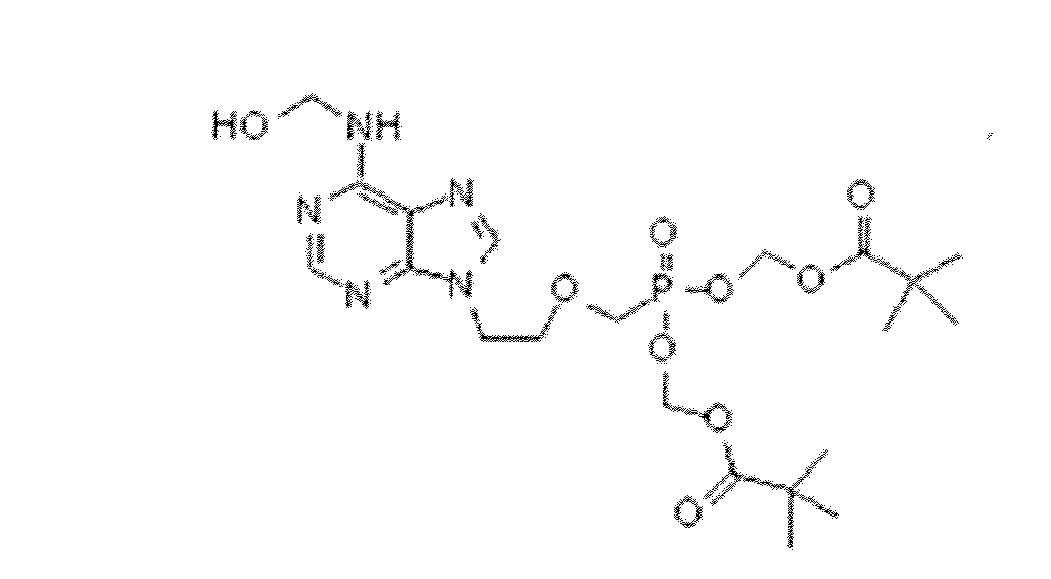
- An object of the present invention is to provide a novel method of preparing adefovir dipivoxil of Formula 1 which shows high reaction yields of adefovir dipivoxil with low production of byproducts and is carried out under improved reaction conditions. The present invention can achieve the object by using dimethylsulfoxide as a reaction solvent, thereby providing an improved method of preparing adefovir dipivoxil of Formula 1.
- According to the present invention, there is provided an improved method of preparing 9-[2-[[bis{(pivaloyloxy)-methoxy}phosphinyl]methoxy]ethyl]adenine ("adefovir dipivoxil.") of
Formula 1 by using 9-[2-(phosphonomethoxy)ethyl]adenine ("adefovir") of Formula 2. - The method according to the present invention is characterized by using dimethylsulfoxide as a reaction solvent instead of 1-methyl-3-pyrrolidone, and comprises reacting adefovir of Formula 2 with chloromethylpivalate at a temperature of 30 to 50°C for 3 to 7 hours in the presence of dimethylsulfoxide and triethylamine as solvents to give adefovir dipivoxil of
Formula 1. - Further, adefovir dipivoxil prepared according to the method of the present invention is characterized by containing 15% or less of byproducts of Formula 3.
- According to a method of the present invention, since 15% or less of byproducts of Formula 3 is contained in final products, adefovir dipivoxil of good quality can be prepared in high yield. Further, the reaction in the method is carried out faster even at lower reaction temperature than conventional methods (using NMP), thereby decreasing the production of related compounds.
- In addition, since dimethylsulfoxide is a reaction solvent that is easily removed and its reaction is carried out at moderate reaction temperature, the method of the present invention provides an additional advantage of improved reaction conditions.
-
-
Fig. 1 is a HPLC spectrum of analyzing a synthetic product obtained in Example 1. -
Fig. 2 is a HPLC spectrum of analyzing a synthetic product obtained in Example 2. -
Fig. 3 is a HPLC spectrum of analyzing a synthetic product obtained in Example 3. -
Fig. 4 is a HPLC spectrum of analyzing a synthetic product obtained in Example 4. - Hereinafter, a preparation method of the present invention will be described in detail.
- In accordance with a method of the present invention, the reaction of synthesizing adefovir dipivoxil of Formula 1 by using adefovir of Formula 2 as a starting material is illustrated by the following
Reaction Scheme 3.
- Adefovir of Formula 2 is added to a mixture of dimethylsulfoxide and triethylamine, and then, chloromethylpivalate is added thereto drop by drop. Then, the resulting mixture is stirred for 3 to 7 hours while maintaining a reaction temperature of 30 to 50°C, to obtain adefovir dipivoxil of
Formula 1. - The method of the present invention may further comprise the following purification process for removing byproducts included in the prepared Adefovir dipivoxil of
Formula 1. - The purification comprises the steps of dissolving the prepared adefovir dipivoxil of
Formula 1 in water or a water-containing mixed solvent; purifying the adefovir dipivoxil solution through a reverse-phase column; and adding a base to the purified adefovir dipivoxil solution, followed by extracting it with an organic solvent. - Specifically, according to the purification process described above, water or a water-containing mixed solvent is added to the organic solvent layer in which impure adefovir dipivoxil containing byproducts generated during the synthetic reaction is dissolved, an acid is added thereto, and then, adefovir dipivoxil is extracted into an aqueous layer. The water-containing mixed solvent used in the present invention refers to an organic solvent in which at least 20% by weight of water is dissolved. An example of suitable organic solvents may include C1∼C4 alcohol, acetone, acetonitrile, tetrahydrofuran, dioxane and the like, but are not limited thereto.
- Adefovir dipivoxil containing byproducts in the organic solvent reacts with the acid to give its salts or complexes, which can be then dissolved in water or the water-containing mixed solvent. The term "salt" or "complex" of adefovir dipivoxil as used herein refers to a compound prepared by mixing adefovir dipivoxil with an inorganic acid or an organic acid.
- The acid used in the present invention can be an inorganic acid or an organic acid, and examples thereof may include hydrochloric acid, sulfuric acid, nitric acid and methanesulfonic acid in consideration of the formation of salts or complexes of adefovir dipivoxil.
- In addition, the pH of the extracted aqueous solution is in a range of 0.1 to 5.0, preferably 1.0 to 3.0.
- The separated aqueous solution is allowed to pass through a reverse-phase column, eluted, and then, collected as an eluate. If necessary, an aqueous solution (mobile phase) having a pH range of 0.1 to 5.0, preferably 1.0 to 3.5 may be further allowed to pass through the reverse-phase column, eluted and collected.
- Packaging materials (stationary phase) used in the reverse-phase column include polymers that are immiscible with water such as C1∼C18 alkyl and HP2O. and it is preferable to use C18 octadecyl.
- An organic solvent is added to the collected aqueous solution, followed by adding a base thereto to thereby adjust the pH of the aqueous solution to a range of 2.5 to 10. Thereafter, the organic solvent is removed therefrom.
- Exemplary organic solvents used here may include dichloromethane, isopropylacetate, toluene, ethylacetate and the like, and it is preferable to use dichloromethane or isopropylacetate.
- Further, the base used here may be inorganic bases or organic bases. When considering the generation of related compounds, the pH of the aqueous solution to which the base added is preferably in a range of 2.5 to 6.5.
- Thereafter, the collected organic solvent is removed to thereby obtain purified amorphous adefovir dipivoxil solids with high purity.
- Here, the organic solvent can be removed by concentrating the aqueous solution under reduced pressure, and during the concentration, an inner temperature of 30°C to 90°C is preferable.
- Besides the concentration under reduced pressure, the organic solvent can be removed by adding the concentrated solution of adefovir dipivoxil represented by
Formula 1 to C5∼C12 hydrocarbons, such as n-pentane, n-hexane, n-heptane, cyclohexane and the like, drop by drop, thereby forming amorphous solids, followed by filtration. - Adefovir dipivoxil purified according to the method of the present invention has a purity of 95% or higher, preferably 99% or higher.
- Hereinafter, examples will be presented in order to help understand the present invention. However, the following examples are provided for the purpose of easily understanding the present invention and are not construed as being limited to the scope of the present invention.
- 100 g of 9-[2-(Phosphonomethoxy)ethyl]adenine ("adefovir") and 400 g of dimethylsulfoxide were inputted into a reactor. Thereafter, 140 mg of triethylamine and 250 g of chloromethylpivalate were subsequently added thereto, and then, the mixture was heated to a reaction temperature of 40°C and stirred for 5 hours.
- After the mixture was cooled down to a temperature of 10 to 20°C, 500 ml of dichloromethane and 1000 ml of distilled water were added thereto, followed by stirring for 5 minutes. As a result, an organic layer was separated.
- The obtained synthetic product was analyzed through HPLC. HPLC analysis was carried out by using an Alltech Mixed Mode Exchange™ C8 (7u, 100Å) as a column and a UV spectrophotometer (observed at a wavelength of 260 nm) was used as a detector, under conditions of a flow rate of 1.2 ml/min and a column temperature of room temperature. A mixture of phosphate buffer (pH 6.0) and acetonitrile at a ratio of 70:30 was used as a mobile phase A, a mixture of phosphate buffer (pH 6.0) and acetonitrile at a ratio of 50:50 was used as a mobile phase B, and a mixture of phosphate buffer (pH 3.0) and acetonitrile at a ratio of 20:30 was used as a diluting agent.
- In a column analysis of mobile phases A and B, a change in inflow amount was as follows.
Time (min) Mobile phase A (%) Mobile phase B (%) 0 to 19 100→0 0→100 19 to 36 0 100 36 to 46 0→100 100→0 - The results of analyzing the synthetic product obtained in Example 1 with HPLC under the conditions described above are shown in
Fig. 1 (in case of adefovir dipivoxil ofFormula 1, RetTime (min): 10.142, Width (min): 0.27, Area (mAU * s): 1.45561e4, Height (mAU): 810.53, and Area (%): 61.55; in case of byproduct ofFormula 3, RetTime (min): 9.236, Width (min): 0.23, Area (mAU * s): 2927.66, Height (mAU): 184.96, and Area (%): 12.38). - 100 g of 9-[2-(Phosphonomethoxy)ethyl]adenine ("adefovir") and 400 g of dimethylsulfoxide were inputted into a reactor. Thereafter, 140 mg of triethylamine and 250 g of chloromethylpivalate were subsequently added thereto, and then, the mixture was heated to a reaction temperature of 43°C and stirred for 4 hours.
- After the mixture was cooled down to a temperature of 10 to 20°C, 500 ml of dichloromethane and 1000 ml of distilled water were added thereto, followed by stirring for 5 minutes. As a result, an organic layer was separated.
- The obtained synthetic product was analyzed through HPLC. HPLC analysis was carried out under the same conditions as described in Example 1. The results of analyzing the synthetic product obtained in Example 2 with HPLC are shown in
Fig. 2 (in case of adefovir dipivoxil ofFormula 1, RetTime (min): 9.944, Width (min): 0.23, Area (mAU * s): 8248.92, Height (mAU): 549.31, and Area (%): 75.68; in case of byproduct ofFormula 3, RetTime (min): 9.228, Width (min): 0.22, Area (mAU * s): 1208.14, Height (mAU): 85.30, and Area (%): 11.08). - 100 g of 9-[2-(Phosphonomethoxy)ethyl]adenine ("adefovir") and 400 g of dimethylsulfoxide were inputted into a reactor. Thereafter, 140 mg of triethylamine and 250 g of chloromethylpivalate were subsequently added thereto, and then, the mixture was heated to a reaction temperature of 38°C and stirred for 6 hours.
- After the mixture was cooled down to a temperature of 10 to 20°C, 500 ml of dichloromethane and 1000 ml of distilled water were added thereto, followed by stirring for 5 minutes. As a result, an organic layer was separated.
- The obtained synthetic product was analyzed through HPLC. HPLC analysis was carried out under the same conditions as described in Example 1. The results of analyzing the synthetic product obtained in Example 3 with HPLC are shown in
Fig. 3 (in case of adefovir dipivoxil ofFormula 1, RetTime (min): 11.518, Width (min): 0.22, Area (mAU * s): 9995.02, Height (mAU): 682.72, and Area (%): 73.83; in case of byproduct ofFormula 3, RetTime (min): 10.466, Width (min): 0.24, Area (mAU * s): 1735.54, Height (mAU): 122.53, and Area (%): 12.82). - 100 g of 9-[2-(Phosphonomethoxy)ethyl]adenine ("adefovir") and 400 g of dimethylsulfoxide were inputted into a reactor. Thereafter, 150 mg of triethylamine and 300 g of chloromethylpivalate were subsequently added thereto, and then, the mixture was heated to a reaction temperature of 40°C and stirred for 5 hours.
- After the mixture was cooled down to a temperature of 10 to 20°C, 500 ml of dichloromethane and 1000 ml of distilled water were added thereto, followed by stirring for 5 minutes. As a result, an organic layer was separated.
- The obtained synthetic product was analyzed through HPLC. HPLC analysis was carried out under the same conditions as described in Example 1. The results of analyzing the synthetic product obtained in Example 4 with HPLC are shown in
Fig. 4 (in case of adefovir dipivoxil ofFormula 1, RetTime (min): 10.947, Width (min): 0.20, Area (mAU * s): 2.40482e4, Height (mAU): 1845.69, and Area (%): 82.04; in case of byproduct ofFormula 3, RetTime (min): 10.106, Width (min): 0.18, Area (mAU *s): 2710.89, Height (mAU): 232.66, and Area (%):9.25). - 3000 ml of distilled water were added to the organic layer obtained in Example 1. After the pH of the distilled water was adjusted to 1.8 by adding 1 N hydrochloric acid, it was stirred at a temperature of 20 to 25°C for 10 minutes. The stirring was stopped, and then, an aqueous layer was separated. The separated aqueous layer was allowed to pass through a C18 reverse-phase column (size: 40×15 cm, packing substance: KP-C18-HSTM 35∼70 um, 90Å C18-bonded silica, manufacturer: Biotage).
- The aqueous solution through the C18 reverse-phase column was collected, and the C18 reverse-phase column was sequentially washed with methanol and a pH 2.0 hydrochloric acid solution.
- After the obtained aqueous solution was allowed to pass through the C18 reverse-phase column and eluted therefrom, the re-collected aqueous solution was mixed with 500 ml of dichloromethane. 5% sodium bicarbonate was added to the reaction mixture drop by drop while stirred to adjust the pH of the collected aqueous solution to a range of 5.5 to 5.6.
- After the stirring was stopped, dichloromethane was separated, followed by dehydrating with sodium sulfate and filtering.
- The filtered dichloromethane was concentrated under reduced pressure. 500 ml of n-hexane were added to the formed solid, stirred, and then, filtered, to thereby obtain amorphous high purity adefovir dipivoxil represented by Formula 1 (yield: 43 g (23.9%), purity: 99.8%).
- 3000 ml of distilled water were added to the organic layer obtained in Example 2. After the pH of the distilled water was adjusted to 2.2 by adding methanesulfonic acid, it was stirred at a temperature of 20 to 25°C for 10 minutes. The stirring was stopped, and then, an aqueous layer was separated. The separated aqueous layer was allowed to pass through a C18 reverse-phase column (size: 40×15 cm, packing substance: KP-C18-HSTM 35∼70 um, 90Å C18-bonded silica, manufacturer: Biotage).
- The aqueous solution passing through the C18 reverse-phase column was collected, and the C18 reverse-phase column was sequentially washed with methanol and a pH 2.3 hydrochloric acid solution.
- After the obtained aqueous solution was allowed to pass through the C18 reverse-phase column and eluted therefrom, the re-collected aqueous solution was mixed with 500 ml of dichloromethane. 5% sodium bicarbonate was added to the reaction mixture drop by drop while stirred to adjust the pH of the collected aqueous solution to a range of 3.2 to 3.3.
- After the stirring was stopped, dichloromethane was separated, followed by dehydrating with sodium sulfate and filtering.
- The filtered dichloromethane was concentrated under reduced pressure, to thereby obtain amorphous high purity adefovir dipivoxil represented by Formula 1 (yield: 45 g (25.1%), purity: 99.7%).
- 3000 ml of distilled water were added to the organic layer obtained in Example 3. After the pH of the distilled water was adjusted to 2.2 by adding methanesulfonic acid, it was stirred at a temperature of 20 to 25°C for 10 minutes. The stirring was stopped, and then, an aqueous layer was separated. The separated aqueous layer was allowed to pass through a C18 reverse-phase column (size: 40×15 cm, packing substance: KP-C18-HSTM 35∼70 um, 90Å C18-bonded silica, manufacturer: Biotage).
- The aqueous solution passing through the C18 reverse-phase column was collected, and the C18 reverse-phase column was sequentially washed with methanol and a pH 2.3 hydrochloric acid solution.
- After the obtained aqueous solution was allowed to pass through the C18 reverse-phase column and eluted therefrom, the re-collected aqueous solution was mixed with 500 ml of dichloromethane. 5% sodium bicarbonate was added to the reaction mixture drop by drop while stirred to adjust the pH of the collected aqueous solution to a range of 3.1 to 3.2.
- After the stirring was stopped, dichloromethane was separated, followed by dehydrating with sodium sulfate and filtering.
- The filtered dichloromethane was concentrated under reduced pressure, to thereby obtain amorphous high purity adefovir dipivoxil represented by Formula 1 (yield: 45 g (25.1%), purity: 99.7%).
Claims (7)
- A method of preparing adefovir dipivoxil of Formula 1, comprising the step of reacting adefovir of Formula 2 with chloromethylpivalate in the presence of dimethylsulfoxide and triethylamine solvents :


- The method as claimed in Claim 1, wherein the prepared adefovir dipivoxil of Formula 1 contains 15% or less of byproducts of Formula 3:

- The method as claimed in Claim 1, wherein the reaction is carried out at a temperature of 30 to 50°C.
- The method as claimed in any one of Claims 1 to 3, wherein the reaction is carried out for 3 to 7 hours.
- The method as claimed in any one of Claims 1 to 3, further comprising the step of purifying the prepared adefovir dipivoxil of Formula 1.
- The method as claimed in Claim 5, wherein the purification step comprises the steps of dissolving the prepared adefovir dipivoxil of Formula 1 in water or a water-containing mixed solvent; purifying the adefovir dipivoxil solution through a reverse-phase column; and adding a base to the purified adefovir dipivoxil solution to extract the resulting solution with an organic solvent.
- The method as claimed in Claim 6, wherein the water-containing mixed solvent is a solvent in which water is dissolved at a concentration of 20 wt% by weight or higher in one or more solvents selected from the group consisting of C1∼C4 alcohol, acetone, acetonitrile, tetrahydrofuran, and dioxane.
Applications Claiming Priority (3)
| Application Number | Priority Date | Filing Date | Title |
|---|---|---|---|
| KR20080091390 | 2008-09-18 | ||
| KR1020090001394A KR20100032803A (en) | 2008-09-18 | 2009-01-08 | Improved method for preparation of adefovir dipivoxil |
| PCT/KR2009/005305 WO2010032974A2 (en) | 2008-09-18 | 2009-09-17 | Improved production method for adefovir dipivoxil |
Publications (2)
| Publication Number | Publication Date |
|---|---|
| EP2330107A2 true EP2330107A2 (en) | 2011-06-08 |
| EP2330107A4 EP2330107A4 (en) | 2011-10-19 |
Family
ID=42181935
Family Applications (1)
| Application Number | Title | Priority Date | Filing Date |
|---|---|---|---|
| EP09814790A Withdrawn EP2330107A4 (en) | 2008-09-18 | 2009-09-17 | Improved production method for adefovir dipivoxil |
Country Status (7)
| Country | Link |
|---|---|
| US (1) | US8637669B2 (en) |
| EP (1) | EP2330107A4 (en) |
| JP (1) | JP2012502984A (en) |
| KR (2) | KR20100032803A (en) |
| CN (1) | CN102159576B (en) |
| TW (1) | TWI445711B (en) |
| WO (1) | WO2010032974A2 (en) |
Cited By (1)
| Publication number | Priority date | Publication date | Assignee | Title |
|---|---|---|---|---|
| CN106028796A (en) * | 2013-12-20 | 2016-10-12 | 美国陶氏益农公司 | RAS Opposite (ROP) and Related Nucleic Acid Molecules Conferring Resistance to Coleopteran and Hemipteran Pests |
Families Citing this family (3)
| Publication number | Priority date | Publication date | Assignee | Title |
|---|---|---|---|---|
| KR20100031045A (en) * | 2008-09-11 | 2010-03-19 | 씨제이제일제당 (주) | Method for purification of adefovir dipivoxil |
| CN101891767B (en) * | 2010-07-21 | 2012-05-23 | 浙江贝得药业有限公司 | Preparation method of adefovir dipivoxil |
| CN106167503B (en) * | 2016-07-07 | 2018-06-22 | 福建广生堂药业股份有限公司 | A kind of preparation method of Aldoforwe ester hydroxymethyl impurity |
Family Cites Families (8)
| Publication number | Priority date | Publication date | Assignee | Title |
|---|---|---|---|---|
| EP0481214B1 (en) * | 1990-09-14 | 1998-06-24 | Institute Of Organic Chemistry And Biochemistry Of The Academy Of Sciences Of The Czech Republic | Prodrugs of phosphonates |
| ZA986614B (en) * | 1997-07-25 | 1999-01-27 | Gilead Sciences | Nucleotide analog composition |
| TR200200137T2 (en) * | 1997-07-25 | 2002-09-23 | Gilead Sciences, Inc. | Nucleotide analog compositions. |
| CA2470423C (en) * | 2001-12-21 | 2011-03-15 | Guilford Pharmaceuticals, Inc. | Process for preparing water-soluble phosphonooxymethyl derivatives of alcohol and phenol |
| WO2007013085A1 (en) * | 2005-07-26 | 2007-02-01 | Hetero Drugs Limited | Novel process for acyclic phosphonate nucleotide analogs |
| CN1935818B (en) | 2006-09-22 | 2011-11-09 | 闫敬武 | Adefovir dipivoxil novel crystallinestate, crystalline state composition, and its preparing method and use |
| CN101357930B (en) * | 2008-09-09 | 2011-06-29 | 珠海联邦制药股份有限公司 | Adefovir dipivoxil preparation method |
| KR20100031045A (en) * | 2008-09-11 | 2010-03-19 | 씨제이제일제당 (주) | Method for purification of adefovir dipivoxil |
-
2009
- 2009-01-08 KR KR1020090001394A patent/KR20100032803A/en active Pending
- 2009-09-17 KR KR1020090088155A patent/KR100976762B1/en active Active
- 2009-09-17 EP EP09814790A patent/EP2330107A4/en not_active Withdrawn
- 2009-09-17 US US13/119,538 patent/US8637669B2/en not_active Expired - Fee Related
- 2009-09-17 JP JP2011527747A patent/JP2012502984A/en active Pending
- 2009-09-17 WO PCT/KR2009/005305 patent/WO2010032974A2/en not_active Ceased
- 2009-09-17 CN CN200980136627.7A patent/CN102159576B/en not_active Expired - Fee Related
- 2009-09-18 TW TW098131576A patent/TWI445711B/en not_active IP Right Cessation
Cited By (2)
| Publication number | Priority date | Publication date | Assignee | Title |
|---|---|---|---|---|
| CN106028796A (en) * | 2013-12-20 | 2016-10-12 | 美国陶氏益农公司 | RAS Opposite (ROP) and Related Nucleic Acid Molecules Conferring Resistance to Coleopteran and Hemipteran Pests |
| US10647994B2 (en) | 2013-12-20 | 2020-05-12 | Dow Agrosciences Llc | Ras opposite (ROP) and related nucleic acid molecules that confer resistance to coleopteran and/or hemipteran pests |
Also Published As
| Publication number | Publication date |
|---|---|
| CN102159576B (en) | 2014-08-06 |
| WO2010032974A2 (en) | 2010-03-25 |
| TWI445711B (en) | 2014-07-21 |
| JP2012502984A (en) | 2012-02-02 |
| KR20100032803A (en) | 2010-03-26 |
| KR20100032839A (en) | 2010-03-26 |
| CN102159576A (en) | 2011-08-17 |
| TW201016714A (en) | 2010-05-01 |
| US8637669B2 (en) | 2014-01-28 |
| EP2330107A4 (en) | 2011-10-19 |
| KR100976762B1 (en) | 2010-08-19 |
| WO2010032974A3 (en) | 2010-06-24 |
| US20110207930A1 (en) | 2011-08-25 |
Similar Documents
| Publication | Publication Date | Title |
|---|---|---|
| EP2327708A2 (en) | Purification method for adefovir dipivoxil | |
| KR102375771B1 (en) | Process for preparing btk inhibitors | |
| JP5455916B2 (en) | Method for continuously producing 3-isothiazolinone derivatives and intermediate products thereof | |
| US8637669B2 (en) | Production method for adefovir dipivoxil | |
| CN112851631A (en) | Impurity of clopidogrel hydrogen sulfate intermediate, preparation method and content control method thereof | |
| CN112679498B (en) | Quaternary ammonium sulfonate compound and preparation method and application thereof | |
| CN102351847B (en) | Industrial method for refining esomeprazole sodium salt | |
| CN107098855A (en) | A kind of method for preparing the quinolinone of 7 hydroxyl 2 | |
| CN106699812A (en) | Method for preparation and purification of tenofovir prodrug | |
| CN106083539B (en) | A kind of synthetic method of list fluorine methoxyl group or the deuterated methoxy base class compound of single fluorine | |
| EP3044215B1 (en) | Processes for preparing medicaments for the treatment of cardiovascular diseases and intermediates for use therein | |
| JP2012020970A (en) | Method for producing {3-(1-diphenylmethylazetidin-3-yl)ester-5-isopropyl ester 2-amino-1,4-dihydro-6-methyl-4-(3-nitrophenyl)-3,5-pyridinedicarboxylate} | |
| CN117229266B (en) | Method for synthesizing ramosetron racemate and salt thereof | |
| CN113929587A (en) | Preparation method of 2-amino-5-chlorophenol | |
| CN112939900A (en) | Preparation method of brivaracetam intermediate | |
| CN117903069A (en) | Synthesis method of fampicin intermediate 2-bromo-5-chloropyrazine | |
| CN121318804A (en) | Method for preparing chiral sulfinate by asymmetric oxidation | |
| CN114249693A (en) | Preparation method of (R) - (1-phenethyl) -1H-imidazole-5-carboxylic ester | |
| WO2004099208A1 (en) | Process for the preparation of famciclovir | |
| CN114805220A (en) | Preparation method of quinazolinone compound | |
| CN118084807A (en) | A method for refining 3,4-dihydroquinazoline compounds | |
| CN120112512A (en) | Method for preparing (Z)-3-(2-(5-bromo-1H-indol-3-yl)-2-cyanovinyl)-4-methoxybenzonitrile | |
| KR20240163708A (en) | Method for producing 4-[5-[bis(2-chloroethyl)amino]-1-methyl-1H-benzo[d]imidazol-2-yl]butyric acid alkyl ester and formylated derivatives | |
| CN111303158A (en) | Preparation method of (4-chloro-1H-pyrazoline [3,4-d ] pyrimidine-3-yl) aryl ketone | |
| CN112824387A (en) | 2-methyl nicotinate and preparation method and application thereof |
Legal Events
| Date | Code | Title | Description |
|---|---|---|---|
| PUAI | Public reference made under article 153(3) epc to a published international application that has entered the european phase |
Free format text: ORIGINAL CODE: 0009012 |
|
| 17P | Request for examination filed |
Effective date: 20110316 |
|
| AK | Designated contracting states |
Kind code of ref document: A2 Designated state(s): AT BE BG CH CY CZ DE DK EE ES FI FR GB GR HR HU IE IS IT LI LT LU LV MC MK MT NL NO PL PT RO SE SI SK SM TR |
|
| AX | Request for extension of the european patent |
Extension state: AL BA RS |
|
| A4 | Supplementary search report drawn up and despatched |
Effective date: 20110920 |
|
| RIC1 | Information provided on ipc code assigned before grant |
Ipc: A61P 31/12 20060101ALI20110909BHEP Ipc: A61K 31/675 20060101ALI20110909BHEP Ipc: C07D 473/34 20060101AFI20110909BHEP |
|
| DAX | Request for extension of the european patent (deleted) | ||
| GRAP | Despatch of communication of intention to grant a patent |
Free format text: ORIGINAL CODE: EPIDOSNIGR1 |
|
| INTG | Intention to grant announced |
Effective date: 20140102 |
|
| STAA | Information on the status of an ep patent application or granted ep patent |
Free format text: STATUS: THE APPLICATION IS DEEMED TO BE WITHDRAWN |
|
| 18D | Application deemed to be withdrawn |
Effective date: 20140513 |