EP2328212A1 - Method for manufacturing lithium titanate for lithium secondary battery active material - Google Patents
Method for manufacturing lithium titanate for lithium secondary battery active material Download PDFInfo
- Publication number
- EP2328212A1 EP2328212A1 EP10192516A EP10192516A EP2328212A1 EP 2328212 A1 EP2328212 A1 EP 2328212A1 EP 10192516 A EP10192516 A EP 10192516A EP 10192516 A EP10192516 A EP 10192516A EP 2328212 A1 EP2328212 A1 EP 2328212A1
- Authority
- EP
- European Patent Office
- Prior art keywords
- lithium
- secondary battery
- lithium titanate
- active material
- titanium dioxide
- Prior art date
- Legal status (The legal status is an assumption and is not a legal conclusion. Google has not performed a legal analysis and makes no representation as to the accuracy of the status listed.)
- Withdrawn
Links
Images

Classifications
-
- H—ELECTRICITY
- H01—ELECTRIC ELEMENTS
- H01M—PROCESSES OR MEANS, e.g. BATTERIES, FOR THE DIRECT CONVERSION OF CHEMICAL ENERGY INTO ELECTRICAL ENERGY
- H01M4/00—Electrodes
- H01M4/02—Electrodes composed of, or comprising, active material
- H01M4/04—Processes of manufacture in general
- H01M4/043—Processes of manufacture in general involving compressing or compaction
- H01M4/0433—Molding
-
- C—CHEMISTRY; METALLURGY
- C01—INORGANIC CHEMISTRY
- C01G—COMPOUNDS CONTAINING METALS NOT COVERED BY SUBCLASSES C01D OR C01F
- C01G23/00—Compounds of titanium
- C01G23/003—Titanates
- C01G23/005—Alkali titanates
-
- H—ELECTRICITY
- H01—ELECTRIC ELEMENTS
- H01M—PROCESSES OR MEANS, e.g. BATTERIES, FOR THE DIRECT CONVERSION OF CHEMICAL ENERGY INTO ELECTRICAL ENERGY
- H01M10/00—Secondary cells; Manufacture thereof
- H01M10/05—Accumulators with non-aqueous electrolyte
- H01M10/052—Li-accumulators
-
- H—ELECTRICITY
- H01—ELECTRIC ELEMENTS
- H01M—PROCESSES OR MEANS, e.g. BATTERIES, FOR THE DIRECT CONVERSION OF CHEMICAL ENERGY INTO ELECTRICAL ENERGY
- H01M4/00—Electrodes
- H01M4/02—Electrodes composed of, or comprising, active material
- H01M4/04—Processes of manufacture in general
- H01M4/0402—Methods of deposition of the material
- H01M4/0419—Methods of deposition of the material involving spraying
-
- H—ELECTRICITY
- H01—ELECTRIC ELEMENTS
- H01M—PROCESSES OR MEANS, e.g. BATTERIES, FOR THE DIRECT CONVERSION OF CHEMICAL ENERGY INTO ELECTRICAL ENERGY
- H01M4/00—Electrodes
- H01M4/02—Electrodes composed of, or comprising, active material
- H01M4/04—Processes of manufacture in general
- H01M4/0471—Processes of manufacture in general involving thermal treatment, e.g. firing, sintering, backing particulate active material, thermal decomposition, pyrolysis
-
- H—ELECTRICITY
- H01—ELECTRIC ELEMENTS
- H01M—PROCESSES OR MEANS, e.g. BATTERIES, FOR THE DIRECT CONVERSION OF CHEMICAL ENERGY INTO ELECTRICAL ENERGY
- H01M4/00—Electrodes
- H01M4/02—Electrodes composed of, or comprising, active material
- H01M4/13—Electrodes for accumulators with non-aqueous electrolyte, e.g. for lithium-accumulators; Processes of manufacture thereof
- H01M4/131—Electrodes based on mixed oxides or hydroxides, or on mixtures of oxides or hydroxides, e.g. LiCoOx
-
- H—ELECTRICITY
- H01—ELECTRIC ELEMENTS
- H01M—PROCESSES OR MEANS, e.g. BATTERIES, FOR THE DIRECT CONVERSION OF CHEMICAL ENERGY INTO ELECTRICAL ENERGY
- H01M4/00—Electrodes
- H01M4/02—Electrodes composed of, or comprising, active material
- H01M4/13—Electrodes for accumulators with non-aqueous electrolyte, e.g. for lithium-accumulators; Processes of manufacture thereof
- H01M4/139—Processes of manufacture
- H01M4/1391—Processes of manufacture of electrodes based on mixed oxides or hydroxides, or on mixtures of oxides or hydroxides, e.g. LiCoOx
-
- H—ELECTRICITY
- H01—ELECTRIC ELEMENTS
- H01M—PROCESSES OR MEANS, e.g. BATTERIES, FOR THE DIRECT CONVERSION OF CHEMICAL ENERGY INTO ELECTRICAL ENERGY
- H01M4/00—Electrodes
- H01M4/02—Electrodes composed of, or comprising, active material
- H01M4/36—Selection of substances as active materials, active masses, active liquids
- H01M4/48—Selection of substances as active materials, active masses, active liquids of inorganic oxides or hydroxides
- H01M4/485—Selection of substances as active materials, active masses, active liquids of inorganic oxides or hydroxides of mixed oxides or hydroxides for inserting or intercalating light metals, e.g. LiTi2O4 or LiTi2OxFy
-
- C—CHEMISTRY; METALLURGY
- C01—INORGANIC CHEMISTRY
- C01P—INDEXING SCHEME RELATING TO STRUCTURAL AND PHYSICAL ASPECTS OF SOLID INORGANIC COMPOUNDS
- C01P2002/00—Crystal-structural characteristics
- C01P2002/30—Three-dimensional structures
- C01P2002/32—Three-dimensional structures spinel-type (AB2O4)
-
- C—CHEMISTRY; METALLURGY
- C01—INORGANIC CHEMISTRY
- C01P—INDEXING SCHEME RELATING TO STRUCTURAL AND PHYSICAL ASPECTS OF SOLID INORGANIC COMPOUNDS
- C01P2002/00—Crystal-structural characteristics
- C01P2002/70—Crystal-structural characteristics defined by measured X-ray, neutron or electron diffraction data
- C01P2002/72—Crystal-structural characteristics defined by measured X-ray, neutron or electron diffraction data by d-values or two theta-values, e.g. as X-ray diagram
-
- C—CHEMISTRY; METALLURGY
- C01—INORGANIC CHEMISTRY
- C01P—INDEXING SCHEME RELATING TO STRUCTURAL AND PHYSICAL ASPECTS OF SOLID INORGANIC COMPOUNDS
- C01P2004/00—Particle morphology
- C01P2004/51—Particles with a specific particle size distribution
- C01P2004/52—Particles with a specific particle size distribution highly monodisperse size distribution
-
- C—CHEMISTRY; METALLURGY
- C01—INORGANIC CHEMISTRY
- C01P—INDEXING SCHEME RELATING TO STRUCTURAL AND PHYSICAL ASPECTS OF SOLID INORGANIC COMPOUNDS
- C01P2004/00—Particle morphology
- C01P2004/51—Particles with a specific particle size distribution
- C01P2004/53—Particles with a specific particle size distribution bimodal size distribution
-
- C—CHEMISTRY; METALLURGY
- C01—INORGANIC CHEMISTRY
- C01P—INDEXING SCHEME RELATING TO STRUCTURAL AND PHYSICAL ASPECTS OF SOLID INORGANIC COMPOUNDS
- C01P2004/00—Particle morphology
- C01P2004/60—Particles characterised by their size
- C01P2004/62—Submicrometer sized, i.e. from 0.1-1 micrometer
-
- C—CHEMISTRY; METALLURGY
- C01—INORGANIC CHEMISTRY
- C01P—INDEXING SCHEME RELATING TO STRUCTURAL AND PHYSICAL ASPECTS OF SOLID INORGANIC COMPOUNDS
- C01P2006/00—Physical properties of inorganic compounds
- C01P2006/12—Surface area
-
- C—CHEMISTRY; METALLURGY
- C01—INORGANIC CHEMISTRY
- C01P—INDEXING SCHEME RELATING TO STRUCTURAL AND PHYSICAL ASPECTS OF SOLID INORGANIC COMPOUNDS
- C01P2006/00—Physical properties of inorganic compounds
- C01P2006/40—Electric properties
-
- C—CHEMISTRY; METALLURGY
- C01—INORGANIC CHEMISTRY
- C01P—INDEXING SCHEME RELATING TO STRUCTURAL AND PHYSICAL ASPECTS OF SOLID INORGANIC COMPOUNDS
- C01P2006/00—Physical properties of inorganic compounds
- C01P2006/80—Compositional purity
-
- Y—GENERAL TAGGING OF NEW TECHNOLOGICAL DEVELOPMENTS; GENERAL TAGGING OF CROSS-SECTIONAL TECHNOLOGIES SPANNING OVER SEVERAL SECTIONS OF THE IPC; TECHNICAL SUBJECTS COVERED BY FORMER USPC CROSS-REFERENCE ART COLLECTIONS [XRACs] AND DIGESTS
- Y02—TECHNOLOGIES OR APPLICATIONS FOR MITIGATION OR ADAPTATION AGAINST CLIMATE CHANGE
- Y02E—REDUCTION OF GREENHOUSE GAS [GHG] EMISSIONS, RELATED TO ENERGY GENERATION, TRANSMISSION OR DISTRIBUTION
- Y02E60/00—Enabling technologies; Technologies with a potential or indirect contribution to GHG emissions mitigation
- Y02E60/10—Energy storage using batteries
Definitions
- the present invention relates to a method for manufacturing lithium titanate for a lithium secondary battery active material.
- a lithium secondary battery using Li 4 Ti 5 O 12 among lithium titanates, lithium-titanium complex oxides, as an electrode active material has a voltage of about 1.55 V based on lithium, and the volume expansion of the lithium secondary battery during charge and discharge is small.
- the lithium secondary battery is known to have a long life. Therefore, this lithium titanate is a material that receives particular attention in the fields of hybrid electric vehicles (HEVs), and large batteries, such as a stationary type.
- this lithium titanate can be used for a positive electrode and a negative electrode, and is particularly promising as a negative electrode active material.
- a method of, using lithium hydroxide or lithium carbonate as a lithium compound, firing a mixture of this lithium compound and titanium oxide at 700°C to 1600°C is disclosed as a method for manufacturing lithium titanate (for example, see Japanese Patent Laid-Open No. 6-275263 ).
- a method of dissolving all or part of a lithium compound in a solvent by mixing titanium oxide and the solvent, drying the mixture to prepare a mixed solid, calcining this mixed solid to prepare a composition composed of TiO 2 and Li 2 TiO 3 , or a composition composed of TiO 2 , Li 2 TiO 3 , and Li 4 Ti 5 O 12 , and then subjecting this composition to main firing is disclosed as a method for manufacturing lithium titanate (for example, see Japanese Patent Laid-Open No. 2001-213622 ).
- a method of compression-molding a mixture of a lithium compound and titanium oxide, calcining the obtained molded product to prepare a composition composed of TiO 2 and Li 2 TiO 3 , or a composition composed of TiO 2 , Li 2 TiO 3 , and Li 4 Ti 5 O 12 , and then subjecting this composition to main firing is disclosed as a method for manufacturing lithium titanate (for example, see Japanese Patent Laid-Open No. 2000-302547 ).
- lithium titanate that is a single phase by X-rays.
- the development of lithium titanate that can provide excellent rapid charge and discharge characteristics to a lithium secondary battery when used as a negative electrode active material has been desired.
- lithium titanate that is a single phase by X-rays can be obtained by pressure-molding a mixture comprising anatase type titanium dioxide having a specific surface area in a particular range as measured by the BET method and a lithium compound and then firing this mixture, that lithium titanate with a sharp particle size distribution is obtained by pulverizing the fired product of lithium titanate by a gas-flow pulverizer, and further that a lithium secondary battery comprising the obtained lithium titanate as a negative electrode active material particularly has excellent rapid charge and discharge characteristics, leading to the completion of the present invention.
- a method for manufacturing lithium titanate for a lithium secondary battery active material comprises a first step of preparing a mixture comprising a lithium compound, and anatase type titanium dioxide obtained by a sulfuric acid method and having a specific surface area of 10.0 to 50.0 m 2 /g as measured by a BET method; a second step of pressure-molding the mixture to prepare a reaction precursor; a third step of firing the reaction precursor; and a fourth step of pulverizing a fired product obtained in the third step by a gas-flow pulverizer to obtain lithium titanate represented by a general formula: Li x Ti Y O 12 , where a Li/Ti atomic ratio is in the range of 0.70 to 0.90, 3.0 ⁇ x ⁇ 5.0, and 4.0 ⁇ y ⁇ 6.0, having an average particle diameter of 3.0 ⁇ m or less.
- the mixture prepared in the first step preferably has a specific volume of 1.30 ml/g or more.
- a firing temperature of the reaction precursor is preferably 600°C or more and 900°C or less.
- the gas-flow pulverizer is preferably a jet mill.
- the anatase type titanium dioxide preferably has a sulfuric acid radical content of 100 ppm or more and 2500 ppm or less in terms of sulfur atoms.
- the anatase type titanium dioxide preferably has a chlorine content of 1500 ppm or less.
- the method for manufacturing lithium titanate for a lithium secondary battery active material comprises a first step of preparing a mixture comprising a lithium compound, and anatase type titanium dioxide obtained by a sulfuric acid method and having a specific surface area of 10.0 to 50.0 m 2 /g as measured by a BET method; a second step of pressure-molding the mixture to prepare a reaction precursor; a third step of firing the reaction precursor; and a fourth step of pulverizing a fired product obtained in the third step by a gas-flow pulverizer to obtain lithium titanate represented by a general formula: Li x Ti y O 12 , where a Li/Ti atomic ratio is in the range of 0.70 to 0.90, 3.0 ⁇ x ⁇ 5.0, and 4.0 ⁇ y ⁇ 6.0, having an average particle diameter of 3.0 ⁇ m or less, and therefore, lithium titanate that is a single phase by X-rays is obtained.
- a lithium secondary battery using this lithium titanate represented by a general
- the method for manufacturing lithium titanate for a lithium secondary battery active material is a method comprising the first step of preparing a mixture comprising a lithium compound, and anatase type titanium dioxide obtained by a sulfuric acid method and having a specific surface area of 10.0 to 50.0 m 2 /g as measured by the BET method; the second step of pressure-molding the above mixture to prepare a reaction precursor; the third step of firing the above reaction precursor; and the fourth step of pulverizing the fired product obtained in the above third step by a gas-flow pulverizer to obtain lithium titanate represented by the general formula: Li x Ti y O 12 , where the Li/Ti atomic ratio is in the range of 0.70 to 0.90, 3.0 ⁇ x ⁇ 5.0, and 4.0 ⁇ y ⁇ 6.0, having an average particle diameter of 3.0 ⁇ m or less.
- the first step is the step of mixing a predetermined amount of a lithium compound and anatase type titanium dioxide obtained by a sulfuric acid method and having a specific surface area of 10.0 to 50.0 m 2 /g as measured by the BET method to prepare a uniform mixture comprising these lithium compound and anatase type titanium dioxide.
- inorganic lithium compounds such as lithium hydroxide, lithium carbonate, and lithium nitrate
- lithium compound lithium carbonate is preferred because it is industrially easily available and is inexpensive.
- the lithium compound preferably has an average particle diameter of 1.0 ⁇ m or more and 20 ⁇ m or less, more preferably 1.0 ⁇ m or more and 10.0 ⁇ m or less, as a value obtained by a laser light scattering method.
- the reason why the lithium compound more preferably has an average particle diameter of 1.0 ⁇ m or more and 20 ⁇ m or less as a value obtained by a laser light scattering method is that if the lithium compound has an average particle diameter in this range, a lithium secondary battery comprising, as a component, lithium titanate manufactured using this lithium compound, particularly a lithium secondary battery comprising the lithium titanate as a negative electrode active material, has improved rapid charge and discharge performance.
- Titanium dioxide is usually industrially manufactured by a chlorine method or a sulfuric acid method.
- titanium dioxide manufactured by a sulfuric acid method is used.
- the sulfuric acid method in the method for manufacturing titanium dioxide is a method of dissolving ilmenite ore (FeTiO 3 ), a raw material, in sulfuric acid to make the titanium portion a soluble salt, then performing hydrolysis, precipitating the hydrolysate as metatitanic acid, a precursor of titanium dioxide, and firing this metatitanic acid to manufacture titanium dioxide.
- the crystal structure of titanium dioxide is broadly divided into an anatase type and a rutile type.
- the anatase type is used in terms of particularly good reactivity.
- the content of the anatase type in titanium dioxide should be 90% by weight or more.
- anatase type titanium dioxide having a specific surface area of 10.0 to 50.0 m 2 /g as measured by the BET method is used, and anatase type titanium dioxide having a specific surface area of 20.0 to 40.0 m 2 /g is preferably used.
- anatase type titanium dioxide having a specific surface area of 10.0 to 50.0 m 2 /g as measured by the BET method is used. If the anatase type titanium dioxide has a specific surface area of less than 10.0 m 2 /g as measured by the BET method, it is difficult to obtain single-phase lithium titanate, and a lithium secondary battery comprising, as a component, lithium titanate manufactured using this anatase type titanium dioxide has poor rapid charge and discharge performance, and on the other hand, if the anatase type titanium dioxide has a specific surface area of more than 50.0 m 2 /g as measured by the BET method, on the contrary, uniform dispersion is difficult, and a lithium secondary battery comprising, as a component, lithium titanate manufactured using this anatase type titanium dioxide has impaired high-temperature storage characteristics.
- the anatase type titanium dioxide preferably has an average particle diameter of 3.0 ⁇ m or less, more preferably 0.10 ⁇ m or more and 3.0 ⁇ m or less, as a value obtained by a laser light scattering method.
- the reason why the anatase type titanium dioxide more preferably has an average particle diameter of 0.10 ⁇ m or more and 3.0 ⁇ m or less as a value obtained by a laser light scattering method is that if the anatase type titanium dioxide has an average particle diameter in this range, a lithium secondary battery comprising, as a component, lithium titanate manufactured using this anatase type titanium dioxide, particularly a lithium secondary battery comprising the lithium titanate as a negative electrode active material, has improved rapid charge and discharge performance.
- Sulfuric acid radicals are irreversibly mixed in such anatase type titanium dioxide as sulfur atoms during manufacture, and their content is preferably 100 ppm or more and 2500 ppm or less, and more preferably 100 ppm or more and 2000 ppm or less.
- sulfuric acid radicals in the above range in lithium titanate by actively containing sulfuric acid radicals in the above range in lithium titanate, the final product, the rapid charge and discharge characteristics of a lithium secondary battery comprising this lithium titanate as a negative electrode active material can be further improved.
- the anatase type titanium dioxide preferably has a chlorine content of 1500 ppm or less, more preferably 500 ppm or less, and further preferably 100 ppm or less.
- the reason why the chlorine content in the anatase type titanium dioxide is 1500 ppm or less is that if the titanium dioxide has a chlorine content in this range, a lithium secondary battery comprising, as a component, lithium titanate manufactured using this anatase type titanium dioxide, particularly a lithium secondary battery comprising the lithium titanate as a negative electrode active material, has improved rapid charge and discharge performance.
- the mixing ratio of the lithium compound to the anatase type titanium dioxide is preferably in the range of 0.70 to 0.90, more preferably in the range of 0.75 to 0.85, as the molar ratio of lithium atoms in the lithium compound to titanium atoms in the anatase type titanium dioxide (Li/Ti).
- the reason why the mixing ratio of the lithium compound to the anatase type titanium dioxide is preferably in the range of 0.70 to 0.90 as the molar ratio of lithium atoms in the lithium compound to titanium atoms in the anatase type titanium dioxide (Li/Ti) is that if the mixing ratio is in this range, a lithium secondary battery comprising, as a component, lithium titanate manufactured using the lithium compound and anatase type titanium dioxide has improved discharge capacity.
- a lithium secondary battery comprising, as a component, lithium titanate manufactured using the lithium compound and anatase type titanium dioxide, particularly a lithium secondary battery comprising the lithium titanate as a negative electrode active material, has reduced discharge capacity.
- the method for mixing the lithium compound, and the anatase type titanium dioxide may be either a wet mixing method of mixing both materials in a solvent, or a dry mixing method of mixing both materials without using a solvent, as long as a uniform mixture can be prepared.
- the obtained mixture preferably has a specific volume of 1.30 ml/g or more, more preferably 1.30 ml/g or more and 2.00 ml/g or less.
- the mixture preferably has a specific volume of 1.30 ml/g or more is that the firing of the reaction precursor (the third step) described later can be performed at a low temperature of 600°C or more and 900°C or less, and therefore, there is no grain growth due to sintering, and fine lithium titanate that is a single phase by X-rays is obtained.
- the specific volume in the present invention is obtained by placing 10 g of a sample in a 50 ml graduated cylinder, tapping 500 times, allowing the cylinder to stand, then reading the volume, and calculating the following formula (1), according to a tapping method, based on the apparent density or apparent specific volume method described in JIS-K-5101.
- specific volume ml / g V / F where F represents the mass (g) of the treated sample in the receiver, and V represents the volume (ml) of the sample after the tapping.
- the second step is the step of pressure-molding the uniform mixture prepared in the first step to prepare a reaction precursor.
- the pressure molding machine for pressure-molding the uniform mixture prepared in the first step is not particularly limited as long as it can apply pressure.
- a tableting machine, a briquetting machine, a roller compactor, and the like are preferably used.
- the molding pressure in the pressure molding is different according to the pressure molding machine, the amount of materials fed, and the like, and is not particularly limited. But, it is preferably 5 MPa or more and 200 MPa or less, and more preferably 5 MPa or more and 180 MPa or less.
- the reason why the molding pressure in the pressure molding is preferably 5 MPa or more and 200 MPa or less is that even if the firing of the reaction precursor (the third step) described later is performed at a low temperature of 600°C or more and 900°C or less, fine lithium titanate that is a single phase by X-rays can be obtained.
- this second step it is possible to increase the contact area between the lithium compound and the anatase type titanium dioxide to further enhance the reactivity. Therefore, the firing of the reaction precursor (the third step) described later can be performed at a low temperature of 600°C or more and 900°C or less, and therefore, there is no grain growth due to sintering, and fine lithium titanate that is a single phase by X-rays is obtained.
- the third step is the step of firing the reaction precursor prepared in the second step to obtain a fired product of lithium titanate.
- the firing temperature of the reaction precursor is preferably 600°C or more and 900°C or less, and more preferably 650°C or more and 850°C or less.
- the reason why the firing temperature of the reaction precursor is preferably 600°C or more and 900°C or less is that if the firing temperature is less than 600°C, the reaction of the lithium compound with the anatase type titanium dioxide is not sufficient, and it is difficult to obtain lithium titanate that is a single phase by X-rays, and on the other hand, if the firing temperature is more than 900°C, the sintering and grain growth of the lithium titanate occur, it is difficult to obtain fine lithium titanate even if pulverization treatment is performed in the fourth step described later, and further, the rapid charge and discharge performance of a lithium secondary battery comprising this lithium titanate as a negative electrode active material tends to be impaired.
- the firing time is 1 hour or more, and preferably 1 hour or more and 10 hours or less.
- the firing atmosphere is not particularly limited, and the firing of the reaction precursor can be performed in the air, in an oxygen atmosphere, or in an inert gas atmosphere. In the present invention, the firing may be performed any number of times, as desired.
- one fired once may be pulverized and then fired again. Then, after the firing, the fired product of lithium titanate is appropriately cooled and recovered.
- the fourth step is the step of pulverizing the fired product obtained in the above third step by a gas-flow pulverizer to obtain lithium titanate represented by the general formula: Li x Ti y O 12 , where the Li/Ti atomic ratio is in the range of 0.70 to 0.90, 3.0 ⁇ x ⁇ 5.0, and 4.0 ⁇ y ⁇ 6.0, having an average particle diameter of 3.0 ⁇ m or less.
- the pulverization treatment by the gas-flow pulverizer is a method of releasing a high-pressure inert gas from a narrow nozzle to generate a high-speed gas flow, which accelerates a roughly pulverized powder to cause the collision of the roughly pulverized powder with each other and the collision of the roughly pulverized powder with a target or a container wall for pulverization.
- the pulverized particles after the pulverization treatment are dispersed in the gas flow without aggregation, compared with the case of using a medium pulverizer, such as a ball mill, and therefore, one with a sharp particle size distribution is obtained.
- the pulverization treatment by the gas-flow pulverizer also has an advantage that due to weak impact force, such as the collision of the particles with each other, or the collision of the particles with the wall, the distortion of the crystal structure can be reduced, compared with one in which a pulverization raw material is put into the strong collision of mediums, such as a medium mill, and destroyed.
- the conditions of the pulverization treatment by the gas-flow pulverizer can be controlled by adjusting the ratio of the gas flow supply to the raw material supply.
- This ratio of the gas flow supply to the raw material supply is different according to the type of the pulverizer used, but should be determined by appropriately selecting optimal conditions so that lithium titanate having the desired particle diameter is obtained.
- gas-flow pulverizer examples include a jet mill, a collision plate type gas-flow pulverizer, a flash dryer, an elbow jet, a turbo classifier, and a free pulverizer.
- a jet mill is particularly preferred in terms of a little contamination.
- the lithium titanate obtained by pulverizing the fired product has an average particle diameter of 3.0 ⁇ m or less, preferably 0.10 ⁇ m or more and 3.0 ⁇ m or less, as a value obtained by a laser light scattering method.
- the reason why the lithium titanate obtained by the pulverization treatment has an average particle diameter of 3.0 ⁇ m or less as a value obtained by a laser light scattering method is that if the lithium titanate has an average particle diameter in this range, a lithium secondary battery comprising this lithium titanate as a negative electrode active material has improved rapid charge and discharge performance, and on the other hand, if the lithium titanate after the pulverization treatment has an average particle diameter of more than 3.0 ⁇ m as a value obtained by a laser light scattering method, the lithium secondary battery has decreased rapid charge and discharge performance.
- lithium titanate for a lithium secondary battery active material is obtained.
- classification may be performed as required.
- the lithium titanate for a lithium secondary battery active material obtained by the present invention is lithium titanate that is a single phase by X-rays, and is represented by the following general formula (2): Li x Ti y O 12 (2) where the Li/Ti atomic ratio is in the range of 0.70 to 0.90, preferably 0.75 to 0.85, 3.0 ⁇ x ⁇ 5.0, preferably 3.5 ⁇ x ⁇ 4.5, and 4.0 ⁇ y ⁇ 6.0, preferably 4.5 ⁇ y ⁇ 5.5.
- the lithium titanate for a lithium secondary battery active material obtained by the present invention preferably has an average particle diameter of 3.0 ⁇ or less, more preferably 0.10 ⁇ m or more and 3.0 ⁇ m or less, as a value obtained by a laser light scattering method.
- this lithium titanate for a lithium secondary battery active material preferably has a specific surface area of 1.0 to 10.0 m 2 /g, more preferably 1.0 to 7.0 m 2 /g, as measured by the BET method.
- this lithium titanate for a lithium secondary battery active material preferably has a sulfuric acid radical content of 100 ppm or more and 2500 ppm or less, more preferably 100 ppm or more and 2000 ppm or less, in terms of sulfur atoms. Further, this lithium titanate for a lithium secondary battery active material preferably has a chlorine content of 1500 ppm or less, more preferably 100 ppm or less, and further preferably 100 ppm or less.
- the lithium titanate for a lithium secondary battery active material obtained by the present invention can be used for either a positive electrode active material or a negative electrode active material, but is preferably used as a negative electrode active material because a lithium secondary battery using this lithium titanate as a negative electrode active material exhibits particularly excellent rapid charge and discharge characteristics.
- a lithium secondary battery using the lithium titanate for a lithium secondary battery active material obtained by the present invention can be preferably used for hybrid electric vehicles (HEVs), and large batteries, such as a stationary type, and is also preferably used for, in addition, for example, electronic equipment, such as notebook computers, laptop computers, pocket word processors, cellular phones, cordless handsets, portable CD players, radios, liquid crystal televisions, backup power supplies, electric shavers, memory cards, and camcorders, and consumer electronic equipment, such as game equipment.
- HEVs hybrid electric vehicles
- large batteries such as a stationary type
- electronic equipment such as notebook computers, laptop computers, pocket word processors, cellular phones, cordless handsets, portable CD players, radios, liquid crystal televisions, backup power supplies, electric shavers, memory cards, and camcorders, and consumer electronic equipment, such as game equipment.
- titanium dioxides shown in Table 1 were used. All anatase type titanium dioxides used in the Examples had an anatase type content of 90% by weight or more. The average particle diameter was obtained by a laser light scattering method.
- the sulfur atom content in the titanium dioxide was measured by ICP-AES (inductively coupled plasma-atomic emission spectroscopy).
- the chlorine content in the titanium dioxide was measured by an X-ray fluorescence analysis method.
- Titanium dioxide (the sample A shown in Table 1) and lithium carbonate (Li 2 CO 3 , average particle diameter: 9.8 ⁇ m) were mixed so that the molar ratio of lithium atoms in the lithium carbonate to titanium atoms in the titanium dioxide (Li/Ti) was 0.800, and dry mixing by a mixer was repeatedly performed to prepare a uniform mixture having a specific volume shown in Table 2 (the first step). Then, the obtained mixture was pressure-molded at a pressure of 150 MPa, using a hand press, to prepare a pellet-like reaction precursor (the second step). Then, the reaction precursor was fired in the air atmosphere at 800°C for 3 hours and cooled, and then, the fired product was recovered (the third step).
- the fired product was pulverized by a jet mill (the fourth step).
- the obtained pulverized product was identified by an X-ray diffractometer (XRD).
- This pulverized product was identified as Li 4 Ti 5 O 12 having a spinel structure.
- the specific volume of the mixture obtained in the first step was obtained by placing 10 g of the mixture of titanium dioxide and lithium carbonate in a 50 ml graduated cylinder, tapping 500 times, allowing the cylinder to stand, then reading the volume, and calculating the following formula (3), according to a tapping method, based on the apparent density or apparent specific volume method described in JIS-K-5101.
- specific volume ml / g V / F where F represents the mass (g) of the treated sample in the receiver, and V represents the volume (ml) of the sample after the tapping.
- Titanium dioxide (the sample B shown in Table 1) and lithium carbonate (Li 2 CO 3 , average particle diameter: 9.8 ⁇ m) were mixed so that the molar ratio of lithium atoms in the lithium carbonate to titanium atoms in the titanium dioxide (Li/Ti) was 0.800, and dry mixing by the mixer was repeatedly performed to prepare a uniform mixture having a specific volume shown in Table 2 (the first step). Then, the obtained mixture was pressure-molded at a pressure of 150 MPa, using the hand press, to prepare a pellet-like reaction precursor (the second step). Then, the reaction precursor was fired in the air atmosphere at 800°C for 5 hours and cooled, and then, the fired product was recovered (the third step).
- the fired product was pulverized by the jet mill (the fourth step).
- the obtained pulverized product was identified by the X-ray diffractometer.
- This pulverized product was identified as Li 4 Ti 5 O 12 having a spinel structure.
- the specific volume of the mixture obtained in the first step was obtained by placing 10 g of the mixture of titanium dioxide and lithium carbonate in a 50 ml graduated cylinder, tapping 500 times, allowing the cylinder to stand, then reading the volume, and calculating the above formula (3), according to the tapping method, based on the apparent density or apparent specific volume method described in JIS-K-5101.
- Titanium dioxide (the sample C shown in Table 1) and lithium carbonate (Li 2 CO 3 , average particle diameter: 9.8 ⁇ m) were mixed so that the molar ratio of lithium atoms in the lithium carbonate to titanium atoms in the titanium dioxide (Li/Ti) was 0.800, and dry mixing by the mixer was repeatedly performed to prepare a uniform mixture having a specific volume shown in Table 2 (the first step). Then, the obtained mixture was pressure-molded at a pressure of 150 MPa, using the hand press, to prepare a pellet-like reaction precursor (the second step). Then, the reaction precursor was fired in the air atmosphere at 700°C for 5 hours and cooled, and then, the fired product was recovered (the third step).
- the fired product was pulverized by the jet mill (the fourth step).
- the obtained pulverized product was identified by the X-ray diffractometer.
- This pulverized product was identified as Li 4 Ti 5 O 12 having a spinel structure.
- the specific volume of the mixture obtained in the first step was obtained by placing 10 g of the mixture of titanium dioxide and lithium carbonate in a 50 ml graduated cylinder, tapping 500 times, allowing the cylinder to stand, then reading the volume, and calculating the above formula (3), according to the tapping method, based on the apparent density or apparent specific volume method described in JIS-K-5101.
- Titanium dioxide (the sample D shown in Table 1) and lithium carbonate (Li 2 CO 3 , average particle diameter: 9.8 ⁇ m) were mixed so that the molar ratio of lithium atoms in the lithium carbonate to titanium atoms in the titanium dioxide (Li/Ti) was 0.800, and dry mixing by the mixer was repeatedly performed to prepare a uniform mixture having a specific volume shown in Table 2 (the first step). Then, the obtained mixture was pressure-molded at a pressure of 150 MPa, using the hand press, to prepare a pellet-like reaction precursor (the second step). Then, the reaction precursor was fired in the air atmosphere at 750°C for 10 hours and cooled, and then, the fired product was recovered (the third step).
- the fired product was pulverized by the jet mill (the fourth step).
- the obtained pulverized product was identified by the X-ray diffractometer.
- This pulverized product was identified as Li 4 Ti 5 O 12 having a spinel structure.
- the specific volume of the mixture obtained in the first step was obtained by placing 10 g of the mixture of titanium dioxide and lithium carbonate in a 50 ml graduated cylinder, tapping 500 times, allowing the cylinder to stand, then reading the volume, and calculating the above formula (3), according to the tapping method, based on the apparent density or apparent specific volume method described in JIS-K-5101.
- Titanium dioxide (the sample D shown in Table 1) and lithium carbonate (Li 2 CO 3 , average particle diameter: 9.8 ⁇ m) were mixed so that the molar ratio of lithium atoms in the lithium carbonate to titanium atoms in the titanium dioxide (Li/Ti) was 0.800, and dry mixing by the mixer was repeatedly performed to prepare a uniform mixture having a specific volume shown in Table 2 (the first step). Then, the obtained mixture was pressure-molded at a pressure of 150 MPa, using the hand press, to prepare a pellet-like reaction precursor (the second step). Then, the reaction precursor was fired in the air atmosphere at 770°C for 7 hours and cooled, and then, the fired product was recovered (the third step).
- the fired product was pulverized by the jet mill (the fourth step).
- the obtained pulverized product was identified by the X-ray diffractometer.
- This pulverized product was identified as Li 4 Ti 5 O 12 having a spinel structure.
- the specific volume of the mixture obtained in the first step was obtained by placing 10 g of the mixture of titanium dioxide and lithium carbonate in a 50 ml graduated cylinder, tapping 500 times, allowing the cylinder to stand, then reading the volume, and calculating the above formula (3), according to the tapping method, based on the apparent density or apparent specific volume method described in JIS-K-5101.
- Li 4 Ti 5 O 12 having a spinel structure was obtained as in Example 1, except that the sample E shown in Table 1 was used as titanium dioxide.
- Li 4 Ti 5 O 12 having a spinel structure was obtained as in Example 1, except that the sample F shown in Table 1 was used as titanium dioxide.
- Li 4 Ti 5 O 12 having a spinel structure was obtained as in Example 1, except that the second step was not performed.
- Li 4 Ti 5 O 12 having a spinel structure was obtained as in Example 1, except that the fired product was pulverized using a pin mill, instead of the jet mill, in the fourth step.
- Li 4 Ti 5 O 12 having a spinel structure was obtained as in Example 1, except that the sample B shown in Table 1 was used as titanium dioxide and the fired product was pulverized using a hammer mill, instead of the jet mill, in the fourth step.
- Li 4 Ti 5 O 12 having a spinel structure was obtained as in Example 1, except that the sample G shown in Table 1 was used as titanium dioxide.
- Li 4 Ti 5 O 12 having a spinel structure was obtained as in Example 1, except that the sample H shown in Table 1 was used as titanium dioxide.
- Li 4 Ti 5 O 12 having a spinel structure was obtained as in Example 1, except that the sample I shown in Table 1 was used as titanium dioxide.
- Type of TiO 2 sample used Li/Ti feed molar ratio Specific volume of mixture (ml/g) Pulverizer used Example 1 A 0.800 1.32 Jet mill Example 2 B 0.800 1.60 Jet mill Example 3 C 0.800 1.98 Jet mill Example 4 D 0.800 1.55 Jet mill Example 5 D 0.800 1.75 Jet mill Comparative Example 1 E 0.800 1.28 Jet mill Comparative Example 2 F 0.800 1.21 Jet mill Comparative Example 3 A 0.800 1.25 Jet mill Comparative Example 4 A 0.800 1.26 Pin mill Comparative Example 5 B 0.800 1.20 Hammer mill Comparative Example 6 G 0.800 1.25 Jet mill Comparative Example 7 H 0.800 1.17 Jet mill Comparative Example 8 I 0.800 1.31 Jet mill
- the average particle diameter, the specific surface area by the BET method, the sulfur content, and the chlorine content were measured for the lithium titanates obtained in Examples 1 to 5 and Comparative Examples 1 to 8.
- X-ray diffraction analysis was performed, using Cu-K ⁇ rays as a source, for the lithium titanates obtained in Examples 1 to 5 and Comparative Examples 1 to 8. The results of these are shown in Table 3.
- the particle size distribution was measured for the lithium titanates obtained in Examples 1 to 5. As a result, all showed a sharp particle size distribution.
- a particle size distribution of the lithium titanate obtained in Example 5, measured by a laser scattering particle size distribution measurement apparatus, is shown in FIG. 1 .
- FIG. 2 a particle size distribution of the lithium titanate obtained in Comparative Example 3, measured by the laser scattering particle size distribution measurement apparatus, is shown in FIG. 2 .
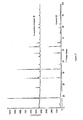
- FIG. 3 an X-ray diffraction diagram of the lithium titanates obtained in Example 2 and Comparative Example 5 is shown in FIG. 3 .
- the average particle diameter was obtained by a laser light scattering method.
- the sulfur content in the lithium titanate was measured by X-ray fluorescence analysis.
- the chlorine content in the lithium titanate was measured by X-ray fluorescence analysis.
- the lithium titanates in Examples 1 to 5, and Comparative Examples 1 to 8 manufactured as described above were used as an active material.
- 70 parts by weight of the lithium titanate, 15 parts by weight of acetylene black as a conductive aid, 15 parts by weight of polyvinylidene fluoride (PVDF) as a binder, and n-methyl-2-pyrrolidone as a solvent were mixed to prepare an electrode mixture.
- This electrode mixture was applied to aluminum foil by a doctor blade method, with a thickness of 0.01 g/cm 2 after drying. Then, after vacuum drying at 150°C for 24 hours, the film was roll-pressed to 80% of the thickness of the film immediately after the application, and punched with an area of 1 cm 2 to obtain a negative electrode of a coin battery.
- a lithium secondary battery was fabricated.
- a lithium metal plate was used as the positive electrode.
- a copper plate was used as the current collector.
- a porous polypropylene film was used as the separator.
- a solution of LiPF 6 dissolved at 1 mol/L in an equal volume mixed liquid of ethylene carbonate and ethyl methyl carbonate was used as the electrolyte.
- the method for manufacturing lithium titanate for a lithium secondary battery active material comprises the first step of preparing a mixture comprising a lithium compound, and anatase type titanium dioxide obtained by a sulfuric acid method and having a specific surface area of 10.0 to 50.0 m 2 /g as measured by the BET method; the second step of pressure-molding the above mixture to prepare a reaction precursor; the third step of firing the above reaction precursor; and the fourth step of pulverizing the fired product obtained in the above third step by a gas-flow pulverizer to obtain lithium titanate represented by the general formula: Li x Ti y O 12 , where the Li/Ti atomic ratio is in the range of 0.70 to 0.90, 3.0 ⁇ x ⁇ 5.0, and 4.0 ⁇ y ⁇ 6.0, having an average particle diameter of 3.0 ⁇ m or less, and therefore, lithium titanate that is a single phase by X-rays is obtained.
Landscapes
- Chemical & Material Sciences (AREA)
- Engineering & Computer Science (AREA)
- Chemical Kinetics & Catalysis (AREA)
- Electrochemistry (AREA)
- General Chemical & Material Sciences (AREA)
- Manufacturing & Machinery (AREA)
- Inorganic Chemistry (AREA)
- Organic Chemistry (AREA)
- Materials Engineering (AREA)
- Life Sciences & Earth Sciences (AREA)
- Environmental & Geological Engineering (AREA)
- General Life Sciences & Earth Sciences (AREA)
- Geology (AREA)
- Battery Electrode And Active Subsutance (AREA)
- Inorganic Compounds Of Heavy Metals (AREA)
Abstract
The present invention provides a method for manufacturing lithium titanate for a lithium secondary battery active material that can provide excellent rapid charge and discharge characteristics to a lithium secondary battery when used as a negative electrode active material, by which method lithium titanate that is a single phase by X-rays can be obtained. The method for manufacturing lithium titanate for a lithium secondary battery active material according to the present invention comprises a first step of preparing a mixture comprising a lithium compound, and anatase type titanium dioxide obtained by a sulfuric acid method and having a specific surface area of 10.0 to 50.0 m2/g as measured by a BET method; a second step of pressure-molding the mixture to prepare a reaction precursor; a third step of firing the reaction precursor; and a fourth step of pulverizing a fired product obtained in the third step by a gas-flow pulverizer to obtain lithium titanate represented by a general formula: LixTiyO12, having an average particle diameter of 3.0 µm or less.
Description
- The present invention relates to a method for manufacturing lithium titanate for a lithium secondary battery active material.
- A lithium secondary battery using Li4Ti5O12 among lithium titanates, lithium-titanium complex oxides, as an electrode active material has a voltage of about 1.55 V based on lithium, and the volume expansion of the lithium secondary battery during charge and discharge is small. Thus, the lithium secondary battery is known to have a long life. Therefore, this lithium titanate is a material that receives particular attention in the fields of hybrid electric vehicles (HEVs), and large batteries, such as a stationary type. In addition, this lithium titanate can be used for a positive electrode and a negative electrode, and is particularly promising as a negative electrode active material.
- A method of, using lithium hydroxide or lithium carbonate as a lithium compound, firing a mixture of this lithium compound and titanium oxide at 700°C to 1600°C is disclosed as a method for manufacturing lithium titanate (for example, see Japanese Patent Laid-Open No.
6-275263
In addition, a method of dissolving all or part of a lithium compound in a solvent by mixing titanium oxide and the solvent, drying the mixture to prepare a mixed solid, calcining this mixed solid to prepare a composition composed of TiO2 and Li2TiO3, or a composition composed of TiO2, Li2TiO3, and Li4Ti5O12, and then subjecting this composition to main firing is disclosed as a method for manufacturing lithium titanate (for example, see Japanese Patent Laid-Open No.2001-213622
Further, a method of compression-molding a mixture of a lithium compound and titanium oxide, calcining the obtained molded product to prepare a composition composed of TiO2 and Li2TiO3, or a composition composed of TiO2, Li2TiO3, and Li4Ti5O12, and then subjecting this composition to main firing is disclosed as a method for manufacturing lithium titanate (for example, see Japanese Patent Laid-Open No.2000-302547 - However, a problem of the above methods for manufacturing lithium titanate has been that it is difficult to obtain lithium titanate that is a single phase by X-rays. In addition, the development of lithium titanate that can provide excellent rapid charge and discharge characteristics to a lithium secondary battery when used as a negative electrode active material has been desired.
- Accordingly, it is an object of the present invention to provide a method for manufacturing lithium titanate for a lithium secondary battery active material that can provide excellent rapid charge and discharge characteristics to a lithium secondary battery when used as a negative electrode active material, by which method lithium titanate that is a single phase by X-rays, in other words, detected as a single phase in X-ray diffraction analysis, can be obtained.
- In order to solve the above problems, the present inventors have diligently studied to find that lithium titanate that is a single phase by X-rays can be obtained by pressure-molding a mixture comprising anatase type titanium dioxide having a specific surface area in a particular range as measured by the BET method and a lithium compound and then firing this mixture, that lithium titanate with a sharp particle size distribution is obtained by pulverizing the fired product of lithium titanate by a gas-flow pulverizer, and further that a lithium secondary battery comprising the obtained lithium titanate as a negative electrode active material particularly has excellent rapid charge and discharge characteristics, leading to the completion of the present invention.
- Specifically, a method for manufacturing lithium titanate for a lithium secondary battery active material according to the present invention comprises a first step of preparing a mixture comprising a lithium compound, and anatase type titanium dioxide obtained by a sulfuric acid method and having a specific surface area of 10.0 to 50.0 m2/g as measured by a BET method; a second step of pressure-molding the mixture to prepare a reaction precursor; a third step of firing the reaction precursor; and a fourth step of pulverizing a fired product obtained in the third step by a gas-flow pulverizer to obtain lithium titanate represented by a general formula: LixTiYO12, where a Li/Ti atomic ratio is in the range of 0.70 to 0.90, 3.0 ≤ x ≤ 5.0, and 4.0 ≤ y ≤ 6.0, having an average particle diameter of 3.0 µm or less.
- The mixture prepared in the first step preferably has a specific volume of 1.30 ml/g or more.
In the third step, a firing temperature of the reaction precursor is preferably 600°C or more and 900°C or less.
The gas-flow pulverizer is preferably a jet mill. - The anatase type titanium dioxide preferably has a sulfuric acid radical content of 100 ppm or more and 2500 ppm or less in terms of sulfur atoms.
The anatase type titanium dioxide preferably has a chlorine content of 1500 ppm or less. - The method for manufacturing lithium titanate for a lithium secondary battery active material according to the present invention comprises a first step of preparing a mixture comprising a lithium compound, and anatase type titanium dioxide obtained by a sulfuric acid method and having a specific surface area of 10.0 to 50.0 m2/g as measured by a BET method; a second step of pressure-molding the mixture to prepare a reaction precursor; a third step of firing the reaction precursor; and a fourth step of pulverizing a fired product obtained in the third step by a gas-flow pulverizer to obtain lithium titanate represented by a general formula: LixTiyO12, where a Li/Ti atomic ratio is in the range of 0.70 to 0.90, 3.0 ≤ x ≤ 5.0, and 4.0 ≤ y ≤ 6.0, having an average particle diameter of 3.0 µm or less, and therefore, lithium titanate that is a single phase by X-rays is obtained. In addition, a lithium secondary battery using this lithium titanate as a negative electrode active material exhibits particularly excellent rapid charge and discharge characteristics.
-
-
FIG. 1 is a particle size distribution of the lithium titanate obtained in Example 5, measured by a laser scattering particle size distribution measurement apparatus; -
FIG. 2 is a particle size distribution of lithium titanate obtained in Comparative Example 3, measured by the laser scattering particle size distribution measurement apparatus; and -
FIG. 3 is an X-ray diffraction diagram of lithium titanate obtained in Example 2 and comparative Example 5. - The best mode of the method for manufacturing lithium titanate for a lithium secondary battery active material according to the present invention will be described.
This mode will be specifically described for better understanding of the spirit of the invention, and does not limit the present invention unless otherwise specified. - The method for manufacturing lithium titanate for a lithium secondary battery active material according to the present invention is a method comprising the first step of preparing a mixture comprising a lithium compound, and anatase type titanium dioxide obtained by a sulfuric acid method and having a specific surface area of 10.0 to 50.0 m2/g as measured by the BET method; the second step of pressure-molding the above mixture to prepare a reaction precursor; the third step of firing the above reaction precursor; and the fourth step of pulverizing the fired product obtained in the above third step by a gas-flow pulverizer to obtain lithium titanate represented by the general formula: LixTiyO12, where the Li/Ti atomic ratio is in the range of 0.70 to 0.90, 3.0 ≤ x ≤ 5.0, and 4.0 ≤ y ≤ 6.0, having an average particle diameter of 3.0 µm or less.
- In the method for manufacturing lithium titanate for a lithium secondary battery active material according to the present invention, the first step is the step of mixing a predetermined amount of a lithium compound and anatase type titanium dioxide obtained by a sulfuric acid method and having a specific surface area of 10.0 to 50.0 m2/g as measured by the BET method to prepare a uniform mixture comprising these lithium compound and anatase type titanium dioxide.
- In the first step, for example, inorganic lithium compounds, such as lithium hydroxide, lithium carbonate, and lithium nitrate, are preferably used as the lithium compound. Among these lithium compounds, lithium carbonate is preferred because it is industrially easily available and is inexpensive.
The lithium compound preferably has an average particle diameter of 1.0 µm or more and 20 µm or less, more preferably 1.0 µm or more and 10.0 µm or less, as a value obtained by a laser light scattering method.
The reason why the lithium compound more preferably has an average particle diameter of 1.0 µm or more and 20 µm or less as a value obtained by a laser light scattering method is that if the lithium compound has an average particle diameter in this range, a lithium secondary battery comprising, as a component, lithium titanate manufactured using this lithium compound, particularly a lithium secondary battery comprising the lithium titanate as a negative electrode active material, has improved rapid charge and discharge performance. - Titanium dioxide is usually industrially manufactured by a chlorine method or a sulfuric acid method. In the present invention, titanium dioxide manufactured by a sulfuric acid method is used. The sulfuric acid method in the method for manufacturing titanium dioxide is a method of dissolving ilmenite ore (FeTiO3), a raw material, in sulfuric acid to make the titanium portion a soluble salt, then performing hydrolysis, precipitating the hydrolysate as metatitanic acid, a precursor of titanium dioxide, and firing this metatitanic acid to manufacture titanium dioxide.
The crystal structure of titanium dioxide is broadly divided into an anatase type and a rutile type. In the present invention, the anatase type is used in terms of particularly good reactivity. In the present invention, the content of the anatase type in titanium dioxide should be 90% by weight or more. - In the present invention, anatase type titanium dioxide having a specific surface area of 10.0 to 50.0 m2/g as measured by the BET method is used, and anatase type titanium dioxide having a specific surface area of 20.0 to 40.0 m2/g is preferably used.
The reason why anatase type titanium dioxide having a specific surface area of 10.0 to 50.0 m2/g as measured by the BET method is used is that if the anatase type titanium dioxide has a specific surface area of less than 10.0 m2/g as measured by the BET method, it is difficult to obtain single-phase lithium titanate, and a lithium secondary battery comprising, as a component, lithium titanate manufactured using this anatase type titanium dioxide has poor rapid charge and discharge performance, and on the other hand, if the anatase type titanium dioxide has a specific surface area of more than 50.0 m2/g as measured by the BET method, on the contrary, uniform dispersion is difficult, and a lithium secondary battery comprising, as a component, lithium titanate manufactured using this anatase type titanium dioxide has impaired high-temperature storage characteristics. - The anatase type titanium dioxide preferably has an average particle diameter of 3.0 µm or less, more preferably 0.10 µm or more and 3.0 µm or less, as a value obtained by a laser light scattering method.
The reason why the anatase type titanium dioxide more preferably has an average particle diameter of 0.10 µm or more and 3.0 µm or less as a value obtained by a laser light scattering method is that if the anatase type titanium dioxide has an average particle diameter in this range, a lithium secondary battery comprising, as a component, lithium titanate manufactured using this anatase type titanium dioxide, particularly a lithium secondary battery comprising the lithium titanate as a negative electrode active material, has improved rapid charge and discharge performance. - Sulfuric acid radicals are irreversibly mixed in such anatase type titanium dioxide as sulfur atoms during manufacture, and their content is preferably 100 ppm or more and 2500 ppm or less, and more preferably 100 ppm or more and 2000 ppm or less.
In the present invention, by actively containing sulfuric acid radicals in the above range in lithium titanate, the final product, the rapid charge and discharge characteristics of a lithium secondary battery comprising this lithium titanate as a negative electrode active material can be further improved. - In addition, the anatase type titanium dioxide preferably has a chlorine content of 1500 ppm or less, more preferably 500 ppm or less, and further preferably 100 ppm or less.
The reason why the chlorine content in the anatase type titanium dioxide is 1500 ppm or less is that if the titanium dioxide has a chlorine content in this range, a lithium secondary battery comprising, as a component, lithium titanate manufactured using this anatase type titanium dioxide, particularly a lithium secondary battery comprising the lithium titanate as a negative electrode active material, has improved rapid charge and discharge performance. - In addition, the mixing ratio of the lithium compound to the anatase type titanium dioxide is preferably in the range of 0.70 to 0.90, more preferably in the range of 0.75 to 0.85, as the molar ratio of lithium atoms in the lithium compound to titanium atoms in the anatase type titanium dioxide (Li/Ti).
The reason why the mixing ratio of the lithium compound to the anatase type titanium dioxide is preferably in the range of 0.70 to 0.90 as the molar ratio of lithium atoms in the lithium compound to titanium atoms in the anatase type titanium dioxide (Li/Ti) is that if the mixing ratio is in this range, a lithium secondary battery comprising, as a component, lithium titanate manufactured using the lithium compound and anatase type titanium dioxide has improved discharge capacity. In addition, if the mixing ratio of the lithium compound to the anatase type titanium dioxide is less than 0.70 or more than 0.90 as the above molar ratio (Li/Ti), a lithium secondary battery comprising, as a component, lithium titanate manufactured using the lithium compound and anatase type titanium dioxide, particularly a lithium secondary battery comprising the lithium titanate as a negative electrode active material, has reduced discharge capacity. - The method for mixing the lithium compound, and the anatase type titanium dioxide may be either a wet mixing method of mixing both materials in a solvent, or a dry mixing method of mixing both materials without using a solvent, as long as a uniform mixture can be prepared. But, the obtained mixture preferably has a specific volume of 1.30 ml/g or more, more preferably 1.30 ml/g or more and 2.00 ml/g or less.
The reason why the mixture preferably has a specific volume of 1.30 ml/g or more is that the firing of the reaction precursor (the third step) described later can be performed at a low temperature of 600°C or more and 900°C or less, and therefore, there is no grain growth due to sintering, and fine lithium titanate that is a single phase by X-rays is obtained. - The specific volume in the present invention is obtained by placing 10 g of a sample in a 50 ml graduated cylinder, tapping 500 times, allowing the cylinder to stand, then reading the volume, and calculating the following formula (1), according to a tapping method, based on the apparent density or apparent specific volume method described in JIS-K-5101.

where F represents the mass (g) of the treated sample in the receiver, and V represents the volume (ml) of the sample after the tapping. - In the method for manufacturing lithium titanate for a lithium secondary battery active material according to the present invention, the second step is the step of pressure-molding the uniform mixture prepared in the first step to prepare a reaction precursor.
- The pressure molding machine for pressure-molding the uniform mixture prepared in the first step is not particularly limited as long as it can apply pressure. For example, a tableting machine, a briquetting machine, a roller compactor, and the like are preferably used.
- The molding pressure in the pressure molding is different according to the pressure molding machine, the amount of materials fed, and the like, and is not particularly limited. But, it is preferably 5 MPa or more and 200 MPa or less, and more preferably 5 MPa or more and 180 MPa or less.
The reason why the molding pressure in the pressure molding is preferably 5 MPa or more and 200 MPa or less is that even if the firing of the reaction precursor (the third step) described later is performed at a low temperature of 600°C or more and 900°C or less, fine lithium titanate that is a single phase by X-rays can be obtained. - According to this second step, it is possible to increase the contact area between the lithium compound and the anatase type titanium dioxide to further enhance the reactivity. Therefore, the firing of the reaction precursor (the third step) described later can be performed at a low temperature of 600°C or more and 900°C or less, and therefore, there is no grain growth due to sintering, and fine lithium titanate that is a single phase by X-rays is obtained.
- In the method for manufacturing lithium titanate for a lithium secondary battery active material according to the present invention, the third step is the step of firing the reaction precursor prepared in the second step to obtain a fired product of lithium titanate.
- In this third step, the firing temperature of the reaction precursor is preferably 600°C or more and 900°C or less, and more preferably 650°C or more and 850°C or less.
The reason why the firing temperature of the reaction precursor is preferably 600°C or more and 900°C or less is that if the firing temperature is less than 600°C, the reaction of the lithium compound with the anatase type titanium dioxide is not sufficient, and it is difficult to obtain lithium titanate that is a single phase by X-rays, and on the other hand, if the firing temperature is more than 900°C, the sintering and grain growth of the lithium titanate occur, it is difficult to obtain fine lithium titanate even if pulverization treatment is performed in the fourth step described later, and further, the rapid charge and discharge performance of a lithium secondary battery comprising this lithium titanate as a negative electrode active material tends to be impaired. - In addition, the firing time is 1 hour or more, and preferably 1 hour or more and 10 hours or less.
Further, the firing atmosphere is not particularly limited, and the firing of the reaction precursor can be performed in the air, in an oxygen atmosphere, or in an inert gas atmosphere.
In the present invention, the firing may be performed any number of times, as desired. In addition, for the purpose of making the powder properties uniform, one fired once may be pulverized and then fired again.
Then, after the firing, the fired product of lithium titanate is appropriately cooled and recovered. - In the method for manufacturing lithium titanate for a lithium secondary battery active material according to the present invention, the fourth step is the step of pulverizing the fired product obtained in the above third step by a gas-flow pulverizer to obtain lithium titanate represented by the general formula: LixTiyO12, where the Li/Ti atomic ratio is in the range of 0.70 to 0.90, 3.0 ≤ x ≤ 5.0, and 4.0 ≤ y ≤ 6.0, having an average particle diameter of 3.0 µm or less.
- The pulverization treatment by the gas-flow pulverizer is a method of releasing a high-pressure inert gas from a narrow nozzle to generate a high-speed gas flow, which accelerates a roughly pulverized powder to cause the collision of the roughly pulverized powder with each other and the collision of the roughly pulverized powder with a target or a container wall for pulverization.
In this fourth step, by performing pulverization treatment by the gas-flow pulverizer, the pulverized particles after the pulverization treatment are dispersed in the gas flow without aggregation, compared with the case of using a medium pulverizer, such as a ball mill, and therefore, one with a sharp particle size distribution is obtained. In addition, the pulverization treatment by the gas-flow pulverizer also has an advantage that due to weak impact force, such as the collision of the particles with each other, or the collision of the particles with the wall, the distortion of the crystal structure can be reduced, compared with one in which a pulverization raw material is put into the strong collision of mediums, such as a medium mill, and destroyed. - The conditions of the pulverization treatment by the gas-flow pulverizer can be controlled by adjusting the ratio of the gas flow supply to the raw material supply. This ratio of the gas flow supply to the raw material supply is different according to the type of the pulverizer used, but should be determined by appropriately selecting optimal conditions so that lithium titanate having the desired particle diameter is obtained.
- Examples of the gas-flow pulverizer include a jet mill, a collision plate type gas-flow pulverizer, a flash dryer, an elbow jet, a turbo classifier, and a free pulverizer. Among these, a jet mill is particularly preferred in terms of a little contamination.
- The lithium titanate obtained by pulverizing the fired product has an average particle diameter of 3.0 µm or less, preferably 0.10 µm or more and 3.0 µm or less, as a value obtained by a laser light scattering method.
The reason why the lithium titanate obtained by the pulverization treatment has an average particle diameter of 3.0 µm or less as a value obtained by a laser light scattering method is that if the lithium titanate has an average particle diameter in this range, a lithium secondary battery comprising this lithium titanate as a negative electrode active material has improved rapid charge and discharge performance, and on the other hand, if the lithium titanate after the pulverization treatment has an average particle diameter of more than 3.0 µm as a value obtained by a laser light scattering method, the lithium secondary battery has decreased rapid charge and discharge performance. - In this manner, according to the present invention, lithium titanate for a lithium secondary battery active material is obtained. In the present invention, classification may be performed as required.
The lithium titanate for a lithium secondary battery active material obtained by the present invention is lithium titanate that is a single phase by X-rays, and is represented by the following general formula (2):
LixTiyO12 (2)
where the Li/Ti atomic ratio is in the range of 0.70 to 0.90, preferably 0.75 to 0.85, 3.0 ≤ x ≤ 5.0, preferably 3.5 ≤ x ≤ 4.5, and 4.0 ≤ y ≤ 6.0, preferably 4.5 ≤ y ≤ 5.5. - In addition, the lithium titanate for a lithium secondary battery active material obtained by the present invention preferably has an average particle diameter of 3.0 µ or less, more preferably 0.10 µm or more and 3.0 µm or less, as a value obtained by a laser light scattering method. In addition, this lithium titanate for a lithium secondary battery active material preferably has a specific surface area of 1.0 to 10.0 m2/g, more preferably 1.0 to 7.0 m2/g, as measured by the BET method. In addition, this lithium titanate for a lithium secondary battery active material preferably has a sulfuric acid radical content of 100 ppm or more and 2500 ppm or less, more preferably 100 ppm or more and 2000 ppm or less, in terms of sulfur atoms. Further, this lithium titanate for a lithium secondary battery active material preferably has a chlorine content of 1500 ppm or less, more preferably 100 ppm or less, and further preferably 100 ppm or less.
- The lithium titanate for a lithium secondary battery active material obtained by the present invention can be used for either a positive electrode active material or a negative electrode active material, but is preferably used as a negative electrode active material because a lithium secondary battery using this lithium titanate as a negative electrode active material exhibits particularly excellent rapid charge and discharge characteristics.
In addition, a lithium secondary battery using the lithium titanate for a lithium secondary battery active material obtained by the present invention can be preferably used for hybrid electric vehicles (HEVs), and large batteries, such as a stationary type, and is also preferably used for, in addition, for example, electronic equipment, such as notebook computers, laptop computers, pocket word processors, cellular phones, cordless handsets, portable CD players, radios, liquid crystal televisions, backup power supplies, electric shavers, memory cards, and camcorders, and consumer electronic equipment, such as game equipment. - The present invention will be more specifically described below by Examples and Comparative Examples, but the present invention is not limited to the following Examples.
- Commercial titanium dioxides shown in Table 1 were used.
All anatase type titanium dioxides used in the Examples had an anatase type content of 90% by weight or more.
The average particle diameter was obtained by a laser light scattering method. In addition, after the sample was dissolved in an acid, the sulfur atom content in the titanium dioxide was measured by ICP-AES (inductively coupled plasma-atomic emission spectroscopy). In addition, the chlorine content in the titanium dioxide was measured by an X-ray fluorescence analysis method. -
[Table 1] Manufacturing method Crystal type Average particle diameter (µm) BET specific surface area (m2/g) Sulfur content (ppm) Chlorine content (ppm) Sample A Sulfuric acid method Anatase type 0.31 29.8 130 20 Sample B Sulfuric acid method Anatase type 0.56 25.4 540 15 Sample C Sulfuric acid method Anatase type 0.92 32.5 1402 60 Sample D Sulfuric acid method Anatase type 0.32 35.4 1850 1200 Sample E Chlorine method Anatase type 0.12 49.2 13 2651 Sample F Sulfuric acid method Rutile type 1.21 21.0 1620 501 Sample G Sulfuric acid method Anatase type 0.15 51.2 3281 1222 Sample H Chlorine method Rutile type 0.95 15.0 8 1820 Sample I Sulfuric acid method Anatase type 0.37 9.2 545 20 - Titanium dioxide (the sample A shown in Table 1) and lithium carbonate (Li2CO3, average particle diameter: 9.8 µm) were mixed so that the molar ratio of lithium atoms in the lithium carbonate to titanium atoms in the titanium dioxide (Li/Ti) was 0.800, and dry mixing by a mixer was repeatedly performed to prepare a uniform mixture having a specific volume shown in Table 2 (the first step).
Then, the obtained mixture was pressure-molded at a pressure of 150 MPa, using a hand press, to prepare a pellet-like reaction precursor (the second step).
Then, the reaction precursor was fired in the air atmosphere at 800°C for 3 hours and cooled, and then, the fired product was recovered (the third step).
Then, the fired product was pulverized by a jet mill (the fourth step). The obtained pulverized product was identified by an X-ray diffractometer (XRD). This pulverized product was identified as Li4Ti5O12 having a spinel structure.
The specific volume of the mixture obtained in the first step was obtained by placing 10 g of the mixture of titanium dioxide and lithium carbonate in a 50 ml graduated cylinder, tapping 500 times, allowing the cylinder to stand, then reading the volume, and calculating the following formula (3), according to a tapping method, based on the apparent density or apparent specific volume method described in JIS-K-5101.
where F represents the mass (g) of the treated sample in the receiver, and V represents the volume (ml) of the sample after the tapping. - Titanium dioxide (the sample B shown in Table 1) and lithium carbonate (Li2CO3, average particle diameter: 9.8 µm) were mixed so that the molar ratio of lithium atoms in the lithium carbonate to titanium atoms in the titanium dioxide (Li/Ti) was 0.800, and dry mixing by the mixer was repeatedly performed to prepare a uniform mixture having a specific volume shown in Table 2 (the first step).
Then, the obtained mixture was pressure-molded at a pressure of 150 MPa, using the hand press, to prepare a pellet-like reaction precursor (the second step).
Then, the reaction precursor was fired in the air atmosphere at 800°C for 5 hours and cooled, and then, the fired product was recovered (the third step).
Then, the fired product was pulverized by the jet mill (the fourth step). The obtained pulverized product was identified by the X-ray diffractometer. This pulverized product was identified as Li4Ti5O12 having a spinel structure.
The specific volume of the mixture obtained in the first step was obtained by placing 10 g of the mixture of titanium dioxide and lithium carbonate in a 50 ml graduated cylinder, tapping 500 times, allowing the cylinder to stand, then reading the volume, and calculating the above formula (3), according to the tapping method, based on the apparent density or apparent specific volume method described in JIS-K-5101. - Titanium dioxide (the sample C shown in Table 1) and lithium carbonate (Li2CO3, average particle diameter: 9.8 µm) were mixed so that the molar ratio of lithium atoms in the lithium carbonate to titanium atoms in the titanium dioxide (Li/Ti) was 0.800, and dry mixing by the mixer was repeatedly performed to prepare a uniform mixture having a specific volume shown in Table 2 (the first step).
Then, the obtained mixture was pressure-molded at a pressure of 150 MPa, using the hand press, to prepare a pellet-like reaction precursor (the second step).
Then, the reaction precursor was fired in the air atmosphere at 700°C for 5 hours and cooled, and then, the fired product was recovered (the third step).
Then, the fired product was pulverized by the jet mill (the fourth step). The obtained pulverized product was identified by the X-ray diffractometer. This pulverized product was identified as Li4Ti5O12 having a spinel structure.
The specific volume of the mixture obtained in the first step was obtained by placing 10 g of the mixture of titanium dioxide and lithium carbonate in a 50 ml graduated cylinder, tapping 500 times, allowing the cylinder to stand, then reading the volume, and calculating the above formula (3), according to the tapping method, based on the apparent density or apparent specific volume method described in JIS-K-5101. - Titanium dioxide (the sample D shown in Table 1) and lithium carbonate (Li2CO3, average particle diameter: 9.8 µm) were mixed so that the molar ratio of lithium atoms in the lithium carbonate to titanium atoms in the titanium dioxide (Li/Ti) was 0.800, and dry mixing by the mixer was repeatedly performed to prepare a uniform mixture having a specific volume shown in Table 2 (the first step).
Then, the obtained mixture was pressure-molded at a pressure of 150 MPa, using the hand press, to prepare a pellet-like reaction precursor (the second step).
Then, the reaction precursor was fired in the air atmosphere at 750°C for 10 hours and cooled, and then, the fired product was recovered (the third step).
Then, the fired product was pulverized by the jet mill (the fourth step). The obtained pulverized product was identified by the X-ray diffractometer. This pulverized product was identified as Li4Ti5O12 having a spinel structure.
The specific volume of the mixture obtained in the first step was obtained by placing 10 g of the mixture of titanium dioxide and lithium carbonate in a 50 ml graduated cylinder, tapping 500 times, allowing the cylinder to stand, then reading the volume, and calculating the above formula (3), according to the tapping method, based on the apparent density or apparent specific volume method described in JIS-K-5101. - Titanium dioxide (the sample D shown in Table 1) and lithium carbonate (Li2CO3, average particle diameter: 9.8 µm) were mixed so that the molar ratio of lithium atoms in the lithium carbonate to titanium atoms in the titanium dioxide (Li/Ti) was 0.800, and dry mixing by the mixer was repeatedly performed to prepare a uniform mixture having a specific volume shown in Table 2 (the first step).
Then, the obtained mixture was pressure-molded at a pressure of 150 MPa, using the hand press, to prepare a pellet-like reaction precursor (the second step).
Then, the reaction precursor was fired in the air atmosphere at 770°C for 7 hours and cooled, and then, the fired product was recovered (the third step).
Then, the fired product was pulverized by the jet mill (the fourth step). The obtained pulverized product was identified by the X-ray diffractometer. This pulverized product was identified as Li4Ti5O12 having a spinel structure.
The specific volume of the mixture obtained in the first step was obtained by placing 10 g of the mixture of titanium dioxide and lithium carbonate in a 50 ml graduated cylinder, tapping 500 times, allowing the cylinder to stand, then reading the volume, and calculating the above formula (3), according to the tapping method, based on the apparent density or apparent specific volume method described in JIS-K-5101. - Li4Ti5O12 having a spinel structure was obtained as in Example 1, except that the sample E shown in Table 1 was used as titanium dioxide.
- Li4Ti5O12 having a spinel structure was obtained as in Example 1, except that the sample F shown in Table 1 was used as titanium dioxide.
- Li4Ti5O12 having a spinel structure was obtained as in Example 1, except that the second step was not performed.
- Li4Ti5O12 having a spinel structure was obtained as in Example 1, except that the fired product was pulverized using a pin mill, instead of the jet mill, in the fourth step.
- Li4Ti5O12 having a spinel structure was obtained as in Example 1, except that the sample B shown in Table 1 was used as titanium dioxide and the fired product was pulverized using a hammer mill, instead of the jet mill, in the fourth step.
- Li4Ti5O12 having a spinel structure was obtained as in Example 1, except that the sample G shown in Table 1 was used as titanium dioxide.
- Li4Ti5O12 having a spinel structure was obtained as in Example 1, except that the sample H shown in Table 1 was used as titanium dioxide.
- Li4Ti5O12 having a spinel structure was obtained as in Example 1, except that the sample I shown in Table 1 was used as titanium dioxide.
-
[Table 2] Type of TiO2 sample used Li/Ti feed molar ratio Specific volume of mixture (ml/g) Pulverizer used Example 1 A 0.800 1.32 Jet mill Example 2 B 0.800 1.60 Jet mill Example 3 C 0.800 1.98 Jet mill Example 4 D 0.800 1.55 Jet mill Example 5 D 0.800 1.75 Jet mill Comparative Example 1 E 0.800 1.28 Jet mill Comparative Example 2 F 0.800 1.21 Jet mill Comparative Example 3 A 0.800 1.25 Jet mill Comparative Example 4 A 0.800 1.26 Pin mill Comparative Example 5 B 0.800 1.20 Hammer mill Comparative Example 6 G 0.800 1.25 Jet mill Comparative Example 7 H 0.800 1.17 Jet mill Comparative Example 8 I 0.800 1.31 Jet mill - The average particle diameter, the specific surface area by the BET method, the sulfur content, and the chlorine content were measured for the lithium titanates obtained in Examples 1 to 5 and Comparative Examples 1 to 8. In addition, X-ray diffraction analysis was performed, using Cu-Kα rays as a source, for the lithium titanates obtained in Examples 1 to 5 and Comparative Examples 1 to 8. The results of these are shown in Table 3.
In addition, the particle size distribution was measured for the lithium titanates obtained in Examples 1 to 5. As a result, all showed a sharp particle size distribution.
A particle size distribution of the lithium titanate obtained in Example 5, measured by a laser scattering particle size distribution measurement apparatus, is shown inFIG. 1 . In addition, a particle size distribution of the lithium titanate obtained in Comparative Example 3, measured by the laser scattering particle size distribution measurement apparatus, is shown inFIG. 2 .
In addition, an X-ray diffraction diagram of the lithium titanates obtained in Example 2 and Comparative Example 5 is shown inFIG. 3 .
The average particle diameter was obtained by a laser light scattering method.
In addition, the sulfur content in the lithium titanate was measured by X-ray fluorescence analysis.
In addition, the chlorine content in the lithium titanate was measured by X-ray fluorescence analysis. -
[Table 3] Average particle diameter (µm) BET specific surface area (m 2/g) Sulfur content (ppm) Chlorine content (ppm) Results of X-ray diffraction Example 1 2.5 3.5 119 18 Single phase spinel Example 2 0.8 5.5 496 14 Single phase spinel Example 3 0.2 8.9 1304 55 Single phase spinel Example 4 1.2 4.2 1698 1102 Single phase spinel Example 5 0.6 4.5 1698 1102 Single phase spinel Comparative Example 1 1.3 2.0 12 2434 Single phase spinel Comparative Example 2 2.2 3.2 1405 460 Containing single phase spinel and rutile type TiO2 Comparative Example 3 2.1 2.1 119 18 Containing single phase spinel and rutile type TiO2 Comparative Example 4 2.8 2.0 119 18 Single phase spinel Comparative Example 5 5.1 6.0 496 14 Single phase spinel Comparative Example 6 2.4 4.2 3012 1122 Single phase spinel Comparative Example 7 2.1 1.1 7 1671 Containing single phase spinel and rutile type TiO2 Comparative Example 8 3.8 1.0 505 18 Containing single phase spinel and rutile type TiO3 - The lithium titanates in Examples 1 to 5, and Comparative Examples 1 to 8 manufactured as described above were used as an active material. 70 parts by weight of the lithium titanate, 15 parts by weight of acetylene black as a conductive aid, 15 parts by weight of polyvinylidene fluoride (PVDF) as a binder, and n-methyl-2-pyrrolidone as a solvent were mixed to prepare an electrode mixture.
This electrode mixture was applied to aluminum foil by a doctor blade method, with a thickness of 0.01 g/cm2 after drying.
Then, after vacuum drying at 150°C for 24 hours, the film was roll-pressed to 80% of the thickness of the film immediately after the application, and punched with an area of 1 cm2 to obtain a negative electrode of a coin battery.
Using this negative electrode, and members, such as a separator, a positive electrode, a current collector, fittings, external terminals, and an electrolyte, a lithium secondary battery was fabricated.
A lithium metal plate was used as the positive electrode. A copper plate was used as the current collector. A porous polypropylene film was used as the separator. A solution of LiPF6 dissolved at 1 mol/L in an equal volume mixed liquid of ethylene carbonate and ethyl methyl carbonate was used as the electrolyte. - For each coin battery fabricated as described above, a cycle in which the coin battery was charged to 1.0 V and then discharged to 2.0 V at constant current at a current density of 0.2 C at 25°C was repeated three times.
Then, the charge and discharge cycle was repeated three times at each of discharge current densities of 0.5 C, 1.0 C, and 2.0 C, and each highest discharge capacity was taken as discharge capacity at each current density. The results are shown in Table 5.
In the evaluation of this charge and discharge test, the insertion reaction of lithium into the negative electrode active material was defined as charge, and the elimination reaction of lithium was defined as discharge. -
[Table 4] Highest discharge capacity 0.1C
(mAh/g)0.5C
(mAh/g)1.0C
(mAh/g)2.0C
(mAh/g)Example 1 165 162 151 140 Example 2 167 160 153 142 Example 3 168 158 152 144 Example 4 164 162 155 142 Example 5 169 154 157 148 Comparative Example 1 164 140 140 133 Comparative Example 2 164 145 132 134 Comparative Example 3 158 140 138 132 Comparative Example 4 165 141 138 135 Comparative Example 5 164 143 137 134 Comparative Example 6 166 148 138 132 Comparative Example 7 159 141 138 130 Comparative Example 8 158 140 137 130 - From the results in Table 4, it was found that the lithium secondary batteries using the lithium titanates in Examples 1 to 5 as the negative electrode active material had better rapid charge and discharge capacity than the lithium secondary batteries using the lithium titanates in Comparative Examples 1 to 8 as the negative electrode active material.
- The method for manufacturing lithium titanate for a lithium secondary battery active material according to the present invention comprises the first step of preparing a mixture comprising a lithium compound, and anatase type titanium dioxide obtained by a sulfuric acid method and having a specific surface area of 10.0 to 50.0 m2/g as measured by the BET method; the second step of pressure-molding the above mixture to prepare a reaction precursor; the third step of firing the above reaction precursor; and the fourth step of pulverizing the fired product obtained in the above third step by a gas-flow pulverizer to obtain lithium titanate represented by the general formula: LixTiyO12, where the Li/Ti atomic ratio is in the range of 0.70 to 0.90, 3.0 ≤ x ≤ 5.0, and 4.0 ≤ y ≤ 6.0, having an average particle diameter of 3.0 µm or less, and therefore, lithium titanate that is a single phase by X-rays is obtained. In addition, a lithium secondary battery using this lithium titanate as a negative electrode active material exhibits particularly excellent rapid charge and discharge characteristics.
Claims (6)
- A method for manufacturing lithium titanate for a lithium secondary battery active material, comprising:a first step of preparing a mixture comprising a lithium compound, and anatase type titanium dioxide obtained by a sulfuric acid method and having a specific surface area of 10.0 to 50.0 m2/g as measured by a BET method;a second step of pressure-molding the mixture to prepare a reaction precursor;a third step of firing the reaction precursor; anda fourth step of pulverizing a fired product obtained in the third step by a gas-flow pulverizer to obtain lithium titanate represented by a general formula: LixTiyO12, wherein a Li/Ti atomic ratio is in the range of 0.70 to 0.90, 3.0 ≤ x ≤ 5.0, and 4.0 ≤ y ≤ 6.0, having an average particle diameter of 3.0 µm or less.
- The method for manufacturing lithium titanate for a lithium secondary battery active material according to claim 1, wherein the mixture prepared in the first step has a specific volume of 1.30 ml/g or more.
- The method for manufacturing lithium titanate for a lithium secondary battery active material according to claim 1 or 2, wherein in the third step, a firing temperature of the reaction precursor is 600°C or more and 900°C or less.
- The method for manufacturing lithium titanate for a lithium secondary battery active material according to claim 1 or 2, wherein the gas-flow pulverizer is a jet mill.
- The method for manufacturing lithium titanate for a lithium secondary battery active material according to claim 1 or 2, wherein the anatase type titanium dioxide has a sulfuric acid radical content of 100 ppm or more and 2500 ppm or less in terms of sulfur atoms.
- The method for manufacturing lithium titanate for a lithium secondary battery active material according to claim 1 or 2, wherein the anatase type titanium dioxide has a chlorine content of 1500 ppm or less.
Applications Claiming Priority (1)
| Application Number | Priority Date | Filing Date | Title |
|---|---|---|---|
| JP2009268784A JP2011111361A (en) | 2009-11-26 | 2009-11-26 | Method for producing lithium titanate for lithium secondary battery active material |
Publications (1)
| Publication Number | Publication Date |
|---|---|
| EP2328212A1 true EP2328212A1 (en) | 2011-06-01 |
Family
ID=43446918
Family Applications (1)
| Application Number | Title | Priority Date | Filing Date |
|---|---|---|---|
| EP10192516A Withdrawn EP2328212A1 (en) | 2009-11-26 | 2010-11-25 | Method for manufacturing lithium titanate for lithium secondary battery active material |
Country Status (3)
| Country | Link |
|---|---|
| US (1) | US20110121226A1 (en) |
| EP (1) | EP2328212A1 (en) |
| JP (1) | JP2011111361A (en) |
Cited By (3)
| Publication number | Priority date | Publication date | Assignee | Title |
|---|---|---|---|---|
| EP2703355A4 (en) * | 2011-04-28 | 2015-01-14 | Ishihara Sangyo Kaisha | Process for manufacturing lithium titanium oxides |
| EP2725641A4 (en) * | 2011-06-21 | 2015-11-18 | Samsung Sdi Co Ltd | METHOD FOR PREPARING AN ELECTRODE ACTIVE MATERIAL FOR IMPROVING THE PROPERTIES OF A BATTERY AND LITHIUM RECHARGEABLE BATTERY COMPRISING THE ELECTRODE ACTIVE MATERIAL THUS PREPARED |
| US9428396B2 (en) | 2011-04-28 | 2016-08-30 | Ishihara Sangyo Kaisha, Ltd | Method for producing lithium titanate precursor, method for producing lithium titanate, lithium titanate, electrode active material, and electricity storage device |
Families Citing this family (9)
| Publication number | Priority date | Publication date | Assignee | Title |
|---|---|---|---|---|
| DE102011012713A1 (en) * | 2011-03-01 | 2012-09-06 | Süd-Chemie AG | Lithium-titanium mixed oxide |
| WO2012147856A1 (en) * | 2011-04-28 | 2012-11-01 | 石原産業株式会社 | Titanium raw material for lithium titanate production and method for producing lithium titanate using same |
| JP2013095646A (en) * | 2011-11-02 | 2013-05-20 | Taiyo Yuden Co Ltd | Lithium-titanium complex oxide, and battery electrode and lithium ion secondary battery using the same |
| EP2827413A4 (en) * | 2012-03-15 | 2016-03-02 | Toshiba Kk | Non-aqueous electrolyte secondary battery and battery pack |
| US9698430B2 (en) * | 2012-07-27 | 2017-07-04 | Toho Titanium Co., Ltd. | Lithium-lanthanum-titanium oxide sintered material, solid electrolyte containing the oxide, lithium air battery and all-solid lithium battery including the solid electrolyte, and method for producing the lithium-lanthanum-titanium oxide sintered material |
| JP6026165B2 (en) * | 2012-07-27 | 2016-11-16 | 東邦チタニウム株式会社 | Lithium titanate aggregate, lithium ion secondary battery and lithium ion capacitor using the same |
| CN103456939B (en) * | 2013-07-24 | 2015-12-23 | 湖南大学 | Metatitanic acid is utilized to prepare the method for the coated lithium titanate of lithium ion battery negative material carbon |
| JP6523629B2 (en) * | 2014-08-06 | 2019-06-05 | Fdk株式会社 | Nonaqueous electrolyte secondary battery and method of manufacturing nonaqueous electrolyte secondary battery |
| JP6220365B2 (en) * | 2015-06-30 | 2017-10-25 | 宇部興産株式会社 | Lithium titanate powder and active material for electrode of power storage device, and electrode sheet and power storage device using the same |
Citations (6)
| Publication number | Priority date | Publication date | Assignee | Title |
|---|---|---|---|---|
| JPH06275263A (en) | 1993-03-17 | 1994-09-30 | Matsushita Electric Ind Co Ltd | Method for manufacturing lithium secondary battery and negative electrode thereof |
| JP2000302547A (en) | 1999-02-16 | 2000-10-31 | Toho Titanium Co Ltd | Production of lithium titanate, lithium ion battery and its negative electrode |
| JP2001213623A (en) * | 2000-01-26 | 2001-08-07 | Toho Titanium Co Ltd | Process of producing lithium titanate, lithium ion battery and electrode thereof |
| JP2001213622A (en) | 2000-01-26 | 2001-08-07 | Toho Titanium Co Ltd | Process of producing lithium titanate, lithium ion battery and electrode thereof |
| JP2004037228A (en) * | 2002-07-03 | 2004-02-05 | Shiga Pref Gov | Titanium dioxide for measuring total nitrogen in water, method for producing the same, and method for measuring total nitrogen in water using the titanium dioxide |
| JP2005239461A (en) * | 2004-02-25 | 2005-09-08 | Ishihara Sangyo Kaisha Ltd | Method for manufacturing lithium titanate and lithium cell produced by using the lithium titanate |
Family Cites Families (1)
| Publication number | Priority date | Publication date | Assignee | Title |
|---|---|---|---|---|
| JP3120645B2 (en) * | 1993-12-21 | 2000-12-25 | ミノルタ株式会社 | Toner for developing electrostatic latent images |
-
2009
- 2009-11-26 JP JP2009268784A patent/JP2011111361A/en not_active Withdrawn
-
2010
- 2010-11-24 US US12/926,570 patent/US20110121226A1/en not_active Abandoned
- 2010-11-25 EP EP10192516A patent/EP2328212A1/en not_active Withdrawn
Patent Citations (6)
| Publication number | Priority date | Publication date | Assignee | Title |
|---|---|---|---|---|
| JPH06275263A (en) | 1993-03-17 | 1994-09-30 | Matsushita Electric Ind Co Ltd | Method for manufacturing lithium secondary battery and negative electrode thereof |
| JP2000302547A (en) | 1999-02-16 | 2000-10-31 | Toho Titanium Co Ltd | Production of lithium titanate, lithium ion battery and its negative electrode |
| JP2001213623A (en) * | 2000-01-26 | 2001-08-07 | Toho Titanium Co Ltd | Process of producing lithium titanate, lithium ion battery and electrode thereof |
| JP2001213622A (en) | 2000-01-26 | 2001-08-07 | Toho Titanium Co Ltd | Process of producing lithium titanate, lithium ion battery and electrode thereof |
| JP2004037228A (en) * | 2002-07-03 | 2004-02-05 | Shiga Pref Gov | Titanium dioxide for measuring total nitrogen in water, method for producing the same, and method for measuring total nitrogen in water using the titanium dioxide |
| JP2005239461A (en) * | 2004-02-25 | 2005-09-08 | Ishihara Sangyo Kaisha Ltd | Method for manufacturing lithium titanate and lithium cell produced by using the lithium titanate |
Non-Patent Citations (1)
| Title |
|---|
| JIE SHU: "Electrochemical behavior and stability of Li4Ti5O12 in a broad voltage window", JOURNAL OF SOLID STATE ELECTROCHEMISTRY ; CURRENT RESEARCH AND DEVELOPMENT IN SCIENCE AND TECHNOLOGY, SPRINGER, BERLIN, DE, vol. 13, no. 10, 11 November 2008 (2008-11-11), pages 1535 - 1539, XP019724279, ISSN: 1433-0768 * |
Cited By (4)
| Publication number | Priority date | Publication date | Assignee | Title |
|---|---|---|---|---|
| EP2703355A4 (en) * | 2011-04-28 | 2015-01-14 | Ishihara Sangyo Kaisha | Process for manufacturing lithium titanium oxides |
| US9428396B2 (en) | 2011-04-28 | 2016-08-30 | Ishihara Sangyo Kaisha, Ltd | Method for producing lithium titanate precursor, method for producing lithium titanate, lithium titanate, electrode active material, and electricity storage device |
| US9446964B2 (en) | 2011-04-28 | 2016-09-20 | Ishihara Sangyo Kaisha, Ltd. | Process for manufacturing lithium titanium oxides |
| EP2725641A4 (en) * | 2011-06-21 | 2015-11-18 | Samsung Sdi Co Ltd | METHOD FOR PREPARING AN ELECTRODE ACTIVE MATERIAL FOR IMPROVING THE PROPERTIES OF A BATTERY AND LITHIUM RECHARGEABLE BATTERY COMPRISING THE ELECTRODE ACTIVE MATERIAL THUS PREPARED |
Also Published As
| Publication number | Publication date |
|---|---|
| US20110121226A1 (en) | 2011-05-26 |
| JP2011111361A (en) | 2011-06-09 |
Similar Documents
| Publication | Publication Date | Title |
|---|---|---|
| EP2328212A1 (en) | Method for manufacturing lithium titanate for lithium secondary battery active material | |
| EP2328213A1 (en) | Method for manufacturing lithium titanate for lithium secondary battery active material | |
| EP3678231B1 (en) | Positive electrode active substance for all solid-state lithium secondary battery | |
| EP3425705B1 (en) | Spinel-type lithium-manganese-containing complex oxide | |
| EP3460887B1 (en) | Cathode active material for all-solid-state lithium secondary battery | |
| EP0938148B1 (en) | Non-aqueous electrolyte secondary cell | |
| EP2048262B1 (en) | Lithium-containing transition metal oxide target, process for producing the same and method for producing lithium ion thin-film secondary battery | |
| EP2264814A1 (en) | Positive electrode active material for lithium ion battery, positive electrode for rechargeable battery, and lithium ion battery | |
| EP2110871A1 (en) | Positive electrode active material for nonaqueous electrolyte secondary battery, positive electrode and secondary battery | |
| JP4299065B2 (en) | Positive electrode material for lithium secondary battery and method for producing the same | |
| EP2544271A1 (en) | Positive electrode active material for lithium-ion battery, positive electrode for lithium-ion battery, and lithium-ion battery | |
| EP3351510B1 (en) | Spinel type lithium nickel manganese-containing composite oxide | |
| EP3878814A1 (en) | Lithium compound, nickel-based cathode active material, method for preparing lithium oxide, method for preparing nickel-based cathode active material, and secondary battery using same | |
| CN107394201B (en) | Method for producing nickel-cobalt composite hydroxide and method for producing positive electrode active material for non-aqueous electrolyte secondary battery | |
| KR20120017004A (en) | Cathode Material with High Safety and High Power in Lithium Secondary Battery | |
| WO2011067937A1 (en) | Nickel complex hydroxide particles and nonaqueous electrolyte secondary battery | |
| EP2725642A1 (en) | Spinel lithium-manganese-nickel-containing composite oxide | |
| JP2003292308A (en) | Lithium iron-phosphorus composite oxide carbon composite, method for producing the same, positive electrode active material for lithium secondary battery, and lithium secondary battery | |
| US10186706B2 (en) | Positive electrode active material for lithium secondary battery | |
| EP3909915A1 (en) | Method for producing positive electrode active material for lithium ion secondary battery, and molded article | |
| EP3929159A1 (en) | Positive electrode active material for lithium ion secondary battery, method for manufacturing positive electrode active material for lithium ion secondary battery, and lithium ion secondary battery | |
| JP2016185903A (en) | Manufacturing method of lithium manganese composite oxide | |
| EP3929158A1 (en) | Positive electrode active material for lithium ion secondary battery, method for producing same, and lithium ion secondary battery | |
| JP2020004537A (en) | Cathode active material for non-aqueous electrolyte secondary batteries | |
| CN115485243A (en) | Positive electrode active material synthesized in solid phase and manufacturing method thereof |
Legal Events
| Date | Code | Title | Description |
|---|---|---|---|
| PUAI | Public reference made under article 153(3) epc to a published international application that has entered the european phase |
Free format text: ORIGINAL CODE: 0009012 |
|
| AK | Designated contracting states |
Kind code of ref document: A1 Designated state(s): AL AT BE BG CH CY CZ DE DK EE ES FI FR GB GR HR HU IE IS IT LI LT LU LV MC MK MT NL NO PL PT RO RS SE SI SK SM TR |
|
| AX | Request for extension of the european patent |
Extension state: BA ME |
|
| STAA | Information on the status of an ep patent application or granted ep patent |
Free format text: STATUS: THE APPLICATION IS DEEMED TO BE WITHDRAWN |
|
| 18D | Application deemed to be withdrawn |
Effective date: 20111202 |