EP2327682A1 - Use of amphiphilic compounds for controlled crystallization of statins and statin intermediates - Google Patents
Use of amphiphilic compounds for controlled crystallization of statins and statin intermediates Download PDFInfo
- Publication number
- EP2327682A1 EP2327682A1 EP09013601A EP09013601A EP2327682A1 EP 2327682 A1 EP2327682 A1 EP 2327682A1 EP 09013601 A EP09013601 A EP 09013601A EP 09013601 A EP09013601 A EP 09013601A EP 2327682 A1 EP2327682 A1 EP 2327682A1
- Authority
- EP
- European Patent Office
- Prior art keywords
- dimethyl
- fluorophenyl
- compound
- acetate
- dioxan
- Prior art date
- Legal status (The legal status is an assumption and is not a legal conclusion. Google has not performed a legal analysis and makes no representation as to the accuracy of the status listed.)
- Withdrawn
Links
- 238000002425 crystallisation Methods 0.000 title claims abstract description 44
- 230000008025 crystallization Effects 0.000 title claims abstract description 44
- 150000001875 compounds Chemical class 0.000 title claims abstract description 42
- 229940121710 HMGCoA reductase inhibitor Drugs 0.000 title claims abstract description 13
- 239000000543 intermediate Substances 0.000 title claims abstract description 11
- 239000002471 hydroxymethylglutaryl coenzyme A reductase inhibitor Substances 0.000 title description 5
- 238000000034 method Methods 0.000 claims abstract description 44
- 238000002360 preparation method Methods 0.000 claims abstract description 13
- WEVYAHXRMPXWCK-UHFFFAOYSA-N Acetonitrile Chemical compound CC#N WEVYAHXRMPXWCK-UHFFFAOYSA-N 0.000 claims description 30
- 239000000203 mixture Substances 0.000 claims description 26
- KFZMGEQAYNKOFK-UHFFFAOYSA-N Isopropanol Chemical compound CC(C)O KFZMGEQAYNKOFK-UHFFFAOYSA-N 0.000 claims description 25
- XEKOWRVHYACXOJ-UHFFFAOYSA-N Ethyl acetate Chemical compound CCOC(C)=O XEKOWRVHYACXOJ-UHFFFAOYSA-N 0.000 claims description 24
- -1 amine salt Chemical class 0.000 claims description 23
- OKKJLVBELUTLKV-UHFFFAOYSA-N Methanol Chemical compound OC OKKJLVBELUTLKV-UHFFFAOYSA-N 0.000 claims description 21
- 239000000654 additive Substances 0.000 claims description 20
- LZZYPRNAOMGNLH-UHFFFAOYSA-M Cetrimonium bromide Chemical compound [Br-].CCCCCCCCCCCCCCCC[N+](C)(C)C LZZYPRNAOMGNLH-UHFFFAOYSA-M 0.000 claims description 17
- 230000000996 additive effect Effects 0.000 claims description 15
- 238000001914 filtration Methods 0.000 claims description 15
- PCZOHLXUXFIOCF-BXMDZJJMSA-N lovastatin Chemical group C([C@H]1[C@@H](C)C=CC2=C[C@H](C)C[C@@H]([C@H]12)OC(=O)[C@@H](C)CC)C[C@@H]1C[C@@H](O)CC(=O)O1 PCZOHLXUXFIOCF-BXMDZJJMSA-N 0.000 claims description 14
- WYURNTSHIVDZCO-UHFFFAOYSA-N Tetrahydrofuran Chemical compound C1CCOC1 WYURNTSHIVDZCO-UHFFFAOYSA-N 0.000 claims description 13
- VLKZOEOYAKHREP-UHFFFAOYSA-N n-Hexane Chemical compound CCCCCC VLKZOEOYAKHREP-UHFFFAOYSA-N 0.000 claims description 12
- LYRXBBUQZCZXES-JSOSNVBQSA-N tert-butyl 2-[(4r,6s)-6-[[2-(4-fluorophenyl)-3-phenyl-4-(phenylcarbamoyl)-5-propan-2-ylpyrrol-1-yl]methyl]-2,2-dimethyl-1,3-dioxan-4-yl]acetate Chemical compound C=1C=CC=CC=1C1=C(C=2C=CC(F)=CC=2)N(C[C@H]2OC(C)(C)O[C@@H](CC(=O)OC(C)(C)C)C2)C(C(C)C)=C1C(=O)NC1=CC=CC=C1 LYRXBBUQZCZXES-JSOSNVBQSA-N 0.000 claims description 12
- PCZOHLXUXFIOCF-UHFFFAOYSA-N Monacolin X Natural products C12C(OC(=O)C(C)CC)CC(C)C=C2C=CC(C)C1CCC1CC(O)CC(=O)O1 PCZOHLXUXFIOCF-UHFFFAOYSA-N 0.000 claims description 11
- 239000002904 solvent Substances 0.000 claims description 11
- 229960004592 isopropanol Drugs 0.000 claims description 10
- 229960004844 lovastatin Drugs 0.000 claims description 10
- QLJODMDSTUBWDW-UHFFFAOYSA-N lovastatin hydroxy acid Natural products C1=CC(C)C(CCC(O)CC(O)CC(O)=O)C2C(OC(=O)C(C)CC)CC(C)C=C21 QLJODMDSTUBWDW-UHFFFAOYSA-N 0.000 claims description 10
- LFQSCWFLJHTTHZ-UHFFFAOYSA-N Ethanol Chemical compound CCO LFQSCWFLJHTTHZ-UHFFFAOYSA-N 0.000 claims description 9
- 125000004169 (C1-C6) alkyl group Chemical group 0.000 claims description 8
- IMNFDUFMRHMDMM-UHFFFAOYSA-N N-Heptane Chemical compound CCCCCCC IMNFDUFMRHMDMM-UHFFFAOYSA-N 0.000 claims description 8
- 150000001412 amines Chemical class 0.000 claims description 7
- 239000013078 crystal Substances 0.000 claims description 7
- 238000004519 manufacturing process Methods 0.000 claims description 7
- 238000000746 purification Methods 0.000 claims description 7
- IAZDPXIOMUYVGZ-UHFFFAOYSA-N Dimethylsulphoxide Chemical compound CS(C)=O IAZDPXIOMUYVGZ-UHFFFAOYSA-N 0.000 claims description 6
- ZMXDDKWLCZADIW-UHFFFAOYSA-N N,N-Dimethylformamide Chemical compound CN(C)C=O ZMXDDKWLCZADIW-UHFFFAOYSA-N 0.000 claims description 6
- YXFVVABEGXRONW-UHFFFAOYSA-N Toluene Chemical compound CC1=CC=CC=C1 YXFVVABEGXRONW-UHFFFAOYSA-N 0.000 claims description 6
- 150000001298 alcohols Chemical class 0.000 claims description 6
- 229940125890 compound Ia Drugs 0.000 claims description 6
- CSCPPACGZOOCGX-UHFFFAOYSA-N Acetone Chemical compound CC(C)=O CSCPPACGZOOCGX-UHFFFAOYSA-N 0.000 claims description 5
- 125000004435 hydrogen atom Chemical group [H]* 0.000 claims description 5
- 239000000463 material Substances 0.000 claims description 5
- 125000000999 tert-butyl group Chemical group [H]C([H])([H])C(*)(C([H])([H])[H])C([H])([H])[H] 0.000 claims description 5
- 125000004191 (C1-C6) alkoxy group Chemical group 0.000 claims description 4
- LRHPLDYGYMQRHN-UHFFFAOYSA-N N-Butanol Chemical compound CCCCO LRHPLDYGYMQRHN-UHFFFAOYSA-N 0.000 claims description 4
- 125000001118 alkylidene group Chemical group 0.000 claims description 4
- FQCKMBLVYCEXJB-MNSAWQCASA-L atorvastatin calcium Chemical compound [Ca+2].C=1C=CC=CC=1C1=C(C=2C=CC(F)=CC=2)N(CC[C@@H](O)C[C@@H](O)CC([O-])=O)C(C(C)C)=C1C(=O)NC1=CC=CC=C1.C=1C=CC=CC=1C1=C(C=2C=CC(F)=CC=2)N(CC[C@@H](O)C[C@@H](O)CC([O-])=O)C(C(C)C)=C1C(=O)NC1=CC=CC=C1 FQCKMBLVYCEXJB-MNSAWQCASA-L 0.000 claims description 4
- BTANRVKWQNVYAZ-UHFFFAOYSA-N butan-2-ol Chemical compound CCC(C)O BTANRVKWQNVYAZ-UHFFFAOYSA-N 0.000 claims description 4
- 125000005843 halogen group Chemical group 0.000 claims description 4
- ZXEKIIBDNHEJCQ-UHFFFAOYSA-N isobutanol Chemical compound CC(C)CO ZXEKIIBDNHEJCQ-UHFFFAOYSA-N 0.000 claims description 4
- BDERNNFJNOPAEC-UHFFFAOYSA-N propan-1-ol Chemical compound CCCO BDERNNFJNOPAEC-UHFFFAOYSA-N 0.000 claims description 4
- FJQFRDAWQRBFCG-IRUSZSJRSA-N monacolin J acid Chemical compound OC(=O)C[C@H](O)C[C@H](O)CC[C@H]1[C@@H](C)C=CC2=C[C@H](C)C[C@H](O)[C@@H]21 FJQFRDAWQRBFCG-IRUSZSJRSA-N 0.000 claims description 3
- WIFPCEOJTKZGSA-UQECUQMJSA-N tert-butyl 2-[(4r,6s)-6-[(e)-2-[4-(4-fluorophenyl)-2-[methyl(methylsulfonyl)amino]-6-propan-2-ylpyrimidin-5-yl]ethenyl]-2,2-dimethyl-1,3-dioxan-4-yl]acetate Chemical compound C(\[C@H]1OC(C)(C)O[C@@H](CC(=O)OC(C)(C)C)C1)=C/C=1C(C(C)C)=NC(N(C)S(C)(=O)=O)=NC=1C1=CC=C(F)C=C1 WIFPCEOJTKZGSA-UQECUQMJSA-N 0.000 claims description 3
- CHRXGPPKFJQAPZ-UHFFFAOYSA-N tert-butyl 7-[2-phenyl-4-(phenylcarbamoyl)pyrrol-1-yl]heptanoate Chemical compound CC(C)(C)OC(=O)CCCCCCN1C=C(C(=O)NC=2C=CC=CC=2)C=C1C1=CC=CC=C1 CHRXGPPKFJQAPZ-UHFFFAOYSA-N 0.000 claims description 3
- ZWEHNKRNPOVVGH-UHFFFAOYSA-N 2-Butanone Chemical compound CCC(C)=O ZWEHNKRNPOVVGH-UHFFFAOYSA-N 0.000 claims description 2
- 101100126074 Caenorhabditis elegans imp-2 gene Proteins 0.000 claims description 2
- GSNUFIFRDBKVIE-UHFFFAOYSA-N DMF Natural products CC1=CC=C(C)O1 GSNUFIFRDBKVIE-UHFFFAOYSA-N 0.000 claims description 2
- 101100452131 Rattus norvegicus Igf2bp1 gene Proteins 0.000 claims description 2
- 125000002015 acyclic group Chemical group 0.000 claims description 2
- 150000003998 acyclic ketones Chemical class 0.000 claims description 2
- 150000001408 amides Chemical class 0.000 claims description 2
- 150000004945 aromatic hydrocarbons Chemical class 0.000 claims description 2
- 150000001735 carboxylic acids Chemical class 0.000 claims description 2
- 125000004122 cyclic group Chemical group 0.000 claims description 2
- 150000003997 cyclic ketones Chemical class 0.000 claims description 2
- 150000002148 esters Chemical class 0.000 claims description 2
- IXLKSCAGZAPNQV-SVKRATOZSA-N 2-[(4R,6S)-6-[(E)-2-[3-(4-fluorophenyl)-1-propan-2-ylindol-2-yl]ethenyl]-2,2-dimethyl-1,3-dioxan-4-yl]acetic acid Chemical compound C=1C=C(F)C=CC=1C=1C2=CC=CC=C2N(C(C)C)C=1\C=C\[C@@H]1C[C@H](CC(O)=O)OC(C)(C)O1 IXLKSCAGZAPNQV-SVKRATOZSA-N 0.000 claims 1
- WOWHHFRSBJGXCM-UHFFFAOYSA-M cetyltrimethylammonium chloride Chemical compound [Cl-].CCCCCCCCCCCCCCCC[N+](C)(C)C WOWHHFRSBJGXCM-UHFFFAOYSA-M 0.000 claims 1
- JMMWKPVZQRWMSS-UHFFFAOYSA-N isopropanol acetate Natural products CC(C)OC(C)=O JMMWKPVZQRWMSS-UHFFFAOYSA-N 0.000 claims 1
- XLYOFNOQVPJJNP-UHFFFAOYSA-N water Substances O XLYOFNOQVPJJNP-UHFFFAOYSA-N 0.000 description 17
- XUKUURHRXDUEBC-KAYWLYCHSA-N Atorvastatin Chemical compound C=1C=CC=CC=1C1=C(C=2C=CC(F)=CC=2)N(CC[C@@H](O)C[C@@H](O)CC(O)=O)C(C(C)C)=C1C(=O)NC1=CC=CC=C1 XUKUURHRXDUEBC-KAYWLYCHSA-N 0.000 description 16
- 239000002245 particle Substances 0.000 description 15
- 239000000047 product Substances 0.000 description 14
- XUKUURHRXDUEBC-UHFFFAOYSA-N Atorvastatin Natural products C=1C=CC=CC=1C1=C(C=2C=CC(F)=CC=2)N(CCC(O)CC(O)CC(O)=O)C(C(C)C)=C1C(=O)NC1=CC=CC=C1 XUKUURHRXDUEBC-UHFFFAOYSA-N 0.000 description 13
- 229960005370 atorvastatin Drugs 0.000 description 13
- 239000000725 suspension Substances 0.000 description 11
- 239000011541 reaction mixture Substances 0.000 description 10
- 238000010992 reflux Methods 0.000 description 9
- 238000001816 cooling Methods 0.000 description 8
- 239000000243 solution Substances 0.000 description 8
- 239000000126 substance Substances 0.000 description 8
- 238000004128 high performance liquid chromatography Methods 0.000 description 7
- 239000012535 impurity Substances 0.000 description 7
- ZGGHKIMDNBDHJB-NRFPMOEYSA-M (3R,5S)-fluvastatin sodium Chemical compound [Na+].C12=CC=CC=C2N(C(C)C)C(\C=C\[C@@H](O)C[C@@H](O)CC([O-])=O)=C1C1=CC=C(F)C=C1 ZGGHKIMDNBDHJB-NRFPMOEYSA-M 0.000 description 6
- HEMHJVSKTPXQMS-UHFFFAOYSA-M Sodium hydroxide Chemical compound [OH-].[Na+] HEMHJVSKTPXQMS-UHFFFAOYSA-M 0.000 description 6
- 239000002253 acid Substances 0.000 description 6
- 229940093499 ethyl acetate Drugs 0.000 description 6
- 235000019439 ethyl acetate Nutrition 0.000 description 6
- NBIIXXVUZAFLBC-UHFFFAOYSA-N Phosphoric acid Chemical compound OP(O)(O)=O NBIIXXVUZAFLBC-UHFFFAOYSA-N 0.000 description 5
- 238000009826 distribution Methods 0.000 description 5
- 229960003765 fluvastatin Drugs 0.000 description 5
- 238000010907 mechanical stirring Methods 0.000 description 5
- BPRHUIZQVSMCRT-VEUZHWNKSA-N rosuvastatin Chemical compound CC(C)C1=NC(N(C)S(C)(=O)=O)=NC(C=2C=CC(F)=CC=2)=C1\C=C\[C@@H](O)C[C@@H](O)CC(O)=O BPRHUIZQVSMCRT-VEUZHWNKSA-N 0.000 description 5
- 150000003839 salts Chemical class 0.000 description 5
- RYMZZMVNJRMUDD-HGQWONQESA-N simvastatin Chemical compound C([C@H]1[C@@H](C)C=CC2=C[C@H](C)C[C@@H]([C@H]12)OC(=O)C(C)(C)CC)C[C@@H]1C[C@@H](O)CC(=O)O1 RYMZZMVNJRMUDD-HGQWONQESA-N 0.000 description 5
- 239000007787 solid Substances 0.000 description 5
- IJGRMHOSHXDMSA-UHFFFAOYSA-N Atomic nitrogen Chemical compound N#N IJGRMHOSHXDMSA-UHFFFAOYSA-N 0.000 description 4
- 0 CC(C)c1c(C(Nc2ccccc2)=O)c(-c2ccccc2)c(*)[n]1CC[C@](C[C@@](*)CC(O*)=O)O* Chemical compound CC(C)c1c(C(Nc2ccccc2)=O)c(-c2ccccc2)c(*)[n]1CC[C@](C[C@@](*)CC(O*)=O)O* 0.000 description 4
- OKTJSMMVPCPJKN-UHFFFAOYSA-N Carbon Chemical compound [C] OKTJSMMVPCPJKN-UHFFFAOYSA-N 0.000 description 4
- BZLVMXJERCGZMT-UHFFFAOYSA-N Methyl tert-butyl ether Chemical compound COC(C)(C)C BZLVMXJERCGZMT-UHFFFAOYSA-N 0.000 description 4
- 238000004458 analytical method Methods 0.000 description 4
- 125000000484 butyl group Chemical group [H]C([*])([H])C([H])([H])C([H])([H])C([H])([H])[H] 0.000 description 4
- 239000011575 calcium Substances 0.000 description 4
- 229910052799 carbon Inorganic materials 0.000 description 4
- HVYWMOMLDIMFJA-DPAQBDIFSA-N cholesterol Chemical compound C1C=C2C[C@@H](O)CC[C@]2(C)[C@@H]2[C@@H]1[C@@H]1CC[C@H]([C@H](C)CCCC(C)C)[C@@]1(C)CC2 HVYWMOMLDIMFJA-DPAQBDIFSA-N 0.000 description 4
- 230000000052 comparative effect Effects 0.000 description 4
- 239000003085 diluting agent Substances 0.000 description 4
- 239000012153 distilled water Substances 0.000 description 4
- 239000003480 eluent Substances 0.000 description 4
- 125000000654 isopropylidene group Chemical group C(C)(C)=* 0.000 description 4
- 229960000672 rosuvastatin Drugs 0.000 description 4
- NPPZOMYSGNZDKY-ROJLCIKYSA-N tert-butyl 2-[(4r,6r)-6-[2-[2-(4-fluorophenyl)-3-phenyl-4-(phenylcarbamoyl)-5-propan-2-ylpyrrol-1-yl]ethyl]-2,2-dimethyl-1,3-dioxan-4-yl]acetate Chemical compound C=1C=CC=CC=1C1=C(C=2C=CC(F)=CC=2)N(CC[C@H]2OC(C)(C)O[C@@H](CC(=O)OC(C)(C)C)C2)C(C(C)C)=C1C(=O)NC1=CC=CC=C1 NPPZOMYSGNZDKY-ROJLCIKYSA-N 0.000 description 4
- OBETXYAYXDNJHR-SSDOTTSWSA-M (2r)-2-ethylhexanoate Chemical compound CCCC[C@@H](CC)C([O-])=O OBETXYAYXDNJHR-SSDOTTSWSA-M 0.000 description 3
- CABVTRNMFUVUDM-VRHQGPGLSA-N (3S)-3-hydroxy-3-methylglutaryl-CoA Chemical compound O[C@@H]1[C@H](OP(O)(O)=O)[C@@H](COP(O)(=O)OP(O)(=O)OCC(C)(C)[C@@H](O)C(=O)NCCC(=O)NCCSC(=O)C[C@@](O)(CC(O)=O)C)O[C@H]1N1C2=NC=NC(N)=C2N=C1 CABVTRNMFUVUDM-VRHQGPGLSA-N 0.000 description 3
- QTBSBXVTEAMEQO-UHFFFAOYSA-N Acetic acid Chemical compound CC(O)=O QTBSBXVTEAMEQO-UHFFFAOYSA-N 0.000 description 3
- VEXZGXHMUGYJMC-UHFFFAOYSA-N Hydrochloric acid Chemical compound Cl VEXZGXHMUGYJMC-UHFFFAOYSA-N 0.000 description 3
- RYMZZMVNJRMUDD-UHFFFAOYSA-N SJ000286063 Natural products C12C(OC(=O)C(C)(C)CC)CC(C)C=C2C=CC(C)C1CCC1CC(O)CC(=O)O1 RYMZZMVNJRMUDD-UHFFFAOYSA-N 0.000 description 3
- OBETXYAYXDNJHR-UHFFFAOYSA-N alpha-ethylcaproic acid Natural products CCCCC(CC)C(O)=O OBETXYAYXDNJHR-UHFFFAOYSA-N 0.000 description 3
- 239000002609 medium Substances 0.000 description 3
- DCKVNWZUADLDEH-UHFFFAOYSA-N sec-butyl acetate Chemical group CCC(C)OC(C)=O DCKVNWZUADLDEH-UHFFFAOYSA-N 0.000 description 3
- 229960002855 simvastatin Drugs 0.000 description 3
- 238000000967 suction filtration Methods 0.000 description 3
- YURNCBVQZBJDAJ-UHFFFAOYSA-N 2-heptenoic acid Chemical compound CCCCC=CC(O)=O YURNCBVQZBJDAJ-UHFFFAOYSA-N 0.000 description 2
- UXVMQQNJUSDDNG-UHFFFAOYSA-L Calcium chloride Chemical compound [Cl-].[Cl-].[Ca+2] UXVMQQNJUSDDNG-UHFFFAOYSA-L 0.000 description 2
- RTZKZFJDLAIYFH-UHFFFAOYSA-N Diethyl ether Chemical compound CCOCC RTZKZFJDLAIYFH-UHFFFAOYSA-N 0.000 description 2
- 102000004190 Enzymes Human genes 0.000 description 2
- 108090000790 Enzymes Proteins 0.000 description 2
- 238000006086 Paal-Knorr synthesis reaction Methods 0.000 description 2
- VYPSYNLAJGMNEJ-UHFFFAOYSA-N Silicium dioxide Chemical compound O=[Si]=O VYPSYNLAJGMNEJ-UHFFFAOYSA-N 0.000 description 2
- 239000004480 active ingredient Substances 0.000 description 2
- 239000008186 active pharmaceutical agent Substances 0.000 description 2
- 229910000147 aluminium phosphate Inorganic materials 0.000 description 2
- 230000003321 amplification Effects 0.000 description 2
- 239000001110 calcium chloride Substances 0.000 description 2
- 229910001628 calcium chloride Inorganic materials 0.000 description 2
- 238000004364 calculation method Methods 0.000 description 2
- 238000006243 chemical reaction Methods 0.000 description 2
- 238000001514 detection method Methods 0.000 description 2
- 235000014113 dietary fatty acids Nutrition 0.000 description 2
- 230000000694 effects Effects 0.000 description 2
- 238000010812 external standard method Methods 0.000 description 2
- 239000000194 fatty acid Substances 0.000 description 2
- 229930195729 fatty acid Natural products 0.000 description 2
- 150000004665 fatty acids Chemical class 0.000 description 2
- MNWFXJYAOYHMED-UHFFFAOYSA-N heptanoic acid group Chemical group C(CCCCCC)(=O)O MNWFXJYAOYHMED-UHFFFAOYSA-N 0.000 description 2
- 238000002347 injection Methods 0.000 description 2
- 239000007924 injection Substances 0.000 description 2
- 238000005040 ion trap Methods 0.000 description 2
- 229910052757 nitrogen Inorganic materials 0.000 description 2
- 230000006911 nucleation Effects 0.000 description 2
- 238000010899 nucleation Methods 0.000 description 2
- 238000003199 nucleic acid amplification method Methods 0.000 description 2
- IUGYQRQAERSCNH-UHFFFAOYSA-N pivalic acid Chemical compound CC(C)(C)C(O)=O IUGYQRQAERSCNH-UHFFFAOYSA-N 0.000 description 2
- 150000003141 primary amines Chemical class 0.000 description 2
- 241000894007 species Species 0.000 description 2
- 239000007858 starting material Substances 0.000 description 2
- 230000009466 transformation Effects 0.000 description 2
- 238000003828 vacuum filtration Methods 0.000 description 2
- XUKUURHRXDUEBC-SVBPBHIXSA-N (3s,5s)-7-[2-(4-fluorophenyl)-3-phenyl-4-(phenylcarbamoyl)-5-propan-2-ylpyrrol-1-yl]-3,5-dihydroxyheptanoic acid Chemical compound C=1C=CC=CC=1C1=C(C=2C=CC(F)=CC=2)N(CC[C@H](O)C[C@H](O)CC(O)=O)C(C(C)C)=C1C(=O)NC1=CC=CC=C1 XUKUURHRXDUEBC-SVBPBHIXSA-N 0.000 description 1
- VDSBXXDKCUBMQC-HNGSOEQISA-N (4r,6s)-6-[(e)-2-[2-(4-fluoro-3-methylphenyl)-4,4,6,6-tetramethylcyclohexen-1-yl]ethenyl]-4-hydroxyoxan-2-one Chemical compound C1=C(F)C(C)=CC(C=2CC(C)(C)CC(C)(C)C=2\C=C\[C@H]2OC(=O)C[C@H](O)C2)=C1 VDSBXXDKCUBMQC-HNGSOEQISA-N 0.000 description 1
- VPXDEUFAXJFWBG-MCBHFWOFSA-N (4r,6s)-6-[(e)-2-[3-(4-fluorophenyl)-1-propan-2-ylindol-2-yl]ethenyl]-4-hydroxyoxan-2-one Chemical compound C=1C=C(F)C=CC=1C=1C2=CC=CC=C2N(C(C)C)C=1\C=C\[C@@H]1C[C@@H](O)CC(=O)O1 VPXDEUFAXJFWBG-MCBHFWOFSA-N 0.000 description 1
- KJTLQQUUPVSXIM-ZCFIWIBFSA-N (R)-mevalonic acid Chemical compound OCC[C@](O)(C)CC(O)=O KJTLQQUUPVSXIM-ZCFIWIBFSA-N 0.000 description 1
- SNPBHOICIJUUFB-UHFFFAOYSA-N 2-[2-(4-fluorophenyl)-2-oxo-1-phenylethyl]-4-methyl-3-oxo-n-phenylpentanamide Chemical compound C=1C=CC=CC=1NC(=O)C(C(=O)C(C)C)C(C=1C=CC=CC=1)C(=O)C1=CC=C(F)C=C1 SNPBHOICIJUUFB-UHFFFAOYSA-N 0.000 description 1
- OUCSEDFVYPBLLF-KAYWLYCHSA-N 5-(4-fluorophenyl)-1-[2-[(2r,4r)-4-hydroxy-6-oxooxan-2-yl]ethyl]-n,4-diphenyl-2-propan-2-ylpyrrole-3-carboxamide Chemical compound C=1C=CC=CC=1C1=C(C=2C=CC(F)=CC=2)N(CC[C@H]2OC(=O)C[C@H](O)C2)C(C(C)C)=C1C(=O)NC1=CC=CC=C1 OUCSEDFVYPBLLF-KAYWLYCHSA-N 0.000 description 1
- FJLGEFLZQAZZCD-UHFFFAOYSA-N 7-[3-(4-fluorophenyl)-1-propan-2-yl-2-indolyl]-3,5-dihydroxy-6-heptenoic acid Chemical group C12=CC=CC=C2N(C(C)C)C(C=CC(O)CC(O)CC(O)=O)=C1C1=CC=C(F)C=C1 FJLGEFLZQAZZCD-UHFFFAOYSA-N 0.000 description 1
- BPRHUIZQVSMCRT-UHFFFAOYSA-N 7-[4-(4-fluorophenyl)-2-[methyl(methylsulfonyl)amino]-6-propan-2-ylpyrimidin-5-yl]-3,5-dihydroxyhept-6-enoic acid Chemical compound CC(C)C1=NC(N(C)S(C)(=O)=O)=NC(C=2C=CC(F)=CC=2)=C1C=CC(O)CC(O)CC(O)=O BPRHUIZQVSMCRT-UHFFFAOYSA-N 0.000 description 1
- QTBSBXVTEAMEQO-UHFFFAOYSA-M Acetate Chemical compound CC([O-])=O QTBSBXVTEAMEQO-UHFFFAOYSA-M 0.000 description 1
- NLXLAEXVIDQMFP-UHFFFAOYSA-N Ammonium chloride Substances [NH4+].[Cl-] NLXLAEXVIDQMFP-UHFFFAOYSA-N 0.000 description 1
- VHUUQVKOLVNVRT-UHFFFAOYSA-N Ammonium hydroxide Chemical compound [NH4+].[OH-] VHUUQVKOLVNVRT-UHFFFAOYSA-N 0.000 description 1
- 241000187643 Amycolatopsis Species 0.000 description 1
- 241000228212 Aspergillus Species 0.000 description 1
- CPELXLSAUQHCOX-UHFFFAOYSA-M Bromide Chemical compound [Br-] CPELXLSAUQHCOX-UHFFFAOYSA-M 0.000 description 1
- PCZOHLXUXFIOCF-INDPWBFMSA-N CC[C@H](C)C(O[C@@H]1[C@H]([C@@H](CC[C@@H](C[C@H](C2)O)OC2=O)[C@@H](C)C=C2)C2=C[C@H](C)C1)=O Chemical compound CC[C@H](C)C(O[C@@H]1[C@H]([C@@H](CC[C@@H](C[C@H](C2)O)OC2=O)[C@@H](C)C=C2)C2=C[C@H](C)C1)=O PCZOHLXUXFIOCF-INDPWBFMSA-N 0.000 description 1
- VEXZGXHMUGYJMC-UHFFFAOYSA-M Chloride anion Chemical compound [Cl-] VEXZGXHMUGYJMC-UHFFFAOYSA-M 0.000 description 1
- KJTLQQUUPVSXIM-UHFFFAOYSA-N DL-mevalonic acid Natural products OCCC(O)(C)CC(O)=O KJTLQQUUPVSXIM-UHFFFAOYSA-N 0.000 description 1
- DGAQECJNVWCQMB-PUAWFVPOSA-M Ilexoside XXIX Chemical compound C[C@@H]1CC[C@@]2(CC[C@@]3(C(=CC[C@H]4[C@]3(CC[C@@H]5[C@@]4(CC[C@@H](C5(C)C)OS(=O)(=O)[O-])C)C)[C@@H]2[C@]1(C)O)C)C(=O)O[C@H]6[C@@H]([C@H]([C@@H]([C@H](O6)CO)O)O)O.[Na+] DGAQECJNVWCQMB-PUAWFVPOSA-M 0.000 description 1
- 241000228347 Monascus <ascomycete fungus> Species 0.000 description 1
- 241000235395 Mucor Species 0.000 description 1
- 241000187654 Nocardia Species 0.000 description 1
- 241000228143 Penicillium Species 0.000 description 1
- TUZYXOIXSAXUGO-UHFFFAOYSA-N Pravastatin Natural products C1=CC(C)C(CCC(O)CC(O)CC(O)=O)C2C(OC(=O)C(C)CC)CC(O)C=C21 TUZYXOIXSAXUGO-UHFFFAOYSA-N 0.000 description 1
- NPXOKRUENSOPAO-UHFFFAOYSA-N Raney nickel Chemical compound [Al].[Ni] NPXOKRUENSOPAO-UHFFFAOYSA-N 0.000 description 1
- SOEGVMSNJOCVHT-VEUZHWNKSA-N Rosuvastatin lactone Chemical compound C(\[C@H]1OC(=O)C[C@H](O)C1)=C/C=1C(C(C)C)=NC(N(C)S(C)(=O)=O)=NC=1C1=CC=C(F)C=C1 SOEGVMSNJOCVHT-VEUZHWNKSA-N 0.000 description 1
- 229930182558 Sterol Natural products 0.000 description 1
- RYMZZMVNJRMUDD-RFTXNYTQSA-N [(1s,3r,7r,8s,8ar)-8-[2-[(2r,4r)-4-hydroxy-6-oxooxan-2-yl]ethyl]-3,7-dimethyl-1,2,3,7,8,8a-hexahydronaphthalen-1-yl] 2,2-dimethylbutanoate Chemical compound C([C@H]1[C@H](C)C=CC2=C[C@H](C)C[C@@H]([C@H]12)OC(=O)C(C)(C)CC)C[C@@H]1C[C@@H](O)CC(=O)O1 RYMZZMVNJRMUDD-RFTXNYTQSA-N 0.000 description 1
- AJLFOPYRIVGYMJ-YUDIKBHMSA-N [(1s,7s,8s,8ar)-8-[2-[(2s,4r)-4-hydroxy-6-oxooxan-2-yl]ethyl]-7-methyl-1,2,3,7,8,8a-hexahydronaphthalen-1-yl] (2s)-2-methylbutanoate Chemical compound C([C@H]1[C@@H](C)C=CC2=CCC[C@@H]([C@H]12)OC(=O)[C@@H](C)CC)C[C@H]1C[C@@H](O)CC(=O)O1 AJLFOPYRIVGYMJ-YUDIKBHMSA-N 0.000 description 1
- 238000009825 accumulation Methods 0.000 description 1
- 125000002723 alicyclic group Chemical group 0.000 description 1
- 125000005210 alkyl ammonium group Chemical group 0.000 description 1
- QGZKDVFQNNGYKY-UHFFFAOYSA-N ammonia Natural products N QGZKDVFQNNGYKY-UHFFFAOYSA-N 0.000 description 1
- 235000019270 ammonium chloride Nutrition 0.000 description 1
- VZTDIZULWFCMLS-UHFFFAOYSA-N ammonium formate Chemical compound [NH4+].[O-]C=O VZTDIZULWFCMLS-UHFFFAOYSA-N 0.000 description 1
- 150000003863 ammonium salts Chemical class 0.000 description 1
- 239000003529 anticholesteremic agent Substances 0.000 description 1
- 239000003524 antilipemic agent Substances 0.000 description 1
- 125000003118 aryl group Chemical group 0.000 description 1
- 125000004429 atom Chemical group 0.000 description 1
- 229950005357 bervastatin Drugs 0.000 description 1
- 230000004071 biological effect Effects 0.000 description 1
- 230000015572 biosynthetic process Effects 0.000 description 1
- 150000001649 bromium compounds Chemical class 0.000 description 1
- AXCZMVOFGPJBDE-UHFFFAOYSA-L calcium dihydroxide Chemical compound [OH-].[OH-].[Ca+2] AXCZMVOFGPJBDE-UHFFFAOYSA-L 0.000 description 1
- 239000000920 calcium hydroxide Substances 0.000 description 1
- 229910001861 calcium hydroxide Inorganic materials 0.000 description 1
- 159000000007 calcium salts Chemical class 0.000 description 1
- 239000003054 catalyst Substances 0.000 description 1
- SEERZIQQUAZTOL-ANMDKAQQSA-N cerivastatin Chemical compound COCC1=C(C(C)C)N=C(C(C)C)C(\C=C\[C@@H](O)C[C@@H](O)CC(O)=O)=C1C1=CC=C(F)C=C1 SEERZIQQUAZTOL-ANMDKAQQSA-N 0.000 description 1
- 229960005110 cerivastatin Drugs 0.000 description 1
- 239000003610 charcoal Substances 0.000 description 1
- 150000001805 chlorine compounds Chemical class 0.000 description 1
- 235000012000 cholesterol Nutrition 0.000 description 1
- 238000013375 chromatographic separation Methods 0.000 description 1
- 230000002860 competitive effect Effects 0.000 description 1
- 238000009833 condensation Methods 0.000 description 1
- 230000005494 condensation Effects 0.000 description 1
- 229950003040 dalvastatin Drugs 0.000 description 1
- 125000005594 diketone group Chemical group 0.000 description 1
- 239000012897 dilution medium Substances 0.000 description 1
- 239000003814 drug Substances 0.000 description 1
- 238000000132 electrospray ionisation Methods 0.000 description 1
- 238000010828 elution Methods 0.000 description 1
- 238000005516 engineering process Methods 0.000 description 1
- ZADJRRFMOOACHL-WQICJITCSA-N ethyl (e,3s,5r)-7-[4-(4-fluorophenyl)spiro[chromene-2,1'-cyclopentane]-3-yl]-3,5-dihydroxyhept-6-enoate Chemical compound C12=CC=CC=C2OC2(CCCC2)C(/C=C/[C@H](O)C[C@H](O)CC(=O)OCC)=C1C1=CC=C(F)C=C1 ZADJRRFMOOACHL-WQICJITCSA-N 0.000 description 1
- 125000001495 ethyl group Chemical group [H]C([H])([H])C([H])([H])* 0.000 description 1
- 238000000605 extraction Methods 0.000 description 1
- 238000000855 fermentation Methods 0.000 description 1
- 230000004151 fermentation Effects 0.000 description 1
- 239000000706 filtrate Substances 0.000 description 1
- 159000000011 group IA salts Chemical class 0.000 description 1
- 238000005984 hydrogenation reaction Methods 0.000 description 1
- 230000000055 hyoplipidemic effect Effects 0.000 description 1
- 239000003112 inhibitor Substances 0.000 description 1
- 150000007529 inorganic bases Chemical class 0.000 description 1
- 238000002955 isolation Methods 0.000 description 1
- 150000002596 lactones Chemical group 0.000 description 1
- 238000002356 laser light scattering Methods 0.000 description 1
- 238000004895 liquid chromatography mass spectrometry Methods 0.000 description 1
- QLJODMDSTUBWDW-BXMDZJJMSA-N mevinolinic acid Chemical compound C1=C[C@H](C)[C@H](CC[C@@H](O)C[C@@H](O)CC(O)=O)[C@H]2[C@@H](OC(=O)[C@@H](C)CC)C[C@@H](C)C=C21 QLJODMDSTUBWDW-BXMDZJJMSA-N 0.000 description 1
- 244000005700 microbiome Species 0.000 description 1
- 238000002156 mixing Methods 0.000 description 1
- 239000003607 modifier Substances 0.000 description 1
- 150000007530 organic bases Chemical class 0.000 description 1
- 150000002894 organic compounds Chemical class 0.000 description 1
- 239000003960 organic solvent Substances 0.000 description 1
- 239000008194 pharmaceutical composition Substances 0.000 description 1
- 239000000825 pharmaceutical preparation Substances 0.000 description 1
- 229940127557 pharmaceutical product Drugs 0.000 description 1
- 239000008363 phosphate buffer Substances 0.000 description 1
- VGYFMXBACGZSIL-MCBHFWOFSA-N pitavastatin Chemical compound OC(=O)C[C@H](O)C[C@H](O)\C=C\C1=C(C2CC2)N=C2C=CC=CC2=C1C1=CC=C(F)C=C1 VGYFMXBACGZSIL-MCBHFWOFSA-N 0.000 description 1
- 229960002797 pitavastatin Drugs 0.000 description 1
- XAEFZNCEHLXOMS-UHFFFAOYSA-M potassium benzoate Chemical compound [K+].[O-]C(=O)C1=CC=CC=C1 XAEFZNCEHLXOMS-UHFFFAOYSA-M 0.000 description 1
- 229960002965 pravastatin Drugs 0.000 description 1
- TUZYXOIXSAXUGO-PZAWKZKUSA-N pravastatin Chemical compound C1=C[C@H](C)[C@H](CC[C@@H](O)C[C@@H](O)CC(O)=O)[C@H]2[C@@H](OC(=O)[C@@H](C)CC)C[C@H](O)C=C21 TUZYXOIXSAXUGO-PZAWKZKUSA-N 0.000 description 1
- 239000002244 precipitate Substances 0.000 description 1
- 239000002243 precursor Substances 0.000 description 1
- 150000003140 primary amides Chemical class 0.000 description 1
- 238000011002 quantification Methods 0.000 description 1
- 150000003335 secondary amines Chemical class 0.000 description 1
- 238000000926 separation method Methods 0.000 description 1
- 238000010583 slow cooling Methods 0.000 description 1
- 229910052708 sodium Inorganic materials 0.000 description 1
- 239000011734 sodium Substances 0.000 description 1
- 159000000000 sodium salts Chemical class 0.000 description 1
- VVRPOCPLIUDBSA-CNZCJKERSA-M sodium;(3r,5r)-7-[2-(4-fluorophenyl)-3-phenyl-4-(phenylcarbamoyl)-5-propan-2-ylpyrrol-1-yl]-3,5-dihydroxyheptanoate Chemical compound [Na+].C=1C=CC=CC=1C1=C(C=2C=CC(F)=CC=2)N(CC[C@@H](O)C[C@@H](O)CC([O-])=O)C(C(C)C)=C1C(=O)NC1=CC=CC=C1 VVRPOCPLIUDBSA-CNZCJKERSA-M 0.000 description 1
- 239000011343 solid material Substances 0.000 description 1
- 238000007711 solidification Methods 0.000 description 1
- 230000008023 solidification Effects 0.000 description 1
- 150000003432 sterols Chemical class 0.000 description 1
- 235000003702 sterols Nutrition 0.000 description 1
- 238000003756 stirring Methods 0.000 description 1
- DPNRMEJBKMQHMC-GHMZBOCLSA-N tert-butyl 2-[(4r,6r)-6-(cyanomethyl)-2,2-dimethyl-1,3-dioxan-4-yl]acetate Chemical compound CC(C)(C)OC(=O)C[C@H]1C[C@@H](CC#N)OC(C)(C)O1 DPNRMEJBKMQHMC-GHMZBOCLSA-N 0.000 description 1
- QGKLFNQKKUKAQS-KAAYJFPCSA-N tert-butyl 2-[(4r,6s)-6-[(e)-2-[3-(4-fluorophenyl)-1-propan-2-ylindol-2-yl]ethenyl]-2,2-dimethyl-1,3-dioxan-4-yl]acetate Chemical compound C=1C=C(F)C=CC=1C=1C2=CC=CC=C2N(C(C)C)C=1\C=C\[C@@H]1C[C@H](CC(=O)OC(C)(C)C)OC(C)(C)O1 QGKLFNQKKUKAQS-KAAYJFPCSA-N 0.000 description 1
- 150000003512 tertiary amines Chemical class 0.000 description 1
Images


Classifications
-
- C—CHEMISTRY; METALLURGY
- C07—ORGANIC CHEMISTRY
- C07D—HETEROCYCLIC COMPOUNDS
- C07D207/00—Heterocyclic compounds containing five-membered rings not condensed with other rings, with one nitrogen atom as the only ring hetero atom
- C07D207/02—Heterocyclic compounds containing five-membered rings not condensed with other rings, with one nitrogen atom as the only ring hetero atom with only hydrogen or carbon atoms directly attached to the ring nitrogen atom
- C07D207/30—Heterocyclic compounds containing five-membered rings not condensed with other rings, with one nitrogen atom as the only ring hetero atom with only hydrogen or carbon atoms directly attached to the ring nitrogen atom having two double bonds between ring members or between ring members and non-ring members
- C07D207/34—Heterocyclic compounds containing five-membered rings not condensed with other rings, with one nitrogen atom as the only ring hetero atom with only hydrogen or carbon atoms directly attached to the ring nitrogen atom having two double bonds between ring members or between ring members and non-ring members with hetero atoms or with carbon atoms having three bonds to hetero atoms with at the most one bond to halogen, e.g. ester or nitrile radicals, directly attached to ring carbon atoms
- C07D207/36—Oxygen or sulfur atoms
- C07D207/40—2,5-Pyrrolidine-diones
- C07D207/416—2,5-Pyrrolidine-diones with hetero atoms or with carbon atoms having three bonds to hetero atoms with at the most one bond to halogen, e.g. ester or nitrile radicals, directly attached to other ring carbon atoms
-
- C—CHEMISTRY; METALLURGY
- C07—ORGANIC CHEMISTRY
- C07C—ACYCLIC OR CARBOCYCLIC COMPOUNDS
- C07C67/00—Preparation of carboxylic acid esters
- C07C67/48—Separation; Purification; Stabilisation; Use of additives
- C07C67/52—Separation; Purification; Stabilisation; Use of additives by change in the physical state, e.g. crystallisation
-
- C—CHEMISTRY; METALLURGY
- C07—ORGANIC CHEMISTRY
- C07D—HETEROCYCLIC COMPOUNDS
- C07D209/00—Heterocyclic compounds containing five-membered rings, condensed with other rings, with one nitrogen atom as the only ring hetero atom
- C07D209/02—Heterocyclic compounds containing five-membered rings, condensed with other rings, with one nitrogen atom as the only ring hetero atom condensed with one carbocyclic ring
- C07D209/04—Indoles; Hydrogenated indoles
- C07D209/10—Indoles; Hydrogenated indoles with substituted hydrocarbon radicals attached to carbon atoms of the hetero ring
- C07D209/18—Radicals substituted by carbon atoms having three bonds to hetero atoms with at the most one bond to halogen, e.g. ester or nitrile radicals
-
- C—CHEMISTRY; METALLURGY
- C07—ORGANIC CHEMISTRY
- C07D—HETEROCYCLIC COMPOUNDS
- C07D239/00—Heterocyclic compounds containing 1,3-diazine or hydrogenated 1,3-diazine rings
- C07D239/02—Heterocyclic compounds containing 1,3-diazine or hydrogenated 1,3-diazine rings not condensed with other rings
- C07D239/24—Heterocyclic compounds containing 1,3-diazine or hydrogenated 1,3-diazine rings not condensed with other rings having three or more double bonds between ring members or between ring members and non-ring members
- C07D239/28—Heterocyclic compounds containing 1,3-diazine or hydrogenated 1,3-diazine rings not condensed with other rings having three or more double bonds between ring members or between ring members and non-ring members with hetero atoms or with carbon atoms having three bonds to hetero atoms with at the most one bond to halogen, directly attached to ring carbon atoms
- C07D239/32—One oxygen, sulfur or nitrogen atom
- C07D239/42—One nitrogen atom
-
- C—CHEMISTRY; METALLURGY
- C07—ORGANIC CHEMISTRY
- C07D—HETEROCYCLIC COMPOUNDS
- C07D309/00—Heterocyclic compounds containing six-membered rings having one oxygen atom as the only ring hetero atom, not condensed with other rings
- C07D309/16—Heterocyclic compounds containing six-membered rings having one oxygen atom as the only ring hetero atom, not condensed with other rings having one double bond between ring members or between a ring member and a non-ring member
- C07D309/28—Heterocyclic compounds containing six-membered rings having one oxygen atom as the only ring hetero atom, not condensed with other rings having one double bond between ring members or between a ring member and a non-ring member with hetero atoms or with carbon atoms having three bonds to hetero atoms with at the most one bond to halogen, e.g. ester or nitrile radicals, directly attached to ring carbon atoms
- C07D309/30—Oxygen atoms, e.g. delta-lactones
-
- C—CHEMISTRY; METALLURGY
- C07—ORGANIC CHEMISTRY
- C07D—HETEROCYCLIC COMPOUNDS
- C07D405/00—Heterocyclic compounds containing both one or more hetero rings having oxygen atoms as the only ring hetero atoms, and one or more rings having nitrogen as the only ring hetero atom
- C07D405/14—Heterocyclic compounds containing both one or more hetero rings having oxygen atoms as the only ring hetero atoms, and one or more rings having nitrogen as the only ring hetero atom containing three or more hetero rings
-
- C—CHEMISTRY; METALLURGY
- C07—ORGANIC CHEMISTRY
- C07C—ACYCLIC OR CARBOCYCLIC COMPOUNDS
- C07C2602/00—Systems containing two condensed rings
- C07C2602/02—Systems containing two condensed rings the rings having only two atoms in common
- C07C2602/04—One of the condensed rings being a six-membered aromatic ring
- C07C2602/10—One of the condensed rings being a six-membered aromatic ring the other ring being six-membered, e.g. tetraline
Definitions
- the invention relates to an improved process for the crystallization of organic compounds, which may be intermediates used in the process for the preparation of statin type molecules.
- Statins of which the representative examples may be selected from rosuvastatin, cerivastatin, atorvastatin, fluvastatin, pitavastatin, bervastatin, dalvastatin or their analogs or pravastatin, simvastatin, lovastatin or their analogs share a characteristic structure, consisting of respectively a heptenoic or heptanoic acid moiety (free acid, salt or lactone) connected to the aromatic or alicyclic core.
- Biological activity of statins is closely related to their stereochemistry, especially configuration at the chiral atoms of said heptenoic or heptanoic acid moiety.
- Crystalline and amorphous statins can be used for the preparation of pharmaceutical formulations.
- amorphous active compounds it is important to have a technology with an efficient purification step for advanced intermediates or active pharmaceutical ingredient (API), because standard crystallization procedures for purification cannot be applied productively.
- API active pharmaceutical ingredient
- Atorvastatin [R-R*,R*)]-2-(4-fluoro[rho]henyl-[beta],[delta]-dihydroxy-5-(1-methylethyl)-3-phenyl-4-[(phenylamino)carbonyl]-1 H -pyrrole-1-heptanoic acid, is pharmacologically active as a hypolipidemic and hypocholesterolemic agent.
- atorvastatin is useful as a selective and competitive inhibitor of the enzyme 3-hydroxy-3-methylglutaryl- coenzyme A (HMG-CoA) reductase, the rate-limiting enzyme that converts 3- hydroxy-3-methylglutarylcoenzyme A to mevalonate, a precursor of sterols such as cholesterol.
- HMG-CoA 3-hydroxy-3-methylglutaryl- coenzyme A
- Fluvastatin of which the full chemical name is 7-[3-(4-fluorophenyl)-1-(1-methylethyl)-1 H- indol-2-yl]-3, 5-dihydroxy-hept-6-enoic acid, as well as its sodium salt, are disclosed in EP-A-O 114 027 . From the state of the art, methods for the preparation of fluvastatin and its salts are already known, e.g. from K.-M- Cheng e tal. Tetrahedron Letters, 1987, Vol. 28, No. 2, 155-188 , or EP 0363 934 .
- Rosuvastatin or 7-[4-(4-fluorophenyl) -6-(1-methylethyl)- 2-(methyl-methylsulfonyl-amino)-pyrimidin-5-yl]- 3,5-dihydroxy-hept-6-enoic acid can generally be prepared by any known process such as the processes described in EP 0521471 , WO 00/49014 , WO 2007/099561 and WO 2004/108691 .
- Simvastatin [(1 S ,3 R ,7 R ,8 S ,8 aR )-8-[2-[(2 R ,4 R )-4-hydroxy-6-oxo-oxan-2-yl]ethyl)-3,7-dimethyl-1,2,3,7,8,8 a -hexahydronaphthalen-1-yl]2,2-dimethylbutanoate and lovastatin ([8-[2-(4-hydroxy-6-oxo-oxan-2-yl)ethyl] -3,7-dimethyl-1,2,3,7,8,8a- hexahydronaphthalen- 1-yl] 2-methylbutanoate) are produced by fermentation using microorganisms of different species identified as species belonging to Aspergillus, Monascus, Nocardia, Amycolatopsis, Mucor or Penicillium genus, and as e.g. described in EP 33538 , EP 22478 , and DE
- Chemical purity of the active ingredient is an important factor for the manufacturing of a safe and effective pharmaceutical.
- the highest possible purity of the product is especially important if the pharmaceutical product should be taken for a longer period as it is the case in the treatment or the preventing of high plasma cholesterol.
- the accumulation of the impurities from the pharmaceuticals of lower purity could cause side effects during the medical treatment.
- R 1 and R 2 together represent isopropylidene and R 3 is a tertiary butyl.
- impurity I (hereinafter described as Imp 1): with the chemical name of tert -butyl 2-((4 R ,6 R )-6- ⁇ 2-[2-((4 R ,6 R )-6- ⁇ 2-[2-(4-fluorophenyl)-5-isopropyl-3-phenyl-4-(phenylcarbamoyl)-1 H -pyrrol-1-yl]ethyl ⁇ -2,2-dimethyl-1,3-dioxan-4-yl)acetamido]ethyl ⁇ -2,2-dimethyl-1,3-dioxan-4-yl)acetate (C 50 H 64 FN 3 O 8 ), and impurity II (hereinafter described as Im2): with the chemical name of tert -butyl ⁇ (4 R ,6 R )-6-[2-(1- ⁇ 2-[(4 R ,6 R )-6-(2- tert -butyl)-6-[2-(1- ⁇ 2-
- statin intermediates Ib-Ie: and wherein R 1 and R 2 may be the same or different and are selected from any one or more of H, C 1 -C 6 alkyl which may be straight or branched, unsubstituted or substituted with a halogen group, C 1 -C 6 alkoxy group, or R 1 and R 2 together represent an alkylidene group of the formula CR a R b wherein R a and R b may be the same or different and are selected from any one or more of a C 1 -C 11 alkyl group, and R 3 is selected from any one or more of a C 1 -C 6 alkyl group; and in case of compound Id may also represent a hydrogen atom.
- R 1 and R 2 together represent isopropylidene and R 3 is a tertiary butyl.
- R 1 , R 2 and R 3 in compound Id represent hydrogen atoms H.
- thermodynamic polymorphic form Whenever for purification of the statin intermediates the crystallization processes for kinetic polymorphic forms, or amorphous form are preferred over thermodynamic polymorphic form, there is a technical difficulty on industrial scale, because expensive special equipment is needed to cool the crystallization mixture sufficiently quickly in order to prevent transformation to the thermodynamically more stable form. Therefore the technical problem exists to control acceptable filtration properties of the material.
- amphiphilic additives preferably custom-made, especially amines, more preferably quarternary amine salts, e.g. bromides or chlorides, of the present invention.
- R 1 and R 2 may be the same or different and are selected from any one or more of H, C 1 -C 6 alkyl which may be straight or branched, unsubstituted or substituted with a halogen group, C 1 -C 6 alkoxy group, or R 1 and R 2 together represent an alkylidene group of the formula CR a R b wherein R a and R b may be the same or different and are selected from any one or more of a C 1 -C 11 alkyl group, and R 3 is selected from any one or more of a C 1 -C 6 alkyl group; and in case of compound Id may also represent a hydrogen atom, in the presence of an amphiphilic additive, preferably custom-made, especially amine, more preferably quarternary amine salt, most preferarably cetyltrimethylammonium bromide (CTABr).
- CTABr cetyltrimethylammonium bromide
- R 1 and R 2 together represent isopropylidene and R 3 is a tertiary butyl.
- R 1 , R 2 and R 3 in compound Id represent hydrogen atoms H.
- the present invention provides an improved crystallization process for preparing the compounds Ia-Ie, preferably the acetonide ester of atorvastatin ( tert -butyl 2-((4R,6S)-6-((3-(phenylcarbamoyl)-5-(4-fluorophenyl)-2- isopropyl-4-phenyl-1 H -pyrrol-1-yl)methyl)-2,2-dimethyl-1,3-dioxan-4-yl)acetate), the acetonide ester of rosuvastatin ( tert -butyl 2-((4R,6S)-6-((E)-2-(4-(4-fluorophenyl)-6-isopropyl-2-(N-methylmethylsulfonamido)pyrimidin-5-yl)vinyl)-2,2-dimethyl-1,3-dioxan-4-yl)acetate), the acetonide ester of fluva
- Tert -butyl 2-((4R, 6S)-6-((3-phenylcarbamoyl)-5-(4-flurophenyl)-2-isopropyl-4-phenyl-1 H- pyrrol-1-yl)methyl)-2,2-dimethyl-1,3-dioxan-4-yl)acetate is preferably prepared by the Paal-Knorr condensation between tert -butyl 2-((4R,6R)-6-(2-aminoethyl)-2,2-diemethyl-1,3-dioxan-4-yl)acetate (e.g.
- heptane/THF (4.1, v/v), catalyzed by pivalic acid; hexane/THF (4.1, v/v), catalyzed by pivalic acid; heptane/THF (4.1, v/v), catalyzed by 2-ethylhexanoic acid; or hexane/THF (4.1, v/v), catalyzed by 2-ethylhexanoic acid.
- Full details of the reaction are given in US 5280126 , US 6476235 , US 6545153 , and WO 2006/097909 .
- tert -butyl 2-((4R, 6S)-6-((3-phenylcarbamoyl)-5-(4-flurophenyl)-2-isopropyl-4-phenyl-1H-pyrrol-1-yl)methyl)-2,2-dimethyl-1,3-dioxan-4-yl)acetate obtained may then after purification directly be converted to atorvastatin salt, such as atorvastatin sodium or atorvastatin hemicalcium, or may first be deprotected in e.g. alcohol, acetonitrile, DMF or THF in the presence of an acid such as a.g.
- the alkaline salt of atorvastatin is converted to the hemi calcium salt by addition of Ca acetate, Ca chloride, Ca(OH) 2 or Ca salt of 2-ethyl hexanoic acid.
- the crystallization process with amphiphilic promotors of crystallization enables improved control over particle size of pharmaceutically active compounds and their intermediate leading to improved filterability of the crystallization mixture appropriate for industrial use.
- Another improvement of the process are lower cooling rates applied in the presence of amphiphilic compounds, preferably tailor-made amphiphilic compounds (especially amines, more preferably quarternary amine salts, most preferably CTABr), smaller differences in jacket-reactor temperature and finally the production of compounds with a higher level of purity.
- the crystallization process with the amphiphilic additive also has a higher ratio of product/solvent compared to the standard crystallization processes without additive.
- amphiphilic additives can modify the ratio between nucleation and crystal growth processes and can result in larger particle size of the produced material compared to materials prepared identically only without the addition of tailor-made group of additives.
- amphiphilic additives it is possible to operate a crystallization process in an acceptable way for industrial scales using slow cooling ramps, efficient mixing and resulting in desired polymorphic form without inclusion of pertinent impurities in a reliable way. Even more surprisingly, it has been found by the inventors that the use of amphiphilic aditives not only stabilizes the different crystalline forms but also promotes intensive crystal growth process. Large crystalline particles usually have better filtration properties and are desired on a large-scale crystallization process. In particular pronounced was the effect of purification and improved filterability when CTABr as crystallization additive has been used during the crystallization process.
- the purity of the obtained compound (Ia-Ie) is higher than 98%, preferably higher than 99%, more preferably higher than 99.9%.
- Compounds (Ia-Ie) can further be used for the preparation of any statin form, e.g. atorvastatin free acid, atorvastatin lactone, atorvastatin salt, rosuvastatin free acid, rosuvastatin lactone, rosuvastatin salt, fluvastatin free acid, fluvastatin lactone, fluvastatin salt, simvastatin free acid, simvastatin lactone, or simvastatin salt.
- statin form e.g. atorvastatin free acid, atorvastatin lactone, atorvastatin salt, rosuvastatin free acid, rosuvastatin lactone, rosuvastatin salt, fluvastatin free acid, fluvastatin lactone, fluvastatin salt, simvastatin free acid, simvastatin lactone, or simvastatin salt.
- compounds (Ia-Ie) can further be used for the preparation of any form of a statin salt in its amorphous or any polymorphic form.
- Particle size was determined by laser light scattering method using e.g. a Malvern Mastersizer 2000 Apparatus using water as the dilution medium.
- the volume average particle diameter was determined by measuring the angular distribution of laser light scattered by a homogeneous suspension of particles.
- R 1 and R 2 together represent isopropylidene and R 3 is a tertiary butyl.
- the present invention provides an improved crystallization process for preparing the acetonide ester of atorvastatin ( tert -butyl 2-((4R,6S)-6-((3-(phenylcarbamoyl)-5-(4-fluorophenyl)-2-isopropyl-4-phenyl-1 H -pyrrol-1-yl)methyl)-2,2-dimethyl-1,3-dioxan-4-yl)acetate).
- the acetonide ester is prepared with improved filterability of the crystallization mixture, high yield and a high level of purity.
- Amphiphilic compounds which are used as crystallization additives may custom made and may be chosen from the group of amines, branched or unbranched, unsubstituted or substituted, such as primary amines, secondary amines, tertiary amines or quarternary amine salts; alcohols, preferably C8-C28 alcohols; fatty acids, preferably C8-28 fatty acids; or their amphiphilic derivatives such as e.g. primary amides or salts with an inorganic or organic base.
- the amphiphilic additive is chosen from the group of amines, more preferably from the group of quarternary ammonium salts, alkyl ammonium chloride or bromide, most preferably cetyltrimethylammonium bromide (CTABr).
- CTABr cetyltrimethylammonium bromide
- Solvents may be selected from any one or more of toluene or other aromatic hydrocarbons, tetrahydrofurane, or cyclic and acyclic ethers, ethyl acetate and other esters of alcohols with carboxylic acids, 2- butanone, acetone, and other cyclic and acyclic ketones, methanol, etanol, iso -propanol, n -propanol, iso -butanol, sec -butanol, n -butanol and other alcohols, acetonitrile, DMSO, DMF and other amides, hexane, heptane, and other acyclic and cyclic aliphatic hydrocarbons. Aliphatic nitriles may also be used as solvents. Binary mixtures of the above may also be used.
- the ratio between the compounds Ia-d dissolved and the solvents used is selected between 1g/1mL to 1 g/30 mL, preferably, 1 g/2mL to 1g/10 mL, most preferably between 1 g/3 mL to 1g/6mL.
- the weight percentage of the amphiphilic additive used with the regards to the compound I to be crystallized is 0.01 % to 20%, preferably 0.01 % to 10%, most preferably 0.01 % to 1%.
- the amphiphilic additive may be added to the solvent together with compounds Ia-Ie, and heated to a temperature where all of the solute dissolves or the temperature of the reflux of the mixture, and than cooled to a temperature where most of the solute crystallizes.
- the amphiphilic additive is added to a solution of compounds Ia-Ie already heated to a temperature where all of the solute dissolves or the temperature of the reflux of the mixture, and than cooled to a temperature where most of the solute crystallize.
- the amphiphilic additive is added already to the heated reaction mixture after compounds Ia-Ie had been synthesized and than cooled to a temperature where all of the solute dissolves or the temperature of the reflux of the mixture, and then cooled to a temperature where most of the solute crystallizes.
- the average cooling ramp of the reactor jacket may be chosen from 0.1 K/min to 2 K/min, preferably from 0.1 K/min to 1 K/min, most preferably from 0.1 K/min to 0.5 K/min.
- the stirring speed may be chosen from 50 to 400 rpm, preferably from 50 to 300 rpm, most preferably from 100 to 250 rpm.
- the crystallized product is isolated by filtration, either by means of a centrifuge or a filter dryer, and dried at a temperature between 50 and 90 °C, preferably between 50 °C and 80 °C, for 5 to 20 hours, preferably for 5 to 15 hours.
- the relative filterability of the crystallization mixture in laboratory is determined and compared by means of the laboratory filtration test using Büchner funnel in a suction filtration.
- the time needed for the filtration of 10 mL of suspension on a surface of 0.79 cm 2 of the crystallization mixture according to the present invention is between 8 and 15 seconds, while the time needed for the filtration of a comparable crystallization mixture without the use of an amphiphilic additive is between 70 and 120 seconds.
- the analyses were carried out using a Agilent 1200series HPLC system (Agilent, USA) consisting of G1379B degasser, G1312B pump, G1367C autosampler, and a 6330 ion trap mass detector.
- the chromatographic separation was accomplished on a C 8 column (Ascentis Express 75 mm ⁇ 4.6 mm, 2,7 ⁇ .m, Supelco) at ambient temperature.
- Compound Ia crystallized by the present invention contained less than 0.10 % of Imp 1 and less than 0.10 % of Imp 2.
- the amphiphilic additive used for crystallization of compounds I was present in a concentration less than 0.03 % (w/w) in the crystallized compound I.
- the present invention is illustrated by the following Examples without being limited thereto.
- the crystallization is carried out using 2-propanol as medium in a reactor with mechanical stirring.
- 25g of crude tert -butyl 2-((4R,6S)-6-((3-(phenylcarbamoyl)-5-(4-fluorophenyl)-2-isopropyl-4-phenyl-1 H -pyrrol-1-yl)methyl)-2,2-dimethyl-1,3-dioxan-4-yl)acetate is dissolved in 90 ml of 2-propanol at the reflux temperature of the mixture, 0.12 g of cetyltrimethyl ammonium bromide is added and the temperature is maintained for 30 minutes to allow all solid to dissolve. Then a linear cooling ramp -0.40 K/min of reactor jacket is applied and the mixture is cooled to 3 °C.
- the formed suspension is homogenized for 2 hours and the product is isolated using Büchner funnel in a suction filtration.
- the crystallization is carried out using 2-propanol as a medium in a reactor with mechanical stirring.
- 180 kg of crude tert -butyl 2-((4R,6S)-6-((3-(phenylcarbamoyl)-5-(4-fluorophenyl)-2-isopropyl-4-phenyl-1 H -pyrrol-1-yl)methyl)-2,2-dimethyl-1,3-dioxan-4-yl)acetate is dissolved in 650 L of 2-propanol at the reflux temperature of the mixture, 0.90 kg of cetyltrimethyl ammonium bromide is added and the temperature is maintained for 30 minutes for all solid to dissolve. Then a linear cooling ramp -0.40 K/min of reactor jacket is applied and the mixture is cooled to 3 °C.
- the formed suspension is homogenized for 2 hours and the product is isolated using a filter-dryer.
- Example 3 comparative example
- the crystallization is carried out using 2-propanol as a medium in a reactor with mechanical stirring.
- 25g of crude tert -butyl 2-((4R,6S)-6-((3-(phenylcarbamoyl)-5-(4-fluorophenyl)-2-isopropyl-4-phenyl-1 H -pyrrol-1-yl)methyl)-2,2-dimethyl-1,3-dioxan-4-yl)acetate is dissolved in 90 ml of 2-propanol at the reflux temperature of the mixture and the temperature is maintained for 30 minutes to allow all solid to dissolve. Then a linear cooling ramp -0.40 K/min of reactor jacket is applied and the mixture is cooled to 3 °C.
- the formed suspension is homogenized for 2 hours and the product is isolated using Büchner funnel in a suction filtration.
- the time needed for the filtration of 10 mL of suspension on a surface of 0.79 cm 2 was approx. 120 s, at a vacuum of about 80-100 mbar.
- the crystallization is carried out using ethylacetate and water as crystallization media in a reactor with mechanical stirring.
- 5 g of crude lovastatin, (1S,3R,7S,8S,8aR)-8-[2-[(2R,4R)-4-hydroxy-6-oxotetrahydro-2 H -pyran-2-yl]ethyl]-3,7-dimethyl-1,2,3,7,8,8a hexahydronaphthalen-1-yl (2S)-2-methylbutanoate) is dissolved in 25 ml of ethylacetate at the reflux. The solution is cooled to 65 °C and 1g of active carbon is added. The mixture isstirred at this temperature for the next 10 minutes.
- the active carbon is removed using filtration at the temperature of solution approximately 65 °C.
- hot solution 20 ml of distilled water (with the temperature approximately 70 °C) and 1 g of cetyltrimethylammonium bromide is slowly added.
- the crystallization mixture is cooled to 50 °C.
- the seeds of pure lovastatin (50 mg) are added and the temperature is maintained for the next 30 minutes.
- the formed product is isolated using vacuum filtration and washed with 15 ml of distilled water with room temperature.
- Example 5 comparative example
- the crystallization is carried out using ethylacetate and water as crystallization media in a reactor with mechanical stirring.
- 5 g of crude lovastatin, (1S,3R,7S,8S,8aR)-8-[2-[(2R,4R)-4-hydroxy-6-oxotetrahydro-2 H -pyran-2-yl]ethyl]-3,7-dimethyl-1,2,3,7,8,8 a hexahydronaphthalen-1-yl (2S)-2-methylbutanoate) is dissolved in 25 ml of ethylacetate at the reflux. The solution is cooled to 65 °C and 1g of active carbon is added. The mixture is stirred at this temperature for the next 10 minutes.
- the active carbon is removed using filtration at the temperature of solution approximately 65 °C.
- hot solution 20 ml of distilled water (with the temperature approximately 70 °C) is slowly added.
- the crystallization mixture was cooled to 50 °C.
- the seeds of pure lovastatin 50 mg are added and the temperature is maintained for the next 30 minutes.
- the formed product is isolated using vacuum filtration and washed with 15 ml of distilled water with room temperature.
- reaction mixture is stirred at 20-25 °C until all (4R-cis)-6- ⁇ 2-[3-phenyl-4-(phenylcarbamoyl)-2-(4-fluorophenyl)-5-(1-methylethyl)pyrrol-1-yl]ethyl ⁇ -2,2-dimethyl-[1,3]dioxane-4-yl acetic acid tertiary butyl ester (Ia) is dissolved and the reaction is followed with HPLC method. After 24 h 267 mL of water was added. The solid precipitate is filtered off and the cake is washed with 100 mL of water unitll the pH value of the filtrate is 5-7.
- the wet cake is dried at 20-30 °C on air for approximately 1 hour till constant weight, optionally granulated and dried for 4 hours at 40-50°C.
- 22,54 g of tertiary butyl ester [R-(R*,R*)]-2-(4-fluorophenyl)- ⁇ , ⁇ -dihydroxy-5-(1-methylethyl)phenyl-4-[(phenylamino)carbonyl]-1 H -pyrrole-1-heptanoic acid is isolated The purity of the obtained product is higher than 99.9%.
- the pH is set to 8.0-8.2 with the addition of aqueous HCl.
- the reaction mixture is washed with 3 ⁇ 60 mL tert -butyl methyl ether and aqueous parts are finally filtered.
- the reaction mixture is purged with nitrogen flow for cca. 5 min, and 1.66 g of CaCl 2 x6H 2 O) and 31 mL of water is added in a 15-20 min interval at 20-25 °C.
- the reaction mixture is stirred for additional 15-30 min; and 250 mL of water is slowly added into the reaction mixture to provoke the solidification of the thick emulsion-like mixture.
- Hemi-calcium salt of atorvastatin is formed and filtered off.
- the wet cake is washed with a mixture of water and methanol and finally with water.
- the collected solid material is dried on air to obtain dry solid atorvastatin hemi-calcium.
- the dry hemi-calcium salt of atorvastatin can optionally be additionally milled on a dry pearl mill.
Landscapes
- Chemical & Material Sciences (AREA)
- Organic Chemistry (AREA)
- Crystallography & Structural Chemistry (AREA)
- Pharmaceuticals Containing Other Organic And Inorganic Compounds (AREA)
- Pyrrole Compounds (AREA)
Abstract
The invention relates to an improved process comprising amphiphilic compounds for the crystallization of an intermediate used in the process for the preparation of statin intermediates.
Description
- The invention relates to an improved process for the crystallization of organic compounds, which may be intermediates used in the process for the preparation of statin type molecules.
- Statins, of which the representative examples may be selected from rosuvastatin, cerivastatin, atorvastatin, fluvastatin, pitavastatin, bervastatin, dalvastatin or their analogs or pravastatin, simvastatin, lovastatin or their analogs share a characteristic structure, consisting of respectively a heptenoic or heptanoic acid moiety (free acid, salt or lactone) connected to the aromatic or alicyclic core. Biological activity of statins is closely related to their stereochemistry, especially configuration at the chiral atoms of said heptenoic or heptanoic acid moiety.
- Crystalline and amorphous statins can be used for the preparation of pharmaceutical formulations. When amorphous active compounds are used it is important to have a technology with an efficient purification step for advanced intermediates or active pharmaceutical ingredient (API), because standard crystallization procedures for purification cannot be applied productively.
- Atorvastatin, [R-R*,R*)]-2-(4-fluoro[rho]henyl-[beta],[delta]-dihydroxy-5-(1-methylethyl)-3-phenyl-4-[(phenylamino)carbonyl]-1H-pyrrole-1-heptanoic acid, is pharmacologically active as a hypolipidemic and hypocholesterolemic agent. In particular, atorvastatin is useful as a selective and competitive inhibitor of the enzyme 3-hydroxy-3-methylglutaryl- coenzyme A (HMG-CoA) reductase, the rate-limiting enzyme that converts 3- hydroxy-3-methylglutarylcoenzyme A to mevalonate, a precursor of sterols such as cholesterol.
- United States Patent Numbers
5,216,174 ;5,245,047 ;5,248,793 ;5,397,792 ;5,342,952 ;5,298,627 ;5,446,054 ;5,470,981 ;5,489,690 ;5,489,691 ;5,5109,488 WO97/03960 WO98/04543 WO99/32434 - Fluvastatin, of which the full chemical name is 7-[3-(4-fluorophenyl)-1-(1-methylethyl)-1H-indol-2-yl]-3, 5-dihydroxy-hept-6-enoic acid, as well as its sodium salt, are disclosed in
EP-A-O 114 027 EP 0363 934 . - Rosuvastatin or 7-[4-(4-fluorophenyl) -6-(1-methylethyl)- 2-(methyl-methylsulfonyl-amino)-pyrimidin-5-yl]- 3,5-dihydroxy-hept-6-enoic acid, can generally be prepared by any known process such as the processes described in
EP 0521471 ,WO 00/49014 WO 2007/099561 andWO 2004/108691 . - Simvastatin ([(1S,3R,7R,8S,8aR)-8-[2-[(2R,4R)-4-hydroxy-6-oxo-oxan-2-yl]ethyl)-3,7-dimethyl-1,2,3,7,8,8a-hexahydronaphthalen-1-yl]2,2-dimethylbutanoate and lovastatin ([8-[2-(4-hydroxy-6-oxo-oxan-2-yl)ethyl] -3,7-dimethyl-1,2,3,7,8,8a- hexahydronaphthalen- 1-yl] 2-methylbutanoate) are produced by fermentation using microorganisms of different species identified as species belonging to Aspergillus, Monascus, Nocardia, Amycolatopsis, Mucor or Penicillium genus, and as e.g. described in
EP 33538 EP 22478 DE 3051175 . - Chemical purity of the active ingredient is an important factor for the manufacturing of a safe and effective pharmaceutical. The highest possible purity of the product is especially important if the pharmaceutical product should be taken for a longer period as it is the case in the treatment or the preventing of high plasma cholesterol. The accumulation of the impurities from the pharmaceuticals of lower purity could cause side effects during the medical treatment.
- It has now been found out that for a number of statins, pertinent structural impurities can easily be removed from the pharmaceutically active ingredient, if the key intermediates are crystallized in the presence of an amphiphilic compound, more preferably a quarternary amine salt, most preferarably cetyltrimethylammonium bromide (CTABr).
- The current process for the preparation of the acetonide ester of atorvastatin of formula (Ia)

- In one embodiment of the invention R1 and R2 together represent isopropylidene and R3 is a tertiary butyl.
- The product obtained must be purified due to the impurities present, in particular impurity I (hereinafter described as Imp 1):
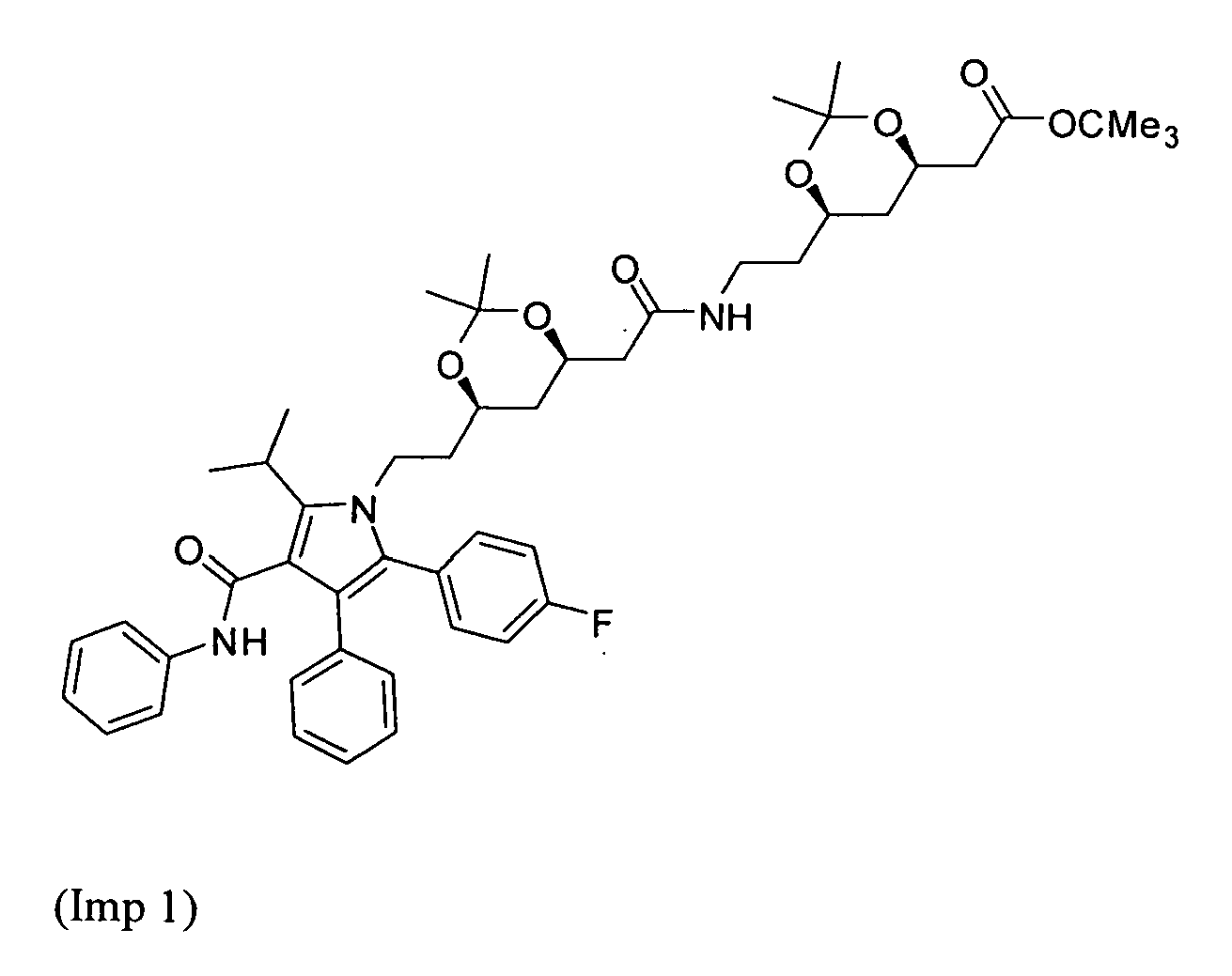

- Similar problems with structural related chemical or sterochemical impurities are encountered also in the crystallization of the following statin intermediates (Ib-Ie):


- In one embodiment of the invention R1 and R2 together represent isopropylidene and R3 is a tertiary butyl.
- In another embodiment of the invention R1, R2 and R3 in compound Id represent hydrogen atoms H.
- Whenever for purification of the statin intermediates the crystallization processes for kinetic polymorphic forms, or amorphous form are preferred over thermodynamic polymorphic form, there is a technical difficulty on industrial scale, because expensive special equipment is needed to cool the crystallization mixture sufficiently quickly in order to prevent transformation to the thermodynamically more stable form. Therefore the technical problem exists to control acceptable filtration properties of the material.
- Although it is possible to prepare the kinetic polymorphic form with fast cooling of the crystallization mixture with average cooling rates of reactor jacket temperature at least 1 K/min, adding additional solvent, and subsequently lowering the nucleation temperature, it is not industrially acceptable mainly due to the formation of material with bad filtration properties as a consequence of large jacket-reactor temperature difference (ΔT > 10 °C, smaller particles), low yields of the crystallization processes and larger solvent consumption. The particles produced have relatively small average size diameter and consequently bad filtration properties. Since the processes of isolation are longer due to bad filterability, the transformation from kinetic to thermodynamic crystalline form could happen during the filtration process itself.
- There is a need for a robust crystallization process, with technically acceptable cooling rates , e.g. <1 K/min, and leading to a product with good filtration properties (bigger particles) and excellent purity of the isolated product. The optimal and shorter production time and lower solvent consumption subsequently lowers the cost of production.
- The problem is solved by the addition of amphiphilic additives, preferably custom-made, especially amines, more preferably quarternary amine salts, e.g. bromides or chlorides, of the present invention.
- According to the invention there is provided a process for the crystallization of a compound of formula Ia-Ie


- In one embodiment of the invention R1 and R2 together represent isopropylidene and R3 is a tertiary butyl.
- In another embodiment of the invention R1, R2 and R3 in compound Id represent hydrogen atoms H.
- The present invention provides an improved crystallization process for preparing the compounds Ia-Ie, preferably the acetonide ester of atorvastatin (tert-butyl 2-((4R,6S)-6-((3-(phenylcarbamoyl)-5-(4-fluorophenyl)-2- isopropyl-4-phenyl-1H-pyrrol-1-yl)methyl)-2,2-dimethyl-1,3-dioxan-4-yl)acetate), the acetonide ester of rosuvastatin (tert-butyl 2-((4R,6S)-6-((E)-2-(4-(4-fluorophenyl)-6-isopropyl-2-(N-methylmethylsulfonamido)pyrimidin-5-yl)vinyl)-2,2-dimethyl-1,3-dioxan-4-yl)acetate), the acetonide ester of fluvastatin (tert-butyl 2-((4R,6S)-6-((E)-2-(3-(4-fluorophenyl)-1-isopropyl-1H-indol-2-yl)vinyl)-2,2-dimethyl-1,3-dioxan-4-yl)acetate), (3R,5R)-3,5-dihydroxy-7-((1S,2S,6R,8S,8aR)-8-hydroxy-2,6-dimethyl-1,2,6,7,8,8a-hexahydronaphthalen-1-yl)heptanoic acid, and lovastatin Ie.
- Tert-butyl 2-((4R, 6S)-6-((3-phenylcarbamoyl)-5-(4-flurophenyl)-2-isopropyl-4-phenyl-1H-pyrrol-1-yl)methyl)-2,2-dimethyl-1,3-dioxan-4-yl)acetate is preferably prepared by the Paal-Knorr condensation between tert-butyl 2-((4R,6R)-6-(2-aminoethyl)-2,2-diemethyl-1,3-dioxan-4-yl)acetate (e.g. prepared by hydrogenation of tert-butyl 2-((4R,6R)-6-(cyanomethyl)-2,2-dimethyl-1,3-dioxan-4-yl)acetate in a solvent such as methanol, ethanol or isopropanol in the presence of a catalyst such as Raney Ni and a base such as e.g. aqueous ammonia) and 2-(2-(4-fluorophenyl)-2-oxo-1-phenylethyl)-4-methyl-3-oxo-N-phenylpentanamide in a solvent system such as e.g. heptane/THF (4.1, v/v), catalyzed by pivalic acid; hexane/THF (4.1, v/v), catalyzed by pivalic acid; heptane/THF (4.1, v/v), catalyzed by 2-ethylhexanoic acid; or hexane/THF (4.1, v/v), catalyzed by 2-ethylhexanoic acid. Full details of the reaction are given in
US 5280126 ,US 6476235 ,US 6545153 , andWO 2006/097909 . - The tert-butyl 2-((4R, 6S)-6-((3-phenylcarbamoyl)-5-(4-flurophenyl)-2-isopropyl-4-phenyl-1H-pyrrol-1-yl)methyl)-2,2-dimethyl-1,3-dioxan-4-yl)acetate obtained may then after purification directly be converted to atorvastatin salt, such as atorvastatin sodium or atorvastatin hemicalcium, or may first be deprotected in e.g. alcohol, acetonitrile, DMF or THF in the presence of an acid such as a.g. acetic acid or aqueous HCl to yield crystalline [R-(R*, R*)]-2-(4-fluorophenyl)-β,δ-dihydroxy-5-(1-methylethyl)-3-phenyl-4-[(phenylamino)-carbonyl]-1H-pyrrole-1-heptanoic acid tertiary butyl ester, which in turn may also be purified by the purification process of the present invention. The latter is then normally converted to the sodium or potassium salt of atorvastatin, e.g. in methanol or ethanol, or their mixtures with water, in the presence of a base such as NaOH or KOH, followed by extractions with an organic solvent such as ether, ethyl acetate or methyl tert-butyl ether. The alkaline salt of atorvastatin is converted to the hemi calcium salt by addition of Ca acetate, Ca chloride, Ca(OH)2 or Ca salt of 2-ethyl hexanoic acid.
- The crystallization process with amphiphilic promotors of crystallization according to the present invention enables improved control over particle size of pharmaceutically active compounds and their intermediate leading to improved filterability of the crystallization mixture appropriate for industrial use. Another improvement of the process are lower cooling rates applied in the presence of amphiphilic compounds, preferably tailor-made amphiphilic compounds (especially amines, more preferably quarternary amine salts, most preferably CTABr), smaller differences in jacket-reactor temperature and finally the production of compounds with a higher level of purity. The crystallization process with the amphiphilic additive also has a higher ratio of product/solvent compared to the standard crystallization processes without additive.
- The use of amphiphilic additives can modify the ratio between nucleation and crystal growth processes and can result in larger particle size of the produced material compared to materials prepared identically only without the addition of tailor-made group of additives.
- Surprisingly, with the use of amphiphilic additives it is possible to operate a crystallization process in an acceptable way for industrial scales using slow cooling ramps, efficient mixing and resulting in desired polymorphic form without inclusion of pertinent impurities in a reliable way. Even more surprisingly, it has been found by the inventors that the use of amphiphilic aditives not only stabilizes the different crystalline forms but also promotes intensive crystal growth process. Large crystalline particles usually have better filtration properties and are desired on a large-scale crystallization process. In particular pronounced was the effect of purification and improved filterability when CTABr as crystallization additive has been used during the crystallization process.
- The purity of the obtained compound (Ia-Ie) is higher than 98%, preferably higher than 99%, more preferably higher than 99.9%.
- Per crystallization cycle approximately 40-70% (w/w) of the Imp1 present is eliminated is the crystallization is performed with the use of an amphiphilic additive according to the invention, while only 10-25% (w/w) are removed if the crystallization is performed under identical conditions without the use of the amphiphilic additive.
- Compounds (Ia-Ie) can further be used for the preparation of any statin form, e.g. atorvastatin free acid, atorvastatin lactone, atorvastatin salt, rosuvastatin free acid, rosuvastatin lactone, rosuvastatin salt, fluvastatin free acid, fluvastatin lactone, fluvastatin salt, simvastatin free acid, simvastatin lactone, or simvastatin salt.
- Preferably compounds (Ia-Ie) can further be used for the preparation of any form of a statin salt in its amorphous or any polymorphic form.
- Particle size was determined by laser light scattering method using e.g. a Malvern Mastersizer 2000 Apparatus using water as the dilution medium.
- The volume average particle diameter was determined by measuring the angular distribution of laser light scattered by a homogeneous suspension of particles.
- In the following preferred embodiments of the process are described.
-
-
Fig. 1 shows two photographs with amplification 400% and 1000% of tert-butyl 2-((4R,6S)-6-((3-(phenylcarbamoyl)-5-(4-fluorophenyl)-2-isopropyl-4-phenyl-1H-pyrrol-1-yl)methyl)-2,2-dimethyl-1,3-dioxan-4-yl)acetate crystals obtained according to Examples 1 and 2. -
Fig. 2 shows two photographs with amplification 400% and 1000% of tert-butyl 2-((4R,6S)-6-((3-(phenylcarbamoyl)-5-(4-fluorophenyl)-2-isopropyl-4-phenyl-1H-pyrrol-1-yl)methyl)-2,2-dimethyl-1,3-dioxan-4-yl)acetate crystals obtained according to Comparative example 3. -
Fig. 3 shows particle size distribution of tert-butyl 2-((4R,6S)-6-((3-(phenylcarbamoyl)-5-(4-fluorophenyl)-2-isopropyl-4-phenyl-1H-pyrrol-1-yl)methyl)-2,2-dimethyl-1,3-dioxan-4-yl)acetate crystals obtained according to Examples 1 and 2. -
Fig. 4 shows particle size distribution of tert-butyl 2-((4R,6S)-6-((3-(phenylcarbamoyl)-5-(4-fluorophenyl)-2-isopropyl-4-phenyl-1H-pyrrol-1-yl)methyl)-2,2-dimethyl-1,3-dioxan-4-yl)acetate crystals obtained according to Comparative example 3. - According to the invention there is provided a process for the crystallization of a compound of formula Ia:

- In one embodiment of the invention R1 and R2 together represent isopropylidene and R3 is a tertiary butyl.
- The present invention provides an improved crystallization process for preparing the acetonide ester of atorvastatin (tert-butyl 2-((4R,6S)-6-((3-(phenylcarbamoyl)-5-(4-fluorophenyl)-2-isopropyl-4-phenyl-1H-pyrrol-1-yl)methyl)-2,2-dimethyl-1,3-dioxan-4-yl)acetate). The acetonide ester is prepared with improved filterability of the crystallization mixture, high yield and a high level of purity.
- Amphiphilic compounds which are used as crystallization additives may custom made and may be chosen from the group of amines, branched or unbranched, unsubstituted or substituted, such as primary amines, secondary amines, tertiary amines or quarternary amine salts; alcohols, preferably C8-C28 alcohols; fatty acids, preferably C8-28 fatty acids; or their amphiphilic derivatives such as e.g. primary amides or salts with an inorganic or organic base. Preferably, the amphiphilic additive is chosen from the group of amines, more preferably from the group of quarternary ammonium salts, alkyl ammonium chloride or bromide, most preferably cetyltrimethylammonium bromide (CTABr).
- Solvents may be selected from any one or more of toluene or other aromatic hydrocarbons, tetrahydrofurane, or cyclic and acyclic ethers, ethyl acetate and other esters of alcohols with carboxylic acids, 2- butanone, acetone, and other cyclic and acyclic ketones, methanol, etanol, iso-propanol, n-propanol, iso-butanol, sec-butanol, n-butanol and other alcohols, acetonitrile, DMSO, DMF and other amides, hexane, heptane, and other acyclic and cyclic aliphatic hydrocarbons. Aliphatic nitriles may also be used as solvents. Binary mixtures of the above may also be used.
- The ratio between the compounds Ia-d dissolved and the solvents used is selected between 1g/1mL to 1 g/30 mL, preferably, 1 g/2mL to 1g/10 mL, most preferably between 1 g/3 mL to 1g/6mL.
- The weight percentage of the amphiphilic additive used with the regards to the compound I to be crystallized is 0.01 % to 20%, preferably 0.01 % to 10%, most preferably 0.01 % to 1%.
- In a first embodiment the amphiphilic additive may be added to the solvent together with compounds Ia-Ie, and heated to a temperature where all of the solute dissolves or the temperature of the reflux of the mixture, and than cooled to a temperature where most of the solute crystallizes.
- In a second embodiment, the amphiphilic additive is added to a solution of compounds Ia-Ie already heated to a temperature where all of the solute dissolves or the temperature of the reflux of the mixture, and than cooled to a temperature where most of the solute crystallize.
- In a third embodiment of the present invention, the amphiphilic additive is added already to the heated reaction mixture after compounds Ia-Ie had been synthesized and than cooled to a temperature where all of the solute dissolves or the temperature of the reflux of the mixture, and then cooled to a temperature where most of the solute crystallizes.
- The average cooling ramp of the reactor jacket (dT/dt) may be chosen from 0.1 K/min to 2 K/min, preferably from 0.1 K/min to 1 K/min, most preferably from 0.1 K/min to 0.5 K/min.
- The stirring speed may be chosen from 50 to 400 rpm, preferably from 50 to 300 rpm, most preferably from 100 to 250 rpm.
- The crystallized product is isolated by filtration, either by means of a centrifuge or a filter dryer, and dried at a temperature between 50 and 90 °C, preferably between 50 °C and 80 °C, for 5 to 20 hours, preferably for 5 to 15 hours.
- The relative filterability of the crystallization mixture in laboratory is determined and compared by means of the laboratory filtration test using Büchner funnel in a suction filtration.
- The time needed for the filtration of 10 mL of suspension on a surface of 0.79 cm2 of the crystallization mixture according to the present invention is between 8 and 15 seconds, while the time needed for the filtration of a comparable crystallization mixture without the use of an amphiphilic additive is between 70 and 120 seconds.
- The chemical purity of the compound Ia obtained was determined with the following method:
- Analyses were carried out on Agilent 1100 HPLC system, equipped with gradient pump, variable UV detector, thermostated autosampler and data handling system. Separation was performed on reversed phase C8 column using gradient elution with phosphate buffer pH 3.8 and a mixture of acetonitrile and tetrahydrofurane as organic modifier. Chromatograms were monitored at wavelength 248 nm.
- The analyses were carried out using a Agilent 1200series HPLC system (Agilent, USA) consisting of G1379B degasser, G1312B pump, G1367C autosampler, and a 6330 ion trap mass detector. The chromatographic separation was accomplished on a C8 column (Ascentis Express 75 mm × 4.6 mm, 2,7µ.m, Supelco) at ambient temperature.
- A gradient method was worked out, with acetonitrile content changing linearly during the analysis. The mobile phase A consisted of 5mM ammonium formiate, and mobile phase B consisted of acetonitrile. Gradient:
time %B 0 10 16 90 19 90 20 10 - For quantification we used a ion trap mass detector with electrospray ionization in SIM mode (m/z=256).
- Compound Ia crystallized by the present invention contained less than 0.10 % of
Imp 1 and less than 0.10 % ofImp 2. The amphiphilic additive used for crystallization of compounds I was present in a concentration less than 0.03 % (w/w) in the crystallized compound I. - The chemical purity of the compound Ie obtained was determined with the following method:
-
HPLC method Column: Zorbax SB-C8 , 3,5µm particles, 100 x 4.6 mm i.d., Eluent A: 0,1% phosphoric acid Eluent B: acetonitrile -
Time (min) % A % B 0 40 60 2 40 60 2,8 35 65 4,8 10 90 6 10 90 6,8 40 60 9 40 60 Post time: 3 min Flow-rate: 1.5 ml/min Detection: UV, 238 nm Injection volume: 5 µl Column temperature: 25°C Diluent: acetonitril - Accurately weigh about 20 mg of sample into 50 ml volumetric flask, dissolve and dilute to volume with diluent.
-
HPLC method Column: Zorbax SB-C8 , 5 µm particles, 250 x 4.6 mm i.d., Eluent A: 0,1% phosphoric acid Eluent B: acetonitrile Flow-rate: 1.5 ml/min Detection: UV, 200 nm Injection volume: 10 µl Column temperature: 40°C Diluent: acetonitril - Accurately weigh about 25 mg of sample into 25 ml volumetric flask, dissolve and dilute to volume with diluent.
- The present invention is illustrated by the following Examples without being limited thereto.
- The crystallization is carried out using 2-propanol as medium in a reactor with mechanical stirring. 25g of crude tert-butyl 2-((4R,6S)-6-((3-(phenylcarbamoyl)-5-(4-fluorophenyl)-2-isopropyl-4-phenyl-1H-pyrrol-1-yl)methyl)-2,2-dimethyl-1,3-dioxan-4-yl)acetate is dissolved in 90 ml of 2-propanol at the reflux temperature of the mixture, 0.12 g of cetyltrimethyl ammonium bromide is added and the temperature is maintained for 30 minutes to allow all solid to dissolve. Then a linear cooling ramp -0.40 K/min of reactor jacket is applied and the mixture is cooled to 3 °C. The formed suspension is homogenized for 2 hours and the product is isolated using Büchner funnel in a suction filtration.
- The time needed for the filtration of 10 mL of suspension on a surface of 0.79 cm2 was approx. 10s, at a vacuum of about 80-100 mbar.
- The crystallization is carried out using 2-propanol as a medium in a reactor with mechanical stirring. 180 kg of crude tert-butyl 2-((4R,6S)-6-((3-(phenylcarbamoyl)-5-(4-fluorophenyl)-2-isopropyl-4-phenyl-1H-pyrrol-1-yl)methyl)-2,2-dimethyl-1,3-dioxan-4-yl)acetate is dissolved in 650 L of 2-propanol at the reflux temperature of the mixture, 0.90 kg of cetyltrimethyl ammonium bromide is added and the temperature is maintained for 30 minutes for all solid to dissolve. Then a linear cooling ramp -0.40 K/min of reactor jacket is applied and the mixture is cooled to 3 °C. The formed suspension is homogenized for 2 hours and the product is isolated using a filter-dryer.
- Microscopic pictures of the product are shown in
Figure 1 , and particle size distribution inFig. 3 . - The crystallization is carried out using 2-propanol as a medium in a reactor with mechanical stirring. 25g of crude tert-butyl 2-((4R,6S)-6-((3-(phenylcarbamoyl)-5-(4-fluorophenyl)-2-isopropyl-4-phenyl-1H-pyrrol-1-yl)methyl)-2,2-dimethyl-1,3-dioxan-4-yl)acetate is dissolved in 90 ml of 2-propanol at the reflux temperature of the mixture and the temperature is maintained for 30 minutes to allow all solid to dissolve. Then a linear cooling ramp -0.40 K/min of reactor jacket is applied and the mixture is cooled to 3 °C. The formed suspension is homogenized for 2 hours and the product is isolated using Büchner funnel in a suction filtration.
- The time needed for the filtration of 10 mL of suspension on a surface of 0.79 cm2 was approx. 120 s, at a vacuum of about 80-100 mbar.
- This example was performed in the same equipment and using the same parameters/ as Example 1, only without the addition of CTABr.
- Microscopic pictures of the product are shown in
Figure 2 , and particle size distribution inFig. 4 . - The crystallization is carried out using ethylacetate and water as crystallization media in a reactor with mechanical stirring. 5 g of crude lovastatin, (1S,3R,7S,8S,8aR)-8-[2-[(2R,4R)-4-hydroxy-6-oxotetrahydro-2H-pyran-2-yl]ethyl]-3,7-dimethyl-1,2,3,7,8,8a hexahydronaphthalen-1-yl (2S)-2-methylbutanoate), is dissolved in 25 ml of ethylacetate at the reflux. The solution is cooled to 65 °C and 1g of active carbon is added. The mixture isstirred at this temperature for the next 10 minutes. Then the active carbon is removed using filtration at the temperature of solution approximately 65 °C. To the above prepared, hot solution 20 ml of distilled water (with the temperature approximately 70 °C) and 1 g of cetyltrimethylammonium bromide is slowly added. Then the crystallization mixture is cooled to 50 °C. At this temperature the seeds of pure lovastatin (50 mg) are added and the temperature is maintained for the next 30 minutes. Finally, the formed suspension is slowly cooled to the 10 °C in the next 6 hours (dT/dt = -0.11 K/min). When the final temperature is reached the suspension is maintained at the
temperature 10 °C for the next two hours. The formed product is isolated using vacuum filtration and washed with 15 ml of distilled water with room temperature. - The crystallization is carried out using ethylacetate and water as crystallization media in a reactor with mechanical stirring. 5 g of crude lovastatin, (1S,3R,7S,8S,8aR)-8-[2-[(2R,4R)-4-hydroxy-6-oxotetrahydro-2H-pyran-2-yl]ethyl]-3,7-dimethyl-1,2,3,7,8,8 a hexahydronaphthalen-1-yl (2S)-2-methylbutanoate), is dissolved in 25 ml of ethylacetate at the reflux. The solution is cooled to 65 °C and 1g of active carbon is added. The mixture is stirred at this temperature for the next 10 minutes. Then the active carbon is removed using filtration at the temperature of solution approximately 65 °C. To the above prepared, hot solution 20 ml of distilled water (with the temperature approximately 70 °C) is slowly added. Then the crystallization mixture was cooled to 50 °C. At this temperature the seeds of pure lovastatin (50 mg) are added and the temperature is maintained for the next 30 minutes. Finally, the formed suspension is slowly cooled to the 10 °C in the next 6 hours (dT/dt = -0.11 K/min). When the final temperature is reached the suspension is maintained at the
temperature 10 °C for the next two hours. The formed product is isolated using vacuum filtration and washed with 15 ml of distilled water with room temperature.Compound Structure Name Compound Ie 
(1S,3R,7S,8S,8aR)-8-[2-[(2R,4R)-4-Hydroxy-6-oxotetrahydro-2H-pyran-2-yl]ethyl]-3,7-dimethyl-1,2,3,7,8,8a-hexahydronaphthalen-1-yl (2S)-2-methylbutanoate Imp. A 
(3R,5R)-7-[(1S,2S,6R,8S,8aR)-2,6-dimethyl-8-[[(2S)-2-methylbutanoyl]oxy]-1,2,6,7,8,8a-hexahydronaphthalen-1-yl]-3,5-dihydroxyheptanoic acid Imp. B 
(S)-((1S,7S,8S,8aR)-8-(2-((2S,4R)-4-hydroxy-6-oxotetrahydro-2H-pyran-2-yl)ethyl)-7-methyl-1,2,3,7,8,8a-hexahydronaphthalen-1-yl) 2-methylbutanoate Imp. A
(w/w%)Imp. B
(w/w%)Compound Ie
(w/w %)Starting material, crude compound Ie 0.25 0.34 82 Crystallized compound Ie , prepared according to Example 4 0.18 n.d. 98.9 Crystallized compound Ie , prepared according to Example 5-comparative example 0.30 n.d. 96.3 - 26,67 g of (4R-cis)-6-{2-[3-phenyl-4-(phenylcarbamoyl)-2-(4-fluorophenyl)-5-(1-methylethyl)pyrrol-1-yl]ethyl}-2,2-dimethyl-[1,3]dioxane-4-yl acetic acid tertiary butyl ester (Ia) is suspended in 120 mL of acetonitrile, 23 mL of water and 6.3 mL of 1M HCl. The reaction mixture is stirred at 20-25 °C until all (4R-cis)-6-{2-[3-phenyl-4-(phenylcarbamoyl)-2-(4-fluorophenyl)-5-(1-methylethyl)pyrrol-1-yl]ethyl}-2,2-dimethyl-[1,3]dioxane-4-yl acetic acid tertiary butyl ester (Ia) is dissolved and the reaction is followed with HPLC method. After 24 h 267 mL of water was added. The solid precipitate is filtered off and the cake is washed with 100 mL of water unitll the pH value of the filtrate is 5-7. The wet cake is dried at 20-30 °C on air for approximately 1 hour till constant weight, optionally granulated and dried for 4 hours at 40-50°C.
22,54 g of tertiary butyl ester [R-(R*,R*)]-2-(4-fluorophenyl)-β,δ-dihydroxy-5-(1-methylethyl)phenyl-4-[(phenylamino)carbonyl]-1H-pyrrole-1-heptanoic acid is isolated The purity of the obtained product is higher than 99.9%. - To the solution of 8,87 g [R-(R*,R*)]-2-(4-fluorophenyl)-β,δ-dihydroxy-5-(1-methylethyl)phenyl-4-[(phenylamino)carbonyl]-1H-pyrrole-1-heptanoic acid tertiary butyl ester in 31 mL of methanol and 26 mL tert-butyl methyl ether, 0.60 g of NaOH and 30 mL of water are added. The reaction mixture is purged with nitrogen flow for cca. 5 minutes, heated to the reflux for 2-4 h, until the concentration of the starting compound [R-(R*,R*)]-2-(4-fluorophenyl)-β,δ-dihydroxy-5-(1-methylethyl)phenyl-4-[(phenylamino)carbonyl]-1H-pyrrole-1-heptanoic acid tertiary butyl ester is lower than 0.5 %, determinated by HPLC.
The reaction mixture is allowed to cool to 20-25 °C, and filtered over randalite in methanol. 3% (w/w) of active charcoal suspended in water are added, the reaction mixture is heated to 50°C, cooled back to room temperature and filtered. The pH is set to 8.0-8.2 with the addition of aqueous HCl. The reaction mixture is washed with 3 × 60 mL tert-butyl methyl ether and aqueous parts are finally filtered. The reaction mixture is purged with nitrogen flow for cca. 5 min, and 1.66 g of CaCl2 x6H2O) and 31 mL of water is added in a 15-20 min interval at 20-25 °C. After the complete addition of CaCl2 to the reaction mixture, the reaction mixture is stirred for additional 15-30 min; and 250 mL of water is slowly added into the reaction mixture to provoke the solidification of the thick emulsion-like mixture. Hemi-calcium salt of atorvastatin is formed and filtered off. The wet cake is washed with a mixture of water and methanol and finally with water. The collected solid material is dried on air to obtain dry solid atorvastatin hemi-calcium. - The dry hemi-calcium salt of atorvastatin can optionally be additionally milled on a dry pearl mill.
Claims (15)
- A process for the crystallization of a compound of formula Ia-Ie:


- A process according to claims 1, characterized in that the amine is a quarternary amine salt, preferably cetyltrimethylammonium bromide or cetyltrimethylammonium chloride.
- A process according to claims 1 to 6, characterized in that the compound Ia is tert-butyl 2-((4R,6S)-6-((3-(phenylcarbaiuoyl)-5-(4-fluorophenyl)-2-isopropyl-4-phenyl-1H-pyrrol-1-yl)methyl)-2,2-dimethyl-1,3-dioxan-4-yl)acetate.
- A process according to claim 7 characterized in that the solvent is selected from any one or more of toluene or other aromatic hydrocarbons, tetrahydrofurane, or cyclic and acyclic ethers, ethyl acetate and other esters of alcohols with carboxylic acids, 2- butanone, acetone, and other cyclic and acyclic ketones, methanol, etanol, iso-propanol, n-propanol, iso-butanol, sec-butanol, n-butanol and other alcohols, acetonitrile, DMSO, DMF and other amides, hexane, heptane, and other acyclic and cyclic aliphatic hydrocarbons, aliphatic nitriles, or binary mixtures thereof, preferably isopropanol or ethyl acetate.
- A process according to claims 1 to 6, characterized in that the compound Ia is [R-(R*,R*)]-2-(4-fluorophenyl)-β,δ-dihydroxy-5-(1-methylethyl) phenyl-4-[(phenylamino)carbonyl]-1H-pyrrole-1-heptanoic acid tertiary butyl ester.
- A process according to claims 1 to 6, characterized in that the compound Ic is tert-butyl 2-((4R,6S)-6-((E)-2-(4-(4-fluorophenyl)-6-isopropyl-2-(N-methylmethylsulfonamido)pyrimidin-5-yl)vinyl)-2,2-dimethyl-1,3-dioxan-4-yl)acetate.
- A process according to claims 1 to 6, characterized in that the compound Id is (3R,5R)-3,5-dihydroxy-7-((1S,2S,6R,8S,8aR)-8-hydroxy-2,6-dimethyl-1,2,6,7,8,8a-hexahydronaphthalen-1-yl)heptanoic acid.
- A process according to claims 1 to 6, characterized in that the compound Ie is lovastatin.
- A process according to claims 1 to 14 characterized in that the percentage of the amphiphilic compound used with regard to compound Ia to Ie is between 0.01% (w/w) and 20% (w/w).
- Use of cetyltrimethylammonium bromide for the purification of tert-butyl 2-((4R,6S)-6-((3-(phenylcarbamoyl)-5-(4-fluorophenyl)-2-isopropyl-4-phenyl-1H-pyrrol-1-yl)methyl)-2,2-dimethyl-1,3-dioxan-4-yl)acetate, [R-(R*,R*)]-2-(4-fluorophenyl)-β,δ-dihydroxy-5-(1-methylethyl) phenyl-4-[(phenylamino)carbonyl]-1H-pyrrole-1-heptanoic acid tertiary butyl ester, tert-butyl 2-((4R,6S)-6-((E)-2-(4-(4-fluorophenyl)-6-isopropyl-2-(N-methylmethylsulfonamido)pyrimidin-5-yl)vinyl)-2,2-dimethyl-1,3-dioxan-4-yl)acetate, (3R,5R)-3,5-dihydroxy-7-((1S,2S,6R,8S,8aR)-8-hydroxy-2,6-dimethyl-1,2,6,7,8,8a-hexahydronaphthalen-1-yl)heptanoic acid, lovastatin or 2-((4R,6S)-6-((E)-2-(3-(4-fluorophenyl)-1-isopropyl-1H-indol-2-yl)vinyl)-2,2-dimethyl-1,3-dioxan-4-yl)acetate.
- Tert-butyl 2-((4R,6S)-6-((3-(phenylcarbamoyl)-5-(4-fluorophenyl)-2- isopropyl-4-phenyl-1H-pyrrol-1-yl)methyl)-2,2-dimethyl-1,3-dioxan-4-yl)acetate containing less than 0.10%(w/w) of Imp1.
- Tert-butyl 2-((4R,6S)-6-((3-(phenylcarbamoyl)-5-(4-fluorophenyl)-2- isopropyl-4-phenyl-1H-pyrrol-1-yl)methyl)-2,2-dimethyl-1,3-dioxan-4-yl)acetate containing less than 0.10 % (w/w) of Imp2.
- Use of amphiphilic compounds as promotors for crystal growth in the crystallization of statin intermediates
- Use of amphiphilic compounds for crystallizations for production of materials with good filtrations properties.
- Use of cetyltrimethylammonium bromide for the preparation of atorvastatin hemi-calcium.
Priority Applications (4)
| Application Number | Priority Date | Filing Date | Title |
|---|---|---|---|
| EP09013601A EP2327682A1 (en) | 2009-10-29 | 2009-10-29 | Use of amphiphilic compounds for controlled crystallization of statins and statin intermediates |
| SI200930745T SI2373609T1 (en) | 2008-12-19 | 2009-12-18 | Use of amphiphilic compounds for controlled crystallization of statins and statin intermediates |
| PCT/EP2009/009149 WO2010069593A1 (en) | 2008-12-19 | 2009-12-18 | Use of amphiphilic compounds for controlled crystallization of statins and statin intermediates |
| EP09795931.6A EP2373609B1 (en) | 2008-12-19 | 2009-12-18 | Use of amphiphilic compounds for controlled crystallization of statins and statin intermediates |
Applications Claiming Priority (1)
| Application Number | Priority Date | Filing Date | Title |
|---|---|---|---|
| EP09013601A EP2327682A1 (en) | 2009-10-29 | 2009-10-29 | Use of amphiphilic compounds for controlled crystallization of statins and statin intermediates |
Publications (1)
| Publication Number | Publication Date |
|---|---|
| EP2327682A1 true EP2327682A1 (en) | 2011-06-01 |
Family
ID=41611363
Family Applications (1)
| Application Number | Title | Priority Date | Filing Date |
|---|---|---|---|
| EP09013601A Withdrawn EP2327682A1 (en) | 2008-12-19 | 2009-10-29 | Use of amphiphilic compounds for controlled crystallization of statins and statin intermediates |
Country Status (1)
| Country | Link |
|---|---|
| EP (1) | EP2327682A1 (en) |
Citations (21)
| Publication number | Priority date | Publication date | Assignee | Title |
|---|---|---|---|---|
| EP0022478A1 (en) | 1979-06-15 | 1981-01-21 | Merck & Co. Inc. | Polyhydro-3,7-dimethyl-8-(2-(tetrahydro-4-hydroxy-6-oxo-2H-pyran-2-yl)-ethyl)-1-naphthylenyl-2-methylbutanoates, corresponding hydroxy acids, process for preparing and pharmaceutical compositions containing the same |
| EP0033538A2 (en) | 1980-02-04 | 1981-08-12 | Merck & Co. Inc. | 6(R)-(2-(8'-acyloxy-2'-methyl-6'-methyl (or hydrogen)-polyhydronaphthyl-1')-ethyl)-4(R)-hydroxy-3,4,5,6-tetrahydro-2H-pyran-2-ones, the hydroxy acid form of said pyranones, the pharmaceutically acceptable salts of said hydroxy acids, and the lower alkyl, and phenyl, dimethylamino or acetylamino substituted lower alkyl esters of said hydroxy acid, processes for preparing the same, and a pharmaceutical antihypercholesterolemic composition containing the same |
| EP0114027A1 (en) | 1982-11-22 | 1984-07-25 | Sandoz Ag | Analogs of mevalolactone and derivatives thereof, processes for their production, pharmaceutical compositions containing them and their use as pharmaceuticals |
| DE3051175C2 (en) | 1979-02-20 | 1989-12-21 | Sankyo Co., Ltd., Tokio/Tokyo, Jp | |
| EP0363934A1 (en) | 1988-10-13 | 1990-04-18 | Sandoz Ag | Process for the preparation of 7-substituted-hept-6-enoic and -heptanoic acids and derivatives thereof |
| EP0521471A1 (en) | 1991-07-01 | 1993-01-07 | Shionogi Seiyaku Kabushiki Kaisha | Pyrimidine derivatives as HMG-CoA reductase inhibitors |
| US5216174A (en) | 1988-02-22 | 1993-06-01 | Warner-Lambert Co. | Process for trans-6-[12-(substituted-pyrrol-1-yl)alkyl]pyran-2-one inhibitors of cholesterol synthesis |
| US5245047A (en) | 1988-02-22 | 1993-09-14 | Warner-Lambert Company | Process for trans-6-[2-(substituted-pyrrol-1-yl)alkyl]pyran-2-one inhibitors of cholesterol synthesis |
| US5248793A (en) | 1990-10-17 | 1993-09-28 | Warner-Lambert Company | Process for the synthesis of (4R-cis)-1,1-dimethylethyl 6-iodomethyl or 6-(phenyl-substituted)sulfonyloxymethyl-2,2-dimethyl-1,3-dioxane-4-acetate |
| US5298627A (en) | 1993-03-03 | 1994-03-29 | Warner-Lambert Company | Process for trans-6-[2-(substituted-pyrrol-1-yl)alkyl]pyran-2-one inhibitors of cholesterol synthesis |
| WO1997003960A1 (en) | 1995-07-17 | 1997-02-06 | Warner-Lambert Company | NOVEL PROCESS FOR THE PRODUCTION OF AMORPHOUS [R-(R*,R*)]-2-(4-FLUOROPHENYL)-β,δ-DIHYDROXY-5-(1-METHYLETHYL)-3-PHENYL-4-[(PHENYLAMINO)CARBONYL]-1H-PYRROLE-1-HEPTANOIC ACID CALCIUM SALT (2:1) |
| WO1998004543A1 (en) | 1996-07-29 | 1998-02-05 | Warner-Lambert Company | Improved process for the synthesis of protected esters of (s)-3,4-dihydroxybutyric acid |
| WO1999032434A1 (en) | 1997-12-19 | 1999-07-01 | Warner-Lambert Export Limited | Process for the synthesis of 1,3-diols |
| WO2000049014A1 (en) | 1999-02-17 | 2000-08-24 | Astrazeneca Ab | Process for the production of tert-butyl (e)-(6-[2- [4-(4-fluorophenyl) -6-isopropyl-2-[ methyl (methylsulfonyl) amino] pyrimidin-5-yl] vinyl](4r, 6s)-2,2-dimethyl [1,3]dioxan-4-yl) acetate |
| WO2001036384A1 (en) * | 1999-11-17 | 2001-05-25 | Teva Pharmaceutical Industries Ltd. | Polymorphic form of atorvastatin calcium |
| US6476235B2 (en) | 2001-01-09 | 2002-11-05 | Warner-Lambert Company | Process for the synthesis of 5-(4-fluorophenyl)-1-[2-((2R,4R)-4-hydroxy-6-oxo-tetrahydro-pyran-2-yl)-ethyl]-2-isopropyl-4-phenyl-1H-pyrrole-3-carboxylic acid phenylamide |
| WO2003068739A1 (en) * | 2002-02-01 | 2003-08-21 | Zentiva A.S. | Method of manufacturing an amorphous form of the hemi-calcium salt of (3r, 5r) 7- 3-phenyl-4-phenylcarbamoyl-2-(4-fluorophenyl)-5-isopropyl-pyrrol-1-yl!-3, 5-dihydroxyheptanoic acid (atorvastatin) |
| WO2004108691A1 (en) | 2003-06-05 | 2004-12-16 | Astrazeneca Uk Limited | Improved production of rosuvastatin calcium salt |
| WO2006079611A1 (en) * | 2005-01-31 | 2006-08-03 | Ciba Specialty Chemicals Holding Inc. | Crystalline forms of rosuvastatin calcium salt |
| WO2006097909A1 (en) | 2005-03-14 | 2006-09-21 | Pfizer Science And Technology Ireland Limited | Preparation of an atorvastatin intermediate using a paal-knorr condensation |
| WO2007099561A1 (en) | 2006-02-27 | 2007-09-07 | Cadila Healthcare Limited | Process for preparing rosuvastatin calcium |
-
2009
- 2009-10-29 EP EP09013601A patent/EP2327682A1/en not_active Withdrawn
Patent Citations (30)
| Publication number | Priority date | Publication date | Assignee | Title |
|---|---|---|---|---|
| DE3051175C2 (en) | 1979-02-20 | 1989-12-21 | Sankyo Co., Ltd., Tokio/Tokyo, Jp | |
| EP0022478A1 (en) | 1979-06-15 | 1981-01-21 | Merck & Co. Inc. | Polyhydro-3,7-dimethyl-8-(2-(tetrahydro-4-hydroxy-6-oxo-2H-pyran-2-yl)-ethyl)-1-naphthylenyl-2-methylbutanoates, corresponding hydroxy acids, process for preparing and pharmaceutical compositions containing the same |
| EP0033538A2 (en) | 1980-02-04 | 1981-08-12 | Merck & Co. Inc. | 6(R)-(2-(8'-acyloxy-2'-methyl-6'-methyl (or hydrogen)-polyhydronaphthyl-1')-ethyl)-4(R)-hydroxy-3,4,5,6-tetrahydro-2H-pyran-2-ones, the hydroxy acid form of said pyranones, the pharmaceutically acceptable salts of said hydroxy acids, and the lower alkyl, and phenyl, dimethylamino or acetylamino substituted lower alkyl esters of said hydroxy acid, processes for preparing the same, and a pharmaceutical antihypercholesterolemic composition containing the same |
| EP0114027A1 (en) | 1982-11-22 | 1984-07-25 | Sandoz Ag | Analogs of mevalolactone and derivatives thereof, processes for their production, pharmaceutical compositions containing them and their use as pharmaceuticals |
| US5216174A (en) | 1988-02-22 | 1993-06-01 | Warner-Lambert Co. | Process for trans-6-[12-(substituted-pyrrol-1-yl)alkyl]pyran-2-one inhibitors of cholesterol synthesis |
| US5245047A (en) | 1988-02-22 | 1993-09-14 | Warner-Lambert Company | Process for trans-6-[2-(substituted-pyrrol-1-yl)alkyl]pyran-2-one inhibitors of cholesterol synthesis |
| US5280126A (en) | 1988-02-22 | 1994-01-18 | Warner-Lambert Company | Process for trans-6-[2-(substituted-pyrrol-1-yl)alkyl]pyran-2-one inhibitors of cholesterol synthesis |
| EP0363934A1 (en) | 1988-10-13 | 1990-04-18 | Sandoz Ag | Process for the preparation of 7-substituted-hept-6-enoic and -heptanoic acids and derivatives thereof |
| US5248793A (en) | 1990-10-17 | 1993-09-28 | Warner-Lambert Company | Process for the synthesis of (4R-cis)-1,1-dimethylethyl 6-iodomethyl or 6-(phenyl-substituted)sulfonyloxymethyl-2,2-dimethyl-1,3-dioxane-4-acetate |
| EP0521471A1 (en) | 1991-07-01 | 1993-01-07 | Shionogi Seiyaku Kabushiki Kaisha | Pyrimidine derivatives as HMG-CoA reductase inhibitors |
| US5470981A (en) | 1993-03-03 | 1995-11-28 | Warner-Lambert Company | Process for trans-6-[2-(substituted-pyrrol-1-yl)alkyl]pyran-2-one inhibitors of cholesterol synthesis |
| US5342952A (en) | 1993-03-03 | 1994-08-30 | Warner-Lambert Company | Process for trans-6-[2-(substituted-pyrrol-1-yl)alkyl]pyran-2-one inhibitors of cholesterol synthesis |
| US5397792A (en) | 1993-03-03 | 1995-03-14 | Warner-Lambert Company | Process for trans-6-[2-(substituted-pyrrol-1-yl)alkyl]pyran-2-one inhibitors of cholesterol synthesis |
| US5446054A (en) | 1993-03-03 | 1995-08-29 | Warner-Lambert Company | Process for trans-6-[2-(substituted-pyrrol-1-yl)alkyl]pyran-2-one inhibitors of cholesterol synthesis |
| US5298627A (en) | 1993-03-03 | 1994-03-29 | Warner-Lambert Company | Process for trans-6-[2-(substituted-pyrrol-1-yl)alkyl]pyran-2-one inhibitors of cholesterol synthesis |
| US5489691A (en) | 1993-03-03 | 1996-02-06 | Warner-Lambert Company | Process for trans-6-(2-(substituted-pyrrol-1-yl)alkyl)pyran-2-one inhibitors of cholesterol synthesis |
| US5489690A (en) | 1993-03-03 | 1996-02-06 | Warner-Lambert Company | Process for trans-6[2-(substituted-pyrrol-1-yl)alkyl]pyran-2-one inhibitors of cholesterol synthesis |
| US5510488A (en) | 1993-03-03 | 1996-04-23 | Warner-Lambert Company | Process for trans-6- 2-(substituted-pyrrol-1-yl)alkyl!pyran-2-one inhibitors of cholesterol synthesis |
| WO1997003960A1 (en) | 1995-07-17 | 1997-02-06 | Warner-Lambert Company | NOVEL PROCESS FOR THE PRODUCTION OF AMORPHOUS [R-(R*,R*)]-2-(4-FLUOROPHENYL)-β,δ-DIHYDROXY-5-(1-METHYLETHYL)-3-PHENYL-4-[(PHENYLAMINO)CARBONYL]-1H-PYRROLE-1-HEPTANOIC ACID CALCIUM SALT (2:1) |
| WO1998004543A1 (en) | 1996-07-29 | 1998-02-05 | Warner-Lambert Company | Improved process for the synthesis of protected esters of (s)-3,4-dihydroxybutyric acid |
| WO1999032434A1 (en) | 1997-12-19 | 1999-07-01 | Warner-Lambert Export Limited | Process for the synthesis of 1,3-diols |
| WO2000049014A1 (en) | 1999-02-17 | 2000-08-24 | Astrazeneca Ab | Process for the production of tert-butyl (e)-(6-[2- [4-(4-fluorophenyl) -6-isopropyl-2-[ methyl (methylsulfonyl) amino] pyrimidin-5-yl] vinyl](4r, 6s)-2,2-dimethyl [1,3]dioxan-4-yl) acetate |
| WO2001036384A1 (en) * | 1999-11-17 | 2001-05-25 | Teva Pharmaceutical Industries Ltd. | Polymorphic form of atorvastatin calcium |
| US6476235B2 (en) | 2001-01-09 | 2002-11-05 | Warner-Lambert Company | Process for the synthesis of 5-(4-fluorophenyl)-1-[2-((2R,4R)-4-hydroxy-6-oxo-tetrahydro-pyran-2-yl)-ethyl]-2-isopropyl-4-phenyl-1H-pyrrole-3-carboxylic acid phenylamide |
| US6545153B1 (en) | 2001-01-09 | 2003-04-08 | Warner-Lambert Company | Process for the synthesis of 5-(4-fluorophenyl)-1-[2-((2R,4R)-4-hydroxy-6-oxo-tetrahydro-pyran-2-yl)-ethyl]-2-isopropyl-4-phenyl-1H-pyrrole-3-carboxylic acid phenylamide |
| WO2003068739A1 (en) * | 2002-02-01 | 2003-08-21 | Zentiva A.S. | Method of manufacturing an amorphous form of the hemi-calcium salt of (3r, 5r) 7- 3-phenyl-4-phenylcarbamoyl-2-(4-fluorophenyl)-5-isopropyl-pyrrol-1-yl!-3, 5-dihydroxyheptanoic acid (atorvastatin) |
| WO2004108691A1 (en) | 2003-06-05 | 2004-12-16 | Astrazeneca Uk Limited | Improved production of rosuvastatin calcium salt |
| WO2006079611A1 (en) * | 2005-01-31 | 2006-08-03 | Ciba Specialty Chemicals Holding Inc. | Crystalline forms of rosuvastatin calcium salt |
| WO2006097909A1 (en) | 2005-03-14 | 2006-09-21 | Pfizer Science And Technology Ireland Limited | Preparation of an atorvastatin intermediate using a paal-knorr condensation |
| WO2007099561A1 (en) | 2006-02-27 | 2007-09-07 | Cadila Healthcare Limited | Process for preparing rosuvastatin calcium |
Non-Patent Citations (2)
| Title |
|---|
| K.-M- CHENG, TETRAHEDRON LETTERS, vol. 28, no. 2, 1987, pages 155 - 188 |
| MAHMOUD ET AL.: "Crystal modification of calcium sulfate dihydrate in the presence of some surface-active agents", JOURNAL OF COLLOID AND INTERFACE SCIENCE, vol. 270, 2004, pages 99 - 105, XP002567945 * |
Similar Documents
| Publication | Publication Date | Title |
|---|---|---|
| RU2138497C1 (en) | Method of preparing trans-6-[substituted pyrrol-1- yl)alkyl]pyran-2-on derivatives and their dihydroxy-containing acids and salts, hydroxy-, 1,3-dioxan- or pyrrole-containing carboxylic acids as intermediates for preparing said pyran-2-on derivatives | |
| AU2002324715B2 (en) | Processes for preparing calcium salt forms of statins | |
| US6777552B2 (en) | Processes for preparing calcium salt forms of statins | |
| EP1341785B1 (en) | Hydrolysis of r(r*,r*)-2-(4-fluorophenyl)-beta,delta-dihydroxy-5-(1-methylethyl)-3-phenyl-4- [(phenylamino)carbonyl]-1h-pyrrole-1-heptanoic acid esters with calcium hydroxide | |
| AU2002324715A1 (en) | Processes for preparing calcium salt forms of statins | |
| EP3178812A1 (en) | Novel polymorphs of pitavastatin calcium | |
| US20060122403A1 (en) | Atorvastatin calcium form vi or hydrates thereof | |
| EP2373609B1 (en) | Use of amphiphilic compounds for controlled crystallization of statins and statin intermediates | |
| KR20110126164A (en) | Derivatives of Rosuvastatin and Atorvastatin | |
| EP2327682A1 (en) | Use of amphiphilic compounds for controlled crystallization of statins and statin intermediates | |
| US20080300305A1 (en) | Method of purifying pravastatin | |
| RU2294924C2 (en) | Form vi of atorvastatin calcium and its hydrates | |
| ZA200501802B (en) | Atorvastatin calcium form VI or hydrates thereof | |
| WO2009139730A1 (en) | Preparation of novel non-crystalline forms of atorvastatin calcium |
Legal Events
| Date | Code | Title | Description |
|---|---|---|---|
| PUAI | Public reference made under article 153(3) epc to a published international application that has entered the european phase |
Free format text: ORIGINAL CODE: 0009012 |
|
| AK | Designated contracting states |
Kind code of ref document: A1 Designated state(s): AT BE BG CH CY CZ DE DK EE ES FI FR GB GR HR HU IE IS IT LI LT LU LV MC MK MT NL NO PL PT RO SE SI SK SM TR |
|
| AX | Request for extension of the european patent |
Extension state: AL BA RS |
|
| STAA | Information on the status of an ep patent application or granted ep patent |
Free format text: STATUS: THE APPLICATION IS DEEMED TO BE WITHDRAWN |
|
| 18D | Application deemed to be withdrawn |
Effective date: 20111202 |