EP2326624B1 - Process for synthesizing substituted isoquinolines - Google Patents
Process for synthesizing substituted isoquinolines Download PDFInfo
- Publication number
- EP2326624B1 EP2326624B1 EP09791977.3A EP09791977A EP2326624B1 EP 2326624 B1 EP2326624 B1 EP 2326624B1 EP 09791977 A EP09791977 A EP 09791977A EP 2326624 B1 EP2326624 B1 EP 2326624B1
- Authority
- EP
- European Patent Office
- Prior art keywords
- formula
- compound
- reaction
- solution
- added
- Prior art date
- Legal status (The legal status is an assumption and is not a legal conclusion. Google has not performed a legal analysis and makes no representation as to the accuracy of the status listed.)
- Not-in-force
Links
- 238000000034 method Methods 0.000 title claims description 28
- 230000008569 process Effects 0.000 title claims description 24
- 230000002194 synthesizing effect Effects 0.000 title description 3
- 150000002537 isoquinolines Chemical class 0.000 title 1
- OKKJLVBELUTLKV-UHFFFAOYSA-N Methanol Chemical compound OC OKKJLVBELUTLKV-UHFFFAOYSA-N 0.000 claims description 87
- 150000001875 compounds Chemical class 0.000 claims description 45
- XHXFXVLFKHQFAL-UHFFFAOYSA-N phosphoryl trichloride Chemical compound ClP(Cl)(Cl)=O XHXFXVLFKHQFAL-UHFFFAOYSA-N 0.000 claims description 24
- AFVFQIVMOAPDHO-UHFFFAOYSA-N Methanesulfonic acid Chemical compound CS(O)(=O)=O AFVFQIVMOAPDHO-UHFFFAOYSA-N 0.000 claims description 20
- 239000002253 acid Substances 0.000 claims description 15
- 239000007800 oxidant agent Substances 0.000 claims description 14
- ZCYVEMRRCGMTRW-UHFFFAOYSA-N 7553-56-2 Chemical compound [I] ZCYVEMRRCGMTRW-UHFFFAOYSA-N 0.000 claims description 12
- 229910052740 iodine Inorganic materials 0.000 claims description 12
- 239000011630 iodine Substances 0.000 claims description 12
- VHUUQVKOLVNVRT-UHFFFAOYSA-N Ammonium hydroxide Chemical compound [NH4+].[OH-] VHUUQVKOLVNVRT-UHFFFAOYSA-N 0.000 claims description 11
- 229910019213 POCl3 Inorganic materials 0.000 claims description 11
- 125000000217 alkyl group Chemical group 0.000 claims description 11
- 125000003118 aryl group Chemical group 0.000 claims description 11
- 239000000908 ammonium hydroxide Substances 0.000 claims description 10
- 239000012320 chlorinating reagent Substances 0.000 claims description 10
- 229940098779 methanesulfonic acid Drugs 0.000 claims description 10
- CTSLXHKWHWQRSH-UHFFFAOYSA-N oxalyl chloride Chemical compound ClC(=O)C(Cl)=O CTSLXHKWHWQRSH-UHFFFAOYSA-N 0.000 claims description 10
- 125000003545 alkoxy group Chemical group 0.000 claims description 9
- ZBIKORITPGTTGI-UHFFFAOYSA-N [acetyloxy(phenyl)-$l^{3}-iodanyl] acetate Chemical group CC(=O)OI(OC(C)=O)C1=CC=CC=C1 ZBIKORITPGTTGI-UHFFFAOYSA-N 0.000 claims description 8
- PNDPGZBMCMUPRI-UHFFFAOYSA-N iodine Chemical compound II PNDPGZBMCMUPRI-UHFFFAOYSA-N 0.000 claims description 8
- 238000004519 manufacturing process Methods 0.000 claims description 8
- ZRLVQFQTCMUIRM-UHFFFAOYSA-N potassium;2-methylbutan-2-olate Chemical compound [K+].CCC(C)(C)[O-] ZRLVQFQTCMUIRM-UHFFFAOYSA-N 0.000 claims description 8
- 125000004093 cyano group Chemical group *C#N 0.000 claims description 6
- 125000001475 halogen functional group Chemical group 0.000 claims description 6
- 125000000449 nitro group Chemical group [O-][N+](*)=O 0.000 claims description 6
- 125000004438 haloalkoxy group Chemical group 0.000 claims description 5
- 125000002924 primary amino group Chemical group [H]N([H])* 0.000 claims description 5
- PXQLVRUNWNTZOS-UHFFFAOYSA-N sulfanyl Chemical class [SH] PXQLVRUNWNTZOS-UHFFFAOYSA-N 0.000 claims description 5
- UHZYTMXLRWXGPK-UHFFFAOYSA-N phosphorus pentachloride Chemical compound ClP(Cl)(Cl)(Cl)Cl UHZYTMXLRWXGPK-UHFFFAOYSA-N 0.000 claims description 4
- IUBQJLUDMLPAGT-UHFFFAOYSA-N potassium bis(trimethylsilyl)amide Chemical compound C[Si](C)(C)N([K])[Si](C)(C)C IUBQJLUDMLPAGT-UHFFFAOYSA-N 0.000 claims description 4
- LPNYRYFBWFDTMA-UHFFFAOYSA-N potassium tert-butoxide Chemical compound [K+].CC(C)(C)[O-] LPNYRYFBWFDTMA-UHFFFAOYSA-N 0.000 claims description 4
- VGJKBWPZBVBXGI-UHFFFAOYSA-N 1,2-dichloro-3-iodobenzene Chemical compound ClC1=CC=CC(I)=C1Cl VGJKBWPZBVBXGI-UHFFFAOYSA-N 0.000 claims description 3
- ZSXGLVDWWRXATF-UHFFFAOYSA-N N,N-dimethylformamide dimethyl acetal Chemical compound COC(OC)N(C)C ZSXGLVDWWRXATF-UHFFFAOYSA-N 0.000 claims description 3
- 125000003710 aryl alkyl group Chemical group 0.000 claims description 3
- 239000001257 hydrogen Substances 0.000 claims description 3
- 229910052739 hydrogen Inorganic materials 0.000 claims description 3
- 125000000956 methoxy group Chemical group [H]C([H])([H])O* 0.000 claims description 3
- 125000004435 hydrogen atom Chemical group [H]* 0.000 claims description 2
- 229910052760 oxygen Inorganic materials 0.000 claims description 2
- 229910052717 sulfur Inorganic materials 0.000 claims description 2
- 238000006243 chemical reaction Methods 0.000 description 67
- 239000000243 solution Substances 0.000 description 45
- XLYOFNOQVPJJNP-UHFFFAOYSA-N water Substances O XLYOFNOQVPJJNP-UHFFFAOYSA-N 0.000 description 39
- XEKOWRVHYACXOJ-UHFFFAOYSA-N Ethyl acetate Chemical compound CCOC(C)=O XEKOWRVHYACXOJ-UHFFFAOYSA-N 0.000 description 36
- YXFVVABEGXRONW-UHFFFAOYSA-N Toluene Chemical compound CC1=CC=CC=C1 YXFVVABEGXRONW-UHFFFAOYSA-N 0.000 description 36
- 239000000047 product Substances 0.000 description 29
- 239000007787 solid Substances 0.000 description 29
- WEVYAHXRMPXWCK-UHFFFAOYSA-N Acetonitrile Chemical compound CC#N WEVYAHXRMPXWCK-UHFFFAOYSA-N 0.000 description 26
- 239000011541 reaction mixture Substances 0.000 description 25
- 238000003756 stirring Methods 0.000 description 20
- 239000002002 slurry Substances 0.000 description 19
- IMNFDUFMRHMDMM-UHFFFAOYSA-N N-Heptane Chemical compound CCCCCCC IMNFDUFMRHMDMM-UHFFFAOYSA-N 0.000 description 18
- 238000010791 quenching Methods 0.000 description 17
- 238000004128 high performance liquid chromatography Methods 0.000 description 16
- IJGRMHOSHXDMSA-UHFFFAOYSA-N Atomic nitrogen Chemical compound N#N IJGRMHOSHXDMSA-UHFFFAOYSA-N 0.000 description 14
- 239000010410 layer Substances 0.000 description 14
- WKBOTKDWSSQWDR-UHFFFAOYSA-N Bromine atom Chemical group [Br] WKBOTKDWSSQWDR-UHFFFAOYSA-N 0.000 description 13
- QTBSBXVTEAMEQO-UHFFFAOYSA-N Acetic acid Chemical compound CC(O)=O QTBSBXVTEAMEQO-UHFFFAOYSA-N 0.000 description 12
- GDTBXPJZTBHREO-UHFFFAOYSA-N bromine Chemical compound BrBr GDTBXPJZTBHREO-UHFFFAOYSA-N 0.000 description 12
- 229910052794 bromium Inorganic materials 0.000 description 12
- 239000012535 impurity Substances 0.000 description 12
- 239000000523 sample Substances 0.000 description 12
- BZLVMXJERCGZMT-UHFFFAOYSA-N Methyl tert-butyl ether Chemical compound COC(C)(C)C BZLVMXJERCGZMT-UHFFFAOYSA-N 0.000 description 11
- 238000010438 heat treatment Methods 0.000 description 11
- KWOLFJPFCHCOCG-UHFFFAOYSA-N Acetophenone Chemical compound CC(=O)C1=CC=CC=C1 KWOLFJPFCHCOCG-UHFFFAOYSA-N 0.000 description 10
- 239000003153 chemical reaction reagent Substances 0.000 description 10
- 150000002576 ketones Chemical class 0.000 description 10
- 239000012071 phase Substances 0.000 description 10
- BWHMMNNQKKPAPP-UHFFFAOYSA-L potassium carbonate Chemical compound [K+].[K+].[O-]C([O-])=O BWHMMNNQKKPAPP-UHFFFAOYSA-L 0.000 description 10
- 238000010992 reflux Methods 0.000 description 10
- 239000007858 starting material Substances 0.000 description 10
- CPELXLSAUQHCOX-UHFFFAOYSA-M Bromide Chemical compound [Br-] CPELXLSAUQHCOX-UHFFFAOYSA-M 0.000 description 9
- HEMHJVSKTPXQMS-UHFFFAOYSA-M Sodium hydroxide Chemical compound [OH-].[Na+] HEMHJVSKTPXQMS-UHFFFAOYSA-M 0.000 description 9
- 239000000543 intermediate Substances 0.000 description 9
- 239000002904 solvent Substances 0.000 description 9
- VYPSYNLAJGMNEJ-UHFFFAOYSA-N Silicium dioxide Chemical compound O=[Si]=O VYPSYNLAJGMNEJ-UHFFFAOYSA-N 0.000 description 8
- WYURNTSHIVDZCO-UHFFFAOYSA-N Tetrahydrofuran Chemical compound C1CCOC1 WYURNTSHIVDZCO-UHFFFAOYSA-N 0.000 description 8
- 239000003795 chemical substances by application Substances 0.000 description 8
- VEXZGXHMUGYJMC-UHFFFAOYSA-N Hydrochloric acid Chemical compound Cl VEXZGXHMUGYJMC-UHFFFAOYSA-N 0.000 description 7
- ZMXDDKWLCZADIW-UHFFFAOYSA-N N,N-Dimethylformamide Chemical compound CN(C)C=O ZMXDDKWLCZADIW-UHFFFAOYSA-N 0.000 description 7
- SECXISVLQFMRJM-UHFFFAOYSA-N N-Methylpyrrolidone Chemical compound CN1CCCC1=O SECXISVLQFMRJM-UHFFFAOYSA-N 0.000 description 7
- 230000015572 biosynthetic process Effects 0.000 description 7
- 229910052757 nitrogen Inorganic materials 0.000 description 7
- JGFZNNIVVJXRND-UHFFFAOYSA-N N,N-Diisopropylethylamine (DIPEA) Chemical compound CCN(C(C)C)C(C)C JGFZNNIVVJXRND-UHFFFAOYSA-N 0.000 description 6
- 230000009471 action Effects 0.000 description 6
- 239000008346 aqueous phase Substances 0.000 description 6
- 125000005843 halogen group Chemical group 0.000 description 6
- 239000000758 substrate Substances 0.000 description 6
- 241000711549 Hepacivirus C Species 0.000 description 5
- 239000000203 mixture Substances 0.000 description 5
- 229910000027 potassium carbonate Inorganic materials 0.000 description 5
- GQHTUMJGOHRCHB-UHFFFAOYSA-N 2,3,4,6,7,8,9,10-octahydropyrimido[1,2-a]azepine Chemical compound C1CCCCN2CCCN=C21 GQHTUMJGOHRCHB-UHFFFAOYSA-N 0.000 description 4
- JWUJQDFVADABEY-UHFFFAOYSA-N 2-methyltetrahydrofuran Chemical compound CC1CCCO1 JWUJQDFVADABEY-UHFFFAOYSA-N 0.000 description 4
- LFQSCWFLJHTTHZ-UHFFFAOYSA-N Ethanol Chemical compound CCO LFQSCWFLJHTTHZ-UHFFFAOYSA-N 0.000 description 4
- 239000005909 Kieselgur Substances 0.000 description 4
- PCLIMKBDDGJMGD-UHFFFAOYSA-N N-bromosuccinimide Chemical compound BrN1C(=O)CCC1=O PCLIMKBDDGJMGD-UHFFFAOYSA-N 0.000 description 4
- KDLHZDBZIXYQEI-UHFFFAOYSA-N Palladium Chemical compound [Pd] KDLHZDBZIXYQEI-UHFFFAOYSA-N 0.000 description 4
- KFSLWBXXFJQRDL-UHFFFAOYSA-N Peracetic acid Chemical compound CC(=O)OO KFSLWBXXFJQRDL-UHFFFAOYSA-N 0.000 description 4
- FAPWRFPIFSIZLT-UHFFFAOYSA-M Sodium chloride Chemical compound [Na+].[Cl-] FAPWRFPIFSIZLT-UHFFFAOYSA-M 0.000 description 4
- 150000007513 acids Chemical class 0.000 description 4
- 238000013019 agitation Methods 0.000 description 4
- 239000003610 charcoal Substances 0.000 description 4
- 238000001816 cooling Methods 0.000 description 4
- ZPWVASYFFYYZEW-UHFFFAOYSA-L dipotassium hydrogen phosphate Chemical compound [K+].[K+].OP([O-])([O-])=O ZPWVASYFFYYZEW-UHFFFAOYSA-L 0.000 description 4
- 229910000396 dipotassium phosphate Inorganic materials 0.000 description 4
- VDBNYAPERZTOOF-UHFFFAOYSA-N isoquinolin-1(2H)-one Chemical compound C1=CC=C2C(=O)NC=CC2=C1 VDBNYAPERZTOOF-UHFFFAOYSA-N 0.000 description 4
- 230000001035 methylating effect Effects 0.000 description 4
- 239000012074 organic phase Substances 0.000 description 4
- 239000003444 phase transfer catalyst Substances 0.000 description 4
- 125000001997 phenyl group Chemical group [H]C1=C([H])C([H])=C(*)C([H])=C1[H] 0.000 description 4
- 239000006228 supernatant Substances 0.000 description 4
- 238000003786 synthesis reaction Methods 0.000 description 4
- JRMUNVKIHCOMHV-UHFFFAOYSA-M tetrabutylammonium bromide Chemical compound [Br-].CCCC[N+](CCCC)(CCCC)CCCC JRMUNVKIHCOMHV-UHFFFAOYSA-M 0.000 description 4
- MSXVEPNJUHWQHW-UHFFFAOYSA-N 2-methylbutan-2-ol Chemical compound CCC(C)(C)O MSXVEPNJUHWQHW-UHFFFAOYSA-N 0.000 description 3
- OKTJSMMVPCPJKN-UHFFFAOYSA-N Carbon Chemical compound [C] OKTJSMMVPCPJKN-UHFFFAOYSA-N 0.000 description 3
- NBIIXXVUZAFLBC-UHFFFAOYSA-N Phosphoric acid Chemical compound OP(O)(O)=O NBIIXXVUZAFLBC-UHFFFAOYSA-N 0.000 description 3
- ZMANZCXQSJIPKH-UHFFFAOYSA-N Triethylamine Chemical compound CCN(CC)CC ZMANZCXQSJIPKH-UHFFFAOYSA-N 0.000 description 3
- 230000002051 biphasic effect Effects 0.000 description 3
- 239000012267 brine Substances 0.000 description 3
- 229910052801 chlorine Inorganic materials 0.000 description 3
- 238000002425 crystallisation Methods 0.000 description 3
- 230000008025 crystallization Effects 0.000 description 3
- UAOMVDZJSHZZME-UHFFFAOYSA-N diisopropylamine Chemical compound CC(C)NC(C)C UAOMVDZJSHZZME-UHFFFAOYSA-N 0.000 description 3
- 238000001035 drying Methods 0.000 description 3
- 239000012456 homogeneous solution Substances 0.000 description 3
- IXCSERBJSXMMFS-UHFFFAOYSA-N hydrogen chloride Substances Cl.Cl IXCSERBJSXMMFS-UHFFFAOYSA-N 0.000 description 3
- 229910000041 hydrogen chloride Inorganic materials 0.000 description 3
- 125000002887 hydroxy group Chemical group [H]O* 0.000 description 3
- RAXXELZNTBOGNW-UHFFFAOYSA-N imidazole Natural products C1=CNC=N1 RAXXELZNTBOGNW-UHFFFAOYSA-N 0.000 description 3
- 239000012044 organic layer Substances 0.000 description 3
- HPALAKNZSZLMCH-UHFFFAOYSA-M sodium;chloride;hydrate Chemical compound O.[Na+].[Cl-] HPALAKNZSZLMCH-UHFFFAOYSA-M 0.000 description 3
- YLQBMQCUIZJEEH-UHFFFAOYSA-N tetrahydrofuran Natural products C=1C=COC=1 YLQBMQCUIZJEEH-UHFFFAOYSA-N 0.000 description 3
- 238000010626 work up procedure Methods 0.000 description 3
- RYHBNJHYFVUHQT-UHFFFAOYSA-N 1,4-Dioxane Chemical compound C1COCCO1 RYHBNJHYFVUHQT-UHFFFAOYSA-N 0.000 description 2
- SGUVLZREKBPKCE-UHFFFAOYSA-N 1,5-diazabicyclo[4.3.0]-non-5-ene Chemical compound C1CCN=C2CCCN21 SGUVLZREKBPKCE-UHFFFAOYSA-N 0.000 description 2
- CSAPESWNZDOAFU-UHFFFAOYSA-N 5-chloro-2-methylbenzoic acid Chemical compound CC1=CC=C(Cl)C=C1C(O)=O CSAPESWNZDOAFU-UHFFFAOYSA-N 0.000 description 2
- JLRCBNLADGATRC-UHFFFAOYSA-N 7-chloro-4-methoxy-2h-isoquinolin-1-one Chemical compound ClC1=CC=C2C(OC)=CN=C(O)C2=C1 JLRCBNLADGATRC-UHFFFAOYSA-N 0.000 description 2
- XKRFYHLGVUSROY-UHFFFAOYSA-N Argon Chemical compound [Ar] XKRFYHLGVUSROY-UHFFFAOYSA-N 0.000 description 2
- IMROMDMJAWUWLK-UHFFFAOYSA-N Ethenol Chemical compound OC=C IMROMDMJAWUWLK-UHFFFAOYSA-N 0.000 description 2
- CPELXLSAUQHCOX-UHFFFAOYSA-N Hydrogen bromide Chemical compound Br CPELXLSAUQHCOX-UHFFFAOYSA-N 0.000 description 2
- CSNNHWWHGAXBCP-UHFFFAOYSA-L Magnesium sulfate Chemical compound [Mg+2].[O-][S+2]([O-])([O-])[O-] CSNNHWWHGAXBCP-UHFFFAOYSA-L 0.000 description 2
- JUJWROOIHBZHMG-UHFFFAOYSA-N Pyridine Chemical compound C1=CC=NC=C1 JUJWROOIHBZHMG-UHFFFAOYSA-N 0.000 description 2
- IWUCXVSUMQZMFG-AFCXAGJDSA-N Ribavirin Chemical compound N1=C(C(=O)N)N=CN1[C@H]1[C@H](O)[C@H](O)[C@@H](CO)O1 IWUCXVSUMQZMFG-AFCXAGJDSA-N 0.000 description 2
- QAOWNCQODCNURD-UHFFFAOYSA-N Sulfuric acid Chemical compound OS(O)(=O)=O QAOWNCQODCNURD-UHFFFAOYSA-N 0.000 description 2
- RNSXYRQCNALSEZ-UHFFFAOYSA-N [C].C1CCOC1 Chemical compound [C].C1CCOC1 RNSXYRQCNALSEZ-UHFFFAOYSA-N 0.000 description 2
- 150000001409 amidines Chemical class 0.000 description 2
- 238000004458 analytical method Methods 0.000 description 2
- WPYMKLBDIGXBTP-UHFFFAOYSA-N benzoic acid Chemical compound OC(=O)C1=CC=CC=C1 WPYMKLBDIGXBTP-UHFFFAOYSA-N 0.000 description 2
- 125000002619 bicyclic group Chemical group 0.000 description 2
- 229910052799 carbon Inorganic materials 0.000 description 2
- 230000003197 catalytic effect Effects 0.000 description 2
- 125000001309 chloro group Chemical group Cl* 0.000 description 2
- 230000006835 compression Effects 0.000 description 2
- 238000007906 compression Methods 0.000 description 2
- 238000010924 continuous production Methods 0.000 description 2
- 239000013078 crystal Substances 0.000 description 2
- 125000004122 cyclic group Chemical group 0.000 description 2
- 238000000354 decomposition reaction Methods 0.000 description 2
- 230000003247 decreasing effect Effects 0.000 description 2
- VAYGXNSJCAHWJZ-UHFFFAOYSA-N dimethyl sulfate Chemical compound COS(=O)(=O)OC VAYGXNSJCAHWJZ-UHFFFAOYSA-N 0.000 description 2
- 238000004821 distillation Methods 0.000 description 2
- 238000001914 filtration Methods 0.000 description 2
- 239000007789 gas Substances 0.000 description 2
- -1 heterocyclic amines Chemical class 0.000 description 2
- 239000000463 material Substances 0.000 description 2
- 230000001590 oxidative effect Effects 0.000 description 2
- 125000004430 oxygen atom Chemical group O* 0.000 description 2
- 229910052763 palladium Inorganic materials 0.000 description 2
- YJVFFLUZDVXJQI-UHFFFAOYSA-L palladium(ii) acetate Chemical compound [Pd+2].CC([O-])=O.CC([O-])=O YJVFFLUZDVXJQI-UHFFFAOYSA-L 0.000 description 2
- TYJJADVDDVDEDZ-UHFFFAOYSA-M potassium hydrogencarbonate Chemical compound [K+].OC([O-])=O TYJJADVDDVDEDZ-UHFFFAOYSA-M 0.000 description 2
- 238000002360 preparation method Methods 0.000 description 2
- 239000000376 reactant Substances 0.000 description 2
- 230000002441 reversible effect Effects 0.000 description 2
- 229960000329 ribavirin Drugs 0.000 description 2
- HZCAHMRRMINHDJ-DBRKOABJSA-N ribavirin Natural products O[C@@H]1[C@H](O)[C@@H](CO)O[C@H]1N1N=CN=C1 HZCAHMRRMINHDJ-DBRKOABJSA-N 0.000 description 2
- 150000003839 salts Chemical class 0.000 description 2
- 238000010956 selective crystallization Methods 0.000 description 2
- 239000011780 sodium chloride Substances 0.000 description 2
- MFRIHAYPQRLWNB-UHFFFAOYSA-N sodium tert-butoxide Chemical compound [Na+].CC(C)(C)[O-] MFRIHAYPQRLWNB-UHFFFAOYSA-N 0.000 description 2
- QJXDSDLNUKLDBP-UHFFFAOYSA-M sodium;n-formylmethanimidate Chemical compound [Na+].O=C[N-]C=O QJXDSDLNUKLDBP-UHFFFAOYSA-M 0.000 description 2
- 230000002459 sustained effect Effects 0.000 description 2
- RIOQSEWOXXDEQQ-UHFFFAOYSA-N triphenylphosphine Chemical compound C1=CC=CC=C1P(C=1C=CC=CC=1)C1=CC=CC=C1 RIOQSEWOXXDEQQ-UHFFFAOYSA-N 0.000 description 2
- LWIHDJKSTIGBAC-UHFFFAOYSA-K tripotassium phosphate Chemical compound [K+].[K+].[K+].[O-]P([O-])([O-])=O LWIHDJKSTIGBAC-UHFFFAOYSA-K 0.000 description 2
- 230000000007 visual effect Effects 0.000 description 2
- MZWRTCSTQRDWGM-UHFFFAOYSA-N 1-chloro-4-methoxyisoquinoline Chemical class C1=CC=C2C(OC)=CN=C(Cl)C2=C1 MZWRTCSTQRDWGM-UHFFFAOYSA-N 0.000 description 1
- UZKWTJUDCOPSNM-UHFFFAOYSA-N 1-ethenoxybutane Chemical compound CCCCOC=C UZKWTJUDCOPSNM-UHFFFAOYSA-N 0.000 description 1
- YBYIRNPNPLQARY-UHFFFAOYSA-N 1H-indene Natural products C1=CC=C2CC=CC2=C1 YBYIRNPNPLQARY-UHFFFAOYSA-N 0.000 description 1
- FSBZFVCIKUIIMT-UHFFFAOYSA-N 5-chloro-2-methylbenzamide Chemical compound CC1=CC=C(Cl)C=C1C(N)=O FSBZFVCIKUIIMT-UHFFFAOYSA-N 0.000 description 1
- 239000005711 Benzoic acid Substances 0.000 description 1
- HOBCGPSQZNVUSJ-UHFFFAOYSA-N COc(c(cc1)c2cc1Cl)cnc2Cl Chemical compound COc(c(cc1)c2cc1Cl)cnc2Cl HOBCGPSQZNVUSJ-UHFFFAOYSA-N 0.000 description 1
- ZWLPBLYKEWSWPD-UHFFFAOYSA-N Cc(cccc1)c1C(O)=O Chemical compound Cc(cccc1)c1C(O)=O ZWLPBLYKEWSWPD-UHFFFAOYSA-N 0.000 description 1
- 206010016654 Fibrosis Diseases 0.000 description 1
- 208000005176 Hepatitis C Diseases 0.000 description 1
- 241000713772 Human immunodeficiency virus 1 Species 0.000 description 1
- UFHFLCQGNIYNRP-UHFFFAOYSA-N Hydrogen Chemical compound [H][H] UFHFLCQGNIYNRP-UHFFFAOYSA-N 0.000 description 1
- BAVYZALUXZFZLV-UHFFFAOYSA-N Methylamine Chemical compound NC BAVYZALUXZFZLV-UHFFFAOYSA-N 0.000 description 1
- GRYLNZFGIOXLOG-UHFFFAOYSA-N Nitric acid Chemical compound O[N+]([O-])=O GRYLNZFGIOXLOG-UHFFFAOYSA-N 0.000 description 1
- GVFFLRYFKQMABK-UHFFFAOYSA-N OC(c(cc1)c2cc1Cl)=CNC2=O Chemical compound OC(c(cc1)c2cc1Cl)=CNC2=O GVFFLRYFKQMABK-UHFFFAOYSA-N 0.000 description 1
- CZPWVGJYEJSRLH-UHFFFAOYSA-N Pyrimidine Chemical compound C1=CN=CN=C1 CZPWVGJYEJSRLH-UHFFFAOYSA-N 0.000 description 1
- BZHJMEDXRYGGRV-UHFFFAOYSA-N Vinyl chloride Chemical compound ClC=C BZHJMEDXRYGGRV-UHFFFAOYSA-N 0.000 description 1
- SPEUIVXLLWOEMJ-UHFFFAOYSA-N acetaldehyde dimethyl acetal Natural products COC(C)OC SPEUIVXLLWOEMJ-UHFFFAOYSA-N 0.000 description 1
- 150000004703 alkoxides Chemical class 0.000 description 1
- 150000001408 amides Chemical class 0.000 description 1
- 150000001412 amines Chemical class 0.000 description 1
- 239000012296 anti-solvent Substances 0.000 description 1
- 229910052786 argon Inorganic materials 0.000 description 1
- 235000010233 benzoic acid Nutrition 0.000 description 1
- 239000006227 byproduct Substances 0.000 description 1
- 125000002837 carbocyclic group Chemical group 0.000 description 1
- 150000001721 carbon Chemical group 0.000 description 1
- 125000004432 carbon atom Chemical group C* 0.000 description 1
- 239000003054 catalyst Substances 0.000 description 1
- 230000008859 change Effects 0.000 description 1
- 239000000460 chlorine Substances 0.000 description 1
- 230000007882 cirrhosis Effects 0.000 description 1
- 208000019425 cirrhosis of liver Diseases 0.000 description 1
- 230000005595 deprotonation Effects 0.000 description 1
- 238000010537 deprotonation reaction Methods 0.000 description 1
- 229940043279 diisopropylamine Drugs 0.000 description 1
- 238000011038 discontinuous diafiltration by volume reduction Methods 0.000 description 1
- 239000003814 drug Substances 0.000 description 1
- 230000000694 effects Effects 0.000 description 1
- 150000002084 enol ethers Chemical class 0.000 description 1
- 229910052731 fluorine Inorganic materials 0.000 description 1
- 150000004820 halides Chemical class 0.000 description 1
- 125000001188 haloalkyl group Chemical group 0.000 description 1
- 206010073071 hepatocellular carcinoma Diseases 0.000 description 1
- 231100000844 hepatocellular carcinoma Toxicity 0.000 description 1
- 244000052637 human pathogen Species 0.000 description 1
- 125000003392 indanyl group Chemical group C1(CCC2=CC=CC=C12)* 0.000 description 1
- 125000003454 indenyl group Chemical group C1(C=CC2=CC=CC=C12)* 0.000 description 1
- 208000015181 infectious disease Diseases 0.000 description 1
- INQOMBQAUSQDDS-UHFFFAOYSA-N iodomethane Chemical compound IC INQOMBQAUSQDDS-UHFFFAOYSA-N 0.000 description 1
- 238000002955 isolation Methods 0.000 description 1
- 238000011031 large-scale manufacturing process Methods 0.000 description 1
- YNESATAKKCNGOF-UHFFFAOYSA-N lithium bis(trimethylsilyl)amide Chemical compound [Li+].C[Si](C)(C)[N-][Si](C)(C)C YNESATAKKCNGOF-UHFFFAOYSA-N 0.000 description 1
- 208000019423 liver disease Diseases 0.000 description 1
- 229910052943 magnesium sulfate Inorganic materials 0.000 description 1
- 230000014759 maintenance of location Effects 0.000 description 1
- 125000002496 methyl group Chemical group [H]C([H])([H])* 0.000 description 1
- XKBGEWXEAPTVCK-UHFFFAOYSA-M methyltrioctylammonium chloride Chemical compound [Cl-].CCCCCCCC[N+](C)(CCCCCCCC)CCCCCCCC XKBGEWXEAPTVCK-UHFFFAOYSA-M 0.000 description 1
- 230000005012 migration Effects 0.000 description 1
- 238000013508 migration Methods 0.000 description 1
- 125000001624 naphthyl group Chemical group 0.000 description 1
- 229910017604 nitric acid Inorganic materials 0.000 description 1
- 239000012038 nucleophile Substances 0.000 description 1
- 230000000269 nucleophilic effect Effects 0.000 description 1
- FAIAAWCVCHQXDN-UHFFFAOYSA-N phosphorus trichloride Chemical compound ClP(Cl)Cl FAIAAWCVCHQXDN-UHFFFAOYSA-N 0.000 description 1
- 239000002244 precipitate Substances 0.000 description 1
- 230000000750 progressive effect Effects 0.000 description 1
- PBMFSQRYOILNGV-UHFFFAOYSA-N pyridazine Chemical compound C1=CC=NN=C1 PBMFSQRYOILNGV-UHFFFAOYSA-N 0.000 description 1
- UMJSCPRVCHMLSP-UHFFFAOYSA-N pyridine Natural products COC1=CC=CN=C1 UMJSCPRVCHMLSP-UHFFFAOYSA-N 0.000 description 1
- 230000009467 reduction Effects 0.000 description 1
- 229930195734 saturated hydrocarbon Natural products 0.000 description 1
- 238000009097 single-agent therapy Methods 0.000 description 1
- CGRKYEALWSRNJS-UHFFFAOYSA-N sodium;2-methylbutan-2-olate Chemical compound [Na+].CCC(C)(C)[O-] CGRKYEALWSRNJS-UHFFFAOYSA-N 0.000 description 1
- 238000006467 substitution reaction Methods 0.000 description 1
- HJUGFYREWKUQJT-UHFFFAOYSA-N tetrabromomethane Chemical compound BrC(Br)(Br)Br HJUGFYREWKUQJT-UHFFFAOYSA-N 0.000 description 1
- 125000001712 tetrahydronaphthyl group Chemical group C1(CCCC2=CC=CC=C12)* 0.000 description 1
- 238000002560 therapeutic procedure Methods 0.000 description 1
- 238000011285 therapeutic regimen Methods 0.000 description 1
- RYVBINGWVJJDPU-UHFFFAOYSA-M tributyl(hexadecyl)phosphanium;bromide Chemical compound [Br-].CCCCCCCCCCCCCCCC[P+](CCCC)(CCCC)CCCC RYVBINGWVJJDPU-UHFFFAOYSA-M 0.000 description 1
- COIOYMYWGDAQPM-UHFFFAOYSA-N tris(2-methylphenyl)phosphane Chemical compound CC1=CC=CC=C1P(C=1C(=CC=CC=1)C)C1=CC=CC=C1C COIOYMYWGDAQPM-UHFFFAOYSA-N 0.000 description 1
- 238000005292 vacuum distillation Methods 0.000 description 1
- 230000003612 virological effect Effects 0.000 description 1
Classifications
-
- C—CHEMISTRY; METALLURGY
- C07—ORGANIC CHEMISTRY
- C07D—HETEROCYCLIC COMPOUNDS
- C07D217/00—Heterocyclic compounds containing isoquinoline or hydrogenated isoquinoline ring systems
- C07D217/22—Heterocyclic compounds containing isoquinoline or hydrogenated isoquinoline ring systems with hetero atoms or with carbon atoms having three bonds to hetero atoms with at the most one bond to halogen, e.g. ester or nitrile radicals, directly attached to carbon atoms of the nitrogen-containing ring
- C07D217/24—Oxygen atoms
-
- A—HUMAN NECESSITIES
- A61—MEDICAL OR VETERINARY SCIENCE; HYGIENE
- A61P—SPECIFIC THERAPEUTIC ACTIVITY OF CHEMICAL COMPOUNDS OR MEDICINAL PREPARATIONS
- A61P31/00—Antiinfectives, i.e. antibiotics, antiseptics, chemotherapeutics
- A61P31/12—Antivirals
- A61P31/14—Antivirals for RNA viruses
Definitions
- the present disclosure generally relates to a process for synthesizing optionally substituted 1-chloro-4-methoxyisoquinolines.
- the present disclosure also relates to intermediates useful in this process.
- HCV Hepatitis C virus
- Compound (II) is an intermediate in the preparation or compound (III) which has demonstrated activity against Hepatitis C.
- the present disclosure provides a process for preparing a compound of formula (I) the process comprising:
- n is 1; and R 1 is halo.
- the acid of step (a) is methanesulfonic acid.
- the hypervalent iodine oxidizing agent is selected from phenyl iodine diacetate, bis(4-methylbenzenesulfonato-kO)phenyliodine, bis(2,2-dimethylpropanoato-kO)phenyliodine, phenylbis(trichloroacetato-O)iodine, bis(benzoato-kO)phenyliodine, phenylbis(2,2,2,-trifluoroacetateo-KO)iodine, and dichloroiodobenzene.
- the hypervalent iodine oxidizing agent is phenyl iodine diacetate.
- the chlorinating agent of step (b) is selected from POCl 3 and PCl 5 .
- the chlorinating agent is POCl 3 .
- the process further comprises a process for preparing a compound of formula (A) the process comprising:
- n is 1; and R 1 is halo.
- the base of step (c) is selected from potassium tert- butoxide, potassium tert -amylate, and potassium hexamethyldisilazide. In an eighth embodiment the base is potassium tert -amylate.
- the process for preparing compound (A) is continuous.
- the present disclosure provides a process for preparing a compound of formula (F) the process comprising:
- the hypervalent iodine oxidizing agent is selected from phenyl iodine diacetate, bis(4-methylbenzenesulfonato-kO)phenyliodine, bis(2,2-dimethylpropanoato-kO)phenyliodine, phenylbis(trichloroacetato-O)iodine, bis(benzoato-kO)phenyliodine, phenylbis(2,2,2,-trifluoroacetateo-KO)iodine, and dichloroiodobenzene.
- the hypervalent iodine oxidizing agent is phenyl iodine diacetate.
- n is 1; R 1 is halo; and R 2 is alkoxy wherein the alkoxy is methoxy.
- the compounds of the present disclosure also exist as tautomers; therefore the present disclosure also encompasses all tautomeric forms.
- Scheme 1 shows one method of synthesizing compounds of formula (I).
- Compounds of formula (B) can be converted to compounds of formula (B') by treatment with oxalyl chloride followed by ammonium hydroxide. Conversion of compounds of formula (B') can be converted to compounds of formula (A) via treatment with N,N-dimethylformamide dimethyl acetal followed by treatment with a base. Examples of bases used in this reaction include potassium tert-amylate, potassium tert-butoxide, and potassium hexamethyldisilazide.
- Compounds of formula (A) can be converted to compounds of formula (F) by treatment with an anhydrous acid in the presence of methanol and a hypervalent iodine oxidizing agent such as phenyl iodine diacetate, bis(4-methylbenzenesulfonato-kO)phenyliodine, bis(2,2-dimethylpropanoato-kO)phenyliodine, phenylbis(trichloroacetato-O)iodine, bis(benzoato-kO)phenyliodine, phenylbis(2,2,2,-trifluoroacetateo-KO)iodine, ordichloroiodobenzene.
- Compounds of formula (F) can in turn be converted to compounds of formula (I) by treatment with a chlorinating agent such as POCl 3 or PCl 5 .
- Compounds of formula (C') can be converted to compounds of formula (D) by treatment with a brominating agent.
- brominating agents include bromine and N-bromosuccinimide.
- Conversion of compounds of formula (D) to compounds of formula (E) can be accomplished by treatment with diformylamide in the presence of a phase transfer catalyst and subsequent treatment with methanol.
- the phase transfer catalyst is tetrabutylammonium bromide.
- Compounds of formula (E) can be converted to compounds of formula (F) by subjecting the starting vinyl hydroxide to either methoxylating or methylating conditions.
- methoxylating conditions is treatment of the compound of formula (E) with dimethyl sulfate in the presence of a base.
- methoxylating conditions include treatment of the vinyl hydroxide with methanolic hydrochloric acid in dioxane and and treatment with methanesulfonic acid in methanol.
- the reaction mixture needs to be quenched into a solution of Potassium Carbonate to quench the HBr present in the reaction mixture. If the quench is not done rapidly, the impurity at 7.2 min will increase significantly.
- reaction mixture must be added to the potassium carbonate solution to avoid the formation of CO 2 .
Landscapes
- Chemical & Material Sciences (AREA)
- Organic Chemistry (AREA)
- Health & Medical Sciences (AREA)
- Life Sciences & Earth Sciences (AREA)
- Virology (AREA)
- Pharmacology & Pharmacy (AREA)
- Animal Behavior & Ethology (AREA)
- Chemical Kinetics & Catalysis (AREA)
- Veterinary Medicine (AREA)
- Medicinal Chemistry (AREA)
- Public Health (AREA)
- General Health & Medical Sciences (AREA)
- Nuclear Medicine, Radiotherapy & Molecular Imaging (AREA)
- Molecular Biology (AREA)
- Communicable Diseases (AREA)
- Oncology (AREA)
- General Chemical & Material Sciences (AREA)
- Organic Low-Molecular-Weight Compounds And Preparation Thereof (AREA)
- Low-Molecular Organic Synthesis Reactions Using Catalysts (AREA)
- Other In-Based Heterocyclic Compounds (AREA)
- Catalysts (AREA)
- Engineering & Computer Science (AREA)
- Materials Engineering (AREA)
- Epidemiology (AREA)
Description
- The present disclosure generally relates to a process for synthesizing optionally substituted 1-chloro-4-methoxyisoquinolines. The present disclosure also relates to intermediates useful in this process.
- Hepatitis C virus (HCV) is a major human pathogen, infecting an estimated 170 million persons worldwide - roughly five times the number infected by human immunodeficiency virus type 1. A substantial fraction of these HCV infected individuals develop serious progressive liver disease, including cirrhosis and hepatocellular carcinoma.
- Presently, the most effective HCV therapy employs a combination of alpha-interferon and ribavirin, leading to sustained efficacy in 40 percent of patients. Recent clinical results demonstrate that pegylated alpha-interferon is superior to unmodified alpha-interferon as monotherapy. However, even with experimental therapeutic regimens involving combinations of pegylated alpha-interferon and ribavirin, a substantial fraction of patients do not have a sustained reduction in viral load. Thus, there is a clear and unmet need to develop effective therapeutics for treatment of HCV infection.
- Compound (II) is an intermediate in the preparation or compound (III) which has demonstrated activity against Hepatitis C.

- For purposes of large-scale production there is a need for a high-yielding synthesis of compound (II) and related analogs that is both efficient and cost-effective.
- In a first aspect the present disclosure provides a process for preparing a compound of formula (I)
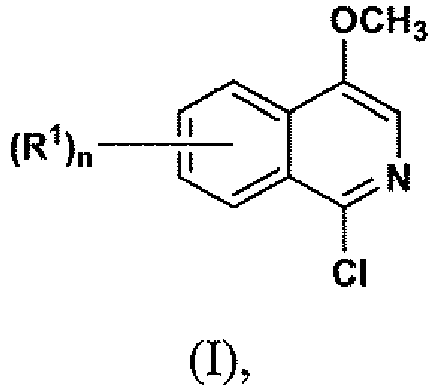
- (a) treating a compound of formula (A)

- n is 0, 1, 2, 3, or 4; and
- each R1 is independently selected from alkoxy, alkyl, amino, aryl, cyano, halo, haloalkoxy, mercapto, and nitro;
- (b) treating the compound of step (a) with a chlorinating agent.
- In a first embodiment of the first aspect, n is 1; and R1 is halo.
- In a second embodiment of the first aspect the acid of step (a) is methanesulfonic acid.
- In a third embodiment the hypervalent iodine oxidizing agent is selected from phenyl iodine diacetate, bis(4-methylbenzenesulfonato-kO)phenyliodine, bis(2,2-dimethylpropanoato-kO)phenyliodine, phenylbis(trichloroacetato-O)iodine, bis(benzoato-kO)phenyliodine, phenylbis(2,2,2,-trifluoroacetateo-KO)iodine, and dichloroiodobenzene. In a fourth embodiment the hypervalent iodine oxidizing agent is phenyl iodine diacetate.
- In a fifth embodiment of the first aspect, the chlorinating agent of step (b) is selected from POCl3 and PCl5. In a sixth embodiment the chlorinating agent is POCl3.
- In a seventh embodiment of the first aspect, the process further comprises a process for preparing a compound of formula (A)

- (a) treating a compound of formula (B)

- (b) treating the product of step (a) with N,N-dimethylformamide dimethyl acetal; and
- (c) treating the product of step (b) with a base.
- In an eighth embodiment, n is 1; and R1 is halo.
- In a ninth embodiment the base of step (c) is selected from potassium tert-butoxide, potassium tert-amylate, and potassium hexamethyldisilazide. In an eighth embodiment the base is potassium tert-amylate.
- In a tenth embodiment of the first aspect the process for preparing compound (A) is continuous.
- In a second aspect the present disclosure provides a process for preparing a compound of formula (F)

- (a) treating a compound of formula (A)

- n is 0, 1, 2, 3, or 4; and
- each R1 is independently selected from alkoxy, alkyl, amino, aryl, cyano, halo, haloalkoxy, mercapto, and nitro;
- X is selected from S, O, and NR4;
- R3 is selected from alkyl, aryl, and arylalkyl; and
- R4 is selected from hydrogen and alkyl.
- In a first embodiment of the first aspect the hypervalent iodine oxidizing agent is selected from phenyl iodine diacetate, bis(4-methylbenzenesulfonato-kO)phenyliodine, bis(2,2-dimethylpropanoato-kO)phenyliodine, phenylbis(trichloroacetato-O)iodine, bis(benzoato-kO)phenyliodine, phenylbis(2,2,2,-trifluoroacetateo-KO)iodine, and dichloroiodobenzene. In a second embodiment the hypervalent iodine oxidizing agent is phenyl iodine diacetate.
- In a third embodiment of the first aspect
n is 1;
R1 is halo; and
R2 is alkoxy wherein the alkoxy is methoxy. - Other embodiments of the present disclosure may comprise suitable combinations of two or more of embodiments and/or aspects disclosed herein.
- Yet other embodiments and aspects of the disclosure will be apparent according to the description provided below.
- The compounds of the present disclosure also exist as tautomers; therefore the present disclosure also encompasses all tautomeric forms.
- As used in the present specification, the following terms have the meanings indicated:
- The term "acid," as used herein, refers to a reagent capable of donating a proton during the course of a reaction. Examples of acids include strong acids such as H2SO4, H3PO4, HNO3, and HCl and weak acids such as acetic acid and benzoic acid.
- The term "alkoxy," as used herein, refers to an alkyl group attached to the parent molecular moiety through an oxygen atom.
- The term "alkyl," as used herein, refers to a group derived from a straight or branched chain saturated hydrocarbon containing from one to six carbon atoms.
- The term "amino," as used herein, refers to -NH2.
- The term "aryl," as used herein, refers to a phenyl group, or a bicyclic fused ring system wherein one or both of the rings is a phenyl group. Bicyclic fused ring systems consist of a phenyl group fused to a four- to six-membered aromatic or nonaromatic carbocyclic ring. The aryl groups of the present disclosure can be attached to the parent molecular moiety through any substitutable carbon atom in the group. Representative examples of aryl groups include, but are not limited to, indanyl, indenyl, naphthyl, phenyl, and tetrahydronaphthyl.
- The term "arylalkyl," as used herein, refers to an alkyl group substituted by one, two, or three aryl groups.
- The term "base," as used herein, refers to a reagent capable of accepting protons during the course of a reaction without acting as a nucleophile in the reaction. Examples of bases include alkoxides such as potassium tert-butoxide, sodium tert-butoxide, potassium tert-amylate, sodium tert-amylate; disilylamides such as lithium hexamethyldisilazide and potassium hexamethyldisilazide; non-nucleophilic amines such as triethylamine, diisopropylethylamine, and diisopropylamine; heterocyclic amines such as imidazole, pyridine, pyridazine, and pyrimidine; and bicyclic amines such as DBN (1,5-diazabicyclo[4.3.0]non-5-ene) and DBU (1,8-diazabicyclo[5.4.0]undec-7-ene. The base chosen for a particular conversion depends on the nature of the starting materials, the solvent or solvents in which the reaction is conducted, and the temperature at which the reaction is conducted.
- The term "brominating agent," as used herein, refers to an agent capable of replacing a particular group on a molecule with a bromine atom. In the present disclosure the brominating agent is used to replace alpha-keto hydrogen atom with a bromine atom to generate an alpha-halo ketone. Representative brominating agents include Br2, NBS, and CBr4.
- The term "chlorinating agent," as used herein, refers to an agent capable of replacing a particular group on a molecule with a chlorine atom. In the present disclosure the chlorinating agent is used to replace an enolic hydroxy group with a chlorine atom to generate a vinyl chloride. Representative chlorinating agents include POCl3, PCl5, and PCl3.
- The term "cyano," as used herein, refers to -CN.
- The terms "halo" and "halide," as used herein, refer to F, Cl, Br, or I.
- The term "haloalkoxy," as used herein, refers to a haloalkyl group attached to the parent molecular moiety through an oxygen atom.
- The term "mercapto," as used herein, refers to -SH.
- The term "nitro," as used herein, refers to -NO2.
- The term "phase transfer catalyst," as used herein refers to a catalyst which facilitates the migration of a reactant in a heterogeneous system from one phase into another phase where reaction can take place. Representative phase transfer catalysts include hexadecyltributylphosphonium bromide, methyltrioctylammonium chloride, and tetrabutylammonium bromide.
- The term "methoxylating conditions," as used herein, refers to conditions that replace an enolic hydroxy group with a methoxy group to form an enol ether. Representative methoxylating conditions include methanolic hydrochloric acid in dioxane and methanesulfonic acid in methanol.
- The term "methylating conditions," as used herein, refers to conditions that replace the hydrogen of a hydroxy group with a methyl group. Representative methylating conditions include dimethyl sulfate in the presence of a base and methyl iodide treatment following deprotonation with a base.
- The term "treating," as used herein, refers to contacting a substrate with one or more reagents and/or additional substrates. The reagents and/or additional substrates may be added to the initial substrate or, alternatively, the initial substrate may be added to the reagents and/or additional substrates.
- All of the processes in the present disclosure can be conducted as continuous processes. The term "continuous process," as used herein, represents steps conducted without isolation of the intermediate.
- Starting materials can be obtained from commercial sources or prepared by well-established literature methods known to those of ordinary skill in the art. It will be readily apparent to one of ordinary skill in the art that compounds of formula (I) can be synthesized by substitution of the appropriate reactants and agents in the syntheses shown below. It will also be readily apparent to one skilled in the art that the specific reaction conditions, such as solvents and temperatures, can vary depending on the nature of the variables to successfully complete the syntheses below.

- Scheme 1 shows one method of synthesizing compounds of formula (I). Compounds of formula (B) can be converted to compounds of formula (B') by treatment with oxalyl chloride followed by ammonium hydroxide. Conversion of compounds of formula (B') can be converted to compounds of formula (A) via treatment with N,N-dimethylformamide dimethyl acetal followed by treatment with a base. Examples of bases used in this reaction include potassium tert-amylate, potassium tert-butoxide, and potassium hexamethyldisilazide.
- Compounds of formula (A) can be converted to compounds of formula (F) by treatment with an anhydrous acid in the presence of methanol and a hypervalent iodine oxidizing agent such as phenyl iodine diacetate, bis(4-methylbenzenesulfonato-kO)phenyliodine, bis(2,2-dimethylpropanoato-kO)phenyliodine, phenylbis(trichloroacetato-O)iodine, bis(benzoato-kO)phenyliodine, phenylbis(2,2,2,-trifluoroacetateo-KO)iodine, ordichloroiodobenzene. Compounds of formula (F) can in turn be converted to compounds of formula (I) by treatment with a chlorinating agent such as POCl3 or PCl5.

- An alternative synthesis of compounds of formula (I) is shown in Scheme 2. Compounds of formula (C) can be converted to compounds of formula (C') by treatment with n-butyl vinyl ether in the presence of a palladium catalytic system, followed by treatment with a strong acid in the presence of water. Examples of palladium catalytic systems include palladium acetate with tri-o-tolylphosphine and diisopropylethylamine and palladium acetate with triphenylphosphine and diisopropylethylamine. Representative strong acids include H3PO4, H2SO4, and HCl. In one embodiment the strong acid is H3PO4.
- Compounds of formula (C') can be converted to compounds of formula (D) by treatment with a brominating agent. Examples of brominating agents include bromine and N-bromosuccinimide.
- Conversion of compounds of formula (D) to compounds of formula (E) can be accomplished by treatment with diformylamide in the presence of a phase transfer catalyst and subsequent treatment with methanol. In one embodiment the phase transfer catalyst is tetrabutylammonium bromide.
- Compounds of formula (E) can be converted to compounds of formula (F) by subjecting the starting vinyl hydroxide to either methoxylating or methylating conditions. One example of methylating conditions is treatment of the compound of formula (E) with dimethyl sulfate in the presence of a base. Examples of methoxylating conditions include treatment of the vinyl hydroxide with methanolic hydrochloric acid in dioxane and and treatment with methanesulfonic acid in methanol.
- Conversion of compounds of formula (F) to compounds of formula (I) can be accomplished using chlorinating conditions as described above.
- The following non-limiting examples are illustrative of the disclosure.
-

Name grams 5-chloro-2-methylbenzoic acid 20.00 Oxalyl Chloride 14.88 Dimethylformamide 0.21 Ammonium Hydroxide 96.50 2-Methyltetrahydrofuran 171.76 2-Methyltetrahydrofuran - biphasic quench 85.88 Water - MeTHF wash 100.00 - To a 500 ml, 3-neck round-bottom (flask A) equipped with a stir bar, nitrogen inlet and temperature probe were charged the following reagents respectively:
- 1) 5-chloro-2-methylbenzoic acid
- 2) MeTHF ---> homogeneous solution
- 3) DMF
- 4) Oxalyl chloride addition over four minutes
- The reaction was allowed to stand for ~1hr at room temperature at which time LC analysis (quenched aliquot in MeOH) indicated >99.5% conversion of starting material;
- In a separate flask (Flask B) MeTHF and 5N NH4OH were combined and stirred vigorously at room temperature.
- The slightly turbid reaction solution in Flask A was then transferred to an addition funnel and added dropwise to flask B over approximately 7 minutes.
- Upon complete addition, the biphasic solution was stirred an additional 10 min prior to transferring the total contents of Flask B to a separatory funnel.
- The layers were then separated and the remaining organic layer was washed 1 x 100ml H2O.
- Layers were then split and assayed.
-

Name grams Starting amide 19.58 Methanamine, 1,1 -Dimethoxy-N,N-dimethyl- 15.13 Potassium-t-amylate 122.42 Toluene 341.16 N-Methylpyrrolidone 151.11 Water 146.85 Hydrogen Chloride 23.89 Heptane 66.92 Methanol 7.77 - The above solution of 5-chloro-2-methylbenzamide was atmospherically solvent switched to toluene.
- The resulting solution was then cooled to 50 °C.
- DMF/DMA was charged to the reaction solution.
- Heated to reflux.
- The solution was allowed to reflux for ~3hrs in order to convert all of the 5-Cl-2-methyl benzamide to the desired amidine intermediate.
- Removal of the methanol byproduct was then performed by distillation.
- The resulting warm, homogeneous solution was then inversely added to a separate reactor that contained 25wt% potassium t-amylate/toluene solution pre-heated to 85°C. Addition rate was maintained ≤ 12L/min on scale.
- Upon complete addition, heating was maintained of the now heterogeneous solution until complete conversion of the amidine intermediate was observed.
- The reaction was then cooled to ∼50 °C.
- Methanol was added, the solution remained heterogeneous.
- Began vacuum distillation (volume reduction involves removing 2-methyl-2-butanol and toluene) to an approximate concentration of 10 ml/g.
- Temperature was reduced to room temperature, then n-heptane was added to the heterogeneous solution.
- A pre-made solution of 50:50 NMP / H2O was then quickly added via addition funnel.
- The resulting bi-phasic solution was then stirred for ∼10 minutes prior to transferring to a separatory funnel.
- The layers separated quickly and cleanly.
- The aqueous NMP layer was cut and transferred to a separate 1L 3-neck round-bottom equipped with a mechanical stirrer, nitrogen inlet and temperature probe.
- While stirring, acid was added via addition funnel in order to neutralize the reaction and subsequently precipitate desired product from solution.
- A total of 100ml, H2O was then added dropwise to the resulting slurry.
- The heterogeneous solution was stirred at room temperature for one hour prior to filtering.
- The resulting cake was washed with 100ml of 20% NMP / H2O, then 3 x 100ml H2O.
- The cake was dried on the frit for several hours under vacuum prior to being transferred to the vacuum oven to continue drying overnight @ 30" Hg and 50 °C. Typical results provide 89% isolated yield with ≥98% LCAP (250nm wavelength).
-

Name equiv grams Starting 1.00 15.00 Iodosobenzene Diacetate 1.10 30.19 Methanesulfonic Acid 1.00 8.05 Methanol 88.75 237.51 - To a 500 ml, 3-neck round-bottom flask (Flask A) equipped with overhead stirring, nitrogen inlet, heating mantle and temperature probe were charged the following reagents respectively:
- 1) starting isocarbostyril
- 2) Methanol (10ml/g-bulk-LR)
- 3) Methanesulfonic acid
- Cooled Flask A via ice bath to ~ 0°C.
- In a separate 250ml, 3-neck round-bottom flask (Flask B) equipped with stir bar, nitrogen inlet, temperature probe and heating mantle was dissolved the oxidant in methanol (10ml/g-bulk-LR) at 30 °C.
- The completely homogeneous oxidant solution was then transferred to an addition funnel and added dropwise to the contents of Flask A, which resulted in a homogeneous solution.
- The ice bath was removed and the reaction was allowed to age at room temperature for ~1 hour prior to heating to reflux.
- The reaction was then aged at reflux until complete conversion was observed (3 - 5 hours).
- Upon complete conversion the reaction volume was then reduced via atmospheric distillation (collected ∼92 ml distillate).
- The reaction was then cooled to room temperature and the resulting slurry was aged @ rt overnight.
- The following morning, a total of 45ml of H2O was slowly added dropwise via addition funnel as anti-solvent.
- The resulting slurry was aged ~1 hour at room temperature prior to filtering.
- The resulting cake was washed with 100ml 50:50 H2O/ MeOH, then 2 x 100ml H2O.
- The solids were dried on the frit under vacuum for several hours prior to being transferred to the vac oven were they continued to dry @ 50 °C and 30" Hg over the weekend. Typical results range from 75 - 85% isolated yield with ≥97 LCAP (250nm wavelength).
-

Name equiv grams Starting isocarbostyril 1.00 10.00 Phosphoryl Chloride 3.00 21.94 Acetonitrile n/a 39.16 Water - inverse quench n/a 200.00 Potassium Phosphate, Tribasic, N-Hydrate 100.24 Tetrahydrofuran 101.90 Toluene 30.49 Tetrahydrofuran - Carbon cake wash 49.62 Heptane-solvent switch and cake wash 314.46 - To a 250ml 3-neck round-bottom flask (Flask A) equipped with a stir bar, nitrogen inlet, temperature probe, heating mantle and reflux condenser were charged the following reagents respectively:
- 1) starting isocarbostyril
- 2) acetonitrile
- 3) POCl3 (maintained temperature during addition below 30 °C)
- Began heating to reflux and followed conversion by LC analysis.
- In a separate, 3-neck round-bottom flask (Flask B) equipped with a stir bar, temperature probe, and cooling capabilities were charged the following reagents respectively:
- 1) water - inverse quench
- 2) potassium phosphate, tribasic, N-hydrate
- Upon complete conversion the reaction solution was cooled to room temperature.
- The contents of Flask A were then transferred to Flask B maintaining the temperature below 10 °C during the inverse addition.
- Upon complete transfer, the resulting slurry was aged between 0 - 10 °C for 30 minutes.
- The following solvents were then charged to begin extractive workup:
- 1) Tetrahydrofuran
- 2) Toluene
- The combined biphasic solution, Vmax=~45mL/g-bulk-LR, was stirred for 30 minutes as the temperature of the combined mixture increased to room temperature.
- Agitation was stopped and the layers were given time to separate.
- The layers were split and the aqueous layer was discarded.
- The organic layer was subjected to carbon treatment (∼10wt% charge wrt Bulk-LR) for 1 hour with agitation.
- MgSO4 (1:1 charge wrt Bulk-LR) was then charged and the solution was again agitated for 1 hour.
- The solids were then filtered off and the resulting cake was washed with Tetrahydrofuran-Carbon cake wash.
- Organic layers were then combined and solvent-switched to n-Heptane in order to crystallize product from solution.
- After switching to n-Heptane, the resulting slurry is held at 50 °C with agitation for approximately 1 hour prior to cooling to ~7 °C.
- The resulting 'cold' slurry was then aged with agitation for an additional hour.
- The slurry was filtered and the solid washed with n-Heptane.
- Typical results range from 77 - 87% isolated yield; ≥98% LCAP (250nm wavelength).
-

Name grams Starting ketone 1000.00 Bromine 676.41 Toluene 8712.00 Bromine 150.31 Bromine if needed 75.16 Potassium Carbonate 649.98 Water 3000.00 Water 1500.00 Sodium Chloride (half brine) 1710.00 - The solution received contains 1000 g of starting ketone in Toluene.
Notes:- The reaction was followed by GC because the desired product has the same HPLC retention time as the solvent of the reaction (toluene).
- Preparation of solution of Potassium Carbonate and Half Brine should be prepared in advance.
- The solution of the starting ketone was transferred to a 20L reactor and the volume of Toluene was adjusted to give a concentration of ketone of 95 mg/mL-108 mg/mL in Toluene.
Note: If the reaction concentration is higher, formation of Cyclized acetophenone impurity (FW: 180 ,5.35 min by GC) up to 12 Area Percent during the reaction results. The reaction must be done in the specified range to reduce the formation of the impurity. - The reactor was equipped with mechanical stirrer, temperature probe, a condenser, argon inlet and addition funnel.
Notes:- A trap with 4 L of 2N NaOH was used to neutralize HBr formed during the reaction.
- An empty flask was placed between the reactor and the Sodium hydroxide trap in case of loss of bromine from the condenser, and to be sure no NaOH went into the reactor.
- The solution of starting ketone in the reactor was cooled to between 0 °C and -3.0 °C.
- Added rapidly 0.9 eq of Bromine (676.41g) keeping the temperature below 3 °C. Note: Fast addition of the bromine reduce the level of impurity.
- Stirred for 10 minutes between -3°C and 3 °C and monitored by GC.(starting material (5.65 min): 18.6 AP; Desired bromide (7.32 min): 63.7 AP; Dibromide imp. (8.56 min): 1.35 AP; Cyclized acetophenone Imp. (5.34 min): 1.06 AP; Unknown Imp (7.21 min): 1.24 AP.
Notes- The five compounds mentioned above need to be follow closely during the reaction. The amount of starting ketone remaining should be below 4 AP by GC. If the reaction is pushed to be below 1 AP of starting material the amount of Dibromide impurity will increase.
- To be sure to not over charge the bromine, the reagent was added by portion to avoid the formation at a high level of the dibromide impurity.
- May have formation of solid during the reaction. The solid formed is the desired product. The solid will go into solution when the reaction is heated up after the quench. It may change the results of the GC for the amount of starting ketone remaining. If the level of Dibromide impurity with presence of solid in the reaction mixture is higher than 3 AP and the amount of starting material about 4-5 AP the reaction should be considered completed.
- Added rapidly 0.2 eq of Bromine (150.31 g) keeping the temperature below 3 °C. Note: Fast addition of the bromine reduced the level of impurity.
- Allowed to stir 10 min between -3°C and 3 °C and monitored by GC (starting ketone (5.65 min): 3.7 AP; desired bromide (7.32 min): 77.4 AP; Dibromide imp. (8.56 min): 2.4 AP; Cyclized acetophenone Imp. (5.34 min): 2.3 AP; Unknown Imp (7.21 min): 1.0 AP.
- The reaction was completed with a total of 1.1 eq of bromine.
- As soon as the reaction is completed the reaction mixture needs to be quenched into a solution of Potassium Carbonate to quench the HBr present in the reaction mixture. If the quench is not done rapidly, the impurity at 7.2 min will increase significantly.
- The reaction mixture must be added to the potassium carbonate solution to avoid the formation of CO2.
- In a 22L/3 neck round-bottomed flask was prepared a solution with Potassium Carbonate (649.98g) with Water (3.00 kg).
Note: This solution must be prepared in advance. - The solution of potassium carbonate was cooled to 0-5 °C.
Note: The solution must be pre-cooled to reduce the time before the quench. - The reaction mixture was transferred into the potassium carbonate solution under vacuum.
Note: The transfer is done in about 15-20 min. The quench is not very exothermic. Maximum temperature increase from 2 °C to 10 °C. Solids may remain in the reactor, they don't need to be transferred into the quenched solution. They will dissolve when the reaction mixture is returned back into the reactor and with the increase of the temperature. - The quenched reaction mixture was returned back to the reactor.
- Heated the reaction mixture up to 20-25 °C and stir 30 min at 20-25 °C. A GC was done to see if there was any decomposition.
Starting ketone (5.65 min): 3.8 AP
Desired product (7.32 min): 76.6 AP
Dibromide imp. (8.56 min): 2.6 AP
Cyclized acetophenone Imp. (5.34 min): 3.0 AP
Unknown Imp (7.21 min): 1.1 AP
Note: After 18 hrs of stirring at 15-25 °C no decomposition was seen on a small sample. - Stopped the stirring for phase split.
Notes:- Can see some rag in the aqueous layer but none of the desired product is present.
- It takes about 20 min to obtain a clean phase split.
- The pH of the Aqueous layer is 9.
- Added Water (1.50 kg) and let it stir 15 min.
- Stopped the stirring for the phase split.
Notes:- It takes about 15 min to obtain a clean phase split. The pH of the Aqueous layer is 8.
- No desired product is present in the aqueous layer.
- Added Sodium Chloride (half brine) (1.71 kg) and let it stir 15 min.
- Stopped the stirring for the phase split.
Note: It took 15 min for a good phase split. The pH of the aqueous layer is 6-7. - A GC was done quantitatively after work-up to know the amount of desired product present in the Toluene solution.
Starting ketone (5.65 min): 3.8 AP
Desired product (7.32 min): 74.4 AP
Dibromide imp. (8.56 min): 2.5 AP
Cyclized acetophenone Imp. (5.34 min): 2.6 AP
Unknown Imp (7.21 min): 1.1 AP
Note: The amount of bromide present: 1031g.
Note: For the following steps the amounts were based on the amount of desired product obtained in the previous step above: - The solution was concentrated to (2mL/g X 1031 (the amount of desired product) + 1031 (amount of desired product) = 3093 mL.) with an evaporator at 40 °C.
Note: The compound crystallized rapidly when the concentration is completed. The next step needs to be done quickly. - The concentrated solution of desired product was transferred into the 20L reactor. Note: The reactor jacket was pre-heated to 40 °C before the transfer of the solution.
- Rapidly added Heptane (5.64 kg) keeping the temperature between 28-40 °C.
Notes:- The stirring rate must be fast since dense orange-yellow solid will crystallize during the addition.
- Small amount of seeds can be added if after 10% volume of the addition no crystallization occurs.
- Cooled the slurry to 20 -25 °C and let it stir overnight.
Note: No solid stuck on the side wall of the reactor. - A quantitative GC of the supernatant after overnight stirring was done. Note: There was about 12-14 % yield in the supernatant after overnight stirring.
- The slurry was filtered and washed with 2 x 1mL/g (based on the bromide amount from above) of heptane.
- Dried under vacuum without heating to constant weight.
Note: The compound dries very fast. -
- Quantity: 825 g (60 % yield not corrected).
- Appearance: crystalline orange-yellow solid.
- HPLC: 98.9 AP
- GC: 99.6 AP
-

Name grams Starting bromide 10.00 Sodium Diformylamide 4.89 Tetra-N-butylammonium Bromide 1.11 Acetonitrile 62.66 Tetrahydrofuran 17.72 Methanol 23.75 Water (quench system) 100.00 Methyl tert-butyl Ether (part of 50:50 wash) 7.42 Acetonitrile 7.83 Acetonitrile 3.45 Acetic Acid (quench system) 1.26 Water (cake wash) 40.00 Methanol (part of 50:50 MTBE:MeOH wash) 7.92 Methyl tert-butyl Ether (cake washes) 37.08 - Sodium Diformylamide was charged to reactor A and slurried in 1ml acetonitrile /g-bulk LR (KF < 0.05%) and 2ml THF/g-bulk LR (KF < 0.05%).
- The slurry was cooled to 0 °C.
- In a separate flask, the starting bromide was dissolved in 8ml acetonitrile/g-bulk LR (KF < 0.05%) and then transferred to reactor A.
- A clear solution of Tetra-N-butylammonium Bromide dissolved in 0.44ml acetonitrile/g-bulk LR (KF <0.05%) was then added to the reaction mixture (reactor A) over ~15minutes.
- Post complete addition the reaction was warmed to ~15 °C.
Note: the initial yellow / orange slurry slowly darkens as the reaction proceeds. - The reaction was aged with stirring @ 15 - 25 °C until complete conversion of the starting bromide ( < 0.5% LCAP).
Note: this usually requires approximately 10 -12hr. - Upon complete conversion of starting bromide to the diformylamide intermediate, 3ml MeOH/g-bulk LR was added sub-surface over ~1hr.
- The reaction was then aged @ 20 - 25 °C for ~ 8 - 10 hrs.
- Upon complete conversion of intermediate the reaction mixture was inversely quenched into a solution of Acetic acid (0.12ml/g-bulk LR) / water (10ml/g-bulk LR).
- The quenched reaction mixture was stirred @ 20 - 25 °C for ~1hr (final pH = 4 - 5).
- The slurry was then filtered.
- The cake was then washed 2 x 2ml H2O / g-bulk LR.
- The cake was then covered with a 50:50 MTBE/MeOH (2ml/g-bulk LR) solution for ~30min prior to applying vacuum.
- The cake was then washed with 2ml MTBE/g-bulk LR.
- The cake was then washed 2 x 1.5ml MTBE/g-bulk LR.
- The solids were then dried on the filter pot via suction under a stream of nitrogen.
- Upon drying a beige/brown solid was isolated in ~ 78% yield.
-

Name grams Starting alcohol 483.60 Methanesulfonic Acid 2376.08 Methanol 2680.06 Methanol 197.92 Ammonium Hydroxide 3094.46 Water 5000.00
• To a 12 L RBF (fitted with glycol-cooled condenser, gas inlet adaptor, stir bar and heating mantle) was added the starting alcohol (483.6 g) and Methanol (2.68 kg).
• The slurry of brown solids was cooled to 3 °C in an ice/water bath.
• Methanesulfonic Acid (2.38 kg) was added via addition funnel over about 25 minutes (VERY EXOTHERMIC). During the addition, the solids appeared to partially dissolve and the reaction mixture turned reddish brown.
• The reaction mixture was heated to 60°C.
• Heating was continued at 60°C and the reaction monitored by HPLC.
• HPLC results:Time (h) SM (AP) Product (AP) 2.5 86 13 24 14 84 46.5 3.7 95.1
• After 47 hours, the reaction mixture was cooled to room temperature.
• The mixture was filtered through diatomaceous earth (Celite®) to remove solids since the reverse quench was going to be done via addition funnel and residual solid could block the stopcock.
• Ammonium Hydroxide (3.09 kg) was cooled using ice/water in a 22 L flask to 1.6 °C.
• The reaction mixture was added via dropping funnel to the ammonium hydroxide, keeping the temperature < 30°C.Volume added (L) Time Temp (°C) 0 12:01 1.6 1 12:11 22.3 3 12:38 27.0 4 12:48 28.3 5.1 13:03 25.4
• The reaction flask was rinsed with 250 mL methanol to remove the remaining reaction mixture and the rinse transferred to the quench vessel.
• The resulting slurry was held at room temperature. Quantitative samples of the supernatant taken after 1 hour, 3 hours, and 5 hours all showed the same level of product remaining in the mother liquors and the same impurity profile. In future, samples will be taken after cooling to room temperature and after 2 hours to determine whether or not the crystallization is complete.
• The slurry was filtered through #54 Whatman paper, 24 cm diameter on a Buchner funnel.
• The cake was washed with 5 L of water; each wash took about 10 minutes.
• Cake dimensions before compression were 25 cm diameter, 5.5 cm thick for a volume of 2700 mL.
• The solid was very slow to deliquor since the cake tends to crack very easily. The crystals are very fine and form a cake which does not release solvents easily.
• The solid was dried under vacuum at 40 °C. This took several days.
• The desired product (466.2 g; 89.95% yield) was isolated. LOD of the solid was 0.46%. HPLC AP was 97.33 with 2.1 P starting material and 2 other Unknown impurities. -

- POCl3 was added to a solution of starting 7-Cl-4-methoxyisoquinolone in CH3CN (13 L/kg) at 25 °C. (Temperature Increase: ~ 4°C). Reaction heated to reflux.
- Checked conversion after 9h by HPLC (250 nm): Conversion to desired product > 99 %. If not complete, reaction can be left for 16h at reflux. If still not complete, 0.5 equiv. POCl3 can be added and reaction can be checked for conversion after 2h.
- Decreased temperature to 25 °C.
- Transferred the reaction mixture slowly to a solution of K2HPO4 (18 wt%) (40 L/kg) equilibrated at 38 °C. Controlled the addition, maximum temperature: 45°C. pH control: if < 5 during the quench 5 L/kg of K2HPO4 added.
- Stirred for 1h at 38 °C after addition completed.
- Added ethyl acetate: 30 L/kg and stirred for 30 min.
- Phases were split: Aged for 15 minutes. At this stage: Vmax: 73 L/kg (Organic: 43 L/kg).
- Corrective action: If inorganic salts present: added 10 L/kg water.
- Corrective action: If rag layer present: added 10 L/kg ethyl acetate: Vmax: 83 L/kg (Vmax: 88 L/kg, Organic: 53 L/kg).
- If both corrective are actions taken: Vmax: 103L/ kg (Organic: 53 L/kg).
- Separated aqueous/organic phase. Checked for product in aqueous phase. < 3 % total yield. If failed, the aqueous phase would be extracted with 10L/kg ethyl acetate, until the product had been extracted. Organic phase: 43 L/ kg, if corrected: 53 L/kg, checked yield by HPLC calibration.
- Added10% weight / desired product of charcoal Darco G60. The charcoal was preliminarily stirred in ethyl acetate (5 L/kg).
- Stirred at 25 °C for 2h. Took a sample (1 ml), filtered, checked color and yield by HPLC. If solution was clear (visual estimation), the mixture was filtered. If not added 10% weight and left 2h more. Same procedure. If not, added 10% more and left overnight.
- Filtered on diatomaceous earth (Celite®) pad, washed with 20 L/kg of ethyl acetate. 68 L/kg <Vmax < 78L/kg.
- Evaporated ethyl acetate and dried.
- On a 10g scale, the total yield was 75% (isolated material by selective crystallization; 63% yield; Potency: 102% (HPLC : RAP >99.9)).
- Upon complete conversion of starting bromide to the diformylamide intermediate, 3ml MeOH/g-bulk LR was added sub-surface over ∼1hr.
- The reaction was then aged @ 20 - 25 °C for ∼8 -10 hrs.
- Upon complete conversion of intermediate the reaction mixture was inversely quenched into a solution of Acetic acid (0.12ml/g-bulk LR) / water (10ml/g-bulk LR).
- The quenched reaction mixture was stirred @ 20 - 25°C for ~1hr (final pH = 4 - 5).
- The slurry was then filtered.
- The cake was then washed 2 x 2ml H2O / g-bulk LR.
- The cake was then covered with a 50:50 MTBE/MeOH (2ml/g-bulk LR) solution for ~30min prior to applying vacuum.
- The cake was then washed with 2ml MTBE/g-bulk LR.
- The cake was then washed 2 x 1.5ml MTBE/g-bulk LR.
- The solids were then dried on the filter pot via suction under a stream of nitrogen.
- Upon drying a beige/brown solid was isolated in ~ 78% yield.
-
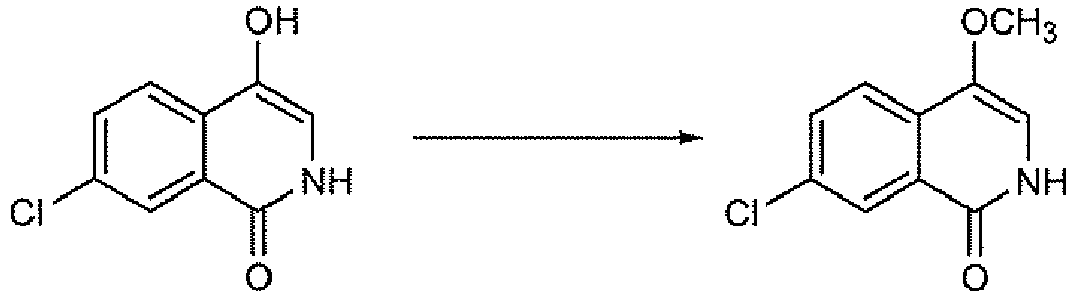
Name grams Starting alcohol 483.60 Methanesulfonic Acid 2376.08 Methanol 2680.06 Methanol 197.92 Ammonium Hydroxide 3094.46 Water 5000.00
• To a 12 L RBF (fitted with glycol-cooled condenser, gas inlet adaptor, stir bar and heating mantle) was added the starting alcohol (483.6 g) and Methanol (2.68 kg).
• The slurry of brown solids was cooled to 3 °C in an ice/water bath.
• Methanesulfonic Acid (2.38 kg) was added via addition funnel over about 25 minutes (VERY EXOTHERMIC). During the addition, the solids appeared to partially dissolve and the reaction mixture turned reddish brown.
• The reaction mixture was heated to 60°C.
• Heating was continued at 60°C and the reaction monitored by HPLC.
• HPLC results:Time (h) SM (AP) Product (AP) 2.5 86 13 24 14 84 46.5 3.7 95.1
• After 47 hours, the reaction mixture was cooled to room temperature.
• The mixture was filtered through diatomaceous earth (Celite®) to remove solids since the reverse quench was going to be done via addition funnel and residual solid could block the stopcock.
• Ammonium Hydroxide (3.09 kg) was cooled using ice/water in a 22 L flask to 1.6 °C.
• The reaction mixture was added via dropping funnel to the ammonium hydroxide, keeping the temperature < 30°C.Volume added (L) Time Temp (°C) 0 12:01 1.6 1 12:11 22.3 3 12:38 27.0 4 12:48 28.3 5.1 13:03 25.4
• The reaction flask was rinsed with 250 mL methanol to remove the remaining reaction mixture and the rinse transferred to the quench vessel.
• The resulting slurry was held at room temperature. Quantitative samples of the supernatant taken after 1 hour, 3 hours, and 5 hours all showed the same level of product remaining in the mother liquors and the same impurity profile. In future, samples will be taken after cooling to room temperature and after 2 hours to determine whether or not the crystallization is complete.
• The slurry was filtered through #54 Whatman paper, 24 cm diameter on a Buchner funnel.
• The cake was washed with 5 L of water; each wash took about 10 minutes.
• Cake dimensions before compression were 25 cm diameter, 5.5 cm thick for a volume of 2700 mL.
• The solid was very slow to deliquor since the cake tends to crack very easily. The crystals are very fine and form a cake which does not release solvents easily.
• The solid was dried under vacuum at 40 °C. This took several days.
• The desired product (466.2 g; 89.95% yield) was isolated. LOD of the solid was 0.46%. HPLC AP was 97.33 with 2.1 P starting material and 2 other unknown impurities. -
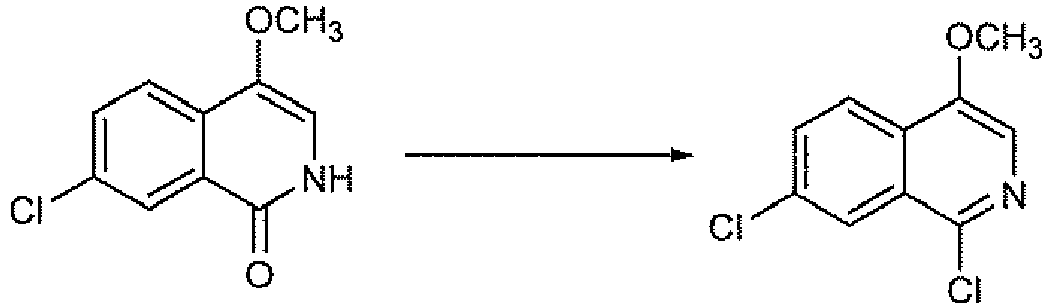
- POCl3 was added to a solution of starting 7-C1-4-methoxyisoquinolone in CH3CN (13 L/kg) at 25 °C. (Temperature Increase: ~ 4°C). Reaction heated to reflux.
- Checked conversion after 9h by HPLC (250 nm): Conversion to desired product > 99 %. If not complete, reaction can be left for 16h at reflux. If still not complete, 0.5 equiv. POCl3 can be added and reaction can be checked for conversion after 2h.
- Decreased temperature to 25 °C.
- Transferred the reaction mixture slowly to a solution of K2HPO4 (18 wt%) (40 L/kg) equilibrated at 38 °C. Controlled the addition, maximum temperature: 45°C. pH control: if < 5 during the quench 5 L/kg of K2HPO4 added.
- Stirred for 1h at 38 °C after addition completed.
- Added ethyl acetate: 30 L/kg and stirred for 30 min.
- Phases were split: Aged for 15 minutes. At this stage: Vmax: 73 L/kg (Organic: 43 L/kg).
- Corrective action: If inorganic salts present: added 10 L/kg water.
- Corrective action: If rag layer present: added 10 L/kg ethyl acetate: Vmax: 83 L/kg (Vmax: 88 L/kg, Organic: 53 L/kg).
- If both corrective are actions taken: Vmax: 103L/ kg (Organic: 53 L/kg).
- Separated aqueous/organic phase. Checked for product in aqueous phase. < 3 % total yield. If failed, the aqueous phase would be extracted with 10L/kg ethyl acetate, until the product had been extracted. Organic phase: 43 L/ kg, if corrected: 53 L/kg, checked yield by HPLC calibration.
- Added10% weight / desired product of charcoal Darco G60. The charcoal was preliminarily stirred in ethyl acetate (5 L/kg).
- Stirred at 25 °C for 2h. Took a sample (1 ml), filtered, checked color and yield by HPLC. If solution was clear (visual estimation), the mixture was filtered. If not added 10% weight and left 2h more. Same procedure. If not, added 10% more and left overnight.
- Filtered on diatomaceous earth (Celite®) pad, washed with 20 L/kg of ethyl acetate. 68 L/kg <Vmax < 78L/kg.
- Evaporated ethyl acetate and dried.
- On a 10g scale, the total yield was 75% (isolated material by selective crystallization; 63% yield; Potency: 102% (HPLC : RAP >99.9)).
Claims (15)
- A process for preparing a compound of formula (I)
 (a) treating a compound of formula (A)
 n is 0, 1, 2, 3, or 4; andeach R1 is independently selected from alkoxy, alkyl, amino, aryl, cyano, halo, haloalkoxy, mercapto, and nitro;with an anhydrous acid in the presence of methanol and a hypervalent iodine oxidizing agent; and(b) treating the compound of step (a) with a chlorinating agent.
 - The process of claim 1 wherein
n is 1; and
R1 is halo. - The process of claim 1 wherein the anhydrous acid of step (a) is methanesulfonic acid.
- The process of claim 1 wherein the hypervalent iodine oxidizing agent is selected from phenyl iodine diacetate, bis(4-methylbenzenesulfonato-kO)phenyliodine, bis(2,2-dimethylpropanoato-KO)phenyliodine, phenylbis(trichloroacetato-O)iodine, bis(benzoato-kO)phenyliodine, phenylbis(2,2,2,-trifluoroacetateo-KO)iodine, and dichloroiodobenzene.
- The process of claim 4 wherein the hypervalent iodine oxidizing agent is phenyl iodine diacetate.
- The process of claim 1 wherein the chlorinating agent of step (b) is selected from POCl3 and PCl5.
- The process of claim 6 wherein the chlorinating agent is POCl3.
- The process of claim 1 further comprising a process for preparing a compound of formula (A)
 (a) treating a compound of formula (B)
 (b) treating the product of step (a) with N,N-dimethylformamide dimethyl acetal; and(c) treating the product of step (b) with a base.
 - The process of claim 8 wherein
n is 1; and
R1 is halo. - The process of claim 8 wherein the base of step (c) is selected from potassium tert-butoxide, potassium tert-amylate, and potassium hexamethyldisilazide.
- The process of claim 8 wherein the base is potassium tert-amylate.
- The process of claim 8 wherein the process for preparing compound (A) is continuous.
- A process for preparing a compound of formula (F)
 (a) treating a compound of formula (A)
 n is 0, 1, 2, 3, or 4; andeach R1 is independently selected from alkoxy, alkyl, amino, aryl, cyano, halo, haloalkoxy, mercapto, and nitro;with an anhydrous acid in the presence of R3XH and a hypervalent iodine oxidizing agent whereinX is selected from S, O, and NR4;R2 is -XR3;R3 is selected from alkyl, aryl, and arylalkyl; andR4 is selected from hydrogen and alkyl.
 - The process of claim 13 wherein the hypervalent iodine oxidizing agent is as defined in claim 4 or claim 5.
- The process of claim 14 wherein
n is 1;
R1 is halo; and
R2 is alkoxy wherein the alkoxy is methoxy.
Priority Applications (1)
| Application Number | Priority Date | Filing Date | Title |
|---|---|---|---|
| EP15183086.6A EP3037416A1 (en) | 2008-09-04 | 2009-08-27 | Process for synthesizing substituted isoquinolines |
Applications Claiming Priority (3)
| Application Number | Priority Date | Filing Date | Title |
|---|---|---|---|
| US9408808P | 2008-09-04 | 2008-09-04 | |
| US12/547,158 US8207341B2 (en) | 2008-09-04 | 2009-08-25 | Process or synthesizing substituted isoquinolines |
| PCT/US2009/055132 WO2010027889A2 (en) | 2008-09-04 | 2009-08-27 | Process for synthesizing substituted isoquinolines |
Related Child Applications (2)
| Application Number | Title | Priority Date | Filing Date |
|---|---|---|---|
| EP15183086.6A Division EP3037416A1 (en) | 2008-09-04 | 2009-08-27 | Process for synthesizing substituted isoquinolines |
| EP15183086.6A Division-Into EP3037416A1 (en) | 2008-09-04 | 2009-08-27 | Process for synthesizing substituted isoquinolines |
Publications (2)
| Publication Number | Publication Date |
|---|---|
| EP2326624A2 EP2326624A2 (en) | 2011-06-01 |
| EP2326624B1 true EP2326624B1 (en) | 2015-10-07 |
Family
ID=41726398
Family Applications (2)
| Application Number | Title | Priority Date | Filing Date |
|---|---|---|---|
| EP15183086.6A Withdrawn EP3037416A1 (en) | 2008-09-04 | 2009-08-27 | Process for synthesizing substituted isoquinolines |
| EP09791977.3A Not-in-force EP2326624B1 (en) | 2008-09-04 | 2009-08-27 | Process for synthesizing substituted isoquinolines |
Family Applications Before (1)
| Application Number | Title | Priority Date | Filing Date |
|---|---|---|---|
| EP15183086.6A Withdrawn EP3037416A1 (en) | 2008-09-04 | 2009-08-27 | Process for synthesizing substituted isoquinolines |
Country Status (9)
| Country | Link |
|---|---|
| US (3) | US8207341B2 (en) |
| EP (2) | EP3037416A1 (en) |
| JP (2) | JP5656838B2 (en) |
| KR (2) | KR101648595B1 (en) |
| CN (2) | CN102143950B (en) |
| AR (1) | AR073278A1 (en) |
| ES (1) | ES2554619T3 (en) |
| TW (1) | TWI441811B (en) |
| WO (1) | WO2010027889A2 (en) |
Families Citing this family (3)
| Publication number | Priority date | Publication date | Assignee | Title |
|---|---|---|---|---|
| MY140680A (en) | 2002-05-20 | 2010-01-15 | Bristol Myers Squibb Co | Hepatitis c virus inhibitors |
| CN109956870A (en) | 2017-12-14 | 2019-07-02 | 南京卡文迪许生物工程技术有限公司 | A kind of synthetic method of roxadustat and intermediate compound thereof |
| CN114805204B (en) * | 2022-04-01 | 2023-09-15 | 云南师范大学 | A method for preparing 4-iodoisoquinoline-1(2H)-one compounds |
Family Cites Families (160)
| Publication number | Priority date | Publication date | Assignee | Title |
|---|---|---|---|---|
| EP0475255A3 (en) * | 1990-09-12 | 1993-04-14 | F. Hoffmann-La Roche Ag | Process for the preparation of optically pure (s)-alpha-((tert-butylsulfonyl)methyl)hydro cinnamic acid |
| CZ298749B6 (en) | 1996-10-18 | 2008-01-16 | Vertex Pharmaceuticals Incorporated | Inhibitors of serine proteases and pharmaceutical compositions in which the inhibitors are comprised |
| DE69829381T2 (en) | 1997-08-11 | 2006-04-13 | Boehringer Ingelheim (Canada) Ltd., Laval | HEPATITIS C INHIBITOR PEPTIDE |
| EP1012180B1 (en) | 1997-08-11 | 2004-12-01 | Boehringer Ingelheim (Canada) Ltd. | Hepatitis c inhibitor peptide analogues |
| AR022061A1 (en) | 1998-08-10 | 2002-09-04 | Boehringer Ingelheim Ca Ltd | INHIBITING PEPTIDES OF HEPATITIS C, A PHARMACEUTICAL COMPOSITION CONTAINING THEM, THE USE OF THE SAME TO PREPARE A PHARMACEUTICAL COMPOSITION, THE USE OF AN INTERMEDIATE PRODUCT FOR THE PREPARATION OF THESE PEPTIDES AND A PROCEDURE FOR THE PREPARATION OF ANOGRAPH . |
| US6323180B1 (en) | 1998-08-10 | 2001-11-27 | Boehringer Ingelheim (Canada) Ltd | Hepatitis C inhibitor tri-peptides |
| UA74546C2 (en) | 1999-04-06 | 2006-01-16 | Boehringer Ingelheim Ca Ltd | Macrocyclic peptides having activity relative to hepatitis c virus, a pharmaceutical composition and use of the pharmaceutical composition |
| MXPA03000627A (en) | 2000-07-21 | 2004-07-30 | Schering Corp | Novel peptides as ns3-serine protease inhibitors of hepatitis c virus. |
| US7244721B2 (en) | 2000-07-21 | 2007-07-17 | Schering Corporation | Peptides as NS3-serine protease inhibitors of hepatitis C virus |
| CA2429359A1 (en) | 2000-11-20 | 2002-08-08 | Bristol-Myers Squibb Company | Hepatitis c tripeptide inhibitors |
| US7544374B2 (en) * | 2001-08-14 | 2009-06-09 | Tel Aviv University Future Technology Development L.P. | Lipidated glycosaminoglycan particles and their use in drug and gene delivery for diagnosis and therapy |
| US6867185B2 (en) | 2001-12-20 | 2005-03-15 | Bristol-Myers Squibb Company | Inhibitors of hepatitis C virus |
| CA2369711A1 (en) | 2002-01-30 | 2003-07-30 | Boehringer Ingelheim (Canada) Ltd. | Macrocyclic peptides active against the hepatitis c virus |
| CA2370396A1 (en) | 2002-02-01 | 2003-08-01 | Boehringer Ingelheim (Canada) Ltd. | Hepatitis c inhibitor tri-peptides |
| CA2369970A1 (en) | 2002-02-01 | 2003-08-01 | Boehringer Ingelheim (Canada) Ltd. | Hepatitis c inhibitor tri-peptides |
| US6828301B2 (en) | 2002-02-07 | 2004-12-07 | Boehringer Ingelheim International Gmbh | Pharmaceutical compositions for hepatitis C viral protease inhibitors |
| US20060199773A1 (en) * | 2002-05-20 | 2006-09-07 | Sausker Justin B | Crystalline forms of (1R,2S)-N-[(1,1-dimethylethoxy)carbonyl]-3-methyl-L-valyl-(4R)-4-[(6-methoxy-1-isoquinolinyl)oxy]-L-prolyl-1-amino-N-(cyclopropylsulfonyl)-2-ethenyl-cyclopropanecarboxamide, monopotassium salt |
| EP1506000B9 (en) | 2002-05-20 | 2011-08-31 | Bristol-Myers Squibb Company | Heterocyclicsulfonamide hepatitis c virus inhibitors |
| MY140680A (en) * | 2002-05-20 | 2010-01-15 | Bristol Myers Squibb Co | Hepatitis c virus inhibitors |
| US6878722B2 (en) | 2002-05-20 | 2005-04-12 | Bristol-Myers Squibb Company | Substituted cycloalkyl P1′ hepatitis C virus inhibitors |
| WO2004032827A2 (en) | 2002-05-20 | 2004-04-22 | Bristol-Myers Squibb Company | Hepatitis c virus inhibitors |
| US20040033959A1 (en) | 2002-07-19 | 2004-02-19 | Boehringer Ingelheim Pharmaceuticals, Inc. | Pharmaceutical compositions for hepatitis C viral protease inhibitors |
| US20050075279A1 (en) | 2002-10-25 | 2005-04-07 | Boehringer Ingelheim International Gmbh | Macrocyclic peptides active against the hepatitis C virus |
| US7601709B2 (en) * | 2003-02-07 | 2009-10-13 | Enanta Pharmaceuticals, Inc. | Macrocyclic hepatitis C serine protease inhibitors |
| AU2004211637C1 (en) | 2003-02-07 | 2010-08-19 | Enanta Pharmaceuticals, Inc. | Macrocyclic hepatitis C serine protease inhibitors |
| JP4682140B2 (en) | 2003-03-05 | 2011-05-11 | ベーリンガー インゲルハイム インターナショナル ゲゼルシャフト ミット ベシュレンクテル ハフツング | Hepatitis C inhibitor peptide analogues |
| EP1601685A1 (en) | 2003-03-05 | 2005-12-07 | Boehringer Ingelheim International GmbH | Hepatitis c inhibiting compounds |
| UA81028C2 (en) | 2003-04-02 | 2007-11-26 | Boehringer Ingelheim Int | Pharmaceutical compositions for hepatitis c viral protease inhibitors |
| EP1629000B1 (en) * | 2003-04-16 | 2009-02-18 | Bristol-Myers Squibb Company | Macrocyclic isoquinoline peptide inhibitors of hepatitis c virus |
| SI1615613T1 (en) | 2003-04-18 | 2010-03-31 | Enanta Pharm Inc | Quinoxalinyl macrocyclic hepatitis c serine protease inhibitors |
| HRP20080014T3 (en) | 2003-05-21 | 2008-02-29 | Boehringer Ingelheim International Gmbh | Hepatitis c inhibitor compounds |
| WO2004113365A2 (en) | 2003-06-05 | 2004-12-29 | Enanta Pharmaceuticals, Inc. | Hepatitis c serine protease tri-peptide inhibitors |
| US7125845B2 (en) | 2003-07-03 | 2006-10-24 | Enanta Pharmaceuticals, Inc. | Aza-peptide macrocyclic hepatitis C serine protease inhibitors |
| RS20060197A (en) | 2003-09-22 | 2008-09-29 | Boehringer Ingelheim International Gmbh., | Macrocyclic peptides active against the hepatitis c virus |
| CA2541634A1 (en) | 2003-10-10 | 2005-04-28 | Vertex Pharmaceuticals Incorporated | Inhibitors of serine proteases, particularly hcv ns3-ns4a protease |
| TW201245229A (en) | 2003-10-14 | 2012-11-16 | Hoffmann La Roche | Macrocyclic carboxylic acids and acylsulfonamides as inhibitors of HCV replication |
| US7132504B2 (en) | 2003-11-12 | 2006-11-07 | Bristol-Myers Squibb Company | Hepatitis C virus inhibitors |
| JP2007532479A (en) | 2003-11-20 | 2007-11-15 | シェーリング コーポレイション | Depeptideization inhibitor of hepatitis C virus NS3 protease |
| US7135462B2 (en) | 2003-11-20 | 2006-11-14 | Bristol-Myers Squibb Company | Hepatitis C virus inhibitors |
| US7309708B2 (en) | 2003-11-20 | 2007-12-18 | Birstol-Myers Squibb Company | Hepatitis C virus inhibitors |
| ATE495185T1 (en) | 2004-01-21 | 2011-01-15 | Boehringer Ingelheim Int | MACROCYCLIC PEPTIDES ACTIVE AGAINST HEPATITIS C VIRUS |
| KR20120090077A (en) | 2004-01-30 | 2012-08-16 | 얀센 알 앤드 디 아일랜드 | Hcv ns-3 serine protease inhibitors |
| JP4654239B2 (en) * | 2004-03-15 | 2011-03-16 | ベーリンガー インゲルハイム インターナショナル ゲゼルシャフト ミット ベシュレンクテル ハフツング | Method for preparing macrocyclic dipeptide suitable for treatment of hepatitis C virus infection |
| AU2005228894B9 (en) | 2004-03-30 | 2011-10-13 | Intermune, Inc. | Macrocyclic compounds as inhibitors of viral replication |
| WO2006016930A2 (en) | 2004-05-14 | 2006-02-16 | Intermune, Inc. | Methods for treating hcv infection |
| WO2005116054A1 (en) | 2004-05-25 | 2005-12-08 | Boehringer Ingelheim International, Gmbh | Process for preparing acyclic hcv protease inhibitors |
| WO2006000085A1 (en) | 2004-06-28 | 2006-01-05 | Boehringer Ingelheim International Gmbh | Hepatitis c inhibitor peptide analogs |
| DK1778702T3 (en) | 2004-07-16 | 2011-10-17 | Gilead Sciences Inc | Antiviral compounds |
| UY29016A1 (en) | 2004-07-20 | 2006-02-24 | Boehringer Ingelheim Int | ANALOGS OF INHIBITING DIPEPTIDES OF HEPATITIS C |
| JP4914355B2 (en) | 2004-07-20 | 2012-04-11 | ベーリンガー インゲルハイム インターナショナル ゲゼルシャフト ミット ベシュレンクテル ハフツング | Hepatitis C inhibitor peptide analog |
| CA2577812A1 (en) | 2004-08-27 | 2006-03-09 | Schering Corporation | Acylsulfonamide compounds as inhibitors of hepatitis c virus ns3 serine protease |
| EP1794178A1 (en) | 2004-09-17 | 2007-06-13 | Boehringer Ingelheim International Gmbh | Process for preparing macrocyclic hcv protease inhibitors |
| WO2007001406A2 (en) | 2004-10-05 | 2007-01-04 | Chiron Corporation | Aryl-containing macrocyclic compounds |
| EP1805187A1 (en) | 2004-10-21 | 2007-07-11 | Pfizer, Inc. | Inhibitors of hepatitis c virus protease, and compositions and treatments using the same |
| US7323447B2 (en) | 2005-02-08 | 2008-01-29 | Bristol-Myers Squibb Company | Hepatitis C virus inhibitors |
| NZ562167A (en) | 2005-03-08 | 2011-01-28 | Boehringer Ingelheim Int | Process for preparing macrocyclic compounds |
| WO2006119061A2 (en) | 2005-05-02 | 2006-11-09 | Merck & Co., Inc. | Hcv ns3 protease inhibitors |
| US7592336B2 (en) | 2005-05-10 | 2009-09-22 | Bristol-Myers Squibb Company | Hepatitis C virus inhibitors |
| US20060281689A1 (en) | 2005-06-02 | 2006-12-14 | Schering Corporation | Method for modulating activity of HCV protease through use of a novel HCV protease inhibitor to reduce duration of treatment period |
| US20070004635A1 (en) | 2005-06-02 | 2007-01-04 | Schering Corporation | Method of treating interferon non-responders using HCV protease inhibitor |
| WO2006130554A2 (en) | 2005-06-02 | 2006-12-07 | Schering Corporation | Methods of treating hepatitis c virus |
| WO2006130627A2 (en) | 2005-06-02 | 2006-12-07 | Schering Corporation | Methods for treating hepatitis c |
| US20060276406A1 (en) | 2005-06-02 | 2006-12-07 | Schering Corporation | Methods of treating hepatitis C virus |
| CN101212970B (en) | 2005-06-02 | 2010-07-21 | 先灵公司 | Compositions of HCV protease inhibitors and surfactants |
| US20060287248A1 (en) | 2005-06-02 | 2006-12-21 | Schering Corporation | Asymmetric dosing methods |
| US20060276404A1 (en) | 2005-06-02 | 2006-12-07 | Anima Ghosal | Medicaments and methods combining a HCV protease inhibitor and an AKR competitor |
| WO2006130686A2 (en) | 2005-06-02 | 2006-12-07 | Schering Corporation | Hcv protease inhibitors in combination with food |
| WO2006130687A2 (en) | 2005-06-02 | 2006-12-07 | Schering Corporation | Liver/plasma concentration ratio for dosing hepatitis c virus protease inhibitor |
| NZ563369A (en) | 2005-06-02 | 2011-03-31 | Schering Corp | Controlled-release formulation useful for treating disorders associated with hepatitus C virus |
| US7601686B2 (en) | 2005-07-11 | 2009-10-13 | Bristol-Myers Squibb Company | Hepatitis C virus inhibitors |
| TW200738742A (en) * | 2005-07-14 | 2007-10-16 | Gilead Sciences Inc | Antiviral compounds |
| TWI389908B (en) | 2005-07-14 | 2013-03-21 | Gilead Sciences Inc | Antiviral compounds |
| TWI387603B (en) | 2005-07-20 | 2013-03-01 | Merck Sharp & Dohme | Hcv ns3 protease inhibitors |
| EP1910378B1 (en) | 2005-07-20 | 2012-06-20 | Boehringer Ingelheim International GmbH | Hepatitis c inhibitor peptide analogs |
| JP5249028B2 (en) | 2005-07-25 | 2013-07-31 | インターミューン・インコーポレーテッド | Novel macrocyclic inhibitor of hepatitis C virus replication |
| DK1919899T3 (en) | 2005-07-29 | 2011-08-01 | Tibotec Pharm Ltd | Macrocyclic inhibitors of hepatitis C virus |
| JO2768B1 (en) | 2005-07-29 | 2014-03-15 | تيبوتيك فارماسيوتيكالز ليمتد | Macrocylic Inhibitors Hepatitis C Virus |
| PE20070211A1 (en) | 2005-07-29 | 2007-05-12 | Medivir Ab | MACROCYCLIC COMPOUNDS AS INHIBITORS OF HEPATITIS C VIRUS |
| DK1919904T3 (en) | 2005-07-29 | 2014-04-07 | Janssen R & D Ireland | MACROCYCLIC INHIBITORS OF HEPATITIS-C VIRUS |
| PL1919898T3 (en) | 2005-07-29 | 2011-06-30 | Tibotec Pharm Ltd | Macrocyclic inhibitors of hepatitis c virus |
| US20100120855A1 (en) | 2005-07-29 | 2010-05-13 | Tibotec Pharmaceuticals Ltd. | Macrocylic inhibitors of hepatitis c virus |
| US7700552B2 (en) | 2005-07-29 | 2010-04-20 | Medivir Ab | Macrocyclic inhibitors of hepatitis C virus |
| PE20070343A1 (en) | 2005-07-29 | 2007-05-12 | Medivir Ab | MACRO CYCLIC INHIBITORS OF HEPATITIS C VIRUS |
| PE20070210A1 (en) | 2005-07-29 | 2007-04-16 | Tibotec Pharm Ltd | MACROCYCLIC COMPOUNDS AS INHIBITORS OF HEPATITIS C VIRUS |
| ES2373685T3 (en) | 2005-07-29 | 2012-02-07 | Tibotec Pharmaceuticals | MACROCYCLIC INHIBITORS OF HEPATITIS VIRUS C. |
| TWI412535B (en) | 2005-07-29 | 2013-10-21 | Tibotec Pharm Ltd | Macrocylic inhibitors of hepatitis c virus |
| KR20080036598A (en) | 2005-08-01 | 2008-04-28 | 머크 앤드 캄파니 인코포레이티드 | Macrocyclic Peptides as HCV NS3 Protease Inhibitors |
| EP1915382A2 (en) | 2005-08-01 | 2008-04-30 | Phenomix Corporation | Hepatitis c serine protease inhibitors and uses therefor |
| AR055395A1 (en) | 2005-08-26 | 2007-08-22 | Vertex Pharma | INHIBITING COMPOUNDS OF THE ACTIVITY OF SERINA PROTEASA NS3-NS4A OF HEPATITIS C VIRUS |
| GEP20104956B (en) | 2005-10-11 | 2010-04-12 | Array Biopharma Inc | Compounds for inhibiting hepatitis c viral replication and use thereof |
| US7772183B2 (en) | 2005-10-12 | 2010-08-10 | Bristol-Myers Squibb Company | Hepatitis C virus inhibitors |
| US7741281B2 (en) * | 2005-11-03 | 2010-06-22 | Bristol-Myers Squibb Company | Hepatitis C virus inhibitors |
| US20070161670A1 (en) | 2006-01-09 | 2007-07-12 | Bristol-Myers Squibb Company | Process for the preparation of substituted heterocycles |
| MX2008011354A (en) | 2006-03-03 | 2008-09-15 | Schering Corp | Pharmaceutical combinations of hcv-protease and -ires inhibitors. |
| GB0609492D0 (en) | 2006-05-15 | 2006-06-21 | Angeletti P Ist Richerche Bio | Therapeutic agents |
| US20070281884A1 (en) | 2006-06-06 | 2007-12-06 | Ying Sun | Macrocyclic oximyl hepatitis C protease inhibitors |
| US8268776B2 (en) * | 2006-06-06 | 2012-09-18 | Enanta Pharmaceuticals, Inc. | Macrocylic oximyl hepatitis C protease inhibitors |
| GB0612423D0 (en) | 2006-06-23 | 2006-08-02 | Angeletti P Ist Richerche Bio | Therapeutic agents |
| UY30437A1 (en) | 2006-06-26 | 2008-01-31 | Enanta Pharm Inc | QUINOXALINIL MACROCECLIC INHIBITORS OF SERINE PROTEASE VIRUS OF HEPATITIS C |
| KR20090024834A (en) | 2006-07-05 | 2009-03-09 | 인터뮨, 인크. | New Inhibitors of Hepatitis C Virus Replication |
| EP2049474B1 (en) | 2006-07-11 | 2015-11-04 | Bristol-Myers Squibb Company | Hepatitis c virus inhibitors |
| CA2657618C (en) | 2006-07-13 | 2016-10-11 | Achillion Pharmaceuticals, Inc. | 4-amino-4-oxobutanoyl peptides as inhibitors of viral replication |
| WO2008019303A2 (en) | 2006-08-04 | 2008-02-14 | Enanta Pharmaceuticals, Inc. | Pyridazinonyl macrocyclic hepatitis c serine protease inhibitors |
| CN101674844A (en) | 2006-08-04 | 2010-03-17 | 英安塔制药有限公司 | Tetrazolyl macrocyclic hepatitis C serine protease inhibitors |
| US7635683B2 (en) * | 2006-08-04 | 2009-12-22 | Enanta Pharmaceuticals, Inc. | Quinoxalinyl tripeptide hepatitis C virus inhibitors |
| US20090035267A1 (en) | 2007-07-31 | 2009-02-05 | Moore Joel D | Acyclic, pyridazinone-derived hepatitis c serine protease inhibitors |
| US20090035268A1 (en) | 2007-08-01 | 2009-02-05 | Ying Sun | Tetrazolyl acyclic hepatitis c serine protease inhibitors |
| WO2008021960A2 (en) | 2006-08-11 | 2008-02-21 | Enanta Pharmaceuticals, Inc. | Triazolyl macrocyclic hepatitis c serine protease inhibitors |
| WO2008022006A2 (en) | 2006-08-11 | 2008-02-21 | Enanta Pharmaceuticals, Inc. | Arylalkoxyl hepatitis c virus protease inhibitors |
| US20080038225A1 (en) | 2006-08-11 | 2008-02-14 | Ying Sun | Triazolyl acyclic hepatitis c serine protease inhibitors |
| US7605126B2 (en) * | 2006-08-11 | 2009-10-20 | Enanta Pharmaceuticals, Inc. | Acylaminoheteroaryl hepatitis C virus protease inhibitors |
| US7582605B2 (en) * | 2006-08-11 | 2009-09-01 | Enanta Pharmaceuticals, Inc. | Phosphorus-containing hepatitis C serine protease inhibitors |
| JP5466349B2 (en) | 2006-10-23 | 2014-04-09 | 国立大学法人佐賀大学 | Method for producing hypervalent iodine compound |
| AU2007309488B2 (en) | 2006-10-24 | 2012-10-11 | Merck Sharp & Dohme Corp. | HCV NS3 protease inhibitors |
| EP2079479B1 (en) | 2006-10-24 | 2014-11-26 | Merck Sharp & Dohme Corp. | Hcv ns3 protease inhibitors |
| CN101568346B (en) | 2006-10-27 | 2015-11-25 | 默沙东公司 | HCV NS3 protease inhibitor |
| CA2667031C (en) | 2006-10-27 | 2013-01-22 | Merck & Co., Inc. | Hcv ns3 protease inhibitors |
| US8343477B2 (en) | 2006-11-01 | 2013-01-01 | Bristol-Myers Squibb Company | Inhibitors of hepatitis C virus |
| US20080107625A1 (en) | 2006-11-01 | 2008-05-08 | Bristol-Myers Squibb Company | Inhibitors of Hepatitis C Virus |
| US20080107623A1 (en) | 2006-11-01 | 2008-05-08 | Bristol-Myers Squibb Company | Inhibitors of Hepatitis C Virus |
| US20080108632A1 (en) | 2006-11-02 | 2008-05-08 | Taigen Biotechnology Co., Ltd. | Hcv protease inhibitors |
| US7772180B2 (en) | 2006-11-09 | 2010-08-10 | Bristol-Myers Squibb Company | Hepatitis C virus inhibitors |
| US7763584B2 (en) | 2006-11-16 | 2010-07-27 | Bristol-Myers Squibb Company | Hepatitis C virus inhibitors |
| WO2008070358A2 (en) | 2006-11-16 | 2008-06-12 | Phenomix Corporation | N-cyclopropyl-hydroxyproline-based tripeptidic hepatitis c serine protease inhibitors containing an isoindole, pyrrolopyridine, pyrrolopyrimidine or pyrrolopyrazine heterocycle in the side chain |
| US8003604B2 (en) | 2006-11-16 | 2011-08-23 | Bristol-Myers Squibb Company | Hepatitis C virus inhibitors |
| US7888464B2 (en) | 2006-11-16 | 2011-02-15 | Bristol-Myers Squibb Company | Hepatitis C virus inhibitors |
| CA2661338C (en) | 2006-11-17 | 2015-05-12 | Tibotec Pharmaceuticals Ltd. | Macrocyclic inhibitors of hepatitis c virus |
| WO2008061477A1 (en) | 2006-11-20 | 2008-05-29 | Huawei Technologies Co., Ltd. | A system and charging control method of network fuse policy charging control structure |
| US20080207528A1 (en) | 2007-02-01 | 2008-08-28 | Syaulan Yang | Hcv protease inhibitors |
| PL2121674T3 (en) | 2007-02-01 | 2010-10-29 | Janssen Sciences Ireland Uc | Processes and intermediates for preparing a macrocyclic protease inhibitor of hcv |
| CL2008000321A1 (en) | 2007-02-01 | 2008-08-22 | Tibotec Pharm Ltd | MACROCICLO COMPOUND IN CRYSTAL FORM, INHIBITOR OF THE HEPATITIS C VIRUS (HCV); MIXING OF ONE OR MORE CRYSTAL FORMS; PREPARATION PROCESSES OF CRYSTAL FORMS; AND PHARMACEUTICAL COMPOSITION THAT UNDERSTANDS THEM. |
| JP5554570B2 (en) | 2007-02-08 | 2014-07-23 | ヤンセン・アールアンドデイ・アイルランド | HCV-inhibited macrocyclic phenylcarbamate |
| US8937080B2 (en) | 2007-02-08 | 2015-01-20 | Medivir Ab | Pyrimidine substituted macrocyclic HCV inhibitors |
| WO2008096002A1 (en) | 2007-02-08 | 2008-08-14 | Tibotec Pharmaceuticals Ltd. | Hcv inhibiting macrocyclic phosphonates and amidophosphates |
| EP2125870A4 (en) | 2007-02-16 | 2011-04-06 | Boehringer Ingelheim Int | INHIBITORS OF NS3 PROTEASE OF HEPATITIS C |
| US20100240638A1 (en) | 2007-02-20 | 2010-09-23 | Britt Shawn D | Organic Compounds and their uses |
| EP2125113A2 (en) | 2007-02-26 | 2009-12-02 | Achillion Pharmaceuticals, Inc. | Tertiary amine substituted peptides useful as inhibitors of hcv replication |
| AU2008240834B2 (en) | 2007-04-24 | 2012-08-23 | F. Hoffmann-La Roche Ag | Process for HCV protease inhibitor intermediate |
| US20080287449A1 (en) | 2007-04-26 | 2008-11-20 | Deqiang Niu | Aza-tripeptide hepatitis c serine protease inhibitors |
| US20080292587A1 (en) | 2007-04-26 | 2008-11-27 | Ying Sun | Oximyl dipeptide hepatitis c protease inhibitors |
| US20080279821A1 (en) * | 2007-04-26 | 2008-11-13 | Deqiang Niu | Arylpiperidinyl and arylpyrrolidinyl macrocyclic hepatitis c serine protease inhibitors |
| WO2008134395A1 (en) | 2007-04-26 | 2008-11-06 | Enanta Pharmaceuticals, Inc. | Aza-peptide macrocyclic hepatitis c serine protease inhibitors |
| KR20100024920A (en) | 2007-05-03 | 2010-03-08 | 인터뮨, 인크. | Novel macrocyclic inhibitors of hepatitis c virus replication |
| MX2009012093A (en) | 2007-05-10 | 2010-01-25 | Intermune Inc | Novel peptide inhibitors of hepatitis c virus replication. |
| AR067180A1 (en) | 2007-06-29 | 2009-09-30 | Gilead Sciences Inc | ANTIVIRAL COMPOUNDS |
| AU2008277377B2 (en) | 2007-07-19 | 2013-08-01 | Msd Italia S.R.L. | Macrocyclic compounds as antiviral agents |
| WO2009014730A1 (en) | 2007-07-26 | 2009-01-29 | Idenix Pharmaceuticals, Inc. | Macrocyclic serine protease inhibitors |
| US8202996B2 (en) | 2007-12-21 | 2012-06-19 | Bristol-Myers Squibb Company | Crystalline forms of N-(tert-butoxycarbonyl)-3-methyl-L-valyl-(4R)-4-((7-chloro-4-methoxy-1-isoquinolinyl)oxy)-N- ((1R,2S)-1-((cyclopropylsulfonyl)carbamoyl)-2-vinylcyclopropyl)-L-prolinamide |
| CA2710144A1 (en) | 2007-12-21 | 2009-07-02 | Avila Therapeutics, Inc. | Hcv protease inhibitors and uses thereof |
| KR20110005869A (en) | 2008-04-15 | 2011-01-19 | 인터뮨, 인크. | Novel Macrocyclic Inhibitors of Hepatitis C Virus Replication |
| US8163921B2 (en) | 2008-04-16 | 2012-04-24 | Bristol-Myers Squibb Company | Hepatitis C virus inhibitors |
| US20090285774A1 (en) | 2008-05-15 | 2009-11-19 | Bristol-Myers Squibb Company | Hepatitis C Virus Inhibitors |
| US20090285773A1 (en) | 2008-05-15 | 2009-11-19 | Bristol-Myers Squibb Company | Hepatitis C Virus Inhibitors |
| US7964560B2 (en) | 2008-05-29 | 2011-06-21 | Bristol-Myers Squibb Company | Hepatitis C virus inhibitors |
| US8044023B2 (en) | 2008-05-29 | 2011-10-25 | Bristol-Myers Squibb Company | Hepatitis C virus inhibitors |
| US8563505B2 (en) | 2008-09-29 | 2013-10-22 | Bristol-Myers Squibb Company | Hepatitis C virus inhibitors |
| US8044087B2 (en) | 2008-09-29 | 2011-10-25 | Bristol-Myers Squibb Company | Hepatitis C virus inhibitors |
| US20100080770A1 (en) | 2008-09-29 | 2010-04-01 | Bristol-Myers Squibb Company | Hepatitis C Virus Inhibitors |
| US20100272674A1 (en) | 2008-12-04 | 2010-10-28 | Bristol-Myers Squibb Company | Hepatitis C Virus Inhibitors |
| US8283310B2 (en) | 2008-12-15 | 2012-10-09 | Bristol-Myers Squibb Company | Hepatitis C virus inhibitors |
-
2009
- 2009-08-25 US US12/547,158 patent/US8207341B2/en not_active Expired - Fee Related
- 2009-08-27 JP JP2011526112A patent/JP5656838B2/en not_active Expired - Fee Related
- 2009-08-27 ES ES09791977.3T patent/ES2554619T3/en active Active
- 2009-08-27 KR KR1020117007591A patent/KR101648595B1/en not_active Expired - Fee Related
- 2009-08-27 EP EP15183086.6A patent/EP3037416A1/en not_active Withdrawn
- 2009-08-27 EP EP09791977.3A patent/EP2326624B1/en not_active Not-in-force
- 2009-08-27 CN CN200980134995.8A patent/CN102143950B/en not_active Expired - Fee Related
- 2009-08-27 KR KR1020157036776A patent/KR101680000B1/en not_active Expired - Fee Related
- 2009-08-27 CN CN201410655091.2A patent/CN104447548B/en not_active Expired - Fee Related
- 2009-08-27 WO PCT/US2009/055132 patent/WO2010027889A2/en not_active Ceased
- 2009-09-04 AR ARP090103417A patent/AR073278A1/en not_active Application Discontinuation
- 2009-09-04 TW TW098129934A patent/TWI441811B/en not_active IP Right Cessation
-
2012
- 2012-05-10 US US13/468,812 patent/US8357806B2/en not_active Expired - Fee Related
- 2012-12-13 US US13/713,740 patent/US8877929B2/en not_active Expired - Fee Related
-
2014
- 2014-04-25 JP JP2014091927A patent/JP5714744B2/en not_active Expired - Fee Related
Also Published As
| Publication number | Publication date |
|---|---|
| WO2010027889A2 (en) | 2010-03-11 |
| CN102143950B (en) | 2014-12-17 |
| TWI441811B (en) | 2014-06-21 |
| US20100056792A1 (en) | 2010-03-04 |
| EP3037416A1 (en) | 2016-06-29 |
| JP5714744B2 (en) | 2015-05-07 |
| KR101680000B1 (en) | 2016-11-28 |
| EP2326624A2 (en) | 2011-06-01 |
| JP2014159459A (en) | 2014-09-04 |
| KR20160005792A (en) | 2016-01-15 |
| JP5656838B2 (en) | 2015-01-21 |
| US20120220774A1 (en) | 2012-08-30 |
| US8357806B2 (en) | 2013-01-22 |
| JP2012515711A (en) | 2012-07-12 |
| AR073278A1 (en) | 2010-10-28 |
| TW201014827A (en) | 2010-04-16 |
| KR20110082516A (en) | 2011-07-19 |
| US8207341B2 (en) | 2012-06-26 |
| WO2010027889A3 (en) | 2010-04-22 |
| CN104447548B (en) | 2017-10-24 |
| ES2554619T3 (en) | 2015-12-22 |
| KR101648595B1 (en) | 2016-08-16 |
| US8877929B2 (en) | 2014-11-04 |
| CN102143950A (en) | 2011-08-03 |
| CN104447548A (en) | 2015-03-25 |
| US20130123503A1 (en) | 2013-05-16 |
Similar Documents
| Publication | Publication Date | Title |
|---|---|---|
| CN106866553B (en) | Synthesis method of Favipiravir | |
| KR101358661B1 (en) | Methanesulfonate salts of abiraterone-3-esters and recovery of salts of abiraterone-3-esters from solution in methyl tert-butyl ether | |
| JP2019218391A (en) | Synthesis of polycyclic-carbamoylpyridone compounds | |
| WO2023109802A1 (en) | Tricyclic fused heterocyclic pde3/4 dual inhibitor and use thereof | |
| KR20150120453A (en) | Oxidation reaction excellent in conversion rate | |
| WO2019038779A1 (en) | A novel process for the preparation of an intermediate of alectinib | |
| US8877929B2 (en) | Process for synthesizing substituted isoquinolines | |
| MX2014007129A (en) | Process for the preparation of (5-fluoro-2-methyl-3-quinolin-2-yl methyl-indol-1-yl)-acetic acid esters. | |
| Sidler et al. | The enantioselective synthesis of LTD4 antagonist L-708,738 | |
| US10344009B2 (en) | Process for the preparation of sofosbuvir | |
| CN117964557A (en) | Preparation method of rosuvastatin intermediate | |
| JP2025508781A (en) | Methods and compounds useful for the synthesis of AAK1 inhibitors | |
| US7223882B2 (en) | Process for producing triterpene derivative | |
| WO2013050310A1 (en) | Methods for the preparation of 5-[2-[7-(trifluoromethyl)-5-[4-(trifluoromethyl)phenyl]pyrazolo[1,5-a]pyrimidin-3-yl]ethynyl]-2-pyridinamine | |
| CN119775254A (en) | Preparation method of o-formamidobenzamide compounds and intermediates thereof | |
| CN121108060A (en) | A method for synthesizing 5-bromo-2-cyclopropylpyrimidine | |
| JPH11269152A (en) | 4-cyanopyridazin-3-one derivatives | |
| NZ569134A (en) | Process for the synthesis of 3-(3-fluoro-4-hydroxyphenyl)-7-hydroxynaphthonitrile | |
| HK40011503B (en) | Synthesis of polycyclic-carbamoylpyridone compounds | |
| HK40011503A (en) | Synthesis of polycyclic-carbamoylpyridone compounds | |
| HK1236512B (en) | Synthesis of polycyclic-carbamoylpyridone compounds | |
| HK1236512A1 (en) | Synthesis of polycyclic-carbamoylpyridone compounds |
Legal Events
| Date | Code | Title | Description |
|---|---|---|---|
| PUAI | Public reference made under article 153(3) epc to a published international application that has entered the european phase |
Free format text: ORIGINAL CODE: 0009012 |
|
| 17P | Request for examination filed |
Effective date: 20110301 |
|
| AK | Designated contracting states |
Kind code of ref document: A2 Designated state(s): AT BE BG CH CY CZ DE DK EE ES FI FR GB GR HR HU IE IS IT LI LT LU LV MC MK MT NL NO PL PT RO SE SI SK SM TR |
|
| AX | Request for extension of the european patent |
Extension state: AL BA RS |
|
| RIN1 | Information on inventor provided before grant (corrected) |
Inventor name: COCUZZA, ANTHONY J. Inventor name: KIM, CHUNYOUNG Inventor name: KIM, HYUNGCHEOL Inventor name: MANCHAND, PERCY SARWOOD Inventor name: BUONO, FREDERIC Inventor name: SPRINGFIELD, SHAWN A. Inventor name: LEVESQUE, KATHIA Inventor name: DOUBLEDAY, WENDEL W. Inventor name: COUTURIER, MICHEL A. Inventor name: FAVREAU, DENIS Inventor name: LEAR, YVONNE Inventor name: YANG, SOONHA Inventor name: CHOI, EUNHEE Inventor name: FRIESER, MARKUS Inventor name: LEE, SANGSOO |
|
| DAX | Request for extension of the european patent (deleted) | ||
| RAP1 | Party data changed (applicant data changed or rights of an application transferred) |
Owner name: BRISTOL-MYERS SQUIBB HOLDINGS IRELAND |
|
| GRAP | Despatch of communication of intention to grant a patent |
Free format text: ORIGINAL CODE: EPIDOSNIGR1 |
|
| INTG | Intention to grant announced |
Effective date: 20150429 |
|
| GRAS | Grant fee paid |
Free format text: ORIGINAL CODE: EPIDOSNIGR3 |
|
| GRAA | (expected) grant |
Free format text: ORIGINAL CODE: 0009210 |
|
| AK | Designated contracting states |
Kind code of ref document: B1 Designated state(s): AT BE BG CH CY CZ DE DK EE ES FI FR GB GR HR HU IE IS IT LI LT LU LV MC MK MT NL NO PL PT RO SE SI SK SM TR |
|
| REG | Reference to a national code |
Ref country code: GB Ref legal event code: FG4D |
|
| REG | Reference to a national code |
Ref country code: AT Ref legal event code: REF Ref document number: 753664 Country of ref document: AT Kind code of ref document: T Effective date: 20151015 Ref country code: CH Ref legal event code: EP |
|
| REG | Reference to a national code |
Ref country code: IE Ref legal event code: FG4D |
|
| REG | Reference to a national code |
Ref country code: DE Ref legal event code: R096 Ref document number: 602009034070 Country of ref document: DE |
|
| REG | Reference to a national code |
Ref country code: ES Ref legal event code: FG2A Ref document number: 2554619 Country of ref document: ES Kind code of ref document: T3 Effective date: 20151222 |
|
| REG | Reference to a national code |
Ref country code: NL Ref legal event code: MP Effective date: 20151007 |
|
| REG | Reference to a national code |
Ref country code: AT Ref legal event code: MK05 Ref document number: 753664 Country of ref document: AT Kind code of ref document: T Effective date: 20151007 |
|
| REG | Reference to a national code |
Ref country code: LT Ref legal event code: MG4D |
|
| PG25 | Lapsed in a contracting state [announced via postgrant information from national office to epo] |
Ref country code: HR Free format text: LAPSE BECAUSE OF FAILURE TO SUBMIT A TRANSLATION OF THE DESCRIPTION OR TO PAY THE FEE WITHIN THE PRESCRIBED TIME-LIMIT Effective date: 20151007 Ref country code: NL Free format text: LAPSE BECAUSE OF FAILURE TO SUBMIT A TRANSLATION OF THE DESCRIPTION OR TO PAY THE FEE WITHIN THE PRESCRIBED TIME-LIMIT Effective date: 20151007 Ref country code: NO Free format text: LAPSE BECAUSE OF FAILURE TO SUBMIT A TRANSLATION OF THE DESCRIPTION OR TO PAY THE FEE WITHIN THE PRESCRIBED TIME-LIMIT Effective date: 20160107 Ref country code: LT Free format text: LAPSE BECAUSE OF FAILURE TO SUBMIT A TRANSLATION OF THE DESCRIPTION OR TO PAY THE FEE WITHIN THE PRESCRIBED TIME-LIMIT Effective date: 20151007 Ref country code: IS Free format text: LAPSE BECAUSE OF FAILURE TO SUBMIT A TRANSLATION OF THE DESCRIPTION OR TO PAY THE FEE WITHIN THE PRESCRIBED TIME-LIMIT Effective date: 20160207 |
|
| PG25 | Lapsed in a contracting state [announced via postgrant information from national office to epo] |
Ref country code: PT Free format text: LAPSE BECAUSE OF FAILURE TO SUBMIT A TRANSLATION OF THE DESCRIPTION OR TO PAY THE FEE WITHIN THE PRESCRIBED TIME-LIMIT Effective date: 20160208 Ref country code: PL Free format text: LAPSE BECAUSE OF FAILURE TO SUBMIT A TRANSLATION OF THE DESCRIPTION OR TO PAY THE FEE WITHIN THE PRESCRIBED TIME-LIMIT Effective date: 20151007 Ref country code: LV Free format text: LAPSE BECAUSE OF FAILURE TO SUBMIT A TRANSLATION OF THE DESCRIPTION OR TO PAY THE FEE WITHIN THE PRESCRIBED TIME-LIMIT Effective date: 20151007 Ref country code: SE Free format text: LAPSE BECAUSE OF FAILURE TO SUBMIT A TRANSLATION OF THE DESCRIPTION OR TO PAY THE FEE WITHIN THE PRESCRIBED TIME-LIMIT Effective date: 20151007 Ref country code: FI Free format text: LAPSE BECAUSE OF FAILURE TO SUBMIT A TRANSLATION OF THE DESCRIPTION OR TO PAY THE FEE WITHIN THE PRESCRIBED TIME-LIMIT Effective date: 20151007 Ref country code: AT Free format text: LAPSE BECAUSE OF FAILURE TO SUBMIT A TRANSLATION OF THE DESCRIPTION OR TO PAY THE FEE WITHIN THE PRESCRIBED TIME-LIMIT Effective date: 20151007 Ref country code: GR Free format text: LAPSE BECAUSE OF FAILURE TO SUBMIT A TRANSLATION OF THE DESCRIPTION OR TO PAY THE FEE WITHIN THE PRESCRIBED TIME-LIMIT Effective date: 20160108 |
|
| REG | Reference to a national code |
Ref country code: DE Ref legal event code: R097 Ref document number: 602009034070 Country of ref document: DE |
|
| REG | Reference to a national code |
Ref country code: FR Ref legal event code: PLFP Year of fee payment: 8 |
|
| PG25 | Lapsed in a contracting state [announced via postgrant information from national office to epo] |
Ref country code: CZ Free format text: LAPSE BECAUSE OF FAILURE TO SUBMIT A TRANSLATION OF THE DESCRIPTION OR TO PAY THE FEE WITHIN THE PRESCRIBED TIME-LIMIT Effective date: 20151007 |
|
| PLBE | No opposition filed within time limit |
Free format text: ORIGINAL CODE: 0009261 |
|
| STAA | Information on the status of an ep patent application or granted ep patent |
Free format text: STATUS: NO OPPOSITION FILED WITHIN TIME LIMIT |
|
| PG25 | Lapsed in a contracting state [announced via postgrant information from national office to epo] |
Ref country code: SK Free format text: LAPSE BECAUSE OF FAILURE TO SUBMIT A TRANSLATION OF THE DESCRIPTION OR TO PAY THE FEE WITHIN THE PRESCRIBED TIME-LIMIT Effective date: 20151007 Ref country code: RO Free format text: LAPSE BECAUSE OF FAILURE TO SUBMIT A TRANSLATION OF THE DESCRIPTION OR TO PAY THE FEE WITHIN THE PRESCRIBED TIME-LIMIT Effective date: 20151007 Ref country code: DK Free format text: LAPSE BECAUSE OF FAILURE TO SUBMIT A TRANSLATION OF THE DESCRIPTION OR TO PAY THE FEE WITHIN THE PRESCRIBED TIME-LIMIT Effective date: 20151007 Ref country code: SM Free format text: LAPSE BECAUSE OF FAILURE TO SUBMIT A TRANSLATION OF THE DESCRIPTION OR TO PAY THE FEE WITHIN THE PRESCRIBED TIME-LIMIT Effective date: 20151007 Ref country code: EE Free format text: LAPSE BECAUSE OF FAILURE TO SUBMIT A TRANSLATION OF THE DESCRIPTION OR TO PAY THE FEE WITHIN THE PRESCRIBED TIME-LIMIT Effective date: 20151007 |
|
| 26N | No opposition filed |
Effective date: 20160708 |
|
| PG25 | Lapsed in a contracting state [announced via postgrant information from national office to epo] |
Ref country code: SI Free format text: LAPSE BECAUSE OF FAILURE TO SUBMIT A TRANSLATION OF THE DESCRIPTION OR TO PAY THE FEE WITHIN THE PRESCRIBED TIME-LIMIT Effective date: 20151007 |
|
| PG25 | Lapsed in a contracting state [announced via postgrant information from national office to epo] |
Ref country code: BE Free format text: LAPSE BECAUSE OF FAILURE TO SUBMIT A TRANSLATION OF THE DESCRIPTION OR TO PAY THE FEE WITHIN THE PRESCRIBED TIME-LIMIT Effective date: 20151007 |
|
| PG25 | Lapsed in a contracting state [announced via postgrant information from national office to epo] |
Ref country code: MC Free format text: LAPSE BECAUSE OF FAILURE TO SUBMIT A TRANSLATION OF THE DESCRIPTION OR TO PAY THE FEE WITHIN THE PRESCRIBED TIME-LIMIT Effective date: 20151007 |
|
| REG | Reference to a national code |
Ref country code: CH Ref legal event code: PL |
|
| PG25 | Lapsed in a contracting state [announced via postgrant information from national office to epo] |
Ref country code: LI Free format text: LAPSE BECAUSE OF NON-PAYMENT OF DUE FEES Effective date: 20160831 Ref country code: CH Free format text: LAPSE BECAUSE OF NON-PAYMENT OF DUE FEES Effective date: 20160831 |
|
| REG | Reference to a national code |
Ref country code: IE Ref legal event code: MM4A |
|
| REG | Reference to a national code |
Ref country code: FR Ref legal event code: PLFP Year of fee payment: 9 |
|
| PG25 | Lapsed in a contracting state [announced via postgrant information from national office to epo] |
Ref country code: IE Free format text: LAPSE BECAUSE OF NON-PAYMENT OF DUE FEES Effective date: 20160827 |
|
| PG25 | Lapsed in a contracting state [announced via postgrant information from national office to epo] |
Ref country code: LU Free format text: LAPSE BECAUSE OF NON-PAYMENT OF DUE FEES Effective date: 20160827 |
|
| PG25 | Lapsed in a contracting state [announced via postgrant information from national office to epo] |
Ref country code: HU Free format text: LAPSE BECAUSE OF FAILURE TO SUBMIT A TRANSLATION OF THE DESCRIPTION OR TO PAY THE FEE WITHIN THE PRESCRIBED TIME-LIMIT; INVALID AB INITIO Effective date: 20090827 Ref country code: CY Free format text: LAPSE BECAUSE OF FAILURE TO SUBMIT A TRANSLATION OF THE DESCRIPTION OR TO PAY THE FEE WITHIN THE PRESCRIBED TIME-LIMIT Effective date: 20151007 |
|
| PG25 | Lapsed in a contracting state [announced via postgrant information from national office to epo] |
Ref country code: MK Free format text: LAPSE BECAUSE OF FAILURE TO SUBMIT A TRANSLATION OF THE DESCRIPTION OR TO PAY THE FEE WITHIN THE PRESCRIBED TIME-LIMIT Effective date: 20151007 Ref country code: TR Free format text: LAPSE BECAUSE OF FAILURE TO SUBMIT A TRANSLATION OF THE DESCRIPTION OR TO PAY THE FEE WITHIN THE PRESCRIBED TIME-LIMIT Effective date: 20151007 Ref country code: MT Free format text: LAPSE BECAUSE OF NON-PAYMENT OF DUE FEES Effective date: 20160831 |
|
| REG | Reference to a national code |
Ref country code: FR Ref legal event code: PLFP Year of fee payment: 10 |
|
| PG25 | Lapsed in a contracting state [announced via postgrant information from national office to epo] |
Ref country code: BG Free format text: LAPSE BECAUSE OF FAILURE TO SUBMIT A TRANSLATION OF THE DESCRIPTION OR TO PAY THE FEE WITHIN THE PRESCRIBED TIME-LIMIT Effective date: 20151007 |
|
| REG | Reference to a national code |
Ref country code: DE Ref legal event code: R082 Ref document number: 602009034070 Country of ref document: DE Representative=s name: MARKS & CLERK (LUXEMBOURG) LLP, LU Ref country code: DE Ref legal event code: R081 Ref document number: 602009034070 Country of ref document: DE Owner name: BRISTOL-MYERS SQUIBB HOLDINGS IRELAND UNLIMITE, CH Free format text: FORMER OWNER: BRISTOL-MYERS SQUIBB HOLDINGS IRELAND, STEINHAUSEN, CH |
|
| REG | Reference to a national code |
Ref country code: ES Ref legal event code: PC2A Owner name: BRISTOL-MYERS SQUIBB HOLDINGS IRELAND UNLIMITED CO Effective date: 20190523 |
|
| PGFP | Annual fee paid to national office [announced via postgrant information from national office to epo] |
Ref country code: DE Payment date: 20190813 Year of fee payment: 11 Ref country code: IT Payment date: 20190821 Year of fee payment: 11 Ref country code: FR Payment date: 20190711 Year of fee payment: 11 Ref country code: ES Payment date: 20190902 Year of fee payment: 11 |
|
| PGFP | Annual fee paid to national office [announced via postgrant information from national office to epo] |
Ref country code: GB Payment date: 20190822 Year of fee payment: 11 |
|
| REG | Reference to a national code |
Ref country code: DE Ref legal event code: R119 Ref document number: 602009034070 Country of ref document: DE |
|
| GBPC | Gb: european patent ceased through non-payment of renewal fee |
Effective date: 20200827 |
|
| PG25 | Lapsed in a contracting state [announced via postgrant information from national office to epo] |
Ref country code: DE Free format text: LAPSE BECAUSE OF NON-PAYMENT OF DUE FEES Effective date: 20210302 Ref country code: IT Free format text: LAPSE BECAUSE OF NON-PAYMENT OF DUE FEES Effective date: 20200827 Ref country code: FR Free format text: LAPSE BECAUSE OF NON-PAYMENT OF DUE FEES Effective date: 20200831 |
|
| PG25 | Lapsed in a contracting state [announced via postgrant information from national office to epo] |
Ref country code: GB Free format text: LAPSE BECAUSE OF NON-PAYMENT OF DUE FEES Effective date: 20200827 |
|
| REG | Reference to a national code |
Ref country code: ES Ref legal event code: FD2A Effective date: 20220110 |
|
| PG25 | Lapsed in a contracting state [announced via postgrant information from national office to epo] |
Ref country code: ES Free format text: LAPSE BECAUSE OF NON-PAYMENT OF DUE FEES Effective date: 20200828 |