EP2326618B1 - Glucagon antagonists - Google Patents
Glucagon antagonists Download PDFInfo
- Publication number
- EP2326618B1 EP2326618B1 EP09791510.2A EP09791510A EP2326618B1 EP 2326618 B1 EP2326618 B1 EP 2326618B1 EP 09791510 A EP09791510 A EP 09791510A EP 2326618 B1 EP2326618 B1 EP 2326618B1
- Authority
- EP
- European Patent Office
- Prior art keywords
- compound
- enyl
- phenyl
- ethyl
- compounds
- Prior art date
- Legal status (The legal status is an assumption and is not a legal conclusion. Google has not performed a legal analysis and makes no representation as to the accuracy of the status listed.)
- Not-in-force
Links
- MASNOZXLGMXCHN-ZLPAWPGGSA-N glucagon Chemical compound C([C@@H](C(=O)N[C@H](C(=O)N[C@@H](CCC(N)=O)C(=O)N[C@@H](CC=1C2=CC=CC=C2NC=1)C(=O)N[C@@H](CC(C)C)C(=O)N[C@@H](CCSC)C(=O)N[C@@H](CC(N)=O)C(=O)N[C@@H]([C@@H](C)O)C(O)=O)C(C)C)NC(=O)[C@H](CC(O)=O)NC(=O)[C@H](CCC(N)=O)NC(=O)[C@H](C)NC(=O)[C@H](CCCNC(N)=N)NC(=O)[C@H](CCCNC(N)=N)NC(=O)[C@H](CO)NC(=O)[C@H](CC(O)=O)NC(=O)[C@H](CC(C)C)NC(=O)[C@H](CC=1C=CC(O)=CC=1)NC(=O)[C@H](CCCCN)NC(=O)[C@H](CO)NC(=O)[C@H](CC=1C=CC(O)=CC=1)NC(=O)[C@H](CC(O)=O)NC(=O)[C@H](CO)NC(=O)[C@@H](NC(=O)[C@H](CC=1C=CC=CC=1)NC(=O)[C@@H](NC(=O)CNC(=O)[C@H](CCC(N)=O)NC(=O)[C@H](CO)NC(=O)[C@@H](N)CC=1NC=NC=1)[C@@H](C)O)[C@@H](C)O)C1=CC=CC=C1 MASNOZXLGMXCHN-ZLPAWPGGSA-N 0.000 title description 22
- 102000051325 Glucagon Human genes 0.000 title description 21
- 108060003199 Glucagon Proteins 0.000 title description 21
- 229960004666 glucagon Drugs 0.000 title description 21
- 239000005557 antagonist Substances 0.000 title description 11
- 150000001875 compounds Chemical class 0.000 claims description 182
- -1 benzoxazol-2-yl Chemical group 0.000 claims description 163
- 208000037265 diseases, disorders, signs and symptoms Diseases 0.000 claims description 78
- 102100040890 Glucagon receptor Human genes 0.000 claims description 44
- 238000000034 method Methods 0.000 claims description 41
- 201000010099 disease Diseases 0.000 claims description 40
- 208000035475 disorder Diseases 0.000 claims description 38
- 150000003839 salts Chemical class 0.000 claims description 36
- 125000001424 substituent group Chemical group 0.000 claims description 34
- WQZGKKKJIJFFOK-GASJEMHNSA-N Glucose Natural products OC[C@H]1OC(O)[C@H](O)[C@@H](O)[C@@H]1O WQZGKKKJIJFFOK-GASJEMHNSA-N 0.000 claims description 32
- 239000008103 glucose Substances 0.000 claims description 32
- 239000008194 pharmaceutical composition Substances 0.000 claims description 29
- 239000012453 solvate Substances 0.000 claims description 28
- 125000003118 aryl group Chemical group 0.000 claims description 27
- 239000003814 drug Substances 0.000 claims description 27
- 239000008280 blood Substances 0.000 claims description 26
- 210000004369 blood Anatomy 0.000 claims description 26
- 208000024891 symptom Diseases 0.000 claims description 19
- 108010063919 Glucagon Receptors Proteins 0.000 claims description 18
- 125000001072 heteroaryl group Chemical group 0.000 claims description 18
- 229910052731 fluorine Inorganic materials 0.000 claims description 16
- 125000003342 alkenyl group Chemical group 0.000 claims description 15
- 125000000876 trifluoromethoxy group Chemical group FC(F)(F)O* 0.000 claims description 15
- 206010012601 diabetes mellitus Diseases 0.000 claims description 14
- 229940124597 therapeutic agent Drugs 0.000 claims description 14
- 229910052801 chlorine Inorganic materials 0.000 claims description 13
- 125000001997 phenyl group Chemical group [H]C1=C([H])C([H])=C(*)C([H])=C1[H] 0.000 claims description 12
- 239000000546 pharmaceutical excipient Substances 0.000 claims description 11
- 125000004169 (C1-C6) alkyl group Chemical group 0.000 claims description 10
- 230000009229 glucose formation Effects 0.000 claims description 10
- 230000002440 hepatic effect Effects 0.000 claims description 9
- 229910052739 hydrogen Inorganic materials 0.000 claims description 9
- 125000005913 (C3-C6) cycloalkyl group Chemical group 0.000 claims description 7
- 125000003545 alkoxy group Chemical group 0.000 claims description 7
- 230000007423 decrease Effects 0.000 claims description 6
- YBYIRNPNPLQARY-UHFFFAOYSA-N 1H-indene Natural products C1=CC=C2CC=CC2=C1 YBYIRNPNPLQARY-UHFFFAOYSA-N 0.000 claims description 5
- 125000001495 ethyl group Chemical group [H]C([H])([H])C([H])([H])* 0.000 claims description 5
- 125000003454 indenyl group Chemical group C1(C=CC2=CC=CC=C12)* 0.000 claims description 5
- 229940125708 antidiabetic agent Drugs 0.000 claims description 4
- 239000003472 antidiabetic agent Substances 0.000 claims description 4
- 239000003937 drug carrier Substances 0.000 claims description 4
- LMBFAGIMSUYTBN-MPZNNTNKSA-N teixobactin Chemical compound C([C@H](C(=O)N[C@@H]([C@@H](C)CC)C(=O)N[C@@H](CO)C(=O)N[C@H](CCC(N)=O)C(=O)N[C@H]([C@@H](C)CC)C(=O)N[C@@H]([C@@H](C)CC)C(=O)N[C@@H](CO)C(=O)N[C@H]1C(N[C@@H](C)C(=O)N[C@@H](C[C@@H]2NC(=N)NC2)C(=O)N[C@H](C(=O)O[C@H]1C)[C@@H](C)CC)=O)NC)C1=CC=CC=C1 LMBFAGIMSUYTBN-MPZNNTNKSA-N 0.000 claims description 3
- XEKOWRVHYACXOJ-UHFFFAOYSA-N Ethyl acetate Chemical compound CCOC(C)=O XEKOWRVHYACXOJ-UHFFFAOYSA-N 0.000 description 136
- 239000000203 mixture Substances 0.000 description 88
- WEVYAHXRMPXWCK-UHFFFAOYSA-N Acetonitrile Chemical compound CC#N WEVYAHXRMPXWCK-UHFFFAOYSA-N 0.000 description 87
- LFQSCWFLJHTTHZ-UHFFFAOYSA-N Ethanol Chemical compound CCO LFQSCWFLJHTTHZ-UHFFFAOYSA-N 0.000 description 71
- 239000002904 solvent Substances 0.000 description 63
- XLYOFNOQVPJJNP-UHFFFAOYSA-N water Substances O XLYOFNOQVPJJNP-UHFFFAOYSA-N 0.000 description 54
- WYURNTSHIVDZCO-UHFFFAOYSA-N Tetrahydrofuran Chemical compound C1CCOC1 WYURNTSHIVDZCO-UHFFFAOYSA-N 0.000 description 46
- VLKZOEOYAKHREP-UHFFFAOYSA-N n-Hexane Chemical compound CCCCCC VLKZOEOYAKHREP-UHFFFAOYSA-N 0.000 description 45
- YMWUJEATGCHHMB-UHFFFAOYSA-N Dichloromethane Chemical compound ClCCl YMWUJEATGCHHMB-UHFFFAOYSA-N 0.000 description 40
- HEDRZPFGACZZDS-MICDWDOJSA-N Trichloro(2H)methane Chemical compound [2H]C(Cl)(Cl)Cl HEDRZPFGACZZDS-MICDWDOJSA-N 0.000 description 40
- 239000000243 solution Substances 0.000 description 39
- 101001040075 Homo sapiens Glucagon receptor Proteins 0.000 description 37
- OKKJLVBELUTLKV-UHFFFAOYSA-N Methanol Chemical compound OC OKKJLVBELUTLKV-UHFFFAOYSA-N 0.000 description 36
- ZMXDDKWLCZADIW-UHFFFAOYSA-N N,N-Dimethylformamide Chemical compound CN(C)C=O ZMXDDKWLCZADIW-UHFFFAOYSA-N 0.000 description 36
- 230000002829 reductive effect Effects 0.000 description 35
- 238000005160 1H NMR spectroscopy Methods 0.000 description 34
- CSNNHWWHGAXBCP-UHFFFAOYSA-L Magnesium sulfate Chemical compound [Mg+2].[O-][S+2]([O-])([O-])[O-] CSNNHWWHGAXBCP-UHFFFAOYSA-L 0.000 description 32
- 239000000047 product Substances 0.000 description 32
- YXFVVABEGXRONW-UHFFFAOYSA-N Toluene Chemical compound CC1=CC=CC=C1 YXFVVABEGXRONW-UHFFFAOYSA-N 0.000 description 30
- VYPSYNLAJGMNEJ-UHFFFAOYSA-N Silicium dioxide Chemical compound O=[Si]=O VYPSYNLAJGMNEJ-UHFFFAOYSA-N 0.000 description 25
- 238000006243 chemical reaction Methods 0.000 description 25
- 239000011541 reaction mixture Substances 0.000 description 25
- 230000014759 maintenance of location Effects 0.000 description 23
- YLQBMQCUIZJEEH-UHFFFAOYSA-N tetrahydrofuran Natural products C=1C=COC=1 YLQBMQCUIZJEEH-UHFFFAOYSA-N 0.000 description 23
- VEXZGXHMUGYJMC-UHFFFAOYSA-N Hydrochloric acid Chemical compound Cl VEXZGXHMUGYJMC-UHFFFAOYSA-N 0.000 description 21
- 239000007787 solid Substances 0.000 description 20
- 238000004296 chiral HPLC Methods 0.000 description 19
- 125000000623 heterocyclic group Chemical group 0.000 description 19
- 238000004128 high performance liquid chromatography Methods 0.000 description 19
- 125000002496 methyl group Chemical group [H]C([H])([H])* 0.000 description 19
- 125000004432 carbon atom Chemical group C* 0.000 description 18
- 238000004895 liquid chromatography mass spectrometry Methods 0.000 description 18
- 239000004215 Carbon black (E152) Substances 0.000 description 17
- JGFZNNIVVJXRND-UHFFFAOYSA-N N,N-Diisopropylethylamine (DIPEA) Chemical compound CCN(C(C)C)C(C)C JGFZNNIVVJXRND-UHFFFAOYSA-N 0.000 description 17
- 229930195733 hydrocarbon Natural products 0.000 description 17
- 239000012074 organic phase Substances 0.000 description 17
- NOESYZHRGYRDHS-UHFFFAOYSA-N insulin Chemical compound N1C(=O)C(NC(=O)C(CCC(N)=O)NC(=O)C(CCC(O)=O)NC(=O)C(C(C)C)NC(=O)C(NC(=O)CN)C(C)CC)CSSCC(C(NC(CO)C(=O)NC(CC(C)C)C(=O)NC(CC=2C=CC(O)=CC=2)C(=O)NC(CCC(N)=O)C(=O)NC(CC(C)C)C(=O)NC(CCC(O)=O)C(=O)NC(CC(N)=O)C(=O)NC(CC=2C=CC(O)=CC=2)C(=O)NC(CSSCC(NC(=O)C(C(C)C)NC(=O)C(CC(C)C)NC(=O)C(CC=2C=CC(O)=CC=2)NC(=O)C(CC(C)C)NC(=O)C(C)NC(=O)C(CCC(O)=O)NC(=O)C(C(C)C)NC(=O)C(CC(C)C)NC(=O)C(CC=2NC=NC=2)NC(=O)C(CO)NC(=O)CNC2=O)C(=O)NCC(=O)NC(CCC(O)=O)C(=O)NC(CCCNC(N)=N)C(=O)NCC(=O)NC(CC=3C=CC=CC=3)C(=O)NC(CC=3C=CC=CC=3)C(=O)NC(CC=3C=CC(O)=CC=3)C(=O)NC(C(C)O)C(=O)N3C(CCC3)C(=O)NC(CCCCN)C(=O)NC(C)C(O)=O)C(=O)NC(CC(N)=O)C(O)=O)=O)NC(=O)C(C(C)CC)NC(=O)C(CO)NC(=O)C(C(C)O)NC(=O)C1CSSCC2NC(=O)C(CC(C)C)NC(=O)C(NC(=O)C(CCC(N)=O)NC(=O)C(CC(N)=O)NC(=O)C(NC(=O)C(N)CC=1C=CC=CC=1)C(C)C)CC1=CN=CN1 NOESYZHRGYRDHS-UHFFFAOYSA-N 0.000 description 16
- 229910052943 magnesium sulfate Inorganic materials 0.000 description 16
- KFZMGEQAYNKOFK-UHFFFAOYSA-N Isopropanol Chemical compound CC(C)O KFZMGEQAYNKOFK-UHFFFAOYSA-N 0.000 description 15
- 150000001732 carboxylic acid derivatives Chemical class 0.000 description 15
- 239000000741 silica gel Substances 0.000 description 15
- 229910002027 silica gel Inorganic materials 0.000 description 15
- XTHFKEDIFFGKHM-UHFFFAOYSA-N Dimethoxyethane Chemical compound COCCOC XTHFKEDIFFGKHM-UHFFFAOYSA-N 0.000 description 14
- 241000282414 Homo sapiens Species 0.000 description 14
- FAPWRFPIFSIZLT-UHFFFAOYSA-M Sodium chloride Chemical compound [Na+].[Cl-] FAPWRFPIFSIZLT-UHFFFAOYSA-M 0.000 description 14
- 125000000217 alkyl group Chemical group 0.000 description 14
- 230000000694 effects Effects 0.000 description 14
- 239000012071 phase Substances 0.000 description 14
- 241001465754 Metazoa Species 0.000 description 13
- 235000019341 magnesium sulphate Nutrition 0.000 description 13
- 239000000651 prodrug Substances 0.000 description 13
- 229940002612 prodrug Drugs 0.000 description 13
- 241000700159 Rattus Species 0.000 description 12
- CDBYLPFSWZWCQE-UHFFFAOYSA-L Sodium Carbonate Chemical compound [Na+].[Na+].[O-]C([O-])=O CDBYLPFSWZWCQE-UHFFFAOYSA-L 0.000 description 12
- HEMHJVSKTPXQMS-UHFFFAOYSA-M Sodium hydroxide Chemical compound [OH-].[Na+] HEMHJVSKTPXQMS-UHFFFAOYSA-M 0.000 description 12
- CTSLXHKWHWQRSH-UHFFFAOYSA-N oxalyl chloride Chemical compound ClC(=O)C(Cl)=O CTSLXHKWHWQRSH-UHFFFAOYSA-N 0.000 description 12
- 229920006395 saturated elastomer Polymers 0.000 description 12
- HBAQYPYDRFILMT-UHFFFAOYSA-N 8-[3-(1-cyclopropylpyrazol-4-yl)-1H-pyrazolo[4,3-d]pyrimidin-5-yl]-3-methyl-3,8-diazabicyclo[3.2.1]octan-2-one Chemical class C1(CC1)N1N=CC(=C1)C1=NNC2=C1N=C(N=C2)N1C2C(N(CC1CC2)C)=O HBAQYPYDRFILMT-UHFFFAOYSA-N 0.000 description 11
- PMZURENOXWZQFD-UHFFFAOYSA-L Sodium Sulfate Chemical compound [Na+].[Na+].[O-]S([O-])(=O)=O PMZURENOXWZQFD-UHFFFAOYSA-L 0.000 description 11
- 239000000460 chlorine Substances 0.000 description 11
- 229940079593 drug Drugs 0.000 description 11
- 229910052938 sodium sulfate Inorganic materials 0.000 description 11
- XOAAWQZATWQOTB-UHFFFAOYSA-N taurine Chemical class NCCS(O)(=O)=O XOAAWQZATWQOTB-UHFFFAOYSA-N 0.000 description 11
- ATRRKUHOCOJYRX-UHFFFAOYSA-N Ammonium bicarbonate Chemical compound [NH4+].OC([O-])=O ATRRKUHOCOJYRX-UHFFFAOYSA-N 0.000 description 10
- 229910000013 Ammonium bicarbonate Inorganic materials 0.000 description 10
- OKKJLVBELUTLKV-MZCSYVLQSA-N Deuterated methanol Chemical compound [2H]OC([2H])([2H])[2H] OKKJLVBELUTLKV-MZCSYVLQSA-N 0.000 description 10
- 241000699666 Mus <mouse, genus> Species 0.000 description 10
- KDLHZDBZIXYQEI-UHFFFAOYSA-N Palladium Chemical compound [Pd] KDLHZDBZIXYQEI-UHFFFAOYSA-N 0.000 description 10
- 235000012538 ammonium bicarbonate Nutrition 0.000 description 10
- 239000001099 ammonium carbonate Substances 0.000 description 10
- 201000009104 prediabetes syndrome Diseases 0.000 description 10
- 238000000746 purification Methods 0.000 description 10
- 208000002705 Glucose Intolerance Diseases 0.000 description 9
- UIIMBOGNXHQVGW-UHFFFAOYSA-M Sodium bicarbonate Chemical compound [Na+].OC([O-])=O UIIMBOGNXHQVGW-UHFFFAOYSA-M 0.000 description 9
- 239000004480 active ingredient Substances 0.000 description 9
- 125000000304 alkynyl group Chemical group 0.000 description 9
- 150000001408 amides Chemical class 0.000 description 9
- 239000012267 brine Substances 0.000 description 9
- 150000001735 carboxylic acids Chemical class 0.000 description 9
- 125000000753 cycloalkyl group Chemical group 0.000 description 9
- 239000002552 dosage form Substances 0.000 description 9
- 150000002148 esters Chemical class 0.000 description 9
- 210000003494 hepatocyte Anatomy 0.000 description 9
- 230000001404 mediated effect Effects 0.000 description 9
- HPALAKNZSZLMCH-UHFFFAOYSA-M sodium;chloride;hydrate Chemical compound O.[Na+].[Cl-] HPALAKNZSZLMCH-UHFFFAOYSA-M 0.000 description 9
- 239000003981 vehicle Substances 0.000 description 9
- IAZDPXIOMUYVGZ-WFGJKAKNSA-N Dimethyl sulfoxide Chemical compound [2H]C([2H])([2H])S(=O)C([2H])([2H])[2H] IAZDPXIOMUYVGZ-WFGJKAKNSA-N 0.000 description 8
- 102000004877 Insulin Human genes 0.000 description 8
- 108090001061 Insulin Proteins 0.000 description 8
- WMFOQBRAJBCJND-UHFFFAOYSA-M Lithium hydroxide Chemical compound [Li+].[OH-] WMFOQBRAJBCJND-UHFFFAOYSA-M 0.000 description 8
- BZLVMXJERCGZMT-UHFFFAOYSA-N Methyl tert-butyl ether Chemical compound COC(C)(C)C BZLVMXJERCGZMT-UHFFFAOYSA-N 0.000 description 8
- 229910052799 carbon Inorganic materials 0.000 description 8
- 210000004027 cell Anatomy 0.000 description 8
- 238000001514 detection method Methods 0.000 description 8
- 229940125396 insulin Drugs 0.000 description 8
- 239000002243 precursor Substances 0.000 description 8
- 208000001072 type 2 diabetes mellitus Diseases 0.000 description 8
- NGNBDVOYPDDBFK-UHFFFAOYSA-N 2-[2,4-di(pentan-2-yl)phenoxy]acetyl chloride Chemical compound CCCC(C)C1=CC=C(OCC(Cl)=O)C(C(C)CCC)=C1 NGNBDVOYPDDBFK-UHFFFAOYSA-N 0.000 description 7
- QGZKDVFQNNGYKY-UHFFFAOYSA-O Ammonium Chemical compound [NH4+] QGZKDVFQNNGYKY-UHFFFAOYSA-O 0.000 description 7
- 239000005711 Benzoic acid Substances 0.000 description 7
- 241000699670 Mus sp. Species 0.000 description 7
- 239000007832 Na2SO4 Substances 0.000 description 7
- DTQVDTLACAAQTR-UHFFFAOYSA-N Trifluoroacetic acid Chemical compound OC(=O)C(F)(F)F DTQVDTLACAAQTR-UHFFFAOYSA-N 0.000 description 7
- 125000002252 acyl group Chemical group 0.000 description 7
- 150000001336 alkenes Chemical class 0.000 description 7
- 229960004592 isopropanol Drugs 0.000 description 7
- 239000012044 organic layer Substances 0.000 description 7
- 150000003254 radicals Chemical class 0.000 description 7
- 238000011282 treatment Methods 0.000 description 7
- 125000002023 trifluoromethyl group Chemical group FC(F)(F)* 0.000 description 7
- HQGGFKMVKGFJPU-UHFFFAOYSA-N 2-(3-bromophenyl)-3-[4-[(2-methylpropan-2-yl)oxycarbonyl]phenyl]propanoic acid Chemical compound C1=CC(C(=O)OC(C)(C)C)=CC=C1CC(C(O)=O)C1=CC=CC(Br)=C1 HQGGFKMVKGFJPU-UHFFFAOYSA-N 0.000 description 6
- FPQQSJJWHUJYPU-UHFFFAOYSA-N 3-(dimethylamino)propyliminomethylidene-ethylazanium;chloride Chemical compound Cl.CCN=C=NCCCN(C)C FPQQSJJWHUJYPU-UHFFFAOYSA-N 0.000 description 6
- NLXLAEXVIDQMFP-UHFFFAOYSA-N Ammonia chloride Chemical class [NH4+].[Cl-] NLXLAEXVIDQMFP-UHFFFAOYSA-N 0.000 description 6
- QOSSAOTZNIDXMA-UHFFFAOYSA-N Dicylcohexylcarbodiimide Chemical compound C1CCCCC1N=C=NC1CCCCC1 QOSSAOTZNIDXMA-UHFFFAOYSA-N 0.000 description 6
- 229940122904 Glucagon receptor antagonist Drugs 0.000 description 6
- DGAQECJNVWCQMB-PUAWFVPOSA-M Ilexoside XXIX Chemical compound C[C@@H]1CC[C@@]2(CC[C@@]3(C(=CC[C@H]4[C@]3(CC[C@@H]5[C@@]4(CC[C@@H](C5(C)C)OS(=O)(=O)[O-])C)C)[C@@H]2[C@]1(C)O)C)C(=O)O[C@H]6[C@@H]([C@H]([C@@H]([C@H](O6)CO)O)O)O.[Na+] DGAQECJNVWCQMB-PUAWFVPOSA-M 0.000 description 6
- 229910002666 PdCl2 Inorganic materials 0.000 description 6
- 239000002253 acid Substances 0.000 description 6
- 230000015572 biosynthetic process Effects 0.000 description 6
- 238000004587 chromatography analysis Methods 0.000 description 6
- 238000004440 column chromatography Methods 0.000 description 6
- 239000012043 crude product Substances 0.000 description 6
- 125000004122 cyclic group Chemical group 0.000 description 6
- 230000010030 glucose lowering effect Effects 0.000 description 6
- PIBWKRNGBLPSSY-UHFFFAOYSA-L palladium(II) chloride Chemical compound Cl[Pd]Cl PIBWKRNGBLPSSY-UHFFFAOYSA-L 0.000 description 6
- 102000005962 receptors Human genes 0.000 description 6
- 108020003175 receptors Proteins 0.000 description 6
- 230000004044 response Effects 0.000 description 6
- 239000011734 sodium Substances 0.000 description 6
- 229910052708 sodium Inorganic materials 0.000 description 6
- 229910000029 sodium carbonate Inorganic materials 0.000 description 6
- 229910052717 sulfur Inorganic materials 0.000 description 6
- COIOYMYWGDAQPM-UHFFFAOYSA-N tris(2-methylphenyl)phosphane Chemical compound CC1=CC=CC=C1P(C=1C(=CC=CC=1)C)C1=CC=CC=C1C COIOYMYWGDAQPM-UHFFFAOYSA-N 0.000 description 6
- LMDZBCPBFSXMTL-UHFFFAOYSA-N 1-Ethyl-3-(3-dimethylaminopropyl)carbodiimide Substances CCN=C=NCCCN(C)C LMDZBCPBFSXMTL-UHFFFAOYSA-N 0.000 description 5
- ASOKPJOREAFHNY-UHFFFAOYSA-N 1-Hydroxybenzotriazole Chemical compound C1=CC=C2N(O)N=NC2=C1 ASOKPJOREAFHNY-UHFFFAOYSA-N 0.000 description 5
- OKTJSMMVPCPJKN-UHFFFAOYSA-N Carbon Chemical group [C] OKTJSMMVPCPJKN-UHFFFAOYSA-N 0.000 description 5
- 239000000556 agonist Substances 0.000 description 5
- 150000001412 amines Chemical class 0.000 description 5
- 238000010171 animal model Methods 0.000 description 5
- 230000008485 antagonism Effects 0.000 description 5
- 238000003556 assay Methods 0.000 description 5
- 239000000872 buffer Substances 0.000 description 5
- 238000003818 flash chromatography Methods 0.000 description 5
- 125000005842 heteroatom Chemical group 0.000 description 5
- 239000001257 hydrogen Substances 0.000 description 5
- NPZTUJOABDZTLV-UHFFFAOYSA-N hydroxybenzotriazole Substances O=C1C=CC=C2NNN=C12 NPZTUJOABDZTLV-UHFFFAOYSA-N 0.000 description 5
- 201000001421 hyperglycemia Diseases 0.000 description 5
- 239000000463 material Substances 0.000 description 5
- 125000002950 monocyclic group Chemical group 0.000 description 5
- 229910000402 monopotassium phosphate Inorganic materials 0.000 description 5
- 239000003921 oil Substances 0.000 description 5
- GNSKLFRGEWLPPA-UHFFFAOYSA-M potassium dihydrogen phosphate Chemical compound [K+].OP(O)([O-])=O GNSKLFRGEWLPPA-UHFFFAOYSA-M 0.000 description 5
- 238000003756 stirring Methods 0.000 description 5
- 238000003786 synthesis reaction Methods 0.000 description 5
- 229960003080 taurine Drugs 0.000 description 5
- QPJWLDFYBBQYSG-UHFFFAOYSA-N (4-tert-butylcyclohexen-1-yl)boronic acid Chemical compound CC(C)(C)C1CCC(B(O)O)=CC1 QPJWLDFYBBQYSG-UHFFFAOYSA-N 0.000 description 4
- IJGRMHOSHXDMSA-UHFFFAOYSA-N Atomic nitrogen Chemical compound N#N IJGRMHOSHXDMSA-UHFFFAOYSA-N 0.000 description 4
- AFVFQIVMOAPDHO-UHFFFAOYSA-N Methanesulfonic acid Chemical compound CS(O)(=O)=O AFVFQIVMOAPDHO-UHFFFAOYSA-N 0.000 description 4
- IMNFDUFMRHMDMM-UHFFFAOYSA-N N-Heptane Chemical compound CCCCCCC IMNFDUFMRHMDMM-UHFFFAOYSA-N 0.000 description 4
- DKGAVHZHDRPRBM-UHFFFAOYSA-N Tert-Butanol Chemical compound CC(C)(C)O DKGAVHZHDRPRBM-UHFFFAOYSA-N 0.000 description 4
- 230000002159 abnormal effect Effects 0.000 description 4
- 150000001242 acetic acid derivatives Chemical class 0.000 description 4
- 230000004913 activation Effects 0.000 description 4
- 125000003710 aryl alkyl group Chemical group 0.000 description 4
- 150000001721 carbon Chemical group 0.000 description 4
- 239000013058 crude material Substances 0.000 description 4
- 239000013078 crystal Substances 0.000 description 4
- 125000000392 cycloalkenyl group Chemical group 0.000 description 4
- 238000011161 development Methods 0.000 description 4
- 230000018109 developmental process Effects 0.000 description 4
- 239000000706 filtrate Substances 0.000 description 4
- 125000005843 halogen group Chemical group 0.000 description 4
- 239000008241 heterogeneous mixture Substances 0.000 description 4
- 125000004435 hydrogen atom Chemical class [H]* 0.000 description 4
- 239000000543 intermediate Substances 0.000 description 4
- 229910052744 lithium Inorganic materials 0.000 description 4
- 235000019796 monopotassium phosphate Nutrition 0.000 description 4
- 230000003287 optical effect Effects 0.000 description 4
- 239000003960 organic solvent Substances 0.000 description 4
- 238000010992 reflux Methods 0.000 description 4
- 125000006413 ring segment Chemical group 0.000 description 4
- 235000011152 sodium sulphate Nutrition 0.000 description 4
- 208000011580 syndromic disease Diseases 0.000 description 4
- FYSNRJHAOHDILO-UHFFFAOYSA-N thionyl chloride Chemical compound ClS(Cl)=O FYSNRJHAOHDILO-UHFFFAOYSA-N 0.000 description 4
- MVQXBXLDXSQURK-UHFFFAOYSA-N 2-aminoethanesulfonamide Chemical class NCCS(N)(=O)=O MVQXBXLDXSQURK-UHFFFAOYSA-N 0.000 description 3
- BPXNUCAGBPCMBQ-UHFFFAOYSA-N 4-(4-chloro-2-methylphenyl)aniline Chemical compound CC1=CC(Cl)=CC=C1C1=CC=C(N)C=C1 BPXNUCAGBPCMBQ-UHFFFAOYSA-N 0.000 description 3
- XIPPVEQKMKCPHQ-UHFFFAOYSA-N 4-(4-methyl-1,3-benzoxazol-2-yl)aniline Chemical compound N=1C=2C(C)=CC=CC=2OC=1C1=CC=C(N)C=C1 XIPPVEQKMKCPHQ-UHFFFAOYSA-N 0.000 description 3
- CSCPPACGZOOCGX-UHFFFAOYSA-N Acetone Chemical compound CC(C)=O CSCPPACGZOOCGX-UHFFFAOYSA-N 0.000 description 3
- DZVIFAFLSLPOHC-YBHNWJONSA-N C(C)(C)(C)[C@@H]1CC[C@H](CC1)C1=CC=C(C=C1)[C@@H](CC1=CC=C(C(=O)NCCS(=O)(=O)O)C=C1)C(NC1=CC=C(C=C1)C1=C(C=C(C=C1)Cl)C)=O Chemical compound C(C)(C)(C)[C@@H]1CC[C@H](CC1)C1=CC=C(C=C1)[C@@H](CC1=CC=C(C(=O)NCCS(=O)(=O)O)C=C1)C(NC1=CC=C(C=C1)C1=C(C=C(C=C1)Cl)C)=O DZVIFAFLSLPOHC-YBHNWJONSA-N 0.000 description 3
- 125000000882 C2-C6 alkenyl group Chemical group 0.000 description 3
- 125000003601 C2-C6 alkynyl group Chemical group 0.000 description 3
- 208000031226 Hyperlipidaemia Diseases 0.000 description 3
- 206010022489 Insulin Resistance Diseases 0.000 description 3
- WHXSMMKQMYFTQS-UHFFFAOYSA-N Lithium Chemical compound [Li] WHXSMMKQMYFTQS-UHFFFAOYSA-N 0.000 description 3
- 229910019142 PO4 Inorganic materials 0.000 description 3
- PBCJIPOGFJYBJE-UHFFFAOYSA-N acetonitrile;hydrate Chemical compound O.CC#N PBCJIPOGFJYBJE-UHFFFAOYSA-N 0.000 description 3
- 125000001931 aliphatic group Chemical group 0.000 description 3
- 238000010976 amide bond formation reaction Methods 0.000 description 3
- 150000001413 amino acids Chemical class 0.000 description 3
- 238000004458 analytical method Methods 0.000 description 3
- 125000002619 bicyclic group Chemical group 0.000 description 3
- 239000003054 catalyst Substances 0.000 description 3
- 239000000306 component Substances 0.000 description 3
- 238000001816 cooling Methods 0.000 description 3
- 239000003085 diluting agent Substances 0.000 description 3
- 238000005516 engineering process Methods 0.000 description 3
- PQCLKTLADHUDNH-MBOZVWFJSA-N ethyl 2-[4-[(1r,2r,4r)-4-tert-butyl-1,2-dihydroxycyclohexyl]phenyl]acetate Chemical compound C1=CC(CC(=O)OCC)=CC=C1[C@@]1(O)[C@H](O)C[C@H](C(C)(C)C)CC1 PQCLKTLADHUDNH-MBOZVWFJSA-N 0.000 description 3
- 238000001640 fractional crystallisation Methods 0.000 description 3
- 230000004110 gluconeogenesis Effects 0.000 description 3
- 150000004677 hydrates Chemical class 0.000 description 3
- 238000001727 in vivo Methods 0.000 description 3
- 239000003112 inhibitor Substances 0.000 description 3
- 238000002347 injection Methods 0.000 description 3
- 239000007924 injection Substances 0.000 description 3
- 230000003834 intracellular effect Effects 0.000 description 3
- 238000001990 intravenous administration Methods 0.000 description 3
- 208000017169 kidney disease Diseases 0.000 description 3
- 239000010410 layer Substances 0.000 description 3
- 150000002632 lipids Chemical class 0.000 description 3
- 235000012054 meals Nutrition 0.000 description 3
- QHJOWSXZDCTNQX-UHFFFAOYSA-N methyl 2-(4-bromophenyl)acetate Chemical compound COC(=O)CC1=CC=C(Br)C=C1 QHJOWSXZDCTNQX-UHFFFAOYSA-N 0.000 description 3
- 229910052757 nitrogen Inorganic materials 0.000 description 3
- 125000004433 nitrogen atom Chemical group N* 0.000 description 3
- 125000006574 non-aromatic ring group Chemical group 0.000 description 3
- NBIIXXVUZAFLBC-UHFFFAOYSA-K phosphate Chemical compound [O-]P([O-])([O-])=O NBIIXXVUZAFLBC-UHFFFAOYSA-K 0.000 description 3
- 239000010452 phosphate Substances 0.000 description 3
- 229960002797 pitavastatin Drugs 0.000 description 3
- 230000002265 prevention Effects 0.000 description 3
- 230000002441 reversible effect Effects 0.000 description 3
- 239000011780 sodium chloride Substances 0.000 description 3
- FVAUCKIRQBBSSJ-UHFFFAOYSA-M sodium iodide Chemical compound [Na+].[I-] FVAUCKIRQBBSSJ-UHFFFAOYSA-M 0.000 description 3
- 159000000000 sodium salts Chemical class 0.000 description 3
- 239000000126 substance Substances 0.000 description 3
- 239000000725 suspension Substances 0.000 description 3
- KGRKDICSQVEPAH-UHFFFAOYSA-N tert-butyl 4-[2-(3-bromophenyl)-3-[4-(4-chloro-2-methylphenyl)anilino]-3-oxopropyl]benzoate Chemical compound CC1=CC(Cl)=CC=C1C(C=C1)=CC=C1NC(=O)C(C=1C=C(Br)C=CC=1)CC1=CC=C(C(=O)OC(C)(C)C)C=C1 KGRKDICSQVEPAH-UHFFFAOYSA-N 0.000 description 3
- 125000000999 tert-butyl group Chemical group [H]C([H])([H])C(*)(C([H])([H])[H])C([H])([H])[H] 0.000 description 3
- 238000012360 testing method Methods 0.000 description 3
- DSSYKIVIOFKYAU-XVKPBYJWSA-N (1s,4r)-4,7,7-trimethylbicyclo[2.2.1]heptan-3-one Chemical compound C1C[C@@]2(C)C(=O)C[C@H]1C2(C)C DSSYKIVIOFKYAU-XVKPBYJWSA-N 0.000 description 2
- BAWKZELQPNXPRP-FFHLUDTASA-N (2r)-2-(4-bromophenyl)-3-[4-[(2-methylpropan-2-yl)oxycarbonyl]phenyl]propanoate;[(2s)-pyrrolidin-1-ium-2-yl]methanol Chemical compound OC[C@@H]1CCC[NH2+]1.C1=CC(C(=O)OC(C)(C)C)=CC=C1C[C@@H](C([O-])=O)C1=CC=C(Br)C=C1 BAWKZELQPNXPRP-FFHLUDTASA-N 0.000 description 2
- CMNPZWUYIZLHQP-QGZVFWFLSA-N (2r)-2-(4-bromophenyl)-3-[4-[(2-methylpropan-2-yl)oxycarbonyl]phenyl]propanoic acid Chemical compound C1=CC(C(=O)OC(C)(C)C)=CC=C1C[C@@H](C(O)=O)C1=CC=C(Br)C=C1 CMNPZWUYIZLHQP-QGZVFWFLSA-N 0.000 description 2
- KQHCSGYMGYXJRW-FXDYGKIASA-N (2r)-2-[4-(4-tert-butylcyclohexen-1-yl)phenyl]-3-[4-[(2-methylpropan-2-yl)oxycarbonyl]phenyl]propanoic acid Chemical compound C1=CC(C(=O)OC(C)(C)C)=CC=C1C[C@@H](C(O)=O)C1=CC=C(C=2CCC(CC=2)C(C)(C)C)C=C1 KQHCSGYMGYXJRW-FXDYGKIASA-N 0.000 description 2
- 125000006272 (C3-C7) cycloalkyl group Chemical group 0.000 description 2
- GPUUMBABTBMCAQ-UHFFFAOYSA-N 1-chloro-5-methyl-4-phenylcyclohexa-2,4-dien-1-amine Chemical compound C1=CC(N)(Cl)CC(C)=C1C1=CC=CC=C1 GPUUMBABTBMCAQ-UHFFFAOYSA-N 0.000 description 2
- VKUISRZHHRRZNX-UHFFFAOYSA-N 2-(4-bromophenyl)-3-(4-methoxycarbonylphenyl)propanoic acid Chemical compound C1=CC(C(=O)OC)=CC=C1CC(C(O)=O)C1=CC=C(Br)C=C1 VKUISRZHHRRZNX-UHFFFAOYSA-N 0.000 description 2
- KQHCSGYMGYXJRW-PMCHYTPCSA-N 2-[4-[(4r)-4-tert-butylcyclohexen-1-yl]phenyl]-3-[4-[(2-methylpropan-2-yl)oxycarbonyl]phenyl]propanoic acid Chemical compound C1=CC(C(=O)OC(C)(C)C)=CC=C1CC(C(O)=O)C1=CC=C(C=2CC[C@H](CC=2)C(C)(C)C)C=C1 KQHCSGYMGYXJRW-PMCHYTPCSA-N 0.000 description 2
- WAYMLSUWPRPJJK-UVNLRBHVSA-N 2-[[4-[(2s)-2-[4-[(4r)-4-tert-butylcyclohexen-1-yl]phenyl]-3-[4-(4-chloro-2-methylphenyl)anilino]-3-oxopropyl]benzoyl]amino]ethanesulfonic acid Chemical compound CC1=CC(Cl)=CC=C1C(C=C1)=CC=C1NC(=O)[C@H](C=1C=CC(=CC=1)C=1CC[C@H](CC=1)C(C)(C)C)CC1=CC=C(C(=O)NCCS(O)(=O)=O)C=C1 WAYMLSUWPRPJJK-UVNLRBHVSA-N 0.000 description 2
- WAYMLSUWPRPJJK-BYYXFNHRSA-N 2-[[4-[(2s)-2-[4-[(4s)-4-tert-butylcyclohexen-1-yl]phenyl]-3-[4-(4-chloro-2-methylphenyl)anilino]-3-oxopropyl]benzoyl]amino]ethanesulfonic acid Chemical compound CC1=CC(Cl)=CC=C1C(C=C1)=CC=C1NC(=O)[C@H](C=1C=CC(=CC=1)C=1CC[C@@H](CC=1)C(C)(C)C)CC1=CC=C(C(=O)NCCS(O)(=O)=O)C=C1 WAYMLSUWPRPJJK-BYYXFNHRSA-N 0.000 description 2
- WAYMLSUWPRPJJK-OEEKEXDXSA-N 2-[[4-[2-[4-[(4R)-4-tert-butylcyclohexen-1-yl]phenyl]-3-[4-(4-chloro-2-methylphenyl)anilino]-3-oxopropyl]benzoyl]amino]ethanesulfonic acid Chemical compound CC1=CC(Cl)=CC=C1C(C=C1)=CC=C1NC(=O)C(C=1C=CC(=CC=1)C=1CC[C@H](CC=1)C(C)(C)C)CC1=CC=C(C(=O)NCCS(O)(=O)=O)C=C1 WAYMLSUWPRPJJK-OEEKEXDXSA-N 0.000 description 2
- UITAZSFORAQRJZ-UHFFFAOYSA-N 2-[[4-[3-(4-bromoanilino)-2-[4-(4-tert-butylcyclohexen-1-yl)phenyl]-3-oxopropyl]benzoyl]amino]ethanesulfonic acid Chemical compound C1C(C(C)(C)C)CCC(C=2C=CC(=CC=2)C(CC=2C=CC(=CC=2)C(=O)NCCS(O)(=O)=O)C(=O)NC=2C=CC(Br)=CC=2)=C1 UITAZSFORAQRJZ-UHFFFAOYSA-N 0.000 description 2
- CZMRCDWAGMRECN-UHFFFAOYSA-N 2-{[3,4-dihydroxy-2,5-bis(hydroxymethyl)oxolan-2-yl]oxy}-6-(hydroxymethyl)oxane-3,4,5-triol Chemical compound OCC1OC(CO)(OC2OC(CO)C(O)C(O)C2O)C(O)C1O CZMRCDWAGMRECN-UHFFFAOYSA-N 0.000 description 2
- QOWSWEBLNVACCL-UHFFFAOYSA-N 4-Bromophenyl acetate Chemical compound OC(=O)CC1=CC=C(Br)C=C1 QOWSWEBLNVACCL-UHFFFAOYSA-N 0.000 description 2
- ALYNCZNDIQEVRV-UHFFFAOYSA-N 4-aminobenzoic acid Chemical compound NC1=CC=C(C(O)=O)C=C1 ALYNCZNDIQEVRV-UHFFFAOYSA-N 0.000 description 2
- QTBSBXVTEAMEQO-UHFFFAOYSA-N Acetic acid Chemical compound CC(O)=O QTBSBXVTEAMEQO-UHFFFAOYSA-N 0.000 description 2
- QGZKDVFQNNGYKY-UHFFFAOYSA-N Ammonia Chemical compound N QGZKDVFQNNGYKY-UHFFFAOYSA-N 0.000 description 2
- 201000001320 Atherosclerosis Diseases 0.000 description 2
- BUHJNMYFIUEUTP-SBJIGXGQSA-N C(C)(C)(C)OC(C1=CC=C(C=C1)C[C@@H](C(NC1=CC=C(C=C1)C1=C(C=C(C=C1)Cl)C)=O)C1=CC=C(C=C1)[C@@H]1CC[C@@H](CC1)C(C)(C)C)=O Chemical compound C(C)(C)(C)OC(C1=CC=C(C=C1)C[C@@H](C(NC1=CC=C(C=C1)C1=C(C=C(C=C1)Cl)C)=O)C1=CC=C(C=C1)[C@@H]1CC[C@@H](CC1)C(C)(C)C)=O BUHJNMYFIUEUTP-SBJIGXGQSA-N 0.000 description 2
- FICRFRJVCWFTNA-FPEBXTNSSA-N C(C)(C)(C)[C@H]1CC[C@H](CC1)C1=CC=C(C=C1)[C@@H](CC1=CC=C(C(=O)O)C=C1)C(NC1=CC=C(C=C1)C1=C(C=C(C=C1)Cl)C)=O Chemical compound C(C)(C)(C)[C@H]1CC[C@H](CC1)C1=CC=C(C=C1)[C@@H](CC1=CC=C(C(=O)O)C=C1)C(NC1=CC=C(C=C1)C1=C(C=C(C=C1)Cl)C)=O FICRFRJVCWFTNA-FPEBXTNSSA-N 0.000 description 2
- SYYCGXDFTNDMAQ-ZSQFBXSQSA-N C1=CC(C(=O)OC(C)(C)C)=CC=C1C[C@@H](C(O)=O)C1=CC=C([C@@H]2CC[C@@H](CC2)C(C)(C)C)C=C1 Chemical compound C1=CC(C(=O)OC(C)(C)C)=CC=C1C[C@@H](C(O)=O)C1=CC=C([C@@H]2CC[C@@H](CC2)C(C)(C)C)C=C1 SYYCGXDFTNDMAQ-ZSQFBXSQSA-N 0.000 description 2
- 125000005915 C6-C14 aryl group Chemical group 0.000 description 2
- 0 CC(C)(C)[C@](CC1)CC[C@@]1c1ccc([C@@](Cc(cc2)ccc2C(*)=O)C(O)=O)cc1 Chemical compound CC(C)(C)[C@](CC1)CC[C@@]1c1ccc([C@@](Cc(cc2)ccc2C(*)=O)C(O)=O)cc1 0.000 description 2
- 208000024172 Cardiovascular disease Diseases 0.000 description 2
- 101710198884 GATA-type zinc finger protein 1 Proteins 0.000 description 2
- 102100039994 Gastric inhibitory polypeptide Human genes 0.000 description 2
- DTHNMHAUYICORS-KTKZVXAJSA-N Glucagon-like peptide 1 Chemical compound C([C@@H](C(=O)N[C@@H]([C@@H](C)CC)C(=O)N[C@@H](C)C(=O)N[C@@H](CC=1C2=CC=CC=C2NC=1)C(=O)N[C@@H](CC(C)C)C(=O)N[C@@H](C(C)C)C(=O)N[C@@H](CCCCN)C(=O)NCC(=O)N[C@@H](CCCNC(N)=N)C(N)=O)NC(=O)[C@H](CCC(O)=O)NC(=O)[C@H](CCCCN)NC(=O)[C@H](C)NC(=O)[C@H](C)NC(=O)[C@H](CCC(N)=O)NC(=O)CNC(=O)[C@H](CCC(O)=O)NC(=O)[C@H](CC(C)C)NC(=O)[C@H](CC=1C=CC(O)=CC=1)NC(=O)[C@H](CO)NC(=O)[C@H](CO)NC(=O)[C@@H](NC(=O)[C@H](CC(O)=O)NC(=O)[C@H](CO)NC(=O)[C@@H](NC(=O)[C@H](CC=1C=CC=CC=1)NC(=O)[C@@H](NC(=O)CNC(=O)[C@H](CCC(O)=O)NC(=O)[C@H](C)NC(=O)[C@@H](N)CC=1N=CNC=1)[C@@H](C)O)[C@@H](C)O)C(C)C)C1=CC=CC=C1 DTHNMHAUYICORS-KTKZVXAJSA-N 0.000 description 2
- 229940121710 HMGCoA reductase inhibitor Drugs 0.000 description 2
- 208000035150 Hypercholesterolemia Diseases 0.000 description 2
- 206010020772 Hypertension Diseases 0.000 description 2
- 206010023379 Ketoacidosis Diseases 0.000 description 2
- 208000007976 Ketosis Diseases 0.000 description 2
- TWRXJAOTZQYOKJ-UHFFFAOYSA-L Magnesium chloride Chemical compound [Mg+2].[Cl-].[Cl-] TWRXJAOTZQYOKJ-UHFFFAOYSA-L 0.000 description 2
- 241000124008 Mammalia Species 0.000 description 2
- 208000001145 Metabolic Syndrome Diseases 0.000 description 2
- PVNIIMVLHYAWGP-UHFFFAOYSA-N Niacin Chemical compound OC(=O)C1=CC=CN=C1 PVNIIMVLHYAWGP-UHFFFAOYSA-N 0.000 description 2
- 102000002072 Non-Receptor Type 1 Protein Tyrosine Phosphatase Human genes 0.000 description 2
- 108010015847 Non-Receptor Type 1 Protein Tyrosine Phosphatase Proteins 0.000 description 2
- 208000008589 Obesity Diseases 0.000 description 2
- 229940126033 PPAR agonist Drugs 0.000 description 2
- 108010028924 PPAR alpha Proteins 0.000 description 2
- 102000023984 PPAR alpha Human genes 0.000 description 2
- 206010033645 Pancreatitis Diseases 0.000 description 2
- 241000009328 Perro Species 0.000 description 2
- 102000002808 Pituitary adenylate cyclase-activating polypeptide Human genes 0.000 description 2
- 108010004684 Pituitary adenylate cyclase-activating polypeptide Proteins 0.000 description 2
- 229920002565 Polyethylene Glycol 400 Polymers 0.000 description 2
- 102100040918 Pro-glucagon Human genes 0.000 description 2
- 208000017442 Retinal disease Diseases 0.000 description 2
- 206010038923 Retinopathy Diseases 0.000 description 2
- YASAKCUCGLMORW-UHFFFAOYSA-N Rosiglitazone Chemical compound C=1C=CC=NC=1N(C)CCOC(C=C1)=CC=C1CC1SC(=O)NC1=O YASAKCUCGLMORW-UHFFFAOYSA-N 0.000 description 2
- ZSJLQEPLLKMAKR-UHFFFAOYSA-N Streptozotocin Natural products O=NN(C)C(=O)NC1C(O)OC(CO)C(O)C1O ZSJLQEPLLKMAKR-UHFFFAOYSA-N 0.000 description 2
- QAOWNCQODCNURD-UHFFFAOYSA-N Sulfuric acid Chemical compound OS(O)(=O)=O QAOWNCQODCNURD-UHFFFAOYSA-N 0.000 description 2
- 206010067584 Type 1 diabetes mellitus Diseases 0.000 description 2
- 230000009471 action Effects 0.000 description 2
- 239000013543 active substance Substances 0.000 description 2
- 150000001299 aldehydes Chemical class 0.000 description 2
- 125000006615 aromatic heterocyclic group Chemical group 0.000 description 2
- 125000004104 aryloxy group Chemical group 0.000 description 2
- 125000004619 benzopyranyl group Chemical group O1C(C=CC2=C1C=CC=C2)* 0.000 description 2
- 125000004196 benzothienyl group Chemical group S1C(=CC2=C1C=CC=C2)* 0.000 description 2
- 125000001797 benzyl group Chemical group [H]C1=C([H])C([H])=C(C([H])=C1[H])C([H])([H])* 0.000 description 2
- 230000004071 biological effect Effects 0.000 description 2
- 230000037396 body weight Effects 0.000 description 2
- 239000011203 carbon fibre reinforced carbon Substances 0.000 description 2
- 239000003153 chemical reaction reagent Substances 0.000 description 2
- 239000003795 chemical substances by application Substances 0.000 description 2
- 125000004617 chromonyl group Chemical group O1C(=CC(C2=CC=CC=C12)=O)* 0.000 description 2
- 238000009833 condensation Methods 0.000 description 2
- 230000005494 condensation Effects 0.000 description 2
- 238000007796 conventional method Methods 0.000 description 2
- 125000000332 coumarinyl group Chemical group O1C(=O)C(=CC2=CC=CC=C12)* 0.000 description 2
- 125000001995 cyclobutyl group Chemical group [H]C1([H])C([H])([H])C([H])(*)C1([H])[H] 0.000 description 2
- 125000000582 cycloheptyl group Chemical group [H]C1([H])C([H])([H])C([H])([H])C([H])([H])C([H])(*)C([H])([H])C1([H])[H] 0.000 description 2
- 125000000113 cyclohexyl group Chemical group [H]C1([H])C([H])([H])C([H])([H])C([H])(*)C([H])([H])C1([H])[H] 0.000 description 2
- 125000001511 cyclopentyl group Chemical group [H]C1([H])C([H])([H])C([H])([H])C([H])(*)C1([H])[H] 0.000 description 2
- 125000001559 cyclopropyl group Chemical group [H]C1([H])C([H])([H])C1([H])* 0.000 description 2
- 230000003247 decreasing effect Effects 0.000 description 2
- 238000013461 design Methods 0.000 description 2
- ZUOUZKKEUPVFJK-UHFFFAOYSA-N diphenyl Chemical compound C1=CC=CC=C1C1=CC=CC=C1 ZUOUZKKEUPVFJK-UHFFFAOYSA-N 0.000 description 2
- 238000006073 displacement reaction Methods 0.000 description 2
- 238000012377 drug delivery Methods 0.000 description 2
- 238000003821 enantio-separation Methods 0.000 description 2
- 125000004185 ester group Chemical group 0.000 description 2
- FZWMPASZKRHSNU-UHFFFAOYSA-N ethyl 2-[4-(4-tert-butylcyclohexen-1-yl)phenyl]acetate Chemical compound C1=CC(CC(=O)OCC)=CC=C1C1=CCC(C(C)(C)C)CC1 FZWMPASZKRHSNU-UHFFFAOYSA-N 0.000 description 2
- PQCLKTLADHUDNH-SQGPQFPESA-N ethyl 2-[4-[(1r,2r,4s)-4-tert-butyl-1,2-dihydroxycyclohexyl]phenyl]acetate Chemical compound C1=CC(CC(=O)OCC)=CC=C1[C@@]1(O)[C@H](O)C[C@@H](C(C)(C)C)CC1 PQCLKTLADHUDNH-SQGPQFPESA-N 0.000 description 2
- FZWMPASZKRHSNU-SFHVURJKSA-N ethyl 2-[4-[(4r)-4-tert-butylcyclohexen-1-yl]phenyl]acetate Chemical compound C1=CC(CC(=O)OCC)=CC=C1C1=CC[C@H](C(C)(C)C)CC1 FZWMPASZKRHSNU-SFHVURJKSA-N 0.000 description 2
- FZWMPASZKRHSNU-GOSISDBHSA-N ethyl 2-[4-[(4s)-4-tert-butylcyclohexen-1-yl]phenyl]acetate Chemical compound C1=CC(CC(=O)OCC)=CC=C1C1=CC[C@@H](C(C)(C)C)CC1 FZWMPASZKRHSNU-GOSISDBHSA-N 0.000 description 2
- 230000029142 excretion Effects 0.000 description 2
- 238000001914 filtration Methods 0.000 description 2
- 238000009472 formulation Methods 0.000 description 2
- 230000002496 gastric effect Effects 0.000 description 2
- 150000004820 halides Chemical class 0.000 description 2
- XLYOFNOQVPJJNP-ZSJDYOACSA-N heavy water Substances [2H]O[2H] XLYOFNOQVPJJNP-ZSJDYOACSA-N 0.000 description 2
- 239000002471 hydroxymethylglutaryl coenzyme A reductase inhibitor Substances 0.000 description 2
- 208000006575 hypertriglyceridemia Diseases 0.000 description 2
- 230000001771 impaired effect Effects 0.000 description 2
- 238000000338 in vitro Methods 0.000 description 2
- 125000003392 indanyl group Chemical group C1(CCC2=CC=CC=C12)* 0.000 description 2
- 238000001802 infusion Methods 0.000 description 2
- 239000004615 ingredient Substances 0.000 description 2
- 230000005764 inhibitory process Effects 0.000 description 2
- 230000003993 interaction Effects 0.000 description 2
- 238000007918 intramuscular administration Methods 0.000 description 2
- 150000002576 ketones Chemical class 0.000 description 2
- ZCSHNCUQKCANBX-UHFFFAOYSA-N lithium diisopropylamide Chemical compound [Li+].CC(C)[N-]C(C)C ZCSHNCUQKCANBX-UHFFFAOYSA-N 0.000 description 2
- 210000004185 liver Anatomy 0.000 description 2
- 238000004519 manufacturing process Methods 0.000 description 2
- 230000002503 metabolic effect Effects 0.000 description 2
- 230000004060 metabolic process Effects 0.000 description 2
- 229940098779 methanesulfonic acid Drugs 0.000 description 2
- BDAGIHXWWSANSR-UHFFFAOYSA-N methanoic acid Natural products OC=O BDAGIHXWWSANSR-UHFFFAOYSA-N 0.000 description 2
- 230000004048 modification Effects 0.000 description 2
- 238000012986 modification Methods 0.000 description 2
- 201000001119 neuropathy Diseases 0.000 description 2
- 230000007823 neuropathy Effects 0.000 description 2
- 238000010606 normalization Methods 0.000 description 2
- 235000020824 obesity Nutrition 0.000 description 2
- 238000003305 oral gavage Methods 0.000 description 2
- 229910052760 oxygen Inorganic materials 0.000 description 2
- 229910052763 palladium Inorganic materials 0.000 description 2
- 208000033808 peripheral neuropathy Diseases 0.000 description 2
- 239000002307 peroxisome proliferator activated receptor agonist Substances 0.000 description 2
- HYAFETHFCAUJAY-UHFFFAOYSA-N pioglitazone Chemical compound N1=CC(CC)=CC=C1CCOC(C=C1)=CC=C1CC1C(=O)NC(=O)S1 HYAFETHFCAUJAY-UHFFFAOYSA-N 0.000 description 2
- VGYFMXBACGZSIL-MCBHFWOFSA-N pitavastatin Chemical compound OC(=O)C[C@H](O)C[C@H](O)\C=C\C1=C(C2CC2)N=C2C=CC=CC2=C1C1=CC=C(F)C=C1 VGYFMXBACGZSIL-MCBHFWOFSA-N 0.000 description 2
- RHGYHLPFVJEAOC-FFNUKLMVSA-L pitavastatin calcium Chemical compound [Ca+2].[O-]C(=O)C[C@H](O)C[C@H](O)\C=C\C1=C(C2CC2)N=C2C=CC=CC2=C1C1=CC=C(F)C=C1.[O-]C(=O)C[C@H](O)C[C@H](O)\C=C\C1=C(C2CC2)N=C2C=CC=CC2=C1C1=CC=C(F)C=C1 RHGYHLPFVJEAOC-FFNUKLMVSA-L 0.000 description 2
- 229940068918 polyethylene glycol 400 Drugs 0.000 description 2
- 238000002953 preparative HPLC Methods 0.000 description 2
- 102000004169 proteins and genes Human genes 0.000 description 2
- 108090000623 proteins and genes Proteins 0.000 description 2
- 125000004076 pyridyl group Chemical group 0.000 description 2
- 238000001525 receptor binding assay Methods 0.000 description 2
- 230000009467 reduction Effects 0.000 description 2
- 230000011514 reflex Effects 0.000 description 2
- 229910052701 rubidium Inorganic materials 0.000 description 2
- 238000000926 separation method Methods 0.000 description 2
- 239000000377 silicon dioxide Substances 0.000 description 2
- 239000002002 slurry Substances 0.000 description 2
- 229910000030 sodium bicarbonate Inorganic materials 0.000 description 2
- GEHJYWRUCIMESM-UHFFFAOYSA-L sodium sulfite Chemical compound [Na+].[Na+].[O-]S([O-])=O GEHJYWRUCIMESM-UHFFFAOYSA-L 0.000 description 2
- 241000894007 species Species 0.000 description 2
- 239000007858 starting material Substances 0.000 description 2
- ZSJLQEPLLKMAKR-GKHCUFPYSA-N streptozocin Chemical compound O=NN(C)C(=O)N[C@H]1[C@@H](O)O[C@H](CO)[C@@H](O)[C@@H]1O ZSJLQEPLLKMAKR-GKHCUFPYSA-N 0.000 description 2
- 229960001052 streptozocin Drugs 0.000 description 2
- 238000006467 substitution reaction Methods 0.000 description 2
- BDHFUVZGWQCTTF-UHFFFAOYSA-M sulfonate Chemical compound [O-]S(=O)=O BDHFUVZGWQCTTF-UHFFFAOYSA-M 0.000 description 2
- 125000004434 sulfur atom Chemical group 0.000 description 2
- 238000010189 synthetic method Methods 0.000 description 2
- 239000003826 tablet Substances 0.000 description 2
- GSIBTIUXYYFCPU-UHFFFAOYSA-N tert-butyl 4-(bromomethyl)benzoate Chemical compound CC(C)(C)OC(=O)C1=CC=C(CBr)C=C1 GSIBTIUXYYFCPU-UHFFFAOYSA-N 0.000 description 2
- UDAULNDFFKITRZ-UHFFFAOYSA-N tert-butyl 4-(chloromethyl)benzoate Chemical compound CC(C)(C)OC(=O)C1=CC=C(CCl)C=C1 UDAULNDFFKITRZ-UHFFFAOYSA-N 0.000 description 2
- NHZWMNUUKIDRQV-UHFFFAOYSA-N tert-butyl 4-(iodomethyl)benzoate Chemical compound CC(C)(C)OC(=O)C1=CC=C(CI)C=C1 NHZWMNUUKIDRQV-UHFFFAOYSA-N 0.000 description 2
- YUUSWXMLRQVVQO-UHFFFAOYSA-N tert-butyl 4-[2-(4-bromophenyl)-3-methoxy-3-oxopropyl]benzoate Chemical compound C=1C=C(Br)C=CC=1C(C(=O)OC)CC1=CC=C(C(=O)OC(C)(C)C)C=C1 YUUSWXMLRQVVQO-UHFFFAOYSA-N 0.000 description 2
- FMZLGDFOJBBIKO-DIHCPYQKSA-N tert-butyl 4-[2-[4-[(4r)-4-tert-butylcyclohexen-1-yl]phenyl]-3-[4-(4-chloro-2-methylphenyl)anilino]-3-oxopropyl]benzoate Chemical compound CC1=CC(Cl)=CC=C1C(C=C1)=CC=C1NC(=O)C(C=1C=CC(=CC=1)C=1CC[C@H](CC=1)C(C)(C)C)CC1=CC=C(C(=O)OC(C)(C)C)C=C1 FMZLGDFOJBBIKO-DIHCPYQKSA-N 0.000 description 2
- HMPHPTYDSBOVIV-MBMZGMDYSA-N tert-butyl 4-[2-[4-[(4r)-4-tert-butylcyclohexen-1-yl]phenyl]-3-ethoxy-3-oxopropyl]benzoate Chemical compound C=1C=C(C=2CC[C@H](CC=2)C(C)(C)C)C=CC=1C(C(=O)OCC)CC1=CC=C(C(=O)OC(C)(C)C)C=C1 HMPHPTYDSBOVIV-MBMZGMDYSA-N 0.000 description 2
- FPGGTKZVZWFYPV-UHFFFAOYSA-M tetrabutylammonium fluoride Chemical compound [F-].CCCC[N+](CCCC)(CCCC)CCCC FPGGTKZVZWFYPV-UHFFFAOYSA-M 0.000 description 2
- 125000003718 tetrahydrofuranyl group Chemical group 0.000 description 2
- 125000003039 tetrahydroisoquinolinyl group Chemical group C1(NCCC2=CC=CC=C12)* 0.000 description 2
- 125000001712 tetrahydronaphthyl group Chemical group C1(CCCC2=CC=CC=C12)* 0.000 description 2
- 230000000699 topical effect Effects 0.000 description 2
- BDZBKCUKTQZUTL-UHFFFAOYSA-N triethyl phosphite Chemical compound CCOP(OCC)OCC BDZBKCUKTQZUTL-UHFFFAOYSA-N 0.000 description 2
- 125000000391 vinyl group Chemical group [H]C([*])=C([H])[H] 0.000 description 2
- 239000003643 water by type Substances 0.000 description 2
- 238000013293 zucker diabetic fatty rat Methods 0.000 description 2
- XUFXOAAUWZOOIT-SXARVLRPSA-N (2R,3R,4R,5S,6R)-5-[[(2R,3R,4R,5S,6R)-5-[[(2R,3R,4S,5S,6R)-3,4-dihydroxy-6-methyl-5-[[(1S,4R,5S,6S)-4,5,6-trihydroxy-3-(hydroxymethyl)-1-cyclohex-2-enyl]amino]-2-oxanyl]oxy]-3,4-dihydroxy-6-(hydroxymethyl)-2-oxanyl]oxy]-6-(hydroxymethyl)oxane-2,3,4-triol Chemical compound O([C@H]1O[C@H](CO)[C@H]([C@@H]([C@H]1O)O)O[C@H]1O[C@@H]([C@H]([C@H](O)[C@H]1O)N[C@@H]1[C@@H]([C@@H](O)[C@H](O)C(CO)=C1)O)C)[C@@H]1[C@@H](CO)O[C@@H](O)[C@H](O)[C@H]1O XUFXOAAUWZOOIT-SXARVLRPSA-N 0.000 description 1
- ZGGHKIMDNBDHJB-NRFPMOEYSA-M (3R,5S)-fluvastatin sodium Chemical compound [Na+].C12=CC=CC=C2N(C(C)C)C(\C=C\[C@@H](O)C[C@@H](O)CC([O-])=O)=C1C1=CC=C(F)C=C1 ZGGHKIMDNBDHJB-NRFPMOEYSA-M 0.000 description 1
- HWFBGGLUEZIDOE-UHFFFAOYSA-N (4,4-dimethylcyclohexen-1-yl)boronic acid Chemical compound CC1(C)CCC(B(O)O)=CC1 HWFBGGLUEZIDOE-UHFFFAOYSA-N 0.000 description 1
- SRXXSLUUAWHGBZ-UHFFFAOYSA-N (4-chloro-2-methylphenyl)boronic acid Chemical compound CC1=CC(Cl)=CC=C1B(O)O SRXXSLUUAWHGBZ-UHFFFAOYSA-N 0.000 description 1
- OJOFMLDBXPDXLQ-SECBINFHSA-N (4r)-4-benzyl-1,3-oxazolidin-2-one Chemical compound C1OC(=O)N[C@@H]1CC1=CC=CC=C1 OJOFMLDBXPDXLQ-SECBINFHSA-N 0.000 description 1
- DYLIWHYUXAJDOJ-OWOJBTEDSA-N (e)-4-(6-aminopurin-9-yl)but-2-en-1-ol Chemical compound NC1=NC=NC2=C1N=CN2C\C=C\CO DYLIWHYUXAJDOJ-OWOJBTEDSA-N 0.000 description 1
- JGTNAGYHADQMCM-UHFFFAOYSA-M 1,1,2,2,3,3,4,4,4-nonafluorobutane-1-sulfonate Chemical compound [O-]S(=O)(=O)C(F)(F)C(F)(F)C(F)(F)C(F)(F)F JGTNAGYHADQMCM-UHFFFAOYSA-M 0.000 description 1
- YJTKZCDBKVTVBY-UHFFFAOYSA-N 1,3-Diphenylbenzene Chemical group C1=CC=CC=C1C1=CC=CC(C=2C=CC=CC=2)=C1 YJTKZCDBKVTVBY-UHFFFAOYSA-N 0.000 description 1
- YUCBLVFHJWOYDN-HVLQGHBFSA-N 1,4-bis[(s)-[(2r,4s,5r)-5-ethyl-1-azabicyclo[2.2.2]octan-2-yl]-(6-methoxyquinolin-4-yl)methoxy]phthalazine Chemical compound C1=C(OC)C=C2C([C@H](OC=3C4=CC=CC=C4C(O[C@H]([C@@H]4N5CC[C@H]([C@H](C5)CC)C4)C=4C5=CC(OC)=CC=C5N=CC=4)=NN=3)[C@H]3C[C@@H]4CCN3C[C@@H]4CC)=CC=NC2=C1 YUCBLVFHJWOYDN-HVLQGHBFSA-N 0.000 description 1
- WORJRXHJTUTINR-UHFFFAOYSA-N 1,4-dioxane;hydron;chloride Chemical compound Cl.C1COCCO1 WORJRXHJTUTINR-UHFFFAOYSA-N 0.000 description 1
- HKDFRDIIELOLTJ-UHFFFAOYSA-N 1,4-dithianyl Chemical group [CH]1CSCCS1 HKDFRDIIELOLTJ-UHFFFAOYSA-N 0.000 description 1
- UYXKSJRBCLSBNE-UHFFFAOYSA-N 1-(4-phenyldiazenylphenyl)ethanone Chemical compound C1=CC(C(=O)C)=CC=C1N=NC1=CC=CC=C1 UYXKSJRBCLSBNE-UHFFFAOYSA-N 0.000 description 1
- BOVGTQGAOIONJV-BETUJISGSA-N 1-[(3ar,6as)-3,3a,4,5,6,6a-hexahydro-1h-cyclopenta[c]pyrrol-2-yl]-3-(4-methylphenyl)sulfonylurea Chemical compound C1=CC(C)=CC=C1S(=O)(=O)NC(=O)NN1C[C@H]2CCC[C@H]2C1 BOVGTQGAOIONJV-BETUJISGSA-N 0.000 description 1
- KYNNBXCGXUOREX-UHFFFAOYSA-N 2-(3-bromophenyl)acetic acid Chemical compound OC(=O)CC1=CC=CC(Br)=C1 KYNNBXCGXUOREX-UHFFFAOYSA-N 0.000 description 1
- JKMHFZQWWAIEOD-UHFFFAOYSA-N 2-[4-(2-hydroxyethyl)piperazin-1-yl]ethanesulfonic acid Chemical compound OCC[NH+]1CCN(CCS([O-])(=O)=O)CC1 JKMHFZQWWAIEOD-UHFFFAOYSA-N 0.000 description 1
- DZVIFAFLSLPOHC-YHMXPXASSA-N 2-[[4-[(2r)-2-[4-(4-tert-butylcyclohexyl)phenyl]-3-[4-(4-chloro-2-methylphenyl)anilino]-3-oxopropyl]benzoyl]amino]ethanesulfonic acid Chemical compound CC1=CC(Cl)=CC=C1C(C=C1)=CC=C1NC(=O)[C@@H](C=1C=CC(=CC=1)C1CCC(CC1)C(C)(C)C)CC1=CC=C(C(=O)NCCS(O)(=O)=O)C=C1 DZVIFAFLSLPOHC-YHMXPXASSA-N 0.000 description 1
- WAYMLSUWPRPJJK-HCJVMEMPSA-N 2-[[4-[(2r)-2-[4-[(4r)-4-tert-butylcyclohexen-1-yl]phenyl]-3-[4-(4-chloro-2-methylphenyl)anilino]-3-oxopropyl]benzoyl]amino]ethanesulfonic acid Chemical compound CC1=CC(Cl)=CC=C1C(C=C1)=CC=C1NC(=O)[C@@H](C=1C=CC(=CC=1)C=1CC[C@H](CC=1)C(C)(C)C)CC1=CC=C(C(=O)NCCS(O)(=O)=O)C=C1 WAYMLSUWPRPJJK-HCJVMEMPSA-N 0.000 description 1
- UZKYUJMONBZNDA-PSXMRANNSA-N 2-[[4-[(2r)-3-[4-(4-chloro-2-methylphenyl)anilino]-2-[4-(4,4-dimethylcyclohexen-1-yl)phenyl]-3-oxopropyl]benzoyl]amino]ethanesulfonic acid Chemical compound CC1=CC(Cl)=CC=C1C(C=C1)=CC=C1NC(=O)[C@@H](C=1C=CC(=CC=1)C=1CCC(C)(C)CC=1)CC1=CC=C(C(=O)NCCS(O)(=O)=O)C=C1 UZKYUJMONBZNDA-PSXMRANNSA-N 0.000 description 1
- FEDLEBCVFZMHBP-UHFFFAOYSA-N 2-amino-3-methylphenol Chemical compound CC1=CC=CC(O)=C1N FEDLEBCVFZMHBP-UHFFFAOYSA-N 0.000 description 1
- 125000004974 2-butenyl group Chemical group C(C=CC)* 0.000 description 1
- YEDUAINPPJYDJZ-UHFFFAOYSA-N 2-hydroxybenzothiazole Chemical compound C1=CC=C2SC(O)=NC2=C1 YEDUAINPPJYDJZ-UHFFFAOYSA-N 0.000 description 1
- 125000006029 2-methyl-2-butenyl group Chemical group 0.000 description 1
- 125000005979 2-naphthyloxy group Chemical group 0.000 description 1
- 125000003903 2-propenyl group Chemical group [H]C([*])([H])C([H])=C([H])[H] 0.000 description 1
- 125000001494 2-propynyl group Chemical group [H]C#CC([H])([H])* 0.000 description 1
- MVQVNTPHUGQQHK-UHFFFAOYSA-N 3-pyridinemethanol Chemical compound OCC1=CC=CN=C1 MVQVNTPHUGQQHK-UHFFFAOYSA-N 0.000 description 1
- MPOYBFYHRQBZPM-UHFFFAOYSA-N 3h-pyridin-4-one Chemical class O=C1CC=NC=C1 MPOYBFYHRQBZPM-UHFFFAOYSA-N 0.000 description 1
- OSWFIVFLDKOXQC-UHFFFAOYSA-N 4-(3-methoxyphenyl)aniline Chemical compound COC1=CC=CC(C=2C=CC(N)=CC=2)=C1 OSWFIVFLDKOXQC-UHFFFAOYSA-N 0.000 description 1
- OITNBJHJJGMFBN-UHFFFAOYSA-N 4-(chloromethyl)benzoic acid Chemical compound OC(=O)C1=CC=C(CCl)C=C1 OITNBJHJJGMFBN-UHFFFAOYSA-N 0.000 description 1
- FQVLPSRGXVGJPT-URKOMERPSA-N 4-[2-[4-[(4r)-4-tert-butylcyclohexen-1-yl]phenyl]-3-[4-(4-chloro-2-methylphenyl)anilino]-3-oxopropyl]benzoic acid Chemical compound CC1=CC(Cl)=CC=C1C(C=C1)=CC=C1NC(=O)C(C=1C=CC(=CC=1)C=1CC[C@H](CC=1)C(C)(C)C)CC1=CC=C(C(O)=O)C=C1 FQVLPSRGXVGJPT-URKOMERPSA-N 0.000 description 1
- WDFQBORIUYODSI-UHFFFAOYSA-N 4-bromoaniline Chemical compound NC1=CC=C(Br)C=C1 WDFQBORIUYODSI-UHFFFAOYSA-N 0.000 description 1
- JVVRCYWZTJLJSG-UHFFFAOYSA-N 4-dimethylaminophenol Chemical compound CN(C)C1=CC=C(O)C=C1 JVVRCYWZTJLJSG-UHFFFAOYSA-N 0.000 description 1
- 229960000549 4-dimethylaminophenol Drugs 0.000 description 1
- VHYFNPMBLIVWCW-UHFFFAOYSA-N 4-dimethylaminopyridine Substances CN(C)C1=CC=NC=C1 VHYFNPMBLIVWCW-UHFFFAOYSA-N 0.000 description 1
- VLVCDUSVTXIWGW-UHFFFAOYSA-N 4-iodoaniline Chemical compound NC1=CC=C(I)C=C1 VLVCDUSVTXIWGW-UHFFFAOYSA-N 0.000 description 1
- ZCYVEMRRCGMTRW-UHFFFAOYSA-N 7553-56-2 Chemical compound [I] ZCYVEMRRCGMTRW-UHFFFAOYSA-N 0.000 description 1
- 229940077274 Alpha glucosidase inhibitor Drugs 0.000 description 1
- 206010003210 Arteriosclerosis Diseases 0.000 description 1
- XUKUURHRXDUEBC-KAYWLYCHSA-N Atorvastatin Chemical compound C=1C=CC=CC=1C1=C(C=2C=CC(F)=CC=2)N(CC[C@@H](O)C[C@@H](O)CC(O)=O)C(C(C)C)=C1C(=O)NC1=CC=CC=C1 XUKUURHRXDUEBC-KAYWLYCHSA-N 0.000 description 1
- XUKUURHRXDUEBC-UHFFFAOYSA-N Atorvastatin Natural products C=1C=CC=CC=1C1=C(C=2C=CC(F)=CC=2)N(CCC(O)CC(O)CC(O)=O)C(C(C)C)=C1C(=O)NC1=CC=CC=C1 XUKUURHRXDUEBC-UHFFFAOYSA-N 0.000 description 1
- 229940123208 Biguanide Drugs 0.000 description 1
- 241000283690 Bos taurus Species 0.000 description 1
- 108091003079 Bovine Serum Albumin Proteins 0.000 description 1
- CPELXLSAUQHCOX-UHFFFAOYSA-M Bromide Chemical compound [Br-] CPELXLSAUQHCOX-UHFFFAOYSA-M 0.000 description 1
- WKBOTKDWSSQWDR-UHFFFAOYSA-N Bromine atom Chemical compound [Br] WKBOTKDWSSQWDR-UHFFFAOYSA-N 0.000 description 1
- SYYCGXDFTNDMAQ-DNRSQYFGSA-N C(C)(C)(C)OC(C1=CC=C(C=C1)C[C@@H](C(=O)O)C1=CC=C(C=C1)[C@@H]1CC[C@H](CC1)C(C)(C)C)=O Chemical compound C(C)(C)(C)OC(C1=CC=C(C=C1)C[C@@H](C(=O)O)C1=CC=C(C=C1)[C@@H]1CC[C@H](CC1)C(C)(C)C)=O SYYCGXDFTNDMAQ-DNRSQYFGSA-N 0.000 description 1
- YIVIANUDGPCNEW-UUWRZZSWSA-N CC(C)(CC1)CC=C1c1cccc([C@@H](Cc(cc2)ccc2C(O)=O)C(Nc(cc2)ccc2-c(cc2)c(C)cc2Cl)=O)c1 Chemical compound CC(C)(CC1)CC=C1c1cccc([C@@H](Cc(cc2)ccc2C(O)=O)C(Nc(cc2)ccc2-c(cc2)c(C)cc2Cl)=O)c1 YIVIANUDGPCNEW-UUWRZZSWSA-N 0.000 description 1
- XMNBTRXWANGUML-UUWRZZSWSA-N CC(C)(CC1)CCC1c1cc([C@@H](Cc(cc2)ccc2C(O)=O)C(Nc(cc2)ccc2-c(cc2)c(C)cc2Cl)=O)ccc1 Chemical compound CC(C)(CC1)CCC1c1cc([C@@H](Cc(cc2)ccc2C(O)=O)C(Nc(cc2)ccc2-c(cc2)c(C)cc2Cl)=O)ccc1 XMNBTRXWANGUML-UUWRZZSWSA-N 0.000 description 1
- DZVIFAFLSLPOHC-NSKQXNFKSA-N CC1=CC(Cl)=CC=C1C(C=C1)=CC=C1NC(=O)[C@@H](C=1C=CC(=CC=1)[C@@H]1CC[C@@H](CC1)C(C)(C)C)CC1=CC=C(C(=O)NCCS(O)(=O)=O)C=C1 Chemical compound CC1=CC(Cl)=CC=C1C(C=C1)=CC=C1NC(=O)[C@@H](C=1C=CC(=CC=1)[C@@H]1CC[C@@H](CC1)C(C)(C)C)CC1=CC=C(C(=O)NCCS(O)(=O)=O)C=C1 DZVIFAFLSLPOHC-NSKQXNFKSA-N 0.000 description 1
- RBIBIDBGWOZHBG-UHFFFAOYSA-N CC1=CC(Cl)=CC=C1C1=CC=CC=C1NC(=O)C(C=1C=CC(=CC=1)C=1CCC(CC=1)C(C)(C)C)CC1=CC=C(C(=O)NCCS(O)(=O)=O)C=C1 Chemical compound CC1=CC(Cl)=CC=C1C1=CC=CC=C1NC(=O)C(C=1C=CC(=CC=1)C=1CCC(CC=1)C(C)(C)C)CC1=CC=C(C(=O)NCCS(O)(=O)=O)C=C1 RBIBIDBGWOZHBG-UHFFFAOYSA-N 0.000 description 1
- OYPRJOBELJOOCE-UHFFFAOYSA-N Calcium Chemical compound [Ca] OYPRJOBELJOOCE-UHFFFAOYSA-N 0.000 description 1
- UXVMQQNJUSDDNG-UHFFFAOYSA-L Calcium chloride Chemical compound [Cl-].[Cl-].[Ca+2] UXVMQQNJUSDDNG-UHFFFAOYSA-L 0.000 description 1
- 241000283707 Capra Species 0.000 description 1
- 206010007572 Cardiac hypertrophy Diseases 0.000 description 1
- 208000006029 Cardiomegaly Diseases 0.000 description 1
- 241000282693 Cercopithecidae Species 0.000 description 1
- ZAMOUSCENKQFHK-UHFFFAOYSA-N Chlorine atom Chemical compound [Cl] ZAMOUSCENKQFHK-UHFFFAOYSA-N 0.000 description 1
- RKWGIWYCVPQPMF-UHFFFAOYSA-N Chloropropamide Chemical compound CCCNC(=O)NS(=O)(=O)C1=CC=C(Cl)C=C1 RKWGIWYCVPQPMF-UHFFFAOYSA-N 0.000 description 1
- 229940122502 Cholesterol absorption inhibitor Drugs 0.000 description 1
- 102000008186 Collagen Human genes 0.000 description 1
- 108010035532 Collagen Proteins 0.000 description 1
- 241000699662 Cricetomys gambianus Species 0.000 description 1
- 229920000858 Cyclodextrin Polymers 0.000 description 1
- IAZDPXIOMUYVGZ-UHFFFAOYSA-N Dimethylsulphoxide Chemical compound CS(C)=O IAZDPXIOMUYVGZ-UHFFFAOYSA-N 0.000 description 1
- 102100025012 Dipeptidyl peptidase 4 Human genes 0.000 description 1
- 229940124213 Dipeptidyl peptidase 4 (DPP IV) inhibitor Drugs 0.000 description 1
- 208000032928 Dyslipidaemia Diseases 0.000 description 1
- 102000004190 Enzymes Human genes 0.000 description 1
- 108090000790 Enzymes Proteins 0.000 description 1
- 241000283073 Equus caballus Species 0.000 description 1
- HTQBXNHDCUEHJF-XWLPCZSASA-N Exenatide Chemical compound C([C@@H](C(=O)N[C@@H]([C@@H](C)CC)C(=O)N[C@@H](CCC(O)=O)C(=O)N[C@@H](CC=1C2=CC=CC=C2NC=1)C(=O)N[C@@H](CC(C)C)C(=O)N[C@@H](CCCCN)C(=O)N[C@@H](CC(N)=O)C(=O)NCC(=O)NCC(=O)N1[C@@H](CCC1)C(=O)N[C@@H](CO)C(=O)N[C@@H](CO)C(=O)NCC(=O)N[C@@H](C)C(=O)N1[C@@H](CCC1)C(=O)N1[C@@H](CCC1)C(=O)N1[C@@H](CCC1)C(=O)N[C@@H](CO)C(N)=O)NC(=O)[C@H](CC(C)C)NC(=O)[C@H](CCCNC(N)=N)NC(=O)[C@@H](NC(=O)[C@H](C)NC(=O)[C@H](CCC(O)=O)NC(=O)[C@H](CCC(O)=O)NC(=O)[C@H](CCC(O)=O)NC(=O)[C@H](CCSC)NC(=O)[C@H](CCC(N)=O)NC(=O)[C@H](CCCCN)NC(=O)[C@H](CO)NC(=O)[C@H](CC(C)C)NC(=O)[C@H](CC(O)=O)NC(=O)[C@H](CO)NC(=O)[C@@H](NC(=O)[C@H](CC=1C=CC=CC=1)NC(=O)[C@@H](NC(=O)CNC(=O)[C@H](CCC(O)=O)NC(=O)CNC(=O)[C@@H](N)CC=1NC=NC=1)[C@@H](C)O)[C@@H](C)O)C(C)C)C1=CC=CC=C1 HTQBXNHDCUEHJF-XWLPCZSASA-N 0.000 description 1
- 108010011459 Exenatide Proteins 0.000 description 1
- 241000282326 Felis catus Species 0.000 description 1
- KRHYYFGTRYWZRS-UHFFFAOYSA-M Fluoride anion Chemical compound [F-] KRHYYFGTRYWZRS-UHFFFAOYSA-M 0.000 description 1
- PXGOKWXKJXAPGV-UHFFFAOYSA-N Fluorine Chemical compound FF PXGOKWXKJXAPGV-UHFFFAOYSA-N 0.000 description 1
- 230000005526 G1 to G0 transition Effects 0.000 description 1
- 208000018522 Gastrointestinal disease Diseases 0.000 description 1
- 229940089838 Glucagon-like peptide 1 receptor agonist Drugs 0.000 description 1
- 206010018404 Glucagonoma Diseases 0.000 description 1
- FAEKWTJYAYMJKF-QHCPKHFHSA-N GlucoNorm Chemical compound C1=C(C(O)=O)C(OCC)=CC(CC(=O)N[C@@H](CC(C)C)C=2C(=CC=CC=2)N2CCCCC2)=C1 FAEKWTJYAYMJKF-QHCPKHFHSA-N 0.000 description 1
- 239000004366 Glucose oxidase Substances 0.000 description 1
- 108010015776 Glucose oxidase Proteins 0.000 description 1
- 206010018429 Glucose tolerance impaired Diseases 0.000 description 1
- 102000017011 Glycated Hemoglobin A Human genes 0.000 description 1
- 108010014663 Glycated Hemoglobin A Proteins 0.000 description 1
- 229920002527 Glycogen Polymers 0.000 description 1
- 206010018473 Glycosuria Diseases 0.000 description 1
- 241000282412 Homo Species 0.000 description 1
- 101000976075 Homo sapiens Insulin Proteins 0.000 description 1
- 101000684208 Homo sapiens Prolyl endopeptidase FAP Proteins 0.000 description 1
- 238000006546 Horner-Wadsworth-Emmons reaction Methods 0.000 description 1
- UFHFLCQGNIYNRP-UHFFFAOYSA-N Hydrogen Chemical compound [H][H] UFHFLCQGNIYNRP-UHFFFAOYSA-N 0.000 description 1
- 208000009451 Hyperglycemic Hyperosmolar Nonketotic Coma Diseases 0.000 description 1
- 206010060378 Hyperinsulinaemia Diseases 0.000 description 1
- 208000013016 Hypoglycemia Diseases 0.000 description 1
- 206010056997 Impaired fasting glucose Diseases 0.000 description 1
- 208000031773 Insulin resistance syndrome Diseases 0.000 description 1
- 229940122199 Insulin secretagogue Drugs 0.000 description 1
- 229940122355 Insulin sensitizer Drugs 0.000 description 1
- 206010022998 Irritability Diseases 0.000 description 1
- 239000007836 KH2PO4 Substances 0.000 description 1
- 208000017170 Lipid metabolism disease Diseases 0.000 description 1
- 108090001030 Lipoproteins Proteins 0.000 description 1
- 102000004895 Lipoproteins Human genes 0.000 description 1
- YSDQQAXHVYUZIW-QCIJIYAXSA-N Liraglutide Chemical compound C([C@@H](C(=O)N[C@@H](CC(C)C)C(=O)N[C@@H](CCC(O)=O)C(=O)NCC(=O)N[C@@H](CCC(N)=O)C(=O)N[C@@H](C)C(=O)N[C@@H](C)C(=O)N[C@@H](CCCCNC(=O)CC[C@H](NC(=O)CCCCCCCCCCCCCCC)C(O)=O)C(=O)N[C@@H](CCC(O)=O)C(=O)N[C@@H](CC=1C=CC=CC=1)C(=O)N[C@@H]([C@@H](C)CC)C(=O)N[C@@H](C)C(=O)N[C@@H](CC=1C2=CC=CC=C2NC=1)C(=O)N[C@@H](CC(C)C)C(=O)N[C@@H](C(C)C)C(=O)N[C@@H](CCCNC(N)=N)C(=O)NCC(=O)N[C@@H](CCCNC(N)=N)C(=O)NCC(O)=O)NC(=O)[C@H](CO)NC(=O)[C@H](CO)NC(=O)[C@@H](NC(=O)[C@H](CC(O)=O)NC(=O)[C@H](CO)NC(=O)[C@@H](NC(=O)[C@H](CC=1C=CC=CC=1)NC(=O)[C@@H](NC(=O)CNC(=O)[C@H](CCC(O)=O)NC(=O)[C@H](C)NC(=O)[C@@H](N)CC=1NC=NC=1)[C@@H](C)O)[C@@H](C)O)C(C)C)C1=CC=C(O)C=C1 YSDQQAXHVYUZIW-QCIJIYAXSA-N 0.000 description 1
- 108010019598 Liraglutide Proteins 0.000 description 1
- 206010054805 Macroangiopathy Diseases 0.000 description 1
- FYYHWMGAXLPEAU-UHFFFAOYSA-N Magnesium Chemical compound [Mg] FYYHWMGAXLPEAU-UHFFFAOYSA-N 0.000 description 1
- QPJVMBTYPHYUOC-UHFFFAOYSA-N Methyl benzoate Natural products COC(=O)C1=CC=CC=C1 QPJVMBTYPHYUOC-UHFFFAOYSA-N 0.000 description 1
- IBAQFPQHRJAVAV-ULAWRXDQSA-N Miglitol Chemical compound OCCN1C[C@H](O)[C@@H](O)[C@H](O)[C@H]1CO IBAQFPQHRJAVAV-ULAWRXDQSA-N 0.000 description 1
- PCZOHLXUXFIOCF-UHFFFAOYSA-N Monacolin X Natural products C12C(OC(=O)C(C)CC)CC(C)C=C2C=CC(C)C1CCC1CC(O)CC(=O)O1 PCZOHLXUXFIOCF-UHFFFAOYSA-N 0.000 description 1
- 241000283973 Oryctolagus cuniculus Species 0.000 description 1
- 108010015181 PPAR delta Proteins 0.000 description 1
- 108010016731 PPAR gamma Proteins 0.000 description 1
- 102000000536 PPAR gamma Human genes 0.000 description 1
- 102000052651 Pancreatic hormone Human genes 0.000 description 1
- 101800001268 Pancreatic hormone Proteins 0.000 description 1
- 206010033647 Pancreatitis acute Diseases 0.000 description 1
- 241001494479 Pecora Species 0.000 description 1
- 102000003728 Peroxisome Proliferator-Activated Receptors Human genes 0.000 description 1
- 108090000029 Peroxisome Proliferator-Activated Receptors Proteins 0.000 description 1
- NQRYJNQNLNOLGT-UHFFFAOYSA-O Piperidinium(1+) Chemical compound C1CC[NH2+]CC1 NQRYJNQNLNOLGT-UHFFFAOYSA-O 0.000 description 1
- 102000014743 Pituitary Adenylate Cyclase-Activating Polypeptide Receptors Human genes 0.000 description 1
- 108010064032 Pituitary Adenylate Cyclase-Activating Polypeptide Receptors Proteins 0.000 description 1
- ZLMJMSJWJFRBEC-UHFFFAOYSA-N Potassium Chemical compound [K] ZLMJMSJWJFRBEC-UHFFFAOYSA-N 0.000 description 1
- TUZYXOIXSAXUGO-UHFFFAOYSA-N Pravastatin Natural products C1=CC(C)C(CCC(O)CC(O)CC(O)=O)C2C(OC(=O)C(C)CC)CC(O)C=C21 TUZYXOIXSAXUGO-UHFFFAOYSA-N 0.000 description 1
- 208000001280 Prediabetic State Diseases 0.000 description 1
- 241000288906 Primates Species 0.000 description 1
- RYMZZMVNJRMUDD-UHFFFAOYSA-N SJ000286063 Natural products C12C(OC(=O)C(C)(C)CC)CC(C)C=C2C=CC(C)C1CCC1CC(O)CC(=O)O1 RYMZZMVNJRMUDD-UHFFFAOYSA-N 0.000 description 1
- 102000005157 Somatostatin Human genes 0.000 description 1
- 108010056088 Somatostatin Proteins 0.000 description 1
- 102000001494 Sterol O-Acyltransferase Human genes 0.000 description 1
- 108010054082 Sterol O-acyltransferase Proteins 0.000 description 1
- QAOWNCQODCNURD-UHFFFAOYSA-L Sulfate Chemical compound [O-]S([O-])(=O)=O QAOWNCQODCNURD-UHFFFAOYSA-L 0.000 description 1
- 229940100389 Sulfonylurea Drugs 0.000 description 1
- JLRGJRBPOGGCBT-UHFFFAOYSA-N Tolbutamide Chemical compound CCCCNC(=O)NS(=O)(=O)C1=CC=C(C)C=C1 JLRGJRBPOGGCBT-UHFFFAOYSA-N 0.000 description 1
- FZNCGRZWXLXZSZ-CIQUZCHMSA-N Voglibose Chemical compound OCC(CO)N[C@H]1C[C@](O)(CO)[C@@H](O)[C@H](O)[C@H]1O FZNCGRZWXLXZSZ-CIQUZCHMSA-N 0.000 description 1
- 238000002441 X-ray diffraction Methods 0.000 description 1
- HVVNJUAVDAZWCB-YFKPBYRVSA-N [(2s)-pyrrolidin-2-yl]methanol Chemical compound OC[C@@H]1CCCN1 HVVNJUAVDAZWCB-YFKPBYRVSA-N 0.000 description 1
- QQIRAVWVGBTHMJ-UHFFFAOYSA-N [dimethyl-(trimethylsilylamino)silyl]methane;lithium Chemical compound [Li].C[Si](C)(C)N[Si](C)(C)C QQIRAVWVGBTHMJ-UHFFFAOYSA-N 0.000 description 1
- 201000000690 abdominal obesity-metabolic syndrome Diseases 0.000 description 1
- 201000010390 abdominal obesity-metabolic syndrome 1 Diseases 0.000 description 1
- 230000009102 absorption Effects 0.000 description 1
- 238000010521 absorption reaction Methods 0.000 description 1
- 229960002632 acarbose Drugs 0.000 description 1
- XUFXOAAUWZOOIT-UHFFFAOYSA-N acarviostatin I01 Natural products OC1C(O)C(NC2C(C(O)C(O)C(CO)=C2)O)C(C)OC1OC(C(C1O)O)C(CO)OC1OC1C(CO)OC(O)C(O)C1O XUFXOAAUWZOOIT-UHFFFAOYSA-N 0.000 description 1
- 229960001466 acetohexamide Drugs 0.000 description 1
- VGZSUPCWNCWDAN-UHFFFAOYSA-N acetohexamide Chemical compound C1=CC(C(=O)C)=CC=C1S(=O)(=O)NC(=O)NC1CCCCC1 VGZSUPCWNCWDAN-UHFFFAOYSA-N 0.000 description 1
- 125000002777 acetyl group Chemical group [H]C([H])([H])C(*)=O 0.000 description 1
- 125000000641 acridinyl group Chemical group C1(=CC=CC2=NC3=CC=CC=C3C=C12)* 0.000 description 1
- 230000003213 activating effect Effects 0.000 description 1
- 201000003229 acute pancreatitis Diseases 0.000 description 1
- 125000005041 acyloxyalkyl group Chemical group 0.000 description 1
- 239000002404 acyltransferase inhibitor Substances 0.000 description 1
- 125000005073 adamantyl group Chemical group C12(CC3CC(CC(C1)C3)C2)* 0.000 description 1
- 102000030621 adenylate cyclase Human genes 0.000 description 1
- 108060000200 adenylate cyclase Proteins 0.000 description 1
- 125000004453 alkoxycarbonyl group Chemical group 0.000 description 1
- 125000005205 alkoxycarbonyloxyalkyl group Chemical group 0.000 description 1
- 125000005119 alkyl cycloalkyl group Chemical group 0.000 description 1
- 230000029936 alkylation Effects 0.000 description 1
- 238000005804 alkylation reaction Methods 0.000 description 1
- 208000026935 allergic disease Diseases 0.000 description 1
- 239000003888 alpha glucosidase inhibitor Substances 0.000 description 1
- HSFWRNGVRCDJHI-UHFFFAOYSA-N alpha-acetylene Natural products C#C HSFWRNGVRCDJHI-UHFFFAOYSA-N 0.000 description 1
- AZDRQVAHHNSJOQ-UHFFFAOYSA-N alumane Chemical class [AlH3] AZDRQVAHHNSJOQ-UHFFFAOYSA-N 0.000 description 1
- 229960004050 aminobenzoic acid Drugs 0.000 description 1
- 235000019270 ammonium chloride Nutrition 0.000 description 1
- 239000003708 ampul Substances 0.000 description 1
- 150000001448 anilines Chemical class 0.000 description 1
- 125000005428 anthryl group Chemical group [H]C1=C([H])C([H])=C2C([H])=C3C(*)=C([H])C([H])=C([H])C3=C([H])C2=C1[H] 0.000 description 1
- 230000002058 anti-hyperglycaemic effect Effects 0.000 description 1
- 229940121363 anti-inflammatory agent Drugs 0.000 description 1
- 239000002260 anti-inflammatory agent Substances 0.000 description 1
- 230000003579 anti-obesity Effects 0.000 description 1
- 239000003529 anticholesteremic agent Substances 0.000 description 1
- 229940127226 anticholesterol agent Drugs 0.000 description 1
- 239000002246 antineoplastic agent Substances 0.000 description 1
- 239000003963 antioxidant agent Substances 0.000 description 1
- 235000006708 antioxidants Nutrition 0.000 description 1
- 238000013459 approach Methods 0.000 description 1
- 125000002886 arachidonoyl group Chemical group O=C([*])C([H])([H])C([H])([H])C([H])([H])/C([H])=C([H])\C([H])([H])/C([H])=C([H])\C([H])([H])/C([H])=C([H])\C([H])([H])/C([H])=C([H])\C([H])([H])C([H])([H])C([H])([H])C([H])([H])C([H])([H])[H] 0.000 description 1
- 125000001124 arachidoyl group Chemical group O=C([*])C([H])([H])C([H])([H])C([H])([H])C([H])([H])C([H])([H])C([H])([H])C([H])([H])C([H])([H])C([H])([H])C([H])([H])C([H])([H])C([H])([H])C([H])([H])C([H])([H])C([H])([H])C([H])([H])C([H])([H])C([H])([H])C([H])([H])[H] 0.000 description 1
- 125000002029 aromatic hydrocarbon group Chemical group 0.000 description 1
- 208000011775 arteriosclerosis disease Diseases 0.000 description 1
- 125000005018 aryl alkenyl group Chemical group 0.000 description 1
- 125000005015 aryl alkynyl group Chemical group 0.000 description 1
- 150000001543 aryl boronic acids Chemical class 0.000 description 1
- 239000012298 atmosphere Substances 0.000 description 1
- 125000004429 atom Chemical group 0.000 description 1
- 229960005370 atorvastatin Drugs 0.000 description 1
- 150000001540 azides Chemical class 0.000 description 1
- 125000003828 azulenyl group Chemical group 0.000 description 1
- 125000003910 behenoyl group Chemical group O=C([*])C([H])([H])C([H])([H])C([H])([H])C([H])([H])C([H])([H])C([H])([H])C([H])([H])C([H])([H])C([H])([H])C([H])([H])C([H])([H])C([H])([H])C([H])([H])C([H])([H])C([H])([H])C([H])([H])C([H])([H])C([H])([H])C([H])([H])C([H])([H])C([H])([H])[H] 0.000 description 1
- 230000008901 benefit Effects 0.000 description 1
- 150000003935 benzaldehydes Chemical class 0.000 description 1
- 125000003785 benzimidazolyl group Chemical group N1=C(NC2=C1C=CC=C2)* 0.000 description 1
- 125000005870 benzindolyl group Chemical group 0.000 description 1
- 125000002047 benzodioxolyl group Chemical group O1OC(C2=C1C=CC=C2)* 0.000 description 1
- 125000000499 benzofuranyl group Chemical group O1C(=CC2=C1C=CC=C2)* 0.000 description 1
- 125000001164 benzothiazolyl group Chemical group S1C(=NC2=C1C=CC=C2)* 0.000 description 1
- 125000004600 benzothiopyranyl group Chemical group S1C(C=CC2=C1C=CC=C2)* 0.000 description 1
- 125000004622 benzoxazinyl group Chemical group O1NC(=CC2=C1C=CC=C2)* 0.000 description 1
- 125000004541 benzoxazolyl group Chemical group O1C(=NC2=C1C=CC=C2)* 0.000 description 1
- 125000003236 benzoyl group Chemical group [H]C1=C([H])C([H])=C(C([H])=C1[H])C(*)=O 0.000 description 1
- 150000004283 biguanides Chemical class 0.000 description 1
- 239000012620 biological material Substances 0.000 description 1
- 229960000074 biopharmaceutical Drugs 0.000 description 1
- 239000004305 biphenyl Substances 0.000 description 1
- 235000010290 biphenyl Nutrition 0.000 description 1
- 235000019658 bitter taste Nutrition 0.000 description 1
- 230000036770 blood supply Effects 0.000 description 1
- 210000004204 blood vessel Anatomy 0.000 description 1
- 238000006664 bond formation reaction Methods 0.000 description 1
- GDTBXPJZTBHREO-UHFFFAOYSA-N bromine Substances BrBr GDTBXPJZTBHREO-UHFFFAOYSA-N 0.000 description 1
- 229910052794 bromium Inorganic materials 0.000 description 1
- 125000001246 bromo group Chemical group Br* 0.000 description 1
- 239000007853 buffer solution Substances 0.000 description 1
- 229960004111 buformin Drugs 0.000 description 1
- XSEUMFJMFFMCIU-UHFFFAOYSA-N buformin Chemical compound CCCC\N=C(/N)N=C(N)N XSEUMFJMFFMCIU-UHFFFAOYSA-N 0.000 description 1
- 125000004369 butenyl group Chemical group C(=CCC)* 0.000 description 1
- 125000000484 butyl group Chemical group [H]C([*])([H])C([H])([H])C([H])([H])C([H])([H])[H] 0.000 description 1
- 125000004063 butyryl group Chemical group O=C([*])C([H])([H])C([H])([H])C([H])([H])[H] 0.000 description 1
- 230000003491 cAMP production Effects 0.000 description 1
- 239000011575 calcium Substances 0.000 description 1
- 229910052791 calcium Inorganic materials 0.000 description 1
- 239000001110 calcium chloride Substances 0.000 description 1
- 229910001628 calcium chloride Inorganic materials 0.000 description 1
- 239000002775 capsule Substances 0.000 description 1
- 125000003917 carbamoyl group Chemical group [H]N([H])C(*)=O 0.000 description 1
- 125000000609 carbazolyl group Chemical group C1(=CC=CC=2C3=CC=CC=C3NC12)* 0.000 description 1
- 150000001720 carbohydrates Chemical class 0.000 description 1
- 235000014633 carbohydrates Nutrition 0.000 description 1
- 125000002915 carbonyl group Chemical group [*:2]C([*:1])=O 0.000 description 1
- 125000003178 carboxy group Chemical group [H]OC(*)=O 0.000 description 1
- 150000001733 carboxylic acid esters Chemical class 0.000 description 1
- 229960003362 carbutamide Drugs 0.000 description 1
- VDTNNGKXZGSZIP-UHFFFAOYSA-N carbutamide Chemical compound CCCCNC(=O)NS(=O)(=O)C1=CC=C(N)C=C1 VDTNNGKXZGSZIP-UHFFFAOYSA-N 0.000 description 1
- 238000006555 catalytic reaction Methods 0.000 description 1
- 230000001413 cellular effect Effects 0.000 description 1
- 230000036755 cellular response Effects 0.000 description 1
- GPUADMRJQVPIAS-QCVDVZFFSA-M cerivastatin sodium Chemical compound [Na+].COCC1=C(C(C)C)N=C(C(C)C)C(\C=C\[C@@H](O)C[C@@H](O)CC([O-])=O)=C1C1=CC=C(F)C=C1 GPUADMRJQVPIAS-QCVDVZFFSA-M 0.000 description 1
- 238000012512 characterization method Methods 0.000 description 1
- 239000007810 chemical reaction solvent Substances 0.000 description 1
- 229960001761 chlorpropamide Drugs 0.000 description 1
- 230000001906 cholesterol absorption Effects 0.000 description 1
- 125000003016 chromanyl group Chemical group O1C(CCC2=CC=CC=C12)* 0.000 description 1
- 125000000259 cinnolinyl group Chemical group N1=NC(=CC2=CC=CC=C12)* 0.000 description 1
- 229920001436 collagen Polymers 0.000 description 1
- 239000012230 colorless oil Substances 0.000 description 1
- 229940125898 compound 5 Drugs 0.000 description 1
- 238000010276 construction Methods 0.000 description 1
- 208000029078 coronary artery disease Diseases 0.000 description 1
- 230000001517 counterregulatory effect Effects 0.000 description 1
- 238000005859 coupling reaction Methods 0.000 description 1
- 239000002178 crystalline material Substances 0.000 description 1
- 125000004093 cyano group Chemical group *C#N 0.000 description 1
- 125000001316 cycloalkyl alkyl group Chemical group 0.000 description 1
- YKFKEYKJGVSEIX-UHFFFAOYSA-N cyclohexanone, 4-(1,1-dimethylethyl)- Chemical compound CC(C)(C)C1CCC(=O)CC1 YKFKEYKJGVSEIX-UHFFFAOYSA-N 0.000 description 1
- 125000000596 cyclohexenyl group Chemical group C1(=CCCCC1)* 0.000 description 1
- 229940127089 cytotoxic agent Drugs 0.000 description 1
- 125000004652 decahydroisoquinolinyl group Chemical group C1(NCCC2CCCCC12)* 0.000 description 1
- 125000004855 decalinyl group Chemical group C1(CCCC2CCCCC12)* 0.000 description 1
- 125000003074 decanoyl group Chemical group [H]C([H])([H])C([H])([H])C([H])([H])C([H])([H])C([H])([H])C([H])([H])C([H])([H])C([H])([H])C([H])([H])C(*)=O 0.000 description 1
- 230000001934 delay Effects 0.000 description 1
- 238000012217 deletion Methods 0.000 description 1
- 230000037430 deletion Effects 0.000 description 1
- 238000010596 desymmetrization reaction Methods 0.000 description 1
- RAFNCPHFRHZCPS-UHFFFAOYSA-N di(imidazol-1-yl)methanethione Chemical compound C1=CN=CN1C(=S)N1C=CN=C1 RAFNCPHFRHZCPS-UHFFFAOYSA-N 0.000 description 1
- 238000003745 diagnosis Methods 0.000 description 1
- WGLUMOCWFMKWIL-UHFFFAOYSA-N dichloromethane;methanol Chemical compound OC.ClCCl WGLUMOCWFMKWIL-UHFFFAOYSA-N 0.000 description 1
- 235000005911 diet Nutrition 0.000 description 1
- 230000037213 diet Effects 0.000 description 1
- 150000004683 dihydrates Chemical class 0.000 description 1
- 125000005992 dihydrobenzisothiazinyl group Chemical group 0.000 description 1
- 125000005993 dihydrobenzisoxazinyl group Chemical group 0.000 description 1
- 125000004852 dihydrofuranyl group Chemical group O1C(CC=C1)* 0.000 description 1
- 125000001070 dihydroindolyl group Chemical group N1(CCC2=CC=CC=C12)* 0.000 description 1
- 125000004611 dihydroisoindolyl group Chemical group C1(NCC2=CC=CC=C12)* 0.000 description 1
- 125000005046 dihydronaphthyl group Chemical group 0.000 description 1
- 125000005043 dihydropyranyl group Chemical group O1C(CCC=C1)* 0.000 description 1
- 125000005051 dihydropyrazinyl group Chemical group N1(CC=NC=C1)* 0.000 description 1
- 125000005052 dihydropyrazolyl group Chemical group N1(NCC=C1)* 0.000 description 1
- 125000004655 dihydropyridinyl group Chemical group N1(CC=CC=C1)* 0.000 description 1
- 125000005053 dihydropyrimidinyl group Chemical group N1(CN=CC=C1)* 0.000 description 1
- 125000005054 dihydropyrrolyl group Chemical group [H]C1=C([H])C([H])([H])C([H])([H])N1* 0.000 description 1
- 150000002009 diols Chemical class 0.000 description 1
- 125000005879 dioxolanyl group Chemical group 0.000 description 1
- 239000003603 dipeptidyl peptidase IV inhibitor Substances 0.000 description 1
- 230000008034 disappearance Effects 0.000 description 1
- 208000016097 disease of metabolism Diseases 0.000 description 1
- 238000004090 dissolution Methods 0.000 description 1
- 238000004821 distillation Methods 0.000 description 1
- 238000001647 drug administration Methods 0.000 description 1
- 239000000890 drug combination Substances 0.000 description 1
- 238000009510 drug design Methods 0.000 description 1
- 230000009977 dual effect Effects 0.000 description 1
- 229940088598 enzyme Drugs 0.000 description 1
- BWQJJZXWTITVCT-CSODHUTKSA-N ethyl 2-[4-[(3ar,6s,7ar)-6-tert-butyl-2-sulfanylidene-5,6,7,7a-tetrahydro-4h-1,3-benzodioxol-3a-yl]phenyl]acetate Chemical compound C1=CC(CC(=O)OCC)=CC=C1[C@@]1(OC(=S)O2)[C@H]2C[C@@H](C(C)(C)C)CC1 BWQJJZXWTITVCT-CSODHUTKSA-N 0.000 description 1
- HTDHSUCLDVTMHW-UHFFFAOYSA-N ethyl 4-[3-(4-bromoanilino)-2-[4-(4-tert-butylcyclohexen-1-yl)phenyl]-3-oxopropyl]benzoate Chemical compound CCOC(=O)c1ccc(CC(C(=O)Nc2ccc(Br)cc2)c2ccc(cc2)C2=CCC(CC2)C(C)(C)C)cc1 HTDHSUCLDVTMHW-UHFFFAOYSA-N 0.000 description 1
- OAYLNYINCPYISS-UHFFFAOYSA-N ethyl acetate;hexane Chemical group CCCCCC.CCOC(C)=O OAYLNYINCPYISS-UHFFFAOYSA-N 0.000 description 1
- PQVSTLUFSYVLTO-UHFFFAOYSA-N ethyl n-ethoxycarbonylcarbamate Chemical compound CCOC(=O)NC(=O)OCC PQVSTLUFSYVLTO-UHFFFAOYSA-N 0.000 description 1
- 125000002534 ethynyl group Chemical group [H]C#C* 0.000 description 1
- 238000011156 evaluation Methods 0.000 description 1
- 229960001519 exenatide Drugs 0.000 description 1
- 239000000284 extract Substances 0.000 description 1
- 238000013213 extrapolation Methods 0.000 description 1
- OLNTVTPDXPETLC-XPWALMASSA-N ezetimibe Chemical compound N1([C@@H]([C@H](C1=O)CC[C@H](O)C=1C=CC(F)=CC=1)C=1C=CC(O)=CC=1)C1=CC=C(F)C=C1 OLNTVTPDXPETLC-XPWALMASSA-N 0.000 description 1
- 239000012091 fetal bovine serum Substances 0.000 description 1
- 239000000945 filler Substances 0.000 description 1
- 125000003983 fluorenyl group Chemical group C1(=CC=CC=2C3=CC=CC=C3CC12)* 0.000 description 1
- 239000011737 fluorine Substances 0.000 description 1
- 229960003765 fluvastatin Drugs 0.000 description 1
- 239000006260 foam Substances 0.000 description 1
- 238000005755 formation reaction Methods 0.000 description 1
- 235000019253 formic acid Nutrition 0.000 description 1
- 125000002485 formyl group Chemical group [H]C(*)=O 0.000 description 1
- 239000012634 fragment Substances 0.000 description 1
- 230000005714 functional activity Effects 0.000 description 1
- 238000002825 functional assay Methods 0.000 description 1
- 125000000524 functional group Chemical group 0.000 description 1
- 125000004612 furopyridinyl group Chemical group O1C(=CC2=C1C=CC=N2)* 0.000 description 1
- 125000002541 furyl group Chemical group 0.000 description 1
- 239000007789 gas Substances 0.000 description 1
- 108010036598 gastric inhibitory polypeptide receptor Proteins 0.000 description 1
- 208000004104 gestational diabetes Diseases 0.000 description 1
- 229960004580 glibenclamide Drugs 0.000 description 1
- 229960001764 glibornuride Drugs 0.000 description 1
- RMTYNAPTNBJHQI-LLDVTBCESA-N glibornuride Chemical compound C1=CC(C)=CC=C1S(=O)(=O)NC(=O)N[C@H]1[C@H](C2(C)C)CC[C@@]2(C)[C@H]1O RMTYNAPTNBJHQI-LLDVTBCESA-N 0.000 description 1
- 229960000346 gliclazide Drugs 0.000 description 1
- 229960001381 glipizide Drugs 0.000 description 1
- ZJJXGWJIGJFDTL-UHFFFAOYSA-N glipizide Chemical compound C1=NC(C)=CN=C1C(=O)NCCC1=CC=C(S(=O)(=O)NC(=O)NC2CCCCC2)C=C1 ZJJXGWJIGJFDTL-UHFFFAOYSA-N 0.000 description 1
- 229960003236 glisoxepide Drugs 0.000 description 1
- ZKUDBRCEOBOWLF-UHFFFAOYSA-N glisoxepide Chemical compound O1C(C)=CC(C(=O)NCCC=2C=CC(=CC=2)S(=O)(=O)NC(=O)NN2CCCCCC2)=N1 ZKUDBRCEOBOWLF-UHFFFAOYSA-N 0.000 description 1
- 210000001511 glucagon-secreting cell Anatomy 0.000 description 1
- 230000002039 glucoregulatory effect Effects 0.000 description 1
- 230000014101 glucose homeostasis Effects 0.000 description 1
- 229940116332 glucose oxidase Drugs 0.000 description 1
- 235000019420 glucose oxidase Nutrition 0.000 description 1
- 238000007446 glucose tolerance test Methods 0.000 description 1
- 230000004190 glucose uptake Effects 0.000 description 1
- ZNNLBTZKUZBEKO-UHFFFAOYSA-N glyburide Chemical compound COC1=CC=C(Cl)C=C1C(=O)NCCC1=CC=C(S(=O)(=O)NC(=O)NC2CCCCC2)C=C1 ZNNLBTZKUZBEKO-UHFFFAOYSA-N 0.000 description 1
- 230000002641 glycemic effect Effects 0.000 description 1
- 229940096919 glycogen Drugs 0.000 description 1
- 230000004116 glycogenolysis Effects 0.000 description 1
- 229950005514 glycyclamide Drugs 0.000 description 1
- RIGBPMDIGYBTBJ-UHFFFAOYSA-N glycyclamide Chemical compound C1=CC(C)=CC=C1S(=O)(=O)NC(=O)NC1CCCCC1 RIGBPMDIGYBTBJ-UHFFFAOYSA-N 0.000 description 1
- 229950008290 glyhexamide Drugs 0.000 description 1
- NFRPNQDSKJJQGV-UHFFFAOYSA-N glyhexamide Chemical compound C=1C=C2CCCC2=CC=1S(=O)(=O)NC(=O)NC1CCCCC1 NFRPNQDSKJJQGV-UHFFFAOYSA-N 0.000 description 1
- 229950009188 glypinamide Drugs 0.000 description 1
- RHQSNARBXHRBNP-UHFFFAOYSA-N glypinamide Chemical compound C1=CC(Cl)=CC=C1S(=O)(=O)NC(=O)NN1CCCCCC1 RHQSNARBXHRBNP-UHFFFAOYSA-N 0.000 description 1
- 208000035474 group of disease Diseases 0.000 description 1
- 229910052736 halogen Inorganic materials 0.000 description 1
- 150000002367 halogens Chemical class 0.000 description 1
- 230000036541 health Effects 0.000 description 1
- 208000019622 heart disease Diseases 0.000 description 1
- 125000000268 heptanoyl group Chemical group O=C([*])C([H])([H])C([H])([H])C([H])([H])C([H])([H])C([H])([H])C([H])([H])[H] 0.000 description 1
- 125000004447 heteroarylalkenyl group Chemical group 0.000 description 1
- 125000004446 heteroarylalkyl group Chemical group 0.000 description 1
- 125000005312 heteroarylalkynyl group Chemical group 0.000 description 1
- 125000003104 hexanoyl group Chemical group O=C([*])C([H])([H])C([H])([H])C([H])([H])C([H])([H])C([H])([H])[H] 0.000 description 1
- 125000006038 hexenyl group Chemical group 0.000 description 1
- 125000004051 hexyl group Chemical group [H]C([H])([H])C([H])([H])C([H])([H])C([H])([H])C([H])([H])C([H])([H])* 0.000 description 1
- 229940088597 hormone Drugs 0.000 description 1
- 239000005556 hormone Substances 0.000 description 1
- XMBWDFGMSWQBCA-UHFFFAOYSA-N hydrogen iodide Chemical compound I XMBWDFGMSWQBCA-UHFFFAOYSA-N 0.000 description 1
- 238000007327 hydrogenolysis reaction Methods 0.000 description 1
- 230000007062 hydrolysis Effects 0.000 description 1
- 238000006460 hydrolysis reaction Methods 0.000 description 1
- 125000002887 hydroxy group Chemical group [H]O* 0.000 description 1
- 125000002768 hydroxyalkyl group Chemical group 0.000 description 1
- 230000003345 hyperglycaemic effect Effects 0.000 description 1
- 230000003451 hyperinsulinaemic effect Effects 0.000 description 1
- 201000008980 hyperinsulinism Diseases 0.000 description 1
- 208000020346 hyperlipoproteinemia Diseases 0.000 description 1
- 230000002218 hypoglycaemic effect Effects 0.000 description 1
- 229940121380 ileal bile acid transporter inhibitor Drugs 0.000 description 1
- 125000002632 imidazolidinyl group Chemical group 0.000 description 1
- 125000002636 imidazolinyl group Chemical group 0.000 description 1
- 125000002883 imidazolyl group Chemical group 0.000 description 1
- 230000005847 immunogenicity Effects 0.000 description 1
- 239000007943 implant Substances 0.000 description 1
- 230000006872 improvement Effects 0.000 description 1
- 230000002779 inactivation Effects 0.000 description 1
- 238000011534 incubation Methods 0.000 description 1
- 125000003453 indazolyl group Chemical group N1N=C(C2=C1C=CC=C2)* 0.000 description 1
- 125000003387 indolinyl group Chemical group N1(CCC2=CC=CC=C12)* 0.000 description 1
- 125000003406 indolizinyl group Chemical group C=1(C=CN2C=CC=CC12)* 0.000 description 1
- 125000001041 indolyl group Chemical group 0.000 description 1
- 150000007529 inorganic bases Chemical class 0.000 description 1
- 238000003780 insertion Methods 0.000 description 1
- 230000037431 insertion Effects 0.000 description 1
- PBGKTOXHQIOBKM-FHFVDXKLSA-N insulin (human) Chemical compound C([C@@H](C(=O)N[C@@H](CC(C)C)C(=O)N[C@H]1CSSC[C@H]2C(=O)N[C@H](C(=O)N[C@@H](CO)C(=O)N[C@H](C(=O)N[C@H](C(N[C@@H](CO)C(=O)N[C@@H](CC(C)C)C(=O)N[C@@H](CC=3C=CC(O)=CC=3)C(=O)N[C@@H](CCC(N)=O)C(=O)N[C@@H](CC(C)C)C(=O)N[C@@H](CCC(O)=O)C(=O)N[C@@H](CC(N)=O)C(=O)N[C@@H](CC=3C=CC(O)=CC=3)C(=O)N[C@@H](CSSC[C@H](NC(=O)[C@H](C(C)C)NC(=O)[C@H](CC(C)C)NC(=O)[C@H](CC=3C=CC(O)=CC=3)NC(=O)[C@H](CC(C)C)NC(=O)[C@H](C)NC(=O)[C@H](CCC(O)=O)NC(=O)[C@H](C(C)C)NC(=O)[C@H](CC(C)C)NC(=O)[C@H](CC=3NC=NC=3)NC(=O)[C@H](CO)NC(=O)CNC1=O)C(=O)NCC(=O)N[C@@H](CCC(O)=O)C(=O)N[C@@H](CCCNC(N)=N)C(=O)NCC(=O)N[C@@H](CC=1C=CC=CC=1)C(=O)N[C@@H](CC=1C=CC=CC=1)C(=O)N[C@@H](CC=1C=CC(O)=CC=1)C(=O)N[C@@H]([C@@H](C)O)C(=O)N1[C@@H](CCC1)C(=O)N[C@@H](CCCCN)C(=O)N[C@@H]([C@@H](C)O)C(O)=O)C(=O)N[C@@H](CC(N)=O)C(O)=O)=O)CSSC[C@@H](C(N2)=O)NC(=O)[C@H](CCC(N)=O)NC(=O)[C@H](CCC(O)=O)NC(=O)[C@H](C(C)C)NC(=O)[C@@H](NC(=O)CN)[C@@H](C)CC)[C@@H](C)CC)[C@@H](C)O)NC(=O)[C@H](CCC(N)=O)NC(=O)[C@H](CC(N)=O)NC(=O)[C@@H](NC(=O)[C@@H](N)CC=1C=CC=CC=1)C(C)C)C1=CN=CN1 PBGKTOXHQIOBKM-FHFVDXKLSA-N 0.000 description 1
- 230000003914 insulin secretion Effects 0.000 description 1
- 230000002452 interceptive effect Effects 0.000 description 1
- 238000001361 intraarterial administration Methods 0.000 description 1
- 238000007912 intraperitoneal administration Methods 0.000 description 1
- 239000007928 intraperitoneal injection Substances 0.000 description 1
- 238000010253 intravenous injection Methods 0.000 description 1
- 229940125425 inverse agonist Drugs 0.000 description 1
- 229910052740 iodine Inorganic materials 0.000 description 1
- 239000011630 iodine Substances 0.000 description 1
- 125000002346 iodo group Chemical group I* 0.000 description 1
- 230000007794 irritation Effects 0.000 description 1
- 125000001977 isobenzofuranyl group Chemical group C=1(OC=C2C=CC=CC12)* 0.000 description 1
- 125000005994 isobenzotetrahydrofuranyl group Chemical group 0.000 description 1
- 125000005995 isobenzotetrahydrothienyl group Chemical group 0.000 description 1
- 125000000959 isobutyl group Chemical group [H]C([H])([H])C([H])(C([H])([H])[H])C([H])([H])* 0.000 description 1
- 125000003384 isochromanyl group Chemical group C1(OCCC2=CC=CC=C12)* 0.000 description 1
- 125000003151 isocoumarinyl group Chemical group C1(=O)OC(=CC2=CC=CC=C12)* 0.000 description 1
- 125000004594 isoindolinyl group Chemical group C1(NCC2=CC=CC=C12)* 0.000 description 1
- 238000002955 isolation Methods 0.000 description 1
- 125000000555 isopropenyl group Chemical group [H]\C([H])=C(\*)C([H])([H])[H] 0.000 description 1
- 125000001449 isopropyl group Chemical group [H]C([H])([H])C([H])(*)C([H])([H])[H] 0.000 description 1
- 125000002183 isoquinolinyl group Chemical group C1(=NC=CC2=CC=CC=C12)* 0.000 description 1
- 125000005956 isoquinolyl group Chemical group 0.000 description 1
- 125000004628 isothiazolidinyl group Chemical group S1N(CCC1)* 0.000 description 1
- 125000001786 isothiazolyl group Chemical group 0.000 description 1
- 125000003965 isoxazolidinyl group Chemical group 0.000 description 1
- 125000000842 isoxazolyl group Chemical group 0.000 description 1
- 125000000400 lauroyl group Chemical group O=C([*])C([H])([H])C([H])([H])C([H])([H])C([H])([H])C([H])([H])C([H])([H])C([H])([H])C([H])([H])C([H])([H])C([H])([H])C([H])([H])[H] 0.000 description 1
- 230000000670 limiting effect Effects 0.000 description 1
- 125000002669 linoleoyl group Chemical group O=C([*])C([H])([H])C([H])([H])C([H])([H])C([H])([H])C([H])([H])C([H])([H])C([H])([H])/C([H])=C([H])\C([H])([H])/C([H])=C([H])\C([H])([H])C([H])([H])C([H])([H])C([H])([H])C([H])([H])[H] 0.000 description 1
- 239000007788 liquid Substances 0.000 description 1
- 229960002701 liraglutide Drugs 0.000 description 1
- YNESATAKKCNGOF-UHFFFAOYSA-N lithium bis(trimethylsilyl)amide Chemical compound [Li+].C[Si](C)(C)[N-][Si](C)(C)C YNESATAKKCNGOF-UHFFFAOYSA-N 0.000 description 1
- DLEDOFVPSDKWEF-UHFFFAOYSA-N lithium butane Chemical compound [Li+].CCC[CH2-] DLEDOFVPSDKWEF-UHFFFAOYSA-N 0.000 description 1
- GLXDVVHUTZTUQK-UHFFFAOYSA-M lithium hydroxide monohydrate Substances [Li+].O.[OH-] GLXDVVHUTZTUQK-UHFFFAOYSA-M 0.000 description 1
- 229940040692 lithium hydroxide monohydrate Drugs 0.000 description 1
- 102000004311 liver X receptors Human genes 0.000 description 1
- 108090000865 liver X receptors Proteins 0.000 description 1
- PCZOHLXUXFIOCF-BXMDZJJMSA-N lovastatin Chemical compound C([C@H]1[C@@H](C)C=CC2=C[C@H](C)C[C@@H]([C@H]12)OC(=O)[C@@H](C)CC)C[C@@H]1C[C@@H](O)CC(=O)O1 PCZOHLXUXFIOCF-BXMDZJJMSA-N 0.000 description 1
- 229960004844 lovastatin Drugs 0.000 description 1
- QLJODMDSTUBWDW-UHFFFAOYSA-N lovastatin hydroxy acid Natural products C1=CC(C)C(CCC(O)CC(O)CC(O)=O)C2C(OC(=O)C(C)CC)CC(C)C=C21 QLJODMDSTUBWDW-UHFFFAOYSA-N 0.000 description 1
- 239000011777 magnesium Substances 0.000 description 1
- 229910052749 magnesium Inorganic materials 0.000 description 1
- 229910001629 magnesium chloride Inorganic materials 0.000 description 1
- 230000000873 masking effect Effects 0.000 description 1
- 239000012528 membrane Substances 0.000 description 1
- 208000030159 metabolic disease Diseases 0.000 description 1
- 208000011661 metabolic syndrome X Diseases 0.000 description 1
- 229910052751 metal Inorganic materials 0.000 description 1
- 239000002184 metal Substances 0.000 description 1
- XZWYZXLIPXDOLR-UHFFFAOYSA-N metformin Chemical compound CN(C)C(=N)NC(N)=N XZWYZXLIPXDOLR-UHFFFAOYSA-N 0.000 description 1
- 229960003105 metformin Drugs 0.000 description 1
- HNQIVZYLYMDVSB-UHFFFAOYSA-N methanesulfonimidic acid Chemical compound CS(N)(=O)=O HNQIVZYLYMDVSB-UHFFFAOYSA-N 0.000 description 1
- DBWHQUNJLQUKPT-UHFFFAOYSA-N methyl 4-[3-(4-bromoanilino)-2-[4-(4-tert-butylcyclohexen-1-yl)phenyl]-3-oxopropyl]benzoate Chemical compound C1=CC(C(=O)OC)=CC=C1CC(C=1C=CC(=CC=1)C=1CCC(CC=1)C(C)(C)C)C(=O)NC1=CC=C(Br)C=C1 DBWHQUNJLQUKPT-UHFFFAOYSA-N 0.000 description 1
- 229940095102 methyl benzoate Drugs 0.000 description 1
- 229960001110 miglitol Drugs 0.000 description 1
- 150000004682 monohydrates Chemical class 0.000 description 1
- 125000002757 morpholinyl group Chemical group 0.000 description 1
- 125000000265 myristoleoyl group Chemical group O=C([*])C([H])([H])C([H])([H])C([H])([H])C([H])([H])C([H])([H])C([H])([H])C([H])([H])/C([H])=C([H])\C([H])([H])C([H])([H])C([H])([H])C([H])([H])[H] 0.000 description 1
- 125000001419 myristoyl group Chemical group O=C([*])C([H])([H])C([H])([H])C([H])([H])C([H])([H])C([H])([H])C([H])([H])C([H])([H])C([H])([H])C([H])([H])C([H])([H])C([H])([H])C([H])([H])C([H])([H])[H] 0.000 description 1
- MZRVEZGGRBJDDB-UHFFFAOYSA-N n-Butyllithium Substances [Li]CCCC MZRVEZGGRBJDDB-UHFFFAOYSA-N 0.000 description 1
- 125000004108 n-butyl group Chemical group [H]C([H])([H])C([H])([H])C([H])([H])C([H])([H])* 0.000 description 1
- 125000004123 n-propyl group Chemical group [H]C([H])([H])C([H])([H])C([H])([H])* 0.000 description 1
- 125000001624 naphthyl group Chemical group 0.000 description 1
- OELFLUMRDSZNSF-BRWVUGGUSA-N nateglinide Chemical compound C1C[C@@H](C(C)C)CC[C@@H]1C(=O)N[C@@H](C(O)=O)CC1=CC=CC=C1 OELFLUMRDSZNSF-BRWVUGGUSA-N 0.000 description 1
- 229960000698 nateglinide Drugs 0.000 description 1
- 230000004770 neurodegeneration Effects 0.000 description 1
- 208000015122 neurodegenerative disease Diseases 0.000 description 1
- 229960003512 nicotinic acid Drugs 0.000 description 1
- 235000001968 nicotinic acid Nutrition 0.000 description 1
- 239000011664 nicotinic acid Substances 0.000 description 1
- 229960004738 nicotinyl alcohol Drugs 0.000 description 1
- 125000000449 nitro group Chemical group [O-][N+](*)=O 0.000 description 1
- 239000012299 nitrogen atmosphere Substances 0.000 description 1
- 235000020925 non fasting Nutrition 0.000 description 1
- 125000001402 nonanoyl group Chemical group O=C([*])C([H])([H])C([H])([H])C([H])([H])C([H])([H])C([H])([H])C([H])([H])C([H])([H])C([H])([H])[H] 0.000 description 1
- 230000001019 normoglycemic effect Effects 0.000 description 1
- 102000039446 nucleic acids Human genes 0.000 description 1
- 108020004707 nucleic acids Proteins 0.000 description 1
- 150000007523 nucleic acids Chemical class 0.000 description 1
- 239000012038 nucleophile Substances 0.000 description 1
- 125000005060 octahydroindolyl group Chemical group N1(CCC2CCCCC12)* 0.000 description 1
- 125000005061 octahydroisoindolyl group Chemical group C1(NCC2CCCCC12)* 0.000 description 1
- 125000002801 octanoyl group Chemical group C(CCCCCCC)(=O)* 0.000 description 1
- 125000002811 oleoyl group Chemical group O=C([*])C([H])([H])C([H])([H])C([H])([H])C([H])([H])C([H])([H])C([H])([H])C([H])([H])/C([H])=C([H])\C([H])([H])C([H])([H])C([H])([H])C([H])([H])C([H])([H])C([H])([H])C([H])([H])C([H])([H])[H] 0.000 description 1
- 210000000056 organ Anatomy 0.000 description 1
- 150000007530 organic bases Chemical class 0.000 description 1
- 125000002524 organometallic group Chemical group 0.000 description 1
- 125000001715 oxadiazolyl group Chemical group 0.000 description 1
- 125000000160 oxazolidinyl group Chemical group 0.000 description 1
- 125000002971 oxazolyl group Chemical group 0.000 description 1
- 125000000466 oxiranyl group Chemical group 0.000 description 1
- 125000004043 oxo group Chemical group O=* 0.000 description 1
- 125000004430 oxygen atom Chemical group O* 0.000 description 1
- 230000020477 pH reduction Effects 0.000 description 1
- 125000001236 palmitoleoyl group Chemical group O=C([*])C([H])([H])C([H])([H])C([H])([H])C([H])([H])C([H])([H])C([H])([H])C([H])([H])/C([H])=C([H])\C([H])([H])C([H])([H])C([H])([H])C([H])([H])C([H])([H])C([H])([H])[H] 0.000 description 1
- 125000001312 palmitoyl group Chemical group O=C([*])C([H])([H])C([H])([H])C([H])([H])C([H])([H])C([H])([H])C([H])([H])C([H])([H])C([H])([H])C([H])([H])C([H])([H])C([H])([H])C([H])([H])C([H])([H])C([H])([H])C([H])([H])[H] 0.000 description 1
- 210000000496 pancreas Anatomy 0.000 description 1
- 239000004025 pancreas hormone Substances 0.000 description 1
- 229940032957 pancreatic hormone Drugs 0.000 description 1
- 230000036961 partial effect Effects 0.000 description 1
- 150000004686 pentahydrates Chemical class 0.000 description 1
- 125000002255 pentenyl group Chemical group C(=CCCC)* 0.000 description 1
- 125000001147 pentyl group Chemical group C(CCCC)* 0.000 description 1
- 239000005426 pharmaceutical component Substances 0.000 description 1
- 229940124531 pharmaceutical excipient Drugs 0.000 description 1
- 230000003285 pharmacodynamic effect Effects 0.000 description 1
- 125000004934 phenanthridinyl group Chemical group C1(=CC=CC2=NC=C3C=CC=CC3=C12)* 0.000 description 1
- 125000005561 phenanthryl group Chemical group 0.000 description 1
- 229950008557 phenbutamide Drugs 0.000 description 1
- AFOGBLYPWJJVAL-UHFFFAOYSA-N phenbutamide Chemical compound CCCCNC(=O)NS(=O)(=O)C1=CC=CC=C1 AFOGBLYPWJJVAL-UHFFFAOYSA-N 0.000 description 1
- 229960003243 phenformin Drugs 0.000 description 1
- ICFJFFQQTFMIBG-UHFFFAOYSA-N phenformin Chemical compound NC(=N)NC(=N)NCCC1=CC=CC=C1 ICFJFFQQTFMIBG-UHFFFAOYSA-N 0.000 description 1
- 230000001766 physiological effect Effects 0.000 description 1
- 229960005095 pioglitazone Drugs 0.000 description 1
- 229940096701 plain lipid modifying drug hmg coa reductase inhibitors Drugs 0.000 description 1
- 229920001184 polypeptide Polymers 0.000 description 1
- 239000011591 potassium Substances 0.000 description 1
- 229910052700 potassium Inorganic materials 0.000 description 1
- LPNYRYFBWFDTMA-UHFFFAOYSA-N potassium tert-butoxide Chemical compound [K+].CC(C)(C)[O-] LPNYRYFBWFDTMA-UHFFFAOYSA-N 0.000 description 1
- 229960002965 pravastatin Drugs 0.000 description 1
- TUZYXOIXSAXUGO-PZAWKZKUSA-N pravastatin Chemical compound C1=C[C@H](C)[C@H](CC[C@@H](O)C[C@@H](O)CC(O)=O)[C@H]2[C@@H](OC(=O)[C@@H](C)CC)C[C@H](O)C=C21 TUZYXOIXSAXUGO-PZAWKZKUSA-N 0.000 description 1
- 239000002244 precipitate Substances 0.000 description 1
- 238000002360 preparation method Methods 0.000 description 1
- 102000004196 processed proteins & peptides Human genes 0.000 description 1
- 108090000765 processed proteins & peptides Proteins 0.000 description 1
- 230000002035 prolonged effect Effects 0.000 description 1
- 125000001501 propionyl group Chemical group O=C([*])C([H])([H])C([H])([H])[H] 0.000 description 1
- 125000001436 propyl group Chemical group [H]C([*])([H])C([H])([H])C([H])([H])[H] 0.000 description 1
- 238000000425 proton nuclear magnetic resonance spectrum Methods 0.000 description 1
- 125000000561 purinyl group Chemical group N1=C(N=C2N=CNC2=C1)* 0.000 description 1
- 125000003373 pyrazinyl group Chemical group 0.000 description 1
- 125000002755 pyrazolinyl group Chemical group 0.000 description 1
- 125000003226 pyrazolyl group Chemical group 0.000 description 1
- 125000001725 pyrenyl group Chemical group 0.000 description 1
- 125000002098 pyridazinyl group Chemical group 0.000 description 1
- JUJWROOIHBZHMG-UHFFFAOYSA-O pyridinium Chemical compound C1=CC=[NH+]C=C1 JUJWROOIHBZHMG-UHFFFAOYSA-O 0.000 description 1
- 125000000714 pyrimidinyl group Chemical group 0.000 description 1
- 125000000168 pyrrolyl group Chemical group 0.000 description 1
- 125000002943 quinolinyl group Chemical group N1=C(C=CC2=CC=CC=C12)* 0.000 description 1
- 125000001567 quinoxalinyl group Chemical group N1=C(C=NC2=CC=CC=C12)* 0.000 description 1
- 125000004621 quinuclidinyl group Chemical group N12C(CC(CC1)CC2)* 0.000 description 1
- 229940044601 receptor agonist Drugs 0.000 description 1
- 239000000018 receptor agonist Substances 0.000 description 1
- 239000002469 receptor inverse agonist Substances 0.000 description 1
- 230000008929 regeneration Effects 0.000 description 1
- 238000011069 regeneration method Methods 0.000 description 1
- 229960002354 repaglinide Drugs 0.000 description 1
- 230000004043 responsiveness Effects 0.000 description 1
- 238000004366 reverse phase liquid chromatography Methods 0.000 description 1
- 238000004007 reversed phase HPLC Methods 0.000 description 1
- 229910052702 rhenium Inorganic materials 0.000 description 1
- 229960004586 rosiglitazone Drugs 0.000 description 1
- 229960000672 rosuvastatin Drugs 0.000 description 1
- BPRHUIZQVSMCRT-VEUZHWNKSA-N rosuvastatin Chemical compound CC(C)C1=NC(N(C)S(C)(=O)=O)=NC(C=2C=CC(F)=CC=2)=C1\C=C\[C@@H](O)C[C@@H](O)CC(O)=O BPRHUIZQVSMCRT-VEUZHWNKSA-N 0.000 description 1
- LALFOYNTGMUKGG-BGRFNVSISA-L rosuvastatin calcium Chemical compound [Ca+2].CC(C)C1=NC(N(C)S(C)(=O)=O)=NC(C=2C=CC(F)=CC=2)=C1\C=C\[C@@H](O)C[C@@H](O)CC([O-])=O.CC(C)C1=NC(N(C)S(C)(=O)=O)=NC(C=2C=CC(F)=CC=2)=C1\C=C\[C@@H](O)C[C@@H](O)CC([O-])=O LALFOYNTGMUKGG-BGRFNVSISA-L 0.000 description 1
- 238000005070 sampling Methods 0.000 description 1
- HFHDHCJBZVLPGP-UHFFFAOYSA-N schardinger α-dextrin Chemical compound O1C(C(C2O)O)C(CO)OC2OC(C(C2O)O)C(CO)OC2OC(C(C2O)O)C(CO)OC2OC(C(O)C2O)C(CO)OC2OC(C(C2O)O)C(CO)OC2OC2C(O)C(O)C1OC2CO HFHDHCJBZVLPGP-UHFFFAOYSA-N 0.000 description 1
- 230000028327 secretion Effects 0.000 description 1
- 239000003352 sequestering agent Substances 0.000 description 1
- RYMZZMVNJRMUDD-HGQWONQESA-N simvastatin Chemical compound C([C@H]1[C@@H](C)C=CC2=C[C@H](C)C[C@@H]([C@H]12)OC(=O)C(C)(C)CC)C[C@@H]1C[C@@H](O)CC(=O)O1 RYMZZMVNJRMUDD-HGQWONQESA-N 0.000 description 1
- 229960002855 simvastatin Drugs 0.000 description 1
- 235000009518 sodium iodide Nutrition 0.000 description 1
- 235000010265 sodium sulphite Nutrition 0.000 description 1
- 238000000638 solvent extraction Methods 0.000 description 1
- NHXLMOGPVYXJNR-ATOGVRKGSA-N somatostatin Chemical compound C([C@H]1C(=O)N[C@H](C(N[C@@H](CO)C(=O)N[C@@H](CSSC[C@@H](C(=O)N[C@@H](CCCCN)C(=O)N[C@@H](CC(N)=O)C(=O)N[C@@H](CC=2C=CC=CC=2)C(=O)N[C@@H](CC=2C=CC=CC=2)C(=O)N[C@@H](CC=2C3=CC=CC=C3NC=2)C(=O)N[C@@H](CCCCN)C(=O)N[C@H](C(=O)N1)[C@@H](C)O)NC(=O)CNC(=O)[C@H](C)N)C(O)=O)=O)[C@H](O)C)C1=CC=CC=C1 NHXLMOGPVYXJNR-ATOGVRKGSA-N 0.000 description 1
- 229960000553 somatostatin Drugs 0.000 description 1
- 230000002269 spontaneous effect Effects 0.000 description 1
- 238000010561 standard procedure Methods 0.000 description 1
- 229910000080 stannane Inorganic materials 0.000 description 1
- 125000003696 stearoyl group Chemical group O=C([*])C([H])([H])C([H])([H])C([H])([H])C([H])([H])C([H])([H])C([H])([H])C([H])([H])C([H])([H])C([H])([H])C([H])([H])C([H])([H])C([H])([H])C([H])([H])C([H])([H])C([H])([H])C([H])([H])C([H])([H])[H] 0.000 description 1
- 208000023516 stroke disease Diseases 0.000 description 1
- 238000007920 subcutaneous administration Methods 0.000 description 1
- 238000010254 subcutaneous injection Methods 0.000 description 1
- 239000007929 subcutaneous injection Substances 0.000 description 1
- 238000013268 sustained release Methods 0.000 description 1
- 239000012730 sustained-release form Substances 0.000 description 1
- 230000009885 systemic effect Effects 0.000 description 1
- 125000005207 tetraalkylammonium group Chemical group 0.000 description 1
- JRMUNVKIHCOMHV-UHFFFAOYSA-M tetrabutylammonium bromide Chemical compound [Br-].CCCC[N+](CCCC)(CCCC)CCCC JRMUNVKIHCOMHV-UHFFFAOYSA-M 0.000 description 1
- DPKBAXPHAYBPRL-UHFFFAOYSA-M tetrabutylazanium;iodide Chemical compound [I-].CCCC[N+](CCCC)(CCCC)CCCC DPKBAXPHAYBPRL-UHFFFAOYSA-M 0.000 description 1
- 125000001412 tetrahydropyranyl group Chemical group 0.000 description 1
- 125000000147 tetrahydroquinolinyl group Chemical group N1(CCCC2=CC=CC=C12)* 0.000 description 1
- 125000005958 tetrahydrothienyl group Chemical group 0.000 description 1
- 125000005329 tetralinyl group Chemical group C1(CCCC2=CC=CC=C12)* 0.000 description 1
- 125000003831 tetrazolyl group Chemical group 0.000 description 1
- 230000001225 therapeutic effect Effects 0.000 description 1
- 231100001274 therapeutic index Toxicity 0.000 description 1
- 238000002560 therapeutic procedure Methods 0.000 description 1
- 125000001113 thiadiazolyl group Chemical group 0.000 description 1
- 125000001984 thiazolidinyl group Chemical group 0.000 description 1
- 125000000335 thiazolyl group Chemical group 0.000 description 1
- 125000001544 thienyl group Chemical group 0.000 description 1
- 150000003573 thiols Chemical class 0.000 description 1
- 125000004568 thiomorpholinyl group Chemical group 0.000 description 1
- 229960002277 tolazamide Drugs 0.000 description 1
- OUDSBRTVNLOZBN-UHFFFAOYSA-N tolazamide Chemical compound C1=CC(C)=CC=C1S(=O)(=O)NC(=O)NN1CCCCCC1 OUDSBRTVNLOZBN-UHFFFAOYSA-N 0.000 description 1
- 229960005371 tolbutamide Drugs 0.000 description 1
- 230000001988 toxicity Effects 0.000 description 1
- 231100000419 toxicity Toxicity 0.000 description 1
- 125000004306 triazinyl group Chemical group 0.000 description 1
- 125000001425 triazolyl group Chemical group 0.000 description 1
- ITMCEJHCFYSIIV-UHFFFAOYSA-M triflate Chemical compound [O-]S(=O)(=O)C(F)(F)F ITMCEJHCFYSIIV-UHFFFAOYSA-M 0.000 description 1
- 150000004684 trihydrates Chemical class 0.000 description 1
- RIOQSEWOXXDEQQ-UHFFFAOYSA-N triphenylphosphine Chemical compound C1=CC=CC=C1P(C=1C=CC=CC=1)C1=CC=CC=C1 RIOQSEWOXXDEQQ-UHFFFAOYSA-N 0.000 description 1
- GXPHKUHSUJUWKP-UHFFFAOYSA-N troglitazone Chemical compound C1CC=2C(C)=C(O)C(C)=C(C)C=2OC1(C)COC(C=C1)=CC=C1CC1SC(=O)NC1=O GXPHKUHSUJUWKP-UHFFFAOYSA-N 0.000 description 1
- 229960001641 troglitazone Drugs 0.000 description 1
- GXPHKUHSUJUWKP-NTKDMRAZSA-N troglitazone Natural products C([C@@]1(OC=2C(C)=C(C(=C(C)C=2CC1)O)C)C)OC(C=C1)=CC=C1C[C@H]1SC(=O)NC1=O GXPHKUHSUJUWKP-NTKDMRAZSA-N 0.000 description 1
- 125000003774 valeryl group Chemical group O=C([*])C([H])([H])C([H])([H])C([H])([H])C([H])([H])[H] 0.000 description 1
- 230000002792 vascular Effects 0.000 description 1
- 229920002554 vinyl polymer Polymers 0.000 description 1
- 229960001729 voglibose Drugs 0.000 description 1
- 125000001834 xanthenyl group Chemical group C1=CC=CC=2OC3=CC=CC=C3C(C12)* 0.000 description 1
Classifications
-
- C—CHEMISTRY; METALLURGY
- C07—ORGANIC CHEMISTRY
- C07C—ACYCLIC OR CARBOCYCLIC COMPOUNDS
- C07C309/00—Sulfonic acids; Halides, esters, or anhydrides thereof
- C07C309/01—Sulfonic acids
- C07C309/02—Sulfonic acids having sulfo groups bound to acyclic carbon atoms
- C07C309/03—Sulfonic acids having sulfo groups bound to acyclic carbon atoms of an acyclic saturated carbon skeleton
- C07C309/13—Sulfonic acids having sulfo groups bound to acyclic carbon atoms of an acyclic saturated carbon skeleton containing nitrogen atoms, not being part of nitro or nitroso groups, bound to the carbon skeleton
- C07C309/14—Sulfonic acids having sulfo groups bound to acyclic carbon atoms of an acyclic saturated carbon skeleton containing nitrogen atoms, not being part of nitro or nitroso groups, bound to the carbon skeleton containing amino groups bound to the carbon skeleton
- C07C309/15—Sulfonic acids having sulfo groups bound to acyclic carbon atoms of an acyclic saturated carbon skeleton containing nitrogen atoms, not being part of nitro or nitroso groups, bound to the carbon skeleton containing amino groups bound to the carbon skeleton the nitrogen atom of at least one of the amino groups being part of any of the groups, X being a hetero atom, Y being any atom
-
- A—HUMAN NECESSITIES
- A61—MEDICAL OR VETERINARY SCIENCE; HYGIENE
- A61K—PREPARATIONS FOR MEDICAL, DENTAL OR TOILETRY PURPOSES
- A61K31/00—Medicinal preparations containing organic active ingredients
- A61K31/185—Acids; Anhydrides, halides or salts thereof, e.g. sulfur acids, imidic, hydrazonic or hydroximic acids
-
- A—HUMAN NECESSITIES
- A61—MEDICAL OR VETERINARY SCIENCE; HYGIENE
- A61K—PREPARATIONS FOR MEDICAL, DENTAL OR TOILETRY PURPOSES
- A61K31/00—Medicinal preparations containing organic active ingredients
- A61K31/33—Heterocyclic compounds
- A61K31/395—Heterocyclic compounds having nitrogen as a ring hetero atom, e.g. guanethidine or rifamycins
- A61K31/41—Heterocyclic compounds having nitrogen as a ring hetero atom, e.g. guanethidine or rifamycins having five-membered rings with two or more ring hetero atoms, at least one of which being nitrogen, e.g. tetrazole
- A61K31/42—Oxazoles
- A61K31/423—Oxazoles condensed with carbocyclic rings
-
- A—HUMAN NECESSITIES
- A61—MEDICAL OR VETERINARY SCIENCE; HYGIENE
- A61K—PREPARATIONS FOR MEDICAL, DENTAL OR TOILETRY PURPOSES
- A61K45/00—Medicinal preparations containing active ingredients not provided for in groups A61K31/00 - A61K41/00
- A61K45/06—Mixtures of active ingredients without chemical characterisation, e.g. antiphlogistics and cardiaca
-
- A—HUMAN NECESSITIES
- A61—MEDICAL OR VETERINARY SCIENCE; HYGIENE
- A61P—SPECIFIC THERAPEUTIC ACTIVITY OF CHEMICAL COMPOUNDS OR MEDICINAL PREPARATIONS
- A61P1/00—Drugs for disorders of the alimentary tract or the digestive system
- A61P1/04—Drugs for disorders of the alimentary tract or the digestive system for ulcers, gastritis or reflux esophagitis, e.g. antacids, inhibitors of acid secretion, mucosal protectants
-
- A—HUMAN NECESSITIES
- A61—MEDICAL OR VETERINARY SCIENCE; HYGIENE
- A61P—SPECIFIC THERAPEUTIC ACTIVITY OF CHEMICAL COMPOUNDS OR MEDICINAL PREPARATIONS
- A61P1/00—Drugs for disorders of the alimentary tract or the digestive system
- A61P1/18—Drugs for disorders of the alimentary tract or the digestive system for pancreatic disorders, e.g. pancreatic enzymes
-
- A—HUMAN NECESSITIES
- A61—MEDICAL OR VETERINARY SCIENCE; HYGIENE
- A61P—SPECIFIC THERAPEUTIC ACTIVITY OF CHEMICAL COMPOUNDS OR MEDICINAL PREPARATIONS
- A61P13/00—Drugs for disorders of the urinary system
- A61P13/12—Drugs for disorders of the urinary system of the kidneys
-
- A—HUMAN NECESSITIES
- A61—MEDICAL OR VETERINARY SCIENCE; HYGIENE
- A61P—SPECIFIC THERAPEUTIC ACTIVITY OF CHEMICAL COMPOUNDS OR MEDICINAL PREPARATIONS
- A61P25/00—Drugs for disorders of the nervous system
-
- A—HUMAN NECESSITIES
- A61—MEDICAL OR VETERINARY SCIENCE; HYGIENE
- A61P—SPECIFIC THERAPEUTIC ACTIVITY OF CHEMICAL COMPOUNDS OR MEDICINAL PREPARATIONS
- A61P25/00—Drugs for disorders of the nervous system
- A61P25/28—Drugs for disorders of the nervous system for treating neurodegenerative disorders of the central nervous system, e.g. nootropic agents, cognition enhancers, drugs for treating Alzheimer's disease or other forms of dementia
-
- A—HUMAN NECESSITIES
- A61—MEDICAL OR VETERINARY SCIENCE; HYGIENE
- A61P—SPECIFIC THERAPEUTIC ACTIVITY OF CHEMICAL COMPOUNDS OR MEDICINAL PREPARATIONS
- A61P27/00—Drugs for disorders of the senses
- A61P27/02—Ophthalmic agents
-
- A—HUMAN NECESSITIES
- A61—MEDICAL OR VETERINARY SCIENCE; HYGIENE
- A61P—SPECIFIC THERAPEUTIC ACTIVITY OF CHEMICAL COMPOUNDS OR MEDICINAL PREPARATIONS
- A61P3/00—Drugs for disorders of the metabolism
-
- A—HUMAN NECESSITIES
- A61—MEDICAL OR VETERINARY SCIENCE; HYGIENE
- A61P—SPECIFIC THERAPEUTIC ACTIVITY OF CHEMICAL COMPOUNDS OR MEDICINAL PREPARATIONS
- A61P3/00—Drugs for disorders of the metabolism
- A61P3/04—Anorexiants; Antiobesity agents
-
- A—HUMAN NECESSITIES
- A61—MEDICAL OR VETERINARY SCIENCE; HYGIENE
- A61P—SPECIFIC THERAPEUTIC ACTIVITY OF CHEMICAL COMPOUNDS OR MEDICINAL PREPARATIONS
- A61P3/00—Drugs for disorders of the metabolism
- A61P3/06—Antihyperlipidemics
-
- A—HUMAN NECESSITIES
- A61—MEDICAL OR VETERINARY SCIENCE; HYGIENE
- A61P—SPECIFIC THERAPEUTIC ACTIVITY OF CHEMICAL COMPOUNDS OR MEDICINAL PREPARATIONS
- A61P3/00—Drugs for disorders of the metabolism
- A61P3/08—Drugs for disorders of the metabolism for glucose homeostasis
-
- A—HUMAN NECESSITIES
- A61—MEDICAL OR VETERINARY SCIENCE; HYGIENE
- A61P—SPECIFIC THERAPEUTIC ACTIVITY OF CHEMICAL COMPOUNDS OR MEDICINAL PREPARATIONS
- A61P3/00—Drugs for disorders of the metabolism
- A61P3/08—Drugs for disorders of the metabolism for glucose homeostasis
- A61P3/10—Drugs for disorders of the metabolism for glucose homeostasis for hyperglycaemia, e.g. antidiabetics
-
- A—HUMAN NECESSITIES
- A61—MEDICAL OR VETERINARY SCIENCE; HYGIENE
- A61P—SPECIFIC THERAPEUTIC ACTIVITY OF CHEMICAL COMPOUNDS OR MEDICINAL PREPARATIONS
- A61P3/00—Drugs for disorders of the metabolism
- A61P3/12—Drugs for disorders of the metabolism for electrolyte homeostasis
-
- A—HUMAN NECESSITIES
- A61—MEDICAL OR VETERINARY SCIENCE; HYGIENE
- A61P—SPECIFIC THERAPEUTIC ACTIVITY OF CHEMICAL COMPOUNDS OR MEDICINAL PREPARATIONS
- A61P43/00—Drugs for specific purposes, not provided for in groups A61P1/00-A61P41/00
-
- A—HUMAN NECESSITIES
- A61—MEDICAL OR VETERINARY SCIENCE; HYGIENE
- A61P—SPECIFIC THERAPEUTIC ACTIVITY OF CHEMICAL COMPOUNDS OR MEDICINAL PREPARATIONS
- A61P9/00—Drugs for disorders of the cardiovascular system
-
- A—HUMAN NECESSITIES
- A61—MEDICAL OR VETERINARY SCIENCE; HYGIENE
- A61P—SPECIFIC THERAPEUTIC ACTIVITY OF CHEMICAL COMPOUNDS OR MEDICINAL PREPARATIONS
- A61P9/00—Drugs for disorders of the cardiovascular system
- A61P9/10—Drugs for disorders of the cardiovascular system for treating ischaemic or atherosclerotic diseases, e.g. antianginal drugs, coronary vasodilators, drugs for myocardial infarction, retinopathy, cerebrovascula insufficiency, renal arteriosclerosis
-
- A—HUMAN NECESSITIES
- A61—MEDICAL OR VETERINARY SCIENCE; HYGIENE
- A61P—SPECIFIC THERAPEUTIC ACTIVITY OF CHEMICAL COMPOUNDS OR MEDICINAL PREPARATIONS
- A61P9/00—Drugs for disorders of the cardiovascular system
- A61P9/12—Antihypertensives
-
- C—CHEMISTRY; METALLURGY
- C07—ORGANIC CHEMISTRY
- C07D—HETEROCYCLIC COMPOUNDS
- C07D263/00—Heterocyclic compounds containing 1,3-oxazole or hydrogenated 1,3-oxazole rings
- C07D263/52—Heterocyclic compounds containing 1,3-oxazole or hydrogenated 1,3-oxazole rings condensed with carbocyclic rings or ring systems
- C07D263/54—Benzoxazoles; Hydrogenated benzoxazoles
- C07D263/56—Benzoxazoles; Hydrogenated benzoxazoles with only hydrogen atoms, hydrocarbon or substituted hydrocarbon radicals, directly attached in position 2
- C07D263/57—Aryl or substituted aryl radicals
-
- C—CHEMISTRY; METALLURGY
- C07—ORGANIC CHEMISTRY
- C07B—GENERAL METHODS OF ORGANIC CHEMISTRY; APPARATUS THEREFOR
- C07B2200/00—Indexing scheme relating to specific properties of organic compounds
- C07B2200/07—Optical isomers
-
- C—CHEMISTRY; METALLURGY
- C07—ORGANIC CHEMISTRY
- C07C—ACYCLIC OR CARBOCYCLIC COMPOUNDS
- C07C2601/00—Systems containing only non-condensed rings
- C07C2601/12—Systems containing only non-condensed rings with a six-membered ring
- C07C2601/14—The ring being saturated
-
- C—CHEMISTRY; METALLURGY
- C07—ORGANIC CHEMISTRY
- C07C—ACYCLIC OR CARBOCYCLIC COMPOUNDS
- C07C2601/00—Systems containing only non-condensed rings
- C07C2601/12—Systems containing only non-condensed rings with a six-membered ring
- C07C2601/16—Systems containing only non-condensed rings with a six-membered ring the ring being unsaturated
Definitions
- glucagon receptors are provided.
- compounds and compositions for use in treatment, prevention or amelioration of one or more symptoms, causes, or effects of a glucoregulatory or glucagon receptor-mediated disease or disorder are provided.
- Glucagon is a 29-amino acid pancreatic hormone which is secreted from the pancreatic a cells into the portal blood supply in response to hypoglycemia. It acts as a counterregulatory hormone to insulin. Most of the physiological effects of glucagon are mediated by its interaction with glucagon receptors in the liver, followed by activation of adenylate cyclase to increase intracellular cAMP levels. The result is an increase in glycogenolysis and gluconeogenesis, while attenuating the ability of insulin to inhibit these metabolic processes ( Johnson et al., J. Biol. Chem. 1972, 247, 3229-3235 ).
- Diabetes is a disease characterized by elevated levels of plasma glucose. Uncontrolled hyperglycemia is associated with an increased risk for microvascular and macrovascular diseases, including nephropathy, retinopathy, hypertension, stroke, and heart disease. Control of glucose homeostasis is a major approach to the treatment of diabetes. It has been demonstrated in healthy animals as well as in animal models of types I and II diabetes that removal of circulating glucagon with selective and specific antibodies results in reduction of the glycemic level ( Brand et al., Diabetologia 1994, 37, 985-993 ; Brand et al., Diabetes 1994, 43(Suppl. 1), 172A ).
- one of the potential treatments for diabetes and other diseases involving impaired glycemia is to block a glucagon receptor with a glucagon receptor antagonist to improve insulin responsiveness, to decrease the rate of gluconeogenesis, and/or to lower plasma glucose levels by reducing the rate of hepatic glucose output in a patient.
- Glucagon antagonists are known, e.g., US20040014789 , US20040152750A1 , WO04002480A1 , US06881746B2 , WO03053938A1 , US20030212119 , US20030236292 , WO03048109A1 , WO03048109A1 , WO00069810A1 , WO02040444A1 , US06875760B2 , US20070015757A , WO04050039A2 , US20060116366A1 , WO04069158A2 , WO05121097A2 , WO05121097A2 , WO07015999A2 , US20070203186A1 , US20080108620A1 , US20060084681A1 , WO04100875A2 , WO05065680A1 , US20070105930A1 , US073010
- glucagon antagonists have characteristics affording the best potential to become useful therapeutics. Some of these characteristics include high affinity at the glucagon receptor, duration of receptor activation, oral bioavailability, and stability (e.g., ability to formulate or crystallize, shelf life). Such characteristics can lead to improved safety, tolerability, efficacy, therapeutic index, patient compliance, cost efficiency, manufacturing ease, etc. It has been unexpectedly discovered that specific stereochemistry and functional groups of the compounds of the present invention exhibit one or more of these desired characteristics, including markedly improved receptor binding properties, oral bioavailability, and/or other advantageous features that enhance their suitability for therapeutic use.
- compositions comprising the same, as well as methods of treating, preventing, delaying the time to onset or reducing the risk for the development or progression of a disease or condition for which one or more glucagon receptor antagonist is indicated, including without limitation Type I and II diabetes, insulin resistance and hyperglycemia.
- methods of making or manufacturing compounds disclosed herein, including enantiomerically pure forms thereof, and pharmaceutically acceptable salts or co-crystals and prodrugs thereof are provided herein.
- compositions comprising a compound provided herein, e.g., a compound of Formula I or Formula II, including a single enantiomer, a mixture of enantiomers, or a mixture of diastereomers thereof; or a pharmaceutically acceptable salt or solvate thereof; in combination with one or more pharmaceutically acceptable excipients or carriers.
- a compound provided herein e.g., a compound of Formula I or Formula II, including a single enantiomer, a mixture of enantiomers, or a mixture of diastereomers thereof; or a pharmaceutically acceptable salt or solvate thereof; in combination with one or more pharmaceutically acceptable excipients or carriers.
- the compounds of Formula I or II, or the pharmaceutically acceptable salts or solvates thereof for use in a method of treating, preventing, or ameliorating one or more symptoms of a condition, disorder, or disease associated with a glucagon receptor, comprising administering to a subject having or being suspected to have such a condition, disorder, or disease, a therapeutically effective amount of the compound, or the salt or solvate.
- subject refers to an animal, including, but not limited to, a primate (e.g., human), cow, sheep, goat, horse, dog, cat, rabbit, rat, or mouse.
- primate e.g., human
- cow, sheep, goat horse
- dog cat
- rabbit rat
- patient are used interchangeably herein in reference, for example, to a mammalian subject, such as a human subject.
- treat means to include alleviating or abrogating a disorder, disease, or condition, or one or more of the symptoms associated with the disorder, disease, or condition; or alleviating or eradicating the cause(s) of the disorder, disease, or condition itself.
- prevent are meant to include a method of delaying and/or precluding the onset of a disorder, disease, or condition, and/or its attendant symptom(s); barring a subject from acquiring a disease; or reducing a subject's risk of acquiring a disorder, disease, or condition.
- therapeutically effective amount are meant to include the amount of a compound that, when administered, is sufficient to prevent development of, or alleviate to some extent, one of more of the symptoms of the disorder, disease, or condition being treated.
- therapeutically effective amount also refers to the amount of a compound that is sufficient to elicit the biological or medical response of a cell, tissue, system, animal, ) or human, which is being sought by a researcher, veterinarian, medical doctor, or clinician.
- IC 50 refers an amount, concentration, or dosage of a compound that is required for 50% inhibition of a maximal response in an assay that measures such response.
- pharmaceutically acceptable carrier refers to a pharmaceutically-acceptable material, composition, or vesicle, such as a liquid or solid filler, diluent, excipient, solvent, or encapsulating material.
- each component is “pharmaceutically acceptable” in the sense of being compatible with the other ingredients of a pharmaceutical formulation, and suitable for use in contact with the tissue or organ of humans and animals without excessive toxicity, irritation, allergic response, immunogenicity, or other problems or complications, commensurate with a reasonable benefit/risk ratio.
- the term “about” or “approximately” means an acceptable error for a particular value as determined by one of ordinary skill in the art, which depends in part on how the value is measured or determined. In certain embodiments, the term “about” or “approximately” means within 1, 2, 3, or 4 standard deviations. In certain embodiments, the term “about” or “approximately” means within 50%, 20%, 15%, 10%, 9%, 8%, 7%, 6%, 5%, 4%, 3%, 2%, 1%, 0.5%, or 0.05% of a given value or range.
- active ingredient and “active substance” refer to a compound, which is administered, alone or in combination with one or more pharmaceutically acceptable excipients, to a subject for treating, preventing, or ameliorating one or more symptoms of a condition, disorder, or disease.
- active ingredient and active substance may be an optically active isomer of a compound described herein.
- drug refers to a compound, or a pharmaceutical composition thereof, which is administered to a subject for treating, preventing, or ameliorating one or more symptoms of a condition, disorder, or disease.
- non-nalurally occurring refers to a material that is not found in nature or that has been structurally modified or synthesized by man.
- glucagon receptor refers to a glucagon receptor protein or variant thereof, which is capable of mediating a cellular response to glucagon in vitro or in vivo.
- GCGR variants include proteins substantially homologous to a native GCGR, i.e., proteins having one or more naturally or non-naturally occurring amino acid deletions, insertions, or substitutions (e.g., GCGR derivatives, homologs, and fragments), as compared to the amino acid sequence of a native GCGR.
- the amino acid sequence of a GCGR variant is at least about 80% identical, at least about 90% identical, or at least about 95% identical to a native GCGR.
- the GCGR is a human glucagon receptor.
- glucagon receptor antagonist or "GCGR antagonist” refers to a compound that, e.g., partially or completely blocks, decreases, prevents, inhibits, or downregulates GCGR activity. These terms also refer to a compound that binds to, delays the activation of, inactivates, or desensitizes GCGR. A GCGR antagonist may act by interfering with the interaction of glucagon with GCGR.
- GCGR-mediated condition, disorder, or disease refers to a condition, disorder, or disease characterized by inappropriate, e.g., less than or greater than normal, GCGR activity. Inappropriate GCGR functional activity might arise as the result of an increase in glucagon concentration, GCGR expression in cells which normally do not express GCGR, increased GCGR expression or degree of intracellular activation, leading to, e.g., abnormal plasma glucose levels; or decreased GCGR expression.
- a GCGR-mediated condition, disorder or disease may be completely or partially mediated by inappropriate GCGR activity.
- a GCGR-mediated condition, disorder or disease is one in which modulation of GCGR results in some effect on the underlying symptom, condition, disorder, or disease, e.g., a GCGR antagonist results in some improvement in at least some of patients being treated.
- alkyl and the prefix “alk” refers to a linear or branched saturated monovalent hydrocarbon radical, wherein the alkyl may optionally be substituted with one or more substituents.
- the alkyl is a linear saturated monovalent hydrocarbon radical that has 1 to 20 (C1-20), 1 to 15 (C1-15), 1 to 12 (C1-12), 1 to 10 (C1-10), or 1 to 6 (C1-6) carbon atoms, or branched saturated monovalent hydrocarbon radical of 3 to 20 (C3-20), 3 to 15 (C3-15), 3 to 12 (C3-12), 3 to 10 (C3-10), or 3 to 6 (C3-6) carbon atoms.
- linear C1-6 and branched C3-6 alkyl groups are also referred as "lower alkyl.”
- alkyl groups include, but are not limited to, methyl, ethyl, propyl (including all isomeric forms), n-propyl, isopropyl, butyl (including all isomeric forms), n-butyl, isobutyl, t-butyl, pentyl (including all isomeric forms), and hexyl (including all isomeric forms).
- C1-6 alkyl refers to a linear saturated monovalent hydrocarbon radical of 1 to 6 carbon atoms or a branched saturated monovalent hydrocarbon radical of 3 to 6 carbon atoms.
- Cycloalkyl also includes monocyclic rings fused to an aryl group in which the point of attachment is on the non-aromatic portion.
- Examples of cycloalkyl include cyclopropyl, cyclobutyl, cyclopentyl, cyclohexyl, cycloheptyl, tetrahydronaphthyl, decahydronaphthyl, indanyl and the like.
- alkenyl refers to a linear or branched monovalent hydrocarbon radical, which contains one or more, in one embodiment, one to five, carbon-carbon double bonds. The alkenyl may be optionally substituted with one or more substituents.
- alkenyl also embraces radicals having "cis” and “trans” configurations, or alternatively, "E” and “Z” configuration, as appreciated by those of ordinary skill in the art. As used herein, the term “alkenyl” encompasses both linear and branched alkenyl, unless otherwise specified.
- C2-6 alkenyl refers to a linear unsaturated monovalent hydrocarbon radical of 2 to 6 carbon atoms or a branched unsaturated monovalent hydrocarbon radical of 3 to 6 carbon atoms.
- the alkenyl is a linear monovalent hydrocarbon radical of 2 to 20 (C2-20), 2 to 15 (C2-15), 2 to 12 (C2-12), 2 to 10 (C2-10), or 2 to 6 (C2-6) carbon atoms, or a branched monovalent hydrocarbon radical of 3 to 20 (C3-20), 3 to 15 (C3-15), 3 to 12 (C3-12), 3 to 10 (C3-10), or 3 to 6 (C3-6) carbon atoms.
- alkenyl groups include, but are not limited to, vinyl, isopropenyl, pentenyl, hexenyl, heptenyl, ethenyl, propen-1-yl, propen-2-yl, allyl, butenyl, 2-butenyl, 2-methyl-2-butenyl, 4-methylbutenyl, and the like.
- alkynyl refers to a linear or branched monovalent hydrocarbon radical, which contains one or more, in one embodiment, one to five, carbon-carbon triple bonds.
- the alkynyl may be optionally substituted with one or more substituents.
- alkynyl also encompasses both linear and branched alkynyl, unless otherwise specified.
- the alkynyl is a linear monovalent hydrocarbon radical of 2 to 20 (C2-20), 2 to 15 (C2-15), 2 to 12 (C2-12), 2 to 10 (C2-10), or 2 to 6 (C2-6) carbon atoms, or a branched monovalent hydrocarbon radical of 3 to 20 (C3-20), 3 to 15 (C3-15), 3 to 12 (C3-12), 3 to 10 (C3-10), or 3 to 6 (C3-6) carbon atoms.
- alkynyl groups include, but are not limited to, ethynyl (-C ⁇ CH), propargyl (-CH2C ⁇ CH), 3-methyl-1-pentynyl, 2-heptynyl, and the like.
- C2-6 alkynyl refers to a linear unsaturated monovalent hydrocarbon radical of 2 to 6 carbon atoms or a branched unsaturated monovalent hydrocarbon radical of 3 to 6 carbon atoms.
- cycloalkyl refers to a cyclic saturated bridged and/or non-bridged monovalent hydrocarbon radical, which may be optionally substituted with one or more substituents.
- the cycloalkyl has from 3 to 20 (C3-20), from 3 to 15 (C3-15), from 3 to 12 (C3-12), from 3 to 10 (C3-10), or from 3 to 7 (C3-7) carbon atoms.
- Examples of cycloalkyl groups include, but are not limited to, cyclopropyl, cyclobutyl, cyclopentyl, cyclohexyl, cycloheptyl, decalinyl, and adamantyl.
- cycloalkenyl refers to a cyclic unsaturated bridged and/or non-bridged monovalent hydrocarbon radical, which contains one or more double bonds in its ring.
- the cycloalkenyl may be optionally substituted with one or more substituents.
- the cycloalkenyl has from 3 to 20 (C3-20), from 3 to 15 (C3-15), from 3 to 12 (C3-12), from 3 to 10 (C3-10), or from 3 to 7 (C3-7) carbon atoms.
- aryl refers to a monocyclic aromatic group and/or multicyclic monovalent aromatic group that contain at least one aromatic hydrocarbon ring. In certain embodiments, the aryl has from 6 to 20 (C6-20), from 6 to 15 (C6-15), or from 6 to 10 (C6-10) ring atoms. Examples of aryl groups include, but are not limited to, phenyl, naphthyl, fluorenyl, azulenyl, anthryl, phenanthryl, pyrenyl, biphenyl, and terphenyl.
- Aryl also refers to bicyclic or tricyclic carbon rings, where one of the rings is aromatic and the others of which may be saturated, partially unsaturated, or aromatic, for example, dihydronaphthyl, indenyl, indanyl, or tetrahydronaphthyl (tetralinyl).
- aryl may also be optionally substituted with one or more substituents.
- aralkyl or "aryl-alkyl” refers to a monovalent alkyl group substituted with aryl. In certain embodiments, both alkyl and aryl may be optionally substituted with one or more substituents.
- heteroaryl refers to a monocyclic aromatic group and/or multicyclic aromatic group that contain at least one aromatic ring, wherein at least one aromatic ring contains one or more heteroatoms independently selected from O, S, and N. In some embodiments, each ring contains 5 to 6 atoms.
- Each ring of a heteroaryl group can contain one or two O atoms, one or two S atoms, and/or one to four N atoms, provided that the total number of heteroatoms in each ring is four or less and each ring contains at least one carbon atom.
- the heteroaryl may be attached to the main structure at any heteroatom or carbon atom which results in the creation of a stable compound.
- the heteroaryl has from 5 to 20, from 5 to 15, or from 5 to 10 ring atoms.
- monocyclic heteroaryl groups include, but are not limited to, pyrrolyl, pyrazolyl, pyrazolinyl, imidazolyl, oxazolyl, isoxazolyl, thiazolyl, thiadiazolyl, isothiazolyl, furanyl, thienyl, oxadiazolyl, pyridyl, pyrazinyl, pyrimidinyl, pyramidyl, pyridazinyl, triazolyl, tetrazolyl, and triazinyl.
- bicyclic heteroaryl groups include, but are not limited to, indolyl, benzothiazolyl, benzoxazolyl, benzothienyl, benzothiophenyl, furo(2,3-b) pyridyl, quinolinyl, tetrahydroisoquinolinyl, isoquinolyl, isoquinolinyl, benzimidazolyl, benzopyranyl, indolizinyl, benzofuranyl, isobenzofuranyl, chromonyl, coumarinyl, cinnolinyl, quinoxalinyl, indazolyl, purinyl, pyrrolopyridinyl, furopyridinyl, thienopyridinyl, dihydroisoindolyl, and tetrahydroquinolinyl.
- tricyclic heteroaryl groups include, but are not limited to, carbazolyl, benzindolyl, phenanthrollinyl, acridinyl, phenanthridinyl, and xanthenyl.
- heteroaryl may also be optionally substituted with one or more substituents.
- Heteroaryl also includes aromatic heterocyclic groups fused to heterocycles that are non-aromatic or partially aromatic, and aromatic heterocyclic groups fused to cycloalkyl rings. Heteroaryl also includes such groups in charged form, e.g., pyridinium.
- heterocyclyl refers to a monocyclic non-aromatic ring system and/or multicyclic ring system that contains at least one non-aromatic ring, wherein one or more of the non-aromatic ring atoms are heteroatoms independently selected from O, S, or N; and the remaining ring atoms are carbon atoms.
- the heterocyclyl or heterocyclic group has from 3 to 20, from 3 to 15, from 3 to 10, from 3 to 8, from 4 to 7, or from 5 to 6 ring atoms.
- the heterocyclyl is a monocyclic, bicyclic, tricyclic, or tetracyclic ring system, which may include a fused or bridged ring system, and in which the nitrogen or sulfur atoms may be optionally oxidized, the nitrogen atoms may be optionally quaternized, and some rings may be partially or fully saturated, or aromatic.
- the heterocyclyl may be attached to the main structure at any heteroatom or carbon atom which results in the creation of a stable compound.
- heterocyclic radicals include, but are not limited to benzoxazinyl, benzodioxanyl, benzodioxolyl, benzopyranonyl, benzopyranyl, benzotetrahydrofuranyl, benzotetrahydrothienyl, benzothiopyranyl, chromanyl, chromonyl, coumarinyl, decahydroisoquinolinyl, dihydrobenzisothiazinyl, dihydrobenzisoxazinyl, 2,3-dihydrofuro(2,3-b)pyridyl, dihydrofuryl, dihydroindolyl, dihydropyranyl, dioxolanyl, dihydropyrazinyl, dihydropyridinyl, dihydropyrazolyl, dihydropyrimidinyl, dihydropyrrolyl, 1,4-dithianyl, imidazolidinyl, imidazol
- Heterocyclyl/heterocyclic also includes partially unsaturated monocyclic rings that are not aromatic, such as 2- or 4- pyridones attached through the nitrogen or N-substituted-(1H,3H)-pyrimidine-2,4-diones (N-substituted uracils). Heterocyclyl/heterocyclic also includes such moieties in charged form, e.g., piperidinium. In certain embodiments, heterocyclyl/heterocyclic may also be optionally substituted with one or more substituents.
- alkoxy refers to an -OR radical, wherein R is, for example, alkyl, alkenyl, alkynyl, cycloalkyl, aryl, heteroaryl, or heterocyclyl, each as defined herein.
- R is aryl, it is also known as aryloxy.
- alkoxy groups include, but are not limited to, methoxy, ethoxy, propoxy, n-propoxy, 2-propoxy, n-butoxy, isobutoxy, tert-butoxy, cyclohexyloxy, phenoxy, benzoxy, and 2-naphthyloxy.
- alkoxy may also be optionally substituted with one or more substituents.
- acyl refers to a -C(O)R radical, wherein R is, for example, hydrogen, alkyl, alkenyl, alkynyl, cycloalkyl, aryl, heteroaryl, or heterocyclyl, each as defined herein.
- acyl groups include, but are not limited to, formyl, acetyl, propionyl, butanoyl, isobutanoyl, pentanoyl, hexanoyl, heptanoyl, octanoyl, nonanoyl, decanoyl, dodecanoyl, tetradecanoyl, hexadecanoyl, octadecanoyl, eicosanoyl, docosanoyl, myristoleoyl, palmitoleoyl, oleoyl, linoleoyl, arachidonoyl, benzoyl, pyridinylcarbonyl, and furoyl.
- acyl may also be optionally substituted with one or more substituents.
- halogen refers to fluorine, chlorine, bromine, and/or iodine.
- optically active refers to a collection of molecules, which has an enantiomeric excess of no less than about 50%, no less than about 70%, no less than about 80%, no less than about 90%, no less than about 91%, no less than about 92%, no less than about 93%, no less than about 94%, no less than about 95%, no less than about 96%, no less than about 97%, no less than about 98%, no less than about 99%, no less than about 99.5%, or no less than about 99.8%.
- the prefixes R and S are used to denote the absolute configuration of the molecule about its chiral center(s).
- the (+) and (-) are used to denote the optical rotation of the compound, that is, the direction in which a plane of polarized light is rotated by the optically active compound.
- the (-) prefix indicates that the compound is levorotatory, that is, the compound rotates the plane of polarized light to the left or counterclockwise.
- the (+) prefix indicates that the compound is dextrorotatory, that is, the compound rotates the plane of polarized light to the right or clockwise.
- the sign of optical rotation, and (-) is not related to the absolute configuration of the molecule, R and S.
- solvate refers to a compound provided herein or a salt thereof, which further includes a stoichiometric or non-stoichiometric amount of solvent bound by non-covalent intermolecular forces. Where the solvent is water, the solvate is a hydrate.
- Binding means the specific association of the compound of interest to the target of interest, e.g ., a receptor.
- crystalline and related terms used herein, when used to describe a substance, component or product, means that the substance, component or product is crystalline as determined by X-ray diffraction. See , e.g., Remington's Pharmaceutical Sciences, 18th ed., Mack Publishing, Easton PA, 173 (1990 ); The United States Pharmacopoeia, 23rd ed., 1843-1844 (1995 ).
- Co-crystal as used herein means a crystalline material comprised of two or more unique solids at room temperature that are H-bonded.
- Diabetes refers to a heterogeneous group of disorders that share impaired glucose tolerance in common. Its diagnosis and characterization, including pre-diabetes, type I and type II diabetes, and a variety of syndromes characterized by impaired glucose tolerance, impaired fasting glucose, and abnormal glycosylated hemoglobin, are well known in the art. It may be characterized by hyperglycemia, glycosuria, ketoacidosis, neuropathy or nephropathy, increased hepatic glucose production, insulin resistance in various tissues, insufficient insulin secretion and enhanced or poorly controlled glucagon secretion from the pancreas.
- drug refers to a compound, or a pharmaceutical composition thereof, which is administered to a subject for treating, preventing, or ameliorating one or more symptoms of a condition, disorder, or disease.
- EC 50 refers an amount, concentration, or dosage of a compound at which 50% of a maximal response is observed in an assay that measures such response.
- enantiomerically pure refers to a compound which comprises at least about 80% by weight of the designated enantiomer and at most about 20% by weight of the other enantiomer or other stereoisomer(s), at least about 90% by weight of the designated enantiomer and at most about 10% by weight of the other enantiomer or other stereoisomer(s), at least about 95% by weight of the designated enantiomer and at most about 5% by weight of the other enantiomer or other stereoisomer(s), at least about 96.6% by weight of the designated enantiomer and at most about 3.4% by weight of the other enantiomer or other stereoisomer(s), at least about 97% by weight of the designated enantiomer and at most about 3% by weight of the other enantiomer or other stereoisomer(s), at least about 99% by weight of the designated enantiomer and at most about 1% by weight of the other enantiomer or other stereoisomer(s)
- R-isomer and R-enantiomer refer to the configuration R of the aliphatic carbon which is alpha to the -C(O)NH- group.
- Formula I shows the R-stereochemistry.
- choral as used herein includes a compound that has the property that it is not superimposable on its mirror image.
- Insulin resistance is defined clinically as the impaired ability of a known quantity of exogenous or endogenous insulin to increase whole body glucose uptake and utilization.
- Impaired glucose tolerance refers to a condition known to precede the development of overt Type 2 diabetes. It is characterized by abnormal blood glucose excursions following a meal. The criteria for diagnosing and characterizing impaired glucose tolerance and related syndromes are well known in the art.
- “Lower” referred to herein in connection with organic radicals or compounds respectively defines such radicals or compounds as containing up to and including 6 carbon atoms.
- One aspect provides organic radicals or compounds as containing up to and including 4 carbon atoms.
- Yet another aspect provides organic radicals or compounds that contain one to three carbon atoms. Such groups may be straight chain, branched, or cyclic.
- metabolic disease includes diseases and conditions such as obesity, diabetes and lipid disorders such as hypercholesterolemia, hyperlipidemia, hypertriglyceridemia as well as disorders that are associated with abnormal levels of lipoproteins, lipids, carbohydrates and insulin such as metabolic syndrome X, diabetes, impaired glucose tolerance, atherosclerosis, coronary artery disease, cardiovascular disease.
- lipid disorders such as hypercholesterolemia, hyperlipidemia, hypertriglyceridemia as well as disorders that are associated with abnormal levels of lipoproteins, lipids, carbohydrates and insulin
- metabolic syndrome X diabetes, impaired glucose tolerance, atherosclerosis, coronary artery disease, cardiovascular disease.
- the criteria for diagnosing and characterizing these conditions and related syndromes are well known in the art.
- Prodrug refers to any compound that when administered to a biological system generates a biologically active compound as a result of spontaneous chemical reaction(s), enzyme catalyzed chemical reaction(s), and/or metabolic chemical reaction(s), or a combination of each.
- Standard prodrugs are formed using groups attached to functionality, e.g., HO-, HS-, HOOC-, -NHR, associated with the drug, that cleave in vivo.
- Standard prodrugs include but are not limited to carboxylate esters where the group is alkyl, aryl, aralkyl, acyloxyalkyl, alkoxycarbonyloxyalkyl as well as esters of hydroxyl, thiol and amines where the group attached is an acyl group, an alkoxycarbonyl, aminocarbonyl, phosphate or sulfate.
- the groups illustrated are exemplary, not exhaustive, and one skilled in the art could prepare other known varieties of prodrugs.
- Prodrugs must undergo some form of a chemical transformation to produce the compound that is biologically active or is a precursor of the biologically active compound.
- the prodrug is biologically active, usually less than the drug itself, and serves to improve drug efficacy or safety through improved oral bioavailability, and/or pharmacodynamic half-life, etc.
- Prodrug forms of compounds may be utilized, for example, to improve bioavailability, improve subject acceptability such as by masking or reducing unpleasant characteristics such as bitter taste or gastrointestinal irritability, alter solubility such as for intravenous use, provide for prolonged or sustained release or delivery, improve ease of formulation, or provide site-specific delivery of the compound.
- Prodrugs are described in The Organic Chemistry of Drug Design and Drug Action, by Richard B. Silverman, Academic Press, San Diego, 1992.
- the configuration of the aliphatic carbon which is alpha to the -C(O)NH- group is R.
- L is substituted with one or more substituents independently selected from F, Cl, CH 3 , CF 3 , OCF 3 or CN.
- L is phenyl, benzoxazol-2-yl or 4,4-dimethylcyclohexenyl, any of which can be optionally substituted with one or more substituents.
- L is 4-chloro-2-methylphenyl, 4-methyl-2-benzoxazolyl, 2,4,6-trimethylphenyl, benzoxazol-2-yl, 4-chloro-3-methylphenyl or 4,4-dimethylcyclohexenyl.
- R 44 is H or CH 3 . In another embodiment, R 44 is H.
- R 45 is attached to the 3 (meta) or 4 (para) position. In another embodiment, R 45 is attached to the 4 (para) position. In another embodiment, R 45 is alkenyl, C 3-6 -cycloalkyl, C 4-8 -cycloalkenyl, C 4-8 -bicycloalkenyl or phenyl, any of which can be optionally substituted with one or more substituents.
- R 45 is substituted with one or more substituents independently selected from CH 3 and (CH 3 ) 3 C-.
- R 45 is trans -t-butylvinyl, cis- 4-t-butylcyclohexyl, trans -4-t-butylcyclohexyl, 4,4-dimethylcyclohexyl, cyclohex-1-enyl, (S)-4-t-butylcyclohex-1-enyl, (R)-4-t-butylcyclohex-1-enyl, 4,4-dimethylcyclohex-1-enyl, 4,4-diethylcyclohex-1-enyl, 4,4-diethylcyclohexyl, 4,4-dipropylcyclohex-1-enyl, 4,4-dipropylcyclohexyl, 4,4-dimethylcyclohexa-1,5-dienyl, (1R,4S)-1,7,7-trimethylbicyclo[2.2.1]3-heptyl-2-ene, (1R,4S)-1,7,
- R 45 is trans -t-butylvinyl, cis- 4-t-butylcyclohexyl, trans -4-t-butylcyclohexyl, 4,4-dimethylcyclohexyl, (S)-4-t-butylcyclohex-1-enyl, (R)-4-t-butylcyclohex-1-enyl, 4,4-dimethylcyclohex-1-enyl, (1R,4R)-1,7,7-trimethylbicyclo[2.2.1]2-heptyl-2-ene or 4-t-butylphenyl.
- R 46 is H or CH 3 . In another embodiment, R 46 is H.
- the compound of Formula I is one presented below in Table 1:
- Another aspect provides for compounds, and compositions comprising the compounds, wherein the compound is a structure of Formula II: wherein:
- L is substituted with one or more substituents independently selected from Cl or CH 3 .
- L is phenyl, benzoxazol-2-yl or 4,4-dimethylcyclohexenyl, any of which can be optionally substituted with one or more substituents selected from Cl or CH 3 .
- R 45 is attached to the 3 (meta) or 4 (para) position. In another embodiment, R 45 is attached to the 4 (para) position.
- R 45 is cis -4-t-butylcyclohexyl, trans -4-t-butylcyclohexyl, 4,4-dimethylcyclohexyl, (S)-4-t-butylcyclohex-1-enyl, (R)-4-t-butylcyclohex-1-enyl, 4,4-dipropylcyclohex-1-enyl, 4-t-butylphenyl, (1R,4S)-1,7,7-trimethylbicyclo[2.2.1]-3-hept-2-enyl or (1R,4R)-1,7,7-trimethylbicyclo[2.2.1]-2-hept-2-enyl.
- R 45 is cis -4-t-butylcyclohexyl, 4,4-dimethylcyclohexyl, (S)-4-t-butylcyclohex-1-enyl, (R)-4-t-butylcyclohex-1-enyl, 4-t-butylphenyl or (1R,4S)-1,7,7-trimethylbicyclo[2.2.1]-3-hept-2-enyl.
- the compound of Formula II is also a compound of Formula I.
- the configuration of the aliphatic carbon which is alpha to the -C(O)NH- group is R.
- the compounds of Formula II are a racemic mixture.
- a single enantiomer is > 60%, >70%, >80%, >85%, >90%, >91%, >92%, >93%, >94%, >95%, >96%, >97%, >9 8% or >99% as compared to the total percentage of all other enantiomers of the same compound or other diastereomers present in the composition.
- the compound comprises at least about 80% by weight of the designated enantiomer and at most about 20% by weight of the other enantiomer or other stereoisomer(s). In certain embodiments, the compound comprises at least about 90% by weight of the designated enantiomer and at most about 10% by weight of the other enantiomer or other stereoisomer(s). In certain embodiments, the compound comprises at least about 95% by weight of the designated enantiomer and at most about 5% by weight of the other enantiomer or other stereoisomer(s).
- the compound comprises at least about 96.6% by weight of the designated enantiomer and at most about 3.4% by weight of the other enantiomer or other stereoisomer(s). In certain embodiments, the compound comprises at least about 97% by weight of the designated enantiomer and at most about 3% by weight of the other enantiomer or other stereoisomer(s). In certain embodiments, the compound comprises at least about 99% by weight of the designated enantiomer and at most about 1% by weight of the other enantiomer or other stereoisomer(s).
- the compound comprises at least about 99.9% by weight of the designated enantiomer and at most about 0.1% by weight of the other enantiomer or other stereoisomer(s). In certain embodiments, the weights are based upon total weight of the compound.
- Salts of compounds of Formula I or II include an inorganic base addition salt such as sodium, potassium, lithium, calcium, magnesium, ammonium, aluminum salts or organic base addition salts.
- Another aspect provides for anhydrates, hydrates and solvates of compounds of Formula I or II and pharmaceutical compositions comprising a pharmaceutically acceptable anhydrates, hydrates and solvates of compounds of Formula I or II. Included are an anhydrate, hydrate or solvate of a free form or salt of a compound of Formula I or 11. Hydrates include, for example, a hemihydrate, monohydrate, dihydrate, trihydrate, quadrahydrate, pentahydrate, sesquihydrate.
- the compounds of Formula I or II are able to displace radiolabeled glucagon from the human glucagon receptor by at least 15% at 1000 nM. In one embodiment, the compounds of Formula I or II are able to displace at least 20%, 30%, 40%, 50%, 60%, 70%, 80%, 90%, 95%, 96%, 97%, 98%, or 99% of radiolabeled glucagon from the human glucagon receptor as described in Example A.
- the activities of the compounds of Formula I or II can be described in terms of the concentrations of compounds required for displacement of 50% of the radiolabeled glucagon from the human glucagon receptor (the IC 50 values) according to the methods of Example A.
- the IC 50 values for the compounds of Formula I are less than ⁇ 10,000 nM, 9,000 nM, 8,000 nM, 7,000 nM, 6,000 nM, 5,000 nM, 4,000 nM, 3,000 nM, 2,000 nM, 1,000 nM, 900 nM, 800 nM, 700 nM, 600 nM, 500 nM, 400 nM, 300 nM, 200 nM, 100 nM, 90 nM, 80 nM, 70 nM, 60 nM, 50 nM, 40 nM, 30 nM, 25 nM, 20 nM, 15 nM, 10 nM or 5 nM.
- the activities of the compounds of Formula I or II can be described in terms of the concentrations of compounds required for functional antagonism of glucagon in hepatocytes from various species.
- the EC 50 is determined using the method of Example B.
- the EC 50 values for the compounds of Formula I or II are less than ⁇ 10,00U nM, 9,000 nM, 8,000 nM, 7,000 nM, 6,000 nM, 5,000 nM, 4,000 nM, 3,000 nM, 2,000 nM, 1,000 nM, 900 nM, 800 nM, 700 nM, 600 nM, 500 nM, 400 nM, 300 nM, 200 nM, 100 nM, 90 nM, 80 nM, 70 nM, 60 nM, 50 nM, 40 nM, 30 nM, 25 nM, 20 nM, 15 nM, 10 nM or 5 nM.
- the compounds of Formula 1 or II disclosed herein also exhibit the ability to reduce blood glucose in an animal.
- circulating blood glucose in fasting or non-fasting (freely-feeding) animals can be reduced between 10% and 100%.
- a reduction of 100% refers to complete normalization of blood glucose levels, not 0% blood glucose levels.
- Normal blood glucose in rats for example, is approximately 80 mg/dl (fasted) and approximately 120 mg/dl (fed).
- contemplated herein is a method for reducing excessive circulating blood glucose levels in fasting or freely fed animals (e.g . rat), by administered 10 mg/kg of a compound of Formula I, by at least 10%, 20%, 30%, 40%, 50%, 60%, 70%, 80%, 90%, 95%, or 99%.
- compositions including a compound provided herein as an active ingredient, e.g., a compound of Formula I or II, or a pharmaceutically acceptable salt or solvate thereof; in combination with a pharmaceutically acceptable vehicle, carrier, diluent, excipient, or a mixture thereof.
- the pharmaceutical compositions may be formulated in various dosage forms, including, but limited to, the dosage forms for oral, parenteral, subcutaneous, intramuscular, transmucosal, inhaled, or topical/transdermal administration.
- the pharmaceutical compositions may also be formulated as modified release dosage forms, including, but not limited to, delayed-, extended-, prolonged-, sustained-, pulsatile-, controlled-, accelerated- and fast-, targeted-, programmed-release, and gastric retention dosage forms.
- dosage forms can be prepared according to conventional methods and techniques known to those skilled in the art (see, Remington: The Science and Practice of Pharmacy, supra; Modified-Release Drug Deliver Technology, Rathbone et al., Eds., Drugs and the Pharmaceutical Science, Marcel Dekker, Inc.: New York, NY, 2003; Vol. 126 ).
- compositions provided herein may be provided in a unit- or multiple-dosage form.
- a unit-dosage form refers to a physically discrete unit suitable for administration to a subject as is known in the art. Examples of a unit-dosage form include an ampoule, syringe, and individually packaged tablet and capsule. A unit-dosage form may be administered in fractions or multiples thereof.
- compositions provided herein may be administered at once, or multiple times at intervals of time. It is understood that the precise dosage and duration of treatment may vary with the age, weight, and condition of the patient being treated, and may be determined empirically using known testing protocols or by extrapolation from in vivo or in vitro test or diagnostic data. It is further understood that for any particular individual, specific dosage regimens can be adjusted over time according to the individual need and the professional judgment of the person administering or supervising the administration of the pharmaceutical compositions provided herein.
- the subject is a mammal. In another embodiment, the subject is a human.
- the subject is a mammal. In another embodiment, the subject is a human.
- the conditions and diseases treatable with the methods provided herein include, but are not limited to, type 1 diabetes, type 2 diabetes, gestational diabetes, ketoacidosis, nonketotic hyperosmolar coma (nonketotic hyperglycemia), impaired glucose tolerance (IGT), insulin resistance syndromes, syndrome X, low HDL levels, high LDL levels, hyperglycemia, hyperinsulinemia, hyperlipidemia, hypertriglyceridemia, hyperlipoproteinemia, hypercholesterolemia, dyslipidemia, arteriosclerosis, atherosclerosis, glucagonomas, acute pancreatitis, cardiovascular diseases, hypertension, cardiac hypertrophy, gastrointestinal disorders, obesity, vascular resenosis, pancreatitis, neurodegenerative disease, retinopathy, nephropathy, neuropathy, accelerated gluconeogenesis, excessive (greater than normal levels) hepatic glucose output, and lipid disorders.
- a compound provided herein may be administered by oral, parenteral (e.g., intramuscular, intraperitoneal, intravenous or intraarterial (e.g., via catheter), ICV, intracistemal injection or infusion, subcutaneous injection, or implant), inhalation, nasal, vaginal, rectal, sublingual, and/or topical (e.g., transdermal or local) routes of administration, and may be formulated alone or together in suitable dosage unit with a pharmaceutically acceptable vehicle, carrier, diluent, excipient, or a mixture thereof, appropriate for each route of administration.
- parenteral e.g., intramuscular, intraperitoneal, intravenous or intraarterial (e.g., via catheter), ICV, intracistemal injection or infusion, subcutaneous injection, or implant
- inhalation nasal, vaginal, rectal, sublingual, and/or topical (e.g., transdermal or local) routes of administration
- the dose may be in the form of one, two, three, four, five, six, or more subdoses that are administered at appropriate intervals per day.
- the dose or sub-doses can be administered in the form of dosage units containing from about from about 0.01 to 2500 mg, from 0.1 mg to about 1,000 mg, from about 1 mg to about 1000 mg, from about 1 mg to about 500 mg, from about 0.1 mg to about 500 mg, from about 0.1 mg to about 100 mg, from about 0.5 mg about to about 100 mg, from about 1 mg to about 100 mg, from about 10 mg to about 1000 mg, from about 10 mg to about 500 mg, or from about 10 mg to about 100 mg of active ingredient(s) per dosage unit.
- the dose or subdoses can be administered in the form of dosage units containing about 10 mg, about 25 mg, about 50 mg, about 75 mg, about 100 mg, about 250 mg, about 300 mg, about 400 mg, about 500 mg, about 600 mg, about 700 mg, about 800 mg, about 900 mg, or about 1000 mg. If the condition of the patient requires, the dose can, by way of alternative, be administered as a continuous infusion.
- an appropriate dosage level is about 0.01 to about 100 mg per kg patient body weight per day (mg/kg per day), about 0.01 to about 50 mg/kg per day, about 0.01 to about 25 mg/kg per day, or about 0.05 to about 10 mg/kg per day, which may be administered in single or multiple doses.
- a suitable dosage level may be about 0.01 to about 100 mg/kg per day, about 0.05 to about 50 mg/kg per day, or about 0.1 to about 10 mg/kg per day. Within this range, the dosage may be about 0.01 to about 0.1, about 0.1 to about 1.0, about 1.0 to about 10, or about 10 to about 50 mg/kg per day.
- the pharmaceutical compositions can be provided in the form of tablets containing 1.0 to 1,000 mg of the active ingredient, particularly about 1, about 5, about 10, about 15, about 20, about 25, about 50, about 75, about 100, about 150, about 200, about 250, about 300, about 400, about 500, about 600, about 750, about 800, about 900, and about 1,000 mg of the active ingredient for the symptomatic adjustment of the dosage to the patient to be treated.
- the compositions may be administered on a regimen of 1 to 4 times per day, including once, twice, three times, and four times per day. In various embodiments, the compositions may be administered before a meal, after a meal, in the morning hours, after awakening, in the evening hours, and/or at bedtime.
- the specific dose level, frequency, and timing of dosage for any particular patient may be varied and will depend upon a variety of factors including the activity of the specific compound employed, the metabolic stability and length of action of that compound, the age, body weight, general health, sex, diet, mode and time of administration, rate of excretion, drug combination, the severity of the particular condition, and the host undergoing therapy.
- the glucagon receptor is expressed by a cell.
- the compounds provided herein may also be combined or used in combination with other therapeutic agents useful in the treatment, prevention, or amelioration of one or more symptoms of the conditions, disorders, or diseases for which the compounds provided herein are useful.
- the term “in combination” includes the use of more than one therapeutic agents. However, the use of the term “in combination” does not restrict the order in which therapeutic agents are administered to a subject with a condition, disorder, or disorder.
- a first therapeutic agent e.g., a therapeutic agent such as a compound provided herein
- a therapeutic agent such as a compound provided herein
- can be administered prior to e.g., 5 min, 15 min, 30 min, 45 min, 1 hr, 2 hrs, 4 hrs, 6 hrs, 12 hrs, 24 hrs, 48 hrs, 72 hrs, 96 hrs, 1 wk, 2 wks, 3 wks, 4 wks, 5 wks, 6 wks, 8 wks, or 12 wks before
- concomitantly with, or subsequent to e.g., 5 min, 15 min, 30 min, 45 min, 1 hr, 2 hrs, 4 hrs, 6 hrs, 12 hrs, 24 hrs, 48 hrs, 72 hrs, 96 hrs, 1 wk, 2 wks, 3 wks, 4 wks, 5 wks, 6 wks, 8 wk
- compositions provided herein include those that also contain one or more other therapeutic agents, in addition to a compound provided herein.
- the other therapeutic agent is an antidiabetic agent.
- Suitable antidiabetic agents include. but are not limited to, insulin sensitizers, biguanides (e.g., buformin, metformin, and phenformin), PPAR agonists (e.g., troglitazone, pioglitazone, and rosiglitazone), insulin and insulin mimetics, somatostatin, ⁇ -glucosidase inhibitors (e.g., voglibose, miglitol, and acarbose), dipeptidyl peptidase-4 inhibitors, liver X receptor modulators, insulin secretagogues (e.g., acetohexamide, carbutamide, chlorpropamide, glibornuride, gliclazide, glimerpiride, glipizide, gliquidine, glisoxepid, glyburide, glyhexamide, glypinamide, phenbutamide
- statins such as lovastatin, simvastatin, pravastatin, fluvastatin, atorvastatin, itavastatin, rivastatin, NK-104 (a.k.a. itavastatin, nisvastatin, and nisbastatin), and ZD-4522 (also known as rosuvastatin, atavastatin, and visastatin)), a cholesterol absorption inhibitor (e.g., ezetimibe), sequestrants, nicotinyl alcohol, nicotinic acid and salts thereof, PPAR ⁇ agonists, PPAR ⁇ / ⁇ dual agonists, inhibitors of cholesterol absorption, acyl CoA:cholesterol acyltransferase inhibitors, anti-oxidants, PPAR ⁇ agonists, antiobesity compounds, ileal bile acid transporter inhibitors, antiinflammatory agents, and protein tyrosine phosphatase-1B (PTP-1B) inhibitor
- dosages given will depend on absorption, inactivation and excretion rates of the drug as well as other factors known to those of skill in the art. It is to be noted that dosage values will also vary with the severity of the condition to be alleviated. It is to be further understood that for any particular subject, specific dosage regimens and schedules should be adjusted over time according to the individual need and the professional judgment of the person administering or supervising the administration of the compositions.
- the weight ratio of a compound provided herein to the second active ingredient depends upon the effective dose of each ingredient. Generally, an effective dose of each will be used. Thus, for example, when a compound provided herein is combined with a PPAR agonist the weight ratio of the compound provided herein to the PPAR agonist will generally range from about 1000:1 to about 1:1000 or about 200:1 to about 1:200. Combinations of a compound provided herein and other active ingredients will generally also be within the aforementioned range, but in each case, an effective dose of each active ingredient should be used.
- THF Tetrahydrofuran
- DME 1,2-Dimethoxyethane
- DMF N,N-Dimethylformamide
- DCC N, N'-Dicyclohexylcarbodiimide
- EDCI or EDC 1-(3-Dimethylaminopropyl)-3-ethyl carbodiimide hydrochloride
- LiHMDS Lithium hexamethyldisilyl azide
- HOBt 1-Hydroxybenzotriazole
- EtOAc Ethyl acetate
- EtOH Ethanol
- IPA iso-Propanol
- ACN Acetonitrile
- DIPEA N,N-Diisopropyl-ethyl amine
- MTBE Methyl-tert-butyl ether.
- the carboxylic acids 3 can be generated using standard methods. As shown in Scheme 1, a carboxylic ester or acid 1 can be alkylated by reaction with a base (such as lithium diisopropylamide or lithium hexamethyldisilylamide) in a suitable solvent (such as THF or DME) followed by reaction with an aralkyl halide to generate intermediates 2.
- a base such as lithium diisopropylamide or lithium hexamethyldisilylamide
- a suitable solvent such as THF or DME
- an Rb group can be a benzyl, t-butyl, 2-trimethylsilylethyl group or other groups that can be selectively removed under conditions where the ester group Ra would remain intact such as hydrogenolysis for the benzyl group, mild acid such as trifluoroacetic acid for the t-butyl group or a fluoride source for the 2-trimethylsilylethyl group such as a tetraalkyl ammonium fluoride (e.g. tetrabutyl ammonium fluoride).
- a tetraalkyl ammonium fluoride e.g. tetrabutyl ammonium fluoride
- R 44 in 4 is H (compound 5 )
- 1,4-addition of an alkyl group can take place by reaction with a suitable carbon nucleophile (e.g. copper mediated reaction of alkyl lithium or alkyl Grignard reagents) to yield compounds 3 where R 44 is alkyl (Scheme 3).
- a suitable carbon nucleophile e.g. copper mediated reaction of alkyl lithium or alkyl Grignard reagents
- Scheme 4 shows an alternative route to precursors 5, involving the palladium catalyzed reaction of a vinylic halide 7 with an organometallic reagent such as an aryl boronic acid or an aryl stannane.
- organometallic reagent such as an aryl boronic acid or an aryl stannane.
- These vinylic halides 7 can be generated from the corresponding benzaldehydes and a halogenated Horner-Emmons reagent (RO) 2 P(O)CH(Hal)CO 2 Ra ( Toke et al, Tetrahedron 51, 9167 (1995 ); Vanderwal et al, J. Am. Chem.
- the carbon atom alpha to the central carbonyl group is an asymmetric center.
- the synthesis of compounds provided herein in enantiomerically pure form can be achieved by utilization of the methods described above if the starting material 8 exists in enantiomerically pure form.
- An optically pure precursor 8* or 8** can be generated by resolution of racemic 8 or by use of synthetic methods that generate the asymmetric center in an enantioselective manner.
- Resolution methods include the generation of a diastereomeric mixture of carboxylate salts with an optically active amine, which may be separated by fractional crystallization. Acidification of the individual diastereomeric salts and isolation of the carboxylic acid affords the individual enantiomers of the carboxylic acid ( D. Kozma: 'CRC Handbook of Optical Resolutions via Diastereomeric Salt Formation' CRC Press, 2001 ). Alternatively, diastereomeric mixtures of ester or amide derivatives may be prepared by condensation of the racemic carboxylic acid with an optically active alcohol or amine, respectively; these diastereomers may be separated by chromatographic methods and/or fractional crystallization. The pure enantiomers are then generated from the individual diastereomers by reconversion to the carboxylic acid, using methods that are well established in the literature (Scheme 5).
- Methods that generate the chiral center in an enantioselective manner include, but are not limited to, the alkylation of precursors containing a chiral auxiliary Xc. This may generate two diastereomers, which may be separated by fractional crystallization or chromatography (Scheme 6). After the separation of the diastereomers, they can be converted into the enantiomerically pure acid 3 and its enantiomer 3* by known procedures and further elaborated into the compounds provided herein as described in the Example below.
- Asymmetric centers may be present in other positions of the molecule.
- substitution on a cyclohexenyl group generates a new chiral center in the compound of Example 1.
- This center can be established in an appropriately functionalized precursor prior to construction of the target molecule.
- a potential route to this chiral precursor involves the desymmetrization of a racemic ketone as illustrated in Scheme 7.
- the two enantiomers of a 4-substituted cyclohex-1-enyl system can be obtained through resolution of the corresponding racemic alkene.
- (enantiospecific or enantioselective) reaction of an alkene 10 (wherein R 50 and R 51 are different groups) generates a mixture of diastereomers which upon separation provides 11 and 12. Regeneration of the alkene provides the two enantiomers 13 and 13* (Scheme 8).
- optically pure compounds can be obtained from their racemic parent compounds through chromatographic methods that utilize a chiral stationary phase.
- a method that can be used to synthesize compounds of Formula I is exemplified below (Scheme 9).
- the carboxylic acids 8 are converted to the corresponding amides by methods known for amide bond formation reactions.
- generation of an acid chloride 14 from 8 takes place under standard conditions (e.g. thionyl chloride in toluene or oxalyl chloride and catalystic DMF in dichloromethane).
- Treatment of acid chloride 14 with amines or anilines generates the amides 15.
- amines can be directly coupled with the carboxylic acid 8 by use of an activating agent (for example, DCC or EDCI with or without a catalyst such as DMAP or HOBT) to directly generate the amides 15.
- an activating agent for example, DCC or EDCI with or without a catalyst such as DMAP or HOBT
- aryl amides 15 can be further functionalized through metal-mediated (e.g. Palladium) C-C bond coupling reactions to give further L-functionalized amides 15.
- taurine derivatives using standard amide bond forming reactions to generate the targeted compounds 16.
- Other activated esters e.g. pentafluorophenyl esters
- Compounds provided herein are dissolved in a suitable solvent (e.g., dimethlysulfoxide) at a concentration of 10 mM and then diluted in buffer (e.g., 50 mM Hepes, pH 7.4, 5 mM MgCl 2 , 1 mM CaCl 2 , and 0.2% BSA) to concentrations ranging from 1 nM to 100 ⁇ M.
- buffer e.g., 50 mM Hepes, pH 7.4, 5 mM MgCl 2 , 1 mM CaCl 2 , and 0.2% BSA
- Compounds (20 ⁇ L/well) and [ 125 I]glucagon at the final concentration of 0.125 nM (20 ⁇ l/well) are added to and mixed in wells of a 96-well plate (Costar, Corning) containing 120 ⁇ L of buffer.
- a membrane preparation containing the human glucagon receptor isolated from human liver samples or obtained from a recombinant cell line
- the binding mixtures are incubated for 2 hrs at room temperature.
- a MultiScreen 96-well filter plate (Millipore) is treated with 200 ⁇ L of the buffer, which is vacuumed through the filter just before the binding mixtures are transferred to the plate.
- binding mixtures are transferred to the wells of the MultiScreen 96-well filter plate and filtered through by applying vacuum. The plate is washed once with 200 ⁇ L per well of the buffer, and the filters are dried and counted using a gamma counter.
- the compounds of Formula I provided herein which have been tested displace radiolabeled glucagon from the human glucagon receptor with an IC 50 of ⁇ 15 nM.
- the R-enantiomer displays up to 5-fold higher affinity for the human glucagon receptor than the S-enantiomer.
- the Table below displays the relative potency in the human glucagon receptor binding assay of the R - vs. S -isomers of the compounds shown. (The stereocenter being changed is marked with an asterisk; the R -isomer is shown in the drawing.)
- Hu IC50 (nM) R S 14 61 6 20 7 19 11 37 10 43 10 49
- the compounds in the above table display nanomolar affinity for the human glucagon receptor.
- the R-enantiomer displays up to 5-fold higher affinity for the human glucagon receptor than the S-enantiomer.
- Example B-Functional antagonism in hepatocytes from various species
- hepatocytes Primary human, monkey, dog, rat, or mouse hepatocytes are seeded onto collagen-coated 24-well plates in Williams E medium (supplemented with 10% fetal bovine serum) and incubated at 37°C overnight in M199 medium (supplemented with 15 mM glucose and 10 nM human insulin). The following day cells are washed twice with a glucose-free Kreb-bicarbonate buffer, pH 7.4, containing 0.1% BSA. Cells are then incubated at 37° C with the aforementioned buffer containing 1 nM glucagon and varying concentrations of a glucagon antagonist (0 - 100 microM). Control wells without glucagon or antagonist are also included.
- R-enantiomer compounds of Formula I provided herein which have been tested show functional antagonism of glucose production in human hepatocytes with an EC 50 of ⁇ 40 nM.
- the compounds disclosed herein display significant functional antagonism of glucose production in human hepatocytes.
- the R-enantiomer displays up to 50-fold greater functional antagonism in human hepatocytes than the S-enantiomer.
- the effects of compounds provided herein on blood glucose levels are assessed in animal models of type 1 or 2 diabetes such as, but not limited to, the db/db mouse, the Zucker fatty (ZF) rat, the Zucker diabetic (ZDF) rat, the glucagon-challenged dog, the alloxan- or streptozotocin-treated mouse or rat, the NOD mouse or the BB rat.
- type 1 or 2 diabetes such as, but not limited to, the db/db mouse, the Zucker fatty (ZF) rat, the Zucker diabetic (ZDF) rat, the glucagon-challenged dog, the alloxan- or streptozotocin-treated mouse or rat, the NOD mouse or the BB rat.
- Compounds are dissolved in an appropriate vehicle such as polyethylene glycol-400 or cyclodextrin and administered to animals at doses of 0.1 to 100 mg/kg either by intraperitoneal injection, intravenous injection, or oral gavage.
- Animal models used in this evaluation [ e.g ., the db/db mouse, the ZF rat, the ZDF rat, the glucagon-challenged (0.3-5 ⁇ g/kg) dog, the alloxan- or streptozotocin-treated mouse or rat, the NOD mouse, or BB rat] are either freely-feeding or fasted from 3 to 24 hours prior to compound administration.
- animals may be subjected to a glucose tolerance test hollowing compound administration by intravenous or oral administration of up to 2g/kg of glucose.
- Blood glucose levels are assessed in blood samples obtained by tail bleed or by sampling an appropriate blood vessel by means of a syringe or catheter.
- Glucose is measured using a portable glucometer such as the OneTouch or HemoCue meters at regular time intervals for up to 24 hours.
- the extent of blood glucose lowering elicited by the compounds of of Formula I or II is determined by comparison to those in control animals administered only the vehicle.
- the percentage of blood glucose lowering attained is calculated relative to blood glucose levels in vehicle-treated nondiabetic or non-glucagon-challenged control animals.
- the percentage glucose lowering is calculated by factoring in the blood glucose levels of vehicle-treated lean db/+ (heterozygote) mice, with 100% representing the normalization of blood glucose levels from the hyperglycemic state (vehicle-treated db/db mice) to the normoglycemic state (vehicle-treated db/+ mice).
- the compounds disclosed herein which have been tested lowered blood glucose of db/db mice in the freely-feeding state.
- the percentage blood glucose lowering achieved ranged from 36 to 57% relative to lean control animals.
- the compounds disclosed herein have pronounced antihyperglycemic activity in animal models of type 2 diabetes.
- Example 1 Sodium; 2- ⁇ 4-[2-[4-(4-tert-butyl-cyclohex-1-enyl)-phenyl]-2-(4'chloro-2'-methyl-biphenyl-ylcarbamoyl)-ethyl]-benzoylamino ⁇ -ethanesulfonate
- Step 1 4-[2-(4-Bromophenyl)-2-carboxy-ethyl]-benzoic acid methyl ester
- Step 2 4- ⁇ 2-(4-Bromo-phenylcarbamoyl)-2-[4-(4-tert-butyl-cyclohex-1-enyl)-phenyl]-ethyl ⁇ -benzoic acid methyl ester
- Step 3 Sodium; 2-(4- ⁇ 2-(4-bromo-phenylcarbamoyl)-2-[4-(4-tert-butyl-cyclohex-1-enyl)-phenyl]-ethyl ⁇ -benzoylamino)-ethanesulfonate
- Example 2 Sodium-2-(4- ⁇ 2-(4'-chloro-2'-methyl biphenyl-4-ylcarbamoyl)-2-[3-(4,4-dimethyl-cyclohexyl)-phenyl]-ethyl ⁇ -benzoylamino-ethane sulfonic acid
- Step 1 4-Benzyl-3-[2-(3-bromo-phenyl)-acetyl]-oxozolidin-2-one
- Step 2 4- ⁇ 3-(4-Benzyl-2-oxo-oxazolidin-3-yl)-2-[4-(3-bromophenyl)-3-oxo-propyl ⁇ -benzoic acid tert -butyl ester
- Step 3 4-[2-carboxy-2-(3-bromo-phenyl)-ethyl]-benzoic acid tert -butyl ester (5)
- Step 5 4-[2-(3-Bromo-phenyl)-2-(4'-chloro-2'-methyl-biphenyl-4-ylcarbamoyl)-ethyl]-benzoic acid tert -butyl ester
- Step 6 4- ⁇ 2'-chloro-2'-methyl-biphenyl-4-ylcarbamoyl)-2-[(3-(4,4-dimethyl-cyclohex-1-enyl)-phenyl]-ethyl ⁇ -benzoic acid tert -butyl ester
- Step 7 4- ⁇ 2'-chloro-2'-methyl-biphenyl-4-ylcarbamoyl)-2-[(3-(4,4-dimethyl-cyclohex-1-enyl)-phenyl]-ethyl ⁇ -benzoic acid
- Step 8 4- ⁇ 2'-chloro-2'-methyl-biphenyl-4-ylcarbamoyl)-2-[(3-(4,4-dimethyl-cyclohexyl)-phenyl]-ethyl ⁇ -benzoic acid
- Step 9 Sodium-2-(4- ⁇ 2-(4'-chloro-2'-methyl biphenyl-4-ylcarbamoyl)-2-[3-(4,4-dimethy]-cyclohexyl)-phenyl]-ethyl ⁇ -benzoylamino-ethane sulfonic acid
- Step 1 [4-(4-tert-Butyl-cyclohex-1-enyl)-phenyl]-acetic acid ethyl ester
- Step 2 [4-((1R,2R,4S)-4-tert-Butyl-1,2-dihydroxy-cyclohexyl)-phenyl]-acetic acid ethyl ester and [4-((1R,2R,4R)-4-tert-Butyl-1,2-dihydroxy-cyclohexyl)-phenyl]-acetic acid ethyl ester
- AD-mix-beta (6.512 g, J. Org. Chem 57, 2768 (1992 )) and methanesulfonamide (443 mg, 4.66 mmol) in tert-butanol (23 mL) and water (28 mL) was cooled to 2 - 4 °C.
- methanesulfonamide (443 mg, 4.66 mmol) in tert-butanol (23 mL) and water (28 mL) was cooled to 2 - 4 °C.
- [4-(4-tert-Butyl-cyclohex-1-enyl)-phenyl]-acetic acid ethyl ester (1.4 g, 4.66 mmol) in tert-Butanol (5 mL) was added slowly while making sure that the temperature remained in the 2 - 4 °C range.
- Step 3 [4-((3R,6R,7R)-6-tert-Butyl-2-thioxo-tetrahydro-benzo[1,3]dioxol-3-yl)-phenyl]-acetic acid ethyl ester
- Step 4 [4-((R)-4-tert-Butyl-cyclohex-1-enyl)-phenyl]-acetic acid ethyl ester
- the enantiomeric excess of the product was determined to be > 99% by chiral HPLC utilizing a Chiral Technologies ChiralPak AD-H 250mm x 4.6mm column, eluting at a 1.0 mL/min flow rate using a mixture of hexanes: isopropanol: methanesulfonic acid in a 95:5:0.1 ratio.
- the sample was dissolved at 1 mg/mL in ethanol prior to injection. The retention time observed was 6.2 min.
- Step 5 4- ⁇ 2-[4-(4-(R)-tert-Butylcyclohex-1-enyl)-phenyl]-2-ethoxylcarbonyl-ethyl ⁇ -benzoic acid tert-butyl ester
- Step 7 4- ⁇ 2-[4-(4-(R)-tert-Butylcyclohex-1-enyl)-phenyl]-2-(4'-chloro-2'-methylbiphenyl-4-ylcarbamoyl)-ethyl]-benzoic acid tert-butyl ester
- Step 8 4- ⁇ 2-[4-(4-(R)-tert-Butylcyclohex-1-enyl)-phenyl]-2-(4'-chloro-2'-methylbiphenyl-4-ylcarbamoyl)-ethyl ⁇ -benzoic acid
- Step 9 Sodium, 2- ⁇ 4-[2-[4-(4-(R)-tert-butylcyclohex-1-enyl)-phenyl]-2-(4'-chloro-2'-methylbiphenyl-4-ylcarbamoyl)-ethyl]-benzoylamino ⁇ -ethanesulfonate
- Step 10 Ammonium, 2-(S)- ⁇ 4-[2-[4-(4-(R)-tert-butylcyclohex-1-enyl)-phenyl]-2-(4'-chloro-2'-methylbiphenyl-4-ylcarbamoyl)-ethyl]-benzoylamino ⁇ -ethanesulfonate
- Step 1 [4-((S)-4-tert-Butyl-cyclohex-1-enyl)-phenyl]-acetic acid ethyl ester
- Example 3 Utilizing the second eluting diol in Example 3, Step 2, the chiral alkene shown above was obtained after utilizing the methods described in Example 3, Steps 3 and 4.
- the enantiomeric excess of the product was determined to be > 99% by chiral HPLC utilizing a Chiral Technologies ChiralPak AD-H 250mm x 4.6mm column, eluting at a 1.0 mL/min flow rate using a mixture of hexanes: isopropanol: methane sulfonic acid in a 95:5:0.1 ratio.
- the sample was dissolved at 1 mg/mL in ethanol prior to injection. The retention time observed was 5.6 min.
- Step 2 Ammonium, 2-(S)- ⁇ 4-[2-[4-(4-(S)-tert-butylcyclohex-1-enyl)-phenyl]-2-(4'-chloro-2'-methylbiphenyl-4-ylcarbamoyl)-ethyl]-benzoylamino ⁇ -ethanesulfonate
- the title compound was the second compound eluting from the chiral chromatography reported in Example 5, Step 2.
- the sample was diluted in ethanol at a 1 mg/mL concentration. It was injected into an HPLC system equipped with a Regis- Whelk-01-786615, (S.S)10/100 250x10 mm column kept at 23°C. The column was eluted with a gradient of two solvents A and B for a 30 min period. The composition of the gradient ranged from 40% A to 65% A over this period (with the balance of the solvent being B).
- Solvent A was acetonitrile
- solvent B was a mixture of 5% acetonitrile and 95% water containing 5 mM potassium phosphate monobasic (pH 6.8).
- Example 7 Sodium-2-(R)-4-[2-(4'-chloro-2'-methyl-biphenyl-4-ylcarbamoyl)-2-[(4-(3,3-dimethyl-but-1-enyl)-phenyl]-ethyl ⁇ -benzoyl amino ethane sulfonic acid
- Example 8 Sodium-2-(S)-4-[2-(4'-chloro-2'-methyl-biphenyl-4-ylcarbamoyl)-2-[(4-(3,3-dimethyl-but-1-enyl)-phenyl]-ethyl ⁇ -benzoyl amino ethane sulfonic acid
- Example 11 Sodium-2-[4-(S)-1-(4'-tert-butyl-biphenyl-4-yl)-2-(4'-chloro-2'-methylphenyl-carbamoyl)-ethyl ⁇ -benzoylamino-ethane sulfonic acid
- Example 12 Sodium-2-[4-(R)-2-(4'-tert-butyl-biphenyl-4-yl)-2-(4'-chloro-2'-methylphenyl-carbamoyl)-ethyl ⁇ -benzoylamino-ethane sulfonic acid
- Example 13 Sodium-2-[4-(R)-(4'-tert-butyl-biphenyl-4-yl)-2-(2',4',6'-trimethyl-biphenyl-4-ylcarbamoly)-ethyl ⁇ -benzoylamino-ethane sulfonic acid
- Example 1.4 Ammonium-2-(R)-(4- ⁇ 2-[4'-tert-butyl-biphenvl-4-yl)-2-[3-(4,4-dimethylcyclohex-1-enyl)-phenyl-4-ylcarbamoyl]-ethyl ⁇ -benzoylamino-ethane sulfonic acid
- Example 15 2-(4-[2-(4-Benzooxazol-2-yl-phenylcarbamoyl)-2-4-(1R,4R)-1,7,7-trimethylbicyclo[2,2,1]hept-2-en-2-yl)-phenyl]-ethyl-benzoylamino)-ethane sulfonic acid
- Example 16 Sodium-2-[4-(R)-2-(4'-tert-butyl-biphenyl-4-yl)-2-(4'-chloro-3'-methylphenyl-carbamoyl)-ethyl ⁇ -benzoylamino-ethane sulfonic acid
- Example 17 Ammonium-2-(R)-(4- ⁇ 2-[4'-tert-butyl-biphenyl-4-yl)-2-(4-methylbenzooxazol-2-yl) phenylcarbamoyl-ethyl ⁇ -benzoylamino)-ethane sulfonic acid
- Step 2 The methods described in Examples 1 - 6 were used to generate the title compound from 4-(4-Methyl-benzooxazol-2-yl)-phenylamine
- Step 1 4-Chloromethyl benzoic acid tert-butyl ester
- Oxalyl chloride (101 mL) was added dropwise over a 30 min period to a slurry of 4-chloromethyl benzoic acid (181.8 g) in dichloromethane (1.2L) containing 5 mL of DMF. After the addition was complete the reaction mixture was stirred at room temperature for 24h, concentrated under reduced pressure and then co-evaporated with toluene. To the residue was added 908 mL of MTBE and the mixture was cooled to -5 °C. A solution of potassium tert-butoxide in THF (1.0 M, 1172 mL) was added dropwise ensuring that the internal temperature remained below 10 °C.
- Step 2 4-Iodomethyl benzoic acid tert-butyl ester
- Step 4 4-[2-(4-Bromo-phenyl)-2-methoxycarbonyl-ethyl]-benzoic acid tert-butyl ester
- Step 5 (R)-2-(4-Bromo-phenyl)-3-(4-tert-butoxycarbonyl-phenyl)-propionate (S)-2-hydroxymethyl pyrrolidinium
- Step 6 4-[(R)-2-(4-Bromo-phenyl)-2-carboxy-ethyl-]-benzoic acid tert-butyl ester
- Step 7 4- ⁇ (R)-2-[4-(4-tert-Butyl-cyclohex-1-enyl)-phenyl]-2-carboxy-ethyl ⁇ -benzoic acid tert-butyl ester
- Step 8 4- ⁇ (R)-2-[4-(4-(cis)-tert-Butyl-cyclohexyl)-phenyl]-2-carboxy-ethyl ⁇ -benzoic acid tert-butyl ester
- Step 9 4-[(R)-2-[4-(4-(cis)-tert-Butyl-cyclohexyl)-phenyl]-2-(4'-chlor-2'-methyl-biphenyl-4-ylcarbamoyl)-ethyl]-benzoic acid tert-butyl ester
- Step 10 4-[(R)-2-[4-(4-(cis)-tert-Butyl-cyclohexyl)-phenyl]-2-(4'-chlor-2'-methyl-biphenyl-4-ylcarbamoyl)-ethyl]-benzoic acid
- Step 11 2- ⁇ 4-[(R)-2-[4-(4-(cis)-tert-Butyl-cyclohexy)-phenyl]-2-(4'-chloro-2'-methylbiphenyl-4-ylcarbamoyl)-ethyl]-benzoylamino ⁇ -ethanesulfonic acid
- the reaction solution was diluted with EtOAc (25 mL) and 10 mL of water, acidified with 2.4 N HCl. The layers were separated and the aqueous layer was extracted with EtOAc (2x20 mL). The organic extracts were combined, dried with Na 2 SO 4 , filtered through a frit and concentrated under reduced pressure to give a foam. The material was subjected to reverse phase HPLC purification to give the desired product as a white solid (150 mg, 36 %).
Landscapes
- Health & Medical Sciences (AREA)
- Chemical & Material Sciences (AREA)
- Organic Chemistry (AREA)
- General Health & Medical Sciences (AREA)
- Public Health (AREA)
- Veterinary Medicine (AREA)
- Medicinal Chemistry (AREA)
- Animal Behavior & Ethology (AREA)
- Life Sciences & Earth Sciences (AREA)
- Pharmacology & Pharmacy (AREA)
- Bioinformatics & Cheminformatics (AREA)
- Engineering & Computer Science (AREA)
- Nuclear Medicine, Radiotherapy & Molecular Imaging (AREA)
- Chemical Kinetics & Catalysis (AREA)
- General Chemical & Material Sciences (AREA)
- Diabetes (AREA)
- Hematology (AREA)
- Obesity (AREA)
- Epidemiology (AREA)
- Neurology (AREA)
- Heart & Thoracic Surgery (AREA)
- Cardiology (AREA)
- Biomedical Technology (AREA)
- Neurosurgery (AREA)
- Emergency Medicine (AREA)
- Urology & Nephrology (AREA)
- Endocrinology (AREA)
- Ophthalmology & Optometry (AREA)
- Hospice & Palliative Care (AREA)
- Psychiatry (AREA)
- Child & Adolescent Psychology (AREA)
- Vascular Medicine (AREA)
- Pharmaceuticals Containing Other Organic And Inorganic Compounds (AREA)
- Acyclic And Carbocyclic Compounds In Medicinal Compositions (AREA)
- Organic Low-Molecular-Weight Compounds And Preparation Thereof (AREA)
- Heterocyclic Carbon Compounds Containing A Hetero Ring Having Nitrogen And Oxygen As The Only Ring Hetero Atoms (AREA)
- Medicines That Contain Protein Lipid Enzymes And Other Medicines (AREA)
- Medicinal Preparation (AREA)
- Pain & Pain Management (AREA)
Description
- Provided are antagonists of glucagon receptors. In particular, provided are compounds and compositions for use in treatment, prevention or amelioration of one or more symptoms, causes, or effects of a glucoregulatory or glucagon receptor-mediated disease or disorder.
- Glucagon is a 29-amino acid pancreatic hormone which is secreted from the pancreatic a cells into the portal blood supply in response to hypoglycemia. It acts as a counterregulatory hormone to insulin. Most of the physiological effects of glucagon are mediated by its interaction with glucagon receptors in the liver, followed by activation of adenylate cyclase to increase intracellular cAMP levels. The result is an increase in glycogenolysis and gluconeogenesis, while attenuating the ability of insulin to inhibit these metabolic processes (Johnson et al., J. Biol. Chem. 1972, 247, 3229-3235). As such, overall rates of hepatic glucose synthesis and glycogen metabolism are controlled by the systemic ratio of insulin and glucagon (Roden et al., J. Clin. Invest. 1996, 97, 642-648; Brand et al., Diabetologia 1994, 37, 985-993).
- Diabetes is a disease characterized by elevated levels of plasma glucose. Uncontrolled hyperglycemia is associated with an increased risk for microvascular and macrovascular diseases, including nephropathy, retinopathy, hypertension, stroke, and heart disease. Control of glucose homeostasis is a major approach to the treatment of diabetes. It has been demonstrated in healthy animals as well as in animal models of types I and II diabetes that removal of circulating glucagon with selective and specific antibodies results in reduction of the glycemic level (Brand et al., Diabetologia 1994, 37, 985-993; Brand et al., Diabetes 1994, 43(Suppl. 1), 172A). Therefore, one of the potential treatments for diabetes and other diseases involving impaired glycemia is to block a glucagon receptor with a glucagon receptor antagonist to improve insulin responsiveness, to decrease the rate of gluconeogenesis, and/or to lower plasma glucose levels by reducing the rate of hepatic glucose output in a patient.
- Glucagon antagonists are known, e.g.,
US20040014789 ,US20040152750A1 ,WO04002480A1 US06881746B2 ,WO03053938A1 US20030212119 ,US20030236292 ,WO03048109A1 WO03048109A1 WO00069810A1 WO02040444A1 US06875760B2 ,US20070015757A ,WO04050039A2 US20060116366A1 ,WO04069158A2 WO05121097A2 WO05121097A2 WO07015999A2 US20070203186A1 ,US20080108620A1 ,US20060084681A1 ,WO04100875A2 WO05065680A1 US20070105930A1 ,US07301036B2 ,US20080085926A1 ,WO08042223A1 WO07047177A1 US20070088071A1 ,WO07111864A2 WO06102067A1 WO07136577A2 WO06104826A2 WO05118542A1 WO05123668A1 WO06086488 WO07106181A2 WO07114855A2 US20070249688A1 ,WO07123581A1 WO06086488A2 WO07120270A2 WO07120284A2 US20080125468A1 , although at this time none are commercially available as therapeutics. Not all compounds that are glucagon antagonists have characteristics affording the best potential to become useful therapeutics. Some of these characteristics include high affinity at the glucagon receptor, duration of receptor activation, oral bioavailability, and stability (e.g., ability to formulate or crystallize, shelf life). Such characteristics can lead to improved safety, tolerability, efficacy, therapeutic index, patient compliance, cost efficiency, manufacturing ease, etc. It has been unexpectedly discovered that specific stereochemistry and functional groups of the compounds of the present invention exhibit one or more of these desired characteristics, including markedly improved receptor binding properties, oral bioavailability, and/or other advantageous features that enhance their suitability for therapeutic use. - R. Kurukulasuriya, et al., Bioorganic and Medicinal Chem. Lett., 2004, 14(9), 2047-2050 (XP002339903) disclose glucagon receptor antagonists bearing a carboxyl group.
- Provided herein are compounds, including enantiomerically pure forms thereof, and pharmaceutically acceptable salts or co-crystals and prodrugs thereof which have glucagon receptor antagonist or inverse agonist activity. Further, provided herein are pharmaceutical compositions comprising the same, as well as methods of treating, preventing, delaying the time to onset or reducing the risk for the development or progression of a disease or condition for which one or more glucagon receptor antagonist is indicated, including without limitation Type I and II diabetes, insulin resistance and hyperglycemia. Moreover, provided herein are methods of making or manufacturing compounds disclosed herein, including enantiomerically pure forms thereof, and pharmaceutically acceptable salts or co-crystals and prodrugs thereof.
- By resolution of a synthetic intermediate into pure enantiomeric forms, a more active enantiomeric series was identified and was characterized as having the R configuration. Methods for synthesis of these enantiomers are described herein. No crystal structure was obtained, however, so while the depictions herein represent the R enantiomer, the compounds of the invention are those that represent the most active enantiomer and were obtained by the synthetic methods described herein. The most active enantiomers (compounds of the invention) are those that display improved characteristics, such as surprisingly increased ratio activity vs. the S enantiomer at the cellular level as compared to activity in the receptor displacement assay.
- In one aspect, a compound of Formula I is provided:

- R44 is H, CH3 or CH3CH2;
- R45 is C1-6-alkyl, alkenyl, alkoxy, C3-6-cycloalkyl, C4-8-cycloalkenyl, C4-8-bicycloalkenyl, aryl or heteroaryl, any of which can be optionally substituted with one or more substituents selected from C1-6alkyl, CF3, F, CN or OCF3;
- L is phenyl, indenyl, benzoxazol-2-yl, C3-6-cycloalkyl, C4-8-cycloalkenyl or C4-8-bicycloalkenyl, any of which can be optionally substituted with one or more substituents selected from F, Cl, CH3, CF3, OCF3 or CN; and
- R46 represents one or more substituents selected from H, F, Cl, CH3, CF3, OCF3 or CN;
- or a pharmaceutically acceptable salt or solvate thereof.
- In another aspect, a compound of Formula II is provided:

- R44 is H;
- R45 is cis-4-t-butylcyclohexyl, trans-4-t-butylcyclohexyl, 4,4-dimethylcyclohexyl, 4,4-diethylcyclohexyl, 4,4-dipropylcyclohexyl, 4,4-diethylcyclohex-1-enyl, 4,4-dimethylcyclohex-1-enyl, (S)-4-t-butylcyclohex-1-enyl, (R)-4-t-butylcyclohex-1-enyl, 4,4-dipropylcyclohex-1-enyl, 4-t-butylphenyl, (1R,4S)-1,7,7-trimethylbicyclo[2.2.1]-3-hept-2-enyl or (1R,4R)-1,7,7-trimethylbicyclo[2.2.1]-2-hept-2-enyl;
- L is phenyl, benzoxazol-2-yl, 4-alkyl-cyclohex-1-enyl, 4,4-dialkylcyclohex-1-enyl, 4-alkyl-cyclohexyl, 4,4-dialkylcyclohexyl or 4,4-dimethylcyclohexenyl, any of which can be optionally substituted with one or more substituents selected from F, Cl, CH3, CF3, OCF3 or CN; and
- R46 is H;
- or a pharmaceutically acceptable salt or solvate thereof,
- In another aspect, pharmaceutical compositions are provided comprising a compound provided herein, e.g., a compound of Formula I or Formula II, including a single enantiomer, a mixture of enantiomers, or a mixture of diastereomers thereof; or a pharmaceutically acceptable salt or solvate thereof; in combination with one or more pharmaceutically acceptable excipients or carriers.
- Further provided herein are the compounds of Formula I or II, or the pharmaceutically acceptable salts or solvates thereof, for use in a method of treating, preventing, or ameliorating one or more symptoms of a condition, disorder, or disease associated with a glucagon receptor, comprising administering to a subject having or being suspected to have such a condition, disorder, or disease, a therapeutically effective amount of the compound, or the salt or solvate.
- Additionally, provided herein are the compounds of Formula I or II, or the pharmaceutically acceptable salts or solvates thereof, or the pharmaceutical compositions thereof, for use in a method of treating, preventing, or ameliorating one or more symptoms of a condition, disorder, or disease responsive to the modulation of a glucagon receptor, comprising administering to a subject having or being suspected to have such a condition, disorder, or disorder, a therapeutically effective amount of the compound, or the salt or solvate; or the composition.
- Provided herein are the compounds of Formula I or II, or the pharmaceutically acceptable salts or solvates thereof, or the pharmaceutical compositions thereof, for use in a method of treating, preventing, or ameliorating one or more symptoms of a GCGR-mediated condition, disorder, or disease, comprising administering to a subject having or being suspected to have such a condition, disorder, or disease, a therapeutically effective amount of the compound, or the salt or solvate; or the composition.
- Provided herein are the compounds of Formula I or II, or the pharmaceutically acceptable salts or solvates thereof, or the pharmaceutical compositions thereof, for use in a method of treating, preventing, or ameliorating one or more symptoms of a condition, disorder, or disease responsive to a decrease in the hepatic glucose production or in the blood glucose level of a subject, comprising administering to the subject a therapeutically effective amount of the compound, or the salt or solvate; or the composition.
- Provided herein are the compounds of Formula I or II, or the pharmaceutically acceptable salts or solvates thereof, or the pharmaceutical compositions thereof, for use in a method of modulating the biological activity of a glucagon receptor, comprising contacting the receptor with one or more of the compounds, or the salt or solvate; or the composition.
- These and other aspects of the invention will be more clearly understood with reference to the following preferred embodiments and detailed description.
- To facilitate understanding of the disclosure set forth herein, a number of terms are defined below.
- Generally, the nomenclature used herein and the laboratory procedures in organic chemistry, medicinal chemistry, and pharmacology described herein are those well known and commonly employed in the art. Unless defined otherwise, all technical and scientific terms used herein generally have the same meaning as commonly understood by one of ordinary skill in the art to which this disclosure belongs.
- The term "subject" refers to an animal, including, but not limited to, a primate (e.g., human), cow, sheep, goat, horse, dog, cat, rabbit, rat, or mouse. The terms "subject" and "patient" are used interchangeably herein in reference, for example, to a mammalian subject, such as a human subject.
- The terms "treat," "treating," and "treatment'' are meant to include alleviating or abrogating a disorder, disease, or condition, or one or more of the symptoms associated with the disorder, disease, or condition; or alleviating or eradicating the cause(s) of the disorder, disease, or condition itself.
- The terms "prevent," "preventing," and "prevention" are meant to include a method of delaying and/or precluding the onset of a disorder, disease, or condition, and/or its attendant symptom(s); barring a subject from acquiring a disease; or reducing a subject's risk of acquiring a disorder, disease, or condition.
- The term "therapeutically effective amount" are meant to include the amount of a compound that, when administered, is sufficient to prevent development of, or alleviate to some extent, one of more of the symptoms of the disorder, disease, or condition being treated. The term "therapeutically effective amount" also refers to the amount of a compound that is sufficient to elicit the biological or medical response of a cell, tissue, system, animal, ) or human, which is being sought by a researcher, veterinarian, medical doctor, or clinician.
- The term "IC50" refers an amount, concentration, or dosage of a compound that is required for 50% inhibition of a maximal response in an assay that measures such response.
- The term "pharmaceutically acceptable carrier," "pharmaceutically acceptable excipients," "physiologically acceptable carrier," or "physiologically acceptable excipient," refers to a pharmaceutically-acceptable material, composition, or vesicle, such as a liquid or solid filler, diluent, excipient, solvent, or encapsulating material. In one embodiment, each component is "pharmaceutically acceptable" in the sense of being compatible with the other ingredients of a pharmaceutical formulation, and suitable for use in contact with the tissue or organ of humans and animals without excessive toxicity, irritation, allergic response, immunogenicity, or other problems or complications, commensurate with a reasonable benefit/risk ratio. See, Remington: The Science and Practice of Pharmacy, 21 st Edition, Lippincott William & Wilkins: Philadelphia, PA, 2005; Handbook of Pharmaceutical Excipients, 5th Edition, Rowe et al., Eds., The Pharmaceutical Press and the American Pharmaceutical Association: 2005; and Handbook of Pharmaceutical Additives, 3rd Edition, Ash and Ash Eds., Gower Publishing Company: 2007; Pharmaceutical Preformulation and Formulation, Gibson Ed., CRC Press LLC: Boca Raton, FL, 2004.
- The term "about" or "approximately" means an acceptable error for a particular value as determined by one of ordinary skill in the art, which depends in part on how the value is measured or determined. In certain embodiments, the term "about" or "approximately" means within 1, 2, 3, or 4 standard deviations. In certain embodiments, the term "about" or "approximately" means within 50%, 20%, 15%, 10%, 9%, 8%, 7%, 6%, 5%, 4%, 3%, 2%, 1%, 0.5%, or 0.05% of a given value or range.
- The terms "active ingredient" and "active substance" refer to a compound, which is administered, alone or in combination with one or more pharmaceutically acceptable excipients, to a subject for treating, preventing, or ameliorating one or more symptoms of a condition, disorder, or disease. As used herein, "active ingredient" and "active substance" may be an optically active isomer of a compound described herein.
- The terms "drug," "therapeutic agent," and "chemotherapeutic agent" refer to a compound, or a pharmaceutical composition thereof, which is administered to a subject for treating, preventing, or ameliorating one or more symptoms of a condition, disorder, or disease.
- The term "naturally occurring" or "native" when used in connection with biological materials such as nucleic acid molecules, polypeptides, host cells, and the like, refers to materials which are found in nature and are not manipulated by man. Similarly, "non-nalurally occurring" or "non-native" refers to a material that is not found in nature or that has been structurally modified or synthesized by man.
- The term "glucagon receptor" or "GCGR" refers to a glucagon receptor protein or variant thereof, which is capable of mediating a cellular response to glucagon in vitro or in vivo. GCGR variants include proteins substantially homologous to a native GCGR, i.e., proteins having one or more naturally or non-naturally occurring amino acid deletions, insertions, or substitutions (e.g., GCGR derivatives, homologs, and fragments), as compared to the amino acid sequence of a native GCGR. In certain embodiments, the amino acid sequence of a GCGR variant is at least about 80% identical, at least about 90% identical, or at least about 95% identical to a native GCGR. In certain embodiments, the GCGR is a human glucagon receptor.
- The term "glucagon receptor antagonist" or "GCGR antagonist" refers to a compound that, e.g., partially or completely blocks, decreases, prevents, inhibits, or downregulates GCGR activity. These terms also refer to a compound that binds to, delays the activation of, inactivates, or desensitizes GCGR. A GCGR antagonist may act by interfering with the interaction of glucagon with GCGR.
- The term "GCGR-mediated condition, disorder, or disease" refers to a condition, disorder, or disease characterized by inappropriate, e.g., less than or greater than normal, GCGR activity. Inappropriate GCGR functional activity might arise as the result of an increase in glucagon concentration, GCGR expression in cells which normally do not express GCGR, increased GCGR expression or degree of intracellular activation, leading to, e.g., abnormal plasma glucose levels; or decreased GCGR expression. A GCGR-mediated condition, disorder or disease may be completely or partially mediated by inappropriate GCGR activity. In particularly, a GCGR-mediated condition, disorder or disease is one in which modulation of GCGR results in some effect on the underlying symptom, condition, disorder, or disease, e.g., a GCGR antagonist results in some improvement in at least some of patients being treated.
- The term "alkyl" and the prefix "alk" refers to a linear or branched saturated monovalent hydrocarbon radical, wherein the alkyl may optionally be substituted with one or more substituents. In certain embodiments, the alkyl is a linear saturated monovalent hydrocarbon radical that has 1 to 20 (C1-20), 1 to 15 (C1-15), 1 to 12 (C1-12), 1 to 10 (C1-10), or 1 to 6 (C1-6) carbon atoms, or branched saturated monovalent hydrocarbon radical of 3 to 20 (C3-20), 3 to 15 (C3-15), 3 to 12 (C3-12), 3 to 10 (C3-10), or 3 to 6 (C3-6) carbon atoms. As used herein, linear C1-6 and branched C3-6 alkyl groups are also referred as "lower alkyl." Examples of alkyl groups include, but are not limited to, methyl, ethyl, propyl (including all isomeric forms), n-propyl, isopropyl, butyl (including all isomeric forms), n-butyl, isobutyl, t-butyl, pentyl (including all isomeric forms), and hexyl (including all isomeric forms). For example, C1-6 alkyl refers to a linear saturated monovalent hydrocarbon radical of 1 to 6 carbon atoms or a branched saturated monovalent hydrocarbon radical of 3 to 6 carbon atoms. Cycloalkyl also includes monocyclic rings fused to an aryl group in which the point of attachment is on the non-aromatic portion. Examples of cycloalkyl include cyclopropyl, cyclobutyl, cyclopentyl, cyclohexyl, cycloheptyl, tetrahydronaphthyl, decahydronaphthyl, indanyl and the like.
- The term "alkenyl" refers to a linear or branched monovalent hydrocarbon radical, which contains one or more, in one embodiment, one to five, carbon-carbon double bonds. The alkenyl may be optionally substituted with one or more substituents. The term "alkenyl" also embraces radicals having "cis" and "trans" configurations, or alternatively, "E" and "Z" configuration, as appreciated by those of ordinary skill in the art. As used herein, the term "alkenyl" encompasses both linear and branched alkenyl, unless otherwise specified. For example, C2-6 alkenyl refers to a linear unsaturated monovalent hydrocarbon radical of 2 to 6 carbon atoms or a branched unsaturated monovalent hydrocarbon radical of 3 to 6 carbon atoms. In certain embodiments, the alkenyl is a linear monovalent hydrocarbon radical of 2 to 20 (C2-20), 2 to 15 (C2-15), 2 to 12 (C2-12), 2 to 10 (C2-10), or 2 to 6 (C2-6) carbon atoms, or a branched monovalent hydrocarbon radical of 3 to 20 (C3-20), 3 to 15 (C3-15), 3 to 12 (C3-12), 3 to 10 (C3-10), or 3 to 6 (C3-6) carbon atoms. Examples of alkenyl groups include, but are not limited to, vinyl, isopropenyl, pentenyl, hexenyl, heptenyl, ethenyl, propen-1-yl, propen-2-yl, allyl, butenyl, 2-butenyl, 2-methyl-2-butenyl, 4-methylbutenyl, and the like.
- The term "alkynyl" refers to a linear or branched monovalent hydrocarbon radical, which contains one or more, in one embodiment, one to five, carbon-carbon triple bonds. The alkynyl may be optionally substituted with one or more substituents. The term "alkynyl" also encompasses both linear and branched alkynyl, unless otherwise specified. In certain embodiments, the alkynyl is a linear monovalent hydrocarbon radical of 2 to 20 (C2-20), 2 to 15 (C2-15), 2 to 12 (C2-12), 2 to 10 (C2-10), or 2 to 6 (C2-6) carbon atoms, or a branched monovalent hydrocarbon radical of 3 to 20 (C3-20), 3 to 15 (C3-15), 3 to 12 (C3-12), 3 to 10 (C3-10), or 3 to 6 (C3-6) carbon atoms. Examples of alkynyl groups include, but are not limited to, ethynyl (-C≡CH), propargyl (-CH2C≡CH), 3-methyl-1-pentynyl, 2-heptynyl, and the like. For example, C2-6 alkynyl refers to a linear unsaturated monovalent hydrocarbon radical of 2 to 6 carbon atoms or a branched unsaturated monovalent hydrocarbon radical of 3 to 6 carbon atoms.
- The term "cycloalkyl" refers to a cyclic saturated bridged and/or non-bridged monovalent hydrocarbon radical, which may be optionally substituted with one or more substituents. In certain embodiments, the cycloalkyl has from 3 to 20 (C3-20), from 3 to 15 (C3-15), from 3 to 12 (C3-12), from 3 to 10 (C3-10), or from 3 to 7 (C3-7) carbon atoms. Examples of cycloalkyl groups include, but are not limited to, cyclopropyl, cyclobutyl, cyclopentyl, cyclohexyl, cycloheptyl, decalinyl, and adamantyl.
- The term "cycloalkenyl" refers to a cyclic unsaturated bridged and/or non-bridged monovalent hydrocarbon radical, which contains one or more double bonds in its ring. The cycloalkenyl may be optionally substituted with one or more substituents. In certain embodiments, the cycloalkenyl has from 3 to 20 (C3-20), from 3 to 15 (C3-15), from 3 to 12 (C3-12), from 3 to 10 (C3-10), or from 3 to 7 (C3-7) carbon atoms.
- The term "aryl" (Ar) refers to a monocyclic aromatic group and/or multicyclic monovalent aromatic group that contain at least one aromatic hydrocarbon ring. In certain embodiments, the aryl has from 6 to 20 (C6-20), from 6 to 15 (C6-15), or from 6 to 10 (C6-10) ring atoms. Examples of aryl groups include, but are not limited to, phenyl, naphthyl, fluorenyl, azulenyl, anthryl, phenanthryl, pyrenyl, biphenyl, and terphenyl. Aryl also refers to bicyclic or tricyclic carbon rings, where one of the rings is aromatic and the others of which may be saturated, partially unsaturated, or aromatic, for example, dihydronaphthyl, indenyl, indanyl, or tetrahydronaphthyl (tetralinyl). In certain embodiments, aryl may also be optionally substituted with one or more substituents.
- The term "aralkyl" or "aryl-alkyl" refers to a monovalent alkyl group substituted with aryl. In certain embodiments, both alkyl and aryl may be optionally substituted with one or more substituents.
- The term "heteroaryl" (HAR) refers to a monocyclic aromatic group and/or multicyclic aromatic group that contain at least one aromatic ring, wherein at least one aromatic ring contains one or more heteroatoms independently selected from O, S, and N. In some embodiments, each ring contains 5 to 6 atoms. Each ring of a heteroaryl group can contain one or two O atoms, one or two S atoms, and/or one to four N atoms, provided that the total number of heteroatoms in each ring is four or less and each ring contains at least one carbon atom. The heteroaryl may be attached to the main structure at any heteroatom or carbon atom which results in the creation of a stable compound. In certain embodiments, the heteroaryl has from 5 to 20, from 5 to 15, or from 5 to 10 ring atoms. Examples of monocyclic heteroaryl groups include, but are not limited to, pyrrolyl, pyrazolyl, pyrazolinyl, imidazolyl, oxazolyl, isoxazolyl, thiazolyl, thiadiazolyl, isothiazolyl, furanyl, thienyl, oxadiazolyl, pyridyl, pyrazinyl, pyrimidinyl, pyramidyl, pyridazinyl, triazolyl, tetrazolyl, and triazinyl. Examples of bicyclic heteroaryl groups include, but are not limited to, indolyl, benzothiazolyl, benzoxazolyl, benzothienyl, benzothiophenyl, furo(2,3-b) pyridyl, quinolinyl, tetrahydroisoquinolinyl, isoquinolyl, isoquinolinyl, benzimidazolyl, benzopyranyl, indolizinyl, benzofuranyl, isobenzofuranyl, chromonyl, coumarinyl, cinnolinyl, quinoxalinyl, indazolyl, purinyl, pyrrolopyridinyl, furopyridinyl, thienopyridinyl, dihydroisoindolyl, and tetrahydroquinolinyl. Examples of tricyclic heteroaryl groups include, but are not limited to, carbazolyl, benzindolyl, phenanthrollinyl, acridinyl, phenanthridinyl, and xanthenyl. In certain embodiments, heteroaryl may also be optionally substituted with one or more substituents. Heteroaryl also includes aromatic heterocyclic groups fused to heterocycles that are non-aromatic or partially aromatic, and aromatic heterocyclic groups fused to cycloalkyl rings. Heteroaryl also includes such groups in charged form, e.g., pyridinium.
- The term "heterocyclyl" (Hetcy) or "heterocyclic" refers to a monocyclic non-aromatic ring system and/or multicyclic ring system that contains at least one non-aromatic ring, wherein one or more of the non-aromatic ring atoms are heteroatoms independently selected from O, S, or N; and the remaining ring atoms are carbon atoms. In certain embodiments, the heterocyclyl or heterocyclic group has from 3 to 20, from 3 to 15, from 3 to 10, from 3 to 8, from 4 to 7, or from 5 to 6 ring atoms. In certain embodiments, the heterocyclyl is a monocyclic, bicyclic, tricyclic, or tetracyclic ring system, which may include a fused or bridged ring system, and in which the nitrogen or sulfur atoms may be optionally oxidized, the nitrogen atoms may be optionally quaternized, and some rings may be partially or fully saturated, or aromatic. The heterocyclyl may be attached to the main structure at any heteroatom or carbon atom which results in the creation of a stable compound. Examples of such heterocyclic radicals include, but are not limited to benzoxazinyl, benzodioxanyl, benzodioxolyl, benzopyranonyl, benzopyranyl, benzotetrahydrofuranyl, benzotetrahydrothienyl, benzothiopyranyl, chromanyl, chromonyl, coumarinyl, decahydroisoquinolinyl, dihydrobenzisothiazinyl, dihydrobenzisoxazinyl, 2,3-dihydrofuro(2,3-b)pyridyl, dihydrofuryl, dihydroindolyl, dihydropyranyl, dioxolanyl, dihydropyrazinyl, dihydropyridinyl, dihydropyrazolyl, dihydropyrimidinyl, dihydropyrrolyl, 1,4-dithianyl, imidazolidinyl, imidazolinyl, indolinyl, isobenzotetrahydrofuranyl, isobenzotetrahydrothienyl, isochromanyl, isocoumarinyl, isoindolinyl, isothiazolidinyl, isoxazolidinyl, morpholinyl, octahydroindolyl, octahydroisoindolyl, oxazolidinonyl, oxazolidinyl, oxiranyl, quinuclidinyl, tetrahydrofuryl, tetrahydrofuranyl, tetrahydrohydroquinolinyl, tetrahydroisoquinolinyl, tetrahydropyranyl, tetrahydrothienyl, thiamorpholinyl, thiazolidinyl, and 1,3,5-trithianyl. Heterocyclyl/heterocyclic also includes partially unsaturated monocyclic rings that are not aromatic, such as 2- or 4- pyridones attached through the nitrogen or N-substituted-(1H,3H)-pyrimidine-2,4-diones (N-substituted uracils). Heterocyclyl/heterocyclic also includes such moieties in charged form, e.g., piperidinium. In certain embodiments, heterocyclyl/heterocyclic may also be optionally substituted with one or more substituents.
- The term "alkoxy" refers to an -OR radical, wherein R is, for example, alkyl, alkenyl, alkynyl, cycloalkyl, aryl, heteroaryl, or heterocyclyl, each as defined herein. When R is aryl, it is also known as aryloxy. Examples of alkoxy groups include, but are not limited to, methoxy, ethoxy, propoxy, n-propoxy, 2-propoxy, n-butoxy, isobutoxy, tert-butoxy, cyclohexyloxy, phenoxy, benzoxy, and 2-naphthyloxy. In certain embodiments, alkoxy may also be optionally substituted with one or more substituents.
- The term "acyl" refers to a -C(O)R radical, wherein R is, for example, hydrogen, alkyl, alkenyl, alkynyl, cycloalkyl, aryl, heteroaryl, or heterocyclyl, each as defined herein. Examples of acyl groups include, but are not limited to, formyl, acetyl, propionyl, butanoyl, isobutanoyl, pentanoyl, hexanoyl, heptanoyl, octanoyl, nonanoyl, decanoyl, dodecanoyl, tetradecanoyl, hexadecanoyl, octadecanoyl, eicosanoyl, docosanoyl, myristoleoyl, palmitoleoyl, oleoyl, linoleoyl, arachidonoyl, benzoyl, pyridinylcarbonyl, and furoyl. In certain embodiments, acyl may also be optionally substituted with one or more substituents.
- The term "halogen", "halide" or "halo" (Halo) refers to fluorine, chlorine, bromine, and/or iodine.
- The term "optionally substituted" is intended to mean that a group, including alkyl, alkoxy, acyl, alkyl-cycloalkyl, hydroxyalkyl, alkenyl, alkynyl, cycloalkyl, cycloalkenyl, cycloalkynyl, cycloalkylalkyl, aryl, aryloxy, aralkyl, aryl-alkenyl, aryl-alkynyl, heteroaryl, heteroarylalkyl, heteroaryl-alkenyl, heteroaryl-alkynyl, and heterocyclyl, or acyl, may be substituted with one or more substituents, in one embodiment, one, two, three, four substituents, where in some embodiments each substituent is independently selected from the group consisting of cyano, halo, oxo, nitro, C1-6 alkyl, C2-6 alkenyl, C2-6 alkynyl, C3-7 cycloalkyl, C6-14 aryl, heteroaryl, heterocyclyl, -C(O)Re, -C(O)ORe, -C(O)NRfRg, - C(NRe)NRfRg, -ORe, -OC(O)Re, -OC(O)ORe, -OC(O)NRfRg, -OC(=NRe)NRfRg, -OS(O)Re, -OS(O)2Re, -OS(O)NRfRg, -OS(O)NRfRg, -NRfRg, -NReC(O)Rf, -NReC(O)ORf, - NReC(O)NRfRg, -NReC(=NRh)NRfRg, -NReS(O)Rf, -NReS(O)2Rf, -NReS(O)NRfRg, - NReS(O)2NRfRg, -SRe, -S(O)Re, -S(O)2RCe, and -S(O)2NRfRg, wherein each Re, Rf, Rg, and Rb is independently hydrogen, C1-6 alkyl, C2-6 alkenyl, C2-6 alkynyl, C3-7 cycloalkyl, C6-14 aryl, heteroaryl, or heterocyclyl; or Rf and Rg together with the N atom to which they are attached form heterocyclyl.
- The term "optically active" refers to a collection of molecules, which has an enantiomeric excess of no less than about 50%, no less than about 70%, no less than about 80%, no less than about 90%, no less than about 91%, no less than about 92%, no less than about 93%, no less than about 94%, no less than about 95%, no less than about 96%, no less than about 97%, no less than about 98%, no less than about 99%, no less than about 99.5%, or no less than about 99.8%.
- In describing an optically active compound, the prefixes R and S are used to denote the absolute configuration of the molecule about its chiral center(s). The (+) and (-) are used to denote the optical rotation of the compound, that is, the direction in which a plane of polarized light is rotated by the optically active compound. The (-) prefix indicates that the compound is levorotatory, that is, the compound rotates the plane of polarized light to the left or counterclockwise. The (+) prefix indicates that the compound is dextrorotatory, that is, the compound rotates the plane of polarized light to the right or clockwise. However, the sign of optical rotation, and (-), is not related to the absolute configuration of the molecule, R and S.
- The term "solvate" refers to a compound provided herein or a salt thereof, which further includes a stoichiometric or non-stoichiometric amount of solvent bound by non-covalent intermolecular forces. Where the solvent is water, the solvate is a hydrate.
- "Binding" means the specific association of the compound of interest to the target of interest, e.g., a receptor.
- The term "crystalline" and related terms used herein, when used to describe a substance, component or product, means that the substance, component or product is crystalline as determined by X-ray diffraction. See, e.g., Remington's Pharmaceutical Sciences, 18th ed., Mack Publishing, Easton PA, 173 (1990); The United States Pharmacopoeia, 23rd ed., 1843-1844 (1995).
- "Co-crystal" as used herein means a crystalline material comprised of two or more unique solids at room temperature that are H-bonded.
- "Diabetes" refers to a heterogeneous group of disorders that share impaired glucose tolerance in common. Its diagnosis and characterization, including pre-diabetes, type I and type II diabetes, and a variety of syndromes characterized by impaired glucose tolerance, impaired fasting glucose, and abnormal glycosylated hemoglobin, are well known in the art. It may be characterized by hyperglycemia, glycosuria, ketoacidosis, neuropathy or nephropathy, increased hepatic glucose production, insulin resistance in various tissues, insufficient insulin secretion and enhanced or poorly controlled glucagon secretion from the pancreas.
- The term "drug" refers to a compound, or a pharmaceutical composition thereof, which is administered to a subject for treating, preventing, or ameliorating one or more symptoms of a condition, disorder, or disease.
- The term "EC50" refers an amount, concentration, or dosage of a compound at which 50% of a maximal response is observed in an assay that measures such response.
- The term "percent enantiomeric excess (% ee)" refers to optical purity. It is obtained by using the following formula;

where [R] is the amount of the R isomer and [S] is the amount of the S isomer. This formula provides the % ee when R is the dominant isomer. - The term "enantiomerically pure" refers to a compound which comprises at least about 80% by weight of the designated enantiomer and at most about 20% by weight of the other enantiomer or other stereoisomer(s), at least about 90% by weight of the designated enantiomer and at most about 10% by weight of the other enantiomer or other stereoisomer(s), at least about 95% by weight of the designated enantiomer and at most about 5% by weight of the other enantiomer or other stereoisomer(s), at least about 96.6% by weight of the designated enantiomer and at most about 3.4% by weight of the other enantiomer or other stereoisomer(s), at least about 97% by weight of the designated enantiomer and at most about 3% by weight of the other enantiomer or other stereoisomer(s), at least about 99% by weight of the designated enantiomer and at most about 1% by weight of the other enantiomer or other stereoisomer(s), or at least about 99.9% by weight of the designated enantiomer and at most about 0.1% by weight of the other enantiomer or other stereoisomer(s). In certain embodiments, the weights are based upon total weight of the compound.
- As used in connection with the compounds of Formula I and II disclosed herein, the terms "R-isomer" and "R-enantiomer" refer to the configuration R of the aliphatic carbon which is alpha to the -C(O)NH- group. Formula I below shows the R-stereochemistry.

- The term "choral" as used herein includes a compound that has the property that it is not superimposable on its mirror image.
- "Insulin resistance" is defined clinically as the impaired ability of a known quantity of exogenous or endogenous insulin to increase whole body glucose uptake and utilization.
- "Impaired glucose tolerance (IGT)" refers to a condition known to precede the development of overt Type 2 diabetes. It is characterized by abnormal blood glucose excursions following a meal. The criteria for diagnosing and characterizing impaired glucose tolerance and related syndromes are well known in the art.
- "Lower" referred to herein in connection with organic radicals or compounds respectively defines such radicals or compounds as containing up to and including 6 carbon atoms. One aspect provides organic radicals or compounds as containing up to and including 4 carbon atoms. Yet another aspect provides organic radicals or compounds that contain one to three carbon atoms. Such groups may be straight chain, branched, or cyclic.
- "metabolic disease" includes diseases and conditions such as obesity, diabetes and lipid disorders such as hypercholesterolemia, hyperlipidemia, hypertriglyceridemia as well as disorders that are associated with abnormal levels of lipoproteins, lipids, carbohydrates and insulin such as metabolic syndrome X, diabetes, impaired glucose tolerance, atherosclerosis, coronary artery disease, cardiovascular disease. The criteria for diagnosing and characterizing these conditions and related syndromes are well known in the art.
- "Prodrug" as used herein refers to any compound that when administered to a biological system generates a biologically active compound as a result of spontaneous chemical reaction(s), enzyme catalyzed chemical reaction(s), and/or metabolic chemical reaction(s), or a combination of each. Standard prodrugs are formed using groups attached to functionality, e.g., HO-, HS-, HOOC-, -NHR, associated with the drug, that cleave in vivo. Standard prodrugs include but are not limited to carboxylate esters where the group is alkyl, aryl, aralkyl, acyloxyalkyl, alkoxycarbonyloxyalkyl as well as esters of hydroxyl, thiol and amines where the group attached is an acyl group, an alkoxycarbonyl, aminocarbonyl, phosphate or sulfate. The groups illustrated are exemplary, not exhaustive, and one skilled in the art could prepare other known varieties of prodrugs. Prodrugs must undergo some form of a chemical transformation to produce the compound that is biologically active or is a precursor of the biologically active compound. In some cases, the prodrug is biologically active, usually less than the drug itself, and serves to improve drug efficacy or safety through improved oral bioavailability, and/or pharmacodynamic half-life, etc. Prodrug forms of compounds may be utilized, for example, to improve bioavailability, improve subject acceptability such as by masking or reducing unpleasant characteristics such as bitter taste or gastrointestinal irritability, alter solubility such as for intravenous use, provide for prolonged or sustained release or delivery, improve ease of formulation, or provide site-specific delivery of the compound. Prodrugs are described in The Organic Chemistry of Drug Design and Drug Action, by Richard B. Silverman, Academic Press, San Diego, 1992. Chapter 8: "Prodrugs and Drug delivery Systems" pp.352-401; Design of Prodrugs, edited by H. Bundgaard, Elsevier Science, Amsterdam, 1985; Design of Biopharmaceutical Properties through Prodrugs and Analogs, Ed. by E. B. Roche, American Pharmaceutical Association, Washington, 1977; and Drug Delivery Systems, ed. by R. L. Juliano, Oxford Univ. Press, Oxford, 1980.
- One aspect provides for compounds of Formula I

- R44 is H, CH3 or CH3CH2;
- R45 is C1-6-alkyl, alkenyl, alkoxy, C3-6-cycloalkyl, C4-8-cycloalkenyl, C4-8-bicycloalkenyl, aryl or heteroaryl, any of which can be optionally substituted with one or more substituents selected from C1-6alkyl, CF3, F, CN or OCF3;
- L is phenyl, indenyl, benzoxazol-2-yl or 4,4-dimethylcyclohexenyl, any of which can be optionally substituted with one or more substituents selected from F, Cl, CH3, CF3, OCF3 or CN; and
- R46 represents one or more substituents selected from H, F, Cl, CH3, CF3, OCF3 or CN.
- In certain embodiments according to Formula 1, the configuration of the aliphatic carbon which is alpha to the -C(O)NH- group is R.
- In other embodiments according to Formula I, L is substituted with one or more substituents independently selected from F, Cl, CH3, CF3, OCF3 or CN. In another embodiment, L is phenyl, benzoxazol-2-yl or 4,4-dimethylcyclohexenyl, any of which can be optionally substituted with one or more substituents. In another embodiment, L is 4-chloro-2-methylphenyl, 4-methyl-2-benzoxazolyl, 2,4,6-trimethylphenyl, benzoxazol-2-yl, 4-chloro-3-methylphenyl or 4,4-dimethylcyclohexenyl.
- In another embodiment, R44 is H or CH3. In another embodiment, R44 is H.
- In certain embodiments, R45 is attached to the 3 (meta) or 4 (para) position. In another embodiment, R45 is attached to the 4 (para) position. In another embodiment, R45 is alkenyl, C3-6-cycloalkyl, C4-8-cycloalkenyl, C4-8-bicycloalkenyl or phenyl, any of which can be optionally substituted with one or more substituents. In yet other embodiments according to Formula 1, R45 is selected from (CH3)3CCH=H-, t-butyl-cycloalkyl-, dimethyl-cycloalkyl-, t-butyl-cycloalkenyl-, dimethyl-cycloalkenyl-, bicycloalkenyl or phenyl-.
- In certain embodiments according to Formula I, R45 is substituted with one or more substituents independently selected from CH3 and (CH3)3C-.
- In certain embodiments according to Formula I, R45 is trans-t-butylvinyl, cis-4-t-butylcyclohexyl, trans-4-t-butylcyclohexyl, 4,4-dimethylcyclohexyl, cyclohex-1-enyl, (S)-4-t-butylcyclohex-1-enyl, (R)-4-t-butylcyclohex-1-enyl, 4,4-dimethylcyclohex-1-enyl, 4,4-diethylcyclohex-1-enyl, 4,4-diethylcyclohexyl, 4,4-dipropylcyclohex-1-enyl, 4,4-dipropylcyclohexyl, 4,4-dimethylcyclohexa-1,5-dienyl, (1R,4S)-1,7,7-trimethylbicyclo[2.2.1]3-heptyl-2-ene, (1R,4R)-1,7,7-trimethylbicyclo[2.2.1]2-heptyl-2-ene, 2-methyl-4-chloro-phenyl, 2,4,6-trimethylphenyl or 4-t-butylphenyl.
- In certain embodiments according to Formula I, R45 is trans-t-butylvinyl, cis-4-t-butylcyclohexyl, trans-4-t-butylcyclohexyl, 4,4-dimethylcyclohexyl, (S)-4-t-butylcyclohex-1-enyl, (R)-4-t-butylcyclohex-1-enyl, 4,4-dimethylcyclohex-1-enyl, (1R,4R)-1,7,7-trimethylbicyclo[2.2.1]2-heptyl-2-ene or 4-t-butylphenyl.
- In another embodiment, R46 is H or CH3. In another embodiment, R46 is H.
- In certain embodiments, the compound of Formula I is one presented below in Table 1:


- Another aspect provides for compounds, and compositions comprising the compounds, wherein the compound is a structure of Formula II:

- R44 is H;
- R45 is cis-4-t-butylcyclohexyl, trans-4-t-butylcyclohexyl, 4,4-dimethylcyclohexyl, 4,4-diethylcyclohexyl, 4,4-dipropylcyclohexyl, 4,4-diethylcyclohex-1-enyl, 4,4-dimethylcyclohex-1-enyl, (S)-4-t-butylcyclohex-1-enyl, (R)-4-t-butylcyclohex-1-enyl, 4,4-dipropylcyclohex-1-enyl, 4-t-butylphenyl, (1R,4S)-1,7,7-trimethylbicyclo[2.2.1]-3-hept-2-enyl or (1R,4R)-1,7,7-trimethylbicyclo[2.2.1]-2-hept-2-enyl;
- L is phenyl, benzoxazol-2-yl, 4-alkyl-cyclohex-1-enyl, 4,4-dialkylcyclohex-1-enyl, 4-alkyl-cyclohexyl, 4,4-dialkylcyclohexyl or 4,4-dimethylcyclohexenyl, any of which can be optionally substituted with one or more substituents selected from F, Cl, CH3, CF3, OCF3 or CN; and
- R46 is H, with the exception of the specific compounds set out above.
- In certain embodiments according to Formula II, L is substituted with one or more substituents independently selected from Cl or CH3. In another embodiment, L is phenyl, benzoxazol-2-yl or 4,4-dimethylcyclohexenyl, any of which can be optionally substituted with one or more substituents selected from Cl or CH3.
- In certain embodiments according to Formula II, R45 is attached to the 3 (meta) or 4 (para) position. In another embodiment, R45 is attached to the 4 (para) position.
- In another embodiment, R45 is cis-4-t-butylcyclohexyl, trans-4-t-butylcyclohexyl, 4,4-dimethylcyclohexyl, (S)-4-t-butylcyclohex-1-enyl, (R)-4-t-butylcyclohex-1-enyl, 4,4-dipropylcyclohex-1-enyl, 4-t-butylphenyl, (1R,4S)-1,7,7-trimethylbicyclo[2.2.1]-3-hept-2-enyl or (1R,4R)-1,7,7-trimethylbicyclo[2.2.1]-2-hept-2-enyl. In other embodiments, R45 is cis-4-t-butylcyclohexyl, 4,4-dimethylcyclohexyl, (S)-4-t-butylcyclohex-1-enyl, (R)-4-t-butylcyclohex-1-enyl, 4-t-butylphenyl or (1R,4S)-1,7,7-trimethylbicyclo[2.2.1]-3-hept-2-enyl.
- In certain embodiments the compound of Formula II is also a compound of Formula I.
- In certain embodiments according to Formula II, the configuration of the aliphatic carbon which is alpha to the -C(O)NH- group is R.
- In certain embodiments, the compounds of Formula II are a racemic mixture.
- Another aspect provides for enantiomerically pure compounds of Formula I or II. In certain embodiments, a single enantiomer is > 60%, >70%, >80%, >85%, >90%, >91%, >92%, >93%, >94%, >95%, >96%, >97%, >9 8% or >99% as compared to the total percentage of all other enantiomers of the same compound or other diastereomers present in the composition.
- Another aspect provides enantiomerically pure compounds of Formula I or II. In certain embodiments, the compound comprises at least about 80% by weight of the designated enantiomer and at most about 20% by weight of the other enantiomer or other stereoisomer(s). In certain embodiments, the compound comprises at least about 90% by weight of the designated enantiomer and at most about 10% by weight of the other enantiomer or other stereoisomer(s). In certain embodiments, the compound comprises at least about 95% by weight of the designated enantiomer and at most about 5% by weight of the other enantiomer or other stereoisomer(s). In certain embodiments, the compound comprises at least about 96.6% by weight of the designated enantiomer and at most about 3.4% by weight of the other enantiomer or other stereoisomer(s). In certain embodiments, the compound comprises at least about 97% by weight of the designated enantiomer and at most about 3% by weight of the other enantiomer or other stereoisomer(s). In certain embodiments, the compound comprises at least about 99% by weight of the designated enantiomer and at most about 1% by weight of the other enantiomer or other stereoisomer(s). In certain embodiments, the compound comprises at least about 99.9% by weight of the designated enantiomer and at most about 0.1% by weight of the other enantiomer or other stereoisomer(s). In certain embodiments, the weights are based upon total weight of the compound.
- Another aspect provides for salts, including pharmaceutically acceptable salts, of compounds of Formula I or II and pharmaceutical compositions comprising a pharmaceutically acceptable salt of compounds of Formula I or II. Salts of compounds of Formula I or II include an inorganic base addition salt such as sodium, potassium, lithium, calcium, magnesium, ammonium, aluminum salts or organic base addition salts.
- Another aspect provides for anhydrates, hydrates and solvates of compounds of Formula I or II and pharmaceutical compositions comprising a pharmaceutically acceptable anhydrates, hydrates and solvates of compounds of Formula I or II. Included are an anhydrate, hydrate or solvate of a free form or salt of a compound of Formula I or 11. Hydrates include, for example, a hemihydrate, monohydrate, dihydrate, trihydrate, quadrahydrate, pentahydrate, sesquihydrate.
- In certain embodiments, the compounds of Formula I or II are able to displace radiolabeled glucagon from the human glucagon receptor by at least 15% at 1000 nM. In one embodiment, the compounds of Formula I or II are able to displace at least 20%, 30%, 40%, 50%, 60%, 70%, 80%, 90%, 95%, 96%, 97%, 98%, or 99% of radiolabeled glucagon from the human glucagon receptor as described in Example A.
- Alternatively, the activities of the compounds of Formula I or II can be described in terms of the concentrations of compounds required for displacement of 50% of the radiolabeled glucagon from the human glucagon receptor (the IC50 values) according to the methods of Example A. In one embodiment, the IC50 values for the compounds of Formula I are less than < 10,000 nM, 9,000 nM, 8,000 nM, 7,000 nM, 6,000 nM, 5,000 nM, 4,000 nM, 3,000 nM, 2,000 nM, 1,000 nM, 900 nM, 800 nM, 700 nM, 600 nM, 500 nM, 400 nM, 300 nM, 200 nM, 100 nM, 90 nM, 80 nM, 70 nM, 60 nM, 50 nM, 40 nM, 30 nM, 25 nM, 20 nM, 15 nM, 10 nM or 5 nM.
- In another alternative, the activities of the compounds of Formula I or II can be described in terms of the concentrations of compounds required for functional antagonism of glucagon in hepatocytes from various species. The EC50 is determined using the method of Example B. In one embodiment, the EC50 values for the compounds of Formula I or II are less than < 10,00U nM, 9,000 nM, 8,000 nM, 7,000 nM, 6,000 nM, 5,000 nM, 4,000 nM, 3,000 nM, 2,000 nM, 1,000 nM, 900 nM, 800 nM, 700 nM, 600 nM, 500 nM, 400 nM, 300 nM, 200 nM, 100 nM, 90 nM, 80 nM, 70 nM, 60 nM, 50 nM, 40 nM, 30 nM, 25 nM, 20 nM, 15 nM, 10 nM or 5 nM.
- The compounds of Formula 1 or II disclosed herein also exhibit the ability to reduce blood glucose in an animal. In certain aspects, circulating blood glucose in fasting or non-fasting (freely-feeding) animals can be reduced between 10% and 100%. A reduction of 100% refers to complete normalization of blood glucose levels, not 0% blood glucose levels. Normal blood glucose in rats, for example, is approximately 80 mg/dl (fasted) and approximately 120 mg/dl (fed). Thus, contemplated herein is a method for reducing excessive circulating blood glucose levels in fasting or freely fed animals (e.g. rat), by administered 10 mg/kg of a compound of Formula I, by at least 10%, 20%, 30%, 40%, 50%, 60%, 70%, 80%, 90%, 95%, or 99%.
- Provided herein are pharmaceutical compositions including a compound provided herein as an active ingredient, e.g., a compound of Formula I or II, or a pharmaceutically acceptable salt or solvate thereof; in combination with a pharmaceutically acceptable vehicle, carrier, diluent, excipient, or a mixture thereof.
- The pharmaceutical compositions may be formulated in various dosage forms, including, but limited to, the dosage forms for oral, parenteral, subcutaneous, intramuscular, transmucosal, inhaled, or topical/transdermal administration. The pharmaceutical compositions may also be formulated as modified release dosage forms, including, but not limited to, delayed-, extended-, prolonged-, sustained-, pulsatile-, controlled-, accelerated- and fast-, targeted-, programmed-release, and gastric retention dosage forms. These dosage forms can be prepared according to conventional methods and techniques known to those skilled in the art (see, Remington: The Science and Practice of Pharmacy, supra; Modified-Release Drug Deliver Technology, Rathbone et al., Eds., Drugs and the Pharmaceutical Science, Marcel Dekker, Inc.: New York, NY, 2003; Vol. 126).
- The pharmaceutical compositions provided herein may be provided in a unit- or multiple-dosage form. A unit-dosage form, as used herein, refers to a physically discrete unit suitable for administration to a subject as is known in the art. Examples of a unit-dosage form include an ampoule, syringe, and individually packaged tablet and capsule. A unit-dosage form may be administered in fractions or multiples thereof.
- The pharmaceutical compositions provided herein may be administered at once, or multiple times at intervals of time. It is understood that the precise dosage and duration of treatment may vary with the age, weight, and condition of the patient being treated, and may be determined empirically using known testing protocols or by extrapolation from in vivo or in vitro test or diagnostic data. It is further understood that for any particular individual, specific dosage regimens can be adjusted over time according to the individual need and the professional judgment of the person administering or supervising the administration of the pharmaceutical compositions provided herein.
- Exemplary pharmaceutical compositions and components for use therewith are described in
U.S. Provisional Application No. 61/088,697 - In one embodiment, provided herein are the compounds of Formula I or II, or the pharmaceutically acceptable salts or solvates thereof, or the pharmaceutical compositions thereof, for use in a method of treating, preventing, or ameliorating one or more symptoms of a condition, disorder, or disease associated with impaired glucose tolerance, a metabolic syndrome, or a glucagon receptor, comprising administering to a subject having or being suspected to have such a condition, disorder, or disease, a therapeutically effective amount of the compound, or the salt or solvate; or the composition. In one embodiment, the subject is a mammal. In another embodiment, the subject is a human.
- In another embodiment, provided herein are the compounds of Formula I or II, or the pharmaceutically acceptable salts or solvates thereof, or the pharmaceutical compositions thereof, for use in a method of treating, preventing, or ameliorating one or more symptoms of a condition, disorder, or disease responsive to a decrease in the hepatic glucose production or in the blood glucose level of a subject, comprising administering to the subject having or being suspected to have such a condition, disorder, or disease, a therapeutically effective amount of the compound, or the salt or solvate; or the composition. In one embodiment, the subject is a mammal. In another embodiment, the subject is a human.
- The conditions and diseases treatable with the methods provided herein include, but are not limited to, type 1 diabetes, type 2 diabetes, gestational diabetes, ketoacidosis, nonketotic hyperosmolar coma (nonketotic hyperglycemia), impaired glucose tolerance (IGT), insulin resistance syndromes, syndrome X, low HDL levels, high LDL levels, hyperglycemia, hyperinsulinemia, hyperlipidemia, hypertriglyceridemia, hyperlipoproteinemia, hypercholesterolemia, dyslipidemia, arteriosclerosis, atherosclerosis, glucagonomas, acute pancreatitis, cardiovascular diseases, hypertension, cardiac hypertrophy, gastrointestinal disorders, obesity, vascular resenosis, pancreatitis, neurodegenerative disease, retinopathy, nephropathy, neuropathy, accelerated gluconeogenesis, excessive (greater than normal levels) hepatic glucose output, and lipid disorders.
- Provided herein also are the compounds of Formula I or II, or the pharmaceutically acceptable salts or solvates thereof, or the pharmaceutical compositions thereof, for use in methods of delaying the time to onset or reducing the risk of the development or progression of a disease or condition responsive to decreased hepatic glucose production or responsive to lowered blood glucose levels.
- Depending on the condition, disorder, or disease to be treated and the subject's condition, a compound provided herein may be administered by oral, parenteral (e.g., intramuscular, intraperitoneal, intravenous or intraarterial (e.g., via catheter), ICV, intracistemal injection or infusion, subcutaneous injection, or implant), inhalation, nasal, vaginal, rectal, sublingual, and/or topical (e.g., transdermal or local) routes of administration, and may be formulated alone or together in suitable dosage unit with a pharmaceutically acceptable vehicle, carrier, diluent, excipient, or a mixture thereof, appropriate for each route of administration.
- The dose may be in the form of one, two, three, four, five, six, or more subdoses that are administered at appropriate intervals per day. The dose or sub-doses can be administered in the form of dosage units containing from about from about 0.01 to 2500 mg, from 0.1 mg to about 1,000 mg, from about 1 mg to about 1000 mg, from about 1 mg to about 500 mg, from about 0.1 mg to about 500 mg, from about 0.1 mg to about 100 mg, from about 0.5 mg about to about 100 mg, from about 1 mg to about 100 mg, from about 10 mg to about 1000 mg, from about 10 mg to about 500 mg, or from about 10 mg to about 100 mg of active ingredient(s) per dosage unit. For example, the dose or subdoses can be administered in the form of dosage units containing about 10 mg, about 25 mg, about 50 mg, about 75 mg, about 100 mg, about 250 mg, about 300 mg, about 400 mg, about 500 mg, about 600 mg, about 700 mg, about 800 mg, about 900 mg, or about 1000 mg. If the condition of the patient requires, the dose can, by way of alternative, be administered as a continuous infusion.
- In certain embodiments, an appropriate dosage level is about 0.01 to about 100 mg per kg patient body weight per day (mg/kg per day), about 0.01 to about 50 mg/kg per day, about 0.01 to about 25 mg/kg per day, or about 0.05 to about 10 mg/kg per day, which may be administered in single or multiple doses. A suitable dosage level may be about 0.01 to about 100 mg/kg per day, about 0.05 to about 50 mg/kg per day, or about 0.1 to about 10 mg/kg per day. Within this range, the dosage may be about 0.01 to about 0.1, about 0.1 to about 1.0, about 1.0 to about 10, or about 10 to about 50 mg/kg per day.
- For oral administration, the pharmaceutical compositions can be provided in the form of tablets containing 1.0 to 1,000 mg of the active ingredient, particularly about 1, about 5, about 10, about 15, about 20, about 25, about 50, about 75, about 100, about 150, about 200, about 250, about 300, about 400, about 500, about 600, about 750, about 800, about 900, and about 1,000 mg of the active ingredient for the symptomatic adjustment of the dosage to the patient to be treated. The compositions may be administered on a regimen of 1 to 4 times per day, including once, twice, three times, and four times per day. In various embodiments, the compositions may be administered before a meal, after a meal, in the morning hours, after awakening, in the evening hours, and/or at bedtime.
- It will be understood, however, that the specific dose level, frequency, and timing of dosage for any particular patient may be varied and will depend upon a variety of factors including the activity of the specific compound employed, the metabolic stability and length of action of that compound, the age, body weight, general health, sex, diet, mode and time of administration, rate of excretion, drug combination, the severity of the particular condition, and the host undergoing therapy.
- In still another embodiment, provided herein are the compounds of Formula I or II, or the pharmaceutically acceptable salts or solvates thereof, or the pharmaceutical compositions thereof, for use in a method of modulating the biological activity of a glucagon receptor, comprising contacting the receptor with one or more of the compounds, including a single enantiomer, a mixture of enantiomers, or a mixture of diastereomers thereof, or the salt or solvate; or the composition. In one embodiment, the glucagon receptor is expressed by a cell.
- The compounds provided herein may also be combined or used in combination with other therapeutic agents useful in the treatment, prevention, or amelioration of one or more symptoms of the conditions, disorders, or diseases for which the compounds provided herein are useful. As used herein, the term "in combination" includes the use of more than one therapeutic agents. However, the use of the term "in combination" does not restrict the order in which therapeutic agents are administered to a subject with a condition, disorder, or disorder. A first therapeutic agent (e.g., a therapeutic agent such as a compound provided herein) can be administered prior to (e.g., 5 min, 15 min, 30 min, 45 min, 1 hr, 2 hrs, 4 hrs, 6 hrs, 12 hrs, 24 hrs, 48 hrs, 72 hrs, 96 hrs, 1 wk, 2 wks, 3 wks, 4 wks, 5 wks, 6 wks, 8 wks, or 12 wks before), concomitantly with, or subsequent to (e.g., 5 min, 15 min, 30 min, 45 min, 1 hr, 2 hrs, 4 hrs, 6 hrs, 12 hrs, 24 hrs, 48 hrs, 72 hrs, 96 hrs, 1 wk, 2 wks, 3 wks, 4 wks, 5 wks, 6 wks, 8 wks, or 12 wks after) the administration of a second therapeutic agent to a subject to be treated.
- When a compound provided herein is used contemporaneously with one or more therapeutic agents, a pharmaceutical composition containing such other agents in addition to the compound provided herein may be utilized, but is not required. Accordingly, the pharmaceutical compositions provided herein include those that also contain one or more other therapeutic agents, in addition to a compound provided herein.
- In one embodiment, the other therapeutic agent is an antidiabetic agent. Suitable antidiabetic agents include. but are not limited to, insulin sensitizers, biguanides (e.g., buformin, metformin, and phenformin), PPAR agonists (e.g., troglitazone, pioglitazone, and rosiglitazone), insulin and insulin mimetics, somatostatin, α-glucosidase inhibitors (e.g., voglibose, miglitol, and acarbose), dipeptidyl peptidase-4 inhibitors, liver X receptor modulators, insulin secretagogues (e.g., acetohexamide, carbutamide, chlorpropamide, glibornuride, gliclazide, glimerpiride, glipizide, gliquidine, glisoxepid, glyburide, glyhexamide, glypinamide, phenbutamide, sulfonylureas, tolazamide, tolbutamide, tolcyclamide, nateglinide, and repaglinide), other glucagon receptor antagonists, GLP-1, GLP-1 mimetics (e.g., exenatide, liraglutide, DPPIV inhibitors), GLP-1 receptor agonists, GIP, GIP mimetics, GIP receptor agonists, PACAP, PACAP mimetics, PACAP receptor 3 agonists, cholesterol lowering agents, HMG-CoA reductase inhibitors (e.g.. statins, such as lovastatin, simvastatin, pravastatin, fluvastatin, atorvastatin, itavastatin, rivastatin, NK-104 (a.k.a. itavastatin, nisvastatin, and nisbastatin), and ZD-4522 (also known as rosuvastatin, atavastatin, and visastatin)), a cholesterol absorption inhibitor (e.g., ezetimibe), sequestrants, nicotinyl alcohol, nicotinic acid and salts thereof, PPAR α agonists, PPAR α/γ dual agonists, inhibitors of cholesterol absorption, acyl CoA:cholesterol acyltransferase inhibitors, anti-oxidants, PPAR δ agonists, antiobesity compounds, ileal bile acid transporter inhibitors, antiinflammatory agents, and protein tyrosine phosphatase-1B (PTP-1B) inhibitors.
- The dosages given will depend on absorption, inactivation and excretion rates of the drug as well as other factors known to those of skill in the art. It is to be noted that dosage values will also vary with the severity of the condition to be alleviated. It is to be further understood that for any particular subject, specific dosage regimens and schedules should be adjusted over time according to the individual need and the professional judgment of the person administering or supervising the administration of the compositions.
- The weight ratio of a compound provided herein to the second active ingredient depends upon the effective dose of each ingredient. Generally, an effective dose of each will be used. Thus, for example, when a compound provided herein is combined with a PPAR agonist the weight ratio of the compound provided herein to the PPAR agonist will generally range from about 1000:1 to about 1:1000 or about 200:1 to about 1:200. Combinations of a compound provided herein and other active ingredients will generally also be within the aforementioned range, but in each case, an effective dose of each active ingredient should be used.
- Compounds of Formula I and 11 can be prepared according to the methodology outlined in the following general synthetic schemes or with modifications of these schemes that will be evident to persons skilled in the art, or by other methods readily known to those of skill in the art.
- In the following sections, the following abbreviations have the following meanings: THF: Tetrahydrofuran; DME: 1,2-Dimethoxyethane; DMF: N,N-Dimethylformamide; DCC: N, N'-Dicyclohexylcarbodiimide; EDCI or EDC: 1-(3-Dimethylaminopropyl)-3-ethyl carbodiimide hydrochloride; LiHMDS: Lithium hexamethyldisilyl azide; HOBt: 1-Hydroxybenzotriazole; EtOAc: Ethyl acetate; EtOH: Ethanol; IPA: iso-Propanol; ACN: Acetonitrile, DIPEA: N,N-Diisopropyl-ethyl amine; and MTBE: Methyl-tert-butyl ether.
- The carboxylic acids 3 can be generated using standard methods. As shown in Scheme 1, a carboxylic ester or acid 1 can be alkylated by reaction with a base (such as lithium diisopropylamide or lithium hexamethyldisilylamide) in a suitable solvent (such as THF or DME) followed by reaction with an aralkyl halide to generate intermediates 2. In one embodiment, when Ra is not hydrogen, then the Ra and Rb groups are adequately chosen so that liberation of the carboxylic acid to generate 3 can take place selectively when Ra is H, 2 and 3 represent the same intermediate). For example, if Ra is a methyl or ethyl group, an Rb group can be a benzyl, t-butyl, 2-trimethylsilylethyl group or other groups that can be selectively removed under conditions where the ester group Ra would remain intact such as hydrogenolysis for the benzyl group, mild acid such as trifluoroacetic acid for the t-butyl group or a fluoride source for the 2-trimethylsilylethyl group such as a tetraalkyl ammonium fluoride (e.g. tetrabutyl ammonium fluoride).


- An alternative route for the synthesis of this particular building block, shown in Scheme 2, involves the condensation of an acetic acid derivative 1 with an aldehyde or a ketone leading to the α,β-unsaturated ester intermediate 4. The esters 4 can be hydrogenated under conditions that are well-documented in the literature (for example, hydrogen atmosphere and palladium on carbon as a catalyst in a solvent such as ethanol) to generate the carboxylate esters 3.

- Alternatively, if R44 in 4 is H (compound 5), 1,4-addition of an alkyl group can take place by reaction with a suitable carbon nucleophile (e.g. copper mediated reaction of alkyl lithium or alkyl Grignard reagents) to yield compounds 3 where R44 is alkyl (Scheme 3).

- Scheme 4 shows an alternative route to precursors 5, involving the palladium catalyzed reaction of a vinylic halide 7 with an organometallic reagent such as an aryl boronic acid or an aryl stannane. These vinylic halides 7 (where Hal represents bromide or iodide), can be generated from the corresponding benzaldehydes and a halogenated Horner-Emmons reagent (RO)2P(O)CH(Hal)CO2Ra (Toke et al, Tetrahedron 51, 9167 (1995); Vanderwal et al, J. Am. Chem. Soc., 125 (18), 5393-5407 (2003)) in the presence of base or by the reaction of the same starting aldehyde with [Ph3P=C(IPh)CO2Ra](+)[BF4](-) in dichloromethane in the presence of a halide source such as tetra-n-butyl ammonium bromide or tetra-n-butyl ammonium iodide (Huang et al. J. Org. Chem 67, 8261 (2002))

- It is recognized that the carbon atom alpha to the central carbonyl group is an asymmetric center. The synthesis of compounds provided herein in enantiomerically pure form can be achieved by utilization of the methods described above if the starting material 8 exists in enantiomerically pure form. An optically pure precursor 8* or 8**, can be generated by resolution of racemic 8 or by use of synthetic methods that generate the asymmetric center in an enantioselective manner.
- Resolution methods include the generation of a diastereomeric mixture of carboxylate salts with an optically active amine, which may be separated by fractional crystallization. Acidification of the individual diastereomeric salts and isolation of the carboxylic acid affords the individual enantiomers of the carboxylic acid (D. Kozma: 'CRC Handbook of Optical Resolutions via Diastereomeric Salt Formation' CRC Press, 2001). Alternatively, diastereomeric mixtures of ester or amide derivatives may be prepared by condensation of the racemic carboxylic acid with an optically active alcohol or amine, respectively; these diastereomers may be separated by chromatographic methods and/or fractional crystallization. The pure enantiomers are then generated from the individual diastereomers by reconversion to the carboxylic acid, using methods that are well established in the literature (Scheme 5).

- Methods that generate the chiral center in an enantioselective manner include, but are not limited to, the alkylation of precursors containing a chiral auxiliary Xc. This may generate two diastereomers, which may be separated by fractional crystallization or chromatography (Scheme 6). After the separation of the diastereomers, they can be converted into the enantiomerically pure acid 3 and its enantiomer 3* by known procedures and further elaborated into the compounds provided herein as described in the Example below.

- Asymmetric centers may be present in other positions of the molecule. As an example, substitution on a cyclohexenyl group generates a new chiral center in the compound of Example 1. This center can be established in an appropriately functionalized precursor prior to construction of the target molecule. A potential route to this chiral precursor involves the desymmetrization of a racemic ketone as illustrated in Scheme 7. The reaction of 4-t-butylcyclohexanone with a chiral amide base has been reported to generate the corresponding chiral enolate in an enantioselective manner [Busch-Petersen and Corey, Tetrahedron Letters 41, 6941(2000), Lyapkalo et al, Synlett 1292(2001)]. Conversion of the enolate into a trifluoromethanesulfonate or a nonafluorobutanesulfonate [Busch-Petersen and Corey, Tetrahedron Letters 41, 6941(2000), Lyapkalo et al, Synlett 1292(2001)]. leads to a chiral precursor that may be used in subsequent steps (A specific enantiomer is shown below, but it should be understood that either enantiomer can be synthesized by modifications of this method). The precursor 9 so obtained can then be elaborated into the single enantiomer as described above.

- In a related manner, the two enantiomers of a 4-substituted cyclohex-1-enyl system can be obtained through resolution of the corresponding racemic alkene. For example, (enantiospecific or enantioselective) reaction of an alkene 10 (wherein R50 and R51 are different groups) generates a mixture of diastereomers which upon separation provides 11 and 12. Regeneration of the alkene provides the two enantiomers 13 and 13* (Scheme 8).

- In addition to the methods described above, optically pure compounds can be obtained from their racemic parent compounds through chromatographic methods that utilize a chiral stationary phase.
- A method that can be used to synthesize compounds of Formula I is exemplified below (Scheme 9). The carboxylic acids 8 are converted to the corresponding amides by methods known for amide bond formation reactions. As an example, generation of an acid chloride 14 from 8 takes place under standard conditions (e.g. thionyl chloride in toluene or oxalyl chloride and catalystic DMF in dichloromethane). Treatment of acid chloride 14 with amines or anilines generates the amides 15. Alternatively, amines can be directly coupled with the carboxylic acid 8 by use of an activating agent (for example, DCC or EDCI with or without a catalyst such as DMAP or HOBT) to directly generate the amides 15. When L is a halo group such as bromo or iodo, aryl amides 15 can be further functionalized through metal-mediated (e.g. Palladium) C-C bond coupling reactions to give further L-functionalized amides 15. Hydrolysis of the ester group of 15 (e.g. Rb = -CH3 or - C(CH3)3) results in a carboxylic acid 15 (wherein Rb = H), which can then be coupled with taurine derivatives using standard amide bond forming reactions to generate the targeted compounds 16.
- The amide bond in the last step can also be formed by other reported methods known for amide bond formation, for example, reaction of an N-hydroxysuccinimidyl ester of 15 (Rb = O-succinimidyl) and taurine gives the target taurine amide derivative 16. Other activated esters (e.g. pentafluorophenyl esters) can also be used to effect the amide bond formation.

- The following examples are provided so that this disclosure can be more fully understood. They should not be construed as limiting the disclosure in any way.
- Compounds provided herein are dissolved in a suitable solvent (e.g., dimethlysulfoxide) at a concentration of 10 mM and then diluted in buffer (e.g., 50 mM Hepes, pH 7.4, 5 mM MgCl2, 1 mM CaCl2, and 0.2% BSA) to concentrations ranging from 1 nM to 100 µM. Compounds (20 µL/well) and [125I]glucagon at the final concentration of 0.125 nM (20 µl/well) (Perkin Elmer) are added to and mixed in wells of a 96-well plate (Costar, Corning) containing 120 µL of buffer. Next, an appropriate aliquot of a membrane preparation containing the human glucagon receptor (isolated from human liver samples or obtained from a recombinant cell line) is added to the wells. The binding mixtures are incubated for 2 hrs at room temperature. In the meantime, a MultiScreen 96-well filter plate (Millipore) is treated with 200 µL of the buffer, which is vacuumed through the filter just before the binding mixtures are transferred to the plate. At the end of incubation, binding mixtures are transferred to the wells of the MultiScreen 96-well filter plate and filtered through by applying vacuum. The plate is washed once with 200 µL per well of the buffer, and the filters are dried and counted using a gamma counter.
- Compounds provided herein have been shown to have high affinity for the glucagon receptor. Examples of some compounds are provided in the Table below. The Table below displays the results of testing the compounds shown in the human glucagon receptor binding assay. Also shown are data from the human hepatocyte assay, oral bioavailability in the rat, and glucose lowering in the db/db mouse (see Examples below for assay descriptions). The column marked "stereo" indicates whether the tested compound tested was racemic or the R-isomer (rac = racemic).


stereo Hu IC50 (nM) Hu Hepatocyte EC50 (nM) OBAV in rat % (Glu lowering in db/db mouse @ 30 mg/kg 
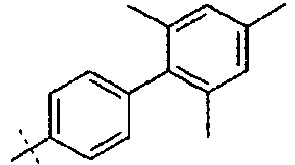
R 5 4 73 57 

R 10 12 52 45 

R 9 3 54 53 

rac 18 27 - - 

R 6 31 62 33 

R 8 36 69 29 

rac 18 412 - - 

rac 10 194 - 45 

rac 12 41 - 58 

rac 15 132 - - 

rac 15 329 - - 

rac 11 560 - - 

rac 15 215 - - 

rac 11 30 - 20 

rac 19 - - - 

rac 18 60 - - 

rac 12 661 - - 

rac 10 - - - 

rac 16 - - - 

rac 8 116 - - 

rac 18 161 - - 

rac 12 30 - - 
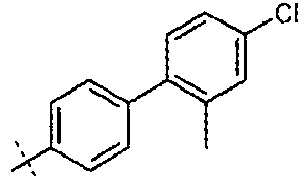
rac 17 49 48 42 

rac 16 - - - 

rac 16 78 - - 

rac 15 137 - - 
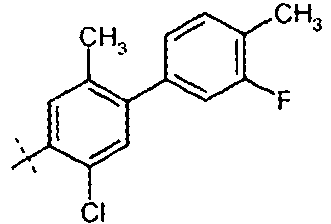
rac 20 143 - - 

rac 13 62 - 39 

rac 9 26 38 56 

rac 14 32 - - 

rac 19 108 - - 

rac 15 30 - 28 

rac 18 61 - - 

rac 12 241 - - 

rac 8 167 - - 

rac 12 - - - 

rac 18 - - - 

rac 16 - - 25 

rac 12 - - 

rac 18 - - - 

rac 10 - - - 

rac 14 - - - 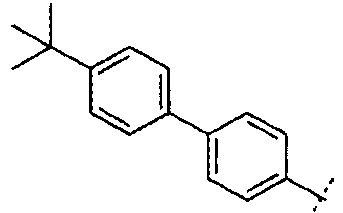

rac 10 192 - - 

rac 17 65 - 30 

rac 10 - - - - The compounds of Formula I provided herein which have been tested displace radiolabeled glucagon from the human glucagon receptor with an IC50 of < 15 nM.
- For certain compounds, the R-enantiomer displays up to 5-fold higher affinity for the human glucagon receptor than the S-enantiomer.
- The Table below displays the relative potency in the human glucagon receptor binding assay of the R- vs. S-isomers of the compounds shown. (The stereocenter being changed is marked with an asterisk; the R-isomer is shown in the drawing.)


Hu IC50 (nM) R S 

14 61 

6 20 

7 19 

11 37 

10 43 

10 49 - The compounds in the above table display nanomolar affinity for the human glucagon receptor. For certain compounds, the R-enantiomer displays up to 5-fold higher affinity for the human glucagon receptor than the S-enantiomer.
- Primary human, monkey, dog, rat, or mouse hepatocytes are seeded onto collagen-coated 24-well plates in Williams E medium (supplemented with 10% fetal bovine serum) and incubated at 37°C overnight in M199 medium (supplemented with 15 mM glucose and 10 nM human insulin). The following day cells are washed twice with a glucose-free Kreb-bicarbonate buffer, pH 7.4, containing 0.1% BSA. Cells are then incubated at 37° C with the aforementioned buffer containing 1 nM glucagon and varying concentrations of a glucagon antagonist (0 - 100 microM). Control wells without glucagon or antagonist are also included. After 1 hour, an aliquot of the medium is removed and analyzed for glucose content by means of the glucose oxidase method. The background glucose levels observed in the control wells are subtracted from the glucagon and antagonist containing wells. A graph of % glucose concentration vs drug concentration is plotted and an EC50 value for inhibition of glucose production generated using Sigmaplot software (SAS, Cary, North Carolina). Alternatively, intracellular cAMP levels are measured using standard kits and EC50 values determined by plotting these levels against drug concentration. Antagonists of the glucagon receptor inhibit glucagon-induced cAMP production.
- The R-enantiomer compounds of Formula I provided herein which have been tested show functional antagonism of glucose production in human hepatocytes with an EC50 of < 40 nM.
- The compounds disclosed herein display significant functional antagonism of glucose production in human hepatocytes. For certain compounds, the R-enantiomer displays up to 50-fold greater functional antagonism in human hepatocytes than the S-enantiomer.
- The Table below displays the relative potency in the human hepatocyte functional assay of the R- vs. S-isomers of the compounds shown. (The stereocenter being changed is marked with an asterisk; the R-isomer is shown in the drawing.)
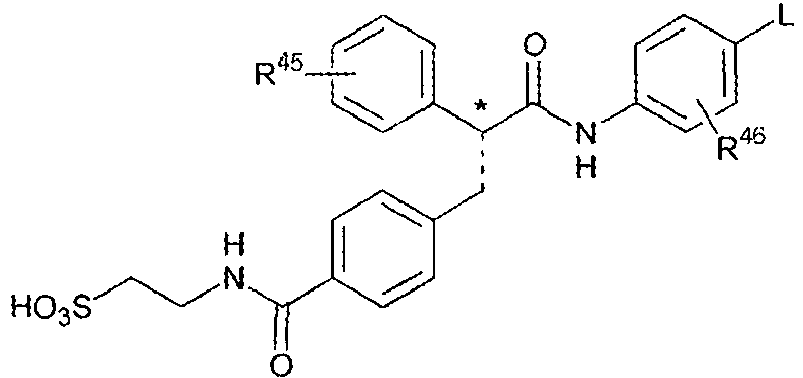


Hu cell EC50 (nM) R S 

37 1177 

7 350 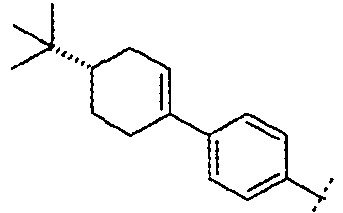

6 165 

33 213 - The effects of compounds provided herein on blood glucose levels are assessed in animal models of type 1 or 2 diabetes such as, but not limited to, the db/db mouse, the Zucker fatty (ZF) rat, the Zucker diabetic (ZDF) rat, the glucagon-challenged dog, the alloxan- or streptozotocin-treated mouse or rat, the NOD mouse or the BB rat.
- Compounds are dissolved in an appropriate vehicle such as polyethylene glycol-400 or cyclodextrin and administered to animals at doses of 0.1 to 100 mg/kg either by intraperitoneal injection, intravenous injection, or oral gavage. Animal models used in this evaluation [e.g., the db/db mouse, the ZF rat, the ZDF rat, the glucagon-challenged (0.3-5 µg/kg) dog, the alloxan- or streptozotocin-treated mouse or rat, the NOD mouse, or BB rat] are either freely-feeding or fasted from 3 to 24 hours prior to compound administration. In some instances, animals may be subjected to a glucose tolerance test hollowing compound administration by intravenous or oral administration of up to 2g/kg of glucose. Blood glucose levels are assessed in blood samples obtained by tail bleed or by sampling an appropriate blood vessel by means of a syringe or catheter. Glucose is measured using a portable glucometer such as the OneTouch or HemoCue meters at regular time intervals for up to 24 hours. The extent of blood glucose lowering elicited by the compounds of of Formula I or II is determined by comparison to those in control animals administered only the vehicle. The percentage of blood glucose lowering attained is calculated relative to blood glucose levels in vehicle-treated nondiabetic or non-glucagon-challenged control animals.
- To assess the effects of compounds provided herein on blood glucose levels in the db/db mouse, an animal model of type 2 diabetes, compounds are dissolved in polyethylene glycol-400 and administered by oral gavage to db/db mice in the freely-feeling state at doses of 30 and/or 100 mg/kg. Blood glucose levels are assessed in blood samples obtained by tail bleed at baseline (prior to drug administration) and at regular time intervals over 24 hrs using a portable glucometer such as the OneTouch or HemoCue meters. The magnitude of blood glucose lowering elicited by the compounds provided herein is determined by comparison to those in db/db mice administered only the vehicle. The percentage glucose lowering is calculated by factoring in the blood glucose levels of vehicle-treated lean db/+ (heterozygote) mice, with 100% representing the normalization of blood glucose levels from the hyperglycemic state (vehicle-treated db/db mice) to the normoglycemic state (vehicle-treated db/+ mice).
- The compounds disclosed herein which have been tested lowered blood glucose of db/db mice in the freely-feeding state. In particular, the percentage blood glucose lowering achieved ranged from 36 to 57% relative to lean control animals.
- The compounds disclosed herein have pronounced antihyperglycemic activity in animal models of type 2 diabetes.
-
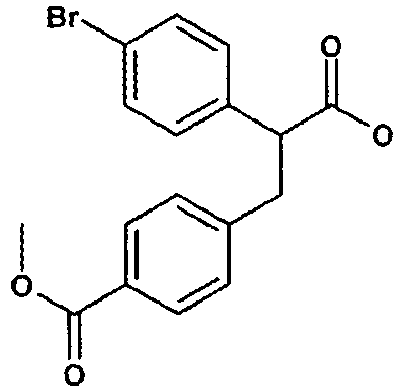
- In a 3-neck flask, a solution of 4-bromophenyl acetic acid (26.91g) in THF (485 mL) was cooled to < 10 °C under a nitrogen atmosphere. A solution of LiHMDS in THF (263 mL, 1.0 M) was added dropwise, ensuring that the internal temperature remained at <10 °C. After the addition was complete, the mixture was stirred at 0 °C for about 15 min. The cooling bath was the removed and the reaction mixture was allowed to warm up to 20°C.
- The reaction mixture was then cooled to <-60 °C. From an addition funnel, a solution of 4-bromomethyl methylbenzoate (29.53g) in THF (270 mL) was added dropwise, ensuring that the temperature did not rise above -60 °C. After the addition was complete, the mixture was stirred at -60 °C for about 15 min, and poured over 300 mL of cold 1 M aqueous HCl (saturated with sodium chloride). The organic layer was washed with 1M aqueous HCl (saturated with sodium chloride). The combined aqueous layers were extracted with toluene (50 mL). The combined organic phases were then dried over magnesium sulfate and concentrated under reduced pressure. The crude residue was recrystallized from toluene to yield the carboxylic acid as a white solid. HNMR (300 MHz, DMSO-d6): 12.54 (1H, broad s), 7.82 (2H, d, J = 6.4 Hz), 7.49 (2H, d, J = 6.7 Hz), 7.32 (2H, d, J = 8.2 Hz), 7.26 (2H, d, J = 8.5 Hz), 3.95 (1H, t, J = 7.9 Hz), 3.81 (3H, s), 3.3 (1H, m, overlaps with residual HOD), 3.03 (1H, m)
-

- To a solution of 4-[2-(4-Bromophenyl)-2-carboxy-ethyl]-benzoic acid methyl ester (step 1 above, 0.6 g) in THF: ethanol: water (6 mL: 3 mL: 1.5 mL) added 4-t-butyl-1-cyclohexenyl-boronic acid (0.5 g), PdCl2(P(o-tolyl)3)2, and sodium carbonate (0.7g). The resulting mixture was heated at 125 °C for a 1h period. The reaction was then cooled to room temperature, treated with an excess of aqueous HCl (1M) and the resulting heterogeneous mixture was filtered through a celite pad. The organic phase was dried over sodium sulfate and concentrated under reduced pressure. The crude residue was dissolved in toluene (25 mL), treated with thionyl chloride (0.26 mL) and heated at 100 °C for a 1h period. The toluene was removed under reduced pressure. The resulting acid chloride was redissolved in toluene (15 mL), treated with 4-bromoaniline (0.3 g) and diisopropyl ethyl amine (0.3 mL), and heated at 100 °C for a 1h period. After cooling to room temperature, the mixture was partitioned between ethyl acetate and 1M aqueous HCl. The organic layer was washed (water, saturated sodium chloride). dried over magnesium sulfate and concentrated under reduced pressure. The product obtained was carried to the next step without further purification.
-

- A solution of 4- {2-(4-Bromo-phenylcarbamoyl)-2-[4-(4-tert-butyl-cyclohex-1-enyl)-phenyl]-ethyl}-benzoic acid ethyl ester (Step 2, 0.8 g) in THF: methanol: water (8 mL: 6 mL: 2 mL) was treated with lithium hydroxide (0.4 g) and stirred at room temperature for 16h. Added an excess of aqueous HCl (1M) and extracted with ethyl acetate. The organic phase was washed with saturated sodium chloride in water and dried over sodium sulfate. The solvents were then removed under reduced pressure. The residue obtained was dissolved in DMF (10 mL), and treated with EDCI (0.4g), HOBt-H2O (0.32g), taurine (0.26g) and diisopropyl ethyl amine (0.71 mL). The reaction mixture was then stirred at room temperature for a 16h period. The solvent was removed under reduced pressure. The residue was partitioned between ethyl acetate and 1M aqueous HCl. The organic phase was washed with saturated sodium chloride, and concentrated. The residue in methanol was treated with an excess of sodium hydroxide and loaded on top of a C-18 reverse phase flash chromatography column. The column was eluted with an acetonitrile - water gradient to afford the sodium salt of the sulfonate as a white solid. LCMS m/z: 665.6 [C34H38N2O5BrS]-
-

- To a solution sodium; 2-(4-{2-(4-bromo-phenylcarbamoyl)-2-[4-(4-tert-butyl-cyclohex-1-enyl)-phenyl]-ethyl}-benzoylamino)-ethanesulfonate (Step 3 above, 96mg) in DME: ethanol: water (2mL: 1mL: 0.5 mL) added 4-t-butyl-1-cyclohexenyl-boronic acid (0.5 g), PdCl2(P(o-tolyl)3))2, and sodium carbonate (0.7g). The resulting mixture was heated at 125 °C for a 1h period. The reaction was then cooled to room temperature, treated with an excess of aqueous HCl (1M) and the resulting heterogeneous mixture was filtered through a celite pad. The mixture was partitioned (ethyl acetate/water). The organic phase was washed with saturated sodium chloride, and concentrated. The residue in methanol was treated with an excess of sodium hydroxide and loaded on top of a C-18 reverse phase flash chromatography column. The column was eluted with an acetonitrile - water gradient to afford the sodium salt of the sulfonate as a white solid. LC-MS mz/ = 711.6 [C44H44N2O5CIS]-
-

- To a solution of (3-bromo-phenyl)-acetic acid (5.0 g, 23.2 mmol) in CH2Cl2 (50 mL) at room temperature was added oxalyl chloride (5.86 g, 46.5 mmol). The reaction mixture was stirred at room temperature for overnight and the solvent was removed under reduced pressure. The residue was dried under vacuum for 3-4 h and used without further purification.
- In a separate flask, to a stirred solution of R- (+)- 4-benzyl-oxazolidinone (4.34 g, 24.5 mmol) in THF (30 mL) at -78 °C was added n-BuLi (26.7 mL, 26.7 mmol, 1.0 M solution in hexane). The reaction mixture was stirred for 1 h, at -78° C, then the crude acid chloride (5.2 g, 22.3 mmol) in THF was added dropwise. The mixture was stirred for 2 h at - 78° C and allowed to warm to rt and stirred for another hour (monitored by TLC). The reaction was quenched with saturated NH4Cl solution (100 mL) and stirred for 10 min. The reaction mixture was extracted with ethyl acetate (2x250 mL) and the combined organic layers were washed with brine, dried over MgSO4 and concentrated under reduced pressure. The crude product was purified by column chromatography on silica gel, eluting with EtOAc-hexanes (5-25%) to afford 4-benzyl-3-[2-(3-bromo-phenyl)-acetyl]-oxozolidin-2-one. 1H NMR (300 MHz, CDCl3): 7.51 (d, J = 2.1 Hz, 1 H), 7.44 (dd, J= 3.9,4.8 Hz, 1 H),7.32 - 7.20 (m, 6 H), 7.15(d, J = 3.9 Hz, 1 H), 4.60 (m, 1 H), 4.30 (m, 2 H), 4.26 - 4.19 (m, 3 H), 3.27 (dd, J = 1.8, 8.1 Hz, 1 H), 2.78 (dd, J = 5.4, 7.8 Hz, 1 H);TLC conditions: Uniplate silica gel, 250 microns; mobile phase = ethyl acetate/ hexanes (5:1); Rf = 0.6.
-

- To a stirred solution of 4-benzyl-3-[2-(3-bromo-phenyl)-acetyl]-oxozolidin-2-one (4.02 g, 10.7 mmol) in anhydrous THF (50 mL) was added LiHMDS (16.5 mL, 16.5 mmol, 1.0 M solution in THF) at -78° C. The reaction mixture was stirred for 1.5 h at -78° C, and then tert-butyl-4-bromo methyl benzoate (3.75 g, 11.8 mmol, in THF 10 mL) was added dropwise, stirred for 2 h at -78° C and then allowed to warm to rt for 1 h. After completion of the reaction quenched with saturated NH4Cl solution (100mL) and stirred for 10 min. The reaction mixture was extracted with ethyl acetate (2x250 mL) and the organic layer was washed with brine, dried over Na2SO4 and concentrated under reduced pressure. The crude product was precipitated from minimum amount of EtOAc and hexane at room temperature to afford 4-{3-(4-Benzyl-2-oxo-oxazolidin-3-yl)-2-[4-(3-bromophenyl)-3-oxo-propyl}-benzoic acid tert-butyl ester as a yellow solid 1H NMR (300 MHz, CDCl3): δ 7.75 (d, J = 6.3 Hz, 2 H), 7.44 (d, J = 2.1 Hz, 2 H), 7.26 - 7.04 (m, 9 H), 6.79 (dd, J = 1.8, 5.7 Hz, 2 H), 5.29 (dd, J = 2.1, 6.3 Hz, 1 H), 3.89 (s, 3 H), 3.83 (d, J= 7.5 Hz, 1 H), 3.41 (dd, J= 8.4, 13.8 Hz, 1 H), 3.05 (dd, J = 7.2, 13.5 Hz, 1 H); TLC conditions: Uniplate silica gel, 250 microns; mobile phase = ethyl acetate-hexanes (1:4); Rf = 0.45.
-

- To a stirred solution of 4-{3-(4-benzyl-2-oxo-oxazolidin-3-yl)-2-[4-(3-bromophenyl)-3-oxo-propyl}-benzoic acid tert-butyl ester (2.3 g, 3.7 mmol) in THF/H2O (20 mL) (3:1) at room temperature were added H2O2 (1.25 g, 37.0 mmol 35% in H2O) followed by LiOH (0.62 g, 14.8 mmol). The reaction mixture was stirred for 3 h, at room temperature and quenched with 0.1 N HCl. The reaction mixture was extracted with ethyl acetate (100 mL) and dried over MgSO4, filtered and concentrated under reduced pressure to afford the crude acid. This crude product was purified by column chromatography on silica gel, eluting with CH2Cl2/MeOH 2%-15% to afford 4-[2-carboxy-2-(3-bromo-phenyl)-ethyl]-benzoic acid tert-butyl ester (1.5 g, 75%). 1H NMR (300 MHz, DMSO-d 6): δ 12.52 (s, 1 H), 7.77 (d, J = 8.4 Hz, 2 H). 7.48 (d, J = 8.7 Hz, 2 H), 7.28 (d, J = 8.4 Hz, 2 H), 7.22 (d, J = 8.4 Hz, 2 H), 3.93 (t, J= 7.8 Hz, 1 H), 3.30 (dd, J = 8.4, 13.8 Hz, 1 H), 3.0 (dd, J = 8.1, 13.8 Hz, H), 1.49 (s, 9 H), TLC conditions: Uniplate silica gel, 250 microns; mobile phase = CH2Cl2/ MeOH (10%); Rf = 0.4. Chiral HPLC conditions: Kromasil 100-5-TBB chiral column 250x4.6 cm, (5% hexane/2-propanol to 30 %), 35 min, flow rate 1 mL/min, RT= 12.41 min (enantiomeric excess: >96%)
-

- A mixture of 4-iodo-aniline (25.0 g, 114.1 mmol), 2-methyl-4-chlorophenylboronic acid (29.17 g, 171.1 mmol), PdCl2(P(o-tolyl)3)2 (11.66 g, 14.8 mmol), and Na2CO3(60.49 g, 570.7 mmol) in DME/EtOH/H2O (100/50/25 mL) was heated 125 °C for 2 h. The reaction mixture was cooled to room temperature, filtered and washed with EtOAc (200 mL). The solvent was removed under reduced pressure. The crude mixture was extracted with ethyl acetate (500 mL) and the organic layer was washed with brine, dried over Na2SO4 and concentrated under reduced pressure. The resulting crude was purified by column chromatography on silica gel, eluting with 5-30% Hexane/EtOAc to afford 4'-Chloro-2'-methyl biphenyl-4-ylamine. 1H NMR (300 MHz, CDCl3): δ 7.24 - 7.08 (m, 5 H), 6.72 (d. J = 7.2 Hz, 2 H). 3.70 (bs, 2 H), 2.27 (s, 3 H).
-

- To a stirred suspension of 4-[2-carboxy-2-(3-bromo-phenyl)-ethyl]-benzoic acid tert-butyl ester (2.41 g, 5.94 mmol) in anhydrous CH2Cl2 (20 mL), was added oxalylchloride (1.0 mL, 11.8 mmol) at room temperature The reaction mixture was stirred for 14 h, concentrated under reduced pressure and azeotroped with CH2Cl2 (2x10 mL). The crude acid chloride (2.2 g, 1.61 mmol) was treated with 4-chloro-2-methyl biphenyl-4-ylamine (1.24 g, 5.71 mmol) and N,N-diispropylethylamine (2.53 mL, 15.5 mmol) in CH2Cl2 (25 mL) at 0 °C. The reaction mixture was stirred for 14 h at room temperature and concentrated under reduced pressure. The crude product was purified by column chromatography on silica gel, eluting with CH2Cl2-hexanes (30%-100%) to give 4-[2-(3-bromo-phenyl)-2-(4'-chloro-2'-methyl-biphenyl-4-ylcarbamoyl)-ethyl]-benzoic acid tert-butyl ester as a brownish solid (2.4 g, 88%). 1H NMR (500 MHz, CDCl3): δ 7.74 (d, J = 14.0 Hz, 2 H), 7.58 - 7.49 (m, 4 H), 7.39 - 7.22 (m, 4 H), 7.24 - 7.19 (m, 3 H), 7.14 (d, J= 14.0 Hz, 2 H), 4.03 (t, J = 11.0 Hz, 1 H), 3.42 (dd, J = 5.5, 22.5 Hz, 1 H), 3.03 (dd, J = 11.0, 22.5 Hz, 1 H), 2.17 (s, 3 H), 1.49 (s, 9 H); Chiral HPLC conditions: Chiralcel OD-H T=23°C; mobile phase = 5-25%hexane/IPA; flow rate = 1.0 mL/min; detection = 254, 280, 220 nm retention time in min: 16.66 min (enantiomeric excess: 97.3%).
-
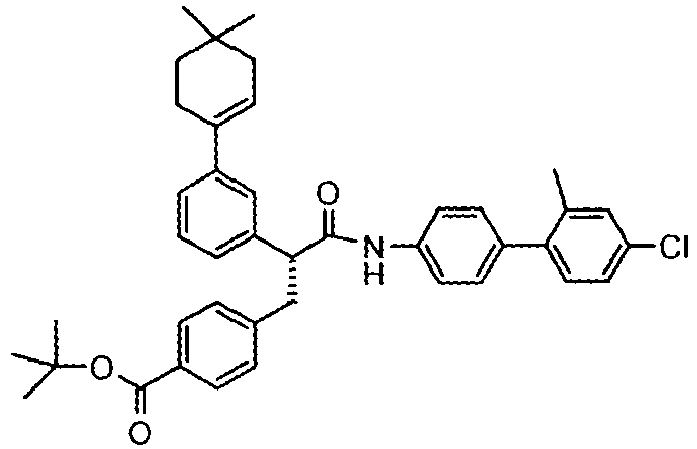
- To 4-[2-(3-bromo-phenyl)-2-(4'-chloro-2'-methyl-biphenyl-4-ylcarbamoyl)-ethyl]-benzoic acid tert-butyl ester (1.2 g, 1.98 mmol) in DME (30 mL), was added 4,4-dimethyl-cyclo-hex-1-enyl-boronic acid (0.76 g. 4.96 mmol), PdCl2(P(o-tolyl)3)2 (202 mg, 0.25 mmol), and diisopropylethylamine(1.0 mL, 5.94 mmol). The resulting mixture was heated at 85 °C for 2 h, allowed to cool to room temperature and filtered. Partitioned the filtrate between EtOAc (20 mL) and water. The organic phase was washed with brine, dried over sodium sulfate and concentrated under reduced pressure. The resulting crude was purified by column chromatography on silica gel, eluting with CH2Cl2:hexanes (20%-100%) to afford 4-{4'-chloro-2'-methyl-biphenyl-4-ylcarbamoyl)-2-[(3-(4,4-dimethyl-cyclohex-1-enyl)-phenyl]-ethyl}-benzoic acid tert-butyl ester as a yellow solid. 1H NMR (500 MHz, CDCl3): δ 10.14 (s, 1 H), 7.76 (d, J = 8.5 Hz, 2 H). 7.57 (d, J = 8.4 Hz, 2 H), 7.48 (s, 1 H), 7.35 - 7.20 (m, 9 H), 7.13 (d, J = 8.5 Hz, 1 H), 6.06 (bt, 1 H), 4.03 (t, J = 6.5 Hz, 1 H), 3.48 (dd, J = 4.5, 13.5 Hz, 1 H), 3.04 (dd, J = 6.5, 14.0 Hz, 1 H), 2.37 - 2.34 (m, 2 H), 2.23 (t, J = 7.0 Hz, 1 H), 2.18 (s, 3 H), 1.57 (t, J = 6.5 Hz, 2 H), 1.50 (s, 9 H), 1.47 (t, J = 6.5 Hz, 1 H), 0.93 (s, 6 H).
-

- To a stirred solution of 4-{4'-chloro-2'-methyl-biphenyl-4-ylcarbamoyl)-2-[(3-(4,4-dimethyl-cyclohex-1-enyl)-phenyl]-ethyl}-benzoic acid tert-butyl ester (0.82 g, 1.29 mmol) in CH2Cl2 (30 mL) at room temperature, added trifluoroacetic acid (2.5 ml), and conc HCl (1.0 mL) The reaction mixture was stirred overnight. The organic solvents were removed under reduced pressure. The residue was extracted with ethyl acetate (2x100 mL), dried over MgSO4 and concentrated o afford 4-{2'-chloro-2'-methyl-biphenyl-4-ylcarbamoyl)-2-[(3-(4,4-dimethyl-cyclohex-1-enyl)-phenyl]-ethyl}-benzoic acid as a solid. 1H NMR (500 MHz, DMSO-d 6): 10.05 (s, 1 H), 7.73 (d, J = 8.0 Hz, 2 H), 7.48 (d, J = 8.5 Hz, 2 H), 7.40 (s, 1 H), 7.29 - 7.05 (m, 10 H), 5.99 (s, 1 H), 3.96 (t, J = 10.5 Hz, 1 H), 2.95 (dd, J = 5.0,14.0 Hz, 1 H), 2.20 - 2.18 (m, 1 H), 2.14 (t, J = 7.5 Hz, 1 H), 2.09 (s, 3 H), 1.89 (bs, 2 H), 1.49 (t, J = 7.5 Hz, 1 H), 1.39 (t, J = 6.0 Hz, 2 H), 0.84 (s, 6 H). Chiral HPLC conditions: Chiralcel OD-H T=23°C; mobile phase = 10-30% hexane/IPA; flow rate = 1.0 mL/min; detection = 254, 280, 220 nm retention time in min: 19.81 min (enantiomeric excess: 70.8%)
-

- A stirred solution of 4-{4'-chloro-2'-methyl-biphenyl-4-ylcarbamoyl)-2-[(3- (4,4-dimethyl-cyclohex-1-enyl)-phenyl]-ethyl}-benzoic acid (0.62 g. 1.07 mmol) in ethyl acetate (30 mL) at room temperature, was added Pd/C (100 mg). The mixture was stirred under 1 atm of H2 (gas) at room temperature for 4 h. The catalyst was removed by filtration through a Celite plug and washed with ethyl acetate (2x50 mL). Concentration of the filtrate afforded 4-{2'-chloro-2'-methyl-biphenyl-4-ylcarbamoyl)-2-[(3-(4,4-dimethyl-cyclohex-1-enyl)-phenyl]-ethyl}-benzoic acid as a solid. 1H NMR (300 MHz, DMSO-d6): 12.69 (s, 1 H), 10.06 (s, 1 H), 7.72 (d, J = 7.0 Hz, 2 H), 7.49 (d, J= 7.0 Hz, 2 H), 7.27 - 7.03 (m, 11 H), 3.94 (t, J = 5.5 Hz, 1 H), 3.39 (t, J = 11.5 Hz, 1 H), 2.93 (dd, J = 5.5, 13.0 Hz, 1 H), 2.16 (t, J = 7.0 Hz, 1 H), 2.09 (s, 3 H), 1.48 - 1.43 (m, 4 H), 1.24 - 1.19 (m, 2 H), 0.87(s, 3 H), 0.84 (s, 3 H). Step 9: Sodium-2-(4-{2-(4'-chloro-2'-methyl biphenyl-4-ylcarbamoyl)-2-[3-(4,4-dimethy]-cyclohexyl)-phenyl]-ethyl}-benzoylamino-ethane sulfonic acid

- To a mixture of 4-{2'-chloro-2'-methyl-biphenyl-4-ylcarbamoyl)-2-[(3-(4,4-dimethyl-cyclohex-1-enyl)-phenyl]-ethyl}-benzoic acid (0.6 g, 1.03 mmol) and EDCI (290 mg, 1.55 mmol) in DMF (7 mL), added HOBt (230 mg, 1.55 mmol), N,N-diispropylethylamine (0.4 g, 2.06 mmol), and taurine (250 mg, 0.5 mmol). The resulting mixture was stirred for 14 h. The reaction solvent was removed under reduced pressure. The residue mixture was dissolved in 0.1 N NaHCO3 and acetonitrile, purified by column chromatography on a C-18 silica gel flash chromatography column, eluting with an acetonitrile-water gradient. Sodium-2-(4-{2-(4'-chloro-2'-methyl-biphenyl-4-ylcarbamoyl)-2-[3-(4,4-dimethyl-1-cyclohex-1-enyl)-phenyl]-ethyl}-benzoylamino-ethane sulfonic acid was obtained as a white solid. 1H NMR (500 MHz, DMSO-d6): 9.98 (s, 1 H), 8.25 (bs, 1 H), 7.50 (d, J = 3.0 Hz, 2 H), 7.43 (d, J= 5.5 Hz, 2 H), 7.19 - 6.98 (m, 11 H), 3.85 (bs, 1 H), 3.32 - 3.18 (m, 3 H), 2.83 (d, J = 14.0 Hz, 2 H), 2.47 (bs, 2 H), 2.23 (bs, 1 H), 2.03 (s, 3 H), 1.42 - 1.15 (m, 6 H), 0.81 (s, 3 H), 0.78 (s, 3 H); LC-MS m/z = 685 [C39H42N2O5S]+; Anal Calcd: (MF:C398H42N2O5SNa+3.3 H2O) Calcd: C:60.94, H:6.37, N:3.64 Found: C: 60.82, H:6.08, N:3.57. Chiral HPLC conditions: Regis-Whelk-01-786615, (S,S)10/100 250x0 mm T=23 °C; mobile phase = 100%ACN/(5% NH4CO3,+H2O) flow rate = 1.0 mL/min; detection 254 nm retention time in min: 12.39 min (enantiomeric excess: 95.1%)
-
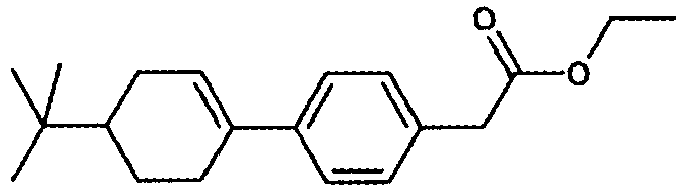
- To a mixture of 4-bromophenyl ethyl acetate (780 mg), 4-t-butyl-cyclohexen-1-yl boronic acid (897 mg), PdCl2(P(o-tolyl)3)2 (254 mg) in THF: ethanol: water (8 mL: 4 mL: 2 mL), added sodium carbonate (1.377g). The sealed flask was heated at 140 °C for a 5 min period. The heterogeneous mixture was treated with an excess of 1M aqueous hydrochloric acid and filtered through a celite pad. The organic solvents were removed under reduced pressure and the residue partitioned between ethyl acetate and water. The organic phase was washed with water and saturated aqueous sodium chloride, dried over magnesium sulfate and chromatographed on silica gel using an ethyl acetate/hexanes gradient. The product was obtained as a yellow oil.
1H NMR (500 MHz, CDCl3): 7.32 (d, J = 8 Hz, 2 H), 7.20 (d, J = 8 Hz, 2 H), 6.10 (m, 1 H), 4.12 (q, J = 7 Hz, 2 H), 3.57 (s, 2 H), 2.52-2.32 (m, 2 H), 2.26-2.18 (m, 1 H), 2-1.9 (m, 2 H), 1.38-1.2 (m, 5 H), 0.91 (s, 9 H). -

- A mixture of AD-mix-beta (6.512 g, J. Org. Chem 57, 2768 (1992)) and methanesulfonamide (443 mg, 4.66 mmol) in tert-butanol (23 mL) and water (28 mL) was cooled to 2 - 4 °C. To this mixture, [4-(4-tert-Butyl-cyclohex-1-enyl)-phenyl]-acetic acid ethyl ester (1.4 g, 4.66 mmol) in tert-Butanol (5 mL) was added slowly while making sure that the temperature remained in the 2 - 4 °C range. The mixture was stirred at the same temperature for a period of 4 days then quenched by adding sodium sulfite (1.5 g/mmol starting material) in water (20 mL). After allowing to warm to room temperature, the reaction mixture was stirred an additional 1h before being partitioned between ethyl acetate and water. The organic phase was washed with brine then concentrated under reduced pressure to afford crude material which was purified by chromatography on silica gel, eluting with an ethyl acetate/hexanes gradient. Two products were obtained. In agreement with the report from Hamon et al (Tetrahedron 57, 9499 (2001)) they were assigned as follows:
- First eluting product: [4-((1R,2R,4R)-4-tert-Butyl-1,2-dihydroxy-cyclohexyl)-phenyl]-acetic acid ethyl ester 1H NMR (500 MHz, CDCl3): 7.46 (m, 2H). 7.28 (m, 2 H), 4.16 (q, J= 7 Hz, 2H), 3.99 (m, 1 H), 3.61 (s, 2 H), 2.59 (m, 1 H), 1.92 (m, 2 H), 1.64-1.46 (m, 5 H), 1.27 (t, J = 7 Hz, 3H), 0.93 (s, 9 H).
- Second eluting product: [4-((1R,2R,4S)-4-tert-Butyl-1,2-dihydroxy-cyclohexyl)-phenyl]-acetic acid ethyl ester. 1H NMR (500 MHz, CDCl3): 7.51 (m, 2H), 7.30 (m, 2 H), 4.36 (m, 1H), 4.16 (q, J = 7 Hz, 2H), 3.62 (s, 2 H), 2.74 (m, 1 H), 2.26 (m, 1H), 2.20 (m, 1H), 2.07 (m, 1 H), 1.92 (m, 1 H), 1.75 (m, 1 H), 1.27 (t, J = 7 Hz, 3H), 1.17 (m, 2H), 0.80 (s, 9 H).
-

- A solution of [4-((1R,2R,4R)-4-tert-Butyl-1,2-dihydroxy-cyclohexyl)-phenyl]-acetic acid ethyl ester (319 mg, 0.95 mmol) and thiocarbonyl diimidazole (309 mg, 1.91 mmol) in THF (15 mL) was refluxed under N2 overnight. The reaction mixture was partitioned between ethyl acetate and brine, dried over Na2SO4 and concentrated under reduced pressure. Purification of the residue by chromatography on silica gel using an ethyl acetate/hexanes gradient afforded 297 mg of product.
1H NMR (500 MHz, CDCl3): 7.31 (m, 4 H), 4.97 (dd, J= 9 Hz, J= 7 Hz, 1 H), 4.13 (q, J = 7 Hz, 2 H), 3.59 (s, 2 H), 2.53-2.48 (m, 1 H), 2.40-2.31 (m, 1 H), 1.90-1.72 (m, 2 H), 1.40-1.15 (m, 6 H), 0.91 (s, 9 H). -

- A solution of [4-((3aR,6S,7aR)-6-tert-Butyl-2-thioxo-tetrahydrobenzo[1,3]dioxol-3a-yl)-phenyl]-acetic acid ethyl ester (297 mg, 0.80 mmol) in triethylphosphite (3 mL) was slowly added to a solution of triethylphosphite (10 mL) heated to reflex - rate of addition was such that the reaction temperature exceeded 150 °C. After reflexing overnight, the solvent was removed under vacuum and the crude reaction mixture was loaded on top of a silica column and eluted with an ethyl acetate/hexanes gradient to afford 145 mg of the title compound. 1H NMR (500 MHz, CDCl3): 7.32 (d, J = 8 Hz, 2 H), 7.20 (d, J = 8 Hz, 2 H), 6.10 (m, 1 H), 4.12 (q, J = 7 Hz, 2 H), 3.57 (s, 2 H), 2.52-2.32 (m, 2 H), 2.26-2.18 (m, 1 H), 2-1.9 (m, 2 H), 1.38-1.2 (m, 5 H), 0.91 (s, 9 H).
- Determination of the enantiomeric excess: A sample of the product was treated with an excess of aqueous 1M NaOH:ethanol:water (1:2:3 ratio by volume) and heated at 125 °C for a 5 min period. The organic solvents were removed under reduced pressure and the residue was partitioned between ethyl acetate and 1M aqueous HCl. The organic phase was washed with water and a saturated sodium chloride solution and then dried over magnesium sulfate. The enantiomeric excess of the product was determined to be > 99% by chiral HPLC utilizing a Chiral Technologies ChiralPak AD-H 250mm x 4.6mm column, eluting at a 1.0 mL/min flow rate using a mixture of hexanes: isopropanol: methanesulfonic acid in a 95:5:0.1 ratio. The sample was dissolved at 1 mg/mL in ethanol prior to injection. The retention time observed was 6.2 min.
-

- To [4-((R)-4-tert-Butyl-cyclohex-1-enyl)-phenyl]-acetic acid ethyl ester (95 mg. 0.32 mmol) in anhydrous THF (5 mL), chilled to -78 °C. was added 380 uL (0.38 mmol) of 1M lithium hexamethyldisilazane in THF. The resulting solution was stirred for 1 hr before 4-Bromomethylbenzoic acid tert-butyl ester (94 mg, 0.35 mmol) was added. The reaction mixture was allowed to warm to rt overnight then quenched with saturated NH4Cl solution. After partitioning between ethyl acetate and brine the organic portion was dried over Na2SO4 and concentrated under reduced pressure. Purification of the crude by prep TLC (Analtech, 2mm silica plates) using an hexane/ethyl acetate (10:1) gave 63 mg of product. 1H NMR (500 MHz, CDCl3): 7.83 (d. J= 8.5 Hz, 2 H), 7.31 (d, J= 8.5 Hz, 2 H), 7.20 (d, J= 8 H, 2 H), 7.14 (d, J= 8 Hz, 2 H), 6.12 (m, 1H), 4.03 (q, J= 7 Hz 2 H), 3.80 (t, J= 8.5 Hz, 1 H), 3.41 (dd, J = 14, 8.5 Hz, 1 H). 3.03 (dd, J = 14, 7 Hz, 1 H), 2.56-2.4 (m, 2H), 2.35-2.2 (m, 1H), 2.05-1.9 (m, 2H), 1.56 (s, 9 H), 1.36-1.2 (m, 2 H). 1.11 (t, J = 7 Hz, 3 H), 0.89 (s, 9H). Step 6: 4-{2-[4-(4-(R)-tert-Butylcyclohex-1-enyl)-phenyl]-2-carboxy-ethyl}-benzoic acid tert-butyl ester

- To 4-{2-[4-(4-(R)-tert-Butylcyclohex-1-enyl)-phenyl]-2-ethoxylcarbonylethyl}-benzoic acid tert-butyl ester (63 mg, 0.13 mmol) dissolved in a solution of THF (3 mL), MeOH (1 mL) and water (1 mL) was added lithium hydroxide (27 mg, 0.64 mmol). The solution was stirred at rt for 5 hrs then neutralized with 3M KH2PO4 and extracted with ethyl acetate. The organic portion was washed with brine, dried over Na2SO4 and concentrated under vacuum to afford crude material which was used without further purification.
-

- To 4-{2-[4-(4-(R)-tert-Butylcyclohex-1-enyl)-phenyl]-2-carboxy-ethyl}-benzoic acid tert-butyl ester (697 mg, 1.5.1 mmol) in anhydrous dichlorocnethane (30 mL) was added oxalyl chloride (650 uL, 7.53 mmol) and 3 drops of DMF. The resulting solution was stirred at rt for 1 hr before being concentrated under vacuum. The residue was co-evaporated with toluene (1 x 5 mL) then dissolved in toluene again (20 mL). To the mixture was added 4-chloro-2-methylbiphenyl-4-ylamine (361 mg. 1.66 mmol) and DIPEA (1.3 mL, 7.53 mmol). The resulting mixture was refluxed for 90 min, diluted with ethyl acetate and washed with saturated NaHCO3. The organic portion was dried over Na2SO4 and concentrated under vacuum to afford crude material which was crystallized from MeOH to afford a white solid (590 mg). Removing the solvent and purification of the residue by chromatography on silica gel using an ethyl acetate/hexanes gradient afforded an additional 137 mg of product. 1H NMR (500 MHz, DMSO-d 6): 10.16 (s, 1H), 7.78 (d, J= 8 Hz, 2H), 7.59 (d, J= 8.5 Hz, 2 H), 7.4-7.32 (m, 7 H), 7.21 (d, J= 8 Hz, 2 H), 7.15 (d, J = 8 Hz, 2 H), 6.14 (m, 1H), 4.03 (dd, J= 9, 7 Hz, 1H), 3.48 (dd, J= 13.5, 9.5 Hz, 1H), 3.41 (dd, J= 13.5, 6.5 Hz, 1 H), 2.4-2.3 (m, 1H), 2.2-2.15 (m, 4H), 1.96-1.9 (m, 2H), 1.52 (s, 9 H), 1.32-1.2 (m, 2 H), 0.89 (s, 9H).
-

- To 4-{2-[4-(4-(R)-tert-Butylcyclohex-1-enyl)-phenyl]-2-(4'-chloro-2'-methylbiphenyl-4-ylcarbamoyl)-ethyl]-benzoic acid tert-butyl ester (727 mg, 1.1 mmol) was added 4N HCl/dioxane (30 mL), water (5 mL) and conc. HCl (1 mL). The resulting solution was stirred at rt overnight. The excess solvent was removed under vacuum and the residue co-evaporated with toluene to afford the desired crude product as a gummy oil. The crude material was used the next step without further purification.
-

- biphenyl-4-ylcarbamoyl)-ethyl]-benzoic acid (assumed 1.1 mmol) in DMF (25 mL) was added EDC (316 mg, 1.65 mmol), HOBt (252 mg, 1.65 mmol), taurine (206 mg, 1.65 mmol) and DIPEA (550 uL, 3.29 mmol). The resulting mixture was stirred at rt overnight. The excess solvent was removed under vacuum and to the oily residue was added excess 1N HCl. After decanting off the excess 1N HCl, the residue was dissolved in acetonitirile/MeOH, made basic with saturated NaHCO3 and purified using reverse phase flash chromatography and eluting with an acetonitrile/water gradient. The sodium salt was obtained as a white solid. LCMS: 711.6 [M-H]-
-

- Sodium, 2-{4-[2-[4-(4-(R)-tert-butylcyclohex-1-enyl)-phenyl]-2-(4'-chloro-2'-methylbiphenyl-4-ylcarbamoyl)-ethyl]-benzoylamino}-ethanesulfonate (obtained on Step 8 above), was dissolved in DMF. The product was subjected to preparative HPLC on a Pirkle Covalent (S,S)-Whelk-01 column (250mm x 10 mm), eluting at 10 mL/min with a gradient of acetonitrile and 5 mM ammonium bicarbonate. The title compound was the first of the two diastereomers to elute. Conditions for the determination of the enantiomeric excess by HPLC: Regis-Whelk-01-786615, (S,S)10/100 250x10 mm T=23°C; mobile phase = 100%ACN/(5% Phosphate pH =7.0, ACN) flow rate = 1.0 mL/min; detection = 254 nm. Retention time in min: 18.22 min (enantiomeric excess: 99.1% ). 1H NMR (500 MHz, CD3OD): 7.71 (d, J = 8.5 Hz, 2 H), 7.51 (d, J = 8.5 Hz, 2 H), 7.4-7.25 (m, 7 H), 7.20 (d, J = 8.5 Hz, 2 H), 7.13 (d, J = 8.5 Hz, 2 H), 3.97 (dd, J = 9.5, 6.5 Hz, 1 H), 3.78 (t, J = 6.5 Hz, 2H), 3.52 (dd, J=13.5, 9.5 Hz, 1 H), 3.10 (dd, J= 13.5,6.5 Hz, 1 H), 3.07 (t, J= 6.5 Hz, 2H), 2.5-2.3 (m, 2H), 2.3-2.20 (m, 4H). 2.1-1.95 (m, 2H), 1.38 (s, 10 H), 0.94 (s, 9H).
-

- The title compound was the second compound eluting from the chiral chromatography reported in Example 3, Step 9. Conditions for the determination of the enantiomeric excess by HPLC: Regis-Whelk-01-786615, (S,S)10/100 250x10 mm T=23°C: mobile phase = 100%ACN/(5% Phosphate pH =7.0, ACN) flow rate = 1.0 mL/min; detection = 254 nm. Retention time in min: 23.55 min (enantiomeric excess: 99.5%). 1H NMR (500 MHz, CD3OD): 7.71 (d, J = 8.5 Hz, 2 H), 7.51 (d, J = 8.5 Hz, 2 H), 7.4-7.25 (m, 7 H), 7.20 (d, J= 8.5 Hz. 2 H), 7.13 (d, J = 8.5 Hz, 2 H), 3.97 (dd, J= 9.5, 6.5 Hz, 1 H), 3.78 (t, J = 6.5 Hz, 2H), 3.52 (dd, J= 13.5, 9.5 Hz, 1H), 3.10 (dd, J= 13.5, 6.5 Hz, 1 H), 3.07 (t, J= 6.5 Hz, 2H), 2.5-2.3 (m, 2H), 2.3-2.20 (m, 4H), 2.1-1.95 (m, 2H), 1.38 (s, 10 H), 0.94 (s, 9H).
-
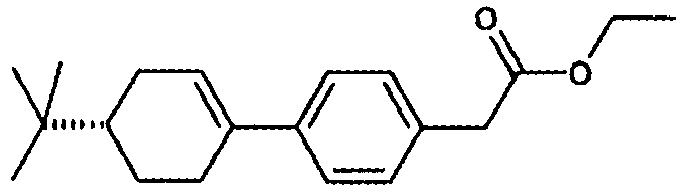
- Utilizing the second eluting diol in Example 3, Step 2, the chiral alkene shown above was obtained after utilizing the methods described in Example 3, Steps 3 and 4. 1H NMR (500 MHz, CDCl3): 7.32 (d, J = 8 Hz, 2 H), 7.20 (d, J = 8 Hz, 2 H), 6.10 (m, 1 H), 4.12 (q, J = 7 Hz, 2 H), 3.57 (s, 2 H), 2.52-2.32 (m, 2 H), 2.26-2.18 (m, 1 H), 2-1.9 (m, 2 H), 1.38-1.2 (m, 5 H), 0.91 (s, 9 H).
- Determination of the enantiomeric excess: A sample of the product was treated with an excess of aqueous 1M NaOH:ethanol:water (1:2:3 ratio by volume) and heated at 125 °C for a 5 min period. The organic solvents were removed under reduced pressure and the residue was partitioned between ethyl acteate and 1M aqueous HCl. The organic phase was washed with water and a saturated sodium chloride solution and then dried over magnesium sulfate. The enantiomeric excess of the product was determined to be > 99% by chiral HPLC utilizing a Chiral Technologies ChiralPak AD-H 250mm x 4.6mm column, eluting at a 1.0 mL/min flow rate using a mixture of hexanes: isopropanol: methane sulfonic acid in a 95:5:0.1 ratio. The sample was dissolved at 1 mg/mL in ethanol prior to injection. The retention time observed was 5.6 min.
-

- [4-((S)-4-tert-Butyl-cyclohex-1-enyl)-phenyl]-acetic acid ethyl ester (Step 1, above), was utilized to yield the title compound through the sequence illustrated in Example 3, Steps 5 - 10. The title compound eluted first among the two possible diastereomers after preparative HPLC on a Pirkle Covalent (S, S)-Whelk-01 column (250mm x 10 mm), eluting at 10 mL/min with a gradient of acetonitrile and 5 mM ammonium bicarbonate.
- Conditions for the determination of the enantiomeric excess by HPLC: The sample was diluted in ethanol at a 1 mg/mL concentration. It was injected into an HPLC system equipped with a Regis-Whelk-01-786615, (S,S)10/100 250x10 mm column kept at 23°C. The column was eluted with a gradient of two solvents A and B for a 30 min period. The composition of the gradient ranged from 40% A to 65% A over this period (with the balance of the solvent being B). Solvent A was acetonitrile, solvent B was a mixture of 5% acetonitrile and 95% water containing 5 mM potassium phosphate monobasic (pH 6.8). The product was detected by UV at 254 nm. Retention time in min: 18.23 min (enantiomeric excess: > 99.5 %). 1H NMR (500 MHz, CD3OD): 7.71 (d, J= 8.5 Hz, 2 H), 7.51 (d, J= 8.5 Hz, 2 H), 7.4-7.25 (m, 7 H), 7.20 (d, J = 8.5 Hz, 2 H), 7.13 (d, J = 8.5 H, 2 H). 3.97 (dd, J = 9.5, 6.5 Hz, 1 H), 3.78 (t, J= 6.5 Hz, 2H), 3.52 (dd, J = 13.5, 9.5 Hz, 1 H), 3.10 (dd, J = 13.5, 6.5 Hz, 1 H), 3.07 (t, J = 6.5 Hz, 2H), 2.5-2.3 (m, 2H), 2.3-2.20 (m, 4H), 2.1-1.95 (m, 2H), 1.38 (s, 10 H), 0.94 (s, 9H).
-

- The title compound was the second compound eluting from the chiral chromatography reported in Example 5, Step 2. The sample was diluted in ethanol at a 1 mg/mL concentration. It was injected into an HPLC system equipped with a Regis- Whelk-01-786615, (S.S)10/100 250x10 mm column kept at 23°C. The column was eluted with a gradient of two solvents A and B for a 30 min period. The composition of the gradient ranged from 40% A to 65% A over this period (with the balance of the solvent being B). Solvent A was acetonitrile, solvent B was a mixture of 5% acetonitrile and 95% water containing 5 mM potassium phosphate monobasic (pH 6.8). The product was detected by UV at 254 nm. Retention time in min:23.41 min (enantiomeric excess: > 99.5%). 1H NMR (500 MHz, CD3OD): 7.71 (d, J = 8.5 Hz. 2 H). 7.51 (d, J= 8.5 Hz, 2 H), 7.4-7.25 (m, 7 H), 7.20 (d, J = 8.5 Hz, 2 H), 7.13 (d, J = 8.5 Hz, 2 H), 3.97 (dd, J = 9.5, 6.5 Hz, 1 H), 3.78 (t, J = 6.5 Hz, 2H), 3.52 (dd, J = 13.5, 9.5 Hz, 1 H), 3.10 (dd, J = 13.5, 6.5 Hz, 1 H), 3.07 (t, J = 6.5 Hz, 2H), 2.5-2.3 (m, 2H), 2.3-2.20 (m, 4H), 2.1-1.95 (m, 2H), 1.38 (s, 10 H), 0.94 (s, 9H).
- Using the methods described in Examples 1 -6, the following compounds were synthesized.
-

- 1H HNMR (500 MHz, DMSO-d 6): 10.14 (s, 1H), 8.39 (t, J = 9.8 Hz, 1 H), 7.61 (d, J = 8.7 Hz, 2 H), 7.55 (d, J = 8.7 Hz, 2 H), 7.33 - 7.12 (m, 11 H), 6.25 (dd, J = 16.2. 3.6 Hz, 2 H), 3.98 (t, J = 8.4 Hz, 1 H), 3.49 - 3.38 (m, 3 H), 3.0 (dd, J= 6.3, 7.8 Hz. 1 H), 2.61 (t, J = 7.8 Hz, 2 H), 2.17 (s, 3 H), 1.06 (s, 3 H); LC-MS m/z = 657 [C37H38N2O5SClNa+H]+; HPLC conditions: Waters Atlantis C-18 OBD 4.6x150 mm; mobile phase = ACN/(H2O:0.1TFA) flow rate = 1.0 mL/min; detection = UV@254, 220 nm retention time in min: 12.33; Anal Calcd: (DMF: C37H38N2O5SClNa +1.2H2O) Calcd: C:63.23, H:5.79, N:3.99 Found: C: 63.02, H:5.89, N:4.15.
- Chiral HPLC conditions: The sample was diluted in ethanol at a 1 mg/mL concentration. It was injected into an HPLC system equipped with a Regis-Whelk-01-786615, (S,S)10/100 250x10 mm column kept at 23°C. The column was eluted with a gradient of two solvents A and B for a 30 min period. The composition of the gradient ranged from 40% A to 65% A over this period (with the balance of the solvent being B). Solvent A was acetonitrile, solvent B was a mixture of 5% acetonitrile and 95% water containing 5 mM potassium phosphate monobasic (pH 6.8). The product was detected by UV at 254 nm. Retention time in min: 14.08 min (enantiomeric excess: >97.06%)
-

- 1H NMR (500 MHz, DMSO-d 6): 10.14 (s, 1. H), 8.39 (t, J = 9.8 Hz, 1 H), 7.61 (d, J = 8.7 Hz, 2 H), 7.56 (d, J = 6.6 Hz, 2 H), 7.33 - 7.12 (m, 11 H), 6.26 (dd, J= 16.2, 3.6 Hz, 2 H), 3.98 (t, J = 9.9 Hz, 1 H), 3.49 - 3.39 (m, 3 H), 3.0 (dd, J = 6.3, 7.8 Hz, 1 H), 2.61 (t, J = 7.2 Hz, 2 H), 2.17 (s, 3 H), 1.05 (s, 3 H); LC-MS m/z = 657 [C37H38N2O5SClNa+H]+; HPLC conditions: Waters Atlantis C-18 OBD 4.6x150 mm: mobile phase = ACN/(H2O:0.1TFA) flow rate = 1.0 mL/min; detection = UV@254, 220 nm retention time in min: 12.33; Anal Calcd: (MF: C37H38N2O5SClNa +1.5H2O) Calcd: C:62.75, H:5.83, N:3.96 Found: C: 62.65, H:5.81, N:4.13.
- Chiral HPLC conditions: The sample was diluted in ethanol at a 1 mg/mL concentration. It was injected into an HPLC system equipped with a Regis-Whelk-01-786615, (S.S) 10/100 250x10 mm column kept at 23°C. The column was eluted with a gradient of two solvents A and B for a 30 min period. The composition of the gradient ranged from 40% A to 65% A over this period (with the balance of the solvent being B). Solvent A was acetonitrile, solvent B was a mixture of 5% acetonitrile and 95% water containing 5 mM potassium phosphate monobasic (pH 6.8). The product was detected by UV at 254 nm. Retention time in min: 17.69 min (enantiomeric excess: >97.4%).
-

- 1H NMR (500 MHz, DMSO-d 6): δ 10.14 (s, 1 H), 8.40 (t, J = 2.8 Hz, 1 H), 7.64 (d, J= 8.4 Hz. 2 H), 7.57 (d, J= 8.9 Hz. 2 H), 7.37 - 7.14 (m, 11 H), 6.07(bs, 1 H), 4.0 (t, J = 5.5 Hz, 1 H), 3.47 - 3.45 (m, 3 H), 3.0 - 2.85 (m, 1 H), 2.62 (t, J = 4.2 Hz, 2 H), 2.35 (t, J = 1.2 Hz, 2 H), 2.18 (s, 3 H), 1.95 (t, J = 2.8 Hz, 2 H), 1.46 (t, J = 2.8 Hz, 2 H), 0.91 (s, 6 H). LC-MS m/z = 685 [C39H40N2O4SCl+H]+.
- Chiral HPLC conditions: The sample was diluted in ethanol at a 1 mg/mL concentration. It was injected into an HPLC system equipped with a Regis-Whelk-01-786615, (S,S)10/100 250x10 mm column kept at 23°C. The column was eluted with a gradient of two solvents A and B for a 30 min period. The composition of the gradient ranged from 40% A to 70% A over this period (with the balance of the solvent being B). Solvent A was acetonitrile, solvent B was a mixture of 5% acetonitrile and 95% water containing 5 mM ammonium bicarbonate (pH adjusted to 6.5 with CO2). The product was detected by UV at 254 nm. Retention time in min: 17.92 min (enantiomeric excess: 99.5% ).
-

- 1H HNMR (500 MHz, DMSO-d 6): δ 10.15 (s, 1 H), 8.40 (t, J= 2.8 Hz, 1 H), 7.64 (d, J= 8.4 Hz. 2 H), 7.57 (d, J = 8.9 Hz, 2 H), 7.37 - 7.11 (m, 1 H), 6.07(bs, H), 4.0 (t, J = 5.5 Hz, 1 H), 3.47 - 3.45 (m, 3 H), 3.0 - 2.85 (m, 1 H), 2.62 (t. J = 8.4 Hz, 2 H), 2.35 (t, J= 1.2 Hz, 2 H), 2.18 (s, 3 H), 1.95 (t, J = 2.8 Hz, 2 H), 1.46 (t, J = 2.8 Hz, 2 H), 0.91 (s, 6 H). LC-MS m/z = 684 [C39H40N2O4SCl]+.
- Chiral HPLC conditions: The sample was diluted in ethanol at a 1 mg/mL concentration. It was injected into an HPLC system equipped with a Regis- Whelk-01-786615, (S,S)10/100 250x10 mm column kept at 23°C. The column was eluted with a gradient of two solvents A and B for a 30 min period. The composition of the gradient ranged from 40% A to 70% A over this period (with the balance of the solvent being B). Solvent A was acetonitrile, solvent B was a mixture of 5% acetonitrile and 95% water containing 5 mM ammonium bicarbonate (pH adjusted to 6.5 with CO2). The product was detected by UV at 254 nm. Retention time in min: 13.87 min (enantiomeric excess: 97.6%).
-

- 1H NMR (500 MHz, DMSO-d 6): δ 7.70 (d, J = 6.0 Hz, 2 H), 7.57 - 7.47 (m, 11 H), 7.33 (d, J = 8.4 Hz, 2 H), 7.21 - 7.13 (m, 4 H), 4.0 (t, J = 6.0 Hz, 1 H), 3.74 (t, J = 13.5 Hz, 2 H), 3.53 (dd, J = 6.3, 3.0 Hz,, 1 H), 3.15 (dd, J = 6.6, 2.8 Hz, 1 H), 3.06 (t, J = 6.9 Hz, 2 H), 2.20 (s, 3 H.), 1.34 (s, 9 H). LC-MS m/z = 709 [C35H36N2O5SClNa]+.
- Chiral HPLC conditions: The sample was diluted in ethanol at a 1 mg/mL concentration. It was injected into an HPLC system equipped with a Regis-Whell-01-786615, (S,S)10/100 250x10 mm column kept at 23°C. The column was eluted with a gradient of two solvents A and B for a 30 min period. The composition of the gradient ranged from 40% A to 70% A over this period (with the balance of the solvent being B). Solvent A was acetonitrile, solvent B was a mixture of 5% acetonitrile and 95% water containing 5 mM ammonium bicarbonate (pH adjusted to 6.5 with CO2). The product was detected by UV at 254 nm. Retention time in min: 23.87 min (enantiomeric excess: 99.5%).
-

- 1H NMR (500 MHz, DMSO-d 6): δ 7.70 (d, J = 6.0 Hz, 2 H), 7.57 - 7.47 (m, 11 H), 7.33 (d, J= 8.4 Hz, 2 H), 7.21 - 7.13 (m, 4 H), 4.0 (t, J = 6.0 Hz, 1 H), 3.74 (t, J = 13.5 Hz, 2 H), 3.53 (dd, J = 6.3, 3.0 Hz, 1 H), 3.15 (dd, J = 6.6, 2.8 Hz, 1 H), 3.06 (t, J = 6.9 Hz, 2 H), 2.20 (s, 3 H), 1.34 (s, 9 H). LC-MS m/z = 707 [C35H36N2O5SClNa-2]+.
- Chiral HPLC conditions: The sample was diluted in ethanol at a 1 mg/mL concentration. It was injected into an HPLC system equipped with a Regis-Whelk-01-786615, (S,S)10/100 250x10 mm column kept at 23°C. The column was eluted with a gradient of two solvents A and B for a 30 min period. The composition of the gradient ranged from 40% A to 70% A over this period (with the balance of the solvent being B). Solvent A was acetonitrile, solvent B was a mixture of 5% acetonitrile and 95% water containing 5 mM ammonium bicarbonate (pH adjusted to 6.5 with CO2). The product was detected by UV at 254 nm. Retention time in min: 23.86 min (enantiomeric excess: >96.9%).
-

- 1H NMR (500 MHz, DMSO-d 6): δ 7.65 (d, J = 7.5 Hz, 2 H), 7.51 (d, J = 8.0 Hz, 2 H), 7.48 - 7.43 (m, 11 H), 7.38 (d, J = 8.4 Hz, 2 H), 7.28 (d, J= 8.4 Hz, 2 H), 6.92 (d, J = 8.5 Hz, 2 H), 6.80 (s, 1 H), 3.97 (t, J = 6.5 Hz, 1 H), 3.71 (t, J = 7.0 Hz, 2 H), 3.50 (dd, J = 9.0, 13.5 Hz, 1 H), 3.08 (dd, J = 6.6, 13.5 Hz. 1 H), 2.99 (t, J = 6.5 Hz, 2 H), 2.19 (s, 3 H), 1.86 (s, 6 H), 1.28 (s, 9 H). LC-MS m/z = 702 [C43H45N2O5SCl]+; Anal Calcd: (MF: C43H45N3O5SClNa+1.2H2O+0.1 NaHCO3) Calcd: C:68.57, H:6.34. N:3.71 Found: C: 68.24, H: 5.98, N: 3.58.
- Chiral HPLC conditions: The sample was diluted in ethanol at a 1 mg/mL concentration. It was injected into an HPLC system equipped with a Regis-Whelk-01-786615, (S,S)10/1.00 250x10 mm column kept at 23°C. The column was eluted with a gradient of two solvents A and B for a 30 min period. The composition of the gradient ranged from 40% A to 70% A over this period (with the balance of the solvent being B). Solvent A was acetonitrile, solvent B was a mixture of 5% acetonitrile and 95% water containing 5 mM ammonium bicarbonate (pH adjusted to 6.5 with CO2). The product was detected by UV at 254 nm. Retention time in min: 28.908 min (enantiomeric excess: >98.79%).
-

- 1H NMR (500 MHz, DMSO-d 6): δ 10.07 (s, 1 H), 8.s9 (t, J = 5.0 Hz, 1 H), 7.64 (d, J = 8.0 Hz, 2 H), 7.57 (d, J = 8.0 Hz, 2 H), 7.54 (d, J= 7.5 Hz, 2 H), 7.50 - 7.44 (m, 6 H), 7.32 - 7.29 (m, 4 H), 6.0 (bs, 1 H), 4.05 (dd, J = 6.0. 8.5 Hz. 1 H), 3.48 (dd, J = 7.0, 12.5 Hz. 3 H), 3.05 (dd, J = 6.0. 13.5 Hz, 1 H), 2.63 (t, J = 7.0 Hz, 2 H), 2.18 (bs, 3 H), 1.94 (bs, 2 H), 1.44 (t, J = 12.0 Hz, 2 H), 1.29 (s, 9 H), 0.90 (s, 6 H). LC-MS m / z = 692 [C42H48N2O5S]+; Anal Calcd: (MF: C42H48N2O5S +2.8H2O+0.6 NH3) Calcd: C:66.94, H:7.41, N:4.83 Found: C: 66.90, H:7.20, N:4.44.
- Chiral HPLC conditions: The sample was diluted in ethanol at a 1 mg/mL concentration. It was injected into an HPLC system equipped with a Regis-Whelk-01-786615, (S,S)10/100 250x10 mm column kept at 23°C. The column was eluted with a gradient of two solvents A and B for a 30 min period. The composition of the gradient ranged from 40% A to 70% A over this period (with the balance of the solvent being B). Solvent A was acetonitrile, solvent B was a mixture of 5% acetonitrile and 95% water containing 5 mM ammonium bicarbonate (pH adjusted to 6.5 with CO2). The product was detected by UV at 254 nm. Retention time in min:13.87 min (enantiomeric excess: >99.0%).
-
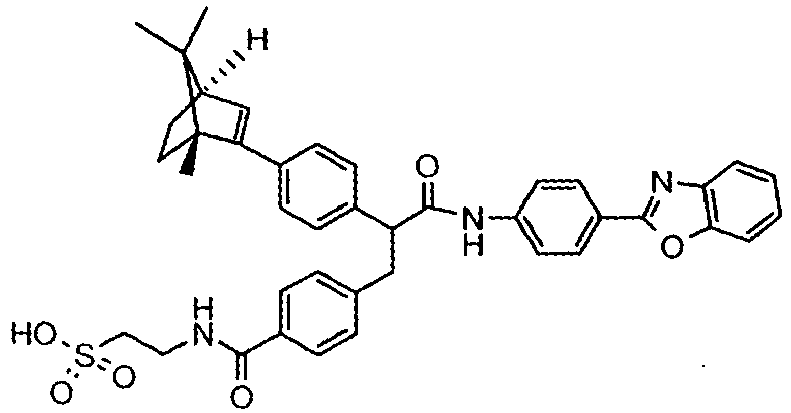
- 1H NMR (500 MHz, DMSO-d 6): δ 8.13 (d, J = 8.5 Hz, 2 H), 7.74 - 7.65 (m, 4 H), 7.40 - 7.38 (m, 6 H), 7.33 (d, J = 8.0 Hz, 2 H), 7.21 (d, J = 8.0 Hz, 2 H), 5.97 (d, J = 3.5 Hz, 2 H), 4.05 (t, J= 6.0, Hz, 1 H). 3.77 (t, J= 6.5, Hz, 1 H), 3.56 - 3.46 (m, 1 H), 3.14 (dd, J = 6.0, 14.0 Hz, 1 H), 3.06 (t, J = 6.5 Hz, 2 H), 2.37 (t, J = 3.5 Hz, 2 H), 1.99 - 1.93 (m, 2 H), 1.72 - 1.67 (m, 2 H), 1.33 - 1.29 (m, 2 H), 1.15 - 1.09 (m, 4 H), 0.90 (s, 3 H), 0.88 (s, 3 H). LC-MS m/z = 703 [C41H41N3O6S]+. HPLC conditions: 250x10 mm T=23°C; mobile phase = 100%ACN/(H2O/CAN+0.1 TFA) flow rate = 1.0 mL/min; detection = 254, 280, 220 nm retention time in min: 7.39 min (95.0%).
-

- 1H NMR (500 MHz, DMSO-d 6): δ 7.71 (d, J = 8.0 Hz, 2 H), 7.59 - 7.44 (m, 13 H), 7.36 - 7.33 (m, 4 H), 4.0 (dd, J= 6.0, 9.0 Hz, 1 H), 3.77 (t, J= 7.0 Hz, 2 H), 3.56 (dd, J = 9.0, 13.0 Hz, 1 H), 3.14 (dd, J = 6.0, 13.0 Hz, 1 H), 3.06 (t, J = 6.5 Hz, 2 H), 2.41 (s, 3 H), 1.34 (s, 9 H). LC-MS m/z = 731 [C35H36N2O5SClNa]+,
-

- To a suspension of 4-amino-benzoic acid (2.0 g, 14.5 mmol) in PPA (~85 g) was added 2-amino-m-cresol (1.8 g, 15.3 mmol). The reaction was heated to 160 °C for 14h, then carefully quenched in aqueous sodium carbonate (∼50% saturated) at room temperature. Ethyl acetate was added, and the organic layer was washed with water and brine, and dried over sodium sulfate. The crude product was obtained was subsequently purified by flash column chromatography on silica gel eluting with ethyl acetate in hexanes to afford the desired product, 4-(4-methyl-benzooxazol-2-yl)-phenylamine as a light pink solid, 1.8 g (56%). LC-MS m/z = 225 [C14H12N2O+ H]+.
-

- 1H NMR (500 MHz, DMSO-d6): δ 10.48 (s, 1 H), 8.41 (t, J = 3.0 Hz, 1 H), 8.12 (d, J = 5.4 Hz, 2 H), 7.77 (d, J = 5.1 Hz, 2 H), 7.67 - 7.46 (m, 11 H), 7.34 (d, J = 5.1 Hz, 1 H), 7.25 (dd, J = 4.5 Hz, 1 H), 7.17 (d, J = 4.8 Hz, 1 H), 4.13 (t, J = 6.0 Hz, 1 H), 3.53 - 3.41 (m, 3 H), 3.11 (dd, J = 3.0, 6.5 Hz, 1 H), 2.62 (t, J = 3.9 Hz, 2 H), 2.55 (s, 3 H), 1.29 (s, 9 H).; LC-MS mlz = 717[C42H41N3O6S]+.
- Chiral HPLC conditions: The sample was diluted in ethanol at a 1 mg/mL concentration. It was injected into an HPLC system equipped with a Regis-Whelk-01-786615, (S,S)10/100 250x10 mm column kept at 23°C. The column was eluted with a gradient of two solvents A and B for a 30 min period. The composition of the gradient ranged from 40% A to 70% A over this period (with the balance of the solvent being B). Solvent A was acetonitrile, solvent B was a mixture of 5% acetonitrile and 95% water containing 5 mM ammonium bicarbonate (pH adjusted to 6.5 with CO2). The product was detected by UV at 254 nm. Retention time in min: 26.69 min (enantiomeric excess: >99.5%).
-
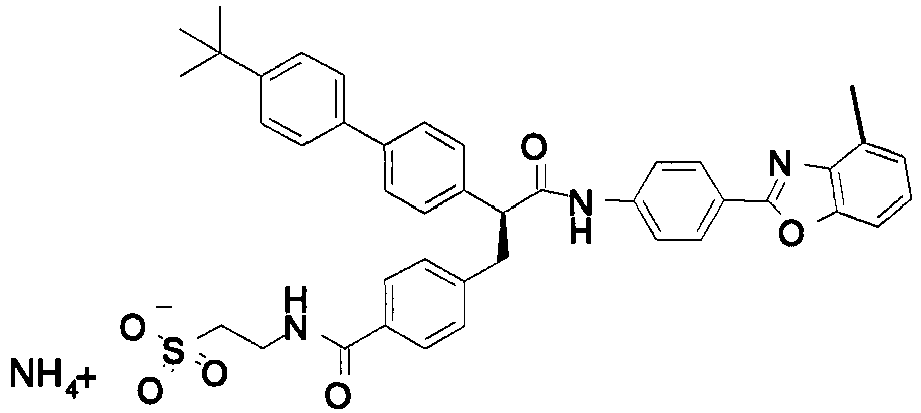
- This compound was generated using the methods described in Example 19. 1H NMR (500 MHz, DMSO-d 6): δ 10.48 (s, 1 H), 8.41 (t, J = 3.3 Hz, 1 H), 8.11 (d, J = 5.1 Hz, 2 H), 7.78 (d, J = 2.1 Hz, 2 H), 7.67 - 7.46 (m, 11 H), 7.34 (d, J = 5.1 Hz, 1 H), 7.25 (dd, J = 4.8 Hz, 1 H), 7.19 (d, J = 4.8 Hz, 1 H), 4.13 (t, J = 6.0 Hz, 1 H), 3.51 - 3.37 (m, 3 H), 3.09 (dd, J = 3.9, 4.5 Hz, 1 H), 2.62 (t, J = 1.2 Hz, 2 H), 2.60 (s, 3 H), 1.29 (s, 9 H).; LC-MS m/z = 717[C42H41N3O6S]+.
- Chiral HPLC conditions: The sample was diluted in ethanol at a 1 mg/mL concentration. It was injected into an HPLC system equipped with a Regis-Whelk-01-786615, (S,S)10/100 250x10 mm column kept at 23°C. The column was eluted with a gradient of two solvents A and B for a 30 min period. The composition of the gradient ranged from 40% A to 70% A over this period (with the balance of the solvent being B). Solvent A was acetonitrile, solvent B was a mixture of 5% acetonitrile and 95% water containing 5 mM ammonium bicarbonate (pH adjusted to 6.5 with CO2). The product was detected by UV at 254 nm. Retention time in min: 26.48 min (enantiomeric excess: >99.8%).
-

-

- Oxalyl chloride (101 mL) was added dropwise over a 30 min period to a slurry of 4-chloromethyl benzoic acid (181.8 g) in dichloromethane (1.2L) containing 5 mL of DMF. After the addition was complete the reaction mixture was stirred at room temperature for 24h, concentrated under reduced pressure and then co-evaporated with toluene. To the residue was added 908 mL of MTBE and the mixture was cooled to -5 °C. A solution of potassium tert-butoxide in THF (1.0 M, 1172 mL) was added dropwise ensuring that the internal temperature remained below 10 °C. After the addition was complete, the reaction mixture was stirred for an additional 1 hour then treated with 500 mL of saturated sodium bicarbonate solution. After stirring 5 minutes, then settling, the organic phase was separated, washed with saturated sodium chloride solution and dried over magnesium sulfate. Concentration yielded 241.7g (86% yield) as a dark oil. HNMR: CDCl3, 1.59 ppm (s, 9H), 4.61 (s, 2H), 7.45 (d, 2H), 7.99 (d, 2H)
-

- Sodium iodide (229.2g) was added to a solution of 4-chloromethyl benzoic acid tert-butyl ester (315.2g) in acetone (1.5 L). The reaction mixture was heated to reflex for about 2h and then allowed to cool to room temperature. The precipitate was removed by filtration and the filtrate concentrated under reduced pressure. The residue was partitioned between water (500 mL) and MTBE (1500 mL). The organic phase was washed with saturated sodium bicarbonate and dried over magnesium sulfate. Concentration under reduced pressure afforded 442.2g (97% yield) dark oil. HNMR: CDCl3, 1.59 ppm (s, 9H), 4.47 (s, 2H), 7.42 (d, 2H), 7.91 (d, 2H)

- Sulfuric acid (56.5 mL) was very slowly added to a solution of 206.6 g of 4-bromophenyl acetic acid in methanol (800 mL). After completion of the addition, the mixture was heated to reflux for 2h. The reflux condenser was replaced by a distillation head and 400 mL of methanol was atmospherically distilled. The temperature was the reduced to 50 °C and the reaction stirred for additional 16h, when the mixture was then cooled to room temperature and partitioned between dichloromethane (1L) and water (600 mL). The organic phase was washed with saturated sodium bicarbonate and dried over magnesium sulfate. Concentration under reduced pressure provided 220.1g (98% yield) colorless oil. HNMR: CDCl3, 3.59 (s, 2H), 3.70 (s, 3H), 7.16 (d, 2H), 7.45 (d, 2H)
-

- A solution of 246.63g of methyl-4-bromophenyl acetate and 342.54g of 4-Iodomethyl benzoic acid tert-butyl ester in THF (1233 mL) was cooled to -8 °C. A solution of lithium hexamethyl disilazide in THF (1185 mL, 1.0 M) was added dropwise ensuring that the temperature remaine below -2 °C. After the addition was complete, the reaction was allowed to proceed for ∼45 min at the same temperature and then poured over over a stirring mixture of ethyl acetate (2.46L) and water (1.23L). The organic phase was washed with saturated ammonium chloride and then with water. Dried over magnesium sulfate and concentrated under reduced pressure to obtain 450.5g (100% yield) thick oil. HNMR: CDCl3, 1.41 (s, 9H), 2.88-2.90 (m, 1H), 3.24-3.28 (m, 1H), 3.45 (s, 3H), 3.63 (t, 1H), 6.96-6.99 (m, 4H), 7.25 (d, 2H), 7.68 (d, 2H)
-

- 4-[2-(4-Bromo-phenyl)-2-methoxycarbonyl-ethyl]-benzoic acid tert-butyl ester (769g) was dissolved in THF (5.38L) and water (3.85L) and treated with lithium hydroxide monohydrate (153.9g). The reaction mixture was heated to 45 °C for approximately 1 hour. After allowing the reaction to cool to 32 °C, the reaction was poured into a stirring mixture of 11.6L of ethyl acetate and 3.9L of 1M aqueous hydrochloric acid. The separated organic layer was washed with water, dried over magnesium sulfate and concentrated under reduced pressure. Added ethyl acetate (2.045L) to the residue and warmed to 78 °C for ∼ 5 min for dissolution. The mixture was allowed to cool to 68 °C and treated with (S)-(+)-prolinol (90.5 mL). The solid that precipitated after cooling to room temperature was filtered and rinsed with a cold mixture (7 °C) of 1:1 ethyl acetate: heptane (740 mL). The solid isolated (232.4g, 35% yield) was shown to have 94% enantiomeric excess (R isomer) by chiral HPLC analysis. HNMR: CDCl3, 1.57 (s, 9H), 1.67-1.74, (m, 2H), 2.64-2.69 (m, 1H), 2.76-2.81 (m, 1H), 2.94-2.99 (m, 1H), 3.14-3.19 (m, 1H), 3.32-3.39 (m, 2H), 3.60-3.67 (m, 2H), 7.14-7.19 (m, 4H), 7.35 (d, 2H), 7.80 (d, 2H). Conditions for chiral HPLC analysis Kromasil 100-5-TBB column, 250 x 4.6mm, 1 mL/min, 15% (1% AcOH/MTBE)/85% hexanes, 230/240/250 nm.
- To 228g of the product above were added 684 mL of ethyl acetate. The mixture was warmed to reflux (additional 228 mL of ethyl acetate were added when the temperature reached 69 °C for mobility) where it was held for about 10 min. The suspension was then allowed to cool to room temperature and filtered. Vacuum dried at 50 °C. Product is a white solid (224.6g, 98% yield) "R' enantiomer with enantiomeric excess of 96.9 % by HPLC analysis as described above.
-

- A stirring slurry of 216.8g of (R)-2-(4-Bromo-phenyl)-3-(4-tert-butoxycarbonyl-phenyl)-propionate (S)-2-hydroxymethyl pyrrolidinium in 2168 mL of ethyl acetate at 21 °C was treated 1084 mL of 10% aqueous formic acid. After 20 minutes, the separated organic phase was washed with water and dried over magnesium sulfate. The ethyl acetate solution was atmospherically displaced into heptanes to yield the product as a granular solid. 166.3g (96% yield) of white solid, enantiomeric excess ("R" enantiomer) of 96.9% by chiral HPLC analysis as described above. HNMR: CDCl3, 1.50 (s, 9H), 2.96-3.00 (m, 1H), 3.32-3.37 (m, 1H), 3.73 (t, 1H), 7.03-7.08 (m, 4H), 7.35 (d, 2H), 7.76 (d, 2H)
-

- A mixture of 3.1 g of 4-[(R)-2-(4-Bromo-phenyl)-2-carboxy-ethyl-]-benzoic acid tert-butyl ester (3.Step 2, above), 1.5g of 4-t-butyl-cyclohex-1-enyl boronic acid, 644 mg of PdCl2(P(o-tolyl)3)2, and 2.21g of sodium carbonate in 12 mL of DME and 6 mL of ethanol and 3 mL of water was heated to reflux for a 16h period. The reaction mixture was quenched with an excess of aqueous ammonium chloride, added ethyl acetate and the heterogeneous mixture was filtered through a celite pad. The organic phase was washed (water, saturated sodium chloride), dried over magnesium sulfate and concentrated. The residue was chromatographed on silica gel using a methanol-dichloromethane gradient to yield the carboxylic acid. HNMR (300 MHz, CDCl3, partial): 6.14 (1H, m), 1.58 (9H, s), 0.92 (9H, s). LCMS m/z = 407.9 [(C30H38O4 + H) - C4H9]+.
-

- To a solution of 4-{(R)-2-[4-(4-tert-Butyl-cyclohex-1-enyl)-phenyl]-2-carboxy-ethyl}-benzoic acid tert-butyl ester (3.0g) in ethyl acetate (100 mL) added 10% palladium on carbon (300 mg). The mixture was stirred under a balloon tilled with hydrogen, until proton NMR indicated the disappearance of the olefinic signal. The reaction was filtered through a plug of celite, and the filtrate was concentrated under reduced pressure to give a mixture of cis/trans isomers (in a ratio of 1:1, based on 1H NMR). The cis 1 and trans isomers were separated by reverse phase chromatography with the latter being cis (1.34 g, 2.9 mmol, 35 %). 1H NMR (CDCl3): δ 0.95 (9H, s), 1.23-1.38 (4H, m), 1.58 (9H, s), 1.88-1.98. (4H, m), 2.39-2.56 (1H, m), 3.05-3.12 (1H, m), 3.19-3.50 (1H, m), 3.82-3.90 (1H, m), 7.19-7.22 (6H, m), 8.81 (2H, d).
- Based on the following reference and references within the article, the cis was assigned as described above. Garbisch, E.W.; Patterson, D. B., J. Am. Chem. Soc., 1963, 85, 3228.
-

- To 4-{(R)-2-[4-(4-(cis)-tert-Butyl-cyclohexyl)-phenyl]-2-carboxy-ethyl}-benzoic acid tert-butyl ester (300 mg) in dichloromethane (10mL) was added a solution of oxalyl chloride in dichloromethane (2.0M, 0.54 mL) followed by 2 drops of DMF. The reaction mixture was stirred at room temperature for 2h and concentrated under reduced pressure. The residue was dissolved in dichloromethane (20 mL), and treated with 4'-Chloro-2'-methyl-biphenyl-4-amine (142 mg) and diisopropyl ethyl amine (0.120 mL). After stirring for 1h at room temperature, the solvent was removed under reduced pressure and the residue treated with methanol. The white precipitated formed was washed with methanol, dried under vacuum and used without further purification in the following step.
-
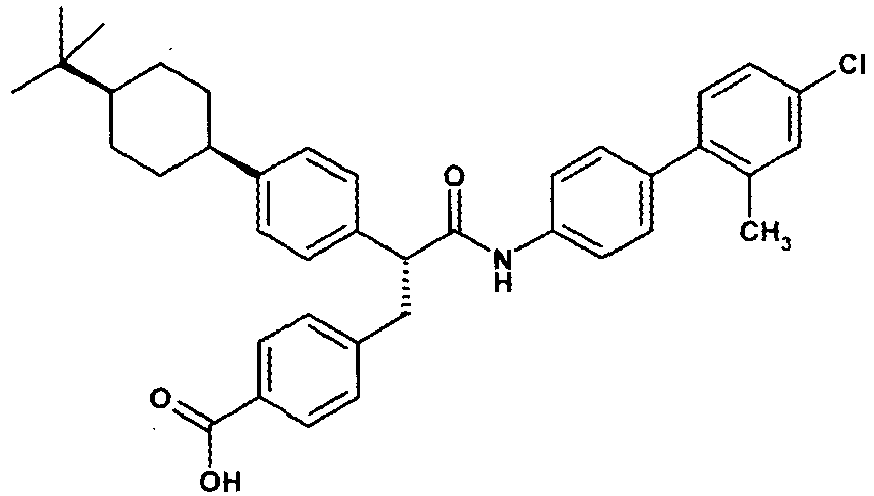
- A solution of 431 mg of 4-[(R)-2-[4-(4-(cis)-tert-Butyl-cyclohexyl)-phenyl]-2-(4'-chlor-2'-methyl-biphenyl-4-ylcarbamoyl)-ethyl]-benzoic acid tert-butyl ester in dichloromethane (10 mL) was treated with trifluoroacetic acid (2 mL) and concentrated aqueous hydrochloric acid (1 mL). The resulting mixture was stirred for 16h at room temperature. The organic phase was separated, washed with water and dried over magnesium sulfate. Concentration left a residue that was used without further purification.
-

- (R)-4-[2-[4-(4-(cis)-tert-Butyl-cyclohexyl)-phenyl]-2-(4'-chloro-2'-methylbiphenyl-4-ylcarbamoyl)-ethyl]-benzoic acid (350 mg, 0.6 mmol), was taken up in 3 mL of DMF, followed by addition of HOBt (133 mg, 0.9 mmol), EDCI (132 mg, 0.7 mmol), taurine (86 mg, 0.7 mmol) and Hunig's base (374 mg, 2.9 mmol). The resulting reaction mixture was then stirred for 16 h at room temperature. The reaction solution was diluted with EtOAc (25 mL) and 10 mL of water, acidified with 2.4 N HCl. The layers were separated and the aqueous layer was extracted with EtOAc (2x20 mL). The organic extracts were combined, dried with Na2SO4, filtered through a frit and concentrated under reduced pressure to give a foam. The material was subjected to reverse phase HPLC purification to give the desired product as a white solid (150 mg, 36 %). 1H NMR (CD3OD): δ 0.89 (9H, s), 1.10-1.60 (6H, m), 1.80-1.90 (4H, m), 2.38 (3H, s), 2.32-2.53 (1H, m), 3.05-3.10 (4H, m), 3.47-3.55 (1h, dd), 3.77 (2H, t), 3.93-3.98 (1H, m), 7.09-7.47 (11H, m), 7.50 (2H, d), 7.70 (2H, d). Anal. Calcd. For C42H47ClN2O5S + NH3 +1.2 H2O; C = 65.22; H = 7.13; N = 5.57. Found C = 65.31; H = 7.00; N = 5.57.
- The trans isomer isolated from step 8, (R)-4-{2-[4-(4-(trans)-tert-Butylcyclohexyl)-phenyl]-2-carboxy-ethyl}-benzoic acid tert-butyl ester, was subjected to the procedures of steps 9-11 to give (R)-2-{4-[2-[4-(4-(trans)-tert-butyl-cyclohexyl)-phenyl]-2-(4'-chloro-2'-methyl-biphenyl-4-ylcarbamoyl)-ethyl]-benzoylamino}-ethanesulfonic acid.

- The examples set forth above are provided to give those of ordinary skill in the art with a complete disclosure and description of how to make and use the claimed embodiments.

Claims (17)
- A compound of Formula I:
 R44 is H, CH3 or CH3CH2;R45 is C1-6-alkyl, alkenyl, alkoxy, C3-6-cycloalkyl, C4-8-cycloalkenyl, C4-8-bicycloalkenyl, aryl or heteroaryl, any of which can be optionally substituted with one or more substituents selected from C1-6alkyl, CF3, F, CN or OCF3;L is phenyl, indenyl, benzoxazol-2-yl, C3-6-cycloalkyl, C4-8-cycloalkenyl or C4-8-bicycloalkenyl, any of which can be optionally substituted with one or more substituents selected from F, Cl, CH3, CF3, OCF3 or CN; andR46 represents one or more substituents selected from H, F, Cl, CH3, CF3, OCF3 or CN;or a pharmaceutically acceptable salt, or solvate thereof.
 - The compound of claim 1, wherein:L is phenyl, indenyl, benzoxazol-2-yl or 4,4-dimethylcyclohexenyl, any of which can be optionally substituted with one or more substituents selected from F, Cl, CH3, CF3, OCF3 or CN; andR46 is H, F, Cl, CH3, CF3, OCF3 or CN.
- The compound of claim 2, wherein L is 4-chloro-2-methylphenyl, 4-methyl-2-benzoxazolyl, 2,4,6-trimethylphenyl, 2-benzoxazolyl, 4-chloro-3-methylphenyl or 4,4-dimethylcyclohexenyl.
- The compound of any of the preceding claims, wherein R45 is attached to the 3 (meta) or 4 (para) position.
- The compound of any of the preceding claims, wherein R45 is alkenyl, C3-6-cycloalkyl, C4-8-cycloalkenyl, C4-8-bicycloalkenyl or phenyl, any of which can be optionally substituted with one or more substituents selected from C1-6alkyl or CF3.
- The compound of claim 1, wherein the compound is selected from the group


- A pharmaceutical composition comprising any of the compounds of claims 1 to 6, and one or more pharmaceutically acceptable excipients or carriers, preferably wherein the pharmaceutical composition further comprises a second therapeutic agent, wherein the second therapeutic agent is preferably an antidiabetic agent.
- A compound of any one of claims 1 to 6 for use in a method of treating, preventing, or ameliorating one or more symptoms of a condition, disorder, or disease responsive to the modulation of a glucagon receptor, comprising administering said compound to a subject.
- A compound of any one of claims 1 to 6 for use in a method of treating, preventing, or ameliorating one or more symptoms of a condition, disorder, or disease responsive to a decrease in the hepatic glucose production or in the blood glucose level of a subject, comprising administering said compound to a subject.
- The compound for use according to claim 8 or 9, wherein the disease is diabetes.
- A compound of Formula II
 R44 is H;R45 is cis-4-t-butylcyclohexyl, trans-4-t-butylcyclohexyl, 4,4-dimethylcyclohexyl, 4,4-diethylcyclohexyl, 4,4-dipropylcyclohexyl, 4,4-diethylcyclohex-1-enyl, 4,4-dimethylcyclohex-1-enyl, (S)-4-t-butylcyclohex-1-enyl, (R)-4-t-butylcyclohex-1-enyl, 4,4-dipropylcyclohex-1-enyl, 4-t-butylphenyl, (1R,4S)-1,7,7-trimethylbicyclo[2.2.1]-3-hept-2-enyl or (1R,4R)-1,7,7-trimethylbicyclo[2.2.1]-2-hept-2-enyl;L is phenyl, benzoxazol-2-yl, 4-alkyl-cyclohex-1-enyl, 4,4-dialkylcyclohex-1-enyl, 4-alkyl-cyclohexyl, 4,4-dialkylcyclohexyl or 4,4-dimethylcyclohexenyl, any of which can be optionally substituted with one or more substituents selected from F, Cl, CH3, CF3, OCF3 or CN; andR46 is H;or a pharmaceutically acceptable salt, or solvate thereof;
with the exception of

- The compound of claim 11, wherein R45 is attached to the 3 (meta) or 4 (para) position.
- The compound of any of claims 11 or 12, wherein the compound is the (R) isomer.
- A pharmaceutical composition comprising any of the compounds of claims 11 to 13, and one or more pharmaceutically acceptable excipients or carriers, preferably wherein the pharmaceutical composition further comprises a second therapeutic agent, wherein the second therapeutic agent is preferably an antidiabetic agent.
- A compound of any one of claims 11 to 13 for use in a method of treating, preventing, or ameliorating one or more symptoms of a condition, disorder, or disease responsive to the modulation of a glucagon receptor, comprising administering said compound to a subject.
- A compound of any one of claims 11 to 13 for use in a method of treating, preventing, or ameliorating one or more symptoms of a condition, disorder, or disease responsive to a decrease in the hepatic glucose production or in the blood glucose level of a subject, comprising administering said compound to a subject.
- The compound for use according to claim 15 or 16, wherein the disease is diabetes.
Priority Applications (3)
| Application Number | Priority Date | Filing Date | Title |
|---|---|---|---|
| DK14179199.6T DK2799428T3 (en) | 2008-08-13 | 2009-08-13 | Glucagon antagonists |
| EP16198552.8A EP3153501B1 (en) | 2008-08-13 | 2009-08-13 | Glucagon antagonists |
| EP14179199.6A EP2799428B1 (en) | 2008-08-13 | 2009-08-13 | Glucagon antagonists |
Applications Claiming Priority (2)
| Application Number | Priority Date | Filing Date | Title |
|---|---|---|---|
| US8869708P | 2008-08-13 | 2008-08-13 | |
| PCT/US2009/053795 WO2010019830A1 (en) | 2008-08-13 | 2009-08-13 | Glucagon antagonists |
Related Child Applications (3)
| Application Number | Title | Priority Date | Filing Date |
|---|---|---|---|
| EP14179199.6A Division EP2799428B1 (en) | 2008-08-13 | 2009-08-13 | Glucagon antagonists |
| EP14179199.6A Division-Into EP2799428B1 (en) | 2008-08-13 | 2009-08-13 | Glucagon antagonists |
| EP16198552.8A Division EP3153501B1 (en) | 2008-08-13 | 2009-08-13 | Glucagon antagonists |
Publications (2)
| Publication Number | Publication Date |
|---|---|
| EP2326618A1 EP2326618A1 (en) | 2011-06-01 |
| EP2326618B1 true EP2326618B1 (en) | 2014-10-15 |
Family
ID=41350634
Family Applications (3)
| Application Number | Title | Priority Date | Filing Date |
|---|---|---|---|
| EP14179199.6A Active EP2799428B1 (en) | 2008-08-13 | 2009-08-13 | Glucagon antagonists |
| EP16198552.8A Not-in-force EP3153501B1 (en) | 2008-08-13 | 2009-08-13 | Glucagon antagonists |
| EP09791510.2A Not-in-force EP2326618B1 (en) | 2008-08-13 | 2009-08-13 | Glucagon antagonists |
Family Applications Before (2)
| Application Number | Title | Priority Date | Filing Date |
|---|---|---|---|
| EP14179199.6A Active EP2799428B1 (en) | 2008-08-13 | 2009-08-13 | Glucagon antagonists |
| EP16198552.8A Not-in-force EP3153501B1 (en) | 2008-08-13 | 2009-08-13 | Glucagon antagonists |
Country Status (13)
| Country | Link |
|---|---|
| US (4) | US8907103B2 (en) |
| EP (3) | EP2799428B1 (en) |
| JP (5) | JP5684126B2 (en) |
| KR (2) | KR101634515B1 (en) |
| CN (2) | CN104803891B (en) |
| BR (1) | BRPI0918004B8 (en) |
| CA (2) | CA2770298C (en) |
| DK (1) | DK2799428T3 (en) |
| ES (3) | ES2615481T3 (en) |
| MX (1) | MX2011001708A (en) |
| PL (1) | PL2799428T3 (en) |
| PT (1) | PT2799428T (en) |
| WO (1) | WO2010019830A1 (en) |
Cited By (1)
| Publication number | Priority date | Publication date | Assignee | Title |
|---|---|---|---|---|
| US10239829B2 (en) | 2007-02-09 | 2019-03-26 | Metabasis Therapeutics, Inc. | Antagonists of the glucagon receptor |
Families Citing this family (12)
| Publication number | Priority date | Publication date | Assignee | Title |
|---|---|---|---|---|
| US5033634A (en) * | 1989-04-03 | 1991-07-23 | The Procter & Gamble Company | Child resistant container for storing hazardous materials |
| CN104803891B (en) | 2008-08-13 | 2017-10-20 | 症变治疗公司 | Glucagon antagonist |
| MX2013006768A (en) | 2010-12-23 | 2013-07-22 | Pfizer | Glucagon receptor modulators. |
| ES2597972T3 (en) | 2011-02-08 | 2017-01-24 | Pfizer Inc | Glucagon receptor modulator |
| RU2013157388A (en) * | 2011-07-22 | 2015-08-27 | Пфайзер Инк. | QUINOLINYL MODULATORS OF THE GLUCAGON RECEPTOR |
| JP2017519000A (en) * | 2014-06-12 | 2017-07-13 | リガンド・ファーマシューティカルズ・インコーポレイテッド | Glucagon antagonist |
| CN106336387A (en) * | 2015-07-10 | 2017-01-18 | 浙江海正药业股份有限公司 | Amides derivative, preparation method thereof and purpose of amides derivative on medicine |
| US20170143673A1 (en) * | 2015-11-24 | 2017-05-25 | Remd Biotherapeutics, Inc. | Methods For Treating Heart Failure Using Glucagon Receptor Antagonists |
| EP3500565A1 (en) * | 2016-08-17 | 2019-06-26 | Ligand Pharmaceuticals, Inc. | Glucagon receptor antagonists |
| DK3573611T3 (en) * | 2017-01-24 | 2022-04-11 | Alphala Co Ltd | Amide compounds and their use |
| JP2021513564A (en) | 2018-02-13 | 2021-05-27 | リガンド・ファーマシューティカルズ・インコーポレイテッド | Glucagon receptor antagonist |
| KR102176621B1 (en) | 2018-08-21 | 2020-11-10 | 가천대학교 산학협력단 | A phenylpyrimidine derivatives, preparation method thereof, and pharmaceutical composition for use in preventing or treating Glucagon Receptor activity related diseases containing the same as an active ingredient |
Family Cites Families (91)
| Publication number | Priority date | Publication date | Assignee | Title |
|---|---|---|---|---|
| US3524846A (en) | 1967-06-02 | 1970-08-18 | Syntex Corp | Process for the didealkylation of phosphonate esters |
| US3536809A (en) | 1969-02-17 | 1970-10-27 | Alza Corp | Medication method |
| US3598123A (en) | 1969-04-01 | 1971-08-10 | Alza Corp | Bandage for administering drugs |
| US3845770A (en) | 1972-06-05 | 1974-11-05 | Alza Corp | Osmatic dispensing device for releasing beneficial agent |
| US3916899A (en) | 1973-04-25 | 1975-11-04 | Alza Corp | Osmotic dispensing device with maximum and minimum sizes for the passageway |
| JPS5322951B2 (en) | 1974-06-05 | 1978-07-12 | ||
| US4008719A (en) | 1976-02-02 | 1977-02-22 | Alza Corporation | Osmotic system having laminar arrangement for programming delivery of active agent |
| IE58110B1 (en) | 1984-10-30 | 1993-07-14 | Elan Corp Plc | Controlled release powder and process for its preparation |
| US4968788A (en) | 1986-04-04 | 1990-11-06 | Board Of Regents, The University Of Texas System | Biologically reversible phosphate and phosphonate protective gruops |
| US5091552A (en) | 1986-06-30 | 1992-02-25 | Board Of Regents, The University Of Texas System | Novel antitumor aldophosphamide analogs |
| JPH0738070B2 (en) | 1986-07-25 | 1995-04-26 | 富士写真フイルム株式会社 | Silver halide photographic light-sensitive material |
| EP0284240B2 (en) | 1987-03-09 | 1993-06-16 | EASTMAN KODAK COMPANY (a New Jersey corporation) | Photographic silver halide materials and process comprising a pyrazolotriazole coupler |
| JPH081079B2 (en) | 1987-10-12 | 1996-01-10 | 大和ハウス工業株式会社 | Multi-story structure |
| US5073543A (en) | 1988-07-21 | 1991-12-17 | G. D. Searle & Co. | Controlled release formulations of trophic factors in ganglioside-lipsome vehicle |
| IT1229203B (en) | 1989-03-22 | 1991-07-25 | Bioresearch Spa | USE OF 5 METHYLTHETRAHYDROPHOLIC ACID, 5 FORMYLTHETRAHYDROPHOLIC ACID AND THEIR PHARMACEUTICALLY ACCEPTABLE SALTS FOR THE PREPARATION OF PHARMACEUTICAL COMPOSITIONS IN THE FORM OF CONTROLLED RELEASE ACTIVE IN THE THERAPY OF MENTAL AND ORGANIC DISORDERS. |
| US5120548A (en) | 1989-11-07 | 1992-06-09 | Merck & Co., Inc. | Swelling modulated polymeric drug delivery device |
| US5733566A (en) | 1990-05-15 | 1998-03-31 | Alkermes Controlled Therapeutics Inc. Ii | Controlled release of antiparasitic agents in animals |
| AU651835B2 (en) | 1990-06-13 | 1994-08-04 | Arnold Glazier | Phosphorous prodrugs |
| US5157027A (en) | 1991-05-13 | 1992-10-20 | E. R. Squibb & Sons, Inc. | Bisphosphonate squalene synthetase inhibitors and method |
| US5580578A (en) | 1992-01-27 | 1996-12-03 | Euro-Celtique, S.A. | Controlled release formulations coated with aqueous dispersions of acrylic polymers |
| JPH05322951A (en) | 1992-05-26 | 1993-12-07 | Toshiba Corp | Trip sequence log device |
| US5591767A (en) | 1993-01-25 | 1997-01-07 | Pharmetrix Corporation | Liquid reservoir transdermal patch for the administration of ketorolac |
| ATE199906T1 (en) | 1993-06-29 | 2001-04-15 | Mitsubishi Chem Corp | PHOSPHONATE NUCLEOTIDE ESTER DERIVATIVES |
| IT1270594B (en) | 1994-07-07 | 1997-05-07 | Recordati Chem Pharm | CONTROLLED RELEASE PHARMACEUTICAL COMPOSITION OF LIQUID SUSPENSION MOGUISTEIN |
| US5780058A (en) | 1995-07-21 | 1998-07-14 | Alza Corporation | Oral delivery of discrete units |
| US6132420A (en) | 1996-02-02 | 2000-10-17 | Alza Corporation | Osmotic delivery system and method for enhancing start-up and performance of osmotic delivery systems |
| JPH09241284A (en) | 1996-03-08 | 1997-09-16 | Koji Yamashita | New oxyazaphosphorine derivative |
| MY125849A (en) | 1997-07-25 | 2006-08-30 | Alza Corp | Osmotic delivery system, osmotic delivery system semipermeable body assembly, and method for controlling delivery rate of beneficial agents from osmotic delivery systems |
| JPH1197740A (en) | 1997-09-19 | 1999-04-09 | Showa Denko Kk | Epitaxial wafer for gap light emitting diode and gap light emitting diode |
| DK1041975T3 (en) | 1997-12-22 | 2002-11-04 | Alza Corp | Speed-controlling membranes for controlled drug delivery devices |
| WO1999033446A1 (en) | 1997-12-29 | 1999-07-08 | Alza Corporation | Osmotic delivery system with membrane plug retention mechanism |
| DE69834213T2 (en) | 1997-12-31 | 2007-01-25 | Alza Corp., Mountain View | Osmotic delivery system for a beneficial agent |
| US6245357B1 (en) | 1998-03-06 | 2001-06-12 | Alza Corporation | Extended release dosage form |
| US6365185B1 (en) | 1998-03-26 | 2002-04-02 | University Of Cincinnati | Self-destructing, controlled release peroral drug delivery system |
| EP1652516A3 (en) | 1998-11-02 | 2006-05-17 | ALZA Corporation | Osmotic controlled delivery of active agents |
| US6375975B1 (en) | 1998-12-21 | 2002-04-23 | Generex Pharmaceuticals Incorporated | Pharmaceutical compositions for buccal and pulmonary application |
| US6342249B1 (en) | 1998-12-23 | 2002-01-29 | Alza Corporation | Controlled release liquid active agent formulation dosage forms |
| BR0010651A (en) * | 1999-05-17 | 2002-03-19 | Novo Nordisk As | Compound, use of a compound, pharmaceutical composition, and method for the treatment and / or prevention of disorders or diseases mediated by an antagonistic action of glucagon |
| US6503949B1 (en) | 1999-05-17 | 2003-01-07 | Noro Nordisk A/S | Glucagon antagonists/inverse agonists |
| AU5283800A (en) | 1999-05-24 | 2000-12-12 | Cor Therapeutics, Inc. | Inhibitors of factor xa |
| WO2001019830A1 (en) | 1999-09-10 | 2001-03-22 | Novo Nordisk A/S | MODULATORS OF PROTEIN TYROSINE PHOSPHATASES (PTPases) |
| DE10008329A1 (en) | 2000-02-23 | 2001-08-30 | Merck Patent Gmbh | New aminosulfonyl-biphenyl derivatives are Factor Xa and Factor VIIa inhibitors useful e.g. for treating thrombosis, myocardial infarction, arteriosclerosis, inflammation or angina pectoris |
| WO2002000612A1 (en) | 2000-06-23 | 2002-01-03 | Novo Nordisk A/S | Glucagon antagonists/inverse agonists |
| AU2002223501A1 (en) | 2000-11-17 | 2002-05-27 | Agouron Pharmaceuticals, Inc. | Glucagon antagonists/inverse agonists |
| US6881746B2 (en) | 2001-12-03 | 2005-04-19 | Novo Nordick A/S | Glucagon antagonists/inverse agonists |
| EP1463715A1 (en) | 2001-12-03 | 2004-10-06 | Novo Nordisk A/S | Novel glucagon antagonists |
| US6762318B2 (en) | 2001-12-03 | 2004-07-13 | Novo Nordisk A/S | Glucagon antagonists |
| AU2002347022A1 (en) | 2001-12-20 | 2003-07-09 | Novo Nordisk A/S | Benzimidazols and indols as glucagon receptor antagonists/inverse agonisten |
| US20030212119A1 (en) | 2001-12-20 | 2003-11-13 | Jesper Lau | Novel glucagon receptor antagonists/inverse agonists |
| JP2006500325A (en) | 2002-06-27 | 2006-01-05 | ノボ ノルディスク アクティーゼルスカブ | Novel glucagon antagonist |
| CA2508581A1 (en) | 2002-12-04 | 2004-06-17 | Merck & Co., Inc. | Spirocyclic ureas, compositions containing such compounds and methods of use |
| MY141521A (en) | 2002-12-12 | 2010-05-14 | Hoffmann La Roche | 5-substituted-six-membered heteroaromatic glucokinase activators |
| US20040152750A1 (en) | 2002-12-20 | 2004-08-05 | Kodra Janos Tibor | Novel glucagon antagonists |
| US7572922B2 (en) | 2003-01-27 | 2009-08-11 | Merck & Co., Inc. | Substituted pyrazoles, compositions containing such compounds and methods of use |
| US7138529B2 (en) | 2003-04-16 | 2006-11-21 | Hoffmann-La Roche Inc. | Substituted 3-cyanothiophene acetamides as glucagon receptor antagonists |
| CN1784226A (en) | 2003-05-09 | 2006-06-07 | 麦克公司 | Benzimidazole compounds, compositions containing benzimidazole compounds, and methods of use |
| EP1689383B1 (en) | 2003-11-19 | 2012-10-31 | Metabasis Therapeutics, Inc. | Novel phosphorus-containing thyromimetics |
| US20070054902A1 (en) | 2003-12-02 | 2007-03-08 | Shionogi & Co., Ltd. | Isoxazole derivatives as peroxisome proliferator-activated receptors agonists |
| US20070015757A1 (en) | 2003-12-19 | 2007-01-18 | Novo Nordisk A/S | Novel Glucagon Antagonists/Inverse Agonists |
| US7301036B2 (en) | 2003-12-19 | 2007-11-27 | Merck & Co., Inc. | Cyclic guanidines, compositions containing such compounds and methods of use |
| US7989457B2 (en) | 2004-05-28 | 2011-08-02 | Eli Lilly And Company | Glucagon receptor antagonists, preparation and therapeutic uses |
| CN1964947A (en) | 2004-06-04 | 2007-05-16 | 默克公司 | Pyrazole derivatives, compositions containing them and uses thereof |
| DK1758853T3 (en) | 2004-06-14 | 2010-04-06 | Lilly Co Eli | Glucagon Receptor Antagonists, Preparation and Therapeutic Uses |
| WO2006002361A2 (en) | 2004-06-24 | 2006-01-05 | Incyte Corporation | 2-methylpropanamides and their use as pharmaceuticals |
| JP2008505905A (en) | 2004-07-07 | 2008-02-28 | メルク エンド カムパニー インコーポレーテッド | Pyrazole amide derivatives, compositions containing such compounds and methods of use |
| CA2574147A1 (en) | 2004-07-22 | 2006-02-09 | Linda Brockunier | Substituted pyrazoles, compositions containing such compounds and methods of use |
| PL1856090T3 (en) | 2005-02-11 | 2010-02-26 | Lilly Co Eli | Substituted thiophene derivatives as glucagon receptor antagonists, preparation and therapeutic uses |
| CN101146762A (en) | 2005-03-21 | 2008-03-19 | 默克公司 | Substituted Aryl and Heteroaryl Derivatives |
| WO2006104826A2 (en) | 2005-03-30 | 2006-10-05 | Merck & Co., Inc. | Glucagon receptor antagonist compounds, compositions containing such compounds and methods of use |
| KR100738004B1 (en) | 2005-05-23 | 2007-07-13 | (주)주빅스테크놀러지 | Hybrid Peer To Peer Network Intelligent Distributed Compiler System and Method thereof, and Computer Readable Recording Medium on which a Program therefor is recorded |
| WO2007015999A2 (en) | 2005-07-26 | 2007-02-08 | Merck & Co., Inc. | Process for synthesizing a substituted pyrazole |
| TW200745031A (en) | 2005-10-13 | 2007-12-16 | Merck & Co Inc | Acyl indoles, compositions containing such compounds and methods of use |
| DK1951658T3 (en) | 2005-11-17 | 2012-10-15 | Lilly Co Eli | GLUCAGON RECEPTOR ANTAGONISTS, MANUFACTURING AND THERAPEUTIC APPLICATIONS |
| SI1951661T1 (en) | 2005-11-17 | 2012-11-30 | Lilly Co Eli | Glucagon receptor antagonists, preparation and therapeutic uses |
| PT1951659E (en) | 2005-11-18 | 2010-09-10 | Lilly Co Eli | Glucagon receptor antagonists, preparation and therapeutic uses |
| CA2629172C (en) | 2005-11-22 | 2014-05-06 | Eli Lilly And Company | Glucagon receptor antagonists, preparation and therapeutic uses |
| JP5140599B2 (en) | 2005-11-23 | 2013-02-06 | イーライ リリー アンド カンパニー | Glucagon receptor antagonists and their preparation and therapeutic use |
| EP2001472A2 (en) | 2006-03-23 | 2008-12-17 | Merck and Co., Inc. | Glucagon receptor antagonist compounds, compositions containing such compounds and methods of use |
| JP2009537525A (en) | 2006-05-16 | 2009-10-29 | メルク エンド カムパニー インコーポレーテッド | Glucagon receptor antagonist compounds, compositions containing such compounds and methods of use |
| US7512570B2 (en) | 2006-05-30 | 2009-03-31 | Zaracom Technologies Inc. | Artificial intelligence analyzer and generator |
| WO2008001883A1 (en) | 2006-06-29 | 2008-01-03 | Nissan Chemical Industries, Ltd. | α-AMINO ACID DERIVATIVE AND PHARMACEUTICAL COMPRISING THE SAME AS ACTIVE INGREDIENT |
| TW200821284A (en) | 2006-10-03 | 2008-05-16 | Merck & Co Inc | Glucagon receptor antagonist compounds, compositions containing such compounds and methods of use |
| JP5455636B2 (en) | 2006-12-02 | 2014-03-26 | ソウル ナショナル ユニバーシティー インダストリー ファンデーション | Aryl compounds, hydrates thereof, solvates thereof, stereoisomers thereof, or pharmaceutically acceptable salts thereof, methods for producing aryl compounds, and uses of aryl compounds, etc. |
| WO2008098244A1 (en) | 2007-02-09 | 2008-08-14 | Metabasis Therapeutics, Inc. | Novel antagonists of the glucagon receptor |
| CN104803891B (en) | 2008-08-13 | 2017-10-20 | 症变治疗公司 | Glucagon antagonist |
| CN103813794A (en) | 2011-07-18 | 2014-05-21 | 拓凯制药公司 | Novel compositions and methods for treating prostate cancer |
| US8869708B1 (en) | 2011-08-26 | 2014-10-28 | Daniel P. Meyer | Model railroad flashing rear end device |
| JP2017519000A (en) | 2014-06-12 | 2017-07-13 | リガンド・ファーマシューティカルズ・インコーポレイテッド | Glucagon antagonist |
| CN106687118A (en) | 2014-07-02 | 2017-05-17 | 配体药物公司 | Prodrug compounds and uses thereof |
| JP2017051900A (en) | 2015-09-08 | 2017-03-16 | 国立大学法人横浜国立大学 | Catalyst and production method thereof |
| CN205117265U (en) | 2015-11-19 | 2016-03-30 | 北京美高科技发展有限公司 | Cable formula electrohydraulic control cuts piping tool |
-
2009
- 2009-08-13 CN CN201510257808.2A patent/CN104803891B/en active Active
- 2009-08-13 CN CN200980141324.4A patent/CN102292316B/en not_active Expired - Fee Related
- 2009-08-13 ES ES14179199.6T patent/ES2615481T3/en active Active
- 2009-08-13 ES ES16198552T patent/ES2714207T3/en active Active
- 2009-08-13 BR BRPI0918004A patent/BRPI0918004B8/en not_active IP Right Cessation
- 2009-08-13 DK DK14179199.6T patent/DK2799428T3/en active
- 2009-08-13 PL PL14179199T patent/PL2799428T3/en unknown
- 2009-08-13 CA CA2770298A patent/CA2770298C/en not_active Expired - Fee Related
- 2009-08-13 MX MX2011001708A patent/MX2011001708A/en active IP Right Grant
- 2009-08-13 CA CA2966273A patent/CA2966273C/en not_active Expired - Fee Related
- 2009-08-13 KR KR1020157027964A patent/KR101634515B1/en not_active Expired - Fee Related
- 2009-08-13 PT PT141791996T patent/PT2799428T/en unknown
- 2009-08-13 EP EP14179199.6A patent/EP2799428B1/en active Active
- 2009-08-13 US US13/058,604 patent/US8907103B2/en active Active
- 2009-08-13 WO PCT/US2009/053795 patent/WO2010019830A1/en not_active Ceased
- 2009-08-13 ES ES09791510.2T patent/ES2527670T3/en active Active
- 2009-08-13 EP EP16198552.8A patent/EP3153501B1/en not_active Not-in-force
- 2009-08-13 JP JP2011523184A patent/JP5684126B2/en active Active
- 2009-08-13 EP EP09791510.2A patent/EP2326618B1/en not_active Not-in-force
- 2009-08-13 KR KR1020117005737A patent/KR101599089B1/en not_active Expired - Fee Related
-
2014
- 2014-11-26 US US14/555,503 patent/US9783494B2/en active Active
-
2015
- 2015-01-14 JP JP2015005005A patent/JP2015129133A/en active Pending
-
2016
- 2016-12-26 JP JP2016251460A patent/JP6309076B2/en active Active
-
2017
- 2017-09-29 US US15/721,556 patent/US10221130B2/en active Active
-
2018
- 2018-01-19 JP JP2018006976A patent/JP6490843B2/en active Active
-
2019
- 2019-02-27 JP JP2019033889A patent/JP2019112427A/en active Pending
- 2019-02-28 US US16/289,241 patent/US11352321B2/en active Active
Cited By (1)
| Publication number | Priority date | Publication date | Assignee | Title |
|---|---|---|---|---|
| US10239829B2 (en) | 2007-02-09 | 2019-03-26 | Metabasis Therapeutics, Inc. | Antagonists of the glucagon receptor |
Also Published As
Similar Documents
| Publication | Publication Date | Title |
|---|---|---|
| US11352321B2 (en) | Glucagon antagonists | |
| WO2010019828A1 (en) | Glucagon receptor antagonists | |
| US20190099391A1 (en) | Glucagon Antagonists | |
| HK1230577A (en) | Glucagon antagonists | |
| HK1203481B (en) | Glucagon antagonists | |
| HK1230577A1 (en) | Glucagon antagonists | |
| HK1230577B (en) | Glucagon antagonists | |
| CN115813897A (en) | Anti-aging uses of crotamiton and its derivatives |
Legal Events
| Date | Code | Title | Description |
|---|---|---|---|
| PUAI | Public reference made under article 153(3) epc to a published international application that has entered the european phase |
Free format text: ORIGINAL CODE: 0009012 |
|
| 17P | Request for examination filed |
Effective date: 20110304 |
|
| AK | Designated contracting states |
Kind code of ref document: A1 Designated state(s): AT BE BG CH CY CZ DE DK EE ES FI FR GB GR HR HU IE IS IT LI LT LU LV MC MK MT NL NO PL PT RO SE SI SK SM TR |
|
| AX | Request for extension of the european patent |
Extension state: AL BA RS |
|
| DAX | Request for extension of the european patent (deleted) | ||
| 17Q | First examination report despatched |
Effective date: 20130207 |
|
| GRAP | Despatch of communication of intention to grant a patent |
Free format text: ORIGINAL CODE: EPIDOSNIGR1 |
|
| INTG | Intention to grant announced |
Effective date: 20140528 |
|
| GRAS | Grant fee paid |
Free format text: ORIGINAL CODE: EPIDOSNIGR3 |
|
| GRAA | (expected) grant |
Free format text: ORIGINAL CODE: 0009210 |
|
| AK | Designated contracting states |
Kind code of ref document: B1 Designated state(s): AT BE BG CH CY CZ DE DK EE ES FI FR GB GR HR HU IE IS IT LI LT LU LV MC MK MT NL NO PL PT RO SE SI SK SM TR |
|
| REG | Reference to a national code |
Ref country code: GB Ref legal event code: FG4D Ref country code: CH Ref legal event code: EP |
|
| REG | Reference to a national code |
Ref country code: IE Ref legal event code: FG4D |
|
| REG | Reference to a national code |
Ref country code: AT Ref legal event code: REF Ref document number: 691584 Country of ref document: AT Kind code of ref document: T Effective date: 20141115 |
|
| REG | Reference to a national code |
Ref country code: DE Ref legal event code: R096 Ref document number: 602009027226 Country of ref document: DE Effective date: 20141127 |
|
| REG | Reference to a national code |
Ref country code: CH Ref legal event code: NV Representative=s name: R.A. EGLI AND CO, PATENTANWAELTE, CH |
|
| REG | Reference to a national code |
Ref country code: ES Ref legal event code: FG2A Ref document number: 2527670 Country of ref document: ES Kind code of ref document: T3 Effective date: 20150128 |
|
| REG | Reference to a national code |
Ref country code: SE Ref legal event code: TRGR |
|
| REG | Reference to a national code |
Ref country code: NL Ref legal event code: T3 |
|
| REG | Reference to a national code |
Ref country code: AT Ref legal event code: MK05 Ref document number: 691584 Country of ref document: AT Kind code of ref document: T Effective date: 20141015 |
|
| REG | Reference to a national code |
Ref country code: LT Ref legal event code: MG4D |
|
| REG | Reference to a national code |
Ref country code: GR Ref legal event code: EP Ref document number: 20150400057 Country of ref document: GR Effective date: 20150220 |
|
| PG25 | Lapsed in a contracting state [announced via postgrant information from national office to epo] |
Ref country code: PT Free format text: LAPSE BECAUSE OF FAILURE TO SUBMIT A TRANSLATION OF THE DESCRIPTION OR TO PAY THE FEE WITHIN THE PRESCRIBED TIME-LIMIT Effective date: 20150216 Ref country code: LT Free format text: LAPSE BECAUSE OF FAILURE TO SUBMIT A TRANSLATION OF THE DESCRIPTION OR TO PAY THE FEE WITHIN THE PRESCRIBED TIME-LIMIT Effective date: 20141015 Ref country code: NO Free format text: LAPSE BECAUSE OF FAILURE TO SUBMIT A TRANSLATION OF THE DESCRIPTION OR TO PAY THE FEE WITHIN THE PRESCRIBED TIME-LIMIT Effective date: 20150115 Ref country code: IS Free format text: LAPSE BECAUSE OF FAILURE TO SUBMIT A TRANSLATION OF THE DESCRIPTION OR TO PAY THE FEE WITHIN THE PRESCRIBED TIME-LIMIT Effective date: 20150215 |
|
| REG | Reference to a national code |
Ref country code: HU Ref legal event code: AG4A Ref document number: E022665 Country of ref document: HU |
|
| PG25 | Lapsed in a contracting state [announced via postgrant information from national office to epo] |
Ref country code: AT Free format text: LAPSE BECAUSE OF FAILURE TO SUBMIT A TRANSLATION OF THE DESCRIPTION OR TO PAY THE FEE WITHIN THE PRESCRIBED TIME-LIMIT Effective date: 20141015 Ref country code: HR Free format text: LAPSE BECAUSE OF FAILURE TO SUBMIT A TRANSLATION OF THE DESCRIPTION OR TO PAY THE FEE WITHIN THE PRESCRIBED TIME-LIMIT Effective date: 20141015 Ref country code: LV Free format text: LAPSE BECAUSE OF FAILURE TO SUBMIT A TRANSLATION OF THE DESCRIPTION OR TO PAY THE FEE WITHIN THE PRESCRIBED TIME-LIMIT Effective date: 20141015 Ref country code: PL Free format text: LAPSE BECAUSE OF FAILURE TO SUBMIT A TRANSLATION OF THE DESCRIPTION OR TO PAY THE FEE WITHIN THE PRESCRIBED TIME-LIMIT Effective date: 20141015 Ref country code: CY Free format text: LAPSE BECAUSE OF FAILURE TO SUBMIT A TRANSLATION OF THE DESCRIPTION OR TO PAY THE FEE WITHIN THE PRESCRIBED TIME-LIMIT Effective date: 20141015 |
|
| REG | Reference to a national code |
Ref country code: DE Ref legal event code: R097 Ref document number: 602009027226 Country of ref document: DE |
|
| PG25 | Lapsed in a contracting state [announced via postgrant information from national office to epo] |
Ref country code: CZ Free format text: LAPSE BECAUSE OF FAILURE TO SUBMIT A TRANSLATION OF THE DESCRIPTION OR TO PAY THE FEE WITHIN THE PRESCRIBED TIME-LIMIT Effective date: 20141015 Ref country code: DK Free format text: LAPSE BECAUSE OF FAILURE TO SUBMIT A TRANSLATION OF THE DESCRIPTION OR TO PAY THE FEE WITHIN THE PRESCRIBED TIME-LIMIT Effective date: 20141015 Ref country code: SK Free format text: LAPSE BECAUSE OF FAILURE TO SUBMIT A TRANSLATION OF THE DESCRIPTION OR TO PAY THE FEE WITHIN THE PRESCRIBED TIME-LIMIT Effective date: 20141015 Ref country code: EE Free format text: LAPSE BECAUSE OF FAILURE TO SUBMIT A TRANSLATION OF THE DESCRIPTION OR TO PAY THE FEE WITHIN THE PRESCRIBED TIME-LIMIT Effective date: 20141015 Ref country code: RO Free format text: LAPSE BECAUSE OF FAILURE TO SUBMIT A TRANSLATION OF THE DESCRIPTION OR TO PAY THE FEE WITHIN THE PRESCRIBED TIME-LIMIT Effective date: 20141015 |
|
| PLBE | No opposition filed within time limit |
Free format text: ORIGINAL CODE: 0009261 |
|
| STAA | Information on the status of an ep patent application or granted ep patent |
Free format text: STATUS: NO OPPOSITION FILED WITHIN TIME LIMIT |
|
| 26N | No opposition filed |
Effective date: 20150716 |
|
| PG25 | Lapsed in a contracting state [announced via postgrant information from national office to epo] |
Ref country code: SI Free format text: LAPSE BECAUSE OF FAILURE TO SUBMIT A TRANSLATION OF THE DESCRIPTION OR TO PAY THE FEE WITHIN THE PRESCRIBED TIME-LIMIT Effective date: 20141015 |
|
| PG25 | Lapsed in a contracting state [announced via postgrant information from national office to epo] |
Ref country code: LU Free format text: LAPSE BECAUSE OF FAILURE TO SUBMIT A TRANSLATION OF THE DESCRIPTION OR TO PAY THE FEE WITHIN THE PRESCRIBED TIME-LIMIT Effective date: 20150813 Ref country code: MC Free format text: LAPSE BECAUSE OF FAILURE TO SUBMIT A TRANSLATION OF THE DESCRIPTION OR TO PAY THE FEE WITHIN THE PRESCRIBED TIME-LIMIT Effective date: 20141015 |
|
| REG | Reference to a national code |
Ref country code: FR Ref legal event code: PLFP Year of fee payment: 8 |
|
| PG25 | Lapsed in a contracting state [announced via postgrant information from national office to epo] |
Ref country code: MT Free format text: LAPSE BECAUSE OF FAILURE TO SUBMIT A TRANSLATION OF THE DESCRIPTION OR TO PAY THE FEE WITHIN THE PRESCRIBED TIME-LIMIT Effective date: 20141015 |
|
| PG25 | Lapsed in a contracting state [announced via postgrant information from national office to epo] |
Ref country code: SM Free format text: LAPSE BECAUSE OF FAILURE TO SUBMIT A TRANSLATION OF THE DESCRIPTION OR TO PAY THE FEE WITHIN THE PRESCRIBED TIME-LIMIT Effective date: 20141015 Ref country code: BG Free format text: LAPSE BECAUSE OF FAILURE TO SUBMIT A TRANSLATION OF THE DESCRIPTION OR TO PAY THE FEE WITHIN THE PRESCRIBED TIME-LIMIT Effective date: 20141015 |
|
| REG | Reference to a national code |
Ref country code: FR Ref legal event code: PLFP Year of fee payment: 9 |
|
| PG25 | Lapsed in a contracting state [announced via postgrant information from national office to epo] |
Ref country code: BE Free format text: LAPSE BECAUSE OF FAILURE TO SUBMIT A TRANSLATION OF THE DESCRIPTION OR TO PAY THE FEE WITHIN THE PRESCRIBED TIME-LIMIT Effective date: 20141015 |
|
| REG | Reference to a national code |
Ref country code: DE Ref legal event code: R082 Ref document number: 602009027226 Country of ref document: DE Representative=s name: EISENFUEHR SPEISER PATENTANWAELTE RECHTSANWAEL, DE |
|
| PG25 | Lapsed in a contracting state [announced via postgrant information from national office to epo] |
Ref country code: MK Free format text: LAPSE BECAUSE OF FAILURE TO SUBMIT A TRANSLATION OF THE DESCRIPTION OR TO PAY THE FEE WITHIN THE PRESCRIBED TIME-LIMIT Effective date: 20141015 |
|
| REG | Reference to a national code |
Ref country code: FR Ref legal event code: PLFP Year of fee payment: 10 |
|
| PGFP | Annual fee paid to national office [announced via postgrant information from national office to epo] |
Ref country code: NL Payment date: 20190730 Year of fee payment: 11 |
|
| PGFP | Annual fee paid to national office [announced via postgrant information from national office to epo] |
Ref country code: FI Payment date: 20190726 Year of fee payment: 11 Ref country code: SE Payment date: 20190808 Year of fee payment: 11 Ref country code: ES Payment date: 20190902 Year of fee payment: 11 Ref country code: IT Payment date: 20190826 Year of fee payment: 11 Ref country code: FR Payment date: 20190717 Year of fee payment: 11 Ref country code: IE Payment date: 20190726 Year of fee payment: 11 Ref country code: DE Payment date: 20190715 Year of fee payment: 11 Ref country code: TR Payment date: 20190723 Year of fee payment: 11 |
|
| PGFP | Annual fee paid to national office [announced via postgrant information from national office to epo] |
Ref country code: HU Payment date: 20190807 Year of fee payment: 11 Ref country code: GR Payment date: 20190726 Year of fee payment: 11 |
|
| PGFP | Annual fee paid to national office [announced via postgrant information from national office to epo] |
Ref country code: GB Payment date: 20190728 Year of fee payment: 11 |
|
| PGFP | Annual fee paid to national office [announced via postgrant information from national office to epo] |
Ref country code: CH Payment date: 20190725 Year of fee payment: 11 |
|
| REG | Reference to a national code |
Ref country code: DE Ref legal event code: R119 Ref document number: 602009027226 Country of ref document: DE |
|
| REG | Reference to a national code |
Ref country code: FI Ref legal event code: MAE |
|
| REG | Reference to a national code |
Ref country code: SE Ref legal event code: EUG |
|
| REG | Reference to a national code |
Ref country code: CH Ref legal event code: PL |
|
| REG | Reference to a national code |
Ref country code: NL Ref legal event code: MM Effective date: 20200901 |
|
| GBPC | Gb: european patent ceased through non-payment of renewal fee |
Effective date: 20200813 |
|
| PG25 | Lapsed in a contracting state [announced via postgrant information from national office to epo] |
Ref country code: FI Free format text: LAPSE BECAUSE OF NON-PAYMENT OF DUE FEES Effective date: 20200813 Ref country code: HU Free format text: LAPSE BECAUSE OF NON-PAYMENT OF DUE FEES Effective date: 20200814 Ref country code: GR Free format text: LAPSE BECAUSE OF NON-PAYMENT OF DUE FEES Effective date: 20210304 Ref country code: LI Free format text: LAPSE BECAUSE OF NON-PAYMENT OF DUE FEES Effective date: 20200831 Ref country code: CH Free format text: LAPSE BECAUSE OF NON-PAYMENT OF DUE FEES Effective date: 20200831 |
|
| PG25 | Lapsed in a contracting state [announced via postgrant information from national office to epo] |
Ref country code: SE Free format text: LAPSE BECAUSE OF NON-PAYMENT OF DUE FEES Effective date: 20200814 |
|
| PG25 | Lapsed in a contracting state [announced via postgrant information from national office to epo] |
Ref country code: IT Free format text: LAPSE BECAUSE OF NON-PAYMENT OF DUE FEES Effective date: 20200813 Ref country code: FR Free format text: LAPSE BECAUSE OF NON-PAYMENT OF DUE FEES Effective date: 20200831 Ref country code: DE Free format text: LAPSE BECAUSE OF NON-PAYMENT OF DUE FEES Effective date: 20210302 |
|
| PG25 | Lapsed in a contracting state [announced via postgrant information from national office to epo] |
Ref country code: GB Free format text: LAPSE BECAUSE OF NON-PAYMENT OF DUE FEES Effective date: 20200813 Ref country code: IE Free format text: LAPSE BECAUSE OF NON-PAYMENT OF DUE FEES Effective date: 20200813 |
|
| PG25 | Lapsed in a contracting state [announced via postgrant information from national office to epo] |
Ref country code: NL Free format text: LAPSE BECAUSE OF NON-PAYMENT OF DUE FEES Effective date: 20200901 |
|
| REG | Reference to a national code |
Ref country code: ES Ref legal event code: FD2A Effective date: 20220110 |
|
| PG25 | Lapsed in a contracting state [announced via postgrant information from national office to epo] |
Ref country code: ES Free format text: LAPSE BECAUSE OF NON-PAYMENT OF DUE FEES Effective date: 20200814 |
|
| PG25 | Lapsed in a contracting state [announced via postgrant information from national office to epo] |
Ref country code: TR Free format text: LAPSE BECAUSE OF NON-PAYMENT OF DUE FEES Effective date: 20200813 |