EP2326116A1 - Method and system related to quality of service in distributed wireless networks - Google Patents
Method and system related to quality of service in distributed wireless networks Download PDFInfo
- Publication number
- EP2326116A1 EP2326116A1 EP09176572A EP09176572A EP2326116A1 EP 2326116 A1 EP2326116 A1 EP 2326116A1 EP 09176572 A EP09176572 A EP 09176572A EP 09176572 A EP09176572 A EP 09176572A EP 2326116 A1 EP2326116 A1 EP 2326116A1
- Authority
- EP
- European Patent Office
- Prior art keywords
- access points
- network
- interference
- client
- distributed antenna
- Prior art date
- Legal status (The legal status is an assumption and is not a legal conclusion. Google has not performed a legal analysis and makes no representation as to the accuracy of the status listed.)
- Granted
Links
Images




Classifications
-
- H—ELECTRICITY
- H04—ELECTRIC COMMUNICATION TECHNIQUE
- H04W—WIRELESS COMMUNICATION NETWORKS
- H04W16/00—Network planning, e.g. coverage or traffic planning tools; Network deployment, e.g. resource partitioning or cells structures
- H04W16/02—Resource partitioning among network components, e.g. reuse partitioning
- H04W16/10—Dynamic resource partitioning
-
- H—ELECTRICITY
- H04—ELECTRIC COMMUNICATION TECHNIQUE
- H04L—TRANSMISSION OF DIGITAL INFORMATION, e.g. TELEGRAPHIC COMMUNICATION
- H04L12/00—Data switching networks
- H04L12/54—Store-and-forward switching systems
-
- H—ELECTRICITY
- H04—ELECTRIC COMMUNICATION TECHNIQUE
- H04W—WIRELESS COMMUNICATION NETWORKS
- H04W28/00—Network traffic management; Network resource management
- H04W28/16—Central resource management; Negotiation of resources or communication parameters, e.g. negotiating bandwidth or QoS [Quality of Service]
Definitions
- the present invention relates to distributed wireless networks such as an IEEE 802.1 infrastructure network type of system, and in particular, to a method for traffic aware assignment of radiofrequency channels to access points.
- the quality in the wireless access typically depends on the infrastructure technology to provide connectivity.
- Exemplary technologies are GPRS, WiMax and IEEE 802.11 family or Wi-Fi.
- users connect to IEEE 802.11 based access points to get connectivity to the Internet. For this, they use devices equipped with network cards.
- Exemplary devices are mobile phones, laptops, PDS, MDAs, which are adapted for Internet usage and increasing popular.
- a distributed antenna system and method of controlling the same comprising a system with multiple antennas and a centralized controller to control and select a subset of the antennas that form the system, in order to generate a distributed antenna system.
- US-A-5293640 a method for planning radio cells is described.
- the method utilizes an exclusion matrix calculated on the basis of measured field strengths, and an iterative allocating algorithm, which allows an adaptation of the cell planning to traffic conditions in the network.
- the method includes the following steps: traffic estimation, channel assignment based on estimate, interference measurements and an iterative algorithm for channel assignment based on continued measurements of interference in the cell system.
- US-A-6459901 a method for resource allocation in wireless systems in disclosed, by providing wireless resource allocation techniques where the wireless network resource allocation is based on maximum system gain. The method considers neighbouring links and interference during resource allocation.
- a method for organizing an architecture of access points in a distributed wireless network is provided.
- the network may be any one of a GPRS type network, a WiMax type network or an IEEE802.11 type or Wi-Fi network.
- the interference between the access points is measured, radiofrequency channels are assigned to the access points based on the measured interference and distributed antenna groups of multiple access points operating on the same radio frequency channel are created.
- Measuring the interference between the access points may include measuring interference from other networks and/or other foreign sources of interference.
- the number of radiofrequency channels to be assigned to a set of spatially co-located access points may be determined based on the remaining wireless capacity of each access point in considered part of the network and the wireless capacity of an access point may be estimated in terms of physical and/or virtual channel load and/or number of detected packet collisions.
- the method may further comprise assigning a client to one of the distributed antenna groups based on a predetermined metric including information on the network load.
- a client may be assigned to one of the distributed antenna groups to which the client has the best downlink and uplink channel quality.
- the client may be assigned to the distributed antenna group having the highest remaining wireless capacity, or depending on the type of traffic requested by the client or on a priority assigned to the client.
- the capacity of a wired backbone connecting the access points may be estimated and a client be assigned to the distributed antenna group with the highest remaining wired capacity wherein the remaining wired network load of each access point within the selected distributed antenna group may be considered by assigning a priority value to each access point in the distributed antenna group.
- temporarily unused access points are used to continuously measure the interference between other access points and themselves.
- the invention provides a distributed wireless network comprising a plurality of access points and a central controller connected to the access points via a common backbone.
- the central controller is adapted for assigning radio frequency channels to the access points by using the method of the invention.
- the central controller may comprise a system monitor for measuring the interference between all access points connected to the network and a graph generator for generating an interference graph.
- the central controller may comprise a link monitor for measuring the link between a particular client and a chosen access point, a channel assignment analyzer for calculating the channel assignment using the interference graph, a traffic analyzer for determining wireless channel capacity of the network, the capacity of the wired backbone and the type of traffic.
- the present invention manages tradeoffs between the generation of distributed antenna receiver systems, load balancing and dynamic channel assignment.
- the present invention does not target specific benefits due to an isolated method, but overall benefits controlling the three methods proposed according to network traffic conditions.
- the concepts of channel assignment, distributed antenna and load balancing are combined according to the present invention and the balance between coverage and capacity in a distributed wireless network, considering traffic conditions, is managed. It is noted in this context that the present invention targets a specific wireless technology, namely an IEEE 802.11 based infrastructure network system. Nevertheless, the benefits of the present invention can also be exhibited in other distributed wireless systems.
- the system can react to changes in the traffic conditions being expressed e.g. by number of users and applications, and interference levels. Also, the channel assignment method is improved by adding the possibility to build distributed antennas, considering balance between capacity and coverage. Moreover, load balancing is also combined with distributed antennas and channel assignment so that the system can balance between capacity in the wireless network and the capacity of the wired backbone.
- the present invention relates to an IEEE 802.11 infrastructure network type of system, and in particular, to a method for traffic aware assignment of radiofrequency (RF) channels to access points and in combination with the creation of distributed receive antennas in the uplink and also network load distribution, to exploit channel diversity and spatial diversity, respectively, all these responding to the changes in traffic conditions.
- RF radiofrequency
- traffic awareness means that the method optimizes all three tasks for the traffic conditions in the system, i.e. it reacts to changes in the traffic conditions (number of clients and number and type of applications). Furthermore it considers whether there are unicast (transmitter sends a message to each of the receivers), multicast (or one message from the transmitter to multiple receivers) or a mix of both traffic patterns in the system. In addition also traffic from foreign networks can be considered. Therefore the channel load, occupied by foreign networks and also other sources of interference (i.e. microwave oven), is taken into account during the channel assignment and load balancing of the clients. Here sparsely used channels are preferred.
- the efficiency of an IEEE 802.11 infrastructure network is determined by the achieve level of Quality of Service (QoS).
- QoS Quality of Service
- QoS can be improved in terms of an increased data throughput and a decreased latency and jitter.
- the complexity for controlling the traffic aware RF channel assignment and distributed antenna creation should be minimized to keep the benefits of this invention in terms of QoS.
- the proposed method requires only modifications on the IEEE 802.11 infrastructure network side. Therefore, ordinary IEEE 802.11 compliant clients can be used without any modifications.
- An exemplary system that implements the present invention comprises a collection of access points that communicate via a common backbone to a central controller.
- the central controller is responsible for all control and management protocols involved in the implementation of the method for traffic aware assignment of RF channels, the creation of distributed receive antenna systems and the distribution of network load.
- An exemplary method of the present invention is conformed by three main parts.
- One part is responsible for the traffic aware RF channel assignment that is to associate to each access point a RF channel depending on the network traffic situation.
- the second part is responsible for the creation of distributed receive antenna systems.
- the third part is network load distribution that is to move clients from one access point to another depending on the traffic situation.
- the first part of the method is based on the fact that by utilizing multiple non-interfering RF channels multiple transmissions can take place in the same spatial domain without the adverse effects of co-channel interference.
- the second part responsible for the creation of the distributed receive antenna system, manages the grouping of multiple access points operating on the same RF channel to form distributed (virtual) receive antennas in the uplink, whereas to improve packet reception from clients (mobile devices).
- the method uses efficiently user-data broadcasting and the fact that the reception is probabilistic and packet loss is weakly correlated among access points when access points are well selected. Therefore the present invention considers packet loss correlation when estimating distributed antennas.
- the last part of the method implement the task of network load distribution is twofold.
- clients can assigned equally to neighboring access points operating on different RF channels thus resulting in an improved system performance (QoS).
- QoS system performance
- the proposed method takes both aspects into account when calculating the association between clients and access points.
- traffic awareness is defined as the reaction to changes in the traffic conditions of the IEEE 802.11 network.
- traffic changes can be represented by the number of users connected to the access points that comprise the system and for the number and types (unicast/multicast or constant/variable data rate) of applications that are running in the computing devices of the users connected to the access points.
- the proposed method also considers interference caused by traffic from foreign, not necessarily 802.11, networks.
- the method according to the invention has three main parts that cooperate to improve the overall quality of service of the IEEE 802.11 based infrastructure. These three parts cooperate as follows.
- the central controller estimates whether the network lacks of capacity (e.g. due to a high number of users) or coverage.
- the number of channels used for channel assignment will be incremented to improve the capacity of the IEEE 802.11 based system.
- additional channels impacts the creation of distributed antennas because the number of access points operating on the same channel will decrease.
- the described system trade off is used by the method to fluctuate between dynamic channel assignment and distributed virtual antenna creation.
- the load balancing protocol distributes the clients, depending on their traffic-pattern, among the available access points.
- the traffic load is evenly distributed over the available channels to reduce interference. It also considers the available bandwidth in the backbone. If the backbone appears to be the bottleneck, the clients are distributed among the access points according to the available bandwidth in the backbone of the access points and the requested bandwidth of the clients.
- the networks lacks of coverage and the number of users is low, the number of used channels is decreased, which results in a higher number of access points operating on the same channel. This increases the number of possible distributed antennas. By creating larger distributed antennas, the coverage of the network will be increased.
- all clients using the multicast application are forced to switch to a common channel, so that the number of multicast packets can be reduced by exploiting the broadcast.
- an IEEE 802.1 based infrastructure network generally consist of two entities - access points (AP) and users/stations (STA).
- access points are interconnected via a common, mostly wired, backbone, the so-called distribution system.
- AP access point
- STA users/stations
- distribution system the so-called distribution system.
- Fig. 2 shows an exemplary system of the present invention. In the system shown in Fig. 2 , the number of clients connected to the system and access points terming the system is the same as the number of non-interfering channels offer, for example, in the IEEE 802.11 b/g technology.
- a particular beneficial traffic aware RF channel assignment method relates one client to each access point using a non-interfering RF channel, as shown in Fig. 2 .
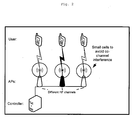
- Fig. 3 The concept of a distributed antenna system is depicted in Fig. 3 .
- a distributed receive antenna system By grouping multiple access points operating on the same RF channel a distributed receive antenna system is created.
- the access points are connected by a common backbone, e.g. wired LAN.
- the packet reception in the uplink is improved (macro-diversity).
- the method considers the fact that the packet reception among access points may be correlated (global interference source) reducing the gain of a distributed antenna system. Therefore the method considers this when creating distributed antennas on a per client basis.
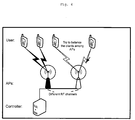
- Fig. 4 The concept of load distribution is illustrated in Fig. 4 .
- the idea is to distribute the clients among the available access points even when the wireless link of some client degrades. This is especially interesting if two neighboring access points are operating on different RF channels. Even for two neighboring access points operate on the same RF channel it makes sense to balance the associated clients due to a slow backbone connection (e.g. DSL).
- a slow backbone connection e.g. DSL
- the method of the present invention makes use of all three concepts, i.e. distributed antenna creation, load distribution and the usage of multiple RF channels, to improve QoS in 802.11 infrastructure networks (see Fig. 5 ).
- a central controller is depicted which is responsible to accomplish all three tasks.
- the number of users compared to access points is low. Therefore multiple access points are grouped together to form distributed (virtual) antennas. If the number of users increases additional RF channels are used to improve the overall system performance.
- the proposed method dynamically adapts to the traffic conditions, i.e. number of users and applications. So the proposed method for both concepts depends on the network traffic, i.e. the assignment is totally different in a network where the majority of flows are either unicast or multicast.
- the users are distributed among access points and Channels in a way to improve the overall system performance.
- the proposed method estimates how strong two access points will interfere with each other when using the same channel. This is accomplished by using a training sequence, i.e. at network idle times the management server set-ups packet flows between access points. This information is used for the creation of the interference graph.
- Fig. 6 shows the central controller used in an embodiment of the system according to the invention.
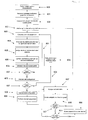
- the operation of the central controller according to a preferred embodiment of the method according to the invention is illustrated in the block diagram of Fig. 7 .
- the System Monitor 600 measures interference between all access points connected to a particular IEEF 802.11 based infrastructure 700.
- the interference from foreign networks e.g. microwave ovens or other wireless networks
- a graph is build by the Graph Generator 601 to include the interferences values among access points.
- the link between a particular client and a chosen access point is measured by the Link Monitor 602. Then, the (RF) channel assignment Analyzer locks every access point, which select them to be considered during the channel assignment. Again, only locked access point are considered for channel assignment. The channel assignment is calculated by the Channel assignment Analyzer (603) for each locked access point.
- the Distributed antenna Analyzer 604 estimates the potential distributed (virtual) antennas for each channel and client. During that, locked access points have to stay on their selected channel, whereas unlocked access points can use any channel. After that, to each client one distributed antenna is assigned considering an optimal load distribution among the channels and the access points. Unlocked access points are locked if they are participating in a distributed antenna (DA), which is assigned to one client. To unlocked access points participating in a distributed antenna the channel of the other locked access points in the DA is assigned.
- the Distributed antenna Analyzer 604 and the Channel assignment Analyzer 603 correspondingly, may consider service provider and user specific policies during the assignment of DAs.
- the interference graph is updated by the Graph Manager 605, adding the information about potential co-channel interference and the updated graph is used by the Channel Assignment Analyzer 603 to identify unused access points. All unused access points get unlocked so that they can use any channel.
- the potential improvement is determined by the Traffic Analyzer 607 considering at least the following variables: user traffic pattern, user load in the channel and link quality between the user and the unused access point.
- the Graph Manager 605 restore the best found configuration. If this results in a better overall system conditions since the last channel assignment, then all locked access points forming a transitive hull are merged into a single group, e.g. if one access point is part of two different DAs then theses two DA are merged into a single group. This is done by the Channel assignment Analyzer 603.
- the Channel Assignment Analyzer 603 performs a new channel assignment considering the group of access points. To all access points belonging to the same group, the same channel is assigned during the channel assignment.
- the actual channel assignment is performed by the Channel Controller 606.
- the Traffic Analyzer 607 uses the new configuration and traffic conditions of the IEEE 802.11 based network infrastructure to analyze again the traffic conditions.
- the complete interference graph is updated by the Graph Manager 605 based on the resulting analysis from the Traffic Analyzer 607.
- a new channel assignment is calculated by the Channel assignment analyzer 603 as described aforementioned, implementing a control loop.
- the Channel assignment analyzer 603 As described aforementioned, implementing a control loop.
- these changes are performed and a new traffic analysis is done by the Traffic Analyzer 607 as describe above, implementing a control loop.
Landscapes
- Engineering & Computer Science (AREA)
- Computer Networks & Wireless Communication (AREA)
- Signal Processing (AREA)
- Quality & Reliability (AREA)
- Mobile Radio Communication Systems (AREA)
Abstract
Description
- The present invention relates to distributed wireless networks such as an IEEE 802.1 infrastructure network type of system, and in particular, to a method for traffic aware assignment of radiofrequency channels to access points.
- The quality in the wireless access typically depends on the infrastructure technology to provide connectivity. Exemplary technologies are GPRS, WiMax and IEEE 802.11 family or Wi-Fi. Typically, users connect to IEEE 802.11 based access points to get connectivity to the Internet. For this, they use devices equipped with network cards. Exemplary devices are mobile phones, laptops, PDS, MDAs, which are adapted for Internet usage and increasing popular.
- In this context, the demand for mobile Internet is growing and quality of service in the wireless access has been constantly increasing. In the area of IEEE 802.11 based infrastructure, the quality during the connectivity has constantly been improved and many methods have been proposed. For example, in
US-B-6308085 , a distributed antenna system and method of controlling the same is described, comprising a system with multiple antennas and a centralized controller to control and select a subset of the antennas that form the system, in order to generate a distributed antenna system. - In
US-A-5293640 a method for planning radio cells is described. The method utilizes an exclusion matrix calculated on the basis of measured field strengths, and an iterative allocating algorithm, which allows an adaptation of the cell planning to traffic conditions in the network. The method includes the following steps: traffic estimation, channel assignment based on estimate, interference measurements and an iterative algorithm for channel assignment based on continued measurements of interference in the cell system. - In
US-A-6459901 , a method for resource allocation in wireless systems in disclosed, by providing wireless resource allocation techniques where the wireless network resource allocation is based on maximum system gain. The method considers neighbouring links and interference during resource allocation. - There is a need for an improved method and system for organizing an architecture of access points in a distributed wireless network that is capable of adapting to current traffic conditions. The method and system of the present invention should further require modifications only on the wireless network side so that clients compliant to the network can be used without any modifications.
- According to a first aspect of the invention a method for organizing an architecture of access points in a distributed wireless network is provided. The network may be any one of a GPRS type network, a WiMax type network or an IEEE802.11 type or Wi-Fi network. According to the method, the interference between the access points is measured, radiofrequency channels are assigned to the access points based on the measured interference and distributed antenna groups of multiple access points operating on the same radio frequency channel are created. Measuring the interference between the access points may include measuring interference from other networks and/or other foreign sources of interference. The number of radiofrequency channels to be assigned to a set of spatially co-located access points may be determined based on the remaining wireless capacity of each access point in considered part of the network and the wireless capacity of an access point may be estimated in terms of physical and/or virtual channel load and/or number of detected packet collisions.
- The method may further comprise assigning a client to one of the distributed antenna groups based on a predetermined metric including information on the network load. A client may be assigned to one of the distributed antenna groups to which the client has the best downlink and uplink channel quality. Also, the client may be assigned to the distributed antenna group having the highest remaining wireless capacity, or depending on the type of traffic requested by the client or on a priority assigned to the client. Furthermore, the capacity of a wired backbone connecting the access points may be estimated and a client be assigned to the distributed antenna group with the highest remaining wired capacity wherein the remaining wired network load of each access point within the selected distributed antenna group may be considered by assigning a priority value to each access point in the distributed antenna group. Preferably, temporarily unused access points are used to continuously measure the interference between other access points and themselves.
- According to a further aspect, the invention provides a distributed wireless network comprising a plurality of access points and a central controller connected to the access points via a common backbone. The central controller is adapted for assigning radio frequency channels to the access points by using the method of the invention. The central controller may comprise a system monitor for measuring the interference between all access points connected to the network and a graph generator for generating an interference graph. Further, the central controller may comprise a link monitor for measuring the link between a particular client and a chosen access point, a channel assignment analyzer for calculating the channel assignment using the interference graph, a traffic analyzer for determining wireless channel capacity of the network, the capacity of the wired backbone and the type of traffic.
- Accordingly, the present invention manages tradeoffs between the generation of distributed antenna receiver systems, load balancing and dynamic channel assignment. The present invention does not target specific benefits due to an isolated method, but overall benefits controlling the three methods proposed according to network traffic conditions. The concepts of channel assignment, distributed antenna and load balancing are combined according to the present invention and the balance between coverage and capacity in a distributed wireless network, considering traffic conditions, is managed. It is noted in this context that the present invention targets a specific wireless technology, namely an IEEE 802.11 based infrastructure network system. Nevertheless, the benefits of the present invention can also be exhibited in other distributed wireless systems.
- By combining the concept of distributed antennas with channel assignment, the system can react to changes in the traffic conditions being expressed e.g. by number of users and applications, and interference levels. Also, the channel assignment method is improved by adding the possibility to build distributed antennas, considering balance between capacity and coverage. Moreover, load balancing is also combined with distributed antennas and channel assignment so that the system can balance between capacity in the wireless network and the capacity of the wired backbone.
- In a preferred embodiment, the present invention relates to an IEEE 802.11 infrastructure network type of system, and in particular, to a method for traffic aware assignment of radiofrequency (RF) channels to access points and in combination with the creation of distributed receive antennas in the uplink and also network load distribution, to exploit channel diversity and spatial diversity, respectively, all these responding to the changes in traffic conditions.
- In the context of the present invention traffic awareness means that the method optimizes all three tasks for the traffic conditions in the system, i.e. it reacts to changes in the traffic conditions (number of clients and number and type of applications). Furthermore it considers whether there are unicast (transmitter sends a message to each of the receivers), multicast (or one message from the transmitter to multiple receivers) or a mix of both traffic patterns in the system. In addition also traffic from foreign networks can be considered. Therefore the channel load, occupied by foreign networks and also other sources of interference (i.e. microwave oven), is taken into account during the channel assignment and load balancing of the clients. Here sparsely used channels are preferred.
- The efficiency of an IEEE 802.11 infrastructure network is determined by the achieve level of Quality of Service (QoS). With the proposed method QoS can be improved in terms of an increased data throughput and a decreased latency and jitter. Finally, in a particular embodiment of the method and system described in this invention, the complexity for controlling the traffic aware RF channel assignment and distributed antenna creation should be minimized to keep the benefits of this invention in terms of QoS. The proposed method requires only modifications on the IEEE 802.11 infrastructure network side. Therefore, ordinary IEEE 802.11 compliant clients can be used without any modifications.
- An exemplary system that implements the present invention comprises a collection of access points that communicate via a common backbone to a central controller. The central controller is responsible for all control and management protocols involved in the implementation of the method for traffic aware assignment of RF channels, the creation of distributed receive antenna systems and the distribution of network load.
- An exemplary method of the present invention is conformed by three main parts. One part is responsible for the traffic aware RF channel assignment that is to associate to each access point a RF channel depending on the network traffic situation. The second part is responsible for the creation of distributed receive antenna systems. The third part is network load distribution that is to move clients from one access point to another depending on the traffic situation.
- The first part of the method, traffic aware RF channel assignment, is based on the fact that by utilizing multiple non-interfering RF channels multiple transmissions can take place in the same spatial domain without the adverse effects of co-channel interference.
- The second part, responsible for the creation of the distributed receive antenna system, manages the grouping of multiple access points operating on the same RF channel to form distributed (virtual) receive antennas in the uplink, whereas to improve packet reception from clients (mobile devices). With this, the method uses efficiently user-data broadcasting and the fact that the reception is probabilistic and packet loss is weakly correlated among access points when access points are well selected. Therefore the present invention considers packet loss correlation when estimating distributed antennas.
- The last part of the method implement the task of network load distribution is twofold. On the one hand, clients can assigned equally to neighboring access points operating on different RF channels thus resulting in an improved system performance (QoS). On the other hand, even if for two neighboring access points operating on the same RF channel it makes sense to balance the associated clients in case of a slow backbone connection (e.g. DSL). Therefore the proposed method takes both aspects into account when calculating the association between clients and access points.
- In an exemplary system or method of the present invention, traffic awareness is defined as the reaction to changes in the traffic conditions of the IEEE 802.11 network. In a particular embodiment, traffic changes can be represented by the number of users connected to the access points that comprise the system and for the number and types (unicast/multicast or constant/variable data rate) of applications that are running in the computing devices of the users connected to the access points. In addition the proposed method also considers interference caused by traffic from foreign, not necessarily 802.11, networks.
- The method according to the invention has three main parts that cooperate to improve the overall quality of service of the IEEE 802.11 based infrastructure. These three parts cooperate as follows.
- Based on the current network traffic, the central controller estimates whether the network lacks of capacity (e.g. due to a high number of users) or coverage. In the case in which the system lacks from capacity, the number of channels used for channel assignment will be incremented to improve the capacity of the IEEE 802.11 based system. However the use of additional channels, impacts the creation of distributed antennas because the number of access points operating on the same channel will decrease. The described system trade off is used by the method to fluctuate between dynamic channel assignment and distributed virtual antenna creation.
- The load balancing protocol distributes the clients, depending on their traffic-pattern, among the available access points. Thus, the traffic load is evenly distributed over the available channels to reduce interference. It also considers the available bandwidth in the backbone. If the backbone appears to be the bottleneck, the clients are distributed among the access points according to the available bandwidth in the backbone of the access points and the requested bandwidth of the clients.
- In the case that the networks lacks of coverage and the number of users is low, the number of used channels is decreased, which results in a higher number of access points operating on the same channel. This increases the number of possible distributed antennas. By creating larger distributed antennas, the coverage of the network will be increased.
- If the usage of applications using multicast operations is detected, e.g. by the central controller, all clients using the multicast application are forced to switch to a common channel, so that the number of multicast packets can be reduced by exploiting the broadcast.
- In the following, the present invention is disclosed in more detail with reference to the Figures, wherein
-
Fig. 1 illustrates a standard IEEE 802.11 based infrastructure network; - f`ig. 2 illustrates traffic aware RF channel assignment, as part of the invention;
-
Fig. 3 illustrates a distributed receive antenna system, as part of the invention; -
Fig. 4 illustrates network load distribution, as part of the invention; -
Fig. 5 illustrates a combination of the three concepts shown inFigs. 2 to 4 according to the present invention; and -
Fig. 6 shows a block diagram illustrating a method of the present invention. - As shown in
Fig. 1 , an IEEE 802.1 based infrastructure network generally consist of two entities - access points (AP) and users/stations (STA). In general access points are interconnected via a common, mostly wired, backbone, the so-called distribution system. During the association a user selects exactly one access point to which it will associate, i.e. all traffic destined to the infrastructure and the user will be routed over that access point. - In an IEEE 802.11 based network, multiple RF channels can be used, i.e. IEEE 802.11b/g offers 3 and IEEE 802.11 a 12 non-interfering RF channels. By using multiple non-interfering RF channels in an IEEE 802.11 infrastructure network QoS can be significantly improved. This fundament is the bases for the traffic aware RF channel assignment algorithm that is one of the three parts the method according to the invention.
Fig. 2 shows an exemplary system of the present invention. In the system shown inFig. 2 , the number of clients connected to the system and access points terming the system is the same as the number of non-interfering channels offer, for example, in the IEEE 802.11 b/g technology. Hence, to benefit from the use of non-interfering channels and to enhance QoS in the system, a particular beneficial traffic aware RF channel assignment method relates one client to each access point using a non-interfering RF channel, as shown inFig. 2 . - The concept of a distributed antenna system is depicted in
Fig. 3 . By grouping multiple access points operating on the same RF channel a distributed receive antenna system is created. Here the access points are connected by a common backbone, e.g. wired LAN. With distributed antennas the packet reception in the uplink is improved (macro-diversity). The method considers the fact that the packet reception among access points may be correlated (global interference source) reducing the gain of a distributed antenna system. Therefore the method considers this when creating distributed antennas on a per client basis. - The concept of load distribution is illustrated in
Fig. 4 . The idea is to distribute the clients among the available access points even when the wireless link of some client degrades. This is especially interesting if two neighboring access points are operating on different RF channels. Even for two neighboring access points operate on the same RF channel it makes sense to balance the associated clients due to a slow backbone connection (e.g. DSL). - The method of the present invention makes use of all three concepts, i.e. distributed antenna creation, load distribution and the usage of multiple RF channels, to improve QoS in 802.11 infrastructure networks (see
Fig. 5 ). Here a central controller is depicted which is responsible to accomplish all three tasks. In the illustrated example the number of users compared to access points is low. Therefore multiple access points are grouped together to form distributed (virtual) antennas. If the number of users increases additional RF channels are used to improve the overall system performance. The proposed method dynamically adapts to the traffic conditions, i.e. number of users and applications. So the proposed method for both concepts depends on the network traffic, i.e. the assignment is totally different in a network where the majority of flows are either unicast or multicast. Finally, the users are distributed among access points and Channels in a way to improve the overall system performance. - In dense networks (high number of access paints/clients) it is very likely that the number of available RF channels is not sufficient to assign a different RF channels to nearby access points, i.e. the coverage and interference areas of access points will overlap with each other. This results in high co-channel interference and problems like hidden-node if those access points are operating on the same frequency. The proposed method estimates how strong two access points will interfere with each other when using the same channel. This is accomplished by using a training sequence, i.e. at network idle times the management server set-ups packet flows between access points. This information is used for the creation of the interference graph.
-
Fig. 6 shows the central controller used in an embodiment of the system according to the invention. The operation of the central controller according to a preferred embodiment of the method according to the invention is illustrated in the block diagram ofFig. 7 . In this, embodiment, theSystem Monitor 600 measures interference between all access points connected to a particular IEEF 802.11 basedinfrastructure 700. The interference from foreign networks (e.g. microwave ovens or other wireless networks) is also considered. Using the measurements, a graph is build by theGraph Generator 601 to include the interferences values among access points. - The link between a particular client and a chosen access point is measured by the
Link Monitor 602. Then, the (RF) channel assignment Analyzer locks every access point, which select them to be considered during the channel assignment. Again, only locked access point are considered for channel assignment. The channel assignment is calculated by the Channel assignment Analyzer (603) for each locked access point. - Then, using the output from the
Channel assignment Analyzer 603, the Distributedantenna Analyzer 604 estimates the potential distributed (virtual) antennas for each channel and client. During that, locked access points have to stay on their selected channel, whereas unlocked access points can use any channel. After that, to each client one distributed antenna is assigned considering an optimal load distribution among the channels and the access points. Unlocked access points are locked if they are participating in a distributed antenna (DA), which is assigned to one client. To unlocked access points participating in a distributed antenna the channel of the other locked access points in the DA is assigned. In a particular embodiment, the Distributedantenna Analyzer 604 and theChannel assignment Analyzer 603 correspondingly, may consider service provider and user specific policies during the assignment of DAs. - The interference graph is updated by the
Graph Manager 605, adding the information about potential co-channel interference and the updated graph is used by theChannel Assignment Analyzer 603 to identify unused access points. All unused access points get unlocked so that they can use any channel. The potential improvement is determined by theTraffic Analyzer 607 considering at least the following variables: user traffic pattern, user load in the channel and link quality between the user and the unused access point. - If the last estimation and assignment of DA could improve the overall system conditions, then the DAs are estimated again (801 - search for maximum).
- If the last estimation and assignment of DA could not improve the overall system conditions, then the
Graph Manager 605 restore the best found configuration. If this results in a better overall system conditions since the last channel assignment, then all locked access points forming a transitive hull are merged into a single group, e.g. if one access point is part of two different DAs then theses two DA are merged into a single group. This is done by theChannel assignment Analyzer 603. - The
Channel Assignment Analyzer 603 performs a new channel assignment considering the group of access points. To all access points belonging to the same group, the same channel is assigned during the channel assignment. - Then the DAs are estimated and assigned 604 again with the new channel assignment 802 - search for maximum).
- If the last channel assignment could not improve the overall system conditions then the best configuration is restored by the
Graph Manager 605. - The actual channel assignment is performed by the
Channel Controller 606. Then theTraffic Analyzer 607 uses the new configuration and traffic conditions of the IEEE 802.11 based network infrastructure to analyze again the traffic conditions. The complete interference graph is updated by theGraph Manager 605 based on the resulting analysis from theTraffic Analyzer 607. - If the traffic conditions in the system change, a new channel assignment is calculated by the
Channel assignment analyzer 603 as described aforementioned, implementing a control loop. In the case there are unused access points that may be assigned to other channels by theChannel controller 606, then these changes are performed and a new traffic analysis is done by theTraffic Analyzer 607 as describe above, implementing a control loop.
Claims (18)
- A method for organizing an architecture of access points in a distributed wireless network, comprising the steps of:measuring interference between the access points;assigning radiofrequency channels to the access points based on the measured interference;creating distributed antenna groups of multiple access points operating on the same radio frequency channel.
- The method according to claim 1, wherein measuring the interference between the access points includes measuring interference from other networks and/or other foreign sources of interference.
- The method according to claim 1 or 2, wherein the number of radiofrequency channels to be assigned to a spatial co-located set of access points is determined based on the remaining wireless capacity of each access point in the considered local area of the network.
- The method according to claim 3, wherein the wireless capacity of an access point is estimated in terms of physical and/or virtual channel load and/or number of detected packet collisions.
- The method according to anyone of the preceding claims, further comprising assigning a client to one of the distributed antenna groups based on a predetermined metric including information on the network load.
- The method according to claim 5, wherein the client is assigned to one of the distributed antenna groups to which the client has the best downlink and uplink channel quality.
- The method according to claim 5 or 6, wherein the client is assigned to the distributed antenna group having the highest remaining wireless capacity.
- The method according to any one of claims 5 to 7, wherein the client is assigned to one of the distributed antenna groups depending on the type of traffic requested by the client.
- The method according to any one of claims 5 to 8, wherein the client is assigned to one of the distributed antenna groups depending on a priority assigned to the client.
- The method according to any one of claims 5 to 9, further comprising estimating the capacity of a wired backbone connecting the access points is estimated, wherein the client is assigned to the distributed antenna group with the highest remaining wired capacity.
- The method according to claim 10, wherein the remaining wired network load of each access point within the selected distributed antenna group is considered by assigning a priority value to each access point in the distributed antenna group.
- The method according to anyone of the preceding claims, wherein temporarily unused access points are used to continuously measure the interference between the access points.
- A distributed wireless networks comprising
a plurality of access points;
a central controller connected to the access points via a common backbone;
the central controller being adapted for assigning radio frequency channels to the access points by using the method according to any one of the preceding claims. - The network according to claim 13, wherein the central controller comprises a system monitor (600) for measuring the interference between all access points connected to the network including interference from other networks and/or other foreign sources of interference and a graph generator (601) for generating an interference graph.
- The network according to claim 14, wherein the central controller further comprises a link monitor (602) for measuring the link between a particular client and a chosen access point.
- The network according to claim 14 or 15, wherein the central controller further comprises a channel assignment analyzer (603) for calculating the channel assignment using the interference graph.
- The network according to claims 16, wherein the central controller further comprises a traffic analyzer (607) for determining wireless channel capacity of the network, the capacity of the wired backbone and the type of traffic.
- The network according to any one of claims 13 to 17, wherein the network is a GPRS type network, a WiMax type network or an IEEE802.11 type or Wi-Fi network.
Priority Applications (2)
| Application Number | Priority Date | Filing Date | Title |
|---|---|---|---|
| EP09176572.7A EP2326116B1 (en) | 2009-11-20 | 2009-11-20 | Method and system related to quality of service in distributed wireless networks |
| US12/948,844 US8780743B2 (en) | 2009-11-20 | 2010-11-18 | Method and system for improving quality of service in distributed wireless networks |
Applications Claiming Priority (1)
| Application Number | Priority Date | Filing Date | Title |
|---|---|---|---|
| EP09176572.7A EP2326116B1 (en) | 2009-11-20 | 2009-11-20 | Method and system related to quality of service in distributed wireless networks |
Publications (2)
| Publication Number | Publication Date |
|---|---|
| EP2326116A1 true EP2326116A1 (en) | 2011-05-25 |
| EP2326116B1 EP2326116B1 (en) | 2020-02-05 |
Family
ID=42249221
Family Applications (1)
| Application Number | Title | Priority Date | Filing Date |
|---|---|---|---|
| EP09176572.7A Active EP2326116B1 (en) | 2009-11-20 | 2009-11-20 | Method and system related to quality of service in distributed wireless networks |
Country Status (2)
| Country | Link |
|---|---|
| US (1) | US8780743B2 (en) |
| EP (1) | EP2326116B1 (en) |
Cited By (5)
| Publication number | Priority date | Publication date | Assignee | Title |
|---|---|---|---|---|
| EP2600674A1 (en) * | 2011-12-02 | 2013-06-05 | Hangzhou H3C Technologies Co., Ltd. | A method and device for radio resource management |
| WO2014010794A1 (en) * | 2012-07-12 | 2014-01-16 | 주식회사 케이티 | System and method for providing wireless network according to cell reconstruction |
| EP2688351A1 (en) * | 2012-07-20 | 2014-01-22 | Mitsubishi Electric R&D Centre Europe B.V. | Method and device for allocating resources for a downlink communication on a frequency selective channel |
| CN103796209A (en) * | 2012-10-26 | 2014-05-14 | 中国移动通信集团北京有限公司 | Channel allocation method and device |
| WO2015080820A1 (en) * | 2013-11-26 | 2015-06-04 | Echostar Technologies L.L.C. | System and method for mitigating wireless interference |
Families Citing this family (58)
| Publication number | Priority date | Publication date | Assignee | Title |
|---|---|---|---|---|
| US9673904B2 (en) | 2009-02-03 | 2017-06-06 | Corning Optical Communications LLC | Optical fiber-based distributed antenna systems, components, and related methods for calibration thereof |
| AU2010210766A1 (en) | 2009-02-03 | 2011-09-15 | Corning Cable Systems Llc | Optical fiber-based distributed antenna systems, components, and related methods for monitoring and configuring thereof |
| US8280259B2 (en) | 2009-11-13 | 2012-10-02 | Corning Cable Systems Llc | Radio-over-fiber (RoF) system for protocol-independent wired and/or wireless communication |
| US9252874B2 (en) | 2010-10-13 | 2016-02-02 | Ccs Technology, Inc | Power management for remote antenna units in distributed antenna systems |
| US9077676B2 (en) * | 2010-11-10 | 2015-07-07 | Rave Wireless, Inc. | Intelligent messaging |
| JP5270648B2 (en) * | 2010-12-08 | 2013-08-21 | 株式会社日立製作所 | Distributed antenna system, base station apparatus, and antenna selection control method |
| WO2012148938A1 (en) | 2011-04-29 | 2012-11-01 | Corning Cable Systems Llc | Determining propagation delay of communications in distributed antenna systems, and related components, systems and methods |
| EP2702780A4 (en) | 2011-04-29 | 2014-11-12 | Corning Cable Sys Llc | Systems, methods, and devices for increasing radio frequency (rf) power in distributed antenna systems |
| KR101343565B1 (en) * | 2011-06-03 | 2013-12-19 | 주식회사 케이티 | Wireless access point, method and apparatus for controling thereof |
| US8688131B2 (en) | 2011-10-14 | 2014-04-01 | Qualcomm Incorporated | Apparatus and methods for facilitating simulcasting and de-simulcasting in a distributed antenna system |
| US9312941B2 (en) * | 2011-10-14 | 2016-04-12 | Qualcomm Incorporated | Base stations and methods for facilitating dynamic simulcasting and de-simulcasting in a distributed antenna system |
| US9276685B2 (en) | 2011-10-14 | 2016-03-01 | Qualcomm Incorporated | Distributed antenna systems and methods of wireless communications for facilitating simulcasting and de-simulcasting of downlink transmissions |
| US8634323B2 (en) | 2011-10-14 | 2014-01-21 | Qualcomm Incorporated | Apparatuses and methods for facilitating simulcasting and de-simulcasting with a plurality of base stations |
| WO2013162988A1 (en) | 2012-04-25 | 2013-10-31 | Corning Cable Systems Llc | Distributed antenna system architectures |
| US8619927B2 (en) | 2012-05-29 | 2013-12-31 | Magnolia Broadband Inc. | System and method for discrete gain control in hybrid MIMO/RF beamforming |
| US8767862B2 (en) | 2012-05-29 | 2014-07-01 | Magnolia Broadband Inc. | Beamformer phase optimization for a multi-layer MIMO system augmented by radio distribution network |
| US8644413B2 (en) | 2012-05-29 | 2014-02-04 | Magnolia Broadband Inc. | Implementing blind tuning in hybrid MIMO RF beamforming systems |
| US8971452B2 (en) | 2012-05-29 | 2015-03-03 | Magnolia Broadband Inc. | Using 3G/4G baseband signals for tuning beamformers in hybrid MIMO RDN systems |
| US9154204B2 (en) | 2012-06-11 | 2015-10-06 | Magnolia Broadband Inc. | Implementing transmit RDN architectures in uplink MIMO systems |
| US10506454B2 (en) * | 2012-07-31 | 2019-12-10 | Dali Systems Co., Ltd. | Optimization of traffic load in a distributed antenna system |
| US9014112B2 (en) | 2012-07-31 | 2015-04-21 | Aruba Networks, Inc. | System and method for computing coverage set and resource allocations in wireless networks |
| US9179321B2 (en) | 2012-08-09 | 2015-11-03 | Axell Wireless Ltd. | Digital capacity centric distributed antenna system |
| US9343808B2 (en) | 2013-02-08 | 2016-05-17 | Magnotod Llc | Multi-beam MIMO time division duplex base station using subset of radios |
| US8797969B1 (en) | 2013-02-08 | 2014-08-05 | Magnolia Broadband Inc. | Implementing multi user multiple input multiple output (MU MIMO) base station using single-user (SU) MIMO co-located base stations |
| US8989103B2 (en) | 2013-02-13 | 2015-03-24 | Magnolia Broadband Inc. | Method and system for selective attenuation of preamble reception in co-located WI FI access points |
| US20140226740A1 (en) | 2013-02-13 | 2014-08-14 | Magnolia Broadband Inc. | Multi-beam co-channel wi-fi access point |
| US9155110B2 (en) | 2013-03-27 | 2015-10-06 | Magnolia Broadband Inc. | System and method for co-located and co-channel Wi-Fi access points |
| US9100968B2 (en) * | 2013-05-09 | 2015-08-04 | Magnolia Broadband Inc. | Method and system for digital cancellation scheme with multi-beam |
| US9425882B2 (en) | 2013-06-28 | 2016-08-23 | Magnolia Broadband Inc. | Wi-Fi radio distribution network stations and method of operating Wi-Fi RDN stations |
| US8995416B2 (en) | 2013-07-10 | 2015-03-31 | Magnolia Broadband Inc. | System and method for simultaneous co-channel access of neighboring access points |
| US9497781B2 (en) | 2013-08-13 | 2016-11-15 | Magnolia Broadband Inc. | System and method for co-located and co-channel Wi-Fi access points |
| US9088898B2 (en) | 2013-09-12 | 2015-07-21 | Magnolia Broadband Inc. | System and method for cooperative scheduling for co-located access points |
| US9271153B2 (en) | 2013-09-24 | 2016-02-23 | Qualcomm Incorporated | Adaptive network configuration |
| US9172454B2 (en) | 2013-11-01 | 2015-10-27 | Magnolia Broadband Inc. | Method and system for calibrating a transceiver array |
| US8891598B1 (en) | 2013-11-19 | 2014-11-18 | Magnolia Broadband Inc. | Transmitter and receiver calibration for obtaining the channel reciprocity for time division duplex MIMO systems |
| US8942134B1 (en) | 2013-11-20 | 2015-01-27 | Magnolia Broadband Inc. | System and method for selective registration in a multi-beam system |
| US9014066B1 (en) | 2013-11-26 | 2015-04-21 | Magnolia Broadband Inc. | System and method for transmit and receive antenna patterns calibration for time division duplex (TDD) systems |
| US9294177B2 (en) | 2013-11-26 | 2016-03-22 | Magnolia Broadband Inc. | System and method for transmit and receive antenna patterns calibration for time division duplex (TDD) systems |
| US9042276B1 (en) | 2013-12-05 | 2015-05-26 | Magnolia Broadband Inc. | Multiple co-located multi-user-MIMO access points |
| JP6087300B2 (en) * | 2014-01-15 | 2017-03-01 | 日本電信電話株式会社 | Wireless communication system and wireless communication method |
| WO2015126520A1 (en) * | 2014-02-21 | 2015-08-27 | Commscope Technologies Llc | Optimizing network resources in a telecommunications system |
| US9100154B1 (en) | 2014-03-19 | 2015-08-04 | Magnolia Broadband Inc. | Method and system for explicit AP-to-AP sounding in an 802.11 network |
| US9172446B2 (en) | 2014-03-19 | 2015-10-27 | Magnolia Broadband Inc. | Method and system for supporting sparse explicit sounding by implicit data |
| US9271176B2 (en) | 2014-03-28 | 2016-02-23 | Magnolia Broadband Inc. | System and method for backhaul based sounding feedback |
| EP3155853A4 (en) * | 2014-06-11 | 2018-02-14 | Intel Corporation | Spatial multiple access uplink for wireless local area networks |
| EP3198755B1 (en) | 2014-09-23 | 2020-12-23 | Axell Wireless Ltd. | Automatic mapping and handling pim and other uplink interferences in digital distributed antenna systems |
| US9945928B2 (en) * | 2014-10-30 | 2018-04-17 | Bastille Networks, Inc. | Computational signal processing architectures for electromagnetic signature analysis |
| US20180007696A1 (en) | 2014-12-23 | 2018-01-04 | Axell Wireless Ltd. | Harmonizing noise aggregation and noise management in distributed antenna system |
| US10085283B2 (en) * | 2014-12-31 | 2018-09-25 | Qualcomm Incorporated | Antenna subset and directional channel access in a shared radio frequency spectrum band |
| US9681313B2 (en) * | 2015-04-15 | 2017-06-13 | Corning Optical Communications Wireless Ltd | Optimizing remote antenna unit performance using an alternative data channel |
| US9948349B2 (en) | 2015-07-17 | 2018-04-17 | Corning Optical Communications Wireless Ltd | IOT automation and data collection system |
| US9661598B2 (en) | 2015-09-30 | 2017-05-23 | Mitsubishi Electric Research Laboratories, Inc. | System and method for reducing interference between multiple terminals |
| US20180027468A1 (en) * | 2016-07-20 | 2018-01-25 | Zinwave Limited | Techniques for load balancing in a network environment |
| US10405366B1 (en) * | 2016-09-28 | 2019-09-03 | Amazon Technologies, Inc. | Coordinated beamforming |
| US10645598B2 (en) * | 2016-10-25 | 2020-05-05 | Hewlett Packard Enterprise Development Lp | Upgrade controllers and access points by group |
| US10757647B2 (en) * | 2016-10-31 | 2020-08-25 | Cisco Technology, Inc. | Optimized channel selection for virtual access point (VAP) enabled networks |
| US10477420B2 (en) | 2017-01-13 | 2019-11-12 | At&T Intellectual Property I, L.P. | Cross link interference measurement for wireless communications in 5G or other next generation network |
| US11510191B2 (en) * | 2020-03-10 | 2022-11-22 | Cisco Technology, Inc. | Decentralized radio resource allocation using a distributed cache |
Citations (6)
| Publication number | Priority date | Publication date | Assignee | Title |
|---|---|---|---|---|
| US5293640A (en) | 1989-03-03 | 1994-03-08 | Televerket | Method for planning radio cells |
| US6308085B1 (en) | 1998-03-13 | 2001-10-23 | Kabushiki Kaisha Toshiba | Distributed antenna system and method of controlling the same |
| US6459901B1 (en) | 1999-07-01 | 2002-10-01 | At&T Corp. | Wireless network resource allocation |
| WO2008007375A2 (en) * | 2006-07-13 | 2008-01-17 | Designart Networks Ltd | Wimax access point network with backhaul technology |
| US20080070510A1 (en) * | 2006-09-18 | 2008-03-20 | Nokia Corporation | Interference management techniques for wireless networks |
| US20080298486A1 (en) * | 2007-06-04 | 2008-12-04 | Nec Laboratories America, Inc. | Multi-cell interference mitigation via coordinated scheduling and power allocation in downlink odma networks |
Family Cites Families (23)
| Publication number | Priority date | Publication date | Assignee | Title |
|---|---|---|---|---|
| US4370743A (en) * | 1980-07-25 | 1983-01-25 | Bell Telephone Laboratories, Incorporated | Time division switching system |
| EP0513206B1 (en) * | 1990-01-30 | 1995-04-12 | Johnson Service Company | Networked facilities management system |
| US5297142A (en) * | 1991-07-18 | 1994-03-22 | Motorola, Inc. | Data transfer method and apparatus for communication between a peripheral and a master |
| US5343461A (en) * | 1991-08-27 | 1994-08-30 | Ameritech Services, Inc. | Full duplex digital transmission facility loop-back test, diagnostics and maintenance system |
| US5471162A (en) * | 1992-09-08 | 1995-11-28 | The Regents Of The University Of California | High speed transient sampler |
| EP0700229B1 (en) * | 1994-08-22 | 2006-06-28 | Fujitsu Limited | Connectionless communications system, test method, and intra-station control system |
| CN101141799B (en) * | 1997-04-24 | 2011-06-22 | 株式会社Ntt都科摩 | Method and system for mobile communications |
| DE69923898T2 (en) * | 1998-03-14 | 2006-04-27 | Samsung Electronics Co., Ltd., Suwon | Apparatus and method for exchanging frame messages of different lengths in a CDMA communication system |
| JP2002534002A (en) * | 1998-12-23 | 2002-10-08 | オーパスウエーブ ネットワークス インコーポレイテッド | Wireless local loop system supporting voice / IP |
| US7301952B2 (en) * | 2000-04-06 | 2007-11-27 | The Distribution Systems Research Institute | Terminal-to-terminal communication connection control method using IP transfer network |
| US6993023B2 (en) * | 2001-04-27 | 2006-01-31 | The Boeing Company | Parallel analysis of incoming data transmissions |
| JP2006054849A (en) * | 2004-07-13 | 2006-02-23 | Iwatsu Electric Co Ltd | Automated channel determination method and automated channel assignment system in access point |
| US7839815B2 (en) * | 2006-02-10 | 2010-11-23 | Alcatel-Lucent Usa Inc. | Triggering migration of a network access agent associated with an access terminal |
| US7574179B2 (en) * | 2006-07-13 | 2009-08-11 | Designart Networks Ltd | Mobile broadband wireless network with interference mitigation mechanism to minimize interference within a cluster during multiple concurrent transmissions |
| US7620370B2 (en) * | 2006-07-13 | 2009-11-17 | Designart Networks Ltd | Mobile broadband wireless access point network with wireless backhaul |
| US20110164527A1 (en) * | 2008-04-04 | 2011-07-07 | Mishra Rajesh K | Enhanced wireless ad hoc communication techniques |
| US20100142448A1 (en) * | 2008-09-04 | 2010-06-10 | Ludger Schlicht | Devices for a mobile, broadband, routable internet |
| WO2012034269A1 (en) * | 2010-09-14 | 2012-03-22 | Nokia Corporation | Interference measurement and reporting for device-to-device communications in communication system |
| US8923225B2 (en) * | 2011-04-05 | 2014-12-30 | Her Majesty The Queen In Right Of Canada, As Represented By The Minister Of Industry, Through The Communications Research Centre Canada | Cognitive WiFi radio network |
| US9456372B2 (en) * | 2011-08-12 | 2016-09-27 | Interdigital Patent Holdings, Inc. | Interference measurement in wireless networks |
| US8693345B2 (en) * | 2011-10-12 | 2014-04-08 | Mayflower Communications Company, Inc. | Dynamic management of wireless network topology with diverse traffic flows |
| CN104969637B (en) * | 2011-12-20 | 2018-08-10 | 马维尔国际贸易有限公司 | Method and apparatus for communication |
| US9819462B2 (en) * | 2012-01-30 | 2017-11-14 | Alcatel Lucent | Method and apparatus for signaling to support flexible reference signal configuration |
-
2009
- 2009-11-20 EP EP09176572.7A patent/EP2326116B1/en active Active
-
2010
- 2010-11-18 US US12/948,844 patent/US8780743B2/en not_active Expired - Fee Related
Patent Citations (6)
| Publication number | Priority date | Publication date | Assignee | Title |
|---|---|---|---|---|
| US5293640A (en) | 1989-03-03 | 1994-03-08 | Televerket | Method for planning radio cells |
| US6308085B1 (en) | 1998-03-13 | 2001-10-23 | Kabushiki Kaisha Toshiba | Distributed antenna system and method of controlling the same |
| US6459901B1 (en) | 1999-07-01 | 2002-10-01 | At&T Corp. | Wireless network resource allocation |
| WO2008007375A2 (en) * | 2006-07-13 | 2008-01-17 | Designart Networks Ltd | Wimax access point network with backhaul technology |
| US20080070510A1 (en) * | 2006-09-18 | 2008-03-20 | Nokia Corporation | Interference management techniques for wireless networks |
| US20080298486A1 (en) * | 2007-06-04 | 2008-12-04 | Nec Laboratories America, Inc. | Multi-cell interference mitigation via coordinated scheduling and power allocation in downlink odma networks |
Cited By (10)
| Publication number | Priority date | Publication date | Assignee | Title |
|---|---|---|---|---|
| EP2600674A1 (en) * | 2011-12-02 | 2013-06-05 | Hangzhou H3C Technologies Co., Ltd. | A method and device for radio resource management |
| WO2014010794A1 (en) * | 2012-07-12 | 2014-01-16 | 주식회사 케이티 | System and method for providing wireless network according to cell reconstruction |
| KR101472575B1 (en) * | 2012-07-12 | 2014-12-12 | 주식회사 케이티 | System and method for providing of network by cell reconstruction |
| EP2688351A1 (en) * | 2012-07-20 | 2014-01-22 | Mitsubishi Electric R&D Centre Europe B.V. | Method and device for allocating resources for a downlink communication on a frequency selective channel |
| WO2014013811A1 (en) * | 2012-07-20 | 2014-01-23 | Mitsubishi Electric Corporation | Method, processing device and information storage means for allocating resources for a downlink communication on a frequency selective channel |
| US9992778B2 (en) | 2012-07-20 | 2018-06-05 | Mitsubishi Electric Corporation | Method, processing device and information storage means for allocating resources for a downlink communication on a frequency selective channel |
| CN103796209A (en) * | 2012-10-26 | 2014-05-14 | 中国移动通信集团北京有限公司 | Channel allocation method and device |
| CN103796209B (en) * | 2012-10-26 | 2017-03-22 | 中国移动通信集团北京有限公司 | Channel allocation method and device |
| WO2015080820A1 (en) * | 2013-11-26 | 2015-06-04 | Echostar Technologies L.L.C. | System and method for mitigating wireless interference |
| US9839040B2 (en) | 2013-11-26 | 2017-12-05 | Echostar Technologies L.L.C. | Mitigating wireless interference |
Also Published As
| Publication number | Publication date |
|---|---|
| US8780743B2 (en) | 2014-07-15 |
| EP2326116B1 (en) | 2020-02-05 |
| US20110122788A1 (en) | 2011-05-26 |
Similar Documents
| Publication | Publication Date | Title |
|---|---|---|
| US8780743B2 (en) | Method and system for improving quality of service in distributed wireless networks | |
| US11197242B2 (en) | Coordinated target wake time (TWT) service for localized wireless neighborhoods | |
| JP4927755B2 (en) | Method and system for switching antenna and channel assignments in a broadband wireless network | |
| JP5657608B2 (en) | Method and apparatus for making handoff decisions as a function of service level indicative of metrics | |
| US20100020760A1 (en) | Orthogonal frequency domain multiplexing (ofdm) communication system | |
| CN101496436A (en) | Multi-carrier communications methods and apparatus | |
| KR20120120445A (en) | METHODS AND APPARATUS FOR MAKING HANDOFF DECISIONS IN ACCESS TERMINALS CAPABLE OF OPERATING AT DIFFERENT TIMES IN BEST EFFORT AND QoS MODES OF TRAFFIC OPERATION | |
| CN1998252A (en) | Method and apparatus for phased deployment of a communications system | |
| Hou et al. | Self-organized resource allocation in LTE systems with weighted proportional fairness | |
| KR20100089105A (en) | Opportunistic uplink scheduling | |
| Hussain et al. | An optimal resource allocation algorithm for D2D communication underlaying cellular networks | |
| US11770740B2 (en) | Automatic classification and enforcement of low-bandwidth internet of things (IoT) devices | |
| Sadr et al. | Hierarchical resource allocation in femtocell networks using graph algorithms | |
| Moretti et al. | A resource allocator for the uplink of multi-cell OFDMA systems | |
| Biermann et al. | CoMP clustering and backhaul limitations in cooperative cellular mobile access networks | |
| Alsarhan et al. | Cluster-based spectrum management using cognitive radios in wireless mesh network | |
| US20130337818A1 (en) | Apparatus and method for determining a control unit using feasibility requests and feasibility responses | |
| US9521560B2 (en) | Multicell beamforming system and methods for OFDMA small-cell networks | |
| Tang et al. | A spectral efficient and fair user-centric spectrum allocation approach for downlink transmissions | |
| Mohanti et al. | WiFED: WiFi friendly energy delivery with distributed beamforming | |
| Fu et al. | Joint user association and resource allocation for tailored qos provisioning in 6g hetnets | |
| Park et al. | Fair semi-distributed resource allocation scheme over relay-enhanced OFDMA networks | |
| CN103079277B (en) | Scheduling of resource distribution method and system in a kind of ofdm system | |
| Abedi et al. | Cellular network planning under variable QOS requirements using Voronoi algorithm | |
| Zhang et al. | Congestion-aware user-centric cooperative base station selection in ultra-dense networks |
Legal Events
| Date | Code | Title | Description |
|---|---|---|---|
| PUAI | Public reference made under article 153(3) epc to a published international application that has entered the european phase |
Free format text: ORIGINAL CODE: 0009012 |
|
| AK | Designated contracting states |
Kind code of ref document: A1 Designated state(s): AT BE BG CH CY CZ DE DK EE ES FI FR GB GR HR HU IE IS IT LI LT LU LV MC MK MT NL NO PL PT RO SE SI SK SM TR |
|
| AX | Request for extension of the european patent |
Extension state: AL BA RS |
|
| 17P | Request for examination filed |
Effective date: 20111124 |
|
| STAA | Information on the status of an ep patent application or granted ep patent |
Free format text: STATUS: EXAMINATION IS IN PROGRESS |
|
| 17Q | First examination report despatched |
Effective date: 20171031 |
|
| RIC1 | Information provided on ipc code assigned before grant |
Ipc: H04L 12/54 20060101ALI20181024BHEP Ipc: H04W 16/10 20090101AFI20181024BHEP Ipc: H04W 28/16 20090101ALI20181024BHEP Ipc: H04L 12/801 20110525ALI20181024BHEP |
|
| RIC1 | Information provided on ipc code assigned before grant |
Ipc: H04L 12/801 20130101ALI20181024BHEP Ipc: H04L 12/54 20130101ALI20181024BHEP Ipc: H04W 28/16 20090101ALI20181024BHEP Ipc: H04W 16/10 20090101AFI20181024BHEP |
|
| RIC1 | Information provided on ipc code assigned before grant |
Ipc: H04W 28/16 20090101ALI20181024BHEP Ipc: H04L 12/801 20130101ALI20181024BHEP Ipc: H04W 16/10 20090101AFI20181024BHEP Ipc: H04L 12/54 20130101ALI20181024BHEP |
|
| RIN1 | Information on inventor provided before grant (corrected) |
Inventor name: SOMBRUTZKI, ROBERT Inventor name: ZUBOW, ANATOLIJ Inventor name: VIDALES, PABLO |
|
| GRAJ | Information related to disapproval of communication of intention to grant by the applicant or resumption of examination proceedings by the epo deleted |
Free format text: ORIGINAL CODE: EPIDOSDIGR1 |
|
| STAA | Information on the status of an ep patent application or granted ep patent |
Free format text: STATUS: GRANT OF PATENT IS INTENDED |
|
| GRAP | Despatch of communication of intention to grant a patent |
Free format text: ORIGINAL CODE: EPIDOSNIGR1 |
|
| INTG | Intention to grant announced |
Effective date: 20190726 |
|
| GRAS | Grant fee paid |
Free format text: ORIGINAL CODE: EPIDOSNIGR3 |
|
| GRAA | (expected) grant |
Free format text: ORIGINAL CODE: 0009210 |
|
| STAA | Information on the status of an ep patent application or granted ep patent |
Free format text: STATUS: THE PATENT HAS BEEN GRANTED |
|
| RAP1 | Party data changed (applicant data changed or rights of an application transferred) |
Owner name: DEUTSCHE TELEKOM AG |
|
| AK | Designated contracting states |
Kind code of ref document: B1 Designated state(s): AT BE BG CH CY CZ DE DK EE ES FI FR GB GR HR HU IE IS IT LI LT LU LV MC MK MT NL NO PL PT RO SE SI SK SM TR |
|
| REG | Reference to a national code |
Ref country code: GB Ref legal event code: FG4D |
|
| REG | Reference to a national code |
Ref country code: AT Ref legal event code: REF Ref document number: 1230787 Country of ref document: AT Kind code of ref document: T Effective date: 20200215 |
|
| REG | Reference to a national code |
Ref country code: DE Ref legal event code: R096 Ref document number: 602009061088 Country of ref document: DE |
|
| REG | Reference to a national code |
Ref country code: IE Ref legal event code: FG4D |
|
| REG | Reference to a national code |
Ref country code: CH Ref legal event code: EP |
|
| REG | Reference to a national code |
Ref country code: NL Ref legal event code: MP Effective date: 20200205 |
|
| PG25 | Lapsed in a contracting state [announced via postgrant information from national office to epo] |
Ref country code: PT Free format text: LAPSE BECAUSE OF FAILURE TO SUBMIT A TRANSLATION OF THE DESCRIPTION OR TO PAY THE FEE WITHIN THE PRESCRIBED TIME-LIMIT Effective date: 20200628 Ref country code: FI Free format text: LAPSE BECAUSE OF FAILURE TO SUBMIT A TRANSLATION OF THE DESCRIPTION OR TO PAY THE FEE WITHIN THE PRESCRIBED TIME-LIMIT Effective date: 20200205 Ref country code: NO Free format text: LAPSE BECAUSE OF FAILURE TO SUBMIT A TRANSLATION OF THE DESCRIPTION OR TO PAY THE FEE WITHIN THE PRESCRIBED TIME-LIMIT Effective date: 20200505 |
|
| REG | Reference to a national code |
Ref country code: LT Ref legal event code: MG4D |
|
| PG25 | Lapsed in a contracting state [announced via postgrant information from national office to epo] |
Ref country code: GR Free format text: LAPSE BECAUSE OF FAILURE TO SUBMIT A TRANSLATION OF THE DESCRIPTION OR TO PAY THE FEE WITHIN THE PRESCRIBED TIME-LIMIT Effective date: 20200506 Ref country code: IS Free format text: LAPSE BECAUSE OF FAILURE TO SUBMIT A TRANSLATION OF THE DESCRIPTION OR TO PAY THE FEE WITHIN THE PRESCRIBED TIME-LIMIT Effective date: 20200605 Ref country code: HR Free format text: LAPSE BECAUSE OF FAILURE TO SUBMIT A TRANSLATION OF THE DESCRIPTION OR TO PAY THE FEE WITHIN THE PRESCRIBED TIME-LIMIT Effective date: 20200205 Ref country code: SE Free format text: LAPSE BECAUSE OF FAILURE TO SUBMIT A TRANSLATION OF THE DESCRIPTION OR TO PAY THE FEE WITHIN THE PRESCRIBED TIME-LIMIT Effective date: 20200205 Ref country code: LV Free format text: LAPSE BECAUSE OF FAILURE TO SUBMIT A TRANSLATION OF THE DESCRIPTION OR TO PAY THE FEE WITHIN THE PRESCRIBED TIME-LIMIT Effective date: 20200205 Ref country code: BG Free format text: LAPSE BECAUSE OF FAILURE TO SUBMIT A TRANSLATION OF THE DESCRIPTION OR TO PAY THE FEE WITHIN THE PRESCRIBED TIME-LIMIT Effective date: 20200505 |
|
| PG25 | Lapsed in a contracting state [announced via postgrant information from national office to epo] |
Ref country code: NL Free format text: LAPSE BECAUSE OF FAILURE TO SUBMIT A TRANSLATION OF THE DESCRIPTION OR TO PAY THE FEE WITHIN THE PRESCRIBED TIME-LIMIT Effective date: 20200205 |
|
| PG25 | Lapsed in a contracting state [announced via postgrant information from national office to epo] |
Ref country code: ES Free format text: LAPSE BECAUSE OF FAILURE TO SUBMIT A TRANSLATION OF THE DESCRIPTION OR TO PAY THE FEE WITHIN THE PRESCRIBED TIME-LIMIT Effective date: 20200205 Ref country code: CZ Free format text: LAPSE BECAUSE OF FAILURE TO SUBMIT A TRANSLATION OF THE DESCRIPTION OR TO PAY THE FEE WITHIN THE PRESCRIBED TIME-LIMIT Effective date: 20200205 Ref country code: RO Free format text: LAPSE BECAUSE OF FAILURE TO SUBMIT A TRANSLATION OF THE DESCRIPTION OR TO PAY THE FEE WITHIN THE PRESCRIBED TIME-LIMIT Effective date: 20200205 Ref country code: LT Free format text: LAPSE BECAUSE OF FAILURE TO SUBMIT A TRANSLATION OF THE DESCRIPTION OR TO PAY THE FEE WITHIN THE PRESCRIBED TIME-LIMIT Effective date: 20200205 Ref country code: EE Free format text: LAPSE BECAUSE OF FAILURE TO SUBMIT A TRANSLATION OF THE DESCRIPTION OR TO PAY THE FEE WITHIN THE PRESCRIBED TIME-LIMIT Effective date: 20200205 Ref country code: SM Free format text: LAPSE BECAUSE OF FAILURE TO SUBMIT A TRANSLATION OF THE DESCRIPTION OR TO PAY THE FEE WITHIN THE PRESCRIBED TIME-LIMIT Effective date: 20200205 Ref country code: DK Free format text: LAPSE BECAUSE OF FAILURE TO SUBMIT A TRANSLATION OF THE DESCRIPTION OR TO PAY THE FEE WITHIN THE PRESCRIBED TIME-LIMIT Effective date: 20200205 Ref country code: SK Free format text: LAPSE BECAUSE OF FAILURE TO SUBMIT A TRANSLATION OF THE DESCRIPTION OR TO PAY THE FEE WITHIN THE PRESCRIBED TIME-LIMIT Effective date: 20200205 |
|
| REG | Reference to a national code |
Ref country code: DE Ref legal event code: R097 Ref document number: 602009061088 Country of ref document: DE |
|
| REG | Reference to a national code |
Ref country code: AT Ref legal event code: MK05 Ref document number: 1230787 Country of ref document: AT Kind code of ref document: T Effective date: 20200205 |
|
| PLBE | No opposition filed within time limit |
Free format text: ORIGINAL CODE: 0009261 |
|
| STAA | Information on the status of an ep patent application or granted ep patent |
Free format text: STATUS: NO OPPOSITION FILED WITHIN TIME LIMIT |
|
| 26N | No opposition filed |
Effective date: 20201106 |
|
| PG25 | Lapsed in a contracting state [announced via postgrant information from national office to epo] |
Ref country code: IT Free format text: LAPSE BECAUSE OF FAILURE TO SUBMIT A TRANSLATION OF THE DESCRIPTION OR TO PAY THE FEE WITHIN THE PRESCRIBED TIME-LIMIT Effective date: 20200205 Ref country code: AT Free format text: LAPSE BECAUSE OF FAILURE TO SUBMIT A TRANSLATION OF THE DESCRIPTION OR TO PAY THE FEE WITHIN THE PRESCRIBED TIME-LIMIT Effective date: 20200205 |
|
| PG25 | Lapsed in a contracting state [announced via postgrant information from national office to epo] |
Ref country code: PL Free format text: LAPSE BECAUSE OF FAILURE TO SUBMIT A TRANSLATION OF THE DESCRIPTION OR TO PAY THE FEE WITHIN THE PRESCRIBED TIME-LIMIT Effective date: 20200205 Ref country code: SI Free format text: LAPSE BECAUSE OF FAILURE TO SUBMIT A TRANSLATION OF THE DESCRIPTION OR TO PAY THE FEE WITHIN THE PRESCRIBED TIME-LIMIT Effective date: 20200205 |
|
| PG25 | Lapsed in a contracting state [announced via postgrant information from national office to epo] |
Ref country code: MC Free format text: LAPSE BECAUSE OF FAILURE TO SUBMIT A TRANSLATION OF THE DESCRIPTION OR TO PAY THE FEE WITHIN THE PRESCRIBED TIME-LIMIT Effective date: 20200205 |
|
| REG | Reference to a national code |
Ref country code: CH Ref legal event code: PL |
|
| PG25 | Lapsed in a contracting state [announced via postgrant information from national office to epo] |
Ref country code: LU Free format text: LAPSE BECAUSE OF NON-PAYMENT OF DUE FEES Effective date: 20201120 |
|
| REG | Reference to a national code |
Ref country code: BE Ref legal event code: MM Effective date: 20201130 |
|
| PG25 | Lapsed in a contracting state [announced via postgrant information from national office to epo] |
Ref country code: CH Free format text: LAPSE BECAUSE OF NON-PAYMENT OF DUE FEES Effective date: 20201130 Ref country code: LI Free format text: LAPSE BECAUSE OF NON-PAYMENT OF DUE FEES Effective date: 20201130 |
|
| PG25 | Lapsed in a contracting state [announced via postgrant information from national office to epo] |
Ref country code: IE Free format text: LAPSE BECAUSE OF NON-PAYMENT OF DUE FEES Effective date: 20201120 |
|
| PG25 | Lapsed in a contracting state [announced via postgrant information from national office to epo] |
Ref country code: TR Free format text: LAPSE BECAUSE OF FAILURE TO SUBMIT A TRANSLATION OF THE DESCRIPTION OR TO PAY THE FEE WITHIN THE PRESCRIBED TIME-LIMIT Effective date: 20200205 Ref country code: MT Free format text: LAPSE BECAUSE OF FAILURE TO SUBMIT A TRANSLATION OF THE DESCRIPTION OR TO PAY THE FEE WITHIN THE PRESCRIBED TIME-LIMIT Effective date: 20200205 Ref country code: CY Free format text: LAPSE BECAUSE OF FAILURE TO SUBMIT A TRANSLATION OF THE DESCRIPTION OR TO PAY THE FEE WITHIN THE PRESCRIBED TIME-LIMIT Effective date: 20200205 |
|
| PG25 | Lapsed in a contracting state [announced via postgrant information from national office to epo] |
Ref country code: MK Free format text: LAPSE BECAUSE OF FAILURE TO SUBMIT A TRANSLATION OF THE DESCRIPTION OR TO PAY THE FEE WITHIN THE PRESCRIBED TIME-LIMIT Effective date: 20200205 |
|
| PG25 | Lapsed in a contracting state [announced via postgrant information from national office to epo] |
Ref country code: BE Free format text: LAPSE BECAUSE OF NON-PAYMENT OF DUE FEES Effective date: 20201130 |
|
| PGFP | Annual fee paid to national office [announced via postgrant information from national office to epo] |
Ref country code: DE Payment date: 20241119 Year of fee payment: 16 |
|
| PGFP | Annual fee paid to national office [announced via postgrant information from national office to epo] |
Ref country code: GB Payment date: 20241121 Year of fee payment: 16 |
|
| PGFP | Annual fee paid to national office [announced via postgrant information from national office to epo] |
Ref country code: FR Payment date: 20241121 Year of fee payment: 16 |
|
| REG | Reference to a national code |
Ref country code: DE Ref legal event code: R119 Ref document number: 602009061088 Country of ref document: DE |