EP2325755A2 - Method of searching a set of real numbers for a nearest neighbor - Google Patents
Method of searching a set of real numbers for a nearest neighbor Download PDFInfo
- Publication number
- EP2325755A2 EP2325755A2 EP10013411A EP10013411A EP2325755A2 EP 2325755 A2 EP2325755 A2 EP 2325755A2 EP 10013411 A EP10013411 A EP 10013411A EP 10013411 A EP10013411 A EP 10013411A EP 2325755 A2 EP2325755 A2 EP 2325755A2
- Authority
- EP
- European Patent Office
- Prior art keywords
- bucket
- nearest neighbor
- real number
- query point
- buckets
- Prior art date
- Legal status (The legal status is an assumption and is not a legal conclusion. Google has not performed a legal analysis and makes no representation as to the accuracy of the status listed.)
- Granted
Links
Images


Classifications
-
- G—PHYSICS
- G06—COMPUTING OR CALCULATING; COUNTING
- G06F—ELECTRIC DIGITAL DATA PROCESSING
- G06F17/00—Digital computing or data processing equipment or methods, specially adapted for specific functions
- G06F17/10—Complex mathematical operations
-
- G—PHYSICS
- G06—COMPUTING OR CALCULATING; COUNTING
- G06F—ELECTRIC DIGITAL DATA PROCESSING
- G06F16/00—Information retrieval; Database structures therefor; File system structures therefor
- G06F16/20—Information retrieval; Database structures therefor; File system structures therefor of structured data, e.g. relational data
- G06F16/22—Indexing; Data structures therefor; Storage structures
- G06F16/2228—Indexing structures
- G06F16/2264—Multidimensional index structures
-
- G—PHYSICS
- G06—COMPUTING OR CALCULATING; COUNTING
- G06F—ELECTRIC DIGITAL DATA PROCESSING
- G06F18/00—Pattern recognition
- G06F18/20—Analysing
- G06F18/24—Classification techniques
- G06F18/241—Classification techniques relating to the classification model, e.g. parametric or non-parametric approaches
- G06F18/2413—Classification techniques relating to the classification model, e.g. parametric or non-parametric approaches based on distances to training or reference patterns
- G06F18/24147—Distances to closest patterns, e.g. nearest neighbour classification
Definitions
- the present invention relates to a nearest neighbor search method, more particularly to a computer-oriented fast search method of searching a set of real numbers for a real number closest to a query point (or real number) by the use of a prepared database of the real numbers.
- the number of real numbers to be searched is very large (for example more than one hundred million)
- the number of the query points is very large (for example more than one million)
- the search is repeated a large number of times, then there is a possibility that the computing time reaches to several hours to a day or two.
- the first method is what is called whole search in which the query point q is compared with the sorted real numbers from the first real number x[1] to the last real number x[n] one by one until the magnitude relation is reversed. For example, if a real number x[ipoint] satisfying a condition: x i ⁇ p ⁇ o ⁇ int ⁇ ⁇ q ⁇ x ⁇ i ⁇ p ⁇ o ⁇ int ⁇ + 1 then the solution is this real number x[ipoint].
- the second method is what is called bisection method or kd-tree method widely used in recent years as a more efficient method than the first method.
- ANN Approximate Nearest Neighbor
- the advantageous effect decreases if the dimensions of the search points is increased and reached to about 3 dimensions because the difference from the whole search becomes small. Further, as the dimensions are increased, the tree becomes complex, and the search ranges increase, therefore, the computing time increases.
- an object of the present invention to provide a fast nearest neighbor search method, in which a database of a set of real numbers is prepared beforehand, and a nearest neighbor search is performed by the use of the database, therefore, the computing time can be greatly decreased.
- a nearest neighbor search method comprises a construction phase in which a database of the real numbers x[i] (i: integers from 1 to n, assigned in ascending order of the real numbers) is prepared in a main memory unit of a computing device, and a search phase in which the computing device searches the nearest neighbor to the query point q by the use of the database, wherein the database comprises a series of buckets, the buckets respectively correspond to small one-dimensional spaces defined by dividing a one-dimensional space between a minimum real number x[1] and a maximum real number x[n] at regular intervals, whereby the number of the buckets and the number of the small one-dimensional spaces are the same integral number m, the buckets have unique bucket indexes from the first bucket B[1] to the last bucket B[m], each of the buckets comprises data about real number(s
- a set of real numbers x[i] and a query point q are given, and the real numbers x[i] are searched for a nearest neighbor namely a real number closest to the query point q, wherein the nearest neighbor search is performed by the use of a database of the real numbers x[i] (wherein "i" is an integral numbers from 1 to n, and x[1] ⁇ x[2] ⁇ x[3] ⁇ --- ⁇ x[n-1] ⁇ x[n]).
- the nearest neighbor search method is performed by a computing device.
- the computing device in this embodiment is a general-purpose computer system. But, the computing device may be a dedicated purpose built-in computer.
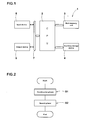
- the computing device 1 in this embodiment comprises: a central processing unit 2; a main memory unit 3 functionable as working memories; an auxiliary storage device 4, e.g. a hard disk and the like; an input device 5, e.g. keyboard, mouse and the like; an output device 6, e.g. display, printer and the like; an interface 7 connecting the 10 devices 5 and 6.
- auxiliary storage device 4 there is stored programs by which the computing device 1 executes the nearest neighbor search method of the present invention.
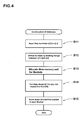
- the nearest neighbor search method comprises:
- the construction phase s1 is performed only once before the search phase s2.
- the real numbers x[i] are sorted in ascending order (namely, x[1] ⁇ x[2] ⁇ x[3] ⁇ --- ⁇ x[n-1] ⁇ x[n]), meanwhile, the first (minimum) real number x[1], the last (maximum) real number x[n], and the total number n of the real numbers are determined.
- the one-dimensional space between the first real number ⁇ [1] and last real number x[n] is divided at regular intervals into small one-dimensional spaces. -- This is mere a conceptional operation for the sake of the following explanation - not necessary to perform actually.
- the number of the divided small one-dimensional spaces is an integral number m which is one or more times, preferably few times as large as the number n of the real numbers x[1] -- x[n].
- the database of the real numbers x[i] (i: 1 to n) comprises a series Br of buckets B.
- the number of the buckets B is the same as the above-mentioned integral number m, and the buckets B correspond to the above-mentioned number m of the small one-dimensional spaces, respectively.
- Each bucket B is a set of data about the real number(s) falling in the corresponding small one-dimensional space and others as explained later.
- bucket index is provided with unique indexes called "bucket index”.
- integral numbers are used as the "bucket index” for illustrative purposes only, and a bucket B with a bucket index j is denoted by bucket B[j] (j: 1 to m). From the first bucket to the last bucket, the bucket index is incremented one by one such that the bucket index of the first bucket is 1, and the bucket index of the last bucket is m.
- each bucket B[j] may be considered as a one-dimensional space between a real number y1 and a real numbers y2, wherein y1 ⁇ y2, and the difference y2 - y1 is constant through all the buckets.
- each bucket B[j] corresponds to a one-dimensional space not less than y1 and less than y2. Therefore, if one or more of the real numbers x[i] (i: 1 to n) satisfy a condition y1 ⁇ x[i] ⁇ y2 of either one of the buckets B[j] (j: 1 to m), then the one or more of the real numbers are determined as belonging to the bucket, and the bucket comprises data about the one or more of the real numbers. In practice, such data about the real number may be the real number or value itself or an address at which the real number is actuary stored.
- Each of the buckets B[j] comprises data about its bucket size.
- the bucket size is the number of the real number(s) x[i] belonging to the bucket B[j] concerned. In the case that there is no real number belonging to the bucket concerned, the bucket size is zero, therefore, the bucket comprises such data that the bucket size is zero.
- the buckets B[1], B[2], B[6], B[9] and B[10] each have one real number x[1], x[2], x[3], x[4], x[5], respectively, therefore, the bucket sizes of these buckets B are equal to 1.
- the buckets B[3], B[4], B[5], B[7] and B[8] have no real number, therefore, these buckets comprise date about the bucket sizes being equal to zero.
- Each of the buckets B[j] further comprises data about a bucket index of a last filled bucket ("BIofLFB" for short).
- the last filled bucket is a bucket whose bucket size is not zero and whose bucket index is nearest to the bucket index of the concerned bucket.
- the real numbers x[1] -- x[n] sorted in ascending order are scanned, starting from x[1] to x[n], in order to determine if each real number x[i] satisfies a condition y1 ⁇ x[i] ⁇ y2 of either one of the buckets, and thereby to determine which one of the buckets the real number x[i] belongs to.
- the first bucket B[1] its own bucket index, namely, "1" is treated as the BIofLFB, and the first bucket B[1] comprises data about the BIoFLFB being 1.
- Each bucket whose bucket size is not zero further, comprises data about the minimum and maximum of the real number(s) belonging to the concerned bucket.
- this single real number is treated as the minimum and maximum real numbers. Namely, the minimum and maximum real numbers are equal to the single real number.
- Fig.4 shows an example of the construction phase s1, wherein:
- the central processing unit 2 loads the real numbers x[1] to x[n] in the main memory unit 3. -- (step s11)
- the central processing unit 2 define the range (y1 to y2) of each bucket based on the range (x[1] to x[n]) of the real numbers divided by the number m. -- (step s12)
- the integral number m is determined by a person as above, and put in the computing device 1 as a variable by the use of the input device 5.
- the central processing unit 2 allocate the main memory unit 3 for the buckets B[1] to B[m] needed for storing data about the bucket size, the BIofLFB, the real number(s) and the minimum and maximum thereof. -- (step S13)
- the central processing unit 2 puts data about the real numbers x[i] to x[n] into the respective buckets in the main memory unit 3. -- (step S14)
- the step S14 is as follow. using the integral number m and the real numbers x[1] and x[n], the spatial size ⁇ of a bucket is determined by the following expression (1).
- the database include buckets whose bucket size is zero. Accordingly, it is expedient to exclude such zero-size buckets from the nearest neighbor search.
- the central processing unit 2 determines the BIofLFB, and stores data about the BIoFLFB in the bucket B[j].
- the step s15 is as follows.
- the last filled bucket is a bucket whose bucket size is not zero and whose bucket index is nearest to the concerned bucket on the first bucket side.
- the last filled bucket is defined by the following conditions (a), (b) and (c):
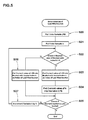
- Fig.5 shows an example of a sequence of operations by which the central processing unit 2 determines the BIofLFB.
- the central processing unit 2 puts 1 (integral number) into both of a variable LFB and a variable k. -- (step s20, s21)
- the central processing unit 2 determines if the bucket size is more than zero. -- (step s22)
- step s22 if the result is true (Y) (namely, more than zero), then the central processing unit 2 stores the current value of the variable LFB in the bucket B[var.k] as the date about the BIofLFB. -- (step s23)
- the central processing unit 2 updates the variable LFB to be equal to the bucket index of the current bucket B[var.k]. --(step S24)
- step s22 if the result is false (NO) (namely, equal to zero), then the central processing unit 2 stores the current value of the variable LFB in the bucket B[var.k] as the date about the BIoFLFB. -- (step s26)
- step s25 without updating or changing the variable LFB.
- the central processing unit 2 judges if the variable k which is the bucket index of the current bucket is equal to the bucket index of the last bucket (namely, m).
- step s27 the central processing unit 2 increments the variable k by one (step s27), and the sequence goes to the step 522.
- the database for used in the search phase S2 is prepared. Such construction phase is performed only once before the search phase S2.
- the main memory unit 3 is faster in the access speed than the auxiliary storage device, therefore, the database is allocated on the main memory unit 3. It is however also possible to allocate the database on the auxiliary storage device.
- Fig.6 shows an example of a sequence of operations by which the central processing unit 2 determines the nearest neighbor.
- the central processing unit 2 determines the bucket index "ibucket" of a bucket which the query point q belongs to. -- (step S31)
- ibucket #floor((q - x[1])/ ⁇ x) + 1 wherein, #floor(y) is a function which returns the largest integral value not greater than y.
- step S32 the central processing unit 2 judges if the bucket size of the bucket B[ibucket] is zero. -- (step S32)
- step s32 if the result is false (No) (namely, bucket size > 0), then the central processing unit 2 searches the real number(s) belonging to or contained in the bucket B[ibucket] for the nearest neighbor. -- (step s33, step s34)
- the central processing unit 2 compares the query point q with the minimum real number stored in the bucket B[ibucket].
- step S35 If the query point q is less than the minimum real number (in the step s33, Yes), then it is determined that the nearest neighbor is the maximum real number stored in the last filled bucket whose bucket index is stored in the bucket B[ibucket]. -- (step S35)
- the central processing unit 2 searches the real number(s) belonging to or contained in the bucket B[ibucket] for a real number x[ipoint] which satisfies a condition x[ipoint] ⁇ q ⁇ x[ipoint + 1], and it is determined that the nearest neighbor is the real number x[ipoint]. -- (step S34)
- the whole search is performed on one of the buckets during the subsequent steps to the step S32. Therefore, the nearest neighbor can be found very quickly, and the computing time can be greatly decreased.
- a real number not more than the query point q and nearest to the query point q is found as the nearest neighbor.
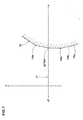
- Fig.7 shows a two-dimensional model for simulating aerodynamics of a golf ball.
- a model 11 of air surrounding the golf ball is defined by Euler elements as orthogonal grids
- a model 10 of a golf ball is defined by Lagrangian elements.
- the golf ball model 10 has nodes 10a which have X-Y coordinate values and between which sides or lines 10b extend to define a Lagrangian mesh.
- the air model 11 has a nonuniform grid structure or Euler mesh such that the grids are gradually decreased in the size towards the surface of the golf ball model 10.
- query point q is an X-coordinate value of a node point of the golf ball model 10 which node point has a Y-coordinate value (y1).
- X-coordinate values of the air model 11 are given as a set of real numbers x[i] and searched for the nearest neighbor which is not more than the query point q and nearest to the query point q.
- the central processing unit checks the bucket size of the bucket B[33].
- the central processing unit reads the BIofLFB.
- the central processing unit reads the maximum real number stored in the bucket B[31].
- the central processing unit answers "49.284" as the nearest neighbor of the query point "52".
- the central processing unit searches the real numbers belonging to the bucket B[5] for a real number x[ipoint] satisfying a condition x[ipoint] ⁇ q ⁇ x [ipoint + 1].
- the nearest neighbor is determined as 6.498.
- the three-dimensional model of a golf ball was defined by Lagrangian elements having nodes with 3,755,598 coordinate values.
- the air model A had 63,050,400 coordinate values (X-coordinate values: 252, Y-coordinate values: 100, Z-coordinate values: 2502).
- the air model B had 150,700,400 coordinate values (X-coordinate values: 502, Y-coordinate values: 100, Z-coordinate values: 3002).
- Each of the 3,755,598 coordinate values of the golf ball model was given as a query point, and the coordinate values of the air model A, B are searched for the nearest neighbor.
- a model of such fluid is defined as structured grids of Euler mesh
- a model of such solid is defined as unstructured grids of Lagrangian mesh because the time required for preparing the models can be reduced, and it is relatively easy to increase the simulation accuracy. Therefore, in the case of a large-scale computer simulation, it is expected that the use of structured grids will be increased in the future. In this case, if the solid has a complicated shape, a very large computational cost is required for defining the boundary between the fluid and solid.
- the present invention can be suitably applied to this kind of computation, and it is possible to greatly decrease the computing time and computational cost.
- the structured grids has coordinate values in three-dimensions, namely, (x, y, z) in the case of a orthogonal coordinate system, (r, z, ⁇ ) in a cylindrical coordinate system, and (r, ⁇ , ⁇ ) in a spherical coordinate system.
- the computing time can be greatly decreased.
- the search speed becomes 2 times or more faster than ANN and kd-tree methods.
Landscapes
- Engineering & Computer Science (AREA)
- Theoretical Computer Science (AREA)
- Physics & Mathematics (AREA)
- Data Mining & Analysis (AREA)
- General Physics & Mathematics (AREA)
- General Engineering & Computer Science (AREA)
- Software Systems (AREA)
- Databases & Information Systems (AREA)
- Mathematical Physics (AREA)
- Bioinformatics & Computational Biology (AREA)
- Mathematical Optimization (AREA)
- Evolutionary Biology (AREA)
- Computer Vision & Pattern Recognition (AREA)
- Algebra (AREA)
- Computational Mathematics (AREA)
- Mathematical Analysis (AREA)
- Evolutionary Computation (AREA)
- Bioinformatics & Cheminformatics (AREA)
- Pure & Applied Mathematics (AREA)
- Artificial Intelligence (AREA)
- Life Sciences & Earth Sciences (AREA)
- Information Retrieval, Db Structures And Fs Structures Therefor (AREA)
- Management, Administration, Business Operations System, And Electronic Commerce (AREA)
Abstract
Description
- The present invention relates to a nearest neighbor search method, more particularly to a computer-oriented fast search method of searching a set of real numbers for a real number closest to a query point (or real number) by the use of a prepared database of the real numbers.
- In a computer simulation, a numerical analysis using a computer and the like, it is often required to search a large number of real numbers for a nearest neighbor to a query point (query number). For example, in the case of an aero-dynamical simulation, it is necessary to import surface coordinates of a moving body (Lagrangian elements) in the coordinate system of a structured grid (Euler elements).
- In this case, if the number of real numbers to be searched is very large (for example more than one hundred million), the number of the query points is very large (for example more than one million), and/or the search is repeated a large number of times, then there is a possibility that the computing time reaches to several hours to a day or two.
- Accordingly, in order to decrease such computing time and thereby to reduce the computational cost, many attempts have been proposed.
- Heretofore, two types of methods have been employed in order to solve this kind of problem.
- The first method is what is called whole search in which the query point q is compared with the sorted real numbers from the first real number x[1] to the last real number x[n] one by one until the magnitude relation is reversed. For example, if a real number x[ipoint] satisfying a condition:

then the solution is this real number x[ipoint]. - The second method is what is called bisection method or kd-tree method widely used in recent years as a more efficient method than the first method.
- Furthermore, ANN (Approximate Nearest Neighbor) method which is a combination of the former two methods is also used in recent years.
- However, in the above-mentioned methods (ANN, kd-tree), the advantageous effect decreases if the dimensions of the search points is increased and reached to about 3 dimensions because the difference from the whole search becomes small. Further, as the dimensions are increased, the tree becomes complex, and the search ranges increase, therefore, the computing time increases.
- It is therefore, an object of the present invention to provide a fast nearest neighbor search method, in which a database of a set of real numbers is prepared beforehand, and a nearest neighbor search is performed by the use of the database, therefore, the computing time can be greatly decreased.
- According to the present invention, a set of real numbers x[i] (i: 1 to n) and a query point q (real number) are given as one-dimensional values, and a nearest neighbor search method comprises
a construction phase in which a database of the real numbers x[i] (i: integers from 1 to n, assigned in ascending order of the real numbers) is prepared in a main memory unit of a computing device, and
a search phase in which the computing device searches the nearest neighbor to the query point q by the use of the database, wherein
the database comprises a series of buckets,
the buckets respectively correspond to small one-dimensional spaces defined by dividing a one-dimensional space between a minimum real number x[1] and a maximum real number x[n] at regular intervals, whereby the number of the buckets and the number of the small one-dimensional spaces are the same integral number m,
the buckets have unique bucket indexes from the first bucket B[1] to the last bucket B[m],
each of the buckets comprises data about real number(s) falling in one of the small one-dimensional spaces corresponding to the bucket concerned,
each of the buckets further comprises data about its bucket size, the bucket size defined by the number of real number(s) falling in one of the small one-dimensional spaces which corresponds to the bucket concerned,
each of the buckets excepting the first bucket B[1] further comprises data about the bucket index of a last filled bucket, the last filled bucket defined as a bucket whose bucket size is not zero and whose bucket index is closest to that of the concerned bucket, and
the search phase comprises: - a first step of locating one of the buckets corresponding to one of the small one-dimensional spaces in which the query point q falls,
- a second step of checking the bucket size of the located bucket whether the bucket size thereof is zero or not,
- a third step of searching the nearest neighbor by the use of the data of real number(s) included in
- the located bucket if the checked bucket size is not zero,
- or
- a bucket with a bucket index equal to the bucket index of the last filled bucket included in the located bucket if the checked bucket size is zero.
-
-
Fig.1 is a block diagram of a computing device for performing the nearest neighbor search according to the present invention. -
Fig.2 is a flowchart of the nearest neighbor search method of the present invention. -
Fig.3 is a diagram showing a simple example for explaining a set of real numbers and a database structure. -
Fig.4 is a flowchart of a construction phase in which the database is prepared. -
Fig.5 is a flowchart showing the steps of setting the bucket index of the last filled bucket. -
Fig.6 is a flowchart of a search phase. -
Fig.7 is a diagram for explaining a simplified example of a two-dimensional model for used in an aero-dynamical simulation. - Embodiments of the present invention will now be described in detail in conjunction with the accompanying drawings.
- In the nearest neighbor search method according to the present invention, a set of real numbers x[i] and a query point q (a real number) are given, and the real numbers x[i] are searched for a nearest neighbor namely a real number closest to the query point q, wherein the nearest neighbor search is performed by the use of a database of the real numbers x[i] (wherein "i" is an integral numbers from 1 to n, and x[1] < x[2] < x[3] < --- < x[n-1] < x[n]).
- The nearest neighbor search method is performed by a computing device. The computing device in this embodiment is a general-purpose computer system. But, the computing device may be a dedicated purpose built-in computer.
- As shown in
Fig.1 , thecomputing device 1 in this embodiment comprises: acentral processing unit 2; amain memory unit 3 functionable as working memories; anauxiliary storage device 4, e.g. a hard disk and the like; aninput device 5, e.g. keyboard, mouse and the like; anoutput device 6, e.g. display, printer and the like; aninterface 7 connecting the 10devices auxiliary storage device 4, there is stored programs by which thecomputing device 1 executes the nearest neighbor search method of the present invention. - As shown in
Fig.2 , the nearest neighbor search method according to the present invention comprises: - a construction phase s1 in which the database is prepared; and
- a search phase s2 in which one of the real numbers x[i] which is closest to the query point q is searched by the use of the database.
- The construction phase s1 is performed only once before the search phase s2.
- In the construction phase s1, the real numbers x[i] are sorted in ascending order (namely, x[1] < x[2] < x[3] < --- < x[n-1] < x[n]), meanwhile, the first (minimum) real number x[1], the last (maximum) real number x[n], and the total number n of the real numbers are determined.
- The one-dimensional space between the first real number × [1] and last real number x[n] is divided at regular intervals into small one-dimensional spaces. -- This is mere a conceptional operation for the sake of the following explanation - not necessary to perform actually.
- The number of the divided small one-dimensional spaces is an integral number m which is one or more times, preferably few times as large as the number n of the real numbers x[1] -- x[n].
- The database of the real numbers x[i] (i: 1 to n) comprises a series Br of buckets B.
- The number of the buckets B is the same as the above-mentioned integral number m, and
the buckets B correspond to the above-mentioned number m of the small one-dimensional spaces, respectively. - Each bucket B is a set of data about the real number(s) falling in the corresponding small one-dimensional space and others as explained later.
- All of the buckets B are provided with unique indexes called "bucket index". Hereinafter, integral numbers are used as the "bucket index" for illustrative purposes only, and a bucket B with a bucket index j is denoted by bucket B[j] (j: 1 to m). From the first bucket to the last bucket, the bucket index is incremented one by one such that the bucket index of the first bucket is 1, and the bucket index of the last bucket is m.
- As explained, the buckets B[j] respectively correspond to the small one-dimensional spaces, and all of the small one-dimensional spaces have an identical spatial size. Therefore, each bucket B[j] may be considered as a one-dimensional space between a real number y1 and a real numbers y2, wherein y1 < y2, and the difference y2 - y1 is constant through all the buckets.
- In this embodiment, each bucket B[j] corresponds to a one-dimensional space not less than y1 and less than y2. Therefore, if one or more of the real numbers x[i] (i: 1 to n) satisfy a condition y1 ≤ x[i] < y2 of either one of the buckets B[j] (j: 1 to m), then the one or more of the real numbers are determined as belonging to the bucket, and the bucket comprises data about the one or more of the real numbers.
In practice, such data about the real number may be the real number or value itself or an address at which the real number is actuary stored. - Each of the buckets B[j] comprises data about its bucket size. The bucket size is the number of the real number(s) x[i] belonging to the bucket B[j] concerned.
In the case that there is no real number belonging to the bucket concerned, the bucket size is zero, therefore, the bucket comprises such data that the bucket size is zero.
For example, inFig.3 , the buckets B[1], B[2], B[6], B[9] and B[10] each have one real number x[1], x[2], x[3], x[4], x[5], respectively, therefore, the bucket sizes of these buckets B are equal to 1. The buckets B[3], B[4], B[5], B[7] and B[8] have no real number, therefore, these buckets comprise date about the bucket sizes being equal to zero. - Each of the buckets B[j] further comprises data about a bucket index of a last filled bucket ("BIofLFB" for short). Here, the last filled bucket is a bucket whose bucket size is not zero and whose bucket index is nearest to the bucket index of the concerned bucket.
- In this invention, it is possible to treat the term "nearest" as having one of the following three meanings:
- (1) nearest on the first bucket side of the concerned bucket,
- (2) nearest on the final bucket side of the concerned bucket,
- (3) nearest literally or regardless of the first bucket side and final bucket side. In this embodiment, the meaning (1) is adopted.
- The real numbers x[1] -- x[n] sorted in ascending order are scanned, starting from x[1] to x[n], in order to determine if each real number x[i] satisfies a condition y1 ≤ x[i] < y2 of either one of the buckets, and thereby to determine which one of the buckets the real number x[i] belongs to.
- During this scan operation performed from x[1] to x[n], if the bucket whose bucket size is not zero is found, then the bucket index thereof is put in a variable for BIofLFB allocated on working memory.
- In the case of the first bucket B[1], its own bucket index, namely, "1" is treated as the BIofLFB, and the first bucket B[1] comprises data about the BIoFLFB being 1.
- Each bucket whose bucket size is not zero, further, comprises data about the minimum and maximum of the real number(s) belonging to the concerned bucket.
- in the case that the bucket size is "1", namely, only a single real number belongs to the concerned bucket, this single real number is treated as the minimum and maximum real numbers. Namely, the minimum and maximum real numbers are equal to the single real number.
-
Fig.4 shows an example of the construction phase s1, wherein: - The
central processing unit 2 loads the real numbers x[1] to x[n] in themain memory unit 3. -- (step s11) - The
central processing unit 2 define the range (y1 to y2) of each bucket based on the range (x[1] to x[n]) of the real numbers divided by the number m. -- (step s12)
In this embodiment, the integral number m is determined by a person as above, and put in thecomputing device 1 as a variable by the use of theinput device 5. - The
central processing unit 2 allocate themain memory unit 3 for the buckets B[1] to B[m] needed for storing data about the bucket size, the BIofLFB, the real number(s) and the minimum and maximum thereof. -- (step S13) - The
central processing unit 2 puts data about the real numbers x[i] to x[n] into the respective buckets in themain memory unit 3. -- (step S14) - The step S14 is as follow. using the integral number m and the real numbers x[1] and x[n], the spatial size Δ× of a bucket is determined by the following expression (1).
- (1) Δ× = (x[n] - x[1])/m
All of the buckets have the same spatial size Δx.
Then, for each of the real numbers x[i] (i: 1 to n), thecentral processing unit 2 evaluates the following expression (2). - (2) ibucket = #floor((x[i] - x[1])/ Δx) + 1
wherein #floor(y) is a function which returns the largest integral value not greater than y.
Through this evaluation, it is determined that the real number x[i] belongs to bucket B[ibucket] (namely, a bucket whose bucket index is "ibucket" ).
Therefore, thecentral processing unit 2 puts data about the real number x[i] into the bucket B[ibucket], and performs the calculation of the following assignment expression (3) in order to increment the bucket size stored in the bucket B[ibucket] by one. - (3) bucket size = bucket size + 1
If need arises as a results of the inclusion of the real number x[i] into the bucket B[ibucket], then thecentral processing unit 2 updates the minimum real number and/or maximum real number stored in the bucket B[ibucket]. - In the meantime, there is a possibility that the database include buckets whose bucket size is zero. Accordingly, it is expedient to exclude such zero-size buckets from the nearest neighbor search.
- Therefore, for each of the buckets B[j] excepting the first bucket B[1], the
central processing unit 2 determines the BIofLFB, and stores data about the BIoFLFB in the bucket B[j]. - The step s15 is as follows.
- In this embodiment in which the above-mentioned meaning (1) is adopted, the last filled bucket is a bucket whose bucket size is not zero and whose bucket index is nearest to the concerned bucket on the first bucket side.
- Therefore, the last filled bucket is defined by the following conditions (a), (b) and (c):
- (a) p < k
- (b) bucket size of bucket B[p] > 0
- (c) difference k-p is minimum
wherein
p is the BIofLFB, and
k is the bucket index of the current bucket concerned. -
Fig.5 shows an example of a sequence of operations by which thecentral processing unit 2 determines the BIofLFB. - First, the
central processing unit 2 puts 1 (integral number) into both of a variable LFB and a variable k. -- (step s20, s21) - with respect to the bucket B with bucket index equal to the variable k (hereinafter "bucket B[var.k]" for short), the
central processing unit 2 determines if the bucket size is more than zero. -- (step s22) - In the step s22, if the result is true (Y) (namely, more than zero), then the
central processing unit 2 stores the current value of the variable LFB in the bucket B[var.k] as the date about the BIofLFB. -- (step s23) - Then, the
central processing unit 2 updates the variable LFB to be equal to the bucket index of the current bucket B[var.k]. --(step S24) - Then the sequence goes to step s25.
- In the step s22, if the result is false (NO) (namely, equal to zero), then the
central processing unit 2 stores the current value of the variable LFB in the bucket B[var.k] as the date about the BIoFLFB. -- (step s26) - Then the sequence goes to step s25, without updating or changing the variable LFB.
- In the step s25, the
central processing unit 2 judges if the variable k which is the bucket index of the current bucket is equal to the bucket index of the last bucket (namely, m). - If the result is true (Yes) (namely, value of k = m), then the construction phase ends.
- If the result is false (No) (namely, value of k < m), then the
central processing unit 2 increments the variable k by one (step s27), and the sequence goes to the step 522. - These steps are repeated till the last bucket B[m].
- Through the construction phase, the database for used in the search phase S2 is prepared. Such construction phase is performed only once before the search phase S2.
- usually, the
main memory unit 3 is faster in the access speed than the auxiliary storage device, therefore, the database is allocated on themain memory unit 3. It is however also possible to allocate the database on the auxiliary storage device. -
Fig.6 shows an example of a sequence of operations by which thecentral processing unit 2 determines the nearest neighbor.
when a query point q is given (step S30), thecentral processing unit 2 determines the bucket index "ibucket" of a bucket which the query point q belongs to. -- (step S31) - As explained above, all of the buckets have the identical spatial size Δx. Therefore, the bucket index "ibucket" can be obtained easily by evaluating the following expression (4).
(4) ibucket = #floor((q - x[1])/ Δx) + 1 wherein, #floor(y) is a function which returns the largest integral value not greater than y. - Then, the
central processing unit 2 judges if the bucket size of the bucket B[ibucket] is zero. -- (step S32) - In the step s32, if the result is false (No) (namely, bucket size > 0), then the
central processing unit 2 searches the real number(s) belonging to or contained in the bucket B[ibucket] for the nearest neighbor. -- (step s33, step s34) - More specifically, the
central processing unit 2 compares the query point q with the minimum real number stored in the bucket B[ibucket]. - If the query point q is less than the minimum real number (in the step s33, Yes), then it is determined that the nearest neighbor is the maximum real number stored in the last filled bucket whose bucket index is stored in the bucket B[ibucket]. -- (step S35)
- If the query point q is not less than the minimum number (in the step S33, No), then the
central processing unit 2 searches the real number(s) belonging to or contained in the bucket B[ibucket] for a real number x[ipoint] which satisfies a condition x[ipoint] ≤ q < x[ipoint + 1], and it is determined that the nearest neighbor is the real number x[ipoint]. -- (step S34) - In the step s32, if the result is true (Yes) (namely, bucket size = 0), then, for the nearest neighbor, the
central processing unit 2 searches the real number(s) belonging to or contained in the last filled bucket whose bucket index is stored in the bucket B[ibucket]. -- (step S35) - According to the present invention, as explained above, the whole search is performed on one of the buckets during the subsequent steps to the step S32. Therefore, the nearest neighbor can be found very quickly, and the computing time can be greatly decreased.
- In the above-explained embodiment, a real number not more than the query point q and nearest to the query point q is found as the nearest neighbor.
- But, it is also possible to find the nearest neighbor as a real number not less than the query point q and nearest to the query point q. -- the above-mentioned meaning (2)
- In order to find this type of nearest neighbor, it is necessary to change as follows:
- the BIofLFB is the bucket index of a bucket which is nearest to the bucket concerned on the last bucket side of the bucket concerned;
- in the step s33, the maximum real number is substituted for the minimum real number;
- in the step s35, the minimum real number is substituted for the maximum real number; and
- in the step s34, the nearest neighbor is a real number x[ipoint] satisfying a condition x[ipoint] ≥ q > x[ipoint-1].
-
Fig.7 shows a two-dimensional model for simulating aerodynamics of a golf ball. In this example, in order to simulate airflow around the golf ball,
amodel 11 of air surrounding the golf ball is defined by Euler elements as orthogonal grids, and
amodel 10 of a golf ball is defined by Lagrangian elements. - The
golf ball model 10 hasnodes 10a which have X-Y coordinate values and between which sides orlines 10b extend to define a Lagrangian mesh. - In order to make detailed analyses of airflow occurring near the surface of the golf ball, the
air model 11 has a nonuniform grid structure or Euler mesh such that the grids are gradually decreased in the size towards the surface of thegolf ball model 10. - In this example, given as the query point q is an X-coordinate value of a node point of the
golf ball model 10 which node point has a Y-coordinate value (y1). - X-coordinate values of the
air model 11 are given as a set of real numbers x[i] and searched for the nearest neighbor which is not more than the query point q and nearest to the query point q. - Table 1A is a listing of the X-coordinate values of the air model 11 (real numbers x[i]) sorted in ascending order.
- Table 1B shows an example of the database thereof.
- In this example, Δ×=1.6, and the minimum of the X-coordinate value (namely, x[1]) is 0, therefore, twelve real numbers from 0 to less than 1.6 belong to the first bucket B[1].
Table 1A Table 1B Real numbers (X-coordinate) Bucket index Bucket coordinate (Δ<=1.6) Real numbers belonging Bucket size BlofLFB *1 Minimum real number Maximum real number 0 1 0 0, 0.004, 0.018, 0.048, 0.1, 0.18, 0.294, 0.448, 0.648, 0.9,1.21, 1.584 12 1 0 1.584 0.004 2 1.6 2.028, 2.548, 3.15 3 1 2.028 3.15 0.018 3 3.2 3.84, 4.624 2 2 3.84 4.624 0.048 4 4.8 5.508 1 3 5.508 5.508 0.1 5 6.4 6.498, 7.6 2 4 6.498 7.6 0.18 6 8 8.82 1 5 8.82 8.82 0.294 7 9.6 10.164 1 6 10.164 10.164 0.448 8 11.2 11.638 1 7 11.638 11.638 0.648 9 12.8 13.248 1 8 13.248 13.248 0.9 10 14.4 15 1 9 15 15 1.21 11 16 16.9 1 10 16.9 16.9 1.584 12 17.6 18.954 1 11 18.954 18.954 2.028 13 19.2 0 11 2.548 14 20.8 21.168 1 11 21.168 21.168 3.15 15 22.4 23.548 1 14 23.548 23.548 3.84 16 24 0 14 4.624 17 25.6 26.1 1 14 26.1 26.1 5.508 18 27.2 28.83 1 17 28.83 28.83 6.498 19 28.8 0 18 7.6 20 30.4 31.744 1 18 31.744 31.744 8.82 21 32 0 20 10.164 22 33.6 34.848 1 20 34.848 34.848 11.638 23 35.2 0 22 13.248 24 36.8 38.148 1 22 38.148 38.148 15 25 38.4 0 24 16.9 26 40 0 24 18.954 27 41.6 41.65 1 24 41.65 41.65 21.168 28 43.2 0 27 23.548 29 44.8 45.36 1 27 45.36 45.36 26.1 30 46.4 0 29 28.83 31 48 49.284 1 29 49.284 49.284 31.744 32 49.6 0 31 34.848 33 51.2 0 31 38.148 34 52.8 53.428 1 31 53.428 53.428 41.65 35 54.4 0 34 45.36 36 56 0 34 49.284 37 57.6 57.798 1 34 57.798 57.798 53.428 38 59.2 0 37 57.798 39 60.8 0 37 62.4 40 62.4 62.4 1 37 62.4 62.4 *1) BlofLFB: Bucket index of Last filled bucket - For example, if "52" is given as the query point q, in order to determine the bucket B[ibucket] to which this value belongs to, the central processing unit evaluates the above-explained expression (2) as follows.

- Then, the central processing unit checks the bucket size of the bucket B[33].
- since the bucket size of the bucket B[33] is zero, the central processing unit reads the BIofLFB.
- Since the BIoFLFB is "31", the central processing unit reads the maximum real number stored in the bucket B[31].
- Since the maximum real number is "49.284", the central processing unit answers "49.284" as the nearest neighbor of the query point "52".
- If "7" is given an the query point q, ibucket is "5". The bucket size of the bucket B[5] is "2". Therefore, the central processing unit searches the real numbers belonging to the bucket B[5] for the nearest neighbor.
- specifically, the central processing unit determines if the query point "7" is less than the minimum real number (=6.498) stored in the bucket B[5].
- In this case, since the results is false, the central processing unit searches the real numbers belonging to the bucket B[5] for a real number x[ipoint] satisfying a condition x[ipoint] ≤ q < x [ipoint + 1]. Thus, the nearest neighbor is determined as 6.498.
- In order to show the advantageous effect of the present invention, three-dimensional model for simulating aerodynamics of a golf ball was prepared, and the nearest neighbor search method according to the present invention was compared with ANN method.
- The three-dimensional model of a golf ball was defined by Lagrangian elements having nodes with 3,755,598 coordinate values.
- As the three-dimensional air model, two models A and B defined by Euler elements were prepared. The air model A had 63,050,400 coordinate values (X-coordinate values: 252, Y-coordinate values: 100, Z-coordinate values: 2502).
- The air model B had 150,700,400 coordinate values (X-coordinate values: 502, Y-coordinate values: 100, Z-coordinate values: 3002).
- Each of the 3,755,598 coordinate values of the golf ball model was given as a query point, and the coordinate values of the air model A, B are searched for the nearest neighbor.
- The test results are shown in Table 2.
Table 2 Method Invention ANN (bucket size=1) ANN (bucket size=3) Search time (sec) air model A 0.82 208.8 165.6 air model B 0.83 401.2 340.9 Time required for preparing database (sec) air model A under 0.01 about 5 about 5 air model B under 0.01 about 5 about 5 - For example, when airflow around a golf ball, flow of plasticizing rubber in an extruder for tire manufacturing and the like are to be simulated in order to study the behavior of a golf ball, the kneading action of a screw and the like, it is desirable that a model of such fluid is defined as structured grids of Euler mesh, and a model of such solid is defined as unstructured grids of Lagrangian mesh because the time required for preparing the models can be reduced, and it is relatively easy to increase the simulation accuracy. Therefore, in the case of a large-scale computer simulation, it is expected that the use of structured grids will be increased in the future. In this case, if the solid has a complicated shape, a very large computational cost is required for defining the boundary between the fluid and solid.
- The present invention can be suitably applied to this kind of computation, and it is possible to greatly decrease the computing time and computational cost.
- In the case of a simulation of a flying golf ball which requires to make analyses of fluid in three-dimensional space, the structured grids has coordinate values in three-dimensions, namely, (x, y, z) in the case of a orthogonal coordinate system, (r, z, θ ) in a cylindrical coordinate system, and (r,θ,φ) in a spherical coordinate system.
- In either system, by performing the method according to the present invention in each dimension, the computing time can be greatly decreased. For example, the search speed becomes 2 times or more faster than ANN and kd-tree methods.
- Therefore, in a moving boundary problem of a rotating golf ball for example, especially the computational efficiency is increased, and it becomes possible to increase the number of the grids. As a result, the approximation accuracy of the space and simulation accuracy can be improved.
Claims (6)
- A nearest neighbor search method of searching a set of real numbers x[i] (i: 1 to n) for a nearest neighbor to a query point q, comprising
a construction phase in which a database of the real numbers x[i] (i: integers from 1 to n, assigned in ascending order of the real numbers) is prepared in a main memory unit of a computing device, and
a search phase in which the computing device searches the nearest neighbor to the query point q by the use of the database, wherein
the database comprises a series of buckets,
the buckets respectively correspond to small one-dimensional spaces defined by dividing a one-dimensional space between a minimum real number x[1] and a maximum real number x[n] at regular intervals, whereby the number of the buckets and the number of the small one-dimensional spaces are the same integral number m,
the buckets have unique bucket indexes from the first bucket B [1] to the last bucket B[m],
each of the buckets comprises data about real number(s) falling in one of the small one-dimensional spaces corresponding to the bucket concerned,
each of the buckets further comprises data about its bucket size, the bucket size defined by the number of real 24 number(s) falling in one of the small one-dimensional spaces which corresponds to the bucket concerned,
each of the buckets excepting the first bucket B[1] further comprises data about the bucket index of a last filled bucket, the last filled bucket defined as a bucket whose bucket size is not zero and whose bucket index is closest to that of the concerned bucket, and
the search phase comprises:a first step of locating one of the buckets corresponding to one of the small one-dimensional spaces in which the query point q falls,a second step of checking the bucket size of the located bucket whether the bucket size thereof is zero or not,a third step of searching the nearest neighbor by the use of the data of real number(s) included in- the located bucket if the checked bucket size is not zero,or- a bucket with a bucket index equal to the bucket index of the last filled bucket included in the located bucket if the checked bucket size is zero. - The nearest neighbor search method according to claim 1, wherein
the nearest neighbor is a real number not more than the query point and closest to the query point, and
the last filled bucket is a bucket whose bucket size is not zero and whose bucket index is closest to that of the concerned bucket on the first bucket side. - The nearest neighbor search method according to claim 2, wherein
the bucket whose bucket size is not zero, further comprises data about minimum and maximum of the real number(s) included in the bucket. - The nearest neighbor search method according to claim 3, wherein
in the third step, if the checked bucket size is not zero, then the query point q is compare with the minimum real number included in the bucket concerned, and
if the query point q is less than the minimum, then the computing device makes a decision such that the nearest neighbor is the maximum real number included in the last filled bucket of which bucket index is included in the bucket concerned. - The nearest neighbor search method according to claim 3 or 4, wherein
in the third step, if the checked bucket size is not zero, then the query point q is compare with the minimum real number included in the bucket concerned, and
if the query point q is not less than the minimum, then the computing device searches the real number(s) included in the concerned bucket for a real number satisfying a condition x[ipoint] ≤ q < x[ipoint + 1], and makes a decision such that the nearest neighbor is the real number x[ipoint]. - A nearest neighbor search method in which:-
search points and a query point each having multidimentsional-coordinate values are given, and
from the multidimentsional-coordinate values of the search points and query point,
coordinate values in each dimension are extracted as a set of real numbers x[i] and a query point q,
with respect to the set of real numbers x[i] and query point q extracted in each dimension,
the real numbers are searched for a nearest neighbor to the query point q by the use of the method as set forth in any one of claims 1-5.
Applications Claiming Priority (1)
| Application Number | Priority Date | Filing Date | Title |
|---|---|---|---|
| JP2009264202A JP4977193B2 (en) | 2009-11-19 | 2009-11-19 | A method for searching the nearest value of a search point from an arbitrary group of real numbers |
Publications (3)
| Publication Number | Publication Date |
|---|---|
| EP2325755A2 true EP2325755A2 (en) | 2011-05-25 |
| EP2325755A3 EP2325755A3 (en) | 2017-10-11 |
| EP2325755B1 EP2325755B1 (en) | 2019-01-02 |
Family
ID=43709149
Family Applications (1)
| Application Number | Title | Priority Date | Filing Date |
|---|---|---|---|
| EP10013411.3A Not-in-force EP2325755B1 (en) | 2009-11-19 | 2010-10-06 | Method of searching a set of real numbers for a nearest neighbor |
Country Status (3)
| Country | Link |
|---|---|
| US (1) | US8271518B2 (en) |
| EP (1) | EP2325755B1 (en) |
| JP (1) | JP4977193B2 (en) |
Families Citing this family (2)
| Publication number | Priority date | Publication date | Assignee | Title |
|---|---|---|---|---|
| US8972415B2 (en) | 2012-04-30 | 2015-03-03 | Hewlett-Packard Development Company, L.P. | Similarity search initialization |
| JP5986481B2 (en) * | 2012-11-05 | 2016-09-06 | 住友ゴム工業株式会社 | How to create a simulation model |
Family Cites Families (13)
| Publication number | Priority date | Publication date | Assignee | Title |
|---|---|---|---|---|
| JPH01304588A (en) * | 1988-06-01 | 1989-12-08 | Oki Electric Ind Co Ltd | Clipping processing system |
| JPH04127379A (en) * | 1990-09-19 | 1992-04-28 | Babcock Hitachi Kk | Method and device for dividing element of analytic object |
| GB2292821A (en) * | 1994-09-03 | 1996-03-06 | Ibm | Sorting method. |
| JP3265879B2 (en) * | 1994-11-25 | 2002-03-18 | 日産自動車株式会社 | 3D orthogonal grid data generator |
| JPH1125293A (en) * | 1997-07-02 | 1999-01-29 | Hitachi Ltd | Mesh generation method |
| US6834278B2 (en) * | 2001-04-05 | 2004-12-21 | Thothe Technologies Private Limited | Transformation-based method for indexing high-dimensional data for nearest neighbour queries |
| JP3626113B2 (en) * | 2001-05-31 | 2005-03-02 | 住友ゴム工業株式会社 | Gas flow simulation method |
| JP2003085569A (en) * | 2001-09-14 | 2003-03-20 | Canon Inc | Inside / outside point judgment algorithm |
| JP2003242151A (en) | 2002-02-13 | 2003-08-29 | Mitsubishi Electric Corp | Point information search method and device |
| JP2004145719A (en) * | 2002-10-25 | 2004-05-20 | Hitachi Ltd | Boundary condition setting method, boundary condition setting system, boundary condition setting program and medium in numerical analysis |
| JP4783100B2 (en) * | 2005-09-12 | 2011-09-28 | 独立行政法人理化学研究所 | Method of converting boundary data into in-cell shape data and its conversion program |
| US8171030B2 (en) * | 2007-06-18 | 2012-05-01 | Zeitera, Llc | Method and apparatus for multi-dimensional content search and video identification |
| US20100070509A1 (en) * | 2008-08-15 | 2010-03-18 | Kai Li | System And Method For High-Dimensional Similarity Search |
-
2009
- 2009-11-19 JP JP2009264202A patent/JP4977193B2/en not_active Expired - Fee Related
-
2010
- 2010-10-04 US US12/897,003 patent/US8271518B2/en not_active Expired - Fee Related
- 2010-10-06 EP EP10013411.3A patent/EP2325755B1/en not_active Not-in-force
Non-Patent Citations (1)
| Title |
|---|
| None |
Also Published As
| Publication number | Publication date |
|---|---|
| EP2325755A3 (en) | 2017-10-11 |
| JP4977193B2 (en) | 2012-07-18 |
| US20110119292A1 (en) | 2011-05-19 |
| US8271518B2 (en) | 2012-09-18 |
| JP2011108113A (en) | 2011-06-02 |
| EP2325755B1 (en) | 2019-01-02 |
Similar Documents
| Publication | Publication Date | Title |
|---|---|---|
| CN1248140C (en) | Storage method of solid data integrating shape and physical characteristic | |
| EP2372585B1 (en) | Method for defining fluid/solid boundary for computational fluid dynamics simulations | |
| US9129075B2 (en) | Mesh generation system | |
| CN110020724A (en) | A kind of neural network column Sparse methods based on weight conspicuousness | |
| CN111105035A (en) | Neural network pruning method based on combination of sparse learning and genetic algorithm | |
| CN115579085B (en) | Simulation optimization design methods, systems, equipment, and dielectrics for battery material blending ratios | |
| JP2011028504A (en) | Multi-objective optimization design support apparatus, method, and program | |
| CN114168318B (en) | Storage release model training method, storage release method and device | |
| EP2325755B1 (en) | Method of searching a set of real numbers for a nearest neighbor | |
| CN109978138A (en) | The structural reliability methods of sampling based on deeply study | |
| Burczyński et al. | Intelligent optimal design of spatial structures | |
| CN112507562B (en) | Method for reliability evaluation based on two-dimensional array system | |
| JP2021022276A (en) | Data processing method, data processing apparatus, and program | |
| CN120805711A (en) | Dynamic simulation analysis result rapid prediction method based on deep learning | |
| EP2442279A1 (en) | Evolvable control point grid layouts for the design optimization of physical bodies | |
| JP7659766B2 (en) | Information processing device, information processing method, and program | |
| CN114357823B (en) | Curved surface movement load analysis method based on ABAQUS | |
| Thalhamer et al. | An optimization strategy for customizable global elastic deformation of unit cell-based metamaterials with variable material section discretization | |
| JP2005078416A (en) | ANALYSIS MODEL GENERATION METHOD AND DEVICE, PROGRAM, AND STORAGE MEDIUM THEREOF | |
| CN118673543B (en) | A method, program, device and storage medium for uniform experimental design in a design space containing complex constraints | |
| CN120822372B (en) | Quasi-regular bi-six discontinuous triangular network construction method for slope potential sliding surface search | |
| CN116504335B (en) | Finite element mesh model construction method for material microstructure and its performance simulation method | |
| CN118098453B (en) | Ceramic fracture toughness analysis method and device | |
| WO2024161501A1 (en) | Information processing device, information processing method, and program | |
| CN122046770A (en) | Composite material multi-scale image finite element analysis method considering manufacturing characteristics |
Legal Events
| Date | Code | Title | Description |
|---|---|---|---|
| PUAI | Public reference made under article 153(3) epc to a published international application that has entered the european phase |
Free format text: ORIGINAL CODE: 0009012 |
|
| AK | Designated contracting states |
Kind code of ref document: A2 Designated state(s): AL AT BE BG CH CY CZ DE DK EE ES FI FR GB GR HR HU IE IS IT LI LT LU LV MC MK MT NL NO PL PT RO RS SE SI SK SM TR |
|
| AX | Request for extension of the european patent |
Extension state: BA ME |
|
| REG | Reference to a national code |
Ref country code: DE Ref legal event code: R079 Ref document number: 602010056197 Country of ref document: DE Free format text: PREVIOUS MAIN CLASS: G06F0017100000 Ipc: G06K0009620000 |
|
| PUAL | Search report despatched |
Free format text: ORIGINAL CODE: 0009013 |
|
| AK | Designated contracting states |
Kind code of ref document: A3 Designated state(s): AL AT BE BG CH CY CZ DE DK EE ES FI FR GB GR HR HU IE IS IT LI LT LU LV MC MK MT NL NO PL PT RO RS SE SI SK SM TR |
|
| AX | Request for extension of the european patent |
Extension state: BA ME |
|
| RIC1 | Information provided on ipc code assigned before grant |
Ipc: G06F 17/30 20060101ALI20170901BHEP Ipc: G06K 9/62 20060101AFI20170901BHEP Ipc: G06F 17/10 20060101ALI20170901BHEP |
|
| STAA | Information on the status of an ep patent application or granted ep patent |
Free format text: STATUS: REQUEST FOR EXAMINATION WAS MADE |
|
| 17P | Request for examination filed |
Effective date: 20180329 |
|
| RBV | Designated contracting states (corrected) |
Designated state(s): AL AT BE BG CH CY CZ DE DK EE ES FI FR GB GR HR HU IE IS IT LI LT LU LV MC MK MT NL NO PL PT RO RS SE SI SK SM TR |
|
| GRAP | Despatch of communication of intention to grant a patent |
Free format text: ORIGINAL CODE: EPIDOSNIGR1 |
|
| STAA | Information on the status of an ep patent application or granted ep patent |
Free format text: STATUS: GRANT OF PATENT IS INTENDED |
|
| INTG | Intention to grant announced |
Effective date: 20180719 |
|
| GRAS | Grant fee paid |
Free format text: ORIGINAL CODE: EPIDOSNIGR3 |
|
| GRAA | (expected) grant |
Free format text: ORIGINAL CODE: 0009210 |
|
| STAA | Information on the status of an ep patent application or granted ep patent |
Free format text: STATUS: THE PATENT HAS BEEN GRANTED |
|
| AK | Designated contracting states |
Kind code of ref document: B1 Designated state(s): AL AT BE BG CH CY CZ DE DK EE ES FI FR GB GR HR HU IE IS IT LI LT LU LV MC MK MT NL NO PL PT RO RS SE SI SK SM TR |
|
| REG | Reference to a national code |
Ref country code: GB Ref legal event code: FG4D |
|
| REG | Reference to a national code |
Ref country code: CH Ref legal event code: EP Ref country code: AT Ref legal event code: REF Ref document number: 1085305 Country of ref document: AT Kind code of ref document: T Effective date: 20190115 |
|
| REG | Reference to a national code |
Ref country code: IE Ref legal event code: FG4D |
|
| REG | Reference to a national code |
Ref country code: DE Ref legal event code: R096 Ref document number: 602010056197 Country of ref document: DE |
|
| REG | Reference to a national code |
Ref country code: NL Ref legal event code: MP Effective date: 20190102 |
|
| REG | Reference to a national code |
Ref country code: LT Ref legal event code: MG4D |
|
| REG | Reference to a national code |
Ref country code: AT Ref legal event code: MK05 Ref document number: 1085305 Country of ref document: AT Kind code of ref document: T Effective date: 20190102 |
|
| PG25 | Lapsed in a contracting state [announced via postgrant information from national office to epo] |
Ref country code: NL Free format text: LAPSE BECAUSE OF FAILURE TO SUBMIT A TRANSLATION OF THE DESCRIPTION OR TO PAY THE FEE WITHIN THE PRESCRIBED TIME-LIMIT Effective date: 20190102 |
|
| PG25 | Lapsed in a contracting state [announced via postgrant information from national office to epo] |
Ref country code: NO Free format text: LAPSE BECAUSE OF FAILURE TO SUBMIT A TRANSLATION OF THE DESCRIPTION OR TO PAY THE FEE WITHIN THE PRESCRIBED TIME-LIMIT Effective date: 20190402 Ref country code: PT Free format text: LAPSE BECAUSE OF FAILURE TO SUBMIT A TRANSLATION OF THE DESCRIPTION OR TO PAY THE FEE WITHIN THE PRESCRIBED TIME-LIMIT Effective date: 20190502 Ref country code: FI Free format text: LAPSE BECAUSE OF FAILURE TO SUBMIT A TRANSLATION OF THE DESCRIPTION OR TO PAY THE FEE WITHIN THE PRESCRIBED TIME-LIMIT Effective date: 20190102 Ref country code: PL Free format text: LAPSE BECAUSE OF FAILURE TO SUBMIT A TRANSLATION OF THE DESCRIPTION OR TO PAY THE FEE WITHIN THE PRESCRIBED TIME-LIMIT Effective date: 20190102 Ref country code: SE Free format text: LAPSE BECAUSE OF FAILURE TO SUBMIT A TRANSLATION OF THE DESCRIPTION OR TO PAY THE FEE WITHIN THE PRESCRIBED TIME-LIMIT Effective date: 20190102 Ref country code: ES Free format text: LAPSE BECAUSE OF FAILURE TO SUBMIT A TRANSLATION OF THE DESCRIPTION OR TO PAY THE FEE WITHIN THE PRESCRIBED TIME-LIMIT Effective date: 20190102 Ref country code: LT Free format text: LAPSE BECAUSE OF FAILURE TO SUBMIT A TRANSLATION OF THE DESCRIPTION OR TO PAY THE FEE WITHIN THE PRESCRIBED TIME-LIMIT Effective date: 20190102 |
|
| PG25 | Lapsed in a contracting state [announced via postgrant information from national office to epo] |
Ref country code: RS Free format text: LAPSE BECAUSE OF FAILURE TO SUBMIT A TRANSLATION OF THE DESCRIPTION OR TO PAY THE FEE WITHIN THE PRESCRIBED TIME-LIMIT Effective date: 20190102 Ref country code: HR Free format text: LAPSE BECAUSE OF FAILURE TO SUBMIT A TRANSLATION OF THE DESCRIPTION OR TO PAY THE FEE WITHIN THE PRESCRIBED TIME-LIMIT Effective date: 20190102 Ref country code: LV Free format text: LAPSE BECAUSE OF FAILURE TO SUBMIT A TRANSLATION OF THE DESCRIPTION OR TO PAY THE FEE WITHIN THE PRESCRIBED TIME-LIMIT Effective date: 20190102 Ref country code: GR Free format text: LAPSE BECAUSE OF FAILURE TO SUBMIT A TRANSLATION OF THE DESCRIPTION OR TO PAY THE FEE WITHIN THE PRESCRIBED TIME-LIMIT Effective date: 20190403 Ref country code: IS Free format text: LAPSE BECAUSE OF FAILURE TO SUBMIT A TRANSLATION OF THE DESCRIPTION OR TO PAY THE FEE WITHIN THE PRESCRIBED TIME-LIMIT Effective date: 20190502 Ref country code: BG Free format text: LAPSE BECAUSE OF FAILURE TO SUBMIT A TRANSLATION OF THE DESCRIPTION OR TO PAY THE FEE WITHIN THE PRESCRIBED TIME-LIMIT Effective date: 20190402 |
|
| REG | Reference to a national code |
Ref country code: DE Ref legal event code: R097 Ref document number: 602010056197 Country of ref document: DE |
|
| PG25 | Lapsed in a contracting state [announced via postgrant information from national office to epo] |
Ref country code: EE Free format text: LAPSE BECAUSE OF FAILURE TO SUBMIT A TRANSLATION OF THE DESCRIPTION OR TO PAY THE FEE WITHIN THE PRESCRIBED TIME-LIMIT Effective date: 20190102 Ref country code: DK Free format text: LAPSE BECAUSE OF FAILURE TO SUBMIT A TRANSLATION OF THE DESCRIPTION OR TO PAY THE FEE WITHIN THE PRESCRIBED TIME-LIMIT Effective date: 20190102 Ref country code: IT Free format text: LAPSE BECAUSE OF FAILURE TO SUBMIT A TRANSLATION OF THE DESCRIPTION OR TO PAY THE FEE WITHIN THE PRESCRIBED TIME-LIMIT Effective date: 20190102 Ref country code: RO Free format text: LAPSE BECAUSE OF FAILURE TO SUBMIT A TRANSLATION OF THE DESCRIPTION OR TO PAY THE FEE WITHIN THE PRESCRIBED TIME-LIMIT Effective date: 20190102 Ref country code: CZ Free format text: LAPSE BECAUSE OF FAILURE TO SUBMIT A TRANSLATION OF THE DESCRIPTION OR TO PAY THE FEE WITHIN THE PRESCRIBED TIME-LIMIT Effective date: 20190102 Ref country code: AT Free format text: LAPSE BECAUSE OF FAILURE TO SUBMIT A TRANSLATION OF THE DESCRIPTION OR TO PAY THE FEE WITHIN THE PRESCRIBED TIME-LIMIT Effective date: 20190102 Ref country code: AL Free format text: LAPSE BECAUSE OF FAILURE TO SUBMIT A TRANSLATION OF THE DESCRIPTION OR TO PAY THE FEE WITHIN THE PRESCRIBED TIME-LIMIT Effective date: 20190102 Ref country code: SK Free format text: LAPSE BECAUSE OF FAILURE TO SUBMIT A TRANSLATION OF THE DESCRIPTION OR TO PAY THE FEE WITHIN THE PRESCRIBED TIME-LIMIT Effective date: 20190102 |
|
| PGFP | Annual fee paid to national office [announced via postgrant information from national office to epo] |
Ref country code: FR Payment date: 20190913 Year of fee payment: 10 |
|
| PLBE | No opposition filed within time limit |
Free format text: ORIGINAL CODE: 0009261 |
|
| STAA | Information on the status of an ep patent application or granted ep patent |
Free format text: STATUS: NO OPPOSITION FILED WITHIN TIME LIMIT |
|
| PG25 | Lapsed in a contracting state [announced via postgrant information from national office to epo] |
Ref country code: SM Free format text: LAPSE BECAUSE OF FAILURE TO SUBMIT A TRANSLATION OF THE DESCRIPTION OR TO PAY THE FEE WITHIN THE PRESCRIBED TIME-LIMIT Effective date: 20190102 |
|
| 26N | No opposition filed |
Effective date: 20191003 |
|
| PGFP | Annual fee paid to national office [announced via postgrant information from national office to epo] |
Ref country code: DE Payment date: 20190924 Year of fee payment: 10 |
|
| PG25 | Lapsed in a contracting state [announced via postgrant information from national office to epo] |
Ref country code: SI Free format text: LAPSE BECAUSE OF FAILURE TO SUBMIT A TRANSLATION OF THE DESCRIPTION OR TO PAY THE FEE WITHIN THE PRESCRIBED TIME-LIMIT Effective date: 20190102 |
|
| PG25 | Lapsed in a contracting state [announced via postgrant information from national office to epo] |
Ref country code: TR Free format text: LAPSE BECAUSE OF FAILURE TO SUBMIT A TRANSLATION OF THE DESCRIPTION OR TO PAY THE FEE WITHIN THE PRESCRIBED TIME-LIMIT Effective date: 20190102 |
|
| PGFP | Annual fee paid to national office [announced via postgrant information from national office to epo] |
Ref country code: GB Payment date: 20191003 Year of fee payment: 10 |
|
| PG25 | Lapsed in a contracting state [announced via postgrant information from national office to epo] |
Ref country code: MC Free format text: LAPSE BECAUSE OF FAILURE TO SUBMIT A TRANSLATION OF THE DESCRIPTION OR TO PAY THE FEE WITHIN THE PRESCRIBED TIME-LIMIT Effective date: 20190102 |
|
| REG | Reference to a national code |
Ref country code: CH Ref legal event code: PL |
|
| PG25 | Lapsed in a contracting state [announced via postgrant information from national office to epo] |
Ref country code: LU Free format text: LAPSE BECAUSE OF NON-PAYMENT OF DUE FEES Effective date: 20191006 Ref country code: LI Free format text: LAPSE BECAUSE OF NON-PAYMENT OF DUE FEES Effective date: 20191031 Ref country code: CH Free format text: LAPSE BECAUSE OF NON-PAYMENT OF DUE FEES Effective date: 20191031 |
|
| REG | Reference to a national code |
Ref country code: BE Ref legal event code: MM Effective date: 20191031 |
|
| PG25 | Lapsed in a contracting state [announced via postgrant information from national office to epo] |
Ref country code: BE Free format text: LAPSE BECAUSE OF NON-PAYMENT OF DUE FEES Effective date: 20191031 |
|
| PG25 | Lapsed in a contracting state [announced via postgrant information from national office to epo] |
Ref country code: IE Free format text: LAPSE BECAUSE OF NON-PAYMENT OF DUE FEES Effective date: 20191006 |
|
| REG | Reference to a national code |
Ref country code: DE Ref legal event code: R119 Ref document number: 602010056197 Country of ref document: DE |
|
| PG25 | Lapsed in a contracting state [announced via postgrant information from national office to epo] |
Ref country code: CY Free format text: LAPSE BECAUSE OF FAILURE TO SUBMIT A TRANSLATION OF THE DESCRIPTION OR TO PAY THE FEE WITHIN THE PRESCRIBED TIME-LIMIT Effective date: 20190102 |
|
| GBPC | Gb: european patent ceased through non-payment of renewal fee |
Effective date: 20201006 |
|
| PG25 | Lapsed in a contracting state [announced via postgrant information from national office to epo] |
Ref country code: FR Free format text: LAPSE BECAUSE OF NON-PAYMENT OF DUE FEES Effective date: 20201031 Ref country code: DE Free format text: LAPSE BECAUSE OF NON-PAYMENT OF DUE FEES Effective date: 20210501 Ref country code: MT Free format text: LAPSE BECAUSE OF FAILURE TO SUBMIT A TRANSLATION OF THE DESCRIPTION OR TO PAY THE FEE WITHIN THE PRESCRIBED TIME-LIMIT Effective date: 20190102 Ref country code: HU Free format text: LAPSE BECAUSE OF FAILURE TO SUBMIT A TRANSLATION OF THE DESCRIPTION OR TO PAY THE FEE WITHIN THE PRESCRIBED TIME-LIMIT; INVALID AB INITIO Effective date: 20101006 |
|
| PG25 | Lapsed in a contracting state [announced via postgrant information from national office to epo] |
Ref country code: GB Free format text: LAPSE BECAUSE OF NON-PAYMENT OF DUE FEES Effective date: 20201006 |
|
| PG25 | Lapsed in a contracting state [announced via postgrant information from national office to epo] |
Ref country code: MK Free format text: LAPSE BECAUSE OF FAILURE TO SUBMIT A TRANSLATION OF THE DESCRIPTION OR TO PAY THE FEE WITHIN THE PRESCRIBED TIME-LIMIT Effective date: 20190102 |