EP2323101A2 - Method for 3D spine and full 3D trunk imaging fusion in standing position - Google Patents
Method for 3D spine and full 3D trunk imaging fusion in standing position Download PDFInfo
- Publication number
- EP2323101A2 EP2323101A2 EP10306105A EP10306105A EP2323101A2 EP 2323101 A2 EP2323101 A2 EP 2323101A2 EP 10306105 A EP10306105 A EP 10306105A EP 10306105 A EP10306105 A EP 10306105A EP 2323101 A2 EP2323101 A2 EP 2323101A2
- Authority
- EP
- European Patent Office
- Prior art keywords
- spine
- reconstruction
- full
- trunk
- image
- Prior art date
- Legal status (The legal status is an assumption and is not a legal conclusion. Google has not performed a legal analysis and makes no representation as to the accuracy of the status listed.)
- Withdrawn
Links
Images


Classifications
-
- G—PHYSICS
- G06—COMPUTING OR CALCULATING; COUNTING
- G06T—IMAGE DATA PROCESSING OR GENERATION, IN GENERAL
- G06T17/00—Three-dimensional [3D] modelling for computer graphics
-
- G—PHYSICS
- G06—COMPUTING OR CALCULATING; COUNTING
- G06T—IMAGE DATA PROCESSING OR GENERATION, IN GENERAL
- G06T7/00—Image analysis
- G06T7/0002—Inspection of images, e.g. flaw detection
- G06T7/0012—Biomedical image inspection
-
- G—PHYSICS
- G06—COMPUTING OR CALCULATING; COUNTING
- G06T—IMAGE DATA PROCESSING OR GENERATION, IN GENERAL
- G06T2200/00—Indexing scheme for image data processing or generation, in general
- G06T2200/04—Indexing scheme for image data processing or generation, in general involving 3D image data
-
- G—PHYSICS
- G06—COMPUTING OR CALCULATING; COUNTING
- G06T—IMAGE DATA PROCESSING OR GENERATION, IN GENERAL
- G06T2207/00—Indexing scheme for image analysis or image enhancement
- G06T2207/10—Image acquisition modality
- G06T2207/10028—Range image; Depth image; 3D point clouds
-
- G—PHYSICS
- G06—COMPUTING OR CALCULATING; COUNTING
- G06T—IMAGE DATA PROCESSING OR GENERATION, IN GENERAL
- G06T2207/00—Indexing scheme for image analysis or image enhancement
- G06T2207/10—Image acquisition modality
- G06T2207/10116—X-ray image
-
- G—PHYSICS
- G06—COMPUTING OR CALCULATING; COUNTING
- G06T—IMAGE DATA PROCESSING OR GENERATION, IN GENERAL
- G06T2207/00—Indexing scheme for image analysis or image enhancement
- G06T2207/20—Special algorithmic details
- G06T2207/20212—Image combination
- G06T2207/20221—Image fusion; Image merging
-
- G—PHYSICS
- G06—COMPUTING OR CALCULATING; COUNTING
- G06T—IMAGE DATA PROCESSING OR GENERATION, IN GENERAL
- G06T2207/00—Indexing scheme for image analysis or image enhancement
- G06T2207/30—Subject of image; Context of image processing
- G06T2207/30004—Biomedical image processing
- G06T2207/30008—Bone
- G06T2207/30012—Spine; Backbone
Definitions
- the present invention is in the technical field of biomedical simulation and reconstruction software.
- the present invention is in the technical field of fusion of images between different imaging modalities. More particularly, the present invention is in the technical field of 3 dimensional imaging and simulation, and further processing and analysis of the information contained to obtain 3D parameters. More particularly, the present invention is in the technical field of the use of 3D parameters and models for medical applications.
- the present invention is related to a specific method for merging (or fusing) three dimensional reconstruction or images of set of bone joints and the full three dimensional image of the related external shape.
- This method allows further analysis of the 3 dimensional parameters and volumetric parameters for medical applications.
- the 3D reconstruction or image of the set of bone joints can be issued from any stereo x-ray system or rendering (hereafter called Stereo Acquisition) such as and not limited to Biomod 3S system or the EOS system.
- Stereo Acquisition any stereo x-ray system or rendering (hereafter called Stereo Acquisition) such as and not limited to Biomod 3S system or the EOS system.
- the 3D Trunk shape image or reconstruction can be issued from any 3D optical scan for trunk shape applications such as, but not limited to the ORTEN or RODIN4D systems.
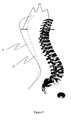
- Fig. 1 there is shown the devisl by witch a 3D spine reconstruction issued from any stereo X Ray system (1) is merged (or fused) with a 3D complete trunk shape reconstruction (2) to obtain 3D spine, trunk and rib cage reconstruction for volumetric assessment (3).
- the 3D spine reconstruction (1) can be issued form any stereotactic XR system, that could be either monomplane systems ( two separate acquisitions needed) or a by-plane system ( one acquisition system, such as in the EOS system, but not limited to this system).
- Fig. 2 shows how a stereo X ray acquisition system (4 and 5 is a simplified view of a XR emitting device and a XR digital Imaging Detector) can be used simultaneously or in sequences with an optical acquisition set up (6 is a simplified view of an optical acquisition system composed of a light source and a optical detector).
- the Optical Acquisition System 6 will create a 3D image (or shape) of back shape surface of the subject hereafter designed as "S1".
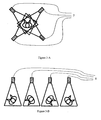
- Fig. 3-A explains how four optical acquisitions with equipment 6 can be performed simultaneously (7).
- One of theses four optical acquisitions set ups will generate a back shape surface of the subject hereafter designed as "S2".
- Fig. 3-B explains how four optical acquisitions performed successively (8).
- the subject is in standing position on a turn table or similar accessory to perform the four successive positions relating to the four optical acquisitions.
- One of theses four optical acquisitions will generate a complete 3D back shape surface of the subject hereafter designed as "S3".
- Fig. 4 and Fig. 5 illustrate the computerized principle used to evaluate, measure and correct the movements of the subject between the Optical Acquisition (9) performed as shown is Fig. 2 and the optical acquisition (10) as shown in Fig. 3-A or Fig. 3-B , prior to merging (or fusing) the 3D spine reconstruction and the 3D trunk shape reconstruction.
- an undeformable (or rigid) 3D calibration object (11) Prior to the acquisitions, an undeformable (or rigid) 3D calibration object (11) is placed on the object to image, and becomes a common part of S1 and S2 or S1 and S3.
- the aim of this 3D calibration object is to reposition both S1 and S2 or S1 and S3 in the same 3D / special referential system (12).
- the two back shapes ([S1] and [S2] or [S1] and [S3]) are placed in the same special reference system and the movements of the subject between the two acquisitions can be evaluated and corrected by the computing algorithm.
- the correction (13) is applied to the 3D spine reconstruction to be fitted to the actual subject positioning during the trunk shape acquisition, as illustrated on figure 4 .
- the reconstructed 3D spine and the 3D acquisition of the shape of the back are positioned in the same reference system, and their position is adjusted in reference of each other.
- the present invention guarantees this positioning.
- the three dimensional spine reconstruction and digitalized trunk shape are merged in the same axis system.
- the patient movements are taken into account and corrected during the merging process.
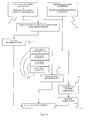
- Figure.6 is an illustration of the principle of the method and computed algorithms used to perform an accurate fusion of a 3D image or reconstruction of the spine with a full 3D image of the truck, which include specific algorithms to eliminate the patient movement between the different imaging sequences and accurately reposition the spine in the 3D volume of the trunk.
- the advantages of the present invention include, without limitation, (a) full compatibility with the different XRay stereotactic imaging apparatus and methods, (b) full compatibility with the different optical stereotactic imaging apparatus and methods (c) the elimination of patient movements between the different acquisition of images (d) the creation of a full 3D model of the trunk in witch a 3D model of the spine is accurately positioned (e) the subsequent analysis of this full 3D model to obtain an accurate analytical description that includes distances, angles in any 2D plane, (f) the subsequent analysis of this full 3D model to obtain an accurate volumetric of the trunck in relation to the position of the spine (g) that the algorithms are compatible with "of the self" hardware and/or clout computing platforms (h) that the 3D images and models that are elaborated and compatible with standard image exchange protocols in healthcare.
- the present invention is a method to fuse (merge) a full 3D image of the trunk and a 3D image (or reconstruction) of the spine into an accurate 3D image, for patients in standing position, to offer a 3D digital image that can be further processed to enables better delivery of care.
- the present invention is related to a specific
Landscapes
- Engineering & Computer Science (AREA)
- Physics & Mathematics (AREA)
- Theoretical Computer Science (AREA)
- General Physics & Mathematics (AREA)
- Medical Informatics (AREA)
- Radiology & Medical Imaging (AREA)
- Quality & Reliability (AREA)
- Computer Vision & Pattern Recognition (AREA)
- Nuclear Medicine, Radiotherapy & Molecular Imaging (AREA)
- Health & Medical Sciences (AREA)
- General Health & Medical Sciences (AREA)
- Computer Graphics (AREA)
- Geometry (AREA)
- Software Systems (AREA)
- Apparatus For Radiation Diagnosis (AREA)
Abstract
Description
- The present invention is in the technical field of biomedical simulation and reconstruction software.
- More particularly, the present invention is in the technical field of fusion of images between different imaging modalities. More particularly, the present invention is in the technical field of 3 dimensional imaging and simulation, and further processing and analysis of the information contained to obtain 3D parameters. More particularly, the present invention is in the technical field of the use of 3D parameters and models for medical applications.
- In terms of prior art, we would like to reference patent
PCT/FR2007051742 WO 2008/012479 ) by Fouad Elbaroudi and Bertrand Blanchard, ("Computerized imaging method for a three-dimensional reconstruction from two-dimensional radiological images; implementation device"). One of the application of this patent, which is a fusion method for between the spine and back shape. - Additional prior art has been published in the area of computed
tomography 3D rendering techniques, with the major shortcoming that (1) the body is lying on a table and (2) XR doses are very high. - Additional prior art has been published by the company that has designed and is manufacturing the EOS system, with the major shortcoming that only
partial trunk surface 3D reconstruction/imaging is performed. - Additional prior art has been published in the area of optical 3D reconstruction of shapes and surfaces, with the major shortcoming that the images obtained have not be fused with XR imaging modalities.
- Additional prior art has been published in the area of 3D reconstruction of the spine with the major shortcoming that the 3D reconstruction of the spine has not been fused with the entire shape of the trunk.
- The present invention is related to a specific method for merging (or fusing) three dimensional reconstruction or images of set of bone joints and the full three dimensional image of the related external shape.
- This method allows further analysis of the 3 dimensional parameters and volumetric parameters for medical applications.
- The 3D reconstruction or image of the set of bone joints can be issued from any stereo x-ray system or rendering (hereafter called Stereo Acquisition) such as and not limited to Biomod 3S system or the EOS system.
- The 3D Trunk shape image or reconstruction can be issued from any 3D optical scan for trunk shape applications such as, but not limited to the ORTEN or RODIN4D systems.
- For easy understanding only, the following description relates to the application of such method to the spine and trunk of a patient in standing position.
-
-
Fig. 1 is a visual illustration of the 3D fusion principle and results -
Fig. 2 is an illustration of an example of a XRay Stereotactic imaging system and simultaneous optical acquisition -
Fig. 3-A is an illustration of an example of a 3D optical Scan of the external shape such as theTrunk using 4 light based acquisitions set up to perform four simultaneous acquisitions. -
Fig. 3-B is an illustration of an example of a 3D optical Scan of the external shape such as the trunk using one light based acquisitions set up combined with a turn table to perform 4 successive acquisitions. -
Fig. 4 is an illustration of the principle used to merge (or fuse) the Optical Acquisition/ reconstruction issued fromFig. 2 and the optical Acquisition/reconstruction issued either fromFig. 3-A or Fig. 3-B -
Fig. 5 is an illustration of the principle used to adjust the position of the 3D reconstruction (or image) of the Spine into the full 3D shape of the trunk. -
Fig..6 is an illustration of the principle of the method and computed algorithms used to perform an accurate fusion of a 3D image or reconstruction of the spine with a full 3D image of the truck, which include specific algorithms to eliminate the patient movement between the different imaging sequences and accurately reposition the spine in the 3D volume of the trunk. - Referring now to the invention in more detail, in
Fig. 1 there is shown the principel by witch a 3D spine reconstruction issued from any stereo X Ray system (1) is merged (or fused) with a 3D complete trunk shape reconstruction (2) to obtain 3D spine, trunk and rib cage reconstruction for volumetric assessment (3). - The 3D spine reconstruction (1) can be issued form any stereotactic XR system, that could be either monomplane systems ( two separate acquisitions needed) or a by-plane system ( one acquisition system, such as in the EOS system, but not limited to this system).
- In more detail, still referring to the invention and specifically to the creation of (1),
Fig. 2 shows how a stereo X ray acquisition system (4 and 5 is a simplified view of a XR emitting device and a XR digital Imaging Detector) can be used simultaneously or in sequences with an optical acquisition set up (6 is a simplified view of an optical acquisition system composed of a light source and a optical detector). The Optical Acquisition System 6 will create a 3D image (or shape) of back shape surface of the subject hereafter designed as "S1". - In all these set up, the patient is in standing position.
- In more detail, still referring to the invention and specifically to discuss the 3D complete trunk shape reconstruction (2),
Fig. 3-A explains how four optical acquisitions withequipment 6 can be performed simultaneously (7). One of theses four optical acquisitions set ups will generate a back shape surface of the subject hereafter designed as "S2". - In more detail, still referring to the invention and specifically to discuss the 3D complete trunk shape reconstruction (2)
Fig. 3-B explains how four optical acquisitions performed successively (8). The subject is in standing position on a turn table or similar accessory to perform the four successive positions relating to the four optical acquisitions. One of theses four optical acquisitions will generate a complete 3D back shape surface of the subject hereafter designed as "S3". - In more detail, still referring to the invention and specifically to (3),
Fig. 4 andFig. 5 illustrate the computerized principle used to evaluate, measure and correct the movements of the subject between the Optical Acquisition (9) performed as shown isFig. 2 and the optical acquisition (10) as shown inFig. 3-A or Fig. 3-B , prior to merging (or fusing) the 3D spine reconstruction and the 3D trunk shape reconstruction. - Prior to the acquisitions, an undeformable (or rigid) 3D calibration object (11) is placed on the object to image, and becomes a common part of S1 and S2 or S1 and S3. The aim of this 3D calibration object is to reposition both S1 and S2 or S1 and S3 in the same 3D / special referential system (12).
- The two back shapes ([S1] and [S2] or [S1] and [S3]) are placed in the same special reference system and the movements of the subject between the two acquisitions can be evaluated and corrected by the computing algorithm. The correction (13) is applied to the 3D spine reconstruction to be fitted to the actual subject positioning during the trunk shape acquisition, as illustrated on
figure 4 . - As a result of this computing sequence, the reconstructed 3D spine and the 3D acquisition of the shape of the back are positioned in the same reference system, and their position is adjusted in reference of each other. The present invention guarantees this positioning.
- At this final step the three dimensional spine reconstruction and digitalized trunk shape are merged in the same axis system. The patient movements are taken into account and corrected during the merging process.
- In summary,
Figure.6 is an illustration of the principle of the method and computed algorithms used to perform an accurate fusion of a 3D image or reconstruction of the spine with a full 3D image of the truck, which include specific algorithms to eliminate the patient movement between the different imaging sequences and accurately reposition the spine in the 3D volume of the trunk. - The advantages of the present invention include, without limitation, (a) full compatibility with the different XRay stereotactic imaging apparatus and methods, (b) full compatibility with the different optical stereotactic imaging apparatus and methods (c) the elimination of patient movements between the different acquisition of images (d) the creation of a full 3D model of the trunk in witch a 3D model of the spine is accurately positioned (e) the subsequent analysis of this full 3D model to obtain an accurate analytical description that includes distances, angles in any 2D plane, (f) the subsequent analysis of this full 3D model to obtain an accurate volumetric of the trunck in relation to the position of the spine (g) that the algorithms are compatible with "of the self" hardware and/or clout computing platforms (h) that the 3D images and models that are elaborated and compatible with standard image exchange protocols in healthcare.
- In broad embodiment, the present invention is a method to fuse (merge) a full 3D image of the trunk and a 3D image (or reconstruction) of the spine into an accurate 3D image, for patients in standing position, to offer a 3D digital image that can be further processed to enables better delivery of care. (See claims)
- While the foregoing written description of the invention enables one of ordinary skill to make and use what is considered presently to be the best mode thereof, those of ordinary skill will understand and appreciate the existence of variations, combinations, and equivalents of the specific embodiment, method, and examples herein. The invention should therefore not be limited by the above described embodiment, method, and examples, but by all embodiments and methods within the scope and spirit of the invention.
- The present invention is related to a specific
Claims (7)
- a method for merging (or fusing) three dimensional reconstruction or images of set of bone joints and the full three dimensional image of the related external shape.
- a method that allows further analysis of the 3 dimensional parameters and volumetric parameters for medical applications.
- a method for performing the fusion of a stereotactic image or reconstruction of the spine with a full (360 degrees) stereotactic image of the truck in standing position
- a method to obtain the full three dimensional characterization (angles, distances) of the spine, the shape of the trunk and the relative positions of the the spine to the surface of the trunk, in any 2D cross section
- a method to obtain the full volumetric analysis of the truck, or sections of the trunk
- the application of the method per claim number 1 and the data generated per claims number 2 and 3 to medicine in general, and in particular in following medical fields:(a) Spinal Deformity characterization(b) Orthopedic surgery planification(c) Orthopedic surgery quality control(d) Rib cage 2D and volumetric measurements(e) Respiratory Functional Assesment(f) Detection of spine deformities(g) Follow up and / or personalization of rehabilitation protocols(h) Deformity Brace design and / or selection(e) Spine Implant, design and / or selection(j) Correlation of Aesthetic parameters with the spine position and shape
- the application of the method per claim number 1 and the data generated per claims number 2 and 3 to life sciences in general, and in particular in animal health and pre-clinical research (small animals research)
Applications Claiming Priority (1)
| Application Number | Priority Date | Filing Date | Title |
|---|---|---|---|
| US25053909P | 2009-10-11 | 2009-10-11 |
Publications (2)
| Publication Number | Publication Date |
|---|---|
| EP2323101A2 true EP2323101A2 (en) | 2011-05-18 |
| EP2323101A3 EP2323101A3 (en) | 2011-06-22 |
Family
ID=43532616
Family Applications (1)
| Application Number | Title | Priority Date | Filing Date |
|---|---|---|---|
| EP10306105A Withdrawn EP2323101A3 (en) | 2009-10-11 | 2010-10-11 | Method for 3D spine and full 3D trunk imaging fusion in standing position |
Country Status (2)
| Country | Link |
|---|---|
| US (1) | US20110135173A1 (en) |
| EP (1) | EP2323101A3 (en) |
Cited By (5)
| Publication number | Priority date | Publication date | Assignee | Title |
|---|---|---|---|---|
| CN105225271A (en) * | 2015-11-09 | 2016-01-06 | 浙江海洋学院 | A kind of planktonic long-range real time image collection in waters and three-dimensional reconstruction system |
| CN106570852A (en) * | 2016-11-07 | 2017-04-19 | 中国航空无线电电子研究所 | Real-time 3D image situation perception method |
| CN107451983A (en) * | 2017-07-18 | 2017-12-08 | 中山大学附属第六医院 | The three-dimensional fusion method and system of CT images |
| FR3071715A1 (en) * | 2017-10-03 | 2019-04-05 | Proteor | RADIOGRAPHIC IMAGING METHOD, RADIOGRAPHIC IMAGE PROCESSING DEVICE, AND RADIOGRAPHIC IMAGING DEVICE. |
| CN120298415A (en) * | 2025-06-13 | 2025-07-11 | 中国科学院合肥物质科学研究院 | Three-dimensional evaluation method and system of spine based on RGB images and anatomical constraints |
Families Citing this family (16)
| Publication number | Priority date | Publication date | Assignee | Title |
|---|---|---|---|---|
| US9824302B2 (en) | 2011-03-09 | 2017-11-21 | Siemens Healthcare Gmbh | Method and system for model-based fusion of multi-modal volumetric images |
| US9292917B2 (en) | 2011-11-23 | 2016-03-22 | Siemens Aktiengesellschaft | Method and system for model-based fusion of computed tomography and non-contrasted C-arm computed tomography |
| US9384546B2 (en) | 2012-02-22 | 2016-07-05 | Siemens Aktiengesellschaft | Method and system for pericardium based model fusion of pre-operative and intra-operative image data for cardiac interventions |
| US10846860B2 (en) | 2013-03-05 | 2020-11-24 | Nview Medical Inc. | Systems and methods for x-ray tomosynthesis image reconstruction |
| US10070828B2 (en) | 2013-03-05 | 2018-09-11 | Nview Medical Inc. | Imaging systems and related apparatus and methods |
| JP7086929B2 (en) * | 2017-03-10 | 2022-06-20 | ソニー・オリンパスメディカルソリューションズ株式会社 | Medical information processing system |
| US10102682B1 (en) * | 2017-04-17 | 2018-10-16 | Raytheon Company | System and method for combining 3D images in color |
| CN107610218B (en) * | 2017-08-25 | 2020-10-23 | 武汉工程大学 | A slice data acquisition method for 3D image reconstruction of three-dimensional structure dots |
| US11610346B2 (en) | 2017-09-22 | 2023-03-21 | Nview Medical Inc. | Image reconstruction using machine learning regularizers |
| US11475558B2 (en) | 2019-11-13 | 2022-10-18 | Raytheon Company | Organ isolation in scan data |
| US11282209B2 (en) | 2020-01-10 | 2022-03-22 | Raytheon Company | System and method for generating contours |
| CN111772584B (en) * | 2020-07-08 | 2022-08-09 | 莆田学院附属医院(莆田市第二医院) | Digital operation device of intelligence backbone |
| US12347100B2 (en) | 2020-11-19 | 2025-07-01 | Mazor Robotics Ltd. | Systems and methods for generating virtual images |
| US11562512B2 (en) | 2020-12-09 | 2023-01-24 | Raytheon Company | System and method for generating and displaying contours |
| US11893745B2 (en) | 2020-12-09 | 2024-02-06 | Raytheon Company | System and method for generating and displaying contours |
| CN114732429A (en) * | 2022-04-08 | 2022-07-12 | 深圳市安健科技股份有限公司 | DR equipment-based three-dimensional image acquisition method and system |
Citations (1)
| Publication number | Priority date | Publication date | Assignee | Title |
|---|---|---|---|---|
| WO2008012479A1 (en) | 2006-07-27 | 2008-01-31 | Axs Ingenierie | computerized imaging method for a three-dimensional reconstruction from two-dimensional radiological images; IMPLEMENTATION DEVICE |
-
2010
- 2010-10-11 EP EP10306105A patent/EP2323101A3/en not_active Withdrawn
- 2010-10-12 US US12/902,708 patent/US20110135173A1/en not_active Abandoned
Patent Citations (1)
| Publication number | Priority date | Publication date | Assignee | Title |
|---|---|---|---|---|
| WO2008012479A1 (en) | 2006-07-27 | 2008-01-31 | Axs Ingenierie | computerized imaging method for a three-dimensional reconstruction from two-dimensional radiological images; IMPLEMENTATION DEVICE |
Non-Patent Citations (1)
| Title |
|---|
| AJEMBA P O ET AL: "A Torso-Imaging System to Quantify the Deformity Associated With Scoliosis", IEEE TRANSACTIONS ON INSTRUMENTATION AND MEASUREMENT, IEEE SERVICE CENTER, PISCATAWAY, NJ, US, vol. 56, no. 5, 1 October 2007 (2007-10-01), pages 1520 - 1526, XP011192288, ISSN: 0018-9456, DOI: 10.1109/TIM.2007.903592 * |
Cited By (8)
| Publication number | Priority date | Publication date | Assignee | Title |
|---|---|---|---|---|
| CN105225271A (en) * | 2015-11-09 | 2016-01-06 | 浙江海洋学院 | A kind of planktonic long-range real time image collection in waters and three-dimensional reconstruction system |
| CN106570852A (en) * | 2016-11-07 | 2017-04-19 | 中国航空无线电电子研究所 | Real-time 3D image situation perception method |
| CN106570852B (en) * | 2016-11-07 | 2019-12-03 | 中国航空无线电电子研究所 | A kind of real-time 3D rendering Situation Awareness method |
| CN107451983A (en) * | 2017-07-18 | 2017-12-08 | 中山大学附属第六医院 | The three-dimensional fusion method and system of CT images |
| FR3071715A1 (en) * | 2017-10-03 | 2019-04-05 | Proteor | RADIOGRAPHIC IMAGING METHOD, RADIOGRAPHIC IMAGE PROCESSING DEVICE, AND RADIOGRAPHIC IMAGING DEVICE. |
| WO2019069001A1 (en) * | 2017-10-03 | 2019-04-11 | Proteor | Radiographic imaging method, radiographic image processing device, and radiographic imaging device |
| US11430110B2 (en) | 2017-10-03 | 2022-08-30 | Proteor | Radiographic imaging method, radiographic image processing device, and radiographic imaging device |
| CN120298415A (en) * | 2025-06-13 | 2025-07-11 | 中国科学院合肥物质科学研究院 | Three-dimensional evaluation method and system of spine based on RGB images and anatomical constraints |
Also Published As
| Publication number | Publication date |
|---|---|
| EP2323101A3 (en) | 2011-06-22 |
| US20110135173A1 (en) | 2011-06-09 |
Similar Documents
| Publication | Publication Date | Title |
|---|---|---|
| US20110135173A1 (en) | Method for 3d spine and full 3d trunk imaging fusion in standing position | |
| ES2716837T3 (en) | Automatic detection of implants from image artifacts | |
| Aubry et al. | Measurements of intrafraction motion and interfraction and intrafraction rotation of prostate by three-dimensional analysis of daily portal imaging with radiopaque markers | |
| ES2987933T3 (en) | Method for determining the position of an object by using marker or strut projections | |
| US20190000564A1 (en) | System and method for medical imaging | |
| De Silva et al. | Virtual fluoroscopy for intraoperative C-arm positioning and radiation dose reduction | |
| Galantucci et al. | Noninvasive computerized scanning method for the correlation between the facial soft and hard tissues for an integrated three-dimensional anthropometry and cephalometry | |
| Muhit et al. | Image-assisted non-invasive and dynamic biomechanical analysis of human joints | |
| JP2024526601A (en) | Systems and methods for creating patient-specific guides for orthopaedic surgery using photogrammetry - Patents.com | |
| Kadoury et al. | Three-dimensional reconstruction of the scoliotic spine and pelvis from uncalibrated biplanar x-ray images | |
| KR20160057024A (en) | Markerless 3D Object Tracking Apparatus and Method therefor | |
| US9254106B2 (en) | Method for completing a medical image data set | |
| US20250152118A1 (en) | Method To Superimpose Rendering Over Spine Hardware Implants On Images Produced By Cbct Scanner System | |
| Hocquelet et al. | Patient-specific 3D models created by 3D imaging system or bi-planar imaging coupled with Moiré–Fringe projections: a comparative study of accuracy and reliability on spinal curvatures and vertebral rotation data | |
| Douglas et al. | Three-dimensional point localisation in low-dose X-ray images using stereo-photogrammetry | |
| JP7738655B2 (en) | Guidance for patient positioning during medical imaging | |
| Broberg et al. | Radiostereometric analysis using clinical radiographic views: development of a universal calibration object | |
| Galantucci et al. | New 3D digitizer for human faces based on digital close range photogrammetry: Application to face symmetry analysis | |
| Rashed et al. | An interactive augmented reality imaging system for minimally invasive orthopedic surgery | |
| Zeng et al. | Low‐dose three‐dimensional reconstruction of the femur with unit free‐form deformation | |
| Tersi et al. | 3D elbow kinematics with monoplanar fluoroscopy: in silico evaluation | |
| Yoo et al. | Three-dimensional localization of cochlear implant electrodes using epipolar stereophotogrammetry | |
| Albiol et al. | 3D measurements in conventional X-ray imaging with RGB-D sensors | |
| JP7841179B2 (en) | Image reconstruction methods for medical systems | |
| EP3379438A1 (en) | Customized implant creation |
Legal Events
| Date | Code | Title | Description |
|---|---|---|---|
| PUAI | Public reference made under article 153(3) epc to a published international application that has entered the european phase |
Free format text: ORIGINAL CODE: 0009012 |
|
| AK | Designated contracting states |
Kind code of ref document: A2 Designated state(s): AL AT BE BG CH CY CZ DE DK EE ES FI FR GB GR HR HU IE IS IT LI LT LU LV MC MK MT NL NO PL PT RO RS SE SI SK SM TR |
|
| AX | Request for extension of the european patent |
Extension state: BA ME |
|
| PUAL | Search report despatched |
Free format text: ORIGINAL CODE: 0009013 |
|
| RIN1 | Information on inventor provided before grant (corrected) |
Inventor name: BLANCHARD, BERTRAND Inventor name: ELBAROUDI, FOUAD |
|
| AK | Designated contracting states |
Kind code of ref document: A3 Designated state(s): AL AT BE BG CH CY CZ DE DK EE ES FI FR GB GR HR HU IE IS IT LI LT LU LV MC MK MT NL NO PL PT RO RS SE SI SK SM TR |
|
| AX | Request for extension of the european patent |
Extension state: BA ME |
|
| RIC1 | Information provided on ipc code assigned before grant |
Ipc: G06T 17/00 20060101ALI20110517BHEP Ipc: G06T 7/00 20060101AFI20110210BHEP |
|
| 17P | Request for examination filed |
Effective date: 20111206 |
|
| 17Q | First examination report despatched |
Effective date: 20120216 |
|
| STAA | Information on the status of an ep patent application or granted ep patent |
Free format text: STATUS: THE APPLICATION IS DEEMED TO BE WITHDRAWN |
|
| 18D | Application deemed to be withdrawn |
Effective date: 20130409 |